EP1758905B1 - 8-[3-amino-piperidin-1-yl]-xanthine, deren herstellung und deren verwendung als dpp-iv hemmer - Google Patents
8-[3-amino-piperidin-1-yl]-xanthine, deren herstellung und deren verwendung als dpp-iv hemmer Download PDFInfo
- Publication number
- EP1758905B1 EP1758905B1 EP05707354A EP05707354A EP1758905B1 EP 1758905 B1 EP1758905 B1 EP 1758905B1 EP 05707354 A EP05707354 A EP 05707354A EP 05707354 A EP05707354 A EP 05707354A EP 1758905 B1 EP1758905 B1 EP 1758905B1
- Authority
- EP
- European Patent Office
- Prior art keywords
- methyl
- cyano
- esi
- benzyl
- piperidin
- Prior art date
- Legal status (The legal status is an assumption and is not a legal conclusion. Google has not performed a legal analysis and makes no representation as to the accuracy of the status listed.)
- Expired - Lifetime
Links
- 0 CC#CC[n]1c(N(CCC2)C[C@@]2N)nc(N(C)C(N2*)=O)c1C2=O Chemical compound CC#CC[n]1c(N(CCC2)C[C@@]2N)nc(N(C)C(N2*)=O)c1C2=O 0.000 description 1
Classifications
-
- C—CHEMISTRY; METALLURGY
- C07—ORGANIC CHEMISTRY
- C07D—HETEROCYCLIC COMPOUNDS
- C07D473/00—Heterocyclic compounds containing purine ring systems
- C07D473/02—Heterocyclic compounds containing purine ring systems with oxygen, sulphur, or nitrogen atoms directly attached in positions 2 and 6
- C07D473/04—Heterocyclic compounds containing purine ring systems with oxygen, sulphur, or nitrogen atoms directly attached in positions 2 and 6 two oxygen atoms
-
- C—CHEMISTRY; METALLURGY
- C07—ORGANIC CHEMISTRY
- C07D—HETEROCYCLIC COMPOUNDS
- C07D473/00—Heterocyclic compounds containing purine ring systems
- C07D473/02—Heterocyclic compounds containing purine ring systems with oxygen, sulphur, or nitrogen atoms directly attached in positions 2 and 6
- C07D473/04—Heterocyclic compounds containing purine ring systems with oxygen, sulphur, or nitrogen atoms directly attached in positions 2 and 6 two oxygen atoms
- C07D473/06—Heterocyclic compounds containing purine ring systems with oxygen, sulphur, or nitrogen atoms directly attached in positions 2 and 6 two oxygen atoms with radicals containing only hydrogen and carbon atoms, attached in position 1 or 3
-
- A—HUMAN NECESSITIES
- A61—MEDICAL OR VETERINARY SCIENCE; HYGIENE
- A61K—PREPARATIONS FOR MEDICAL, DENTAL OR TOILETRY PURPOSES
- A61K31/00—Medicinal preparations containing organic active ingredients
- A61K31/33—Heterocyclic compounds
- A61K31/395—Heterocyclic compounds having nitrogen as a ring hetero atom, e.g. guanethidine or rifamycins
- A61K31/435—Heterocyclic compounds having nitrogen as a ring hetero atom, e.g. guanethidine or rifamycins having six-membered rings with one nitrogen as the only ring hetero atom
- A61K31/44—Non condensed pyridines; Hydrogenated derivatives thereof
-
- A—HUMAN NECESSITIES
- A61—MEDICAL OR VETERINARY SCIENCE; HYGIENE
- A61P—SPECIFIC THERAPEUTIC ACTIVITY OF CHEMICAL COMPOUNDS OR MEDICINAL PREPARATIONS
- A61P1/00—Drugs for disorders of the alimentary tract or the digestive system
- A61P1/02—Stomatological preparations, e.g. drugs for caries, aphtae, periodontitis
-
- A—HUMAN NECESSITIES
- A61—MEDICAL OR VETERINARY SCIENCE; HYGIENE
- A61P—SPECIFIC THERAPEUTIC ACTIVITY OF CHEMICAL COMPOUNDS OR MEDICINAL PREPARATIONS
- A61P1/00—Drugs for disorders of the alimentary tract or the digestive system
- A61P1/04—Drugs for disorders of the alimentary tract or the digestive system for ulcers, gastritis or reflux esophagitis, e.g. antacids, inhibitors of acid secretion, mucosal protectants
-
- A—HUMAN NECESSITIES
- A61—MEDICAL OR VETERINARY SCIENCE; HYGIENE
- A61P—SPECIFIC THERAPEUTIC ACTIVITY OF CHEMICAL COMPOUNDS OR MEDICINAL PREPARATIONS
- A61P1/00—Drugs for disorders of the alimentary tract or the digestive system
- A61P1/18—Drugs for disorders of the alimentary tract or the digestive system for pancreatic disorders, e.g. pancreatic enzymes
-
- A—HUMAN NECESSITIES
- A61—MEDICAL OR VETERINARY SCIENCE; HYGIENE
- A61P—SPECIFIC THERAPEUTIC ACTIVITY OF CHEMICAL COMPOUNDS OR MEDICINAL PREPARATIONS
- A61P13/00—Drugs for disorders of the urinary system
- A61P13/08—Drugs for disorders of the urinary system of the prostate
-
- A—HUMAN NECESSITIES
- A61—MEDICAL OR VETERINARY SCIENCE; HYGIENE
- A61P—SPECIFIC THERAPEUTIC ACTIVITY OF CHEMICAL COMPOUNDS OR MEDICINAL PREPARATIONS
- A61P13/00—Drugs for disorders of the urinary system
- A61P13/12—Drugs for disorders of the urinary system of the kidneys
-
- A—HUMAN NECESSITIES
- A61—MEDICAL OR VETERINARY SCIENCE; HYGIENE
- A61P—SPECIFIC THERAPEUTIC ACTIVITY OF CHEMICAL COMPOUNDS OR MEDICINAL PREPARATIONS
- A61P15/00—Drugs for genital or sexual disorders; Contraceptives
- A61P15/08—Drugs for genital or sexual disorders; Contraceptives for gonadal disorders or for enhancing fertility, e.g. inducers of ovulation or of spermatogenesis
-
- A—HUMAN NECESSITIES
- A61—MEDICAL OR VETERINARY SCIENCE; HYGIENE
- A61P—SPECIFIC THERAPEUTIC ACTIVITY OF CHEMICAL COMPOUNDS OR MEDICINAL PREPARATIONS
- A61P15/00—Drugs for genital or sexual disorders; Contraceptives
- A61P15/16—Masculine contraceptives
-
- A—HUMAN NECESSITIES
- A61—MEDICAL OR VETERINARY SCIENCE; HYGIENE
- A61P—SPECIFIC THERAPEUTIC ACTIVITY OF CHEMICAL COMPOUNDS OR MEDICINAL PREPARATIONS
- A61P17/00—Drugs for dermatological disorders
-
- A—HUMAN NECESSITIES
- A61—MEDICAL OR VETERINARY SCIENCE; HYGIENE
- A61P—SPECIFIC THERAPEUTIC ACTIVITY OF CHEMICAL COMPOUNDS OR MEDICINAL PREPARATIONS
- A61P17/00—Drugs for dermatological disorders
- A61P17/06—Antipsoriatics
-
- A—HUMAN NECESSITIES
- A61—MEDICAL OR VETERINARY SCIENCE; HYGIENE
- A61P—SPECIFIC THERAPEUTIC ACTIVITY OF CHEMICAL COMPOUNDS OR MEDICINAL PREPARATIONS
- A61P19/00—Drugs for skeletal disorders
- A61P19/02—Drugs for skeletal disorders for joint disorders, e.g. arthritis, arthrosis
-
- A—HUMAN NECESSITIES
- A61—MEDICAL OR VETERINARY SCIENCE; HYGIENE
- A61P—SPECIFIC THERAPEUTIC ACTIVITY OF CHEMICAL COMPOUNDS OR MEDICINAL PREPARATIONS
- A61P19/00—Drugs for skeletal disorders
- A61P19/08—Drugs for skeletal disorders for bone diseases, e.g. rachitism, Paget's disease
- A61P19/10—Drugs for skeletal disorders for bone diseases, e.g. rachitism, Paget's disease for osteoporosis
-
- A—HUMAN NECESSITIES
- A61—MEDICAL OR VETERINARY SCIENCE; HYGIENE
- A61P—SPECIFIC THERAPEUTIC ACTIVITY OF CHEMICAL COMPOUNDS OR MEDICINAL PREPARATIONS
- A61P25/00—Drugs for disorders of the nervous system
-
- A—HUMAN NECESSITIES
- A61—MEDICAL OR VETERINARY SCIENCE; HYGIENE
- A61P—SPECIFIC THERAPEUTIC ACTIVITY OF CHEMICAL COMPOUNDS OR MEDICINAL PREPARATIONS
- A61P25/00—Drugs for disorders of the nervous system
- A61P25/06—Antimigraine agents
-
- A—HUMAN NECESSITIES
- A61—MEDICAL OR VETERINARY SCIENCE; HYGIENE
- A61P—SPECIFIC THERAPEUTIC ACTIVITY OF CHEMICAL COMPOUNDS OR MEDICINAL PREPARATIONS
- A61P25/00—Drugs for disorders of the nervous system
- A61P25/14—Drugs for disorders of the nervous system for treating abnormal movements, e.g. chorea, dyskinesia
- A61P25/16—Anti-Parkinson drugs
-
- A—HUMAN NECESSITIES
- A61—MEDICAL OR VETERINARY SCIENCE; HYGIENE
- A61P—SPECIFIC THERAPEUTIC ACTIVITY OF CHEMICAL COMPOUNDS OR MEDICINAL PREPARATIONS
- A61P25/00—Drugs for disorders of the nervous system
- A61P25/24—Antidepressants
-
- A—HUMAN NECESSITIES
- A61—MEDICAL OR VETERINARY SCIENCE; HYGIENE
- A61P—SPECIFIC THERAPEUTIC ACTIVITY OF CHEMICAL COMPOUNDS OR MEDICINAL PREPARATIONS
- A61P25/00—Drugs for disorders of the nervous system
- A61P25/28—Drugs for disorders of the nervous system for treating neurodegenerative disorders of the central nervous system, e.g. nootropic agents, cognition enhancers, drugs for treating Alzheimer's disease or other forms of dementia
-
- A—HUMAN NECESSITIES
- A61—MEDICAL OR VETERINARY SCIENCE; HYGIENE
- A61P—SPECIFIC THERAPEUTIC ACTIVITY OF CHEMICAL COMPOUNDS OR MEDICINAL PREPARATIONS
- A61P29/00—Non-central analgesic, antipyretic or antiinflammatory agents, e.g. antirheumatic agents; Non-steroidal antiinflammatory drugs [NSAID]
-
- A—HUMAN NECESSITIES
- A61—MEDICAL OR VETERINARY SCIENCE; HYGIENE
- A61P—SPECIFIC THERAPEUTIC ACTIVITY OF CHEMICAL COMPOUNDS OR MEDICINAL PREPARATIONS
- A61P3/00—Drugs for disorders of the metabolism
-
- A—HUMAN NECESSITIES
- A61—MEDICAL OR VETERINARY SCIENCE; HYGIENE
- A61P—SPECIFIC THERAPEUTIC ACTIVITY OF CHEMICAL COMPOUNDS OR MEDICINAL PREPARATIONS
- A61P3/00—Drugs for disorders of the metabolism
- A61P3/04—Anorexiants; Antiobesity agents
-
- A—HUMAN NECESSITIES
- A61—MEDICAL OR VETERINARY SCIENCE; HYGIENE
- A61P—SPECIFIC THERAPEUTIC ACTIVITY OF CHEMICAL COMPOUNDS OR MEDICINAL PREPARATIONS
- A61P3/00—Drugs for disorders of the metabolism
- A61P3/08—Drugs for disorders of the metabolism for glucose homeostasis
- A61P3/10—Drugs for disorders of the metabolism for glucose homeostasis for hyperglycaemia, e.g. antidiabetics
-
- A—HUMAN NECESSITIES
- A61—MEDICAL OR VETERINARY SCIENCE; HYGIENE
- A61P—SPECIFIC THERAPEUTIC ACTIVITY OF CHEMICAL COMPOUNDS OR MEDICINAL PREPARATIONS
- A61P31/00—Antiinfectives, i.e. antibiotics, antiseptics, chemotherapeutics
- A61P31/12—Antivirals
-
- A—HUMAN NECESSITIES
- A61—MEDICAL OR VETERINARY SCIENCE; HYGIENE
- A61P—SPECIFIC THERAPEUTIC ACTIVITY OF CHEMICAL COMPOUNDS OR MEDICINAL PREPARATIONS
- A61P31/00—Antiinfectives, i.e. antibiotics, antiseptics, chemotherapeutics
- A61P31/12—Antivirals
- A61P31/14—Antivirals for RNA viruses
- A61P31/18—Antivirals for RNA viruses for HIV
-
- A—HUMAN NECESSITIES
- A61—MEDICAL OR VETERINARY SCIENCE; HYGIENE
- A61P—SPECIFIC THERAPEUTIC ACTIVITY OF CHEMICAL COMPOUNDS OR MEDICINAL PREPARATIONS
- A61P35/00—Antineoplastic agents
-
- A—HUMAN NECESSITIES
- A61—MEDICAL OR VETERINARY SCIENCE; HYGIENE
- A61P—SPECIFIC THERAPEUTIC ACTIVITY OF CHEMICAL COMPOUNDS OR MEDICINAL PREPARATIONS
- A61P35/00—Antineoplastic agents
- A61P35/02—Antineoplastic agents specific for leukemia
-
- A—HUMAN NECESSITIES
- A61—MEDICAL OR VETERINARY SCIENCE; HYGIENE
- A61P—SPECIFIC THERAPEUTIC ACTIVITY OF CHEMICAL COMPOUNDS OR MEDICINAL PREPARATIONS
- A61P35/00—Antineoplastic agents
- A61P35/04—Antineoplastic agents specific for metastasis
-
- A—HUMAN NECESSITIES
- A61—MEDICAL OR VETERINARY SCIENCE; HYGIENE
- A61P—SPECIFIC THERAPEUTIC ACTIVITY OF CHEMICAL COMPOUNDS OR MEDICINAL PREPARATIONS
- A61P37/00—Drugs for immunological or allergic disorders
- A61P37/02—Immunomodulators
- A61P37/06—Immunosuppressants, e.g. drugs for graft rejection
-
- A—HUMAN NECESSITIES
- A61—MEDICAL OR VETERINARY SCIENCE; HYGIENE
- A61P—SPECIFIC THERAPEUTIC ACTIVITY OF CHEMICAL COMPOUNDS OR MEDICINAL PREPARATIONS
- A61P43/00—Drugs for specific purposes, not provided for in groups A61P1/00-A61P41/00
-
- A—HUMAN NECESSITIES
- A61—MEDICAL OR VETERINARY SCIENCE; HYGIENE
- A61P—SPECIFIC THERAPEUTIC ACTIVITY OF CHEMICAL COMPOUNDS OR MEDICINAL PREPARATIONS
- A61P5/00—Drugs for disorders of the endocrine system
-
- A—HUMAN NECESSITIES
- A61—MEDICAL OR VETERINARY SCIENCE; HYGIENE
- A61P—SPECIFIC THERAPEUTIC ACTIVITY OF CHEMICAL COMPOUNDS OR MEDICINAL PREPARATIONS
- A61P5/00—Drugs for disorders of the endocrine system
- A61P5/02—Drugs for disorders of the endocrine system of the hypothalamic hormones, e.g. TRH, GnRH, CRH, GRH, somatostatin
-
- A—HUMAN NECESSITIES
- A61—MEDICAL OR VETERINARY SCIENCE; HYGIENE
- A61P—SPECIFIC THERAPEUTIC ACTIVITY OF CHEMICAL COMPOUNDS OR MEDICINAL PREPARATIONS
- A61P7/00—Drugs for disorders of the blood or the extracellular fluid
- A61P7/10—Antioedematous agents; Diuretics
-
- A—HUMAN NECESSITIES
- A61—MEDICAL OR VETERINARY SCIENCE; HYGIENE
- A61P—SPECIFIC THERAPEUTIC ACTIVITY OF CHEMICAL COMPOUNDS OR MEDICINAL PREPARATIONS
- A61P9/00—Drugs for disorders of the cardiovascular system
- A61P9/10—Drugs for disorders of the cardiovascular system for treating ischaemic or atherosclerotic diseases, e.g. antianginal drugs, coronary vasodilators, drugs for myocardial infarction, retinopathy, cerebrovascula insufficiency, renal arteriosclerosis
-
- A—HUMAN NECESSITIES
- A61—MEDICAL OR VETERINARY SCIENCE; HYGIENE
- A61P—SPECIFIC THERAPEUTIC ACTIVITY OF CHEMICAL COMPOUNDS OR MEDICINAL PREPARATIONS
- A61P9/00—Drugs for disorders of the cardiovascular system
- A61P9/12—Antihypertensives
Definitions
- the present invention relates to novel substituted xanthines of the general formula their tautomers, enantiomers, diastereomers, their mixtures and their salts, in particular their physiologically tolerated salts with inorganic or organic acids, which have valuable pharmacological properties, in particular an inhibitory action on the activity of the enzyme dipeptidyl peptidase-IV (DPP-IV), their preparation, their use for the prevention or treatment of diseases or conditions associated with increased DPP-IV activity or which may be prevented or alleviated by reduction of DPP-IV activity, in particular diabetes mellitus type I or type II, which is a compound of the general formula (I) or a physiologically acceptable salt thereof containing medicaments and process for their preparation.
- DPP-IV dipeptidyl peptidase-IV
- Xanthine derivatives with an inhibitory effect on DPP-IV are already out WO 02/068420 .
- WO 02/02560 WO 03/004496 .
- WO 03/024965 WO 04/018468 .
- WO 04/048379 JP 2003300977 and EP 1 338 595 known.
- R is a benzyl, 2-fluorobenzyl, 3-fluorobenzyl, 4-fluorobenzyl, 2,6-difluoro-benzyl, 3,4-difluoro-benzyl, 2-chlorobenzyl, 3-chlorobenzyl or 4- chlorobenzyl group, a 2-trifluoromethylbenzyl, 3-trifluoromethylbenzyl or 4-trifluoromethylbenzyl group, a 3-trifluoromethoxybenzyl or 4-trifluoromethoxybenzyl group, a 2-cyanobenzyl, 3-cyanobenzyl or 4-cyanobenzyl group, 2,6-dicyanobenzyl, 3,4-dicyanobenzyl, 3,5-dicyanobenzyl, 2-trifluoromethyl-4-cyano-benzyl, 3-nitro-4-cyano-benzyl, 2-cyano-3 methoxy-benzyl, 2-cyano-4-methoxy-benzyl, 2-
- the cleavage of the tert-Butyloxycarbonylrestes is preferably carried out by treatment with an acid such as trifluoroacetic acid or hydrochloric acid or by treatment with bromotrimethylsilane or iodotrimethylsilane optionally using a solvent such as methylene chloride, ethyl acetate, dioxane, methanol, isopropanol or diethyl ether at temperatures between 0 and 80 ° C. ,
- optionally present reactive groups such as amino, alkylamino or imino groups can be protected during the reaction by conventional protecting groups, which are cleaved again after the reaction.
- protective groups for an amino, alkylamino or imino group are the formyl, acetyl, trifluoroacetyl, ethoxycarbonyl, tert-butoxycarbonyl, benzyloxycarbonyl, benzyl, methoxybenzyl or 2,4-dimethoxybenzyl groups and for the amino group additionally the phthalyl group into consideration.
- the optional subsequent cleavage of a protective moiety used is carried out, for example, hydrolytically in an aqueous solvent, for example in water, Isopropanol / water, acetic acid / water, tetrahydrofuran / water or dioxane / water, in the presence of an acid such as trifluoroacetic acid, hydrochloric acid or sulfuric acid or in the presence of an alkali metal base such as sodium hydroxide or potassium hydroxide or aprotic, for example in the presence of iodotrimethylsilane, at temperatures between 0 and 120 ° C, preferably at temperatures between 10 and 100 ° C.
- an aqueous solvent for example in water, Isopropanol / water, acetic acid / water, tetrahydrofuran / water or dioxane / water, in the presence of an acid such as trifluoroacetic acid, hydrochloric acid or sulfuric acid or in the presence of an
- cleavage of a benzyl, methoxybenzyl or benzyloxycarbonyl radical is for example effected by hydrogenolysis, e.g. with hydrogen in the presence of a catalyst such as palladium / carbon in a suitable solvent such as methanol, ethanol, ethyl acetate or glacial acetic acid optionally with the addition of an acid such as hydrochloric acid at temperatures between 0 and 100 ° C, but preferably at room temperatures between 20 and 60 ° C, and at a hydrogen pressure of 1 to 7 bar, but preferably from 3 to 5 bar.
- cleavage of a 2,4-dimethoxybenzyl radical is preferably carried out in trifluoroacetic acid in the presence of anisole.
- the cleavage of a tert-Butyloxycarbonylrestes is preferably carried out by treatment with an acid such as trifluoroacetic acid or hydrochloric acid or by treatment with iodotrimethylsilane optionally with the use of a solvent such as methylene chloride, dioxane, methanol or diethyl ether.
- an acid such as trifluoroacetic acid or hydrochloric acid
- iodotrimethylsilane optionally with the use of a solvent such as methylene chloride, dioxane, methanol or diethyl ether.
- Trifluoracetylrestes The cleavage of a Trifluoracetylrestes is preferably carried out by treatment with an acid such as hydrochloric acid optionally in the presence of a solvent such as acetic acid at temperatures between 50 and 120 ° C or by treatment with sodium hydroxide, optionally in the presence of a solvent such as tetrahydrofuran at temperatures between 0 and 50 ° C.
- an acid such as hydrochloric acid
- a solvent such as acetic acid
- sodium hydroxide optionally in the presence of a solvent such as tetrahydrofuran at temperatures between 0 and 50 ° C.
- the cleavage of a Phthalylrestes preferably takes place in the presence of hydrazine or a primary amine such as methylamine, ethylamine, ethanolamine or n-butylamine in a solvent such as methanol, ethanol, isopropanol, toluene / water or dioxane at temperatures between 20 and 50 ° C.
- a primary amine such as methylamine, ethylamine, ethanolamine or n-butylamine
- a solvent such as methanol, ethanol, isopropanol, toluene / water or dioxane at temperatures between 20 and 50 ° C.
- the compounds of general formula I obtained can be separated into their enantiomers and / or diastereomers.
- cis / trans mixtures can be separated into their cis and trans isomers, and compounds having at least one optically active carbon atom can be separated into their enantiomers.
- the cis- / trans mixtures obtained can be purified by chromatography into their cis- and trans-isomers, the compounds of general formula I which are obtained in racemates, by methods known per se (see Allinger NL and Eliel EL in "Topics in Stereochemistry", Vol. 6, Wiley Interscience, 1971 ) in their optical antipodes and compounds of general formula I with at least 2 asymmetric carbon atoms due to their physicochemical differences according to known methods, for example by chromatography and / or fractional crystallization, in their diastereomers, which, if they are in racemic form can then be separated into the enantiomers as mentioned above.
- the enantiomer separation is preferably carried out by column separation on chiral phases or by recrystallization from an optically active solvent or by reacting with a, with the racemic compound salts or derivatives such as esters or amides forming optically active substance, in particular acids and their activated derivatives or alcohols, and Separation of the thus obtained diastereomeric salt mixture or derivative, for example due to different solubilities, wherein from the pure diastereomeric salts or derivatives, the free antipodes can be released by the action of suitable agents.
- optically active acids are, for example, the D and L forms of tartaric acid or dibenzoyltartaric acid, di-Op-toluoyl-tartaric acid, malic acid, mandelic acid, camphorsulfonic acid, glutamic acid, aspartic acid or quinic acid.
- optically active alcohols are (+) - or (-) - menthol and, for example, (+) - or (-) - menthyloxycarbonyl as the optically active acyl radical in amides.
- the resulting compounds of the formula I can be converted into their salts, in particular for the pharmaceutical application in their physiologically acceptable salts with inorganic or organic acids.
- suitable acids are hydrochloric acid, hydrobromic acid, sulfuric acid, methanesulfonic acid, phosphoric acid, fumaric acid, succinic acid, lactic acid, citric acid, tartaric acid or maleic acid.
- the compounds of the general formula I according to the invention and their physiologically tolerated salts have valuable pharmacological properties, in particular an inhibiting action on the enzyme DPP-IV.
- the cell extract was purified from cells solubilized in a buffer (10mM Tris HCl, 0.15M NaCl, 0.04% aprotinin, 0.5% Nonidet-P40, pH 8.0) by centrifugation at 35,000g for 30 minutes at 4 ° C (to remove cell debris). won.
- a buffer (10mM Tris HCl, 0.15M NaCl, 0.04% aprotinin, 0.5% Nonidet-P40, pH 8.0
- the DPP-IV assay was performed as follows: 50 ⁇ l substrate solution (AFC, amido-4-trifluoromethylcoumarin AFC), final concentration 100 ⁇ M, were placed in black microtiter plates. 20 ⁇ l assay buffer (final concentrations 50 mM Tris HCl pH 7.8, 50 mM NaCl, 1% DMSO) was pipetted. The reaction was started by adding 30 ⁇ l solubilized Caco-2 protein (final concentration 0.14 ⁇ g protein per well). The test substances to be tested were typically added prediluted in 20 ⁇ l, with the assay buffer volume correspondingly reduced. The reaction was carried out at room temperature, the incubation time was 60 minutes.
- the compounds prepared according to the invention are well tolerated, since, for example, no changes in the behavior of the animals could be observed after oral administration of 10 mg / kg of the compound of Example 1 (30) to rats.
- the compounds of general formula I according to the invention and their corresponding pharmaceutically acceptable salts are capable of affecting all those conditions or diseases which may be affected by inhibition of DPP-IV activity . It is therefore to be expected that the compounds according to the invention for the prevention or treatment of diseases or conditions such as diabetes mellitus type 1 and type 2, prediabetes, diminution of glucose tolerance or changes in fasting blood sugar, diabetic complications (such as retinopathy, nephropathy or neuropathy), metabolic Acidosis or ketosis, reactive hypoglycemia, insulin resistance, metabolic syndrome, dyslipidaemias of various genesis, arthritis, atherosclerosis and related diseases, obesity, allograft transplantation, and calcitonin-induced osteoporosis.
- diseases or conditions such as diabetes mellitus type 1 and type 2, prediabetes, diminution of glucose tolerance or changes in fasting blood sugar, diabetic complications (such as retinopathy, nephropathy or neuropathy), metabolic Acidosis or ketosis, reactive hypoglycemia, insulin
- these substances are suitable for preventing B cell degeneration such as apoptosis or necrosis of pancreatic B cells.
- the substances are further suited to improve or restore the functionality of pancreatic cells, in addition to increase the number and size of pancreatic B cells.
- glucagon-like peptides such as GLP-1 and GLP-2 and their linkage to DPP-IV inhibition, it is expected that the compounds of this invention will be useful to provide, inter alia, a sedative or anxiolytic effect
- catabolic states after surgery or hormonal stress responses can be favorably influenced or the mortality and morbidity after myocardial infarction can be reduced.
- the compounds of the invention are also useful as diuretics or antihypertensives and are suitable for the prevention and treatment of acute renal failure.
- the compounds according to the invention can be used for the treatment of inflammatory diseases of the respiratory tract. They are the same for the prevention and treatment of chronic inflammatory bowel diseases such as irritable bowel syndrome (IBS), Crohn's disease or ulcerative colitis as well as in pancreatitis suitable.
- IBS irritable bowel syndrome
- Crohn's disease or ulcerative colitis as well as in pancreatitis suitable.
- DPP-IV inhibitors can be used to treat infertility or improve human or mammalian fertility, particularly if infertility is associated with insulin resistance or polycystic ovarian syndrome .
- these substances are suitable for influencing sperm motility and thus can be used as contraceptives for use in men.
- the substances are suitable for influencing deficiency states of growth hormone associated with shortage growth, as well as being useful for all indications in which growth hormone can be used.
- the compounds of the invention are due to their inhibitory effect against DPP IV also suitable for the treatment of various autoimmune diseases such as rheumatoid arthritis, multiple sclerosis, thyroiditis and Basedow's disease etc .. Moreover, they can be used in viral diseases as well as eg in HIV infections, for the stimulation of blood formation, for benign prostatic hyperplasia, for gingivitis, as well as for the treatment of neuronal defects and neurodegenerative diseases such as Alzheimer's disease. Described compounds are also to be used for the therapy of tumors, in particular for the modification of tumor invasion as well as metastatization, examples being the use in T-cell lymphomas, acute lymphoblastic leukemia, cell-based thyroid carcinomas, basal cell carcinomas or breast carcinomas.
- indications include stroke, ischemia of various origins, Parkinson's disease and migraine.
- indications are follicular and epidermal hyperkeratosis, increased keratinocyte proliferation, psoriasis, encephalomyelitis, glomerulonephritides, lipodystrophies, as well as psychosomatic, depressive and neuropsychiatric disorders of various origins.
- the compounds according to the invention can also be used in combination with other active substances.
- Therapeutics suitable for such a combination include, for example, antidiabetic agents such as metformin, sulfonylureas (eg, glibenclamide, tolbutamide, glimepiride), nateglinides, repaglinide, thiazolidinediones (eg, rosiglitazone, pioglitazone), PPAR-gamma agonists (eg, GI 262570), and Antagonists, PPAR-gamma-alpha modulators (eg KRP 297), PPAR-gamma / alpha / delta modulators, AMPK activators, ACC1 and ACC2 inhibitors, DGAT inhibitors, SMT3 receptor agonists, 11ß-HSD inhibitors, FGF19 agonists or -Mimetics, alpha-glucosidase inhibitors (eg acarbose, vo
- SGLT2 inhibitors such as T-1095 or KGT-1251 (869682), inhibitors of protein tyrosine phosphatase 1, substances that influence deregulated glucose production in the liver, such as inhibitors of glucose-6-phosphatase, or fructose-1 , 6-bisphosphatase, glycogen phosphorylase, glucagon receptor antagonists and inhibitors of phosphoenolpyruvate carboxykinase, glycogen synthase kinase or pyruvate dehydrokinase, lipid lowering agents such as HMG-CoA reductase inhibitors (eg simvastatin, atorvastatin), fibrates (eg bezafibrate, fenofibrate), nicotinic acid and their derivatives , PPAR-alpha agonists, PPAR-delta agonists, ACAT inhibitors (eg Avasimibe) or cholesterol resorption inhibitors such as ezetimibe, bil
- a combination with drugs for influencing hypertension such as All antagonists or ACE inhibitors, diuretics, ⁇ -blockers, Ca antagonists and others or combinations thereof are suitable.
- the dosage required to achieve a corresponding effect is expediently when intravenously administered 1 to 100 mg, preferably 1 to 30 mg, and when administered orally 1 to 1000 mg, preferably 1 to 100 mg, in each case 1 to 4 times daily.
- the compounds of formula I according to the invention optionally in combination with other active substances, together with one or more inert conventional carriers and / or diluents, e.g.
- lactose cane sugar, microcrystalline cellulose, magnesium stearate, polyvinylpyrrolidone, citric acid, tartaric acid, water, water / ethanol, water / glycerin, water / sorbitol, water / polyethylene glycol, propylene glycol, cetylstearyl alcohol, carboxymethylcellulose or fatty substances such as hard fat or their suitable mixtures , incorporated into common pharmaceutical preparations such as tablets, dragees, capsules, powders, suspensions or suppositories.
- a mixture of 416 mg of 3-methyl-7- (2-butyn-1-yl) -8- [3- (tert -butyloxycarbonylamino) -piperidin-1-yl] -xanthine and 456 mg of cesium carbonate in 4 ml of N, N-Dimethylformamide is stirred at 80 ° C for 10 minutes, then 324 mg of 2-chloromethyl-4-phenylamino-quinazoline are added and the reaction mixture is stirred at 80 ° C for two hours. Then again 50 mg of cesium carbonate and 50 mg of chloromethyl-4-phenylamino-quinazoline are added and the mixture is stirred for a further 1.5 hours at 80 ° C.
- Dragéekern contains: active substance 75.0 mg calcium phosphate 93.0 mg corn starch 35.5 mg polyvinylpyrrolidone 10.0 mg hydroxypropyl methylcellulose 15.0 mg magnesium stearate 1.5 mg 230.0 mg
- the active substance is mixed with calcium phosphate, corn starch, polyvinylpyrrolidone, hydroxypropylmethylcellulose and half of the stated amount of magnesium stearate.
- a tabletting machine compacts are produced with a diameter of about 13 mm, these are ground on a suitable machine through a sieve with a mesh size of 1.5 mm and mixed with the remaining amount of magnesium stearate. This granules are on a tabletting machine too
- the thus prepared dragee cores are coated with a film consisting essentially of hydroxypropylmethylcellulose.
- the finished Filmdragées are shined with beeswax.
- Dragée weight 245 mg.
- Active ingredient, lactose and starch are mixed and uniformly moistened with an aqueous solution of polyvinylpyrrolidone. After screening of the moist mass (2.0 mm mesh size) and drying in a rack oven at 50 ° C is again sieved (1.5 mm mesh) and the lubricant mixed. The ready-to-use mixture is processed into tablets. Tablet weight: 220 mg Diameter: 10 mm, biplan with facet on both sides and one-sided part notch.
- 1 Tablet contains: active substance 150.0 mg Milk sugar powder. 89.0 mg corn starch 40.0 mg Colloidal silicic acid 10.0 mg polyvinylpyrrolidone 10.0 mg magnesium stearate 1.0 mg 300.0 mg
- the active substance mixed with milk sugar, corn starch and silicic acid is moistened with a 20% strength aqueous solution of polyvinylpyrrolidone and beaten through a sieve with a mesh size of 1.5 mm.
- Capsule contains: active substance 150.0 mg Corn starch drink. about 180.0 mg Milk sugar powder. about 87.0 mg magnesium stearate 3.0 mg about 420.0 mg
- the active ingredient is mixed with the excipients, passed through a sieve of 0.75 mm mesh size and mixed homogeneously in a suitable device. The final mixture is filled into size 1 hard gelatin capsules.
- Capsule shell Hard gelatin capsule size 1.
- 1 Suppository contains: active substance 150.0 mg Polyethylene glycol 1500 550.0 mg Polyethylene glycol 6000 460.0 mg polyoxyethylene 840.0 mg 2000.0 mg
- the active ingredient is distributed homogeneously therein and the melt is poured into pre-cooled molds.
- 100 ml suspension contain: active substance 1.00 g Carboxymethylcellulose-Na-salt 0.10 g p-hydroxybenzoate 0.05 g p-hydroxybenzoate 0.01 g cane sugar 10.00 g glycerin 5.00 g Sorbitol solution 70% 20.00 g Aroma 0.30 g Water dist. ad 100 ml
- Dest. Water is heated to 70 ° C.
- p-hydroxybenzoic acid methyl ester and propyl ester and glycerol and carboxymethyl cellulose sodium salt are dissolved with stirring. It is cooled to room temperature and added with stirring, the active ingredient and dispersed homogeneously. After addition and dissolution of the sugar, the sorbitol solution and the aroma, the suspension is evacuated to vent with stirring. 5 ml of suspension contain 50 mg of active ingredient.
- the active substance is dissolved in the required amount of 0.01N HCl, made isotonic with sodium chloride, sterile filtered and filled into 2 ml ampoules.
- the active ingredient is dissolved in the required amount of 0.01 N HCl, isotonic with saline, sterile filtered and filled into 10 ml ampoules.
Landscapes
- Health & Medical Sciences (AREA)
- Chemical & Material Sciences (AREA)
- Organic Chemistry (AREA)
- Life Sciences & Earth Sciences (AREA)
- Pharmacology & Pharmacy (AREA)
- Animal Behavior & Ethology (AREA)
- Veterinary Medicine (AREA)
- Public Health (AREA)
- Medicinal Chemistry (AREA)
- General Health & Medical Sciences (AREA)
- Nuclear Medicine, Radiotherapy & Molecular Imaging (AREA)
- General Chemical & Material Sciences (AREA)
- Chemical Kinetics & Catalysis (AREA)
- Engineering & Computer Science (AREA)
- Bioinformatics & Cheminformatics (AREA)
- Diabetes (AREA)
- Neurosurgery (AREA)
- Biomedical Technology (AREA)
- Neurology (AREA)
- Hematology (AREA)
- Endocrinology (AREA)
- Physical Education & Sports Medicine (AREA)
- Oncology (AREA)
- Immunology (AREA)
- Rheumatology (AREA)
- Pain & Pain Management (AREA)
- Reproductive Health (AREA)
- Virology (AREA)
- Urology & Nephrology (AREA)
- Obesity (AREA)
- Orthopedic Medicine & Surgery (AREA)
- Dermatology (AREA)
- Psychiatry (AREA)
- Heart & Thoracic Surgery (AREA)
- Communicable Diseases (AREA)
- Cardiology (AREA)
- Molecular Biology (AREA)
- Epidemiology (AREA)
- AIDS & HIV (AREA)
- Tropical Medicine & Parasitology (AREA)
Description
- Gegenstand der vorliegenden Erfindung sind neue substituierte Xanthine der allgemeinen Formel

- Xanthinderivate mit einer hemmenden Wirkung auf DPP-IV sind bereits aus
WO 02/068420 WO 02/02560 WO 03/004496 WO 03/024965 WO 04/018468 WO 04/048379 JP 2003300977 EP 1 338 595 bekannt. - In der obigen Formel I bedeutet
R eine Benzyl-, 2-Fluorbenzyl-, 3-Fluorbenzyl-, 4-Fluorbenzyl-, 2,6-Difluor-benzyl-, 3,4-Difluor-benzyl-, 2-Chlorbenzyl-, 3-Chlorbenzyl- oder 4-Chlorbenzyl-Gruppe,
eine 2-Trifluormethyl-benzyl-, 3-Trifluormethyl-benzyl- oder 4-Trifluormethyl-benzyl-Gruppe,
eine 3-Trifluormethoxy-benzyl- oder 4-Trifluormethoxy-benzyl-Gruppe,
eine 2-Cyanobenzyl-, 3-Cyanobenzyl- oder 4-Cyanobenzyl-Gruppe,
eine 2,6-Dicyanobenzyl-, 3,4-Dicyanobenzyl-, 3,5-Dicyanobenzyl-, 2-Trifluormethyl-4-cyano-benzyl-, 3-Nitro-4-cyano-benzyl-, 2-Cyano-3-methoxy-benzyl-, 2-Cyano-4-methoxy-benzyl-, 2-Cyano-5-methoxy-benzyl-, 2-Cyano-4-fluor-benzyl-, 2-Cyano-5-fluor-benzyl-, 2-Cyano-6-fluor-benzyl-, 3-Cyano-4-fluor-benzyl-, 4-Cyano-3-fluorbenzyl-, 2-Fluor-4-cyano-benzyl-, 2-Cyano-3-chlorbenzyl-, 2-Chlor-4-cyano-benzyl- oder 2-Cyano-4-brombenzyl-Gruppe,
eine 2-Methoxy-benzyl-, 3-Methoxy-benzyl-, 4-Methoxy-benzyl-, 2-Fluor-3-methoxy-benzyl-, 2-Fluor-4-methoxy-benzyl-, 2-Fluor-5-methoxy-benzyl-, 3-Fluor-4-methoxy-benzyl-, 3,4-Dimethoxy-benzyl-, 3,5-Dimethoxybenzyl- oder 3,4-Dimethoxy-6-fluorbenzyl-Gruppe,
eine (Benzo[1,3]dioxol-5-yl)methyl-Gruppe,
eine [(4-Cyano-benzo[1,3]dioxol-5-yl)methyl-Gruppe,
eine 2-(3-Cyclopropyloxy-phenyl)-2-oxo-ethyl-; 2-(3-Cyclopropylmethoxy-phenyl)-2-oxo-ethyl- oder 2-(3-Cyclobutyloxy-phenyl)-2-oxo-ethyl-Gruppe,
eine 2-Oxo-2-[2-(pyridin-3-yl)-phenyl]-ethyl- oder 2-Oxo-2-[2-(pyridin-4-yl)-phenyl]-ethyl-Gruppe,
eine (3-Cyano-naphthalin-1-yl)methyl-, (1,4-Dicyano-naphthalin-2-yl)methyl- oder (2,4-Dimethoxy-naphthalin-1-yl)methyl-Gruppe,
eine (Furan-2-yl)methyl-, (Furan-3-yl)methyl-, (5-Brom-furan-2-yl)methyl-, (5-Methyl-furan-2-yl)methyl-, (5-Cyano-furan-2-yl)methyl- oder (5-Methoxycarbonyl-furan-2-yl)methyl-Gruppe,
eine (Pyridin-2-yl)methyl-, (6-Fluor-pyridin-2-yl)methyl- oder (5-Methoxy-pyridin-2-yl)methyl-Gruppe,
eine (3-Cyanopyridin-2-yl)methyl-, (6-Cyanopyridin-2-yl)methyl-, (5-Cyano-pyridin-2-yl)methyl-, (4-Cyano-pyridin-2-yl)methyl-, (4-Cyano-pyridin-3-yl)methyl-, (3-Cyano-pyridin-4-yl)methyl-, (2-Cyano-pyridin-3-yl)methyl-, (2-Cyano-pyridin-4-yl)methyl-, (5-Cyano-pyridin-3-yl)methyl-, (6-Cyano-pyridin-3-yl)methyl- oder (5-Cyano-6-methoxy-pyridin-2-yl)methyl-Gruppe,
eine (6-Phenyl-pyridin-2-yl)methyl- oder eine ([2,2']Bipyridinyl-6-yl)methyl-Gruppe,
eine (Pyrimidin-2-yl)methyl-, (4-Methyl-pyrimidin-2-yl)methyl- oder (4,6-Dimethyl-pyrimidin-2-yl)methyl-Gruppe,
eine (2-Phenyl-pyrimidin-4-yl)methyl- oder (4-Phenyl-pyrimidin-2-yl)methyl-Gruppe,
eine [(1-Methyl-1 H-benzotriazol-5-yl)methyl]-Gruppe,
eine (6-Fluor-chinolin-2-yl)methyl-, (7-Fluor-chinolin-2-yl)methyl-, (2-Methyl-chinolin-4-yl)methyl-, (3-Cyano-chinolin-2-yl)methyl-, (3-Cyano-4-methyl-chinolin-2-yl)methyl-, (4-Cyano-chinotin-2-yl)methyl-, (5-Cyano-chinolin-2-yl)methyl-, (8-Cyano-chinolin-2-yl)methyl-, (6-Amino-chinolin-2-yl)methyl-, (8-Amino-chinolin-2-yl)methyl-, (4-Methoxy-chinolin-2-yl)methyl-, (6-Methoxy-chinolin-2-yl)methyl-, (6,7-Dimethoxy-chinolin-2-yl)methyl- oder (8-Cyano-chinolin-7-yl)methyl-Gruppe, eine (1-Cyano-isochinolin-3-yl)methyl-, (4-Cyano-isochinolin-1-yl)methyl- (4-Cyano-isochinolin-3-yl)methyl- oder [(4-(Pyridin-2-yl)-isochinolin-1-yl]methyl-Gruppe,
eine (Chinazolin-6-yl)methyl-, (Chinazolin-7-yl)methyl-, (2-Methyl-chinazolin-4-yl)methyl-, (4,5-Dimethyl-chinazolin-2-yl)methyl-, (4-Ethyl-chinazolin-2-yl)methyl-, (4-Cyclopropyl-chinazolin-2-yl)methyl-, (2-Phenyl-chinazolin-4-yl)methyl-, (4-Cyano-chinazolin-2-yl)methyl-, (4-Phenylamino-chinazolin-2-yl)methyl- oder (4-Benzylamino-chinazolin-2-yl)methyl-Gruppe,
eine (Chinoxalin-5-yl)methyl- (Chinoxalin-6-yl)methyl- oder (2,3-Dimethyl-chinoxalin-6-yl)methyl-Gruppe, oder
eine ([1,5]Naphthyridin-3-yl)methyl-Gruppe,
deren Tautomere, Enantiomere, Diastereomere, deren Gemische und deren Salze. - Bevorzugt sind Verbindungen der allgemeinen Formel

- Ebenfalls bevorzugt sind Verbindungen der allgemeinen Formel

- Erfindungsgemäß erhält man die Verbindungen der allgemeinen Formel I nach an sich bekannten Verfahren, beispielsweise nach folgenden Verfahren:
- a) Umsetzung einer Verbindung der allgemeinen Formel
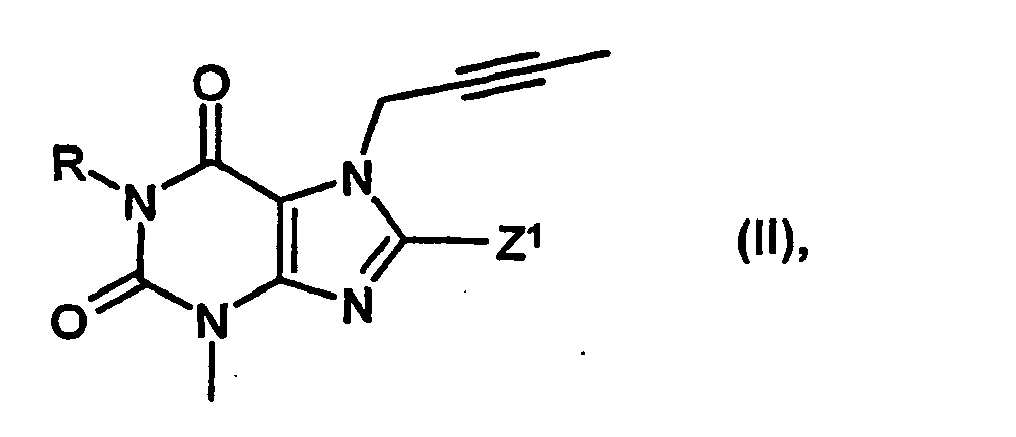
R wie eingangs erwähnt definiert ist und
Z1 eine Austrittsgruppe wie ein Halogenatom, eine substituierte Hydroxy-, Mercapto-, Sulfinyl-, Sulfonyl- oder Sulfonyloxygruppe wie ein Chlor- oder Bromatom, eine Methansulfonyl- oder Methansulfonyloxygruppe darstellt, mit 3-Aminopiperidin, dessen Enantiomeren oder dessen Salzen.
Die Umsetzung wird zweckmäßigerweise in einem Lösungsmittel wie Isopropanol, Butanol, Tetrahydrofuran, Dioxan, Dimethylformamid, Dimethylsulfoxid, Ethylenglycolmonomethylether, Ethylenglycoldiethylether oder Sulfolan gegebenenfalls in Gegenwart einer anorganischen oder tertiären organischen Base, z.B. Natriumcarbonat, Kaliumcarbonat oder Kaliumhydroxid, einer tertiären organischen Base, z.B. Triethylamin, oder in Gegenwart von N-Ethyl-diisopropylamin (Hünig-Base), wobei diese organischen Basen gleichzeitig auch als Lösungsmittel dienen können, und gegebenenfalls in Gegenwart eines Reaktionsbeschleunigers wie einem Alkalihalogenid oder einem Katalysator auf Palladiumbasis bei Temperaturen zwischen -20 und 180°C, vorzugsweise jedoch bei Temperaturen zwischen -10 und 120°C, durchgeführt. Die Umsetzung kann jedoch auch ohne Lösungsmittel oder in einem Überschuß des 3-Aminopiperidins durchgeführt werden. - b) Entschützung einer Verbindung der allgemeinen Formel

- Die Abspaltung des tert.-Butyloxycarbonylrestes erfolgt vorzugsweise durch Behandlung mit einer Säure wie Trifluoressigsäure oder Salzsäure oder durch Behandlung mit Bromtrimethylsilan oder lodtrimethylsilan gegebenenfalls unter Verwendung eines Lösungsmittels wie Methylenchlorid, Essigester, Dioxan, Methanol, Isopropanol oder Diethylether bei Temperaturen zwischen 0 und 80°C.
- Bei den vorstehend beschriebenen Umsetzungen können gegebenenfalls vorhandene reaktive Gruppen wie Amino-, Alkylamino- oder Iminogruppen während der Umsetzung durch übliche Schutzgruppen geschützt werden, welche nach der Umsetzung wieder abgespalten werden.
- Beispielsweise kommen als Schutzreste für eine Amino-, Alkylamino- oder Iminogruppe die Formyl-, Acetyl-, Trifluoracetyl-, Ethoxycarbonyl-, tert.-Butoxycarbonyl-, Benzyloxycarbonyl-, Benzyl-, Methoxybenzyl- oder 2,4-Dimethoxybenzylgruppe und für die Aminogruppe zusätzlich die Phthalylgruppe in Betracht.
- Die gegebenenfalls anschließende Abspaltung eines verwendeten Schutzrestes erfolgt beispielsweise hydrolytisch in einem wässrigen Lösungsmittel, z.B. in Wasser, Isopropanol/Wasser, Essigsäure/Wasser, Tetrahydrofuran/Wasser oder Dioxan/Wasser, in Gegenwart einer Säure wie Trifluoressigsäure, Salzsäure oder Schwefelsäure oder in Gegenwart einer Alkalibase wie Natriumhydroxid oder Kaliumhydroxid oder aprotisch, z.B. in Gegenwart von Jodtrimethylsilan, bei Temperaturen zwischen 0 und 120°C, vorzugsweise bei Temperaturen zwischen 10 und 100°C.
- Die Abspaltung eines Benzyl-, Methoxybenzyl- oder Benzyloxycarbonylrestes erfolgt jedoch beispielsweise hydrogenolytisch, z.B. mit Wasserstoff in Gegenwart eines Katalysators wie Palladium/Kohle in einem geeigneten Lösungsmittel wie Methanol, Ethanol, Essigsäureethylester oder Eisessig gegebenenfalls unter Zusatz einer Säure wie Salzsäure bei Temperaturen zwischen 0 und 100°C, vorzugsweise jedoch bei Raumtemperaturen zwischen 20 und 60°C, und bei einem Wasserstoffdruck von 1 bis 7 bar, vorzugsweise jedoch von 3 bis 5 bar. Die Abspaltung eines 2,4-Dimethoxybenzylrestes erfolgt jedoch vorzugsweise in Trifluoressigsäure in Gegenwart von Anisol.
- Die Abspaltung eines tert.-Butyloxycarbonylrestes erfolgt vorzugsweise durch Behandlung mit einer Säure wie Trifluoressigsäure oder Salzsäure oder durch Behandlung mit Jodtrimethylsilan gegebenenfalls unter Verwendung eines Lösungsmittels wie Methylenchlorid, Dioxan, Methanol oder Diethylether.
- Die Abspaltung eines Trifluoracetylrestes erfolgt vorzugsweise durch Behandlung mit einer Säure wie Salzsäure gegebenenfalls in Gegenwart eines Lösungsmittels wie Essigsäure bei Temperaturen zwischen 50 und 120°C oder durch Behandlung mit Natronlauge gegebenenfalls in Gegenwart eines Lösungsmittels wie Tetrahydrofuran bei Temperaturen zwischen 0 und 50°C.
- Die Abspaltung eines Phthalylrestes erfolgt vorzugsweise in Gegenwart von Hydrazin oder eines primären Amins wie Methylamin, Ethylamin, Ethanolamin oder n-Butylamin in einem Lösungsmittel wie Methanol, Ethanol, Isopropanol, Toluol/Wasser oder Dioxan bei Temperaturen zwischen 20 und 50°C.
- Ferner können die erhaltenen Verbindungen der allgemeinen Formel I, wie bereits eingangs erwähnt wurde, in ihre Enantiomeren und/oder Diastereomeren aufgetrennt werden. So können beispielsweise cis-/trans-Gemische in ihre cis- und trans-Isomere, und Verbindungen mit mindestens einem optisch aktiven Kohlenstoffatom in ihre Enantiomeren aufgetrennt werden.
- So-lassen sich beispielsweise die erhaltenen cis-/trans-Gemische durch Chromatographie in ihre cis- und trans-Isomeren, die erhaltenen Verbindungen der allgemeinen Formel I, welche in Racematen auftreten, nach an sich bekannten Methoden (siehe Allinger N. L. und Eliel E. L. in "Topics in Stereochemistry", Vol. 6, Wiley Interscience, 1971) in ihre optischen Antipoden und Verbindungen der allgemeinen Formel I mit mindestens 2 asymmetrischen Kohlenstoffatomen auf Grund ihrer physikalisch-chemischen Unterschiede nach an sich bekannten Methoden, z.B. durch Chromatographie und/oder fraktionierte Kristallisation, in ihre Diastereomeren auftrennen, die, falls sie in racemischer Form anfallen, anschließend wie oben erwähnt in die Enantiomeren getrennt werden können.
- Die Enantiomerentrennung erfolgt vorzugsweise durch Säulentrennung an chiralen Phasen oder durch Umkristallisieren aus einem optisch aktiven Lösungsmittel oder durch Umetzen mit einer, mit der racemischen Verbindung Salze oder Derivate wie z.B. Ester oder Amide bildenden optisch aktiven Substanz, insbesondere Säuren und ihre aktivierten Derivate oder Alkohole, und Trennen des auf diese Weise erhaltenen diastereomeren Salzgemisches oder Derivates, z.B. auf Grund von verschiedenen Löslichkeiten, wobei aus den reinen diastereomeren Salzen oder Derivaten die freien Antipoden durch Einwirkung geeigneter Mittel freigesetzt werden können. Besonders gebräuchliche, optisch aktive Säuren sind z.B. die D- und L-Formen von Weinsäure oder Dibenzoylweinsäure, Di-O-p-toluoyl-weinsäure, Äpfelsäure, Mandelsäure, Camphersulfonsäure, Glutaminsäure, Asparaginsäure oder Chinasäure. Als optisch aktiver Alkohol kommt beispielsweise (+)- oder (-)-Menthol und als optisch aktiver Acylrest in Amiden beispielsweise (+)-oder (-)-Menthyloxycarbonyl in Betracht.
- Desweiteren können die erhaltenen Verbindungen der Formel I in ihre Salze, insbesondere für die pharmazeutische Anwendung in ihre physiologisch verträglichen Salze mit anorganischen oder organischen Säuren, übergeführt werden. Als Säuren kommen hierfür beispielsweise Salzsäure, Bromwasserstoffsäure, Schwefelsäure, Methansulfonsäure, Phosphorsäure, Fumarsäure, Bernsteinsäure, Milchsäure, Zitronensäure, Weinsäure oder Maleinsäure in Betracht.
- Die als Ausgangsstoffe verwendeten Verbindungen der allgemeinen Formeln II und
- III sind entweder literaturbekannt oder man erhält diese nach an sich literaturbekannten Verfahren (siehe Beispiele I bis XXV).
- Wie bereits eingangs erwähnt, weisen die erfindungsgemäßen Verbindungen der allgemeinen Formel I und ihre physiologisch verträglichen Salze wertvolle pharmakologische Eigenschaften auf, insbesondere eine Hemmwirkung auf das Enzym DPP-IV.
- Die biologischen Eigenschaften der neuen Verbindungen wurden wie folgt geprüft:
- Die Fähigkeit der Substanzen und ihrer entsprechenden Salze, die DPP-IV Aktivität zu hemmen, kann in einem Versuchsaufbau gezeigt werden, in dem ein Extrakt der humanen Koloncarcinomzelllinie Caco-2 als DPP IV Quelle benutzt wird. Die Differenzierung der Zellen, um die DPP-IV Expression zu induzieren, wurde nach der Beschreibung von Reiher et al. in einem Artikel mit dem Titel "Increased expression of intestinal cell line Caco-2" , erschienen in Proc. Natl. Acad. Sci. Vol. 90, Seiten 5757-5761 (1993), durchgeführt. Der Zellextrakt wurde von in einem Puffer (10 mM Tris HCI, 0.15 M NaCl, 0.04 t.i.u. Aprotinin, 0.5% Nonidet-P40, pH 8.0) solubilisierten Zellen durch Zentrifugation bei 35,000 g für 30 Minuten bei 4°C (zur Entfernung von Zelltrümmern) gewonnen.
- Der DPP-IV Assay wurde wie folgt durchgeführt:
50 µl Substratlösung (AFC; AFC ist Amido-4-trifluormethylcoumarin), Endkonzentration 100 µM, wurden in schwarze Mikrotiterplatten vorgelegt. 20 µl Assay Puffer (Endkonzentrationen 50 mM Tris HCI pH 7.8, 50 mM NaCl, 1 % DMSO) wurde zupipettiert. Die Reaktion wurde durch Zugabe von 30 µl solubilisiertem Caco-2 Protein (Endkonzentration 0.14 µg Protein pro Well) gestartet. Die zu überprüfenden Testsubstanzen wurden typischerweise in 20 µl vorverdünnt zugefügt, wobei das Assaypuffervolumen dann entsprechend reduziert wurde. Die Reaktion wurde bei Raumtemperatur durchgeführt, die Inkubationsdauer betrug 60 Minuten. Danach wurde die Fluoreszenz in einem Victor 1420 Multilabel Counter gemessen, wobei die Anregungswellenlänge bei 405 nm und die Emissionswellenlänge bei 535 nm lag. Leerwerte (entsprechend 0 % Aktivität) wurden in Ansätzen ohne Caco-2 Protein (Volumen ersetzt durch Assay Puffer), Kontrollwerte (entsprechend 100 % Aktivität) wurden in Ansätzen ohne Substanzzusatz erhalten. Die Wirkstärke der jeweiligen Testsubstanzen, ausgedrückt als IC50 Werte, wurden aus Dosis-Wirkungs Kurven berechnet, die aus jeweils 11 Meßpunkten bestanden. Hierbei wurden folgende Ergebnisse erhalten:Verbindung DPP IV-Hemmung (Beispiel Nr.) IC50 [nM] 1 6 1 (3) 6 1(4) 9 1(6) 2 1 (7) 5 1 (12) 2 1(21) 2 1 (26) 2 1 (30) 2 1(31) 3 1 (38) 1 1 (39) 2 - Die erfindungsgemäß hergestellten Verbindungen sind gut verträglich, da beispielsweise nach oraler Gabe von 10 mg/kg der Verbindung des Beispiels 1 (30) an Ratten keine Änderungen im Verhalten der Tiere beobachtet werden konnten.
- Im Hinblick auf die Fähigkeit, die DPP-IV Aktivität zu hemmen, sind die erfindungsgemäßen Verbindungen der allgemeinen Formel I und ihre entsprechenden pharmazeutisch akzeptablen Salze geeignet, alle diejenigen Zustände oder Krankheiten zu beeinflussen, die durch eine Hemmung der DPP-IV Aktivität beeinflusst werden können. Es ist daher zu erwarten, daß die erfindungsgemäßen Verbindungen zur Prävention oder Behandlung von Krankheiten oder Zuständen wie Diabetes mellitus Typ 1 und Typ 2, Prädiabetes, Verminderung der Glukosetoleranz oder Veränderungen im Nüchternblutzucker, diabetische Komplikationen (wie z.B. Retinopathie, Nephropathie oder Neuropathien), metabolische Azidose oder Ketose, reaktiver Hypoglykämie, Insulinresistenz, Metabolischem Syndrom, Dyslipidämien unterschiedlichster Genese, Arthritis, Atherosklerose und verwandte Erkrankungen, Adipositas, Allograft Transplantation und durch Calcitonin verursachte Osteoporose geeignet sind. Darüberhinaus sind diese Substanzen geeignet, die B-Zelldegeneration wie z.B. Apoptose oder Nekrose von pankreatischen B-Zellen zu verhindern. Die Substanzen sind weiter geeignet, die Funktionalität von pankreatischen Zellen zu verbessern oder wiederherzustellen, daneben die Anzahl und Größe von pankreatischen B-Zellen zu erhöhen. Zusätzlich und begründet durch die Rolle der Glucagon-Like Peptide, wie z.B. GLP-1 und GLP-2 und deren Verknüpfung mit DPP-IV Inhibition, wird erwartet, daß die erfindungsgemäßen Verbindungen geeignet sind, um unter anderem einen sedierenden oder angstlösenden Effekt zu erzielen, darüberhinaus katabole Zustände nach Operationen oder hormonelle Stressantworten günstig zu beeinflussen oder die Mortalität und Morbidität nach Myokardinfarkt reduzieren zu können. Darüberhinaus sind sie geeignet zur Behandlung von allen Zuständen, die im Zusammenhang mit oben genannten Effekten stehen und durch GLP-1 oder GLP-2 vermittelt sind. Die erfindungsgemäßen Verbindungen sind ebenfalls als Diuretika oder Antihypertensiva einsetzbar und zur Prävention und Behandlung des akuten Nierenversagens geeignet. Weiterhin sind die erfindungsgemäßen Verbindungen zur Behandlung entzündlicher Erkrankungen der Atemwege einsetzbar. Ebenso sind sie zur Prävention und Therapie von chronischen entzündlichen Darmerkrankungen wie z.B. Reizdarmsyndrom (IBS), Morbus Crohn oder Colitis ulcerosa ebenso wie bei Pankreatitis geeignet. Des weiteren wird erwartet, daß sie bei jeglicher Art von Verletzung oder Beeinträchtigung im Gastrointestinaltrakt eingesetzt werden können wie auch z.B. bei Kolitiden und Enteriden. Darüberhinaus wird erwartet, daß DPP-IV Inhibitoren und somit auch die erfindungsgemäßen Verbindungen zur Behandlung der Unfruchtbarkeit oder zur Verbesserung der Fruchtbarkeit beim Menschen oder im Säugetierorganismus verwendet werden können, insbesondere dann, wenn die Unfruchtbarkeit im Zusammenhang mit einer Insulinresistenz oder mit dem polyzystischen Ovarialsyndrom steht. Auf der anderen Seite sind diese Substanzen geeignet, die Motilität der Spermien zu beeinflussen und sind damit als Kontrazeptiva zur Verwendung beim Mann einsetzbar. Des weiteren sind die Substanzen geeignet, Mangelzustände von Wachstumshormon, die mit Minderwuchs einhergehen, zu beeinflussen, sowie bei allen Indikationen sinnvoll eingesetzt werden können, bei denen Wachstumshormon verwendet werden kann. Die erfindungsgemäßen Verbindungen sind auf Grund ihrer Hemmwirkung gegen DPP IV auch geeignet zur Behandlung von verschiedenen Autoimmunerkrankungen wie z.B. rheumatoide Arthritis, Multiple Sklerose, Thyreoditiden und Basedow'scher Krankheit etc.. Darüberhinaus können sie eingesetzt werden bei viralen Erkrankungen wie auch z.B. bei HIV Infektionen, zur Stimulation der Blutbildung, bei benigner Prostatahyperplasie, bei Gingivitiden, sowie zur Behandlung von neuronalen Defekten und neurdegenerativen Erkrankungen wie z.B. Morbus Alzheimer. Beschriebene Verbindungen sind ebenso zu verwenden zur Therapie von Tumoren, insbesondere zur Veränderung der Tumorinvasion wie auch Metastatisierung, Beispiele hier sind die Anwendung bei T-Zell Lymphomen, akuter lymphoblastischer Leukämie, zellbasierende Schilddrüsenkarzinome, Basalzellkarzinome oder Brustkarzinome. Weitere Indikationen sind Schlaganfall, Ischämien verschiedenster Genese, Morbus Parkinson und Migräne. Darüberhinaus sind weitere Indikationsgebiete follikuläre und epidermale Hyperkeratosen, erhöhte Keratinozytenproliferation, Psoriasis, Enzephalomyelitiden, Glomerulonephritiden, Lipodystrophien, sowie psychosomatische, depressive und neuropsychiatrische Erkrankungen verschiedenster Genese.
- Die erfindungsgemäßen Verbindungen können auch in Kombination mit anderen Wirkstoffen verwendet werden. Zu den zu einer solchen Kombination geeigneten Therapeutika gehören z.B. Antidiabetika, wie etwa Metformin, Sulfonylharnstoffe (z.B. Glibenclamid, Tolbutamid, Glimepiride), Nateglinide, Repaglinide, Thiazolidindione (z.B. Rosiglitazone, Pioglitazone), PPAR-gamma-Agonisten (z.B. GI 262570) und -Antagonisten, PPAR-gammalalpha Modulatoren (z.B. KRP 297), PPAR-gamma/alpha/delta Modulatoren, AMPK-Aktivatoren, ACC1 und ACC2 Inhibitoren, DGAT-Inhibitoren, SMT3-Rezeptor-Agonisten, 11ß-HSD-Inhibitoren, FGF19-Agonisten oder -Mimetika, alpha-Glucosidasehemmer (z.B. Acarbose, Voglibose), andere DPPIV Inhibitoren, alpha2-Antagonisten, Insulin und Insulinanaloga, GLP-1 und GLP-1 Analoga (z.B. Exendin-4) oder Amylin. Daneben sind Kombinationen mit SGLT2-Inhibitoren wie T-1095 oder KGT-1251 (869682), Inhibitoren der Proteintyrosinphosphatase 1, Substanzen, die eine deregulierte Glucoseproduktion in der Leber beeinflussen, wie z.B. Inhibitoren der Glucose-6-phosphatase, oder der Fructose-1,6-bisphosphatase, der Glycogenphosphorylase, Glucagonrezeptor Antagonisten und-Inhibitoren der Phosphoenolpyruvatcarboxykinase, der Glykogensynthasekinase oder der Pyruvatdehydrokinase, Lipidsenker, wie etwa HMG-CoA-Reduktasehemmer (z.B. Simvastatin, Atorvastatin), Fibrate (z.B. Bezafibrat, Fenofibrat), Nikotinsäure und deren Derivate, PPAR-alpha Agonisten, PPAR-delta Agonisten, ACAT Inhibitoren (z.B. Avasimibe) oder Cholesterolresorptionsinhibitoren wie zum Beispiel Ezetimibe, gallensäurebindende Substanzen wie zum Beispiel Colestyramin, Hemmstoffe des ilealen Gallensäuretransportes, HDL-erhöhende Verbindungen wie zum Beispiel Inhibitoren von CETP oder Regulatoren von ABC1 oder LXRalpha Antagonisten, LXRbeta Agonisten oder LXRalpha/beta Regulatoren oder Wirkstoffe zur Behandlung von Obesitas, wie etwa Sibutramin oder Tetrahydrolipstatin, Dexfenfluramin, Axokine, Antagonisten des Cannbinoid1 Rezeptors, MCH-1 Rezeptorantagonisten, MC4 Rezeptor Agonisten, NPY5 oder NPY2 Antagonisten oder β3-Agonisten wie SB-418790 oder AD-9677 ebenso wie Agonisten des 5HT2c Rezeptors möglich.
- Daneben ist eine Kombination mit Medikamenten zur Beeinflussung des Bluthochdrucks wie z.B. All Antagonisten oder ACE Inhibitoren, Diuretika, β-Blocker, Ca-Antagonisten und anderen oder Kombinationen daraus geeignet.
- Die zur Erzielung einer entsprechenden Wirkung erforderliche Dosierung beträgt zweckmäßigerweise bei intravenöser Gabe 1 bis 100 mg, vorzugsweise 1 bis 30 mg, und bei oraler Gabe 1 bis 1000 mg, vorzugsweise 1 bis 100 mg, jeweils 1 bis 4 x täglich. Hierzu lassen sich die erfindungsgemäß hergestellten Verbindungen der Formel I, gegebenenfalls in Kombination mit anderen Wirksubstanzen, zusammen mit einem oder mehreren inerten üblichen Trägerstoffen und/oder Verdünnungsmitteln, z.B. mit Maisstärke, Milchzucker, Rohrzucker, mikrokristalliner Zellulose, Magnesiumstearat, Polyvinylpyrrolidon, Zitronensäure, Weinsäure, Wasser, Wasser/Ethanol, Wasser/Glycerin, Wasser/Sorbit, Wasser/Polyethylenglykol, Propylenglykol, Cetylstearylalkohol, Carboxymethylcellulose oder fetthaltigen Substanzen wie Hartfett oder deren geeigneten Gemischen, in übliche galenische Zubereitungen wie Tabletten, Dragees, Kapseln, Pulver, Suspensionen oder Zäpfchen einarbeiten.
- Die nachfolgenden Beispiele sollen die Erfindung näher erläutern:
- Ein Gemisch aus 416 mg 3-Methyl-7-(2-butin-1-yl)-8-[3-(tert.-butyloxycarbonylamino)-piperidin-1-yl]-xanthin und 456 mg Casiumcarbonat in 4 ml N,N-Dimethylformamid wird bei 80°C für 10 Minuten gerührt, dann werden 324 mg 2-Chlormethyl-4-phenylamino-chinazolin zugegeben und das Reaktionsgemisch wird zwei Stunden bei 80°C gerührt. Dann werden erneut 50 mg Cäsiumcarbonat und 50 mg Chlormethyl-4-phenylamino-chinazolin zugegeben und das Gemisch wird weitere 1.5 Stunden bei 80°C gerührt. Anschließend wird das Lösungsmittel abdestilliert und der Rückstand zwischen Wasser und Essigester verteilt. Die organische Phase wird mit verdünnter Zitronensäure, Wasser und gesättigter Natriumchloridlösung gewaschen, über Magnesiumsulfat getrocknet und eingeengt. Das Rohprodukt wird chromatographisch über eine Kieselgelsäule mit Essigester/Petrolether (8:2 auf 10:0) als Laufmittel gereinigt.
Ausbeute: 425 mg (65 % der Theorie)
Rf-Wert: 0.33 (Kieselgel, Essigester)
Massenspektrum (ESI+): m/z = 650 [M+H]+ - Analog Beispiel I werden folgende Verbindungen erhalten:
- (1) 1-[(4-Benzylamino-chinazolin-2-yl)methyl]-3-methyl-7-(2-butin-1-yl)-8-[3-(tert.-butyloxycarbonylamino)-piperidin-1-yl]-xanthin
Rf-Wert: 0.20 (Kieselgel, Essigester)
Massenspektrum (ESI+): m/z = 664 [M+H]+ - (2) 1-[(2-Methyl-chinolin-4-yl)methyl]-3-methyl-7-(2-butin-1-yl)-8-[(R)-3-(tert.-butyloxycarbonylamino)-piperidin-1-yl]-xanthin
Rf-Wert: 0.80 (Kieselgel, Methylenchlorid/Methanol = 9:1)
Massenspektrum (ESI+): m/z = 572 [M+H]+ - (3) 1-[(3-Cyano-naphthalin-1-yl)methyl]-3-methyl-7-(2-butin-1-yl)-8-[(R)-3-(tert.-butyloxycarbonylamino)-piperidin-1-yl]-xanthin
Rf-Wert: 0.67 (Kieselgel, Methylenchlorid/Methanol = 95:5)
Massenspektrum (ESI+): m/z = 582 [M+H]+ - (4) 1-[(2-Phenyl-chinazolin-4-yl)methyl]-3-methyl-7-(2-butin-1-yl)-8-[(R)-3-(tert.-butyloxycarbonylamino)-piperidin-1-yl]-xanthin
Rf-Wert: 0.75 (Kieselgel, Methylenchlorid/Essigester = 1:1)
Massenspektrum (ESI+): m/z = 635 [M+H]+ - (5) 1-[(4-Cyano-isochinolin-1-yl)methyl]-3-methyl-7-(2-butin-1-yl)-8-[(R)-3-(tert.-butyloxycarbonylamino)-piperidin-1-yl]-xanthin
Rf-Wert: 0.75 (Kieselgel, Methylenchlorid/Methanol/konz. wässriges Ammoniak = 90:10:1)
Massenspektrum (ESI+): m/z = 583 [M+H]+ - (6) 1-[(4-Cyano-chinolin-2-yl)methyl]-3-methyl-7-(2-butin-1-yl)-8-[(R)-3-(tert.-butyloxycarbonylamino)-piperidin-1-yl]-xanthin
Massenspektrum (ESI+): m/z = 583 [M+H]+ - (7) 1-[2-(3-Cyclopropyloxy-phenyl)-2-oxo-ethyl]-3-methyl-7-(2-butin-1-yl)-8-[(R)-3-(tert.-butyloxycarbonylamino)-piperidin-1-yl]-xanthin
Rf-Wert: 0.75 (Kieselgel, Methylenchlorid/Essigester = 1:1)
Massenspektrum (ESI+): m/z = 591 [M+H]+ - (8) 1-[2-(3-Cyclopropylmethoxy-phenyl)-2-oxo-ethyl]-3-methyl-7-(2-butin-1-yl)-8-[(R)-3-(tert.-butyloxycarbonylamino)-piperidin-1-yl]-xanthin
Rf-Wert: 0.65 (Kieselgel, Methylenchlorid/Essigester = 1:1)
Massenspektrum (ESI+): m/z = 605 [M+H]+ - (9) 1-[2-(3-Cyclobutyloxy-phenyl)-2-oxo-ethyl]-3-methyl-7-(2-butin-1-yl)-8-[(R)-3-(tert.-butyloxycarbonylamino)-piperidin-1-yl]-xanthin
Rf-Wert: 0.85 (Kieselgel, Methylenchlorid/Essigester = 1:1)
Massenspektrum (ESI+): m/z = 605 [M+H]+ - (10) 1-[(1-Cyano-isochinolin-3-yl)methyl]-3-methyl-7-(2-butin-1-yl)-8-[(R)-3-(tert.-butyloxycarbonylamino)-piperidin-1-yl]-xanthin
Massenspektrum (ESI+): m/z = 583 [M+H]+ - (11) 1-[(2,4-Methoxy-naphthalin-1-yl)methyl]-3-methyl-7-(2-butin-1-yl)-8-[(R)-3-(tert.-butyloxycarbonylamino)-piperidin-1-yl]-xanthin
Rf-Wert: 0.70 (Kieselgel, Essigester)
Massenspektrum (ESI+): m/z = 617 [M+H]+ - (12) 1-[(2,3-Dimethyl-chinoxalin-6-yl)methyl]-3-methyl-7-(2-butin-1-yl)-8-[(R)-3-(tert.-butyloxycarbonylamino)-piperidin-1-yl]-xanthin
Rf-Wert: 0.50 (Kieselgel, Essigester)
Massenspektrum (ESI+): m/z = 587 [M+H]+ - (13) 1-[(6-Nitro-chinolin-2-yl)methyl]-3-methyl-7-(2-butin-1-yl)-8-[(R)-3-(tert.-butyloxycarbonylamino)-piperidin-1-yl]-xanthin
Rf-Wert: 0.45 (Kieselgel, Essigester/Petrolether = 7:3)
Massenspektrum (ESI+): m/z = 603 [M+H]+ - (14) 1-[(Chinoxalin-5-yl)methyl]-3-methyl-7-(2-butin-1-yl)-8-[(R)-3-(tert.-butyloxycarbonylamino)-piperidin-1-yl]-xanthin
Massenspektrum (ESI+): m/z = 559 [M+H]+ - (15) 1-[(6-Methoxy-chinolin-2-yl)methyl]-3-methyl-7-(2-butin-1-yl)-8-[(R)-3-(tert.-butyloxycarbonylamino)-piperidin-1-yl]-xanthin
Rf-Wert: 0.65 (Kieselgel, Essigester)
Massenspektrum (ESI+): m/z = 588 [M+H]+ - (16) 1-[(6-Phenyl-pyridin-2-yl)methyl]-3-methyl-7-(2-butin-1-yl)-8-[(R)-3-(tert.-butyloxycarbony(amino)-piperidin-1-yl]-xanthin
Rf-Wert: 0.43 (Kieselgel, Methylenchlorid/Methanol = 96:4)
Massenspektrum (ESI+): m/z = 584 [M+H]+ - (17) 1-{[(4-(Pyridin-2-yl)-isochinolin-1-yl]methyl}-3-methyl-7-(2-butin-1-yl)-8-[(R)-3-(tert.-butyloxycarbonylamino)-piperidin-1-yl]-xanthin
- (18) 1-[(7-Fluor-chinolin-2-yl)methyl]-3-methyl-7-(2-butin-1-yl)-8-[(R)-3-(tert.-butyloxycarbonylamino)-piperidin-1-yl]-xanthin
Rf-Wert: 0.24 (Kieselgel, Essigester/Petrolether = 1:1)
Massenspektrum (ESI+): m/z = 576 [M+H]+ - (19) 1-[(8-Nitro-chinolin-2-yl)methyl]-3-methyl-7-(2-butin-1-yl)-8-[(-R)-3-(tert.-butyloxycarbonylamino)-piperidin-1-yl]-xanthin
Rf-Wert: 0.63 (Kieselgel, Methylenchlorid/Methanol = 95:5)
Massenspektrum (ESI+): m/z = 603 [M+H]+ - (20) 1-[(6-Fluor-chinolin-2-yl)methyl]-3-methyl-7--(2-butin-1-yl)-8-[(R)-3-(tert.-butyloxycarbonylamino)-piperidin-1-yl]-xanthin
Rf-Wert: 0.47 (Kieselgel, Methylenchlorid/Methanol = 95:5)
Massenspektrum (ESI+): m/z = 576 [M+H]+ - (21) 1-[2-Oxo-2-(2-brom-phenyl)-ethyl]-3-methyl-7-(2-butin-1-yl)-8-[(R)-3-(tert.-butyloxycarbonylamino)-piperidin-1-yl]-xanthin
Rf-Wert: 0.75 (Kieselgel, Methylenchlorid/Essigester = 1:1)
Massenspektrum (ESI+): m/z = 613, 615 [M+H]+ - (22) 1-Cyanomethyl-3-methyl-7-(2-butin-1-yl)-8-[(R)-3-(tert.-butyloxycarbonylamino)-piperidin-1-yl]-xanthin
Rf-Wert: 0.80 (Kieselgel, Essigester)
Massenspektrum (ESI+): m/z = 456 [M+H]+ - (23) 1-[(4-Methoxy-chinolin-2-yl)methyl]-3-methyl-7-(2-butin-1-yl)-8-[(R)-3-(tert.-butyloxycarbonylamino)-piperidin-1-yl]-xanthin
Massenspektrum (ESI+): m/z = 588 [M+H]+ - (24) 1-[(2-Phenyl-pyrimidin-4-yl)methyl]-3-methyl-7-(2-butin-1-yl)-8-[(R)-3-(tert.-butyloxycarbonylamino)-piperidin-1-yl]-xanthin
Rf-Wert: 0.39 (Kieselgel, Methylenchlorid/Methanol = 96:4)
Massenspektrum (ESI+): m/z = 585 [M+H]+ - (25) 1-[([1,5]Naphthyridin-3-yl)methyl]-3-methyl-7-(2-butin-1-yl)-8-[(R)-3-(tert.-butyloxycarbonylamino)-piperidin-1-yl]-xanthin
Rf-Wert: 0.28 (Kieselgel, Essigester)
Massenspektrum (ESI+): m/z = 559 [M+H]+ - (26) 1-[(3-Cyano-4-methyl-chinolin-2-yl)methyl]-3-methyl-7-(2-butin-1-yl)-8-[(R)-3-(tert.-butyloxycarbonylamino)-piperidin-1-yl]-xanthin
Rf-Wert: 0.75 (Kieselgel, Methylenchlorid/Essigester =1:1)
Massenspektrum (ESI+): m/z = 597 [M+H]+ - (27) 1-[(4,5-Dimethyl-chinazolin-2-yl)methyl]-3-methyl-7-(2-butin-1-yl)-8-[(R)-3-(tert.-butyloxycarbonylamino)-piperidin-1-yl]-xanthin
Massenspektrum (ESI+): m/z = 587 [M+H]+ - (28) 1-[(5-Cyano-chinolin-2-yl)methyl]-3-methyl-7-(2-butin-1-yl)-8-[(R)-3-(tert.-butyloxycarbonylamino)-piperidin-1-yl]-xanthin
Rf-Wert: 0.42 (Kieselgel, Petrolether/Essigester = 1:2)
Massenspektrum (ESI+): m/z = 583 [M+H]+ - (29) 1-[(3-Cyano-chinolin-2-yl)methyl]-3-methyl-7-(2-butin-1-yl)-8-[(R)-3-(tert.-butyloxycarbonylamino)-piperidin-1-yl]-xanthin
Rf-Wert: 0.80 (Kieselgel, Methylenchlorid/Essigester= 1:1) - (30) 1-[(4-Phenyl-pyrimidin-2-yl)methyl]-3-methyl-7-(2-butin-1-yl)-8-[(R)-3-(tert.-butyloxycarbonylamino)-piperidin-1-yl]-xanthin
Rf-Wert: 0.46 (Kieselgel, Essigester) - (31) 1-[2-(2-Nitro-phenyl)-2-oxo-ethyl]-3-methyl-7-(2-butin-1-yl)-8-[(R)-3-(tert.-butyloxycarbony)amino)-piperidin-1-yl]-xanthin
Rf-Wert: 0.75 (Kieselgel, Essigester)
Massenspektrum (ESI+): m/z = 580 [M+H]+ - (32) 1-[(1,4-Dicyano-naphthalin-2-yl)methyl]-3-methyl-7-(2-butin-1-yl)-8-[(R)-3-(tert.-butyloxycarbonylamino)-piperidin-1-yl]-xanthin
Rf-Wert: 0.54 (Kieselgel, Methylenchlorid/Methanol = 95:5)
Massenspektrum (ESI+): m/z = 607 [M+H]+ - (33) 1-[(6,7-Dimethoxy-chinolin-2-yl)methyl]-3-methyl-7-(2-butin-1-yl)-8-[(R)-3-(tert.-butyloxycarbonylamino)-piperidin-1-yl]-xanthin
Rf-Wert: 0.36 (Kieselgel, Essigester)
Massenspektrum (ESI+): m/z = 618 [M+H]+ - (34) 1-[(Chinazolin-6-yl)methyl]-3-methyl-7-(2-butin-1-yl)-8-[(R)-3-(tert.-butyloxycarbonylamino)-piperidin-1-yl]-xanthin
Rf-Wert: 0.20 (Kieselgel, Essigester)
Massenspektrum (ESI+): m/z = 559 [M+H]+ - (35) 1-[(4-Cyano-chinazolin-2-yl)methyl]-3-methyl-7-(2-butin-1-yl)-8-[(R)-3-(tert.-butyloxycarbonylamino)-piperidin-1-yl]-xanthin
Rf-Wert: 0.40 (Kieselgel, Methylenchlorid/Essigester = 7:3)
Massenspektrum (ESI+): m/z = 584 [M+H]+ - (36) 1-[(Chinazolin-7-yl)methyl]-3-methyl-7-(2-butin-1-yl)-8-[(R)-3-(tert.-butyloxycarbonylamino)-piperidin-1-yl]-xanthin
Rf-Wert: 0.20 (Kieselgel, Essigester)
Massenspektrum (ESI+): m/z = 559 [M+H]+ - (37) 1-(2-Cyano-benzyl)-3-methyl-7-(2-butin-1-yl)-8-[(R)-3-(tert.-butyloxycarbonylamino)-piperidin-1-yl]-xanthin
Rf-Wert: 0.50 (Kieselgel, Methylenchlorid/Essigester = 7:3)
Massenspektrum (ESI+): m/z = 532 [M+H]+ - (38) 1-(3-Cyano-benzyl)-3-methyl-7-(2-butin-1-yl)-8-[(R)-3-(tert.-butyloxycarbonylamino)-piperidin-1-yl]-xanthin
Rf-Wert: 0.58 (Kieselgel, Methylenchlorid/Essigester = 1:1)
Massenspektrum (ESI+): m/z = 532 [M+H]+ - (39) 1-(4-Cyano-benzyl)-3-methyl-7-(2-butin-1-yl)-8-[(R)-3-(tert.-butyloxycarbonylamino)-piperidin-1-yl]-xanthin
Rf-Wert: 0.61 (Kieselgel, Methylenchlorid/Essigester = 1:1)
Massenspektrum (ESI+): m/z = 532 [M+H]+ - (40) 1-[(Pyridin-2-yl)methyl]-3-methyl-7-(2-butin-1-yl)-8-[(R)-3-(tert.-butyloxycarbonylamino)-piperidin-1-yl]-xanthin
Massenspektrum (ESI+): m/z = 508 [M+H]+ - (41) 1-Benzyl-3-methyl-7-(2-butin-1-yl)-8-[(R)-3-(tert.-butyloxycarbonylamino)-piperidin-1-yl]-xanthin
Rf-Wert: 0.70 (Kieselgel, Methylenchlorid/Essigester =1:1)
Massenspektrum (ESI+): m/z = 507 [M+H]+ - (42) 1-(4-Methoxy-benzyl)-3-methyl-7-(2-butin-1-yl)-8-[(R)-3-(tert.-butyloxycarbonylamino)-piperidin-1-yl]-xanthin
Rf-Wert: 0.75 (Kieselgel, Essigester)
Massenspektrum (ESI+): m/z = 537 [M+H]+ - (43) 1-(2-Chlor-benzyl)-3-methyl-7-(2-butin-1-yl)-8-[(R)-3-(tert.-butyloxycarbonylamino)-piperidin-1-yl]-xanthin
Rf-Wert: 0.80 (Kieselgel, Essigester)
Massenspektrum (ESI+): m/z = 541, 543 [M+H]+ - (44) 1-(2,6-Dicyano-benzyl)-3-methyl-7-(2-butin-1-yl)-8-[(R)-3-(tert.-butyloxycarbonylamino)-piperidin-1-yl]-xanthin
Massenspektrum (ESI+): m/z = 557 [M+H]+ - (45) 1-(2-Cyano-4-brom-benzyl)-3-methyl-7-(2-butin-1-yl)-8-[(R)-3-(tert.-butyloxycarbonylamino)-piperidin-1-yl]-xanthin
Massenspektrum (ESI+): m/z = 610, 612 [M+H]+ - (46) 1-(3-Fluor-benzyl)-3-methyl-7-(2-butin-1-yl)-8-[(R)-3-(tert.-butyloxycarbonylamino)-piperidin-1-yl]-xanthin
Rf-Wert: 0.80 (Kieselgel, Essigester)
Massenspektrum (ESI+): m/z = 525 [M+H]+ - (47) 1-(3,5-Dimethoxy-benzyl)-3-methyl-7-(2-butin-1-yl)-8-[(R)-3-(tert.-butyloxycarbonylamino)-piperidin-1-yl]-xanthin
Rf-Wert: 0.70 (Kieselgel, Essigester)
Massenspektrum (ESI+): m/z = 567 [M+H]+ - (48) 1-(2-Fluor-benzyl)-3-methyl-7-(2-butin-1-yl)-8-[(R)-3-(tert.-butyloxycarbonylamino)-piperidin-1-yl]-xanthin
Rf-Wert: 0.85 (Kieselgel, Essigester)
Massenspektrum (ESI+): m/z = 525 [M+H]+ - (49) 1-[(6-Cyano-pyridin-2-yl)methyl]-3-methyl-7-(2-butin-1-yl)-8-[(R)-3-(tert.-butyloxycarbonylamino)-piperidin-1-yl]-xanthin
Rf-Wert: 0.60 (Kieselgel, Methylenchlorid/Essigester= 1:1)
Massenspektrum (ESI+): m/z = 533 [M+H]+ - (50) 1-[(3-Cyano-pyridin-2-yl)methyl]-3-methyl-7-(2-butin-1-yl)-8-[(R)-3-(tert.-butyloxycarbonylamino)-piperidin-1-yl]-xanthin
Rf-Wert: 0.60 (Kieselgel, Methylenchlorid/Essigester = 1:1)
Massenspektrum (ESI+): m/z = 533 [M+H]+ - (51) 1-(2-Cyano-3-chlor-benzyl)-3-methyl-7-(2-butin-1-yl)-8-[(R)-3-(tert.-butyloxycarbonylamino)-piperidin-1-yl]-xanthin
Massenspektrum (ESI+): m/z = 566, 568 [M+H]+ - (52) 1-(4-Fluor-benzyl)-3-methyl-7-(2-butin-1-yl)-8-[(R)-3-(tert.-butyloxycarbonylamino)-piperidin-1-yl]-xanthin
Rf-Wert: 0.80 (Kieselgel, Essigester)
Massenspektrum (ESI+): m/z = 525 [M+H]+ - (53) 1-(4-Chlor-benzyl)-3-methyl-7-(2-butin-1-yl)-8-[(R)-3-(tert.-butyloxycarbonylamino)-piperidin-1-yl]-xanthin
Rf-Wert: 0.80 (Kieselgel, Essigester)
Massenspektrum (ESI+): m/z = 541, 543 [M+H]+ - (54) 1-(2-Cyano-4-fluor-benzyl)-3-methyl-7-(2-butin-1-yl)-8-[(R)-3-(tert.-butyloxycarbonylamino)-piperidin-1-yl]-xanthin
Massenspektrum (ESI+): m/z = 550 [M+H]+ - (55) 1-(3-Cyano-4-fluor-benzyl)-3-methyl-7-(2-butin-1-yl)-8-[(R)-3-(tert.-butyloxycarbonylamino)-piperidin-1-yl]-xanthin
Massenspektrum (ESI+): m/z = 550 [M+H]+ - (56) 1-(2-Chlor-4-cyano-benzyl)-3-methyl-7-(2-butin-1-yl)-8-[(R)-3-(tert.-butyloxycarbonylamino)-piperidin-1-yl]-xanthin
Massenspektrum (ESI+): m/z = 566, 568 [M+H]+ - (57) 1-[(5-Methoxycarbonyl-furan-2-yl)methyl]-3-methyl-7-(2-butin-1-yl)-8-[(R)-3-(tert.-butyloxycarbonylamino)-piperidin-1-yl]-xanthin
Massenspektrum (ESI+): m/z = 555 [M+H]+ - (58) 1-(2-Trifluormethyl-4-cyano-benzyl)-3-methyl-7-(2-butin-1-yl)-8-[(R)-3-(tert.-butyloxycarbonylamino)-piperidin-1-yl]-xanthin
Massenspektrum (ESI+): m/z = 600 [M+H]+ - (59) 1-(3,5-Dicyano-benzyl)-3-methyl-7-(2-butin-1-yl)-8-[(R)-3-(tert.-butyloxycarbonylamino)-piperidin-1-yl]-xanthin
Massenspektrum (ESI+): m/z = 557 [M+H]+ - (60) 1-(3-Nitro-4-cyano-benzyl)-3-methyl-7-(2-butin-1-yl)-8-[(R)-3-(tert.-butyloxycarbonylamino)-piperidin-1-yl]-xanthin
Massenspektrum (ESI+): m/z = 577 [M+H]+ - (61) 1-[(2-Cyano-pyridin-3-yl)methyl]-3-methyl-7-(2-butin-1-yl)-8-[(R)-3-(tert.-butyloxycarbonylamino)-piperidin-1-yl]-xanthin
Rf-Wert: 0.50 (Kieselgel, Methylenchlorid/Essigester = 1:1)
Massenspektrum (ESI+): m/z = 533 [M+H]+ - (62) 1-(2-Cyano-4-methoxy-benzyl)-3-methyl-7-(2-butin-1-yl)-8-[(R)-3-(tert.-butyloxycarbonylamino)-piperidin-1-yl]-xanthin
Rf-Wert: 0.70 (Kieselgel, Methylenchlorid/Essigester = 1:1)
Massenspektrum (ESI+): m/z = 562 [M+H]+ - (63) 1-(2-Cyano-5-methoxy-benzyl)-3-methyl-7-(2-butin-1-yl)-8-[(R)-3-(tert.-butyloxycarbonylamino)-piperidin-1-yl]-xanthin
Rf-Wert: 0.75 (Kieselgel, Methylenchlorid/Essigester =1:1)
Massenspektrum (ESI+): m/z = 562 [M+H]+ - (64) 1-(3-Methoxy-benzyl)-3-methyl-7-(2-butin-1-yl)-8-[(R)-3-(tert.-butyloxycarbonylamino)-piperidin-1-yl]-xanthin
Rf-Wert: 0.80 (Kieselgel, Essigester)
Massenspektrum (ESI+): m/z = 537 [M+H]+ - (65) 1-(3-Trifluormethyl-benzyl)-3-methyl-7-(2-butin-1-yl)-8-[(R)-3-(tert.-butyloxycarbonylamino)-piperidin-1-yl]-xanthin
Rf-Wert: 0.80 (Kieselgel, Essigester)
Massenspektrum (ESI+): m/z = 575 [M+H]+ - (66) 1-(3,4-Dimethoxy-benzyl)-3-methyl-7-(2-butin-1-yl)-8-[(R)-3-(tert.-butyloxycarbonylamino)-piperidin-1-yl]-xanthin
Rf-Wert: 0.65 (Kieselgel, Essigester)
Massenspektrum (ESI+): m/z = 567 [M+H]+ - (67) 1-(3-Chlor-benzyl)-3-methyl-7-(2-butin-1-yl)-8-[(R)-3-(tert.-butyloxycarbonylamino)-piperidin-1-yl]-xanthin
Rf-Wert: 0.80 (Kieselgel, Essigester)
Massenspektrum (ESI+): m/z = 541, 543 [M+H]+ - (68) 1-(4-Trifluormethyl-benzyl)-3-methyl-7-(2-butin-1-yl)-8-[(R)-3-(tert.-butyloxycarbonylamino)-piperidin-1-yl]-xanthin
Rf-Wert: 0.85 (Kieselgel, Essigester)
Massenspektrum (ESI+): m/z = 575 [M+H]+ - (69) 1-[([2,2']Bipyridinyl-6-yl)methyl]-3-methyl-7-(2-butin-1-yl)-8-[(R)-3-(tert.-butyloxycarbonylamino)-piperidin-1-yl]-xanthin
Rf-Wert: 0.53 (Aluminiumoxid, Methylenchlorid/Methanol = 98:2)
Massenspektrum (ESI+): m/z = 585 [M+H]+ - (70) 1-(3,4-Dimethoxy-6-fluor-benzyl)-3-methyl-7-(2-butin-1-yl)-8-[(R)-3-(tert.-butyloxycarbonylamino)-piperidin-1-yl]-xanthin
Rf-Wert: 0.65 (Kieselgel, Essigester)
Massenspektrum (ESI+): m/z = 585 [M+H]+ - (71) 1-[(6-Fluor-pyridin-2-yl)methyl]-3-methyl-7-(2-butin-1-yl)-8-[(R)-3-(tert.-butyloxycarbonylamino)-piperidin-1-yl]-xanthin
Massenspektrum (ESI+): m/z = 526 [M+H]+ - (72) 1-[(5-Cyano-6-methoxy-pyridin-2-yl)methyl]-3-methyl-7-(2-butin-1-yl)-8-[(R)-3-(tert.-butyloxycarbonylamino)-piperidin-1-yl]-xanthin
Massenspektrum (ESI+): m/z = 563 [M+H]+ - (73) 1-(2,6-Difluor-benzyl)-3-methyl-7-(2-butin-1-yl)-8-[(R)-3-(tert.-butyloxycarbonylamino)-piperidin-1-yl]-xanthin
Rf-Wert: 0.62 (Kieselgel, Essigester)
Massenspektrum (ESI+): m/z = 543 [M+H]+ - (74) 1-(3-Trifluormethoxy-benzyl)-3-methyl-7-(2-butin-1-yl)-8-[(R)-3-(tert.-butyloxycarbonylamino)-piperidin-1-yl]-xanthin
Rf-Wert: 0.67 (Kieselgel, Essigester)
Massenspektrum (ESI+): m/z = 591 [M+H]+ - (75) 1-(4-Trifluormethoxy-benzyl)-3-methyl-7-(2-butin-1-yl)-8-[(R)-3-(tert.-butyloxycarbonylamino)-piperidin-1-yl]-xanthin
Rf-Wert: 0.62 (Kieselgel, Essigester)
Massenspektrum (ESI+): m/z = 591 [M+H]+ - (76) 1-[(2-Cyano-pyridin-4-yl)methyl]-3-methyl-7-(2-butin-1-yl)-8-[(R)-3-(tert.-butyloxycarbonylamino)-piperidin-1-yl]-xanthin
Rf-Wert: 0.55 (Kieselgel, Methylenchlorid/Essigester = 1:1)
Massenspektrum (ESI+): m/z = 533 [M+H]+ - (77) 1-[(5-Cyano-pyridin-2-yl)methyl]-3-methyl-7-(2-butin-1-yl)-8-[(R)-3-(tert.-butyloxycarbonylamino)-piperidin-1-yl]-xanthin
Rf-Wert: 0.55 (Kieselgel, Methylenchlorid/Essigester = 1:1)
Massenspektrum (ESI+): m/z = 533 [M+H]+ - (78) 1-[(Pyrimidin-2-yl)methyl]-3-methyl-7-(2-butin-1-yl)-8-[(R)-3-(tert.-butyloxycarbonylamino)-piperidin-1-yl]-xanthin
Rf-Wert: 0.60 (Kieselgel, Essigester/Methanol = 9:1)
Massenspektrum (ESI+): m/z = 509 [M+H]+ - (79) 1-[(4-Methyl-pyrimidin-2-yl)methyl]-3-methyl-7-(2-butin-1-yl)-8-[(R)-3-(tert.-butyloxycarbonylamino)-piperidin-1-yl]-xanthin
Rf-Wert: 0.60 (Kieselgel, Essigester/Methanol = 9:1)
Massenspektrum (ESI+): m/z = 523 [M+H]+ - (80) 1-[(4,6-Dimethyl-pyrimidin-2-yl)methyl]-3-methyl-7-(2-butin-1-yl)-8-[(R)-3-(tert.-butyloxycarbonylamino)-piperidin-1-yl]-xanthin
Rf-Wert: 0.70 (Kieselgel, Essigester/Methanol = 9:1)
Massenspektrum (ESI+): m/z = 537 [M+H]+ - (81) 1-[(Chinoxalin-6-yl)methyl]-3-methyl-7-(2-butin-1-yl)-8-brom-xanthin
Rf-Wert: 0.55 (Kieselgel, Essigester)
Massenspektrum (ESI+): m/z = 439, 441 [M+H]+ - (82) 1-(3-Fluor-4-methoxy-benzyl)-3-methyl-7-(2-butin-1-yl)-8-[(R)-3-(tert.-butyloxycarbonylamino)-piperidin-1-yl]-xanthin
Rf-Wert: 0.70 (Kieselgel, Essigester)
Massenspektrum (ESI+): m/z = 555 [M+H]+ - (83) 1-(3,4-Difluor-benzyl)-3-methyl-7-(2-butin-1-yl)-8-[(R)-3-(tert.-butyloxycarbonylamino)-piperidin-1-yl]-xanthin
Rf-Wert: 0.75 (Kieselgel, Essigester)
Massenspektrum (ESI+): m/z = 543 [M+H]+ - (84) 1-(2-Fluor-5-methoxy-benzyl)-3-methyl-7-(2-butin-1-yl)-8-[(R)-3-(tert.-butyloxycarbonylamino)-piperidin-1-yl]-xanthin
Rf-Wert: 0.55 (Kieselgel, Essigester/Petrolether = 3:2)
Massenspektrum (ESI+): m/z = 555 [M+H]+ - (85) 1-(2-Fluor-3-methoxy-benzyl)-3-methyl-7-(2-butin-1-yl)-8-[(R)-3-(tert.-butyloxycarbonylamino)-piperidin-1-yl]-xanthin
Rf-Wert: 0.48 (Kieselgel, Essigester/Petrolether = 3:2)
Massenspektrum (ESI+): m/z = 555 [M+H]+ - (86) 1-[(4-Cyano-isochinolin-3-yl)methyl]-3-methyl-7-(2-butin-1-yl)-8-[(R)-3-(tert.-butyloxycarbonylamino)-piperidin-1-yl]-xanthin
Rf-Wert: 0.55 (Kieselgel, Methylenchlorid/Methanol= 95:5)
Massenspektrum (ESI+): m/z = 583 [M+H]+ - (87) 1-(2-Fluor-4-methoxy-benzyl)-3-methyl-7-(2-butin-1-yl)-8-[(R)-3-(tert.-butyloxycarbonylamino)-piperidin-1-yl]-xanthin
Rf-Wert: 0.48 (Kieselgel, Essigester/Petrolether = 1:1)
Massenspektrum (ESI+): m/z = 555 [M+H]+ - (88) 1-[(Furan-2-yl)methyl]-3-methyl-7-(2-butin-1-yl)-8-[(R)-3-(tert.-butyloxycarbonylamino)-piperidin-1-yl]-xanthin
Massenspektrum (ESI+): m/z = 497 [M+H]+ - (89) 1-(3,4-Dicyano-benzyl)-3-methyl-7-(2-butin-1-yl)-8-[(R)-3-(tert.-butyloxycarbonylamino)-piperidin-1-yl]-xanthin
Massenspektrum (ESI+): m/z = 557 [M+H]+ - (90) 1-(4-Cyano-2-fluor-benzyl)-3-methyl-7-(2-butin-1-yl)-8-[(R)-3-(tert.-butyloxycarbonylamino)-piperidin-1-yl]-xanthin
Massenspektrum (ESI+): m/z = 550 [M+H]+ - (91) (1-(2-Cyano-5-fluor-benzyl)-3-methyl-7-(2-butin-1-yl)-8-[(R)-3-(tert.-butyloxycarbonylamino)-piperidin-1-yl]-xanthin
Massenspektrum (ESI+): m/z = 550 [M+H]+ - (92) 1-[(5-Formyl-furan-2-yl)methyl]-3-methyl-7-(2-butin-1-yl)-8-[(R)-3-(tert.-butyloxycarbonylamino)-piperidin-1-yl]-xanthin
Massenspektrum (ESI+): m/z = 525 [M+H]+ - (93) 1-(2-Cyano-6-fluor-benzyl)-3-methyl-7-(2-butin-1-yl)-8-[(R)-3-(tert.-butyloxycarbonylamino)-piperidin-1-yl]-xanthin
- (94) 1-(4-Cyano-3-fluor-benzyl)-3-methyl-7-(2-butin-1-yl)-8-[(R)-3-(tert.-butyloxycarbonylamino)-piperidin-1-yl]-xanthin
Massenspektrum (ESI+): m/z = 550 [M+H]+ - (95) 1-(2-Cyano-3-methoxy-benzyl)-3-methyl-7-(2-butin-1-yl)-8-brom-xanthin
Rf-Wert: 0.85 (Kieselgel, Essigester)
Massenspektrum (ESI+): m/z = 442, 444 [M+H]+ - (96) 1-[(8-Cyano-chinolin-7-yl)methyl]-3-methyl-7-(2-butin-1-yl)-8-[(R)-3-(tert.-butyloxycarbonylamino)-piperidin-1-yl]-xanthin
Rf-Wert: 0.70 (Kieselgel, Essigester)
Massenspektrum (ESI+): m/z = 583 [M+H]+ - (97) 1-[(4-Cyano-pyridin-3-yl)methyl]-3-methyl-7-(2-butin-1-yl)-8-[(R)-3-(tert.-butyloxycarbonylamino)-piperidin-1-yl]-xanthin
Rf-Wert: 0.40 (Kieselgel, Essigester/Cyclohexan = 3:1)
Massenspektrum (ESI+): m/z = 533 [M+H]+ - (98) 1-[(8-Cyano-chinolin-2-yl)methyl]-3-methyl-7-(2-butin-1-yl)-8-[(R)-3-(tert.-butyloxycarbonylamino)-piperidin-1-yl]-xanthin
Rf-Wert: 0.40 (Kieselgel, Essigester/Petrolether = 4:1)
Massenspektrum (ESI+): m/z = 583 [M+H]+ - (99) 1-[(1-Methyl-1H-benzotriazol-5-yl)methyl]-3-methyl-7-(2-butin-1-yl)-8-[(R)-3-(tert.-butyloxycarbonylamino)-piperidin-1-yl]-xanthin
Rf-Wert: 0.30 (Kieselgel, Methylenchlorid/Essigester = 1:1)
Massenspektrum (ESI+): m/z = 562 [M+H]+ - (100) 1-[(3-Cyano-pyridin-4-yl)methyl]-3-methyl-7-(2-butin-1-yl)-8-[(R)-3-(tert.-butyloxycarbonylamino)-piperidin-1-yl]-xanthin
Rf-Wert: 0.30 (Kieselgel, Methylenchlorid/Essigester = 1:1)
Massenspektrum (ESI+): m/z = 533 [M+H]+ - (101) 1-[(3-Cyano-pyridin-2-yl)methyl]-3-methyl-7-(2-butin-1-yl)-8-brom-xanthin
Massenspektrum (ESI+): m/z = 413, 415 [M+H]+ - (102) 1-[(4-Cyano-benzo[1,3]dioxol-5-yl)methyl]-3-methyl-7-(2-butin-1-yl)-8-[(R)-3-(tert.-butyloxycarbonylamino)-piperidin-1-yl]-xanthin
Rf-Wert: 0.80 (Kieselgel, Essigester)
Massenspektrum (ESI+): m/z = 576 [M+H]+ - Zu 15.00 g 3-Methyl-7-(2-butin-1-yl)-8-brom-xanthin und 16.00 g Kaliumcarbonat in 100 ml Dimethylsulfoxid werden 11.00 g (R)-3-tert.-Butyloxycarbonylamino-piperidin gegeben und die dicke hellbeige Suspension wird vier Stunden mit einem mechanischen Rührer bei ca. 114°C gerührt. Dann werden nochmals 900 mg (R)-3-tert.-Butyloxycarbonylamino-piperidin, gelöst in 10 ml Dimethylsulfoxid, zum Reaktionsgemisch gegeben und dieses wird weitere zwei Stunden bei 114°C gerührt.
- Nach Abkühlung auf Raumtemperatur wird das Reaktionsgemisch mit reichlich Wasser verdünnt. Der entstandene Niederschlag wird gründlich verrieben, bis keine Klumpen mehr vorhanden sind, und absaugt. Der helle Feststoff wird erneut mit Wasser aufgeschlämmt, abgesaugt, mit Wasser und Diethylether nachgewaschen und im Umlufttrockenschrank bei 60°C getrocknet.
Ausbeute: 19.73 g (94 % der Theorie)
Rf-Wert: 0.64 (Kieselgel, Essigester)
Massenspektrum (ESI+): m/z = 417 [M+H]+ - Analog Beispiel II wird folgende Verbindung erhalten:
- (1) 3-Methyl-7-(2-butin-1-yl)-8-[(3-(tert.-butyloxycarbonylamino)-piperidin-1-yl]-xanthin
Schmelzpunkt: 235-237°C
Massenspektrum (ESI+): m/z = 417 [M+H]+ - (2) 1-[(Chinoxalin-6-yl)methyl]-3-methyl-7-(2-butin-1-yl)-8-[(R)-3-(tert.-butyloxycarbonylamino)-piperidin-1-yl]-xanthin
Rf-Wert: 0.40 (Kieselgel, Essigester)
Massenspektrum (ESI+): m/z = 559 [M+H]+ - (3) 1-[(5-Methyl-furan-2-yl)methyl]-3-methyl-7-(2-butin-1-yl)-8-[(R)-3-(tert.-butyloxycarbonylamino)-piperidin-1-yl]-xanthin
Massenspektrum (ESI+): m/z = 511 [M+H]+ - (4) 1-(2-Cyano-3-methoxy-benzyl)-3-methyl-7-(2-butin-1-yl)-8-[(R)-3-(tert.-butyloxycarbonylamino)-piperidin-1-yl]-xanthin
Rf-Wert: 0.50 (Kieselgel, Essigester)
Massenspektrum (ESI+): m/z = 562 [M+H]+ - (5) 1-[(3-Cyano-pyridin-2-yl)methyl]-3-methyl-7-(2-butin-1-yl)-8-[(S)-3-(tert.-butyloxycarbonylamino)-piperidin-1-yl]-xanthin
Rf-Wert: 0.50 (Kieselgel, Essigester)
Massenspektrum (ESI+): m/z = 533 [M+H]+ - Zu 30.17 g 3-Methyl-8-brom-xanthin und 27.00 ml Hünigbase in 370 ml N,N-Dimethylformamid werden 17.06 g 1-Brom-2-butin gegeben. Das Reaktionsgemisch wird zwei Stunden bei Raumtemperatur gerührt, dann wird nochmals 1 ml 1-Brom-2-butin nachgesetzt und eine weitere Stunde bei Raumtemperatur gerührt. Zur Aufarbeitung wird das Reaktionsgemisch mit ca. 300 ml Wasser verdünnt. Der entstandene helle Niederschlag wird abgesaugt und mit Wasser nachgewaschen. Der Filterkuchen wird mit wenig Ethanol und Diethylether gewaschen und im Umlufttrockenschrank bei 60°C getrocknet.
Ausbeute: 30.50 g (84 % der Theorie)
Rf-Wert: 0.24 (Kieselgel, Methylenchlorid/Methanol = 95:5)
Massenspektrum (ESI+): m/z = 297, 299 [M+H]+ - Hergestellt durch Umsetzung von 500 mg 4-Chlor-2-chloromethyl-chinazolin mit 438 mg Anilin in 12 ml Methylenchlorid bei Raumtemperatur.
Ausbeute: 518 mg (82 % der Theorie)
Rf-Wert: 0.60 (Kieselgel, Cyclohexan/Essigester = 1:1)
Massenspektrum (ESI+): m/z = 270, 272 [M+H]+ - Analog Beispiel IV wird folgende Verbindung erhalten:
- (1) 2-Chlormethyl-4-benzylamino-chinazolin
Rf-Wert: 0.60 (Kieselgel, Cyclohexan/Essigester 1:1)
Massenspektrum (ESI+): m/z = 284, 286 [M+H]+ - Hergestellt durch Bromierung von 1-Methyl-4-cyano-isochinolin mit N-Bromsuccinimid in Gegenwart von Azobisisobutyronitril in Tetrachlorkohlenstoff bei 80°C.
- Rf-Wert: 0.51 (Kieselgel, Methylenchlorid)
Massenspektrum (EI): m/z = 246, 248 [M]+
Analog Beispiel V werden folgende Verbindungen erhalten: - (1) 2-Brommethyl-4-cyano-chinolin
Massenspektrum (ESI+): m/z = 247,249 [M+H]+ - (2) 3-Brommethyl-1-cyano-isochinolin
Massenspektrum (ESI+): m/z = 247, 249 [M+H]+ - (3) 1-Brommethyl-4-(pyridin-2-yl)-isochinolin
Rf-Wert: 0.47 (Kieselgel, Methylenchlorid/Methanol = 9:1) - (4) 2-Brommethyl-4-methoxy-chinolin
Massenspektrum (ESI+): m/z = 252, 254 [M+H]+ - (5) 3-Brommethyl-[1,5]naphthyridin
Massenspektrum (ESI+): m/z = 223, 225 [M+H]+ - (6) 2-Brommethyl-5-cyano-chinolin
Rf-Wert: 0.28 (Kieselgel, Petrolether/Essigester = 5:1)
Massenspektrum (ESI+): m/z = 247, 249 [M+H]+ - (7) 2-Brommethyl-3-cyano-chinolin
Rf-Wert: 0.65 (Kieselgel, Cyclohexan/Essigester = 3:1) - (8) 2-Brommethyl-4-phenyl-pyrimidin
Rf-Wert: 0.88 (Kieselgel, Essigester)
Massenspektrum (ESI+): m/z = 249, 251 [M+H]+ - (9) 2-Brommethyl-1,4-dicyano-naphthalin
Rf-Wert: 0.48 (Kieselgel, Petrolether/Essigester = 9:1)
Massenspektrum (EI+): m/z = 270, 272 [M]+ - (10) 2-Brommethyl-6,7-dimethoxy-chinolin
Rf-Wert: 0.70 (Kieselgel, Methylenchlorid/Methanol = 95:5)
Massenspektrum (ESI+): m/z = 282, 284 [M+H]+ - (11) 2-Brommethyl-4-cyano-chinazolin
Rf-Wert: 0.85 (Kieselgel, Methylenchlorid/Methanol = 99:1)
Massenspektrum (EI+): m/z = 247, 249 [M]+ - (12) 7-Brommethyl-chinazolin
Rf-Wert: 0.15 (Kieselgel, Methylenchlorid/Methanol = 99:1)
Massenspektrum (ESI+): m/z = 223, 225 [M+H]+ - (13) 2-Trifluormethyl-4-cyano-benzylbromid
- (14) 2-Brommethyl-5-cyano-6-methoxy-pyridin Massenspektrum (ESI+): m/z = 227, 229 [M+H]+
- (15) 3-Brommethyl-4-cyano-isochinolin
Rf-Wert: 0.43 (Kieselgel, Petrolether/Essigester = 7:3) - (16) 7-Brommethyl-8-cyano-chinolin
Rf-Wert: 0.25 (Kieselgel, Petrolether/Essigester = 7:3)
Massenspektrum (ESI+): m/z = 247, 249 [M+H]+ - (17) 2-Brommethyl-8-cyano-chinolin
Rf-Wert: 0.75 (Kieselgel, Methylenchlorid/Methanol = 99:1)
Massenspektrum (ESI+): m/z = 247, 249 [M+H]+ - Hergestellt durch Bromierung von 1-(3-Cyclopropyloxy-phenyl)-ethanon mit Phenyltrimethylammoniumtribromid in Methylenchlorid unter Rückfluss.
Rf-Wert: 0.75 (Kieselgel, Cyclohexan/Essigester = 3:1)
Massenspektrum (ESI+): m/z = 255, 257 [M+H]+ - Analog Beispiel VI werden folgende Verbindungen erhalten:
- (1) 2-Brom-1-(3-cyclopropylmethoxy-phenyl)-ethanon
Rf-Wert: 0.70 (Kieselgel, Cyclohexan/Essigester = 3:1) - (2) 2-Brom-1-(3-cyclobutyloxy-phenyl)-ethanon
Rf-Wert: 0.70 (Kieselgel, Cyclohexan/Essigester = 3:1) - Hergestellt durch Umsetzung von 3-Hydroxyacetophenon mit Bromcyclopropan in Gegenwart von Kaliumiodid und Kalium-tert.-butylat in N,N-Dimethylformamid in der Mikrowelle bei 220°C.
Rf-Wert: 0.65 (Kieselgel, Cyclohexan/Essigester = 3:1)
Massenspektrum (ESI+): m/z = 177 [M+H]+ - Analog Beispiel VII werden folgende Verbindungen erhalten:
- (1) 1-(3-Cyclopropylmethoxy-phenyl)-ethanon
Rf-Wert: 0.70 (Kieselgel, Cyclohexan/Essigester = 3:1)
Massenspektrum (ESI+): m/z = 191 [M+H]+ - (2) 1-(3-Cyclobutyloxy-phenyl)-ethanon
Rf-Wert: 0.65 (Kieselgel, Cyclohexan/Essigester = 3:1)
Massenspektrum (ESI+): m/z = 191 [M+H]+ - Hergestellt durch Chlorierung von 1-Hydroxymethyl-2,4-dimethoxy-naphthalin mit Thionylchlorid in Methylenchlorid bei Raumtemperatur.
Rf-Wert: 0.78 (Kieselgel, Cyclohexan/Essigester = 1:1)
Massenspektrum (EI): m/z = 236, 238 [M]+ - Hergestellt durch Reduktion von 2,4-Dimethoxy-naphthalin-1-carboxaldehyd mit Natriumborhydrid in einem Gemisch aus Dioxan und Wasser (3:1) bei Raumtemperatur.
Rf-Wert: 0.48 (Kieselgel, Cyclohexan/Essigester = 1:1) - Hergestellt durch Behandlung von 1-[(6-Nitro-chinolin-2-yl)methyl]-3-methyl-7-(2-butin-1-yl)-8-[(R)-3-(tert.-butyloxycarbonylamino)-piperidin-1-yl]-xanthin mit Natriumdithionit in einem Gemisch aus Ethanol/Wasser (5:2) bei 55-60°C.
Rf-Wert: 0.40 (Kieselgel, Methylenchlorid/Methanol = 95:5)
Massenspektrum (ESI+): m/z = 573 [M+H]+ - Hergestellt durch Umsetzung von 4-Brom-1-methyl-isochinolin mit Lithium-Triiisopropoxy-2-pyridinyl-boronat in Gegenwart von Tetrakis(triphenylphosphin)-palladium, Triphenylphosphin, Natriumcarbonat und Kupfer(I)iodid in 1,4-Dioxan unter Rückfluss.
Rf-Wert: 0.22 (Kieselgel, Methylenchlorid/Methanol = 95:5)
Massenspektrum (ESI+): m/z = 221 [M+H]+ - Hergestellt durch Behandlung von 1-[(8-Nitro-chinolin-2-yl)methyl]-3-methyl-7-(2-butin-1-yl)-8-[(R)-3-(tert.-butyloxycarbonylamino)-piperidin-1-yl]-xanthin mit Eisenpulver in einem Gemisch aus Eisessig, Ethanol und Wasser (2:20:5) unter Rückfluss. Rf-Wert: 0.50 (Kieselgel, Methylenchlorid/Methanol = 95:5)
Massenspektrum (ESI+): m/z = 573 [M+H]+ - Hergestellt durch Umsetzung von 1-[2-Oxo-2-(2-brom-phenyl)-ethyl]-3-methyl-7-(2-butin-1-yl)-8-[(R)-3-(tert.-butyloxycarbonylamino)-piperidin-1-yl]-xanthin mit Pyridin-3-boronsäure in Gegenwart von Tetrakis(triphenylphosphin)palladium, Tetra-n-butylammoniumbromid und Natriumcarbonat in einem Gemisch aus Toluol/Ethanol (1:1) bei 105°C.
Rf-Wert: 0.55 (Kieselgel, Essigester)
Massenspektrum (ESI+): m/z = 612 [M+H]+ . - Analog Beispiel XII wird folgende Verbindung erhalten:
- (1) 1-{2-Oxo-2-[2-(pyridin-4-yl)-phenyl]-ethyl}-3-methyl-7-(2-butin-1-yl)-8-[(R)-3-(tert.-butyloxycarbonylamino)-piperidin-1-yl]-xanthin
(Die Umsetzung erfolgt mit 4-(4,4,5,5-Tetramethyl-[1,3,2]dioxaborolan-2-yl)-pyridin.)
Rf-Wert: 0.40 (Kieselgel, Essigester)
Massenspektrum (ESI+): m/z = 612 [M+H]+ - Hergestellt durch Behandlung von 1-Cyanomethyl-3-methyl-7-(2-butin-1-yl)-8-[(R)-3-(tert.-butyloxycarbonylamino)-piperidin-1-yl]-xanthin mit Kalium-tert.-butylat in Methanol und anschließende Umsetzung des entstandenen Iminoesters mit 2-Aminopropiophenon in Gegenwart von Eisessig.
Rf-Wert: 0.60 (Kieselgel, Essigester)
Massenspektrum (ESI+): m/z = 587 [M+H]+
Analog Beispiel XIV wird folgende Verbindung erhalten: - (1) 1-[(4-Cyclopropyl-chinazolin-2-yl)methyl]-3-methyl-7-(2-butin-1-yl)-8-[(R)-3-(tert.-butyloxycarbonylamino)-piperidin-1-yl]-xanthin
Rf-Wert: 0.70 (Kieselgel, Essigester)
Massenspektrum (ESI+): m/z = 599 [M+H]+ - Hergestellt durch Umsetzung von 3-Cyano-2,4-dimethyl-1-oxy-chinolin mit Benzosulfonsäurechlorid in Toluol bei 80°C.
Rf-Wert: 0.55 (Kieselgel, Cyclohexan/Essigester = 2:1)
Massenspektrum (ESI+): m/z =217,219 [M+H]+ - Hergestellt durch Behandlung von 3-Cyano-2,4-dimethyl-chinolin mit wässriger Wasserstoffperoxidlösung (35 %) in Eisessig bei 60°C.
Rf-Wert: 0.35 (Kieselgel, Essigester)
Massenspektrum (ESI+): m/z = 199 [M+H]+ - Hergestellt durch Umsetzung von 1-(2-Amino-6-methyl-phenyl)-ethanon mit Chloracetonitril in Dioxan unter Einleitung von Chlorwasserstoff bei 30-38°C. Massenspektrum (ESI+): m/z = 207, 209 [M+H]+
- Hergestellt durch Umsetzung von 1-[2-(2-Acetylamino-phenyl)-2-oxo-ethyl]-3-methyl-7-(2-butin-1-yl)-8-[(R)-3-(tert.-butyloxycarbonylamino)-piperidin-1-yl]-xanthin mit ethanolischem Ammoniak (6 M) und Ammoniumchlorid im Autoklaven bei 150°C.
Rf-Wert: 0.35 (Kieselgel, Essigester)
Massenspektrum (ESI+): m/z = 573 [M+H]+ - Hergestellt durch Umsetzung von 1-[2-(2-Amino-phenyl)-2-oxo-ethyl]-3-methyl-7-(2-butin-1-yl)-8-[(R)-3-(tert.-butyloxycarbonylamino)-piperidin-1-yl]-xanthin mit Acetylchlorid in Gegenwart von Pyridin in Methylenchlorid bei Raumtemperatur.
Rf-Wert: 0.79 (Kieselgel, Essigester)
Massenspektrum (ESI+): m/z = 592 [M+H]+ - Hergestellt durch Reduktion von 1-[2-(2-Nitro-phenyl)-2-oxo-ethyl]-3-methyl-7-(2-butin-1-yl)-8-[(R)-3-(tert.-butyloxycarbonylamino)-piperidin-1-yl]-xanthin mit Zinn(II)-chlorid-dihydrat in Tetrahydrofuran bei Raumtemperatur.
Rf-Wert: 0.85 (Kieselgel, Essigester)
Massenspektrum (ESI+): m/z = 550 [M+H]+ - Ein Gemisch aus 300 mg 3-Methyl-7-(2-butin-1-yl)-8-[(R)-3-(tert.-butyloxycarbonylamino)-piperidin-1-yl]-xanthin, 95 µl Furan-3-yl-methanol, 302 mg Triphenylphosphin und 226 µl Diisopropylazodicarboxylat in 4 ml Tetrahydrofuran wird über Nacht bei Raumtemperatur gerührt. Zur Aufarbeitung wird das Reaktionsgemisch mit gesättigter Kaliumcarbonat-Lösung versetzt und mit Essigester extrahiert. Die vereinigten organischen Phasen werden über Magnesiumsulfat getrocknet und eingeengt. Der Kolbenrückstand wird über eine Kieselgelsäule mit Cyclohexan/Essigester (1:1 auf 3:7) chromatographiert.
Ausbeute: 330 mg (92 % der Theorie)
Massenspektrum (ESI+): m/z = 497 [M+H]+ - Analog Beispiel XXI werden folgende Verbindungen erhalten:
- (1) 1-[(5-Methyl-furan-2-yl)methyl]-3-methyl-7-(2-butin-1-yl)-8-brom-xanthin
Massenspektrum (ESI+): m/z = 391, 393 [M+H]+ - (2) 1-[(5-Brom-furan-2-yl)methyl]-3-methyl-7-(2-butin-1-yl)-8-[(R)-3-(tert.-butyloxycarbonylamino)-piperidin-1-yl]-xanthin
Massenspektrum (ESI+): m/z = 575, 577 [M+H]+ - Hergestellt durch Umsetzung von 1-[(5-Formyl-furan-2-yl)methyl]-3-methyl-7-(2-butin-1-yl)-8-[(R)-3-(tert.-butyloxycarbonylamino)-piperidin-1-yl]-xanthin mit Hydroxylamin-O-sulfonsäure und Pyridin in Toluol unter Rückfluss.
- Hergestellt durch Umsetzung von 5-(Hydroxymethyl)-2-furan-carboxaldehyd mit Methansulfonsäurechlorid in Gegenwart von Triethylamin in Methylenchlorid bei Raumtemperatur. Das Rohprodukt wird ohne weitere Reingung weiter umgesetzt.
- Hergestellt aus 2-(Hydroxymethyl)-nicotinamid durch Umsetzung mit Thionylchlorid in Acetonitril und anschliessende Dehydratisierung des so erhaltenen 2-(Chlormethyl)-nicotinamids mit Trifluoressigsäureanhydrid in Gegenwart von Triethylamin in Methylenchlorid.
Alternativ wird die Verbindung auch in einem Schritt durch Erhitzen von 2-(Hydroxymethyl)-nicotinamid mit Phosphoroxychlorid unter Rückfluß erhalten.
Rf-Wert: 0.85 (Kieselgel, Methylenchlorid/Methanol = 9:1)
Massenspektrum (ES+): m/z = 153, 155 [M+H]+ - Hergestellt durch Umsetzung von 8-Brom-7-methyl-chinolin mit Zinkcyanid in Gegenwart von Tetrakis(triphenylphosphin)palladium in N-Methylpyrrolidinon unter Schutzgasatmosphäre bei 100-105°C.
Rf-Wert: 0.35 (Kieselgel, Petrolether/Essigester = 7:3)
Massenspektrum (ESI+): m/z = 169 [M+H]+ - Hergestellt durch Umsetzung von 2-Methyl-8-brom-chinolin mit Kupfer(I)cyanid in N-Methylpyrrolidinon unter Schutzgasatmosphäre bei 180°C.
Rf-Wert: 0.40 (Kieselgel, Petrolether/Essigester = 7:3)
Massenspektrum (ESI+): m/z = 169 [M+H]+ - Ein Gemisch aus 400 mg 1-[(4-Phenylamino-chinazolin-2-yl)methyl]-3-methyl-7-(2-butin-1-yl)-8-[3-(tert.-butyloxycarbonylamino)-piperidin-1-yl]-xanthin in 10 ml Methylenchlorid wir mit 2 ml isopropanolischer Salzsäure (5-6 M) versetzt und drei Stunden bei Raumtemperatur gerührt. Anschließend wird das Reaktionsgemisch mit Methylenchlorid verdünnt, mit Eiswasser versetzt und mit 3 M Kaliumcarbonatlösung alkalisch gestellt. Die wässrige Phase wird mit Methylenchlorid extrahiert. Die vereinigten Extrakte werden mit Wasser gewaschen, über Magnesiumsulfat getrocknet und eingeengt. Der Kolbenrückstand wird mit Diethylether verrührt, abgesaugt, mit Diethylether nachgewaschen und im Vakuum getrocknet.
Ausbeute: 274 mg (81 % der Theorie)
Rf-Wert: 0.50 (Kieselgel, Methylenchlorid/Methano)konz. wässriges Ammoniak = 90:10:0.1)
Massenspektrum (ESI+): m/z = 550 [M+H]+
Analog Beispiel 1 werden folgende Verbindungen erhalten: - (1) 1-[(4-Benzylamino-chinazolin-2-yl)methyl]-3-methyl-7-(2-butin-1-yl)-8-(3-aminopiperidin-1-yl)-xanthin
Rf-Wert: 0.43 (Kieselgel, Methylenchlorid/Methanol/konz. wässriges Ammoniak = 90:10:0.1)
Massenspektrum (ESI+): m/z = 564 [M+H]+ - (2) 1-[(2-Methyl-chinolin-4-yl)methyl]-3-methyl-7-(2-butin-1-yl)-8-((R)-3-aminopiperidin-1-yl)-xanthin
Massenspektrum (ESI+): m/z = 472 [M+H]+ - (3) 1-[(3-Cyano-naphthalin-1-yl)methyl]-3-methyl-7-(2-butin-1-yl)-8-((R)-3-aminopiperidin-1-yl)-xanthin
Rf-Wert: 0.55 (Kieselgel, Methylenchlorid/Methanollkonz. wässriges Ammoniak = 90:10:1)
Massenspektrum (ESI+): m/z = 482 [M+H]+ - (4) 1-[(2-Phenyl-chinazolin-4-yl)methyl]-3-methyl-7-(2-butin-1-yl)-8-((R)-3-aminopiperidin-1-yl)-xanthin
Rf-Wert: 0.45 (Reversed Phase DC-Fertigplatte (E. Merck), Acetonitril/Wasser/Trifluoressigsäure = 50:50:1)
Massenspektrum (ESI+): m/z = 535 [M+H]+ - (5) 1-[(4-Cyano-isochinolin-1-yl)methyl]-3-methyl-7-(2-butin-1-yl)-8-((R)-3-aminopiperidin-1-yl)-xanthin
Rf-Wert: 0.15 (Kieselgel, Methylenchlorid/Methanol/konz. wässriges Ammoniak = 90:10:1)
Massenspektrum (ESI+): m/z = 483 [M+H]+ - (6) 1-[(4-Cyano-chinolin-2-yl)methyl]-3-methyl-7-(2-butin-1-yl)-8-((R)-3-aminopiperidin-1-yl)-xanthin
Massenspektrum (ESI+): m/z = 483 [M+H]+ - (7) 1-[2-(3-Cyclopropyloxy-phenyl)-2-oxo-ethyl]-3-methyl-7-(2-butin-1-yl)-8-((R)-3-amino-piperidin-1-yl)-xanthin
Rf-Wert: 0.45 (Reversed Phase DC-Fertigplatte (E. Merck), Acetonitril/Wasser/Trifluoressigsäure = 50:50:1)
Massenspektrum (ESI+): m/z = 491 [M+H]+ - (8) 1-[2-(3-Cyclopropylmethoxy-phenyl)-2-oxo-ethyl]-3-methyl-7-(2-butin-1-yl)-8-((R)-3-amino-piperidin-1-yl)-xanthin
Rf-Wert- 0.35 (Reversed Phase DC-Fertigplatte (E. Merck), Acetonitril/Wasser/
Trifluoressigsäure = 50:50:1)
Massenspektrum (ESI+): m/z = 505 [M+H]+ - (9) 1-[2-(3-Cyclobutyloxy-phenyl)-2-oxo-ethyl]-3-methyl-7-(2-butin-1-yl)-8-((R)-3-amino-piperidin-1-yl)-xanthin
Rf-Wert: 0.40 (Reversed Phase DC-Fertigplatte (E. Merck), Acetonitril/Wasser/Trifluoressigsäure = 50:50:1)
Massenspektrum (ESI+) m/z = 505 [M+H]+ - (10) 1-[(1-Cyano-isochinolin-3-yl)methyl]-3-methyl-7-(2-butin-1-yl)-8-((R)-3-aminopiperidin-1-yl)-xanthin
Massenspektrum (ESI+): m/z = 483 [M+H]+ - (11) 1-[(2,4-Methoxy-naphthalin-1-yl)methyl]-3-methyl-7-(2-butin-1-yl)-8-((R)-3-aminopiperidin-1-yl)-xanthin
Rf-Wert: 0.55 (Kieselgel, Methylenchlorid/Methanol/konz. wässriges Ammoniak = 90:10:0.1)
Massenspektrum (ESI+): m/z = 517 [M+H]+ - (12) 1-[(2,3-Dimethyl-chinoxalin-6-yl)methyl]-3-methyl-7-(2-butin-1-yl)-8-((R)-3-aminopiperidin-1-yl)-xanthin
Rf-Wert: 0.48 (Kieselgel, Methylenchlorid/Methanol/konz. wässriges Ammoniak = 90:10:0.1)
Massenspektrum (ESI+): m/z = 487 [M+H]+ - (13) 1-[(6-Amino-chinolin-2-yl)methyl]-3-methyl-7-(2-butin-1-yl)-8-((R)-3-aminopiperidin-1-yl)-xanthin
Rf-Wert: 0.40 (Kieselgel, Methylenchlorid/Methanol/konz. wässeriges Ammoniak = 90:10:0.1)
Massenspektrum (ESI+): m/z = 473 [M+H]+ - (14) 1-[(Chinoxalin-5-yl)methyl]-3-methyl-7-(2-butin-1-yl)-8-((R)-3-amino-piperidin-1-yl)-xanthin-hydrochlorid
Massenspektrum (ESI+): m/z = 459 [M+H]+ - (15) 1-[(6-Methoxy-chinolin-2-yl)methyl]-3-methyl-7-(2-butin-1-yl)-8-((R)-3-aminopiperidin-1-yl)-xanthin
Rf-Wert: 0.50 (Kieselgel, Methylenchlorid/Methanol/konz. wässriges Ammoniak = 90:10:0.1)
Massenspektrum (ESI+): m/z 488 [M+H]+ - (16) 1-[(6-Phenyl-pyridin-2-yl)methyl]-3-methyl-7-(2-butin-1-yl)-8-((R)-3-aminopiperidin-1-yl)-xanthin
Rf-Wert: 0.37 (Kieselgel, Methylenchlorid/Methanol/konz. wässriges Ammoniak = 90:10:1)
Massenspektrum (ESI+): m/z = 484 [M+H]+ - (17) 1-{[(4-(Pyridin-2-yl)-isochinolin-1-yl]methyl}-3-methyl-7-(2-butin-1-yl)-8-((R)-3-amino-piperidin-1-yl)-xanthin
Rf-Wert: 0.37 (Kieselgel, Methylenchlorid/Methanol/konz. wässriges Ammoniak = 80:20:1)
Massenspektrum (ESI+): m/z = 535 [M+H]+ - (18) 1-[(7-Fluor-chinolin-2-yl)methyl]-3-methyl-7-(2-butin-1-yl)-8-((R)-3-aminopiperidin-1-yl)-xanthin
Rf-Wert: 0.58 (Kieselgel, Methylenchlorid/Methanol/konz. wässriges Ammoniak = 90:10:1)
Massenspektrum (ESI+): m/z = 476 [M+H]+ - (19) 1-[(8-Amino-chinolin-2-yl)methyl]-3-methyl-7-(2-butin-1-yl)-8-((R)-3-aminopiperidin-1-yf)-xanthin
Rf-Wert: 0.50 (Kieselgel, Methylenchlorid/Methanol/konz. wässriges Ammoniak = 90:10:1)
Massenspektrum (ESI+): m/z = 473 [M+H]+ - (20) 1-[(6-Fluor-chinolin-2-yl)methyl]-3-methyl-7-(2-butin-1-yl)-8-((R)-3-aminopiperidin-1-yl)-xanthin
Rf-Wert: 0.50 (Kieselgel, Methylenchlorid/Methanol/konz. wässriges Ammoniak = 90:10:1)
Massenspektrum (ESI+) : m/z = 476 [M+H]+ - (21) 1-{2-Oxo-2-[2-(pyridin-3-yl)-phenyl]-ethyl}-3-methyl-7-(2-butin-1-yl)-8-((R)-3-amino-piperidin-1-yl)-xanthin
Rf-Wert: 0.55 (Reversed Phase DC-Fertigplatte (E. Merck), Acetonitril/Wasser/Trifluoressigsäure = 50:50:1)
Massenspektrum (ESI+): m/z = 512 [M+H]+ - (22) 1-[(4-Ethyl-chinazolin-2-yl)methyl]-3-methyl-7-(2-butin-1-yl)-8-((R)-3-aminopiperidin-1-yl)-xanthin
Rf-Wert: 0.45 (Kieselgel, Methylenchlorid/Methanol/konz. wässriges Ammoniak = 90:10:0.1)
Massenspektrum (ESI+): m/z = 487 [M+H]+ - (23) 1-[(4-Cyclopropyl-chinazolin-2-yl)methyl]-3-methyl-7-(2-butin-1-yl)-8-((R)-3-amino-piperidin-1-yl)-xanthin
(BOC-Spaltung erfolgt mit Trifluoressigsäure)
Rf-Wert: 0.45 (Kieselgel, Methylenchlorid/Methanol/konz. wässriges Ammoniak = 90:10:0.1)
Massenspektrum (ESI+): m/z = 499 [M+H]+ - (24) 1-[(4-Methoxy-chinolin-2-yl)methyl]-3-methyl-7-(2-butin-1-yl)-8-((R)-3-aminopiperidin-1-yl)-xanthin
Massenspektrum (ESI+): m/z = 488 [M+H]+ - (25) 1-[(2-Phenyl-pyrimidin-4-yl)methyl]-3-methyl-7-(2-butin-1-yl)-8-((R)-3-aminopiperidin-1-yl)-xanthin
Rf-Wert: 0.50 (Kieselgel, Methylenchlorid/Methanol/konz. wässriges Ammoniak = 90:10:1)
Massenspektrum (ESI+): m/z = 485 [M+H]+ - (26) 1-[([1,5]Naphthyridin-3-yl)methyl]-3-methyl-7-(2-butin-1-yl)-8-((R)-3-aminopiperidin-1-yl)-xanthin
Rf-Wert: 0.52 (Kieselgel, Methylenchlorid/Methanol/konz. wässriges Ammoniak = 90:10:1)
Massenspektrum (ESI+): m/z = 459 [M+H]+ - (27) 1-[(3-Cyano-4-methyl-chinolin-2-yl)methyl]-3-methyl-7-(2-butin-1-yl)-8-((R)-3-amino-piperidin-1-yl)-xanthin
(BOC-Spaltung erfolgt mit Trifluoressigsäure)
Rf-Wert: 0.50 (Reversed Phase DC-Fertigplatte (E. Merck), Acetonitril/Wasser/Trifluoressigsäure = 50:50:1)
Massenspektrum (ESI+): m/z = 497 [M+H]+ - (28) 1-[(4,5-Dimethyl-chinazolin-2-yl)methyl]-3-methyl-7-(2-butin-1-yl)-8-((R)-3-aminopiperidin-1-yl)-xanthin
(BOC-Spaltung erfolgt mit Trifluoressigsäure)
Massenspektrum (ESI+): m/z = 487 [M+H]+ - (29) 1-[(5-Cyano-chinolin-2-yl)methyl]-3-methyl-7-(2-butin-1-yl)-8-((R)-3-aminopiperidin-1-yl)-xanthin
Rf-Wert: 0.50 (Kieselgel, Methylenchlorid/Methanol/konz. wässriges Ammoniak = 90:10:1)
Massenspektrum (ESI+): m/z = 483 [M+H]+ - (30) 1-[(3-Cyano-chinolin-2-yl)methyl]-3-methyl-7-(2-butin-1-yl)-8-((R)-3-aminopiperidin-1-yl)-xanthin
(BOC-Spaltung erfolgt mit Trifluoressigsäure)
Rf-Wert: 0.50 (Reversed Phase DC-Fertigplatte (E. Merck), Acetonitril/Wasser/Trifluoressigsäure = 50:50:1)
Massenspektrum (ESI+): m/z = 483 [M+H]+ - (31) 1-[(4-Phenyl-pyrimidin-2-yl)methyl]-3-methyl-7-(2-butin-1-yl)-8-((R)-3-aminopiperidin-1-yl)-xanthin
Rf-Wert: 0.50 (Kieselgel, Methylenchlorid/methanol/konz. wässriges Ammoniak = 90:10:1)
Massenspektrum (ESI+): m/z = 485 [M+H]+ - (32) 1-[(2-Methyl-chinazolin-4-yl)methyl]-3-methyl-7-(2-butin-1-yl)-8-((R)-3-aminopiperidin-1-yl)-xanthin
(BOC-Spaltung erfolgt mit Trifluoressigsäure)
Rf-Wert: 0.38 (Kieselgel, Methylenchlorid/Methanol/konz. wässriges Ammoniak = 90:10:1)
Massenspektrum (ESI+): m/z = 473 [M+H]+ - (33) 1-[(1,4-Dicyano-naphthalin-2-yl)methyl]-3-methyl-7-(2-butin-1-yl)-8-((R)-3-aminopiperidin-1-yl)-xanthin-hydrochlorid
Rf-Wert: 0.86 (Kieselgel, Methylenchlorid/Methanol/konz. wässriges Ammoniak = 90:10:1)
Massenspektrum (ESI+): m/z = 507 [M+H]+ - (34) 1-{2-Oxo-2-[2-(pyridin-4-yl)-phenyl]-ethyl}-3-methyl-7-(2-butin-1-yl)-8-((R)-3-amino-piperidin-1-yl)-xanthin
(BOC-Spaltung erfolgt mit Trifluoressigsäure)
Rf-Wert: 0.55 (Reversed Phase DC-Fertigplatte (E. Merck), Acetonitril/Wasser/Trifluoressigsäure = 50:50:1)
Massenspektrum (ESI+): m/z = 512 [M+H]+ - (35) 1-[(6,7-Dimethoxy-chinolin-2-yl)methyl]-3-methyl-7-(2-butin-1-yl)-8-((R)-3-aminopiperidin-1-yl)-xanthin
Rf-Wert: 0.45 (Kieselgel, Methylenchlorid/Methanol/konz. wässriges Ammoniak = 90:10:1)
Massenspektrum (ESI+): m/z = 518 [M+H]+ - (36) 1-[(Chinazolin-6-yl)methyl]-3-methyl-7-(2-butin-1-yl)-8-((R)-3-amino-piperidin-1-yl)-xanthin-hydrochlorid
Rf-Wert: 0.50 (Kieselgel, Methylenchlorid/Methanol/konz. wässriges Ammoniak = 90:10:0.1)
Massenspektrum (ESI+): m/z = 459 [M+H]+ - (37) 1-[(4-Cyano-chinazolin-2-yl)methyl]-3-methyl-7-(2-butin-1-yl)-8-((R)-3-aminopiperidin-1-yl)-xanthin
(BOC-Spaltung erfolgt mit Trifluoressigsäure)
Rf-Wert: 0.50 (Kieselgel, Methylenchlorid/Methanol/konz. wässriges Ammoniak = 90:10:1)
Massenspektrum (ESI+): m/z = 484 [M+H]+ - (38) 1-[(Chinazolin-7-yl)methyl]-3-methyl-7-(2-butin-1-yl)-8-((R)-3-amino-piperidin-1-yl)-xanthin
Rf-Wert: 0.43 (Kieselgel, Methylenchlorid/Methanol/konz. wässriges Ammoniak = 90:10:0.1)
Massenspektrum (ESI+): m/z = 459 [M+H]+ - (39) 1-(2-Cyano-benzyl)-3-methyl-7-(2-butin-1-yl)-8-((R)-3-amino-piperidin-1-yl)-xanthin
(BOC-Spaltung erfolgt mit Trifluoressigsäure)
Rf-Wert: 0.35 (Kieselgel, Methylenchlorid/Methanol/konz. wässriges Ammoniak = 90:10:1)
Massenspektrum (ESI+): m/z = 432 [M+H]+ - (40) 1-(3-Cyano-benzyl)-3-methyl-7-(2-butin-1-yl)-8-((R)-3-amino-piperidin-1-yl)-xanthin
(BOC-Spaltung erfolgt mit Trifluoressigsäure)
Rf-Wert: 0.40 (Kieselgel, Methylenchlorid/Methanol/konz. wässriges Ammoniak = 90:10:1)
Massenspektrum (ESI+): m/z = 432 [M+H]+ - (41) 1-(4-Cyano-benzyl)-3-methyl-7-(2-butin-1-yl)-8-((R)-3-amino-piperidin-1-yl)-xanthin
(BOC-Spaltung erfolgt mit Trifluoressigsäure)
Rf-Wert: 0.31 (Kieselgel, Methylenchlorid/Methanol/konz. wässriges Ammoniak = 90:10:1)
Massenspektrum (ESI+): m/z = 432 [M+H]+ - (42) 1-[(Pyridin-2-yl)methyl]-3-methyl-7-(2-butin-1-yl)-8-((R)-3-amino-piperidin-1-yl)-xanthin
Rf-Wert: 0.52 (Kieselgel, Methylenchlorid/Methanol/konz. wässriges Ammoniak = 90:10:1)
Massenspektrum (ESI+): m/z = 408 [M+H]+ - (43) 1-Benzyl-3-methyl-7-(2-butin-1-yl)-8-((R)-3-amino-piperidin-1-yl)-xanthin (BOC-Spaltung erfolgt mit Trifluoressigsäure)
Schmelzpunkt: 207-209°C
Massenspektrum (ESI+): m/z = 407 [M+H]+ - (44) 1-(4-Methoxy-benzyl)-3-methyl-7-(2-butin-1-yl)-8-((R)-3-amino-piperidin-1-yl)-xanthin-hydrochlorid
Rf-Wert: 0.50 (Kieselgel, Methylenchlorid/Methanol/konz. wässriges Ammoniak = 90:10:0.1)
Massenspektrum (ESI+): m/z = 437 [M+H]+ - (45) 1-(2-Chlor-benzyl)-3-methyl-7-(2-butin-1-yl)-8-((R)-3-amino-piperidin-1-yl)-xanthin
Rf-Wert: 0.50 (Kieselgel, Methylenchlorid/Methanol/konz. wässriges Ammoniak = 90:10:0.1)
Massenspektrum (ESI+): m/z = 441, 443 [M+H]+ - (46) 1-(2,6-Dicyano-benzyl)-3-methyl-7-(2-butin-1-yl)-8-((R)-3-amino-piperidin-1-yl)-xanthin x Trifluoressigsäure
(BOC-Spaltung erfolgt mit Trifluoressigsäure)
Massenspektrum (ESI+): m/z = 457 [M+H]+ - (47) 1-(2-Cyano-4-brom-benzyl)-3-methyl-7-(2-butin-1-yl)-8-((R)-3-amino-piperidin-1-yl)-xanthin x Trifluoressigsäure
(BOC-Spaltung erfolgt mit Trifluoressigsäure)
Massenspektrum (ESI+): m/z = 510, 512 [M+H]+ - (48) 1-(3-Fluor-benzyl)-3-methyl-7-(2-butin-1-yl)-8-((R)-3-amino-piperidin-1-yl)-xanthin
(BOC-Spaltung erfolgt mit Trifluoressigsäure)
Rf-Wert: 0.45 (Kieselgel, Methylenchlorid/Methanol/konz. wässriges Ammoniak = 90:10:0.1)
Massenspektrum (ESI+): m/z = 425 [M+H]+ - (49) 1-(3,5-Dimethoxy-benzyl)-3-methyl-7-(2-butin-1-yl)-8-((R)-3-amino-piperidin-1-yl)-xanthin
(BOC-Spaltung erfolgt mit Trifluoressigsäure)
Rf-Wert: 0.45 (Kieselgel, Methylenchlorid/Methanol/konz. wässriges Ammoniak = 90:10:0.1)
Massenspektrum (ESI+): m/z = 467 [M+H]+ - (50) 1-(2-Fluor-benzyl)-3-methyl-7-(2-butin-1-yl)-8-((R)-3-amino-piperidin-1-yl)-xanthin
(BOC-Spaltung erfolgt mit Trifluoressigsäure)
Rf-Wert: 0.45 (Kieselgel, Methylenchlorid/Methanol/konz. wässriges Ammoniak = 90:10:0.1)
Massenspektrum (ESI+): m/z = 425 [M+H]+ - (51) 1-[(6-Cyano-pyridin-2-yl)methyl]-3-methyl-7-(2-butin-1-yl)-8-((R)-3-aminopiperidin-1-yl)-xanthin
(BOC-Spaltung erfolgt mit Trifluoressigsäure)
Massenspektrum (ESI+): m/z = 433 [M+H]+ - (52) 1-[(3-Cyano-pyridin-2-yl)methyl]-3-methyl-7-(2-butin-1-yl)-8-((R)-3-aminopiperidin-1-yl)-xanthin
(BOC-Spaltung erfolgt mit Trifluoressigsäure)
Massenspektrum (ESI+): m/z = 433 [M+H]+ - (53) 1-(2-Cyano-3-chlor-benzyl)-3-methyl-7-(2-butin-1-yl)-8-((R)-3-amino-piperidin-1-yl)-xanthin x Trifluoressigsäure
(BOC-Spaltung erfolgt mit Trifluoressigsäure)
Massenspektrum (ESI+): m/z = 466, 468 [M+H]+ - (54) 1-(4-Fluor-benzyl)-3-methyl-7-(2-butin-1-yl)-8-((R)-3-amino-piperidin-1-yl)-xanthin
(BOC-Spaltung erfolgt mit Trifluoressigsäure)
Massenspektrum (ESI+): m/z = 425 [M+H]+ - (55) 1-(4-Chlor-benzyl)-3-methyl-7-(2-butin-1-yl)-8-((R)-3-amino-piperidin-1-yl)-xanthin
(BOC-Spaltung erfolgt mit Trifluoressigsäure)
Massenspektrum (ESI+): m/z = 441, 443 [M+H]+ - (56) 1-(2-Cyano-4-fluor-benzyl)-3-methyl-7-(2-butin-1-yl)-8-((R)-3-amino-piperidin-1-yl)-xanthin x Trifluoressigsäure
(BOC-Spaltung erfolgt mit Trifluoressigsäure)
Massenspektrum (ESI+): m/z = 450 [M+H]+ - (57) 1-(3-Cyano-4-fluor-benzyl)-3-methyl-7-(2-butin-1-yl)-8-((R)-3-amino-piperidin-1-yl)-xanthin x Trifluoressigsäure
(BOC-Spaltung erfolgt mit Trifluoressigsäure)
Massenspektrum (ESI+): m/z = 450 [M+H]+ - (58) 1-(2-Chlor-4-cyano-benzyl)-3-methyl-7-(2-butin-1-yl)-8-((R)-3-amino-piperidin-1-yl)-xanthin x Trifluoressigsäure
(BOC-Spaltung erfolgt mit Trifluoressigsäure)
Massenspektrum (ESI+): m/z = 466, 468 [M+H]+ - (59) 1-[(5-Methoxycarbonyl-furan-2-yl)methyl]-3-methyl-7-(2-butin-1-yl)-8-((R)-3-amino-piperidin-1-yl)-xanthin x Trifluoressigsäure
(BOC-Spaltung erfolgt mit Trifluoressigsäure)
Massenspektrum (ESI+): m/z = 455 [M+H]+ - (60) 1-(2-Trifluormethyl-4-cyano-benzyl)-3-methyl-7-(2-butin-1-yl)-8-((R)-3-aminopiperidin-1-yl)-xanthinx x Trifluoressigsäure
(BOC-Spaltung erfolgt mit Trifluoressigsäure)
Massenspektrum (ESI+): m/z = 500 [M+H]+ - (61) 1-(3,5-Dicyano-benzyl)-3-methyl-7-(2-butin-1-yl)-8-((R)-3-amino-piperidin-1-yl)-xanthin
(BOC-Spaltung erfolgt mit Trifluoressigsäure)
Massenspektrum (ESI+): m/z = 457 [M+H]+ - (62) 1-(3-Nitro-4-cyano-benzyl)-3-methyl-7-(2-butin-1-yl)-8-((R)-3-amino-piperidin-1-yl)-xanthin x Trifluoressigsäure
(BOC-Spaltung erfolgt mit Trifluoressigsäure)
Massenspektrum (ESI+): m/z = 477 [M+H]+ - (63) 1-[(2-Cyano-pyridin-3-yl)methyl]-3-methyl-7-(2-butin-1-yl)-8-((R)-3-aminopiperidin-1-yl)-xanthin
(BOC-Spaltung erfolgt mit Trifluoressigsäure)
Rf-Wert: 0.50 (Reversed Phase DC-Fertigplatte (E. Merck), Acetonitril/Wasser/Trifluoressigsäure = 50:50:1)
Massenspektrum (ESI+): m/z = 433 [M+H]+ - (64) 1-(2-Cyano-4-methoxy-benzyl)-3-methyl-7-(2-butin-1-yl)-8-((R)-3-aminopiperidin-1-yl)-xanthin
(BOC-Spaltung erfolgt mit Trifluoressigsäure)
Rf-Wert: 0.50 (Reversed Phase DC-Fertigplatte (E. Merck), Acetonitril/Wasser/Trifluoressigsäure = 50:50:1)
Massenspektrum (ESI+): m/z = 462 [M+H]+ - (65) 1-(2-Cyano-5-methoxy-benzyl)-3-methyl-7-(2-butin-1-yl)-8-((R)-3-aminopiperidin-1-yl)-xanthin
(BOC-Spaltung erfolgt mit Trifluoressigsäure)
Rf-Wert: 0.45 (Reversed Phase DC-Fertigplatte (E. Merck), Acetonitril/Wasser/Trifluoressigsäure = 50:50:1)
Massenspektrum (ESI+): m/z = 462 [M+H]+ - (66) 1-(3-Methoxy-benzyl)-3-methyl-7-(2-butin-1-yl)-8-((R)-3-amino-piperidin-1-yl)-xanthin
(BOC-Spaltung erfolgt mit Trifluoressigsäure)
Rf-Wert: 0.45 (Kieselgel, Methylenchlorid/Methanol/konz. wässriges Ammoniak = 90:10:0.1)
Massenspektrum (ESI+): m/z = 437 [M+H]+ - (67) 1-(3-Trifluormethyl-benzyl)-3-methyl-7-(2-butin-1-yl)-8-((R)-3-amino-piperidin-1-yl)-xanthin
(BOC-Spaltung erfolgt mit Trifluoressigsäure)
Rf-Wert: 0.60 (Kieselgel, Methylenchlorid/Methanol/konz. wässriges Ammoniak = 90:10:0.1)
Massenspektrum (ESI+): m/z = 475 [M+H]+ - (68) 1-(3,4-Dimethoxy-benzyl)-3-methyl-7-(2-butin-1-yl)-8-((R)-3-amino-piperidin-1-yl)-xanthin
(BOC-Spaltung erfolgt mit Trifluoressigsäure)
Rf-Wert: 0.50 (Kieselgel, Methylenchlorid/Methanol/konz. wässriges Ammoniak = 90:10:0.1)
Massenspektrum (ESI+): m/z = 467 [M+H]+ - (69) 1-(3-Chlor-benzyl)-3-methyl-7-(2-butin-1-yl)-8-((R)-3-amino-piperidin-1-yl)-xanthin
(BOC-Spaltung erfolgt mit Trifluoressigsäure)
Rf-Wert: 0.45 (Kieselgel, Methylenchlorid/Methanol/konz. wässriges Ammoniak = 90:10:0.1)
Massenspektrum (ESI+): m/z = 441, 443 [M+H]+ - (70) 1-(4-Trifluormethyl-benzyl)-3-methyl-7-(2-butin-1-yl)-8-((R)-3-amino-piperidin-1-yl)-xanthin
(BOC-Spaltung erfolgt mit Trifluoressigsäure)
Rf-Wert: 0.45 (Kieselgel, Methylenchlorid/Methanol/konz. wässriges Ammoniak = 90:10:0.1)
Massenspektrum (ESI+): m/z = 475 [M+H]+ - (71) 1-[([2,2']Bipyridinyl-6-yl)methyl-3-methyl-7-(2-butin-1-yl)-8-((R)-3-aminopiperidin-1-yl)-xanthin
Rf-Wert: 0.50 (Kieselgel, Methylenchlorid/Methanol/konz. wässriges Ammoniak = 90:10:1)
Massenspektrum (ESI+): m/z = 485 [M+H]+ - (72) 1-(3,4-Dimethoxy-6-fluor-benzyl)-3-methyl-7-(2-butin-1-yl)-8-((R)-3-aminopiperidin-1-yl)-xanthin
Rf-Wert: 0.50 (Kieselgel, Methylenchlorid/Methanol/konz. wässriges Ammoniak = 90:10:0.1)
Massenspektrum (ESI+): m/z = 485 [M+H]+ - (73) 1-[(6-Fluor-pyridin-2-yl)methyl]-3-methyl-7-(2-butin-1-yl)-8-((R)-3-aminopiperidin-1-yl)-xanthin
Rf-Wert: 0.41 (Kieselgel, Methylenchlorid/Methanol/konz. wässriges Ammoniak = 90:10:1)
Massenspektrum (ESI+): m/z = 426 [M+H]+ - (74) 1-[(5-Cyano-6-methoxy-pyridin-2-yl)methyl]-3-methyl-7-(2-butin-1-yl)-8-((R)-3-amino-piperidin-1-yl)-xanthin
Rf-Wert: 0.40 (Kieselgel, Methylenchlorid/Methanol/konz. wässriges Ammoniak = 90:10:1)
Massenspektrum (ESI+): m/z = 463 [M+H]+ - (75) 1-(2,6-Difluor-benzyl)-3-methyl-7-(2-butin-1-yl)-8-((R)-3-amino-piperidin-1-yl)-xanthin
Rf-Wert: 0.41 (Kieselgel, Methylenchlorid/Methanol/konz. wässriges Ammoniak = 90:10:1)
Massenspektrum (ESI+): m/z = 443 [M+H]+ - (76) 1-(3-Trifluormethoxy-benzy))-3-methyl-7-(2-butin-1-yl)-8-((R)-3-amino-piperidin-1-yl)-xanthin
Rf-Wert: 0.36 (Kieselgel, Methylenchlorid/Methanol/konz. wässriges Ammoniak = 90:10:1)
Massenspektrum (ESI+): m/z = 491 [M+H]+ - (77) 1-(4-Trifluormethoxy-benzyl)-3-methyl-7-(2-butin-1-yl)-8-((R)-3-amino-piperidin-1-yl)-xanthin
Rf-Wert: 0.38 (Kieselgel, Methylenchlorid/Methanol/konz. wässriges Ammoniak = 90:10:1)
Massenspektrum (ESI+): m/z = 491 [M+H]+ - (78) 1-[(2-Cyano-pyridin-4-yl)methyl]-3-methyl-7-(2-butin-1-yl)-8-((R)-3-aminopiperidin-1-yl)-xanthin
(BOC-Spaltung erfolgt mit Trifluoressigsäure)
Rf-Wert: 0.60 (Reversed Phase DC-Fertigplatte (E. Merck), Acetonitril/Wasser/Trifluoressigsäure = 50:50:1)
Massenspektrum (ESI+): m/z = 433 [M+H]+ - (79) 1-[(5-Cyano-pyridin-2-yl)methyl]-3-methyl-7-(2-butin-1-yl)-8-((R)-3-aminopiperidin-1-yl)-xanthin
(BOC-Spaltung erfolgt mit Trifluoressigsäure)
Rf-Wert: 0.60 (Reversed Phase DC-Fertigplatte (E. Merck), Acetonitril/Wasser/Trifluoressigsäure = 50:50:1)
Massenspektrum (ESI+): m/z = 433 [M+H]+ - (80) 1-[(Pyrimidin-2-yl)methyl]-3-methyl-7-(2-butin-1-yl)-8-((R)-3-amino-piperidin-1-yl)-xanthin
(BOC-Spaltung erfolgt mit Trifluoressigsäure)
Rf-Wert: 0.60 (Reversed Phase DC-Fertigplatte (E. Merck), Acetonitril/Wasser/ Trifluoressigsäure = 50:50:1)
Massenspektrum (ESI+): m/z = 409 [M+H]+ - (81) 1-[(4-Methyl-pyrimidin-2-yl)methyl]-3-methyl-7-(2-butin-1-yl)-8-((R)-3-aminopiperidin-1-yl)-xanthin
(BOC-Spaltung erfolgt mit Trifluoressigsäure)
Rf-Wert: 0.65 (Reversed Phase DC-Fertigplatte (E. Merck), Acetonitril/Wasser/Trifluoressigsäure = 50:50:1)
Massenspektrum (ESI+): m/z = 423 [M+H]+ - (82) 1-[(4,6-Dimethyl-pyrimidin-2-yl)methyl]-3-methyl-7-(2-butin-1-yl)-8-((R)-3-aminopiperidin-1-yl)-xanthin
(BOC-Spaltung erfolgt mit Trifluoressigsäure)
Schmelzpunkt: 202-204°C
Massenspektrum (ESI+): m/z = 437 [M+H]+ - (83) 1-[(Chinoxalin-6-yl)methyl]-3-methyl-7-(2-butin-1-yl)-8-((R)-3-amino-piperidin-1-yl)-xanthin
Rf-Wert: 0.50 (Kieselgel, Methylenchlorid/Methanol/konz. wässriges Ammoniak = 90:10:0.1)
Massenspektrum (ESI+): m/z = 459 [M+H]+ - (84) 1-(3-Fluor-4-methoxy-benzyl)-3-methyl-7-(2-butin-1-yl)-8-((R)-3-amino-piperidin-1-yl)-xanthin
(BOC-Spaltung erfolgt mit Trifluoressigsäure)
Rf-Wert: 0.45 (Kieselgel, Methylenchlorid/Methanol/konz. wässriges Ammoniak = 90:10:0.1)
Massenspektrum (ESI+): m/z = 455 [M+H]+ - (85) 1-(3,4-Difluor-benzyl)-3-methyl-7-(2-butin-1-yl)-8-((R)-3-amino-piperidin-1-yl)-xanthin
(BOC-Spaltung erfolgt mit Trifluoressigsäure)
Rf-Wert: 0.45 (Kieselgel, Methylenchlorid/Methanol/konz. wässriges Ammoniak = 90:10:0.1)
Massenspektrum (ESI+): m/z = 443 [M+H]+ - (86) 1-(2-Fluor-5-methoxy-benzyl)-3-methyl-7-(2-butin-1-yl)-8-((R)-3-amino-piperidin-1-yl)-xanthin
Rf-Wert: 0.39 (Kieselgel, Methytenchtorid/Methanol/konz. wässriges Ammoniak = 90:10:1)
Massenspektrum (ESI+): m/z = 455 [M+H]+ - (87) 1-(2-Fluor-3-methoxy-benzyl)-3-methyl-7-(2-butin-1-yl)-8-((R)-3-amino-piperidin-1-yl)-xanthin
Rf-Wert: 0.41 (Kieselgel, Methylenchlorid/Methanol/konz. wässriges Ammoniak = 90:10:1)
Massenspektrum (ESI+): m/z = 455 [M+H]+ - (88) 1-[(4-Cyano-isochinolin-3-yl)methyl]-3-methyl-7-(2-butin-1-yl)-8-((R)-3-aminopiperidin-1-yl)-xanthin
(BOC-Spaltung erfolgt mit Trifluoressigsäure)
Rf-Wert: 0.40 (Kieselgel, Methylenchlorid/Methanol/konz. wässriges Ammoniak = 90:10:0.1)
Massenspektrum (ESI+): m/z = 483 [M+H]+ - (89) 1-(2-Fluor-4-methoxy-benzyl)-3-methyl-7-(2-butin-1-yl)-8-((R)-3-amino-piperidin-1-yl)-xanthin
Rf-Wert: 0.45 (Kieselgel, Methylenchlorid/Methanol/konz. wässriges Ammoniak = 90:10:1)
Massenspektrum (ESI+): m/z = 455 [M+H]+ - (90) 1-[(Furan-2-yl)methyl]-3-methyl-7-(2-butin-1-yl)-8-((R)-3-amino-piperidin-1-yl)-xanthin
(BOC-Spaltung erfolgt mit Trifluoressigsäure)
Massenspektrum (ESI+): m/z = 397 [M+H]+ - (91) 1-(3,4-Dicyano-benzyl)-3-methyl-7-(2-butin-1-yl)-8-((R)-3-amino-piperidin-1-yl)-xanthin x Trifluoressigsäure
(BOC-Spaltung erfolgt mit Trifluoressigsäure)
Massenspektrum (ESI+): m/z = 457 [M+H]+ - (92) 1-[(Furan-3-yl)methyl]-3-methyl-7-(2-butin-1-yl)-8-((R)-3-amino-piperidin-1-yl)-xanthin
(BOC-Spaltung erfolgt mit Trifluoressigsäure)
Massenspektrum (ESI+): m/z = 397 [M+H]+ - (93) 1-[(5-Methyl-furan-2-yl)methyl]-3-methyl-7-(2-butin-1-yl)-8-((R)-3-aminopiperidin-1-yl)-xanthin
(BOC-Spaltung erfolgt mit Trifluoressigsäure)
Massenspektrum (ESI+): m/z = 411 [M+H]+ - (94) 1-[(5-Brom-furan-2-yl)methyl]-3-methyl-7-(2-butin-1-yl)-8-((R)-3-amino-piperidin-1-yl)-xanthin x Trifluoressigsäure
(BOC-Spaltung erfolgt mit Trifluoressigsäure)
Massenspektrum (ESI+): m/z = 475, 477 [M+H]+ - (95) 1-(4-Cyano-2-fluor-benzyl)-3-methyl-7-(2-butin-1-yl)-8-((R)-3-amino-piperidin-1-yl)-xanthin
(BOC-Spaltung erfolgt mit Trifluoressigsäure)
Massenspektrum (ESI+): m/z = 450 [M+H]+ - (96) 1-(2-Cyano-5-fluor-benzyl)-3-methyl-7-(2-butin-1-yl)-8-((R)-3-amino-piperidin-1-yl)-xanthin
(BOC-Spaltung erfolgt mit Trifluoressigsäure)
Massenspektrum (ESI+): m/z = 450 [M+H]+ - (97) 1-[(5-Cyano-furan-2-yl)methyl]-3-methyl-7-(2-butin-1-yl)-8-((R)-3-aminopiperidin-1-yl)-xanthin x Trifluoressigsäure
(BOC-Spaltung erfolgt mit Trifluoressigsäure)
Massenspektrum (ESI+): m/z = 422 [M+H]+ - (98) 1-(2-Cyano-6-fluor-benzyl)-3-methyl-7-(2-butin-1-yf)-8-((R)-3-amino-piperidin-1-yl)-xanthin
(BOC-Spaltung erfolgt mit Trifluoressigsäure)
Massenspektrum (ESI+): m/z = 450 [M+H]+ - (99) 1-(4-Cyano-3-fluor-benzyl)-3-methyl-7-(2-butin-1-yl)-8-((R)-3-amino-piperidin-1-yl)-xanthin
(BOC-Spaltung erfolgt mit Trifluoressigsäure)
Massenspektrum (ESI+): m/z = 450 [M+H]+ - (100) 1-(2-Cyano-3-methoxy-benzyl)-3-methyl-7-(2-butin-1-yl)-8-((R)-3-aminopiperidin-1-yl)-xanthin
Rf-Wert: 0.50 (Kieselgel, Methytenchtorid/Methanol/konz. wässriges Ammoniak = 90:10:0.1)
Massenspektrum (ESI+): m/z = 462 [M+H]+ - (101) 1-[(8-Cyano-chinolin-7-yl)methyl]-3-methyl-7-(2-butin-1-yl)-8-((R)-3-aminopiperidin-1-yl)-xanthin
(BOC-Spaltung erfolgt mit Trifluoressigsäure)
Massenspektrum (ESI+): m/z = 483 [M+H]+ - (102) 1-[(4-Cyano-pyridin-3-yl)methyl]-3-methyl-7-(2-butin-1-yl)-8-((R)-3-aminopiperidin-1-yl)-xanthin
(BOC-Spaltung erfolgt mit Trifluoressigsäure)
Schmelzpunkt: 166°C
Massenspektrum (ESI+): m/z = 433 [M+H]+ - (103) 1-[(8-Cyano-chinolin-2-yl)methyl]-3-methyl-7-(2-butin-1-yl)-8-((R)-3-aminopiperidin-1-yl)-xanthin
(BOC-Spaltung erfolgt mit Trifluoressigsäure)
Rf-Wert: 0.50 (Kieselgel, Methylenchlorid/Methanol/konz. wässriges Ammoniak = 90:10:0.1)
Massenspektrum (ESI+): m/z = 483 [M+H]+ - (104) 1-[(1-Methyl-1 H-benzotriazol-5-yl)methyl]-3-methyl-7-(2-butin-1-yl)-8-((R)-3-amino-piperidin-1-yl)-xanthin
(BOC-Spaltung erfolgt mit Trifluoressigsäure)
Rf-Wert: 0.60 (Reversed Phase DC-Fertigplatte (E. Merck), Acetonitril/Wasser/Trifluoressigsäure = 50:50:1)
Massenspektrum (ESI+): m/z = 462 [M+H]+ - (105) 1-[(3-Cyano-pyridin-4-yl)methyl]-3-methyl-7-(2-butin-1-yl)-8-((R)-3-aminopiperidin-1-yl)-xanthin x Trifluoressigsäure
(BOC-Spaltung erfolgt mit Trifluoressigsäure)
Rf-Wert: 0.65 (Reversed Phase DC-Fertigplatte (E. Merck), Acetonitril/Wasser/Trifluoressigsäure = 50:50:1)
Massenspektrum (ESI+): m/z = 433 [M+H]+ - (106) 1-[(3-Cyano-pyridin-2-yl)methyl]-3-methyl-7-(2-butin-1-yl)-8-((S)-3-aminopiperidin-1-yl)-xanthin
(BOC-Spaltung erfolgt mit Trifluoressigsäure)
Rf-Wert: 0.60 (Reversed Phase DC-Fertigplatte (E. Merck), Acetonitril/Wasser/Trifluoressigsäure = 50:50:1)
Massenspektrum (ESI+): m/z = 433 [M+H]+ - (107) 1-[(4-Cyano-benzo[1,3]dioxol-5-yl)methyl]-3-methyl-7-(2-butin-1-yl)-8-((R)-3-amino-piperidin-1-yl)-xanthin
Rf-Wert: 0.45 (Kieselgel, Methylenchlorid/Methanol/konz. wässriges Ammoniak = 90:10:0.1)
Massenspektrum (ESI+): m/z = 476 [M+H]+ - Analog den vorstehenden Beispielen und anderen literaturbekannten Verfahren können auch folgende Verbindungen erhalten werden:
- (1) 1-(2-Cyano-4-fluor-benzyl)-3-methyl-7-(2-butin-1-yl)-8-((R)-3-amino-piperidin-1-yl)-xanthin
- (2) 1-(2-Cyano-5-fluor-benzyl)-3-methyl-7-(2-butin-1-yl)-8-((R)-3-amino-piperidin-1-yl)-xanthin
- (3) 1-(2-Cyano-6-fluor-benzyl)-3-methyl-7-(2-butin-1-yl)-8-((R)-3-amino-piperidin-1-yl)-xanthin
- (4) 1-(3-Cyano-4-fluor-benzyl)-3-methyl-7-(2-butin-1-yl)-8-((R)-3-amino-piperidin-1-yl)-xanthin
- (5) 1-(3,5-Dicyano-benzyl)-3-methyl-7-(2-butin-1-yl)-8-((R)-3-amino-piperidin-1-yl)-xanthin
- (6) 1-(3,4-Dicyano-benzyl)-3-methyl-7-(2-butin-1-yl)-8-((R)-3-amino-piperidin-1-yl)-xanthin
- (7) 1-(3-Nitro-4-cyano-benzyl)-3-methyl-7-(2-butin-1-yl)-8-((R)-3-amino-piperidin-1-yl)-xanthin
- (8) 1-(2-Chlor-4-cyano-benzyl)-3-methyl-7-(2-butin-1-yl)-8-((R)-3-amino-piperidin-1-yl)-xanthin
- (9) 1-(2-Fluor-4-cyano-benzyl)-3-methyl-7-(2-butin-1-yl)-8-((R)-3-amino-piperidin-1-yl)-xanthin
- (10) 1-(2-Trifluormethyl-4-cyano-benzyl)-3-methyl-7-(2-butin-1-yl)-8-((R)-3-aminopiperidin-1-yl)-xanthin
- (11) 1-[(5-Cyano-pyridin-2-yl)methyl]-3-methyl-7-(2-butin-1-yl)-8-((R)-3-aminopiperidin-1-yl)-xanthin
- (12) 1-[(4-Cyano-pyridin-2-yl)methyl]-3-methyl-7-(2-butin-1-yl)-8-((R)-3-aminopiperidin-1-yl)-xanthin
- (13) 1-[(4-Cyano-pyridin-3-yl)methyl]-3-methyl-7-(2-butin-1-yl)-8-((R)-3-aminopiperidin-1-yl)-xanthin
- (14) 1-[(3-Cyano-pyridin-4-yl)methyl]-3-methyl-7-(2-butin-1-yl)-8-((R)-3-aminopiperidin-1-yl)-xanthin
- (15) 1-[(2-Cyano-pyridin-3-yl)methyl]-3-methyl-7-(2-butin-1-yl)-8-((R)-3-aminopiperidin-1-yl)-xanthin
- (16) 1-1[(2-Cyano-pyridin-4-yl)methyl]-3-methyl-7-(2-butin-1-yl)-8-((R)-3-aminopiperidin-1-yl)-xanthin
- (17) 1-[(5-Cyano-pyridin-3-yl)methyl]-3-methyl-7-(2-butin-1-yl)-8-((R)-3-aminopiperidin-1-yl)-xanthin
- (18) 1-[(6-Cyano-pyridin-3-yl)methyl]-3-methyl-7-(2-butin-1-yl)-8-((R)-3-aminopiperidin-1-yl)-xanthin
- (19) 1-(2-Cyano-4-methoxy-benzyi)-3-methyl-7-(2-butin-1-yl)-8-((R)-3-aminopiperidin-1-yl)-xanthin
- (20) 1-(2-Cyano-5-methoxy-benzyl)-3-methyl-7-(2-butin-1-yl)-8-((R)-3-aminopiperidin-1-yl)-xanthin
- (21) 1-[([2,2']Bipyridinyl-6-yl)methyl]-3-methyl-7-(2-butin-1-yl)-8-((R)-3-aminopiperidin-1-yl)-xanthin
- (22) 1-[(5-Methoxy-pyridin-2-yl)methyl]-3-methyl-7-(2-butin-1-yl)-8-((R)-3-aminopiperidin-1-yl)-xanthin
- (23) 1-[(6-Fluor-pyridin-2-yl)methyl]-3-methyl-7-(2-butin-1-yl)-8-((R)-3-aminopiperidin-1-yl)-xanthin
- (24) 1-[(5-Cyano-6-methoxy-pyridin-2-yl)methyl]-3-methyl-7-(2-butin-1-yl)-8-((R)-3-amino-piperidin-1-yl)-xanthin
- (25) 1-(2-Methoxy-benzyl)-3-methyl-7-(2-butin-1-yl)-8-((R)-3-amino-piperidin-1-yl)-xanthin
- (26) 1-(3-Methoxy-benzyl)-3-methyl-7-(2-butin-1-yl)-8-((R)-3-amino-piperidin-1-yl)-xanthin
- (27) 1-(3-Chlor-benzyl)-3-methyl-7-(2-butin-1-yl)-8-((R)-3-amino-piperidin-1-yl)-xanthin
- (28) 1-(4-Trifluormethyl-benzyl)-3-methyl-7-(2-butin-1-yl)-8-((R)-3-amino-piperidin-1-yl)-xanthin
- (29) 1-(3-Trifluormethyl-benzyl)-3-methyl-7-(2-butin-1-yl)-8-((R)-3-amino-piperidin-1-yl)-xanthin
- (30) 1-(2-Trifluormethyl-benzyl)-3-methyl-7-(2-butin-1-yl)-8-((R)-3-amino-piperidin-1-yl)-xanthin
- (31) 1-(3,4-Dimethoxy-benzyl)-3-methyl-7-(2-butin-1-yl)-8-((R)-3-amino-piperidin-1-yl)-xanthin
- (32) 1-(3,4-Dimethoxy-6-fluor-benzyl)-3-methyl-7-(2-butin-1-yl)-8-((R)-3-aminopiperidin-1-yl)-xanthin
- (33) 1-[(Benzo[1,3]dioxol-5-yl)methyl]-3-methyl-7-(2-butin-1-yl)-8-((R)-3-aminopiperidin-1-yl)-xanthin
-
1 Dragéekern enthält: Wirksubstanz 75,0 mg Calciumphosphat 93,0 mg Maisstärke 35,5 mg Polyvinylpyrrolidon 10,0 mg Hydroxypropylmethylcellulose 15,0 mg Magnesiumstearat 1,5 mg 230,0 mg - Die Wirksubstanz wird mit Calciumphosphat, Maisstärke, Polyvinylpyrrolidon, Hydroxypropylmethylcellulose und der Hälfte der angegebenen Menge Magnesiumstearat gemischt. Auf einer Tablettiermaschine werden Preßlinge mit einem Durchmesser von ca. 13 mm hergestellt, diese werden auf einer geeigneten Maschine durch ein Sieb mit 1,5 mm-Maschenweite gerieben und mit der restlichen Menge Magnesiumstearat vermischt. Dieses Granulat wird auf einer Tablettiermaschine zu
- Tabletten mit der gewünschten Form gepreßt.
Kerngewicht: 230 mg Stempel: 9 mm, gewölbt - Die so hergestellten Dragéekerne werden mit einem Film überzogen, der im wesentlichen aus Hydroxypropylmethylcellulose besteht. Die fertigen Filmdragées werden mit Bienenwachs geglänzt.
- Dragéegewicht: 245 mg.
- Tabletten mit 100 mg Wirksubstanz
-
1 Tablette enthält: Wirksubstanz 100,0 mg Milchzucker 80,0 mg Maisstärke 34,0 mg Polyvinylpyrrolidon 4,0 mg Magnesiumstearat 2,0 mg 220,0 mg - Wirkstoff, Milchzucker und Stärke werden gemischt und mit einer wäßrigen Lösung des Polyvinylpyrrolidons gleichmäßig befeuchtet. Nach Siebung der feuchten Masse (2,0 mm-Maschenweite) und Trocknen im Hordentrockenschrank bei 50°C wird erneut gesiebt (1,5 mm-Maschenweite) und das Schmiermittel zugemischt. Die preßfertige Mischung wird zu Tabletten verarbeitet.
Tablettengewicht: 220 mg Durchmesser: 10 mm, biplan mit beidseitiger Facette und einseitiger Teilkerbe. - Tabletten mit 150 mg Wirksubstanz
-
1 Tablette enthält: Wirksubstanz 150,0 mg Milchzucker pulv. 89,0 mg Maisstärke 40,0 mg Kolloide Kieselgelsäure 10,0 mg Polyvinylpyrrolidon 10,0 mg Magnesiumstearat 1,0 mg 300,0 mg - Die mit Milchzucker, Maisstärke und Kieselsäure gemischte Wirksubstanz wird mit einer 20%igen wäßrigen Polyvinylpyrrolidonlösung befeuchtet und durch ein Sieb mit 1,5 mm-Maschenweite geschlagen.
- Das bei 45°C getrocknete Granulat wird nochmals durch dasselbe Sieb gerieben und mit der angegebenen Menge Magnesiumstearat gemischt. Aus der Mischung werden Tabletten gepreßt.
Tablettengewicht: 300 mg Stempel: 10 mm, flach -
1 Kapsel enthält: Wirkstoff 150,0 mg Maisstärke getr. ca. 180,0 mg Milchzucker pulv. ca. 87,0 mg Magnesiumstearat 3,0 mg ca. 420,0 mg - Der Wirkstoff wird mit den Hilfsstoffen vermengt, durch ein Sieb von 0,75 mm-Maschenweite gegeben und in einem geeigneten Gerät homogen gemischt. Die Endmischung wird in Hartgelatine-Kapseln der Größe 1 abgefüllt.
Kapselfüllung: ca. 320 mg Kapselhülle: Hartgelatine-Kapsel Größe 1. -
1 Zäpfchen enthält: Wirkstoff 150,0 mg Polyethylenglykol 1500 550,0 mg Polyethylenglykol 6000 460,0 mg Polyoxyethylensorbitanmonostearat 840,0 mg 2000,0 mg - Nach dem Aufschmelzen der Suppositorienmasse wird der Wirkstoff darin homogen verteilt und die Schmelze in vorgekühlte Formen gegossen.
-
100 ml Suspension enthalten: Wirkstoff 1,00 g Carboxymethylcellulose-Na-Salz 0,10 g p-Hydroxybenzoesäuremethylester 0,05 g p-Hydroxybenzoesäurepropylester 0,01 g Rohrzucker 10,00 g Glycerin 5,00 g Sorbitlösung 70%ig 20,00 g Aroma 0,30 g Wasser dest. ad 100 ml - Dest. Wasser wird auf 70°C erhitzt. Hierin wird unter Rühren p-Hydroxybenzoesäuremethylester und -propylester sowie Glycerin und Carboxymethylcellulose-Natriumsalz gelöst. Es wird auf Raumtemperatur abgekühlt und unter Rühren der Wirkstoff zugegeben und homogen dispergiert. Nach Zugabe und Lösen des Zuckers, der Sorbitlösung und des Aromas wird die Suspension zur Entlüftung unter Rühren evakuiert.
5 ml Suspension enthalten 50 mg Wirkstoff. -
Wirkstoff 10,0 mg 0,01 n Salzsäure s.q. Aqua bidest ad 2,0 ml - Die Wirksubstanz wird in der erforderlichen Menge 0,01 n HCl gelöst, mit Kochsalz isotonisch gestellt, sterilfiltriert und in 2 ml Ampullen abgefüllt.
-
Wirkstoff 50,0 mg 0,01 n Salzsäure s.q. Aqua bidest ad 10,0 ml - Die Wirksubstanz wird in der erforderlichen Menge 0,01 n HCl gelöst, mit Kochsalz isotonisch gestellt, sterilfiltriert und in 10 ml Ampullen abgefüllt.
Claims (16)
- Verbindungen der allgemeinen Formel

R eine Benzyl-, 2-Fluorbenzyl-, 3-Fluorbenzyl-, 4-Fluorbenzyl-, 2,6-Difluor-benzyl-, 3,4-Difluor-benzyl-, 2-Chlorbenzyl-, 3-Chlorbenzyl- oder 4-Chlorbenzyl-Gruppe, eine 2- Trifluormethyl-benzyl-, 3-Trifluormethyl-benzyl- oder 4-Trifluormethyl-benzyl-Gruppe,
eine 3-Trifluormethoxy-benzyl- oder 4-Trifluormethoxy-benzyl-Gruppe,
eine 2-Cyanobenzyl-, 3-Cyanobenzyl- oder 4-Cyanobenzyl-Gruppe,
eine 2,6-Dicyanobenzyl-, 3,4-Dicyanobenzyl-, 3,5-Dicyanobenzyl-, 2-Trifluormethyl-4-cyano-benzyl-, 3-Nitro-4-cyano-benzyl-, 2-Cyano-3-methoxy-benzyl-, 2-Cyano-4-methoxy-benzyl-, 2-Cyano-5-methoxy-benzyl-, 2-Cyano-4-fluor-benzyl-, 2-Cyano-5-fluor-benzyl-, 2-Cyano-6-fluor-benzyl-, 3-Cyano-4-fluor-benzyl-, 4-Cyano-3-fluorbenzyl-, 2-Fluor-4-cyano-benzyl-, 2-Cyano-3-chlorbenzyl-, 2-Chlor-4-cyano-benzyl- oder 2-Cyano-4-brombenzyl-Gruppe,
eine 2-Methoxy-benzyl-, 3-Methoxy-benzyl-, 4-Methoxy-benzyl-, 2-Fluor-3-methoxybenzyl-, 2-Fluor-4-methoxy-benzyl-, 2-Fluor-5-methoxy-benzyl-, 3-Fluor-4-methoxybenzyl-, 3,4-Dimethoxy-benzyl-, 3,5-Dimethoxybenzyl- oder 3,4-Dimethoxy-6-fluorbenzyl-Gruppe,
eine (Benzo[1,3]dioxol-5-yl)methyl-Gruppe,
eine [(4-Cyano-benzo[1,3]dioxol-5-yl)methyl-Gruppe,
eine 2-(3-Cyclopropyloxy-phenyl)-2-oxo-ethyl-, 2-(3-Cyclopropylmethoxy-phenyl)-2-oxo-ethyl- oder 2-(3-Cyclobutyloxy-phenyl)-2-oxo-ethyl-Gruppe,
eine 2-Oxo-2-[2-(pyridin-3-yl)-phenyl]-ethyl- oder 2-Oxo-2-[2-(pyridin-4-yl)-phenyl]-ethyl-Gruppe,
eine (3-Cyano-naphthalin-1-yl)methyl-, (1,4-Dicyano-naphthalin-2-yl)methyl- oder (2,4-Dimethoxy-naphthalin-1-yl)methyl-Gruppe,
eine (Furan-2-yl)methyl-, (Furan-3-yl)methyl-, (5-Brom-furan-2-yl)methyl-, (5-Methylfuran-2-yl)methyl-, (5-Cyano-furan-2-yl)methyl- oder (5-Methoxycarbonyl-furan-2-yl)methyl-Gruppe,
eine (Pyridin-2-yl)methyl-, (6-Fluor-pyridin-2-yl)methyl- oder (5-Methoxy-pyridin-2-yl)methyl-Gruppe,
eine (3-Cyanopyridin-2-yl)methyl-, (6-Cyanopyridin-2-yl)methyl-, (5-Cyano-pyridin-2-yl)methyl-, (4-Cyano-pyridin-2-yl)methyl-, (4-Cyano-pyridin-3-yl)methyl-, (3-Cyano-pyridin-4-yl)methyl-, (2-Cyano-pyridin-3-yl)methyl-, (2-Cyano-pyridin-4-yl)methyl-, (5-Cyano-pyridin-3-yl)methyl-, (6-Cyano-pyridin-3-yl)methyl- oder (5-Cyano-6-methoxy-pyridin-2-yl)methyl-Gruppe,
eine (6-Phenyl-pyridin-2-yl)methyl- oder eine ([2,2']Bipyridinyl-6-yl)methyl-Gruppe,
eine (Pyrimidin-2-yl)methyl-, (4-Methyl-pyrimidin-2-yl)methyl- oder (4,6-Dimethyl-pyrimidin-2-yl)methyl-Gruppe,
eine (2-Phenyl-pyrimidin-4-yl)methyl- oder (4-Phenyl-pyrimidin-2-yl)methyl-Gruppe, eine [(1-Methyl-1 H-benzotriazol-5-yl)methyl]-Gruppe,
eine (6-Fluor-chinolin-2-yl)methyl-, (7-Fluor-chinolin-2-yl)methyl-, (2-Methyl-chinolin-4-yl)methyl-, (3-Cyano-chinolin-2-yl)methyl-, (3-Cyano-4-methyl-chinolin-2-yl)methyl-, (4-Cyano-chinolin-2-yl)methyl-, (5-Cyano-chinolin-2-yl)methyl-, (8-Cyano-chinolin-2-yl)methyl-, (6-Amino-chinolin-2-yl)methyl-, (8-Amino-chinolin-2-yl)methyl-, (4-Methoxy-chinolin-2-yl)methyl-, (6-Methoxy-chinolin-2-yl)methyl-, (6,7-Dimethoxy-chinolin-2-yl)methyl- oder (8-Cyano-chinolin-7-yl)methyl-Gruppe,
eine (1-Cyano-isochinolin-3-yl)methyl-, (4-Cyano-isochinolin-1-yl)methyl-, (4-Cyano-isochinolin-3-yl)methyl- oder [(4-(Pyridin-2-yl)-isochinolin-1-yl]methyl-Gruppe,
eine (Chinazolin-6-yl)methyl-, (Chinazolin-7-yl)methyl-, (2-Methyl-chinazolin-4-yl)methyl-, (4,5-Dimethyl-chinazolin-2-yl)methyl-, (4-Ethyl-chinazolin-2-yl)methyl-, (4-Cyclopropyl-chinazolin-2-yl)methyl-, (2-Phenyl-chinazolin-4-yl)methyl-, (4-Cyano-chinazolin-2-yl)methyl-, (4-Phenylamino-chinazolin-2-yl)methyl- oder (4-Benzylamino-chinazolin-2-yl)methyl-Gruppe,
eine (Chinoxalin-5-yl)methyl-, (Chinoxalin-6-yl)methyl- oder (2,3-Dimethyl-chinoxalin-6-yl)methyl-Gruppe, oder
eine ([1,5]Naphthyridin-3-yl)methyl-Gruppe bedeutet,
deren Tautomere, Enantiomere, Diastereomere, deren Gemische und deren Salze. - Eine Verbindung der allgemeinen Formel

- Eine Verbindung der allgemeinen Formel

- Physiologisch verträgliche Salze der Verbindungen nach einem der Ansprüche 1 bis 3 mit anorganischen oder organischen Säuren.
- Arzneimittel, enthaltend eine Verbindung nach einem der Ansprüche 1 bis 3 oder ein physiologisch verträgliches Salz gemäß Anspruch 4 neben gegebenenfalls einem oder mehreren inerten Trägerstoffen und/oder Verdünnungsmitteln.
- Verwendung einer Verbindung nach mindestens einem der Ansprüche 1 bis 4 zur Herstellung eines Arzneimittels, das zur Behandlung von Diabetes mellitus Typ I und Typ II, Arthritis, Adipositas, Allograft Transplantation und durch Calcitonin verursachte Osteoporose geeignet ist.
- Verfahren zur Herstellung eines Arzneimittels gemäß Anspruch 5, dadurch gekennzeichnet, daß auf nichtchemischen Weg eine Verbindung nach mindestens einem der Ansprüche 1 bis 4 in einen oder mehrere inerte Trägerstoffe und/oder Verdünnungsmittel eingearbeitet wird.
- Verfahren zur Herstellung der Verbindungen der allgemeinen Formel I gemäß den Ansprüchen 1 bis 4, dadurch gekennzeichnet, daßa) eine Verbindung der allgemeinen Formel

R wie in Anspruch 1 erwähnt definiert ist und
Z1 eine Austrittsgruppe wie ein Halogenatom, eine substituierte Hydroxy-, Mercapto-, Sulfinyl-, Sulfonyl- oder Sulfonyloxygruppe darstellt,
mit 3-Aminopiperidin, dessen Enantiomeren oder dessen Salzen umgesetzt wird, oderb) eine Verbindung der allgemeinen Formel
und/oder
anschließend gegegebenenfalls während der Umsetzung verwendete Schutzgruppen abgespalten werden und/oder
die so erhaltenen Verbindungen der allgemeinen Formel I in ihre Enantiomeren und/oder Diastereomeren aufgetrennt werden und/oder
die erhaltenen Verbindungen der Formel I in ihre Salze, insbesondere für die pharmazeutische Anwendung in ihre physiologisch verträglichen Salze mit anorganischen oder organischen Säuren, übergeführt werden. - Eine Verbindung der allgemeinen Formel

- Arzneimittel enthaltend eine Verbindung der allgemeinen Formel

- Verwendung einer Verbindung der allgemeinen Formel

- Verfahren zur Herstellung eines Arzneimittels gemäß Anspruch 10, dadurch gekennzeichnet, daß auf nichtchemischen Weg eine Verbindung der allgemeinen Formel

- Die Verbindung 1-[(3-Cyano-pyridin-2-yl)methyl]-3-methyl-7-(2-butin-1-yl)-8-((R)-3-amino-piperidin-1-yl)-xanthin in Form eines physiologisch verträglichen Salzes mit einer anorganischen oder organischen Säure.
- Arzneimittel enthaltend 1-[(3-Cyano-pyridin-2-yl)methyl]-3-methyl-7-(2-butin-1-yl)-8-((R)-3-amino-piperidin-1-yl)-xanthin in Form eines physiologisch verträglichen Salzes mit einer anorganischen oder organischen Säure, neben gegebenenfalls einem oder mehreren inerten Trägerstoffen und/oder Verdünnungsmitteln.
- Verwendung der Verbindung 1-[(3-Cyano-pyridin-2-yl)methyl]-3-methyl-7-(2-butin-1-yl)-8-((R)-3-amino-piperidin-1-yl)-xanthin in Form ihres physiologisch verträglichen Salzes mit einer anorganischen oder organischen Säure, zur Herstellung eines Arzneimittels, das zur Behandlung von Diabetes mellitus Typ II oder Adipositas geeignet ist.
- Verfahren zur Herstellung eines Arzneimittels gemäß Anspruch 14, dadurch gekennzeichnet, daß auf nichtchemischen Weg 1-[(3-Cyano-pyridin-2-yl)methyl]-3-methyl-7-(2-butin-1-yl)-8-((R)-3-amino-piperidin-1-yl)-xanthin in Form eines physiologisch verträglichen Salzes mit einer anorganischen oder organischen Säure, in einen oder mehrere inerte Trägerstoffe und/oder Verdünnungsmittel eingearbeitet wird.
Priority Applications (5)
| Application Number | Priority Date | Filing Date | Title |
|---|---|---|---|
| SI200530736T SI1758905T1 (sl) | 2004-02-18 | 2005-02-12 | 8-(3-amino-piperidin-1-il)-ksantini, njihova priprava in njihova uporaba kot inhibitor DPP-IV |
| EP09158875.6A EP2119717B1 (de) | 2004-02-18 | 2005-02-12 | 8-[3-amino-piperidin-1-yl]-Xanthine, deren Herstellung und deren Verwendung als DPP IV Hemmer |
| PL05707354T PL1758905T3 (pl) | 2004-02-18 | 2005-02-12 | 8-[3-Aminopiperydyn-1-ylo]-ksantyna, jej wytwarzanie i jej zastosowanie jako inhibitora DPP-IV |
| MEP-2009-235A ME01108B (de) | 2004-02-18 | 2005-02-12 | 8-[3-amino-piperidin-1-yl]-xanthine, deren herstellung und deren verwendung als dpp-iv hemmer |
| CY20091100791T CY1109284T1 (el) | 2004-02-18 | 2009-07-23 | 8-[3-αμινο-πιπεριδιν-1-υλο]-ξανθινες, η παραγωγη αυτων και η χρηση αυτων ως dpp-iv αναστολεις |
Applications Claiming Priority (4)
| Application Number | Priority Date | Filing Date | Title |
|---|---|---|---|
| DE102004008112A DE102004008112A1 (de) | 2004-02-18 | 2004-02-18 | 8-[3-Amino-piperidin-1-yl]-xanthine, deren Herstellung und Verwendung als Arzneimittel |
| DE102004012921A DE102004012921A1 (de) | 2004-03-17 | 2004-03-17 | 8-[3-Amino-piperidin-1-yl]-xanthine, deren Herstellung und deren Verwendung als Arzneimittel |
| DE102004032263A DE102004032263A1 (de) | 2004-07-03 | 2004-07-03 | 8-[3-Amino-piperidin-1yl]-xanthine, deren Herstellung und deren Verwendung als Arzneimittel |
| PCT/EP2005/001427 WO2005085246A1 (de) | 2004-02-18 | 2005-02-12 | 8-[3-amino-piperidin-1-yl]-xanthine, deren herstellung und deren verwendung als dpp-iv hemmer |
Related Child Applications (2)
| Application Number | Title | Priority Date | Filing Date |
|---|---|---|---|
| EP09158875.6A Division EP2119717B1 (de) | 2004-02-18 | 2005-02-12 | 8-[3-amino-piperidin-1-yl]-Xanthine, deren Herstellung und deren Verwendung als DPP IV Hemmer |
| EP09158875.6A Previously-Filed-Application EP2119717B1 (de) | 2004-02-18 | 2005-02-12 | 8-[3-amino-piperidin-1-yl]-Xanthine, deren Herstellung und deren Verwendung als DPP IV Hemmer |
Publications (2)
| Publication Number | Publication Date |
|---|---|
| EP1758905A1 EP1758905A1 (de) | 2007-03-07 |
| EP1758905B1 true EP1758905B1 (de) | 2009-04-29 |
Family
ID=34922894
Family Applications (2)
| Application Number | Title | Priority Date | Filing Date |
|---|---|---|---|
| EP09158875.6A Expired - Lifetime EP2119717B1 (de) | 2004-02-18 | 2005-02-12 | 8-[3-amino-piperidin-1-yl]-Xanthine, deren Herstellung und deren Verwendung als DPP IV Hemmer |
| EP05707354A Expired - Lifetime EP1758905B1 (de) | 2004-02-18 | 2005-02-12 | 8-[3-amino-piperidin-1-yl]-xanthine, deren herstellung und deren verwendung als dpp-iv hemmer |
Family Applications Before (1)
| Application Number | Title | Priority Date | Filing Date |
|---|---|---|---|
| EP09158875.6A Expired - Lifetime EP2119717B1 (de) | 2004-02-18 | 2005-02-12 | 8-[3-amino-piperidin-1-yl]-Xanthine, deren Herstellung und deren Verwendung als DPP IV Hemmer |
Country Status (29)
| Country | Link |
|---|---|
| EP (2) | EP2119717B1 (de) |
| JP (2) | JP4733058B2 (de) |
| KR (1) | KR101207224B1 (de) |
| CN (1) | CN102199151A (de) |
| AR (1) | AR047614A1 (de) |
| AT (1) | ATE430150T1 (de) |
| AU (1) | AU2005219508B2 (de) |
| BR (1) | BRPI0507873B8 (de) |
| CA (1) | CA2555050C (de) |
| CY (1) | CY1109284T1 (de) |
| DE (1) | DE502005007196D1 (de) |
| DK (1) | DK1758905T3 (de) |
| EA (2) | EA200801601A1 (de) |
| EC (1) | ECSP066775A (de) |
| ES (1) | ES2326666T3 (de) |
| HR (1) | HRP20090346T1 (de) |
| IL (2) | IL176920A (de) |
| ME (1) | ME01108B (de) |
| MY (1) | MY144322A (de) |
| NO (1) | NO20062688L (de) |
| NZ (1) | NZ548901A (de) |
| PE (1) | PE20060210A1 (de) |
| PL (1) | PL1758905T3 (de) |
| PT (1) | PT1758905E (de) |
| RS (1) | RS50982B (de) |
| SI (1) | SI1758905T1 (de) |
| TW (1) | TWI350756B (de) |
| UY (1) | UY28749A1 (de) |
| WO (1) | WO2005085246A1 (de) |
Cited By (1)
| Publication number | Priority date | Publication date | Assignee | Title |
|---|---|---|---|---|
| WO2013024023A1 (en) | 2011-08-12 | 2013-02-21 | Boehringer Ingelheim Vetmedica Gmbh | Taste masked pharmaceutical composition |
Families Citing this family (92)
| Publication number | Priority date | Publication date | Assignee | Title |
|---|---|---|---|---|
| US7407955B2 (en) | 2002-08-21 | 2008-08-05 | Boehringer Ingelheim Pharma Gmbh & Co., Kg | 8-[3-amino-piperidin-1-yl]-xanthines, the preparation thereof and their use as pharmaceutical compositions |
| US7569574B2 (en) | 2002-08-22 | 2009-08-04 | Boehringer Ingelheim Pharma Gmbh & Co. Kg | Purine derivatives, the preparation thereof and their use as pharmaceutical compositions |
| US7495005B2 (en) | 2002-08-22 | 2009-02-24 | Boehringer Ingelheim Pharma Gmbh & Co. Kg | Xanthine derivatives, their preparation and their use in pharmaceutical compositions |
| US7482337B2 (en) | 2002-11-08 | 2009-01-27 | Boehringer Ingelheim Pharma Gmbh & Co. Kg | Xanthine derivatives, the preparation thereof and their use as pharmaceutical compositions |
| DE10254304A1 (de) | 2002-11-21 | 2004-06-03 | Boehringer Ingelheim Pharma Gmbh & Co. Kg | Neue Xanthinderivate, deren Herstellung und deren Verwendung als Arzneimittel |
| US7566707B2 (en) | 2003-06-18 | 2009-07-28 | Boehringer Ingelheim International Gmbh | Imidazopyridazinone and imidazopyridone derivatives, the preparation thereof and their use as pharmaceutical compositions |
| DE10355304A1 (de) | 2003-11-27 | 2005-06-23 | Boehringer Ingelheim Pharma Gmbh & Co. Kg | Neue 8-(Piperazin-1-yl)-und 8-([1,4]Diazepan-1-yl)-xanthine, deren Herstellung und deren Verwendung als Arzneimittel |
| US7501426B2 (en) | 2004-02-18 | 2009-03-10 | Boehringer Ingelheim International Gmbh | 8-[3-amino-piperidin-1-yl]-xanthines, their preparation and their use as pharmaceutical compositions |
| AU2005219508B2 (en) * | 2004-02-18 | 2012-02-16 | Boehringer Ingelheim International Gmbh | 8-[3-amino-piperidin-1-yl]-xanthine, the production thereof and the use in the form of a DPP inhibitor |
| DE102004009039A1 (de) | 2004-02-23 | 2005-09-08 | Boehringer Ingelheim Pharma Gmbh & Co. Kg | 8-[3-Amino-piperidin-1-yl]-xanthine, deren Herstellung und Verwendung als Arzneimittel |
| US7393847B2 (en) | 2004-03-13 | 2008-07-01 | Boehringer Ingleheim International Gmbh | Imidazopyridazinediones, their preparation and their use as pharmaceutical compositions |
| US7439370B2 (en) | 2004-05-10 | 2008-10-21 | Boehringer Ingelheim International Gmbh | Imidazole derivatives, their preparation and their use as intermediates for the preparation of pharmaceutical compositions and pesticides |
| DE102004030502A1 (de) | 2004-06-24 | 2006-01-12 | Boehringer Ingelheim Pharma Gmbh & Co. Kg | Neue Imidazole und Triazole, deren Herstellung und Verwendung als Arzneimittel |
| DE102004043944A1 (de) * | 2004-09-11 | 2006-03-30 | Boehringer Ingelheim Pharma Gmbh & Co. Kg | Neue 8-(3-Amino-piperidin-1-yl)-7-(but-2-inyl)-xanthine, deren Herstellung und deren Verwendung als Arzneimittel |
| DE102004044221A1 (de) | 2004-09-14 | 2006-03-16 | Boehringer Ingelheim Pharma Gmbh & Co. Kg | Neue 3-Methyl-7-butinyl-xanthine, deren Herstellung und deren Verwendung als Arzneimittel |
| AU2012205240B2 (en) * | 2004-11-05 | 2015-03-26 | Boehringer Ingelheim International Gmbh | Method for producing chiral 8-(3-amino-piperidin-1-yl)-xanthines |
| DE102004054054A1 (de) | 2004-11-05 | 2006-05-11 | Boehringer Ingelheim Pharma Gmbh & Co. Kg | Verfahren zur Herstellung chiraler 8-(3-Amino-piperidin-1-yl)-xanthine |
| DE102005035891A1 (de) * | 2005-07-30 | 2007-02-08 | Boehringer Ingelheim Pharma Gmbh & Co. Kg | 8-(3-Amino-piperidin-1-yl)-xanthine, deren Herstellung und deren Verwendung als Arzneimittel |
| GB0526291D0 (en) | 2005-12-23 | 2006-02-01 | Prosidion Ltd | Therapeutic method |
| AU2007235876A1 (en) | 2006-04-12 | 2007-10-18 | Probiodrug Ag | Enzyme inhibitors |
| BRPI0711558A2 (pt) | 2006-05-04 | 2011-11-08 | Boeringer Ingelheim Internat Gmbh | polimorfos |
| PE20080251A1 (es) * | 2006-05-04 | 2008-04-25 | Boehringer Ingelheim Int | Usos de inhibidores de dpp iv |
| EP1852108A1 (de) * | 2006-05-04 | 2007-11-07 | Boehringer Ingelheim Pharma GmbH & Co.KG | Zusammensetzungen von DPP-IV-Inhibitoren |
| WO2008017670A1 (en) * | 2006-08-08 | 2008-02-14 | Boehringer Ingelheim International Gmbh | Pyrrolo [3, 2 -d] pyrimidines as dpp-iv inhibitors for the treatment of diabetes mellitus |
| US8278345B2 (en) | 2006-11-09 | 2012-10-02 | Probiodrug Ag | Inhibitors of glutaminyl cyclase |
| ATE554085T1 (de) | 2006-11-30 | 2012-05-15 | Probiodrug Ag | Neue inhibitoren von glutaminylcyclase |
| WO2008128985A1 (en) | 2007-04-18 | 2008-10-30 | Probiodrug Ag | Thiourea derivatives as glutaminyl cyclase inhibitors |
| BRPI0701664A2 (pt) * | 2007-05-28 | 2009-01-13 | Fundacao Universidade Fed De Sco Carlos | 4-quinolinonas e quinolinas, processo de preparaÇço, formulaÇÕes farmacÊuticas e uso das mesmas |
| CN101357922B (zh) * | 2007-08-02 | 2011-05-18 | 山东轩竹医药科技有限公司 | 新的dpp-iv抑制剂 |
| PE20090938A1 (es) | 2007-08-16 | 2009-08-08 | Boehringer Ingelheim Int | Composicion farmaceutica que comprende un derivado de benceno sustituido con glucopiranosilo |
| PE20090597A1 (es) * | 2007-08-16 | 2009-06-06 | Boehringer Ingelheim Int | Composicion farmaceutica que comprende un derivado de pirazol-o-glucosido |
| NZ600126A (en) * | 2007-08-17 | 2013-12-20 | Boehringer Ingelheim Int | Purine derivatives for use in the treatment of fap-related diseases |
| CN101952252A (zh) | 2008-02-27 | 2011-01-19 | 住友化学株式会社 | 哌啶-3-基氨基甲酸烷基酯的光学拆分方法及其中间体 |
| JP2009256298A (ja) | 2008-03-26 | 2009-11-05 | Sumitomo Chemical Co Ltd | ピペリジン−3−イルカーバメート化合物の光学分割方法およびその中間体 |
| PE20140960A1 (es) | 2008-04-03 | 2014-08-15 | Boehringer Ingelheim Int | Formulaciones que comprenden un inhibidor de dpp4 |
| EP2146210A1 (de) | 2008-04-07 | 2010-01-20 | Arena Pharmaceuticals, Inc. | Verfahren zur Verwendung eines AG-Protein-gekoppelten Rezeptors zur Identifikation von Peptid-YY (PPY)-Sekretagogen sowie Verbindungen zur Behandlung durch PYY modulierter Leiden |
| UY32030A (es) | 2008-08-06 | 2010-03-26 | Boehringer Ingelheim Int | "tratamiento para diabetes en pacientes inapropiados para terapia con metformina" |
| BRPI0916997A2 (pt) | 2008-08-06 | 2020-12-15 | Boehringer Ingelheim International Gmbh | Inibidor de dpp-4 e seu uso |
| KR101657960B1 (ko) * | 2008-08-15 | 2016-09-20 | 베링거 인겔하임 인터내셔날 게엠베하 | Fab-관련 질환의 치료에 사용하기 위한 푸린 유도체 |
| AU2009290911A1 (en) | 2008-09-10 | 2010-03-18 | Boehringer Ingelheim International Gmbh | Combination therapy for the treatment of diabetes and related conditions |
| US20200155558A1 (en) | 2018-11-20 | 2020-05-21 | Boehringer Ingelheim International Gmbh | Treatment for diabetes in patients with insufficient glycemic control despite therapy with an oral antidiabetic drug |
| BRPI0920699A2 (pt) * | 2008-10-16 | 2020-09-01 | Boehringer Ingelheim International Gmbh | uso de um inibidor de dpp-4 no tratamento de diabetes em pacientes com controle insuficiente da glicemia apesar de terapia com um fármaco antidiabético oral ou não-oral |
| UY32177A (es) * | 2008-10-16 | 2010-05-31 | Boehringer Ingelheim Int | Tratamiento de diabetes en pacientes con control glucémico insuficiente a pesar de la terapia con fármaco, oral o no, antidiabético |
| EP2382216A1 (de) | 2008-12-23 | 2011-11-02 | Boehringer Ingelheim International GmbH | Salzformen einer organischen verbindung |
| AR074990A1 (es) | 2009-01-07 | 2011-03-02 | Boehringer Ingelheim Int | Tratamiento de diabetes en pacientes con un control glucemico inadecuado a pesar de la terapia con metformina |
| AR075204A1 (es) | 2009-01-29 | 2011-03-16 | Boehringer Ingelheim Int | Inhibidores de dpp-4 y composiciones farmaceuticas que los comprenden, utiles para tratar enfermedades metabolicas en pacientes pediatricos, particularmente diabetes mellitus tipo 2 |
| KR20110118668A (ko) | 2009-02-13 | 2011-10-31 | 베링거 인겔하임 인터내셔날 게엠베하 | 1형 당뇨병, 2형 당뇨병, 내당능 장애 또는 고혈당증을 치료하기 위한 sglt2 억제제 |
| MX339194B (es) | 2009-02-13 | 2016-05-16 | Boehringer Ingelheim Int | Composicion farmaceutica que comprende un inhibidor de sglt2, un inhibidor de dpp-iv y opcionalmente otro agente antidiabetico, y usos de la misma. |
| WO2010092163A2 (en) | 2009-02-13 | 2010-08-19 | Boehringer Ingelheim International Gmbh | Antidiabetic medications |
| PL2475428T3 (pl) | 2009-09-11 | 2015-12-31 | Probiodrug Ag | Pochodne heterocykliczne jako inhibitory cyklazy glutaminowej |
| CN107028924A (zh) | 2009-10-02 | 2017-08-11 | 勃林格殷格翰国际有限公司 | 包含bi‑1356和二甲双胍的药物组合物 |
| EA034869B1 (ru) | 2009-11-27 | 2020-03-31 | Бёрингер Ингельхайм Интернациональ Гмбх | Лечение генотипированных пациентов с диабетом ингибиторами дпп-4, такими как линаглиптин |
| ES2586231T3 (es) | 2010-03-03 | 2016-10-13 | Probiodrug Ag | Inhibidores de glutaminil ciclasa |
| MX2012010470A (es) | 2010-03-10 | 2012-10-09 | Probiodrug Ag | Inhibidores heterociclicos d ciclasa de glutaminilo (qc, ec .3 2. 5). |
| JP2013522279A (ja) | 2010-03-18 | 2013-06-13 | ベーリンガー インゲルハイム インターナショナル ゲゼルシャフト ミット ベシュレンクテル ハフツング | 糖尿病及び関連状態の治療で用いるgpr119作動薬とddp−iv阻害薬リナグリプチンの組合せ |
| EP2368552A1 (de) | 2010-03-25 | 2011-09-28 | Boehringer Ingelheim Vetmedica GmbH | 1-[(3-Cyano-pyridin-2-yl)methyl]-3-methyl-7-(2-butyn-1-yl)-8-[3-(r)-amino-piperidin-1-yl]-Xanthin zur Behandlung von Stoffwechselstörungen von vorwiegend fleischfressenden nichtmenschlichen Tieren |
| US8541596B2 (en) | 2010-04-21 | 2013-09-24 | Probiodrug Ag | Inhibitors |
| EP2566464A1 (de) | 2010-05-05 | 2013-03-13 | Boehringer Ingelheim International GmbH | Pharmazeutische formulierungen mit pioglitazon und linagliptin |
| MX341025B (es) | 2010-05-05 | 2016-08-04 | Boehringer Ingelheim Int Gmbh * | Terapia de combinacion. |
| PH12012502524A1 (en) | 2010-06-24 | 2014-02-10 | Boehringer Ingelheim Int | Diabetes therapy |
| US9034883B2 (en) | 2010-11-15 | 2015-05-19 | Boehringer Ingelheim International Gmbh | Vasoprotective and cardioprotective antidiabetic therapy |
| IT1403282B1 (it) * | 2010-12-23 | 2013-10-17 | Dipharma Francis Srl | Procedimento per la preparazione di linagliptin |
| CN102617566B (zh) * | 2011-01-30 | 2015-03-04 | 山东轩竹医药科技有限公司 | 吡啶并咪唑烷衍生物 |
| AR085689A1 (es) | 2011-03-07 | 2013-10-23 | Boehringer Ingelheim Int | Composiciones farmaceuticas de metformina, linagliptina y un inhibidor de sglt-2 |
| EP2686313B1 (de) | 2011-03-16 | 2016-02-03 | Probiodrug AG | Benzimidazolderivate als glutaminylcyclase-hemmer |
| WO2012170702A1 (en) | 2011-06-08 | 2012-12-13 | Arena Pharmaceuticals, Inc. | Modulators of the gpr119 receptor and the treatment of disorders related thereto |
| EP3517539B1 (de) | 2011-07-15 | 2022-12-14 | Boehringer Ingelheim International GmbH | Substituiertes dimeres chinazolinderivat, dessen herstellung und dessen verwendung in pharmazeutischen zusammensetzungen zur behandlung von diabetes typ i und ii |
| US20130172244A1 (en) | 2011-12-29 | 2013-07-04 | Thomas Klein | Subcutaneous therapeutic use of dpp-4 inhibitor |
| US9555001B2 (en) | 2012-03-07 | 2017-01-31 | Boehringer Ingelheim International Gmbh | Pharmaceutical composition and uses thereof |
| US20130303554A1 (en) | 2012-05-14 | 2013-11-14 | Boehringer Ingelheim International Gmbh | Use of a dpp-4 inhibitor in sirs and/or sepsis |
| JP6224084B2 (ja) | 2012-05-14 | 2017-11-01 | ベーリンガー インゲルハイム インターナショナル ゲゼルシャフト ミット ベシュレンクテル ハフツング | 糸球体上皮細胞関連障害及び/又はネフローゼ症候群の治療に用いるdpp−4阻害薬としてのキサンチン誘導体 |
| EP2854812A1 (de) | 2012-05-24 | 2015-04-08 | Boehringer Ingelheim International GmbH | Xanthinderivat als dpp-4-inhibitor zur behandlung von autoimmundiabetes, insbesondere lada |
| WO2013174767A1 (en) | 2012-05-24 | 2013-11-28 | Boehringer Ingelheim International Gmbh | A xanthine derivative as dpp -4 inhibitor for use in modifying food intake and regulating food preference |
| JP2015518843A (ja) | 2012-05-25 | 2015-07-06 | ベーリンガー インゲルハイム インターナショナル ゲゼルシャフト ミット ベシュレンクテル ハフツング | 創傷、例えば、糖尿病性創傷の処置における、dpp−4阻害剤と組み合わせてもよい生物活性物質としてのケラチン生成細胞の使用 |
| WO2014045266A1 (en) | 2012-09-24 | 2014-03-27 | Ulf Eriksson | Treatment of type 2 diabetes and related conditions |
| JP2016513682A (ja) | 2013-03-15 | 2016-05-16 | ダイアックス コーポレーション | 抗血漿カリクレイン抗体 |
| JP2016510795A (ja) | 2013-03-15 | 2016-04-11 | ベーリンガー インゲルハイム インターナショナル ゲゼルシャフト ミット ベシュレンクテル ハフツング | 心臓保護及び腎臓保護の抗糖尿病治療におけるリナグリプチンの使用 |
| CA2812519A1 (en) | 2013-04-05 | 2014-10-05 | Boehringer Ingelheim International Gmbh | Pharmaceutical composition, methods for treating and uses thereof |
| US11813275B2 (en) | 2013-04-05 | 2023-11-14 | Boehringer Ingelheim International Gmbh | Pharmaceutical composition, methods for treating and uses thereof |
| HRP20190101T1 (hr) | 2013-04-05 | 2019-03-08 | Boehringer Ingelheim International Gmbh | Terapeutske uporabe empagliflozina |
| US20140303097A1 (en) | 2013-04-05 | 2014-10-09 | Boehringer Ingelheim International Gmbh | Pharmaceutical composition, methods for treating and uses thereof |
| PL2986304T3 (pl) | 2013-04-18 | 2022-05-02 | Boehringer Ingelheim International Gmbh | Kompozycja farmaceutyczna, sposoby leczenia i jej zastosowania |
| WO2014179156A1 (en) * | 2013-04-29 | 2014-11-06 | Archer Daniels Midland Company | 5-(hydroxymethyl) furan-2-carbaldehyde (hmf) sulfonates and process for synthesis thereof |
| US9526728B2 (en) | 2014-02-28 | 2016-12-27 | Boehringer Ingelheim International Gmbh | Medical use of a DPP-4 inhibitor |
| CN106188058B (zh) * | 2015-05-29 | 2020-11-06 | 江苏天士力帝益药业有限公司 | 黄嘌呤衍生物 |
| CN109310697A (zh) | 2016-06-10 | 2019-02-05 | 勃林格殷格翰国际有限公司 | 利格列汀和二甲双胍的组合 |
| WO2018087132A1 (en) | 2016-11-10 | 2018-05-17 | Boehringer Ingelheim International Gmbh | Pharmaceutical composition, methods for treating and uses thereof |
| EP3551202B1 (de) | 2016-12-06 | 2024-01-24 | INSERM (Institut National de la Santé et de la Recherche Médicale) | Verfahren zur erhöhung der wirksamkeit von incretinbasierten arzneimitteln bei darauf angewiesenen personen |
| PL3461819T3 (pl) | 2017-09-29 | 2020-11-30 | Probiodrug Ag | Inhibitory cyklazy glutaminylowej |
| EP3773582B1 (de) | 2018-03-31 | 2023-10-25 | Molecular International Research, Inc. | Selektives antikrebsmittel zur vorbeugung und behandlung |
| EP4608388A1 (de) | 2022-10-25 | 2025-09-03 | Starrock Pharma Inc. | Kombinatorische und rotierende kombinatorische therapien für adipositas und andere erkrankungen |
| WO2025227129A2 (en) | 2024-04-25 | 2025-10-30 | Starrock Pharma Llc | Delivery vehicles comprising proglucagon derived polypeptides and anabolic polypeptides and uses thereof |
Family Cites Families (11)
| Publication number | Priority date | Publication date | Assignee | Title |
|---|---|---|---|---|
| MXPA02012272A (es) | 2000-07-04 | 2003-04-25 | Novo Nordisk As | Compuestos heterociclicos que son inhibidores de la enzima dipeptidilpeptidasa-iv. |
| SI1953162T1 (sl) * | 2001-02-24 | 2012-09-28 | Boehringer Ingelheim Pharma | Ksantinski derivati, njihova priprava in njihova uporaba kot zdravila |
| EP1404675B1 (de) | 2001-07-03 | 2008-03-12 | Novo Nordisk A/S | Dpp-iv-inhibierende purin-derivative zur behandlung von diabetes |
| AU2002331311A1 (en) | 2001-09-19 | 2003-04-01 | Novo Nordisk A/S | Heterocyclic compounds that are inhibitors of the enzyme dpp-iv |
| DE60304911D1 (de) | 2002-02-25 | 2006-06-08 | Eisai Co Ltd | Xanthin-Derivate als DPP-IV-Inhibitoren |
| JP2004043429A (ja) * | 2002-02-25 | 2004-02-12 | Eisai Co Ltd | 新規キサンチン誘導体およびdppiv阻害剤 |
| JP2003300977A (ja) | 2002-04-10 | 2003-10-21 | Sumitomo Pharmaceut Co Ltd | キサンチン誘導体 |
| CA2485641C (en) * | 2002-06-06 | 2010-12-14 | Eisai Co., Ltd. | Novel condensed imidazole derivatives |
| CA2496249C (en) * | 2002-08-21 | 2012-01-24 | Boehringer Ingelheim Pharma Gmbh & Co. Kg | 8-[3-amino-piperidin-1-yl]-xanthines, the production thereof and the use of the same as medicaments |
| AU2003280680A1 (en) | 2002-11-01 | 2004-06-18 | Sumitomo Pharmaceuticals Co., Ltd. | Xanthine compound |
| AU2005219508B2 (en) * | 2004-02-18 | 2012-02-16 | Boehringer Ingelheim International Gmbh | 8-[3-amino-piperidin-1-yl]-xanthine, the production thereof and the use in the form of a DPP inhibitor |
-
2005
- 2005-02-12 AU AU2005219508A patent/AU2005219508B2/en not_active Expired
- 2005-02-12 EA EA200801601A patent/EA200801601A1/ru unknown
- 2005-02-12 EP EP09158875.6A patent/EP2119717B1/de not_active Expired - Lifetime
- 2005-02-12 SI SI200530736T patent/SI1758905T1/sl unknown
- 2005-02-12 ME MEP-2009-235A patent/ME01108B/de unknown
- 2005-02-12 NZ NZ548901A patent/NZ548901A/en not_active IP Right Cessation
- 2005-02-12 PL PL05707354T patent/PL1758905T3/pl unknown
- 2005-02-12 CA CA2555050A patent/CA2555050C/en not_active Expired - Lifetime
- 2005-02-12 CN CN2011100842167A patent/CN102199151A/zh active Pending
- 2005-02-12 RS RSP-2009/0303A patent/RS50982B/sr unknown
- 2005-02-12 ES ES05707354T patent/ES2326666T3/es not_active Expired - Lifetime
- 2005-02-12 HR HR20090346T patent/HRP20090346T1/hr unknown
- 2005-02-12 EA EA200601496A patent/EA010854B1/ru active IP Right Revival
- 2005-02-12 EP EP05707354A patent/EP1758905B1/de not_active Expired - Lifetime
- 2005-02-12 AT AT05707354T patent/ATE430150T1/de active
- 2005-02-12 DE DE502005007196T patent/DE502005007196D1/de not_active Expired - Lifetime
- 2005-02-12 KR KR1020067019124A patent/KR101207224B1/ko not_active Expired - Lifetime
- 2005-02-12 BR BRPI0507873A patent/BRPI0507873B8/pt not_active IP Right Cessation
- 2005-02-12 DK DK05707354T patent/DK1758905T3/da active
- 2005-02-12 JP JP2006553504A patent/JP4733058B2/ja not_active Expired - Lifetime
- 2005-02-12 PT PT05707354T patent/PT1758905E/pt unknown
- 2005-02-12 WO PCT/EP2005/001427 patent/WO2005085246A1/de not_active Ceased
- 2005-02-15 UY UY28749A patent/UY28749A1/es not_active Application Discontinuation
- 2005-02-16 PE PE2005000183A patent/PE20060210A1/es not_active Application Discontinuation
- 2005-02-16 MY MYPI20050575A patent/MY144322A/en unknown
- 2005-02-17 TW TW094104568A patent/TWI350756B/zh not_active IP Right Cessation
- 2005-02-18 AR ARP050100578A patent/AR047614A1/es active IP Right Grant
-
2006
- 2006-06-09 NO NO20062688A patent/NO20062688L/no not_active Application Discontinuation
- 2006-07-18 IL IL176920A patent/IL176920A/en active IP Right Grant
- 2006-08-18 EC EC2006006775A patent/ECSP066775A/es unknown
-
2009
- 2009-07-23 CY CY20091100791T patent/CY1109284T1/el unknown
-
2010
- 2010-08-09 JP JP2010178510A patent/JP2011006437A/ja active Pending
-
2011
- 2011-12-29 IL IL217268A patent/IL217268A0/en unknown
Cited By (2)
| Publication number | Priority date | Publication date | Assignee | Title |
|---|---|---|---|---|
| WO2013024023A1 (en) | 2011-08-12 | 2013-02-21 | Boehringer Ingelheim Vetmedica Gmbh | Taste masked pharmaceutical composition |
| EP3318247A1 (de) | 2011-08-12 | 2018-05-09 | Boehringer Ingelheim Vetmedica GmbH | Geschmacksmaskierte pharmazeutische zusammensetzung |
Also Published As
Similar Documents
| Publication | Publication Date | Title |
|---|---|---|
| EP2119717B1 (de) | 8-[3-amino-piperidin-1-yl]-Xanthine, deren Herstellung und deren Verwendung als DPP IV Hemmer | |
| EP1720875B1 (de) | 8- [3-amino-piperidin-1-yl]-xanthine, deren herstellung und deren verwendung als arzneimittel | |
| EP1709049B1 (de) | Bicyclische imidazolverbindungen, deren herstellung und deren verwendung als arzneimittel | |
| EP1689748B1 (de) | Neue 8-(piperazin-1-yl)- und 8-( 1,4 diazepan-1-yl)-xanthine, deren herstellung und deren verwendung als arzneimittel | |
| EP1554278B1 (de) | Neue xanthinderivate, deren herstellung und deren verwendung als arzneimittel | |
| EP1797093B1 (de) | Neue 3-methyl-7-butinyl-xanthine, deren herstellung und deren verwendung als arzneimittel | |
| EP1761517B1 (de) | Neue imidazole und triazole, deren herstellung und verwendung als arzneimittel | |
| EP1562946B1 (de) | Neue xanthinderivate, deren herstellung und deren verwendung als arzneimittel | |
| EP1532150B1 (de) | Neue purinderivate, deren herstelllung und deren verwendung als arzneimittel | |
| EP1532149B1 (de) | 8-[3-amino-piperidin-1-yl] -xanthine, deren herstellung und deren verwendung als arzneimittel | |
| WO2006027204A1 (de) | 8-(3-amino-piperidin-1-yl)-7-(but-2-inyl)-xanthine, deren herstellung und deren verwendung als arzneimittel | |
| DE10359098A1 (de) | Neue 2-(Piperazin-1-yl)- und 2-([1,4]Diazepan-1-yl)-imidazo[4,5-d]pyridazin-4-one, deren Herstellung und deren Verwendung als Arzneimittel | |
| DE10254304A1 (de) | Neue Xanthinderivate, deren Herstellung und deren Verwendung als Arzneimittel | |
| JP2007522251A6 (ja) | 8−[3−アミノ−ピペリジン−1−イル]−キサンチン、その製造及びそのdpp−ivインヒビターの形態での使用 | |
| DE102004008112A1 (de) | 8-[3-Amino-piperidin-1-yl]-xanthine, deren Herstellung und Verwendung als Arzneimittel | |
| DE102004012366A1 (de) | Imidazopyridazindione, deren Herstellung und deren Verwendung als Arzneimittel | |
| DE102004032263A1 (de) | 8-[3-Amino-piperidin-1yl]-xanthine, deren Herstellung und deren Verwendung als Arzneimittel | |
| DE102004012921A1 (de) | 8-[3-Amino-piperidin-1-yl]-xanthine, deren Herstellung und deren Verwendung als Arzneimittel | |
| DE102004017739A1 (de) | Neue 2-Amino-imidazo(4,5-d)pyridazin-4-one, deren Herstellung und deren Verwendung als Arzneimittel | |
| DE102004025552A1 (de) | Neue 2-Amino-imidazo[4,5-d]pyridazin-4-one und 2-Amino-imidazo[4,5-c]pyridin-4-one, deren Herstellung und deren Verwendung als Arzneimittel |
Legal Events
| Date | Code | Title | Description |
|---|---|---|---|
| PUAI | Public reference made under article 153(3) epc to a published international application that has entered the european phase |
Free format text: ORIGINAL CODE: 0009012 |
|
| 17P | Request for examination filed |
Effective date: 20070104 |
|
| AK | Designated contracting states |
Kind code of ref document: A1 Designated state(s): AT BE BG CH CY CZ DE DK EE ES FI FR GB GR HU IE IS IT LI LT LU MC NL PL PT RO SE SI SK TR |
|
| AX | Request for extension of the european patent |
Extension state: AL BA HR LV MK YU |
|
| RIN1 | Information on inventor provided before grant (corrected) |
Inventor name: THOMAS, LEO Inventor name: LANGKOPF, ELKE Inventor name: ECKHARDT, MATTHIAS Inventor name: HIMMELSBACH, FRANK Inventor name: TADAYYON, MOHAMMAD |
|
| GRAP | Despatch of communication of intention to grant a patent |
Free format text: ORIGINAL CODE: EPIDOSNIGR1 |
|
| RAP1 | Party data changed (applicant data changed or rights of an application transferred) |
Owner name: BOEHRINGER INGELHEIM PHARMA GMBH & CO. KG Owner name: BOEHRINGER INGELHEIM INTERNATIONAL GMBH |
|
| GRAS | Grant fee paid |
Free format text: ORIGINAL CODE: EPIDOSNIGR3 |
|
| GRAA | (expected) grant |
Free format text: ORIGINAL CODE: 0009210 |
|
| AK | Designated contracting states |
Kind code of ref document: B1 Designated state(s): AT BE BG CH CY CZ DE DK EE ES FI FR GB GR HU IE IS IT LI LT LU MC NL PL PT RO SE SI SK TR |
|
| AX | Request for extension of the european patent |
Extension state: AL BA HR LV MK YU |
|
| REG | Reference to a national code |
Ref country code: GB Ref legal event code: FG4D Free format text: NOT ENGLISH |
|
| REG | Reference to a national code |
Ref country code: CH Ref legal event code: EP |
|
| REF | Corresponds to: |
Ref document number: 502005007196 Country of ref document: DE Date of ref document: 20090610 Kind code of ref document: P |
|
| REG | Reference to a national code |
Ref country code: IE Ref legal event code: FG4D |
|
| REG | Reference to a national code |
Ref country code: HR Ref legal event code: TUEP Ref document number: P20090346 Country of ref document: HR |
|
| REG | Reference to a national code |
Ref country code: PT Ref legal event code: SC4A Free format text: AVAILABILITY OF NATIONAL TRANSLATION Effective date: 20090708 |
|
| REG | Reference to a national code |
Ref country code: RO Ref legal event code: EPE |
|
| REG | Reference to a national code |
Ref country code: SE Ref legal event code: TRGR |
|
| REG | Reference to a national code |
Ref country code: DK Ref legal event code: T3 |
|
| REG | Reference to a national code |
Ref country code: GR Ref legal event code: EP Ref document number: 20090401730 Country of ref document: GR |
|
| REG | Reference to a national code |
Ref country code: HR Ref legal event code: T1PR Ref document number: P20090346 Country of ref document: HR |
|
| REG | Reference to a national code |
Ref country code: EE Ref legal event code: FG4A Ref document number: E003498 Country of ref document: EE Effective date: 20090710 |
|
| REG | Reference to a national code |
Ref country code: ES Ref legal event code: FG2A Ref document number: 2326666 Country of ref document: ES Kind code of ref document: T3 |
|
| REG | Reference to a national code |
Ref country code: PL Ref legal event code: T3 |
|
| PG25 | Lapsed in a contracting state [announced via postgrant information from national office to epo] |
Ref country code: IS Free format text: LAPSE BECAUSE OF FAILURE TO SUBMIT A TRANSLATION OF THE DESCRIPTION OR TO PAY THE FEE WITHIN THE PRESCRIBED TIME-LIMIT Effective date: 20090829 |
|
| REG | Reference to a national code |
Ref country code: HU Ref legal event code: AG4A Ref document number: E006022 Country of ref document: HU |
|
| PLBE | No opposition filed within time limit |
Free format text: ORIGINAL CODE: 0009261 |
|
| STAA | Information on the status of an ep patent application or granted ep patent |
Free format text: STATUS: NO OPPOSITION FILED WITHIN TIME LIMIT |
|
| 26N | No opposition filed |
Effective date: 20100201 |
|
| REG | Reference to a national code |
Ref country code: FR Ref legal event code: PLFP Year of fee payment: 11 |
|
| REG | Reference to a national code |
Ref country code: FR Ref legal event code: PLFP Year of fee payment: 12 |
|
| REG | Reference to a national code |
Ref country code: FR Ref legal event code: PLFP Year of fee payment: 13 |
|
| REG | Reference to a national code |
Ref country code: FR Ref legal event code: PLFP Year of fee payment: 14 |
|
| REG | Reference to a national code |
Ref country code: HR Ref legal event code: ODRP Ref document number: P20090346 Country of ref document: HR Payment date: 20190125 Year of fee payment: 15 |
|
| REG | Reference to a national code |
Ref country code: HR Ref legal event code: ODRP Ref document number: P20090346 Country of ref document: HR Payment date: 20200127 Year of fee payment: 16 |
|
| REG | Reference to a national code |
Ref country code: HR Ref legal event code: ODRP Ref document number: P20090346 Country of ref document: HR Payment date: 20210205 Year of fee payment: 17 |
|
| REG | Reference to a national code |
Ref country code: HR Ref legal event code: ODRP Ref document number: P20090346 Country of ref document: HR Payment date: 20220207 Year of fee payment: 18 |
|
| REG | Reference to a national code |
Ref country code: HR Ref legal event code: ODRP Ref document number: P20090346 Country of ref document: HR Payment date: 20230207 Year of fee payment: 19 |
|
| PGFP | Annual fee paid to national office [announced via postgrant information from national office to epo] |
Ref country code: PT Payment date: 20231221 Year of fee payment: 20 |
|
| REG | Reference to a national code |
Ref country code: HR Ref legal event code: ODRP Ref document number: P20090346 Country of ref document: HR Payment date: 20240201 Year of fee payment: 20 |
|
| PGFP | Annual fee paid to national office [announced via postgrant information from national office to epo] |
Ref country code: LU Payment date: 20240220 Year of fee payment: 20 |
|
| PGFP | Annual fee paid to national office [announced via postgrant information from national office to epo] |
Ref country code: GR Payment date: 20240221 Year of fee payment: 20 |
|
| PGFP | Annual fee paid to national office [announced via postgrant information from national office to epo] |
Ref country code: LT Payment date: 20240123 Year of fee payment: 20 |
|
| PGFP | Annual fee paid to national office [announced via postgrant information from national office to epo] |
Ref country code: ES Payment date: 20240322 Year of fee payment: 20 Ref country code: NL Payment date: 20240219 Year of fee payment: 20 Ref country code: IE Payment date: 20240219 Year of fee payment: 20 |
|
| PGFP | Annual fee paid to national office [announced via postgrant information from national office to epo] |
Ref country code: AT Payment date: 20240220 Year of fee payment: 20 |
|
| PGFP | Annual fee paid to national office [announced via postgrant information from national office to epo] |
Ref country code: MC Payment date: 20240226 Year of fee payment: 20 |
|
| PGFP | Annual fee paid to national office [announced via postgrant information from national office to epo] |
Ref country code: RO Payment date: 20240207 Year of fee payment: 20 Ref country code: HU Payment date: 20240222 Year of fee payment: 20 Ref country code: FI Payment date: 20240219 Year of fee payment: 20 Ref country code: EE Payment date: 20240215 Year of fee payment: 20 Ref country code: DE Payment date: 20240219 Year of fee payment: 20 Ref country code: CZ Payment date: 20240205 Year of fee payment: 20 Ref country code: CY Payment date: 20240123 Year of fee payment: 20 Ref country code: BG Payment date: 20240222 Year of fee payment: 20 Ref country code: CH Payment date: 20240301 Year of fee payment: 20 Ref country code: GB Payment date: 20240219 Year of fee payment: 20 Ref country code: SK Payment date: 20240205 Year of fee payment: 20 |
|
| PGFP | Annual fee paid to national office [announced via postgrant information from national office to epo] |
Ref country code: SI Payment date: 20240201 Year of fee payment: 20 |
|
| PGFP | Annual fee paid to national office [announced via postgrant information from national office to epo] |
Ref country code: TR Payment date: 20240208 Year of fee payment: 20 Ref country code: SE Payment date: 20240219 Year of fee payment: 20 Ref country code: PL Payment date: 20240202 Year of fee payment: 20 Ref country code: IT Payment date: 20240228 Year of fee payment: 20 Ref country code: FR Payment date: 20240220 Year of fee payment: 20 Ref country code: DK Payment date: 20240223 Year of fee payment: 20 Ref country code: BE Payment date: 20240219 Year of fee payment: 20 |
|
| REG | Reference to a national code |
Ref country code: DE Ref legal event code: R071 Ref document number: 502005007196 Country of ref document: DE Ref country code: NL Ref legal event code: MK Effective date: 20250211 |
|
| REG | Reference to a national code |
Ref country code: CH Ref legal event code: PL |
|
| REG | Reference to a national code |
Ref country code: DK Ref legal event code: EUP Expiry date: 20250212 |
|
| REG | Reference to a national code |
Ref country code: LT Ref legal event code: MM9A Effective date: 20250212 |
|
| REG | Reference to a national code |
Ref country code: SK Ref legal event code: MK4A Ref document number: E 5564 Country of ref document: SK Expiry date: 20250212 |
|
| REG | Reference to a national code |
Ref country code: ES Ref legal event code: FD2A Effective date: 20250228 |
|
| REG | Reference to a national code |
Ref country code: GB Ref legal event code: PE20 Expiry date: 20250211 |
|
| REG | Reference to a national code |
Ref country code: AT Ref legal event code: MK07 Ref document number: 430150 Country of ref document: AT Kind code of ref document: T Effective date: 20250212 |
|
| REG | Reference to a national code |
Ref country code: IE Ref legal event code: MK9A |
|
| REG | Reference to a national code |
Ref country code: SE Ref legal event code: EUG |
|
| PG25 | Lapsed in a contracting state [announced via postgrant information from national office to epo] |
Ref country code: PT Free format text: LAPSE BECAUSE OF EXPIRATION OF PROTECTION Effective date: 20250221 |
|
| PG25 | Lapsed in a contracting state [announced via postgrant information from national office to epo] |
Ref country code: ES Free format text: LAPSE BECAUSE OF EXPIRATION OF PROTECTION Effective date: 20250213 |
|
| PG25 | Lapsed in a contracting state [announced via postgrant information from national office to epo] |
Ref country code: IE Free format text: LAPSE BECAUSE OF EXPIRATION OF PROTECTION Effective date: 20250212 |
|
| PG25 | Lapsed in a contracting state [announced via postgrant information from national office to epo] |
Ref country code: CZ Free format text: LAPSE BECAUSE OF EXPIRATION OF PROTECTION Effective date: 20250212 |
|
| PG25 | Lapsed in a contracting state [announced via postgrant information from national office to epo] |
Ref country code: GB Free format text: LAPSE BECAUSE OF EXPIRATION OF PROTECTION Effective date: 20250211 Ref country code: SK Free format text: LAPSE BECAUSE OF EXPIRATION OF PROTECTION Effective date: 20250212 |
|
| REG | Reference to a national code |
Ref country code: BE Ref legal event code: MK Effective date: 20250212 |
|
| REG | Reference to a national code |
Ref country code: HR Ref legal event code: PB20 Ref document number: P20090346 Country of ref document: HR Effective date: 20250212 |