EP1574486A1 - Verre optique - Google Patents
Verre optique Download PDFInfo
- Publication number
- EP1574486A1 EP1574486A1 EP03778900A EP03778900A EP1574486A1 EP 1574486 A1 EP1574486 A1 EP 1574486A1 EP 03778900 A EP03778900 A EP 03778900A EP 03778900 A EP03778900 A EP 03778900A EP 1574486 A1 EP1574486 A1 EP 1574486A1
- Authority
- EP
- European Patent Office
- Prior art keywords
- glass
- optical glass
- less
- refractive index
- optical
- Prior art date
- Legal status (The legal status is an assumption and is not a legal conclusion. Google has not performed a legal analysis and makes no representation as to the accuracy of the status listed.)
- Withdrawn
Links
- 239000005304 optical glass Substances 0.000 title claims abstract description 94
- 230000007704 transition Effects 0.000 claims abstract description 46
- DLYUQMMRRRQYAE-UHFFFAOYSA-N tetraphosphorus decaoxide Chemical compound O1P(O2)(=O)OP3(=O)OP1(=O)OP2(=O)O3 DLYUQMMRRRQYAE-UHFFFAOYSA-N 0.000 claims abstract description 17
- RUDFQVOCFDJEEF-UHFFFAOYSA-N yttrium(III) oxide Inorganic materials [O-2].[O-2].[O-2].[Y+3].[Y+3] RUDFQVOCFDJEEF-UHFFFAOYSA-N 0.000 claims abstract description 13
- ZSLUVFAKFWKJRC-IGMARMGPSA-N 232Th Chemical compound [232Th] ZSLUVFAKFWKJRC-IGMARMGPSA-N 0.000 claims abstract description 11
- 229910052776 Thorium Inorganic materials 0.000 claims abstract description 11
- 229910052793 cadmium Inorganic materials 0.000 claims abstract description 11
- BDOSMKKIYDKNTQ-UHFFFAOYSA-N cadmium atom Chemical compound [Cd] BDOSMKKIYDKNTQ-UHFFFAOYSA-N 0.000 claims abstract description 11
- 229910003069 TeO2 Inorganic materials 0.000 claims abstract description 9
- LAJZODKXOMJMPK-UHFFFAOYSA-N tellurium dioxide Chemical compound O=[Te]=O LAJZODKXOMJMPK-UHFFFAOYSA-N 0.000 claims abstract description 9
- ZKATWMILCYLAPD-UHFFFAOYSA-N niobium pentoxide Chemical compound O=[Nb](=O)O[Nb](=O)=O ZKATWMILCYLAPD-UHFFFAOYSA-N 0.000 claims description 56
- YBMRDBCBODYGJE-UHFFFAOYSA-N germanium dioxide Chemical compound O=[Ge]=O YBMRDBCBODYGJE-UHFFFAOYSA-N 0.000 claims description 52
- VYPSYNLAJGMNEJ-UHFFFAOYSA-N Silicium dioxide Chemical compound O=[Si]=O VYPSYNLAJGMNEJ-UHFFFAOYSA-N 0.000 claims description 38
- MCMNRKCIXSYSNV-UHFFFAOYSA-N Zirconium dioxide Chemical compound O=[Zr]=O MCMNRKCIXSYSNV-UHFFFAOYSA-N 0.000 claims description 33
- CMIHHWBVHJVIGI-UHFFFAOYSA-N gadolinium(III) oxide Inorganic materials [O-2].[O-2].[O-2].[Gd+3].[Gd+3] CMIHHWBVHJVIGI-UHFFFAOYSA-N 0.000 claims description 28
- 229910052751 metal Inorganic materials 0.000 claims description 25
- GWEVSGVZZGPLCZ-UHFFFAOYSA-N Titan oxide Chemical compound O=[Ti]=O GWEVSGVZZGPLCZ-UHFFFAOYSA-N 0.000 claims description 20
- 229910052681 coesite Inorganic materials 0.000 claims description 19
- 229910052906 cristobalite Inorganic materials 0.000 claims description 19
- 239000000377 silicon dioxide Substances 0.000 claims description 19
- 229910052682 stishovite Inorganic materials 0.000 claims description 19
- PBCFLUZVCVVTBY-UHFFFAOYSA-N tantalum pentoxide Inorganic materials O=[Ta](=O)O[Ta](=O)=O PBCFLUZVCVVTBY-UHFFFAOYSA-N 0.000 claims description 19
- 229910052905 tridymite Inorganic materials 0.000 claims description 19
- FUJCRWPEOMXPAD-UHFFFAOYSA-N Li2O Inorganic materials [Li+].[Li+].[O-2] FUJCRWPEOMXPAD-UHFFFAOYSA-N 0.000 claims description 18
- MRELNEQAGSRDBK-UHFFFAOYSA-N lanthanum oxide Inorganic materials [O-2].[O-2].[O-2].[La+3].[La+3] MRELNEQAGSRDBK-UHFFFAOYSA-N 0.000 claims description 18
- KTUFCUMIWABKDW-UHFFFAOYSA-N oxo(oxolanthaniooxy)lanthanum Chemical compound O=[La]O[La]=O KTUFCUMIWABKDW-UHFFFAOYSA-N 0.000 claims description 18
- XUCJHNOBJLKZNU-UHFFFAOYSA-M dilithium;hydroxide Chemical compound [Li+].[Li+].[OH-] XUCJHNOBJLKZNU-UHFFFAOYSA-M 0.000 claims description 17
- ADCOVFLJGNWWNZ-UHFFFAOYSA-N antimony trioxide Inorganic materials O=[Sb]O[Sb]=O ADCOVFLJGNWWNZ-UHFFFAOYSA-N 0.000 claims description 16
- YEAUATLBSVJFOY-UHFFFAOYSA-N tetraantimony hexaoxide Chemical compound O1[Sb](O2)O[Sb]3O[Sb]1O[Sb]2O3 YEAUATLBSVJFOY-UHFFFAOYSA-N 0.000 claims description 15
- 229910003443 lutetium oxide Inorganic materials 0.000 claims description 11
- FIXNOXLJNSSSLJ-UHFFFAOYSA-N ytterbium(III) oxide Inorganic materials O=[Yb]O[Yb]=O FIXNOXLJNSSSLJ-UHFFFAOYSA-N 0.000 claims description 8
- 150000002222 fluorine compounds Chemical class 0.000 claims description 5
- 238000003825 pressing Methods 0.000 abstract description 47
- 239000000203 mixture Substances 0.000 abstract description 19
- 230000009477 glass transition Effects 0.000 abstract description 3
- 239000011521 glass Substances 0.000 description 117
- 238000004031 devitrification Methods 0.000 description 40
- 230000003287 optical effect Effects 0.000 description 39
- 239000000463 material Substances 0.000 description 35
- 238000000465 moulding Methods 0.000 description 32
- 239000006185 dispersion Substances 0.000 description 21
- 230000000052 comparative effect Effects 0.000 description 17
- 239000002184 metal Substances 0.000 description 17
- 230000000694 effects Effects 0.000 description 16
- 238000004519 manufacturing process Methods 0.000 description 13
- 238000000034 method Methods 0.000 description 12
- 239000006060 molten glass Substances 0.000 description 11
- BASFCYQUMIYNBI-UHFFFAOYSA-N platinum Chemical compound [Pt] BASFCYQUMIYNBI-UHFFFAOYSA-N 0.000 description 10
- 230000007613 environmental effect Effects 0.000 description 8
- 229910052697 platinum Inorganic materials 0.000 description 5
- 239000000126 substance Substances 0.000 description 5
- 230000003247 decreasing effect Effects 0.000 description 4
- 238000002844 melting Methods 0.000 description 4
- 230000008018 melting Effects 0.000 description 4
- 238000005498 polishing Methods 0.000 description 4
- 230000001105 regulatory effect Effects 0.000 description 4
- 206010040925 Skin striae Diseases 0.000 description 3
- 238000005520 cutting process Methods 0.000 description 3
- 230000007547 defect Effects 0.000 description 3
- 239000012467 final product Substances 0.000 description 3
- 229910002610 Gd2O3–ZrO2 Inorganic materials 0.000 description 2
- 230000007423 decrease Effects 0.000 description 2
- 239000004615 ingredient Substances 0.000 description 2
- 238000007721 mold pressing method Methods 0.000 description 2
- 239000002344 surface layer Substances 0.000 description 2
- 238000002834 transmittance Methods 0.000 description 2
- KRHYYFGTRYWZRS-UHFFFAOYSA-M Fluoride anion Chemical compound [F-] KRHYYFGTRYWZRS-UHFFFAOYSA-M 0.000 description 1
- PXGOKWXKJXAPGV-UHFFFAOYSA-N Fluorine Chemical compound FF PXGOKWXKJXAPGV-UHFFFAOYSA-N 0.000 description 1
- PNEYBMLMFCGWSK-UHFFFAOYSA-N aluminium oxide Inorganic materials [O-2].[O-2].[O-2].[Al+3].[Al+3] PNEYBMLMFCGWSK-UHFFFAOYSA-N 0.000 description 1
- 230000005540 biological transmission Effects 0.000 description 1
- 150000004649 carbonic acid derivatives Chemical class 0.000 description 1
- 229910052593 corundum Inorganic materials 0.000 description 1
- 230000003628 erosive effect Effects 0.000 description 1
- 229910052731 fluorine Inorganic materials 0.000 description 1
- 239000011737 fluorine Substances 0.000 description 1
- 238000005816 glass manufacturing process Methods 0.000 description 1
- CJNBYAVZURUTKZ-UHFFFAOYSA-N hafnium(IV) oxide Inorganic materials O=[Hf]=O CJNBYAVZURUTKZ-UHFFFAOYSA-N 0.000 description 1
- 230000009931 harmful effect Effects 0.000 description 1
- 150000004679 hydroxides Chemical class 0.000 description 1
- 229910052746 lanthanum Inorganic materials 0.000 description 1
- FZLIPJUXYLNCLC-UHFFFAOYSA-N lanthanum atom Chemical compound [La] FZLIPJUXYLNCLC-UHFFFAOYSA-N 0.000 description 1
- 239000012528 membrane Substances 0.000 description 1
- 229910001512 metal fluoride Inorganic materials 0.000 description 1
- 229910044991 metal oxide Inorganic materials 0.000 description 1
- 150000004706 metal oxides Chemical class 0.000 description 1
- 150000002823 nitrates Chemical class 0.000 description 1
- 230000003647 oxidation Effects 0.000 description 1
- 238000007254 oxidation reaction Methods 0.000 description 1
- 239000000047 product Substances 0.000 description 1
- 230000001737 promoting effect Effects 0.000 description 1
- 238000007493 shaping process Methods 0.000 description 1
- 229910052714 tellurium Inorganic materials 0.000 description 1
- PORWMNRCUJJQNO-UHFFFAOYSA-N tellurium atom Chemical compound [Te] PORWMNRCUJJQNO-UHFFFAOYSA-N 0.000 description 1
- 229910001845 yogo sapphire Inorganic materials 0.000 description 1
Images
Classifications
-
- C—CHEMISTRY; METALLURGY
- C03—GLASS; MINERAL OR SLAG WOOL
- C03C—CHEMICAL COMPOSITION OF GLASSES, GLAZES OR VITREOUS ENAMELS; SURFACE TREATMENT OF GLASS; SURFACE TREATMENT OF FIBRES OR FILAMENTS MADE FROM GLASS, MINERALS OR SLAGS; JOINING GLASS TO GLASS OR OTHER MATERIALS
- C03C3/00—Glass compositions
- C03C3/04—Glass compositions containing silica
- C03C3/062—Glass compositions containing silica with less than 40% silica by weight
- C03C3/064—Glass compositions containing silica with less than 40% silica by weight containing boron
- C03C3/068—Glass compositions containing silica with less than 40% silica by weight containing boron containing rare earths
Definitions
- the present invention relates to a glass preform material used in precision mold pressing and an optical glass suitable for precision mold pressing, which have low transition point (Tg) and low dispersion and high refractive index.
- an aspherical lens is often applied in order to decrease the number of lenses constituting an optical system of the optical instrument.
- a method in which a lens is produced by press forming a heat-softened glass preform material with a metal molding die having precise molding surface, or a precision mold pressing, is a mainstream of manufacturing a glass aspherical lens. Since the glass molding obtained by precision mold pressing is available as final products such as lens without or almost without grinding and polishing after forming, a lens and the like can be manufactured in high productivity with precision mold pressing.
- Precision mold pressing method is a suitable method for manufacturing a glass aspherical lens because it is difficult to manufacture an aspherical lens in large amount at a low cost in a former method including grinding and polishing. Furthermore, a precision mold pressing method has high productivity. As a result, spherical lenses and other optical elements of various shapes as well as an aspherical lens are manufactured in a precision mold pressing.
- a heat-softened glass preform material is required to be press formed under high temperature condition in order to print precise molding surface of metal molding die to the glass preform material. Therefore, the applied metal molding die is also exposed to high temperature, and furthermore, to high pressure.
- a precise molding surface of metal molding die often cannot be maintained because of oxidation and erosion of the molding surface and a damage of a mold release membrane provided on the molding surface. Further, the metal molding die itself is damaged easily. Under these conditions, since the metal molding die is required to exchange frequently, the frequency of exchanging the metal molding die increases as a result, the manufacturing in large amount at low cost cannot to be achieved.
- the transition temperature (Tg) of a glass for a glass preform material used in precision mold pressing is desirably as low as possible from the viewpoints of reducing the above-described damage, maintaining precise molding surface of a metal molding die for a long period and permitting precision mold pressing with low pressure.
- a glass of the glass preform material used for precision mold pressing having transition point (Tg) of more than 650°C is difficult to be applied to precision mold pressing, a high refractive index and low dispersion glass having transition temperature (Tg) of not more than 650°C is required, preferably the transition temperature (Tg) of not more than 640°C, more preferably the transition temperature (Tg) of not more than 630°C.
- the glass of a glass preform material used for precision mold pressing is required to have superior resistance to devitrification property.
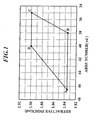
- X-axis is the Abbe number ( ⁇ d ) and Y-axis is the refractive index (n d )
- the area including the border lines hereinafter, the above-described area is referred to as a specific area.
- an optical glass having the optical constants within the specific area and refractive index (n d ) more than 1.85 and less than 1.875, an optical glass having the optical constants within the specific area and Abbe number ( ⁇ d ) less than 39.5 and the like are required.
- Cadmium and thorium components have been known for a long time as ingredients providing high refractive index to a glass. However, it is well known that these ingredients cause environmental damage.
- a glass containing lead such as a glass containing PbO is known as a glass having has a high refractive index and a low transition temperature (Tg). Since a glass containing lead easily fuses with a metal molding die in precision mold pressing, it is difficult to use a metal molding die repeatedly. Therefore, it is not suitable for a glass used for precision mold pressing. Furthermore, for the sake of unfavorable environmental effect of lead component, there is a problem that some kinds of environmental measures are required in manufacturing, coolworking such as polishing, disposal and the like of a glass containing lead. There is also a movement to prohibit manufacture, use and the like of a glass containing lead. For these reason, an optical glass having high refractive index and low dispersion, low transition temperature, and containing no lead is strongly required.
- Publication 1 Japanese Patent Application Publication (Unexamined) Tokukaisho-52-14607 discloses a B 2 O 3 -SiO 2 -La 2 O 3 -Gd 2 O 3 -ZrO 2 +Ta 2 O 5 system optical glass.
- the glass disclosed in Publication 1 does not fulfill the recent above-described requirement for optical design, because the refractive index is low and the optical constants is not within the above-described specific area.
- Publication 2 discloses a B 2 O 3 -La 2 O 3 -Gd 2 O 3 -WO 3 -ZrO 2 +Ta 2 O 5 system high refractive index and low dispersion optical glass. Though some optical glasses disclosed in Publication 2 has the optical constants within the above-described specific area, they are difficult to perform the precision mold pressing for the sake of its high transition temperature (Tg).
- Japanese Patent Application Publication (Examined) Tokukousho-54-2646 discloses a SiO 2 -B 2 O 3 -La 2 O 3 -Ta 2 O 5 +ZnO system high refractive index and low dispersion optical glass. It is difficult that the optical glass disclosed in this publication is applied to precision mold pressing for the sake of its high transition temperature (Tg).
- Japanese Patent Application Publication (Unexamined) Tokukaisho-53-4023 discloses a B 2 O 3 -La 2 O 3 -HfO 2 system high refractive index and low dispersion optical glass. It is difficult that the optical glass disclosed on this publication is applied to precision mold pressing for the sake of its high transition temperature (Tg).
- Publication 3 discloses a SiO 2 -B 2 O 3 -La 2 O 3 -WO 3 -Ta 2 O 5 -Gd 2 O 3 -ZrO 2 system high refractive index and low dispersion optical glass. It is difficult that the glass practically disclosed in this publication is applied to precision mold pressing for the sake of its high transition temperature (Tg).
- Japanese Patent Application Publication (Unexamined) Tokukaisho-52-129716 and Japanese Patent Application Publication (Examined) Tokukousho-54-6042 discloses a B 2 O 3 -La 2 O 3 -Y 2 O 3 -ZrO 2 -WO 3 -Ta 2 O 5 +Nb 2 O 5 +TiO 2 system high refractive index and low dispersion optical glass. It is difficult that both of the glasses disclosed in Japanese Patent Application Publication (Unexamined) Tokukaisho-52-129716 and Publication 4 are applied to precision mold pressing for the sake of their high transition temperature (Tg).
- Tg transition temperature
- Japanese Patent Application Publication (Unexamined) Tokukaisho-60-46948 discloses a SiO 2 -B 2 O 3 -La 2 O 3 -Yb 2 O 3 -Nb 2 O 5 -Ta 2 O 5 system high refractive index and low dispersion optical glass. It is difficult that the glass practically disclosed in this publication is applied to precision mold pressing for the sake of its high transition temperature (Tg).
- Japanese Patent Application Publication (Unexamined) Tokukaisho-60-221338 discloses a B 2 O 3 -La 2 O 3 -Y 2 O 3 -bivalent metal oxide-Li 2 O system optical glass having low transition temperature (Tg).
- Japanese Patent Application Publication (Unexamined) Tokukaisho-62-100449 discloses a B 2 O 3 -La 2 O 3 -ZnO-Li 2 O-Sb 2 O 3 system optical glass having low transition temperature (Tg). Since this glass disclosed in this publication contains much Sb 2 O 3 as an essential component, in obtaining a glass preform material in hot forming, selective volatilization of Sb 2 O 3 component from the surface layer of molten glass tend to cause the surface striae of the glass preform material.
- the surface striae does not disappear by precision mold pressing, and a glass molding having surface striae does not used for optical elements such as lenses. Therefore, it is not suitable for the glass preform material used for precision mold pressing. Further, on precision mold pressing of a glass preform material, Sb 2 O 3 component selectively volatilizes from the surface layer of a glass preform material, and it adheres to the molding surface of a metal molding die to cause haze on the molding surface of a metal molding die. If the hazed metal die is used repeatedly, the haze itself is transferred to the surface of a glass molding, or the haze pattern is printed to the surface of a glass molding.
- Publication 7 discloses a high refractive index and low dispersion optical glass having low Tg.
- the glass practically disclosed in Publication 7 having the optical constants within the above-described specific area has a defect of having a difficulty in manufacturing a glass preform material for the sake of its low resistance to devitrification property. Further, there is also a defect that transmission factor in short visible wavelength range is low since a lot of WO 3 or TiO 2 is contained.
- An object of the present invention is to solve the defects of the optical glass described in Description of Related Art, and to provide an optical glass which has optical constants within the above-described specific area and a low transition temperature (Tg), and which is suitable for a glass preform material used for precision mold pressing and precision mold pressing, and furthermore, is free from cadmium component, thorium component and lead component in order to have low environmental burden.
- the inventors has examined and researched an optical lens.
- an optical glass which has optical constants in the specific range and low transition temperature (Tg) at which precise press forming can be performed, and which is suitable for a glass preform material used for precision mold pressing and precision mold pressing, and is available for precision mold pressing.
- Tg transition temperature
- the above-described optical glass preferably comprises 0.1 to less than 5.5% of SiO 2 .
- the above-described optical glass preferably comprises more than 1 to less than 3% of Li 2 O.
- the above-described optical glass may have the refractive index (n d ) of less than 1.875.
- the above-described optical glass may have the refractive index (n d ) of 1.875 or more.
- the above-described optical glass may have the refractive index (n d ) of more than 1.85.
- the above-described optical glass may have the Abbe number ( ⁇ d ) of less than 39.5.
- the above-described optical glass may have the Abbe number ( ⁇ d ) of 39.5 and more.
- the above-described optical glass preferably has the transition temperature (Tg) of 640°C or less.
- the above-described optical glass preferably has the transition temperature (Tg) of 630°C or less.
- composition range by mass% of each components are limited as described above in an optical glass of the present invention.
- the SiO 2 component is an effective component in increasing the viscosity and improving the resistance to devitrification property of the optical glass of the present invention.
- the content thereof is less than 0.1%, it becomes difficult to obtain the above-described effect efficiently.
- the glass contains the SiO 2 component excessively, it is not preferable since the transition temperature (Tg) becomes high.
- the content of SiO 2 component is preferably 0.1 % or more, more preferably 0.5% or more and the most preferably 1% or more, and is preferably 8% or less, more preferably 6% or less and the most preferably less than 5.5%.
- the B 2 O 3 component is an essential component as a glass consisting oxide component in the Lanthanum system optical glass of the present invention.
- the optical glass of the present invention contains preferably 5% or more, more preferably 6% or more and the most preferably 8% or more, and contains preferably less than 20%, more preferably 19.5% or less and the most preferably 19% or less of B 2 O 3 component.
- the La 2 O 3 component is effective in increasing refractive index and decreasing dispersion and is essential for the glass of the present invention having high refractive index and low dispersion.
- the glass contains preferably 15% or more, more preferably 18% or more, and the most preferably 20% or more, and contains preferably not more than 50%, more preferably less than 47%, and the most preferably not more than 45% of La 2 O 3 component.
- Gd 2 O 3 component is effective in increasing refractive index and decreasing dispersion of the glass.
- the optical glass of the present invention contains preferably 0.1% or more, more preferably 0.5% or more and the most preferably 1% or more, and contains preferably 30% or less, more preferably less than 28% and the most preferably 25% or less of Gd 2 O 3 component.
- the Nb 2 O 5 component is effective in increasing refractive index and improving chemical durability and resistance to devitrification property. On the contrary the resistance to devitrification property degrades when the glass contains the Nb 2 O 5 component excessively.
- the content thereof is preferably 0.1% or more. Furthermore, the content thereof is preferably 8% or less, more preferably 7% or less and the most preferably 6% or less in order to obtain the fine resistance to devitrification property.
- the GeO 2 component is effective component in increasing refractive index and improving resistance to devitrification property.
- the material thereof is extremely expensive. Therefore, the glass of the present invention contains preferably 10% or less, more preferably 8% or less and the most preferably 6% or less of GeO 2 component.
- the total content of the Gd 2 O 3 , the Nb 2 O 5 and the GeO 2 components is controlled preferably more than 10%, more preferably 10.5% or more and the most preferably 11% or more, and also controlled preferably 30% or less, more preferably 28% or less and the most preferably 25% or less.
- the Yb 2 O 3 component is effective in increasing the refractive index and decreasing the dispersion of the glass.
- the optical glass of the present invention contains preferably 5% or less, more preferably 4% or less and the most preferably 3.5% or less of Yb 2 O 3 .
- the TiO 2 component has the effects of regulating optical constants and improving resistance to devitrification property.
- the glass of the present invention contains preferably 1% or less, more preferably 0.8% or less and the most preferably 0.5% or less of TiO 2 .
- the ZrO 2 component has effects of regulating optical constants and improving resistance to devitrification property and chemical durability.
- the optical glass of the present invention contains preferably 8% or less, more preferably less than 8% and the most preferably 7.5% or less of ZrO 2 .
- the content is preferably 0.1% or more.
- the Ta 2 O 5 component has the effects of increasing refractive index and improving chemical durability and resistance to devitrification property.
- the content thereof is 10% or less, no remarkable effect is seen, and when it is more than 25%, resistance to devitrification property degrades to the contrary. Therefore, in order to obtain the optical glass of the present invention having enough chemical durability and resistance to devitrification property while the refractive index is kept in the desired range, the content is preferably more than 10%, more preferably 14% or more and the most preferably more than 19%. In addition, the upper limit is 25%.
- the WO 3 component has the effects of regulating optical constants and improving resistance to devitrification property. However, when the glass contains the WO 3 component excessively, the resistance to devitrification property and the light transmittance in shorter wavelength range of visible range decreases.
- the glass of the present invention contains preferably 10% or less, more preferably 8% or less and the most preferably 6% or less of the WO 3 .
- the content is less than 2%
- the ZnO component has a large effect of lowering transition temperature (Tg).
- Tg transition temperature
- the glass of the present invention contains preferably 15% or less, more preferably 13% or less and the most preferably 10% or less of ZnO.
- the content is 0.1% or more.
- the RO component which is one or more kinds of the components selected from CaO, SrO and BaO, is effective in regulating optical constants.
- the amount i.e. the total content of CaO, SrO and BaO components
- the total content of CaO, SrO and BaO components is preferably 5% or less, more preferably 4% or less and the most preferably 3% or less.
- the Li 2 O component has the effects of lowering transition temperature (Tg) to a large degree and promoting the melting of the mixed glass materials.
- the glass of the present invention contains less than 3%, preferably 2.5% or less and the most preferably 2% or less of the Li 2 O.
- the content is more than 0.5%, preferably 0.6% or more and the most preferably more than 1%.
- the Sb 2 O 3 component can be added to the molten glass for defoaming in melting the glass.
- the content is preferably 1% and less, more preferably 0.8% and less and the most preferably 0.5% and less.
- the Lu 2 O 3 component has the effect of improving resistance to devitrification property when extremely small amount is added to the glass of the composition system according to the present invention. Since the material of the Lu 2 O 3 component is extremely expensive, when the glass contains the Lu 2 O 3 component excessively, the glass is not practical because of its high production cost. Furthermore, there is a disadvantage that the resistance to devitrification property degrades. Therefore, the glass of the present invention contains preferably less than 0.5%, more preferably 0.45% or less and the most preferably 0.4% or less of Lu 2 O 3 .
- the F component is effective in decreasing the dispersion of a glass, lowering transition temperature (Tg), and improving resistance to devitrification property.
- F component coexists with La 2 O 3 component, it becomes successful in obtaining the high refractive index and low dispersion optical glass having the optical constants within the above-described specific area and the low transition temperature (Tg) at which precision mold pressing can be performed. Therefore, F component is extremely important component in the glass of the present invention.
- a part or all of one kind or two or more kinds of metal oxide of the each above-described metal element is substituted with the metal fluoride thereof.
- the total content of the fluoride calculated as F element is less than 0.1%, the above-described effects of the F component are insufficient, and when it is more than 6%, it become difficult to obtain a uniform glass since the volatilization amount of the F component increases.
- the glass of the present invention contains preferably 6% or less, more preferably 5.5% or less and the most preferably 5% or less, and contains preferably 0.1% or more, more preferably 0.2% or more and the most preferably 0.5% or more of the F component.
- the optical glass of the present invention should not contain the lead component, because the lead component makes large environmental burden.
- the optical glass of the present invention should not contain them.
- the optical glass of the present invention contains P205, it tends to degrade the resistance to devitrification property. Therefore, it is not preferable that the glass contains P 2 O 5 component.
- the Y 2 O 3 the inventors have found that resistance to devitrification property of the optical glass of the present invention degrades unexpectedly when the glass contains the Y 2 O 3 component. Therefore, the glass should not contain it.
- the optical glass of the present invention should not contain the TeO 2 .
- Tables 1 to 6 show the composition of the examples according to the glass of the present invention (No. 1 to No. 32) together with their refractive index (n d ), Abbe number ( ⁇ d ) and transition temperature (Tg).
- Tables 7 and 8 show the composition of the glass of the comparative examples (No. A to No. H) together with their refractive index (n d ), Abbe number ( ⁇ d ) and transition temperature (Tg).
- Table 9 shows the results of a devitrification test of the example of the present invention (No. 17, 25, 28 and 30) and the comparative examples (No. I, J and K). EXAMPLE COMPOSITION (mass%) No.
- optical glasses of the examples of the present invention (No. 1 to No. 32) shown in Tables 1 to 6 were obtained in the following processes.
- General optical glasses materials such as oxides, hydroxides, carbonates, nitrates, fluorides and the like were weighed by their mass proportions according to be the composition of the examples shown in Tables 1 to 6 and were mixed together.
- the mixed glass materials were installed to a platinum crucible of 300cc volume and were melted, refined and stirred at 1200°C to 1400°C for 3 to 6 hours depending on their meltability based on the compositions so as to be homogenized.
- the homogenized molten glasses were cast into a metal molding die or the like and annealed.
- optical glasses of the examples of the present invention have the optical constants (refractive index (n d ) and Abbe number ( ⁇ d )) within the above-described specific area and the transition point (Tg) within a range of 550 to 650°C.
- their optical glasses are suitable for the glass preform material for precision mold pressing and precision mold pressing.
- glass of comparative example No. A (example 6 of above-described Publication 1) contains fluorine, but has transition temperature (Tg) of more than 650°C. Therefore, it is difficult to be applied to precision mold pressing. Further, the optical constants are not within the above-described specific area.
- the comparative examples J, K, and L had same compositions of the example 23 and 28 of the above-described Publication 7 (their compositions shown in Publication 7 are converted from mol% to mass%) and the example 4 of the above-described Publication 6 respectively.
- a circle mark (O) indicates that devitrification was generated after the above-described process, and a cross mark (x) indicates that devitrification was not generated.
- each of the molten glasses of the examples of the present invention are superior in resistance to devitrification property to the comparative example I to L. Particularly, from the example 17 and the comparative example I, it is found that the resistance to devitrification property degrades when the glass contains Y 2 O 3 .
- the optical glass is suitable for glass preform material used for precision mold pressing, and for precision mold pressing.
- the optical glass is industrially very useful. Further, since the optical glass does not contain lead component, cadmium component and thorium component, the present invention is successful in obtaining an optical glass making low environmental burden.
Landscapes
- Chemical & Material Sciences (AREA)
- Life Sciences & Earth Sciences (AREA)
- Engineering & Computer Science (AREA)
- Chemical Kinetics & Catalysis (AREA)
- General Chemical & Material Sciences (AREA)
- Geochemistry & Mineralogy (AREA)
- Materials Engineering (AREA)
- Organic Chemistry (AREA)
- Glass Compositions (AREA)
Applications Claiming Priority (3)
| Application Number | Priority Date | Filing Date | Title |
|---|---|---|---|
| JP2002365851 | 2002-12-17 | ||
| JP2002365851 | 2002-12-17 | ||
| PCT/JP2003/015978 WO2004054937A1 (fr) | 2002-12-17 | 2003-12-12 | Verre optique |
Publications (2)
| Publication Number | Publication Date |
|---|---|
| EP1574486A1 true EP1574486A1 (fr) | 2005-09-14 |
| EP1574486A4 EP1574486A4 (fr) | 2008-09-03 |
Family
ID=32588283
Family Applications (1)
| Application Number | Title | Priority Date | Filing Date |
|---|---|---|---|
| EP03778900A Withdrawn EP1574486A4 (fr) | 2002-12-17 | 2003-12-12 | Verre optique |
Country Status (7)
| Country | Link |
|---|---|
| US (2) | US7138349B2 (fr) |
| EP (1) | EP1574486A4 (fr) |
| JP (1) | JP3762421B2 (fr) |
| CN (1) | CN100457658C (fr) |
| AU (1) | AU2003289074A1 (fr) |
| TW (1) | TWI287000B (fr) |
| WO (1) | WO2004054937A1 (fr) |
Families Citing this family (54)
| Publication number | Priority date | Publication date | Assignee | Title |
|---|---|---|---|---|
| US20040067904A1 (en) * | 2001-12-13 | 2004-04-08 | Soldatenkov Viatcheslav A. | Gene therapy for prostate cancer: sensibilization of cells to dna damaging drugs and radiation |
| JP3912774B2 (ja) * | 2002-03-18 | 2007-05-09 | Hoya株式会社 | 精密プレス成形用光学ガラス、精密プレス成形用プリフォームおよびその製造方法 |
| US7138349B2 (en) * | 2002-12-17 | 2006-11-21 | Kabushiki Kaisha Ohara | Optical glass |
| JP4739721B2 (ja) * | 2003-11-17 | 2011-08-03 | 株式会社オハラ | 光学ガラス |
| JP4124749B2 (ja) * | 2004-03-02 | 2008-07-23 | Hoya株式会社 | 光学ガラス、精密プレス成形用プリフォームおよびその製造方法、光学素子およびその製造方法 |
| JP4218804B2 (ja) * | 2004-03-19 | 2009-02-04 | Hoya株式会社 | 光学ガラス、精密プレス成形用プリフォームとその製造方法および光学素子とその製造方法 |
| JP2005298262A (ja) * | 2004-04-12 | 2005-10-27 | Hoya Corp | 光学素子の量産方法 |
| JP2006016295A (ja) * | 2004-06-02 | 2006-01-19 | Ohara Inc | 光学ガラス |
| EP1604959A1 (fr) * | 2004-06-02 | 2005-12-14 | Kabushiki Kaisha Ohara | Verre optique |
| JP4828893B2 (ja) * | 2004-08-27 | 2011-11-30 | 株式会社オハラ | 光学ガラス |
| JP4895512B2 (ja) * | 2005-02-28 | 2012-03-14 | 株式会社オハラ | 光学ガラス |
| TWI316928B (en) | 2005-04-28 | 2009-11-11 | Ohara Kk | Optical glass |
| DE102005020423B4 (de) * | 2005-04-29 | 2009-04-02 | Schott Ag | Blei- und arsenfreies optisches Lanthanboratglas und dessen Verwendung |
| JP4988253B2 (ja) * | 2005-06-06 | 2012-08-01 | 株式会社オハラ | 光学ガラスの製造方法 |
| JP5561888B2 (ja) * | 2005-10-11 | 2014-07-30 | 株式会社オハラ | 光学ガラス |
| US7499219B2 (en) * | 2005-10-14 | 2009-03-03 | Volk Optical, Inc. | Optimized lens for indirect ophthalmoscopy |
| JP4756554B2 (ja) * | 2006-03-23 | 2011-08-24 | Hoya株式会社 | 光学ガラス、精密プレス成形用プリフォームとその製造方法、および光学素子とその製造方法 |
| TW200813467A (en) * | 2006-06-13 | 2008-03-16 | Asahi Glass Co Ltd | Optical glass and lens using the same |
| JP5336035B2 (ja) * | 2006-06-21 | 2013-11-06 | Hoya株式会社 | 光学ガラス、ガラス成形体、光学素子およびそれらの製造方法 |
| US7897532B2 (en) * | 2007-04-24 | 2011-03-01 | Panasonic Corproation | Optical glass composition, preform and optical element |
| JP5594807B2 (ja) * | 2007-09-25 | 2014-09-24 | 株式会社オハラ | 光学ガラス |
| US8003556B2 (en) * | 2007-09-28 | 2011-08-23 | Ohara Inc. | Optical glass |
| CN102320739B (zh) * | 2007-09-29 | 2015-04-01 | 株式会社小原 | 光学玻璃 |
| WO2009075325A1 (fr) * | 2007-12-11 | 2009-06-18 | Olympus Corporation | Verre optique et dispositif optique l'utilisant |
| US7897533B2 (en) * | 2007-12-19 | 2011-03-01 | Panasonic Corporation | Optical glass composition, preform and optical element |
| JP5327942B2 (ja) * | 2007-12-19 | 2013-10-30 | パナソニック株式会社 | 光学ガラス組成物、プリフォーム及び光学素子 |
| JP5327943B2 (ja) * | 2007-12-19 | 2013-10-30 | パナソニック株式会社 | 光学ガラス組成物、プリフォーム及び光学素子 |
| JP5180758B2 (ja) | 2008-09-30 | 2013-04-10 | Hoya株式会社 | 光学ガラス、プレス成形用ガラスゴブおよび光学素子とその製造方法ならびに光学素子ブランクの製造方法 |
| CN101386469B (zh) * | 2008-10-16 | 2011-05-11 | 成都光明光电股份有限公司 | 高折射低色散光学玻璃 |
| US8247336B2 (en) * | 2008-11-05 | 2012-08-21 | Panasonic Corporation | Optical glass composition, preform and optical element |
| JP5327954B2 (ja) * | 2008-11-05 | 2013-10-30 | パナソニック株式会社 | 光学ガラス組成物、プリフォーム及び光学素子 |
| JP5327953B2 (ja) * | 2008-11-05 | 2013-10-30 | パナソニック株式会社 | 光学ガラス組成物、プリフォーム及び光学素子 |
| JP5305436B2 (ja) * | 2008-11-05 | 2013-10-02 | パナソニック株式会社 | 光学ガラス組成物、プリフォーム及び光学素子 |
| WO2010090014A1 (fr) | 2009-02-03 | 2010-08-12 | Hoya株式会社 | Verre optique, préforme pour moulage de précision à la presse et élément optique |
| JP5678477B2 (ja) * | 2009-05-28 | 2015-03-04 | 旭硝子株式会社 | 光学ガラス |
| JP2011027993A (ja) * | 2009-07-24 | 2011-02-10 | Panasonic Corp | 光学部品およびその製造方法 |
| JP5624832B2 (ja) * | 2009-09-30 | 2014-11-12 | Hoya株式会社 | 光学ガラス、プレス成形用ガラス素材、光学素子とその製造方法 |
| TWI594966B (zh) * | 2010-10-08 | 2017-08-11 | Ohara Kk | Optical glass, preform and optical element |
| WO2012054432A2 (fr) | 2010-10-18 | 2012-04-26 | Ocv Intellectual Capital, Llc | Composition de verre à indice de réfraction élevé |
| JP6096409B2 (ja) * | 2010-10-29 | 2017-03-15 | 株式会社オハラ | 光学ガラス、プリフォーム及び光学素子 |
| JP6076594B2 (ja) * | 2010-12-13 | 2017-02-08 | 株式会社オハラ | 光学ガラス、プリフォーム及び光学素子 |
| KR20130016126A (ko) * | 2011-08-05 | 2013-02-14 | 가부시키가이샤 오하라 | 광학 유리, 프리폼 및 광학 소자 |
| JP5731358B2 (ja) * | 2011-09-01 | 2015-06-10 | 株式会社オハラ | 光学ガラス、プリフォーム及び光学素子 |
| JP6069217B2 (ja) * | 2011-11-08 | 2017-02-01 | Hoya株式会社 | 光学ガラス、プレス成形用ガラス素材、ならびに光学素子およびその製造方法 |
| JP5596717B2 (ja) * | 2012-01-30 | 2014-09-24 | 株式会社オハラ | 光学ガラス |
| JP6086804B2 (ja) * | 2013-04-30 | 2017-03-01 | 株式会社オハラ | 光学ガラス、プリフォーム及び光学素子 |
| JP6164923B2 (ja) * | 2013-05-14 | 2017-07-19 | 株式会社オハラ | 光学ガラス及び光学素子 |
| JP6462244B2 (ja) * | 2014-01-07 | 2019-01-30 | 日本電気硝子株式会社 | 光学ガラス |
| JP6462245B2 (ja) * | 2014-01-07 | 2019-01-30 | 日本電気硝子株式会社 | 光学ガラス |
| US11319243B2 (en) | 2018-01-17 | 2022-05-03 | Corning Incorporated | High refractive index optical borate glass |
| US11952311B2 (en) | 2018-08-17 | 2024-04-09 | Cdgm Glass Co., Ltd. | Optical glass, glass prefabricated member or optical element prepared therefrom, and optical instrument |
| CN109626815B (zh) * | 2019-01-23 | 2021-10-01 | 成都光明光电股份有限公司 | 光学玻璃、玻璃预制件、光学元件及光学仪器 |
| CN109665714B (zh) * | 2019-02-28 | 2021-06-29 | 成都光明光电股份有限公司 | 光学玻璃、玻璃预制件、光学元件及光学仪器 |
| CN114859444B (zh) * | 2022-05-06 | 2024-03-19 | 西安交通大学 | 一种硫系玻璃红外复眼的制备方法 |
Family Cites Families (29)
| Publication number | Priority date | Publication date | Assignee | Title |
|---|---|---|---|---|
| JPS5248609B2 (fr) * | 1973-06-09 | 1977-12-10 | ||
| JPS5214607A (en) | 1975-07-24 | 1977-02-03 | Obara Optical Glass | Optical glass not containing thorium |
| JPS52129716A (en) | 1976-04-26 | 1977-10-31 | Hoya Glass Works Ltd | Optical glass |
| JPS52155614A (en) | 1976-06-22 | 1977-12-24 | Obara Optical Glass | Optical glass of high difraction index and low dispersion |
| JPS534023A (en) | 1976-07-02 | 1978-01-14 | Obara Optical Glass | Optical glass |
| JPS5347368A (en) | 1976-10-13 | 1978-04-27 | Otsuki Tatsukiyo | Deodorization of vacuum car exhaust gas |
| JPS542646A (en) | 1977-06-08 | 1979-01-10 | Toshiba Corp | Generation system for variable-frequency signal |
| GB1586997A (en) | 1977-06-16 | 1981-03-25 | Union Carbide Corp | Curable ethylene-alkyl acrylate copolymer composition containing silane treated aluminum oxide filler |
| JPS546242A (en) | 1977-06-17 | 1979-01-18 | Nissan Diesel Motor Co Ltd | Automotive parking brake device |
| JPS5490218A (en) * | 1977-12-28 | 1979-07-17 | Minolta Camera Kk | Optical glass |
| JPS553329A (en) * | 1978-06-21 | 1980-01-11 | Ohara Inc | Optical glass |
| JPS6046948A (ja) | 1983-08-25 | 1985-03-14 | Nippon Kogaku Kk <Nikon> | 高屈折率低分散光学ガラス |
| JPS60221338A (ja) * | 1984-04-12 | 1985-11-06 | Ohara Inc | 光学ガラス |
| JPS62100449A (ja) * | 1985-10-24 | 1987-05-09 | Ohara Inc | 光学ガラス |
| JP3015079B2 (ja) * | 1990-08-02 | 2000-02-28 | 株式会社住田光学ガラス | 精密プレス用光学ガラス |
| JP3138551B2 (ja) | 1992-10-09 | 2001-02-26 | 株式会社オハラ | ガラス塊の成形方法 |
| JP3521942B2 (ja) * | 1993-10-22 | 2004-04-26 | 株式会社住田光学ガラス | 精密プレス成形用光学ガラス |
| JPH07165431A (ja) | 1993-12-14 | 1995-06-27 | Ohara Inc | ゴブの成形方法及びそれに用いられる成形装置 |
| JPH08217484A (ja) | 1995-02-13 | 1996-08-27 | Ohara Inc | 光学ガラス |
| JP2798208B2 (ja) | 1995-05-19 | 1998-09-17 | 株式会社オハラ | ガラスゴブの成形方法 |
| JP3448395B2 (ja) | 1995-05-23 | 2003-09-22 | ポーラ化成工業株式会社 | 皮膚洗浄料 |
| JP3750984B2 (ja) * | 2000-05-31 | 2006-03-01 | Hoya株式会社 | 光学ガラスおよび光学製品の製造方法 |
| JP4017832B2 (ja) | 2001-03-27 | 2007-12-05 | Hoya株式会社 | 光学ガラスおよび光学部品 |
| JP4789358B2 (ja) * | 2001-07-03 | 2011-10-12 | 株式会社オハラ | 光学ガラス |
| US6977232B2 (en) * | 2001-10-24 | 2005-12-20 | Hoya Corporation | Optical glass, preform for press molding and optical part |
| JP3912774B2 (ja) * | 2002-03-18 | 2007-05-09 | Hoya株式会社 | 精密プレス成形用光学ガラス、精密プレス成形用プリフォームおよびその製造方法 |
| US7138349B2 (en) * | 2002-12-17 | 2006-11-21 | Kabushiki Kaisha Ohara | Optical glass |
| EP1433757B1 (fr) * | 2002-12-27 | 2017-02-01 | Hoya Corporation | Verre optique, paraison de verre pour moulage par pression et élément optique |
| JP4739721B2 (ja) * | 2003-11-17 | 2011-08-03 | 株式会社オハラ | 光学ガラス |
-
2003
- 2003-12-12 US US10/733,303 patent/US7138349B2/en not_active Expired - Fee Related
- 2003-12-12 JP JP2004560633A patent/JP3762421B2/ja not_active Expired - Fee Related
- 2003-12-12 CN CNB2003801066627A patent/CN100457658C/zh not_active Expired - Fee Related
- 2003-12-12 EP EP03778900A patent/EP1574486A4/fr not_active Withdrawn
- 2003-12-12 AU AU2003289074A patent/AU2003289074A1/en not_active Abandoned
- 2003-12-12 WO PCT/JP2003/015978 patent/WO2004054937A1/fr not_active Ceased
- 2003-12-16 TW TW092135517A patent/TWI287000B/zh not_active IP Right Cessation
-
2006
- 2006-06-12 US US11/450,411 patent/US7335614B2/en not_active Expired - Fee Related
Also Published As
| Publication number | Publication date |
|---|---|
| JP3762421B2 (ja) | 2006-04-05 |
| CN1729147A (zh) | 2006-02-01 |
| JPWO2004054937A1 (ja) | 2006-04-20 |
| EP1574486A4 (fr) | 2008-09-03 |
| TW200418739A (en) | 2004-10-01 |
| AU2003289074A1 (en) | 2004-07-09 |
| US7335614B2 (en) | 2008-02-26 |
| US7138349B2 (en) | 2006-11-21 |
| TWI287000B (en) | 2007-09-21 |
| US20060229186A1 (en) | 2006-10-12 |
| WO2004054937A1 (fr) | 2004-07-01 |
| CN100457658C (zh) | 2009-02-04 |
| US20040235638A1 (en) | 2004-11-25 |
Similar Documents
| Publication | Publication Date | Title |
|---|---|---|
| US7138349B2 (en) | Optical glass | |
| JP3943348B2 (ja) | 光学ガラス | |
| JP3377454B2 (ja) | モールドプレス用光学ガラス | |
| US7827823B2 (en) | Optical glass, precision press-molding preform, process for producing the preform, optical element and process for producing the element | |
| TWI413626B (zh) | 硬火石及鑭硬火石位置之無鉛光學玻璃 | |
| TWI477470B (zh) | 光學玻璃 | |
| KR101004990B1 (ko) | 광학 글라스 | |
| JP4034589B2 (ja) | 光学ガラス | |
| JP5602987B2 (ja) | 光学ガラス | |
| TWI382967B (zh) | 不含鉛及砷之高折射率光學玻璃 | |
| JP2013067558A (ja) | 光学ガラス | |
| CN106630595A (zh) | 光学玻璃、预成型体材料及光学元件 | |
| KR101298373B1 (ko) | 납 및 비소를 포함하지 않는 광학 란탄 붕산염 유리 | |
| EP2246311A1 (fr) | Verre optique | |
| JP4938982B2 (ja) | 特に精密プレスした光学要素用の光学ガラス | |
| JP5313440B2 (ja) | 光学ガラス | |
| CN110372202B (zh) | 光学玻璃、玻璃预制件、光学元件及光学仪器 | |
| JP2008143773A (ja) | フッ素無含有光学ガラス | |
| JP2003176151A (ja) | モールドプレス成形用光学ガラス | |
| JP4233832B2 (ja) | モールド成形用光学ガラス | |
| JP2024001857A (ja) | 光学ガラスおよび光学素子 | |
| JPWO2004087596A1 (ja) | 光学ガラス | |
| US20040132605A1 (en) | Optical glass | |
| CN102167510A (zh) | 光学玻璃以及光学元件 | |
| CN102050570A (zh) | 光学玻璃 |
Legal Events
| Date | Code | Title | Description |
|---|---|---|---|
| PUAI | Public reference made under article 153(3) epc to a published international application that has entered the european phase |
Free format text: ORIGINAL CODE: 0009012 |
|
| 17P | Request for examination filed |
Effective date: 20050610 |
|
| AK | Designated contracting states |
Kind code of ref document: A1 Designated state(s): AT BE BG CH CY CZ DE DK EE ES FI FR GB GR HU IE IT LI LU MC NL PT RO SE SI SK TR |
|
| AX | Request for extension of the european patent |
Extension state: AL LT LV MK |
|
| DAX | Request for extension of the european patent (deleted) | ||
| A4 | Supplementary search report drawn up and despatched |
Effective date: 20080806 |
|
| GRAP | Despatch of communication of intention to grant a patent |
Free format text: ORIGINAL CODE: EPIDOSNIGR1 |
|
| STAA | Information on the status of an ep patent application or granted ep patent |
Free format text: STATUS: THE APPLICATION IS DEEMED TO BE WITHDRAWN |
|
| 18D | Application deemed to be withdrawn |
Effective date: 20090926 |