EP1564947B1 - Elektronisches System zum Abschluss von Busleitungen - Google Patents
Elektronisches System zum Abschluss von Busleitungen Download PDFInfo
- Publication number
- EP1564947B1 EP1564947B1 EP05009867A EP05009867A EP1564947B1 EP 1564947 B1 EP1564947 B1 EP 1564947B1 EP 05009867 A EP05009867 A EP 05009867A EP 05009867 A EP05009867 A EP 05009867A EP 1564947 B1 EP1564947 B1 EP 1564947B1
- Authority
- EP
- European Patent Office
- Prior art keywords
- voltage
- circuit
- output
- termination
- power supply
- Prior art date
- Legal status (The legal status is an assumption and is not a legal conclusion. Google has not performed a legal analysis and makes no representation as to the accuracy of the status listed.)
- Expired - Lifetime
Links
Images









Classifications
-
- H—ELECTRICITY
- H03—ELECTRONIC CIRCUITRY
- H03K—PULSE TECHNIQUE
- H03K19/00—Logic circuits, i.e. having at least two inputs acting on one output; Inverting circuits
-
- H—ELECTRICITY
- H04—ELECTRIC COMMUNICATION TECHNIQUE
- H04L—TRANSMISSION OF DIGITAL INFORMATION, e.g. TELEGRAPHIC COMMUNICATION
- H04L25/00—Baseband systems
- H04L25/02—Details ; arrangements for supplying electrical power along data transmission lines
- H04L25/0264—Arrangements for coupling to transmission lines
- H04L25/028—Arrangements specific to the transmitter end
-
- G—PHYSICS
- G11—INFORMATION STORAGE
- G11C—STATIC STORES
- G11C11/00—Digital stores characterised by the use of particular electric or magnetic storage elements; Storage elements therefor
- G11C11/21—Digital stores characterised by the use of particular electric or magnetic storage elements; Storage elements therefor using electric elements
- G11C11/34—Digital stores characterised by the use of particular electric or magnetic storage elements; Storage elements therefor using electric elements using semiconductor devices
- G11C11/40—Digital stores characterised by the use of particular electric or magnetic storage elements; Storage elements therefor using electric elements using semiconductor devices using transistors
-
- H—ELECTRICITY
- H03—ELECTRONIC CIRCUITRY
- H03K—PULSE TECHNIQUE
- H03K19/00—Logic circuits, i.e. having at least two inputs acting on one output; Inverting circuits
- H03K19/003—Modifications for increasing the reliability for protection
- H03K19/00369—Modifications for compensating variations of temperature, supply voltage or other physical parameters
- H03K19/00384—Modifications for compensating variations of temperature, supply voltage or other physical parameters in field effect transistor circuits
-
- H—ELECTRICITY
- H03—ELECTRONIC CIRCUITRY
- H03K—PULSE TECHNIQUE
- H03K19/00—Logic circuits, i.e. having at least two inputs acting on one output; Inverting circuits
- H03K19/0175—Coupling arrangements; Interface arrangements
- H03K19/0185—Coupling arrangements; Interface arrangements using field effect transistors only
- H03K19/018557—Coupling arrangements; Impedance matching circuits
- H03K19/018571—Coupling arrangements; Impedance matching circuits of complementary type, e.g. CMOS
-
- H—ELECTRICITY
- H04—ELECTRIC COMMUNICATION TECHNIQUE
- H04L—TRANSMISSION OF DIGITAL INFORMATION, e.g. TELEGRAPHIC COMMUNICATION
- H04L25/00—Baseband systems
- H04L25/02—Details ; arrangements for supplying electrical power along data transmission lines
- H04L25/0264—Arrangements for coupling to transmission lines
- H04L25/0278—Arrangements for impedance matching
-
- H—ELECTRICITY
- H04—ELECTRIC COMMUNICATION TECHNIQUE
- H04L—TRANSMISSION OF DIGITAL INFORMATION, e.g. TELEGRAPHIC COMMUNICATION
- H04L25/00—Baseband systems
- H04L25/02—Details ; arrangements for supplying electrical power along data transmission lines
- H04L25/0264—Arrangements for coupling to transmission lines
- H04L25/0298—Arrangement for terminating transmission lines
-
- H—ELECTRICITY
- H04—ELECTRIC COMMUNICATION TECHNIQUE
- H04L—TRANSMISSION OF DIGITAL INFORMATION, e.g. TELEGRAPHIC COMMUNICATION
- H04L25/00—Baseband systems
- H04L25/02—Details ; arrangements for supplying electrical power along data transmission lines
- H04L25/0264—Arrangements for coupling to transmission lines
- H04L25/0266—Arrangements for providing Galvanic isolation, e.g. by means of magnetic or capacitive coupling
-
- H—ELECTRICITY
- H04—ELECTRIC COMMUNICATION TECHNIQUE
- H04L—TRANSMISSION OF DIGITAL INFORMATION, e.g. TELEGRAPHIC COMMUNICATION
- H04L25/00—Baseband systems
- H04L25/02—Details ; arrangements for supplying electrical power along data transmission lines
- H04L25/0264—Arrangements for coupling to transmission lines
- H04L25/0292—Arrangements specific to the receiver end
Definitions
- the present invention generally relates to electronic systems which transmit signals to remote devices via signal lines, and more particularly to an electronic system which transmits a signal having an amplitude less than the power supply voltage applied to the electronic system.
- GTL Guide Transceiver Logic
- the output circuit is an open-drain type driver and an impedance match termination is employed.
- Taguchi et al. "COMPARING SMALL-AMPLITUDE INTERFACES TOWARD 100 MHZ TIMES", Nikkei Electronics, No. 591, pp. 269 - 290, 1993. 9. 27; and 2) Taguchi et al., "SMALL-AMPLITUDE INTERFACE CIRCUIT FOR HIGH-SPEED MEMORY BUS", Study Document of Institute of Electronics, Communication and Information Engineers, November 26, 1993.
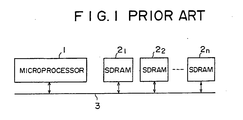
- Fig. 1 is a block diagram of a system having electronic systems in which a small-amplitude signal, which has an amplitude less than the power supply voltage, is transmitted therebetween via a bus line.
- the system shown in Fig. 1 includes a microprocessor 1, SDRAM (Synchronous Dynamic Random Access Memory) devices 2 1 , 2 2 and 2 n (where n is an integer), and a bus line 3 via which small-amplitude signals are transmitted.
- SDRAM Serial Dynamic Random Access Memory
- n is an integer
- the transmission of signals between the microprocessor 1 and the DRAM devices 2 1 - 2 n are carried out at tens of mega-hertz. However, it is required that signal transmissions be performed at 100 MHz or higher.
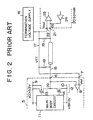
- Fig. 2 is a circuit diagram of conventional interfaces and a bus system employed in electronic systems as described above.
- a microprocessor 5 has a signal input/output terminal 6, a reference voltage input terminal 7 and an input circuit 8.
- the signal input/output terminal 6 is used to input and output a signal DQ.
- the reference voltage input terminal 7 is used to receive a reference voltage Vref.
- the input circuit 8 includes a differential amplifier circuit.
- the microprocessor 5 has a VCC power supply line 10 providing a power supply voltage VCC (equal to, for example, 3.3 V), a VSS power supply line via which a power supply voltage VSS (equal to, for example, 0 V), a main body circuit 11 and a push-pull-type output circuit 12.
- the push-pull-type output circuit 12 is made up of an enhancement-type p-channel MOS transistor 13 functioning as a pull-up element, and an enhancement-type n-channel MOS transistor 14 functioning as a pull-down element.
- a bus line 15 transmits small-amplitude signals.
- a termination voltage supply 16 generates a termination voltage VTT (equal to, for example, 1.65 V).
- a VTT voltage line 17 supplies the termination voltage VTT to parts connected thereto.
- Two termination resistors 18 and 19 (equal to, for example, 50 ⁇ ) are connected as shown in Fig. 2.
- An SDRAM device 20 has a signal input/output terminal 21 used to input and output the signal DQ, a reference voltage input terminal 22 receiving the reference voltage Vref, an input circuit 23 having a differential amplifier circuit, and a push-pull-type output circuit 24.
- the termination voltage VTT generated from the termination voltage supply 16 is applied, as the reference voltage Vref, to the reference voltage input terminal 7 of the microprocessor 5 and the reference voltage input terminal 22 of the SDRAM 20.
- Vref the reference voltage
- the pMOS transistor 13 is turned OFF (not conducting), and the nMOS transistor 14 is turned ON (conducting).
- the signal DQ is set to the low level (L).
- the pMOS transistor 13 is turned ON and the nMOS transistor 14 is OFF, the signal DQ is switched to the high level (H).
- the output circuit 12 outputs the low level, a current flows from the termination voltage supply 16 to the load.
- the output circuit 12 outputs the high level, a current flows the termination voltage supply 16 from the load.
- the termination voltage supply 16 is formed with a voltage source such as a switching regulator or a series regulator. However, such a regulator is not expected to receive current coming from the power supply. If a current comes into the voltage source from the load, the termination voltage VTT will be varied.
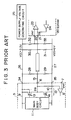
- the bus system shown in Fig. 3 includes a power supply voltage generating circuit 25 for generating the power supply voltage VCC.
- the circuit 25 is connected to a VCC power supply line 26. Further, there is provided a VSS power supply line 27. Further, the system includes termination resistors 28 - 31 (each equal to, for example, 100 ⁇ ), voltage dividing resistors 32 and 33, and power supply voltage input terminals 34 and 35 of the microprocessor 5.
- the resistors 32 and 33 divide the power supply voltage VCC to thereby generate the reference voltage Vref.
- the termination part made up of the termination resistors 28 and 29 is set approximately equal to 50 n, and the termination part made up of the termination resistors 30 and 31 is set approximately equal to 50 ⁇ .
- the bus system shown in Fig. 3 has the following disadvantages.
- the termination resistors 28 and 29 as well as the termination resistors 30 and 31 are respectively connected in series between the VCC line 26 and the VSS line 27. Hence, even when no signal is transmitted, currents flow in the termination resistors 28 - 31 and increase power consumption.
- the voltage dividing resistors 32 and 33 are designed to have large resistance values, the current flowing in the resistors 32 and 33 can be reduced.
- the reference voltage Vref will not be equal to the termination voltage VTT.
- the difference between the reference voltage Vref and the termination voltage VTT functions as a D.C. offset voltage of the input signal, which reduces the operation margin at the high-level or low-level side of the input signal.
- a more specific object of the present invention is to provide an electronic system in which the termination voltage is stabilized with reduced power consumption and a sufficient operation margin for input signals can be ensured by preventing an offset voltage from being produced.
- Fig. 4 is a circuit diagram of an electronic system.
- the electronic system shown in Fig. 4 includes a voltage generating circuit 37, which includes a voltage generating circuit 38 for generating a voltage V1, a voltage generating circuit 39 for generating a voltage V2, and voltage output terminals 40 and 41.
- the voltage generating circuits 38 and 39 are connected in series. The voltages V1 and V2 generated by the circuits 38 and 39 are applied to the voltage output terminals 40 and 41, respectively.
- a power supply line 42 carries a power supply voltage equal to V1 + V2 generated by the voltage generating circuit 37.
- a termination voltage line 43 carries a termination voltage VTT equal to the voltage V2 output by the voltage generating circuit 37.
- An integrated circuit 44 performs inputting and outputting of signals via a signal input/output terminal 45.
- the integrated circuit 44 has a power supply voltage input terminal 46, which receives the power supply voltage V1 + V2, and a power supply line 47 which supplies the voltage V1 + V2 as a power supply voltage.
- the integrated circuit 44 has a push-pull-type output circuit 48.
- the push-pull-type output circuit 48 includes a p-channel insulation gate type field effect transistor 49 functioning as a pull-up element, and an n-channel insulation gate type field effect transistor 50 functioning as a pull-down element.
- the system shown in Fig. 4 includes a bus line forming a signal transmission path, and a termination resistor 52 which terminates the bus line 51.
- the system includes an integrated circuit 53, which performs inputting and outputting of signals.
- the integrated circuit 53 has a signal input terminal 54 which inputs signals, a reference voltage input terminal 55 to which the voltage V2 output from the voltage generating circuit 37 is applied, and an input circuit 56.
- the output circuit 48 is supplied with the voltage V1 + V2 as the power supply voltage, and the termination resistor 52 is supplied with the voltage V2 as the termination voltage VTT.
- the termination voltage VTT can be set equal to half of the voltage V1 + V2.
- a current i Q flows, in the following order, in a closed circuit made up of the voltage generating circuit 39, the termination voltage line 43, the termination resistor 52, the bus line 51, the n-channel transistor 50, the ground, and the voltage generating circuit 39. - Hence, the voltage of the voltage output terminal 41 is maintained at the voltage V2.
- a current i 1 flows, in the following order, in a closed circuit made up of the voltage generating circuit 38, the power supply line 42, the transistor 49, the bus line 51, the termination resistor 52, and the voltage generating circuit 38. Hence, the voltage of the voltage output terminal 41 is maintained at the voltage V2.
- the voltage output terminal 41 can be maintained at the voltage V2 even when a current enters the voltage generating circuit 37, so that the stability in which the termination voltage VTT is equal to the voltage V2 can be ensured. Further, when the bus line 51 does not transmit any signal, no current flows in the termination resistor 52, whereby the power consumption can be reduced. Furthermore, the termination voltage VTT can be used as the reference voltage Vref with respect to the integrated circuits 44 and 53. Hence, it is possible to coincide the reference voltage Vref with the termination voltage VTT and prevent an occurrence of an offset voltage and to ensure a sufficient operation margin.
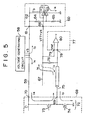
- Fig. 5 is a circuit diagram of an electronic system according to the present invention.
- the system includes a voltage generating circuit 58, which generates a voltage V3.
- a power supply line 59 for supplying the voltage V3 as the power supply voltage is connected to the circuit 58.
- the system includes a voltage generating circuit 60, which generates a voltage V4.
- the circuit 60 includes a power supply voltage input terminal 61 receiving the voltage V3, a power supply line 62 and an operational amplifier 63.
- the voltage generating circuit 60 includes voltage dividing resistors 64 and 65, which divide the voltage V3.
- the voltage generating circuit 60 includes a voltage output terminal 66 via which the voltage V4 is output, and a termination voltage line 67 for supplying the voltage V4 output from the voltage generating circuit 60 as the termination voltage VTT.
- the voltage V3 is divided by the resistors 64 and 65 to thereby generate a divided voltage applied to the first input terminal of the operational amplifier 63.
- the output of the operational amplifier 63 is fed back to the second input terminal thereof.
- the second input terminal that is, the voltage output terminal 66 is supplied with the same voltage V4 as the divided voltage divided by the resistors 64 and 66.
- the system includes an integrated circuit 68, which has a signal input/output terminal 69 via which signals are input and output, a power supply voltage input terminal 70 via which the voltage V3 is received as the power supply voltage, a power supply line 71 via which the voltage V3 is supplied as the power supply voltage, and a push-pull-type output circuit 72.
- the push-pull-type output circuit 72 includes a p-channel insulation gate type field effect transistor 73 functioning as a pull-up element, and an n-channel insulation gate type field effect transistor 74 functioning as a pull-down element.
- a bus line 75 serving as a signal transmission path, and a termination resistor 76 which terminates the bus line 75.
- the system further includes an integrated circuit 77 via which signals are input and output.
- the circuit 77 includes a signal input terminal 78 via which signals are input, a reference voltage input terminal 79 via which the voltage V4 output by the voltage generating circuit 60 is supplied as the reference voltage Vref, and an input circuit 80.
- the termination voltage VTT is written as V3 x R 65 /(R 64 + R 65 ), so that a small-amplitude signal having the center voltage equal to the termination voltage VTT can be transmitted.
- R 64 R 65
- the termination voltage VTT can be set equal to V3/2.
- a current i 3 flows, in the following order, in a closed circuit made up of the operational amplifier 63, the termination voltage line 67, the termination resistor 76, the bus line 75, the transistor 74, the ground, the voltage generating circuit 58, the power supply lines 59 and 62 and the operational amplifier 63.
- a current i 4 flows, in the following order, in a closed circuit made up of the voltage generating circuit 58, the power supply lines 59 and 71, the transistor 73, the bus line 75, the termination resistor 76, the termination voltage line 67, the operational amplifier 63, the ground and the voltage generating circuit 58.
- the system according to the present invention is configured so that the voltage V4 equal to the termination voltage VTT is fed back by means of the operational amplifier 63. Hence even when a current is output or input via the voltage output terminal 66, the stability in which the termination voltage VTT is equal to V4 can be ensured.
- the termination voltage VTT can be used as the reference voltage Vref for the integrated circuits 68 and 77, it is possible to coincide the reference voltage Vref with the termination voltage VTT and prevent an occurrence of an offset voltage and to ensure a sufficient operation margin.
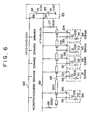
- An electronic system shown in Fig. 6 includes a voltage generating circuit 83, which includes voltage generating circuits 84 and 85 and voltage output terminals 86 and 87.
- Each of the voltage generating circuits 84 and 85 generates a voltage V5 equal to, for example, 1.0 V.
- the voltage generating circuits 84 and 85 are connected in series.
- the electronic system includes a microprocessor 90 and SDRAM devices 91 - 94, each of which devices performs an input/output operation on data of eight bits DQ0 - DQ7.
- Reference numbers 95 - 99 indicate data input/output terminals via which data is input and output.
- Reference numbers 100 - 104 indicate reference voltage input terminals via which the reference voltage Vref is received.
- the termination voltage VTT is supplied, as the reference voltage Vref, to the microprocessor 90 and the SDRAM devices 91 - 94.
- the microprocessor 90 includes an input circuit 105 and a push-pull-type output circuit 110, which circuits handle data DQ0.
- the SDRAM devices 91 - 94 include input circuits 106 - 109 and push-pull-type output circuits 111 - 114, these input and output circuits handling data DQ0.
- a bus line 115 is provided for transmitting data DQ0.
- Termination resistors 116 and 117 are connected to the two ends of the bus line 115.
- the termination resistor 116 has a resistance of 50 ⁇
- the termination resistor 117 has a resistance of 30 n.
- the input and output circuits of the microprocessor 90 and the SDRAM devices 91 - 94 have an identical circuit configuration, and only the input and output circuit of the microprocessor 90, which is a part thereof, is illustrated in Fig. 7.
- the microprocessor 90 has a VCC power supply terminal 119 to which the power supply voltage VCC (for example, 3.3 V) is applied, a VCCQ power supply terminal 120 to which the power supply voltage VCCQ (2.0V, for example) is applied, and a VSS power supply terminal 121 to which the ground voltage VSS (OV) is applied.
- the microprocessor 90 has a VCC power supply line 122 connected to the VCC power supply terminal 119, a VCCQ power supply line 123 connected to the VCCQ power supply terminal 120, and a VSS power supply line 124 connected to the VSS power supply terminal 121.
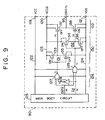
- the microprocessor 90 has a main body circuit 125 to which the power supply voltage VCC is applied.
- the symbol /DATA (“/" is equivalent to the symbol “bar” in Fig. 7) denotes data output from the main body circuit 125, and the symbol /HZ denotes a control signal determining whether the output state should be set to a high-impedance state.
- An output control circuit 126 is supplied with the power supply voltage VCC, and is made up of a NOR circuit 127, an inverter 128 and a NAND circuit 129.
- An output driving circuit (pre-driver) 130 is supplied with the power supply voltage VCCQ, and is made up of enhancement-type p-channel MOS transistors 133 and 134, and enhancement-type n-channel MOS transistors 135 and 136.
- the output circuit 110 is made up of an enhancement-type pMOS transistor 137 serving as a pull-up element, and an enhancement-type nMOS transistor 138 serving as a pull-down element.
- the above current may damage the pMOS transistors 133, 134 and 137.
- the power supply voltage VCCQ is applied as the back bias voltage to the N-type well in which the pMOS transistors 133, 134 and 137 are formed. Even when the power supply voltages VCC and VCCQ become 0 V and 2 V, respectively, at the time of power on or off, the current is prevented from flowing from the sources of the pMOS transistors 133, 134 and 137 to the N-type well in which the pMOS transistors 133, 134 and 137 are formed. As a result, it is possible to prevent the pMOS transistors 133, 134 and 137 from being damaged.
- the output level of the inverter 128 is high and the output level of the NOR circuit 127 is low.
- the pMOS transistor 133 is ON and the nMOS transistor 135 is OFF.
- the output level of an inverter 131 is high, and thus the pMOS transistor 137 is OFF.
- the output level of the NAND circuit 129 is high, and the pMOS transistor 134 is OFF.
- the nMOS transistor 136 is ON, and the output level of an inverter 132 is low.
- the nMOS transistor 138 is OFF.
- the output circuit 110 is in the high-impedance state (Hi-Z).
- the output level of the NOR circuit 127 is low.
- the pMOS transistor 133 is ON and the nMOS transistor 135 is OFF.
- the output level of the inverter 131 is high, and the pMOS transistor 137 is OFF.
- the output level of the NAND circuit 129 is low, and the pMOS transistor 134 is ON.
- the nMOS transistor 136 is OFF, and the output level of the inverter 132 is high.
- the nMOS transistor 138 is ON.
- the signal DQ0 output from the output circuit 110 is low.
- the output level of the NOR circuit 127 is high.
- the pMOS transistor 133 is OFF, and the nMOS transistor 135 is ON.
- the output level of the inverter 131 is low, and the pMOS transistor 137 is ON.
- the output level of the NAND circuit 129 is high, and the pMOS transistor 134 is OFF.
- the nMOS transistor 136 is ON, and the output level of the inverter 132 is low.
- the nMOS transistor 138 is OFF.
- the signal DQ0 output from the output circuit 110 is high.
- the SDRAM devices 91 - 94 are connected to the bus line 115 at equal intervals, and there is provided only the bus line 115 between the microprocessor 90 and the DRAM device 91.
- the characteristic impedance of the bus line 115 is denoted as Z0
- the effective characteristic impedance of parts of the bus line 115 via which the SDRAM devices 91 - 94 are connected at equal intervals are less than that of parts thereof to which the SDRAM devices 91 - 94 are not connected.
- L 250 nH/m
- C 100 pF.
- the resistance values of the termination resistors 116 and 117 should be set equal to the effective characteristic impedance ZL, that is, 18.9 ⁇ .
- the load resistance viewed from the driving side is 9.45 ⁇ .
- the input circuits 105 - 109 cannot operate stably and provide the sufficient amplitude unless the output circuits 110 - 114 have a current driving ability of approximately 20 mA.
- the value of the termination resistor 117 around which the SDRAM devices 91 - 94 are concentrated is omitted from the strict matching condition, and is made greater than the effective characteristic impedance ZL.
- the above value is limited to the characteristic impedance Z0 of the bus line 115 with no load connected thereto, more specifically, 30 ⁇ .
- the value of the termination resistor 116 is set equal to 50 ⁇ , which is equal to the characteristic impedance of the bus line 115 obtained when there is no load.
- the load resistance viewed from the driving side is 18.7 ⁇ , which is equal to the parallel-connection value of 30 ⁇ and 50 ⁇ .
- the load resistance is greater than that obtained when a resistance of 30 ⁇ is simply connected on either side of the bus line 115 (the load resistance then being equal to 15 n).
- the output circuits 110 - 114 of the microprocessor 90 and the SDRAM devices 91 - 94 are formed with the CMOS-type push-pull circuits to which the power supply voltage VCCQ is applied. Further, the termination voltage VTT is equal to VCCQ/2, and thus the signals can be transmitted in such a way that the center voltage is equal to the termination voltage VTT.
- a current flows in a closed circuit made up of the voltage generating circuit 85, the termination voltage line 89, the termination resistors 116 and 117, the bus line 115, the output circuit 110 (nMOS transistor 138), the ground and the voltage generating circuit 85 in the above order.
- a current flows in a closed circuit made up of the voltage generating circuit 84, the VCCQ power supply line 88, the output circuit 110 (pMOS transistor 137), the bus line 115, the termination resistors 116 and 117 and the voltage generating circuit 84 in the above order.
- the voltage generating circuits 84 and 85 of the voltage generating circuit 83 are connected in series, the voltage of the voltage output terminal 87 is maintained at V5 equal to 1.0 V even if a current is output or input via the voltage output terminal 87. Hence, it is possible to ensure the stability that the termination voltage VTT is equal to the voltage V5 equal to 1.0 V.
- the termination voltage VTT is used as the reference voltage Vref which is needed in the microprocessor 90 and the SDRAM devices 91 - 94. Hence, the coincidence of the reference voltage Vref and the termination voltage VTT can be accomplished and no offset voltage is generated. Hence, a sufficient operation margin can be ensured.
- the power supply voltage VCCQ is supplied as the power supply voltage necessary for the output driving circuit 130 to drive the output circuits 110 - 114. Hence, it is possible to drive the pMOS transistor serving as the pull-up element and the nMOS transistor serving as the pull-down element in a balanced way.
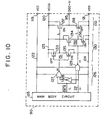
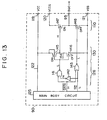
- the output control circuit 126, the output driving circuit 130 and the output circuit 110 in the microprocessor 90 can be configured as shown in Fig. 11.
- the circuit shown in Fig. 11 can be applied to the SDRAM devices 91 - 94 as well.
- the output control circuit 126 is made up of a NAND circuit 141, an inverter 142 and a NOR circuit 143.
- the output driving circuit 130 is a CMOS type inverter to which the power supply voltage VCC is applied.
- the CMOS inverter is made up of an enhancement type pMOS transistor 145 and an enhancement type nMOS transistor 146.
- the output circuit 110 is made up of a depletion type nMOS transistor 147 functioning as a pull-up element and an enhancement type nMOS transistor 148 functioning as a pull-down element.
- the output circuit 110 is intended to improve the driving ability of the pull-up element.
- the threshold voltage V THD of the nMOS transistor 147 is set to -V 0L ⁇ V THD .
- the threshold voltage V THD is equal to or greater than -0.75V.
- the output level of the inverter 142 is low, and the output level of the NAND circuit 141 is high.
- the pMOS transistor 145 is OFF, and the nMOS transistor 146 is ON.
- the output level of the inverter 144 is low, and the nMOS transistor 147 is OFF.
- the output level of the NOR circuit 143 is low, and the nMOS transistor 148 is OFF. In this case, the output circuit 110 is in the high-impedance state.
- the nMOS transistor 147 may be replaced by an enhancement-type nMOS transistor.
- the threshold voltage of the enhancement type nMOS transistor is lower than the threshold voltage of the nMOS transistor 148, the advantage of an increase in the driving ability may be canceled by a decrease in the threshold voltage.
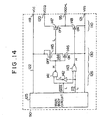
- Fig. 15 is a circuit diagram of the essential part of an electronic system.
- the electronic system shown in Fig. 15 has a voltage generating circuit 150, which generates voltages different from those generated by the voltage generating circuit 83 shown in Fig. 6.
- the voltage generating circuit 150 has voltage generating circuits 151 and 152, each generating a voltage V6 (1.65 V, for example), and voltage output terminals 153 and 154. More specifically, the voltage generating circuits 151 and 152 are connected in series.
- the bus line 115 shown in Fig. 15 has branched parts 155 - 159, that is, stubs. Resistors 160 - 164 are connected between branch points on the bus line 115 and the stubs 155 - 159.
- the power supply voltage VCCQ supplied via the VCCQ power supply line 88 is supplied to the VCC power supply terminals and the VCCQ power supply terminals of the microprocessor 90 and the SDRAM devices 91 - 94.
- the VCC power supply terminals of the microprocessor 90 and the SDRAM devices 91 - 94 are connected to the VCCQ power supply terminals outside thereof.
- Fig. 16 shows such a connection for the microprocessor 90.
- nain body circuit 125 and the output control circuit 126 are driven by the power supply voltage VCCQ equal to 3.3 V.
- the gate of the nMOS transistor 138 is also supplied with the power supply voltage VCCQ of 3.3 V, so that the inner resistance of the nMOS transistor 138 is decreased and an excessive current flows in the output.
- the resistor 160 is connected between the branching point on the bus line 115 and the stub 155 in order to select an appropriate inner resistance value of the output circuit 110 and prevent changes in the driving currents with respect to the termination resistors 116 and 117.
- the resistors 161 - 164 are connected between the branch points on the bus line 115 and the stubs 156 - 159.
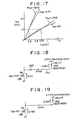
- Figs. 17 and 18 show how to determine the resistance values of the resistors 160 - 164. More particularly, Fig. 17 is a graph of the static characteristic of the nMOS transistor 138 in the output circuit 110 of the microprocessor 90, and Fig. 18 shows part of the configuration shown in Fig. 15. In the second embodiment of the present invention, the nMOS transistor 138 is configured so as to have a static characteristic as shown in Fig. 17. In the case where the nMOS transistor 138 is turned ON with the VCCQ equal to 3.3 V, the gate-source voltage V GS thereof is equal to 3.3 V, while the drain-source voltage V DS thereof is equal to 0.2 V.
- the load resistance value is equal to 25 ⁇
- the voltage drops developing across the termination resistors 116 and 117 are equal to 0.25 V, as shown in Fig. 18.
- the resistance values of the resistors 161 - 164 are selected in the same way as the resistor 160.
- the characteristic impedances of the stubs 155 - 159 can be determined as follows. First of all, the resistance values of the resistors 160 - 164 are set equal to 120 ⁇ taking into consideration the driving ability of the output circuit. Since the characteristic impedance of the bus line 115 is 50 ⁇ , two resistors having resistances of 50 n connected in parallel are seen when viewing the bus line 115 from the branch node. That is, a characteristic impedance of 25 n can be seen as a load.
- the resistors 160 - 164 respectively have a resistance of 120 n
- the characteristic impedances of the stubs 155 - 159 are appropriately set equal to 145 ⁇ . It has been confirmed through a simulation that the above value causes no problems even when it varies within the range of ⁇ 50 %.
- the signal is input to the stubs 155 - 159 from the bus line 115, the input/output terminals 95 - 99 have no terminations.
- the input signal is totally reflected (100% reflection).
- reflection does not take place when the reflected signal is transmitted to the resistors 160 - 164 because the impedance match is established. That is, the signal is absorbed by the termination resistors 116 and 117 after it comes in the bus 115. Hence, thereafter, the resonance phenomenon does not occur after the stubs 155 - 159, and good signal transmissions can be carried out.
- the gate-source voltage V GS is equal to 2.0 V
- the drain-source voltage V DS is equal to 0.75 V.
- the driving current for the nMOS transistor 138 is equal to 10 mA
- the resistances of the termination resistors 116 and 117 are equal to 50 ⁇
- the load resistance is 25 ⁇
- the voltage drops developing across the termination resistors 116 and 117 become equal to 0.25 V as shown in Fig. 19.
- the resistor 160 is not needed. That is, when decreasing the power supply voltage VCCQ, the resistors 160 - 164 are needed no longer, and the number of parts can be reduced.
- the resonances caused in the stubs 155 - 159 cannot be suppressed by means of impedance matching. Hence, it is necessary to reduce the lengths of the stubs 155 - 159 as much as possible.
- the output circuits 110 - 114 of the microprocessor 90 and the SDRAM devices 91 - 94 are formed by the CMOS type push-pull circuits supplied with the power supply voltage VCCQ. Further, the termination voltage VTT is set to VCCQ/2. Hence, it is possible to transmit small-amplitude signals having the center voltage equal to the termination voltage VTT.
- a current flows, in the following order, in a closed circuit made up of the voltage generating circuit 152, the termination voltage line 89, the termination resistors 116 and 117, the bus line 115, the output circuit 110 (nMOS transistor 138), the ground and the voltage generating circuit 152.
- a current flows in a closed circuit made up of the voltage generating circuit 151, the VCCQ power supply line 88, the output circuit 110 (pMOS transistor 137), the bus line 115, the termination resistors 116 and 117, and the voltage generating circuit 151.
- the termination voltage VTT is used as the reference voltage Vref which is needed in the microprocessor 90 and the SDRAM devices 91 - 94. Hence, the coincidence of the reference voltage Vref and the termination voltage VTT can be accomplished and no offset voltage is generated. Hence, the sufficient operation margin can be ensured.
- the resistors 160 - 164 are provided at the branch points on the bus line 115. Hence, it is possible to not only prevent an excessive current from flowing in the circuits but also to cut off, by means of the resistors 160 - 164, highfrequency components contained in the reflected signals produced at the stubs 155 - 159 in the case where these stubs are needed. As a result, it is difficult for the transmitted signal waveforms to be deformed. From these viewpoints, it can be said that the second embodiment of the present invention is suitable for a system in which the SDRAM devices 91 - 94 are mounted on a module (SIMM) and connectors of the module are connected to the bus line 115. Meanwhile, the structure is suitable for a system in which the SDRAM devices 91 - 95 are directly connected to the bus line 115 because it does not need the stubs 155 - 159.
- SIMM module
- Fig. 19A is a circuit diagram of a practical example of the voltage generating circuit 150 shown in Fig. 15.
- the circuit shown in Fig. 19A is a switching regulator.
- the voltage generating circuit 150 shown in Fig. 19A includes a pMOS transistor Q1, an nMOS transistor Q2, diodes D1 and D2, an inductor L, capacitors C1 and C2, and a control circuit 150A.
- the control circuit 150A includes a comparator COMP and a driver DRV having two CMOS inverters.
- the transistors Q1 and Q2 function as switches of the switching regulator.
- the diodes D1 and D2 allow a counter electromotive force of the inductance to pass therethrough.
- the inductor L and the capacitors C1 and C2 form a smoothing circuit.
- the comparator output turns ON and OFF the transistors Q1 and Q2 with the equal duty ratio. In this state, the circuit is in the oscillating state.
- the control circuit 150A can be formed by Si9145 manufactured by Siliconics in the United States.
- the voltage generating circuit 83 shown in Fig. 6 can be configured in the same way as described above.
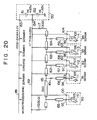
- Fig. 20 is a circuit diagram of the essential part of an electronic system.
- the resistors 161 - 164 are connected between the bus line 115 and the stubs 156 - 159, while no resistor is intentionally connected between the microprocessor 90 and the bus line 115.
- the microprocessor 90 is mounted on PGA (Pin Grid Array) packages and has a large number of pins. Hence, many cases will take place in which no space for providing the resistor 160 shown in Fig. 15 is available.
- the resistors 161 - 164 are connected between the bus line 115 and the stubs 156 - 159, while the resistor 160 shown in Fig. 15 is not provided between the bus line 115 and the processor 90. Even when the resistor 160 is not used, the microprocessor 90 would be connected to an end portion of the bus line 115 in many cases. This end portion is close to the termination resistor 116, which functions to reduce deformation in the signal waveforms.
- the output circuit 110 of the microprocessor 90 is designed to have a small driving ability and the inner resistance thereof is as high as approximately 100 ⁇ .
- the decreasing of the inner resistance of the output circuit 110 to approximately 100 ⁇ can be achieved by adjusting the sizes of the pMOS transistor 137 and the nMOS transistor 138, or providing a resistor in series to the output of the output circuit 110 at a position close to the output circuit 110, for example, on the chip or in the package.
- the gate width of the pMOS transistor 137 is set to, for example, 500 ⁇ m and the gate length thereof is set to, for example, 1 ⁇ m. Further, the gate width of the nMOS transistor 138 is set to, for example, 200 ⁇ m, and the gate length thereof is set to, for example, 1 ⁇ m.
- the gate width and gate length of the pMOS transistor 137 are set to, for example, 1000 ⁇ m and 1 ⁇ m, respectively. Further, the gate width and gate length of the nMOS transistor 138 are set to, for example, 400 ⁇ m and 1 ⁇ m, respectively.
- the resistor connected in series to the output circuit 110 has a negative temperature coefficient, it advantageously functions to cancel a positive temperature coefficient of the inner resistances of the transistors of the output circuit 110.
- the series-connected resistor of an amorphous-system semiconductor material generally called thermistor.
- the series-connected resistor is formed by a diffused layer formed in a semiconductor substrate.
- the p-type diffused layer has a temperature coefficient greater than that of the n-type diffused layer.
- Such diffused layers are suitable for the above purpose.
- the above-mentioned materials have natures in which the resistance is decreased as the temperature increases. Hence, it is possible to cancel a phenomenon such that the driving abilities of transistors are decreased as the temperature increases.
- Fig. 21 is a circuit diagram of the essential part of an electronic system.
- a temperature sensor 165 is provided to control the voltage V6 generated by the voltage generating circuits 151 and 152 on the basis of the temperature sensed by the temperature sensor.
- the resistors 161 - 164 are connected between the bus line 115 and the stubs 156 - 159, and no resistor is connected to the bus line 115 and the microprocessor 90.
- the transistors in the output circuit 110 of the microprocessor 90 have small driving abilities. It should be noted that the MOS transistors have negative driving current temperature coefficients, in which the driving ability is degraded as the operation temperature increases.
- the voltage V6 output from the voltage generating circuits 151 and 152 have a positive temperature coefficient.
- the appropriate value of the voltage V6 is 1.3 V at 25°C and 1.65 V at 100 °C.
- Fig. 22 is a circuit diagram of the essential part of the electronic system according to the embodiment of the present invention.
- the voltage generating circuit 83 shown in Fig. 6 is replaced by a termination voltage generating circuit 166.
- a VCCQ power supply line 167 for supplying the power supply voltage VCCQ equal to 2.0 V to the termination voltage generating circuit 166
- a VSSQ power supply line 168 for supplying the power.
- supply voltage VSSQ equal to 0 V to the termination voltage generating circuit 166.
- the power supply voltage VCCQ from the VCCQ power supply line 167 is supplied to the microprocessor 90 and the SDRAM devices 91 - 94.
- the other parts of the circuit of the embodiment of the present invention are the same as those shown in Fig. 6.
- the termination voltage generating circuit 166 includes an operational amplifier 171, and voltage dividing resistors 172 and 173 having an identical resistance.
- the output of the operational amplifier 171 is fed back to the reverse phase (inverting) input terminal of the operational amplifier 171.
- the termination voltage VTT equal to VCCQ/2 is obtained at the output terminal of the operational amplifier 171.
- termination voltage generating circuit 166 There are integrally provided on one chip the termination voltage generating circuit 166, the voltage dividing resistors 172 and 173, the termination resistor 117 for the bus line 115 provided for the data DQ0, and termination resistors for the bus lines for data DQ1 - DQ7. These elements provided on one chip are packaged, as a termination module (termination device), with the same dimensions as the SDRAM devices 91 - 94.
- Fig. 23 schematically shows the termination module 174, which includes a termination module main body 175, termination resistors 176 - 181 respectively provided for data DQ1 - DQ7 and external terminals 182 - 200. These external terminals 182 - 200 are located in the same positions of the corresponding external terminals of each of the SDRAM device 91 - 94.
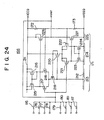
- Fig. 24 is a circuit diagram of the termination voltage generating circuit 166 used in the embodiment of the present invention.
- the circuit 166 includes a VCCQ power supply line 211, a VSSQ power supply line 212, and differential amplifier circuits 213 and 214.
- the differential amplifier circuit 213 includes enhancement type pMOS transistors 215 and 216 forming a current-mirror circuit functioning as a load.
- the circuit 166 includes enhancement type nMOS transistors 217 and 218 functioning as driving transistors, and an enhancement type nMOS transistor 219 functioning as a resistor.
- the differential amplifier circuit 214 includes an enhancement type pMOS transistor 220 functioning as a resistor, enhancement type pMOS transistors 221 and 222 functioning as driving transistors, and nMOS transistors 223 and 224 functioning as loads. Further, the termination voltage generating circuit 166 shown in Fig. 24 includes an output circuit 225, which is made up of an enhancement type pMOS transistor 226 functioning as a pull-up element, and an enhancement type nMOS transistor 227 functioning as a pull-down element.
Landscapes
- Engineering & Computer Science (AREA)
- Computer Hardware Design (AREA)
- Power Engineering (AREA)
- Computer Networks & Wireless Communication (AREA)
- Signal Processing (AREA)
- Physics & Mathematics (AREA)
- Computing Systems (AREA)
- General Engineering & Computer Science (AREA)
- Mathematical Physics (AREA)
- Microelectronics & Electronic Packaging (AREA)
- Logic Circuits (AREA)
- Dram (AREA)
Claims (1)
- Elektronisches System mit:einer Vielzahl von elektronischen Schaltungen (68, 77), die jeweils eine Signaleingangs- und -ausgangsfunktion haben;einem Bus (75), mit dem die Vielzahl von elektronischen Schaltungen verbunden ist;ersten Abschlusswiderständen (76), die mit Enden des Busses verbunden sind; undeiner Abschlussspannungsschaltung, die einen ersten Teil (58) hat, der eine erste Spannung (V3) erzeugt, und einen zweiten Teil (60), der eine zweite Spannung (V4) erzeugt, welche erste Spannung (V3) als Energiezufuhrspannung Ausgangsschaltungen (72) von der Vielzahl von elektronischen Schaltungen zugeführt wird, die mit dem Bus verbunden sind, und welche zweite Spannung (V4) den ersten Abschlusswiderständen (76) als Abschlussspannung (VTT) zugeführt wird,dadurch gekennzeichnet, dass:der zweite Teil (60) einen Operationsverstärker (63, 171) umfasst, der einen ersten Eingangsanschluss hat, der eine geteilte Spannung empfängt, die von der ersten Spannung (V3) abgeleitet ist, einen zweiten Eingangsanschluss und einen Ausgangsanschluss, der mit dem zweiten Eingangsanschluss verbunden ist; unddie zweite Spannung (V4) über den Ausgangsanschluss ausgegeben wird und der geteilten Spannung gleich ist, die von der ersten Spannung abgeleitet ist,
bei dem der Operationsverstärker (171) umfasst:eine erste Differenzverstärkerschaltung (213), der als Energiezufuhrspannung die erste Spannung zugeführt wird und die Treibertransistoren umfasst, die aus ersten und zweiten n-Kanal-Feldeffekttransistoren des Isoliergate-Typs (218, 217) gebildet sind;eine zweite Differenzverstärkerschaltung (214), der als Energiezufuhrspannung die erste Spannung zugeführt wird und die Treibertransistoren umfasst, die aus ersten und zweiten p-Kanal-Feldeffekttransistoren des Isoliergate-Typs (222, 221) gebildet sind; undeine Ausgangsschaltung (225), der als Energiezufuhrspannung die erste Spannung zugeführt wird und die ein Pull-up-Element umfasst, das durch die erste Differenzverstärkerschaltung (213) angetrieben wird und aus einem dritten p-Kanal-Feldeffekttransistor des Isoliergate-Typs (226) gebildet ist, und ein Pull-down-Element, das durch die zweite Differenzverstärkerschaltung (214) angetrieben wird und aus einem dritten n-Kanal-Feldeffekttransistor des Isoliergate-Typs (227) gebildet ist,bei dem:ein Verbindungsknoten, an dem ein Gate des ersten p-Kanal-Feldeffekttransistors des Isoliergate-Typs (222) und ein Gate des ersten n-Kanal-Feldeffekttransistors des Isoliergate-Typs (218) gemeinsam verbunden sind, mit dem ersten Eingangsanschluss verbunden ist;ein Verbindungsknoten, an dem ein Gate des zweiten p-Kanal-Feldeffekttransistors des Isoliergate-Typs (221) und ein Gate des zweiten n-Kanal-Feldeffekttransistors des Isoliergate-Typs (217) gemeinsam verbunden sind, mit dem zweiten Eingangsanschluss verbunden ist; undein Ausgangsanschluss der Ausgangsschaltung (225) des Operationsverstärkers (171) den Ausgangsanschluss des Operationsverstärkers bildet.
Applications Claiming Priority (7)
| Application Number | Priority Date | Filing Date | Title |
|---|---|---|---|
| JP29766993A JP3170980B2 (ja) | 1993-11-29 | 1993-11-29 | 半導体集積回路 |
| JP29766993 | 1993-11-29 | ||
| JP03047094A JP3146829B2 (ja) | 1994-02-28 | 1994-02-28 | 半導体集積回路 |
| JP3047094 | 1994-02-28 | ||
| JP03050194A JP3147642B2 (ja) | 1994-02-28 | 1994-02-28 | 電子装置、集積回路及び終端装置 |
| JP3050194 | 1994-02-28 | ||
| EP94118585A EP0655839B1 (de) | 1993-11-29 | 1994-11-25 | Elektronisches System zum Abschluss von Busleitungen |
Related Parent Applications (1)
| Application Number | Title | Priority Date | Filing Date |
|---|---|---|---|
| EP94118585A Division EP0655839B1 (de) | 1993-11-29 | 1994-11-25 | Elektronisches System zum Abschluss von Busleitungen |
Publications (2)
| Publication Number | Publication Date |
|---|---|
| EP1564947A1 EP1564947A1 (de) | 2005-08-17 |
| EP1564947B1 true EP1564947B1 (de) | 2006-12-27 |
Family
ID=27286971
Family Applications (3)
| Application Number | Title | Priority Date | Filing Date |
|---|---|---|---|
| EP05009867A Expired - Lifetime EP1564947B1 (de) | 1993-11-29 | 1994-11-25 | Elektronisches System zum Abschluss von Busleitungen |
| EP03025514A Withdrawn EP1392028A1 (de) | 1993-11-29 | 1994-11-25 | Treiber mit komplimentären Toren |
| EP94118585A Expired - Lifetime EP0655839B1 (de) | 1993-11-29 | 1994-11-25 | Elektronisches System zum Abschluss von Busleitungen |
Family Applications After (2)
| Application Number | Title | Priority Date | Filing Date |
|---|---|---|---|
| EP03025514A Withdrawn EP1392028A1 (de) | 1993-11-29 | 1994-11-25 | Treiber mit komplimentären Toren |
| EP94118585A Expired - Lifetime EP0655839B1 (de) | 1993-11-29 | 1994-11-25 | Elektronisches System zum Abschluss von Busleitungen |
Country Status (5)
| Country | Link |
|---|---|
| US (2) | US6160417A (de) |
| EP (3) | EP1564947B1 (de) |
| KR (1) | KR0157096B1 (de) |
| CN (2) | CN1158611C (de) |
| DE (2) | DE69434906T2 (de) |
Families Citing this family (65)
| Publication number | Priority date | Publication date | Assignee | Title |
|---|---|---|---|---|
| US5546016A (en) * | 1995-07-03 | 1996-08-13 | Intel Corporation | MOS termination for low power signaling |
| JP3195913B2 (ja) * | 1996-04-30 | 2001-08-06 | 株式会社東芝 | 半導体集積回路装置 |
| CN100356362C (zh) * | 1996-06-07 | 2007-12-19 | 株式会社日立制作所 | 信号传输装置 |
| JP2910679B2 (ja) * | 1996-07-04 | 1999-06-23 | 日本電気株式会社 | 半導体集積回路 |
| GB2322042B (en) * | 1997-02-05 | 2002-02-06 | Ericsson Telefon Ab L M | Radio architecture |
| TW381385B (en) | 1997-08-20 | 2000-02-01 | Advantest Corp | Signal transmission circuit, CMOS semiconductor device and circuit board |
| WO1999053627A1 (en) | 1998-04-10 | 1999-10-21 | Chrimar Systems, Inc. Doing Business As Cms Technologies | System for communicating with electronic equipment on a network |
| US6460168B1 (en) * | 1998-04-23 | 2002-10-01 | Matsushita Electric Industrial Co., Ltd. | Method of designing power supply circuit and semiconductor chip |
| JP2000012787A (ja) * | 1998-06-10 | 2000-01-14 | Lucent Technol Inc | 集積回路デバイスおよび集積回路に用いる抵抗性素子を形成する方法 |
| US6067596A (en) * | 1998-09-15 | 2000-05-23 | Compaq Computer Corporation | Flexible placement of GTL end points using double termination points |
| US6108740A (en) * | 1998-10-14 | 2000-08-22 | Lsi Logic Corporation | Method and apparatus for terminating a bus such that stub length requirements are met |
| US6222389B1 (en) | 1999-03-25 | 2001-04-24 | International Business Machines Corporation | Assisted gunning transceiver logic (AGTL) bus driver |
| US6212591B1 (en) | 1999-04-02 | 2001-04-03 | Cradle Technologies | Configurable I/O circuitry defining virtual ports |
| JP3849835B2 (ja) * | 1999-06-23 | 2006-11-22 | 株式会社ルネサステクノロジ | 半導体集積回路装置 |
| JP2001068626A (ja) * | 1999-08-27 | 2001-03-16 | Mitsubishi Electric Corp | 半導体装置 |
| US6380787B1 (en) * | 1999-08-31 | 2002-04-30 | Micron Technology, Inc. | Integrated circuit and method for minimizing clock skews |
| US6271704B1 (en) * | 1999-12-14 | 2001-08-07 | Intel Corporation | Method and apparatus for balancing current in a system with two sets of termination devices |
| US6356106B1 (en) * | 2000-09-12 | 2002-03-12 | Micron Technology, Inc. | Active termination in a multidrop memory system |
| KR100340285B1 (ko) * | 2000-10-24 | 2002-06-15 | 윤종용 | 복수의 인쇄회로기판이 상호 직렬 접속된 메모리 모듈 |
| US6323687B1 (en) | 2000-11-03 | 2001-11-27 | Fujitsu Limited | Output drivers for integrated-circuit chips with VCCQ supply compensation |
| JP2002251890A (ja) * | 2001-02-26 | 2002-09-06 | Mitsubishi Electric Corp | 信号増幅回路およびそれを備える半導体記憶装置 |
| GB2386484A (en) * | 2002-03-14 | 2003-09-17 | Sharp Kk | Level shifting and active matrix driver |
| US7280574B1 (en) * | 2002-05-15 | 2007-10-09 | Cypress Semiconductor Corp. | Circuit for driving a laser diode and method |
| JP2004039689A (ja) * | 2002-06-28 | 2004-02-05 | Sony Corp | 電子回路装置 |
| US6836142B2 (en) * | 2002-07-12 | 2004-12-28 | Xilinx, Inc. | Asymmetric bidirectional bus implemented using an I/O device with a digitally controlled impedance |
| US6963218B1 (en) * | 2002-08-09 | 2005-11-08 | Xilinx, Inc. | Bi-directional interface and communication link |
| US6922071B2 (en) * | 2002-12-27 | 2005-07-26 | Intel Corporation | Setting multiple chip parameters using one IC terminal |
| FR2849972B1 (fr) * | 2003-01-10 | 2005-03-04 | Somfy Sas | Installation permettant l'echange d'informations entre un emetteur et un recepteur. |
| US6922076B2 (en) * | 2003-08-27 | 2005-07-26 | International Business Machines Corporation | Scalable termination |
| DE10352812B4 (de) * | 2003-11-12 | 2008-08-14 | Infineon Technologies Ag | Verfahren und Schaltungsanordnung zur Erzeugung ternärer Signale |
| JP4275583B2 (ja) * | 2004-06-24 | 2009-06-10 | ユーディナデバイス株式会社 | 電子モジュール |
| US7242249B2 (en) * | 2005-02-11 | 2007-07-10 | International Business Machines Corporation | Peaking transmission line receiver for logic signals |
| KR100697281B1 (ko) | 2005-03-17 | 2007-03-20 | 삼성전자주식회사 | 패키지 저항 변화에 따른 임피던스 부정합과 전압강하를방지할 수 있는 수신 방법 및 장치 |
| US7358758B2 (en) * | 2005-10-18 | 2008-04-15 | Via Technologies, Inc. | Apparatus and method for enabling a multi-processor environment on a bus |
| JP2007227625A (ja) * | 2006-02-23 | 2007-09-06 | Toshiba Microelectronics Corp | 半導体集積回路及びそのレイアウト設計方法 |
| US20080270037A1 (en) * | 2007-04-30 | 2008-10-30 | Masato Nakada | System and method for measuring and displaying health information |
| US7646213B2 (en) * | 2007-05-16 | 2010-01-12 | Micron Technology, Inc. | On-die system and method for controlling termination impedance of memory device data bus terminals |
| JP4871997B2 (ja) * | 2007-06-05 | 2012-02-08 | パナソニック株式会社 | データ伝送システム及びその受信回路 |
| US20090091963A1 (en) * | 2007-10-04 | 2009-04-09 | Advanced Micro Devices, Inc. | Memory device |
| US7750666B2 (en) * | 2008-09-15 | 2010-07-06 | Integrated Device Technology, Inc. | Reduced power differential type termination circuit |
| US8085062B2 (en) * | 2009-04-14 | 2011-12-27 | Via Technologies, Inc. | Configurable bus termination for multi-core/multi-package processor configurations |
| US7843225B2 (en) * | 2009-04-14 | 2010-11-30 | Via Technologies, Inc. | Protocol-based bus termination for multi-core processors |
| US8242802B2 (en) * | 2009-04-14 | 2012-08-14 | Via Technologies, Inc. | Location-based bus termination for multi-core processors |
| US7767492B1 (en) | 2009-04-14 | 2010-08-03 | Via Technologies, Inc. | Location-based bus termination for multi-core/multi-package processor configurations |
| JP5726635B2 (ja) * | 2010-08-25 | 2015-06-03 | 株式会社Nttドコモ | マルチモードフロントエンド回路 |
| CN102243481B (zh) * | 2011-03-28 | 2013-04-24 | 上海华为技术有限公司 | 实现不同电源供电的模块之间互联的装置、方法及电路 |
| US8848462B2 (en) * | 2011-10-11 | 2014-09-30 | Mediatek Inc. | Low power memory controllers |
| US10698432B2 (en) * | 2013-03-13 | 2020-06-30 | Intel Corporation | Dual loop digital low drop regulator and current sharing control apparatus for distributable voltage regulators |
| US10153611B2 (en) | 2015-04-09 | 2018-12-11 | Hewlett Packard Enterprise Development Lp | Termination voltage circuits |
| CN104882869A (zh) * | 2015-06-11 | 2015-09-02 | 国网四川省电力公司南充供电公司 | 移动设备数据接口保护电路 |
| FI20150294A (fi) * | 2015-10-23 | 2017-04-24 | Ari Paasio | Matalan tehonkulutuksen logiikkaperhe |
| US10348270B2 (en) | 2016-12-09 | 2019-07-09 | Micron Technology, Inc. | Apparatuses and methods for calibrating adjustable impedances of a semiconductor device |
| JP2018133503A (ja) * | 2017-02-16 | 2018-08-23 | 東芝メモリ株式会社 | 半導体記憶装置 |
| CN107277660B (zh) * | 2017-06-07 | 2019-10-15 | 上海乐野网络科技有限公司 | 一种提高动态范围和压摆率的耳放电路 |
| US10193711B2 (en) | 2017-06-22 | 2019-01-29 | Micron Technology, Inc. | Timing based arbitration methods and apparatuses for calibrating impedances of a semiconductor device |
| KR102347178B1 (ko) * | 2017-07-19 | 2022-01-04 | 삼성전자주식회사 | 기준 전압 회로를 포함하는 단말 장치 |
| US10615798B2 (en) | 2017-10-30 | 2020-04-07 | Micron Technology, Inc. | Apparatuses and methods for identifying memory devices of a semiconductor device sharing an external resistance |
| CN108540295B (zh) * | 2018-04-10 | 2021-05-07 | 武汉虹创联众科技有限公司 | 一种单总线通信电路 |
| US10916288B1 (en) * | 2019-07-18 | 2021-02-09 | Micron Technology, Inc. | Sensing techniques for a memory cell |
| US10729002B2 (en) * | 2019-07-18 | 2020-07-28 | Intel Corporation | Device, system and method to mitigate signal noise in communications with a memory module |
| US10747245B1 (en) | 2019-11-19 | 2020-08-18 | Micron Technology, Inc. | Apparatuses and methods for ZQ calibration |
| US10892759B1 (en) * | 2020-02-19 | 2021-01-12 | Amazing Microelectronic Corp. | Bus driver module with controlled circuit and transition controlled circuit thereof |
| CN111586969B (zh) * | 2020-04-28 | 2021-12-21 | 中国科学院计算技术研究所 | 电路布线方法、ddr4内存电路及电子设备 |
| JP7602902B2 (ja) * | 2020-12-03 | 2024-12-19 | 株式会社日立製作所 | 制御装置 |
| KR20240006614A (ko) * | 2021-05-07 | 2024-01-15 | 블루마인드 인크. | 트랜지스터 기반 신경망을 위한 시스템, 방법 및 컴퓨터 디바이스 |
Citations (1)
| Publication number | Priority date | Publication date | Assignee | Title |
|---|---|---|---|---|
| DE4142081A1 (de) * | 1990-12-20 | 1992-07-23 | Murata Manufacturing Co | Abschlussschaltkreis zum abschluss einer datenbusleitung |
Family Cites Families (22)
| Publication number | Priority date | Publication date | Assignee | Title |
|---|---|---|---|---|
| US3631528A (en) * | 1970-08-14 | 1971-12-28 | Robert S Green | Low-power consumption complementary driver and complementary bipolar buffer circuits |
| JPS59117323A (ja) * | 1982-12-23 | 1984-07-06 | Mitsubishi Electric Corp | 抵抗モジユ−ル |
| US4591745A (en) * | 1984-01-16 | 1986-05-27 | Itt Corporation | Power-on reset pulse generator |
| US4647797A (en) * | 1984-08-23 | 1987-03-03 | Ncr Corporation | Assist circuit for improving the rise time of an electronic signal |
| US4766334A (en) * | 1986-03-07 | 1988-08-23 | The Singer Company | Level clamp for Tri-state CMOS bus structure |
| JPS6342215A (ja) * | 1986-08-07 | 1988-02-23 | Canon Inc | 電子機器 |
| JPH0728214B2 (ja) * | 1987-02-06 | 1995-03-29 | 株式会社日立製作所 | 半導体集積回路装置 |
| US4871931A (en) * | 1987-10-30 | 1989-10-03 | Gazelle Microcircuits, Inc. | Logic circuit resistant to errors due to supply fluctuations |
| US4808855A (en) * | 1987-12-16 | 1989-02-28 | Intel Corporation | Distributed precharge wire-or bus |
| JP2573320B2 (ja) * | 1988-07-11 | 1997-01-22 | 株式会社東芝 | 出力バッファ回路 |
| US5019729A (en) * | 1988-07-27 | 1991-05-28 | Kabushiki Kaisha Toshiba | TTL to CMOS buffer circuit |
| GB2234872B (en) * | 1989-08-03 | 1994-04-06 | Plessey Co Plc | High speed CMOS differential interface circuits |
| IT1231052B (it) * | 1989-09-27 | 1991-11-12 | Bull Hn Information Syst | Alimentatore a commutazione con piu' uscite, regolazione di una tensione di uscita e compensazione di carico. |
| US4994690A (en) * | 1990-01-29 | 1991-02-19 | Motorola, Inc. | Split level bus |
| US5132564A (en) * | 1990-07-27 | 1992-07-21 | North American Philips Corp. | Bus driver circuit with low on-chip dissipation and/or pre-biasing of output terminal during live insertion |
| JPH04150731A (ja) * | 1990-10-09 | 1992-05-25 | Matsushita Electric Ind Co Ltd | 電源装置 |
| US5266847A (en) * | 1990-12-28 | 1993-11-30 | National Semiconductor Corporation | High speed data transceiver |
| US5149992A (en) * | 1991-04-30 | 1992-09-22 | The State Of Oregon Acting By And Through The State Board Of Higher Education On Behalf Of Oregon State University | MOS folded source-coupled logic |
| EP0533971A1 (de) * | 1991-09-24 | 1993-03-31 | Siemens Aktiengesellschaft | Schnittstellenschaltung |
| US5227677A (en) * | 1992-06-10 | 1993-07-13 | International Business Machines Corporation | Zero power transmission line terminator |
| US5347177A (en) * | 1993-01-14 | 1994-09-13 | Lipp Robert J | System for interconnecting VLSI circuits with transmission line characteristics |
| US5471498A (en) * | 1993-04-15 | 1995-11-28 | National Semiconductor Corporation | High-speed low-voltage differential swing transmission line transceiver |
-
1994
- 1994-11-25 EP EP05009867A patent/EP1564947B1/de not_active Expired - Lifetime
- 1994-11-25 DE DE69434906T patent/DE69434906T2/de not_active Expired - Fee Related
- 1994-11-25 EP EP03025514A patent/EP1392028A1/de not_active Withdrawn
- 1994-11-25 EP EP94118585A patent/EP0655839B1/de not_active Expired - Lifetime
- 1994-11-25 DE DE69434903T patent/DE69434903T2/de not_active Expired - Fee Related
- 1994-11-28 CN CNB941189724A patent/CN1158611C/zh not_active Expired - Fee Related
- 1994-11-28 CN CNB031430554A patent/CN1271531C/zh not_active Expired - Fee Related
- 1994-11-28 US US08/351,064 patent/US6160417A/en not_active Expired - Fee Related
- 1994-11-29 KR KR1019940032390A patent/KR0157096B1/ko not_active Expired - Fee Related
-
1996
- 1996-09-10 US US08/715,358 patent/US5729154A/en not_active Expired - Fee Related
Patent Citations (1)
| Publication number | Priority date | Publication date | Assignee | Title |
|---|---|---|---|---|
| DE4142081A1 (de) * | 1990-12-20 | 1992-07-23 | Murata Manufacturing Co | Abschlussschaltkreis zum abschluss einer datenbusleitung |
Non-Patent Citations (1)
| Title |
|---|
| DR.-ING. WILLI RYCHETSKY: "Entwurf elektronischer Schaltungen I, Wintersemester 1971/72", 1971, TECHNISCHE HOCHSCHULE DARMSTADT, FACHBEREICH NACHRICHTENTECHNIK, DARMSTADT * |
Also Published As
| Publication number | Publication date |
|---|---|
| EP1564947A1 (de) | 2005-08-17 |
| KR950016005A (ko) | 1995-06-17 |
| EP0655839A2 (de) | 1995-05-31 |
| CN1117614A (zh) | 1996-02-28 |
| DE69434903D1 (de) | 2007-02-08 |
| EP0655839A3 (de) | 1996-07-17 |
| EP0655839B1 (de) | 2007-01-03 |
| US5729154A (en) | 1998-03-17 |
| CN1516028A (zh) | 2004-07-28 |
| DE69434906D1 (de) | 2007-02-15 |
| KR0157096B1 (ko) | 1999-02-18 |
| US6160417A (en) | 2000-12-12 |
| DE69434903T2 (de) | 2007-04-26 |
| CN1271531C (zh) | 2006-08-23 |
| EP1392028A1 (de) | 2004-02-25 |
| CN1158611C (zh) | 2004-07-21 |
| DE69434906T2 (de) | 2007-08-30 |
Similar Documents
| Publication | Publication Date | Title |
|---|---|---|
| EP1564947B1 (de) | Elektronisches System zum Abschluss von Busleitungen | |
| US5955889A (en) | Electronic circuit apparatus for transmitting signals through a bus and semiconductor device for generating a predetermined stable voltage | |
| EP0905902B1 (de) | Konstantstrom-CMOS-Ausgangstreiberschaltung mit Dual-Gate-Transistoren | |
| KR100932548B1 (ko) | 온 다이 터미네이션 장치의 캘리브래이션 회로 | |
| US7990178B2 (en) | Driving circuit with impedence calibration | |
| US6985009B2 (en) | Signal transmitting system | |
| JPH1185345A (ja) | 入出力インターフェース回路及び半導体システム | |
| US5514983A (en) | CMOS full duplex transmission-reception circuit | |
| JP4676646B2 (ja) | インピーダンス調整回路および半導体装置 | |
| US6766155B2 (en) | Fixed termination scheme for differential receiver that compensates for process, voltage, and temperature variations | |
| US5789937A (en) | Impedence self-adjusting driver circuit | |
| US7038504B2 (en) | Output buffer circuit eliminating high voltage insulated transistor and level shift circuit, and an interface circuit using the output buffer circuit | |
| US5661416A (en) | Interface circuit and interface-network system using the same | |
| US20060061395A1 (en) | Semiconductor integrated circuit | |
| US5646549A (en) | Semiconductor device having an output circuit for transmitting low-voltage differential signals | |
| CN101242179A (zh) | 电子系统、半导体集成电路和终端装置 | |
| JP3147642B2 (ja) | 電子装置、集積回路及び終端装置 | |
| JP2910679B2 (ja) | 半導体集積回路 | |
| KR100354672B1 (ko) | 레벨 시프트 회로와, 그 회로를 이용한 입력 회로 및 출력회로 | |
| Esch et al. | Theory and design of CMOS HSTL I/O pads | |
| KR100293303B1 (ko) | 반도체 장치용 입력 버퍼 | |
| KR100924016B1 (ko) | 온 다이 터미네이션 장치의 캘리브래이션 회로 | |
| KR100861180B1 (ko) | 반도체 메모리 장치 | |
| JP2001160717A (ja) | バッファ回路 | |
| HK1017176A (en) | Constant current cmos output driver circuit with dual gate transistor devices |
Legal Events
| Date | Code | Title | Description |
|---|---|---|---|
| PUAI | Public reference made under article 153(3) epc to a published international application that has entered the european phase |
Free format text: ORIGINAL CODE: 0009012 |
|
| AC | Divisional application: reference to earlier application |
Ref document number: 0655839 Country of ref document: EP Kind code of ref document: P |
|
| AK | Designated contracting states |
Kind code of ref document: A1 Designated state(s): DE FR GB IT |
|
| RIN1 | Information on inventor provided before grant (corrected) |
Inventor name: TAGUCHI, MASAO,C/O FUJITSU LIMITED |
|
| 17P | Request for examination filed |
Effective date: 20050726 |
|
| AKX | Designation fees paid |
Designated state(s): DE FR GB IT |
|
| GRAP | Despatch of communication of intention to grant a patent |
Free format text: ORIGINAL CODE: EPIDOSNIGR1 |
|
| RTI1 | Title (correction) |
Free format text: ELECTRONIC SYSTEM FOR TERMINATING BUS LINES |
|
| GRAS | Grant fee paid |
Free format text: ORIGINAL CODE: EPIDOSNIGR3 |
|
| GRAA | (expected) grant |
Free format text: ORIGINAL CODE: 0009210 |
|
| AC | Divisional application: reference to earlier application |
Ref document number: 0655839 Country of ref document: EP Kind code of ref document: P |
|
| AK | Designated contracting states |
Kind code of ref document: B1 Designated state(s): DE FR GB IT |
|
| REG | Reference to a national code |
Ref country code: GB Ref legal event code: FG4D |
|
| REF | Corresponds to: |
Ref document number: 69434903 Country of ref document: DE Date of ref document: 20070208 Kind code of ref document: P |
|
| ET | Fr: translation filed | ||
| PLBE | No opposition filed within time limit |
Free format text: ORIGINAL CODE: 0009261 |
|
| STAA | Information on the status of an ep patent application or granted ep patent |
Free format text: STATUS: NO OPPOSITION FILED WITHIN TIME LIMIT |
|
| 26N | No opposition filed |
Effective date: 20070928 |
|
| PGFP | Annual fee paid to national office [announced via postgrant information from national office to epo] |
Ref country code: DE Payment date: 20081120 Year of fee payment: 15 |
|
| PGFP | Annual fee paid to national office [announced via postgrant information from national office to epo] |
Ref country code: IT Payment date: 20081126 Year of fee payment: 15 |
|
| PGFP | Annual fee paid to national office [announced via postgrant information from national office to epo] |
Ref country code: FR Payment date: 20081112 Year of fee payment: 15 |
|
| PGFP | Annual fee paid to national office [announced via postgrant information from national office to epo] |
Ref country code: GB Payment date: 20081119 Year of fee payment: 15 |
|
| GBPC | Gb: european patent ceased through non-payment of renewal fee |
Effective date: 20091125 |
|
| REG | Reference to a national code |
Ref country code: FR Ref legal event code: ST Effective date: 20100730 |
|
| PG25 | Lapsed in a contracting state [announced via postgrant information from national office to epo] |
Ref country code: FR Free format text: LAPSE BECAUSE OF NON-PAYMENT OF DUE FEES Effective date: 20091130 |
|
| PG25 | Lapsed in a contracting state [announced via postgrant information from national office to epo] |
Ref country code: DE Free format text: LAPSE BECAUSE OF NON-PAYMENT OF DUE FEES Effective date: 20100601 |
|
| PG25 | Lapsed in a contracting state [announced via postgrant information from national office to epo] |
Ref country code: GB Free format text: LAPSE BECAUSE OF NON-PAYMENT OF DUE FEES Effective date: 20091125 |
|
| PG25 | Lapsed in a contracting state [announced via postgrant information from national office to epo] |
Ref country code: IT Free format text: LAPSE BECAUSE OF NON-PAYMENT OF DUE FEES Effective date: 20091125 |