EP1516018B1 - Verfahren zur ueberfuehrung von perylen-3,4:9, 10-tetracarbonsaeurediimiden in eine fuer die anwendung als fluoreszenzfarbmittel geeignete form - Google Patents
Verfahren zur ueberfuehrung von perylen-3,4:9, 10-tetracarbonsaeurediimiden in eine fuer die anwendung als fluoreszenzfarbmittel geeignete form Download PDFInfo
- Publication number
- EP1516018B1 EP1516018B1 EP03735563A EP03735563A EP1516018B1 EP 1516018 B1 EP1516018 B1 EP 1516018B1 EP 03735563 A EP03735563 A EP 03735563A EP 03735563 A EP03735563 A EP 03735563A EP 1516018 B1 EP1516018 B1 EP 1516018B1
- Authority
- EP
- European Patent Office
- Prior art keywords
- perylene
- alkyl
- solvent
- temperature
- perylimide
- Prior art date
- Legal status (The legal status is an assumption and is not a legal conclusion. Google has not performed a legal analysis and makes no representation as to the accuracy of the status listed.)
- Expired - Lifetime
Links
Images



Classifications
-
- C—CHEMISTRY; METALLURGY
- C09—DYES; PAINTS; POLISHES; NATURAL RESINS; ADHESIVES; COMPOSITIONS NOT OTHERWISE PROVIDED FOR; APPLICATIONS OF MATERIALS NOT OTHERWISE PROVIDED FOR
- C09B—ORGANIC DYES OR CLOSELY-RELATED COMPOUNDS FOR PRODUCING DYES, e.g. PIGMENTS; MORDANTS; LAKES
- C09B5/00—Dyes with an anthracene nucleus condensed with one or more heterocyclic rings with or without carbocyclic rings
- C09B5/62—Cyclic imides or amidines of peri-dicarboxylic acids of the anthracene, benzanthrene, or perylene series
-
- C—CHEMISTRY; METALLURGY
- C09—DYES; PAINTS; POLISHES; NATURAL RESINS; ADHESIVES; COMPOSITIONS NOT OTHERWISE PROVIDED FOR; APPLICATIONS OF MATERIALS NOT OTHERWISE PROVIDED FOR
- C09B—ORGANIC DYES OR CLOSELY-RELATED COMPOUNDS FOR PRODUCING DYES, e.g. PIGMENTS; MORDANTS; LAKES
- C09B67/00—Influencing the physical, e.g. the dyeing or printing properties of dyestuffs without chemical reactions, e.g. by treating with solvents grinding or grinding assistants, coating of pigments or dyes; Process features in the making of dyestuff preparations; Dyestuff preparations of a special physical nature, e.g. tablets, films
- C09B67/0001—Post-treatment of organic pigments or dyes
- C09B67/0014—Influencing the physical properties by treatment with a liquid, e.g. solvents
-
- C—CHEMISTRY; METALLURGY
- C09—DYES; PAINTS; POLISHES; NATURAL RESINS; ADHESIVES; COMPOSITIONS NOT OTHERWISE PROVIDED FOR; APPLICATIONS OF MATERIALS NOT OTHERWISE PROVIDED FOR
- C09B—ORGANIC DYES OR CLOSELY-RELATED COMPOUNDS FOR PRODUCING DYES, e.g. PIGMENTS; MORDANTS; LAKES
- C09B67/00—Influencing the physical, e.g. the dyeing or printing properties of dyestuffs without chemical reactions, e.g. by treating with solvents grinding or grinding assistants, coating of pigments or dyes; Process features in the making of dyestuff preparations; Dyestuff preparations of a special physical nature, e.g. tablets, films
- C09B67/0025—Crystal modifications; Special X-ray patterns
Definitions
- the present invention relates to a novel process for the conversion of perylene-3,4: 9,10-tetracarboxylic diimides of general formula I (abbreviated to "perylimides I" hereinafter) in which R 1 and R 2 are unbranched, branched or cyclic C 1 -C 8 -alkyl, in a form suitable for use as a fluorescent colorant form.
- perylimides I 9,10-tetracarboxylic diimides of general formula I (abbreviated to "perylimides I” hereinafter) in which R 1 and R 2 are unbranched, branched or cyclic C 1 -C 8 -alkyl, in a form suitable for use as a fluorescent colorant form.
- the invention relates to crystalline solvates of perylimides I, which contain per mole of perylimide I 1 or 2 moles of solvent.
- the invention relates to the use of According to the invention produced perylimides I and the perylimides A. to E as fluorescent dyes for coloring organic and inorganic polymeric materials as well as emitter materials in electro-optical components.
- EP-A-55 363 various perylimides which are attached to the both Imidstickstoffatomen by alkyl or chlorine-substituted Phenyl, i.a. also N, N'-bis (2,6-diisopropylphenyl) perylimide, described.
- perylimides The preparation of these perylimides takes place by reaction of perylene-3,4: 9,10-tetracarboxylic dianhydride with the corresponding substituted aniline in the presence of a zinc compound and also partially of acetic acid as a catalyst in quinoline. The perylimides are then precipitated by addition of methanol, filtered off and washed with methanol and water. For removal unreacted perylene-3,4: 9,10-tetracarboxylic dihydride the isolated perylimides usually still in hot carbonate solution stirred up.
- EP-A-55 363 proposes a further variant for the isolation of Perylimide before, in which the entire reaction mixture first by adding a solvent dissolving the perylimide, such as N-methylpyrrolidone, Dimethylacetamide and dimethylformamide, and heating is dissolved, the solution is filtered and the Perylimide by addition of lower alcohols, such as methanol, optionally in a mixture with water, is precipitated again.
- a solvent dissolving the perylimide such as N-methylpyrrolidone, Dimethylacetamide and dimethylformamide
- lower alcohols such as methanol
- EP-A-55363 proposes reprecipitation Sulfuric acid and recrystallization before, without further details to do this.
- the object of the invention was to provide a method which allows efficient purification of perylimides I. and in which the perylimides I are directly in for use incurred as a fluorescent colorant form suitable.
- the solvent molecules used in step a) have a molecular volume of ⁇ 230 ⁇ 3 , preferably ⁇ 200 ⁇ 3 and more preferably ⁇ 180 ⁇ 3 , and therefore with the perylimide I stable binary crystal phases (solvates or also Clathrates) containing up to 2 molecules of solvent per molecule of perylimide I.
- the molecular volumes mentioned may be that of Gavezzotti published method (J.Amer.Chem Soc, 1989, 11, p 1835) the structure of the molecule can be calculated.
- solvents are used in which the Perylimide I, optionally after heating, dissolves but may also be used solvents in which the perylimide I dissolves only partially at the treatment temperature. The transformation in the corresponding solvates is then in suspension.
- Preferred organic solvents are xylene, toluene, N-methylpyrrolidone, Dimethylacetamide, dimethylformamide, methyl isobutyl ketone, Methylene chloride, ethylene glycol monophenyl ether and ethylene glycol monobutyl ether.
- Suitable inorganic solvents are above all acids, in particular Sulfuric acid.
- step a) of the process according to the invention the perylimide I either dissolved in the solvent or suspended therein.
- one can use organic solvents proceed as follows: A mixture of Perylimide I and solvent to a temperature at which dissolves the perylimide I in the solvent, cools the resulting Solution then in step b1) at or below the crystallization temperature of perylimide I and keeps the solution to another Crystallization at this temperature; the crystallization can if desired, by simultaneous removal of excess Be promoted solvent. Or you suspend that Perylimide I in the solvent, preferably at elevated Temperature to increase the cleaning effect, cools the resulting Suspension then in step b2) on or under the Temperature at which the solvate crystals crystallize, and holds the suspension for further crystallization in this Temperature.
- inorganic solvents can be analogous as Proceed as follows: Dissolve the perylimide I with suitable Temperature in largely anhydrous to highly concentrated Solvent and initiates the crystallization in step b1) by Dilute the solvent with water or aqueous solutions of the solvent. Or you stir the perylimide I several Hours directly in a lower concentrated solvent preferably at temperatures around room temperature, as well Form solvate crystals.
- the perylimide I at approximately room temperature (about 20-30 ° C) in about 96 to 100 wt .-% sulfuric acid to solve, the sulfuric acid concentration then by adding water or a more dilute sulfuric acid (e.g., 20% by weight sulfuric acid) slowly to about 70 to 93 wt .-% and lower thereby the crystallization of a sulfate of the perylimide I to cause.
- the second variant uses about 70 directly to 90 wt .-% sulfuric acid.
- Crystalline solvates according to the invention also have depending on the molecular size of the solvent is a molar composition from solvent to perylimide I of 1: 1 (e.g., xylene, N-methylpyrrolidone, methoxybenzene, dimethylacetamide solvates) or 2: 1 (e.g., with methylene chloride, acetic acid solvates).
- 1: 1 e.g., xylene, N-methylpyrrolidone, methoxybenzene, dimethylacetamide solvates
- 2: 1 e.g., with methylene chloride, acetic acid solvates
- the crystalline Phases have different crystal structures.
- the solvent molecules may be the perylimide host lattice leave without its crystalline structure worth mentioning changes. In such cases, non-stoichiometric binary phases of solvent and perylimide I are formed.
- step d) the solvent from the solvate crystals removed, wherein largely formed in step b) crystalline structures are preserved or new crystalline phases are formed.
- the removal of the solvent expediently takes place by drying the solvate crystals, optionally in vacuo and at elevated temperature.
- the solvate crystals may additionally be dried before drying with a solvent that does not form solvate itself, preferably with water or mixtures of organic solvents with water, treated (washed).
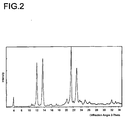
- the crystalline forms of perylimides obtained according to the invention I can by X-ray powder diffraction and single crystal structure analysis be characterized. They were also crystalline perylimides A to E according to the invention, by crystallization from methylene chloride (perylimide A), Acetic acid (perylimide B), sulfuric acid (perylimide C and D) and M-methylpyrrolidone / acetic acid (perylimide E) are available. The X-ray powder diagrams of these perylimides are shown in FIGS. 1 and 3 to 6 shown.
- the process according to the invention has a number of advantages on, which were not to be foreseen. This is not just the crystallization the perylimide I facilitates, but it will too coarsely crystalline crystals are formed, which are easy to filter, can be washed without significant product losses and also high purities of usually> 90% (in the synthesis accumulating by-products such as N-monoalkylation products can be easily removed).
- sulfuric acid as a solvent
- the degree of purity in general by additional removal of those obtained in the synthesis Decarboxylation products can be increased even further to> 95%, so that regardless of the type of synthesis of the used Raw materials I product qualities are easily obtained otherwise accessible only by chromatography.
- the crystals formed are characterized by high dissolution speeds, making them particularly lightweight can be incorporated in plastics.
- the perylimides obtained according to the invention are suitable I, especially the perylimides A to E, excellent as fluorescent dyes for coloring organic and inorganic polymeric materials as well as emitter materials in electro-optical components, e.g. Displays and emissive color filters, what especially the perylimide A due to its pronounced Solid-state fluorescence offers.
- perylimide Ia in the crystalline form A (perylimide A) with essential lines in the X-ray powder diagram (CuK ⁇ ) at the following d values (FIG. 1): 10.2, 9.60, 8.17, 7.60, 7.07 , 6.89, 6.02, 5.64, 4.89, 4.79, 4.63, 3.93, 3.81, 3.53 and 3.43 ⁇ .
- the X-ray powder pattern (CuK ⁇ ) of the NMP wet crystalline product had substantial lines at d values of 15.3, 8.36, 7.64, 7.36, 6.48, 5.95, 5.85, 5.65, 5.56, 5.10, 4.36, 4.14 and 3.87 ⁇ (shown in FIG 2).
- the comparison of the X-ray powder diagrams of Example 2 and Example 3 revealed the isomorphism of the two solvates.
- the precipitated red, voluminous precipitate was filtered off, washed with water and dried for 24 h at 100 ° C in a vacuum.
- the material obtained showed only in the X-ray powder diagram 4 broad lines whose mean d values (15.7, 6.95, 5.88, 3.47 ⁇ ) correspond to the molecular dimensions of the perylimide Ia, and proved to be largely X-ray amorphous.
- the X-ray powder diagram (CuK ⁇ ) of the product thus dried had substantial lines at d values of 14.7, 8.64, 7.73, 7.27, 6.69, 6.14, 5.75, 5.68, 4.98, 4.54, 4.49, 4.35, 4.13 and 3.87 ⁇ .
- Elemental analysis of the shiny platelet-derived perylimide Ia revealed a molar 1: 1 solvate whose X-ray powder pattern (CuK ⁇ ) showed substantial lines at the following d values: 15.2, 7.60, 7.35, 6.46, 5.07, 4.34, 3.87, and 3.47 ⁇ ,
- the resulting red crystals were characterized as sulfuric acid-free with exclusion of air by a Debye-Scherrer diagram (CuK ⁇ ). Essential lines were at the following d values: 10.24, 7.80, 6.77, 6.24, 5.61, 5.34, 4.58, 4.42, 4.01, 3.805 and 3.415 ⁇ .
- the resulting red crystals were characterized as sulfuric acid-free with exclusion of air by a Debye-Scherrer diagram (CuK ⁇ ). Essential lines were at the following d values: 9.74, 9.27, 7.73, 7.13, 5.80, 4.7 and 4.11 ⁇ .
- perylimide C The crystalline form C of perylimide Ia (perylimide C) was obtained in the form of dark orange crystals with essential lines in the X-ray powder diagram (CuK ⁇ ) at the following d values (FIG. 4): 10.67, 9.88, 9.36, 7.82, 7.16, 6.89, 5.74 , 5.49, 4.68, 4.085, 3.354 and 3.252 ⁇ .
- perylimide E The crystalline form E of perylimide Ia (perylimide E) was obtained in the form of orange crystals with essential lines in the X-ray powder diagram (CuK ⁇ ) at the following d values (FIG. 6): 15.2, 14.7, 8.04, 7.76, 7.36, 6.43, 5.59 , 4.99, 4.25, 4.14 and 3.863 ⁇ .
Landscapes
- Chemical & Material Sciences (AREA)
- Organic Chemistry (AREA)
- Chemical Kinetics & Catalysis (AREA)
- Nitrogen Condensed Heterocyclic Rings (AREA)
- Organic Low-Molecular-Weight Compounds And Preparation Thereof (AREA)
- Luminescent Compositions (AREA)
Description


- Di-C1-C4-alkylsulfoxide, wie Dimethylsulfoxid;
- Sulfolan;
- unsubstituierte und N-C1-C6-alkylsubstituierte C4-C6-Lactame, wie Pyrrolidon, N-Methylpyrrolidon, N-Cyclohexylpyrrolidon, N-Octylpyrrolidon, Caprolactam und N-Ethylcaprolactam;
- unsubstituierte und N-C1-C6-alkylsubstituierte aliphatische C1-C6-Carbonsäureamide, wie Formamid, Dimethylformamid, Dimethylacetamid, Benzamid und N-Acetylmorpholin;
- aliphatische Nitrile mit 2 bis 12 C-Atomen, wie Acetonitril und 2-Methoxypropionitril;
- aromatische Nitrile, die durch C1-C8-Alkyl, C1-C8-Alkoxy und/oder Halogen substituiert sein können, wie Benzonitril und 3-Methylbenzonitril;
- aliphatische C1-C12-Carbonsäuren und deren C1-C6-Alkylester mit einer Gesamtzahl an Kohlenstoffatomen von ≤ 12, wie Ameisensäure, Essigsäure, Propionsäure, 2-Ethylhexansäure und Essigsäureethylester;
- Hydroxy-C2-C6-carbonsäuren und deren Ester, wie Milchsäure, Butyrolacton, Valerolacton und Caprolacton;
- C2-C6-Alkylencarbonate, wie Ethylencarbonat und Propylencarbonat;
- Benzoesäuren, wie Benzoesäure, Phthalsäure und Terephthalsäure;
- Naphthoesäuren, wie α- und β-Naphthoesäure;
- Benzoesäure-C1-C6-alkylester, wie Benzoesäuremethylester und 3-Methylbenzoesäureethylester;
- Phthalsäuredi-C1-C2-alkylester, wie Phthalsäurediethylester;
- einwertige und mehrwertige gesättigte und ungesättigte aliphatische und cycloaliphatische C4-C12-Alkohole, wie Butanol, iso-Amylalkohol, Cyclohexanol, Octanol, 3-Methyl-1-pentin-3-ol, Methoxypropanol, Furfurylalkohol, Tetrahydrofurfurylalkohol und 1,5-Pentandiol;
- araliphatische Alkohole, wie Benzylalkohol, 2-Phenylethanol und 4-Methoxybenzylalkohol;
- Mono- und Oligo-C2-C3-alkylenglykolmono- und -di-C1-C8-alkyl- und -monophenylether, wie Ethylenglykolmonomethylether, Ethylenglykolmonobutylether, Ethylenglykolmonophenylether und Diethylenglykoldimethylether;
- aliphatische C3-C12-Ketone, wie Aceton, Methylisobutylketon, Diacetonalkohol, Cyclohexanon und 2-Methylcyclohexanon;
- aromatische Ketone, die durch C1-C8-Alkyl, C1-C8-Alkoxy und/oder Halogen substituiert sein können, wie Isophoron, Acetophenon, Propiophenon, 3-Chloracetophenon und 3-Ethylacetophenon;
- aliphatische und cycloaliphatische C4-C12-Ether, wie Methyl-tert.-butylether, Ethylisobutylether, 2-Ethylhexylmethylether, Tetrahydrofuran und Dioxan;
- aromatische Ether, die durch C1-C8-Alkyl, C1-C8-Alkoxy und/oder Halogen substituiert sein können, wie Diphenylether;
- Heterocyclen, wie Pyridin, Picolin, Lutidin, Chinolin, Methylchinolin, Imidazol, Methylimidazol und 1,3-Dimethyl-2-imidazolidinon;
- aromatische Kohlenwasserstoffe, die durch C1-C8-Alkyl, C1-C8-Alkoxy, C1-C6-Alkylamino, Di-C1-C3-alkylamino, Chlor und/oder Nitro substituiert sein können, wie Toluol, o-, mund p-Xylol, Ethylbenzol, Cumol, Methoxybenzol, Chlorbenzol, o-Dichlorbenzol, 1,2,4-Trichlorbenzol, Nitrobenzol, Phenol, 3-Methylphenol, p-Chlorphenol, o-Nitrophenol, N-Hydroxyethylanilin, 1,2,3,4-Tetrahydronaphthalin, 2-Chlornaphthalin, 2-Methoxynaphthalin und Dimethylnaphthalin;
- aliphatische und cycloaliphatische C6-C18-Kohlenwasserstoffe, wie Limonen, Dekalin und Methylcyclohexan;
- Chlorkohlenwasserstoffe, wie Methylenchlorid, Chloroform, Tetrachlormethan, Dichlorethan, Trichlorethan und Tetrachlorethan.
| Bsp | x [ml] | L | T [°C] | t [h] | d-Werte [Å] |
| 13 | 100 | Nitrobenzol | 150 | 4 | 20.4, 11.8, 8.32, 7.81, 7.20, 6.80, 6.49, 6.14, 5.408, 4.947, 4.083, 3.927 |
| 14 | 100 | Phenylglykol | 150 | 4 | 16.1, 14.2, 10.3, 8.48, 7.61, 6.793, 5.180, 4.237 |
| 15 | 100 | n-Butanol | 90 | 2 | 14.7, 8.26, 7.47, 6.44, 5.633, 4.879, 4.240, 3.923, 3.842, 3.743 |
| 16 | 150 | Methylglykol | 60 | 2 | 14.7, 14.45, 7.45, 7.31, 6.40, 4.834, 4.212, 3.894 |
| 17 | 100 | Cyclohexanol | 80 | 2 | 11.8, 8.4, 7.17, 6.48, 5.89, 5.44, 5.284, 4.68, 4.49, 3.55 |
| 18 | 100 | Chlorbenzol | 120 | 6 | 20.5, 13.6, 11.8, 7.75, 7.20, 6.84, 6.58, 6.19, 4.53, 3.956 |
| 19 | 50 | Benzylalkohol | 130 | 6 | 15.6, 9.62, 9.28, 8.296, 7.973, 6.369, 6.045, 5.155, 4.462, 4.157, 3.888, 3.353 |
| 20 | 150 | Butylglykol | 130 | 4 | 7.94, 7.232, 7.12, 5.92, 4.96, 4.79, 4.62, 3.986, 3.63, 3.555 |
| 21 | 75 | Benzoesäuremethylester | 130 | 4 | 15.2, 14.8, 14.4, 8.86, 7.82, 6.84, 6.75, 5.8, 5.00, 4.42 |
Claims (10)
- Verfahren zur Überführung von Perylen-3,4:9,10-tetracarbonsäurediimiden der allgemeinen Formel Iin der R1 und R2 unverzweigtes, verzweigtes oder cyclisches C1-C8-Alkyl bedeuten, in eine für die Anwendung als Fluoreszenzfarbmittel geeignete Form, dadurch gekennzeichnet, daß man
 a) die Perylen-3,4:9,10-tetracarbonsäurediimide in einem organischen oder anorganischen Lösungsmittel, dessen Moleküle ein molekulares Volumen von ≤ 230 Å3 aufweisen, bei 0 bis 250°C löst oder suspendiert,b1) die in Schritt a) erhaltene Lösung auf oder unter die Kristallisationstemperatur abkühlt und, im Fall eines organischen Lösungsmittels, gewünschtenfalls gleichzeitig solange überschüssiges Lösungsmittel entfernt, bis sich erste Kristalle bilden, oder, im Fall eines anorganischen Lösungsmittels, solange Wasser oder verdünnte wäßrige Lösungen des Lösungsmittels zugibt, bis sich erste Kristalle bilden, und die Lösung zur weiteren Kristallisation bei dieser Temperatur hält oderb2) die in Schritt a) erhaltene Suspension auf oder unter die Kristallisationstemperatur abkühlt, wenn die Temperatur in Schritt a) über der Kristallisationstemperatur lag, und die Suspension zur weiteren Kristallisation bei dieser Temperatur hält,c) die in Schritt b) gebildeten Solvatkristalle isoliert undd) das Lösungsmittel anschließend aus den Solvatkristallen entfernt.
 - Verfahren nach Anspruch 1, dadurch gekennzeichnet, daß man als Lösungsmittel Di-C1-C4-alkylsulfoxide; Sulfolan; unsubstituierte und N-C1-C6-alkylsubstituierte C4-C6-Lactame; unsubstituierte und N-C1-C6-alkylsubstituierte aliphatische C1-C6-Carbonsäureamide; aliphatische Nitrile mit 2 bis 12 C-Atomen; aromatische Nitrile, die durch C1-C8-Alkyl, C1-C8-Alkoxy und/oder Halogen substituiert sein können; aliphatische C1-C12-Carbonsäuren und deren C1-C6-Alkylester mit einer Gesamtzahl an Kohlenstoffatomen von ≤ 12; Hydroxy-C2-C6-carbonsäuren und deren Ester; C2-C6-Alkylencarbonate; Benzoesäuren; Naphthoesäuren; Benzoesäure-C1-C8-alkylester, Phthalsäuredi-C2-C4-alkylester; einwertige und mehrwertige gesättigte und ungesättigte aliphatische und cycloaliphatische C4-C12-Alkohole; araliphatische Alkohole; Mono- und Oligo-C2-C3-alkylenglykolmono- und -di-C1-C8-alkyl- und -monophenylether; aliphatische C3-C12-Ketone; aromatische Ketone, die durch C1-C8-Alkyl, C1-C8-Alkoxy und/oder Halogen substituiert sein können; aliphatische und cycloaliphatische C4-C12-Ether; aromatische Ether, die durch C1-C8-Alkyl, C1-C8-Alkoxy und/oder Halogen substituiert sein können; Heterocyclen; aromatische Kohlenwasserstoffe, die durch C1-C8-Alkyl, C1-C8-Alkoxy, C1-C6-Alkylamino, Di-C1-C3-alkylamino, Chlor und/oder Nitro substituiert sein können; aliphatische und cycloaliphatische C6-C18-Kohlenwasserstoffe; Chlorkohlenwasserstoffe, deren Mischungen oder Kombinationen oder Schwefelsäure einsetzt.
- Kristallines N,N'-Bis-(2,6-diisopropylphenyl)perylen-3,4:9,10-tetracarbonsäurediimid der Form A, gekennzeichnet durch ein Röntgenpulverdiagramm (CuKα) mit wesentlichen Linien bei d-Werten von 10.2, 9.60, 8.17, 7.60, 7.07, 6.89, 6.02, 5.64, 4.89, 4.79, 4.63, 3.93, 3.81, 3.53 und 3.43 Å.
- Kristallines N,N'-Bis-(2,6-diisopropylphenyl)perylen-3,4:9,10-tetracarbonsäurediimid der Form B, gekennzeichnet durch ein Röntgenpulverdiagramm (CuKα) mit wesentlichen Linien bei d-Werten von 15.3, 7.68, 7.32, 7.15, 5.99, 5.59, 5.33, 4.98, 4.24, 3.86 und 3.235 Å.
- Kristallines N,N'-Bis-(2,6-diisopropylphenyl)perylen-3,4:9,10-tetracarbonsäurediimid der Form C, gekennzeichnet durch ein Röntgenpulverdiagramm (CuKα) mit wesentlichen Linien bei d-Werten von 10.67, 9.88, 9.36, 7.82, 7.16, 6.89, 5.74, 5.49, 4.68, 4.085, 3.354 und 3.252 Å.
- Kristallines N,N'-Bis-(2,6-diisopropylphenyl)perylen-3,4:9,10-tetracarbonsäurediimid der Form D, gekennzeichnet durch ein Röntgenpulverdiagramm (CuKα) mit wesentlichen Linien bei d-Werten von 9.7, 8.6, 7.85, 6.88, 4.83, 4.13 und 3.81 Å.
- Kristallines N,N'-Bis-(2,6-diisopropylphenyl)perylen-3,4:9,10-tetracarbonsäurediimid der Form E, gekennzeichnet durch ein Röntgenpulverdiagramm (CuKα) mit wesentlichen Linien bei d-Werten von 15.2, 14.7, 8.04, 7.76, 7.36, 6.43, 5.59, 4.99, 4.25, 4.14 und 3.863 Å.
- Kristalline Solvate der Perylen-3,4:9,10-tetracarbonsäurediimide der Formel I gemäß Anspruch 1, die pro mol Perylen-3,4:9,10-tetracarbonsäurediimid 1 oder 2 mol Lösungsmittel enthalten.
- Verwendung von Perylen-3,4:9,10-tetracarbonsäurediimiden gemäß den Ansprüchen 1 bis 7 als Fluoreszenzfarbstoffe zum Einfärben von organischen und anorganischen polymeren Materialien.
- Verwendung von Perylen-3,4:9,10-tetracarbonsäurediimiden gemäß den Ansprüchen 1 bis 7 als Emittermaterialien in elektrooptischen Bauteilen.
Applications Claiming Priority (3)
| Application Number | Priority Date | Filing Date | Title |
|---|---|---|---|
| DE10226181 | 2002-06-12 | ||
| DE10226181A DE10226181A1 (de) | 2002-06-12 | 2002-06-12 | Verfahren zur Überführung von Perylen-3,4:9,10-tetracarbonsäurediimide in eine für die Anwendung als Fluoreszenzfarbmittel geeignete Form |
| PCT/EP2003/005937 WO2003106566A1 (de) | 2002-06-12 | 2003-06-06 | Verfahren zur überführung von perylen-3, 4:9, 10-tetracarbonsäurediimiden in eine für die anwendung als fluoreszenzfarbmittel geeignete form |
Publications (2)
| Publication Number | Publication Date |
|---|---|
| EP1516018A1 EP1516018A1 (de) | 2005-03-23 |
| EP1516018B1 true EP1516018B1 (de) | 2005-11-23 |
Family
ID=29594447
Family Applications (1)
| Application Number | Title | Priority Date | Filing Date |
|---|---|---|---|
| EP03735563A Expired - Lifetime EP1516018B1 (de) | 2002-06-12 | 2003-06-06 | Verfahren zur ueberfuehrung von perylen-3,4:9, 10-tetracarbonsaeurediimiden in eine fuer die anwendung als fluoreszenzfarbmittel geeignete form |
Country Status (9)
| Country | Link |
|---|---|
| US (3) | US7753967B2 (de) |
| EP (1) | EP1516018B1 (de) |
| JP (1) | JP4555682B2 (de) |
| KR (1) | KR100983298B1 (de) |
| CN (1) | CN100335482C (de) |
| AT (1) | ATE310772T1 (de) |
| AU (1) | AU2003236705A1 (de) |
| DE (2) | DE10226181A1 (de) |
| WO (1) | WO2003106566A1 (de) |
Cited By (1)
| Publication number | Priority date | Publication date | Assignee | Title |
|---|---|---|---|---|
| US8435914B2 (en) | 2009-05-14 | 2013-05-07 | Univation Technologies, Llc | Mixed metal catalyst systems having a tailored hydrogen response |
Families Citing this family (12)
| Publication number | Priority date | Publication date | Assignee | Title |
|---|---|---|---|---|
| WO2005076815A2 (en) | 2004-01-26 | 2005-08-25 | Northwestern University | PERYLENE n-TYPE SEMICONDUCTORS AND RELATED DEVICES |
| WO2007146250A2 (en) * | 2006-06-12 | 2007-12-21 | Northwestern University | Naphthalene-based semiconductor materials and methods of preparing and use thereof |
| US7947837B2 (en) * | 2006-10-25 | 2011-05-24 | Polyera Corporation | Organic semiconductor materials and methods of preparing and use thereof |
| EP2086974B1 (de) * | 2006-11-17 | 2013-07-24 | Polyera Corporation | Halbleitermaterialien auf diimidbasis und verfahren zu deren herstellung und anwendung |
| EP2104676A2 (de) * | 2007-01-08 | 2009-09-30 | Polyera Corporation | Verfahren zur herstellung aren-bi-(dicarboximid)-basierter halbleitermaterialien und entsprechende zwischenprodukte zu ihrer herstellung |
| WO2008091670A2 (en) * | 2007-01-24 | 2008-07-31 | Polyera Corporation | Organic semiconductor materials and precursors thereof |
| KR100928120B1 (ko) * | 2007-11-07 | 2009-11-24 | 삼성에스디아이 주식회사 | 이차 전지 |
| EP2518788A4 (de) * | 2010-01-13 | 2013-05-29 | Sumitomo Chemical Co | Organisches elektrolumineszentes element und lichtemittierende polymerzusammensetzung |
| CN103146226B (zh) * | 2012-12-27 | 2014-09-10 | 中国科学院上海硅酸盐研究所 | 利用柱层析纯化钌络合物染料粗品的方法 |
| CN103073923A (zh) * | 2012-12-27 | 2013-05-01 | 中国科学院上海硅酸盐研究所 | 钌络合物光敏染料粗产品的纯化方法及钌络合物光敏染料产品 |
| CN103013178B (zh) * | 2012-12-27 | 2014-07-16 | 中国科学院上海硅酸盐研究所 | 利用重结晶法提纯钌络合物粗产物的方法 |
| KR101753012B1 (ko) | 2016-10-12 | 2017-07-03 | 주식회사 소룩스 | 색온도 조절 가능한 확산시트판이 구비된 led 조명기구 및, 이의 제조방법 |
Family Cites Families (13)
| Publication number | Priority date | Publication date | Assignee | Title |
|---|---|---|---|---|
| DE2116048C3 (de) * | 1971-04-02 | 1980-02-14 | Basf Ag, 6700 Ludwigshafen | Farbstoff der Perylentetracarbonsäurediimidreihe |
| US4379934A (en) * | 1980-01-19 | 1983-04-12 | Basf Aktiengesellschaft | Process for two-dimensionally concentrating light, and novel perylene-3,4,9,10-tetracarboxylic acid diimides |
| DE3016765A1 (de) | 1980-04-30 | 1981-11-05 | Fraunhofer-Gesellschaft zur Förderung der angewandten Forschung e.V., 8000 München | Verwendung von perylenderivaten fuer fluoreszenzzwecke und neue perylenderivate |
| DE3018006A1 (de) * | 1980-05-10 | 1981-11-12 | Hoechst Ag, 6000 Frankfurt | Verfahren zur herstellung von pigmenten der perylen-3,4,9,10-tetracarbonsaeurediimidreihe und ihre verwendung |
| DE3161654D1 (en) | 1980-12-27 | 1984-01-19 | Basf Ag | Perylene tetracarboxylic-acid diimides and their use |
| DE3049215A1 (de) | 1980-12-27 | 1982-07-15 | Basf Ag, 6700 Ludwigshafen | Perylentetracarbonsaeurediimid und dessen verwendung |
| US4446324A (en) * | 1980-12-27 | 1984-05-01 | Basf Aktiengesellschaft | Perylenetetracarboxylic acid diimides and their use |
| DE3345810A1 (de) * | 1983-04-21 | 1984-10-25 | Hoechst Ag, 6230 Frankfurt | Verfahren zur herstellung von 3,4,9,10-perylentetracarbonsaeurediimid |
| US4667036A (en) * | 1983-08-27 | 1987-05-19 | Basf Aktiengesellschaft | Concentration of light over a particular area, and novel perylene-3,4,9,10-tetracarboxylic acid diimides |
| JP2690068B2 (ja) * | 1990-07-04 | 1997-12-10 | 三田工業株式会社 | 電子写真感光体 |
| JPH11130974A (ja) * | 1997-10-27 | 1999-05-18 | Dainippon Ink & Chem Inc | 有機顔料の製造方法 |
| DE10039232A1 (de) * | 2000-08-11 | 2002-02-21 | Basf Ag | Flüssigkristalline Perylen-3,4:9,10-tetracarbonsäurediimide |
| JP2002105448A (ja) * | 2000-09-28 | 2002-04-10 | Shiina:Kk | カラー蓄光組成物 |
-
2002
- 2002-06-12 DE DE10226181A patent/DE10226181A1/de not_active Withdrawn
-
2003
- 2003-06-06 CN CNB038136163A patent/CN100335482C/zh not_active Expired - Lifetime
- 2003-06-06 AT AT03735563T patent/ATE310772T1/de not_active IP Right Cessation
- 2003-06-06 EP EP03735563A patent/EP1516018B1/de not_active Expired - Lifetime
- 2003-06-06 US US10/514,564 patent/US7753967B2/en not_active Expired - Lifetime
- 2003-06-06 JP JP2004513384A patent/JP4555682B2/ja not_active Expired - Lifetime
- 2003-06-06 KR KR1020047020109A patent/KR100983298B1/ko not_active Expired - Lifetime
- 2003-06-06 DE DE50301761T patent/DE50301761D1/de not_active Expired - Lifetime
- 2003-06-06 AU AU2003236705A patent/AU2003236705A1/en not_active Abandoned
- 2003-06-06 WO PCT/EP2003/005937 patent/WO2003106566A1/de not_active Ceased
-
2008
- 2008-12-30 US US12/346,262 patent/US7851628B2/en not_active Expired - Lifetime
-
2010
- 2010-03-05 US US12/718,512 patent/US20100218321A1/en not_active Abandoned
Cited By (1)
| Publication number | Priority date | Publication date | Assignee | Title |
|---|---|---|---|---|
| US8435914B2 (en) | 2009-05-14 | 2013-05-07 | Univation Technologies, Llc | Mixed metal catalyst systems having a tailored hydrogen response |
Also Published As
| Publication number | Publication date |
|---|---|
| KR20050020976A (ko) | 2005-03-04 |
| DE10226181A1 (de) | 2003-12-24 |
| US20100218321A1 (en) | 2010-09-02 |
| US7753967B2 (en) | 2010-07-13 |
| JP2006508197A (ja) | 2006-03-09 |
| US7851628B2 (en) | 2010-12-14 |
| CN100335482C (zh) | 2007-09-05 |
| DE50301761D1 (de) | 2005-12-29 |
| US20090176985A1 (en) | 2009-07-09 |
| CN1659237A (zh) | 2005-08-24 |
| KR100983298B1 (ko) | 2010-09-24 |
| EP1516018A1 (de) | 2005-03-23 |
| AU2003236705A1 (en) | 2003-12-31 |
| JP4555682B2 (ja) | 2010-10-06 |
| US20050251930A1 (en) | 2005-11-17 |
| WO2003106566A1 (de) | 2003-12-24 |
| ATE310772T1 (de) | 2005-12-15 |
Similar Documents
| Publication | Publication Date | Title |
|---|---|---|
| US7851628B2 (en) | Conversion of perylene-3,4:9,10-tetracarboximides to a form suitable for use as fluorescent dyes | |
| DE2614669C2 (de) | Gamma-kristalline wasserfreie Form von 7-(D-alpha-Formyloxy-alpha-phenylacetamido)-3-(1-methyl-1H-tetrazol-5- ylthiomethyl)-3-cephem-4-natriumcarboxylat und Verfahren zu ihrer Herstellung | |
| US4247696A (en) | Process for preparing gamma phase quinacridone | |
| CH639986A5 (de) | Verfahren zur herstellung von pigmentformen des perylen-3,4,9,10-tetracarbonsaeurediimids mit hoher lasur und brillanz. | |
| DE2037854C2 (de) | 3-(4-Chlor-1-pyrazolyl)-7-v-triazol-2-yl-cumarin-Verbindungen und deren Verwendung zum optischen Aufhellen | |
| DE2058577B2 (de) | Kristallines Perylentetracarbonsäuredibenzoylhydrazld, Verfahren zu seiner Herstellung und dessen Verwendung als Pigment | |
| DE2025427A1 (en) | 2,6-dihydroxy-3-oxo-pyridine cpds prodn- from 2,6-dihydroxy cpds, - starting materials for dyes and pesticides | |
| EP0326866B1 (de) | Verfahren zur Herstellung von Acylaminen der Anthrachinonreihe | |
| DE2258276C3 (de) | Triazolyl-stilbene, sowie deren Herstellung und Verwendung als optische Aufheller | |
| US3372163A (en) | Process for the preparation of linear quinacridone in the form of red pigments | |
| DE2421804A1 (de) | Verfahren zur herstellung von farbstarken kupferphthalocyaninpigmenten der alphamodifikation | |
| DE2532540A1 (de) | Neue disazopigmente und verfahren zu deren herstellung | |
| DE2247971A1 (de) | Verfahren zur herstellung von chinophthalonfarbstoffen | |
| DE1266425C2 (de) | Verfahren zur herstellung von anthrachinon-dispersionsfarbstoffen und deren verwendung | |
| DE2407003A1 (de) | Neue naphthalin-tetracarbonsaeurederivate und verfahren zu ihrer herstellung | |
| DE1960896A1 (de) | Neue Pigmente der Chinacridon-Reihe und Verfahren zu deren Herstellung | |
| DE2047547A1 (de) | Verfahren zur Herstellung neuer fluor eszierender 1,2,3 Tnazolverbindungen | |
| DE1544441B2 (de) | Verfahren zur Herstellung eines Monoazopigmentes | |
| DE2226524A1 (de) | Triazolyl-naphthalimide | |
| DE2116048C3 (de) | Farbstoff der Perylentetracarbonsäurediimidreihe | |
| AT233143B (de) | Verfahren zur Herstellung von Fluorubin | |
| CH619476A5 (en) | Process for preparing new basic oxazine compounds | |
| DE2451782C3 (de) | Perylen^&lO-tetracarbonsäurediimidfarbstoffe und ihre Verwendung | |
| AT295855B (de) | Verfahren zur Herstellung von Polyacyloxamidrazonen | |
| DE1644401C (de) | Monoazofarbstoffe und Verfahren zur Herstellung und Verwendung von Monoazofarbstoffen |
Legal Events
| Date | Code | Title | Description |
|---|---|---|---|
| PUAI | Public reference made under article 153(3) epc to a published international application that has entered the european phase |
Free format text: ORIGINAL CODE: 0009012 |
|
| 17P | Request for examination filed |
Effective date: 20050112 |
|
| AK | Designated contracting states |
Kind code of ref document: A1 Designated state(s): AT BE BG CH CY CZ DE DK EE ES FI FR GB GR HU IE IT LI LU MC NL PT RO SE SI SK TR |
|
| AX | Request for extension of the european patent |
Extension state: AL LT LV MK |
|
| GRAP | Despatch of communication of intention to grant a patent |
Free format text: ORIGINAL CODE: EPIDOSNIGR1 |
|
| GRAS | Grant fee paid |
Free format text: ORIGINAL CODE: EPIDOSNIGR3 |
|
| DAX | Request for extension of the european patent (deleted) | ||
| GRAA | (expected) grant |
Free format text: ORIGINAL CODE: 0009210 |
|
| AK | Designated contracting states |
Kind code of ref document: B1 Designated state(s): AT BE BG CH CY CZ DE DK EE ES FI FR GB GR HU IE IT LI LU MC NL PT RO SE SI SK TR |
|
| PG25 | Lapsed in a contracting state [announced via postgrant information from national office to epo] |
Ref country code: SI Free format text: LAPSE BECAUSE OF FAILURE TO SUBMIT A TRANSLATION OF THE DESCRIPTION OR TO PAY THE FEE WITHIN THE PRESCRIBED TIME-LIMIT Effective date: 20051123 Ref country code: FI Free format text: LAPSE BECAUSE OF FAILURE TO SUBMIT A TRANSLATION OF THE DESCRIPTION OR TO PAY THE FEE WITHIN THE PRESCRIBED TIME-LIMIT Effective date: 20051123 Ref country code: NL Free format text: LAPSE BECAUSE OF FAILURE TO SUBMIT A TRANSLATION OF THE DESCRIPTION OR TO PAY THE FEE WITHIN THE PRESCRIBED TIME-LIMIT Effective date: 20051123 Ref country code: IE Free format text: LAPSE BECAUSE OF FAILURE TO SUBMIT A TRANSLATION OF THE DESCRIPTION OR TO PAY THE FEE WITHIN THE PRESCRIBED TIME-LIMIT Effective date: 20051123 Ref country code: SK Free format text: LAPSE BECAUSE OF FAILURE TO SUBMIT A TRANSLATION OF THE DESCRIPTION OR TO PAY THE FEE WITHIN THE PRESCRIBED TIME-LIMIT Effective date: 20051123 Ref country code: RO Free format text: LAPSE BECAUSE OF FAILURE TO SUBMIT A TRANSLATION OF THE DESCRIPTION OR TO PAY THE FEE WITHIN THE PRESCRIBED TIME-LIMIT Effective date: 20051123 Ref country code: CZ Free format text: LAPSE BECAUSE OF FAILURE TO SUBMIT A TRANSLATION OF THE DESCRIPTION OR TO PAY THE FEE WITHIN THE PRESCRIBED TIME-LIMIT Effective date: 20051123 |
|
| REG | Reference to a national code |
Ref country code: GB Ref legal event code: FG4D Free format text: NOT ENGLISH |
|
| REG | Reference to a national code |
Ref country code: CH Ref legal event code: EP |
|
| REF | Corresponds to: |
Ref document number: 50301761 Country of ref document: DE Date of ref document: 20051229 Kind code of ref document: P |
|
| REG | Reference to a national code |
Ref country code: IE Ref legal event code: FG4D Free format text: LANGUAGE OF EP DOCUMENT: GERMAN |
|
| PG25 | Lapsed in a contracting state [announced via postgrant information from national office to epo] |
Ref country code: GR Free format text: LAPSE BECAUSE OF FAILURE TO SUBMIT A TRANSLATION OF THE DESCRIPTION OR TO PAY THE FEE WITHIN THE PRESCRIBED TIME-LIMIT Effective date: 20060223 Ref country code: DK Free format text: LAPSE BECAUSE OF FAILURE TO SUBMIT A TRANSLATION OF THE DESCRIPTION OR TO PAY THE FEE WITHIN THE PRESCRIBED TIME-LIMIT Effective date: 20060223 Ref country code: SE Free format text: LAPSE BECAUSE OF FAILURE TO SUBMIT A TRANSLATION OF THE DESCRIPTION OR TO PAY THE FEE WITHIN THE PRESCRIBED TIME-LIMIT Effective date: 20060223 Ref country code: BG Free format text: LAPSE BECAUSE OF FAILURE TO SUBMIT A TRANSLATION OF THE DESCRIPTION OR TO PAY THE FEE WITHIN THE PRESCRIBED TIME-LIMIT Effective date: 20060223 |
|
| GBT | Gb: translation of ep patent filed (gb section 77(6)(a)/1977) |
Effective date: 20060208 |
|
| PG25 | Lapsed in a contracting state [announced via postgrant information from national office to epo] |
Ref country code: ES Free format text: LAPSE BECAUSE OF FAILURE TO SUBMIT A TRANSLATION OF THE DESCRIPTION OR TO PAY THE FEE WITHIN THE PRESCRIBED TIME-LIMIT Effective date: 20060306 |
|
| PG25 | Lapsed in a contracting state [announced via postgrant information from national office to epo] |
Ref country code: PT Free format text: LAPSE BECAUSE OF FAILURE TO SUBMIT A TRANSLATION OF THE DESCRIPTION OR TO PAY THE FEE WITHIN THE PRESCRIBED TIME-LIMIT Effective date: 20060424 |
|
| NLV1 | Nl: lapsed or annulled due to failure to fulfill the requirements of art. 29p and 29m of the patents act | ||
| PG25 | Lapsed in a contracting state [announced via postgrant information from national office to epo] |
Ref country code: HU Free format text: LAPSE BECAUSE OF FAILURE TO SUBMIT A TRANSLATION OF THE DESCRIPTION OR TO PAY THE FEE WITHIN THE PRESCRIBED TIME-LIMIT Effective date: 20060524 |
|
| ET | Fr: translation filed | ||
| REG | Reference to a national code |
Ref country code: IE Ref legal event code: FD4D |
|
| PG25 | Lapsed in a contracting state [announced via postgrant information from national office to epo] |
Ref country code: BE Free format text: LAPSE BECAUSE OF NON-PAYMENT OF DUE FEES Effective date: 20060630 Ref country code: MC Free format text: LAPSE BECAUSE OF NON-PAYMENT OF DUE FEES Effective date: 20060630 |
|
| PLBE | No opposition filed within time limit |
Free format text: ORIGINAL CODE: 0009261 |
|
| STAA | Information on the status of an ep patent application or granted ep patent |
Free format text: STATUS: NO OPPOSITION FILED WITHIN TIME LIMIT |
|
| 26N | No opposition filed |
Effective date: 20060824 |
|
| PG25 | Lapsed in a contracting state [announced via postgrant information from national office to epo] |
Ref country code: AT Free format text: LAPSE BECAUSE OF NON-PAYMENT OF DUE FEES Effective date: 20060606 |
|
| BERE | Be: lapsed |
Owner name: BASF A.G. Effective date: 20060630 |
|
| REG | Reference to a national code |
Ref country code: CH Ref legal event code: PL |
|
| PG25 | Lapsed in a contracting state [announced via postgrant information from national office to epo] |
Ref country code: LI Free format text: LAPSE BECAUSE OF NON-PAYMENT OF DUE FEES Effective date: 20070630 Ref country code: CH Free format text: LAPSE BECAUSE OF NON-PAYMENT OF DUE FEES Effective date: 20070630 |
|
| PG25 | Lapsed in a contracting state [announced via postgrant information from national office to epo] |
Ref country code: EE Free format text: LAPSE BECAUSE OF FAILURE TO SUBMIT A TRANSLATION OF THE DESCRIPTION OR TO PAY THE FEE WITHIN THE PRESCRIBED TIME-LIMIT Effective date: 20051123 |
|
| PG25 | Lapsed in a contracting state [announced via postgrant information from national office to epo] |
Ref country code: TR Free format text: LAPSE BECAUSE OF FAILURE TO SUBMIT A TRANSLATION OF THE DESCRIPTION OR TO PAY THE FEE WITHIN THE PRESCRIBED TIME-LIMIT Effective date: 20051123 Ref country code: LU Free format text: LAPSE BECAUSE OF NON-PAYMENT OF DUE FEES Effective date: 20060606 |
|
| PG25 | Lapsed in a contracting state [announced via postgrant information from national office to epo] |
Ref country code: CY Free format text: LAPSE BECAUSE OF FAILURE TO SUBMIT A TRANSLATION OF THE DESCRIPTION OR TO PAY THE FEE WITHIN THE PRESCRIBED TIME-LIMIT Effective date: 20051123 |
|
| REG | Reference to a national code |
Ref country code: FR Ref legal event code: PLFP Year of fee payment: 13 |
|
| REG | Reference to a national code |
Ref country code: FR Ref legal event code: PLFP Year of fee payment: 14 |
|
| REG | Reference to a national code |
Ref country code: FR Ref legal event code: PLFP Year of fee payment: 15 |
|
| REG | Reference to a national code |
Ref country code: FR Ref legal event code: PLFP Year of fee payment: 16 |
|
| PGFP | Annual fee paid to national office [announced via postgrant information from national office to epo] |
Ref country code: IT Payment date: 20210630 Year of fee payment: 19 Ref country code: FR Payment date: 20210621 Year of fee payment: 19 |
|
| PGFP | Annual fee paid to national office [announced via postgrant information from national office to epo] |
Ref country code: GB Payment date: 20210623 Year of fee payment: 19 |
|
| PGFP | Annual fee paid to national office [announced via postgrant information from national office to epo] |
Ref country code: DE Payment date: 20220518 Year of fee payment: 20 |
|
| GBPC | Gb: european patent ceased through non-payment of renewal fee |
Effective date: 20220606 |
|
| PG25 | Lapsed in a contracting state [announced via postgrant information from national office to epo] |
Ref country code: FR Free format text: LAPSE BECAUSE OF NON-PAYMENT OF DUE FEES Effective date: 20220630 |
|
| PG25 | Lapsed in a contracting state [announced via postgrant information from national office to epo] |
Ref country code: GB Free format text: LAPSE BECAUSE OF NON-PAYMENT OF DUE FEES Effective date: 20220606 |
|
| REG | Reference to a national code |
Ref country code: DE Ref legal event code: R071 Ref document number: 50301761 Country of ref document: DE |
|
| P01 | Opt-out of the competence of the unified patent court (upc) registered |
Effective date: 20230520 |
|
| PG25 | Lapsed in a contracting state [announced via postgrant information from national office to epo] |
Ref country code: IT Free format text: LAPSE BECAUSE OF NON-PAYMENT OF DUE FEES Effective date: 20220606 |