EP1193239B1 - Stabilisierung von Rhodiumkatalysatoren für die Hydroformylierung von Olefinen - Google Patents
Stabilisierung von Rhodiumkatalysatoren für die Hydroformylierung von Olefinen Download PDFInfo
- Publication number
- EP1193239B1 EP1193239B1 EP01119282A EP01119282A EP1193239B1 EP 1193239 B1 EP1193239 B1 EP 1193239B1 EP 01119282 A EP01119282 A EP 01119282A EP 01119282 A EP01119282 A EP 01119282A EP 1193239 B1 EP1193239 B1 EP 1193239B1
- Authority
- EP
- European Patent Office
- Prior art keywords
- process according
- carbon monoxide
- hydroformylation
- catalyst
- bar
- Prior art date
- Legal status (The legal status is an assumption and is not a legal conclusion. Google has not performed a legal analysis and makes no representation as to the accuracy of the status listed.)
- Expired - Lifetime
Links
- 239000003054 catalyst Substances 0.000 title claims description 52
- 238000007037 hydroformylation reaction Methods 0.000 title claims description 30
- 150000001336 alkenes Chemical class 0.000 title claims description 27
- 239000010948 rhodium Substances 0.000 title claims description 23
- 229910052703 rhodium Inorganic materials 0.000 title claims description 21
- MHOVAHRLVXNVSD-UHFFFAOYSA-N rhodium atom Chemical compound [Rh] MHOVAHRLVXNVSD-UHFFFAOYSA-N 0.000 title claims description 21
- 230000006641 stabilisation Effects 0.000 title description 2
- 238000000034 method Methods 0.000 claims description 46
- 230000008569 process Effects 0.000 claims description 37
- 239000007789 gas Substances 0.000 claims description 28
- UGFAIRIUMAVXCW-UHFFFAOYSA-N Carbon monoxide Chemical compound [O+]#[C-] UGFAIRIUMAVXCW-UHFFFAOYSA-N 0.000 claims description 18
- 229910002091 carbon monoxide Inorganic materials 0.000 claims description 18
- 230000015572 biosynthetic process Effects 0.000 claims description 16
- 238000003786 synthesis reaction Methods 0.000 claims description 15
- 239000007791 liquid phase Substances 0.000 claims description 14
- JRZJOMJEPLMPRA-UHFFFAOYSA-N olefin Natural products CCCCCCCC=C JRZJOMJEPLMPRA-UHFFFAOYSA-N 0.000 claims description 10
- 239000012071 phase Substances 0.000 claims description 6
- 239000010409 thin film Substances 0.000 claims description 6
- 239000000203 mixture Substances 0.000 claims description 5
- CURLTUGMZLYLDI-UHFFFAOYSA-N Carbon dioxide Chemical compound O=C=O CURLTUGMZLYLDI-UHFFFAOYSA-N 0.000 claims description 4
- VNWKTOKETHGBQD-UHFFFAOYSA-N methane Chemical compound C VNWKTOKETHGBQD-UHFFFAOYSA-N 0.000 claims description 4
- 125000004432 carbon atom Chemical group C* 0.000 claims description 3
- 239000011552 falling film Substances 0.000 claims description 3
- UFHFLCQGNIYNRP-UHFFFAOYSA-N Hydrogen Chemical compound [H][H] UFHFLCQGNIYNRP-UHFFFAOYSA-N 0.000 claims description 2
- 239000001569 carbon dioxide Substances 0.000 claims description 2
- 229910002092 carbon dioxide Inorganic materials 0.000 claims description 2
- 239000001257 hydrogen Substances 0.000 claims description 2
- 229910052739 hydrogen Inorganic materials 0.000 claims description 2
- 238000004519 manufacturing process Methods 0.000 claims description 2
- IJGRMHOSHXDMSA-UHFFFAOYSA-N Atomic nitrogen Chemical compound N#N IJGRMHOSHXDMSA-UHFFFAOYSA-N 0.000 claims 2
- 125000002485 formyl group Chemical class [H]C(*)=O 0.000 claims 2
- 229910052757 nitrogen Inorganic materials 0.000 claims 1
- 239000000047 product Substances 0.000 description 15
- 239000000243 solution Substances 0.000 description 13
- 230000000694 effects Effects 0.000 description 12
- 238000000926 separation method Methods 0.000 description 10
- 150000001299 aldehydes Chemical class 0.000 description 9
- 239000003446 ligand Substances 0.000 description 9
- 238000005194 fractionation Methods 0.000 description 7
- RIOQSEWOXXDEQQ-UHFFFAOYSA-N triphenylphosphine Chemical compound C1=CC=CC=C1P(C=1C=CC=CC=1)C1=CC=CC=C1 RIOQSEWOXXDEQQ-UHFFFAOYSA-N 0.000 description 7
- 238000006243 chemical reaction Methods 0.000 description 4
- 230000009849 deactivation Effects 0.000 description 4
- 238000000354 decomposition reaction Methods 0.000 description 4
- 238000004821 distillation Methods 0.000 description 4
- 230000003647 oxidation Effects 0.000 description 4
- 238000007254 oxidation reaction Methods 0.000 description 4
- FIQMHBFVRAXMOP-UHFFFAOYSA-N triphenylphosphane oxide Chemical compound C=1C=CC=CC=1P(C=1C=CC=CC=1)(=O)C1=CC=CC=C1 FIQMHBFVRAXMOP-UHFFFAOYSA-N 0.000 description 4
- YXFVVABEGXRONW-UHFFFAOYSA-N Toluene Chemical compound CC1=CC=CC=C1 YXFVVABEGXRONW-UHFFFAOYSA-N 0.000 description 3
- 238000009835 boiling Methods 0.000 description 3
- 230000000977 initiatory effect Effects 0.000 description 3
- 239000007788 liquid Substances 0.000 description 3
- 150000003283 rhodium Chemical class 0.000 description 3
- 239000000126 substance Substances 0.000 description 3
- VXNZUUAINFGPBY-UHFFFAOYSA-N 1-Butene Chemical class CCC=C VXNZUUAINFGPBY-UHFFFAOYSA-N 0.000 description 2
- QQONPFPTGQHPMA-UHFFFAOYSA-N Propene Chemical compound CC=C QQONPFPTGQHPMA-UHFFFAOYSA-N 0.000 description 2
- 150000001412 amines Chemical class 0.000 description 2
- 230000008901 benefit Effects 0.000 description 2
- 239000012018 catalyst precursor Substances 0.000 description 2
- 229910017052 cobalt Inorganic materials 0.000 description 2
- 239000010941 cobalt Substances 0.000 description 2
- GUTLYIVDDKVIGB-UHFFFAOYSA-N cobalt atom Chemical compound [Co] GUTLYIVDDKVIGB-UHFFFAOYSA-N 0.000 description 2
- 238000010586 diagram Methods 0.000 description 2
- 230000007774 longterm Effects 0.000 description 2
- OJMIONKXNSYLSR-UHFFFAOYSA-N phosphorous acid Chemical compound OP(O)O OJMIONKXNSYLSR-UHFFFAOYSA-N 0.000 description 2
- 238000002360 preparation method Methods 0.000 description 2
- 150000003284 rhodium compounds Chemical class 0.000 description 2
- 239000002904 solvent Substances 0.000 description 2
- 239000003381 stabilizer Substances 0.000 description 2
- 125000000383 tetramethylene group Chemical group [H]C([H])([*:1])C([H])([H])C([H])([H])C([H])([H])[*:2] 0.000 description 2
- -1 triphenylphosphine Peroxide Chemical class 0.000 description 2
- LFQSCWFLJHTTHZ-UHFFFAOYSA-N Ethanol Chemical compound CCO LFQSCWFLJHTTHZ-UHFFFAOYSA-N 0.000 description 1
- JKIJEFPNVSHHEI-UHFFFAOYSA-N Phenol, 2,4-bis(1,1-dimethylethyl)-, phosphite (3:1) Chemical compound CC(C)(C)C1=CC(C(C)(C)C)=CC=C1OP(OC=1C(=CC(=CC=1)C(C)(C)C)C(C)(C)C)OC1=CC=C(C(C)(C)C)C=C1C(C)(C)C JKIJEFPNVSHHEI-UHFFFAOYSA-N 0.000 description 1
- OAICVXFJPJFONN-UHFFFAOYSA-N Phosphorus Chemical compound [P] OAICVXFJPJFONN-UHFFFAOYSA-N 0.000 description 1
- 241000589614 Pseudomonas stutzeri Species 0.000 description 1
- 239000007983 Tris buffer Substances 0.000 description 1
- 230000001133 acceleration Effects 0.000 description 1
- 150000001298 alcohols Chemical class 0.000 description 1
- 238000005882 aldol condensation reaction Methods 0.000 description 1
- QVGXLLKOCUKJST-UHFFFAOYSA-N atomic oxygen Chemical compound [O] QVGXLLKOCUKJST-UHFFFAOYSA-N 0.000 description 1
- IAQRGUVFOMOMEM-UHFFFAOYSA-N butene Natural products CC=CC IAQRGUVFOMOMEM-UHFFFAOYSA-N 0.000 description 1
- 239000006227 byproduct Substances 0.000 description 1
- 229910052799 carbon Inorganic materials 0.000 description 1
- 238000006555 catalytic reaction Methods 0.000 description 1
- 239000007795 chemical reaction product Substances 0.000 description 1
- 238000001816 cooling Methods 0.000 description 1
- URYYVOIYTNXXBN-UPHRSURJSA-N cyclooctene Chemical compound C1CCC\C=C/CC1 URYYVOIYTNXXBN-UPHRSURJSA-N 0.000 description 1
- 239000004913 cyclooctene Substances 0.000 description 1
- 230000000447 dimerizing effect Effects 0.000 description 1
- 238000007599 discharging Methods 0.000 description 1
- 238000002474 experimental method Methods 0.000 description 1
- 125000004836 hexamethylene group Chemical class [H]C([H])([*:2])C([H])([H])C([H])([H])C([H])([H])C([H])([H])C([H])([H])[*:1] 0.000 description 1
- 238000007172 homogeneous catalysis Methods 0.000 description 1
- 229930195733 hydrocarbon Natural products 0.000 description 1
- 150000002430 hydrocarbons Chemical class 0.000 description 1
- 239000011261 inert gas Substances 0.000 description 1
- 239000004615 ingredient Substances 0.000 description 1
- 239000000463 material Substances 0.000 description 1
- 229910052751 metal Inorganic materials 0.000 description 1
- 239000002184 metal Substances 0.000 description 1
- 238000002156 mixing Methods 0.000 description 1
- HDKCVDHYIIKWFM-UHFFFAOYSA-K octanoate;rhodium(3+) Chemical compound [Rh+3].CCCCCCCC([O-])=O.CCCCCCCC([O-])=O.CCCCCCCC([O-])=O HDKCVDHYIIKWFM-UHFFFAOYSA-K 0.000 description 1
- 238000006384 oligomerization reaction Methods 0.000 description 1
- 150000002902 organometallic compounds Chemical class 0.000 description 1
- 239000007800 oxidant agent Substances 0.000 description 1
- 239000001301 oxygen Substances 0.000 description 1
- 229910052760 oxygen Inorganic materials 0.000 description 1
- YWAKXRMUMFPDSH-UHFFFAOYSA-N pentene Chemical compound CCCC=C YWAKXRMUMFPDSH-UHFFFAOYSA-N 0.000 description 1
- 150000002989 phenols Chemical class 0.000 description 1
- 229910052698 phosphorus Inorganic materials 0.000 description 1
- 239000011574 phosphorus Substances 0.000 description 1
- 230000009467 reduction Effects 0.000 description 1
- 230000008439 repair process Effects 0.000 description 1
- 238000011105 stabilization Methods 0.000 description 1
- 239000007858 starting material Substances 0.000 description 1
- 238000003860 storage Methods 0.000 description 1
- 230000008646 thermal stress Effects 0.000 description 1
- LENZDBCJOHFCAS-UHFFFAOYSA-N tris Chemical compound OCC(N)(CO)CO LENZDBCJOHFCAS-UHFFFAOYSA-N 0.000 description 1
- 230000007306 turnover Effects 0.000 description 1
- 238000010626 work up procedure Methods 0.000 description 1
Images
Classifications
-
- C—CHEMISTRY; METALLURGY
- C07—ORGANIC CHEMISTRY
- C07C—ACYCLIC OR CARBOCYCLIC COMPOUNDS
- C07C45/00—Preparation of compounds having >C = O groups bound only to carbon or hydrogen atoms; Preparation of chelates of such compounds
- C07C45/49—Preparation of compounds having >C = O groups bound only to carbon or hydrogen atoms; Preparation of chelates of such compounds by reaction with carbon monoxide
-
- B—PERFORMING OPERATIONS; TRANSPORTING
- B01—PHYSICAL OR CHEMICAL PROCESSES OR APPARATUS IN GENERAL
- B01J—CHEMICAL OR PHYSICAL PROCESSES, e.g. CATALYSIS OR COLLOID CHEMISTRY; THEIR RELEVANT APPARATUS
- B01J31/00—Catalysts comprising hydrides, coordination complexes or organic compounds
- B01J31/16—Catalysts comprising hydrides, coordination complexes or organic compounds containing coordination complexes
- B01J31/18—Catalysts comprising hydrides, coordination complexes or organic compounds containing coordination complexes containing nitrogen, phosphorus, arsenic or antimony as complexing atoms, e.g. in pyridine ligands, or in resonance therewith, e.g. in isocyanide ligands C=N-R or as complexed central atoms
- B01J31/1845—Catalysts comprising hydrides, coordination complexes or organic compounds containing coordination complexes containing nitrogen, phosphorus, arsenic or antimony as complexing atoms, e.g. in pyridine ligands, or in resonance therewith, e.g. in isocyanide ligands C=N-R or as complexed central atoms the ligands containing phosphorus
- B01J31/185—Phosphites ((RO)3P), their isomeric phosphonates (R(RO)2P=O) and RO-substitution derivatives thereof
-
- B—PERFORMING OPERATIONS; TRANSPORTING
- B01—PHYSICAL OR CHEMICAL PROCESSES OR APPARATUS IN GENERAL
- B01J—CHEMICAL OR PHYSICAL PROCESSES, e.g. CATALYSIS OR COLLOID CHEMISTRY; THEIR RELEVANT APPARATUS
- B01J31/00—Catalysts comprising hydrides, coordination complexes or organic compounds
- B01J31/40—Regeneration or reactivation
- B01J31/4015—Regeneration or reactivation of catalysts containing metals
- B01J31/4023—Regeneration or reactivation of catalysts containing metals containing iron group metals, noble metals or copper
- B01J31/4038—Regeneration or reactivation of catalysts containing metals containing iron group metals, noble metals or copper containing noble metals
- B01J31/4046—Regeneration or reactivation of catalysts containing metals containing iron group metals, noble metals or copper containing noble metals containing rhodium
-
- C—CHEMISTRY; METALLURGY
- C07—ORGANIC CHEMISTRY
- C07C—ACYCLIC OR CARBOCYCLIC COMPOUNDS
- C07C45/00—Preparation of compounds having >C = O groups bound only to carbon or hydrogen atoms; Preparation of chelates of such compounds
- C07C45/49—Preparation of compounds having >C = O groups bound only to carbon or hydrogen atoms; Preparation of chelates of such compounds by reaction with carbon monoxide
- C07C45/50—Preparation of compounds having >C = O groups bound only to carbon or hydrogen atoms; Preparation of chelates of such compounds by reaction with carbon monoxide by oxo-reactions
-
- B—PERFORMING OPERATIONS; TRANSPORTING
- B01—PHYSICAL OR CHEMICAL PROCESSES OR APPARATUS IN GENERAL
- B01J—CHEMICAL OR PHYSICAL PROCESSES, e.g. CATALYSIS OR COLLOID CHEMISTRY; THEIR RELEVANT APPARATUS
- B01J2231/00—Catalytic reactions performed with catalysts classified in B01J31/00
- B01J2231/30—Addition reactions at carbon centres, i.e. to either C-C or C-X multiple bonds
- B01J2231/32—Addition reactions to C=C or C-C triple bonds
- B01J2231/321—Hydroformylation, metalformylation, carbonylation or hydroaminomethylation
-
- B—PERFORMING OPERATIONS; TRANSPORTING
- B01—PHYSICAL OR CHEMICAL PROCESSES OR APPARATUS IN GENERAL
- B01J—CHEMICAL OR PHYSICAL PROCESSES, e.g. CATALYSIS OR COLLOID CHEMISTRY; THEIR RELEVANT APPARATUS
- B01J2531/00—Additional information regarding catalytic systems classified in B01J31/00
- B01J2531/80—Complexes comprising metals of Group VIII as the central metal
- B01J2531/82—Metals of the platinum group
- B01J2531/822—Rhodium
-
- B—PERFORMING OPERATIONS; TRANSPORTING
- B01—PHYSICAL OR CHEMICAL PROCESSES OR APPARATUS IN GENERAL
- B01J—CHEMICAL OR PHYSICAL PROCESSES, e.g. CATALYSIS OR COLLOID CHEMISTRY; THEIR RELEVANT APPARATUS
- B01J31/00—Catalysts comprising hydrides, coordination complexes or organic compounds
- B01J31/02—Catalysts comprising hydrides, coordination complexes or organic compounds containing organic compounds or metal hydrides
- B01J31/04—Catalysts comprising hydrides, coordination complexes or organic compounds containing organic compounds or metal hydrides containing carboxylic acids or their salts
-
- Y—GENERAL TAGGING OF NEW TECHNOLOGICAL DEVELOPMENTS; GENERAL TAGGING OF CROSS-SECTIONAL TECHNOLOGIES SPANNING OVER SEVERAL SECTIONS OF THE IPC; TECHNICAL SUBJECTS COVERED BY FORMER USPC CROSS-REFERENCE ART COLLECTIONS [XRACs] AND DIGESTS
- Y02—TECHNOLOGIES OR APPLICATIONS FOR MITIGATION OR ADAPTATION AGAINST CLIMATE CHANGE
- Y02P—CLIMATE CHANGE MITIGATION TECHNOLOGIES IN THE PRODUCTION OR PROCESSING OF GOODS
- Y02P20/00—Technologies relating to chemical industry
- Y02P20/50—Improvements relating to the production of bulk chemicals
- Y02P20/584—Recycling of catalysts
Definitions
- the present invention relates to an improved process for the preparation of aldehydes by hydroformylation of olefins by reducing catalyst deactivation the processing of rhodium catalysts.
- the decomposition or deactivation of the Determine catalyst In the case of separation by distillation, the decomposition or deactivation of the Determine catalyst. Especially in the hydroformylation of long-chain olefins the distillation due to the boiling points of the products only at an elevated temperature and / or reduced pressure.
- EP 0272608 B1 describes a process in which a for the hydroformylation Rhodium catalyst with triphenylphosphine oxide ligand is used.
- the reaction product is worked up before it is distilled, triphenylphosphine (the nine times the amount based on rhodium) was added.
- the distillation residue contains Rhodium complexes with triphenylphoshin as ligands and triphenylphoshin and Triphenylphosphine oxide.
- the free and complexed Triphenylphosphine oxidized to triphenylphosphine oxide.
- This catalyst solution is in the Reactor returned.
- Other variants of this method are known and in JP 63 222 139, JP 63 208 540, DE 3 338 340 and JP 63 218 640.
- triphenylphosphine is constantly consumed. This produces the equivalent amount of triphenylphosphine oxide through oxidation. For that To limit the concentration in the reactor, a discharge flow is necessary through which again rhodium is discharged. An oxidation device is also required. In oxidation, unless air is being used, there is a cost for that Oxidizing agent.
- the object was therefore to provide a process for the hydroformylation of olefins develop in which the deactivation of the rhodium catalyst largely suppressed becomes.
- the methods according to the invention have the following advantages over known methods:
- the catalyst is hardly deactivated during the workup. There will be none additional substances are required that burden the process with their material costs.
- the Catalyst is stabilized with a substance that is present in the reactor anyway. It is possible to store the catalyst solution without loss of activity. This is particularly the case with long-term stoppages, such as B. for major repairs or revisions, or at Campaign production of products, an advantage.
- the hydroformylation is carried out in a homogeneous phase in a reactor by known processes (B. Cornils, W. A. Herrmann, "Applied Homogeneous Catalysis with Organometallic Compounds ", Vol. 1 & 2, VCH, Weinheim, New York, 1996).
- olefins with 2 to 20 carbon atoms are suitable, in particular butenes, pentene, Hexenes and octenes, especially the dibutene obtained by butene oligomerization.
- the Product stream consisting of aldehydes, alcohols, unreacted olefins, High boilers, catalyst system, by-products and decomposition products are first in one Separation stage, process stage a), separated into a gas and a liquid phase.
- the gas phase contains most of the unreacted synthesis gas and depending on the temperature and pressure fractions of unreacted olefins, aldehydes, hydrocarbons and other ingredients.
- the liquid phase consists mainly of the Hydroformylation products and unreacted olefins.
- the temperature in this Separation stage is 30-180 ° C, preferably 50-150 ° C.
- the separation takes place under one Partial pressure of carbon monoxide from 0.5 to 100 bar instead, preferably at 1 to 35 bar. This also ensures that the rhodium is stabilized in this part of the plant.
- this separation can take place both at the top of the hydroformylation reactor and in a separate apparatus, e.g. B. in a flasher. If the reactor is at higher Pressure operated as the separation stage, a relaxation takes place between them.
- the Carbon monoxide partial pressure can be generated either in the hydroformylation reactor used gas mixture or by adding a carbon monoxide-containing gas be maintained.
- the liquid phase is distilled into a top and bottom a bottom fraction separated (fractionation stage, process stage b)).
- the Bottom fraction is the catalyst, dissolved in high boilers, which either Process added and / or formed in the process.
- the top fraction is mainly the oxo products and the unreacted Olefins.
- Fractionation stage b) can separate a flasher, a falling film evaporator, a thin film evaporator or have comparable devices that enable gentle separation. Also Combinations of these units can be used, for example a Falling film evaporator, the bottom drain of which is transferred to a thin film evaporator.
- the pressure in the fractionation stage is preferably between 0.01 mbar and 1 bar between 10 mbar and 1 bar.
- the temperature is 40 ° C to 180 ° C, preferably 80 ° C to 150 ° C.
- the bottom fraction emerging from the fractionation stage immediately becomes Chilled temperatures from 10 ° C to 120 ° C, preferably to temperatures of 40 ° C up to 90 ° C and under a carbon monoxide partial pressure of 5 bar to 300 bar, in particular 5 up to 64 bar.
- Pure carbon monoxide, synthesis gas can be used as the gas containing carbon monoxide or other mixtures of carbon monoxide with inert gases, e.g. B. nitrogen, Carbon dioxide, hydrogen and / or methane can be used.
- One possible implementation of this part of the process is to remove the high boiler from the Fractionation stage in a cooler or alternatively by mixing with a cooler Cool the liquid, preferably with the insert olefin, and then use a pump into a container loaded with carbon monoxide, such as a stirred kettle Pressure vessel or a pressure line to pump.
- the catalyst solutions are preferably stored at temperatures lower than are the outlet temperatures of the catalyst solution from process stage b).
- preferred Storage temperatures of the bottom fraction are therefore 10 to 120 ° C, in particular 40 to 90 ° C.
- a solvent can be added to the catalyst solution to be stored, advantageously a substance that is present in the process, such as educt (olefin), product (aldehyde) or hydrogenated product (alcohol).
- This catalyst solution i.e. H. the bottom fraction of process stage b) can be whole or partially returned to the hydroformylation reactor.
- the in the Fractionation step b) resulting vapors, d. H. unreacted olefin and the products the hydroformylation are worked up by known methods.
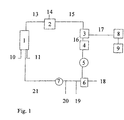
- the olefin (10), synthesis gas (11) and catalyst solution (21) were fed into the bubble column reactor (1) (volume 60 l).
- the hydroformylation discharge (13) was let down to 5 bar in a flash (2).
- the escaping gas (14) was cooled in a cooler, not shown, and the condensate obtained was combined with the liquid (15).
- the liquid phase (15) obtained in the flash container (2) is separated into a top fraction (17) and a bottom fraction (16) in the thin-film evaporator (3).
- the raw product (17) is condensed in the cooler (8) and collected in the container 9.
- the bottom product (16), which contains the catalyst, dissolved in high boilers, is cooled in the cooler (4) (see Table 3) and conveyed into the intermediate container (6) with the aid of the pump (5).
- a pressure of 10 bar is set in the container (6) using synthesis gas (18).
- the temperature of the catalyst solution (16) in the container (6) was determined in accordance with Table 3.
- the catalyst solution (16) could be brought to the desired activity in the reactor (1) by discharging a portion (19) and adding catalyst precursor (rhodium compound and ligand) and was used as solution (21) with pump (7) in the Hydroformylation reactor (1) returned.
- Table 2 shows the test parameters that were kept constant throughout the test. Pressure in the reactor 1 50 bar Temperature in the reactor 1 130 ° C Thin film evaporator pressure 3 60 mbar Temperature in thin film evaporator 3 (outlet temperature at the bottom) 140 ° C
- the activity of the catalyst was monitored via the conversion achieved in the reactor. As soon as the conversion of olefin fell below 95%, part of the catalyst solution was removed Container (6) removed and through fresh catalyst precursor (rhodium salt and ligand) replaced, so that the turnover was again over 95%. Also became a minor one Catalyst loss replaced by the high boiler discharge.
- Diagram 1 shows the influence of the synthesis gas pressure on the activity of the catalyst (normalized activity, fresh catalyst has the activity 100% or 1). At a synthesis gas pressure of 50 bar, more than 80% of the initial activity is still present after more than 100 hours; at 20 bar synthesis gas pressure, the activity falls below 40% of the initial activity after 65 hours.
- Diagram 2 shows the influence of temperature on the stability of the catalyst at a constant synthesis gas pressure of 50 bar. A temperature increase from 120 ° C to 140 ° C leads to a strong acceleration of the decomposition of the catalyst.
Landscapes
- Chemical & Material Sciences (AREA)
- Organic Chemistry (AREA)
- Chemical Kinetics & Catalysis (AREA)
- Engineering & Computer Science (AREA)
- Materials Engineering (AREA)
- Inorganic Chemistry (AREA)
- Low-Molecular Organic Synthesis Reactions Using Catalysts (AREA)
- Organic Low-Molecular-Weight Compounds And Preparation Thereof (AREA)
- Catalysts (AREA)
Description
| Olefin | Di-n-buten | 5 kg/h |
| Synthesegas | CO/H2(1/1) | 2 kg/h |
| Rhodiumverbindung | Rhodiumoctanoat | (30-90 ppm Rh im Reaktor 1) |
| Ligand | Tris(24-di-tert.-butylphenyl)phosphit | ( 20 mol Ligand/ mol Rh) |
| Druck im Reaktor 1 | 50 bar |
| Temperatur im Reaktor 1 | 130 °C |
| Druck im Dünnschichtverdampfer 3 | 60 mbar |
| Temperatur im Dünnschichtverdampfer 3 (Austrittstemperatur am Sumpf) | 140 °C |
| Temperatur Kühler 4 | Temperatur Behälter 6 | Rhodium (g), je Tonne umgesetztes Olefin |
| Keine Kühlung | 70 - 90 °C | 2,1 |
| 60 °C | 40 - 55 °C | 0,9 |


Claims (11)
- Verfahren zur Herstellung von Aldehyden mit 3 bis 21 Kohlenstoffatomen durch Hydroformylierung der entsprechenden Olefine mit Rhodiumkatalysatoren,
dadurch gekennzeichnet, dass der Austrag des Hydroformylierungsreaktorswird.a) in eine Gasphase und eine Flüssigphase getrennt,b) die Flüssigphase in eine Kopffraktion, enthaltend nicht umgesetzte Olefine und Aldehyde, und eine Sumpffraktion enthaltend den Rhodiumkatalysator getrennt undc) die Sumpffraktion unter die Temperatur des Austrags des Hydroformylierungsreaktors auf eine Temperatur von 10 bis 120 °C abgekühlt und mit einem Kohlenmonoxid-haltigen Gas mit einem Kohlenmonoxidpartialdruck von 5 bis 300 bar beaufschlagt - Verfahren nach Anspruch 1,
dadurch gekennzeichnet, dass in der Verfahrensstufe a) ein Kohlenmonoxidpartialdruck von 0,5 bis 100 bar eingestellt wird. - Verfahren nach einem der Ansprüche 1 oder 2,
dadurch gekennzeichnet, dass die Verfahrensstufe b) einen Fallfilmverdampfer, einen Dünnschichtverdampfer, einen Flasher oder eine Kombination dieser Einheiten aufweist. - Verfahren nach einem der Ansprüche 1 bis 3,
dadurch gekennzeichnet, dass die mittlere Verweilzeit der Flüssigphase in der Verfahrensstufe b) unter 15 Minuten beträgt. - Verfahren nach einem der Ansprüche 1 bis 4,
dadurch gekennzeichnet, dass die mittlere Verweilzeit der Sumpffraktion der Verfahrensstufe b) unter 2 Minuten beträgt. - Verfahren nach einem der Ansprüche 1 bis 5,
dadurch gekennzeichnet, dass die Temperatur in der Verfahrensstufe b) 40 bis 180 °C beträgt. - Verfahren nach einem der Ansprüche 1 bis 6,
dadurch gekennzeichnet, dass der Druck in der Verfahrensstufe b) 0.01 bis 1 bar beträgt. - Verfahren nach einem der Ansprüche 1 bis 7,
dadurch gekennzeichnet, dass die Sumpffraktion der Verfahrensstufe c) mit einem Kohlenmonoxidpartialdruck von 5 bis 64 bar beaufschlagt wird. - Verfahren nach einem der Ansprüche 1 bis 8,
dadurch gekennzeichnet, dass als Kohlenmonoxid-haltiges Gas Synthesegas, reines Kohlenmonoxid oder Gemische aus Kohlenmonoxid mit Stickstoff, Methan, Wasserstoff und/oder Kohlendioxid eingesetzt wird. - Verfahren nach einem der Ansprüche 1 bis 9,
dadurch gekennzeichnet, dass die Sumpffraktion der Verfahrensstufe c) auf Temperaturen von 40 bis 90 °C abgekühlt wird. - Verfahren nach einem der Ansprüche 1 bis 10,
dadurch gekennzeichnet, dass die Sumpffraktion der Verfahrensstufe c) ganz oder teilweise in den Hydroformylierungsreaktor zurückgeführt wird.
Applications Claiming Priority (2)
| Application Number | Priority Date | Filing Date | Title |
|---|---|---|---|
| DE10048301A DE10048301A1 (de) | 2000-09-29 | 2000-09-29 | Stabilisierung von Rhodiumkatalysatoren für die Hydroformylierung von Olefinen |
| DE10048301 | 2000-09-29 |
Publications (2)
| Publication Number | Publication Date |
|---|---|
| EP1193239A1 EP1193239A1 (de) | 2002-04-03 |
| EP1193239B1 true EP1193239B1 (de) | 2004-12-08 |
Family
ID=7658106
Family Applications (1)
| Application Number | Title | Priority Date | Filing Date |
|---|---|---|---|
| EP01119282A Expired - Lifetime EP1193239B1 (de) | 2000-09-29 | 2001-08-10 | Stabilisierung von Rhodiumkatalysatoren für die Hydroformylierung von Olefinen |
Country Status (19)
| Country | Link |
|---|---|
| US (1) | US6500991B2 (de) |
| EP (1) | EP1193239B1 (de) |
| JP (1) | JP5226922B2 (de) |
| KR (1) | KR100717984B1 (de) |
| CN (1) | CN1200923C (de) |
| AR (1) | AR030811A1 (de) |
| AT (1) | ATE284375T1 (de) |
| BR (1) | BR0104335A (de) |
| CA (1) | CA2357856A1 (de) |
| DE (2) | DE10048301A1 (de) |
| ES (1) | ES2231358T3 (de) |
| MX (1) | MXPA01009756A (de) |
| MY (1) | MY121533A (de) |
| PL (1) | PL201587B1 (de) |
| RU (1) | RU2270829C2 (de) |
| SA (1) | SA01220521B1 (de) |
| SG (1) | SG94863A1 (de) |
| TW (1) | TWI224094B (de) |
| ZA (1) | ZA200107977B (de) |
Cited By (1)
| Publication number | Priority date | Publication date | Assignee | Title |
|---|---|---|---|---|
| DE102013203117A1 (de) | 2013-02-26 | 2014-08-28 | Evonik Industries Ag | Optimierte Trenntechnik zur Aufarbeitung von homogen katalysierten Hydroformylierungsmischungen |
Families Citing this family (53)
| Publication number | Priority date | Publication date | Assignee | Title |
|---|---|---|---|---|
| DE10058383A1 (de) * | 2000-11-24 | 2002-05-29 | Oxeno Olefinchemie Gmbh | Neue Phosphininverbindungen und deren Metallkomplexe |
| EP1249438A1 (de) * | 2001-04-13 | 2002-10-16 | Dsm N.V. | Kontinuierliches Hydroformylierungsverfahren zur Herstellung von Aldehyden |
| AU2002327859B2 (en) * | 2001-09-26 | 2007-08-09 | Evonik Degussa Gmbh | Phthalic acid alkylester mixtures with controlled viscosity |
| DE10149348A1 (de) | 2001-10-06 | 2003-04-10 | Oxeno Olefinchemie Gmbh | Verfahren zur Herstellung von 1-Olefin mit Palladiumcarbenverbindungen |
| DE10210918B4 (de) | 2002-03-13 | 2004-06-03 | Oxeno Olefinchemie Gmbh | Verfahren zur Herstellung von Bisphosphiten |
| DE10220801A1 (de) | 2002-05-10 | 2003-11-20 | Oxeno Olefinchemie Gmbh | Verfahren zur Rhodium-katalysierten Hydroformylierung von Olefinen unter Reduzierung der Rhodiumverluste |
| DE10223593A1 (de) * | 2002-05-27 | 2003-12-11 | Degussa | Hydroxydiphosphine und deren Verwendung in der Katalyse |
| DE10225565A1 (de) | 2002-06-10 | 2003-12-18 | Oxeno Olefinchemie Gmbh | Katalysator und Verfahren zur Hydrierung von aromatischen Verbindungen |
| BR0313866A (pt) * | 2002-08-31 | 2005-07-05 | Oxeno Olefinchemie Gmbh | Processo para a hidroformilação de compostos olefinicamente insaturados, especialmente olefinas na presença de ésteres de ácido carbÈnico cìclicos |
| RU2336261C2 (ru) | 2002-08-31 | 2008-10-20 | Оксено Олефинхеми Гмбх | Способ каталитического гидроформилирования высших олефинов в присутствии циклических эфиров угольной кислоты |
| DE10257499A1 (de) | 2002-12-10 | 2004-07-01 | Oxeno Olefinchemie Gmbh | Verfahren zur Herstellung von 1-Olefinen durch katalytische Spaltung von 1-Alkoxyalkanen |
| DE10329042A1 (de) * | 2003-06-27 | 2005-01-13 | Oxeno Olefinchemie Gmbh | Verfahren zur Herstellung von 1-Octen aus Crack-C4 |
| US6982355B2 (en) * | 2003-08-25 | 2006-01-03 | Syntroleum Corporation | Integrated Fischer-Tropsch process for production of linear and branched alcohols and olefins |
| DE10359628A1 (de) * | 2003-12-18 | 2005-07-21 | Oxeno Olefinchemie Gmbh | Katalysator und Verfahren zur Herstellung von 1-Olefinen aus 2-Hydroxyalkanen |
| DE10360772A1 (de) * | 2003-12-23 | 2005-07-28 | Oxeno Olefinchemie Gmbh | Verfahren zur Herstellung von Organoacylphosphiten |
| DE10360771A1 (de) * | 2003-12-23 | 2005-07-28 | Oxeno Olefinchemie Gmbh | Verfahren zur Herstellung von dreiwertigen Organophosphor-Verbindungen |
| DE102004033410A1 (de) * | 2004-02-14 | 2005-09-01 | Oxeno Olefinchemie Gmbh | Verfahren zur Herstellung von Olefinen mit 8 bis 12 Kohlenstoffatomen |
| DE102004013514A1 (de) * | 2004-03-19 | 2005-10-06 | Oxeno Olefinchemie Gmbh | Verfahren zur Hydroformylierung von Olefinen in Anwesenheit von neuen phosphororganischen Verbindungen |
| DE102004021128A1 (de) * | 2004-04-29 | 2005-11-24 | Oxeno Olefinchemie Gmbh | Vorrichtung und Verfahren für die kontinuierliche Umsetzung einer Flüssigkeit mit einem Gas an einem festen Katalysator |
| DE102005036039A1 (de) | 2004-08-28 | 2006-03-02 | Oxeno Olefinchemie Gmbh | Verfahren zur Herstellung von 2,7-Octadienylderivaten |
| DE102004063673A1 (de) * | 2004-12-31 | 2006-07-13 | Oxeno Olefinchemie Gmbh | Verfahren zur kontinuierlichen katalytischen Hydrierung von hydrierbaren Verbindungen an festen, im Festbett angeordneten Katalysatoren mit einem wasserstoffhaltigen Gas |
| DE102005014055A1 (de) * | 2005-03-23 | 2006-09-28 | Degussa Ag | Unsymmetrisch substituierte Phospholankatalysatoren |
| DE102005035816A1 (de) * | 2005-07-30 | 2007-02-01 | Oxeno Olefinchemie Gmbh | Verfahren zur Hydrierung von Oxo-Aldehyden mit hohen Estergehalten |
| DE102005042464A1 (de) * | 2005-09-07 | 2007-03-08 | Oxeno Olefinchemie Gmbh | Carbonylierungsverfahren unter Zusatz von sterisch gehinderten sekundären Aminen |
| DE102005046250B4 (de) * | 2005-09-27 | 2020-10-08 | Evonik Operations Gmbh | Anlage zur Abtrennung von organischen Übergangsmetallkomplexkatalysatoren |
| JP4835228B2 (ja) * | 2006-03-29 | 2011-12-14 | 三菱化学株式会社 | アルデヒドの製造方法 |
| DE102009016651B4 (de) * | 2009-04-07 | 2011-11-17 | Oxea Gmbh | Verfahren zur Herstellung von Aldehyden |
| CN102470329B (zh) | 2009-07-23 | 2015-06-24 | 赢创纤维有限公司 | 由聚合溶液制成的聚酰亚胺膜 |
| KR101229195B1 (ko) | 2009-10-07 | 2013-02-01 | 주식회사 엘지화학 | 올레핀으로부터 고 수율의 알데히드 제조 방법 및 이에 사용되는 반응 장치 |
| DE102009047351A1 (de) | 2009-12-01 | 2011-06-09 | Evonik Goldschmidt Gmbh | Komposit-Siliconmembranen mit hoher Trennwirkung |
| CN102826971B (zh) * | 2011-06-17 | 2015-01-07 | 中国石油化工股份有限公司 | 连续氢甲酰化工艺中催化剂的使用方法 |
| JP5890535B2 (ja) * | 2011-12-20 | 2016-03-22 | ダウ テクノロジー インベストメンツ リミティド ライアビリティー カンパニー | 改良されたヒドロホルミル化プロセス |
| DE102012202779A1 (de) | 2012-02-23 | 2013-08-29 | Evonik Oxeno Gmbh | Verfahren und Vorrichtung zur technischen Hydroformylierung von Isobuten und zum Auftrennen des Produktgemisches |
| WO2013153136A1 (de) | 2012-04-12 | 2013-10-17 | Basf Se | Verfahren zur ergänzung des katalysators bei der kontinuierlichen hydroformylierung |
| SG11201502824VA (en) | 2012-10-12 | 2015-05-28 | Evonik Degussa Gmbh | Mixture of different asymmetrical bisophosphites and use thereof as a catalyst mixture for hydroformylation |
| DE102012223572A1 (de) | 2012-12-18 | 2014-06-18 | Evonik Industries Ag | Steuerung der Viskosität von Reaktionslösungen in Hydroformylierungverfahren |
| RU2557062C1 (ru) * | 2014-06-26 | 2015-07-20 | Общество с ограниченной ответственностью "Объединенный центр исследований и разработок" (ООО "РН-ЦИР") | Технологическая установка получения альдегидов, преимущественно из бутенов или пропилена, с применением родиевых катализаторов |
| MY184826A (en) | 2014-12-04 | 2021-04-24 | Dow Technology Investments Llc | Hydroformylation process |
| GB201603558D0 (en) * | 2016-03-01 | 2016-04-13 | Johnson Matthey Davy Technologies Ltd | Apparatus and process |
| CN107141204B (zh) * | 2016-03-01 | 2022-03-15 | 陶氏技术投资有限责任公司 | 氢甲酰化工艺 |
| CN108395370B (zh) * | 2017-02-08 | 2021-04-06 | 中国石化扬子石油化工有限公司 | 一种氧化苯乙烯制备苯甲醛的方法 |
| MY203235A (en) | 2018-11-29 | 2024-06-19 | Dow Technology Investments Llc | Hydroformylation process |
| GB201907659D0 (en) | 2019-05-30 | 2019-07-17 | Johnson Matthey Davy Technologies Ltd | Process |
| US11680032B2 (en) | 2020-06-05 | 2023-06-20 | SCION Holdings LLC | Alcohols production |
| US12054455B2 (en) | 2020-06-05 | 2024-08-06 | SCION Holdings LLC | Branched alcohols |
| US12221404B2 (en) | 2020-06-05 | 2025-02-11 | SCION Holdings LLC | Composition comprising branched aldehydes |
| GB202012930D0 (en) | 2020-08-19 | 2020-09-30 | Johnson Matthey Davy Technologies Ltd | Process for hydroformylation with removal of dissolved hydrogen |
| CN112479841B (zh) * | 2020-11-26 | 2022-09-20 | 万华化学集团股份有限公司 | 一种丙烯氢甲酰化合成丁醛的工艺 |
| US12145904B2 (en) | 2020-12-17 | 2024-11-19 | SCION Holdings LLC | Branched products |
| CN113351249B (zh) * | 2021-04-29 | 2023-02-03 | 四川大学 | 一种催化内烯烃氢甲酰化制醛的催化体系 |
| ES3023592T3 (en) * | 2022-12-19 | 2025-06-02 | Evonik Oxeno Gmbh & Co Kg | Method for maintaining activity during hydroformylation shutoff |
| WO2025029349A1 (en) | 2023-08-03 | 2025-02-06 | Dow Technology Investments Llc | Hydroformylation process |
| CN120166986A (zh) * | 2023-10-16 | 2025-06-17 | 株式会社Lg化学 | 制备醛的方法 |
Family Cites Families (18)
| Publication number | Priority date | Publication date | Assignee | Title |
|---|---|---|---|---|
| GB1387657A (en) * | 1972-08-25 | 1975-03-19 | Davy Powergas Ltd | Hydroformylation process |
| JPS5638576B2 (de) * | 1974-07-25 | 1981-09-08 | ||
| US4178313A (en) * | 1978-07-14 | 1979-12-11 | Conoco, Inc. | Olefin isomerization and hydroformylation process |
| US4400547A (en) * | 1981-04-10 | 1983-08-23 | Eastman Kodak Company | Hydroformylation process utilizing an unmodified rhodium catalyst and the stabilization and regeneration thereof |
| US4446074A (en) * | 1981-12-24 | 1984-05-01 | Union Carbide Corporation | Preparation of rhodium complex compounds |
| US4528403A (en) | 1982-10-21 | 1985-07-09 | Mitsubishi Chemical Industries Ltd. | Hydroformylation process for preparation of aldehydes and alcohols |
| SU1168548A1 (ru) * | 1983-12-21 | 1985-07-23 | Институт нефтехимического синтеза им.А.В.Топчиева | Способ получени смеси алифатических альдегидов и спиртов @ - @ |
| GB8334359D0 (en) | 1983-12-23 | 1984-02-01 | Davy Mckee Ltd | Process |
| US4822917A (en) | 1986-12-23 | 1989-04-18 | Mitsubishi Chemical Industries Limited | Process for the hydroformylation of an olefin |
| JP2687960B2 (ja) | 1987-02-25 | 1997-12-08 | 三菱化学株式会社 | オレフインのヒドロホルミル化方法 |
| JPH0764772B2 (ja) | 1987-03-09 | 1995-07-12 | 三菱化学株式会社 | オレフインのヒドロホルミル化法 |
| JPH0764773B2 (ja) | 1987-03-10 | 1995-07-12 | 三菱化学株式会社 | オレフインのヒドロホルミル化方法 |
| JP2893929B2 (ja) | 1990-10-29 | 1999-05-24 | 三菱化学株式会社 | アルデヒドの製造方法 |
| US5087763A (en) * | 1990-11-09 | 1992-02-11 | Union Carbide Chemicals & Plastics Technology Corporation | Hydroformylation process |
| KR0134494B1 (ko) * | 1993-10-20 | 1998-04-20 | 성재갑 | 하이드리도카르보닐트리스(트리오가노포스포러스)로듐의 제조방법 |
| US5731472A (en) * | 1995-12-06 | 1998-03-24 | Union Carbide Chemicals & Plastics Technology Corporation | Metal-ligand complex catalyzed processes |
| US5767321A (en) * | 1995-12-06 | 1998-06-16 | Union Carbide Chemicals & Plastics Technology Corporation | Metal-ligand complex catalyzed processes |
| DE19605435A1 (de) * | 1996-02-14 | 1997-08-21 | Basf Ag | Verfahren zur Herstellung von Aldehyden durch Hydroformylierung mit einem Rhodiumkatalysator und Wiedergewinnung des Rhodiumkatalysators durch Extraktion |
-
2000
- 2000-09-29 DE DE10048301A patent/DE10048301A1/de not_active Withdrawn
-
2001
- 2001-08-10 AT AT01119282T patent/ATE284375T1/de not_active IP Right Cessation
- 2001-08-10 DE DE2001504749 patent/DE50104749D1/de not_active Expired - Lifetime
- 2001-08-10 ES ES01119282T patent/ES2231358T3/es not_active Expired - Lifetime
- 2001-08-10 EP EP01119282A patent/EP1193239B1/de not_active Expired - Lifetime
- 2001-09-12 SG SG200105593A patent/SG94863A1/en unknown
- 2001-09-25 US US09/960,936 patent/US6500991B2/en not_active Expired - Lifetime
- 2001-09-25 PL PL349832A patent/PL201587B1/pl unknown
- 2001-09-25 TW TW090123565A patent/TWI224094B/zh not_active IP Right Cessation
- 2001-09-27 CA CA002357856A patent/CA2357856A1/en not_active Abandoned
- 2001-09-27 MY MYPI20014532A patent/MY121533A/en unknown
- 2001-09-27 KR KR1020010059894A patent/KR100717984B1/ko not_active Expired - Fee Related
- 2001-09-27 BR BR0104335-8A patent/BR0104335A/pt not_active Application Discontinuation
- 2001-09-27 MX MXPA01009756A patent/MXPA01009756A/es unknown
- 2001-09-28 ZA ZA200107977A patent/ZA200107977B/xx unknown
- 2001-09-28 CN CNB011411198A patent/CN1200923C/zh not_active Expired - Fee Related
- 2001-09-28 RU RU2001126325/04A patent/RU2270829C2/ru not_active IP Right Cessation
- 2001-09-28 AR ARP010104573A patent/AR030811A1/es unknown
- 2001-09-28 JP JP2001300783A patent/JP5226922B2/ja not_active Expired - Fee Related
- 2001-11-13 SA SA01220521A patent/SA01220521B1/ar unknown
Cited By (2)
| Publication number | Priority date | Publication date | Assignee | Title |
|---|---|---|---|---|
| DE102013203117A1 (de) | 2013-02-26 | 2014-08-28 | Evonik Industries Ag | Optimierte Trenntechnik zur Aufarbeitung von homogen katalysierten Hydroformylierungsmischungen |
| WO2014131623A1 (de) | 2013-02-26 | 2014-09-04 | Evonik Industries Ag | Optimierte trenntechnik zur aufarbeitung von homogen katalysierten hydroformylierungsmischungen |
Also Published As
| Publication number | Publication date |
|---|---|
| PL201587B1 (pl) | 2009-04-30 |
| KR100717984B1 (ko) | 2007-05-16 |
| CN1200923C (zh) | 2005-05-11 |
| US6500991B2 (en) | 2002-12-31 |
| MXPA01009756A (es) | 2002-04-15 |
| JP5226922B2 (ja) | 2013-07-03 |
| TWI224094B (en) | 2004-11-21 |
| CN1346821A (zh) | 2002-05-01 |
| CA2357856A1 (en) | 2002-03-29 |
| EP1193239A1 (de) | 2002-04-03 |
| RU2270829C2 (ru) | 2006-02-27 |
| DE50104749D1 (de) | 2005-01-13 |
| JP2002161063A (ja) | 2002-06-04 |
| MY121533A (en) | 2006-01-28 |
| KR20020025747A (ko) | 2002-04-04 |
| PL349832A1 (en) | 2002-04-08 |
| DE10048301A1 (de) | 2002-04-11 |
| ATE284375T1 (de) | 2004-12-15 |
| ES2231358T3 (es) | 2005-05-16 |
| SG94863A1 (en) | 2003-03-18 |
| US20020065437A1 (en) | 2002-05-30 |
| ZA200107977B (en) | 2002-05-29 |
| SA01220521B1 (ar) | 2006-05-23 |
| BR0104335A (pt) | 2002-05-07 |
| AR030811A1 (es) | 2003-09-03 |
Similar Documents
| Publication | Publication Date | Title |
|---|---|---|
| EP1193239A1 (de) | Stabilisierung von Rhodiumkatalysatoren für die Hydroformylierung von Olefinen | |
| DE69017346T2 (de) | Verfahren zur Hydroformylierung von Olefinen. | |
| EP2802550B1 (de) | Langzeitstabiles verfahren zur herstellung von c5-aldehyden | |
| EP0846095B1 (de) | Verfahren zur aufarbeitung eines flüssigen hydroformylierungsaustrags | |
| EP1503977B1 (de) | Verfahren zur rhodium-katalysierten hydroformylierung von olefinen unter reduzierung der rhodiumverluste | |
| EP0254180B1 (de) | Verfahren zur kontinuierlichen Hydroformylierung olefinisch ungesättigter Verbindungen | |
| EP0114611B1 (de) | Verfahren zur kontinuierlichen Hydroformylierung olefinisch ungesättigter Verbindungen | |
| EP2220017B1 (de) | Mehrstufiges kontinuierliches verfahren zur hydroformylierung von höheren olefinen oder olefingemischen | |
| EP0103810A2 (de) | Verfahren zur Herstellung von Aldehyden | |
| EP1294668B1 (de) | Verfahren zur hydroformylierung von olefinen mit 2 bis 8 kohlenstoffatomen | |
| DE3030108C2 (de) | Verfahren zur Herstellung von Aldehyden durch Hydroformylierung | |
| EP2417094B1 (de) | Verfahren zur aufarbeitung eines flüssigen hydroformylierungsaustrags | |
| DE3232557A1 (de) | Verfahren zur herstellung eines alkohols durch hydroformylierung | |
| DE3884254T2 (de) | Verfahren zur kontinuierlichen Herstellung von Octa-2,7-dien-1-ol. | |
| EP1294669A1 (de) | Verfahren zur hydroformylierung von olefinen mit 2 bis 8 kohlenstoffatomen | |
| DE4419898C2 (de) | Verfahren zur Herstellung eines Aldehyds | |
| DE102009016651B4 (de) | Verfahren zur Herstellung von Aldehyden | |
| DE2802923C2 (de) | Verfahren zur kontinuierlichen Herstellung von Butyraldehyden | |
| EP2836474B1 (de) | Verfahren zur ergänzung des katalysators bei der kontinuierlichen hydroformylierung | |
| DE3017651C2 (de) | ||
| EP1242351B1 (de) | Verfahren zur hydroformylierung olefinisch ungesättigter verbindungen | |
| EP1456162B1 (de) | Verfahren zur herstellung von aldehyden | |
| EP0186075B1 (de) | Verfahren zur Herstellung von 8- und 9-Formyl-tricyclo-(5,2,1,0, 2,6)-decen-3 | |
| EP4273119A1 (de) | Verfahren zur herstellung von c5-aldehyden | |
| DE932368C (de) | Verfahren zur Herstellung von Carbonsaeuren |
Legal Events
| Date | Code | Title | Description |
|---|---|---|---|
| PUAI | Public reference made under article 153(3) epc to a published international application that has entered the european phase |
Free format text: ORIGINAL CODE: 0009012 |
|
| 17P | Request for examination filed |
Effective date: 20010810 |
|
| AK | Designated contracting states |
Kind code of ref document: A1 Designated state(s): AT BE CH CY DE DK ES FI FR GB GR IE IT LI LU MC NL PT SE TR |
|
| AX | Request for extension of the european patent |
Free format text: AL;LT;LV;MK;RO;SI |
|
| AKX | Designation fees paid |
Free format text: AT BE CH CY DE DK ES FI FR GB GR IE IT LI LU MC NL PT SE TR |
|
| 17Q | First examination report despatched |
Effective date: 20030704 |
|
| GRAP | Despatch of communication of intention to grant a patent |
Free format text: ORIGINAL CODE: EPIDOSNIGR1 |
|
| GRAS | Grant fee paid |
Free format text: ORIGINAL CODE: EPIDOSNIGR3 |
|
| GRAA | (expected) grant |
Free format text: ORIGINAL CODE: 0009210 |
|
| AK | Designated contracting states |
Kind code of ref document: B1 Designated state(s): AT BE CH CY DE DK ES FI FR GB GR IE IT LI LU MC NL PT SE TR |
|
| PG25 | Lapsed in a contracting state [announced via postgrant information from national office to epo] |
Ref country code: TR Free format text: LAPSE BECAUSE OF FAILURE TO SUBMIT A TRANSLATION OF THE DESCRIPTION OR TO PAY THE FEE WITHIN THE PRESCRIBED TIME-LIMIT Effective date: 20041208 |
|
| REG | Reference to a national code |
Ref country code: GB Ref legal event code: FG4D Free format text: NOT ENGLISH |
|
| REG | Reference to a national code |
Ref country code: CH Ref legal event code: EP |
|
| REG | Reference to a national code |
Ref country code: IE Ref legal event code: FG4D Free format text: GERMAN |
|
| REF | Corresponds to: |
Ref document number: 50104749 Country of ref document: DE Date of ref document: 20050113 Kind code of ref document: P |
|
| REG | Reference to a national code |
Ref country code: SE Ref legal event code: TRGR |
|
| GBT | Gb: translation of ep patent filed (gb section 77(6)(a)/1977) |
Effective date: 20050117 |
|
| PG25 | Lapsed in a contracting state [announced via postgrant information from national office to epo] |
Ref country code: DK Free format text: LAPSE BECAUSE OF FAILURE TO SUBMIT A TRANSLATION OF THE DESCRIPTION OR TO PAY THE FEE WITHIN THE PRESCRIBED TIME-LIMIT Effective date: 20050308 Ref country code: GR Free format text: LAPSE BECAUSE OF FAILURE TO SUBMIT A TRANSLATION OF THE DESCRIPTION OR TO PAY THE FEE WITHIN THE PRESCRIBED TIME-LIMIT Effective date: 20050308 |
|
| REG | Reference to a national code |
Ref country code: ES Ref legal event code: FG2A Ref document number: 2231358 Country of ref document: ES Kind code of ref document: T3 |
|
| PG25 | Lapsed in a contracting state [announced via postgrant information from national office to epo] |
Ref country code: LU Free format text: LAPSE BECAUSE OF NON-PAYMENT OF DUE FEES Effective date: 20050810 Ref country code: CY Free format text: LAPSE BECAUSE OF FAILURE TO SUBMIT A TRANSLATION OF THE DESCRIPTION OR TO PAY THE FEE WITHIN THE PRESCRIBED TIME-LIMIT Effective date: 20050810 |
|
| PGFP | Annual fee paid to national office [announced via postgrant information from national office to epo] |
Ref country code: IE Payment date: 20050815 Year of fee payment: 5 |
|
| PG25 | Lapsed in a contracting state [announced via postgrant information from national office to epo] |
Ref country code: LI Free format text: LAPSE BECAUSE OF NON-PAYMENT OF DUE FEES Effective date: 20050831 Ref country code: MC Free format text: LAPSE BECAUSE OF NON-PAYMENT OF DUE FEES Effective date: 20050831 Ref country code: CH Free format text: LAPSE BECAUSE OF NON-PAYMENT OF DUE FEES Effective date: 20050831 |
|
| PLBE | No opposition filed within time limit |
Free format text: ORIGINAL CODE: 0009261 |
|
| STAA | Information on the status of an ep patent application or granted ep patent |
Free format text: STATUS: NO OPPOSITION FILED WITHIN TIME LIMIT |
|
| ET | Fr: translation filed | ||
| 26N | No opposition filed |
Effective date: 20050909 |
|
| REG | Reference to a national code |
Ref country code: CH Ref legal event code: PL |
|
| PG25 | Lapsed in a contracting state [announced via postgrant information from national office to epo] |
Ref country code: IE Free format text: LAPSE BECAUSE OF NON-PAYMENT OF DUE FEES Effective date: 20060810 |
|
| REG | Reference to a national code |
Ref country code: IE Ref legal event code: MM4A |
|
| PG25 | Lapsed in a contracting state [announced via postgrant information from national office to epo] |
Ref country code: PT Free format text: LAPSE BECAUSE OF NON-PAYMENT OF DUE FEES Effective date: 20050508 |
|
| PGFP | Annual fee paid to national office [announced via postgrant information from national office to epo] |
Ref country code: ES Payment date: 20090821 Year of fee payment: 9 |
|
| PGFP | Annual fee paid to national office [announced via postgrant information from national office to epo] |
Ref country code: AT Payment date: 20090814 Year of fee payment: 9 Ref country code: FI Payment date: 20090814 Year of fee payment: 9 Ref country code: GB Payment date: 20090827 Year of fee payment: 9 |
|
| NLT1 | Nl: modifications of names registered in virtue of documents presented to the patent office pursuant to art. 16 a, paragraph 1 |
Owner name: EVONIK OXENO GMBH |
|
| REG | Reference to a national code |
Ref country code: FR Ref legal event code: CD |
|
| PGFP | Annual fee paid to national office [announced via postgrant information from national office to epo] |
Ref country code: IT Payment date: 20090820 Year of fee payment: 9 |
|
| GBPC | Gb: european patent ceased through non-payment of renewal fee |
Effective date: 20100810 |
|
| PG25 | Lapsed in a contracting state [announced via postgrant information from national office to epo] |
Ref country code: AT Free format text: LAPSE BECAUSE OF NON-PAYMENT OF DUE FEES Effective date: 20100810 Ref country code: IT Free format text: LAPSE BECAUSE OF NON-PAYMENT OF DUE FEES Effective date: 20100810 Ref country code: FI Free format text: LAPSE BECAUSE OF NON-PAYMENT OF DUE FEES Effective date: 20100810 |
|
| PG25 | Lapsed in a contracting state [announced via postgrant information from national office to epo] |
Ref country code: GB Free format text: LAPSE BECAUSE OF NON-PAYMENT OF DUE FEES Effective date: 20100810 |
|
| REG | Reference to a national code |
Ref country code: ES Ref legal event code: FD2A Effective date: 20111019 |
|
| PG25 | Lapsed in a contracting state [announced via postgrant information from national office to epo] |
Ref country code: ES Free format text: LAPSE BECAUSE OF NON-PAYMENT OF DUE FEES Effective date: 20100811 |
|
| REG | Reference to a national code |
Ref country code: DE Ref legal event code: R081 Ref document number: 50104749 Country of ref document: DE Owner name: EVONIK DEGUSSA GMBH, DE Free format text: FORMER OWNER: EVONIK OXENO GMBH, 45772 MARL, DE Effective date: 20130905 |
|
| REG | Reference to a national code |
Ref country code: NL Ref legal event code: SD Effective date: 20140502 |
|
| REG | Reference to a national code |
Ref country code: FR Ref legal event code: TP Owner name: EVONIK DEGUSSA GMBH, DE Effective date: 20140411 |
|
| REG | Reference to a national code |
Ref country code: FR Ref legal event code: PLFP Year of fee payment: 15 |
|
| PGFP | Annual fee paid to national office [announced via postgrant information from national office to epo] |
Ref country code: DE Payment date: 20150821 Year of fee payment: 15 |
|
| PGFP | Annual fee paid to national office [announced via postgrant information from national office to epo] |
Ref country code: FR Payment date: 20150820 Year of fee payment: 15 Ref country code: SE Payment date: 20150819 Year of fee payment: 15 Ref country code: BE Payment date: 20150819 Year of fee payment: 15 Ref country code: NL Payment date: 20150830 Year of fee payment: 15 |
|
| PG25 | Lapsed in a contracting state [announced via postgrant information from national office to epo] |
Ref country code: BE Free format text: LAPSE BECAUSE OF NON-PAYMENT OF DUE FEES Effective date: 20160831 |
|
| REG | Reference to a national code |
Ref country code: DE Ref legal event code: R119 Ref document number: 50104749 Country of ref document: DE |
|
| REG | Reference to a national code |
Ref country code: SE Ref legal event code: EUG |
|
| REG | Reference to a national code |
Ref country code: NL Ref legal event code: MM Effective date: 20160901 |
|
| PG25 | Lapsed in a contracting state [announced via postgrant information from national office to epo] |
Ref country code: SE Free format text: LAPSE BECAUSE OF NON-PAYMENT OF DUE FEES Effective date: 20160811 |
|
| REG | Reference to a national code |
Ref country code: FR Ref legal event code: ST Effective date: 20170428 |
|
| PG25 | Lapsed in a contracting state [announced via postgrant information from national office to epo] |
Ref country code: NL Free format text: LAPSE BECAUSE OF NON-PAYMENT OF DUE FEES Effective date: 20160901 |
|
| PG25 | Lapsed in a contracting state [announced via postgrant information from national office to epo] |
Ref country code: DE Free format text: LAPSE BECAUSE OF NON-PAYMENT OF DUE FEES Effective date: 20170301 Ref country code: FR Free format text: LAPSE BECAUSE OF NON-PAYMENT OF DUE FEES Effective date: 20160831 |