EP1055140B1 - Multilayer infrared reflecting optical body - Google Patents
Multilayer infrared reflecting optical body Download PDFInfo
- Publication number
- EP1055140B1 EP1055140B1 EP98926194A EP98926194A EP1055140B1 EP 1055140 B1 EP1055140 B1 EP 1055140B1 EP 98926194 A EP98926194 A EP 98926194A EP 98926194 A EP98926194 A EP 98926194A EP 1055140 B1 EP1055140 B1 EP 1055140B1
- Authority
- EP
- European Patent Office
- Prior art keywords
- film
- optical body
- optical
- wavelength
- angle
- Prior art date
- Legal status (The legal status is an assumption and is not a legal conclusion. Google has not performed a legal analysis and makes no representation as to the accuracy of the status listed.)
- Expired - Lifetime
Links
- 230000003287 optical effect Effects 0.000 title claims description 139
- 239000000049 pigment Substances 0.000 claims description 24
- 230000005855 radiation Effects 0.000 claims description 19
- 230000010287 polarization Effects 0.000 claims description 18
- RBTKNAXYKSUFRK-UHFFFAOYSA-N heliogen blue Chemical compound [Cu].[N-]1C2=C(C=CC=C3)C3=C1N=C([N-]1)C3=CC=CC=C3C1=NC([N-]1)=C(C=CC=C3)C3=C1N=C([N-]1)C3=CC=CC=C3C1=N2 RBTKNAXYKSUFRK-UHFFFAOYSA-N 0.000 claims description 3
- 239000010408 film Substances 0.000 description 273
- 239000010410 layer Substances 0.000 description 193
- 229920000642 polymer Polymers 0.000 description 114
- 239000000463 material Substances 0.000 description 105
- -1 or ITO Substances 0.000 description 81
- 239000000975 dye Substances 0.000 description 60
- 238000001228 spectrum Methods 0.000 description 43
- 229920001577 copolymer Polymers 0.000 description 29
- 239000011521 glass Substances 0.000 description 26
- 230000005540 biological transmission Effects 0.000 description 25
- 239000000945 filler Substances 0.000 description 25
- 229910052751 metal Inorganic materials 0.000 description 24
- 239000002184 metal Substances 0.000 description 24
- 238000000034 method Methods 0.000 description 24
- 239000005020 polyethylene terephthalate Substances 0.000 description 24
- 229920000139 polyethylene terephthalate Polymers 0.000 description 24
- 238000000576 coating method Methods 0.000 description 22
- 238000002310 reflectometry Methods 0.000 description 22
- 239000004020 conductor Substances 0.000 description 20
- 239000000203 mixture Substances 0.000 description 18
- 230000008859 change Effects 0.000 description 17
- 239000012788 optical film Substances 0.000 description 17
- 229920006254 polymer film Polymers 0.000 description 17
- 239000011248 coating agent Substances 0.000 description 16
- 230000007423 decrease Effects 0.000 description 15
- 238000004519 manufacturing process Methods 0.000 description 15
- 229920003229 poly(methyl methacrylate) Polymers 0.000 description 15
- 239000004926 polymethyl methacrylate Substances 0.000 description 15
- 238000001429 visible spectrum Methods 0.000 description 15
- 239000011159 matrix material Substances 0.000 description 14
- 229920002554 vinyl polymer Polymers 0.000 description 14
- LYCAIKOWRPUZTN-UHFFFAOYSA-N Ethylene glycol Chemical compound OCCO LYCAIKOWRPUZTN-UHFFFAOYSA-N 0.000 description 13
- 238000013461 design Methods 0.000 description 13
- 229920001634 Copolyester Polymers 0.000 description 12
- 229910044991 metal oxide Inorganic materials 0.000 description 12
- 150000004706 metal oxides Chemical class 0.000 description 12
- 239000000178 monomer Substances 0.000 description 12
- 229920000728 polyester Polymers 0.000 description 12
- 238000010276 construction Methods 0.000 description 11
- VYPSYNLAJGMNEJ-UHFFFAOYSA-N Silicium dioxide Chemical compound O=[Si]=O VYPSYNLAJGMNEJ-UHFFFAOYSA-N 0.000 description 10
- PPBRXRYQALVLMV-UHFFFAOYSA-N Styrene Natural products C=CC1=CC=CC=C1 PPBRXRYQALVLMV-UHFFFAOYSA-N 0.000 description 10
- 230000000694 effects Effects 0.000 description 10
- 238000002329 infrared spectrum Methods 0.000 description 10
- 230000008569 process Effects 0.000 description 10
- 238000010521 absorption reaction Methods 0.000 description 9
- KKEYFWRCBNTPAC-UHFFFAOYSA-N Terephthalic acid Chemical compound OC(=O)C1=CC=C(C(O)=O)C=C1 KKEYFWRCBNTPAC-UHFFFAOYSA-N 0.000 description 8
- 238000001125 extrusion Methods 0.000 description 8
- 238000012545 processing Methods 0.000 description 8
- OFOBLEOULBTSOW-UHFFFAOYSA-N Malonic acid Chemical compound OC(=O)CC(O)=O OFOBLEOULBTSOW-UHFFFAOYSA-N 0.000 description 7
- BQCADISMDOOEFD-UHFFFAOYSA-N Silver Chemical compound [Ag] BQCADISMDOOEFD-UHFFFAOYSA-N 0.000 description 7
- MCMNRKCIXSYSNV-UHFFFAOYSA-N ZrO2 Inorganic materials O=[Zr]=O MCMNRKCIXSYSNV-UHFFFAOYSA-N 0.000 description 7
- 150000002009 diols Chemical class 0.000 description 7
- 150000002148 esters Chemical class 0.000 description 7
- KYTZHLUVELPASH-UHFFFAOYSA-N naphthalene-1,2-dicarboxylic acid Chemical compound C1=CC=CC2=C(C(O)=O)C(C(=O)O)=CC=C21 KYTZHLUVELPASH-UHFFFAOYSA-N 0.000 description 7
- 238000009304 pastoral farming Methods 0.000 description 7
- 239000004417 polycarbonate Substances 0.000 description 7
- 229920000515 polycarbonate Polymers 0.000 description 7
- 229910052709 silver Inorganic materials 0.000 description 7
- 239000004332 silver Substances 0.000 description 7
- PXHVJJICTQNCMI-UHFFFAOYSA-N Nickel Chemical compound [Ni] PXHVJJICTQNCMI-UHFFFAOYSA-N 0.000 description 6
- YXFVVABEGXRONW-UHFFFAOYSA-N Toluene Chemical compound CC1=CC=CC=C1 YXFVVABEGXRONW-UHFFFAOYSA-N 0.000 description 6
- 230000009477 glass transition Effects 0.000 description 6
- 229910001092 metal group alloy Inorganic materials 0.000 description 6
- 150000002739 metals Chemical class 0.000 description 6
- 229920002223 polystyrene Polymers 0.000 description 6
- 239000010409 thin film Substances 0.000 description 6
- 239000004793 Polystyrene Substances 0.000 description 5
- 238000002835 absorbance Methods 0.000 description 5
- 239000003086 colorant Substances 0.000 description 5
- 230000006870 function Effects 0.000 description 5
- 229920005644 polyethylene terephthalate glycol copolymer Polymers 0.000 description 5
- 239000000377 silicon dioxide Substances 0.000 description 5
- 230000003595 spectral effect Effects 0.000 description 5
- 230000035882 stress Effects 0.000 description 5
- 230000007704 transition Effects 0.000 description 5
- IHXWECHPYNPJRR-UHFFFAOYSA-N 3-hydroxycyclobut-2-en-1-one Chemical compound OC1=CC(=O)C1 IHXWECHPYNPJRR-UHFFFAOYSA-N 0.000 description 4
- 229920002292 Nylon 6 Polymers 0.000 description 4
- 238000013459 approach Methods 0.000 description 4
- WERYXYBDKMZEQL-UHFFFAOYSA-N butane-1,4-diol Chemical compound OCCCCO WERYXYBDKMZEQL-UHFFFAOYSA-N 0.000 description 4
- 230000003247 decreasing effect Effects 0.000 description 4
- WOZVHXUHUFLZGK-UHFFFAOYSA-N dimethyl terephthalate Chemical compound COC(=O)C1=CC=C(C(=O)OC)C=C1 WOZVHXUHUFLZGK-UHFFFAOYSA-N 0.000 description 4
- 229920001519 homopolymer Polymers 0.000 description 4
- 239000001007 phthalocyanine dye Substances 0.000 description 4
- 229920001707 polybutylene terephthalate Polymers 0.000 description 4
- XOLBLPGZBRYERU-UHFFFAOYSA-N tin dioxide Chemical compound O=[Sn]=O XOLBLPGZBRYERU-UHFFFAOYSA-N 0.000 description 4
- 238000000411 transmission spectrum Methods 0.000 description 4
- QGKMIGUHVLGJBR-UHFFFAOYSA-M (4z)-1-(3-methylbutyl)-4-[[1-(3-methylbutyl)quinolin-1-ium-4-yl]methylidene]quinoline;iodide Chemical compound [I-].C12=CC=CC=C2N(CCC(C)C)C=CC1=CC1=CC=[N+](CCC(C)C)C2=CC=CC=C12 QGKMIGUHVLGJBR-UHFFFAOYSA-M 0.000 description 3
- 229910001316 Ag alloy Inorganic materials 0.000 description 3
- RYGMFSIKBFXOCR-UHFFFAOYSA-N Copper Chemical compound [Cu] RYGMFSIKBFXOCR-UHFFFAOYSA-N 0.000 description 3
- MUBZPKHOEPUJKR-UHFFFAOYSA-N Oxalic acid Chemical compound OC(=O)C(O)=O MUBZPKHOEPUJKR-UHFFFAOYSA-N 0.000 description 3
- 239000004642 Polyimide Substances 0.000 description 3
- GWEVSGVZZGPLCZ-UHFFFAOYSA-N Titan oxide Chemical compound O=[Ti]=O GWEVSGVZZGPLCZ-UHFFFAOYSA-N 0.000 description 3
- 238000005299 abrasion Methods 0.000 description 3
- 239000006117 anti-reflective coating Substances 0.000 description 3
- WPYMKLBDIGXBTP-UHFFFAOYSA-N benzoic acid Chemical compound OC(=O)C1=CC=CC=C1 WPYMKLBDIGXBTP-UHFFFAOYSA-N 0.000 description 3
- 238000005266 casting Methods 0.000 description 3
- 229910052802 copper Inorganic materials 0.000 description 3
- 239000010949 copper Substances 0.000 description 3
- MTHSVFCYNBDYFN-UHFFFAOYSA-N diethylene glycol Chemical compound OCCOCCO MTHSVFCYNBDYFN-UHFFFAOYSA-N 0.000 description 3
- 238000009826 distribution Methods 0.000 description 3
- RTZKZFJDLAIYFH-UHFFFAOYSA-N ether Substances CCOCC RTZKZFJDLAIYFH-UHFFFAOYSA-N 0.000 description 3
- 229920002313 fluoropolymer Polymers 0.000 description 3
- 230000014509 gene expression Effects 0.000 description 3
- 229910052759 nickel Inorganic materials 0.000 description 3
- RVTZCBVAJQQJTK-UHFFFAOYSA-N oxygen(2-);zirconium(4+) Chemical compound [O-2].[O-2].[Zr+4] RVTZCBVAJQQJTK-UHFFFAOYSA-N 0.000 description 3
- 229920003023 plastic Polymers 0.000 description 3
- 239000011112 polyethylene naphthalate Substances 0.000 description 3
- 229920001721 polyimide Polymers 0.000 description 3
- 229920002635 polyurethane Polymers 0.000 description 3
- 239000004814 polyurethane Substances 0.000 description 3
- 230000001681 protective effect Effects 0.000 description 3
- 239000000126 substance Substances 0.000 description 3
- 238000002834 transmittance Methods 0.000 description 3
- 238000001771 vacuum deposition Methods 0.000 description 3
- AZQWKYJCGOJGHM-UHFFFAOYSA-N 1,4-benzoquinone Chemical compound O=C1C=CC(=O)C=C1 AZQWKYJCGOJGHM-UHFFFAOYSA-N 0.000 description 2
- GZRZIVBGDNCIOR-UHFFFAOYSA-N 1-[4-(dimethylamino)phenyl]-2-phenylethane-1,2-dithione;nickel Chemical compound [Ni].C1=CC(N(C)C)=CC=C1C(=S)C(=S)C1=CC=CC=C1.C1=CC(N(C)C)=CC=C1C(=S)C(=S)C1=CC=CC=C1 GZRZIVBGDNCIOR-UHFFFAOYSA-N 0.000 description 2
- YBYIRNPNPLQARY-UHFFFAOYSA-N 1H-indene Chemical compound C1=CC=C2CC=CC2=C1 YBYIRNPNPLQARY-UHFFFAOYSA-N 0.000 description 2
- FJKROLUGYXJWQN-UHFFFAOYSA-N 4-hydroxybenzoic acid Chemical compound OC(=O)C1=CC=C(O)C=C1 FJKROLUGYXJWQN-UHFFFAOYSA-N 0.000 description 2
- QNVNLUSHGRBCLO-UHFFFAOYSA-N 5-hydroxybenzene-1,3-dicarboxylic acid Chemical compound OC(=O)C1=CC(O)=CC(C(O)=O)=C1 QNVNLUSHGRBCLO-UHFFFAOYSA-N 0.000 description 2
- KAKZBPTYRLMSJV-UHFFFAOYSA-N Butadiene Chemical compound C=CC=C KAKZBPTYRLMSJV-UHFFFAOYSA-N 0.000 description 2
- CURLTUGMZLYLDI-UHFFFAOYSA-N Carbon dioxide Chemical compound O=C=O CURLTUGMZLYLDI-UHFFFAOYSA-N 0.000 description 2
- VGGSQFUCUMXWEO-UHFFFAOYSA-N Ethene Chemical compound C=C VGGSQFUCUMXWEO-UHFFFAOYSA-N 0.000 description 2
- 239000005977 Ethylene Substances 0.000 description 2
- QIGBRXMKCJKVMJ-UHFFFAOYSA-N Hydroquinone Chemical compound OC1=CC=C(O)C=C1 QIGBRXMKCJKVMJ-UHFFFAOYSA-N 0.000 description 2
- RRHGJUQNOFWUDK-UHFFFAOYSA-N Isoprene Chemical compound CC(=C)C=C RRHGJUQNOFWUDK-UHFFFAOYSA-N 0.000 description 2
- 239000004696 Poly ether ether ketone Substances 0.000 description 2
- 239000004952 Polyamide Substances 0.000 description 2
- 239000004698 Polyethylene Substances 0.000 description 2
- 239000004721 Polyphenylene oxide Substances 0.000 description 2
- 239000004743 Polypropylene Substances 0.000 description 2
- 241000206607 Porphyra umbilicalis Species 0.000 description 2
- 239000004820 Pressure-sensitive adhesive Substances 0.000 description 2
- SMWDFEZZVXVKRB-UHFFFAOYSA-N Quinoline Chemical compound N1=CC=CC2=CC=CC=C21 SMWDFEZZVXVKRB-UHFFFAOYSA-N 0.000 description 2
- 229920010524 Syndiotactic polystyrene Polymers 0.000 description 2
- ORLQHILJRHBSAY-UHFFFAOYSA-N [1-(hydroxymethyl)cyclohexyl]methanol Chemical compound OCC1(CO)CCCCC1 ORLQHILJRHBSAY-UHFFFAOYSA-N 0.000 description 2
- 239000002253 acid Substances 0.000 description 2
- NIXOWILDQLNWCW-UHFFFAOYSA-N acrylic acid group Chemical group C(C=C)(=O)O NIXOWILDQLNWCW-UHFFFAOYSA-N 0.000 description 2
- 239000000853 adhesive Substances 0.000 description 2
- 230000001070 adhesive effect Effects 0.000 description 2
- WNLRTRBMVRJNCN-UHFFFAOYSA-N adipic acid Chemical compound OC(=O)CCCCC(O)=O WNLRTRBMVRJNCN-UHFFFAOYSA-N 0.000 description 2
- 238000004458 analytical method Methods 0.000 description 2
- MWPLVEDNUUSJAV-UHFFFAOYSA-N anthracene Chemical compound C1=CC=CC2=CC3=CC=CC=C3C=C21 MWPLVEDNUUSJAV-UHFFFAOYSA-N 0.000 description 2
- 230000008901 benefit Effects 0.000 description 2
- IMHDGJOMLMDPJN-UHFFFAOYSA-N biphenyl-2,2'-diol Chemical group OC1=CC=CC=C1C1=CC=CC=C1O IMHDGJOMLMDPJN-UHFFFAOYSA-N 0.000 description 2
- IISBACLAFKSPIT-UHFFFAOYSA-N bisphenol A Chemical compound C=1C=C(O)C=CC=1C(C)(C)C1=CC=C(O)C=C1 IISBACLAFKSPIT-UHFFFAOYSA-N 0.000 description 2
- 230000015556 catabolic process Effects 0.000 description 2
- 238000006731 degradation reaction Methods 0.000 description 2
- 230000001419 dependent effect Effects 0.000 description 2
- 150000001991 dicarboxylic acids Chemical class 0.000 description 2
- 229920001971 elastomer Polymers 0.000 description 2
- 239000004811 fluoropolymer Substances 0.000 description 2
- 238000009472 formulation Methods 0.000 description 2
- PCHJSUWPFVWCPO-UHFFFAOYSA-N gold Chemical compound [Au] PCHJSUWPFVWCPO-UHFFFAOYSA-N 0.000 description 2
- 229910052737 gold Inorganic materials 0.000 description 2
- 239000010931 gold Substances 0.000 description 2
- WGCNASOHLSPBMP-UHFFFAOYSA-N hydroxyacetaldehyde Natural products OCC=O WGCNASOHLSPBMP-UHFFFAOYSA-N 0.000 description 2
- 230000006872 improvement Effects 0.000 description 2
- 238000010348 incorporation Methods 0.000 description 2
- AMGQUBHHOARCQH-UHFFFAOYSA-N indium;oxotin Chemical compound [In].[Sn]=O AMGQUBHHOARCQH-UHFFFAOYSA-N 0.000 description 2
- 229910010272 inorganic material Inorganic materials 0.000 description 2
- 239000011147 inorganic material Substances 0.000 description 2
- QQVIHTHCMHWDBS-UHFFFAOYSA-N isophthalic acid Chemical compound OC(=O)C1=CC=CC(C(O)=O)=C1 QQVIHTHCMHWDBS-UHFFFAOYSA-N 0.000 description 2
- 238000010030 laminating Methods 0.000 description 2
- FPYJFEHAWHCUMM-UHFFFAOYSA-N maleic anhydride Chemical compound O=C1OC(=O)C=C1 FPYJFEHAWHCUMM-UHFFFAOYSA-N 0.000 description 2
- 230000007246 mechanism Effects 0.000 description 2
- 238000002844 melting Methods 0.000 description 2
- 230000008018 melting Effects 0.000 description 2
- 239000000434 metal complex dye Substances 0.000 description 2
- 238000005065 mining Methods 0.000 description 2
- 125000001624 naphthyl group Chemical group 0.000 description 2
- BDJRBEYXGGNYIS-UHFFFAOYSA-N nonanedioic acid Chemical compound OC(=O)CCCCCCCC(O)=O BDJRBEYXGGNYIS-UHFFFAOYSA-N 0.000 description 2
- 150000002894 organic compounds Chemical class 0.000 description 2
- XNGIFLGASWRNHJ-UHFFFAOYSA-N phthalic acid Chemical compound OC(=O)C1=CC=CC=C1C(O)=O XNGIFLGASWRNHJ-UHFFFAOYSA-N 0.000 description 2
- 239000004033 plastic Substances 0.000 description 2
- 229920003207 poly(ethylene-2,6-naphthalate) Polymers 0.000 description 2
- 229920002492 poly(sulfone) Polymers 0.000 description 2
- 229920002647 polyamide Polymers 0.000 description 2
- 229920001748 polybutylene Polymers 0.000 description 2
- 229920002530 polyetherether ketone Polymers 0.000 description 2
- 229920000573 polyethylene Polymers 0.000 description 2
- 239000002861 polymer material Substances 0.000 description 2
- 229920000098 polyolefin Polymers 0.000 description 2
- 229920001955 polyphenylene ether Polymers 0.000 description 2
- 229920006380 polyphenylene oxide Polymers 0.000 description 2
- 229920001155 polypropylene Polymers 0.000 description 2
- YPFDHNVEDLHUCE-UHFFFAOYSA-N propane-1,3-diol Chemical compound OCCCO YPFDHNVEDLHUCE-UHFFFAOYSA-N 0.000 description 2
- 230000004224 protection Effects 0.000 description 2
- 230000009467 reduction Effects 0.000 description 2
- 239000011347 resin Substances 0.000 description 2
- 229920005989 resin Polymers 0.000 description 2
- CXMXRPHRNRROMY-UHFFFAOYSA-N sebacic acid Chemical compound OC(=O)CCCCCCCCC(O)=O CXMXRPHRNRROMY-UHFFFAOYSA-N 0.000 description 2
- 230000035945 sensitivity Effects 0.000 description 2
- 238000000926 separation method Methods 0.000 description 2
- 235000012239 silicon dioxide Nutrition 0.000 description 2
- 229910052708 sodium Inorganic materials 0.000 description 2
- 239000011734 sodium Substances 0.000 description 2
- 239000007787 solid Substances 0.000 description 2
- 238000000638 solvent extraction Methods 0.000 description 2
- 238000004544 sputter deposition Methods 0.000 description 2
- 239000000758 substrate Substances 0.000 description 2
- KKEYFWRCBNTPAC-UHFFFAOYSA-L terephthalate(2-) Chemical compound [O-]C(=O)C1=CC=C(C([O-])=O)C=C1 KKEYFWRCBNTPAC-UHFFFAOYSA-L 0.000 description 2
- 238000012360 testing method Methods 0.000 description 2
- ARCGXLSVLAOJQL-UHFFFAOYSA-N trimellitic acid Chemical compound OC(=O)C1=CC=C(C(O)=O)C(C(O)=O)=C1 ARCGXLSVLAOJQL-UHFFFAOYSA-N 0.000 description 2
- 238000007740 vapor deposition Methods 0.000 description 2
- NHQOULZCPKJYMM-UHFFFAOYSA-M (2e)-1,3,3-trimethyl-2-[(2e)-7-(1,3,3-trimethylindol-1-ium-2-yl)hepta-2,4,6-trienylidene]indole;perchlorate Chemical compound [O-]Cl(=O)(=O)=O.CC1(C)C2=CC=CC=C2N(C)C1=CC=CC=CC=CC1=[N+](C)C2=CC=CC=C2C1(C)C NHQOULZCPKJYMM-UHFFFAOYSA-M 0.000 description 1
- JKXWXYURKUEZHV-UHFFFAOYSA-M (2z)-1,3,3-trimethyl-2-[(2e)-7-(1,3,3-trimethylindol-1-ium-2-yl)hepta-2,4,6-trienylidene]indole;iodide Chemical compound [I-].CC1(C)C2=CC=CC=C2N(C)C1=CC=CC=CC=CC1=[N+](C)C2=CC=CC=C2C1(C)C JKXWXYURKUEZHV-UHFFFAOYSA-M 0.000 description 1
- PZQHZVAROUTGBU-UHFFFAOYSA-M (2z)-3-ethyl-2-[(2e)-7-(3-ethyl-1,3-benzothiazol-3-ium-2-yl)hepta-2,4,6-trienylidene]-1,3-benzothiazole;perchlorate Chemical compound [O-]Cl(=O)(=O)=O.S1C2=CC=CC=C2[N+](CC)=C1/C=C/C=C/C=C/C=C1/N(CC)C2=CC=CC=C2S1 PZQHZVAROUTGBU-UHFFFAOYSA-M 0.000 description 1
- SZCWBURCISJFEZ-UHFFFAOYSA-N (3-hydroxy-2,2-dimethylpropyl) 3-hydroxy-2,2-dimethylpropanoate Chemical compound OCC(C)(C)COC(=O)C(C)(C)CO SZCWBURCISJFEZ-UHFFFAOYSA-N 0.000 description 1
- OWDGIUANGTZXCP-DEWSNNOYSA-J (z)-1,2-diphenylethene-1,2-dithiolate;platinum(4+) Chemical compound [Pt+4].C=1C=CC=CC=1C(/[S-])=C(/[S-])C1=CC=CC=C1.C=1C=CC=CC=1C(/[S-])=C(/[S-])C1=CC=CC=C1 OWDGIUANGTZXCP-DEWSNNOYSA-J 0.000 description 1
- RPJXIPBAZYOQDH-UHFFFAOYSA-N 1,2-bis(4-methoxyphenyl)ethane-1,2-dithione;nickel Chemical compound [Ni].C1=CC(OC)=CC=C1C(=S)C(=S)C1=CC=C(OC)C=C1.C1=CC(OC)=CC=C1C(=S)C(=S)C1=CC=C(OC)C=C1 RPJXIPBAZYOQDH-UHFFFAOYSA-N 0.000 description 1
- CPYFUJWIAABTQE-UHFFFAOYSA-N 1,2-diphenylethane-1,2-dithione;nickel Chemical compound [Ni].C=1C=CC=CC=1C(=S)C(=S)C1=CC=CC=C1.C=1C=CC=CC=1C(=S)C(=S)C1=CC=CC=C1 CPYFUJWIAABTQE-UHFFFAOYSA-N 0.000 description 1
- PXGZQGDTEZPERC-UHFFFAOYSA-N 1,4-cyclohexanedicarboxylic acid Chemical compound OC(=O)C1CCC(C(O)=O)CC1 PXGZQGDTEZPERC-UHFFFAOYSA-N 0.000 description 1
- RTBFRGCFXZNCOE-UHFFFAOYSA-N 1-methylsulfonylpiperidin-4-one Chemical compound CS(=O)(=O)N1CCC(=O)CC1 RTBFRGCFXZNCOE-UHFFFAOYSA-N 0.000 description 1
- IGGDKDTUCAWDAN-UHFFFAOYSA-N 1-vinylnaphthalene Chemical class C1=CC=C2C(C=C)=CC=CC2=C1 IGGDKDTUCAWDAN-UHFFFAOYSA-N 0.000 description 1
- AHXBXWOHQZBGFT-UHFFFAOYSA-M 19631-19-7 Chemical compound N1=C(C2=CC=CC=C2C2=NC=3C4=CC=CC=C4C(=N4)N=3)N2[In](Cl)N2C4=C(C=CC=C3)C3=C2N=C2C3=CC=CC=C3C1=N2 AHXBXWOHQZBGFT-UHFFFAOYSA-M 0.000 description 1
- JCTXKRPTIMZBJT-UHFFFAOYSA-N 2,2,4-trimethylpentane-1,3-diol Chemical compound CC(C)C(O)C(C)(C)CO JCTXKRPTIMZBJT-UHFFFAOYSA-N 0.000 description 1
- LMOSYFZLPBHEOW-UHFFFAOYSA-N 2,5-dichloroterephthalic acid Chemical compound OC(=O)C1=CC(Cl)=C(C(O)=O)C=C1Cl LMOSYFZLPBHEOW-UHFFFAOYSA-N 0.000 description 1
- IAXFZZHBFXRZMT-UHFFFAOYSA-N 2-[3-(2-hydroxyethoxy)phenoxy]ethanol Chemical compound OCCOC1=CC=CC(OCCO)=C1 IAXFZZHBFXRZMT-UHFFFAOYSA-N 0.000 description 1
- ZPXGNBIFHQKREO-UHFFFAOYSA-N 2-chloroterephthalic acid Chemical compound OC(=O)C1=CC=C(C(O)=O)C(Cl)=C1 ZPXGNBIFHQKREO-UHFFFAOYSA-N 0.000 description 1
- QPGBFKDHRXJSIK-UHFFFAOYSA-N 2-tert-butylbenzene-1,3-dicarboxylic acid Chemical compound CC(C)(C)C1=C(C(O)=O)C=CC=C1C(O)=O QPGBFKDHRXJSIK-UHFFFAOYSA-N 0.000 description 1
- WMRCTEPOPAZMMN-UHFFFAOYSA-N 2-undecylpropanedioic acid Chemical compound CCCCCCCCCCCC(C(O)=O)C(O)=O WMRCTEPOPAZMMN-UHFFFAOYSA-N 0.000 description 1
- OYVFJKVYVDYPFV-UHFFFAOYSA-M 3-ethyl-2-[7-(3-ethyl-1,3-benzothiazol-3-ium-2-yl)hepta-2,4,6-trienylidene]-1,3-benzothiazole;iodide Chemical compound [I-].S1C2=CC=CC=C2[N+](CC)=C1/C=C/C=C/C=C/C=C1/N(CC)C2=CC=CC=C2S1 OYVFJKVYVDYPFV-UHFFFAOYSA-M 0.000 description 1
- MCSXGCZMEPXKIW-UHFFFAOYSA-N 3-hydroxy-4-[(4-methyl-2-nitrophenyl)diazenyl]-N-(3-nitrophenyl)naphthalene-2-carboxamide Chemical compound Cc1ccc(N=Nc2c(O)c(cc3ccccc23)C(=O)Nc2cccc(c2)[N+]([O-])=O)c(c1)[N+]([O-])=O MCSXGCZMEPXKIW-UHFFFAOYSA-N 0.000 description 1
- NCGICGYLBXGBGN-UHFFFAOYSA-N 3-morpholin-4-yl-1-oxa-3-azonia-2-azanidacyclopent-3-en-5-imine;hydrochloride Chemical compound Cl.[N-]1OC(=N)C=[N+]1N1CCOCC1 NCGICGYLBXGBGN-UHFFFAOYSA-N 0.000 description 1
- KHXKYJYWAPRBDH-UHFFFAOYSA-L 3h-dithiole-3-carboxylate;nickel(2+) Chemical compound [Ni+2].[O-]C(=O)C1SSC=C1.[O-]C(=O)C1SSC=C1 KHXKYJYWAPRBDH-UHFFFAOYSA-L 0.000 description 1
- VPWNQTHUCYMVMZ-UHFFFAOYSA-N 4,4'-sulfonyldiphenol Chemical class C1=CC(O)=CC=C1S(=O)(=O)C1=CC=C(O)C=C1 VPWNQTHUCYMVMZ-UHFFFAOYSA-N 0.000 description 1
- WVDRSXGPQWNUBN-UHFFFAOYSA-N 4-(4-carboxyphenoxy)benzoic acid Chemical compound C1=CC(C(=O)O)=CC=C1OC1=CC=C(C(O)=O)C=C1 WVDRSXGPQWNUBN-UHFFFAOYSA-N 0.000 description 1
- NEQFBGHQPUXOFH-UHFFFAOYSA-N 4-(4-carboxyphenyl)benzoic acid Chemical compound C1=CC(C(=O)O)=CC=C1C1=CC=C(C(O)=O)C=C1 NEQFBGHQPUXOFH-UHFFFAOYSA-N 0.000 description 1
- JLBJTVDPSNHSKJ-UHFFFAOYSA-N 4-Methylstyrene Chemical compound CC1=CC=C(C=C)C=C1 JLBJTVDPSNHSKJ-UHFFFAOYSA-N 0.000 description 1
- SBBQDUFLZGOASY-OWOJBTEDSA-N 4-[(e)-2-(4-carboxyphenyl)ethenyl]benzoic acid Chemical compound C1=CC(C(=O)O)=CC=C1\C=C\C1=CC=C(C(O)=O)C=C1 SBBQDUFLZGOASY-OWOJBTEDSA-N 0.000 description 1
- 229940090248 4-hydroxybenzoic acid Drugs 0.000 description 1
- KAUQJMHLAFIZDU-UHFFFAOYSA-N 6-Hydroxy-2-naphthoic acid Chemical compound C1=C(O)C=CC2=CC(C(=O)O)=CC=C21 KAUQJMHLAFIZDU-UHFFFAOYSA-N 0.000 description 1
- ZCYVEMRRCGMTRW-UHFFFAOYSA-N 7553-56-2 Chemical compound [I] ZCYVEMRRCGMTRW-UHFFFAOYSA-N 0.000 description 1
- NLHHRLWOUZZQLW-UHFFFAOYSA-N Acrylonitrile Chemical compound C=CC#N NLHHRLWOUZZQLW-UHFFFAOYSA-N 0.000 description 1
- 229930185605 Bisphenol Natural products 0.000 description 1
- WKBOTKDWSSQWDR-UHFFFAOYSA-N Bromine atom Chemical compound [Br] WKBOTKDWSSQWDR-UHFFFAOYSA-N 0.000 description 1
- UZLDSPSTABQEQP-UHFFFAOYSA-M C7-oxacyanine Chemical compound [I-].O1C2=CC=CC=C2[N+](CC)=C1C=CC=CC=CC=C1N(CC)C2=CC=CC=C2O1 UZLDSPSTABQEQP-UHFFFAOYSA-M 0.000 description 1
- 241000282461 Canis lupus Species 0.000 description 1
- OKTJSMMVPCPJKN-OUBTZVSYSA-N Carbon-13 Chemical compound [13C] OKTJSMMVPCPJKN-OUBTZVSYSA-N 0.000 description 1
- DQEFEBPAPFSJLV-UHFFFAOYSA-N Cellulose propionate Chemical compound CCC(=O)OCC1OC(OC(=O)CC)C(OC(=O)CC)C(OC(=O)CC)C1OC1C(OC(=O)CC)C(OC(=O)CC)C(OC(=O)CC)C(COC(=O)CC)O1 DQEFEBPAPFSJLV-UHFFFAOYSA-N 0.000 description 1
- ZAMOUSCENKQFHK-UHFFFAOYSA-N Chlorine atom Chemical compound [Cl] ZAMOUSCENKQFHK-UHFFFAOYSA-N 0.000 description 1
- VYZAMTAEIAYCRO-UHFFFAOYSA-N Chromium Chemical compound [Cr] VYZAMTAEIAYCRO-UHFFFAOYSA-N 0.000 description 1
- 239000001856 Ethyl cellulose Substances 0.000 description 1
- ZZSNKZQZMQGXPY-UHFFFAOYSA-N Ethyl cellulose Chemical compound CCOCC1OC(OC)C(OCC)C(OCC)C1OC1C(O)C(O)C(OC)C(CO)O1 ZZSNKZQZMQGXPY-UHFFFAOYSA-N 0.000 description 1
- CWYNVVGOOAEACU-UHFFFAOYSA-N Fe2+ Chemical class [Fe+2] CWYNVVGOOAEACU-UHFFFAOYSA-N 0.000 description 1
- 239000004812 Fluorinated ethylene propylene Substances 0.000 description 1
- PXGOKWXKJXAPGV-UHFFFAOYSA-N Fluorine Chemical compound FF PXGOKWXKJXAPGV-UHFFFAOYSA-N 0.000 description 1
- 239000004831 Hot glue Substances 0.000 description 1
- DGAQECJNVWCQMB-PUAWFVPOSA-M Ilexoside XXIX Chemical compound C[C@@H]1CC[C@@]2(CC[C@@]3(C(=CC[C@H]4[C@]3(CC[C@@H]5[C@@]4(CC[C@@H](C5(C)C)OS(=O)(=O)[O-])C)C)[C@@H]2[C@]1(C)O)C)C(=O)O[C@H]6[C@@H]([C@H]([C@@H]([C@H](O6)CO)O)O)O.[Na+] DGAQECJNVWCQMB-PUAWFVPOSA-M 0.000 description 1
- JHWNWJKBPDFINM-UHFFFAOYSA-N Laurolactam Chemical compound O=C1CCCCCCCCCCCN1 JHWNWJKBPDFINM-UHFFFAOYSA-N 0.000 description 1
- CERQOIWHTDAKMF-UHFFFAOYSA-M Methacrylate Chemical compound CC(=C)C([O-])=O CERQOIWHTDAKMF-UHFFFAOYSA-M 0.000 description 1
- VVQNEPGJFQJSBK-UHFFFAOYSA-N Methyl methacrylate Chemical compound COC(=O)C(C)=C VVQNEPGJFQJSBK-UHFFFAOYSA-N 0.000 description 1
- 229920000426 Microplastic Polymers 0.000 description 1
- 238000005481 NMR spectroscopy Methods 0.000 description 1
- UFWIBTONFRDIAS-UHFFFAOYSA-N Naphthalene Chemical compound C1=CC=CC2=CC=CC=C21 UFWIBTONFRDIAS-UHFFFAOYSA-N 0.000 description 1
- 229930192627 Naphthoquinone Natural products 0.000 description 1
- 239000000020 Nitrocellulose Substances 0.000 description 1
- 229920000571 Nylon 11 Polymers 0.000 description 1
- 229920000299 Nylon 12 Polymers 0.000 description 1
- 229920003189 Nylon 4,6 Polymers 0.000 description 1
- 229920000572 Nylon 6/12 Polymers 0.000 description 1
- JMMSLMMJRMCXPW-UHFFFAOYSA-N OC.OC.C1CC2CCC1C2 Chemical class OC.OC.C1CC2CCC1C2 JMMSLMMJRMCXPW-UHFFFAOYSA-N 0.000 description 1
- 239000002033 PVDF binder Substances 0.000 description 1
- 229930040373 Paraformaldehyde Natural products 0.000 description 1
- 229920001774 Perfluoroether Polymers 0.000 description 1
- 229920003171 Poly (ethylene oxide) Polymers 0.000 description 1
- 229920002319 Poly(methyl acrylate) Polymers 0.000 description 1
- 229920001283 Polyalkylene terephthalate Polymers 0.000 description 1
- 239000004962 Polyamide-imide Substances 0.000 description 1
- 239000005062 Polybutadiene Substances 0.000 description 1
- 229920002614 Polyether block amide Polymers 0.000 description 1
- 239000002202 Polyethylene glycol Substances 0.000 description 1
- 229920002367 Polyisobutene Polymers 0.000 description 1
- 239000004734 Polyphenylene sulfide Substances 0.000 description 1
- 229920001328 Polyvinylidene chloride Polymers 0.000 description 1
- KDYFGRWQOYBRFD-UHFFFAOYSA-N Succinic acid Natural products OC(=O)CCC(O)=O KDYFGRWQOYBRFD-UHFFFAOYSA-N 0.000 description 1
- ATJFFYVFTNAWJD-UHFFFAOYSA-N Tin Chemical compound [Sn] ATJFFYVFTNAWJD-UHFFFAOYSA-N 0.000 description 1
- RTAQQCXQSZGOHL-UHFFFAOYSA-N Titanium Chemical compound [Ti] RTAQQCXQSZGOHL-UHFFFAOYSA-N 0.000 description 1
- ZJCCRDAZUWHFQH-UHFFFAOYSA-N Trimethylolpropane Chemical compound CCC(CO)(CO)CO ZJCCRDAZUWHFQH-UHFFFAOYSA-N 0.000 description 1
- 230000006750 UV protection Effects 0.000 description 1
- 239000012963 UV stabilizer Substances 0.000 description 1
- 229910052770 Uranium Inorganic materials 0.000 description 1
- XLOMVQKBTHCTTD-UHFFFAOYSA-N Zinc monoxide Chemical compound [Zn]=O XLOMVQKBTHCTTD-UHFFFAOYSA-N 0.000 description 1
- FJWGYAHXMCUOOM-QHOUIDNNSA-N [(2s,3r,4s,5r,6r)-2-[(2r,3r,4s,5r,6s)-4,5-dinitrooxy-2-(nitrooxymethyl)-6-[(2r,3r,4s,5r,6s)-4,5,6-trinitrooxy-2-(nitrooxymethyl)oxan-3-yl]oxyoxan-3-yl]oxy-3,5-dinitrooxy-6-(nitrooxymethyl)oxan-4-yl] nitrate Chemical compound O([C@@H]1O[C@@H]([C@H]([C@H](O[N+]([O-])=O)[C@H]1O[N+]([O-])=O)O[C@H]1[C@@H]([C@@H](O[N+]([O-])=O)[C@H](O[N+]([O-])=O)[C@@H](CO[N+]([O-])=O)O1)O[N+]([O-])=O)CO[N+](=O)[O-])[C@@H]1[C@@H](CO[N+]([O-])=O)O[C@@H](O[N+]([O-])=O)[C@H](O[N+]([O-])=O)[C@H]1O[N+]([O-])=O FJWGYAHXMCUOOM-QHOUIDNNSA-N 0.000 description 1
- YIMQCDZDWXUDCA-UHFFFAOYSA-N [4-(hydroxymethyl)cyclohexyl]methanol Chemical compound OCC1CCC(CO)CC1 YIMQCDZDWXUDCA-UHFFFAOYSA-N 0.000 description 1
- BWVAOONFBYYRHY-UHFFFAOYSA-N [4-(hydroxymethyl)phenyl]methanol Chemical compound OCC1=CC=C(CO)C=C1 BWVAOONFBYYRHY-UHFFFAOYSA-N 0.000 description 1
- SFHGONLFTNHXDX-UHFFFAOYSA-N [4-[4-(hydroxymethyl)phenyl]phenyl]methanol Chemical group C1=CC(CO)=CC=C1C1=CC=C(CO)C=C1 SFHGONLFTNHXDX-UHFFFAOYSA-N 0.000 description 1
- 239000006096 absorbing agent Substances 0.000 description 1
- 239000011358 absorbing material Substances 0.000 description 1
- LBGCRGLFTKVXDZ-UHFFFAOYSA-M ac1mc2aw Chemical compound [Al+3].[Cl-].C12=CC=CC=C2C(N=C2[N-]C(C3=CC=CC=C32)=N2)=NC1=NC([C]1C=CC=CC1=1)=NC=1N=C1[C]3C=CC=CC3=C2[N-]1 LBGCRGLFTKVXDZ-UHFFFAOYSA-M 0.000 description 1
- 150000001242 acetic acid derivatives Chemical class 0.000 description 1
- 150000007513 acids Chemical class 0.000 description 1
- NIXOWILDQLNWCW-UHFFFAOYSA-M acrylate group Chemical group C(C=C)(=O)[O-] NIXOWILDQLNWCW-UHFFFAOYSA-M 0.000 description 1
- 150000001252 acrylic acid derivatives Chemical class 0.000 description 1
- 229920000122 acrylonitrile butadiene styrene Polymers 0.000 description 1
- LBVBDLCCWCJXFA-UHFFFAOYSA-N adamantane-1,2-dicarboxylic acid Chemical class C1C(C2)CC3CC1C(C(=O)O)C2(C(O)=O)C3 LBVBDLCCWCJXFA-UHFFFAOYSA-N 0.000 description 1
- 239000001361 adipic acid Substances 0.000 description 1
- 235000011037 adipic acid Nutrition 0.000 description 1
- 239000002671 adjuvant Substances 0.000 description 1
- 238000004378 air conditioning Methods 0.000 description 1
- 125000001931 aliphatic group Chemical group 0.000 description 1
- 150000001336 alkenes Chemical class 0.000 description 1
- 125000005907 alkyl ester group Chemical group 0.000 description 1
- 150000005215 alkyl ethers Chemical class 0.000 description 1
- XYLMUPLGERFSHI-UHFFFAOYSA-N alpha-Methylstyrene Chemical compound CC(=C)C1=CC=CC=C1 XYLMUPLGERFSHI-UHFFFAOYSA-N 0.000 description 1
- 229920005603 alternating copolymer Polymers 0.000 description 1
- 229910052782 aluminium Inorganic materials 0.000 description 1
- XAGFODPZIPBFFR-UHFFFAOYSA-N aluminium Chemical compound [Al] XAGFODPZIPBFFR-UHFFFAOYSA-N 0.000 description 1
- 125000005001 aminoaryl group Chemical group 0.000 description 1
- JFCQEDHGNNZCLN-UHFFFAOYSA-N anhydrous glutaric acid Natural products OC(=O)CCCC(O)=O JFCQEDHGNNZCLN-UHFFFAOYSA-N 0.000 description 1
- PYKYMHQGRFAEBM-UHFFFAOYSA-N anthraquinone Natural products CCC(=O)c1c(O)c2C(=O)C3C(C=CC=C3O)C(=O)c2cc1CC(=O)OC PYKYMHQGRFAEBM-UHFFFAOYSA-N 0.000 description 1
- 150000004056 anthraquinones Chemical class 0.000 description 1
- 230000003667 anti-reflective effect Effects 0.000 description 1
- 239000003963 antioxidant agent Substances 0.000 description 1
- 230000003078 antioxidant effect Effects 0.000 description 1
- 150000004945 aromatic hydrocarbons Chemical class 0.000 description 1
- 239000000987 azo dye Substances 0.000 description 1
- 230000004888 barrier function Effects 0.000 description 1
- JUPQTSLXMOCDHR-UHFFFAOYSA-N benzene-1,4-diol;bis(4-fluorophenyl)methanone Chemical compound OC1=CC=C(O)C=C1.C1=CC(F)=CC=C1C(=O)C1=CC=C(F)C=C1 JUPQTSLXMOCDHR-UHFFFAOYSA-N 0.000 description 1
- 230000008033 biological extinction Effects 0.000 description 1
- 229920001400 block copolymer Polymers 0.000 description 1
- GDTBXPJZTBHREO-UHFFFAOYSA-N bromine Substances BrBr GDTBXPJZTBHREO-UHFFFAOYSA-N 0.000 description 1
- 229910052794 bromium Inorganic materials 0.000 description 1
- CDQSJQSWAWPGKG-UHFFFAOYSA-N butane-1,1-diol Chemical class CCCC(O)O CDQSJQSWAWPGKG-UHFFFAOYSA-N 0.000 description 1
- KDYFGRWQOYBRFD-NUQCWPJISA-N butanedioic acid Chemical compound O[14C](=O)CC[14C](O)=O KDYFGRWQOYBRFD-NUQCWPJISA-N 0.000 description 1
- 239000000298 carbocyanine Substances 0.000 description 1
- 229910052799 carbon Inorganic materials 0.000 description 1
- 239000001569 carbon dioxide Substances 0.000 description 1
- 229910002092 carbon dioxide Inorganic materials 0.000 description 1
- BVKZGUZCCUSVTD-UHFFFAOYSA-N carbonic acid Chemical class OC(O)=O BVKZGUZCCUSVTD-UHFFFAOYSA-N 0.000 description 1
- 150000001732 carboxylic acid derivatives Chemical class 0.000 description 1
- 239000004203 carnauba wax Substances 0.000 description 1
- 229920002678 cellulose Polymers 0.000 description 1
- 239000001913 cellulose Substances 0.000 description 1
- 229920002301 cellulose acetate Polymers 0.000 description 1
- 229920006217 cellulose acetate butyrate Polymers 0.000 description 1
- 229920006218 cellulose propionate Polymers 0.000 description 1
- 239000003795 chemical substances by application Substances 0.000 description 1
- 229910052801 chlorine Inorganic materials 0.000 description 1
- 239000000460 chlorine Substances 0.000 description 1
- 229910052804 chromium Inorganic materials 0.000 description 1
- 239000011651 chromium Substances 0.000 description 1
- PMMYEEVYMWASQN-IMJSIDKUSA-N cis-4-Hydroxy-L-proline Chemical compound O[C@@H]1CN[C@H](C(O)=O)C1 PMMYEEVYMWASQN-IMJSIDKUSA-N 0.000 description 1
- 238000009833 condensation Methods 0.000 description 1
- 230000005494 condensation Effects 0.000 description 1
- 238000001816 cooling Methods 0.000 description 1
- 238000005260 corrosion Methods 0.000 description 1
- 230000007797 corrosion Effects 0.000 description 1
- 238000005336 cracking Methods 0.000 description 1
- NLUNLVTVUDIHFE-UHFFFAOYSA-N cyclooctylcyclooctane Chemical compound C1CCCCCCC1C1CCCCCCC1 NLUNLVTVUDIHFE-UHFFFAOYSA-N 0.000 description 1
- YWJUZWOHLHBWQY-UHFFFAOYSA-N decanedioic acid;hexane-1,6-diamine Chemical compound NCCCCCCN.OC(=O)CCCCCCCCC(O)=O YWJUZWOHLHBWQY-UHFFFAOYSA-N 0.000 description 1
- 238000011161 development Methods 0.000 description 1
- 238000010586 diagram Methods 0.000 description 1
- 239000003989 dielectric material Substances 0.000 description 1
- 150000001993 dienes Chemical class 0.000 description 1
- VNGOYPQMJFJDLV-UHFFFAOYSA-N dimethyl benzene-1,3-dicarboxylate Chemical compound COC(=O)C1=CC=CC(C(=O)OC)=C1 VNGOYPQMJFJDLV-UHFFFAOYSA-N 0.000 description 1
- 125000000118 dimethyl group Chemical group [H]C([H])([H])* 0.000 description 1
- OVPXRLUTUWRYEY-UHFFFAOYSA-N dimethyl naphthalene-1,8-dicarboxylate Chemical compound C1=CC(C(=O)OC)=C2C(C(=O)OC)=CC=CC2=C1 OVPXRLUTUWRYEY-UHFFFAOYSA-N 0.000 description 1
- 230000003292 diminished effect Effects 0.000 description 1
- CZZYITDELCSZES-UHFFFAOYSA-N diphenylmethane Chemical compound C=1C=CC=CC=1CC1=CC=CC=C1 CZZYITDELCSZES-UHFFFAOYSA-N 0.000 description 1
- 239000006185 dispersion Substances 0.000 description 1
- ZMUCVNSKULGPQG-UHFFFAOYSA-N dodecanedioic acid;hexane-1,6-diamine Chemical compound NCCCCCCN.OC(=O)CCCCCCCCCCC(O)=O ZMUCVNSKULGPQG-UHFFFAOYSA-N 0.000 description 1
- 239000000806 elastomer Substances 0.000 description 1
- 230000005684 electric field Effects 0.000 description 1
- 230000005670 electromagnetic radiation Effects 0.000 description 1
- 238000004049 embossing Methods 0.000 description 1
- 239000003822 epoxy resin Substances 0.000 description 1
- RLYTZHQLDITXLO-UHFFFAOYSA-N ethene-1,2-dithiol Chemical compound SC=CS RLYTZHQLDITXLO-UHFFFAOYSA-N 0.000 description 1
- 229920001249 ethyl cellulose Polymers 0.000 description 1
- 235000019325 ethyl cellulose Nutrition 0.000 description 1
- 230000007717 exclusion Effects 0.000 description 1
- 239000003063 flame retardant Substances 0.000 description 1
- RMBPEFMHABBEKP-UHFFFAOYSA-N fluorene Chemical compound C1=CC=C2C3=C[CH]C=CC3=CC2=C1 RMBPEFMHABBEKP-UHFFFAOYSA-N 0.000 description 1
- 229910052731 fluorine Inorganic materials 0.000 description 1
- 239000011737 fluorine Substances 0.000 description 1
- 150000002334 glycols Chemical class 0.000 description 1
- 229920000578 graft copolymer Polymers 0.000 description 1
- 229910052736 halogen Inorganic materials 0.000 description 1
- 150000002367 halogens Chemical class 0.000 description 1
- LNEPOXFFQSENCJ-UHFFFAOYSA-N haloperidol Chemical compound C1CC(O)(C=2C=CC(Cl)=CC=2)CCN1CCCC(=O)C1=CC=C(F)C=C1 LNEPOXFFQSENCJ-UHFFFAOYSA-N 0.000 description 1
- 239000012760 heat stabilizer Substances 0.000 description 1
- 125000004836 hexamethylene group Chemical class [H]C([H])([*:2])C([H])([H])C([H])([H])C([H])([H])C([H])([H])C([H])([H])[*:1] 0.000 description 1
- ACCCMOQWYVYDOT-UHFFFAOYSA-N hexane-1,1-diol Chemical class CCCCCC(O)O ACCCMOQWYVYDOT-UHFFFAOYSA-N 0.000 description 1
- 229960004337 hydroquinone Drugs 0.000 description 1
- 125000002887 hydroxy group Chemical group [H]O* 0.000 description 1
- 150000003949 imides Chemical class 0.000 description 1
- 230000003116 impacting effect Effects 0.000 description 1
- 229910001026 inconel Inorganic materials 0.000 description 1
- HOBCFUWDNJPFHB-UHFFFAOYSA-N indolizine Chemical compound C1=CC=CN2C=CC=C21 HOBCFUWDNJPFHB-UHFFFAOYSA-N 0.000 description 1
- 239000011229 interlayer Substances 0.000 description 1
- 239000011630 iodine Substances 0.000 description 1
- 229910052740 iodine Inorganic materials 0.000 description 1
- 238000007733 ion plating Methods 0.000 description 1
- 239000005340 laminated glass Substances 0.000 description 1
- 239000002650 laminated plastic Substances 0.000 description 1
- 238000003475 lamination Methods 0.000 description 1
- 239000004973 liquid crystal related substance Substances 0.000 description 1
- LBAIJNRSTQHDMR-UHFFFAOYSA-N magnesium phthalocyanine Chemical compound [Mg].C12=CC=CC=C2C(N=C2NC(C3=CC=CC=C32)=N2)=NC1=NC([C]1C=CC=CC1=1)=NC=1N=C1[C]3C=CC=CC3=C2N1 LBAIJNRSTQHDMR-UHFFFAOYSA-N 0.000 description 1
- 230000014759 maintenance of location Effects 0.000 description 1
- 238000005259 measurement Methods 0.000 description 1
- 239000000155 melt Substances 0.000 description 1
- DZVCFNFOPIZQKX-LTHRDKTGSA-M merocyanine Chemical compound [Na+].O=C1N(CCCC)C(=O)N(CCCC)C(=O)C1=C\C=C\C=C/1N(CCCS([O-])(=O)=O)C2=CC=CC=C2O\1 DZVCFNFOPIZQKX-LTHRDKTGSA-M 0.000 description 1
- 150000002734 metacrylic acid derivatives Chemical class 0.000 description 1
- 229910001507 metal halide Inorganic materials 0.000 description 1
- 150000005309 metal halides Chemical class 0.000 description 1
- LGRLWUINFJPLSH-UHFFFAOYSA-N methanide Chemical compound [CH3-] LGRLWUINFJPLSH-UHFFFAOYSA-N 0.000 description 1
- 238000002156 mixing Methods 0.000 description 1
- 238000012986 modification Methods 0.000 description 1
- 230000004048 modification Effects 0.000 description 1
- 150000002791 naphthoquinones Chemical class 0.000 description 1
- SLCVBVWXLSEKPL-UHFFFAOYSA-N neopentyl glycol Chemical compound OCC(C)(C)CO SLCVBVWXLSEKPL-UHFFFAOYSA-N 0.000 description 1
- 230000007935 neutral effect Effects 0.000 description 1
- 229920001220 nitrocellulos Polymers 0.000 description 1
- 239000012454 non-polar solvent Substances 0.000 description 1
- UMRZSTCPUPJPOJ-KNVOCYPGSA-N norbornane Chemical compound C1C[C@H]2CC[C@@H]1C2 UMRZSTCPUPJPOJ-KNVOCYPGSA-N 0.000 description 1
- JFNLZVQOOSMTJK-KNVOCYPGSA-N norbornene Chemical compound C1[C@@H]2CC[C@H]1C=C2 JFNLZVQOOSMTJK-KNVOCYPGSA-N 0.000 description 1
- NIHNNTQXNPWCJQ-UHFFFAOYSA-N o-biphenylenemethane Natural products C1=CC=C2CC3=CC=CC=C3C2=C1 NIHNNTQXNPWCJQ-UHFFFAOYSA-N 0.000 description 1
- JRZJOMJEPLMPRA-UHFFFAOYSA-N olefin Natural products CCCCCCCC=C JRZJOMJEPLMPRA-UHFFFAOYSA-N 0.000 description 1
- 239000011368 organic material Substances 0.000 description 1
- 235000006408 oxalic acid Nutrition 0.000 description 1
- SJHHDDDGXWOYOE-UHFFFAOYSA-N oxytitamium phthalocyanine Chemical compound [Ti+2]=O.C12=CC=CC=C2C(N=C2[N-]C(C3=CC=CC=C32)=N2)=NC1=NC([C]1C=CC=CC1=1)=NC=1N=C1[C]3C=CC=CC3=C2[N-]1 SJHHDDDGXWOYOE-UHFFFAOYSA-N 0.000 description 1
- YRZZLAGRKZIJJI-UHFFFAOYSA-N oxyvanadium phthalocyanine Chemical compound [V+2]=O.C12=CC=CC=C2C(N=C2[N-]C(C3=CC=CC=C32)=N2)=NC1=NC([C]1C=CC=CC1=1)=NC=1N=C1[C]3C=CC=CC3=C2[N-]1 YRZZLAGRKZIJJI-UHFFFAOYSA-N 0.000 description 1
- 238000004806 packaging method and process Methods 0.000 description 1
- 239000002245 particle Substances 0.000 description 1
- 239000008188 pellet Substances 0.000 description 1
- WXZMFSXDPGVJKK-UHFFFAOYSA-N pentaerythritol Chemical compound OCC(CO)(CO)CO WXZMFSXDPGVJKK-UHFFFAOYSA-N 0.000 description 1
- 125000004817 pentamethylene group Chemical class [H]C([H])([*:2])C([H])([H])C([H])([H])C([H])([H])C([H])([H])[*:1] 0.000 description 1
- UWJJYHHHVWZFEP-UHFFFAOYSA-N pentane-1,1-diol Chemical class CCCCC(O)O UWJJYHHHVWZFEP-UHFFFAOYSA-N 0.000 description 1
- YWAKXRMUMFPDSH-UHFFFAOYSA-N pentene Chemical compound CCCC=C YWAKXRMUMFPDSH-UHFFFAOYSA-N 0.000 description 1
- VLTRZXGMWDSKGL-UHFFFAOYSA-M perchlorate Inorganic materials [O-]Cl(=O)(=O)=O VLTRZXGMWDSKGL-UHFFFAOYSA-M 0.000 description 1
- VLTRZXGMWDSKGL-UHFFFAOYSA-N perchloric acid Chemical compound OCl(=O)(=O)=O VLTRZXGMWDSKGL-UHFFFAOYSA-N 0.000 description 1
- 229920009441 perflouroethylene propylene Polymers 0.000 description 1
- 108091008695 photoreceptors Proteins 0.000 description 1
- 230000000704 physical effect Effects 0.000 description 1
- 239000002985 plastic film Substances 0.000 description 1
- 229920006255 plastic film Polymers 0.000 description 1
- 229920001596 poly (chlorostyrenes) Polymers 0.000 description 1
- 229920003197 poly( p-chlorostyrene) Polymers 0.000 description 1
- 229920001620 poly(3-methyl styrene) Polymers 0.000 description 1
- 229920001627 poly(4-methyl styrene) Polymers 0.000 description 1
- 229920005575 poly(amic acid) Polymers 0.000 description 1
- 229920000090 poly(aryl ether) Polymers 0.000 description 1
- 229920001485 poly(butyl acrylate) polymer Polymers 0.000 description 1
- 229920001084 poly(chloroprene) Polymers 0.000 description 1
- 229920002493 poly(chlorotrifluoroethylene) Polymers 0.000 description 1
- 229920001483 poly(ethyl methacrylate) polymer Polymers 0.000 description 1
- 229920000205 poly(isobutyl methacrylate) Polymers 0.000 description 1
- 229920001608 poly(methyl styrenes) Polymers 0.000 description 1
- 229920002285 poly(styrene-co-acrylonitrile) Polymers 0.000 description 1
- 229920000058 polyacrylate Polymers 0.000 description 1
- 229920002239 polyacrylonitrile Polymers 0.000 description 1
- 229920001281 polyalkylene Polymers 0.000 description 1
- 229920002312 polyamide-imide Polymers 0.000 description 1
- 229920001230 polyarylate Polymers 0.000 description 1
- 229920006260 polyaryletherketone Polymers 0.000 description 1
- 229920002857 polybutadiene Polymers 0.000 description 1
- 239000005023 polychlorotrifluoroethylene (PCTFE) polymer Substances 0.000 description 1
- 229920000647 polyepoxide Polymers 0.000 description 1
- 229920000570 polyether Polymers 0.000 description 1
- 229920006393 polyether sulfone Polymers 0.000 description 1
- 229920001601 polyetherimide Polymers 0.000 description 1
- 229920000120 polyethyl acrylate Polymers 0.000 description 1
- 229920001223 polyethylene glycol Polymers 0.000 description 1
- 229920001195 polyisoprene Polymers 0.000 description 1
- 229920001470 polyketone Polymers 0.000 description 1
- 229920002959 polymer blend Polymers 0.000 description 1
- 229920000193 polymethacrylate Polymers 0.000 description 1
- 229920006324 polyoxymethylene Polymers 0.000 description 1
- 229920000069 polyphenylene sulfide Polymers 0.000 description 1
- 229920001343 polytetrafluoroethylene Polymers 0.000 description 1
- 239000004810 polytetrafluoroethylene Substances 0.000 description 1
- 229920002689 polyvinyl acetate Polymers 0.000 description 1
- 239000011118 polyvinyl acetate Substances 0.000 description 1
- 239000004800 polyvinyl chloride Substances 0.000 description 1
- 229920000915 polyvinyl chloride Polymers 0.000 description 1
- 229920002620 polyvinyl fluoride Polymers 0.000 description 1
- 239000005033 polyvinylidene chloride Substances 0.000 description 1
- 229920002981 polyvinylidene fluoride Polymers 0.000 description 1
- 239000000843 powder Substances 0.000 description 1
- 230000002035 prolonged effect Effects 0.000 description 1
- 230000001737 promoting effect Effects 0.000 description 1
- ULWHHBHJGPPBCO-UHFFFAOYSA-N propane-1,1-diol Chemical class CCC(O)O ULWHHBHJGPPBCO-UHFFFAOYSA-N 0.000 description 1
- QQONPFPTGQHPMA-UHFFFAOYSA-N propylene Natural products CC=C QQONPFPTGQHPMA-UHFFFAOYSA-N 0.000 description 1
- 125000004805 propylene group Chemical group [H]C([H])([H])C([H])([*:1])C([H])([H])[*:2] 0.000 description 1
- 239000011241 protective layer Substances 0.000 description 1
- 238000000197 pyrolysis Methods 0.000 description 1
- 238000012889 quartic function Methods 0.000 description 1
- 150000005839 radical cations Chemical class 0.000 description 1
- 229920005604 random copolymer Polymers 0.000 description 1
- 238000000985 reflectance spectrum Methods 0.000 description 1
- 229920002050 silicone resin Polymers 0.000 description 1
- 239000012748 slip agent Substances 0.000 description 1
- 238000004528 spin coating Methods 0.000 description 1
- 239000010935 stainless steel Substances 0.000 description 1
- 229910001220 stainless steel Inorganic materials 0.000 description 1
- 238000007655 standard test method Methods 0.000 description 1
- 229920000638 styrene acrylonitrile Polymers 0.000 description 1
- 229920003048 styrene butadiene rubber Polymers 0.000 description 1
- 150000003440 styrenes Chemical class 0.000 description 1
- 125000003011 styrenyl group Chemical group [H]\C(*)=C(/[H])C1=C([H])C([H])=C([H])C([H])=C1[H] 0.000 description 1
- 150000003457 sulfones Chemical class 0.000 description 1
- 229920001897 terpolymer Polymers 0.000 description 1
- 230000008646 thermal stress Effects 0.000 description 1
- 229920001169 thermoplastic Polymers 0.000 description 1
- 229920006259 thermoplastic polyimide Polymers 0.000 description 1
- 239000004416 thermosoftening plastic Substances 0.000 description 1
- OKYDCMQQLGECPI-UHFFFAOYSA-N thiopyrylium Chemical compound C1=CC=[S+]C=C1 OKYDCMQQLGECPI-UHFFFAOYSA-N 0.000 description 1
- 229910052718 tin Inorganic materials 0.000 description 1
- 239000011135 tin Substances 0.000 description 1
- 229910052719 titanium Inorganic materials 0.000 description 1
- 239000010936 titanium Substances 0.000 description 1
- 239000004408 titanium dioxide Substances 0.000 description 1
- 238000012546 transfer Methods 0.000 description 1
- ZIBGPFATKBEMQZ-UHFFFAOYSA-N triethylene glycol Chemical compound OCCOCCOCCO ZIBGPFATKBEMQZ-UHFFFAOYSA-N 0.000 description 1
- JSPLKZUTYZBBKA-UHFFFAOYSA-N trioxidane Chemical compound OOO JSPLKZUTYZBBKA-UHFFFAOYSA-N 0.000 description 1
- AAAQKTZKLRYKHR-UHFFFAOYSA-N triphenylmethane Chemical compound C1=CC=CC=C1C(C=1C=CC=CC=1)C1=CC=CC=C1 AAAQKTZKLRYKHR-UHFFFAOYSA-N 0.000 description 1
- 229920006163 vinyl copolymer Polymers 0.000 description 1
- 229920001567 vinyl ester resin Polymers 0.000 description 1
- 125000000391 vinyl group Chemical group [H]C([*])=C([H])[H] 0.000 description 1
- 230000000007 visual effect Effects 0.000 description 1
- 239000002478 γ-tocopherol Substances 0.000 description 1
Images


Classifications
-
- G—PHYSICS
- G02—OPTICS
- G02B—OPTICAL ELEMENTS, SYSTEMS OR APPARATUS
- G02B5/00—Optical elements other than lenses
- G02B5/30—Polarising elements
- G02B5/3083—Birefringent or phase retarding elements
-
- B—PERFORMING OPERATIONS; TRANSPORTING
- B32—LAYERED PRODUCTS
- B32B—LAYERED PRODUCTS, i.e. PRODUCTS BUILT-UP OF STRATA OF FLAT OR NON-FLAT, e.g. CELLULAR OR HONEYCOMB, FORM
- B32B17/00—Layered products essentially comprising sheet glass, or glass, slag, or like fibres
- B32B17/06—Layered products essentially comprising sheet glass, or glass, slag, or like fibres comprising glass as the main or only constituent of a layer, next to another layer of a specific material
- B32B17/10—Layered products essentially comprising sheet glass, or glass, slag, or like fibres comprising glass as the main or only constituent of a layer, next to another layer of a specific material of synthetic resin
- B32B17/10005—Layered products essentially comprising sheet glass, or glass, slag, or like fibres comprising glass as the main or only constituent of a layer, next to another layer of a specific material of synthetic resin laminated safety glass or glazing
- B32B17/10009—Layered products essentially comprising sheet glass, or glass, slag, or like fibres comprising glass as the main or only constituent of a layer, next to another layer of a specific material of synthetic resin laminated safety glass or glazing characterized by the number, the constitution or treatment of glass sheets
- B32B17/10018—Layered products essentially comprising sheet glass, or glass, slag, or like fibres comprising glass as the main or only constituent of a layer, next to another layer of a specific material of synthetic resin laminated safety glass or glazing characterized by the number, the constitution or treatment of glass sheets comprising only one glass sheet
-
- G—PHYSICS
- G02—OPTICS
- G02B—OPTICAL ELEMENTS, SYSTEMS OR APPARATUS
- G02B5/00—Optical elements other than lenses
- G02B5/08—Mirrors
- G02B5/0816—Multilayer mirrors, i.e. having two or more reflecting layers
- G02B5/0825—Multilayer mirrors, i.e. having two or more reflecting layers the reflecting layers comprising dielectric materials only
- G02B5/0841—Multilayer mirrors, i.e. having two or more reflecting layers the reflecting layers comprising dielectric materials only comprising organic materials, e.g. polymers
-
- G—PHYSICS
- G02—OPTICS
- G02B—OPTICAL ELEMENTS, SYSTEMS OR APPARATUS
- G02B5/00—Optical elements other than lenses
- G02B5/30—Polarising elements
- G02B5/3025—Polarisers, i.e. arrangements capable of producing a definite output polarisation state from an unpolarised input state
- G02B5/3033—Polarisers, i.e. arrangements capable of producing a definite output polarisation state from an unpolarised input state in the form of a thin sheet or foil, e.g. Polaroid
- G02B5/3041—Polarisers, i.e. arrangements capable of producing a definite output polarisation state from an unpolarised input state in the form of a thin sheet or foil, e.g. Polaroid comprising multiple thin layers, e.g. multilayer stacks
- G02B5/305—Polarisers, i.e. arrangements capable of producing a definite output polarisation state from an unpolarised input state in the form of a thin sheet or foil, e.g. Polaroid comprising multiple thin layers, e.g. multilayer stacks including organic materials, e.g. polymeric layers
-
- Y—GENERAL TAGGING OF NEW TECHNOLOGICAL DEVELOPMENTS; GENERAL TAGGING OF CROSS-SECTIONAL TECHNOLOGIES SPANNING OVER SEVERAL SECTIONS OF THE IPC; TECHNICAL SUBJECTS COVERED BY FORMER USPC CROSS-REFERENCE ART COLLECTIONS [XRACs] AND DIGESTS
- Y10—TECHNICAL SUBJECTS COVERED BY FORMER USPC
- Y10S—TECHNICAL SUBJECTS COVERED BY FORMER USPC CROSS-REFERENCE ART COLLECTIONS [XRACs] AND DIGESTS
- Y10S428/00—Stock material or miscellaneous articles
- Y10S428/91—Product with molecular orientation
-
- Y—GENERAL TAGGING OF NEW TECHNOLOGICAL DEVELOPMENTS; GENERAL TAGGING OF CROSS-SECTIONAL TECHNOLOGIES SPANNING OVER SEVERAL SECTIONS OF THE IPC; TECHNICAL SUBJECTS COVERED BY FORMER USPC CROSS-REFERENCE ART COLLECTIONS [XRACs] AND DIGESTS
- Y10—TECHNICAL SUBJECTS COVERED BY FORMER USPC
- Y10T—TECHNICAL SUBJECTS COVERED BY FORMER US CLASSIFICATION
- Y10T428/00—Stock material or miscellaneous articles
- Y10T428/24—Structurally defined web or sheet [e.g., overall dimension, etc.]
- Y10T428/24942—Structurally defined web or sheet [e.g., overall dimension, etc.] including components having same physical characteristic in differing degree
Definitions
- the reflectivity of metal layers originates from a thin coating and if this coating is damaged, the performance of the film is decreased.
- Clear infrared rejecting film can be made from a quarter wave mirror that has its reflecting band in the near infrared.
- Infrared rejecting films made from alternating layers of metal oxides have been described in U.S. Patent No. 5,179,468, U.S. Patent No. 4,705,356 and EP 0 080 182. Films made from a combination of metal and metal oxide layers have been described in U.S. Patent Nos. 4,389,452, 4,799,745; 5,071,206; and 5,306,547.
- the films are highly corrosion resistant, have a neutral color, and can have various properties built into the film, such as antistatic, abrasion resistant, and slip layers incorporated in the film's surface.
- the flexibility and manufacturing cost of the films make them well suited for use as a laminate to glass before window construction as well as for retrofit applications.
- the infrared reflective film reflect as much solar radiation as possible in the infrared portion of the spectrum while maintaining essentially complete transparency in the visible region of the spectrum.
- D r is the sum of the optical thicknesses of the individual polymer layers that make up the optical repeating and the optical thickness is the product of n t , the in plane refractive index of material i, and d 1 , the actual thickness of material i.
- n t the in plane refractive index of material i
- d 1 the actual thickness of material i.
- higher order reflections appear at fractions of the first order reflection.
- a film designed to reflect infrared radiation between about 700 and 2000 nm will also reflect at 1000 nm, 667 nm, 500 nm, of which the latter two are in the visible range and would produce strong iridescent color. It is possible to suppress some higher order reflections by proper selection of the ratio of the optical thicknesses in two component multilaver films.
- the coating is taught to suppress second and third order reflectance bands, but the materials used in the fabrication of the coating are metal oxide and metal halide dielectric materials which must be deposited in separate steps using expensive vacuum deposition techniques.
- Other vacuum deposition techniques used to reduce higher order reflections are taught in U.S. Patent Nos. 3,432,225 and 4,229,066, and in "Design of Three-Layer Equivalent Films", Journal of the Optical Society of America , Vol. 68 (I), 137 (January 1978) U.S Patent No.
- RE 34,605 describes an all polymeric three-component optical interference film formed by coextrusion techniques which reflects infrared light while suppressing second, third and fourth order reflections in the visible region of the spectrum
- the polymers in the film are required to have closely defined refractive indexes, which limits the choice of polymers which may be used, and production of the film requires separate extruders for each of the three polymeric components.
- U.S. Patent No. 5,360,659 describes an all polymeric two-component film which can also be coextruded and reflects infrared light while suppressing second, third, and fourth order wavelengths which occur in the visible portion of the spectrum.
- the film comprises alternating layers of first (A) and second (B) diverse polymeric materials having a six layer alternating repeat unit with relative optical thicknesses of about 7:1:1 7:1:1 for the layers of A:B:A:B:A:B, respectively.
- the two-component film comprises a first portion of alternating layers comprising the six layer alternating layer repeating unit with relative optical thicknesses of about 7 1 1 7:1.1 for the layers of A:B A. B A:B. respectively, and a second portion of alternating layers having a repeating unit AB of equal optical thicknesses.
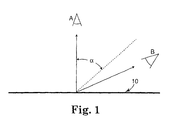
- the shift in the reflection band is caused by the change in effective index of refraction with angle. Both the band centers and the width of the reflection band change as the incidence angle changes, with the reflecting band always shifting towards shorter wavelengths. This is counterintuitive, as the total path length increases with angle.
- the band position does not depend on the total path length, but the difference in path length between reflections off the interfaces, and this difference decreases with angle.
- the high wavelength bandedge also shifts differently from the low wavelength bandedge.
- the change in center and width with angle tend to cancel.
- the changes add to broaden the band.
- a bandedge shifts to about 80% of its normal incidence wavelength when viewed at grazing incidence
- the low wavelength bandedge of an infrared reflector be positioned sufficiently far into the infrared so that it is not observed at a desired use angle.
- the film must be designed so that the short wavelength edge of the normal angle is shifted 100-150 nm away from the edge of the visible spectrum.
- the short wavelength bandedge must be moved to about 850 nm to eliminate any perceived color with angle. This creates a gap between the edge of the visible spectrum (about 700 nm) and the low wavelength bandedge of about 150 nm.
- U.S. Patent No. 5,486,949 discloses that it may be desirable to incorporate coloring agents such as dyes or pigments into one or more layers of a birefringent polarizer to permit selective absorption of certain wavelengths of light and control the bandwidth of reflected polarized light and the wavelength range of transmitted light.
- U.S. Patent No. 4,705,356 discloses a thin film optically variable article having substantial color shift with varying angle of light incidence and viewing comprising an optically thick substantially transparent structural element carrying a colorant and a multilayer interference coating, whereby the colorant serves to modify in essentially a substractive mode the color at normal incidence and the color shift with angle of the multilayer interference coating as seen by transmission of light through the article.
- Patent No. 4,705,356 disclose an optical body comprising a film having a reflecting band positioned to reflect infrared radiation of at least one polarization at an incident angle normal to the film combined with a component designed to at least partially absorb or reflect infrared radiation at normal incidence in the region resulting from the positioned reflecting band.
- the present invention relates to an optical body comprising (a) a birefringent dielectric multilayer film, which may be a polarizer, mirror, or both, having a reflecting band positioned to reflect infrared radiation of at least one polarization at an incident angle normal to the film, said reflecting band having a short wavelength bandedge ⁇ a0 and long wavelength bandedge ⁇ b0 at a normal incident angle, and a short wavelength bandedge ⁇ a ⁇ and long wavelength bandedge ⁇ b ⁇ at a maximum usage angle ⁇ , wherein ⁇ a ⁇ is less than ⁇ a0 and ⁇ a0 is selectively positioned at a wavelength greater than about 700 nm, and (b) at least one component which at least partially absorbs or reflects radiation in the wavelength region between ⁇ a ⁇ and ⁇ a0 at a normal angle of incidence.
- a birefringent dielectric multilayer film which may be a polarizer, mirror, or both, having a reflecting band positioned to reflect infrare
- the present invention also relates to an optical body comprising (a) an isotropic dielectric multilayer film having a reflecting band positioned to reflect infrared radiation of at least one polarization at an incident angle normal to the film, said reflecting band having a short wavelength bandedge ⁇ a0 and long wavelength bandedge ⁇ b0 at a normal incident angle, and a short wavelength bandedge ⁇ a ⁇ and long wavelength bandedge ⁇ b ⁇ at a maximum usage angle ⁇ , wherein ⁇ a ⁇ is less than ⁇ a0 and ⁇ a0 is selectively positioned at a wavelength greater than about 700 nm; and (b) at least one component which at least partially absorbs or reflects radiation in the wavelength region between ⁇ a ⁇ and ⁇ a0 at a normal angle of incidence.
- the optical body of the present invention provides good reflectivity in the infrared region of the spectrum and improved shading coefficient at normal angles while still transmitting visible light at all desirable angles of incidence.
- the infrared film of the present invention can be designed so that the short wavelength edge of the normal angle spectrum is a certain wavelength, depending on the requirements of the end application, away from the edge of the visible, for example, 100-150 nm away.
- This allows the film to be designed to avoid off-angle color changes for example, the film may be designed so that the off angle shift does not allow the low wavelength bandedge to encroach into the visible and cause color or, when there is already visible color at normal angles, the film can be designed so that the off angle color shift does not cause perceptible color change in the film. Shifting the bandedge to longer wavelengths for the normal incidence condition results in lower spectral coverage at wavelengths where the solar infrared spectrum is a maximum.
- a wavelength gap filler component is used to cover at least a part of the gap between, for example, the short wavelength reflecting bandedge and the edge of the visible spectrum
- the film of the present invention comprises at least two layers and is a dielectric optical film having alternating layers of a material having a high index of refraction and a material having a low index of refraction.
- the film may be isotropic or birefringent.
- the film is a birefringent polymeric film, and more preferably the film is designed to allow the construction of multilayer stacks for which the Brewster angle (the angle at which reflectance of p polarized light goes to zero) is very large or is nonexistent for the polymer layer interfaces.
- the multilayered films of the present invention have high reflectivity (for both s and p polarized light for any incident direction in the case of mirrors, and for the selected direction in the case of polarizers) over a wide bandwidth.
- the film of this invention can be used to prepare multilaver films having an average reflectivity of at least 50% over at least a 100 nm wide band in the infrared region of the spectrum.
- Suitable films include those described in U.S Serial Number 08/402,041 filed March 10, 1995, and U S. Serial Number 09/006,601, entitled “Modified Copolyesters and Improved Multilayer Reflective Film” now published as US 5882774A and WO 99/36262 A2.
- the optical thickness ratio of first material A, f A is 1/5
- the optical thickness ratio of second material B, f B is 1/6
- the optical thickness of third material C, f C is 1/3
- n B n A n C
- a layer thickness gradient may be introduced across the thickness of the film.
- the layer thicknesses may increase monotonically across the thickness of the film.
- the first polymeric material (A) differs in refractive index from the second polymeric material (B) by at least about 0.03
- the second polymeric material (B) differs in refractive index from the third polymeric material (C) by at least about 0.03
- the refractive index of the second polymeric material (B) is intermediate the respective refractive indices of the first (A) and third (C) polymeric materials.
- Any or all of the polymeric materials may be synthesized to have the desired index of refraction by utilizing a copolymer or miscible blend of polymers.
- the second polymeric material may be a copolymer or miscible blend of the first and third polymeric materials.
- Another suitable film includes the film described in U.S. Patent No. 5,360,659, which describes a two component film having a six layer alternating repeating unit suppresses the unwanted second, third, and fourth order reflections in the visible wavelength region of between about 380 - 770 nm while reflecting light in the infrared wavelength region of between about 770 - 2000 nm. Reflections higher than fourth order will generally be in the ultraviolet, not visible, region of the spectrum or will be of such a low intensity as to be unobjectionable.
- the film comprises alternating layers of first (A) and second (B) diverse polymeric materials in which the six layer alternating repeat unit has relative optical thicknesses of about 778A, 111B.111A.778B 111A.111B.
- a repeat unit gradient may be introduced across the thickness of the film.
- the repeat unit thicknesses will increase linearly across the thickness of the film. By linearly, it is meant that the repeat unit thicknesses increase at a constant rate across the thickness of the film.
- the ratio of repeat unit optical thicknesses can be greater or less than two as long as the short wavelength range of the retlectance band is above 770 nm and the long wavelength edge is about 2000 nm.
- Other repeat unit gradients may be introduced by using logarithmic and/or quartic functions.
- the infrared reflecting film of the present invention may comprise a first portion of alternating layers comprising a six layer alternating layer repeating unit or a multicomponent optical design that reflects infrared light of wavelengths between about 1200-2000 nm while minimizing higher order reflections that contribute to visible color, and a second portion of alternating layers having an AB repeat unit and substantially equal optical thicknesses which reflect infrared light of wavelengths between about 700-1200 nm.
- a combination of alternating layers results in reflection of light across the infrared wavelength region through about 2000 nm, and is commonly known as a "hybrid design".
- This hybrid design may be provided as described, for example, in U.S Patent No.
- optical body This is accomplished by forming at least a portion of the optical body out of polymeric materials A, B, and C which are arranged in a repeating sequence ABC, wherein A has refractive indices n x A , n y A , and n z A along mutually orthogonal axes x, y, and z, respectively, B has refractive indices n x B , n y B , and n z B along axes x, y and z, respectively, and C has refractive indices n x C , n y C and n z C along axes x, y, and z, respectively, where axis z is orthogonal to the plane of the film or optical body, wherein n x A > n x B > n x C or n y A > n y B > n y C , and wherein n z C ⁇ n z B ⁇
- the film or optical body By designing the film or optical body within these constraints, at least some combination of second, third and forth higher-order reflections can be suppressed without a substantial decrease of the first harmonic reflection with angle of incidence, particularly when the first reflection band is in the infrared region of the spectrum.
- Such films and optical bodies are particularly useful as IR mirrors, and may be used advantageously as window films and in similar applications where IR protection is desired but good transparency and low color are important.
- optical film of the present invention can be made with dielectric inorganic thin film stacks of materials such as indium tin oxide (ITO), silicon dioxide (SiO2), zirconium dioxide (ZrO2), or titanium dioxide (TiO2) as described, for example, in EP 0 080 182 and U.S. Patent numbers 4,705,356 and 5.179,468, the preferred optical film is a polymeric multilayer film having alternating layers of polymeric materials having high and low indices of refraction.
- ITO indium tin oxide
- SiO2 silicon dioxide
- ZrO2 zirconium dioxide
- TiO2 titanium dioxide
- Multilayer polymeric films can include hundreds or thousands of thin layers, and may contain as many materials as there are layers in the stack. For ease of manufacturing, preferred multilayer films have only a few different materials, and for simplicity those discussed herein typically include only two.
- the multilayer film includes alternating layers of a first polymeric material having a first index of refraction, and a second polymeric material having a second index of refraction that is different from that of the first material.
- the individual layers are typically on the order of 0.05 micrometers to 0 45 micrometers thick.
- a multilayered polymeric film having alternating layers of crystalline naphthalene dicarboxylic acid polyester and another selected polymer, such as copolyester or copolycarbonate, wherein the layers have a thickness of less than 0.5 micrometers, and wherein the refractive indices of one of the polymers can be as high as 1 9 in one direction and 1 64 in the other direction, thereby providing a birefringent effect which is useful in the polarization of light.
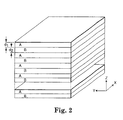
- Adjacent pairs of layers preferably have a total optical thickness that is 1/2 of the wavelength of the light desired to be reflected. as shown in Figure 2.
- the individual layers of a multilayer polymeric film have an optical thickness that is 1/4 of the wavelength of the light desired to be reflected, although other ratios of the optical thicknesses within the layer pairs may be chosen for other reasons.
- optical thickness is defined as the refractive index of a material multiplied by the actual thickness of the material. and that unless stated otherwise, all actual thicknesses discussed herein are measured after any orientation or other processing.
- the film will reflect light of different wavelengths.
- An important feature of the present invention is the selection of layers having desired optical thicknesses (by selecting the actual layer thicknesses and materials) sufficient to reflect light in the near infrared portion of the spectrum.
- pairs of layers will reflect a predictable band width of light, as described below, individual layer pairs may be designed and made to reflect a given band width of light. Thus, if a large number of properly selected layer pairs are combined, superior reflectance of a desired portion of the near infrared spectrum can be achieved.
- the bandwidth of light desired to be blocked, i.e., not transmitted, at a zero degree observation angle in accordance with an optical body of the present invention is from approximately 700 to 1200 nm.
- the layer pairs preferably have optical thicknesses ranging from 350 to 600 nm (1/2 the wavelength of the light desired to be reflected) in order to reflect the near infrared light.
- the multilayer film would have individual layers each having an optical thickness ranging from 175 to 300 nm (1/4 the wavelength of the light desired to be reflected), in order to reflect the near infrared light.
- the first layer material has a refractive index of 1 66 (as does biaxially oriented PET), and the second layer material has a refractive index of 1 52 (as does the biaxially oriented thermoplastic polyester commercially available from Eastman Chemical Co., Knoxville, TN, under the trade designation "Ecdel”)
- the actual thicknesses of the first material layers would range from approximately 105 to 180 nm
- the actual thicknesses of the second layers would range from approximately 115 to 197 nm.
- the optical properties of multilayer films such as this are discussed in detail below.
- the various layers in the film preferably have different thicknesses. This is commonly referred to as the layer thickness gradient.
- a layer thickness gradient is selected to achieve the desired band width of reflection.
- One common layer thickness gradient is a linear one, in which the thickness of the thickest layer pairs is a certain percent thicker than the thickness of the thinnest layer pairs.
- a 1.055:1 layer thickness gradient means that the thickest layer pair (adjacent to one major surface) is 5.5% thicker than the thinnest layer pair (adjacent to the opposite surface of the film).
- the layer thickness could decrease, then increase, then decrease again from one major surface of the film to the other.
- Suitable polymeric materials for use in the optical films of the present invention may be amorphous, semicrystalline, or crystalline polymeric materials.
- the films consist of at least two distinguishable polymers having different indices of refraction. The number is not limited, and three or more materials may be advantageously used in applications wherein it is desirable to eliminate higher order harmonics that would otherwise reflect light in the visible region of the spectrum and give a film with a colored appearance. For simplicity, the films will be described further considering an optical stack made from only two materials.
- the birefringence may be developed between two orthogonal directions in the plane of the film, between one or more in-plane directions and the direction perpendicular to the film plane, or a combination of these.
- the first polymer should be capable of maintaining birefringence after stretching, so that the desired optical properties are imparted to the finished film.
- the other required polymer referred to as the "second polymer” should be chosen so that in the finished film, its refractive index, in at least one direction, differs significantly from the index of refraction of the first polymer in the same direction. Because polymeric materials are typically dispersive, that is, the refractive indices vary with wavelength, these conditions must be considered in terms of a particular spectral bandwidth of interest.
- the difference in the index of refraction of the first and second polymers in one film-plane direction is advantageous for the difference in the index of refraction of the first and second polymers in one film-plane direction to differ significantly in the finished film, while the difference in the orthogonal film-plane index is minimized.
- the first polymer has a large refractive index when isotropic, and is positively birefringent (that is, its refractive index increases in the direction of stretching)
- the second polymer will be chosen to have a matching refractive index, after processing, in the planar direction orthogonal to the stretching direction, and a refractive index in the direction of stretching which is as low as possible.
- the second polymer will be chosen to have a matching refractive index, after processing, in the planar direction orthogonal to the stretching direction, and a refractive index in the direction of stretching which is as high as possible.
- the second polymer may be chosen so that, after processing, its refractive index will match that of the first polymer in either the stretching direction or the planar direction orthogonal to stretching. Further, the second polymer will be chosen such that the difference in index of refraction in the remaining planar direction is maximized, regardless of whether this is best accomplished by a very low or very high index of refraction in that direction.
- One means of achieving this combination of planar index matching in one direction and mismatching in the orthogonal direction is to select a first polymer which develops significant birefringence when stretched, and a second polymer which develops little or no birefringence when stretched, and to stretch the resulting film in only one planar direction.
- the second polymer may be selected from among those which develop birefringence in the sense opposite to that of the first polymer (negative - positive or positive - negative).
- Another alternative method is to select both first and second polymers which are capable of developing birefringence when stretched, but to stretch in two orthogonal planar directions, selecting process conditions, such as temperatures, stretch rates, post-stretch relaxation, and the like, which result in development of unequal levels of orientation in the two stretching directions for the first polymer, and levels of orientation for the second polymer such that one in-plane index is approximately matched to that of the first polymer, and the orthogonal in-plane index is significantly mismatched to that of the first polymer.
- process conditions such as temperatures, stretch rates, post-stretch relaxation, and the like, which result in development of unequal levels of orientation in the two stretching directions for the first polymer, and levels of orientation for the second polymer such that one in-plane index is approximately matched to that of the first polymer, and the orthogonal in-plane index is significantly mismatched to that of the first polymer.
- conditions may be chosen such that the first polymer has a biaxially oriented character in the finished film, while
- a reflective, or mirror, film Different considerations apply to a reflective, or mirror, film. Provided that the film is not meant to have some polarizing properties as well, refractive index criteria apply equally to any direction in the film plane, so it is typical for the indices for any given layer in orthogonal in-plane directions to be equal or nearly so. It is advantageous, however, for the film-plane indices of the first polymer to differ as greatly as possible from the film-plane indices of the second polymer For this reason, if the first polymer has a high index of refraction when isotropic, it is advantageous that it also be positively birefringent. Likewise, if the first polymer has a low index of refraction when isotropic, it is advantageous that it also be negatively birefringent.
- the second polymer advantageously develops little or no birefringence when stretched, or develops birefringence of the opposite sense (positive - negative or negative - positive), such that its film-plane refractive indices differ as much as possible from those of the first polymer in the finished film.
- Colored films can be regarded as special cases of mirror and polarizing films. Thus, the same criteria outlined above apply.
- the perceived color is a result of reflection or polarization over one or more specific bandwidths of the spectrum.
- the bandwidths over which a multilayer film of the current invention is effective will be determined primarily by the distribution of layer thicknesses employed in the optical stack(s), but consideration must also be given to the wavelength dependence, or dispersion, of the refractive indices of the first and second polymers It will be understood that the same rules apply to the infrared and ultraviolet wavelengths as to the visible colors.
- Absorbance is another consideration. For most applications, it is advantageous for neither the first polymer nor the second polymer to have any absorbance bands within the bandwidth of interest for the film in question. Thus, all incident light within the bandwidth is either reflected or transmitted. However, for some applications, it may be useful for one or both of the first and second polymer to absorb specific wavelengths, either totally or in part.
- Polyethylene 2,6-naphthalate is frequently chosen as a first polymer for films of the present invention. It has a large positive stress optical coefficient, retains birefringence effectively after stretching, and has little or no absorbance within the visible range. It also has a large index of refraction in the isotropic state. Its refractive index for polarized incident light of 550 nm wavelength increases when the plane of polarization is parallel to the stretch direction from about 1.64 to as high as about 1.9. Its birefringence can be increased by increasing its molecular orientation which, in turn, may be increased by stretching to greater stretch ratios with other stretching conditions held fixed.
- polystyrene dicarboxylic polyesters are also suitable as first polymers
- Polybutylene 2,6-Naphthalate (PBN) is an example. These polymers may be homopolymers or copolymers, provided that the use of comonomers does not substantially impair the stress optical coefficient or retention of birefringence after stretching.
- PEN herein will be understood to include copolymers of PEN meeting these restrictions. In practice, these restrictions imposes an upper limit on the comonomer content, the exact value of which will vary with the choice of comonomer(s) employed. Some compromise in these properties may be accepted, however, if comonomer incorporation results in improvement of other properties. Such properties include but are not limited to improved interlayer adhesion, lower melting point (resulting in lower extrusion temperature), better rheological matching to other polymers in the film, and advantageous shifts in the process window for stretching due to change in the glass transition temperature.
- Suitable comonomers for use in PEN, PBN or the like may be of the diol or dicarboxylic acid or ester type.
- Dicarboxylic acid comonomers include but are not limited to terephthalic acid, isophthalic acid, phthalic acid, all isomeric naphthalenedicarboxylic acids (2,6-, 1,2-, 1,3-, 1,4-, 1,5-, 1,6-, 1,7-, 1,8-, 2,3-, 2,4-, 2,5-, 2,7-, and 2,8-), bibenzoic acids such as 4,4'-biphenyl dicarboxylic acid and its isomers, trans-4,4'-stilbene dicarboxylic acid and its isomers, 4,4'-diphenyl ether dicarboxylic acid and its isomers, 4,4'-diphenylsulfone dicarboxylic acid and its isomers, 4,4'-benzophenone dicarboxylic acid and its isomers
- Suitable diol comonomers include but are not limited to linear or branched alkane diols or glycols (such as ethylene glycol, propanediols such as trimethylene glycol, butanediols such as tetramethylene glycol, pentanediols such as neopentyl glycol, hexanediols, 2,2,4-trimethyl-1,3-pentanediol and higher diols), ether glycols (such as diethylene glycol, triethylene glycol, and polyethylene glycol), chain-ester diols such as 3-hydroxy-2,2-dimethylpropyl-3-hydroxy-2,2-dimethyl propanoate, cycloalkane glycols such as 1,4-cyclohexanedimethanol and its isomers and 1,4-cyclohexanediol and its isomers, bi- or multicyclic diols (such as the various isomeric
- Tri- or polyfunctional comonomers which can serve to impart a branched structure to the polyester molecules, can also be used. They may be of either the carboxylic acid, ester, hydroxy or ether types. Examples include, but are not limited to, trimellitic acid and its esters, trimethylol propane, and pentaerythritol.
- comonomers are monomers of mixed functionality, including hydroxycarboxylic acids such as parahydroxybenzoic acid and 6-hydroxy-2-naphthalenecarboxylic acid, and their isomers, and tri- or polyfunctional comonomers of mixed functionality such as 5-hydroxyisophthalic acid and the like.
- PET Polyethylene terephthalate
- naphthalene dicarboxylic polyester such as PEN or PBN
- PEN naphthalene dicarboxylic copolyester
- This can be accomplished by choosing comonomers and their concentrations in the copolymer such that crystallizability of the coPEN is eliminated or greatly reduced.
- One typical formulation employs as the dicarboxylic acid or ester components dimethyl naphthalate at from about 20 mole percent to about 80 mole percent and dimethyl terephthalate or dimethyl isophthalate at from about 20 mole percent to about 80 mole percent, and employs ethylene glycol as diol component.
- dicarboxylic acids may be used instead of the esters.
- the number of comonomers which can be employed in the formulation of a coPEN second polymer is not limited. Suitable comonomers for a coPEN second polymer include but are not limited to all of the comonomers listed above as suitable PEN comonomers, including the acid, ester, hydroxy, ether, tri- or polyfunctional, and mixed functionality types.
- polycarbonates having a glass transition temperature compatible with that of PEN and having a refractive index similar to the isotropic refractive index of PEN are also useful as second polymers.
- Polyesters, copolyesters, polycarbonates, and copolycarbonates may also be fed together to an extruder and transesterified into new suitable copolymeric second polymers.
- the second polymer be a copolyester or copolycarbonate.
- Vinyl polymers and copolymers made from monomers such as vinyl naphthalenes, styrenes, ethylene, maleic anhydride, acrylates, acetates, and methacrylates may be employed.
- Condensation polymers other than polyesters and polycarbonates may also be used. Examples include: polysulfones, polyamides, polyurethanes, polyamic acids, and polyimides.
- Naphthalene groups and halogens such as chlorine, bromine and iodine are useful for increasing the refractive index of the second polymer to a desired level. Acrylate groups and fluorine are particularly useful in decreasing refractive index when this is desired.
- Suitable second polymer materials include but are not limited to polyethylene naphthalate (PEN) and isomers thereof (such as 2.6-, 1,4-, 1.5-, 2.7-.
- PEN polyethylene naphthalate
- isomers thereof such as 2.6-, 1,4-, 1.5-, 2.7-.
- polyalkylene terephthalates such as polyethylene terephthalate, polybutylene terephthalate, and poly-1,4-cyclohexanedimethylene terephthalate
- other polyesters polycarbonates, polyarylates, polyamides (such as nylon 6, nylon 11, nylon 12, nylon 4/6, nylon 6/6, nylon 6/9, nylon 6/10, nylon 6/12, and nylon 6/T), polyimides (including thermoplastic polyimides and polyacrylic imides), polyamide-imides, polyether-amides, polyetherimides, polyaryl ethers (such as polyphenylene ether and the ring-substituted polyphenylene oxides), polyarylether ketones such as polyetheretherketone (“PEEK”), aliphatic polyketones (such as copolymers and terpolymers of ethylene and/or propylene with carbon dioxide), polyphenylene sulfide, polysulfones (including polyethersulfones and poly
- copolymers such as the copolymers of PEN discussed above as well as any other non- naphthalene group -containing copolyesters which may be formulated from the above lists of suitable polyester comonomers for PEN
- copolyesters based on PET and comonomers from said lists above are especially suitable.
- first or second polymers may consist of miscible or immiscible blends of two or more of the above-described polymers or copolymers (such as blends of sPS and atactic polystyrene, or of PEN and sPS).
- syndiotactic vinyl aromatic polymers such as syndiotactic polystyrene.
- Syndiotactic vinyl aromatic polymers useful in the current invention include poly(styrene), poly(alkyl styrene)s, poly (aryl styrene)s, poly(styrene halide)s, poly(alkoxy styrene)s, poly(vinyl ester benzoate), poly(vinyl naphthalene), poly(vinylstyrene), and poly(acenaphthalene), as well as the hydrogenated polymers and mixtures or copolymers containing these structural units.
- poly(alkyl styrene)s include the isomers of the following: poly(methyl styrene), poly(ethyl styrene), poly(propyl styrene), and poly(butyl styrene)
- poly(aryl styrene)s include the isomers of poly(phenyl styrene)
- examples include the isomers of the following: poly(chlorostyrene), poly(bromostyrene), and poly(fluorostyrene).
- poly(alkoxy styrene)s include the isomers of the following: poly(methoxy styrene) and poly(ethoxy styrene).
- particularly preferable styrene group polymers are: polystyrene, poly(p-methyl styrene), poly(m-methyl styrene), poly(p-tertiary butyl styrene), poly(p-chlorostyrene), poly(m-chloro styrene), poly(p-fluoro styrene), and copolymers of styrene and p-methyl styrene.
- comonomers may be used to make syndiotactic vinyl aromatic group copolymers.
- suitable comonomers include olefin monomers (such as ethylene, propylene, butenes, pentenes, hexenes, octenes or decenes), diene monomers (such as butadiene and isoprene), and polar vinyl monomers (such as cyclic diene monomers, methyl methacrylate, maleic acid anhydride, or acrylonitrile).
- syndiotactic vinyl aromatic polymers and copolymers referred to in this invention generally have syndiotacticity of higher than 75% or more, as determined by carbon-13 nuclear magnetic resonance.
- the degree of syndiotacticity is higher than 85% racemic diad, or higher than 30%, or more preferably, higher than 50%, racemic pentad.
- the weight average molecular weight is greater than 10,000 and less than 1,000,000, and more preferably, greater than 50,000 and less than 800,000.
- syndiotactic vinyl aromatic polymers and copolymers may also be used in the form of polymer blends with, for instance, vinyl aromatic group polymers with atactic structures, vinyl aromatic group polymers with isotactic structures, and any other polymers that are miscible with the vinyl aromatic polymers.
- vinyl aromatic group polymers with atactic structures vinyl aromatic group polymers with isotactic structures
- any other polymers that are miscible with the vinyl aromatic polymers for example, polyphenylene ethers show good miscibility with many of the previous described vinyl aromatic group polymers.
- PEN/coPEN When a polarizing film is made using a process with predominantly uniaxial stretching, particularly preferred combinations of polymers for optical layers include PEN/coPEN. PET/coPET, PEN/sPS, PET/sPS, PEN/Eastar,TM and PET/Eastar,TM where "coPEN” refers to a copolymer or blend based upon naphthalene dicarboxylic acid (as described above) and EastarTM is a polyester or copolyester (believed to comprise cyclohexanedimethylene diol units and terephthalate units) commercially available from Eastman Chemical Co.
- coPEN refers to a copolymer or blend based upon naphthalene dicarboxylic acid (as described above) and EastarTM is a polyester or copolyester (believed to comprise cyclohexanedimethylene diol units and terephthalate units) commercially available from Eastman Chemical Co.
- PEN.coPEN PEN/PET
- PEN/PBT polybutylene terephthalate
- PET polybutylene terephthalate
- PET polybutylene terephthalate
- PET copolymer of PET employing a second glycol (usually cyclohexanedimethanol)
- PETcoPBT refers to a copolyester of terephthalic acid or an ester thereof with a mixture of ethylene glycol and 1,4-butanediol.
- Particularly preferred combinations of polymers for optical layers in the case of mirrors or colored films include PEN/PMMA, PET/PMMA, PEN/"Ecdel", PET/"Ecdel", PEN/sPS, PET/sPS, PEN/coPET, PEN/PETG, and PEN/a fluoropolymer commercially available from Minnesota Mining and Manufacturing Company (3M), St. Paul, MN under the trade designation "THV", where "PMMA” refers to polymethyl methacrylate, "coPET” refers to a copolymer or blend based upon terephthalic acid (as described above), and "PETG” refers to a copolymer of PET employing a second glycol (usually cyclohexanedimethanol).
- the in-plane refractive indices might be 1.76 for biaxially oriented PEN, while the film plane-normal refractive index might fall to 1.49.
- PMMA is used as the second polymer in the multilayer construction, its refractive index at the same wavelength, in all three directions, might be 1.495.
- PET/"Ecdel Another example is the PET/"Ecdel” system, in which the analogous indices might be 1 66 and 1.51 for PET, while the isotropic index of "Ecdel” might be 1.52.
- the crucial property is that the normal-to-plane index for one material must be closer to the in-plane indices of the other material than to its own in-plane indices.
- the multilaver optical films of the current invention may consist of more than two distinguishable polymers
- a third or subsequent polymer might be fruitfully employed as an adhesion-promoting layer between the first polymer and the second polymer within an optical stack, as an additional component in a stack for optical purposes, as a protective boundary layer between optical stacks, as a skin layer, as a functional coating, or for any other purpose.
- the composition of a third or subsequent polymer, if any, is not limited.
- Preferred multicomponent films include those described in U.S Serial No. 09/006,118 filed on 13.1.98, now published as WO99/36810A1, entitled "Multicomponent Optical Body".
- the reflectance characteristics of multilayer films are determined by several factors, the most important of which for purposes of this discussion are the indices of refraction for each layer of the film stack.
- reflectivity depends upon the relationship between the indices of refraction of each material in the x, y, and z directions (n x , n y , n z ).
- Different relationships between the three indices lead to three general categories of materials: isotropic, uniaxially birefringent, and biaxially birefringent. The latter two are important to the optical performance of the present invention.
- n x and n y In a uniaxially birefringent material, two indices (typically along the x and y axes, or n x and n y ) are equal, and different from the third index (typically along the z axis, or n z ).
- the x and y axes are defined as the in-plane axes, in that they represent the plane of a given layer within the multilayer film, and the respective indices n x and n y are referred to as the in-plane indices.
- One method of creating a uniaxially birefringent system is to biaxially orient (stretch along two axes) a multilayer polymeric film. Biaxial orientation of the multilayer film results in differences between refractive indices of adjoining layers for planes parallel to both axes, resulting in the reflection of light in both planes of polarization.
- a uniaxially birefringent material can have either positive or negative uniaxial birefringence. Positive uniaxial birefringence occurs when the index of refraction in the z direction (n z ) is greater than the in-plane indices (n x and n y ).
- an infrared mirror can be made that is transparent in the visible region of the spectrum, even at high angles of incidence.
- the reflective bandedge may be positioned so that even at grazing angles of incidence, the reflectance band does not shift past the colored portion of the visible spectrum, thereby maintaining the same visible color at grazing angles as at normal angle of incidence. This same effect may be achieved by positioning two uniaxially oriented films (discussed below) with their respective orientation axes at 90° to each other.
- a biaxially birefringent system can be made by uniaxially orienting (stretching along one axis) the multilayer polymeric film, such as along the x direction in Figure 2.
- a biaxially birefringent multilayer film can be designed to provide high reflectivity for light with its plane of polarization parallel to one axis, for all angles of incidence, and simultaneously have low reflectivity (high transmissivity) for light with its plane of polarization parallel to the other axis at all angles of incidence.
- the biaxially birefringent system acts as a polarizer, reflecting light of one polarization and transmitting light of the other polarization.
- a polarizing film is one that receives incident light of random polarity (light vibrating in planes at random angles), and allows incident light rays of one polarity (vibrating in one plane) to pass through the film, while reflecting incident light rays of the other polarity (vibrating in a plane perpendicular to the first plane).
- an infrared polarizer can be made that is transparent in the visible region of the spectrum, even at high angles of incidence.
- the reflective bandedge may be positioned so that even at grazing angles of incidence, the reflectance band does not shift past the colored portion of the visible spectrum, thereby maintaining the same visible color at grazing angles as at normal angle of incidence.
- Two crossed sheets of biaxially birefringent film would yield a highly efficient mirror, and the films would perform similar to a single uniaxially birefringent film.
- PEN/PET An example of a system that produces a good polarizer from biaxial orientation is PEN/PET.
- the indices of refraction can be adjusted over a range of values.
- Copolymers of PEN and PET may also be used. For example, a copolymer comprising approximately 10% PEN subunits and 90% PET subunits by weight may replace the PET homopolymer in the construction.
- n 1x 1 67
- n 1x 1 62
- n 1z 1 52, at 632.8 nm.
- refractive indices in the x direction a large difference (for strong reflection) in the y direction
- a small difference in the z direction This small z index difference minimizes unwanted color leaks at shallow observation angles.
- the film formed by biaxial orientation is strong in all planar directions, while uniaxially oriented polarizer is prone to splitting. Depending on the application, either approach has merit.
- the infrared reflecting multilayer film of the present invention may be designed so that the reflecting band is positioned within the infrared region at such a wavelength that it does not reflect red light at angles less than the angle of use. If the reflection band is not positioned sufficiently far into the infrared, then the film will reflect red at angles greater than the angle of use. Because cyan is by definition the subtraction of red light from white light, the film appears cyan in transmission. The amount of red light reflected, and thus the degree to which the film appears cyan, depends on the observation angle and the reflected band width.
- the observation angle alpha is measured between the photoreceptor (typically a human eye) and the observation axis perpendicular to the plane of the film.
- the observation angle is approximately zero degrees, very little visible light of any color is reflected by the multilayer film, and the film appears clear against a diffuse white background (or black against a black background).
- the observation angle exceeds a predetermined shift angle and the short wavelength bandedge has not been positioned properly within the infrared, a substantial portion of the red light is reflected by the multilayer film, and the film appears cyan against a diffuse white background (or red against a black background).
- the observation angle increases toward 90 degrees, more red light is reflected by the multilayer film, and the cyan appears to be even deeper.
- the shift into the red region of the spectrum may be acceptable, for example, if the film is already cyan in appearance at normal angles, for example, because of the incorporation of an absorbing dye, then the short wavelength bandedge may shift beyond the visible into the red region so long as it does not move beyond the absorption bandedge of the dye to cause a change in the perceived color with angle.
- the reflectance peak is very narrow.
- the breadth or band width of the transmission minimum is about 42 nm.
- the band width is 77 nm.
- the reflective band of the film of the present invention should be designed to cover from about 850 nm to about 1200 nm.
- the band width for a given pair of materials may be estimated from Equation 3, multiplying by the layer thickness ratio.
- the center of the reflectance band is calculated from Equations I or 2 so that it is positioned approximately one half band width from the desired location of the lower bandedge.
- the compounded effects result in a greater blue shift of the spectrum compared to film stacks composed entirely of isotropic materials.
- the actual blue shift will be determined by the thickness weighted average change in ⁇ with angle of incidence for all material layers in the unit cell.
- the blue shift can be enhanced or lessened by adjusting the relative thickness of the birefringent layer(s) to the isotropic layer(s) in the unit cell. This will result in f-ratio changes that must first be considered in the product design.
- the maximum blue shift in mirrors is attained by using negatively uniaxially birefringent materials in all layers of the stack.
- the minimum blue shift is attained by using only uniaxially positive birefringent materials in the optical stack.
- biaxially birefringent materials are used, but for the simple case of light incident along one of the major axes of a birefringent thin film polarizer, the analysis is the same for both uniaxial and biaxial films. For directions between the major axes of a polarizer, the effect is still observable but the analysis is more complex.
- the in-plane/z-axis index differential of the PEN layers is about 1.75 - 1 50. This index differential is less for PET-based films (i e., about 1.66 - 1.50)
- the effect is even more pronounced because the difference in the PEN in-plane index compared to the PEN z-axis index is much greater (about 1.85 - 1.50), resulting in an even greater blue shift for p-polarized light than that observed in isotropic multilayer film stacks. If only uniaxially positive birefringent materials were used in the stack, the blue shift would be diminished compared to isotropic optical films.
- the angular dependence of the red light reflectance is illustrated in Figures 3 and 4.
- the percent of transmitted light is plotted along the vertical axis, and the wavelengths of light are plotted along the horizontal axis. Note that because the percentage of light transmitted is simply 1 minus the percentage of reflected light (absorption is negligible), information about light transmission also provides information about light reflection.
- the spectra provided in Figures 3 and 4 are taken from a computerized optical modeling system, and actual performance typically corresponds relatively closely with predicted performance. Surface reflections contribute to a decreased transmission in both the computer modeled and measured spectra. In examples for which actual samples were tested, a spectrometer available from the Perkin Elmer Corporation of Norwalk, Connecticut under the designation Lambda 19 was used to measure optical transmission of light at the angles indicated.
- the spectra for this ideal film at a zero degree observation angle and a 60 degree observation angle are plotted in Figures 3 and 4, respectively.
- the low wavelength bandedge for both the s- and p-polarized light shift together from about 750 nm to about 600 nm and transmission is minimized in the desired range of the spectrum, so that to the eye, a very sharp color shift is achieved.
- the low wavelength bandedge for p-polarized light viewed at a 60 degree observation angle shifts by about 100 nm, while that for s-polarized light shifts by about 150 nm.
- This construction does not exhibit an abrupt change from clear to cyan because the s- and p-polarized light do not shift together with change in angle.
- the value for the shift for p-polarized light for a construction with an isotropic film would likely be between the shift achieved using a birefringent film and that achieved using an inorganic isotropic film, depending on the index of refraction of the specific materials used.
- a dielectric reflector is composed of layer groups that have two or more layers of alternating high and low index of refraction. Each group has a halfwave optical thickness that determines the wavelength of the reflection band. Typically, many sets of halfwaves are used to build a stack that has reflective power over a range of wavelengths. Most stack designs have sharp reflectivity decreases at higher and lower wavelengths, know as bandedges.
- the edge above the halfwave position is the high wavelength bandedge, l BEhi , and the one below is the low wavelength bandedge, l BElo . These are illustrated in Figure 8.
- the center, edges, and width of a reflection band change with incident angle.
- the reflecting band can be exactly calculated by using a characteristic matrix method.
- the characteristic matrix relates the electric field at one interface to that at the next. It has terms for each interface and each layer thickness. By using effective indicies for interface and phase terms, both anisotropic and isotropic materials can be evaluated.
- the characteristic matrix for the halfwave is the product of the matrix for each layer of the halfwave.
- the characteristic matrix for each layer is given by Equation 6 where r i and t i are the Fresnel coefficients for the interface reflection of the i th interface, and b i is the phase thickness of the i th layer.
- the characteristic matrix of the entire stack is the product of the matrix for each layer. Other useful results, such as the total transmission and reflection of the stack, can be derived from the characteristic matrix.
- the incident material has an index of n O and an angle of q O .
- the wavelength edge of the high reflectance region can be determined by evaluating the M 11 and M 22 elements of the characteristic matrix of the stack at different wavelengths. At wavelengths where Equation 10 is satisfied, the transmission exponentially decreases as more halfwaves are added to the stack Equation 10: M 11 + M 22 2 ⁇ 1
- the edge of a reflection band can be determined from the characteristic matrix for each halfwave.
- the characteristic matrix for the stack can be derived by matrix multiplication of the component layers to generate the total matrix at any wavelength.
- a bandedge is defined by wavelengths where Equation 11 is satisfied. This can be either the first order reflection band or higher order reflections. For each band, there are two solutions. There are additional solutions at shorter wavelengths where higher order reflections can be found.
- a preferred method of making the multilayer film of the present invention is illustrated schematically in Figure 7, and is described in even greater detail in U S Serial No. 09/006,288 entitled “Process for Making Multilayer Optical Films” filed on 13.01.98, published as WO 99/36248A2.
- materials 100 and 102 selected to have suitably different optical properties are heated above their melting and/or glass transition temperatures and fed into a multilayer feedblock 104, with or without a layer multiplier 106.
- the layer multiplier 106 splits the multilayer how stream, and then redirects and "stacks" one stream atop the second to multiply the number of layers extruded.
- An asymmetric multiplier when used with extrusion equipment that introduces layer thickness deviations throughout the stack, may broaden the distribution of layer thicknesses so as to enable the multilayer film to have layer pairs corresponding to a desired portion of the visible spectrum of light, and provide a desired layer thickness gradient.
- Skin layers may also be introduced by providing material 108 for skin layers to a skin layer feedblock 110.
- the multilayer feedblock feeds a film extrusion die 112.
- Feedblocks useful in the manufacture of the present invention are described in, for example, U.S. Patent Nos. 3,773,882 and 3,884,606, and U.S. Serial No. 09/006,288 entitled "Process for Making Multilayer Optical Films" filed on 13.11.98, now WO99/36248A2.
- the extrusion temperature may be approximately 295° C, and the feed rate approximately 10-150 kg/hour for each material. It is desirable in most cases to have skin layers 111 flowing on the upper and lower surfaces of the film as it goes through feedblock 110 and before it goes through die 112.
- These layers 111 serve to dissipate the large stress gradient found near the wall, leading to smoother extrusion of the optical layers.
- Typical extrusion rates for each skin layer 111 would be 2-50 kg/hr (1-40% of the total throughput).
- the skin material may be the same as one of the optical layers, or a third polymer.
- the melt After exiting die 112, the melt is cooled on a casting wheel 116, which rotates past pinning wire 114. Pinning wire 114 pins the extrudate to casting wheel 116.
- the film then travels through lengthwise orientation pull rolls 118, tenter oven 120, heat set portion 122 of tenter oven 120 and then to wind up roll 124.
- the film is oriented by stretching at ratios determined with reference to the desired optical and mechanical properties.
- Stretch ratios of approximately 3-4 to 1 are preferred, although ratios as small as 2 to 1 and as large as 6 to 1 may also be appropriate to a given film. Stretch temperatures will depend on the type of birefringent polymer used, but 2° to 33° C (5° to 60° F) above its glass transition temperature would generally be an appropriate range.
- the film is typically heat set in the last two zones of tenter oven 120 to impart the maximum crystallinity in the film and reduce its shrinkage. Employing a heat set temperature as high as possible without causing film breakage in the tenter oven 120 reduces the shrinkage during a heated embossing step. A reduction in the width of the tenter rails by about 1-4% also serves to reduce film shrinkage. If the film is not heat set, heat shrink properties are maximized, which may be desirable in some security packaging applications.
- a suitable multilayer optical body may also be prepared using techniques such as spin coating, e.g ., as described, for example, in Boese et al., J. Polym. Sci.: Part B, 30:1321(1992) for birefringent polyimides, and vacuum deposition, e.g. , as described by Zang et. al., Appl. Phys Letters, 59 ⁇ 823 (1991) for crystalline organic compounds; the latter technique is particularly useful for certain combinations of crystalline organic compounds and inorganic materials.
- Orientation of the extruded film may be done by stretching individual sheets of the material in heated air.
- stretching may be accomplished on a continuous basis in a standard length orienter, i.e., lengthwise orientation pull rolls 118, tenter oven 120, or both.
- economies of scale and line speeds of standard polymer film production may be achieved thereby achieving manufacturing costs that are substantially lower than costs associated with commercially available absorptive polarizers.
- other layers and features of the inventive film may include slip agents, low adhesion backsize materials, conductive coatings, antistatic, antireflective or antifogging coatings or films, barrier layers, flame retardants, UV stabilizers or protective layers, abrasion resistant materials, optical coatings, or substrates to improve the mechanical integrity or strength of the film.
- Non-continuous layers may also be incorporated into the film to prevent tampering.
- inorganic or organic adjuvants such as an antioxidant, extrusion aid, heat stabilizer, ultraviolet ray absorber, nucleator, surface projection forming agent, and the like in normal quantities so long as the addition does not substantially interfere with the performance of the present invention.
- Lamination of two or more sheets together may be advantageous, to improve reflectivity or to broaden the bandwidth, or to form a mirror from two polarizers.
- Amorphous copolyesters are useful as laminating materials.
- Exemplary amorphous copolyesters include those commercially available from Goodyear Tire and Rubber Co. of Akron, Ohio, under the trade designations "VITEL Brand 3000” and “VITEL Brand 3300".
- the choice of laminating material is broad, with adhesion to the sheets 10, optical clarity and exclusion of air being the primary guiding principles.
- a characteristic of dielectric multilayer thin interference films is that the reflected wavelength shifts to shorter wavelengths at higher angles of view.
- the thicknesses of the individual layer pairs are increased such that their resonant first order wavelengths occur at a higher wavelength than would normally be desired. This increase follows equation 11.
- the optical body of the present invention further include a wavelength gap filler component in conjunction with the film described above.
- the gap filler component functions to either absorb or reflect the infrared wavelengths that are not reflected by the film at normal angles because of the need to shift the reflective band of the film to higher wavelengths in order to minimize perceived color changes at non-normal incidence.
- the component may not function at non-normal angles because the reflective band shifts to lower wavelengths, preferably coinciding with the wavelength region of the absorption or reflection of the gap filler component.
- Suitable gap filler components include an infrared absorbing dye or pigment, an infrared absorbing glass, a trailing segment, a plurality of isotropic layers, or combinations thereof
- the gap filler component may be a part of the film, for example, as a trailing segment or a plurality of isotropic layers coextruded with the film layers or as a dye or pigment incorporated into one or more of the film layers.
- the gap filler component may be a discrete part of the optical body of the present invention, i.e., separate from the film, that is attached, for example, laminated thereto. Examples of this embodiment include a dye or pigment as a separate layer adhered to the film.
- gap filler as a part of the film and separate from the film is merely exemplary
- the gap filler component disclosed herein may be either be a part of the film or may be separate from the film depending on the characteristics of the component itself and the film with which it is being combined.
- the film and the gap filler components are preferably combined such that the film is placed on a surface nearest the sun as practical because it is more efficient to reflect solar energy than to absorb it.
- the sun's rays first encounter the film and then secondarily encounter the gap filler component
- the most preferable placement for the film is the exterior nearest the sun, the next preferably position is between the panes or plies.
- the film may be placed on the interior surface but this allows absorption of solar light by the glass before the light reaches the film and absorption of part of the light reflected from the film
- This embodiment may be preferable when considered from a UV protection standpoint, since it may be preferable to position the film away from the sun, allowing components which are less sensitive to UV to absorb this part of the light.
- suitable infrared absorbing dyes include cyanine dyes as described, for example, in U.S. Patent No. 4,973,572, as well as bridged cyanine dyes and trinuclear cyanine dyes as described, for example, in U.S. Patent No. 5,034,303, merocyanine dyes as described, for example, in U S. Patent No.
- carbocyanine dyes for example, 3,3'-diethyloxatricarbocyanine iodide, 1,1',3,3,3',3'-hexamethylindotricarbocyanine perchlorate, 1,1',3,3,3',3'-hexamethylindotricarbocyanine iodide, 3,3'-diethylthiatricarbocyanine iodide, 3,3'-diethylthiatricarbocyanine perchlorate, 1,1',3,3,3',3'-hexamethyl-4,4',5,5'-dibenzo-2,2'-indotricarbocyanine perchlorate, all of which are commercially available from Kodak, Rochester, NY), and phthalocyanine dyes as described, for example, in U.S.
- metal dithiolate dyes for example, nickel dithiolate dyes and, for example, bis[4-dimethylaminodithiobenzil] nickel, bis[dithiobenzil] nickel, bis[1,2-bis(n-butylthio)ethene
- polymethine dyes such as bis(chalcogenopyrylo)polymethine dyes as described, for example, in U S. Patent No. 4,948,777, bis(aminoaryl) polymethine dyes as described, for example, in U.S. Patent No. 4,950,639, indene-bridged polymethine dyes as described, for example, in U.S. Patent No. 5,019,480, and tetraaryl polymethine dyes; diphenylmethane dyes; triphenylmethane dyes; quinone dyes; azo dyes; ferrous complexes as described, for example, in U.S. Patent No.
- Patent No 5,035,977 squaraine dyes such as chromylium squaraine dyes, thiopyrylium squaraine dyes as described, for example, in U.S. Patent No. 5.019,549, and thiochromylium squaraine dyes, polyisothianaphthene dyes; indoaniline and azomethine dyes as described, for example, in U.S. Patent No 5,193,737, indoaniline methide dyes; tetraarylaminium radical cation dyes and metallized quinoline indoaniline dyes Squarylium dyes or squaraines are also described, for example, in U.S. Patent No. 4,942,141 and U.S. Patent No. 5,019,549.
- squaraine dyes such as chromylium squaraine dyes, thiopyrylium squaraine dyes as described, for example, in
- phthalocyanine dyes include, for example, those available from Zeneca Corporation, Blackley, Manchester, England under the trade designation "Projet Series” for example, “Projet 830NP”, “Projet 860 NP” and “Projet 900NP”
- metal complex dyes include those available from C.C. Scientific Products, Ft. Worth, TX 76120, for example, bis[4-dimethylaminodithiobenzil] nickel.
- Useful near infrared absorbing dyes include those from Epolin, Inc., Newark, NJ, for example, having the trade designations: Epolight III-57, Epolight III-117, Epolight V-79, Epolight V-138, Epolight V-129, Epolight V-99, Epolight V-130, Epolight V-149, Epolight IV-66, Epolight IV-62A, and Epolight III-189.
- Suitable infrared absorbing pigments include cyanines, metal oxides and squaraines.
- Suitable pigments include those described in U.S. Patent No. 5,215,838, such as metal phthalocyanines, for example, vanadyl phthalocyanine, chloroindium phthalocyanine. titanyl phthalocyanine, chloroaluminum phthalocyanine, copper phthalocyanine, magnesium phthalocyanine, and the like, squaraines, such as hydroxy squaraine, and the like; as well as mixtures thereof.
- Exemplary copper pthalocyanine pigments include the pigment commercially available from BASF under the trade designation "6912".
- Other exemplary infrared pigments include the metal oxide pigment commercially available from Heubach Langelsheim under the trade designation "Heucodor".
- Dyes or pigments useful in the present invention may be narrow-band absorbing, absorbing in the region of the spectrum not covered because of the position of the short wavelength bandedge of the optical body, for example, 700 to 850 nm, or may be broad band, absorbing over substantially all or all of the infrared region.
- the dye or pigment can be applied to either surface of the film, in a layer of glass or polymer, such as polycarbonate or acrylic, laminated to the film, or be present in at least one of the polymer layers of the film.
- the dye is preferably on the innermost surface of the film the toward the room interior and away from the sun) so that when the sun is a high angle, the film reflective band shifts to lower wavelengths. essentially coinciding with the wavelength region of the dye. This is preferred because reflecting solar energy away from the building is preferred to absorbing it.
- the amount of dye or pigment used in the optical body of the present invention varies depending on the type of dye or pigment and/or the end use application.
- the dye or pigment when applied to the surface of the film, the dye or pigment is present on the surface at a concentration and coating thickness suitable to accomplish the desired infrared absorption and visible appearance.
- the concentration ranges from about 0.05 to about 0.5 weight %, based on the total weight of the optical body.
- a pigment when a pigment is used, a small particle size typically is needed, for example, less than the wavelength of light.
- the dyes are non-polar solvent soluble, the dyes can be coated or mixed in with solid plastic pellets and extruded if the dyes can withstand the heat of mixing and extrusion.
- suitable infrared absorbing glasses include clear glass having a thickness generally ranging from about 3 to about 6 mm, such as architectural or automotive glass; blue glass, or green glass which selectively absorb in the near infrared, i.e., about 700 to 1800 nm.
- the film of the present invention is located on the surface of the glass closest to the sun so that the film can reflect away the 850-1250 nm wavelengths, allowing some of the infrared which is not reflected to be absorbed by the glass. If it is not practical to place the film on the exterior surface of a glass layer, for example, on the exterior of a window of a building, it may be useful to place the film between panes of glass, rather than on the surface closest to the interior, in the case of multiple pane windows, in order to minimize absorption.
- the exterior layer (closest to the sun) has minimal infrared absorbing properties so that the film is able to reflect light in the infrared region before this light reaches the interior infrared absorbing glass.
- the glass temperature would be lower and less heat would enter the room due to re-radiation of absorbed light.
- the glass and/or film would be cooler which would reduce cracking of the glass due to thermal stress, a common problem with heavily absorbing materials.
- Infrared absorbing glass is available commercially from companies including Pittsburgh Plate Glass (PPG), Guardian, Pilkington-Libbey Owens Ford, Toledo, OH.
- PPG Pittsburgh Plate Glass
- Guardian Guardian
- Pilkington-Libbey Owens Ford Toledo
- OH OH
- a sharp band edge is desired in optical interference films such as the infrared reflective films described herein.
- Sharp band edges can be obtained from proper design of the layer thickness gradient throughout the multilayer optical stack, as described in U.S. Serial No. 09/006,085 entitled “Optical Film with Sharpened Bandedge” filed by on 13.01.98, now WO 99/36809A1.
- a reflective film of the present invention can be designed to include a trailing segment to partially reflect infrared wavelengths in the gap region without producing strong color in the visible spectrum at non-normal angles.
- a trailing segment can be provided as a multilaver interference film have layer thicknesses and refractive indices such that the reflectance in the gap region is relatively weak, for example, 50% and which may decrease so that transfer from high reflectance to low reflectance of the multilaver film is gradual.
- a layer gradient may provide a sharp bandedge above, for example, the 50% reflectance point and a trailing segment could be provided by additional layers.
- the last 30 layers of a 200 layer stack could be of appropriate optical thickness that their first order reflection occurs in the range of about 800-850 nm. the intensity of which increase from about 90% reflection at 850 nm to about 25% at 800 nm.
- the other 170 layers could provide, for example, about 90% reflection from about 850-1150 nm.
- Achieving the trailing segment can be done in a number of ways, for example, by controlling the volumetric feed of the individual layers.
- the trailing segment may be extruded with the multilayer film of the present invention or laminated thereto.
- trailing segment provides a "softer" transition which may be more aesthetically acceptable and easier to control from a process standpoint.
- An isotropic multilayer film could also be used to cover at least a portion of the wavelength gap.
- the optical body of the present invention may comprise the combination of any film described herein and any gap filler component described herein, with the proviso that when a polymeric isotropic material is selected as the film, the gap filler component is not a polymeric isotropic material and when a polymeric isotropic material is selected as the gap filler component, the film is not selected to be a polymeric isotropic material.
- Isotropic layers lose p-pol reflection intensity at oblique angles. If a birefringent film is used as the multilayer film, for example, PEN/PMMA. isotropic layers can be used to cover at least a portion of the gap. Accordingly, at oblique angles, the z-index matched reflectance band would shift into the gap and the reflectance from the isotropic layers would shift to the visible but also decrease in p-pol intensity. S-pol would be masked or partially masked by the air/optical body surface which would increase its reflectance at oblique angles.
- Exemplary isotropic polymers include but are not limited to isotropic coPEN, PMMA, polycarbonates, styrene acrylonitriles, PETG, PCTG, styrenics, polyurethanes, polyolefins, and fluoropolymers.
- the isotropic film could be coextruded with the film of the present invention or laminated to this film.
- Gap filler components may be used in combination with the multilayer film of the present invention, for example, when each gap filler component only absorbs or reflects in a portion of the gap to be filled.
- shifting the bandedge and, thus, creating the gap also serves to create another, or second, gap in the infrared region at longer wavelengths off angle. Therefore, it may be preferable to also include a component which fills this second gap region off angle.
- the present invention also encompasses an optical body comprising a birefringent or isotropic dielectric multilayer film, as described above, in combination with a gap filler component which only fills the second gap in the infrared region at longer wavelengths off angle.
- Suitable gap filler components to fill this second gap include dyes, pigments, glasses, metals and multilayer films which absorb or reflect in the longer wavelengths of the infrared region, as described above.
- gap filler component (a) is situated such that light hits the multilayer film of the present invention before it hits the gap filler component so that, then when the sun is at normal incidence, the gap filler absorbs light in the region of the gap.
- the film will shift to some of the same wavelengths as the gap filler component and serve to reflect at least some of the light in the region of the gap.
- a multilayered infrared optical body in accordance with the present invention may be combined with a transparent conductor to provide a transparent multilayer optical body having broader reflectivity.
- the transparent conductor provides good far infrared reflection (above about 2500 nm) although its reflectivity in the near infrared region of the spectrum generally is not as good throughout the region of about 700 nm to about 2500 nm.
- the optical body of the present invention can be designed or "tuned" to provide the desired infrared reflection while still transmitting sufficient light to be transparent.
- the transparent conductors useful in the present invention are those that reflect light in the far infrared region of the spectrum, and more particularly include those effective in efficiently partitioning infrared light (above about 700 nm) from visible light (between about 380 nm and about 700 nm). In other words, the transparent conductor passes light in the wavelength region sensitive to the human eye while rejecting light in the infrared region. Because both high visible transmission and low near infrared transmission are desired, the reflective edge necessarily must be above about 700 nm, just out of the sensitivity of the human eye.
- Suitable transparent conductors are electrically conductive materials that reflect well in the far infrared spectrum and include metals, metal alloys, and semiconductive metal oxide materials.
- Preferred metals include silver, gold, copper, and aluminum. Other metals, such as nickel, sodium, chromium, tin, and titanium, may also be used, but they generally are not as effective in partitioning infrared light from visible light. Silver is particularly preferred since it can be applied in the form of a very thin film and optically has a relatively high transmittance over the entire visible light region while also possessing the ability to reflect light of longer wavelengths than visible light.
- Preferred semiconductive metal oxides include doped and undoped tin dioxide (SnO 2 ), zinc oxide (ZnO), and indium tin oxide (ITO) with the latter being particularly preferred.
- Preferred metal alloys include silver alloys, stainless steel, and inconel.
- Silver alloys especially those containing at least 30 wt. % silver, are particularly preferred for the same reasons that silver is preferred, but have the added advantage of improved durability, such as a silver alloy containing, in addition to silver, less than 50 wt. % gold and/or less than 20 wt. % copper.
- the transparent conductor may comprise a single metal layer or a plurality of layers, each of which may contain one or more metals, metal alloys, and metal oxides.
- Metals and metal alloys useful as transparent conductors in the present invention have electrical conductivities ranging between about 0.02 mhos/sq. to about 1.0 mhos/sq., preferably between about 0.05 mhos/sq. to about 1.0 mhos/sq., and may be applied in a thickness from about 10 nm to about 40 nm, preferably between about 12 nm to about 30 nm.
- Preferred semiconductive metal oxide layers have an electrical conductivity ranging between about 0.0001 mhos/sq.
- the transparent conductor is a metalized polymer or glass sheet laminated to the multilayered polymer film
- the metal or metal alloy coatings on the sheet preferably have a thickness from about 10 nm to about 40 nm, while metal oxide coatings on the sheet preferably have a thickness from about 20 nm to about 200 nm.
- thin metal transparent conductors such as silver
- their reflectivity in the near infrared region between about 700 nm and about 1200 nm is not as good as compared to the reflectivity that can be achieved in that region by the multilayered polymer films used in the present invention.
- the multilayered polymer films described above have high transmission of visible light and comparatively good reflection in the near infrared region with relatively low to poor reflectivity in the far infrared region.
- the multilayered polymer films are also generally capable of providing a sharper transition between visible and infrared light than the transparent conductors.
- the combination of the multilayered polymer film with the transparent conductor to form the transparent multilayer optical body of the present invention provides better reflectivity throughout the entire infrared region while still transmitting visible light.
- antireflective coatings which are well known to those of ordinary skill in the art, may be coated over the transparent conductor to increase the transmission of visible light. This includes, for example, an antireflective coating consisting of a metal, dielectric, metal stack with the individual layer thicknesses controlled to provide the desired visible transmission.
- antireflective coatings are not required by the present invention to obtain the desired transmission of light in the visible spectrum.
- the bandwidth of this reflectivity in the infrared region is also dependent upon color and/or the level of transmission desired in the visible range since overtones and third order effects, which occur for first orders above about 1150 nm, will undesirably increase reflection in the visible spectrum as is well known to those of ordinary skill in this art.
- One way to avoid significantly impacting deleteriously the transmission of visible light is to control the thicknesses of the individual layers in the multilayered polymer film as discussed above to limit the reflection band in the near infrared spectrum to a preselected range, such as between 700 nm and about 1150 nm where the solar spectrum is more intense than further out in the infrared spectra.
- the desired transmission in the visible spectrum will be maintained, and the combination of transparent conductor and multilayered polymer film will reflect the desired amount of light, with the multilayer film dominating the reflection in the near infrared from about 700 nm to about 1150 nm, and the transparent conductor dominating the reflection in the infrared spectrum above about 1150 nm.
- Other ways to achieve this result are also known in the art. See, for example, Alfred Thelen, “Multilayer Filters with Wide Transmittance Bands," J. Opt. Soc. Am. 53(11), 1963, p. 1266, and Philip Baumeister, “Multilayer Reflections With Suppressed Higher Order Reflection Peaks," Applied Optics 31(10), 1992, p 1568, and U.S.
- the transparent conductor may be applied to the multilayered polymer films by conventional coating techniques well-known to those of ordinary skill in this art, with the understanding that the resulting multilayered optical body is transparent
- coating techniques well-known to those of ordinary skill in this art, with the understanding that the resulting multilayered optical body is transparent
- Such known processes include pyrolysis, powder coating, vapor deposition, cathode sputtering, ion plating, and the like. Cathode sputtering and vapor deposition are often preferred in view of the uniformity of structure and thickness that can be obtained.
- the transparent conductor may be a separate metalized polymer or glass sheet that is laminated to the multilayered polymer film by means of a suitable adhesive, preferably a hot melt adhesive such as the VITEL 3300 adhesive from Shell Chemical Company, Akron, Ohio, or a pressure sensitive adhesive such as 90/10 IOA/AA and 95/5 IOA/acrylamide acrylic PSAs from Minnesota Mining and Manufacturing Company (3M), St. Paul, MN.
- a suitable adhesive preferably a hot melt adhesive such as the VITEL 3300 adhesive from Shell Chemical Company, Akron, Ohio
- a pressure sensitive adhesive such as 90/10 IOA/AA and 95/5 IOA/acrylamide acrylic PSAs from Minnesota Mining and Manufacturing Company (3M), St. Paul, MN.
- the thickness of the transparent conductor applied to the multilayered polymer films to form the transparent multilayer optical body of the present invention can be selected to provide the desired reflectivity.
- the thinner the metal layer the more light in the visible spectrum will be transmitted.
- the electrical conductivity of the metal layer decreases as its thickness decreases, the amount of light reflected in the far infrared spectrum also decreases as the thickness of the metal layer decreases.
- the transparent conductor can provide the desired balance between transmission of light in the visible spectrum and reflection of light in the far infrared spectrum.
- the thickness of the metal layer deposited on the multilayered polymer film can be monitored by measuring the metal layer's electrical conductivity.
- the optical body of the present invention generally has no perceived color change with a change in viewing angle or angle of incidence of impinging light, and is preferably uncolored, and has a modest shading coefficient.
- the shading coefficient is the amount of solar energy that enters a window as compared to that of a simple pane of clear glass, and can be measured as follows
- the measured sample transmission spectra is multiplied by the sensitivity function of the human eye integrated over the visible spectrum and is referred to as T lum .
- the measured sample reflection (R AM2 ) and transmission spectra (T AM2 ) are integrated over air mass 2 solar spectrum according to ASTM E903, "Standard Test For Solar Absorbance. Reflectance, and Transmittance of Materials Using Integrating Spheres.”
- the dominant wavelength is the apparent color of the sample that is calculated with CIE techniques using Illuminant C and the 10° observer according to ASTM E308, "Standard Test Method for Computing The Colors of Objects Using the CIE System.”
- the color purity is the saturation of the color, with 0% being white and 100% being a pure color.
- the optical body of the present invention preferably has a shading coefficient of less than 0.6.
- the optical body of the present invention have desirable optical properties in that they reflect and/or absorb the desired amount of light in the infrared region of the spectrum, and preferably transmitting sufficient light in the visible region of the spectrum to be transparent.
- the optical body of the present invention controls the amount of solar energy that passes through it preferably without significantly decreasing the intensity or changing the color of light sensed by the human eye at any angle.
- the optical body of the present invention aids in reducing required cooling in summer. Consequently, the optical body can be used by applying it directly to the surface of a glass or plastic substrate, such as an exterior window in a building or the windshield or window of an automobile, truck or aircraft. It is also suitable for laminated glass and plastic articles in which at least one transparent multilayer optical body is sandwiched between pairs of glass or plastic panes. Other uses would be apparent to those of ordinary skill in this art where protection is desired from infrared radiation while still obtaining substantial transparency to light in the visible region of the spectrum, such as, for example, applying the transparent multilayer optical body of the present invention to the window in a door to a refrigerated display case.
- the gap filler is next to the interior surface of the window and the multilayered polymer film faces the house or automobile interior.
- the outer surface of the multilayered polymer film may be covered by an abrasion resistant coating, as is well known in the art.
- the transparent conductor is preferably positioned facing the room or automobile interior.
- a protective polyolefin film such as, for example, a polypropylene film, may be used to cover the optical body, if low emissivity is desired, to maintain the reflectance in the far infrared region.
- Such constructions are well known to those of ordinary skill in the art. If the multilayer optical body of the present invention are used on the exterior of such windows, durability of the optical body is a concern. Accordingly, a protective UV-stabilized polyester or acrylic film layer may be laminated directly to the optical body.
- a 210 layer infrared film or PEN:PMMA which was approximately 85% transmissive in the visible wavelength region was coated with PMMA in toluene commercially available from Rohm & Haas under the trade designation "B48S" diluted further with additional toluene to 27% solids.
- the coating was applied with a #12 meyer bar commercially available from R.D.S. Co., Webster, NY, and dried in an oven for 10 minutes at 210°F (99°C) to produce a 7 ⁇ m thick coating on both sides of the film. Transmission and spectral ringing was measured, the transmission was found to have increased to about 89% and the spectral ringing near the bandedge was reduced as compared to the film without a coating.
- the first sample had no coating, and the second, third and fourth samples was coated with a dye at thickness of 2 ⁇ m, 3.5 ⁇ m, and 7.3 ⁇ m, respectively, on the surface of the outer PEN skin layer using the meier bar technique.
- the dye was a phthalocyanine dye commercially available from Zeneca Corp., Manchester, United Kingdom, under the trade designation "Pro-Jet 830NP" at a concentration of 3% by weight.
- the shading coefficient is 1.15 (TSI ⁇ 0.27 (SA)), where TST is total solar transmission from 300-2500 nm and SA is solar absorption from 300-2500 nm.
Landscapes
- Physics & Mathematics (AREA)
- General Physics & Mathematics (AREA)
- Optics & Photonics (AREA)
- Optical Filters (AREA)
- Laminated Bodies (AREA)
Applications Claiming Priority (3)
| Application Number | Priority Date | Filing Date | Title |
|---|---|---|---|
| US09/005,727 US6049419A (en) | 1998-01-13 | 1998-01-13 | Multilayer infrared reflecting optical body |
| US5727 | 1998-01-13 | ||
| PCT/US1998/011313 WO1999036808A1 (en) | 1998-01-13 | 1998-06-08 | Multilayer infrared reflecting optical body |
Publications (2)
| Publication Number | Publication Date |
|---|---|
| EP1055140A1 EP1055140A1 (en) | 2000-11-29 |
| EP1055140B1 true EP1055140B1 (en) | 2002-09-04 |
Family
ID=21717414
Family Applications (1)
| Application Number | Title | Priority Date | Filing Date |
|---|---|---|---|
| EP98926194A Expired - Lifetime EP1055140B1 (en) | 1998-01-13 | 1998-06-08 | Multilayer infrared reflecting optical body |
Country Status (6)
| Country | Link |
|---|---|
| US (2) | US6049419A (https=) |
| EP (1) | EP1055140B1 (https=) |
| JP (1) | JP5088988B2 (https=) |
| CN (1) | CN1132027C (https=) |
| DE (1) | DE69807754T2 (https=) |
| WO (1) | WO1999036808A1 (https=) |
Cited By (3)
| Publication number | Priority date | Publication date | Assignee | Title |
|---|---|---|---|---|
| WO2013020629A1 (en) * | 2011-08-08 | 2013-02-14 | Merck Patent Gmbh | Layer arrangement for the regulation of light transmission |
| US9588268B2 (en) | 2012-01-11 | 2017-03-07 | Konica Minolta, Inc. | Infrared shielding film |
| WO2017041085A1 (en) * | 2015-09-04 | 2017-03-09 | President And Fellows Of Harvard College | Modifying optical properties of thin film structures using an absorbing element |
Families Citing this family (277)
| Publication number | Priority date | Publication date | Assignee | Title |
|---|---|---|---|---|
| US5882774A (en) * | 1993-12-21 | 1999-03-16 | Minnesota Mining And Manufacturing Company | Optical film |
| EP0962807B1 (en) | 1993-12-21 | 2008-12-03 | Minnesota Mining And Manufacturing Company | Multilayered optical film |
| US6498683B2 (en) * | 1999-11-22 | 2002-12-24 | 3M Innovative Properties Company | Multilayer optical bodies |
| EP0832392B1 (en) * | 1995-06-26 | 2003-08-13 | Minnesota Mining And Manufacturing Company | Backlight system with multilayer optical film reflector |
| US6080467A (en) | 1995-06-26 | 2000-06-27 | 3M Innovative Properties Company | High efficiency optical devices |
| US6433931B1 (en) * | 1997-02-11 | 2002-08-13 | Massachusetts Institute Of Technology | Polymeric photonic band gap materials |
| US6486997B1 (en) | 1997-10-28 | 2002-11-26 | 3M Innovative Properties Company | Reflective LCD projection system using wide-angle Cartesian polarizing beam splitter |
| US7023602B2 (en) * | 1999-05-17 | 2006-04-04 | 3M Innovative Properties Company | Reflective LCD projection system using wide-angle Cartesian polarizing beam splitter and color separation and recombination prisms |
| EP1548045B1 (en) * | 1998-01-13 | 2009-06-03 | Minnesota Mining And Manufacturing Company | Modified copolyesters |
| US6049419A (en) * | 1998-01-13 | 2000-04-11 | 3M Innovative Properties Co | Multilayer infrared reflecting optical body |
| US6788463B2 (en) | 1998-01-13 | 2004-09-07 | 3M Innovative Properties Company | Post-formable multilayer optical films and methods of forming |
| AU4967499A (en) | 1998-07-02 | 2000-01-24 | Massachusetts Institute Of Technology | Periodic porous and relief nanostructured articles |
| EP1127381B1 (en) | 1998-11-02 | 2015-09-23 | 3M Innovative Properties Company | Transparent conductive oxides for plastic flat panel displays |
| US6515785B1 (en) * | 1999-04-22 | 2003-02-04 | 3M Innovative Properties Company | Optical devices using reflecting polarizing materials |
| US7306158B2 (en) | 2001-07-10 | 2007-12-11 | American Express Travel Related Services Company, Inc. | Clear contactless card |
| US6764014B2 (en) * | 1999-09-07 | 2004-07-20 | American Express Travel Related Services Company, Inc. | Transaction card |
| US7837116B2 (en) | 1999-09-07 | 2010-11-23 | American Express Travel Related Services Company, Inc. | Transaction card |
| US8066190B2 (en) | 1999-09-07 | 2011-11-29 | American Express Travel Related Services Company, Inc. | Transaction card |
| US6290180B1 (en) * | 1999-09-09 | 2001-09-18 | Lockheed Martin Corporation | Photocatalytic coatings on optical solar reflectors to decompose organic contaminants |
| JP3752410B2 (ja) * | 1999-12-24 | 2006-03-08 | 帝人株式会社 | 多層積層延伸フィルム |
| US6811867B1 (en) * | 2000-02-10 | 2004-11-02 | 3M Innovative Properties Company | Color stable pigmented polymeric films |
| US7238401B1 (en) | 2000-06-09 | 2007-07-03 | 3M Innovative Properties Company | Glazing element and laminate for use in the same |
| US6797396B1 (en) * | 2000-06-09 | 2004-09-28 | 3M Innovative Properties Company | Wrinkle resistant infrared reflecting film and non-planar laminate articles made therefrom |
| WO2002004023A2 (en) * | 2000-07-06 | 2002-01-17 | Massachusetts Institute Of Technology | Photoactivated drug therapy |
| JP2002060698A (ja) * | 2000-08-15 | 2002-02-26 | Origin Electric Co Ltd | 赤外線透過層形成用組成物及び赤外線反射体並びに処理物 |
| US6316531B1 (en) * | 2000-11-15 | 2001-11-13 | Shashikant B Garware | Process for dyeing UV stabilized polyester film |
| EP1350618B1 (en) * | 2000-11-27 | 2009-01-14 | Teijin Limited | Multilayered film and near-infrared-ray reflection film |
| KR100905142B1 (ko) * | 2001-01-15 | 2009-06-29 | 쓰리엠 이노베이티브 프로퍼티즈 컴파니 | 가시 파장 영역에서의 높고 평활한 투과율을 가진 다층적외선 반사 필름 및 그로부터 제조된 라미네이트 제품 |
| JP5052716B2 (ja) * | 2001-03-27 | 2012-10-17 | 三菱樹脂株式会社 | 赤外線フィルター |
| DE10117786A1 (de) * | 2001-04-10 | 2002-10-17 | Bayer Ag | Wärmeabsorbierendes Schichtsystem |
| US6609795B2 (en) * | 2001-06-11 | 2003-08-26 | 3M Innovative Properties Company | Polarizing beam splitter |
| US6676859B2 (en) * | 2001-09-19 | 2004-01-13 | Gentex Corporation | Substrate mounting for organic, dielectric, optical film |
| DE10150874A1 (de) * | 2001-10-04 | 2003-04-30 | Zeiss Carl | Optisches Element und Verfahren zu dessen Herstellung sowie ein Lithographiegerät und ein Verfahren zur Herstellung eines Halbleiterbauelements |
| US6949297B2 (en) * | 2001-11-02 | 2005-09-27 | 3M Innovative Properties Company | Hybrid adhesives, articles, and methods |
| US7189447B2 (en) | 2002-01-04 | 2007-03-13 | 3M Innovative Properties Company | Laminates |
| EP1665998A3 (en) * | 2002-01-08 | 2010-10-20 | Bio Scan Ltd. | Ultrasonic transducer probe |
| US20030227250A1 (en) * | 2002-05-08 | 2003-12-11 | Han Nee | Silver alloy thin film reflector and transparent electrical conductor |
| DE10221518A1 (de) * | 2002-05-14 | 2003-11-27 | Merck Patent Gmbh | Infrarot reflektierendes Material |
| US20050041292A1 (en) * | 2002-05-21 | 2005-02-24 | Wheatley John A. | Visible wavelength detector systems and filters therefor |
| US6991695B2 (en) * | 2002-05-21 | 2006-01-31 | 3M Innovative Properties Company | Method for subdividing multilayer optical film cleanly and rapidly |
| US7095009B2 (en) * | 2002-05-21 | 2006-08-22 | 3M Innovative Properties Company | Photopic detector system and filter therefor |
| US7396493B2 (en) * | 2002-05-21 | 2008-07-08 | 3M Innovative Properties Company | Multilayer optical film with melt zone to control delamination |
| JP2004026547A (ja) * | 2002-06-24 | 2004-01-29 | Nippon Sheet Glass Co Ltd | 断熱合わせガラス |
| US6818291B2 (en) | 2002-08-17 | 2004-11-16 | 3M Innovative Properties Company | Durable transparent EMI shielding film |
| US6933051B2 (en) * | 2002-08-17 | 2005-08-23 | 3M Innovative Properties Company | Flexible electrically conductive film |
| US7215473B2 (en) * | 2002-08-17 | 2007-05-08 | 3M Innovative Properties Company | Enhanced heat mirror films |
| US6929864B2 (en) * | 2002-08-17 | 2005-08-16 | 3M Innovative Properties Company | Extensible, visible light-transmissive and infrared-reflective film and methods of making and using the film |
| GB2396436B (en) * | 2002-12-19 | 2006-06-28 | Thales Plc | An optical filter |
| US6887917B2 (en) * | 2002-12-30 | 2005-05-03 | 3M Innovative Properties Company | Curable pressure sensitive adhesive compositions |
| US7064897B2 (en) * | 2002-12-31 | 2006-06-20 | 3M Innovative Properties Company | Optical polarizing films with designed color shifts |
| US7038746B2 (en) * | 2003-03-31 | 2006-05-02 | Sumitomo Chemical Company, Limited | Laminated polarizing film |
| US7927703B2 (en) * | 2003-04-11 | 2011-04-19 | 3M Innovative Properties Company | Adhesive blends, articles, and methods |
| US20040219338A1 (en) * | 2003-05-01 | 2004-11-04 | Hebrink Timothy J. | Materials, configurations, and methods for reducing warpage in optical films |
| TWI245130B (en) * | 2003-05-02 | 2005-12-11 | Optimax Tech Corp | Color compensational layer's structure and manufacturing method thereof |
| US20040227994A1 (en) * | 2003-05-16 | 2004-11-18 | Jiaying Ma | Polarizing beam splitter and projection systems using the polarizing beam splitter |
| KR100521179B1 (ko) * | 2003-06-11 | 2005-10-12 | 현대자동차주식회사 | 나이트비젼시스템용 적외선 조사장치 |
| US7025501B2 (en) * | 2003-06-18 | 2006-04-11 | J. A. Woollam Co., Inc | Tracking temperature change in birefringent materials |
| WO2005017580A1 (en) * | 2003-07-16 | 2005-02-24 | 3M Innovative Properties Company | Laminates and methods of making same |
| US7011425B2 (en) | 2003-08-01 | 2006-03-14 | S.C. Johnson & Son, Inc. | Luminary product |
| US7473331B2 (en) * | 2003-10-08 | 2009-01-06 | General Electric Company | Method of applying an optical coating to an article surface |
| US7291398B2 (en) | 2003-10-28 | 2007-11-06 | E. I. Du Pont De Nemours And Company | Ionomer resins as interlayers for use with imbedded or attached IR reflective or absorptive films in laminated glazing applications |
| US20050100665A1 (en) * | 2003-11-06 | 2005-05-12 | General Electric Company | Method for applying an optical coating to a surface of an article |
| US6859323B1 (en) | 2003-12-11 | 2005-02-22 | Optical Coating Laboratory, Inc. | Dichroic neutral density optical filter |
| US7019905B2 (en) * | 2003-12-30 | 2006-03-28 | 3M Innovative Properties Company | Multilayer reflector with suppression of high order reflections |
| US20050242301A1 (en) * | 2004-01-12 | 2005-11-03 | Advanced Light Technologies, Llc, A Corporation Of The State Of California | Targeted radiation treatment using a spectrally selective radiation emitter |
| US7133197B2 (en) * | 2004-02-23 | 2006-11-07 | Jds Uniphase Corporation | Metal-dielectric coating for image sensor lids |
| WO2006007742A1 (en) * | 2004-07-21 | 2006-01-26 | Rolic Ag | Anisotropic optical devices and method for making same |
| US7255920B2 (en) | 2004-07-29 | 2007-08-14 | 3M Innovative Properties Company | (Meth)acrylate block copolymer pressure sensitive adhesives |
| US7345137B2 (en) * | 2004-10-18 | 2008-03-18 | 3M Innovative Properties Company | Modified copolyesters and optical films including modified copolyesters |
| US20060159888A1 (en) * | 2004-10-29 | 2006-07-20 | Hebrink Timothy J | Optical films incorporating cyclic olefin copolymers |
| US7329465B2 (en) * | 2004-10-29 | 2008-02-12 | 3M Innovative Properties Company | Optical films incorporating cyclic olefin copolymers |
| JP2008518280A (ja) * | 2004-10-29 | 2008-05-29 | スリーエム イノベイティブ プロパティズ カンパニー | 環状オレフィンコポリマーを組み入れた光学フィルム |
| US20060093809A1 (en) * | 2004-10-29 | 2006-05-04 | Hebrink Timothy J | Optical bodies and methods for making optical bodies |
| US20070014018A1 (en) * | 2004-12-30 | 2007-01-18 | Wheatley John A | Internal components of optical device comprising hardcoat |
| JP2006201725A (ja) * | 2005-01-24 | 2006-08-03 | Matsushita Electric Ind Co Ltd | 多層膜干渉フィルタ、多層膜干渉フィルタの製造方法、固体撮像装置及びカメラ |
| WO2006088056A1 (ja) * | 2005-02-16 | 2006-08-24 | Mitsubishi Polyester Film Corporation | 近赤外線吸収フィルター、プラズマディスプレイ用光学フィルター及びプラズマディスプレイパネル |
| US7525604B2 (en) * | 2005-03-15 | 2009-04-28 | Naxellent, Llc | Windows with electrically controllable transmission and reflection |
| US20060227421A1 (en) * | 2005-04-06 | 2006-10-12 | Stover Carl A | Optical bodies including strippable boundary layers |
| US9709700B2 (en) * | 2005-04-06 | 2017-07-18 | 3M Innovative Properties Company | Optical bodies including rough strippable boundary layers |
| EP1890869B1 (en) | 2005-04-06 | 2008-10-15 | 3M Innovative Properties Company | Optical bodies including rough strippable boundary layers and asymmetric surface structures |
| US20060226777A1 (en) * | 2005-04-07 | 2006-10-12 | Cunningham David W | Incandescent lamp incorporating extended high-reflectivity IR coating and lighting fixture incorporating such an incandescent lamp |
| WO2006118277A1 (ja) * | 2005-04-28 | 2006-11-09 | Api Corporation | 近赤外線吸収色素含有粘着剤 |
| JP4890800B2 (ja) | 2005-06-29 | 2012-03-07 | スリーエム イノベイティブ プロパティズ カンパニー | 透明波長選択性再帰反射体 |
| US20070003746A1 (en) * | 2005-06-30 | 2007-01-04 | Solutia, Inc. | Polymer interlayers comprising poly(cyclohexanedimethylene terephthalate-co-ethylene terephthalate) copolyester |
| US7686906B2 (en) * | 2005-06-30 | 2010-03-30 | Solutia Inc. | Methods of making polymer interlayers comprising poly(cyclohexanedimethylene terephthalate-co-ethylene terephthalate) copolyester |
| JP5076896B2 (ja) * | 2005-08-16 | 2012-11-21 | 旭硝子株式会社 | 車両窓用合わせガラス |
| JP4765504B2 (ja) * | 2005-09-16 | 2011-09-07 | 東レ株式会社 | 光学フィルタ |
| US7652736B2 (en) * | 2005-10-25 | 2010-01-26 | 3M Innovative Properties Company | Infrared light reflecting film |
| US7439000B2 (en) * | 2005-10-25 | 2008-10-21 | 3M Innovative Properties Company | High clarity cholesteric liquid crystal films |
| US20070097509A1 (en) * | 2005-10-31 | 2007-05-03 | Nevitt Timothy J | Optical elements for high contrast applications |
| US7636193B2 (en) * | 2006-05-02 | 2009-12-22 | 3M Innovative Properties Company | Visible light-transmissive IR filter with distorted portions |
| US7491287B2 (en) * | 2006-06-09 | 2009-02-17 | 3M Innovative Properties Company | Bonding method with flowable adhesive composition |
| US20070285778A1 (en) * | 2006-06-13 | 2007-12-13 | Walker Christopher B | Optical films comprising high refractive index and antireflective coatings |
| US20070285779A1 (en) * | 2006-06-13 | 2007-12-13 | Walker Christopher B | Optical films comprising high refractive index and antireflective coatings |
| US20070298271A1 (en) * | 2006-06-23 | 2007-12-27 | 3M Innovative Properties Company | Multilayer optical film, method of making the same, and transaction card having the same |
| US20080016655A1 (en) * | 2006-07-18 | 2008-01-24 | Thomas & Betts International, Inc. | Cable ties authentically verifiable |
| US8067110B2 (en) * | 2006-09-11 | 2011-11-29 | 3M Innovative Properties Company | Organic vapor sorbent protective device with thin-film indicator |
| US7906223B2 (en) | 2006-09-11 | 2011-03-15 | 3M Innovative Properties Company | Permeable nanoparticle reflector |
| US8304081B2 (en) * | 2006-10-17 | 2012-11-06 | Rensselaer Polytechnic Institute | Process for making rare earth containing glass |
| KR100809849B1 (ko) * | 2006-11-10 | 2008-03-04 | 엘지.필립스 엘시디 주식회사 | 광학 필름 및 이의 제조 방법, 그리고 액정 표시 장치 |
| WO2008083308A1 (en) * | 2006-12-28 | 2008-07-10 | 3M Innovative Properties Company | Nucleation layer for thin film metal layer formation |
| US8197928B2 (en) | 2006-12-29 | 2012-06-12 | E. I. Du Pont De Nemours And Company | Intrusion resistant safety glazings and solar cell modules |
| US7684109B2 (en) * | 2007-02-28 | 2010-03-23 | Maxim Integrated Products, Inc. | Bragg mirror optimized for shear waves |
| US7973998B2 (en) * | 2007-05-18 | 2011-07-05 | Serious Materials, Inc. | Temperature activated optical films |
| US9612369B2 (en) | 2007-08-12 | 2017-04-04 | Toyota Motor Engineering & Manufacturing North America, Inc. | Red omnidirectional structural color made from metal and dielectric layers |
| US9739917B2 (en) | 2007-08-12 | 2017-08-22 | Toyota Motor Engineering & Manufacturing North America, Inc. | Red omnidirectional structural color made from metal and dielectric layers |
| US10870740B2 (en) | 2007-08-12 | 2020-12-22 | Toyota Jidosha Kabushiki Kaisha | Non-color shifting multilayer structures and protective coatings thereon |
| US10690823B2 (en) | 2007-08-12 | 2020-06-23 | Toyota Motor Corporation | Omnidirectional structural color made from metal and dielectric layers |
| US10048415B2 (en) | 2007-08-12 | 2018-08-14 | Toyota Motor Engineering & Manufacturing North America, Inc. | Non-dichroic omnidirectional structural color |
| US10788608B2 (en) | 2007-08-12 | 2020-09-29 | Toyota Jidosha Kabushiki Kaisha | Non-color shifting multilayer structures |
| US8861087B2 (en) | 2007-08-12 | 2014-10-14 | Toyota Motor Corporation | Multi-layer photonic structures having omni-directional reflectivity and coatings incorporating the same |
| US8329247B2 (en) * | 2009-02-19 | 2012-12-11 | Toyota Motor Engineering & Manufacturing North America, Inc. | Methods for producing omni-directional multi-layer photonic structures |
| US8736959B2 (en) * | 2007-08-12 | 2014-05-27 | Toyota Motor Engineering & Manufacturing North America, Inc. | Omnidirectional reflector |
| US8593728B2 (en) * | 2009-02-19 | 2013-11-26 | Toyota Motor Engineering & Manufacturing North America, Inc. | Multilayer photonic structures |
| WO2009062106A1 (en) | 2007-11-07 | 2009-05-14 | Ming-Liang Shiao | Photovoltaic roofing elements and roofs using them |
| KR20150084068A (ko) | 2007-11-08 | 2015-07-21 | 쓰리엠 이노베이티브 프로퍼티즈 컴파니 | 확산 특성을 갖는 광학 접착제 |
| CN101925664B (zh) * | 2007-12-27 | 2013-05-29 | 3M创新有限公司 | 脲基压敏粘合剂 |
| US9228117B2 (en) | 2008-01-11 | 2016-01-05 | 3M Innovative Properties Company | Stretch releasing optically clear pressure sensitive adhesive |
| KR20100122090A (ko) * | 2008-02-21 | 2010-11-19 | 쓰리엠 이노베이티브 프로퍼티즈 컴파니 | 일시적으로 재접착가능한 감압성 접착제 배합물 |
| US8673419B2 (en) * | 2008-03-14 | 2014-03-18 | 3M Innovative Properties Company | Stretch releasable adhesive tape |
| US8350451B2 (en) * | 2008-06-05 | 2013-01-08 | 3M Innovative Properties Company | Ultrathin transparent EMI shielding film comprising a polymer basecoat and crosslinked polymer transparent dielectric layer |
| US7901780B2 (en) * | 2008-06-25 | 2011-03-08 | Solutia Inc. | Polymer interlayers comprising blends of plasticized poly(vinyl butyral) and poly(cyclohexanedimethylene terephthalate-co-ethylene terephthalate) copolyester |
| WO2010033571A1 (en) * | 2008-09-17 | 2010-03-25 | 3M Innovative Properties Company | Optical adhesive with diffusive properties |
| WO2010062338A1 (en) * | 2008-10-28 | 2010-06-03 | Steven Allen Carlson | Solar control window films with infrared reflective layers |
| US8314991B2 (en) | 2008-10-31 | 2012-11-20 | Cpfilms Inc. | Variable transmission composite interference filter |
| US10549504B2 (en) * | 2008-12-05 | 2020-02-04 | Case Western Reserve University | Confined crystallization multilayer films |
| WO2010078289A2 (en) * | 2008-12-30 | 2010-07-08 | 3M Innovative Properties Company | Fluoropolymeric multilayer optical film and methods of making and using the same |
| CN104999749A (zh) * | 2008-12-30 | 2015-10-28 | 3M创新有限公司 | 含氟聚合物多层光学膜及其制备和使用方法 |
| CN102333998B (zh) * | 2008-12-30 | 2015-08-05 | 3M创新有限公司 | 宽带反射器、集光型太阳能发电系统、以及使用它们的方法 |
| EP2379660A1 (en) | 2008-12-31 | 2011-10-26 | 3M Innovative Properties Company | Stretch releasable adhesive tape |
| IT1392502B1 (it) * | 2008-12-31 | 2012-03-09 | St Microelectronics Srl | Sensore comprendente almeno un fotodiodo a doppia giunzione verticale integrato su substrato semiconduttore e relativo processo di integrazione |
| US20100163759A1 (en) * | 2008-12-31 | 2010-07-01 | Stmicroelectronics S.R.L. | Radiation sensor with photodiodes being integrated on a semiconductor substrate and corresponding integration process |
| JP2010197305A (ja) | 2009-02-26 | 2010-09-09 | Fujifilm Corp | ナフタロシアニン化合物を用いた製品の真偽を証明する方法、シグナル変換方法及び印刷用インク又はトナー、及びナフタロシアニン化合物の製造方法 |
| US9296933B2 (en) | 2009-05-15 | 2016-03-29 | 3M Innovative Properties Company | Urethane-based pressure sensitive adhesives |
| US8336543B2 (en) * | 2009-05-22 | 2012-12-25 | 3M Innovative Properties Company | Filter cartridge having cover for masking service life indicator |
| US8365723B2 (en) * | 2009-05-22 | 2013-02-05 | 3M Innovative Properties Company | Filter cartridge having cone of visibility for end-of-service-life-indicator (ESLI) |
| US8225782B2 (en) * | 2009-05-22 | 2012-07-24 | 3M Innovative Properties Company | Filter cartridge having location-registered view window for end-of-service-life-indicator (ESLI) |
| US20110007388A1 (en) * | 2009-07-10 | 2011-01-13 | Wilson Stephen S | Vehicles Having a High Efficiency Solar Control System |
| US20110014481A1 (en) * | 2009-07-14 | 2011-01-20 | Wilson Stephen S | Low Absorption Spectral Selective Solar Control Film for Fenestration |
| US8361260B2 (en) * | 2009-07-14 | 2013-01-29 | Wilson Stephen S | Automobiles having a radiant barrier |
| US20110014485A1 (en) * | 2009-07-15 | 2011-01-20 | Wilson Stephen S | Solar Control Film |
| US20110010994A1 (en) * | 2009-07-15 | 2011-01-20 | Wilson Stephen S | Spectral Selective Solar Control Film Containing an Air Layer for Windows |
| US20110013273A1 (en) * | 2009-07-15 | 2011-01-20 | Wilson Stephen S | Spectral Selective Solar Control Film Containing an Air Layer for Windows |
| KR20110007408A (ko) * | 2009-07-16 | 2011-01-24 | 삼성전자주식회사 | 3차원 컬러 입체 영상 센서용 광학 필터를 갖는 반도체 소자 및 제조 방법 |
| US8955515B2 (en) * | 2009-10-23 | 2015-02-17 | 3M Innovative Properties Company | Patterned chemical sensor having inert occluding layer |
| JP5389616B2 (ja) * | 2009-11-18 | 2014-01-15 | 日東電工株式会社 | 赤外線反射基板 |
| JP6054747B2 (ja) * | 2009-12-17 | 2016-12-27 | スリーエム イノベイティブ プロパティズ カンパニー | 光方向転換構成体 |
| US9244206B2 (en) | 2009-12-17 | 2016-01-26 | 3M Innovative Properties Company | Light redirecting film laminate |
| JP5277189B2 (ja) | 2010-02-02 | 2013-08-28 | 富士フイルム株式会社 | 遮熱部材、及び合わせガラス |
| JP5832514B2 (ja) | 2010-04-02 | 2015-12-16 | スリーエム イノベイティブ プロパティズ カンパニー | パターン付き光学式検体センサ及び光学式読み取り装置を含むフィルタシステム |
| EP2553437A4 (en) | 2010-04-02 | 2017-12-06 | 3M Innovative Properties Company | Alignment registration feature for analyte sensor optical reader |
| EP2553436B1 (en) | 2010-04-02 | 2020-03-04 | 3M Innovative Properties Company | Filter systems including optical analyte sensors and optical readers |
| US20170031525A1 (en) | 2010-05-14 | 2017-02-02 | Racing Optics, Inc. | Touch screen shield |
| MX2012013699A (es) * | 2010-06-10 | 2012-12-17 | 3M Innovative Properties Co | Dispositivo de pantalla y metodo de proteccion de panel de cristal liquido (lc). |
| JPWO2012008587A1 (ja) * | 2010-07-16 | 2013-09-09 | 旭硝子株式会社 | 赤外線反射基板および合わせガラス |
| US8196823B2 (en) | 2010-08-10 | 2012-06-12 | Toyota Motor Engineering & Manufacturing North America, Inc. | Optical lock systems and methods |
| US8257784B2 (en) | 2010-08-10 | 2012-09-04 | Toyota Motor Engineering & Manufacturing North America, Inc. | Methods for identifying articles of manufacture |
| RU2013112820A (ru) | 2010-09-08 | 2014-10-20 | 3М Инновейтив Пропертиз Компани | Изделие для вентиляции кровли над обрешеткой крыши |
| US8936152B2 (en) | 2010-09-21 | 2015-01-20 | Signode Industrial Group Llc | Condensation control film |
| CN103154319B (zh) | 2010-10-06 | 2016-08-10 | 3M创新有限公司 | 具有基于纳米二氧化硅的涂层和阻挡层的抗反射制品 |
| CN103154320B (zh) | 2010-10-06 | 2015-12-16 | 3M创新有限公司 | 具有纳米二氧化硅基涂层的抗反射制品 |
| US10067265B2 (en) | 2010-10-12 | 2018-09-04 | Toyota Motor Engineering & Manufacturing North America, Inc. | Semi-transparent reflectors |
| JP6000962B2 (ja) * | 2010-10-25 | 2016-10-05 | コベストロ、ドイチュラント、アクチエンゲゼルシャフトCovestro Deutschland Ag | 低いエネルギー透過を有するプラスチックの多層構造体 |
| CN103229079B (zh) | 2010-12-10 | 2016-10-12 | 3M创新有限公司 | 减少炫光的窗用制品 |
| KR20130129239A (ko) | 2010-12-16 | 2013-11-27 | 쓰리엠 이노베이티브 프로퍼티즈 컴파니 | 광학적으로 투명한 접착제 및 코팅을 제조하는 방법 |
| US8854730B2 (en) | 2010-12-30 | 2014-10-07 | 3M Innovative Properties Company | Negatively birefringent polyesters and optical films |
| JP2014520220A (ja) | 2011-06-07 | 2014-08-21 | スリーエム イノベイティブ プロパティズ カンパニー | 屋根の管理用システム及び方法 |
| WO2013012858A2 (en) | 2011-07-19 | 2013-01-24 | 3M Innovative Properties Company | Dual-sided daylight redirecting film |
| JP2013041141A (ja) * | 2011-08-17 | 2013-02-28 | Asahi Glass Co Ltd | 撮像装置、固体撮像素子、撮像装置用レンズ、及び近赤外光カットフィルタ |
| US9228356B2 (en) | 2011-12-22 | 2016-01-05 | 3M Innovative Properties Company | Above-deck roof venting article |
| WO2013099564A1 (ja) | 2011-12-28 | 2013-07-04 | コニカミノルタ株式会社 | 赤外遮蔽フィルム、これを用いた熱線反射合わせガラス、および熱線反射合わせガラスの製造方法 |
| JP5831242B2 (ja) * | 2012-01-18 | 2015-12-09 | コニカミノルタ株式会社 | 赤外遮蔽フィルムの評価方法、および赤外遮蔽フィルムの製造方法 |
| IL218364A0 (en) | 2012-02-28 | 2012-04-30 | Kilolambda Tech Ltd | Responsivity enhancement for thermochromic compositions and devices |
| US9268158B2 (en) | 2012-02-22 | 2016-02-23 | Kilolambda Technologies Ltd. | Responsivity enhancement of solar light compositions and devices for thermochromic windows |
| US9527266B2 (en) * | 2012-03-16 | 2016-12-27 | Toray Industries, Inc. | Multi-layer laminated film |
| KR102086441B1 (ko) | 2012-03-30 | 2020-03-09 | 쓰리엠 이노베이티브 프로퍼티즈 컴파니 | 우레아계 및 우레탄계 감압 접착제 블렌드 |
| JP5984111B2 (ja) * | 2012-03-30 | 2016-09-06 | 株式会社クラレ | 再帰反射性を有する波長選択フィルタ及び窓材 |
| JP6305331B2 (ja) * | 2012-04-25 | 2018-04-04 | 株式会社Adeka | 波長カットフィルタ |
| US9606280B2 (en) * | 2012-05-24 | 2017-03-28 | Extend Optronics Corp. | Method for manufacturing a reflective optical film |
| CN104412133A (zh) * | 2012-06-28 | 2015-03-11 | 可隆工业株式会社 | 增亮膜及含有该增亮膜的背光单元 |
| US10239301B2 (en) | 2012-07-03 | 2019-03-26 | 3M Innovative Properties Company | Heat-activatable siloxane-based adhesives |
| JPWO2014010562A1 (ja) | 2012-07-13 | 2016-06-23 | コニカミノルタ株式会社 | 赤外遮蔽フィルム |
| WO2014018231A1 (en) | 2012-07-26 | 2014-01-30 | 3M Innovative Properties Company | Heat de-bondable optical articles |
| KR20150038203A (ko) | 2012-07-26 | 2015-04-08 | 쓰리엠 이노베이티브 프로퍼티즈 컴파니 | 열 접합해제성 접착제 물품 |
| EP2881769A4 (en) | 2012-08-06 | 2016-03-09 | Konica Minolta Inc | LIGHT REFLECTIVE FILM AND LIGHT REFLECTOR MADE THEREFROM |
| US9664832B2 (en) | 2012-08-10 | 2017-05-30 | Toyota Motor Engineering & Manufacturing North America, Inc. | Omnidirectional high chroma red structural color with combination semiconductor absorber and dielectric absorber layers |
| US9678260B2 (en) | 2012-08-10 | 2017-06-13 | Toyota Motor Engineering & Manufacturing North America, Inc. | Omnidirectional high chroma red structural color with semiconductor absorber layer |
| US9658375B2 (en) | 2012-08-10 | 2017-05-23 | Toyota Motor Engineering & Manufacturing North America, Inc. | Omnidirectional high chroma red structural color with combination metal absorber and dielectric absorber layers |
| US9228355B2 (en) | 2012-11-01 | 2016-01-05 | 3M Innovative Properties Company | Above-deck roof venting article |
| US9365450B2 (en) * | 2012-12-27 | 2016-06-14 | Intermolecular, Inc. | Base-layer consisting of two materials layer with extreme high/low index in low-e coating to improve the neutral color and transmittance performance |
| US10202477B2 (en) | 2012-12-28 | 2019-02-12 | 3M Innovative Properties Company | Optically clear hot melt processable high refractive index adhesives |
| CN103235356B (zh) * | 2013-04-16 | 2016-06-29 | 京东方科技集团股份有限公司 | 滤光片及其制备方法、彩膜基板和显示装置 |
| US9279921B2 (en) * | 2013-04-19 | 2016-03-08 | 3M Innovative Properties Company | Multilayer stack with overlapping harmonics for wide visible-infrared coverage |
| JP2014219531A (ja) * | 2013-05-08 | 2014-11-20 | リコーイメージング株式会社 | 偏光光学素子、光学ローパスフィルタ及び撮影装置 |
| KR20160014765A (ko) | 2013-06-06 | 2016-02-11 | 쓰리엠 이노베이티브 프로퍼티즈 컴파니 | 구조화된 접착용품의 제조 방법 |
| US10316226B2 (en) | 2013-06-06 | 2019-06-11 | 3M Innovative Properties Company | Method for preparing structured laminating adhesive articles |
| KR20160018654A (ko) | 2013-06-06 | 2016-02-17 | 쓰리엠 이노베이티브 프로퍼티즈 캄파니 | 구조화된 접착 용품의 제조 방법 |
| US9850705B2 (en) * | 2013-07-16 | 2017-12-26 | University Of Cincinnati | Energy efficient shading systems for windows |
| WO2015077249A1 (en) | 2013-11-19 | 2015-05-28 | 3M Innovative Properties Company | Multilayer polymeric reflector |
| MX2016007060A (es) * | 2013-12-06 | 2016-08-11 | 3M Innovative Properties Co | Polarizador reflectante multicapa con elementos absorbentes embebidos. |
| EP3476597A1 (en) | 2013-12-13 | 2019-05-01 | AGC Inc. | Manufacturing method of composite film |
| JP6741586B2 (ja) | 2014-04-01 | 2020-08-19 | トヨタ モーター エンジニアリング アンド マニュファクチャリング ノース アメリカ,インコーポレイティド | 色シフトのない多層構造 |
| US9295297B2 (en) | 2014-06-17 | 2016-03-29 | Racing Optics, Inc. | Adhesive mountable stack of removable layers |
| KR102349012B1 (ko) | 2014-09-05 | 2022-01-10 | 쓰리엠 이노베이티브 프로퍼티즈 컴파니 | 열 정합가능한 경화성 접착제 필름 |
| CN104237993B (zh) * | 2014-09-26 | 2017-10-20 | 中国科学院上海光学精密机械研究所 | 多层介质膜反射窄带分离滤光片组合器件 |
| KR20170074934A (ko) | 2014-10-20 | 2017-06-30 | 쓰리엠 이노베이티브 프로퍼티즈 캄파니 | 감소된 눈부심을 갖는 태양-지향식 광 방향전환 필름 |
| JP2017538147A (ja) | 2014-10-20 | 2017-12-21 | スリーエム イノベイティブ プロパティズ カンパニー | グレアを低減させた、部屋の側を向いた光方向転換フィルム |
| US10723894B2 (en) | 2014-12-23 | 2020-07-28 | 3M Innovative Properties Company | Tie layers prepared from particle-containing waterborne suspensions |
| WO2016106040A1 (en) | 2014-12-23 | 2016-06-30 | 3M Innovative Properties Company | Dual-sided multi-layer adhesive |
| US9810824B2 (en) | 2015-01-28 | 2017-11-07 | Toyota Motor Engineering & Manufacturing North America, Inc. | Omnidirectional high chroma red structural colors |
| WO2016205130A1 (en) * | 2015-06-15 | 2016-12-22 | 3M Innovative Properties Company | Optical stack including reflecting-absorbing polarizer |
| CN107923718A (zh) | 2015-06-18 | 2018-04-17 | 纽约市哥伦比亚大学理事会 | 用于辐射冷却和加热的系统和方法 |
| EP3389848B1 (en) | 2015-12-18 | 2023-11-15 | 3M Innovative Properties Company | Metal-containing sorbents for nitrogen-containing compounds |
| WO2017112450A1 (en) | 2015-12-22 | 2017-06-29 | 3M Innovative Properties Company | Internally incorporated phenolic resins in water-based (meth)acrylate adhesive compositions, pre-adhesive reaction mixtures, methods, and articles |
| US10759980B1 (en) | 2015-12-22 | 2020-09-01 | 3M Innovative Properties Company | Packaged pre-adhesive composition including a polylactic acid-containing packaging material, adhesives, and articles |
| CN108431161A (zh) | 2015-12-30 | 2018-08-21 | 3M创新有限公司 | 含有活性酶的压敏粘合剂 |
| WO2017130934A1 (ja) | 2016-01-29 | 2017-08-03 | パナソニックIpマネジメント株式会社 | 遮熱フィルタおよび監視システム |
| JP6934703B2 (ja) * | 2016-02-03 | 2021-09-15 | スリーエム イノベイティブ プロパティズ カンパニー | 表示装置、及び赤外光カットフィルム |
| EP3420018B1 (en) | 2016-02-24 | 2019-12-25 | 3M Innovative Properties Company | Modification of siloxane polyoxamide copolymers with ultraviolet light |
| DE102017107230A1 (de) * | 2016-05-02 | 2017-11-02 | Toyota Motor Engineering & Manufacturing North America Inc. | Omnidirektionale rote strukturelle Farbe hoher Chroma |
| WO2017200862A1 (en) | 2016-05-15 | 2017-11-23 | 3M Innovative Properties Company | Light redirecting film constructions and methods of making them |
| CN109219763B (zh) | 2016-06-09 | 2021-03-05 | 3M创新有限公司 | 光学滤光器 |
| JP6654515B2 (ja) * | 2016-06-15 | 2020-02-26 | 日本化薬株式会社 | 赤外線遮蔽シート、赤外線遮蔽合わせガラス用中間膜並びに赤外線遮蔽合わせガラス及びその製造方法 |
| EP3485303B1 (en) * | 2016-07-12 | 2024-02-14 | 3M Innovative Properties Company | Optical stack |
| CN109477924B (zh) * | 2016-07-13 | 2022-02-22 | 3M创新有限公司 | 光学膜 |
| JP6740762B2 (ja) * | 2016-07-13 | 2020-08-19 | 日亜化学工業株式会社 | 発光装置およびその製造方法 |
| JP6919248B2 (ja) * | 2016-07-27 | 2021-08-18 | 株式会社リコー | 多層フィルム、多層フィルム複合体、光学部品、及び窓 |
| WO2018023032A1 (en) * | 2016-07-28 | 2018-02-01 | Racing Optics, Inc. | Low reflectance optical web |
| US10126479B2 (en) * | 2016-08-12 | 2018-11-13 | Akron Polymer Systems, Inc. | Multilayer optical compensation film having reversed wavelength dispersion |
| JP7042799B2 (ja) * | 2016-08-12 | 2022-03-28 | アクロン ポリマー システムズ,インク. | 逆波長を有する光学補償フィルム |
| CN109563197B (zh) | 2016-08-12 | 2022-09-09 | 阿克隆聚合物系统有限公司 | 制备硝化苯乙烯类含氟聚合物的方法 |
| CN109716208B (zh) | 2016-09-13 | 2022-04-12 | 3M创新有限公司 | 具有针对斜角度处的低颜色定制的厚度分布的单分组反射偏振器 |
| US11298918B2 (en) | 2016-09-30 | 2022-04-12 | 3M Innovative Properties Company | Visibly transparent broadband infrared mirror films having fluoropolymers and 7:1:1:7:1:1 layer thickness ratio |
| CN106680921A (zh) * | 2016-12-08 | 2017-05-17 | 北京化工大学 | 一种红外反射复合薄膜 |
| CN110087883B (zh) | 2016-12-16 | 2021-11-09 | 3M创新有限公司 | 红外反射型光学透明组件及其制造方法 |
| US11305826B2 (en) * | 2017-08-14 | 2022-04-19 | Nissan Motor Co., Ltd. | Mobile body having reflection control layer |
| US20200376802A1 (en) * | 2017-08-14 | 2020-12-03 | Nissan Motor Co., Ltd. | Mobile body having reflection control layer |
| JP6849073B2 (ja) * | 2017-08-14 | 2021-03-24 | 日産自動車株式会社 | 反射制御層を有する移動体 |
| US11492491B2 (en) | 2017-08-28 | 2022-11-08 | 3M Innovative Properties Company | Solid siloxane polymers as delivery agents for siloxane tackifying resins |
| WO2019043490A1 (en) | 2017-08-31 | 2019-03-07 | 3M Innovative Properties Company | POLYDIORGANOSILOXANE-POLYOXAMIDE HYPERBRANCHED POLYMERS |
| CN108099299B (zh) * | 2017-12-18 | 2020-05-01 | 中国科学院光电技术研究所 | 一种可见光透明的辐射致冷多层膜 |
| CN111511548A (zh) | 2017-12-28 | 2020-08-07 | 3M创新有限公司 | 用于制备多层光学层合体的方法 |
| JP2021510856A (ja) * | 2018-01-26 | 2021-04-30 | スリーエム イノベイティブ プロパティズ カンパニー | 結晶性低屈折率層を有する多層反射偏光子 |
| WO2019234560A1 (en) | 2018-06-04 | 2019-12-12 | 3M Innovative Properties Company | Thermoformed abrasion-resistant multilayer optical film and method of making the same |
| CN112639546B (zh) * | 2018-09-12 | 2022-06-28 | 东丽株式会社 | 层叠膜 |
| US12092848B2 (en) * | 2018-10-22 | 2024-09-17 | Board Of Regents, The University Of Texas System | Layered sheet polarizers and isolators having non-dichroic layers |
| WO2020160492A1 (en) | 2019-02-01 | 2020-08-06 | Racing Optics, Inc. | Thermoform windshield stack with integrated formable mold |
| US11846788B2 (en) | 2019-02-01 | 2023-12-19 | Racing Optics, Inc. | Thermoform windshield stack with integrated formable mold |
| TWI853005B (zh) * | 2019-03-11 | 2024-08-21 | 美商3M新設資產公司 | 具有減少色彩之高效率紅外線反射膜及含其之層壓體或窗 |
| TWI705269B (zh) * | 2019-03-27 | 2020-09-21 | 群光電子股份有限公司 | 影像擷取裝置、濾光膜及濾光膜的製作方法 |
| US11364715B2 (en) | 2019-05-21 | 2022-06-21 | Racing Optics, Inc. | Polymer safety glazing for vehicles |
| US11739425B2 (en) | 2019-08-14 | 2023-08-29 | Apple Inc. | Electronic device coatings for reflecting mid-spectrum visible light |
| EP4058284A1 (en) | 2019-11-15 | 2022-09-21 | 3M Innovative Properties Company | Ionomeric polyester-based pressure sensitive adhesives |
| CN110873909A (zh) * | 2019-12-02 | 2020-03-10 | 华东交通大学 | 一种全紫外-中红外波段的超宽带偏振不敏感吸收器 |
| US11912001B2 (en) | 2019-12-03 | 2024-02-27 | Ro Technologies, Llc | Method and apparatus for reducing non-normal incidence distortion in glazing films |
| US11648723B2 (en) | 2019-12-03 | 2023-05-16 | Racing Optics, Inc. | Method and apparatus for reducing non-normal incidence distortion in glazing films |
| JP2023504902A (ja) | 2019-12-09 | 2023-02-07 | スリーエム イノベイティブ プロパティズ カンパニー | 難燃性感圧接着剤 |
| US20210285661A1 (en) | 2020-03-10 | 2021-09-16 | Wolf Steel Ltd. | Heating and cooling appliance |
| US11548356B2 (en) | 2020-03-10 | 2023-01-10 | Racing Optics, Inc. | Protective barrier for safety glazing |
| US12447716B2 (en) * | 2020-03-12 | 2025-10-21 | Osaka Gas Co., Ltd. | Radiative cooling device and radiative cooling method |
| US11940639B2 (en) | 2020-03-25 | 2024-03-26 | Magic Leap, Inc. | Optical device with one-way mirror |
| JP2023523765A (ja) | 2020-05-01 | 2023-06-07 | スリーエム イノベイティブ プロパティズ カンパニー | 反射光学メタ表面フィルム |
| CN111880255B (zh) * | 2020-05-08 | 2023-01-03 | 浙江水晶光电科技股份有限公司 | 带通滤光片及其制备方法 |
| US12104827B2 (en) | 2020-05-15 | 2024-10-01 | 3M Innovative Properties Company | Hybrid solar window and IR absorbing assemblies |
| US20230416572A1 (en) | 2020-11-16 | 2023-12-28 | 3M Innovative Properties Company | High temperature stable optically transparent pressure sensitive adhesives |
| CN116964490A (zh) * | 2021-02-12 | 2023-10-27 | 3M创新有限公司 | 光学膜和包装件 |
| US11490667B1 (en) | 2021-06-08 | 2022-11-08 | Racing Optics, Inc. | Low haze UV blocking removable lens stack |
| CN117581125A (zh) * | 2021-06-28 | 2024-02-20 | 3M创新有限公司 | 用于显示系统的光学膜 |
| US11709296B2 (en) | 2021-07-27 | 2023-07-25 | Racing Optics, Inc. | Low reflectance removable lens stack |
| US11307329B1 (en) | 2021-07-27 | 2022-04-19 | Racing Optics, Inc. | Low reflectance removable lens stack |
| US12140781B2 (en) | 2021-07-27 | 2024-11-12 | Laminated Film Llc | Low reflectance removable lens stack |
| CN114428091A (zh) * | 2021-12-29 | 2022-05-03 | 苏州闻道电子科技有限公司 | 一种Ni/Ti非周期多层膜及其制备方法和应用、Ni/Ti非周期多层膜中子超反射镜 |
| US12162330B2 (en) | 2022-02-08 | 2024-12-10 | Ro Technologies, Llc | Multi-layer windshield film having progressive thickness layers |
| US11933943B2 (en) | 2022-06-06 | 2024-03-19 | Laminated Film Llc | Stack of sterile peelable lenses with low creep |
| US11808952B1 (en) | 2022-09-26 | 2023-11-07 | Racing Optics, Inc. | Low static optical removable lens stack |
| CN119998420A (zh) | 2022-09-27 | 2025-05-13 | 3M创新有限公司 | 自吸光学透明粘合剂 |
| CN120762151B (zh) * | 2025-09-05 | 2025-11-25 | 中国科学院上海光学精密机械研究所 | 一种纳米复合超低吸收低损耗薄膜 |
Family Cites Families (105)
| Publication number | Priority date | Publication date | Assignee | Title |
|---|---|---|---|---|
| US3124639A (en) * | 1964-03-10 | figure | ||
| US34605A (en) * | 1862-03-04 | George westinghouse | ||
| US3247392A (en) | 1961-05-17 | 1966-04-19 | Optical Coating Laboratory Inc | Optical coating and assembly used as a band pass interference filter reflecting in the ultraviolet and infrared |
| US3432225A (en) | 1964-05-04 | 1969-03-11 | Optical Coating Laboratory Inc | Antireflection coating and assembly having synthesized layer of index of refraction |
| US3588216A (en) * | 1966-09-02 | 1971-06-28 | Polaroid Corp | Plastic optical elements |
| US3610729A (en) * | 1969-06-18 | 1971-10-05 | Polaroid Corp | Multilayered light polarizer |
| US3682528A (en) * | 1970-09-10 | 1972-08-08 | Optical Coating Laboratory Inc | Infra-red interference filter |
| US3860036A (en) * | 1970-11-02 | 1975-01-14 | Dow Chemical Co | Variable geometry feed block for multilayer extrusion |
| US3711176A (en) * | 1971-01-14 | 1973-01-16 | Dow Chemical Co | Highly reflective thermoplastic bodies for infrared, visible or ultraviolet light |
| US3884606A (en) | 1971-10-01 | 1975-05-20 | Dow Chemical Co | Apparatus for multilayer coextrusion of sheet or film |
| BE789478A (fr) | 1971-10-01 | 1973-03-29 | Dow Chemical Co | Procede et dispositif d'extrusion de matieres plastiques en feuilles multicouches |
| US4389452A (en) * | 1974-05-20 | 1983-06-21 | The Southwall Corporation | Transparent infrared radiation absorption system |
| US4721349A (en) * | 1974-08-16 | 1988-01-26 | Massachusetts Institute Of Technology | Transparent heat-mirror |
| US4337990A (en) * | 1974-08-16 | 1982-07-06 | Massachusetts Institute Of Technology | Transparent heat-mirror |
| US4229066A (en) | 1978-09-20 | 1980-10-21 | Optical Coating Laboratory, Inc. | Visible transmitting and infrared reflecting filter |
| DE3039821A1 (de) * | 1980-10-22 | 1982-06-03 | Robert Bosch Gmbh, 7000 Stuttgart | Mehrschichtsystem fuer waermeschutzanwendung |
| US4520189A (en) * | 1981-03-02 | 1985-05-28 | Polaroid Corporation | Optical device including birefringent aromatic amino carboxylic acid polymer |
| US4521588A (en) * | 1981-03-02 | 1985-06-04 | Polaroid Corporation | Optical device including birefringent polyhydrazide polymer |
| US4525413A (en) * | 1981-03-02 | 1985-06-25 | Polaroid Corporation | Optical device including birefringent polymer |
| US4446305A (en) * | 1981-03-02 | 1984-05-01 | Polaroid Corporation | Optical device including birefringent polymer |
| JPS5890604A (ja) * | 1981-11-25 | 1983-05-30 | Toyota Central Res & Dev Lab Inc | 赤外線遮蔽積層体 |
| EP0098088B1 (en) * | 1982-06-30 | 1987-03-11 | Teijin Limited | Optical laminar structure |
| US4590118A (en) * | 1983-02-17 | 1986-05-20 | Teijin Limited | Selective light transmission sheet |
| GB8408259D0 (en) | 1984-03-30 | 1984-05-10 | Ici Plc | Printing apparatus |
| US4705356A (en) * | 1984-07-13 | 1987-11-10 | Optical Coating Laboratory, Inc. | Thin film optical variable article having substantial color shift with angle and method |
| JPS6177018A (ja) * | 1984-09-25 | 1986-04-19 | Canon Inc | フイルタ− |
| US4779745A (en) | 1985-09-23 | 1988-10-25 | Trans-World Manufacturing Corp. | Dispenser for displaying and dispensing merchandise |
| US5071206A (en) * | 1986-06-30 | 1991-12-10 | Southwall Technologies Inc. | Color-corrected heat-reflecting composite films and glazing products containing the same |
| US4720426A (en) * | 1986-06-30 | 1988-01-19 | General Electric Company | Reflective coating for solid-state scintillator bar |
| US4799745A (en) * | 1986-06-30 | 1989-01-24 | Southwall Technologies, Inc. | Heat reflecting composite films and glazing products containing the same |
| JPH01154001A (ja) * | 1987-12-10 | 1989-06-16 | Minolta Camera Co Ltd | 光学フイルタ |
| US4973572A (en) | 1987-12-21 | 1990-11-27 | Eastman Kodak Company | Infrared absorbing cyanine dyes for dye-donor element used in laser-induced thermal dye transfer |
| US5211878A (en) * | 1988-03-10 | 1993-05-18 | Merck Patent Gesellschaft Mit Beschrankter Haftung | Difluorobenzonitrile derivatives |
| US5037977A (en) | 1988-08-11 | 1991-08-06 | Mitsui Petrochemical Industries Ltd. | Method for production of dimeric alkaloids |
| US4937134A (en) | 1989-04-17 | 1990-06-26 | The Dow Chemical Company | Elastomeric optical interference films |
| US4950640A (en) | 1989-06-16 | 1990-08-21 | Eastman Kodak Company | Infrared absorbing merocyanine dyes for dye-donor element used in laser-induced thermal dye transfer |
| US5019480A (en) | 1989-06-16 | 1991-05-28 | Eastman Kodak Company | Infrared absorbing indene-bridged-polymethine dyes for dye-donor element used in laser-induced thermal dye transfer |
| US4948777A (en) | 1989-06-16 | 1990-08-14 | Eastman Kodak Company | Infrared absorbing bis(chalcogenopyrylo)polymethine dyes for dye-donor element used in laser-induced thermal dye transfer |
| US4942141A (en) | 1989-06-16 | 1990-07-17 | Eastman Kodak Company | Infrared absorbing squarylium dyes for dye-donor element used in laser-induced thermal dye transfer |
| US5034303A (en) | 1989-06-16 | 1991-07-23 | Eastman Kodak Company | Infrared absorbing trinuclear cyanine dyes for dye-donor element used in laser-induced thermal dye transfer |
| US4950639A (en) | 1989-06-16 | 1990-08-21 | Eastman Kodak Company | Infrared absorbing bis(aminoaryl)polymethine dyes for dye-donor element used in laser-induced thermal dye transfer |
| US5035977A (en) | 1989-06-16 | 1991-07-30 | Eastman Kodak Company | Infrared absorbing oxonol dyes for dye-donor element used in laser-induced thermal dye transfer |
| US4948776A (en) | 1989-06-16 | 1990-08-14 | Eastman Kodak Company | Infrared absorbing chalcogenopyrylo-arylidene dyes for dye-donor element used in laser-induced thermal dye transfer |
| US5486949A (en) * | 1989-06-20 | 1996-01-23 | The Dow Chemical Company | Birefringent interference polarizer |
| US5262894A (en) * | 1989-06-20 | 1993-11-16 | The Dow Chemical Company | Multicomponent, multilayer polymeric reflective bodies |
| US5122905A (en) * | 1989-06-20 | 1992-06-16 | The Dow Chemical Company | Relective polymeric body |
| US5036040A (en) | 1989-06-20 | 1991-07-30 | Eastman Kodak Company | Infrared absorbing nickel-dithiolene dye complexes for dye-donor element used in laser-induced thermal dye transfer |
| US4912083A (en) | 1989-06-20 | 1990-03-27 | Eastman Kodak Company | Infrared absorbing ferrous complexes for dye-donor element used in laser-induced thermal dye transfer |
| US4952552A (en) | 1989-06-20 | 1990-08-28 | Eastman Kodak Company | Infrared absorbing quinoid dyes for dye-donor element used in laser-induced thermal dye transfer |
| US5235443A (en) * | 1989-07-10 | 1993-08-10 | Hoffmann-La Roche Inc. | Polarizer device |
| US5193737A (en) | 1989-10-12 | 1993-03-16 | General Electric Company | Method and apparatus for diffusion bonding |
| SG50560A1 (en) * | 1989-11-01 | 2000-10-24 | Rolic Ag | Light control systems with liquid crystals |
| US5149578A (en) | 1989-12-26 | 1992-09-22 | The Dow Chemical Company | Multilayer film for tamper indication by use of optical interference reflection |
| US5095210A (en) | 1990-04-06 | 1992-03-10 | The Dow Chemical Company | Multilayer film indicator for determining the integrity or authenticity of an item and process for using same |
| NL9000808A (nl) * | 1990-04-06 | 1991-11-01 | Koninkl Philips Electronics Nv | Vloeibaar kristallijn materiaal en beeldweergeefcel die dit materiaal bevat. |
| US5103337A (en) * | 1990-07-24 | 1992-04-07 | The Dow Chemical Company | Infrared reflective optical interference film |
| US5019549A (en) | 1990-10-25 | 1991-05-28 | Kellogg Reid E | Donor element for thermal imaging containing infra-red absorbing squarylium compound |
| US5196393A (en) | 1990-10-26 | 1993-03-23 | Fuji Photo Film Co., Ltd. | Heat transfer dye-providing material |
| US5306547A (en) * | 1990-12-14 | 1994-04-26 | Southwall Technologies Inc. | Low transmission heat-reflective glazing materials |
| US5126880A (en) | 1990-12-18 | 1992-06-30 | The Dow Chemical Company | Polymeric reflective bodies with multiple layer types |
| US5217794A (en) * | 1991-01-22 | 1993-06-08 | The Dow Chemical Company | Lamellar polymeric body |
| JPH04349339A (ja) * | 1991-05-24 | 1992-12-03 | Stanley Electric Co Ltd | 着色電球 |
| US5215838A (en) | 1991-10-04 | 1993-06-01 | Xerox Corporation | Infrared or red light sensitive migration imaging member |
| US5179468A (en) * | 1991-11-05 | 1993-01-12 | Gte Products Corporation | Interleaving of similar thin-film stacks for producing optical interference coatings |
| EP0627991A1 (en) | 1992-02-25 | 1994-12-14 | The Dow Chemical Company | All-polymeric ultraviolet reflecting film |
| US5294657A (en) * | 1992-05-15 | 1994-03-15 | Melendy Peter S | Adhesive composition with decorative glitter |
| US5233465A (en) * | 1992-05-27 | 1993-08-03 | The Dow Chemical Company | Visibly transparent infrared reflecting film with color masking |
| CA2097388A1 (en) * | 1992-07-16 | 1994-01-17 | Susan Nord Bohlke | Topographical selective patterns |
| DE4326521B4 (de) * | 1992-08-10 | 2005-12-22 | Bridgestone Corp. | Lichtstreuendes Material und Verfahren zu seiner Herstellung |
| US5269995A (en) * | 1992-10-02 | 1993-12-14 | The Dow Chemical Company | Coextrusion of multilayer articles using protective boundary layers and apparatus therefor |
| EP0666993B1 (en) * | 1992-10-29 | 1999-06-09 | Minnesota Mining And Manufacturing Company | Formable reflective multilayer body |
| JP3335397B2 (ja) * | 1992-12-25 | 2002-10-15 | 三井化学株式会社 | 熱線遮断シート |
| TW289095B (https=) * | 1993-01-11 | 1996-10-21 | ||
| DE69409977T2 (de) * | 1993-01-11 | 1998-10-22 | Koninkl Philips Electronics Nv | Beleuchtungssystem und ein solches System umfassendes Anzeigegerät |
| JPH06214113A (ja) * | 1993-01-20 | 1994-08-05 | Mitsui Toatsu Chem Inc | 近赤外線吸収フィルム及びそれを用いた熱線遮断シート |
| US5360659A (en) * | 1993-05-24 | 1994-11-01 | The Dow Chemical Company | Two component infrared reflecting film |
| US5389324A (en) * | 1993-06-07 | 1995-02-14 | The Dow Chemical Company | Layer thickness gradient control in multilayer polymeric bodies |
| US5486935A (en) * | 1993-06-29 | 1996-01-23 | Kaiser Aerospace And Electronics Corporation | High efficiency chiral nematic liquid crystal rear polarizer for liquid crystal displays having a notch polarization bandwidth of 100 nm to 250 nm |
| KR100344364B1 (ko) * | 1993-12-21 | 2002-11-30 | 미네소타 마이닝 앤드 매뉴팩춰링 캄파니 | 광학편광자및디스플레이장치 |
| CN1052795C (zh) * | 1993-12-21 | 2000-05-24 | 美国3M公司 | 光学显示器 |
| EP0962807B1 (en) * | 1993-12-21 | 2008-12-03 | Minnesota Mining And Manufacturing Company | Multilayered optical film |
| KR100430351B1 (ko) * | 1993-12-21 | 2004-05-04 | 미네소타 마이닝 앤드 매뉴팩춰링 캄파니 | 휘도 향상 디바이스 |
| US5882774A (en) | 1993-12-21 | 1999-03-16 | Minnesota Mining And Manufacturing Company | Optical film |
| US5629055A (en) * | 1994-02-14 | 1997-05-13 | Pulp And Paper Research Institute Of Canada | Solidified liquid crystals of cellulose with optically variable properties |
| KR100366848B1 (ko) * | 1994-04-06 | 2003-04-10 | 미네소타 마이닝 앤드 매뉴팩춰링 캄파니 | 편광원 |
| US5451449A (en) * | 1994-05-11 | 1995-09-19 | The Mearl Corporation | Colored iridescent film |
| JP4034365B2 (ja) * | 1995-03-09 | 2008-01-16 | 大日本印刷株式会社 | 超微粒子含有反射防止フィルム、偏光板及び液晶表示装置 |
| US5751388A (en) * | 1995-04-07 | 1998-05-12 | Honeywell Inc. | High efficiency polarized display |
| US5699188A (en) * | 1995-06-26 | 1997-12-16 | Minnesota Mining And Manufacturing Co. | Metal-coated multilayer mirror |
| US6080467A (en) * | 1995-06-26 | 2000-06-27 | 3M Innovative Properties Company | High efficiency optical devices |
| AU708412B2 (en) * | 1995-06-26 | 1999-08-05 | Minnesota Mining And Manufacturing Company | Diffusely reflecting multilayer polarizers and mirrors |
| JP4314357B2 (ja) * | 1995-06-26 | 2009-08-12 | スリーエム カンパニー | 透明多層デバイス |
| US5686979A (en) | 1995-06-26 | 1997-11-11 | Minnesota Mining And Manufacturing Company | Optical panel capable of switching between reflective and transmissive states |
| CN1106937C (zh) * | 1995-06-26 | 2003-04-30 | 美国3M公司 | 带有附加涂层或附加层的多层聚合物薄膜 |
| US5767935A (en) * | 1995-08-31 | 1998-06-16 | Sumitomo Chemical Company, Limited | Light control sheet and liquid crystal display device comprising the same |
| US5825543A (en) * | 1996-02-29 | 1998-10-20 | Minnesota Mining And Manufacturing Company | Diffusely reflecting polarizing element including a first birefringent phase and a second phase |
| US5783120A (en) * | 1996-02-29 | 1998-07-21 | Minnesota Mining And Manufacturing Company | Method for making an optical film |
| DE69721505T2 (de) * | 1996-02-29 | 2003-11-20 | Minnesota Mining And Manufacturing Company, St. Paul | Film zur helligkeitserhoehung |
| US5808794A (en) * | 1996-07-31 | 1998-09-15 | Weber; Michael F. | Reflective polarizers having extended red band edge for controlled off axis color |
| US5940149A (en) | 1997-12-11 | 1999-08-17 | Minnesota Mining And Manufacturing Company | Planar polarizer for LCD projectors |
| KR100601228B1 (ko) | 1998-01-13 | 2006-07-19 | 미네소타 마이닝 앤드 매뉴팩춰링 캄파니 | 다층 광학 필름의 제조 방법 |
| US6024455A (en) * | 1998-01-13 | 2000-02-15 | 3M Innovative Properties Company | Reflective article with concealed retroreflective pattern |
| EP1548045B1 (en) | 1998-01-13 | 2009-06-03 | Minnesota Mining And Manufacturing Company | Modified copolyesters |
| US6049419A (en) * | 1998-01-13 | 2000-04-11 | 3M Innovative Properties Co | Multilayer infrared reflecting optical body |
| JP3651611B2 (ja) * | 2003-08-12 | 2005-05-25 | 富士ゼロックス株式会社 | 反射型カラー表示装置 |
-
1998
- 1998-01-13 US US09/005,727 patent/US6049419A/en not_active Expired - Lifetime
- 1998-06-08 CN CN98813084.XA patent/CN1132027C/zh not_active Expired - Lifetime
- 1998-06-08 DE DE69807754T patent/DE69807754T2/de not_active Expired - Lifetime
- 1998-06-08 EP EP98926194A patent/EP1055140B1/en not_active Expired - Lifetime
- 1998-06-08 JP JP2000540462A patent/JP5088988B2/ja not_active Expired - Lifetime
- 1998-06-08 WO PCT/US1998/011313 patent/WO1999036808A1/en not_active Ceased
-
1999
- 1999-11-22 US US09/447,336 patent/US6451414B1/en not_active Expired - Lifetime
Cited By (5)
| Publication number | Priority date | Publication date | Assignee | Title |
|---|---|---|---|---|
| WO2013020629A1 (en) * | 2011-08-08 | 2013-02-14 | Merck Patent Gmbh | Layer arrangement for the regulation of light transmission |
| US10139658B2 (en) | 2011-08-08 | 2018-11-27 | Merck Patent Gmbh | Layer arrangement for the regulation of light transmission |
| US9588268B2 (en) | 2012-01-11 | 2017-03-07 | Konica Minolta, Inc. | Infrared shielding film |
| WO2017041085A1 (en) * | 2015-09-04 | 2017-03-09 | President And Fellows Of Harvard College | Modifying optical properties of thin film structures using an absorbing element |
| US10539727B2 (en) | 2015-09-04 | 2020-01-21 | President And Fellows Of Harvard College | Modifying optical properties of thin film structures using an absorbing element |
Also Published As
| Publication number | Publication date |
|---|---|
| CN1132027C (zh) | 2003-12-24 |
| US6451414B1 (en) | 2002-09-17 |
| JP5088988B2 (ja) | 2012-12-05 |
| CN1285922A (zh) | 2001-02-28 |
| DE69807754T2 (de) | 2003-06-05 |
| JP2002509279A (ja) | 2002-03-26 |
| DE69807754D1 (de) | 2002-10-10 |
| EP1055140A1 (en) | 2000-11-29 |
| WO1999036808A1 (en) | 1999-07-22 |
| US6049419A (en) | 2000-04-11 |
Similar Documents
| Publication | Publication Date | Title |
|---|---|---|
| EP1055140B1 (en) | Multilayer infrared reflecting optical body | |
| EP1051649B1 (en) | Multicomponent optical body | |
| AU694884B2 (en) | Transparent multilayer device | |
| KR100691544B1 (ko) | 반사 방지 중합체 구조물 및 이것의 제조 방법 | |
| JP3971455B2 (ja) | 多層光学フィルム | |
| EP1047967B1 (en) | Optical device with a dichroic polarizer and a multilayer optical film | |
| KR100552889B1 (ko) | 은폐된 역반사 패턴을 갖는 반사 제품 | |
| EP2292423B1 (en) | Color shifting film | |
| US7297393B2 (en) | Optical film | |
| US20080075936A1 (en) | Solar control film |
Legal Events
| Date | Code | Title | Description |
|---|---|---|---|
| PUAI | Public reference made under article 153(3) epc to a published international application that has entered the european phase |
Free format text: ORIGINAL CODE: 0009012 |
|
| 17P | Request for examination filed |
Effective date: 20000621 |
|
| AK | Designated contracting states |
Kind code of ref document: A1 Designated state(s): DE FR GB IT |
|
| GRAG | Despatch of communication of intention to grant |
Free format text: ORIGINAL CODE: EPIDOS AGRA |
|
| 17Q | First examination report despatched |
Effective date: 20010808 |
|
| GRAG | Despatch of communication of intention to grant |
Free format text: ORIGINAL CODE: EPIDOS AGRA |
|
| GRAH | Despatch of communication of intention to grant a patent |
Free format text: ORIGINAL CODE: EPIDOS IGRA |
|
| GRAH | Despatch of communication of intention to grant a patent |
Free format text: ORIGINAL CODE: EPIDOS IGRA |
|
| GRAH | Despatch of communication of intention to grant a patent |
Free format text: ORIGINAL CODE: EPIDOS IGRA |
|
| GRAA | (expected) grant |
Free format text: ORIGINAL CODE: 0009210 |
|
| AK | Designated contracting states |
Kind code of ref document: B1 Designated state(s): DE FR GB IT |
|
| PG25 | Lapsed in a contracting state [announced via postgrant information from national office to epo] |
Ref country code: IT Free format text: LAPSE BECAUSE OF FAILURE TO SUBMIT A TRANSLATION OF THE DESCRIPTION OR TO PAY THE FEE WITHIN THE PRESCRIBED TIME-LIMIT;WARNING: LAPSES OF ITALIAN PATENTS WITH EFFECTIVE DATE BEFORE 2007 MAY HAVE OCCURRED AT ANY TIME BEFORE 2007. THE CORRECT EFFECTIVE DATE MAY BE DIFFERENT FROM THE ONE RECORDED. Effective date: 20020904 Ref country code: FR Free format text: LAPSE BECAUSE OF NON-PAYMENT OF DUE FEES Effective date: 20020904 |
|
| REG | Reference to a national code |
Ref country code: GB Ref legal event code: FG4D |
|
| REF | Corresponds to: |
Ref document number: 69807754 Country of ref document: DE Date of ref document: 20021010 |
|
| EN | Fr: translation not filed | ||
| PLBE | No opposition filed within time limit |
Free format text: ORIGINAL CODE: 0009261 |
|
| STAA | Information on the status of an ep patent application or granted ep patent |
Free format text: STATUS: NO OPPOSITION FILED WITHIN TIME LIMIT |
|
| 26N | No opposition filed |
Effective date: 20030605 |
|
| PGFP | Annual fee paid to national office [announced via postgrant information from national office to epo] |
Ref country code: GB Payment date: 20100602 Year of fee payment: 13 |
|
| GBPC | Gb: european patent ceased through non-payment of renewal fee |
Effective date: 20110608 |
|
| PG25 | Lapsed in a contracting state [announced via postgrant information from national office to epo] |
Ref country code: GB Free format text: LAPSE BECAUSE OF NON-PAYMENT OF DUE FEES Effective date: 20110608 |
|
| PGFP | Annual fee paid to national office [announced via postgrant information from national office to epo] |
Ref country code: DE Payment date: 20170530 Year of fee payment: 20 |
|
| REG | Reference to a national code |
Ref country code: DE Ref legal event code: R071 Ref document number: 69807754 Country of ref document: DE |