EP0885461B1 - Polyfluorenes as materials for photoluminescence and electroluminescence - Google Patents
Polyfluorenes as materials for photoluminescence and electroluminescence Download PDFInfo
- Publication number
- EP0885461B1 EP0885461B1 EP97907994A EP97907994A EP0885461B1 EP 0885461 B1 EP0885461 B1 EP 0885461B1 EP 97907994 A EP97907994 A EP 97907994A EP 97907994 A EP97907994 A EP 97907994A EP 0885461 B1 EP0885461 B1 EP 0885461B1
- Authority
- EP
- European Patent Office
- Prior art keywords
- light
- fluorene
- alkyl
- poly
- emitting device
- Prior art date
- Legal status (The legal status is an assumption and is not a legal conclusion. Google has not performed a legal analysis and makes no representation as to the accuracy of the status listed.)
- Expired - Lifetime
Links
Images
Classifications
-
- C—CHEMISTRY; METALLURGY
- C08—ORGANIC MACROMOLECULAR COMPOUNDS; THEIR PREPARATION OR CHEMICAL WORKING-UP; COMPOSITIONS BASED THEREON
- C08G—MACROMOLECULAR COMPOUNDS OBTAINED OTHERWISE THAN BY REACTIONS ONLY INVOLVING UNSATURATED CARBON-TO-CARBON BONDS
- C08G61/00—Macromolecular compounds obtained by reactions forming a carbon-to-carbon link in the main chain of the macromolecule
-
- C—CHEMISTRY; METALLURGY
- C08—ORGANIC MACROMOLECULAR COMPOUNDS; THEIR PREPARATION OR CHEMICAL WORKING-UP; COMPOSITIONS BASED THEREON
- C08G—MACROMOLECULAR COMPOUNDS OBTAINED OTHERWISE THAN BY REACTIONS ONLY INVOLVING UNSATURATED CARBON-TO-CARBON BONDS
- C08G61/00—Macromolecular compounds obtained by reactions forming a carbon-to-carbon link in the main chain of the macromolecule
- C08G61/02—Macromolecular compounds containing only carbon atoms in the main chain of the macromolecule, e.g. polyxylylenes
- C08G61/10—Macromolecular compounds containing only carbon atoms in the main chain of the macromolecule, e.g. polyxylylenes only aromatic carbon atoms, e.g. polyphenylenes
-
- C—CHEMISTRY; METALLURGY
- C09—DYES; PAINTS; POLISHES; NATURAL RESINS; ADHESIVES; COMPOSITIONS NOT OTHERWISE PROVIDED FOR; APPLICATIONS OF MATERIALS NOT OTHERWISE PROVIDED FOR
- C09K—MATERIALS FOR MISCELLANEOUS APPLICATIONS, NOT PROVIDED FOR ELSEWHERE
- C09K11/00—Luminescent materials, e.g. electroluminescent or chemiluminescent
- C09K11/06—Luminescent materials, e.g. electroluminescent or chemiluminescent containing organic luminescent materials
-
- H—ELECTRICITY
- H10—SEMICONDUCTOR DEVICES; ELECTRIC SOLID-STATE DEVICES NOT OTHERWISE PROVIDED FOR
- H10K—ORGANIC ELECTRIC SOLID-STATE DEVICES
- H10K50/00—Organic light-emitting devices
- H10K50/10—OLEDs or polymer light-emitting diodes [PLED]
- H10K50/11—OLEDs or polymer light-emitting diodes [PLED] characterised by the electroluminescent [EL] layers
-
- H—ELECTRICITY
- H10—SEMICONDUCTOR DEVICES; ELECTRIC SOLID-STATE DEVICES NOT OTHERWISE PROVIDED FOR
- H10K—ORGANIC ELECTRIC SOLID-STATE DEVICES
- H10K50/00—Organic light-emitting devices
- H10K50/10—OLEDs or polymer light-emitting diodes [PLED]
- H10K50/11—OLEDs or polymer light-emitting diodes [PLED] characterised by the electroluminescent [EL] layers
- H10K50/135—OLEDs or polymer light-emitting diodes [PLED] characterised by the electroluminescent [EL] layers comprising mobile ions
-
- H—ELECTRICITY
- H10—SEMICONDUCTOR DEVICES; ELECTRIC SOLID-STATE DEVICES NOT OTHERWISE PROVIDED FOR
- H10K—ORGANIC ELECTRIC SOLID-STATE DEVICES
- H10K85/00—Organic materials used in the body or electrodes of devices covered by this subclass
- H10K85/10—Organic polymers or oligomers
- H10K85/111—Organic polymers or oligomers comprising aromatic, heteroaromatic, or aryl chains, e.g. polyaniline, polyphenylene or polyphenylene vinylene
- H10K85/115—Polyfluorene; Derivatives thereof
-
- H—ELECTRICITY
- H10—SEMICONDUCTOR DEVICES; ELECTRIC SOLID-STATE DEVICES NOT OTHERWISE PROVIDED FOR
- H10K—ORGANIC ELECTRIC SOLID-STATE DEVICES
- H10K30/00—Organic devices sensitive to infrared radiation, light, electromagnetic radiation of shorter wavelength or corpuscular radiation
-
- Y—GENERAL TAGGING OF NEW TECHNOLOGICAL DEVELOPMENTS; GENERAL TAGGING OF CROSS-SECTIONAL TECHNOLOGIES SPANNING OVER SEVERAL SECTIONS OF THE IPC; TECHNICAL SUBJECTS COVERED BY FORMER USPC CROSS-REFERENCE ART COLLECTIONS [XRACs] AND DIGESTS
- Y10—TECHNICAL SUBJECTS COVERED BY FORMER USPC
- Y10S—TECHNICAL SUBJECTS COVERED BY FORMER USPC CROSS-REFERENCE ART COLLECTIONS [XRACs] AND DIGESTS
- Y10S428/00—Stock material or miscellaneous articles
- Y10S428/917—Electroluminescent
Definitions
- the present invention relates to polyfluorenes and their use in photoluminescent and electroluminescent devices. More particularly it concerns new polyfluorenes and their synthesis and the use of these polyfluorenes as materials for photoluminescence and for electroluminescence in light-emitting devices including light-emitting diodes and light-emitting electrochemical cells.
- Electroluminescent diodes or light-emitting diodes, "LED”s
- based on small emitting molecules vapor deposited as thin films from vacuum were reported by Tang et al (C.W. Tang and S.A. Van Slyke, Appl. Phys. Lett. 51, 913 (1987)); double-layer devices emitted 1000 cd/m 2 with an external efficiency of 1 %.
- Such organic small molecule LEDs have been extensively developed; Kido et al.. (J. Kido, N. Nagai and Y. Okamoto, IEEE Transactions on Electron Devices 40, 1342 (1993)) reported luminance up to 40,000 cd/m 2 .
- the active organic luminescent layer(s) are sandwiched between a transparent anode, such as indium/tin-oxide (ITO) as hole-injecting contact and a low work function metal (as electron injecting contact).
- ITO indium/tin-oxide
- a low work function metal as electron injecting contact
- the light-emitting electrochemical cell comprises a blend of conjugated luminescent polymer and solid electrolyte, said blend serving as the active electroluminescent layer.
- the operating mechanism proposed for the polymer LEC involves the following steps:
- the ionically conducting material can be the semiconducting and luminescent polymer, possibly enhanced by blending with a known ion transport polymer, for example, poly(ethylene oxide), PEO.
- a known ion transport polymer for example, poly(ethylene oxide), PEO.
- conjugated luminescent polymers which contain ethylene oxide or other ion transport polymer repeat units in their structures are of particular interest for use in LECs.
- the polymer LEC include the use of stable metals as the electrodes (for example, gold) and the ability to fabricate the polymer LEC in a planar surface configuration (G. Yu, U.S. Patent Application Serial No. 08/444998).
- Both the polymer LED and the polymer LEC require semiconducting (conjugated) polymer in the active electroluminescent layer.
- semiconducting (conjugated) polymers must exhibit a high quantum efficiency for photoluminescence.
- preferred semiconducting (conjugated) polymers must exhibit high stability, particularly stability against degradation because the shelf life and operating life of LEC and LED devices is ultimately dependent upon the stability of the active electroluminescent layer.
- luminescent polymers include, for example, poly[1,4-phenylene vinylene], PPV (J.H. Burroughs, D.D.C. Bradley, A.R. Brown, R.N. Marks, K. MacKay, R.H. Friend, P. L. Burns and A.B. Holmes, Nature 347, 539 (1990)) and soluble derivatives of PPV, such as MEH-PPV (U.S. Patent No. 5,189,136) and BCHA-PPV (U.S. Patent Application Serial No. 07/626463), PPPV (C. Zhang, H. von Seggern, K. Pakbaz, B. Kraabel, H.-W.
- PPV J.H. Burroughs, D.D.C. Bradley, A.R. Brown, R.N. Marks, K. MacKay, R.H. Friend, P. L. Burns and A.B. Holmes, Nature 347, 539 (1990)
- the soluble derivatives of polythiophene for example the poly(3-alkylthiophenes) (D. Braun, G. Gustafssom, D. McBranch, J. Appl, Phys. 72, 564, (1992)), the soluble derivatives of polyphenylene (L. Hamaguchi and K. Yoshino, Jpn. J. Appl. Phys. L587 (1995)), and other semiconducting conjugated polymers which exhibit photoluminescence; blends of such semiconducting and luminescent conjugated polymers in hole-transporting or electron transporting polymers or molecules (C.
- Alkyl and dialkyl derivatives of polyfluorene have also been used in polymer LEDs (M. Fukuda and K. Yoshino, Japanese Patent No. 02,269,734, Y. Ohmori, M. Uchida, K. Muro and K. Yoshino, Japanese Journal of Applied Physics 30, L1941(1991), see also the earlier International application WO-A-97/05184, which is prior art only in the sense of Article 54(3) and (4) EPC.)
- Stable, high quantum efficiency photoluminescent polymers are also important for applications which do not involve electroluminescence. Such materials have been demonstrated to be useful, for example, in dye lasers (D. Moses, U.S. Patent Application Serial No. 07/904,731). More generally, luminescent materials with high photoluminescent efficiency are useful in a variety of display applications.
- polyfluorenes based upon fluorene repeat units in which the fluorene bridge "9" methylene contains at least one polar-substituted alkyl are excellent photoluminescent materials.
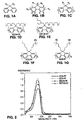
- These polymers are depicted by the first structure in Fig. 1 in which R1 is an aliphatic group which includes at least one heteroatom-containing polar group and R2 is either hydrogen, an alkyl or an aliphatic group which includes at least one heteroatom-containing polar group.
- the monomeric fluorenes upon which these polymers are based have also been discovered as have light emitting diodes and light emitting electrochemical cells incorporating the polymers.
- this invention provides a polyfluorene compound comprising from 3 to 10,000 repeat units of the formula wherein R1 is an aliphatic group including at least one polar heteroatom-containing group which is a cyano-substituted alkyl containing 1 or 2 cyanos on a 4 to 10 carbon atom linear or branched alkyl, or a polyether containing 2 to 5 ether oxygens separated from one another by 1, 2 or 3 carbon alkyl bridges and R2 is selected from the group consisting of R1, hydrogen, and an alkyl of from 1 to 30 carbon atoms.
- R1 is an aliphatic group including at least one polar heteroatom-containing group which is a cyano-substituted alkyl containing 1 or 2 cyanos on a 4 to 10 carbon atom linear or branched alkyl, or a polyether containing 2 to 5 ether oxygens separated from one another by 1, 2 or 3 carbon alkyl bridges and R2 is selected from the group consisting of R1, hydrogen
- These materials can be homopolymers of copolymers and will have values for n ranging from 3 to 10,000.
- this invention provides light-emitting organic solid state devices in which a polyfluorene compound comprising from 3 to 10,000 repeat units of the formula wherein R1 is an aliphatic group including at least one polar heteroatom-containing group and R2 is selected from the group consisting of hydrogen, alkyls and aliphatic groups including at least one polar heteroatom-containing group, is incorporated into a layer of an electrically activated luminescent organic polymer positioned between a hole-injecting electrode and an electron-injecting electrode.
- These devices can be configured as light-emitting diodes or as light-emitting electrochemical cells.
- this invention can take the form of a method for generating light by applying a solid-state device activating voltage across the hole injecting electrode and electron injecting electrodes of one of the light-emitting devices of the invention, thereby giving rise to light emission from the device's layer of electroluminescent organic polymer and detecting the emitted light.
- R1 is an aliphatic group which includes at least 1 heteroatom-containing polar group.
- R1 typically contains at least about 1 carbon in its aliphatic portion and especially from 1 to about 30 carbon atoms and more preferably 1 to 20 carbon atoms.
- a "lower" aliphatic group or alkyl is from about 1 to about 15 atoms in length.
- the aliphatic portion of R1 can be saturated (alkyl) or olefinically unsaturated (alkenyl) and can be linear or branched.
- the heteroatom groups can be pendant from the aliphatic chains and/or can interrupt the aliphatic chains. In the case of interruption, the above-recited carbon lengths are totals for both sides of the interruptions.
- the aliphatic portion may contain up to 3 olefinic unsaturations.
- the polar groups present in R1 can be selected generally from those oxygen-, nitrogen-, sulfur- and phosphorus-containing groups known in the art.
- Representative oxygen-containing groups include ether, hydroxyl, ester, acid and the like.
- Representative nitrogen-containing groups include amine (primary, secondary and tertiary), cyano, amide, imine and the like.
- Representative sulfur-containing groups include sulfonate, sulfate, sulfite, sulfide, thiol, mercapto and the like.
- Representative phosphorus-containing groups include, phosphate, phosphine, phosphazene and the like.
- the polar groups can present cyclization of a portion of the R1 group such as occurs when cyclic ethers are present.
- the R1 group can include mixtures and combinations of these substituents, as well.
- the number of polar groups is at least 1 and typically is 1 to 3 with the exception of ether oxygens where the number is often larger ranging from 1 to 10 and especially 2 to 5.
- R1 groups are cyano-substituted alkyls containing 1 or 2 cyanos on 4 to 10 carbon atom linear or branched alkyls and polyethers containing 2 to 5 ether oxygens separated from one another by 1, 2 or 3 carbon alkyl bridges. These latter materials are particularly preferred for use in LEC structures where the polyether groups present in the R1 chains are polyoxymethylenes, polyethylene oxides or polypropylene oxides all of which are known to be polymer electrolytes and thus suitable for promoting ionic transport in the material. Other polar functionality in the R1 group which promotes ion transport is preferred for fluorene groups destined for use as polymers in the LEC structures.
- R2 can be identical to R1 or it can be a different polar group-containing aliphatic group or it can be hydrogen or an alkyl. If an alkyl, R2 can have from about 1 to about 30 carbons and preferably 1 to about 15 carbons.
- alkyl R2s examples include n and iso butyl, pentyls, both linear and branched, hexyls, octyls, including 2-ethyl hexyl, up through hexadecyls and beyond with and without olefinic unsaturation.
- R1 and R2 groups When these fluorenes are polymerized, the R1 and R2 groups essentially become sidechains off of the polyfluorene core. Thus, the final selection of R1 and R2 groups should take into account the role these sidechains may play in the properties of the final polymer. These properties include electronic properties, solubility properties, processibility properties, film-forming properties, to enhance or to reduce interchain interaction, to induce solubility in organic solvents, to induce compatibility in blends with host polymers, to induce high dielectric constant so as to solvate ions, to enhance ionic mobility, etc.
- the polyfluorenes are commonly produced by polymerizing preformed fluorene units of Formula (A). To do this, the fluorenes of Formula (A) are typically further derivatized to introduce polymerization-enabling leaving groups. These groups are removed during polymerization. Bromo groups are conveniently introduced into the fluorenes and are very suitable leaving groups although other art-known polymerizable groups can be incorporated.
- the fluorene monomers in polymerizable form are depicted in Formula (B) wherein R3 and R4 are the leaving groups.
- polyfluorenes of this invention are depicted generically by Formula (C) in Fig. 1. These polyfluorenes typically have at least 3 repeat units (i.e. n equals at least 3) and can be very large molecules with n ranging as high as 10,000 or greater.
- Molecular weight is not seen to be critical and may vary as desired to achieve other desired properties such as solubility, processibility, formability and the like.
- the polyfluorenes may be homopolymers. They also may be copolymerized with other monomers. Usually copolymerization is used to reduce the cost of materials by reducing the fluorene content.
- Representative copolymer materials include olefin units such as ethylene, propylene or the like, aromatic units such as styrene, ester units and the like.
- the relative weight proportion of comonomer units will range from 100:0 (for a pure polyfluorene homopolymer) to about 10:90 for a highly diluted material. This lower level can be varied, as desired, of course.
- fluorenes and polyfluorenes are prepared as illustrated in the Examples with feed stocks being varied as will be apparent to achieve the range of materials contemplated.
- polymer light-emitting diodes comprise an electron injecting contact, for example a relatively low work function metal (Ca, Al, or the like) as one electrode on the front of a semiconducting and luminescent conjugated polymer film comprising the present polyfluorenes.
- This luminescent polymer film has, in turn been deposited on a substrate which has been partially coated with a layer of transparent conducting material with higher work function (high ionization potential) to serve as the second (transparent) electron-withdrawing electrode.
- This configuration is well known for polymer LEDs (D. Braun and A.J. Heeger, Appl. Phys. Lett. 58, 1982 (1991)).
- any low work function (low ionization potential) conducting material can be used as the electron injecting contact.
- any relatively high work function (high ionization potential) transparent conducting material such as for example, ITO or polyaniline (PANI) in the conductive emeraldine salt form, can be used as the second (transparent) electron-withdrawing (or hole injecting) electrode.
- Typical film thicknesses of the polyfluorene-containing semi-conductive and luminescent polymers range from about 10nm to a millimeter or so. More commonly thickness is in the range of from a 20 nm to a 1,000 nm. Although the active film thicknesses are not critical, device performance can typically be improved by using the thinner films.
- the polyfluorenes can be the sole luminescent polymer in the film or it can be combined with other materials known heretofore.
- the low work function metal electrode is typically vacuum evaporated onto the top surface of the active organic layer.
- Useful metals are well known in the art and include, for example pure metals such as Ca, Al, and In, as well as low work function metal alloys such as Ag:Mg, and Al:Li. Any low work function (low ionization potential) conducting material can be used in place of a conventional metal as the electron injecting contact.
- the thickness of the electron injecting electrode film is not critical and can be adjusted to achieve the desired surface resistance (surface resistance or sheet resistance is defined as the resistivity divided by the thickness).
- an ionically conductive species is present with the polyfluorene luminescent polymer.
- the proportions of polyfluorene and ionic species source in an LEC active layer can vary throughout the range which permits light to be emitted, for example from about 0.1:0.9 to about 0.9:0.1 on a weight basis. At the present time ranges of from about 0.2:0.8 to about 0.8:0.2 and especially from about 0.3:0.7 to about 0.7:0.3 are preferred.
- Ionic species may be provided by incorporation in the composite material of an electrolyte, by which is meant an ionically bound positively charged cation and negatively charged anion which ionize in a solvent or other suitable medium to render said solvent or medium electrically conducting.
- suitable representative salts have cations which include the singly ionized alkali metals, ions of polyvalent metals, metallo-organic cations, and organic cations, and the like.
- the ionic species are provided by a polymer electrolyte.
- Polymer electrolytes are well known in the art (see, e.g., K.M. Abraham, Highly Conductive Polymer Electrolytes in Applications of Electroactive Polymers , B. Scrosati ed., Chapman & Hall, London, 1993) and consist of salt complexes of high polymers containing optimally spaced electron donor atoms or moieties which coordinately bond with the cation of the salt.
- Suitable examples of such polymers include poly(ethylene oxide), poly(propylene oxide), poly(dimethyl siloxane), polyoxymethylene, poly(epichlorohydran), poly(phosphazene), poly[bis-(methoxyethoxyethoxy)phosphazene], polyoxetane, polytetrahydrofuran, poly(1,3-dioxolane), poly(ethylene imine), poly(ethylene succinate), poly(ethylene sulfide), poly(propylene sulfide), poly[oligo(oxyethylene) methacrylate], poly[oligo(oxyethylene) cyclotrisphosphazene] and the like, and mixtures thereof. These materials can be added to the luminescent layer.
- R1 and R2 Their functionality can, at least in part, be provided by the polar group-containing R1 and R2 groups present on the polyfluorene. It will be appreciated that the polar groups present in R1 and R2 encompass the monomer units found in these ionically conductive polymers and thus the same functionality can be provided directly by the sidechains.
- the light-emitting devices have contact layers. These layers serve as electrodes for applying the powering voltage across the polyfluorene-containing luminescent layer.
- One of these contacts is typically a low work function layer to serve as an electron-injecting layer.
- the other is of higher work function and is the hole injector.
- These electrodes may be placed in contact with the layer of polyfluorene material by processing the polyfluorene into a layer on a substrate bearing one electrode and then depositing a second electrode on the free surface of the layer.
- any material capable of forming an electrical pathway for the powering voltage to the polyfluorene layer may be employed as these contact layers.
- Typical materials include metals such as aluminum, silver, platinum, gold, palladium, tungsten, indium, copper, iron, nickel, zinc, lead and the like; metal oxides such as lead oxide, tin oxide, and the like; graphite; doped inorganic semiconductors such as silicon, germanium, gallium arsenide, and the like; and doped conducting polymers such as polyaniline, polypyrrole, polythiophene, and the like.
- At least one electrode consists of a semitransparent conductive material such as indium tin oxide, tin oxide, nickel, gold, doped polyaniline, doped polypyrrole, and the like.
- a semitransparent conductive material such as indium tin oxide, tin oxide, nickel, gold, doped polyaniline, doped polypyrrole, and the like.
- such electrodes have a sheet resistance of about 10 to 1000 ohms per square and an optical transmittance of about 80% or greater for wavelengths longer than about 400 nm.
- Suitable substrates may be rigid or mechanically flexible and include glass, metals and alloys, and plastics.
- ITO has been the most commonly used transparent electrode for polymer LED's.
- PANI in the emeraldine salt form prepared according to U.S. Patent Nos. 5,232,631 and 5,470,505, U.S. Patent Application Serial Nos. 07/800,555 and 07/800,559, and in Appl. Phys. Lett. 60, 2711 (1992) has a higher work function than ITO (Y. Yang and A.J. Heeger, Appl. Phys. Lett. 64, 1245 (1994)), and therefore provides better hole injection into the polymer active layer.
- the surface resistance of a very thin PANI film often is too high for some applications.
- Both the polymer LED and the polymer LEC require semiconducting (conjugated) polymer in the active electroluminescent layer.
- preferred semiconducting (conjugated) polymers must exhibit a high quantum efficiency for photoluminescence.
- preferred semiconducting (conjugated) polymers must exhibit high stability, particularly stability against degradation because the shelf life and operating life of LEC and LED devices is ultimately dependent upon the stability of the active electroluminescent layer.
- the present polyfluorenes offer these advantages.
- Stable, high quantum efficiency photoluminescent polymers are also important for applications which do not involve electroluminescence. Such materials have been demonstrated to be useful, for example, in dye lasers (D. Moses, U.S. Patent Application Serial No. 07/904,731). More generally, luminescent materials with high photoluminescent efficiency are useful in a variety of display applications.
- Thin films spin cast from a solution in tetrahydrofuan has a UV-Vis absorption peak at 378 nm, photoluminescent emission peaks at 430 and 450 nm, and photoluminescence quantum efficiency about 75 % (relative to a dilute solution of coumarin 480 in ethanol whose quantum efficiency was reported to be 93%).
- Thin films spin cast from a solution in tetrahydrofuan has a UV-Vis absorption peak at 378 nm, photoluminescent emission peaks at 428, 450, and 525 nm, and photoluminescence quantum efficiency about 64% (relative to a dilute solution of coumarin 480 in ethanol whose quantum efficiency was reported to be 93%).
- Thin films spin cast from a solution in tetrahydrofuan has a UV-Vis absorption peak at 378 nm, photoluminescent emission peaks at 425, 450, and 525 nm, and photoluminescence quantum efficiency about 45% (relative to a dilute solution of coumarin 480 in ethanol whose quantum efficiency was reported to be 93%).
- the polyfluorenes BDOH-PF, EHTOD-PF, BCN-PF, and HCN-PF are soluble in tetrahydrofuran, chloroform, chlorobenzene, toluene, N,N-dimethylformamide, N,N-dimethylacetamide, cyclopentanone, cyclohexanone, pyridine, and the like, up to a concentration of 1 gram of polymer per 10 ml of solvent.
- the resulting solutions are clear and colorless or light yellow.
- the solutions were used to spin-cast and dip-coat thin films which were colorless or light yellow and transparent. No crystal particles or other particles in the films were observed under an optical microscope.
- the polymer solutions of the concentration 2 gram polymer per 100 ml of tetrahydrofuran were used to spin cast thin films on glass substrates.
- the spin speed was 1000 to 3000 rpm.
- the UV-visible absorption spectra of these thin films were taken and are displayed in Fig. 2.
- the absorption of the films in the visible range is small, confirming the transparency of the films.
- the absorption peaks are in the same range (378-380 nm), almost independent of the side groups.
- the photoluminescence spectra of the films described in example 13 were taken using a CCD array spectrophotometer.
- the emission color was blue-green for HCN-PF, green-blue for BCN-PF, sky blue for BDOH-PF, and blue for EHTOD-PF.
- the photoluminescence quantum efficiency of these films were determined by using an integrating sphere to measure the total power of the emitted light from the samples; the resulting quantum efficiencies are shown in the Table below.
- Light-emitting electrochemical cells were fabricated using BDOH-PF on a transparent, indium-tin oxide (ITO) coated glass substrate.
- a solution of 2% PF in cyclopentanone was prepared.
- the PF polymer to Li salt concentration are kept at 5.6:1 ratio.
- Polymer films of BDOH-PF were spin-cast onto the ITO/glass substrates, with film thicknesses approx. 100-150 nm.
- Aluminum electrode were vacuum deposited onto the BDOH-PF films at 1.33 x 10 -4 Pa (10 -6 torr) vacuum.
- the device area was about 12mm 2 .
- the LECs prepared in this way using BDOH-PF were uniform and bright. The operating lifetime was more than ten hours. LECs fabricated with this structure emitted sky blue light at a bias voltage greater than 2.8 V and reached 200 cd/m 2 at 3.1 V and greater than 1000 cd/m 2 at 3.5 V. The measured external quantum efficiency of device was approx. 4% photons per electron injected. The power efficiency was approx. 12 lumen per watt.
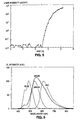
- the EL color changed to white.
- the device quantum efficiency was approx 2.5% photons/electron (external). This is the highest reported quantum efficiency of any organic/polymer white light-emitting device.
- the EL spectra of the white light-emitting LEC are shown in Fig. 6. EL spectra with RGB color filters are also shown.
- Light-emitting diodes were fabricated with BDOH-PF using ITO as the anode and calcium as the cathode; i.e. ITO/BDOH-PF/Ca.
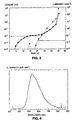
- the BDOH-PF film was spin-cast at room temperature from CHCl 3 solution with 20mg/1ml ratio. Light emission was observed in forward bias for V greater than 15 V. The luminance reached 650 cd/m 2 at 40 V (approx. 130 mA/cm 2 ).
- the EL efficiency is greater than 0.5% for current greater than 1 mA/cm 2 , as shown in Fig. 3.
- Example 17 was repeated with a relatively thin BDOH-PF film.
- the operation voltage of this device was reduced significantly. Light emission was detected for V>5V; the intensity reached 500 cd/m 2 at approx. 20 V.
- Example 17 was repeated and the electroluminescence (EL) emission spectrum was measured as shown in Fig. 4.
- the EL emission has broader distribution than PL; the EL was shifted toward the yellow/red region relative to the photoluminescence spectrum.
- Devices were fabricated with a PVK hole transport layer between the anode and the BDOH-PF layer; i.e. in the configuration ITO/PVK/BDOH-PF/Ca. Similar device performance (I-V, L-V, and device efficiency) were observed as described in Examples 17, 18, 19.
- HEH-PF Poly[9-hexyl-9-(2'-ethyl;hexyl)-fluorene-2,7-diyl), (HEH-PF) was synthesized in a similar manner to HCN-PF as described in example 12. LEDs were fabricated with HEH-PF using ITO as the anode and calcium as the cathode; i.e. ITO/HEH-PF/Ca and ITO/PVK/HEH-PF/Ca. Similar device performance was observed as described in examples 117, 18, 19 and 20. For HEH-PF, the EL emission spectrum covered the entire visible region resulting in white light.
- HEH-PF LEDs emit white light and can be used for full color displays by combining a matrix of the white color LED with a RGB color filter panel.
- LEDs were fabricated with HCN-PF in the configurations of ITO/HCN-PF/Ca and ITO/PVK/HCN-PF/Ca. Similar device performance was observed to that described in examples 17 through 21. The device efficiency was 0.3-0.5% ph/el. Again the EL spectrum was shifted toward the yellow/ red relative to the PL spectrum.
Landscapes
- Chemical & Material Sciences (AREA)
- Organic Chemistry (AREA)
- Physics & Mathematics (AREA)
- Optics & Photonics (AREA)
- Health & Medical Sciences (AREA)
- Chemical Kinetics & Catalysis (AREA)
- Medicinal Chemistry (AREA)
- Polymers & Plastics (AREA)
- Engineering & Computer Science (AREA)
- Materials Engineering (AREA)
- Electroluminescent Light Sources (AREA)
- Polyoxymethylene Polymers And Polymers With Carbon-To-Carbon Bonds (AREA)
Applications Claiming Priority (3)
| Application Number | Priority Date | Filing Date | Title |
|---|---|---|---|
| US61066496A | 1996-03-04 | 1996-03-04 | |
| US610664 | 1996-03-04 | ||
| PCT/US1997/003326 WO1997033323A1 (en) | 1996-03-04 | 1997-03-03 | Polyfluorenes as materials for photoluminescence and electroluminescence |
Publications (2)
| Publication Number | Publication Date |
|---|---|
| EP0885461A1 EP0885461A1 (en) | 1998-12-23 |
| EP0885461B1 true EP0885461B1 (en) | 2003-08-13 |
Family
ID=24445944
Family Applications (1)
| Application Number | Title | Priority Date | Filing Date |
|---|---|---|---|
| EP97907994A Expired - Lifetime EP0885461B1 (en) | 1996-03-04 | 1997-03-03 | Polyfluorenes as materials for photoluminescence and electroluminescence |
Country Status (5)
| Country | Link |
|---|---|
| US (1) | US5900327A (enExample) |
| EP (1) | EP0885461B1 (enExample) |
| JP (2) | JP4112007B2 (enExample) |
| DE (1) | DE69724107T2 (enExample) |
| WO (1) | WO1997033323A1 (enExample) |
Cited By (2)
| Publication number | Priority date | Publication date | Assignee | Title |
|---|---|---|---|---|
| CN109929094A (zh) * | 2018-12-31 | 2019-06-25 | 华南理工大学 | 一种基于蒽并硫氧芴单元的蓝光聚合物发光材料及其制备方法与应用 |
| CN109929095A (zh) * | 2018-12-31 | 2019-06-25 | 华南理工大学 | 一种基于双硫氧吲哚咔唑单元的蓝光共轭聚合物发光材料及其制备方法与应用 |
Families Citing this family (134)
| Publication number | Priority date | Publication date | Assignee | Title |
|---|---|---|---|---|
| US5708130A (en) | 1995-07-28 | 1998-01-13 | The Dow Chemical Company | 2,7-aryl-9-substituted fluorenes and 9-substituted fluorene oligomers and polymers |
| DE69608446T3 (de) * | 1995-07-28 | 2010-03-11 | Sumitomo Chemical Company, Ltd. | 2,7-aryl-9-substituierte fluorene und 9-substituierte fluorenoligomere und polymere |
| JPH1069238A (ja) * | 1996-08-26 | 1998-03-10 | Pioneer Electron Corp | 有機エレクトロルミネッセンス表示装置 |
| EP1367431B1 (en) * | 1996-09-19 | 2005-12-28 | Seiko Epson Corporation | Manufacturing method of a matrix type display device |
| US6309763B1 (en) * | 1997-05-21 | 2001-10-30 | The Dow Chemical Company | Fluorene-containing polymers and electroluminescent devices therefrom |
| JP3514417B2 (ja) * | 1997-09-16 | 2004-03-31 | キヤノン株式会社 | 有機化合物、その重合体および有機電界発光素子 |
| US5777070A (en) * | 1997-10-23 | 1998-07-07 | The Dow Chemical Company | Process for preparing conjugated polymers |
| DE19806037A1 (de) * | 1998-02-13 | 1999-08-19 | Aventis Res & Tech Gmbh & Co | Triptycen-Polymere und -Copolymere |
| GB9805476D0 (en) * | 1998-03-13 | 1998-05-13 | Cambridge Display Tech Ltd | Electroluminescent devices |
| WO1999054943A1 (en) * | 1998-04-21 | 1999-10-28 | The Dow Chemical Company | Organic electroluminescent devices with improved stability in air |
| WO2000006665A1 (en) * | 1998-07-28 | 2000-02-10 | The Dow Chemical Company | Organic electroluminescent devices |
| DE19840943A1 (de) | 1998-09-08 | 2000-03-09 | Aventis Res & Tech Gmbh & Co | Verfahren zur Herstellung von Derivaten des 4-Alkylsulfinylmethylarylenmethanols |
| DE19846766A1 (de) * | 1998-10-10 | 2000-04-20 | Aventis Res & Tech Gmbh & Co | Konjugierte Polymere, enthaltend spezielle Fluorenbausteine mit verbesserten Eigenschaften |
| DE19846768A1 (de) * | 1998-10-10 | 2000-04-20 | Aventis Res & Tech Gmbh & Co | Konjugierte Polymere enthaltend 2,7-Fluorenyleinheiten mit verbesserten Eigenschaften |
| EP1155096B1 (en) | 1999-02-04 | 2005-03-09 | Dow Global Technologies Inc. | Fluorene copolymers and devices made therefrom |
| US6414104B1 (en) | 1999-07-20 | 2002-07-02 | Sri International | Arylamine-substituted poly (arylene vinylenes) and associated methods of preparation and use |
| US6593687B1 (en) | 1999-07-20 | 2003-07-15 | Sri International | Cavity-emission electroluminescent device and method for forming the device |
| GB9920543D0 (en) * | 1999-08-31 | 1999-11-03 | Cambridge Display Tech Ltd | A formulation for depositing a light-emitting polymer layer |
| FR2798379B1 (fr) * | 1999-09-15 | 2003-09-05 | Univ Joseph Fourier | Nouveaux monomeres, polymeres incorporant lesdits monomeres et leurs utilisation au sein de dispositifs organiques electroluminescents |
| US6294245B1 (en) * | 1999-09-22 | 2001-09-25 | Agilent Technologies, Inc. | Method for depositing electrically conducting polymer films via electrochemical deposition of precursor polymers |
| AU1540001A (en) * | 1999-12-09 | 2001-06-18 | Cambridge Display Technology Limited | Fluorene-perylene copolymers and uses thereof |
| US6750835B2 (en) * | 1999-12-27 | 2004-06-15 | Semiconductor Energy Laboratory Co., Ltd. | Image display device and driving method thereof |
| GB0005842D0 (en) * | 2000-03-10 | 2000-05-03 | Cambridge Display Tech Ltd | Copoymer |
| US6887973B2 (en) * | 2000-02-25 | 2005-05-03 | Cambridge Display Technology Limited | Electro-luminescent polymers, their preparation and uses |
| WO2001062822A1 (en) * | 2000-02-25 | 2001-08-30 | Cambridge Display Technology Limited | Electro-luminiscent polymers, their preparation and uses |
| US6858324B2 (en) * | 2000-03-10 | 2005-02-22 | Cambridge Display Technology Limited | Copolymer |
| KR20010095429A (ko) * | 2000-03-30 | 2001-11-07 | 윤덕용 | 단일 이온 전도체를 전자 혹은 정공 주입층으로 이용하는유기/고분자 전기 발광 소자 |
| SG96550A1 (en) | 2000-04-24 | 2003-06-16 | Inst Materials Research & Eng | Blue electroluminescent materials for polymer light-emitting diodes |
| GB2367788A (en) * | 2000-10-16 | 2002-04-17 | Seiko Epson Corp | Etching using an ink jet print head |
| TW474115B (en) * | 2000-11-07 | 2002-01-21 | Helix Technology Inc | Manufacturing method of organic light emitting diode |
| JP2002158089A (ja) * | 2000-11-21 | 2002-05-31 | Toppan Printing Co Ltd | 有機エレクトロルミネッセンス表示素子及びその製造方法 |
| JP4956862B2 (ja) * | 2001-03-23 | 2012-06-20 | Tdk株式会社 | 高分子化合物およびその製造方法と使用法 |
| US7074885B2 (en) * | 2001-05-03 | 2006-07-11 | E.I. Du Pont De Nemours And Company | Electroactive fluorene copolymers and devices made with such polymers |
| US7074886B2 (en) * | 2001-05-07 | 2006-07-11 | E. I. Du Pont De Memours And Company | Electroactive fluorene polymers having perfluoroalkyl groups, process for preparing such polymers and devices made with such polymers |
| KR100424073B1 (ko) * | 2001-05-22 | 2004-03-22 | 한국과학기술연구원 | 관능기를 함유한 플로렌계 화합물, 그 중합체 및 이들을이용한 el 소자 |
| US6723828B2 (en) * | 2001-05-23 | 2004-04-20 | Sri International | Conjugated electroluminescent polymers and associated methods of preparation and use |
| US6856086B2 (en) * | 2001-06-25 | 2005-02-15 | Avery Dennison Corporation | Hybrid display device |
| US6727970B2 (en) | 2001-06-25 | 2004-04-27 | Avery Dennison Corporation | Method of making a hybrid display device having a rigid substrate and a flexible substrate |
| US6649433B2 (en) * | 2001-06-26 | 2003-11-18 | Sigma Technologies International, Inc. | Self-healing flexible photonic composites for light sources |
| WO2003008475A2 (en) | 2001-07-20 | 2003-01-30 | University Of Rochester | Light-emitting organic oligomer compositions |
| US6699597B2 (en) * | 2001-08-16 | 2004-03-02 | 3M Innovative Properties Company | Method and materials for patterning of an amorphous, non-polymeric, organic matrix with electrically active material disposed therein |
| JP2005500653A (ja) * | 2001-08-16 | 2005-01-06 | スリーエム イノベイティブ プロパティズ カンパニー | 電気活性材料が内部に配置された重合性非晶質母材のパターン化方法および材料 |
| US6767446B2 (en) * | 2001-08-24 | 2004-07-27 | Im&T Research, Inc. | Method for preparing polymers containing cyclopentanone structures |
| US10211268B1 (en) | 2012-09-28 | 2019-02-19 | Imaging Systems Technology, Inc. | Large area OLED display |
| WO2003044877A2 (en) * | 2001-11-16 | 2003-05-30 | Cdt Oxford Limited | Light emitting device and compounds for use therein |
| US20030124265A1 (en) * | 2001-12-04 | 2003-07-03 | 3M Innovative Properties Company | Method and materials for transferring a material onto a plasma treated surface according to a pattern |
| US7241512B2 (en) * | 2002-04-19 | 2007-07-10 | 3M Innovative Properties Company | Electroluminescent materials and methods of manufacture and use |
| WO2003090502A2 (en) * | 2002-04-19 | 2003-10-30 | 3M Innovative Properties Company | Materials for organic electronic devices |
| US6936355B2 (en) * | 2002-06-04 | 2005-08-30 | Canon Kabushiki Kaisha | Organic photoluminescent polymers with improved stability |
| US6811815B2 (en) | 2002-06-14 | 2004-11-02 | Avery Dennison Corporation | Method for roll-to-roll deposition of optically transparent and high conductivity metallic thin films |
| US20040004433A1 (en) * | 2002-06-26 | 2004-01-08 | 3M Innovative Properties Company | Buffer layers for organic electroluminescent devices and methods of manufacture and use |
| JP4164317B2 (ja) * | 2002-08-28 | 2008-10-15 | キヤノン株式会社 | 有機発光素子 |
| JP4125076B2 (ja) | 2002-08-30 | 2008-07-23 | キヤノン株式会社 | モノアミノフルオレン化合物およびそれを使用した有機発光素子 |
| US6818919B2 (en) * | 2002-09-23 | 2004-11-16 | Air Products And Chemicals, Inc. | Light emitting layers for LED devices based on high Tg polymer matrix compositions |
| US20040079924A1 (en) * | 2002-10-25 | 2004-04-29 | Korea Kumho Petrochemical Co., Ltd. | Blue light-emitting, ladder-type polymer with excellent heat stability |
| SG111090A1 (en) * | 2002-10-25 | 2005-05-30 | Agency Science Tech & Res | Cationic water-soluble conjugated polymers and their precursors |
| EP1416028A1 (en) | 2002-10-30 | 2004-05-06 | Covion Organic Semiconductors GmbH | New method for the production of monomers useful in the manufacture of semiconductive polymers |
| US6975067B2 (en) * | 2002-12-19 | 2005-12-13 | 3M Innovative Properties Company | Organic electroluminescent device and encapsulation method |
| US6916902B2 (en) * | 2002-12-19 | 2005-07-12 | Dow Global Technologies Inc. | Tricyclic arylamine containing polymers and electronic devices therefrom |
| US6849348B2 (en) * | 2002-12-31 | 2005-02-01 | Eastman Kodak Company | Complex fluorene-containing compounds |
| US20040131881A1 (en) * | 2002-12-31 | 2004-07-08 | Eastman Kodak Company | Complex fluorene-containing compounds for use in OLED devices |
| US7049392B2 (en) * | 2003-02-12 | 2006-05-23 | E. I. Du Pont De Nemour And Company | Electroluminescent copolymers with multi-functional monomers and methods for use thereof |
| US7138483B2 (en) * | 2003-02-12 | 2006-11-21 | E.I. Du Pont De Nemours And Company | Monomers, conjugated polymers and electronic devices using such polymers |
| US20040185302A1 (en) * | 2003-02-12 | 2004-09-23 | Uckert Frank P. | Aromatic polymers with multiple side chains and methods for use thereof |
| US7192657B2 (en) * | 2003-04-15 | 2007-03-20 | 3M Innovative Properties Company | Ethynyl containing electron transport dyes and compositions |
| US7271406B2 (en) * | 2003-04-15 | 2007-09-18 | 3M Innovative Properties Company | Electron transport agents for organic electronic devices |
| KR100561699B1 (ko) * | 2003-04-22 | 2006-03-17 | 한국과학기술연구원 | 폴리아릴렌계 화합물과 그 중합체 및 이들을 이용한 el소자 |
| US7014925B2 (en) * | 2003-04-29 | 2006-03-21 | Canon Kabushiki Kaisha | Heterogeneous spiro compounds in organic light emitting device elements |
| US6853134B2 (en) * | 2003-05-20 | 2005-02-08 | Canon Kabushiki Kaisha | Anode structure for organic light emitting device |
| JP4846191B2 (ja) * | 2003-06-04 | 2011-12-28 | 住友化学株式会社 | 色変換膜および発光装置 |
| JP4576918B2 (ja) * | 2003-07-31 | 2010-11-10 | 住友化学株式会社 | 高分子化合物およびそれを用いた高分子発光素子 |
| JP5219371B2 (ja) | 2003-09-17 | 2013-06-26 | ザ リージェンツ オブ ザ ユニバーシティ オブ カリフォルニア | 可溶性共役ポリマーを含む方法及びデバイス |
| KR100773522B1 (ko) * | 2003-10-02 | 2007-11-07 | 삼성에스디아이 주식회사 | 사이클로펜타페난트렌계 화합물 및 이를 이용한 유기 전계발광 소자 |
| KR100718101B1 (ko) * | 2003-10-29 | 2007-05-14 | 삼성에스디아이 주식회사 | 나노 금속 입자를 이용한 전계 발광 소자 |
| JP2007511889A (ja) * | 2003-11-18 | 2007-05-10 | スリーエム イノベイティブ プロパティズ カンパニー | カラーフィルタを含むエレクトロルミネセンスデバイスの製造方法 |
| KR101193201B1 (ko) * | 2003-11-18 | 2012-10-19 | 삼성디스플레이 주식회사 | 색 전환 소자를 포함하는 전기발광 장치 및 전기발광 장치의 제조 방법 |
| US20090160325A1 (en) * | 2003-12-16 | 2009-06-25 | Panasonic Corporation | Organic electroluminescent device and method for manufacturing the same |
| EP1695396B1 (en) | 2003-12-16 | 2009-06-03 | Panasonic Corporation | Organic electroluminescent device and method for manufacturing the same |
| KR100718104B1 (ko) * | 2004-01-15 | 2007-05-14 | 삼성에스디아이 주식회사 | 스피로사이클로펜타페난트렌플루오렌계 화합물 및 이를이용한 유기 전계 발광 소자 |
| KR100773525B1 (ko) * | 2004-02-06 | 2007-11-05 | 삼성에스디아이 주식회사 | 티에노[3,2-b]인돌계 고분자 및 이를 이용한 유기 전계발광 소자 |
| US8129906B1 (en) | 2004-04-26 | 2012-03-06 | Imaging Systems Technology, Inc. | Lumino-shells |
| JP5909314B2 (ja) | 2004-09-03 | 2016-04-26 | ザ リージェンツ オブ ザ ユニバーシティ オブ カリフォルニア | 可溶性共役ポリマーを使用する方法及びデバイス |
| JP2008512523A (ja) * | 2004-09-03 | 2008-04-24 | ザ リージェンツ オブ ザ ユニバーシティ オブ カリフォルニア | 可溶性共役ポリマー |
| DE112005002495B4 (de) | 2004-10-11 | 2016-11-17 | Cambridge Display Technology Ltd. | Polares halbleitendes Lochtransportmaterial |
| US7537884B2 (en) * | 2004-10-20 | 2009-05-26 | National Taiwan University | Method for forming self-synthesizing conductive or conjugated polymer film and application |
| US7315042B2 (en) * | 2004-11-18 | 2008-01-01 | 3M Innovative Properties Company | Semiconductors containing trans-1,2-bis(acenyl)ethylene compounds |
| US20060105199A1 (en) * | 2004-11-18 | 2006-05-18 | 3M Innovative Properties Company | Electroluminescent devices containing trans-1,2-bis(acenyl)ethylene compounds |
| JP5239116B2 (ja) * | 2004-11-19 | 2013-07-17 | 住友化学株式会社 | 高分子発光体組成物および高分子発光素子 |
| US7960037B2 (en) * | 2004-12-03 | 2011-06-14 | The Regents Of The University Of California | Carbon nanotube polymer composition and devices |
| US20060131567A1 (en) * | 2004-12-20 | 2006-06-22 | Jie Liu | Surface modified electrodes and devices using reduced organic materials |
| US20060142520A1 (en) * | 2004-12-27 | 2006-06-29 | 3M Innovative Properties Company | Hole transport layers for organic electroluminescent devices |
| US8569948B2 (en) * | 2004-12-28 | 2013-10-29 | Samsung Display Co., Ltd. | Electroluminescent devices and methods of making electroluminescent devices including an optical spacer |
| US20060181203A1 (en) * | 2005-02-16 | 2006-08-17 | Hsin-Fei Meng | Voltage-tuning multi-layer full-color conjugated polymer LED |
| DE112006000495B4 (de) | 2005-03-01 | 2017-11-09 | The Regents Of The University Of California | Mehrschichtige Licht emittierende Polymer-Diode für Festkörper Beleuchtungs-Anwendungen |
| US7645478B2 (en) * | 2005-03-31 | 2010-01-12 | 3M Innovative Properties Company | Methods of making displays |
| CA2611823C (en) | 2005-06-16 | 2013-07-30 | Nektar Therapeutics Al, Corporation | Conjugates having a degradable linkage and polymeric reagents useful in preparing such conjugates |
| JP4857789B2 (ja) * | 2006-02-01 | 2012-01-18 | 株式会社日立製作所 | 燃料電池、それに用いる高分子電解質及びイオン交換性樹脂 |
| EP1982561B1 (en) * | 2006-02-08 | 2015-07-29 | 3M Innovative Properties Company | Method for manufacturing a film substrate at a temperature above its glass transition temperature |
| US20070241665A1 (en) * | 2006-04-12 | 2007-10-18 | Matsushita Electric Industrial Co., Ltd. | Organic electroluminescent element, and manufacturing method thereof, as well as display device and exposure apparatus using the same |
| US20080015269A1 (en) * | 2006-04-17 | 2008-01-17 | Bazan Guillermo C | Hybrid polymer light-emitting devices |
| US20070290604A1 (en) * | 2006-06-16 | 2007-12-20 | Matsushita Electric Industrial Co., Ltd. | Organic electroluminescent device and method of producing the same |
| JP4910518B2 (ja) * | 2006-07-05 | 2012-04-04 | 富士ゼロックス株式会社 | 有機電界発光素子の製造方法 |
| KR100857010B1 (ko) | 2006-07-28 | 2008-09-04 | 호서대학교 산학협력단 | 황색 발광 화합물 및 그를 포함하는 유기 전계 발광 소자 |
| US8288508B2 (en) * | 2006-09-01 | 2012-10-16 | Carnegie Mellon University | Universal grignard metathesis polymerization |
| JP5420414B2 (ja) * | 2006-10-06 | 2014-02-19 | シリゲン グループ リミテッド | 指向性バイオマーカシグナル増幅用の蛍光方法および材料 |
| GB2442724B (en) * | 2006-10-10 | 2009-10-21 | Cdt Oxford Ltd | Light emissive device |
| US8697254B2 (en) * | 2006-11-14 | 2014-04-15 | Sri International | Cavity electroluminescent devices and methods for producing the same |
| JP5552433B2 (ja) * | 2008-01-24 | 2014-07-16 | エスアールアイ インターナショナル | 高効率エレクトロルミネセント素子およびそれを生産するための方法 |
| US8951646B2 (en) * | 2008-03-07 | 2015-02-10 | Sumitomo Chemical Company, Limited | Layered structure comprising a layer containing a conjugated polymer compound |
| KR101646770B1 (ko) * | 2008-03-31 | 2016-08-08 | 카운슬 오브 사이언티픽 앤드 인더스트리얼 리서치 | 신규의 공여체-수용체 플루오렌 스캐폴드, 이의 제조방법 및 용도 |
| JP5515542B2 (ja) * | 2008-10-06 | 2014-06-11 | 住友化学株式会社 | 含窒素複素環構造を含む高分子化合物 |
| US8410243B2 (en) * | 2008-12-17 | 2013-04-02 | The Governors Of The University Of Alberta | Aromatic ether-containing fluorene monomers, processes for their preparation and polymerization thereof |
| DE102009030848A1 (de) | 2009-06-26 | 2011-02-03 | Merck Patent Gmbh | Polymere enthaltend Struktureinheiten, die Alkylalkoxygruppen aufweisen, Blends enthaltend diese Polymere sowie optoelektronische Vorrichtungen enthaltend diese Polymere und Blends |
| US20110077373A1 (en) * | 2009-09-29 | 2011-03-31 | General Electric Company | Polymer and optoelectronic device comprising the same |
| SE534257C2 (sv) | 2009-10-28 | 2011-06-21 | Lunavation Ab | En ljusemitterande elektrokemisk anordning, ett system innefattande en sådan anordning samt användning av en sådan anordning |
| KR101840481B1 (ko) * | 2009-12-09 | 2018-03-20 | 메르크 파텐트 게엠베하 | 치료적 및 미용적 전계발광 조성물 |
| JP5138733B2 (ja) * | 2010-06-14 | 2013-02-06 | 双葉電子工業株式会社 | 高分子化合物およびその製造方法と使用法 |
| GB201122316D0 (en) | 2011-12-23 | 2012-02-01 | Cambridge Display Tech Ltd | Polymer, polymer composition and organic light-emitting device |
| JP5883570B2 (ja) * | 2011-03-25 | 2016-03-15 | 国立大学法人横浜国立大学 | 積層構造体 |
| JP6223961B2 (ja) * | 2011-05-12 | 2017-11-01 | メルク パテント ゲーエムベーハー | 有機イオン性機能材料、組成物および電子素子 |
| WO2013133359A1 (ja) | 2012-03-09 | 2013-09-12 | 国立大学法人九州大学 | 発光材料および有機発光素子 |
| US9024526B1 (en) | 2012-06-11 | 2015-05-05 | Imaging Systems Technology, Inc. | Detector element with antenna |
| US10211409B2 (en) | 2014-02-02 | 2019-02-19 | Molecular Glasses, Inc. | Noncrystallizable sensitized layers for OLED and OEDs |
| WO2015146912A1 (ja) * | 2014-03-28 | 2015-10-01 | 日産化学工業株式会社 | フルオレン誘導体及びその利用 |
| CN106103649A (zh) | 2014-03-31 | 2016-11-09 | 默克专利有限公司 | 白光发射 |
| WO2016125834A1 (ja) * | 2015-02-06 | 2016-08-11 | Jxエネルギー株式会社 | 発光組成物、発光電気化学素子、及び発光装置 |
| GB2539404A (en) * | 2015-06-15 | 2016-12-21 | Cambridge Display Tech Ltd | Organic diode |
| JP6564649B2 (ja) * | 2015-08-20 | 2019-08-21 | Jxtgエネルギー株式会社 | 発光電気化学素子及び該発光電気化学素子を有する発光装置 |
| CN108603045B (zh) | 2016-01-08 | 2021-02-02 | 加拿大国家研究委员会 | 亲水性半导体性单壁碳纳米管油墨 |
| GB2551026B (en) | 2016-04-27 | 2020-08-19 | Neudrive Ltd | Semiconducting compositions comprising semiconducting polymers |
| TW201842087A (zh) | 2017-02-08 | 2018-12-01 | 加拿大國家研究委員會 | 具改良之熱穩定性的分子油墨 |
| TWI874294B (zh) | 2017-02-08 | 2025-03-01 | 加拿大國家研究委員會 | 可印刷分子油墨 |
| TWI842668B (zh) | 2017-02-08 | 2024-05-21 | 加拿大國家研究委員會 | 具低黏度與低加工溫度之銀分子油墨 |
| CN115260454B (zh) * | 2022-06-23 | 2023-10-13 | 东华理工大学 | 一种聚芴型共轭聚电解质及其制备方法和应用 |
Citations (1)
| Publication number | Priority date | Publication date | Assignee | Title |
|---|---|---|---|---|
| WO1997005184A1 (en) * | 1995-07-28 | 1997-02-13 | The Dow Chemical Company | 2,7-aryl-9-substituted fluorenes and 9-substituted fluorene oligomers and polymers |
Family Cites Families (4)
| Publication number | Priority date | Publication date | Assignee | Title |
|---|---|---|---|---|
| FR2603288B1 (fr) * | 1986-09-03 | 1988-12-09 | France Etat | Polyfluorenes 9,9'-disubstitues, leur procede de preparation et leurs applications en electro-optique et electrochimie |
| JPH02269734A (ja) * | 1989-04-11 | 1990-11-05 | Idemitsu Kosan Co Ltd | ポリフェニレン系重合体およびその製造法 |
| WO1995001871A1 (en) * | 1993-07-09 | 1995-01-19 | The Regents Of The University Of California | Electroluminescent diodes utilizing blends of polymers |
| US5708130A (en) * | 1995-07-28 | 1998-01-13 | The Dow Chemical Company | 2,7-aryl-9-substituted fluorenes and 9-substituted fluorene oligomers and polymers |
-
1997
- 1997-03-03 WO PCT/US1997/003326 patent/WO1997033323A1/en not_active Ceased
- 1997-03-03 JP JP53188297A patent/JP4112007B2/ja not_active Expired - Fee Related
- 1997-03-03 EP EP97907994A patent/EP0885461B1/en not_active Expired - Lifetime
- 1997-03-03 DE DE69724107T patent/DE69724107T2/de not_active Expired - Lifetime
- 1997-11-05 US US08/968,852 patent/US5900327A/en not_active Expired - Lifetime
-
2007
- 2007-08-22 JP JP2007216523A patent/JP2007321163A/ja not_active Withdrawn
Patent Citations (1)
| Publication number | Priority date | Publication date | Assignee | Title |
|---|---|---|---|---|
| WO1997005184A1 (en) * | 1995-07-28 | 1997-02-13 | The Dow Chemical Company | 2,7-aryl-9-substituted fluorenes and 9-substituted fluorene oligomers and polymers |
Cited By (2)
| Publication number | Priority date | Publication date | Assignee | Title |
|---|---|---|---|---|
| CN109929094A (zh) * | 2018-12-31 | 2019-06-25 | 华南理工大学 | 一种基于蒽并硫氧芴单元的蓝光聚合物发光材料及其制备方法与应用 |
| CN109929095A (zh) * | 2018-12-31 | 2019-06-25 | 华南理工大学 | 一种基于双硫氧吲哚咔唑单元的蓝光共轭聚合物发光材料及其制备方法与应用 |
Also Published As
| Publication number | Publication date |
|---|---|
| JP2007321163A (ja) | 2007-12-13 |
| JP4112007B2 (ja) | 2008-07-02 |
| DE69724107D1 (de) | 2003-09-18 |
| JP2000506916A (ja) | 2000-06-06 |
| EP0885461A1 (en) | 1998-12-23 |
| US5900327A (en) | 1999-05-04 |
| DE69724107T2 (de) | 2004-06-24 |
| WO1997033323A1 (en) | 1997-09-12 |
Similar Documents
| Publication | Publication Date | Title |
|---|---|---|
| US5900327A (en) | Polyfluorenes as materials for photoluminescence and electroluminescence | |
| Kraft et al. | Electroluminescent conjugated polymers—seeing polymers in a new light | |
| Chung et al. | Highly efficient light‐emitting diodes based on an organic‐soluble poly (p‐phenylenevinylene) derivative carrying the electron‐transporting PBD moiety | |
| EP1010359B1 (en) | Color variable bipolar/ac light-emitting devices | |
| US8308978B2 (en) | Polymer matrix electroluminescent materials and devices | |
| US8206838B2 (en) | Polymer matrix electroluminescent materials and devices | |
| JP4622022B2 (ja) | 高分子発光素子ならびにそれを用いた表示装置および面状光源 | |
| EP0915754A1 (en) | Light-emitting devices containing network electrode polymers in electron blocking layer | |
| CN1768093B (zh) | 聚合物 | |
| KR20090074795A (ko) | 발광 소자 | |
| KR20020069199A (ko) | 고효율 픽셀화 중합체 전자 디스플레이에 유용한 고저항의폴리아닐린 | |
| Stephan et al. | Blue-green light-emitting diodes and electrochemical cells based on a copolymer derived from fluorene | |
| US20080265756A1 (en) | Conductive Polymer Compositions in Opto-Electrical Devices | |
| Sohn et al. | Synthesis and luminescence properties of poly [2-(9, 9-dihexylfluorene-2-yl)-1, 4-phenylenevinylene] and its copolymers containing 2-(2-ethylhexyloxy)-5-methoxy-1, 4-phenylenevinylene units | |
| Tao et al. | Novel main-chain poly-carbazoles as hole and electron transport materials in polymer light-emitting diodes | |
| AU3742797A (en) | Light-emitting devices utilizing high workfunction electrodes | |
| EP2016112B1 (en) | Opto-electrical polymers and devices | |
| US20110168987A1 (en) | Organic Electronic Device | |
| WO1998040899A9 (en) | Bilayer polymer electroluminescent device featuring interface electroluminescence | |
| AU6554898A (en) | Bilayer polymer electroluminescent device featuring interface electroluminescence | |
| Jang et al. | Mechanism of enhanced quantum efficiency in light-emitting diode based on a poly (p-phenylenevinylene) derivative | |
| Chuah et al. | New conjugated polymers for light-emitting diodes | |
| Wang et al. | Direct and Alternating Current Light-Emitting Devices Based on Pyridine-Containing Conjugated Polymers | |
| Epstein et al. | Direct and Alternating Current Light-Emitting Devices Based on Pyridine-Containing Conjugated Polymers | |
| HK1107874B (en) | Light emissive device |
Legal Events
| Date | Code | Title | Description |
|---|---|---|---|
| PUAI | Public reference made under article 153(3) epc to a published international application that has entered the european phase |
Free format text: ORIGINAL CODE: 0009012 |
|
| 17P | Request for examination filed |
Effective date: 19980820 |
|
| AK | Designated contracting states |
Kind code of ref document: A1 Designated state(s): DE FR GB NL |
|
| 17Q | First examination report despatched |
Effective date: 20010731 |
|
| RAP1 | Party data changed (applicant data changed or rights of an application transferred) |
Owner name: DUPONT DISPLAYS, INC. |
|
| RIC1 | Information provided on ipc code assigned before grant |
Free format text: 7H 01L 33/00 A, 7H 01L 51/30 B, 7C 08G 61/00 B, 7C 09K 11/06 B |
|
| GRAH | Despatch of communication of intention to grant a patent |
Free format text: ORIGINAL CODE: EPIDOS IGRA |
|
| GRAH | Despatch of communication of intention to grant a patent |
Free format text: ORIGINAL CODE: EPIDOS IGRA |
|
| GRAA | (expected) grant |
Free format text: ORIGINAL CODE: 0009210 |
|
| AK | Designated contracting states |
Designated state(s): DE FR GB NL |
|
| REG | Reference to a national code |
Ref country code: GB Ref legal event code: FG4D |
|
| REF | Corresponds to: |
Ref document number: 69724107 Country of ref document: DE Date of ref document: 20030918 Kind code of ref document: P |
|
| ET | Fr: translation filed | ||
| PLBE | No opposition filed within time limit |
Free format text: ORIGINAL CODE: 0009261 |
|
| STAA | Information on the status of an ep patent application or granted ep patent |
Free format text: STATUS: NO OPPOSITION FILED WITHIN TIME LIMIT |
|
| 26N | No opposition filed |
Effective date: 20040514 |
|
| PGFP | Annual fee paid to national office [announced via postgrant information from national office to epo] |
Ref country code: NL Payment date: 20060305 Year of fee payment: 10 |
|
| PGFP | Annual fee paid to national office [announced via postgrant information from national office to epo] |
Ref country code: FR Payment date: 20060308 Year of fee payment: 10 |
|
| GBPC | Gb: european patent ceased through non-payment of renewal fee |
Effective date: 20070303 |
|
| NLV4 | Nl: lapsed or anulled due to non-payment of the annual fee |
Effective date: 20071001 |
|
| REG | Reference to a national code |
Ref country code: FR Ref legal event code: ST Effective date: 20071130 |
|
| PG25 | Lapsed in a contracting state [announced via postgrant information from national office to epo] |
Ref country code: NL Free format text: LAPSE BECAUSE OF NON-PAYMENT OF DUE FEES Effective date: 20071001 |
|
| PG25 | Lapsed in a contracting state [announced via postgrant information from national office to epo] |
Ref country code: GB Free format text: LAPSE BECAUSE OF NON-PAYMENT OF DUE FEES Effective date: 20070303 |
|
| PG25 | Lapsed in a contracting state [announced via postgrant information from national office to epo] |
Ref country code: FR Free format text: LAPSE BECAUSE OF NON-PAYMENT OF DUE FEES Effective date: 20070402 |
|
| PGFP | Annual fee paid to national office [announced via postgrant information from national office to epo] |
Ref country code: GB Payment date: 20060301 Year of fee payment: 10 |
|
| PGFP | Annual fee paid to national office [announced via postgrant information from national office to epo] |
Ref country code: DE Payment date: 20140417 Year of fee payment: 18 |
|
| REG | Reference to a national code |
Ref country code: DE Ref legal event code: R119 Ref document number: 69724107 Country of ref document: DE |
|
| PG25 | Lapsed in a contracting state [announced via postgrant information from national office to epo] |
Ref country code: DE Free format text: LAPSE BECAUSE OF NON-PAYMENT OF DUE FEES Effective date: 20151001 |