EP0873983B1 - Process for decomposition of cumene hydroperoxide - Google Patents
Process for decomposition of cumene hydroperoxide Download PDFInfo
- Publication number
- EP0873983B1 EP0873983B1 EP98112218A EP98112218A EP0873983B1 EP 0873983 B1 EP0873983 B1 EP 0873983B1 EP 98112218 A EP98112218 A EP 98112218A EP 98112218 A EP98112218 A EP 98112218A EP 0873983 B1 EP0873983 B1 EP 0873983B1
- Authority
- EP
- European Patent Office
- Prior art keywords
- chp
- decomposition
- acetone
- reactor
- reaction
- Prior art date
- Legal status (The legal status is an assumption and is not a legal conclusion. Google has not performed a legal analysis and makes no representation as to the accuracy of the status listed.)
- Expired - Lifetime
Links
Images
Classifications
-
- C—CHEMISTRY; METALLURGY
- C07—ORGANIC CHEMISTRY
- C07C—ACYCLIC OR CARBOCYCLIC COMPOUNDS
- C07C45/00—Preparation of compounds having >C = O groups bound only to carbon or hydrogen atoms; Preparation of chelates of such compounds
- C07C45/51—Preparation of compounds having >C = O groups bound only to carbon or hydrogen atoms; Preparation of chelates of such compounds by pyrolysis, rearrangement or decomposition
- C07C45/517—Preparation of compounds having >C = O groups bound only to carbon or hydrogen atoms; Preparation of chelates of such compounds by pyrolysis, rearrangement or decomposition involving transformation of peroxy-compounds to >C = O groups
-
- C—CHEMISTRY; METALLURGY
- C07—ORGANIC CHEMISTRY
- C07C—ACYCLIC OR CARBOCYCLIC COMPOUNDS
- C07C1/00—Preparation of hydrocarbons from one or more compounds, none of them being a hydrocarbon
- C07C1/20—Preparation of hydrocarbons from one or more compounds, none of them being a hydrocarbon starting from organic compounds containing only oxygen atoms as heteroatoms
-
- C—CHEMISTRY; METALLURGY
- C07—ORGANIC CHEMISTRY
- C07C—ACYCLIC OR CARBOCYCLIC COMPOUNDS
- C07C15/00—Cyclic hydrocarbons containing only six-membered aromatic rings as cyclic parts
- C07C15/40—Cyclic hydrocarbons containing only six-membered aromatic rings as cyclic parts substituted by unsaturated carbon radicals
- C07C15/42—Cyclic hydrocarbons containing only six-membered aromatic rings as cyclic parts substituted by unsaturated carbon radicals monocyclic
- C07C15/44—Cyclic hydrocarbons containing only six-membered aromatic rings as cyclic parts substituted by unsaturated carbon radicals monocyclic the hydrocarbon substituent containing a carbon-to-carbon double bond
-
- C—CHEMISTRY; METALLURGY
- C07—ORGANIC CHEMISTRY
- C07C—ACYCLIC OR CARBOCYCLIC COMPOUNDS
- C07C37/00—Preparation of compounds having hydroxy or O-metal groups bound to a carbon atom of a six-membered aromatic ring
- C07C37/08—Preparation of compounds having hydroxy or O-metal groups bound to a carbon atom of a six-membered aromatic ring by decomposition of hydroperoxides, e.g. cumene hydroperoxide
-
- C—CHEMISTRY; METALLURGY
- C07—ORGANIC CHEMISTRY
- C07C—ACYCLIC OR CARBOCYCLIC COMPOUNDS
- C07C45/00—Preparation of compounds having >C = O groups bound only to carbon or hydrogen atoms; Preparation of chelates of such compounds
- C07C45/51—Preparation of compounds having >C = O groups bound only to carbon or hydrogen atoms; Preparation of chelates of such compounds by pyrolysis, rearrangement or decomposition
- C07C45/53—Preparation of compounds having >C = O groups bound only to carbon or hydrogen atoms; Preparation of chelates of such compounds by pyrolysis, rearrangement or decomposition of hydroperoxides
-
- C—CHEMISTRY; METALLURGY
- C07—ORGANIC CHEMISTRY
- C07C—ACYCLIC OR CARBOCYCLIC COMPOUNDS
- C07C2527/00—Catalysts comprising the elements or compounds of halogens, sulfur, selenium, tellurium, phosphorus or nitrogen; Catalysts comprising carbon compounds
- C07C2527/02—Sulfur, selenium or tellurium; Compounds thereof
- C07C2527/053—Sulfates or other compounds comprising the anion (SnO3n+1)2-
- C07C2527/054—Sulfuric acid or other acids with the formula H2Sn03n+1
-
- Y—GENERAL TAGGING OF NEW TECHNOLOGICAL DEVELOPMENTS; GENERAL TAGGING OF CROSS-SECTIONAL TECHNOLOGIES SPANNING OVER SEVERAL SECTIONS OF THE IPC; TECHNICAL SUBJECTS COVERED BY FORMER USPC CROSS-REFERENCE ART COLLECTIONS [XRACs] AND DIGESTS
- Y02—TECHNOLOGIES OR APPLICATIONS FOR MITIGATION OR ADAPTATION AGAINST CLIMATE CHANGE
- Y02P—CLIMATE CHANGE MITIGATION TECHNOLOGIES IN THE PRODUCTION OR PROCESSING OF GOODS
- Y02P20/00—Technologies relating to chemical industry
- Y02P20/50—Improvements relating to the production of bulk chemicals
- Y02P20/52—Improvements relating to the production of bulk chemicals using catalysts, e.g. selective catalysts
Definitions
- Phenol is manufactured commercially by several processes. However one of the key manufacturing processes is air oxidation of cumene to cumene hydroperoxide (CHP) followed by acid catalyzed cleavage of this CHP to phenol and acetone.
- the CHP decomposition is a very exothermic reaction which is normally carried out on a commercial scale in continuous stirred or back-mixed reactors. Generally in such reactors only a small fraction of CHP is unreacted at any given time and the reaction medium consists essentially of the products of decomposition of CHP, i.e. phenol and acetone plus any solvent for example, cumene, carried in the feed stream and other materials added with CHP to the reactor.
- DMBA dimethylbenzyl alcohol
- AP acetophenone
- AMS alphamethylstyrene
- AMS alphamethylstyrene
- This reaction product is then held at that temperature in a conduit for time sufficient to produce a second mixture wherein the CHP concentration is no more than about 0.4%.
- This new reaction mixture is then reacted at a very high temperature, generally between about 120° and about 150°C under plug-flow reaction conditions to convert at least 90% of the DCP to AMS, phenol and acetone.
- This particular set of reactions is known to be kinetically fast and is generally run at a reasonably high temperature in order to obtain the fastest reaction, including the particularly high temperature of the conversion of DCP to AMS, phenol and acetone.
- the actual CHP cleavage reaction initially stated is carried out in a non-isothermal manner and preferably in a multiplicity of sequential reactors, for example a shell-in-tube reactor, generally two to five reactors, particularly three, wherein temperature is maintained over a specific range for each reactor thereby obtaining optimal CHP conversion profile and yield.
- This entire first reaction is controlled by a plug-flow mini-reactor wherein the measurement of temperature difference at the inlet and outlet of the mini reactor is maintained in a certain range.
- This mini reactor is preferably installed as a by-pass on line at the product emitted from the last sequential reactor.
- the total acidic materials then present are the unneutralized strong catalyst and the mild acid reaction product of the amine and the acid catalyst.
- the reaction product between the acidic catalyst, preferably sulfuric acid, and the amine, preferably ammonia appears to have a co-catalytic effect in the environmental milieu although we do not wish to be bound to that observation.
- the strong catalyst When only the strong catalyst is present a maximum of about 90% of the DCP in the feed can be efficiently converted to AMS before tar begins to form. But when a reduced quantity of sulfuric acid and the amine reaction product are present, over 95% of the DCP can be converted without significant loss in AMS selectivity.
- sulfuric acid is reacted with ammonia the reaction product is ammonium hydrogen sulfate.
- a method for enhancing the decomposition of cumene hydroperoxide and producing cumene hydroperoxide decomposition products therefrom wherein the improvement comprises recycling the cumene hydroperoxide decomposition products to a cumene hydroperoxide feedstream in the quantity of from 10-25 times the weight of the cumene hydroperoxide feedstream, and wherein additional acetone is added to the cumene hydroperoxide decomposition products so as to maintain a molar ratio of 1.1 to 1 to 1.5 to 1 acetone to phenol in the cumene hydroperoxide decomposition reaction.
- a further aspect of the invention is a method for enhancing the decomposition of CHP to phenol and acetone which comprises having additional water in the CHP decomposition reactor.
- the cleavage reaction in the manufacture of phenol and acetone from cumene is well known.
- a feed stream of cumene is oxidized to cumene hydroperoxide. It is then passed into a cleavage unit wherein an acid catalyst is added and the CHP is then decomposed to phenol, acetone and other by-products.
- the acidic catalyst employed can be any acidic material. Generally, since corrosion can be a factor, the heavily corrosive inorganic acids such as hydrochloric and hydrobromic are not employed. Certain acids such as phosphoric, sulfuric and SO 2 can be employed. Generally sulfuric acid is preferred in this particular reaction as a catalyst.
- the CHP decomposition reaction is known to be extremely fast and because of its heavily exothermic nature is carried out over a short time period and essentially to completion in most processes. In fact it is common to use a constant boiling or refluxing type system for the isothermal cleavage reaction. This is generally the constant boiling temperature of the CHP feed stream and product mixture present in the cleavage reactor at a given moment. Generally this can vary from 70 to 90°C. Since this is the general CHP feed stream as well as the reactant product, the phenol to acetone molar ratio is essentially 1 to 1 throughout the course of the reaction.
- This quantity of cumene should be from 1 to 20 weight percent of the cleavage reactor composition preferably 10 to 18%.
- the temperature can vary from 45°C to 74°C.
- Pressure is not unduly significant with respect to the chemistry.
- pressure can vary from about one atmosphere to five atmospheres.
- These reactors are generally shell-in-tube heat exchangers and a specific heat exchange surface not less than 30 to 35 meter 2 per metric ton of 100% CHP per hour.
- CHP conversion in a three reactor sequence preferably having 30 to 60% in the first, 25 to 50% in the second and 30 to 10% in the third.
- the acetone fed to the reactors is on the basis of one metric ton of technical CHP according to the algorithm wherein:
- the temperature of the reactions among the three sequentially placed reactors are 50 to 62°C first, 62 to 57°C second, and 57 to 50°C third. These temperatures are below the constant boiling temperature of the CHP decomposition mass thereby decomposing the CHP in a non-isothermal manner. It is preferred to have the reactors controlled by a plug-flow mini-reactor which is located by-pass after the third sequential reactor and through which a portion of the products emitted from the last sequential reactor passes.
- This mini-reactor has a product residence time of generally not more than 3 minutes with a measurement of temperature difference at the inlet and outlet ( ⁇ T), of the mini-reactor maintained at 4 to 16°C, preferably 5 to 15°C.
- This mini-reactor helps to produce products of optimal compositon. Its primary function is to decompose essentially all of the CHP remaining in the effluent passed through the mini-reactor so as to be an analytical indication of the completeness of the CHP decomposition reaction.
- the quantity of catalyst which is present can vary substantially.
- the catalyst quantity is generally from 50 to 750 parts per million of the reactor composition, preferably 150 to 600 ppm.
- the reaction is of relatively short duration throughout the sequential reactors. Generally anywhere from 30 seconds to 3 minutes is appropriate. However optimal conditions when coupled with other optimized parameters are from 45 seconds to 2 minutes.
- One of the significant parameters is the quantity of CHP decomposition product produced in these sequential reactors which is recycled to the CHP feed stream. This recycle stream can vary in amount from 10 to 25 times the mass flow of the CHP feed stream. Not only does this recycle bring about higher selectivity but it also provides a significant safety factor to the process.
- Another factor is the presence of additional water in the CHP decomposition reactors. This is water above the usual amount of water produced in the CHP decomposition reaction. Such water can initially be added in the recycle stream.
- the level of water in the decomposition reactors should not be higher than 3 wt.% of the CHP decomposition mass, preferably no greater than 2 wt.% and is most preferably in the range of 0.8 to 1.2 wt.%.
- the ammonia is added as aqueous ammonia of relatively low concentration, from 0.15 to 10 wt.% ammonia. Generally 10 to 99 wt.% of the original acid catalyst is neutralized, preferably the quantity of catalyst neutralized is from 30 to 70 wt.%.
- H 2 SO 4 is employed as the catalyst or when a specific catalyst such as SO 2 or SO 3 which can react with water present in the reactor and thereby form a sulfurous or sulfuric acid is present, it is preferred to use ammonia as the material to react with the sulfurous or sulfuric acid.
- the reaction product is the weakly acidic salt ammonium hydrogen sulfate. In this particular case it is believed that the ammonium hydrogen sulfate functions as a co-catalyst.
- the invention temperature range is 80-110°C, preferably from 85 to 105°C for a period of 20 to 60 minutes at a pressure range from 0.3 to 5 atmospheres.
- a cooling of the cleavage products by evaporation of acetone in a separate vessel.
- the evaporated acetone condenses under vacuum for example, 0.25 to 0.9 of one atmosphere and an operating temperature of 80-110°C and at least a portion, preferably all of that is returned to the CHP decomposition reactor sequence.
- Generation of at least a portion of the recycle acetone in this manner increases overall plant energy usage through the more efficient usage of steam, utilizes equipment more efficiently and debottlenecks equipment.
- the water concentration in the recycling acetone can be more accurately controlled since the overall cleavage product is constant in composition and the quantity of water present in the evaporator overhead stream, recycle acetone, is a function of the operating temperature and pressure of the evaporator vapor-liquid equilibrium. As long as the temperature and pressure are held constant, the water concentration of the overhead vapor remains constant and self-controlling.
- Cumene is oxidized to CHP.
- the stream of CHP primarily having cumene hydroperoxide therein but also containing DMBA, acetophenone, and various organic acids as well as other materials is brought to a cleavage reactor having a sulfuric acid catalyst in the quantity of about 250 parts per million of sulfuric acid per weight of composition mass.
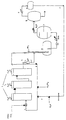
- This CHP decomposition and process is conducted in 1 to 2 minutes in 3 sequentially installed reactors of the shell and tube heat exchangers as shown at 1. These reactors have a specific surface not less than 30 to 35 meter squared per ton of 100% CHP per hour.
- CHP conversion in the reactors in one pass is 30 to 35%, 30 to 40%, 30 to 15%, respectively.
- the feed line, 2 the acetone is fed to mixer, 3, in line prior to the first CHP decomposition reactor.
- the amount of fed acetone when CHP flow rate is decreased is increased to a higher ratio of acetone to phenol.
- the circulation ratio of CHP cleavage products to CHP feedstream on a weight basis through the 3 sequentially installed reactors is 20 to 1, see reaction circulation loop, 4.
- the three decomposition temperatures in the sequential reactors are respectively 50 to 62°C, 62 to 57°C, and 57 to 50°C, respectively.
- Following the third sequential reactor, is a plug-flow mini-reactor, 5.
- This mini-reactor funtions as a calorimeter with respect to the three sequentially placed reactors. Only a small portion of the effluent of the reactor passes through this mini-reactor. The term mini only refers to the size of the unit in comparison to the three previous reactors.
- This plug-flow mini-reactor has a product residence time of generally not more than 3 minutes and with a measurement of temperature difference at the inlet and outlet of the mini-reactor maintained at 5 to 15°C.
- an aqueous ammonia solution is introduced into the cleavage products at a weight ratio of sulfuric acid (catalyst) to ammonia of (11-23:1) in holding tank, 6.
- CHP level is brought to a minimum, preferably zero, and the ammonium bisulfate generated.
- Cleavage products are then transferred to plug-flow reactor, 7, and maintained at a temperature of 85 to 95°C and a pressure of 0.3 to 0.5 atmosphere above normal atmospheric pressure for a period of 25 to 45 minutes.
- the DCP is decomposed to phenol, AMS and acetone. Thereafter the pressure is lowered to 0.35 to 0.45 of one atmosphere pressure thereby providing coolage of the cleavage products through the evaporating of the acetone by use of evaporator vessel, 8.
- the vaporized acetone passes overhead in the evaporator and is subsequently condensed in condenser, 9, collected in vessel, 10, and then pumped to reaction circulation loop, 4, via pump, 11.
- Decomposition of technical CHP containing cumene 12.16 wt. %, acetophenone 0.40 wt.%, DMBA 3.64 wt.%, CHP 83.80 wt.% was conducted an installation similar to that shown in Fig. 1. It was conducted in equimolar mixture of phenol and acetone containing 0.03 wt.% of H 2 SO 4 and additionally introduced acetone in amount of 14.96 wt.% relatively on the basis of fed technical CHP. The temperature in each of three sequentially installed reactors was maintained non-isothermal in a range of 50-62°C, 62-57°C, 57-50°C, respectively with a pressure of 1 to 5 atmospheres. Product recycle circulation weight ratio was 17 to 1. Flow mixing and mini-reactor for T measurement were installed in the scheme. The delta T value was 9°C. CHP decomposition time was 2 minutes.
- Aqueous ammonia solution was introduced into plug-flow reactor in amount which is necessary to translate 50% weight of H 2 SO 4 into NH 4 HSO 4 .
- the temperature in DCP plug-flow reactor was maintained at 93°C, pressure 1.5 atm.
- Product residence time in the plug-flow reactor was varied from 35 min. to 60 min.
- Examples 9-11 demonstrate the production of good results as shown by the yield of AMS at various ranges of CHP conversions in one pass in three sequentially installed reactors wherein acetone is additionally fed and mole ratio acetone/phenol of 1.15 -1.5 is maintained.
- the delta T values varies dependent upon the unreacted CHP remaining in the flow through the mini-reactor.
- Example 7 demonstrates the low yield of AMS without acetone introduction into CHP decomposition reactors.
- the delta T value of 0°C shows that the CHP is depleted.
- Example 12 illustrates the influence of acetone fed to CHP decomposition unit above the preferred molar ratio.
- the high delta T value at the mini-reactor reflects the presence of significant levels of nonconverted CHP in the flow to the mini-reactor. Such levels of CHP can be a safety issue.
- Decomposition of technical CHP of the same composition as in example 1-4 was conducted in the same installation as Examples 1-4 but without preliminary flow mixing, without introduction of extra acetone quantity to CHP decomposition unit, i.e. in equimolar acetone-phenol mixture.
- Aqueous ammonia solution was not fed to plug-flow reactor wherein the temperature was maintained at 93°C.
- CHP conversion in three sequentially installed reactors was 80, 20, and 0% respectively.
- Delta T value was 0°C.
- the yield of AMS was 52 mol.% on the basis of DMBA present in the technical CHP (compare to 75-80 mole% in Examples 9-11).
- the sum of by-product which were components of phenol tar was 2.96g (compare to 1.22g of Examples 1-4).
- the high level of phenol tar is evidence that some of the CHP is actually converted to additional DMBA under the comparative example process conditions. Additional yield loss arises from such conversion.
Landscapes
- Chemical & Material Sciences (AREA)
- Organic Chemistry (AREA)
- Organic Low-Molecular-Weight Compounds And Preparation Thereof (AREA)
- Low-Molecular Organic Synthesis Reactions Using Catalysts (AREA)
Priority Applications (1)
| Application Number | Priority Date | Filing Date | Title |
|---|---|---|---|
| EP01112781A EP1142855B1 (en) | 1992-09-14 | 1993-09-06 | Decomposition of cumene hydroperoxide |
Applications Claiming Priority (3)
| Application Number | Priority Date | Filing Date | Title |
|---|---|---|---|
| US944688 | 1992-09-14 | ||
| US07/944,688 US5254751A (en) | 1992-09-14 | 1992-09-14 | Method for the decomposition of cumene hydroperoxide by acidic catalyst to phenol and acetone |
| EP93307016A EP0589588B2 (en) | 1992-09-14 | 1993-09-06 | Process for the production of phenol, acetone and alpha-methylstyrene |
Related Parent Applications (1)
| Application Number | Title | Priority Date | Filing Date |
|---|---|---|---|
| EP93307016A Division EP0589588B2 (en) | 1992-09-14 | 1993-09-06 | Process for the production of phenol, acetone and alpha-methylstyrene |
Related Child Applications (1)
| Application Number | Title | Priority Date | Filing Date |
|---|---|---|---|
| EP01112781A Division EP1142855B1 (en) | 1992-09-14 | 1993-09-06 | Decomposition of cumene hydroperoxide |
Publications (3)
| Publication Number | Publication Date |
|---|---|
| EP0873983A2 EP0873983A2 (en) | 1998-10-28 |
| EP0873983A3 EP0873983A3 (en) | 1998-12-09 |
| EP0873983B1 true EP0873983B1 (en) | 2002-02-06 |
Family
ID=25481882
Family Applications (4)
| Application Number | Title | Priority Date | Filing Date |
|---|---|---|---|
| EP98112218A Expired - Lifetime EP0873983B1 (en) | 1992-09-14 | 1993-09-06 | Process for decomposition of cumene hydroperoxide |
| EP96202123A Expired - Lifetime EP0738698B1 (en) | 1992-09-14 | 1993-09-06 | Process for decomposition of cumene hydroperoxide |
| EP93307016A Expired - Lifetime EP0589588B2 (en) | 1992-09-14 | 1993-09-06 | Process for the production of phenol, acetone and alpha-methylstyrene |
| EP01112781A Expired - Lifetime EP1142855B1 (en) | 1992-09-14 | 1993-09-06 | Decomposition of cumene hydroperoxide |
Family Applications After (3)
| Application Number | Title | Priority Date | Filing Date |
|---|---|---|---|
| EP96202123A Expired - Lifetime EP0738698B1 (en) | 1992-09-14 | 1993-09-06 | Process for decomposition of cumene hydroperoxide |
| EP93307016A Expired - Lifetime EP0589588B2 (en) | 1992-09-14 | 1993-09-06 | Process for the production of phenol, acetone and alpha-methylstyrene |
| EP01112781A Expired - Lifetime EP1142855B1 (en) | 1992-09-14 | 1993-09-06 | Decomposition of cumene hydroperoxide |
Country Status (8)
| Country | Link |
|---|---|
| US (2) | US5254751A (enExample) |
| EP (4) | EP0873983B1 (enExample) |
| JP (3) | JP3268082B2 (enExample) |
| KR (1) | KR0161540B1 (enExample) |
| CN (3) | CN1071293C (enExample) |
| CA (1) | CA2105187A1 (enExample) |
| DE (4) | DE69333863T2 (enExample) |
| ES (3) | ES2148669T3 (enExample) |
Families Citing this family (61)
| Publication number | Priority date | Publication date | Assignee | Title |
|---|---|---|---|---|
| US7166752B2 (en) * | 1989-01-17 | 2007-01-23 | Sunoco, Inc. (R&M) | Decomposition of cumene oxidation product |
| US5371305A (en) * | 1992-12-31 | 1994-12-06 | Hercules Incorporated | Process for producing phenol from cumene |
| RU2108318C1 (ru) * | 1994-03-01 | 1998-04-10 | Закошанский Владимир Михайлович | СПОСОБ ПОЛУЧЕНИЯ ФЕНОЛА, АЦЕТОНА И α МЕТИЛСТИРОЛА |
| DE69505573T2 (de) * | 1994-03-01 | 1999-06-17 | General Electric Co., Schenectady, N.Y. | Säurespaltung von Cumolhydroperoxid in Phenol, Aceton und Alphamethylstyrol |
| US5457244A (en) * | 1994-10-04 | 1995-10-10 | General Electric Company | Phenol tar waste reduction process |
| TW318174B (enExample) * | 1994-11-04 | 1997-10-21 | Gen Electric | |
| US5510543A (en) * | 1994-12-09 | 1996-04-23 | General Electric Company | Removal and neutralization of acid catalyst from products of cumene hydroperoxide cleavage |
| US5463136A (en) * | 1994-12-22 | 1995-10-31 | Shell Oil Company | Cumene hydroperoxide cleavage process |
| JP3769050B2 (ja) * | 1995-07-07 | 2006-04-19 | 三井化学株式会社 | フェノールの製造方法 |
| IN185136B (enExample) * | 1995-09-20 | 2000-11-25 | Gen Electric | |
| US5672774A (en) * | 1995-10-24 | 1997-09-30 | General Electric Company | Phenol tar processing method |
| US5962751A (en) * | 1996-04-26 | 1999-10-05 | General Electric Company | Phenol tar desalting method |
| RU2125038C1 (ru) * | 1996-09-24 | 1999-01-20 | Закошанский Владимир Михайлович | Безотходный экономичный способ получения фенола и ацетона |
| RU2141938C1 (ru) | 1996-12-15 | 1999-11-27 | ООО "Илла Интернешнл", Лтд. | Энергосберегающий и высокоселективный способ получения фенола и ацетона (процесс иф-96) |
| RU2114816C1 (ru) * | 1997-02-13 | 1998-07-10 | Открытое акционерное общество "Казаньоргсинтез" | Способ разложения гидроперекиси кумола кислотным катализатором на фенол и ацетон |
| RU2142932C1 (ru) * | 1997-11-03 | 1999-12-20 | Закошанский Владимир Михайлович | Высокоселективный способ получения фенола и ацетона (процесс фан-98) |
| EP1042264B1 (en) * | 1998-09-04 | 2006-03-15 | Illa International L.L.C. | High selective method of phenol and acetone production |
| DE19858770A1 (de) * | 1998-12-18 | 2000-06-21 | Phenolchemie Gmbh & Co Kg | Verfahren zur Herstellung von Phenol und Aceton durch säurekatalysierte Spaltung von Cumolhydroperoxid |
| DE19911024B4 (de) | 1999-03-12 | 2005-09-08 | Phenolchemie Gmbh & Co. Kg | Verfahren zum Anfahren von Schlaufenreaktorsystemen, in denen zumindest eine exotherme Reaktion durchgeführt werden soll |
| US6201157B1 (en) * | 2000-01-10 | 2001-03-13 | Sunoco, Inc. (R&M) | Method for production of phenol and acetone by decomposition of cumene hydroperoxide |
| DE10021482A1 (de) * | 2000-05-03 | 2001-11-08 | Phenolchemie Gmbh & Co Kg | Verfahren zur thermischen Nachbehandlung von Spaltprodukt aus der säurekatalysierten Spaltung von Cumolhydroperoxid |
| RU2179167C1 (ru) * | 2000-09-29 | 2002-02-10 | Открытое акционерное общество "Всероссийский научно-исследовательский институт органического синтеза" | СПОСОБ ПОЛУЧЕНИЯ ФЕНОЛА, АЦЕТОНА И α-МЕТИЛСТИРОЛА |
| DE10051581A1 (de) * | 2000-10-18 | 2002-06-20 | Phenolchemie Gmbh & Co Kg | Verfahren zur Spaltung von Alkylarylhydroperoxiden |
| DE10111889A1 (de) * | 2001-03-13 | 2002-10-02 | Phenolchemie Gmbh & Co Kg | Verfahren zur säurekatalysierten Spaltung von Cumolhydroperoxid |
| RU2231045C2 (ru) * | 2002-05-20 | 2004-06-20 | Общество с ограниченной ответственностью "Еврохим-СпбТрейдинг" | Способ измерения концентрации гидропероксидов алкилароматических углеводородов в жидких промышленных потоках |
| US7312365B2 (en) * | 2003-02-14 | 2007-12-25 | Shell Oil Company | Process for low temperature cleavage of an oxidation mixture comprising hydroperoxides |
| US7282613B2 (en) * | 2003-02-14 | 2007-10-16 | Shell Oil Company | Process for producing phenol and methyl ethyl ketone |
| US7141703B2 (en) * | 2003-02-14 | 2006-11-28 | Shell Oil Company | Process for producing phenol and ketone using neutralizing base |
| US7626060B2 (en) * | 2003-07-11 | 2009-12-01 | INEOS Phenol GmbH & Co., KG | Process for the preparation of phenolic compounds, for separating phenol from cleavage product mixtures, and an apparatus |
| CN1938250A (zh) * | 2004-03-31 | 2007-03-28 | 通用电气公司 | 生产酚的方法 |
| US7141701B1 (en) * | 2005-08-19 | 2006-11-28 | Uop Llc | Decomposition of cumene hydroperoxide |
| US7141700B1 (en) * | 2005-08-19 | 2006-11-28 | Uop Llc | Decomposition of cumene hydroperoxide |
| US8026398B2 (en) * | 2006-05-16 | 2011-09-27 | Narayana Mysore | Catalysts comprising a combination of oxidized metals and a method for cleaving phenylalkyl hydroperoxides using the catalysts |
| US20100063329A1 (en) * | 2006-05-16 | 2010-03-11 | John Charles Saukaitis | Method for decomposing di(phenylalkyl)peroxides to produce hydroxybenzenes and phenylalkenes using solid catalysts |
| US7888537B2 (en) * | 2006-12-29 | 2011-02-15 | Uop Llc | Solid acid catalyst and process for decomposition of cumene hydroperoxide |
| EP2352715A1 (en) | 2008-10-10 | 2011-08-10 | Exxonmobil Chemical Company | Process for producing phenol |
| CN102333750A (zh) | 2009-02-26 | 2012-01-25 | 埃克森美孚化学专利公司 | 苯酚的制备方法 |
| US9321710B2 (en) | 2010-01-25 | 2016-04-26 | Exxonmobil Chemical Patents Inc. | Process for producing phenol |
| US20110306800A1 (en) * | 2010-06-09 | 2011-12-15 | Scott Roy Keenan | Method for the decomposition of cumene hydroperoxide |
| US8921610B2 (en) | 2010-09-14 | 2014-12-30 | Exxonmobil Chemical Patents Inc. | Oxidation of alkylbenzenes |
| CN103097330A (zh) | 2010-09-14 | 2013-05-08 | 埃克森美孚化学专利公司 | 生产苯酚的方法 |
| US8884068B2 (en) | 2010-09-14 | 2014-11-11 | Exxonmobil Chemical Patents Inc. | Phenol and cyclohexanone mixtures |
| SG186345A1 (en) | 2010-09-14 | 2013-01-30 | Exxonmobil Chem Patents Inc | Processes for producing phenol |
| WO2012067711A1 (en) | 2010-11-16 | 2012-05-24 | Exxonmobil Chemical Patents Inc. | Process for producing phenol |
| US9388102B2 (en) | 2011-04-19 | 2016-07-12 | Exxonmobil Chemical Patents Inc. | Process for producing phenol |
| CN103492072B (zh) | 2011-04-19 | 2016-01-20 | 埃克森美孚化学专利公司 | 苯酚的制备方法 |
| CN103492073B (zh) | 2011-04-19 | 2016-03-23 | 埃克森美孚化学专利公司 | 苯酚和/或环己酮的制备方法 |
| US9469589B2 (en) | 2011-06-30 | 2016-10-18 | Exxonmobil Chemical Patents Inc. | Process for producing phenol and/or cyclohexanone |
| CN104080763B (zh) * | 2011-09-19 | 2016-08-24 | 凯洛格·布朗及鲁特有限公司 | 联产低甲醇含量的丙酮的方法和系统 |
| WO2013043271A1 (en) | 2011-09-23 | 2013-03-28 | Exxonmobil Chemical Patents Inc. | Process for producing phenol |
| US9067870B2 (en) | 2011-09-23 | 2015-06-30 | Exxonmobil Chemical Patents Inc. | Process for producing phenol |
| US9249078B2 (en) | 2011-10-07 | 2016-02-02 | Exxonmobil Chemical Patents Inc. | Mixed metal oxide catalysts and use thereof |
| US8865957B2 (en) | 2012-03-09 | 2014-10-21 | Honeywell Intenational Inc. | Method for producing alpha-methyl styrene from cumene |
| WO2014209577A1 (en) | 2013-06-28 | 2014-12-31 | Exxonmobil Chemical Patents Inc. | Process for producing phenol and/or cyclohexanone |
| CN106573868B (zh) | 2014-04-23 | 2019-08-16 | 陶氏环球技术有限责任公司 | 制造苯酚时酸性催化剂的中和 |
| CN104151144A (zh) * | 2014-07-16 | 2014-11-19 | 常州大学 | 一种过氧化氢异丙苯分解制苯酚/丙酮的方法 |
| RU2565764C1 (ru) | 2014-08-08 | 2015-10-20 | Общество с ограниченной ответственностью "Научно-производственное объединение ЕВРОХИМ" | Способ получения фенола и ацетона |
| KR102040059B1 (ko) * | 2016-11-14 | 2019-11-05 | 주식회사 엘지화학 | 페놀의 정제 방법 |
| CN110818536A (zh) * | 2019-11-13 | 2020-02-21 | 中国石油化工股份有限公司 | 一种采用微反应器装置催化分解过氧化氢异丙苯的方法 |
| CN114426463B (zh) * | 2020-10-13 | 2024-05-28 | 中国石油化工股份有限公司 | 制备间苯二酚的方法 |
| EP4043420B1 (en) * | 2020-12-21 | 2024-10-09 | LG Chem, Ltd. | Method for producing alpha-methylstyrene |
Family Cites Families (50)
| Publication number | Priority date | Publication date | Assignee | Title |
|---|---|---|---|---|
| CA482145A (en) | 1952-04-01 | Harold Hall Reginald | Decomposition of organic peroxides | |
| FR961022A (enExample) * | 1947-02-13 | 1950-04-28 | ||
| IT486308A (enExample) * | 1949-12-30 | |||
| US2668180A (en) * | 1950-07-01 | 1954-02-02 | Hercules Powder Co Ltd | Preparation of aryldialkyl peroxides |
| US2757209A (en) * | 1951-04-26 | 1956-07-31 | Allied Chem & Dye Corp | Recovery of phenol and alphamethylstyrene from cumene oxidation reaction mixtures |
| US2761877A (en) | 1951-05-17 | 1956-09-04 | Rhone Poulenc Sa | Production of phenols and carbonyl compounds |
| FR1109297A (fr) * | 1953-07-30 | 1956-01-24 | California Research Corp | Procédé de fabrication de l'acétone |
| US2904592A (en) † | 1953-07-30 | 1959-09-15 | California Research Corp | Production of acetone |
| GB864486A (en) * | 1957-05-27 | 1961-04-06 | It Resine Soc | Process for manufacturing phenol and acetone from cumene hydro-peroxide |
| US2957921A (en) | 1958-03-31 | 1960-10-25 | California Research Corp | Processes for separating hydroperoxides into phenol and other products |
| DE1443329B1 (de) * | 1962-01-10 | 1970-01-02 | It Resine S P A Soc | Verfahren und Vorrichtung zum kontinuierlichen katalytischen Spalten von Alkylarylhydroperoxyden,besonders Cumolhydroperoxyd,mit Schwefelsaeure |
| GB1202687A (en) * | 1968-03-28 | 1970-08-19 | Sir Soc Italiana Resine Spa | Process for preparing phenol and acetone |
| US4207264A (en) | 1969-10-29 | 1980-06-10 | The Goodyear Tire & Rubber Company | Rearrangement of aralkyl hydroperoxides to form phenols and carbonyl compounds |
| US3927124A (en) | 1970-03-05 | 1975-12-16 | Goodyear Tire & Rubber | Process for the neutralization of alkyl aromatic hydroperoxide rearrangement reaction products |
| US3899538A (en) | 1970-12-14 | 1975-08-12 | Sun Ventures Inc | Acid-catalyzed decomposition of aliphatic hydroperoxides |
| US4016213A (en) * | 1971-05-03 | 1977-04-05 | Allied Chemical Corporation | Recovery of phenol, acetone and dimethyl phenyl carbinol from cumene oxidation product |
| SU537066A1 (ru) * | 1974-01-25 | 1976-11-30 | Казанский Ордена Октябрьской Революции Завод Органического Синтеза | Способ получени фенола и ацетона |
| GB1499666A (en) | 1974-05-06 | 1978-02-01 | Burmah Oil Trading Ltd | Production of phenols |
| GB1503508A (en) | 1974-07-19 | 1978-03-15 | Burmah Oil Trading Ltd | Production of phenols |
| JPS5289609A (en) | 1976-01-21 | 1977-07-27 | Sumitomo Chem Co Ltd | Prpduction of aromatic hydroxides and alifatic ketones |
| US4297518A (en) | 1977-11-18 | 1981-10-27 | Gulf Research & Development Company | Decomposition of cumene hydroperoxide with a homogeneous catalyst |
| US4173587A (en) | 1977-11-18 | 1979-11-06 | Gulf Research And Development Company | Decomposition of cumene hydroperoxide with a heterogeneous catalyst |
| SU721395A1 (ru) | 1977-12-01 | 1980-03-15 | Омское специальное конструкторское бюро Научно-производственного объединения "Нефтехимавтоматика" | Способ автоматического регулировани процессом разложени гидроперекиси изопропилбензола |
| DD149857A3 (de) | 1978-05-26 | 1981-08-05 | Bernd Haase | Verfahren zur herstellung von phenol-und aceton aus cumolhydroperoxid |
| DE2964960D1 (en) | 1978-08-18 | 1983-04-07 | Bp Chem Int Ltd | Process for the production of a phenol and a carbonyl compound by the catalysed decomposition of an aromatic hydroperoxide |
| US4267379A (en) | 1978-12-04 | 1981-05-12 | Gulf Research & Development Company | Decomposition of cumene hydroperoxide and recovery of boron trifluoride catalyst |
| JPS5583723A (en) | 1978-12-20 | 1980-06-24 | Mitsui Petrochem Ind Ltd | Recovery of resorcinol |
| US4262153A (en) | 1978-12-26 | 1981-04-14 | The Standard Oil Company | Decomposition of hydroperoxides using metal complex catalysts |
| GB2048260A (en) | 1979-04-20 | 1980-12-10 | Ici Ltd | Process for the production of phenol and acetone |
| US4210606A (en) | 1979-06-15 | 1980-07-01 | Gulf Research And Development Company | Decomposition of cumene hydroperoxide with a halogen-substituted thiophenol catalyst |
| US4210607A (en) | 1979-06-20 | 1980-07-01 | Gulf Research And Development Company | Decomposition of cumene hydroperoxide using a stable nitrosonium or nitronium salt as the catalyst |
| US4209465A (en) * | 1979-06-20 | 1980-06-24 | Gulf Research And Development Company | Decomposition of cumene hydroperoxide using a stable carbonium, tropylium or oxonium salt as the catalyst |
| US4267380A (en) | 1979-06-25 | 1981-05-12 | Gulf Research & Development Company | Decomposition of cumene hydroperoxide using a Lewis acid catalyst |
| US4238417A (en) * | 1979-08-15 | 1980-12-09 | Gulf Research & Development Company | Decomposition of cumene hydroperoxide and recovery of boron trifluoride catalyst |
| US4358618A (en) * | 1981-06-22 | 1982-11-09 | Allied Corporation | Decomposition of cumene oxidation product |
| JPS5889609A (ja) * | 1981-11-24 | 1983-05-28 | Canon Inc | 硬化性樹脂組成物 |
| US4490565A (en) | 1983-05-06 | 1984-12-25 | Mobil Oil Corporation | Production of phenol |
| US4490566A (en) | 1983-05-06 | 1984-12-25 | Mobil Oil Corporation | Production of phenol |
| US4482757A (en) | 1983-06-24 | 1984-11-13 | Phillips Petroleum Company | Cleavage of hydroperoxides |
| SU1131865A1 (ru) | 1983-07-07 | 1984-12-30 | Предприятие П/Я А-1748 | Способ получени фенола и ацетона |
| IT1187662B (it) | 1985-04-23 | 1987-12-23 | Enichem Sintesi | Catalizzatore per la decomposizione selettiva del cumilidroperossido e procedimento utilizzante lo stesso |
| JPH0251408A (ja) * | 1988-08-12 | 1990-02-21 | Toshiba Tungaloy Co Ltd | 炭化タングステンを過飽和に含有してなる固溶体組成物及びその製造方法 |
| US5017729A (en) | 1988-09-30 | 1991-05-21 | Mitsui Petrochemical Industries, Ltd. | Phenol preparation process and propylene recovery therefrom |
| US4898995A (en) | 1988-10-24 | 1990-02-06 | Texaco Chemical Company | Method for production of phenol/acetone from cumene hydroperoxide |
| US4870217A (en) | 1988-10-24 | 1989-09-26 | Texaco Chemical Company | Method for production of phenol/acetone from cumene hydroperoxide |
| US4898987A (en) | 1989-03-17 | 1990-02-06 | Texaco Chemical Company | Method for production of phenol/acetone from cumene hydroperoxide |
| US4876397A (en) | 1988-10-24 | 1989-10-24 | Texaco Chemical Company | Method for production of phenol/acetone from cumene hydroperoxide |
| US5015786A (en) | 1988-11-28 | 1991-05-14 | Mitsui Petrochemical Industries Inc. | Preparation of cumene through alkylation of an aromatic compound and preparation of phenol through cumene |
| EP0492807A3 (en) | 1990-12-27 | 1992-08-12 | Texaco Chemical Company | Method for production of phenol/acetone from cumene hydroperoxide |
| US5245090A (en) * | 1992-09-11 | 1993-09-14 | Aristech Chemical Corporation | Two-stage cleavage of cumene hydroperoxide |
-
1992
- 1992-09-14 US US07/944,688 patent/US5254751A/en not_active Ceased
-
1993
- 1993-08-19 CA CA002105187A patent/CA2105187A1/en not_active Abandoned
- 1993-09-06 EP EP98112218A patent/EP0873983B1/en not_active Expired - Lifetime
- 1993-09-06 DE DE69333863T patent/DE69333863T2/de not_active Expired - Lifetime
- 1993-09-06 ES ES96202123T patent/ES2148669T3/es not_active Expired - Lifetime
- 1993-09-06 DE DE69331564T patent/DE69331564T2/de not_active Expired - Lifetime
- 1993-09-06 EP EP96202123A patent/EP0738698B1/en not_active Expired - Lifetime
- 1993-09-06 EP EP93307016A patent/EP0589588B2/en not_active Expired - Lifetime
- 1993-09-06 ES ES98112218T patent/ES2172063T3/es not_active Expired - Lifetime
- 1993-09-06 EP EP01112781A patent/EP1142855B1/en not_active Expired - Lifetime
- 1993-09-06 DE DE69329300T patent/DE69329300T2/de not_active Expired - Lifetime
- 1993-09-06 ES ES93307016T patent/ES2127253T5/es not_active Expired - Lifetime
- 1993-09-06 DE DE69323140T patent/DE69323140T3/de not_active Expired - Lifetime
- 1993-09-11 CN CN93117275A patent/CN1071293C/zh not_active Expired - Lifetime
- 1993-09-13 KR KR1019930018372A patent/KR0161540B1/ko not_active Expired - Lifetime
- 1993-09-14 JP JP22882993A patent/JP3268082B2/ja not_active Expired - Fee Related
-
1995
- 1995-10-19 US US08/545,092 patent/USRE40668E1/en not_active Expired - Lifetime
-
1997
- 1997-11-25 JP JP32255697A patent/JP3281587B2/ja not_active Expired - Fee Related
-
1999
- 1999-04-30 CN CN99105393A patent/CN1101371C/zh not_active Expired - Lifetime
- 1999-04-30 CN CN99105392A patent/CN1088051C/zh not_active Expired - Lifetime
-
2001
- 2001-10-24 JP JP2001325724A patent/JP3797914B2/ja not_active Expired - Fee Related
Also Published As
Similar Documents
| Publication | Publication Date | Title |
|---|---|---|
| EP1142855B1 (en) | Decomposition of cumene hydroperoxide | |
| RU2141938C1 (ru) | Энергосберегающий и высокоселективный способ получения фенола и ацетона (процесс иф-96) | |
| US6057483A (en) | High selective method of phenol and acetone production | |
| RU2108318C1 (ru) | СПОСОБ ПОЛУЧЕНИЯ ФЕНОЛА, АЦЕТОНА И α МЕТИЛСТИРОЛА | |
| WO2004074230A1 (en) | Process for producing phenol and methyl ethyl ketone | |
| JP3769050B2 (ja) | フェノールの製造方法 | |
| US4310712A (en) | Process for the production of phenol and acetone | |
| JP4558936B2 (ja) | フェノール及びアセトン製造の高度に選択的な方法 | |
| US7312365B2 (en) | Process for low temperature cleavage of an oxidation mixture comprising hydroperoxides | |
| US7141700B1 (en) | Decomposition of cumene hydroperoxide | |
| EP0432876B1 (en) | Process for production of hydrogen cyanide from crude acetonitrile | |
| US7141701B1 (en) | Decomposition of cumene hydroperoxide | |
| US4593145A (en) | Process for producing isoprene | |
| JP2000226352A (ja) | ヒドロキシアセトン含有フェノ―ルからヒドロキシアセトンを除去する方法 | |
| JP4472271B2 (ja) | フェノールの製造方法 | |
| JP2002371020A (ja) | フェノールの製造方法 | |
| RU2098398C1 (ru) | Способ получения изопрена | |
| JPH0254836B2 (enExample) | ||
| JPS59106427A (ja) | イソプレンの製造法 |
Legal Events
| Date | Code | Title | Description |
|---|---|---|---|
| PUAI | Public reference made under article 153(3) epc to a published international application that has entered the european phase |
Free format text: ORIGINAL CODE: 0009012 |
|
| PUAL | Search report despatched |
Free format text: ORIGINAL CODE: 0009013 |
|
| AC | Divisional application: reference to earlier application |
Ref document number: 589588 Country of ref document: EP |
|
| AK | Designated contracting states |
Kind code of ref document: A2 Designated state(s): DE ES FR GB IT NL |
|
| AK | Designated contracting states |
Kind code of ref document: A3 Designated state(s): DE ES FR GB IT NL |
|
| RHK1 | Main classification (correction) |
Ipc: C07C 1/20 |
|
| 17P | Request for examination filed |
Effective date: 19990609 |
|
| 17Q | First examination report despatched |
Effective date: 19991217 |
|
| GRAG | Despatch of communication of intention to grant |
Free format text: ORIGINAL CODE: EPIDOS AGRA |
|
| GRAG | Despatch of communication of intention to grant |
Free format text: ORIGINAL CODE: EPIDOS AGRA |
|
| GRAH | Despatch of communication of intention to grant a patent |
Free format text: ORIGINAL CODE: EPIDOS IGRA |
|
| GRAH | Despatch of communication of intention to grant a patent |
Free format text: ORIGINAL CODE: EPIDOS IGRA |
|
| GRAA | (expected) grant |
Free format text: ORIGINAL CODE: 0009210 |
|
| REG | Reference to a national code |
Ref country code: GB Ref legal event code: IF02 |
|
| AC | Divisional application: reference to earlier application |
Ref document number: 589588 Country of ref document: EP |
|
| AK | Designated contracting states |
Kind code of ref document: B1 Designated state(s): DE ES FR GB IT NL |
|
| REF | Corresponds to: |
Ref document number: 69331564 Country of ref document: DE Date of ref document: 20020321 |
|
| ET | Fr: translation filed | ||
| REG | Reference to a national code |
Ref country code: ES Ref legal event code: FG2A Ref document number: 2172063 Country of ref document: ES Kind code of ref document: T3 |
|
| PLBE | No opposition filed within time limit |
Free format text: ORIGINAL CODE: 0009261 |
|
| STAA | Information on the status of an ep patent application or granted ep patent |
Free format text: STATUS: NO OPPOSITION FILED WITHIN TIME LIMIT |
|
| 26N | No opposition filed |
Effective date: 20021107 |
|
| PG25 | Lapsed in a contracting state [announced via postgrant information from national office to epo] |
Ref country code: IT Free format text: LAPSE BECAUSE OF NON-PAYMENT OF DUE FEES Effective date: 20050906 |
|
| REG | Reference to a national code |
Ref country code: GB Ref legal event code: 732E |
|
| PGFP | Annual fee paid to national office [announced via postgrant information from national office to epo] |
Ref country code: NL Payment date: 20080903 Year of fee payment: 16 Ref country code: FR Payment date: 20080915 Year of fee payment: 16 |
|
| PGFP | Annual fee paid to national office [announced via postgrant information from national office to epo] |
Ref country code: GB Payment date: 20080910 Year of fee payment: 16 |
|
| NLS | Nl: assignments of ep-patents |
Owner name: SABIC INNOVATIVE PLASTICS IP B.V. Effective date: 20081023 |
|
| REG | Reference to a national code |
Ref country code: FR Ref legal event code: TQ |
|
| PGFP | Annual fee paid to national office [announced via postgrant information from national office to epo] |
Ref country code: ES Payment date: 20081021 Year of fee payment: 16 |
|
| REG | Reference to a national code |
Ref country code: NL Ref legal event code: V1 Effective date: 20100401 |
|
| GBPC | Gb: european patent ceased through non-payment of renewal fee |
Effective date: 20090906 |
|
| REG | Reference to a national code |
Ref country code: FR Ref legal event code: ST Effective date: 20100531 |
|
| PG25 | Lapsed in a contracting state [announced via postgrant information from national office to epo] |
Ref country code: NL Free format text: LAPSE BECAUSE OF NON-PAYMENT OF DUE FEES Effective date: 20100401 Ref country code: FR Free format text: LAPSE BECAUSE OF NON-PAYMENT OF DUE FEES Effective date: 20090930 |
|
| PG25 | Lapsed in a contracting state [announced via postgrant information from national office to epo] |
Ref country code: GB Free format text: LAPSE BECAUSE OF NON-PAYMENT OF DUE FEES Effective date: 20090906 |
|
| REG | Reference to a national code |
Ref country code: ES Ref legal event code: FD2A Effective date: 20111116 |
|
| PG25 | Lapsed in a contracting state [announced via postgrant information from national office to epo] |
Ref country code: ES Free format text: LAPSE BECAUSE OF NON-PAYMENT OF DUE FEES Effective date: 20090907 |
|
| PGFP | Annual fee paid to national office [announced via postgrant information from national office to epo] |
Ref country code: DE Payment date: 20120829 Year of fee payment: 20 |
|
| REG | Reference to a national code |
Ref country code: DE Ref legal event code: R071 Ref document number: 69331564 Country of ref document: DE |
|
| REG | Reference to a national code |
Ref country code: DE Ref legal event code: R071 Ref document number: 69331564 Country of ref document: DE |
|
| PG25 | Lapsed in a contracting state [announced via postgrant information from national office to epo] |
Ref country code: DE Free format text: LAPSE BECAUSE OF EXPIRATION OF PROTECTION Effective date: 20130907 |