EP0679331B1 - Méthode de traite automatique d'animaux et appareil utilisant cette méthode - Google Patents
Méthode de traite automatique d'animaux et appareil utilisant cette méthode Download PDFInfo
- Publication number
- EP0679331B1 EP0679331B1 EP95200969A EP95200969A EP0679331B1 EP 0679331 B1 EP0679331 B1 EP 0679331B1 EP 95200969 A EP95200969 A EP 95200969A EP 95200969 A EP95200969 A EP 95200969A EP 0679331 B1 EP0679331 B1 EP 0679331B1
- Authority
- EP
- European Patent Office
- Prior art keywords
- milk
- teat
- vacuum
- space
- line
- Prior art date
- Legal status (The legal status is an assumption and is not a legal conclusion. Google has not performed a legal analysis and makes no representation as to the accuracy of the status listed.)
- Expired - Lifetime
Links
- 241001465754 Metazoa Species 0.000 title claims description 27
- 238000000034 method Methods 0.000 title claims description 27
- 210000002445 nipple Anatomy 0.000 claims description 181
- 239000008267 milk Substances 0.000 claims description 125
- 235000013336 milk Nutrition 0.000 claims description 124
- 210000004080 milk Anatomy 0.000 claims description 124
- 239000007788 liquid Substances 0.000 claims description 112
- 230000010349 pulsation Effects 0.000 claims description 66
- XLYOFNOQVPJJNP-UHFFFAOYSA-N water Substances O XLYOFNOQVPJJNP-UHFFFAOYSA-N 0.000 claims description 30
- 238000004140 cleaning Methods 0.000 claims description 20
- 210000003608 fece Anatomy 0.000 claims description 13
- 239000010871 livestock manure Substances 0.000 claims description 13
- 210000000481 breast Anatomy 0.000 claims description 10
- 239000002253 acid Substances 0.000 claims description 8
- 230000000249 desinfective effect Effects 0.000 claims description 6
- 239000000463 material Substances 0.000 claims description 6
- 241000283690 Bos taurus Species 0.000 claims description 5
- 230000004936 stimulating effect Effects 0.000 claims description 5
- 239000012459 cleaning agent Substances 0.000 claims description 4
- ZAMOUSCENKQFHK-UHFFFAOYSA-N Chlorine atom Chemical compound [Cl] ZAMOUSCENKQFHK-UHFFFAOYSA-N 0.000 claims description 3
- 229910052801 chlorine Inorganic materials 0.000 claims description 3
- 239000000460 chlorine Substances 0.000 claims description 3
- 210000000078 claw Anatomy 0.000 claims description 3
- 239000003599 detergent Substances 0.000 claims description 3
- 235000020244 animal milk Nutrition 0.000 claims description 2
- 238000004891 communication Methods 0.000 claims description 2
- 238000005070 sampling Methods 0.000 claims description 2
- 101100327917 Caenorhabditis elegans chup-1 gene Proteins 0.000 description 7
- 239000008237 rinsing water Substances 0.000 description 3
- 238000009835 boiling Methods 0.000 description 2
- 230000002950 deficient Effects 0.000 description 2
- 230000000694 effects Effects 0.000 description 2
- 239000000203 mixture Substances 0.000 description 2
- MFSIEROJJKUHBQ-UHFFFAOYSA-N O.[Cl] Chemical compound O.[Cl] MFSIEROJJKUHBQ-UHFFFAOYSA-N 0.000 description 1
- 238000006073 displacement reaction Methods 0.000 description 1
- 230000007613 environmental effect Effects 0.000 description 1
- 230000000977 initiatory effect Effects 0.000 description 1
- 238000005259 measurement Methods 0.000 description 1
- 108090000623 proteins and genes Proteins 0.000 description 1
- 102000004169 proteins and genes Human genes 0.000 description 1
- 230000000638 stimulation Effects 0.000 description 1
- 239000000126 substance Substances 0.000 description 1
Images


Classifications
-
- A—HUMAN NECESSITIES
- A01—AGRICULTURE; FORESTRY; ANIMAL HUSBANDRY; HUNTING; TRAPPING; FISHING
- A01J—MANUFACTURE OF DAIRY PRODUCTS
- A01J5/00—Milking machines or devices
- A01J5/017—Automatic attaching or detaching of clusters
- A01J5/0175—Attaching of clusters
-
- A—HUMAN NECESSITIES
- A01—AGRICULTURE; FORESTRY; ANIMAL HUSBANDRY; HUNTING; TRAPPING; FISHING
- A01J—MANUFACTURE OF DAIRY PRODUCTS
- A01J5/00—Milking machines or devices
- A01J5/007—Monitoring milking processes; Control or regulation of milking machines
-
- A—HUMAN NECESSITIES
- A01—AGRICULTURE; FORESTRY; ANIMAL HUSBANDRY; HUNTING; TRAPPING; FISHING
- A01J—MANUFACTURE OF DAIRY PRODUCTS
- A01J5/00—Milking machines or devices
- A01J5/007—Monitoring milking processes; Control or regulation of milking machines
- A01J5/0075—Monitoring milking processes; Control or regulation of milking machines with a specially adapted stimulation of the teats
-
- A—HUMAN NECESSITIES
- A01—AGRICULTURE; FORESTRY; ANIMAL HUSBANDRY; HUNTING; TRAPPING; FISHING
- A01J—MANUFACTURE OF DAIRY PRODUCTS
- A01J5/00—Milking machines or devices
- A01J5/04—Milking machines or devices with pneumatic manipulation of teats
- A01J5/08—Teat-cups with two chambers
-
- A—HUMAN NECESSITIES
- A01—AGRICULTURE; FORESTRY; ANIMAL HUSBANDRY; HUNTING; TRAPPING; FISHING
- A01J—MANUFACTURE OF DAIRY PRODUCTS
- A01J7/00—Accessories for milking machines or devices
- A01J7/02—Accessories for milking machines or devices for cleaning or sanitising milking machines or devices
- A01J7/025—Teat cup cleaning, e.g. by rinse jetters or nozzles
-
- A—HUMAN NECESSITIES
- A01—AGRICULTURE; FORESTRY; ANIMAL HUSBANDRY; HUNTING; TRAPPING; FISHING
- A01J—MANUFACTURE OF DAIRY PRODUCTS
- A01J7/00—Accessories for milking machines or devices
- A01J7/04—Accessories for milking machines or devices for treatment of udders or teats, e.g. for cleaning
Definitions
- the present invention relates to a method and implement of automatically milking animals, such as cows, in which use is made of teat cups, each of which is provided with a liner made of a flexible material, by means of which the teat space of a teat cup is separated from the pulsation space that is provided to create therein a pulsating vacuum stimulating the milk yield.
- teat cups each of which is provided with a liner made of a flexible material
- the method according to the invention is characterized in that, when a teat cup is being disconnected, in the pulsation space a fixed vacuum is maintained and in the teat space the vacuum is neutralized, and when a teat cup is being connected to a teat, the pulsation space is kept at an approximately atmospheric pressure, while air is extracted from the teat space.
- connecting a teat cup it applies that, as soon as a predetermined vacuum has been detected in a teat space or in a milk line being in communication with this space, or after a predetermined period of time has elapsed, the approximately atmospheric pressure in the pulsation space is replaced by a pulsating vacuum, whereat the teat cup is capable of further embracing the teat.
- the pulsating vacuum in the pulsation space is replaced by a fixed vacuum which is maintained until at least the vacuum existing in the teat space has been removed.
- the pressure in the pulsation space can be controlled by means of a pulsator under electronic or computer control. Especially when the teat cups are simultaneously connected and disconnected, a single pulsator will be sufficient.
- each teat cup goes with a pulsator of its own. Because the pressure in the pulsation space is kept at a constant value during connection and disconnection, whereas use is made of an alternating vacuum in the pulsation space during milking, it is important that the suction stroke and/or idle stroke and/or the vacuum level of a pulsator is controllable by electronic or computer means.
- a rinsing circuit which includes the teat cups, the milk line and the milk jar, with a rinsing liquid being sucked through the teat cups via separate rinse jetters by the vacuum provided in the milk jar.
- the supply of rinsing liquid through the teat cups can vary to a large extent, which is felt to be disadvantageous.
- this problem is solvable by releasing and closing the rinsing liquid supply lines of the individual rinse jetters either directly by a computer or by means of an electronically controlled or computer-controlled pulsator.
- pre-rinsing by means of water of approximately 32° C to 42° C, especially of about 37° C, can take place in the rinsing circuit. At this temperature, fatty materials in the milk residues present in the various parts of the milking implement can be removed, while the proteins in these milk residues are prevented from solidifying.
- the rinsing circuit may be closed, while therein hot water containing a detergent or cleaning agent is fed, i.e. through the circuit comprising the teat cups, the milk lines connected thereto and a collecting element, such as a milk jar, into which these milk lines discharge.
- the water temperature is then preferably between 20° C and 70° C, and more particularly between 40° C and 50° C.
- the rinsing liquid is drawn in from a rinsing liquid tank by the vacuum applied in the milk jar, and it is pumped back therefrom into the rinsing liquid tank again.
- the rinsing circuit there may be included one or a plurality of temperature sensors, by means of which, using a computer and an adjustable hot-water supply or a heater element in the tank from which the rinsing liquid is put into circulation, the rinsing liquid temperature is kept constant at least during rinsing.
- the rinsing circuit may be open, while therein during a certain time, preferably in the order of two or five minutes, hot water or steam is fed, i.e. through the circuit comprising the teat cups, the milk lines connected thereto and a collecting element, such as a milk jar, into which these milk lines discharge.
- water having a temperature which is between 70° C and 100° C, and preferably more than 80° C can then be led from e.g. a water heater, through the rinsing circuit which includes the milking apparatus, to the sewer.
- the invention also relates to an implement for automatically milking animals, such as cows, in which the method as set forth hereinbefore can be applied.
- the implement is provided with teat cups and a collecting element, such as a milk claw or a milk jar, into which the milk obtained from each udder quarter is fed via separate milk lines, while also each of the teat cups is provided with a liner made of a flexible material, by means of which the teat space of a teat cup is separated from the pulsation space provided to apply therein a pulsating vacuum stimulating the milk yield.
- the implement is then characterized in that for each teat cup there is provided an electronically controlled or computer-controlled pulsator to control the pressure in the pulsation space of a relevant teat cup, such that, when a teat cup is being disconnected, in the pulsation space a vacuum is maintained and in the teat space the vacuum is neutralized, and, when a teat cup is being connected to a teat, the pulsation space is kept at an approximately atmospheric pressure, while air is extracted from the teat space.
- an electronically controlled or computer-controlled pulsator to control the pressure in the pulsation space of a relevant teat cup, such that, when a teat cup is being disconnected, in the pulsation space a vacuum is maintained and in the teat space the vacuum is neutralized, and, when a teat cup is being connected to a teat, the pulsation space is kept at an approximately atmospheric pressure, while air is extracted from the teat space.
- a vacuum sensor whose output signals are supplied to a computer which, as soon as a predetermined vacuum detected by the vacuum sensor has been found in the milk line, causes the approximately atmospheric pressure in the pulsation space to be replaced by a pulsation vacuum.
- a flow sensor whose output signals are supplied to a computer which, as soon as the milk flow obtained has fallen to below a predetermined value detected by the flow sensor, causes the pulsating vacuum in the pulsation space to be replaced by a fixed vacuum which is maintained until at least the vacuum in the teat space has been removed.
- the implement further comprises a rinsing circuit including rinse jetters, which circuit permits at least the teat cups to be included, while each of the rinsing liquid supply lines of the individual rinse jetters is provided with a shut-off element which is operated directly by the computer or is operated by means of a pulsator under electronic or computer control, with the rinsing liquid flow being led through the teat cups by means of said shut-off elements.
- each shut-off element When there is provided a separate pulsator for each teat cup, each shut-off element will consequently be operated by one of these pulsators, while the computer control of the pulsators sees to it that the system of shut-off elements successively opens and closes the rinsing liquid supply line to the individual rinse jetters.
- the vacuum in the teat space or in the milk line connected thereto can be measured permanently by means of vacuum sensors included in the individual milk lines, with the vacuum sensor output signals being supplied to the computer which ensures that the pressure in the milk lines is kept constant by means of a computer-controlled shut-off element in each of the milk lines.
- a particularly advantageous embodiment of the implement for automatically milking is obtained when it is also provided with a milking robot for both automatically connecting the teat cups to an animal's teats and for automatically disconnecting same therefrom.
- the rinsing circuit comprises a first supply line for a pre-rinsing liquid and a second supply line for a further rinsing liquid from the rinsing liquid tank, said first and second supply lines being connected to a rinsing line of the rinsing circuit.
- the invention also relates to an implement for automatically milking animals, such as cows, in which the method as set forth hereinbefore can be applied, which implement is provided with teat cups and a collecting element, such as a milk claw or a milk jar, into which the milk obtained from each udder quarter is fed via milk lines, as well as a rinsing circuit for cleaning at least the teat cups, the collecting element and the milk lines, and a rinsing liquid tank and rinsing lines, this implement being characterized in that the rinsing circuit comprises a first supply line for a pre-rinsing liquid and a second supply line for a further rinsing liquid from the rinsing liquid tank, said first and second supply lines being connected to a rinsing line of the rinsing circuit.
- the rinsing liquid tank can be filled with pre-rinsing liquid prior to, or during cleaning, while subsequently the rinsing liquid can be warmed up to a temperature of between 70° C and 100° C for hot-cleaning.
- the temperature-control means for the pre-rinsing liquid of the first supply line comprise a thermostat with a supply line for hot and cold water.
- the thermostat can be designed as a mixing tap which is adjustable by means of an operator and/or a computer, the arrangement being such that pre-rinsing takes place by water of approximately 37° C.
- the temperature-control means for the second supply line comprise a heater element and a thermostat.
- the rinsing circuit can be supplied with (pre-)rinsing liquid via the first or via the second supply line, because the first supply line and the second supply line are provided with computer-controlled cocks.
- the rinsing liquid tank comprises a sensor to determine the level of the rinsing liquid in the rinsing liquid tank.
- a supply line suitable for supplying a base and/or an acid to the rinsing liquid tank is provided, the supply line comprising a computer-controlled cock.
- the supply line(s) for base and/or acid is/are provided with (a) Venturi element(s).
- a Venturi element in relation to e.g. a displacement pump is that a Venturi element is inexpensive and does not comprise any moving parts which, as is the case with a pump, are liable to wear, which causes that, by comparison with a Venturi element, a pump is less reliable than a Venturi element.
- a rinsing liquid supply line is connected to the first supply line for the supply of rinsing liquid to a cleaning implement for cleaning of cleaning elements, with the aid of which the udder and/or teats of an animal are cleaned, while further in the rinsing liquid line there is included a Venturi element connected, via a further line, to a tank containing a disinfecting liquid, such as chlorine.
- a computer-controlled cock included in the further line whether or not a disinfecting liquid is added to the rinsing liquid.
- the Venturi element is adjustable, the arrangement being such that the flow rate of the line connected to the Venturi element is controllable.
- a pulsating vacuum is mostly simultaneously applied to the pulsation space of the teat cup through a pulsation line and a pulsator.
- the pulsation line becomes leaky due to e.g. wear or kicking by the animal, or in the worst case, when it gets loose from the teat cup and may come into contact with the floor of the cow-shed, it is possible that, because a vacuum still exists in the pulsation line, dirt, such as manure, present on the floor is sucked into the vacuum circuit via the pulsation line.
- a manure separator is included in the pulsation line.
- the manure separator is included and disposed before the pulsator(s), so that the pulsator(s) is/are not in direct danger of being clogged.
- a manure separator is included in each of the four pulsation lines.
- the manure separator comprises a vessel to which the pulsation line, interrupted by the vessel, is connected at the top. Vacuum exists in the vessel just like in the pulsation line, so that manure possibly sucked in through one part of the pulsation line falls into the vessel and, consequently, does not arrive at the other part of the pulsation line.
- the vessel should be exchanged or cleaned after a certain time lapse.
- a milk-level sensor is provided in the milk jar, while near the bottom thereof an air line is connected thereto, by means of which air line it is possible to blow air bubbles through the milk collected in the milk jar in order that the milk is appropriately mixed, while there is provided a milk sampling apparatus connected to the milk discharge line of the milk jar, by means of which apparatus one or a plurality of milk samples can be drawn from a quantity of milk pre-defined by means of the milk-level sensor, so that each milk sample comprises roughly the same quantity of milk, irrespective of the animal's milk yield.
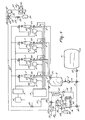
- the teat cups are indicated by the reference number 1. These teat cups are each provided with a liner made of a flexible material, by means of which the teat space of a teat cup is separated from the pulsation space.
- the teat cups 1 are capable of being automatically connected to, and disconnected from an animal's teats by means of a (non-shown) milking robot.
- a milk line 2 is connected to the teat space of each of the teat cups 1. All these milk lines 2 discharge into a milk jar 3.
- the milk jar 3 communicates with a milk tank 7 through a cock 4, a pump 5 and a cock 6.
- each teat cup 1 there is provided a pulsator 8, which produces a milk-yield stimulating, pulsating vacuum in the pulsation space of the respective teat cup 1 during milking.
- Each of the pulsators 8 is connected to a vacuum balance tank 9, wherein a stabilized vacuum is generated by means of a motor-driven pump 10.
- a shut-off element 11 In each of the milk lines 2 connected to the teat cups 1 there is included a shut-off element 11, a vacuum sensor 12 and a flow sensor 13 in that order.
- the implement further comprises a computer 14, by means of which the various parts of the implement for automatic milking are controlled, while it should be specially mentioned that the pulsators 8 are under electronic or computer control, and the sensors 12 and 13 send their acquired information concerning the vacuum or the milk flow in the respective lines to the computer 14.
- the suction stroke, the idle stroke and the vacuum level of the pulsators 8 are computer-controllable. This means that the parameters relevant to the milking, i.e. the pulsation rate, the pulsation ratio and the vacuum level are computer-controlled and attunable to the milk yield from the individual udder quarters of each animal.
- shut-off elements 11 When the teat cups are to be connected, a vacuum is created in the milk jar 3 by means of the vacuum balance tank 9 and, consequently, air is sucked in through the teat space of the respective teat cups and milk lines, of course, insofar as these have been released by the shut-off elements 11.
- the shut-off elements 11 When the teat cups are being connected simultaneously, then the shut-off elements 11 will release the respective milk lines simultaneously; when, however, the teat cups are being connected successively, then the shut-off elements 11 will also release the respective milk lines successively.
- the pulsation frequency can be higher than during a further stage of the milking.
- the flow sensor 13 will issue a signal to the computer 14 which then effects that the pulsator 8 replaces the pulsating vacuum in the pulsation space of the teat cup 1 by a fixed vacuum, so that the liner of the teat cup 1 is sucked against the wall of the teat cup.
- This fixed vacuum will then be of the same magnitude or somewhat less than the vacuum in the milk line 2.
- the vacuum in the teat space can subsequently be removed and the teat cup be disconnected.
- Such a difference in pressure is created across the liner of the teat cups, through the computer-controlled pressure in the pulsation space relative to the pressure in the teat space, that the wear of this liner is restricted considerably.
- the pulsators 8 can also fulfil a function during the rinsing of the teat cups 1.
- the implement is provided with a rinsing circuit 15 comprising a rinsing liquid tank 16, a common rinsing liquid supply line 17, separate rinsing liquid supply lines 18 each being connected to the common rinsing liquid supply line 17, and, connected to the individual rinsing liquid supply lines 18, rinse jetters 19 to which the teat cups 1 can be connected.
- the milk jar 3 is capable of being connected to the rinsing liquid tank 16 again through the cock 6 and a return line 20.
- a "shortened" rinsing circuit through the milk jar 3 can be realized directly by means of the rinsing liquid line 21.
- a heater element 22 in the rinsing liquid tank 16 water of preferably between 40 and 50° C and containing a detergent or cleaning agent can be sucked in, by the vacuum existing in the milk jar 3, via the common rinsing liquid supply line 17, the individual rinsing liquid supply lines 18, the rinse jetters 19, the teat cups 1 and the milk lines 2.
- This rinsing liquid is pumped back again to the rinsing liquid tank 16 via the cock 4, the pump 5, and the cock 6.
- a shut-off element 23 is included in each of the rinsing liquid supply lines 18.
- Each shut-off element 23 is under the control of a pulsator 8.
- the pulsators 8 can be controlled by the computer 14 such that the shut-off elements 23 connected to the respective pulsators successively release and close the rinsing liquid supply lines 18 so as to lead the rinsing liquid successively in time through the respective teat cups 1.
- an open rinsing circuit can also be utilized.
- the temperature of the rinsing liquid is kept as constant as possible during rinsing.
- temperature sensors 24 and 25 are included in the rinsing circuit 15. These temperature sensors communicate with the computer 14, which in its turn controls the heater element 22 in the rinsing liquid tank 16.
- the drawing includes various computer-controlled cocks 26, 27, and 28 (not mentioned before) which are of importance to the initiation and termination of the rinsing of the teat cups, the milk lines and the milk jar and to the draining of the rinsing liquid, either directly or through the rinsing liquid tank 16 to the sewer.
- Figure 2 represents a second exemplary embodiment of the invention, wherein corresponding parts of Figure 1 are indicated by the same reference numbers.
- a first supply line 29 for rinsing liquid such as water
- a computer-controlled cock 30 is included in the first supply line 29.
- the first supply line 29 comprises a thermostatically controlled cock 31, to which a hot-water line 32 and a cold-water line 33 are connected.
- thermostatically controlled cock 31 For pre-rinsing the milk lines, teat cups and milk jar, with the aid of the computer 14 the thermostatically controlled cock 31 is set to a rinsing liquid temperature of between 32° C and 42° C, preferably about 37° C, and the computer-controlled cock 30 is opened for approximately 5 to 7 minutes.
- a second supply line 34 for a further rinsing liquid is connected to the rinsing liquid supply line.
- the second supply line 34 also includes a cock 35 controlled by the computer 14.
- the further rinsing liquid is hot water, which is allowed to flow into the rinsing liquid tank 16 via a line branched off from the hot-water line 32, when the computer-controlled cock 37 included in the line 36 is opened by a signal from the computer 14.
- Connected to the line 36 are also lines 38, permitting a base or an acid to be added to the hot water.
- the lines 38 also include computer-controlled cocks 39.
- the rinsing liquid tank 16 comprises a heater element 22 controlled by a thermostat 40 enabling water to be heated to a temperature of about 78° C, which is a temperature very suitable for hot-cleaning.
- the rinsing liquid tank comprises liquid-level sensors 41, which issue a signal to the computer 14 if no or insufficient water is present in the rinsing liquid tank.
- the rinsing circuit in the vicinity of the milk jar 3 there is also included a temperature sensor 24, with the aid of which the rinsing liquid temperature can be measured, which measurement is issued to the computer 14.
- the temperature sensor 24 is preferably provided at the end of the rinsing circuit, i.e. remotely from the first and second supply lines, so that at the end of the rinsing circuit it can be checked whether the desired and/or minimum temperature of the (pre-)rinsing liquid has been reached there, too. If the minimum temperature has not been reached, in the event of pre-rinsing the computer issues a signal to the thermostatically controlled cock 31, or in the event of main-rin-sing, to the thermostat 40, until the desired minimum temperature of the (pre-)rinsing liquid is obtained.
- the rinsing circuit For the purpose of draining the rinsing liquid into e.g. the sewer, the rinsing circuit comprises two further computer-controlled cocks 42. Possibly infected milk or fore-milk can be discharged into the sewer upon the opening of the computer-controlled cock 6.
- the computer-controlled cock 6 is preferably disposed close by the milk jar 3.
- Figure 3 represents a third exemplary embodiment of the invention, wherein corresponding parts of Figures 1 and 2 are indicated by the same reference numbers.
- the computer-controlled cock 30 is designed as a three-way cock.
- a rinsing liquid line 43 connected to the three-way cock 30 enables rinsing liquid supplied via the first supply line 29 to be applied to a cleaning implement 44 for cleaning of cleaning elements 45, by means of which the udder and/or the teats of an animal are cleaned.
- the cleaning elements 45 are designed as two cleaning rolls 46 disposed at a certain distance from each other and which can be put under the animal's udder by means of a (non-shown) robot. During cleaning, the teats being in between the cleaning rolls 46 driven in mutually opposite directions are rubbed clean.
- a Venturi element 47 is included in the rinsing liquid line 43.
- This Venturi element 47 comprises a cylindrical housing 48 provided with an inlet nipple 49 and an outlet nipple 50.
- the inlet nipple 49 extends in the cylindrical housing 48 as far as the outlet nipple 50 and has a tapered end part 51.
- a tank 54 containing disinfecting liquid, such as chlorine, is connected to the cylindrical housing 48 through a further nipple 52 and a further line 53.
- a computer-controlled cock 55 is included in the further line 53. If it is desired to clean the cleaning elements 45 with a chlorine-water mixture, such a mixture can be obtained by opening the computer-controlled cock 55. Water flowing through the Venturi element 47 makes that in the cylindrical housing 48 there is created a vacuum, as a result of which the disinfecting liquid present in the tank 54 is sucked into the cylindrical housing 48 and is mixed with water.
- the addition of acid or base to the rinsing liquid tank 16 takes place in a similar way as the addition of disinfecting liquid to the rinsing liquid line 43.
- the line 36 branches into a first line 56 and a second line 57, both of which end in the rinsing liquid tank 16.
- a Venturi element 47 In the first line 56 and in the second line 57 there is included a Venturi element 47, while computer-controlled cocks 58 are included in both lines 56 and 57.
- a tank 60 containing a basic liquid is connected to the Venturi element 47 included in the first line 56, while through a line 61, a tank 62 containing an acid is connected to the Venturi element 47 included in the second line 57. Furthermore, computer-controlled cocks 63 are included in the lines 59 and 61.
- Each of the teat cups 1 is also provided with a pulsation line 64, which includes a manure separator 65.
- the manure separator 65 comprises a vessel 66 to which, near the top, interrupted by the vessel 66, the pulsator line 64 is connected.
- the manure separator 65 is disposed in the pulsation line 64 between the teat cup 1 and the pulsator 8.
Landscapes
- Life Sciences & Earth Sciences (AREA)
- Animal Husbandry (AREA)
- Environmental Sciences (AREA)
- Dairy Products (AREA)
- Housing For Livestock And Birds (AREA)
- Cleaning In General (AREA)
- Feeding And Watering For Cattle Raising And Animal Husbandry (AREA)
Claims (40)
- Procédé de traite automatique d'animaux, tels que des vaches, dans lequel on utilise des gobelets trayeurs, chacun d'entre eux étant équipé d'une pièce d'écartement fabriquée à partir d'un matériau souple, au moyen de laquelle l'espace pour tétons d'un gobelet trayeur est séparé de l'espace de pulsation qui est prévu pour créer à l'intérieur un vide de pulsation stimulant la production de lait de l'animal, caractérisé en ce que, lorsqu'un gobelet trayeur est déconnecté, un vide fixe est maintenu dans l'espace de pulsation et le vide est neutralisé dans l'espace pour tétons, et lorsqu'un gobelet trayeur est connecté à un téton, l'espace de pulsation est maintenu à une pression à peu près atmosphérique, tandis que de l'air est extrait de l'espace pour tétons.
- Procédé selon la revendication 1, caractérisé en ce que, dès qu'un vide prédéterminé a été détecté dans un espace pour tétons ou dans une chaíne de lait en communication avec cet espace, ou une fois qu'une période de temps prédéterminée s'est écoulée, la pression à peu près atmosphérique dans l'espace de pulsation est remplacée par un vide de pulsation, au niveau duquel le gobelet trayeur entoure le téton davantage.
- Procédé selon la revendication 1 ou 2, caractérisé en ce que, dès que le débit de lait obtenu a chuté sous une valeur prédéterminée, le vide de pulsation dans l'espace de pulsation est remplacé par un vide fixe qui est maintenu jusqu'à ce qu'au moins le vide existant dans l'espace pour tétons ait été supprimé.
- Procédé selon l'une quelconque des revendications précédentes, caractérisé en ce que, lors de la connexion des gobelets trayeurs et durant la traite ainsi que lors de la déconnexion des gobelets trayeurs, la pression existant dans l'espace de pulsation puisse être contrôlée au moyen d'un pulsateur sous contrôle électronique ou informatique.
- Procédé selon l'une quelconque des revendications précédentes, caractérisé en ce que les gobelets trayeurs sont connectés et déconnectés individuellement, tandis que la pression existant dans l'espace de pulsation de chaque gobelet trayeur, lors de la connexion des gobelets trayeurs aux tétons, de la traite et de la déconnexion des gobelets trayeurs, est contrôlée au moyen de pulsateurs séparés sous contrôle électronique ou informatique.
- Procédé selon l'une quelconque des revendications précédentes, caractérisé en ce que les gobelets trayeurs sont automatiquement connectés à et déconnectés des tétons d'un animal au moyen d'un robot de traite.
- Procédé selon la revendication 4 ou 5, caractérisé en ce que la course d'aspiration et/ou la course à vide et/ou le niveau de vide d'un pulsateur est (sont) contrôlé(s) par des moyens électroniques ou informatiques.
- Procédé selon la revendication 7, caractérisé en ce que le rapport de pulsation et/ou la fréquence de pulsation et/ou le niveau de vide d'un pulsateur pour chaque animal sont individuellement contrôlés par des moyens informatiques.
- Procédé selon l'une quelconque des revendications précédentes, caractérisé en ce que, lors de la traite, le vide présent dans un espace pour tétons ou dans une chaíne de lait connectée à cet espace est mesuré en permanence et est maintenu à une valeur constante par l'intermédiaire d'un ordinateur.
- Procédé selon l'une quelconque des revendications précédentes, caractérisé en ce que, lorsqu'au moins les gobelets trayeurs sont compris dans un circuit de rinçage, un liquide de rinçage étant acheminé à travers les gobelets trayeurs via des têtes de rinçage séparées, les conduites d'alimentation de liquide des têtes de rinçage individuelles sont libérées et fermées soit directement par un ordinateur, soit au moyen d'un pulsateur commandé de manière électronique ou commandé par ordinateur.
- Procédé selon la revendication 10, caractérisé en ce que les conduites d'alimentation de liquide de rinçage individuelles des têtes de rinçage sont libérées et fermées l'une après l'autre dans le temps.
- Procédé selon la revendication 10 ou 11, caractérisé en ce que toutes les conduites d'alimentation de liquide de rinçage des têtes de rinçage sont libérées et fermées par des pulsateurs séparés.
- Procédé selon l'une quelconque des revendications 10 à 12, caractérisé en ce qu'un pré-rinçage a lieu dans le circuit de rinçage, au moyen d'eau ayant une température approximativement comprise entre 32°C et 42°C, particulièrement de 37°C environ.
- Procédé selon l'une quelconque des revendications 10 à 13, caractérisé en ce que le circuit de rinçage est fermé, tandis que de l'eau chaude contenant un détergent ou un produit de nettoyage est alimentée à l'intérieur, c'est-à-dire à travers le circuit comprenant les gobelets trayeurs, les chaínes de lait connectées à ces derniers ainsi qu'à travers un élément de perception, tel qu'un bocal de lait, dans lequel ces chaínes de lait se vident.
- Procédé selon la revendication 14, caractérisé en ce que la température de l'eau est comprise entre 20°C et 70°C, et de préférence entre 40°C et 50°C.
- Procédé selon la revendication 14 ou 15, caractérisé en ce que, dans le circuit de rinçage, est/sont compris un ou une pluralité de capteur(s) de température, au moyen duquel/desquels, en utilisant un ordinateur et un élément d'alimentation en eau réglable ou un élément chauffant dans le réservoir à partir duquel le liquide de rinçage est mis en circulation, la température du liquide de rinçage est maintenue constante au moins durant le rinçage.
- Procédée selon l'une quelconque des revendications 10 à 13, caractérisé en ce que le circuit de rinçage est ouvert, tandis qu'à l'intérieur, pendant un certain temps, de préférence de l'ordre de deux à cinq minutes, de l'eau chaude ou de la vapeur est alimentée, c'est-à-dire par l'intermédiaire du circuit comprenant les gobelets trayeurs, les chaínes de lait connectées à ces derniers ainsi qu'à travers un élément de perception, tel qu'un bocal de lait, dans lequel ces chaínes de lait se vident.
- Procédé selon la revendication 17, caractérisé en ce que la température de l'eau est comprise entre 70°C et 100°C, et est de préférence supérieure à 80°C.
- Appareil destiné à traire automatiquement des animaux, tels que des vaches, dans lequel le procédé selon l'une quelconque des revendications précédentes peut être appliqué, lequel appareil est équipé de gobelets trayeurs (1) et d'un élément de perception (3), tel qu'un collecteur ou un bocal de lait, dans lequel le lait obtenu à partir de chaque quartier de pis d'un animal est alimenté via des chaínes de lait séparées (2), tandis que chacun des gobelets trayeurs (1) est également équipé d'une pièce d'écartement fabriquée à partir d'un matériau souple, au moyen duquel l'espace pour tétons d'un gobelet trayeur (1) est séparé de l'espace de pulsation qui est prévu pour appliquer à l'intérieur un vide de pulsation stimulant la production de lait, caractérisé en ce que, pour chaque gobelet trayeur (1), il est prévu un pulsateur (8) commandé de manière électronique ou commandé par ordinateur, destiné à commander la pression dans l'espace de pulsation d'un gobelet trayeur en question (1), de telle sorte que, lorsqu'un gobelet trayeur est déconnecté, un vide fixe soit maintenu dans l'espace de pulsation et que le vide soit neutralisé dans l'espace pour tétons, et que, lorsqu'un gobelet trayeur est connecté à un téton, l'espace de pulsation soit maintenu à une pression à peu près atmosphérique, tandis que de l'air est extrait de l'espace pour tétons.
- Appareil selon la revendication 19, caractérisé en ce que, dans la chaíne de lait connectée à un gobelet trayeur (1) est compris un détecteur de vide (12) dont les signaux de sortie sont délivrés à un ordinateur (14) qui, dès qu'un vide prédéterminé détecté par le détecteur de vide (12) a été trouvé dans la chaíne de lait, provoque le fait que la pression à peu près atmosphérique existant dans l'espace de pulsation est remplacée par un vide de pulsation.
- Appareil selon la revendication 19 ou 20, caractérisé en ce que, dans la chaíne de lait connectée à un gobelet trayeur (1) est compris un capteur d'écoulement (13) dont les signaux de sortie sont délivrés à un ordinateur (14) qui, dès que l'écoulement de lait obtenu a chuté à un niveau inférieur à une valeur prédéterminée détectée par le capteur d'écoulement (13), provoque le fait que le vide de pulsation présent dans l'espace de pulsation est remplacé par un vide fixe qui est maintenu jusqu'à ce qu'au moins le vide existant dans l'espace pour tétons ait été neutralisé.
- Appareil selon l'une quelconque des revendications 19 à 21, caractérisé en ce que l'appareil comprend un circuit de rinçage (15) comprenant des têtes de rinçage (19), lequel circuit permet au moins l'incorporation des gobelets trayeurs (1), tandis que chacune des conduites d'alimentation de liquide de rinçage (18) des têtes de rinçages individuelles (19) est équipée d'un élément d'arrêt (23) qui est directement commandé par l'ordinateur (14) ou qui est commandé au moyen d'un pulsateur (8) sous contrôle électronique ou informatique, le flux de liquide de rinçage à travers les gobelets trayeurs (1) étant commandé par ces éléments d'arrêt (23).
- Appareil selon l'une quelconque des revendications 19 à 22, caractérisé en ce que, lors de la traite, le vide existant dans l'espace pour tétons ou dans la chaíne de lait connectée à ce dernier peut être mesuré en permanence au moyen de détecteurs de vide (12) compris dans les chaínes de lait individuelles (2), les signaux de sortie des détecteurs de vide (12) étant délivrés à l'ordinateur (14) qui garantit le fait que la pression dans les chaínes de lait soit maintenue constante au moyen de l'élément d'arrêt commandé par ordinateur (11) dans chacune des chaínes de lait (2).
- Appareil selon l'une quelconque des revendications 19 à 23, caractérisé en ce qu'il est muni d'un robot de traite qui sert à la fois à connecter automatiquement les gobelets trayeurs (1) au téton d'un animal et à déconnecter automatiquement ces derniers du téton.
- Appareil selon l'une quelconque des revendications 19 à 24, caractérisé en ce que le circuit de rinçage (15) comprend une première conduite d'alimentation (29) destinée à un liquide de pré-rinçage et une seconde conduite d'alimentation (34) destinée à un autre liquide de rinçage provenant du réservoir de liquide de rinçage (16), lesdites première et seconde conduites d'alimentation (29, 34) étant connectées à une conduite de rinçage (21) du circuit de rinçage.
- Appareil selon la revendication 25, caractérisé en ce que des moyens (31 ; 22, 40) destinés à réguler la température sont prévus, à l'aide desquels il est possible de régler la température du liquide de rinçage qui est délivré dans les première et seconde conduites d'alimentation (29, 34).
- Appareil selon la revendication 26, caractérisé en ce que les moyens de régulation de température pour la première conduite d'alimentation (29) comprennent un thermostat (31) doté d'une conduite d'alimentation pour l'eau chaude (32) et l'eau froide (33).
- Appareil selon la revendication 26 ou 27, caractérisé en ce que les moyens de régulation de température (22, 40) pour la seconde conduite d'alimentation (34) comprennent un élément chauffant (22) et un thermostat (40).
- Appareil selon l'une quelconque des revendications 25 à 28, caractérisé en ce que la première conduite d'alimentation (29) et la seconde conduite d'alimentation (34) sont équipées de robinets commandés par ordinateur (30, 35).
- Appareil selon l'une quelconque des revendications 25 à 29, caractérisé en ce que le réservoir de liquide de rinçage (16) est équipé d'un détecteur de niveau (41) pour le liquide de rinçage.
- Appareil selon l'une quelconque des revendications 25 à 30, caractérisé en ce qu'il est prévu une conduite d'alimentation (59, 61) destinée à délivrer une base et/ou un acide dans le réservoir de liquide de rinçage (16), la conduite d'alimentation comprenant un robinet commandé par ordinateur (63).
- Appareil selon la revendication 31, caractérisé en ce que la/les conduite(s) d'alimentation (59, 61) pour une base et/ou de l'acide est/sont munie(s) d'un élément/d'éléments venturi (47).
- Appareil selon l'une quelconque des revendications 25 à 32, caractérisé en ce qu'une conduite d'alimentation de liquide de rinçage (43) est connectée à une première conduite d'alimentation (29) destinée à délivrer du liquide de rinçage à un appareil de nettoyage (44) destiné à nettoyer des éléments de nettoyage, à l'aide duquel le pis et/ou les tétons d'un animal est/sont nettoyé(s), tandis qu'un élément venturi (47) est également compris dans la conduite de liquide de rinçage (43), lequel est connecté, via une autre canalisation (53), à un réservoir (54) contenant un liquide désinfectant, tel que du chlore.
- Appareil selon la revendication 33, caractérisé en ce qu'un robinet commandé par ordinateur (55) est compris dans l'autre canalisation (53).
- Appareil selon l'une quelconque des revendications 32 à 34, caractérisé en ce que l'élément venturi (47) est réglable, le dispositif étant tel que le débit de la canalisation connectée à l'élément venturi (47) peut être contrôlé.
- Appareil selon l'une quelconque des revendications précédentes, caractérisé en ce qu'un séparateur de fumier (65) est compris dans un conduit de pulsation (64).
- Appareil selon la revendication 36, caractérisé en ce que le séparateur de fumier (65) comprend un récipient auquel le conduit de pulsation (64), interrompu par le récipient, est relié au niveau de la partie supérieure.
- Appareil selon la revendication 36 ou 37, caractérisé en ce qu'un séparateur de fumier (65) est compris dans chacun des quatre conduits de pulsation (64).
- Appareil selon l'une quelconque des revendications 36 à 38, caractérisé en ce que le(s) séparateur(s) de fumier (65) est/sont incorporé(s) avant le(s) pulsateur(s) (8) dans le(s) conduit(s) de pulsation (64).
- Appareil selon l'une quelconque des revendications précédentes, caractérisé en ce qu'un détecteur de niveau de lait est prévu dans le bocal de lait (3), tandis qu'à proximité du fond de ce dernier est reliée une canalisation d'air au détecteur, au moyen de laquelle canalisation d'air il est possible de chasser des bulles d'air dans le lait collecté dans le bocal de lait (3) afin que le lait soit correctement mélangé, tandis qu'il est prévu un appareil de prélèvement de lait connecté à la conduite d'évacuation du lait du bocal de lait (3), au moyen duquel appareil un ou une pluralité d'échantillon(s) de lait peut/peuvent être prélevé(s) d'une quantité de lait prédéfinie au moyen du détecteur de niveau de lait, de telle sorte que chaque échantillon de lait comprenne à peu près la même quantité de lait, quelle que soit la production de lait de l'animal.
Priority Applications (2)
| Application Number | Priority Date | Filing Date | Title |
|---|---|---|---|
| EP06077043A EP1754411B1 (fr) | 1994-04-27 | 1995-04-18 | Méthode de traite automatique d'animaux et dispositif pour sa mise en oeuvre |
| EP01204523A EP1186229B1 (fr) | 1994-04-27 | 1995-04-18 | Méthode de traite automatique d'animaux |
Applications Claiming Priority (6)
| Application Number | Priority Date | Filing Date | Title |
|---|---|---|---|
| NL9400675 | 1994-04-27 | ||
| NL9400675 | 1994-04-27 | ||
| NL9401837 | 1994-11-04 | ||
| NL9401837 | 1994-11-04 | ||
| NL9401937 | 1994-11-21 | ||
| NL9401937A NL9401937A (nl) | 1994-04-27 | 1994-11-21 | Werkwijze voor het automatisch melken van dieren en inrichting waarin deze werkwijze kan worden toegepast. |
Related Child Applications (1)
| Application Number | Title | Priority Date | Filing Date |
|---|---|---|---|
| EP01204523A Division EP1186229B1 (fr) | 1994-04-27 | 1995-04-18 | Méthode de traite automatique d'animaux |
Publications (3)
| Publication Number | Publication Date |
|---|---|
| EP0679331A2 EP0679331A2 (fr) | 1995-11-02 |
| EP0679331A3 EP0679331A3 (fr) | 1995-12-27 |
| EP0679331B1 true EP0679331B1 (fr) | 2002-06-26 |
Family
ID=27352456
Family Applications (3)
| Application Number | Title | Priority Date | Filing Date |
|---|---|---|---|
| EP01204523A Revoked EP1186229B1 (fr) | 1994-04-27 | 1995-04-18 | Méthode de traite automatique d'animaux |
| EP95200969A Expired - Lifetime EP0679331B1 (fr) | 1994-04-27 | 1995-04-18 | Méthode de traite automatique d'animaux et appareil utilisant cette méthode |
| EP06077043A Expired - Lifetime EP1754411B1 (fr) | 1994-04-27 | 1995-04-18 | Méthode de traite automatique d'animaux et dispositif pour sa mise en oeuvre |
Family Applications Before (1)
| Application Number | Title | Priority Date | Filing Date |
|---|---|---|---|
| EP01204523A Revoked EP1186229B1 (fr) | 1994-04-27 | 1995-04-18 | Méthode de traite automatique d'animaux |
Family Applications After (1)
| Application Number | Title | Priority Date | Filing Date |
|---|---|---|---|
| EP06077043A Expired - Lifetime EP1754411B1 (fr) | 1994-04-27 | 1995-04-18 | Méthode de traite automatique d'animaux et dispositif pour sa mise en oeuvre |
Country Status (6)
| Country | Link |
|---|---|
| US (2) | US5651329A (fr) |
| EP (3) | EP1186229B1 (fr) |
| AU (2) | AU694480B2 (fr) |
| DE (2) | DE69535420T2 (fr) |
| DK (3) | DK1754411T3 (fr) |
| NL (1) | NL9401937A (fr) |
Cited By (1)
| Publication number | Priority date | Publication date | Assignee | Title |
|---|---|---|---|---|
| WO2014070087A1 (fr) | 2012-11-01 | 2014-05-08 | Delaval Holding Ab | Procédé, programme informatique et produit programme d'ordinateur de commande de la traite par un dispositif de traite et agencement de traite |
Families Citing this family (83)
| Publication number | Priority date | Publication date | Assignee | Title |
|---|---|---|---|---|
| NL9400305A (nl) * | 1994-02-28 | 1995-10-02 | Gascoigne Melotte Bv | Inrichting voor het meten van de complexe impedantie van melk, alsmede melkklauw met een dergelijke inrichting. |
| NL9401937A (nl) * | 1994-04-27 | 1995-12-01 | Maasland Nv | Werkwijze voor het automatisch melken van dieren en inrichting waarin deze werkwijze kan worden toegepast. |
| SE9401685D0 (sv) * | 1994-05-17 | 1994-05-17 | Tetra Laval Holdings & Finance | Metod för mjölkning av djur |
| NL9401681A (nl) * | 1994-10-12 | 1996-05-01 | Maasland Nv | Werkwijze en inrichting voor het automatisch melken van dieren, zoals koeien. |
| SE505351C2 (sv) * | 1995-05-17 | 1997-08-11 | Alfa Laval Agri Ab | Sätt att övervaka funktionen hos en mjölkningsmaskin jämte mjölkningsmaskin |
| SE504429C2 (sv) * | 1995-05-17 | 1997-02-10 | Tetra Laval Holdings & Finance | Sätt att styra mjölkning med hjälp av spengummits abrupta rörelse jämte mjölkningsmaskin med avkännare härför |
| EP0797915B2 (fr) * | 1996-03-29 | 2005-08-31 | Maasland N.V. | Appareil pour la traite d'animaux |
| JP3382808B2 (ja) * | 1997-02-07 | 2003-03-04 | 株式会社日立ユニシアオートモティブ | 燃料供給装置 |
| NL1006473C2 (nl) * | 1997-07-04 | 1999-01-05 | Maasland Nv | Inrichting voor het automatisch melken van dieren. |
| NL1006586C2 (nl) * | 1997-07-15 | 1999-01-18 | Maasland Nv | Constructie met een inrichting voor het melken van dieren, alsmede een werkwijze daarvoor. |
| NL1007727C2 (nl) * | 1997-12-08 | 1999-06-09 | Maasland Nv | Spoelvloeistofreinigingsinrichting voor het reinigen van althans een deel van een melkmachine. |
| AU744154B2 (en) * | 1997-12-19 | 2002-02-14 | Waikato Milking Systems Nz Limited | Milking machines and use thereof |
| NL1010323C2 (nl) * | 1998-10-15 | 2000-04-18 | Maasland Nv | Werkwijze voor het automatisch melken van dieren en volautomatische melkmachine met een melkrobot geschikt voor het uitvoeren van de werkwijze. |
| DE19900274B4 (de) * | 1999-01-07 | 2009-01-29 | Werner Happel | Verfahren zur Anpassung der Melkanlage an eine Herde von Tieren |
| SE517346C2 (sv) * | 1999-09-15 | 2002-05-28 | Delaval Holding Ab | Mjölkningsanordning med tvätt och sköljning av olika delar och med intervallstyrning |
| SE517344C2 (sv) * | 1999-09-15 | 2002-05-28 | Delaval Holding Ab | Anordning och förfarande för att styra vakuumnivån vid varje spenkopp i beroende av mjölkflödet från respektive spenkopp |
| US6439156B1 (en) * | 2000-11-13 | 2002-08-27 | Dec International, Inc. | Milking vacuum fluctuation filter |
| SE521033C2 (sv) * | 2001-01-12 | 2003-09-23 | Delaval Holding Ab | Förfarande och anordning för att automatiskt mjölka djur samt datorprogram för detta |
| DE10129475B4 (de) * | 2001-06-21 | 2016-11-10 | Gea Farm Technologies Gmbh | Verfahren zum Melken eines Tieres, insbesondere einer Kuh |
| SE520170C2 (sv) * | 2001-09-20 | 2003-06-03 | Delaval Holding Ab | Arrangemang och förfarande för transport av mjölk i en mjölkningsanläggning |
| US7607404B2 (en) | 2001-11-28 | 2009-10-27 | Delaval Holding Ab | Vacuum system communication |
| SE0202988D0 (sv) * | 2002-03-15 | 2002-10-10 | Delaval Holding Ab | A method and an arrangement at a dairy farm |
| US6619227B1 (en) | 2002-04-04 | 2003-09-16 | Danaher Controls | Milking equipment wash monitoring system and method |
| SE0201215D0 (sv) * | 2002-04-23 | 2002-04-23 | Delaval Holding Ab | A device and a method for sampling of milk |
| NL1020782C2 (nl) * | 2002-06-06 | 2003-12-09 | Lely Entpr Ag | Werkwijze en inrichting voor het automatisch melken van een dier. |
| NL1020784C2 (nl) * | 2002-06-06 | 2003-12-09 | Lely Entpr Ag | Inrichting voor het automatisch melken van een dier. |
| NL1020785C2 (nl) * | 2002-06-06 | 2003-12-09 | Lely Entpr Ag | Inrichting voor het melken van dieren. |
| NL1020783C2 (nl) * | 2002-06-06 | 2003-12-09 | Lely Entpr Ag | Werkwijze en inrichting voor het automatisch melken van een dier. |
| US20040069203A1 (en) * | 2002-10-11 | 2004-04-15 | Timothy Fleming | Foam and inflatable collar assemblies for watercraft |
| US6767408B2 (en) * | 2002-12-18 | 2004-07-27 | Hydrite Chemical Co. | Monitoring device and method for operating clean-in-place system |
| US7841296B2 (en) | 2003-02-07 | 2010-11-30 | Global Tech Systems, Inc. | Controller for monitoring and controlling pulsators in a milking system |
| US6990924B2 (en) * | 2003-02-07 | 2006-01-31 | Global Tech Systems Inc | Controller for monitoring and controlling pulsators in a milking system |
| US7051673B2 (en) * | 2003-02-07 | 2006-05-30 | Global Tech Systems, Inc. | Pulsator controller for monitoring and controlling a designated pulsator in a milking system and method of using same |
| SE0301934L (sv) * | 2003-06-30 | 2005-02-22 | Delaval Holding Ab | Mjölkningsanordning och förfarande för hantering av en mjölkningsanordning |
| NL1024295C2 (nl) * | 2003-09-15 | 2005-03-16 | Lely Entpr Ag | Werkwijze voor het melken van een dier en inrichting hiervoor. |
| GB0408968D0 (en) * | 2004-04-22 | 2004-05-26 | Duke James R J | Milking equipment |
| NL1025819C2 (nl) * | 2004-03-26 | 2005-09-27 | Lely Entpr Ag | Werkwijze en inrichting voor het melken van een melkdier. |
| NL1033100C2 (nl) * | 2006-12-21 | 2008-06-24 | Maasland Nv | Melkbekerreinigingsinrichting en -werkwijze. |
| NL1025818C2 (nl) * | 2004-03-26 | 2005-10-03 | Lely Entpr Ag | Inrichting en werkwijze voor het melken van een melkdier. |
| US8540821B2 (en) | 2004-03-26 | 2013-09-24 | Maasland N.V. | Teat cup cleaning device and method |
| US8025029B2 (en) | 2004-06-12 | 2011-09-27 | Gea Farm Technologies, Inc. | Automatic dairy animal milker unit backflusher and teat dip applicator system and method |
| US8342125B2 (en) * | 2004-06-12 | 2013-01-01 | Gea Farm Technologies, Inc. | Safety valve for an automatic dairy animal milker unit backflusher and teat dip applicator |
| US8033247B2 (en) | 2004-06-12 | 2011-10-11 | Gea Farm Technologies, Inc. | Automatic dairy animal milker unit backflusher and teat dip applicator system and method |
| US8117989B2 (en) | 2008-06-27 | 2012-02-21 | Gea Farm Technologies, Inc. | Milk tube dome with flow controller |
| US10874084B2 (en) | 2004-06-12 | 2020-12-29 | Gea Farm Technologies, Inc. | Safety valve for a dairy system component |
| DE102004059089A1 (de) * | 2004-07-15 | 2006-02-02 | Agrar GbR Schmidt & Fenzel (Vertretungsberechtigter Gesellschafter: Herr Jörg Schmidt, 14547 Beelitz) | Melkanlage |
| NL1030474C2 (nl) * | 2005-11-21 | 2007-05-22 | Maasland Nv | Werkwijze voor het stimuleren van de spenen van het uier van een dier, pulsator en werkwijze voor het controleren van het melkproces aan de hand van het pulsatievacuüm. |
| DE102006038484A1 (de) * | 2006-08-16 | 2008-02-21 | Westfaliasurge Gmbh | Verfahren und Vorrichtung zum Desinfizieren von Melkzeug |
| DK1935235T3 (da) * | 2006-12-21 | 2010-05-31 | Maasland Nv | Pattekoprengøringsindretning og fremgangsmåde forbundet dermed |
| SE0800092L (sv) * | 2007-04-13 | 2008-10-14 | Delaval Holding Ab | Optimal tömning av slutenheten under provtagning i vms |
| NL1034963C2 (nl) * | 2007-05-24 | 2008-11-25 | Maasland Nv | Melkbekerreinigingsinrichting en -werkwijze. |
| SE531745C2 (sv) † | 2007-06-01 | 2009-07-28 | Delaval Holding Ab | Förfarande och arrangemang för rengöring av mjölkningssystem med flera mjölkningsstationer |
| SE532738C2 (sv) * | 2008-01-30 | 2010-03-30 | Delaval Holding Ab | Arrangemang och metod vid mjölkprovtagning vid mjölkning av ett djur |
| EP2111750A1 (fr) * | 2008-04-25 | 2009-10-28 | Lely Patent N.V. | Procédé pour effectuer une opération associée à un animal et mise en ?uvre pour effectuer le procédé |
| NL1035773C2 (nl) * | 2008-07-28 | 2010-01-29 | Lely Patent Nv | Afsluiter voor melkinstallatie. |
| EP2355652B2 (fr) * | 2008-11-10 | 2021-03-17 | GEA Farm Technologies GmbH | Procédé et dispositif de mise en contact automatique d'un fluide avec les tétines d'un animal |
| WO2010069811A2 (fr) * | 2008-12-18 | 2010-06-24 | Delaval Holding Ab | Dispositif de nettoyage |
| US11723341B2 (en) | 2009-09-04 | 2023-08-15 | Gea Farm Technologies, Inc. | Safety valve for an automated milker unit backflushing and teat dip applicator system |
| US8770146B2 (en) | 2009-09-04 | 2014-07-08 | Gea Farm Technologies, Inc. | Methods and apparatus for applying teat dip to a dairy animal |
| NL1037523C2 (nl) | 2009-12-02 | 2011-06-06 | Lely Patent Nv | Melkinrichting, en werkwijze voor reinigen daarvan. |
| US20120097107A1 (en) | 2010-02-22 | 2012-04-26 | Gea Farm Technologies, Inc. | Dairy animal milking preparation system and methods |
| WO2011102911A2 (fr) | 2010-02-22 | 2011-08-25 | Gea Farm Technologies, Inc. | Installations de traite équipées d'un système de protection de la canalisation à lait et procédés associés |
| EP2632247B1 (fr) | 2010-10-26 | 2017-04-26 | DeLaval Holding AB | Système de commande et procédé de traite d'éléments dans une salle de traite |
| US8671884B2 (en) * | 2011-04-27 | 2014-03-18 | Lanny Gehm | Milking machine attachment aid |
| DK3202257T3 (da) | 2011-04-28 | 2020-07-13 | Technologies Holdings Corp | Malkeboks med mange holdere til patte- eller rengøringskopper |
| DE102011075138A1 (de) | 2011-05-03 | 2012-11-08 | Leibniz-Institut für Agrartechnik Potsdam-Bornim e.V.(ATB) | Verfahren und Kit zum automatischen Melken von Tieren |
| KR101190058B1 (ko) * | 2012-01-19 | 2012-10-12 | 조용석 | 착유기 자동 점검 장치 및 방법 |
| GB201213231D0 (en) | 2012-07-25 | 2012-09-05 | An Udder Company Ltd | Milking equipment |
| DE102013114595B4 (de) | 2013-12-20 | 2026-01-15 | Gea Farm Technologies Gmbh | Sicherheitsventil |
| US9526224B2 (en) | 2013-12-20 | 2016-12-27 | Gea Farm Technologies Gmbh | Safety valve device |
| US20150296736A1 (en) * | 2014-04-17 | 2015-10-22 | Milkline Srl | Method implemented by a computer for the control of milking operations on automated systems |
| NL2012793B1 (nl) * | 2014-05-09 | 2016-02-24 | Lely Patent Nv | Melksysteem. |
| NL2012792B1 (nl) * | 2014-05-09 | 2016-02-24 | Lely Patent Nv | Melkinrichting. |
| NL2012789B1 (nl) | 2014-05-09 | 2016-02-24 | Lely Patent Nv | Melkinrichting. |
| US10258016B2 (en) * | 2014-05-09 | 2019-04-16 | Delaval Holding Ab | Cleaning system and method for an automatic milking system |
| NL2015944B1 (nl) * | 2015-12-11 | 2017-07-05 | Lely Patent Nv | Melkinrichting. |
| DE102016103674A1 (de) * | 2016-03-01 | 2017-09-07 | Gea Farm Technologies Gmbh | Reinigungsverfahren für Melkanlagen und Reinigungsvorrichtung |
| US9901068B2 (en) * | 2016-04-21 | 2018-02-27 | Technologies Holdings Corp. | Solenoid actuated shutoff valve |
| DE102016108300A1 (de) | 2016-05-04 | 2017-11-09 | Gea Farm Technologies Gmbh | Sicherheitsventil |
| US10542723B2 (en) | 2016-07-21 | 2020-01-28 | Lanny Gehm | Milking system |
| EP3703490A1 (fr) | 2017-11-03 | 2020-09-09 | GEA Farm Technologies, Inc. | Agencement de soupape de sécurité de système de traite automatique |
| US11825807B2 (en) | 2019-11-08 | 2023-11-28 | Delaval Holding Ab | Milking system |
| WO2023034254A1 (fr) * | 2021-08-31 | 2023-03-09 | Gea Farm Technologies, Inc. | Système et procédés de traite avec pré-immersion et post-immersion dans le manchon trayeur |
Family Cites Families (27)
| Publication number | Priority date | Publication date | Assignee | Title |
|---|---|---|---|---|
| US3479008A (en) * | 1967-06-07 | 1969-11-18 | Zero Manufacturing Co | Self-cleaning valve for vacuum milking system |
| NL7014273A (fr) * | 1969-10-06 | 1971-04-08 | ||
| US3696790A (en) * | 1970-01-08 | 1972-10-10 | Zero Manufacturing Co | Teat cup assembly |
| US4011838A (en) * | 1976-03-25 | 1977-03-15 | Alfa-Laval Ab | Electronic milker |
| GB1594087A (en) * | 1977-03-25 | 1981-07-30 | Philips E M | Milking machine pulsator valves |
| US4175514A (en) * | 1977-05-19 | 1979-11-27 | Frank F. Souza, Inc. | Automatic milking machine control and cleansing |
| FR2424700A1 (fr) * | 1978-05-03 | 1979-11-30 | Abrahamson John | Procede et appareil de traite du lait |
| US4222346A (en) * | 1978-11-29 | 1980-09-16 | Reisgies Rolf W | Milk line back flushing method and apparatus |
| US4445522A (en) * | 1982-09-23 | 1984-05-01 | Bender Machine Works, Inc. | Apparatus for cleaning liquid conveying system and control valve assembly therefor |
| EP0131646B1 (fr) * | 1983-07-19 | 1989-05-31 | Biomelktechnik Hoefelmayr & Co. | Soupape permettant l'introduction d'air dans la canalisation du lait d'un gobelet-trayeur ou d'un collecteur de lait |
| US4516592A (en) * | 1984-02-29 | 1985-05-14 | Alfa-Laval, Inc. | Milker unit washer |
| US4572105A (en) * | 1984-09-20 | 1986-02-25 | Alfa-Laval, Inc. | Backflushing system |
| FR2595197B1 (fr) * | 1986-03-07 | 1988-11-18 | Cemagref | Installation de traite automatique |
| GB8807999D0 (en) * | 1988-04-06 | 1988-05-05 | Ambic Equip Ltd | Improvements in/relating to automatic milking apparatus |
| DE8809131U1 (de) * | 1988-07-16 | 1988-09-01 | Westfalia Separator Ag, 4740 Oelde | Melkzeug |
| US5272997A (en) * | 1989-02-27 | 1993-12-28 | C. Van Der Lely N.V. | Milking apparatus |
| NL193553C (nl) * | 1989-02-27 | 2003-01-10 | Lely Entpr Ag | Melkinstallatie. |
| US5275124A (en) * | 1989-02-27 | 1994-01-04 | C. Van Der Lely N.V. | Milking apparatus |
| NL9101636A (nl) * | 1991-09-27 | 1993-04-16 | Lely Nv C Van Der | Werkwijze voor het automatisch melken van dieren. |
| US5568788A (en) * | 1990-02-27 | 1996-10-29 | C. Van Der Lely N.V. | Implement for and a method of milking animals automatically |
| DE4113699A1 (de) * | 1991-04-26 | 1992-10-29 | Dieter Dipl Ing Schillingmann | Melkmaschine |
| CA2068834A1 (fr) * | 1991-05-17 | 1992-11-18 | Pieter A. Oosterling | Gobelet trayeur et machine a traire |
| NL9200258A (nl) * | 1991-10-04 | 1993-05-03 | Lely Nv C Van Der | Werkwijze voor het reinigen van melkbekers en/of het nabehandelen van de spenen van een gemolken dier, inrichting voor het melken van dieren voor het toepassen van deze werkwijze(n), en spoelwerktuig toegepast in een dergelijke inrichting. |
| NL9200091A (nl) * | 1992-01-17 | 1993-08-16 | Lely Nv C Van Der | Melkmachine. |
| US5218924A (en) * | 1992-03-19 | 1993-06-15 | Dec International, Inc. | Milking system with variable pressure source |
| NL9300918A (nl) * | 1993-05-28 | 1994-12-16 | Lely Nv C Van Der | Inrichting voor het melken van dieren. |
| NL9401937A (nl) * | 1994-04-27 | 1995-12-01 | Maasland Nv | Werkwijze voor het automatisch melken van dieren en inrichting waarin deze werkwijze kan worden toegepast. |
-
1994
- 1994-11-21 NL NL9401937A patent/NL9401937A/nl not_active Application Discontinuation
-
1995
- 1995-04-18 DK DK06077043.5T patent/DK1754411T3/da active
- 1995-04-18 EP EP01204523A patent/EP1186229B1/fr not_active Revoked
- 1995-04-18 EP EP95200969A patent/EP0679331B1/fr not_active Expired - Lifetime
- 1995-04-18 DK DK95200969T patent/DK0679331T3/da active
- 1995-04-18 DE DE69535420T patent/DE69535420T2/de not_active Expired - Lifetime
- 1995-04-18 DE DE69527168T patent/DE69527168T2/de not_active Expired - Lifetime
- 1995-04-18 DK DK01204523T patent/DK1186229T3/da active
- 1995-04-18 EP EP06077043A patent/EP1754411B1/fr not_active Expired - Lifetime
- 1995-04-24 AU AU17625/95A patent/AU694480B2/en not_active Ceased
- 1995-04-27 US US08/428,484 patent/US5651329A/en not_active Expired - Lifetime
-
1997
- 1997-04-03 US US08/826,525 patent/US5881669A/en not_active Expired - Lifetime
-
1998
- 1998-07-06 AU AU74175/98A patent/AU713282B2/en not_active Ceased
Cited By (2)
| Publication number | Priority date | Publication date | Assignee | Title |
|---|---|---|---|---|
| WO2014070087A1 (fr) | 2012-11-01 | 2014-05-08 | Delaval Holding Ab | Procédé, programme informatique et produit programme d'ordinateur de commande de la traite par un dispositif de traite et agencement de traite |
| US9339003B2 (en) | 2012-11-01 | 2016-05-17 | Delaval Holding Ab | Method, computer program, and computer program product for controlling the milking by a milking device, and a milking arrangement |
Also Published As
| Publication number | Publication date |
|---|---|
| EP1754411B1 (fr) | 2011-07-13 |
| EP1186229B1 (fr) | 2007-03-07 |
| DE69527168T2 (de) | 2003-02-06 |
| DE69527168D1 (de) | 2002-08-01 |
| DE69535420D1 (de) | 2007-04-19 |
| EP1186229A2 (fr) | 2002-03-13 |
| NL9401937A (nl) | 1995-12-01 |
| DE69535420T2 (de) | 2007-11-29 |
| US5881669A (en) | 1999-03-16 |
| EP1186229A3 (fr) | 2003-04-23 |
| EP1754411A3 (fr) | 2009-03-18 |
| AU713282B2 (en) | 1999-11-25 |
| AU694480B2 (en) | 1998-07-23 |
| AU7417598A (en) | 1998-09-03 |
| EP1754411A2 (fr) | 2007-02-21 |
| EP0679331A2 (fr) | 1995-11-02 |
| DK0679331T3 (da) | 2002-10-14 |
| EP0679331A3 (fr) | 1995-12-27 |
| DK1186229T3 (da) | 2007-07-09 |
| US5651329A (en) | 1997-07-29 |
| AU1762595A (en) | 1995-11-02 |
| DK1754411T3 (da) | 2011-08-15 |
Similar Documents
| Publication | Publication Date | Title |
|---|---|---|
| EP0679331B1 (fr) | Méthode de traite automatique d'animaux et appareil utilisant cette méthode | |
| EP0944301B1 (fr) | Dispositif pour traite automatique d'animaux | |
| EP0761091B1 (fr) | Méthode de nettoyage d'un circuit de lait | |
| US5080040A (en) | Milking plant | |
| EP0527509A2 (fr) | Procédé pour nettoyer les trayons d'un animal femelle, procédé de traite et goblet troyeur à utiliser avec les dits procédés | |
| JP3653100B2 (ja) | 動物搾乳装置 | |
| US20020119574A1 (en) | Method and apparatus for cleaning a milk line system | |
| US2915072A (en) | Milk pipe line washing system | |
| AU724419B2 (en) | A method of automatically milking animals and an implement for applying same | |
| EP0666475B1 (fr) | Dispositif pour traire les animaux | |
| NL1010827C2 (nl) | Werkwijze en inrichting voor het melken van dieren. |
Legal Events
| Date | Code | Title | Description |
|---|---|---|---|
| PUAI | Public reference made under article 153(3) epc to a published international application that has entered the european phase |
Free format text: ORIGINAL CODE: 0009012 |
|
| AK | Designated contracting states |
Kind code of ref document: A2 Designated state(s): BE DE DK FR GB IT NL SE |
|
| PUAL | Search report despatched |
Free format text: ORIGINAL CODE: 0009013 |
|
| AK | Designated contracting states |
Kind code of ref document: A3 Designated state(s): BE DE DK FR GB IT NL SE |
|
| 17P | Request for examination filed |
Effective date: 19960603 |
|
| 17Q | First examination report despatched |
Effective date: 19990310 |
|
| GRAG | Despatch of communication of intention to grant |
Free format text: ORIGINAL CODE: EPIDOS AGRA |
|
| GRAG | Despatch of communication of intention to grant |
Free format text: ORIGINAL CODE: EPIDOS AGRA |
|
| GRAH | Despatch of communication of intention to grant a patent |
Free format text: ORIGINAL CODE: EPIDOS IGRA |
|
| GRAH | Despatch of communication of intention to grant a patent |
Free format text: ORIGINAL CODE: EPIDOS IGRA |
|
| GRAA | (expected) grant |
Free format text: ORIGINAL CODE: 0009210 |
|
| AK | Designated contracting states |
Kind code of ref document: B1 Designated state(s): BE DE DK FR GB IT NL SE |
|
| PG25 | Lapsed in a contracting state [announced via postgrant information from national office to epo] |
Ref country code: IT Free format text: LAPSE BECAUSE OF FAILURE TO SUBMIT A TRANSLATION OF THE DESCRIPTION OR TO PAY THE FEE WITHIN THE PRESCRIBED TIME-LIMIT;WARNING: LAPSES OF ITALIAN PATENTS WITH EFFECTIVE DATE BEFORE 2007 MAY HAVE OCCURRED AT ANY TIME BEFORE 2007. THE CORRECT EFFECTIVE DATE MAY BE DIFFERENT FROM THE ONE RECORDED. Effective date: 20020626 |
|
| REG | Reference to a national code |
Ref country code: GB Ref legal event code: FG4D |
|
| REF | Corresponds to: |
Ref document number: 69527168 Country of ref document: DE Date of ref document: 20020801 |
|
| REG | Reference to a national code |
Ref country code: DK Ref legal event code: T3 |
|
| ET | Fr: translation filed | ||
| PLBQ | Unpublished change to opponent data |
Free format text: ORIGINAL CODE: EPIDOS OPPO |
|
| PLBI | Opposition filed |
Free format text: ORIGINAL CODE: 0009260 |
|
| PLBF | Reply of patent proprietor to notice(s) of opposition |
Free format text: ORIGINAL CODE: EPIDOS OBSO |
|
| 26 | Opposition filed |
Opponent name: PROLION B.V Effective date: 20030326 |
|
| NLR1 | Nl: opposition has been filed with the epo |
Opponent name: PROLION B.V |
|
| PLBB | Reply of patent proprietor to notice(s) of opposition received |
Free format text: ORIGINAL CODE: EPIDOSNOBS3 |
|
| PLCK | Communication despatched that opposition was rejected |
Free format text: ORIGINAL CODE: EPIDOSNREJ1 |
|
| PLBN | Opposition rejected |
Free format text: ORIGINAL CODE: 0009273 |
|
| STAA | Information on the status of an ep patent application or granted ep patent |
Free format text: STATUS: OPPOSITION REJECTED |
|
| 27O | Opposition rejected |
Effective date: 20051208 |
|
| NLR2 | Nl: decision of opposition |
Effective date: 20051208 |
|
| PGFP | Annual fee paid to national office [announced via postgrant information from national office to epo] |
Ref country code: FR Payment date: 20090417 Year of fee payment: 15 |
|
| PGFP | Annual fee paid to national office [announced via postgrant information from national office to epo] |
Ref country code: BE Payment date: 20090528 Year of fee payment: 15 |
|
| PGFP | Annual fee paid to national office [announced via postgrant information from national office to epo] |
Ref country code: GB Payment date: 20090429 Year of fee payment: 15 |
|
| BERE | Be: lapsed |
Owner name: *MAASLAND N.V. Effective date: 20100430 |
|
| GBPC | Gb: european patent ceased through non-payment of renewal fee |
Effective date: 20100418 |
|
| REG | Reference to a national code |
Ref country code: FR Ref legal event code: ST Effective date: 20101230 |
|
| PG25 | Lapsed in a contracting state [announced via postgrant information from national office to epo] |
Ref country code: GB Free format text: LAPSE BECAUSE OF NON-PAYMENT OF DUE FEES Effective date: 20100418 Ref country code: BE Free format text: LAPSE BECAUSE OF NON-PAYMENT OF DUE FEES Effective date: 20100430 |
|
| PG25 | Lapsed in a contracting state [announced via postgrant information from national office to epo] |
Ref country code: FR Free format text: LAPSE BECAUSE OF NON-PAYMENT OF DUE FEES Effective date: 20100430 |
|
| PGFP | Annual fee paid to national office [announced via postgrant information from national office to epo] |
Ref country code: DK Payment date: 20120425 Year of fee payment: 18 Ref country code: NL Payment date: 20120426 Year of fee payment: 18 |
|
| PGFP | Annual fee paid to national office [announced via postgrant information from national office to epo] |
Ref country code: DE Payment date: 20130429 Year of fee payment: 19 Ref country code: SE Payment date: 20130429 Year of fee payment: 19 |
|
| REG | Reference to a national code |
Ref country code: NL Ref legal event code: V1 Effective date: 20131101 |
|
| REG | Reference to a national code |
Ref country code: DK Ref legal event code: EBP Effective date: 20130430 |
|
| PG25 | Lapsed in a contracting state [announced via postgrant information from national office to epo] |
Ref country code: NL Free format text: LAPSE BECAUSE OF NON-PAYMENT OF DUE FEES Effective date: 20131101 |
|
| PG25 | Lapsed in a contracting state [announced via postgrant information from national office to epo] |
Ref country code: DK Free format text: LAPSE BECAUSE OF NON-PAYMENT OF DUE FEES Effective date: 20130430 |
|
| REG | Reference to a national code |
Ref country code: DE Ref legal event code: R119 Ref document number: 69527168 Country of ref document: DE |
|
| REG | Reference to a national code |
Ref country code: SE Ref legal event code: EUG |
|
| PG25 | Lapsed in a contracting state [announced via postgrant information from national office to epo] |
Ref country code: DE Free format text: LAPSE BECAUSE OF NON-PAYMENT OF DUE FEES Effective date: 20141101 Ref country code: SE Free format text: LAPSE BECAUSE OF NON-PAYMENT OF DUE FEES Effective date: 20140419 |
|
| REG | Reference to a national code |
Ref country code: DE Ref legal event code: R119 Ref document number: 69527168 Country of ref document: DE Effective date: 20141101 |