EP0380808B1 - Verfahren und Vorrichtung zum Herstellen eines Jacquard-Schattenvelours - Google Patents
Verfahren und Vorrichtung zum Herstellen eines Jacquard-Schattenvelours Download PDFInfo
- Publication number
- EP0380808B1 EP0380808B1 EP89124010A EP89124010A EP0380808B1 EP 0380808 B1 EP0380808 B1 EP 0380808B1 EP 89124010 A EP89124010 A EP 89124010A EP 89124010 A EP89124010 A EP 89124010A EP 0380808 B1 EP0380808 B1 EP 0380808B1
- Authority
- EP
- European Patent Office
- Prior art keywords
- pile
- weft
- warp
- threads
- jacquard
- Prior art date
- Legal status (The legal status is an assumption and is not a legal conclusion. Google has not performed a legal analysis and makes no representation as to the accuracy of the status listed.)
- Expired - Lifetime
Links
- 238000000034 method Methods 0.000 title claims abstract description 19
- 238000004519 manufacturing process Methods 0.000 title claims description 3
- 239000003086 colorant Substances 0.000 claims abstract description 20
- 239000004744 fabric Substances 0.000 claims description 38
- 238000009941 weaving Methods 0.000 claims description 19
- 238000004043 dyeing Methods 0.000 claims description 4
- 238000007667 floating Methods 0.000 claims description 4
- 230000008878 coupling Effects 0.000 abstract description 2
- 238000010168 coupling process Methods 0.000 abstract description 2
- 238000005859 coupling reaction Methods 0.000 abstract description 2
- 230000002730 additional effect Effects 0.000 abstract 1
- 239000000835 fiber Substances 0.000 description 6
- 230000000694 effects Effects 0.000 description 5
- 238000003780 insertion Methods 0.000 description 5
- 230000037431 insertion Effects 0.000 description 5
- 230000015572 biosynthetic process Effects 0.000 description 4
- 230000000712 assembly Effects 0.000 description 3
- 238000000429 assembly Methods 0.000 description 3
- 229920002972 Acrylic fiber Polymers 0.000 description 2
- 210000000050 mohair Anatomy 0.000 description 2
- 229920000742 Cotton Polymers 0.000 description 1
- 241000446313 Lamella Species 0.000 description 1
- 235000014676 Phragmites communis Nutrition 0.000 description 1
- 230000005540 biological transmission Effects 0.000 description 1
- 238000005516 engineering process Methods 0.000 description 1
- 238000010348 incorporation Methods 0.000 description 1
- 238000000819 phase cycle Methods 0.000 description 1
- 230000001681 protective effect Effects 0.000 description 1
- 239000007787 solid Substances 0.000 description 1
- 239000000126 substance Substances 0.000 description 1
- 230000001360 synchronised effect Effects 0.000 description 1
- 229920002994 synthetic fiber Polymers 0.000 description 1
- 239000012209 synthetic fiber Substances 0.000 description 1
Images


Classifications
-
- D—TEXTILES; PAPER
- D03—WEAVING
- D03D—WOVEN FABRICS; METHODS OF WEAVING; LOOMS
- D03D27/00—Woven pile fabrics
- D03D27/02—Woven pile fabrics wherein the pile is formed by warp or weft
- D03D27/10—Fabrics woven face-to-face, e.g. double velvet
Definitions
- the invention relates to a method and a device for producing a jacquard shadow velor with different standing and layered areas according to a pattern to be woven.
- a tight figure chain is provided for the formation of the double work, with respect to which the weft threads in the upper and lower goods are bound by a double weave in transverse ribs, in which two weft threads on one side of the tight chain and one weft thread on the other side of the tight Chain lies.
- the weft threads are integrated via the basic chain in plain weave.
- the weft threads are arranged in the upper fabric with a position deep, deep, high for a first position pile, with a position high, deep, deep for a second layer and with a position high, low, high for a standing pile.
- the weft threads are arranged symmetrically in the bottom fabric. Repeat repetitions and the combination of the repetitions enable the weaving of patterns.
- the weaving machines used for this are conventional dobby and / or jacquard machines.
- the object of the invention is therefore to create a method and a device for producing a jacquard shadow velor, which allow a three- and multi-colored weaving of patterns with differently colored formation of individual pile areas.
- the special double plush weave enables one weft thread for different feed repeats to lie on the top of the fabric facing the pile cover and to be bound by the base warp, while the other weft threads are essentially covered by the figure and pile warp.
- the color of the weft thread on the pile-side fabric surface dominates the color effect of the pile area of a specific repeat.
- the pull-in repeats possible for a 3/6 weft pile binding, right-hand layer pile, left-hand layer pile and standing pile can thus have their own color, which is determined by the color of the weft thread on the pile side.
- Another color variation can be achieved by weaving in additional weft threads in the same or different colors. These additional shots are tied off by the figure chain and preferably floating.
- Natural fibers in particular mohair, are preferably used for the pile chain.
- colored acrylic fibers are preferably used as the weft. The different color affinity of these fibers during dyeing allows a dyeing process to be followed in which the color of the weft threads remains unchanged, the pile warp and possibly the base and figure warp, which are also preferably made of natural fiber, are dyed.
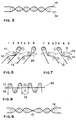
- the process for producing a jacquard shadow velor according to fabric sections in FIGS. 1 to 5 is carried out on a double-weaving machine.
- a basic chain 14 and a pole chain 13 are raised and lowered by means of shafts, and a figure chain 11, 12 is controlled via a jacquard device.
- Weft threads 1, 2, 3, 4, 5 and 6 of a repeat are entered in three different colors a, b, c by means of a weft changer, and controlled in such a way that three successive weft threads 1, 2, 3 or 4, 5, 6 be entered in selectable colors a, b, c one after the other and thus form a group.
- the individual wefts 1 to 6 are bound in plain weave by the base chain 14.
- the pile warp threads are preferably integrated via a 3/6 weft W-pile binding, but can also, for. B. by a 3/4 or 3/8 weft W-pole binding.
- the figure warp threads are controlled by the jacquard device to form layer pile and standing pile areas so that the figure chain 11, 12 crosses with the weft threads 1 to 6 to form offset transverse ribs. With these weaving processes, a double work 10 with upper goods 20 and lower goods 30 according to FIG. 1 is produced, which is finally cut open.
- the color design is carried out in accordance with a pattern to be woven, each strong repeat of the pile knobs being assigned a strong color corresponding to one of the colors a, b, c of the weft threads.
- the second weft 2, 5 of color b of a group is bound in one plane by the chain of figures 11, 12, while the first weft 1, 4 of color a and third weft 3 , 6 of the color c can be arranged in a plane above and below the plane of the second shot 2, 5.
- the weft threads 1, 2, 3 and 4, 5, 6 are consequently arranged in three planes.
- the direction of the pile is also determined. Consequently, for the direction of a first layer pile according to FIG. 2, the first weft 1, 4 lies on the pile-side fabric top.
- the color a of this first shot 1, 4 thus shapes the color of the upper or lower fabric and gives the layer of floret a strong color according to the color a of the first shot 1, 4.
- the third weft 3, 6 of a group lies on the pile-side fabric top. The color c of the third weft thread determines the color of this fabric top and thus the color of the second layer pile.
- the figure chain 11, 12 separates the weft threads 1, 2, 3 and 4, 5, 6 in two planes, since only the second weft 2, 5 with the color b lies on the pile-side fabric surface, while the first Shot 1, 4 and third shot 3, 6 are essentially covered by the chain of figures 11.
- the color b of the second shot 2, 5 thus shapes the color of the standing pile area.
- a further color variation of the jacquard shadow velor according to the fabric sections of FIGS. 6 to 9 can be achieved in that additional wefts 7 with further colors e are integrated on the side of the upper and / or lower fabric facing the pile cover.
- cover shots are tied off by the figure chain 11, 12, so that they are guided alternately above and below the figure chain 11, 12, which is indicated by means of solid and dashed circles for the color e.
- additional wefts are preferably woven in with thread floats.
- the thread sequence of the pile and base chain in the warp repeat is preferably chosen 1/2 and woven 1 pin.
- 4 are woven protective.
- the yarns for weft 1 to 7 can consist of synthetic fibers, natural or mixed fibers, but preferably acrylic fibers.
- the yarns for the base, figure and pile chain can also consist of chemical or natural fibers, but cotton is preferably used for the base and figure chain and mohair for the pile chain. This preferred selection of the fibers used results in a different color affinity of the weft threads on the one hand and of the base, figure and pile warp on the other hand, so that when the woven velor is dyed, one yarn is dyed but the dye is not drawn onto the other yarns.
- the method described above is thus used to weave a jacquard shadow velor, which has a basic warp 14, a figure warp 11, 12, tufts 13 in 3 weft W-pile binding, preferably 3 / 6W, and differently colored weft threads 1 to 6 and optionally cover weft threads 7, that are woven into colored patterns from pile areas with different feed repeats.
- the second weft thread 2, 5 is in each case the weft of a group of three color-changing weft threads 1, 2, 3 and 4, 5, 6, which is wrapped by the tuft, which is bound in one plane by the intersecting figure warp threads 11, 12 .
- first weft 1, 4 and third weft 3, 6 of the group are each arranged in a plane above and below the plane of the second weft thread 2, 5.
- the direction of the layer pile is determined by the direction of an offset arrangement of the three shots 1, 2, 3 or 4, 5, 6 of each group in the individual levels. This staggered arrangement of the shots in three levels results in a color design of the respective positional flor by the first or third shot.
- These different-colored piles can be combined into colored designs, the standing pile to which the color of the second weft thread is assigned allows a three-color design, provided that the same colors a, b, c are always used for each weft of each group. Varying the colors a, b, c for a group's shots as well as use other colors enables further color variations.
- the weft which determines the color design in the respective area of the flora can be integrated in this area.
- the weft threads 1 to 6 are bound by the base chain 4 via a plain weave, as shown in FIGS. 5 and 9.
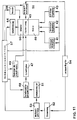
- FIG. 11 shows a system of the essential assemblies of a double-weaving machine 40, which are listed below.
- Three warp beams 41, 42 and 43 for the pile chain, the basic chain and the figure chain are provided and equipped with warp let-off gears to regulate the unwinding of the chains from the warp beams.
- Shafts are provided for lifting and lowering the base and pile warp threads.
- a fabric take-off 44 ensures a continuous warp and fabric run.
- a shed formation device 45 controls the shed formation and the thread crossing between chain 46 and weft 47 in accordance with the weave to be woven.
- a weft insertion device 48 effects a weft feed into the shed, this weft insertion device 48 preferably being formed by grippers, each of which takes a thread from one of the fixed bobbins with different colors before they insert it into a shed.
- the weft insertion occurs only from one side, while the drive of the weft insertion means acts from both sides.
- a sley 49 with a reed feeds the weft insertion means 48 and the inserted weft thread to the finished fabric 50.
- a weft changer 51 is provided which allows weft threads of different colors to be inserted.
- This weft changer 51 is preferably designed as a lamella changer.
- the weft thread sequence is encoded by the weft changer 51 Data carrier entered, which contains the change program for the weft change.
- the change program triggers 52 control pulses in a controller, which act on a change gear 53.
- the change program here is preferably contained in a jacquard card or a jacquard program 54 which, in addition to the weft changer, in particular controls a jacquard device 55 for lifting and lowering the figure chain for large warp repeats.
- the jacquard device 55 comprises a control system which is designed in such a way that a multicolored jacquard shadow velor is produced, in which the pile chains are integrated via a three-layer W-pile binding for positional flor areas and the figurine warp threads in each case the second weft thread of a group of three successive, offset and tie a color warp thread wrapped around a pile warp thread in one plane, while the first and third weft threads of the group are each arranged in a plane above and below the plane of the second weft thread.
- the first and third weft threads determine the color of the pile according to a pattern to be woven.
- a knife 56 serves to cut open the tissue produced as a double work.
- a weaving machine drive 57 provides power and motion transmission to the assemblies of the weaving machine. Because of the fixed phase sequence of the weaving process, the assemblies of the weaving machine are synchronized.
Landscapes
- Engineering & Computer Science (AREA)
- Textile Engineering (AREA)
- Looms (AREA)
- Knitting Of Fabric (AREA)
- Silver Salt Photography Or Processing Solution Therefor (AREA)
- Stringed Musical Instruments (AREA)
- Preparation Of Compounds By Using Micro-Organisms (AREA)
- Woven Fabrics (AREA)
Priority Applications (1)
| Application Number | Priority Date | Filing Date | Title |
|---|---|---|---|
| AT89124010T ATE89344T1 (de) | 1989-01-10 | 1989-12-27 | Verfahren und vorrichtung zum herstellen eines jacquard-schattenvelours. |
Applications Claiming Priority (2)
| Application Number | Priority Date | Filing Date | Title |
|---|---|---|---|
| DE3900500 | 1989-01-10 | ||
| DE3900500A DE3900500C1 (enExample) | 1989-01-10 | 1989-01-10 |
Publications (2)
| Publication Number | Publication Date |
|---|---|
| EP0380808A1 EP0380808A1 (de) | 1990-08-08 |
| EP0380808B1 true EP0380808B1 (de) | 1993-05-12 |
Family
ID=6371806
Family Applications (1)
| Application Number | Title | Priority Date | Filing Date |
|---|---|---|---|
| EP89124010A Expired - Lifetime EP0380808B1 (de) | 1989-01-10 | 1989-12-27 | Verfahren und Vorrichtung zum Herstellen eines Jacquard-Schattenvelours |
Country Status (4)
| Country | Link |
|---|---|
| EP (1) | EP0380808B1 (enExample) |
| AT (1) | ATE89344T1 (enExample) |
| DE (2) | DE3900500C1 (enExample) |
| ES (1) | ES2044047T3 (enExample) |
Families Citing this family (13)
| Publication number | Priority date | Publication date | Assignee | Title |
|---|---|---|---|---|
| BE1004509A4 (nl) * | 1991-02-15 | 1992-12-01 | Haezebrouck Weverij Bvba | Werkwijze voor het dubbelstuk-weven van schaduwfluweel en volgens deze werkwijze vervaardigd schaduwfluweel. |
| BE1008839A5 (nl) * | 1994-10-07 | 1996-08-06 | Weverij Hazebrouck B V B A | Werkwijze voor de vervaardiging van een fluweelweefsel. |
| DE4446927C1 (de) * | 1994-12-28 | 1996-02-29 | Smm Moebelstoff Manufaktur Gmb | Verfahren und Vorrichtung zur Herstellung eines gemusterten Schattenvelours |
| NL1006160C2 (nl) * | 1997-05-29 | 1998-12-10 | Movelta N V | Jacquard-schaduwvelours, inrichting en werkwijze voor het vervaardigen van een dergelijke jacquard-schaduwvelours. |
| NL1009196C2 (nl) * | 1998-05-18 | 1999-11-25 | Devantex N V | Jacquardschaduwvelours en werkwijze voor het vervaardigen van een dergelijk jacquardschaduwvelours. |
| NL1012297C2 (nl) * | 1999-06-11 | 2000-12-12 | Movelta N V | Jacquard-schaduwvelours. |
| BE1014129A3 (nl) * | 2001-04-20 | 2003-05-06 | Wiele Michel Van De Nv | Werkwijze voor het dubbelstukweven van schaduwfluweel. |
| BE1015489A3 (fr) * | 2001-10-03 | 2005-05-03 | Fibertex Nv | Tissu de velours ombre et procede pour son tissage. |
| BE1020320A5 (nl) * | 2011-10-13 | 2013-08-06 | Wiele Michel Van De Nv | Werkwijze voor het weven van een poolweefsel. |
| BE1020257A3 (nl) * | 2011-09-22 | 2013-07-02 | Wiele Michel Van De Nv | Werkwijze voor het weven van een poolweefsel. |
| EP2758573B1 (en) * | 2011-09-22 | 2019-07-10 | NV Michel van de Wiele | Method for weaving a pile fabric |
| BE1021026B1 (nl) * | 2013-01-09 | 2015-01-27 | Nv Michel Van De Wiele | Tapijt met een schaduweffect en werkwijze voor het weven van een tapijtweefsel met een schaduweffect. |
| CN103911747B (zh) * | 2014-04-22 | 2015-04-29 | 辽宁采逸野蚕丝制品有限公司 | 一面毛圈一面丝绒的双色提花织物及其织造方法 |
Family Cites Families (3)
| Publication number | Priority date | Publication date | Assignee | Title |
|---|---|---|---|---|
| BE636137A (enExample) * | ||||
| DE7031883U (de) * | 1970-08-26 | 1970-11-12 | Guesken Jean | Mischwechseleinrichtung fuer schuetzenlose doppelfach-webmaschinen zur plueschherstellung. |
| GB2115022B (en) * | 1982-02-06 | 1985-04-03 | British Trimmings Ltd | Weaving narrow fabric |
-
1989
- 1989-01-10 DE DE3900500A patent/DE3900500C1/de not_active Expired - Fee Related
- 1989-12-27 ES ES89124010T patent/ES2044047T3/es not_active Expired - Lifetime
- 1989-12-27 DE DE8989124010T patent/DE58904354D1/de not_active Expired - Lifetime
- 1989-12-27 AT AT89124010T patent/ATE89344T1/de not_active IP Right Cessation
- 1989-12-27 EP EP89124010A patent/EP0380808B1/de not_active Expired - Lifetime
Also Published As
| Publication number | Publication date |
|---|---|
| DE3900500C1 (enExample) | 1990-02-22 |
| ES2044047T3 (es) | 1994-01-01 |
| EP0380808A1 (de) | 1990-08-08 |
| ATE89344T1 (de) | 1993-05-15 |
| DE58904354D1 (de) | 1993-06-17 |
Similar Documents
| Publication | Publication Date | Title |
|---|---|---|
| DE60319296T2 (de) | Webmaschine und Verfahren zum Weben von Polschlingengeweben | |
| DE3900500C1 (enExample) | ||
| DE60008694T2 (de) | Verfahren zur Herstellung von Polgewebe mit einer hohen Pohlfadenzahl pro Kettfadensystem | |
| DE60124813T2 (de) | Verfahren zum Herstellen von Doppelstück Plüschgewebe und nach diesem Verfahren hergestelltes Gewebe | |
| DE60015026T3 (de) | Verfahren zum Weben von Doppelstück-falsche Plüschgewebe mit geschnittener Flor und nach diesem Verfahren hergestelltes Gewebe | |
| DE2512617A1 (de) | Schmales gewebe oder band sowie verfahren und vorrichtung zu seiner herstellung | |
| DE69905103T2 (de) | Falsche und echte Plüschgewebe und dessen Herstellungsverfahren | |
| DE60024548T2 (de) | Gewebe | |
| DE69915234T2 (de) | Verfahren zum Weben von Doppelplüschgeweben | |
| EP0514911B1 (de) | Verfahren zum Herstellen eines Doppelstück-Teppichgewebes mit einspuliger Bindung sowie auf diese Weise erhältliche Gewebe | |
| DE69923648T2 (de) | Verfahren zum Weben von falschem Plüschgewebe | |
| DE19839810C2 (de) | Verfahren zum Weben von Doppelstückteppichen und Teppichgewebe | |
| EP1165869B1 (de) | Verfahren zur herstellung farbig gemusterter textiler flächengebilde, system zur durchführung des verfahrens und textiles flächengebilde hergestellt nach dem verfahren | |
| DE19924214C2 (de) | Arbeitsverfahren und Webmaschine zum Weben eines Polgewebes | |
| DE69904402T2 (de) | Verfahren zum Herstellen von Gewebe mit doppelseitiger Rippenstruktur und nach diesem Verfahren hergestellte Gewebe | |
| DE68909333T2 (de) | Gurt mit farbigem Bindungsbild. | |
| EP1217114B1 (de) | Verfahren zur Herstellung eines Doppelpolgewebes | |
| DE2164948A1 (de) | Verfahren zum weben von doppel-florgeweben | |
| DE8900209U1 (de) | Jacquard-Schattenveloursbahn | |
| DE4446927C1 (de) | Verfahren und Vorrichtung zur Herstellung eines gemusterten Schattenvelours | |
| DE4035936A1 (de) | Verfahren zum herstellen eines zweischuss-doppelplueschgewebes | |
| DE3545877C1 (en) | Process for producing a two-layer velours and apparatus for carrying out the process | |
| DE4221376A1 (de) | Verfahren zur Herstellung von in der Florebene trennbarem Doppelflorgewebe | |
| DE4300306C2 (de) | Verfahren und Vorrichtung zum Herstellen eines Doppelplüschgewebes | |
| DE561711C (de) | Ripsartiger Moebelstoff |
Legal Events
| Date | Code | Title | Description |
|---|---|---|---|
| PUAI | Public reference made under article 153(3) epc to a published international application that has entered the european phase |
Free format text: ORIGINAL CODE: 0009012 |
|
| AK | Designated contracting states |
Kind code of ref document: A1 Designated state(s): AT BE CH DE ES FR GB IT LI NL |
|
| 17P | Request for examination filed |
Effective date: 19901107 |
|
| 17Q | First examination report despatched |
Effective date: 19920402 |
|
| GRAA | (expected) grant |
Free format text: ORIGINAL CODE: 0009210 |
|
| AK | Designated contracting states |
Kind code of ref document: B1 Designated state(s): AT BE CH DE ES FR GB IT LI NL |
|
| REF | Corresponds to: |
Ref document number: 89344 Country of ref document: AT Date of ref document: 19930515 Kind code of ref document: T |
|
| REF | Corresponds to: |
Ref document number: 58904354 Country of ref document: DE Date of ref document: 19930617 |
|
| ITF | It: translation for a ep patent filed | ||
| ET | Fr: translation filed | ||
| GBT | Gb: translation of ep patent filed (gb section 77(6)(a)/1977) |
Effective date: 19930817 |
|
| REG | Reference to a national code |
Ref country code: ES Ref legal event code: FG2A Ref document number: 2044047 Country of ref document: ES Kind code of ref document: T3 |
|
| PLAA | Information modified related to event that no opposition was filed |
Free format text: ORIGINAL CODE: 0009299DELT |
|
| STAA | Information on the status of an ep patent application or granted ep patent |
Free format text: STATUS: NO OPPOSITION FILED WITHIN TIME LIMIT |
|
| PGFP | Annual fee paid to national office [announced via postgrant information from national office to epo] |
Ref country code: GB Payment date: 20011116 Year of fee payment: 13 |
|
| PGFP | Annual fee paid to national office [announced via postgrant information from national office to epo] |
Ref country code: AT Payment date: 20011203 Year of fee payment: 13 |
|
| PGFP | Annual fee paid to national office [announced via postgrant information from national office to epo] |
Ref country code: FR Payment date: 20011211 Year of fee payment: 13 |
|
| PGFP | Annual fee paid to national office [announced via postgrant information from national office to epo] |
Ref country code: ES Payment date: 20011212 Year of fee payment: 13 |
|
| REG | Reference to a national code |
Ref country code: GB Ref legal event code: IF02 |
|
| PG25 | Lapsed in a contracting state [announced via postgrant information from national office to epo] |
Ref country code: GB Free format text: LAPSE BECAUSE OF NON-PAYMENT OF DUE FEES Effective date: 20021227 Ref country code: AT Free format text: LAPSE BECAUSE OF NON-PAYMENT OF DUE FEES Effective date: 20021227 |
|
| PG25 | Lapsed in a contracting state [announced via postgrant information from national office to epo] |
Ref country code: ES Free format text: LAPSE BECAUSE OF NON-PAYMENT OF DUE FEES Effective date: 20021228 |
|
| GBPC | Gb: european patent ceased through non-payment of renewal fee |
Effective date: 20021227 |
|
| PG25 | Lapsed in a contracting state [announced via postgrant information from national office to epo] |
Ref country code: FR Free format text: LAPSE BECAUSE OF NON-PAYMENT OF DUE FEES Effective date: 20030901 |
|
| REG | Reference to a national code |
Ref country code: FR Ref legal event code: ST |
|
| REG | Reference to a national code |
Ref country code: ES Ref legal event code: FD2A Effective date: 20021228 |
|
| PGFP | Annual fee paid to national office [announced via postgrant information from national office to epo] |
Ref country code: NL Payment date: 20081216 Year of fee payment: 20 Ref country code: CH Payment date: 20081215 Year of fee payment: 20 |
|
| PGFP | Annual fee paid to national office [announced via postgrant information from national office to epo] |
Ref country code: IT Payment date: 20081223 Year of fee payment: 20 |
|
| PGFP | Annual fee paid to national office [announced via postgrant information from national office to epo] |
Ref country code: DE Payment date: 20090220 Year of fee payment: 20 |
|
| PGFP | Annual fee paid to national office [announced via postgrant information from national office to epo] |
Ref country code: BE Payment date: 20090130 Year of fee payment: 20 |
|
| BE20 | Be: patent expired |
Owner name: LEO *SCHELLENS B.V. Effective date: 20091227 |
|
| REG | Reference to a national code |
Ref country code: CH Ref legal event code: PL |
|
| PG25 | Lapsed in a contracting state [announced via postgrant information from national office to epo] |
Ref country code: NL Free format text: LAPSE BECAUSE OF EXPIRATION OF PROTECTION Effective date: 20091227 |
|
| NLV7 | Nl: ceased due to reaching the maximum lifetime of a patent |
Effective date: 20091227 |