EP0030294B1 - Verfahren zur Herstellung von Cephalosporinderivaten; Zwischenprodukte und deren Herstellung - Google Patents
Verfahren zur Herstellung von Cephalosporinderivaten; Zwischenprodukte und deren Herstellung Download PDFInfo
- Publication number
- EP0030294B1 EP0030294B1 EP80107160A EP80107160A EP0030294B1 EP 0030294 B1 EP0030294 B1 EP 0030294B1 EP 80107160 A EP80107160 A EP 80107160A EP 80107160 A EP80107160 A EP 80107160A EP 0030294 B1 EP0030294 B1 EP 0030294B1
- Authority
- EP
- European Patent Office
- Prior art keywords
- formula
- process according
- salts
- compound
- salt
- Prior art date
- Legal status (The legal status is an assumption and is not a legal conclusion. Google has not performed a legal analysis and makes no representation as to the accuracy of the status listed.)
- Expired
Links
- 0 CC(C)*C(C1=CSC(N)N1)=NOC Chemical compound CC(C)*C(C1=CSC(N)N1)=NOC 0.000 description 11
Classifications
-
- C—CHEMISTRY; METALLURGY
- C07—ORGANIC CHEMISTRY
- C07D—HETEROCYCLIC COMPOUNDS
- C07D501/00—Heterocyclic compounds containing 5-thia-1-azabicyclo [4.2.0] octane ring systems, i.e. compounds containing a ring system of the formula:, e.g. cephalosporins; Such ring systems being further condensed, e.g. 2,3-condensed with an oxygen-, nitrogen- or sulfur-containing hetero ring
- C07D501/14—Compounds having a nitrogen atom directly attached in position 7
- C07D501/16—Compounds having a nitrogen atom directly attached in position 7 with a double bond between positions 2 and 3
- C07D501/20—7-Acylaminocephalosporanic or substituted 7-acylaminocephalosporanic acids in which the acyl radicals are derived from carboxylic acids
- C07D501/24—7-Acylaminocephalosporanic or substituted 7-acylaminocephalosporanic acids in which the acyl radicals are derived from carboxylic acids with hydrocarbon radicals, substituted by hetero atoms or hetero rings, attached in position 3
- C07D501/38—Methylene radicals, substituted by nitrogen atoms; Lactams thereof with the 2-carboxyl group; Methylene radicals substituted by nitrogen-containing hetero rings attached by the ring nitrogen atom; Quaternary compounds thereof
- C07D501/46—Methylene radicals, substituted by nitrogen atoms; Lactams thereof with the 2-carboxyl group; Methylene radicals substituted by nitrogen-containing hetero rings attached by the ring nitrogen atom; Quaternary compounds thereof with the 7-amino radical acylated by carboxylic acids containing hetero rings
-
- C—CHEMISTRY; METALLURGY
- C07—ORGANIC CHEMISTRY
- C07D—HETEROCYCLIC COMPOUNDS
- C07D501/00—Heterocyclic compounds containing 5-thia-1-azabicyclo [4.2.0] octane ring systems, i.e. compounds containing a ring system of the formula:, e.g. cephalosporins; Such ring systems being further condensed, e.g. 2,3-condensed with an oxygen-, nitrogen- or sulfur-containing hetero ring
- C07D501/14—Compounds having a nitrogen atom directly attached in position 7
- C07D501/16—Compounds having a nitrogen atom directly attached in position 7 with a double bond between positions 2 and 3
- C07D501/20—7-Acylaminocephalosporanic or substituted 7-acylaminocephalosporanic acids in which the acyl radicals are derived from carboxylic acids
- C07D501/24—7-Acylaminocephalosporanic or substituted 7-acylaminocephalosporanic acids in which the acyl radicals are derived from carboxylic acids with hydrocarbon radicals, substituted by hetero atoms or hetero rings, attached in position 3
- C07D501/36—Methylene radicals, substituted by sulfur atoms
-
- A—HUMAN NECESSITIES
- A61—MEDICAL OR VETERINARY SCIENCE; HYGIENE
- A61P—SPECIFIC THERAPEUTIC ACTIVITY OF CHEMICAL COMPOUNDS OR MEDICINAL PREPARATIONS
- A61P31/00—Antiinfectives, i.e. antibiotics, antiseptics, chemotherapeutics
- A61P31/04—Antibacterial agents
Definitions
- the present invention relates to a process for the preparation of acyl derivatives, namely cephalosporin derivatives of the general formula 1 in the X one of the groups means and R represents hydrogen or an easily hydrolyzable ester group and R 'represents hydrogen or an easily hydrolyzable ether group, and salts of these compounds and hydrates of these compounds or their salts.
- R 'in group (b) is hydrogen, this group is in tautomeric equilibrium with group (a).
- ester groups R in the compounds of the formula are understood to mean R groups on the carboxyl function which are in the form of an easily hydrolyzable ester group.
- ester groups which can be conventional, are lower alkanoyloxyalkyl, e.g. B. acetoxymethyl, pivaloyloxymethyl, 1-acetoxyethyl and 1-pivaloyloxyethyl; lower alkoxycarbonyloxyalkyl, e.g. B. methoxycarbonyloxymethyl, 1-ethoxycarbonyloxyethyl and 1-isopropoxycarbonyloxyethyl; Lactonyl residues, e.g. B. Phthalidyl and Thiophthalidyl; lower alkoxymethyl, e.g. B. methoxymethyl; and lower alkanoylaminomethyl, e.g. B. Acetamidomethyl.
- R 'in the compounds of the formula I R' groups have the enolic function of the 2,5-dihydro-6-hydroxy-2-methyl-S-oxo-as-triazin-3-yl group (b) to understand which are in the form of an easily hydrolyzable ether group.
- Suitable ether groups are the same groups as those already mentioned above for the easily hydrolyzable ester groups. Representatives of such ethers are, for example, the lower alkanoyloxyalkyl ethers, e.g. B.
- the lower alkoxycarbonyloxyalkyl ethers e.g. B. the methoxycarbonyloxymethyl, 1-ethoxycarbonyloxyethyl and 1-isopropoxycarbonyloxyethyl ether
- salts of the compounds of formula I are alkali metal salts such as the sodium and potassium salt; the ammonium salt; Alkaline earth metal salts such as the calcium salt; Salts with organic bases, such as salts with amines, e.g. B. salts with N-ethyl-piperidine, procaine, dibenzylamine, N, N'-dibenzyl-ethyl ethylenediamine, alkylamines or dialkylamines, and salts with amino acids, such as. B. salts with arginine or lysine.
- the salts can be mono-salts or also disalts.
- the second salt formation can occur in compounds with the hydroxyl radical of the 2,5-dihydro-6-hydroxy-2-methyl-5-oxo-as-triazin-3-yl group.
- the compounds of formula I also form addition salts with organic or inorganic acids.
- such salts are hydrohalides, for example hydrochlorides, hydrobromides, hydroiodides, and also other mineral acid salts, such as sulfates, nitrates, phosphates, alkyl and mono-arylsulfonates, such as ethanesulfonates, toluenesulfonates, benzenesulfonates, and also other organic acid salts, such as acetates, tartrates , Citrates, benzoates, salicylates and ascorbates.
- hydrohalides for example hydrochlorides, hydrobromides, hydroiodides
- other mineral acid salts such as sulfates, nitrates, phosphates, alkyl and mono-arylsulfonates, such as ethanesulfonates, toluenesulfonates, benzenesulfonates, and
- the compounds of formula 1 can be hydrated.
- the hydration can take place in the course of the manufacturing process or can gradually occur as a result of hygroscopic properties of an initially anhydrous product.
- the products according to the invention can be in the syn-isomeric form (Z form) or in the anti-isomeric form (E-form) or as mixtures of these two forms.
- the syn-isomeric form or mixtures in which the syn-isomeric form predominates is preferred.
- DE-A-2 715 385, DE-A-2 707 565 and DE-A-2 900 961 disclose cephalosporin derivatives which, like the cephalosporins which can be prepared according to the invention, contain a 7- [ 2- (2-Amino-4-thiazolyl) -2- (Z-methoxyimino) acetamido] group.
- the cephalosporins which can be prepared according to the invention differ in the configuration of the substituent in the 3-position, which results in new compounds with surprising advantages to provide.
- the invention relates to a process for the preparation of acyl derivatives of the general formula 1 in which R represents hydrogen or an easily hydrolyzable ester group, and salts of these compounds and hydrates of these compounds or salts by reacting a halide of the general formula II in which R has the meaning given above and Y represents a halogen atom, or a salt of this compound with thiourea and, if desired, converting a compound of the formula I obtained into a salt or hydrate or a hydrate of this salt, characterized in that X is one of the groups in which R 'represents hydrogen or an easily hydrolyzable ether group, means.
- the halide of formula II used according to the invention can, for. B. by reacting a primary amine of the general formula in which X and R have the meaning given above, with a halogenated carboxylic acid of the general formula IV in which Y represents a halogen atom, or with a reactive derivative of this compound.
- the halogenated carboxylic acid of formula IV is either used in free form in the presence of a condensing agent, e.g. B.
- an N, N'-disubstituted carbodiimide such as N, N'-dicyclohexylcarbodiimide
- an azolide compound such as N, N'-carbonyldiimidazole or N, N'-thionyldiimbazole or in the form of an acid halide, such as acid chloride or bromide
- an acid anhydride such as an acid anhydride with a carbonic acid monoester, e.g. B.
- reaction is generally carried out in an inert organic solvent, e.g. B. in a halogenated hydrocarbon such as thloroform, dichloromethane, carbon tetrachloride, in an ether, e.g. B. tetrahydrofuran, dioxane, in dimethylformamide, dimethylacetamide, water or mixtures thereof.
- the reaction temperature is primarily in the range from -50 to + 40 ° C, preferably at -10 to + 10 ° C.
- the halide of the formula 11 used according to the invention can also be halogenated by a compound of the general formula V. in which X and R have the meaning given above, getting produced.
- the starting product of formula V used here can in turn be produced by a process which is characterized in that the primary amine of formula III defined above is reacted with 3-oxo-2-methoximihobutyric acid or with a reactive derivative of this compound. This reaction proceeds essentially in the same way as the above-described acylation of the primary amine with the halogenated carboxylic acid of the formula IV or with a reactive derivative thereof.
- the halogenation of the acylation product of the formula V obtained leads to the halides of the formula II defined above and is preferably carried out by treatment with the corresponding halogen or thionyl halide, e.g. B. with chlorine, bromine or sulfuryl chloride, preferably in an inert solvent such as a hatched Hydrocarbon e.g. B. dichloromethane, dichloroethane, chloroform, dichloroethylene, carbon tetrachloride, or a lower alkane carboxylic acid such as acetic acid, an aromatic solvent such as benzene or toluene.
- the reaction temperature is generally between 0 ° C and 60 ° C.
- the inventive reaction of the halide of formula II or a salt thereof with thiourea preferably takes place in an inert solvent, such as. B. in a lower alkanol, e.g. B. ethanol, in a lower ketone, such as acetone, in an ether, such as tetrahydrofuran, dioxane, in dimethylformamide, dimethylacetamide, in water or in mixtures thereof.
- the reaction temperature is generally in the range from 0 ° C to 60 ° C, preferably at room temperature.
- the chloride, bromide, fluoride or iodide can be used as the halide of the formula; the chloride or the bromide is preferably used. It can be used in the free acid of the formula, but optionally also a salt thereof, the same salts as the salts of the compounds of the formula I explained above being suitable.
- the salts and hydrates of the compounds of the formula I or the hydrates of these salts can be prepared in a manner known per se, for. B. by reacting the carboxylic acid of formula 1 with an equivalent amount of the desired base, advantageously in a solvent such as water or in an organic solvent such as ethanol, methanol, acetone and others. If a second equivalent of base is used, salt formation also takes place on any tautomeric enol form (2,5-dihydro-6-hydroxy-2-methyl-5-oxo-as-triazin-3-yl group X) which forms a disalt.
- the temperature of salt formation is not critical. It is generally at room temperature, but can also be slightly above or below, for example in the range from 0 ° C. to + 50 ° C.
- the hydrates are usually produced automatically in the course of the manufacturing process or as a result of hydgroscopic properties of an initially anhydrous product.
- a completely or partially anhydrous product (carboxylic acid of the formula I or ester, ether or salt thereof) of a moist atmosphere, for. B. at + 10 ° C to + 40 ° C, exposed.
- syn / anti mixture of a compound of the formula I obtained can be separated into the corresponding syn and anti forms in a customary manner, for example by recrystallization or by chromatographic methods using a suitable solvent or solvent mixture.
- the compounds of formula 1 and the corresponding salts or the hydrates of these products have an antibiotic, in particular bactericidal activity. They have a broad spectrum of activity against gram-positive and gram-negative: microorganisms, including ⁇ -lactamase-forming staphylococci and various d-lactamase-forming gram-negative bacteria, such as.
- the compounds of the formula I and the corresponding readily hydrolyzable esters, ethers and salts or the hydrates of these products can be used for the treatment and prophylaxis of infectious diseases.
- a daily dose of 0.1 g to 2 g can be considered.
- the parenteral administration of the compounds according to the invention is particularly preferred.
- the products obtainable according to the invention can be used as medicines, e.g. B. in the form of pharmaceutical preparations are used, which they or their salts in a mixture with a suitable for enteral or parenteral application pharmaceutical, organic or inorganic inert carriers, such as.
- pharmaceutical, organic or inorganic inert carriers such as.
- the pharmaceutical preparations can be in solid form, e.g. B. as tablets, dragees, suppositories, capsules; or in liquid form, for example as solutions, suspensions or emulsions.
- the compounds of the formula I and their salts or hydrates are preferably suitable for parenteral administration and are preferably prepared for this purpose as lyophilisates or dry powder for dilution with conventional agents, such as water or isotonic saline.
- the easily hydrolyzable esters or ethers of the compounds of formula 1 and their salts or hydrates are also suitable for enteral administration.
- reaction product is filtered off with suction, washed successively with 250 ml of 85% aqueous acetone, 250 ml of acetone and 250 ml of low-boiling petroleum ether and finally dried in vacuo at 25 ° C., 19.6 g (59.3% of theory.
Landscapes
- Chemical & Material Sciences (AREA)
- Organic Chemistry (AREA)
- Health & Medical Sciences (AREA)
- Life Sciences & Earth Sciences (AREA)
- General Health & Medical Sciences (AREA)
- General Chemical & Material Sciences (AREA)
- Medicinal Chemistry (AREA)
- Nuclear Medicine, Radiotherapy & Molecular Imaging (AREA)
- Oncology (AREA)
- Pharmacology & Pharmacy (AREA)
- Communicable Diseases (AREA)
- Animal Behavior & Ethology (AREA)
- Chemical Kinetics & Catalysis (AREA)
- Public Health (AREA)
- Veterinary Medicine (AREA)
- Cephalosporin Compounds (AREA)
- Pharmaceuticals Containing Other Organic And Inorganic Compounds (AREA)
- Saccharide Compounds (AREA)
- Organic Low-Molecular-Weight Compounds And Preparation Thereof (AREA)
- Peptides Or Proteins (AREA)
- Laminated Bodies (AREA)
- Suspension Of Electric Lines Or Cables (AREA)
- Table Devices Or Equipment (AREA)
Description
- Die vorliegende Erfindung betrifft ein Verfahren zur Herstellung von Acylderivaten, und zwar von Cephalosporinderivaten der allgemeinen Formel 1

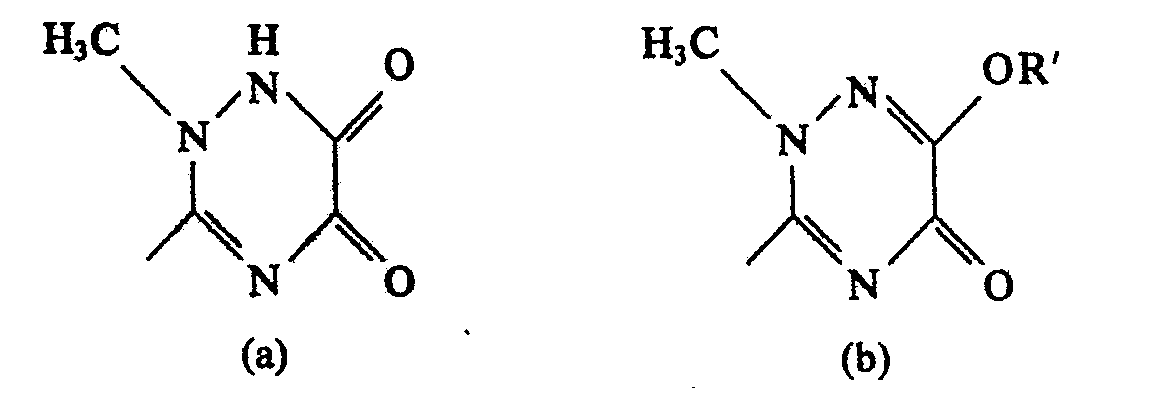
sowie von Salzen dieser Verbindungen und Hydraten dieser Verbindungen bzw. deren Salze. - Falls R' in der Gruppe (b) Wasserstoff darstellt, liegt diese Gruppe in tautomerem Gleichgewicht mit der Gruppe (a) vor.
- Als leicht hydrolysierbare Estergruppen R in den Verbindungen der Formel sind R-Gruppen an der Carboxylfunktion zu verstehen, welche in Form einer leicht hydrolysierbaren Estergruppe vorliegen. Beispiele solcher Estergruppen, die herkömmlicher Art sein können, sind niederes Alkanoyloxyalkyl, z. B. Acetoxymethyl, Pivaloyloxymethyl, 1-Acetoxyäthyl und 1-Pivaloyloxyäthyl; niederes Alkoxycarbonyloxyalkyl, z. B. Methoxycarbonyloxymethyl, 1-Äthoxycärbonyloxyäthyl und 1-lsopropoxycarbonyloxyäthyl; Lactonylreste, z. B. Phthalidyl und Thiophthalidyl; niederes Alkoxymethyl, z. B. Methoxymethyl; und niederes Alkanoylaminomethyl, z. B. Acetamidomethyl.
- Als leicht hydrolysierbare Äthergruppen R' in den Verbindungen der Formel I sind R'-Gruppen an der enolischen Funktion der 2,5-Dihydro-6-hydroxy-2-methyl-S-oxo-as-triazin-3-ylgruppe (b) zu verstehen, welche in Form einer leicht hydrolysierbaren Äthergruppe vorliegen. Als Äthergruppen kommen die gleichen Gruppen in Betracht, wie sie oben bereits die leicht hydrolysierbaren Estergruppen erwähnt wurden. Vertreter solcher Äther sind also beispielsweise die niederen Alkanoyloxyalkyläther, z. B. der Acetoxymethyl-, Pivaloyloxymethyl-, 1-Acetoxyäthyl- und 1-Pivaloyloxyäthyläther; die niederen Alkoxycarbonyloxyalkyläther, z. B. der Methoxycarbonyloxymethyl-, 1-Äthoxycarbonyloxyäthyl-und 1-lsopropoxycarbonyloxyäthyläther; die Lactonyläther, z. B. der Phthalidyl- und Thiophthalidyläther; die niederen Alkoxymethyläther, z. B. der Methoxymethyläther; und die niederen Alkanoylaminomethyläther, z. B. der Acetamidomethyläther.
- Beispiele von Salzen der Verbindungen der Formel I sind Alkalimetallsalze, wie das Natrium- und Kaliumsalz; das Ammoniumsalz; Erdalkalimetallsalze, wie das Calciumsalz; Salze mit organischen Basen, wie Salze mit Aminen, z. B. Salze mit N-Äthyl-piperidin, Procain, Dibenzylamin, N,N'-Dibenzyl- äthyläthylendiamin, Alkylaminen oder Dialkylaminen, sowie Salze mit Aminosäuren, wie z. B. Salze mit Arginin oder Lysin. Die Salze können Monosalze oder auch Disalze sein. Die zweite Salzbildung kann in Verbindungen mit dem Hydroxyrest der 2,5-Dihydro-6-hydroxy-2-methyl-5-oxo-as-triazin-3-ylgruppe auftreten.
- Die Verbindungen der Formel I bilden ebenfalls Additionssalze mit organischen oder anorganischen Säuren. Beispiele solcher Salze sind Hydrohalogenide, beispielsweise Hydrochloride, Hydrobromide, Hydrojodide, sowie andere Mineralsäuresalze, wie Sulfate, Nitrate, Phosphate, Alkyl- und Mono-arylsulfonate, wie Äthansulfonate, Toluolsulfonate, Benzolsulfonate, und auch andere organische Säuresalze, wie Acetate, Tartrate, Maleate, Citrate, Benzoate, Salicylate und Ascorbate.
- Die Verbindungen der Formel 1 (einschließlich deren Salze, leicht hydrolysierbare Ester und Äther) können hydratisiert sein. Die Hydratisierung kann im Zuge des Herstellungsverfahrens erfolgen oder allmählich als Folge hygroskopischer Eigenschaften eines zunächst wasserfreien Produktes auftreten.
- Die erfindungsgemäßen Produkte können in der syn-isomeren Form (Z-Form)
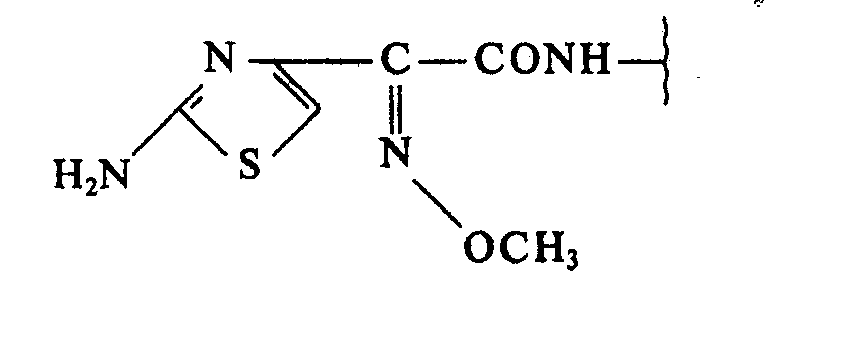

- Bevorzugt sind (6R,7R)-7-[2-(Amino-4-thiazolyl)-2-(Z-methoxyimino)-acetamido]-3-/[(2,5-dihydro-6-hydroxy-2-methyl-5-oxo-as-tri azin-3-yl)thio]-methyl/-8-oxo-5-thia-1-azabicyclo(4.2.0]oct-2-en-2-carbonsäure sowie ihre Salze und die entsprechenden Hydrate.
- Die erfindungsgemäß herstellbaren Cephalosporine werden in der früheren, nicht vorveröffentlich, ten EP-A-5830 beschrieben; die vorliegende Erfindung betrifft ein zusätzliches Verfahren zu deren Herstellung. Ein ähnliches Verfahren wird in der DE-A-2 900 961 beschrieben, wobei jedoch die Endprodukte unterschiedliche Substitution in 3-Stellung aufweisen. Das erfindungsgemäße Verfahren basiert somit auf den gleichen erfinderischen Gedanken wie die Stofferfindung gemäß EP-A-5830.
- Was die Endprodukte betrifft, so sind in der DE-A-2 715 385, der DE-A-2 707 565 und der DE-A-2 900 961 Cephalosporinderivate offenbart, welche, ähnlich wie die erfindungsgemäß herstellbaren Cephalosporine, eine 7-[2-(2-Amino-4-thiazolyl)-2-(Z-methoxyimino)-acetamido]-gruppe tragen, Die erfindungsgemäß herstellbaren Cephalosporine unterscheiden sich jedoch charakteristisch durch die Konfiguration des Substituenten in 3-Stellung, wodurch neue Verbindungen mit überraschenden Wirkungsvorteilen zur Verfügung gestellt werden.
- Die Erfindung betrifft ein Verfahren zur Herstellung von Acylderivaten der allgemeinen Formel 1

sowie von Salzen dieser Verbindungen und Hydraten dieser Verbindungen bzw. Salze durch Umsetzung eines Halogenids der allgemeinen Formel II
oder eines Salzes dieser Verbindung mit Thioharnstoff und erwünschtenfalls Überführung einer erhaltenen Verbindung der Formel I in ein Salz oder Hydrat bzw. ein Hydrat dieses Salzes, dadurch gekennzeichnet, daß X eine der Gruppen
bedeutet. - Das erfindungsgemäße eingesetzte Halogenid der Formel II kann z. B. durch Umsetzung eines primären Amins der allgemeinen Formel

mit einer halogenierten Carbonsäure der allgemeinen Formel IV
oder mit einem reaktionsfähigen Derivat dieser Verbiridung hergestellt werden. Die halogenierte Carbonsäure der Formel IV wird entweder in freier Form eidngesetzt in Gegenwart einesKondensa- tionsmittels, z. B. eines N,N'-disubstituierten Carbodiimides, wie N,N'-dicyclohexylcarbodiimid, odet einer Azolidverbindung, wie N,N'-Carbonyldiimidazöl oder N,N'-Thionyldiimbazol oder auch in Form eines Säurehalogenids, wie des Säurechlorids oder -bromids, In Form eines Säureanhydfids, wie eines Säureanhydrids mit einem Kohlensäuremonoester, z. B. mit Monomethyl- oder Monoisopropylcarbonat, oder in Form eines aktivierten Esters, wie des p-Nitrophenylesters, 2,4-Dinitrophenylesters, N-Hydroxysuccinimidesters oder N-Hydroxyphthalimidestets. Die Reaktion erfolgt im allgemeinen in einem inerten organischen Lösungsmittel, z. B. in einem halogenierten Kohlenwasserstoff, wie thloroform, Dichlormethan, Tetrachlorkohlenstoff, in einem Äther, z. B. Tetrahydrofuran, Dioxan, in Dimethylformamid, Dimethylacetamid, Wasser oder Mischungen davon. Die Reaktionstemperatur liegt vornehmlich im Bereich von -50 bis +40°C, vorzugsweise bei-10bis +10°C. - Das erfindungsgemäß eingesetzte Halogenid der Formel 11 kann auch dutoh Halogenierung einer Verbindung der allgemeinen Formel V

hergestellt werden. Das hierbei verwendete Ausgangsprodukt der Formel V kann seinerseits durch ein Verfahren hergestellt werden, welches dadurch gekennzeichnet ist, daß man das oben definierte primäre Amin der Formel III mit 3-Oxo-2-methoximihobuttersäure oder mit einem reaktionsfähigen Derivat dieser Verbindung umsetzt. Diese Umsetzung verläuft im wesentlichen in der gleichen Weise wie die oben beschriebene Acylierung des primären Amins mit der halogenierten Carbonsäure der Formel IV bzw. mit einem reaktionsfähigen Derivat davon. Die Halogehierung des erhaltenen Acylierungsprodukts der Formel V führt zu den oben definierten Halogeniden der Formel II und erfolgt vorzugsweise durch Behandeln mit dem entsprechenden Halogen oder Thionylhalogenid, z. B. mit Chlor, Brom oder Sulfurylchlorid, bevorzugt in einem inerten Löstungsmittel, wie einem hatdgenierten Kohlenwasserstoff, z. B. Dichlormethan, Dichloräthan, Chloroform, Dichloräthylen, Tetrachlorkohlenstoff, oder einer niederen Alkancarbonsäure, wie Essigsäure, einem aromatischen Lösungsmittel wie Benzol oder Toluol. Die Reaktionstemperatur liegt im allgemeinen zwischen 0° C und 60° C. - Die oben beschriebenen Zwischenprodukte der Formel II sowie deren Herstellung aus Vorprodukten der Formel III bzw. der Formel V sowie die Vorprodukte der Formel V und deren Herstellung ausgehend von Verbindungen der Formel III sind ebenfalls Gegenstand der vorliegenden Erfindung,
- Die erfindungsgemäße Umsetzung des Halogenids der Formel II bzw. eines Salzes davon mit Thioharnstoff verläuft vorzugsweise in einem inerten Lösungsmittel, wie z. B. in einem niederen Alkanol, z. B. Äthanol, in einem niederen Keton, wie Aceton, in einem Äther, wie Tetrahydrofuran, Dioxan, in Dimethylformamid, Dimethylacetamid, in Wasser oder in Mischungen davon. Die Reaktionstemperatur liegt im allgemeinen im Bereich von 0°C bis 60°C, vorzugsweise bei Zimmertemperatur. Als Halogenid der Formel kann das Chlorid, Bromid, Fluorid oder Jodid eingesetzt werden, bevorzugt verwendet man das Chlorid oder das Bromid. Es kann in freie Säure der Formel eingesetzt werden, wahlweise aber auch ein Salz davon, wobei die gleichen Salze wie die oben erläuterten Salze der Verbindungen der Formel I in Betracht kommen.
- Die Herstellung der Salze und Hydrate der Verbindungen der Formel I bzw. der Hydrate dieser Salze kann in an sich bekannter Weise erfolgen, z. B. durch Umsetzung der Carbonsäure der Formel 1 mit einer äquivalenten Menge der gewünschten Base, zweckmäßig in einem Lösungsmittel, wie Wasser oder in einem organischen Lösungsmittel, wie Äthanol, Methanol, Aceton und anderen mehr. Bei Verwendung eines zweiten Äquivalents an Base erfolgt Salzbildung auch an einer allenfalls vorhandenen tautomeren Enolform (2,5-Dihydro-6-hydroxy-2-methyl-5-oxo-as-triazin-3-ylgruppe X), wobei ein Disalz entsteht. Die Temperatur der Salzbildung ist nicht kritisch. Sie liegt im allgemeinen bei Raumtemperatur, kann aber auch, leicht darüber oder darunter, etwa im Bereiche von 0° C bis + 50° C, sein.
- Die Herstellung der Hydrate erfolgt zumeist automatisch im Zuge des Herstellungsverfahrens oder als Folge hydgroskopischer Eigenschaften eines zunächst wasserfreien Produktes. Zur gezielten Herr stellung eines Hydrats kann ein ganz oder teilweise wasserfreies Produkt (Carbonsäure der Formel I bzw. Ester, Äther oder Salz davon) einer feuchten Atmosphäre, z. B. bei + 10° C bis +40° C, ausgesetzt werden.
- Ein allenfalls erhaltenes syn/anti-Gemisch einer Verbindung der Formel I kann in die entsprechenden syn- und anti-Formen in üblicher Weise aufgetrennt werden, beispielsweise durch Umkristallisa, tion oder durch chromatographische Methoden unter Verwendung eines geeigneten Lösungsmittels bzw. Lösungsmittelgemisches.
- Die Verbindungen der Formel 1 sowie die entsprechenden Salze bzw. die Hydrate dieser Produkte sind antibiotisch, insbesondere bakterizid wirksam. Sie besitzen ein breites Wirkungsspektrum gegen gram-positive und gram-negetive: Mikroorganismen, einschließlich β-Lactamase bildende Staphylokokken und verschiedene d-Lactamase-bildende gram-negative Bakterien, wie z. B. Pseudomonas aeruginosa, Haemophilus influenzae, Escherichia coli, Serratia marcescens, Proteus- und Klebsiella-Spezies.
- Die Verbindungen der Formel I sowie die entsprechenden leicht hydrolysierbaren Ester, Äther und Salze bzw. die Hydrate dieser Produkte können zur Behandlung und Prophylaxe von Infektionskrankheiten verwendet werden. Für den Erwachsenen kommt eine Tagesdosis von 0,1 g bis 2 g in Betracht. Die parenterale Verabreichung der erfindungsgemäßen Verbindungen ist besonders bevorzugt.
- Zum Nachweis der antimikrobiellen Wirksamkeit der erwähnten Produkte wurde die Aktivität in vitro (Mindesthemmkonzentration in µ/ml) ermittelt für (6R,7R)-7-[2-(2-Amino-4-thiazolyl)-2-(Z-me- thoxyimino)acetamido]-3-{[(2,5-dihydro-6-hydroxy-2-methyl-5-oxo-as-triazin-3-yl)thio]-methyl)-8-oxo-5-thia-1-azabicyclo[4.2.0]oct-2-en-2-carbonsäure (nachstehend mit A bezeichnet), einen repräsentativen Vertreter der erfindungsgemäß erhältlichen Verfahrensprodukte. Das Ergebnis ist in der nachstehenden Tabelle zusammengefaßt:


- Die antibakterielle Wirkung in vivo wurde wie folgt ermittelt:
- Gruppen von 5 Mäusen werden mit einer wäßrigen Suspension von Escherichia coli intraperitoneal infiziert. Dreimal, d. h. 1 Stunde, 22½ Stunden und 4 Stunden nach der Infektion; wird die Prüfsubstanz in physiologischer Kochsalzlösung subcutan appliziert. Die Zahl der überlebenden Tiere wird am 4. Tag bestimmt. Es werden verschiedene Dosierungen appliziert, und durch Interpolation wird diejenige Dosis bestimmt, bei der 50% der Versuchstiere überleben (CDso, mg/kg).


- Die erfindungsgemäß erhältlichen Produkte können als Heilmittel z. B. in Form pharmazeutischer Präparate Verwendung finden, welche sie oder ihre Salze in Mischung mit einem für die enterale oder parenterale Applikation geeigneten pharmazeutischen, organischen oder anorganischen inerten Trägermittel, wie z. B. Wasser, Gelatine, Gummi arabicum, Milchzucker, Stärke, Magnesiumstearat, Talk, pflanzliche Öle, Polyalkylenglykole, Vaseline usw., enthalten. Die pharmazeutischen Präparate können in fester Form, z. B. als Tabletten, Dragees, Suppositorien, Kapseln; oder in flüssiger Form, z, B. als Lösungen, Suspensionen oder Emulsionen, vorliegen. Gegebenenfalls sind sie sterilisiert und bzw. oder enthalten Hilfsstoffe, wie Konservierungs-, Stabilisierungs-, Netz- oder Emulgiermittel, Salze zur Veränderung des osmotischen Druckes, Anaesthetica oder Puffer. Sie können auch noch andere therapeutische wertvolle Stoffe enthalten. Die Verbindungen der Formel I und ihre Salze bzw. Hydrate kommen vorzugsweise für die parenterale Applikation in Betracht und werden zu diesem Zweck bevorzugt als Lyophilisate oder Trockenpulver zur Verdünnung mit üblichen Agenzien, wie Wasser oder isotonische Kochsalzlösung, zubereitet. Die leicht hydrolysierbaren Ester bzw. Äther der Verbindungen der Formel 1 und ihre Salze bzw. Hydrate kommen auch für die enterale Verabreichung in Betracht.
- 28,8 g (6R,7R)-7-{4-Brom-2-[(Z)-methoxyimino]acetoacetamido}-3-{[(2,5-dihydro-6-hydroxyw2-methyl-5-oxo-as-triazin-3-yl)thio]methyl}-8-oxo-5-thia-1-azabicycle [4.2.0]oct-2-en-2-carbonsäure werden in 400 ml absolutem Äthanol gelöst. Die Lösung wird mit 7,6 g Thioharnstoff versetzt. Nach 15-20 Minuten Rühren bei 25° C beginnt aus der orangen Lösung das Reaktionsprodukt als Hydrobromid zu kristallisieren. Nach 1½ Stunden Rühren wird letzteres abgenutscht, nacheinander mit 200 ml Alkohol und 200 ml tiefsiedendem Petroläther gewaschen, und über Nacht im Hochvakuum bei 35―40°C getrocknet. Man erhält 22 g praktisch farbloses Hydrobromid. Dieses wird in einem Gemisch von 110 ml Wasser und 110 ml Aceton zusammen mit 15,7 g Natriumacetat-trihydrat gelöst. Zu dieser Lösung werden 140 ml Aceton bis zur leichten Trübung hinzugefügt. Kurz darauf beginnt das Reaktionsprodukt zu kristallisieren. Das Gemisch wird 30 Minuten gerührt, danach werden während weiteren 30 Minuten 180 ml Aceton zugetropft, wobei die Kristallisation vervollständigt wird. Das Reaktionsr produkt wird abgenutscht, nacheinander mit 250 ml 85%igem wäßrigem Aceton, 250 ml Aceton und 250 ml tiefsiedendem Petroläther gewaschen und schließlich im Vakuum bei 25°C getrocknet, Man erhält 19,6 g (59,3% d. Th.) praktisch farbloses Dinatriumsalz der (6R,7R)-7-[2-(2-Amino-4-thiazolyl)-2-(Z-methoxyimino)acetamido]-3-{[(2,5-dihydro-6-hydroxy-2-methyl-5-oxo-as-triazin-3-yl)thio]-methyl}-8-oxo-5-thia-1-azabicyclo[4.2.0]oct-2-en-carbonsäure, welches aus Wasser-Aceton umkristallisiert wird. Man erhält 17,3 g (52,3% d. Th.) Reinsubstanz mit


- Die als Ausgangsverbindung eingesetzte (6R,7R)-7-)4-Brom-2-[(Z)-methoxyimino]acetoaeetami- do}-3-{[[(2,5-dihydro-6-hydroxy-2-methyl-5-oxo-as-triazin-3-yl)thio]methyl}-8-oxo-5-thia-1-azablcy- clo[4.2.0]oct-2-en-2-carbonsäure kann wie folgt hergestellt werden:
- 592,1 g Acetessigsäure-tert.-butylester werden in 560 ml Eisessig gelöst. Zu dieser Lösung wird bei 5―10°C während 2½ Stunden eine Lösung von 290,6 g Natriumnitrit in 655 ml Wasser getropft. Die entstandene gelbe Suspension wird 30 Minuten bei 20°C gerührt, mit 940 ml Wasser versetzt und weitere 2 Stunden gerührt. Das Gemisch wird mit 900 ml Wasser und 900 g Eis versetzt und im Ausrührgefäß dreimal mit je 1 I Äthylacetat extrahiert. Die vereinigten Äthylacetatextrakte werden dreimal mit je 1 I Wasser gewaschen, dann mit 5 I Wasser versetzt und mit Natriumhydrogencarbonat der pH-Wert auf 6,8 gestellt. Nach dem Abtrennen der wäßrigen Phase wird noch einmal mit Wasser gewaschen. Danach wird die Äthylacetatlösung über Natriumsulfat getrocknet und am Vakuum bei 40° C eingedampft. Man erhält (Z)-2-Hydroxyimino-3-oxo-buttersäure-tert.-butylester als gelbes Öl, das noch 9 Stunden am Hochvakuum bei 40° C getrocknet wird. Die Ausbeute beträgt 626,65 g (89,2% d. Th.).
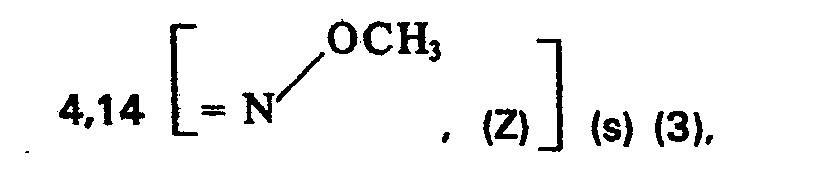
- 626,65 g (Z)-2-Hydroxyimino-3oxo-buttersäure-tert.-butylester werden in 2,86 I Aceton gelöst, Die Lösung wird auf 5°C abgekühlt und portionsweise mit 703,5 g Kaliumcarbonat versetzt. Zur gelben Suspension werden dann ohne Kühlung während 1 Stunde 322 ml Dimethylsulfat hinzugetropft, wobei die Temperatur des Gemisches nicht über 25° C steigen soll. Die hellbeige Suspension wird bei 20-25°C ca. 4 Stunden gerührt, bis dünnschicht·chromatographisch kein Ausgangsmaterial mehr nachgewiesen wird. Danach wird das Gemisch auf 7 I Wasser gegossen und dreimal mit je 11 Äthylacetat extrahiert. Die vereinigten Äthylacetatextrakte werden dreimal mit je 11 Wasset gewaschen, über Natriumsulfat getrocknet und am Vakuum bei 40° C eitigedampft. Das verbleibende, gelbe Öl wird noch 6 Stunden am Hochvakuum bei 40° C getrocknet und anschließend destilliert. Man erhält 577 g (Z)-2-Methoxyimino-3-oxo-buttersäure-tert.-butylester (85,6% d. Th.) als gelbes Öl mit einem Siedepunkt von 57°C bei 0,02 mm Hg. 1H-NMR-Spektrum in CDCl3 (δ-Werte in ppm, s = Singlett, Protonenzahl in Klammern): 1,55 [―C(CH3)31 (s) (9), 2,36 (CH3―CO) (s) (3),

- 86 g (Z)-2-Methoxyimino-3-oxo-buttersäure-tert.-butylester werden in 400 ml Trifluoressigsäure gelöst. Die Lösung wird 1 Stunde bei 25° C stehengelassen, danach am Vakuum bei 35° C eingedampft. Der ölige Rückstand wird aus Äther/Petroläther kristallisiert. Man erhält 50 g (80,6% d. Th.) gelbliche, wasserlösliche (Z)-2-Methoxyimino-3-oxo-buttersäure vom Smp. 80―85°C.1―H―NMR-Spektrum in CDCl3 (δ=Werte in ppm, s = Singlett, Protonenzahl in Klammern): 2.43 (GH3―CO) (3),
- 145 g (Z)-2-Methoxyimino-3-oxo-buttersäure werden in 1000 ml atkohol- und wasserfreiem Dichlormethan gelöst. Zu dieser Lösung werden 10ml 30%ige Bromwasserstoffsäure in Eisessig gegeben. Dann wird während ca. 2 Stunden eine Lösung von 37,5 m1 Brom in 112,5 ml Dichlormethan zugetropft, wobei die Temperatur des Reaktionsgemisches mittels leichter Kühtung auf 20―25°C gehalten wird. Nun wird zur Entfernung von HBr aus dem Reaktionsgemisch heftig Stickstoff durchgeblasen. Anschließend werden nacheinander 250 g Eis, 250 ml Wasser und 2 Äther zugegeben. Die wäßrige Phase wird abgetrennt und verworfen. Die organisehe Phase wird mit 250 ml Wasser und 250 ml gesättigter Natriumchloridlösung gewaschen, mit Natriumsulfat getrocknet und im Vakuum eingedampft. Es verbleiben 170 g braunes Öl, das aus Tetrachlorkohlenstoff kristallisiert wlld. Man erhält 100 g (44,6% d. Th.) praktisch farblose (Z)-4-Born-2-methoxyimion-3-oxo-bonersäure1H―NMR-Spektrum in CDCl3(δ-Werte in ppm, S = Singlett, Protonenzahl in Klammern):

- 37,1 g (7R)-7-Amino-3-desacetoxy-3-[(2,5-dihydro-6-Hydroxy-2-methyl-5-oxo-as-triazin-3-yl)-thio]-cephalosporansäure werden in 800 ml Essigester suspendiert und mit 100 ml N,O-Bis-(trimethylsilyl)-acetamid versetzt. Das Gemisch wird unter Feuchtigkeitsausschluß 30 Minuten bei 25° C gerührt, wobei eine hellgelbe Lösung entsteht. Dieser auf -10°C gekühlten Lösung wird eine Lösung von (Z)-4-Brom-2-methoxyimino-3-oxo-buttersäurechlorid, welches aus 22,4 g (Z)-4-Brom-2-methoxyimi- no-3-oxo-buttersäure in 300 ml alkohol- und wasserfreiem Dichlormethan und 20,8 g Phosphorpentachlorid bei 8-10°C hergestellt worden war, während 30 Minuten bei minus 10 bis 0°C zugetropft. Das Reaktionsgemisch wird 30 Minuten bei 0―5°C und 1 Stunde bei 25° C gerührt. Es werden 1 I Essigester und 500 ml Wasser unter Rühren hinzugefügt. Die wäßrige Phase und die harzige Zwischenschicht werden verworfen. Die organische Phase wird sechsmal mit je 500 ml Wasser gewaschen, mit Natriumsulfat getrocknet und am Vakuum bei 40° C auf ein Volumen von 200 ml eingeengt. Dieses orange gefärbte Konzentrat wird unter Rühren zu 1,8 1 Äther getropft, wobei das Reaktionsprodukt amorph ausfällt. Dieses wird abgenutscht, nacheinander mit 1 I Äther und 1 1 tiefsiedendem Petroläther gewaschen und über Nacht im Vakuum bei 35° C getrocknet. Man erhält 37,2 g (64,4% d. Th.) (6R,7R)-7-{4-Brom-2-[(Z)-methoxyimino]acetoacetamido}-3-{[(2,5-dihydro-6-hydroxy-2-methyl-5-oxo- as-triazin-3-yl)thio]methyl}-8-oxo-5-thia-1-azabicyclo[4.2.0]oct-2-en-2-catbonsäute als beiges, amorphes Produkt mit


- Es wird in üblicher Weise ein Lyophilisat von 1 g des Dinatriumsalzes der (6R,7R)-7-[2-2- amino-4-thiazolyl)-2-(Z-methoxyimino)acetamido]-3-{((2,5-dihydro-6-hydroxy-2-methyl-5-oxo-as-triazin-3-yl)thio]methyl}-8-oxo-5-thia-1-azabicyclo(4.2.0]oct-2-en-2-carbonsäure. hergestellt und in eine Ampulle abgefüllt. Vor der Verabreichung wird das Lyophilisat mit 2,5 ml einer 2%igen wäßrigen Lidocainhydrochlorid-Lösung versetzt.
Claims (16)

sowie von Salzen dieser Verbindungen und Hydraten dieser Verbindungen bzw. deren Salze durch Umsetzung eines Halogenids der allgemeinen Formel II

oder eines Salzes dieser Verbindung mit Thioharnstoff und erwünschtenfalls Überführung einer erhaltenen Verbindung der Formel I in ein Salz oder Hydrat bzw. ein Hydrat dieses Salzes, dadurch gekennzeichnet, daß X eine der Gruppen

bedeutet.

mit einer halogenierten Carbonsäure der allgemeinen Formel IV

oder mit einem reaktionsfähigen Derivat dieser Verbindung hergestellt worden ist.

hergestellt worden ist.


sowie deren Salze.
Applications Claiming Priority (2)
| Application Number | Priority Date | Filing Date | Title |
|---|---|---|---|
| CH10384/79 | 1979-11-21 | ||
| CH1038479 | 1979-11-21 |
Publications (3)
| Publication Number | Publication Date |
|---|---|
| EP0030294A2 EP0030294A2 (de) | 1981-06-17 |
| EP0030294A3 EP0030294A3 (en) | 1981-12-09 |
| EP0030294B1 true EP0030294B1 (de) | 1984-08-08 |
Family
ID=4362652
Family Applications (1)
| Application Number | Title | Priority Date | Filing Date |
|---|---|---|---|
| EP80107160A Expired EP0030294B1 (de) | 1979-11-21 | 1980-11-18 | Verfahren zur Herstellung von Cephalosporinderivaten; Zwischenprodukte und deren Herstellung |
Country Status (21)
| Country | Link |
|---|---|
| EP (1) | EP0030294B1 (de) |
| JP (2) | JPS5692894A (de) |
| KR (1) | KR860000852B1 (de) |
| AT (1) | ATE8896T1 (de) |
| AU (1) | AU533088B2 (de) |
| CA (1) | CA1146165A (de) |
| DE (1) | DE3068905D1 (de) |
| DK (1) | DK166728B1 (de) |
| ES (2) | ES8200694A1 (de) |
| FI (2) | FI67385C (de) |
| GR (1) | GR71879B (de) |
| HU (1) | HU184941B (de) |
| IE (1) | IE50516B1 (de) |
| IL (1) | IL61486A (de) |
| NO (2) | NO166229C (de) |
| NZ (1) | NZ195547A (de) |
| PH (2) | PH17359A (de) |
| PT (1) | PT72084B (de) |
| SI (1) | SI8012952A8 (de) |
| YU (1) | YU42364B (de) |
| ZA (1) | ZA807099B (de) |
Cited By (1)
| Publication number | Priority date | Publication date | Assignee | Title |
|---|---|---|---|---|
| US6846952B2 (en) | 2001-11-26 | 2005-01-25 | Lupin Limited | Process for manufacture of a 4-bromo-2-oxyimino butyric acid and its derivatives |
Families Citing this family (18)
| Publication number | Priority date | Publication date | Assignee | Title |
|---|---|---|---|---|
| JPH0830051B2 (ja) * | 1986-05-21 | 1996-03-27 | 武田薬品工業株式会社 | 4−ハロゲノ−2−置換オキシイミノ−3−オキソ酪酸のエステルまたはアミドの製造法 |
| JP2595605B2 (ja) * | 1988-01-18 | 1997-04-02 | 武田薬品工業株式会社 | 2−置換オキシイミノ−3−オキソ酪酸の製造法 |
| AT398764B (de) * | 1992-01-28 | 1995-01-25 | Lek Tovarna Farmacevtskih | Verfahren zur herstellung von ceftriaxondinatrium-salzhemiheptahydrat |
| AT399877B (de) * | 1992-02-20 | 1995-08-25 | Biochemie Gmbh | Neues verfahren zur herstellung von ceftriaxon |
| AT411598B (de) * | 1999-04-29 | 2004-03-25 | Biochemie Gmbh | Verfahren zur herstellung von cephalosporinen |
| AT408225B (de) * | 1999-04-29 | 2001-09-25 | Biochemie Gmbh | Verfahren zur herstellung von cephalosporinen |
| EP1399429A1 (de) * | 2001-06-14 | 2004-03-24 | Orchid Chemicals and Pharmaceuticals Ltd | 1,3,4-oxadiazol-2-ylthioester und ihre verwendung zur acylierung von 7-aminocephalosporinen |
| US6919449B2 (en) | 2002-04-19 | 2005-07-19 | Orchid Chemicals And Pharmaceuticals Limited | Process for the preparation of cephalosporin intermediate and its use for the manufacture of cephalosporin compounds |
| WO2003089406A1 (en) * | 2002-04-19 | 2003-10-30 | Orchid Chemicals And Pharmaceuticals Limited | A process for the preparation of cephalosporin intermediate and its use for the manufacture of cephalosporin compounds |
| US6800756B2 (en) | 2002-05-03 | 2004-10-05 | Orchid Chemicals And Pharmaceuticals, Ltd. | Method for the preparation of ceftiofur sodium and its intermediates |
| WO2004083216A1 (en) * | 2003-03-20 | 2004-09-30 | Orchid Chemicals & Pharmaceuticals Ltd | A process for the preparation of cephalosporins |
| EP1618114B1 (de) | 2003-04-16 | 2010-07-14 | Sandoz AG | Verfahren zur herstellung von cefepim |
| US7847093B2 (en) | 2003-04-16 | 2010-12-07 | Sandoz Ag | Processes for the preparations of cefepime |
| WO2004111059A1 (en) * | 2003-06-19 | 2004-12-23 | Orchid Chemicals & Pharmaceuticals Ltd | A process for the preparation of a cephalosporin antibiotic |
| WO2005019227A1 (en) | 2003-08-22 | 2005-03-03 | Orchid Chemicals & Pharmaceuticals Ltd | Process for the preparation of cephalosporin antibiotic |
| US20050059820A1 (en) * | 2003-09-17 | 2005-03-17 | Debashish Datta | Method for manufacture of ceftriaxone sodium |
| WO2005040175A2 (en) * | 2003-10-22 | 2005-05-06 | Ranbaxy Laboratories Limited | Process for the preparation of cephem carboxylic acids |
| US20050119244A1 (en) | 2003-12-02 | 2005-06-02 | Acs Dobfar S.P.A. | Process for preparing cephalosporins with salified intermediate |
Family Cites Families (3)
| Publication number | Priority date | Publication date | Assignee | Title |
|---|---|---|---|---|
| US4200745A (en) * | 1977-12-20 | 1980-04-29 | Eli Lilly And Company | 7[2-(2-Aminothiazol-4-yl)-2-alkoxyimino]acetamido 3[4-alkyl-5-oxo-6-hydroxy-3,4 dihydro 1,2,4-triazin 3-yl]thio methyl cephalosporins |
| JPS5498795A (en) * | 1978-01-13 | 1979-08-03 | Takeda Chem Ind Ltd | Cephalosporin derivative and its preparation |
| MC1259A1 (fr) * | 1978-05-30 | 1980-01-14 | Hoffmann La Roche | Derives acyles |
-
1979
- 1979-11-30 FI FI793768A patent/FI67385C/fi not_active IP Right Cessation
-
1980
- 1980-11-07 PH PH24818A patent/PH17359A/en unknown
- 1980-11-14 IL IL61486A patent/IL61486A/xx not_active IP Right Cessation
- 1980-11-14 NZ NZ195547A patent/NZ195547A/xx unknown
- 1980-11-14 CA CA000364648A patent/CA1146165A/en not_active Expired
- 1980-11-14 ZA ZA00807099A patent/ZA807099B/xx unknown
- 1980-11-17 AU AU64438/80A patent/AU533088B2/en not_active Expired
- 1980-11-17 HU HU802744A patent/HU184941B/hu unknown
- 1980-11-18 DE DE8080107160T patent/DE3068905D1/de not_active Expired
- 1980-11-18 EP EP80107160A patent/EP0030294B1/de not_active Expired
- 1980-11-18 AT AT80107160T patent/ATE8896T1/de not_active IP Right Cessation
- 1980-11-18 JP JP16148780A patent/JPS5692894A/ja active Granted
- 1980-11-18 GR GR63382A patent/GR71879B/el unknown
- 1980-11-20 PT PT72084A patent/PT72084B/pt unknown
- 1980-11-20 KR KR1019800004446A patent/KR860000852B1/ko not_active Expired
- 1980-11-20 ES ES496994A patent/ES8200694A1/es not_active Expired
- 1980-11-20 NO NO803516A patent/NO166229C/no unknown
- 1980-11-20 YU YU2952/80A patent/YU42364B/xx unknown
- 1980-11-20 SI SI8012952A patent/SI8012952A8/sl unknown
- 1980-11-20 IE IE2408/80A patent/IE50516B1/en not_active IP Right Cessation
- 1980-11-20 DK DK496380A patent/DK166728B1/da not_active IP Right Cessation
-
1981
- 1981-06-18 NO NO81812083A patent/NO166228C/no unknown
- 1981-07-01 ES ES503583A patent/ES503583A0/es active Granted
- 1981-12-16 PH PH26633A patent/PH18468A/en unknown
-
1984
- 1984-06-28 FI FI842614A patent/FI71563C/fi not_active IP Right Cessation
-
1985
- 1985-12-20 JP JP60285859A patent/JPS61143392A/ja active Granted
Cited By (1)
| Publication number | Priority date | Publication date | Assignee | Title |
|---|---|---|---|---|
| US6846952B2 (en) | 2001-11-26 | 2005-01-25 | Lupin Limited | Process for manufacture of a 4-bromo-2-oxyimino butyric acid and its derivatives |
Also Published As
Similar Documents
| Publication | Publication Date | Title |
|---|---|---|
| EP0030294B1 (de) | Verfahren zur Herstellung von Cephalosporinderivaten; Zwischenprodukte und deren Herstellung | |
| DE2727753C2 (de) | ||
| DE2715385C2 (de) | ||
| EP0088320B1 (de) | Cephalosporinderivate und Verfahren zu ihrer Herstellung | |
| CH646178A5 (de) | Cephalosporinantibiotika. | |
| DE2922036C2 (de) | 7-[2-(2-Amino-4-thiazolyl)-2-methoxyimino-acetamido]- cephalosporansäure-Derivate | |
| CH655118A5 (de) | Cephalosporinverbindungen, verfahren zu ihrer herstellung und antibakterielle mittel, die diese verbindungen enthalten. | |
| CH641468A5 (de) | Cephemderivate. | |
| DE3233377A1 (de) | Cephalosporinisochinoliniumbetaine und sie enthaltende pharmazeutische mittel | |
| DE3307550C2 (de) | ||
| EP0111934B1 (de) | Cephalosporinderivate und Verfahren zu ihrer Herstellung | |
| DE2607064C2 (de) | Verfahren zur Herstellung von 3-Acyloxymethyl-cephem-Verbindungen | |
| EP0049855B1 (de) | Neue Cephalosporinderivate, Verfahren zu ihrer Herstellung und Zwischenprodukte dafür sowie entsprechende pharmazeutische Präparate | |
| DE69109913T2 (de) | Cephalosporinzwischenverbindungen, Verfahren zu ihrer Herstellung sowie zur Herstellung ihrer Endprodukte. | |
| EP0029966A2 (de) | Cephalosporinderivate, und deren Herstellung sowie entsprechende pharmazeutische Präparate | |
| EP0000005B1 (de) | Neue Cephalosporinderivate, Verfahren zu ihrer Herstellung und pharmazeutische Präparate | |
| EP0553792B1 (de) | Verfahren zur Herstellung von Ceftriaxon-dinatriumsalzhemiheptahydrat | |
| EP0036652A2 (de) | Cephalosporinderivate, entsprechende Präparate, die Verwendung dieser Produkte bei der Behandlung von Krankheiten, die Herstellung der Wirkstoffe sowie dabei anfallende Zwischenprodukte | |
| EP0008372B1 (de) | Leicht hydrolisierbare Cephalosporinester und -äther, deren Herstellung und pharmazeutische Präparate enthaltend solche Ester und Äther | |
| EP0049499B1 (de) | Neue Cephalosporinderivate, Verfahren zu ihrer Herstellung und Zwischenprodukte dafür sowie entsprechende pharmazeutische Präparate | |
| DE2805608A1 (de) | Neue cephalosporin-derivate, verfahren zu ihrer herstellung und ihre verwendung in arzneimitteln | |
| DE2202274C2 (de) | 3-Triazolylthiomethyl-cephalosporine und Verfahren zu ihrer Herstellung | |
| DE2760488C2 (de) | Cephalosporinderivate, Verfahren zu ihrer Herstellung und sie enthaltende Arzneimittel | |
| AT337365B (de) | Verfahren zur herstellung von neuen derivaten des cephalosporins und von ihren salzen | |
| DE2112058A1 (de) | Chemische Verbindungen und Verfahren zu ihrer Herstellung |
Legal Events
| Date | Code | Title | Description |
|---|---|---|---|
| PUAI | Public reference made under article 153(3) epc to a published international application that has entered the european phase |
Free format text: ORIGINAL CODE: 0009012 |
|
| 17P | Request for examination filed |
Effective date: 19801118 |
|
| AK | Designated contracting states |
Kind code of ref document: A2 Designated state(s): AT BE CH DE FR GB IT LU NL SE Designated state(s): AT BE CH DE FR GB IT LU NL SE |
|
| PUAL | Search report despatched |
Free format text: ORIGINAL CODE: 0009013 |
|
| AK | Designated contracting states |
Kind code of ref document: A3 Designated state(s): AT BE CH DE FR GB IT LU NL SE Designated state(s): AT BE CH DE FR GB IT LU NL SE |
|
| ITF | It: translation for a ep patent filed | ||
| GRAA | (expected) grant |
Free format text: ORIGINAL CODE: 0009210 |
|
| AK | Designated contracting states |
Designated state(s): AT BE CH DE FR GB IT LI LU NL SE Kind code of ref document: B1 Designated state(s): AT BE CH DE FR GB IT LI LU NL SE |
|
| REF | Corresponds to: |
Ref document number: 8896 Country of ref document: AT Date of ref document: 19840815 Kind code of ref document: T |
|
| REF | Corresponds to: |
Ref document number: 3068905 Country of ref document: DE Date of ref document: 19840913 |
|
| ET | Fr: translation filed | ||
| PLBE | No opposition filed within time limit |
Free format text: ORIGINAL CODE: 0009261 |
|
| STAA | Information on the status of an ep patent application or granted ep patent |
Free format text: STATUS: NO OPPOSITION FILED WITHIN TIME LIMIT |
|
| 26N | No opposition filed | ||
| ITPR | It: changes in ownership of a european patent |
Owner name: CESSIONE;F. HOFFMANN - LA ROCHE AG |
|
| NLS | Nl: assignments of ep-patents |
Owner name: F. HOFFMANN-LA ROCHE AG TE BAZEL, ZWITSERLAND. |
|
| REG | Reference to a national code |
Ref country code: FR Ref legal event code: TP |
|
| REG | Reference to a national code |
Ref country code: CH Ref legal event code: PUE Owner name: F. HOFFMANN-LA ROCHE AG |
|
| REG | Reference to a national code |
Ref country code: GB Ref legal event code: 732 |
|
| ITTA | It: last paid annual fee | ||
| EPTA | Lu: last paid annual fee | ||
| EAL | Se: european patent in force in sweden |
Ref document number: 80107160.6 |
|
| PGFP | Annual fee paid to national office [announced via postgrant information from national office to epo] |
Ref country code: SE Payment date: 19991104 Year of fee payment: 20 |
|
| PGFP | Annual fee paid to national office [announced via postgrant information from national office to epo] |
Ref country code: FR Payment date: 19991109 Year of fee payment: 20 |
|
| PGFP | Annual fee paid to national office [announced via postgrant information from national office to epo] |
Ref country code: AT Payment date: 19991112 Year of fee payment: 20 |
|
| PGFP | Annual fee paid to national office [announced via postgrant information from national office to epo] |
Ref country code: GB Payment date: 19991117 Year of fee payment: 20 |
|
| PGFP | Annual fee paid to national office [announced via postgrant information from national office to epo] |
Ref country code: DE Payment date: 19991119 Year of fee payment: 20 |
|
| PGFP | Annual fee paid to national office [announced via postgrant information from national office to epo] |
Ref country code: CH Payment date: 19991129 Year of fee payment: 20 |
|
| PGFP | Annual fee paid to national office [announced via postgrant information from national office to epo] |
Ref country code: NL Payment date: 19991130 Year of fee payment: 20 Ref country code: LU Payment date: 19991130 Year of fee payment: 20 |
|
| BE20 | Be: patent expired |
Free format text: 20001118 F. *HOFFMANN-LA ROCHE A.G. |
|
| PGFP | Annual fee paid to national office [announced via postgrant information from national office to epo] |
Ref country code: BE Payment date: 20000121 Year of fee payment: 20 |
|
| PG25 | Lapsed in a contracting state [announced via postgrant information from national office to epo] |
Ref country code: LI Free format text: LAPSE BECAUSE OF EXPIRATION OF PROTECTION Effective date: 20001117 Ref country code: GB Free format text: LAPSE BECAUSE OF EXPIRATION OF PROTECTION Effective date: 20001117 Ref country code: CH Free format text: LAPSE BECAUSE OF EXPIRATION OF PROTECTION Effective date: 20001117 |
|
| PG25 | Lapsed in a contracting state [announced via postgrant information from national office to epo] |
Ref country code: NL Free format text: LAPSE BECAUSE OF EXPIRATION OF PROTECTION Effective date: 20001118 Ref country code: LU Free format text: LAPSE BECAUSE OF NON-PAYMENT OF DUE FEES Effective date: 20001118 Ref country code: AT Free format text: LAPSE BECAUSE OF EXPIRATION OF PROTECTION Effective date: 20001118 |
|
| PG25 | Lapsed in a contracting state [announced via postgrant information from national office to epo] |
Ref country code: SE Free format text: THE PATENT HAS BEEN ANNULLED BY A DECISION OF A NATIONAL AUTHORITY Effective date: 20001129 |
|
| REG | Reference to a national code |
Ref country code: GB Ref legal event code: PE20 Effective date: 20001117 |
|
| REG | Reference to a national code |
Ref country code: CH Ref legal event code: PL |
|
| NLV7 | Nl: ceased due to reaching the maximum lifetime of a patent |
Effective date: 20001118 |
|
| EUG | Se: european patent has lapsed |
Ref document number: 80107160.6 |