WO2022210433A1 - マレイミド樹脂混合物、硬化性樹脂組成物、プリプレグおよびその硬化物 - Google Patents
マレイミド樹脂混合物、硬化性樹脂組成物、プリプレグおよびその硬化物 Download PDFInfo
- Publication number
- WO2022210433A1 WO2022210433A1 PCT/JP2022/014705 JP2022014705W WO2022210433A1 WO 2022210433 A1 WO2022210433 A1 WO 2022210433A1 JP 2022014705 W JP2022014705 W JP 2022014705W WO 2022210433 A1 WO2022210433 A1 WO 2022210433A1
- Authority
- WO
- WIPO (PCT)
- Prior art keywords
- acid
- dianhydride
- maleimide resin
- bis
- maleimide
- Prior art date
- Legal status (The legal status is an assumption and is not a legal conclusion. Google has not performed a legal analysis and makes no representation as to the accuracy of the status listed.)
- Ceased
Links
Images

Classifications
-
- C—CHEMISTRY; METALLURGY
- C08—ORGANIC MACROMOLECULAR COMPOUNDS; THEIR PREPARATION OR CHEMICAL WORKING-UP; COMPOSITIONS BASED THEREON
- C08L—COMPOSITIONS OF MACROMOLECULAR COMPOUNDS
- C08L79/00—Compositions of macromolecular compounds obtained by reactions forming in the main chain of the macromolecule a linkage containing nitrogen with or without oxygen or carbon only, not provided for in groups C08L61/00 - C08L77/00
- C08L79/04—Polycondensates having nitrogen-containing heterocyclic rings in the main chain; Polyhydrazides; Polyamide acids or similar polyimide precursors
- C08L79/08—Polyimides; Polyester-imides; Polyamide-imides; Polyamide acids or similar polyimide precursors
- C08L79/085—Unsaturated polyimide precursors
-
- C—CHEMISTRY; METALLURGY
- C08—ORGANIC MACROMOLECULAR COMPOUNDS; THEIR PREPARATION OR CHEMICAL WORKING-UP; COMPOSITIONS BASED THEREON
- C08F—MACROMOLECULAR COMPOUNDS OBTAINED BY REACTIONS ONLY INVOLVING CARBON-TO-CARBON UNSATURATED BONDS
- C08F222/00—Copolymers of compounds having one or more unsaturated aliphatic radicals, each having only one carbon-to-carbon double bond, and at least one being terminated by a carboxyl radical and containing at least one other carboxyl radical in the molecule; Salts, anhydrides, esters, amides, imides, or nitriles thereof
- C08F222/36—Amides or imides
- C08F222/40—Imides, e.g. cyclic imides
-
- C—CHEMISTRY; METALLURGY
- C08—ORGANIC MACROMOLECULAR COMPOUNDS; THEIR PREPARATION OR CHEMICAL WORKING-UP; COMPOSITIONS BASED THEREON
- C08G—MACROMOLECULAR COMPOUNDS OBTAINED OTHERWISE THAN BY REACTIONS ONLY INVOLVING UNSATURATED CARBON-TO-CARBON BONDS
- C08G73/00—Macromolecular compounds obtained by reactions forming a linkage containing nitrogen with or without oxygen or carbon in the main chain of the macromolecule, not provided for in groups C08G12/00 - C08G71/00
- C08G73/06—Polycondensates having nitrogen-containing heterocyclic rings in the main chain of the macromolecule
- C08G73/10—Polyimides; Polyester-imides; Polyamide-imides; Polyamide acids or similar polyimide precursors
-
- C—CHEMISTRY; METALLURGY
- C08—ORGANIC MACROMOLECULAR COMPOUNDS; THEIR PREPARATION OR CHEMICAL WORKING-UP; COMPOSITIONS BASED THEREON
- C08G—MACROMOLECULAR COMPOUNDS OBTAINED OTHERWISE THAN BY REACTIONS ONLY INVOLVING UNSATURATED CARBON-TO-CARBON BONDS
- C08G73/00—Macromolecular compounds obtained by reactions forming a linkage containing nitrogen with or without oxygen or carbon in the main chain of the macromolecule, not provided for in groups C08G12/00 - C08G71/00
- C08G73/06—Polycondensates having nitrogen-containing heterocyclic rings in the main chain of the macromolecule
- C08G73/10—Polyimides; Polyester-imides; Polyamide-imides; Polyamide acids or similar polyimide precursors
- C08G73/12—Unsaturated polyimide precursors
-
- C—CHEMISTRY; METALLURGY
- C08—ORGANIC MACROMOLECULAR COMPOUNDS; THEIR PREPARATION OR CHEMICAL WORKING-UP; COMPOSITIONS BASED THEREON
- C08J—WORKING-UP; GENERAL PROCESSES OF COMPOUNDING; AFTER-TREATMENT NOT COVERED BY SUBCLASSES C08B, C08C, C08F, C08G or C08H
- C08J5/00—Manufacture of articles or shaped materials containing macromolecular substances
- C08J5/24—Impregnating materials with prepolymers which can be polymerised in situ, e.g. manufacture of prepregs
-
- C—CHEMISTRY; METALLURGY
- C08—ORGANIC MACROMOLECULAR COMPOUNDS; THEIR PREPARATION OR CHEMICAL WORKING-UP; COMPOSITIONS BASED THEREON
- C08L—COMPOSITIONS OF MACROMOLECULAR COMPOUNDS
- C08L35/00—Compositions of homopolymers or copolymers of compounds having one or more unsaturated aliphatic radicals, each having only one carbon-to-carbon double bond, and at least one being terminated by a carboxyl radical, and containing at least one other carboxyl radical in the molecule, or of salts, anhydrides, esters, amides, imides or nitriles thereof; Compositions of derivatives of such polymers
-
- C—CHEMISTRY; METALLURGY
- C08—ORGANIC MACROMOLECULAR COMPOUNDS; THEIR PREPARATION OR CHEMICAL WORKING-UP; COMPOSITIONS BASED THEREON
- C08L—COMPOSITIONS OF MACROMOLECULAR COMPOUNDS
- C08L2205/00—Polymer mixtures characterised by other features
- C08L2205/02—Polymer mixtures characterised by other features containing two or more polymers of the same C08L -group
- C08L2205/025—Polymer mixtures characterised by other features containing two or more polymers of the same C08L -group containing two or more polymers of the same hierarchy C08L, and differing only in parameters such as density, comonomer content, molecular weight, structure
Definitions
- the present invention relates to a maleimide resin mixture, a curable resin composition, a prepreg and a cured product thereof, and is used in electrical and electronic parts such as semiconductor sealing materials, printed wiring boards, and build-up laminates, carbon fiber reinforced plastics, and glass. Suitable for use in lightweight high-strength materials such as fiber-reinforced plastics and 3D printing applications.
- Wiring boards using BT resin which is a resin in which a bisphenol A-type cyanate ester compound and a bismaleimide compound disclosed in Patent Document 1 are combined, are excellent in heat resistance, chemical resistance, dielectric properties, etc. Although it has been widely used as a wiring board, it needs to be improved in order to cope with the above-mentioned further high performance.
- maleimide resins available on the market have significantly improved heat resistance compared to epoxy resins, etc., which have been conventionally used for the above applications, and exhibit excellent dielectric properties in the high frequency range.
- the maleimide resin which has high heat resistance, has drawbacks such as low moisture resistance, brittleness due to its rigidity, and low adhesion to copper foil.
- maleimide resins such as those disclosed in Patent Documents 2 and 3 have been developed, but they are still insufficient.
- Japanese Patent Publication No. 54-30440 Japanese Patent Laid-Open No. 03-100016 Japanese Patent No. 5030297 Japanese Patent Laid-Open No. 04-359911 Japanese Patent Publication No. 04-75222 Japanese Patent Publication No. 06-37465
- the present invention has been made in view of such circumstances, and provides a maleimide resin mixture, a curable resin composition, and a cured product thereof that exhibit excellent heat resistance, mechanical properties, and dielectric properties after moisture absorption. aim.
- each of a plurality of R's independently represents a hydrogen atom or an alkyl group having 1 to 5 carbon atoms.
- m represents an integer of 0 to 3.
- n is the number of repetitions, and the average The values are 1 ⁇ n ⁇ 5.
- each of a plurality of R independently represents a hydrogen atom or an alkyl group having 1 to 5 carbon atoms.
- m represents an integer of 0 to 3.
- n is the number of repetitions, and the average The values are 1 ⁇ n ⁇ 5.
- R 1 represents a divalent hydrocarbon group (c) derived from a dimer acid
- R 2 represents a divalent hydrocarbon group other than the divalent hydrocarbon group (c) derived from a dimer acid
- R 3 is a divalent hydrocarbon group (c) derived from a dimer acid, and a divalent organic group other than the divalent hydrocarbon group (c) derived from a dimer acid (d)
- R 4 and R 5 each independently represent a tetravalent C 4-40 alicyclic structure having a monocyclic or condensed polycyclic structure an organic group, a tetravalent organic group having 8 to 40 carbon atoms in which organic groups having a monocyclic alicyclic structure are linked directly or via a bridge structure, and a semivalent organic group having both an alicyclic structure and an aromatic ring one or more organic groups selected from tetravalent organic groups having 8 to 40 carbon atoms and having an alicyclic structure
- m is an integer of 1 to
- the cured products of the maleimide resin mixture and curable resin composition of the present invention are excellent in heat resistance, mechanical properties, and dielectric properties after moisture absorption.
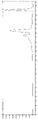
- FIG. 1 is a GPC chart of Synthesis Example 1.
- FIG. 2 is a GPC chart of Synthesis Example 2.
- the maleimide resin mixture of the present invention is obtained by reacting a maleimide resin represented by the following formula (1) (hereinafter also referred to as component (A)), diamine (b), and maleic anhydride. It contains a maleimide resin (B) (hereinafter also referred to as component (B)).
- each of a plurality of R's independently represents a hydrogen atom or an alkyl group having 1 to 5 carbon atoms.
- m represents an integer of 0 to 3.
- n is the number of repetitions, and the average The values are 1 ⁇ n ⁇ 5.
- m is usually 0-3, preferably 0-2, more preferably 0.
- R is usually a hydrogen atom or an alkyl group having 1 to 5 carbon atoms, preferably a hydrogen atom, a methyl group or an ethyl group, more preferably a hydrogen atom.
- m is greater than 3 or when R is an alkyl group having 6 or more carbon atoms, the electrical properties may be degraded due to molecular vibration when the alkyl group is exposed to high frequency.
- n is calculated from the value of the number average molecular weight determined by gel permeation chromatography (GPC, detector: RI) of the maleimide resin, or from the area ratio of each of the separated peaks.
- the solvent can be removed at a low temperature when the solid is taken out, the self-polymerization hardly occurs and the handling becomes easy.
- the component (A) has good solvent solubility and can improve the dielectric properties of the cured product.
- the softening point of component (A) is preferably 50°C to 150°C, more preferably 80°C to 120°C, still more preferably 90°C to 120°C, and particularly preferably 95°C to 120°C.
- the melt viscosity at 150° C. is 0.05 to 100 Pa ⁇ s, preferably 0.1 to 40 Pa ⁇ s.
- the compound represented by the formula (1) is more preferably represented by the following formula (2). This is because the crystallinity is lower than when the propyl group is substituted at the para position with respect to the benzene ring to which the maleimide group is not bonded in formula (1).
- each of a plurality of R independently represents a hydrogen atom or an alkyl group having 1 to 5 carbon atoms.
- m represents an integer of 0 to 3.
- n is the number of repetitions, and the average The values are 1 ⁇ n ⁇ 5.
- Component (A) can use an aromatic amine resin represented by the following formula (5) as a precursor.
- each of a plurality of R independently represents a hydrogen atom or an alkyl group having 1 to 5 carbon atoms.
- m represents an integer of 0 to 3
- n is the number of repetitions, and the average The values are 1 ⁇ n ⁇ 5.
- n 1 bodies, 1,3-bis(p-aminocumyl)benzene and 1,3-bis(o-aminocumyl)benzene, which have the same orientation with respect to two aniline molecules, have a symmetrical structure. It contains three isomers of a compound and an asymmetric structure compound with different orientations with respect to two aniline molecules such as 1-(o-aminocumyl)-3-(p-aminocumyl)benzene.
- Patent Document 6 1,3-bis(p-aminocumyl)benzene is maleimidated to give N,N'-(1,3-phenylene-di-(2,2-propylidene)-di-p-phenylene)bis.
- a crystalline product is obtained by synthesizing maleimide, but it must be heated in order to dissolve it in a solvent, and if left at room temperature after heating, crystals will precipitate in several hours.
- crystals may precipitate even when preparing a resin composition, and N,N'-(1,3-phenylene-di-(2,2-propylidene)-di-p-phenylene)bismaleimide
- concentration the higher the probability of crystallization.
- glass cloth or carbon fiber is impregnated with varnish to adhere the resin. Increasing the temperature accelerates the reaction of the composition and shortens the pot life of the varnish.
- Acidic catalysts used in synthesizing the aromatic amine resin represented by the formula (5) include hydrochloric acid, phosphoric acid, sulfuric acid, formic acid, zinc chloride, ferric chloride, aluminum chloride, p-toluenesulfonic acid, and methane.
- acidic catalysts such as sulfonic acid.
- protonic acids such as hydrochloric acid, p-toluenesulfonic acid and methanesulfonic acid are preferred. These may be used alone or in combination of two or more.
- the amount of catalyst used is preferably 1 to 12% by weight, more preferably 1 to 10% by weight, particularly preferably 1 to 7% by weight, based on 100% by weight of the aniline used, and is more than 12% by weight. Therefore, there are few compounds with the desired asymmetric structure, and compounds with a symmetric structure are preferentially produced. On the other hand, if it is less than 1%, not only does the progress of the reaction slow down, but the reaction may not be completed in some cases, which is not preferable.
- the reaction may be carried out using an organic solvent such as toluene, xylene, or the like, if necessary, or may be carried out without a solvent.
- an organic solvent such as toluene, xylene, or the like
- diisopropenylbenzene or di( ⁇ -hydroxyisopropyl)benzene is added, and then the temperature is raised while removing the solvent from the system to 140 to 190°C, preferably 160 to 190°C for 5 to 50 hours, preferably The reaction is carried out for 5-30 hours.
- the reaction temperature is too high, the asymmetric structure is recombined after being formed, and the symmetric structure is preferentially formed, so that the desired solvent solubility and electrical properties cannot be exhibited.
- water is by-produced when di( ⁇ -hydroxyisopropyl)benzene is used, it is removed from the system while being azeotroped with the solvent when the temperature is raised.
- neutralize the acidic catalyst with an alkaline aqueous solution, add a water-insoluble organic solvent to the oil layer, repeat washing with water until the wastewater becomes neutral, and remove the solvent and excess aniline derivative under heating and reduced pressure.
- activated clay or ion exchange resin is used, the reaction solution is filtered to remove the catalyst after completion of the reaction.
- diphenylamine is produced as a by-product depending on the reaction temperature and the type of catalyst, and therefore it is preferable to remove it as necessary.
- the diphenylamine derivative is removed to 1% by weight or less, preferably 0.5% by weight or less, more preferably 0.2% by weight or less, under high temperature and high vacuum, or by using means such as steam distillation.
- the compound represented by the formula (5) more preferably has a structure represented by the following formula (5-a).
- each of the multiple R's independently represents a hydrogen atom or an alkyl group having 1 to 5 carbon atoms.
- m represents an integer of 0 to 3
- n is the number of repetitions, The average value is 1 ⁇ n ⁇ 5.
- Component (A) is an aromatic amine resin represented by the formula (5) obtained by the above process, and maleic acid or maleic anhydride (hereinafter also referred to as “maleic anhydride”) as a solvent and a catalyst. It can be obtained by addition or dehydration condensation reaction in the presence.
- maleic anhydride maleic acid or maleic anhydride
- a water-insoluble solvent because the solvent used in the reaction must remove the water generated during the reaction from the system.
- aromatic solvents such as toluene and xylene; aliphatic solvents such as cyclohexane and n-hexane; ethers such as diethyl ether and diisopropyl ether; ester solvents such as ethyl acetate and butyl acetate; ketone-based solvents, etc., but are not limited to these, and two or more of them may be used in combination.
- An aprotic polar solvent can also be used in addition to the water-insoluble solvent.
- examples thereof include dimethylsulfone, dimethylsulfoxide, dimethylformamide, dimethylacetamide, 1,3-dimethyl-2-imidazolidinone, N-methyl-2-pyrrolidone and the like, and two or more of them may be used in combination.
- an aprotic polar solvent it is preferable to use one having a boiling point higher than that of the water-insoluble solvent used in combination.
- the catalyst used in the reaction is an acidic catalyst and is not particularly limited, but examples include p-toluenesulfonic acid, hydroxy-p-toluenesulfonic acid, methanesulfonic acid, sulfuric acid, phosphoric acid and the like.
- the amount of acid catalyst used is generally 0.1 to 10% by weight, preferably 1 to 5% by weight, relative to the aromatic amine resin.
- the aromatic amine resin represented by the above formula (5) is dissolved in toluene and N-methyl-2-pyrrolidone, maleic anhydride is added to generate amic acid, and then p-toluenesulfone is dissolved. An acid is added and the reaction is carried out while removing the water generated from the system under reflux conditions.
- maleic anhydride is dissolved in toluene, and an N-methyl-2-pyrrolidone solution of the aromatic amine resin represented by the formula (5) is added under stirring to generate an amic acid, and then p- Toluenesulfonic acid is added, and the reaction is carried out while removing water generated from the system under reflux conditions.
- maleic anhydride is dissolved in toluene, p-toluenesulfonic acid is added, and an N-methyl-2-pyrrolidone solution of the aromatic amine resin represented by the formula (5) is added dropwise under stirring and reflux conditions. Meanwhile, the water azeotroped during the reaction is removed from the system, and toluene is returned to the system during the reaction (the above is the first-stage reaction).
- the amount of maleic anhydride is usually 1.0 to 3.0 equivalents, preferably 1.2 to 2.0 equivalents, relative to the amino group of the aromatic amine resin represented by formula (5). Use 0 eq.
- water is added to the reaction solution after the maleimidation reaction listed above to separate the resin solution layer and the aqueous layer, and excess maleic acid, maleic anhydride, aprotic polar Solvents, catalysts, etc. are dissolved in the aqueous layer, so they are separated and removed, and the same operation is repeated to thoroughly remove excess maleic acid, maleic anhydride, aprotic polar solvents, and catalysts. .
- the time for the re-dehydration ring-closure reaction is usually 1 to 5 hours, preferably 1 to 3 hours, and if necessary, the aprotic polar solvent described above may be added.
- the mixture is cooled and washed with water repeatedly until the washing water becomes neutral. Thereafter, after removing water by azeotropic dehydration under heating and reduced pressure, the solvent may be distilled off, another solvent may be added to adjust the resin solution to a desired concentration, or the solvent may be completely distilled. It may be removed and taken out as a solid resin.
- Component (B) can be obtained by reacting diamine (b) with maleic anhydride.
- Component (b) includes linear or branched aliphatic diamines, aliphatic ether diamines, cyclic aliphatic diamines, aromatic diamines, and the like. Only one type of diamine may be used, or two or more types may be used.
- linear or branched aliphatic diamines examples include 1,4-butanediamine, 1,6-hexanediamine, 1,8-octanediamine, 1,9-nonanediamine, 1,10-decanediamine, 1, 11-undecanediamine, 1,12-dodecanediamine, 1,14-tetradecanediamine, 1,16-hexadecanediamine, 1,18-octadecanediamine, 1,20-eicosanediamine, 2-methyl-1,8-octane diamine, 2-methyl-1,9-nonanediamine, 2,7-dimethyl-1,8-octanediamine and the like.
- the diamine preferably has 6 to 60 carbon atoms, and is more preferably a diamine derived from a dimer acid.
- the aliphatic ether diamines include 2,2'-oxybis(ethylamine), 3,3'-oxybis(propylamine), 1,2-bis(2-aminoethoxy)ethane and the like.
- the cyclic aliphatic diamine include 1,3-bis(aminomethyl)cyclohexane, 1,4-bis(aminomethyl)cyclohexane, 1,4-diaminocyclohexane, methylcyclohexanediamine, and isophoronediamine.
- aromatic diamine examples include 4,4′-diaminodiphenyl ether, 3,4′-diaminodiphenyl ether, 1,4-bis(4-aminophenoxy)benzene, 1,3-bis(aminomethyl)benzene, 1 ,3-bis(4-aminophenoxy)benzene, 1,3-bis(3-aminophenoxy)benzene, 1,4-diaminobenzene, 1,3-diaminobenzene, 2,4-diaminotoluene, 4,4'-diaminodiphenylmethane;4,4'-diaminodiphenylsulfone;3,3'-diaminodiphenylsulfone;4,4-diaminobenzophenone;4,4-diaminodiphenylsulfide; aminophenoxy)phenyl]propane.
- the component (b) is obtained by reacting a diamine (b-1) having 4 to 60 carbon atoms with a tetracarboxylic dianhydride (b-2), and the component (b-1) is Particularly preferred is a diamine (b-1a) derived from a dimer acid.
- component (B) can be obtained by reacting diamine (b-1a) derived from dimer acid, tetracarboxylic dianhydride (b-2), and maleic anhydride.
- Component (B) has a divalent hydrocarbon group (c) derived from a dimer acid and a cyclic imide bond.
- the divalent hydrocarbon group (c) derived from the dimer acid refers to a divalent residue obtained by removing two carboxyl groups from the dicarboxylic acid contained in the dimer acid.
- the divalent hydrocarbon group (c) derived from such a dimer acid is a diamine (b -1a) with tetracarboxylic dianhydride (b-2) and maleic anhydride to be described later to form an imide bond to be introduced into the maleimide resin.
- the dimer acid is preferably a dicarboxylic acid having 20 to 60 carbon atoms.
- Specific examples of the dimer acid include those obtained by dimerizing unsaturated bonds of unsaturated carboxylic acids such as linoleic acid, oleic acid and linolenic acid, followed by purification by distillation.
- the dimer acid according to the above specific example mainly contains a dicarboxylic acid having 36 carbon atoms, and usually contains about 5% by mass of a tricarboxylic acid having 54 carbon atoms and about 5% by mass of a monocarboxylic acid. Each includes as a limit.
- Diamine (b-1a) derived from dimer acid according to the present invention has two carboxyl groups of each dicarboxylic acid contained in the dimer acid is a diamine obtained by substituting with an amino group, and is usually a mixture.
- dimer acid-derived diamine (b-1a) include diamines such as [3,4-bis(1-aminoheptyl)6-hexyl-5-(1-octenyl)]cyclohexane, and those containing diamines saturated with unsaturated bonds by further hydrogenating these diamines.
- the dimer acid-derived diamine ( It is preferably a residue obtained by removing two amino groups from b-1a). Further, when the maleimide resin (B) according to the present invention is obtained using the dimer acid-derived diamine (b-1a), even if one type of the dimer acid-derived diamine (b-1a) is used alone, the composition may be used in combination of two or more different types. Furthermore, as such a dimer acid-derived diamine (b-1a), for example, a commercially available product such as "PRIAMINE 1074" (manufactured by Croda Japan Co., Ltd.) may be used.
- PRIAMINE 1074 manufactured by Croda Japan Co., Ltd.
- the tetracarboxylic dianhydride (b-2) has an alicyclic structure adjacent to the anhydride group, and when converted into a maleimide resin after the reaction, the imide ring adjacent site is an alicyclic It is a tetracarboxylic dianhydride having a structure that gives a structure. If the imide ring-adjacent portion has an alicyclic structure, the structure may additionally contain an aromatic ring.
- component (B) is preferably represented by the following formula (3).
- R 4 and R 5 are structures derived from tetracarboxylic dianhydride (b-2).
- R 1 represents a divalent hydrocarbon group (c) derived from a dimer acid
- R 2 represents a divalent hydrocarbon group other than the divalent hydrocarbon group (c) derived from a dimer acid
- R 3 is a divalent hydrocarbon group (c) derived from a dimer acid, and a divalent organic group other than the divalent hydrocarbon group (c) derived from a dimer acid (d)
- R 4 and R 5 each independently have a monocyclic or condensed polycyclic alicyclic structure with 4 to 40 carbon atoms (preferably a 6 to 40), a tetravalent organic group having 8 to 40 carbon atoms in which an organic group having a monocyclic alicyclic structure is connected to each other directly or via a crosslinked structure, and an alicyclic one or more organic groups selected from tetravalent organic groups having 8 to 40 carbon atoms having a semi-alicyclic structure having both a ring structure and an aromatic ring
- m is an organic groups selected from
- the tetracarboxylic dianhydride (b-2) is preferably a tetracarboxylic dianhydride (b-2) having an alicyclic structure represented by the following formula (6).
- a tetracarboxylic dianhydride (b-2) having an alicyclic structure represented by the following formula (6) has an alicyclic structure adjacent to an anhydride group.
- Cy is a tetravalent organic group having 4 to 40 carbon atoms containing a hydrocarbon ring, and the organic group may also contain an aromatic ring.
- the tetracarboxylic dianhydride (b-2) having an alicyclic structure represented by the above formula (6) can be specifically represented by the following formula (6-a).
- R 6 is a tetravalent organic group having 4 to 40 carbon atoms containing a hydrocarbon ring, and the organic group may contain an aromatic ring.
- the tetracarboxylic dianhydride (b-2) is a tetracarboxylic dianhydride (b-2) having an alicyclic structure represented by the following formulas (7-1) to (7-11). Preferably.
- Tetracarboxylic dianhydrides (b-2) represented by formulas (7-1) to (7-11) have 4 to 40 carbon atoms (preferably a tetravalent organic group having 6 to 40 carbon atoms), a tetravalent organic group having 8 to 40 carbon atoms in which organic groups having a monocyclic alicyclic structure are connected to each other directly or via a crosslinked structure, or It has a structure containing a C8-C40 tetravalent organic group having a semi-alicyclic structure having both an alicyclic structure and an aromatic ring.
- X 1 is a direct bond, an oxygen atom, a sulfur atom, a sulfonyl group, or a divalent organic group having 1 to 3 carbon atoms.
- X 2 is a direct bond, an oxygen atom, a sulfur atom, a sulfonyl group, a divalent organic group having 1 to 3 carbon atoms, or an arylene group.
- the tetracarboxylic dianhydride (b-2) having an alicyclic structure represented by the above formulas (7-1) to (7-11) is represented by the following formulas (7-1a) to (7-11a) ).
- X 1 is a direct bond, an oxygen atom, a sulfur atom, a sulfonyl group, or a divalent organic group having 1 to 3 carbon atoms.
- X 2 is a direct bond, an oxygen atom, a sulfur atom, a sulfonyl group, a divalent organic group having 1 to 3 carbon atoms, or an arylene group.
- the tetracarboxylic dianhydride (b-2) used in the present invention is a tetravalent having 4 to 40 carbon atoms (preferably 6 to 40 carbon atoms) having a monocyclic or condensed polycyclic alicyclic structure.
- organic group a tetravalent organic group having 8 to 40 carbon atoms in which an organic group having a monocyclic alicyclic structure is connected to each other directly or via a bridge structure, or both an alicyclic structure and an aromatic ring has a C8-40 tetravalent organic group having a semi-alicyclic structure.
- tetracarboxylic dianhydride (b-2) having an alicyclic structure examples include 1,2,3,4-cyclobutanetetracarboxylic dianhydride (CBDA), 1,2-dimethyl-1 , 2,3,4-cyclobutanetetracarboxylic dianhydride, 1,2,3,4-tetramethyl-1,2,3,4-cyclobutanetetracarboxylic dianhydride, 1,2,3,4- Cyclopentanetetracarboxylic dianhydride, 1,2,4,5-cyclohexanetetracarboxylic dianhydride (H-PMDA), 1,1'-bicyclohexane-3,3',4,4'-tetracarboxylic Acid-3,4: 3',4'-dianhydride (H-BPDA), 4-(2,5-dioxotetrahydrofuran-3-yl)-1,2,3,4-tetrahydronaphthalene-1, 2-dicarboxylic anhydride
- the tetracarboxylic dianhydride (b-2) is preferably a tetracarboxylic dianhydride (b-2) having an alicyclic structure represented by the following formula (8).
- the tetracarboxylic dianhydride (b-2) is preferably a tetracarboxylic dianhydride (b-2) having an alicyclic structure represented by the following formula (4).
- the tetracarboxylic dianhydride (b-2) is preferably a tetracarboxylic dianhydride (b-2) having an alicyclic structure represented by the following formula (9).
- the tetracarboxylic dianhydride (b-2) is preferably a tetracarboxylic dianhydride (b-2) having an alicyclic structure represented by the following formula (10).
- an acid dianhydride having no alicyclic structure or an acid dianhydride containing an aromatic ring adjacent to the anhydride group You can add things.
- the lower limit of the tetracarboxylic dianhydride (b-2) in the total amount of acid dianhydride is preferably 40 mol% or more, more preferably 80 mol% or more, and 90 mol% or more. is particularly preferred.
- the upper limit may be 100 mol % or less. If the content of the tetracarboxylic dianhydride (b-2) in the total amount of acid dianhydrides is less than 40 mol %, the number of aromatic ring structures increases, possibly deteriorating dielectric properties.
- acid dianhydrides containing an aromatic ring adjacent to an anhydride group other than the tetracarboxylic dianhydride include pyromellitic dianhydride and 4,4'-oxydiphthalic acid.
- the component (b-1) is not limited to the dimer acid-derived diamine (b-1a), and a diamine (b-1b) other than the dimer acid-derived diamine (b-1a) and the tetracarboxylic acid diamine (b-1a). It may be a maleimide resin obtained by reacting the anhydride (b-2) with the maleic anhydride, and the dimer acid-derived diamine (b-1a) and the dimer acid-derived diamine ( It may be a maleimide resin obtained by reacting a diamine (b-1b) other than b-1a), the tetracarboxylic dianhydride (b-2), and the maleic anhydride.
- the diamine (b-1b) other than the dimer acid-derived diamine (b-1a) refers to the diamine (b-1a) derived from the dimer acid in the present invention. Refers to diamines other than the included diamines.
- Such diamine (b-1b) is not particularly limited, and examples thereof include aliphatic diamines such as 1,6-hexamethylenediamine; 1,4-diaminocyclohexane, 1,3-bis(aminomethyl)cyclohexane, etc.
- aliphatic diamines having 6 to 12 carbon atoms such as 1,6-hexamethylenediamine; aromatic diamines such as 2,2-bis[4-(4-aminophenoxy)phenyl]propane having an aliphatic structure having 1 to 4 carbon atoms in the aromatic skeleton are more preferred.
- aromatic diamines such as 2,2-bis[4-(4-aminophenoxy)phenyl]propane having an aliphatic structure having 1 to 4 carbon atoms in the aromatic skeleton are more preferred.
- the method for reacting b-1a), the diamine (b-1b), the tetracarboxylic dianhydride (b-2) having an alicyclic structure, and the maleic anhydride is not particularly limited. Therefore, a known method can be adopted as appropriate.
- the dimer acid-derived diamine (b-1a), the tetracarboxylic dianhydride (b-2), and optionally the diamine (b-1b) are combined with toluene, xylene, tetralin, Synthesize polyamic acid by stirring at room temperature (about 23° C.) for 30 to 60 minutes in a solvent such as N,N-dimethylacetamide, N-methyl-2-pyrrolidone, or a mixed solvent thereof, and then Maleic anhydride is added to the resulting polyamic acid, and the mixture is stirred at room temperature (about 23° C.) for 30 to 60 minutes to synthesize a polyamic acid having maleic acid added to both ends.
- a solvent such as N,N-dimethylacetamide, N-methyl-2-pyrrolidone, or a mixed solvent thereof
- a water-azeotropic solvent such as toluene is further added to the polyamic acid, and the mixture is refluxed at a temperature of 100 to 160° C. for 3 to 6 hours while removing the water generated during imidization to obtain the desired maleimide resin.
- a catalyst such as pyridine or methanesulfonic acid may be further added.
- the mixing ratio of the raw materials in the reaction is (total number of moles of all diamines and diamines (b-1b) contained in the dimer acid-derived diamine (b-1a)): (tetracarboxylic dianhydride having an alicyclic structure It is preferable that the total number of moles of (b-2) + 1/2 of the number of moles of maleic anhydride) be 1:1.
- the diamine (b-1b) is used in combination, the flexibility derived from the dimer acid is exhibited, and a cured product with a lower elastic modulus tends to be obtained.
- the form of polymerization with an amic acid unit composed of (b-1b) and the tetracarboxylic dianhydride (b-2) having an alicyclic structure may be random polymerization or block polymerization.
- the component (B) thus obtained is preferably represented by the following formula (3).
- R 1 represents a divalent hydrocarbon group (c) derived from a dimer acid
- R 2 represents a divalent hydrocarbon group other than the divalent hydrocarbon group (c) derived from a dimer acid
- R 3 is a divalent hydrocarbon group (c) derived from a dimer acid, and a divalent organic group other than the divalent hydrocarbon group (c) derived from a dimer acid (d)
- R 4 and R 5 each independently represent a tetravalent C 4-40 alicyclic structure having a monocyclic or condensed polycyclic structure an organic group, a tetravalent organic group having 8 to 40 carbon atoms in which organic groups having a monocyclic alicyclic structure are linked directly or via a bridge structure, and a semivalent organic group having both an alicyclic structure and an aromatic ring one or more organic groups selected from tetravalent organic groups having 8 to 40 carbon atoms and having an alicyclic structure
- m is an integer of 1 to
- the divalent hydrocarbon group (c) derived from the dimer acid in the formula (3) is as described above. Further, in the present invention, the divalent organic group (d) other than the divalent hydrocarbon group (c) derived from the dimer acid in the formula (2) includes two Refers to divalent residues excluding amino groups. However, in the same compound, the divalent hydrocarbon group (c) derived from the dimer acid and the divalent organic group (d) are not the same. Further, the tetravalent organic group in the formula (2) refers to a tetravalent residue obtained by removing two groups represented by -CO-O-CO- from the tetracarboxylic dianhydride.
- m is the number of repeating units containing a divalent hydrocarbon group (c) derived from the dimer acid (hereinafter sometimes referred to as a dimer acid-derived structure), and is an integer of 1 to 30. indicates When the value of m exceeds the above upper limit, the solubility in solvents tends to decrease, and in particular, the solubility in developing solutions during development, which will be described later, tends to decrease. Further, the value of m is particularly preferably 3 to 10 from the viewpoint of favorable solubility in a developer during development.
- n is the number of repeating units containing the divalent organic group (d) (hereinafter sometimes referred to as an organic diamine-derived structure) and represents an integer of 0-30. If the value of n exceeds the above upper limit, the flexibility of the resulting cured product is deteriorated, and the resin tends to be hard and brittle. Further, the value of n is particularly preferably 0 to 10 from the viewpoint that a cured product with a low elastic modulus tends to be obtained.
- R 1 and R 4 may be the same or different between each repeating unit.
- R 2 and R 5 may be the same or different between the respective repeating units.
- the dimer acid-derived structure and the organic diamine-derived structure may be random or block.
- the maleimide resin (B ) when the reaction rate is 100%, the n and m are the total diamine contained in the dimer acid-derived diamine (b-1a), the diamine (b-1b), and the maleic anhydride. and the mixing molar ratio of the tetracarboxylic dianhydride (b-2).
- (m + n): (m + n + 2) is (the total number of moles of all diamines and diamines (b-1b) contained in the dimer acid-derived diamine (b-1a)): (maleic anhydride and tetracarboxylic dianhydride (b-2) total number of moles),
- m: n is (number of moles of all diamines contained in dimer acid-derived diamine (b-1a)): (number of moles of diamine (b-1b)) 2: (m+n) is represented by (number of moles of maleic anhydride):(number of moles of tetracarboxylic dianhydride (b-2)).
- the sum (m+n) of m and n is preferably 2 to 30 from the viewpoint that a cured product with a lower elastic modulus tends to be obtained.
- the ratio (n/m) of m to n is 1 or less from the viewpoint that flexibility derived from dimer acid is exhibited and a cured product with a lower elastic modulus tends to be obtained. is preferred, and 0.4 or less is more preferred.
- the curable resin composition of the present invention may be used singly or in combination of two or more as the component (B).
- the weight ratio of component (A) and component (B) in the curable resin composition of the present invention is preferably 99/1 to 60/40, more preferably 97/3 to 60/40, and further It is preferably 95/5 to 70/30.
- the weight ratio of component (B) is 1 or more, the water absorption property is improved.
- the weight ratio of component (B) is 40 or less, good heat resistance is obtained.
- any known resin material can be used in the curable resin composition of the present invention in addition to components (A) and (B).
- resin material can be used in addition to components (A) and (B).
- Specific examples include phenol resins, epoxy resins, amine resins, active alkene-containing resins, isocyanate resins, polyamide resins, polyimide resins, cyanate ester resins, propenyl resins, methallyl resins, active ester resins, and the like. may be used in combination.
- Maleimide resins other than components (A) and (B) may be used in combination.
- Phenolic resins, epoxy resins, amine resins, active alkene-containing resins, isocyanate resins, polyamide resins, polyimide resins, cyanate ester resins, and active ester resins may be exemplified below, but are limited to these. not to be
- Phenolic resin phenols (phenol, alkyl-substituted phenol, aromatic-substituted phenol, hydroquinone, resorcinol, naphthol, alkyl-substituted naphthol, dihydroxybenzene, alkyl-substituted dihydroxybenzene, dihydroxynaphthalene, etc.) and various aldehydes (formaldehyde, acetaldehyde, alkylaldehyde, benzaldehyde, alkyl-substituted benzaldehyde, hydroxybenzaldehyde, naphthaldehyde, glutaraldehyde, phthalaldehyde, crotonaldehyde, cinnamaldehyde, furfural, etc.), phenols and various diene compounds (dicyclopentadiene, terpenes, vinylcyclohexene, norbornadiene, vinyln
- Epoxy resins glycidyl ether-based epoxy resins obtained by glycidylating the above phenolic resins, alcohols, etc., 4-vinyl-1-cyclohexene diepoxide, 3,4-epoxycyclohexylmethyl-3,4'-epoxycyclohexane carboxylate, etc. Alicyclic epoxy resins, glycidylamine epoxy resins such as tetraglycidyldiaminodiphenylmethane (TGDDM) and triglycidyl-p-aminophenol, and glycidyl ester epoxy resins.
- TGDDM tetraglycidyldiaminodiphenylmethane
- Amine resins diaminodiphenylmethane, diaminodiphenylsulfone, isophoronediamine, naphthalenediamine, aniline novolak, orthoethylaniline novolak, aniline resin obtained by reaction of aniline with xylylene chloride, aniline described in Japanese Patent No.
- Active alkene-containing resins Polycondensates of the above phenol resins and active alkene-containing halogen compounds (chloromethylstyrene, allyl chloride, methallyl chloride, acrylic acid chloride, allyl chloride, etc.), active alkene-containing phenols (2- allylphenol, 2-propenylphenol, 4-allylphenol, 4-propenylphenol, eugenol, isoeugenol, etc.) and halogen compounds (4,4'-bis(methoxymethyl)-1,1'-biphenyl, 1,4 -Bis(chloromethyl)benzene, 4,4'-difluorobenzophenone, 4,4'-dichlorobenzophenone, 4,4'-dibromobenzophenone, cyanuric chloride, etc.), epoxy resin or alcohol and substituted or non-substituted Polycondensates of substituted acrylates (acrylates, methacrylates, etc.),
- Isocyanate resins p-phenylene diisocyanate, m-phenylene diisocyanate, p-xylene diisocyanate, m-xylene diisocyanate, 2,4-tolylene diisocyanate, 2,6-tolylene diisocyanate, 4,4′-diphenylmethane diisocyanate, naphthalene diisocyanate, etc.
- Aromatic diisocyanates areophorone diisocyanate, hexamethylene diisocyanate, 4,4'-dicyclohexylmethane diisocyanate, hydrogenated xylene diisocyanate, norbornene diisocyanate, lysine diisocyanate and other aliphatic or alicyclic diisocyanates; one or more types of isocyanate monomers or an isocyanate trimerized from the above diisocyanate compound; a polyisocyanate obtained by a urethanization reaction between the above isocyanate compound and a polyol compound.
- Polyamide resins amino acids (6-aminocaproic acid, 11-aminoundecanoic acid, 12-aminododecanoic acid, para-aminomethylbenzoic acid, etc.), lactams ( ⁇ -caprolactam, ⁇ -undecanelactam, ⁇ -laurolactam) and diamines (ethylenediamine, trimethylenediamine, tetramethylenediamine, pentamethylenediamine, hexamethylenediamine, heptamethylenediamine, octamethylenediamine, nonamethylenediamine, decanediamine, undecanediamine, dodecanediamine, tridecanediamine, tetradecanediamine, pentadecanediamine, hexadecanediamine, Aliphatic diamines such as heptadecanediamine, octadecanediamine, nonadecanediamine, eicosanediamine, 2-methyl-1,5-diaminopent
- Polyimide resin the above diamine and tetracarboxylic dianhydride (4,4'-(hexafluoroisopropylidene) diphthalic anhydride, 5-(2,5-dioxotetrahydro-3-furanyl)-3-methyl- Cyclohexene-1,2 dicarboxylic anhydride, pyromellitic dianhydride, 1,2,3,4-benzenetetracarboxylic dianhydride, 3,3′,4,4′-benzophenonetetracarboxylic dianhydride , 2,2′,3,3′-benzophenonetetracarboxylic dianhydride, 3,3′,4,4′-biphenyltetracarboxylic dianhydride, 3,3′,4,4′-diphenylsulfonetetra Carboxylic dianhydride, 2,2',3,3'-biphenyltetracarboxylic dianhydride, methylene-4,4'
- Cyanate ester resin A cyanate ester compound obtained by reacting a phenolic resin with cyanogen halide.
- Specific examples include dicyanatobenzene, tricyanatobenzene, dicyanatonaphthalene, dicyanatobiphenyl, 2, 2 '-bis(4-cyanatophenyl)propane, bis(4-cyanatophenyl)methane, bis(3,5-dimethyl-4-cyanatophenyl)methane, 2,2'-bis(3,5-dimethyl -4-cyanatophenyl)propane, 2,2'-bis(4-cyanatophenyl)ethane, 2,2'-bis(4-cyanatophenyl)hexafluoropropane, bis(4-cyanatophenyl)sulfone , bis(4-cyanatophenyl) thioether, phenol novolak cyanate, and phenol/dicyclopentadiene cocondensate
- cyanate ester compounds whose synthesis method is described in JP-A-2005-264154 are particularly preferable as cyanate ester compounds because they are excellent in low hygroscopicity, flame retardancy and dielectric properties.
- the cyanate resin may be zinc naphthenate, cobalt naphthenate, copper naphthenate, lead naphthenate, zinc octylate, tin octylate, lead, etc., in order to trimerize the cyanate group to form a sym-triazine ring, if necessary. Catalysts such as acetylacetonate, dibutyltin maleate and the like can also be included.
- the catalyst is usually used in an amount of 0.0001 to 0.10 parts by weight, preferably 0.00015 to 0.0015 parts by weight, per 100 parts by weight of the total weight of the curable resin composition.
- Active ester resin A compound having one or more active ester groups in one molecule, such as an epoxy resin, can be used as a curing agent for a curable resin, if necessary.
- Active ester curing agents include compounds having two or more highly reactive ester groups per molecule, such as phenol esters, thiophenol esters, N-hydroxyamine esters, and esters of heterocyclic hydroxy compounds. preferable.
- the active ester curing agent is preferably obtained by a condensation reaction of at least one of a carboxylic acid compound and a thiocarboxylic acid compound and at least one of a hydroxy compound and a thiol compound.
- an active ester curing agent obtained from a carboxylic acid compound and a hydroxy compound is preferable, and an active ester curing agent obtained from a carboxylic acid compound and at least one of a phenol compound and a naphthol compound. agents are preferred.
- carboxylic acid compounds include benzoic acid, acetic acid, succinic acid, maleic acid, itaconic acid, phthalic acid, isophthalic acid, terephthalic acid, and pyromellitic acid.
- phenol compounds or naphthol compounds include hydroquinone, resorcinol, bisphenol A, bisphenol F, bisphenol S, phenolphthalin, methylated bisphenol A, methylated bisphenol F, methylated bisphenol S, phenol, o-cresol, m- cresol, p-cresol, catechol, ⁇ -naphthol, ⁇ -naphthol, 1,5-dihydroxynaphthalene, 1,6-dihydroxynaphthalene, 2,6-dihydroxynaphthalene, dihydroxybenzophenone, trihydroxybenzophenone, tetrahydroxybenzophenone, phloroglucine, Benzenetriol, dicyclopentadiene-type diphenol compound, phenol novolak, and the like.
- dicyclopentadiene-type diphenol compound refers to a diphenol compound obtained by condensing one molecule of dicyclopentadiene with two molecules of phenol.
- the active ester curing agent include an active ester compound containing a dicyclopentadiene type diphenol structure, an active ester compound containing a naphthalene structure, an active ester compound containing an acetylated phenol novolac, and a benzoylated phenol novolac.
- “Dicyclopentadiene-type diphenol structure” represents a divalent structural unit consisting of phenylene-dicyclopentylene-phenylene.
- Active ester curing agents include, for example, "EXA9451”, “EXA9460”, “EXA9460S”, “HPC-8000-65T”, “HPC- 8000H-65TM”, “EXA-8000L-65TM”, “EXA-8150-65T” (manufactured by DIC); “EXA9416-70AK” (manufactured by DIC) as an active ester compound containing a naphthalene structure; acetylated phenol novolac "DC808” (manufactured by Mitsubishi Chemical Corporation) as an active ester compound containing "DC808” (manufactured by Mitsubishi Chemical Corporation) as an active ester curing agent; "EXA-9050L-62M” manufactured by DIC Corporation as a phosphorus atom-containing active
- the curable resin composition of the present invention can also be used in combination with a curing accelerator (curing catalyst) to improve curability.
- curing accelerators include imidazoles such as 2-methylimidazole, 2-ethylimidazole and 2-ethyl-4-methylimidazole, 2-(dimethylaminomethyl)phenol and 1,8-diaza-bicyclo ( 5,4,0) Tertiary amines such as undecene-7, phosphines such as triphenylphosphine, tetrabutylammonium salt, triisopropylmethylammonium salt, trimethyldecanylammonium salt, cetyltrimethylammonium salt, hexadecyltrimethyl Quaternary ammonium salts such as ammonium hydroxide, triphenylbenzylphosphonium salts, triphenylethylphosphonium salts, quaternary phosphonium salts such as tetrabuty
- tin octylate zinc carboxylate (zinc 2-ethylhexanoate, zinc stearate, behene transition metal compounds (transition metal salts) such as zinc compounds such as zinc acid, zinc mystate) and zinc phosphate esters (zinc octyl phosphate, zinc stearyl phosphate, etc.);
- a blending amount of the curing accelerator is, if necessary, 0.01 to 5.0 parts by weight with respect to 100 parts by weight of the curable resin composition.
- a curing accelerator for a radical polymerization initiator may be added or used in combination with the curable resin composition of the present invention, if necessary.
- Radical polymerization initiators include ketone peroxides such as methyl ethyl ketone peroxide and acetylacetone peroxide, diacyl peroxides such as benzoyl peroxide, dicumyl peroxide, and 1,3-bis-(t-butylperoxyisopropyl).
- -dialkyl peroxides such as benzene, peroxyketals such as t-butyl peroxybenzoate, 1,1-di-t-butylperoxycyclohexane, ⁇ -cumyl peroxyneodecanoate, t-butyl peroxy Neodecanoate, t-butylperoxypivalate, 1,1,3,3-tetramethylbutylperoxy-2-ethylhexanoate, t-amylperoxy-2-ethylhexanoate, t-butylperoxy Oxy-2-ethylhexanoate, t-amylperoxy-3,5,5-trimethylhexanoate, t-butylperoxy-3,5,5-trimethylhexanoate, t-amylperoxybenzoate, etc.
- alkyl peresters di-2-ethylhexyl peroxydicarbonate, bis(4-t-butylcyclohexyl) peroxydicarbonate, t-butylperoxyisopropyl carbonate, 1,6-bis(t-butylperoxycarbonyl oxy)hexane and other peroxycarbonates, t-butyl hydroperoxide, cumene hydroperoxide, t-butyl peroxyoctoate, lauroyl peroxide and other organic peroxides and azobisisobutyronitrile, 4,4 '-azobis (4-cyanovaleric acid), 2,2'-azobis (2,4-dimethylvaleronitrile) known curing accelerators of azo compounds such as, but not particularly limited to these do not have.
- Ketone peroxides, diacyl peroxides, hydroperoxides, dialkyl peroxides, peroxyketals, alkyl peresters, percarbonates, etc. are preferred, and dialkyl peroxides are more preferred.
- the amount of the radical polymerization initiator to be added is preferably 0.01 to 5 parts by mass, particularly preferably 0.01 to 3 parts by mass, per 100 parts by mass of the curable resin composition. If the amount of the radical polymerization initiator used is large, the dielectric properties of the cured product deteriorate.
- the curable resin composition of the present invention can contain a phosphorus-containing compound as a flame retardancy-imparting component.
- the phosphorus-containing compound may be of a reactive type or an additive type.
- Specific examples of phosphorus-containing compounds include trimethyl phosphate, triethyl phosphate, tricresyl phosphate, trixylylenyl phosphate, cresyl diphenyl phosphate, cresyl-2,6-dixylylenyl phosphate, 1,3-phenylenebis ( dixylylenyl phosphate), 1,4-phenylenebis (dixylylenyl phosphate), 4,4'-biphenyl (dixylylenyl phosphate) and other phosphoric acid esters; 9,10-dihydro-9-oxa -phosphanes such as 10-phosphaphenanthrene-10-oxide and 10(2,5-dihydroxyphenyl)-10H-9-o
- the content of the phosphorus-containing compound is preferably in the range of (phosphorus-containing compound)/resin component in the curable resin composition (weight ratio) of 0.1 to 0.6. If it is less than 0.1, the flame retardance is insufficient, and if it is more than 0.6, there is a concern that the hygroscopicity and dielectric properties of the cured product may be adversely affected.
- a light stabilizer may be added to the curable resin composition of the present invention, if necessary.
- Hindered amine-based light stabilizers particularly HALS, are suitable as the light stabilizer.
- HALS are not particularly limited, but representative ones include dibutylamine/1,3,5-triazine/N,N'-bis(2,2,6,6-tetramethyl-4- Polycondensation product of piperidyl-1,6-hexamethylenediamine and N-(2,2,6,6-tetramethyl-4-piperidyl)butylamine, dimethyl-1-(2-hydroxyethyl)-4-hydroxy succinate -2,2,6,6-tetramethylpiperidine polycondensate, poly[ ⁇ 6-(1,1,3,3-tetramethylbutyl)amino-1,3,5-triazine-2,4-diyl ⁇ ⁇ (2,2,6,6-tetramethyl-4-piperidyl)imino ⁇ hexamethylene ⁇ (2,2,6,6-
- the curable resin composition of the present invention can be blended with a binder resin as necessary.
- binder resins include butyral resins, acetal resins, acrylic resins, epoxy-nylon resins, NAR-phenol resins, epoxy-NAR resins, polyamide resins, polyimide resins, and silicone resins. , but not limited to these.
- the blending amount of the binder resin is preferably within a range that does not impair the flame retardancy and heat resistance of the cured product, preferably 0.05 to 50 parts by mass, more preferably 0.05 to 50 parts by mass based on 100 parts by mass of the resin component. 0.05 to 20 parts by weight are used as needed.
- the curable resin composition of the present invention may optionally contain fused silica, crystalline silica, porous silica, alumina, zircon, calcium silicate, calcium carbonate, quartz powder, silicon carbide, silicon nitride, boron nitride, zirconia. , powders such as aluminum nitride, graphite, forsterite, steatite, spinel, mullite, titania, talc, clay, iron oxide asbestos, glass powder, etc., or inorganic fillers made of spherical or pulverized powders. can be done.
- the amount of the inorganic filler used is usually 80 to 92% by mass, preferably 83 to 90% by mass in the curable resin composition. be.
- additives can be added to the curable resin composition of the present invention as necessary.
- additives that can be used include polybutadiene and its modified products, modified acrylonitrile copolymers, polyphenylene ethers, polystyrene, polyethylene, polyimide, fluororesins, silicone gels, silicone oils, fillers such as silane coupling agents.
- Coloring agents such as surface treatment agents for materials, release agents, carbon black, phthalocyanine blue, and phthalocyanine green.
- the amount of these additives to be blended is preferably 1,000 parts by mass or less, more preferably 700 parts by mass or less per 100 parts by mass of the resin component.
- the curable resin composition of the present invention is obtained by uniformly mixing the above-mentioned respective components in a predetermined ratio, usually precured at 130 to 180 ° C. for 30 to 500 seconds, and further cured at 150 to 200 ° C. After curing for 2 to 15 hours at , the curing reaction proceeds sufficiently to obtain the cured product of the present invention. It is also possible to uniformly disperse or dissolve the components of the curable resin composition in a solvent or the like, remove the solvent, and then cure the composition.
- the curable resin composition of the present invention thus obtained has good heat resistance, mechanical properties, and good dielectric properties even after absorbing water. Therefore, the curable resin composition of the present invention can be used in a wide range of fields requiring moisture resistance, heat resistance, low dielectric constant and low dielectric loss tangent. Specifically, it is useful as an insulating material, laminate (printed wiring board, AGA substrate, build-up substrate, etc.), sealing material, resist, and all other electrical and electronic component materials. In addition to molding materials and composite materials, it can also be used in fields such as paint materials, adhesives, and 3D printing. Particularly in semiconductor encapsulation, solder reflow resistance is beneficial.
- a semiconductor device has one sealed with the curable resin composition of the present invention.
- semiconductor devices include DIP (dual in-line package), QFP (quad flat package), AGA (ball grid array), CSP (chip size package), SOP (small outline package), TSOP (thin small outline package), and TQFP. (think quad flat package) and the like.
- the method for preparing the curable resin composition of the present invention is not particularly limited, it is prepared by dispersing or dissolving each component in a solvent or the like as described above, uniformly mixing, and optionally distilling off the solvent. Alternatively, it may be prepolymerized.
- component (A) and component (B) are prepolymerized by heating in the presence or absence of a catalyst and in the presence or absence of a solvent.
- curing agents such as epoxy resins, amine compounds, maleimide compounds, cyanate ester compounds, phenol resins, acid anhydride compounds, and other additives are added to prepolymers. may be changed.
- Mixing or prepolymerization of each component is carried out by using, for example, an extruder, kneader, rolls, etc. in the absence of a solvent, and by using a reactor equipped with a stirrer in the presence of a solvent.
- a uniform curable resin composition is obtained by kneading using a device such as a kneader, roll, planetary mixer, etc. at a temperature within the range of 50 to 100 ° C. do.
- a device such as a kneader, roll, planetary mixer, etc.
- After pulverizing the obtained curable resin composition it is molded into a cylindrical tablet by a molding machine such as a tablet machine, or it is made into a granular powder or a powdery molding, or these compositions are used as a surface support. It is also possible to form a sheet having a thickness of 0.05 mm to 10 mm by melting above and forming a curable resin composition molded body.
- the obtained molded article becomes a non-sticky molded article at 0 to 20°C, and its fluidity and curability hardly deteriorate even when stored at -25 to 0°C for 1 week or longer.
- the molded product obtained can be molded into a cured product by using a transfer molding machine or a compression molding machine.
- An organic solvent can be added to the curable resin composition of the present invention to form a varnish-like composition (hereinafter simply referred to as varnish).
- the curable resin composition of the present invention is dissolved in a solvent such as toluene, xylene, acetone, methyl ethyl ketone, methyl isobutyl ketone, dimethylformamide, dimethylacetamide, N-methylpyrrolidone, etc. to form a varnish.
- a solvent such as toluene, xylene, acetone, methyl ethyl ketone, methyl isobutyl ketone, dimethylformamide, dimethylacetamide, N-methylpyrrolidone, etc.
- Polyester fiber, polyamide fiber, alumina fiber, paper, etc. is impregnated into a base material and heat-dried to obtain a prepreg, which is hot-press molded to obtain a cured product of the curable resin composition of the present invention. .
- the solvent is usually used in an amount of 10 to 70% by weight, preferably 15 to 70% by weight in the mixture of the curable resin composition of the present invention and the solvent. If the amount of solvent is less than this range, the viscosity of the varnish will increase and the workability will be deteriorated. Moreover, if it is a liquid composition, it is also possible to obtain a resin cured product containing carbon fibers as it is by, for example, the RTM method.
- the curable resin composition of the present invention can also be used as a modifier for film-type compositions. Specifically, it can be used to improve flexibility and the like in the A-stage.
- a film-type curable resin composition is obtained by applying the curable resin composition of the present invention as the curable resin composition varnish on a release film, removing the solvent under heating, and then turning it into an A-stage.
- This sheet-like adhesive can be used as an interlayer insulating layer in multilayer substrates and the like.
- a prepreg can be obtained by heating and melting the curable resin composition of the present invention, reducing the viscosity, and impregnating reinforcing fibers such as glass fibers, carbon fibers, polyester fibers, polyamide fibers, and alumina fibers with the melted resin composition.
- reinforcing fibers such as glass fibers, carbon fibers, polyester fibers, polyamide fibers, and alumina fibers with the melted resin composition.
- Specific examples thereof include glass fibers such as E glass cloth, D glass cloth, S glass cloth, Q glass cloth, spherical glass cloth, NE glass cloth, and T glass cloth, inorganic fibers other than glass, and poly paraphenylene terephthalamide (Kevlar®, manufactured by DuPont), wholly aromatic polyamides, polyesters; and organic fibers such as polyparaphenylene benzoxazole, polyimides and carbon fibers, but are particularly limited to these.
- the shape of the substrate is not particularly limited, but examples thereof include woven fabric, nonwoven fabric, roving, chopped strand mat, and the like. Plain weave, Nanako weave, twill weave, and the like are known as weaving methods of woven fabric, and it is possible to appropriately select and use from these known methods depending on the intended use and performance.
- a woven fabric subjected to opening treatment or a glass woven fabric surface-treated with a silane coupling agent or the like is preferably used.
- the thickness of the base material is not particularly limited, it is preferably about 0.01 to 0.4 mm.
- a prepreg can also be obtained by impregnating reinforcing fibers with the varnish and heating and drying the varnish.
- the laminate of the present embodiment includes one or more prepregs.
- the laminate is not particularly limited as long as it comprises one or more prepregs, and may have any other layers.
- a method for producing a laminate generally known methods can be appropriately applied, and there is no particular limitation. For example, when molding a metal foil-clad laminate, a multi-stage press machine, a multi-stage vacuum press machine, a continuous molding machine, an autoclave molding machine, etc. can be used, and the above prepregs are laminated and heat-pressed to form a laminate. Obtainable.
- the heating temperature is not particularly limited, but is preferably 65 to 300°C, more preferably 120 to 270°C.
- the pressure to be applied is not particularly limited, but if the pressure is too high, it will be difficult to adjust the solid content of the resin in the laminate and the quality will not be stable. 2.0 to 5.0 MPa is preferable, and 2.5 to 4.0 MPa is more preferable, because it deteriorates.
- the laminate of the present embodiment can be suitably used as a metal-foil-clad laminate described later by including a layer made of metal foil. After cutting the prepreg into a desired shape and laminating it with copper foil or the like if necessary, the curable resin composition is heat-cured while applying pressure to the laminate by a press molding method, an autoclave molding method, a sheet winding molding method, or the like. Electrical and electronic laminates (printed wiring boards) and carbon fiber reinforcing materials can be obtained.
- the cured product of the present invention can be used for various purposes such as molding materials, adhesives, composite materials, and paints. Since the cured product of the curable resin composition according to the present invention exhibits excellent heat resistance and dielectric properties, it can be used as a sealing material for semiconductor elements, a sealing material for liquid crystal display elements, a sealing material for organic EL elements, and a printed wiring board. , electrical and electronic parts such as build-up laminates, and composite materials for lightweight and high-strength structural materials such as carbon fiber reinforced plastics and glass fiber reinforced plastics.
- Parts and “%” in the text represent “parts by weight” and “% by weight”, respectively.
- the softening point and melt viscosity were measured by the following methods.
- ⁇ GPC (gel permeation chromatography) analysis Manufacturer Waters Columns: SHODEXGPCKF-601 (2 columns), KF-602, KF-602.5, KF-603 Flow rate: 0.5 ml/min. Column temperature: 40°C Solvent used: THF (tetrahydrofuran) Detector: RI (differential refraction detector)
- Tg The temperature at which the value of tan ⁇ was maximum was defined as Tg.
- Water Absorption Rate Test It was taken out after being immersed in water for 24 hours, and the weight was measured and calculated after being left in an environment of 25°C and 30% for 24 hours.
- test piece having a width of 2.5 mm and a length of 5 cm was dried in a dryer at 120°C for 2 hours, and then measured. Furthermore, after the test piece was immersed in water for 24 hours, it was taken out and left in an environment of 25° C. and 30% for 24 hours, and then measured again.
- the softening point was 115.5° C. and the viscosity was 6.0 Pa ⁇ s.
- a GPC chart is shown in FIG.
- Examples 1 to 5 Various maleimide resins and a thermoplastic resin (Septon 2104) were weighed out at the ratios shown in Table 1, acetone was added so that the resin solid content was 50% by weight, and the mixture was mixed to prepare a varnish. Furthermore, 2-ethyl-4-methylimidazole (2E4MZ, manufactured by Shikoku Kasei Kogyo Co., Ltd.) was dissolved in the varnish as a curing accelerator. A curable resin composition was prepared by heating the varnish in which the curing accelerator was dissolved in a vacuum dryer at 60° C. for 30 minutes and at 150° C. for 1 hour. The resulting curable resin composition was sandwiched between copper foils and cured at 220° C. for 2 hours under vacuum with a pressure of 1 MPa. Curability at this time was confirmed and physical properties were evaluated. Table 1 shows the results of various measurements on the obtained cured product.
- ⁇ M-1 (Component (A), obtained by distilling off the solvent of the product obtained in Synthesis Example 2 by heating under reduced pressure)
- ⁇ B-1 (Component (B), obtained in Synthesis Example 3)
- ⁇ MIR-3000 MIR-3000-70MT (manufactured by Nippon Kayaku Co., Ltd.) solvent is distilled off by heating under reduced pressure)
- ⁇ Septon 2104 thermoplastic resin, manufactured by Kuraray Co., Ltd.
- ⁇ 2E4MZ curing accelerator, manufactured by Shikoku Kasei Kogyo Co., Ltd.
- Examples 1 to 5 had good results in all properties of heat resistance, mechanical properties, water absorption, and dielectric properties. In addition, Examples 1 to 4 had a Tg of 200° C. or higher, indicating even better heat resistance. On the other hand, Comparative Example 1 had poor dielectric properties after water absorption, Comparative Examples 2 to 4 had heat resistance, Comparative Examples 5 to 7 had poor dielectric properties, and Comparative Example 8 had bad results in heat resistance and elastic modulus. I didn't.
Landscapes
- Chemical & Material Sciences (AREA)
- Health & Medical Sciences (AREA)
- Chemical Kinetics & Catalysis (AREA)
- Medicinal Chemistry (AREA)
- Polymers & Plastics (AREA)
- Organic Chemistry (AREA)
- Engineering & Computer Science (AREA)
- Materials Engineering (AREA)
- Manufacturing & Machinery (AREA)
- Macromolecular Compounds Obtained By Forming Nitrogen-Containing Linkages In General (AREA)
- Reinforced Plastic Materials (AREA)
- Addition Polymer Or Copolymer, Post-Treatments, Or Chemical Modifications (AREA)
Priority Applications (3)
| Application Number | Priority Date | Filing Date | Title |
|---|---|---|---|
| KR1020237032634A KR102798548B1 (ko) | 2021-03-30 | 2022-03-25 | 말레이미드 수지 혼합물, 경화성 수지 조성물, 프리프레그 및 그의 경화물 |
| JP2022548413A JP7152839B1 (ja) | 2021-03-30 | 2022-03-25 | マレイミド樹脂混合物、硬化性樹脂組成物、プリプレグおよびその硬化物 |
| CN202280026458.7A CN117098789B (zh) | 2021-03-30 | 2022-03-25 | 马来酰亚胺树脂混合物、硬化性树脂组合物、预浸体及其硬化物 |
Applications Claiming Priority (2)
| Application Number | Priority Date | Filing Date | Title |
|---|---|---|---|
| JP2021056834 | 2021-03-30 | ||
| JP2021-056834 | 2021-03-30 |
Publications (1)
| Publication Number | Publication Date |
|---|---|
| WO2022210433A1 true WO2022210433A1 (ja) | 2022-10-06 |
Family
ID=83456149
Family Applications (1)
| Application Number | Title | Priority Date | Filing Date |
|---|---|---|---|
| PCT/JP2022/014705 Ceased WO2022210433A1 (ja) | 2021-03-30 | 2022-03-25 | マレイミド樹脂混合物、硬化性樹脂組成物、プリプレグおよびその硬化物 |
Country Status (5)
| Country | Link |
|---|---|
| JP (1) | JP7152839B1 (https=) |
| KR (1) | KR102798548B1 (https=) |
| CN (1) | CN117098789B (https=) |
| TW (1) | TWI894455B (https=) |
| WO (1) | WO2022210433A1 (https=) |
Cited By (1)
| Publication number | Priority date | Publication date | Assignee | Title |
|---|---|---|---|---|
| WO2024079923A1 (ja) * | 2022-10-14 | 2024-04-18 | 日本化薬株式会社 | 樹脂組成物、硬化物、半導体素子およびドライフィルムレジスト |
Citations (7)
| Publication number | Priority date | Publication date | Assignee | Title |
|---|---|---|---|---|
| JP2001316429A (ja) * | 2000-05-01 | 2001-11-13 | Mitsubishi Rayon Co Ltd | ビスマレイミド樹脂組成物 |
| WO2020054601A1 (ja) * | 2018-09-12 | 2020-03-19 | 日本化薬株式会社 | マレイミド樹脂、硬化性樹脂組成物およびその硬化物 |
| WO2020203834A1 (ja) * | 2019-04-02 | 2020-10-08 | 日本化薬株式会社 | ビスマレイミド化合物、それを用いた感光性樹脂組成物、その硬化物及び半導体素子 |
| WO2021020563A1 (ja) * | 2019-08-01 | 2021-02-04 | 積水化学工業株式会社 | 樹脂材料及び多層プリント配線板 |
| JP2021025053A (ja) * | 2019-08-01 | 2021-02-22 | 積水化学工業株式会社 | 樹脂材料及び多層プリント配線板 |
| WO2021149733A1 (ja) * | 2020-01-24 | 2021-07-29 | 三菱瓦斯化学株式会社 | 樹脂組成物、樹脂シート、プリプレグ及びプリント配線板 |
| JP2021116423A (ja) * | 2020-01-21 | 2021-08-10 | 日本化薬株式会社 | 硬化性樹脂組成物およびその硬化物 |
Family Cites Families (10)
| Publication number | Priority date | Publication date | Assignee | Title |
|---|---|---|---|---|
| JPS5430440A (en) | 1977-08-10 | 1979-03-06 | Japan Storage Battery Co Ltd | Inverter |
| JP2855138B2 (ja) | 1990-07-17 | 1999-02-10 | 財団法人東北電気保安協会 | 柱上開閉器等の操作紐取り換え方法 |
| JPH0637465A (ja) | 1992-07-17 | 1994-02-10 | Mitsubishi Electric Corp | カバーの取付装置 |
| JP2003100016A (ja) | 2001-09-26 | 2003-04-04 | Matsushita Electric Ind Co Ltd | ディスク媒体の記録再生装置及び記録再生方法 |
| JP4248939B2 (ja) | 2003-06-09 | 2009-04-02 | 三井化学株式会社 | カレンダー成形性を改良したポリオレフィン組成物およびこれを用いた壁紙 |
| JP5030297B2 (ja) | 2007-05-18 | 2012-09-19 | 日本化薬株式会社 | 積層板用樹脂組成物、プリプレグ及び積層板 |
| KR102261470B1 (ko) * | 2016-03-29 | 2021-06-07 | 닛뽄 가야쿠 가부시키가이샤 | 말레이미드 수지, 경화성 수지 조성물, 및 그 경화물 |
| JP6964325B2 (ja) * | 2017-05-22 | 2021-11-10 | ユニチカ株式会社 | イソマレイミドの製造方法 |
| JP7024548B2 (ja) * | 2018-03-28 | 2022-02-24 | 昭和電工マテリアルズ株式会社 | マレイミド樹脂の製造方法 |
| KR102727867B1 (ko) * | 2020-03-11 | 2024-11-07 | 닛뽄 가야쿠 가부시키가이샤 | 말레이미드 수지 및 그의 제조 방법, 말레이미드 용액, 그리고, 경화성 수지 조성물 및 그의 경화물 |
-
2022
- 2022-03-25 WO PCT/JP2022/014705 patent/WO2022210433A1/ja not_active Ceased
- 2022-03-25 JP JP2022548413A patent/JP7152839B1/ja active Active
- 2022-03-25 CN CN202280026458.7A patent/CN117098789B/zh active Active
- 2022-03-25 KR KR1020237032634A patent/KR102798548B1/ko active Active
- 2022-03-30 TW TW111112253A patent/TWI894455B/zh active
Patent Citations (7)
| Publication number | Priority date | Publication date | Assignee | Title |
|---|---|---|---|---|
| JP2001316429A (ja) * | 2000-05-01 | 2001-11-13 | Mitsubishi Rayon Co Ltd | ビスマレイミド樹脂組成物 |
| WO2020054601A1 (ja) * | 2018-09-12 | 2020-03-19 | 日本化薬株式会社 | マレイミド樹脂、硬化性樹脂組成物およびその硬化物 |
| WO2020203834A1 (ja) * | 2019-04-02 | 2020-10-08 | 日本化薬株式会社 | ビスマレイミド化合物、それを用いた感光性樹脂組成物、その硬化物及び半導体素子 |
| WO2021020563A1 (ja) * | 2019-08-01 | 2021-02-04 | 積水化学工業株式会社 | 樹脂材料及び多層プリント配線板 |
| JP2021025053A (ja) * | 2019-08-01 | 2021-02-22 | 積水化学工業株式会社 | 樹脂材料及び多層プリント配線板 |
| JP2021116423A (ja) * | 2020-01-21 | 2021-08-10 | 日本化薬株式会社 | 硬化性樹脂組成物およびその硬化物 |
| WO2021149733A1 (ja) * | 2020-01-24 | 2021-07-29 | 三菱瓦斯化学株式会社 | 樹脂組成物、樹脂シート、プリプレグ及びプリント配線板 |
Cited By (1)
| Publication number | Priority date | Publication date | Assignee | Title |
|---|---|---|---|---|
| WO2024079923A1 (ja) * | 2022-10-14 | 2024-04-18 | 日本化薬株式会社 | 樹脂組成物、硬化物、半導体素子およびドライフィルムレジスト |
Also Published As
| Publication number | Publication date |
|---|---|
| TWI894455B (zh) | 2025-08-21 |
| KR102798548B1 (ko) | 2025-04-18 |
| TW202305038A (zh) | 2023-02-01 |
| CN117098789A (zh) | 2023-11-21 |
| JPWO2022210433A1 (https=) | 2022-10-06 |
| CN117098789B (zh) | 2024-09-27 |
| KR20230161451A (ko) | 2023-11-27 |
| JP7152839B1 (ja) | 2022-10-13 |
Similar Documents
| Publication | Publication Date | Title |
|---|---|---|
| JP7586738B2 (ja) | オレフィン樹脂、硬化性樹脂組成物およびその硬化物 | |
| CN114650979A (zh) | 化合物、混合物、固化性树脂组合物及其固化物以及化合物的制造方法 | |
| JP7208705B1 (ja) | マレイミド樹脂、硬化性樹脂組成物およびその硬化物 | |
| KR20220004617A (ko) | 말레이미드 수지, 경화성 수지 조성물 및 그 경화물 | |
| KR20220004616A (ko) | 방향족 아민 수지, 말레이미드 수지, 경화성 수지 조성물 및 그 경화물 | |
| JP7360981B2 (ja) | オレフィン化合物、硬化性樹脂組成物およびその硬化物 | |
| JP7570241B2 (ja) | 硬化性樹脂組成物およびその硬化物 | |
| JP2023015005A (ja) | 硬化性樹脂組成物、プリプレグおよびその硬化物 | |
| JP7152839B1 (ja) | マレイミド樹脂混合物、硬化性樹脂組成物、プリプレグおよびその硬化物 | |
| JP2023015004A (ja) | 硬化性樹脂組成物、プリプレグおよびその硬化物 | |
| JP7157277B1 (ja) | 硬化性樹脂組成物、プリプレグおよびその硬化物 | |
| JP7182343B1 (ja) | マレイミド樹脂、アミン樹脂、硬化性樹脂組成物およびその硬化物 | |
| JP2022176111A (ja) | マレイミド樹脂、硬化性樹脂組成物およびその硬化物 | |
| JP7252301B1 (ja) | 硬化性樹脂組成物、プリプレグおよびその硬化物 | |
| JP7570450B2 (ja) | エポキシ樹脂、硬化性樹脂組成物、およびその硬化物 | |
| JP7500693B2 (ja) | 化合物、硬化性樹脂組成物およびその硬化物 | |
| US20260109854A1 (en) | Curable resin composition, and cured product thereof | |
| WO2024154628A1 (ja) | 混合物、硬化性樹脂組成物およびその硬化物 | |
| WO2023189411A1 (ja) | マレイミド化合物、硬化性樹脂組成物及びその硬化物、並びにアミン化合物及びアミン化合物と無水マレイン酸の反応物 | |
| JP2022189547A (ja) | マレイミド樹脂を含有する硬化性樹脂組成物およびその硬化物 |
Legal Events
| Date | Code | Title | Description |
|---|---|---|---|
| ENP | Entry into the national phase |
Ref document number: 2022548413 Country of ref document: JP Kind code of ref document: A |
|
| 121 | Ep: the epo has been informed by wipo that ep was designated in this application |
Ref document number: 22780645 Country of ref document: EP Kind code of ref document: A1 |
|
| WWE | Wipo information: entry into national phase |
Ref document number: 202280026458.7 Country of ref document: CN |
|
| NENP | Non-entry into the national phase |
Ref country code: DE |
|
| 122 | Ep: pct application non-entry in european phase |
Ref document number: 22780645 Country of ref document: EP Kind code of ref document: A1 |