WO2021020522A1 - ニッケル粉末、ニッケル粉末の製造方法 - Google Patents
ニッケル粉末、ニッケル粉末の製造方法 Download PDFInfo
- Publication number
- WO2021020522A1 WO2021020522A1 PCT/JP2020/029288 JP2020029288W WO2021020522A1 WO 2021020522 A1 WO2021020522 A1 WO 2021020522A1 JP 2020029288 W JP2020029288 W JP 2020029288W WO 2021020522 A1 WO2021020522 A1 WO 2021020522A1
- Authority
- WO
- WIPO (PCT)
- Prior art keywords
- nickel
- nickel powder
- powder
- hydroxide
- salt
- Prior art date
- Legal status (The legal status is an assumption and is not a legal conclusion. Google has not performed a legal analysis and makes no representation as to the accuracy of the status listed.)
- Ceased
Links
Images
Classifications
-
- B—PERFORMING OPERATIONS; TRANSPORTING
- B22—CASTING; POWDER METALLURGY
- B22F—WORKING METALLIC POWDER; MANUFACTURE OF ARTICLES FROM METALLIC POWDER; MAKING METALLIC POWDER; APPARATUS OR DEVICES SPECIALLY ADAPTED FOR METALLIC POWDER
- B22F9/00—Making metallic powder or suspensions thereof
- B22F9/16—Making metallic powder or suspensions thereof using chemical processes
- B22F9/18—Making metallic powder or suspensions thereof using chemical processes with reduction of metal compounds
- B22F9/24—Making metallic powder or suspensions thereof using chemical processes with reduction of metal compounds starting from liquid metal compounds, e.g. solutions
-
- B—PERFORMING OPERATIONS; TRANSPORTING
- B22—CASTING; POWDER METALLURGY
- B22F—WORKING METALLIC POWDER; MANUFACTURE OF ARTICLES FROM METALLIC POWDER; MAKING METALLIC POWDER; APPARATUS OR DEVICES SPECIALLY ADAPTED FOR METALLIC POWDER
- B22F1/00—Metallic powder; Treatment of metallic powder, e.g. to facilitate working or to improve properties
- B22F1/05—Metallic powder characterised by the size or surface area of the particles
- B22F1/054—Nanosized particles
- B22F1/056—Submicron particles having a size above 100 nm up to 300 nm
-
- B—PERFORMING OPERATIONS; TRANSPORTING
- B22—CASTING; POWDER METALLURGY
- B22F—WORKING METALLIC POWDER; MANUFACTURE OF ARTICLES FROM METALLIC POWDER; MAKING METALLIC POWDER; APPARATUS OR DEVICES SPECIALLY ADAPTED FOR METALLIC POWDER
- B22F1/00—Metallic powder; Treatment of metallic powder, e.g. to facilitate working or to improve properties
- B22F1/06—Metallic powder characterised by the shape of the particles
- B22F1/065—Spherical particles
-
- B—PERFORMING OPERATIONS; TRANSPORTING
- B22—CASTING; POWDER METALLURGY
- B22F—WORKING METALLIC POWDER; MANUFACTURE OF ARTICLES FROM METALLIC POWDER; MAKING METALLIC POWDER; APPARATUS OR DEVICES SPECIALLY ADAPTED FOR METALLIC POWDER
- B22F1/00—Metallic powder; Treatment of metallic powder, e.g. to facilitate working or to improve properties
- B22F1/12—Metallic powder containing non-metallic particles
-
- B—PERFORMING OPERATIONS; TRANSPORTING
- B22—CASTING; POWDER METALLURGY
- B22F—WORKING METALLIC POWDER; MANUFACTURE OF ARTICLES FROM METALLIC POWDER; MAKING METALLIC POWDER; APPARATUS OR DEVICES SPECIALLY ADAPTED FOR METALLIC POWDER
- B22F1/00—Metallic powder; Treatment of metallic powder, e.g. to facilitate working or to improve properties
- B22F1/14—Treatment of metallic powder
- B22F1/145—Chemical treatment, e.g. passivation or decarburisation
-
- B—PERFORMING OPERATIONS; TRANSPORTING
- B22—CASTING; POWDER METALLURGY
- B22F—WORKING METALLIC POWDER; MANUFACTURE OF ARTICLES FROM METALLIC POWDER; MAKING METALLIC POWDER; APPARATUS OR DEVICES SPECIALLY ADAPTED FOR METALLIC POWDER
- B22F1/00—Metallic powder; Treatment of metallic powder, e.g. to facilitate working or to improve properties
- B22F1/16—Metallic particles coated with a non-metal
-
- B—PERFORMING OPERATIONS; TRANSPORTING
- B22—CASTING; POWDER METALLURGY
- B22F—WORKING METALLIC POWDER; MANUFACTURE OF ARTICLES FROM METALLIC POWDER; MAKING METALLIC POWDER; APPARATUS OR DEVICES SPECIALLY ADAPTED FOR METALLIC POWDER
- B22F9/00—Making metallic powder or suspensions thereof
- B22F9/02—Making metallic powder or suspensions thereof using physical processes
- B22F9/04—Making metallic powder or suspensions thereof using physical processes starting from solid material, e.g. by crushing, grinding or milling
-
- B—PERFORMING OPERATIONS; TRANSPORTING
- B32—LAYERED PRODUCTS
- B32B—LAYERED PRODUCTS, i.e. PRODUCTS BUILT-UP OF STRATA OF FLAT OR NON-FLAT, e.g. CELLULAR OR HONEYCOMB, FORM
- B32B5/00—Layered products characterised by the non- homogeneity or physical structure, i.e. comprising a fibrous, filamentary, particulate or foam layer; Layered products characterised by having a layer differing constitutionally or physically in different parts
- B32B5/16—Layered products characterised by the non- homogeneity or physical structure, i.e. comprising a fibrous, filamentary, particulate or foam layer; Layered products characterised by having a layer differing constitutionally or physically in different parts characterised by features of a layer formed of particles, e.g. chips, powder or granules
-
- C—CHEMISTRY; METALLURGY
- C22—METALLURGY; FERROUS OR NON-FERROUS ALLOYS; TREATMENT OF ALLOYS OR NON-FERROUS METALS
- C22C—ALLOYS
- C22C19/00—Alloys based on nickel or cobalt
- C22C19/03—Alloys based on nickel or cobalt based on nickel
-
- B—PERFORMING OPERATIONS; TRANSPORTING
- B22—CASTING; POWDER METALLURGY
- B22F—WORKING METALLIC POWDER; MANUFACTURE OF ARTICLES FROM METALLIC POWDER; MAKING METALLIC POWDER; APPARATUS OR DEVICES SPECIALLY ADAPTED FOR METALLIC POWDER
- B22F9/00—Making metallic powder or suspensions thereof
- B22F9/16—Making metallic powder or suspensions thereof using chemical processes
- B22F9/18—Making metallic powder or suspensions thereof using chemical processes with reduction of metal compounds
- B22F9/24—Making metallic powder or suspensions thereof using chemical processes with reduction of metal compounds starting from liquid metal compounds, e.g. solutions
- B22F2009/245—Reduction reaction in an Ionic Liquid [IL]
-
- B—PERFORMING OPERATIONS; TRANSPORTING
- B22—CASTING; POWDER METALLURGY
- B22F—WORKING METALLIC POWDER; MANUFACTURE OF ARTICLES FROM METALLIC POWDER; MAKING METALLIC POWDER; APPARATUS OR DEVICES SPECIALLY ADAPTED FOR METALLIC POWDER
- B22F2301/00—Metallic composition of the powder or its coating
- B22F2301/15—Nickel or cobalt
-
- B—PERFORMING OPERATIONS; TRANSPORTING
- B22—CASTING; POWDER METALLURGY
- B22F—WORKING METALLIC POWDER; MANUFACTURE OF ARTICLES FROM METALLIC POWDER; MAKING METALLIC POWDER; APPARATUS OR DEVICES SPECIALLY ADAPTED FOR METALLIC POWDER
- B22F2304/00—Physical aspects of the powder
- B22F2304/10—Micron size particles, i.e. above 1 micrometer up to 500 micrometer
-
- B—PERFORMING OPERATIONS; TRANSPORTING
- B22—CASTING; POWDER METALLURGY
- B22F—WORKING METALLIC POWDER; MANUFACTURE OF ARTICLES FROM METALLIC POWDER; MAKING METALLIC POWDER; APPARATUS OR DEVICES SPECIALLY ADAPTED FOR METALLIC POWDER
- B22F2998/00—Supplementary information concerning processes or compositions relating to powder metallurgy
- B22F2998/10—Processes characterised by the sequence of their steps
Definitions
- the present invention relates to a method for producing high-performance nickel powder and nickel powder used as an electrode material for laminated ceramic parts, and the nickel powder and nickel produced via a nickel powder-impregnated cake containing at least nickel powder and water.
- the present invention relates to a method for producing a powder, particularly an inexpensive and high-performance nickel powder obtained by a wet method and a method for producing a nickel powder.
- Nickel powder is used as a material for capacitors in electronic circuits, and in particular, as a material for thick film conductors constituting internal electrodes of multilayer ceramic parts such as multilayer ceramic capacitors (MLCCs) and multilayer ceramic substrates. There is.
- MLCCs multilayer ceramic capacitors
- an internal electrode paste kneaded with a binder resin such as nickel powder and ethyl cellulose and an organic solvent such as tarpineol is screen-printed on a dielectric green sheet. Then, the internal electrode paste is printed and the dried dielectric green sheet is laminated so that the internal electrode paste printing layer and the dielectric green sheet are alternately overlapped, and further pressure-bonded to obtain a laminated body.
- a binder resin such as nickel powder and ethyl cellulose and an organic solvent such as tarpineol
- This laminate is cut to a predetermined size, then the binder resin is removed by heat treatment (debinder treatment), and the laminate after the debinder treatment is fired at a high temperature of about 1300 ° C. , A ceramic molded body is obtained.
- an external electrode is attached to the obtained ceramic molded body, and a monolithic ceramic capacitor is obtained. Since base metals such as nickel are used as the metal powder in the internal electrode paste that serves as the internal electrode, the debinder treatment of the laminate has an oxygen concentration such as an inert atmosphere so that these base metals do not oxidize. It is performed in a very low atmosphere.
- both internal electrodes and dielectrics are being thinned.
- the particle size of the nickel powder used for the internal electrode paste has also been refined, and a nickel powder having an average particle size of 0.4 ⁇ m or less is required, and in particular, a nickel powder having an average particle size of 0.3 ⁇ m or less. Is the mainstream.
- Nickel powder production methods are roughly divided into vapor phase method and wet method.
- the vapor phase method include a method of reducing nickel chloride vapor described in Patent Document 1 with hydrogen to produce nickel powder, and a method of vaporizing nickel metal described in Patent Document 2 in plasma.
- a method of making nickel powder There is a method of making nickel powder.
- a wet method for example, there is a method described in Patent Document 3 in which a reducing agent is added to a nickel salt solution to prepare nickel powder.
- the vapor phase method is a high temperature process of about 1000 ° C. or higher, it is an effective means for obtaining nickel powder having excellent crystallinity and high characteristics, but there is a problem that the particle size distribution of the obtained nickel powder becomes wide. is there.
- nickel powder having an average particle size of 0.4 ⁇ m or less, which does not contain coarse particles and has a relatively narrow particle size distribution, is required. Therefore, in order to obtain such nickel powder by the vapor phase method, it is indispensable to classify the nickel powder by introducing an expensive classifying device.
- the wet method has an advantage that the particle size distribution of the obtained nickel powder is narrower than that of the vapor phase method.
- nickel powder is produced by crystallization in which a reduction reaction is carried out in a reaction solution obtained by adding a solution containing hydrazine as a reducing agent to a solution containing a copper salt as a nickel salt described in Patent Document 3.
- the nickel salt (to be exact, nickel ion (Ni 2+ ) or nickel complex ion) is reduced by hydrazine in the coexistence with a salt (nuclear agent) of a metal nobler than nickel, so that the number of nuclei generated Is controlled (that is, the particle size is controlled), and nucleation and particle growth become uniform, and fine nickel powder with a narrower particle size distribution (hereinafter, nickel powder generated in the reaction solution is referred to as nickel crystallization powder. It is known that (sometimes called) is obtained.
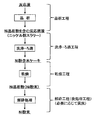
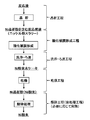
- FIG. 1 shows a typical manufacturing process of nickel powder by the wet method.
- the nickel powder obtained by the above wet method is applied to a laminated ceramic capacitor, the nickel powder and the resin are used in order to prevent a short circuit between the electrodes in the laminated body composed of the internal electrode layer and the dielectric layer described above.
- High flatness is required for a nickel paste dry film (a dry film obtained by printing and drying nickel paste) containing the above as a main component.
- the average particle size is preferably 0.3 ⁇ m or less.
- Fine nickel powder having an average particle size of 0.2 ⁇ m or less is used, and coarse particles having a size similar to the thickness of the internal electrode layer contained in the nickel powder (for example, 0.8 ⁇ m to 1.2 ⁇ m) are used. Is required to be reduced to the limit.
- Patent Document 4 describes, as a method for producing nickel powder using a wet method, a specific amine compound in the reaction solution in a crystallization step in which a reduction reaction is carried out in the reaction solution in order to increase the reducing power of hydrazine.
- a method for obtaining powder at low cost is shown.
- hydrazine is often used as a reducing agent. Therefore, as is clear from Patent Document 4 and the like, as shown in FIG. 1 described above, in the crystallization step.
- a nickel powder slurry in which nickel crystallization powder was generated was obtained in the reaction solution, and the nickel crystallization powder was collected by filtration from this nickel powder slurry while being washed with pure water and washed.
- a washing / filtering step for obtaining a powder-impregnated cake and a drying step for obtaining nickel crystallization powder (nickel powder) by heating and drying (vacuum drying, etc.) the washed nickel powder-containing cake are carried out following the crystallization step. Will be done.
- the resulting washed nickel powder hydrous cake will be more or less exposed to the atmosphere during the washing and filtering steps and before the drying of the drying steps. It is inevitable that the nickel crystallized powder will be oxidized by exposure.
- the crystallization reaction is carried out on a mass production scale, unlike the handling of a small amount at the laboratory level, it takes time to handle the nickel powder hydrous cake, so that the nickel crystallization powder is easily oxidized by the above atmospheric exposure.
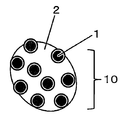
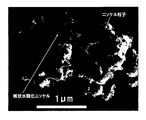
- the nickel crystallized powder 1 (particle size 0.4 ⁇ m) is generated.
- coarse particles 10 mainly composed of plate-shaped nickel hydroxide (Ni (OH) 2 ) in which the following) are firmly solidified with nickel hydroxide 2 are likely to be generated.
- the nickel hydroxide 2 in the coarse particles 10 is a strong plate-shaped nickel hydroxide matrix in which an oxide film containing nickel hydroxide as a main component generated by surface oxidation of the nickel crystallization powder 1 is easily crystal-grown into a plate shape. Is formed.
- the coarse particles 10 containing plate-shaped nickel hydroxide as a main component have a particle size of 0.8 ⁇ m or more and may cause a malfunction of a multilayer ceramic capacitor or the like. Therefore, effective suppression measures are required. Was being done.
- nickel powder is produced via a nickel powder-impregnated cake containing at least nickel powder and water, it is coarse with a plate-shaped nickel hydroxide as a main component due to an oxide film of the nickel powder.
- a method for producing nickel powder in which the formation of particles is suppressed a method for producing nickel powder, and a method for forming an oxide film of nickel powder, particularly a method for producing nickel powder by a wet method capable of producing the above nickel powder more easily and easily. The purpose.
- the present inventors have made a nickel powder slurry (a slurry containing nickel crystallization powder having no oxide film) which is a reaction final solution of crystallization.
- the nickel powder of the present invention has a substantially spherical particle shape, has a number average particle size of 0.03 ⁇ m to 0.4 ⁇ m, and mainly contains a basic salt of nickel hydroxide on the surface.
- the content of coarse particles containing nickel hydroxide as a main component is 100 mass ppm or less.
- the oxygen content of the nickel powder with respect to the specific surface area may be 0.35% by mass ⁇ g / m 2 or more, and the sulfur content of the nickel powder with respect to the specific surface area may be 0.04% by mass ⁇ g / m 2 or less. ..
- the method for producing nickel powder of the present invention is the method for producing nickel powder of the present invention, and the nickel powder slurry in which nickel powder having no oxide film is dispersed is dispersed.
- at least sulfate ions (SO 4 2-), chloride ion (Cl -), nitrate ion (NO 3 -), carbonate ions (CO 3 2-), formate ion (HCOO -), acetate ion (CH 3 COO -) and mixtures of one or more selected from by mixing the hydrogen peroxide (H 2 O 2), the surface of the nickel powder, at least sulfate ions (SO 4 2-), chloride ion (Cl -), nitrate ion (NO 3 -), carbonate ions (CO 3 2-), formate ion (HCOO -), acetate ion (CH 3 COO - and one or more selected from), basic nickel hydroxide
- the method for producing nickel powder of the present invention has the oxide film formed by crystallizing by a reduction reaction in a reaction solution containing at least a water-soluble nickel salt, a salt of a metal nobler than nickel, a reducing agent, and an alkali hydroxide.
- a crystallization step may be provided to form a nickel powder slurry in which the nickel powder that has not been used is dispersed.
- the water-soluble nickel salt may be one or more selected from nickel chloride (NiCl 2 ), nickel sulfate (NiSO 4 ), and nickel nitrate (Ni (NO 3 ) 2 ).
- the salt of the metal nobler than nickel may be one or more selected from copper salt, gold salt, silver salt, platinum salt, palladium salt, rhodium salt, and iridium salt.
- the alkali hydroxide may be one or more selected from sodium hydroxide (NaOH) and potassium hydroxide (KOH).
- the nickel powder slurry obtained in the crystallization step includes a sulfur coating treatment step of subjecting the nickel powder slurry to a sulfur coating treatment as a surface treatment for adhering sulfur to the surface of the nickel powder having no oxide film, and the sulfur coating treatment.
- the step may be performed between the crystallization step and the oxide film forming step.
- the nickel powder according to the present invention is a nickel powder obtained by heating and drying a nickel powder-containing cake, plate-like crystal growth of a nickel hydroxide component is suppressed in the oxide film of the nickel powder. , The formation of coarse particles containing plate-shaped nickel hydroxide as a main component is effectively suppressed, the content of the coarse particles is extremely small, and high flatness in the nickel paste dry film can be realized. Therefore, it is suitable for applications such as internal electrodes of multilayer ceramic capacitors.
- the method for producing nickel powder according to the present invention is, for example, a method for producing nickel powder via a nickel powder hydrous cake, and in the case of a method for producing nickel powder by a wet method, it is a crystallization step which is one step thereof.
- Hydrogen peroxide (H 2 O 2 ) as an oxidizing agent is added to the obtained nickel powder slurry which is the final solution of the reaction containing nickel crystallization powder (nickel powder) having no oxide film, and the oxide film is obtained.
- nickel crystal ⁇ (nickel powder) at least sulfate ions (SO 4 2-), chloride ion (Cl -), nitrate ion (nO 3 -), carbonate ions (CO 3 2-), formate ion (HCOO - the oxide coating mainly basic salts of nickel hydroxide containing one or more selected from) -), acetate ion (CH 3 COO
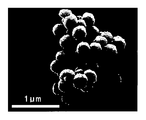
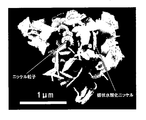
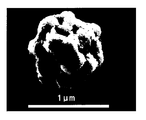
- FIG. 1 It is a schematic diagram which shows the typical manufacturing process in the manufacturing method of nickel powder by a wet method. It is a schematic diagram which shows the coarse particle containing nickel hydroxide as a main component, which is seen in the nickel powder by the wet method. It is a scanning electron micrograph (SEM image) of the agglomerated nickel crystallized powder seen in the nickel powder before the crushing treatment by the wet method. It is a scanning electron micrograph (SEM image) of the coarse particle containing nickel hydroxide as a main component, which is seen in the nickel powder before the crushing treatment by the wet method.
- the nickel powder obtained via the nickel powder hydrous cake will be described.
- a method for producing nickel powder using a wet method will also be described in the following order with reference to FIGS. 1 to 7. .
- the present invention is not limited to these, and can be arbitrarily modified without departing from the gist of the present invention.
- Nickel powder 2. Method for producing nickel powder using a wet method 2-1. Crystallization step 2-1-1. Chemicals used in the crystallization process 2-1-2. Crystallization procedure 2-1-3. Reduction reaction 2-1-4. Reaction start temperature 2-2. Oxide film forming step 2-2-1. Chemicals used in the oxide film formation process 2-2-2. Method and procedure for forming an oxide film 2-3. Cleaning / filtration process 2-3-1. Cleaning / filtration methods and procedures 2-4. Drying process 2-5. Crushing process (post-treatment process)
- the nickel powder of the present invention contains coarse particles mainly composed of plate-shaped nickel hydroxide having a particle size of more than 0.8 ⁇ m, even if the nickel powder is obtained by heating and drying a nickel powder-containing cake. Therefore, high flatness in the nickel paste dry film can be realized. Therefore, it is possible to effectively prevent a short circuit between electrodes in a laminated body composed of an internal electrode layer and a dielectric layer, which is suitable for use as an internal electrode of a multilayer ceramic capacitor.
- the main component is a component having the highest proportion of nickel hydroxide generated by oxidation of nickel crystallization powder, that is, plate-shaped water.
- Nickel oxide is the component with the highest proportion of the total coarse particles.
- the nickel powder of the present invention has a substantially spherical particle shape, and its number average particle size is preferably 0.03 ⁇ m to 0. From the viewpoint of corresponding to the thinning of the internal electrode of the multilayer ceramic capacitor in recent years. It is 4 ⁇ m, more preferably 0.05 ⁇ m to 0.3 ⁇ m, and even more preferably 0.08 ⁇ m to 0.25 ⁇ m.
- the substantially spherical shape is not limited to a true sphere, but an ellipsoid in which the ratio of minor axis to major axis (minor axis / major axis) is 0.8 to 1.0 in a predetermined cross section (for example, a cross section passing through the center of a particle). It also includes an ellipsoid that becomes a shape.
- the average particle size of the present invention is a number average particle size obtained from a scanning electron micrograph (SEM image) of nickel powder. Further, the nickel powder produced by the wet method of the present invention described later has a sufficiently narrow particle size distribution without subjecting the classification treatment. That is, in this case, the CV value, which is the value obtained by dividing the standard deviation of the particle size by the average particle size, is 0.2 or less, and the nickel powder has a uniform particle size.
- the coarse particles containing plate-shaped nickel hydroxide as a main component are in the state of a nickel powder-containing cake in the process from the washing / filtering step to the drying step described later, and the surface of the nickel crystallization powder is generated by oxygen in the air or the like.
- the oxide film containing nickel hydroxide as the main component which is produced by the oxidation of nickel hydroxide, grows as a plate-like crystal, so that the surrounding nickel crystallization powder is involved and firmly bonded to the solid substance.
- the main component is a component having the highest proportion of nickel hydroxide generated by oxidation of nickel crystallization powder, that is, plate-shaped nickel hydroxide. Is the component with the highest proportion in the entire oxide film.
- FIG. 3 shows a scanning electron micrograph of a nickel crystallized powder that is simply weakly aggregated in a state where the coarse particles containing the plate-shaped nickel hydroxide as a main component are not formed in the nickel powder before the crushing treatment by the wet method.
- SEM image is shown, such agglomeration is hardly a problem because it is easily disintegrated by performing a crushing treatment described later.
- SEM images scanning electron micrographs before and after the crushing treatment of the plate-shaped nickel hydroxide-based coarse particles found in the nickel powder by the wet method are shown in FIGS. 4 to 6. From FIGS.
- the nickel hydroxide matrix in which coarse particles containing plate-shaped nickel hydroxide as a main component are grown into plate-like crystals firmly solidifies the nickel crystallized powders with each other, and FIG. From this, it can be seen that these coarse particles containing plate-shaped nickel hydroxide as a main component are not easily disentangled even if they are crushed.
- the coarse particles mainly composed of plate-shaped nickel hydroxide after being crushed have a smooth surface shape of nickel hydroxide, but the shape is changed by the action of the collision energy of the particles during the crushing treatment. This is a variation, and the plate-shaped nickel hydroxide matrix is still present.
- coarse particles containing plate-shaped nickel hydroxide as a main component coarse particles are separated from nickel powder by, for example, a filter such as a porous track etching membrane filter described later, and the coarse particles are separated by EDS (energy dispersive X-ray). It can be identified by analysis by XPS (X-ray photoelectron spectroscopy) or the like and shape observation by a scanning electron microscope (SEM) or the like.
- EDS energy dispersive X-ray
- the nickel powder of the present invention can be obtained by heating and drying a nickel powder-containing cake containing at least nickel powder and water, and by providing an oxide film containing a basic salt of nickel hydroxide as a main component on the surface. , Plate-like crystal growth of nickel hydroxide component can be suppressed on the surface.
- Basic salts of the nickel hydroxide, at least sulfate ions (SO 4 2-), chloride ion (Cl -), nitrate ion (NO 3 -), carbonate ions (CO 3 2-), formate ion (HCOO - ), acetate ion (CH 3 COO - may are basic salt containing one or more selected from).
- the content of the coarse particles as a component can be controlled to 200 mass ppm or less, more preferably 150 mass ppm or less, and further preferably 100 mass ppm or less. Further, the content of coarse particles containing plate-shaped nickel hydroxide having a particle size of more than 1.2 ⁇ m as a main component can be controlled to 100 mass ppm or less, more preferably 80 mass ppm or less, still more preferably 50 mass ppm or less. It can be ppm or less.
- the influence of the coarse particles of the nickel powder depends on the thickness of the internal electrode layer of the multilayer ceramic capacitor in which the nickel powder is used, but the particle size of the thinned internal electrode layer in recent years exceeds 0.8 ⁇ m.
- the content of coarse particles containing plate-shaped nickel hydroxide as a main component exceeds 200 mass ppm, or the content of coarse particles containing plate-shaped nickel hydroxide as a main component exceeds 100 mass ppm. If it exceeds, the occurrence of short circuit between electrodes may become remarkable.
- the content of coarse particles mainly composed of plate-shaped nickel hydroxide having a particle size of more than 1.2 ⁇ m or 100 mass ppm or less is 50 mass ppm or less, the occurrence rate of short circuit between electrodes is sufficiently reduced. can do.
- the particle size of the coarse particles containing plate-shaped nickel hydroxide as a main component may be the minor axis diameter obtained from the SEM image.
- the nickel powder may contain a small amount of impurities, including those in an oxide film containing a basic salt of nickel hydroxide on the surface of the nickel powder as a main component.
- the nickel powder obtained by the wet method contains alkali metals such as oxygen caused by surface oxidation of nickel particles, chlorine thought to be caused by nickel chloride as a nickel raw material, and sodium caused by sodium hydroxide. It may be contained in a small amount.
- the nickel powder obtained by the vapor phase method also contains a small amount of chlorine in the case of oxygen caused by surface oxidation of nickel particles and the nickel powder obtained by hydrogen reduction of nickel chloride vapor. May be contained.
- chlorine and alkali metals are 0 in the nickel powder.
- the content is preferably 0.01% by mass or less.
- the nickel powder applicable to the internal electrode of a multilayer ceramic capacitor usually contains a trace amount of sulfur in order to suppress its catalytic activity. This is because the surface of the nickel particles has high catalytic activity, and if it is used as it is without containing sulfur or the like, for example, in the debinder treatment at the time of manufacturing a laminated ceramic capacitor, a binder such as ethyl cellulose (EC) resin contained in the internal electrode paste This is because the binder resin is decomposed from a low temperature by promoting the thermal decomposition of the resin, and the strength of the laminate is significantly reduced. At the same time, a large amount of decomposition gas is generated and cracks are likely to occur in the laminate. Is.
- EC ethyl cellulose
- a surface treatment for adhering sulfur to the surface of the nickel particles is performed using a sulfur coating treatment agent described later, and the entire surface of the nickel particles is thin.
- a sulfur coating treatment agent described later, and the entire surface of the nickel particles is thin.
- the state uniformly modified (coated) with sulfur from the viewpoint of exhibiting the decomposition suppressing effect of the binder resin and reducing the influence of sulfur as an impurity on the characteristics of the laminated ceramic capacitor.
- the nickel particles may be in a modified (coated) state in which a part of the surface is modified (coated) without modifying (coating) the entire surface. ..
- "surface treatment” is used as a concept including all modifications (coatings) and some modifications (coatings) of such nickel particles.
- a nickel powder having an average particle size of 0.2 ⁇ m has a specific surface area. Since it is about 4 m 2 / g, its sulfur content is preferably about 0.40% by mass or less, more preferably about 0.28% by mass or less, and further preferably about 0.16% by mass or less.
- the lower limit of the sulfur content is not particularly limited, and the content is very small so that the measurement result is below the detection limit by an analytical instrument used for content analysis, for example, a sulfur analyzer by the combustion method or an ICP analyzer. It may be an amount.
- the sulfur content with respect to the specific surface area (m 2 / g) of the nickel powder is reduced to 0.04% by mass ⁇ g / m 2 or less, the above-mentioned effect of suppressing the decomposition of the binder resin by sulfur becomes small and the multilayer ceramic capacitor In the debinder treatment during production, the strength of the laminate is likely to decrease and cracks are likely to occur.
- an oxide film containing a basic salt of nickel hydroxide formed on the surface as a main component is used. A secondary effect is exhibited in which the metallic nickel portion having high catalytic activity is less likely to come into contact with the binder resin and resin decomposition is suppressed.
- the nickel powder of the present invention even if the sulfur coating treatment is not performed to reduce the sulfur content, decomposition of the binder resin can be suppressed if the thickness of the oxide film is made more than a predetermined value.
- the sulfur content relative to the specific surface area of the nickel powder (m 2 / g) (wt%) of 0.04 wt% ⁇ g / m 2 or less the specific surface area of the nickel powder (m 2 /
- the oxygen content (mass%) with respect to g) may be preferably 0.35% by mass ⁇ g / m 2 or more, more preferably 0.40 mass% ⁇ g / m 2 or more.
- a nickel powder having an average particle size of 0.2 ⁇ m has a specific surface area of about 4 m 2 / g, and therefore its oxygen content is preferably about 1.4% by mass or more, more preferably about 1.6% by mass or more. is there.
- the method for producing nickel powder using the wet method according to the embodiment of the present invention is at least a water-soluble nickel salt, a salt of a metal nobler than nickel, a reducing agent (for example, hydrazine), and an alkali hydroxide as a pH adjusting agent.
- an amine compound or a sulfur-containing compound which will be described later, is added to the reaction solution to add a hydrazine self-decomposition inhibitor (amine compound, sulfur-containing compound) and a reduction reaction accelerator (complexing agent) (amine compound). ) May act as. Further, a crushing step performed as needed may be added as a post-treatment step.
- nickel powder slurry is a reaction completion solution containing nickel crystals ⁇ , in its diluted solution and washing solution, as a sulfur coating treatment agent, the inorganic sodium sulfide (Na 2 S) and sodium hydrosulfide (NaSH ) And other alkali metal sulfides, and in organic systems, a very small amount of a mercapto compound having a mercapto group (another name: thiol group) (-SH) or a disulfide compound having a disulfide group (-SS-) is added.
- a mercapto compound having a mercapto group another name: thiol group
- -SS- disulfide compound having a disulfide group
- the surface treatment (sulfur coating treatment) for modifying the surface of the nickel particles with a sulfur component may be performed so that the content in the nickel powder is 0.5% by mass or less.
- the disulfide group breaks the bond between S and is easy to directly bond with the nickel element
- the mercapto compound examples include mercaptoacetic acid (thioglycolic acid) (HSCH 2 COOH), thioalic acid (HOOCCH (SH) CH 2 COOH), L-cysteine (HSCH 2 CH (NH 2 ) COOH), and thioglycerol (HSCH 2 ).
- CH (OH) CH 2 OH) and the like can be used, and as the disulfide compound, dithiodiglycolic acid (HOOCH 2 S-SCH 2 COOH) and the like can be used.
- the obtained nickel powder can be subjected to heat treatment at about 200 ° C. to 300 ° C. in an inert atmosphere or a reducing atmosphere to obtain nickel powder.
- This sulfur coating treatment and heat treatment can control the debinder behavior at the internal electrode and the sintering behavior of the nickel powder at the time of manufacturing the above-mentioned multilayer ceramic capacitor, and are therefore very effective if used within an appropriate range.
- a crushing step (post-treatment step) of crushing the nickel crystallization powder having an oxide film containing a basic salt of nickel hydroxide as a main component on the surface is added. It is preferable to obtain nickel powder in which coarse particles and the like are reduced by connecting nickel particles generated in the process of forming nickel particles in the crystallization step.
- the particles By performing such a crystallization step, an oxide film forming step, a washing / filtering step, a drying step, and a crushing step as necessary, the particles have a substantially spherical particle shape, and the average particle size thereof is 0.
- a nickel powder of 03 ⁇ m to 0.4 ⁇ m can be obtained.
- an amine compound or a sulfur-containing compound is mixed with the reaction solution as needed to suppress the decomposition of hydrazine as a reducing agent in the presence of the amine compound or the sulfur-containing compound.
- the nickel salt can also be reduced.
- a reaction solution containing a nickel salt, a salt of a metal nobler than nickel, a reducing agent, an alkali hydroxide, and if necessary, various chemicals such as an amine compound and a sulfur-containing compound and water is used.
- Water as a solvent is ultrapure water (conductivity: ⁇ 0.06 ⁇ S / cm (microsiemens per centimeter)) or pure water (conductivity) from the viewpoint of reducing the amount of impurities in the obtained nickel powder. : ⁇ 1 ⁇ S / cm) is preferable, and pure water, which is inexpensive and easily available, is particularly preferable.
- Nickel salt used in the present invention is not particularly limited as long as it is a nickel salt that is easily soluble in water.
- Ni (NO 3 ) 2 nickel chloride
- nickel sulfate or a mixture thereof nickel chloride, nickel sulfate or a mixture thereof.
- the salt of the metal nobler than nickel may be a metal salt of a metal that is water-soluble and has a lower ionization tendency than nickel.
- Rhodium salt, iridium salt and other water-soluble noble metal salts for example, copper sulfate is used as a water-soluble copper salt, silver nitrate is used as a water-soluble silver salt, and palladium (II) chloride, palladium (II) ammonium chloride, and palladium (II) nitrate are used as water-soluble palladium salts.
- Palladium (II) sulfate and the like can be used, but the present invention is not limited thereto.
- the salt of the metal nobler than nickel particularly the above-mentioned palladium salt is preferable because the particle size distribution of the obtained nickel powder can be controlled more finely, although the particle size distribution becomes somewhat wider.
- the proportion of palladium salt and nickel [molppm] may be appropriately selected depending on the number-average particle size which is an object of the nickel powder it can. For example, if the average particle size of the nickel powder is set to 0.03 ⁇ m to 0.4 ⁇ m, the ratio of the palladium salt to nickel is in the range of 0.2 mol ppm to 100 mol ppm, preferably 0.5 mol ppm.
- the average particle size of the obtained nickel powder may exceed 0.4 ⁇ m.
- this ratio exceeds 100 mol ppm, a large amount of expensive palladium salt is used, which may lead to an increase in the cost of nickel powder.
- the reducing agent used in the crystallization step of the present invention is not particularly limited, and examples thereof include hydrazine (N 2 H 4 , molecular weight: 32.05).
- hydrazine includes hydrazine hydrate, water-holding hydrazine (N 2 H 4 ⁇ H 2 O, molecular weight: 50.06), whichever is used.
- the reduction reaction of hydrazine is as shown in the formula (2) described later, but since it is particularly alkaline and has high reducing power, and the by-products of the reduction reaction are nitrogen gas and water, the impurity components due to the reduction reaction are present.
- hydrazine is suitable as a reducing agent, and for example, commercially available industrial grade 60% by mass hydrazine containing water can be used.
- (D) Alkali hydroxide The reducing power of hydrazine increases as the alkalinity of the reaction solution becomes stronger, as shown in the formula (2) described later. Therefore, in the present invention, the alkali hydroxide is made alkaline in the crystallization step. It can be used as an increasing pH adjuster.
- the alkali hydroxide is not particularly limited, but it is preferable to use an alkali metal hydroxide from the viewpoint of availability and price. Specifically, it is more preferable to use one or more selected from sodium hydroxide (NaOH) and potassium hydroxide (KOH).
- the amount of alkali hydroxide blended is such that the pH of the reaction solution is 9.5 or more, preferably 10 or more, more preferably 10.5 or more at the reaction temperature so that the reducing power of hydrazine as a reducing agent is sufficiently enhanced. It is good to decide to be.
- the pH of the reaction solution is somewhat smaller at a high temperature of 70 ° C., for example, when comparing 25 ° C. and about 70 ° C.
- the amine compound has an action of a self-decomposition inhibitor of hydrazine, a reduction reaction accelerator, and a connection inhibitor between nickel particles, and therefore, if necessary, a reaction solution. It is recommended to add to.
- the amine compound is a compound containing at least two functional groups selected from a primary amino group (-NH 2 ) or a secondary amino group (-NH-) in the molecule.
- a primary amino group -NH 2
- -NH- secondary amino group
- at least one of an alkylene amine or an alkylene amine derivative can be used.
- alkylene amines ethylenediamine (H 2 NC 2 H 4 NH 2 ), diethylene triamine (H 2 NC 2 H 4 NHC 2 H 4 NH 2 ), triethylene tetramine (H 2 N (C 2 H 4 )) NH) 2 C 2 H 4 NH 2 ), Tetraethylene Pentamine (H 2 N (C 2 H 4 NH) 3 C 2 H 4 NH 2 ), Pentaethylene Hexamine (H 2 N (C 2 H 4 NH) 4 )
- One or more selected from C 2 H 4 NH 2 ) and propylenediamine (CH 3 CH (NH 2 ) CH 2 NH 2 ) can be used.
- alkylene amine derivatives tris (2-aminoethyl) amine (N (C 2 H 4 NH 2 ) 3 ), N- (2-aminoethyl) ethanol amine (H 2 NC 2 H 4 NHC 2 H 4 OH) ), N- (2-Aminoethyl) propanolamine (H 2 NC 2 H 4 NHC 3 H 6 OH), 2,3-diaminopropionic acid (H 2 NCH 2 CH (NH) COOH), 1,2-cyclohexane Diamine (H 2 NC 6 H 10 NH 2 ), Ethylenediamine-N, N'-diacetic acid (also known as ethylene-N, N'-diglycine, HOOCCH 2 NHC 2 H 4 NHCH 2 COOH), N, N'- Diacetylethylenediamine (CH 3 CONNHC 2 H 4 NHCOCH 3 ), N, N'-dimethylethylenediamine (CH 3 NHC 2 H 4 NH
- the action of the amine compound as a reduction reaction accelerator is due to the action as a complexing agent that complexes nickel ions (Ni 2+ ) in the reaction solution to form nickel complex ions.
- the action of hydrazine as a self-decomposition inhibitor and a linkage inhibitor between nickel particles the primary amino group (-NH 2 ) and the secondary amino group (-NH-) in the amine compound molecule It is presumed that the action is exhibited by the interaction with the surface of the nickel crystallization powder in the reaction solution.
- the alkylene amine or the alkylene amine derivative which is an amine compound, has the structure of the above formula A in which the nitrogen atom of the amino group in the molecule is bonded via a carbon chain having 2 carbon atoms.
- the nitrogen atom of the amino group strongly adsorbed on the nickel crystallization powder is bonded via a carbon chain having 3 or more carbon atoms, the carbon chain becomes longer and the carbon chain portion of the amine compound molecule is free to move. It is considered that the degree (flexibility of the molecule) increases.
- ethine diamine H 2 NC 2 H 4 NH 2
- propylene diamine another name: 1,2-diaminopropane, 1, 1 in which the nitrogen atom of the amino group in the molecule is bonded via a carbon chain having 2 carbon atoms
- 2-propanediamine CH 3 CH (NH 2 ) CH 2 NH 2
- trimethylenediamine another name: 1 in which the nitrogen atom of the amino group in the molecule is bonded via a carbon chain having 3 carbon atoms.
- 3-Diaminopropane, 1,3-propanediamine H 2 NC 3 H 6 NH 2
- the ratio [mol%] of the amine compound and nickel in the reaction solution ((number of moles of amine compound / number of moles of nickel) x 100) is in the range of 0.01 mol% to 5 mol%, preferably. The range of 0.03 mol% to 2 mol% is preferable. If the above ratio is less than 0.01 mol%, the amount of the amine compound may be too small to obtain each action as a self-decomposition inhibitor of hydrazine, a reduction reaction accelerator, or a linkage inhibitor between nickel particles. is there.
- the amine compound acts too strongly as a complexing agent for forming nickel complex ions, and as a result, the particle growth of the nickel crystallization powder may be abnormal, and nickel. There is a risk that the characteristics of the nickel powder will deteriorate, such as the powder losing its granularity and spheroidity, resulting in a distorted shape, and the formation of many coarse particles in which nickel particles are connected to each other.
- the sulfur-containing compound is a compound applied to a brightener for nickel plating and a stabilizer for a plating bath, and unlike the above amine compound, the self-decomposition inhibitory effect of hydrazine is not so great when used alone. However, it has an interaction such as adsorption with the surface of nickel particles, and when used in combination with the above amine compound, it has the action of an autolysis inhibitory agent for hydrazine, which can significantly enhance the autolysis inhibitory effect of hydrazine. There is. Therefore, it may be added to the reaction solution as needed.
- the sulfur-containing compound for example, in the sulfide compound having a sulfide group (-S-) in the molecule, it is desirable that the sulfide compound has high water solubility, and therefore, a carboxy group (-COOH) and a hydroxyl group (-S-) are further contained in the molecule.
- carboxy group-containing sulfide compound containing at least one of amino groups primary: -NH 2 , secondary: -NH-, tertiary: -N ⁇
- hydroxyl group-containing sulfide compound it is preferred that either the amino group-containing sulfide compound, a thiazole ring-containing sulfide compound containing thiazole rings (C 3 H 3 NS) at least one more than the water-soluble is not high but applicable is there. More specifically, L (or D, or DL) -methionine (CH 3 SC 2 H 4 CH (NH 2 ) COOH), L (or D, or DL) -ethionine (C 2 H 5 SC 2 H 4).
- sulfur-containing compounds other than sulfide compounds include saccharin (also known as o-sulfimide benzoate, o-sulfobenzimide) (C 7 H 5 NO 3 S) and sodium dodecyl sulfate (C 12 H).
- saccharin also known as o-sulfimide benzoate, o-sulfobenzimide
- o-sulfobenzimide C 7 H 5 NO 3 S
- sodium dodecyl sulfate C 12 H
- the sulfur-containing compound molecules supplementarily cover the portion by adsorption, which more effectively hinders the contact between the hydrazine molecules in the reaction solution and the nickel crystallization powder, and further, the nickel crystallization powder. It is said that the coalescence of each other can be prevented more strongly, and the above-mentioned action is exhibited.
- the ratio [mol%] of the sulfur-containing compound to nickel in the reaction solution ((number of moles of sulfur-containing compound / number of moles of nickel) x 100) is in the range of 0.01 mol% to 5 mol%.
- the range is preferably 0.03 mol% to 2 mol%, more preferably 0.05 mol% to 1 mol%. If the ratio is less than 0.01 mol%, the amount of the sulfur-containing compound is too small, and there is a risk that the actions of the hydrazine autolysis inhibitor and the nickel particle linkage inhibitor cannot be obtained.
- aqueous solution from overflowing from the container.
- Known substances can be used as the dispersant, for example, alanine (CH 3 CH (COOH) NH 2 ), glycine (H 2 NCH 2 COOH), triethanolamine (N (C 2 H 4 OH) 3 ). ), Diethanolamine (also known as iminodiethanol) (NH (C 2 H 4 OH) 2 ) and the like.
- the complexing agent known substances can be used, such as hydroxycarboxylic acid, carboxylic acid (organic acid containing at least one carboxyl group), hydroxycarboxylic acid salt or hydroxycarboxylic acid derivative, carboxylic acid salt or carboxylic acid.
- acid derivatives include tartrate acid, citric acid, malic acid, ascorbic acid, formic acid, acetic acid, pyruvate, and salts and derivatives thereof.
- the defoaming agent is not particularly limited as long as it has excellent defoaming property under alkaline conditions, and an oil-type or solvent-type silicone-based or non-silicone-based defoaming agent can be used.
- the amine compound and sulfur-containing compound to be added as necessary can be added and mixed with any of the above solutions or a mixture thereof before the reaction solution is prepared, or the reaction solution is prepared and then the reaction solution is prepared. Can be added and mixed with. In a room temperature environment, the reduction reaction is started when the reaction solution is prepared.
- a specific crystallization procedure it is obtained by previously mixing a reducing agent solution and an alkali hydroxide solution with a nickel salt solution containing a nickel salt as a reduction product and a salt of a metal nobler than nickel.
- a reaction solution is prepared by adding and mixing an alkali hydroxide solution to the obtained nickel salt / reducing agent solution.
- a reducing agent for example, hydrazine
- a nickel salt solution containing a reduced product whereas in the latter, a reducing agent (for example, hydrazine) is added.
- the pH is adjusted (increased) by alkali hydroxide after being mixed in advance with a nickel salt solution containing a reducing agent to enhance the reducing power.
- the reaction start temperature the temperature at the time when the reaction solution is prepared, that is, when the reduction reaction starts.
- a reducing agent / alkali hydroxide solution with a nickel salt solution a solution containing a nickel salt and a salt of a metal nobler than nickel
- an alkali hydroxide to increase the alkalinity and enhance the reducing power.
- the raw material mixing time When the time required for addition and mixing (hereinafter, may be referred to as the raw material mixing time) becomes long, the alkalinity increases locally in the addition and mixing region of the nickel salt solution and the reducing agent / alkali hydroxide solution from the middle stage of addition and mixing. As a result, the reducing power of hydrazine is increased, and nucleation occurs due to a salt of a metal that is more noble than nickel, which is a nucleating agent. Therefore, the closer to the end of the raw material mixing time, the greater the dependence of the added nucleating agent on the raw material mixing time, which is that the nucleating action of the added nucleating agent weakens, and the nickel crystallization powder becomes finer and a narrow particle size distribution is obtained.
- the mixing time of the raw materials is preferably 10 seconds to 180 seconds, more preferably. It is preferably 10 seconds to 120 seconds, more preferably 10 seconds to 80 seconds.
- the nickel salt and the salt of a metal nobler than nickel are used.
- the nickel salt / reducing agent solution containing the reducing agent the reducing agent hydrazine is added and mixed in advance to obtain a uniform concentration. Therefore, the dependence of alkali hydroxide on the raw material mixing time for nucleation that occurs when the alkali hydroxide solution is added and mixed is not as large as in the former case, and the nickel crystallization powder is made finer and a narrow particle size distribution is obtained. There is a feature that it becomes easy.
- the mixing time of the alkaline hydroxide solution is short, and in consideration of restrictions on mass production equipment, the mixing time is preferably 10 seconds to 180 seconds. It is preferably 10 seconds to 120 seconds, more preferably 10 seconds to 80 seconds.
- the procedure of pre-blending the reaction solution with the reaction solution and the addition after the reaction solution is prepared and the reduction reaction is started are added. There are two types of procedures to be mixed.
- the amine compound or the sulfur-containing compound is mixed in the reaction solution in advance, so that the reaction solution is more noble than nickel.
- the reaction solution is more noble than nickel.
- various actions of amine compounds and sulfur-containing compounds are exhibited from the start of nuclear generation caused by a salt (nuclear agent) of a metal.
- interactions with the surface of nickel particles such as adsorption of amine compounds and sulfur-containing compounds may be involved in nucleation and affect the particle size and particle size distribution of the obtained nickel crystallized powder.
- the mixing time in the addition and mixing of the amine compound and the sulfur-containing compound to the reaction solution in this procedure may be added all at once within a few seconds, or may be added in portions or added dropwise over a period of several minutes to 30 minutes. May be good.
- the amine compound has an action as a reduction reaction accelerator (complexing agent). Therefore, if it is added slowly, the crystal growth will proceed more slowly and the nickel crystallization powder will have higher crystallinity, but the self-decomposition suppression of hydrazine will also gradually act, and the effect of reducing hydrazine consumption will decrease.
- the mixing time may be appropriately determined while observing the balance between the two.
- the timing of addition and mixing of the amine compound and the sulfur-containing compound in the former procedure can be comprehensively judged according to the purpose and appropriately selected.
- nickel crystallization powder is obtained by reducing the nickel salt with hydrazine in the coexistence of alkali hydroxide and a salt of a metal nobler than nickel in the reaction solution.
- the autolysis of hydrazine can be significantly suppressed by the action of a very small amount of a specific amine compound or sulfur-containing compound, and a reduction reaction can be carried out.
- the reaction when nickel ions (Ni 2+ ) crystallize to nickel (Ni) is a two-electron reaction of the following formula (1).
- the reaction of hydrazine is a 4-electron reaction of the following formula (2).
- nickel hydroxide produced by the neutralization reaction of sodium hydroxide is expressed by the reaction of reduction with hydrazine. Chemically (theoretical value), nickel (Ni) is 1 mol and hydrazine is 0. 5 mol is needed.
- Alkali hydroxide is used as a pH adjuster to increase the alkalinity of the reaction solution, and plays a role in promoting the reduction reaction of hydrazine.
- the active surface of the nickel crystallization powder serves as a catalyst to promote the autolysis reaction of hydrazine represented by the following formula (4), and hydrazine as a reducing agent is reduced. Other than that, it was sometimes consumed in large quantities. Therefore, although it depends on the crystallization conditions such as the reaction start temperature, for example, about 2 mol of hydrazine with respect to 1 mol of nickel, which is about 4 times the theoretical value required for the above-mentioned reduction, is generally used.
- a very small amount of a specific amine compound or sulfur-containing compound is added to the reaction solution to remarkably suppress the self-decomposition reaction of hydrazine, and the amount of expensive hydrazine used as a drug is significantly increased. It is preferable to reduce to.
- the specific amine compound can suppress the self-decomposition of hydrazine because (I) the molecules of the specific amine compound and sulfur-containing compound are adsorbed on the surface of the nickel crystallization powder in the reaction solution.
- nickel ions such as tartrate acid and citric acid and complex ions are used. It is common to use a complexing agent that forms to increase the concentration of ionic nickel as a reduction reaction accelerator.
- these complexing agents such as tartaric acid and citric acid are coarse particles generated by the action of a self-decomposition inhibitor of hydrazine such as the above-mentioned specific amine compound or sulfur-containing compound, or by connecting nickel particles to each other during crystallization. It does not have an action as a ligation inhibitor that makes it difficult to form.
- the above-mentioned specific amine compound also acts as a complexing agent like tartaric acid and citric acid, and has an advantage of having the actions of a self-decomposition inhibitor of hydrazine, a ligation inhibitor, and a reduction reaction accelerator. There is.
- reaction start temperature for example, a solution containing at least a water-soluble nickel salt and a salt of a metal noble than nickel (nickel salt solution), and a solution containing a reducing agent (for example, hydrazine) and alkali hydroxide (reduction) Start with the reaction solution in which the agent / alkali hydroxide solution) is added and mixed.
- the reaction start temperature of the crystallization reaction is preferably 40 ° C. to 95 ° C., more preferably 50 ° C. to 80 ° C., and even more preferably 60 ° C. to 70 ° C.
- the temperatures of the nickel salt solution and the reducing agent / alkali hydroxide solution are not particularly limited as long as the temperature of the mixed solution obtained by premixing them, that is, the reaction start temperature is within the above temperature range, and is free. Can be set to.
- reaction start temperature the higher the reaction start temperature, the more the reduction reaction is promoted, and the nickel crystallization powder tends to be highly crystallized.
- autolysis reaction of hydrazine is further promoted. As the amount of consumption increases, the foaming of the reaction solution tends to increase. Therefore, if the reaction start temperature is too high, the consumption of hydrazine may increase significantly, or the crystallization reaction may not be able to continue due to a large amount of foaming.
- the reaction start temperature becomes too low, the crystallinity of the nickel crystallization powder is significantly lowered, or the reduction reaction is delayed, the time of the crystallization step is significantly extended, and the productivity of the nickel powder is lowered. Tend. For the above reasons, by setting the temperature in the above range, it is possible to inexpensively produce high-performance nickel powder while suppressing the consumption of hydrazine and maintaining high productivity.
- the oxide film forming step a nickel powder having no oxide film, at least sulfate ions (SO 4 2-), chloride ion (Cl -), nitrate ion (NO 3 -), carbonate ions (CO 3 2- ), formate ion (HCOO -), acetate ion (CH 3 COO - and a mixture of at least one member selected from), hydrogen peroxide (H 2 O 2) and by mixing, the surface of the nickel powder, at least sulfate ions (SO 4 2-), chloride ion (Cl -), nitrate ion (NO 3 -), carbonate ions (CO 3 2-), formate ion (HCOO -), acetate ion (CH 3 COO -)
- An oxide film containing one or more selected from the above and nickel hydroxide as a main component is formed.
- At least sulfate ions are attached to a nickel powder slurry or a diluted solution thereof, which is a reaction final solution containing nickel crystallization powder (nickel powder) having no oxide film, which is obtained by a reduction reaction in the above crystallization step.
- oxide film forming step An oxide film containing one or more of the basic salts of nickel hydroxide as a main component is formed (oxide film forming step). By forming such an oxide film, it is possible to suppress the growth of the nickel hydroxide component of the oxide film into plate-like crystals and effectively suppress the formation of coarse particles containing plate-like nickel hydroxide as a main component.
- the oxide film forming step of the present invention for example, in a nickel powder slurry or a diluted solution thereof, which is the final reaction solution in the crystallization step, an oxide film is formed on the surface of the nickel crystallization powder (nickel powder) using an oxidizing agent. .. Further, the nickel powder slurry contains an anion component for forming a basic salt so that the main component of the oxide film is a basic salt of nickel hydroxide.
- the oxidizing agent that can be used in the present invention is easily soluble in water and forms an oxide film containing a basic salt of nickel hydroxide as a main component on the surface of nickel crystallization powder (nickel powder).
- nickel powder nickel crystallization powder
- the present invention is not particularly limited.
- one or more selected from air, oxygen gas (dissolved oxygen dissolved in water, etc.), and hydrogen peroxide (H 2 O 2 ) can be used.
- industrial aqueous hydrogen peroxide H 2 O 2: 30% to 60 It is more preferable to use% by mass).
- Ni + mol of nickel hydroxide should be formed for 1 mol of hydrogen peroxide (H 2 O 2 ) as shown in the formula (6).
- anions nickel powder in the slurry SO 4 2-, Cl -, NO 3 -, CO 3 2-, HCO 3 -, HCO 2 -, CH 3 CO 2 - , etc.
- 1 mol of a basic salt of nickel hydroxide as shown in the above formula (5) is formed with 1 mol of hydrogen peroxide (H 2 O 2 ).
- the above-mentioned oxidizing agent may not be anything as long as it has an oxidizing action and can form an oxide film on the surface of the nickel crystallization powder (nickel powder).
- HClO hypochlorous acid
- NaClO sodium hypochlorite
- an oxide film can be formed on the surface of nickel crystallization powder (nickel powder), but the nickel hydroxide component It has been confirmed that a sufficient inhibitory effect on the growth of plate-like crystals is not obtained.
- (I) Anionic component required for the basic salt of nickel hydroxide As described above, in order for the main component of the oxide film to be the basic salt of nickel hydroxide as represented by the formula (5), It is necessary to include an anion component for forming a basic salt in the nickel powder slurry or its diluted solution.
- the chemicals used as necessary to contain such anionic components are preferably those that are easily soluble in water. Specifically, for inorganic acids, hydrochloric acid (HCl), nitric acid (HNO 3 ), and carbonic acid. (H 2 SO 4 ), carbonic acid (H 2 CO 3 ), formic acid (HCOOH), acetic acid (CH 3 COOH), etc.
- HCl hydrochloric acid
- HNO 3 nitric acid
- sulfuric acid H 2 ) SO 4
- nitric acid (CH 3 COOH) and other lithium (Li) salts sodium (Na) salt, potassium (K) salt, ammonium (NH 4 ), etc.
- CO 2 carbonate is blown carbon dioxide gas
- the liquid nickel powder slurry and its dilution
- carbonate ion (CO 3 2-) and bicarbonate ion (HCO 3 -) May act as.
- the nickel powder slurry as a reaction completion solution in the crystallization step is anion component of the drug from that used in the crystallization step (e.g., nickel chloride (NiCl 2) and nickel sulfate (NiSO 4) derived from SO 4 2 - and Cl -) because it contains, if nickel powder slurry and the diluent already contains a sufficient amount of anionic components, agents used in order to include the aforementioned anionic components, especially unnecessary.
- NiCl 2 nickel chloride
- NiSO 4 nickel sulfate
- Niobium powder slurry containing nickel crystallization powder (nickel powder) having no oxide film or a diluted solution thereof is added to the nickel hydroxide base.
- Nickel crystallized powder (nickel crystallized powder) is subjected to an oxide film forming treatment in a slurry state by adding the above-mentioned inorganic acid and its salt as necessary and then adding the above-mentioned oxidizing agent so that the sex salt contains the necessary anionic component.
- An oxide film containing a basic salt of nickel hydroxide as a main component is formed on the surface of nickel powder).
- the oxide film forming treatment may be performed by passing an oxidizing agent solution through a nickel powder cake or the like, but it is better to form the oxide film in a slurry state in which nickel crystallization powders (nickel powders) are dispersed as much as possible. It is preferable to perform this on a nickel powder in a slurry state because the bond strengthening due to the oxide film at the contact portion between the nickel crystallization powders (nickel powders) is alleviated and the aggregation of the nickel crystallization powders (nickel powders) can be suppressed. ..
- the temperature at which the oxide film forming treatment is performed on the nickel powder slurry or its diluted solution is not particularly limited, but may be room temperature to 90 ° C. (almost the maximum temperature at the time when the crystallization reaction is completed). Considering the convenience of the above, room temperature to about 50 ° C. is preferable.
- the amount of oxidizing agent added to nickel powder or its diluent (concentration of oxidizing agent) and the time required to form the oxide film after the addition of the oxidizing agent are the amount of oxidation of the target oxide film (thickness of the oxide film). It can be set as appropriate according to.
- the amount of the oxidizing agent is, for example, 1 mol% to 20 mol%, more preferably 1 mol% to 20 mol% with respect to nickel in the case of a nickel powder slurry containing nickel crystallized powder (nickel powder) having a particle size of about 0.2 ⁇ m. It is 3 mol% to 15 mol%, more preferably 5 mol% to 10 mol% (when the oxidizing agent is hydrogen peroxide (H 2 O 2 ), it is preferably 0.58 in terms of mass%. Mass% to 11.6% by mass, more preferably 1.74% by mass to 8.69% by mass, still more preferably 2.90% by mass to 5.80% by mass).
- the amount of oxidant required is considered to be proportional to the specific surface area of the nickel crystallized powder (nickel powder) (that is, inversely proportional to the particle size), so if the particle size is different from 0.2 ⁇ m, it is inversely proportional to the particle size.
- the amount of oxidant may be used.
- the amount of the oxidizing agent when the particle size is about 0.1 ⁇ m is about twice as much as when the particle size is about 0.2 ⁇ m, and about 0.5 times when the particle size is about 0.4 ⁇ m.
- the oxide film forming treatment time is preferably 1 minute to 60 minutes, more preferably 3 minutes to 30 minutes, and further preferably 5 minutes to 15 minutes.
- the oxide film forming treatment is basically performed on the nickel powder slurry or its diluted solution immediately after the crystallization step, but the washing is performed to some extent in the middle of the washing / filtering step. It may be carried out at a stage where a sufficient amount of anionic components still remain in the nickel powder slurry, or it may be sufficiently washed in the washing / filtration step and almost no anionic components remain.
- the chemical used for containing the anion component may be added to the nickel powder slurry to perform the oxide film forming treatment, and then the washing may be continued.
- the crystallization step includes a cleaning / filtering step of collecting the nickel powder and obtaining a nickel powder-containing cake, and a drying step of drying the nickel powder-containing cake (vacuum drying, etc.) to obtain nickel crystallization powder (nickel powder). It will be carried out subsequently.
- the resulting nickel powder hydrous cake is more or less exposed to the atmosphere during the washing and filtering steps and before the drying of the drying steps. It is inevitable that the nickel crystallization powder will be oxidized. Especially when the crystallization reaction is performed on a mass production scale, it takes time to handle the nickel powder hydrous cake, unlike the handling of a small amount at the laboratory level. The nickel crystallized powder is easily oxidized by the above atmospheric exposure.
- the nickel powder hydrous cake obtained through a washing / filtration step of washing the nickel powder slurry (for example, about pH 14) with pure water and collecting it by filtration impurities in the reaction final solution containing alkali hydroxide (for example, Na, Although Cl and the like are washed and removed, a small amount of alkali hydroxide may remain and remain in the nickel powder-containing cake as a weakly alkaline adhering liquid (for example, about pH 11). Therefore, when the nickel crystallization powder is oxidized in this state, the nickel ions (Ni 2+ ) generated by the oxidation are likely to form nickel hydroxide according to the formula (6).
- alkali hydroxide for example, Na, Although Cl and the like
- Nickel hydroxide generated by this oxidation grew into plate-like crystals, and as a result, nickel crystallization powders 1 (particle size 0.4 ⁇ m or less) grew into plate-like crystals in places where the amount of nickel hydroxide formed was large.
- Coarse particles 10 firmly hardened with nickel hydroxide 2 (coarse particles containing plate-shaped nickel hydroxide as a main component) (in many cases, the particle size is 0.8 ⁇ m or more, FIG. 2, FIG. 4, FIG. 5, FIG. See) is more likely to occur.
- an oxidizing agent is used to oxidize the surface of the nickel crystallization powder (nickel powder) with a basic salt of nickel hydroxide as a main component. Even if a film is formed and an oxide film containing nickel hydroxide as a main component is formed, the nickel hydroxide component suppresses the growth of plate-like crystals, and the plate-shaped nickel hydroxide is used as a main component. Coarse particles (coarse particles in which nickel crystallization powders are firmly solidified with plate-shaped nickel hydroxide) are prevented from being generated.
- the degree of cleaning in the cleaning / filtration step is such that the conductivity of the liquid containing the nickel crystallization powder is 30 ⁇ S / cm to 1000 ⁇ S / cm, preferably 30 ⁇ S / cm to 500 ⁇ S / cm, and more preferably 30 ⁇ S / cm to 100 ⁇ S.
- the nickel crystallization powder is washed with pure water so as to be / cm (cleaning step), and then the nickel crystallization powder is filtered from the liquid to obtain a nickel powder water-containing cake containing an adhering liquid (filtering step). ), The residual amount of impurities (Na, Cl, etc.) caused by the chemicals used in the crystallization step is significantly reduced.
- a nickel powder slurry containing a nickel crystallization powder (nickel powder) having an oxide film containing a basic salt of nickel hydroxide obtained in the oxide film forming step as a main component is formed.
- nickel is used as a nickel powder hydrous cake containing an adhering liquid from the nickel powder slurry or the diluted solution using a general-purpose solid-liquid separator.
- the crystallization powder is collected by filtration.
- the above-mentioned general-purpose cleaning method includes repeated decanting and pure water dilution, concentration of nickel crystallized powder by a solid-liquid separator (higher slurry concentration and cake formation), and pure water repulp (adding pure water). Repeating of re-slurrying), washing with pure water flowing through the concentrate (cake) of nickel crystallized powder in the solid-liquid separator, and the like, but not limited to these.
- the general-purpose solid-liquid separator includes, but is not limited to, a Denver filter, a filter press, a centrifuge, a decanter, and the like.
- the pure water used for the above cleaning should have a high purity of 1 ⁇ S / cm or less.
- Distilled water or ultrapure water can be used instead of pure water, but it is preferable to use pure water which is inexpensive and easily available.
- the nickel powder-impregnated cake containing the adhering liquid of nickel crystallization powder (nickel powder) having an oxide film containing a basic salt of nickel hydroxide as a main component formed on the surface obtained in the washing / filtering step is air-dried. It is dried at 50 to 300 ° C., preferably 80 to 150 ° C. using a general-purpose drying device such as a machine, a hot air dryer, an inert gas atmosphere dryer and a vacuum dryer, and a basic salt of nickel hydroxide on the surface. It is possible to obtain a nickel crystallization powder (nickel powder) on which an oxide film containing the above as a main component is formed.
- the adhering water in the nickel powder-containing cake is replaced with a low-temperature volatile organic solvent such as ethanol, and then dried in the above-mentioned inert gas atmosphere dryer or vacuum dryer to obtain a large surface tension of water. It is also possible to weaken the drying agglomeration between the nickel particles that results during drying.
- the nickel powder-containing cake is dried in an inert atmosphere, a reducing atmosphere, or a vacuum atmosphere at about 200 ° C. to 300 ° C. using a drying device such as an inert gas atmosphere dryer or a vacuum dryer, it is simply It is possible to obtain nickel powder that has been heat-treated in addition to drying.
- Nickel crystallization powder (nickel powder) having an oxide film containing a basic salt of nickel hydroxide as a main component formed on the surface obtained through a crystallization step, an oxide film forming step, a washing / filtering step, and a drying step.
- an amine compound or a sulfur-containing compound when added as needed, they act as an inhibitor of nickel particle linkage during nickel crystallization. Therefore, in order to distinguish from the coarse particles formed by connecting the nickel particles to each other in the process of reduction and precipitation (hereinafter, "coarse particles containing plate-shaped nickel hydroxide as a main component"", they are referred to as "connected coarse particles”.
- the content ratio of is not so large.
- the content ratio of the linked coarse particles may become somewhat large, which may cause a problem.
- a crushing step may be provided during or at the end of the manufacturing process, and the connected coarse particles to which the nickel particles are connected can be divided at the connecting portion to reduce the connected coarse particles.
- dry crushing methods such as spiral jet crushing and counter jet mill crushing, wet crushing methods such as high-pressure fluid collision crushing, and other general-purpose crushing methods. Is possible.
- the coarse particles mainly composed of plate-shaped nickel hydroxide in which the above-mentioned nickel crystallization powders (particle size 0.4 ⁇ m or less) are firmly solidified with plate-shaped nickel hydroxide are crushed by the above-mentioned general-purpose various types. Since it cannot be easily crushed even by using the method (see FIG. 6), effective suppression measures for coarse particles containing plate-shaped nickel hydroxide as a main component are very important, and the present invention is from this point of view. Is also extremely useful.
- the method for producing nickel powder of the present invention is a method including an oxide film forming step, a cleaning / filtering step, and a drying step, and the other steps described above can be arbitrarily performed. ..
- a nickel powder slurry nickel powder having no oxide film are dispersed, at least sulfate ions (SO 4 2-), chloride ion (Cl -), nitrate ion ( NO 3 -), carbonate ions (CO 3 2-), formate ion (HCOO -), acetate ion (CH 3 COO - mixtures of one or more and selected from) by creating a mixture by itself prepared It may be prepared or may be prepared by obtaining this mixture.
- the method for forming an oxide film of nickel powder of the present invention is a method including an oxide film forming step among the steps of the method for producing nickel powder of the present invention described above, and the other steps described above are optionally performed. It is a process that can be done.
- a nickel powder slurry nickel powder having no oxide film are dispersed, at least sulfate ions (SO 4 2-), chloride ion (Cl -), nitrate ions (NO 3 -), carbonate ions (CO 3 2-), formate ion (HCOO -), acetate ion (CH 3 COO -) mixtures of one or more and selected from, by creating a mixture by itself prepared It may be prepared by, or it may be prepared by obtaining this mixture.
- the present invention will be described in more detail with reference to examples, but the present invention is not limited to the following examples.
- the characteristics of the nickel powder, the average particle size, the specific surface area, the content of coarse particles, and the binder resin decomposition peak temperature are evaluated as follows.
- the nickel powder obtained in the present invention has a substantially spherical particle shape, and the average particle size thereof is an observation image using a scanning electron microscope (SEM, JEOL Ltd., JSM-7100F) of the nickel powder (SEM, manufactured by JEOL Ltd., JSM-7100F). It is a number average particle size based on the particle size obtained from the result of the image analysis of the SEM image).
- the specific surface area of the nickel powder was measured using a "Macsorb” manufactured by Mountech.
- the stainless steel airtight container also contains a container containing pure water, and since the inside of the container has an air atmosphere saturated with water vapor at 40 ° C., nickel hydroxide is used in the nickel crystallization powder in the nickel powder water-containing cake.
- the formation of an oxide film containing nickel hydroxide and the growth of plate-like crystals of the nickel hydroxide component are significantly accelerated, and coarse particles containing plate-like nickel hydroxide as a main component are easily formed.
- 0.05 g of the nickel powder hydrous cake subjected to the above acceleration test was ultrasonically dispersed in 100 mL of a 0.1 mass% sodium hexametaphosphate aqueous solution to obtain a nickel powder dispersion, and this dispersion was used with a membrane filter having a pore size of 3 ⁇ m. After filtering, coarse particles having a size larger than the pore size of the membrane filter (size exceeding 3 ⁇ m) are captured on the filter, and the coarse particles are oxidized from the SEM image (magnification of 5000 times) of the coarse particles captured on the membrane filter. The state of the coating film was observed and evaluated.
- ICP emission spectroscopic analysis high frequency inductively coupled of a solution in which coarse particles of a large size (size exceeding 0.8 ⁇ m or size exceeding 1.2 ⁇ m) are captured and the coarse particles are acid-dissolved in the entire amount of the coarse particles.
- the content of coarse particles contained in the nickel powder was determined by calculation by plasma emission spectroscopic analysis method).
- the porous track etching membrane filter irradiates a plastic film with neutron rays, heavy ion rays, etc. to form a straight track (irradiation mark) in the film, and then wets the damaged track portion. It is obtained by chemically etching (treating with an alkaline aqueous solution) to form linear pores of uniform size on the entire surface of the film, and has a feature that only coarse particles larger than the pore diameter can be completely captured on the filter surface. The size of the pores (pore diameter) is controlled by the treatment time of wet chemical etching and the like.
- the evaluation method includes (1) coarse nickel particles having a particle size of more than 0.8 ⁇ m or 1.2 ⁇ m, and (2) nickel having a particle size of 0.4 ⁇ m or less.
- Coarse-linked coarse particles in which particles (nickel crystallization powder) are connected to each other on the surface of nickel particles in the crystallization process (reduction precipitation process) to a size exceeding 0.8 ⁇ m or 1.2 ⁇ m, (3) particle size 0.
- the main component is plate-shaped nickel hydroxide in which nickel particles (nickel crystallization powder) of 4 ⁇ m or less are firmly solidified with plate-shaped nickel hydroxide generated by oxidation to a size exceeding 0.8 ⁇ m or 1.2 ⁇ m. In all cases of coarse particles (see FIG. 2) ((1) to (3)), coarse particles are included.
- nickel powder produced by a wet method that can obtain nickel powder having a narrow particle size distribution was used. Therefore, coarse nickel particles having a particle size of more than 0.8 ⁇ m or 1.2 ⁇ m are not produced by themselves ( ⁇ 10 ppm), and the presence of the particles described in (1) above can be ignored. Furthermore, appropriate crystallization conditions are adopted for the linked coarse particles formed by linking nickel particles (nickel crystallization powder) with a particle size of 0.4 ⁇ m or less on the surface of the nickel particles in the crystallization process (reduction precipitation process). If so, the content is not so high in the first place, and the connection strength between nickel particles is not so strong.
- the crushing treatment is performed at the end of the manufacturing process, even if the content ratio of the linked coarse particles becomes somewhat large, the linked coarse particles are divided at the connecting portion to 0. Since the size can be 8 ⁇ m or less and the linked coarse particles can be eliminated ( ⁇ 10 ppm), the presence of the particles described in (2) above can be ignored. Therefore, the coarse particles calculated by the ICP emission spectroscopic analysis are only the particles described in (3) above, and the coarse particles exceed the particle size of 0.8 ⁇ m (or the particle size of 1.2 ⁇ m) in the present invention.
- the content of the particles may be considered to be the content of coarse particles mainly composed of plate-shaped nickel hydroxide having a particle size of more than 0.8 ⁇ m (or 1.2 ⁇ m).
- Coarse particles mainly composed of plate-shaped nickel hydroxide having a size of more than 0.8 ⁇ m or 1.2 ⁇ m can form a plurality of nickel particles (nickel crystallized powder) by the nickel hydroxide generated on the surface of the nickel crystallized powder. This is because the coarse particles that are involved and tightly bonded are not disentangled even if the above-mentioned crushing treatment is performed (see FIG. 6), and remain in the nickel powder as coarse particles of the same size.
- nickel hydroxide grows as a plate-like crystal in the coarse particles having a size exceeding 0.8 ⁇ m or 1.2 ⁇ m captured on the membrane filter as described above. It has a structure in which a plurality of nickel particles (nickel crystallization powder) entrained in the matrix are firmly bonded via a plate-shaped nickel hydroxide matrix (mainly composed of plate-shaped nickel hydroxide in FIG. 6). In the coarse particles, the surface of the nickel hydroxide matrix appears smooth due to the action of the particle collision energy during the crushing process). It should be noted that the fact that the above matrix (reference numeral 2 in FIG.
- the oxide film formed on the surface of the nickel crystallization powder (nickel powder) of the present invention is a basic salt of nickel hydroxide is contained in the nickel crystallization powder (nickel powder) by the oxide film forming treatment.
- anion SO 4 2-, Cl -, NO 3 -, CO 3 2-, HCO 3 -, HCO 2 -, CH 3 CO 2 - , etc.
- elements S, Cl, N, C, etc.
- the oxygen and nitrogen contents are the oxygen / nitrogen analyzer (LECO ON836)
- the carbon and sulfur contents are the carbon / sulfur analyzer (LECO CS844)
- the sodium content is the frame atomic absorptiometer (LECO).
- the chlorine content was measured by a fluorescent X-ray analyzer (ZSX Primus IV manufactured by Rigaku).
- a mixed powder of 20 parts by weight of nickel powder and 1 part by weight of ethyl cellulose (EC) resin powder is heated in a nitrogen atmosphere at a heating rate of 10 ° C./min to measure thermal weight. (TG) was performed, and the temperature showing the minimum value in the profile of the amount of change in weight with respect to temperature ( ⁇ TG) as the resin decomposition behavior was determined as the resin decomposition peak temperature (Tn).
- Tn resin decomposition peak temperature
- the resin decomposition peak temperature (Tr) was also obtained for the powder alone, and the difference (Tr—Tn) was used as an index for suppressing resin decomposition.
- (Tr—Tn) was evaluated as “x” when it was over 20 ° C., “ ⁇ ” when it was over 10 ° C. and 20 ° C. or less, and “ ⁇ ” when it was 10 ° C. or less.
- the resin decomposition peak temperature (Tr) of the ethyl cellulose resin powder alone measured under the above conditions was 340 ° C.
- Nickel chloride hexahydrate as nickel salt NiCl 2 ⁇ 6H 2 O, molecular weight: 237.69
- a sulfur-containing compound as autolysis suppressing adjuvant hydrazine
- a sulfide group (-S-) in the molecule
- One L-methionine CH 3 SC 2 H 4 CH (NH 2 ) COOH, molecular weight: 149.21) 1.271 g
- palladium (II) ammonium chloride also known as tetra
- ammonium chloropalladium (II) acid ((NH 4 ) 2 PdCl 4 , molecular weight: 284.31) was dissolved in 1880 mL of pure water, and the main components were nickel salt, sulfur-containing compound, and nickel.
- a nickel salt solution which is an aqueous solution containing a nucleating agent, which is a metal salt of a noble metal, was prepared.
- L-methionine which is a sulfide compound, is as small as 0.5 mol% (0.005 in terms of molar ratio) with respect to nickel, and palladium is 0.28 mol ppm (0. 50 mass ppm).
- reducing agent solution Hydrazine hydrate as a reducing agent (N 2 H 4 ⁇ H 2 O, molecular weight: 50.06) of commercially available 60 wt% hydrazine hydrate technical grade diluted to 1.67 times with pure water (MG sea Otsuka Chemical stock Weighed 207 g (manufactured by the company) to prepare a reducing agent solution which is an aqueous solution containing hydrazine as a main component without containing alkali hydroxide.
- the molar ratio of hydrazine contained in the reducing agent solution to nickel in the nickel salt solution is 1.46.
- alkali hydroxide solution As alkali hydroxide, 230 g of sodium hydroxide (NaOH, molecular weight: 40.0) was dissolved in 672 mL of pure water to prepare an alkali hydroxide solution which is an aqueous solution containing sodium hydroxide as a main component. The sodium hydroxide contained in the alkaline hydroxide solution was prepared so that the molar ratio to nickel in the nickel salt solution was 5.75.
- EDA Ethylenediamine
- EDA Ethylenediamine
- a reduction reaction accelerator complexing agent
- 1.024 g H 2 NC 2 H 4 NH 2 , molecular weight: 60.1
- a amine compound solution which is an aqueous solution containing ethylenediamine as a main component.
- the amount of ethylenediamine contained in the amine compound solution was as small as 1.0 mol% (0.01 in molar ratio) with respect to nickel in the nickel salt solution.
- the materials used in the nickel salt solution the reducing agent solution, the alkali hydroxide solution, and the amine compound solution, reagents manufactured by Wako Pure Chemical Industries, Ltd. were used except for 60% by mass of water-holding hydrazine.
- a nickel salt solution in which nickel chloride and palladium salt are dissolved in pure water is placed in a Teflon (registered trademark) coated stainless steel container with a stirring blade, heated while stirring so that the liquid temperature becomes 85 ° C, and then the liquid temperature is 25 ° C.
- the above-mentioned reducing agent solution containing hydrazine and water was added and mixed at a mixing time of 20 seconds to prepare a nickel salt / reducing agent-containing solution.
- the above alkali hydroxide solution containing alkali hydroxide and water at a liquid temperature of 25 ° C.
- reaction liquid nickel chloride + palladium salt
- + Hydrazine + sodium hydroxide + Hydrazine + sodium hydroxide
- the reaction start temperature was 63 ° C.
- the amine compound solution was added dropwise to the reaction solution over 10 minutes from 8 minutes to 18 minutes after the start of the reaction, and the reduction reaction was promoted while suppressing the autolysis of hydrazine to react the nickel crystallization powder. It was crystallized in the liquid. Within 60 minutes from the start of the reaction, it was confirmed that the reduction reaction of the above formula (3) was completed, the supernatant of the reaction solution was transparent, and all the nickel components in the reaction solution were reduced to metallic nickel. ..
- the amount of 60% by mass hydrazine hydrate consumed in the crystallization reaction was 171 g, and the molar ratio to nickel was 1.20 with respect to 207 g of 60% by mass hydrazine hydrate blended in the reducing agent solution.
- the molar ratio of hydrazine to nickel consumed in the reduction reaction is assumed to be 0.5 from the above formula (3), the molar ratio of hydrazine to nickel consumed in self-decomposition is 0.70. It is estimated that there was.
- aqueous solution of mercaptoacetic acid (thioglycolic acid) (HSCH 2 COOH, molecular weight: 92.12) as a sulfur coating treatment agent is added to the diluted nickel powder slurry to perform surface treatment (sulfur coating treatment) on the nickel crystallization powder. did. After that, the nickel crystallized powder which was left to stand and surface-treated was settled, and about 65% of the reaction solution was decanted from the supernatant, and pure water having a conductivity of 1 ⁇ S / cm was removed. Diluted by adding about the same amount as the above (the main anion in the solution was Cl ⁇ : 0.21 mol / L).
- Nickel hydroxide was used on the surface of a slurry containing nickel crystallization powder having an oxide film containing a basic salt of nickel hydroxide as a main component formed on the surface, which was obtained in the oxide film forming step.
- Nickel crystallization powder having an oxide film mainly composed of the basic salt of No. 1 is sucked using a Büchner funnel (filter paper: 5C) until the conductivity of the filtrate filtered from the above slurry reaches 50 ⁇ S / cm.
- Nickel powder water-containing cake water content is usually about 25 to 35% by mass) that has been filtered and washed (water-passing washing performed while suction-filtering pure water) and then sucked in the air for 20 minutes to separate solid and liquid.
- Got Table 1 shows the oxidants used in the oxide film forming treatment and the main anions in the nickel powder slurry. (Similarly, the main anions in the oxidizing agent and the nickel powder slurry in Examples 2 to 11 and Comparative Examples 1 to 5 described later are also shown in Tables 1 and 2.)
- the nickel powder hydrous cake was vacuum dried in a vacuum dryer set at a temperature of 150 ° C. to obtain nickel crystallization powder (nickel powder).
- the average particle size of the obtained nickel powder is 0.20 ⁇ m
- the oxygen content of the nickel powder with respect to the specific surface area (m 2 / g) is 0.42% by mass ⁇ g / m 2
- the sulfur content is 0. It was 060 mass% ⁇ g / m 2 .
- the content of the coarse particles containing plate-shaped nickel hydroxide having a particle size exceeding 0.8 ⁇ m as a main component is 30 mass ppm, and the coarse particles containing plate-shaped nickel hydroxide having a particle size exceeding 1.2 ⁇ m as a main component. The content of was less than 10 mass ppm.
- the resin decomposition peak temperature (Tn) of the nickel powder was measured and found to be 340 ° C. Therefore, (Tr-Tn) was 0 ° C.
- Table 1 shows the content of coarse particles mainly composed of plate-shaped nickel hydroxide having a particle size of more than 0.8 ⁇ m and the content of coarse particles mainly composed of plate-shaped nickel hydroxide having a particle size of more than 1.2 ⁇ m. Is shown. Similarly, the contents of coarse particles in Examples 2 to 11 and Comparative Examples 1 to 5 described later are also shown in Tables 1 and 2.
- Example 2 In the nickel powder slurry obtained by removing (decantation) the supernatant of the nickel powder slurry obtained in the crystallization step and adding pure water to dilute the nickel powder slurry, the surface treatment (sulfur coating treatment) was not applied to the nickel crystallization powder.
- the surface treatment sulfur coating treatment
- Example 1 nickel crystallization powder
- nickel powder was subjected to the same spiral jet crushing treatment as in Example 1.
- a nickel powder according to Example 2 produced by a wet method was obtained.
- the average particle size of the obtained nickel powder is 0.20 ⁇ m
- the oxygen content of the nickel powder with respect to the specific surface area (m 2 / g) is 0.42% by mass ⁇ g / m 2
- the sulfur content is 0. It was 028 mass% ⁇ g / m 2 .
- the content of the coarse particles containing plate-shaped nickel hydroxide having a particle size exceeding 0.8 ⁇ m as a main component is 20 mass ppm, and the coarse particles containing plate-shaped nickel hydroxide having a particle size exceeding 1.2 ⁇ m as a main component.
- the content of was less than 10 mass ppm.
- the resin decomposition peak temperature (Tn) of the nickel powder was measured and found to be 340 ° C. Therefore, (Tr-Tn) was 0 ° C.
- Example 3 In the oxide film forming step, an oxide film forming treatment was carried out with a hydrogen peroxide solution as an oxidizing agent without using an aqueous solution of sulfuric acid (H 2 SO 4 ) as a chemical used for containing an anionic component.
- a hydrogen peroxide solution as an oxidizing agent
- an aqueous solution of sulfuric acid (H 2 SO 4 ) as a chemical used for containing an anionic component.
- the nickel crystallized powder was surface-treated (sulfur-coated), and then decanted and diluted with pure water.
- the slurry of Example 1 main anions in the liquid were Cl ⁇ : 0.21 mol).
- To / L add 24.9 g of 30% by mass hydrogen peroxide solution (12.9 mol% (7.5% by mass) of hydrogen peroxide to nickel) and leave it for 5 minutes. Other than that.
- Example 3 Was carried out in the same manner as in Example 1 to obtain nickel crystallization powder (nickel powder). Then, the above nickel crystallization powder (nickel powder) was subjected to the same spiral jet crushing treatment as in Example 1. Through the above steps, a nickel powder according to Example 3 produced by a wet method was obtained.
- the average particle size of the obtained nickel powder is 0.20 ⁇ m
- the oxygen content of the nickel powder with respect to the specific surface area (m 2 / g) is 0.42% by mass ⁇ g / m 2
- the sulfur content is 0. It was 051 mass% ⁇ g / m 2 .
- the content of the coarse particles containing plate-shaped nickel hydroxide having a particle size exceeding 0.8 ⁇ m as a main component is 40 mass ppm, and the coarse particles containing plate-shaped nickel hydroxide having a particle size exceeding 1.2 ⁇ m as a main component.
- the content of was less than 10 mass ppm.
- the resin decomposition peak temperature (Tn) of the nickel powder was measured and found to be 340 ° C. Therefore, (Tr-Tn) was 0 ° C.
- Example 4 In the nickel powder slurry obtained by removing (decantation) the supernatant of the nickel powder slurry obtained in the crystallization step and adding pure water to dilute the nickel powder slurry, the surface treatment (sulfur coating treatment) was not applied to the nickel crystallization powder.
- the surface treatment sulfur coating treatment
- the above nickel crystallization powder was subjected to the same spiral jet crushing treatment as in Example 1. Through the above steps, a nickel powder according to Example 4 produced by a wet method was obtained.
- the average particle size of the obtained nickel powder is 0.20 ⁇ m
- the oxygen content of the nickel powder with respect to the specific surface area (m 2 / g) is 0.40% by mass ⁇ g / m 2
- the sulfur content is 0. It was 021 mass% ⁇ g / m 2 .
- the content of the coarse particles containing plate-shaped nickel hydroxide having a particle size exceeding 0.8 ⁇ m as a main component is 30 mass ppm, and the coarse particles containing plate-shaped nickel hydroxide having a particle size exceeding 1.2 ⁇ m as a main component.
- the content of was less than 10 mass ppm.
- the resin decomposition peak temperature (Tn) of the nickel powder was measured and found to be 340 ° C. Therefore, (Tr-Tn) was 0 ° C.
- Example 5 In the oxide film forming step, a slurry (almost containing anionic components) washed until the conductivity of the solution reaches 50 ⁇ S / cm without using an aqueous solution of sulfuric acid (H 2 SO 4 ) as a chemical used to contain the anionic components.
- Sodium nitrate (NaNO 3 ) was added to nickel in an amount of 0.5 mol% as a chemical used to contain an anionic component, and pure water was added to bring the total amount of slurry to 1 L. so as to adjust, and a pH of about 7 of the liquid (main anions in the liquid, NO 3 -: 0.0043mol / L ).
- Example 2 To this slurry, 7.1 g of 30% by mass hydrogen peroxide solution (3.7 mol% (2.1% by mass) of hydrogen peroxide with respect to nickel) was added and left for 30 minutes to form an oxide film. After that, the same procedure as in Example 1 was carried out except that the nickel powder-containing cake was obtained by solid-liquid separation and water-passing washing to remove the chemicals used to contain excess oxidizing agent and anionic components. , Nickel crystallization powder (nickel powder) was obtained. Then, the above nickel crystallization powder (nickel powder) was subjected to the same spiral jet crushing treatment as in Example 1. Through the above steps, a nickel powder according to Example 5 produced by a wet method was obtained.
- the average particle size of the obtained nickel powder is 0.20 ⁇ m
- the oxygen content of the nickel powder with respect to the specific surface area (m 2 / g) is 0.42% by mass ⁇ g / m 2
- the sulfur content is 0. It was 049 mass% ⁇ g / m 2 .
- the content of the coarse particles containing plate-shaped nickel hydroxide having a particle size exceeding 0.8 ⁇ m as a main component is 50 mass ppm, and the coarse particles containing plate-shaped nickel hydroxide having a particle size exceeding 1.2 ⁇ m as a main component.
- the content of was less than 10 mass ppm.
- the resin decomposition peak temperature (Tn) of the nickel powder was measured and found to be 340 ° C. Therefore, (Tr-Tn) was 0 ° C.
- Example 6 In the nickel powder slurry obtained by removing (decantation) the supernatant of the nickel powder slurry obtained in the crystallization step and adding pure water to dilute the nickel powder slurry, the surface treatment (sulfur coating treatment) was not applied to the nickel crystallization powder.
- the surface treatment sulfur coating treatment
- the above nickel crystallization powder was subjected to the same spiral jet crushing treatment as in Example 1. Through the above steps, a nickel powder according to Example 6 produced by a wet method was obtained.
- the average particle size of the obtained nickel powder is 0.20 ⁇ m
- the oxygen content of the nickel powder with respect to the specific surface area (m 2 / g) is 0.40% by mass ⁇ g / m 2
- the sulfur content is 0. It was 021 mass% ⁇ g / m 2 .
- the content of the coarse particles containing plate-shaped nickel hydroxide having a particle size exceeding 0.8 ⁇ m as a main component is 40 mass ppm, and the coarse particles containing plate-shaped nickel hydroxide having a particle size exceeding 1.2 ⁇ m as a main component.
- the content of was less than 10 mass ppm.
- the resin decomposition peak temperature (Tn) of the nickel powder was measured and found to be 340 ° C. Therefore, (Tr-Tn) was 0 ° C.
- Example 7 In the oxide film forming step, a slurry (almost containing anionic components) washed until the conductivity of the solution reaches 50 ⁇ S / cm without using an aqueous solution of sulfuric acid (H 2 SO 4 ) as a chemical used to contain the anionic components.
- Sodium carbonate (Na 2 CO 3 ) was added to nickel in an amount of 0.5 mol% as a chemical used to contain an anionic component, and pure water was further added to add pure water to the total amount of the slurry.
- Example 7 To this slurry, 10.7 g of 30% by mass hydrogen peroxide solution (5.5 mol% (3.2% by mass) of hydrogen peroxide with respect to nickel) was added and left for 15 minutes to form an oxide film. After that, the same procedure as in Example 1 was carried out except that the nickel powder-containing cake was obtained by solid-liquid separation and water-passing washing to remove the chemicals used to contain excess oxidizing agent and anionic components. , Nickel crystallization powder (nickel powder) was obtained. Then, the above nickel crystallization powder (nickel powder) was subjected to the same spiral jet crushing treatment as in Example 1. Through the above steps, a nickel powder according to Example 7 produced by a wet method was obtained.
- the average particle size of the obtained nickel powder is 0.20 ⁇ m
- the oxygen content of the nickel powder with respect to the specific surface area (m 2 / g) is 0.42% by mass ⁇ g / m 2
- the sulfur content is 0. It was 051 mass% ⁇ g / m 2 .
- the content of the coarse particles containing plate-shaped nickel hydroxide having a particle size exceeding 0.8 ⁇ m as a main component is 40 mass ppm, and the coarse particles containing plate-shaped nickel hydroxide having a particle size exceeding 1.2 ⁇ m as a main component.
- the content of was less than 10 mass ppm.
- the resin decomposition peak temperature (Tn) of the nickel powder was measured and found to be 340 ° C. Therefore, (Tr-Tn) was 0 ° C.
- Example 8 In the nickel powder slurry obtained by removing (decantation) the supernatant of the nickel powder slurry obtained in the crystallization step and adding pure water to dilute the nickel powder slurry, the surface treatment (sulfur coating treatment) was not applied to the nickel crystallization powder.
- the surface treatment sulfur coating treatment
- the above nickel crystallization powder was subjected to the same spiral jet crushing treatment as in Example 1. Through the above steps, a nickel powder according to Example 8 produced by a wet method was obtained.
- the average particle size of the obtained nickel powder is 0.20 ⁇ m
- the oxygen content of the nickel powder with respect to the specific surface area (m 2 / g) is 0.40% by mass ⁇ g / m 2
- the sulfur content is 0. It was 021 mass% ⁇ g / m 2 .
- the content of the coarse particles containing plate-shaped nickel hydroxide having a particle size exceeding 0.8 ⁇ m as a main component is 30 mass ppm, and the coarse particles containing plate-shaped nickel hydroxide having a particle size exceeding 1.2 ⁇ m as a main component.
- the content of was less than 10 mass ppm.
- the resin decomposition peak temperature (Tn) of the nickel powder was measured and found to be 340 ° C. Therefore, (Tr-Tn) was 0 ° C.
- Example 9 In the oxide film forming step, a slurry (almost containing anionic components) washed until the conductivity of the solution reaches 50 ⁇ S / cm without using an aqueous solution of sulfuric acid (H 2 SO 4 ) as a chemical used to contain the anionic components.
- Sodium formate (HCOONa) was added to nickel in an amount of 0.5 mol% as a chemical used to contain an anionic component, and pure water was further added to bring the total amount of slurry to 1 L.
- the pH of the solution was adjusted to about 9 (the main anion in the solution was HCOO ⁇ : 0.0043 mol / L).
- the average particle size of the obtained nickel powder is 0.20 ⁇ m
- the oxygen content of the nickel powder with respect to the specific surface area (m 2 / g) is 0.37% by mass ⁇ g / m 2
- the sulfur content is 0. It was 049 mass% ⁇ g / m 2 .
- the content of the coarse particles containing plate-shaped nickel hydroxide having a particle size exceeding 0.8 ⁇ m as a main component is 40 mass ppm, and the coarse particles containing plate-shaped nickel hydroxide having a particle size exceeding 1.2 ⁇ m as a main component.
- the content of was less than 10 mass ppm.
- the resin decomposition peak temperature (Tn) of the nickel powder was measured and found to be 340 ° C. Therefore, (Tr-Tn) was 0 ° C.
- Example 10 In the oxide film forming step, a slurry (almost containing anionic components) washed until the conductivity of the solution reaches 50 ⁇ S / cm without using an aqueous solution of sulfuric acid (H 2 SO 4 ) as a chemical used to contain an anionic component.
- Sodium acetate (CH 3 COONa) was added to nickel in an amount of 0.5 mol% as a drug used to contain an anionic component, and pure water was further added to increase the total amount of the slurry.
- the pH of the solution was adjusted to about 9 (the main anion in the solution was CH 3 COO ⁇ : 0.0043 mol / L).
- nickel powder was obtained in the same manner as in Example 1 except that a hydrous cake was obtained. Then, the above nickel crystallization powder (nickel powder) was subjected to the same spiral jet crushing treatment as in Example 1. Through the above steps, a nickel powder according to Example 10 produced by a wet method was obtained.
- the average particle size of the obtained nickel powder is 0.20 ⁇ m
- the oxygen content of the nickel powder with respect to the specific surface area (m 2 / g) is 0.40% by mass ⁇ g / m 2
- the sulfur content is 0. It was 051 mass% ⁇ g / m 2 .
- the content of the coarse particles containing plate-shaped nickel hydroxide having a particle size exceeding 0.8 ⁇ m as a main component is 40 mass ppm, and the coarse particles containing plate-shaped nickel hydroxide having a particle size exceeding 1.2 ⁇ m as a main component.
- the content of was less than 10 mass ppm.
- the resin decomposition peak temperature (Tn) of the nickel powder was measured and found to be 340 ° C. Therefore, (Tr-Tn) was 0 ° C.
- Nickel chloride hexahydrate as nickel salt NiCl 2 ⁇ 6H 2 O, molecular weight: 237.69
- a sulfur-containing compound as autolysis suppressing adjuvant hydrazine
- a sulfide group (-S-) in the molecule
- One L-methionine CH 3 SC 2 H 4 CH (NH 2 ) COOH, molecular weight: 149.21) 1.271 g
- palladium (II) ammonium chloride also known as tetra
- ammonium chloropalladium (II) acid ((NH 4 ) 2 PdCl 4 , molecular weight: 284.31) was dissolved in 1880 mL of pure water, and the main components were nickel salt, sulfur-containing compound, and nickel.
- a nickel salt solution which is an aqueous solution containing a nucleating agent, which is a metal salt of a noble metal, was prepared.
- L-methionine which is a sulfide compound, is as small as 0.5 mol% (0.005 in terms of molar ratio) with respect to nickel, and palladium is 0.08 mol ppm (0. 15 mass ppm).
- Example 11 In the crystallization step, using a solution of the above nickel salt and a metal salt nobler than nickel, 16.6 g of 30 mass% hydrogen peroxide solution (hydrogen peroxide is 8.6 mol% (5.0) with respect to nickel).
- a nickel crystallization powder (nickel powder) was obtained in the same manner as in Example 4 except that the oxide film was formed by adding (% by mass))) and leaving it for 5 minutes. Then, the above nickel crystallization powder (nickel powder) was subjected to the same spiral jet crushing treatment as in Example 1. Through the above steps, a nickel powder according to Example 11 produced by a wet method was obtained.
- the average particle size of the obtained nickel powder is 0.30 ⁇ m
- the oxygen content of the nickel powder with respect to the specific surface area (m 2 / g) is 0.48% by mass ⁇ g / m 2
- the sulfur content is 0. It was 021 mass% ⁇ g / m 2 .
- the content of the coarse particles containing plate-shaped nickel hydroxide having a particle size of more than 0.8 ⁇ m as a main component is 60 mass ppm, and the coarse particles containing plate-shaped nickel hydroxide having a particle size of more than 1.2 ⁇ m as a main component.
- the content of was less than 10 mass ppm.
- the resin decomposition peak temperature (Tn) of the nickel powder was measured and found to be 340 ° C. Therefore, (Tr-Tn) was 0 ° C.
- the average particle size of the obtained nickel powder was 0.20 ⁇ m
- the oxygen content of the nickel powder with respect to the specific surface area (m 2 / g) was 0.26% by mass ⁇ g / m 2
- the sulfur content was 0. It was 052 mass% ⁇ g / m 2 .
- the content of the coarse particles containing plate-shaped nickel hydroxide having a particle size of more than 0.8 ⁇ m as a main component is 310 mass ppm
- the content of was 150 mass ppm.
- the resin decomposition peak temperature (Tn) of the nickel powder was measured and found to be 340 ° C. Therefore, (Tr-Tn) was 0 ° C.
- the average particle size of the obtained nickel powder was 0.20 ⁇ m
- the oxygen content of the nickel powder with respect to the specific surface area (m 2 / g) was 0.26% by mass ⁇ g / m 2
- the sulfur content was 0. It was 021 mass% ⁇ g / m 2 .
- the content of the coarse particles containing plate-shaped nickel hydroxide having a particle size of more than 0.8 ⁇ m as a main component is 250 mass ppm
- the content of was 120 mass ppm.
- the resin decomposition peak temperature (Tn) of the nickel powder was measured and found to be 310 ° C. Therefore, (Tr-Tn) was 30 ° C.
- the average particle size of the obtained nickel powder is 0.20 ⁇ m
- the oxygen content of the nickel powder with respect to the specific surface area (m 2 / g) is 0.37% by mass ⁇ g / m 2
- the sulfur content is 0. It was 051 mass% ⁇ g / m 2 .
- the content of the coarse particles containing plate-shaped nickel hydroxide having a particle size of more than 0.8 ⁇ m as a main component is 260 mass ppm, and the coarse particles containing plate-shaped nickel hydroxide having a particle size of more than 1.2 ⁇ m as a main component.
- the content of was 130 mass ppm.
- the resin decomposition peak temperature (Tn) of the nickel powder was measured and found to be 340 ° C. Therefore, (Tr-Tn) was 0 ° C.
- the average particle size of the obtained nickel powder is 0.20 ⁇ m
- the oxygen content of the nickel powder with respect to the specific surface area (m 2 / g) is 0.37% by mass ⁇ g / m 2
- the sulfur content is 0. It was 021 mass% ⁇ g / m 2 .
- the content of the coarse particles containing plate-shaped nickel hydroxide having a particle size exceeding 0.8 ⁇ m as a main component is 230 mass ppm, and the coarse particles containing plate-shaped nickel hydroxide having a particle size exceeding 1.2 ⁇ m as a main component.
- the content of was 110 mass ppm.
- the resin decomposition peak temperature (Tn) of the nickel powder was measured and found to be 335 ° C. Therefore, (Tr-Tn) was 5 ° C.
- Example 5 The same procedure as in Example 11 was carried out except that the oxide film forming treatment of the nickel crystallization powder was not performed to obtain a nickel crystallization powder (nickel powder). Then, the above nickel crystallization powder (nickel powder) was subjected to the same spiral jet crushing treatment as in Example 1. Through the above steps, a nickel powder according to Comparative Example 5 produced by a wet method was obtained.
- the average particle size of the obtained nickel powder is 0.30 ⁇ m
- the oxygen content of the nickel powder with respect to the specific surface area (m 2 / g) is 0.30% by mass ⁇ g / m 2
- the sulfur content is 0. It was 023% by mass and g / m 2 .
- the content of the coarse particles containing plate-shaped nickel hydroxide having a particle size of more than 0.8 ⁇ m as a main component is 370 mass ppm
- the content of was 180 mass ppm.
- the resin decomposition peak temperature (Tn) of the nickel powder was measured and found to be 305 ° C. Therefore, (Tr-Tn) was 35 ° C.
- Example 1 to 11 Comparing each Example and each Comparative Example according to the present invention, Examples 1 to 11 in which an oxide film containing a basic salt of nickel hydroxide as a main component was formed on the surface through an oxide film forming step, particularly sulfur coating.
- Example 2 Example 4, Example 6, Example 8, and Example 11 which were not treated, Comparative Example 1, Comparative Example 2, and Comparative Example in which the oxide film was not formed without undergoing the oxide film forming step.
- Example 2 Example 4, Example 6, Example 8, and Example 11 according to the present invention, the surface of nickel hydroxide is basic to the surface through an oxide film forming step without being subjected to sulfur coating treatment. It can be seen that the decomposition of the binder resin is effectively suppressed despite the low sulfur content because the oxide film containing the salt as the main component is formed.
- the present invention provides a method for producing nickel particles by a wet method, which can more easily and easily produce nickel powder containing very small coarse particles containing plate-shaped nickel hydroxide as a main component. be able to.
- Nickel particles (nickel crystallized powder) 2 Plate-shaped nickel hydroxide produced by oxidation and crystal growth of nickel crystallized powder 10 Coarse particles mainly composed of plate-shaped nickel hydroxide
Landscapes
- Chemical & Material Sciences (AREA)
- Engineering & Computer Science (AREA)
- Nanotechnology (AREA)
- Chemical Kinetics & Catalysis (AREA)
- General Chemical & Material Sciences (AREA)
- Inorganic Chemistry (AREA)
- Materials Engineering (AREA)
- Mechanical Engineering (AREA)
- Metallurgy (AREA)
- Organic Chemistry (AREA)
- Life Sciences & Earth Sciences (AREA)
- Wood Science & Technology (AREA)
- Powder Metallurgy (AREA)
- Manufacture Of Metal Powder And Suspensions Thereof (AREA)
Abstract
ニッケル粉含水ケーキを加熱乾燥して得られるニッケル粉末でありながら、その酸化被膜において水酸化ニッケル成分の板状結晶成長が抑制され、板状水酸化ニッケルを主成分とする粗大粒子の含有量が少ないニッケル粉末およびニッケル粉末の製造方法、特に、上記ニッケル粉末をより簡便かつ容易に作製できる湿式法によるニッケル粉末の製造方法を提供する。 略球状の粒子形状を有し、数平均粒径が0.03μm~0.4μmであり、表面に水酸化ニッケルの塩基性塩を主成分とする酸化被膜を備え、粒径が0.8μmを超える、水酸化ニッケルを主成分とする粗大粒子の含有量が200質量ppm以下であり、粒径が1.2μmを超える、水酸化ニッケルを主成分とする粗大粒子の含有量が100質量ppm以下である、ニッケル粉末。
Description
本発明は、積層セラミック部品の電極材として用いられる高性能なニッケル粉末およびニッケル粉末の製造方法に関し、ニッケル粉末と水とを少なくとも含有するニッケル粉含水ケーキを経由して製造されるニッケル粉末およびニッケル粉末の製造方法、特に湿式法により得られる安価で高性能なニッケル粉末およびニッケル粉末の製造方法に関する。
ニッケル粉末は、電子回路のコンデンサの材料として、特に、積層セラミックコンデンサ(MLCC:multilayer ceramic capacitor)や多層セラミック基板等の積層セラミック部品の内部電極等を構成する厚膜導電体の材料として利用されている。
近年、積層セラミックコンデンサの大容量化が進み、積層セラミックコンデンサの内部電極の形成に用いられる内部電極ペーストの使用量も大幅に増加している。このため、厚膜導電体を構成する内部電極ペースト用の金属粉末として、高価な貴金属の使用に代替して、主としてニッケル等の安価な卑金属が使用されている。
積層セラミックコンデンサを製造する工程では、ニッケル粉末、エチルセルロース等のバインダー樹脂およびターピネオール等の有機溶剤を混練した内部電極ペーストを、誘電体グリーンシート上にスクリーン印刷する。そして、内部電極ペーストが印刷され、乾燥された誘電体グリーンシートは、内部電極ペースト印刷層と誘電体グリーンシートとが交互に重なるように積層され、さらに圧着されて積層体が得られる。
この積層体を、所定の大きさにカットし、次に、バインダー樹脂を加熱処理により除去し(脱バインダー処理)、さらに、脱バインダー処理後の積層体を1300℃程度の高温で焼成することにより、セラミック成形体が得られる。
そして、得られたセラミック成形体に外部電極が取り付けられ、積層セラミックコンデンサが得られる。内部電極となる内部電極ペースト中の金属粉末として、ニッケル等の卑金属が使用されていることから、積層体の脱バインダー処理は、これらの卑金属が酸化しないように、不活性雰囲気等の酸素濃度がきわめて低い雰囲気下にて行われる。
積層セラミックコンデンサの小型化および大容量化に伴い、内部電極や誘電体はともに薄層化が進められている。これに伴って、内部電極ペーストに使用されるニッケル粉末の粒径も微細化が進行し、平均粒径0.4μm以下のニッケル粉末が必要とされ、特に平均粒径0.3μm以下のニッケル粉末の使用が主流となっている。
ニッケル粉末の製造方法には、大別すると、気相法と湿式法がある。気相法としては、例えば、特許文献1に記載されている塩化ニッケル蒸気を水素により還元してニッケル粉末を作製する方法や、特許文献2に記載されているニッケル金属をプラズマ中で蒸気化してニッケル粉末を作製する方法がある。また、湿式法としては、例えば、特許文献3に記載されている、ニッケル塩溶液に還元剤を添加してニッケル粉末を作製する方法がある。
気相法は、1000℃程度以上の高温プロセスのため、結晶性に優れる高特性のニッケル粉末を得るためには有効な手段ではあるが、得られるニッケル粉末の粒径分布が広くなるという問題がある。上述の通り、内部電極の薄層化においては、粗大粒子を含まず、比較的粒径分布の狭い平均粒径0.4μm以下のニッケル粉末が必要とされる。そのため、気相法でこのようなニッケル粉末を得るためには、高価な分級装置の導入によるニッケル粉末の分級処理が必須となる。
なお、分級処理では、粒径が0.6μm~2μm程度の任意の値の分級点を目途に、分級点よりも大きな粗大粒子の除去が可能であるが、分級点よりも小さな粒子の一部も同時に除去されてしまうため、製品実収が大幅に低下するという問題もある。したがって、気相法では、上述の高額な設備導入も含めて、製品のコストアップが避けられない。
さらに、気相法では、平均粒径が0.2μm以下、特に、平均粒径が0.1μm以下のニッケル粉末を用いる場合に、分級処理による粗大粒子の除去自体が困難になるため、今後の内部電極の一層の薄層化に対応できない。
一方で、湿式法は、気相法と比較して、得られるニッケル粉末の粒径分布が狭いという利点がある。特に、特許文献3に記載されている、ニッケル塩として銅塩を含む溶液に還元剤としてヒドラジンを含む溶液を添加して得られる反応液中で還元反応を行う晶析により、ニッケル粉末を作製する方法では、ニッケルよりも貴な金属の塩(核剤)との共存下でニッケル塩(正確には、ニッケルイオン(Ni2+)、またはニッケル錯イオン)がヒドラジンで還元されるため、核発生数が制御され(すなわち、粒径が制御され)、かつ核発生と粒子成長が均一となって、より狭い粒径分布で微細なニッケル粉末(以後、反応液中に生じるニッケル粉末をニッケル晶析粉と呼ぶことがある)が得られることが知られている。参考までに、図1に湿式法によるニッケル粉末の代表的な製造工程を示す。
ところで、上記湿式法で得られるニッケル粉末を積層セラミックコンデンサに適用する場合には、前述した内部電極層と誘電体層からなる積層体における電極間ショート(短絡)を防止するため、ニッケル粉末と樹脂を主成分とするニッケルペースト乾燥膜(ニッケルペーストを印刷・乾燥させて得られる乾燥膜)には高い平坦性が求められる。特に、近年の積層セラミックコンデンサの高容量化に伴う内部電極層の薄層化(膜厚が0.5μm~1.0μm程度)に対応するためには、平均粒径0.3μm以下、好ましくは平均粒径0.2μm以下の微細なニッケル粉末が用いられ、また、そのニッケル粉末中に含まれる内部電極層の膜厚と同程度のサイズ(例えば、0.8μm~1.2μm)の粗大粒子は極限まで低減することが要求されている。
そこで、特許文献4には、湿式法を用いたニッケル粉末の製造方法として、ヒドラジンの還元力を高めるために反応液中で還元反応を行う晶析工程において、反応液中に特定のアミン化合物やスルフィド化合物をごく微量添加して、ヒドラジンの自己分解反応を著しく抑制するとともに、ニッケル粒子同士が連結して生じる粗大粒子を形成しにくくして、粗大粒子の含有量が非常に少ない高性能なニッケル粉末を安価に得る方法が示されている。
上記のような湿式法を用いたニッケル粉末の製造方法においては、還元剤としてヒドラジンがよく用いられるため、特許文献4等からも明らかなように、前述した図1に示すとおり、晶析工程では、ヒドラジンの還元反応により、反応液中にニッケル晶析粉が生成したニッケル粉スラリーが得られ、このニッケル粉スラリーからニッケル晶析粉を純水で洗浄しながらろ別回収して洗浄されたニッケル粉含水ケーキを得る洗浄・ろ過工程、この洗浄されたニッケル粉含水ケーキを加熱乾燥(真空乾燥等)してニッケル晶析粉(ニッケル粉末)を得る乾燥工程、が晶析工程に引続いて実施される。
上記洗浄・ろ過工程は通常大気中で実施されるため、得られる洗浄されたニッケル粉含水ケーキは洗浄・ろ過工程の間や乾燥工程の乾燥が行なわれるまでの間に、多かれ少なかれ大気にいくらかは暴露されてニッケル晶析粉の酸化が生じることは避けがたい。特に、量産規模で晶析反応を行う場合には、実験室レベルの少量の取扱いと異なり、ニッケル粉含水ケーキのハンドリングに時間を要するため、上記大気暴露によるニッケル晶析粉の酸化が進みやすい。
上述したニッケル粉スラリーから洗浄・ろ過工程を経て得られた、洗浄されたニッケル粉含水ケーキにおいて、上記ニッケル晶析粉の酸化が生じた場合には、ニッケル晶析粉1(粒径0.4μm以下)同士が水酸化ニッケル2で強固に固められた板状水酸化ニッケル(Ni(OH)2)を主成分とする粗大粒子10(図2参照)が生じやすいという問題があった。粗大粒子10中の水酸化ニッケル2は、ニッケル晶析粉1の表面酸化で生じた水酸化ニッケルを主成分とする酸化被膜が容易に板状に結晶成長して強固な板状水酸化ニッケルマトリックスを形成したものである。この板状水酸化ニッケルを主成分とする粗大粒子10は、多くの場合、粒径が0.8μm以上となって積層セラミックコンデンサ等の不具合の原因となり得るため、その効果的な抑制対策が求められていた。
そこで、本発明では、ニッケル粉末と水とを少なくとも含有するニッケル粉含水ケーキを経由してニッケル粉末を製造した場合でも、ニッケル粉末の酸化被膜に起因した板状水酸化ニッケルを主成分とする粗大粒子の生成が抑制されたニッケル粉末、ニッケル粉末の製造方法およびニッケル粉末の酸化被膜形成方法、特に、上記ニッケル粉末をより簡便かつ容易に作製できる湿式法によるニッケル粉末の製造方法を提供することを目的とする。
本発明者らは、積層セラミックコンデンサ等に用いられる、湿式法によるニッケル粉末の製造方法において、晶析の反応終液であるニッケル粉スラリー(酸化被膜を有していないニッケル晶析粉を含むスラリー)からニッケル晶析粉(ニッケル粉末)を洗浄・ろ過して、ニッケル粉含水ケーキとして回収する洗浄・ろ過工程の過程で、上記ニッケル粉スラリーに少なくとも硫酸イオン(SO4
2-)、塩化物イオン(Cl-)、硝酸イオン(NO3
-)、炭酸イオン(CO3
2-)、蟻酸イオン(HCOO-)、酢酸イオン(CH3COO-)から選ばれる1種以上を含有させた後に、酸化被膜を有していないニッケル晶析粉(ニッケル粉末)の表面に少なくとも硫酸イオン(SO4
2-)、塩化物イオン(Cl-)、硝酸イオン(NO3
-)、炭酸イオン(CO3
2-)、蟻酸イオン(HCOO-)、酢酸イオン(CH3COO-)から選ばれる1種以上を含む水酸化ニッケルの塩基性塩を主成分とする酸化被膜を形成しておけば、上記板状水酸化ニッケルを主成分とする粗大粒子の生成を効果的に抑制できることを見出した。本発明は、このような知見に基づいて完成したものである。
上記課題を解決するために、本発明のニッケル粉末は、略球状の粒子形状を有し、数平均粒径が0.03μm~0.4μmであり、表面に水酸化ニッケルの塩基性塩を主成分とする酸化被膜を備え、粒径が0.8μmを超える、板状水酸化ニッケルを主成分とする粗大粒子の含有量が200質量ppm以下であり、粒径が1.2μmを超える、板状水酸化ニッケルを主成分とする粗大粒子の含有量が100質量ppm以下である。
前記水酸化ニッケルの塩基性塩が、少なくとも硫酸イオン(SO4
2-)、塩化物イオン(Cl-)、硝酸イオン(NO3
-)、炭酸イオン(CO3
2-)、蟻酸イオン(HCOO-)、酢酸イオン(CH3COO-)から選ばれる1種以上を含む塩基性塩であってもよい。
ニッケル粉末の比表面積に対する酸素含有量が0.35質量%・g/m2以上であり、ニッケル粉末の比表面積に対する硫黄含有量が0.04質量%・g/m2以下であってもよい。
また、上記課題を解決するために、本発明のニッケル粉末の製造方法は、上記本発明のニッケル粉末を製造する製造方法であって、酸化被膜を有していないニッケル粉末が分散したニッケル粉スラリーと、少なくとも硫酸イオン(SO4
2-)、塩化物イオン(Cl-)、硝酸イオン(NO3
-)、炭酸イオン(CO3
2-)、蟻酸イオン(HCOO-)、酢酸イオン(CH3COO-)から選ばれる1種以上との混合物と、過酸化水素(H2O2)とを混合して、前記ニッケル粉末の表面に、少なくとも硫酸イオン(SO4
2-)、塩化物イオン(Cl-)、硝酸イオン(NO3
-)、炭酸イオン(CO3
2-)、蟻酸イオン(HCOO-)、酢酸イオン(CH3COO-)から選ばれる1種以上と、水酸化ニッケルとの塩基性塩を主成分とする酸化被膜を形成する酸化被膜形成工程と、表面に前記酸化被膜が形成されたニッケル粉末を洗浄・ろ過して、当該ニッケル粉末のニッケル粉含水ケーキを得る洗浄・ろ過工程と、前記ニッケル粉含水ケーキを加熱乾燥して、ニッケル粉末を得る乾燥工程と、を含む。
本発明のニッケル粉末の製造方法は、少なくとも水溶性ニッケル塩、ニッケルよりも貴な金属の塩、還元剤、水酸化アルカリを含む反応液中において、還元反応により晶析させて前記酸化被膜を有していないニッケル粉末が分散したニッケル粉スラリーを形成する晶析工程を備えてもよい。
前記水溶性ニッケル塩が、塩化ニッケル(NiCl2)、硫酸ニッケル(NiSO4)、硝酸ニッケル(Ni(NO3)2)から選ばれる1種以上であってもよい。
前記ニッケルよりも貴な金属の塩が、銅塩、金塩、銀塩、白金塩、パラジウム塩、ロジウム塩、イリジウム塩から選ばれる1種以上であってもよい。
前記水酸化アルカリが、水酸化ナトリウム(NaOH)、水酸化カリウム(KOH)から選ばれる1種以上であってもよい。
前記晶析工程で得られた前記ニッケル粉スラリーに対し、酸化被膜を有していないニッケル粉末の表面に硫黄を付着させる表面処理として硫黄コート処理を施す硫黄コート処理工程を含み、前記硫黄コート処理工程は、前記晶析工程と前記酸化被膜形成工程の間に行ってもよい。
本発明に係るニッケル粉末は、ニッケル粉含水ケーキを加熱乾燥して得られるニッケル粉末である場合であっても、上記ニッケル粉末の酸化被膜において水酸化ニッケル成分の板状結晶成長が抑制されており、板状水酸化ニッケルを主成分とする粗大粒子の生成が効果的に抑制されて、その粗大粒子の含有量が極めて少なく、ニッケルペースト乾燥膜における高い平坦性を実現できる。そのため、積層セラミックコンデンサの内部電極等の用途に好適である。
また、本発明に係るニッケル粉末の製造方法は、例えば、ニッケル粉含水ケーキを経由する製造方法であって、湿式法によるニッケル粉末の製造方法の場合には、その一工程である晶析工程で得られる、酸化被膜を有していないニッケル晶析粉(ニッケル粉末)を含む反応終液であるニッケル粉スラリーに酸化剤としての過酸化水素(H2O2)を添加して、上記酸化被膜を有していないニッケル晶析粉(ニッケル粉末)の表面に酸化被膜を形成する酸化被膜形成工程において、少なくとも硫酸イオン(SO4
2-)、塩化物イオン(Cl-)、硝酸イオン(NO3
-)、炭酸イオン(CO3
2-)、蟻酸イオン(HCOO-)、酢酸イオン(CH3COO-)から選ばれる1種以上を含む水酸化ニッケルの塩基性塩を主成分とする酸化被膜を形成することで、板状水酸化ニッケルを主成分とする粗大粒子の生成を効果的に抑制することができる。そのため、積層セラミックコンデンサの内部電極等の用途に好適な、高性能なニッケル粉末を安価に製造することができる。
以下、本発明に係るニッケル粉末の一例として、ニッケル粉含水ケーキを経由して得られるニッケル粉末について説明する。また、本発明に係るニッケル粉含水ケーキを経由するニッケル粉末の製造方法の好ましい一例として、湿式法を用いたニッケル粉末の製造方法についても、図1~7を参照しながら下記の順序で説明する。ただし、本発明はこれらに限定されるものではなく、本発明の要旨を逸脱しない範囲で、任意に変更可能である。
1.ニッケル粉末
2.湿式法を用いたニッケル粉末の製造方法
2-1.晶析工程
2-1-1.晶析工程で用いる薬剤
2-1-2.晶析手順
2-1-3.還元反応
2-1-4.反応開始温度
2-2.酸化被膜形成工程
2-2-1.酸化被膜形成工程で用いる薬剤
2-2-2.酸化被膜の形成方法と手順
2-3.洗浄・ろ過工程
2-3-1.洗浄・ろ過の方法と手順
2-4.乾燥工程
2-5.解砕工程(後処理工程)
2.湿式法を用いたニッケル粉末の製造方法
2-1.晶析工程
2-1-1.晶析工程で用いる薬剤
2-1-2.晶析手順
2-1-3.還元反応
2-1-4.反応開始温度
2-2.酸化被膜形成工程
2-2-1.酸化被膜形成工程で用いる薬剤
2-2-2.酸化被膜の形成方法と手順
2-3.洗浄・ろ過工程
2-3-1.洗浄・ろ過の方法と手順
2-4.乾燥工程
2-5.解砕工程(後処理工程)
<1.ニッケル粉末>
本発明のニッケル粉末は、ニッケル粉含水ケーキを加熱乾燥して得られるニッケル粉末であっても、粒径が0.8μmを超えるような板状水酸化ニッケルを主成分とする粗大粒子の含有量が極めて少ないため、ニッケルペースト乾燥膜における高い平坦性を実現できる。そのため、内部電極層と誘電体層からなる積層体における電極間ショート(短絡)を効果的に防止することが可能となり、積層セラミックコンデンサの内部電極の用途に好適である。なお、板状水酸化ニッケルを主成分とする粗大粒子において、主成分とは、ニッケル晶析粉の酸化で生じた水酸化ニッケルの中で占める割合が最も高い成分であり、すなわち、板状水酸化ニッケルが粗大粒子の全体の中で占める割合が最も高い成分となる。
本発明のニッケル粉末は、ニッケル粉含水ケーキを加熱乾燥して得られるニッケル粉末であっても、粒径が0.8μmを超えるような板状水酸化ニッケルを主成分とする粗大粒子の含有量が極めて少ないため、ニッケルペースト乾燥膜における高い平坦性を実現できる。そのため、内部電極層と誘電体層からなる積層体における電極間ショート(短絡)を効果的に防止することが可能となり、積層セラミックコンデンサの内部電極の用途に好適である。なお、板状水酸化ニッケルを主成分とする粗大粒子において、主成分とは、ニッケル晶析粉の酸化で生じた水酸化ニッケルの中で占める割合が最も高い成分であり、すなわち、板状水酸化ニッケルが粗大粒子の全体の中で占める割合が最も高い成分となる。
本発明のニッケル粉末は、略球状の粒子形状を有し、その数平均粒径は、近年の積層セラミックコンデンサの内部電極の薄層化に対応するという観点から、好ましくは0.03μm~0.4μm、より好ましくは0.05μm~0.3μm、さらに好ましくは0.08μm~0.25μmである。略球状の形状には、真球のみならず、所定の断面(例えば粒子の中心を通る断面)において短径と長径との比(短径/長径)が0.8~1.0となる楕円形状となる楕円体等も含む。
なお、本発明の平均粒径は、ニッケル粉末の走査電子顕微鏡写真(SEM像)から求めた数平均の粒径である。また、後述する本発明の湿式法で製造されたニッケル粉末であれば、分級処理を施さなくても十分に狭い粒度分布を有している。すなわち、この場合には、粒径の標準偏差をその平均粒径で除した値であるCV値は0.2以下となり、粒径が揃ったニッケル粉末となる。
ここで、板状水酸化ニッケルを主成分とする粗大粒子は、後述する洗浄・ろ過工程から乾燥工程に至る過程におけるニッケル粉含水ケーキの状態で、空気中の酸素などによってニッケル晶析粉の表面が酸化されて生成した水酸化ニッケルを主成分とする酸化被膜が板状結晶成長することで、周囲のニッケル晶析粉を巻き込んで強固に結合した固形物である。なお、水酸化ニッケルを主成分とする酸化被膜において、主成分とは、ニッケル晶析粉の酸化で生じた水酸化ニッケルの中で占める割合が最も高い成分であり、すなわち、板状水酸化ニッケルが酸化被膜の全体の中で占める割合が最も高い成分となる。
図3に、湿式法による解砕処理前のニッケル粉末において、上記板状水酸化ニッケルを主成分とする粗大粒子が形成されていない状態の、単に弱く凝集したニッケル晶析粉の走査電子顕微鏡写真(SEM像)を示すが、このような凝集は、後述する解砕処理を施せば容易に解きほぐされるため、ほとんど問題になることはない。ここで、湿式法によるニッケル粉末中にみられる板状水酸化ニッケルを主成分とする粗大粒子の解砕処理前後での走査電子顕微鏡写真(SEM像)を、図4~6に示す。図4および図5から、板状水酸化ニッケルを主成分とする粗大粒子が板状結晶成長した水酸化ニッケルマトリックスがニッケル晶析粉同士を強固に固めたものであることが確認でき、図6から、これらの板状水酸化ニッケルを主成分とする粗大粒子は、解砕処理を施したとしても、容易に解きほぐされないことがわかる。解砕処理を施した後の板状水酸化ニッケルを主成分とする粗大粒子は、水酸化ニッケルの表面形状が滑らかになっているが、解砕処理時の粒子の衝突エネルギーの作用により形状が変化したものであり、上記板状水酸化ニッケルマトリックスが存在していることに変わりはない。なお、板状水酸化ニッケルを主成分とする粗大粒子は、ニッケル粉末を例えば後述する多孔性トラックエッチングメンブレンフィルタ等のフィルタ等により粗大粒子を分離し、その粗大粒子をEDS(エネルギー分散型X線分析)やXPS(X線光電子分光法)等による分析と走査電子顕微鏡(SEM)等による形状観察により特定することができる。
本発明のニッケル粉末は、ニッケル粉末と水とを少なくとも含有するニッケル粉含水ケーキを加熱乾燥して得ることができ、表面に水酸化ニッケルの塩基性塩を主成分とする酸化被膜を備えることで、表面において水酸化ニッケル成分の板状結晶成長を抑制することができる。上記水酸化ニッケルの塩基性塩は、少なくとも硫酸イオン(SO4
2-)、塩化物イオン(Cl-)、硝酸イオン(NO3
-)、炭酸イオン(CO3
2-)、蟻酸イオン(HCOO-)、酢酸イオン(CH3COO-)から選ばれる1種以上を含む塩基性塩であるとよい。このように、水酸化ニッケルの塩基性塩による酸化被膜を備えることにより、水酸化ニッケル成分の板状結晶成長が抑制されているため、粒径が0.8μmを超える板状水酸化ニッケルを主成分とする粗大粒子の含有量を200質量ppm以下に制御することができ、より好ましくは150質量ppm以下、さらに好ましくは100質量ppm以下にすることができる。また、粒径が1.2μmを超える板状水酸化ニッケルを主成分とする粗大粒子の含有量を100質量ppm以下に制御することができ、より好ましくは80質量ppm以下、さらに好ましくは50質量ppm以下にすることができる。
ニッケル粉末の粗大粒子の影響は、ニッケル粉末が用いられる積層セラミックコンデンサの内部電極層の膜厚により左右されるが、近年の薄層化された内部電極層では、粒径が0.8μmを超える板状水酸化ニッケルを主成分とする粗大粒子の含有量が200質量ppmを超えたり、粒径が1.2μmを超える板状水酸化ニッケルを主成分とする粗大粒子の含有量が100質量ppmを超えると、電極間ショートの発生が顕著となることがある。板状水酸化ニッケルを主成分とする粗大粒子の含有量が少ないほど良好であるのは言うまでもなく、粒径が0.8μmを超える板状水酸化ニッケルを主成分とする粗大粒子の含有量が100質量ppm以下であったり、粒径が1.2μmを超える板状水酸化ニッケルを主成分とする粗大粒子の含有量が50質量ppm以下とすれば、電極間ショートの発生率を十分に低減することができる。なお、板状水酸化ニッケルを主成分とする粗大粒子の粒径は、SEM像から求めた短軸径とすればよい。
通常、ニッケル粉末には、上記ニッケル粉末表面の水酸化ニッケルの塩基性塩を主成分とする酸化被膜中のものを含めて、僅かな不純物が含有されている場合がある。例えば、湿式法により得られたニッケル粉末には、ニッケル粒子の表面酸化が起因である酸素、ニッケル原料である塩化ニッケルが起因と考えられる塩素、水酸化ナトリウムが起因であるナトリウム等のアルカリ金属が微量含まれている場合がある。また、気相法により得られたニッケル粉末も、ニッケル粒子の表面酸化が起因である酸素や、塩化ニッケルの蒸気を水素還元して作製する方法によって得られたニッケル粉末の場合は微量の塩素が含有される場合がある。これらの不純物は、積層セラミックコンデンサの製造時において内部電極の欠陥発生の原因となる可能性があるため、可能な限り低減することが好ましく、例えば、塩素、アルカリ金属については、ニッケル粉末中に0.01質量%以下の含有量であることが好ましい。
本発明のニッケル粉末のように、積層セラミックコンデンサの内部電極に適用可能なニッケル粉末は、その触媒活性を抑制するため、通常、微量の硫黄を含有している場合がある。これは、ニッケル粒子の表面は触媒活性が高く、例えば硫黄等を含有させずにそのまま使用すると、積層セラミックコンデンサ製造時の脱バインダー処理において、内部電極ペーストに含まれるエチルセルロース(EC)樹脂等のバインダー樹脂の熱分解を促進し、低温からバインダー樹脂が分解されて、積層体としての強度が大幅に低下すると同時に、分解ガスが多量に発生して積層体にクラックが発生しやすくなる場合があるためである。
上記のようにニッケル粉末に硫黄を含有させるには、ニッケル粒子の表面に硫黄を付着させる表面処理(硫黄コート処理)を後述する硫黄コート処理剤を用いて行い、ニッケル粒子表面全体が、薄く、かつ均一に硫黄で修飾(コーティング)している状態にすることが、上記バインダー樹脂の分解抑制効果の発現や不純物としての硫黄の積層セラミックコンデンサ特性への影響低減の観点からすると、最も好ましい。ただし、上記バインダー樹脂の分解抑制の効果が発揮できれば、ニッケル粒子の表面全体を修飾(コーティング)せずとも、表面の一部を修飾(コーティング)している修飾(コーティング)状態であってもよい。本発明では、このようなニッケル粒子の全体の修飾(コーティング)、および一部の修飾(コーティング)を包括する概念として、“表面処理”を用いている。
ニッケル粉末に対する硫黄含有量は、多くなると硫黄に起因する内部電極欠陥が発生することがあるため、好ましくはニッケル粉末の比表面積(m2/g)に対して0.1質量%・g/m2以下、より好ましくは0.07質量%・g/m2以下、さらに好ましくは0.04質量%・g/m2以下である、例えば平均粒径0.2μmのニッケル粉末だと比表面積は4m2/g程度のため、その硫黄含有量は、好ましくは0.40質量%以下程度、より好ましくは0.28質量%以下程度、さらに好ましくは0.16質量%以下程度である。硫黄含有量の下限は特に限定されることはなく、含有量の分析で用いられる分析機器、例えば燃焼法による硫黄分析装置やICP分析装置により検出限界以下の測定結果となるようなごく微量の含有量でもよい。
ただし、ニッケル粉末の比表面積(m2/g)に対する硫黄含有量が0.04質量%・g/m2以下まで少なくなると、前述した硫黄によるバインダー樹脂の分解抑制効果が小さくなって積層セラミックコンデンサ製造時の脱バインダー処理において積層体の強度低下やクラック発生などが起きやすくなるが、本発明のニッケル粉末では、表面に形成された水酸化ニッケルの塩基性塩を主成分とする酸化被膜により、触媒活性の高い金属ニッケル部分がバインダー樹脂と接触しにくくなって樹脂分解が抑制されるという副次効果が発現する。
したがって、本発明のニッケル粉末において、硫黄含有量を少なくするために硫黄コート処理を施さなかったとしても、酸化被膜の厚みを所定以上にすれば、バインダー樹脂分解を抑制することができる。具体的には、ニッケル粉末の比表面積(m2/g)に対する硫黄含有量(質量%)が0.04質量%・g/m2以下の場合には、ニッケル粉末の比表面積(m2/g)に対する酸素含有量(質量%)は好ましくは0.35質量%・g/m2以上、より好ましくは0.40質量%・g/m2以上にすればよい。例えば平均粒径0.2μmのニッケル粉末だと比表面積は4m2/g程度のため、その酸素含有量は、好ましくは1.4質量%以上程度、より好ましくは1.6質量%以上程度である。
<2.湿式法を用いたニッケル粉末の製造方法>
まず、本発明の一実施形態に係る湿式法を用いたニッケル粉末の製造方法について説明する。本発明の一実施形態に係る湿式法を用いたニッケル粉末の製造方法は、少なくとも水溶性ニッケル塩、ニッケルよりも貴な金属の塩、還元剤(例えばヒドラジン)、pH調整剤としての水酸化アルカリと水を混合して得た強アルカリ性反応液中において、ヒドラジン等による還元反応でニッケルを晶析させてニッケル晶析粉を含む反応終液であるニッケル粉スラリーを得る晶析工程、該ニッケル粉スラリーのニッケル粉末と、少なくとも硫酸イオン(SO4 2-)、塩化物イオン(Cl-)、硝酸イオン(NO3 -)、炭酸イオン(CO3 2-)、蟻酸イオン(HCOO-)、酢酸イオン(CH3COO-)から選ばれる1種以上との混合物と、酸化剤としての過酸化水素(H2O2)とを混合して、酸化被膜を有していないニッケル粉末の表面に、少なくとも硫酸イオン(SO4 2-)、塩化物イオン(Cl-)、硝酸イオン(NO3 -)、炭酸イオン(CO3 2-)、蟻酸イオン(HCOO-)、酢酸イオン(CH3COO-)から選ばれる1種以上と、水酸化ニッケルとの塩基性塩を主成分とする酸化被膜を形成する酸化被膜形成工程、該ニッケル粉スラリーを洗浄しながら表面に水酸化ニッケルの塩基性塩を主成分とする酸化被膜が形成されたニッケル晶析粉を分離してニッケル粉含水ケーキを得る洗浄・ろ過工程、該ニッケル粉含水ケーキを乾燥して表面に水酸化ニッケルの塩基性塩を主成分とする酸化被膜が形成されたニッケル晶析粉(ニッケル粉末)を得る乾燥工程を含む。また、必要に応じて、反応液中に後述するアミン化合物や硫黄含有化合物を配合し、ヒドラジンの自己分解抑制剤(アミン化合物、硫黄含有化合物)および還元反応促進剤(錯化剤)(アミン化合物)として作用させてもよい。また、必要に応じて行う解砕工程を後処理工程として付加してもよい。
まず、本発明の一実施形態に係る湿式法を用いたニッケル粉末の製造方法について説明する。本発明の一実施形態に係る湿式法を用いたニッケル粉末の製造方法は、少なくとも水溶性ニッケル塩、ニッケルよりも貴な金属の塩、還元剤(例えばヒドラジン)、pH調整剤としての水酸化アルカリと水を混合して得た強アルカリ性反応液中において、ヒドラジン等による還元反応でニッケルを晶析させてニッケル晶析粉を含む反応終液であるニッケル粉スラリーを得る晶析工程、該ニッケル粉スラリーのニッケル粉末と、少なくとも硫酸イオン(SO4 2-)、塩化物イオン(Cl-)、硝酸イオン(NO3 -)、炭酸イオン(CO3 2-)、蟻酸イオン(HCOO-)、酢酸イオン(CH3COO-)から選ばれる1種以上との混合物と、酸化剤としての過酸化水素(H2O2)とを混合して、酸化被膜を有していないニッケル粉末の表面に、少なくとも硫酸イオン(SO4 2-)、塩化物イオン(Cl-)、硝酸イオン(NO3 -)、炭酸イオン(CO3 2-)、蟻酸イオン(HCOO-)、酢酸イオン(CH3COO-)から選ばれる1種以上と、水酸化ニッケルとの塩基性塩を主成分とする酸化被膜を形成する酸化被膜形成工程、該ニッケル粉スラリーを洗浄しながら表面に水酸化ニッケルの塩基性塩を主成分とする酸化被膜が形成されたニッケル晶析粉を分離してニッケル粉含水ケーキを得る洗浄・ろ過工程、該ニッケル粉含水ケーキを乾燥して表面に水酸化ニッケルの塩基性塩を主成分とする酸化被膜が形成されたニッケル晶析粉(ニッケル粉末)を得る乾燥工程を含む。また、必要に応じて、反応液中に後述するアミン化合物や硫黄含有化合物を配合し、ヒドラジンの自己分解抑制剤(アミン化合物、硫黄含有化合物)および還元反応促進剤(錯化剤)(アミン化合物)として作用させてもよい。また、必要に応じて行う解砕工程を後処理工程として付加してもよい。
なお、所望により、ニッケル晶析粉を含む反応終液であるニッケル粉スラリーや、その希釈液や洗浄液に、硫黄コート処理剤として、無機系では硫化ナトリウム(Na2S)や水硫化ナトリウム(NaSH)などのアルカリ金属の硫化物を、有機系ではメルカプト基(別名称:チオール基)(-SH)を有するメルカプト化合物やジスルフィド基(-S-S-)を有するジスルフィド化合物をごく微量添加して、ニッケル粉末中の含有量として0.5質量%以下となるように、硫黄成分でニッケル粒子の表面を修飾する表面処理(硫黄コート処理)を施こしてもよい。上記有機系の硫黄コート処理剤であるメルカプト基(-SH)やジスルフィド基(-S-S-)は、後述する硫黄含有化合物のスルフィド基(-S-)、スルホニル基(-S(=O)2-)、スルホン酸基(-S(=O)2-O-)、チオケトン基(-C(=S)-)などと異なり、スラリー液中においてニッケル晶析粉表面のニッケル元素に直接結合しやすい(ジスルフィド基はSとSの間の結合が切れてニッケル元素と直接結合しやすい)ため、硫黄コート処理剤として効果的に作用する。上記メルカプト化合物としては、メルカプト酢酸(チオグリコール酸)(HSCH2COOH)、チオリンゴ酸(HOOCCH(SH)CH2COOH)、L-システイン(HSCH2CH(NH2)COOH)、チオグリセロール(HSCH2CH(OH)CH2OH)などを、また、ジスルフィド化合物としては、ジチオジグリコール酸(HOOCH2S-SCH2COOH)などを用いることができる。また、得られたニッケル粉末に、例えば不活性雰囲気や還元性雰囲気中で200℃~300℃程度の熱処理を施してニッケル粉末を得ることもできる。この硫黄コート処理や熱処理は、前述の積層セラミックコンデンサ製造時の内部電極での脱バインダー挙動やニッケル粉末の焼結挙動を制御できるため、適正範囲内で用いれば非常に有効である。
さらに、必要に応じて、表面に水酸化ニッケルの塩基性塩を主成分とする酸化被膜が形成されたニッケル晶析粉に解砕処理を施す解砕工程(後処理工程)を追加して、晶析工程におけるニッケル粒子の生成過程で生じたニッケル粒子の連結による粗大粒子等の低減を図ったニッケル粉末を得ることが好ましい。
このような晶析工程、酸化被膜形成工程、洗浄・ろ過工程、乾燥工程、および必要に応じて解砕工程を行うことで、略球状の粒子形状を有し、その数平均粒径が0.03μm~0.4μmのニッケル粉末を得ることができる。
(2-1.晶析工程)
晶析工程では、少なくとも水溶性ニッケル塩、ニッケルよりも貴な金属の塩、還元剤、水酸化アルカリ、および水を混合した反応液中でニッケル塩(正確には、ニッケルイオン、またはニッケル錯イオン)を、例えばヒドラジン等の還元剤を用いた還元反応により還元して、ニッケル晶析粉を含む反応終液であるニッケル粉スラリーを得ることができる。本発明では、ヒドラジンを用いる場合には、この反応液に、必要に応じてアミン化合物や硫黄含有化合物を混合させ、アミン化合物や硫黄含有化合物の存在下で、還元剤としてのヒドラジンの分解抑制をしながら、ニッケル塩を還元することもできる。
晶析工程では、少なくとも水溶性ニッケル塩、ニッケルよりも貴な金属の塩、還元剤、水酸化アルカリ、および水を混合した反応液中でニッケル塩(正確には、ニッケルイオン、またはニッケル錯イオン)を、例えばヒドラジン等の還元剤を用いた還元反応により還元して、ニッケル晶析粉を含む反応終液であるニッケル粉スラリーを得ることができる。本発明では、ヒドラジンを用いる場合には、この反応液に、必要に応じてアミン化合物や硫黄含有化合物を混合させ、アミン化合物や硫黄含有化合物の存在下で、還元剤としてのヒドラジンの分解抑制をしながら、ニッケル塩を還元することもできる。
(2-1-1.晶析工程で用いる薬剤)
本発明の晶析工程では、ニッケル塩、ニッケルよりも貴な金属の塩、還元剤、水酸化アルカリ、必要に応じて、アミン化合物や硫黄含有化合物等の各種薬剤と水を含む反応液が用いられている。溶媒としての水は、得られるニッケル粉末中の不純物量を低減させる観点から、超純水(導電率:≦0.06μS/cm(マイクロジーメンス・パー・センチメートル))や、純水(導電率:≦1μS/cm)という高純度のものがよく、中でも安価で入手が容易な純水を用いることが好ましい。以下、上記各種薬剤について、それぞれ詳述する。
本発明の晶析工程では、ニッケル塩、ニッケルよりも貴な金属の塩、還元剤、水酸化アルカリ、必要に応じて、アミン化合物や硫黄含有化合物等の各種薬剤と水を含む反応液が用いられている。溶媒としての水は、得られるニッケル粉末中の不純物量を低減させる観点から、超純水(導電率:≦0.06μS/cm(マイクロジーメンス・パー・センチメートル))や、純水(導電率:≦1μS/cm)という高純度のものがよく、中でも安価で入手が容易な純水を用いることが好ましい。以下、上記各種薬剤について、それぞれ詳述する。
(a)ニッケル塩
本発明に用いるニッケル塩は、水に易溶であるニッケル塩であれば、特に限定されるものではなく、例えば、塩化ニッケル(NiCl2)、硫酸ニッケル(NiSO4)、硝酸ニッケル(Ni(NO3)2)から選ばれる1種以上を用いることができる。これらのニッケル塩の中では、塩化ニッケル、硫酸ニッケルあるいはこれらの混合物を用いることがより好ましい。
本発明に用いるニッケル塩は、水に易溶であるニッケル塩であれば、特に限定されるものではなく、例えば、塩化ニッケル(NiCl2)、硫酸ニッケル(NiSO4)、硝酸ニッケル(Ni(NO3)2)から選ばれる1種以上を用いることができる。これらのニッケル塩の中では、塩化ニッケル、硫酸ニッケルあるいはこれらの混合物を用いることがより好ましい。
(b)ニッケルよりも貴な金属の塩
ニッケルよりも貴な金属の塩は、ニッケルよりもイオン化傾向が低いことにより、ニッケルを還元析出させる際にニッケルよりも先に還元される。したがって、ニッケルよりも貴な金属の塩は、ニッケル塩溶液に含有させると、ニッケルを還元析出させる際に、ニッケルよりも貴な金属が先に還元されて初期核となる核剤として作用する。そのため、この初期核が粒子成長して得られるニッケル晶析粉(ニッケル粉末)において、ニッケル粉末の粒径制御や微細化を容易に行なうことができるようになる。
ニッケルよりも貴な金属の塩は、ニッケルよりもイオン化傾向が低いことにより、ニッケルを還元析出させる際にニッケルよりも先に還元される。したがって、ニッケルよりも貴な金属の塩は、ニッケル塩溶液に含有させると、ニッケルを還元析出させる際に、ニッケルよりも貴な金属が先に還元されて初期核となる核剤として作用する。そのため、この初期核が粒子成長して得られるニッケル晶析粉(ニッケル粉末)において、ニッケル粉末の粒径制御や微細化を容易に行なうことができるようになる。
ニッケルよりも貴な金属の塩としては、水溶性でニッケルよりもイオン化傾向が低い金属の金属塩であればよく、例えば、水溶性の銅塩や、金塩、銀塩、プラチナ塩、パラジウム塩、ロジウム塩、イリジウム塩等の水溶性の貴金属塩が挙げられる。例えば、水溶性の銅塩としては硫酸銅を、水溶性の銀塩としては硝酸銀を、水溶性のパラジウム塩としては塩化パラジウム(II)ナトリウム、塩化パラジウム(II)アンモニウム、硝酸パラジウム(II)、硫酸パラジウム(II)等を用いることができるが、これらには限定されない。
ニッケルよりも貴な金属の塩としては、特に上述したパラジウム塩を用いると、粒度分布は幾分広くなるものの、得られるニッケル粉末の粒径をより微細に制御することが可能となるため好ましい。パラジウム塩を用いた場合の、パラジウム塩とニッケルの割合[molppm](パラジウム塩のモル数/ニッケルのモル数×106)は、ニッケル粉末の目的とする数平均粒径によって適宜選択することができる。例えば、ニッケル粉末の平均粒径を0.03μm~0.4μmに設定するのであれば、パラジウム塩とニッケルの割合を0.2モルppm~100モルppmの範囲内、好ましくは0.5モルppm~25モルppmの範囲内とすることがよい。上記割合が0.2モルppm未満だと、得られるニッケル粉末の平均粒径が0.4μmを超えてしまう場合がある。一方で、この割合が100モルppmを超えると、高価なパラジウム塩を多く使用することとなり、ニッケル粉末のコスト増につながるおそれがある。
(c)還元剤
本発明の晶析工程に用いる還元剤は、特に限定されるものではないが、例えばヒドラジン(N2H4、分子量:32.05)が挙げられる。なお、ヒドラジンには、無水のヒドラジンの他にヒドラジン水和物である抱水ヒドラジン(N2H4・H2O、分子量:50.06)があるが、どちらを用いてもかまわない。ヒドラジンの還元反応は、後述する式(2)に示す通りであるが、特にアルカリ性で還元力が高いこと、還元反応の副生成物が窒素ガスと水であるために、還元反応による不純物成分が反応液中に生じないこと、ヒドラジン中の不純物がそもそも少ないこと、および入手が容易なこと、という特徴を有している。そのため、ヒドラジンは還元剤に好適であり、例えば、市販されている工業グレードの60質量%抱水ヒドラジンを用いることができる。
本発明の晶析工程に用いる還元剤は、特に限定されるものではないが、例えばヒドラジン(N2H4、分子量:32.05)が挙げられる。なお、ヒドラジンには、無水のヒドラジンの他にヒドラジン水和物である抱水ヒドラジン(N2H4・H2O、分子量:50.06)があるが、どちらを用いてもかまわない。ヒドラジンの還元反応は、後述する式(2)に示す通りであるが、特にアルカリ性で還元力が高いこと、還元反応の副生成物が窒素ガスと水であるために、還元反応による不純物成分が反応液中に生じないこと、ヒドラジン中の不純物がそもそも少ないこと、および入手が容易なこと、という特徴を有している。そのため、ヒドラジンは還元剤に好適であり、例えば、市販されている工業グレードの60質量%抱水ヒドラジンを用いることができる。
(d)水酸化アルカリ
ヒドラジンの還元力は、後述する式(2)に示すように、反応液のアルカリ性が強い程大きくなるため、本発明では、晶析工程において、水酸化アルカリを、アルカリ性を高めるpH調整剤として用いることができる。水酸化アルカリとしては、特に限定されるものではないが、入手の容易さや価格の面から、アルカリ金属水酸化物を用いることが好ましい。具体的には、水酸化ナトリウム(NaOH)、水酸化カリウム(KOH)から選ばれる1種以上を用いることがより好ましい。
ヒドラジンの還元力は、後述する式(2)に示すように、反応液のアルカリ性が強い程大きくなるため、本発明では、晶析工程において、水酸化アルカリを、アルカリ性を高めるpH調整剤として用いることができる。水酸化アルカリとしては、特に限定されるものではないが、入手の容易さや価格の面から、アルカリ金属水酸化物を用いることが好ましい。具体的には、水酸化ナトリウム(NaOH)、水酸化カリウム(KOH)から選ばれる1種以上を用いることがより好ましい。
水酸化アルカリの配合量は、還元剤としてのヒドラジンの還元力が十分高まるように、反応液のpHが、反応温度において、9.5以上、好ましくは10以上、さらに好ましくは10.5以上となるように決定するとよい。反応液のpHは、例えば、25℃と70℃程度を比較すると、高温の70℃の方が幾分小さくなる。
(e)アミン化合物
アミン化合物は、前述のようにヒドラジンの自己分解抑制剤、還元反応促進剤、さらにはニッケル粒子同士の連結抑制剤の作用を有しているため、必要に応じて、反応液に添加するとよい。上記アミン化合物としては、分子内に第1級アミノ基(-NH2)または第2級アミノ基(-NH-)をから選ばれる官能基のいずれかを合わせて2個以上含有する化合物であって、例えば、アルキレンアミンまたはアルキレンアミン誘導体の少なくともいずれかを用いることができる。一例としては、分子内のアミノ基の窒素原子が炭素数2の炭素鎖を介して結合した下記式Aの構造を少なくとも有しているアミン化合物を用いることが好ましい。
アミン化合物は、前述のようにヒドラジンの自己分解抑制剤、還元反応促進剤、さらにはニッケル粒子同士の連結抑制剤の作用を有しているため、必要に応じて、反応液に添加するとよい。上記アミン化合物としては、分子内に第1級アミノ基(-NH2)または第2級アミノ基(-NH-)をから選ばれる官能基のいずれかを合わせて2個以上含有する化合物であって、例えば、アルキレンアミンまたはアルキレンアミン誘導体の少なくともいずれかを用いることができる。一例としては、分子内のアミノ基の窒素原子が炭素数2の炭素鎖を介して結合した下記式Aの構造を少なくとも有しているアミン化合物を用いることが好ましい。

より具体的には、アルキレンアミンとして、エチレンジアミン(H2NC2H4NH2)、ジエチレントリアミン(H2NC2H4NHC2H4NH2)、トリエチレンテトラミン(H2N(C2H4NH)2C2H4NH2)、テトラエチレンペンタミン(H2N(C2H4NH)3C2H4NH2)、ペンタエチレンヘキサミン(H2N(C2H4NH)4C2H4NH2)、プロピレンジアミン(CH3CH(NH2)CH2NH2)から選ばれる1種以上を用いることができる。また、アルキレンアミン誘導体として、トリス(2-アミノエチル)アミン(N(C2H4NH2)3)、N-(2-アミノエチル)エタノールアミン(H2NC2H4NHC2H4OH)、N-(2-アミノエチル)プロパノールアミン(H2NC2H4NHC3H6OH)、2,3-ジアミノプロピオン酸(H2NCH2CH(NH)COOH)、1,2-シクロヘキサンジアミン(H2NC6H10NH2)、エチレンジアミン-N,N’-二酢酸(別名称:エチレン-N,N’-ジグリシン、HOOCCH2NHC2H4NHCH2COOH)、N,N’-ジアセチルエチレンジアミン(CH3CONHC2H4NHCOCH3)、N,N’-ジメチルエチレンジアミン(CH3NHC2H4NHCH3)、N,N’-ジエチルエチレンジアミン(C2H5NHC2H4NHC2H5)、N,N’-ジイソプロピルエチレンジアミン(CH3(CH3)CHNHC2H4NHCH(CH3)CH3)、1,2-シクロヘキサンジアミン(H2NC6H10NH2)から選ばれる1種以上を用いることができる。これらのアルキレンアミン、アルキレンアミン誘導体は水溶性であり、中でもエチレンジアミン、ジエチレントリアミンは、入手が容易で安価のため好ましい。
上記アミン化合物の還元反応促進剤としての作用は、反応液中のニッケルイオン(Ni2+)を錯化してニッケル錯イオンを形成する錯化剤としての働きによると考えられる。また、ヒドラジンの自己分解抑制剤や、ニッケル粒子同士の連結抑制剤としての作用については、アミン化合物分子内の第1級アミノ基(-NH2)や第2級アミノ基(-NH-)と、反応液中のニッケル晶析粉の表面との相互作用により、作用が発現しているものと推測される。
なお、アミン化合物であるアルキレンアミンまたはアルキレンアミン誘導体が、分子内のアミノ基の窒素原子が炭素数2の炭素鎖を介して結合した上記式Aの構造を有するのが好ましい。ヒドラジン分子の分解を抑制する効果が大きくなるからである。例えば、ニッケル晶析粉に強く吸着するアミノ基の窒素原子が炭素数3以上の炭素鎖を介して結合していると、炭素鎖が長くなることでアミン化合物分子の炭素鎖部分の運動の自由度(分子の柔軟性)が大きくなると考えられる。その結果として、ニッケル晶析粉へのヒドラジン分子の接触を効果的に妨害できなくなって、ニッケルの触媒活性により自己分解するヒドラジン分子が多くなり、ヒドラジンの自己分解の抑制効果を低下させるものと考えられる。
実際に、分子内のアミノ基の窒素原子が炭素数2の炭素鎖を介して結合したエチンジアミン(H2NC2H4NH2)やプロピレンジアミン(別名称:1,2-ジアミノプロパン、1,2-プロパンジアミン)(CH3CH(NH2)CH2NH2)と比べると、分子内のアミノ基の窒素原子が炭素数3の炭素鎖を介して結合したトリメチレンジアミン(別名称:1,3-ジアミノプロパン、1,3-プロパンジアミン)(H2NC3H6NH2)は、ヒドラジンの自己分解抑制作用が劣っていることが確認されている。
ここで、反応液中の上記アミン化合物とニッケルの割合[モル%]((アミン化合物のモル数/ニッケルのモル数)×100)は、0.01モル%~5モル%の範囲、好ましくは0.03モル%~2モル%の範囲がよい。上記割合が0.01モル%未満だと、上記アミン化合物が少なすぎて、ヒドラジンの自己分解抑制剤、還元反応促進剤、またはニッケル粒子同士の連結抑制剤としての各作用が得られなくなる場合がある。一方で、上記割合が5モル%を超えると、アミン化合物がニッケル錯イオンを形成する錯化剤としての働きが強くなりすぎる結果、ニッケル晶析粉の粒子成長に異常をきたす場合があり、ニッケル粉末の粒状性や球状性が失われていびつな形状となったり、ニッケル粒子同士が互いに連結した粗大粒子が多く形成される等、ニッケル粉末の特性の劣化が生じるおそれがある。
(f)硫黄含有化合物(ヒドラジンの自己分解抑制補助剤)
硫黄含有化合物は、ニッケルめっきの光沢剤やめっき浴の安定剤に適用される化合物であって、上記アミン化合物と異なり、単独で用いた場合にはヒドラジンの自己分解抑制作用はそれ程大きくない。ただし、ニッケル粒子表面と吸着等の相互作用を有しており、上記アミン化合物と併用すると、ヒドラジンの自己分解抑制作用を大幅に強めることができるヒドラジンの自己分解抑制補助剤の作用を有している。そのため、必要に応じて、反応液に添加するとよい。そして上記硫黄含有化合物は、分子内に、スルフィド基(-S-)、スルホニル基(-S(=O)2-)、スルホン酸基(-S(=O)2-O-)、チオケトン基(-C(=S)-)のいずれかを少なくとも1個以上含有する化合物である。さらに、上記硫黄含有化合物は、ヒドラジンの自己分解抑制補助剤の作用に加えて、ニッケル粒子同士の連結抑制剤としての作用も有しており、上記アミン化合物と併用すると、ニッケル粒子同士が互いに連結した粗大粒子の生成量をより効果的に低減することもできる。
硫黄含有化合物は、ニッケルめっきの光沢剤やめっき浴の安定剤に適用される化合物であって、上記アミン化合物と異なり、単独で用いた場合にはヒドラジンの自己分解抑制作用はそれ程大きくない。ただし、ニッケル粒子表面と吸着等の相互作用を有しており、上記アミン化合物と併用すると、ヒドラジンの自己分解抑制作用を大幅に強めることができるヒドラジンの自己分解抑制補助剤の作用を有している。そのため、必要に応じて、反応液に添加するとよい。そして上記硫黄含有化合物は、分子内に、スルフィド基(-S-)、スルホニル基(-S(=O)2-)、スルホン酸基(-S(=O)2-O-)、チオケトン基(-C(=S)-)のいずれかを少なくとも1個以上含有する化合物である。さらに、上記硫黄含有化合物は、ヒドラジンの自己分解抑制補助剤の作用に加えて、ニッケル粒子同士の連結抑制剤としての作用も有しており、上記アミン化合物と併用すると、ニッケル粒子同士が互いに連結した粗大粒子の生成量をより効果的に低減することもできる。
硫黄含有化合物としては、例えば、分子内に、スルフィド基(-S-)を有するスルフィド化合物においては、水溶性が高い方が望ましく、したがって、分子内にさらにカルボキシ基(-COOH)、水酸基(-OH)、アミノ基(第1級:-NH2、第2級:-NH-、第3級:-N<)のいずれかを少なくとも1個以上含有するカルボキシ基含有スルフィド化合物、水酸基含有スルフィド化合物、アミノ基含有スルフィド化合物のいずれかであることが好適であり、また、チアゾール環(C3H3NS)を少なくとも1個以上含有するチアゾール環含有スルフィド化合物も水溶性は高くないが適用可能である。より具体的には、L(またはD、またはDL)-メチオニン(CH3SC2H4CH(NH2)COOH)、L(またはD、またはDL)-エチオニン(C2H5SC2H4CH(NH2)COOH)、N-アセチル-L(またはD、またはDL)-メチオニン(CH3SC2H4CH(NH(COCH3))COOH)、ランチオニン(別名称:3,3’-チオジアラニン)(HOOCCH(NH2)CH2SCH2CH(NH2)COOH)、チオジプロピオン酸(別名称:3,3’-チオジプロピオン酸)(HOOCC2H4SC2H4COOH)、チオジグリコール酸(別名称:2,2’-チオジグリコール酸、2,2’-チオ二酢酸、2,2’-チオビス酢酸、メルカプト二酢酸)(HOOCCH2SCH2COOH)、メチオノール(別名称:3-メチルチオ-1-プロパノール)(CH3SC3H6OH)、チオジグリコール(別名称:2,2’-チオジエタノール)(HOC2H5SC2H5OH)、チオモルホリン(C4H9NS)、チアゾール(C3H3NS)、ベンゾチアゾール(C7H5NS)から選ばれる1種以上が好適である。これらの中でもメチオニンやチオジグリコール酸は、ヒドラジンの自己分解抑制補助作用に優れ、かつ入手が容易で安価のため好ましい。
スルフィド化合物以外の硫黄含有化合物としては、より具体的には、サッカリン(別名称:o-安息香酸スルフィミド、o-スルホベンズイミド)(C7H5NO3S)、ドデシル硫酸ナトリウム(C12H25OS(O)2ONa)、ドデシルベンゼンスルホン酸(C12H25C6H4S(O)2OH)、ドデシルベンゼンスルホン酸ナトリウム(C12H25C6H4S(O)2ONa)、スルホこはく酸ビス(2-エチルヘキシル)ナトリウム(別名称:スルホこはく酸ジ2-エチルヘキシルナトリウム、スルホこはく酸ジオクチルナトリウム)(NaOS(O)2CH(COOCH2CH(C2H5)C4H9)CH2(COOCH2CH(C2H5)C4H9)、チオ尿素(H2NC(S)NH2)から選ばれる1種以上が好適である。これらの硫黄含有化合物は水溶性であり、中でもサッカリンやチオ尿素は、ヒドラジンの自己分解抑制補助作用に優れ、かつ入手が容易で安価のため好ましい。
上記硫黄含有化合物によるヒドラジンの自己分解抑制補助剤や、ニッケル粒子同士の連結抑制剤としての作用については、以下のように推測できる。すなわち、硫黄含有化合物は、分子内のスルフィド基(-S-)、スルホニル基(-S(=O)2-)、スルホン酸基(-S(=O)2-O-)、チオケトン基(-C(=S)-)がニッケル粒子のニッケル表面に分子間力により吸着するが、それ単独では、前述したアミン化合物分子のようにニッケル晶析粉を覆って保護する作用が大きくならない。一方で、アミン化合物と硫黄含有化合物を併用すると、アミン化合物分子がニッケル晶析粉の表面に強く吸着して覆い保護する際に、アミン化合物分子同士では完全に覆いきれない微小な領域が生じる可能性が高いが、その部分を硫黄含有化合物分子が吸着により補助的に覆うことで、反応液中のヒドラジン分子とニッケル晶析粉との接触がより効果的に妨げられ、さらにはニッケル晶析粉同士の合体もより強力に防止できて、上記作用が発現しているというものである。
ここで、反応液中の上記硫黄含有化合物とニッケルの割合[モル%]((硫黄含有化合物のモル数/ニッケルのモル数)×100)は、0.01モル%~5モル%の範囲、好ましくは0.03モル%~2モル%、より好ましくは0.05モル%~1モル%の範囲がよい。上記割合が0.01モル%未満だと、上記硫黄含有化合物が少なすぎて、ヒドラジンの自己分解抑制補助剤やニッケル粒子同士の連結抑制剤の各作用が得られなくなるおそれがある。一方で、上記割合が5モル%を超えても上記各作用の向上は見られないため、単に硫黄含有化合物の使用量が増加するだけであり、薬剤コストが上昇すると同時に、反応液に有機成分の配合量が増大して晶析工程の反応廃液の化学的酸素要求量(COD)が上昇するため廃液処理コスト増大を生じる。
(g)その他の含有物
晶析工程の反応液中には、上述のニッケル塩、ニッケルよりも貴な金属の塩、還元剤(例えばヒドラジン)、水酸化アルカリ、アミン化合物に加え、分散剤、錯化剤、消泡剤等の各種添加剤を少量含有させてもよい。例えば、分散剤や錯化剤は、適切なものを適正量用いれば、ニッケル晶析粉の粒状性(球状性)や表面平滑性を改善できたり、粗大粒子を低減することが可能になる場合がある。また、消泡剤も、適切なものを適正量用いれば、晶析反応で生じる窒素ガス(後述の式(2)~式(4)参照)に起因する晶析工程での発泡を抑制することで、例えば水溶液が容器からあふれてしまうことを防止することが可能となる。分散剤としては、公知の物質を用いることができ、例えば、アラニン(CH3CH(COOH)NH2)、グリシン(H2NCH2COOH)、トリエタノールアミン(N(C2H4OH)3)、ジエタノールアミン(別名:イミノジエタノール)(NH(C2H4OH)2)等が挙げられる。また、錯化剤としては、公知の物質を用いることができ、ヒドロキシカルボン酸、カルボン酸(少なくとも一つのカルボキシル基を含む有機酸)、ヒドロキシカルボン酸塩やヒドロキシカルボン酸誘導体、カルボン酸塩やカルボン酸誘導体、具体的には、酒石酸、クエン酸、リンゴ酸、アスコルビン酸、蟻酸、酢酸、ピルビン酸、およびそれらの塩や誘導体等が挙げられる。さらに、消泡剤としては、アルカリ性条件下において破泡性に優れたものであれば、特に限定されず、オイル型や溶剤型のシリコーン系またはノンシリコーン系の消泡剤を用いることができる。
晶析工程の反応液中には、上述のニッケル塩、ニッケルよりも貴な金属の塩、還元剤(例えばヒドラジン)、水酸化アルカリ、アミン化合物に加え、分散剤、錯化剤、消泡剤等の各種添加剤を少量含有させてもよい。例えば、分散剤や錯化剤は、適切なものを適正量用いれば、ニッケル晶析粉の粒状性(球状性)や表面平滑性を改善できたり、粗大粒子を低減することが可能になる場合がある。また、消泡剤も、適切なものを適正量用いれば、晶析反応で生じる窒素ガス(後述の式(2)~式(4)参照)に起因する晶析工程での発泡を抑制することで、例えば水溶液が容器からあふれてしまうことを防止することが可能となる。分散剤としては、公知の物質を用いることができ、例えば、アラニン(CH3CH(COOH)NH2)、グリシン(H2NCH2COOH)、トリエタノールアミン(N(C2H4OH)3)、ジエタノールアミン(別名:イミノジエタノール)(NH(C2H4OH)2)等が挙げられる。また、錯化剤としては、公知の物質を用いることができ、ヒドロキシカルボン酸、カルボン酸(少なくとも一つのカルボキシル基を含む有機酸)、ヒドロキシカルボン酸塩やヒドロキシカルボン酸誘導体、カルボン酸塩やカルボン酸誘導体、具体的には、酒石酸、クエン酸、リンゴ酸、アスコルビン酸、蟻酸、酢酸、ピルビン酸、およびそれらの塩や誘導体等が挙げられる。さらに、消泡剤としては、アルカリ性条件下において破泡性に優れたものであれば、特に限定されず、オイル型や溶剤型のシリコーン系またはノンシリコーン系の消泡剤を用いることができる。
(2-1-2.晶析手順)
晶析工程では、少なくとも水溶性ニッケル塩とニッケルよりも貴な金属の塩を水に溶解させたニッケル塩溶液と、還元剤(例えばヒドラジン)を水に溶解させた還元剤溶液と、水酸化アルカリを水に溶解させた水酸化アルカリ溶液を用意し、これらを添加混合させて反応液を調合する。そして、還元反応により、この反応液中でニッケル粒子を晶析させてニッケル晶析粉を得る晶析反応を行う。なお、必要に応じて添加するアミン化合物や硫黄含有化合物は、反応液を調合する前に上記いずれかの溶液またはそれらを混合させた液に添加混合させるか、反応液を調合してから反応液に添加混合させることができる。なお、室温環境下では、反応液が調合された時点で還元反応が開始される。
晶析工程では、少なくとも水溶性ニッケル塩とニッケルよりも貴な金属の塩を水に溶解させたニッケル塩溶液と、還元剤(例えばヒドラジン)を水に溶解させた還元剤溶液と、水酸化アルカリを水に溶解させた水酸化アルカリ溶液を用意し、これらを添加混合させて反応液を調合する。そして、還元反応により、この反応液中でニッケル粒子を晶析させてニッケル晶析粉を得る晶析反応を行う。なお、必要に応じて添加するアミン化合物や硫黄含有化合物は、反応液を調合する前に上記いずれかの溶液またはそれらを混合させた液に添加混合させるか、反応液を調合してから反応液に添加混合させることができる。なお、室温環境下では、反応液が調合された時点で還元反応が開始される。
ここで、具体的な晶析手順としては、被還元物であるニッケル塩とニッケルよりも貴な金属の塩を含むニッケル塩溶液に、還元剤溶液と水酸化アルカリ溶液をあらかじめ混合して得られる還元剤(例えばヒドラジン)と水酸化アルカリを含む還元剤・水酸化アルカリ溶液を添加混合して反応液を調合する手順と、上記ニッケル塩溶液に還元剤溶液(例えばヒドラジン溶液)を添加混合して得られるニッケル塩・還元剤溶液に、水酸化アルカリ溶液を添加混合して反応液を調合する手順の2種類が挙げられる。前者は、水酸化アルカリによりアルカリ性が高く還元力を高めた還元剤(例えばヒドラジン)を、被還元物を含むニッケル塩溶液に添加混合するのに対し、後者は還元剤(例えばヒドラジン)を、被還元物を含むニッケル塩溶液にあらかじめ混合させておいてから、水酸化アルカリによりpHを調整(上昇)して還元力を高める違いがある。
前者の場合(ニッケル塩溶液と、還元剤・水酸化アルカリ溶液を添加混合する場合)は、反応液が調合された時点、すなわち還元反応が開始する時点での温度(以降、反応開始温度とすることもある)にもよるが、ニッケル塩溶液(ニッケル塩とニッケルより貴な金属の塩を含む溶液)と水酸化アルカリによりアルカリ性を高くして還元力を高めた還元剤・水酸化アルカリ溶液の添加混合に要する時間(以降、原料混合時間とすることもある)が長くなると、添加混合の途中の段階から、ニッケル塩溶液と還元剤・水酸化アルカリ溶液の添加混合領域の局所においてアルカリ性が上昇してヒドラジンの還元力が高まり、核剤であるニッケルよりも貴な金属の塩に起因した核発生が生じてしまう。したがって、原料混合時間の終盤になるほど、添加された核剤の核発生作用が弱まるという核発生の原料混合時間依存性が大きくなってしまい、ニッケル晶析粉を微細化したり、狭い粒度分布を得ることが困難になるという傾向がある。この傾向は、弱酸性のニッケル塩溶液にアルカリ性の還元剤・水酸化アルカリ溶液を添加混合する場合により顕著である。上記傾向は、原料の混合時間が短いほど抑制できるため、短時間の混合が望ましいが、量産設備面の制約等を考慮すると、原料の混合時間は、好ましくは10秒~180秒、より好ましくは10秒~120秒、さらに好ましくは10秒~80秒とすることがよい。
一方、後者の場合(ニッケル塩溶液と還元剤溶液を添加混合させたニッケル塩・還元剤溶液に、水酸化アルカリ溶液を添加混合する場合)は、ニッケル塩とニッケルよりも貴な金属の塩と還元剤を含むニッケル塩・還元剤溶液中では、還元剤のヒドラジンが予め添加混合されて均一濃度となっている。そのため、水酸化アルカリ溶液を添加混合する際に生じる核発生の、水酸化アルカリの原料混合時間依存性は、前者の場合ほど大きくならず、ニッケル晶析粉を微細化したり、狭い粒度分布を得ることが容易となるという特徴がある。ただし、前者の場合と同様の理由で、水酸化アルカリ溶液の混合時間は短時間であるが望ましく、量産設備面の制約等を考慮すると、かかる混合時間は、好ましくは10秒~180秒、より好ましくは10秒~120秒、さらに好ましくは10秒~80秒がよい。
本発明のアミン化合物や硫黄含有化合物の添加混合についても、上述の通り、反応液が調合される前に反応液にあらかじめ配合しておく手順と、反応液が調合されて還元反応開始以降に添加混合される手順の2種類が挙げられる。
前者の場合(反応液が調合される前に反応液にあらかじめアミン化合物や硫黄含有化合物を配合する場合)は、反応液に予めアミン化合物や硫黄含有化合物を配合しておくため、ニッケルよりも貴な金属の塩(核剤)に起因した核発生の開始時点から、アミン化合物や硫黄含有化合物の各種作用が発現するという利点がある。一方で、アミン化合物や硫黄含有化合物の有する吸着等のニッケル粒子表面との相互作用が核発生に関与して、得られるニッケル晶析粉の粒径や粒度分布に影響を及ぼす可能性がある。
逆に後者の場合(反応液が調合されて還元反応開始以降にアミン化合物や硫黄含有化合物を添加混合する場合)は、核剤に起因した核発生が生じる晶析工程のごく初期段階を経た後に、アミン化合物や硫黄含有化合物を反応液に添加混合する。そのため、上記説明したアミン化合物や硫黄含有化合物の作用が幾分遅れるものの、アミン化合物や硫黄含有化合物の核発生への関与がなくなるため、得られるニッケル晶析粉の粒径や粒度分布がアミン化合物や硫黄含有化合物によって影響を受けにくくなり、それらを制御しやすくなる利点がある。ここで、この手順でのアミン化合物や硫黄含有化合物の反応液への添加混合における混合時間は、数秒以内に一気に添加してもよいし、数分間~30分間程度にわたり分割添加や滴下添加してもよい。なお、上述のように、アミン化合物には、還元反応促進剤(錯化剤)としての作用がある。そのため、ゆっくり添加する方が結晶成長をゆっくりと進行させてニッケル晶析粉が高結晶性となるが、ヒドラジンの自己分解抑制も徐々に作用することとなり、ヒドラジン消費量の低減効果は減少するため、上記混合時間は、これら両者のバランスをみながら適宜決定すればよい。なお、前者の手順におけるアミン化合物や硫黄含有化合物の添加混合のタイミングについては、目的に応じ総合的に判断して適宜選択することができる。
ニッケル塩溶液と還元剤・水酸化アルカリ溶液の添加混合や、ニッケル塩溶液と還元剤溶液の添加混合や、ニッケル塩・還元剤溶液への水酸化アルカリ溶液の添加混合は、溶液を撹拌しながら混合する撹拌混合が好ましい。撹拌混合性がよいと、核発生の場所によるが核が不均一に発生する頻度が低下し、かつ、前述したような核発生の原料混合時間依存性や水酸化アルカリ混合時間依存性が低下するため、ニッケル晶析粉を微細化したり、狭い粒度分布を得ることが容易となる。撹拌混合の方法は、公知の方法を用いればよく、撹拌混合性の制御や設備コストの面から撹拌羽根を用いることが好ましい。
(2-1-3.還元反応)
晶析工程では、反応液中において、水酸化アルカリとニッケルよりも貴な金属の塩の共存下でニッケル塩をヒドラジンで還元することにより、ニッケル晶析粉を得ている。また、必要に応じて、ごく微量の特定のアミン化合物や硫黄含有化合物の作用で、ヒドラジンの自己分解を大幅に抑制して、還元反応させることができる。
晶析工程では、反応液中において、水酸化アルカリとニッケルよりも貴な金属の塩の共存下でニッケル塩をヒドラジンで還元することにより、ニッケル晶析粉を得ている。また、必要に応じて、ごく微量の特定のアミン化合物や硫黄含有化合物の作用で、ヒドラジンの自己分解を大幅に抑制して、還元反応させることができる。
まず、晶析工程における還元反応について説明する。ニッケルイオン(Ni2+)が晶析してニッケル(Ni)となる場合の反応は、下記の式(1)の2電子反応である。また、ヒドラジンの反応は、下記の式(2)の4電子反応である。例えば、上述のように、ニッケル塩として塩化ニッケル(NiCl2)、水酸化アルカリとして水酸化ナトリウム(NaOH)を用いた場合には、還元反応全体は下記の式(3)のように、塩化ニッケルと水酸化ナトリウムの中和反応で生じた水酸化ニッケルがヒドラジンで還元される反応で表され、化学量論的には(理論値としては)、ニッケル(Ni)1モルに対し、ヒドラジン0.5モルが必要である。
ここで、式(2)のヒドラジンの還元反応から、ヒドラジンはアルカリ性が強い程、その還元力が大きくなることが分かる。水酸化アルカリは、反応液のアルカリ性を高めるpH調整剤として用いており、ヒドラジンの還元反応を促進する働きを担っている。
[化2]
Ni2++2e-→Ni↓ (2電子反応) ・・・(1)
N2H4→N2↑+4H++4e- (4電子反応) ・・・(2)
2NiCl2+N2H4+4NaOH
→2Ni(OH)2+N2H4+4NaCl
→2Ni↓+N2↑+4NaCl+4H2O ・・・(3)
Ni2++2e-→Ni↓ (2電子反応) ・・・(1)
N2H4→N2↑+4H++4e- (4電子反応) ・・・(2)
2NiCl2+N2H4+4NaOH
→2Ni(OH)2+N2H4+4NaCl
→2Ni↓+N2↑+4NaCl+4H2O ・・・(3)
上述の通り、従来の晶析工程では、ニッケル晶析粉の活性な表面が触媒となって、下記の式(4)で示されるヒドラジンの自己分解反応が促進され、還元剤としてのヒドラジンが還元以外に大量に消費される場合があった。そのため、反応開始温度等の晶析条件にもよるが、例えば、ニッケル1モルに対しヒドラジン2モル程度と前述の還元に必要な理論値の4倍程度が一般的に用いられていた。さらに、式(4)に示すように、ヒドラジンの自己分解では多量のアンモニアが副生して、反応液中にアンモニアが高濃度で含有されて含窒素廃液を生じることとなる。このように、高価な薬剤であるヒドラジンの過剰量の使用や、含窒素廃液の処理コストの発生が、湿式法によるニッケル粉末(湿式ニッケル粉末)の製造コストを増加させる要因となっている。
[化3]
3N2H4→N2↑+4NH3 ・・・(4)
3N2H4→N2↑+4NH3 ・・・(4)
そこで、本発明のニッケル粉末の製造方法では、ごく微量の特定のアミン化合物や硫黄含有化合物を反応液に加えて、ヒドラジンの自己分解反応を著しく抑制し、薬剤として高価なヒドラジンの使用量を大幅に削減することが好ましい。上記特定のアミン化合物が、ヒドラジンの自己分解を抑制することができるのは、(I)上記特定のアミン化合物や硫黄含有化合物の分子が、反応液中のニッケル晶析粉の表面に吸着し、ニッケル晶析粉の活性な表面とヒドラジン分子との接触を物理的に妨害している、(II)特定のアミン化合物や硫黄含有化合物の分子がニッケル晶析粉の表面に作用し、表面の触媒活性を不活性化している、等が考えられる。
なお、従来から湿式法での晶析工程では、還元反応時間(晶析反応時間)を実用的な範囲にまで短縮するために、酒石酸やクエン酸等のニッケルイオン(Ni2+)と錯イオンを形成してイオン状ニッケル濃度を高める錯化剤を還元反応促進剤として用いるのが一般的である。しかしながら、これら酒石酸やクエン酸等の錯化剤は、上記特定のアミン化合物や硫黄含有化合物のようなヒドラジンの自己分解抑制剤の作用、あるいは晶析中にニッケル粒子同士が連結して生じる粗大粒子を形成しにくくする連結抑制剤としての作用は有していない。
一方で、上記特定のアミン化合物は、酒石酸やクエン酸等と同様に錯化剤としても働き、ヒドラジンの自己分解抑制剤、連結抑制剤、および還元反応促進剤の作用を兼ね備える利点を有している。
(2-1-4.反応開始温度)
晶析工程の晶析反応は、例えば、少なくとも水溶性ニッケル塩、ニッケルよりも貴な金属の塩を含む溶液(ニッケル塩溶液)に、還元剤(例えばヒドラジン)と水酸化アルカリを含む溶液(還元剤・水酸化アルカリ溶液)を添加混合させた反応液において開始する。この場合において、晶析反応の反応開始温度が、40℃~95℃とすることが好ましく、50℃~80℃とすることがより好ましく、60℃~70℃とすることがさらに好ましい。なお、上記ニッケル塩溶液と還元剤・水酸化アルカリ溶液のそれぞれの温度は、それらを予備混合して得られる混合液の温度、すなわち反応開始温度が上記温度範囲になれば特に制約はなく、自由に設定することができる。
晶析工程の晶析反応は、例えば、少なくとも水溶性ニッケル塩、ニッケルよりも貴な金属の塩を含む溶液(ニッケル塩溶液)に、還元剤(例えばヒドラジン)と水酸化アルカリを含む溶液(還元剤・水酸化アルカリ溶液)を添加混合させた反応液において開始する。この場合において、晶析反応の反応開始温度が、40℃~95℃とすることが好ましく、50℃~80℃とすることがより好ましく、60℃~70℃とすることがさらに好ましい。なお、上記ニッケル塩溶液と還元剤・水酸化アルカリ溶液のそれぞれの温度は、それらを予備混合して得られる混合液の温度、すなわち反応開始温度が上記温度範囲になれば特に制約はなく、自由に設定することができる。
反応開始温度は、高いほど還元反応は促進され、かつニッケル晶析粉は高結晶化する傾向にあるが、一方で、ヒドラジンの自己分解反応がそれ以上に促進される側面があるため、ヒドラジンの消費量が増加するとともに、反応液の発泡が激しくなる傾向がある。したがって、反応開始温度が高すぎると、ヒドラジンの消費量が大幅に増加したり、多量の発泡で晶析反応を継続できなくなる場合がある。一方で、反応開始温度が低くなり過ぎると、ニッケル晶析粉の結晶性が著しく低下したり、還元反応が遅くなって晶析工程の時間が大幅に延長してニッケル粉末の生産性が低下する傾向がある。以上の理由から、上記温度範囲にすることで、ヒドラジンの消費量を抑制しながら、高い生産性を維持しつつ、高性能のニッケル粉末を安価に製造することができる。
(2-2.酸化被膜形成工程)
酸化被膜形成工程では、酸化被膜を有していないニッケル粉末と、少なくとも硫酸イオン(SO4 2-)、塩化物イオン(Cl-)、硝酸イオン(NO3 -)、炭酸イオン(CO3 2-)、蟻酸イオン(HCOO-)、酢酸イオン(CH3COO-)から選ばれる1種以上との混合物と、過酸化水素(H2O2)とを混合して、前記ニッケル粉末の表面に、少なくとも硫酸イオン(SO4 2-)、塩化物イオン(Cl-)、硝酸イオン(NO3 -)、炭酸イオン(CO3 2-)、蟻酸イオン(HCOO-)、酢酸イオン(CH3COO-)から選ばれる1種以上と、水酸化ニッケルとの塩基性塩を主成分とする酸化被膜を形成する。
酸化被膜形成工程では、酸化被膜を有していないニッケル粉末と、少なくとも硫酸イオン(SO4 2-)、塩化物イオン(Cl-)、硝酸イオン(NO3 -)、炭酸イオン(CO3 2-)、蟻酸イオン(HCOO-)、酢酸イオン(CH3COO-)から選ばれる1種以上との混合物と、過酸化水素(H2O2)とを混合して、前記ニッケル粉末の表面に、少なくとも硫酸イオン(SO4 2-)、塩化物イオン(Cl-)、硝酸イオン(NO3 -)、炭酸イオン(CO3 2-)、蟻酸イオン(HCOO-)、酢酸イオン(CH3COO-)から選ばれる1種以上と、水酸化ニッケルとの塩基性塩を主成分とする酸化被膜を形成する。
例えば、上記の晶析工程で還元反応により得られる、酸化被膜を有していないニッケル晶析粉(ニッケル粉末)を含む反応終液であるニッケル粉スラリーやその希釈液に対して、少なくとも硫酸イオン(SO4
2-)、塩化物イオン(Cl-)、硝酸イオン(NO3
-)、炭酸イオン(CO3
2-)、蟻酸イオン(HCOO-)、酢酸イオン(CH3COO-)から選ばれる1種以上を含有させ、その後に、酸化剤としての過酸化水素(H2O2)を添加して、酸化被膜を有していないニッケル晶析粉(ニッケル粉末)の表面に、少なくとも硫酸イオン(SO4
2-)、塩化物イオン(Cl-)、硝酸イオン(NO3
-)、炭酸イオン(CO3
2-)、蟻酸イオン(HCOO-)、酢酸イオン(CH3COO-)から選ばれる1種以上を含む、水酸化ニッケルの塩基性塩を主成分とする酸化被膜を形成する(酸化被膜形成工程)。このような酸化被膜を形成することにより、該酸化被膜の水酸化ニッケル成分が板状結晶成長することを抑え、板状水酸化ニッケルを主成分とする粗大粒子の生成を効果的に抑制できる。
上記の水酸化ニッケルの塩基性塩を主成分とする酸化被膜において、水酸化ニッケル成分の板状結晶成長が抑制できる理由としては、例えば、式(5)に示すような陰イオン(SO4
2-、Cl-、NO3
-、CO3
2-、HCO3
-、HCO2
-、CH3CO2
-など)を成分として有する水酸化ニッケルの塩基性塩では、純度の高い水酸化ニッケルに比べて水酸化ニッケルの結晶性が低下して、オストワルド成長のような結晶成長の速度が大幅に低下していることが考えられる。そして、この結晶成長の速度低下が、板状水酸化ニッケルを主成分とする粗大粒子の生成の抑制につながると予想される。
[化4]
Ni(OH)2-X(A)X ・・・(5)
(A:1/2SO4、Cl、NO3、1/2CO3、HCO2、CH3CO2;0<X)
Ni(OH)2-X(A)X ・・・(5)
(A:1/2SO4、Cl、NO3、1/2CO3、HCO2、CH3CO2;0<X)
(2-2-1.酸化被膜形成工程で用いる薬剤)
本発明の酸化被膜形成工程では、例えば晶析工程での反応終液であるニッケル粉スラリーやその希釈液において、酸化剤を用いてニッケル晶析粉(ニッケル粉末)の表面に酸化被膜を形成する。また、その酸化被膜の主成分が水酸化ニッケルの塩基性塩となるように、上記ニッケル粉スラリーに塩基性塩を形成するための陰イオン成分を含ませるようにしている。
本発明の酸化被膜形成工程では、例えば晶析工程での反応終液であるニッケル粉スラリーやその希釈液において、酸化剤を用いてニッケル晶析粉(ニッケル粉末)の表面に酸化被膜を形成する。また、その酸化被膜の主成分が水酸化ニッケルの塩基性塩となるように、上記ニッケル粉スラリーに塩基性塩を形成するための陰イオン成分を含ませるようにしている。
(h)酸化剤
本発明に用いることのできる酸化剤は、水に易溶で、かつニッケル晶析粉(ニッケル粉末)の表面に水酸化ニッケルの塩基性塩を主成分とする酸化被膜を形成して、水酸化ニッケル成分の板状結晶成長を抑制できれば、特に限定されるものではない。例えば、空気や酸素ガス(水に溶けた溶存酸素等)、過酸化水素(H2O2)から選ばれる1種以上を用いることができる。これらの中では、安価で入手が容易で、かつ、水酸化ニッケル成分の板状結晶成長の抑制効果が高いという観点から、工業用の過酸化水素水(H2O2:30質量%~60質量%)を用いることがより好ましい。
本発明に用いることのできる酸化剤は、水に易溶で、かつニッケル晶析粉(ニッケル粉末)の表面に水酸化ニッケルの塩基性塩を主成分とする酸化被膜を形成して、水酸化ニッケル成分の板状結晶成長を抑制できれば、特に限定されるものではない。例えば、空気や酸素ガス(水に溶けた溶存酸素等)、過酸化水素(H2O2)から選ばれる1種以上を用いることができる。これらの中では、安価で入手が容易で、かつ、水酸化ニッケル成分の板状結晶成長の抑制効果が高いという観点から、工業用の過酸化水素水(H2O2:30質量%~60質量%)を用いることがより好ましい。
例えば、過酸化水素(H2O2)を酸化剤に用いると、式(6)のように過酸化水素(H2O2)1モルに対し水酸化ニッケル1モルが形成されるはずであり、ニッケル粉スラリー中に陰イオン(SO4
2-、Cl-、NO3
-、CO3
2-、HCO3
-、HCO2
-、CH3CO2
-など)が含まれている場合には、過酸化水素(H2O2)1モルに対して、前述の式(5)に示すような水酸化ニッケルの塩基性塩1モルが形成されると考えられる。
[化5]
Ni+H2O2→Ni(OH)2 ・・・(6)
Ni+H2O2→Ni(OH)2 ・・・(6)
なお、上記酸化剤として、ただ酸化作用を有してニッケル晶析粉(ニッケル粉末)の表面に酸化被膜を形成できるものなら何でもよいということはない。例えば、次亜塩素酸(HClO)や次亜塩素酸ナトリウム(NaClO)を酸化剤に用いた場合には、ニッケル晶析粉(ニッケル粉末)の表面に酸化被膜を形成できるものの、水酸化ニッケル成分の板状結晶成長の十分な抑制効果は得られないことが確認されている。
(i)水酸化ニッケルの塩基性塩に必要な陰イオン成分
前述のとおり、酸化被膜の主成分が、式(5)で表されるような水酸化ニッケルの塩基性塩となるためには、ニッケル粉スラリーやその希釈液等には、塩基性塩を形成するための陰イオン成分を含ませる必要がある。そのような陰イオン成分を含ませるために必要に応じて用いる薬剤は、水に易溶であるものが良く、具体的には、無機酸では、塩酸(HCl)、硝酸(HNO3)、硫酸(H2SO4)、炭酸(H2CO3)、蟻酸(HCOOH)、酢酸(CH3COOH)等を、無機酸の塩では、塩酸(HCl)、硝酸(HNO3)、硫酸(H2SO4)、炭酸(H2CO3)、蟻酸(HCOOH)、酢酸(CH3COOH)等のリチウム(Li)塩、ナトリウム(Na)塩、カリウム(K)塩、アンモニウム(NH4)等を用いることができる。これらの無機酸やその塩は、そのまま用いてもよいが、取扱いの容易さを考慮すると、水溶液の形で用いるのがより好ましい。例えば、炭酸を用いる場合は、炭酸ガス(CO2)を液(ニッケル粉スラリーやその希釈液)中に吹き込んで、液中で炭酸イオン(CO3 2-)や炭酸水素イオン(HCO3 -)として作用させてもよい。
前述のとおり、酸化被膜の主成分が、式(5)で表されるような水酸化ニッケルの塩基性塩となるためには、ニッケル粉スラリーやその希釈液等には、塩基性塩を形成するための陰イオン成分を含ませる必要がある。そのような陰イオン成分を含ませるために必要に応じて用いる薬剤は、水に易溶であるものが良く、具体的には、無機酸では、塩酸(HCl)、硝酸(HNO3)、硫酸(H2SO4)、炭酸(H2CO3)、蟻酸(HCOOH)、酢酸(CH3COOH)等を、無機酸の塩では、塩酸(HCl)、硝酸(HNO3)、硫酸(H2SO4)、炭酸(H2CO3)、蟻酸(HCOOH)、酢酸(CH3COOH)等のリチウム(Li)塩、ナトリウム(Na)塩、カリウム(K)塩、アンモニウム(NH4)等を用いることができる。これらの無機酸やその塩は、そのまま用いてもよいが、取扱いの容易さを考慮すると、水溶液の形で用いるのがより好ましい。例えば、炭酸を用いる場合は、炭酸ガス(CO2)を液(ニッケル粉スラリーやその希釈液)中に吹き込んで、液中で炭酸イオン(CO3 2-)や炭酸水素イオン(HCO3 -)として作用させてもよい。
なお、晶析工程での反応終液としてのニッケル粉スラリーは、晶析工程で用いた薬剤由来の陰イオン成分(例えば、塩化ニッケル(NiCl2)や硫酸ニッケル(NiSO4)由来のSO4
2-やCl-)を含有しているため、ニッケル粉スラリーやその希釈液が既に十分な量の陰イオン成分を含んでいる場合には、上記の陰イオン成分を含ませるために用いる薬剤は特に必要ない。
(2-2-2.酸化被膜の形成方法と手順)
酸化被膜形成工程では、例えば晶析工程での反応終液としての、酸化被膜を有していないニッケル晶析粉(ニッケル粉末)を含むニッケル粉スラリーまたはその希釈液に、上記水酸化ニッケルの塩基性塩に必要な陰イオン成分が含まれるように、必要に応じて上記無機酸やその塩を加えた後に前述の酸化剤を加え、スラリー状態で酸化被膜形成処理を行なってニッケル晶析粉(ニッケル粉末)の表面に水酸化ニッケルの塩基性塩を主成分とする酸化被膜を形成する。酸化被膜形成処理は、ニッケル粉ケーキなどへの酸化剤溶液の通液などで行ってもよいが、ニッケル晶析粉(ニッケル粉末)同士ができるだけ分散したスラリー状態で酸化被膜を形成する方が、ニッケル晶析粉(ニッケル粉末)同士の接触部分の酸化被膜による結合強化が緩和され、ニッケル晶析粉(ニッケル粉末)同士の凝集を抑制できるため、スラリー状態のニッケル粉末に対して行うことが好ましい。
酸化被膜形成工程では、例えば晶析工程での反応終液としての、酸化被膜を有していないニッケル晶析粉(ニッケル粉末)を含むニッケル粉スラリーまたはその希釈液に、上記水酸化ニッケルの塩基性塩に必要な陰イオン成分が含まれるように、必要に応じて上記無機酸やその塩を加えた後に前述の酸化剤を加え、スラリー状態で酸化被膜形成処理を行なってニッケル晶析粉(ニッケル粉末)の表面に水酸化ニッケルの塩基性塩を主成分とする酸化被膜を形成する。酸化被膜形成処理は、ニッケル粉ケーキなどへの酸化剤溶液の通液などで行ってもよいが、ニッケル晶析粉(ニッケル粉末)同士ができるだけ分散したスラリー状態で酸化被膜を形成する方が、ニッケル晶析粉(ニッケル粉末)同士の接触部分の酸化被膜による結合強化が緩和され、ニッケル晶析粉(ニッケル粉末)同士の凝集を抑制できるため、スラリー状態のニッケル粉末に対して行うことが好ましい。
上記ニッケル粉スラリーやその希釈液に対して酸化被膜形成処理を行う温度は、特に制約はないが、室温~90℃(晶析反応が終了する時点でのほぼ最高温度)であればよく、処理の簡便性を考慮すれば、室温~50℃程度が好ましい。ニッケル粉またはその希釈液に加える酸化剤の量(酸化剤の濃度)、および、酸化剤を加えてからの酸化被膜形成処理時間については、目的とする酸化被膜の酸化量(酸化被膜の厚み)に応じて適宜設定することができる。酸化剤の量は、例えば、粒径0.2μm程度のニッケル晶析粉(ニッケル粉末)を含むニッケル粉スラリーの場合だと、ニッケルに対し、好ましくは1モル%~20モル%、より好ましくは3モル%~15モル%、さらに好ましくは5モル%~10モル%である(酸化剤が過酸化水素(H2O2)の場合だと、質量%に換算すれば、好ましくは0.58質量%~11.6質量%、より好ましくは1.74質量%~8.69質量%、さらに好ましくは2.90質量%~5.80質量%)。必要な酸化剤の量は、ニッケル晶析粉(ニッケル粉末)の比表面積に比例(すなわち粒径に反比例)すると考えられるため、粒径が0.2μmと異なる場合には、粒径に反比例した酸化剤の量を用いればよい。例えば、粒径0.1μm程度の場合の酸化剤の量は、上記粒径0.2μm程度の場合の2倍程度、粒径0.4μm程度の場合は0.5倍程度、である。また、酸化被膜形成処理時間は、好ましくは1分間~60分間、より好ましくは3分間~30分間、さらに好ましくは5分間~15分間である。
なお、本発明では、酸化被膜形成処理は、例えば晶析工程の直後にニッケル粉スラリーやその希釈液に対して行うのが基本であるが、洗浄・ろ過工程の途中過程で、洗浄がある程度行われたニッケル粉スラリーに十分な量の陰イオン成分がまだ残留している段階で行なってもよいし、あるいは、洗浄・ろ過工程で十分に洗浄が行われて陰イオン成分がほとんど残留していないニッケル粉スラリーに対して、上記陰イオン成分を含ませるために用いる薬剤を添加して酸化被膜形成処理を行い、その後に洗浄を継続して行なってもよい。
(2-3.洗浄・ろ過工程)
上記のような湿式法を用いたニッケル粉末の製造方法においては、還元剤としてヒドラジンがよく用いられるため、特許文献4等からも明らかなように、反応液は強アルカリ性(例えばpH14程度)となることが一般的である。図1に示すとおり、晶析工程では、ヒドラジンの還元反応により、この反応液中にニッケル晶析粉が生成したニッケル粉スラリーが得られ、このニッケル粉スラリーからニッケル晶析粉を純水で洗浄しながらろ別回収してニッケル粉含水ケーキを得る洗浄・ろ過工程、このニッケル粉含水ケーキを乾燥(真空乾燥等)してニッケル晶析粉(ニッケル粉末)を得る乾燥工程、が晶析工程に引続いて実施される。
上記のような湿式法を用いたニッケル粉末の製造方法においては、還元剤としてヒドラジンがよく用いられるため、特許文献4等からも明らかなように、反応液は強アルカリ性(例えばpH14程度)となることが一般的である。図1に示すとおり、晶析工程では、ヒドラジンの還元反応により、この反応液中にニッケル晶析粉が生成したニッケル粉スラリーが得られ、このニッケル粉スラリーからニッケル晶析粉を純水で洗浄しながらろ別回収してニッケル粉含水ケーキを得る洗浄・ろ過工程、このニッケル粉含水ケーキを乾燥(真空乾燥等)してニッケル晶析粉(ニッケル粉末)を得る乾燥工程、が晶析工程に引続いて実施される。
上記洗浄・ろ過工程は通常大気中で実施されるため、得られるニッケル粉含水ケーキは洗浄・ろ過工程の間や乾燥工程の乾燥が行なわれるまでの間に、多かれ少なかれ大気にいくらかは暴露されてニッケル晶析粉の酸化が生じることは避けがたく、特に、量産規模で晶析反応を行う場合には、実験室レベルの少量の取扱いと異なり、ニッケル粉含水ケーキのハンドリングに時間を要するため、上記大気暴露によるニッケル晶析粉の酸化が進みやすい。
ニッケル粉スラリー(例えばpH14程度)から純水で洗浄しながらろ別回収する洗浄・ろ過工程を経て得られたニッケル粉含水ケーキでは、水酸化アルカリを含む反応終液中の不純物(例えば、Na、Clなど)の洗浄除去が図られてはいるものの、微量の水酸化アルカリは残存して弱アルカリ性の付着液(例えばpH11程度)としてニッケル粉含水ケーキに留まる場合がある。そのため、この状態で上記ニッケル晶析粉の酸化が生じた場合には、酸化で生じたニッケルイオン(Ni2+)が式(6)により水酸化ニッケルを形成しやすくなる。この酸化で生じた水酸化ニッケルは板状結晶成長して、水酸化ニッケルの形成量が多い箇所では、結果的にニッケル晶析粉1(粒径0.4μm以下)同士が板状結晶成長した水酸化ニッケル2で強固に固められた粗大粒子10(板状水酸化ニッケルを主成分とする粗大粒子)(多くの場合、粒径0.8μm以上、図2、図4、図5、図6参照)を生じるという事態が発生しやすくなる。
[化6]
Ni2++2OH-→Ni(OH)2 ・・・(7)
Ni2++2OH-→Ni(OH)2 ・・・(7)
そこで、本発明では洗浄・ろ過工程に先立って、前述の酸化被膜形成工程において、酸化剤を用いてニッケル晶析粉(ニッケル粉末)の表面に水酸化ニッケルの塩基性塩を主成分とする酸化被膜を形成し、たとえ水酸化ニッケルを主成分とする酸化被膜が形成されたとしても、水酸化ニッケル成分が板状結晶成長することを抑制して、上記板状水酸化ニッケルを主成分とする粗大粒子(ニッケル晶析粉同士が板状水酸化ニッケルで強固に固められた粗大粒子)が生成しないようにしている。
ここで、洗浄・ろ過工程における洗浄度合いは、ニッケル晶析粉を含有する液の導電率が30μS/cm~1000μS/cm、好ましくは30μS/cm~500μS/cm、さらに好ましくは30μS/cm~100μS/cmとなるようにニッケル晶析粉を純水で洗浄すること(洗浄段階)を行い、その後、ニッケル晶析粉を液よりろ別して付着液を含むニッケル粉含水ケーキを得ること(ろ別段階)を行うことで、晶析工程で用いた薬剤起因による不純物(Na、Cl等)の残留量を大幅に低下させている。
(2-3-1.洗浄・ろ過の方法と手順)
本発明では、図7に示すように、酸化被膜形成工程で得られる水酸化ニッケルの塩基性塩を主成分とする酸化被膜が形成されたニッケル晶析粉(ニッケル粉末)を含むニッケル粉スラリーやその希釈液に対して、汎用の洗浄手法を用いてニッケル晶析粉を洗浄しながら、汎用の固液分離装置を用いてニッケル粉スラリーやその希釈液から付着液を含むニッケル粉含水ケーキとしてニッケル晶析粉をろ別回収している。
本発明では、図7に示すように、酸化被膜形成工程で得られる水酸化ニッケルの塩基性塩を主成分とする酸化被膜が形成されたニッケル晶析粉(ニッケル粉末)を含むニッケル粉スラリーやその希釈液に対して、汎用の洗浄手法を用いてニッケル晶析粉を洗浄しながら、汎用の固液分離装置を用いてニッケル粉スラリーやその希釈液から付着液を含むニッケル粉含水ケーキとしてニッケル晶析粉をろ別回収している。
上記汎用の洗浄手法は、具体的には、デカンテーションと純水希釈の繰返し、固液分離装置によるニッケル晶析粉の濃縮(スラリー高濃度化やケーキ化)と純水レパルプ(純水を加えての再スラリー化)の繰返し、固液分離装置中のニッケル晶析粉の濃縮物(ケーキ)への純水の通水洗浄、等が挙げられるがこれらに限定されない。また、汎用の固液分離装置は、具体的には、デンバーろ過器、フィルタープレス、遠心分離機、デカンター等が挙げられるがこれらに限定されない。
上記洗浄に用いる純水は、一般的に導電率1μS/cm以下の高純度のものがよい。純水に代えて蒸留水や超純水(導電率:≦0.06μS/cm)を用いることもできるが、安価で入手が容易な純水を用いることが好ましい。
(2-4.乾燥工程)
洗浄・ろ過工程で得られた、表面に水酸化ニッケルの塩基性塩を主成分とする酸化被膜が形成されたニッケル晶析粉(ニッケル粉末)の付着液を含むニッケル粉含水ケーキは、大気乾燥機、熱風乾燥機、不活性ガス雰囲気乾燥機および真空乾燥機等の汎用の乾燥装置を用いて50~300℃、好ましくは、80~150℃で乾燥し、表面に水酸化ニッケルの塩基性塩を主成分とする酸化被膜が形成されたニッケル晶析粉(ニッケル粉末)を得ることができる。必要に応じて、ニッケル粉含水ケーキ中の付着水をエタノール等の低温揮発性の有機溶剤に置換した後、上記不活性ガス雰囲気乾燥機や真空乾燥機で乾燥して、水の大きな表面張力に起因して乾燥中に生じるニッケル粒子間の乾燥凝集を弱めることも可能である。
洗浄・ろ過工程で得られた、表面に水酸化ニッケルの塩基性塩を主成分とする酸化被膜が形成されたニッケル晶析粉(ニッケル粉末)の付着液を含むニッケル粉含水ケーキは、大気乾燥機、熱風乾燥機、不活性ガス雰囲気乾燥機および真空乾燥機等の汎用の乾燥装置を用いて50~300℃、好ましくは、80~150℃で乾燥し、表面に水酸化ニッケルの塩基性塩を主成分とする酸化被膜が形成されたニッケル晶析粉(ニッケル粉末)を得ることができる。必要に応じて、ニッケル粉含水ケーキ中の付着水をエタノール等の低温揮発性の有機溶剤に置換した後、上記不活性ガス雰囲気乾燥機や真空乾燥機で乾燥して、水の大きな表面張力に起因して乾燥中に生じるニッケル粒子間の乾燥凝集を弱めることも可能である。
なお、不活性ガス雰囲気乾燥機、真空乾燥機等の乾燥装置を用いて、ニッケル粉含水ケーキを不活性雰囲気、還元性雰囲気、真空雰囲気中で200℃~300℃程度で乾燥した場合は、単なる乾燥に加え、熱処理を施したニッケル粉末を得ることが可能である。
(2-5.解砕工程(後処理工程))
晶析工程、酸化被膜形成工程、洗浄・ろ過工程、乾燥工程を経て得られた、表面に水酸化ニッケルの塩基性塩を主成分とする酸化被膜が形成されたニッケル晶析粉(ニッケル粉末)は、前述の通り、必要に応じてアミン化合物や硫黄含有化合物が添加された場合には、それらがニッケルの晶析中においてニッケル粒子の連結抑制剤として作用する。そのため、ニッケル粒子が還元析出の過程で互いに連結して形成される粗大粒子(以降、「板状水酸化ニッケルを主成分とする粗大粒子」と区別するために、「連結粗大粒子」とすることもある。)の含有割合はそもそもそれ程大きくない。ただし、晶析手順や晶析条件によっては、連結粗大粒子の含有割合が幾分大きくなって問題になる場合もある。この場合には、製造工程の途中や最後に解砕工程を設け、ニッケル粒子が連結した連結粗大粒子をその連結部で分断して連結粗大粒子の低減を図ることができる。解砕処理工程では、スパイラルジェット解砕処理、カウンタージェットミル解砕処理等の乾式解砕方法や、高圧流体衝突解砕処理等の湿式解砕方法、その他の汎用の解砕方法を適用することが可能である。
晶析工程、酸化被膜形成工程、洗浄・ろ過工程、乾燥工程を経て得られた、表面に水酸化ニッケルの塩基性塩を主成分とする酸化被膜が形成されたニッケル晶析粉(ニッケル粉末)は、前述の通り、必要に応じてアミン化合物や硫黄含有化合物が添加された場合には、それらがニッケルの晶析中においてニッケル粒子の連結抑制剤として作用する。そのため、ニッケル粒子が還元析出の過程で互いに連結して形成される粗大粒子(以降、「板状水酸化ニッケルを主成分とする粗大粒子」と区別するために、「連結粗大粒子」とすることもある。)の含有割合はそもそもそれ程大きくない。ただし、晶析手順や晶析条件によっては、連結粗大粒子の含有割合が幾分大きくなって問題になる場合もある。この場合には、製造工程の途中や最後に解砕工程を設け、ニッケル粒子が連結した連結粗大粒子をその連結部で分断して連結粗大粒子の低減を図ることができる。解砕処理工程では、スパイラルジェット解砕処理、カウンタージェットミル解砕処理等の乾式解砕方法や、高圧流体衝突解砕処理等の湿式解砕方法、その他の汎用の解砕方法を適用することが可能である。
なお、前述したニッケル晶析粉(粒径0.4μm以下)同士が板状水酸化ニッケルで強固に固められた板状水酸化ニッケルを主成分とする粗大粒子は、上記の汎用の各種解砕方法を用いても容易に解砕できないため(図6参照)、板状水酸化ニッケルを主成分とする粗大粒子の効果的な抑制対策は非常に重要であり、本発明はそういう観点からしても極めて有用なものである。
なお、本発明のニッケル粉末の製造方法は、酸化被膜形成工程と、洗浄・ろ過工程と、乾燥工程とを含む方法であり、上記したその他の工程については、任意で行うことのできる工程である。また、本発明のニッケル粉末の製造方法において、酸化被膜を有していないニッケル粉末が分散したニッケル粉スラリーと、少なくとも硫酸イオン(SO4
2-)、塩化物イオン(Cl-)、硝酸イオン(NO3
-)、炭酸イオン(CO3
2-)、蟻酸イオン(HCOO-)、酢酸イオン(CH3COO-)から選ばれる1種以上との混合物は、自ら調製して混合物を作成することにより用意してもよく、また、この混合物を入手することにより用意してもよい。
また、本発明のニッケル粉末の酸化被膜形成方法は、上記した本発明のニッケル粉末の製造方法の工程のうち、酸化被膜形成工程を含む方法であり、上記したその他の工程については、任意で行うことのできる工程である。本発明のニッケル粉末の酸化被膜形成方法においても、酸化被膜を有していないニッケル粉末が分散したニッケル粉スラリーと、少なくとも硫酸イオン(SO4
2-)、塩化物イオン(Cl-)、硝酸イオン(NO3
-)、炭酸イオン(CO3
2-)、蟻酸イオン(HCOO-)、酢酸イオン(CH3COO-)から選ばれる1種以上との混合物は、自ら調製して混合物を作成することにより用意してもよく、また、この混合物を入手することにより用意してもよい。
以下、本発明について、実施例を用いてさらに具体的に説明するが、本発明は、以下の実施例に何ら限定されるものではない。なお、ニッケル粉末の特性として、平均粒径、比表面積、粗大粒子の含有量、バインダー樹脂分解ピーク温度を、以下の通り評価している。
(平均粒径)
本発明で得られるニッケル粉末は略球状の粒子形状を有しているが、その平均粒径は、ニッケル粉末の走査電子顕微鏡(SEM、JEOL Ltd.製、JSM-7100F)を用いた観察像(SEM像)の画像解析の結果から求めた粒径を基にした数平均の粒径である。
本発明で得られるニッケル粉末は略球状の粒子形状を有しているが、その平均粒径は、ニッケル粉末の走査電子顕微鏡(SEM、JEOL Ltd.製、JSM-7100F)を用いた観察像(SEM像)の画像解析の結果から求めた粒径を基にした数平均の粒径である。
(比表面積)
ニッケル粉末の比表面積はマウンテック社製の「マックソーブ」を用いて測定した。
ニッケル粉末の比表面積はマウンテック社製の「マックソーブ」を用いて測定した。
(板状水酸化ニッケルを主成分とする粗大粒子形成の抑制評価)
実施例および比較例において得られた乾燥工程を行う直前のニッケル粉含水ケーキ(含水率:25~35質量%)を、大気で満たしたステンレス製密閉容器に入れ、40℃で1時間保って、板状水酸化ニッケルを主成分とする粗大粒子形成を促進させる加速試験により、板状水酸化ニッケルを主成分とする粗大粒子の形成を抑制することができているか評価した。上記ステンレス製密閉容器には、純水を入れた容器も入れられており、容器内を40℃で水蒸気が飽和した空気雰囲気としているため、ニッケル粉含水ケーキ中のニッケル晶析粉では水酸化ニッケルを含む酸化被膜の形成および水酸化ニッケル成分の板状結晶成長が大幅に加速されて、板状水酸化ニッケルを主成分とする粗大粒子が形成されやすくなっている。
実施例および比較例において得られた乾燥工程を行う直前のニッケル粉含水ケーキ(含水率:25~35質量%)を、大気で満たしたステンレス製密閉容器に入れ、40℃で1時間保って、板状水酸化ニッケルを主成分とする粗大粒子形成を促進させる加速試験により、板状水酸化ニッケルを主成分とする粗大粒子の形成を抑制することができているか評価した。上記ステンレス製密閉容器には、純水を入れた容器も入れられており、容器内を40℃で水蒸気が飽和した空気雰囲気としているため、ニッケル粉含水ケーキ中のニッケル晶析粉では水酸化ニッケルを含む酸化被膜の形成および水酸化ニッケル成分の板状結晶成長が大幅に加速されて、板状水酸化ニッケルを主成分とする粗大粒子が形成されやすくなっている。
上記加速試験を行なったニッケル粉含水ケーキ0.05gを、0.1質量%ヘキサメタりん酸ナトリウム水溶液100mL中に超音波分散させてニッケル粉末分散液とし、この分散液を、孔径3μmのメンブレンフィルタでろ過して、フィルタ上にメンブレンフィルタの孔径よりも大きなサイズ(3μmを超えるサイズ)の粗大粒子を補足し、メンブレンフィルタ上に補足された粗大粒子のSEM像(倍率5000倍)から粗大粒子の酸化被膜の状態を観察して評価した。結果を示す表1では、SEM像内のニッケル晶析粉が凝集した粗大粒子において、結晶成長した板状水酸化ニッケルを主成分とする粗大粒子が、面積において50%以上認められるものを「×」評価とし、10%以上50%未満を「△」評価とし、10%未満を「○」評価とした。
(板状水酸化ニッケルを主成分とする粗大粒子の含有量の評価)
実施例および比較例において得られたニッケル粉末0.05gを、0.1質量%ヘキサメタりん酸ナトリウム水溶液100mL中に超音波分散させてニッケル粉末分散液を得た。この分散液を、孔径0.8μm、あるいは孔径1.2μmの均一な大きさの直線状の細孔を有する多孔性トラックエッチングメンブレンフィルタでろ過して、フィルタ上にそれぞれのメンブレンフィルタの孔径よりも大きなサイズ(0.8μmを超えるサイズ、あるいは1.2μmを超えるサイズ)の粗大粒子を補足し、その粗大粒子量を、粗大粒子の全量を酸溶解した溶液のICP発光分光分析法(高周波誘導結合プラズマ発光分光分析法)により算出し、上記ニッケル粉末中に含まれる粗大粒子の含有量(粒径0.8μmを超える場合、および、粒径1.2μmを超える場合)を求めた。
実施例および比較例において得られたニッケル粉末0.05gを、0.1質量%ヘキサメタりん酸ナトリウム水溶液100mL中に超音波分散させてニッケル粉末分散液を得た。この分散液を、孔径0.8μm、あるいは孔径1.2μmの均一な大きさの直線状の細孔を有する多孔性トラックエッチングメンブレンフィルタでろ過して、フィルタ上にそれぞれのメンブレンフィルタの孔径よりも大きなサイズ(0.8μmを超えるサイズ、あるいは1.2μmを超えるサイズ)の粗大粒子を補足し、その粗大粒子量を、粗大粒子の全量を酸溶解した溶液のICP発光分光分析法(高周波誘導結合プラズマ発光分光分析法)により算出し、上記ニッケル粉末中に含まれる粗大粒子の含有量(粒径0.8μmを超える場合、および、粒径1.2μmを超える場合)を求めた。
なお、上記多孔性トラックエッチングメンブレンフィルタは、プラスチックフィルムに、中性子線、重イオン線などを照射して、フィルム中に直線のトラック(照射跡)を形成した後、ダメージを受けたトラック部分をウェットケミカルエッチング(アルカリ水溶液により処理)して、均一な大きさの直線状の細孔をフィルム全面に形成したものであり、孔径より大きな粗大粒子だけをフィルタ表面で完全に捕捉できるという特徴がある。細孔の大きさ(孔径)は、ウェットケミカルエッチングの処理時間などで制御されている。
なお、上記評価方法の原理的には、上記粗大粒子には、(1)単独で粒径が0.8μmや1.2μmを超える粗大なニッケル粒子、(2)粒径0.4μm以下のニッケル粒子(ニッケル晶析粉)同士が晶析過程(還元析出の過程)においてニッケル粒子表面で連結して0.8μmや1.2μmを超えるサイズとなった連結粗大粒子、(3)粒径0.4μm以下のニッケル粒子(ニッケル晶析粉)が酸化で生じた板状水酸化ニッケルで強固に固められて0.8μmや1.2μmを超えるサイズとなった板状水酸化ニッケルを主成分とする粗大粒子(図2参照)、の全ての場合((1)~(3))の粗大粒子が含まれることになる。
しかしながら、本実施例においては、前述のとおり、粒径分布が狭いニッケル粉末が得られる湿式法により製造したニッケル粉末を用いた。そのため、単独で粒径が0.8μmや1.2μmを超える粗大なニッケル粒子は生成せず(<10ppm)、上記(1)に記載される粒子の存在は無視することができる。さらに、粒径0.4μm以下のニッケル粒子(ニッケル晶析粉)が、晶析過程(還元析出の過程)においてニッケル粒子表面で連結して生成する連結粗大粒子は、適正な晶析条件を採用すればそもそもその含有量はそれ程多くなく、また、ニッケル粒子同士の連結強度もそれ程強くはない。そこで、前述したように、製造工程の最後で解砕処理を施せば、連結粗大粒子の含有割合が幾分大きくなった場合であっても、連結粗大粒子をその連結部で分断して0.8μm以下のサイズとすることができ、連結粗大粒子をなくすことができるため(<10ppm)、上記(2)に記載される粒子の存在も無視することができる。したがって、ICP発光分光分析法によって算出される粗大粒子としては、上記(3)に記載される粒子だけであり、本発明での粒径0.8μm(または、粒径1.2μm)を超える粗大粒子の含有量は、粒径0.8μm(または、粒径1.2μm)を超える板状水酸化ニッケルを主成分とする粗大粒子の含有量と考えても良い。0.8μmや1.2μmを超えるサイズの板状水酸化ニッケルを主成分とする粗大粒子は、ニッケル晶析粉の表面に生成した水酸化ニッケルによって、複数のニッケル粒子(ニッケル晶析粉)を巻き込んで強固に結合した粗大粒子のため、上記解砕処理を施したとしても、解きほぐされることはなく(図6参照)、そのままのサイズの粗大粒子としてニッケル粉末中に残存するからである。
(板状水酸化ニッケルを主成分とする粗大粒子)
上記のようにメンブレンフィルタ上に補足された0.8μmや1.2μmを超えるサイズの粗大粒子は、図2、図4、図5、図6に示すように、水酸化ニッケルが板状結晶成長したマトリックス中に巻き込まれた複数のニッケル粒子(ニッケル晶析粉)が、板状水酸化ニッケルマトリックスを介して強固に結合した構造を有している(図6の板状水酸化ニッケルを主成分とする粗大粒子では、解砕処理時の粒子衝突エネルギーの作用によって、水酸化ニッケルマトリックスの表面が滑らかになって見えているだけである)。なお、上記マトリックス(図2の符号2)が水酸化ニッケルを主成分とすることは、メンブレンフィルタ上に補足された0.8μmや1.2μmを超えるサイズの粗大粒子において、(a)マトリックス部分のSEM-EDSによる測定でニッケルと酸素のモル比がNi:O=1:2程度の箇所が多く観察されること、(b)メンブレンフィルタ上から回収した0.8μmや1.2μmを超えるサイズの粗大粒子のXPSによる測定結果では水酸化ニッケルが主成分として検出されること、により確認されている。
上記のようにメンブレンフィルタ上に補足された0.8μmや1.2μmを超えるサイズの粗大粒子は、図2、図4、図5、図6に示すように、水酸化ニッケルが板状結晶成長したマトリックス中に巻き込まれた複数のニッケル粒子(ニッケル晶析粉)が、板状水酸化ニッケルマトリックスを介して強固に結合した構造を有している(図6の板状水酸化ニッケルを主成分とする粗大粒子では、解砕処理時の粒子衝突エネルギーの作用によって、水酸化ニッケルマトリックスの表面が滑らかになって見えているだけである)。なお、上記マトリックス(図2の符号2)が水酸化ニッケルを主成分とすることは、メンブレンフィルタ上に補足された0.8μmや1.2μmを超えるサイズの粗大粒子において、(a)マトリックス部分のSEM-EDSによる測定でニッケルと酸素のモル比がNi:O=1:2程度の箇所が多く観察されること、(b)メンブレンフィルタ上から回収した0.8μmや1.2μmを超えるサイズの粗大粒子のXPSによる測定結果では水酸化ニッケルが主成分として検出されること、により確認されている。
また、本発明のニッケル晶析粉(ニッケル粉末)の表面に形成された酸化被膜が、水酸化ニッケルの塩基性塩であることは、酸化被膜形成処理によりニッケル晶析粉(ニッケル粉末)に含まれる陰イオン(SO4
2-、Cl-、NO3
-、CO3
2-、HCO3
-、HCO2
-、CH3CO2
-など)を構成する元素(S、Cl、N、Cなど)の含有量の増加、すなわち、酸化被膜中への上記陰イオンの取込み、および上記XPSによる測定結果から確認できている。
(ニッケル粉末中のニッケル以外の構成元素の含有量の測定)
酸素、窒素の含有量は、酸素・窒素分析装置(LECO社製ON836)、炭素、硫黄の含有量は炭素・硫黄分析装置(LECO社製CS844)、ナトリウムの含有量はフレーム原子吸光光度計(日立ハイテクサイエンス製ZA3300)、塩素の含有量は蛍光X線分析装置(リガク製ZSX PrimusIV)により測定した。
酸素、窒素の含有量は、酸素・窒素分析装置(LECO社製ON836)、炭素、硫黄の含有量は炭素・硫黄分析装置(LECO社製CS844)、ナトリウムの含有量はフレーム原子吸光光度計(日立ハイテクサイエンス製ZA3300)、塩素の含有量は蛍光X線分析装置(リガク製ZSX PrimusIV)により測定した。
(バインダー樹脂分解の抑制評価)
前述のとおり、ニッケル粉末の表面の触媒活性が高いと、積層セラミックコンデンサ製造時の脱バインダー処理時に、バインダー樹脂の急激な分解により多量の分解ガスが発生して積層体にクラックが生じやすくなる場合がある。そこで、バインダー樹脂分解の抑制を図る方法の一つとして、例えば、ニッケル粉末に硫黄を付着させる表面処理(硫黄コート処理)によりニッケル粉末の触媒活性を低下させる手法が実施されている。
前述のとおり、ニッケル粉末の表面の触媒活性が高いと、積層セラミックコンデンサ製造時の脱バインダー処理時に、バインダー樹脂の急激な分解により多量の分解ガスが発生して積層体にクラックが生じやすくなる場合がある。そこで、バインダー樹脂分解の抑制を図る方法の一つとして、例えば、ニッケル粉末に硫黄を付着させる表面処理(硫黄コート処理)によりニッケル粉末の触媒活性を低下させる手法が実施されている。
本発明におけるバインダー樹脂分解の抑制評価では、ニッケル粉末20重量部とエチルセルロース(EC)樹脂粉末1重量部の混合粉末を、窒素雰囲気中で昇温速度を10℃/分として加熱して熱重量測定(TG)を行い、樹脂分解挙動としての、温度に対する重量変化量(△TG)のプロファイルにおいて、極小値を示す温度を樹脂分解ピーク温度(Tn)として求め、同様に、上記エチルセルロース(EC)樹脂粉末単体についても樹脂分解ピーク温度(Tr)を求め、その差(Tr-Tn)を樹脂分解抑制の指標とした。評価結果は、(Tr-Tn)が20℃超を「×」評価とし、10℃超20℃以下を「△」評価とし、10℃以下を「○」評価とした。なお、上記条件で測定したエチルセルロース樹脂粉末単体の樹脂分解ピーク温度(Tr)は、340℃であった。
(実施例1)
[ニッケル塩およびニッケルよりも貴な金属の塩の溶液の調製]
ニッケル塩として塩化ニッケル6水和物(NiCl2・6H2O、分子量:237.69)405g、ヒドラジンの自己分解抑制補助剤としての硫黄含有化合物として、分子内にスルフィド基(-S-)を1個含有するL-メチオニン(CH3SC2H4CH(NH2)COOH、分子量:149.21)1.271g、ニッケルよりも貴な金属の塩として塩化パラジウム(II)アンモニウム(別名:テトラクロロパラジウム(II)酸アンモニウム)((NH4)2PdCl4、分子量:284.31)0.134mgを、純水1880mLに溶解して、主成分としてニッケル塩と、硫黄含有化合物と、ニッケルより貴な金属の金属塩である核剤とを含有する水溶液であるニッケル塩溶液を調製した。ここで、ニッケル塩溶液において、スルフィド化合物であるL-メチオニンは、ニッケルに対し0.5モル%(モル比で0.005)と微量で、パラジウムはニッケルに対し0.28モルppm(0.50質量ppm)である。
[還元剤溶液の調製]
還元剤として抱水ヒドラジン(N2H4・H2O、分子量:50.06)を純水で1.67倍に希釈した市販の工業グレードの60質量%抱水ヒドラジン(エムジーシー大塚ケミカル株式会社製)を207g秤量し、水酸化アルカリを含まず、主成分としてのヒドラジンを含有する水溶液である還元剤溶液を調製した。還元剤溶液に含まれるヒドラジンは、ニッケル塩溶液中のニッケルに対するモル比は1.46である。
還元剤として抱水ヒドラジン(N2H4・H2O、分子量:50.06)を純水で1.67倍に希釈した市販の工業グレードの60質量%抱水ヒドラジン(エムジーシー大塚ケミカル株式会社製)を207g秤量し、水酸化アルカリを含まず、主成分としてのヒドラジンを含有する水溶液である還元剤溶液を調製した。還元剤溶液に含まれるヒドラジンは、ニッケル塩溶液中のニッケルに対するモル比は1.46である。
[水酸化アルカリ溶液]
水酸化アルカリとして、水酸化ナトリウム(NaOH、分子量:40.0)230gを、純水672mLに溶解して、主成分としての水酸化ナトリウムを含有する水溶液である水酸化アルカリ溶液を用意した。水酸化アルカリ溶液に含まれる水酸化ナトリウムは、ニッケル塩溶液中のニッケルに対するモル比が5.75となるように調製した。
水酸化アルカリとして、水酸化ナトリウム(NaOH、分子量:40.0)230gを、純水672mLに溶解して、主成分としての水酸化ナトリウムを含有する水溶液である水酸化アルカリ溶液を用意した。水酸化アルカリ溶液に含まれる水酸化ナトリウムは、ニッケル塩溶液中のニッケルに対するモル比が5.75となるように調製した。
[アミン化合物溶液]
ヒドラジンの自己分解抑制剤および還元反応促進剤(錯化剤)としてのアミン化合物として、分子内に第1級アミノ基(-NH2)を2個含有するアルキレンアミンであるエチレンジアミン(略称:EDA)(H2NC2H4NH2、分子量:60.1)1.024gを、純水19mLに溶解して、主成分としてのエチレンジアミンを含有する水溶液であるアミン化合物溶液を用意した。アミン化合物溶液に含まれるエチレンジアミンは、ニッケル塩溶液中のニッケルに対し1.0モル%(モル比で0.01)と微量であった。なお、上記ニッケル塩溶液、還元剤溶液、水酸化アルカリ溶液、およびアミン化合物溶液における使用材料には、60質量%抱水ヒドラジンを除き、いずれも和光純薬工業株式会社製の試薬を用いた。
ヒドラジンの自己分解抑制剤および還元反応促進剤(錯化剤)としてのアミン化合物として、分子内に第1級アミノ基(-NH2)を2個含有するアルキレンアミンであるエチレンジアミン(略称:EDA)(H2NC2H4NH2、分子量:60.1)1.024gを、純水19mLに溶解して、主成分としてのエチレンジアミンを含有する水溶液であるアミン化合物溶液を用意した。アミン化合物溶液に含まれるエチレンジアミンは、ニッケル塩溶液中のニッケルに対し1.0モル%(モル比で0.01)と微量であった。なお、上記ニッケル塩溶液、還元剤溶液、水酸化アルカリ溶液、およびアミン化合物溶液における使用材料には、60質量%抱水ヒドラジンを除き、いずれも和光純薬工業株式会社製の試薬を用いた。
[晶析工程]
塩化ニッケルとパラジウム塩を純水に溶解したニッケル塩溶液を、撹拌羽根付テフロン(登録商標)被覆ステンレス容器内に入れ、液温85℃になるように撹拌しながら加熱した後、液温25℃のヒドラジンと水を含む上記還元剤溶液を混合時間20秒で添加混合してニッケル塩・還元剤含有液とした。このニッケル塩・還元剤含有液に、液温25℃の水酸化アルカリと水を含む上記水酸化アルカリ溶液を混合時間80秒で添加混合し、液温70℃の反応液(塩化ニッケル+パラジウム塩+ヒドラジン+水酸化ナトリウム)を調合し、還元反応(晶析反応)を開始した。反応開始温度は63℃であった。反応開始後、8分後から18分後までの10分間にかけて、上記アミン化合物溶液を上記反応液に滴下混合し、ヒドラジンの自己分解を抑制しながら還元反応を進めて、ニッケル晶析粉を反応液中に晶析させた。反応開始から60分以内には、前述の式(3)の還元反応は完了し、反応液の上澄み液は透明で、反応液中のニッケル成分はすべて金属ニッケルに還元されていることを確認した。
塩化ニッケルとパラジウム塩を純水に溶解したニッケル塩溶液を、撹拌羽根付テフロン(登録商標)被覆ステンレス容器内に入れ、液温85℃になるように撹拌しながら加熱した後、液温25℃のヒドラジンと水を含む上記還元剤溶液を混合時間20秒で添加混合してニッケル塩・還元剤含有液とした。このニッケル塩・還元剤含有液に、液温25℃の水酸化アルカリと水を含む上記水酸化アルカリ溶液を混合時間80秒で添加混合し、液温70℃の反応液(塩化ニッケル+パラジウム塩+ヒドラジン+水酸化ナトリウム)を調合し、還元反応(晶析反応)を開始した。反応開始温度は63℃であった。反応開始後、8分後から18分後までの10分間にかけて、上記アミン化合物溶液を上記反応液に滴下混合し、ヒドラジンの自己分解を抑制しながら還元反応を進めて、ニッケル晶析粉を反応液中に晶析させた。反応開始から60分以内には、前述の式(3)の還元反応は完了し、反応液の上澄み液は透明で、反応液中のニッケル成分はすべて金属ニッケルに還元されていることを確認した。
還元剤溶液に配合した60質量%抱水ヒドラジン207gに対し、晶析反応で消費された60質量%抱水ヒドラジン量は171gであり、ニッケルに対するモル比は1.20であった。ここで、還元反応に消費されるヒドラジンのニッケルに対するモル比は、前述の式(3)から0.5と想定されるため、自己分解に消費されたヒドラジンのニッケルに対するモル比は0.70であったと見積もられる。
[酸化被膜形成工程]
晶析工程では、ニッケル晶析粉を含む反応終液として、スラリー状の強アルカリ性(pH:14.1)のニッケル粉スラリーが得られた。このニッケル粉スラリーの上澄み液の約50%程度を除去(デカンテーション)し、導電率が1μS/cmの純水を、除去した上澄み液と同量程度加えて希釈(pH:13.8)した。希釈したニッケル粉スラリーに硫黄コート処理剤としてのメルカプト酢酸(チオグリコール酸)(HSCH2COOH、分子量:92.12)の水溶液を加えて、ニッケル晶析粉の表面処理(硫黄コート処理)を施した。その後、静置して表面処理したニッケル晶析粉を沈降させ、上澄み液を反応液の約65%程度を除去(デカンテーション)し、導電率が1μS/cmの純水を、除去した上澄み液と同量程度加えて希釈(液中の主要な陰イオンは、Cl-:0.21mol/L)した。その後、陰イオン成分を含ませるために用いる薬剤として硫酸(H2SO4)をニッケルに対して0.5モル%となるように加え、さらに純水を加えて、スラリー全量が1Lになるように調整し、液のpHを約8.0とした(液中の主要な陰イオンは、Cl-:0.20mol/L、SO4 2-:0.05mol/L)。この液を室温(25℃)に保ち、攪拌しながら酸化剤として30質量%の過酸化水素水17.7g(過酸化水素はニッケルに対し9.2モル%(5.3質量%))を加え、10分間放置して酸化被膜形成処理を行い、ニッケル晶析粉の表面に水酸化ニッケルの塩基性塩を主成分とする酸化被膜を形成した。
晶析工程では、ニッケル晶析粉を含む反応終液として、スラリー状の強アルカリ性(pH:14.1)のニッケル粉スラリーが得られた。このニッケル粉スラリーの上澄み液の約50%程度を除去(デカンテーション)し、導電率が1μS/cmの純水を、除去した上澄み液と同量程度加えて希釈(pH:13.8)した。希釈したニッケル粉スラリーに硫黄コート処理剤としてのメルカプト酢酸(チオグリコール酸)(HSCH2COOH、分子量:92.12)の水溶液を加えて、ニッケル晶析粉の表面処理(硫黄コート処理)を施した。その後、静置して表面処理したニッケル晶析粉を沈降させ、上澄み液を反応液の約65%程度を除去(デカンテーション)し、導電率が1μS/cmの純水を、除去した上澄み液と同量程度加えて希釈(液中の主要な陰イオンは、Cl-:0.21mol/L)した。その後、陰イオン成分を含ませるために用いる薬剤として硫酸(H2SO4)をニッケルに対して0.5モル%となるように加え、さらに純水を加えて、スラリー全量が1Lになるように調整し、液のpHを約8.0とした(液中の主要な陰イオンは、Cl-:0.20mol/L、SO4 2-:0.05mol/L)。この液を室温(25℃)に保ち、攪拌しながら酸化剤として30質量%の過酸化水素水17.7g(過酸化水素はニッケルに対し9.2モル%(5.3質量%))を加え、10分間放置して酸化被膜形成処理を行い、ニッケル晶析粉の表面に水酸化ニッケルの塩基性塩を主成分とする酸化被膜を形成した。
[洗浄・ろ過工程]
酸化被膜形成工程において得られる、表面に水酸化ニッケルの塩基性塩を主成分とする酸化被膜が形成されたニッケル晶析粉を含むスラリーに対し、前述の純水を用い、表面に水酸化ニッケルの塩基性塩を主成分とする酸化被膜が形成されたニッケル晶析粉を、上記スラリーからろ過したろ液の導電率が50μS/cmになるまで、ブフナー漏斗(ろ紙:5C)を用いて吸引ろ過洗浄(純水を吸引ろ過しながら行う通水洗浄)し、洗浄後に大気中で20分間吸引を続けて固液分離されたニッケル粉含水ケーキ(水分含有率は通常25~35質量%程度)を得た。表1に、酸化被膜形成処理に用いた酸化剤およびニッケル粉スラリー中の主要な陰イオンを示す。(同様に、後述する実施例2~11、比較例1~5における、酸化剤およびニッケル粉スラリー中の主要な陰イオンについても、表1、2に示す。)
酸化被膜形成工程において得られる、表面に水酸化ニッケルの塩基性塩を主成分とする酸化被膜が形成されたニッケル晶析粉を含むスラリーに対し、前述の純水を用い、表面に水酸化ニッケルの塩基性塩を主成分とする酸化被膜が形成されたニッケル晶析粉を、上記スラリーからろ過したろ液の導電率が50μS/cmになるまで、ブフナー漏斗(ろ紙:5C)を用いて吸引ろ過洗浄(純水を吸引ろ過しながら行う通水洗浄)し、洗浄後に大気中で20分間吸引を続けて固液分離されたニッケル粉含水ケーキ(水分含有率は通常25~35質量%程度)を得た。表1に、酸化被膜形成処理に用いた酸化剤およびニッケル粉スラリー中の主要な陰イオンを示す。(同様に、後述する実施例2~11、比較例1~5における、酸化剤およびニッケル粉スラリー中の主要な陰イオンについても、表1、2に示す。)
[乾燥工程]
上記ニッケル粉含水ケーキを、150℃の温度に設定した真空乾燥器中で真空乾燥して、ニッケル晶析粉(ニッケル粉末)を得た。
上記ニッケル粉含水ケーキを、150℃の温度に設定した真空乾燥器中で真空乾燥して、ニッケル晶析粉(ニッケル粉末)を得た。
[解砕処理工程(後処理工程)]
晶析工程、洗浄・ろ過工程、乾燥工程に引き続いて解砕工程を実施し、ニッケル粉末中の主にニッケル粒子が連結して形成された粗大粒子の低減を図った。具体的には、晶析工程で得られた上記ニッケル晶析粉(ニッケル粉末)に、乾式解砕方法であるスパイラルジェット解砕処理を施した。以上の工程により、湿式法を用いて作製された、実施例1に係るニッケル粉末を得た。
晶析工程、洗浄・ろ過工程、乾燥工程に引き続いて解砕工程を実施し、ニッケル粉末中の主にニッケル粒子が連結して形成された粗大粒子の低減を図った。具体的には、晶析工程で得られた上記ニッケル晶析粉(ニッケル粉末)に、乾式解砕方法であるスパイラルジェット解砕処理を施した。以上の工程により、湿式法を用いて作製された、実施例1に係るニッケル粉末を得た。
(ニッケル粉末の物性)
得られたニッケル粉末の平均粒径は0.20μmであり、ニッケル粉末の比表面積(m2/g)に対する酸素含有量は0.42質量%・g/m2で、硫黄含有量は0.060質量%・g/m2であった。また、粒径0.8μmを超える板状水酸化ニッケルを主成分とする粗大粒子の含有量は30質量ppmであり、粒径1.2μmを超える板状水酸化ニッケルを主成分とする粗大粒子の含有量が10質量ppm未満であった。ニッケル粉末の樹脂分解ピーク温度(Tn)を測定すると340℃であった。従って(Tr-Tn)は0℃であった。表1に、粒径0.8μmを超える板状水酸化ニッケルを主成分とする粗大粒子の含有量、および粒径1.2μmを超える板状水酸化ニッケルを主成分とする粗大粒子の含有量を示す。同様に、後述する実施例2~11、比較例1~5における粗大粒子の含有量についても、表1、2に示す。
得られたニッケル粉末の平均粒径は0.20μmであり、ニッケル粉末の比表面積(m2/g)に対する酸素含有量は0.42質量%・g/m2で、硫黄含有量は0.060質量%・g/m2であった。また、粒径0.8μmを超える板状水酸化ニッケルを主成分とする粗大粒子の含有量は30質量ppmであり、粒径1.2μmを超える板状水酸化ニッケルを主成分とする粗大粒子の含有量が10質量ppm未満であった。ニッケル粉末の樹脂分解ピーク温度(Tn)を測定すると340℃であった。従って(Tr-Tn)は0℃であった。表1に、粒径0.8μmを超える板状水酸化ニッケルを主成分とする粗大粒子の含有量、および粒径1.2μmを超える板状水酸化ニッケルを主成分とする粗大粒子の含有量を示す。同様に、後述する実施例2~11、比較例1~5における粗大粒子の含有量についても、表1、2に示す。
(実施例2)
晶析工程で得られたニッケル粉スラリーの上澄み液を除去(デカンテーション)し、純水を加えて希釈したニッケル粉スラリーにおいて、ニッケル晶析粉に表面処理(硫黄コート処理)を施さなかった以外は実施例1と同様に行ない、ニッケル晶析粉(ニッケル粉末)を得た。そして、上記のニッケル晶析粉(ニッケル粉末)に、実施例1と同様のスパイラルジェット解砕処理を施した。以上の工程により、湿式法を用いて作製された、実施例2に係るニッケル粉末を得た。
晶析工程で得られたニッケル粉スラリーの上澄み液を除去(デカンテーション)し、純水を加えて希釈したニッケル粉スラリーにおいて、ニッケル晶析粉に表面処理(硫黄コート処理)を施さなかった以外は実施例1と同様に行ない、ニッケル晶析粉(ニッケル粉末)を得た。そして、上記のニッケル晶析粉(ニッケル粉末)に、実施例1と同様のスパイラルジェット解砕処理を施した。以上の工程により、湿式法を用いて作製された、実施例2に係るニッケル粉末を得た。
(ニッケル粉末の物性)
得られたニッケル粉末の平均粒径は0.20μmであり、ニッケル粉末の比表面積(m2/g)に対する酸素含有量は0.42質量%・g/m2で、硫黄含有量は0.028質量%・g/m2であった。また、粒径0.8μmを超える板状水酸化ニッケルを主成分とする粗大粒子の含有量は20質量ppmであり、粒径1.2μmを超える板状水酸化ニッケルを主成分とする粗大粒子の含有量が10質量ppm未満であった。ニッケル粉末の樹脂分解ピーク温度(Tn)を測定すると340℃であった。従って(Tr-Tn)は0℃であった。
得られたニッケル粉末の平均粒径は0.20μmであり、ニッケル粉末の比表面積(m2/g)に対する酸素含有量は0.42質量%・g/m2で、硫黄含有量は0.028質量%・g/m2であった。また、粒径0.8μmを超える板状水酸化ニッケルを主成分とする粗大粒子の含有量は20質量ppmであり、粒径1.2μmを超える板状水酸化ニッケルを主成分とする粗大粒子の含有量が10質量ppm未満であった。ニッケル粉末の樹脂分解ピーク温度(Tn)を測定すると340℃であった。従って(Tr-Tn)は0℃であった。
(実施例3)
酸化被膜形成工程において、陰イオン成分を含ませるために用いる薬剤として硫酸(H2SO4)水溶液を用いず、酸化剤としての過酸化水素水による酸化被膜形成処理を行った。酸化被膜形成は、ニッケル晶析粉を表面処理(硫黄コート処理)した後に、デカンテーションと純水希釈した状態の実施例1のスラリー(液中の主要な陰イオンは、Cl-:0.21mol/L)に対して、30質量%の過酸化水素水24.9g(過酸化水素はニッケルに対し12.9モル%(7.5質量%))を加え5分間放置して行ない、それ以外は実施例1と同様に行ない、ニッケル晶析粉(ニッケル粉末)を得た。そして、上記のニッケル晶析粉(ニッケル粉末)に、実施例1と同様のスパイラルジェット解砕処理を施した。以上の工程により、湿式法を用いて作製された、実施例3に係るニッケル粉末を得た。
酸化被膜形成工程において、陰イオン成分を含ませるために用いる薬剤として硫酸(H2SO4)水溶液を用いず、酸化剤としての過酸化水素水による酸化被膜形成処理を行った。酸化被膜形成は、ニッケル晶析粉を表面処理(硫黄コート処理)した後に、デカンテーションと純水希釈した状態の実施例1のスラリー(液中の主要な陰イオンは、Cl-:0.21mol/L)に対して、30質量%の過酸化水素水24.9g(過酸化水素はニッケルに対し12.9モル%(7.5質量%))を加え5分間放置して行ない、それ以外は実施例1と同様に行ない、ニッケル晶析粉(ニッケル粉末)を得た。そして、上記のニッケル晶析粉(ニッケル粉末)に、実施例1と同様のスパイラルジェット解砕処理を施した。以上の工程により、湿式法を用いて作製された、実施例3に係るニッケル粉末を得た。
(ニッケル粉末の物性)
得られたニッケル粉末の平均粒径は0.20μmであり、ニッケル粉末の比表面積(m2/g)に対する酸素含有量は0.42質量%・g/m2で、硫黄含有量は0.051質量%・g/m2であった。また、粒径0.8μmを超える板状水酸化ニッケルを主成分とする粗大粒子の含有量は40質量ppmであり、粒径1.2μmを超える板状水酸化ニッケルを主成分とする粗大粒子の含有量が10質量ppm未満であった。ニッケル粉末の樹脂分解ピーク温度(Tn)を測定すると340℃であった。従って(Tr-Tn)は0℃であった。
得られたニッケル粉末の平均粒径は0.20μmであり、ニッケル粉末の比表面積(m2/g)に対する酸素含有量は0.42質量%・g/m2で、硫黄含有量は0.051質量%・g/m2であった。また、粒径0.8μmを超える板状水酸化ニッケルを主成分とする粗大粒子の含有量は40質量ppmであり、粒径1.2μmを超える板状水酸化ニッケルを主成分とする粗大粒子の含有量が10質量ppm未満であった。ニッケル粉末の樹脂分解ピーク温度(Tn)を測定すると340℃であった。従って(Tr-Tn)は0℃であった。
(実施例4)
晶析工程で得られたニッケル粉スラリーの上澄み液を除去(デカンテーション)し、純水を加えて希釈したニッケル粉スラリーにおいて、ニッケル晶析粉に表面処理(硫黄コート処理)を施さなかった以外は実施例3と同様に行ない、ニッケル晶析粉(ニッケル粉末)を得た。そして、上記のニッケル晶析粉(ニッケル粉末)に、実施例1と同様のスパイラルジェット解砕処理を施した。以上の工程により、湿式法を用いて作製された、実施例4に係るニッケル粉末を得た。
晶析工程で得られたニッケル粉スラリーの上澄み液を除去(デカンテーション)し、純水を加えて希釈したニッケル粉スラリーにおいて、ニッケル晶析粉に表面処理(硫黄コート処理)を施さなかった以外は実施例3と同様に行ない、ニッケル晶析粉(ニッケル粉末)を得た。そして、上記のニッケル晶析粉(ニッケル粉末)に、実施例1と同様のスパイラルジェット解砕処理を施した。以上の工程により、湿式法を用いて作製された、実施例4に係るニッケル粉末を得た。
(ニッケル粉末の物性)
得られたニッケル粉末の平均粒径は0.20μmであり、ニッケル粉末の比表面積(m2/g)に対する酸素含有量は0.40質量%・g/m2で、硫黄含有量は0.021質量%・g/m2であった。また、粒径0.8μmを超える板状水酸化ニッケルを主成分とする粗大粒子の含有量は30質量ppmであり、粒径1.2μmを超える板状水酸化ニッケルを主成分とする粗大粒子の含有量が10質量ppm未満であった。ニッケル粉末の樹脂分解ピーク温度(Tn)を測定すると340℃であった。従って(Tr-Tn)は0℃であった。
得られたニッケル粉末の平均粒径は0.20μmであり、ニッケル粉末の比表面積(m2/g)に対する酸素含有量は0.40質量%・g/m2で、硫黄含有量は0.021質量%・g/m2であった。また、粒径0.8μmを超える板状水酸化ニッケルを主成分とする粗大粒子の含有量は30質量ppmであり、粒径1.2μmを超える板状水酸化ニッケルを主成分とする粗大粒子の含有量が10質量ppm未満であった。ニッケル粉末の樹脂分解ピーク温度(Tn)を測定すると340℃であった。従って(Tr-Tn)は0℃であった。
(実施例5)
酸化被膜形成工程において、陰イオン成分を含ませるために用いる薬剤として硫酸(H2SO4)水溶液を用いず、液の導電率が50μS/cmになるまで洗浄したスラリー(陰イオン成分がほぼ含まれていない)に対して、陰イオン成分を含ませるために用いる薬剤として硝酸ナトリウム(NaNO3)をニッケルに対して0.5モル%を加え、さらに純水を加えて、スラリー全量が1Lになるように調整し、液のpHを約7とした(液中の主要な陰イオンは、NO3 -:0.0043mol/L)。このスラリーに対して、30質量%の過酸化水素水7.1g(過酸化水素はニッケルに対し3.7モル%(2.1質量%))を加え30分間放置して酸化被膜形成処理を行なった後、固液分離して通水洗浄して過剰の酸化剤や陰イオン成分を含ませるために用いる薬剤を除去してニッケル粉含水ケーキを得た以外は、実施例1と同様に行ない、ニッケル晶析粉(ニッケル粉末)を得た。そして、上記のニッケル晶析粉(ニッケル粉末)に、実施例1と同様のスパイラルジェット解砕処理を施した。以上の工程により、湿式法を用いて作製された、実施例5に係るニッケル粉末を得た。
酸化被膜形成工程において、陰イオン成分を含ませるために用いる薬剤として硫酸(H2SO4)水溶液を用いず、液の導電率が50μS/cmになるまで洗浄したスラリー(陰イオン成分がほぼ含まれていない)に対して、陰イオン成分を含ませるために用いる薬剤として硝酸ナトリウム(NaNO3)をニッケルに対して0.5モル%を加え、さらに純水を加えて、スラリー全量が1Lになるように調整し、液のpHを約7とした(液中の主要な陰イオンは、NO3 -:0.0043mol/L)。このスラリーに対して、30質量%の過酸化水素水7.1g(過酸化水素はニッケルに対し3.7モル%(2.1質量%))を加え30分間放置して酸化被膜形成処理を行なった後、固液分離して通水洗浄して過剰の酸化剤や陰イオン成分を含ませるために用いる薬剤を除去してニッケル粉含水ケーキを得た以外は、実施例1と同様に行ない、ニッケル晶析粉(ニッケル粉末)を得た。そして、上記のニッケル晶析粉(ニッケル粉末)に、実施例1と同様のスパイラルジェット解砕処理を施した。以上の工程により、湿式法を用いて作製された、実施例5に係るニッケル粉末を得た。
(ニッケル粉末の物性)
得られたニッケル粉末の平均粒径は0.20μmであり、ニッケル粉末の比表面積(m2/g)に対する酸素含有量は0.42質量%・g/m2で、硫黄含有量は0.049質量%・g/m2であった。また、粒径0.8μmを超える板状水酸化ニッケルを主成分とする粗大粒子の含有量は50質量ppmであり、粒径1.2μmを超える板状水酸化ニッケルを主成分とする粗大粒子の含有量が10質量ppm未満であった。ニッケル粉末の樹脂分解ピーク温度(Tn)を測定すると340℃であった。従って(Tr-Tn)は0℃であった。
得られたニッケル粉末の平均粒径は0.20μmであり、ニッケル粉末の比表面積(m2/g)に対する酸素含有量は0.42質量%・g/m2で、硫黄含有量は0.049質量%・g/m2であった。また、粒径0.8μmを超える板状水酸化ニッケルを主成分とする粗大粒子の含有量は50質量ppmであり、粒径1.2μmを超える板状水酸化ニッケルを主成分とする粗大粒子の含有量が10質量ppm未満であった。ニッケル粉末の樹脂分解ピーク温度(Tn)を測定すると340℃であった。従って(Tr-Tn)は0℃であった。
(実施例6)
晶析工程で得られたニッケル粉スラリーの上澄み液を除去(デカンテーション)し、純水を加えて希釈したニッケル粉スラリーにおいて、ニッケル晶析粉に表面処理(硫黄コート処理)を施さなかった以外は実施例5と同様に行ない、ニッケル晶析粉(ニッケル粉末)を得た。そして、上記のニッケル晶析粉(ニッケル粉末)に、実施例1と同様のスパイラルジェット解砕処理を施した。以上の工程により、湿式法を用いて作製された、実施例6に係るニッケル粉末を得た。
晶析工程で得られたニッケル粉スラリーの上澄み液を除去(デカンテーション)し、純水を加えて希釈したニッケル粉スラリーにおいて、ニッケル晶析粉に表面処理(硫黄コート処理)を施さなかった以外は実施例5と同様に行ない、ニッケル晶析粉(ニッケル粉末)を得た。そして、上記のニッケル晶析粉(ニッケル粉末)に、実施例1と同様のスパイラルジェット解砕処理を施した。以上の工程により、湿式法を用いて作製された、実施例6に係るニッケル粉末を得た。
(ニッケル粉末の物性)
得られたニッケル粉末の平均粒径は0.20μmであり、ニッケル粉末の比表面積(m2/g)に対する酸素含有量は0.40質量%・g/m2で、硫黄含有量は0.021質量%・g/m2であった。また、粒径0.8μmを超える板状水酸化ニッケルを主成分とする粗大粒子の含有量は40質量ppmであり、粒径1.2μmを超える板状水酸化ニッケルを主成分とする粗大粒子の含有量が10質量ppm未満であった。ニッケル粉末の樹脂分解ピーク温度(Tn)を測定すると340℃であった。従って(Tr-Tn)は0℃であった。
得られたニッケル粉末の平均粒径は0.20μmであり、ニッケル粉末の比表面積(m2/g)に対する酸素含有量は0.40質量%・g/m2で、硫黄含有量は0.021質量%・g/m2であった。また、粒径0.8μmを超える板状水酸化ニッケルを主成分とする粗大粒子の含有量は40質量ppmであり、粒径1.2μmを超える板状水酸化ニッケルを主成分とする粗大粒子の含有量が10質量ppm未満であった。ニッケル粉末の樹脂分解ピーク温度(Tn)を測定すると340℃であった。従って(Tr-Tn)は0℃であった。
(実施例7)
酸化被膜形成工程において、陰イオン成分を含ませるために用いる薬剤として硫酸(H2SO4)水溶液を用いず、液の導電率が50μS/cmになるまで洗浄したスラリー(陰イオン成分がほぼ含まれていない)に対して、陰イオン成分を含ませるために用いる薬剤として炭酸ナトリウム(Na2CO3)をニッケルに対して0.5モル%を加えて、さらに純水を加えて、スラリー全量が1Lになるように調整し、液のpHを約11とした(液中の主要な陰イオンは、CO3 2-:0.0043mol/L)。このスラリーに対して、30質量%の過酸化水素水10.7g(過酸化水素はニッケルに対し5.5モル%(3.2質量%))を加え15分間放置して酸化被膜形成処理を行なった後、固液分離して通水洗浄して過剰の酸化剤や陰イオン成分を含ませるために用いる薬剤を除去してニッケル粉含水ケーキを得た以外は、実施例1と同様に行ない、ニッケル晶析粉(ニッケル粉末)を得た。そして、上記のニッケル晶析粉(ニッケル粉末)に、実施例1と同様のスパイラルジェット解砕処理を施した。以上の工程により、湿式法を用いて作製された、実施例7に係るニッケル粉末を得た。
酸化被膜形成工程において、陰イオン成分を含ませるために用いる薬剤として硫酸(H2SO4)水溶液を用いず、液の導電率が50μS/cmになるまで洗浄したスラリー(陰イオン成分がほぼ含まれていない)に対して、陰イオン成分を含ませるために用いる薬剤として炭酸ナトリウム(Na2CO3)をニッケルに対して0.5モル%を加えて、さらに純水を加えて、スラリー全量が1Lになるように調整し、液のpHを約11とした(液中の主要な陰イオンは、CO3 2-:0.0043mol/L)。このスラリーに対して、30質量%の過酸化水素水10.7g(過酸化水素はニッケルに対し5.5モル%(3.2質量%))を加え15分間放置して酸化被膜形成処理を行なった後、固液分離して通水洗浄して過剰の酸化剤や陰イオン成分を含ませるために用いる薬剤を除去してニッケル粉含水ケーキを得た以外は、実施例1と同様に行ない、ニッケル晶析粉(ニッケル粉末)を得た。そして、上記のニッケル晶析粉(ニッケル粉末)に、実施例1と同様のスパイラルジェット解砕処理を施した。以上の工程により、湿式法を用いて作製された、実施例7に係るニッケル粉末を得た。
(ニッケル粉末の物性)
得られたニッケル粉末の平均粒径は0.20μmであり、ニッケル粉末の比表面積(m2/g)に対する酸素含有量は0.42質量%・g/m2で、硫黄含有量は0.051質量%・g/m2であった。また、粒径0.8μmを超える板状水酸化ニッケルを主成分とする粗大粒子の含有量は40質量ppmであり、粒径1.2μmを超える板状水酸化ニッケルを主成分とする粗大粒子の含有量が10質量ppm未満であった。ニッケル粉末の樹脂分解ピーク温度(Tn)を測定すると340℃であった。従って(Tr-Tn)は0℃であった。
得られたニッケル粉末の平均粒径は0.20μmであり、ニッケル粉末の比表面積(m2/g)に対する酸素含有量は0.42質量%・g/m2で、硫黄含有量は0.051質量%・g/m2であった。また、粒径0.8μmを超える板状水酸化ニッケルを主成分とする粗大粒子の含有量は40質量ppmであり、粒径1.2μmを超える板状水酸化ニッケルを主成分とする粗大粒子の含有量が10質量ppm未満であった。ニッケル粉末の樹脂分解ピーク温度(Tn)を測定すると340℃であった。従って(Tr-Tn)は0℃であった。
(実施例8)
晶析工程で得られたニッケル粉スラリーの上澄み液を除去(デカンテーション)し、純水を加えて希釈したニッケル粉スラリーにおいて、ニッケル晶析粉に表面処理(硫黄コート処理)を施さなかった以外は実施例7と同様に行ない、ニッケル晶析粉(ニッケル粉末)を得た。そして、上記のニッケル晶析粉(ニッケル粉末)に、実施例1と同様のスパイラルジェット解砕処理を施した。以上の工程により、湿式法を用いて作製された、実施例8に係るニッケル粉末を得た。
晶析工程で得られたニッケル粉スラリーの上澄み液を除去(デカンテーション)し、純水を加えて希釈したニッケル粉スラリーにおいて、ニッケル晶析粉に表面処理(硫黄コート処理)を施さなかった以外は実施例7と同様に行ない、ニッケル晶析粉(ニッケル粉末)を得た。そして、上記のニッケル晶析粉(ニッケル粉末)に、実施例1と同様のスパイラルジェット解砕処理を施した。以上の工程により、湿式法を用いて作製された、実施例8に係るニッケル粉末を得た。
(ニッケル粉末の物性)
得られたニッケル粉末の平均粒径は0.20μmであり、ニッケル粉末の比表面積(m2/g)に対する酸素含有量は0.40質量%・g/m2で、硫黄含有量は0.021質量%・g/m2であった。また、粒径0.8μmを超える板状水酸化ニッケルを主成分とする粗大粒子の含有量は30質量ppmであり、粒径1.2μmを超える板状水酸化ニッケルを主成分とする粗大粒子の含有量が10質量ppm未満であった。ニッケル粉末の樹脂分解ピーク温度(Tn)を測定すると340℃であった。従って(Tr-Tn)は0℃であった。
得られたニッケル粉末の平均粒径は0.20μmであり、ニッケル粉末の比表面積(m2/g)に対する酸素含有量は0.40質量%・g/m2で、硫黄含有量は0.021質量%・g/m2であった。また、粒径0.8μmを超える板状水酸化ニッケルを主成分とする粗大粒子の含有量は30質量ppmであり、粒径1.2μmを超える板状水酸化ニッケルを主成分とする粗大粒子の含有量が10質量ppm未満であった。ニッケル粉末の樹脂分解ピーク温度(Tn)を測定すると340℃であった。従って(Tr-Tn)は0℃であった。
(実施例9)
酸化被膜形成工程において、陰イオン成分を含ませるために用いる薬剤として硫酸(H2SO4)水溶液を用いず、液の導電率が50μS/cmになるまで洗浄したスラリー(陰イオン成分がほぼ含まれていない)に対して、陰イオン成分を含ませるために用いる薬剤として蟻酸ナトリウム(HCOONa)をニッケルに対して0.5モル%を加えて、さらに純水を加えて、スラリー全量が1Lになるように調整し、液のpHを約9とした(液中の主要な陰イオンは、HCOO-:0.0043mol/L)。このスラリーに対して、30質量%の過酸化水素水35.6g(過酸化水素はニッケルに対し18.4モル%(10.7質量%))を加え3分間放置して酸化被膜形成処理を行なった後、固液分離して通水洗浄して過剰の酸化剤や陰イオン成分を含ませるために用いる薬剤を除去してニッケル粉含水ケーキを得た以外は、実施例1と同様に行ない、ニッケル晶析粉(ニッケル粉末)を得た。そして、上記のニッケル晶析粉(ニッケル粉末)に、実施例1と同様のスパイラルジェット解砕処理を施した。以上の工程により、湿式法を用いて作製された、実施例9に係るニッケル粉末を得た。
酸化被膜形成工程において、陰イオン成分を含ませるために用いる薬剤として硫酸(H2SO4)水溶液を用いず、液の導電率が50μS/cmになるまで洗浄したスラリー(陰イオン成分がほぼ含まれていない)に対して、陰イオン成分を含ませるために用いる薬剤として蟻酸ナトリウム(HCOONa)をニッケルに対して0.5モル%を加えて、さらに純水を加えて、スラリー全量が1Lになるように調整し、液のpHを約9とした(液中の主要な陰イオンは、HCOO-:0.0043mol/L)。このスラリーに対して、30質量%の過酸化水素水35.6g(過酸化水素はニッケルに対し18.4モル%(10.7質量%))を加え3分間放置して酸化被膜形成処理を行なった後、固液分離して通水洗浄して過剰の酸化剤や陰イオン成分を含ませるために用いる薬剤を除去してニッケル粉含水ケーキを得た以外は、実施例1と同様に行ない、ニッケル晶析粉(ニッケル粉末)を得た。そして、上記のニッケル晶析粉(ニッケル粉末)に、実施例1と同様のスパイラルジェット解砕処理を施した。以上の工程により、湿式法を用いて作製された、実施例9に係るニッケル粉末を得た。
(ニッケル粉末の物性)
得られたニッケル粉末の平均粒径は0.20μmであり、ニッケル粉末の比表面積(m2/g)に対する酸素含有量は0.37質量%・g/m2で、硫黄含有量は0.049質量%・g/m2であった。また、粒径0.8μmを超える板状水酸化ニッケルを主成分とする粗大粒子の含有量は40質量ppmであり、粒径1.2μmを超える板状水酸化ニッケルを主成分とする粗大粒子の含有量が10質量ppm未満であった。ニッケル粉末の樹脂分解ピーク温度(Tn)を測定すると340℃であった。従って(Tr-Tn)は0℃であった。
得られたニッケル粉末の平均粒径は0.20μmであり、ニッケル粉末の比表面積(m2/g)に対する酸素含有量は0.37質量%・g/m2で、硫黄含有量は0.049質量%・g/m2であった。また、粒径0.8μmを超える板状水酸化ニッケルを主成分とする粗大粒子の含有量は40質量ppmであり、粒径1.2μmを超える板状水酸化ニッケルを主成分とする粗大粒子の含有量が10質量ppm未満であった。ニッケル粉末の樹脂分解ピーク温度(Tn)を測定すると340℃であった。従って(Tr-Tn)は0℃であった。
(実施例10)
酸化被膜形成工程において、陰イオン成分を含ませるために用いる薬剤として硫酸(H2SO4)水溶液を用いず、液の導電率が50μS/cmになるまで洗浄したスラリー(陰イオン成分がほぼ含まれていない)に対して、陰イオン成分を含ませるために用いる薬剤として酢酸ナトリウム(CH3COONa)をニッケルに対して0.5モル%を加えて、さらに純水を加えて、スラリー全量が1Lになるように調整し、液のpHを約9とした(液中の主要な陰イオンは、CH3COO-:0.0043mol/L)。このスラリーに対して過酸化水素水による酸化被膜形成処理を行なった後、固液分離して通水洗浄して過剰の酸化剤や陰イオン成分を含ませるために用いる薬剤を除去してニッケル粉含水ケーキを得た以外は、実施例1と同様に行ない、ニッケル晶析粉(ニッケル粉末)を得た。そして、上記のニッケル晶析粉(ニッケル粉末)に、実施例1と同様のスパイラルジェット解砕処理を施した。以上の工程により、湿式法を用いて作製された、実施例10に係るニッケル粉末を得た。
酸化被膜形成工程において、陰イオン成分を含ませるために用いる薬剤として硫酸(H2SO4)水溶液を用いず、液の導電率が50μS/cmになるまで洗浄したスラリー(陰イオン成分がほぼ含まれていない)に対して、陰イオン成分を含ませるために用いる薬剤として酢酸ナトリウム(CH3COONa)をニッケルに対して0.5モル%を加えて、さらに純水を加えて、スラリー全量が1Lになるように調整し、液のpHを約9とした(液中の主要な陰イオンは、CH3COO-:0.0043mol/L)。このスラリーに対して過酸化水素水による酸化被膜形成処理を行なった後、固液分離して通水洗浄して過剰の酸化剤や陰イオン成分を含ませるために用いる薬剤を除去してニッケル粉含水ケーキを得た以外は、実施例1と同様に行ない、ニッケル晶析粉(ニッケル粉末)を得た。そして、上記のニッケル晶析粉(ニッケル粉末)に、実施例1と同様のスパイラルジェット解砕処理を施した。以上の工程により、湿式法を用いて作製された、実施例10に係るニッケル粉末を得た。
(ニッケル粉末の物性)
得られたニッケル粉末の平均粒径は0.20μmであり、ニッケル粉末の比表面積(m2/g)に対する酸素含有量は0.40質量%・g/m2で、硫黄含有量は0.051質量%・g/m2であった。また、粒径0.8μmを超える板状水酸化ニッケルを主成分とする粗大粒子の含有量は40質量ppmであり、粒径1.2μmを超える板状水酸化ニッケルを主成分とする粗大粒子の含有量が10質量ppm未満であった。ニッケル粉末の樹脂分解ピーク温度(Tn)を測定すると340℃であった。従って(Tr-Tn)は0℃であった。
得られたニッケル粉末の平均粒径は0.20μmであり、ニッケル粉末の比表面積(m2/g)に対する酸素含有量は0.40質量%・g/m2で、硫黄含有量は0.051質量%・g/m2であった。また、粒径0.8μmを超える板状水酸化ニッケルを主成分とする粗大粒子の含有量は40質量ppmであり、粒径1.2μmを超える板状水酸化ニッケルを主成分とする粗大粒子の含有量が10質量ppm未満であった。ニッケル粉末の樹脂分解ピーク温度(Tn)を測定すると340℃であった。従って(Tr-Tn)は0℃であった。
(実施例11)
[ニッケル塩およびニッケルよりも貴な金属の塩の溶液の調製]
ニッケル塩として塩化ニッケル6水和物(NiCl2・6H2O、分子量:237.69)405g、ヒドラジンの自己分解抑制補助剤としての硫黄含有化合物として、分子内にスルフィド基(-S-)を1個含有するL-メチオニン(CH3SC2H4CH(NH2)COOH、分子量:149.21)1.271g、ニッケルよりも貴な金属の塩として塩化パラジウム(II)アンモニウム(別名:テトラクロロパラジウム(II)酸アンモニウム)((NH4)2PdCl4、分子量:284.31)0.040mgを、純水1880mLに溶解して、主成分としてニッケル塩と、硫黄含有化合物と、ニッケルより貴な金属の金属塩である核剤とを含有する水溶液であるニッケル塩溶液を調製した。ここで、ニッケル塩溶液において、スルフィド化合物であるL-メチオニンは、ニッケルに対し0.5モル%(モル比で0.005)と微量で、パラジウムはニッケルに対し0.08モルppm(0.15質量ppm)である。
晶析工程において、上記ニッケル塩およびニッケルよりも貴な金属の塩の溶液を用い、30質量%の過酸化水素水16.6g(過酸化水素はニッケルに対し8.6モル%(5.0質量%))を加え5分間放置して酸化被膜形成処理を行なった以外は、実施例4と同様に行ない、ニッケル晶析粉(ニッケル粉末)を得た。そして、上記のニッケル晶析粉(ニッケル粉末)に、実施例1と同様のスパイラルジェット解砕処理を施した。以上の工程により、湿式法を用いて作製された、実施例11に係るニッケル粉末を得た。
(ニッケル粉末の物性)
得られたニッケル粉末の平均粒径は0.30μmであり、ニッケル粉末の比表面積(m2/g)に対する酸素含有量は0.48質量%・g/m2で、硫黄含有量は0.021質量%・g/m2であった。また、粒径0.8μmを超える板状水酸化ニッケルを主成分とする粗大粒子の含有量は60質量ppmであり、粒径1.2μmを超える板状水酸化ニッケルを主成分とする粗大粒子の含有量が10質量ppm未満であった。ニッケル粉末の樹脂分解ピーク温度(Tn)を測定すると340℃であった。従って(Tr-Tn)は0℃であった。
得られたニッケル粉末の平均粒径は0.30μmであり、ニッケル粉末の比表面積(m2/g)に対する酸素含有量は0.48質量%・g/m2で、硫黄含有量は0.021質量%・g/m2であった。また、粒径0.8μmを超える板状水酸化ニッケルを主成分とする粗大粒子の含有量は60質量ppmであり、粒径1.2μmを超える板状水酸化ニッケルを主成分とする粗大粒子の含有量が10質量ppm未満であった。ニッケル粉末の樹脂分解ピーク温度(Tn)を測定すると340℃であった。従って(Tr-Tn)は0℃であった。
(比較例1)
洗浄・ろ過工程において、ニッケル晶析粉の表面処理(硫黄コート処理)を施した後、酸化被膜形成処理を行わず、導電率が1μS/cmの純水を用い、表面処理が施されたニッケル晶析粉を含有するスラリーからろ過したろ液の導電率が50μS/cm(液のpHは約8)になるまでろ過洗浄し、固液分離してニッケル粉含水ケーキを得た。これ以外は実施例1と同様に行ない、ニッケル晶析粉(ニッケル粉末)を得た。そして、上記のニッケル晶析粉(ニッケル粉末)に、実施例1と同様のスパイラルジェット解砕処理を施した。以上の工程により、湿式法を用いて作製された、比較例1に係るニッケル粉末を得た。
洗浄・ろ過工程において、ニッケル晶析粉の表面処理(硫黄コート処理)を施した後、酸化被膜形成処理を行わず、導電率が1μS/cmの純水を用い、表面処理が施されたニッケル晶析粉を含有するスラリーからろ過したろ液の導電率が50μS/cm(液のpHは約8)になるまでろ過洗浄し、固液分離してニッケル粉含水ケーキを得た。これ以外は実施例1と同様に行ない、ニッケル晶析粉(ニッケル粉末)を得た。そして、上記のニッケル晶析粉(ニッケル粉末)に、実施例1と同様のスパイラルジェット解砕処理を施した。以上の工程により、湿式法を用いて作製された、比較例1に係るニッケル粉末を得た。
(ニッケル粉末の物性)
得られたニッケル粉末の平均粒径は0.20μmであり、ニッケル粉末の比表面積(m2/g)に対する酸素含有量は0.26質量%・g/m2で、硫黄含有量は0.052質量%・g/m2であった。また、粒径0.8μmを超える板状水酸化ニッケルを主成分とする粗大粒子の含有量は310質量ppmであり、粒径1.2μmを超える板状水酸化ニッケルを主成分とする粗大粒子の含有量が150質量ppmであった。ニッケル粉末の樹脂分解ピーク温度(Tn)を測定すると340℃であった。従って(Tr-Tn)は0℃であった。
得られたニッケル粉末の平均粒径は0.20μmであり、ニッケル粉末の比表面積(m2/g)に対する酸素含有量は0.26質量%・g/m2で、硫黄含有量は0.052質量%・g/m2であった。また、粒径0.8μmを超える板状水酸化ニッケルを主成分とする粗大粒子の含有量は310質量ppmであり、粒径1.2μmを超える板状水酸化ニッケルを主成分とする粗大粒子の含有量が150質量ppmであった。ニッケル粉末の樹脂分解ピーク温度(Tn)を測定すると340℃であった。従って(Tr-Tn)は0℃であった。
(比較例2)
晶析工程で得られたニッケル粉スラリーの上澄み液を除去(デカンテーション)し、純水を加えて希釈したニッケル粉スラリーにおいて、ニッケル晶析粉に表面処理(硫黄コート処理)を施さなかった以外は比較例1と同様に行ない、ニッケル晶析粉(ニッケル粉末)を得た。そして、上記のニッケル晶析粉(ニッケル粉末)に、実施例1と同様のスパイラルジェット解砕処理を施した。以上の工程により、湿式法を用いて作製された、比較例2に係るニッケル粉末を得た。
晶析工程で得られたニッケル粉スラリーの上澄み液を除去(デカンテーション)し、純水を加えて希釈したニッケル粉スラリーにおいて、ニッケル晶析粉に表面処理(硫黄コート処理)を施さなかった以外は比較例1と同様に行ない、ニッケル晶析粉(ニッケル粉末)を得た。そして、上記のニッケル晶析粉(ニッケル粉末)に、実施例1と同様のスパイラルジェット解砕処理を施した。以上の工程により、湿式法を用いて作製された、比較例2に係るニッケル粉末を得た。
(ニッケル粉末の物性)
得られたニッケル粉末の平均粒径は0.20μmであり、ニッケル粉末の比表面積(m2/g)に対する酸素含有量は0.26質量%・g/m2で、硫黄含有量は0.021質量%・g/m2であった。また、粒径0.8μmを超える板状水酸化ニッケルを主成分とする粗大粒子の含有量は250質量ppmであり、粒径1.2μmを超える板状水酸化ニッケルを主成分とする粗大粒子の含有量が120質量ppmであった。ニッケル粉末の樹脂分解ピーク温度(Tn)を測定すると310℃であった。従って(Tr-Tn)は30℃であった。
得られたニッケル粉末の平均粒径は0.20μmであり、ニッケル粉末の比表面積(m2/g)に対する酸素含有量は0.26質量%・g/m2で、硫黄含有量は0.021質量%・g/m2であった。また、粒径0.8μmを超える板状水酸化ニッケルを主成分とする粗大粒子の含有量は250質量ppmであり、粒径1.2μmを超える板状水酸化ニッケルを主成分とする粗大粒子の含有量が120質量ppmであった。ニッケル粉末の樹脂分解ピーク温度(Tn)を測定すると310℃であった。従って(Tr-Tn)は30℃であった。
(比較例3)
陰イオン成分を含ませるために用いる薬剤として硫酸(H2SO4)水溶液を用いず、酸化被膜形成工程において、酸化剤としての過酸化水素水による酸化被膜形成処理を、液の導電率が50μS/cmになるまで洗浄したスラリー(陰イオン成分がほぼ含まれていない)に対して行なった後、固液分離して通水洗浄して過剰の酸化剤を除去してニッケル粉含水ケーキを得た以外は、実施例1と同様に行ない、ニッケル晶析粉(ニッケル粉末)を得た。そして、上記のニッケル晶析粉(ニッケル粉末)に、実施例1と同様のスパイラルジェット解砕処理を施した。以上の工程により、湿式法を用いて作製された、比較例3に係るニッケル粉末を得た。
陰イオン成分を含ませるために用いる薬剤として硫酸(H2SO4)水溶液を用いず、酸化被膜形成工程において、酸化剤としての過酸化水素水による酸化被膜形成処理を、液の導電率が50μS/cmになるまで洗浄したスラリー(陰イオン成分がほぼ含まれていない)に対して行なった後、固液分離して通水洗浄して過剰の酸化剤を除去してニッケル粉含水ケーキを得た以外は、実施例1と同様に行ない、ニッケル晶析粉(ニッケル粉末)を得た。そして、上記のニッケル晶析粉(ニッケル粉末)に、実施例1と同様のスパイラルジェット解砕処理を施した。以上の工程により、湿式法を用いて作製された、比較例3に係るニッケル粉末を得た。
(ニッケル粉末の物性)
得られたニッケル粉末の平均粒径は0.20μmであり、ニッケル粉末の比表面積(m2/g)に対する酸素含有量は0.37質量%・g/m2で、硫黄含有量は0.051質量%・g/m2であった。また、粒径0.8μmを超える板状水酸化ニッケルを主成分とする粗大粒子の含有量は260質量ppmであり、粒径1.2μmを超える板状水酸化ニッケルを主成分とする粗大粒子の含有量が130質量ppmであった。ニッケル粉末の樹脂分解ピーク温度(Tn)を測定すると340℃であった。従って(Tr-Tn)は0℃であった。
得られたニッケル粉末の平均粒径は0.20μmであり、ニッケル粉末の比表面積(m2/g)に対する酸素含有量は0.37質量%・g/m2で、硫黄含有量は0.051質量%・g/m2であった。また、粒径0.8μmを超える板状水酸化ニッケルを主成分とする粗大粒子の含有量は260質量ppmであり、粒径1.2μmを超える板状水酸化ニッケルを主成分とする粗大粒子の含有量が130質量ppmであった。ニッケル粉末の樹脂分解ピーク温度(Tn)を測定すると340℃であった。従って(Tr-Tn)は0℃であった。
(比較例4)
晶析工程で得られたニッケル粉スラリーの上澄み液を除去(デカンテーション)し、純水を加えて希釈したニッケル粉スラリーにおいて、ニッケル晶析粉に表面処理(硫黄コート処理)を施さなかった以外は比較例3と同様に行ない、ニッケル晶析粉(ニッケル粉末)を得た。そして、上記のニッケル晶析粉(ニッケル粉末)に、実施例1と同様のスパイラルジェット解砕処理を施した。以上の工程により、湿式法を用いて作製された、比較例4に係るニッケル粉末を得た。
晶析工程で得られたニッケル粉スラリーの上澄み液を除去(デカンテーション)し、純水を加えて希釈したニッケル粉スラリーにおいて、ニッケル晶析粉に表面処理(硫黄コート処理)を施さなかった以外は比較例3と同様に行ない、ニッケル晶析粉(ニッケル粉末)を得た。そして、上記のニッケル晶析粉(ニッケル粉末)に、実施例1と同様のスパイラルジェット解砕処理を施した。以上の工程により、湿式法を用いて作製された、比較例4に係るニッケル粉末を得た。
(ニッケル粉末の物性)
得られたニッケル粉末の平均粒径は0.20μmであり、ニッケル粉末の比表面積(m2/g)に対する酸素含有量は0.37質量%・g/m2で、硫黄含有量は0.021質量%・g/m2であった。また、粒径0.8μmを超える板状水酸化ニッケルを主成分とする粗大粒子の含有量は230質量ppmであり、粒径1.2μmを超える板状水酸化ニッケルを主成分とする粗大粒子の含有量が110質量ppmであった。ニッケル粉末の樹脂分解ピーク温度(Tn)を測定すると335℃であった。従って(Tr-Tn)は5℃であった。
得られたニッケル粉末の平均粒径は0.20μmであり、ニッケル粉末の比表面積(m2/g)に対する酸素含有量は0.37質量%・g/m2で、硫黄含有量は0.021質量%・g/m2であった。また、粒径0.8μmを超える板状水酸化ニッケルを主成分とする粗大粒子の含有量は230質量ppmであり、粒径1.2μmを超える板状水酸化ニッケルを主成分とする粗大粒子の含有量が110質量ppmであった。ニッケル粉末の樹脂分解ピーク温度(Tn)を測定すると335℃であった。従って(Tr-Tn)は5℃であった。
(比較例5)
ニッケル晶析粉の酸化被膜形成処理を行わなかった以外は実施例11と同様に行ない、ニッケル晶析粉(ニッケル粉末)を得た。そして、上記のニッケル晶析粉(ニッケル粉末)に、実施例1と同様のスパイラルジェット解砕処理を施した。以上の工程により、湿式法を用いて作製された、比較例5に係るニッケル粉末を得た。
ニッケル晶析粉の酸化被膜形成処理を行わなかった以外は実施例11と同様に行ない、ニッケル晶析粉(ニッケル粉末)を得た。そして、上記のニッケル晶析粉(ニッケル粉末)に、実施例1と同様のスパイラルジェット解砕処理を施した。以上の工程により、湿式法を用いて作製された、比較例5に係るニッケル粉末を得た。
(ニッケル粉末の物性)
得られたニッケル粉末の平均粒径は0.30μmであり、ニッケル粉末の比表面積(m2/g)に対する酸素含有量は0.30質量%・g/m2で、硫黄含有量は0.023質量%・g/m2であった。また、粒径0.8μmを超える板状水酸化ニッケルを主成分とする粗大粒子の含有量は370質量ppmであり、粒径1.2μmを超える板状水酸化ニッケルを主成分とする粗大粒子の含有量が180質量ppmであった。ニッケル粉末の樹脂分解ピーク温度(Tn)を測定すると305℃であった。従って(Tr-Tn)は35℃であった。
得られたニッケル粉末の平均粒径は0.30μmであり、ニッケル粉末の比表面積(m2/g)に対する酸素含有量は0.30質量%・g/m2で、硫黄含有量は0.023質量%・g/m2であった。また、粒径0.8μmを超える板状水酸化ニッケルを主成分とする粗大粒子の含有量は370質量ppmであり、粒径1.2μmを超える板状水酸化ニッケルを主成分とする粗大粒子の含有量が180質量ppmであった。ニッケル粉末の樹脂分解ピーク温度(Tn)を測定すると305℃であった。従って(Tr-Tn)は35℃であった。
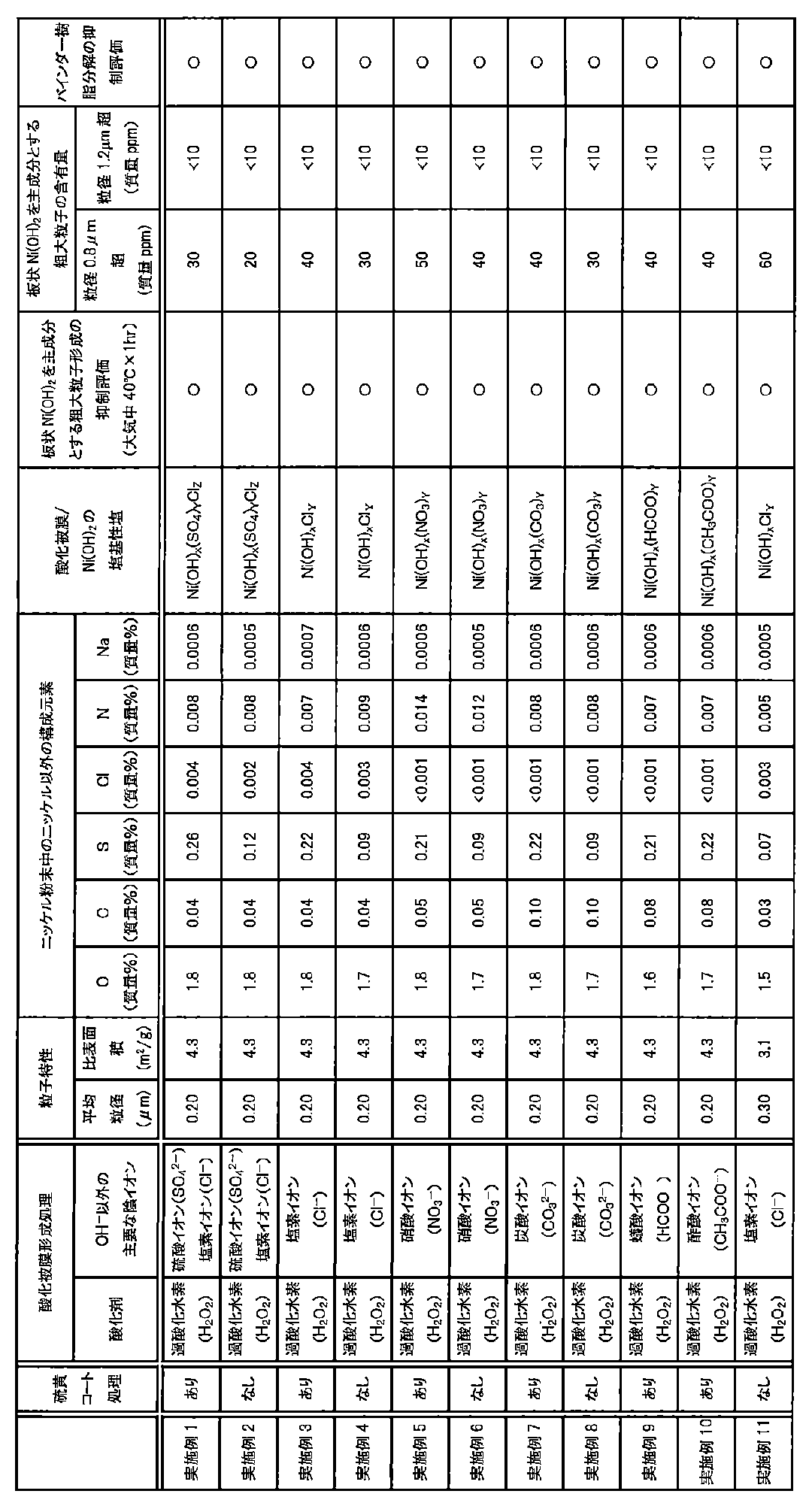
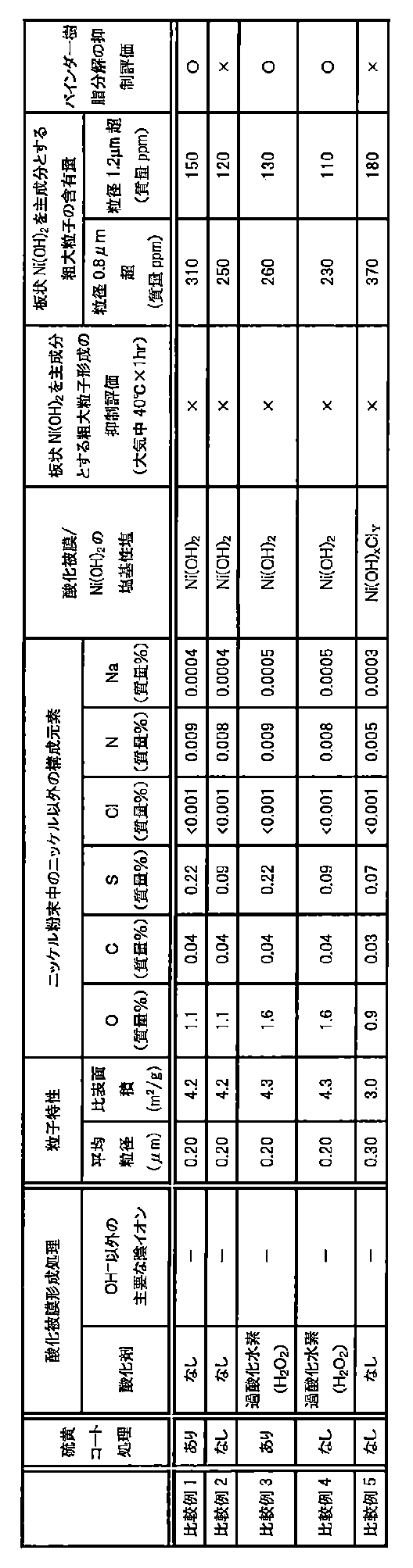
[まとめ]
本発明に係る各実施例と各比較例を比較すると、酸化被膜形成工程を経て表面に水酸化ニッケルの塩基性塩を主成分とする酸化被膜が形成された実施例1~11、特に硫黄コート処理を施さなかった実施例2、実施例4、実施例6、実施例8、実施例11では、酸化被膜形成工程を経ず酸化被膜が形成されなかった比較例1、比較例2、比較例5や、酸化被膜形成工程を経て表面に水酸化ニッケルを主成分とする酸化被膜が形成された比較例3、比較例4に比べて、粒径0.8μmや粒径1.2μmを超える板状水酸化ニッケルを主成分とする粗大粒子の含有量が非常に少なく、ニッケルペースト乾燥膜における高い平坦性を実現できるニッケル粉末、およびニッケル粒子の製造方法を提供することができることは明らかである。
本発明に係る各実施例と各比較例を比較すると、酸化被膜形成工程を経て表面に水酸化ニッケルの塩基性塩を主成分とする酸化被膜が形成された実施例1~11、特に硫黄コート処理を施さなかった実施例2、実施例4、実施例6、実施例8、実施例11では、酸化被膜形成工程を経ず酸化被膜が形成されなかった比較例1、比較例2、比較例5や、酸化被膜形成工程を経て表面に水酸化ニッケルを主成分とする酸化被膜が形成された比較例3、比較例4に比べて、粒径0.8μmや粒径1.2μmを超える板状水酸化ニッケルを主成分とする粗大粒子の含有量が非常に少なく、ニッケルペースト乾燥膜における高い平坦性を実現できるニッケル粉末、およびニッケル粒子の製造方法を提供することができることは明らかである。
また、本発明に係る実施例2、実施例4、実施例6、実施例8、実施例11では、硫黄コート処理が施されずに、酸化被膜形成工程を経て表面に水酸化ニッケルの塩基性塩を主成分とする酸化被膜が形成されているため、硫黄含有量が少ないにも関わらずバインダー樹脂分解が効果的に抑制されていることが分かる。
特に、本発明であれば、板状水酸化ニッケルを主成分とする粗大粒子の含有量が非常に少ないニッケル粉末を、より簡便かつ容易に作製できる、湿式法によるニッケル粒子の製造方法を提供することができる。
1 ニッケル粒子(ニッケル晶析粉)
2 ニッケル晶析粉の酸化および結晶成長で生じた板状水酸化ニッケル
10 板状水酸化ニッケルを主成分とする粗大粒子
2 ニッケル晶析粉の酸化および結晶成長で生じた板状水酸化ニッケル
10 板状水酸化ニッケルを主成分とする粗大粒子
Claims (9)
- 略球状の粒子形状を有し、
数平均粒径が0.03μm~0.4μmであり、
表面に水酸化ニッケルの塩基性塩を主成分とする酸化被膜を備え、
粒径が0.8μmを超える、板状水酸化ニッケルを主成分とする粗大粒子の含有量が200質量ppm以下であり、
粒径が1.2μmを超える、板状水酸化ニッケルを主成分とする粗大粒子の含有量が100質量ppm以下である、ニッケル粉末。 - 前記水酸化ニッケルの塩基性塩が、少なくとも硫酸イオン(SO4 2-)、塩化物イオン(Cl-)、硝酸イオン(NO3 -)、炭酸イオン(CO3 2-)、蟻酸イオン(HCOO-)、酢酸イオン(CH3COO-)から選ばれる1種以上を含む塩基性塩である、請求項1に記載のニッケル粉末。
- ニッケル粉末の比表面積に対する酸素含有量が0.35質量%・g/m2以上であり、ニッケル粉末の比表面積に対する硫黄含有量が0.04質量%・g/m2以下である、請求項1または2に記載のニッケル粉末。
- 請求項1~3のいずれか1項に記載のニッケル粉末の製造方法であって、
酸化被膜を有していないニッケル粉末が分散したニッケル粉スラリーと、少なくとも硫酸イオン(SO4 2-)、塩化物イオン(Cl-)、硝酸イオン(NO3 -)、炭酸イオン(CO3 2-)、蟻酸イオン(HCOO-)、酢酸イオン(CH3COO-)から選ばれる1種以上との混合物と、過酸化水素(H2O2)とを混合して、前記ニッケル粉末の表面に、少なくとも硫酸イオン(SO4 2-)、塩化物イオン(Cl-)、硝酸イオン(NO3 -)、炭酸イオン(CO3 2-)、蟻酸イオン(HCOO-)、酢酸イオン(CH3COO-)から選ばれる1種以上と、水酸化ニッケルとの塩基性塩を主成分とする酸化被膜を形成する酸化被膜形成工程と、
表面に前記酸化被膜が形成されたニッケル粉末を洗浄・ろ過して、当該ニッケル粉末のニッケル粉含水ケーキを得る洗浄・ろ過工程と、
前記ニッケル粉含水ケーキを加熱乾燥して、ニッケル粉末を得る乾燥工程と、
を含む、ニッケル粉末の製造方法。 - 少なくとも水溶性ニッケル塩、ニッケルよりも貴な金属の塩、還元剤、水酸化アルカリを含む反応液中において、還元反応により晶析させて前記酸化被膜を有していないニッケル粉末が分散したニッケル粉スラリーを形成する晶析工程を備える、請求項3に記載のニッケル粉末の製造方法。
- 前記水溶性ニッケル塩が、塩化ニッケル(NiCl2)、硫酸ニッケル(NiSO4)、硝酸ニッケル(Ni(NO3)2)から選ばれる1種以上である、請求項4に記載のニッケル粉末の製造方法。
- 前記ニッケルよりも貴な金属の塩が、銅塩、金塩、銀塩、白金塩、パラジウム塩、ロジウム塩、イリジウム塩から選ばれる1種以上である、請求項4または5に記載のニッケル粉末の製造方法。
- 前記水酸化アルカリが、水酸化ナトリウム(NaOH)、水酸化カリウム(KOH)から選ばれる1種以上である、請求項4~6のいずれか1項に記載のニッケル粉末の製造方法。
- 前記晶析工程で得られた前記ニッケル粉スラリーに対し、酸化被膜を有していないニッケル粉末の表面に硫黄を付着させる表面処理として硫黄コート処理を施す硫黄コート処理工程を含み、
前記硫黄コート処理工程は、前記晶析工程と前記酸化被膜形成工程の間に行う、請求項5~7のいずれか1項に記載のニッケル粉末の製造方法。
Priority Applications (4)
| Application Number | Priority Date | Filing Date | Title |
|---|---|---|---|
| KR1020217043047A KR20220038023A (ko) | 2019-07-31 | 2020-07-30 | 니켈 분말, 니켈 분말의 제조 방법 |
| CN202080053815.XA CN114206527B (zh) | 2019-07-31 | 2020-07-30 | 镍粉末、镍粉末的制造方法 |
| US17/630,330 US11850665B2 (en) | 2019-07-31 | 2020-07-30 | Nickel powder and method for producing nickel powder |
| JP2021535433A JP7815762B2 (ja) | 2019-07-31 | 2020-07-30 | ニッケル粉末、ニッケル粉末の製造方法 |
Applications Claiming Priority (2)
| Application Number | Priority Date | Filing Date | Title |
|---|---|---|---|
| JP2019-140933 | 2019-07-31 | ||
| JP2019140933 | 2019-07-31 |
Publications (1)
| Publication Number | Publication Date |
|---|---|
| WO2021020522A1 true WO2021020522A1 (ja) | 2021-02-04 |
Family
ID=74228926
Family Applications (1)
| Application Number | Title | Priority Date | Filing Date |
|---|---|---|---|
| PCT/JP2020/029288 Ceased WO2021020522A1 (ja) | 2019-07-31 | 2020-07-30 | ニッケル粉末、ニッケル粉末の製造方法 |
Country Status (5)
| Country | Link |
|---|---|
| US (1) | US11850665B2 (ja) |
| JP (1) | JP7815762B2 (ja) |
| KR (1) | KR20220038023A (ja) |
| CN (1) | CN114206527B (ja) |
| WO (1) | WO2021020522A1 (ja) |
Cited By (3)
| Publication number | Priority date | Publication date | Assignee | Title |
|---|---|---|---|---|
| JP2022152785A (ja) * | 2021-03-29 | 2022-10-12 | 住友金属鉱山株式会社 | ニッケル粉末及びニッケル粉末の製造方法 |
| JP2023079721A (ja) * | 2021-11-29 | 2023-06-08 | 住友金属鉱山株式会社 | ニッケル粉末の製造方法 |
| JP2023079720A (ja) * | 2021-11-29 | 2023-06-08 | 住友金属鉱山株式会社 | ニッケル粉末の製造方法 |
Families Citing this family (4)
| Publication number | Priority date | Publication date | Assignee | Title |
|---|---|---|---|---|
| CN115536368B (zh) * | 2022-09-29 | 2023-03-31 | 深圳市众诚达应用材料科技有限公司 | 一种氧含量可控的NiOx靶材制备方法 |
| CN116673489B (zh) * | 2023-06-29 | 2026-06-05 | 英特派铂业股份有限公司 | 一种类球形银粉及其制备方法和应用 |
| KR102843571B1 (ko) * | 2023-12-27 | 2025-08-06 | 국립한국해양대학교산학협력단 | 수소 생산용 암모니아 전기분해 니켈 촉매의 제조방법 및 장치 |
| CN117773096B (zh) * | 2024-01-09 | 2024-08-02 | 长沙立优金属材料有限公司 | 一种高纯度球形镍粉及其制备方法与用途 |
Citations (5)
| Publication number | Priority date | Publication date | Assignee | Title |
|---|---|---|---|---|
| WO2004020128A1 (ja) * | 2002-08-28 | 2004-03-11 | Toho Titanium Co., Ltd. | 金属ニッケル粉末及びその製造方法 |
| JP2014029013A (ja) * | 2012-04-04 | 2014-02-13 | Nippon Steel & Sumikin Chemical Co Ltd | 複合ニッケル粒子 |
| JP2014162967A (ja) * | 2013-02-26 | 2014-09-08 | Nippon Steel & Sumikin Chemical Co Ltd | ニッケル微粒子、その使用方法及びニッケル微粒子の製造方法 |
| WO2016185529A1 (ja) * | 2015-05-15 | 2016-11-24 | エム・テクニック株式会社 | ニッケル微粒子の改質方法およびニッケル微粒子の製造方法 |
| JP2018178256A (ja) * | 2017-04-14 | 2018-11-15 | 住友金属鉱山株式会社 | ニッケル粉末の製造方法 |
Family Cites Families (13)
| Publication number | Priority date | Publication date | Assignee | Title |
|---|---|---|---|---|
| JP2554213B2 (ja) | 1991-06-11 | 1996-11-13 | 川崎製鉄株式会社 | 球状ニッケル超微粉の製造方法 |
| JP3490818B2 (ja) * | 1995-11-17 | 2004-01-26 | 三洋電機株式会社 | アルカリ蓄電池用のペースト式ニッケル極 |
| EP1708297A3 (en) * | 1996-12-27 | 2007-03-07 | Canon Kabushiki Kaisha | Powdery material, electrode member, method for manufacturing same and secondary cell |
| US6379419B1 (en) | 1998-08-18 | 2002-04-30 | Noranda Inc. | Method and transferred arc plasma system for production of fine and ultrafine powders |
| JP2000109323A (ja) * | 1998-10-01 | 2000-04-18 | Toda Kogyo Corp | 板状スピネル型フェライト粒子粉末の製造法 |
| JP4081987B2 (ja) | 2000-05-30 | 2008-04-30 | 株式会社村田製作所 | 金属粉末の製造方法,金属粉末,これを用いた導電性ペーストならびにこれを用いた積層セラミック電子部品 |
| US7604679B2 (en) * | 2005-11-04 | 2009-10-20 | Sumitomo Metal Mining Co., Ltd. | Fine nickel powder and process for producing the same |
| JP5206246B2 (ja) * | 2008-09-03 | 2013-06-12 | 住友金属鉱山株式会社 | ニッケル粉末およびその製造方法 |
| JP5621268B2 (ja) * | 2010-02-03 | 2014-11-12 | 住友金属鉱山株式会社 | 酸化ニッケル微粉末及びその製造方法 |
| JP6610425B2 (ja) * | 2015-08-31 | 2019-11-27 | 住友金属鉱山株式会社 | ニッケル粉の製造方法 |
| JP6172413B1 (ja) | 2015-10-19 | 2017-08-02 | 住友金属鉱山株式会社 | ニッケル粉末の製造方法 |
| JP6876001B2 (ja) * | 2016-01-12 | 2021-05-26 | 東邦チタニウム株式会社 | ニッケル粉末の製造方法 |
| CN108400021B (zh) * | 2018-03-05 | 2020-05-19 | 湖北大学 | 一种超级电容器电极材料及其制备方法 |
-
2020
- 2020-07-30 US US17/630,330 patent/US11850665B2/en active Active
- 2020-07-30 CN CN202080053815.XA patent/CN114206527B/zh active Active
- 2020-07-30 WO PCT/JP2020/029288 patent/WO2021020522A1/ja not_active Ceased
- 2020-07-30 JP JP2021535433A patent/JP7815762B2/ja active Active
- 2020-07-30 KR KR1020217043047A patent/KR20220038023A/ko active Pending
Patent Citations (5)
| Publication number | Priority date | Publication date | Assignee | Title |
|---|---|---|---|---|
| WO2004020128A1 (ja) * | 2002-08-28 | 2004-03-11 | Toho Titanium Co., Ltd. | 金属ニッケル粉末及びその製造方法 |
| JP2014029013A (ja) * | 2012-04-04 | 2014-02-13 | Nippon Steel & Sumikin Chemical Co Ltd | 複合ニッケル粒子 |
| JP2014162967A (ja) * | 2013-02-26 | 2014-09-08 | Nippon Steel & Sumikin Chemical Co Ltd | ニッケル微粒子、その使用方法及びニッケル微粒子の製造方法 |
| WO2016185529A1 (ja) * | 2015-05-15 | 2016-11-24 | エム・テクニック株式会社 | ニッケル微粒子の改質方法およびニッケル微粒子の製造方法 |
| JP2018178256A (ja) * | 2017-04-14 | 2018-11-15 | 住友金属鉱山株式会社 | ニッケル粉末の製造方法 |
Cited By (5)
| Publication number | Priority date | Publication date | Assignee | Title |
|---|---|---|---|---|
| JP2022152785A (ja) * | 2021-03-29 | 2022-10-12 | 住友金属鉱山株式会社 | ニッケル粉末及びニッケル粉末の製造方法 |
| JP2023079721A (ja) * | 2021-11-29 | 2023-06-08 | 住友金属鉱山株式会社 | ニッケル粉末の製造方法 |
| JP2023079720A (ja) * | 2021-11-29 | 2023-06-08 | 住友金属鉱山株式会社 | ニッケル粉末の製造方法 |
| JP7697357B2 (ja) | 2021-11-29 | 2025-06-24 | 住友金属鉱山株式会社 | ニッケル粉末の製造方法 |
| JP7697356B2 (ja) | 2021-11-29 | 2025-06-24 | 住友金属鉱山株式会社 | ニッケル粉末の製造方法 |
Also Published As
| Publication number | Publication date |
|---|---|
| CN114206527B (zh) | 2023-05-02 |
| JP7815762B2 (ja) | 2026-02-18 |
| US20220250144A1 (en) | 2022-08-11 |
| JPWO2021020522A1 (ja) | 2021-02-04 |
| CN114206527A (zh) | 2022-03-18 |
| US11850665B2 (en) | 2023-12-26 |
| KR20220038023A (ko) | 2022-03-25 |
Similar Documents
| Publication | Publication Date | Title |
|---|---|---|
| JP7815762B2 (ja) | ニッケル粉末、ニッケル粉末の製造方法 | |
| JP7314507B2 (ja) | ニッケル粉末およびその製造方法 | |
| KR102091143B1 (ko) | 니켈 분말의 제조 방법 | |
| KR102253292B1 (ko) | 니켈 분말의 제조 방법 | |
| JP7336649B2 (ja) | ニッケル粉スラリーの製造方法 | |
| JP2018104819A (ja) | ニッケル粉末とその製造方法、およびニッケル粉末の表面処理方法 | |
| JP7673518B2 (ja) | ニッケル粉末の製造方法 | |
| JP7292577B2 (ja) | ニッケル連結粒子およびその製造方法 | |
| JP6805873B2 (ja) | ニッケル粉末の製造方法 | |
| JP7697357B2 (ja) | ニッケル粉末の製造方法 | |
| JP7697356B2 (ja) | ニッケル粉末の製造方法 | |
| JP7673517B2 (ja) | ニッケル粉末の製造方法 | |
| JP7292578B2 (ja) | ニッケル粉末の製造方法 | |
| JP6973155B2 (ja) | ニッケル粉末の製造方法 | |
| JP7006337B2 (ja) | ニッケル粉末の製造方法 | |
| JP7212256B2 (ja) | ニッケル粉末の製造方法 | |
| JP2024146129A (ja) | ニッケル粉末の製造方法 | |
| JP2017150074A (ja) | ニッケル粉末の製造方法 | |
| JP2018178256A (ja) | ニッケル粉末の製造方法 | |
| JP2022152785A (ja) | ニッケル粉末及びニッケル粉末の製造方法 | |
| JP2021139031A (ja) | 金属粉末の製造方法 | |
| JP2026047241A (ja) | ニッケル粉末の製造方法 | |
| JP2024086335A (ja) | ニッケル粉末およびニッケル粉末の製造方法 | |
| JP7293591B2 (ja) | ニッケル粉末およびニッケル粉末の製造方法 |
Legal Events
| Date | Code | Title | Description |
|---|---|---|---|
| 121 | Ep: the epo has been informed by wipo that ep was designated in this application |
Ref document number: 20847955 Country of ref document: EP Kind code of ref document: A1 |
|
| ENP | Entry into the national phase |
Ref document number: 2021535433 Country of ref document: JP Kind code of ref document: A |
|
| NENP | Non-entry into the national phase |
Ref country code: DE |
|
| 122 | Ep: pct application non-entry in european phase |
Ref document number: 20847955 Country of ref document: EP Kind code of ref document: A1 |