WO2019163992A1 - 細長い粒子形状を有するシリカゾルの製造方法 - Google Patents
細長い粒子形状を有するシリカゾルの製造方法 Download PDFInfo
- Publication number
- WO2019163992A1 WO2019163992A1 PCT/JP2019/007109 JP2019007109W WO2019163992A1 WO 2019163992 A1 WO2019163992 A1 WO 2019163992A1 JP 2019007109 W JP2019007109 W JP 2019007109W WO 2019163992 A1 WO2019163992 A1 WO 2019163992A1
- Authority
- WO
- WIPO (PCT)
- Prior art keywords
- silica sol
- acid
- producing
- raw material
- exchange resin
- Prior art date
- Legal status (The legal status is an assumption and is not a legal conclusion. Google has not performed a legal analysis and makes no representation as to the accuracy of the status listed.)
- Ceased
Links
Images






Classifications
-
- B—PERFORMING OPERATIONS; TRANSPORTING
- B82—NANOTECHNOLOGY
- B82Y—SPECIFIC USES OR APPLICATIONS OF NANOSTRUCTURES; MEASUREMENT OR ANALYSIS OF NANOSTRUCTURES; MANUFACTURE OR TREATMENT OF NANOSTRUCTURES
- B82Y40/00—Manufacture or treatment of nanostructures
-
- C—CHEMISTRY; METALLURGY
- C01—INORGANIC CHEMISTRY
- C01B—NON-METALLIC ELEMENTS; COMPOUNDS THEREOF; METALLOIDS OR COMPOUNDS THEREOF NOT COVERED BY SUBCLASS C01C
- C01B33/00—Silicon; Compounds thereof
- C01B33/113—Silicon oxides; Hydrates thereof
- C01B33/12—Silica; Hydrates thereof, e.g. lepidoic silicic acid
- C01B33/14—Colloidal silica, e.g. dispersions, gels, sols
- C01B33/141—Preparation of hydrosols or aqueous dispersions
- C01B33/142—Preparation of hydrosols or aqueous dispersions by acidic treatment of silicates
-
- C—CHEMISTRY; METALLURGY
- C01—INORGANIC CHEMISTRY
- C01B—NON-METALLIC ELEMENTS; COMPOUNDS THEREOF; METALLOIDS OR COMPOUNDS THEREOF NOT COVERED BY SUBCLASS C01C
- C01B33/00—Silicon; Compounds thereof
- C01B33/113—Silicon oxides; Hydrates thereof
- C01B33/12—Silica; Hydrates thereof, e.g. lepidoic silicic acid
- C01B33/14—Colloidal silica, e.g. dispersions, gels, sols
- C01B33/141—Preparation of hydrosols or aqueous dispersions
- C01B33/142—Preparation of hydrosols or aqueous dispersions by acidic treatment of silicates
- C01B33/143—Preparation of hydrosols or aqueous dispersions by acidic treatment of silicates of aqueous solutions of silicates
- C01B33/1435—Preparation of hydrosols or aqueous dispersions by acidic treatment of silicates of aqueous solutions of silicates using ion exchangers
-
- C—CHEMISTRY; METALLURGY
- C01—INORGANIC CHEMISTRY
- C01P—INDEXING SCHEME RELATING TO STRUCTURAL AND PHYSICAL ASPECTS OF SOLID INORGANIC COMPOUNDS
- C01P2002/00—Crystal-structural characteristics
- C01P2002/02—Amorphous compounds
-
- C—CHEMISTRY; METALLURGY
- C01—INORGANIC CHEMISTRY
- C01P—INDEXING SCHEME RELATING TO STRUCTURAL AND PHYSICAL ASPECTS OF SOLID INORGANIC COMPOUNDS
- C01P2004/00—Particle morphology
- C01P2004/01—Particle morphology depicted by an image
-
- C—CHEMISTRY; METALLURGY
- C01—INORGANIC CHEMISTRY
- C01P—INDEXING SCHEME RELATING TO STRUCTURAL AND PHYSICAL ASPECTS OF SOLID INORGANIC COMPOUNDS
- C01P2004/00—Particle morphology
- C01P2004/01—Particle morphology depicted by an image
- C01P2004/04—Particle morphology depicted by an image obtained by TEM, STEM, STM or AFM
-
- C—CHEMISTRY; METALLURGY
- C01—INORGANIC CHEMISTRY
- C01P—INDEXING SCHEME RELATING TO STRUCTURAL AND PHYSICAL ASPECTS OF SOLID INORGANIC COMPOUNDS
- C01P2004/00—Particle morphology
- C01P2004/10—Particle morphology extending in one dimension, e.g. needle-like
-
- C—CHEMISTRY; METALLURGY
- C01—INORGANIC CHEMISTRY
- C01P—INDEXING SCHEME RELATING TO STRUCTURAL AND PHYSICAL ASPECTS OF SOLID INORGANIC COMPOUNDS
- C01P2004/00—Particle morphology
- C01P2004/60—Particles characterised by their size
- C01P2004/61—Micrometer sized, i.e. from 1-100 micrometer
-
- C—CHEMISTRY; METALLURGY
- C01—INORGANIC CHEMISTRY
- C01P—INDEXING SCHEME RELATING TO STRUCTURAL AND PHYSICAL ASPECTS OF SOLID INORGANIC COMPOUNDS
- C01P2004/00—Particle morphology
- C01P2004/60—Particles characterised by their size
- C01P2004/62—Submicrometer sized, i.e. from 0.1-1 micrometer
-
- C—CHEMISTRY; METALLURGY
- C01—INORGANIC CHEMISTRY
- C01P—INDEXING SCHEME RELATING TO STRUCTURAL AND PHYSICAL ASPECTS OF SOLID INORGANIC COMPOUNDS
- C01P2004/00—Particle morphology
- C01P2004/60—Particles characterised by their size
- C01P2004/64—Nanometer sized, i.e. from 1-100 nanometer
-
- C—CHEMISTRY; METALLURGY
- C01—INORGANIC CHEMISTRY
- C01P—INDEXING SCHEME RELATING TO STRUCTURAL AND PHYSICAL ASPECTS OF SOLID INORGANIC COMPOUNDS
- C01P2006/00—Physical properties of inorganic compounds
- C01P2006/80—Compositional purity
Definitions
- the present invention relates to a method for producing a silica sol in which elongated amorphous colloidal silica particles are dispersed in a liquid medium, and more particularly to a method for efficiently producing a silica sol having a low content of alkali metal or alkaline earth metal.
- ⁇ Colloidal silica is roughly divided into two types: near spherical and non-spherical.
- various effects for example, binding force, adsorptive power, light transmittance
- abrasives for materials for example, abrasives for silicon wafers, CMP abrasives for device wafers for polishing metals such as silicon oxide film, copper, and aluminum.
- Silica particles having an elongated shape in which silica particles having a nearly spherical shape are connected in a chain or bead shape are also non-spherical type silica particles, and there is a silica sol in which the silica particles are stably dispersed in an aqueous medium or an organic medium. .
- a water-soluble calcium salt or magnesium salt is added to an aqueous colloidal solution of active silicic acid having a SiO 2 concentration of 1 to 6% by mass.
- an aqueous solution containing a mixture of these is added in such an amount that the mass ratio of CaO (calcium oxide), MgO (magnesium oxide), or both of them to 1500 to 8500 ppm with respect to SiO 2 (silica) of the active silicic acid is further added.
- a metal hydroxide, an organic base, or a silicate of an aqueous solution thereof is added, and a formula represented by SiO 2 / M 2 O (provided that SiO 2 is a silica component derived from the active silicic acid and the water-soluble silicate).
- the total content of the silica content is represented, and M represents the alkali metal atom or the organic base molecule).
- silica sols that are chain-like silica particles in which the relationship between the reduced viscosity and the silica concentration is indicated by a specific function are disclosed, and the manufacturing method thereof includes adding silicic acid to an alkali metal silicate aqueous solution.
- Add polyvalent metal ions such as Ca, Mg, Al, In, Ti, Zr, Sn, Si, Sb, Fe, Cu, or rare earth metals before, heat to a temperature of 60 ° C. or higher, and again add silicic acid.
- a method of adding is disclosed (see Patent Document 2).
- Colloidal silica containing spherical irregular-shaped silica particles is disclosed, and a compound serving as a supply source of potassium ions and an alkaline agent are added to an active silicic acid aqueous solution to make it alkaline, followed by heating to form silica particles.
- a method for producing colloidal silica is disclosed in which an active silicic acid aqueous solution, an alkali agent, and a compound that reduces supply of potassium ions are added under heating (see Patent Document 3).
- the silica sol may not be usable depending on the application.
- this invention is made
- the present inventors have added a compound as an anion source and ammonia as an alkali source to a silica sol as a raw material, and easily heated the metal impurities by heating at a predetermined temperature.
- the present inventors have found that a silica sol in which a small amount of colloidal silica having an elongated particle shape is dispersed in a solvent can be produced.
- the present invention provides, as a first aspect, a method for producing a silica sol including the following steps (a) and (b), wherein the silica sol has a mean particle diameter ( DL nm) determined by a dynamic light scattering method and nitrogen gas:
- the ratio D L / D B to the primary particle diameter (D B nm) by the adsorption method is 2.5 or more, the D L is 30 nm to 300 nm, and is within the range of 50 nm to 1000 nm by electron microscope observation
- a step of preparing a raw material liquid comprising adding at least one compound serving as an anion source selected from the group consisting of an inorganic acid, an organic acid, and an ammonium salt thereof, and ammonia;
- silica sol as a raw material used in the step (a) is an alkali silicate whose colloidal aqueous solution of active silicic acid has a SiO 2 / M 2 O molar ratio (where M represents sodium or potassium) 1 to 4.5.
- the aqueous solution is prepared from a colloidal aqueous solution of active silicic acid obtained by contacting a strong acid cation exchange resin or a strong acid cation exchange resin and a strong base anion exchange resin.
- the present invention relates to a method for producing a silica sol.
- the silica sol as a raw material used in the step (a) is obtained by treating a colloidal aqueous solution of active silicic acid with a strong acid added to the alkali silicate aqueous solution and treating at a temperature of 1 ° C to 98 ° C.
- the silica sol according to the second aspect which is produced from a colloidal aqueous solution of active silicic acid obtained by contacting a strong acid type cation exchange resin or a strong acid type cation exchange resin and a strong base type anion exchange resin It relates to the manufacturing method.
- the silica sol as a raw material used in the step (a) is obtained by using a colloidal solution of active silicic acid as a strong acid cation exchange resin or a strong acid cation exchange resin and a strong acid cation exchange resin.
- the compound as an anion source used in the step (a) is nitric acid, sulfuric acid, phosphoric acid, boric acid, hydrofluoric acid, hydrochloric acid, acetic acid, formic acid, oxalic acid, citric acid, lactic acid, malic acid.
- 1st to 4th aspects which are compounds that become at least one anion source selected from the group consisting of gluconic acid, tartaric acid, ethylenediaminetetraacetic acid (EDTA), diethylenetriaminepentaacetic acid (DTPA), and ammonium salts thereof.
- a sixth aspect, according to the primary particle diameter (D B or D S nm) are first aspect to any one of the fifth aspect is 5nm to 50nm colloidal particles of silica sol as the raw material used in step (a)
- the present invention relates to a method for producing silica sol.
- the present invention relates to the method for producing a silica sol according to any one of the first to sixth aspects, wherein the ammonia added in the step (a) is added in the form of ammonia gas or an aqueous ammonia solution.
- the production of the silica sol according to any one of the first to seventh aspects including a step of adding the compound serving as the anion source to the silica sol as a raw material in step (a) and then adding the ammonia.
- the step (a) includes adding the ammonia to the silica sol as a raw material, adding the compound serving as the anion source, and then adding the ammonia.
- a 10th viewpoint it is related with the manufacturing method of the silica sol as described in any one of the 1st viewpoint thru
- the silica sol according to any one of the first to tenth aspects wherein the heating of the raw material liquid in the step (b) is performed by a method of heating the raw material liquid at 100 ° C. to 180 ° C. in an autoclave apparatus. It relates to the manufacturing method.
- the method further includes a step of bringing the silica sol obtained in the step (b) into contact with the strongly acidic ion exchange resin and / or the strongly basic ion exchange resin.
- the present invention relates to a method for producing silica sol.
- the present invention relates to the method for producing a silica sol according to any one of the first to thirteenth aspects, further including a step of solvent substitution of the obtained aqueous medium of the silica sol with an organic medium.
- the present invention relates to the method for producing a silica sol according to any one of the first to fourteenth aspects, in which the mass ratio of Ca and Mg to SiO 2 is 0.01 ppm to 50 ppm, respectively.
- the silica sol according to any one of the first to fifteenth aspects wherein the mass ratio of Na to SiO 2 is 0.1 ppm to 50 ppm and the mass ratio of K is 0.1 ppm to 50 ppm. It relates to the manufacturing method.
- the amorphous colloidal silica particles have a ratio D L / D B between an average particle size (D L nm) obtained by a dynamic light scattering method and a primary particle size (D B nm) obtained by a nitrogen gas adsorption method.
- the present invention relates to the method for producing a silica sol according to any one of the first to sixteenth aspects.
- the present invention relates to the method for producing a silica sol according to any one of the first to seventeenth aspects, wherein the silica sol is an acidic silica sol or an ammonia type alkaline silica sol.
- the silica sol as a raw material used in the step (a) is a compound serving as an anion source selected from the group consisting of an inorganic acid, an organic acid, and an ammonium salt thereof, and an alkali source.
- Silica sol in which non-spherical silica particles are dispersed, can be expected to have various effects (for example, binding force, adsorption power, light transmittance) due to its particle shape. It is used for applications such as modifiers, catalyst carriers, and abrasives for electronic materials (for example, abrasives for silicon wafers, CMP abrasives for device wafers for polishing metals such as silicon oxide films, copper, and aluminum).
- abrasives for silicon wafers for silicon wafers
- CMP abrasives for device wafers for polishing metals such as silicon oxide films, copper, and aluminum
- the silica sol obtained by the method for producing silica sol of the present invention has a low metal impurity content and is highly purified. There is an effect that it can be applied to any use.
- the above purification may be performed in the step (a) of preparing the silica sol, or in the step (b) of forming the silica sol, or in both steps.
- the colloidal aqueous solution of active silicic acid used for the production of the silica sol used as the raw material of the step (a) is treated with room temperature or heating by adding a strong acid, and the metal impurities incorporated into the colloid of active silicic acid are contained in the aqueous solution. Elution (leaching) to a strong acid cation exchange resin, strong base anion exchange resin, and weak acid type (carboxylic acid type) chelate resin or weak base type (amine type) chelate resin There is an effect that it is possible to remove the material and make it highly purified.
- the metal impurities are Na, K, Ca, Mg, Ni, Cu, Fe, Co, Zn, Ti, etc.
- the silica sol production method of the present invention does not use an alkali metal based on Na or K, but an alkali source. It is possible to provide a method for producing a silica sol having a low content of Ca and Mg by using ammonia as a low content of Na and K, and by not using a Ca and Mg source for adjusting the shape to be elongated. There is an effect that can be done. Further, the combined use of an ion exchange resin and a chelate resin produces an effect that the polyvalent metal can be removed from the silica sol.
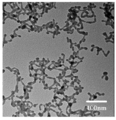
- FIG. 1 is a TEM (transmission electron microscope) photograph (magnification: 250,000 times) of the silica particles obtained in Example 1.
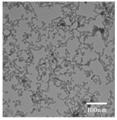
- FIG. FIG. 2 is a TEM (transmission electron microscope) photograph (magnification 250,000 times) of the silica particles obtained in Example 2.
- FIG. 3 is a TEM (transmission electron microscope) photograph (magnification 250,000 times) of the silica particles obtained in Example 3.
- FIG. 4 is a TEM (transmission electron microscope) photograph (magnification 250,000 times) of the silica particles obtained in Example 4.
- FIG. 5 is a TEM (transmission electron microscope) photograph (magnification: 250,000 times) of the silica particles obtained in Example 5.
- FIG. 6 is a TEM (transmission electron microscope) photograph (magnification of 250,000 times) of the silica particles obtained in Example 6.
- FIG. FIG. 7 is a TEM (transmission electron microscope) photograph (magnification: 250,000 times) of the silica particles obtained in Example 7.
- FIG. 8 is a TEM (transmission electron microscope) photograph (magnification: 250,000 times) of the silica particles obtained in Example 8.
- FIG. 9 is a TEM (transmission electron microscope) photograph (magnification 250,000 times) of the silica particles obtained in Comparative Example 1.
- FIG. 10 is a TEM (transmission electron microscope) photograph (magnification: 250,000 times) showing the particle length (L) of a series of linked silica particles.
- the present invention is a method for producing a silica sol comprising the following steps (a) and (b), wherein the silica sol has an average particle size ( DL nm) determined by a dynamic light scattering method and a primary particle size (the ratio D L / D B and D B nm) is not less than 2.5, the D L is 30nm to 300 nm, and has a particle length of length within the range of 50nm to 1000nm by electron microscopy
- a step of preparing a raw material liquid comprising adding at least one compound serving as an anion source selected from the group consisting of an inorganic acid, an organic acid, and an ammonium salt thereof, and ammonia;
- the liquid medium is an aqueous medium (water) or an organic medium (organic solvent).
- the anion source compound can be prepared in a mass ratio of 0.5 to 1.9%, 0.5 to 1.9, or 0.5 to 1.5 with respect to SiO 2 .
- the measurement of the average particle diameter (D L nm) by the dynamic light scattering method is based on the measurement principle based on the dynamic light scattering method. For example, with a dynamic light scattering particle diameter measurement device (Spectersizer, Zeta Sizer Nano). It can be measured.
- the average particle diameter (D L nm) by the dynamic light scattering method is in the range of 30 nm to 300 nm.
- the elongated silica particles are not aggregated three-dimensionally, and do not have a three-dimensional network structure. It shows a structure in which particles are connected in a bead shape or a chain shape, and the particles are considered to be silica particles having the same particle size and / or different particle sizes connected in a bead shape or a chain shape.
- the D L / D B ratio is 2.5 or more, and can be, for example, 2.5 to 50.0, 3.0 to 30.0, or 3.0 to 15.0.
- the particle length of these silica particles can be confirmed by observing the particle shape with an electron microscope (transmission electron microscope), and the length is 50 nm to 1000 nm, or 100 nm to 700 nm.
- the silica sol used as the raw material for the step (a) is an alkali silicate aqueous solution in which the colloidal aqueous solution of active silicic acid has a SiO 2 / M 2 O molar ratio (where M represents sodium or potassium) 1 to 4.5.
- M represents sodium or potassium
- a colloidal aqueous solution of active silicic acid can be produced by preparing the alkali silicate aqueous solution to a solid content of 1 to 10% by mass and bringing it into contact with an ion exchange resin.
- solid content is what remove
- commercially available No. 1 silica, No. 2 silica, and No. 3 silica can be diluted with pure water or the like.
- the strong acid type cation exchange resin is a hydrogen type cation exchange resin, and a cation exchange resin converted into a hydrogen type by passing a strong acid aqueous solution through the cation exchange resin loaded in the column can be used.
- Specific examples of the strong acid type cation exchange resin include Amberlite IR-120B, Amberjet 1020, DOWEX MARATHON GH (manufactured by Dow Chemical Company), Diaion SK104, Diaion PK208 (manufactured by Mitsubishi Chemical Holdings), Duolite C20J (manufactured by Sumika Chemtech Co., Ltd.) and the like can be mentioned.
- the strong base type ion exchange resin is a hydroxyl type ion exchange resin, and an anion exchange resin converted into a hydroxyl type by passing a strong alkaline aqueous solution through the anion exchange resin loaded in the column can be used.
- strong base type anion exchange resins include Amberlite IRA400J, Amberlite IRA410J, Amberjet 4400 (Dow Chemical Co.), Diaion SA10A, Diaion SA20A (Mitsubishi Chemical Holdings Co., Ltd.), Duolite UBA120 (Manufactured by Sumika Chemtech Co., Ltd.).
- colloidal aqueous solution of active silicic acid one having a solid content concentration of SiO 2 in the range of 1% by mass to 10% by mass, preferably in the range of 1% by mass to 6% by mass can be used.
- the silica sol as a raw material used in the step (a) is an active silicic acid aqueous solution obtained by contacting an aqueous colloidal solution of active silicic acid with a carboxylic acid type chelate resin, a hydroxyl type chelate resin, and / or an amine type chelate resin. What was manufactured from the colloid aqueous solution can be used.
- These chelate resins are those containing two or more electron donating atoms such as N, S, O, P, etc., and they are N—O, S—N, N—N, and O—O type chelate resins. Examples thereof include iminodiacetic acid type (—N (CH 2 COO—) 2 ) and polyamine type (—NH (CH 2 CH 2 NH) nH). Specific examples of the chelate resin include Diaion CR11, Diaion CR20, Diaion CRB03, and Diaion CRB05 (manufactured by Mitsubishi Chemical Holding).
- the chelate resin to which metal ions are adsorbed can be regenerated and used by removing the metal ions using an oxalic acid aqueous solution (hydrochloric acid aqueous solution or sulfuric acid aqueous solution).
- the silica sol used as the raw material for the step (a) is prepared from a highly purified colloidal aqueous solution of active silicic acid by repeatedly contacting the colloidal aqueous solution of active silicic acid with the ion exchange resin or chelate resin. I can do things.
- the ion-exchange resin or chelate resin was packed into a column, it can be passed through the column at a space velocity of the aqueous 1h -1 to 30h -1, or 1h -1 to 15h -1.
- the silica sol as a raw material used in the step (a) is prepared by adding a strong acid to a colloidal aqueous solution of active silicic acid and treating it at a temperature of 1 ° C to 98 ° C.
- High purity can be achieved by producing from an aqueous colloidal solution of active silicic acid obtained by contact with a strong base type anion exchange resin.
- the colloidal aqueous solution of active silicic acid is considered to form fine colloidal particles (for example, the particle diameter is 5 nm or less, 3 nm or less, or 1 nm or less) in the aqueous solution, and metal impurities are present in these colloidal particles. May have been captured.
- the colloidal particles can be treated by adding an aqueous acid solution to an aqueous colloidal solution of active silicic acid and treating at 1 ° C to 98 ° C, preferably at room temperature.
- Metal impurities can be eluted into the aqueous solution from inside the particles. Since these metal impurities are adsorbed and separated from the aqueous solution by contacting with the ion exchange resin or chelate resin, the colloidal aqueous solution of active silicic acid can be highly purified. Thereby, the silica sol finally obtained can also be highly purified.
- Silica sol used as a raw material used in step (a) it is possible to use silica sol with primary particle diameter (D B or D S nm) is 5nm to 50 nm, or 5nm to 30 nm, or in the range of 5nm to 10 nm.
- D B or D S nm primary particle diameter
- the primary particle diameter of the silica sol can be measured by a general method such as a Sears titration method or a nitrogen adsorption method.
- the silica sol used as a raw material for the step (a) can be a silica sol having a SiO 2 concentration of 1% by mass to 30% by mass, or in a range of 3% by mass to 25% by mass, or 10% by mass to 25% by mass.
- a certain silica sol can be used.
- A As an anion source compound used in the step, nitric acid, sulfuric acid, phosphoric acid, boric acid, hydrofluoric acid, hydrochloric acid, acetic acid, formic acid, oxalic acid, citric acid, lactic acid, malic acid, gluconic acid, A compound serving as at least one anion source selected from the group consisting of tartaric acid, ethylenediaminetetraacetic acid (EDTA), diethylenetriaminepentaacetic acid (DTPA), and ammonium salts thereof can be used.
- EDTA ethylenediaminetetraacetic acid
- DTPA diethylenetriaminepentaacetic acid
- ammonium salts thereof can be used.
- an aqueous solution of nitric acid, sulfuric acid, oxalic acid, or the like can be used.
- anion sources can be added as ammonium salts, or converted into ammonium salts with ammonia used for pH adjustment.
- concentration of the aqueous solution is, for example, 0.1 mass% to 50 mass%, or 0.1 mass% to 10 mass%, or 0.1 mass% to 5 mass%, or 0.1 mass% to 1 mass%, or 0 It can be used in the range of 1% by mass to 0.2% by mass.
- Ammonia used for pH adjustment in the step (a) can be used in the form of ammonia gas or an aqueous ammonia solution.
- the pH adjustment method include a method of directly introducing ammonia gas into the silica sol as a raw material, or a method of adding an aqueous ammonia solution to the silica sol as a raw material.
- the aqueous ammonia solution can be used at a concentration of 28% by mass, or diluted with pure water to a concentration of 1% by mass to less than 28% by mass.
- (A) As an example of the step, there may be mentioned a method including a step of adding a compound as an anion source to silica sol as a raw material and then adding the ammonia.
- step (a) there may be mentioned a method including a step of adding the ammonia to a silica sol as a raw material, adding a compound serving as the anion source, and then adding the ammonia.
- the pH of the raw material liquid (silica sol used as a raw material) obtained in the step (a) can be adjusted to 8 to 12, 9 to 11, or 9 to 10.
- the raw material liquid (silica sol as a raw material) obtained in the step (a) is stirred at 80 ° C. to 200 ° C., or 100 ° C. to 180 ° C., or 120 ° C. to 150 ° C. for 0.5 hours to In this process, the silica sol is obtained by heating for 20 hours. By using an autoclave apparatus, it is heated to a temperature of 100 ° C. to 200 ° C., or 100 ° C. to 180 ° C., and an elongated silica sol with a high degree of irregularity can be produced.
- an ammonia type alkaline silica sol having a pH in the range of 8 to 11 or 9 to 11 is obtained.
- the silica sol obtained in the step (b) can be brought into contact with a strongly acidic ion exchange resin and / or a strongly basic ion exchange resin to obtain a high purity silica sol.
- the silica sol obtained in the step (b) can be brought into contact with a strongly acidic ion exchange resin, or a strongly acidic on-exchange resin and a strongly basic ion exchange resin to obtain a high-purity silica sol.
- the carboxylic acid type chelate resin, the hydroxyl group type chelate resin, and / or the amine type before or after contacting the silica sol obtained in the step (b) with the strongly acidic ion exchange resin and / or the strongly basic ion exchange resin, the carboxylic acid type chelate resin, the hydroxyl group type chelate resin, and / or the amine type.
- High purity silica sol can be obtained by contacting with a chelate resin.
- a strongly acidic ion exchange resin or a strongly acidic on-exchange resin and a strongly basic ion exchange resin
- a carboxylic acid type chelate resin for example, after contacting the silica sol obtained in the step (b) with a strongly acidic ion exchange resin, or a strongly acidic on-exchange resin and a strongly basic ion exchange resin, a carboxylic acid type chelate resin, a hydroxyl group type chelate resin, and / or Alternatively, it can be brought into contact with an amine-type chelate resin to obtain a high-purity silica sol.
- the silica sol obtained in the step (b) is adjusted to a SiO 2 concentration of 6 to 30% by mass using an ultrafiltration membrane as needed, or by evaporating and concentrating under reduced pressure or normal pressure. I can do this.
- the silica sol obtained in the step (b) can be produced by bringing it into contact with a strongly acidic ion exchange resin.
- the acidic silica sol can be prepared by replacing the aqueous medium with an organic medium (organic solvent). This solvent replacement can be performed by an evaporation method using a device such as a rotary evaporator. There is no change in D L / D B ratio of the colloidal silica particles by solvent substitution.
- organic solvent examples include methanol, ethanol, propanol, ethylene glycol, propylene glycol, glycerin, ethylene glycol monomethyl ether, propylene glycol monomethyl ether, propylene glycol monomethyl ether acetate, propylene glycol monoethyl ether, propylene glycol monoethyl ether acetate, Examples include organic solvents such as acetone, methyl ethyl ketone, dimethylformamide, N-methyl-2-pyrrolidone, toluene, xylene and dimethylethane. Further, polyethylene glycol, silicone oil, a reactive diluent solvent containing a radical polymerizable vinyl group or epoxy group, or the like can also be used.
- the surface of the silica particles can be treated with a silane coupling agent such as tetraethoxysilane, trimethylmonoethoxysilane, or hexamethyldisilane.
- a silane coupling agent such as tetraethoxysilane, trimethylmonoethoxysilane, or hexamethyldisilane.
- silica sol weight ratio 0.01ppm to 100ppm of Ca metal impurity with respect to SiO 2, or contained in 0.01ppm to 50ppm, the mass ratio 0.01ppm to 100ppm of Mg for SiO 2, or 0.01ppm to 50ppm Can be contained.
- silica sol, the weight ratio 0.1ppm to 1000ppm of Na for SiO 2, or contained in 0.1ppm to 500 ppm, containing a weight ratio 0.1ppm to 100 ppm, or 0.1ppm or 50ppm of K for SiO 2 I can do things.
- step (B) The silica sol obtained in the step (b) is brought into contact with a strong acidic ion exchange resin to form an acidic silica sol, and then a high-purity ammonia gas or an aqueous ammonia solution can be added to obtain an ammonia-type alkaline silica sol.
- D B particle diameter (primary particle diameter measured by a nitrogen adsorption method)
- a hydrogen type strongly acidic cation exchange resin and an aqueous silica sol were contacted to remove sodium adsorbed on the surface of the silica sol, dried at 300 ° C., and then pulverized to prepare a powder sample.
- the prepared powder sample is a nitrogen adsorption method specific surface area measuring device (Made by Yuasa Ionics Co., Ltd.). onosorb MS-16) by measuring the BET method according to the specific surface area S 1 (m 2 / g) at to determine the D B particle diameter (nm).
- the slurry was subjected to pH titration with 0.1N NaOH at 25 ° C., and the volume V (ml) of the 0.1N NaOH solution necessary to increase the pH from 4.00 to 9.00 was measured.
- the specific surface area (S 2 ) was determined by the Sears titration method, and the primary particle diameter (D S ) was calculated using the following formula (III) and formula (IV).
- Metal element analysis was performed using an atomic absorption spectrophotometer (Spectra AA manufactured by Agilent Technologies) and an ICP emission spectrometer (CIROS120 E0P manufactured by Rigaku). From the measured amount of metal (Si, Na, K, Mg, Ca), the mass ratio of the metal to SiO 2 was calculated.
- D B nm nitrogen gas adsorption method
- D L nm average particle diameter measured by dynamic light scattering method
- silica sol prepared above While stirring with a magnetic stirrer, 294.3 g of the ammonia-stable raw material silica sol prepared above was added and stirred for 10 minutes to make it uniform. Subsequently, 3.3 g of a 10% by mass nitric acid aqueous solution serving as an anion source was added, and then 0.8 g of a 28% by mass ammonia aqueous solution was added, followed by stirring for 1 hour to prepare a raw material solution. 260 g of the above raw material liquid was placed in a 300 ml SUS autoclave, heated at 140 ° C. for 8 hours, cooled to room temperature, and silica sol was taken out. The obtained silica sol was evaluated according to the evaluation of physical properties of silica sol and the determination of deforming.
- Example 4 The raw material liquid of Example 4 was produced in the same manner as in Example 3 except that 71.8 g of pure water and the amount of 10 mass% aqueous nitric acid solution added were 3.0 g and 28 mass% aqueous ammonia solution were 1.0 g. . 260 g of the raw material liquid was placed in an SUS autoclave having an internal volume of 300 ml, heated at 140 ° C. for 8 hours, and then cooled to room temperature to take out silica sol. The obtained silica sol was evaluated according to the evaluation of physical properties of silica sol and the determination of deforming.
- Example 6 Example 3 except that 73.1 g of pure water, 10% by mass nitric acid of the anion source were changed to oxalic acid dihydrate, the input amount was 0.3 g, and the 28% by mass ammonia aqueous solution was 2.3 g.
- the raw material liquid of Example 6 was manufactured by the same operation as in Example 1. 260 g of the above raw material liquid was placed in a 300 ml SUS autoclave, heated at 140 ° C. for 8 hours, cooled to room temperature, and silica sol was taken out. The obtained silica sol was evaluated according to the evaluation of physical properties of silica sol and the determination of deforming.
- Example 7 The same operation as in Example 3, except that 70.1 g of pure water, 10% by mass nitric acid of the anion source were changed to 8% by mass sulfuric acid, and the input amount was 3.8 g and 28% by mass ammonia aqueous solution was 1.9 g.
- the raw material liquid of Example 7 was manufactured. 260 g of the above raw material liquid was placed in a 300 ml SUS autoclave, heated at 140 ° C. for 8 hours, cooled to room temperature, and silica sol was taken out. The obtained silica sol was evaluated according to the evaluation of physical properties of silica sol and the determination of deforming.
- Example 8 72.7g of pure water and 10 mass% nitric acid of the anion source were changed to ethylenediaminetetraacetic acid (containing Kirest 3N-50, EDTA ⁇ H ⁇ 3 (NH 4 ), 50.4% by mass EDTA).
- the raw material liquid of Example 9 was manufactured in the same manner as in Example 3 except that the input amount was 1.3 g and the 28 mass% aqueous ammonia solution was 1.7 g.
- 260 g of the above raw material liquid was placed in a 300 ml SUS autoclave, heated at 140 ° C. for 8 hours, cooled to room temperature, and silica sol was taken out. The obtained silica sol was evaluated according to the evaluation of physical properties of silica sol and the determination of deforming.
- Example 9 130 g of the modified silica sol obtained in Example 6 was added to a hydrogen type strongly acidic cation exchange resin (Amberlite IR-120B, manufactured by Dow Chemical Co.), a hydroxyl type strongly basic anion exchange resin (Amberlite IRA-410J, By passing through a column packed with hydrogen-type strongly acidic cation exchange resin (Amberlite IR-120B, manufactured by Dow Chemical) in order, with a SiO 2 concentration of 10.5% by mass and a pH of 5.1. An acidic silica sol was obtained. Next, 0.28 g of 28 mass% ammonia aqueous solution was added to 63 g of the obtained acidic silica sol to prepare an ammonia stable silica sol having a pH of 9.6.
- a hydrogen type strongly acidic cation exchange resin Amberlite IR-120B, manufactured by Dow Chemical Co.
- Amberlite IRA-410J hydroxyl type strongly basic anion exchange resin
- An acidic silica sol was obtained.
- Example 10 Using 130 g of the silica sol obtained in Example 7, hydrogen type strongly acidic cation exchange resin (Amberlite IR-120B, manufactured by Dow Chemical Company), hydroxyl group type strongly basic anion exchange resin (Amberlite IRA-410J, Dow (Made by Chemical Co., Ltd.), a hydrogen type strong acidic cation exchange resin (Amberlite IR-120B, manufactured by Dow Chemical Co., Ltd.), and then sequentially passed through a column packed with a SiO 2 concentration of 10.5% by mass and a pH of 4.9. An acidic silica sol was obtained. Subsequently, 0.29 g of 28 mass% ammonia aqueous solution was added to 68 g of the obtained acidic silica sol to prepare an ammonia stable silica sol having a pH of 9.6.
- hydrogen type strongly acidic cation exchange resin Amberlite IR-120B, manufactured by Dow Chemical Company
- hydroxyl group type strongly basic anion exchange resin Amberlite IRA-410J,
- Comparative Example 1 A raw material solution of Comparative Example 2 was produced in the same manner as in Example 3 except that 72.5 g of pure water and 1.5 g of 10% by mass nitric acid were added and 1.7 g of 28% by mass ammonia aqueous solution were used. 260 g of the above raw material liquid was placed in a 300 ml SUS autoclave, heated at 140 ° C. for 8 hours, cooled to room temperature, and silica sol was taken out. The obtained silica sol was evaluated according to the evaluation of physical properties of silica sol and the determination of deforming.
- Comparative Example 2 A raw material solution of Comparative Example 2 was produced in the same manner as in Example 3 except that 63.9 g of pure water and 7.8 g of 10 mass% nitric acid were added and 4.0 g of 28 mass% aqueous ammonia solution were used. 260 g of the above raw material liquid was placed in a 300 ml SUS autoclave, heated at 140 ° C. for 8 hours, and then cooled to room temperature to take out the contents.
- the silica source, the SiO 2 concentration and pH of the aqueous silica sol used in the production of the raw material liquids of Examples 1 to 8, Comparative Examples 1 and 2, and the added anion source and the amount thereof added are shown in Tables 1 to 3 below.
- Table 3 shows.
- the physical property values and heating conditions of the raw material liquids obtained in Examples 1 to 8, Comparative Example 1 and Comparative Example 2 are shown in Tables 4 to 6, respectively.
- Table 7 to Table 10 below show the physical property evaluation and the evaluation of the deforming of the silica sol obtained in Examples 1 to 10, Comparative Example 1 and Comparative Example 2, respectively.
- TEM (transmission electron microscope) photographs (magnification of 250,000 times) of the silica particles in the silica sols obtained in Examples 1 to 8 and Comparative Example 1 are shown in FIGS. 1 to 9, respectively.
- silica sol in which elongated colloidal silica with few metal impurities is dispersed in a solvent can be easily produced.
- Silica sol composed of non-spherical silica particles can be expected to have various effects (for example, binding strength, adsorption strength, light transmission) due to the shape of the particles. It can be used for applications such as a catalyst carrier, an abrasive for electronic materials (for example, an abrasive for silicon wafers, a CMP abrasive for device wafers for polishing a metal such as a silicon oxide film, copper, and aluminum).
Landscapes
- Chemical & Material Sciences (AREA)
- Organic Chemistry (AREA)
- Dispersion Chemistry (AREA)
- Inorganic Chemistry (AREA)
- Engineering & Computer Science (AREA)
- Nanotechnology (AREA)
- Condensed Matter Physics & Semiconductors (AREA)
- General Physics & Mathematics (AREA)
- Manufacturing & Machinery (AREA)
- Crystallography & Structural Chemistry (AREA)
- Physics & Mathematics (AREA)
- Silicon Compounds (AREA)
- Compounds Of Alkaline-Earth Elements, Aluminum Or Rare-Earth Metals (AREA)
Priority Applications (4)
| Application Number | Priority Date | Filing Date | Title |
|---|---|---|---|
| CN201980015361.4A CN111788153B (zh) | 2018-02-26 | 2019-02-25 | 具有细长的粒子形状的硅溶胶的制造方法 |
| KR1020207026560A KR102686976B1 (ko) | 2018-02-26 | 2019-02-25 | 가늘고 긴 입자형상을 갖는 실리카졸의 제조방법 |
| US16/975,448 US11814295B2 (en) | 2018-02-26 | 2019-02-25 | Method for producing silica sol having elongated particle shape |
| JP2020501086A JP7137156B2 (ja) | 2018-02-26 | 2019-02-25 | 細長い粒子形状を有するシリカゾルの製造方法 |
Applications Claiming Priority (2)
| Application Number | Priority Date | Filing Date | Title |
|---|---|---|---|
| JP2018-032123 | 2018-02-26 | ||
| JP2018032123 | 2018-02-26 |
Publications (1)
| Publication Number | Publication Date |
|---|---|
| WO2019163992A1 true WO2019163992A1 (ja) | 2019-08-29 |
Family
ID=67688116
Family Applications (1)
| Application Number | Title | Priority Date | Filing Date |
|---|---|---|---|
| PCT/JP2019/007109 Ceased WO2019163992A1 (ja) | 2018-02-26 | 2019-02-25 | 細長い粒子形状を有するシリカゾルの製造方法 |
Country Status (6)
| Country | Link |
|---|---|
| US (1) | US11814295B2 (https=) |
| JP (1) | JP7137156B2 (https=) |
| KR (1) | KR102686976B1 (https=) |
| CN (1) | CN111788153B (https=) |
| TW (1) | TWI850216B (https=) |
| WO (1) | WO2019163992A1 (https=) |
Cited By (4)
| Publication number | Priority date | Publication date | Assignee | Title |
|---|---|---|---|---|
| JP2021143110A (ja) * | 2020-03-13 | 2021-09-24 | 日揮触媒化成株式会社 | 粒子連結型シリカ微粒子分散液およびその製造方法、並びに研磨用砥粒分散液 |
| WO2022123820A1 (ja) * | 2020-12-09 | 2022-06-16 | 日揮触媒化成株式会社 | 異形シリカ系微粒子分散液およびその製造方法、粒子連結型シリカ微粒子分散液およびその製造方法、並びに研磨用砥粒分散液 |
| CN116143131A (zh) * | 2023-03-02 | 2023-05-23 | 衢州博来纳润电子材料有限公司 | 一种低金属离子含量硼改性酸性硅溶胶的制备方法 |
| WO2025173621A1 (ja) * | 2024-02-14 | 2025-08-21 | 株式会社トクヤマ | 非晶質シリカ粒子の製造方法、非晶質シリカ粒子、それを含む化粧品、及び非晶質シリカ粒子の製造システム |
Families Citing this family (1)
| Publication number | Priority date | Publication date | Assignee | Title |
|---|---|---|---|---|
| CN113845117B (zh) * | 2020-06-28 | 2023-05-26 | 中国石油天然气股份有限公司 | 一种油水两亲性二氧化硅纳米粒子及其制备方法 |
Citations (5)
| Publication number | Priority date | Publication date | Assignee | Title |
|---|---|---|---|---|
| JPH07118008A (ja) * | 1993-10-15 | 1995-05-09 | Nissan Chem Ind Ltd | 細長い形状のシリカゾルの製造法 |
| JP2007153672A (ja) * | 2005-12-05 | 2007-06-21 | Catalysts & Chem Ind Co Ltd | 異方形状シリカゾルの製造方法 |
| WO2008093422A1 (ja) * | 2007-02-01 | 2008-08-07 | Nissan Chemical Industries, Ltd. | 細長い形状を有するシリカゾルの製造方法 |
| JP2010143784A (ja) * | 2008-12-18 | 2010-07-01 | Adeka Corp | 分鎖状シリカ粒子よりなるシリカゾル及びその製造方法 |
| US9783702B1 (en) * | 2016-10-19 | 2017-10-10 | Rohm And Haas Electronic Materials Cmp Holdings Inc. | Aqueous compositions of low abrasive silica particles |
Family Cites Families (11)
| Publication number | Priority date | Publication date | Assignee | Title |
|---|---|---|---|---|
| JP2803134B2 (ja) | 1988-03-16 | 1998-09-24 | 日産化学工業株式会社 | 細長い形状のシリカゾル及びその製造法 |
| JPH085657B2 (ja) | 1990-11-21 | 1996-01-24 | 触媒化成工業株式会社 | シリカゾルとその製法 |
| JP4264701B2 (ja) * | 2002-12-11 | 2009-05-20 | 日産化学工業株式会社 | 低アルカリ金属含有水性シリカゾルの製造方法 |
| JP3691048B1 (ja) * | 2004-08-09 | 2005-08-31 | 日本化学工業株式会社 | 高純度コロイダルシリカの製造方法 |
| TW200833606A (en) | 2007-02-02 | 2008-08-16 | Nissan Chemical Ind Ltd | Process for producing silica sol having elongated shape |
| JP5398963B2 (ja) * | 2007-04-23 | 2014-01-29 | 日本化学工業株式会社 | 低ナトリウムで非球状のコロイダルシリカ |
| CN101397139B (zh) | 2008-09-09 | 2012-01-04 | 苏州纳迪微电子有限公司 | 高纯度硅溶胶及其制备方法 |
| JP5457070B2 (ja) * | 2009-05-14 | 2014-04-02 | 日本化学工業株式会社 | コロイダルシリカおよびその製造方法 |
| JP5431120B2 (ja) | 2009-11-06 | 2014-03-05 | 日本化学工業株式会社 | コロイダルシリカの製造方法 |
| TWI549911B (zh) | 2011-12-28 | 2016-09-21 | 日揮觸媒化成股份有限公司 | 高純度氧化矽溶膠及其製造方法 |
| JP6414547B2 (ja) * | 2013-06-10 | 2018-10-31 | 日産化学株式会社 | シリカゾル及びシリカゾルの製造方法 |
-
2019
- 2019-02-25 KR KR1020207026560A patent/KR102686976B1/ko active Active
- 2019-02-25 WO PCT/JP2019/007109 patent/WO2019163992A1/ja not_active Ceased
- 2019-02-25 US US16/975,448 patent/US11814295B2/en active Active
- 2019-02-25 CN CN201980015361.4A patent/CN111788153B/zh active Active
- 2019-02-25 JP JP2020501086A patent/JP7137156B2/ja active Active
- 2019-02-26 TW TW108106494A patent/TWI850216B/zh active
Patent Citations (5)
| Publication number | Priority date | Publication date | Assignee | Title |
|---|---|---|---|---|
| JPH07118008A (ja) * | 1993-10-15 | 1995-05-09 | Nissan Chem Ind Ltd | 細長い形状のシリカゾルの製造法 |
| JP2007153672A (ja) * | 2005-12-05 | 2007-06-21 | Catalysts & Chem Ind Co Ltd | 異方形状シリカゾルの製造方法 |
| WO2008093422A1 (ja) * | 2007-02-01 | 2008-08-07 | Nissan Chemical Industries, Ltd. | 細長い形状を有するシリカゾルの製造方法 |
| JP2010143784A (ja) * | 2008-12-18 | 2010-07-01 | Adeka Corp | 分鎖状シリカ粒子よりなるシリカゾル及びその製造方法 |
| US9783702B1 (en) * | 2016-10-19 | 2017-10-10 | Rohm And Haas Electronic Materials Cmp Holdings Inc. | Aqueous compositions of low abrasive silica particles |
Cited By (7)
| Publication number | Priority date | Publication date | Assignee | Title |
|---|---|---|---|---|
| JP2021143110A (ja) * | 2020-03-13 | 2021-09-24 | 日揮触媒化成株式会社 | 粒子連結型シリカ微粒子分散液およびその製造方法、並びに研磨用砥粒分散液 |
| JP7455623B2 (ja) | 2020-03-13 | 2024-03-26 | 日揮触媒化成株式会社 | 粒子連結型シリカ微粒子分散液およびその製造方法、並びに研磨用砥粒分散液 |
| WO2022123820A1 (ja) * | 2020-12-09 | 2022-06-16 | 日揮触媒化成株式会社 | 異形シリカ系微粒子分散液およびその製造方法、粒子連結型シリカ微粒子分散液およびその製造方法、並びに研磨用砥粒分散液 |
| JP2022091234A (ja) * | 2020-12-09 | 2022-06-21 | 日揮触媒化成株式会社 | 異形シリカ系微粒子分散液およびその製造方法 |
| JP7583597B2 (ja) | 2020-12-09 | 2024-11-14 | 日揮触媒化成株式会社 | 異形シリカ系微粒子分散液およびその製造方法 |
| CN116143131A (zh) * | 2023-03-02 | 2023-05-23 | 衢州博来纳润电子材料有限公司 | 一种低金属离子含量硼改性酸性硅溶胶的制备方法 |
| WO2025173621A1 (ja) * | 2024-02-14 | 2025-08-21 | 株式会社トクヤマ | 非晶質シリカ粒子の製造方法、非晶質シリカ粒子、それを含む化粧品、及び非晶質シリカ粒子の製造システム |
Also Published As
| Publication number | Publication date |
|---|---|
| TWI850216B (zh) | 2024-08-01 |
| US11814295B2 (en) | 2023-11-14 |
| US20200392004A1 (en) | 2020-12-17 |
| KR102686976B1 (ko) | 2024-07-19 |
| JPWO2019163992A1 (ja) | 2021-03-04 |
| KR20200124249A (ko) | 2020-11-02 |
| JP7137156B2 (ja) | 2022-09-14 |
| TW201936500A (zh) | 2019-09-16 |
| CN111788153A (zh) | 2020-10-16 |
| CN111788153B (zh) | 2023-12-19 |
Similar Documents
| Publication | Publication Date | Title |
|---|---|---|
| JP7137157B2 (ja) | 細長い粒子形状を有するシリカゾルの製造方法 | |
| WO2019163992A1 (ja) | 細長い粒子形状を有するシリカゾルの製造方法 | |
| US9550683B2 (en) | Colloidal silica, and method for production thereof | |
| JP5019076B2 (ja) | 細長い形状を有するシリカゾルの製造方法 | |
| EP2678399A2 (de) | Verfahren zur herstellung wässriger kolloidaler silikasole hoher reinheit aus alkalimetallsilikatlösungen | |
| WO2007018069A1 (ja) | 異形シリカゾルおよびその製造方法 | |
| WO2010035613A1 (ja) | 屈曲構造及び/又は分岐構造を持つシリカ二次粒子を含有するコロイダルシリカ及びその製造方法 | |
| JP4222582B2 (ja) | 高純度シリカゾルの製造方法 | |
| JP7707558B2 (ja) | シリカゾルの製造方法、研磨方法、半導体ウェハの製造方法及び半導体デバイスの製造方法 | |
| CN115023408A (zh) | 二氧化硅粒子、硅溶胶、研磨组合物、研磨方法、半导体晶片的制造方法和半导体装置的制造方法 | |
| KR100744976B1 (ko) | 무기 산화물 | |
| JP3837754B2 (ja) | 結晶性酸化第二セリウムの製造方法 | |
| CN118439623A (zh) | 二氧化硅粒子及其制造方法、硅烷醇基的测定方法、研磨组合物、研磨方法、半导体晶片的制造方法和半导体器件的制造方法 | |
| JP2018531208A (ja) | 高度に均質なゼオライトの前駆体 | |
| JP2018531208A6 (ja) | 高度に均質なゼオライトの前駆体 | |
| JP3758391B2 (ja) | 高純度シリカ水性ゾル及びその製造方法 | |
| JPH0217932A (ja) | 改質無機質粒子及びその製法 | |
| TWI900801B (zh) | 鏈狀之膠體二氧化矽粒子分散溶膠及其製造方法 | |
| JP5377134B2 (ja) | コロイダルシリカの製造方法 | |
| JP7552145B2 (ja) | シリカゾル、シリカゾルの製造方法、研磨組成物、研磨方法及び半導体デバイスの製造方法 | |
| JP2025156151A (ja) | 低誘電正接シリカ粒子及びその製造方法 | |
| CN120265574A (zh) | 二氧化硅粒子、二氧化硅粒子的制造方法、硅溶胶、研磨组合物、研磨方法、半导体晶片的制造方法及半导体器件的制造方法 | |
| WO2015068828A1 (ja) | チューブ状アルミニウムケイ酸塩 |
Legal Events
| Date | Code | Title | Description |
|---|---|---|---|
| 121 | Ep: the epo has been informed by wipo that ep was designated in this application |
Ref document number: 19758235 Country of ref document: EP Kind code of ref document: A1 |
|
| ENP | Entry into the national phase |
Ref document number: 2020501086 Country of ref document: JP Kind code of ref document: A |
|
| NENP | Non-entry into the national phase |
Ref country code: DE |
|
| ENP | Entry into the national phase |
Ref document number: 20207026560 Country of ref document: KR Kind code of ref document: A |
|
| 122 | Ep: pct application non-entry in european phase |
Ref document number: 19758235 Country of ref document: EP Kind code of ref document: A1 |