WO2017170888A1 - 樹脂組成物 - Google Patents
樹脂組成物 Download PDFInfo
- Publication number
- WO2017170888A1 WO2017170888A1 PCT/JP2017/013301 JP2017013301W WO2017170888A1 WO 2017170888 A1 WO2017170888 A1 WO 2017170888A1 JP 2017013301 W JP2017013301 W JP 2017013301W WO 2017170888 A1 WO2017170888 A1 WO 2017170888A1
- Authority
- WO
- WIPO (PCT)
- Prior art keywords
- group
- resin composition
- compound
- formula
- weight
- Prior art date
- Legal status (The legal status is an assumption and is not a legal conclusion. Google has not performed a legal analysis and makes no representation as to the accuracy of the status listed.)
- Ceased
Links
- 0 *C(*[n]1c2ccccc2c2c1cccc2)=C Chemical compound *C(*[n]1c2ccccc2c2c1cccc2)=C 0.000 description 2
Images

Classifications
-
- C—CHEMISTRY; METALLURGY
- C08—ORGANIC MACROMOLECULAR COMPOUNDS; THEIR PREPARATION OR CHEMICAL WORKING-UP; COMPOSITIONS BASED THEREON
- C08F—MACROMOLECULAR COMPOUNDS OBTAINED BY REACTIONS ONLY INVOLVING CARBON-TO-CARBON UNSATURATED BONDS
- C08F2/00—Processes of polymerisation
- C08F2/46—Polymerisation initiated by wave energy or particle radiation
- C08F2/48—Polymerisation initiated by wave energy or particle radiation by ultraviolet or visible light
- C08F2/50—Polymerisation initiated by wave energy or particle radiation by ultraviolet or visible light with sensitising agents
-
- H—ELECTRICITY
- H10—SEMICONDUCTOR DEVICES; ELECTRIC SOLID-STATE DEVICES NOT OTHERWISE PROVIDED FOR
- H10K—ORGANIC ELECTRIC SOLID-STATE DEVICES
- H10K50/00—Organic light-emitting devices
- H10K50/80—Constructional details
- H10K50/84—Passivation; Containers; Encapsulations
-
- C—CHEMISTRY; METALLURGY
- C07—ORGANIC CHEMISTRY
- C07C—ACYCLIC OR CARBOCYCLIC COMPOUNDS
- C07C321/00—Thiols, sulfides, hydropolysulfides or polysulfides
- C07C321/24—Thiols, sulfides, hydropolysulfides, or polysulfides having thio groups bound to carbon atoms of six-membered aromatic rings
- C07C321/28—Sulfides, hydropolysulfides, or polysulfides having thio groups bound to carbon atoms of six-membered aromatic rings
- C07C321/30—Sulfides having the sulfur atom of at least one thio group bound to two carbon atoms of six-membered aromatic rings
-
- C—CHEMISTRY; METALLURGY
- C07—ORGANIC CHEMISTRY
- C07D—HETEROCYCLIC COMPOUNDS
- C07D209/00—Heterocyclic compounds containing five-membered rings, condensed with other rings, with one nitrogen atom as the only ring hetero atom
- C07D209/56—Ring systems containing three or more rings
- C07D209/80—[b, c]- or [b, d]-condensed
- C07D209/82—Carbazoles; Hydrogenated carbazoles
- C07D209/86—Carbazoles; Hydrogenated carbazoles with only hydrogen atoms, hydrocarbon or substituted hydrocarbon radicals, directly attached to carbon atoms of the ring system
-
- C—CHEMISTRY; METALLURGY
- C08—ORGANIC MACROMOLECULAR COMPOUNDS; THEIR PREPARATION OR CHEMICAL WORKING-UP; COMPOSITIONS BASED THEREON
- C08F—MACROMOLECULAR COMPOUNDS OBTAINED BY REACTIONS ONLY INVOLVING CARBON-TO-CARBON UNSATURATED BONDS
- C08F2/00—Processes of polymerisation
- C08F2/46—Polymerisation initiated by wave energy or particle radiation
- C08F2/48—Polymerisation initiated by wave energy or particle radiation by ultraviolet or visible light
-
- C—CHEMISTRY; METALLURGY
- C08—ORGANIC MACROMOLECULAR COMPOUNDS; THEIR PREPARATION OR CHEMICAL WORKING-UP; COMPOSITIONS BASED THEREON
- C08F—MACROMOLECULAR COMPOUNDS OBTAINED BY REACTIONS ONLY INVOLVING CARBON-TO-CARBON UNSATURATED BONDS
- C08F216/00—Copolymers of compounds having one or more unsaturated aliphatic radicals, each having only one carbon-to-carbon double bond, and at least one being terminated by an alcohol, ether, aldehydo, ketonic, acetal or ketal radical
- C08F216/12—Copolymers of compounds having one or more unsaturated aliphatic radicals, each having only one carbon-to-carbon double bond, and at least one being terminated by an alcohol, ether, aldehydo, ketonic, acetal or ketal radical by an ether radical
- C08F216/14—Monomers containing only one unsaturated aliphatic radical
-
- C—CHEMISTRY; METALLURGY
- C08—ORGANIC MACROMOLECULAR COMPOUNDS; THEIR PREPARATION OR CHEMICAL WORKING-UP; COMPOSITIONS BASED THEREON
- C08F—MACROMOLECULAR COMPOUNDS OBTAINED BY REACTIONS ONLY INVOLVING CARBON-TO-CARBON UNSATURATED BONDS
- C08F216/00—Copolymers of compounds having one or more unsaturated aliphatic radicals, each having only one carbon-to-carbon double bond, and at least one being terminated by an alcohol, ether, aldehydo, ketonic, acetal or ketal radical
- C08F216/12—Copolymers of compounds having one or more unsaturated aliphatic radicals, each having only one carbon-to-carbon double bond, and at least one being terminated by an alcohol, ether, aldehydo, ketonic, acetal or ketal radical by an ether radical
- C08F216/14—Monomers containing only one unsaturated aliphatic radical
- C08F216/1458—Monomers containing nitrogen
-
- C—CHEMISTRY; METALLURGY
- C08—ORGANIC MACROMOLECULAR COMPOUNDS; THEIR PREPARATION OR CHEMICAL WORKING-UP; COMPOSITIONS BASED THEREON
- C08F—MACROMOLECULAR COMPOUNDS OBTAINED BY REACTIONS ONLY INVOLVING CARBON-TO-CARBON UNSATURATED BONDS
- C08F226/00—Copolymers of compounds having one or more unsaturated aliphatic radicals, each having only one carbon-to-carbon double bond, and at least one being terminated by a single or double bond to nitrogen or by a heterocyclic ring containing nitrogen
- C08F226/06—Copolymers of compounds having one or more unsaturated aliphatic radicals, each having only one carbon-to-carbon double bond, and at least one being terminated by a single or double bond to nitrogen or by a heterocyclic ring containing nitrogen by a heterocyclic ring containing nitrogen
- C08F226/12—N-Vinylcarbazole
-
- C—CHEMISTRY; METALLURGY
- C08—ORGANIC MACROMOLECULAR COMPOUNDS; THEIR PREPARATION OR CHEMICAL WORKING-UP; COMPOSITIONS BASED THEREON
- C08F—MACROMOLECULAR COMPOUNDS OBTAINED BY REACTIONS ONLY INVOLVING CARBON-TO-CARBON UNSATURATED BONDS
- C08F228/00—Copolymers of compounds having one or more unsaturated aliphatic radicals, each having only one carbon-to-carbon double bond, and at least one being terminated by a bond to sulfur or by a heterocyclic ring containing sulfur
- C08F228/02—Copolymers of compounds having one or more unsaturated aliphatic radicals, each having only one carbon-to-carbon double bond, and at least one being terminated by a bond to sulfur or by a heterocyclic ring containing sulfur by a bond to sulfur
- C08F228/04—Thioethers
-
- C—CHEMISTRY; METALLURGY
- C08—ORGANIC MACROMOLECULAR COMPOUNDS; THEIR PREPARATION OR CHEMICAL WORKING-UP; COMPOSITIONS BASED THEREON
- C08K—Use of inorganic or non-macromolecular organic substances as compounding ingredients
- C08K5/00—Use of organic ingredients
- C08K5/36—Sulfur-, selenium-, or tellurium-containing compounds
- C08K5/37—Thiols
- C08K5/372—Sulfides, e.g. R-(S)x-R'
-
- H—ELECTRICITY
- H05—ELECTRIC TECHNIQUES NOT OTHERWISE PROVIDED FOR
- H05B—ELECTRIC HEATING; ELECTRIC LIGHT SOURCES NOT OTHERWISE PROVIDED FOR; CIRCUIT ARRANGEMENTS FOR ELECTRIC LIGHT SOURCES, IN GENERAL
- H05B33/00—Electroluminescent light sources
- H05B33/02—Details
- H05B33/04—Sealing arrangements, e.g. against humidity
-
- H—ELECTRICITY
- H05—ELECTRIC TECHNIQUES NOT OTHERWISE PROVIDED FOR
- H05B—ELECTRIC HEATING; ELECTRIC LIGHT SOURCES NOT OTHERWISE PROVIDED FOR; CIRCUIT ARRANGEMENTS FOR ELECTRIC LIGHT SOURCES, IN GENERAL
- H05B33/00—Electroluminescent light sources
- H05B33/10—Apparatus or processes specially adapted to the manufacture of electroluminescent light sources
-
- H—ELECTRICITY
- H10—SEMICONDUCTOR DEVICES; ELECTRIC SOLID-STATE DEVICES NOT OTHERWISE PROVIDED FOR
- H10K—ORGANIC ELECTRIC SOLID-STATE DEVICES
- H10K50/00—Organic light-emitting devices
- H10K50/80—Constructional details
- H10K50/84—Passivation; Containers; Encapsulations
- H10K50/844—Encapsulations
-
- C—CHEMISTRY; METALLURGY
- C07—ORGANIC CHEMISTRY
- C07C—ACYCLIC OR CARBOCYCLIC COMPOUNDS
- C07C43/00—Ethers; Compounds having groups, groups or groups
- C07C43/02—Ethers
- C07C43/20—Ethers having an ether-oxygen atom bound to a carbon atom of a six-membered aromatic ring
- C07C43/205—Ethers having an ether-oxygen atom bound to a carbon atom of a six-membered aromatic ring the aromatic ring being a non-condensed ring
-
- Y—GENERAL TAGGING OF NEW TECHNOLOGICAL DEVELOPMENTS; GENERAL TAGGING OF CROSS-SECTIONAL TECHNOLOGIES SPANNING OVER SEVERAL SECTIONS OF THE IPC; TECHNICAL SUBJECTS COVERED BY FORMER USPC CROSS-REFERENCE ART COLLECTIONS [XRACs] AND DIGESTS
- Y02—TECHNOLOGIES OR APPLICATIONS FOR MITIGATION OR ADAPTATION AGAINST CLIMATE CHANGE
- Y02P—CLIMATE CHANGE MITIGATION TECHNOLOGIES IN THE PRODUCTION OR PROCESSING OF GOODS
- Y02P20/00—Technologies relating to chemical industry
- Y02P20/50—Improvements relating to the production of bulk chemicals
- Y02P20/55—Design of synthesis routes, e.g. reducing the use of auxiliary or protecting groups
Definitions
- the present invention relates to a resin composition that can be used as a fill material when an organic electroluminescence element is sealed by a dam and fill method.
- This application claims the priority of Japanese Patent Application No. 2016-074517 for which it applied to Japan on April 1, 2016, and uses the content here.
- organic EL device including an organic electroluminescence (hereinafter sometimes referred to as “organic EL”) element is used as a full-color flat panel display or an LED because of high impact resistance, high visibility, and a variety of emission colors. Expected to replace.
- organic EL devices There are two types of organic EL devices, a top emission type and a bottom emission type, due to differences in light extraction methods.
- organic EL elements are more susceptible to moisture than other electronic components, and moisture that penetrates into the organic EL elements can cause electrode oxidation or organic modification, resulting in a significant decrease in light emission characteristics.
- Met As a method for solving this problem, a method of sealing (or covering) the periphery of the organic EL element with a low moisture-permeable resin is known.
- a method for sealing with the resin As a method for sealing with the resin, a method of sealing by filling the periphery of the organic EL element formed on the substrate with a resin composition that is cured by ultraviolet irradiation, and then curing the resin composition (1) And a method (2) in which a resin composition is applied to a lid (lid) and irradiated with ultraviolet rays, and then bonded to a substrate on which an organic EL element is formed and sealed (2).
- the method (1) has a problem in that the light emission characteristics are deteriorated by directly exposing the organic EL element to ultraviolet rays.
- the problem is that the resin composition is difficult to cure because the color filter blocks ultraviolet rays. It was.
- Patent Document 1 discloses that a resin composition containing an epoxy compound, a cationic photopolymerization initiator, and a crown ether or a polyether as a curing retarder gradually progresses after the ultraviolet irradiation, It is described that when the composition is used in the method (2), the organic EL device can be sealed without being directly exposed to ultraviolet rays.
- crown ethers and polyethers are decomposed by an acid generated from a photocationic polymerization initiator to generate outgas, and the organic EL element is deteriorated by the outgas.
- the cured product of the resin composition is required to have a high refractive index in order to make it difficult for light to be reflected at the interface with the organic EL element.
- a resin for forming a cured product having a high refractive index a bis (4-vinylthiophenyl) sulfide derivative is known (Patent Document 2).
- the bis (4-vinylthiophenyl) sulfide derivative has a low viscosity, and when the resin composition containing the bis (4-vinylthiophenyl) sulfide derivative is used as a fill material when sealing an organic EL device by, for example, a dam and fill method, the above method (2 ) Is likely to flow out of the dam when bonded to the substrate.
- a polymer compound for example, petroleum resin
- a resin composition containing an acetone-insoluble polymer compound is used in a liquid dispensing device such as a dispenser or an inkjet coating device.
- the viscosity is increased to such an extent that it can be prevented from flowing out of the dam, it may be difficult to discharge using the device, etc., good dischargeability from the device, etc., cleanability inside the device, etc. It was very difficult to combine the prevention of spillage from the dam.
- an object of the present invention is a resin composition that can be used as a fill material when sealing an organic EL element by a dam and fill method, and is excellent in applicability and acetone solubility, and has a timing of thickening and curing. It is an object to provide a resin composition capable of forming a cured product having a high refractive index, a low moisture permeability, and a low outgassing property. Another object of the present invention is to provide an organic EL device having a configuration in which an organic EL element is sealed with a cured product of the resin composition.
- Phenyl sulfide compound (A) having two reactive functional groups in a molecule, a specific compound (B) having one polymerizable unsaturated group in one molecule, a photocationic polymerization initiator (C 1) is low in viscosity, excellent in coatability and excellent in acetone solubility.
- the resin composition is irradiated with ultraviolet rays, the (A) exhibits curing retardation, and at the same time, the (B) exhibits curing properties, so that the curing reaction of the resin composition is moderately thickened.
- the curing reaction once stopped can be resumed by applying heat treatment, and thereafter a cured product can be formed quickly.
- the obtained cured product has high refractive index, low moisture permeability, and low outgassing properties.
- the present invention has been completed based on these findings.
- this invention provides the resin composition containing the following compound (A), the following compound (B), and a photocationic polymerization initiator (C).
- a hydroxyalkyl group an amino group optionally protected with a protecting group, a carboxyl group optionally protected with a protecting group, a sulfo group optionally protected with a protecting group, a nitro group, a cyano group, or a protecting group;
- An acyl group which may be protected R c represents a single bond or a linking group, m represents an integer of 0 to 4, n represents an integer of 0 to 10.
- R 1 represents a hydrogen atom or a methyl group
- R 2 represents a hydrocarbon group
- t represents an integer of 0 or more
- t represents an integer of 2 or more
- a plurality of R 2 are the same.
- a plurality of R 2 may be bonded to each other to form a ring together with the carbon atoms constituting the aromatic ring in the formula.
- the present invention also provides the above resin composition, wherein R a in the formula (a) is a vinyl group or an allyl group.
- the compound represented by the formula (b-2) is represented by the following formula (b-2-1): (Wherein R 1 represents a hydrogen atom or a methyl group, and L represents a linking group)
- the resin composition is a compound represented by:
- the content ratio of the compound (A) to the compound (B) is 60:40 to 95: 5, and the compound (A) and the compound (B) Provided is the above resin composition having a total content of 50% by weight or more of the total amount of the curable compound contained in the resin composition.
- the present invention also provides the above resin composition having a viscosity at 25 ° C. of 10 mPa ⁇ s or more and less than 30 mPa ⁇ s.
- the present invention also provides the resin composition as described above, which is an organic electroluminescence device sealant.
- the present invention also provides a method for producing an organic electroluminescent device, wherein the organic electroluminescent element is sealed through the following steps 1 and 2.
- Step 1 UV irradiation is performed on the coating film made of the resin composition.
- Step 2 The UV-irradiated coating film obtained through Step 1 is bonded to the element mounting surface of the substrate on which the organic electroluminescence element is mounted. Heat treatment
- the present invention also provides an organic electroluminescence device having a structure in which an element is sealed with a cured product of the resin composition.
- the present invention relates to the following.
- At least one selected from the compound (A) represented by the formula (a), the compound represented by the formula (b-1), and the compound represented by the following formula (b-2) The resin composition containing a compound (B) and a photocationic polymerization initiator (C).
- R a in the formula (a) is a cationically polymerizable group.
- R a in the formula (a) is a group selected from a vinyl group, an allyl group, an epoxy group, a glycidyl group, and an oxetanyl group.
- Y in formula (b-1) is a divalent hydrocarbon group (preferably a C 1-18 alkylene group, a C 2-8 alkenylene group, a C 6-10 arylene group, and a single bond thereof.
- [1] to [9] which are groups selected from a group selected from a group linked via a carbonyl group, an ether bond, an ester bond, an amide bond, a carbonate bond, and a group in which a plurality of these groups are linked.
- At least one compound in which the compound represented by the formula (b-1) is selected from N-vinylcarbazole, N-allylcarbazole, N- (meth) acryloylcarbazole, and N- (vinylbenzyl) carbazole The resin composition according to any one of [1] to [11].
- L in the formula (b-2) is a divalent hydrocarbon group (preferably a C 1-18 alkylene group, a C 2-8 alkenylene group, a C 6-10 arylene group, or a single bond thereof) A group selected from a group linked through a carbonyl group, an ether bond, a thioether bond, an ester bond, an amide bond, a carbonate bond, and a group in which a plurality of these are linked, [1] -The resin composition as described in any one of [12]. [14] In any one of [1] to [13], the molecular weight of the compound represented by the formula (b-2) is 1000 to 70 (preferably 700 to 100, particularly preferably 400 to 150). The resin composition as described.
- the content of the compound other than the compound (A), the compound (B), and the photocationic polymerization initiator (C) is 40% by weight or less (preferably 20% by weight or less, particularly preferably 10% by weight) of the total amount of the resin composition. % Or less), the resin composition according to any one of [1] to [15].
- the total content of the compound (A), the compound (B) and the photocationic polymerization initiator (C) is 60% by weight or more (preferably 80% by weight or more, particularly preferably 90% by weight or more) of the total amount of the resin composition.
- the content of the polymer compound having a weight average molecular weight of more than 1000 is 5% by weight or less (preferably 3% by weight or less, particularly preferably 1% by weight or less).
- the content of a compound having a solubility parameter (SP value at 25 ° C .; a value calculated by the formula of Fedors) of 8.5 or more is 5% by weight or less (preferably 3% by weight or less, particularly preferably 1% by weight)
- the content ratio of the compound (A) to the compound (B) is 60:40 to 95: 5 (preferably 65:35 to 90:10, particularly preferably 70: 30 to 85:15), and the total content of the compound (A) and the compound (B) is 50% by weight or more (preferably 60% by weight or more, more preferably, the total amount of the curable compound contained in the resin composition).
- the content of the compound (A) is 45 to 95% (preferably 60 to 95% by weight, more preferably 65 to 90% by weight) of the total amount (100% by weight) of the curable compound contained in the resin composition.
- the content of the compound (B) is 5 to 40% by weight (preferably 10 to 35% by weight, particularly preferably 15 to 30% by weight) of the total amount (100% by weight) of the curable compound contained in the resin composition.
- the content of the photocationic polymerization initiator (C) is 0.01 to 15 parts by weight (preferably 0.01 to 10 parts by weight, particularly preferably 100 parts by weight of the curable compound contained in the resin composition). Is 0.05 to 5 parts by weight, and most preferably 0.1 to 3 parts by weight).
- the resin composition according to any one of [1] to [23].
- the viscosity according to any one of [1] to [24], in which the viscosity at 25 ° C. when not irradiated with ultraviolet rays is 10 mPa ⁇ s or more and less than 30 mPa ⁇ s (preferably 15 to 25 mPa ⁇ s). Resin composition.
- the degree of increase in viscosity during 30 minutes after ultraviolet irradiation is 1.30 or less (preferably 1.20 or less).
- Step 1 UV coating is applied to the coating film made of the resin composition according to any one of [1] to [29]
- Step 2 is applied to the element mounting surface of the substrate on which the organic electroluminescence element is mounted.
- the device was sealed with a cured product of the resin composition as described in any one of [1] to [29], after the ultraviolet-irradiated coating film obtained through the above was pasted and heat-treated An organic electroluminescence device having a configuration.
- the moisture permeability (g / m 2 ⁇ day ⁇ atm) of the cured product having a thickness of 100 ⁇ m is 100 or less (preferably 50 or less, particularly preferably 35 or less, most preferably 25 or less).
- Organic electroluminescence device is
- the resin composition of the present invention Since the resin composition of the present invention has the above-described configuration, it is low in viscosity and excellent in fluidity until it is irradiated with ultraviolet rays, and can be discharged satisfactorily using a liquid dispensing apparatus or the like. Moreover, since the solubility which was excellent with respect to acetone used as an industrial cleaning agent is shown, the inside of the said apparatus etc. can be easily wash
- the progress of the curing reaction can be stopped in the semi-cured state until the heat treatment is performed even after irradiation with ultraviolet rays, and the timing for restarting the curing reaction can be arbitrarily set by adjusting the timing for performing the heat treatment. can do.
- it can harden
- the resin composition of the present invention includes, in particular, a sealant (in particular, a fill material) for a top emission type organic EL device, a light extraction layer material for a bottom emission type organic EL device, a solar cell material, and a lens material. Etc. can be preferably used.
- a sealant in particular, a fill material
- Etc. can be preferably used.
- an organic EL device having excellent light extraction efficiency, high efficiency, high luminance, and long life can be obtained.
- the resin composition of the present invention is used as a lens material, a lens having a high refractive index can be obtained, and the lens can be made thinner and lighter, and the design of an electronic device including the lens can be improved. Can do.
- the compound (A) in the present invention is a compound (curable compound) represented by the above formula (a).
- Two R a in the above formula (a) represent a reactive functional group (polymerizable functional group).
- the two R a may be respectively identical or different.
- the reactive functional group include a cationic polymerizable group such as a vinyl group, an allyl group, an epoxy group, a glycidyl group, and an oxetanyl group.
- a vinyl group or an allyl group is preferable.
- a plurality of R b in the formula (a) may be the same or different and may be protected with a halogen atom, an alkyl group, a haloalkyl group, an aryl group, a hydroxyl group which may be protected with a protecting group, or a protecting group.
- Examples of the halogen atom for R b include a fluorine atom, a chlorine atom, a bromine atom, and an iodine atom.
- Examples of the alkyl group in R b include, for example, methyl group, ethyl group, propyl group, isopropyl group, butyl group, isobutyl group, s-butyl group, t-butyl group, hexyl group, heptyl group, octyl group, and nonyl group.
- a C 1-10 (preferably C 1-5 ) alkyl group such as a decyl group.
- haloalkyl group for R b examples include C 1-10 (preferably C 1-5 ) haloalkyl groups such as a chloromethyl group, a trifluoromethyl group, a trifluoroethyl group, and a pentafluoroethyl group. it can.
- aryl group for R b examples include a phenyl group and a naphthyl group.
- the aromatic ring of the aryl group includes, for example, a halogen atom such as a fluorine atom, a C 1-4 alkyl group such as a methyl group, a C 1-5 haloalkyl group such as a trifluoromethyl group, a hydroxyl group, and a methoxy group.
- a halogen atom such as a fluorine atom
- a C 1-4 alkyl group such as a methyl group
- a C 1-5 haloalkyl group such as a trifluoromethyl group
- a hydroxyl group and a methoxy group.
- C 1-4 alkoxy group an amino group, a dialkylamino group, a carboxyl group, C 1-4 alkoxycarbonyl group such as methoxycarbonyl group, a nitro group, a cyano group
- an acyl group such as an acetyl group (in particular, C 1-6 aliphatic Group (s
- hydroxyalkyl group for R b examples include C 1-10 (preferably C 1-5 ) in which at least one hydrogen atom of the C 1-10 alkyl group such as hydroxymethyl group is substituted with a hydroxyl group.
- a hydroxyalkyl group etc. can be mentioned.
- a protecting group commonly used in the field of organic synthesis for example, alkyl group (for example, C 1-4 alkyl such as methyl group, t-butyl group, etc.) Alkenyl group (eg, allyl group); cycloalkyl group (eg, cyclohexyl group); aryl group (eg, 2,4-dinitrophenyl group); aralkyl group (eg, benzyl group); A substituted methyl group (eg, methoxymethyl group, methylthiomethyl group, benzyloxymethyl group, t-butoxymethyl group, 2-methoxyethoxymethyl group, etc.), substituted ethyl group (eg, 1-ethoxyethyl group, etc.), tetrahydropyrani Hydroxyl groups, tetrahydrofuranyl groups, 1-hydroxyalkyl groups (for example, 1-hydroxyethyl)
- Examples of the protecting group for the amino group in R b include protecting groups commonly used in the field of organic synthesis (eg, alkyl groups, aralkyl groups, acyl groups, alkoxycarbonyl groups and the like exemplified as the protecting groups for the hydroxyl group). Can do.
- Examples of the protecting group for carboxyl group and sulfo group for R b include protecting groups commonly used in the field of organic synthesis [eg, alkoxy groups (eg, C 1-6 alkoxy such as methoxy group, ethoxy group, butoxy group, etc.). Group, etc.), cycloalkyloxy group, aryloxy group, aralkyloxy group, trialkylsilyloxy group, optionally substituted amino group, hydrazino group, alkoxycarbonylhydrazino group, aralkylcarbonylhydrazino group, etc. ] Can be mentioned.
- alkoxy groups eg, C 1-6 alkoxy such as methoxy group, ethoxy group, butoxy group, etc.
- Group, etc. cycloalkyloxy group, aryloxy group, aralkyloxy group, trialkylsilyloxy group, optionally substituted amino group, hydrazino group, alkoxycarbonylhydrazino group
- Examples of the acyl group in R b include C 1-6 aliphatic acyl groups such as formyl group, acetyl group, propionyl group, butyryl group, isobutyryl group, and pivaloyl group; aromatic acyl groups such as acetoacetyl group; Groups and the like.
- As the protecting group for the acyl group a protecting group commonly used in the field of organic synthesis can be used. Examples of the form in which the acyl group is protected include acetal (including hemiacetal).
- a plurality of R b bonds to one aromatic ring in the formula (a) that is, when m in the formula (a) is 2 to 4
- two or more selected from the plurality of R b Are bonded together to form a ring together with carbon atoms constituting an aromatic ring (for example, a 5-membered alicyclic carbocyclic ring, a 6-membered alicyclic carbocyclic ring, two or more alicyclic carbocyclic rings (monocyclic)).
- a alicyclic carbocyclic ring such as a condensed ring of the above; a lactone ring such as a 5-membered lactone ring or a 6-membered lactone ring).
- R c in the above formula (a) represents a single bond or a linking group (a divalent group having one or more atoms).
- the linking group include a divalent hydrocarbon group, a carbonyl group (—CO—), an ether bond (—O—), a thioether bond (—S—), an ester bond (—COO—), an amide bond ( -CONH-), carbonate bond (-OCOO-), and a group in which a plurality of these are linked.
- the linking group may have a substituent such as a hydroxyl group or a carboxyl group, and examples of such a linking group include a divalent hydrocarbon group having one or more hydroxyl groups.
- Examples of the divalent hydrocarbon group include linear or branched alkylene groups having 1 to 18 carbon atoms, and divalent alicyclic hydrocarbon groups.
- Examples of the linear or branched alkylene group having 1 to 18 carbon atoms include a methylene group, a methylmethylene group, a dimethylmethylene group, an ethylene group, a propylene group, and a trimethylene group.
- Examples of the divalent alicyclic hydrocarbon group include 1,2-cyclopentylene group, 1,3-cyclopentylene group, cyclopentylidene group, 1,2-cyclohexylene group, 1,3-cyclohexene group.
- the molecular weight of the compound (A) is not particularly limited, but is preferably 1000 or less, particularly preferably 700 or less, and most preferably 500 or less in terms of compatibility with the compound (B).
- the lower limit of the molecular weight is 302.
- a plurality of m are the same or different and represent an integer of 0 to 4.
- N (the number of repeating structural units in parentheses to which n is attached) represents an integer of 0 to 10.
- n is preferably 0 to 3 and particularly preferably 0 in that the viscosity of the resin composition can be adjusted in a wide range. That is, as the compound (A), a compound represented by the following formula (a ′) is particularly preferable. (Wherein R a , R b and m are the same as above)
- Examples of the compound (A) include compounds represented by the following formulas (a′-1) to (a′-12).
- Compound (A) can be produced by a known or conventional method. For example, a method in which 4,4′-thiobisbenzenethiol or the like is used as a raw material and reacted with vinyl halide, allyl halide, halide of (meth) acrylic acid, epihalohydrin, etc. in the presence of a base. Can do.
- a compound in which R a in formula (a) is a vinyl group can also be produced by a method of reacting 4,4′-thiobisbenzenethiol and dihaloethane, followed by dehydrohalogenation. .
- Compound (A) has low viscosity and excellent acetone solubility. Moreover, the curing delay property is exhibited by trapping the acid generated from the photocationic polymerization initiator (C) by ultraviolet irradiation. When heat treatment is performed after irradiation with ultraviolet rays, the compound (A) releases the trapped acid and quickly cures to form a cured product having a high refractive index, low moisture permeability, and low outgassing properties. .
- the compound (B) in the present invention includes at least one compound selected from the compound (b-1) and the compound (b-2).
- the compound (b-1) in the present invention is a compound (cation and radical polymerizable compound) represented by the following formula (b-1).
- the compound (b-1) undergoes a rapid polymerization reaction by the acid generated from the photocationic polymerization initiator (C). Therefore, the polymerization reaction can be allowed to proceed in a short time until the compound (A) traps the acid generated from the photocationic polymerization initiator (C). Further, when the photocationic polymerization initiator (C) is irradiated with ultraviolet rays, the photocationic polymerization initiator (C) absorbs the ultraviolet rays and decomposes to form a radical body, and the radical body extracts hydrogen to remove the acid.
- the compound (b-1) can also react with the radical body to cause a polymerization reaction to proceed. Therefore, the polymerization reaction can proceed to some extent even in the presence of the compound (A) having an action of trapping an acid generated from the photocationic polymerization initiator (C), and the resin composition of the present invention is semi-cured. Can lead to a state. (Wherein Y represents a single bond or a linking group, and R 1 represents a hydrogen atom or a methyl group)
- Y represents a single bond or a linking group.
- the linking group include a divalent hydrocarbon group, a carbonyl group (—CO—), an ether bond (—O—), an ester bond (—COO—), an amide bond (—CONH—), a carbonate bond ( -OCOO-) and a group in which a plurality of these are linked.
- divalent hydrocarbon group examples include, for example, a linear or branched alkylene group having 1 to 18 carbon atoms; vinylene group, propenylene group, 1-butenylene group, 2-butenylene group, butadienylene group, pentenylene group A straight or branched alkenylene group having 2 to 8 carbon atoms such as a hexenylene group, a heptenylene group or an octenylene group; a divalent alicyclic hydrocarbon group having 5 to 6 carbon atoms; Valent aromatic hydrocarbon group (for example, phenylene group, etc.) and a group in which these are linked through a single bond.
- a linear or branched alkylene group having 1 to 18 carbon atoms vinylene group, propenylene group, 1-butenylene group, 2-butenylene group, butadienylene group, pentenylene group A straight or branched alkenylene group having 2 to 8 carbon atoms such as
- the molecular weight (or weight average molecular weight) of the compound (b-1) is, for example, about 1000 to 70 (preferably 700 to 100, particularly preferably 400 to 150). It is preferable at the point which can provide the property.
- the weight average molecular weight is a molecular weight in terms of standard polystyrene measured by gel permeation chromatography (GPC).
- Examples of the compound (b-1) include N-vinylcarbazole, N-allylcarbazole, N- (meth) acryloylcarbazole, N- (vinylbenzyl) carbazole and the like. These can be used alone or in combination of two or more.
- the compound (b-2) in the present invention is a compound (radical polymerizable compound) represented by the following formula (b-2).
- the photocationic polymerization initiator (C) absorbs the ultraviolet rays and decomposes to form radicals, which generate acids by extracting hydrogen.
- the compound (b-2) undergoes a curing reaction by reacting with the radical body, leading to the semi-cured state of the resin composition of the present invention.
- R 1 represents a hydrogen atom or a methyl group
- R 2 represents a hydrocarbon group
- t represents an integer of 0 or more, and when t is an integer of 2 or more, the plurality of R 2 may be the same or different.
- L represents a linking group.
- the hydrocarbon group in R 2 includes an aliphatic hydrocarbon group, an alicyclic hydrocarbon group, an aromatic hydrocarbon group, and a group in which these are bonded.
- Examples of the aliphatic hydrocarbon group include a methyl group, an ethyl group, a propyl group, an isopropyl group, a butyl group, an isobutyl group, an s-butyl group, a t-butyl group, a pentyl group, a hexyl group, a decyl group, and a dodecyl group.
- An alkyl group having about 1 to 20 carbon atoms (preferably 1 to 10, more preferably 1 to 3 carbon atoms) such as vinyl group, allyl group, 1-butenyl group, etc.
- an alkenyl group having about 2 to 3 More preferred is an alkenyl group having about 2 to 3); an alkynyl group having about 2 to 20 carbon atoms (preferably 2 to 10, more preferably 2 to 3) such as an ethynyl group and a propynyl group.
- Examples of the alicyclic hydrocarbon group include 3 to 20 members (preferably 3 to 15 members, more preferably 5 to 8 members) such as cyclopropyl group, cyclobutyl group, cyclopentyl group, cyclohexyl group, and cyclooctyl group.
- a cycloalkenyl group of about 3 to 20 members (preferably 3 to 15 members, more preferably 5 to 8 members) such as a cyclopentenyl group and a cyclohexenyl group; a perhydronaphthalen-1-yl group , Norbornyl group, adamantyl group, tetracyclo [4.4.0.1 2,5 .
- a bridged cyclic hydrocarbon group such as a 1,7,10 ] dodecan-3-yl group.
- aromatic hydrocarbon group examples include aromatic hydrocarbon groups having about 6 to 14 (preferably 6 to 10) carbon atoms such as a phenyl group and a naphthyl group.
- examples of the ring that may be bonded together to form a carbon atom that constitutes the aromatic ring in the formula include 3 to 20
- examples include a non-aromatic carbocycle having 3 members and a non-aromatic heterocycle having 3 to 20 members.
- the hydrocarbon group may have one or more substituents.
- substituents include a halogen atom such as a fluorine atom, a C 1-5 haloalkyl group such as a trifluoromethyl group, a hydroxyl group, an amino group, a dialkylamino group, a carboxyl group, a nitro group, and a cyano group.
- a halogen atom such as a fluorine atom
- a C 1-5 haloalkyl group such as a trifluoromethyl group
- a hydroxyl group such as an amino group, a dialkylamino group, a carboxyl group, a nitro group, and a cyano group.
- R 2 in the formula (b-2) is preferably an aromatic hydrocarbon group.
- T in the formula (b-2) represents an integer of 0 or more.
- t is, for example, an integer of 0 to 3, and is preferably an integer of 1 or more (eg, an integer of 1 to 3).
- L represents a linking group.
- the linking group is a divalent group having one or more atoms.
- a divalent hydrocarbon group a carbonyl group (—CO—), an ether bond (—O—), a thioether bond (—S—), Examples thereof include an ester bond (—COO—), an amide bond (—CONH—), a carbonate bond (—OCOO—), and a group in which a plurality of these are linked.
- Examples of the divalent hydrocarbon group include the same examples as those in Y in the above formula (b-1).
- the molecular weight (or weight average molecular weight) of the compound (b-2) is, for example, about 1000 to 70 (preferably 700 to 100, particularly preferably 400 to 150). It is preferable at the point which can provide the property.
- the weight average molecular weight is a molecular weight in terms of standard polystyrene measured by gel permeation chromatography (GPC).
- the compound (b-2) is excellent in compatibility with the above-described compound (A), and can form a cured product having a high refractive index, low moisture permeability, and low outgassing property.
- a compound represented by formula (b-2-1) is preferred. In the following formulae, R 1 and L are the same as described above.
- the resin composition of the present invention contains at least one compound selected from the compound (b-1) and the compound (b-2) as the compound (B) together with the compound (A).
- the compound (A) traps an acid generated from the photocationic polymerization initiator (C) and exhibits curing retardation, while the compound (B) Since the curing reaction proceeds to some extent, a combination of these actions results in a semi-cured state.
- Compound (B) in the present invention has low viscosity and excellent acetone solubility. Moreover, the hardened
- the cationic photopolymerization initiator is a compound that decomposes by irradiation with ultraviolet rays to form a radical body, and the radical body extracts hydrogen to generate an acid to initiate a curing reaction of the curable compound.
- the cationic photopolymerization initiator is composed of a cation moiety that absorbs light and an anion moiety that is a source of acid generation.
- Examples of the photocationic polymerization initiator of the present invention include diazonium salt compounds, iodonium salt compounds, sulfonium salt compounds, phosphonium salt compounds, selenium salt compounds, oxonium salt compounds, ammonium salt compounds, bromine salts. And the like, and the like.
- a sulfonium salt compound is preferable in that a cured product having excellent curability can be formed.
- the cation moiety of the sulfonium salt compound include aryls such as (4-hydroxyphenyl) methylbenzylsulfonium ion, triphenylsulfonium ion, diphenyl [4- (phenylthio) phenyl] sulfonium ion, and tri-p-tolylsulfonium ion.
- aryls such as (4-hydroxyphenyl) methylbenzylsulfonium ion, triphenylsulfonium ion, diphenyl [4- (phenylthio) phenyl] sulfonium ion, and tri-p-tolylsulfonium ion.
- examples include sulfonium ions (particularly triarylsulfonium ions).
- anion part of the cationic photopolymerization initiator examples include BF 4 ⁇ , B (C 6 F 5 ) 4 ⁇ , PF 6 ⁇ , [(Rf) k PF 6 ⁇ k ] ⁇ (Rf: 80% of hydrogen atoms)
- the above is an alkyl group substituted with a fluorine atom, k: an integer of 1 to 5), AsF 6 ⁇ , SbF 6 ⁇ , SbF 5 OH ⁇ and the like.
- Examples of the photocationic polymerization initiator of the present invention include (4-hydroxyphenyl) methylbenzylsulfonium tetrakis (pentafluorophenyl) borate, 4- (4-biphenylylthio) phenyl-4-biphenylylphenylsulfonium tetrakis (penta Fluorophenyl) borate, diphenyl [4- (phenylthio) phenyl] sulfonium tetrakis (pentafluorophenyl) borate, diphenyl [4- (phenylthio) phenyl] sulfonium hexafluorophosphate, 4- (4-biphenylylthio) phenyl-4 -Biphenylylphenylsulfonium tris (pentafluoroethyl) trifluorophosphate, trade names “Syracure UVI-6970”, “S
- the resin composition of the present invention may further include, for example, a curable compound (excluding compounds (A) and (B)), a filler, a silane coupling agent, a polymerization inhibitor, an antioxidant, and a light stabilizer, as necessary.
- a curable compound excluding compounds (A) and (B)
- Conventional additives such as an agent, a plasticizer, a leveling agent, an antifoaming agent, a pigment, an organic solvent, an ultraviolet absorber, an ion adsorbent, a phosphor, a release agent, and a rheology control agent may be contained.
- the content thereof is, for example, 40% by weight or less, preferably 20% by weight or less, particularly preferably 10% by weight or less, based on the total amount of the resin composition.
- the resin composition of the present invention is a polymer compound having a weight average molecular weight of more than 1000 (preferably more than 5000, particularly preferably more than 10,000) and / or a solubility parameter (SP value at 25 ° C .; Fedors formula) May contain a compound having a value of 8.5 or more, but the content thereof is, for example, 5% by weight or less, preferably 3% by weight or less, particularly preferably 1% by weight or less. If the content of the polymer compound exceeds the above range, the acetone solubility is lowered, and it is difficult to wash the inside of the liquid quantitative discharge device or the like with acetone.
- the resin composition of the present invention may contain a polymerization initiator other than the photocationic polymerization initiator (C) (for example, a radical photopolymerization initiator), but is included in the resin composition of the present invention.
- the proportion of the photocationic polymerization initiator (C) in the total amount of the polymerization initiator is, for example, 60% by weight or more, preferably 80% by weight or more, and particularly preferably 90% by weight or more.
- the upper limit is 100% by weight.
- the content of the photo radical polymerization initiator in the resin composition of the present invention is, for example, 10% by weight or less (in particular, 5% by weight or less, particularly 1% by weight) of the total amount of the polymerization initiator contained in the resin composition of the present invention. Or less), and most preferably not substantially contained.
- the content of the photo radical polymerization initiator exceeds the above range, the viscosity after ultraviolet irradiation becomes too high, and it tends to be difficult to maintain adhesiveness.
- the resin composition of the present invention can be produced by uniformly mixing the above-described compound (A), compound (B), photocationic polymerization initiator (C), and other components as necessary.
- a compound (A), a compound (B), and a photocationic polymerization initiator (C) can each be used individually by 1 type or in combination of 2 or more types.
- each component is made as uniform as possible by using generally known mixing equipment such as a revolving and stirring agitation / deaerator, a homogenizer, a planetary mixer, a three-roll mill, and a bead mill. It is desirable to perform stirring, dissolution, mixing, dispersion, and the like. Each component may be mixed simultaneously or sequentially.
- the content of the compound (A) in the resin composition of the present invention is, for example, 45 to 95% by weight, preferably 60 to 95% by weight, more preferably the total amount (100% by weight) of the curable compound contained in the resin composition. Is 65 to 90% by weight, particularly preferably 70 to 85% by weight.
- the content of the compound (B) in the resin composition of the present invention is, for example, 5 to 40% by weight, preferably 10 to 35% by weight, based on the total amount (100% by weight) of the curable compound contained in the resin composition. Particularly preferred is 15 to 30% by weight.
- the ratio of the content of the compound (A) and the compound (B) contained in the resin composition of the present invention is, for example, 60:40 to 95: 5, preferably 65:35. ⁇ 90: 10, particularly preferably 70:30 to 85:15.
- the total content of the compound (A) and the compound (B) in the resin composition of the present invention is, for example, 50% by weight or more, preferably 60% of the total amount (100% by weight) of the curable compound contained in the resin composition.
- % By weight or more, more preferably 70% by weight or more, particularly preferably 80% by weight or more, and most preferably 90% by weight or more.
- the upper limit is 100% by weight.
- the content of the cationic photopolymerization initiator (C) in the resin composition of the present invention is preferably 0.01 to 15 parts by weight, more preferably 100 parts by weight with respect to 100 parts by weight of the curable compound contained in the resin composition. 0.01 to 10 parts by weight, particularly preferably 0.05 to 5 parts by weight, and most preferably 0.1 to 3 parts by weight.
- the resin composition of the present invention contains the compound (A) and the compound (B) as the curable compound in the above range, the fluidity is appropriately reduced by irradiation with ultraviolet rays and led to a semi-cured state, and the state is maintained. can do. Therefore, for example, when the resin composition of the present invention is used as a fill material, the outflow from the dam can be prevented. Moreover, even if it irradiates with ultraviolet rays, it can be kept in a semi-cured state (that is, in a state where adhesion is maintained) until heat treatment is performed, and the curing reaction can be resumed by adjusting the timing of the heat treatment. The time can be set arbitrarily.
- the viscosity after ultraviolet irradiation becomes too high, and the followability with respect to steps such as elements and electrodes. Decreases, and a gap is formed between the bonded substrate and the sealing accuracy tends to decrease.
- the content of the compound (A) exceeds the above range (or if the content of the compound (B) is below the above range)
- the fluidity cannot be lowered even when irradiated with ultraviolet rays.
- the resin composition of the present invention is used as a fill material, it may be difficult to prevent outflow from a dam.
- the resin composition of the present invention is excellent in fluidity until it is irradiated with ultraviolet rays, and the viscosity at 25 ° C. is, for example, 10 mPa ⁇ s or more and less than 30 mPa ⁇ s, preferably 15 to 25 mPa ⁇ s. Therefore, it can discharge favorably using liquid fixed-quantity discharge apparatuses, such as a dispenser, an inkjet coating device, etc.
- the viscosity of the resin composition can be measured using an E-type viscometer or a rheometer.
- the resin composition of the present invention comprises a compound (A) having an action of trapping an acid generated from the photocationic polymerization initiator (C) and suppressing the progress of the curing reaction, and the acid or photocationic polymerization initiator (C ),
- the compound (B) that undergoes a curing reaction by a radical body, which is a decomposition product of the compound (B) contains both the compound (B) and the curing reaction of the compound (B) is suppressed to the extent that the fluidity is lowered. Curing does not proceed until disappears. In other words, the curing retardation is exhibited and the semi-cured state is maintained.
- the resin composition of the present invention can moderately reduce fluidity by irradiating with ultraviolet rays
- a polymer compound for example, petroleum resin
- the ultraviolet irradiation is preferably performed by irradiating light of 1000 mJ / cm 2 or more with a mercury lamp or the like.
- the viscosity of the resin composition immediately after UV irradiation (irradiation amount: 1500 mJ / cm 2 ) at 25 ° C. is, for example, 30 to 2000 mPa ⁇ s, preferably 30 to 1000 mPa ⁇ s.
- the resin composition of the present invention can maintain a semi-cured state until heat treatment is performed, and the resin composition 30 minutes after irradiation with ultraviolet rays (irradiation amount: 1500 mJ / cm 2 ).
- the viscosity at 25 ° C. is, for example, 30 to 2500 mPa ⁇ s, preferably 30 to 1500 mPa ⁇ s.
- the resin composition of the present invention can be subjected to heat treatment after being irradiated with ultraviolet rays to release the acid trapped in the compound (A), whereby the curing reaction is restarted, and a cured product can be quickly formed after the heat treatment. it can.
- the heat treatment is performed, for example, at a temperature of 50 to 200 ° C. (more preferably 50 to 170 ° C., more preferably 50 to 150 ° C.) for 10 to 600 minutes (more preferably 10 to 360 minutes, still more preferably 15 to 180). Heating for a minute) is preferred.
- the resin composition of the present invention has the above characteristics, when it is used as a sealant for an organic EL device, the resin composition that has been subjected to ultraviolet irradiation in advance and has reduced fluidity is applied to the organic EL device.
- the organic EL element can be bonded to the organic EL element while preventing the resin composition from flowing out of the dam, and then the organic EL element can be sealed without being directly exposed to ultraviolet rays by performing a heat treatment.
- the cured product of the resin composition of the present invention can be obtained by subjecting the resin composition to ultraviolet irradiation under the above-mentioned conditions and further subjecting it to a heat treatment under the above-mentioned conditions.
- the refractive index of the cured product of the resin composition of the present invention with respect to light having a wavelength of 589.3 nm (sodium D line) at 25 ° C. is, for example, 1.65 or more, preferably 1.68 or more.
- cured material can be measured by the method based on JISK7142, or the method using a prism coupler, for example.
- the cured product has low moisture permeability, and the moisture permeability (g / m 2 ⁇ day ⁇ atm) of the cured product (thickness: 100 ⁇ m) is, for example, 100 or less, preferably 50 or less, particularly preferably 35. Hereinafter, it is most preferably 25 or less.
- the moisture permeation amount is a value obtained by measuring the moisture permeation amount of a cured product adjusted to a thickness of 100 ⁇ m in accordance with JIS L 1099 and JIS Z 0208 under the conditions of 60 ° C. and 90% RH.
- the cured product has low outgassing properties, and the amount of outgas of the cured product (60 mg) is, for example, 1000 ppm or less (preferably 200 ppm or less, particularly preferably 100 ppm or less).
- the outgas amount can be measured by the head space GC / MS.
- the resin composition of the present invention has a low viscosity and excellent coating properties and acetone solubility until it is irradiated with ultraviolet rays. Moreover, by irradiating with ultraviolet rays, the fluidity can be lowered moderately to be in a semi-cured state, and the semi-cured state can be maintained until heat treatment is performed. And after irradiating with ultraviolet rays, the curing reaction can be restarted by further heat treatment, and then cured rapidly to form a cured product having high refractive index, low moisture permeability, and low outgassing properties. be able to.
- a sealant for example, a sealant (particularly, a fill material) for a top emission type organic EL device, a light extraction layer material for a bottom emission type organic EL device, a solar cell material, a lens material (particularly, a high refractive index lens material) ) And the like.
- the resin composition of the present invention when used as a sealant in the process of producing an organic EL device, reflection of light at the interface with a high refractive index member can be suppressed, and light extraction efficiency is improved.
- an organic EL device having high efficiency, high brightness, and long life can be obtained.
- the method for producing an organic EL device of the present invention is characterized by sealing an organic EL element (particularly, a top emission type organic EL element) through the following steps 1 and 2.
- Step 1 UV coating is applied to the coating film made of the resin composition described above.
- Step 2 The coating film after UV irradiation obtained through Step 1 is bonded to the element mounting surface of the substrate on which the organic EL element is mounted. Heat treatment
- an organic EL device can be sealed while preventing deterioration of the device due to ultraviolet irradiation, and a long-life and highly reliable organic EL device can be provided.
- the ultraviolet irradiation and heat treatment methods can be performed in the same manner as the ultraviolet irradiation and heat treatment of the above resin composition.
- the production method of the present invention includes the following method 1.
- ⁇ Method 1 See FIG. 1>
- Step 1-1 Applying the above-mentioned resin composition on the lid to form a coating film / lid laminate
- Step 1-2 Irradiating the coating film with ultraviolet rays
- Step 2-1 An organic EL element on the substrate Install and bond the UV / irradiated coating film / lid laminate on the organic EL element installation surface so that the coating film surface faces the element installation surface
- Step 2-2 Heat treatment is performed to cure the coating film
- a moisture-proof substrate as the lid (lid) or substrate, for example, a glass substrate such as soda glass or non-alkali glass; a metal substrate such as stainless steel or aluminum; Polyfluorinated ethylene polymers such as fluorinated ethylene chloride (PCTFE), polyvinylidene fluoride (PVDF), copolymers of PCTFE and PVDF, copolymers of PVDF and polyfluorinated ethylene chloride, polyimide, polycarbonate, dicyclo Examples thereof include cycloolefin resins such as pentadiene, polyesters such as polyethylene terephthalate, and resin base materials such as polyethylene and polystyrene.
- PCTFE fluorinated ethylene chloride
- PVDF polyvinylidene fluoride
- copolymers of PCTFE and PVDF copolymers of PVDF and polyfluorinated ethylene chloride
- polyimide polycarbonate
- dicyclo Examples thereof include cycloolefin resins such
- the organic EL element includes an anode / light emitting layer / negative electrode laminate. If necessary, a passivation film such as a SiN film may be provided.
- the coating film made of the resin composition of the present invention forms a dam by applying a dam material on a lid (lid), and uses a liquid dispensing apparatus such as a dispenser or an inkjet coating apparatus in the dam. And can be formed by discharging the resin composition.
- the thickness of the coating film is not particularly limited as long as the purpose of protecting the organic EL element from moisture and the like can be achieved.
- the resin composition of this invention is excellent in acetone solubility, the said apparatus etc. can wash
- the resin composition at the time of bonding is bonded to the organic EL element after the fluidity of the resin composition is appropriately reduced by irradiating the coating film made of the resin composition of the present invention with ultraviolet rays. Things can be prevented from flowing out of the dam.
- the organic EL element can be sealed without being exposed to ultraviolet rays, and the organic EL elements do not have deterioration due to ultraviolet rays.
- the curing reaction is resumed by performing the heat treatment after the bonding, even if the bonding work is delayed, the bonding is not difficult.
- an organic EL element can be sealed with the hardened
- the viscosity of the resin composition is a value measured at 25 ° C. and a shear rate of 20 (1 / s) using a rheometer (trade name “Physica® MCR301”, manufactured by Anton® Paar).
- reaction solution was stirred for 6 hours, then cooled to 0 ° C., and then slowly quenched by dropwise addition of water, and transferred to a separatory funnel.
- the aqueous layer was extracted with ethyl acetate, and the organic layer was washed with saturated brine. Thereafter, the organic layer was separated and dehydrated with anhydrous sodium sulfate, and then the solvent was distilled off to obtain a liquid crude product.
- Example 1 MPV (82 parts by weight), VCZ (17 parts by weight), and a photocationic polymerization initiator (1 part by weight) were put into a self-revolving stirring and deaerator (model: AR-250, manufactured by Shinky Corporation). And stirred to obtain a resin composition (1).
- the obtained resin composition (1) was poured into a mold and irradiated with ultraviolet rays from a distance of 10 cm with a 200 W / cm high-pressure mercury lamp (irradiation amount: 1500 mJ / cm 2 ).
- the viscosity before ultraviolet irradiation, immediately after ultraviolet irradiation, and 30 minutes after ultraviolet irradiation was measured, respectively, and the viscosity raise degree after ultraviolet irradiation was computed from the following formula.
- Viscosity increase degree after ultraviolet irradiation viscosity 30 minutes after ultraviolet irradiation / viscosity immediately after ultraviolet irradiation
- the resin composition (1) after ultraviolet irradiation is subjected to heat treatment (100 ° C., 1 hour) to obtain a cured product (1 ) (Thickness: 100 ⁇ m).
- UV delayed curing dam material (3,4,3 ′, 4′-diepoxy) 30 parts by weight of bicyclohexyl, liquid bisphenol F diglycidyl ether (trade name “YL-983U”, manufactured by Mitsubishi Chemical Corporation) 70 Parts by weight, 2- (4-biphenylylthio) phenyl-4-biphenylylphenylsulfonium tetrakis (pentafluorophenyl) borate, 1,3,4,6-tetraglycidylglycoluril (trade name "TG-G ”, 2.5 parts by weight, manufactured by Shikoku Kasei Kogyo Co., Ltd., talc (average particle size 1.5 ⁇ m, tabular particles, trade name“ FG-15 ”, manufactured by Nippon Talc Co., Ltd.), 52 parts by weight, spacer particles (Average particle size 15 ⁇ m, trade name “SD-DB”, manufactured by Hayakawa Rubber Co., Ltd.)
- the viscosity of the obtained UV delayed dam material was 150 Pa ⁇ s. Further, the viscosity immediately after the UV delayed dam material was irradiated with ultraviolet rays from a distance of 10 cm with a 200 W / cm high-pressure mercury lamp (irradiation amount: 1500 mJ / cm 2 ) was 1500,000 Pa ⁇ s. Furthermore, the viscosity for 30 minutes after the ultraviolet irradiation was 1570000 Pa ⁇ s.
- the viscosity of the dam material is a value measured using a rheometer (trade name “Physica MCR301”, manufactured by Anton Paar) at 25 ° C. and a shear rate of 2.5 (1 / s). .
- the UV delayed curing dam material was applied to the glass (76 mm ⁇ 52 mm) surface using an auto dispenser to form a 50 mm ⁇ 35 mm dam, and the fill material (obtained in Examples or Comparative Examples) was formed in the dam.
- a total of 15 drops (80 to 120 mg) of the resin composition) were dropped one by one at a distance of 5 mm or more from the dam so that the drops did not touch.
- ultraviolet rays were irradiated from a location 10 cm away from the glass surface (irradiation amount: 1500 mJ / cm 2 ).
- OPP-EO-VE (2-phenylphenoxy) ethyl vinyl ether obtained in Preparation Example 1, molecular weight: 240.16 HRD-01: 2- (o-phenylphenoxy) ethyl acrylate, molecular weight: 268, trade name “HRD-01”, manufactured by Nippon Touch Technofine Chemical Co., Ltd.
- HRD-01 2- (o-phenylphenoxy) ethyl acrylate
- SY-OPG o-phenylphenol glycidyl ether, trade name “SY-OPG”, manufactured by Sakamoto Pharmaceutical Co., Ltd.
- Neopolymer 120 petroleum resin, weight average molecular weight: 1500 SP value at 25 ° C .: 11.2, trade name “Neopolymer 120”, manufactured by JX Nippon Mining & Energy Corporation [Photocationic polymerization initiator (C)] Photocationic polymerization initiator: 4- (4-biphenylylthio) phenyl-4-biphenylylphenylsulfonium tetrakis (pentafluorophenyl) borate
- the resin composition of the present invention After irradiating the resin composition of the present invention with ultraviolet rays, it is bonded to a substrate provided with an organic EL element, and heat treatment is performed after the bonding, thereby suppressing the outflow from the dam and making it difficult to bond.
- the organic EL element can be sealed with a cured product having a high refractive index, a low moisture permeability, and a low outgassing property without being directly exposed to ultraviolet rays. . Therefore, the resin composition of the present invention can be preferably used as a sealant for top emission type organic EL devices, a light extraction layer material for bottom emission type organic EL devices, a solar cell material, a lens material, and the like.
Landscapes
- Chemical & Material Sciences (AREA)
- Organic Chemistry (AREA)
- Polymers & Plastics (AREA)
- Health & Medical Sciences (AREA)
- Chemical Kinetics & Catalysis (AREA)
- Medicinal Chemistry (AREA)
- Physics & Mathematics (AREA)
- Optics & Photonics (AREA)
- Engineering & Computer Science (AREA)
- Manufacturing & Machinery (AREA)
- Electroluminescent Light Sources (AREA)
- Polymerisation Methods In General (AREA)
- Addition Polymer Or Copolymer, Post-Treatments, Or Chemical Modifications (AREA)
- Epoxy Resins (AREA)
Abstract
Description
本発明の他の目的は、前記樹脂組成物の硬化物によって有機EL素子が封止された構成を有する有機ELデバイスを提供することにある。
1.1分子中に反応性官能基を2つ有するフェニルスルフィド化合物(A)と、1分子中に重合性不飽和基を1つ有する特定の化合物(B)と、光カチオン重合開始剤(C)とを含有する樹脂組成物は、低粘度で塗布性に優れ、且つアセトン溶解性に優れること
2.前記樹脂組成物に紫外線照射を施すと、前記(A)は硬化遅延性を発揮し、同時に、前記(B)は硬化性を発揮することにより、樹脂組成物の硬化反応が、適度に増粘した状態(すなわち、半硬化状態)で一旦停止すること
3.一旦停止していた硬化反応は、加熱処理を施すことで再開し、その後は速やかに硬化物を形成することができること
4.得られる硬化物は高屈折率、低透湿性、及び低アウトガス性を兼ね備えること
本発明はこれらの知見に基づいて完成させたものである。
化合物(A):下記式(a)
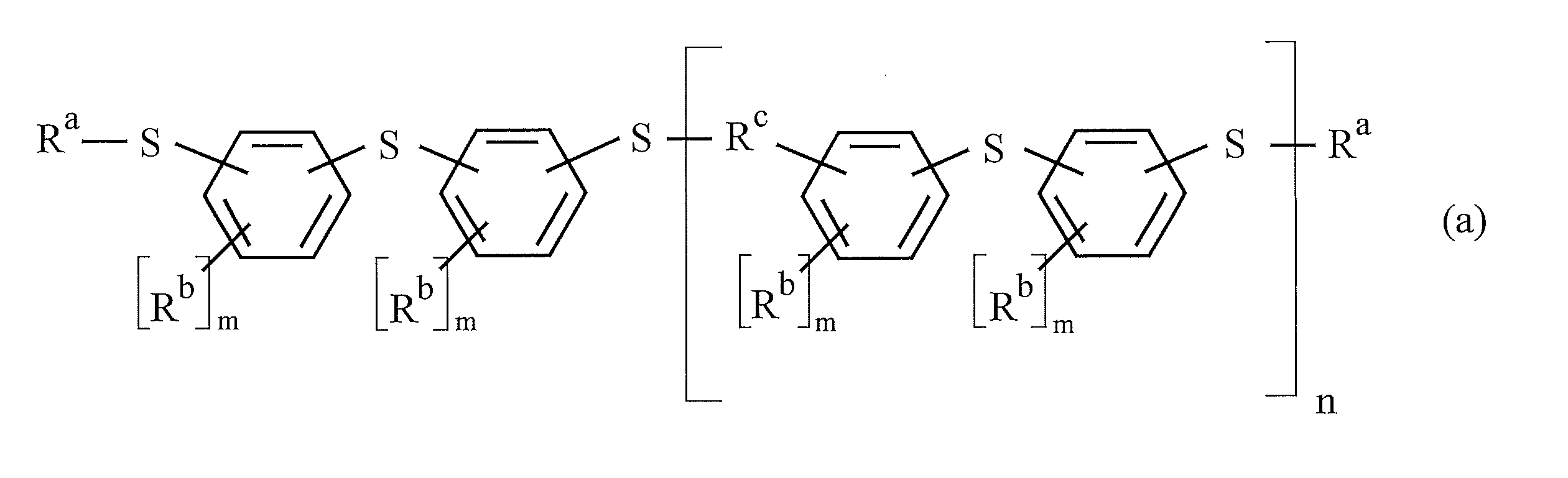
で表される化合物
化合物(B):下記式(b-1)

で表される化合物、及び下記式(b-2)

で表される化合物から選択される少なくとも1種の化合物

で表される化合物である前記の樹脂組成物を提供する。
工程1:前記樹脂組成物からなる塗膜に、紫外線照射を施す
工程2:有機エレクトロルミネッセンス素子を設置した基板の素子設置面に、工程1を経て得られた紫外線照射後の塗膜を貼り合わせて加熱処理を施す
[1] 式(a)で表される化合物(A)と、式(b-1)で表される化合物、及び下記式(b-2)で表される化合物から選択される少なくとも1種の化合物(B)と、光カチオン重合開始剤(C)を含む樹脂組成物。
[2] 式(a)中のRaがカチオン重合性基である、[1]に記載の樹脂組成物。
[3] 式(a)中のRaがビニル基、アリル基、エポキシ基、グリシジル基、及びオキセタニル基から選択される基である、[1]に記載の樹脂組成物。
[4] 式(a)中のRaが、ビニル基又はアリル基である、[1]に記載の樹脂組成物。
[5] 式(a)中のRcが二価の炭化水素基、カルボニル基、エーテル結合、チオエーテル結合、エステル結合、アミド結合、カーボネート結合、及びこれらが複数個連結した基から選択される基である、[1]~[4]の何れか1つに記載の樹脂組成物。
[6] 化合物(A)の分子量が1000以下(好ましくは700以下、最も好ましくは500以下)である、[1]~[5]の何れか1つに記載の樹脂組成物。
[7] 化合物(A)の分子量が302~1000(好ましくは302~700、最も好ましくは302~500)である、[1]~[5]の何れか1つに記載の樹脂組成物。
[8] 化合物(A)が式(a’)で表される化合物である、[1]~[7]の何れか1つに記載の樹脂組成物。
[9] 化合物(A)が式(a'-1)~(a'-12)で示される化合物から選択される少なくとも1種の化合物である、[1]~[7]の何れか1つに記載の樹脂組成物。
[10] 式(b-1)中のYが二価の炭化水素基(好ましくは、C1-18アルキレン基、C2-8アルケニレン基、C6-10のアリーレン基、及びこれらが単結合を介して連結した基から選択される基)、カルボニル基、エーテル結合、エステル結合、アミド結合、カーボネート結合、及びこれらが複数個連結した基から選択される基である、[1]~[9]の何れか1つに記載の樹脂組成物。
[11] 式(b-1)で表される化合物の分子量が1000~70(好ましくは700~100、特に好ましくは400~150)である、[1]~[10]の何れか1つに記載の樹脂組成物。
[12] 式(b-1)で表される化合物がN-ビニルカルバゾール、N-アリルカルバゾール、N-(メタ)アクリロイルカルバゾール、及びN-(ビニルベンジル)カルバゾールから選択される少なくとも1種の化合物である、[1]~[11]の何れか1つに記載の樹脂組成物。
[13] 式(b-2)中のLが二価の炭化水素基(好ましくは、C1-18アルキレン基、C2-8アルケニレン基、C6-10のアリーレン基、及びこれらが単結合を介して連結した基から選択される基)、カルボニル基、エーテル結合、チオエーテル結合、エステル結合、アミド結合、カーボネート結合、及びこれらが複数個連結した基から選択される基である、[1]~[12]の何れか1つに記載の樹脂組成物。
[14] 式(b-2)で表される化合物の分子量が1000~70(好ましくは700~100、特に好ましくは400~150)である、[1]~[13]の何れか1つに記載の樹脂組成物。
[15] 式(b-2)で表される化合物が、式(b-2-1)で表される化合物である、[1]~[14]の何れか1つに記載の樹脂組成物。
[16] 化合物(A)と化合物(B)と光カチオン重合開始剤(C)以外の化合物の含有量が樹脂組成物全量の40重量%以下(好ましくは20重量%以下、特に好ましくは10重量%以下)である、[1]~[15]の何れか1つに記載の樹脂組成物。
[17] 化合物(A)と化合物(B)と光カチオン重合開始剤(C)の合計含有量が樹脂組成物全量の60重量%以上(好ましくは80重量%以上、特に好ましくは90重量%以上)である、[1]~[16]の何れか1つに記載の樹脂組成物。
[18] 重量平均分子量が1000超(好ましくは5000超、特に好ましくは10000超)の高分子化合物の含有量が5重量%以下(好ましくは3重量%以下、特に好ましくは1重量%以下)である、[1]~[17]の何れか1つに記載の樹脂組成物。
[19] 溶解度パラメーター(25℃におけるSP値;Fedorsの式で算出される値)が8.5以上の化合物の含有量が5重量%以下(好ましくは3重量%以下、特に好ましくは1重量%以下)である、[1]~[18]の何れか1つに記載の樹脂組成物。
[20] 重量平均分子量が1000超(好ましくは5000超、特に好ましくは10000超)の高分子化合物と溶解度パラメーター(25℃におけるSP値;Fedorsの式で算出される値)が8.5以上の化合物の合計含有量が5重量%以下(好ましくは3重量%以下、特に好ましくは1重量%以下)である、[1]~[19]の何れか1つに記載の樹脂組成物。
[21] 化合物(A)と化合物(B)の含有量の比(前者:後者(重量比))が60:40~95:5(好ましくは65:35~90:10、特に好ましくは70:30~85:15)であり、化合物(A)と化合物(B)の合計含有量が、樹脂組成物に含まれる硬化性化合物全量の50重量%以上(好ましくは60重量%以上、より好ましくは70重量%以上、特に好ましくは80重量%以上、最も好ましくは90重量%以上)である、[1]~[20]の何れか1つに記載の樹脂組成物。
[22] 化合物(A)の含有量が樹脂組成物に含まれる硬化性化合物全量(100重量%)の45~95重量%(好ましくは60~95重量%、より好ましくは65~90重量%、特に好ましくは70~85重量%)である、[1]~[21]の何れか1つに記載の樹脂組成物。
[23] 化合物(B)の含有量が樹脂組成物に含まれる硬化性化合物全量(100重量%)の5~40重量%(好ましくは10~35重量%、特に好ましくは15~30重量%)である、[1]~[22]の何れか1つに記載の樹脂組成物。
[24] 光カチオン重合開始剤(C)の含有量が樹脂組成物に含まれる硬化性化合物100重量部に対して0.01~15重量部(好ましくは0.01~10重量部、特に好ましくは0.05~5重量部、最も好ましくは0.1~3重量部)である、[1]~[23]の何れか1つに記載の樹脂組成物。
[25] 25℃における、紫外線未照射の場合の粘度が10mPa・s以上、30mPa・s未満(好ましくは15~25mPa・s)である、[1]~[24]の何れか1つに記載の樹脂組成物。
[26] 紫外線照射(照射量:1500mJ/cm2)直後の、25℃における粘度が30~2000mPa・s(好ましくは30~1000mPa・s)である、[1]~[25]の何れか1つに記載の樹脂組成物。
[27] 紫外線照射(照射量:1500mJ/cm2)後30分の、25℃における粘度が30~2500mPa・s(好ましくは30~1500mPa・s)である、[1]~[26]の何れか1つに記載の樹脂組成物。
[28] 紫外線照射直後から紫外線照射後30分の間の粘度の上昇度(紫外線照射後30分の粘度/紫外線照射直後の粘度)が1.30以下(好ましくは1.20以下)である、[1]~[27]の何れか1つに記載の樹脂組成物。
[29] 有機エレクトロルミネッセンス素子封止剤である、[1]~[28]の何れか1つに記載の樹脂組成物。
[30] 下記工程1及び2を経て有機エレクトロルミネッセンス素子を封止することを特徴とする有機エレクトロルミネッセンスデバイスの製造方法。
工程1:[1]~[29]の何れか1つに記載の樹脂組成物からなる塗膜に、紫外線照射を施す
工程2:有機エレクトロルミネッセンス素子を設置した基板の素子設置面に、工程1を経て得られた紫外線照射後の塗膜を貼り合わせて加熱処理を施す
[31] [1]~[29]の何れか1つに記載の樹脂組成物の硬化物で素子が封止された構成を有する有機エレクトロルミネッセンスデバイス。
[32] 硬化物が、25℃における波長589.3nmの光に対する屈折率が1.65以上(好ましくは1.68以上)である硬化物である、[31]に記載の有機エレクトロルミネッセンスデバイス。
[33] 硬化物が、厚さ100μmの硬化物の透湿量(g/m2・day・atm)が100以下(好ましくは50以下、特に好ましくは35以下、最も好ましくは25以下)である硬化物である、[31]又は[32]に記載の有機エレクトロルミネッセンスデバイス。
[34] 硬化物が、60mgの硬化物のアウトガス量が1000ppm以下(好ましくは200ppm以下、特に好ましくは100ppm以下)である硬化物である、[31]~[33]の何れか1つに記載の有機エレクトロルミネッセンスデバイス。
そのため、本発明の樹脂組成物に紫外線を照射した後に、有機EL素子を備えた基板に貼り合わせ、貼り合わせ後に加熱処理を施すことにより、ダムからの流出を抑制しつつ、且つ貼り合わせ困難となる事態を生じることなく、貼り合わせ作業を行うことができ、有機EL素子を紫外線に直に曝すことなく、高屈折率、低透湿性、及び低アウトガス性を兼ね備えた硬化物で封止することができる。
このため、本発明の樹脂組成物は、特に、トップ・エミッション型有機ELデバイスの封止剤(特に、フィル材)、ボトム・エミッション型有機ELデバイスの光取り出し層材料、太陽電池材料、レンズ材料等として好ましく使用できる。
特に、本発明の樹脂組成物を封止剤として使用すると、光の取り出し効率に優れ、高効率、高輝度、長寿命を有する有機ELデバイスが得られる。また、本発明の樹脂組成物をレンズ材料として使用すると、高屈折率を有するレンズが得られ、レンズの薄膜化、軽量化が可能であり、当該レンズを含む電子機器のデザイン性を向上することができる。
本発明における化合物(A)は、上記式(a)で表される化合物(硬化性化合物)である。上記式(a)中の2つのRaは反応性官能基(重合性官能基)を示す。前記2つのRaはそれぞれ同一であってもよいし、異なっていてもよい。前記反応性官能基としては、例えば、ビニル基、アリル基、エポキシ基、グリシジル基、オキセタニル基等のカチオン重合性基を挙げることができる。本発明においては、なかでも、ビニル基又はアリル基が好ましい。

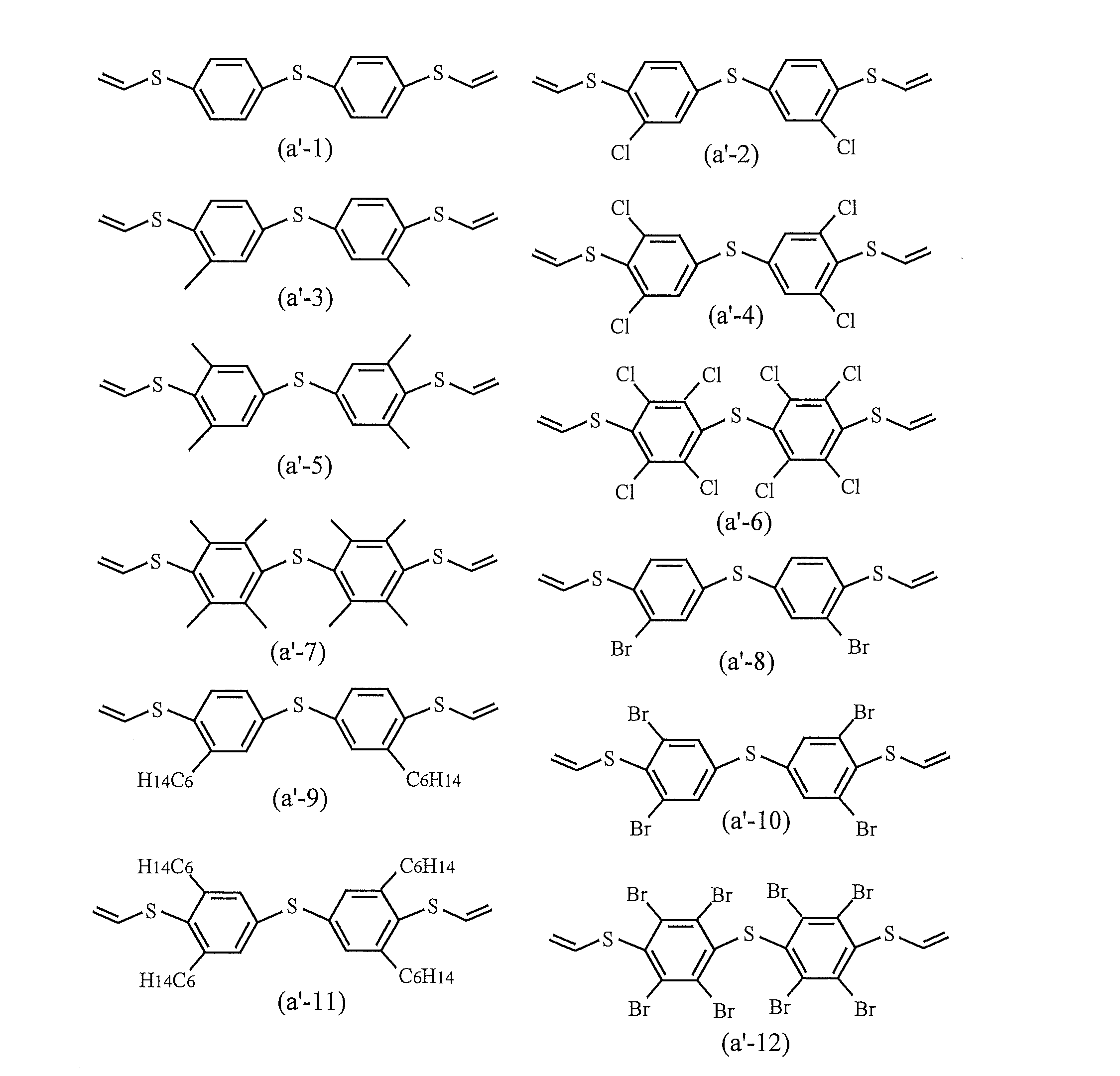
本発明における化合物(B)には、化合物(b-1)、及び化合物(b-2)から選択される少なくとも1種の化合物が含まれる。
本発明における化合物(b-1)は、下記式(b-1)で表される化合物(カチオン及びラジカル重合性化合物)である。化合物(b-1)は、光カチオン重合開始剤(C)から発生する酸によって急速に重合反応が進行する。そのため、上記化合物(A)が光カチオン重合開始剤(C)から発生する酸をトラップするまでのわずかな時間に、重合反応を進行させることができる。また、光カチオン重合開始剤(C)に紫外線を照射すると、前記光カチオン重合開始剤(C)は紫外線を吸収して分解してラジカル体を形成し、当該ラジカル体が水素を引き抜くことで酸を発生するものであるが、化合物(b-1)は、前記ラジカル体とも反応して重合反応を進行させることができる。そのため、光カチオン重合開始剤(C)から発生する酸をトラップする作用を有する上記化合物(A)との共存下でも、ある程度重合反応を進行させることができ、本発明の樹脂組成物を半硬化状態へと導くことができる。

本発明における化合物(b-2)は、下記式(b-2)で表される化合物(ラジカル重合性化合物)である。光カチオン重合開始剤(C)に紫外線を照射すると、前記光カチオン重合開始剤(C)は紫外線を吸収して分解してラジカル体を形成し、当該ラジカル体が水素を引き抜くことで酸を発生するものであるが、化合物(b-2)は、前記ラジカル体と反応することにより硬化反応が進行し、本発明の樹脂組成物を半硬化状態へ導く。


光カチオン重合開始剤は、紫外線の照射によって分解してラジカル体を形成し、当該ラジカル体が水素を引き抜くことで酸を発生して硬化性化合物の硬化反応を開始させる化合物である。光カチオン重合開始剤は、光を吸収するカチオン部と酸の発生源となるアニオン部からなる。
本発明の樹脂組成物は、更に、必要に応じて、例えば、硬化性化合物(化合物(A)、(B)を除く)、フィラー、シランカップリング剤、重合禁止剤、酸化防止剤、光安定剤、可塑剤、レベリング剤、消泡剤、顔料、有機溶剤、紫外線吸収剤、イオン吸着体、蛍光体、離型剤、レオロジーコントロール剤等の慣用の添加剤を含有していてもよい。これらの含有量は、樹脂組成物全量の例えば40重量%以下、好ましくは20重量%以下、特に好ましくは10重量%以下である。また、本発明の樹脂組成物は石油樹脂等の重量平均分子量が1000超(好ましくは5000超、特に好ましくは10000超)の高分子化合物及び/又は溶解度パラメーター(25℃におけるSP値;Fedorsの式で算出される値)が8.5以上の化合物を含有していても良いがその含有量は、例えば5重量%以下、好ましくは3重量%以下、特に好ましくは1重量%以下である。高分子化合物の含有量が上記範囲を上回ると、アセトン溶解性が低下し、液体定量吐出装置等の内部をアセトンで洗浄することが困難となるため好ましくない。
本発明の樹脂組成物は、上述の化合物(A)、化合物(B)、光カチオン重合開始剤(C)、及び必要に応じてその他の成分を、均一に混合することにより製造することができる。尚、化合物(A)、化合物(B)、光カチオン重合開始剤(C)は、それぞれ、1種を単独で、又は2種以上を組み合わせて使用することができる。本発明の樹脂組成物を得るにあたっては、各成分を自公転式撹拌脱泡装置、ホモジナイザー、プラネタリーミキサー、3本ロールミル、ビーズミル等の一般的に知られる混合用機器を使用してなるべく均一になるように、撹拌、溶解、混合、分散等を行うことが望ましい。尚、各成分は、同時に混合してもよいし、逐次混合してもよい。
本発明の樹脂組成物の硬化物は、樹脂組成物に上述の条件で紫外線照射を施し、更に上述の条件で加熱処理を施すことにより得られる。
本発明の有機ELデバイスの製造方法は、下記工程1及び2を経て有機EL素子(特に、トップ・エミッション型有機EL素子)を封止することを特徴とする。
工程1:上述の樹脂組成物からなる塗膜に、紫外線照射を施す
工程2:有機EL素子を設置した基板の素子設置面に、工程1を経て得られた紫外線照射後の塗膜を貼り合わせて加熱処理を施す
<方法1:図1参照>
工程1-1:リッド上に上述の樹脂組成物を塗布して塗膜/リッド積層体を形成する
工程1-2:塗膜に紫外線照射を施す
工程2-1:基板上に有機EL素子を設置し、有機EL素子設置面に紫外線照射後の塗膜/リッド積層体を塗膜面が素子設置面に相対するように貼り合わせる
工程2-2:加熱処理を施して塗膜を硬化させる
冷却管、撹拌器、及び温度計を備え付けた2Lの4口フラスコに水素化ナトリウム(55重量%のミネラルオイルを含む)(15.4g、352.9mmol)、及びDMSO(510.6g)を入れ、0℃に冷却した後、ここに、o-フェニルフェノール(50.6g、297.3mmol)をDMSO(191.0g)に溶解させた溶液を滴下した。その後、60℃のオイルバスにつけ、2-クロロエチルビニルエーテル(38.2g、358.5mmol)をDMSO(61.4g)に溶解させた溶液を滴下した。反応液を6時間攪拌後、0℃に冷却してからゆっくり水を滴下してクエンチし、分液ロートに移した。水層を酢酸エチルで抽出し、有機層に飽和食塩水を加え洗浄した。その後、有機層を分け、無水硫酸ナトリウムで脱水した後、溶媒を留去して液状の粗生成物を得た。これをシリカゲルカラムクロマトグラフィー[展開溶媒:ヘキサン/酢酸エチル=10/1(体積比)]で精製して、下記式で表される、(2-フェニルフェノキシ)エチルビニルエーテル55.5g(収率:78%、純度98%)を無色透明液体として得た。
1H-NMR(500MHz,CDCl3):δ3.96(t,J=5.0Hz,2H)、4.17-4.21(m,3H)、6.44(dd,J=14.1,6.5Hz,1H)、6.98-7.01(m,1H)、7.04-7.07(m,1H)、7.28-7.41(m,6H)、7.56-7.57(m,2H)

MPV(82重量部)、VCZ(17重量部)、及び光カチオン重合開始剤(1重量部)を自公転式撹拌脱泡装置(型式:AR-250、(株)シンキー製)内に投入して撹拌し、樹脂組成物(1)を得た。
得られた樹脂組成物(1)を金型に注型し、200W/cmの高圧水銀灯で10cmの距離から紫外線を照射(照射量:1500mJ/cm2)した。
得られた樹脂組成物(1)について、紫外線照射前、紫外線照射直後、及び紫外線照射後30分の粘度をそれぞれ測定し、紫外線照射後の粘度上昇度を下記式から算出した。
紫外線照射後の粘度上昇度=紫外線照射後30分の粘度/紫外線照射直後の粘度
また、紫外線照射後の樹脂組成物(1)に加熱処理(100℃、1時間)を施して硬化物(1)(厚み:100μm)を得た。
下記表に示す組成に変更した以外は実施例1と同様にして樹脂組成物及び硬化物を作製した。
実施例及び比較例で得られた樹脂組成物1gに対しアセトン100mLを添加し、マグネチックスターラーを用いて25℃で1時間攪拌して得られたアセトン溶液について、透明性を目視で確認することにより、樹脂組成物のアセトン溶解性を評価した。
UV遅延硬化性ダム材の調製
(3,4,3’,4’-ジエポキシ)ビシクロヘキシル30重量部、液状ビスフェノールFジグリシジルエーテル(商品名「YL-983U」、三菱化学(株)製)70重量部、4-(4-ビフェニリルチオ)フェニル-4-ビフェニリルフェニルスルホニウム テトラキス(ペンタフルオロフェニル)ボレート2重量部、1,3,4,6-テトラグリシジルグリコールウリル(商品名「TG-G」、四国化成工業(株)製)2.5重量部、タルク(平均粒子径1.5μm、平板状粒子、商品名「FG-15」、日本タルク(株)製)52重量部、スペーサー粒子(平均粒子径15μm、商品名「SD-DB」、早川ゴム(株)製)0.5重量部を自公転式撹拌脱泡装置(型式:AR-250、(株)シンキー製)内に投入して撹拌し、UV遅延硬化性ダム材を得た。
得られたUV遅延硬化性ダム材の粘度は150Pa・sであった。また、このUV遅延硬化性ダム材を200W/cmの高圧水銀灯で10cmの距離から紫外線を照射(照射量:1500mJ/cm2)した直後の粘度は1500000Pa・sであった。さらに、紫外線照射後30分の粘度は1570000Pa・sであった。尚、ダム材の粘度は、レオメーター(商品名「Physica MCR301」、Anton Paar社製)を使用して測定した、25℃、せん断速度が2.5(1/s)の時の値である。
200W/cmの高圧水銀灯を用いて、ガラス面から10cm離れたところから紫外線を照射(照射量:1500mJ/cm2)した。
30分後、前記ガラス表面にもう1枚のガラス(76mm×52mm)を被せ、クリップで2枚のガラスをはさみ、真空チャンバーにて2.5torrの圧力で貼り合わせた。貼り合わせたガラスを100℃で1時間加熱することにより、ダムアンドフィル工法で封止されたガラス試験片を得た。ガラス試験片におけるダムとフィルの境界部をCCDカメラにて観察し、下記基準でダムの流出防止性を評価した。
評価基準
○:フィルが流出するのを完全に防止できた
△:フィルが少量流出した
×:フィルが多量に流出した
実施例及び比較例で得られた硬化物(厚み:100μm)について、Model 2010プリズムカプラ(メトリコン社製)を使用して、25℃において、589.3nmの光の屈折率を測定した。
実施例及び比較例で得られた硬化物(60mg)をバイヤル瓶に入れ、紫外線照射(1500mJ/cm2)して100℃の条件下で1時間静置した後、バイヤル瓶中のアウトガス量(単位:ppm)を測定した。尚、トルエン標準液[標準物質としてトルエン:100ppm、溶媒としてヘキサン:60mg]を用いて検量線を作成した。また、測定機器としては、商品名「HP-6890N」(ヒューレットパッカート社製)を使用し、カラムは商品名「DB-624」(アジレント社製)を使用した。
実施例及び比較例で得られた硬化物(厚み:100μm)の透湿量(g/m2・day・atm)を、JIS L 1099及びJIS Z 0208(カップ法)に準じた方法で、60℃、90%RH条件下で測定して水蒸気透過性を評価した。
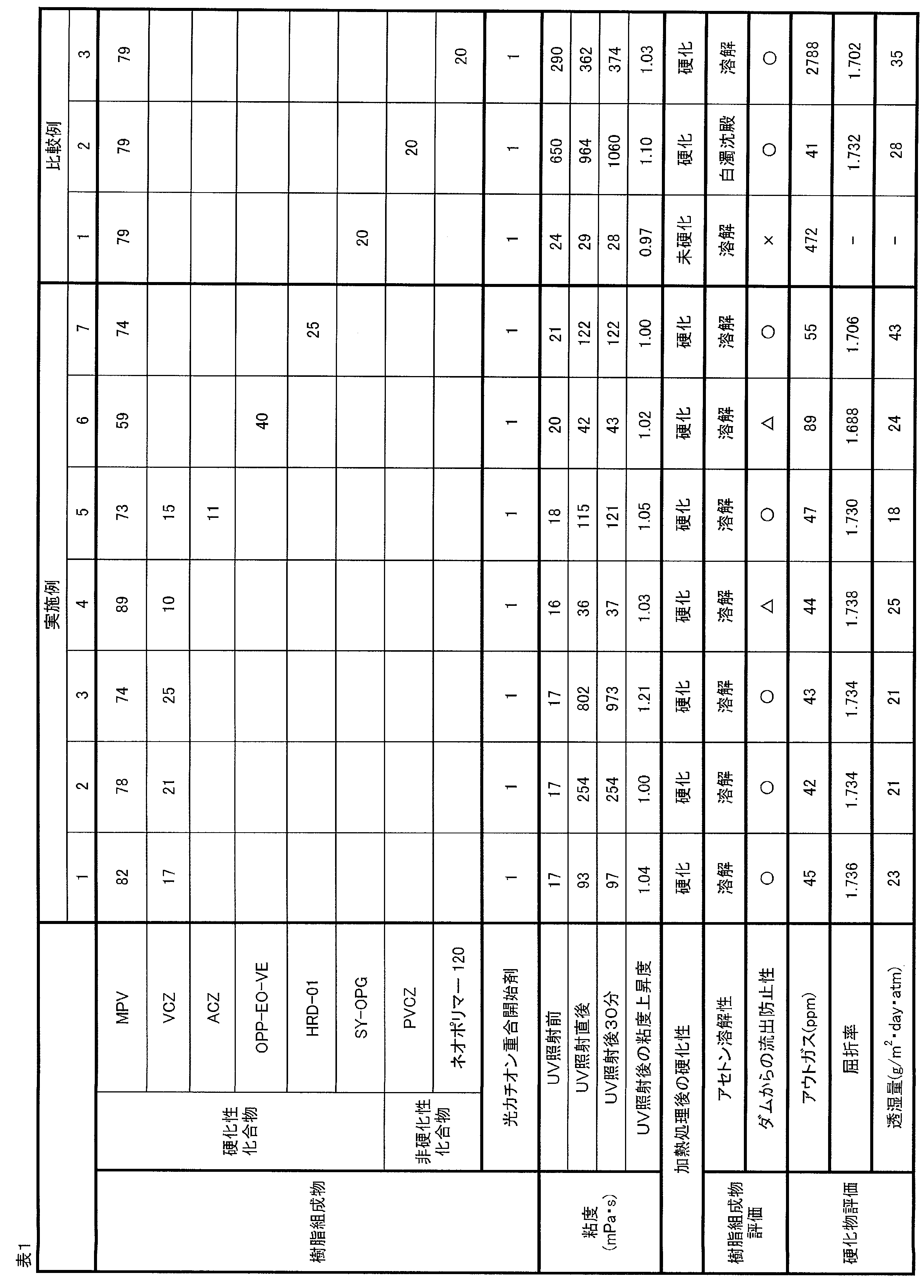
[化合物(A)]
MPV:ビス(4-ビニルチオフェニル)スルフィド、分子量:302、商品名「MPV」、住友精化(株)製
[化合物(B)]
VCZ:N-ビニルカルバゾール、分子量:193.24、商品名「HRM-C01」、日触テクノファインケミカル(株)製
ACZ:N-アリルカルバゾール、分子量:207.16、日触テクノファインケミカル(株)製
OPP-EO-VE:調製例1で得られた(2-フェニルフェノキシ)エチルビニルエーテル、分子量:240.16
HRD-01:2-(o-フェニルフェノキシ)エチルアクリレート、分子量:268、商品名「HRD-01」、日触テクノファインケミカル(株)製
[その他の硬化性化合物]
SY-OPG:o-フェニルフェノールグリシジルエーテル、商品名「SY-OPG」、阪本薬品工業(株)製
[非硬化性化合物]
PVCZ:ポリ-N-ビニルカルバゾール、重量平均分子量:45000、25℃におけるSP値:5.6、商品名「PVCZ」、丸善石油化学(株)製
ネオポリマー120:石油樹脂、重量平均分子量:1500、25℃におけるSP値:11.2、商品名「ネオポリマー120」、JX日鉱日石エネルギー(株)製
[光カチオン重合開始剤(C)]
光カチオン重合開始剤:4-(4-ビフェニリルチオ)フェニル-4-ビフェニリルフェニルスルホニウム テトラキス(ペンタフルオロフェニル)ボレート
そのため、本発明の樹脂組成物は、トップ・エミッション型有機ELデバイスの封止剤、ボトム・エミッション型有機ELデバイスの光取り出し層材料、太陽電池材料、レンズ材料等として好ましく使用できる。
2 ダム
3 ディスペンサー
4 樹脂組成物
5 基板
6 陰極
7 発光層
8 陽極
Claims (8)
- 下記化合物(A)と下記化合物(B)と光カチオン重合開始剤(C)を含む樹脂組成物。
化合物(A):下記式(a)

で表される化合物
化合物(B):下記式(b-1)

で表される化合物、及び下記式(b-2)

で表される化合物から選択される少なくとも1種の化合物 - 式(a)中のRaが、ビニル基又はアリル基である請求項1に記載の樹脂組成物。
- 式(b-2)で表される化合物が、下記式(b-2-1)

で表される化合物である請求項1又は2に記載の樹脂組成物。 - 化合物(A)と化合物(B)の含有量の比(前者:後者(重量比))が60:40~95:5であり、化合物(A)と化合物(B)の合計含有量が、樹脂組成物に含まれる硬化性化合物全量の50重量%以上である請求項1~3の何れか1項に記載の樹脂組成物。
- 25℃における粘度が10mPa・s以上、30mPa・s未満である請求項1~4の何れか1項に記載の樹脂組成物。
- 有機エレクトロルミネッセンス素子封止剤である請求項1~5の何れか1項に記載の樹脂組成物。
- 下記工程1及び2を経て有機エレクトロルミネッセンス素子を封止することを特徴とする有機エレクトロルミネッセンスデバイスの製造方法。
工程1:請求項6に記載の樹脂組成物からなる塗膜に、紫外線照射を施す
工程2:有機エレクトロルミネッセンス素子を設置した基板の素子設置面に、工程1を経て得られた紫外線照射後の塗膜を貼り合わせて加熱処理を施す - 請求項6に記載の樹脂組成物の硬化物で素子が封止された構成を有する有機エレクトロルミネッセンスデバイス。
Priority Applications (3)
| Application Number | Priority Date | Filing Date | Title |
|---|---|---|---|
| KR1020177029440A KR101878117B1 (ko) | 2016-04-01 | 2017-03-30 | 수지 조성물 |
| JP2017534757A JP6211746B1 (ja) | 2016-04-01 | 2017-03-30 | 樹脂組成物 |
| CN201780001410.XA CN107531817B (zh) | 2016-04-01 | 2017-03-30 | 树脂组合物 |
Applications Claiming Priority (2)
| Application Number | Priority Date | Filing Date | Title |
|---|---|---|---|
| JP2016074517 | 2016-04-01 | ||
| JP2016-074517 | 2016-04-01 |
Publications (1)
| Publication Number | Publication Date |
|---|---|
| WO2017170888A1 true WO2017170888A1 (ja) | 2017-10-05 |
Family
ID=59965875
Family Applications (1)
| Application Number | Title | Priority Date | Filing Date |
|---|---|---|---|
| PCT/JP2017/013301 Ceased WO2017170888A1 (ja) | 2016-04-01 | 2017-03-30 | 樹脂組成物 |
Country Status (5)
| Country | Link |
|---|---|
| JP (1) | JP6211746B1 (ja) |
| KR (1) | KR101878117B1 (ja) |
| CN (1) | CN107531817B (ja) |
| TW (1) | TWI613222B (ja) |
| WO (1) | WO2017170888A1 (ja) |
Cited By (3)
| Publication number | Priority date | Publication date | Assignee | Title |
|---|---|---|---|---|
| WO2019123760A1 (ja) * | 2017-12-20 | 2019-06-27 | コニカミノルタ株式会社 | 有機エレクトロルミネッセンス素子 |
| JPWO2022203081A1 (ja) * | 2021-03-26 | 2022-09-29 | ||
| KR20250024841A (ko) | 2022-06-15 | 2025-02-19 | 데이까 가부시끼가이샤 | 분산액, 이의 제조방법 및 이의 경화물 |
Families Citing this family (2)
| Publication number | Priority date | Publication date | Assignee | Title |
|---|---|---|---|---|
| CN112578634A (zh) * | 2019-09-27 | 2021-03-30 | 松下知识产权经营株式会社 | 紫外线固化性树脂组合物、彩色滤光片、彩色抗蚀剂和发光装置及它们的制造方法 |
| WO2022196764A1 (ja) * | 2021-03-19 | 2022-09-22 | 三井化学株式会社 | 液晶シール剤、液晶表示パネルの製造方法および液晶表示パネル |
Citations (5)
| Publication number | Priority date | Publication date | Assignee | Title |
|---|---|---|---|---|
| JP2006003388A (ja) * | 2004-06-15 | 2006-01-05 | Daiso Co Ltd | 体積位相型ホログラム記録用感光性組成物、ホログラム記録媒体とその製法、およびホログラム記録法 |
| JP2006003387A (ja) * | 2004-06-15 | 2006-01-05 | Daiso Co Ltd | 体積位相型ホログラム記録用感光性組成物、ホログラム記録媒体とその製法、およびホログラム記録方法 |
| JP2013071959A (ja) * | 2011-09-27 | 2013-04-22 | Daicel Corp | 樹脂組成物及びその硬化物 |
| JP2015109202A (ja) * | 2013-12-04 | 2015-06-11 | 株式会社ダイセル | 光半導体装置の製造方法 |
| JP2015124286A (ja) * | 2013-12-26 | 2015-07-06 | 株式会社ダイセル | 硬化性組成物 |
Family Cites Families (3)
| Publication number | Priority date | Publication date | Assignee | Title |
|---|---|---|---|---|
| JPS5823827A (ja) * | 1981-07-10 | 1983-02-12 | シ−メンス・アクチエンゲゼルシヤフト | ポリフエニレンスルフイド中における硫黄含有廃ガスの減少方法 |
| CN103325918A (zh) * | 2013-04-03 | 2013-09-25 | 杭州杭科光电股份有限公司 | 一种发光二极管的封装工艺 |
| JP6267533B2 (ja) * | 2014-02-14 | 2018-01-24 | 信越化学工業株式会社 | パターン形成方法 |
-
2017
- 2017-03-30 KR KR1020177029440A patent/KR101878117B1/ko not_active Expired - Fee Related
- 2017-03-30 JP JP2017534757A patent/JP6211746B1/ja not_active Expired - Fee Related
- 2017-03-30 CN CN201780001410.XA patent/CN107531817B/zh not_active Expired - Fee Related
- 2017-03-30 WO PCT/JP2017/013301 patent/WO2017170888A1/ja not_active Ceased
- 2017-03-31 TW TW106110974A patent/TWI613222B/zh not_active IP Right Cessation
Patent Citations (5)
| Publication number | Priority date | Publication date | Assignee | Title |
|---|---|---|---|---|
| JP2006003388A (ja) * | 2004-06-15 | 2006-01-05 | Daiso Co Ltd | 体積位相型ホログラム記録用感光性組成物、ホログラム記録媒体とその製法、およびホログラム記録法 |
| JP2006003387A (ja) * | 2004-06-15 | 2006-01-05 | Daiso Co Ltd | 体積位相型ホログラム記録用感光性組成物、ホログラム記録媒体とその製法、およびホログラム記録方法 |
| JP2013071959A (ja) * | 2011-09-27 | 2013-04-22 | Daicel Corp | 樹脂組成物及びその硬化物 |
| JP2015109202A (ja) * | 2013-12-04 | 2015-06-11 | 株式会社ダイセル | 光半導体装置の製造方法 |
| JP2015124286A (ja) * | 2013-12-26 | 2015-07-06 | 株式会社ダイセル | 硬化性組成物 |
Cited By (6)
| Publication number | Priority date | Publication date | Assignee | Title |
|---|---|---|---|---|
| WO2019123760A1 (ja) * | 2017-12-20 | 2019-06-27 | コニカミノルタ株式会社 | 有機エレクトロルミネッセンス素子 |
| JPWO2019123760A1 (ja) * | 2017-12-20 | 2020-12-10 | コニカミノルタ株式会社 | 有機エレクトロルミネッセンス素子 |
| JP7105252B2 (ja) | 2017-12-20 | 2022-07-22 | メルク パテント ゲゼルシャフト ミット ベシュレンクテル ハフツング | 有機エレクトロルミネッセンス素子 |
| JPWO2022203081A1 (ja) * | 2021-03-26 | 2022-09-29 | ||
| WO2022203081A1 (ja) * | 2021-03-26 | 2022-09-29 | パナソニックIpマネジメント株式会社 | 光硬化性樹脂組成物、光学部品、光学部品の製造方法、及び発光装置 |
| KR20250024841A (ko) | 2022-06-15 | 2025-02-19 | 데이까 가부시끼가이샤 | 분산액, 이의 제조방법 및 이의 경화물 |
Also Published As
| Publication number | Publication date |
|---|---|
| JPWO2017170888A1 (ja) | 2018-04-12 |
| CN107531817B (zh) | 2019-03-15 |
| JP6211746B1 (ja) | 2017-10-11 |
| KR101878117B1 (ko) | 2018-07-12 |
| TW201805313A (zh) | 2018-02-16 |
| CN107531817A (zh) | 2018-01-02 |
| KR20170122833A (ko) | 2017-11-06 |
| TWI613222B (zh) | 2018-02-01 |
Similar Documents
| Publication | Publication Date | Title |
|---|---|---|
| JP6211746B1 (ja) | 樹脂組成物 | |
| TWI591089B (zh) | 樹脂組成物、其硬化物及其用途 | |
| JP6796582B2 (ja) | 硬化物の製造方法、硬化物、及び前記硬化物を含む積層物 | |
| WO2016204114A1 (ja) | 硬化性組成物、接着シート、硬化物、積層物、接着シートの製造方法、及び装置 | |
| JP6709730B2 (ja) | 光硬化性組成物、及びそれを含む光学素子用接着剤 | |
| WO2017099055A1 (ja) | 封止用組成物 | |
| JP5827853B2 (ja) | 組成物及びその硬化物 | |
| JP7160803B2 (ja) | 接着剤用硬化性組成物、接着シート、硬化物、積層物、及び装置 | |
| JP2017008147A (ja) | ポリオルガノシルセスキオキサン、硬化性組成物、接着シート、積層物及び装置 | |
| JP5839934B2 (ja) | 樹脂組成物及びその硬化物 | |
| JP2024022608A (ja) | 有機el表示素子用封止剤 | |
| JP2015124286A (ja) | 硬化性組成物 | |
| JP5923485B2 (ja) | 光半導体装置の製造方法 | |
| CN110603276A (zh) | 有机el元件的密封用的阳离子聚合固化型喷墨用树脂组合物 | |
| KR101779541B1 (ko) | 광경화 코팅용 조성물 및 코팅막 | |
| JP2015151528A (ja) | 硬化性組成物 | |
| WO2020250736A1 (ja) | 活性エネルギー線硬化型組成物 | |
| WO2020253838A1 (zh) | 一种含双氧杂环的含硅单体及其制备和应用 | |
| JP2018141028A (ja) | 光硬化性組成物、それを用いた硬化物及び光学部品 | |
| WO2012053377A1 (ja) | 高屈折率樹脂組成物および樹脂硬化物 | |
| JP7468064B2 (ja) | カチオン重合性組成物 | |
| JP6612647B2 (ja) | 硬化性組成物 | |
| TW202336075A (zh) | 電子裝置用硬化性樹脂組成物 | |
| JPWO2019188805A1 (ja) | 有機el表示素子用封止剤 | |
| JP2015109201A (ja) | 光透過型モジュール |
Legal Events
| Date | Code | Title | Description |
|---|---|---|---|
| ENP | Entry into the national phase |
Ref document number: 2017534757 Country of ref document: JP Kind code of ref document: A |
|
| ENP | Entry into the national phase |
Ref document number: 20177029440 Country of ref document: KR Kind code of ref document: A |
|
| NENP | Non-entry into the national phase |
Ref country code: DE |
|
| 121 | Ep: the epo has been informed by wipo that ep was designated in this application |
Ref document number: 17775422 Country of ref document: EP Kind code of ref document: A1 |
|
| 122 | Ep: pct application non-entry in european phase |
Ref document number: 17775422 Country of ref document: EP Kind code of ref document: A1 |