WO2016159138A1 - 表面処理金属板、塗装部材および塗装部材の製造方法 - Google Patents
表面処理金属板、塗装部材および塗装部材の製造方法 Download PDFInfo
- Publication number
- WO2016159138A1 WO2016159138A1 PCT/JP2016/060488 JP2016060488W WO2016159138A1 WO 2016159138 A1 WO2016159138 A1 WO 2016159138A1 JP 2016060488 W JP2016060488 W JP 2016060488W WO 2016159138 A1 WO2016159138 A1 WO 2016159138A1
- Authority
- WO
- WIPO (PCT)
- Prior art keywords
- coating film
- oxide particles
- particles
- metal plate
- chemical conversion
- Prior art date
- Legal status (The legal status is an assumption and is not a legal conclusion. Google has not performed a legal analysis and makes no representation as to the accuracy of the status listed.)
- Ceased
Links
Images


Classifications
-
- B—PERFORMING OPERATIONS; TRANSPORTING
- B05—SPRAYING OR ATOMISING IN GENERAL; APPLYING FLUENT MATERIALS TO SURFACES, IN GENERAL
- B05D—PROCESSES FOR APPLYING FLUENT MATERIALS TO SURFACES, IN GENERAL
- B05D7/00—Processes, other than flocking, specially adapted for applying liquids or other fluent materials to particular surfaces or for applying particular liquids or other fluent materials
- B05D7/14—Processes, other than flocking, specially adapted for applying liquids or other fluent materials to particular surfaces or for applying particular liquids or other fluent materials to metal, e.g. car bodies
-
- B—PERFORMING OPERATIONS; TRANSPORTING
- B32—LAYERED PRODUCTS
- B32B—LAYERED PRODUCTS, i.e. PRODUCTS BUILT-UP OF STRATA OF FLAT OR NON-FLAT, e.g. CELLULAR OR HONEYCOMB, FORM
- B32B15/00—Layered products comprising a layer of metal
- B32B15/04—Layered products comprising a layer of metal comprising metal as the main or only constituent of a layer, which is next to another layer of the same or of a different material
- B32B15/08—Layered products comprising a layer of metal comprising metal as the main or only constituent of a layer, which is next to another layer of the same or of a different material of synthetic resin
-
- C—CHEMISTRY; METALLURGY
- C08—ORGANIC MACROMOLECULAR COMPOUNDS; THEIR PREPARATION OR CHEMICAL WORKING-UP; COMPOSITIONS BASED THEREON
- C08K—Use of inorganic or non-macromolecular organic substances as compounding ingredients
- C08K3/00—Use of inorganic substances as compounding ingredients
- C08K3/02—Elements
- C08K3/08—Metals
-
- C—CHEMISTRY; METALLURGY
- C08—ORGANIC MACROMOLECULAR COMPOUNDS; THEIR PREPARATION OR CHEMICAL WORKING-UP; COMPOSITIONS BASED THEREON
- C08K—Use of inorganic or non-macromolecular organic substances as compounding ingredients
- C08K3/00—Use of inorganic substances as compounding ingredients
- C08K3/10—Metal compounds
- C08K3/14—Carbides
-
- C—CHEMISTRY; METALLURGY
- C08—ORGANIC MACROMOLECULAR COMPOUNDS; THEIR PREPARATION OR CHEMICAL WORKING-UP; COMPOSITIONS BASED THEREON
- C08K—Use of inorganic or non-macromolecular organic substances as compounding ingredients
- C08K3/00—Use of inorganic substances as compounding ingredients
- C08K3/28—Nitrogen-containing compounds
-
- C—CHEMISTRY; METALLURGY
- C08—ORGANIC MACROMOLECULAR COMPOUNDS; THEIR PREPARATION OR CHEMICAL WORKING-UP; COMPOSITIONS BASED THEREON
- C08K—Use of inorganic or non-macromolecular organic substances as compounding ingredients
- C08K3/00—Use of inorganic substances as compounding ingredients
- C08K3/34—Silicon-containing compounds
- C08K3/36—Silica
-
- C—CHEMISTRY; METALLURGY
- C09—DYES; PAINTS; POLISHES; NATURAL RESINS; ADHESIVES; COMPOSITIONS NOT OTHERWISE PROVIDED FOR; APPLICATIONS OF MATERIALS NOT OTHERWISE PROVIDED FOR
- C09D—COATING COMPOSITIONS, e.g. PAINTS, VARNISHES OR LACQUERS; FILLING PASTES; CHEMICAL PAINT OR INK REMOVERS; INKS; CORRECTING FLUIDS; WOODSTAINS; PASTES OR SOLIDS FOR COLOURING OR PRINTING; USE OF MATERIALS THEREFOR
- C09D167/00—Coating compositions based on polyesters obtained by reactions forming a carboxylic ester link in the main chain; Coating compositions based on derivatives of such polymers
-
- C—CHEMISTRY; METALLURGY
- C09—DYES; PAINTS; POLISHES; NATURAL RESINS; ADHESIVES; COMPOSITIONS NOT OTHERWISE PROVIDED FOR; APPLICATIONS OF MATERIALS NOT OTHERWISE PROVIDED FOR
- C09D—COATING COMPOSITIONS, e.g. PAINTS, VARNISHES OR LACQUERS; FILLING PASTES; CHEMICAL PAINT OR INK REMOVERS; INKS; CORRECTING FLUIDS; WOODSTAINS; PASTES OR SOLIDS FOR COLOURING OR PRINTING; USE OF MATERIALS THEREFOR
- C09D175/00—Coating compositions based on polyureas or polyurethanes; Coating compositions based on derivatives of such polymers
- C09D175/04—Polyurethanes
-
- C—CHEMISTRY; METALLURGY
- C09—DYES; PAINTS; POLISHES; NATURAL RESINS; ADHESIVES; COMPOSITIONS NOT OTHERWISE PROVIDED FOR; APPLICATIONS OF MATERIALS NOT OTHERWISE PROVIDED FOR
- C09D—COATING COMPOSITIONS, e.g. PAINTS, VARNISHES OR LACQUERS; FILLING PASTES; CHEMICAL PAINT OR INK REMOVERS; INKS; CORRECTING FLUIDS; WOODSTAINS; PASTES OR SOLIDS FOR COLOURING OR PRINTING; USE OF MATERIALS THEREFOR
- C09D201/00—Coating compositions based on unspecified macromolecular compounds
-
- C—CHEMISTRY; METALLURGY
- C09—DYES; PAINTS; POLISHES; NATURAL RESINS; ADHESIVES; COMPOSITIONS NOT OTHERWISE PROVIDED FOR; APPLICATIONS OF MATERIALS NOT OTHERWISE PROVIDED FOR
- C09D—COATING COMPOSITIONS, e.g. PAINTS, VARNISHES OR LACQUERS; FILLING PASTES; CHEMICAL PAINT OR INK REMOVERS; INKS; CORRECTING FLUIDS; WOODSTAINS; PASTES OR SOLIDS FOR COLOURING OR PRINTING; USE OF MATERIALS THEREFOR
- C09D5/00—Coating compositions, e.g. paints, varnishes or lacquers, characterised by their physical nature or the effects produced; Filling pastes
- C09D5/02—Emulsion paints including aerosols
-
- C—CHEMISTRY; METALLURGY
- C09—DYES; PAINTS; POLISHES; NATURAL RESINS; ADHESIVES; COMPOSITIONS NOT OTHERWISE PROVIDED FOR; APPLICATIONS OF MATERIALS NOT OTHERWISE PROVIDED FOR
- C09D—COATING COMPOSITIONS, e.g. PAINTS, VARNISHES OR LACQUERS; FILLING PASTES; CHEMICAL PAINT OR INK REMOVERS; INKS; CORRECTING FLUIDS; WOODSTAINS; PASTES OR SOLIDS FOR COLOURING OR PRINTING; USE OF MATERIALS THEREFOR
- C09D5/00—Coating compositions, e.g. paints, varnishes or lacquers, characterised by their physical nature or the effects produced; Filling pastes
- C09D5/02—Emulsion paints including aerosols
- C09D5/024—Emulsion paints including aerosols characterised by the additives
- C09D5/028—Pigments; Filters
-
- C—CHEMISTRY; METALLURGY
- C09—DYES; PAINTS; POLISHES; NATURAL RESINS; ADHESIVES; COMPOSITIONS NOT OTHERWISE PROVIDED FOR; APPLICATIONS OF MATERIALS NOT OTHERWISE PROVIDED FOR
- C09D—COATING COMPOSITIONS, e.g. PAINTS, VARNISHES OR LACQUERS; FILLING PASTES; CHEMICAL PAINT OR INK REMOVERS; INKS; CORRECTING FLUIDS; WOODSTAINS; PASTES OR SOLIDS FOR COLOURING OR PRINTING; USE OF MATERIALS THEREFOR
- C09D5/00—Coating compositions, e.g. paints, varnishes or lacquers, characterised by their physical nature or the effects produced; Filling pastes
- C09D5/08—Anti-corrosive paints
-
- C—CHEMISTRY; METALLURGY
- C09—DYES; PAINTS; POLISHES; NATURAL RESINS; ADHESIVES; COMPOSITIONS NOT OTHERWISE PROVIDED FOR; APPLICATIONS OF MATERIALS NOT OTHERWISE PROVIDED FOR
- C09D—COATING COMPOSITIONS, e.g. PAINTS, VARNISHES OR LACQUERS; FILLING PASTES; CHEMICAL PAINT OR INK REMOVERS; INKS; CORRECTING FLUIDS; WOODSTAINS; PASTES OR SOLIDS FOR COLOURING OR PRINTING; USE OF MATERIALS THEREFOR
- C09D5/00—Coating compositions, e.g. paints, varnishes or lacquers, characterised by their physical nature or the effects produced; Filling pastes
- C09D5/08—Anti-corrosive paints
- C09D5/082—Anti-corrosive paints characterised by the anti-corrosive pigment
- C09D5/084—Inorganic compounds
-
- C—CHEMISTRY; METALLURGY
- C09—DYES; PAINTS; POLISHES; NATURAL RESINS; ADHESIVES; COMPOSITIONS NOT OTHERWISE PROVIDED FOR; APPLICATIONS OF MATERIALS NOT OTHERWISE PROVIDED FOR
- C09D—COATING COMPOSITIONS, e.g. PAINTS, VARNISHES OR LACQUERS; FILLING PASTES; CHEMICAL PAINT OR INK REMOVERS; INKS; CORRECTING FLUIDS; WOODSTAINS; PASTES OR SOLIDS FOR COLOURING OR PRINTING; USE OF MATERIALS THEREFOR
- C09D5/00—Coating compositions, e.g. paints, varnishes or lacquers, characterised by their physical nature or the effects produced; Filling pastes
- C09D5/08—Anti-corrosive paints
- C09D5/10—Anti-corrosive paints containing metal dust
-
- C—CHEMISTRY; METALLURGY
- C09—DYES; PAINTS; POLISHES; NATURAL RESINS; ADHESIVES; COMPOSITIONS NOT OTHERWISE PROVIDED FOR; APPLICATIONS OF MATERIALS NOT OTHERWISE PROVIDED FOR
- C09D—COATING COMPOSITIONS, e.g. PAINTS, VARNISHES OR LACQUERS; FILLING PASTES; CHEMICAL PAINT OR INK REMOVERS; INKS; CORRECTING FLUIDS; WOODSTAINS; PASTES OR SOLIDS FOR COLOURING OR PRINTING; USE OF MATERIALS THEREFOR
- C09D5/00—Coating compositions, e.g. paints, varnishes or lacquers, characterised by their physical nature or the effects produced; Filling pastes
- C09D5/24—Electrically-conducting paints
-
- C—CHEMISTRY; METALLURGY
- C09—DYES; PAINTS; POLISHES; NATURAL RESINS; ADHESIVES; COMPOSITIONS NOT OTHERWISE PROVIDED FOR; APPLICATIONS OF MATERIALS NOT OTHERWISE PROVIDED FOR
- C09D—COATING COMPOSITIONS, e.g. PAINTS, VARNISHES OR LACQUERS; FILLING PASTES; CHEMICAL PAINT OR INK REMOVERS; INKS; CORRECTING FLUIDS; WOODSTAINS; PASTES OR SOLIDS FOR COLOURING OR PRINTING; USE OF MATERIALS THEREFOR
- C09D7/00—Features of coating compositions, not provided for in group C09D5/00; Processes for incorporating ingredients in coating compositions
- C09D7/40—Additives
-
- C—CHEMISTRY; METALLURGY
- C09—DYES; PAINTS; POLISHES; NATURAL RESINS; ADHESIVES; COMPOSITIONS NOT OTHERWISE PROVIDED FOR; APPLICATIONS OF MATERIALS NOT OTHERWISE PROVIDED FOR
- C09D—COATING COMPOSITIONS, e.g. PAINTS, VARNISHES OR LACQUERS; FILLING PASTES; CHEMICAL PAINT OR INK REMOVERS; INKS; CORRECTING FLUIDS; WOODSTAINS; PASTES OR SOLIDS FOR COLOURING OR PRINTING; USE OF MATERIALS THEREFOR
- C09D7/00—Features of coating compositions, not provided for in group C09D5/00; Processes for incorporating ingredients in coating compositions
- C09D7/40—Additives
- C09D7/60—Additives non-macromolecular
- C09D7/61—Additives non-macromolecular inorganic
-
- C—CHEMISTRY; METALLURGY
- C09—DYES; PAINTS; POLISHES; NATURAL RESINS; ADHESIVES; COMPOSITIONS NOT OTHERWISE PROVIDED FOR; APPLICATIONS OF MATERIALS NOT OTHERWISE PROVIDED FOR
- C09D—COATING COMPOSITIONS, e.g. PAINTS, VARNISHES OR LACQUERS; FILLING PASTES; CHEMICAL PAINT OR INK REMOVERS; INKS; CORRECTING FLUIDS; WOODSTAINS; PASTES OR SOLIDS FOR COLOURING OR PRINTING; USE OF MATERIALS THEREFOR
- C09D7/00—Features of coating compositions, not provided for in group C09D5/00; Processes for incorporating ingredients in coating compositions
- C09D7/40—Additives
- C09D7/60—Additives non-macromolecular
- C09D7/61—Additives non-macromolecular inorganic
- C09D7/62—Additives non-macromolecular inorganic modified by treatment with other compounds
-
- C—CHEMISTRY; METALLURGY
- C23—COATING METALLIC MATERIAL; COATING MATERIAL WITH METALLIC MATERIAL; CHEMICAL SURFACE TREATMENT; DIFFUSION TREATMENT OF METALLIC MATERIAL; COATING BY VACUUM EVAPORATION, BY SPUTTERING, BY ION IMPLANTATION OR BY CHEMICAL VAPOUR DEPOSITION, IN GENERAL; INHIBITING CORROSION OF METALLIC MATERIAL OR INCRUSTATION IN GENERAL
- C23C—COATING METALLIC MATERIAL; COATING MATERIAL WITH METALLIC MATERIAL; SURFACE TREATMENT OF METALLIC MATERIAL BY DIFFUSION INTO THE SURFACE, BY CHEMICAL CONVERSION OR SUBSTITUTION; COATING BY VACUUM EVAPORATION, BY SPUTTERING, BY ION IMPLANTATION OR BY CHEMICAL VAPOUR DEPOSITION, IN GENERAL
- C23C22/00—Chemical surface treatment of metallic material by reaction of the surface with a reactive liquid, leaving reaction products of surface material in the coating, e.g. conversion coatings, passivation of metals
- C23C22/05—Chemical surface treatment of metallic material by reaction of the surface with a reactive liquid, leaving reaction products of surface material in the coating, e.g. conversion coatings, passivation of metals using aqueous solutions
- C23C22/06—Chemical surface treatment of metallic material by reaction of the surface with a reactive liquid, leaving reaction products of surface material in the coating, e.g. conversion coatings, passivation of metals using aqueous solutions using aqueous acidic solutions with pH less than 6
- C23C22/07—Chemical surface treatment of metallic material by reaction of the surface with a reactive liquid, leaving reaction products of surface material in the coating, e.g. conversion coatings, passivation of metals using aqueous solutions using aqueous acidic solutions with pH less than 6 containing phosphates
- C23C22/08—Orthophosphates
- C23C22/12—Orthophosphates containing zinc cations
-
- C—CHEMISTRY; METALLURGY
- C23—COATING METALLIC MATERIAL; COATING MATERIAL WITH METALLIC MATERIAL; CHEMICAL SURFACE TREATMENT; DIFFUSION TREATMENT OF METALLIC MATERIAL; COATING BY VACUUM EVAPORATION, BY SPUTTERING, BY ION IMPLANTATION OR BY CHEMICAL VAPOUR DEPOSITION, IN GENERAL; INHIBITING CORROSION OF METALLIC MATERIAL OR INCRUSTATION IN GENERAL
- C23C—COATING METALLIC MATERIAL; COATING MATERIAL WITH METALLIC MATERIAL; SURFACE TREATMENT OF METALLIC MATERIAL BY DIFFUSION INTO THE SURFACE, BY CHEMICAL CONVERSION OR SUBSTITUTION; COATING BY VACUUM EVAPORATION, BY SPUTTERING, BY ION IMPLANTATION OR BY CHEMICAL VAPOUR DEPOSITION, IN GENERAL
- C23C22/00—Chemical surface treatment of metallic material by reaction of the surface with a reactive liquid, leaving reaction products of surface material in the coating, e.g. conversion coatings, passivation of metals
- C23C22/78—Pretreatment of the material to be coated
-
- C—CHEMISTRY; METALLURGY
- C23—COATING METALLIC MATERIAL; COATING MATERIAL WITH METALLIC MATERIAL; CHEMICAL SURFACE TREATMENT; DIFFUSION TREATMENT OF METALLIC MATERIAL; COATING BY VACUUM EVAPORATION, BY SPUTTERING, BY ION IMPLANTATION OR BY CHEMICAL VAPOUR DEPOSITION, IN GENERAL; INHIBITING CORROSION OF METALLIC MATERIAL OR INCRUSTATION IN GENERAL
- C23C—COATING METALLIC MATERIAL; COATING MATERIAL WITH METALLIC MATERIAL; SURFACE TREATMENT OF METALLIC MATERIAL BY DIFFUSION INTO THE SURFACE, BY CHEMICAL CONVERSION OR SUBSTITUTION; COATING BY VACUUM EVAPORATION, BY SPUTTERING, BY ION IMPLANTATION OR BY CHEMICAL VAPOUR DEPOSITION, IN GENERAL
- C23C28/00—Coating for obtaining at least two superposed coatings either by methods not provided for in a single one of groups C23C2/00 - C23C26/00 or by combinations of methods provided for in subclasses C23C and C25C or C25D
-
- C—CHEMISTRY; METALLURGY
- C25—ELECTROLYTIC OR ELECTROPHORETIC PROCESSES; APPARATUS THEREFOR
- C25D—PROCESSES FOR THE ELECTROLYTIC OR ELECTROPHORETIC PRODUCTION OF COATINGS; ELECTROFORMING; APPARATUS THEREFOR
- C25D13/00—Electrophoretic coating characterised by the process
- C25D13/22—Servicing or operating apparatus or multistep processes
-
- C—CHEMISTRY; METALLURGY
- C25—ELECTROLYTIC OR ELECTROPHORETIC PROCESSES; APPARATUS THEREFOR
- C25D—PROCESSES FOR THE ELECTROLYTIC OR ELECTROPHORETIC PRODUCTION OF COATINGS; ELECTROFORMING; APPARATUS THEREFOR
- C25D5/00—Electroplating characterised by the process; Pretreatment or after-treatment of workpieces
- C25D5/48—After-treatment of electroplated surfaces
-
- C—CHEMISTRY; METALLURGY
- C08—ORGANIC MACROMOLECULAR COMPOUNDS; THEIR PREPARATION OR CHEMICAL WORKING-UP; COMPOSITIONS BASED THEREON
- C08K—Use of inorganic or non-macromolecular organic substances as compounding ingredients
- C08K3/00—Use of inorganic substances as compounding ingredients
- C08K3/02—Elements
- C08K3/08—Metals
- C08K2003/0856—Iron
-
- C—CHEMISTRY; METALLURGY
- C08—ORGANIC MACROMOLECULAR COMPOUNDS; THEIR PREPARATION OR CHEMICAL WORKING-UP; COMPOSITIONS BASED THEREON
- C08K—Use of inorganic or non-macromolecular organic substances as compounding ingredients
- C08K3/00—Use of inorganic substances as compounding ingredients
- C08K3/18—Oxygen-containing compounds, e.g. metal carbonyls
- C08K3/20—Oxides; Hydroxides
- C08K3/22—Oxides; Hydroxides of metals
- C08K2003/2206—Oxides; Hydroxides of metals of calcium, strontium or barium
-
- C—CHEMISTRY; METALLURGY
- C08—ORGANIC MACROMOLECULAR COMPOUNDS; THEIR PREPARATION OR CHEMICAL WORKING-UP; COMPOSITIONS BASED THEREON
- C08K—Use of inorganic or non-macromolecular organic substances as compounding ingredients
- C08K3/00—Use of inorganic substances as compounding ingredients
- C08K3/18—Oxygen-containing compounds, e.g. metal carbonyls
- C08K3/20—Oxides; Hydroxides
- C08K3/22—Oxides; Hydroxides of metals
- C08K2003/2217—Oxides; Hydroxides of metals of magnesium
- C08K2003/222—Magnesia, i.e. magnesium oxide
-
- C—CHEMISTRY; METALLURGY
- C08—ORGANIC MACROMOLECULAR COMPOUNDS; THEIR PREPARATION OR CHEMICAL WORKING-UP; COMPOSITIONS BASED THEREON
- C08K—Use of inorganic or non-macromolecular organic substances as compounding ingredients
- C08K3/00—Use of inorganic substances as compounding ingredients
- C08K3/18—Oxygen-containing compounds, e.g. metal carbonyls
- C08K3/20—Oxides; Hydroxides
- C08K3/22—Oxides; Hydroxides of metals
- C08K2003/2296—Oxides; Hydroxides of metals of zinc
-
- C—CHEMISTRY; METALLURGY
- C08—ORGANIC MACROMOLECULAR COMPOUNDS; THEIR PREPARATION OR CHEMICAL WORKING-UP; COMPOSITIONS BASED THEREON
- C08K—Use of inorganic or non-macromolecular organic substances as compounding ingredients
- C08K3/00—Use of inorganic substances as compounding ingredients
- C08K3/32—Phosphorus-containing compounds
- C08K2003/321—Phosphates
- C08K2003/327—Aluminium phosphate
-
- C—CHEMISTRY; METALLURGY
- C08—ORGANIC MACROMOLECULAR COMPOUNDS; THEIR PREPARATION OR CHEMICAL WORKING-UP; COMPOSITIONS BASED THEREON
- C08K—Use of inorganic or non-macromolecular organic substances as compounding ingredients
- C08K2201/00—Specific properties of additives
- C08K2201/001—Conductive additives
-
- C—CHEMISTRY; METALLURGY
- C08—ORGANIC MACROMOLECULAR COMPOUNDS; THEIR PREPARATION OR CHEMICAL WORKING-UP; COMPOSITIONS BASED THEREON
- C08K—Use of inorganic or non-macromolecular organic substances as compounding ingredients
- C08K2201/00—Specific properties of additives
- C08K2201/014—Additives containing two or more different additives of the same subgroup in C08K
-
- C—CHEMISTRY; METALLURGY
- C08—ORGANIC MACROMOLECULAR COMPOUNDS; THEIR PREPARATION OR CHEMICAL WORKING-UP; COMPOSITIONS BASED THEREON
- C08K—Use of inorganic or non-macromolecular organic substances as compounding ingredients
- C08K3/00—Use of inorganic substances as compounding ingredients
- C08K3/18—Oxygen-containing compounds, e.g. metal carbonyls
- C08K3/20—Oxides; Hydroxides
- C08K3/22—Oxides; Hydroxides of metals
-
- C—CHEMISTRY; METALLURGY
- C08—ORGANIC MACROMOLECULAR COMPOUNDS; THEIR PREPARATION OR CHEMICAL WORKING-UP; COMPOSITIONS BASED THEREON
- C08K—Use of inorganic or non-macromolecular organic substances as compounding ingredients
- C08K3/00—Use of inorganic substances as compounding ingredients
- C08K3/32—Phosphorus-containing compounds
-
- C—CHEMISTRY; METALLURGY
- C08—ORGANIC MACROMOLECULAR COMPOUNDS; THEIR PREPARATION OR CHEMICAL WORKING-UP; COMPOSITIONS BASED THEREON
- C08K—Use of inorganic or non-macromolecular organic substances as compounding ingredients
- C08K3/00—Use of inorganic substances as compounding ingredients
- C08K3/34—Silicon-containing compounds
Definitions
- the present invention relates to a surface-treated metal plate, a painted member, and a method for producing the painted member.
- many automobile body members are made of a metal plate such as a steel plate.
- a metal plate such as a steel plate.
- the member for an automobile body used as the outer plate further undergoes a coating process such as (8) intermediate coating process and (9) top coating process. Therefore, in the automobile industry, there is a high need for cost reduction by omitting and simplifying manufacturing processes, particularly chemical conversion treatment processes and painting processes.
- the corrosion resistance of automobile body members is often ensured by a chemical conversion treatment film formed by the chemical conversion treatment process and an electrodeposition coating film formed by the subsequent electrodeposition coating process.
- a chemical conversion treatment film formed by the chemical conversion treatment process and an electrodeposition coating film formed by the subsequent electrodeposition coating process.
- the corrosion resistance of the joint portion of the molding material is compensated by using a rust preventive auxiliary material such as a body sealer, undercoat, adhesive, and bag portion wax.
- Patent Document 1 describes an alloyed galvanized steel sheet having a resin-based conductive coating containing zinc powder and having high corrosion resistance and is weldable.
- Patent Document 1 describes that the zinc powder is preferably contained in the coating film in an amount of 30 to 90% by mass, and the coating film thickness is preferably 2 to 30 ⁇ m.
- Patent Document 2 an organic resin coating containing 3 to 59% by volume of conductive powder and a rust preventive pigment is formed on a rust preventive treatment layer mainly composed of a chromium compound in a thickness of 0.5 to 20 ⁇ m.
- a rust preventive treatment layer mainly composed of a chromium compound in a thickness of 0.5 to 20 ⁇ m.
- An organic composite plated steel sheet that is coated and has excellent corrosion resistance and is capable of resistance welding is described.
- iron phosphide, Fe—Si alloy, Fe—Co alloy or the like is used as the conductive powder, and it is also described that it is excellent in corrosion resistance and spot weldability.
- Patent Document 3 discloses an organic resin layer containing 25 to 45% by mass of a conductive pigment mainly composed of iron phosphide and a rust preventive pigment on a chromate base treatment for improving corrosion resistance and coating film adhesion.
- Examples of Patent Document 3 illustrate both water-based and solvent-based coating resins, and it is described that the coating composition for forming the resin coating layer may be either water-based or solvent-based.
- Patent Document 4 discloses an aqueous system containing 10 to 30% by mass of a specific organic binder and 30 to 60% by mass of a conductive powder as a metal surface coating agent that is conductive and can form a weldable corrosion-resistant film. The coating agent is described. Patent Document 4 describes zinc, aluminum, graphite, carbon black, molybdenum sulfide, and iron phosphide as examples of conductive powders suitable for preparing a water-based coating agent.
- Patent Document 5 and Patent Document 6 a conductive pigment and a rust preventive additive are provided on the surface of a zinc-based plated steel sheet or an aluminum-based plated steel sheet via a first layer film that reinforces adhesion to the plated layer.
- An organic coated steel sheet for automobiles that achieves both excellent corrosion resistance and weldability by coating a resin-based second-layer coating containing the above is described.
- Patent Documents 5 and 6 exemplify an aqueous system as the coating composition for forming the first layer film, and exemplify both an aqueous system and a solvent system as the coating composition for forming the second layer film.
- Patent Documents 5 and 6 describe that 5 to 70% by volume of a conductive pigment is contained in the second layer film having a thickness of 1 to 30 ⁇ m.
- Suitable conductive pigments include metals, alloys, conductive materials. Illustrative carbons, iron phosphides, carbides and semiconductor oxides are illustrated.
- Patent Document 7 discloses a coated metal material having a conductive coating film containing alloy particles or compound particles of metal and metalloid elements as conductive particles and a specific urethane resin, and is welded with high corrosion resistance. Possible painted metal materials are listed. Patent Document 7 describes that the conductive particles are preferably an alloy or compound containing 50% by mass or more of Si, and more preferably ferrosilicon containing 70% by mass or more of Si.
- the core metal is covered with a clad layer made of a corrosion-resistant metal, and further, the conductive material is coated thereon.
- Patent Document 8 describes a corrosion-resistant metal selected from titanium, zirconium, tantalum, niobium, or an alloy thereof as the corrosion-resistant metal, and at least one selected from a carbon material, conductive ceramics, and metal powder as the conductive material. The above conductive materials are described.
- Patent Document 9 and Patent Document 10 a coating solution for forming a composite film is applied to the surface of a zinc-based plated steel sheet, immediately followed by baking at a sheet temperature of 90 to 150 ° C. and air cooling to the surface of the steel sheet.
- a surface-treated steel sheet formed by forming a composite film of 0.1 to 2.0 g / m 2 and having excellent corrosion resistance, powdering resistance, lubricity, and paint adhesion is described.
- it describes that it contains an amorphous inorganic component that is hardly soluble in a neutral or alkaline aqueous solution and contains 5% by mass or more of Mg.
- Patent Document 11 discloses that 10 to 150 mg / m 2.
- An organic composite plated steel sheet having a coating is described.
- Patent Document 11 the organic composite plated steel sheet simultaneously satisfies adhesion with paint, continuous weldability, and post-processing bare corrosion resistance, and can be widely used for applications such as car body rust-proof steel sheets, home appliances, and building materials.
- applications such as car body rust-proof steel sheets, home appliances, and building materials.
- Patent Document 12 discloses that, for an alloyed hot-dip galvanized steel sheet having excellent powder coatability, the alloying index and surface roughness of the alloyed hot-dip galvanizing are set to predetermined values, thereby improving the powder coatability. It is described that it is excellent.
- JP-A-55-17508 JP-A-9-276788 JP 2000-70842 A Special table 2003-513141 gazette JP 2005-288730 A JP 2005-325427 A JP 2004-42622 A JP 2003-268567 A JP 2002-206174 A JP 2002-206173 A JP-A-7-224389 JP 2003-286556 A
- the coating film includes oxide particles, a binder resin, and conductive particles, The content of the conductive particles is 5 to 30% by mass with respect to the coating film,
- the oxide particles include undoped oxide particles and / or doped oxide particles,
- the undoped oxide particles include at least one selected from the group consisting of zinc oxide particles, tin oxide particles, magnesium oxide particles, calcium oxide particles, and strontium oxide particles,
- the doped oxide particles include at least one selected from the group consisting of doped zinc oxide particles and doped tin oxide particles,
- the content of the oxide particles is 1 to 30% by mass with respect to the coating film when the oxide particles include the doped oxide particles, and the oxide particles include the doped oxide particles.
- a surface-treated metal plate which is 1 to 10% by mass with respect to the coating film, and the coating amount of the coating film to the main surface is 2 to 20 g / m 2 .
- the binder resin is a water-soluble or water-dispersible aqueous resin.
- the conductive particles include two or more of non-oxide ceramic particles and at least one selected from the group consisting of iron alloy particles and stainless steel particles, The mass ratio of the non-oxide ceramic particles to at least one selected from the group consisting of the iron alloy particles and the stainless particles (the non-oxide ceramic particles / the iron alloy particles and the stainless particles).
- the coating film further contains a rust preventive pigment.
- the anticorrosive pigment includes tripolyaluminum phosphate, phosphoric acid and phosphorous acid Zn, Mg, Al, Ti, Zr and Ce salts, hydrocalumite-treated phosphate compound, Ca ion-exchanged silica, and oil absorption
- the surface treatment according to ⁇ 6> comprising at least one selected from the group consisting of amorphous silica having an amount of 100 to 1000 ml / 100 g, a specific surface area of 200 to 1000 m 2 / g, and an average particle size of 2.0 to 30 ⁇ m. Metal plate.
- the present invention it is possible to provide a surface-treated metal plate that is excellent in both adhesion to the coated film after coating and weldability, a coated member using the surface-treated metal plate, and a method for producing the painted member.
- the present invention broadly discloses two means as means for providing a surface-treated metal plate excellent in both adhesion to a coated film after coating and weldability, and a coated member using the surface-treated metal plate. Embodiments that are examples of the present invention will be described below. In the present specification, the numerical range indicated by “to” indicates a range including the numerical values described before and after that.
- the surface-treated metal plate according to the first embodiment has a metal plate and a coating film (hereinafter also referred to as “resin coating film”) disposed on at least one main surface of the metal plate,
- the coating film includes oxide particles, a binder resin, and conductive particles, The content of the conductive particles is 5 to 30% by mass with respect to the coating film,
- the oxide particles include undoped oxide particles,
- the undoped oxide particles include at least one selected from the group consisting of zinc oxide particles, tin oxide particles, magnesium oxide particles, calcium oxide particles, and strontium oxide particles,
- the content of the oxide particles is 1 to 10% by mass with respect to the coating film, and the adhesion amount of the coating film to the main surface is 2 to 20 g / m 2 .
- the surface-treated metal plate according to the first embodiment is excellent in both adhesion and weldability to the coated film after coating due to the above configuration. The reason is not necessarily clear, but is presumed to be as follows.
- coating is generally performed on a molding material used for an automobile body member as an outer plate.
- the chemical conversion treatment is generally performed on the resin coating film of the surface-treated metal plate before the coating, so that a chemical conversion coating film is formed.
- a chemical conversion treatment film for example, an acid chloride film such as a phosphate film is representatively mentioned, and a chemical conversion treatment liquid for forming an acid chloride film such as a phosphate film is acidic (for example, pH 2-3).
- the undoped oxide particles are included in the resin coating film of the surface-treated metal plate with the above-mentioned predetermined content, the undoped oxide particles are partly exposed on the surface of the resin coating film and the resin. It exists in the state also disperse
- Each of zinc oxide particles, tin oxide particles, magnesium oxide particles, calcium oxide particles, and strontium oxide particles has a property of being dissolved in an acidic solution (for example, pH 2 to 3).
- crystals of the chemical conversion coating for example, crystals of acid chlorides such as phosphates
- SEM Sccanning Electron Microscope
- diffraction peaks by X-ray diffraction analysis can do.
- the resin coating film has high conductivity by including the adhesion amount in the above range and containing the conductive particles in the above range, and there is little inhibition of conductivity by the undoped oxide particles, so that the weldability is improved. Also excellent.
- the surface-treated metal plate according to the first embodiment is excellent in both adhesion and weldability to the coated film after coating due to the above configuration.
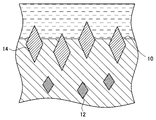
- 10 indicates a resin coating
- 12 indicates an oxide particle
- 14 indicates a crystal of a chemical conversion coating (for example, a crystal of an acid chloride such as a phosphate).
- 16 indicates a coating film.
- a rust preventive pigment may be included in the resin coating film.
- This rust preventive pigment is dissolved by an acidic chemical conversion treatment liquid depending on the type.
- the undoped oxide particles are included in the resin coating film together with the rust preventive pigment, the undoped oxide particles are actively dissolved by the acidic chemical conversion liquid, and therefore the rust preventive pigment is difficult to dissolve. Become. Thereby, corrosion resistance becomes easy to improve.
- the resin coating film may be formed in both surfaces (both main surfaces) of a metal plate according to a use, or one side (one side of a metal plate) It may be formed only on the main surface. Moreover, even if the resin coating film is formed on a part of the surface of the metal plate, the entire surface of the metal plate may be covered. The part of the metal plate on which the resin coating film is formed has excellent adhesion to the coating film and resistance weldability. It also has excellent corrosion resistance and moldability.
- Metal plate examples of the metal plate include various metal plates such as steel (iron-based alloy), aluminum and its alloy, magnesium and its alloy.
- the steel sheet examples include well-known plated steel sheets such as zinc-based plated steel sheets and aluminum-based plated steel sheets.
- the steel plate may be a plain steel plate or a steel plate containing additional elements such as chromium.
- the steel sheet is preferably a steel sheet in which the type and amount of additive element and the metal structure are appropriately controlled so as to have a desired forming process followability.
- Examples of the zinc-based plated layer of the zinc-based plated steel sheet include a zinc-plated layer, an alloy plated layer of zinc and at least one of aluminum, cobalt, tin, nickel, iron, chromium, titanium, magnesium, and manganese. Further, various zinc-based alloy plating layers containing other metal elements or non-metal elements (for example, quaternary alloy plating layers with zinc, aluminum, magnesium, and silicon) can be mentioned. However, in the zinc-based plating layer, alloy components other than zinc are not particularly limited.
- Examples of the aluminum-based plating layer of the aluminum-based plated steel sheet include a plating layer made of aluminum, an alloy plating layer of aluminum and at least one of silicon, zinc, and magnesium (for example, an alloy plating layer of aluminum and silicon, aluminum and the like). Alloy plating layer of zinc, ternary alloy plating layer of aluminum, silicon and magnesium).
- Zinc-based plated steel sheets and aluminum-based plated steel sheets are multi-layer plated steel sheets combined with other types of plating layers (for example, iron plating layers, iron-phosphorus alloy plating layers, nickel plating layers, cobalt plating layers, etc.) Also good.
- plating layers for example, iron plating layers, iron-phosphorus alloy plating layers, nickel plating layers, cobalt plating layers, etc.
- the method for forming the plated layer of the plated steel sheet is not particularly limited.
- electroplating, electroless plating, hot dipping, vapor deposition plating, dispersion plating, or the like can be used.
- the plating layer can be formed by either a continuous method or a batch method. Further, after the plating layer is formed, a process such as a zero spangle process that is a uniform appearance process, an annealing process that is a modification process of the plating layer, and a temper rolling for adjusting the surface state or material may be performed.
- the zinc oxide particles are dissolved in the chemical conversion treatment solution and then promote the growth of crystals of the chemical conversion treatment film (for example, crystals of acid chlorides such as phosphates).
- crystals of the chemical conversion treatment film for example, crystals of acid chlorides such as phosphates.
- the adhesion between the coating film and the coating film can be further improved.
- Magnesium oxide particles, calcium oxide particles, and strontium oxide particles are dissolved in the chemical conversion treatment solution and then taken into the chemical conversion treatment film.
- a chemical conversion film having Mg, Ca, Sn, or Sr having corrosion resistance is formed, and the corrosion resistance can be further improved.
- the average particle diameter of the undoped oxide particles is not particularly limited, but is preferably 0.2 to 5 ⁇ m, more preferably 0.3 to 4 ⁇ m, and still more preferably 0.4 to 2.5 ⁇ m.
- the formed chemical conversion film crystals for example, crystals of acid chlorides such as phosphates
- the anchoring effect of the crystal can further improve the adhesion between the resin coating film and the coating film.
- the “average particle size” of the undoped oxide particles refers to the average primary particle size when the undoped oxide particles present in the resin coating film are present alone.
- Means that the average secondary particle size representing the particle size of the undoped oxide particles at the time of aggregation is preferably obtained by the following measurement method. First, the surface-treated metal plate on which the resin coating film is formed is cut to expose the cross section, and the cross section is further polished. The cross section thus obtained is observed with an electron microscope to obtain an observation image of the cross section in the resin coating film.
- the average value of an average particle diameter changes a little with measurement methods. For example, it may vary depending on the measurement principle when using a particle size distribution meter, and depending on the image processing method in the case of image analysis.
- the range of the particle size of the undoped oxide particles defined in the present specification takes into account such variations, and the particle size obtained by any method is defined in the present specification. If it is within the range, the desired effect can be stably achieved.
- the content of the undoped oxide particles is 1 to 10% by mass with respect to the resin coating film (total solid content of the coating film).
- component crystals of the chemical conversion treatment film to be formed for example, crystals of acid chlorides such as phosphates
- the anchor effect of the chemical conversion treatment film makes it difficult to obtain adhesion between the resin coating film and the coating film.
- the content of the undoped oxide particles exceeds 10% by mass, the formation of the component crystals of the formed chemical conversion film is saturated, and the adhesion between the resin coating film and the coating film is saturated.
- the water-based resin is not particularly limited, and examples thereof include water-soluble or water-dispersible resins such as polyester resins, urethane resins, acrylic resins, epoxy resins, phenol resins, and mixed resins of these two or more resins.
- the molecular weight is preferably 10,000 to 30,000. If the molecular weight is less than 10,000, it may be difficult to ensure sufficient processability. On the other hand, when the molecular weight exceeds 30000, the binding site of the resin itself is lowered, and it may be difficult to ensure excellent adhesion with the coating film.
- the urethane resin when making it bridge
- the urethane resin is preferably in the form of an emulsion having an emulsion particle size of 10 to 100 nm (preferably 20 to 60 nm). If the emulsion particle size is too small, the cost may increase. On the other hand, when the emulsion particle diameter is excessively large, the gap between the emulsions becomes large when the coating film is formed, and the barrier property as a resin coating film may be lowered.
- the type of urethane resin is not particularly limited, and examples thereof include ether-based, polycarbonate-based, ester-based, and acrylic graphite types. These may be used alone or in combination.
- the binder resin may be a crosslinked resin having a crosslinked structure, or may be a non-crosslinked resin having no crosslinked structure.
- the binder resin is preferably a non-crosslinked resin from the viewpoint of low-temperature film formation of the resin coating film.
- a crosslinking agent (curing agent) that imparts a crosslinked structure to the binder resin
- a water-soluble crosslinking agent is preferable.
- Specific examples of the crosslinking agent include melamine and isocyanate.
- the addition amount of the crosslinking agent is not particularly limited, but is preferably 5 to 30 parts by mass with respect to 100 parts by mass of the resin solid content.
- the addition amount of the crosslinking agent is less than 5 parts by mass, the crosslinking reaction with the resin does not sufficiently proceed, and the performance as a coating film may be insufficient.
- the addition amount of the crosslinking agent exceeds 30 parts by mass, the crosslinking reaction proceeds too much, the resin coating film becomes excessively hard, and the workability may be lowered.
- the content of the binder resin is not particularly limited, but is preferably 20 to 80% by mass with respect to the resin coating film (total solid content of the coating film).
- the content of the binder resin is less than 20% by mass, the function as a binder is not manifested, the cohesive strength of the resin coating film is reduced, and the adhesion test and the molding process are performed inside the coating film. Breakdown (cohesive failure of the coating film) may occur easily.
- the content of the binder resin exceeds 80% by mass, the ratio of the pigment component contained in the resin coating film becomes small, and it may be difficult to achieve both weldability, corrosion resistance, and adhesion after coating.
- the content of the binder resin is more preferably 25 to 25% based on the resin coating film (total solid content of the coating film) from the viewpoint of developing the binder function and achieving both weldability, corrosion resistance, and adhesion to the coating film. It is 70% by mass, and more preferably 30 to 60% by mass.
- the conductive particles contribute to improving weldability by imparting conductivity to the resin coating film.
- the conductive particles contained in the resin coating are not particularly limited, and examples include non-oxide ceramic particles, iron alloy particles, stainless steel particles, particles other than iron alloys (metal particles, metal alloy particles, etc.), and the like. .
- the conductive particles are preferably at least one selected from the group consisting of non-oxide ceramic particles, iron alloy particles, and stainless steel particles.
- Non-oxide ceramic particles and stainless steel particles are less likely to deteriorate in the composition even when the resin coating composition is an aqueous composition, and can maintain high electrical conductivity. Thereby, it is possible to maintain excellent weldability of the surface-treated metal plate for a long period of time.
- the iron alloy particles are inferior in stability in an alkaline aqueous composition, but in an acidic aqueous composition containing a part of the polyester resin and the like. Then, it is excellent in stability to some extent. For this reason, when the composition for forming a resin coating film is an acidic aqueous composition, it is possible to maintain the excellent weldability of the surface-treated metal plate for a long period of time.
- non-oxide ceramic particles will be described.
- the non-oxide ceramic constituting the non-oxide ceramic particles is not particularly limited, but preferably has an electrical resistivity (volume resistivity, specific resistance) at 25 ° C. of 0.1 ⁇ 10 ⁇ 6 to 185 ⁇ 10 ⁇ 6 ⁇ cm.
- Non-oxide ceramics (boride ceramics, carbide ceramics, nitride ceramics, silicide ceramics, etc.) in the range of
- the non-oxide ceramic is a ceramic made of an element or compound not containing oxygen.
- boride ceramics, carbide ceramics, nitride ceramics, and silicide ceramics are non-oxide ceramics containing boron B, carbon C, nitrogen N, and silicon Si as main nonmetallic constituent elements, respectively. . These are non-oxide ceramics whose electrical resistivity at 25 ° C. is less than 0.1 ⁇ 10 ⁇ 6 ⁇ cm.
- the non-oxide ceramic particles have high conductivity, the content for imparting sufficient conductivity to the resin coating film can be smaller. As a result, the influence on the corrosion resistance and formability of the surface-treated metal plate due to the inclusion of the conductive particles is further reduced.
- the electrical resistivity of pure metal is in the range of 1.6 ⁇ 10 ⁇ 6 ⁇ cm (Ag simple substance) to 185 ⁇ 10 ⁇ 6 ⁇ cm (Mn simple substance)
- the electrical resistivity is 0.1 ⁇
- Non-oxide ceramics in the range of 10 ⁇ 6 to 185 ⁇ 10 ⁇ 6 ⁇ cm have excellent conductivity comparable to that of pure metals.
- examples of the non-oxide ceramic particles include the following.
- the boride ceramic particles include group IV (Ti, Zr, Hf), group V (V, Nb, Ta), group VI (Cr, Mo, W) transition metals of the periodic table, Mn, Examples include Fe, Co, Ni, rare earth elements, or Group II (Ca, Sr, Ba) boride ceramic particles other than Be and Mg.
- ceramic particles for example, Be 2 B, BeB 6 etc. having an electrical resistivity at 25 ° C. exceeding 185 ⁇ 10 ⁇ 6 ⁇ cm have low electrical conductivity and surface treatment. The weldability of the metal plate may be reduced.
- Mg boride ceramics (Mg 3 B 2 , MgB 2, etc.) particles have low stability to water or acid, and may deteriorate the weldability of the surface-treated metal plate.
- transition metal of Group IV (Ti, Zr, Hf), Group V (V, Nb, Ta), Group VI (Cr, Mo, W) of the periodic table, or Mn examples thereof include carbide ceramic particles of Fe, Co, and Ni.
- rare earth elements and Group II carbide ceramics for example, YC 2 , LaC 2 , CeC 2 , PrC 2 , Be 2 C, Mg 2 C 3 , SrC 2, etc. particles are easily hydrolyzed in a humid atmosphere. The weldability of the surface-treated metal plate may be reduced.
- rare earth elements and Group II nitride (for example, LaN, Mg 3 N 2 , Ca 3 N 2, etc.) particles are easily hydrolyzed in a humid atmosphere, and decrease the weldability of the surface-treated metal plate. There are things to do.
- Silicide ceramic particles include transition metals of Group IV (Ti, Zr, Hf), Group V (V, Nb, Ta) and Group VI (Cr, Mo, W) of the periodic table, or Mn, Fe Co, Ni silicide particles are exemplified.
- rare earth elements and Group II silicide for example, LaSi, Mg 2 Si, SrSi 2 , BaSi 2, etc. particles easily react with water in a humid atmosphere to generate hydrogen, and welding of the surface-treated metal plate It may reduce the sex.
- non-oxide ceramic particles particles of a mixture of two or more selected from the group consisting of these boride ceramics, carbide ceramics, nitride ceramics, and silicide ceramics, these ceramics as metal binders
- grains etc. which were mixed and sintered are illustrated.
- the standard electrode potential of the metal constituting a part of the cermet particles is preferably ⁇ 0.3 V or more.
- the standard electrode potential of the metal constituting a part of the cermet particles is less than ⁇ 0.3 V, if the cermet particles are present in the aqueous composition for a long time, a rust layer or a thick oxide insulating layer is likely to be formed on the surface of the particles. , The conductivity of the particles may be lost.
- the cermet particles having resistance to water deterioration include WC-12Co, WC-12Ni, TiC-20TiN-15WC-10Mo 2 C-5Ni, and the like.
- the standard electrode potentials of Co and Ni are ⁇ 0.28 V and ⁇ 0.25 V, respectively, and both are nobler than ⁇ 0.3 V. Therefore, both metals have water deterioration resistance.
- non-oxide ceramic particles are BaB 6 (electric resistivity 77 ⁇ 10 ⁇ 6 ⁇ cm), CeB 6 (30 ⁇ 10 ⁇ 6 ⁇ cm), Co 2 B (33 ⁇ 10 ⁇ 6 ⁇ cm), CoB ( 76 ⁇ 10 ⁇ 6 ⁇ cm), FeB (80 ⁇ 10 ⁇ 6 ⁇ cm), GdB 4 (31 ⁇ 10 ⁇ 6 ⁇ cm), GdB 6 (45 ⁇ 10 ⁇ 6 ⁇ cm), LaB 4 (12 ⁇ ) 10 -6 ⁇ cm), LaB 6 (same 15 ⁇ 10 -6 ⁇ cm), Mo 2 B ( the 40 ⁇ 10 -6 ⁇ cm), MoB ( the 35 ⁇ 10 -6 ⁇ cm), MoB 2 ( same 45 ⁇ 10 -
- the iron alloy particles are alloy particles of iron and at least one kind of alloy selected from the group consisting of Si, V, Mn, W, Mo, Ti, Ni, and Nb.
- the iron alloy powder include ferrosilicon, ferrovanadium, ferromanganese, ferrotungsten, ferromolybdenum, ferrotitanium, ferronickel, ferroboron, and ferroniobium.
- ferrovanadium, ferrosilicon, and ferromanganese are preferable from the viewpoint of corrosion resistance in addition to weldability.
- the stainless particles will be described.
- the stainless steel particles are alloy particles containing 10.5% by mass or more of Cr in Fe (wherein the C content is 1.2% by mass or less of alloy particles).
- the particle shape of the conductive particles is not particularly limited, but for example, spherical, pseudo-spherical (for example, elliptical sphere, egg, rugby ball, etc.), or polyhedral (for example, soccer ball, dice, brilliant for various gemstones)
- a shape close to a sphere, such as a cut shape, is preferable.
- Conductive particles having a shape close to a sphere are uniformly dispersed in the resin coating film, and can easily form an effective current path through the thickness direction of the resin coating film. As a result, the bondability of the surface-treated metal plate is further improved. .
- the conductive particles having an elongated shape for example, rod shape, needle shape, fiber shape, etc.
- a planar shape for example, flake shape, flat plate shape, flake shape, etc.
- the average particle size of the conductive particles is not particularly limited, but is preferably 0.2 to 5 ⁇ m, more preferably 0.5 to 2.5 ⁇ m.
- the “average particle size” of the conductive particles refers to the average primary particle size when the conductive particles present in the resin coating are present alone, and the conductive particles are present in an aggregated state. In this case, it means an average secondary particle size representing the particle size of the conductive particles at the time of aggregation, and is preferably obtained by the following measurement method.
- the surface-treated metal plate on which the resin coating film is formed is cut to expose the cross section, and the cross section is further polished.
- the cross section thus obtained is observed with an electron microscope to obtain an observation image of the cross section in the resin coating film.
- Select several pigments present in the field of the observed image measure the long side length and short side length of each conductive particle, and calculate the average value of the long side length and the average value of the short side length.
- the average particle size is calculated by calculating and further averaging these.
- the content of the conductive particles is 5 to 30% by mass with respect to the resin coating film (total solid content of the coating film).
- the content of the conductive particles is less than 5% by mass, the weldability of the surface-treated metal plate cannot be obtained sufficiently.
- content of electroconductive particle exceeds 30 mass%, adhesiveness with a coating film falls with the cohesion force fall of a coating film.
- the content of the conductive particles is preferably 10 to 20% by mass with respect to the resin coating film (total solid content of the coating film) from the viewpoint of weldability, coating film adhesion and the like.
- the resin coating preferably contains a rust preventive pigment.
- the rust preventive pigment can improve the corrosion resistance of the surface-treated metal plate, particularly the surface of the metal plate adjacent to the resin coating film.
- the anticorrosive pigment that can be contained in the resin coating is not particularly limited, but preferably aluminum tripolyphosphate, phosphoric acid and phosphorous acid Zn, Mg, Al, Ti, Zr and Ce salts, hydrocalumite treated Phosphate compounds (for example, EXPERT NP-530 N5 manufactured by Toho Pigment, which is a hydrocalumite treatment of zinc phosphate), Ca ion-exchanged silica, and oil absorption of 100 to 1000 ml / 100 g, specific surface area of 200 to 1000 m 2 / g And at least one selected from the group consisting of amorphous silica having an average particle size of 2 to 30 ⁇ m.
- preferred rust preventive pigments are phosphate-based rust preventive pigments (aluminum tripolyphosphate, hydrocalumite-treated phosphate compounds, etc.), silica-based anti-corrosive pigments, from the viewpoint of the compatibility between the corrosion resistance of the heel and flat portions. Rust pigment or a combination of both.
- Particularly preferred rust preventive pigments are aluminum tripolyphosphate, hydrocalumite-treated phosphate compound, Ca-exchanged silica, oil absorption of 100 to 1000 ml / 100 g, specific surface area of 200 to 1000 m 2 / g, and average particle size of 2 to 30 ⁇ m. It is at least one selected from the group consisting of amorphous silica.
- the oil absorption of silica can be measured according to JIS K 5101-13-2.
- the specific surface area of silica can be measured by the BET method.
- the average particle diameter of silica can be measured by the same method as the average particle diameter of conductive particles.
- the content of the rust preventive pigment is preferably 5 to 40% by mass with respect to the resin coating film (total solid content of the coating film).
- the content of the rust preventive pigment is less than 5% by mass, the corrosion resistance may not be sufficiently obtained.
- content of a rust preventive pigment exceeds 40 mass%, the workability of a coating film and the cohesion force may fall.
- the content of the rust preventive pigment is preferably 7.5 to 35% by mass, more preferably 10 to 30% by mass, based on the resin coating film (total solid content of the coating film). is there.
- the resin coating film may contain other additives.
- Other additives include well-known additives such as extender pigments, solid lubricants, and leveling agents.
- extender pigments examples include silica (including colloidal silica), titania, zirconia, and the like.
- solid lubricant excellent lubricity can be imparted to the resin coating film, and powdering resistance can be improved.
- the solid lubricant include the following solid lubricants (1) to (2).
- Polyolefin wax, paraffin wax For example, polyethylene wax, synthetic paraffin, natural paraffin, micro wax, chlorinated hydrocarbon, etc.
- Fluororesin wax For example, polyfluoroethylene resin (polytetrafluoroethylene resin, etc.) Polyvinyl fluoride resin, polyvinylidene fluoride resin, etc.
- the average particle size of the solid lubricant is preferably 0.05 to 25 ⁇ m.
- the average particle size of the solid lubricant is less than 0.05 ⁇ m, the lubricant occupies the surface area of the resin coating due to thickening of the lubricant, and the adhesion between the resin coating and the coating film tends to increase. May decrease.
- the average particle diameter of the solid lubricant exceeds 25 ⁇ m, the lubricant is likely to fall off from the resin coating film, and it is difficult to obtain a predetermined lubricity, and the corrosion resistance may be lowered.
- the average particle size of the solid lubricant is more preferably from 1 to 15 ⁇ m, and even more preferably from 3 to 10 ⁇ m from the viewpoint of obtaining excellent paint adhesion, corrosion resistance, lubricity, and powdering resistance.
- the softening point of the solid lubricant is preferably 100 to 135 ° C, more preferably 110 to 130 ° C. When the softening point of the solid lubricant is 100 ° C. to 135 ° C., lubricity and powdering resistance are further improved.
- the content of the solid lubricant is preferably 0.1 to 10% by mass with respect to the resin coating film (total solid content of the coating film). When the content of the solid lubricant is less than 0.1% by mass, sufficient lubricity may not be obtained. When content of a solid lubricant exceeds 10 mass%, the adhesiveness of a resin coating film and a coating film and corrosion resistance may fall.
- the content of the solid lubricant is more preferably 0.2 to 5 mass with respect to the resin coating film (total solid content of the coating film) in terms of adhesion between the resin coating film and the coating film, lubricity, and corrosion resistance. %, More preferably 0.5 to 2.5% by mass.
- Formation of resin coating It does not specifically limit as a formation method of a resin coating film, A well-known method can be utilized.
- a composition for forming a resin coating film obtained by mixing a binder resin, conductive particles, oxide particles, and, if necessary, a rust preventive pigment and other additives in a solvent is obtained.
- the solvent may be water or an organic solvent, but is preferably water from the viewpoint of production cost and environmental suitability. That is, the composition for forming a resin coating film is preferably an aqueous composition.
- the resin coating film can be formed by apply
- a well-known functional film such as a ground treatment film for further improving the adhesion of the coating film to the metal plate and the corrosion resistance may be interposed between the metal plate and the resin coating film.
- the ground treatment film may be a chromate treatment film or a ground treatment film (chromate-free treatment film) substantially free of chromium.
- chromate-free treatment liquids include silica-based treatment liquids containing silicon compounds such as liquid phase silica, vapor phase silica and silicate as main film components, and zircon-based treatment liquids containing zircon compounds as main film components. It is done.
- the coating member according to the first embodiment includes a molding material made of the surface-treated metal plate according to the first embodiment, and a chemical conversion treatment film positioned on the coating film (resin coating film) of the molding material. And a coating film positioned on the chemical conversion film.
- the molding material is obtained by molding the above-described surface-treated metal plate as a material.
- the shape of a molding material is not specifically limited, It can have a shape according to the use of the coating member.
- the molding material may be obtained by joining a plurality of surface-treated metal plates by welding, adhesion, or the like. Since the surface-treated metal plate according to the present embodiment is excellent in weldability, defects such as cracks due to welding are prevented even when the formed material is welded.
- the chemical conversion treatment film is a film that is located on the resin coating film and formed by performing chemical conversion treatment on the resin coating film surface.
- a chemical conversion treatment film is not specifically limited, For example, it is preferable that it is a film
- a phosphate-containing film has a structure as shown in FIGS. 1B and 1C as described above, because the surface of the resin coating film is in contact with an acidic chemical conversion solution at the time of formation. It tends to be easy.
- Such phosphates include crystalline or amorphous phosphates. From the viewpoint of allowing wedge-shaped phosphate to be present in the chemical conversion film, crystalline phosphate is preferred.
- Examples of the crystalline phosphate include zinc phosphate (hopeite: Zn 3 (PO 4 ) 2 .4H 2 O) and zinc iron phosphate (phosphophyllite: Zn 2 Fe (PO 4 ) 2 .4H 2. O), manganese phosphate (huriolite: Mn 5 (PO 3 (OH)) 2 (PO 4 ) 2 .4H 2 O), manganese iron phosphate ((Mn 1-x Fe x ) 5 H 2 (PO 4) 4 ⁇ 4H 2 O, wherein, x is etched during the iron-based metallic material is chemical conversion treatment, a representative .0 ⁇ x ⁇ 1 that the iron component is contained in the film.)
- Examples include zinc calcium phosphate (Solzite: CaZn 2 (PO 4 ) 2 .2H 2 O).
- Examples of the amorphous phosphate include iron phosphate, tin phosphate, zirconium phosphate, titanium phosphate, and hafnium phosphat
- the coating member which concerns on 1st embodiment is not specifically limited, For example, a motor vehicle member (automobile body, a suspension member, etc.), a mechanical member (housing, etc.), a household appliance member (housing, etc.), a building material (roof, It can be widely used for walls, etc.).
- chemical conversion treatment is performed on the molding material to form a chemical conversion treatment film on the resin coating film.
- the chemical conversion treatment solution and treatment conditions used for the chemical conversion treatment can be appropriately selected according to the state and composition of the chemical conversion treatment film to be formed.
- the pH of the chemical conversion solution is not particularly limited, but is preferably 1.0 to 5.0, and more preferably 2.0 to 4.0.
- a coating treatment is performed on the resin coating film of the molding material that has been subjected to chemical conversion treatment.
- a coating film is formed on the resin coating film on which the chemical conversion treatment has been performed.
- known coating processes such as electrodeposition coating, powder coating, and solvent coating are applied.
- a coating film can be formed by performing a coating process in multiple times.
- the surface-treated metal plate according to the second embodiment is a metal plate, A coating film disposed on at least one main surface of the metal plate,
- the coating film includes oxide particles, a binder resin, and conductive particles,
- the content of the conductive particles is 5 to 30% by mass with respect to the coating film
- the oxide particles include at least doped oxide particles,
- the doped oxide particles include at least one selected from the group consisting of doped zinc oxide particles and doped tin oxide particles,
- the content of the oxide particles is 1 to 30% by mass with respect to the coating film, and the adhesion amount of the coating film to the main surface is 2 to 20 g / m 2 .
- the doped chemical oxide treatment solution dissolves the doped oxide particles exposed on the surface of the resin coating film. To do. Then, the pH in the vicinity thereof rises, and components of the chemical conversion liquid (for example, acid chlorides such as phosphates) precipitate and grow. Thereby, a chemical conversion treatment film is formed. At this time, the dope-type oxide particles present inside the surface of the resin coating are also dissolved by the acidic chemical conversion liquid, and the components of the chemical conversion liquid enter and deposit inside the surface of the resin coating, It is thought that it grows in a wedge shape so as to protrude from the inside of the surface layer to the surface (see FIG.
- the chemical conversion liquid for example, acid chlorides such as phosphates
- crystals of the chemical conversion coating for example, crystals of acid chlorides such as phosphates
- SEM Sccanning Electron Microscope
- diffraction peaks by X-ray diffraction analysis can do.
- the doped oxide particles have electrical conductivity
- inclusion in the above range increases the electrical conductivity of the resin coating film in addition to the adhesion between the resin coating film and the coating film, and also improves the weldability. improves.
- the effect of the adhesiveness of the resin coating film by a dope-type oxide particle and a coating film and weldability improves by making the adhesion amount into the said range.
- grains are included in the resin film in the said range, electroconductivity becomes high, and it is excellent also in weldability.
- the surface-treated metal plate according to the second embodiment is excellent in both adhesiveness and weldability with the coating film after coating due to the above configuration.
- 10 shows a resin coating film in FIG. 1
- 12 shows dope-type oxide particle
- 14 shows the crystal
- 16) shows a coating film.
- a rust preventive pigment may be included in the resin coating film.
- This rust preventive pigment is dissolved by an acidic chemical conversion treatment liquid depending on the type.
- oxide particles are included in the resin coating film together with the rust preventive pigment, the oxide particles are actively dissolved by the acidic chemical conversion treatment solution, and thus the rust preventive pigment is hardly dissolved. Thereby, corrosion resistance becomes easy to improve.
- the resin coating film may be formed in both surfaces (both main surfaces) of a metal plate according to a use, or one side (one side of a metal plate) It may be formed only on the main surface. Moreover, even if the resin coating film is formed on a part of the surface of the metal plate, the entire surface of the metal plate may be covered. The part of the metal plate on which the resin coating film is formed has excellent adhesion to the coating film and resistance weldability. It also has excellent corrosion resistance and moldability.
- the surface-treated metal plate according to the second embodiment is the surface treatment according to the first embodiment except that the resin coating film includes doped oxide particles instead of the predetermined undoped oxide particles. It is the same structure as a metal plate. For this reason, description of the same configuration is omitted.
- the oxide particles include doped oxide particles.
- the doped oxide particles include at least one selected from the group consisting of zinc oxide particles and tin oxide particles.
- doped zinc oxide is taken as an example.
- At least one element selected from the group consisting of Group 13 elements of Periodic Table and Group 15 elements of Periodic Table (hereinafter referred to as “Doped Elements”). ”) Is also included in the oxide particles so as to exhibit conductivity.
- B, Al, Ga, In etc. are mentioned as a periodic table group 13 element.
- Examples of Group 15 elements of the Periodic Table include P and As.
- Al, Ga, and Sb are preferable as the doping element from the viewpoint of improving conductivity.
- zinc oxide Al is more preferable from the viewpoint of cost.
- the content of the doping element is preferably 0.05 to 5 atom%, more preferably 0.1 to 5 atom%, based on the undoped oxide particles, from the viewpoint of improving conductivity.
- the average particle diameter of the doped oxide particles is preferably 0.2 to 5 ⁇ m, more preferably 0.3 to 4 ⁇ m, and still more preferably 0.4 to 2.5 ⁇ m.
- the formed chemical conversion film crystals for example, crystals of acid chlorides such as phosphates
- the adhesion between the resin coating film and the coating film can be further improved by the crystal anchor effect.
- the resin coating is “zinc oxide particles, magnesium oxide particles, calcium oxide particles in the resin coating of the surface-treated metal plate according to the first embodiment. It may contain at least one oxide particle selected from the group consisting of tin oxide particles and strontium oxide particles.
- the content of the oxide particles is 1 to 30% by mass with respect to the resin coating film (total solid content of the coating film).
- the component crystals of the chemical conversion film to be formed for example, crystals of acid chlorides such as phosphates
- the anchor effect of the film makes it difficult to obtain adhesion between the resin coating film and the coating film. Further, it becomes difficult to obtain weldability.
- the content of the oxide particles exceeds 30% by mass, the formation of the component crystals of the chemical conversion film formed is saturated, and the adhesion between the resin coating film and the coating film is saturated, and the coating film Performances such as corrosion resistance before painting may become insufficient due to a decrease in the ratio of conductive particles and anti-corrosive pigments.
- the content of the oxide particles is preferably 10 to 20% by mass from the viewpoint of further improving the adhesion between the resin coating film and the coating film due to the crystal anchor effect of the chemical conversion coating and further improving the weldability. .
- the content of the non-doped oxide particles is preferably a resin from the viewpoint of improving adhesion with a coated film after coating and weldability. It is 1 to 10% by mass (preferably 2.5 to 7.5% by mass) based on the coating film.
- the resin coating preferably contains a rust preventive pigment.
- the rust preventive pigment can improve the corrosion resistance of the surface-treated metal plate, particularly the surface of the metal plate adjacent to the resin coating film.
- the anticorrosive pigment that can be contained in the resin coating is not particularly limited, but preferably aluminum tripolyphosphate, phosphoric acid and phosphorous acid Zn, Mg, Al, Ti, Zr and Ce salts, hydrocalumite treated Phosphate compounds (for example, EXPERT NP-530 N5 manufactured by Toho Pigment, which is a hydrocalumite treatment of zinc phosphate), Ca ion-exchanged silica, and oil absorption of 100 to 1000 ml / 100 g, specific surface area of 200 to 1000 m 2 / g And at least one selected from the group consisting of amorphous silica having an average particle size of 2 to 30 ⁇ m.
- preferred rust preventive pigments are phosphate-based rust preventive pigments (aluminum tripolyphosphate, hydrocalumite-treated phosphate compounds, etc.), silica-based anti-corrosive pigments, from the viewpoint of the compatibility between the corrosion resistance of the heel and flat portions. Rust pigment or a combination of both.
- Particularly preferred rust preventive pigments are aluminum tripolyphosphate, hydrocalumite-treated phosphate compound, Ca-exchanged silica, oil absorption of 100 to 1000 ml / 100 g, specific surface area of 200 to 1000 m 2 / g, and average particle size of 2 to 30 ⁇ m. It is at least one selected from the group consisting of amorphous silica.
- the resin coating film when the resin coating film contains doped or undoped zinc oxide particles, the resin coating film preferably contains aluminum trihydrogen phosphate containing Mg as a rust preventive pigment.
- Mg-containing aluminum trihydrogenphosphate include magnesium-treated products of aluminum dipolyphosphate, magnesium hydroxide mixture of aluminum tripolyphosphate, and the like.
- Mg-containing trihydrogenaluminum diphosphate By including Mg-containing trihydrogenaluminum diphosphate in the resin coating, zinc oxide reacts with Mg and tripolyaluminum dihydrogenaluminum to produce composite oxides and composites of Zn-Mg and Zn-phosphate compounds. By forming the compound, it is presumed to have excellent corrosion resistance.
- the coating member which concerns on 2nd embodiment is the molding material which uses the surface treatment metal plate which concerns on said 2nd embodiment as a material, the chemical conversion treatment film located on the coating film of the said molding material, and the said chemical conversion treatment film And a coating film located on the top. That is, the coating member according to the second embodiment relates to the first embodiment except that the surface-treated substrate according to the second embodiment is applied instead of the surface-treated metal plate according to the first embodiment. It is the same composition as a painting member. For this reason, description is abbreviate
- the manufacturing method of the painted member according to the second embodiment is also the first embodiment except that the surface-treated substrate according to the second embodiment is applied instead of the surface-treated metal plate according to the second embodiment. It is the same structure as the manufacturing method of the coating member which concerns on a form. For this reason, description is abbreviate
- Example of a surface-treated metal sheet according to the first embodiment> [Manufacture of surface-treated metal sheets] 1. Preparation of metal plate Prepare the following 4 types of galvanized steel plate and AL plate and immerse in 2.5% by weight, 40 ° C aqueous solution of water based alkaline degreasing agent (Nippon Parkerizing Co., Ltd. FC-301) for 2 minutes. After degreasing the surface, it was washed with water and dried to obtain a metal plate for coating.
- water based alkaline degreasing agent Nippon Parkerizing Co., Ltd. FC-301
- EG electrogalvanized steel sheet (plate thickness 0.8 mm, plating adhesion 40 g / m 2 )
- ZL Electric Zn-10 mass% Ni alloy plated steel sheet (plate thickness 0.8 mm, plating adhesion 40 g / m 2 )
- GI hot dip galvanized steel sheet (plate thickness 0.8 mm, plating adhesion 60 g / m 2 )
- GA Alloyed hot-dip galvanized steel sheet (plate thickness 0.8 mm, 10 mass% Fe, plating adhesion 45 g / m 2 )
- AL 6000 series AL plate (plate thickness 1.0mm)
- compositions for forming a base treatment film were prepared, and this composition was bar-coated on a metal plate so that the film thickness was 0.08 ⁇ m, and this was applied to a hot stove Was dried at a metal surface arrival temperature of 70 ° C. and air-dried to form a base treatment film on the surface of the metal plate.
- P1 A composition for water-based coating comprising a Zr compound, a silane coupling agent and silica fine particles
- p2 A composition for water-based coating comprising a polyester resin, silica fine particles and a silane coupling agent
- each component was mixed so that the solid content concentration was the same as in Tables 1 and 2, and the resin coating film was formed.
- An aqueous composition for forming a coating film was prepared. According to Tables 3 to 5, the obtained aqueous composition was coated on a metal plate with a bar coater, and dried using an oven under the condition that it was held at a maximum temperature of 140 ° C. for 8 seconds. Formed.
- the adhesion amount of the resin coating film was adjusted by dilution of the aqueous composition and the number of the bar coater so that the total adhesion amount of the solid content (nonvolatile content) in the aqueous composition became the values shown in Tables 3 to 5.
- the solid content concentration of each component is the ratio of the solid content (nonvolatile content) of each component to the solid content (nonvolatile content) of the entire aqueous composition (unit: mass%, value per side). .).
- Conductive particles / VC Vanadium carbide (average particle size of 1 to 3 ⁇ m) ⁇
- ZS Zirconium disilicide particles (average particle size of 1 to 3 ⁇ m)
- ZN zirconium nitride particles (average particle size of 1 to 3 ⁇ m)
- TN Titanium nitride particles (average particle size of 1 to 3 ⁇ m)
- FeV ferrovanadium particles (average particle size 3-7 ⁇ m)
- FeSi Ferrosilicon particles (average particle size 3-7 ⁇ m)
- SUS SUS particles (average particle size 3-7 ⁇ m)
- the various oxide particles described above were dispersed in water with added resin and pulverized with a ball mill. About the average particle diameter of oxide particle
- the surface of the molding material after chemical conversion treatment (phosphate treatment) is observed with an arbitrary five visual fields (125 ⁇ m ⁇ 90 ⁇ m) with a 1000 ⁇ scanning electron microscope (SEM) to obtain a reflected electron image (BSE image). It was. In the reflected electron image, the observation area was displayed in gray scale. In the reflected electron image, the contrast is different between the portion where the phosphate coating that is the chemical conversion coating is formed and the portion where the phosphate coating is not formed. Therefore, the numerical value range X1 of the brightness (multiple gradations) of the portion where the phosphate film is not formed was determined in advance by SEM and EDS (energy dispersive X-ray spectrometer).
- C in the “Chemical conversion treatment” column in Tables 3 to 5 means that the see-through area ratio was 15% or more.
- B means that the transparent area ratio was 5% or more and less than 15%.
- A means that the transparent area ratio was less than 5%. In the sheer evaluation, when it was “B” or “A”, it was judged that the chemical conversion treatment property (phosphate treatment property) was excellent.
- “D” in the “Electrodeposition adhesion” column of Tables 3 to 5 means that the coating film peeling rate was 10.0% or more. “C” means 5.0% or more and less than 10.0%. “B” means that the coating film peeling rate was less than 5.0% and 1.0% or more. “A” means that the coating film peeling rate was less than 1.0%. In the electrodeposition coating film adhesion evaluation, when “B” or “A”, it was judged that the electrodeposition coating film adhesion was excellent.
- “D” in the “SDT resistance” column in Tables 3 to 5 means that the coating film peeling rate was 30.0% or more. “C” means 10.0% or more and less than 30.0%. “B” means that the coating film peeling rate was less than 10.0% and 5.0% or more. “A” means that the coating film peeling rate was less than 5.0%. In the SDT resistance evaluation, when it was “B” or “A”, it was judged that the SDT resistance was excellent.
- A The number of striking points is 1000 points or more B: 200 points or more, less than 1000 points C: Less than 200 points D: Nugget is not generated and one point cannot be welded.
- B 200 points or more
- C Less than 200 points
- D Nugget is not generated and one point cannot be welded
- “B” or “A” In some cases, it was judged that the weldability was excellent.
- “E” in the “Cycle corrosion (corrosion resistance) test” column in Tables 3 to 5 means that there was a swelling of the coating film of more than 3 mm.
- “D” means that there was a swollen film of 1.5 mm or more and less than 3 mm.
- “C” means that there was a swollen coating film of 1 mm or more and less than 1.5 mm.
- “B” means that there was a minute swelling of the coating film of less than 1 mm.
- “A” means that there was no swelling of the coating film. In this cycle corrosion (corrosion resistance) test, when “C”, “B” or “A”, it was judged that the cycle corrosion (corrosion resistance) was excellent.
- sample Nos. Nos. 1 to 5, 8 to 21, 23 to 25, 27 to 29, 31 to 66, and 69 to 73 are sample Nos.
- surface-treated metal plates corresponding to comparative examples It can be seen that both the electrodeposition coating film adhesion (primary adhesion) and the SDT resistance (secondary adhesion) after coating are higher than those of 6 and 7.
- sample No. of the surface treatment metal plate corresponding to an Example As shown by 1-3, it can be seen that the powder coating film adhesion is also high. And it turns out that corrosion resistance is also excellent. Sample No. of the surface-treated metal plate corresponding to the example. Nos.
- sample No. of the surface-treated metal plate corresponding to the example 76 to 80, 82 to 88, 90 to 107, and 110 to 114 are sample Nos.
- surface-treated metal plates corresponding to the comparative examples Compared to 76, 82, 90, and 110, it can be seen that both the adhesion (primary adhesion) and the SDT resistance (secondary adhesion) of the electrodeposition coating film after coating are high.
Landscapes
- Chemical & Material Sciences (AREA)
- Organic Chemistry (AREA)
- Engineering & Computer Science (AREA)
- Materials Engineering (AREA)
- Wood Science & Technology (AREA)
- Life Sciences & Earth Sciences (AREA)
- Chemical Kinetics & Catalysis (AREA)
- Metallurgy (AREA)
- Health & Medical Sciences (AREA)
- Medicinal Chemistry (AREA)
- Polymers & Plastics (AREA)
- Inorganic Chemistry (AREA)
- Mechanical Engineering (AREA)
- Dispersion Chemistry (AREA)
- Electrochemistry (AREA)
- General Chemical & Material Sciences (AREA)
- Laminated Bodies (AREA)
- Other Surface Treatments For Metallic Materials (AREA)
- Paints Or Removers (AREA)
- Application Of Or Painting With Fluid Materials (AREA)
Abstract
Description
のクロム付着量を有するクロメート被覆めっき鋼板に、芳香族エポキシ樹脂をウレタン樹脂で変性した樹脂であって、しかも固形分換算で10~80重量%の芳香族エポキシ樹脂を含有した樹脂に、固形分換算で該樹脂の100重量部に対し、10~80重量部なる範囲の2~12nmの粒径を有するSiO2、Cr2O3、Fe2O3、Fe3O4、MgO、ZrO2、SnO2、Al2O3、Sb2O5の粉末もしくはコロイド(ゾル)の1種または2種以上を添加した樹脂組成物を0.5~3.0g/m2塗布、硬化せしめてなる有機皮膜を有する有機複合めっき鋼板が記載されている。特許文献11では、有機複合めっき鋼板は、塗料との密着性、連続溶接性および加工後裸耐蝕性を同時に満足し、車体防錆鋼板、家電、建材等の用途に広く利用することができることが記載されている。
しかしながら、塗装膜との密着性および溶接性については、上記各文献に記載された技術でも研究開発されているが、昨今の要求レベルが増すなかで、更なる改善が望まれているのが現状である。
前記金属板の少なくとも一方の主面に配置された塗膜と、を有し、
前記塗膜は、酸化物粒子と、バインダー樹脂と、導電性粒子と、を含み、
前記導電性粒子の含有量は、前記塗膜に対して5~30質量%であり、
前記酸化物粒子は、非ドープ型酸化物粒子および/またはドープ型酸化物粒子を含み、
前記非ドープ型酸化物粒子は、酸化亜鉛粒子、酸化スズ粒子、酸化マグネシウム粒子、酸化カルシウム粒子および酸化ストロンチウム粒子からなる群から選択される少なくとも1種を含み、
ドープ型酸化物粒子は、ドープ型酸化亜鉛粒子およびドープ型酸化スズ粒子からなる群から選択される少なくとも1種を含み、
前記酸化物粒子の含有量は、前記酸化物粒子が前記ドープ型酸化物粒子を含む場合前記塗膜に対して1~30質量%であり、前記酸化物粒子が前記ドープ型酸化物粒子を含まない場合前記塗膜に対して1~10質量%であり、および
前記塗膜の前記主面への付着量が2~20g/m2である、表面処理金属板。
<2> 前記酸化物粒子の平均粒径が、0.2~5μmである、<1>に記載の表面処理金属板。
<3> 前記バインダー樹脂が、水溶性または水分散性の水系樹脂である、<1>または<2>に記載の表面処理金属板。
<4> 前記導電性粒子が、非酸化物セラミクス粒子、鉄合金粒子、およびステンレス粒子からなる群から選択される少なくとも1種を含む、<1>~<3>のいずれか一項に記載の表面処理金属板。
<5> 前記導電性粒子が、非酸化物セラミクス粒子と、鉄合金粒子およびステンレス粒子からなる群から選択される少なくとも1種との2種以上を含み、
前記非酸化物セラミクス粒子と、前記鉄合金粒子、および前記ステンレス粒子よりなる群から選択される少なくとも1種との質量比(前記非酸化物セラミクス粒子/前記鉄合金粒子、および前記ステンレス粒子よりなる群から選択される少なくとも1種)が、1/9~8/2である<1>~<4>のいずれか一項に記載の表面処理金属板。
<6> 前記塗膜は、さらに防錆顔料を含む、<1>~<5>のいずれか一項に記載の表面処理金属板。
<7> 前記防錆顔料が、トリポリリン酸アルミニウム、リン酸および亜リン酸のZn、Mg、Al、Ti、ZrおよびCe塩、ハイドロカルマイト処理されたリン酸化合物、Caイオン交換シリカならびに、吸油量100~1000ml/100g、比表面積200~1000m2/gかつ平均粒径2.0~30μmの非晶質シリカからなる群から選択される少なくとも1種を含む、<6>に記載の表面処理金属板。
<8> 前記酸化物粒子が前記ドープ型酸化物粒子を含み、前記トリポリリン酸アルミニウムが、Mgを含有するトリポリリン酸アルミニウムである、<7>に記載の表面処理金属板。
<9> 前記金属板が、亜鉛系めっき鋼板、またはアルミニウム系めっき鋼板である<1>~<8>のいずれか一項に記載の表面処理金属板。
<10> <1>~<9>のいずれか一項に記載の表面処理金属板を材料とする成形材と、
前記成形材の塗膜上に位置する化成処理皮膜と、
前記化成処理皮膜上に位置する塗装膜と、
を有する塗装部材。
<11> <1>~<9>のいずれか一項に記載の表面処理金属板が成形された成形材に対し化成処理を行い、塗膜上に化成処理皮膜を形成する工程と、
前記化成処理被膜上に塗装膜を形成する工程と、を有する、塗装部材の製造方法。
以下、本発明の一例である実施形態について説明する。なお、本明細書において、「~」で示された数値範囲は、その前後に記載される数値を各々含む範囲を示す。
まず、第一の実施形態に係る表面処理金属板について説明する。
第一の実施形態に係る表面処理金属板は、金属板と、金属板の少なくとも一方の主面に配置された塗膜(以下「樹脂塗膜」とも称する)と、を有し、
塗膜は、酸化物粒子と、バインダー樹脂と、導電性粒子と、を含み、
導電性粒子の含有量は、塗膜に対して5~30質量%であり、
酸化物粒子は、非ドープ型酸化物粒子を含み、
非ドープ型酸化物粒子は、酸化亜鉛粒子、酸化スズ粒子、酸化マグネシウム粒子、酸化カルシウム粒子および酸化ストロンチウム粒子からなる群から選択される少なくとも1種を含み、
酸化物粒子の含有量は、前記塗膜に対して1~10質量%であり、および
塗膜の上記主面への付着量が2~20g/m2である。
なお、第一の実施形態においては、図1中、10は樹脂塗膜を示し、12は酸化物粒子を示し、14は化成処理皮膜の結晶(例えばリン酸塩等の酸塩化物の結晶)を示し、16は塗装膜を示す。
金属板としては、鋼(鉄系合金)、アルミニウムおよびその合金、マグネシウムおよびその合金等の各種金属板が挙げられる。
なお、これらに亜鉛系めっき層には、更に、少量の異種金属元素または不純物として、コバルト、モリブデン、タングステン、ニッケル、チタン、クロム、アルミニウム、マンガン、鉄、マグネシウム、鉛、ビスマス、アンチモン、スズ、銅、カドミウム、ヒ素等を含んでもよいし、シリカ、アルミナ、チタニア等の無機物を含んでもよい。
樹脂塗膜は、上述した金属板の少なくとも一方の主面に(すなわち、少なくとも片面に)配置されている。樹脂塗膜は、バインダー樹脂と、導電性粒子と、非ドープ型酸化物粒子とを含む。樹脂塗膜は、必要に応じて、防錆顔料や、その他添加剤を含んでもよい。
非ドープ型酸化物粒子は、上述したように、化成処理皮膜を介した樹脂塗膜と塗装膜との密着性を向上させることができる。非ドープ型酸化物粒子は、酸化亜鉛粒子、酸化スズ粒子、酸化マグネシウム粒子、酸化カルシウム粒子、および酸化ストロンチウム粒子よりなる群から選択される少なくとも1種を含む。これらの中でも、塗装膜の密着性向上の点から、酸化物粒子として、酸化マグネシウム粒子、酸化亜鉛粒子、酸化スズ粒子、および酸化カルシウム粒子よりなる群から選択される少なくとも1種が好ましい。
酸化マグネシウム粒子、酸化カルシウム粒子、および酸化ストロンチウム粒子(特に、酸化マグネシウム粒子、酸化カルシウム粒子、および酸化スズ粒子)は、化成処理液により溶解した後、化成処理皮膜中に取り込まれる。耐食性を有するMg、Ca、SnまたはSrを有する化成処理皮膜が形成され、より耐食性を向上させることができる。
なお、平均粒径の数値は計測方法によって若干変動する。例えば、粒度分布計を用いる場合には測定原理によって、画像解析の場合には画像処理方法によって変動しうる。しかしながら、本明細書において規定される非ドープ型酸化物粒子の粒径の範囲はこうした変動を考慮したものであり、いずれの方法によって得られた粒径であっても、本明細書に規定される範囲であれば、所期の効果を得ることが安定的に実現される。
非ドープ型酸化物粒子の含有量が1質量%未満の場合、形成される化成処理皮膜の成分結晶(例えばリン酸塩等の酸塩化物の結晶)が樹脂塗膜の表層内部に形成され難く、化成処理皮膜のアンカー効果により樹脂塗膜と塗装膜との密着性が得られ難くなる。一方、非ドープ型酸化物粒子の含有量が10質量%を超える場合、形成される化成処理皮膜の成分結晶の形成が飽和することで、樹脂塗膜と塗装膜との密着性が飽和するとともに、樹脂塗膜中に占める導電性粒子、防錆顔料の比率が低下することで、溶接性、塗装前の耐食性等の性能が不十分となることがある。
非ドープ型酸化物粒子の含有量は、化成処理皮膜の結晶のアンカー効果により樹脂塗膜と塗装膜との密着性を更に向上する点から、好ましくは2.5~7.5質量%である。
バインダー樹脂は、樹脂塗膜中の各成分を結着する結着剤として機能する。バインダー樹脂は、水に溶解または分散する水溶性または水分散性の水系樹脂、および、有機溶剤に溶解または分散する溶剤系樹脂のいずれであってもよいが、製造コスト、環境適性の点から、水系樹脂が好ましい。
水系樹脂としてポリエステル樹脂を用いる場合には、分子量は10000~30000であることが好ましい。分子量が10000未満であると十分な加工性を確保するのが困難になることがある。一方、分子量が30000を超えると樹脂自体の結合サイトが低下し、塗装膜と優れた密着性を確保するのが困難になることがある。また、メラミン等の硬化剤を使用して架橋させる場合、架橋反応が十分に行われず樹脂塗膜としての性能が低下することがある。
水系樹脂としてウレタン樹脂を用いる場合には、好ましくはウレタン樹脂は、エマルション粒子径が10~100nm(好ましくは20~60nm)のエマルションの形態である。エマルション粒子径が過度に小さい場合、コスト高になることがある。一方、エマルション粒子径が過度に大きい場合には、塗膜化した際にエマルション同士の隙間が大きくなり樹脂塗膜としてのバリア性が低下することがある。ウレタン樹脂のタイプとしては、特に限定されないが、エーテル系、ポリカーボネイト系、エステル系、アクリルグラファイトタイプ等が挙げられる。これらを、単独で用いてもよいし、または併用してもよい。
バインダー樹脂に架橋構造を付与する架橋剤(硬化剤)としては、水溶性の架橋剤が好ましい。架橋剤として具体的には、メラミン、イソシアネート等が好ましい。架橋剤の添加量は、特に限定されないが、好ましくは樹脂固形分100質量部に対して5質量部~30質量部である。架橋剤の添加量が5質量部未満だと樹脂との架橋反応が十分に進まず、塗膜としての性能が不十分となることがある。一方、架橋剤の添加量が30質量部より多くなると架橋反応が進みすぎて、樹脂塗膜が過度に硬くなり、加工性が低下することがある。
バインダー樹脂の含有量が20質量%未満である場合、バインダーとしての機能が発現せず、樹脂塗膜の凝集力が低下し、密着性試験や成形加工を行った際に塗膜の内部での破壊(塗膜の凝集破壊)が起こりやすくなることがある。バインダー樹脂の含有量が80質量%を超えると、樹脂塗膜中に含まれる顔料成分の比率が小さくなり、溶接性、耐食性、塗装後密着性を両立することが困難となることがある。
バインダー樹脂の含有量は、バインダー機能を発現し、溶接性、耐食性、および塗装膜との密着性を両立させる点から、より好ましくは樹脂塗膜(塗膜の全固形分)に対して25~70質量%であり、さらに好ましくは30~60質量%である。
導電性粒子は、樹脂塗膜に導電性を付与することにより、溶接性の向上に寄与する。樹脂塗膜に含まれる導電性粒子としては、特に限定されず、例えば、非酸化物セラミクス粒子、鉄合金粒子、ステンレス粒子、鉄合金以外の粒子(金属粒子、金属合金粒子等)等が挙げられる。
これらの中でも、導電性粒子は、好ましくは非酸化物セラミクス粒子、鉄合金粒子、およびステンレス粒子よりなる群から選択される少なくとも1種である。
鉄合金粒子は、樹脂塗膜形成用の組成物が水系組成物である場合、アルカリ性の水系組成物中での安定性には劣るが、一部のポリエステル樹脂等を含む酸性の水系組成物中では、安定性にある程度優れている。このため、樹脂塗膜形成用の組成物が酸性の水系組成物である場合、表面処理金属板の優れた溶接性を長期間維持することが可能となる。
非酸化物セラミクス粒子を構成する非酸化物セラミクスは、特に限定されないが、好ましくは25℃の電気抵抗率(体積抵抗率、比抵抗)が0.1×10⁻⁶~185×10-6Ωcmの範囲にある非酸化物セラミクス(ホウ化物セラミクス、炭化物セラミクス、窒化物セラミクス、ケイ化物セラミクス等)である。
ホウ化物セラミクス粒子としては、周期律表の第IV族(Ti、Zr、Hf)、第V族(V、Nb、Ta)、第VI族(Cr、Mo、W)の各遷移金属、Mn、Fe、Co、Ni、希土類元素、または、BeおよびMg以外の第II族(Ca、Sr、Ba)のホウ化物セラミクス粒子が例示される。
ただし、Beのホウ化物セラミクス粒子のうち、25℃に於ける電気抵抗率が185×10-6Ωcmを超えるセラミクス(例えば、Be2B、BeB6等)粒子は、導電性能が低く、表面処理金属板の溶接性を低下させることがある。また、Mgのホウ化物セラミクス(Mg3B2、MgB2等)粒子は、水または酸に対し安定性が低く、表面処理金属板の溶接性を低下させることがある。
鉄合金粒子は、Si、V、Mn、W、Mo、Ti、NiおよびNbよりなる群から選ばれた少なくとも1種の合金と鉄との合金粒子である。鉄合金粉末としては、フェロシリコン、フェロバナジウム、フェロマンガン、フェロタングステン、フェロモリブデン、フェロチタン、フェロニッケル、フェロボロン、フェロニオブ等が挙げられる。
これらの中でも、鉄合金粒子としては、溶接性に加え、耐食性の観点から、フェロバナジウム、フェロシリコン、フェロマンガンが好ましい。
ステンレス粒子は、FeにCrを10.5質量%以上含有させた合金粒子(ただし、Cの含有量は1.2質量%以下の合金粒子)である。
導電性粒子の粒子形状は、特に限定されないが、例えば、球状、擬球状(例えば楕円球体状、鶏卵状、ラグビーボール状等)、または多面体状(例えばサッカーボール状、サイコロ状、各種宝石のブリリアントカット形状等)のような、球に近い形状が好ましい。球に近い形状の導電性粒子は、樹脂塗膜に均一に分散し、樹脂塗膜の厚さ方向を貫く有効な通電路を形成し易く、この結果表面処理金属板の接合性が更に向上する。一方、細長い形状(例えば棒状、針状、繊維状等)、または平面形状(例えばフレーク状、平板状、薄片状等)の導電性粒子は、樹脂塗膜の形成過程で塗膜面に平行に配列したり、金属板(金属板の表面に下地処理がある場合は下地処理層)と樹脂塗膜の界面付近に沈積したりして、樹脂塗膜の厚さ方向を貫く有効な通電路を形成し難くなり、表面処理金属板の接合性が低下することがある。
ここで、導電性粒子の「平均粒径」とは、樹脂塗膜中に存在する導電性粒子が単独で存在する場合は平均1次粒径を指し、導電性粒子同士が凝集して存在する場合は凝集時の導電性粒子の粒径を表す平均2次粒径を意味し、次の計測方法で求めることが好ましい。まず、樹脂塗膜が形成された表面処理金属板を切断してその断面を露出させ、その断面をさらに研摩する。こうして得られた断面を電子顕微鏡で観察して、樹脂塗膜中の断面の観察像を得る。その観察像の視野に存在する顔料から数個を選び出し、それぞれの導電性粒子の長辺長さと短辺長さを測定し、これら長辺長さの平均値と短辺長さの平均値を算出し、さらにこれらを平均して平均粒径を算出する。
導電性粒子は、非酸化物セラミクス粒子と、鉄合金粒子、およびステンレス粒子よりなる群から選択される少なくとも1種との2種以上を含むことが好ましい。そして、非酸化物セラミクス粒子と、鉄合金粒子、およびステンレス粒子よりなる群から選択される少なくとも1種との質量比(非酸化物セラミクス粒子/鉄合金粒子、およびステンレス粒子よりなる群から選択される少なくとも1種)は、好ましくは1/9~8/2、より好ましくは1/9~7/3、さらに好ましくは2/8~6/4である。
導電性粒子として、非酸化物セラミクス粒子と共に、鉄合金粒子、およびステンレス粒子よりなる群から選択される少なくとも1種とを上記範囲の比率で併用すると、樹脂塗膜の導電性が高まり、表面処理金属板の溶接性が更に向上する。また、硬度の硬い非酸化物粒子の含有量を低減することができる。そして、抵抗溶接を連続で実施した際に電極へ導電性粒子が刺さる現象の発生を抑制し、連続溶接時に溶接不良等の発生を抑えられる。
導電性粒子の含有量は、樹脂塗膜(塗膜の全固形分)に対して5~30質量%である。
導電性粒子の含有量が5質量%未満の場合、表面処理金属板の溶接性が十分に得られない。導電性粒子の含有量が30質量%を超える場合、塗膜の凝集力低下に伴い塗装膜との密着性が低下する。
導電性粒子の含有量は、溶接性、塗膜密着性等の点から、好ましくは、樹脂塗膜(塗膜の全固形分)に対して10~20質量%である。
また、樹脂塗膜は、好ましくは防錆顔料を含む。防錆顔料は、表面処理金属板の、特に樹脂塗膜に隣接した金属板表面の耐腐食性を向上させることができる。
樹脂塗膜に含まれ得る防錆顔料は、特に限定されないが、好ましくは、トリポリリン酸アルミニウム、リン酸および亜リン酸のZn、Mg、Al、Ti、ZrおよびCe塩、ハイドロカルマイト処理されたリン酸化合物(例として、リン酸亜鉛のハイドロカルマイト処理である東邦顔料製EXPERT NP-530 N5)、Caイオン交換シリカ、ならびに、吸油量100~1000ml/100g、比表面積200~1000m2/g、平均粒径2~30μmの非晶質シリカよりなる群から選択される少なくとも1種を含む。
防錆顔料の含有量が5質量%未満である場合、耐食性が十分に得られないことがある。防錆顔料の含有量が40質量%を超える場合、塗膜の加工性の低下、凝集力の低下が生じる場合がある。
防錆顔料の含有量は、耐食性、加工性の点から、より好ましくは樹脂塗膜(塗膜の全固形分)に対して7.5~35質量%、さらに好ましくは10~30質量%である。
樹脂塗膜には、その他添加剤を含んでもよい。その他添加剤としては、体質顔料、固体潤滑剤、レベリング剤等の周知の添加剤が挙げられる。
(1)ポリオレフィンワックス、パラフィンワックス:例えばポリエチレンワックス、合成パラフィン、天然パラフィン、マイクロワックス、塩素化炭化水素等
(2)フッ素樹脂系ワックス:例えばポリフルオロエチレン樹脂(ポリ4フッ化エチレン樹脂等)、ポリフッ化ビニル樹脂、ポリフッ化ビニリデン樹脂等
固体潤滑剤の含有量は、樹脂塗膜と塗装膜との密着性、潤滑性、耐食性の点から、より好ましくは樹脂塗膜(塗膜の全固形分)に対して0.2~5質量%、さらに好ましくは0.5~2.5質量%である。
樹脂塗膜の付着量(樹脂塗膜の全固形分の付着量)は、2~20g/m2である。樹脂塗膜の付着量が2g/m2未満の場合、樹脂塗膜と塗装膜との密着性、耐食性が十分に得られない。樹脂塗膜の付着量が20g/m2を超える場合、塗膜の凝集力の低下、溶接性が十分に得られない。
樹脂塗膜の付着量は、樹脂塗膜と塗装膜との密着性、溶接性、耐食性の点から、好ましくは2~15g/m2である。
樹脂塗膜の形成方法としては、特に限定されず、周知の方法を利用できる。例えば、バインダー樹脂と、導電性粒子と、酸化物粒子と、必要に応じて、防錆顔料と、その他添加剤とを、溶剤に混合した樹脂塗膜形成用の組成物を得る。溶剤は、水であってもよし、有機溶剤であってもよいが、製造コスト、環境適性の点から、好ましくは水である。つまり、樹脂塗膜形成用の組成物は、好ましくは水系組成物である。そして、樹脂塗膜形成用の組成物を、金属板の少なくも片面上に塗布し、乾燥、加熱することで、樹脂塗膜を形成することができる。
表面処理金属板には、金属板と樹脂塗膜との間に、塗膜の金属板への密着性および耐食性等を更に改善する下地処理皮膜等の周知の機能膜が介在していてもよい。
下地処理皮膜としては、クロメート処理皮膜またはクロムを実質的に含有しない下地処理皮膜(クロメートフリー処理皮膜)であることができる。クロメートフリー処理液の代表例は、液相シリカ、気相シリカ、ケイ酸塩等のケイ素化合物を主皮膜成分とするシリカ系処理液、ジルコン系化合物を主皮膜成分とするジルコン系処理液が挙げられる。これら処理液は、主皮膜成分と共に有機樹脂を共存させた処理液であってもよい。なお、クロメートフリー処理液は、シリカ系処理液、およびジルコン系処理系に限られるものではない。クロメートフリー処理液は、シリカ系処理液、およびジルコン系処理系以外にも、塗装下地処理に使用するための各種のクロムフリー処理液が提案されており、また、今後も提案されることが予想される。そのようなクロムフリー処理液を使用することもできる。
下地処理皮膜の付着量は、使用する処理液に応じて、適当な付着量を選択すればよい。例えば、シリカ系処理液による下地処理皮膜の場合、通常の付着量は、好ましくはSi換算で1~20mg/m2の範囲内である。
次に、第一の実施形態に係る塗装部材について説明する。
第一の実施形態に係る塗装部材は、上記第一の実施形態に係る表面処理金属板を材料とする成形材と、前記成形材の塗膜(樹脂塗膜)上に位置する化成処理皮膜と、前記化成処理皮膜上に位置する塗装膜と、を有する。
また、非晶性のリン酸塩としては、例えば、リン酸鉄、リン酸スズ、リン酸ジルコニウム、リン酸チタニウム、リン酸ハフニウム等が挙げられる。
なお、化成処理皮膜が結晶性の塩を含む場合、当該皮膜は結晶による凹凸を有しているため、厚さを論じることは適切ではない。一方で、化成処理皮膜の結晶径に着目することができる。結晶性リン酸塩の結晶径は、好ましくは0.10~5μmであり、より好ましくは0.30~4μmであり、さらに好ましくは0.50~3μmである。
次に、第一の実施形態に係る塗装部材の製造方法について説明する。
本実施形態に係る塗装部材の製造方法は、上述した表面処理金属板が成形された成形材に対し化成処理を行い、塗膜上に化成処理皮膜を形成する工程(第1の工程)と、前記化成処理被膜上に塗装膜を形成する工程(第2の工程)と、を有する。
また、成形材の化成処理が行われるべき樹脂塗膜には、脱脂、表面調整等の公知の処理が行われてもよい。
続いて、第二の実施形態に係る表面処理金属板について説明する。
第二の実施形態に係る表面処理金属板は、金属板と、
前記金属板の少なくとも一方の主面に配置された塗膜と、を有し、
前記塗膜は、酸化物粒子と、バインダー樹脂と、導電性粒子と、を含み、
前記導電性粒子の含有量は、前記塗膜に対して5~30質量%であり、
前記酸化物粒子は、少なくともドープ型酸化物粒子を含み、
ドープ型酸化物粒子は、ドープ型酸化亜鉛粒子およびドープ型酸化スズ粒子からなる群から選択される少なくとも1種を含み、
前記酸化物粒子の含有量は、前記塗膜に対して1~30質量%であり、および
前記塗膜の前記主面への付着量が2~20g/m2である。
ところで、表面処理金属板の樹脂塗膜に、上述したドープ型酸化物粒子を上記所定の含有量で含めると、ドープ型酸化物粒子は、一部が樹脂塗膜の表面に露出すると共に、樹脂塗膜の表層内部にも分散された状態で存在する(図1A参照)。そして、上述したドープ型酸化物粒子は、上述した非ドープ型酸化物粒子と同様に酸性溶液(例えばpH2~3)に溶解する性質を有している。
そして、樹脂塗膜は、付着量を上記範囲とすることで、ドープ型酸化物粒子による樹脂塗膜と塗装膜との密着性および溶接性の効果が向上する。さらに、樹脂塗膜に、導電性粒子を上記範囲で含ませることで導電性が高くなり、溶接性にも優れる。
なお、第二の実施形態においては、図1中、10は樹脂塗膜を示し、12はドープ型酸化物粒子を示し、14は化成処理皮膜の結晶(例えばリン酸塩等の酸塩化物の結晶)を示し、16は塗装膜を示す。
本実施形態において、酸化物粒子は、ドープ型酸化物粒子を含む。
ドープされる酸化物粒子は、酸化亜鉛粒子および酸化スズ粒子からなる群から選択される少なくとも一種を含む。
また、周期律表13族元素としては、B、Al、Ga、In等が挙げられる。周期律表15族元素としては、P、As等が挙げられる。これら中でも、導電性向上の点から、ドープ元素としては、Al、Ga、Sbが好ましい。更に酸化亜鉛に関しては、コストの観点からAlがより好ましい。
ドープ型酸化物粒子は、化成処理液により溶解した後、化成処理皮膜中に取り込まれる。
さらに、上記化成処理形成に伴う、耐食性向上に加え、ドープ型酸化物粒子が導電性を有するため、導電顔料としても作用できるため、導電性を向上させることができる。
酸化物粒子の含有量が1質量%未満の場合、形成される化成処理皮膜の成分結晶(例えばリン酸塩等の酸塩化物の結晶)が樹脂塗膜の表層内部に形成され難く、化成処理皮膜のアンカー効果により樹脂塗膜と塗装膜との密着性が得られ難くなる。また、溶接性も得られ難くなる。一方、酸化物粒子の含有量が30質量%を超える場合、形成される化成処理皮膜の成分結晶の形成が飽和することで、樹脂塗膜と塗装膜との密着性が飽和するとともに、塗膜中に占める導電性粒子、防錆顔料の比率が低下することで、塗装前の耐食性等の性能が不十分となることがある。
酸化物粒子の含有量は、化成処理皮膜の結晶のアンカー効果により樹脂塗膜と塗装膜との密着性を更に向上する点、および溶接性を更に向上する点から、10~20質量%が好ましい。
また、樹脂塗膜は、好ましくは防錆顔料を含む。防錆顔料は、表面処理金属板の、特に樹脂塗膜に隣接した金属板表面の耐腐食性を向上させることができる。
樹脂塗膜に含まれ得る防錆顔料は、特に限定されないが、好ましくは、トリポリリン酸アルミニウム、リン酸および亜リン酸のZn、Mg、Al、Ti、ZrおよびCe塩、ハイドロカルマイト処理されたリン酸化合物(例として、リン酸亜鉛のハイドロカルマイト処理である東邦顔料製EXPERT NP-530 N5)、Caイオン交換シリカ、ならびに、吸油量100~1000ml/100g、比表面積200~1000m2/g、平均粒径2~30μmの非晶質シリカよりなる群から選択される少なくとも1種を含む。
第二の実施形態に係る塗装部材は、上記第二の実施形態に係る表面処理金属板を材料とする成形材と、前記成形材の塗膜上に位置する化成処理皮膜と、前記化成処理皮膜上に位置する塗装膜と、を有する。
つまり、第二の実施形態に係る塗装部材は、第一の実施形態に係る表面処理金属板に代えて、第二の実施形態に係る表面処理基板を適用する以外は、第一実施形態に係る塗装部材と同じ構成である。このため、第二の実施形態に係る塗装部材については説明を省略する。
[表面処理金属板の製造]
1.金属板の準備
以下の4種の亜鉛系めっき鋼板とAL板を準備し、水系アルカリ脱脂剤(日本パーカライジング(株)製FC-301)の2.5質量%、40℃水溶液に2分間浸漬して表面を脱脂した後、水洗、乾燥して塗装用の金属板とした。
・EG:電気亜鉛めっき鋼板(板厚0.8mm、めっき付着量40g/m2)
・ZL:電気Zn-10質量%Ni合金めっき鋼板(板厚0.8mm、めっき付着量40g/m2)
・GI:溶融亜鉛めっき鋼板(板厚0.8mm、めっき付着量60g/m2)
・GA:合金化溶融亜鉛めっき鋼板(板厚0.8mm、10質量%Fe、めっき付着量45g/m2)
・AL:6000系AL板(板厚1.0mm)
次に、以下の2種の下地処理皮膜形成用の組成物を準備し、この組成物を皮膜厚0.08μmになるように金属板にバーコートし、これを熱風炉にて金属表面到達温度70℃で乾燥し、風乾し、下地処理皮膜を金属板の表面に形成した。
・p1:Zr化合物、シランカップリング剤、シリカ微粒子からなる水系塗装用組成物
・p2:ポリエステル樹脂、シリカ微粒子、シランカップリング剤からなる水系塗装用組成物
次に、表1~表2に示される組成となる樹脂塗膜を形成するため、表1~表2と同様の固形分濃度となるように各成分を混合し、樹脂塗膜形成用の水系組成物を準備した。表3~表5に従って、得られた水系組成物を金属板上にバーコータで塗布し、最高到達温度140℃で8秒間保持されるような条件でオーブンを用いて乾燥することにより、樹脂塗膜を形成した。樹脂塗膜の付着量は、水系組成物中の固形分(不揮発分)の全付着量が表3~表5に示される数値になるように、水系組成物の希釈およびバーコータの番手により調整した。
表1~表2において、各成分の固形分濃度は、水系組成物全体の固形分(不揮発分)に対する各成分の固形分(不揮発分)の比率(単位:質量%、片面当たりの値である。)として記載した。
・VC : 炭化バナジウム(平均粒径1~3μm)
・ZS : 二ケイ化ジルコニウム粒子(平均粒径1~3μm)
・ZN : 窒化ジルコニウム粒子(平均粒径1~3μm)
・TN : 窒化チタン粒子(平均粒径1~3μm)
・FeV : フェロバナジウム粒子(平均粒径3~7μm)
・FeSi: フェロシリコン粒子(平均粒径3~7μm)
・SUS : SUS粒子(平均粒径3~7μm)
・PA : トリポリリン酸二水素アルミニウム(平均粒径1~2μm)(テイカ製K-WHITE K105)
・PAM : Mg含有トリポリリン酸二水素アルミニウム(平均粒径1~2μm)(テイカ製K-WHITE G105)
・PM : リン酸マグネシウム(平均粒径1~2μm)
・SC : カルシウムイオン交換シリカ(平均粒径1~2μm)
・Si : シリカ(吸油量100~1000ml/100g、比表面積200~1000m2/g、平均粒径1~30μmの非晶質シリカ)(富士シリシア製サイロマスク02)
・HP : ハイドロカルマイト処理されたリン酸亜鉛(東邦顔料製EXPERT NP-530 N5)(平均粒径1~2μm)
(C)バインダー樹脂
・U : ウレタン系樹脂エマルション(第一工業製薬(株)スーパーフレックス(登録商標)E-2000)
・P : ポリエステル系樹脂エマルション(東洋紡(株)バイロナール(登録商標)MD1985)
・MgO : 酸化マグネシウム粒子(平均粒径=1.0μm)
・CaO : 酸化カルシウム粒子(平均粒径=1.0μm)
・ZnO1 : 酸化亜鉛粒子(非導電性(非ドープ型)、平均粒径=1.0μm)
・SnO1 : 酸化スズ粒子(非ドープ型、平均粒径=1.0μm)
・SrO : 酸化ストロンチウム粒子(平均粒径=1.0μm)
・M1 : 酸化マグネシウム粒子(平均粒径=0.5μm)
・M2 : 酸化マグネシウム粒子(平均粒径=2.0μm)
・M3 : 酸化マグネシウム粒子(平均粒径=5.0μm)
・M4 : 酸化マグネシウム粒子(平均粒径=10.0μm)
・wax : ポリエチレンワックス
・ZrO : ジルコニア粒子(日産化学製ジルコニアゾル ナノユースZR-30AL)
・T : チタニア(石原産業製 酸化チタン R-930)
・CS : コロイダルシリカ(日産化学製 シリカゾル ST-O)
表1~表5の記載、および上記各操作方法に従って、金属板上に、下地処理皮膜、樹脂皮膜を形成し、各サンプルNo.の表面処理金属板を製造した。
各サンプルNo.の表面処理金属板をプレス成形した。得られた成形材に対して、日本パーカライジング株式会社製の表面調整処理剤プレパレンX(商品名)を用いて、表面調整を室温で20秒実施した。更に、日本パーカライジング株式会社製の化成処理液(リン酸亜鉛処理液)「パルボンド3020(商品名)」を用いて、化成処理(リン酸塩処理)を実施した。化成処理液の温度は43℃とし、成形材を化成処理液に120秒間浸漬後、水洗・乾燥を行った。
各視野の反射電子像において、画像処理により、数値範囲X1内のコントラストを示す領域の面積A1を求めた。そして、以下の式に基づいて、各視野の透け面積率TR(%)を求めた。
・式:TR=(A1/A0)×100
ここで、上記式(1)において、A0は、視野の全面積(11250μm2)である。5視野の透け面積率TR(%)の平均を、そのサンプルの鋼材の透け面積率(%)と定義した。
上記化成処理(リン酸塩処理)を実施した後、表面処理金属板に対して、日本ペイント株式会社製のカチオン型電着塗料を、電圧160Vのスロープ通電で電着塗装し、更に、焼き付け温度170℃で20分間焼き付け塗装した。電着塗装後の塗装膜の膜厚の平均は、いずれのサンプルも10μmであった。
電着塗装を実施した後、表面処理金属板の塗装膜に対し、カッターナイフ(荷重500gf、1gfは約9.8×10⁻³Nである。)で、1mmマスの碁盤目を100マスいれ、碁盤目にポリエステル製テープを貼り付けた。その後、テープを引きはがした。テープの引きはがしにより剥離した碁盤目の数を求め、下記式に基づいて塗装膜剥離率(%)を求めた。
・式: 塗装膜剥離率=(剥離した碁盤目数/100)×100
上記電着塗装後、表面処理金属板を、50℃の温度を有する5%NaCl水溶液に、500時間浸漬した。浸漬後、試験面60mm×120mmの領域(面積A10=60mm×120mm=7200mm2)全面に、ポリエステル製テープを貼り付けた。その後、テープを引きはがした。テープの引きはがしにより剥離した塗装膜の面積A2(mm2)を求め、下記式に基づいて塗装膜剥離率(%)を求めた。
・式: 塗装膜剥離率=(A2/A10)×100
上記化成処理(リン酸塩処理)を実施する前の表面処理金属板を、先端径5mm、R40のCF型Cr-Cu電極を用い、加圧力1.96kN、溶接電流8kA、通電時間12サイクル/50Hzにてスポット溶接の連続打点性試験を行い、ナゲット径が3√t(tは板厚)を下回る直前の打点数を求めた。以下の評価点を用いてスポット溶接性の優劣を評価した。
A:打点数が1000点以上
B:200点以上、1000点未満
C:200点未満
D:ナゲットが生成せず1点も溶接できない
なお、かかる溶接性試験において、「B」または「A」である場合、溶接性に優れると判断した。
上記電着塗装を実施した後、表面処理金属板の塗装膜に対し、カッターナイフ(荷重500gf、1gfは約9.8×10⁻³Nである。)で切れ目を入れ、下記サイクル条件のサイクル腐食試験を180サイクル実施した。
塩水噴霧(SST、5%NaCl、35℃雰囲気)2hr、乾燥(60℃)2hr、および湿潤(50℃、98%RH)4hrを1サイクルとして、実施した。
その後、カット部から1cm幅程度の領域で発生する塗膜の膨れの有無を観察した。
上記化成処理(リン酸塩処理)を実施した後、表面処理金属板にポリエステル系樹脂塗料(日本ペイント社製粉体ポリエステル塗料「パウダックス」)を静電塗布し、更に、焼き付け温度180℃で20分間焼き付け塗装した。粉体塗装後の塗装膜の膜厚の平均は、いずれのサンプルも50μmであった。
粉体塗装後、表面処理金属板を、50℃の温度を有する5%NaCl水溶液に、500時間浸漬した。浸漬後、試験面60mm×120mmの領域(面積A10=60mm×120mm=7200mm2)全面に、ポリエステル製テープを貼り付けた。その後、テープを引きはがした。テープの引きはがしにより剥離した塗装膜の面積A2(mm2)を求め、下記式に基づいて塗装膜剥離率(%)を求めた。
・式: 塗装膜剥離率=(A2/A10)×100
なお、粉体塗装膜密着性評価試験は、表面処理金属板のサンプルNo.1~3について実施した。

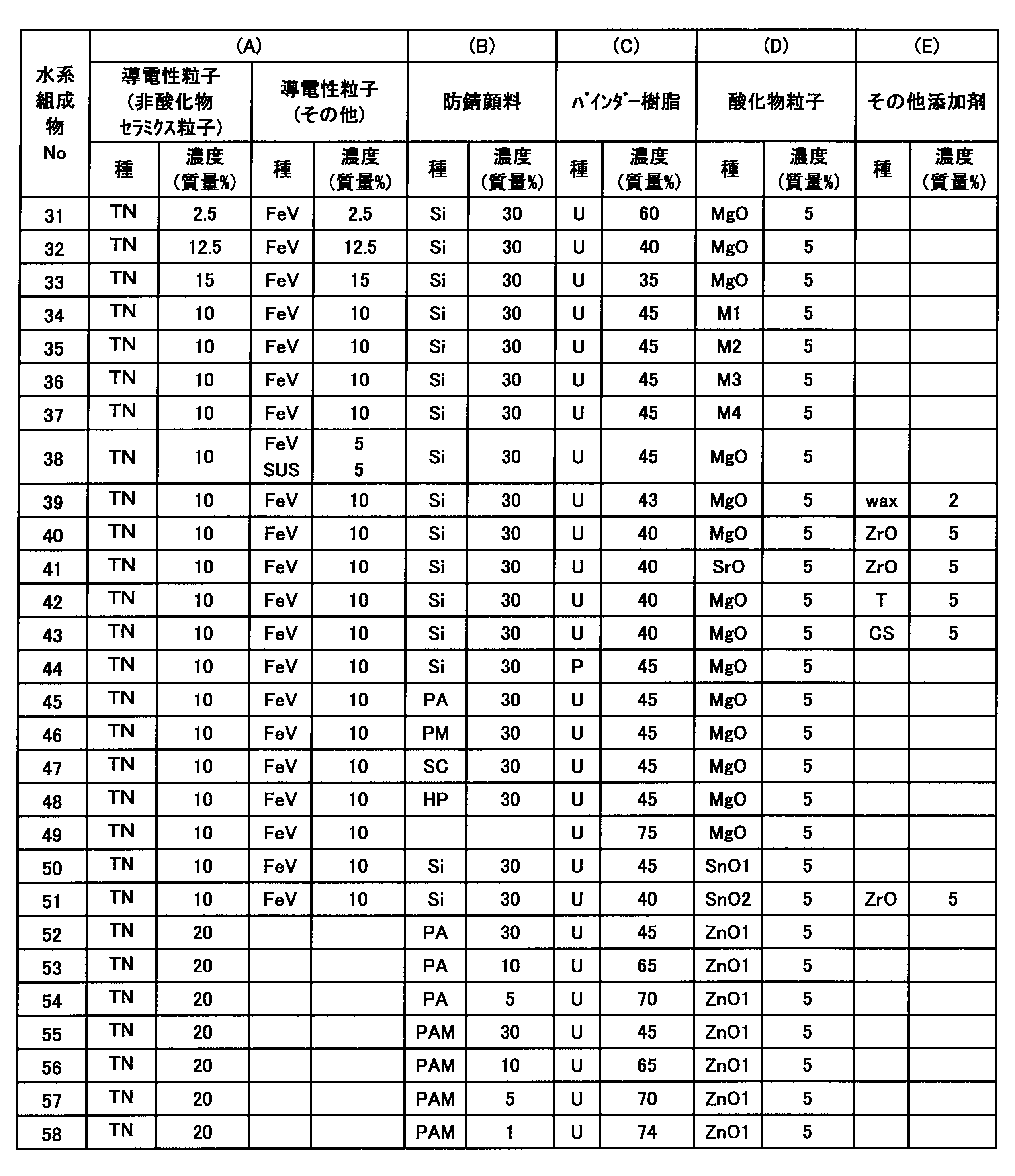
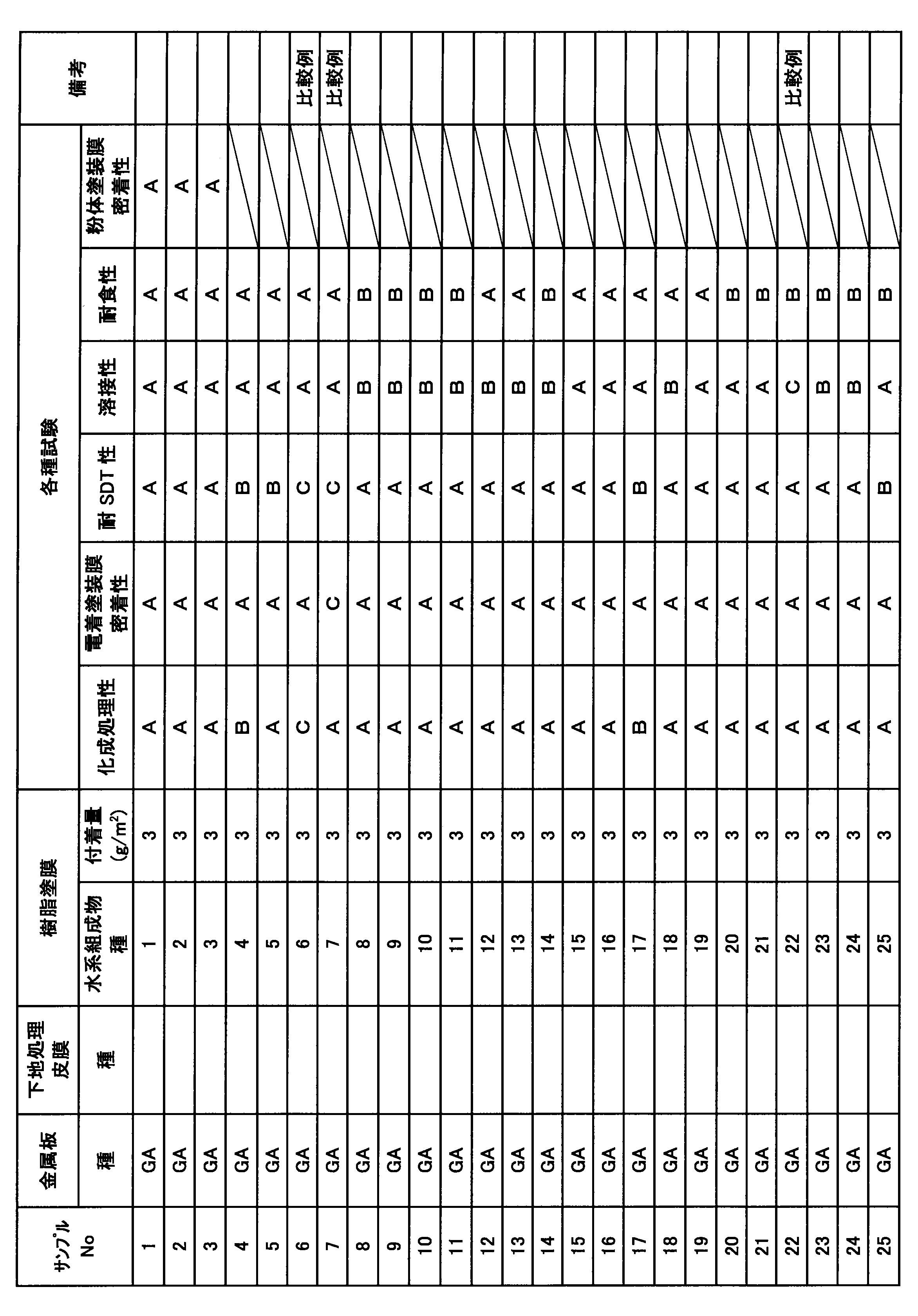
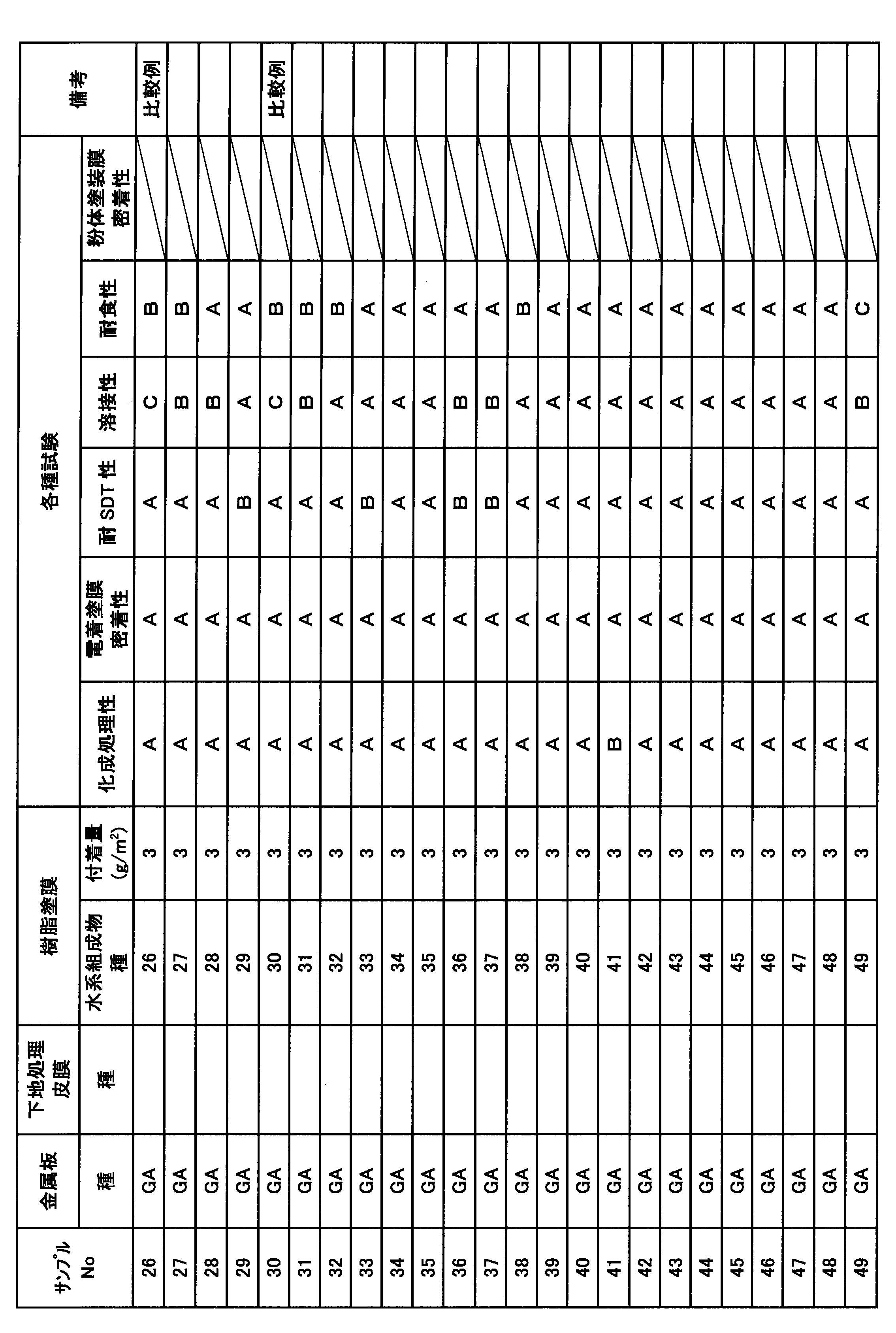

また、実施例対応の表面処理金属板のサンプルNo.1~5、8~21、23~25、27~29、31~66、69~73は、比較例対応の表面処理金属板のサンプルNo.22、26、30に比べ、溶接性にも優れていることがわかる。
一方、比較例対応の表面処理鋼板のサンプルNo.67、68は、樹脂塗膜の付着量が少なすぎるため、耐SDT性(二次密着性)および耐食性が悪化していることがわかる。比較例対応の表面処理鋼板のサンプルNo.74は、樹脂塗膜の付着量が多すぎるため、溶接性が悪化していることがわかる。
表6~の記載の条件とした以外は、第一の実施例と同様にして、表面処理金属板の製造し、評価を実施した。ただし、表6中において、酸化物粒子の欄の「ZnO2」は、ハクスイテック(株)アルミニウムをドープした導電性酸化亜鉛粒子23-Kt(平均粒径=0.5μm)を示す。
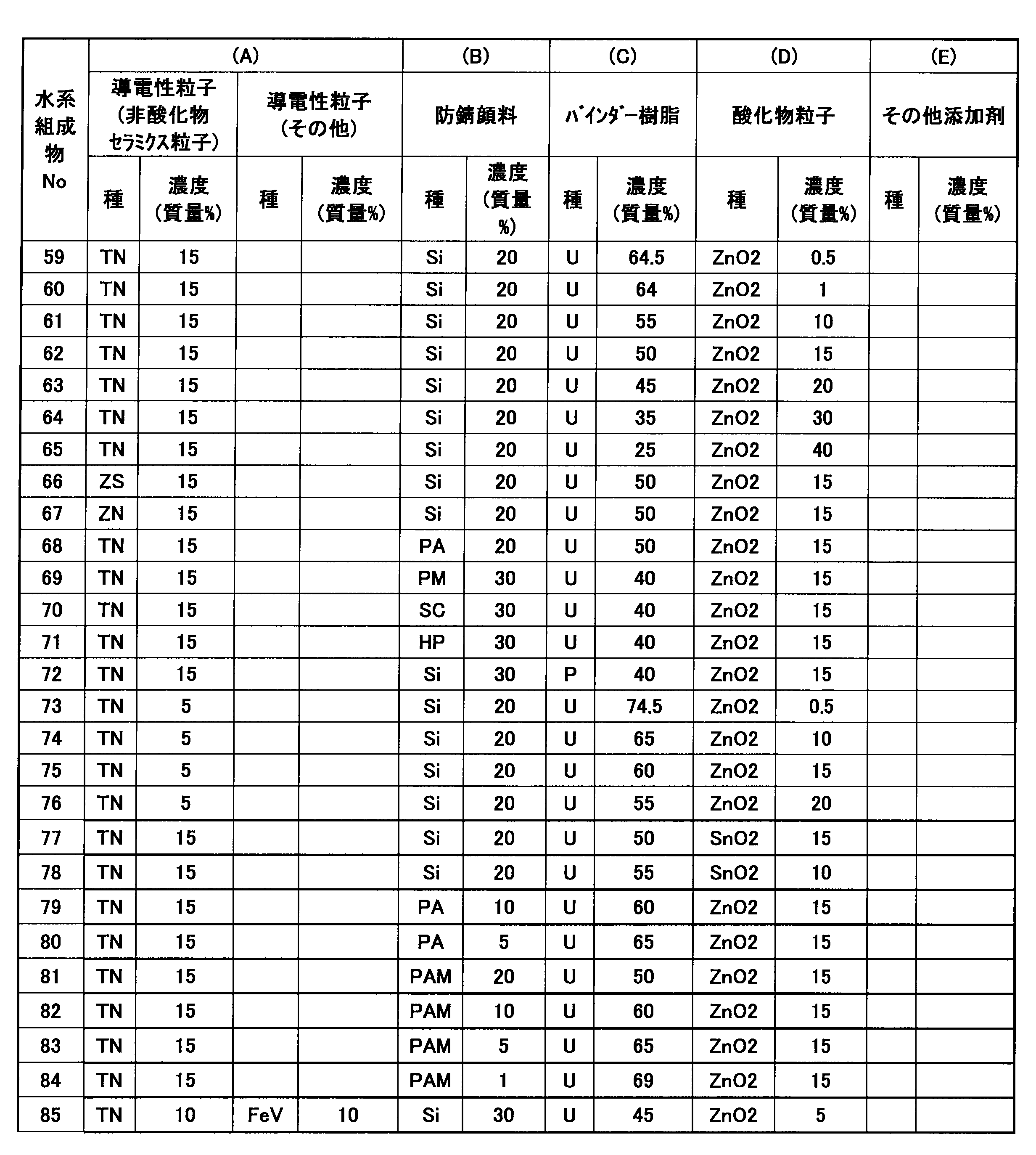

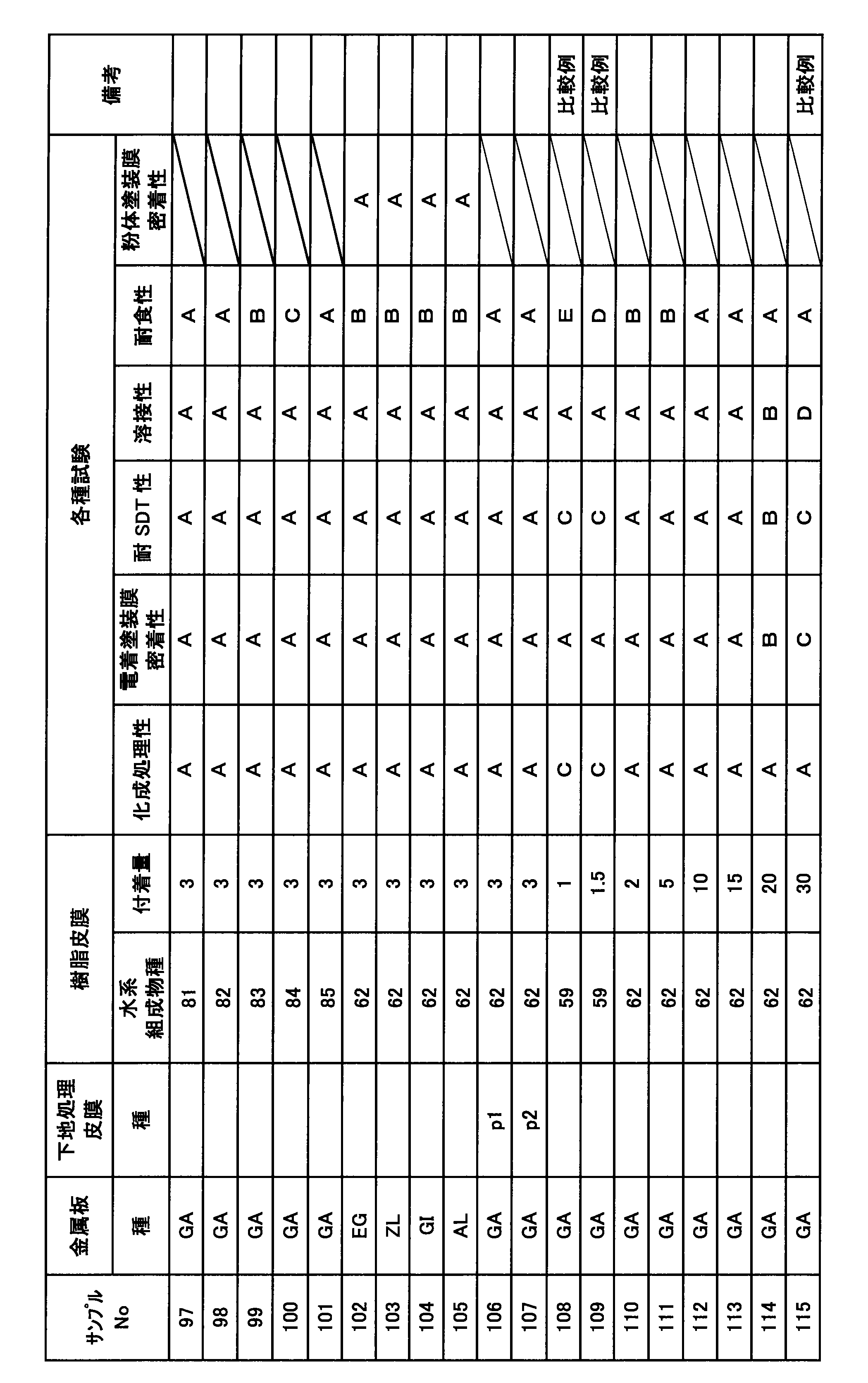
12 酸化物粒子(または、ドープ型酸化亜鉛粒子)
14 化成処理皮膜の結晶(例えばリン酸塩等の酸塩化物の結晶)
16 塗装膜
Claims (11)
- 金属板と、
前記金属板の少なくとも一方の主面に配置された塗膜と、を有し、
前記塗膜は、酸化物粒子と、バインダー樹脂と、導電性粒子と、を含み、
前記導電性粒子の含有量は、前記塗膜に対して5~30質量%であり、
前記酸化物粒子は、非ドープ型酸化物粒子および/またはドープ型酸化物粒子を含み、
前記非ドープ型酸化物粒子は、酸化亜鉛粒子、酸化スズ粒子、酸化マグネシウム粒子、酸化カルシウム粒子および酸化ストロンチウム粒子からなる群から選択される少なくとも1種を含み、
ドープ型酸化物粒子は、ドープ型酸化亜鉛粒子およびドープ型酸化スズ粒子からなる群から選択される少なくとも1種を含み、
前記酸化物粒子の含有量は、前記酸化物粒子が前記ドープ型酸化物粒子を含む場合前記塗膜に対して1~30質量%であり、前記酸化物粒子が前記ドープ型酸化物粒子を含まない場合前記塗膜に対して1~10質量%であり、および
前記塗膜の前記主面への付着量が2~20g/m2である、表面処理金属板。 - 前記酸化物粒子の平均粒径が、0.2~5μmである、請求項1に記載の表面処理金属板。
- 前記バインダー樹脂が、水溶性または水分散性の水系樹脂である、請求項1または2に記載の表面処理金属板。
- 前記導電性粒子が、非酸化物セラミクス粒子、鉄合金粒子、およびステンレス粒子からなる群から選択される少なくとも1種を含む、請求項1~3のいずれか一項に記載の表面処理金属板。
- 前記導電性粒子が、非酸化物セラミクス粒子と、鉄合金粒子およびステンレス粒子からなる群から選択される少なくとも1種との2種以上を含み、
前記非酸化物セラミクス粒子と、前記鉄合金粒子、および前記ステンレス粒子よりなる群から選択される少なくとも1種との質量比(前記非酸化物セラミクス粒子/前記鉄合金粒子、および前記ステンレス粒子よりなる群から選択される少なくとも1種)が、1/9~8/2である請求項1~4のいずれか一項に記載の表面処理金属板。 - 前記塗膜は、さらに防錆顔料を含む、請求項1~5のいずれか一項に記載の表面処理金属板。
- 前記防錆顔料が、トリポリリン酸アルミニウム、リン酸および亜リン酸のZn、Mg、Al、Ti、ZrおよびCe塩、ハイドロカルマイト処理されたリン酸化合物、Caイオン交換シリカならびに、吸油量100~1000ml/100g、比表面積200~1000m2/gかつ平均粒径2.0~30μmの非晶質シリカからなる群から選択される少なくとも1種を含む、請求項6に記載の表面処理金属板。
- 前記酸化物粒子が前記ドープ型酸化物粒子を含み、前記トリポリリン酸アルミニウムが、Mgを含有するトリポリリン酸アルミニウムである、請求項7に記載の表面処理金属板。
- 前記金属板が、亜鉛系めっき鋼板、またはアルミニウム系めっき鋼板である請求項1~8のいずれか一項に記載の表面処理金属板。
- 請求項1~9のいずれか一項に記載の表面処理金属板を材料とする成形材と、
前記成形材の塗膜上に位置する化成処理皮膜と、
前記化成処理皮膜上に位置する塗装膜と、
を有する塗装部材。 - 請求項1~9のいずれか一項に記載の表面処理金属板が成形された成形材に対し化成処理を行い、塗膜上に化成処理皮膜を形成する工程と、
前記化成処理被膜上に塗装膜を形成する工程と、を有する、塗装部材の製造方法。
Priority Applications (7)
| Application Number | Priority Date | Filing Date | Title |
|---|---|---|---|
| EP16773019.1A EP3279369B1 (en) | 2015-03-31 | 2016-03-30 | Surface-treated metal sheet, coated member and method for producing coated member |
| KR1020177027430A KR102024570B1 (ko) | 2015-03-31 | 2016-03-30 | 표면 처리 금속판, 도장 부재 및 도장 부재의 제조 방법 |
| BR112017017645-9A BR112017017645A2 (ja) | 2015-03-31 | 2016-03-30 | A manufacturing method of a surface treatment metal plate, a paint member, and a paint member |
| CN201680017843.XA CN107406989B (zh) | 2015-03-31 | 2016-03-30 | 表面处理金属板、涂装构件和涂装构件的制造方法 |
| MX2017010892A MX385060B (es) | 2015-03-31 | 2016-03-30 | Lamina de metal tratada en la superficie, miembro revestido y metodo para producir miembro revestido. |
| JP2017510137A JP6515298B2 (ja) | 2015-03-31 | 2016-03-30 | 表面処理金属板、塗装部材および塗装部材の製造方法 |
| US15/560,847 US11028276B2 (en) | 2015-03-31 | 2016-03-30 | Surface-treated metal sheet, coated member, and method for producing coated member |
Applications Claiming Priority (4)
| Application Number | Priority Date | Filing Date | Title |
|---|---|---|---|
| JP2015-074525 | 2015-03-31 | ||
| JP2015074525 | 2015-03-31 | ||
| JP2015197164 | 2015-10-02 | ||
| JP2015-197164 | 2015-10-02 |
Publications (1)
| Publication Number | Publication Date |
|---|---|
| WO2016159138A1 true WO2016159138A1 (ja) | 2016-10-06 |
Family
ID=57005759
Family Applications (1)
| Application Number | Title | Priority Date | Filing Date |
|---|---|---|---|
| PCT/JP2016/060488 Ceased WO2016159138A1 (ja) | 2015-03-31 | 2016-03-30 | 表面処理金属板、塗装部材および塗装部材の製造方法 |
Country Status (9)
| Country | Link |
|---|---|
| US (1) | US11028276B2 (ja) |
| EP (1) | EP3279369B1 (ja) |
| JP (1) | JP6515298B2 (ja) |
| KR (1) | KR102024570B1 (ja) |
| CN (1) | CN107406989B (ja) |
| BR (1) | BR112017017645A2 (ja) |
| MX (1) | MX385060B (ja) |
| TW (1) | TWI599626B (ja) |
| WO (1) | WO2016159138A1 (ja) |
Cited By (8)
| Publication number | Priority date | Publication date | Assignee | Title |
|---|---|---|---|---|
| JP2016194137A (ja) * | 2015-03-31 | 2016-11-17 | 新日鐵住金株式会社 | 表面処理鋼板、及び塗装部材 |
| WO2018180979A1 (ja) * | 2017-03-27 | 2018-10-04 | 新日鐵住金株式会社 | Al系めっき鋼板 |
| KR20190082862A (ko) * | 2016-11-17 | 2019-07-10 | 닛폰세이테츠 가부시키가이샤 | 표면 처리 강판 및 도장 부재 |
| WO2020129473A1 (ja) | 2018-12-20 | 2020-06-25 | Jfeスチール株式会社 | 表面処理鋼板 |
| JPWO2020067447A1 (ja) * | 2018-09-28 | 2021-09-24 | 日本製鉄株式会社 | 接着接合構造体および自動車用部品 |
| JP2022072128A (ja) * | 2020-10-29 | 2022-05-17 | 菊水化学工業株式会社 | 水性防錆塗料,積層構造及びその施工方法 |
| JP2023030644A (ja) * | 2021-08-23 | 2023-03-08 | 日本製鉄株式会社 | 表面処理鋼板 |
| JPWO2024219435A1 (ja) * | 2023-04-18 | 2024-10-24 |
Families Citing this family (12)
| Publication number | Priority date | Publication date | Assignee | Title |
|---|---|---|---|---|
| US11028276B2 (en) | 2015-03-31 | 2021-06-08 | Nippon Steel Corporation | Surface-treated metal sheet, coated member, and method for producing coated member |
| DE102018214641B4 (de) | 2018-08-29 | 2022-09-22 | Robert Bosch Gmbh | Vergussmasse, Verfahren zum elektrischen Isolieren eines elektrischen oder elektronischen Bauteils unter Verwendung der Vergussmasse, elektrisch isoliertes Bauteil, hergestellt über ein solches Verfahren und Verwendung der Vergussmasse |
| WO2020069263A1 (en) * | 2018-09-28 | 2020-04-02 | Construction Research & Technology Gmbh | Slip-resistant coating, method of coating a substrate and a coated substrate |
| JP7284379B2 (ja) * | 2019-02-07 | 2023-05-31 | 日本製鉄株式会社 | 複合体およびその製造方法、ならびに塗装金属板 |
| EP3957474A4 (en) * | 2019-04-16 | 2023-02-08 | Nippon Steel Corporation | METAL/FIBER REINFORCED RESIN COMPOSITE |
| EP3957764A4 (en) | 2019-04-19 | 2022-08-24 | Nippon Steel Corporation | GALVANIZED SHEET STEEL |
| CN112251088B (zh) * | 2020-10-22 | 2022-03-11 | 重庆建谊祥科技有限公司 | 双氟处理液、制备方法及镁合金建筑模板表面处理方法 |
| CN112593184B (zh) * | 2020-11-27 | 2022-07-01 | 北京钢研高纳科技股份有限公司 | 提高铌基合金抗氧化性能的方法、应用及抗氧化铌基合金 |
| JP7650708B2 (ja) * | 2021-04-13 | 2025-03-25 | 本田技研工業株式会社 | 電気パルス分解方法、複合材、複合材分解方法 |
| TWI810923B (zh) * | 2022-05-05 | 2023-08-01 | 中國鋼鐵股份有限公司 | 鍍鋅鋼材構件之銲接性質的評估方法與鍍鋅鋼材連接件之形成方法 |
| CN117004939B (zh) * | 2023-08-08 | 2025-08-08 | 湖南金裕环保科技有限公司 | 一种锰锆系表调剂及制备方法与应用 |
| CN117698004B (zh) * | 2023-12-29 | 2024-10-11 | 东莞市振飞自动化机械有限公司 | 一种基于吸热便导热涂料的鞋底热冷成型设备 |
Citations (4)
| Publication number | Priority date | Publication date | Assignee | Title |
|---|---|---|---|---|
| JPS51117935A (en) * | 1975-04-09 | 1976-10-16 | Nippon Steel Corp | Weldable painted steel sheet superior in anticorrosive property |
| JPS5554366A (en) * | 1978-10-16 | 1980-04-21 | Sakai Chem Ind Co Ltd | Composition for corrosion prevention of metal surface |
| JPS57143489A (en) * | 1981-02-28 | 1982-09-04 | Kawasaki Steel Corp | Surface treated steel plate having coating layer of three layered structure and its production |
| JPS5896822A (ja) * | 1981-12-02 | 1983-06-09 | Nippon Steel Corp | 歪時効硬化性を有する塗装鋼板の製造方法 |
Family Cites Families (24)
| Publication number | Priority date | Publication date | Assignee | Title |
|---|---|---|---|---|
| US4079163A (en) * | 1974-11-29 | 1978-03-14 | Nippon Steel Corporation | Weldable coated steel sheet |
| JPS598353B2 (ja) | 1978-07-25 | 1984-02-24 | 川崎製鉄株式会社 | 密着性に優れた高耐食性加工用複合被覆鋼板 |
| US4391855A (en) * | 1980-08-25 | 1983-07-05 | Depor Industries | Corrosion resistant coating and method for coating metal substrate |
| JPH07224389A (ja) | 1994-02-15 | 1995-08-22 | Nippon Steel Corp | 有機複合めっき鋼板 |
| JPH09276788A (ja) | 1996-04-18 | 1997-10-28 | Nippon Steel Corp | 耐食性およびプレス成形性に優れる抵抗溶接可能有機複合めっき鋼板 |
| JPH1043677A (ja) * | 1996-08-06 | 1998-02-17 | Nkk Corp | 耐食性、耐パウダリング性及び塗装性に優れた溶接可能なプレプライムド鋼板 |
| JP2000070842A (ja) | 1998-08-31 | 2000-03-07 | Sumitomo Metal Ind Ltd | 自動車補修部品用の樹脂被覆鋼板 |
| DE19951133A1 (de) | 1999-10-23 | 2001-04-26 | Henkel Kgaa | Leitfähige, organische Beschichtungen |
| JP3882586B2 (ja) | 2000-11-09 | 2007-02-21 | Jfeスチール株式会社 | 耐食性、成形性に優れた表面処理鋼板およびその製造方法 |
| JP3555604B2 (ja) | 2000-11-09 | 2004-08-18 | Jfeスチール株式会社 | 耐食性、成形性に優れた表面処理鋼板およびその製造方法 |
| JP2003268567A (ja) | 2002-03-19 | 2003-09-25 | Hitachi Cable Ltd | 導電材被覆耐食性金属材料 |
| JP2003286556A (ja) | 2002-03-29 | 2003-10-10 | Nisshin Steel Co Ltd | 粉体塗装性に優れた合金化溶融亜鉛めっき鋼板 |
| MXPA04010220A (es) * | 2002-04-20 | 2005-03-07 | Chemetall Gmbh | Mezcla para aplicar un revestimiento de polimero delgado, no corrosivo, que puede configurarse de una manera poco abrasiva, y metodo para su produccion. |
| CN1668460B (zh) * | 2002-05-14 | 2010-05-26 | 新日本制铁株式会社 | 成形加工部分的耐蚀性优良、可焊接的被覆金属材料 |
| JP4084702B2 (ja) | 2002-05-14 | 2008-04-30 | 新日本製鐵株式会社 | 成形加工部の耐食性に優れる溶接可能な塗装金属材 |
| JP2005288730A (ja) | 2004-03-31 | 2005-10-20 | Jfe Steel Kk | 溶接可能な自動車用有機被覆鋼板 |
| JP4534592B2 (ja) | 2004-05-17 | 2010-09-01 | Jfeスチール株式会社 | 溶接可能な自動車用高耐食性表面処理鋼板及びその製造方法 |
| KR100762465B1 (ko) * | 2006-08-02 | 2007-10-04 | 주식회사 포스코 | 크롬이 배제된 내식성과 응력제거소둔후 피막밀착성이우수한 절연피막 형성용 피복조성물 및 이를 이용한무방향성 전기강판의 절연피막 형성방법 |
| RU2524937C1 (ru) * | 2010-09-02 | 2014-08-10 | Ниппон Стил Энд Сумитомо Метал Корпорейшн | Металлический лист c предварительно нанесённым покрытием с превосходной проводимостью и коррозионной стойкостью |
| KR101271965B1 (ko) * | 2011-07-13 | 2013-06-07 | 주식회사 노루코일코팅 | 표면 처리용 수지 조성물 및 이에 의해 코팅된 강판 |
| JP6016548B2 (ja) * | 2012-09-19 | 2016-10-26 | 日揮触媒化成株式会社 | 透明被膜形成用塗布液および透明被膜付基材 |
| CN102993847B (zh) * | 2012-12-11 | 2015-02-04 | 中国建筑股份有限公司 | 储罐底部和内壁用浅色水性防腐导静电涂料及其制备方法 |
| WO2015026602A1 (en) | 2013-08-23 | 2015-02-26 | Valspar Sourcing Inc. | Waterborne shop primer |
| US11028276B2 (en) | 2015-03-31 | 2021-06-08 | Nippon Steel Corporation | Surface-treated metal sheet, coated member, and method for producing coated member |
-
2016
- 2016-03-30 US US15/560,847 patent/US11028276B2/en active Active
- 2016-03-30 WO PCT/JP2016/060488 patent/WO2016159138A1/ja not_active Ceased
- 2016-03-30 EP EP16773019.1A patent/EP3279369B1/en active Active
- 2016-03-30 CN CN201680017843.XA patent/CN107406989B/zh active Active
- 2016-03-30 KR KR1020177027430A patent/KR102024570B1/ko active Active
- 2016-03-30 MX MX2017010892A patent/MX385060B/es unknown
- 2016-03-30 JP JP2017510137A patent/JP6515298B2/ja active Active
- 2016-03-30 BR BR112017017645-9A patent/BR112017017645A2/ja not_active Application Discontinuation
- 2016-03-31 TW TW105110288A patent/TWI599626B/zh not_active IP Right Cessation
Patent Citations (4)
| Publication number | Priority date | Publication date | Assignee | Title |
|---|---|---|---|---|
| JPS51117935A (en) * | 1975-04-09 | 1976-10-16 | Nippon Steel Corp | Weldable painted steel sheet superior in anticorrosive property |
| JPS5554366A (en) * | 1978-10-16 | 1980-04-21 | Sakai Chem Ind Co Ltd | Composition for corrosion prevention of metal surface |
| JPS57143489A (en) * | 1981-02-28 | 1982-09-04 | Kawasaki Steel Corp | Surface treated steel plate having coating layer of three layered structure and its production |
| JPS5896822A (ja) * | 1981-12-02 | 1983-06-09 | Nippon Steel Corp | 歪時効硬化性を有する塗装鋼板の製造方法 |
Non-Patent Citations (1)
| Title |
|---|
| See also references of EP3279369A4 * |
Cited By (21)
| Publication number | Priority date | Publication date | Assignee | Title |
|---|---|---|---|---|
| JP2016194137A (ja) * | 2015-03-31 | 2016-11-17 | 新日鐵住金株式会社 | 表面処理鋼板、及び塗装部材 |
| CN110073034B (zh) * | 2016-11-17 | 2021-06-11 | 日本制铁株式会社 | 表面处理钢板以及涂装构件 |
| KR20190082862A (ko) * | 2016-11-17 | 2019-07-10 | 닛폰세이테츠 가부시키가이샤 | 표면 처리 강판 및 도장 부재 |
| CN110073034A (zh) * | 2016-11-17 | 2019-07-30 | 日本制铁株式会社 | 表面处理钢板以及涂装构件 |
| KR102245651B1 (ko) * | 2016-11-17 | 2021-04-28 | 닛폰세이테츠 가부시키가이샤 | 표면 처리 강판 및 도장 부재 |
| WO2018180979A1 (ja) * | 2017-03-27 | 2018-10-04 | 新日鐵住金株式会社 | Al系めっき鋼板 |
| CN110325667A (zh) * | 2017-03-27 | 2019-10-11 | 日本制铁株式会社 | Al系镀覆钢板 |
| JPWO2018180979A1 (ja) * | 2017-03-27 | 2019-12-26 | 日本製鉄株式会社 | Al系めっき鋼板 |
| JPWO2020067447A1 (ja) * | 2018-09-28 | 2021-09-24 | 日本製鉄株式会社 | 接着接合構造体および自動車用部品 |
| US20210387679A1 (en) * | 2018-09-28 | 2021-12-16 | Nippon Steel Corporation | Adhesively joined structure and component for vehicle |
| US11904948B2 (en) * | 2018-09-28 | 2024-02-20 | Nippon Steel Corporation | Adhesively joined structure and component for vehicle |
| KR20210092258A (ko) | 2018-12-20 | 2021-07-23 | 제이에프이 스틸 가부시키가이샤 | 표면 처리 강판 |
| WO2020129473A1 (ja) | 2018-12-20 | 2020-06-25 | Jfeスチール株式会社 | 表面処理鋼板 |
| US11795526B2 (en) | 2018-12-20 | 2023-10-24 | Jfe Steel Corporation | Surface-treated steel sheet |
| JP2022072128A (ja) * | 2020-10-29 | 2022-05-17 | 菊水化学工業株式会社 | 水性防錆塗料,積層構造及びその施工方法 |
| JP7502152B2 (ja) | 2020-10-29 | 2024-06-18 | 菊水化学工業株式会社 | 水性防錆塗料,積層構造及びその施工方法 |
| JP2023030644A (ja) * | 2021-08-23 | 2023-03-08 | 日本製鉄株式会社 | 表面処理鋼板 |
| JP7712539B2 (ja) | 2021-08-23 | 2025-07-24 | 日本製鉄株式会社 | 表面処理鋼板 |
| JPWO2024219435A1 (ja) * | 2023-04-18 | 2024-10-24 | ||
| KR20250165605A (ko) | 2023-04-18 | 2025-11-26 | 닛폰세이테츠 가부시키가이샤 | 표면 처리 금속판 및 자동차 부재 |
| JP7817651B2 (ja) | 2023-04-18 | 2026-02-19 | 日本製鉄株式会社 | 表面処理金属板および自動車部材 |
Also Published As
| Publication number | Publication date |
|---|---|
| CN107406989B (zh) | 2020-06-02 |
| MX2017010892A (es) | 2017-12-07 |
| EP3279369A1 (en) | 2018-02-07 |
| TW201704374A (zh) | 2017-02-01 |
| EP3279369A4 (en) | 2019-01-09 |
| CN107406989A (zh) | 2017-11-28 |
| BR112017017645A2 (ja) | 2018-05-08 |
| TWI599626B (zh) | 2017-09-21 |
| EP3279369B1 (en) | 2020-09-23 |
| MX385060B (es) | 2025-03-14 |
| KR20170127485A (ko) | 2017-11-21 |
| JP6515298B2 (ja) | 2019-05-22 |
| US20180112084A1 (en) | 2018-04-26 |
| KR102024570B1 (ko) | 2019-09-25 |
| US11028276B2 (en) | 2021-06-08 |
| JPWO2016159138A1 (ja) | 2018-01-11 |
Similar Documents
| Publication | Publication Date | Title |
|---|---|---|
| JP6515298B2 (ja) | 表面処理金属板、塗装部材および塗装部材の製造方法 | |
| JP6123969B1 (ja) | 表面処理鋼板および塗装部材 | |
| JP6555133B2 (ja) | 被覆鋼板 | |
| JP5940097B2 (ja) | 抵抗溶接性、耐食性、成形性に優れる自動車用塗装金属板 | |
| CN107000379B (zh) | 低温行驶环境中的防锈性优异的汽车用涂装金属板 | |
| EP3260575B1 (en) | Zinc-based plated steel sheet | |
| JP6710924B2 (ja) | 表面処理鋼板、及び塗装部材 | |
| JP6070917B1 (ja) | 塗装鋼板 | |
| JP2008195977A (ja) | 無機系クロムフリー金属表面処理剤 | |
| JP7712539B2 (ja) | 表面処理鋼板 | |
| JP7817651B2 (ja) | 表面処理金属板および自動車部材 | |
| TWI655086B (zh) | Surface treated steel sheet and coated member | |
| JP3882586B2 (ja) | 耐食性、成形性に優れた表面処理鋼板およびその製造方法 | |
| JP7791484B2 (ja) | 表面処理鋼板、及び、部品の製造方法 | |
| JP2023030634A (ja) | 表面処理鋼板 |
Legal Events
| Date | Code | Title | Description |
|---|---|---|---|
| 121 | Ep: the epo has been informed by wipo that ep was designated in this application |
Ref document number: 16773019 Country of ref document: EP Kind code of ref document: A1 |
|
| ENP | Entry into the national phase |
Ref document number: 2017510137 Country of ref document: JP Kind code of ref document: A |
|
| WWE | Wipo information: entry into national phase |
Ref document number: MX/A/2017/010892 Country of ref document: MX |
|
| REG | Reference to national code |
Ref country code: BR Ref legal event code: B01A Ref document number: 112017017645 Country of ref document: BR |
|
| WWE | Wipo information: entry into national phase |
Ref document number: 15560847 Country of ref document: US |
|
| ENP | Entry into the national phase |
Ref document number: 20177027430 Country of ref document: KR Kind code of ref document: A |
|
| REEP | Request for entry into the european phase |
Ref document number: 2016773019 Country of ref document: EP |
|
| NENP | Non-entry into the national phase |
Ref country code: DE |
|
| ENP | Entry into the national phase |
Ref document number: 112017017645 Country of ref document: BR Kind code of ref document: A2 Effective date: 20170817 |