WO2015186444A1 - 搬送車システムと搬送方法 - Google Patents
搬送車システムと搬送方法 Download PDFInfo
- Publication number
- WO2015186444A1 WO2015186444A1 PCT/JP2015/062071 JP2015062071W WO2015186444A1 WO 2015186444 A1 WO2015186444 A1 WO 2015186444A1 JP 2015062071 W JP2015062071 W JP 2015062071W WO 2015186444 A1 WO2015186444 A1 WO 2015186444A1
- Authority
- WO
- WIPO (PCT)
- Prior art keywords
- transport vehicle
- transport
- transfer
- vehicles
- point
- Prior art date
- Legal status (The legal status is an assumption and is not a legal conclusion. Google has not performed a legal analysis and makes no representation as to the accuracy of the status listed.)
- Ceased
Links
Images


Classifications
-
- G—PHYSICS
- G05—CONTROLLING; REGULATING
- G05D—SYSTEMS FOR CONTROLLING OR REGULATING NON-ELECTRIC VARIABLES
- G05D1/00—Control of position, course, altitude or attitude of land, water, air or space vehicles, e.g. using automatic pilots
- G05D1/02—Control of position or course in two dimensions
- G05D1/021—Control of position or course in two dimensions specially adapted to land vehicles
- G05D1/0287—Control of position or course in two dimensions specially adapted to land vehicles involving a plurality of land vehicles, e.g. fleet or convoy travelling
- G05D1/0291—Fleet control
- G05D1/0297—Fleet control by controlling means in a control room
-
- B—PERFORMING OPERATIONS; TRANSPORTING
- B65—CONVEYING; PACKING; STORING; HANDLING THIN OR FILAMENTARY MATERIAL
- B65G—TRANSPORT OR STORAGE DEVICES, e.g. CONVEYORS FOR LOADING OR TIPPING, SHOP CONVEYOR SYSTEMS OR PNEUMATIC TUBE CONVEYORS
- B65G1/00—Storing articles, individually or in orderly arrangement, in warehouses or magazines
- B65G1/02—Storage devices
- B65G1/04—Storage devices mechanical
-
- G—PHYSICS
- G05—CONTROLLING; REGULATING
- G05D—SYSTEMS FOR CONTROLLING OR REGULATING NON-ELECTRIC VARIABLES
- G05D1/00—Control of position, course, altitude or attitude of land, water, air or space vehicles, e.g. using automatic pilots
- G05D1/02—Control of position or course in two dimensions
Definitions
- the present invention relates to a transport vehicle system such as an overhead traveling vehicle system and an automatic guided vehicle system, and a transport method.
- At least one circuit route a plurality of transport vehicles that travel in one direction along the circuit route, a transfer point that is arranged along the circuit route and that transfers a load between the plurality of transport vehicles, and a plurality of transports 2.
- a transport vehicle system that includes a transport vehicle controller that manages vehicle travel is known. It is known that a priority is assigned to a conveyance command, and execution is performed from the priority conveyance command (Patent Document 1: JP2002-189520A). Since the conveyance of the load starts with loading from the transfer point and ends with the unloading to the transfer point, the priority of the transfer command is also the priority of loading from the transfer point. In addition, when loading from a plurality of transfer points in the same circulation path is requested, it is also known to load in order from the transfer point on the downstream side (Patent Document 2: JP5309814B).
- An object of the present invention is to harmonize the priority of the conveyance command with the prevention of traffic jam due to the priority of loading on the downstream side.
- the present invention relates to at least one circuit route, a plurality of transport vehicles that travel in one direction along the circuit route, and a plurality of transfer devices that transfer luggage between the plurality of transport vehicles arranged along the circuit route.
- a transport vehicle system comprising a point and a transport vehicle controller for managing the traveling of a plurality of transport vehicles, The transport vehicle controller is requested to load from a plurality of transfer points in the same circuit route, and when priority is specified for each load, The traveling to a predetermined point upstream of the plurality of transfer points is allocated to a plurality of transport vehicles according to the number of transfer points to be loaded, When the first transport vehicle in the plurality of vehicles passes a predetermined point, the first transport vehicle loads at a transfer point having a high priority.
- Whether to decelerate or stop other transport vehicles in the platform is determined according to the situation of the other transport vehicles in the plurality, When decelerating or stopping, instruct the first transporter to travel to the downstream transfer point and load, When neither decelerating nor stopping is performed, the first transport vehicle is configured to instruct to travel to and load the transfer point having a high priority.
- the present invention also provides at least one circuit path, a plurality of transport vehicles that travel in one direction along the circuit path, and a plurality of transports that are arranged along the circuit path and that transfer a load between the plurality of transport vehicles.
- a transportation method by a transportation vehicle system comprising a loading point and a transportation vehicle controller that manages the traveling of a plurality of transportation vehicles, The transport vehicle controller is requested to load from a plurality of transfer points in the same circuit route, and when priority is specified for each load, The traveling to a predetermined point upstream of the plurality of transfer points is allocated to a plurality of transport vehicles according to the number of transfer points to be loaded, When the first transport vehicle in the plurality of vehicles passes the predetermined point, the loading of the first transport vehicle at the transfer point having a high priority is performed at the transfer point on the downstream side.
- Whether to decelerate or stop other transport vehicles in the plurality of units is determined according to the situation of the other transport vehicles in the plurality of units, When decelerating or stopping, the first transport vehicle is instructed to travel to the downstream transfer point and load, When neither decelerating nor stopping is performed, the first transport vehicle is instructed to travel to the transfer point having a high priority and load.
- the transfer point to load is commanded. If the loading at the downstream transfer point is not hindered, the priority loading can be performed. Moreover, when obstructing loading, it can be loaded first at the transfer point on the downstream side so that other transport vehicles can be prevented from loading at the transfer point having a high priority. In this situation, other transport vehicles should arrive and load the transfer points with high priority within a short waiting time, so that a plurality of transport vehicles may be able to load at the same time.
- the predetermined point is, for example, a point on the upstream side of the plurality of transfer points in the circulation route to which the plurality of transfer points to be loaded belong.
- the point means the position on the circuit route.
- Patent Literatures 1 and 2 are used as they are, it is necessary to select either priority-oriented priority or downstream loading, and it is difficult to realize both of them.
- the transport vehicle controller is configured to determine whether to decelerate or stop based on the speeds of the other transport vehicles in the plurality. For example, if another transport vehicle is stopped or traveling at a speed that is lower than a predetermined rate than the upper limit speed determined according to the position on the circuit route, the other transport vehicle is caught in a traffic jam. There is a high possibility that the arrival at the downstream transfer point should be delayed. *
- the transport vehicle controller is configured to determine whether to decelerate or stop based on the position of another transport vehicle in the plurality of vehicles. If the position of the other transport vehicle is known, the arrival time of the other transport vehicle can be determined from the standard required time from the position to the predetermined point, the distance from the position to the predetermined point, or the like. Note that determination based on the position of another transport vehicle and determination based on the speed may be used in combination.
- the transport vehicle is an overhead traveling vehicle and travels according to a command from the transport vehicle controller
- the at least one circuit route is provided in a ceiling space of the building
- the at least one circuit route includes an interbay route and an interbay route.
- Consists of multiple round-trip routes with multiple intrabay rules connected to Beirut In accordance with the instruction from the transport vehicle controller, the transport vehicle loads the load from the designated transfer point, and from the intra bay route to which the transfer point to be loaded belongs to the transfer point to be unloaded via the inter bay route.
- the transport vehicle and the transport vehicle controller are configured to travel to the intra-bay route to which it belongs. If it does in this way, a load can be efficiently conveyed with respect to an overhead traveling vehicle system.
- the predetermined point is arranged at the entrance from the interbay route to the intrabay route which is the same circuit route. Since the station to be loaded is designated at the entrance of the intrabay route where there are a plurality of stations to be loaded, a more accurate command can be given compared with the case where it is designated further upstream. Further, if a predetermined station is arranged at the entrance of the intra bay route, it will not be affected by traffic congestion when moving from the inter bay route to the intra bay route.
- the transport vehicle controller is configured to give a command without stopping or decelerating when the first transport vehicle passes the predetermined point. By notifying which loading station to load before passing a predetermined point, this is possible and the first transport vehicle can be run more efficiently.
- the transport vehicle controller is configured to specify a transfer point to be loaded and to command the travel to the specified transfer point when the other transport vehicle passes the predetermined point. Has been. It is possible to flexibly respond to changes in the situation by making the loading point variable for other transport vehicles until the predetermined point is passed.
- the carrier controller is After commanding the transfer point to load on the first transport vehicle, loading is requested from the new transfer point in the same circuit route with the priority specified, Allocate travel to the predetermined point to a new transport vehicle, A group of transfer points consisting of transfer points and the new transfer points in the same circuit route for which loading is required, and a group of transfer vehicles consisting of the other transfer vehicle and the new transfer vehicle Whereas When the first transport vehicle in the group of transport vehicles passes the predetermined point, the first transport vehicle in the group of transport vehicles at the transfer point having a high priority in the group of transfer points.
- a transfer point in the same circulation route for which loading is requested is a group of transfer points, and a transport vehicle scheduled to be loaded at any of these transfer points is a group of transport vehicles.
- the group reorganization is repeated when loading with a specified priority is requested and when the transport vehicle passes a predetermined point. Then, when the transport vehicle passes a predetermined point, it is determined at which transfer point in the group it is most efficient to load the transport vehicle, and the transfer point to be loaded is designated.
- reference numeral 2 denotes a travel route, and a plurality of circulation routes are connected to each other to form a travel route 2 of the transport vehicle, and the transport vehicle travels in one direction in the direction of the arrow in each travel route.
- Reference numerals 4 to 7 are intra-bay routes, and reference numeral 8 is an inter-bay route, both of which are circulation routes.
- Reference numeral 10 denotes a transport vehicle controller that controls the transport vehicle. A number of transport vehicles travel along the travel path 2, and each transport vehicle loads or unloads at stations, buffers, stockers, and the like.
- the conveyance vehicle is an overhead traveling vehicle, an automatic guided vehicle, or the like, and here is an overhead traveling vehicle, and the traveling route 2 is provided in the ceiling space of the building.
- loading from the stations A, B, and C is required along the order of the intrabay route 4 from upstream to downstream.
- the priority of loading from station A is 70
- the priority of station B is 90
- the priority of station C is 85.
- the upper limit of the priority is 99, and the higher the priority is, the more priority is given to loading.
- the vehicle controller 10 assigns vehicles a, b, and c, assigns travel to the call point P1 upstream of stations A, B, and C, I am running.
- the destinations after the calling point P1 may be determined before the transport vehicles a, b, c arrive at the point P1.
- the calling point (hereinafter simply referred to as “point”) is a point on the upstream side of a loading station or the like (hereinafter simply referred to as “loading point”). Is the point.
- a call point P 1 is arranged in the intrabay route 4 at the entrance from the interbay route 8 to the intrabay route 4.
- loading at station B should be performed first. However, it should be avoided that loading at station B causes the subsequent transport vehicle to stop or slow down (cause of traffic congestion). It is most efficient if it can be transferred simultaneously at stations B and C. Therefore, when the transport vehicle reaches a predetermined position immediately upstream of the point P1 (for example, when it reaches a position that arrives at the point P1 in about 1 second), the transport vehicle controller 10 is informed of the current position and speed. It is configured to report. In the case of FIG. 1, when the transport vehicle a reaches a position immediately upstream of the point P1, a report is made to the transport vehicle controller 10. *
- the transport vehicle controller 10 Upon receipt of this report, the transport vehicle controller 10 requests the other transport vehicles b and c scheduled to be assigned for loading at the stations A, B, and C to report the current position, speed, state, and the like. .
- the state includes detecting the front carriage with the inter-vehicle distance sensor, being in a traffic jam, and the like, and the speed may be an instantaneous speed or an average speed in the past predetermined time.
- the transport vehicle controller 10 determines whether the loading at the station B causes a traffic jam for the transport vehicles b and c from the positions, speeds, and states of the transport vehicles b and c. In this determination, all of the position, speed, and state may be used, or not all, but only some information, for example, only the position, only the position and speed, or only the state may be used.
- the required time to the station C can be predicted. If this time is longer than the time until the transport vehicle a completes loading at the station B and departs, it can be determined that it does not cause a traffic jam. If the speeds of the transport vehicles b and c are lower than the normal speed by a predetermined rate or more, it can be determined that the transport vehicles b and c are in a traffic jam.
- the inter-vehicle distance sensor detects a forward (downstream) transport vehicle, or when the inter-vehicle distance sensor detects a forward transport vehicle and decelerates, it can be determined that the vehicle is congested. It can be determined that the transported vehicle in a traffic jam is not affected even if the transport vehicle a is loaded at the station B because the arrival at the station C is late.
- the transport vehicle controller 10 instructs the station on which the transport vehicle a is loaded before the transport vehicle a passes to the point P1 according to the above determination result.
- Commanding before passing means that the command is given to the transport vehicle a without decelerating or stopping for waiting for the command.
- the loading at the station B by the transport vehicle a does not affect the travel of the transport vehicles b and c
- the loading at the station B having a high priority is performed and the travel of the transport vehicles b and c is performed. If it affects, the loading at the station C on the downstream side can be executed.
- the transport vehicle b or the like can also load at the station B simultaneously with the transport vehicle a. It can be considered that the transportation efficiency is high when the package is transported according to the priority and in a short waiting time. In the embodiment, high conveyance efficiency based on this standard can be obtained.
- the same processing as that for the transport vehicle a is performed on the remaining transport vehicles b and c and the remaining transfer stations. That is, by passing through the call point P1, the stations excluding the stations designated as the transport vehicle a from the stations A, B, and C are targeted, and the station to be loaded is designated.
- a process when a new loading request with a specified priority is generated in the same intrabay route 4 before designating a station for loading on the transport vehicles b and c will be described.
- a new station (not shown) in which loading is requested is set as D
- transfer stations not assigned to loading are set as A and B, for example, and a newly assigned transport vehicle (not shown) is set as d.
- Stations A, B, and D that need to be loaded and are not assigned are grouped as transfer stations, and transport vehicles b, c, and d that have started traveling for these stations are grouped as transport vehicles.
- the same processing as described above is performed on the carrier group. That is, each time a loading request with a specified priority is generated within the same intrabay route, that station is added to the group, and the new vehicle is instructed to travel to the call point P1, Add to group. Further, when a station to be loaded is determined when the transport vehicle passes the calling point P1, the transport vehicle and the assigned station are deleted from the group. By these, it is possible to continue to command the optimum loading point.
- the configuration of the transport vehicles a, b, c, etc. and the configuration of the transport vehicle controller 10 are shown in FIG.
- the transport vehicle controller 10 communicates with the communication units 20 such as the transport vehicles a, b, and c via the communication unit 12, and via the communication unit 14, the production management controller 30 (a controller that requests the transport vehicle controller 10 to perform transport). ).
- the conveyance command management unit 16 of the conveyance vehicle controller 10 performs generation and allocation of conveyance commands and management of execution status.
- the transport command includes travel to point P1, travel from point P1 to loading stations A, B, and C, and the like.
- the transport vehicle state memory 18 of the transport vehicle controller 10 stores the status of each of the transport vehicles a, b, c, etc., the speed, the empty / actual load, the front carriage being detected by the inter-vehicle distance sensor, and the like. .
- the traveling control unit 22 controls the traveling motor and the like, and the transfer control unit 24 controls the lifting and lowering of the lifting platform.
- the inter-vehicle distance sensor 26 detects a forward transport vehicle in the deceleration range, the vehicle is decelerated or stopped.
- the communication unit 20, the travel control unit 22, and the transfer control unit 24 include a computer and are programmed to realize the functions of the embodiment.
- the traveling to the point P1 is assigned to the loading at the stations A, B, and C, the report is received immediately before the transportation vehicle reaches the point P1, and the position and speed are transferred to the other transportation vehicles. You can inquire about the status. Then, loading at station B or loading at station C can be selected from the position, speed, and state of other transport vehicles.
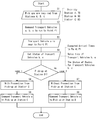
- FIG. 3 shows a processing algorithm for the situation of the embodiment.
- a loading request is generated at the stations A, B, and C, and the priority is 70 for the upstream station A, 90 for the intermediate station B, and 85 for the downstream station C.
- traveling up to the point P1 is allocated to the three transport vehicles a, b, and c so as to travel.
- the first transport vehicle a approaches point P1.
- conditions such as the position, speed, and state of the transport vehicles b and c are acquired.
- steps S5 to S7 it is determined whether or not the loading at station B prevents the loading at station C (whether the transport vehicle toward station C is decelerated or stopped). It is loaded (step S9), and if it is blocked, it is loaded at station C (step S8). In this way, efficient transportation is realized by making both priority on priority and prevention of traffic jams compatible.
- the range of judgment may be expanded to whether loading at station B interferes with all other transport vehicles passing through station B.
- the transport vehicle controller 10 stores the destination commanded to the transport vehicle, and can search the transport vehicle state memory 18 for a transport vehicle that requires an inquiry.
- the determination criteria in steps S5 to S7 in FIG. 3 may be changed according to the difference in priority. For example, when the difference in priority between station B and station C is large, the possibility of interference is evaluated by lowering the possibility of interference, giving priority to loading at station B, and when the difference is small, the possibility of interference May be evaluated higher.
- the control of the embodiment can be extended to unloading at stations A, B, and C, for example.
- the station A, B, or C may be unloaded, and the priority for the stations A, B, and C is not considered.
- the transport vehicle controller 10 instructs.
- the inquiry from the conveyance vehicle controller 10 and the report from the conveyance vehicles a, b, c are used.
- the conveyance vehicles a, b, c, etc. periodically indicate the position, speed, and state of the conveyance vehicle. It is also possible to report to the controller 10.
- the transport vehicle controller 10 can omit the inquiry and determine the presence or absence of interference based on the report from the transport vehicle, so that the transport vehicles a, b, and c are loaded in the same manner as in the embodiment. The position can be commanded.
Landscapes
- Engineering & Computer Science (AREA)
- Aviation & Aerospace Engineering (AREA)
- Radar, Positioning & Navigation (AREA)
- Remote Sensing (AREA)
- Physics & Mathematics (AREA)
- General Physics & Mathematics (AREA)
- Automation & Control Theory (AREA)
- Mechanical Engineering (AREA)
- Control Of Position, Course, Altitude, Or Attitude Of Moving Bodies (AREA)
- Warehouses Or Storage Devices (AREA)
Abstract
Description
搬送車コントローラは、同一周回経路内の複数の移載ポイントからの荷積みが要求され、かつ各荷積みに優先度が指定されている際に、
前記複数の移載ポイントの上流側の所定のポイントまでの走行を、荷積みする移載ポイントの数に応じた複数台の搬送車に割り付け、
前記複数台中の最初の搬送車が所定のポイントを通過する際に、優先度の高い移載ポイントで最初の搬送車が荷積みすることが、その下流側の移載ポイントで荷積みする前記複数台中の他の搬送車を減速あるいは停止させるか否かを、前記複数台中の他の搬送車の状況に応じて判断し、
減速あるいは停止させる場合は、最初の搬送車に、下流側の移載ポイントまで走行して荷積みすることを指令し、
減速も停止もさせない場合は、前記最初の搬送車に、前記優先度の高い移載ポイントまで走行して荷積みすることを指令するように構成されている、ことを特徴とする。
搬送車コントローラは、同一周回経路内の複数の移載ポイントからの荷積みが要求され、かつ各荷積みに優先度が指定されている際に、
前記複数の移載ポイントの上流側の所定のポイントまでの走行を、荷積みする移載ポイントの数に応じた複数台の搬送車に割り付け、
前記複数台中の最初の搬送車が前記所定のポイントを通過する際に、優先度の高い移載ポイントで前記最初の搬送車が荷積みすることが、その下流側の移載ポイントで荷積みする前記複数台中の他の搬送車を減速あるいは停止させるか否かを、前記複数台中の他の搬送車の状況に応じて判断し、
減速あるいは停止させる場合は、前記最初の搬送車に、前記下流側の移載ポイントまで走行して荷積みすることを指令し、
減速も停止もさせない場合は、前記最初の搬送車に、前記優先度の高い移載ポイントまで走行して荷積みすることを指令する、ことを特徴とする。
搬送車は、搬送車コントローラからの指令に従い、指定された移載ポイントから荷物を荷積みし、荷積みする移載ポイントの属するイントラベイルートから、インターベイルートを介して、荷下ろしする移載ポイントの属するイントラベイルートへ走行するように、搬送車と前記搬送車コントローラとが構成されている。このようにすると、天井走行車システムに対し、効率的に荷物を搬送させることができる。
前記最初の搬送車に荷積みする移載ポイントを指令した後に、前記同一周回経路内の新たな移載ポイントから荷積みが優先度を指定して要求されると、
前記所定のポイントまでの走行を新たな搬送車に割り付け、
荷積みが要求されている同一周回経路内の移載ポイントと前記新たな移載ポイントとから成る移載ポイントのグループと、前記他の搬送車と前記新たな搬送車とから成る搬送車のグループに対し、
前記搬送車のグループ中の最初の搬送車が前記所定のポイントを通過する際に、前記移載ポイントのグループ中の優先度の高い移載ポイントで、前記搬送車のグループ中の最初の搬送車が荷積みすることが、その下流側の移載ポイントで荷積みする前記搬送車のグループ中の他の搬送車を減速あるいは停止させるか否かを、前記搬送車のグループ中の他の搬送車の状況に応じて判断し、
減速あるいは停止させる場合は、前記搬送車のグループ中の最初の搬送車に、前記下流側の移載ポイントまで走行して荷積みすることを指令し、
減速も停止もさせない場合は、前記搬送車のグループ中の最初の搬送車に、前記移載ポイントのグループ中での優先度の高い移載ポイントまで走行して荷積みすることを指令するように構成されている。
10 搬送車コントローラ 12,14,20 通信部
16 搬送指令管理部 18 搬送車状態メモリ 22 走行制御部
24 移載制御部 26 車間距離センサ 30 生産管理コントローラ
A~C ステーション(移載ポイント) a~c 搬送車
P1 呼び込みポイント(所定のポイント)
Claims (9)
- 少なくとも1つの周回経路と、前記周回経路を一方向に走行する複数の搬送車と、前記周回経路に沿って配置されかつ前記複数の搬送車との間で荷物を移載する複数の移載ポイントと、前記複数の搬送車の走行を管理する搬送車コントローラとを備える搬送車システムであって、
前記搬送車コントローラは、同一周回経路内の複数の移載ポイントからの荷積みが要求され、かつ各荷積みに優先度が指定されている際に、
前記複数の移載ポイントの上流側の所定のポイントまでの走行を、荷積みする移載ポイントの数に応じた複数台の搬送車に割り付け、
前記複数台中の最初の搬送車が前記所定のポイントを通過する際に、優先度の高い移載ポイントで前記最初の搬送車が荷積みすることが、その下流側の移載ポイントで荷積みする前記複数台中の他の搬送車を減速あるいは停止させるか否かを、前記複数台中の他の搬送車の状況に応じて判断し、
減速あるいは停止させる場合は、前記最初の搬送車に、前記下流側の移載ポイントまで走行して荷積みすることを指令し、
減速も停止もさせない場合は、前記最初の搬送車に、前記優先度の高い移載ポイントまで走行して荷積みすることを指令するように構成されている、ことを特徴とする搬送車システム。 - 前記搬送車コントローラは、前記複数台中の他の搬送車の速度に基づいて、減速あるいは停止させるか否かを判断するように構成されていることを特徴とする、請求項1の搬送車システム。
- 前記搬送車コントローラは、前記複数台中の他の搬送車の位置に基づいて、減速あるいは停止させるか否かを判断するように構成されていることを特徴とする、請求項1の搬送車システム。
- 搬送車は天井走行車で、搬送車コントローラからの指令に従って走行し、
前記少なくとも1つの周回経路は建屋の天井スペースに設けられ、かつ前記少なくとも1つの周回経路は、インターベイルートと、インターベイルートに接続されている複数のイントラベイルールとの、複数の周回経路から成り、
搬送車は、搬送車コントローラからの指令に従い、指定された移載ポイントから荷物を荷積みし、荷積みする移載ポイントの属するイントラベイルートから、インターベイルートを介して、荷下ろしする移載ポイントの属するイントラベイルートへ走行するように、搬送車と前記搬送車コントローラとが構成されていることを特徴とする、請求項1の搬送車システム。 - 前記同一周回経路であるイントラベイルートへの、インターベイルートからの入口に、前記所定のポイントが配置されていることを特徴とする、請求項4の搬送車システム。
- 前記搬送車コントローラは、前記最初の搬送車が前記所定のポイントを通過する際に、停止も減速もさせずに、指令するように構成されていることを特徴とする、請求項4の搬送車システム。
- 前記搬送車コントローラは、前記他の搬送車が前記所定のポイントを通過する際に、荷積みする移載ポイントを指定すると共に、指定した移載ポイントまでの走行を指令するように構成されていることを特徴とする、請求項6の搬送車システム。
- 前記搬送車コントローラは、
前記最初の搬送車に荷積みする移載ポイントを指令した後に、前記同一周回経路内の新たな移載ポイントから荷積みが優先度を指定して要求されると、
前記所定のポイントまでの走行を新たな搬送車に割り付け、
荷積みが要求されている同一周回経路内の移載ポイントと前記新たな移載ポイントとから成る移載ポイントのグループと、前記他の搬送車と前記新たな搬送車とから成る搬送車のグループに対し、
前記搬送車のグループ中の最初の搬送車が前記所定のポイントを通過する際に、前記移載ポイントのグループ中の優先度の高い移載ポイントで、前記搬送車のグループ中の最初の搬送車が荷積みすることが、その下流側の移載ポイントで荷積みする前記搬送車のグループ中の他の搬送車を減速あるいは停止させるか否かを、前記搬送車のグループ中の他の搬送車の状況に応じて判断し、
減速あるいは停止させる場合は、前記搬送車のグループ中の最初の搬送車に、前記下流側の移載ポイントまで走行して荷積みすることを指令し、
減速も停止もさせない場合は、前記搬送車のグループ中の最初の搬送車に、前記移載ポイントのグループ中での優先度の高い移載ポイントまで走行して荷積みすることを指令するように構成されている、ことを特徴とする、請求項7の搬送車システム。 - 少なくとも1つの周回経路と、前記周回経路を一方向に走行する複数の搬送車と、前記周回経路に沿って配置されかつ前記複数の搬送車との間で荷物を移載する複数の移載ポイントと、前記複数の搬送車の走行を管理する搬送車コントローラとを備える搬送車システムによる、搬送方法であって、
前記搬送車コントローラは、同一周回経路内の複数の移載ポイントからの荷積みが要求され、かつ各荷積みに優先度が指定されている際に、
前記複数の移載ポイントの上流側の所定のポイントまでの走行を、荷積みする移載ポイントの数に応じた複数台の搬送車に割り付け、
前記複数台中の最初の搬送車が前記所定のポイントを通過する際に、優先度の高い移載ポイントで前記最初の搬送車が荷積みすることが、その下流側の移載ポイントで荷積みする前記複数台中の他の搬送車を減速あるいは停止させるか否かを、前記複数台中の他の搬送車の状況に応じて判断し、
減速あるいは停止させる場合は、前記最初の搬送車に、前記下流側の移載ポイントまで走行して荷積みすることを指令し、
減速も停止もさせない場合は、前記最初の搬送車に、前記優先度の高い移載ポイントまで走行して荷積みすることを指令する、ことを特徴とする搬送方法。
Priority Applications (2)
| Application Number | Priority Date | Filing Date | Title |
|---|---|---|---|
| US15/308,616 US9845192B2 (en) | 2014-06-04 | 2015-04-21 | Transport vehicle system and transport method |
| JP2016525734A JP6172554B2 (ja) | 2014-06-04 | 2015-04-21 | 搬送車システムと搬送方法 |
Applications Claiming Priority (2)
| Application Number | Priority Date | Filing Date | Title |
|---|---|---|---|
| JP2014-115483 | 2014-06-04 | ||
| JP2014115483 | 2014-06-04 |
Publications (1)
| Publication Number | Publication Date |
|---|---|
| WO2015186444A1 true WO2015186444A1 (ja) | 2015-12-10 |
Family
ID=54766524
Family Applications (1)
| Application Number | Title | Priority Date | Filing Date |
|---|---|---|---|
| PCT/JP2015/062071 Ceased WO2015186444A1 (ja) | 2014-06-04 | 2015-04-21 | 搬送車システムと搬送方法 |
Country Status (4)
| Country | Link |
|---|---|
| US (1) | US9845192B2 (ja) |
| JP (1) | JP6172554B2 (ja) |
| TW (1) | TW201600445A (ja) |
| WO (1) | WO2015186444A1 (ja) |
Cited By (4)
| Publication number | Priority date | Publication date | Assignee | Title |
|---|---|---|---|---|
| WO2017090334A1 (ja) * | 2015-11-27 | 2017-06-01 | 村田機械株式会社 | 搬送システム及び搬送方法 |
| CN107992053A (zh) * | 2017-12-27 | 2018-05-04 | 宁波舜宇智能科技有限公司 | Agv交通管制方法和agv交通管制系统 |
| JP2019151474A (ja) * | 2018-03-06 | 2019-09-12 | 村田機械株式会社 | 搬送システム及び搬送方法 |
| WO2019198330A1 (ja) * | 2018-04-12 | 2019-10-17 | 村田機械株式会社 | 搬送車システム及び搬送車制御方法 |
Families Citing this family (13)
| Publication number | Priority date | Publication date | Assignee | Title |
|---|---|---|---|---|
| JP6677115B2 (ja) * | 2016-07-21 | 2020-04-08 | 株式会社ダイフク | 物品並べ替え装置及びそれを備えた物品保管設備 |
| JP6809062B2 (ja) * | 2016-09-09 | 2021-01-06 | 株式会社ダイフク | 物品搬送設備 |
| JP6825532B2 (ja) * | 2017-10-12 | 2021-02-03 | 株式会社ダイフク | 搬送システム |
| CN111788106B (zh) * | 2018-05-01 | 2022-07-26 | 村田机械株式会社 | 输送系统 |
| CN111902784B (zh) * | 2018-05-31 | 2023-04-07 | 村田机械株式会社 | 搬送系统 |
| CN109017885B (zh) * | 2018-08-17 | 2023-06-06 | 湖南大学 | 一种动态自动重组车列方法和系统 |
| JP6958534B2 (ja) * | 2018-11-28 | 2021-11-02 | 村田機械株式会社 | 搬送車システム |
| JP6973362B2 (ja) * | 2018-12-05 | 2021-11-24 | 村田機械株式会社 | 搬送車システム |
| US20230384798A1 (en) * | 2020-10-26 | 2023-11-30 | Murata Machinery, Ltd. | Traveling vehicle system and method for controlling traveling vehicle |
| CN112863246B (zh) * | 2020-12-29 | 2022-06-14 | 广东嘉腾机器人自动化有限公司 | Agv调度系统的交管控制方法 |
| JP7671687B2 (ja) * | 2021-12-09 | 2025-05-02 | 株式会社日立製作所 | 物流倉庫制御システム及び物流倉庫制御方法 |
| JP7704108B2 (ja) * | 2022-09-01 | 2025-07-08 | 株式会社ダイフク | 物品搬送設備 |
| CN115744637B (zh) * | 2022-11-15 | 2025-12-02 | 中创智能(河南)科技有限公司 | 一种多行车协调运动控制方法、装置及系统 |
Citations (5)
| Publication number | Priority date | Publication date | Assignee | Title |
|---|---|---|---|---|
| JPH04149608A (ja) * | 1990-10-09 | 1992-05-22 | Toshiba Corp | 無人搬送車の搬送制御装置 |
| JPH0681003U (ja) * | 1993-04-09 | 1994-11-15 | 村田機械株式会社 | 有軌道台車システム |
| JP2003221105A (ja) * | 2002-01-30 | 2003-08-05 | Sharp Corp | 自動倉庫の入出庫制御方法 |
| WO2013005467A1 (ja) * | 2011-07-07 | 2013-01-10 | 村田機械株式会社 | 搬送車システムと搬送車の走行スケジュールの生成方法 |
| JP2013105844A (ja) * | 2011-11-11 | 2013-05-30 | Denso Corp | 搬送システムおよびその制御方法 |
Family Cites Families (5)
| Publication number | Priority date | Publication date | Assignee | Title |
|---|---|---|---|---|
| JP2002189520A (ja) | 2000-12-20 | 2002-07-05 | Murata Mach Ltd | 搬送システム及び搬送車の制御方法 |
| JP4306723B2 (ja) * | 2006-12-15 | 2009-08-05 | 村田機械株式会社 | 搬送台車システム |
| JP5309814B2 (ja) | 2008-09-08 | 2013-10-09 | 村田機械株式会社 | 搬送車システム |
| KR101246280B1 (ko) * | 2008-09-26 | 2013-03-22 | 무라다기카이가부시끼가이샤 | 반송차 시스템 |
| JP5617854B2 (ja) * | 2012-02-15 | 2014-11-05 | 村田機械株式会社 | 台車システム |
-
2015
- 2015-04-21 US US15/308,616 patent/US9845192B2/en active Active
- 2015-04-21 JP JP2016525734A patent/JP6172554B2/ja active Active
- 2015-04-21 WO PCT/JP2015/062071 patent/WO2015186444A1/ja not_active Ceased
- 2015-06-02 TW TW104117765A patent/TW201600445A/zh unknown
Patent Citations (5)
| Publication number | Priority date | Publication date | Assignee | Title |
|---|---|---|---|---|
| JPH04149608A (ja) * | 1990-10-09 | 1992-05-22 | Toshiba Corp | 無人搬送車の搬送制御装置 |
| JPH0681003U (ja) * | 1993-04-09 | 1994-11-15 | 村田機械株式会社 | 有軌道台車システム |
| JP2003221105A (ja) * | 2002-01-30 | 2003-08-05 | Sharp Corp | 自動倉庫の入出庫制御方法 |
| WO2013005467A1 (ja) * | 2011-07-07 | 2013-01-10 | 村田機械株式会社 | 搬送車システムと搬送車の走行スケジュールの生成方法 |
| JP2013105844A (ja) * | 2011-11-11 | 2013-05-30 | Denso Corp | 搬送システムおよびその制御方法 |
Cited By (9)
| Publication number | Priority date | Publication date | Assignee | Title |
|---|---|---|---|---|
| WO2017090334A1 (ja) * | 2015-11-27 | 2017-06-01 | 村田機械株式会社 | 搬送システム及び搬送方法 |
| JPWO2017090334A1 (ja) * | 2015-11-27 | 2018-11-01 | 村田機械株式会社 | 搬送システム及び搬送方法 |
| CN107992053A (zh) * | 2017-12-27 | 2018-05-04 | 宁波舜宇智能科技有限公司 | Agv交通管制方法和agv交通管制系统 |
| CN107992053B (zh) * | 2017-12-27 | 2021-06-18 | 宁波舜宇智能科技有限公司 | Agv交通管制方法和agv交通管制系统 |
| JP2019151474A (ja) * | 2018-03-06 | 2019-09-12 | 村田機械株式会社 | 搬送システム及び搬送方法 |
| JP7069845B2 (ja) | 2018-03-06 | 2022-05-18 | 村田機械株式会社 | 搬送システム及び搬送方法 |
| WO2019198330A1 (ja) * | 2018-04-12 | 2019-10-17 | 村田機械株式会社 | 搬送車システム及び搬送車制御方法 |
| JPWO2019198330A1 (ja) * | 2018-04-12 | 2021-05-13 | 村田機械株式会社 | 搬送車システム及び搬送車制御方法 |
| JP7006775B2 (ja) | 2018-04-12 | 2022-01-24 | 村田機械株式会社 | 搬送車システム及び搬送車制御方法 |
Also Published As
| Publication number | Publication date |
|---|---|
| JP6172554B2 (ja) | 2017-08-02 |
| US20170137219A1 (en) | 2017-05-18 |
| JPWO2015186444A1 (ja) | 2017-04-20 |
| TW201600445A (zh) | 2016-01-01 |
| US9845192B2 (en) | 2017-12-19 |
Similar Documents
| Publication | Publication Date | Title |
|---|---|---|
| JP6172554B2 (ja) | 搬送車システムと搬送方法 | |
| US11226637B2 (en) | Traveling vehicle system, and control method for traveling vehicle system | |
| CN114881284B (zh) | 基于变轨道的oht搬运系统防堵塞调度策略 | |
| JP6460260B2 (ja) | 搬送システム及び搬送方法 | |
| JP4366663B2 (ja) | 搬送台車システム | |
| JP4766111B2 (ja) | 搬送車システム | |
| JPWO2013108501A1 (ja) | 走行車システム | |
| WO2020049872A1 (ja) | 搬送車システム | |
| JP2018188287A (ja) | 物品搬送設備 | |
| IL288047B2 (en) | Transport system and transport control method | |
| JP7306588B2 (ja) | 走行車システム及び走行車の制御方法 | |
| JP7259528B2 (ja) | 搬送制御システム、搬送制御装置、および搬送制御方法 | |
| JP2007207078A (ja) | 搬送システム | |
| JP7375791B2 (ja) | 走行車システム | |
| KR102534375B1 (ko) | 비히클의 경로 탐색 방법 | |
| JP5278736B2 (ja) | 搬送車システム | |
| JP2010218380A (ja) | 搬送車システム | |
| JP5229622B2 (ja) | 搬送車システム | |
| JP4389225B2 (ja) | 搬送システム | |
| JP2010282567A (ja) | 搬送車システム | |
| WO2021241046A1 (ja) | 台車システム、及び台車制御方法 | |
| JPH0667727A (ja) | 無人搬送車の制御装置 | |
| JPH04282709A (ja) | 無人搬送車運行制御装置 |
Legal Events
| Date | Code | Title | Description |
|---|---|---|---|
| 121 | Ep: the epo has been informed by wipo that ep was designated in this application |
Ref document number: 15802354 Country of ref document: EP Kind code of ref document: A1 |
|
| ENP | Entry into the national phase |
Ref document number: 2016525734 Country of ref document: JP Kind code of ref document: A |
|
| WWE | Wipo information: entry into national phase |
Ref document number: 15308616 Country of ref document: US |
|
| NENP | Non-entry into the national phase |
Ref country code: DE |
|
| 122 | Ep: pct application non-entry in european phase |
Ref document number: 15802354 Country of ref document: EP Kind code of ref document: A1 |