WO2015147166A1 - 耐酸露点腐食性に優れた鋼板および製造方法並びに排ガス流路構成部材 - Google Patents
耐酸露点腐食性に優れた鋼板および製造方法並びに排ガス流路構成部材 Download PDFInfo
- Publication number
- WO2015147166A1 WO2015147166A1 PCT/JP2015/059375 JP2015059375W WO2015147166A1 WO 2015147166 A1 WO2015147166 A1 WO 2015147166A1 JP 2015059375 W JP2015059375 W JP 2015059375W WO 2015147166 A1 WO2015147166 A1 WO 2015147166A1
- Authority
- WO
- WIPO (PCT)
- Prior art keywords
- less
- dew point
- ferrite
- acid dew
- corrosion resistance
- Prior art date
- Legal status (The legal status is an assumption and is not a legal conclusion. Google has not performed a legal analysis and makes no representation as to the accuracy of the status listed.)
- Ceased
Links
Images


Classifications
-
- C—CHEMISTRY; METALLURGY
- C21—METALLURGY OF IRON
- C21D—MODIFYING THE PHYSICAL STRUCTURE OF FERROUS METALS; GENERAL DEVICES FOR HEAT TREATMENT OF FERROUS OR NON-FERROUS METALS OR ALLOYS; MAKING METAL MALLEABLE, e.g. BY DECARBURISATION OR TEMPERING
- C21D9/00—Heat treatment, e.g. annealing, hardening, quenching or tempering, adapted for particular articles; Furnaces therefor
- C21D9/46—Heat treatment, e.g. annealing, hardening, quenching or tempering, adapted for particular articles; Furnaces therefor for sheet metals
-
- B—PERFORMING OPERATIONS; TRANSPORTING
- B22—CASTING; POWDER METALLURGY
- B22D—CASTING OF METALS; CASTING OF OTHER SUBSTANCES BY THE SAME PROCESSES OR DEVICES
- B22D11/00—Continuous casting of metals, i.e. casting in indefinite lengths
- B22D11/001—Continuous casting of metals, i.e. casting in indefinite lengths of specific alloys
-
- C—CHEMISTRY; METALLURGY
- C21—METALLURGY OF IRON
- C21D—MODIFYING THE PHYSICAL STRUCTURE OF FERROUS METALS; GENERAL DEVICES FOR HEAT TREATMENT OF FERROUS OR NON-FERROUS METALS OR ALLOYS; MAKING METAL MALLEABLE, e.g. BY DECARBURISATION OR TEMPERING
- C21D8/00—Modifying the physical properties of ferrous metals or ferrous alloys by deformation combined with, or followed by, heat treatment
- C21D8/02—Modifying the physical properties of ferrous metals or ferrous alloys by deformation combined with, or followed by, heat treatment during manufacturing of plates or strips
- C21D8/021—Modifying the physical properties of ferrous metals or ferrous alloys by deformation combined with, or followed by, heat treatment during manufacturing of plates or strips involving particular fabrication steps or treatments of ingots or slabs
-
- C—CHEMISTRY; METALLURGY
- C21—METALLURGY OF IRON
- C21D—MODIFYING THE PHYSICAL STRUCTURE OF FERROUS METALS; GENERAL DEVICES FOR HEAT TREATMENT OF FERROUS OR NON-FERROUS METALS OR ALLOYS; MAKING METAL MALLEABLE, e.g. BY DECARBURISATION OR TEMPERING
- C21D8/00—Modifying the physical properties of ferrous metals or ferrous alloys by deformation combined with, or followed by, heat treatment
- C21D8/02—Modifying the physical properties of ferrous metals or ferrous alloys by deformation combined with, or followed by, heat treatment during manufacturing of plates or strips
- C21D8/0221—Modifying the physical properties of ferrous metals or ferrous alloys by deformation combined with, or followed by, heat treatment during manufacturing of plates or strips characterised by the working steps
- C21D8/0226—Hot rolling
-
- C—CHEMISTRY; METALLURGY
- C21—METALLURGY OF IRON
- C21D—MODIFYING THE PHYSICAL STRUCTURE OF FERROUS METALS; GENERAL DEVICES FOR HEAT TREATMENT OF FERROUS OR NON-FERROUS METALS OR ALLOYS; MAKING METAL MALLEABLE, e.g. BY DECARBURISATION OR TEMPERING
- C21D8/00—Modifying the physical properties of ferrous metals or ferrous alloys by deformation combined with, or followed by, heat treatment
- C21D8/02—Modifying the physical properties of ferrous metals or ferrous alloys by deformation combined with, or followed by, heat treatment during manufacturing of plates or strips
- C21D8/0221—Modifying the physical properties of ferrous metals or ferrous alloys by deformation combined with, or followed by, heat treatment during manufacturing of plates or strips characterised by the working steps
- C21D8/0236—Cold rolling
-
- C—CHEMISTRY; METALLURGY
- C21—METALLURGY OF IRON
- C21D—MODIFYING THE PHYSICAL STRUCTURE OF FERROUS METALS; GENERAL DEVICES FOR HEAT TREATMENT OF FERROUS OR NON-FERROUS METALS OR ALLOYS; MAKING METAL MALLEABLE, e.g. BY DECARBURISATION OR TEMPERING
- C21D8/00—Modifying the physical properties of ferrous metals or ferrous alloys by deformation combined with, or followed by, heat treatment
- C21D8/02—Modifying the physical properties of ferrous metals or ferrous alloys by deformation combined with, or followed by, heat treatment during manufacturing of plates or strips
- C21D8/0247—Modifying the physical properties of ferrous metals or ferrous alloys by deformation combined with, or followed by, heat treatment during manufacturing of plates or strips characterised by the heat treatment
- C21D8/0263—Modifying the physical properties of ferrous metals or ferrous alloys by deformation combined with, or followed by, heat treatment during manufacturing of plates or strips characterised by the heat treatment following hot rolling
-
- C—CHEMISTRY; METALLURGY
- C21—METALLURGY OF IRON
- C21D—MODIFYING THE PHYSICAL STRUCTURE OF FERROUS METALS; GENERAL DEVICES FOR HEAT TREATMENT OF FERROUS OR NON-FERROUS METALS OR ALLOYS; MAKING METAL MALLEABLE, e.g. BY DECARBURISATION OR TEMPERING
- C21D8/00—Modifying the physical properties of ferrous metals or ferrous alloys by deformation combined with, or followed by, heat treatment
- C21D8/02—Modifying the physical properties of ferrous metals or ferrous alloys by deformation combined with, or followed by, heat treatment during manufacturing of plates or strips
- C21D8/0247—Modifying the physical properties of ferrous metals or ferrous alloys by deformation combined with, or followed by, heat treatment during manufacturing of plates or strips characterised by the heat treatment
- C21D8/0273—Final recrystallisation annealing
-
- C—CHEMISTRY; METALLURGY
- C22—METALLURGY; FERROUS OR NON-FERROUS ALLOYS; TREATMENT OF ALLOYS OR NON-FERROUS METALS
- C22C—ALLOYS
- C22C38/00—Ferrous alloys, e.g. steel alloys
-
- C—CHEMISTRY; METALLURGY
- C22—METALLURGY; FERROUS OR NON-FERROUS ALLOYS; TREATMENT OF ALLOYS OR NON-FERROUS METALS
- C22C—ALLOYS
- C22C38/00—Ferrous alloys, e.g. steel alloys
- C22C38/002—Ferrous alloys, e.g. steel alloys containing In, Mg, or other elements not provided for in one single group C22C38/001 - C22C38/60
-
- C—CHEMISTRY; METALLURGY
- C22—METALLURGY; FERROUS OR NON-FERROUS ALLOYS; TREATMENT OF ALLOYS OR NON-FERROUS METALS
- C22C—ALLOYS
- C22C38/00—Ferrous alloys, e.g. steel alloys
- C22C38/004—Very low carbon steels, i.e. having a carbon content of less than 0,01%
-
- C—CHEMISTRY; METALLURGY
- C22—METALLURGY; FERROUS OR NON-FERROUS ALLOYS; TREATMENT OF ALLOYS OR NON-FERROUS METALS
- C22C—ALLOYS
- C22C38/00—Ferrous alloys, e.g. steel alloys
- C22C38/008—Ferrous alloys, e.g. steel alloys containing tin
-
- C—CHEMISTRY; METALLURGY
- C22—METALLURGY; FERROUS OR NON-FERROUS ALLOYS; TREATMENT OF ALLOYS OR NON-FERROUS METALS
- C22C—ALLOYS
- C22C38/00—Ferrous alloys, e.g. steel alloys
- C22C38/02—Ferrous alloys, e.g. steel alloys containing silicon
-
- C—CHEMISTRY; METALLURGY
- C22—METALLURGY; FERROUS OR NON-FERROUS ALLOYS; TREATMENT OF ALLOYS OR NON-FERROUS METALS
- C22C—ALLOYS
- C22C38/00—Ferrous alloys, e.g. steel alloys
- C22C38/04—Ferrous alloys, e.g. steel alloys containing manganese
-
- C—CHEMISTRY; METALLURGY
- C22—METALLURGY; FERROUS OR NON-FERROUS ALLOYS; TREATMENT OF ALLOYS OR NON-FERROUS METALS
- C22C—ALLOYS
- C22C38/00—Ferrous alloys, e.g. steel alloys
- C22C38/06—Ferrous alloys, e.g. steel alloys containing aluminium
-
- C—CHEMISTRY; METALLURGY
- C22—METALLURGY; FERROUS OR NON-FERROUS ALLOYS; TREATMENT OF ALLOYS OR NON-FERROUS METALS
- C22C—ALLOYS
- C22C38/00—Ferrous alloys, e.g. steel alloys
- C22C38/18—Ferrous alloys, e.g. steel alloys containing chromium
- C22C38/40—Ferrous alloys, e.g. steel alloys containing chromium with nickel
- C22C38/42—Ferrous alloys, e.g. steel alloys containing chromium with nickel with copper
-
- C—CHEMISTRY; METALLURGY
- C22—METALLURGY; FERROUS OR NON-FERROUS ALLOYS; TREATMENT OF ALLOYS OR NON-FERROUS METALS
- C22C—ALLOYS
- C22C38/00—Ferrous alloys, e.g. steel alloys
- C22C38/18—Ferrous alloys, e.g. steel alloys containing chromium
- C22C38/40—Ferrous alloys, e.g. steel alloys containing chromium with nickel
- C22C38/44—Ferrous alloys, e.g. steel alloys containing chromium with nickel with molybdenum or tungsten
-
- C—CHEMISTRY; METALLURGY
- C22—METALLURGY; FERROUS OR NON-FERROUS ALLOYS; TREATMENT OF ALLOYS OR NON-FERROUS METALS
- C22C—ALLOYS
- C22C38/00—Ferrous alloys, e.g. steel alloys
- C22C38/18—Ferrous alloys, e.g. steel alloys containing chromium
- C22C38/40—Ferrous alloys, e.g. steel alloys containing chromium with nickel
- C22C38/46—Ferrous alloys, e.g. steel alloys containing chromium with nickel with vanadium
-
- C—CHEMISTRY; METALLURGY
- C22—METALLURGY; FERROUS OR NON-FERROUS ALLOYS; TREATMENT OF ALLOYS OR NON-FERROUS METALS
- C22C—ALLOYS
- C22C38/00—Ferrous alloys, e.g. steel alloys
- C22C38/18—Ferrous alloys, e.g. steel alloys containing chromium
- C22C38/40—Ferrous alloys, e.g. steel alloys containing chromium with nickel
- C22C38/48—Ferrous alloys, e.g. steel alloys containing chromium with nickel with niobium or tantalum
-
- C—CHEMISTRY; METALLURGY
- C22—METALLURGY; FERROUS OR NON-FERROUS ALLOYS; TREATMENT OF ALLOYS OR NON-FERROUS METALS
- C22C—ALLOYS
- C22C38/00—Ferrous alloys, e.g. steel alloys
- C22C38/18—Ferrous alloys, e.g. steel alloys containing chromium
- C22C38/40—Ferrous alloys, e.g. steel alloys containing chromium with nickel
- C22C38/50—Ferrous alloys, e.g. steel alloys containing chromium with nickel with titanium or zirconium
-
- C—CHEMISTRY; METALLURGY
- C22—METALLURGY; FERROUS OR NON-FERROUS ALLOYS; TREATMENT OF ALLOYS OR NON-FERROUS METALS
- C22C—ALLOYS
- C22C38/00—Ferrous alloys, e.g. steel alloys
- C22C38/18—Ferrous alloys, e.g. steel alloys containing chromium
- C22C38/40—Ferrous alloys, e.g. steel alloys containing chromium with nickel
- C22C38/54—Ferrous alloys, e.g. steel alloys containing chromium with nickel with boron
-
- C—CHEMISTRY; METALLURGY
- C22—METALLURGY; FERROUS OR NON-FERROUS ALLOYS; TREATMENT OF ALLOYS OR NON-FERROUS METALS
- C22C—ALLOYS
- C22C38/00—Ferrous alloys, e.g. steel alloys
- C22C38/60—Ferrous alloys, e.g. steel alloys containing lead, selenium, tellurium, or antimony, or more than 0.04% by weight of sulfur
-
- C—CHEMISTRY; METALLURGY
- C21—METALLURGY OF IRON
- C21D—MODIFYING THE PHYSICAL STRUCTURE OF FERROUS METALS; GENERAL DEVICES FOR HEAT TREATMENT OF FERROUS OR NON-FERROUS METALS OR ALLOYS; MAKING METAL MALLEABLE, e.g. BY DECARBURISATION OR TEMPERING
- C21D2211/00—Microstructure comprising significant phases
- C21D2211/002—Bainite
-
- C—CHEMISTRY; METALLURGY
- C21—METALLURGY OF IRON
- C21D—MODIFYING THE PHYSICAL STRUCTURE OF FERROUS METALS; GENERAL DEVICES FOR HEAT TREATMENT OF FERROUS OR NON-FERROUS METALS OR ALLOYS; MAKING METAL MALLEABLE, e.g. BY DECARBURISATION OR TEMPERING
- C21D2211/00—Microstructure comprising significant phases
- C21D2211/003—Cementite
-
- C—CHEMISTRY; METALLURGY
- C21—METALLURGY OF IRON
- C21D—MODIFYING THE PHYSICAL STRUCTURE OF FERROUS METALS; GENERAL DEVICES FOR HEAT TREATMENT OF FERROUS OR NON-FERROUS METALS OR ALLOYS; MAKING METAL MALLEABLE, e.g. BY DECARBURISATION OR TEMPERING
- C21D2211/00—Microstructure comprising significant phases
- C21D2211/005—Ferrite
-
- C—CHEMISTRY; METALLURGY
- C21—METALLURGY OF IRON
- C21D—MODIFYING THE PHYSICAL STRUCTURE OF FERROUS METALS; GENERAL DEVICES FOR HEAT TREATMENT OF FERROUS OR NON-FERROUS METALS OR ALLOYS; MAKING METAL MALLEABLE, e.g. BY DECARBURISATION OR TEMPERING
- C21D2211/00—Microstructure comprising significant phases
- C21D2211/008—Martensite
-
- C—CHEMISTRY; METALLURGY
- C21—METALLURGY OF IRON
- C21D—MODIFYING THE PHYSICAL STRUCTURE OF FERROUS METALS; GENERAL DEVICES FOR HEAT TREATMENT OF FERROUS OR NON-FERROUS METALS OR ALLOYS; MAKING METAL MALLEABLE, e.g. BY DECARBURISATION OR TEMPERING
- C21D2211/00—Microstructure comprising significant phases
- C21D2211/009—Pearlite
Definitions
- So-called “sulfuric acid condensation” or “hydrochloric acid condensation” occurs on the surface of a member in contact with a gas containing sulfur oxide or hydrogen chloride at a temperature lower than the dew point of the gas.
- the member is a metal
- corrosion may progress due to condensed water containing sulfuric acid or hydrochloric acid, which may be a problem.
- Such corrosion by the acid in the condensed water is referred to as “acid dew point corrosion” in the present specification.
- the present invention relates to steel imparted with resistance to acid dew point corrosion, and an exhaust gas flow path component using the same.
- Combustion exhaust gas from thermal power plants and waste incineration facilities is mainly composed of moisture, sulfur oxides (sulfur dioxide, sulfur trioxide), hydrogen chloride, nitrogen oxides, carbon dioxide, nitrogen, oxygen, and the like.
- sulfur oxides sulfur dioxide, sulfur trioxide
- hydrogen chloride nitrogen oxides
- carbon dioxide carbon dioxide
- nitrogen oxygen
- the exhaust gas contains even 1 ppm of sulfur trioxide, the dew point of the exhaust gas often reaches 100 ° C. or more, and sulfuric acid condensation tends to occur.
- the exhaust gas from coal-fired thermal power plants and the exhaust gas from waste incineration facilities (such as municipal waste incineration facilities and industrial waste incineration facilities) contain a considerable amount of hydrogen chloride, and hydrochloric acid condenses easily.
- the temperature at which sulfuric acid condensation occurs (sulfuric acid dew point) and the temperature at which hydrochloric acid condensation occurs (hydrochloric acid dew point) vary depending on the combustion exhaust gas composition. In general, the sulfuric acid dew point is about 100 to 150 ° C and the hydrochloric acid dew point is often about 50 to 80 ° C. Even in the exhaust gas flow path of the same combustion equipment, the site of sulfuric acid dew point corrosion control and the site of hydrochloric acid dew point corrosion control are Can occur.
- metal members that are relatively low in the exhaust gas flow path for example, members constituting a duct wall of a flue and a chimney, a dust collector member, a heat exchange member for using the heat of exhaust gas
- materials that are excellent in both sulfuric acid dew point corrosion resistance and hydrochloric acid dew point corrosion resistance It is necessary to apply materials that are excellent in both sulfuric acid dew point corrosion resistance and hydrochloric acid dew point corrosion resistance.
- Sb-added steel is known as steel with improved acid dew point corrosion resistance (Patent Documents 1 and 2).
- Patent Documents 1 and 2 Sb-added steel is known as steel with improved acid dew point corrosion resistance.
- Patent Document 2 Sb-added steel is known as steel with improved acid dew point corrosion resistance.
- Sb is an expensive element, which causes an increase in the cost of steel, and there is anxiety in terms of raw material procurement when a large amount of Sb is consumed as a steel material. Moreover, the hot workability of steel is reduced by the addition of Sb.
- Stainless steel is a material with excellent acid resistance, but depending on the acid concentration and temperature, corrosion may proceed more easily than Sb-added steel. Stainless steel is expensive and is not a perfect material against acid dew point corrosion.
- Patent Document 3 it is possible to improve the characteristics of both sulfuric acid corrosion resistance and hydrochloric acid corrosion resistance without relying on Sb addition by strictly controlling the addition amount of Cr and Mo. It becomes possible (Patent Document 3).
- the present invention intends to disclose a technique for improving the level of acid dew point corrosion resistance and stably realizing excellent acid dew point corrosion resistance equivalent to or better than the steel sheet disclosed in Patent Document 3 in a wider composition range. is there.
- the inventors have made a combined addition of Cu, Cr, and Mo and adjusted the content of these elements to a specific range to improve sulfuric acid dew point corrosion resistance and hydrochloric acid dew point corrosion resistance at the same time.
- the inventors have found that the acid dew point corrosion resistance can be further improved by finely controlling the crystal grain size of the ferrite phase.
- the content tolerance range of Cu, Cr, and Mo in which favorable acid dew point corrosion resistance is obtained is expanded.
- This technique for improving acid dew point corrosion resistance in combination with grain refinement is extremely effective in improving the acid dew point corrosion resistance of steels composed of general steel component elements not containing special elements such as Sb.
- this method is applied to Sb-containing steel, it is possible to increase the resistance to sulfuric acid corrosion more significantly.
- the present invention has been completed based on such novel findings.
- the purpose is mass%, C: 0.001 to 0.15%, Si: 0.80% or less, Mn: 1.50% or less, P: 0.025% or less, S: 0.030% or less Cu: 0.10 to 1.00%, Ni: 0.50% or less, Cr: 0.05 to 0.25%, Mo: 0.01 to 0.08%, Al: 0.100% or less, Ti, Nb, V: total 0 to 0.20%, B: 0 to 0.010%, Sb, Sn: total 0 to 0.10%, having a chemical composition consisting of the balance Fe and inevitable impurities, ferrite It has a single-phase structure or a structure containing one or more of cementite, pearlite, bainite, martensite in a total volume of 30% by volume or less and the balance being a ferrite phase, and the average grain size of the ferrite grains is 12. This is achieved by a steel sheet having excellent acid dew point corrosion resistance of 0 ⁇ m or less. Of these, the S content is more than 0.005%, which
- Ti, Nb, V, B, Sb, and Sn are optional elements.
- Ti, Nb, and V are contained, it is more effective to set the total content of one or more of them to 0.005 to 0.20%.
- B is contained, it is more effective to make the content 0.0005 to 0.010%.
- Sb and Sn are contained, it is more effective to make the total content of one or two of them 0.005 to 0.10%.
- the average crystal grain size of the ferrite crystal grains can be determined according to the following (X) by the cutting method of JIS G0551: 2013.
- (X) The metal structure of the cross section (L cross section) parallel to the rolling direction and the plate thickness direction of the steel sheet is observed with a microscope, and the grain size number according to JIS G0551: 2013 Annex JB “Evaluation method by cutting ferrite crystal grains” G is obtained, and this is substituted into the following equation (1) to obtain the average number of crystal grains m per 1 mm 2 of the cross section of the test piece.
- the value of m is substituted into the following equation (2) to obtain the average of ferrite crystal grains
- the crystal grain size D M ( ⁇ m) is determined.
- Examples of the steel sheet having excellent acid dew point corrosion resistance include hot-rolled steel sheets, cold-rolled steel sheets, and cold-rolled annealed steel sheets.
- a steel sheet obtained by subjecting a cold-rolled annealed steel sheet to skin pass rolling (for example, an elongation of 3% or less) is also included in the cold-rolled annealed steel sheet referred to in this specification.
- “hot rolled steel sheet” As a method for producing “hot rolled steel sheet”, by subjecting a continuous cast slab having the above chemical composition to hot rolling under conditions of a finish rolling temperature of 900 ° C. or lower and a winding temperature of 650 ° C. or lower, One or more types of cementite, pearlite, bainite, and martensite are contained in a total volume of 30% by volume or less, the balance is a ferrite phase, and the average grain size of ferrite grains is 12.0 ⁇ m or less. Techniques for making hot rolled steel sheets are provided. When the content of one or more of Ti, Nb, and V is 0.005 to 0.20% or when B is 0.0005 to 0.010%, the finish rolling temperature is set to a range of 930 ° C.
- the finish rolling temperature is the surface temperature of the plate material used for the final rolling pass of hot rolling.
- the finish rolling temperature is 900 ° C. or less and the winding temperature is 650 ° C. or less in the hot rolling process.
- the heating temperature is set to 600 to 830 ° C. in the annealing process, the ferrite single phase structure, or one or more of cementite, pearlite, bainite, and martensite is contained in a total amount of 30% by volume or less, and the balance is the ferrite phase.
- a method of producing a cold-rolled annealed steel sheet having a structure of the above and having an average crystal grain size of ferrite crystal grains of 12.0 ⁇ m or less When the content of one or more of Ti, Nb, and V is 0.005 to 0.20% or when B is 0.0005 to 0.010%, the finish rolling temperature is set to a range of 930 ° C. or less. be able to.
- a “cold rolled steel sheet” having excellent acid dew point corrosion resistance can also be obtained by further cold rolling the cold rolled annealed steel sheet.
- the exhaust gas in the flow path of the combustion exhaust gas of a coal-fired thermal power plant or the combustion exhaust gas of a waste incineration facility is provided an exhaust gas flow path component that constitutes a portion that is exposed to cause condensation on the surface.
- the exhaust gas flow path constituting member is a member constituting a structure of the exhaust gas flow path (for example, a duct or a chimney) and a member disposed in the exhaust gas flow path (for example, a dust collector or a heat exchanger member).
- the members of the heat exchanger include “cooling fins” attached to a pipe through which a fluid that receives heat flows.
- a steel sheet having a markedly improved sulfuric acid dew point corrosion resistance and hydrochloric acid dew point corrosion resistance at the same time is realized by using steel composed of general steel component elements not containing special elements such as Sb and Sn. it can.
- the improvement effect is superior to the acid dew point corrosion steel sheet disclosed in Patent Document 3.
- the allowable content range of Cu, Cr, and Mo can be expanded as compared with the technique of Patent Document 3, and the production of the acid dew-resistant corrosion-resistant steel sheet is facilitated.
- the technique of the present invention is applied to steel containing Sb or Sn, it becomes possible to impart further excellent acid corrosion resistance. Therefore, the present invention is extremely useful for the construction of a flue gas flow channel particularly in a coal-fired thermal power plant or a waste incineration facility.
- the graph which illustrated the influence of Mo content on the corrosion rate in a sulfuric acid aqueous solution The graph which illustrated the influence of Cr content on the corrosion rate in a sulfuric acid aqueous solution.
- the steel sheet that is the subject of the present invention is characterized in that it has a chemical composition in which a specific amount of Cr and Mo is added in combination in a Cu-containing steel and a metal structure in which the ferrite crystal grain size is finely controlled.
- the inventors consider the mechanism by which both the sulfuric acid dew point corrosion resistance and the hydrochloric acid dew point corrosion resistance are remarkably improved by these methods as follows. (1) Cu is effective in forming a hardly soluble CuS film, and this film particularly increases the resistance to sulfuric acid.
- the corrosion product in a sulfuric acid environment becomes scaly, whereas in the case where Cr and Mo are added in an appropriate range, they are densified into a lump. Since a corrosion product is formed, densification of the corrosion product particularly improves sulfuric acid corrosion resistance.
- the anode-cathode reaction becomes slow in the appropriate addition range of Cr and Mo in both sulfuric acid and hydrochloric acid environments. This contributes directly to the suppression of dissolution of the steel substrate (Fe).
- the crystal grain boundaries that are the starting points of corrosion by acid are finely dispersed, and the rate of progress of corrosion becomes slow.
- FIG. 1 and FIG. 2 illustrate the influence of the Mo content and the Cr content on the corrosion rate in a sulfuric acid aqueous solution, respectively.
- the sulfuric acid aqueous solution has a sulfuric acid concentration of 40% by mass, a temperature of 60 ° C., and a soaking time of 6 hours under extremely severe conditions assuming a combustion gas of heavy oil (coal).
- the steel plate used was a cold-rolled annealed steel plate.
- the Cr content in FIG. 1 is almost constant at the 0.2% by mass level
- the Mo content in FIG. 2 is almost constant at the 0.05% by mass level. .
- the black circle (SOLID) plot indicates that the average crystal grain size of ferrite crystal grains (hereinafter referred to as “ferrite average crystal grain size”) exceeds 12.0 ⁇ m, and is described in FIGS. 1 and 2 of Patent Document 3. Is equivalent to The white circle (OPEN) plot shows the ferrite average crystal grain size of 12.0 ⁇ m or less.
- the corrosion rate of the conventional acid dew-point corrosion steel containing Sb, Cu, and Mo is generally in the range of 10 to 20 mg / cm 2 / h.
- the sulfuric acid dew point is superior to that of the conventional Sb-added steel. Corrosiveness is obtained. It can be seen that by controlling the ferrite average crystal grain size to 12.0 ⁇ m or less, the sulfuric acid dew point corrosion resistance level is further stably improved. As the sulfuric acid dew point corrosion resistance level is improved, the appropriate ranges of Mo amount and Cr amount for clearing a certain corrosion rate (for example, 20 mg / cm 2 / h or less) are expanded.
- [Hydrochloric acid dew point corrosion resistance] 3 and 4 illustrate the influence of the Mo content and the Cr content on the corrosion rate in a hydrochloric acid aqueous solution, respectively.
- the hydrochloric acid aqueous solution has a hydrochloric acid concentration of 1 mass%, a temperature of 80 ° C., and a soaking time of 6 hours under severe conditions assuming a waste incinerator.
- the steel plates used are the same as those shown in FIGS. 1 and 2 in FIGS. 3 and 4, respectively.
- the black circle (SOLID) plot has a ferrite average crystal grain size exceeding 12.0 ⁇ m, and corresponds to that described in FIG. 3 and FIG.
- the white circle (OPEN) plot shows the ferrite average crystal grain size of 12.0 ⁇ m or less.
- the corrosion rate of the conventional acid dew-point corrosion steel containing Sb, Cu, and Mo is generally in the range of 2 to 4 mg / cm 2 / h.
- excellent hydrochloric acid dew point corrosion resistance is obtained in the composition range where the Mo content is around 0.05 mass% and the Cr content is around 0.20 mass%.
- the hydrochloric acid dew point corrosion resistance level is more stably improved.
- Si is an element that is necessary for deoxidation at the time of steelmaking and is also effective for securing strength as a structural material. It is more effective to secure a Si content of 0.05% or more. However, excessive addition of Si reduces the descaleability during hot rolling, leading to an increase in scale defects. Furthermore, it becomes a factor which reduces weldability. As a result of various studies, the Si content is limited to 0.80% or less.
- Mn is effective in adjusting the strength of steel and has the effect of preventing hot brittleness due to S.
- the Mn content is more effectively 0.10% or more, and the Mn content may be controlled to 0.30% or more, or 0.50% or more.
- Mn becomes a factor which reduces hydrochloric acid corrosion resistance.
- the Mn content is allowed up to 1.50%, and may be controlled within a range of 1.20% or less, or 1.00% or less.
- P P is limited to 0.025% or less because it degrades hot workability and weldability.
- the sulfuric acid corrosion resistance and hydrochloric acid corrosion resistance it is effective to reduce the P content.
- excessive reduction increases the steelmaking load and increases the cost.
- the P content may be adjusted in the range of 0.005 to 0.025%, more preferably 0.005 to 0.015%.
- S deteriorates hot workability and corrosion resistance, it is limited to 0.030% or less, and more preferably 0.018% or less.
- sulfuric acid dew point corrosion resistance a certain amount of S is advantageous.
- the sulfuric acid dew point corrosion resistance is particularly emphasized, it is effective to ensure the S content to be 0.003% or more, and more effective to be 0.005% or more.
- Cu is effective for improving sulfuric acid corrosion resistance and hydrochloric acid corrosion resistance, and in the present invention, it is necessary to ensure a Cu content of 0.10% or more. However, since excessive Cu content causes a decrease in hot workability, the content is preferably 1.00% or less.
- Ni does not act directly on the improvement of sulfuric acid corrosion resistance and hydrochloric acid corrosion resistance, but is an element that exerts an action of suppressing a decrease in hot workability due to addition of Cu, and is contained in an amount of 0.01% or more. The amount is desirable. When emphasizing hot workability, it is effective to secure a Ni content of 0.05% or more, and more effective to be 0.10% or more. However, if it exceeds 0.50%, the effect is saturated and the cost becomes high. Therefore, the Ni content is set in the range of 0.50% or less.
- Cr and Mo are important elements for simultaneously improving sulfuric acid dew point corrosion resistance and hydrochloric acid dew point corrosion resistance without depending on special elements such as Sb.
- the allowable content range of Cr and Mo can be expanded as compared with the technique disclosed in Patent Document 3.
- simultaneous addition of sulfuric acid dew point corrosion resistance and hydrochloric acid dew point corrosion resistance is improved by adding both Cr in the range of 0.05 to 0.25% and Mo in the range of 0.01 to 0.08%. Is possible.
- a more effective Cr content is 0.10 to 0.25%. Further, it is more effective to set the Mo content to 0.03 to 0.07%.
- Al is an element necessary for deoxidation during steelmaking. It is effective to adjust the Al content to 0.005% or more, and it is more effective to set the content to 0.010% or more. However, Al becomes a factor which reduces hot workability. As a result of various studies, the Al content is limited to 0.100% or less, and may be controlled to 0.050% or less.
- Ti, Nb, and V have the effect of refining the ferrite crystal grain size and are effective in improving the resistance to acid dew point corrosion. Therefore, 1 or more types of these can be added as needed. In that case, it is more effective to set the total content of at least one of Ti, Nb, and V to 0.005% or more. However, even if it adds excessively, the said effect
- B is an element that can exert the effect of refining the ferrite crystal grain size with a small amount of addition, and can be added as necessary. It is more effective that the content of B is 0.0005% or more. However, even if B is added excessively, the above action is saturated and the manufacturing cost increases. When adding B, it is desirable to carry out in the content range of 0.010% or less.
- Sb and Sn are effective elements for improving the acid dew point corrosion resistance through the action of slowing the electrochemical anode-cathode reaction like Cr and Mo.
- a remarkable improvement effect of acid dew point corrosion resistance can be obtained by optimizing the Cr and Mo contents and refining the ferrite crystal grain size without depending on the addition of Sb and Sn.
- Sb and Sn are added, the acid dew point corrosion resistance can be further improved.
- the addition of Sb is extremely effective in enhancing the resistance to sulfuric acid dew point corrosion. Therefore, when importance is attached to the level of acid dew point corrosion resistance, one or more of Sb and Sn can be added as necessary.
- the steel sheet to be used in the present invention has a ferrite single-phase structure or a structure containing at least one of cementite, pearlite, bainite, and martensite in a total amount of 30% by volume or less and the balance being a ferrite phase.
- cementite, pearlite, bainite, and martensite may be referred to as the second phase.
- pearlite is a lamellar structure composed of a thin ferrite phase and a cementite phase, but in this specification, the ferrite phase described as the remainder of the second phase, that is, the ferrite phase that is the subject of measurement of the ferrite average crystal grain size. Does not include the ferrite phase constituting pearlite.
- the cementite described in the same row as the pearlite as the component of the second phase does not include the cementite constituting the pearlite.
- the presence of the second phase is effective for increasing the strength of steel. On the other hand, it is disadvantageous for ductility.
- the proportion of the second phase can be adjusted according to the application to be used. It is good also as a ferrite single phase structure which does not contain the second phase. Considering the workability generally required in the exhaust gas flow path component, the abundance of the second phase is desirably 30% by volume or less, and more desirably 10% by volume or less.
- the ferrite crystal grains in the steel sheet are fine.
- the inventors of the present invention can stably improve the acid dew point corrosion resistance when the crystal grain size of the ferrite crystal grains is refined in the steel in which the Cr content and the Mo content are adjusted to a certain range. (See FIGS. 1 to 4 above). The reason for this is thought to be that the rate of progress of corrosion becomes slow due to fine dispersion of crystal grain boundaries that are the starting point of acid corrosion.
- the ferrite average crystal grain size is 12.0 ⁇ m or less, a stable improvement effect of acid dew point corrosion resistance can be obtained.
- the ferrite average crystal grain size obtained by the method described in the above (X) is applied.
- the finish rolling temperature should be 900 ° C. or lower and the coiling temperature should be 650 ° C. or lower in the hot rolling process. desirable. More preferably, the finish rolling temperature is 870 ° C. or lower and the winding temperature is 600 ° C. or lower.
- the above finish rolling Temperature can be made into the range of 930 degrees C or less.
- the ferrite single-phase structure or one or more of cementite, pearlite, bainite, and martensite is contained within a total volume of 30% by volume or less under the hot rolling conditions, with the balance being the ferrite phase. It is possible to obtain a hot-rolled steel sheet having a structure of The obtained hot-rolled steel sheet can be applied as it is to the exhaust gas path components of coal-fired power plants. For example, depending on the application, it can be used after pickling and removing the oxide scale, depending on the application. It is also possible to do.
- Cold-rolled steel sheet obtained by cold-rolling the hot-rolled steel sheet obtained by the above hot rolling also has excellent acid dew point corrosion resistance.
- a cold-rolled product it can be applied to various uses as a high-strength steel plate. In general, pickling is performed before cold rolling.
- a “cold rolled steel sheet” obtained by further cold rolling the cold rolled annealed steel sheet can be used.
- This cold-rolled steel sheet also has excellent acid dew point corrosion resistance.
- the “cold rolled annealing steel sheet” may be obtained by performing the cold rolling process and the annealing process a plurality of times. In this case, it is desirable that the heating temperature is 600 to 830 ° C. in all the annealing steps.
- Example 1 The steel shown in Table 1 is melted and hot-rolled under conditions of an extraction temperature of 1250 ° C., a finish rolling temperature of 920 ° C. or 860 ° C., and a winding temperature of 550 ° C., and a hot-rolled steel plate having a thickness of 2.0 mm Got.
- the obtained hot-rolled steel sheet was removed from the scale by pickling and used as a test material.
- the metal structure of the L cross section was observed with the optical microscope, the ferrite crystal grain size number G was computed with the cutting method according to JIS G0551: 2013, and it converted into the average crystal grain size. Specifically, the ferrite average crystal grain size was determined according to the above (X). Further, the total area ratio of cementite, pearlite, bainite and martensite in the metal structure was determined, and this was defined as the ratio (volume%) of the second phase.
- sulfuric acid immersion test under the same conditions (as described above) when the plots of FIGS. 1 and 2 were obtained, and when the plots of FIGS. 3 and 4 were obtained
- a hydrochloric acid immersion test was performed under the same conditions (described above).
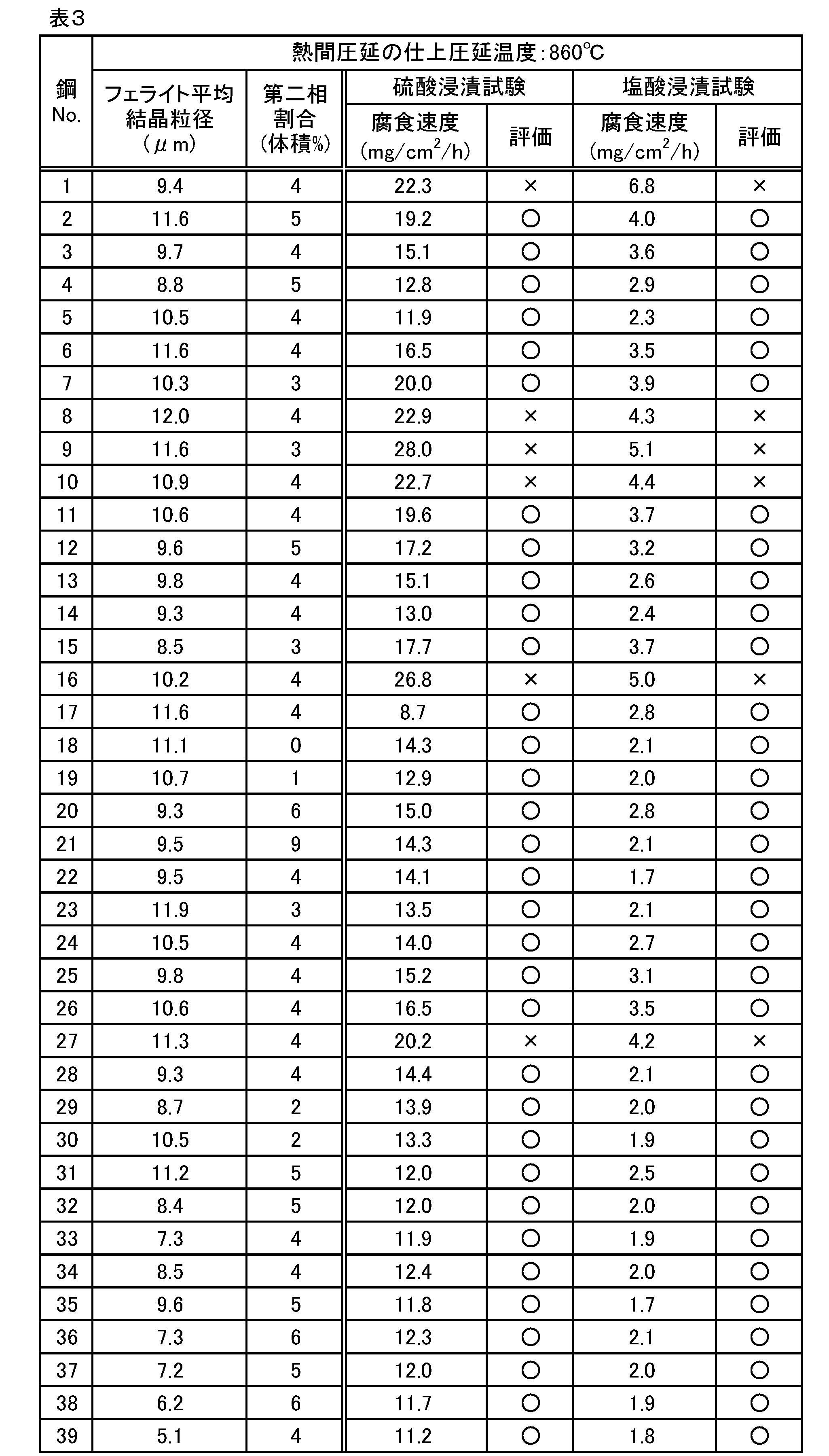
- the hot-rolled steel sheet having the chemical composition and metal structure defined in the present invention exhibits excellent characteristics in both sulfuric acid corrosion resistance and hydrochloric acid corrosion resistance.
- the steel sheet having an average ferrite grain size of more than 12.0 ⁇ m has poor acid dew point corrosion resistance.
- Steel Nos. 32 to 39 containing a predetermined amount of at least one of Ti, Nb, V, and B have a ferrite average crystal grain size of 12.0 ⁇ m or less stably even when the hot rolling finish temperature is high (Table 2).
- Organizational status was obtained.
- steel No. 18 was a ferrite single phase
- steel Nos. 19, 29 and 30 were ferrite + cementite
- other examples were ferrite + pearlite.
- Example 2 Using steel No. 5 and No. 26 shown in Table 1, hot rolling was performed under conditions of an extraction temperature of 1250 ° C., a finish rolling temperature of 860 ° C., and a winding temperature of 550 ° C., and a plate thickness of 3.2 mm A rolled steel sheet was obtained. Thereafter, pickling and cold rolling were performed to obtain a cold-rolled steel sheet having a thickness of 1.0 mm. The cold-rolled steel sheet was annealed by the following heat patterns A to C in a continuous annealing pickling line to obtain a pickled cold-rolled annealed steel sheet. (A) After soaking at 680 ° C. for 60 sec, cooling to 450 ° C.
- Each cold-rolled annealed steel sheet is finished by performing skin pass rolling with an elongation of 0.5% in an in-line mill provided between the pickling equipment and the winding device of the continuous annealing pickling line.
- Example 4 The results are shown in Table 4.
- the cold-rolled annealed steel sheets manufactured with heat patterns A and C that satisfy the annealing conditions of the present invention have an average ferrite grain size of 12.0 ⁇ m or less, and exhibit excellent acid dew point corrosion resistance.
- the average crystal grain size of ferrite to 12.0 ⁇ m or less, excellent acid dew point corrosion resistance even when the metal structure is ferrite + bainite or ferrite + martensite Can be maintained.
- heat pattern B since the maximum temperature reached by the material was too high, the ferrite average crystal grain size exceeded 12.0 ⁇ m, and the acid dew point corrosion resistance was poor.
Landscapes
- Chemical & Material Sciences (AREA)
- Engineering & Computer Science (AREA)
- Mechanical Engineering (AREA)
- Materials Engineering (AREA)
- Metallurgy (AREA)
- Organic Chemistry (AREA)
- Physics & Mathematics (AREA)
- Thermal Sciences (AREA)
- Crystallography & Structural Chemistry (AREA)
- Heat Treatment Of Sheet Steel (AREA)
- Heat Treatment Of Steel (AREA)
Abstract
Description
(X)鋼板の圧延方向および板厚方向に平行な断面(L断面)の金属組織を顕微鏡で観察し、JIS G0551:2013の附属書JB「フェライト結晶粒の切断法による評価方法」に従って粒度番号Gを求め、これを下記(1)式に代入して試験片断面の1mm2当たりの平均結晶粒数mを求め、前記mの値を下記(2)式に代入してフェライト結晶粒の平均結晶粒径DM(μm)を定める。
m=8×2G …(1)
DM=m(-1/2)×103 …(2)
ここで、上記(1)式はJIS G0551:2013のパラグラフ7.1に規定される(1)式に相当し、上記(2)式はJIS G0551:2013の表1に定義される平均結晶粒径(mm)をμm単位に換算したものに相当する。
ここで、仕上圧延温度とは、熱間圧延の最終圧延パスに供する板材の表面温度である。
ここで、排ガス流路構成部材は、排ガス流路の構造物(例えばダクトや煙突等)を構成する部材、および排ガス流路内に配置される部材(例えば集塵器や熱交換器の部材)をいう。熱交換器の部材としては例えば熱を受け取る流体が流れる管に取り付けらた「冷却フィン」が挙げられる。
(1)Cuは難溶性のCuS皮膜の形成に有効であり、この皮膜が特に硫酸に対する抵抗力を高める。
(2)CrとMoの含有量が本発明範囲から外れる鋼では硫酸環境での腐食生成物が鱗片状となるのに対し、CrとMoを適正範囲で複合添加したものでは塊状に緻密化した腐食生成物が形成されることから、この腐食生成物の緻密化が特に耐硫酸腐食性を向上させる。
(3)電気化学的測定によれば硫酸環境および塩酸環境のいずれにおいてもCrとMoの適正添加量範囲においてアノード・カソード反応が緩慢となることから、この溶解特性が硫酸環境および塩酸環境での鋼素地(Fe)の溶解抑制に直接寄与する。
(4)フェライト結晶粒径の微細化により、酸による腐食の起点となる結晶粒界が微細に分散し、腐食の進行速度が緩慢になる。
図1、図2に、それぞれ硫酸水溶液中での腐食速度に及ぼすMo含有量およびCr含有量の影響を例示する。硫酸水溶液は、重油(石炭)の燃焼ガスを想定した非常に厳しい条件として、硫酸濃度40質量%、温度60℃とし、浸漬時間は6hである。使用した鋼板は冷延焼鈍鋼板であり、図1のものはCr含有量が0.2質量%レベルでほぼ一定、図2のものはMo含有量が0.05質量%レベルでほぼ一定である。いずれもSb、Snは無添加であり、Cr、Mo以外の残部元素の含有量は全て本発明規定範囲内にある。図中、黒丸(SOLID)のプロットはフェライト結晶粒の平均結晶粒径(以下「フェライト平均結晶粒径」という)が12.0μmを超えるものであり、特許文献3の図1および図2に記載したものに相当する。白丸(OPEN)のプロットはフェライト平均結晶粒径が12.0μm以下のものである。
図3、図4に、それぞれ塩酸水溶液中での腐食速度に及ぼすMo含有量およびCr含有量の影響を例示する。塩酸水溶液は、廃棄物焼却炉を想定した厳しい条件として、塩酸濃度1質量%、温度80℃とし、浸漬時間は6hである。使用した鋼板は、図3および図4においてそれぞれ前述の図1および図2と同じである。図中、黒丸(SOLID)のプロットはフェライト平均結晶粒径が12.0μmを超えるものであり、特許文献3の図3および図4に記載したものに相当する。白丸(OPEN)のプロットはフェライト平均結晶粒径が12.0μm以下のものである。
本発明鋼の成分元素について説明する。成分元素に関する「%」は質量%を意味する。
Cは、耐酸露点腐食性に大きな影響を及ぼさず、とくに限定する必要はないが、一般の構造用材料としての強度確保の観点から0.001~0.15%とする。
本発明で対象とする鋼板は、フェライト単相組織、またはセメンタイト、パーライト、ベイナイト、マルテンサイトの1種以上を合計30体積%以下の範囲で含有し残部がフェライト相である組織を有する。本明細書では、セメンタイト、パーライト、ベイナイト、マルテンサイトを第二相と呼ぶことがある。このうちパーライトは薄いフェライト相とセメンタイト相で構成される層状組織であるが、本明細書において第二相の残部として記述されるフェライト相、すなわちフェライト平均結晶粒径の測定対象となるフェライト相には、パーライトを構成するフェライト相は含まれない。同様に第二相の構成要素としてパーライトと同列に記述されるセメンタイトにも、パーライトを構成するセメンタイトは含まれない。
フェライト平均結晶粒径が12.0μm以下に調整された鋼板を安定して得るためには、熱間圧延工程において仕上圧延温度を900℃以下とし、かつ巻取温度を650℃以下とすることが望ましい。仕上圧延温度を870℃以下とし、かつ巻取温度を600℃以下とすることがより好ましい。ただし、結晶粒微細化作用を有するTi、Nb、Vの1種以上を0.005~0.20%含有する場合や、Bを0.0005~0.010%含有する場合は、上記仕上圧延温度を930℃以下の範囲とすることができる。
上述の化学組成を満たす鋼であれば、この熱間圧延条件においてフェライト単相組織、またはセメンタイト、パーライト、ベイナイト、マルテンサイトの1種以上を合計30体積%以下の範囲で含有し残部がフェライト相である組織の熱延鋼板を得ることができる。得られた熱延鋼板は、そのまま石炭火力発電所の排ガス経路構成部材へ適用可能であるが、例えば熱交換器のフィン材など、用途によっては必要に応じて酸化スケールを酸洗除去して使用することも可能である。
表1に示す鋼を溶製し、抽出温度1250℃、仕上圧延温度920℃または860℃の2水準、巻取温度550℃の条件で熱間圧延を施し、板厚2.0mmの熱延鋼板を得た。得られた熱延鋼板は酸洗にてスケールを除去し、供試材とした。

各供試材から切り出した試験片を用いて、図1、図2のプロットを得た場合と同様の条件(前述)での硫酸浸漬試験、および図3、図4のプロットを得た場合と同様の条件(前述)での塩酸浸漬試験を行った。耐硫酸露点腐食性評価は、硫酸浸漬試験での腐食速度が20mg/cm2/h以下のものを○(良好)、それ以外のものを×(不良)と判定した。耐塩酸露点腐食性評価は、塩酸浸漬試験での腐食速度が4mg/cm2/h以下のものを○(良好)、それ以外のものを×(不良)と判定した。
各供試材のフェライト平均結晶粒径、第二相の割合、硫酸浸漬試験結果、塩酸浸漬試験結果を表2、表3に示す。表2は熱延圧延の仕上圧延温度が920℃、表3は同860℃の場合である。
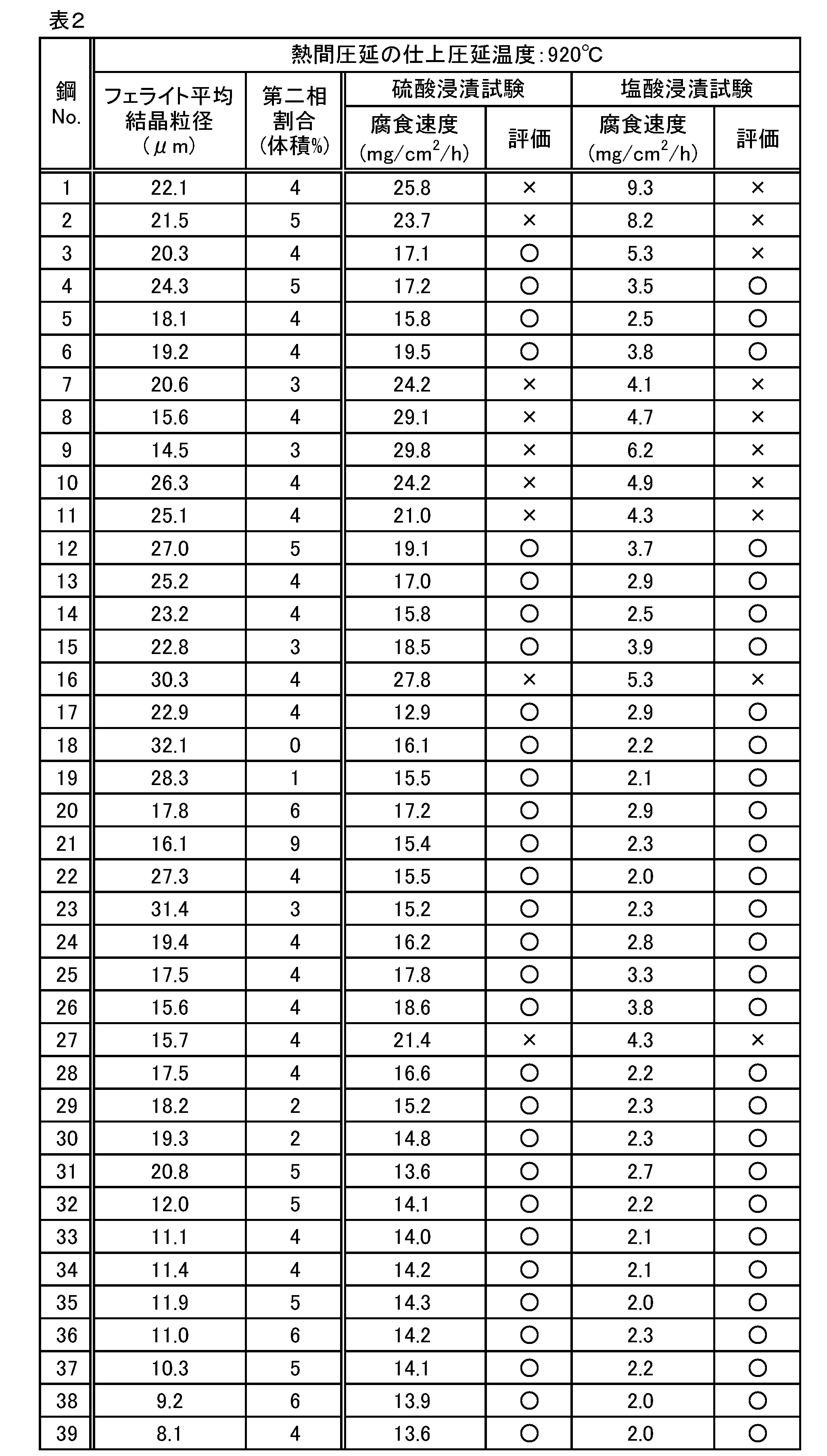
Ti、Nb、V、Bの1種以上を所定量含有する鋼No.32~39では、熱延仕上げ温度が高い場合(表2)でも安定してフェライト平均結晶粒径が12.0μm以下の組織状態が得られた。
なお、実施例1で得られた金属組織は、鋼No.18がフェライト単相、鋼No.19、29および30がフェライト+セメンタイト、それ以外の例はフェライト+パーライトであった。
表1に示したNo.5およびNo.26の鋼を用いて、抽出温度1250℃、仕上圧延温度860℃、巻取温度550℃の条件で熱間圧延を施し、板厚3.2mmの熱延鋼板を得た。その後、酸洗および冷間圧延を施して板厚1.0mmの冷延鋼板を得た。この冷延鋼板に、連続焼鈍酸洗ラインにて以下のヒートパターンA~Cで焼鈍を施し、酸洗済みの冷延焼鈍鋼板を得た。
(A)680℃で60secの均熱処理後、450℃まで10℃/sec以上の平均冷却速度で冷却、その後300~450℃の温度範囲に180sec保持。
(B)860℃で60secの均熱処理後、450℃まで10℃/sec以上の平均冷却速度で冷却、その後300~450℃の温度範囲に180sec保持。
(C)820℃で60secの均熱処理後、200℃まで50℃/sec以上の平均冷却速度で冷却、その後300~400℃の温度範囲に180sec保持。
なお、各冷延焼鈍鋼板は、連続焼鈍酸洗ラインの酸洗設備と巻取装置の間に設けたインラインミルにて伸び率0.5%のスキンパス圧延を施して仕上げたものである。
結果を表4に示す。

Claims (9)
- 質量%で、C:0.001~0.15%、Si:0.80%以下、Mn:1.50%以下、P:0.025%以下、S:0.030%以下、Cu:0.10~1.00%、Ni:0.50%以下、Cr:0.05~0.25%、Mo:0.01~0.08%、Al:0.100%以下、Ti、Nb、V:合計0~0.20%、B:0~0.010%、Sb、Sn:合計0~0.10%、残部Feおよび不可避的不純物からなる化学組成を有し、フェライト単相組織、またはセメンタイト、パーライト、ベイナイト、マルテンサイトの1種以上を合計30体積%以下の範囲で含有し残部がフェライト相である組織を有し、フェライト結晶粒の平均結晶粒径が12.0μm以下である耐酸露点腐食性に優れた鋼板。
- 前記化学組成において、Ti、Nb、Vの1種または2種以上の合計含有量が0.005~0.20%である請求項1に記載の耐酸露点腐食性に優れた鋼板。
- 前記化学組成において、Bの含有量が0.0005~0.010%である請求項1に記載の耐酸露点腐食性に優れた鋼板。
- 前記化学組成において、Sb、Snの1種または2種の合計含有量が0.005~0.10%である請求項1に記載の耐酸露点腐食性に優れた鋼板。
- 連続鋳造スラブに、仕上圧延温度900℃以下、巻取温度650℃以下の条件で熱間圧延を施すことにより、フェライト単相組織、またはセメンタイト、パーライト、ベイナイト、マルテンサイトの1種以上を合計30体積%以下の範囲で含有し残部がフェライト相である組織を有し、かつフェライト結晶粒の平均結晶粒径が12.0μm以下である鋼板を作る請求項1に記載の耐酸露点腐食性に優れた鋼板の製造方法。
- 連続鋳造スラブに、仕上圧延温度930℃以下、巻取温度650℃以下の条件で熱間圧延を施すことにより、フェライト単相組織、またはセメンタイト、パーライト、ベイナイト、マルテンサイトの1種以上を合計30体積%以下の範囲で含有し残部がフェライト相である組織を有し、かつフェライト結晶粒の平均結晶粒径が12.0μm以下である鋼板を作る請求項2または3に記載の耐酸露点腐食性に優れた鋼板の製造方法。
- 熱間圧延工程、冷間圧延工程、焼鈍工程を有する鋼板製造方法において、熱間圧延工程で仕上圧延温度を900℃以下、巻取温度を650℃以下とし、焼鈍工程で加熱温度を600~830℃とすることにより、フェライト単相組織、またはセメンタイト、パーライト、ベイナイト、マルテンサイトの1種以上を合計30体積%以下の範囲で含有し残部がフェライト相である組織を有し、かつフェライト結晶粒の平均結晶粒径が12.0μm以下である鋼板を作る請求項1に記載の耐酸露点腐食性に優れた鋼板の製造方法。
- 熱間圧延工程、冷間圧延工程、焼鈍工程を有する鋼板製造方法において、熱間圧延工程で仕上圧延温度を930℃以下、巻取温度を650℃以下とし、焼鈍工程で加熱温度を600~830℃とすることにより、フェライト単相組織、またはセメンタイト、パーライト、ベイナイト、マルテンサイトの1種以上を合計30体積%以下の範囲で含有し残部がフェライト相である組織を有し、かつフェライト結晶粒の平均結晶粒径が12.0μm以下である鋼板を作る請求項2または3に記載の耐酸露点腐食性に優れた鋼板の製造方法。
- 請求項1~4のいずれか1項に記載の鋼板を用いた部材であって、石炭焚火力発電所の燃焼排ガスまたは廃棄物焼却施設の燃焼排ガスの流路において、前記排ガスに曝されて表面に凝結が生じる部位を構成する排ガス流路構成部材。
Priority Applications (5)
| Application Number | Priority Date | Filing Date | Title |
|---|---|---|---|
| AU2015234860A AU2015234860B2 (en) | 2014-03-28 | 2015-03-26 | Steel plate having excellent acid dew point corrosion resistance, method of production, and exhaust gas channel constituent member |
| KR1020167029481A KR102462565B1 (ko) | 2014-03-28 | 2015-03-26 | 내산 이슬점 부식성이 우수한 강판 및 제조 방법 및 배기가스 유로 구성 부재 |
| CN201580016949.3A CN106414784B (zh) | 2014-03-28 | 2015-03-26 | 耐酸露点腐蚀性优异的钢板及制造方法以及排气流路构成部件 |
| JP2016510486A JP6173567B2 (ja) | 2014-03-28 | 2015-03-26 | 耐酸露点腐食性に優れた鋼板の製造方法 |
| US15/127,820 US10351925B2 (en) | 2014-03-28 | 2015-03-26 | Steel plate having excellent acid dew point corrosion resistance, method of production, and exhaust gas channel constituent member |
Applications Claiming Priority (2)
| Application Number | Priority Date | Filing Date | Title |
|---|---|---|---|
| JP2014069095 | 2014-03-28 | ||
| JP2014-069095 | 2014-03-28 |
Publications (1)
| Publication Number | Publication Date |
|---|---|
| WO2015147166A1 true WO2015147166A1 (ja) | 2015-10-01 |
Family
ID=54195672
Family Applications (1)
| Application Number | Title | Priority Date | Filing Date |
|---|---|---|---|
| PCT/JP2015/059375 Ceased WO2015147166A1 (ja) | 2014-03-28 | 2015-03-26 | 耐酸露点腐食性に優れた鋼板および製造方法並びに排ガス流路構成部材 |
Country Status (8)
| Country | Link |
|---|---|
| US (1) | US10351925B2 (ja) |
| JP (2) | JP6173567B2 (ja) |
| KR (1) | KR102462565B1 (ja) |
| CN (2) | CN106414784B (ja) |
| AU (1) | AU2015234860B2 (ja) |
| MY (1) | MY179972A (ja) |
| TW (1) | TWI652357B (ja) |
| WO (1) | WO2015147166A1 (ja) |
Cited By (7)
| Publication number | Priority date | Publication date | Assignee | Title |
|---|---|---|---|---|
| JP2017128753A (ja) * | 2016-01-19 | 2017-07-27 | 日新製鋼株式会社 | 加工性に優れた耐酸露点腐食性鋼板および製造方法並びに排ガス流路構成部材 |
| JP2017186650A (ja) * | 2016-03-30 | 2017-10-12 | 日新製鋼株式会社 | 耐酸露点腐食性に優れる溶接鋼管およびその製造法並びに熱交換器 |
| KR20180123837A (ko) * | 2017-05-10 | 2018-11-20 | 현대자동차주식회사 | 부식환경에서 내식성을 향상시킨 차량용 저합금 내식강과 그 제조방법 |
| JP6477983B1 (ja) * | 2018-03-29 | 2019-03-06 | 新日鐵住金株式会社 | オーステナイト系耐摩耗鋼板 |
| WO2019186911A1 (ja) * | 2018-03-29 | 2019-10-03 | 新日鐵住金株式会社 | オーステナイト系耐摩耗鋼板 |
| CN115652194A (zh) * | 2022-09-29 | 2023-01-31 | 首钢集团有限公司 | 一种耐硫酸露点腐蚀钢及其制备方法 |
| WO2023223744A1 (ja) * | 2022-05-20 | 2023-11-23 | Jfeスチール株式会社 | 熱延厚物耐硫酸鋼板およびその製造方法 |
Families Citing this family (20)
| Publication number | Priority date | Publication date | Assignee | Title |
|---|---|---|---|---|
| KR102134310B1 (ko) * | 2017-12-26 | 2020-07-15 | 주식회사 포스코 | 플럭스 코어드 와이어용 냉연강판 및 그 제조방법 |
| CN111485166A (zh) * | 2019-01-29 | 2020-08-04 | 宝山钢铁股份有限公司 | 一种冷轧耐低温酸露点腐蚀钢及其制造方法 |
| CN109628844B (zh) * | 2019-02-12 | 2020-05-29 | 鞍钢股份有限公司 | 屈服强度700MPa级运煤敞车用耐蚀钢及其制造方法 |
| CN109628842B (zh) * | 2019-02-12 | 2020-05-29 | 鞍钢股份有限公司 | 屈服强度550MPa级运煤敞车用耐蚀钢及其制造方法 |
| CN109628841B (zh) * | 2019-02-12 | 2020-05-29 | 鞍钢股份有限公司 | 屈服强度350MPa级运煤敞车用耐蚀钢及其制造方法 |
| CN109628843B (zh) * | 2019-02-12 | 2020-05-29 | 鞍钢股份有限公司 | 屈服强度450MPa级运煤敞车用耐蚀钢及其制造方法 |
| KR102255818B1 (ko) * | 2019-06-24 | 2021-05-25 | 주식회사 포스코 | 내부식성이 우수한 고강도 구조용 강재 및 그 제조방법 |
| JP6806291B1 (ja) * | 2019-07-09 | 2021-01-06 | Jfeスチール株式会社 | 耐硫酸露点腐食性に優れる継目無鋼管およびその製造方法 |
| WO2021005960A1 (ja) * | 2019-07-09 | 2021-01-14 | Jfeスチール株式会社 | 耐硫酸露点腐食性に優れる継目無鋼管およびその製造方法 |
| WO2021005959A1 (ja) * | 2019-07-09 | 2021-01-14 | Jfeスチール株式会社 | 耐硫酸露点腐食性に優れる継目無鋼管およびその製造方法 |
| CN112522589B (zh) * | 2019-09-19 | 2022-10-21 | 宝山钢铁股份有限公司 | 一种含b耐硫酸露点腐蚀用热轧钢板/带及其制造方法 |
| CN112522594B (zh) * | 2019-09-19 | 2022-10-21 | 宝山钢铁股份有限公司 | 一种薄规格耐火耐候钢板/带及其生产方法 |
| WO2021052317A1 (zh) * | 2019-09-19 | 2021-03-25 | 宝山钢铁股份有限公司 | 一种耐硫酸露点腐蚀用热轧钢板/带及其制造方法 |
| CN112575269A (zh) * | 2019-09-27 | 2021-03-30 | 宝山钢铁股份有限公司 | 一种耐低温酸露点腐蚀冷轧钢及其制造方法 |
| CN111172463A (zh) * | 2020-02-17 | 2020-05-19 | 本钢板材股份有限公司 | 一种抗酸腐蚀bgns440钢热轧卷板及其制备方法 |
| CN114763591A (zh) * | 2021-01-11 | 2022-07-19 | 宝山钢铁股份有限公司 | 一种耐盐和酸腐蚀的耐腐蚀钢及其制造方法 |
| CN112941412A (zh) * | 2021-01-30 | 2021-06-11 | 南阳汉冶特钢有限公司 | 一种特厚550MPa级抗震耐候钢的生产方法 |
| CN114807785B (zh) * | 2022-06-28 | 2022-11-18 | 江苏省沙钢钢铁研究院有限公司 | 390MPa级耐蚀钢板及其生产方法 |
| CN116815057B (zh) * | 2023-06-30 | 2026-03-03 | 马鞍山钢铁有限公司 | 一种350MPa级全天候高耐候钢及其制造方法 |
| KR20250093776A (ko) * | 2023-12-15 | 2025-06-25 | 주식회사 포스코 | 내산용 강판 및 그 제조방법 |
Citations (3)
| Publication number | Priority date | Publication date | Assignee | Title |
|---|---|---|---|---|
| JP2003213367A (ja) * | 2001-11-19 | 2003-07-30 | Nippon Steel Corp | 耐塩酸腐食性および耐硫酸腐食性に優れた低合金鋼およびその溶接継手 |
| JP2012057221A (ja) * | 2010-09-09 | 2012-03-22 | Nisshin Steel Co Ltd | 耐酸露点腐食鋼および排ガス流路構成部材 |
| JP2012180546A (ja) * | 2011-02-28 | 2012-09-20 | Nisshin Steel Co Ltd | 耐硫酸露点腐食鋼および排ガス流路構成部材 |
Family Cites Families (16)
| Publication number | Priority date | Publication date | Assignee | Title |
|---|---|---|---|---|
| US3459538A (en) | 1965-03-25 | 1969-08-05 | Fuji Iron & Steel Co Ltd | Corrosion resistant low-alloy steel |
| US5622572A (en) * | 1995-08-28 | 1997-04-22 | Newport News Shipbuilding And Dry Dock Company | Extra-strength steel and method of making |
| BR9806104A (pt) * | 1997-06-26 | 1999-08-31 | Kawasaki Steel Co | Tubo de aço de granulação superfina e processo para a produção do mesmo. |
| JP3812279B2 (ja) * | 2000-04-21 | 2006-08-23 | Jfeスチール株式会社 | 加工性および歪時効硬化特性に優れた高降伏比型高張力溶融亜鉛めっき鋼板およびその製造方法 |
| JP2004315936A (ja) * | 2003-04-18 | 2004-11-11 | Nippon Steel Corp | 粒界割れ抵抗性に優れた極低炭素系耐酸露点腐食鋼 |
| US7491277B2 (en) * | 2006-04-10 | 2009-02-17 | Illinois Tool Works Inc. | Method of making cold rolled full hard steel strapping |
| CN100460550C (zh) * | 2006-08-22 | 2009-02-11 | 武汉钢铁(集团)公司 | 一种耐海水腐蚀性能的海洋钻采平台用钢及其制造方法 |
| EP2163658B9 (en) * | 2007-06-21 | 2020-10-28 | JFE Steel Corporation | Ferritic stainless steel sheet having excellent corrosion resistance against sulfuric acid, and method for production thereof |
| CN101705425B (zh) * | 2009-11-06 | 2011-07-20 | 武汉钢铁(集团)公司 | 含Ti抗拉强度≥450MPa级耐硫酸露点腐蚀钢 |
| CN101705441A (zh) * | 2009-11-24 | 2010-05-12 | 上海亘富冶金科技有限公司 | 一种耐硫酸露点腐蚀高强度低合金钢 |
| CN101831598A (zh) * | 2010-05-26 | 2010-09-15 | 马鞍山钢铁股份有限公司 | 一种低合金耐硫酸露点腐蚀用钢及其生产方法 |
| CN102286700B (zh) * | 2011-09-13 | 2013-06-12 | 江苏省沙钢钢铁研究院有限公司 | 抗拉强度≥800MPa级耐硫酸露点腐蚀钢及其制备方法 |
| CN102392185B (zh) * | 2011-10-28 | 2013-05-22 | 首钢总公司 | 一种正火态抗酸性热轧钢板及其制备方法 |
| CN103147000B (zh) * | 2013-03-20 | 2014-12-03 | 钢铁研究总院 | 多边形铁素体+针状铁素体双相钢板/带及生产方法 |
| CN103589972B (zh) * | 2013-10-10 | 2015-04-29 | 中天钢铁集团有限公司 | 一种低成本耐硫酸露点腐蚀用低合金钢及其生产工艺与用途 |
| CN103741056B (zh) * | 2014-01-26 | 2016-01-06 | 北京科技大学 | 一种耐南海海洋环境用耐蚀钢板的生产工艺 |
-
2015
- 2015-03-26 JP JP2016510486A patent/JP6173567B2/ja active Active
- 2015-03-26 US US15/127,820 patent/US10351925B2/en active Active
- 2015-03-26 KR KR1020167029481A patent/KR102462565B1/ko active Active
- 2015-03-26 MY MYPI2016703491A patent/MY179972A/en unknown
- 2015-03-26 CN CN201580016949.3A patent/CN106414784B/zh active Active
- 2015-03-26 WO PCT/JP2015/059375 patent/WO2015147166A1/ja not_active Ceased
- 2015-03-26 AU AU2015234860A patent/AU2015234860B2/en active Active
- 2015-03-26 CN CN201811215964.2A patent/CN109536827B/zh active Active
- 2015-03-27 TW TW104109948A patent/TWI652357B/zh active
-
2017
- 2017-05-10 JP JP2017093814A patent/JP6227182B2/ja active Active
Patent Citations (3)
| Publication number | Priority date | Publication date | Assignee | Title |
|---|---|---|---|---|
| JP2003213367A (ja) * | 2001-11-19 | 2003-07-30 | Nippon Steel Corp | 耐塩酸腐食性および耐硫酸腐食性に優れた低合金鋼およびその溶接継手 |
| JP2012057221A (ja) * | 2010-09-09 | 2012-03-22 | Nisshin Steel Co Ltd | 耐酸露点腐食鋼および排ガス流路構成部材 |
| JP2012180546A (ja) * | 2011-02-28 | 2012-09-20 | Nisshin Steel Co Ltd | 耐硫酸露点腐食鋼および排ガス流路構成部材 |
Cited By (12)
| Publication number | Priority date | Publication date | Assignee | Title |
|---|---|---|---|---|
| JP2017128753A (ja) * | 2016-01-19 | 2017-07-27 | 日新製鋼株式会社 | 加工性に優れた耐酸露点腐食性鋼板および製造方法並びに排ガス流路構成部材 |
| JP2017186650A (ja) * | 2016-03-30 | 2017-10-12 | 日新製鋼株式会社 | 耐酸露点腐食性に優れる溶接鋼管およびその製造法並びに熱交換器 |
| KR20180123837A (ko) * | 2017-05-10 | 2018-11-20 | 현대자동차주식회사 | 부식환경에서 내식성을 향상시킨 차량용 저합금 내식강과 그 제조방법 |
| KR102373161B1 (ko) | 2017-05-10 | 2022-03-10 | 현대자동차주식회사 | 부식환경에서 내식성을 향상시킨 차량용 저합금 내식강과 그 제조방법 |
| JP6477983B1 (ja) * | 2018-03-29 | 2019-03-06 | 新日鐵住金株式会社 | オーステナイト系耐摩耗鋼板 |
| WO2019186911A1 (ja) * | 2018-03-29 | 2019-10-03 | 新日鐵住金株式会社 | オーステナイト系耐摩耗鋼板 |
| WO2019186906A1 (ja) * | 2018-03-29 | 2019-10-03 | 日本製鉄株式会社 | オーステナイト系耐摩耗鋼板 |
| EP3778950A4 (en) * | 2018-03-29 | 2021-10-06 | Nippon Steel Corporation | AUSTENITIC ABRASION-RESISTANT STEEL SHEET |
| US11326237B2 (en) | 2018-03-29 | 2022-05-10 | Nippon Steel Corporation | Austenitic wear-resistant steel plate |
| WO2023223744A1 (ja) * | 2022-05-20 | 2023-11-23 | Jfeスチール株式会社 | 熱延厚物耐硫酸鋼板およびその製造方法 |
| JP7444338B1 (ja) * | 2022-05-20 | 2024-03-06 | Jfeスチール株式会社 | 熱延厚物耐硫酸鋼板およびその製造方法 |
| CN115652194A (zh) * | 2022-09-29 | 2023-01-31 | 首钢集团有限公司 | 一种耐硫酸露点腐蚀钢及其制备方法 |
Also Published As
| Publication number | Publication date |
|---|---|
| CN109536827A (zh) | 2019-03-29 |
| CN106414784A (zh) | 2017-02-15 |
| AU2015234860B2 (en) | 2019-11-21 |
| JPWO2015147166A1 (ja) | 2017-04-13 |
| KR20160138185A (ko) | 2016-12-02 |
| US10351925B2 (en) | 2019-07-16 |
| KR102462565B1 (ko) | 2022-11-03 |
| AU2015234860A1 (en) | 2016-09-22 |
| CN109536827B (zh) | 2021-10-12 |
| CN106414784B (zh) | 2018-11-16 |
| TW201542840A (zh) | 2015-11-16 |
| JP2017160544A (ja) | 2017-09-14 |
| JP6173567B2 (ja) | 2017-08-02 |
| JP6227182B2 (ja) | 2017-11-08 |
| US20170114425A1 (en) | 2017-04-27 |
| TWI652357B (zh) | 2019-03-01 |
| MY179972A (en) | 2020-11-19 |
Similar Documents
| Publication | Publication Date | Title |
|---|---|---|
| JP6227182B2 (ja) | 耐酸露点腐食性に優れた鋼板および排ガス流路構成部材 | |
| KR100470046B1 (ko) | 내황산 부식특성이 우수한 냉연강판 | |
| CN109563594B (zh) | 耐硫酸露点腐蚀钢 | |
| EP2980251B1 (en) | Hot-rolled ferritic stainless-steel plate, process for producing same, and steel strip | |
| JP6379282B2 (ja) | せん断端面の耐食性に優れるフェライト・オーステナイト系ステンレス鋼板 | |
| JP6332575B1 (ja) | 耐硫酸露点腐食鋼 | |
| JP2007239095A (ja) | 耐酸腐食鋼 | |
| CN104968823A (zh) | 加工性优良的铁素体系不锈钢板及其制造方法 | |
| CN111433382B (zh) | 具有优异的抗高温氧化性的铁素体不锈钢及其制造方法 | |
| WO2018038197A1 (ja) | 耐硫酸露点腐食鋼 | |
| CN103857812A (zh) | 冷裂纹性优异的铁素体系不锈钢热轧钢板以及其制造方法 | |
| JP7444338B1 (ja) | 熱延厚物耐硫酸鋼板およびその製造方法 | |
| JP6632388B2 (ja) | 加工性に優れた耐酸露点腐食性鋼板および製造方法並びに排ガス流路構成部材 | |
| JP6992499B2 (ja) | 鋼材 | |
| JP2017160483A (ja) | 加工性に優れた熱交換器用耐酸露点腐食性鋼板および製造方法 | |
| JP4317517B2 (ja) | 加工性・溶接熱影響部靭性に優れた高耐食性熱延鋼板およびその製造法 | |
| JP6504973B2 (ja) | 耐硫化腐食性に優れたAl含有フェライト系ステンレス鋼およびその製造方法 | |
| KR20120011259A (ko) | 내식성이 우수한 고강도 고연성 열연강판 및 그 제조방법 | |
| KR20120032886A (ko) | 내식성이 우수한 저합금 열연강판 및 그 제조방법 | |
| JP5780019B2 (ja) | 化成処理性に優れた高Si含有高張力冷延鋼帯の製造方法 | |
| JP7598378B2 (ja) | 耐摩耗性と複合耐食性に優れた鋼板およびその製造方法 |
Legal Events
| Date | Code | Title | Description |
|---|---|---|---|
| 121 | Ep: the epo has been informed by wipo that ep was designated in this application |
Ref document number: 15770217 Country of ref document: EP Kind code of ref document: A1 |
|
| ENP | Entry into the national phase |
Ref document number: 2016510486 Country of ref document: JP Kind code of ref document: A |
|
| WWE | Wipo information: entry into national phase |
Ref document number: 15127820 Country of ref document: US |
|
| ENP | Entry into the national phase |
Ref document number: 2015234860 Country of ref document: AU Date of ref document: 20150326 Kind code of ref document: A |
|
| NENP | Non-entry into the national phase |
Ref country code: DE |
|
| ENP | Entry into the national phase |
Ref document number: 20167029481 Country of ref document: KR Kind code of ref document: A |
|
| 122 | Ep: pct application non-entry in european phase |
Ref document number: 15770217 Country of ref document: EP Kind code of ref document: A1 |
|
| WWG | Wipo information: grant in national office |
Ref document number: 201647031468 Country of ref document: IN |