WO2015133497A1 - 両面黒色粘着テープ - Google Patents
両面黒色粘着テープ Download PDFInfo
- Publication number
- WO2015133497A1 WO2015133497A1 PCT/JP2015/056259 JP2015056259W WO2015133497A1 WO 2015133497 A1 WO2015133497 A1 WO 2015133497A1 JP 2015056259 W JP2015056259 W JP 2015056259W WO 2015133497 A1 WO2015133497 A1 WO 2015133497A1
- Authority
- WO
- WIPO (PCT)
- Prior art keywords
- sensitive adhesive
- acrylate
- meth
- pressure
- double
- Prior art date
- Legal status (The legal status is an assumption and is not a legal conclusion. Google has not performed a legal analysis and makes no representation as to the accuracy of the status listed.)
- Ceased
Links
Classifications
-
- C—CHEMISTRY; METALLURGY
- C09—DYES; PAINTS; POLISHES; NATURAL RESINS; ADHESIVES; COMPOSITIONS NOT OTHERWISE PROVIDED FOR; APPLICATIONS OF MATERIALS NOT OTHERWISE PROVIDED FOR
- C09J—ADHESIVES; NON-MECHANICAL ASPECTS OF ADHESIVE PROCESSES IN GENERAL; ADHESIVE PROCESSES NOT PROVIDED FOR ELSEWHERE; USE OF MATERIALS AS ADHESIVES
- C09J7/00—Adhesives in the form of films or foils
- C09J7/20—Adhesives in the form of films or foils characterised by their carriers
- C09J7/29—Laminated material
-
- C—CHEMISTRY; METALLURGY
- C09—DYES; PAINTS; POLISHES; NATURAL RESINS; ADHESIVES; COMPOSITIONS NOT OTHERWISE PROVIDED FOR; APPLICATIONS OF MATERIALS NOT OTHERWISE PROVIDED FOR
- C09J—ADHESIVES; NON-MECHANICAL ASPECTS OF ADHESIVE PROCESSES IN GENERAL; ADHESIVE PROCESSES NOT PROVIDED FOR ELSEWHERE; USE OF MATERIALS AS ADHESIVES
- C09J7/00—Adhesives in the form of films or foils
- C09J7/10—Adhesives in the form of films or foils without carriers
-
- C—CHEMISTRY; METALLURGY
- C08—ORGANIC MACROMOLECULAR COMPOUNDS; THEIR PREPARATION OR CHEMICAL WORKING-UP; COMPOSITIONS BASED THEREON
- C08K—Use of inorganic or non-macromolecular organic substances as compounding ingredients
- C08K7/00—Use of ingredients characterised by shape
- C08K7/22—Expanded, porous or hollow particles
-
- C—CHEMISTRY; METALLURGY
- C09—DYES; PAINTS; POLISHES; NATURAL RESINS; ADHESIVES; COMPOSITIONS NOT OTHERWISE PROVIDED FOR; APPLICATIONS OF MATERIALS NOT OTHERWISE PROVIDED FOR
- C09F—NATURAL RESINS; FRENCH POLISH; DRYING-OILS; OIL DRYING AGENTS, i.e. SICCATIVES; TURPENTINE
- C09F9/00—Compounds to be used as driers, i.e. siccatives
-
- C—CHEMISTRY; METALLURGY
- C09—DYES; PAINTS; POLISHES; NATURAL RESINS; ADHESIVES; COMPOSITIONS NOT OTHERWISE PROVIDED FOR; APPLICATIONS OF MATERIALS NOT OTHERWISE PROVIDED FOR
- C09J—ADHESIVES; NON-MECHANICAL ASPECTS OF ADHESIVE PROCESSES IN GENERAL; ADHESIVE PROCESSES NOT PROVIDED FOR ELSEWHERE; USE OF MATERIALS AS ADHESIVES
- C09J11/00—Features of adhesives not provided for in group C09J9/00, e.g. additives
- C09J11/02—Non-macromolecular additives
- C09J11/04—Non-macromolecular additives inorganic
-
- C—CHEMISTRY; METALLURGY
- C09—DYES; PAINTS; POLISHES; NATURAL RESINS; ADHESIVES; COMPOSITIONS NOT OTHERWISE PROVIDED FOR; APPLICATIONS OF MATERIALS NOT OTHERWISE PROVIDED FOR
- C09J—ADHESIVES; NON-MECHANICAL ASPECTS OF ADHESIVE PROCESSES IN GENERAL; ADHESIVE PROCESSES NOT PROVIDED FOR ELSEWHERE; USE OF MATERIALS AS ADHESIVES
- C09J133/00—Adhesives based on homopolymers or copolymers of compounds having one or more unsaturated aliphatic radicals, each having only one carbon-to-carbon double bond, and at least one being terminated by only one carboxyl radical, or of salts, anhydrides, esters, amides, imides, or nitriles thereof; Adhesives based on derivatives of such polymers
- C09J133/04—Homopolymers or copolymers of esters
- C09J133/06—Homopolymers or copolymers of esters of esters containing only carbon, hydrogen and oxygen, the oxygen atom being present only as part of the carboxyl radical
- C09J133/062—Copolymers with monomers not covered by C09J133/06
-
- C—CHEMISTRY; METALLURGY
- C09—DYES; PAINTS; POLISHES; NATURAL RESINS; ADHESIVES; COMPOSITIONS NOT OTHERWISE PROVIDED FOR; APPLICATIONS OF MATERIALS NOT OTHERWISE PROVIDED FOR
- C09J—ADHESIVES; NON-MECHANICAL ASPECTS OF ADHESIVE PROCESSES IN GENERAL; ADHESIVE PROCESSES NOT PROVIDED FOR ELSEWHERE; USE OF MATERIALS AS ADHESIVES
- C09J133/00—Adhesives based on homopolymers or copolymers of compounds having one or more unsaturated aliphatic radicals, each having only one carbon-to-carbon double bond, and at least one being terminated by only one carboxyl radical, or of salts, anhydrides, esters, amides, imides, or nitriles thereof; Adhesives based on derivatives of such polymers
- C09J133/04—Homopolymers or copolymers of esters
- C09J133/06—Homopolymers or copolymers of esters of esters containing only carbon, hydrogen and oxygen, the oxygen atom being present only as part of the carboxyl radical
- C09J133/062—Copolymers with monomers not covered by C09J133/06
- C09J133/066—Copolymers with monomers not covered by C09J133/06 containing -OH groups
-
- C—CHEMISTRY; METALLURGY
- C09—DYES; PAINTS; POLISHES; NATURAL RESINS; ADHESIVES; COMPOSITIONS NOT OTHERWISE PROVIDED FOR; APPLICATIONS OF MATERIALS NOT OTHERWISE PROVIDED FOR
- C09J—ADHESIVES; NON-MECHANICAL ASPECTS OF ADHESIVE PROCESSES IN GENERAL; ADHESIVE PROCESSES NOT PROVIDED FOR ELSEWHERE; USE OF MATERIALS AS ADHESIVES
- C09J201/00—Adhesives based on unspecified macromolecular compounds
-
- C—CHEMISTRY; METALLURGY
- C08—ORGANIC MACROMOLECULAR COMPOUNDS; THEIR PREPARATION OR CHEMICAL WORKING-UP; COMPOSITIONS BASED THEREON
- C08K—Use of inorganic or non-macromolecular organic substances as compounding ingredients
- C08K2201/00—Specific properties of additives
- C08K2201/002—Physical properties
- C08K2201/003—Additives being defined by their diameter
-
- C—CHEMISTRY; METALLURGY
- C08—ORGANIC MACROMOLECULAR COMPOUNDS; THEIR PREPARATION OR CHEMICAL WORKING-UP; COMPOSITIONS BASED THEREON
- C08K—Use of inorganic or non-macromolecular organic substances as compounding ingredients
- C08K3/00—Use of inorganic substances as compounding ingredients
- C08K3/02—Elements
- C08K3/04—Carbon
-
- C—CHEMISTRY; METALLURGY
- C08—ORGANIC MACROMOLECULAR COMPOUNDS; THEIR PREPARATION OR CHEMICAL WORKING-UP; COMPOSITIONS BASED THEREON
- C08K—Use of inorganic or non-macromolecular organic substances as compounding ingredients
- C08K9/00—Use of pretreated ingredients
- C08K9/12—Adsorbed ingredients, e.g. ingredients on carriers
-
- C—CHEMISTRY; METALLURGY
- C09—DYES; PAINTS; POLISHES; NATURAL RESINS; ADHESIVES; COMPOSITIONS NOT OTHERWISE PROVIDED FOR; APPLICATIONS OF MATERIALS NOT OTHERWISE PROVIDED FOR
- C09J—ADHESIVES; NON-MECHANICAL ASPECTS OF ADHESIVE PROCESSES IN GENERAL; ADHESIVE PROCESSES NOT PROVIDED FOR ELSEWHERE; USE OF MATERIALS AS ADHESIVES
- C09J2203/00—Applications of adhesives in processes or use of adhesives in the form of films or foils
- C09J2203/318—Applications of adhesives in processes or use of adhesives in the form of films or foils for the production of liquid crystal displays
-
- C—CHEMISTRY; METALLURGY
- C09—DYES; PAINTS; POLISHES; NATURAL RESINS; ADHESIVES; COMPOSITIONS NOT OTHERWISE PROVIDED FOR; APPLICATIONS OF MATERIALS NOT OTHERWISE PROVIDED FOR
- C09J—ADHESIVES; NON-MECHANICAL ASPECTS OF ADHESIVE PROCESSES IN GENERAL; ADHESIVE PROCESSES NOT PROVIDED FOR ELSEWHERE; USE OF MATERIALS AS ADHESIVES
- C09J2301/00—Additional features of adhesives in the form of films or foils
- C09J2301/40—Additional features of adhesives in the form of films or foils characterized by the presence of essential components
- C09J2301/408—Additional features of adhesives in the form of films or foils characterized by the presence of essential components additives as essential feature of the adhesive layer
-
- C—CHEMISTRY; METALLURGY
- C09—DYES; PAINTS; POLISHES; NATURAL RESINS; ADHESIVES; COMPOSITIONS NOT OTHERWISE PROVIDED FOR; APPLICATIONS OF MATERIALS NOT OTHERWISE PROVIDED FOR
- C09J—ADHESIVES; NON-MECHANICAL ASPECTS OF ADHESIVE PROCESSES IN GENERAL; ADHESIVE PROCESSES NOT PROVIDED FOR ELSEWHERE; USE OF MATERIALS AS ADHESIVES
- C09J2301/00—Additional features of adhesives in the form of films or foils
- C09J2301/40—Additional features of adhesives in the form of films or foils characterized by the presence of essential components
- C09J2301/412—Additional features of adhesives in the form of films or foils characterized by the presence of essential components presence of microspheres
-
- C—CHEMISTRY; METALLURGY
- C09—DYES; PAINTS; POLISHES; NATURAL RESINS; ADHESIVES; COMPOSITIONS NOT OTHERWISE PROVIDED FOR; APPLICATIONS OF MATERIALS NOT OTHERWISE PROVIDED FOR
- C09J—ADHESIVES; NON-MECHANICAL ASPECTS OF ADHESIVE PROCESSES IN GENERAL; ADHESIVE PROCESSES NOT PROVIDED FOR ELSEWHERE; USE OF MATERIALS AS ADHESIVES
- C09J2433/00—Presence of (meth)acrylic polymer
Definitions
- the present invention relates to a double-sided black adhesive tape that can be preferably used when a transparent protective front panel is attached to an image display module of a portable information terminal such as a smartphone.
- the portable information terminal has a structure in which an image display module including a casing and a transparent front panel such as a glass plate or an acrylic plate are bonded to each other with a double-sided adhesive tape disposed on the outer peripheral edges facing each other.
- a double-sided pressure-sensitive adhesive tape is required to exhibit good impact resistance.
- a double-sided pressure-sensitive adhesive tape in consideration of impact resistance has been proposed in which a pressure-sensitive adhesive layer obtained by photocuring a photocurable acrylic pressure-sensitive adhesive composition is laminated on both surfaces of a foam substrate. (Patent Document 1).
- this double-sided pressure-sensitive adhesive tape has a drawback that a part of the bubbles of the foam base material used becomes open cells, and thus has a problem that the waterproof property is lowered. For this reason, in order to achieve both impact resistance and waterproofness, it is considered to incorporate fine hollow particles in the acrylic pressure-sensitive adhesive layer of the double-sided pressure-sensitive adhesive tape.
- the double-sided adhesive tape for attaching the image display module including the housing and the front panel is required to be black because a black frame-like print layer is provided on the front panel. .
- carbon black as a black colorant into a photocurable acrylic pressure-sensitive adhesive composition containing hollow particles.
- the object of the present invention is to solve the above-mentioned problems of the prior art, and both surfaces having an acrylic pressure-sensitive adhesive layer obtained by photocuring a photocurable acrylic pressure-sensitive adhesive composition containing hollow particles.
- the acrylic pressure-sensitive adhesive layer can be blackened so as to be sufficiently photocured without impairing the impact resistance and waterproofness.
- the present inventors separately include the hollow particles and the black pigment in the photocurable acrylic pressure-sensitive adhesive composition, the light diffusion ability of the hollow particles is maintained to some extent, and the photocurable acrylic pressure-sensitive adhesive is maintained. It was presumed that since the black pigment is dispersed throughout the adhesive composition, the photocuring of the adhesive composition tends to be insufficient. Based on this presumption, the present inventor tried to contain hollow particles whose surface was previously treated with black pigment adhesion in a photocurable acrylic pressure-sensitive adhesive composition, and the light diffusing ability of the hollow particles was greatly suppressed.
- the photocurable acrylic pressure-sensitive adhesive composition can be sufficiently blackened, and nevertheless, since the amount of black pigment dispersed in the photocurable acrylic component is suppressed, the photocurable acrylic The inventors have found that the pressure-sensitive adhesive composition can be sufficiently photocured, and have completed the present invention.
- the double-sided black adhesive tape according to [1] or [2], wherein the hollow particles are polyacrylonitrile hollow particles.
- a hollow particle-containing pressure-sensitive adhesive composition containing an acrylic pressure-sensitive adhesive composition and hollow particles whose surface is subjected to black pigment adhesion treatment is formed into a film and photopolymerized [1] to [6] ]
- the monofunctional (meth) acrylate is at least one selected from the group consisting of 2-ethylhexyl acrylate, butyl acrylate, isooctyl acrylate, isostearyl acrylate, and ethyl carbitol acrylate;
- (B) (meth) acrylic acid is acrylic acid or methacrylic acid,
- (C) Acrylic crosslinking agent is neopentyl glycol di (meth) acrylate, neopentyl glycol di (meth) acrylate hydroxypivalate, polypropylene glycol di (meth) acrylate, nonanediol di (meth) acrylate, 1, 4-butanediol di (meth) acrylate, polyethylene glycol di (meth) acrylate, and at least one selected from the group consisting of EO-modified polypropylene glycol di (meth) acrylate,
- the photocurable acrylic pressure-sensitive adhesive composition comprises (a) 100 parts by mass of monofunctional (meth) acrylate, (b) 2 to 20 parts by mass of (meth) acrylic acid, and (c) acrylic crosslinking agent 0.1.
- the radical photopolymerization initiator comprises an oxime ester photopolymerization initiator, an acyl phosphine oxide photopolymerization initiator, and an alkylphenone photopolymerization initiator on a mass basis (0.1 to 4):
- the monofunctional (meth) acrylate is at least one selected from the group consisting of 2-ethylhexyl acrylate, butyl acrylate, isooctyl acrylate, isostearyl acrylate, and ethyl carbitol acrylate;
- (Bb) (meth) acrylic acid is acrylic acid or methacrylic acid,
- Acrylic crosslinking agent is neopentyl glycol di (meth) acrylate, hydroxypivalate neopentyl glycol di (meth) acrylate, polypropylene glycol di (meth) acrylate, nonanediol di (meth) acrylate, 1, 4-butanediol di (meth) acrylate, polyethylene glycol di (meth) acrylate, and at least one selected from the group consisting of EO-modified polypropylene glycol di (meth) acrylate, (Dd)
- the hollow particle-free pressure-sensitive adhesive composition comprises (bb) 2 to 20 parts by weight of (meth) acrylic acid, (cc) 0.1 to The double-sided black pressure-sensitive adhesive tape according to [11] or [12], which is contained in an amount of 1.0 part by mass and (dd) 0.1 to 1.0 part by mass of a radical photopolymerization initiator.
- the radical photopolymerization initiator comprises an oxime ester photopolymerization initiator, an acyl phosphine oxide photopolymerization initiator, and an alkylphenone photopolymerization initiator on a mass basis (0.1 to 4):
- the pressure-sensitive adhesive layer contains hollow particles. Therefore, the double-sided pressure-sensitive adhesive tape has good waterproofness and impact resistance.
- the hollow particles have a black pigment adhesion treatment on the surface. Therefore, the light diffusing ability of the hollow particles is greatly suppressed, the photocurable acrylic resin composition can be sufficiently blackened, and the black pigment is not uniformly dispersed in the photocurable acrylic resin composition. In addition, the photocurable acrylic resin composition can be sufficiently photocured.
- Double-sided black adhesive tape (1) Hollow particle-containing pressure-sensitive adhesive layer (2) Hollow particle (3) Black pigment (4) Photocurable acrylic pressure-sensitive adhesive composition (5) Component (a) Monofunctional (meth) acrylate (6 ) Component (b) (Meth) acrylic acid (7) Component (c) Acrylic crosslinking agent (8) Component (d) Photoradical polymerization initiator (9) Black pigment-encapsulating resin particles (10) Hollow particle-containing pressure-sensitive adhesive layer 1. Layer thickness of 2. Other aspects of double-sided black pressure-sensitive adhesive tape (11) Hollow particle-free pressure-sensitive adhesive layer (12) Layer thickness of hollow particle-free pressure-sensitive adhesive layer Manufacturing method of double-sided black adhesive tape (13) Step A (14) Process B (15) Process C 4). Information mobile terminal
- Double-sided black pressure-sensitive adhesive tape The double-sided black pressure-sensitive adhesive tape of the present invention has a hollow particle-containing pressure-sensitive adhesive layer.
- double-sided means that both the front surface and the back surface of the tape are adhesive
- black means that the adhesive tape applied to the adherend surface is black.
- the degree of black varies depending on the blackness required when the double-sided black adhesive tape is applied, but it means that the reflection density (Macbeth density) of the ISO 5/4 standard is preferably 1.5 or more.
- the hollow particle-containing pressure-sensitive adhesive layer constituting the double-sided black pressure-sensitive adhesive tape of the present invention is formed by dispersing hollow particles in a photocurable acrylic pressure-sensitive adhesive composition, forming a film, and then irradiating with ultraviolet rays. Photocured.
- the content of hollow particles in the hollow particle-containing pressure-sensitive adhesive layer is preferably 20 to 40% by volume, more preferably 25 to 35% by volume. If it is this range, sufficient impact-resistant performance will be obtained and the intensity
- any method can be adopted as long as the effects of the present invention are not impaired.
- a stirrer such as a mixer or a dissolver
- the film formation method is not particularly limited.
- a roll coater or a bar coater is used and a suitable support such as a release film is used.
- a method of applying an acrylic pressure-sensitive adhesive composition can be employed.
- a photocuring method a method of irradiating ultraviolet rays can be employed.
- the hollow particles constituting the hollow particle-containing pressure-sensitive adhesive layer have a surface subjected to black pigment adhesion treatment.
- the black pigment adhesion treatment is a treatment for adhering the black pigment to the surface of the hollow particles, and any method can be adopted as long as the effect of the present invention is not impaired.
- a hollow particle and a black pigment can be mixed using a jar mill or a mixer. From the balance between the simplicity of the processing operation and the high black pigment adhesion processing efficiency, it is preferable to mix the hollow particles and the black pigment using a jar mill.
- the hollow particles those having an average particle diameter of 20 to 40 ⁇ m can be preferably used. This is because, within this range, sufficient impact resistance can be obtained without impairing the strength of the pressure-sensitive adhesive.
- the average particle size can be measured using, for example, a laser light scattering particle size distribution measuring apparatus.
- hollow particles from the viewpoint of materials, depending on the purpose of use of double-sided black adhesive tape from known hollow particles such as inorganic hollow particles such as glass and ceramics, organic hollow particles such as polyacrylonitrile, polyethylene and polystyrene, etc. It can be determined as appropriate. Of these, polyacrylonitrile hollow particles can be preferably used from the viewpoint of impact absorption.
- Black pigment As a black pigment, it can select suitably from well-known inorganic black pigments and organic black pigments according to the intended purpose etc. of a double-sided black adhesive tape. Among these, carbon black, which is an inorganic black pigment, can be preferably used from the viewpoint of versatility and cost.
- the average particle size of the black pigment is preferably 10 to 30 nm, more preferably 15 to 25 nm. This is because if it is within this range, the adhesion to the resin is good and the aggregation is small.
- This average particle diameter can also be measured using, for example, a laser light scattering particle size distribution measuring apparatus.
- the hollow particle-containing pressure-sensitive adhesive layer constituting the hollow particle-containing pressure-sensitive adhesive layer of the present invention is formed from a photocurable acrylic pressure-sensitive adhesive composition.
- a photocurable pressure-sensitive adhesive composition comprises a component (a) monofunctional (meth) acrylate, component (b) (meth) acrylic acid, component (c) acrylic crosslinking agent, and component (d) photoradical polymerization.
- a photocurable pressure-sensitive adhesive composition comprises a component (a) monofunctional (meth) acrylate, component (b) (meth) acrylic acid, component (c) acrylic crosslinking agent, and component (d) photoradical polymerization.
- the term (meth) acrylate is a term including acrylate and methacrylate.
- the preferred blending ratio of these components is as follows: component (a) 2 to 20 parts by mass of (meth) acrylic acid, (c) acrylic crosslinking agent 0.1 with respect to 100 parts by mass of component (a) monofunctional (meth) acrylate To 1.0 parts by mass, and (d) 0.1 to 1.0 parts by mass of a radical photopolymerization initiator.
- a more preferable blending ratio is that 4 to 10 parts by mass of component (b) (meth) acrylic acid and (c) acrylic crosslinking agent 0.2 to 0.100 parts by mass per 100 parts by mass of component (a) monofunctional (meth) acrylate. 5 parts by mass, and (d) 0.2 to 0.6 parts by mass of a radical photopolymerization initiator.
- Component (a) Monofunctional (meth) acrylate is a photopolymerizable monomer that is the base of the polymer, and any monofunctional (meth) acrylate should be used. Can do. Preferably, at least one selected from the group consisting of 2-ethylhexyl acrylate, butyl acrylate, isooctyl acrylate, isostearyl acrylate, and ethyl carbitol acrylate from the viewpoint of versatility and low glass transition point (Tg) Is used.
- Tg glass transition point
- Component (b) (Meth) acrylic acid is a monomer for imparting heat resistance and cohesive strength to the polymer, and is acrylic acid or methacrylic acid.
- the acrylic cross-linking agent of component (c) is a monomer for imparting curability that does not melt to the polymer, and a known acrylic cross-linking agent can be used. .
- a polyfunctional (meth) acrylate having two or more acryloyl groups or methacryloyl groups in the molecule.
- neopentyl glycol di (meth) acrylate, hydroxypivalate neopentyl glycol di (meth) acrylate, polypropylene glycol di (meth) acrylate, nonanediol di (meth) acrylate, 1,4-butanediol At least one selected from the group consisting of di (meth) acrylate, polyethylene glycol di (meth) acrylate, and EO-modified polypropylene glycol di (meth) acrylate is used.
- the photoradical polymerization initiator of component (d) is a source of active species necessary for photopolymerizing components (a) to (c).
- a known radical photopolymerization initiator can be used.
- at least one photopolymerization initiator selected from the group consisting of an oxime ester photopolymerization initiator, an acyl phosphine oxide photopolymerization initiator, and an alkylphenone photopolymerization initiator can be used. Among these, it is preferable from the viewpoint of curability to use these three types at the same time.
- the oxime ester photopolymerization initiator, the acylphosphine oxide photopolymerization initiator, and the alkylphenone photopolymerization initiator are preferably (0.1 to 4) :( 0.1 To 2.0): (0.4 to 8), more preferably (0.1 to 4): (0.1 to 2.0): (1 to 8), more preferably (0 .2 to 2): (0.5 to 1.5): (3 to 6) is preferably used.
- each photopolymerization initiator is within this range, curing for black is sufficiently advanced, and it is possible to cure without significantly reducing the molecular weight.
- the hollow particle-containing pressure-sensitive adhesive layer can contain black pigment-encapsulated resin particles encapsulating a black pigment in order to further improve the blackness.
- the hollow particle-containing pressure-sensitive adhesive layer can contain 1 to 8% by volume, more preferably 2 to 4% by volume of black pigment-containing resin particles.
- Such black pigment-encapsulating resin particles include a known acrylic monomer, a known photopolymerization initiator, a black pigment having a volume average particle diameter of 1 to 20 ⁇ m, and a black pigment content of 0.25 to 1.0 mass. %, And the resulting mixture can be suspension photopolymerized by a known method, isolated by a known method, and dried.
- the layer thickness of the hollow particle-containing pressure-sensitive adhesive layer is preferably 60 to 140 ⁇ m, more preferably 80 to 120 ⁇ m. This is because, within this range, sufficient blackness and impact resistance can be obtained.
- the double-sided black pressure-sensitive adhesive tape of the present invention may have a hollow particle-free pressure-sensitive adhesive layer on one side or both sides of the hollow particle-containing pressure-sensitive adhesive layer for component fixation. It is preferable to provide both surfaces from the viewpoint of strong adhesiveness.
- the hollow particle-free pressure-sensitive adhesive layer is preferably formed by forming a photocurable hollow particle-free pressure-sensitive adhesive composition and irradiating it with ultraviolet rays.
- a hollow particle-free pressure-sensitive adhesive composition component (aa) monofunctional (meth) acrylate, component (bb) (meth) acrylic acid, component (cc) acrylic crosslinking agent, component (dd )
- a photo radical polymerization initiator is preferably mentioned.
- the preferred blending ratio of these components is that the component (bb) (meth) acrylic acid is 2 to 20 parts by mass with respect to 100 parts by mass of the component (aa) monofunctional (meth) acrylate, and (cc) acrylic crosslinking agent 0.1 To 1.0 part by mass, and (dd) 0.1 to 1.0 part by mass of a radical photopolymerization initiator. More preferable blending ratio is 4 to 10 parts by mass of component (bb) (meth) acrylic acid and (cc) acrylic crosslinking agent 0.2 to 0.100 parts by mass with respect to 100 parts by mass of component (aa) monofunctional (meth) acrylate. 5 parts by mass, and (dd) 0.2 to 0.6 parts by mass of a radical photopolymerization initiator.
- component (aa) monofunctional (meth) acrylate, component (bb) (meth) acrylic acid, component (cc) acrylic crosslinking agent, and component (dd) radical photopolymerization initiator have already demonstrated ( It can be set as the same structure as a) monofunctional (meth) acrylate, component (b) (meth) acrylic acid, component (c) acrylic type crosslinking agent, and component (d) photoradical polymerization initiator, respectively.
- component (dd) photoradical polymerization initiator is an oxime ester photopolymerization initiator, acylphosphine oxide photopolymerization initiator, and alkylphenone photopolymerization initiator, as with the photoradical polymerization initiator of component (d). It is preferable to use a polymerization initiator at the same blending ratio at the same time.
- the layer thickness of the hollow particle-free pressure-sensitive adhesive layer is preferably 10 to 60 ⁇ m, more preferably 20 to 50 ⁇ m. It is because sufficient adhesiveness will be acquired if it is this range.
- the method for producing a double-sided black adhesive tape having a hollow particle-containing pressure-sensitive adhesive layer has the following steps A to C.
- a black pigment adhesion treatment is performed on the surface of the hollow particles.
- any method can be adopted as long as the effects of the present invention are not impaired.
- a hollow particle and a black pigment can be mixed using a jar mill, or a stirrer such as a dissolver. From the balance of safety, simple processing operation and high black pigment adhesion processing efficiency, it is preferable to mix the hollow particles and the black pigment using a jar mill.
- a photocurable acrylic pressure-sensitive adhesive composition containing (a) monofunctional (meth) acrylate, (b) (meth) acrylic acid, (c) acrylic crosslinking agent, and (d) photoradical polymerization initiator
- the hollow particle-containing pressure-sensitive adhesive composition layer is formed by forming a hollow particle-containing pressure-sensitive adhesive composition containing the product and the hollow particles obtained in step A and having a black pigment adhesion treatment on the surface.
- limiting in particular as a film-forming method Arbitrary methods can be employ
- the method of coating on suitable support bodies, such as a peeling film, using a roll coater and a bar coater can be illustrated.
- the hollow particle-containing pressure-sensitive adhesive composition layer formed in Step B is photopolymerized by irradiation with electromagnetic waves such as ultraviolet rays to form a hollow particle-containing pressure-sensitive adhesive layer. Furthermore, if necessary, a single-layer double-sided black adhesive tape can be obtained by cutting into a tape shape. In use, the release base sheet is peeled off.
- the double-sided black adhesive tape of the present invention can be preferably applied to bonding of an image display module such as an organic EL panel module and a liquid crystal panel module and a front panel such as a cover panel made of glass or plastic. Specifically, it is useful when an information display terminal is obtained by disposing the image display module and the front panel on the outer peripheral edges facing each other and bonding them together. Such an information portable terminal is also an embodiment of the present invention.
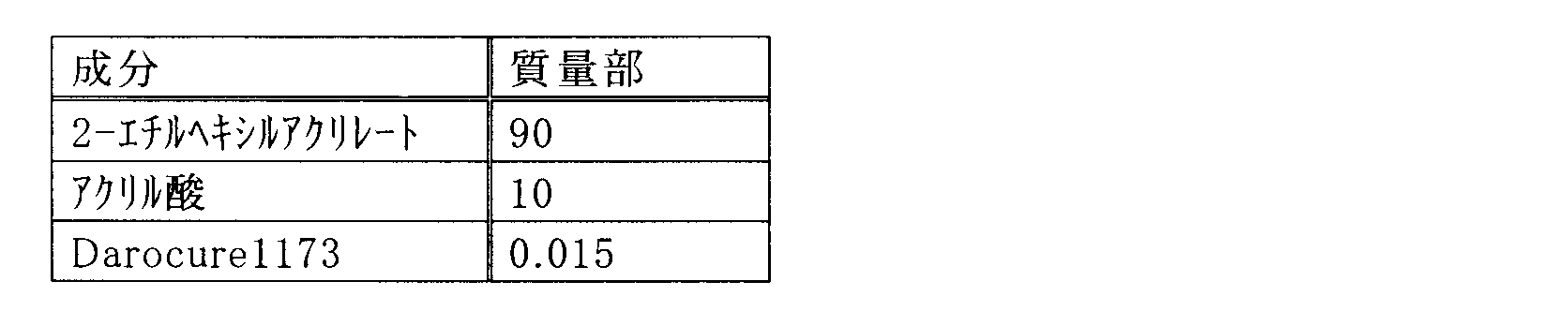
- Example 1 (Preparation of syrup) A polymerization reaction apparatus having a shutter device was charged with 90 parts by mass of 2-ethylhexyl acrylate and 10 parts by mass of acrylic acid, and 2-hydroxy-2-methyl-1-phenylpropan-1-one (Darocur 1173) as a photopolymerization initiator. , BASF Japan Ltd.) 0.015 parts by mass was allowed to react with stirring, and prepolymerized until the viscosity of the reaction mixture reached 1000 cps.
- a liquid hollow particle-free pressure-sensitive adhesive composition is applied on a paper separator having a thickness of 150 ⁇ m, the surface of which is treated with a silicone-based release agent, and one side of a transparent PET film having a thickness of 50 ⁇ m is applied thereon.
- a transparent release film treated with a silicone-based release agent is laminated, and the formed laminate is passed through two rolls adjusted to a predetermined interval so that the thickness of the pressure-sensitive adhesive composition containing no hollow particles Was adjusted to 0.05 mm and further irradiated with ultraviolet rays to form a hollow particle-free pressure-sensitive adhesive film.
- the liquid hollow particle-containing pressure-sensitive adhesive composition is applied onto a 150 ⁇ m thick paper separator treated with a silicone mold release agent on the surface, and one side of a transparent PET film with a thickness of 50 ⁇ m is coated on the surface with a silicone release agent. After laminating the transparent release film treated with the mold, the thickness of the black hollow particle-containing pressure-sensitive adhesive composition is adjusted to 0.1 mm by passing between two rolls adjusted to a predetermined interval, A black hollow particle-containing pressure-sensitive adhesive base material was formed by irradiating with ultraviolet rays.
- Example 2 A tape sample was prepared in the same manner as in Example 1 except that Irgacure OXE02 was used instead of Irgacure OXE01 in Table 4 of Example 1.
- Example 3 Example 1 except that 2.5 parts by mass of urethane solid particles (Art Pearl C-800, Negami Kogyo Co., Ltd.) kneaded with carbon black was added to the black hollow particle-containing pressure-sensitive adhesive composition of Example 1.
- a tape sample was prepared in the same manner as described above.
- the content of the hollow particles in the hollow particle-containing pressure-sensitive adhesive layer was 1 to 2% by volume.
- Example 4 A tape sample was prepared in the same manner as in Example 1 except that glass hollow particles (Q-CEL 7040S, Potters Barotini Co., Ltd., average particle size 35 to 80 ⁇ m) were used instead of the polyacrylonitrile hollow particles in Example 1. Produced.
- glass hollow particles Q-CEL 7040S, Potters Barotini Co., Ltd., average particle size 35 to 80 ⁇ m
- Example 5 A tape sample was prepared in the same manner as in Example 1 except that the photopolymerization initiator Iglacure OXE-01 was not used in Example 1.
- Comparative Example 1 A tape sample was prepared in the same manner as in Example 1 except that only hollow particles were blended without attaching carbon black in Example 1.
- Comparative Example 2 A tape sample was prepared in the same manner as in Example 2 except that the step of coating carbon black in Example 2 was not performed and carbon black and hollow particles were used separately.
- Comparative Example 3 A tape sample was prepared in the same manner as in Comparative Example 2 except that no hollow particles were used in Comparative Example 2.
- Comparative Example 4 In place of the black hollow particle-containing pressure-sensitive adhesive substrate of Example 1, a tape sample was prepared in the same manner as in Example 1 except that a 100 ⁇ m thick foam substrate (Borala XL, Sekisui Chemical Co., Ltd.) was used. .
- Comparative Example 5 A tape sample (a type containing only solid particles) was prepared in the same manner as in Example 3 except that the carbon black adhesion-treated hollow particles were excluded from the blending of the black hollow particle-containing pressure-sensitive adhesive base material of Example 3.
- the tape samples prepared in Examples and Comparative Examples were sandwiched between 25 ⁇ m-thick polyethylene terephthalate films, and the reflection density (Macbeth density) was measured using a measuring apparatus (TR-924, Macbeth Division of Kollmorgen (UK) Ltd). In practice, it is desired that the reflection density is 1.5 or more.
- the tape samples prepared in the examples and comparative examples were cut into a size of 15 mm ⁇ 15 mm, and the PMMA (polymethyl methacrylate) plate (15 mm ⁇ 15 mm ⁇ 4 mm) was used as an ABS (acrylonitrile-butadiene-styrene copolymer) plate.
- a test piece was prepared by pasting it at the center of (50 mm ⁇ 50 mm ⁇ 4 mm). This was left for 24 hours in a room temperature (25 ° C.) room.
- a waterproof test laminate was prepared by bonding together.
- a submergence detection seal (0.1 mm thickness x 2 mm x 30 mm) (product name submergence detection seal D-2, Toko Kogyo Co., Ltd.) is pasted on the ABS plate facing the PMMA plate at a position where it does not interfere with the frame tape. I left it.
- This waterproof test laminate was submerged in a tray filled with tap water at 40 ° C., and in this state, the submergence detection seal was observed for the presence or absence of bleeding after a considerable pressurization at a depth of 10 m was performed for 1 hour. The case where no bleeding was observed was evaluated as “ ⁇ (good)”, and the case where bleeding was observed was evaluated as “ ⁇ (bad)”.
- Comparative Example 4 since a foam base material in which the presence of voids was unavoidable was used instead of the black hollow particle-containing pressure-sensitive adhesive base material, there was a problem in waterproofness especially when the width of the tape was narrowed.
- the double-sided pressure-sensitive adhesive tape of Comparative Example 5 contained black solid particles, but had no problem with impact resistance because it did not contain black hollow particles.
- the pressure-sensitive adhesive layer contains hollow particles. Therefore, the double-sided pressure-sensitive adhesive tape has good waterproofness and impact resistance.
- the hollow particles have a black pigment adhesion treatment on the surface. Therefore, the light diffusing ability of the hollow particles is greatly suppressed, the photocurable acrylic resin composition can be sufficiently blackened, and the black pigment is not uniformly dispersed in the photocurable acrylic resin composition.
- the photocurable acrylic resin composition can be sufficiently photocured. Therefore, it is useful when a transparent protective front panel is attached to an image display module of a portable information terminal such as a smartphone.
Landscapes
- Chemical & Material Sciences (AREA)
- Organic Chemistry (AREA)
- Polymers & Plastics (AREA)
- Health & Medical Sciences (AREA)
- Chemical Kinetics & Catalysis (AREA)
- Medicinal Chemistry (AREA)
- Inorganic Chemistry (AREA)
- Adhesive Tapes (AREA)
- Adhesives Or Adhesive Processes (AREA)
- Physics & Mathematics (AREA)
- General Physics & Mathematics (AREA)
- Engineering & Computer Science (AREA)
- Theoretical Computer Science (AREA)
- Devices For Indicating Variable Information By Combining Individual Elements (AREA)
Abstract
Description
[1]
中空粒子含有粘着剤層を有する両面黒色粘着テープであって、該中空粒子の表面に黒色顔料付着処理が施されていることを特徴とする両面黒色粘着テープ。
[2]
中空粒子の平均粒子径が20~40μmであり、黒色顔料の平均粒子径が10~30nmである[1]記載の両面黒色粘着テープ。
[3]
中空粒子がポリアクリロニトリル中空粒子である[1]又は[2]記載の両面黒色粘着テープ。
[4]
黒色顔料がカーボンブラックである[1]~[3]のいずれか1項に記載の両面黒色粘着テープ。
[5]
中空粒子含有粘着剤層中の中空粒子の含有量が、20~40体積%である[1]~[4]のいずれか1項に記載の両面黒色粘着テープ。
[6]
中空粒子含有粘着剤層が、黒色顔料を内包した黒色樹脂粒子を更に1~8体積%含有する[1]~[5]のいずれか1項に記載の両面黒色粘着テープ。
[7]
中空粒子含有粘着剤層が、(a)単官能(メタ)アクリレート、(b)(メタ)アクリル酸、(c)アクリル系架橋剤、及び(d)光ラジカル重合開始剤を含有する光硬化型アクリル系粘着剤組成物と、表面に黒色顔料付着処理が施されている中空粒子とを含有する中空粒子含有粘着剤組成物を成膜し、光重合させたものである[1]~[6]のいずれか1項に記載の両面黒色粘着テープ。
[8]
(a)単官能(メタ)アクリレートが、2-エチルヘキシルアクリレート、ブチルアクリレート、イソオクチルアクリレート、イソステアリルアクリレート、及びエチルカルビトールアクリレートからなる群から選択される少なくとも一種であり、
(b)(メタ)アクリル酸が、アクリル酸又はメタクリル酸であり、
(c)アクリル系架橋剤が、ネオペンチルグリコールジ(メタ)アクリレート、ヒドロキシピバリン酸ネオペンチルグリコールジ(メタ)アクリレート、ポリプロピレングリコールジ(メタ)アクリレート、ノナンジオールジ(メタ)アクリレ-ト、1,4-ブタンジオールジ(メタ)アクリレート、ポリエチレングリコールジ(メタ)アクリレート、及びEO変性ポリプロピレングリコールジ(メタ)アクリレートからなる群から選択される少なくとも一種であり、
(d)光ラジカル重合開始剤が、オキシムエステル系光重合開始剤、アシルフォスフィンオキサイド系光重合開始剤、及びアルキルフェノン系光重合開始剤からなる群より選択される少なくとも一種である[7]記載の両面黒色粘着テープ。
[9]
光硬化型アクリル系粘着剤組成物が、(a)単官能(メタ)アクリレート100質量部に対し、(b)(メタ)アクリル酸2~20質量部、(c)アクリル系架橋剤0.1~1.0質量部、及び(d)光ラジカル重合開始剤0.1~1.0質量部の割合で含有している[8]記載の両面黒色粘着テープ。
[10]
(d)光ラジカル重合開始剤が、オキシムエステル系光重合開始剤、アシルフォスフィンオキサイド系光重合開始剤、及びアルキルフェノン系光重合開始剤を、質量基準で(0.1~4):(0.1~2):(1~8)の割合で含有する[8]又は[9]記載の両面黒色粘着テープ。
[11]
中空粒子含有粘着剤層の層厚が、60~140μmである[1]~[10]のいずれか1項に記載の両面黒色粘着テープ。
[12]
中空粒子含有粘着剤層の片面又は両面に、(aa)単官能(メタ)アクリレートと、(bb)(メタ)アクリル酸と、(cc)アクリル系架橋剤と、(dd)光ラジカル重合開始剤とを含有する光硬化型の中空粒子非含有粘着剤組成物を成膜し、光硬化させた中空粒子非含有粘着剤層が形成されている[1]~[11]のいずれか1項に記載の両面黒色粘着テープ。
[13]
(aa)単官能(メタ)アクリレートが、2-エチルヘキシルアクリレート、ブチルアクリレート、イソオクチルアクリレート、イソステアリルアクリレート、及びエチルカルビトールアクリレートからなる群から選択される少なくとも一種であり、
(bb)(メタ)アクリル酸が、アクリル酸又はメタクリル酸であり、
(cc)アクリル系架橋剤が、ネオペンチルグリコールジ(メタ)アクリレート、ヒドロキシピバリン酸ネオペンチルグリコールジ(メタ)アクリレート、ポリプロピレングリコールジ(メタ)アクリレート、ノナンジオールジ(メタ)アクリレ-ト、1,4-ブタンジオールジ(メタ)アクリレート、ポリエチレングリコールジ(メタ)アクリレート、及びEO変性ポリプロピレングリコールジ(メタ)アクリレートからなる群から選択される少なくとも一種であり、
(dd)光ラジカル重合開始剤が、オキシムエステル系光重合開始剤、アシルフォスフィンオキサイド系光重合開始剤、及びアルキルフェノン系光重合開始剤からなる群より選択される少なくとも一種である[12]記載の両面黒色粘着テープ。
[14]
中空粒子非含有粘着剤組成物が、(aa)単官能(メタ)アクリレート100質量部に対し、(bb)(メタ)アクリル酸2~20質量部、(cc)アクリル系架橋剤0.1~1.0質量部、及び(dd)光ラジカル重合開始剤0.1~1.0質量部の割合で含有している[11]又は[12]記載の両面黒色粘着テープ。
[15]
(dd)光ラジカル重合開始剤が、オキシムエステル系光重合開始剤、アシルフォスフィンオキサイド系光重合開始剤、及びアルキルフェノン系光重合開始剤を、質量基準で(0.1~4):(0.1~2):(0.4~8)の割合で含有する[13]又は[14]記載の両面黒色粘着テープ。
[16]
中空粒子非含有粘着剤層の層厚が、10~60μmである[12]~[14]のいずれか1項に記載の両面黒色粘着テープ。
[17]
中空粒子含有粘着剤層を有する両面黒色粘着テープの製造方法であって、以下の工程:(工程A)
中空粒子の表面に黒色顔料付着処理を行う工程;
(工程B)
(a)単官能(メタ)アクリレート、(b)(メタ)アクリル酸、(c)アクリル系架橋剤、及び(d)光ラジカル重合開始剤を含有する光硬化型アクリル系粘着剤組成物と、工程Aで得られた、表面に黒色顔料付着処理が施されている中空粒子とを含有する中空粒子含有粘着剤組成物を成膜して中空粒子含有粘着剤組成物層を形成する工程;及び(工程C)
工程Bで形成された中空粒子含有粘着剤組成物層を光硬化させることにより中空粒子含有粘着剤層を形成する工程を有する製造方法。
[18]
工程Aにおける黒色顔料付着処理が、中空粒子と黒色顔料とをジャーミルを用いて混合することである[17]記載の製造方法。
[19]
画像表示モジュールとフロントパネルとを、それらの互いに対向する外周縁に両面黒色粘着テープを介して接合してなる情報携帯端末であって、該粘着テープが、[1]~[16]のいずれか1項に記載の両面黒色粘着テープであることを特徴とする情報携帯端末。
1.両面黒色粘着テープ
(1)中空粒子含有粘着剤層
(2)中空粒子
(3)黒色顔料
(4)光硬化型アクリル系粘着剤組成物
(5)成分(a)単官能(メタ)アクリレート
(6)成分(b)(メタ)アクリル酸
(7)成分(c)アクリル系架橋剤
(8)成分(d)光ラジカル重合開始剤
(9)黒色顔料内包樹脂粒子
(10)中空粒子含有粘着剤層の層厚
2.両面黒色粘着テープの他の態様
(11)中空粒子非含有粘着剤層
(12)中空粒子非含有粘着剤層の層厚
3.両面黒色粘着テープの製造方法
(13)工程A
(14)工程B
(15)工程C
4.情報携帯端末
本発明の両面黒色粘着テープは、中空粒子含有粘着剤層を有する。ここで、“両面”は、テープの表面と裏面とが共に粘着性を示すということを意味し、“黒色”は、被着面に適用された粘着テープが黒色を示すことを意味する。また、黒色の程度は、両面黒色粘着テープの適用の際に要求される黒色度により異なるが、ISO5/4規格の反射濃度(マクベス濃度)で好ましくは1.5以上であることを意味する。
本発明の両面黒色粘着テープを構成する中空粒子含有粘着剤層は、光硬化型アクリル系粘着剤組成物に中空粒子を分散し、成膜し、紫外線照射により光硬化させたものである。
中空粒子含有粘着剤層を構成する中空粒子は、その表面に黒色顔料付着処理が施されているものである。ここで、黒色顔料付着処理とは、黒色顔料を中空粒子の表面に付着させる処理のことであり、本発明の効果を損なわない限り、任意の手法を採用することができる。例えば、中空粒子と黒色顔料とをジャーミルを用いて混合することやミキサー等を挙げることができる。処理操作の簡便さと黒色顔料付着処理効率の高さとのバランスから、好ましくは中空粒子と黒色顔料とをジャーミルを用いて混合することが挙げられる。
黒色顔料としては、公知の無機黒色顔料、有機黒色顔料の中から、両面黒色粘着テープの使用目的等に応じて適宜選択することができる。中でも汎用性、コストの点から無機黒色顔料であるカーボンブラックを好ましく使用することができる。
本発明の中空粒子含有粘着剤層を構成する中空粒子含有粘着剤層は、光硬化型アクリル系粘着剤組成物から形成されたものである。このような光硬化型粘着剤組成物は、成分(a)単官能(メタ)アクリレート、成分(b)(メタ)アクリル酸、成分(c)アクリル系架橋剤、及び成分(d)光ラジカル重合開始剤を含有する。ここで、(メタ)アクリレートという用語は、アクリレートとメタクリレートとを包含する用語である。
成分(a)の単官能(メタ)アクリレートは、ポリマーのベースとなる光重合性モノマーであり、任意の単官能(メタ)アクリレートを使用することができる。好ましくは、汎用性、及びガラス転移点(Tg)の低さの点から、2-エチルヘキシルアクリレート、ブチルアクリレート、イソオクチルアクリレート、イソステアリルアクリレート、及びエチルカルビトールアクリレートからなる群から選択される少なくとも一種を使用する。
成分(b)の(メタ)アクリル酸は、ポリマーに耐熱性、凝集力を付与するためのモノマーであり、アクリル酸又はメタクリル酸である。
成分(c)のアクリル系架橋剤は、ポリマーに熱溶融しない硬化性を付与するためのモノマーであり、公知のアクリル系架橋剤を使用することができる。好ましくは、分子中に2以上のアクリロイル基またはメタクリロイル基を有する多官能(メタ)アクリレートである。具体的には、ネオペンチルグリコールジ(メタ)アクリレート、ヒドロキシピバリン酸ネオペンチルグリコールジ(メタ)アクリレート、ポリプロピレングリコールジ(メタ)アクリレート、ノナンジオールジ(メタ)アクリレ-ト、1,4-ブタンジオールジ(メタ)アクリレート、ポリエチレングリコールジ(メタ)アクリレート、及びEO変性ポリプロピレングリコールジ(メタ)アクリレートからなる群から選択される少なくとも一種を使用する。
成分(d)の光ラジカル重合開始剤は、成分(a)~(c)を光重合させるために必要な活性種源となるものであり、本発明の効果を損なわない範囲で、公知の光ラジカル重合開始剤を使用することができる。好ましくはオキシムエステル系光重合開始剤、アシルフォスフィンオキサイド系光重合開始剤、及びアルキルフェノン系光重合開始剤からなる群より選択される少なくとも一種の光重合開始剤を使用することができる。なかでも、これら三種を同時併用することが硬化性の点から好ましい。同時併用の場合、オキシムエステル系光重合開始剤、アシルフォスフィンオキサイド系光重合開始剤、及びアルキルフェノン系光重合開始剤を、好ましくは質量基準で(0.1~4):(0.1~2.0):(0.4~8)の割合、より好ましくは(0.1~4):(0.1~2.0):(1~8)の割合、さらに好ましくは(0.2~2):(0.5~1.5):(3~6)の割合で使用することが好ましい。ここで、各光重合開始剤がこの範囲であれば、黒色に対する硬化が十分に進み、且つ分子量が著しく低下しないで硬化させる事が可能である。
なお、中空粒子含有粘着剤層は、黒色顔料を内包した黒色顔料内包樹脂粒子を、更に黒色度を向上するために含有することができる。この場合、中空粒子含有粘着剤層は、黒色顔料内包樹脂粒子を好ましくは1~8体積%、より好ましくは2~4体積%で含有することができる。
中空粒子含有粘着剤層の層厚は、好ましくは60~140μm、より好ましくは80~120μmである。この範囲であれば、十分な黒色度と耐衝撃性能が得られるからである。
本発明の両面黒色粘着テープは、部品固定のために、中空粒子含有粘着剤層の片面又は両面に中空粒子非含有粘着剤層を有していてもよい。好ましくは強接着性の点から両面に設けることが好ましい。
中空粒子非含有粘着剤層は、好ましくは光硬化型の中空粒子非含有粘着剤組成物を成膜し、紫外線を照射することにより形成したものである。このような中空粒子非含有粘着剤組成物としては、成分(aa)単官能(メタ)アクリレートと、成分(bb)(メタ)アクリル酸と、成分(cc)アクリル系架橋剤と、成分(dd)光ラジカル重合開始剤とを含有するものを好ましく挙げることができる。
中空粒子非含有粘着剤層の層厚は、好ましくは10~60μm、より好ましくは20~50μmである。この範囲であれば、十分な接着性が得られるからである。
中空粒子含有粘着剤層を有する両面黒色粘着テープの製造方法は、以下の工程A~Cを有する。
まず、中空粒子の表面に黒色顔料付着処理を行う。この黒色顔料付着処理としては、本発明の効果を損なわない限り、任意の手法を採用することができる。例えば、中空粒子と黒色顔料とをジャーミルを用いて混合することやディゾルバー等撹拌機を挙げることができる。安全性、処理操作の簡便さと黒色顔料付着処理効率の高さとのバランスから、好ましくは中空粒子と黒色顔料とをジャーミルを用いて混合することが挙げられる。
次に、(a)単官能(メタ)アクリレート、(b)(メタ)アクリル酸、(c)アクリル系架橋剤、及び(d)光ラジカル重合開始剤を含有する光硬化型アクリル系粘着剤組成物と、工程Aで得られた、表面に黒色顔料付着処理が施されている中空粒子とを含有する中空粒子含有粘着剤組成物を成膜して中空粒子含有粘着剤組成物層を形成する。成膜の方法としては特に制限がなく、本発明の効果を損なわない範囲で任意の手法を採用することができる。例えば、ロールコーターやバーコーターを使用し剥離フィルム等の適当な支持体上に塗工するという方法を例示することができる。
次に、工程Bで形成された中空粒子含有粘着剤組成物層を、紫外線等の電磁波の照射により光重合させ、中空粒子含有粘着剤層を形成する。更に必要に応じて、テープ状にカッティングすることにより、単層の両面黒色粘着テープが得られる。使用の際には、剥離ベースシートを剥離して使用する。
本発明の両面黒色粘着テープは、有機ELパネルモジュール、液晶パネルモジュール等の画像表示モジュールと、ガラスやプラスチックなどからなるカバーパネル等のフロントパネルとの接合に好ましく適用することができる。具体的には、画像表示モジュールとフロントパネルの互いに対向する外周縁に配し、両者を接着して情報携帯端末を得る際に有用である。このような情報携帯端末も本発明の一態様である。
(シロップの調製)
シャッター装置を有する重合反応装置に、2-エチルヘキシルアクリレート90質量部とアクリル酸10質量部とを仕込み、更に光重合開始剤として2-ヒドロキシ-2-メチル-1-フェニルプロパン-1-オン(Darocure1173、BASFジャパン(株))0.015質量部を添加し、撹拌しながら反応させ、反応混合物の粘度が1000cpsとなるまで予備重合させた。
前記シロップ溶液80質量部に対し、2-エチルヘキシルアクリレート20質量部、光重合開始剤として2-ヒドロキシ-2-メチル-1-フェニルプロパン-1-オン(Darocure1173、BASFジャパン(株))0.3質量部、アクリル系架橋剤としてヒドロキシピバリン酸ネオペンチルグリコールジアクリレート(KAYARAD MANDA、日本化薬(株))0.2質量部、柔軟性付与剤としてイソステアリルアクリレート(ISTA、大阪有機化学工業(株))10質量部、及び接着性改善剤としてN-イソプロピルアクリルアミド(NIPAN、興人ホールディングス(株))5質量部を添加し、均一に混合し、室温で液状の紫外線硬化型の中空粒子非含有粘着剤組成物を調製した。

容量450mlのガラス容器に、アクリロニトリル樹脂中空粒子(マツモトマイクロスフェアーF-80SDE、松本油脂製薬(株)、平均粒子径20~40μm)1.5質量部とカーボンブラック(Printex60、Orion Engineered Carbons社、平均粒子径18nm)1.5質量部とを投入し、封をし、ローラタイプのジャーミル(100rpm)で48時間混合することにより、中空粒子の黒色顔料付着処理を行った。この処理により、カーボンブラックが表面に付着した中空粒子(カーボンブラック付着処理中空粒子)が得られた。

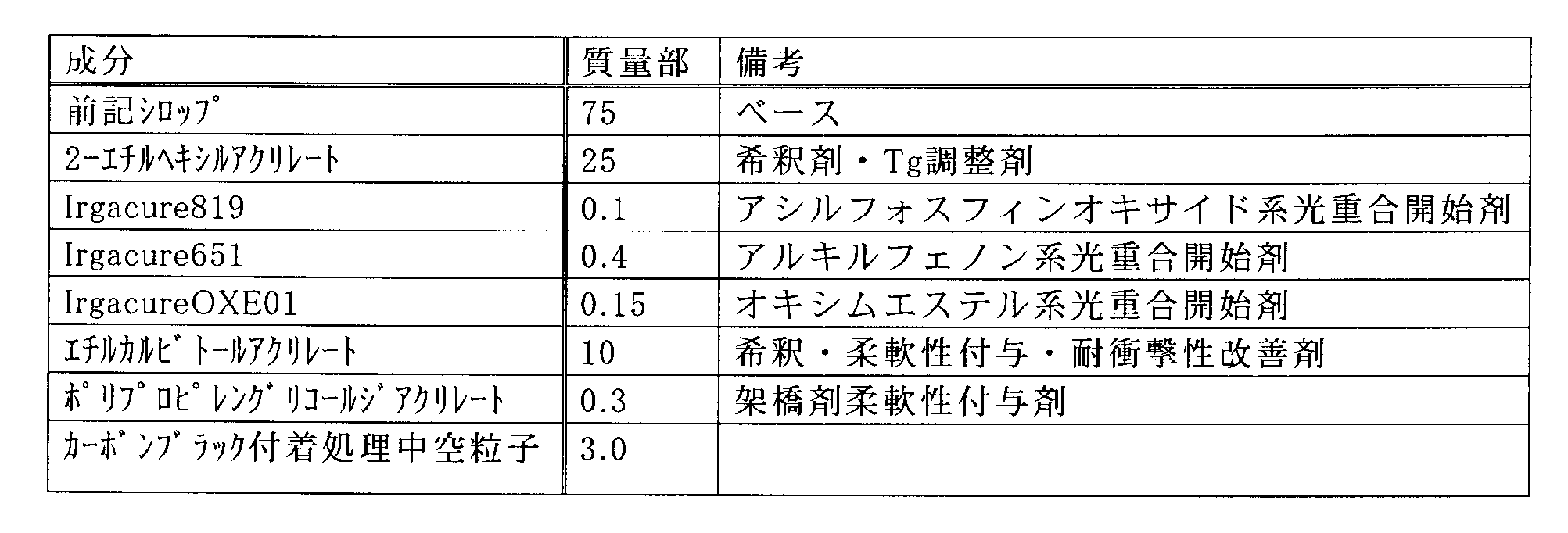
前記シロップ溶液75質量部に対し、2-エチルヘキシルアクリレート25質量部、光開始剤としてビス(2,4,6-トリメチルベンゾイル)-フェニルフォスフィンオキサイド(Irgacure 819、BASFジャパン(株))0.1質量部、光重合開始剤として2,2-ジメトキシ-1,2-ジフェニルエタン-1-オン(Irgacure 651、BASFジャパン(株))0.4質量部、光重合開始剤として1,2-オクタンジオン,1-〔4-(フェニルチオ)-,2-(O-ベンゾイルオキシム)〕(Irgacure OXE-01、BASFジャパン(株))0.15質量部、アクリル系架橋剤としてポリプロピレングリコールジアクリレート(アロニックス M-270、東亞合成(株))0.3質量部、希釈及び柔軟性付与剤としてエチルカルビトールアクリレート(ビスコート190、大阪有機化学工業(株))10質量部、及び上記作製したカーボンブラックが表面に付着した中空粒子を添加し、均一に混合することにより紫外線硬化型の液状の黒色中空粒子含有粘着剤組成物を調製した。中空粒子含有粘着剤層中の中空粒子の含有量は30体積%であった。
黒色中空粒子含有粘着剤基材の両面を、中空粒子非含有粘着剤フィルムで挟み込み、5kg/cm2の荷重でプレスを行い、三層構造の両面黒色粘着シートのテープサンプルを作製した。
実施例1の表4におけるIrgacureOXE01に代えてIrgacureOXE02を使用したこと以外は実施例1と同様にテープサンプルを作製した。
実施例1の黒色中空粒子含有粘着剤組成物に、カーボンブラックを練りこんだウレタン中実粒子(アートパールC-800、根上工業(株))を2.5質量部添加した以外は実施例1と同様にテープサンプルを作製した。中空粒子含有粘着剤層中の中空粒子の含有量は1~2体積%であった。
実施例1におけるポリアクリルニトリル中空粒子に代えてガラス中空粒子(Q-CEL 7040S、ポッターズ・バロティーニ(株) 、平均粒子径35~80μm)を使用した以外は実施例1と同様にテープサンプルを作製した。
実施例1において光重合開始剤IgracureOXE-01を使用しなかった以外は実施例1と同様にテープサンプルを作製した。
実施例1においてカーボンブラックを付着させずに中空粒子のみを配合した以外は実施例1と同様にテープサンプルを作製した。
実施例2においてカーボンブラックをコーティングする工程を行わず、カーボンブラックと中空粒子を別々に使用した以外は実施例2と同様にテープサンプルを作製した。
比較例2において中空粒子を使用しない以外は比較例2と同様にテープサンプルを作製した。
実施例1の黒色中空粒子含有粘着剤基材に代えて、100μm厚の発泡体基材(ボラーラXL、積水化学工業(株))を使用した以外は実施例1と同様にテープサンプルを作製した。
実施例3の黒色中空粒子含有粘着剤基材の配合中からカーボンブラック付着処理中空粒子を除いた以外は実施例3と同様にテープサンプル(中実粒子のみ含有タイプ)を作製した。
実施例及び比較例で作成したテープサンプルについて、「反射濃度」、「耐衝撃性」、「加熱減量」、及び「防水性」を以下に説明するように試験・評価した。得られた結果を表5に示す。
実施例及び比較例で作成したテープサンプルを25μm厚のポリエチレンテレフタレートフィルムで挟み、その反射濃度(マクベス濃度)を測定装置(TR-924、Macbeth Division of Kollmorgen (UK) Ltd)を用いて測定した。実用上、反射濃度が1.5以上であることが望まれる。
実施例及び比較例で作成したテープサンプルを15mm×15mmの大きさに切り出し、それを用いて、PMMA(ポリメチルメタクリレート)板(15mm×15mm×4mm)をABS(アクリロニトリル-ブタジエン-スチレンコポリマー)板(50mm×50mm×4mm)の中央に貼り合せてテストピースを作成した。これを常温(25℃)の室内中に24時間放置した。放置後、常温又は0℃に保持したテストピースをPMMA板側からエリクセン試験用の定盤に置き、30cmの高さから300gのエリクセン試験用の重りを、テストピースのABS側の中央に落下させた。PMMA板とABS板との間で剥がれの有無を確認した。剥がれが確認されなかった場合を「○(良好)」と評価し、剥がれが確認された場合を「×(不良)」と評価した。
実施例及び比較例で作成したテープサンプルを10cm四方の大きさにカットし、アルミニウム箔の上に貼り付け、初期重量(W0)を測定した。これを135℃のオーブンに10分間投入し、オーブンから取り出して常温に5分間放置した後、再び重量(W1)を測定し、加熱減量(%)[={(W0-W1)/W0}×100]を求めた。この数値が小さいほど硬化が進んでいることを示している。
ABS板(45mm×65mm×1mm)とPMMA板(45mm×65mm×1mm)との外周縁を、額縁型(額縁の外形寸法40mm×60mm、巾0.5mm又は1mm)に抜き加工した額縁型テープで貼り合わせて防水テスト積層板を作成した。なお、ABS板のPMMA板対向面に水没検知シール(0.1mm厚×2mm×30mm)(品名水没検知シールD-2、(株)東光工業)を、額縁型テープと干渉しない位置に貼り付けておいた。この防水テスト積層板を、40℃の水道水を張ったトレイに沈め、その状態で水深10mの相当の加圧を1時間行った後の水没検知シールの水による滲みの有無を観察した。滲みが観察されなかった場合を「○(良好)」と評価し、滲みが観察された場合を「×(不良)」と評価した。

本出願は、2014年3月5日出願の日本特許出願(特願2014-042642)、及び2015年3月3日出願の日本特許出願(特願2015-041048)に基づくものであり、その内容はここに参照として取り込まれる。
Claims (19)
- 中空粒子含有粘着剤層を有する両面黒色粘着テープであって、該中空粒子の表面に黒色顔料付着処理が施されていることを特徴とする両面黒色粘着テープ。
- 中空粒子の平均粒子径が20~40μmであり、黒色顔料の平均粒子径が10~30nmである請求項1記載の両面黒色粘着テープ。
- 中空粒子がポリアクリロニトリル中空粒子である請求項1又は2記載の両面黒色粘着テープ。
- 黒色顔料がカーボンブラックである請求項1~3のいずれか1項に記載の両面黒色粘着テープ。
- 中空粒子含有粘着剤層中の中空粒子の含有量が、20~40体積%である請求項1~4のいずれか1項に記載の両面黒色粘着テープ。
- 中空粒子含有粘着剤層が、黒色顔料を内包した黒色樹脂粒子を更に1~8体積%含有する請求項1~5のいずれか1項に記載の両面黒色粘着テープ。
- 中空粒子含有粘着剤層が、(a)単官能(メタ)アクリレート、(b)(メタ)アクリル酸、(c)アクリル系架橋剤、及び(d)光ラジカル重合開始剤を含有する光硬化型アクリル系粘着剤組成物と、表面に黒色顔料付着処理が施されている中空粒子とを含有する中空粒子含有粘着剤組成物を成膜し、光重合させたものである請求項1~6のいずれか1項に記載の両面黒色粘着テープ。
- (a)単官能(メタ)アクリレートが、2-エチルヘキシルアクリレート、ブチルアクリレート、イソオクチルアクリレート、イソステアリルアクリレート、及びエチルカルビトールアクリレートからなる群から選択される少なくとも一種であり、
(b)(メタ)アクリル酸が、アクリル酸又はメタクリル酸であり、
(c)アクリル系架橋剤が、ネオペンチルグリコールジ(メタ)アクリレート、ヒドロキシピバリン酸ネオペンチルグリコールジ(メタ)アクリレート、ポリプロピレングリコールジ(メタ)アクリレート、ノナンジオールジ(メタ)アクリレ-ト、1,4-ブタンジオールジ(メタ)アクリレート、ポリエチレングリコールジ(メタ)アクリレート、及びEO変性ポリプロピレングリコールジ(メタ)アクリレートからなる群から選択される少なくとも一種であり、
(d)光ラジカル重合開始剤が、オキシムエステル系光重合開始剤、アシルフォスフィンオキサイド系光重合開始剤、及びアルキルフェノン系光重合開始剤からなる群より選択される少なくとも一種である請求項7記載の両面黒色粘着テープ。 - 光硬化型アクリル系粘着剤組成物が、(a)単官能(メタ)アクリレート100質量部に対し、(b)(メタ)アクリル酸2~20質量部、(c)アクリル系架橋剤0.1~1.0質量部、及び(d)光ラジカル重合開始剤0.1~1.0質量部の割合で含有している請求項8記載の両面黒色粘着テープ。
- (d)光ラジカル重合開始剤が、オキシムエステル系光重合開始剤、アシルフォスフィンオキサイド系光重合開始剤、及びアルキルフェノン系光重合開始剤を、質量基準で(0.1~4):(0.1~2):(1~8)の割合で含有する請求項8又は9記載の両面黒色粘着テープ。
- 中空粒子含有粘着剤層の層厚が、60~140μmである請求項1~10のいずれか1項に記載の両面黒色粘着テープ。
- 中空粒子含有粘着剤層の片面又は両面に、(aa)単官能(メタ)アクリレートと、(bb)(メタ)アクリル酸と、(cc)アクリル系架橋剤と、(dd)光ラジカル重合開始剤とを含有する光硬化型の中空粒子非含有粘着剤組成物を成膜し、光硬化させた中空粒子非含有粘着剤層が形成されている請求項1~11のいずれか1項に記載の両面黒色粘着テープ。
- (aa)単官能(メタ)アクリレートが、2-エチルヘキシルアクリレート、ブチルアクリレート、イソオクチルアクリレート、イソステアリルアクリレート、及びエチルカルビトールアクリレートからなる群から選択される少なくとも一種であり、
(bb)(メタ)アクリル酸が、アクリル酸又はメタクリル酸であり、
(cc)アクリル系架橋剤が、ネオペンチルグリコールジ(メタ)アクリレート、ヒドロキシピバリン酸ネオペンチルグリコールジ(メタ)アクリレート、ポリプロピレングリコールジ(メタ)アクリレート、ノナンジオールジ(メタ)アクリレ-ト、1,4-ブタンジオールジ(メタ)アクリレート、ポリエチレングリコールジ(メタ)アクリレート、及びEO変性ポリプロピレングリコールジ(メタ)アクリレートからなる群から選択される少なくとも一種であり、
(dd)光ラジカル重合開始剤が、オキシムエステル系光重合開始剤、アシルフォスフィンオキサイド系光重合開始剤、及びアルキルフェノン系光重合開始剤からなる群より選択される少なくとも一種である請求項12記載の両面黒色粘着テープ。 - 中空粒子非含有粘着剤組成物が、(aa)単官能(メタ)アクリレート100質量部に対し、(bb)(メタ)アクリル酸2~20質量部、(cc)アクリル系架橋剤0.1~1.0質量部、及び(dd)光ラジカル重合開始剤0.1~1.0質量部の割合で含有している請求項11又は12記載の両面黒色粘着テープ。
- (dd)光ラジカル重合開始剤が、オキシムエステル系光重合開始剤、アシルフォスフィンオキサイド系光重合開始剤、及びアルキルフェノン系光重合開始剤を、質量基準で(0.1~4):(0.1~2):(0.4~8)の割合で含有する請求項13又は14記載の両面黒色粘着テープ。
- 中空粒子非含有粘着剤層の層厚が、10~60μmである請求項12~14のいずれか1項に記載の両面黒色粘着テープ。
- 中空粒子含有粘着剤層を有する両面黒色粘着テープの製造方法であって、以下の工程:(工程A)
中空粒子の表面に黒色顔料付着処理を行う工程;
(工程B)
(a)単官能(メタ)アクリレート、(b)(メタ)アクリル酸、(c)アクリル系架橋剤、及び(d)光ラジカル重合開始剤を含有する光硬化型アクリル系粘着剤組成物と、工程Aで得られた、表面に黒色顔料付着処理が施されている中空粒子とを含有する中空粒子含有粘着剤組成物を成膜して中空粒子含有粘着剤組成物層を形成する工程;及び(工程C)
工程Bで形成された中空粒子含有粘着剤組成物層を光硬化させることにより中空粒子含有粘着剤層を形成する工程を有する製造方法。 - 工程Aにおける黒色顔料付着処理が、中空粒子と黒色顔料とをジャーミルを用いて混合することである請求項17記載の製造方法。
- 画像表示モジュールとフロントパネルとを、それらの互いに対向する外周縁に両面黒色粘着テープを介して接合してなる情報携帯端末であって、該粘着テープが、請求項1~16のいずれか1項に記載の両面黒色粘着テープであることを特徴とする情報携帯端末。
Priority Applications (4)
| Application Number | Priority Date | Filing Date | Title |
|---|---|---|---|
| CN201580012122.5A CN106068315B (zh) | 2014-03-05 | 2015-03-03 | 双面黑色胶带 |
| US15/123,591 US10557063B2 (en) | 2014-03-05 | 2015-03-03 | Double-sided black adhesive tape |
| DE112015001108.0T DE112015001108T5 (de) | 2014-03-05 | 2015-03-03 | Doppelseitiges schwarzes Klebeband |
| KR1020167024359A KR102327723B1 (ko) | 2014-03-05 | 2015-03-03 | 양면 흑색 점착 테이프 |
Applications Claiming Priority (4)
| Application Number | Priority Date | Filing Date | Title |
|---|---|---|---|
| JP2014-042642 | 2014-03-05 | ||
| JP2014042642 | 2014-03-05 | ||
| JP2015-041048 | 2015-03-03 | ||
| JP2015041048A JP6522993B2 (ja) | 2014-03-05 | 2015-03-03 | 両面黒色粘着テープ |
Publications (1)
| Publication Number | Publication Date |
|---|---|
| WO2015133497A1 true WO2015133497A1 (ja) | 2015-09-11 |
Family
ID=54055300
Family Applications (1)
| Application Number | Title | Priority Date | Filing Date |
|---|---|---|---|
| PCT/JP2015/056259 Ceased WO2015133497A1 (ja) | 2014-03-05 | 2015-03-03 | 両面黒色粘着テープ |
Country Status (6)
| Country | Link |
|---|---|
| US (1) | US10557063B2 (ja) |
| JP (1) | JP6522993B2 (ja) |
| KR (1) | KR102327723B1 (ja) |
| DE (1) | DE112015001108T5 (ja) |
| TW (1) | TWI659080B (ja) |
| WO (1) | WO2015133497A1 (ja) |
Cited By (5)
| Publication number | Priority date | Publication date | Assignee | Title |
|---|---|---|---|---|
| WO2018012161A1 (ja) * | 2016-07-14 | 2018-01-18 | 日東電工株式会社 | 樹脂組成物、樹脂層、および積層シート |
| JP2018016785A (ja) * | 2016-07-14 | 2018-02-01 | 日東電工株式会社 | 樹脂組成物、樹脂層、および積層シート |
| JP2018130934A (ja) * | 2017-02-17 | 2018-08-23 | 日東電工株式会社 | 積層シート |
| JPWO2018030026A1 (ja) * | 2016-08-09 | 2019-06-06 | 東洋紡株式会社 | 低誘電接着剤層を含有する積層体 |
| JP2024080585A (ja) * | 2022-12-01 | 2024-06-13 | 財團法人工業技術研究院 | 両面接着体および多層構造 |
Families Citing this family (9)
| Publication number | Priority date | Publication date | Assignee | Title |
|---|---|---|---|---|
| JP2017179132A (ja) * | 2016-03-30 | 2017-10-05 | 積水化学工業株式会社 | 両面粘着テープ |
| JP6975189B2 (ja) * | 2019-02-07 | 2021-12-01 | 日東電工株式会社 | 両面粘着テープ |
| JP7844095B2 (ja) * | 2019-08-01 | 2026-04-13 | 日東電工株式会社 | 両面粘着テープ |
| JP7679623B2 (ja) * | 2020-12-15 | 2025-05-20 | Dic株式会社 | 粘着テ-プ |
| KR102526742B1 (ko) * | 2021-05-27 | 2023-04-28 | 주식회사 영우 | 점착력 및 내충격성이 우수한 테이프 |
| DE102021006273B4 (de) * | 2021-12-21 | 2024-06-13 | Lohmann Gmbh & Co. Kg | Indikatormischung |
| CN116463065A (zh) * | 2023-04-21 | 2023-07-21 | 深圳市宏征胶粘科技有限公司 | 一种耐高温光固化丙烯酸泡棉胶带的合成工艺 |
| JP2025030075A (ja) * | 2023-08-22 | 2025-03-07 | 日東電工株式会社 | 粘着シート用光硬化性組成物、粘着シート、光学積層体及び画像表示装置 |
| WO2026028957A1 (ja) * | 2024-07-30 | 2026-02-05 | 日東電工株式会社 | 光硬化性粘着剤組成物、粘着剤、粘着剤付き部材、粘着剤の製造方法、硬化体、部材及び硬化体の製造方法 |
Citations (11)
| Publication number | Priority date | Publication date | Assignee | Title |
|---|---|---|---|---|
| JPS61272251A (ja) * | 1985-05-24 | 1986-12-02 | ミネソタ マイニング アンド マニュファクチュアリング コンパニ− | ガラスマイクロバブルを充填した感圧粘着テープ |
| JPS63241087A (ja) * | 1987-01-02 | 1988-10-06 | ミネソタ マイニング アンド マニユフアクチユアリング カンパニー | 複合感圧接着テープ及びその製造法 |
| JPH01217092A (ja) * | 1988-01-13 | 1989-08-30 | Minnesota Mining & Mfg Co <3M> | 発泡状感圧接着テープ |
| JPH02248483A (ja) * | 1989-02-22 | 1990-10-04 | Minnesota Mining & Mfg Co <3M> | 発泡体状感圧接着テープ |
| JPH06510057A (ja) * | 1991-08-29 | 1994-11-10 | ロレアル | 化粧料組成物に用いられる顔料被覆済み粒子及び該粒子の製造方法 |
| JPH06346040A (ja) * | 1993-06-08 | 1994-12-20 | Dainippon Ink & Chem Inc | 着色された感圧接着剤層およびそれを使用した感圧接着テープまたはシート |
| JP2003049144A (ja) * | 2001-08-08 | 2003-02-21 | Sekisui Chem Co Ltd | 熱伝導性感圧接着剤及び熱伝導性感圧接着シート |
| JP2006516300A (ja) * | 2003-01-17 | 2006-06-29 | ユニバーシティー オブ ミズーリ キュレーターズ | 炭素顔料を含有する腐食抵抗性コーティング |
| JP2007333885A (ja) * | 2006-06-13 | 2007-12-27 | Toyo Ink Mfg Co Ltd | 感光性着色組成物及び該組成物を用いて形成できるカラーフィルタ |
| JP2013100465A (ja) * | 2011-10-20 | 2013-05-23 | Nitto Denko Corp | 両面接着テープ |
| WO2014123034A1 (ja) * | 2013-02-08 | 2014-08-14 | デクセリアルズ株式会社 | 樹脂組成物、粘着テープ及び粘着テープの製造方法 |
Family Cites Families (8)
| Publication number | Priority date | Publication date | Assignee | Title |
|---|---|---|---|---|
| US4612242A (en) * | 1985-06-03 | 1986-09-16 | Minnesota Mining And Manufacturing Company | Pressure-sensitive adhesive tape containing coated glass microbubbles |
| US20040249023A1 (en) | 2003-01-17 | 2004-12-09 | Stoffer James O. | Compounds for corrosion resistant primer coatings and protection of metal substrates |
| US7601425B2 (en) | 2003-03-07 | 2009-10-13 | The Curators Of The University Of Missouri | Corrosion resistant coatings containing carbon |
| JP4868915B2 (ja) * | 2006-04-04 | 2012-02-01 | 日東電工株式会社 | 粘着剤層付光学部材の製造方法、粘着剤層付光学部材及び画像表示装置 |
| JP4623198B2 (ja) | 2007-10-12 | 2011-02-02 | Dic株式会社 | 防水用両面粘着テープ |
| JP2015038162A (ja) * | 2010-04-20 | 2015-02-26 | 日本ビー・ケミカル株式会社 | ポリエステル樹脂及びその用途 |
| JP6140491B2 (ja) | 2012-08-07 | 2017-05-31 | 日東電工株式会社 | 両面粘着シート及び携帯電子機器 |
| JP2014093385A (ja) * | 2012-11-02 | 2014-05-19 | Fujifilm Corp | インプリント用密着膜の製造方法およびパターン形成方法 |
-
2015
- 2015-03-03 DE DE112015001108.0T patent/DE112015001108T5/de not_active Withdrawn
- 2015-03-03 KR KR1020167024359A patent/KR102327723B1/ko active Active
- 2015-03-03 JP JP2015041048A patent/JP6522993B2/ja active Active
- 2015-03-03 US US15/123,591 patent/US10557063B2/en active Active
- 2015-03-03 WO PCT/JP2015/056259 patent/WO2015133497A1/ja not_active Ceased
- 2015-03-05 TW TW104107003A patent/TWI659080B/zh active
Patent Citations (11)
| Publication number | Priority date | Publication date | Assignee | Title |
|---|---|---|---|---|
| JPS61272251A (ja) * | 1985-05-24 | 1986-12-02 | ミネソタ マイニング アンド マニュファクチュアリング コンパニ− | ガラスマイクロバブルを充填した感圧粘着テープ |
| JPS63241087A (ja) * | 1987-01-02 | 1988-10-06 | ミネソタ マイニング アンド マニユフアクチユアリング カンパニー | 複合感圧接着テープ及びその製造法 |
| JPH01217092A (ja) * | 1988-01-13 | 1989-08-30 | Minnesota Mining & Mfg Co <3M> | 発泡状感圧接着テープ |
| JPH02248483A (ja) * | 1989-02-22 | 1990-10-04 | Minnesota Mining & Mfg Co <3M> | 発泡体状感圧接着テープ |
| JPH06510057A (ja) * | 1991-08-29 | 1994-11-10 | ロレアル | 化粧料組成物に用いられる顔料被覆済み粒子及び該粒子の製造方法 |
| JPH06346040A (ja) * | 1993-06-08 | 1994-12-20 | Dainippon Ink & Chem Inc | 着色された感圧接着剤層およびそれを使用した感圧接着テープまたはシート |
| JP2003049144A (ja) * | 2001-08-08 | 2003-02-21 | Sekisui Chem Co Ltd | 熱伝導性感圧接着剤及び熱伝導性感圧接着シート |
| JP2006516300A (ja) * | 2003-01-17 | 2006-06-29 | ユニバーシティー オブ ミズーリ キュレーターズ | 炭素顔料を含有する腐食抵抗性コーティング |
| JP2007333885A (ja) * | 2006-06-13 | 2007-12-27 | Toyo Ink Mfg Co Ltd | 感光性着色組成物及び該組成物を用いて形成できるカラーフィルタ |
| JP2013100465A (ja) * | 2011-10-20 | 2013-05-23 | Nitto Denko Corp | 両面接着テープ |
| WO2014123034A1 (ja) * | 2013-02-08 | 2014-08-14 | デクセリアルズ株式会社 | 樹脂組成物、粘着テープ及び粘着テープの製造方法 |
Cited By (9)
| Publication number | Priority date | Publication date | Assignee | Title |
|---|---|---|---|---|
| WO2018012161A1 (ja) * | 2016-07-14 | 2018-01-18 | 日東電工株式会社 | 樹脂組成物、樹脂層、および積層シート |
| JP2018016785A (ja) * | 2016-07-14 | 2018-02-01 | 日東電工株式会社 | 樹脂組成物、樹脂層、および積層シート |
| CN109312139A (zh) * | 2016-07-14 | 2019-02-05 | 日东电工株式会社 | 树脂组合物、树脂层、以及层叠片 |
| JPWO2018030026A1 (ja) * | 2016-08-09 | 2019-06-06 | 東洋紡株式会社 | 低誘電接着剤層を含有する積層体 |
| JP2018130934A (ja) * | 2017-02-17 | 2018-08-23 | 日東電工株式会社 | 積層シート |
| WO2018150859A1 (ja) * | 2017-02-17 | 2018-08-23 | 日東電工株式会社 | 積層シート |
| CN110267810A (zh) * | 2017-02-17 | 2019-09-20 | 日东电工株式会社 | 层叠片 |
| JP2024080585A (ja) * | 2022-12-01 | 2024-06-13 | 財團法人工業技術研究院 | 両面接着体および多層構造 |
| JP7689996B2 (ja) | 2022-12-01 | 2025-06-09 | 財團法人工業技術研究院 | 両面接着体および多層構造 |
Also Published As
| Publication number | Publication date |
|---|---|
| DE112015001108T5 (de) | 2017-01-05 |
| US10557063B2 (en) | 2020-02-11 |
| JP6522993B2 (ja) | 2019-05-29 |
| JP2015180720A (ja) | 2015-10-15 |
| US20170081564A1 (en) | 2017-03-23 |
| TWI659080B (zh) | 2019-05-11 |
| TW201542732A (zh) | 2015-11-16 |
| KR20160129850A (ko) | 2016-11-09 |
| KR102327723B1 (ko) | 2021-11-17 |
Similar Documents
| Publication | Publication Date | Title |
|---|---|---|
| JP6522993B2 (ja) | 両面黒色粘着テープ | |
| JP6801202B2 (ja) | 両面粘着テープ、及びその製造方法 | |
| JP5514817B2 (ja) | 再剥離性を有する粘着材 | |
| EP2341112B1 (en) | Transparent adhesive sheet and image display device | |
| JP4971529B2 (ja) | 画像表示装置構成用積層体の製造方法、及びこの積層体を用いてなる画像表示装置 | |
| TWI826518B (zh) | 透明構件貼合用黏著片、積層體的製造方法及積層體 | |
| JPWO2004083330A1 (ja) | 表面保護用粘着シート及びその製造方法 | |
| TW201240824A (en) | Two-sided adhesive tape | |
| CN106068315B (zh) | 双面黑色胶带 | |
| WO2017204248A1 (ja) | 積層粘着シート | |
| JP7567645B2 (ja) | 活性エネルギー線硬化型粘着シート及び表示装置 | |
| JP2022174182A (ja) | 粘着シート、剥離シート付き粘着シート、積層体及び積層体の製造方法 | |
| JPH0238621B2 (ja) | ||
| CN114085624A (zh) | 粘合片及其制造方法 | |
| JP7172058B2 (ja) | 積層粘着シート及び積層粘着シートの製造方法 | |
| JP7567644B2 (ja) | 活性エネルギー線硬化型粘着シート及び表示装置 | |
| JPWO2016194958A6 (ja) | 画像表示装置用積層体の製造方法 | |
| TW202115440A (zh) | 附黏著劑層之偏光膜、黏著片材、積層構件及圖像顯示裝置 | |
| CN115247030B (zh) | 活性能量射线固化型粘合片和显示装置 | |
| JP7585954B2 (ja) | 活性エネルギー線硬化型粘着シート及び表示装置 | |
| JP2022174181A (ja) | 粘着シート、剥離シート付き粘着シート、積層体及び積層体の製造方法 | |
| JP2023045324A (ja) | 粘着シート | |
| JP2003253159A (ja) | 接着剤受容層形成用インクおよびそれを用いた接着シート |
Legal Events
| Date | Code | Title | Description |
|---|---|---|---|
| 121 | Ep: the epo has been informed by wipo that ep was designated in this application |
Ref document number: 15759191 Country of ref document: EP Kind code of ref document: A1 |
|
| DPE1 | Request for preliminary examination filed after expiration of 19th month from priority date (pct application filed from 20040101) | ||
| ENP | Entry into the national phase |
Ref document number: 20167024359 Country of ref document: KR Kind code of ref document: A |
|
| WWE | Wipo information: entry into national phase |
Ref document number: 15123591 Country of ref document: US |
|
| WWE | Wipo information: entry into national phase |
Ref document number: 112015001108 Country of ref document: DE |
|
| 122 | Ep: pct application non-entry in european phase |
Ref document number: 15759191 Country of ref document: EP Kind code of ref document: A1 |