WO2015064499A1 - 耐コロナ性樹脂組成物、樹脂組成物の耐コロナ性発現方法及び耐コロナ性部材 - Google Patents
耐コロナ性樹脂組成物、樹脂組成物の耐コロナ性発現方法及び耐コロナ性部材 Download PDFInfo
- Publication number
- WO2015064499A1 WO2015064499A1 PCT/JP2014/078340 JP2014078340W WO2015064499A1 WO 2015064499 A1 WO2015064499 A1 WO 2015064499A1 JP 2014078340 W JP2014078340 W JP 2014078340W WO 2015064499 A1 WO2015064499 A1 WO 2015064499A1
- Authority
- WO
- WIPO (PCT)
- Prior art keywords
- corona
- resin
- resin composition
- resistant
- silicone polymer
- Prior art date
- Legal status (The legal status is an assumption and is not a legal conclusion. Google has not performed a legal analysis and makes no representation as to the accuracy of the status listed.)
- Ceased
Links
Images

Classifications
-
- C—CHEMISTRY; METALLURGY
- C08—ORGANIC MACROMOLECULAR COMPOUNDS; THEIR PREPARATION OR CHEMICAL WORKING-UP; COMPOSITIONS BASED THEREON
- C08L—COMPOSITIONS OF MACROMOLECULAR COMPOUNDS
- C08L81/00—Compositions of macromolecular compounds obtained by reactions forming in the main chain of the macromolecule a linkage containing sulfur with or without nitrogen, oxygen or carbon only; Compositions of polysulfones; Compositions of derivatives of such polymers
- C08L81/04—Polysulfides
-
- C—CHEMISTRY; METALLURGY
- C08—ORGANIC MACROMOLECULAR COMPOUNDS; THEIR PREPARATION OR CHEMICAL WORKING-UP; COMPOSITIONS BASED THEREON
- C08L—COMPOSITIONS OF MACROMOLECULAR COMPOUNDS
- C08L67/00—Compositions of polyesters obtained by reactions forming a carboxylic ester link in the main chain; Compositions of derivatives of such polymers
- C08L67/02—Polyesters derived from dicarboxylic acids and dihydroxy compounds
-
- C—CHEMISTRY; METALLURGY
- C08—ORGANIC MACROMOLECULAR COMPOUNDS; THEIR PREPARATION OR CHEMICAL WORKING-UP; COMPOSITIONS BASED THEREON
- C08J—WORKING-UP; GENERAL PROCESSES OF COMPOUNDING; AFTER-TREATMENT NOT COVERED BY SUBCLASSES C08B, C08C, C08F, C08G or C08H
- C08J3/00—Processes of treating or compounding macromolecular substances
- C08J3/20—Compounding polymers with additives, e.g. colouring
-
- C—CHEMISTRY; METALLURGY
- C08—ORGANIC MACROMOLECULAR COMPOUNDS; THEIR PREPARATION OR CHEMICAL WORKING-UP; COMPOSITIONS BASED THEREON
- C08K—Use of inorganic or non-macromolecular organic substances as compounding ingredients
- C08K7/00—Use of ingredients characterised by shape
- C08K7/02—Fibres or whiskers
- C08K7/04—Fibres or whiskers inorganic
- C08K7/14—Glass
-
- C—CHEMISTRY; METALLURGY
- C08—ORGANIC MACROMOLECULAR COMPOUNDS; THEIR PREPARATION OR CHEMICAL WORKING-UP; COMPOSITIONS BASED THEREON
- C08L—COMPOSITIONS OF MACROMOLECULAR COMPOUNDS
- C08L101/00—Compositions of unspecified macromolecular compounds
-
- C—CHEMISTRY; METALLURGY
- C08—ORGANIC MACROMOLECULAR COMPOUNDS; THEIR PREPARATION OR CHEMICAL WORKING-UP; COMPOSITIONS BASED THEREON
- C08L—COMPOSITIONS OF MACROMOLECULAR COMPOUNDS
- C08L51/00—Compositions of graft polymers in which the grafted component is obtained by reactions only involving carbon-to-carbon unsaturated bonds; Compositions of derivatives of such polymers
- C08L51/08—Compositions of graft polymers in which the grafted component is obtained by reactions only involving carbon-to-carbon unsaturated bonds; Compositions of derivatives of such polymers grafted on to macromolecular compounds obtained otherwise than by reactions only involving unsaturated carbon-to-carbon bonds
- C08L51/085—Compositions of graft polymers in which the grafted component is obtained by reactions only involving carbon-to-carbon unsaturated bonds; Compositions of derivatives of such polymers grafted on to macromolecular compounds obtained otherwise than by reactions only involving unsaturated carbon-to-carbon bonds on to polysiloxanes
-
- C—CHEMISTRY; METALLURGY
- C08—ORGANIC MACROMOLECULAR COMPOUNDS; THEIR PREPARATION OR CHEMICAL WORKING-UP; COMPOSITIONS BASED THEREON
- C08L—COMPOSITIONS OF MACROMOLECULAR COMPOUNDS
- C08L83/00—Compositions of macromolecular compounds obtained by reactions forming in the main chain of the macromolecule a linkage containing silicon with or without sulfur, nitrogen, oxygen or carbon only; Compositions of derivatives of such polymers
- C08L83/04—Polysiloxanes
-
- C—CHEMISTRY; METALLURGY
- C09—DYES; PAINTS; POLISHES; NATURAL RESINS; ADHESIVES; COMPOSITIONS NOT OTHERWISE PROVIDED FOR; APPLICATIONS OF MATERIALS NOT OTHERWISE PROVIDED FOR
- C09D—COATING COMPOSITIONS, e.g. PAINTS, VARNISHES OR LACQUERS; FILLING PASTES; CHEMICAL PAINT OR INK REMOVERS; INKS; CORRECTING FLUIDS; WOODSTAINS; PASTES OR SOLIDS FOR COLOURING OR PRINTING; USE OF MATERIALS THEREFOR
- C09D181/00—Coating compositions based on macromolecular compounds obtained by reactions forming in the main chain of the macromolecule a linkage containing sulfur, with or without nitrogen, oxygen, or carbon only; Coating compositions based on polysulfones; Coating compositions based on derivatives of such polymers
- C09D181/04—Polysulfides
-
- C—CHEMISTRY; METALLURGY
- C08—ORGANIC MACROMOLECULAR COMPOUNDS; THEIR PREPARATION OR CHEMICAL WORKING-UP; COMPOSITIONS BASED THEREON
- C08G—MACROMOLECULAR COMPOUNDS OBTAINED OTHERWISE THAN BY REACTIONS ONLY INVOLVING UNSATURATED CARBON-TO-CARBON BONDS
- C08G77/00—Macromolecular compounds obtained by reactions forming a linkage containing silicon with or without sulfur, nitrogen, oxygen or carbon in the main chain of the macromolecule
- C08G77/42—Block-or graft-polymers containing polysiloxane sequences
- C08G77/442—Block-or graft-polymers containing polysiloxane sequences containing vinyl polymer sequences
-
- C—CHEMISTRY; METALLURGY
- C08—ORGANIC MACROMOLECULAR COMPOUNDS; THEIR PREPARATION OR CHEMICAL WORKING-UP; COMPOSITIONS BASED THEREON
- C08L—COMPOSITIONS OF MACROMOLECULAR COMPOUNDS
- C08L2201/00—Properties
- C08L2201/08—Stabilised against heat, light or radiation or oxydation
Definitions
- Patent Documents 4 to 6 a resin composition using a silicone polymer such as polysiloxane is known (see, for example, Patent Documents 4 to 6).
- the resin composition described in Patent Document 4 is for obtaining excellent water repellency
- the resin composition described in Patent Document 5 is intended to improve flame retardancy.
- the resin composition is for obtaining excellent mechanical strength and chemical resistance. That is, none of the resin compositions described in Patent Documents 4 to 6 pursues corona resistance. At present, it is not known what uses a PAS resin and a silicone polymer in combination to improve the corona resistance.
- the present invention has been made in view of the above-described conventional problems, and the problem is that a corona-resistant resin composition having sufficient durability against corona discharge, a corona-resistant expression method for the resin composition, and a corona-resistant material. It is in providing a sex member.
- a method for developing corona resistance in a resin composition wherein 7-80 parts by mass of a silicone-based polymer is added to 100 parts by mass of a resin component to develop corona resistance.
- a corona-resistant member formed by molding the corona-resistant resin composition according to any one of (1) to (3).
- the corona-resistant member according to (5) which is 0.1 ⁇ m or more and 20 ⁇ m or less when measured using a photograph taken.
- a corona-resistant resin composition having sufficient durability against corona discharge, a corona-resistant expression method for the resin composition, and a corona-resistant member.
- the corona-resistant resin composition of the present invention is characterized by melting and kneading 7 to 80 parts by mass of a silicone polymer with respect to 100 parts by mass of a resin component. Below, each component of the corona-resistant resin composition of this invention is explained in full detail.
- the resin component is not particularly limited.
- the resin component is not particularly limited.
- Two or more kinds of resin components may be used in combination.
- polyarylene sulfide resin polybutylene terephthalate resin (hereinafter also referred to as “PBT resin”)
- PBT resin polybutylene terephthalate resin
- polyacetal resin polyacetal resin
- liquid crystal resin etc.
- engineering plastic Because of its excellent and workability, it is generically called engineering plastic and is used in a wide range of applications such as automobiles, electrical / electronic parts, etc.
- PAS resin and the PBT resin will be sequentially described.
- the PAS resin is a polymer compound mainly composed of — (Ar—S) — (wherein Ar is an arylene group) as a repeating unit, and a PAS resin having a molecular structure generally known in the present invention is used. can do.
- arylene group examples include p-phenylene group, m-phenylene group, o-phenylene group, substituted phenylene group, p, p′-diphenylene sulfone group, p, p′-biphenylene group, p, p′-.
- examples thereof include a diphenylene ether group, p, p′-diphenylenecarbonyl group, and naphthalene group.
- the PAS resin may be a homopolymer consisting only of the above repeating units, or a copolymer containing the following different types of repeating units may be preferable from the viewpoint of processability and the like.
- a polyphenylene sulfide resin using a p-phenylene sulfide group as a repeating unit and a p-phenylene sulfide group as the arylene group is preferably used.
- the copolymer among the arylene sulfide groups comprising the above-mentioned arylene groups, two or more different combinations can be used, and among them, a combination containing a p-phenylene sulfide group and an m-phenylene sulfide group is particularly preferably used. It is done.
- the melt viscosity (310 ° C., shear rate 1216 sec ⁇ 1 ) of the PAS resin as the base resin used in the present invention is preferably 600 Pa ⁇ s or less, including the above mixed system, and is in the range of 8 to 300 Pa ⁇ s. Those having a good balance between mechanical properties and fluidity are particularly preferred.
- the PBT resin includes a dicarboxylic acid component containing at least terephthalic acid or an ester-forming derivative thereof (such as a lower alcohol ester), an alkylene glycol (1,4-butanediol) having at least 4 carbon atoms or an ester-forming derivative thereof (acetyl).
- the PBT resin is not limited to a homo PBT resin, but may be a copolymer (copolymerized PBT resin) containing 60 mol% or more (particularly 75 mol% or more and 95 mol% or less) of a butylene terephthalate unit.
- dicarboxylic acid components other than terephthalic acid and its ester-forming derivatives
- aromatic dicarboxylic acid components isophthalic acid, phthalic acid, naphthalenedicarboxylic acid, diphenyl ether dicarboxylic acid, etc., C 6 -C 12 aryl dicarboxylic acid etc.
- aliphatic dicarboxylic acid component C 4 -C 16 alkyl dicarboxylic acid such as succinic acid, adipic acid, azelaic acid, sebacic acid, etc.
- C 5 -C 10 cyclo such as cyclohexane dicarboxylic acid, etc.
- Alkyl dicarboxylic acids and the like or ester-forming derivatives of these dicarboxylic acid components.
- These dicarboxylic acid components can be used alone or in combination of two or more.
- Preferred dicarboxylic acid components include aromatic dicarboxylic acid components (especially C 6 -C 10 aryl dicarboxylic acids such as isophthalic acid) and aliphatic dicarboxylic acid components (particularly C such as adipic acid, azelaic acid and sebacic acid). 6 ⁇ C 12 alkyl dicarboxylic acids) are included.
- Preferred glycol components include aliphatic diol components (particularly polyoxy C 2 -C 3 alkylene glycols such as C 2 -C 6 alkylene glycol, diethylene glycol, and alicyclic diols such as cyclohexane dimethanol). .
- any of the homo PBT resin or copolymer PBT resin produced by polycondensation using the above compound as a monomer component can be used as the resin component of the present invention.
- the homo PBT resin and copolymer PBT resin can be used alone or in admixture of two or more.
- the corona-resistant resin composition of the present invention is obtained by melt-kneading a resin component and a silicone polymer, and the silicone polymer contributes to improvement of corona resistance.
- silicone polymers include silicone acrylic core shell rubber, polyorganosiloxane, silicone composite powder, and silicone / acrylic copolymer.
- organopolysiloxanes include polydimethylsiloxane, polymethylphenylsiloxane, and polydimethylsiloxane-diphenylsiloxane. A copolymer etc. are mentioned.
- a modified polyorganosiloxane obtained by modifying a part of the polyorganosiloxane with a hydroxyl group, amino group, carboxyl group, epoxy group, methacryloxy group, mercapto group, or the like may be used.
- silicone acrylic core shell rubber, silicone composite powder, and silicone / acrylic copolymer are preferred because of their higher corona resistance effect.
- examples of the silicone acrylic core shell rubber include Kaneka Seisakusho Kane ACE MR-01.
- examples of the polyorganosiloxane include Tow Dow Corning Co., Ltd., DOW CORNING TORAY DY 33-315, and the like.
- examples of the silicone composite powder include KMP-600 manufactured by Shin-Etsu Chemical Co., Ltd., and examples of the silicone / acrylic copolymer include R-181S manufactured by Nissin Chemical Industry Co., Ltd.
- Glass fibers may be further added and melt kneaded. Since the glass fiber itself has the effect of improving the corona resistance, the addition of the glass fiber can further improve the corona resistance effect. Further, it is presumed that there is a synergistic effect due to the combined use of the silicone polymer and the glass fiber, and it is presumed that the corona resistance effect may be improved in comparison with the effect obtained when each is added alone.
- the glass fiber used in the present invention is not particularly limited, and commercially available products can be used.
- Examples of commercially available products include chopped glass fiber (ECS03T-790DE, average fiber diameter: 6 ⁇ m) manufactured by Nippon Electric Glass Co., Ltd., chopped glass fiber (CS03DE416A, average fiber manufactured by Owens Corning Manufacturing Co., Ltd.) Diameter: 6 ⁇ m), manufactured by Nippon Electric Glass Co., Ltd., chopped glass fiber (ECS03T-747H, average fiber diameter: 10 ⁇ m), manufactured by Nippon Electric Glass Co., Ltd., chopped glass fiber (ECS03T-747, average fiber diameter: 13 ⁇ m) Etc.
- the resin and the silicone-based polymer in the method for expressing the corona resistance of the resin composition of the present invention are the same as the resin and the silicone-based polymer in the corona-resistant resin composition of the present invention described above, in order to develop the corona resistance.
- the corona-resistant member of the present invention is formed by molding the above-described corona-resistant resin composition of the present invention, and has excellent corona resistance. Further, in the corona-resistant member of the present invention, in observation with a scanning electron microscope, the domain of the silicone polymer is scattered in the matrix of the resin component, and the dispersion diameter of the silicone polymer in the matrix of the resin component is When measured using a photograph taken with the scanning electron microscope, it is preferably 0.1 ⁇ m or more and 20 ⁇ m or less. When the dispersion diameter is within the above range, the effect of corona resistance is further improved.
- the dispersion diameter is preferably from 0.1 to 15 ⁇ m on average, and particularly preferably from 0.1 to 7 ⁇ m on average.
- the specific measuring method of the said average dispersion diameter using a scanning microscope is shown in the below-mentioned Example.
- the method for producing a corona-resistant member using the corona-resistant resin composition of the present invention is not particularly limited, and a known method can be employed.
- the corona-resistant resin composition of the present invention is put into an extruder, melted and kneaded into pellets, and the pellets are put into an injection molding machine equipped with a predetermined mold and produced by injection molding. Can do.
Landscapes
- Chemical & Material Sciences (AREA)
- Chemical Kinetics & Catalysis (AREA)
- Organic Chemistry (AREA)
- Health & Medical Sciences (AREA)
- Medicinal Chemistry (AREA)
- Polymers & Plastics (AREA)
- Life Sciences & Earth Sciences (AREA)
- Engineering & Computer Science (AREA)
- Materials Engineering (AREA)
- Wood Science & Technology (AREA)
- Compositions Of Macromolecular Compounds (AREA)
- Processes Of Treating Macromolecular Substances (AREA)
Abstract
Description
また、特許文献2及び3には、PAS樹脂と、導電性カーボンブラック、黒鉛、エポキシ基含有α-オレフィン系共重合体を含有する樹脂組成物からなる成形品(ケーブル用部品、難着雪リング)が開示されている。これは、樹脂組成物の体積抵抗率を適度な値にすることで耐コロナ性等とともに、耐熱性、耐候性、難燃性、防水性、気密性、靱性などの諸性能を追求したものである。
上記特許文献1~3に記載の樹脂組成物(成形品)により、一定以上の耐コロナ性の効果が得られるが十分なものではなく改善の余地が残されていた。
(1)少なくとも、樹脂成分100質量部に対して、シリコーン系ポリマー7~80質量部を溶融混練してなる耐コロナ性樹脂組成物。
本発明の耐コロナ性樹脂組成物は、樹脂成分100質量部に対して、シリコーン系ポリマー7~80質量部を溶融混練してなることを特徴としている。
以下に、本発明の耐コロナ性樹脂組成物の各成分について詳述する。
樹脂成分としては、特に限定はなく、例えば、ポリエチレン樹脂、ポリプロピレン樹脂、ポリアミド樹脂、ポリアセタール樹脂、変性ポリフェニレンエーテル樹脂、ポリエチレンテレフタレート樹脂、ポリブチレンテレフタレート樹脂、ポリエチレンナフタレート樹脂、ポリアリーレンサルファイド樹脂、ポリイミド樹脂、ポリアミドイミド樹脂、ポリエーテルイミド樹脂、ポリサルフォン樹脂、ポリエーテルサルフォン樹脂、ポリエーテルケトン樹脂、ポリエーテルエーテルケトン樹脂、液晶樹脂、弗素樹脂、熱可塑性エラストマー、各種の生分解性樹脂等が挙げられる。また、2種類以上の樹脂成分を併用してもよい。その中でも、ポリアリーレンサルファイド樹脂、ポリブチレンテレフタレート樹脂(以下、「PBT樹脂」とも言う。)、ポリアセタール樹脂、液晶樹脂等は、機械的性質、電気的性質、耐熱性その他物理的・化学的特性に優れ、且つ加工性が良好であるがゆえにエンジニアリングプラスチックと総称され自動車、電気・電子部品等の広範な用途に使用されている。
以下、PAS樹脂、PBT樹脂について順次説明する。
PAS樹脂は、主として、繰返し単位として-(Ar-S)-(但しArはアリーレン基)で構成された高分子化合物であり、本発明では一般的に知られている分子構造のPAS樹脂を使用することができる。
PBT樹脂は、少なくともテレフタル酸又はそのエステル形成性誘導体(低級アルコールエステルなど)を含むジカルボン酸成分と、少なくとも炭素原子数4のアルキレングリコール(1,4-ブタンジオール)又はそのエステル形成性誘導体(アセチル化物等)を含むグリコール成分とを重縮合して得られるポリブチレンテレフタレート系樹脂である。PBT樹脂は、ホモPBT樹脂に限らず、ブチレンテレフタレート単位を60モル%以上(特に75モル%以上95モル%以下)含有する共重合体(共重合PBT樹脂)であってもよい。
本発明の耐コロナ性樹脂組成物は、樹脂成分とシリコーン系ポリマーとを溶融混練してなるのであるが、当該シリコーン系ポリマーが耐コロナ性の向上に寄与する。
シリコーン系ポリマーとしては、シリコーンアクリルコアシェルゴム、ポリオルガノシロキサン、シリコーン複合パウダー、シリコーン・アクリル共重合体などが挙げられ、オルガノポリシロキサンとしてはポリジメチルシロキサン、ポリメチルフェニルシロキサン、ポリジメチルシロキサンージフェニルシロキサン共重合体などが挙げられる。また、ポリオルガノシロキサンの一部をヒドロキシル基、アミノ基、カルボキシル基、エポキシ基、メタクリロキシ基、メルカプト基などで変性した変性ポリオルガノシロキサンを用いてもよい。中でも、耐コロナ性の効果がより高いことから、シリコーンアクリルコアシェルゴム、シリコーン複合パウダー、シリコーン・アクリル共重合体が好ましい。
本発明の耐コロナ性樹脂組成物においては、さらにガラス繊維を添加して溶融混練してもよい。ガラス繊維自体が耐コロナ性を向上させる効果を有するため、ガラス繊維の添加により、耐コロナ性の効果をさらに向上させることができる。また、シリコーン系ポリマーとガラス繊維併用による相乗効果もあると推定され、それぞれ単独で添加したときに得られる効果よりも、耐コロナ性の効果が向上する場合があると推定される。
本発明の耐コロナ性樹脂組成物は、本発明の効果を妨げない範囲で、滑剤、カーボンブラック、核剤、難燃剤、難燃助剤、酸化防止剤、金属不活性剤、その他老化防止剤、及びUV吸収剤、安定剤、可塑剤、顔料、染料、着色剤、帯電防止剤、発泡剤、その他の樹脂等の高分子や、添加剤を含有していてもよい。
本発明の樹脂組成物の耐コロナ性発現方法は、樹脂組成物において、樹脂成分100質量部に対してシリコーン系ポリマー7~80質量部を添加することにより耐コロナ性を発現させることを特徴としている。
既述の通り、本発明の耐コロナ性樹脂組成物は、シリコーン系ポリマーを所定量添加することで耐コロナ性を発現させている。換言すると、樹脂組成物にシリコーン系ポリマーを所定量添加することにより、その樹脂組成物に耐コロナ性を発現させることができる。
本発明の樹脂組成物の耐コロナ性発現方法における樹脂及びシリコーン系ポリマーは、既述の本発明の耐コロナ性樹脂組成物における樹脂及びシリコーン系ポリマーと同じであり、耐コロナ性を発現させるための各成分の好ましい例や添加量、添加し得る他の成分も同様である。
本発明の耐コロナ性部材は、既述の本発明の耐コロナ性樹脂組成物を成形してなることを特徴とし、優れた耐コロナ性を有する。
また、本発明の耐コロナ性部材においては、走査型電子顕微鏡による観察において、樹脂成分のマトリックス中にシリコーン系ポリマーのドメインが点在し、樹脂成分のマトリックス中のシリコーン系ポリマーの分散径が、前記走査型電子顕微鏡により撮影した写真を用いて測定した場合において0.1μm以上20μm以下であることが好ましい。当該分散径が上記範囲内であると、耐コロナ性の効果がより向上する。当該分散径は、平均0.1μm以上15μm以下であることが好ましく、平均0.1μm以上7μm以下であることが特に好ましい。分散径が小さい程、比表面積が大きくなり、ラビリンス効果が高まるため、耐コロナ性の効果がより向上する。
なお、走査型顕微鏡を用いた上記平均分散径の具体的な測定方法は、後記の実施例にて示す。
各実施例・比較例において、表1及び表2に示す各原料成分をドライブレンドして得た混合物を、シリンダー温度320℃の二軸押出機に投入し(ガラス繊維は押出機のサイドフィード部より別添加)、溶融混練し、ペレット化した。表1及び表2に示す各原料成分の詳細を以下に記す。尚、表1の実施例1~4及び比較例1~3はいずれもガラス繊維を用いない例であり、表2の実施例5~13、及び比較例4~6はいずれもガラス繊維を用いた例である。
(1)PAS樹脂成分
PPS樹脂:(株)クレハ製、フォートロンKPS W214A (溶融粘度:130Pa・s(せん断速度:1216sec-1、310℃))
尚、上記PPS樹脂の溶融粘度は以下のようにして測定した。
(PPS樹脂の溶融粘度の測定)
東洋精機(株)製キャピログラフを用い、キャピラリーとして1mmφ×20mmL/フラットダイを使用し、バレル温度310℃、せん断速度1216sec-1での溶融粘度を測定した。
(2)他の樹脂成分
・シリコーン系ポリマー1:(株)カネカ製 、KANE ACE MR-01、(シリコーンアクリルコアシェルゴム)
・シリコーン系ポリマー2:東レ・ダウコーニング(株)製、DOW CORNING TORAY DY 33-315(ポリオルガノシロキサン)
・シリコーン系ポリマー3:信越化学工業(株)製、KMP-600(シリコーン複合パウダー)
・シリコーン系ポリマー4:日信化学工業(株)製、R-181S(シリコーン・アクリル共重合体)
・オレフィン系ポリマー:日本ユニカー(株)製 NUC-6570(エチレンエチルアクリレート共重合物)
(3)充填剤
ガラス繊維:チョップドガラス繊維、日本電気硝子(株)製、ECS03T-790DE 平均繊維径: 6μm
各実施例・比較例において作製した試験片10を、図1に示すように、高圧側電極12(φ9.5mm)とアース側電極14(φ25mm)の間に固定し、耐電圧試験機(ヤマヨ試験機有限会社製 YST-243WS-28)を用いて、空気中で、130℃、周波数200Hz、印加電圧18kVを加え、絶縁破壊が生じるまでの時間を測定した。測定結果を表1及び表2に示す。
なお、比較例3においては、試験片を作製する以前に、ストランド状に押し出すこともペレット化することもできず、耐コロナ性試験を行うことができなかった。
実施例7、10、12、13においては、以下のようにして成形品中でのシリコーン系ポリマーの平均分散径を測定した。
上記実施例で作製したペレットから、射出成形機(住友重機械工業(株)製、SE100D)により、シリンダー温度320℃、金型温度150℃で縦80mm、横80mm、厚み1mmの試験片(平板)を成形し、その試験片を、液体窒素中で衝撃的に破壊(液体窒素中に入れたままニッパで破断)させた脆性破壊面の中央部を(株)日立製作所製、走査型電子顕微鏡(SEM) S-4700を用いて観察した。次いで、観察領域において、無作為に選んだ2箇所を撮影し、撮影した2枚の写真(SEM像)の中から無作為に総計25個の粒子(シリコーン系ポリマーのドメイン)を選んだ。そして、定規によってその25個の粒子の粒子径を測定し、測定した粒子径の和を25で割って得た数値を平均分散径とした。

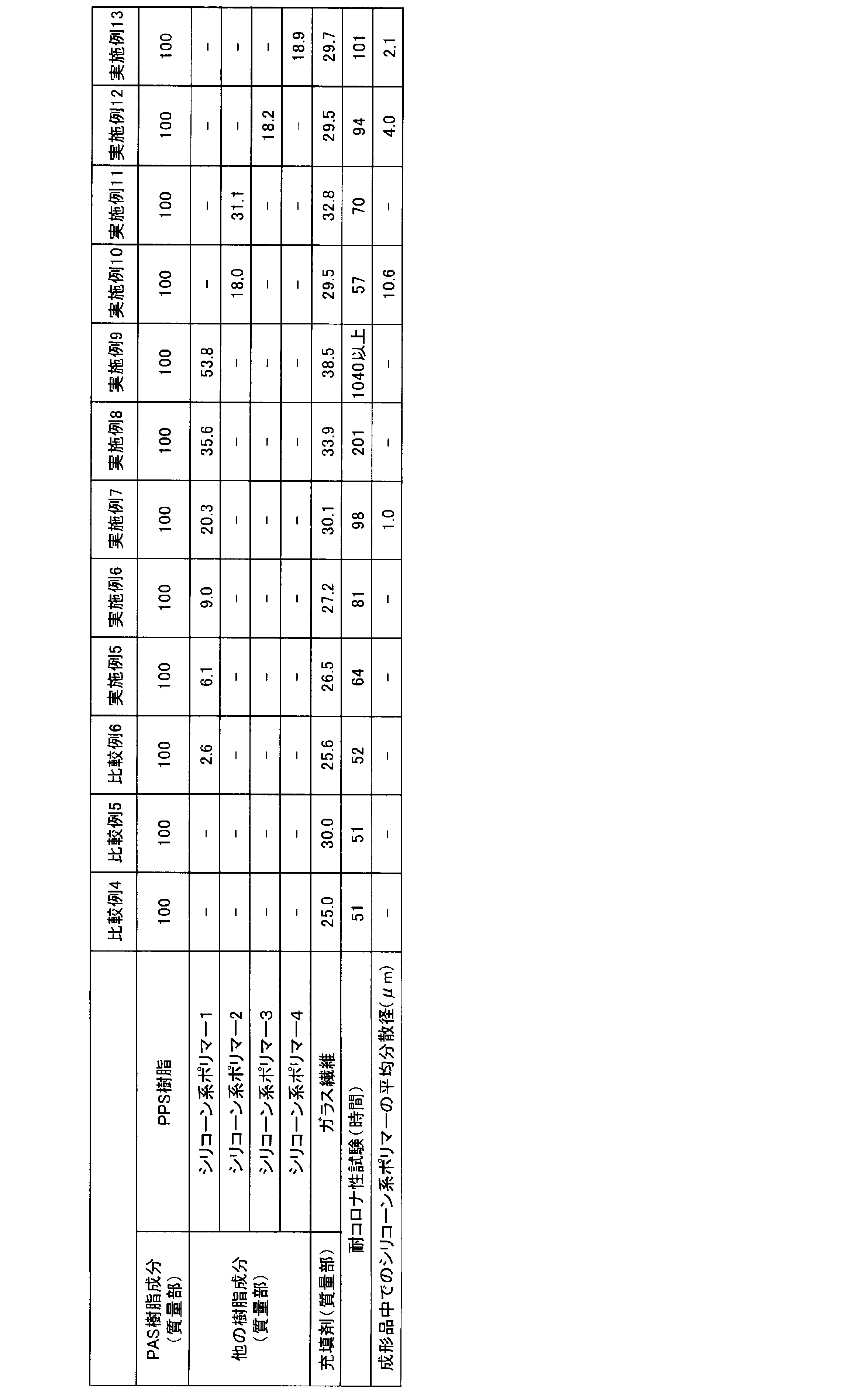
さらに、比較例1、実施例1及び2の比較、あるいは比較例1、実施例3及び4の比較により、シリコーン系ポリマーの添加量が増大すると耐コロナ性が向上することが分かる。ただし、比較例3の結果により、樹脂成分100質量部に対する添加量が80質量部を超えるとペレットの作製すらできないことが分かる。
また、表2より以下のことが分かる。まず、ガラス繊維の有無のみが異なる比較例1(表1)と比較例4及び比較例5との比較により、ガラス繊維を用いることで耐コロナ性の向上が認められる。そして、実施例5~13は、ガラス繊維とシリコーン系ポリマーとを併用した例であり、シリコーン系ポリマーを用いていない比較例4及び比較例5と比較して、耐コロナ性がより向上しているのが分かる。比較例1、実施例1及び比較例5と、実施例7との比較により、シリコーンアクリルコアシェルゴムとガラス繊維の併用系では、それぞれ単独で添加したときに得られる耐コロナ性の効果の和(耐コロナ性試験結果(時間)の和)よりも、大幅に向上していることが分かる。シリコーン系ポリマーとガラス繊維併用による相乗効果があると推定される。
さらに、比較例4~6、実施例5~9の比較、あるいは比較例5、実施例10及び11の比較により、シリコーン系ポリマー単独系同様、ガラス繊維とシリコーン系ポリマーとを併用した系においても、シリコーン系ポリマーの添加量が増大すると耐コロナ性が向上することが分かる。中でも、実施例7~9は耐コロナ性の効果が顕著である。このことから、シリコーンアクリルコアシェルゴムの添加量が30質量部を超えたあたりを臨界とし、その臨界を超えると耐コロナ性の効果が顕著になることが分かる。
さらに、シリコーン系ポリマーをほぼ同量用いた実施例7、10、12及び13の比較により、シリコーン系ポリマーとして、シリコーンアクリルコアシェルゴム、シリコーン複合パウダー、シリコーン・アクリル共重合体が特に耐コロナ性の効果に優れることが分かる。
一方、成形品中でのシリコーン系ポリマーの平均分散径を測定した実施例7、10、12及び13の比較により、当該平均分散径が小さい方が、耐コロナ性が向上することが分かる。
12 高圧側電極
14 アース側電極
Claims (7)
- 少なくとも、樹脂成分100質量部に対して、シリコーン系ポリマー7~80質量部を溶融混練してなる耐コロナ性樹脂組成物。
- 前記樹脂成分が、ポリアリーレンスルフィド樹脂又はポリブチレンテレフタレート樹脂である請求項1に記載の耐コロナ性樹脂組成物。
- さらに、ガラス繊維を添加して溶融混練してなる請求項1又は2に記載の耐コロナ性樹脂組成物。
- 樹脂組成物において、樹脂成分100質量部に対してシリコーン系ポリマー7~80質量部を添加することにより耐コロナ性を発現させる樹脂組成物の耐コロナ性発現方法。
- 請求項1~3のいずれか1項に記載の耐コロナ性樹脂組成物を成形してなる耐コロナ性部材。
- 走査型電子顕微鏡による観察において、前記樹脂成分のマトリックス中に前記シリコーン系ポリマーのドメインが点在し、樹脂成分のマトリックス中のシリコーン系ポリマーの平均分散径が、前記走査型電子顕微鏡により撮影した写真を用いて測定した場合において0.1μm以上20μm以下である請求項5に記載の耐コロナ性部材。
- 形状が、シート状、板状、筒状、または被膜状であることを特徴とする請求項5又は6に記載の耐コロナ性部材。
Priority Applications (2)
| Application Number | Priority Date | Filing Date | Title |
|---|---|---|---|
| US15/029,697 US10017643B2 (en) | 2013-10-29 | 2014-10-24 | Corona-resistant resin composition, method for developing corona resistance of resin composition, and corona-resistant member |
| JP2015518706A JP5914759B2 (ja) | 2013-10-29 | 2014-10-24 | 耐コロナ性樹脂組成物、樹脂組成物の耐コロナ性発現方法及び耐コロナ性部材 |
Applications Claiming Priority (2)
| Application Number | Priority Date | Filing Date | Title |
|---|---|---|---|
| JP2013-224190 | 2013-10-29 | ||
| JP2013224190 | 2013-10-29 |
Publications (1)
| Publication Number | Publication Date |
|---|---|
| WO2015064499A1 true WO2015064499A1 (ja) | 2015-05-07 |
Family
ID=53004105
Family Applications (1)
| Application Number | Title | Priority Date | Filing Date |
|---|---|---|---|
| PCT/JP2014/078340 Ceased WO2015064499A1 (ja) | 2013-10-29 | 2014-10-24 | 耐コロナ性樹脂組成物、樹脂組成物の耐コロナ性発現方法及び耐コロナ性部材 |
Country Status (3)
| Country | Link |
|---|---|
| US (1) | US10017643B2 (ja) |
| JP (2) | JP5914759B2 (ja) |
| WO (1) | WO2015064499A1 (ja) |
Cited By (8)
| Publication number | Priority date | Publication date | Assignee | Title |
|---|---|---|---|---|
| WO2017057558A1 (ja) * | 2015-10-02 | 2017-04-06 | Dic株式会社 | ポリアリーレンスルフィド樹脂組成物、成形品及び製造方法 |
| WO2017057559A1 (ja) * | 2015-10-02 | 2017-04-06 | Dic株式会社 | ポリアリーレンスルフィド樹脂組成物及び製造方法 |
| WO2017179706A1 (ja) * | 2016-04-15 | 2017-10-19 | ポリプラスチックス株式会社 | 耐コロナ性樹脂組成物、樹脂組成物の耐コロナ性発現方法及び耐コロナ性部材 |
| WO2018124079A1 (ja) * | 2016-12-26 | 2018-07-05 | ポリプラスチックス株式会社 | ポリアリーレンスルフィド樹脂成形品の耐コロナ性向上方法 |
| US10450461B2 (en) | 2015-12-11 | 2019-10-22 | Ticona Llc | Crosslinkable polyarylene sulfide composition |
| US10590273B2 (en) | 2015-12-11 | 2020-03-17 | Ticona Llc | Polyarylene sulfide composition |
| JP2021143223A (ja) * | 2020-03-10 | 2021-09-24 | 東レ株式会社 | ポリフェニレンサルファイド樹脂組成物、成形品および押出成形品 |
| US11383491B2 (en) | 2016-03-24 | 2022-07-12 | Ticona Llc | Composite structure |
Families Citing this family (3)
| Publication number | Priority date | Publication date | Assignee | Title |
|---|---|---|---|---|
| WO2015064499A1 (ja) | 2013-10-29 | 2015-05-07 | ポリプラスチックス株式会社 | 耐コロナ性樹脂組成物、樹脂組成物の耐コロナ性発現方法及び耐コロナ性部材 |
| CN116814050B (zh) * | 2023-07-10 | 2025-01-17 | 广东合诚实业有限公司 | 高ipt无卤阻燃增强pbt复合材料及制备方法与应用 |
| CN117736534B (zh) * | 2023-11-16 | 2024-09-20 | 华电电力科学研究院有限公司 | 一种基于peek的定子线棒端部防晕带及其制备方法 |
Citations (11)
| Publication number | Priority date | Publication date | Assignee | Title |
|---|---|---|---|---|
| JPH07278413A (ja) * | 1994-04-08 | 1995-10-24 | Toshiba Silicone Co Ltd | 樹脂モールド品 |
| JPH09328617A (ja) * | 1996-06-11 | 1997-12-22 | Japan Synthetic Rubber Co Ltd | 熱可塑性樹脂組成物 |
| JP2002107402A (ja) * | 2000-10-03 | 2002-04-10 | Ebara Corp | モータの絶縁異常監視装置及び絶縁異常監視方法 |
| JP2002161200A (ja) * | 2000-11-28 | 2002-06-04 | Toyobo Co Ltd | 樹脂組成物 |
| JP2005290283A (ja) * | 2004-04-02 | 2005-10-20 | Arai Pump Mfg Co Ltd | シリコーンゴム組成物およびシリコーンゴム成型品ならびにキャリアプレート |
| JP2007182554A (ja) * | 2005-11-23 | 2007-07-19 | General Electric Co <Ge> | 反強誘電性ポリマー複合材料、その製造方法、及びそれを含んでなる物品 |
| JP2010090260A (ja) * | 2008-10-07 | 2010-04-22 | Fuji Beekuraito Kk | ガラス板取扱用成形品及びその製造方法 |
| JP2011148917A (ja) * | 2010-01-22 | 2011-08-04 | Mitsubishi Engineering Plastics Corp | 熱伝導性ポリアルキレンテレフタレート系樹脂組成物および樹脂成形体 |
| JP2013155272A (ja) * | 2012-01-30 | 2013-08-15 | Nissei Electric Co Ltd | 混合絶縁材料及びその成形品 |
| WO2014065377A1 (ja) * | 2012-10-26 | 2014-05-01 | ポリプラスチックス株式会社 | 耐コロナ性部材、耐コロナ性樹脂組成物及び樹脂成形品の耐コロナ性発現方法 |
| WO2014065376A1 (ja) * | 2012-10-26 | 2014-05-01 | ポリプラスチックス株式会社 | 耐コロナ性部材、耐コロナ性樹脂組成物及び樹脂成形品の耐コロナ性発現方法 |
Family Cites Families (12)
| Publication number | Priority date | Publication date | Assignee | Title |
|---|---|---|---|---|
| JPS5815444A (ja) * | 1981-07-20 | 1983-01-28 | Toshiba Corp | 高電圧用絶縁線輪 |
| JPS58211572A (ja) * | 1982-06-03 | 1983-12-09 | Nissan Motor Co Ltd | 雑音防止型点火装置 |
| JPS5979903A (ja) | 1982-10-29 | 1984-05-09 | 大日本インキ化学工業株式会社 | 電気絶縁材料 |
| JPH08231852A (ja) | 1995-02-23 | 1996-09-10 | Tonen Chem Corp | ポリアリーレンスルフィド樹脂組成物 |
| JP3635766B2 (ja) | 1995-02-24 | 2005-04-06 | 東レ株式会社 | ポリフェニレンスルフィド樹脂組成物 |
| JPH1153943A (ja) | 1997-08-01 | 1999-02-26 | Kureha Chem Ind Co Ltd | ケーブル用部品 |
| JP3969465B2 (ja) | 1997-11-13 | 2007-09-05 | 株式会社クレハ | 難着雪リング |
| JP2007119527A (ja) | 2005-10-25 | 2007-05-17 | Kaneka Corp | 粒子状ポリシロキサン化合物およびそれを含む難燃性樹脂組成物 |
| US7989530B2 (en) | 2005-11-23 | 2011-08-02 | General Electric Company | Nonlinear polymer composites and methods of making the same |
| JP5425597B2 (ja) | 2009-11-24 | 2014-02-26 | 株式会社カネカ | 樹脂組成物、その成型体、及び容器 |
| JP6003484B2 (ja) | 2012-09-28 | 2016-10-05 | 株式会社デンソー | 耐コロナ性絶縁部材及びそれを使用した物品 |
| WO2015064499A1 (ja) | 2013-10-29 | 2015-05-07 | ポリプラスチックス株式会社 | 耐コロナ性樹脂組成物、樹脂組成物の耐コロナ性発現方法及び耐コロナ性部材 |
-
2014
- 2014-10-24 WO PCT/JP2014/078340 patent/WO2015064499A1/ja not_active Ceased
- 2014-10-24 JP JP2015518706A patent/JP5914759B2/ja active Active
- 2014-10-24 US US15/029,697 patent/US10017643B2/en active Active
-
2016
- 2016-01-27 JP JP2016013335A patent/JP6240688B2/ja active Active
Patent Citations (11)
| Publication number | Priority date | Publication date | Assignee | Title |
|---|---|---|---|---|
| JPH07278413A (ja) * | 1994-04-08 | 1995-10-24 | Toshiba Silicone Co Ltd | 樹脂モールド品 |
| JPH09328617A (ja) * | 1996-06-11 | 1997-12-22 | Japan Synthetic Rubber Co Ltd | 熱可塑性樹脂組成物 |
| JP2002107402A (ja) * | 2000-10-03 | 2002-04-10 | Ebara Corp | モータの絶縁異常監視装置及び絶縁異常監視方法 |
| JP2002161200A (ja) * | 2000-11-28 | 2002-06-04 | Toyobo Co Ltd | 樹脂組成物 |
| JP2005290283A (ja) * | 2004-04-02 | 2005-10-20 | Arai Pump Mfg Co Ltd | シリコーンゴム組成物およびシリコーンゴム成型品ならびにキャリアプレート |
| JP2007182554A (ja) * | 2005-11-23 | 2007-07-19 | General Electric Co <Ge> | 反強誘電性ポリマー複合材料、その製造方法、及びそれを含んでなる物品 |
| JP2010090260A (ja) * | 2008-10-07 | 2010-04-22 | Fuji Beekuraito Kk | ガラス板取扱用成形品及びその製造方法 |
| JP2011148917A (ja) * | 2010-01-22 | 2011-08-04 | Mitsubishi Engineering Plastics Corp | 熱伝導性ポリアルキレンテレフタレート系樹脂組成物および樹脂成形体 |
| JP2013155272A (ja) * | 2012-01-30 | 2013-08-15 | Nissei Electric Co Ltd | 混合絶縁材料及びその成形品 |
| WO2014065377A1 (ja) * | 2012-10-26 | 2014-05-01 | ポリプラスチックス株式会社 | 耐コロナ性部材、耐コロナ性樹脂組成物及び樹脂成形品の耐コロナ性発現方法 |
| WO2014065376A1 (ja) * | 2012-10-26 | 2014-05-01 | ポリプラスチックス株式会社 | 耐コロナ性部材、耐コロナ性樹脂組成物及び樹脂成形品の耐コロナ性発現方法 |
Cited By (15)
| Publication number | Priority date | Publication date | Assignee | Title |
|---|---|---|---|---|
| JPWO2017057558A1 (ja) * | 2015-10-02 | 2018-07-05 | Dic株式会社 | ポリアリーレンスルフィド樹脂組成物、成形品及び製造方法 |
| WO2017057559A1 (ja) * | 2015-10-02 | 2017-04-06 | Dic株式会社 | ポリアリーレンスルフィド樹脂組成物及び製造方法 |
| WO2017057558A1 (ja) * | 2015-10-02 | 2017-04-06 | Dic株式会社 | ポリアリーレンスルフィド樹脂組成物、成形品及び製造方法 |
| JPWO2017057559A1 (ja) * | 2015-10-02 | 2018-06-28 | Dic株式会社 | ポリアリーレンスルフィド樹脂組成物及び製造方法 |
| US10590273B2 (en) | 2015-12-11 | 2020-03-17 | Ticona Llc | Polyarylene sulfide composition |
| US10450461B2 (en) | 2015-12-11 | 2019-10-22 | Ticona Llc | Crosslinkable polyarylene sulfide composition |
| US11383491B2 (en) | 2016-03-24 | 2022-07-12 | Ticona Llc | Composite structure |
| US11919273B2 (en) | 2016-03-24 | 2024-03-05 | Ticona Llc | Composite structure |
| JPWO2017179706A1 (ja) * | 2016-04-15 | 2019-02-21 | ポリプラスチックス株式会社 | 耐コロナ性樹脂組成物、樹脂組成物の耐コロナ性発現方法及び耐コロナ性部材 |
| WO2017179706A1 (ja) * | 2016-04-15 | 2017-10-19 | ポリプラスチックス株式会社 | 耐コロナ性樹脂組成物、樹脂組成物の耐コロナ性発現方法及び耐コロナ性部材 |
| JP7021074B2 (ja) | 2016-04-15 | 2022-02-16 | ポリプラスチックス株式会社 | 耐コロナ性部材用樹脂組成物、樹脂組成物の耐コロナ性発現方法及び耐コロナ性部材 |
| WO2018124079A1 (ja) * | 2016-12-26 | 2018-07-05 | ポリプラスチックス株式会社 | ポリアリーレンスルフィド樹脂成形品の耐コロナ性向上方法 |
| JPWO2018124079A1 (ja) * | 2016-12-26 | 2019-06-27 | ポリプラスチックス株式会社 | ポリアリーレンスルフィド樹脂成形品の耐コロナ性向上方法 |
| JP2021143223A (ja) * | 2020-03-10 | 2021-09-24 | 東レ株式会社 | ポリフェニレンサルファイド樹脂組成物、成形品および押出成形品 |
| JP7379222B2 (ja) | 2020-03-10 | 2023-11-14 | 東レ株式会社 | ポリフェニレンサルファイド樹脂組成物、成形品および押出成形品 |
Also Published As
| Publication number | Publication date |
|---|---|
| US20160280917A1 (en) | 2016-09-29 |
| JP5914759B2 (ja) | 2016-05-11 |
| JP2016056381A (ja) | 2016-04-21 |
| JPWO2015064499A1 (ja) | 2017-03-09 |
| JP6240688B2 (ja) | 2017-11-29 |
| US10017643B2 (en) | 2018-07-10 |
Similar Documents
| Publication | Publication Date | Title |
|---|---|---|
| JP6240688B2 (ja) | 耐コロナ性樹脂組成物、樹脂組成物の耐コロナ性発現方法及び耐コロナ性部材 | |
| TW500765B (en) | Thermoplastic resin composition and heat-resistant tray for IC | |
| US20110269879A1 (en) | High-strength polyphenylene sulfide/polyethylene terephthalate blend resin composition and method for preparing the same | |
| JPWO2014103665A1 (ja) | 絶縁ワイヤ、電気機器および絶縁ワイヤの製造方法 | |
| JP6805536B2 (ja) | ポリブチレンテレフタレート樹脂組成物 | |
| TWI726894B (zh) | 提高比較追蹤指數的方法以及環氧化合物及乙烯丙烯酸乙酯共聚物的用途 | |
| JP7025604B1 (ja) | 樹脂組成物、成形品およびメッキ付成形品の製造方法 | |
| JP2016540067A (ja) | 炭素繊維強化プラスチック成形材料 | |
| US20230250255A1 (en) | Thermoplastic resin composition and member, and method of manufacturing member formed from thermoplastic resin composition and method of enhancing mechanical strength | |
| JP6294829B2 (ja) | 耐コロナ性部材、耐コロナ性樹脂組成物及び樹脂成形品の耐コロナ性発現方法 | |
| US6042910A (en) | Polyarylene sulfide resin composition | |
| CN114672161B (zh) | 一种阻燃聚酰胺复合材料及其制备方法和应用 | |
| WO2014065376A1 (ja) | 耐コロナ性部材、耐コロナ性樹脂組成物及び樹脂成形品の耐コロナ性発現方法 | |
| JP2003176410A (ja) | インサート成形品 | |
| JP6751160B2 (ja) | ポリアリーレンスルフィド樹脂成形品の耐コロナ性向上方法 | |
| JP2016124948A (ja) | インサート成形用樹脂組成物及びインサート成形品 | |
| JP2013120645A (ja) | 被覆電線 | |
| JP5762506B2 (ja) | ポリブチレンテレフタレート系樹脂組成物及び成形品 | |
| JP2004217895A (ja) | ポリアリーレンサルファイド樹脂組成物 | |
| JP2019182967A (ja) | 耐コロナ性ポリアリーレンスルフィド樹脂組成物、耐コロナ性部材、並びにポリアリーレンスルフィド樹脂組成物の耐コロナ性及び絶縁性の発現方法 | |
| JP7021074B2 (ja) | 耐コロナ性部材用樹脂組成物、樹脂組成物の耐コロナ性発現方法及び耐コロナ性部材 | |
| JP2015081331A (ja) | 樹脂組成物及びそれを用いた被覆材料 | |
| KR102483994B1 (ko) | 열가소성 탄성 수지 조성물 및 이로부터 제조된 성형품 | |
| US20230242762A1 (en) | Method of suppressing burr of polyarylene sulfide resin composition | |
| JP7126879B2 (ja) | ガスバリア性部材用樹脂組成物 |
Legal Events
| Date | Code | Title | Description |
|---|---|---|---|
| ENP | Entry into the national phase |
Ref document number: 2015518706 Country of ref document: JP Kind code of ref document: A |
|
| 121 | Ep: the epo has been informed by wipo that ep was designated in this application |
Ref document number: 14857309 Country of ref document: EP Kind code of ref document: A1 |
|
| WWE | Wipo information: entry into national phase |
Ref document number: 15029697 Country of ref document: US |
|
| NENP | Non-entry into the national phase |
Ref country code: DE |
|
| 122 | Ep: pct application non-entry in european phase |
Ref document number: 14857309 Country of ref document: EP Kind code of ref document: A1 |