WO2014024414A1 - テクスチャー形成用エッチング液およびそれを用いたテクスチャー形成方法 - Google Patents
テクスチャー形成用エッチング液およびそれを用いたテクスチャー形成方法 Download PDFInfo
- Publication number
- WO2014024414A1 WO2014024414A1 PCT/JP2013/004586 JP2013004586W WO2014024414A1 WO 2014024414 A1 WO2014024414 A1 WO 2014024414A1 JP 2013004586 W JP2013004586 W JP 2013004586W WO 2014024414 A1 WO2014024414 A1 WO 2014024414A1
- Authority
- WO
- WIPO (PCT)
- Prior art keywords
- group
- compound
- salt
- etching solution
- acid
- Prior art date
- Legal status (The legal status is an assumption and is not a legal conclusion. Google has not performed a legal analysis and makes no representation as to the accuracy of the status listed.)
- Ceased
Links
Classifications
-
- H—ELECTRICITY
- H10—SEMICONDUCTOR DEVICES; ELECTRIC SOLID-STATE DEVICES NOT OTHERWISE PROVIDED FOR
- H10F—INORGANIC SEMICONDUCTOR DEVICES SENSITIVE TO INFRARED RADIATION, LIGHT, ELECTROMAGNETIC RADIATION OF SHORTER WAVELENGTH OR CORPUSCULAR RADIATION
- H10F77/00—Constructional details of devices covered by this subclass
- H10F77/70—Surface textures, e.g. pyramid structures
- H10F77/703—Surface textures, e.g. pyramid structures of the semiconductor bodies, e.g. textured active layers
Definitions
- the present invention relates to an etching solution and an etching method for forming an uneven structure called texture on the surface of a silicon substrate.
- a crystalline silicon substrate used in a solar cell is subjected to a surface structure treatment called texture in order to reduce light reflectance on the substrate surface and efficiently absorb light.
- a method of forming a pyramidal texture structure by immersing and etching a single crystal silicon substrate in an alkaline solution such as sodium hydroxide or potassium hydroxide is used. It is known that a texture structure having a uniform size or shape can be formed by using an additive other than the above.
- an etching solution for forming a texture for example, a mixture of an aqueous solution of sodium hydroxide or potassium hydroxide and isopropyl alcohol (IPA) is used.
- a texture is formed by immersing the silicon substrate for 10 to 30 minutes under a warm condition.
- IPA is used to moderately etch silicon with alkali and form a pyramidal texture on the silicon substrate. This effect of IPA is the most widely known substance that serves this purpose. However, since the boiling point of IPA is about 82 ° C., which is about the same as the etching processing temperature, there is a problem that the composition of the etching solution is likely to change due to volatilization of IPA during the processing. In addition, it has been pointed out that the IPA method has a low substrate processing yield. In addition, since IPA has a low flash point, it is not desirable to be careful in handling.
- the silicon substrate slicing method is shifting from the conventional free abrasive method to the fixed abrasive method, and in these methods, the surface state of the substrate after slicing is different from each other.
- the etching solution that can be used on the silicon substrate manufactured by the method cannot be used as it is on the silicon substrate manufactured by the fixed abrasive method.
- JP 2000-183378 A International Publication No. WO2007 / 129555 JP 2009-123811 A JP 2002-57139 A JP 2007-258656 A JP 2010-141139 A
- the present invention has been made in view of the above-mentioned problems, and can form a good texture with low reflectance uniformly and stably on the substrate surface.
- the normal use temperature is 60 ° C. to 95 ° C.
- the composition of the etching solution does not volatilize, and it can be applied to both a silicon substrate manufactured by a free abrasive method and a silicon substrate manufactured by a fixed abrasive method. It is an object to provide an etching solution for texture formation.
- the etching solution of the present invention is an etching solution for forming irregularities on the surface of a silicon substrate.
- the molecule contains a compound having at least one group selected from the group consisting of a carboxyl group, a sulfo group, these groups forming a salt, and a carboxymethyl group.
- sodium hydroxide or potassium hydroxide can be suitably used as the alkali component (A).
- phosphonic acid derivative or salt (B) 1-hydroxyethylidene-1,1-diphosphonic acid or a salt thereof can be preferably used.
- the compound (C) at least one selected from the group consisting of carboxylic acid, carboxylic acid salt, sulfonic acid, and sulfonic acid salt can be used.
- R 1 -X (I)
- R 1 is an alkyl group having 4 to 12 carbon atoms, an alkenyl group, an alkoxy group, or an aryl group
- X is either a carboxyl group or a sulfo group.
- a compound in which R 1 is an alkyl group having a branched structure, an alkenyl group having a branched structure, an alkoxy group having a branched structure, or an aryl group is more preferable.
- n is an integer of 2 or more
- m is an integer of 1 to 5
- each m value may be the same or different from each other.
- 0 represents a hydrogen atom
- Y 1 to Y n each represents a hydrocarbon group having 1 to 30 carbon atoms, and they may all be the same or different from each other.
- X 1 to X n are each a sulfo group. Any one of a group, a carboxyl group, and a hydrogen atom may be the same or different from each other, but at least one is a sulfo group or a carboxyl group.
- At least one selected from the group consisting of polycarboxylic acid, polycarboxylic acid salt, polysulfonic acid, and polysulfonic acid salt can be used.
- at least one selected from the group consisting of polyacrylic acid, polyacrylic acid salt, naphthalene sulfonic acid formalin condensate, naphthalene sulfonic acid formalin condensate salt, polystyrene sulfonic acid, and polystyrene sulfonic acid salt Can be used.
- a compound having a carboxymethyl group in the molecule can also be used.
- a compound having a monosaccharide as a basic structural unit is preferably used.
- a carboxymethyl cellulose salt can be used.
- the concentration of the alkali component (A) is 0.3% by mass to 25% by mass
- the concentration of the phosphonic acid derivative or a salt thereof (B) is 0.1% by mass to 25% by mass
- the compound (C) The concentration is preferably 0.0001% by mass to 25% by mass.
- the silicon substrate surface processing method of the present invention includes a step of immersing the silicon substrate in the etching solution of the present invention to form a concavo-convex structure on the substrate surface.
- a uniform pyramidal texture structure can be formed on the surface of the silicon substrate.
- the blended components do not volatilize in the range of 60 ° C. to 95 ° C., which is the use temperature, stable texture formation is possible and safety is high.
- the etching solution of the present invention has an excellent effect on a silicon substrate manufactured by either the free abrasive grain method or the fixed abrasive grain method.
- the alkali component (A) used in the present invention is not particularly limited, and those conventionally used as etching solutions for silicon substrates can be used as appropriate. Examples thereof include alkali metal or alkaline earth metal hydroxides such as sodium hydroxide and potassium hydroxide, or salts thereof, and sodium hydroxide is preferred in terms of general availability. These alkali components may be used in combination of two or more as required.
- the phosphonic acid derivative used in the present invention or a salt thereof (hereinafter sometimes abbreviated as “phosphonic acid derivative etc.”) (B) is generally used as a sequestering agent, It can use without being specifically limited.
- 1-hydroxyethylidene-1,1-diphosphonic acid represented by the following formula (1)
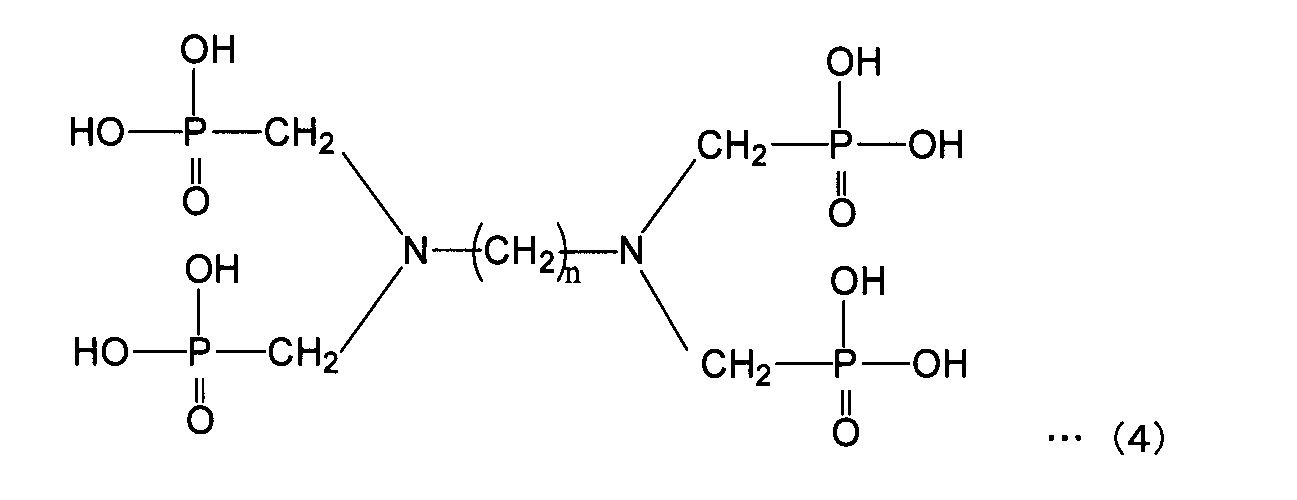
- nitrilotris
- alkali metal salts examples include alkali metal salts, alkaline earth metal salts, amine salts, and ammonium salts. Since they are generally easily available, alkali metal salts such as sodium salts and potassium salts are preferred. Used. Two or more of these phosphonic acid derivatives can be used as needed.
- 1-hydroxyethylidene-1,1-diphosphonic acid is obtained because of the high uniformity of the obtained texture structure and the high purity product with few impurities to be avoided in this application.
- Nitrilotris (methylenephosphonic acid) or phosphonobutanetricarboxylic acid is particularly preferred.
- the compound (C) having at least one group selected from the group consisting of a carboxyl group, a sulfo group, a salt-forming group, and a carboxymethyl group used in the present invention will be described.
- one or more selected from sulfonic acid, sulfonic acid salt, carboxylic acid, and carboxylic acid salt can be used.
- the sulfonic acid is a compound having at least one sulfo group in the molecule
- the salt of the sulfonic acid is a compound having at least one sulfonate group in the molecule to form a salt.
- Is a compound having at least one carboxyl group in the molecule, and a carboxylic acid salt is a compound having at least one carboxylate group in the molecule to form a salt.
- the compound (C) for example, a compound represented by the following general formula (I) or a salt thereof can be suitably used.
- R 1 -X (I)
- R 1 is any of an alkyl group having 4 to 12 carbon atoms, an alkenyl group, an alkoxy group, and an aryl group, and these groups may have a branched structure in the carbon skeleton
- X is a carboxyl group, One of the sulfo groups.
- the compound represented by the general formula (I) is not particularly limited.
- Specific examples of the carboxyl group-containing substance include butanoic acid, pentanoic acid, hexanoic acid, heptanoic acid, octanoic acid, and nonanoic acid having a linear carbon skeleton. , Decanoic acid, undecanoic acid, dodecanoic acid, or carbon skeleton such as 2-ethylhexanoic acid, 2,3-dimethylnonanoic acid, 2-ethyl-3-methylnonanoic acid, 3,5,5-trimethylhexanoic acid, etc. Examples thereof include carboxylic acids having a branched structure. In addition, carboxylic acids having an aromatic ring structure such as a benzene ring and a naphthalene ring can also be used.
- the sulfo group-containing substance examples include butanesulfonic acid, pentanesulfonic acid, hexanesulfonic acid, heptanesulfonic acid, octanesulfonic acid, nonanesulfonic acid, decanesulfonic acid, undecanesulfonic acid, and dodecanesulfonic acid. Can be mentioned.
- sulfonic acid having a branched structure in the carbon skeleton and sulfonic acid having an aromatic ring structure can also be used in the sulfo group-containing substance, similarly to the carboxyl group-containing substance.
- carboxylic acids and sulfonic acids may be used in the form of alkali metal salts, alkaline earth metal salts, amine salts, and ammonium salts.
- the carbon number of the longest carbon chain length portion such as 3,5,5-trimethylhexanoic acid is such that a synergistic effect with the phosphonic acid is easily obtained.
- Carboxylic acids having 6 to 8 and 1 to 3 branched side chains of methyl group and ethyl group are preferred.
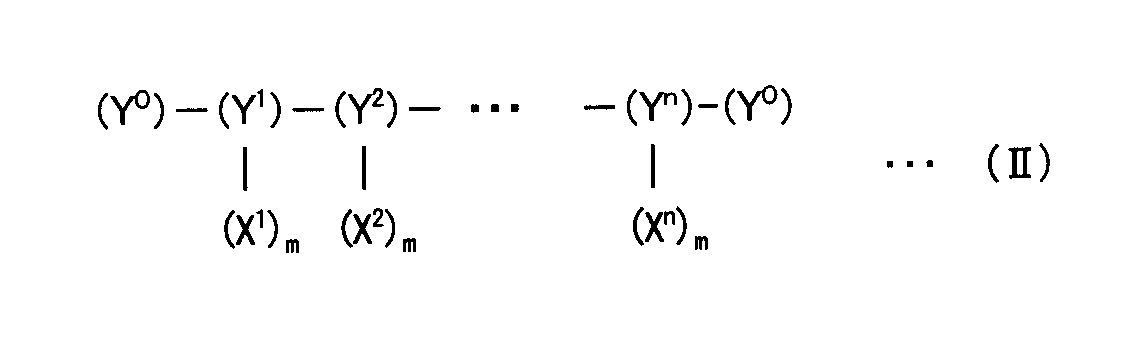
- compound (C) a compound having a structure represented by the following general formula (II) or a salt thereof is also preferably used.
- n is an integer of 2 or more
- m is an integer of 1 to 5
- Y 0 represents a hydrogen atom
- Y 1 to Y n each represents a hydrocarbon group having 1 to 30 carbon atoms
- the structure of these hydrocarbon groups is a single bond, a double bond
- Any of triple bonds may be included, and any of an aliphatic hydrocarbon group and an aromatic hydrocarbon group may be sufficient, and all may be the same or may mutually differ.
- X 1 to X n each represent any one of a sulfo group, a carboxyl group, and a hydrogen atom, and may be all the same or different from each other, but at least one is a sulfo group or a carboxyl group It is a group.
- n of X 1 to X n in the general formula (II) have a high effect of forming an excellent etching solution when used in combination with a phosphonic acid derivative as described above.
- the salt is not particularly limited, and examples thereof include sodium salt and potassium salt.
- the compound represented by the general formula (II) as described above is produced by polycondensation of polyacrylic acid or naphthalenesulfonic acid and formalin produced by polymerization of acrylic acid represented by the following formula.
- Naphthalene sulfonic acid formalin condensate, polystyrene sulfonic acid and the like are particularly preferable in that a synergistic effect with the above-described phosphonic acid is remarkably obtained.
- the compound that can be used is not limited to the polymer in which the monomer is polymerized, and the type and number of monomers to be polymerized are not limited even when the monomer is a polymer.
- the polymerization may be carried out either in a state where one kind of monomer is continuously polymerized (block) or in a state where a plurality of monomers are complicatedly polymerized (random).
- the number of polymerizations n is not particularly limited as long as it is 2 or more.
- polyacrylic acid about 130 molecules of acrylic acid produced by polymerizing about 130 molecules of acrylic acid is about 40 molecules of acrylic acid. Even a polyacrylic acid having a molecular weight of about 3000 produced by polymerization is applicable.
- a compound having a carboxymethyl group in the molecule can also be suitably used.
- compounds having a carboxymethyl group in the molecule include carboxymethyl cellulose salt, carboxymethyl starch, carboxymethyl sucrose, carboxymethyl inulin, carboxymethyl chitin, carboxymethyl chitosan, carboxymethyl dextran, carboxymethyl lignin, carboxymethyl guar gum, etc. And so on.
- carboxymethyl cellulose salt carboxymethyl starch
- carboxymethyl sucrose carboxymethyl inulin
- carboxymethyl chitin carboxymethyl chitosan
- carboxymethyl dextran carboxymethyl lignin
- carboxymethyl guar gum etc.
- a compound in which a carboxymethyl group is newly introduced into the molecule can be used for the purpose of the present invention. These may be used alone or in combination of two or more.
- a composition component of the etching solution for texture formation monosaccharides such as glucose and fructose are used as a basic structural unit in that a synergistic effect with the phosphonic acid can be obtained.
- Compounds are preferred, among which carboxymethylcellulose salt and carboxymethyl starch are preferred, and carboxymethylcellulose salt is particularly preferred.
- the salt an alkali metal salt is preferable, and among them, a lithium salt, a sodium salt, and a potassium salt are preferable.
- carboxymethyl group-containing compound that can be suitably used in the present invention will be described using carboxymethyl cellulose salt as an example.
- Cellulose formed by polymerization of glucose has three hydroxyl groups per unit glucose, and a substance in which these hydroxyl groups are substituted with carboxymethyl groups is called carboxymethyl cellulose.
- the number of substitutions of these hydroxyl groups with carboxymethyl groups is called the degree of etherification, and the degree of etherification can theoretically be up to 3.
- carboxymethyl cellulose salt those having any degree of etherification can be used, but a carboxymethyl cellulose salt having a degree of etherification of 0.4 to 2.0 is preferred, and a degree of etherification of 0.7 to 1.5 is preferred. Those are particularly preferred.
- the molecular weight of the carboxymethyl cellulose salt can be applied without any particular limitation, but those having an average degree of polymerization of 1000 or less and an average molecular weight of 220,000 or less are preferred, and those having an average degree of polymerization of 250 or less and an average molecular weight of 54000 or less are more preferred. .
- the compound (C) that can be used in the present invention can be used without particular limitation as long as it has a structure that can be dissolved in a high-temperature alkaline aqueous solution to which the present invention is applied as well as an existing compound. If it cannot be dissolved, the etching solution becomes non-uniform, and there is a concern that it may adversely affect the uniform processing of the substrate. These may be used alone or in combination of two or more.
- the phosphonic acid derivative (B) is regularly arranged and adsorbed on the surface of the silicon substrate, and etching by the alkali component (A) is moderately suppressed, so that a texture is formed on the substrate surface. It is thought that it is done.
- etching unevenness may occur on the surface of the silicon substrate, and this unevenness is caused by uneven hydrogen bubbles generated on the surface of the silicon substrate. It is thought that this occurs because the reaction proceeds while adhering to the surface.
- the various compounds (C) as described above in combination with the phosphonic acid derivative (B) the generation of bubbles is suppressed, and more uniform. It is considered that etching can be performed.
- the etching solution of the present invention can be used as an aqueous solution in which the alkali component (A), the phosphonic acid derivative or the like (B), and the compound (C) are dissolved in water.
- the water used is preferably water from which impurities have been removed, such as ion exchange water or distilled water.
- an insoluble component is contained in the etching solution, it is preferable to use after removing by performing a known fractionation operation such as filtration.
- the concentration of the alkali component (A) is preferably in the range of 0.3 to 25% by mass, more preferably 1 to 15% by mass.
- concentration of the alkali component is 0.3% by mass or more, the texture can be formed efficiently in a short time, and even if it exceeds 25% by mass, the etching effect does not decrease, but an etching inhibitor used as an additive is necessary. Since the amount increases, it is disadvantageous in terms of cost.
- the content of the phosphonic acid derivative (B) in this etching solution is preferably 0.1 to 25% by mass, more preferably 0.3 to 15% by mass, and particularly preferably 0.5 to 15% by mass.
- the content of the phosphonic acid derivative is within the above range, a moderate inhibitory effect on alkali etching can be obtained, and texture formation without unevenness can be performed in a short time.
- the content of the compound (C) is preferably in the range of 0.0001 to 25% by mass in order to efficiently perform etching without unevenness.
- the preferred content varies depending on the type of the compound (C).
- the content is more preferably 0.1 to 25% by mass, and 0.3 to 15% by mass. Is particularly preferred.
- the compound (C) is a compound represented by the formula (II)
- 0.0001 to 10% by mass is more preferable, and 0.01 to 5% by mass is particularly preferable.
- the compound (C) is a compound having a carboxymethyl group, 0.001 to 10% by mass is more preferable, and 0.01 to 3% by mass is particularly preferable.
- the ratio of the content of the phosphonic acid derivative (B) and the sulfonic acid / carboxylic acid (C) is preferably such that the value of A / (B + C) is in the range of 0.1 to 10, more preferably in the range of 0.2 to 5.
- the ratio of the two in the above range anisotropic etching of silicon due to the alkali component can be moderately suppressed by the phosphonic acid derivative (B) and the compound (C), contributing to good texture formation. It is thought that.
- additives such as isopropyl alcohol, fatty acid, silicate and the like that are usually used in the etching solution for texture formation of a silicon substrate, if necessary, are within the scope of the present invention. Can be added.
- the etching solution of the present invention can be applied not only to a single crystal silicon substrate but also to a polycrystalline silicon substrate, and any silicon substrate including a slicing method such as a free abrasive method or a fixed abrasive method. Is applicable. Among these, it can be preferably used particularly for a single crystal silicon substrate having a surface orientation of (100) on the substrate surface.
- the etching method using the etching solution of the present invention is not particularly limited, and as in the conventional method, the etching solution is heated to about 60 ° C. to 95 ° C., and the target silicon substrate is heated for 10 to 30 minutes. A dipping method can be used.
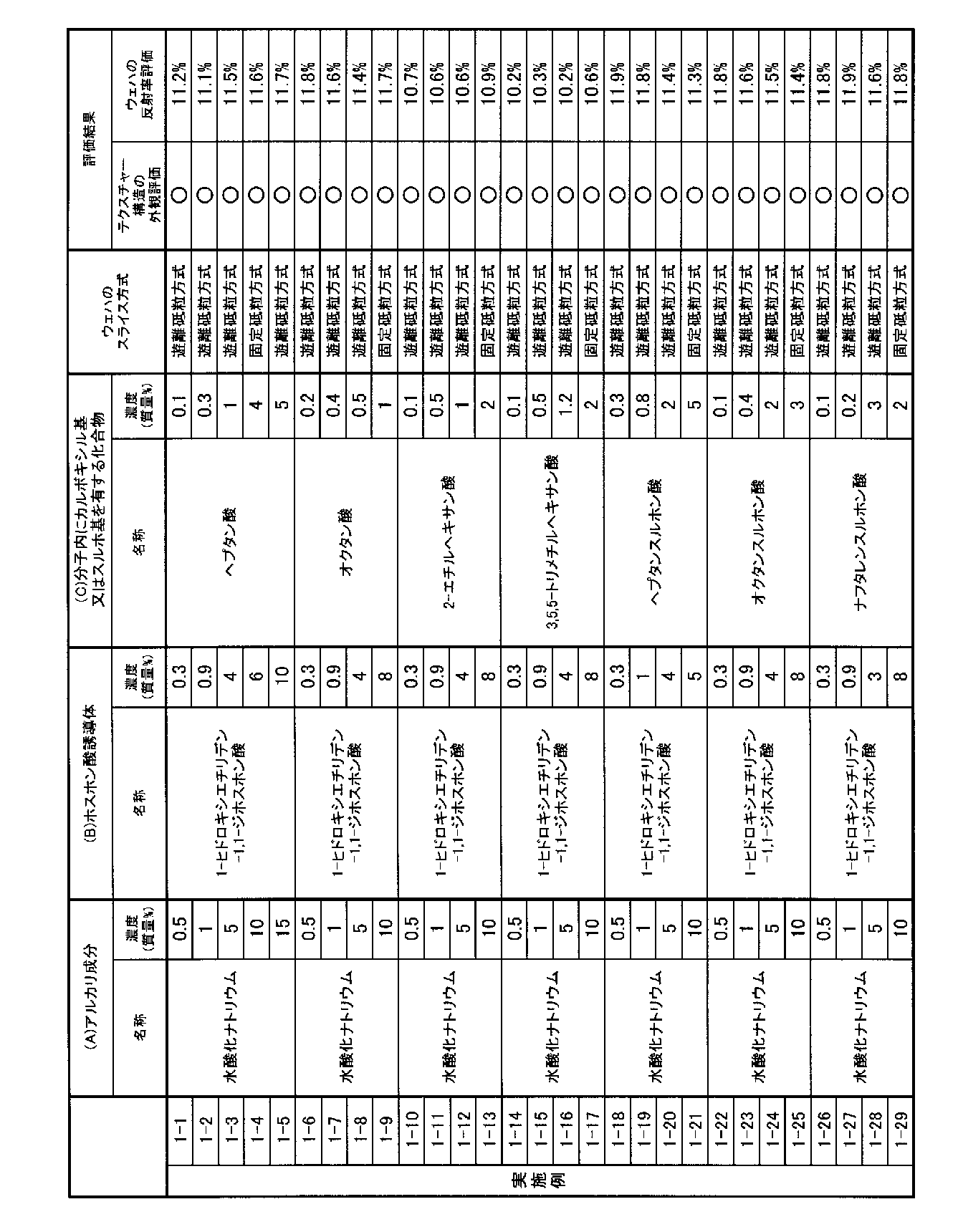
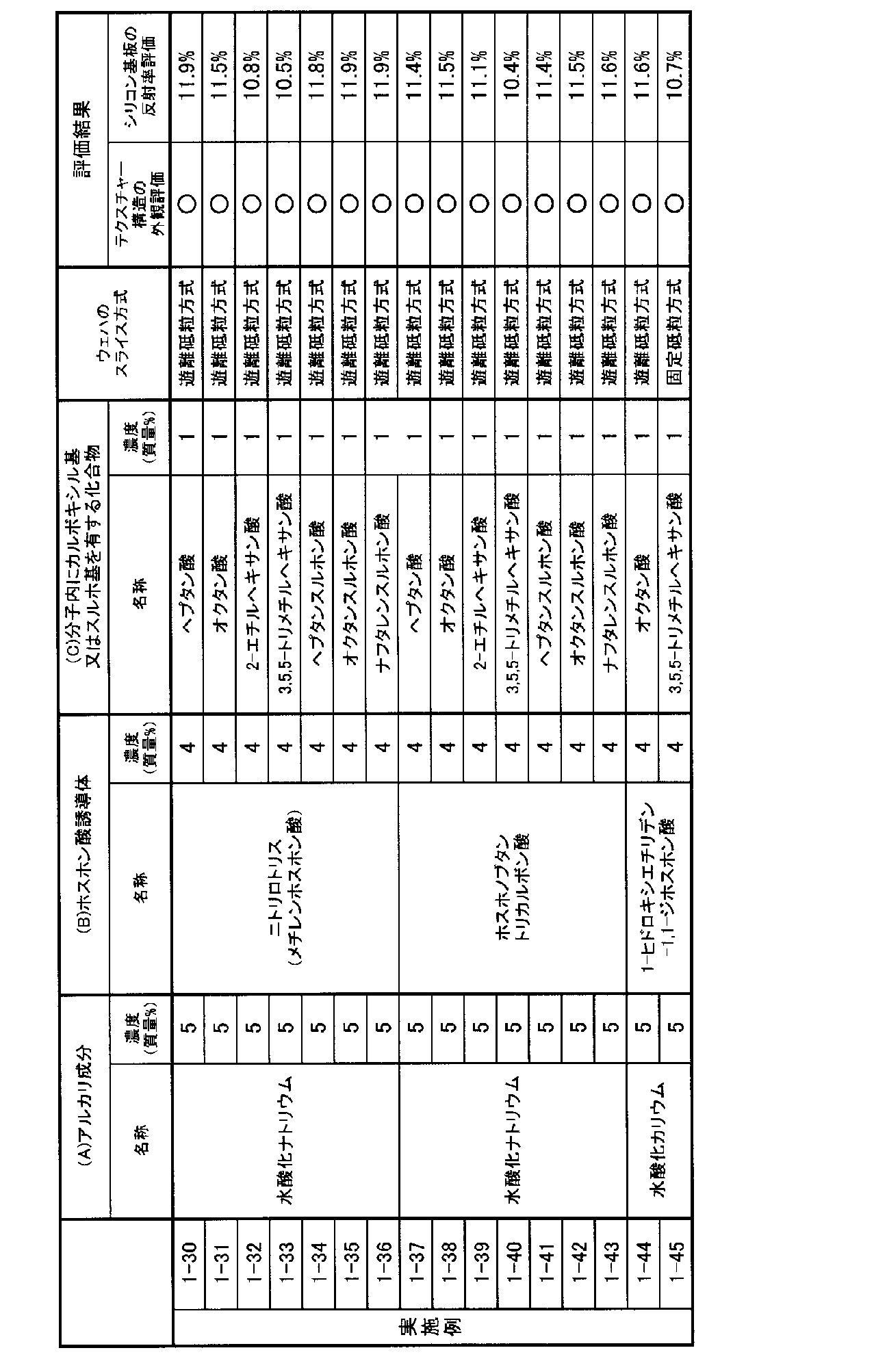
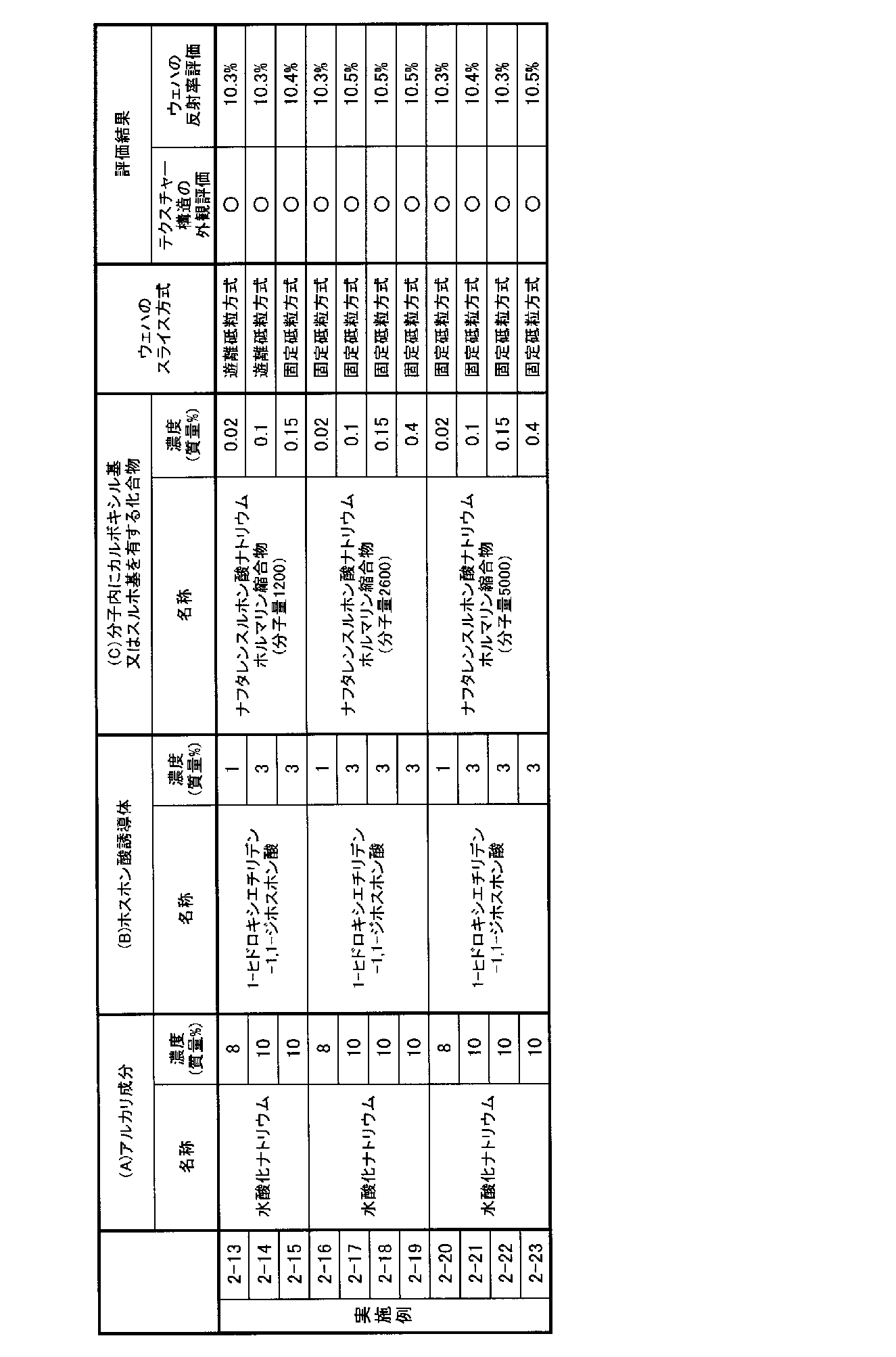
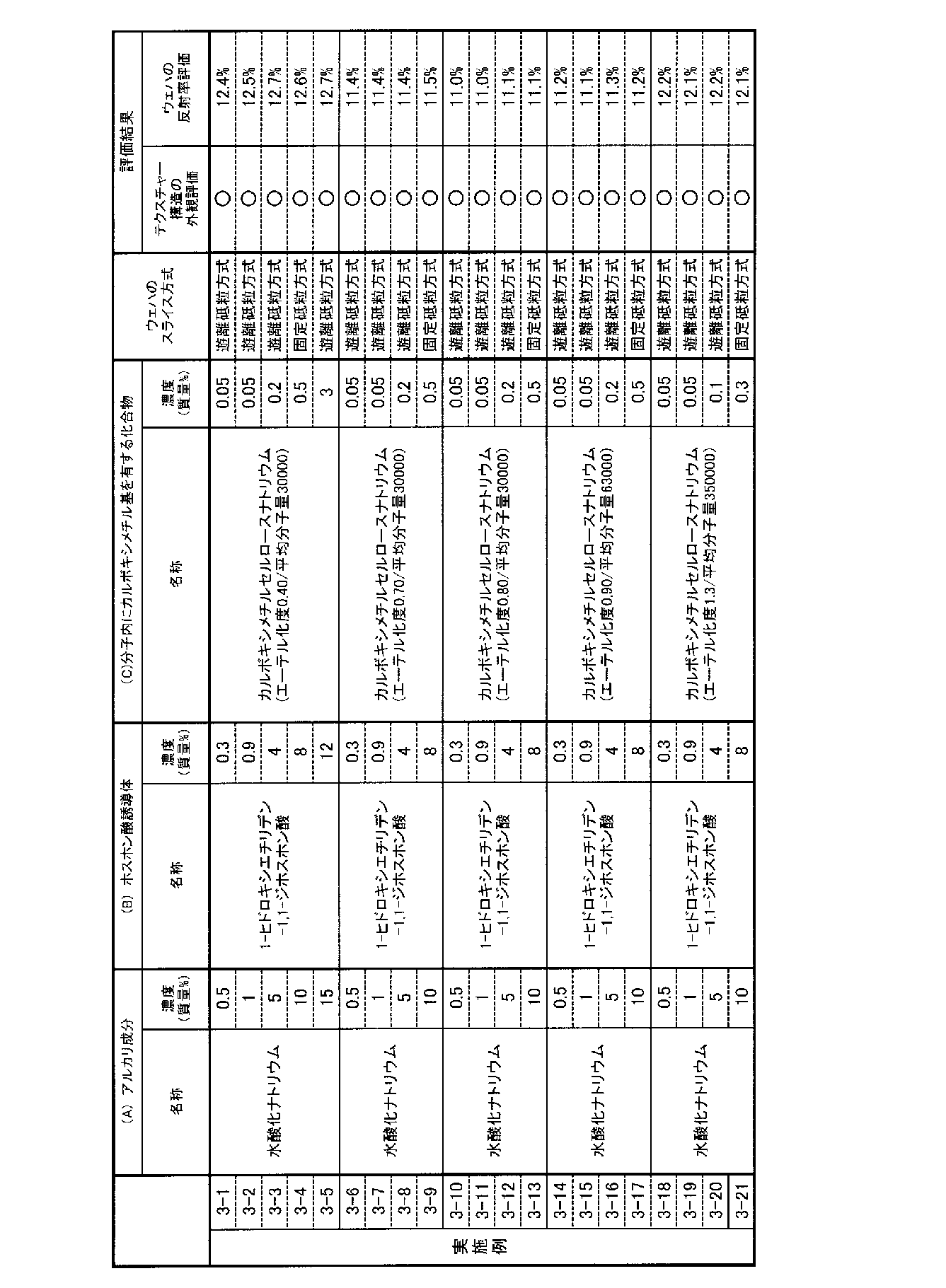
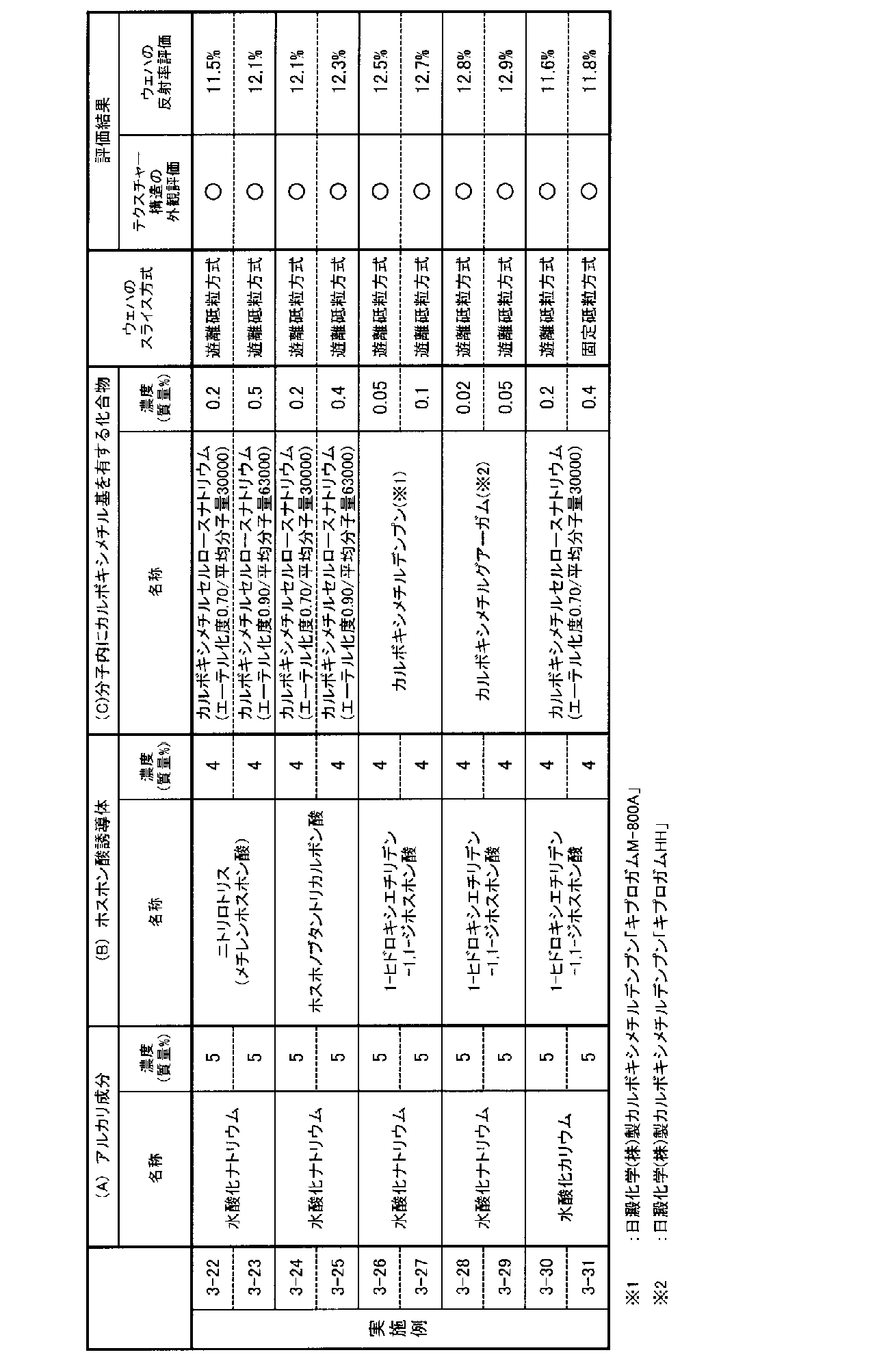
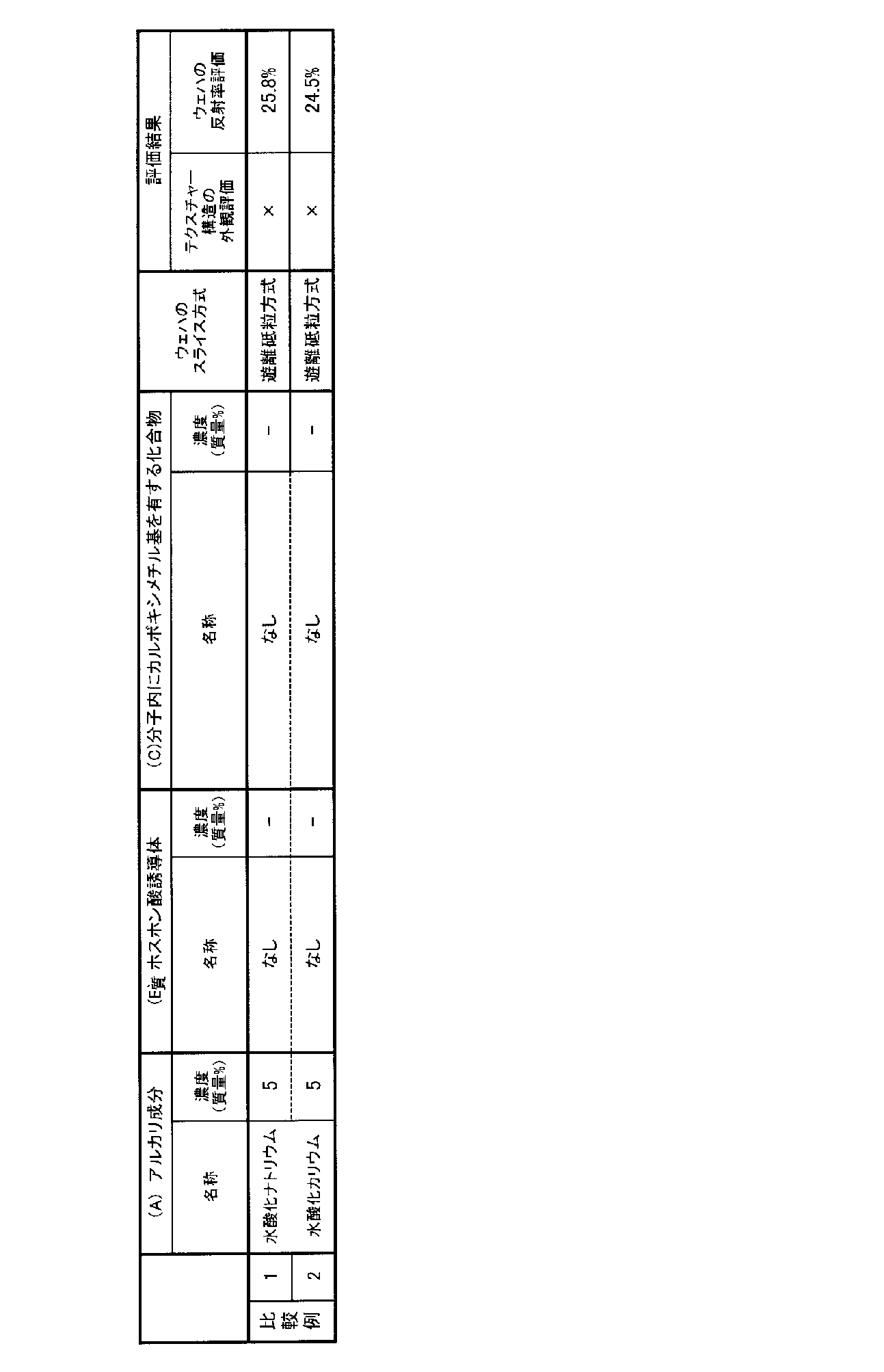
- wafers single crystal silicon substrate wafers sliced by either the free abrasive method or the fixed abrasive method shown in the table, respectively. Etching was performed by dipping for 20 minutes, washing with water and drying, and the texture structure was evaluated and the reflectance was measured as follows. The results are shown in each table.
- the texture structure was observed using a scanning electron microscope (manufactured by JEOL Ltd., JSM-6380LV). When observing at a magnification of 1000 times, a flat area having no texture structure on the substrate surface is 5% or less with respect to the total area, and “ ⁇ ” is exceeded, and exceeds 5% with respect to the total area. And a flat region is indicated as “x”.
- the wafer reflectivity was measured with an ultraviolet / visible spectrophotometer (U-3900H, manufactured by Hitachi High-Technologies Corporation). Light having a wavelength of 600 nm was adopted as an evaluation standard.
- the etching solution of the present invention can be used for etching a silicon substrate of a solar cell, for example.
Landscapes
- Weting (AREA)
- Photovoltaic Devices (AREA)
- ing And Chemical Polishing (AREA)
Abstract
Description
但し、一般式(I)におけるR1は炭素数4~12のアルキル基、アルケニル基、アルコキシ基、アリール基のいずれかであり、Xはカルボキシル基、スルホ基のいずれかである。一般式(I)で表される化合物としては、R1が分岐構造を有するアルキル基、分岐構造を有するアルケニル基、分岐構造を有するアルコキシ基、又はアリール基である化合物がより好ましい。



但し、R1は炭素数4~12のアルキル基、アルケニル基、アルコキシ基、アリール基のいずれかであり、これらの基は炭素骨格に分岐構造を有していてもよく、Xはカルボキシル基、スルホ基のいずれかである。


アルカリ成分(A)、ホスホン酸誘導体等(B)、及び化合物(C)を、以下の各表に示す割合で混合した水溶液を調製し、エッチング液とした。調製用の水はイオン交換水を使用した。
ウェハの反射率を紫外・可視分光光度計((株)日立ハイテクノロジーズ製、U-3900H)で測定した。波長600nmの光を評価基準として採用した。


Claims (15)
- シリコン基板表面に凹凸を形成させるエッチング液であって、
(A)アルカリ成分、
(B)ホスホン酸誘導体又はその塩、及び
(C)分子内に、カルボキシル基、スルホ基、塩を形成したこれらの基、及びカルボキシメチル基からなる群より選ばれた少なくとも1種の基を有する化合物
を含有することを特徴とする、エッチング液。 - 前記アルカリ成分(A)が、水酸化ナトリウム又は水酸化カリウムであることを特徴とする、請求項1に記載のエッチング液。
- 前記ホスホン酸誘導体又はその塩(B)が、1-ヒドロキシエチリデン-1,1-ジホスホン酸又はその塩であることを特徴とする、請求項1又は2のいずれか1項に記載のエッチング液。
- 前記化合物(C)が、カルボン酸、カルボン酸の塩、スルホン酸、及びスルホン酸の塩からなる群より選ばれた少なくとも1種であることを特徴とする、請求項1~3のいずれか1項に記載のエッチング液。
- 前記化合物(C)が下記一般式(I)で表わされる化合物であることを特徴とする、請求項4に記載のエッチング液。
R1-X … (I)
但し、R1は炭素数4~12のアルキル基、アルケニル基、アルコキシ基、アリール基のいずれかであり、Xはカルボキシル基、スルホ基のいずれかである。 - 前記化合物(C)が、前記一般式(I)において、R1が分岐構造を有するアルキル基、分岐構造を有するアルケニル基、分岐構造を有するアルコキシ基、又はアリール基である化合物であることを特徴とする、請求項5に記載のエッチング液。
- 前記化合物(C)が下記一般式(II)で表される化合物又はその塩であることを特徴とする、請求項4に記載のエッチング液。
Y0は水素原子を示し、Y1~Ynはそれぞれ炭素数1~30の炭化水素基を示し、全て同一であっても、相互に異なっていてもよく、
X1~Xnはそれぞれ、スルホ基、カルボキシル基、又は水素原子のいずれかを示し、全て同一であっても、相互に異なっていてもよいが、少なくとも一つはスルホ基又はカルボキシル基であるものとする。 - 前記化合物(C)が、ポリカルボン酸、ポリカルボン酸の塩、ポリスルホン酸、及びポリスルホン酸の塩からなる群より選ばれた少なくとも1種の化合物であることを特徴とする、請求項7に記載のエッチング液。
- 前記化合物(C)が、ポリアクリル酸、ポリアクリル酸の塩、ナフタレンスルホン酸ホルマリン縮合物、ナフタレンスルホン酸ホルマリン縮合物の塩、ポリスチレンスルホン酸、及びポリスチレンスルホン酸の塩からなる群より選ばれた少なくとも1種の化合物であることを特徴とする、請求項7又は8に記載のエッチング液。
- 前記化合物(C)が、分子内にカルボキシメチル基を有する化合物であることを特徴とする、請求項1~3のいずれか1項に記載のエッチング液。
- 前記分子内にカルボキシメチル基を有する化合物が、単糖類を基本構成単位とする化合物であることを特徴とする、請求項10に記載のエッチング液。
- 前記分子内にカルボキシメチル基を有する化合物が、カルボキシメチルセルロース塩であることを特徴とする、請求項11に記載のエッチング液。
- 前記アルカリ成分(A)と、前記ホスホン酸誘導体又はその塩(B)と、前記化合物(C)との配合割合が、質量比でA/(B+C)=0.1~10の範囲内であることを特徴とする、請求項1~12のいずれか1項に記載のエッチング液。
- 前記アルカリ成分(A)の濃度が0.3質量%~25質量%であり、前記ホスホン酸誘導体又はその塩(B)の濃度が0.1質量%~25質量%であり、前記化合物(C)の濃度が、0.0001質量%~25質量%であることを特徴とする、請求項1~13のいずれか1項に記載のエッチング液。
- 請求項1~14のいずれかに記載のエッチング液にシリコン基板を浸漬して、基板表面に凹凸構造を形成させる工程を含むことを特徴とする、シリコン基板の表面加工方法。
Priority Applications (4)
| Application Number | Priority Date | Filing Date | Title |
|---|---|---|---|
| JP2014529271A JP6138794B2 (ja) | 2012-08-10 | 2013-07-29 | テクスチャー形成用エッチング液およびそれを用いたテクスチャー形成方法 |
| SG11201500281YA SG11201500281YA (en) | 2012-08-10 | 2013-07-29 | Etching fluid for forming texture and texture-forming method using same |
| CN201380042594.6A CN104584232B (zh) | 2012-08-10 | 2013-07-29 | 纹理形成用蚀刻液及使用其的纹理形成方法 |
| PH12015500079A PH12015500079B1 (en) | 2012-08-10 | 2015-01-13 | Etching fluid for forming texture and texture-forming method using same |
Applications Claiming Priority (6)
| Application Number | Priority Date | Filing Date | Title |
|---|---|---|---|
| JP2012178129 | 2012-08-10 | ||
| JP2012-178129 | 2012-08-10 | ||
| JP2012-178128 | 2012-08-10 | ||
| JP2012178128 | 2012-08-10 | ||
| JP2013073434 | 2013-03-29 | ||
| JP2013-073434 | 2013-03-29 |
Publications (1)
| Publication Number | Publication Date |
|---|---|
| WO2014024414A1 true WO2014024414A1 (ja) | 2014-02-13 |
Family
ID=50067674
Family Applications (1)
| Application Number | Title | Priority Date | Filing Date |
|---|---|---|---|
| PCT/JP2013/004586 Ceased WO2014024414A1 (ja) | 2012-08-10 | 2013-07-29 | テクスチャー形成用エッチング液およびそれを用いたテクスチャー形成方法 |
Country Status (7)
| Country | Link |
|---|---|
| JP (2) | JP6138794B2 (ja) |
| CN (1) | CN104584232B (ja) |
| MY (1) | MY168909A (ja) |
| PH (1) | PH12015500079B1 (ja) |
| SG (1) | SG11201500281YA (ja) |
| TW (1) | TWI554592B (ja) |
| WO (1) | WO2014024414A1 (ja) |
Cited By (3)
| Publication number | Priority date | Publication date | Assignee | Title |
|---|---|---|---|---|
| JP2015023277A (ja) * | 2013-07-19 | 2015-02-02 | 東友ファインケム株式会社 | 結晶性シリコンウェハーのテクスチャエッチング液組成物及びテクスチャエッチング方法 |
| JP2015191946A (ja) * | 2014-03-27 | 2015-11-02 | 第一工業製薬株式会社 | テクスチャー形成用エッチング液およびそれを用いたテクスチャー形成方法 |
| JP2018117068A (ja) * | 2017-01-19 | 2018-07-26 | 信越化学工業株式会社 | 高光電変換効率太陽電池の製造方法 |
Citations (4)
| Publication number | Priority date | Publication date | Assignee | Title |
|---|---|---|---|---|
| WO2007138921A1 (ja) * | 2006-05-26 | 2007-12-06 | Wako Pure Chemical Industries, Ltd. | 基板エッチング液 |
| WO2011020632A1 (en) * | 2009-08-20 | 2011-02-24 | Rena Gmbh | Method for etching of silicon surfaces |
| JP2011515872A (ja) * | 2008-03-25 | 2011-05-19 | アプライド マテリアルズ インコーポレイテッド | 結晶太陽電池の表面クリーニング及び凹凸形成プロセス |
| JP2012004528A (ja) * | 2010-05-18 | 2012-01-05 | Shinryo Corp | エッチング液およびシリコン基板の表面加工方法 |
Family Cites Families (5)
| Publication number | Priority date | Publication date | Assignee | Title |
|---|---|---|---|---|
| JP3772456B2 (ja) * | 1997-04-23 | 2006-05-10 | 三菱電機株式会社 | 太陽電池及びその製造方法、半導体製造装置 |
| DE10241300A1 (de) * | 2002-09-04 | 2004-03-18 | Merck Patent Gmbh | Ätzpasten für Siliziumoberflächen und -schichten |
| EP2337089A3 (en) * | 2009-12-17 | 2013-12-11 | Rohm and Haas Electronic Materials LLC | Improved method of texturing semiconductor substrates |
| US9076920B2 (en) * | 2010-06-09 | 2015-07-07 | Basf Se | Aqueous alkaline etching and cleaning composition and method for treating the surface of silicon substrates |
| US20120295447A1 (en) * | 2010-11-24 | 2012-11-22 | Air Products And Chemicals, Inc. | Compositions and Methods for Texturing of Silicon Wafers |
-
2013
- 2013-07-29 WO PCT/JP2013/004586 patent/WO2014024414A1/ja not_active Ceased
- 2013-07-29 JP JP2014529271A patent/JP6138794B2/ja active Active
- 2013-07-29 CN CN201380042594.6A patent/CN104584232B/zh active Active
- 2013-07-29 SG SG11201500281YA patent/SG11201500281YA/en unknown
- 2013-07-29 MY MYPI2014704078A patent/MY168909A/en unknown
- 2013-08-06 TW TW102128087A patent/TWI554592B/zh not_active IP Right Cessation
-
2015
- 2015-01-13 PH PH12015500079A patent/PH12015500079B1/en unknown
-
2017
- 2017-03-15 JP JP2017049968A patent/JP6129455B1/ja active Active
Patent Citations (4)
| Publication number | Priority date | Publication date | Assignee | Title |
|---|---|---|---|---|
| WO2007138921A1 (ja) * | 2006-05-26 | 2007-12-06 | Wako Pure Chemical Industries, Ltd. | 基板エッチング液 |
| JP2011515872A (ja) * | 2008-03-25 | 2011-05-19 | アプライド マテリアルズ インコーポレイテッド | 結晶太陽電池の表面クリーニング及び凹凸形成プロセス |
| WO2011020632A1 (en) * | 2009-08-20 | 2011-02-24 | Rena Gmbh | Method for etching of silicon surfaces |
| JP2012004528A (ja) * | 2010-05-18 | 2012-01-05 | Shinryo Corp | エッチング液およびシリコン基板の表面加工方法 |
Cited By (3)
| Publication number | Priority date | Publication date | Assignee | Title |
|---|---|---|---|---|
| JP2015023277A (ja) * | 2013-07-19 | 2015-02-02 | 東友ファインケム株式会社 | 結晶性シリコンウェハーのテクスチャエッチング液組成物及びテクスチャエッチング方法 |
| JP2015191946A (ja) * | 2014-03-27 | 2015-11-02 | 第一工業製薬株式会社 | テクスチャー形成用エッチング液およびそれを用いたテクスチャー形成方法 |
| JP2018117068A (ja) * | 2017-01-19 | 2018-07-26 | 信越化学工業株式会社 | 高光電変換効率太陽電池の製造方法 |
Also Published As
| Publication number | Publication date |
|---|---|
| TWI554592B (zh) | 2016-10-21 |
| CN104584232A (zh) | 2015-04-29 |
| CN104584232B (zh) | 2017-03-08 |
| SG11201500281YA (en) | 2015-03-30 |
| JP6129455B1 (ja) | 2017-05-17 |
| JP2017118143A (ja) | 2017-06-29 |
| PH12015500079A1 (en) | 2015-03-02 |
| MY168909A (en) | 2018-12-04 |
| PH12015500079B1 (en) | 2015-03-02 |
| TW201412947A (zh) | 2014-04-01 |
| JPWO2014024414A1 (ja) | 2016-07-25 |
| JP6138794B2 (ja) | 2017-05-31 |
Similar Documents
| Publication | Publication Date | Title |
|---|---|---|
| JP5339880B2 (ja) | シリコン基板のエッチング液およびシリコン基板の表面加工方法 | |
| CN102656250B (zh) | 含水酸性蚀刻溶液和使单晶和多晶硅衬底的表面纹理化的方法 | |
| TWI498421B (zh) | 水性鹼性蝕刻與清潔組合物及處理矽基板表面之方法 | |
| JP6129455B1 (ja) | シリコン基板の表面加工方法 | |
| WO2018181896A1 (ja) | チタン層またはチタン含有層のエッチング液組成物およびエッチング方法 | |
| CN102241985A (zh) | 透明导电膜湿法蚀刻液组合物 | |
| JPWO2009072438A1 (ja) | 多結晶シリコン基板の製造方法及び多結晶シリコン基板 | |
| WO2015064174A1 (ja) | テクスチャエッチング液、テクスチャエッチング液用添加剤液、テクスチャ形成基板及びテクスチャ形成基板の製造方法並びに太陽電池 | |
| TWI635161B (zh) | 晶態矽晶圓之紋理蝕刻液組成物及紋理蝕刻方法 | |
| JP5575822B2 (ja) | テクスチャー形成用エッチング液 | |
| WO2012023613A1 (ja) | テクスチャー形成用組成物、シリコン基板の製造方法、及びテクスチャー形成用組成物調製キット | |
| KR20120119796A (ko) | 결정성 실리콘 웨이퍼의 텍스쳐 에칭액 조성물 및 텍스쳐 에칭방법 | |
| JP6282507B2 (ja) | テクスチャー形成用エッチング液およびそれを用いたテクスチャー形成方法 | |
| TWI635160B (zh) | 紋理蝕刻溶液組成物及晶體矽晶圓紋理蝕刻方法 | |
| JP5550441B2 (ja) | テクスチャー形成用組成物 | |
| JP5484249B2 (ja) | テクスチャー形成用組成物 | |
| KR20150020186A (ko) | 에칭액 및 이를 이용한 실리콘계 기판의 제조방법 | |
| JP6157895B2 (ja) | テクスチャー形成用組成物、シリコン基板の製造方法、及びテクスチャー形成用組成物調製キット | |
| KR101892624B1 (ko) | 결정성 실리콘 웨이퍼의 텍스쳐 에칭액 조성물 및 텍스쳐 에칭방법 | |
| JP2014033046A (ja) | テクスチャー形成用組成物、シリコン基板の製造方法、及びテクスチャー形成用組成物調製キット | |
| JP2013168619A (ja) | テクスチャー形成用組成物 | |
| JP6178543B2 (ja) | P型拡散層用塗布液 | |
| JP2013236027A (ja) | エッチング液及びこれを用いたシリコン系基板の製造方法 | |
| JP2015088711A (ja) | テクスチャエッチング液、テクスチャエッチング液用添加剤液、テクスチャ形成基板及びテクスチャ形成基板の製造方法並びに太陽電池 |
Legal Events
| Date | Code | Title | Description |
|---|---|---|---|
| 121 | Ep: the epo has been informed by wipo that ep was designated in this application |
Ref document number: 13828242 Country of ref document: EP Kind code of ref document: A1 |
|
| ENP | Entry into the national phase |
Ref document number: 2014529271 Country of ref document: JP Kind code of ref document: A |
|
| WWE | Wipo information: entry into national phase |
Ref document number: 12015500079 Country of ref document: PH |
|
| NENP | Non-entry into the national phase |
Ref country code: DE |
|
| 122 | Ep: pct application non-entry in european phase |
Ref document number: 13828242 Country of ref document: EP Kind code of ref document: A1 |