WO2013147148A1 - 耐熱性樹脂組成物の製造方法、並びに、その製造方法で製造された耐熱性樹脂組成物及び該耐熱性樹脂組成物を用いた成形品 - Google Patents
耐熱性樹脂組成物の製造方法、並びに、その製造方法で製造された耐熱性樹脂組成物及び該耐熱性樹脂組成物を用いた成形品 Download PDFInfo
- Publication number
- WO2013147148A1 WO2013147148A1 PCT/JP2013/059504 JP2013059504W WO2013147148A1 WO 2013147148 A1 WO2013147148 A1 WO 2013147148A1 JP 2013059504 W JP2013059504 W JP 2013059504W WO 2013147148 A1 WO2013147148 A1 WO 2013147148A1
- Authority
- WO
- WIPO (PCT)
- Prior art keywords
- resin composition
- mass
- parts
- heat
- coupling agent
- Prior art date
- Legal status (The legal status is an assumption and is not a legal conclusion. Google has not performed a legal analysis and makes no representation as to the accuracy of the status listed.)
- Ceased
Links
Classifications
-
- C—CHEMISTRY; METALLURGY
- C08—ORGANIC MACROMOLECULAR COMPOUNDS; THEIR PREPARATION OR CHEMICAL WORKING-UP; COMPOSITIONS BASED THEREON
- C08K—Use of inorganic or non-macromolecular organic substances as compounding ingredients
- C08K3/00—Use of inorganic substances as compounding ingredients
- C08K3/01—Use of inorganic substances as compounding ingredients characterized by their specific function
- C08K3/013—Fillers, pigments or reinforcing additives
-
- H—ELECTRICITY
- H01—ELECTRIC ELEMENTS
- H01B—CABLES; CONDUCTORS; INSULATORS; SELECTION OF MATERIALS FOR THEIR CONDUCTIVE, INSULATING OR DIELECTRIC PROPERTIES
- H01B3/00—Insulators or insulating bodies characterised by the insulating materials; Selection of materials for their insulating or dielectric properties
- H01B3/18—Insulators or insulating bodies characterised by the insulating materials; Selection of materials for their insulating or dielectric properties mainly consisting of organic substances
- H01B3/28—Insulators or insulating bodies characterised by the insulating materials; Selection of materials for their insulating or dielectric properties mainly consisting of organic substances natural or synthetic rubbers
-
- C—CHEMISTRY; METALLURGY
- C08—ORGANIC MACROMOLECULAR COMPOUNDS; THEIR PREPARATION OR CHEMICAL WORKING-UP; COMPOSITIONS BASED THEREON
- C08J—WORKING-UP; GENERAL PROCESSES OF COMPOUNDING; AFTER-TREATMENT NOT COVERED BY SUBCLASSES C08B, C08C, C08F, C08G or C08H
- C08J3/00—Processes of treating or compounding macromolecular substances
- C08J3/24—Crosslinking, e.g. vulcanising, of macromolecules
- C08J3/241—Preventing premature crosslinking by physical separation of components, e.g. encapsulation
-
- C—CHEMISTRY; METALLURGY
- C08—ORGANIC MACROMOLECULAR COMPOUNDS; THEIR PREPARATION OR CHEMICAL WORKING-UP; COMPOSITIONS BASED THEREON
- C08K—Use of inorganic or non-macromolecular organic substances as compounding ingredients
- C08K5/00—Use of organic ingredients
- C08K5/04—Oxygen-containing compounds
- C08K5/14—Peroxides
-
- C—CHEMISTRY; METALLURGY
- C08—ORGANIC MACROMOLECULAR COMPOUNDS; THEIR PREPARATION OR CHEMICAL WORKING-UP; COMPOSITIONS BASED THEREON
- C08K—Use of inorganic or non-macromolecular organic substances as compounding ingredients
- C08K5/00—Use of organic ingredients
- C08K5/54—Silicon-containing compounds
- C08K5/541—Silicon-containing compounds containing oxygen
- C08K5/5425—Silicon-containing compounds containing oxygen containing at least one C=C bond
-
- C—CHEMISTRY; METALLURGY
- C08—ORGANIC MACROMOLECULAR COMPOUNDS; THEIR PREPARATION OR CHEMICAL WORKING-UP; COMPOSITIONS BASED THEREON
- C08L—COMPOSITIONS OF MACROMOLECULAR COMPOUNDS
- C08L23/00—Compositions of homopolymers or copolymers of unsaturated aliphatic hydrocarbons having only one carbon-to-carbon double bond; Compositions of derivatives of such polymers
- C08L23/02—Compositions of homopolymers or copolymers of unsaturated aliphatic hydrocarbons having only one carbon-to-carbon double bond; Compositions of derivatives of such polymers not modified by chemical after-treatment
- C08L23/16—Ethylene-propylene or ethylene-propylene-diene copolymers
-
- H—ELECTRICITY
- H01—ELECTRIC ELEMENTS
- H01B—CABLES; CONDUCTORS; INSULATORS; SELECTION OF MATERIALS FOR THEIR CONDUCTIVE, INSULATING OR DIELECTRIC PROPERTIES
- H01B3/00—Insulators or insulating bodies characterised by the insulating materials; Selection of materials for their insulating or dielectric properties
- H01B3/18—Insulators or insulating bodies characterised by the insulating materials; Selection of materials for their insulating or dielectric properties mainly consisting of organic substances
- H01B3/30—Insulators or insulating bodies characterised by the insulating materials; Selection of materials for their insulating or dielectric properties mainly consisting of organic substances plastics; resins; waxes
- H01B3/34—Waxes
-
- H—ELECTRICITY
- H01—ELECTRIC ELEMENTS
- H01B—CABLES; CONDUCTORS; INSULATORS; SELECTION OF MATERIALS FOR THEIR CONDUCTIVE, INSULATING OR DIELECTRIC PROPERTIES
- H01B3/00—Insulators or insulating bodies characterised by the insulating materials; Selection of materials for their insulating or dielectric properties
- H01B3/18—Insulators or insulating bodies characterised by the insulating materials; Selection of materials for their insulating or dielectric properties mainly consisting of organic substances
- H01B3/30—Insulators or insulating bodies characterised by the insulating materials; Selection of materials for their insulating or dielectric properties mainly consisting of organic substances plastics; resins; waxes
- H01B3/44—Insulators or insulating bodies characterised by the insulating materials; Selection of materials for their insulating or dielectric properties mainly consisting of organic substances plastics; resins; waxes vinyl resins; acrylic resins
- H01B3/441—Insulators or insulating bodies characterised by the insulating materials; Selection of materials for their insulating or dielectric properties mainly consisting of organic substances plastics; resins; waxes vinyl resins; acrylic resins from alkenes
-
- H—ELECTRICITY
- H01—ELECTRIC ELEMENTS
- H01B—CABLES; CONDUCTORS; INSULATORS; SELECTION OF MATERIALS FOR THEIR CONDUCTIVE, INSULATING OR DIELECTRIC PROPERTIES
- H01B7/00—Insulated conductors or cables characterised by their form
- H01B7/17—Protection against damage caused by external factors, e.g. sheaths or armouring
- H01B7/29—Protection against damage caused by extremes of temperature or by flame
- H01B7/292—Protection against damage caused by extremes of temperature or by flame using material resistant to heat
-
- H—ELECTRICITY
- H01—ELECTRIC ELEMENTS
- H01B—CABLES; CONDUCTORS; INSULATORS; SELECTION OF MATERIALS FOR THEIR CONDUCTIVE, INSULATING OR DIELECTRIC PROPERTIES
- H01B7/00—Insulated conductors or cables characterised by their form
- H01B7/17—Protection against damage caused by external factors, e.g. sheaths or armouring
- H01B7/29—Protection against damage caused by extremes of temperature or by flame
- H01B7/295—Protection against damage caused by extremes of temperature or by flame using material resistant to flame
-
- C—CHEMISTRY; METALLURGY
- C08—ORGANIC MACROMOLECULAR COMPOUNDS; THEIR PREPARATION OR CHEMICAL WORKING-UP; COMPOSITIONS BASED THEREON
- C08J—WORKING-UP; GENERAL PROCESSES OF COMPOUNDING; AFTER-TREATMENT NOT COVERED BY SUBCLASSES C08B, C08C, C08F, C08G or C08H
- C08J2323/00—Characterised by the use of homopolymers or copolymers of unsaturated aliphatic hydrocarbons having only one carbon-to-carbon double bond; Derivatives of such polymers
- C08J2323/02—Characterised by the use of homopolymers or copolymers of unsaturated aliphatic hydrocarbons having only one carbon-to-carbon double bond; Derivatives of such polymers not modified by chemical after treatment
- C08J2323/16—Ethene-propene or ethene-propene-diene copolymers
-
- C—CHEMISTRY; METALLURGY
- C08—ORGANIC MACROMOLECULAR COMPOUNDS; THEIR PREPARATION OR CHEMICAL WORKING-UP; COMPOSITIONS BASED THEREON
- C08L—COMPOSITIONS OF MACROMOLECULAR COMPOUNDS
- C08L2312/00—Crosslinking
- C08L2312/08—Crosslinking by silane
Definitions
- the present invention relates to a method for producing a heat-resistant resin composition, a heat-resistant resin composition produced by the production method, and a molded article using the heat-resistant resin composition.
- a heat-resistant resin composition excellent in heat resistance a heat-resistant resin composition obtained by the method of producing the heat-resistant resin composition, and molding of an electric wire insulator or sheath using the heat-resistant resin composition It is about goods.
- Insulated wires, cables, cords, optical fiber cores, and optical fiber cords used for internal and external wiring of electrical and electronic equipment are flame retardant, heat resistant, and mechanical properties (for example, tensile properties, wear resistance) Various characteristics are required.
- a resin composition containing a large amount of an inorganic filler such as magnesium hydroxide or aluminum hydroxide is used.
- wiring materials used in electrical and electronic equipment may be heated to 80 to 105 ° C., and further to about 125 ° C. in continuous use, and heat resistance may be required.
- a method of crosslinking the coating material by an electron beam crosslinking method or a chemical crosslinking method is employed.
- silane cross-linking method refers to cross-linking molding by reacting a silane coupling agent having an unsaturated group in the presence of an organic peroxide to obtain a silane graft polymer, and then contacting with moisture in the presence of a silanol condensation catalyst. A way to get a body.
- the silane cross-linking method in particular does not require special equipment and can be used in a wide range of fields.
- a method for producing a halogen-free heat-resistant silane crosslinked resin includes a silane master batch obtained by grafting a silane coupling agent having an unsaturated group to a polyolefin resin, and a heat-resistant master obtained by kneading a polyolefin and an inorganic filler. There is a method of melt-kneading a batch and a catalyst masterbatch containing a silanol condensation catalyst.
- the silane masterbatch and the heat-resistant masterbatch are dry-mixed and uniformly in a single screw extruder or a twin screw extruder.
- the ratio including the silane masterbatch is limited, it has been difficult to achieve higher flame resistance and higher heat resistance.
- a silane coupling agent having an unsaturated group is generally highly volatile and volatilizes before the grafting reaction. It was very difficult to do.
- a silane coupling agent having a hydrolyzable unsaturated group and an organic peroxide are added to the heat-resistant masterbatch obtained by melting and kneading a polyolefin resin and a flame retardant.
- a method may be considered in which a product is added and graft polymerization is carried out using a single screw extruder.
- the appearance of the molded product is deteriorated due to variations in reaction, the amount of inorganic filler in the master batch must be very large, the extrusion load becomes very large, and the production is very difficult. As a result, a desired material or molded body cannot be obtained.
- Patent Document 1 an inorganic filler surface-treated with a silane coupling agent, a silane coupling agent, an organic peroxide, and a crosslinking catalyst are sufficiently melt-kneaded with a kneader and then molded with a single screw extruder. A method has been proposed.
- Patent Documents 2 to 4 disclose a vinyl aromatic thermoplastic elastomer composition having a block copolymer or the like as a base resin and a non-aromatic rubber softener added as a softener. A technique of partially crosslinking using an organic peroxide through a filler has been proposed.
- the present invention solves the above-mentioned problems, suppresses volatilization of the unsaturated group-containing silane coupling agent from the reaction system, and has excellent heat resistance, heat resistance, and mechanical properties, It is another object of the present invention to provide a molded product using the heat resistant resin composition.
- the subject of this invention was achieved by the following means.
- (1) (a) a resin composition containing a polyolefin resin, 0.01 to 0.6 parts by weight of an organic peroxide and 10 to 400 parts by weight of an inorganic filler with respect to 100 parts by weight of the resin composition; Melting and kneading 0.5 to 15.0 parts by mass of a silane coupling agent with respect to 100 parts by mass of the inorganic filler at a temperature equal to or higher than the decomposition temperature of the organic peroxide to prepare a silane masterbatch without mixing a silanol condensation catalyst.
- a step of preparing (B) a step of molding after melt-kneading the silane masterbatch and the silanol condensation catalyst; (C) The manufacturing method of the heat resistant resin composition characterized by including the process of making the molded article of the said (b) process contact with a water
- a silane masterbatch is prepared without mixing a silanol condensation catalyst by melting and kneading 0.5 to 15.0 parts by mass of a silane coupling agent with respect to 100 parts by mass of an inorganic filler at a temperature higher than the decomposition temperature of the organic peroxide.
- (B-1) a step of mixing a silanol condensation catalyst and a carrier resin to produce a catalyst master batch;
- (B-3) a step of melt-kneading the silane masterbatch and the catalyst masterbatch prepared in the steps (a) and (b-1), respectively, and then molding,
- (C) The method for producing a heat-resistant resin composition according to (1), further comprising a step of bringing the molded product in the step (b-3) into contact with moisture to crosslink.
- the resin composition contains at least one of an ethylene- ⁇ -olefin copolymer and a styrene elastomer and a paraffinic oil in a mass ratio of 4 to 70% by mass (1).
- the method for producing a flame retardant crosslinking composition according to any one of items 1) to (7).
- the inorganic filler is at least one selected from the group consisting of silica, aluminum hydroxide, magnesium hydroxide, calcium carbonate, magnesium carbonate, zinc borate, zinc hydroxystannate and talc ( The method for producing a heat-resistant resin composition according to any one of 1) to 12).
- the present invention is excellent in flame retardancy, heat resistance and mechanical properties, and at the time of kneading by mixing the inorganic filler and the silane coupling agent before and / or during kneading with the polyolefin resin.
- the volatilization of the silane coupling agent can be suppressed, and a heat-resistant resin composition and a molded product of the heat-resistant resin composition can be obtained efficiently.
- a highly heat-resistant crosslinked composition to which a large amount of an inorganic filler is added can be produced without using a special machine such as an electron beam crosslinking machine.
- the method for producing a heat-resistant resin composition of the present invention comprises: (a) a resin composition containing a polyolefin-based resin; and 0.01 to 0.6 parts by mass of an organic peroxide with respect to 100 parts by mass of the resin composition. Then, 10 to 400 parts by mass of the inorganic filler and 0.5 to 15.0 parts by mass of the silane coupling agent with respect to 100 parts by mass of the inorganic filler are melt-kneaded at a temperature equal to or higher than the decomposition temperature of the organic peroxide, and silanol condensation is performed.
- a step of preparing a silane master batch without mixing the catalyst (b) a step of melt-kneading the silane master batch and a silanol condensation catalyst, and (c) contacting the molded product of the step with moisture. And crosslinking.
- the resin composition used in the present invention contains a polyolefin resin as an essential component, and optionally contains a styrene elastomer, paraffin oil, various additives, and the like. is doing.
- an ethylene- ⁇ -olefin copolymer which will be described later, is used as one of the polyolefin resins, or when a styrene elastomer is used as one component of the resin composition (A), it contains paraffin oil. In view of excellent flexibility and appearance, it is preferable.
- “resin” and “copolymer” are used to include rubber and elastomer.
- the term “copolymer” is used to include various copolymers such as a random copolymer, a block copolymer, and an alternating copolymer.
- the content rate of each component in a resin composition is not specifically limited,
- the content rate of polyolefin resin may be 100 mass% independently, and may contain the other component in a suitable mass ratio.
- the content of the polyolefin resin in the resin composition (A) is 100% by mass at the maximum, but is not limited to this, and the mechanical properties and heat resistance of the entire resin composition (A) are not limited to this. In this respect, it is preferably 30 to 100% by mass, and more preferably 30 to 92% by mass. Therefore, in this case, the content of components other than the polyolefin resin in the resin composition (A) is preferably 70 to 0% by mass, and preferably 70 to 8% by mass with respect to the entire resin composition (A).
- the total content of the ethylene- ⁇ -olefin copolymer as the polyolefin resin, the styrene elastomer, and the paraffinic oil is 4 to 70% by mass. From the viewpoint of suppressing the occurrence of blisters when stopped and from the viewpoint of flexibility, it is preferably 8 to 70% by mass, more preferably 15 to 70% by mass. Therefore, in this case, the total content of components other than the ethylene- ⁇ -olefin copolymer, the styrene elastomer, and the paraffinic oil in the resin composition (A) is 30 to 96 mass based on the entire resin composition. %, More preferably 30 to 92% by mass, still more preferably 30 to 85% by mass.
- polyolefin-based resin used in the present invention is not particularly limited, and known ones conventionally used in heat-resistant resin compositions can be used. Examples thereof include polyethylene, polypropylene, ethylene- ⁇ -olefin copolymer, polyolefin copolymer having an acid copolymerization component or an acid ester copolymerization component, and rubbers and elastomers thereof.
- polyethylene an ethylene- ⁇ -olefin copolymer, and a copolymer having an acid copolymer component are preferable from the viewpoint of suppressing a decrease in withstand voltage characteristics at high temperatures.
- polyolefin resins may be used alone or in combination of two or more.
- PE polyethylene
- HDPE high density polyethylene
- LDPE low density polyethylene
- UHMW-PE ultra high molecular weight polyethylene
- LLDPE linear low density polyethylene
- VLDPE very low density polyethylene
- the ethylene- ⁇ -olefin copolymer is preferably a copolymer of ethylene and an ⁇ -olefin having 3 to 12 carbon atoms.
- Specific examples of the ⁇ -olefin include propylene, 1-butene, 1- Examples include hexene, 4-methyl-1-pentene, 1-octene, 1-decene, and 1-dodecene.
- Specific examples of the ethylene- ⁇ -olefin copolymer include an ethylene-propylene copolymer (EPR), an ethylene-butylene copolymer (EBR), and an ethylene- ⁇ -olefin synthesized in the presence of a single site catalyst. There are copolymers and the like. An ethylene-propylene copolymer is preferable, and examples thereof include an ethylene-propylene-diene copolymer.
- polyolefin copolymers having an acid copolymerization component or an acid ester copolymerization component examples include ethylene-vinyl acetate copolymer (EVA), ethylene- (meth) acrylic acid copolymer, ethylene- (meth) acrylic acid alkyl copolymer.
- EVA ethylene-vinyl acetate copolymer
- ethylene- (meth) acrylic acid copolymer ethylene- (meth) acrylic acid alkyl copolymer.
- a polymer etc. are mentioned.
- ethylene-vinyl acetate copolymer, ethylene-methyl acrylate copolymer, ethylene-ethyl acrylate copolymer, and ethylene-butyl acrylate copolymer are preferable, and further, acceptability to inorganic filler and heat resistance. From this point, an ethylene-vinyl acetate copolymer and an ethylene-ethyl acrylate copolymer are particularly preferable.
- the content of the polyolefin resin (A-1) in the resin composition (A) is as described above.
- the content of the ethylene- ⁇ -olefin copolymer is the polyolefin resin (A) in the resin composition (A).
- the content of A-1) is appropriately set so as to be within the above range, and for example, it is preferably 30 to 100% by mass with respect to the resin composition (A).
- the content of the ethylene- ⁇ -olefin copolymer is such that when the resin composition (A) contains a paraffinic oil (A-3) described later, the styrene elastomer (A-2) and the paraffinic oil It is appropriately set so that the total content with (A-3) falls within the above-mentioned range, and for example, it is preferably 4 to 70% by mass with respect to the resin composition (A).
- the content of the ethylene- ⁇ -olefin copolymer is within the above range, the appearance of the electric wire is excellent when the flame-retardant crosslinked resin composition of the present invention is used for the electric wire.
- styrene elastomer (A-2) Styrene Elastomer
- A-2 Styrene Elastomer
- the styrenic elastomer (A-2) refers to those having an aromatic vinyl compound such as styrene as a constituent component in the molecule. Therefore, in the present invention, even if an ethylene component is contained in the molecule, it is classified as a styrene elastomer (A-2) if it contains an aromatic vinyl compound component.
- Examples of such a styrene elastomer (A-2) include a copolymer of a conjugated diene compound and an aromatic vinyl compound, or a hydrogenated product thereof.
- Examples of the conjugated diene compound include butadiene, isoprene, 1,3-pentadiene, 2,3-dimethyl-1,3-butadiene and the like.
- aromatic vinyl compound examples include styrene, p- (t-butyl) styrene, ⁇ -methylstyrene, p-methylstyrene, divinylbenzene, 1,1-diphenylstyrene, N, N-diethyl-p- Aminoethylstyrene, vinyltoluene, p- (t-butyl) styrene and the like can be mentioned.
- styrene elastomer examples include SEBS (styrene-ethylene-butylene-styrene block copolymer), SIS (styrene-isoprene-styrene block copolymer), hydrogenated SBS, SEEPS ( Styrene-ethylene-ethylene-propylene-styrene block copolymer), SEPS (styrene-ethylene-propylene-styrene block copolymer), hydrogenated SIS, HSBR (hydrogenated styrene-butadiene rubber), HNBR (hydrogenated acrylonitrile, Butadiene rubber).
- SEBS styrene-ethylene-butylene-styrene block copolymer
- SIS styrene-isoprene-styrene block copolymer
- hydrogenated SBS SEEPS ( Styrene-ethylene-ethylene-propylene-styrene block copolymer
- SEPS styrene elastomer
- SEEPS SEBS having a styrene content of 10 to 40% alone or in combination of two or more thereof.
- the content of the styrene-based elastomer (A-2) is appropriately set so that the content of the polyolefin-based resin (A-1) in the resin composition (A) is within the above range.
- the resin composition The content is preferably 2 to 50% by mass relative to (A).
- the content of the styrene elastomer (A-2) is such that when the resin composition (A) contains a paraffinic oil (A-3) described later, an ethylene- ⁇ -olefin copolymer and a paraffinic oil. It is appropriately set so that the total content with (A-3) falls within the above-mentioned range, and for example, it is preferably 4 to 70% by mass with respect to the resin composition (A).
- the appearance of the electric wire is excellent when the flame-retardant crosslinked resin composition of the present invention is used for the electric wire.
- paraffinic oil (A-3) can also be used as a component of the resin composition (A).
- the paraffinic oil (A-3) for example, a non-aromatic mineral oil softener or a liquid or low molecular weight synthetic softener can be used.
- the mineral oil softener used for rubber is a mixture of an aromatic ring, a naphthene ring and a paraffin chain, and the paraffin chain carbon number accounts for 50% or more of the total carbon number.
- Paraffinic oils having a naphthenic ring carbon number of 30 to 40% are called naphthenic oils, and those having an aromatic carbon number of 30% or more are called aromatic oils.
- paraffinic oil can be used in the present invention. Examples of commercially available paraffinic oils include Dyna Process Oil (trade name, manufactured by Idemitsu Kosan Co., Ltd.).
- the content of the paraffinic oil (A-3) is appropriately set so that the content of the polyolefin resin (A-1) in the resin composition (A) is within the above-mentioned range.
- the resin composition The content is preferably 2 to 40% by mass relative to (A).
- the content of the paraffinic oil (A-3) is such that when the resin composition (A) contains at least one of an ethylene- ⁇ -olefin copolymer and a styrene elastomer (A-2), The content is appropriately set so that the total content of the ethylene- ⁇ -olefin copolymer and the styrene-based elastomer is within the above-described range.
- the resin composition (A) For example, 4 to 70% by mass with respect to the resin composition (A), More preferably, it is 8 to 70% by weight.
- the content of the paraffinic oil (A-3) is within this range, the styrene elastomer can be well dispersed during melt-kneading to reduce the occurrence of kneading, and the flame-retardant crosslinked resin composition of the present invention
- the wire is used for an electric wire, the electric wire can be prevented from bleeding at a high temperature.
- the resin composition (A) contains at least one of an ethylene- ⁇ -olefin copolymer and a styrene elastomer (A-2), an ethylene- ⁇ -olefin copolymer, a styrene elastomer (A-2)
- A-2 ethylene- ⁇ -olefin copolymer
- A-2 styrene elastomer
- the cross-linking reaction between the styrenic elastomers (A-2) forms a situation close to dynamic rubber cross-linking, and improves the viscosity. However, since it is difficult to generate blisters, the blisters can be greatly reduced. Furthermore, by adding paraffinic oil (A-3) to the styrene elastomer (A-2), the local reaction between the styrene elastomers (A-2) is further alleviated and the amount of waste is reduced. Can be considered. In addition, it is considered that the paraffinic oil (A-3) also has an effect of suppressing the cross-linking reaction between the polyolefin-based resins (A-1) by causing a crosslinking reaction. On the other hand, it is considered that the case where the ethylene- ⁇ -olefin copolymer coexists is basically the same as the case where the styrene elastomer coexists.
- the resin composition (A) contains at least one of ethylene- ⁇ olefin rubber and styrene elastomer (A-2) as a polyolefin resin (A-1) and paraffin oil (A-3). As described above, it is preferable in that the appearance of the obtained molded product and the bleed of the electric wire at a high temperature can be prevented. More preferably, the resin composition (A) contains a styrene elastomer (A-2) and a paraffin oil (A-3). Among the above-mentioned ethylene- ⁇ -olefin rubbers, ethylene-propylene-diene rubber is preferable.
- the organic peroxide used in the present invention generates radicals by thermal decomposition, and radicals of unsaturated groups of the silane coupling agent described later and polyolefin resin (A-1) or the like. It works to promote grafting reaction by reaction (including hydrogen radical abstraction reaction from polyolefin resin (A-1) and the like).
- the organic peroxide (B) is not particularly limited as long as it generates radicals.
- R 1 —OO—R 2 , R—OO—C ( ⁇ O) R 3 and R 3 C ( ⁇ O ) -OO (C ⁇ O) R 4 is preferred.
- R 1 , R 2 , R 3 and R 4 each independently represents an alkyl group, an aryl group, or an acyl group. Among these, in the present invention, it is preferable that R 1 , R 2 , R 3 and R 4 are all alkyl groups, or any one is an alkyl group and the other is an acyl group.
- organic peroxide examples include dicumyl peroxide, di-tert-butyl peroxide, 2,5-dimethyl-2,5-di- (tert-butylperoxy) hexane, and 2,5-dimethyl-2.
- tert- butyl cumyl peroxide and the like.
- dicumyl peroxide 2,5-dimethyl-2,5-di- (tert-butylperoxy) hexane, 2,5-dimethyl-2 are preferable in terms of odor, colorability, and scorch stability.
- 5-di- (tert-butylperoxy) hexyne-3 is most preferred.
- the decomposition temperature of the organic peroxide (B) is preferably 80 to 195 ° C, more preferably 125 to 180 ° C.
- the decomposition temperature of an organic peroxide means that when a single composition organic peroxide (B) is heated, it decomposes itself into two or more compounds at a certain temperature or temperature range. It means the temperature at which heat is generated, and refers to the temperature at which heat absorption or heat generation starts when heated from room temperature in a nitrogen gas atmosphere at a rate of temperature increase of 5 ° C./min by thermal analysis such as DSC method.
- the compounding amount of the organic peroxide is in the range of 0.01 to 0.6 parts by mass, preferably 0.1 to 0.5 parts by mass with respect to 100 parts by mass of the resin composition (A).
- the organic peroxide By setting the organic peroxide within this range, the polymerization can be carried out in an appropriate range, and a composition excellent in extrudability can be obtained without generating an agglomerate due to a crosslinked gel or the like.
- the blending amount of the organic peroxide is less than 0.01 parts by mass, the crosslinking reaction of the polyolefin resin does not proceed via the silane coupling agent at the time of crosslinking, and the silane coupling agent may be polymerized.
- the amount exceeds 0.6 parts by mass the silane coupling agent tends to volatilize or there is a risk that the side reaction may cause a flaw.
- inorganic filler As the inorganic filler (C), a site capable of forming a hydrogen bond or the like with a reaction site such as a silanol group of a hydrolyzable silane coupling agent on the surface of the inorganic filler or a site capable of chemical bonding by a covalent bond If it has, it can use without a restriction
- OH groups OH groups such as hydroxyl groups, water-containing or crystal water molecules, carboxyl groups
- Such an inorganic filler (C) is not particularly limited, and examples thereof include aluminum hydroxide, magnesium hydroxide, calcium carbonate, magnesium carbonate, calcium silicate, magnesium silicate, calcium oxide, magnesium oxide, Metal hydroxide or metal such as aluminum oxide, aluminum nitride, aluminum borate, whisker, hydrated aluminum silicate, alumina, hydrated magnesium silicate, basic magnesium carbonate, hydrotalcite or other metal compounds having water or crystal water Hydrates, boron nitride, silica (crystalline silica, amorphous silica, etc.), carbon, clay, zinc oxide, tin oxide, titanium oxide, molybdenum oxide, antimony trioxide, silicone compounds, quartz, talc , Zinc borate, white carbo , It can be used zinc borate, hydroxy stannate, zinc stannate.
- the inorganic filler (C) can be used by mixing with a silane coupling agent.
- the method of mixing the inorganic filler and the silane coupling agent is not particularly limited, but the silane coupling is carried out in an inorganic filler that has not been treated or has been previously surface-treated with stearic acid, oleic acid, phosphate ester, or a part of the silane coupling agent.
- There are a method of adding and mixing an agent without heating or heating a method of adding a silane coupling agent in a state where a filler is dispersed in a solvent such as water, and the details will be described later.
- the inorganic filler (C) can be an inorganic filler surface-treated with a silane coupling agent.
- silane coupling agent surface-treated magnesium hydroxide examples include magnesium hydroxide commercial products (Kisuma 5L, Kisuma 5P (both trade names, manufactured by Kyowa Chemical Co., Ltd.)), aluminum hydroxide, and the like.
- One kind of these inorganic fillers (C) may be blended alone, or two or more kinds may be mixed and used.
- these inorganic fillers at least one of silica, aluminum hydroxide, magnesium hydroxide, calcium carbonate, magnesium carbonate, zinc borate, zinc hydroxystannate and talc is preferable.
- the average particle size is preferably 0.2 to 10 ⁇ m, more preferably 0.3 to 8 ⁇ m, 0.4 to 5 ⁇ m, 0.4 to More preferably, it is 3 ⁇ m.
- the inorganic filler (C) may cause secondary aggregation when mixed with the silane coupling agent in the silane masterbatch, resulting in a decrease in appearance and blisters on the molded body. There is.
- the average particle size is determined by an optical particle size analyzer such as a laser diffraction / scattering particle size distribution measuring device after being dispersed with alcohol or water.
- the compounding amount of the inorganic filler (C) is 10 to 400 parts by mass, preferably 30 to 280 parts by mass, more preferably 30 to 200 parts by mass with respect to 100 parts by mass of the resin composition (A).
- the blending amount of the inorganic filler (C) is less than 10 parts by mass, the graft reaction of the silane coupling agent (D) becomes non-uniform and the desired heat resistance cannot be obtained, or the appearance deteriorates due to the non-uniform reaction. There is a risk.
- it exceeds 400 parts by mass the load during molding or kneading becomes very large, and secondary molding may be difficult.
- the silane coupling agent (D) is not particularly limited as long as it has a group that can be grafted to the polyolefin resin (A) in the presence of a radical and a group that can be hydrolyzed.
- a silane coupling agent having an unsaturated group used for silane crosslinking can be used.
- a compound represented by the following general formula (1) can be used.
- R a11 represents a group containing an ethylenically unsaturated group
- R b11 represents an aliphatic hydrocarbon group, a hydrogen atom, or Y 13.
- Y 11 , Y 12 and Y 13 are each independently hydrolyzed. Y 11 , Y 12 and Y 13 may be the same as or different from each other.
- R a11 of the silane coupling agent represented by the general formula (1) is preferably a group containing an ethylenically unsaturated group, such as a vinyl group, an allyl group, a (meth) acryloyloxyalkylene group, or p-styryl. Group, etc. can be mentioned, More preferably, it is a vinyl group.
- R b11 represents an aliphatic hydrocarbon group, a hydrogen atom, or Y 13 described later, and the aliphatic hydrocarbon group is an aliphatic hydrocarbon group other than an aliphatic unsaturated hydrocarbon group, preferably having 1 to 8 monovalent aliphatic hydrocarbon groups.
- R b11 is preferably Y 13 described later.
- Y 11 , Y 12 and Y 13 represent an organic group to be hydrolyzed, and examples thereof include an alkoxy group having 1 to 4 carbon atoms, an aryloxy group having 6 to 8 carbon atoms, and an acyloxy group having 1 to 4 carbon atoms, Among them, an alkoxy group having 1 to 4 carbon atoms, preferably an acyloxy group having 1 carbon atom (OCOCH 3 ), and more preferably an alkoxy group having 1 to 2 carbon atoms.
- Specific examples of the organic group to be hydrolyzed include a methoxy group, an ethoxy group, a butoxy group, an acetyloxy group, and a (meth) acrylooxy group. Among these, a methoxy group or an ethoxy group is preferable from the viewpoint of reactivity.
- the silane coupling agent is preferably a silane coupling agent having an unsaturated group with a high hydrolysis rate, more preferably R b11 is Y 13 and Y 11 , Y 12 and Y 13 are the same. Silane coupling agent.
- the silane coupling agent (D) is 0.5 to 15.0 parts by mass, preferably 1.0 to 12.0 parts by mass with respect to 100 parts by mass of the inorganic filler (C).
- the silane coupling agent (D) itself may be used, or one diluted with a solvent may be used.
- the amount of the silane coupling agent (D) used is less than 0.5 parts by mass, there is a possibility that crosslinking is not sufficient and desired heat resistance and mechanical properties cannot be obtained in the heat resistant resin composition.
- the amount exceeds 15.0 parts by mass no more silane coupling agent is adsorbed on the surface of the inorganic filler (C) and volatilizes during kneading, which is not economical and condenses.
- the body also referred to as a molded product
- the silane coupling agent (D) satisfies 0.5 to 18.0 parts by mass with respect to 100 parts by mass of the resin composition (A) in the silane master batch, in addition to satisfying the above-mentioned usage amount. Is preferably contained in a proportion of 1.0 to 8.0 parts by mass, more preferably in a proportion of 3.0 to 8.0 parts by mass. Particularly preferred.
- the amount of the silane coupling agent (D) used is less than 0.5 parts by mass, the crosslinking is not sufficiently performed, and the heat resistant resin composition may not be able to obtain desired heat resistance and mechanical properties.
- the amount exceeds 18.0 parts by mass the silane coupling agents (D) are condensed with each other, and the molded article may be brittle or burnt in the crosslinked gel, resulting in a poor appearance.
- the silane coupling agent (D) is more preferably contained in a proportion of more than 4 parts by mass and 15 parts by mass or less with respect to 100 parts by mass of the resin composition (A). More preferably, it is contained in a proportion of 5 to 12 parts by mass, and particularly preferably 6 to 10 parts by mass.
- the silane coupling agent (D) in the silane master batch is set to be large, the occurrence of cross-linking flaws can be suppressed even if the extruder is stopped once, and the silane master batch remaining in the extruder If only this is poured out, a molded article having a good appearance can be obtained.
- the grafting reaction due to the decomposition of the organic peroxide (B) during kneading causes the silane coupling agent (D) and the polyolefin resin (A) having a high reaction rate.
- the reaction with -1) and the like and the reaction between the silane coupling agents (D) are dominant, and the crosslinking reaction between the polyolefin resins (A-1) and the like hardly occurs.
- the polyolefin resin (A-1) and the like hardly react with each other, the appearance is improved.
- the reaction between the silane coupling agents (D) is limited by the content of the inorganic filler (C), and most of the silane coupling agents (D) are bonded to the inorganic filler (C).
- the reaction between the free silane coupling agents (D) hardly occurs. Therefore, as described above, it is considered that a molded article having a clean appearance free from gel spots can be obtained.
- the carrier resin (E) is not particularly limited, and the same resin as the polyolefin resin (A-1) can be used, and preferably has good affinity with the silanol condensation catalyst (F). It is an ethylene-based resin in terms of heat resistance.
- the ethylene-based resin include the above-mentioned polyethylene (PE) such as linear low density polyethylene, low density polyethylene, ultra low density polyethylene, high density polyethylene, and ultra high molecular weight polyethylene. Density polyethylene, low density polyethylene, ultra-low density polyethylene, and high density polyethylene are preferred, and linear low density polyethylene is particularly preferred.
- the amount of the carrier resin (E) is preferably 1 to 60 parts by mass, more preferably 2 to 50 parts by mass, and further preferably 2 to 40 parts by mass with respect to 100 parts by mass of the resin composition (A). .
- an inorganic filler may or may not be added to this carrier resin (E).
- the amount of the inorganic filler at that time is not particularly limited, but is preferably 350 parts by mass or less with respect to 100 parts by mass of the resin component of the carrier resin (E). This is because if the amount of the inorganic filler is too large, the silanol condensation catalyst (F) is difficult to disperse and the crosslinking is difficult to proceed.
- carrier resin (E) there exists a possibility that the crosslinking degree of a molded object may fall and appropriate heat resistance may not be obtained.
- silanol condensation catalyst (F) in the present invention has a function of binding a silane coupling agent (D) having a grafted unsaturated group in the presence of moisture by a condensation reaction. Based on the action of the silanol condensation catalyst (F), the polyolefin resin (A-1) and the like are crosslinked through the silane coupling agent (D). As a result, a resin molded body excellent in heat resistance (also simply referred to as a molded body or a heat resistant resin composition) can be obtained.
- silanol condensation catalyst (F) an organic tin compound, a metal soap, a platinum compound, or the like is used.
- Common silanol condensation catalysts (F) include, for example, dibutyltin dilaurate, dioctyltin dilaurate, dibutyltin dioctate, dibutyltin diacetate, zinc stearate, lead stearate, barium stearate, calcium stearate, stearin Sodium acid, lead naphthenate, lead sulfate, zinc sulfate, organic platinum compounds, etc.
- organic tin compounds such as dibutyltin dilaurate, dioctyltin dilaurate, dibutyltin dioctiate, dibutyltin diacetate, etc. is there.
- the blending amount of the silanol condensation catalyst (F) is preferably 0.0001 to 0.5 parts by mass, more preferably 0.001 to 0.1 parts by mass with respect to 100 parts by mass of the resin composition (A). .
- the condensation reaction of the silane coupling agent (D) proceeds rapidly to form a uniform cross-linked structure, and the molded product has flame retardancy.
- the heat-resistant resin composition includes various additives commonly used in electric wires, electric cables, electric cords, sheets, foams, tubes, and pipes, such as antioxidants, lubricants, metal additives, and the like.
- An activator, a flame retardant (auxiliary) agent, other resins, and the like can be appropriately blended within a range not impairing the object of the present invention.
- These additives should be added to the carrier resin.
- the antioxidant and the metal deactivator are silane coupling agent (D) mixed with inorganic filler (C) and polyolefin resin (A-1). It is better to add to the carrier resin (E) so as not to hinder grafting onto the carrier resin.
- a crosslinking adjuvant is not included substantially among them.
- the crosslinking aid is not substantially contained in the step of preparing the master batch.
- the cross-linking aid reacts with the organic peroxide (B) during kneading, resulting in cross-linking of the polyolefin resin (A-1) and the like, resulting in gelation and the appearance of the molded product.
- the silane coupling agent (D) is not significantly grafted onto the polyolefin resin (A-1) or the like, the final molded article may not have sufficient heat resistance.
- the additive can be introduced into the heat resistant resin composition as long as the object of the present invention is not impaired.
- the crosslinking aid refers to a material that forms a partially crosslinked structure with the polyolefin resin (A-1) in the presence of an organic peroxide, such as polypropylene glycol diacrylate, trimethylolpropane triacrylate.
- organic peroxide such as polypropylene glycol diacrylate, trimethylolpropane triacrylate.
- polyfunctional compounds such as methacrylate compounds, allyl compounds such as triallyl cyanurate, maleimide compounds, and divinyl compounds.
- antioxidants examples include amine-based oxidation such as a polymer of 4,4′-dioctyl diphenylamine, N, N′-diphenyl-p-phenylenediamine, and 2,2,4-trimethyl-1,2-dihydroquinoline.
- Pentaerythrityl-tetrakis (3- (3,5-di-t-butyl-4-hydroxyphenyl) propionate), octadecyl-3- (3,5-di-t-butyl-4-hydroxyphenyl)
- Phenol-based antioxidants such as propionate, 1,3,5-trimethyl-2,4,6-tris (3,5-di-t-butyl-4-hydroxybenzyl) benzene, bis (2-methyl-4- (3-n-alkylthiopropionyloxy) -5-tert-butylphenyl) sulfide, 2-mercaptoben ⁇ imidazole and its zinc salt, pentae Suritoru - tetrakis (3-lauryl - thiopropionate) and the like sulfur-based antioxidant such.
- metal deactivators examples include N, N′-bis (3- (3,5-di-t-butyl-4-hydroxyphenyl) propionyl) hydrazine, 3- (N-salicyloyl) amino-1,2,4. -Triazole, 2,2'-oxamidobis- (ethyl-3- (3,5-di-t-butyl-4-hydroxyphenyl) propionate) and the like.
- the antioxidant can be added in an amount of preferably 0.1 to 15.0 parts by mass, more preferably 0.1 to 10 parts by mass with respect to 100 parts by mass of the resin composition (A).
- Flame retardant (auxiliary) and filler include carbon, clay, zinc oxide, tin oxide, titanium oxide, magnesium oxide, molybdenum oxide, antimony trioxide, silicone compound, quartz, talc, calcium carbonate, magnesium carbonate, zinc borate And white carbon. These fillers may be used when a silane coupling agent is mixed as a filler, or may be added to a carrier resin.
- lubricant examples include hydrocarbon, siloxane, fatty acid, fatty amide, ester, alcohol, and metal soap. These lubricants should be added to the carrier resin.
- a resin composition (A), an organic peroxide (B), an inorganic filler (C) and a silane coupling agent (D) are mixed with a silanol condensation catalyst (F).
- the step (a) of melt-mixing without mixing is carried out.
- the silanol condensation catalyst (F) is not mixed with any component. “Not mixed” includes not only the case where the silanol condensation catalyst (F) is not completely used, but also the inevitable use as impurities and the use that can be melt-mixed in the step (b) described later. Meaning.
- step (a) in the first step, the inorganic filler (C), the silane coupling agent (D) and the organic peroxide (B) are dried at a temperature below the decomposition temperature of the organic peroxide, preferably at room temperature. It is preferable to obtain a mixture by wet mixing (step (a-1)).
- the addition of the silane coupling agent (D) to the inorganic filler (C) is performed by heating or non-heating and mixing (dry type), or in a state where the inorganic filler (C) is dispersed in a solvent such as water.
- a process which adds a coupling agent (D).
- the process which adds and mixes a silane coupling agent (D) in an inorganic filler (C), preferably the dried inorganic filler (C), with heating or non-heating, that is, a dry process is preferred.
- the silane coupling agent (D) In the method of adding the silane coupling agent (D) in a state where the inorganic filler (C) is dispersed in a solvent such as water (wet mixing), the silane coupling agent (D) is strongly bonded to the inorganic filler (C). Therefore, the subsequent condensation reaction may be difficult to proceed.
- the method of adding and mixing the silane coupling agent (D) in the inorganic filler (C) with heating or non-heating (dry mixing) is relatively binding of the inorganic filler (C) and the silane coupling agent (D). Since it is weak, the cross-linking easily proceeds efficiently.
- the silane coupling agent (D) and the organic peroxide (B) may be mixed together and dispersed in the inorganic filler (C) or may be dispersed separately. It is better to mix together.
- the silane coupling agent (D) added to the inorganic filler (C) exists so as to surround the surface of the inorganic filler (C), and part or all of the silane coupling agent (D) is adsorbed to the inorganic filler (C) or filled with the filler (C ) It may chemically bond with the surface.
- volatilization of the silane coupling agent (D) when kneading and processing the material in a subsequent kneader or Banbury mixer is greatly reduced, and an organic peroxide ( By B), the unsaturated group of the silane coupling agent (D) is considered to undergo a crosslinking reaction with the polyolefin resin (A-1) and the like.
- the silane coupling agent (D) undergoes a condensation reaction with the silanol condensation catalyst (F) during molding. Although the mechanism of this reaction is not clear, if the bond between the inorganic filler (C) and the silane coupling agent (D) is too strong during the condensation reaction, the inorganic filler (C) can be added even if the silanol condensation catalyst (F) is added. It is considered that the silane coupling agent (D) bonded to the silane coupling agent does not come off from the inorganic filler (C), and the silanol condensation reaction (crosslinking reaction) is difficult to proceed.
- the silane coupling agent (D) may be mixed with the inorganic filler (C), and the organic peroxide (B) may be added in the next step of producing a silane master batch.
- the organic peroxide (B) it may be dispersed in the resin composition (A), for example, the polyolefin resin (A-1), or may be added alone or dispersed in oil or the like. Although it may be added, it is preferable to be dispersed in the resin composition (A).
- each of the mixture and the resin composition (A) is added to a mixer, and melt kneading while heating above the decomposition temperature of the organic peroxide (B) without mixing the silanol condensation catalyst (F).
- a silane master batch step (a-2)
- the silane coupling agent (D) and the organic peroxide (B) are mixed with the inorganic filler (C)
- the mixture and the resin composition (A) are added to the organic peroxide (B
- a silane masterbatch (graftmer) is prepared by grafting the silane coupling agent (D) to the polyolefin resin (A-1) mainly at a decomposition temperature of
- the kneading temperature is not less than the decomposition temperature of the organic peroxide (B), preferably the decomposition temperature of the organic peroxide (B) + 25 ° C. to 110 ° C.
- This decomposition temperature is preferably set after the polyolefin resin (A-1) is melted.
- kneading conditions such as kneading time can be set as appropriate.
- the resin composition (A) for example, the polyolefin resin (A-1), is kneaded in a molten state without being kneaded without melting.
- the kneading method can be satisfactorily used as long as it is a method usually used for rubber, plastics, etc., and as the apparatus, for example, a single-screw extruder, a twin-screw extruder, a roll, a Banbury, etc.
- a mixer or various kneaders are used, but a closed mixer such as a Banbury mixer or various kneaders is preferable in terms of resin dispersion and crosslinking stability.
- the silane coupling agent (D) is preferably not introduced into the silane masterbatch alone, but introduced by premixing with the inorganic filler (C). This is because the silane coupling agent (D) volatilizes during kneading and is not economical, and the non-adsorbing silane coupling agent (D) is condensed to make melting and kneading difficult, and is desirable during extrusion molding. This is because the shape may not be obtained.
- generation of the above-mentioned mixture does not set it as a melt-kneading process, but a resin composition (A), an organic peroxide (B), a silane coupling agent (D), and an inorganic filler (C) together.
- a silane master batch can be prepared by mixing at a decomposition temperature of the organic peroxide (step a).
- step a since there exists a possibility that local bridge
- the silane masterbatch prepared in the step (a) includes at least a decomposition product of the organic peroxide (B) and a silane coupling agent (D) to the extent that it can be molded by the step (b) described later.
- step (b) of molding after melting and mixing the silane masterbatch and the silanol condensation catalyst (F) is carried out.
- This step (b) is a step in which the silane master batch and the silanol condensation catalyst (F) are melt-mixed, and the step (b) is preferably the following mode. That is, the silanol condensation catalyst (F) and the carrier resin (E) are mixed to produce a catalyst master batch (b-1), and the silanes prepared in the steps (a-2) and (b-1), respectively.
- the step (b-1) of obtaining the catalyst master batch by mixing the carrier resin (E) and the silanol condensation catalyst (F) is carried out.
- the kneading temperature can be 80 to 250 ° C., more preferably 100 to 240 ° C.
- the kneading conditions such as kneading time can be set as appropriate.
- the kneading method can be performed by the same method as the above kneading method.
- the silanol condensation catalyst (F) is included in the catalyst master batch and not the silane master batch. This is because when the silanol condensation catalyst (F) is contained in the silane masterbatch, the silane coupling agent (D) is condensed and melt mixing becomes difficult, and the desired shape cannot be obtained during extrusion molding. Because there is.
- the silane masterbatch and the catalyst masterbatch are melt-kneaded in a coating apparatus while being heated, and covered with, for example, an extruded wire or fiber and formed into a desired shape (step b-2).
- the silane master batch to be used the one obtained in (Step a) can be used (Step (b-3)).
- melt-kneading there are resins whose melting point cannot be measured by DSC or the like such as elastomer, but at least a temperature at which either the polyolefin resin (A-1) or the organic peroxide (B) melts.
- the carrier resin (E) needs to be melted in order to disperse the silanol condensation catalyst (F).
- the kneading conditions such as kneading time can be set as appropriate.
- the kneading method can be performed by the same method as the above kneading method.
- step (b) is performed.
- the molded product obtained in the step (b) is a mixture (uncrosslinked product) of a silane masterbatch and a silanol condensation catalyst (F), and contains at least the above-mentioned silane graft polymer.
- a step (c) is performed in which the molded product is brought into contact with moisture to be crosslinked.
- the process itself of the step (c) of bringing the molded article into contact with moisture and crosslinking can be carried out by a usual method.
- the silane coupling agent (D) is hydrolyzed, and the silane coupling agent (D) is condensed with the silanol condensation catalyst (F) to form a crosslinked structure.
- the condition of contacting with moisture proceeds only by storing at room temperature, but in order to further accelerate the crosslinking, it may be immersed in warm water, placed in a moist heat bath, or exposed to high temperature steam. Moreover, you may apply a pressure in order to permeate
- the manufacturing method of the heat resistant resin composition of this invention is implemented, and the heat resistant resin composition of this invention is manufactured.
- the polyolefin resin (A-1) of the resin composition (A) is condensed with the organic groups Y 11 , Y 12 and Y 13 of the silane coupling agent (D) after hydrolysis.
- the polyolefin resins (A-1) are cross-linked with each other through the silanol bond. It can be confirmed that the polyolefin resin (A-1) is cross-linked with the polyolefin resin (A-1) through a silanol bond, for example, by heat deformation or hot set.
- the polyolefin resins (A-1) are crosslinked with each other by the method.
- the polyolefin resin (A-1) is bonded to the inorganic filler (C) via a silanol bond, and the mechanical strength and wear resistance are greatly improved.
- the details of the reaction mechanism are not yet clear, but are considered as follows. That is, the polyolefin resin (A-1) of the resin composition (A) is grafted in the presence of the organic peroxide (B) when heated and kneaded with the inorganic filler (C) and the silane coupling agent (D). It crosslinks with the inorganic filler (C) through the reacted silane coupling agent (D). Only when a specific amount of the silane coupling agent (D) is blended with the resin composition (A), it becomes possible to blend a large amount of the inorganic filler (C) without impairing the extrusion processability during molding. It has both heat resistance and mechanical properties while ensuring high flame retardancy.
- the details of the mechanism by which the inorganic filler (C) mixed with the silane coupling agent (D) acts on the polyolefin resin (A-1) are not yet known, it is considered as follows. That is, by mixing the silane coupling agent (D) and the inorganic filler (C), the silane coupling agent (D) is bonded to the surface of the inorganic filler (C) with an alkoxy group, and vinyl existing at the other end. It is physically bonded to the hole or surface of the inorganic filler (C) without being bonded to an uncrosslinked portion of the polyolefin resin (A-1) with an ethylenically unsaturated group such as a group or to the inorganic filler (C).
- the silane coupling agent (D) When kneading is performed by adding a peroxide in this state, the silane coupling agent (D) hardly volatilizes, and the ethylenically unsaturated group which is a reactive site of the silane coupling agent (D) is present. It reacts with the polyolefin resin (A-1) of the resin composition (A) and causes a graft reaction. Further, carrier resin (E) is added to this, and when it comes into contact with moisture, the silane coupling agent (D) bonded to an uncrosslinked portion such as polyolefin resin (A-1) is hydrolyzed and silanol condensed to form polyolefin.
- the resin series resins (A-1) are bonded to each other through the silane coupling agent (D) and crosslinked.
- the heat resistance of the resin composition (also referred to as a crosslinked composition) and molded product obtained by this reaction is extremely high, and it becomes possible to obtain a resin composition and molded product that do not melt even at high temperatures.
- the silane coupling agent (D) strongly bonded to the surface of the inorganic filler (C) in advance does not cause this hydrolysis reaction, and the bond with the inorganic filler (C) is maintained.
- the bond between the polyolefin resin (A-1) and the inorganic filler (C) occurs, and the polyolefin resin (A-1) and the like are cross-linked via the inorganic filler (C).
- the adhesion between the polyolefin resin (A-1) and the like and the inorganic filler (C) becomes strong, and a heat-resistant resin composition having good mechanical strength and wear resistance and hardly scratching is obtained.
- the production method of the present invention includes, for example, heat-resistant flame-retardant insulated wires / heat-resistant flame-retardant cable coating materials, other heat-resistant and flame-retardant electric wire parts, flame-resistant and heat-resistant sheets, flame-resistant and heat-resistant films, and other various molded products having heat resistance,
- These shapes can be formed by coating while being melt kneaded in an extrusion coating apparatus.
- Such a molded article is a highly heat resistant high temperature non-melting cross-linking composition added with a large amount of inorganic filler, using a general-purpose extrusion coating apparatus without using a special machine such as an electron beam cross-linking machine, It can be produced by extrusion coating around the periphery, or around a conductor that is longitudinally or twisted with tensile strength fibers.
- any conductor such as an annealed copper single wire or stranded wire can be used as the conductor.
- the conductor may be tin-plated or an enamel-covered insulating layer.
- the thickness of the insulating layer (the coating layer made of the heat resistant resin composition of the present invention) formed around the conductor is not particularly limited, but is usually about 0.15 mm to 5 mm.
- Examples 1 to 81 and Comparative Examples 1 to 17 were produced using the components shown in Tables 1 to 5 with various specifications changed.
- EV180 (trade name) is an ethylene / vinyl acetate copolymer VA content 33 mass% manufactured by Mitsui DuPont Chemical Co., Ltd.
- V-9000 (trade name) is an ethylene-vinyl acetate copolymer manufactured by Mitsui DuPont Polychemical Co., Ltd.
- VA content 41% by mass NUC6510 (trade name) is Dow ethylene ethyl acrylate resin
- EA content 22% by mass KS240T (trade name) is a kernel (registered trademark) (low density polyethylene) manufactured by Nippon Polyethylene UE320 (trade name) is Novatec PE (linear low density polyethylene (PE)), Mitsubishi Oil Chemical PB222A (trade name) is Sun Allomer (trade name), Random Polypropylene, Sun Allomer Co., Ltd.
- Evolution SP0540 (Product) Name) is metallocene LLDPE, manufactured by Prime Polymer Co., Ltd.
- Septon 4077 (trade name) is a styrene-ethylene-ethylene-propylene-styrene copolymer (SEEPS, styrene elastomer), manufactured by Kuraray Co., Ltd., containing styrene components 30% Mitsui 3092EPM is ethylene-propylene-diene rubber (ethylene content 66%), Mitsui Chemicals Co., Ltd. EP11 is ethylene-propylene-diene rubber (EPDM), JSR Dyna Process Oil PW90 (trade name) is paraffinic oil, Idemitsu Kosan Co., Ltd. Admer XE070 (trade name) is maleic acid-modified polyethylene, manufactured by Mitsui Chemicals, Inc.
- SEEPS styrene-ethylene-ethylene-propylene-styrene copolymer
- Mitsui 3092EPM ethylene-propylene-diene rubber (ethylene content 66%)
- Tokuseal U (trade name) is a wet silica (precipitated silica) manufactured by Tokuyama Corporation Crystallite 5X (trade name) is Tatsumori's crystalline silica Kisuma 5 (trade name) is Kyowa Chemical's untreated magnesium hydroxide Softon 1200 (trade name) is calcium carbonate made by Shiroishi Calcium GROMAX LL (trade name) is a calcined kaolin fire break 290 (trade name) manufactured by Takehara Chemical Industry Co., Ltd.
- Zinc borate manufactured by Borax Corporation Alkanex ZHS (trade name) is zinc hydroxystannate manufactured by Mizusawa Chemical Co., Ltd.
- Heidilite (registered trademark) H42M is an aluminum hydroxide MV talc (trade name) manufactured by Showa Denko Co., Ltd.
- KBM1003 (trade name) is vinyltrimethoxysilane manufactured by Shin-Etsu Chemical Co., Ltd.
- KBE1003 (trade name) is vinyltriethoxysilane manufactured by Shin-Etsu Chemical Co., Ltd.
- Perhexa 25B (trade name) is 2,5-dimethyl-2,5-di (t-butylperoxy) hexane (decomposition temperature 149 ° C.) manufactured by NOF Corporation.
- ⁇ Silanol condensation catalyst (F)> ADK STAB OT-1 (trade name) is dioctyltin laurate ⁇ carrier resin (E)> manufactured by Asahi Denka Kogyo Co., Ltd. UE-320 and EV180
- Irganox 1076 (trade name) is octadecyl-3- (3,5-di-t-butyl-4-hydroxyphenyl) propionate manufactured by Nagase & Co.
- Carrier resin (E) and silanol condensation catalyst (F) are separately mixed at a temperature of 180-190 ° C using a Banbury mixer in the mass part ratio shown in the column "III" in Tables 1 to 5.
- a catalyst master batch was obtained by melt-kneading at a temperature of 180 to 190 ° C. (step (b-1)).
- Heat deformation 1 was performed at a measurement temperature of 150 ° C. and a load of 3 N based on the conditions of JIS C 3005. In addition, 50% or less was set as the pass.
- Heat deformation 2 was performed at a measurement temperature of 180 ° C. and a load of 3 N based on the conditions of UL1581. In addition, although 50% or less is preferable, this test was shown for reference.
- Hot Set 1 After creating a tubular piece of electric wire and marking it with a length of 50 mm, attach a weight of 117 g in a constant temperature bath at 170 ° C., leave it for 15 minutes, and measure the length after leaving it. The elongation was determined. An elongation of 120% or less was accepted.
- Hot Set 2 After creating a tubular piece of electric wire and marking it with a length of 50 mm, attach a 180 g weight in a constant temperature bath at 180 ° C., leave it for 15 minutes, and measure the length after leaving it. The elongation was determined. The elongation is preferably 120% or less, but this test is shown for reference.
- Hot Set 3 After creating a tubular piece of electric wire and marking it with a length of 50 mm, attach a weight of 117 g in a constant temperature bath at 220 ° C., leave it for 15 minutes, and measure the length after leaving it. The elongation was determined. The elongation is preferably 120% or less, but this test is shown for reference.
- Extrusion appearance 1 was observed when the electric wire was produced.
- the appearance was good with a 25 mm extruder at a linear speed of 10 m, the appearance was good as “A”, the appearance was slightly bad as “B”, the appearance as remarkably bad as “C”, “ B ”or higher was regarded as acceptable at the product level.
- Extrusion appearance 2 observed the extrusion appearance when manufacturing the electric wire. When the 65 mm extruder was used to produce a line speed of 80 m, the appearance was good as “A”, the appearance was slightly bad as “B”, and the appearance was acceptable but bad as “C”. . This test is shown for reference.
- the elongation and tensile strength of the insulator were produced in the same manner as in Example 21 and Comparative Example 17, and a wire piece was produced and tested based on JIS C3005.
- the tensile strength is 10 MPa or more and the elongation is 100% or more, but it is not always necessary to pass.
Landscapes
- Chemical & Material Sciences (AREA)
- Health & Medical Sciences (AREA)
- Chemical Kinetics & Catalysis (AREA)
- Medicinal Chemistry (AREA)
- Polymers & Plastics (AREA)
- Organic Chemistry (AREA)
- Physics & Mathematics (AREA)
- Spectroscopy & Molecular Physics (AREA)
- Analytical Chemistry (AREA)
- Compositions Of Macromolecular Compounds (AREA)
- Insulated Conductors (AREA)
- Organic Insulating Materials (AREA)
- Processes Of Treating Macromolecular Substances (AREA)
- Treatments Of Macromolecular Shaped Articles (AREA)
Abstract
(a)ポリオレフィン系樹脂を含有する樹脂組成物と、該樹脂組成物100質量部に対して有機過酸化物0.01~0.6質量部及び無機フィラー10~400質量部と、該無機フィラー100質量部に対してシランカップリング剤0.5~15.0質量部とを前記有機過酸化物の分解温度以上で溶融混練し、シラノール縮合触媒を混合せずにシランマスターバッチを調製する工程と、(b)前記シランマスターバッチとシラノール縮合触媒とを溶融混練した後に成形する工程と、(c)前記(b)工程の成形物を水分と接触させて架橋させる工程とを含むことを特徴とする耐熱性樹脂組成物の製造方法、この耐熱性樹脂組成物の製造方法により製造された耐熱性樹脂組成物、並びに、この耐熱性樹脂組成物の成形物を含む成形品。
Description
本発明は、耐熱性樹脂組成物の製造方法、並びに、その製造方法で製造された耐熱性樹脂組成物及び該耐熱性樹脂組成物を用いた成形品に関し、特には、機械特性、さらに耐熱性に優れた耐熱性樹脂組成物の製造方法と該耐熱性樹脂組成物の製造方法で得られた耐熱性樹脂組成物と該耐熱性樹脂組成物を用いた電線の絶縁体や、シース等の成形品に関するものである。
電気・電子機器の内部及び外部配線に使用される絶縁電線・ケーブル・コードや光ファイバ心線、光ファイバコードには、難燃性、耐熱性、機械特性(例えば、引張特性、耐摩耗性)など種々の特性が要求されている。これらの配線材に使用される材料としては、水酸化マグネシウム、水酸化アルミニウムなどの無機フィラーを多量に配合した樹脂組成物が用いられる。
また、電気・電子機器に使用される配線材は、連続使用の状態で80~105℃、さらには、125℃位にまで昇温することがあり、これに対する耐熱性が要求される場合がある。このような場合、配線材に高耐熱性を付与することを目的として、被覆材料を電子線架橋法や化学架橋法などによって架橋する方法がとられている。
従来、ポリエチレン等のポリオレフィン樹脂を架橋する方法として、電子線を照射して架橋させる電子線架橋法や、成形後に熱を加えることにより有機過酸化物等を分解させて架橋反応させる化学架橋法や、シラン架橋法が知られている。シラン架橋法とは、有機過酸化物の存在下で不飽和基を有するシランカップリング剤を反応させてシラングラフトポリマーを得た後に、シラノール縮合触媒の存在下で水分と接触させることにより架橋成形体を得る方法である。これらの架橋法の中でも特にシラン架橋法は特殊な設備を要しないことが多いため、幅広い分野で使用することができる。
具体的には例えば、ハロゲンフリーの耐熱性シラン架橋樹脂の製造方法は、ポリオレフィン樹脂に不飽和基を有するシランカップリング剤をグラフトさせたシランマスターバッチと、ポリオレフィンと無機フィラーを混練した耐熱性マスターバッチと、シラノール縮合触媒を含有した触媒マスターバッチとを溶融混練させる方法がある。しかし、この方法ではポリオレフィン樹脂100質量部に対して無機フィラーが100質量部を超える場合では、シランマスターバッチと耐熱性マスターバッチとを乾式混合して単軸押出機や二軸押出機内にて均一に溶融混練することが困難になり、外観が悪化したり、物性が大幅に低下したり、押出負荷が高く成形ができないおそれがあった。また、シランマスターバッチを含む割合が制限されてしまうため、より高難燃化・高耐熱化することが困難であった。
通常、このような無機フィラーが、ポリオレフィン樹脂100質量部に対して100質量部を超える場合の混練には、連続混練機、加圧式ニーダーやバンバリーミキサーなどの密閉型ミキサーを用いることが一般的である。
通常、このような無機フィラーが、ポリオレフィン樹脂100質量部に対して100質量部を超える場合の混練には、連続混練機、加圧式ニーダーやバンバリーミキサーなどの密閉型ミキサーを用いることが一般的である。
一方、ニーダーやバンバリーミキサーでシラングラフトを行う場合には、不飽和基を有するシランカップリング剤は一般に揮発性が高く、グラフト反応する前に揮発してしまうため、所望のシラン架橋マスターバッチを作製することが非常に困難であった。
そこで、バンバリーミキサーやニーダーにて、耐熱性シランマスターバッチを製造する場合、ポリオレフィン樹脂及び難燃剤を溶融混練した耐熱性マスターバッチに、加水分解性不飽和基を有するシランカップリング剤と有機過酸化物を加え、単軸押出機にてグラフト重合させる方法が考えられる。しかし、この方法では反応のばらつきによって成形体に外観不良が生じたり、マスターバッチの無機フィラーの配合量を非常に多くしなければならず、押出負荷が非常に大きくなったり、製造が非常に難しくなったりして所望の材料や成形体を得ることができない。また2工程となり、コスト面にも大きな課題があった。
特許文献1にはポリオレフィン系樹脂にシランカップリング剤で表面処理した無機フィラー、シランカップリング剤、有機過酸化物、架橋触媒をニーダーにて十分に溶融混練した後に、単軸押出機にて成形する方法が提案されている。
また、特許文献2~4にはブロック共重合体等をベース樹脂とし、軟化剤として非芳香族系ゴム用軟化剤を加えたビニル芳香族系熱可塑性エラストマー組成物を、シラン表面処理された無機フィラーを介して有機過酸化物を用いて、部分架橋する技術が提案されている。
しかし、特許文献1に記載された方法では、ニーダーでの溶融混練中に架橋してしまい成形体は外観不良を引き起こすばかりでなく、無機フィラーを表面処理したシランカップリング剤以外のシランカップリング剤の大部分は、揮発するか又はシランカップリング剤同士が縮合するおそれがある。そのため、所望の耐熱性を得ることができないばかりか、シランカップリング剤同士の縮合が電線の外観悪化の要因となるおそれがある。
また、特許文献2~4で提案されている技術であっても、まだ、樹脂が十分な網状構造になっておらず、樹脂と無機フィラーの結合は高温で結合が外れるため、高温下では溶融し、例えば電線のハンダ加工中に絶縁材が熔けてしまったり、また成形対を2次加工する際に変形した、発泡を生じたりする問題があった。さらに200℃程度に短時間加熱されると、外観が著しく劣化したり、変形したりする問題があった。
また、特許文献2~4で提案されている技術であっても、まだ、樹脂が十分な網状構造になっておらず、樹脂と無機フィラーの結合は高温で結合が外れるため、高温下では溶融し、例えば電線のハンダ加工中に絶縁材が熔けてしまったり、また成形対を2次加工する際に変形した、発泡を生じたりする問題があった。さらに200℃程度に短時間加熱されると、外観が著しく劣化したり、変形したりする問題があった。
本発明は、上記の問題点を解決し、反応系からの、不飽和基を有するシランカップリング剤の揮発を抑えるとともに、難燃性、耐熱性、機械特性に優れた耐熱性樹脂組成物、及びその製造方法、並びに、該耐熱性樹脂組成物を用いた成形品を提供することを課題とする。
すなわち、本発明の課題は以下の手段によって達成された。
(1)(a)ポリオレフィン系樹脂を含有する樹脂組成物と、該樹脂組成物100質量部に対して有機過酸化物0.01~0.6質量部及び無機フィラー10~400質量部と、該無機フィラー100質量部に対してシランカップリング剤0.5~15.0質量部とを前記有機過酸化物の分解温度以上で溶融混練し、シラノール縮合触媒を混合せずにシランマスターバッチを調製する工程と、
(b)前記シランマスターバッチとシラノール縮合触媒とを溶融混練した後に成形する工程と、
(c)前記(b)工程の成形物を水分と接触させて架橋させる工程とを含むことを特徴とする耐熱性樹脂組成物の製造方法。
(2)(a-1)ポリオレフィン系樹脂を含有する樹脂組成物100質量部に対して、有機過酸化物0.01~0.6質量部及び無機フィラー10~400質量部と、無機フィラー100質量部に対してシランカップリング剤0.5~15.0質量部とを混合して混合物を調製する工程と、
(a-2)前記混合物と樹脂組成物を有機過酸化物の分解温度以上で溶融混練し、シラノール縮合触媒を混合せずにシランマスターバッチを調製する工程と、
(b-1)シラノール縮合触媒とキャリア樹脂を混合して触媒マスターバッチを製造する工程と、
(b-2)前記(a-2)および前記(b-1)工程でそれぞれ調製したシランマスターバッチと触媒マスターバッチとを溶融混練した後に成形する工程と、
(c)前記(b-2)工程の成形物を水分と接触させて架橋させる工程とを含むことを特徴とする(1)に記載の耐熱性樹脂組成物の製造方法。
(3)(a)ポリオレフィン系樹脂を含有する樹脂組成物と、該樹脂組成物100質量部に対して有機過酸化物0.01~0.6質量部及び無機フィラー10~400質量部と、無機フィラー100質量部に対してシランカップリング剤0.5~15.0質量部とを有機過酸化物の分解温度以上で溶融混練し、シラノール縮合触媒を混合せずにシランマスターバッチを調製する工程と、
(b-1)シラノール縮合触媒とキャリア樹脂を混合して触媒マスターバッチを製造する工程と、
(b-3)前記(a)および前記(b-1)工程でそれぞれ調製したシランマスターバッチと触媒マスターバッチとを溶融混練した後成形する工程と、
(c)前記(b-3)工程の成形物を水分と接触させて架橋させる工程とを含むことを特徴とする(1)に記載の耐熱性樹脂組成物の製造方法。
(1)(a)ポリオレフィン系樹脂を含有する樹脂組成物と、該樹脂組成物100質量部に対して有機過酸化物0.01~0.6質量部及び無機フィラー10~400質量部と、該無機フィラー100質量部に対してシランカップリング剤0.5~15.0質量部とを前記有機過酸化物の分解温度以上で溶融混練し、シラノール縮合触媒を混合せずにシランマスターバッチを調製する工程と、
(b)前記シランマスターバッチとシラノール縮合触媒とを溶融混練した後に成形する工程と、
(c)前記(b)工程の成形物を水分と接触させて架橋させる工程とを含むことを特徴とする耐熱性樹脂組成物の製造方法。
(2)(a-1)ポリオレフィン系樹脂を含有する樹脂組成物100質量部に対して、有機過酸化物0.01~0.6質量部及び無機フィラー10~400質量部と、無機フィラー100質量部に対してシランカップリング剤0.5~15.0質量部とを混合して混合物を調製する工程と、
(a-2)前記混合物と樹脂組成物を有機過酸化物の分解温度以上で溶融混練し、シラノール縮合触媒を混合せずにシランマスターバッチを調製する工程と、
(b-1)シラノール縮合触媒とキャリア樹脂を混合して触媒マスターバッチを製造する工程と、
(b-2)前記(a-2)および前記(b-1)工程でそれぞれ調製したシランマスターバッチと触媒マスターバッチとを溶融混練した後に成形する工程と、
(c)前記(b-2)工程の成形物を水分と接触させて架橋させる工程とを含むことを特徴とする(1)に記載の耐熱性樹脂組成物の製造方法。
(3)(a)ポリオレフィン系樹脂を含有する樹脂組成物と、該樹脂組成物100質量部に対して有機過酸化物0.01~0.6質量部及び無機フィラー10~400質量部と、無機フィラー100質量部に対してシランカップリング剤0.5~15.0質量部とを有機過酸化物の分解温度以上で溶融混練し、シラノール縮合触媒を混合せずにシランマスターバッチを調製する工程と、
(b-1)シラノール縮合触媒とキャリア樹脂を混合して触媒マスターバッチを製造する工程と、
(b-3)前記(a)および前記(b-1)工程でそれぞれ調製したシランマスターバッチと触媒マスターバッチとを溶融混練した後成形する工程と、
(c)前記(b-3)工程の成形物を水分と接触させて架橋させる工程とを含むことを特徴とする(1)に記載の耐熱性樹脂組成物の製造方法。
(4)前記樹脂組成物100質量部に対して前記シランカップリング剤を0.5~18.0質量部を含有させてなることを特徴とする(1)~(3)のいずれか1項に記載の耐熱性樹脂組成物の製造方法。
(5)前記シランカップリング剤を4質量部を超えて15質量部以下で含有させてなることを特徴とする(4)に記載の難燃性架橋組成物の製造方法。
(6)前記シランカップリング剤を5~12質量部で含有させてなることを特徴とする(4)に記載の難燃性架橋組成物の製造方法。
(7)前記シランカップリング剤を6~10質量部で含有させてなることを特徴とする(4)に記載の難燃性架橋組成物の製造方法。
(8)前記樹脂組成物が、エチレン-α-オレフィン共重合体及びスチレン系エラストマーの少なくとも一方とパラフィン系オイルとを4~70質量%の質量割合で含有していることを特徴とする(1)~(7)のずれか1項に記載の難燃性架橋組成物の製造方法。
(9)前記質量割合が、8~70質量%であることを特徴とする(8)に記載の難燃性架橋組成物の製造方法。
(10)前記エチレン-α-オレフィン共重合体及びスチレン系エラストマーの少なくとも一方が、前記スチレン系エラストマーであることを特徴とする(8)または(9)に記載の難燃性架橋組成物の製造方法。
(11)前記エチレン-α-オレフィン共重合体が、エチレン-プロピレン-ジエンゴムであることを特徴とする(8)~(10)のいずれか1項に記載の難燃性架橋組成物の製造方法。
(12)前記シランカップリング剤が、ビニルトリメトキシシラン又はビニルトリエトキシシランであることを特徴とする(1)~(11)のいずれか1項に記載の耐熱性樹脂組成物の製造方法。
(13)前記無機フィラーが、シリカ、水酸化アルミニウム、水酸化マグネシウム、炭酸カルシウム、炭酸マグネシウム、硼酸亜鉛、ヒドロキシスズ酸亜鉛及びタルクからなる群から選ばれる少なくとも1種であることを特徴とする(1)~(12)のいずれか1項に記載の耐熱性樹脂組成物の製造方法。
(5)前記シランカップリング剤を4質量部を超えて15質量部以下で含有させてなることを特徴とする(4)に記載の難燃性架橋組成物の製造方法。
(6)前記シランカップリング剤を5~12質量部で含有させてなることを特徴とする(4)に記載の難燃性架橋組成物の製造方法。
(7)前記シランカップリング剤を6~10質量部で含有させてなることを特徴とする(4)に記載の難燃性架橋組成物の製造方法。
(8)前記樹脂組成物が、エチレン-α-オレフィン共重合体及びスチレン系エラストマーの少なくとも一方とパラフィン系オイルとを4~70質量%の質量割合で含有していることを特徴とする(1)~(7)のずれか1項に記載の難燃性架橋組成物の製造方法。
(9)前記質量割合が、8~70質量%であることを特徴とする(8)に記載の難燃性架橋組成物の製造方法。
(10)前記エチレン-α-オレフィン共重合体及びスチレン系エラストマーの少なくとも一方が、前記スチレン系エラストマーであることを特徴とする(8)または(9)に記載の難燃性架橋組成物の製造方法。
(11)前記エチレン-α-オレフィン共重合体が、エチレン-プロピレン-ジエンゴムであることを特徴とする(8)~(10)のいずれか1項に記載の難燃性架橋組成物の製造方法。
(12)前記シランカップリング剤が、ビニルトリメトキシシラン又はビニルトリエトキシシランであることを特徴とする(1)~(11)のいずれか1項に記載の耐熱性樹脂組成物の製造方法。
(13)前記無機フィラーが、シリカ、水酸化アルミニウム、水酸化マグネシウム、炭酸カルシウム、炭酸マグネシウム、硼酸亜鉛、ヒドロキシスズ酸亜鉛及びタルクからなる群から選ばれる少なくとも1種であることを特徴とする(1)~(12)のいずれか1項に記載の耐熱性樹脂組成物の製造方法。
(14)前記シランマスターバッチの製造の際の溶融混練を密閉型のミキサーで行うことを特徴とする(1)~(13)のいずれか1項に記載の耐熱性樹脂組成物の製造方法。
(15)(1)~(14)のいずれか1項に記載の耐熱性樹脂組成物の製造方法により製造された耐熱性樹脂組成物の成形物を含むことを特徴とする成形品。
(16)前記成形品が、電線あるいは光ファイバケーブル被覆であることを特徴とする(15)に記載の成形品。
(17)(1)~(14)のいずれか1項に記載の耐熱性樹脂組成物の製造方法により製造された耐熱性樹脂組成物であって、前記ポリオレフィン樹脂がシラノール結合を介して無機フィラーと架橋してなることを特徴とする耐熱性樹脂組成物。
(15)(1)~(14)のいずれか1項に記載の耐熱性樹脂組成物の製造方法により製造された耐熱性樹脂組成物の成形物を含むことを特徴とする成形品。
(16)前記成形品が、電線あるいは光ファイバケーブル被覆であることを特徴とする(15)に記載の成形品。
(17)(1)~(14)のいずれか1項に記載の耐熱性樹脂組成物の製造方法により製造された耐熱性樹脂組成物であって、前記ポリオレフィン樹脂がシラノール結合を介して無機フィラーと架橋してなることを特徴とする耐熱性樹脂組成物。
本発明の上記及び他の特徴及び利点は、適宜添付の図面を参照して、下記の記載からより明らかになるであろう。
本発明によれば、難燃性、耐熱性、機械特性に優れるとともに、ポリオレフィン系樹脂との混練り前及び/又は混練り時に、無機フィラー及びシランカップリング剤を混合することにより、混練り時のシランカップリング剤の揮発を抑え、効率的に耐熱性樹脂組成物及び耐熱性樹脂組成物の成形品を得ることができる。さらに無機フィラーを大量に加えた高耐熱の架橋組成物を電子線架橋機などの特殊な機械を使用することなく製造することができる。
以下に本発明の好ましい実施の形態を詳細に説明する。
本発明の耐熱性樹脂組成物の製造方法は、(a)ポリオレフィン系樹脂を含有する樹脂組成物と、該樹脂組成物100質量部に対して有機過酸化物0.01~0.6質量部及び無機フィラー10~400質量部と、該無機フィラー100質量部に対してシランカップリング剤0.5~15.0質量部とを前記有機過酸化物の分解温度以上で溶融混練し、シラノール縮合触媒を混合せずにシランマスターバッチを調製する工程と、(b)前記シランマスターバッチとシラノール縮合触媒とを溶融混練した後に成形する工程と、(c)前記工程の成形物を水分と接触させて架橋させる工程とを含む。
本発明の耐熱性樹脂組成物の製造方法は、(a)ポリオレフィン系樹脂を含有する樹脂組成物と、該樹脂組成物100質量部に対して有機過酸化物0.01~0.6質量部及び無機フィラー10~400質量部と、該無機フィラー100質量部に対してシランカップリング剤0.5~15.0質量部とを前記有機過酸化物の分解温度以上で溶融混練し、シラノール縮合触媒を混合せずにシランマスターバッチを調製する工程と、(b)前記シランマスターバッチとシラノール縮合触媒とを溶融混練した後に成形する工程と、(c)前記工程の成形物を水分と接触させて架橋させる工程とを含む。
(A)ポリオレフィン系樹脂を含有する樹脂組成物
本発明において使用される樹脂組成物は、ポリオレフィン系樹脂を必須成分として含有し、所望により、スチレン系エラストマー、パラフィン系オイル、各種添加剤などを含有している。ポリオレフィン系樹脂の1つとして後述するエチレン-α-オレフィン共重合体を用いる場合、又は、樹脂組成物(A)の一成分としてスチレン系エラストマーを用いる場合は、パラフィン系オイルを含有していると、柔軟性及び外観に優れる点で、好ましい。
なお、本発明において、「樹脂」及び「共重合体」はゴム及びエラストマーを包含する意味で用いる。また「共重合体」はランダム共重合体、ブロック共重合体及び交互共重合体等の各種共重合体を包含する意味で用いる。
本発明において使用される樹脂組成物は、ポリオレフィン系樹脂を必須成分として含有し、所望により、スチレン系エラストマー、パラフィン系オイル、各種添加剤などを含有している。ポリオレフィン系樹脂の1つとして後述するエチレン-α-オレフィン共重合体を用いる場合、又は、樹脂組成物(A)の一成分としてスチレン系エラストマーを用いる場合は、パラフィン系オイルを含有していると、柔軟性及び外観に優れる点で、好ましい。
なお、本発明において、「樹脂」及び「共重合体」はゴム及びエラストマーを包含する意味で用いる。また「共重合体」はランダム共重合体、ブロック共重合体及び交互共重合体等の各種共重合体を包含する意味で用いる。
樹脂組成物における各成分の含有率は、特に限定されず、ポリオレフィン系樹脂の含有率が単独で100質量%であってもよく、他の成分を適宜の質量割合で含有していてもよい。
例えば、樹脂組成物(A)におけるポリオレフィン系樹脂の含有率は、最大で100質量%であるが、これに限定されず、樹脂組成物(A)全体に対して、機械的特性及び耐熱性の点で、30~100質量%であるのが好ましく、30~92質量%であるのがより好ましい。したがって、この場合、樹脂組成物(A)におけるポリオレフィン系樹脂以外の成分の含有量は、樹脂組成物(A)全体に対して、70~0質量%であるのが好ましく、70~8質量%であるのがより好ましい。
また、樹脂組成物(A)において、ポリオレフィン系樹脂としてのエチレン-α-オレフィン共重合体とスチレン系エラストマーとパラフィン系オイルとの合計含有率が4~70質量%であるのが、押出機を止めた際のブツ発生が抑えられる点や柔軟性の点で、好ましく、8~70質量%であるのがより好ましく、15~70質量%であるのがさらに好ましい。したがって、この場合、樹脂組成物(A)における、エチレン-α-オレフィン共重合体、スチレン系エラストマー及びパラフィン系オイル以外の成分の合計含有率は、樹脂組成物全体に対して、30~96質量%であるのが好ましく、30~92質量%であるのがより好ましく、30~85質量%であるのがさらに好ましい。
例えば、樹脂組成物(A)におけるポリオレフィン系樹脂の含有率は、最大で100質量%であるが、これに限定されず、樹脂組成物(A)全体に対して、機械的特性及び耐熱性の点で、30~100質量%であるのが好ましく、30~92質量%であるのがより好ましい。したがって、この場合、樹脂組成物(A)におけるポリオレフィン系樹脂以外の成分の含有量は、樹脂組成物(A)全体に対して、70~0質量%であるのが好ましく、70~8質量%であるのがより好ましい。
また、樹脂組成物(A)において、ポリオレフィン系樹脂としてのエチレン-α-オレフィン共重合体とスチレン系エラストマーとパラフィン系オイルとの合計含有率が4~70質量%であるのが、押出機を止めた際のブツ発生が抑えられる点や柔軟性の点で、好ましく、8~70質量%であるのがより好ましく、15~70質量%であるのがさらに好ましい。したがって、この場合、樹脂組成物(A)における、エチレン-α-オレフィン共重合体、スチレン系エラストマー及びパラフィン系オイル以外の成分の合計含有率は、樹脂組成物全体に対して、30~96質量%であるのが好ましく、30~92質量%であるのがより好ましく、30~85質量%であるのがさらに好ましい。
(A-1)ポリオレフィン系樹脂
本発明において使用されるポリオレフィン系樹脂としては、特に限定されるものではなく、従来、耐熱性樹脂組成物に使用されている公知のものを使用することができる。例えば、ポリエチレン、ポリプロピレン、エチレン-α-オレフィン共重合体、酸共重合成分又は酸エステル共重合成分を有するポリオレフィン共重合体、及びそれらのゴム、エラストマーが挙げられる。この中でも、金属水和物などをはじめとする各種無機フィラーに対する受容性が高く、無機フィラーを多量に配合しても機械的強度を維持する効果があり、また耐熱性を確保しつつ耐電圧、特に、高温での耐電圧特性の低下を抑制する点から、ポリエチレン、エチレン-α-オレフィン共重合体及び酸共重合成分を有する共重合体が好ましい。これらのポリオレフィン系樹脂は、1種を単独で用いても2種以上を混合して用いてもよい。
本発明において使用されるポリオレフィン系樹脂としては、特に限定されるものではなく、従来、耐熱性樹脂組成物に使用されている公知のものを使用することができる。例えば、ポリエチレン、ポリプロピレン、エチレン-α-オレフィン共重合体、酸共重合成分又は酸エステル共重合成分を有するポリオレフィン共重合体、及びそれらのゴム、エラストマーが挙げられる。この中でも、金属水和物などをはじめとする各種無機フィラーに対する受容性が高く、無機フィラーを多量に配合しても機械的強度を維持する効果があり、また耐熱性を確保しつつ耐電圧、特に、高温での耐電圧特性の低下を抑制する点から、ポリエチレン、エチレン-α-オレフィン共重合体及び酸共重合成分を有する共重合体が好ましい。これらのポリオレフィン系樹脂は、1種を単独で用いても2種以上を混合して用いてもよい。
ポリエチレン(PE)としては、高密度ポリエチレン(HDPE)、低密度ポリエチレン(LDPE)、超高分子量ポリエチレン(UHMW-PE)、直鎖型低密度ポリエチレン(LLDPE)、超低密度ポリエチレン(VLDPE)が挙げられる。このなかでも、直鎖型低密度ポリエチレン(LLDPE)、低密度ポリエチレン(LDPE)が好ましい。
エチレン-α-オレフィン共重合体としては、好ましくは、エチレンと炭素数3~12のα-オレフィンとの共重合体であり、α-オレフィンの具体例としては、プロピレン、1-ブテン、1-ヘキセン、4-メチル-1-ペンテン、1-オクテン、1-デセン、1-ドデセンなどが挙げられる。エチレン-α-オレフィン共重合体としては、具体的にはエチレン-プロピレン共重合体(EPR)、エチレン-ブチレン共重合体(EBR)、及びシングルサイト触媒存在下に合成されたエチレン-α-オレフィン共重合体等がある。好ましくはエチレン-プロピレン共重合体であり、例えば、エチレン-プロピレン-ジエン共重合体等が挙げられる。
酸共重合成分又は酸エステル共重合成分を有するポリオレフィン共重合体としては、エチレン-酢酸ビニル共重合体(EVA)、エチレン-(メタ)アクリル酸共重合体、エチレン-(メタ)アクリル酸アルキル共重合体などが挙げられる。この中でもエチレン-酢酸ビニル共重合体、エチレン-アクリル酸メチル共重合体、エチレン-アクリル酸エチル共重合体、エチレン-アクリル酸ブチル共重合体が好ましく、さらには無機フィラーへの受容性及び耐熱性の点から、エチレン-酢酸ビニル共重合体、エチレン-アクリル酸エチル共重合体が特に好ましい。
ポリオレフィン系樹脂(A-1)の、樹脂組成物(A)中の含有率は上述した通りである。
ポリオレフィン系樹脂(A-1)がエチレン-α-オレフィン共重合体を含有している場合には、エチレン-α-オレフィン共重合体の含有率は、樹脂組成物(A)におけるポリオレフィン系樹脂(A-1)の含有率が上述の範囲内になるように適宜に設定され、例えば、樹脂組成物(A)に対して、30~100質量%であるのが好ましい。
また、エチレン-α-オレフィン共重合体の含有率は、樹脂組成物(A)が後述するパラフィン系オイル(A-3)を含有する場合は、スチレン系エラストマー(A-2)及びパラフィン系オイル(A-3)との合計含有率が上述した範囲内になるように、適宜に設定され、例えば、樹脂組成物(A)に対して、4~70質量%であるのが好ましい。エチレン-α-オレフィン共重合体の含有量が上述の範囲内にあると、本発明の難燃性架橋樹脂組成物を電線に用いたときに電線の外観に優れる。
ポリオレフィン系樹脂(A-1)がエチレン-α-オレフィン共重合体を含有している場合には、エチレン-α-オレフィン共重合体の含有率は、樹脂組成物(A)におけるポリオレフィン系樹脂(A-1)の含有率が上述の範囲内になるように適宜に設定され、例えば、樹脂組成物(A)に対して、30~100質量%であるのが好ましい。
また、エチレン-α-オレフィン共重合体の含有率は、樹脂組成物(A)が後述するパラフィン系オイル(A-3)を含有する場合は、スチレン系エラストマー(A-2)及びパラフィン系オイル(A-3)との合計含有率が上述した範囲内になるように、適宜に設定され、例えば、樹脂組成物(A)に対して、4~70質量%であるのが好ましい。エチレン-α-オレフィン共重合体の含有量が上述の範囲内にあると、本発明の難燃性架橋樹脂組成物を電線に用いたときに電線の外観に優れる。
(A-2)スチレン系エラストマー
本発明において、樹脂組成物(A)の成分としてスチレン系エラストマー(A-2)を用いることもできる。スチレン系エラストマー(A-2)は、分子内にスチレン等の芳香族ビニル化合物を構成成分とするものをいう。したがって、本発明において、分子内にエチレン構成成分を含んでいても芳香族ビニル化合物構成成分を含んでいれば、スチレン系エラストマー(A-2)に分類する。
本発明において、樹脂組成物(A)の成分としてスチレン系エラストマー(A-2)を用いることもできる。スチレン系エラストマー(A-2)は、分子内にスチレン等の芳香族ビニル化合物を構成成分とするものをいう。したがって、本発明において、分子内にエチレン構成成分を含んでいても芳香族ビニル化合物構成成分を含んでいれば、スチレン系エラストマー(A-2)に分類する。
このようなスチレン系エラストマー(A-2)としては、共役ジエン化合物と芳香族ビニル化合物との共重合体、又は、それらの水素添加物が挙げられる。共役ジエン化合物としては、例えば、ブタジエン、イソプレン、1,3-ペンタジエン、2,3-ジメチル-1,3-ブタジエン等が挙げられる。また、芳香族ビニル化合物としては、例えば、スチレン、p-(t-ブチル)スチレン、α-メチルスチレン、p-メチルスチレン、ジビニルベンゼン、1,1-ジフェニルスチレン、N,N-ジエチル-p-アミノエチルスチレン、ビニルトルエン、p-(t-ブチル)スチレン等が挙げられる。
スチレン系エラストマー(A-2)としては、具体的には、SEBS(スチレン-エチレン-ブチレン-スチレンブロック共重合体)、SIS(スチレン-イソプレン-スチレンブロック共重合体)、水素化SBS、SEEPS(スチレン-エチレン-エチレン-プロピレン-スチレンブロック共重合体)、SEPS(スチレン-エチレン-プロピレン-スチレンブロック共重合体)、水素化SIS、HSBR(水素化スチレン・ブタジエンゴム)、HNBR(水素化アクリロニトリル・ブタジエンゴム)等を挙げることができる。市販品としては、例えば、セプトン(商品名、(株)クラレ製)、ダイナロン(商品名、JSR(株)製)等を挙げることができる。
なお、スチレン系エラストマー(A-2)としては、スチレン含有量が10~40%であるSEPS、SEEPS、SEBSを単独で、あるいはこれらの2種以上を組み合わせて使用することが好ましい。
スチレン系エラストマー(A-2)としては、具体的には、SEBS(スチレン-エチレン-ブチレン-スチレンブロック共重合体)、SIS(スチレン-イソプレン-スチレンブロック共重合体)、水素化SBS、SEEPS(スチレン-エチレン-エチレン-プロピレン-スチレンブロック共重合体)、SEPS(スチレン-エチレン-プロピレン-スチレンブロック共重合体)、水素化SIS、HSBR(水素化スチレン・ブタジエンゴム)、HNBR(水素化アクリロニトリル・ブタジエンゴム)等を挙げることができる。市販品としては、例えば、セプトン(商品名、(株)クラレ製)、ダイナロン(商品名、JSR(株)製)等を挙げることができる。
なお、スチレン系エラストマー(A-2)としては、スチレン含有量が10~40%であるSEPS、SEEPS、SEBSを単独で、あるいはこれらの2種以上を組み合わせて使用することが好ましい。
スチレン系エラストマー(A-2)の含有率は、樹脂組成物(A)におけるポリオレフィン系樹脂(A-1)の含有率が上述の範囲内になるように適宜に設定され、例えば、樹脂組成物(A)に対して、2~50質量%であるのが好ましい。
また、スチレン系エラストマー(A-2)の含有率は、樹脂組成物(A)が後述するパラフィン系オイル(A-3)を含有する場合は、エチレン-α-オレフィン共重合体とパラフィン系オイル(A-3)との合計含有率が上述した範囲内になるように、適宜に設定され、例えば、樹脂組成物(A)に対して、4~70質量%であるのが好ましい。スチレン系エラストマー(A-2)の含有量がこの範囲内にあると、本発明の難燃性架橋樹脂組成物を電線に用いたときに電線の外観に優れる。
また、スチレン系エラストマー(A-2)の含有率は、樹脂組成物(A)が後述するパラフィン系オイル(A-3)を含有する場合は、エチレン-α-オレフィン共重合体とパラフィン系オイル(A-3)との合計含有率が上述した範囲内になるように、適宜に設定され、例えば、樹脂組成物(A)に対して、4~70質量%であるのが好ましい。スチレン系エラストマー(A-2)の含有量がこの範囲内にあると、本発明の難燃性架橋樹脂組成物を電線に用いたときに電線の外観に優れる。
(A-3)パラフィン系オイル
本発明において、樹脂組成物(A)の成分としてパラフィン系オイル(A-3)を用いることもできる。パラフィン系オイル(A-3)としては、例えば、非芳香族系の鉱物油軟化剤又は液状若しくは低分子量の合成軟化剤等を用いることができる。一般に、ゴム用として用いられる鉱物油軟化剤は、芳香族環、ナフテン環及びパラフィン鎖の三者の組み合わさった混合物であって、パラフィン鎖炭素数が全炭素数の50%以上を占めるものをパラフィン系オイル、ナフテン環炭素数が30~40%のものはナフテン系オイル、芳香族炭素数が30%以上のものは芳香族系オイルと呼ばれて区別されている。本発明ではこれらのうち、パラフィン系オイルを使用することができる。
パラフィン系オイルの、市販されているものとしては、例えば、ダイナプロセスオイル(商品名、出光興産(株)製)が挙げられる。
本発明において、樹脂組成物(A)の成分としてパラフィン系オイル(A-3)を用いることもできる。パラフィン系オイル(A-3)としては、例えば、非芳香族系の鉱物油軟化剤又は液状若しくは低分子量の合成軟化剤等を用いることができる。一般に、ゴム用として用いられる鉱物油軟化剤は、芳香族環、ナフテン環及びパラフィン鎖の三者の組み合わさった混合物であって、パラフィン鎖炭素数が全炭素数の50%以上を占めるものをパラフィン系オイル、ナフテン環炭素数が30~40%のものはナフテン系オイル、芳香族炭素数が30%以上のものは芳香族系オイルと呼ばれて区別されている。本発明ではこれらのうち、パラフィン系オイルを使用することができる。
パラフィン系オイルの、市販されているものとしては、例えば、ダイナプロセスオイル(商品名、出光興産(株)製)が挙げられる。
パラフィン系オイル(A-3)の含有率は、樹脂組成物(A)におけるポリオレフィン系樹脂(A-1)の含有率が上述の範囲内になるように適宜に設定され、例えば、樹脂組成物(A)に対して、2~40質量%であるのが好ましい。
また、パラフィン系オイル(A-3)の含有率は、樹脂組成物(A)がエチレン-α-オレフィン共重合体及びスチレン系エラストマー(A-2)の少なくとも一方を含有している場合は、エチレン-α-オレフィン共重合体及びスチレン系エラストマーとの合計含有率が上述した範囲内になるように、適宜に設定され、例えば、樹脂組成物(A)に対して、4~70質量%、さらに好ましくは8~70重量%であるのが好ましい。パラフィン系オイル(A-3)の含有率がこの範囲内にあると、溶融混練時にスチレン系エラストマーを良好に分散させて練ブツの発生を低減でき、また本発明の難燃性架橋樹脂組成物を電線に用いたときに高温時での電線のブリードを防止できる。
また、パラフィン系オイル(A-3)の含有率は、樹脂組成物(A)がエチレン-α-オレフィン共重合体及びスチレン系エラストマー(A-2)の少なくとも一方を含有している場合は、エチレン-α-オレフィン共重合体及びスチレン系エラストマーとの合計含有率が上述した範囲内になるように、適宜に設定され、例えば、樹脂組成物(A)に対して、4~70質量%、さらに好ましくは8~70重量%であるのが好ましい。パラフィン系オイル(A-3)の含有率がこの範囲内にあると、溶融混練時にスチレン系エラストマーを良好に分散させて練ブツの発生を低減でき、また本発明の難燃性架橋樹脂組成物を電線に用いたときに高温時での電線のブリードを防止できる。
樹脂組成物(A)がエチレン-α-オレフィン共重合体及びスチレン系エラストマー(A-2)の少なくとも一方を含有する場合に、エチレン-α-オレフィン共重合体、スチレン系エラストマー(A-2)及びパラフィン系オイル(A-3)の合計含有量を上述の範囲にすると電線の外観に優れるという作用の詳細はまだ明らかではないが、次のように考えている。シランカップリング剤(D)がポリオレフィン系樹脂(A)にシラングラフト反応をする際の副反応としてポリオレフィン系樹脂(A-1)同士の架橋反応とシランカップリング剤(D)同士の重合反応が生じ、これが成形体のブツの原因と考えられる。このとき、スチレン系エラストマーを共存させることにより、スチレン系エラストマー同士の架橋反応はポリオレフィン系樹脂(A-1)同士の架橋反応に比べて速く生じるため、ポリオレフィン系樹脂(A-1)同士の架橋が生じにくくなる。スチレン系エラストマー(A-2)同士の架橋反応はゴムの動的架橋に近い状況を形成し、粘度こそ向上させるが、ブツを生じさせにくいため、大幅にブツを減少させることが出来る。さらにこのスチレン系エラストマー(A-2)にパラフィン系オイル(A-3)を添加することにより、さらにこのスチレン系エラストマー(A-2)同士の局所的な反応を緩和しブツの低減を図ることが出来るものと考えられる。またパラフィン系オイル(A-3)同士も橋かけ反応することにより、ポリオレフィン系樹脂(A-1)同士の架橋反応を抑える効果もあると考えられる。
一方、エチレン-α-オレフィン共重合体を共存させた場合もスチレン系エラストマーを共存させた場合と基本的に同様であると考えられる。
一方、エチレン-α-オレフィン共重合体を共存させた場合もスチレン系エラストマーを共存させた場合と基本的に同様であると考えられる。
樹脂組成物(A)は、ポリオレフィン系樹脂(A-1)としてエチレン-αオレフィン系ゴム及びスチレン系エラストマー(A-2)との少なくとも一方と、パラフィン系オイル(A-3)とを含有しているのが、上述のように、得られる成形品の外観及び高温時での電線のブリードを防止できる点で、好ましい。より好ましくは、樹脂組成物(A)が、スチレン系エラストマー(A-2)とパラフィン系オイル(A-3)とを含有している。エチレン-α-オレフィン系ゴムは、上述した中でも、エチレン-プロピレン-ジエンゴムであるのが好ましい。
(B)有機過酸化物
本発明に用いられる有機過酸化物は、熱分解によりラジカルを発生して、後述するシランカップリング剤の不飽和基とポリオレフィン系樹脂(A-1)等とのラジカル反応(ポリオレフィン系樹脂(A-1)等からの水素ラジカルの引き抜き反応を含む)によるグラフト化反応を促進させる働きをする。この有機過酸化物(B)は、ラジカルを発生させるものであれば、特に限定されず、R1-OO-R2、R-OO-C(=O)R3やR3C(=O)-OO(C=O)R4で表される化合物が好ましい。ここで、R1、R2、R3及びR4は各々独立にアルキル基、アリール基、アシル基を表す。このうち、本発明においては、R1、R2、R3及びR4がいずれもアルキル基であるか、いずれかがアルキル基で他がアシル基であるものが好ましい。
本発明に用いられる有機過酸化物は、熱分解によりラジカルを発生して、後述するシランカップリング剤の不飽和基とポリオレフィン系樹脂(A-1)等とのラジカル反応(ポリオレフィン系樹脂(A-1)等からの水素ラジカルの引き抜き反応を含む)によるグラフト化反応を促進させる働きをする。この有機過酸化物(B)は、ラジカルを発生させるものであれば、特に限定されず、R1-OO-R2、R-OO-C(=O)R3やR3C(=O)-OO(C=O)R4で表される化合物が好ましい。ここで、R1、R2、R3及びR4は各々独立にアルキル基、アリール基、アシル基を表す。このうち、本発明においては、R1、R2、R3及びR4がいずれもアルキル基であるか、いずれかがアルキル基で他がアシル基であるものが好ましい。
有機過酸化物としては、例えば、ジクミルパーオキサイド、ジ-tert-ブチルパーオキサイド、2,5-ジメチル-2,5-ジ-(tert-ブチルパーオキシ)ヘキサン、2,5-ジメチル-2,5-ジ(tert-ブチルペルオキシ)ヘキシン-3、1,3-ビス(tert-ブチルパーオキシイソプロピル)ベンゼン、1,1-ビス(tert-ブチルパーオキシ)-3,3,5-トリメチルシクロヘキサン、n-ブチル-4,4-ビス(tert-ブチルパーオキシ)バレレート、ベンゾイルパーオキサイド、p-クロロベンゾイルパーオキサイド、2,4-ジクロロベンゾイルパーオキサイド、tert-ブチルパーオキシベンゾエート、tert-ブチルパーオキシイソプロピルカーボネート、ジアセチルパーオキサイド、ラウロイルパーオキサイド、tert‐ブチルクミルパーオキサイドなどを挙げることができる。これらのうち、臭気性、着色性、スコーチ安定性の点で、ジクミルパーオキサイド、2,5-ジメチル-2,5-ジ-(tert-ブチルパーオキシ)ヘキサン、2,5-ジメチル-2,5-ジ-(tert-ブチルペルオキシ)ヘキシン-3が最も好ましい。
有機過酸化物(B)の分解温度は、80~195℃であるのが好ましく、125~180℃であるのがより好ましい。
本発明において、有機過酸化物の分解温度とは、単一組成の有機過酸化物(B)を加熱したとき、ある一定の温度あるいは温度域でそれ自身が2種類以上の化合物に分解反応を起こす温度を意味し、DSC法等の熱分析により、窒素ガス雰囲気下で5℃/分の昇温速度で、室温から加熱したとき、吸熱又は発熱を開始する温度をいう。
本発明において、有機過酸化物の分解温度とは、単一組成の有機過酸化物(B)を加熱したとき、ある一定の温度あるいは温度域でそれ自身が2種類以上の化合物に分解反応を起こす温度を意味し、DSC法等の熱分析により、窒素ガス雰囲気下で5℃/分の昇温速度で、室温から加熱したとき、吸熱又は発熱を開始する温度をいう。
有機過酸化物の配合量は、樹脂組成物(A)100質量部に対して、0.01~0.6質量部の範囲であり、好ましくは0.1~0.5質量部である。有機過酸化物をこの範囲内にすることにより、適切な範囲で重合を行うことができ、架橋ゲル等に起因する凝集塊も発生することなく押し出し性に優れた組成物が得ることができる。
すなわち、有機過酸化物の配合量が0.01質量部未満では、架橋時にシランカップリング剤を介してポリオレフィン系樹脂の架橋反応が進行せずにシランカップリング剤同士の重合が生じおそれがある。一方、0.6質量部を超えると、シランカップリング剤が揮発しやすくなり、又は、副反応によってブツが生じるおそれがある。
(C)無機フィラー
無機フィラー(C)としては、無機フィラーの表面に、加水分解性シランカップリング剤のシラノール基などの反応部位と水素結合などが形成できる部位もしくは共有結合による化学結合しうる部位を有するものであれば特に制限なく用いることができる。無機フィラーにおける、加水分解性シランカップリング剤の反応部位と化学結合しうる部位としては、OH基(水酸基、含水もしくは結晶水の水分子、カルボキシル基などのOH基)、アミノ基、SH基等が挙げられる。
無機フィラー(C)としては、無機フィラーの表面に、加水分解性シランカップリング剤のシラノール基などの反応部位と水素結合などが形成できる部位もしくは共有結合による化学結合しうる部位を有するものであれば特に制限なく用いることができる。無機フィラーにおける、加水分解性シランカップリング剤の反応部位と化学結合しうる部位としては、OH基(水酸基、含水もしくは結晶水の水分子、カルボキシル基などのOH基)、アミノ基、SH基等が挙げられる。
このような無機フィラー(C)としては、特に限定されるものではないが、例えば、水酸化アルミニウム、水酸化マグネシウム、炭酸カルシウム、炭酸マグネシウム、ケイ酸カルシウム、ケイ酸マグネシウム、酸化カルシウム、酸化マグネシウム、酸化アルミニウム、窒化アルミニウム、ほう酸アルミニウム、ウイスカ、水和珪酸アルミニウム、アルミナ、水和珪酸マグネシウム、塩基性炭酸マグネシウム、ハイドロタルサイトなどの水酸基あるいは結晶水を有する金属化合物のような金属水酸化物や金属水和物、さらには、窒化ほう素、シリカ(結晶質シリカ、非晶質シリカ等)、カーボン、クレー、酸化亜鉛、酸化錫、酸化チタン、酸化モリブデン、三酸化アンチモン、シリコーン化合物、石英、タルク、ほう酸亜鉛、ホワイトカーボン、硼酸亜鉛、ヒドロキシスズ酸亜鉛、スズ酸亜鉛を使用することができる。
また、無機フィラー(C)は、シランカップリング剤と混合して用いることができる。無機フィラーとシランカップリング剤を混合する方法として特には限定しないが、無処理あるいは予めステアリン酸やオレイン酸、リン酸エステル、又は一部シランカップリング剤で表面処理した無機フィラー中にシランカップリング剤を、加熱又は加熱せずに加え混合する方法や、水などの溶媒にフィラーを分散させた状態でシランカップリング剤を加える方法などがあり、詳細は後述する。本発明においては無機フィラー中にシランカップリング剤を、加熱又は加熱せずに加え混合することが好ましい。
上記無機フィラー(C)は、シランカップリング剤で表面処理した無機フィラーを使用することができる。例えば、シランカップリング剤表面処理水酸化マグネシウムとして、水酸化マグネシウムの市販品(キスマ5L、キスマ5P(いずれも商品名、協和化学社製)など)や水酸化アルミニウムなどが挙げられる。
これらの無機フィラー(C)は1種類を単独で配合してもよいし、2種類以上を混合して用いてもよい。
これらの無機フィラーのうち、シリカ、水酸化アルミニウム、水酸化マグネシウム、炭酸カルシウム、炭酸マグネシウム、硼酸亜鉛、ヒドロキシスズ酸亜鉛及びタルクの少なくとも1種が好ましい。
これらの無機フィラーのうち、シリカ、水酸化アルミニウム、水酸化マグネシウム、炭酸カルシウム、炭酸マグネシウム、硼酸亜鉛、ヒドロキシスズ酸亜鉛及びタルクの少なくとも1種が好ましい。
無機フィラー(C)が粉体の場合には、平均粒径が0.2~10μmであることが好ましく、0.3~8μmであることがより好ましく、0.4~5μm、0.4~3μmであることがさらに好ましい。
無機フィラー(C)の平均粒径が0.2μm未満では、シランマスターバッチにおけるシランカップリング剤との混合時に無機フィラー(C)が二次凝集を引き起こし成形体の外観に低下やブツを生じるおそれがある。一方10μmを超えると、外観が低下したり、シランカップリング剤(D)の保持効果が低下し、架橋に問題が生じたりするおそれがある。
なお、平均粒径とは、アルコールや水で分散させて、レーザ回折/散乱式粒子径分布測定装置等の光学式粒径測定器によって求められる。
無機フィラー(C)の平均粒径が0.2μm未満では、シランマスターバッチにおけるシランカップリング剤との混合時に無機フィラー(C)が二次凝集を引き起こし成形体の外観に低下やブツを生じるおそれがある。一方10μmを超えると、外観が低下したり、シランカップリング剤(D)の保持効果が低下し、架橋に問題が生じたりするおそれがある。
なお、平均粒径とは、アルコールや水で分散させて、レーザ回折/散乱式粒子径分布測定装置等の光学式粒径測定器によって求められる。
無機フィラー(C)の配合量は、樹脂組成物(A)100質量部に対して、10~400質量部であり、好ましくは30~280質量部、より好ましくは30~200質量部である。
無機フィラー(C)の配合量が10質量部未満の場合は、シランカップリング剤(D)のグラフト反応が不均一となり、所望の耐熱性が得られなかったり、不均一な反応により外観が低下するおそれがある。一方、400質量部を超えると、成型時や混練時の負荷が非常に大きくなり、2次成形が難しくなるおそれがある。
無機フィラー(C)の配合量が10質量部未満の場合は、シランカップリング剤(D)のグラフト反応が不均一となり、所望の耐熱性が得られなかったり、不均一な反応により外観が低下するおそれがある。一方、400質量部を超えると、成型時や混練時の負荷が非常に大きくなり、2次成形が難しくなるおそれがある。
(D)シランカップリング剤
シランカップリング剤(D)は、ラジカルの存在下でポリオレフィン系樹脂(A)にグラフト反応しうる基と加水分解しうる基とを有するものであれば、特に限定されるものではなく、従来、シラン架橋に用いられる不飽和基を有するシランカップリング剤を使用することができ、例えば下記の一般式(1)で表される化合物を用いることができる。
シランカップリング剤(D)は、ラジカルの存在下でポリオレフィン系樹脂(A)にグラフト反応しうる基と加水分解しうる基とを有するものであれば、特に限定されるものではなく、従来、シラン架橋に用いられる不飽和基を有するシランカップリング剤を使用することができ、例えば下記の一般式(1)で表される化合物を用いることができる。

(式中、Ra11はエチレン性不飽和基を含有する基を表し、Rb11は脂肪族炭化水素基、水素原子又はY13を表す。Y11、Y12及びY13は各々独立に加水分解する有機基を表す。Y11、Y12及びY13は互いに同じでも異なっていてもよい。)
上記一般式(1)で表されるシランカップリング剤のRa11は、エチレン性不飽和基を含有する基が好ましく、例えば、ビニル基、アリル基、(メタ)アクリロイルオキシアルキレン基、p-スチリル基などを挙げることができ、より好ましくはビニル基である。
Rb11は脂肪族炭化水素基、水素原子又は後述のY13を表し、脂肪族炭化水素基としては、脂肪族不飽和炭化水素基以外の脂肪族炭化水素基であり、好ましくは炭素数1~8の1価の脂肪族炭化水素基が挙げられる。Rb11は、好ましくは後述のY13である。
Y11、Y12及びY13は加水分解する有機基を表し、例えば、炭素数1~4のアルコキシ基、炭素数6~8のアリールオキシ基、炭素数1~4のアシルオキシ基が挙げられ、その中でも炭素数1~4のアルコキシ基、好ましくは炭素数1のアシルオキシ基(OCOCH3)のこと)、さらに好ましくは炭素数1~2のアルコキシ基である。加水分解する有機基としは具体的には例えば、メトキシ基、エトキシ基、ブトキシ基、アセチルオキシ基、(メタ)アクリロオキシ基等を挙げることができる。この中でも反応性の点からメトキシ基又はエトキシ基が好ましい。
上記シランカップリング剤としては、好ましくは加水分解速度の速い不飽和基を有するシランカップリング剤、より好ましくはRb11がY13であり、かつY11、Y12及びY13が互いに同じであるシランカップリング剤である。具体的には、ビニルトリメトキシシラン、ビニルトリエトキシシラン、ビニルジメトキシエトキシシラン、ビニルジメトキシブトキシシラン、ビニルジエトキシブトキシシラン、ビニルトリアセトキシシラン、メタクリロキシプロピルトリメトキシシラン、メタクリロキシプロピルトリエトキシシラン、メタクリロキシプロピルメチルジメトキシシラン等のエチレン性二重結合を末端に有するシランカップリング剤などを挙げることができる。これらのシランカップリング剤は単独又は2種以上併用してもよい。このような架橋性のシランカップリング剤の中でも、末端にビニル基とアルコキシ基を有するシランカップリング剤がさらに好ましく、ビニルトリメトキシシラン、ビニルトリエトキシシランが特に好ましい。
シランカップリング剤(D)は、無機フィラー(C)100質量部に対して、0.5~15.0質量部であり、好ましくは1.0~12.0質量部である。シランカップリング剤(D)はそのものでもよいし、溶剤で希釈されたものを使用してもよい。
シランカップリング剤(D)の使用量が0.5質量部未満の場合は、架橋が十分になされず耐熱性樹脂組成物に所望の耐熱性や機械特性を得ることができないおそれがある。一方、15.0質量部を超えると、それ以上のシランカップリング剤が無機フィラー(C)表面に吸着せず、混練中に揮発してしまい、経済的でないばかりか、縮合してしまい、成形体(成形物ともいう)に架橋ゲルブツや焼けが生じ外観が悪化するおそれがある。特に外観不良は15.0質量部を超える場合に顕著である。
また、シランカップリング剤(D)は、上述の使用量を満たすことに加えて、シランマスターバッチ中において、樹脂組成物(A)100質量部に対して、0.5~18.0質量部の割合で含有されているのが好ましく、1.0~8.0質量部の割合で含有されているのがより好ましく、3.0~8.0質量部の割合で含有されているのが特に好ましい。
シランカップリング剤(D)の使用量が0.5質量部未満の場合は、架橋が十分に行われず耐熱性樹脂組成物に所望の耐熱性や機械特性を得ることができないおそれがある。一方、18.0質量部を超えると、シランカップリング剤(D)同士が縮合してしまい、成形体に架橋ゲルのブツや焼けが生じ外観が悪くなるおそれがある。
シランマスターバッチ中において、シランカップリング剤(D)は、樹脂組成物(A)100質量部に対して、4質量部を超えて15質量部以下の割合で含有されているのがより好ましく、5~12質量部の割合で含有されているのがさらに好ましく、6~10質量部の割合で含有されているのが特に好ましい。
このように、シランマスターバッチ中のシランカップリング剤(D)の含有量を多めに設定すると、押出機を1回止めても架橋ブツの発生を抑えることができ、押出機内に残るシランマスターバッチだけを流し出せば、良好な外観の成形体を得ることができる。
その詳細についてはまだ定かではないが、次のように考えられる。すなわち、シランカップリング剤(D)を多く加えることにより、混練り時に有機過酸化物(B)の分解によるグラフト化反応は、反応速度が速いシランカップリング剤(D)とポリオレフィン系樹脂(A-1)等との反応やシランカップリング剤(D)同士の反応が支配的となり、ポリオレフィン系樹脂(A-1)等同士の架橋反応はほとんど起こらない。このように、ポリオレフィン系樹脂(A-1)等同士がほとんど反応しないため、外観が良好になる。一方、シランカップリング剤(D)同士の反応は無機フィラー(C)の含有量により限定されており、シランカップリング剤(D)はそのほとんどが無機フィラー(C)と結合しているため、遊離しているシランカップリング剤(D)同士の反応もほとんど生じない。したがって、上述のように、ゲルブツのない外観のきれいな成形体を得ることができると考えられる。
このように、シランマスターバッチ中のシランカップリング剤(D)の含有量を多めに設定すると、押出機を1回止めても架橋ブツの発生を抑えることができ、押出機内に残るシランマスターバッチだけを流し出せば、良好な外観の成形体を得ることができる。
その詳細についてはまだ定かではないが、次のように考えられる。すなわち、シランカップリング剤(D)を多く加えることにより、混練り時に有機過酸化物(B)の分解によるグラフト化反応は、反応速度が速いシランカップリング剤(D)とポリオレフィン系樹脂(A-1)等との反応やシランカップリング剤(D)同士の反応が支配的となり、ポリオレフィン系樹脂(A-1)等同士の架橋反応はほとんど起こらない。このように、ポリオレフィン系樹脂(A-1)等同士がほとんど反応しないため、外観が良好になる。一方、シランカップリング剤(D)同士の反応は無機フィラー(C)の含有量により限定されており、シランカップリング剤(D)はそのほとんどが無機フィラー(C)と結合しているため、遊離しているシランカップリング剤(D)同士の反応もほとんど生じない。したがって、上述のように、ゲルブツのない外観のきれいな成形体を得ることができると考えられる。
(E)キャリア樹脂
キャリア樹脂(E)としては、特に限定されないが、上記ポリオレフィン系樹脂(A-1)と同様のものを用いることができ、好ましくはシラノール縮合触媒(F)と親和性がよく耐熱性の点でエチレン系樹脂である。具体的には、エチレン系樹脂としては、直鎖型低密度ポリエチレン、低密度ポリエチレン、超低密度ポリエチレン、高密度ポリエチレン、超高分子量ポリエチレン等の上記ポリエチレン(PE)が挙げられ、直鎖型低密度ポリエチレン、低密度ポリエチレン、超低密度ポリエチレン、高密度ポリエチレンが好ましく、直鎖型低密度ポリエチレンが特に好ましい。
キャリア樹脂(E)としては、特に限定されないが、上記ポリオレフィン系樹脂(A-1)と同様のものを用いることができ、好ましくはシラノール縮合触媒(F)と親和性がよく耐熱性の点でエチレン系樹脂である。具体的には、エチレン系樹脂としては、直鎖型低密度ポリエチレン、低密度ポリエチレン、超低密度ポリエチレン、高密度ポリエチレン、超高分子量ポリエチレン等の上記ポリエチレン(PE)が挙げられ、直鎖型低密度ポリエチレン、低密度ポリエチレン、超低密度ポリエチレン、高密度ポリエチレンが好ましく、直鎖型低密度ポリエチレンが特に好ましい。
キャリア樹脂(E)の配合量は、樹脂組成物(A)100質量部に対して、好ましくは1~60質量部、より好ましくは2~50質量部、さらに好ましくは2~40質量部である。またこのキャリア樹脂(E)には無機フィラーを加えてもよいし、加えなくてもよい。その際の無機フィラーの量は、特には限定しないがキャリア樹脂(E)の樹脂成分100質量部に対し、350質量部以下が好ましい。あまり無機フィラー量が多いとシラノール縮合触媒(F)が分散しにくく、架橋が進行しにくくなるためである。一方、キャリア樹脂(E)が多すぎると、成形体の架橋度が低下してしまい、適正な耐熱性が得られないおそれがある。
(F)シラノール縮合触媒
本発明におけるシラノール縮合触媒(F)は、グラフト化された不飽和基を有するシランカップリング剤(D)を縮合反応により水分の存在下で結合させる働きがある。このシラノール縮合触媒(F)の働きに基づき、シランカップリング剤(D)を介してポリオレフィン系樹脂(A-1)等同士が架橋される。その結果、耐熱性に優れた樹脂成形体(単に成形体、又は、耐熱性樹脂組成物ともいう)を得ることができる。
本発明におけるシラノール縮合触媒(F)は、グラフト化された不飽和基を有するシランカップリング剤(D)を縮合反応により水分の存在下で結合させる働きがある。このシラノール縮合触媒(F)の働きに基づき、シランカップリング剤(D)を介してポリオレフィン系樹脂(A-1)等同士が架橋される。その結果、耐熱性に優れた樹脂成形体(単に成形体、又は、耐熱性樹脂組成物ともいう)を得ることができる。
シラノール縮合触媒(F)としては、有機スズ化合物、金属石けん、白金化合物等が用いられる。一般的なシラノール縮合触媒(F)としては、例えば、ジブチルスズジラウリレート、ジオクチルスズジラウリレート、ジブチルスズジオクチエート、ジブチルスズジアセテート、ステアリン酸亜鉛、ステアリン酸鉛、ステアリン酸バリウム、ステアリン酸カルシウム、ステアリン酸ナトリウム、ナフテン酸鉛、硫酸鉛、硫酸亜鉛、有機白金化合物などが用いられるが、特に好ましくはジブチルスズジラウリレート、ジオクチルスズジラウリレート、ジブチルスズジオクチエート、ジブチルスズジアセテート等の有機スズ化合物である。
シラノール縮合触媒(F)の配合量は、樹脂組成物(A)100質量部に対して、好ましくは0.0001~0.5質量部、より好ましくは0.001~0.1質量部である。
シラノール縮合触媒(F)の配合量が、上述の範囲内にあると、シランカップリング剤(D)の縮合反応が速やかに進行して均一な架橋構造が形成され、成形体に難燃性が発現し、また生産性も向上するうえ、部分的なゲル化を抑えて成形体の外観及び樹脂物性に優れる。
また、耐熱性樹脂組成物には、電線、電気ケーブル、電気コード、シート、発泡体、チューブ、パイプにおいて、一般的に使用されている各種の添加剤、例えば、酸化防止剤、滑剤、金属不活性剤、難燃(助)剤や他の樹脂などを本発明の目的を損なわない範囲で適宜配合することができる。これらの添加剤はキャリア樹脂に加えた方がよく、特に酸化防止剤や金属不活性剤は無機フィラー(C)に混合されたシランカップリング剤(D)がポリオレフィン系樹脂(A-1)等へのグラフトを阻害しないように、キャリア樹脂(E)に加えた方が良い。さらにその中でも架橋助剤を実質的に含まないことが好ましい。特に架橋助剤はマスターバッチを作成する工程に実質的に含まれないことが好ましい。架橋助剤を加えると、混練り中に有機過酸化物(B)により架橋助剤が反応し、ポリオレフィン系樹脂(A-1)等同士の架橋が生じ、ゲル化が生じ成形体の外観が著しく低下したり、シランカップリング剤(D)のポリオレフィン系樹脂(A-1)等へのグラフトが進まないことにより、最終的な成形体の耐熱性が得られなくなるおそれがある。耐熱性樹脂組成物には、本発明の目的を損なわない範囲で前記添加物を導入することができる。
ここで、架橋助剤とは有機過酸化物の存在下において、ポリオレフィン系樹脂(A-1)との間に部分架橋構造を形成するものをいい、例えばポリプロピレングリコールジアクリレート、トリメチロールプロパントリアクリレートなどのメタクリレート系化合物、トリアリルシアヌレートなどのアリル系化合物、マレイミド系化合物、ジビニル系化合物などの多官能性化合物を挙げることができる。
酸化防止剤としては、例えば4,4’-ジオクチル・ジフェニルアミン、N,N’-ジフェニル-p-フェニレンジアミン、2,2,4-トリメチル-1,2-ジヒドロキノリンの重合物などのアミン系酸化防止剤、ペンタエリスリチル-テトラキス(3-(3,5-ジ-t-ブチル-4-ヒドロキシフェニル)プロピオネート)、オクタデシル-3-(3,5-ジ-t-ブチル-4-ヒドロキシフェニル)プロピオネート、1,3,5-トリメチル-2,4,6-トリス(3,5-ジ-t-ブチル-4-ヒドロキシベンジル)ベンゼン等のフェノール系酸化防止剤、ビス(2-メチル-4-(3-n-アルキルチオプロピオニルオキシ)-5-t-ブチルフェニル)スルフィド、2-メルカプトベンヅイミダゾール及びその亜鉛塩、ペンタエリスリトール-テトラキス(3-ラウリル-チオプロピオネート)などのイオウ系酸化防止剤などが挙げられる。
金属不活性剤としては、N,N’-ビス(3-(3,5-ジ-t-ブチル-4-ヒドロキシフェニル)プロピオニル)ヒドラジン、3-(N-サリチロイル)アミノ-1,2,4-トリアゾール、2,2’-オキサミドビス-(エチル-3-(3,5-ジ-t-ブチル-4-ヒドロキシフェニル)プロピオネート)などが挙げられる。
金属不活性剤としては、N,N’-ビス(3-(3,5-ジ-t-ブチル-4-ヒドロキシフェニル)プロピオニル)ヒドラジン、3-(N-サリチロイル)アミノ-1,2,4-トリアゾール、2,2’-オキサミドビス-(エチル-3-(3,5-ジ-t-ブチル-4-ヒドロキシフェニル)プロピオネート)などが挙げられる。
上記樹脂組成物(A)100質量部に対して、酸化防止剤は好ましくは0.1~15.0質量部、さらに好ましくは0.1~10質量部で加えることができる。
難燃(助)剤、充填剤としては、カーボン、クレー、酸化亜鉛、酸化錫、酸化チタン、酸化マグネシウム、酸化モリブデン、三酸化アンチモン、シリコーン化合物、石英、タルク、炭酸カルシウム、炭酸マグネシウム、ほう酸亜鉛、ホワイトカーボンなどが挙げられる。これらの充填剤はフィラーとしてシランカップリング剤を混合させる際に使用してもよいし、キャリア樹脂に加えてもよい。
滑剤としては、炭化水素系、シロキサン系、脂肪酸系、脂肪酸アミド系、エステル系、アルコール系、金属石けん系などが挙げられる。これらの滑剤はキャリア樹脂に加えた方がよい。
以下、本発明の耐熱性樹脂組成物の製造方法を説明する。
本発明の耐熱性樹脂組成物の製造方法においては、樹脂組成物(A)、有機過酸化物(B)、無機フィラー(C)及びシランカップリング剤(D)を、シラノール縮合触媒(F)を混合せずに溶融混合する工程(a)を実施する。
このように、工程(a)において、シラノール縮合触媒(F)はいずれの成分とも混合されない。「混合されない」とは、シラノール縮合触媒(F)が完全に使用されない場合に加えて、不純物等としての不可避的な使用、及び、後述する工程(b)で溶融混合できる程度の使用をも含み意味である。
本発明の耐熱性樹脂組成物の製造方法においては、樹脂組成物(A)、有機過酸化物(B)、無機フィラー(C)及びシランカップリング剤(D)を、シラノール縮合触媒(F)を混合せずに溶融混合する工程(a)を実施する。
このように、工程(a)において、シラノール縮合触媒(F)はいずれの成分とも混合されない。「混合されない」とは、シラノール縮合触媒(F)が完全に使用されない場合に加えて、不純物等としての不可避的な使用、及び、後述する工程(b)で溶融混合できる程度の使用をも含み意味である。
工程(a)においては、最初の工程で、無機フィラー(C)、シランカップリング剤(D)及び有機過酸化物(B)を、有機過酸化物の分解温度未満、好ましくは室温で乾式又は湿式混合して混合物を得るのが好ましい(工程(a-1))。
無機フィラー(C)中へのシランカップリング剤(D)の添加は、加熱又は非加熱で加え混合する処理(乾式)や、水などの溶媒に無機フィラー(C)を分散させた状態でシランカップリング剤(D)を加える処理(湿式)などの方法がある。本発明においては無機フィラー(C)、好ましくは乾燥させた無機フィラー(C)中にシランカップリング剤(D)を、加熱又は非加熱で加え混合する処理、すなわち乾式処理が好ましい。
水などの溶媒に無機フィラー(C)を分散させた状態でシランカップリング剤(D)を加える方法(湿式混合)では、シランカップリング剤(D)が強く無機フィラー(C)と結合が生じやすくなるため、その後の縮合反応が進みにくくなるおそれがある。一方で無機フィラー(C)中にシランカップリング剤(D)を、加熱又は非加熱で加え混合する方法(乾式混合)は比較的無機フィラー(C)とシランカップリング剤(D)の結合が弱いため、効率的に架橋が進みやすくなる。
その際にシランカップリング剤(D)と有機過酸化物(B)を一緒に混合して、無機フィラー(C)に分散させても良いし、分けて分散させてもよいが、実質的に一緒に混合した方がよい。
その際にシランカップリング剤(D)と有機過酸化物(B)を一緒に混合して、無機フィラー(C)に分散させても良いし、分けて分散させてもよいが、実質的に一緒に混合した方がよい。
無機フィラー(C)中に加えるシランカップリング剤(D)は、無機フィラー(C)の表面を取り囲むように存在し、その一部又は全部は無機フィラー(C)に吸着されたり、フィラー(C)表面と化学的な結合を生じたりする。このような状態になることにより、その後のニーダーやバンバリーミキサー等で、本材料を混練り加工する際のシランカップリング剤(D)の揮発は大幅に低減するとともに、同時に加える有機過酸化物(B)によってシランカップリング剤(D)の不飽和基はポリオレフィン系樹脂(A-1)等と架橋反応すると考えられる。また、成形の際にシラノール縮合触媒(F)によってシランカップリング剤(D)同士が縮合反応すると考えられる。この反応の機構は定かではないが縮合反応の際に、無機フィラー(C)とシランカップリング剤(D)の結合があまりに強いと、シラノール縮合触媒(F)を加えても無機フィラー(C)と結合したシランカップリング剤(D)が無機フィラー(C)からはずれることがなく、シラノール縮合反応(架橋反応)が進みにくくなると考えられる。
また生産条件によってはシランカップリング剤(D)のみを無機フィラー(C)に混合し、次の工程のシランマスターバッチを製造する工程で有機過酸化物(B)を加えてもよい。なお有機過酸化物(B)を加える方法としては、樹脂組成物(A)、例えばポリオレフィン系樹脂(A-1)に分散させたものでもよいし、単体で加えたり、油等に分散させて加えてもよいが、好ましくは樹脂組成物(A)に分散させた方がよい。
次の工程で、上記混合物及び樹脂組成物(A)のそれぞれを混合機に加え、シラノール縮合触媒(F)を混合せずに有機過酸化物(B)の分解温度以上に加熱しながら溶融混練して、シランマスターバッチを調製するのが好ましい(工程(a-2))。
より好ましくは、シランカップリング剤(D)及び有機過酸化物(B)を無機フィラー(C)に混合した後、この混合物と樹脂組成物(A)を添加して、有機過酸化物(B)の分解温度以上にして、主にシランカップリング剤(D)をポリオレフィン系樹脂(A-1)にグラフト反応させてシランマスターバッチ(グラフトマー)を調製する。
より好ましくは、シランカップリング剤(D)及び有機過酸化物(B)を無機フィラー(C)に混合した後、この混合物と樹脂組成物(A)を添加して、有機過酸化物(B)の分解温度以上にして、主にシランカップリング剤(D)をポリオレフィン系樹脂(A-1)にグラフト反応させてシランマスターバッチ(グラフトマー)を調製する。
混練温度は有機過酸化物(B)の分解温度以上、好ましくは有機過酸化物(B)の分解温度+25℃~110℃である。この分解温度はポリオレフィン系樹脂(A-1)が溶融してから設定することが好ましい。また、混練時間等の混練条件も適宜設定することができる。
有機過酸化物の分解温度未満で混練りを行う場合、シラングラフト反応が起こらず、所望の耐熱性を得ることができないばかりか、押出中に有機過酸化物が反応してしまい、所望の形状に成形できない場合がある。好ましくは樹脂組成物(A)、例えばポリオレフィン系樹脂(A-1)を溶融させない状態で混練することなく、溶融させた状態で混練する。
有機過酸化物の分解温度未満で混練りを行う場合、シラングラフト反応が起こらず、所望の耐熱性を得ることができないばかりか、押出中に有機過酸化物が反応してしまい、所望の形状に成形できない場合がある。好ましくは樹脂組成物(A)、例えばポリオレフィン系樹脂(A-1)を溶融させない状態で混練することなく、溶融させた状態で混練する。
混練方法としては、ゴム、プラスチックなどで通常用いられる方法であれば満足に使用でき、装置としては無機フィラー(C)の量に応じて、例えば、一軸押出機、二軸押出機、ロール、バンバリーミキサーあるいは各種のニーダーなどが用いられるが、バンバリーミキサーあるいは各種のニーダーなどの密閉型ミキサーが樹脂分散や架橋の安定性の面で好ましい。
また通常、このような無機フィラー(C)が樹脂組成物(A)100質量部に対して100質量部を超える場合、連続混練機、加圧式ニーダーやバンバリーミキサーでの混練りが一般的である。
また通常、このような無機フィラー(C)が樹脂組成物(A)100質量部に対して100質量部を超える場合、連続混練機、加圧式ニーダーやバンバリーミキサーでの混練りが一般的である。
シランカップリング剤(D)は、シランマスターバッチに単独で導入されず、無機フィラー(C)と前混合等して導入することが好ましい。
これは、シランカップリング剤(D)は混練中に揮発して経済的でないばかりか、吸着しないシランカップリング剤(D)が縮合して溶融混練が困難になるとともに、押出成形の際に所望の形状を得ることができないおそれがあるためである。
これは、シランカップリング剤(D)は混練中に揮発して経済的でないばかりか、吸着しないシランカップリング剤(D)が縮合して溶融混練が困難になるとともに、押出成形の際に所望の形状を得ることができないおそれがあるためである。
また、上述の混合物の生成は、溶融混練工程と別工程とすることなく、樹脂組成物(A)、有機過酸化物(B)、シランカップリング剤(D)及び無機フィラー(C)を一緒に有機過酸化物の分解温度以上で混合して、シランマスターバッチを調製することができる(工程a)。なお、局所的な架橋が生じてブツを発生するおそれがあるため、好ましくは混合物の生成は、溶融混練工程と別工程で行うことが好ましい。
このようにして工程(a)で調製されるシランマスターバッチは、少なくとも、有機過酸化物(B)の分解物と、後述の工程(b)により成形可能な程度にシランカップリング剤(D)がポリオレフィン系樹脂(A-1)等にグラフトしたシラングラフトポリマーを含有している。
本発明の耐熱性樹脂組成物の製造方法においては、次いで、シランマスターバッチとシラノール縮合触媒(F)とを溶融混合した後に成形する工程(b)を実施する。この工程(b)は、シランマスターバッチとシラノール縮合触媒(F)とを溶融混合する工程であるが、工程(b)は、以下の態様が好ましい。すなわち、シラノール縮合触媒(F)とキャリア樹脂(E)を混合して触媒マスターバッチを製造する工程(b-1)と、工程(a-2)及び工程(b-1)でそれぞれ調製したシランマスターバッチと触媒マスターバッチとを溶融混合した後に成形する工程(b-2)とを有する態様、並びに、工程(b-1)と、工程(a)及び工程(b-1)でそれぞれ調製したシランマスターバッチと触媒マスターバッチとを溶融混合した後に成形する工程(b-3)とを有する態様である。
このように、好適な工程(b)においては、キャリア樹脂(E)とシラノール縮合触媒(F)を混合して触媒マスターバッチを得る工程(b-1)を実施する。
キャリア樹脂(E)の溶融温度に応じて、混練温度は、80~250℃、より好ましくは100~240℃で行うことができる。なお混練時間等の混練条件は適宜設定することができる。
混練方法は、上記混練方法と同様の方法で行うことができる。
このように、好適な工程(b)においては、キャリア樹脂(E)とシラノール縮合触媒(F)を混合して触媒マスターバッチを得る工程(b-1)を実施する。
キャリア樹脂(E)の溶融温度に応じて、混練温度は、80~250℃、より好ましくは100~240℃で行うことができる。なお混練時間等の混練条件は適宜設定することができる。
混練方法は、上記混練方法と同様の方法で行うことができる。
ここで、上述したように、シラノール縮合触媒(F)は、触媒マスターバッチに含まれ、シランマスターバッチには含まれない。これは、シラノール縮合触媒(F)がシランマスターバッチに含まれるとシランカップリング剤(D)が縮合して溶融混合が困難になるとともに、押出成形の際に所望の形状を得ることができないおそれがあるためである。
次に、上記シランマスターバッチと触媒マスターバッチとを、加熱しながら被覆装置内で溶融混練し、例えば押出し電線やファイバに被覆し、所望の形状に成形する(工程b-2)。なお、用いるシランマスターバッチは、(工程a)によって得られたものを使用することもできる(工程(b-3))。
溶融混練は、エラストマーなどDSCなどで融点が測定不可の樹脂もあるが、少なくともポリオレフィン系樹脂(A-1)及び有機過酸化物(B)のいずれかが溶融する温度で混練する。キャリア樹脂(E)は、シラノール縮合触媒(F)を分散させるために溶融する必要がある。なお混練時間等の混練条件は適宜設定することができる。
混練方法は、上記混練方法と同様の方法で行うことができる。
混練方法は、上記混練方法と同様の方法で行うことができる。
このようにして工程(b)が実施される。工程(b)で得られる成形物は、シランマスターバッチとシラノール縮合触媒(F)との混合物(未架橋物)であり、少なくとも、上述のシラングラフトポリマーを含有している。
本発明の耐熱性樹脂組成物の製造方法においては、次いで、成形物を水分と接触させて架橋させる工程(c)を実施する。上記成形物を水分と接触させて架橋させる工程(c)の処理自体は通常の方法によって行うことができる。成形物に水分を接触させることで、シランカップリング剤(D)が加水分解し、シラノール縮合触媒(F)によりシランカップリング剤(D)同士が縮合し、架橋構造を形成する。
水分と接触させる条件は、常温で保管するだけで進行していくが、架橋をさらに加速させるために、温水に浸水させたり、湿熱槽に入れたり、高温の水蒸気にさらしても良い。また、その際に水分を内部に浸透させるために圧力を掛けてもよい。
水分と接触させる条件は、常温で保管するだけで進行していくが、架橋をさらに加速させるために、温水に浸水させたり、湿熱槽に入れたり、高温の水蒸気にさらしても良い。また、その際に水分を内部に浸透させるために圧力を掛けてもよい。
このようにして本発明の耐熱性樹脂組成物の製造方法が実施され、本発明の耐熱性樹脂組成物が製造される。この耐熱性樹脂組成物において、樹脂組成物(A)のポリオレフィン系樹脂(A-1)は、シランカップリング剤(D)の有機基Y11、Y12及びY13が加水分解後に縮合してなるシラノール結合を介して、ポリオレフィン系樹脂(A-1)同士が結びつくことにより架橋している。
ポリオレフィン系樹脂(A-1)がシラノール結合を介してポリオレフィン系樹脂(A-1)同士と架橋していることは、例えば、加熱変形やホットセットによって、確認でき、後述する実施例においてもこの方法でポリオレフィン系樹脂(A-1)同士とが架橋していることを確認している。
また一方でポリオレフィン系樹脂(A-1)がシラノール結合を介して無機フィラー(C)と結合し、力学的強度や摩耗性が大幅に向上している。
ポリオレフィン系樹脂(A-1)がシラノール結合を介してポリオレフィン系樹脂(A-1)同士と架橋していることは、例えば、加熱変形やホットセットによって、確認でき、後述する実施例においてもこの方法でポリオレフィン系樹脂(A-1)同士とが架橋していることを確認している。
また一方でポリオレフィン系樹脂(A-1)がシラノール結合を介して無機フィラー(C)と結合し、力学的強度や摩耗性が大幅に向上している。
本発明において、反応機構の詳細についてはまだ定かではないが、以下のように考えられる。
すなわち、樹脂組成物(A)のポリオレフィン系樹脂(A-1)は、無機フィラー(C)及びシランカップリング剤(D)と加熱混練されると有機過酸化物(B)の存在下でグラフト反応したシランカップリング剤(D)を介して無機フィラー(C)と架橋する。樹脂組成物(A)にシランカップリング剤(D)を特定量配合した場合に限り、成形時の押し出し加工性を損なうことなく無機フィラー(C)を多量に配合することが可能になり、優れた難燃性を確保しながらも耐熱性、及び機械特性を併せ持つことができる。
すなわち、樹脂組成物(A)のポリオレフィン系樹脂(A-1)は、無機フィラー(C)及びシランカップリング剤(D)と加熱混練されると有機過酸化物(B)の存在下でグラフト反応したシランカップリング剤(D)を介して無機フィラー(C)と架橋する。樹脂組成物(A)にシランカップリング剤(D)を特定量配合した場合に限り、成形時の押し出し加工性を損なうことなく無機フィラー(C)を多量に配合することが可能になり、優れた難燃性を確保しながらも耐熱性、及び機械特性を併せ持つことができる。
シランカップリング剤(D)と混合した無機フィラー(C)が、ポリオレフィン系樹脂(A-1)に作用する機構についても詳細はまだ定かではないが、以下のように考えられる。すなわち、シランカップリング剤(D)と無機フィラー(C)を混合することにより、無機フィラー(C)表面にアルコキシ基でシランカップリング剤(D)が結合し、もう一方の末端に存在するビニル基などのエチレン性不飽和基でポリオレフィン系樹脂(A-1)の未架橋部分と結合したり、又は、無機フィラー(C)と結合することなく、無機フィラー(C)の穴や表面に物理的および化学的に吸着して、保持される。この状態で過酸化物を加えて混練りを行うと、シランカップリング剤(D)がほとんど揮発することがなく、シランカップリング剤(D)が有する反応性部位であるエチレン性不飽和基が樹脂組成物(A)のポリオレフィン系樹脂(A-1)等と反応し、グラフト反応を引き起こす。
さらにこれにキャリア樹脂(E)が加えられ、水分と接触すると、ポリオレフィン系樹脂(A-1)等の未架橋部分と結合したシランカップリング剤(D)が加水分解してシラノール縮合し、ポリオレフィン系樹脂(A-1)同士がシランカップリング剤(D)を介して結合して、架橋する。この反応により得られた樹脂組成物(架橋組成物ともいう)や成形体の耐熱性は非常に高くなり、高温でも溶融しない樹脂組成物や成形体を得ることが可能となる。
一方、無機フィラー(C)表面に予め強く結合したシランカップリング剤(D)はこの加水分解反応が生じることがなく、無機フィラー(C)との結合が保持される。そこで、ポリオレフィン系樹脂(A-1)等と無機フィラー(C)との結合が生じ、無機フィラー(C)を介したポリオレフィン系樹脂(A-1)等の架橋が生じる。これによりポリオレフィン系樹脂(A-1)等と無機フィラー(C)との密着性が強固になり、機械強度及び耐摩耗性が良好で、傷つきにくい耐熱性樹脂組成物が得られる。
さらにこれにキャリア樹脂(E)が加えられ、水分と接触すると、ポリオレフィン系樹脂(A-1)等の未架橋部分と結合したシランカップリング剤(D)が加水分解してシラノール縮合し、ポリオレフィン系樹脂(A-1)同士がシランカップリング剤(D)を介して結合して、架橋する。この反応により得られた樹脂組成物(架橋組成物ともいう)や成形体の耐熱性は非常に高くなり、高温でも溶融しない樹脂組成物や成形体を得ることが可能となる。
一方、無機フィラー(C)表面に予め強く結合したシランカップリング剤(D)はこの加水分解反応が生じることがなく、無機フィラー(C)との結合が保持される。そこで、ポリオレフィン系樹脂(A-1)等と無機フィラー(C)との結合が生じ、無機フィラー(C)を介したポリオレフィン系樹脂(A-1)等の架橋が生じる。これによりポリオレフィン系樹脂(A-1)等と無機フィラー(C)との密着性が強固になり、機械強度及び耐摩耗性が良好で、傷つきにくい耐熱性樹脂組成物が得られる。
本発明の製造方法は、例えば耐熱性難燃絶縁電線・耐熱難燃ケーブル被覆材料、その他耐熱難燃電線部品、難燃耐熱シート、難燃耐熱フィルム、その他種々の耐熱性を有する成形体、具体的には電源プラグ、コネクター、スリーブ、ボックス、テープ基材、チューブ、シート、電気・電子機器の内部及び外部配線に使用される配線材や、電線の絶縁体や、シース等の成形部品、特に電線や光ケーブルの製造に適用することができる。それらの形状に、押出し被覆装置内で溶融混練しながら被覆する等により成形することができる。このような成形品は、無機フィラーを大量に加えた高耐熱性の高温溶融しない架橋組成物を電子線架橋機などの特殊な機械を使用することなく汎用の押出被覆装置を用いて、導体の周囲に、又は抗張力繊維を縦添えもしくは撚り合わせた導体の周囲に押出被覆することにより製造することができる。例えば、導体としては軟銅の単線又は撚線などの任意のものを用いることができる。また、導体としては裸線の他に、錫メッキしたものやエナメル被覆絶縁層を有するものを用いてもよい。導体の周りに形成される絶縁層(本発明の耐熱性樹脂組成物からなる被覆層)の肉厚は特に限定しないが通常0.15mm~5mm程度である。
以下、本発明を実施例に基づき更に詳細に説明するが、本発明はこれらに限定されるものではない。なお、表1~表5において、各実施例及び比較例における数値は質量部を表す。表1~表5に、シランカップリング剤(D)の無機フィラー(C)100質量部に対する換算量(少数第1位)を、「換算量(C100質量部)」として、記載した。
実施例1~81、比較例1~17は、表1~表5の各成分を用いて、それぞれの諸元を変更して、それぞれ作製した。

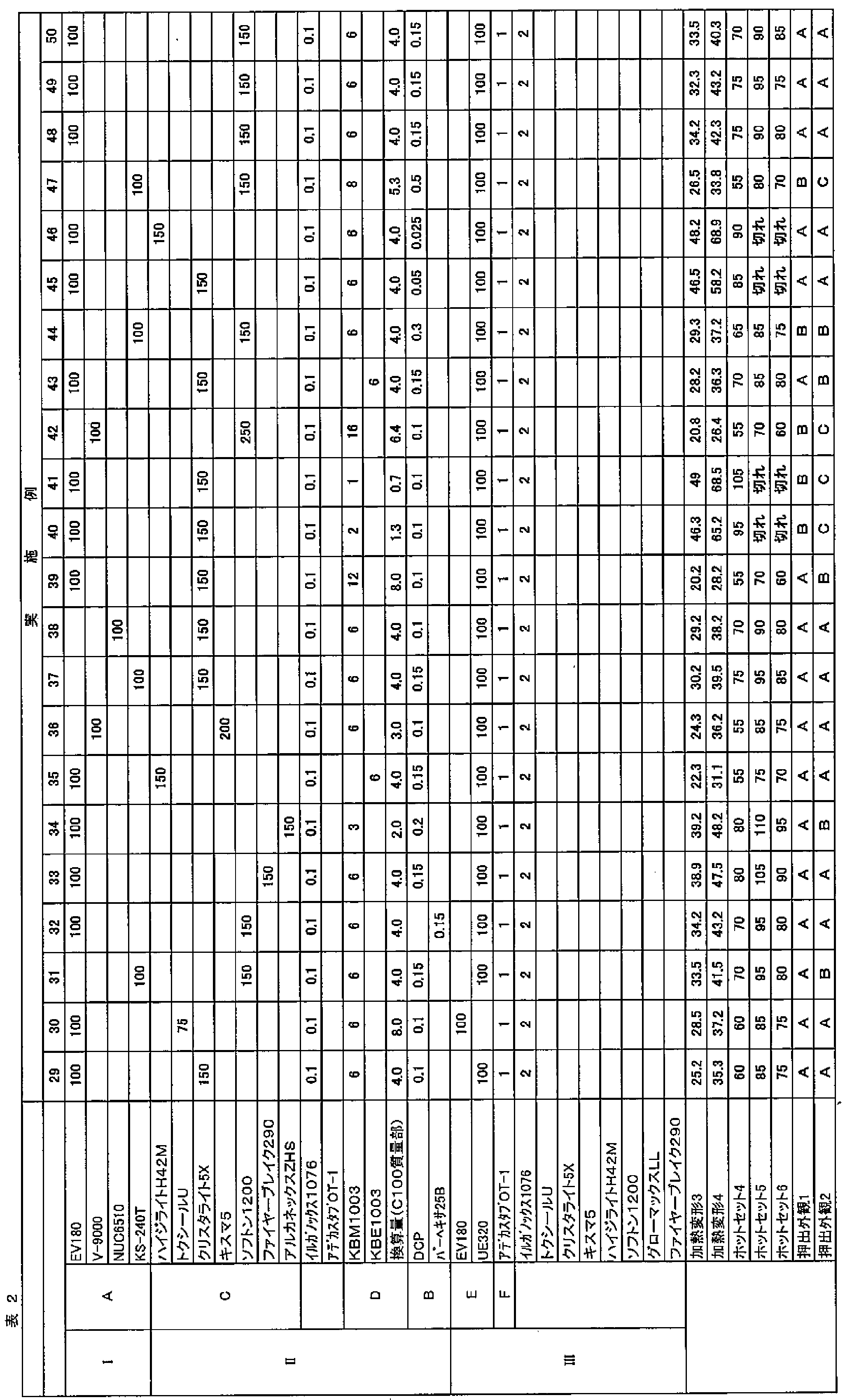
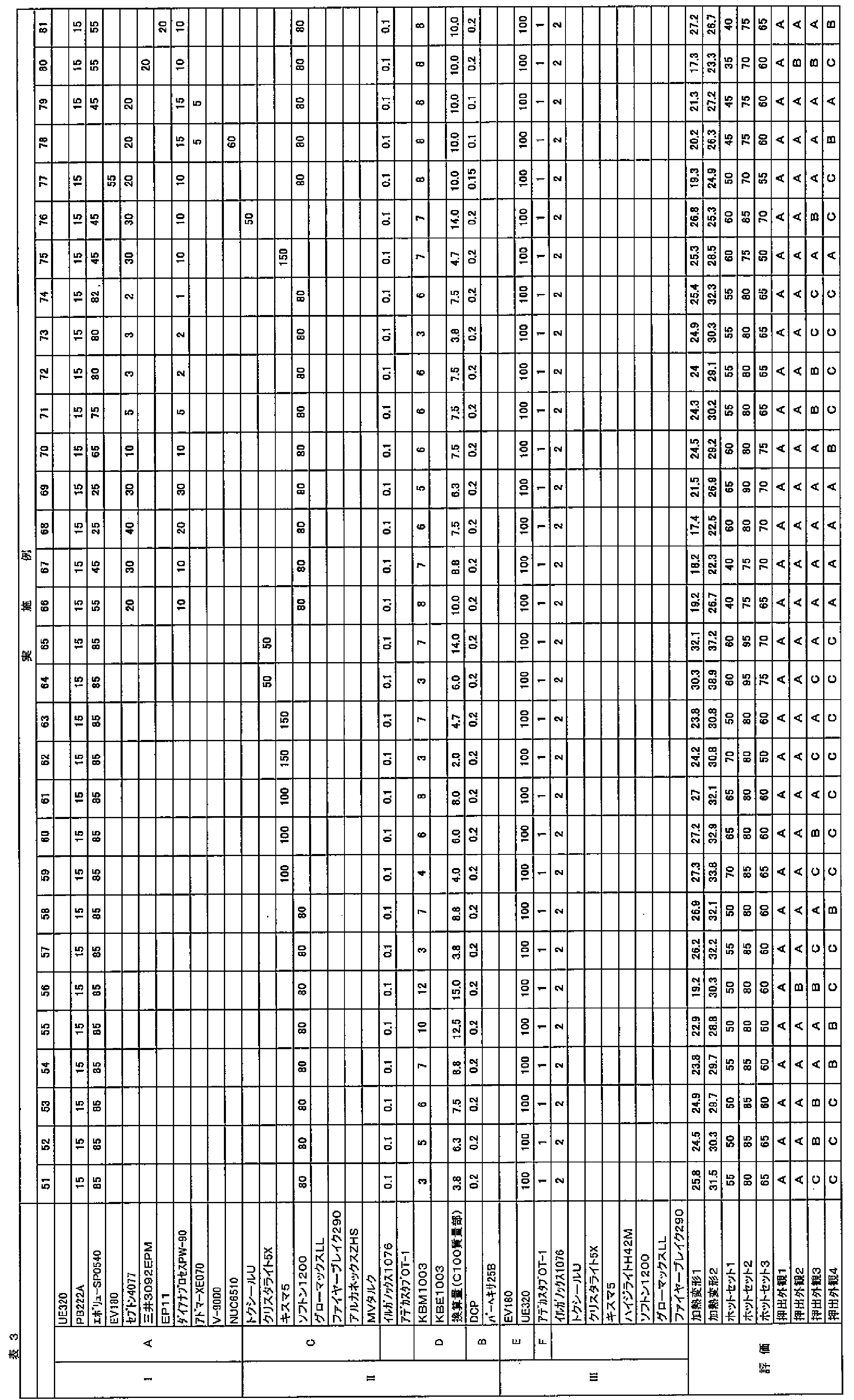
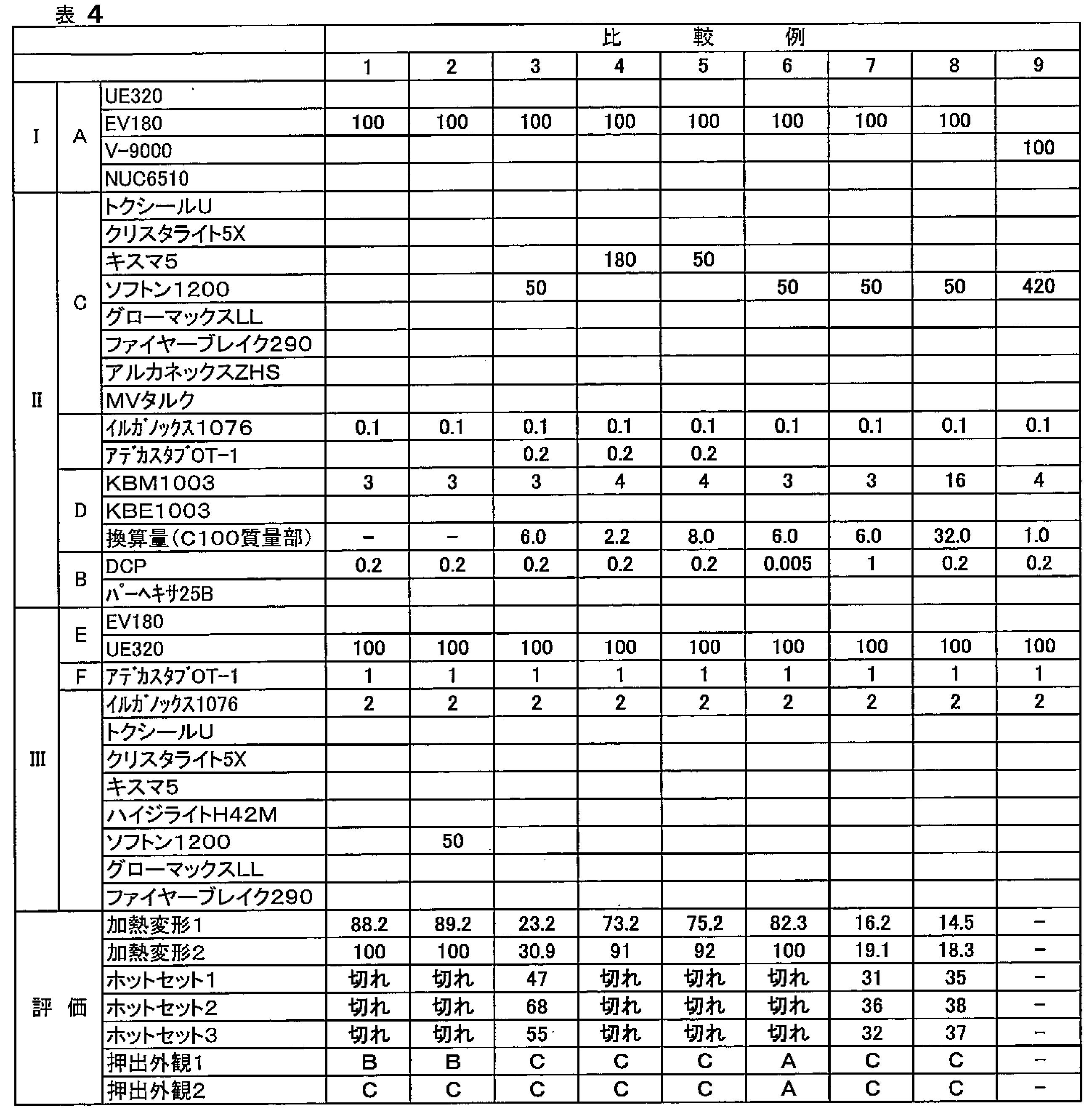
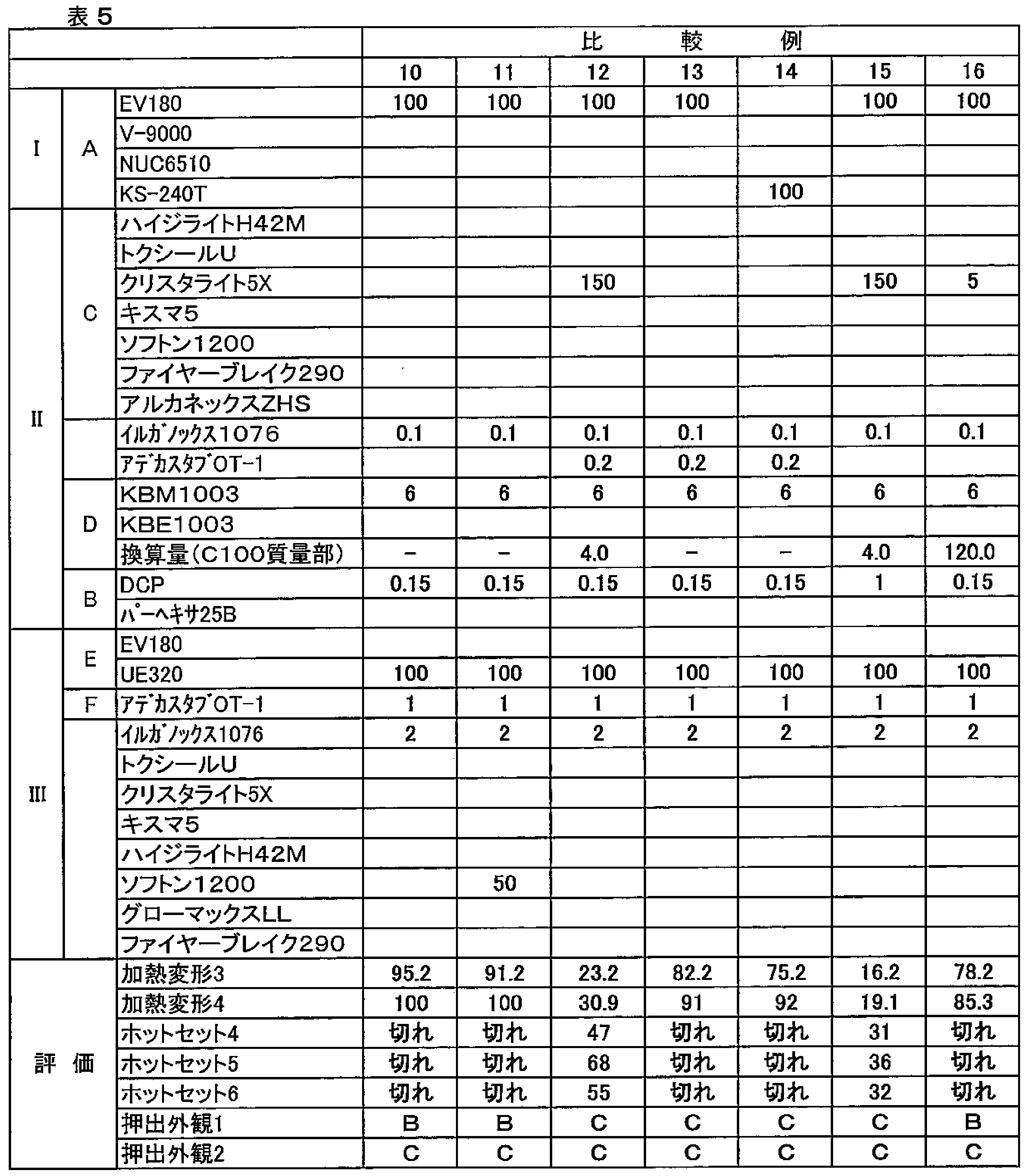
なお、表1~表5中に示す各化合物としては下記のものを使用した。
<樹脂組成物(A)の成分>
EV180(商品名)は、三井・デュポンケミカル社製のエチレン・酢酸ビニル共重合体 VA含有量33質量%
V-9000(商品名)は、三井・デュポンポリケミカル社製のエチレン-酢酸ビニル共重合体 VA含有量41質量%
NUC6510(商品名)は、ダウ社製のエチレンエチルアクリレート樹脂EA含有量22質量%
KS240T(商品名)は、日本ポリエチレン社製のカーネル(登録商標)(低密度ポリエチレン)
UE320(商品名)は、ノバテックPE(直鎖型低密度ポリエチレン(PE))、三菱油化社製
PB222A(商品名)は、サンアロマー(商品名)、ランダムポリプロピレン、サンアロマー株式会社製
エボリューSP0540(商品名)は、メタロセンLLDPE、プライムポリマー株式会社製
セプトン4077(商品名)は、スチレン-エチレン-エチレン-プロピレン-スチレン共重合体(SEEPS、スチレン系エラストマー)、(株)クラレ社製、スチレン成分含有量30%
三井3092EPMは、エチレン-プロピレン-ジエンゴム(エチレン含有量66%)、三井化学株式会社製
EP11は、エチレン-プロピレン-ジエンゴム(EPDM)、JSR製
ダイナプロセスオイルPW90(商品名)は、パラフィン系オイル、出光興産(株)製
アドマーXE070(商品名)は、マレイン酸変性ポリエチレン、三井化学株式会社製
<樹脂組成物(A)の成分>
EV180(商品名)は、三井・デュポンケミカル社製のエチレン・酢酸ビニル共重合体 VA含有量33質量%
V-9000(商品名)は、三井・デュポンポリケミカル社製のエチレン-酢酸ビニル共重合体 VA含有量41質量%
NUC6510(商品名)は、ダウ社製のエチレンエチルアクリレート樹脂EA含有量22質量%
KS240T(商品名)は、日本ポリエチレン社製のカーネル(登録商標)(低密度ポリエチレン)
UE320(商品名)は、ノバテックPE(直鎖型低密度ポリエチレン(PE))、三菱油化社製
PB222A(商品名)は、サンアロマー(商品名)、ランダムポリプロピレン、サンアロマー株式会社製
エボリューSP0540(商品名)は、メタロセンLLDPE、プライムポリマー株式会社製
セプトン4077(商品名)は、スチレン-エチレン-エチレン-プロピレン-スチレン共重合体(SEEPS、スチレン系エラストマー)、(株)クラレ社製、スチレン成分含有量30%
三井3092EPMは、エチレン-プロピレン-ジエンゴム(エチレン含有量66%)、三井化学株式会社製
EP11は、エチレン-プロピレン-ジエンゴム(EPDM)、JSR製
ダイナプロセスオイルPW90(商品名)は、パラフィン系オイル、出光興産(株)製
アドマーXE070(商品名)は、マレイン酸変性ポリエチレン、三井化学株式会社製
<無機フィラー(C)>
トクシールU(商品名)は、トクヤマ社製の湿式シリカ(沈殿シリカ)
クリスタライト5X(商品名)は、龍森社製の結晶性シリカ
キスマ5(商品名)は、協和化学社製の無処理水酸化マグネシウム
ソフトン1200(商品名)は、白石カルシウム社製の炭酸カルシウム
グローマックスLL(商品名)は、竹原化学工業社製の焼成カオリン
ファイヤーブレイク290(商品名)は、ボラックス社製の硼酸亜鉛
アルカネックスZHS(商品名)は、水澤化学社製のヒドロキシスズ酸亜鉛
ハイジライト(登録商標)H42Mは、昭和電工社製の水酸化アルミニウム
MVタルク(商品名)は、日本ミストロン株式会社製タルク
トクシールU(商品名)は、トクヤマ社製の湿式シリカ(沈殿シリカ)
クリスタライト5X(商品名)は、龍森社製の結晶性シリカ
キスマ5(商品名)は、協和化学社製の無処理水酸化マグネシウム
ソフトン1200(商品名)は、白石カルシウム社製の炭酸カルシウム
グローマックスLL(商品名)は、竹原化学工業社製の焼成カオリン
ファイヤーブレイク290(商品名)は、ボラックス社製の硼酸亜鉛
アルカネックスZHS(商品名)は、水澤化学社製のヒドロキシスズ酸亜鉛
ハイジライト(登録商標)H42Mは、昭和電工社製の水酸化アルミニウム
MVタルク(商品名)は、日本ミストロン株式会社製タルク
<シランカップリング剤(D)>
KBM1003(商品名)は、信越化学工業社製のビニルトリメトキシシラン
KBE1003(商品名)は、信越化学工業社製のビニルトリエトキシシラン
<有機過酸化物(B)>
DCPは、日本化薬社製のジクミルパーオキサイド(分解温度151℃)
パーヘキサ25B(商品名)は、日本油脂社製の2,5-ジメチル-2,5-ジ(t-ブチルパーオキシ)ヘキサン(分解温度149℃)
<シラノール縮合触媒(F)>
アデカスタブOT-1(商品名)は、旭電化工業社製のジオクチルスズラウリレート
<キャリア樹脂(E)>
上記UE-320及び上記EV180
KBM1003(商品名)は、信越化学工業社製のビニルトリメトキシシラン
KBE1003(商品名)は、信越化学工業社製のビニルトリエトキシシラン
<有機過酸化物(B)>
DCPは、日本化薬社製のジクミルパーオキサイド(分解温度151℃)
パーヘキサ25B(商品名)は、日本油脂社製の2,5-ジメチル-2,5-ジ(t-ブチルパーオキシ)ヘキサン(分解温度149℃)
<シラノール縮合触媒(F)>
アデカスタブOT-1(商品名)は、旭電化工業社製のジオクチルスズラウリレート
<キャリア樹脂(E)>
上記UE-320及び上記EV180
<酸化防止剤(ヒンダードフェノール系酸化防止剤)>
イルガノックス1076(商品名)は、長瀬産業社製のオクタデシル-3-(3,5-ジ-t-ブチル-4-ヒドロキシフェニル)プロピオネート
イルガノックス1076(商品名)は、長瀬産業社製のオクタデシル-3-(3,5-ジ-t-ブチル-4-ヒドロキシフェニル)プロピオネート
表1~表5の「II」欄に記載の質量部比で、無機フィラー(C)、シランカップリング剤(D)及び有機過酸化物等(B)などを、東洋精機製10Lヘンシェルミキサーに投入して、ミキサーを室温で1時間混合して粉体混合物を得た(工程(a-1))。
次に、表1~表5の「I」欄及び「II」欄に記載の質量部比で、上記粉体混合物と樹脂組成物(A)の各成分を、日本ロール製2Lバンバリーミキサー内に投入し、そのミキサーで、有機過酸化物(B)の分解温度以上の温度、具体的には180~190℃の温度で、約12分混練り後、材料排出温度180℃~190℃で排出し、シランマスターバッチを得た(工程(a-2))。
なお、実施例9については、予めヘンシェルミキサーで混合せずに、バンバリーミキサーで1度に、表1の「I」欄及び「II」欄に記載の各成分を混合した(工程(a))。
なお、実施例9については、予めヘンシェルミキサーで混合せずに、バンバリーミキサーで1度に、表1の「I」欄及び「II」欄に記載の各成分を混合した(工程(a))。
表1~表5の「III」欄に記載の質量部比で、キャリア樹脂(E)及びシラノール縮合触媒(F)などをバンバリーミキサーで、180~190℃の温度下で別途混合し、材料排出温度を180~190℃として溶融混練して触媒マスターバッチを得た(工程(b-1))。
次いで、シランマスターバッチと触媒マスターバッチを100:5の割合(質量比)で、バンバリーミキサーによって180℃で溶融混合を行い、L/D=24の40mm押出機(圧縮部スクリュー温度190℃、ヘッド温度200℃)に導入し、1/0.8mmTA導体の外側に肉厚1mmの未架橋の耐熱性樹脂組成物を被覆し、外径2.8mmの電線を得た(工程(b-2))。その後、この電線を温度80℃湿度95%の雰囲気に24時間放置して水分と接触させて未架橋の耐熱性樹脂組成物を架橋させた耐熱性樹脂組成物の被覆を有する電線を得た(工程(c))。
実施例21と比較例17とについては垂直難燃性試験用としてシランマスターバッチと触媒マスターバッチを100:5の割合(質量比)で、バンバリーミキサーによって180℃で溶融混合を行い、L/D=24の40mm押出機(圧縮部スクリュー温度190℃、ヘッド温度200℃)に導入し、1/1.6mmTA導体の外側に肉厚1.5mmの未架橋の耐熱性樹脂組成物を被覆し、外径4.6mmの電線を得た(工程(b-2))。その後、この電線を温度80℃、湿度95%の雰囲気に24時間放置して水分と接触させて未架橋の耐熱性樹脂組成物を架橋させた耐熱性樹脂組成物の被覆を有する電線を得た(工程(c))。
得られた各電線について、下記の加熱変形、ホットセット及び押出外観を測定し、その結果を表1~表5に示す。
なお、比較例9は、シランマスターバッチと触媒マスターバッチとの混合物がぼそぼそしており、押出成形できなかった。
なお、比較例9は、シランマスターバッチと触媒マスターバッチとの混合物がぼそぼそしており、押出成形できなかった。
加熱変形1は、JIS C 3005の条件に基づいて、測定温度150℃、荷重3Nで行った。なお、50%以下を合格とした。
加熱変形2は、UL1581の条件に基づいて、測定温度180℃、荷重3Nで行った。なお、50%以下が好ましいが、本試験は参考までに示した。
ホットセット1は、電線の管状片を作成し、長さ50mmの評線を付けた後に、170℃の恒温槽の中に117gのおもりを取り付け15分間放置し、放置後の長さを測定し伸び率を求めた。なお伸び率が120%以下を合格とした。
ホットセット2は、電線の管状片を作成し、長さ50mmの評線を付けた後に、180℃の恒温槽の中に180gのおもりを取り付け15分間放置し、放置後の長さを測定し伸び率を求めた。なお、伸び率は120%以下が好ましいが、本試験は参考までに示した。
ホットセット3は、電線の管状片を作成し、長さ50mmの評線を付けた後に、220℃の恒温槽の中に117gのおもりを取り付け15分間放置し、放置後の長さを測定し伸び率を求めた。なお、伸び率は120%以下が好ましいが、本試験は参考までに示した。
押出外観1は、電線を製造する際に押出外観を観察した。なお、25mm押出機にて線速10mで作成した際に外観が良好だったものを「A」、外観がやや悪かったものを「B」、外観が著しく悪かったものを「C」とし、「B」以上を製品レベルであり合格とした。
押出外観2は、電線を製造する際に押出外観を観察した。なお、65mm押出機にて線速80mで作成した際に外観が良好だったものを「A」、外観がやや悪かいものを「B」、外観が許容レベルだが悪いものを「C」とした。本試験は参考までに示した。
押出外観3は、実施例10~14及び51~81において、電線を製造する際に押出外観を観察した。なお、65mm押出機でシランマスターバッチと触媒マスターバッチとの溶融混合物を流した後に押出機を15分間停止し、再度押出機を稼働させて押出機内の、シランマスターバッチと触媒マスターバッチとの溶融混合物を、十分流した後に線速40m/分で電線を試作した。作製した電線を10m観察し、外観にブツが確認されなかったものを「A」、外観ブツが電線1mに1個以上(全体で10個以上)あったものを「C」、1mに1個以下(全体で10個以下)のものを「B」とした。
「B」以上は、製品レベルとして合格としたが、本試験は必ずしも合格する必要はない。
「B」以上は、製品レベルとして合格としたが、本試験は必ずしも合格する必要はない。
押出外観4は、実施例10~14及び51~81において、電線を製造する際に押出外観を観察した。なお、65mm押出機でシランマスターバッチと触媒マスターバッチとの溶融混合物を流した後に押出機を15分間停止し、再度押出機を稼働させてすぐに線速40m/分で電線を試作した。作製した電線を5m観察し、外観にブツが確認されなかったものを「A」、外観ブツが電線50cmに1個以上(全体で10個以上)あったものを「C」、50cmに1個以下(全体で10個以下)のものを「B」とした。
「B」以上は製品レベルとして合格としたが、本試験は必ずしも合格する必要はない。
「B」以上は製品レベルとして合格としたが、本試験は必ずしも合格する必要はない。
垂直難燃性試験は、実施例21及び比較例17で垂直難燃性試験用として作製した、外径4.6mmの電線を用いて、IEC60332-1の試験方法に基づき、試験を行った。試験数はn=3である。垂直難燃性試験は必ずしも合格する必要はない。
絶縁体の伸びと引っ張り強さは、実施例21及び比較例17と同様にして電線の管状片を作製し、JIS C3005に基づき試験を行った。引っ張り強さは10MPa以上、伸びは100%以上が合格であるが、必ずしも合格する必要はない。
表1~表5の結果から明らかなように、比較例1~17は加熱変形、ホットセット及び押出外観を両立することができないのに対し、実施例1~81は加熱変形、ホットセット及び押出外観を両立できた。
本発明をその実施態様とともに説明したが、我々は特に指定しない限り我々の発明を説明のどの細部においても限定しようとするものではなく、添付の請求の範囲に示した発明の精神と範囲に反することなく幅広く解釈されるべきであると考える。
本願は、2012年3月30日に日本国で特許出願された特願2012-081354に基づく優先権を主張するものであり、これは参照してその内容を本明細書の記載の一部として取り込む。
Claims (17)
- (a)ポリオレフィン系樹脂を含有する樹脂組成物と、該樹脂組成物100質量部に対して有機過酸化物0.01~0.6質量部及び無機フィラー10~400質量部と、該無機フィラー100質量部に対してシランカップリング剤0.5~15.0質量部とを前記有機過酸化物の分解温度以上で溶融混練し、シラノール縮合触媒を混合せずにシランマスターバッチを調製する工程と、
(b)前記シランマスターバッチとシラノール縮合触媒とを溶融混練した後に成形する工程と、
(c)前記(b)工程の成形物を水分と接触させて架橋させる工程とを含むことを特徴とする耐熱性樹脂組成物の製造方法。 - (a-1)ポリオレフィン系樹脂を含有する樹脂組成物100質量部に対して、有機過酸化物0.01~0.6質量部及び無機フィラー10~400質量部と、無機フィラー100質量部に対してシランカップリング剤0.5~15.0質量部とを混合して混合物を調製する工程と、
(a-2)前記混合物と樹脂組成物を有機過酸化物の分解温度以上で溶融混練し、シラノール縮合触媒を混合せずにシランマスターバッチを調製する工程と、
(b-1)シラノール縮合触媒とキャリア樹脂を混合して触媒マスターバッチを製造する工程と、
(b-2)前記(a-2)および前記(b-1)工程でそれぞれ調製したシランマスターバッチと触媒マスターバッチとを溶融混練した後に成形する工程と、
(c)前記(b-2)工程の成形物を水分と接触させて架橋させる工程とを含むことを特徴とする請求項1に記載の耐熱性樹脂組成物の製造方法。 - (a)ポリオレフィン系樹脂を含有する樹脂組成物と、該樹脂組成物100質量部に対して有機過酸化物0.01~0.6質量部及び無機フィラー10~400質量部と、無機フィラー100質量部に対してシランカップリング剤0.5~15.0質量部とを有機過酸化物の分解温度以上で溶融混練し、シラノール縮合触媒を混合せずにシランマスターバッチを調製する工程と、
(b-1)シラノール縮合触媒とキャリア樹脂を混合して触媒マスターバッチを製造する工程と、
(b-3)前記(a)および前記(b-1)工程でそれぞれ調製したシランマスターバッチと触媒マスターバッチとを溶融混練した後成形する工程と、
(c)前記(b-3)工程の成形物を水分と接触させて架橋させる工程とを含むことを特徴とする請求項1に記載の耐熱性樹脂組成物の製造方法。 - 前記樹脂組成物100質量部に対して前記シランカップリング剤を0.5~18.0質量部を含有させてなることを特徴とする請求項1~3のいずれか1項に記載の耐熱性樹脂組成物の製造方法。
- 前記シランカップリング剤を、4質量部を超えて15質量部以下で含有させてなることを特徴とする請求項4に記載の難燃性架橋組成物の製造方法。
- 前記シランカップリング剤を、5~12質量部で含有させてなることを特徴とする請求項4に記載の難燃性架橋組成物の製造方法。
- 前記シランカップリング剤を、6~10質量部で含有させてなることを特徴とする請求項4に記載の難燃性架橋組成物の製造方法。
- 前記樹脂組成物が、エチレン-α-オレフィン共重合体及びスチレン系エラストマーの少なくとも一方とパラフィン系オイルとを、4~70質量%の質量割合で、含有していることを特徴とする請求項1~7のいずれか1項に記載の難燃性架橋組成物の製造方法。
- 前記質量割合が、8~70質量%であることを特徴とする請求項8に記載の難燃性架橋組成物の製造方法。
- 前記エチレン-α-オレフィン共重合体及びスチレン系エラストマーの少なくとも一方が、前記スチレン系エラストマーであることを特徴とする請求項8または9に記載の難燃性架橋組成物の製造方法。
- 前記エチレン-α-オレフィン共重合体が、エチレン-プロピレン-ジエンゴムであることを特徴とする請求項8~10のいずれか1項に記載の難燃性架橋組成物の製造方法。
- 前記シランカップリング剤が、ビニルトリメトキシシラン又はビニルトリエトキシシランであることを特徴とする請求項1~11のいずれか1項に記載の耐熱性樹脂組成物の製造方法。
- 前記無機フィラーが、シリカ、水酸化アルミニウム、水酸化マグネシウム、炭酸カルシウム、炭酸マグネシウム、硼酸亜鉛、ヒドロキシスズ酸亜鉛及びタルクからなる群から選ばれる少なくとも1種であることを特徴とする請求項1~12のいずれか1項に記載の耐熱性樹脂組成物の製造方法。
- 前記シランマスターバッチの製造の際の溶融混練を密閉型のミキサーで行うことを特徴とする請求項1~13のいずれか1項に記載の耐熱性樹脂組成物の製造方法。
- 請求項1~14のいずれか1項に記載の耐熱性樹脂組成物の製造方法により製造された耐熱性樹脂組成物の成形物を含むことを特徴とする成形品。
- 前記成形品が、電線あるいは光ファイバケーブル被覆であることを特徴とする請求項15に記載の成形品。
- 請求項1~14のいずれか1項に記載の耐熱性樹脂組成物の製造方法により製造された耐熱性樹脂組成物であって、前記ポリオレフィン樹脂がシラノール結合を介して無機フィラーと架橋してなることを特徴とする耐熱性樹脂組成物。
Priority Applications (2)
| Application Number | Priority Date | Filing Date | Title |
|---|---|---|---|
| JP2014508089A JP6219268B2 (ja) | 2012-03-30 | 2013-03-29 | 耐熱性樹脂組成物の製造方法、並びに、その製造方法で製造された耐熱性樹脂組成物及び該耐熱性樹脂組成物を用いた成形品 |
| CN201380018536.XA CN104204048B (zh) | 2012-03-30 | 2013-03-29 | 耐热性树脂组合物的制造方法、以及通过该制造方法所制造的耐热性树脂组合物和使用了该耐热性树脂组合物的成型品 |
Applications Claiming Priority (2)
| Application Number | Priority Date | Filing Date | Title |
|---|---|---|---|
| JP2012-081354 | 2012-03-30 | ||
| JP2012081354 | 2012-03-30 |
Publications (1)
| Publication Number | Publication Date |
|---|---|
| WO2013147148A1 true WO2013147148A1 (ja) | 2013-10-03 |
Family
ID=49260390
Family Applications (1)
| Application Number | Title | Priority Date | Filing Date |
|---|---|---|---|
| PCT/JP2013/059504 Ceased WO2013147148A1 (ja) | 2012-03-30 | 2013-03-29 | 耐熱性樹脂組成物の製造方法、並びに、その製造方法で製造された耐熱性樹脂組成物及び該耐熱性樹脂組成物を用いた成形品 |
Country Status (3)
| Country | Link |
|---|---|
| JP (1) | JP6219268B2 (ja) |
| CN (1) | CN104204048B (ja) |
| WO (1) | WO2013147148A1 (ja) |
Cited By (29)
| Publication number | Priority date | Publication date | Assignee | Title |
|---|---|---|---|---|
| WO2014084048A1 (ja) * | 2012-11-30 | 2014-06-05 | 古河電気工業株式会社 | 耐熱性シラン架橋性樹脂組成物を用いた成形体の製造方法 |
| WO2014084047A1 (ja) * | 2012-11-30 | 2014-06-05 | 古河電気工業株式会社 | 耐熱性シラン架橋性樹脂組成物を用いた成形体の製造方法 |
| WO2014188925A1 (ja) * | 2013-05-20 | 2014-11-27 | 古河電気工業株式会社 | 耐熱性シラン架橋樹脂成形体、耐熱性シラン架橋性樹脂組成物及びそれらの製造方法、耐熱性シラン架橋樹脂成形体を用いた耐熱性製品、並びにシランカップリング剤予備混合フィラー及びそれを含むフィラー |
| WO2015002263A1 (ja) * | 2013-07-03 | 2015-01-08 | 古河電気工業株式会社 | 耐熱性シラン架橋樹脂成形体及びその製造方法、並びに、耐熱性シラン架橋樹脂成形体を用いた耐熱性製品 |
| WO2015046477A1 (ja) * | 2013-09-27 | 2015-04-02 | 古河電気工業株式会社 | 耐熱性シラン架橋樹脂成形体及びその製造方法、耐熱性シラン架橋性樹脂組成物及びその製造方法、シランマスターバッチ、並びに耐熱性シラン架橋樹脂成形体を用いた耐熱性製品 |
| WO2015046476A1 (ja) * | 2013-09-27 | 2015-04-02 | 古河電気工業株式会社 | 耐熱性シラン架橋樹脂成形体及びその製造方法、耐熱性シラン架橋性樹脂組成物及びその製造方法、シランマスターバッチ、並びに耐熱性シラン架橋樹脂成形体を用いた耐熱性製品 |
| WO2015046478A1 (ja) * | 2013-09-27 | 2015-04-02 | 古河電気工業株式会社 | 耐熱性シラン架橋樹脂成形体及びその製造方法、耐熱性シラン架橋性樹脂組成物及びその製造方法、シランマスターバッチ、並びに耐熱性シラン架橋樹脂成形体を用いた耐熱性製品 |
| CN105006286A (zh) * | 2015-07-15 | 2015-10-28 | 安徽鸿海电缆有限公司 | 一种高阻燃耐电耐老化电缆 |
| CN105175934A (zh) * | 2015-07-15 | 2015-12-23 | 安徽鸿海电缆有限公司 | 一种高强度耐磨防水电缆 |
| WO2016056634A1 (ja) * | 2014-10-08 | 2016-04-14 | 古河電気工業株式会社 | 難燃性架橋樹脂成形体及び難燃性架橋性樹脂組成物とそれらの製造方法、難燃性シランマスターバッチ、並びに、成形品 |
| WO2016056635A1 (ja) * | 2014-10-08 | 2016-04-14 | 古河電気工業株式会社 | 架橋樹脂成形体及び架橋性樹脂組成物とそれらの製造方法、シランマスターバッチ、並びに、成形品 |
| JP2016074853A (ja) * | 2014-10-08 | 2016-05-12 | 古河電気工業株式会社 | 架橋樹脂成形体及び架橋性樹脂組成物とそれらの製造方法、シランマスターバッチ、並びに、成形品 |
| JP2016121203A (ja) * | 2014-12-24 | 2016-07-07 | 古河電気工業株式会社 | 耐熱性シラン架橋樹脂成形体、架橋性樹脂成形体、耐熱性シラン架橋性樹脂組成物及びそれらの製造方法、シランマスターバッチ、並びに耐熱性製品 |
| JP2016148002A (ja) * | 2015-02-13 | 2016-08-18 | 古河電気工業株式会社 | ポリオレフィン架橋発泡成形体及びポリオレフィン架橋性発泡成形体とそれらの製造方法、並びに、ポリオレフィン架橋発泡製品 |
| JP2016160380A (ja) * | 2015-03-03 | 2016-09-05 | 古河電気工業株式会社 | シラン架橋性ゴム組成物及びシラン架橋ゴム成形体とそれらの製造方法、並びに、シラン架橋ゴム成形品 |
| JP2016166349A (ja) * | 2015-03-03 | 2016-09-15 | 古河電気工業株式会社 | シラン架橋性ゴム組成物及びシラン架橋ゴム成形体とそれらの製造方法、並びに、シラン架橋ゴム成形品 |
| JP2016188307A (ja) * | 2015-03-30 | 2016-11-04 | 古河電気工業株式会社 | 耐熱性シラン架橋樹脂成形体及び耐熱性シラン架橋性樹脂組成物とそれらの製造方法、シランマスターバッチ、並びに、耐熱性製品 |
| JPWO2015030055A1 (ja) * | 2013-08-27 | 2017-03-02 | 古河電気工業株式会社 | 耐熱性シラン架橋樹脂成形体及びその製造方法、耐熱性シラン架橋性樹脂組成物及びその製造方法、シランマスターバッチ、並びに耐熱性シラン架橋樹脂成形体を用いた耐熱性製品 |
| JP2017141384A (ja) * | 2016-02-12 | 2017-08-17 | 古河電気工業株式会社 | 耐熱性塩素含有架橋樹脂成形体及びその製造方法、シランマスターバッチ、マスターバッチ混合物及びその成形体、並びに、耐熱性製品 |
| WO2017138641A1 (ja) * | 2016-02-12 | 2017-08-17 | 古河電気工業株式会社 | 耐熱性塩素含有架橋樹脂成形体及びその製造方法、シランマスターバッチ、マスターバッチ混合物及びその成形体、並びに、耐熱性製品 |
| JP2017141383A (ja) * | 2016-02-12 | 2017-08-17 | 古河電気工業株式会社 | 耐熱性架橋樹脂成形体及びその製造方法、シランマスターバッチ、マスターバッチ混合物及びその成形体、並びに、耐熱性製品 |
| WO2017154585A1 (ja) * | 2016-03-07 | 2017-09-14 | 株式会社フジクラ | シラン架橋性樹脂組成物、及び、これを用いたケーブルの製造方法 |
| JP2017179235A (ja) * | 2016-03-31 | 2017-10-05 | 古河電気工業株式会社 | 難燃性架橋樹脂成形体及び難燃性架橋性樹脂組成物とそれらの製造方法、難燃性シランマスターバッチ、並びに、難燃性成形品 |
| JP2017179236A (ja) * | 2016-03-31 | 2017-10-05 | 古河電気工業株式会社 | 耐熱性塩素含有架橋樹脂成形体及びその製造方法、シランマスターバッチ、マスターバッチ混合物及びその成形体、並びに、耐熱性製品 |
| WO2018070491A1 (ja) * | 2016-10-12 | 2018-04-19 | リケンテクノス株式会社 | エラストマー組成物、水架橋性エラストマー組成物、及びその製造方法 |
| JP2018083937A (ja) * | 2016-11-14 | 2018-05-31 | Mcppイノベーション合同会社 | シラン架橋ポリ塩化ビニル樹脂及びその成形品の製造方法 |
| JP2018111834A (ja) * | 2018-04-10 | 2018-07-19 | 古河電気工業株式会社 | 架橋樹脂成形体及び架橋性樹脂組成物とそれらの製造方法、シランマスターバッチ、並びに、成形品 |
| JP2020143184A (ja) * | 2019-03-04 | 2020-09-10 | 古河電気工業株式会社 | シラン架橋樹脂成形体の製造方法及びシラン架橋樹脂成形体 |
| JP2022156654A (ja) * | 2021-03-31 | 2022-10-14 | 株式会社イノアックコーポレーション | ゴム発泡体、及びゴム発泡体の製造方法 |
Families Citing this family (4)
| Publication number | Priority date | Publication date | Assignee | Title |
|---|---|---|---|---|
| EP3269763B1 (en) * | 2016-07-12 | 2020-09-09 | Hitachi-GE Nuclear Energy, Ltd. | Polyethylene resin composition, and pipe material, pipe, and joint including the composition |
| JP7128886B2 (ja) | 2018-06-12 | 2022-08-31 | エルジー・ケム・リミテッド | 架橋ポリオレフィン分離膜及びその製造方法 |
| WO2021090579A1 (ja) * | 2019-11-08 | 2021-05-14 | 住友電気工業株式会社 | 樹脂組成物、樹脂組成物成形体および電力ケーブル |
| US12365788B2 (en) | 2019-11-08 | 2025-07-22 | Sumitomo Electric Industries, Ltd. | Resin composition, resin composition molded body, and power cable |
Citations (8)
| Publication number | Priority date | Publication date | Assignee | Title |
|---|---|---|---|---|
| JPS52108462A (en) * | 1976-03-09 | 1977-09-10 | Showa Electric Wire & Cable Co | Method of producing bridged polyolefin formed article |
| JPS55129441A (en) * | 1979-03-28 | 1980-10-07 | Furukawa Electric Co Ltd:The | Method of crosslinking poly-alpha-olefin resin |
| JPS57172925A (en) * | 1981-04-16 | 1982-10-25 | Shin Etsu Chem Co Ltd | High-filling of organic polymer with inorganic filler |
| JPS61204245A (ja) * | 1985-03-07 | 1986-09-10 | Toa Nenryo Kogyo Kk | ポリオレフイン組成物 |
| US5589526A (en) * | 1994-10-19 | 1996-12-31 | Peroxid-Chemie Gmbh | Master batch compositions containing organic peroxides |
| JP2000133048A (ja) * | 1998-10-30 | 2000-05-12 | Yazaki Corp | 耐トラッキング性絶縁電線、及び耐トラッキング性絶縁ケーブル |
| JP2010180260A (ja) * | 2009-02-03 | 2010-08-19 | Nok Corp | Epdm組成物 |
| JP2012177028A (ja) * | 2011-02-25 | 2012-09-13 | Mitsubishi Chemicals Corp | 難燃性ポリオレフィン樹脂組成物およびその製造方法 |
Family Cites Families (14)
| Publication number | Priority date | Publication date | Assignee | Title |
|---|---|---|---|---|
| JPS55129551A (en) * | 1979-03-28 | 1980-10-07 | Taku Yamada | Bed for wall |
| JPS5749109A (en) * | 1980-09-09 | 1982-03-20 | Fujikura Ltd | Method of producing crosslinked polyolefin rubber insulated wire |
| JPS58129044A (ja) * | 1982-01-28 | 1983-08-01 | Showa Electric Wire & Cable Co Ltd | 難燃架橋ポリオレフイン組成物の製造方法 |
| JPH02185549A (ja) * | 1989-01-12 | 1990-07-19 | Showa Electric Wire & Cable Co Ltd | シラン架橋ポリオレフィンの製造方法 |
| JP3486105B2 (ja) * | 1998-06-17 | 2004-01-13 | 矢崎総業株式会社 | 難燃架橋オレフィン系樹脂組成物、及び難燃架橋オレフィン系樹脂の製造方法 |
| JP2001101928A (ja) * | 1999-09-29 | 2001-04-13 | Yazaki Corp | 難燃性樹脂組成物 |
| JP4050570B2 (ja) * | 2001-08-13 | 2008-02-20 | リケンテクノス株式会社 | 難燃性熱可塑性エラストマー組成物 |
| JP3989306B2 (ja) * | 2002-06-11 | 2007-10-10 | 日本ユニカー株式会社 | 耐トラッキング性と耐候性に優れた水架橋性樹脂組成物、及びそれからなる絶縁被覆層を持つ電力ケーブル |
| CN100513466C (zh) * | 2006-09-19 | 2009-07-15 | 上海电缆研究所 | 硅烷交联低烟无卤阻燃聚烯烃电缆料及其生产工艺 |
| JP5343327B2 (ja) * | 2007-05-31 | 2013-11-13 | 株式会社オートネットワーク技術研究所 | 難燃性シラン架橋オレフィン系樹脂の製造方法および絶縁電線ならびに絶縁電線の製造方法 |
| WO2009008537A1 (ja) * | 2007-07-12 | 2009-01-15 | Autonetworks Technologies, Ltd. | 難燃性シラン架橋オレフィン系樹脂組成物および絶縁電線ならびに難燃性シラン架橋オレフィン系樹脂の製造方法 |
| CN101633754B (zh) * | 2009-05-22 | 2013-03-20 | 上海凯波特种电缆料厂有限公司 | 耐油型硅烷自然交联低烟无卤阻燃聚烯烃电缆料及其制备方法 |
| JP5598843B2 (ja) * | 2010-03-17 | 2014-10-01 | 古河電気工業株式会社 | 多層電線およびその製造方法 |
| JP5896626B2 (ja) * | 2011-06-08 | 2016-03-30 | リケンテクノス株式会社 | シラン架橋性難燃ポリオレフィンとシラノール触媒樹脂組成物からなる電線成形体の製造方法 |
-
2013
- 2013-03-29 WO PCT/JP2013/059504 patent/WO2013147148A1/ja not_active Ceased
- 2013-03-29 CN CN201380018536.XA patent/CN104204048B/zh active Active
- 2013-03-29 JP JP2014508089A patent/JP6219268B2/ja active Active
Patent Citations (8)
| Publication number | Priority date | Publication date | Assignee | Title |
|---|---|---|---|---|
| JPS52108462A (en) * | 1976-03-09 | 1977-09-10 | Showa Electric Wire & Cable Co | Method of producing bridged polyolefin formed article |
| JPS55129441A (en) * | 1979-03-28 | 1980-10-07 | Furukawa Electric Co Ltd:The | Method of crosslinking poly-alpha-olefin resin |
| JPS57172925A (en) * | 1981-04-16 | 1982-10-25 | Shin Etsu Chem Co Ltd | High-filling of organic polymer with inorganic filler |
| JPS61204245A (ja) * | 1985-03-07 | 1986-09-10 | Toa Nenryo Kogyo Kk | ポリオレフイン組成物 |
| US5589526A (en) * | 1994-10-19 | 1996-12-31 | Peroxid-Chemie Gmbh | Master batch compositions containing organic peroxides |
| JP2000133048A (ja) * | 1998-10-30 | 2000-05-12 | Yazaki Corp | 耐トラッキング性絶縁電線、及び耐トラッキング性絶縁ケーブル |
| JP2010180260A (ja) * | 2009-02-03 | 2010-08-19 | Nok Corp | Epdm組成物 |
| JP2012177028A (ja) * | 2011-02-25 | 2012-09-13 | Mitsubishi Chemicals Corp | 難燃性ポリオレフィン樹脂組成物およびその製造方法 |
Cited By (49)
| Publication number | Priority date | Publication date | Assignee | Title |
|---|---|---|---|---|
| WO2014084048A1 (ja) * | 2012-11-30 | 2014-06-05 | 古河電気工業株式会社 | 耐熱性シラン架橋性樹脂組成物を用いた成形体の製造方法 |
| WO2014084047A1 (ja) * | 2012-11-30 | 2014-06-05 | 古河電気工業株式会社 | 耐熱性シラン架橋性樹脂組成物を用いた成形体の製造方法 |
| WO2014188925A1 (ja) * | 2013-05-20 | 2014-11-27 | 古河電気工業株式会社 | 耐熱性シラン架橋樹脂成形体、耐熱性シラン架橋性樹脂組成物及びそれらの製造方法、耐熱性シラン架橋樹脂成形体を用いた耐熱性製品、並びにシランカップリング剤予備混合フィラー及びそれを含むフィラー |
| WO2015002263A1 (ja) * | 2013-07-03 | 2015-01-08 | 古河電気工業株式会社 | 耐熱性シラン架橋樹脂成形体及びその製造方法、並びに、耐熱性シラン架橋樹脂成形体を用いた耐熱性製品 |
| JPWO2015030055A1 (ja) * | 2013-08-27 | 2017-03-02 | 古河電気工業株式会社 | 耐熱性シラン架橋樹脂成形体及びその製造方法、耐熱性シラン架橋性樹脂組成物及びその製造方法、シランマスターバッチ、並びに耐熱性シラン架橋樹脂成形体を用いた耐熱性製品 |
| US10083776B2 (en) | 2013-09-27 | 2018-09-25 | Furukawa Electric Co., Ltd. | Heat-resistant silane crosslinked resin molded body and method of producing the same, heat-resistant silane crosslinkable resin composition and method of producing the same, silane master batch, and heat-resistant product using heat-resistant silane crosslinked resin molded body |
| JPWO2015046476A1 (ja) * | 2013-09-27 | 2017-03-09 | 古河電気工業株式会社 | 耐熱性シラン架橋樹脂成形体及びその製造方法、耐熱性シラン架橋性樹脂組成物及びその製造方法、シランマスターバッチ、並びに耐熱性シラン架橋樹脂成形体を用いた耐熱性製品 |
| US10438718B2 (en) | 2013-09-27 | 2019-10-08 | Furukawa Electric Co., Ltd. | Heat-resistant silane crosslinked resin molded body and method of producing the same, heat-resistant silane crosslinkable resin composition and method of producing the same, silane master batch, and heat-resistant product using heat-resistant silane crosslinked resin molded body |
| US10304584B2 (en) | 2013-09-27 | 2019-05-28 | Furukawa Electric Co., Ltd. | Heat-resistant silane crosslinked resin molded body and method of producing the same, heat-resistant silane crosslinkable resin composition and method of producing the same, silane master batch, and heat-resistant product using heat-resistant silane crosslinked resin molded body |
| JPWO2015046477A1 (ja) * | 2013-09-27 | 2017-03-09 | 古河電気工業株式会社 | 耐熱性シラン架橋樹脂成形体及びその製造方法、耐熱性シラン架橋性樹脂組成物及びその製造方法、シランマスターバッチ、並びに耐熱性シラン架橋樹脂成形体を用いた耐熱性製品 |
| WO2015046478A1 (ja) * | 2013-09-27 | 2015-04-02 | 古河電気工業株式会社 | 耐熱性シラン架橋樹脂成形体及びその製造方法、耐熱性シラン架橋性樹脂組成物及びその製造方法、シランマスターバッチ、並びに耐熱性シラン架橋樹脂成形体を用いた耐熱性製品 |
| WO2015046477A1 (ja) * | 2013-09-27 | 2015-04-02 | 古河電気工業株式会社 | 耐熱性シラン架橋樹脂成形体及びその製造方法、耐熱性シラン架橋性樹脂組成物及びその製造方法、シランマスターバッチ、並びに耐熱性シラン架橋樹脂成形体を用いた耐熱性製品 |
| WO2015046476A1 (ja) * | 2013-09-27 | 2015-04-02 | 古河電気工業株式会社 | 耐熱性シラン架橋樹脂成形体及びその製造方法、耐熱性シラン架橋性樹脂組成物及びその製造方法、シランマスターバッチ、並びに耐熱性シラン架橋樹脂成形体を用いた耐熱性製品 |
| US10155854B2 (en) | 2013-09-27 | 2018-12-18 | Furukawa Electric Co., Ltd. | Heat-resistant silane crosslinked resin molded body and method of producing the same, heat-resistant silane crosslinkable resin composition and method of producing the same, silane master batch, and heat-resistant product using heat-resistant silane crosslinked resin molded body |
| US10287405B2 (en) | 2014-10-08 | 2019-05-14 | Furukawa Electric Co., Ltd. | Crosslinked resin molded body, crosslinkable resin composition, method of producing these, silane master batch, and molded article |
| JPWO2016056635A1 (ja) * | 2014-10-08 | 2017-09-07 | 古河電気工業株式会社 | 架橋樹脂成形体及び架橋性樹脂組成物とそれらの製造方法、シランマスターバッチ、並びに、成形品 |
| US10040913B2 (en) | 2014-10-08 | 2018-08-07 | Furukawa Electric Co., Ltd. | Crosslinked resin molded body, crosslinkable resin composition, method of producing these, silane master batch, and molded article |
| JP2016074853A (ja) * | 2014-10-08 | 2016-05-12 | 古河電気工業株式会社 | 架橋樹脂成形体及び架橋性樹脂組成物とそれらの製造方法、シランマスターバッチ、並びに、成形品 |
| WO2016056635A1 (ja) * | 2014-10-08 | 2016-04-14 | 古河電気工業株式会社 | 架橋樹脂成形体及び架橋性樹脂組成物とそれらの製造方法、シランマスターバッチ、並びに、成形品 |
| WO2016056634A1 (ja) * | 2014-10-08 | 2016-04-14 | 古河電気工業株式会社 | 難燃性架橋樹脂成形体及び難燃性架橋性樹脂組成物とそれらの製造方法、難燃性シランマスターバッチ、並びに、成形品 |
| US20170210862A1 (en) * | 2014-10-08 | 2017-07-27 | Furukawa Electric Co., Ltd. | Crosslinked resin molded body, crosslinkable resin composition, method of producing these, silane master batch, and molded article |
| JPWO2016056634A1 (ja) * | 2014-10-08 | 2017-07-27 | 古河電気工業株式会社 | 難燃性架橋樹脂成形体及び難燃性架橋性樹脂組成物とそれらの製造方法、難燃性シランマスターバッチ、並びに、成形品 |
| US20170210863A1 (en) * | 2014-10-08 | 2017-07-27 | Furukawa Electric Co., Ltd. | Flame-retardant crosslinked resin molded body, flame-retardant crosslinkable resin composition, method of producing these, flame-retardant silane master batch, and molded article |
| JP2016121203A (ja) * | 2014-12-24 | 2016-07-07 | 古河電気工業株式会社 | 耐熱性シラン架橋樹脂成形体、架橋性樹脂成形体、耐熱性シラン架橋性樹脂組成物及びそれらの製造方法、シランマスターバッチ、並びに耐熱性製品 |
| JP2016148002A (ja) * | 2015-02-13 | 2016-08-18 | 古河電気工業株式会社 | ポリオレフィン架橋発泡成形体及びポリオレフィン架橋性発泡成形体とそれらの製造方法、並びに、ポリオレフィン架橋発泡製品 |
| JP2016160380A (ja) * | 2015-03-03 | 2016-09-05 | 古河電気工業株式会社 | シラン架橋性ゴム組成物及びシラン架橋ゴム成形体とそれらの製造方法、並びに、シラン架橋ゴム成形品 |
| JP2016166349A (ja) * | 2015-03-03 | 2016-09-15 | 古河電気工業株式会社 | シラン架橋性ゴム組成物及びシラン架橋ゴム成形体とそれらの製造方法、並びに、シラン架橋ゴム成形品 |
| JP2016188307A (ja) * | 2015-03-30 | 2016-11-04 | 古河電気工業株式会社 | 耐熱性シラン架橋樹脂成形体及び耐熱性シラン架橋性樹脂組成物とそれらの製造方法、シランマスターバッチ、並びに、耐熱性製品 |
| CN105006286A (zh) * | 2015-07-15 | 2015-10-28 | 安徽鸿海电缆有限公司 | 一种高阻燃耐电耐老化电缆 |
| CN105175934A (zh) * | 2015-07-15 | 2015-12-23 | 安徽鸿海电缆有限公司 | 一种高强度耐磨防水电缆 |
| US10703894B2 (en) | 2016-02-12 | 2020-07-07 | Furukawa Electric Co., Ltd. | Heat-resistant crosslinked resin formed body and method for producing the same, silane master batch, master batch mixture and formed body thereof, and heat-resistant product |
| JP2017141384A (ja) * | 2016-02-12 | 2017-08-17 | 古河電気工業株式会社 | 耐熱性塩素含有架橋樹脂成形体及びその製造方法、シランマスターバッチ、マスターバッチ混合物及びその成形体、並びに、耐熱性製品 |
| US11242453B2 (en) | 2016-02-12 | 2022-02-08 | Furukawa Electric Co., Ltd. | Heat-resistant chlorine-containing crosslinked resin formed body and method for producing the same, silane master batch, master batch mixture and formed body thereof, and heat-resistant product |
| WO2017138641A1 (ja) * | 2016-02-12 | 2017-08-17 | 古河電気工業株式会社 | 耐熱性塩素含有架橋樹脂成形体及びその製造方法、シランマスターバッチ、マスターバッチ混合物及びその成形体、並びに、耐熱性製品 |
| JP2017141383A (ja) * | 2016-02-12 | 2017-08-17 | 古河電気工業株式会社 | 耐熱性架橋樹脂成形体及びその製造方法、シランマスターバッチ、マスターバッチ混合物及びその成形体、並びに、耐熱性製品 |
| WO2017138640A1 (ja) * | 2016-02-12 | 2017-08-17 | 古河電気工業株式会社 | 耐熱性架橋樹脂成形体及びその製造方法、シランマスターバッチ、マスターバッチ混合物及びその成形体、並びに、耐熱性製品 |
| JP6204632B1 (ja) * | 2016-03-07 | 2017-09-27 | 株式会社フジクラ | シラン架橋性樹脂組成物、及び、これを用いたケーブルの製造方法 |
| WO2017154585A1 (ja) * | 2016-03-07 | 2017-09-14 | 株式会社フジクラ | シラン架橋性樹脂組成物、及び、これを用いたケーブルの製造方法 |
| JP2017179235A (ja) * | 2016-03-31 | 2017-10-05 | 古河電気工業株式会社 | 難燃性架橋樹脂成形体及び難燃性架橋性樹脂組成物とそれらの製造方法、難燃性シランマスターバッチ、並びに、難燃性成形品 |
| JP2017179236A (ja) * | 2016-03-31 | 2017-10-05 | 古河電気工業株式会社 | 耐熱性塩素含有架橋樹脂成形体及びその製造方法、シランマスターバッチ、マスターバッチ混合物及びその成形体、並びに、耐熱性製品 |
| JPWO2018070491A1 (ja) * | 2016-10-12 | 2019-07-25 | リケンテクノス株式会社 | エラストマー組成物、水架橋性エラストマー組成物、及びその製造方法 |
| WO2018070491A1 (ja) * | 2016-10-12 | 2018-04-19 | リケンテクノス株式会社 | エラストマー組成物、水架橋性エラストマー組成物、及びその製造方法 |
| JP7499006B2 (ja) | 2016-10-12 | 2024-06-13 | リケンテクノス株式会社 | エラストマー組成物、水架橋性エラストマー組成物、及びその製造方法 |
| JP2018083937A (ja) * | 2016-11-14 | 2018-05-31 | Mcppイノベーション合同会社 | シラン架橋ポリ塩化ビニル樹脂及びその成形品の製造方法 |
| JP2018111834A (ja) * | 2018-04-10 | 2018-07-19 | 古河電気工業株式会社 | 架橋樹脂成形体及び架橋性樹脂組成物とそれらの製造方法、シランマスターバッチ、並びに、成形品 |
| JP2020143184A (ja) * | 2019-03-04 | 2020-09-10 | 古河電気工業株式会社 | シラン架橋樹脂成形体の製造方法及びシラン架橋樹脂成形体 |
| JP7097318B2 (ja) | 2019-03-04 | 2022-07-07 | 古河電気工業株式会社 | シラン架橋樹脂成形体の製造方法 |
| JP2022156654A (ja) * | 2021-03-31 | 2022-10-14 | 株式会社イノアックコーポレーション | ゴム発泡体、及びゴム発泡体の製造方法 |
| JP7737806B2 (ja) | 2021-03-31 | 2025-09-11 | 株式会社イノアックコーポレーション | ゴム発泡体、及び両面テープ付きゴム発泡体 |
Also Published As
| Publication number | Publication date |
|---|---|
| CN104204048B (zh) | 2018-03-16 |
| CN104204048A (zh) | 2014-12-10 |
| JPWO2013147148A1 (ja) | 2015-12-14 |
| JP6219268B2 (ja) | 2017-10-25 |
Similar Documents
| Publication | Publication Date | Title |
|---|---|---|
| JP6219268B2 (ja) | 耐熱性樹脂組成物の製造方法、並びに、その製造方法で製造された耐熱性樹脂組成物及び該耐熱性樹脂組成物を用いた成形品 | |
| JP6767438B2 (ja) | 耐熱性シラン架橋樹脂成形体及びその製造方法、耐熱性シラン架橋性樹脂組成物及びその製造方法、シランマスターバッチ、並びに耐熱性シラン架橋樹脂成形体を用いた耐熱性製品 | |
| JP6391580B2 (ja) | 耐熱性シラン架橋樹脂成形体及びその製造方法、耐熱性シラン架橋性樹脂組成物及びその製造方法、シランマスターバッチ、並びに耐熱性シラン架橋樹脂成形体を用いた耐熱性製品 | |
| JP6329948B2 (ja) | 耐熱性シラン架橋樹脂成形体及びその製造方法、並びに、耐熱性シラン架橋樹脂成形体を用いた耐熱性製品 | |
| JP6265875B2 (ja) | 耐熱性シラン架橋樹脂成形体及びその製造方法、耐熱性シラン架橋性樹脂組成物及びその製造方法、シランマスターバッチ、並びに耐熱性シラン架橋樹脂成形体を用いた耐熱性製品 | |
| CN105579519B (zh) | 耐热性硅烷交联树脂成型体及其制造方法、耐热性硅烷交联性树脂组合物及其制造方法、硅烷母料、以及使用了耐热性硅烷交联树脂成型体的耐热性制品 | |
| JP6265876B2 (ja) | 耐熱性シラン架橋樹脂成形体及びその製造方法、耐熱性シラン架橋性樹脂組成物及びその製造方法、シランマスターバッチ、並びに耐熱性シラン架橋樹脂成形体を用いた耐熱性製品 | |
| JP6452610B2 (ja) | 耐熱性シラン架橋樹脂成形体及びその製造方法、耐熱性シラン架橋性樹脂組成物及びその製造方法、シランマスターバッチ、並びに耐熱性シラン架橋樹脂成形体を用いた耐熱性製品 | |
| CN104812813B (zh) | 使用了耐热性硅烷交联性树脂组合物的成型体的制造方法 | |
| JP7316753B2 (ja) | 耐熱性シラン架橋樹脂成形体の製造方法 | |
| JP6440613B2 (ja) | 耐熱性シラン架橋樹脂成形体、耐熱性シラン架橋性樹脂組成物及びそれらの製造方法、耐熱性シラン架橋樹脂成形体を用いた耐熱性製品、 | |
| JP6339720B2 (ja) | 難燃性架橋組成物 | |
| JPWO2014084048A1 (ja) | 耐熱性シラン架橋性樹脂組成物を用いた成形体の製造方法 | |
| JP7732908B2 (ja) | 耐熱性シラン架橋樹脂成形体、シラン架橋性樹脂組成物及びそれらの製造方法、並びに配線材 | |
| JP6567311B2 (ja) | 耐熱性シラン架橋樹脂成形体及び耐熱性シラン架橋性樹脂組成物とそれらの製造方法、シランマスターバッチ、並びに、耐熱性製品 |
Legal Events
| Date | Code | Title | Description |
|---|---|---|---|
| 121 | Ep: the epo has been informed by wipo that ep was designated in this application |
Ref document number: 13769194 Country of ref document: EP Kind code of ref document: A1 |
|
| ENP | Entry into the national phase |
Ref document number: 2014508089 Country of ref document: JP Kind code of ref document: A |
|
| NENP | Non-entry into the national phase |
Ref country code: DE |
|
| 122 | Ep: pct application non-entry in european phase |
Ref document number: 13769194 Country of ref document: EP Kind code of ref document: A1 |