WO2012176750A1 - ネガ型感光性樹脂組成物及びその硬化物 - Google Patents
ネガ型感光性樹脂組成物及びその硬化物 Download PDFInfo
- Publication number
- WO2012176750A1 WO2012176750A1 PCT/JP2012/065567 JP2012065567W WO2012176750A1 WO 2012176750 A1 WO2012176750 A1 WO 2012176750A1 JP 2012065567 W JP2012065567 W JP 2012065567W WO 2012176750 A1 WO2012176750 A1 WO 2012176750A1
- Authority
- WO
- WIPO (PCT)
- Prior art keywords
- resin composition
- epoxy resin
- photosensitive resin
- negative photosensitive
- epoxy
- Prior art date
- Legal status (The legal status is an assumption and is not a legal conclusion. Google has not performed a legal analysis and makes no representation as to the accuracy of the status listed.)
- Ceased
Links
Classifications
-
- C—CHEMISTRY; METALLURGY
- C08—ORGANIC MACROMOLECULAR COMPOUNDS; THEIR PREPARATION OR CHEMICAL WORKING-UP; COMPOSITIONS BASED THEREON
- C08G—MACROMOLECULAR COMPOUNDS OBTAINED OTHERWISE THAN BY REACTIONS ONLY INVOLVING UNSATURATED CARBON-TO-CARBON BONDS
- C08G59/00—Polycondensates containing more than one epoxy group per molecule; Macromolecules obtained by polymerising compounds containing more than one epoxy group per molecule using curing agents or catalysts which react with the epoxy groups
- C08G59/02—Polycondensates containing more than one epoxy group per molecule
- C08G59/04—Polycondensates containing more than one epoxy group per molecule of polyhydroxy compounds with epihalohydrins or precursors thereof
- C08G59/06—Polycondensates containing more than one epoxy group per molecule of polyhydroxy compounds with epihalohydrins or precursors thereof of polyhydric phenols
-
- G—PHYSICS
- G03—PHOTOGRAPHY; CINEMATOGRAPHY; ANALOGOUS TECHNIQUES USING WAVES OTHER THAN OPTICAL WAVES; ELECTROGRAPHY; HOLOGRAPHY
- G03F—PHOTOMECHANICAL PRODUCTION OF TEXTURED OR PATTERNED SURFACES, e.g. FOR PRINTING, FOR PROCESSING OF SEMICONDUCTOR DEVICES; MATERIALS THEREFOR; ORIGINALS THEREFOR; APPARATUS SPECIALLY ADAPTED THEREFOR
- G03F7/00—Photomechanical, e.g. photolithographic, production of textured or patterned surfaces, e.g. printing surfaces; Materials therefor, e.g. comprising photoresists; Apparatus specially adapted therefor
- G03F7/004—Photosensitive materials
- G03F7/038—Macromolecular compounds which are rendered insoluble or differentially wettable
- G03F7/0382—Macromolecular compounds which are rendered insoluble or differentially wettable the macromolecular compound being present in a chemically amplified negative photoresist composition
-
- C—CHEMISTRY; METALLURGY
- C08—ORGANIC MACROMOLECULAR COMPOUNDS; THEIR PREPARATION OR CHEMICAL WORKING-UP; COMPOSITIONS BASED THEREON
- C08G—MACROMOLECULAR COMPOUNDS OBTAINED OTHERWISE THAN BY REACTIONS ONLY INVOLVING UNSATURATED CARBON-TO-CARBON BONDS
- C08G59/00—Polycondensates containing more than one epoxy group per molecule; Macromolecules obtained by polymerising compounds containing more than one epoxy group per molecule using curing agents or catalysts which react with the epoxy groups
- C08G59/02—Polycondensates containing more than one epoxy group per molecule
- C08G59/04—Polycondensates containing more than one epoxy group per molecule of polyhydroxy compounds with epihalohydrins or precursors thereof
- C08G59/06—Polycondensates containing more than one epoxy group per molecule of polyhydroxy compounds with epihalohydrins or precursors thereof of polyhydric phenols
- C08G59/063—Polycondensates containing more than one epoxy group per molecule of polyhydroxy compounds with epihalohydrins or precursors thereof of polyhydric phenols with epihalohydrins
-
- C—CHEMISTRY; METALLURGY
- C08—ORGANIC MACROMOLECULAR COMPOUNDS; THEIR PREPARATION OR CHEMICAL WORKING-UP; COMPOSITIONS BASED THEREON
- C08G—MACROMOLECULAR COMPOUNDS OBTAINED OTHERWISE THAN BY REACTIONS ONLY INVOLVING UNSATURATED CARBON-TO-CARBON BONDS
- C08G59/00—Polycondensates containing more than one epoxy group per molecule; Macromolecules obtained by polymerising compounds containing more than one epoxy group per molecule using curing agents or catalysts which react with the epoxy groups
- C08G59/18—Macromolecules obtained by polymerising compounds containing more than one epoxy group per molecule using curing agents or catalysts which react with the epoxy groups ; e.g. general methods of curing
- C08G59/20—Macromolecules obtained by polymerising compounds containing more than one epoxy group per molecule using curing agents or catalysts which react with the epoxy groups ; e.g. general methods of curing characterised by the epoxy compounds used
- C08G59/32—Epoxy compounds containing three or more epoxy groups
- C08G59/3218—Carbocyclic compounds
-
- C—CHEMISTRY; METALLURGY
- C08—ORGANIC MACROMOLECULAR COMPOUNDS; THEIR PREPARATION OR CHEMICAL WORKING-UP; COMPOSITIONS BASED THEREON
- C08G—MACROMOLECULAR COMPOUNDS OBTAINED OTHERWISE THAN BY REACTIONS ONLY INVOLVING UNSATURATED CARBON-TO-CARBON BONDS
- C08G59/00—Polycondensates containing more than one epoxy group per molecule; Macromolecules obtained by polymerising compounds containing more than one epoxy group per molecule using curing agents or catalysts which react with the epoxy groups
- C08G59/18—Macromolecules obtained by polymerising compounds containing more than one epoxy group per molecule using curing agents or catalysts which react with the epoxy groups ; e.g. general methods of curing
- C08G59/40—Macromolecules obtained by polymerising compounds containing more than one epoxy group per molecule using curing agents or catalysts which react with the epoxy groups ; e.g. general methods of curing characterised by the curing agents used
- C08G59/42—Polycarboxylic acids; Anhydrides, halides or low molecular weight esters thereof
-
- C—CHEMISTRY; METALLURGY
- C08—ORGANIC MACROMOLECULAR COMPOUNDS; THEIR PREPARATION OR CHEMICAL WORKING-UP; COMPOSITIONS BASED THEREON
- C08L—COMPOSITIONS OF MACROMOLECULAR COMPOUNDS
- C08L63/00—Compositions of epoxy resins; Compositions of derivatives of epoxy resins
-
- G—PHYSICS
- G03—PHOTOGRAPHY; CINEMATOGRAPHY; ANALOGOUS TECHNIQUES USING WAVES OTHER THAN OPTICAL WAVES; ELECTROGRAPHY; HOLOGRAPHY
- G03F—PHOTOMECHANICAL PRODUCTION OF TEXTURED OR PATTERNED SURFACES, e.g. FOR PRINTING, FOR PROCESSING OF SEMICONDUCTOR DEVICES; MATERIALS THEREFOR; ORIGINALS THEREFOR; APPARATUS SPECIALLY ADAPTED THEREFOR
- G03F7/00—Photomechanical, e.g. photolithographic, production of textured or patterned surfaces, e.g. printing surfaces; Materials therefor, e.g. comprising photoresists; Apparatus specially adapted therefor
- G03F7/004—Photosensitive materials
- G03F7/038—Macromolecular compounds which are rendered insoluble or differentially wettable
Definitions
- the present invention relates to a negative resist. More specifically, precision processing such as bump formation, metal post formation, wiring formation, etc. performed in the manufacture of MEMS parts, micromachine parts, ⁇ -TAS (micro total analysis system) parts, microreactor parts, electronic parts, etc., and LCD
- precision processing such as bump formation, metal post formation, wiring formation, etc. performed in the manufacture of MEMS parts, micromachine parts, ⁇ -TAS (micro total analysis system) parts, microreactor parts, electronic parts, etc., and LCD
- the present invention relates to a negative photosensitive resin composition suitable for manufacturing displays such as PDP, electronic paper, and organic EL.
- a MEMS (microelectromechanical system) or micromachine is a device in which minute mechanical elements, electronic circuits, and optical elements are integrated, and many applications have been studied and put into practical use (see Non-Patent Document 1). These devices are small components based on semiconductor manufacturing technology, but they are complex and sophisticated, so the key to microsystems such as various sensors, printer heads, disk heads, communication optical switches, biochips, etc. It is an important part to grasp. Unlike normal semiconductor manufacturing, devices in this field require resists that can be patterned with a high aspect ratio (the aspect ratio means “height / width of the structure”).
- Non-Patent Document 2 a pattern forming method by X-ray lithography of a photosensitive resin composition called “LIGA process” is often employed (see Non-Patent Document 2).
- LIGA process has drawbacks such as requiring an expensive X-ray apparatus and requiring a long time for X-ray irradiation. Due to demands for resource saving, energy saving, workability improvement, productivity improvement, etc., the application of an inexpensive and highly productive UV (ultraviolet) lithography system has attracted attention.
- a positive resist based on a dinaphthoquinone-novolak reaction in a UV lithography system is not suitable for applications requiring a thick film of 50 ⁇ m or more.
- the dinaphthoquinone type (DNQ) photoreactant in the near ultraviolet region wavelength (350 to 450 nm) generally used for resist exposure has a relatively high light absorption. Because. Further, due to the difference in solubility between the exposed region and the non-exposed region in the developer, which is peculiar to the DNQ type photoresist, the side wall has a slope shape rather than a straight shape.
- the irradiation intensity at the bottom part of the resist is lower than the surface because the resist itself absorbs the irradiation light.
- the bottom part is underexposed. Becomes noticeable, and the side wall has a slope shape or a distorted shape.
- Patent Document 1 discloses a negative-type chemically amplified thick film resist composition
- a negative-type chemically amplified thick film resist composition comprising a polyfunctional bisphenol A novolak epoxy resin, a photoacid generator, and a propylene carbonate solution of aromatic sulfonium hexafluoroantimonate. It is described that it has very low light absorption in the 450 nm wavelength region.
- the solvent is volatilized by baking to form a solid photoresist layer having a thickness of 100 ⁇ m or more, and contact exposure and proximity exposure.
- Photolithography is performed by irradiating near ultraviolet light through a photomask using various exposure methods such as projection exposure.
- Patent Documents 2, 3 and 4 disclose resist compositions that can be developed with an alkaline aqueous solution as a chemically amplified thick film resist. However, since they are colored by heat or yellow due to diameter, they are transparent. It cannot be used in fields where safety is required.
- Patent Document 5 discloses a resin composition for optical three-dimensional modeling containing a specific epoxy compound as a resin composition having excellent transparency.
- the resin composition cannot be developed with an alkaline aqueous solution, a fine pattern cannot be formed by photolithography using existing lines such as semiconductors, LCDs, and MEMS.
- An object of the present invention is a high-resolution, high-sensitivity, negative-type resin composition capable of alkali development, which has high transparency and heat resistance, is less susceptible to yellowing due to heat, and provides a cured product having a high aspect ratio. Is to provide.
- the present inventors have solved the above problems by using a negative photosensitive resin composition in which a specific epoxy resin, an alkali-soluble resin, and a photocationic polymerization initiator are combined. As a result, the present invention has been completed.
- the present invention is (1) a photosensitive resin composition
- a photosensitive resin composition comprising an epoxy resin (A) having two or more epoxy groups in one molecule, an alkali-soluble resin (B) and a photocationic polymerization initiator (C).
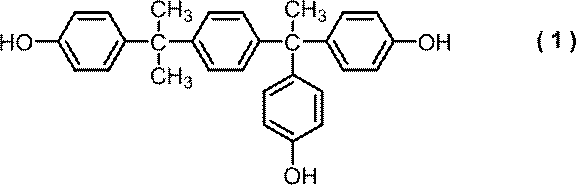
- the epoxy resin (A) is represented by the following formula (1)
- a negative photosensitive resin composition which is an epoxy resin obtained by a reaction between a phenol derivative represented by formula (II) and an epihalohydrin, (2)
- the alkali-soluble resin (B) is a reaction product of the reaction product of the epoxy resin (a) and the monocarboxylic acid (b) and the polybasic acid or its anhydride (c).
- the negative photosensitive resin composition capable of alkali development of the present invention has high sensitivity and high resolution, and the cured product of the resin composition has high heat resistance and is colored by heat while maintaining high transparency.
- the feature is that there are few.
- the negative photosensitive resin composition of the present invention (hereinafter also simply referred to as “the resin composition of the present invention”) is an epoxy resin having two or more epoxy groups in one molecule, and is represented by the above formula (1 ) And a phenol derivative (A) (hereinafter also simply referred to as “component (A)”) obtained by reaction of the phenol derivative represented by (II) with an epihalohydrin, an alkali-soluble resin (B) (hereinafter simply referred to as “(B)”).
- component ”and a photocationic polymerization initiator (C) (hereinafter also simply referred to as“ component (C) ”).
- the component (A) contained in the negative photosensitive resin composition of the present invention can be obtained by a conventionally known method for synthesizing an epoxy resin using a phenol derivative represented by formula (1) and an epihalohydrin.
- a general synthesis method for example, sodium hydroxide is added to a mixed solution obtained by dissolving a phenol derivative represented by the formula (1) and epihalohydrin (such as epichlorohydrin or epibromohydrin) in a solvent. After adding an alkali and the like, raising the temperature to the reaction temperature and carrying out an addition reaction and a ring closure reaction, washing the reaction liquid with water, separating and removing the aqueous layer are repeated, and finally the solvent is distilled off from the oil layer. Can be mentioned.
- an epoxy resin (A) having a different main component in the component (A) can be obtained depending on the use ratio of the phenol derivative represented by the formula (1) used in the synthesis reaction and epihalohydrin.
- the main component is a trifunctional epoxy resin in which all of the three phenolic hydroxyl groups in the formula (1) are epoxidized (A ) Component is obtained, but as the amount of epihalohydrin used with respect to the phenolic hydroxyl group decreases, the phenolic hydroxyl groups of multiple phenol derivatives are bonded via epihalohydrin and the remaining phenolic hydroxyl groups are epoxidized.
- the content of large polyfunctional epoxy resins increases.
- a method of obtaining the component (A) mainly composed of such a polyfunctional epoxy resin having a large molecular weight in addition to the method of controlling by the use ratio of the phenol derivative and the epihalohydrin, a phenol is further added to the epoxy resin (A).
- a method of reacting a derivative is also mentioned.
- the component (A) contained in the resin composition of the present invention the component (A) mainly composed of the trifunctional epoxy resin or the polyfunctional epoxy resin having a large molecular weight can be used. It is preferable that the epoxy resin represented by either Formula (2) or Formula (3) is included as a main component.
- the area ratio of the epoxy resin represented by Formula (2) and the epoxy resin represented by Formula (3) calculated in terms of polystyrene is more preferably in the range of 1 to 20, and still more preferably in the range of 1.1 to 12.
- epoxy resin (A) examples include Techmore VG3101 (manufactured by Printec) and NC-6000 (manufactured by Nippon Kayaku).
- the alkali-soluble resin (B) contained in the resin composition of the present invention can be used without particular limitation as long as it can impart developability (solubility) to an aqueous alkaline solution to the resin composition. In the sense that the high transparency of the cured product, which is one of the effects, is not impaired, those in which the alkali-soluble resin (B) itself is less colored are preferable.
- component (B) examples include phenol novolak resins, orthocresol novolak resins, copolymers of ethylenically unsaturated compounds such as acrylic esters, polyester resins synthesized from polyhydric alcohols and polybasic acid compounds,
- Examples include a reaction product of an epoxy resin, a monocarboxylic acid, and a polybasic acid anhydride. From the viewpoint of solubility in an alkaline aqueous solution, a compound having one or more carboxyl groups in one molecule is preferable. More preferably, it is a reaction product of a reaction product of (a) with a monocarboxylic acid (b) and a polybasic acid or its anhydride (c).
- Examples of the epoxy resin (a) used as a raw material for the alkali-soluble resin (B) include novolac type epoxy resins, bisphenol type epoxy resins, biphenyl type epoxy resins, triphenylmethane type epoxy resins, and phenol aralkyl type epoxy resins. Can be mentioned.
- bisphenol A bisphenol F, bisphenol S, thiodiphenol, fluorene bisphenol, terpene diphenol, 4,4′-biphenol, 2,2′-biphenol, 3,3 ′, 5,5′-tetra Methyl- [1,1′-biphenyl] -4,4′-diol, hydroquinone, resorcin, naphthalenediol, tris- (4-hydroxyphenyl) methane, 1,1,2,2-tetrakis (4-hydroxyphenyl) Ethane, phenols (phenol, alkyl-substituted phenol, naphthol, alkyl-substituted naphthol, dihydroxybenzene, dihydroxynaphthalene, etc.) and formaldehyde, acetaldehyde, benzaldehyde, p-hydroxybenzaldehyde, o-hydroxybenzaldehyde, p Hydroxyacetophenone,
- the epoxy resin (a) itself is preferably less colored, and the particularly preferable epoxy resin (a) is a bisphenol A type.
- the particularly preferable epoxy resin (a) is a bisphenol A type. Examples thereof include an epoxy resin and an epoxy resin mainly composed of the epoxy resin represented by any one of the above formulas (2) and (3).
- Examples of the monocarboxylic acid (b) used as the raw material for the alkali-soluble resin (B) include ethylenically unsaturated monocarboxylic acids such as acrylic acid, methacrylic acid, crotonic acid, cinnamic acid, and acrylic acid dimer, and dimethylol. Mention may be made of polyhydroxy-containing monocarboxylic acids such as propionic acid, dimethylolacetic acid, dimethylolbutyric acid, dimethylolvaleric acid and dimethylolcaproic acid, and monohydroxy-containing monocarboxylic acids such as hydroxyhypabolinic acid and p-hydroxybenzoic acid. it can.
- Examples of the polybasic acid or anhydride (c) used as a raw material for the alkali-soluble resin (B) include succinic acid, maleic acid, phthalic acid, tetrahydrophthalic acid, hexahydrophthalic acid, and methylhexahydrophthalic acid. And polybasic acids such as methylendomethylenetetrahydrophthalic acid, trimellitic acid and pyromellitic acid, and anhydrides of these polybasic acids.
- the monocarboxylic acid (b) is preferably about 0.1 to 1.5 equivalents relative to 1 equivalent of the epoxy group of the epoxy resin (a). React.
- solvents such as methyl ethyl ketone, methyl isobutyl ketone, cyclopentanone, ethyl cellosolve acetate, butyl cellosolve acetate, carbitol acetate, diethylene glycol dimethyl ether, and solvent naphtha as diluents.
- a catalyst for example, triethylamine, benzyldimethylamine, tetramethylammonium chloride, methyltriethylammonium chloride, triphenylstibine, triphenylphosphine, etc.
- the amount is preferably 0.01 to 10% by weight, particularly preferably 0.05 to 5% by weight, based on the reaction raw material mixture.
- a polymerization inhibitor eg, methoquinone, hydroquinone, dibutylhydroxytoluene, phenothiazine, etc.
- the amount used is preferably 0.01 to It is 2% by weight, particularly preferably 0.05 to 1% by weight.
- the reaction temperature is usually 60 to 150 ° C., and the reaction time is usually 5 to 50 hours.
- the polybasic acid or its anhydride (c) is preferably reacted in an amount of 0.05 to 1.00 equivalents per equivalent of hydroxyl group with respect to the hydroxyl group in the reaction product of the epoxy resin (a) and the monocarboxylic acid (b).
- an alkali-soluble resin (B) is obtained from the epoxy resin (a), the monocarboxylic acid (b), and the polybasic acid or its anhydride (c).
- the reaction temperature is 60 to 160 ° C.
- the acid value (mgKOH / g) of the alkali-soluble resin (B) thus obtained is preferably 30 to 160, particularly preferably 50 to 150.
- the acid value here is a value measured according to JIS K-2501.
- the cationic photopolymerization initiator (C) contained in the resin composition of the present invention means a chemical species that generates a cationic species by irradiation with active energy rays, and has sufficient performance to cure the epoxy resin (A). If it has, it can be used without particular limitation.
- Examples of the photocationic polymerization initiator (C) that can be used include aromatic iodonium complex salts and aromatic sulfonium complex salts.
- aromatic iodonium complex salt examples include diphenyliodonium tetrakis (pentafluorophenyl) borate, diphenyliodonium hexafluorophosphate, diphenyliodonium hexafluoroantimonate, di (4-nonylphenyl) iodonium hexafluorophosphate, and triluku.
- aromatic sulfonium complex salt examples include 4- (phenylthio) phenyldiphenylsulfonium hexafluoroantimonate (manufactured by San Apro Co., Ltd., trade name CPI-101A), 4- (phenylthio) phenyldiphenylsulfonium tris (pentafluoroethyl).
- Trifluorophosphate (manufactured by San Apro Co., Ltd., trade name CPI-210S), 4- ⁇ 4- (2-chlorobenzoyl) phenylthio ⁇ phenylbis (4-fluorophenyl) sulfonium hexafluoroantimonate (manufactured by Asahi Denka Kogyo Co., Ltd.) , Trade name SP-172), a mixture of aromatic sulfonium hexafluoroantimonate containing 4- (phenylthio) phenyldiphenylsulfonium hexafluoroantimonate (manufactured by Dow Chemical Co., Ltd.
- UVI-6976 and triphenylsulfonium tris (trifluoromethanesulfonyl) methanide (manufactured by BASF Japan, trade name CGI TPS C1), tris [4- (4-acetylphenylsulfanyl) phenyl] sulfonium tris [(trifluoromethyl) sulfonyl ] Methanide (trade name GSID26-1 manufactured by BASF Japan), tris [4- (4-acetylphenyl) thiophenyl] sulfonium tetrakis (pentafluorophenyl) borate (trade name PAG-290, manufactured by BASF Japan) and the like are preferable.
- Can be used for Of these (C) components 4- (phenylthio) phenyldiphenylsulfonium complex salts are preferred because the resin is difficult to be colored during heating and is excellent in acid generation ability when irradiated with light.
- the component (A) when the total of the component (A), the component (B) and the component (C) is 100% by mass, the component (A) is usually 10 to 90% by mass, preferably 10 to 80% by mass. %, More preferably 20 to 50% by mass, component (B) is usually 10 to 90% by mass, preferably 10 to 80% by mass, more preferably 50 to 80% by mass, and component (C) is usually 0.1 to The content is 15% by mass, preferably 1 to 10% by mass.
- the photocationic polymerization initiator (C) used in the resin composition of the present invention has a high molar extinction coefficient at a wavelength of 300 to 380 nm, the optimum blending amount is used according to the film thickness when the resin composition is used. It is particularly preferred.
- the negative photosensitive resin composition of the present invention includes a reactive epoxy that is miscible with the component (A) and the component (B) for the purpose of improving the performance of the pattern, the reactivity of the resist, and the physical properties of the cured film.
- Monomer (D) (hereinafter sometimes simply referred to as “component (D)”) may be added.
- component (D) as used herein means a compound having a relatively small molecular weight and a liquid or semi-solid epoxy group at room temperature.
- Specific examples thereof include diethylene glycol diglycidyl ether, hexanediol diglycidyl ether, Dimethylolpropane diglycidyl ether, polypropylene glycol diglycidyl ether (ADEKA Corporation, ED506), trimethylolpropane triglycidyl ether (ADEKA Corporation, ED505), trimethylolpropane triglycidyl ether (low chlorine type, Nagase ChemteX) EX 321L), pentaerythritol tetraglycidyl ether, bisphenol A diglycidyl ether, bisphenol F diglycidyl ether, 3,4-epoxycyclohexane Senirumechiru -3 ', 4'-epoxy cyclohexene carboxylate (manufactured by Daicel Chemical Industries, Ltd., Celloxide 2021P), and the like.
- the component (D) can be used alone or in admixture of two or more.
- the component (D) is in a liquid form, if it is added in an amount of more than 20% by mass with respect to the total amount of the resin composition, it is inappropriate because the film after removal of the solvent becomes sticky and mask sticking is likely to occur. From this point, it is preferable that the blending ratio of the component (D) in the resin composition of the present invention is 20% by mass or less with respect to the total of the component (A), the component (B) and the component (C).
- a solvent (E) can be used to lower the viscosity of the resin composition and improve the coating properties.
- the solvent organic solvents that are usually used in inks, paints, and the like, and can dissolve each component of the resin composition without particular limitation.
- Specific examples of the solvent (E) include ketones such as acetone, ethyl methyl ketone, cyclohexanone and cyclopentanone, aromatic hydrocarbons such as toluene, xylene and tetramethylbenzene, dipropylene glycol dimethyl ether and dipropylene glycol diethyl.
- Glycol ethers such as ether, ethyl acetate, butyl acetate, butyl cellosolve acetate, carbitol acetate, esters such as propylene glycol monomethyl ether acetate and ⁇ -butyrolactone, alcohols such as methanol, ethanol, ceresolve and methyl ceresolve, octane and Examples thereof include aliphatic hydrocarbons such as decane, petroleum solvents such as petroleum ether, petroleum naphtha, hydrogenated petroleum naphtha and solvent naphtha.
- the solvent (E) component is added for the purpose of adjusting the film thickness and applicability when applied to the substrate, and maintains the solubility of the main component, the volatility of the component, the liquid viscosity of the composition, etc.
- the amount thereof used is preferably 95% by mass or less, particularly preferably 10 to 90% by mass in the resin composition.
- an adhesion imparting agent that is miscible with the component (A) or the component (B) may be used for the purpose of further improving the adhesion of the composition to the substrate.
- a coupling agent such as a silane coupling agent or a titanium coupling agent can be used, and a silane coupling agent is preferable.
- silane coupling agent examples include 3-chloropropyltrimethoxysilane, vinyltrichlorosilane, vinyltriethoxysilane, vinyltrimethoxysilane, vinyltris (2-methoxyethoxy) silane, and 3-methacryloxypropyltrimethoxy.
- Silane 2- (3,4-epoxycyclohexyl) ethyltrimethoxysilane, 3-glycidoxypropyltrimethoxysilane, 3-mercaptopropyltrimethoxysilane, 3-aminopropyltriethoxysilane, N-2- (aminoethyl) ) -3-aminopropyltrimethoxysilane, 3-ureidopropyltriethoxysilane and the like.
- These adhesiveness imparting agents can be used alone or in combination of two or more.
- the adhesion-imparting agent does not have reactivity with the main component, it remains in the cured product except for acting at the interface of the base material, and therefore, if used excessively, there is a risk of adverse effects such as deterioration of physical properties.
- the use ratio is preferably 15% by mass or less, particularly preferably 5% by mass in the resin composition. % Or less.
- a sensitizer that further absorbs ultraviolet rays and plays a role of supplying the absorbed light energy to the photocationic polymerization initiator may be used.
- the sensitizer for example, thioxanthones and anthracene compounds having an alkoxy group at the 9th and 10th positions (9,10-dialkoxyanthracene derivatives) are preferable.
- the alkoxy group include C1-C4 alkoxy groups such as a methoxy group, an ethoxy group, a propoxy group, and a butoxy group.
- the 9,10-dialkoxyanthracene derivative may further have a substituent.
- substituents examples include halogen atoms such as fluorine atom, chlorine atom, bromine atom and iodine atom, C1-C4 alkyl groups such as methyl group, ethyl group and propyl group, sulfonic acid alkyl ester groups, and carboxylic acid alkyl ester groups.
- halogen atoms such as fluorine atom, chlorine atom, bromine atom and iodine atom
- C1-C4 alkyl groups such as methyl group, ethyl group and propyl group
- sulfonic acid alkyl ester groups examples include C1-C4 alkyl such as methyl, ethyl, and propyl.
- the substitution position of these substituents is preferably the 2-position.
- thioxanthones include 2,4-dimethylthioxanthone, 2,4-diethylthioxanthone, 2-chlorothioxanthone, 2,4-diisopropylthioxanthone, and the like.
- 2,4-diethylthioxanthone (trade name: Kayacure DETX- S, manufactured by Nippon Kayaku Co., Ltd.) and 2-isopropylthioxanthone are preferable.
- Examples of the 9,10-dialkoxyanthracene derivative include 9,10-dimethoxyanthracene, 9,10-diethoxyanthracene, 9,10-dipropoxyanthracene, 9,10-dibutoxyanthracene, and 9,10-dimethoxy-2.
- sensitizers can be used singly or in combination of two or more, but 2,4-diethylthioxanthone, 9,10-dimethoxy-2-ethylanthracene, and / or 9,10-dibutoxyanthracene. Use is most preferred. Since the sensitizer component exhibits an effect in a small amount, its use ratio is preferably 30% by mass or less, particularly preferably 20% by mass or less, relative to the photocationic polymerization initiator (C) component.
- An ion catcher may be added to the negative photosensitive resin composition of the present invention for the purpose of reducing the adverse effects of ions derived from the photocationic polymerization initiator (C).
- Specific examples of the ion catcher include trismethoxyaluminum, trisethoxyaluminum, trisisopropoxyaluminum, isopropoxydiethoxyaluminum and trisbutoxyaluminum and other alkoxyaluminums, trisphenoxyaluminum and trisparamethylphenoxyaluminum and other phenoxyaluminums, tris Acetoxyaluminum, trisstearatoaluminum, trisbutyratealuminum, trispropionatoaluminum, trisacetylacetonatoaluminum, tristrifluoroacetylacetonatoaluminum, trisethylacetoacetatoaluminum, diacetylacetonatodipival
- thermoplastic resin examples include polyethersulfone, polystyrene, and polycarbonate.
- colorant examples include phthalocyanine blue, phthalocyanine green, iodin green, crystal violet, titanium oxide, carbon black, naphthalene black and the like.
- thickener examples include olben, benton, montmorillonite and the like.
- antifoaming agent examples include silicone-based, fluorine-based and polymer-based antifoaming agents.
- a photo radical polymerization initiator (C) may be used in combination with a photo radical polymerization initiator. it can.
- Examples of the negative photosensitive dendritic composition of the present invention include inorganic substances such as barium sulfate, barium titanate, silicon oxide, amorphous silica, talc, clay, magnesium carbonate, calcium carbonate, aluminum oxide, aluminum hydroxide, and mica powder.
- a filler can be used.
- the content of the inorganic filler is 0 to 60% by mass in the resin composition of the present invention.
- the negative photosensitive resin composition of the present invention can be obtained by simply mixing and stirring the (A) component, the (B) component and the (C) component, and optional components added as necessary, by a usual method. If necessary, a disperser such as a dissolver, a homogenizer, or a three roll mill may be used for dispersion and mixing. Moreover, after mixing, you may further filter using a mesh, a membrane filter, etc.
- a disperser such as a dissolver, a homogenizer, or a three roll mill may be used for dispersion and mixing.
- the resin composition of the present invention is preferably used in liquid form.
- the liquid resin composition is 0.1 on a metal substrate such as silicon, aluminum, copper and ITO, a ceramic substrate such as lithium tantalate, glass, silicon oxide and silicon nitride, a substrate such as polyimide and polyethylene terephthalate.
- the resin composition layer is formed on the substrate by coating with a spin coater or the like with a thickness of ⁇ 1000 ⁇ m and removing the solvent by heat treatment at 60 to 130 ° C. for about 5 to 60 minutes.
- a mask having a predetermined pattern is placed on the resin composition layer, irradiated with ultraviolet rays, and subjected to a heat treatment at 50 to 130 ° C. for about 1 to 50 minutes.
- a cured product satisfying various characteristics can be obtained.
- alkaline aqueous solution such as TMAH, sodium hydroxide, potassium hydroxide, sodium carbonate, sodium silicate
- a water-soluble organic solvent such as methanol or ethanol or a surfactant
- a paddle type, spray type, shower type, or other developing device may be used, and ultrasonic irradiation may be performed as necessary.
- glass or ITO is mentioned as a preferable substrate in using the resin composition of the present invention.
- Synthesis Example 1 (Synthesis of epoxy resin (A-1)) In a flask equipped with a stirrer, a reflux condenser, and a stirrer, while purging with nitrogen, TrisP-PA (phenol derivative represented by the formula (1), Honshu Chemical Co., Ltd.) 141 parts, epichlorohydrin 370 parts and methanol 64 parts was dissolved under stirring, and the temperature was raised to 70 ° C. Next, 42 parts of flaky sodium hydroxide was added in portions over 90 minutes, and then reacted at 70 ° C. for 1 hour. After completion of the reaction, washing with water was performed, and excess epichlorohydrin, solvent, and the like were distilled off from the oil layer under reduced pressure at 140 ° C.
- TrisP-PA phenol derivative represented by the formula (1), Honshu Chemical Co., Ltd.
- the area ratio of the epoxy resin represented by the formula (2) and the epoxy resin represented by the formula (3) calculated in terms of polystyrene was about 10.
- Synthesis Example 2 (Synthesis of epoxy resin (A-2)) An epoxy resin (A-2) was obtained in the same manner as in Synthesis Example 1 except that epichlorohydrin was changed to 185 parts. The epoxy equivalent of the obtained epoxy resin was 233 g / eq. The softening point was 70 ° C. In addition, based on the measurement result of GPC (gel permeation chromatography), the area ratio of the epoxy resin represented by the formula (2) and the epoxy resin represented by the formula (3) calculated in terms of polystyrene ( (Epoxy resin of formula (2) / epoxy resin of formula (3)) was about 3.
- Synthesis Example 3 (Synthesis of alkali-soluble resin (B-1)) In a flask equipped with a stirrer, a reflux condenser and a stirrer, 330 parts of NER-1302 (manufactured by Nippon Kayaku, bisphenol A type epoxy resin, epoxy equivalent 330 g / eq., Softening point 70 ° C.), acrylic acid 72.8 Parts, 1.7 parts of dibutylhydroxytoluene, 0.9 parts of tetramethylammonium chloride, and 173 parts of methyl isobutyl ketone were heated to 98 ° C.
- NER-1302 manufactured by Nippon Kayaku, bisphenol A type epoxy resin, epoxy equivalent 330 g / eq., Softening point 70 ° C.
- acrylic acid 72.8 Parts
- 1.7 parts of dibutylhydroxytoluene 0.9 parts of tetramethylammonium chloride
- Synthesis Example 4 (Synthesis of alkali-soluble resin (B-2)) In a flask equipped with a stirrer, a reflux condenser, and a stirrer, 233 parts of the epoxy resin (A-2) synthesized in Synthesis Example 2, 72.8 parts of acrylic acid, 1.3 parts of dibutylhydroxytoluene, tetramethylammonium chloride 0.7 parts and 145 parts of methyl isobutyl ketone were charged and heated to 98 ° C. The reaction was continued while maintaining the temperature at 98 ° C. until the acid value of the reaction solution became 3.0 or less, and the reaction solution was cooled to 60 ° C.
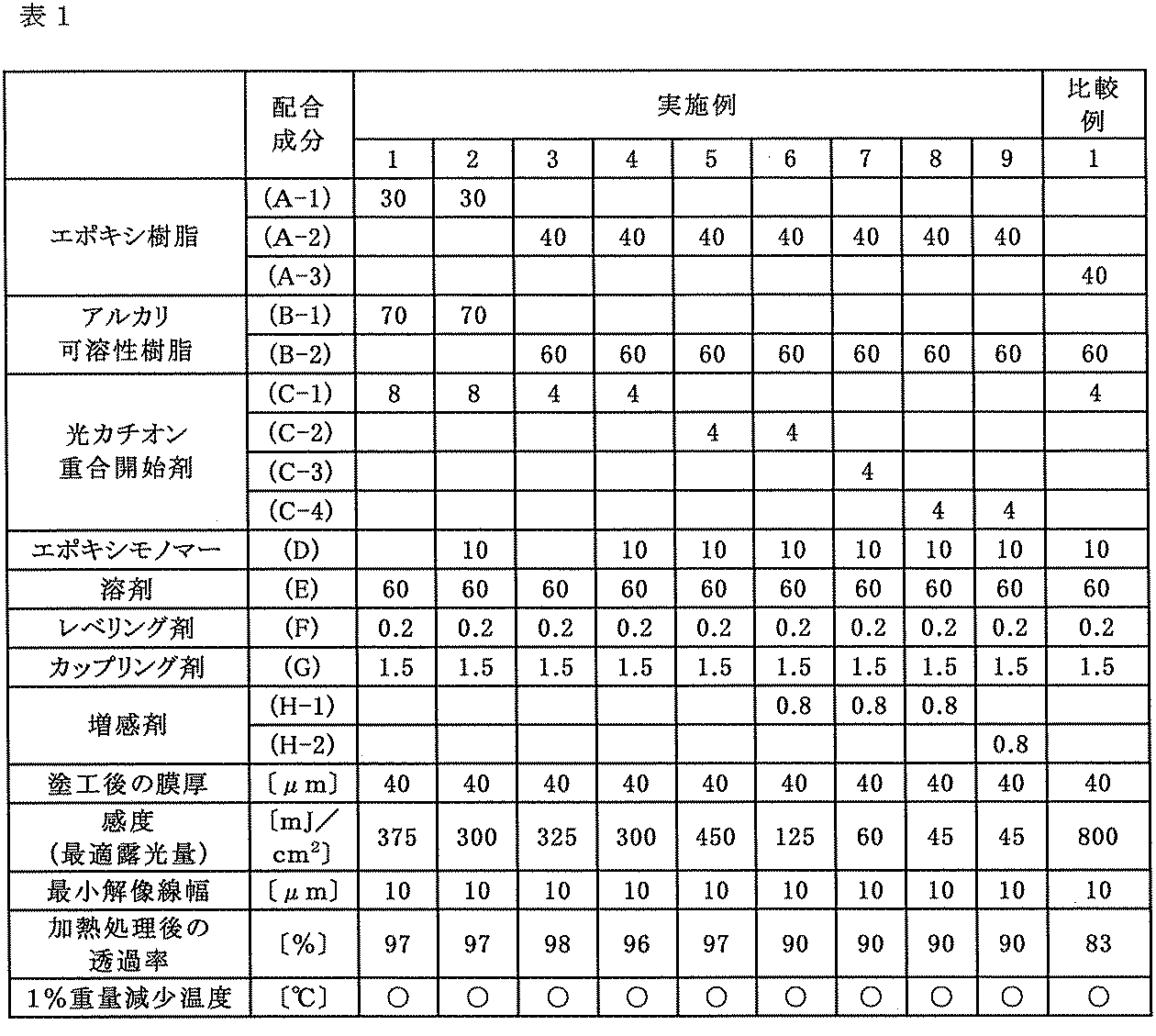
- the resin compositions of Examples 1 to 9 and Comparative Example 1 were coated on a substrate (glass or ITO) with a spin coater and then dried, and the film thicknesses shown in Table 1 (“film thickness after coating” in Table 1 are It means the film thickness after coating and drying.
- This resin composition layer was pre-baked on a hot plate at 65 ° C. for 5 minutes and at 95 ° C. for 10 minutes. Thereafter, pattern exposure (soft contact, i-line) is performed using an i-line exposure apparatus (mask aligner: manufactured by USHIO INC.), Post-exposure baking is performed at 95 ° C. for 6 minutes using a hot plate, and 2.38% by mass.
- the TMAH solution was developed by an immersion method at 23 ° C. for 5 minutes to obtain a resin pattern cured on the substrate.
- A-1) Epoxy resin obtained in Synthesis Example 1
- A-2) Epoxy resin obtained in Synthesis Example 2
- A-3) EOCN-1020 (manufactured by Nippon Kayaku, ortho-cresol novolac epoxy resin , Epoxy equivalent 197 g / eq., Softening point 64 ° C.)
- B-1) Alkali-soluble resin obtained in Synthesis Example 3
- B-2) Alkali-soluble resin obtained in Synthesis Example 4
- C-3) OPPI (Hampford Research Products)
- C-4) BBI-103 (Midori Chemical Co., Ltd.)
- D) Celoxide 2021P (manufactured by Daicel Chemical Industries, Ltd.)
- E) Propylene glycol monomethyl ether acetate
- the negative photosensitive resin composition of the present invention is alkali developable and excellent in image resolution and sensitivity, and the cured product of the resin composition is excellent in thermal stability, chemical resistance and solvent solubility, and when heated. It is useful in fields that require transparency, such as display applications.
Landscapes
- Chemical & Material Sciences (AREA)
- Physics & Mathematics (AREA)
- Health & Medical Sciences (AREA)
- Chemical Kinetics & Catalysis (AREA)
- Medicinal Chemistry (AREA)
- Polymers & Plastics (AREA)
- Organic Chemistry (AREA)
- Spectroscopy & Molecular Physics (AREA)
- General Physics & Mathematics (AREA)
- Epoxy Resins (AREA)
- Materials For Photolithography (AREA)
Abstract
Description
(1)1分子中に2個以上のエポキシ基を有するエポキシ樹脂(A)、アルカリ可溶性樹脂(B)及び光カチオン重合開始剤(C)を含有してなる感光性樹脂組成物であって、エポキシ樹脂(A)が、下記式(1)
(2)アルカリ可溶性樹脂(B)が、1分子中に1個以上のカルボキシル基を有するアルカリ可溶性樹脂である前項(1)に記載のネガ型感光性樹脂組成物、
(3)アルカリ可溶性樹脂(B)が、エポキシ樹脂(a)とモノカルボン酸(b)との反応物と、多塩基酸又はその無水物(c)との反応物である前項(2)に記載のネガ型感光性樹脂組成物、
(4)前項(1)及至(3)のいずれか一項に記載のネガ型感光性樹脂組成物を硬化させて得られる硬化物、
に関する。
本発明のネガ型感光性樹脂組成物(以下、単に「本発明の樹脂組成物」とも記載する)は、1分子中に2個以上のエポキシ基を有するエポキシ樹脂であって、上記式(1)で表されるフェノール誘導体と、エピハロヒドリンとの反応によって得られるエポキシ樹脂(A)(以下、単に「(A)成分」とも記載する)、アルカリ可溶性樹脂(B)(以下、単に「(B)成分」とも記載する)及び光カチオン重合開始剤(C)(以下、単に「(C)成分」とも記載する)を含有する。
一般的な合成方法としては、例えば、式(1)で表されるフェノール誘導体とエピハロヒドリン(エピクロロヒドリンやエピブロモヒドリン等)とを溶剤に溶解して得られる混合溶液に、水酸化ナトリウム等のアルカリ類を添加し、反応温度まで昇温して付加反応及び閉環反応を行った後、反応液の水洗、分離及び水層の除去を繰り返し、最後に油層から溶剤を留去する方法が挙げられる。
前記の合成反応に用いる式(1)で表されるフェノール誘導体とエピハロヒドリンとの使用比率によって、(A)成分中の主成分の異なるエポキシ樹脂(A)が得られることが知られている。例えば、フェノール誘導体のフェノール性水酸基に対して過剰量のエピハロヒドリンを用いた場合、式(1)中の3つのフェノール性水酸基の全てがエポキシ化された3官能のエポキシ樹脂を主成分とする(A)成分が得られるが、フェノール性水酸基に対するエピハロヒドリンの使用量が少なくなるのに伴い、複数のフェノール誘導体のフェノール性水酸基がエピハロヒドリンを介して結合し、残りのフェノール性水酸基がエポキシ化された分子量の大きい多官能エポキシ樹脂の含有率が増加する。
この様な分子量の大きい多官能エポキシ樹脂を主成分とする(A)成分を得る方法としては、前記のフェノール誘導体とエピハロヒドリンの使用比率で制御する方法の他に、エポキシ樹脂(A)に更にフェノール誘導体を反応させる方法も挙げられる。
本発明の樹脂組成物が含有する(A)成分としては、前記の3官能のエポキシ樹脂や前記の分子量の大きい多官能エポキシ樹脂を主成分とする(A)成分を用いることができるが、下記式(2)又は式(3)のいずれかで表されるエポキシ樹脂を主成分として含むことが好ましい。そして、GPC(ゲルパーミェーションクロマトグラフィー)の測定結果に基づいて、ポリスチレン換算で算出した式(2)で表されるエポキシ樹脂と式(3)で表されるエポキシ樹脂との面積比(式(2)のエポキシ樹脂/式(3)のエポキシ樹脂)は、1~20の範囲であることがより好ましく、1.1~12の範囲であることが更に好ましい。


こうして得られるアルカリ可溶性樹脂(B)の酸価(mgKOH/g)は30~160が好ましく、特に好ましくは50~150である。なお、ここでいう酸価はJIS K-2501に準じて測定した値である。
これら(C)成分のうち、加熱時に樹脂が着色しにくく光を照射した際の酸発生能力に優れることから、4-(フェニルチオ)フェニルジフェニルスルホニウム錯塩が好ましい。
本発明の樹脂組成物は、(A)成分、(B)成分及び(C)成分の合計を100質量%とした場合、(A)成分を通常10~90質量%、好ましくは10~80質量%、より好ましくは20~50質量%、(B)成分を通常10~90質量%、好ましくは10~80質量%、より好ましくは50~80質量%、(C)成分を通常0.1~15質量%、好ましくは1~10質量%含有する。本発明の樹脂組成物に用いられる光カチオン重合開始剤(C)は、波長300~380nmにおけるモル吸光係数が高いので、樹脂組成物を使用する際の膜厚に応じて最適な配合量を用いることが特に好ましい。
密着性付与剤が主成分との反応性を持たない場合、基材界面で作用する以外は硬化物中にそのまま残存するため、過剰に使用すると物性の低下などの悪影響を及ぼす恐れがある。基材によっては、少量でも効果を発揮する点から、悪影響を及ぼさない範囲内での使用が適当であり、その使用割合は、樹脂組成物中に15質量%以下が好ましく、特に好ましくは5質量%以下である。
撹拌機、還流冷却管、撹拌装置を備えたフラスコに、窒素パージをしながらTrisP-PA(式(1)で示されるフェノール誘導体、本州化学株式会社製)141部、エピクロルヒドリン370部及びメタノール64部を加え、撹拌下で溶解し、70℃にまで昇温した。次いでフレーク状の水酸化ナトリウム42部を90分間かけて分割添加した後、70℃で1時間反応を行った。反応終了後水洗を行ない、油層からロータリーエバポレーターを用いて140℃で減圧下、過剰のエピクロルヒドリン、溶媒等を留去した。残留物にメチルイソブチルケトン400部を加えて溶解し、70℃に昇温した。撹拌下で30%水酸化ナトリウム水溶液10部を加え、1時間撹拌行った後、洗浄水が中性になるまで水洗を行ない、得られた溶液からロータリーエバポレーターを用いて180℃で減圧下にメチルイソブチルケトン等を留去することにより、前記式(2)のエポキシ樹脂を主成分として含むエポキシ樹脂(A-1)を得た。得られたエポキシ樹脂のエポキシ当量は205g/eq.、軟化点は58.8℃であった。尚、GPC(ゲルパーミェーションクロマトグラフィー)の測定結果に基づいて、ポリスチレン換算で算出した式(2)で表されるエポキシ樹脂と式(3)で表されるエポキシ樹脂との面積比(式(2)のエポキシ樹脂/式(3)のエポキシ樹脂)は約10であった。
エピクロルヒドリンを185部へ変更する以外は、合成例1と同様に行い、エポキシ樹脂(A-2)を得た。得られたエポキシ樹脂のエポキシ当量は233g/eq.、軟化点は70℃であった。尚、GPC(ゲルパーミェーションクロマトグラフィー)の測定結果に基づいて、ポリスチレン換算で算出した式(2)で表されるエポキシ樹脂と式(3)で表されるエポキシ樹脂との面積比(式(2)のエポキシ樹脂/式(3)のエポキシ樹脂)は約3であった。
撹拌機、還流冷却管、撹拌装置を備えたフラスコに、NER-1302(日本化薬製、ビスフェノールA型エポキシ樹脂、エポキシ当量330g/eq.、軟化点70℃)330部、アクリル酸72.8部、ジブチルヒドロキシトルエン1.7部、テトラメチルアンモニウムクロリド0.9部及びメチルイソブチルケトン173部を仕込み、98℃まで昇温した。98℃に維持したまま反応液の酸価(mgKOH/g、溶剤を除いた固形分酸化、以下同様)が3.0以下になるまで反応を行い、60℃まで冷却した。次いで、テトラヒドロ無水フタル酸150部及びメチルイソブチルケトン64部を仕込み、120℃まで昇温した。120℃に維持したまま反応液の酸価が100になるまで反応を行い、水洗した後、メチルイソブチルケトンを留去しながらプロピレングリコールモノメチルエーテルアセテートに置換することで、アルカリ可溶性樹脂(B-1)を得た。
撹拌機、還流冷却管、撹拌装置を備えたフラスコに、合成例2で合成したエポキシ樹脂(A-2)233部、アクリル酸72.8部、ジブチルヒドロキシトルエン1.3部、テトラメチルアンモニウムクロリド0.7部及びメチルイソブチルケトン145部を仕込み、98℃まで昇温した。98℃に維持したまま反応液の酸価が3.0以下になるまで反応を行い、60℃まで冷却した。次いで、テトラヒドロ無水フタル酸152部及びメチルイソブチルケトン51部を仕込み、120℃まで昇温した。120℃に維持したまま反応液の酸価が122になるまで反応を行い、水洗した後、メチルイソブチルケトンを留去しながらプロピレングリコールモノメチルエーテルアセテートに置換することで、アルカリ可溶性樹脂(B-2)を得た。
エポキシ当量;JIS K-7236
軟化点;JIS K-7234
分子量;GPC(ゲルパーミェーションクロマトグラフィー)
(ネガ型感光性樹脂組成物の調製)
表1に記載の配合量に従って、各成分を攪拌機付きフラスコで60℃、1時間攪拌混合し、本発明及び比較用の樹脂組成物を得た。
実施例1~9及び比較例1の各樹脂組成物を基板(ガラスまたはITO)上にスピンコーターで塗布後、乾燥し、表1に示す膜厚(表1における「塗工後膜厚」は塗布、乾燥した後の膜厚を意味する。)を有する樹脂組成物層を得た。この樹脂組成物層をホットプレートにより65℃で5分間および95℃で10分間プリベークした。その後、i線露光装置(マスクアライナー:ウシオ電機社製)を用いてパターン露光(ソフトコンタクト、i線)を行い、ホットプレートにより95℃で6分間の露光後ベークを行い、2.38質量%のTMAH溶液を用いて浸漬法により23℃で5分間現像処理を行い、基板上に硬化した樹脂パターンを得た。
前記パターン露光において、マスク転写精度が最良となる露光量を最適露光量とし、それぞれの樹脂組成物の感度の評価を行った。最適露光量の値が小さいほど感度が高いことを表す。結果を表1に示した。
前記で得られた最適露光量によるパターン露光において、1~50μmのラインアンドスペースのフォトマスクを使用し、残渣がなく解像されたレジストパターン中、基板へ密着している最も細かいパターン幅を測定することにより解像性の評価を行った。結果を表1に示した。
前記で得られた硬化物(厚さ:40μm)を230℃の空気オーブンで20分間加熱処理した後、分光光度計(日本分光製 V-650)で波長450nmの光透過率(%)を厚さ方向で測定した。結果を表1に示した。
230℃の空気オーブンで20分間加熱処理した硬化物を、TG/DTA(セイコーインスツル製 TG/DTA 6200)を用いて20℃/分の昇温速度で測定し、下記の判定基準で評価した。結果を下記表1に示した。
判定基準
○:1%重量減少温度が250℃以上
×:1%重量減少温度が250℃未満
(A-2):合成例2で得られたエポキシ樹脂
(A-3):EOCN-1020(日本化薬製、オルトクレゾールノボラックエポキシ樹脂、エポキシ当量197g/eq.、軟化点64℃)
(B-1):合成例3で得られたアルカリ可溶性樹脂
(B-2):合成例4で得られたアルカリ可溶性樹脂
(C-1):CPI-210S(サンアプロ株式会社製)
(C-2):UVI-6976(ダウケミカル社製)
(C-3):OPPI(Hampford Research Products製)
(C-4):BBI-103(みどり化学株式会社製)
(D):セロキサイド2021P(ダイセル化学工業株式会社製)
(E):プロピレングリコールモノメチルエーテルアセテート
(F):メガファックF-470(DIC株式会社製)
(G):S510(チッソ株式会社製)
(H-1):ANTHRACURE UVS-1331(川崎化成工業株式会社製)
(H-2):9,10-ジメトキシ-2-エチルアントラセン(アルドリッチ社製)
Claims (4)
- 1分子中に2個以上のエポキシ基を有するエポキシ樹脂(A)、アルカリ可溶性樹脂(B)及び光カチオン重合開始剤(C)を含有してなる感光性樹脂組成物であって、エポキシ樹脂(A)が下記式(1)

で表されるフェノール誘導体と、エピハロヒドリンとの反応によって得られるエポキシ樹脂であるネガ型感光性樹脂組成物。 - アルカリ可溶性樹脂(B)が、1分子中に1個以上のカルボキシル基を有するアルカリ可溶性樹脂である請求項1に記載のネガ型感光性樹脂組成物。
- アルカリ可溶性樹脂(B)が、エポキシ樹脂(a)とモノカルボン酸(b)との反応物と、多塩基酸又はその無水物(c)との反応物である請求項2に記載のネガ型感光性樹脂組成物。
- 請求項1及至請求項3のいずれか一項に記載のネガ型感光性樹脂組成物を硬化させて得られる硬化物。
Priority Applications (4)
| Application Number | Priority Date | Filing Date | Title |
|---|---|---|---|
| CN201280030558.3A CN103608727A (zh) | 2011-06-20 | 2012-06-19 | 负型光敏树脂组合物及其固化产物 |
| JP2013521580A JP5885269B2 (ja) | 2011-06-20 | 2012-06-19 | ネガ型感光性樹脂組成物及びその硬化物 |
| KR1020137033035A KR101930975B1 (ko) | 2011-06-20 | 2012-06-19 | 네거티브형 감광성 수지 조성물 및 그 경화물 |
| US14/124,474 US9411229B2 (en) | 2011-06-20 | 2012-06-19 | Negative photosensitive resin composition and cured product of same |
Applications Claiming Priority (2)
| Application Number | Priority Date | Filing Date | Title |
|---|---|---|---|
| JP2011136179 | 2011-06-20 | ||
| JP2011-136179 | 2011-06-20 |
Publications (1)
| Publication Number | Publication Date |
|---|---|
| WO2012176750A1 true WO2012176750A1 (ja) | 2012-12-27 |
Family
ID=47422586
Family Applications (1)
| Application Number | Title | Priority Date | Filing Date |
|---|---|---|---|
| PCT/JP2012/065567 Ceased WO2012176750A1 (ja) | 2011-06-20 | 2012-06-19 | ネガ型感光性樹脂組成物及びその硬化物 |
Country Status (6)
| Country | Link |
|---|---|
| US (1) | US9411229B2 (ja) |
| JP (1) | JP5885269B2 (ja) |
| KR (1) | KR101930975B1 (ja) |
| CN (1) | CN103608727A (ja) |
| TW (1) | TWI548665B (ja) |
| WO (1) | WO2012176750A1 (ja) |
Cited By (9)
| Publication number | Priority date | Publication date | Assignee | Title |
|---|---|---|---|---|
| WO2014112537A1 (ja) * | 2013-01-16 | 2014-07-24 | 日本化薬株式会社 | エポキシ樹脂、硬化性樹脂組成物および硬化物 |
| WO2014112539A1 (ja) * | 2013-01-16 | 2014-07-24 | 日本化薬株式会社 | エポキシ樹脂、エポキシ樹脂組成物および硬化物 |
| JP2016193984A (ja) * | 2015-03-31 | 2016-11-17 | 株式会社Adeka | 樹脂及び該樹脂を用いた組成物 |
| JP2018119110A (ja) * | 2017-01-27 | 2018-08-02 | 三菱瓦斯化学株式会社 | 樹脂組成物、樹脂シート、プリント配線板及び半導体装置 |
| JP2018123311A (ja) * | 2017-01-31 | 2018-08-09 | 日本化薬株式会社 | 反応性ポリカルボン酸化合物、それを用いた活性エネルギー線硬化型樹脂組成物、その硬化物及びその用途 |
| WO2020137610A1 (ja) * | 2018-12-27 | 2020-07-02 | 住友ベークライト株式会社 | 中空パッケージおよびその製造方法 |
| JP2023017881A (ja) * | 2018-06-22 | 2023-02-07 | 旭化成株式会社 | 感光性樹脂組成物およびレジストパターンの形成方法 |
| JP2023018861A (ja) * | 2021-07-28 | 2023-02-09 | キヤノン株式会社 | 感光性樹脂組成物、造形物、造形物の製造方法及び液体吐出ヘッドの製造方法 |
| DE112021002638T5 (de) | 2020-07-08 | 2023-03-02 | San-Apro Ltd. | Negative lichtempfindliche harzzusammensetzung, verfahren zur herstellung von strukturen und laminierter film |
Families Citing this family (6)
| Publication number | Priority date | Publication date | Assignee | Title |
|---|---|---|---|---|
| KR101670245B1 (ko) * | 2014-03-21 | 2016-10-28 | 동우 화인켐 주식회사 | 감광성 수지 조성물 |
| US10527936B2 (en) * | 2016-06-17 | 2020-01-07 | Nan Ya Plastics Corporation | Low Dk/Df solder resistant composition use for printed circuit board |
| TWI882174B (zh) | 2020-09-25 | 2025-05-01 | 日商田村製作所股份有限公司 | 感光性樹脂組成物、硬化物及電子電路基板 |
| US12065005B2 (en) * | 2020-10-29 | 2024-08-20 | Bosch Automative Service Solutions Inc. | Vehicle service cart with external tow features |
| CN113754441B (zh) * | 2021-03-15 | 2023-02-17 | 山东理工大学 | 一种光敏树脂及其制备方法和应用 |
| KR20230027438A (ko) * | 2021-08-19 | 2023-02-28 | 주식회사 동진쎄미켐 | 감광성 수지 조성물 및 표시 소자 |
Citations (6)
| Publication number | Priority date | Publication date | Assignee | Title |
|---|---|---|---|---|
| JPH0625582A (ja) * | 1991-10-08 | 1994-02-01 | Nippon Kayaku Co Ltd | ソルダーレジストインキ組成物及びその硬化物 |
| JP2000143770A (ja) * | 1998-11-05 | 2000-05-26 | Mitsui Chemicals Inc | 硬化性樹脂組成物 |
| JP2008026667A (ja) * | 2006-07-21 | 2008-02-07 | Nippon Kayaku Co Ltd | 永久レジスト組成物、及びレジスト積層体 |
| JP2009075261A (ja) * | 2007-09-19 | 2009-04-09 | Nippon Kayaku Co Ltd | 感光性樹脂組成物、及びそれを用いて得られたマイクロチップ |
| JP2011081302A (ja) * | 2009-10-09 | 2011-04-21 | Nof Corp | 感光性樹脂組成物およびその用途 |
| JP2011256271A (ja) * | 2010-06-09 | 2011-12-22 | Jnc Corp | 硬化性組成物およびその用途、ならびに新規化合物 |
Family Cites Families (15)
| Publication number | Priority date | Publication date | Assignee | Title |
|---|---|---|---|---|
| US4882245A (en) | 1985-10-28 | 1989-11-21 | International Business Machines Corporation | Photoresist composition and printed circuit boards and packages made therewith |
| JP3698499B2 (ja) | 1996-09-20 | 2005-09-21 | 日本化薬株式会社 | 樹脂組成物、永久レジスト樹脂組成物及びこれらの硬化物 |
| JPH1097068A (ja) | 1996-09-20 | 1998-04-14 | Nippon Kayaku Co Ltd | 樹脂組成物、永久レジスト樹脂組成物及びこれらの硬化物 |
| JP2001147527A (ja) * | 1999-11-19 | 2001-05-29 | Nippon Kayaku Co Ltd | 感光性樹脂組成物及びこれを用いた感光性フィルム |
| EP1434090A1 (en) * | 2001-09-27 | 2004-06-30 | Clariant International Ltd. | Photosensitive resin composition |
| JP4099114B2 (ja) * | 2003-06-26 | 2008-06-11 | Azエレクトロニックマテリアルズ株式会社 | 感光性樹脂組成物 |
| US7282324B2 (en) * | 2004-01-05 | 2007-10-16 | Microchem Corp. | Photoresist compositions, hardened forms thereof, hardened patterns thereof and metal patterns formed using them |
| JP5353064B2 (ja) * | 2008-02-19 | 2013-11-27 | 日立化成株式会社 | 感光性接着剤組成物、これを用いて得られる接着フィルム、接着シート、接着剤パターン、及び半導体装置 |
| JP5305502B2 (ja) * | 2008-03-07 | 2013-10-02 | 日本化薬株式会社 | 機能素子及びそれに用いられるネガ型感光性樹脂組成物並びに機能素子の製造方法 |
| JP5247396B2 (ja) * | 2008-07-02 | 2013-07-24 | 日本化薬株式会社 | Mems用感光性樹脂組成物及びその硬化物 |
| JP5338352B2 (ja) * | 2009-02-09 | 2013-11-13 | 日油株式会社 | ポジ型感光性樹脂組成物 |
| JP5266131B2 (ja) | 2009-05-15 | 2013-08-21 | シーメット株式会社 | 光学的立体造形用樹脂組成物 |
| CN101717599B (zh) | 2009-12-27 | 2012-06-06 | 浙江桐乡新东方油墨有限公司 | 液态感光阻焊油墨及其制备方法 |
| CN103370347B (zh) * | 2010-11-24 | 2016-08-10 | 普罗米鲁斯有限责任公司 | 可自成像成膜聚合物、其组合物以及由其制得的器件和结构 |
| US11635688B2 (en) * | 2012-03-08 | 2023-04-25 | Kayaku Advanced Materials, Inc. | Photoimageable compositions and processes for fabrication of relief patterns on low surface energy substrates |
-
2012
- 2012-06-19 JP JP2013521580A patent/JP5885269B2/ja active Active
- 2012-06-19 KR KR1020137033035A patent/KR101930975B1/ko not_active Expired - Fee Related
- 2012-06-19 US US14/124,474 patent/US9411229B2/en not_active Expired - Fee Related
- 2012-06-19 CN CN201280030558.3A patent/CN103608727A/zh active Pending
- 2012-06-19 WO PCT/JP2012/065567 patent/WO2012176750A1/ja not_active Ceased
- 2012-06-19 TW TW101121919A patent/TWI548665B/zh not_active IP Right Cessation
Patent Citations (6)
| Publication number | Priority date | Publication date | Assignee | Title |
|---|---|---|---|---|
| JPH0625582A (ja) * | 1991-10-08 | 1994-02-01 | Nippon Kayaku Co Ltd | ソルダーレジストインキ組成物及びその硬化物 |
| JP2000143770A (ja) * | 1998-11-05 | 2000-05-26 | Mitsui Chemicals Inc | 硬化性樹脂組成物 |
| JP2008026667A (ja) * | 2006-07-21 | 2008-02-07 | Nippon Kayaku Co Ltd | 永久レジスト組成物、及びレジスト積層体 |
| JP2009075261A (ja) * | 2007-09-19 | 2009-04-09 | Nippon Kayaku Co Ltd | 感光性樹脂組成物、及びそれを用いて得られたマイクロチップ |
| JP2011081302A (ja) * | 2009-10-09 | 2011-04-21 | Nof Corp | 感光性樹脂組成物およびその用途 |
| JP2011256271A (ja) * | 2010-06-09 | 2011-12-22 | Jnc Corp | 硬化性組成物およびその用途、ならびに新規化合物 |
Cited By (22)
| Publication number | Priority date | Publication date | Assignee | Title |
|---|---|---|---|---|
| CN104918977B (zh) * | 2013-01-16 | 2017-10-10 | 日本化药株式会社 | 环氧树脂、固化性树脂组合物和固化物 |
| WO2014112539A1 (ja) * | 2013-01-16 | 2014-07-24 | 日本化薬株式会社 | エポキシ樹脂、エポキシ樹脂組成物および硬化物 |
| JP2014136725A (ja) * | 2013-01-16 | 2014-07-28 | Nippon Kayaku Co Ltd | エポキシ樹脂、および硬化性樹脂組成物 |
| JP2014136726A (ja) * | 2013-01-16 | 2014-07-28 | Nippon Kayaku Co Ltd | エポキシ樹脂、およびエポキシ樹脂組成物 |
| CN104903379A (zh) * | 2013-01-16 | 2015-09-09 | 日本化药株式会社 | 环氧树脂、环氧树脂组合物及固化物 |
| CN104918977A (zh) * | 2013-01-16 | 2015-09-16 | 日本化药株式会社 | 环氧树脂、固化性树脂组合物和固化物 |
| WO2014112537A1 (ja) * | 2013-01-16 | 2014-07-24 | 日本化薬株式会社 | エポキシ樹脂、硬化性樹脂組成物および硬化物 |
| JP2016193984A (ja) * | 2015-03-31 | 2016-11-17 | 株式会社Adeka | 樹脂及び該樹脂を用いた組成物 |
| JP2018119110A (ja) * | 2017-01-27 | 2018-08-02 | 三菱瓦斯化学株式会社 | 樹脂組成物、樹脂シート、プリント配線板及び半導体装置 |
| JP2018123311A (ja) * | 2017-01-31 | 2018-08-09 | 日本化薬株式会社 | 反応性ポリカルボン酸化合物、それを用いた活性エネルギー線硬化型樹脂組成物、その硬化物及びその用途 |
| JP7021960B2 (ja) | 2017-01-31 | 2022-02-17 | 日本化薬株式会社 | 反応性ポリカルボン酸化合物、それを用いた活性エネルギー線硬化型樹脂組成物、その硬化物及びその用途 |
| JP2023017881A (ja) * | 2018-06-22 | 2023-02-07 | 旭化成株式会社 | 感光性樹脂組成物およびレジストパターンの形成方法 |
| JP7615110B2 (ja) | 2018-06-22 | 2025-01-16 | 旭化成株式会社 | 感光性樹脂組成物およびレジストパターンの形成方法 |
| WO2020137610A1 (ja) * | 2018-12-27 | 2020-07-02 | 住友ベークライト株式会社 | 中空パッケージおよびその製造方法 |
| JP7366538B2 (ja) | 2018-12-27 | 2023-10-23 | 住友ベークライト株式会社 | 中空パッケージおよびその製造方法 |
| US11955394B2 (en) | 2018-12-27 | 2024-04-09 | Nippon Kayaku Kabushiki Kaisha | Hollow package and method for manufacturing same |
| JP2020107768A (ja) * | 2018-12-27 | 2020-07-09 | 住友ベークライト株式会社 | 中空パッケージおよびその製造方法 |
| DE112021002638T5 (de) | 2020-07-08 | 2023-03-02 | San-Apro Ltd. | Negative lichtempfindliche harzzusammensetzung, verfahren zur herstellung von strukturen und laminierter film |
| KR20230036101A (ko) | 2020-07-08 | 2023-03-14 | 산아프로 가부시키가이샤 | 네거티브형 감광성 수지 조성물, 패턴 형성 방법 및 적층 필름 |
| US12422747B2 (en) | 2020-07-08 | 2025-09-23 | San-Apro Ltd. | Negative photosensitive resin composition, pattern formation method, and laminated film |
| JP2023018861A (ja) * | 2021-07-28 | 2023-02-09 | キヤノン株式会社 | 感光性樹脂組成物、造形物、造形物の製造方法及び液体吐出ヘッドの製造方法 |
| JP7362698B2 (ja) | 2021-07-28 | 2023-10-17 | キヤノン株式会社 | 感光性樹脂組成物、造形物、造形物の製造方法及び液体吐出ヘッドの製造方法 |
Also Published As
| Publication number | Publication date |
|---|---|
| US9411229B2 (en) | 2016-08-09 |
| TWI548665B (zh) | 2016-09-11 |
| KR20140033120A (ko) | 2014-03-17 |
| TW201313768A (zh) | 2013-04-01 |
| KR101930975B1 (ko) | 2018-12-19 |
| JP5885269B2 (ja) | 2016-03-15 |
| US20140099581A1 (en) | 2014-04-10 |
| JPWO2012176750A1 (ja) | 2015-02-23 |
| CN103608727A (zh) | 2014-02-26 |
Similar Documents
| Publication | Publication Date | Title |
|---|---|---|
| JP5885269B2 (ja) | ネガ型感光性樹脂組成物及びその硬化物 | |
| US7282324B2 (en) | Photoresist compositions, hardened forms thereof, hardened patterns thereof and metal patterns formed using them | |
| KR101959107B1 (ko) | 술포늄염, 광산 발생제, 경화성 조성물 및 레지스트 조성물 | |
| JP2017048325A (ja) | 硬化性組成物及びそれを用いた硬化体 | |
| WO2010134513A1 (ja) | レジスト組成物 | |
| JP2010276694A (ja) | 感光性樹脂組成物及びその積層体並びにそれらの硬化物 | |
| JP5828715B2 (ja) | スルホニウム塩、光酸発生剤、硬化性組成物およびレジスト組成物 | |
| JP4913142B2 (ja) | 感光性樹脂組成物、その積層体、その硬化物及び該組成物を用いたパターン形成方法(3) | |
| JP7085791B2 (ja) | 感光性樹脂組成物及びその硬化物 | |
| JP4913141B2 (ja) | 感光性樹脂組成物、その積層体、その硬化物及び該組成物を用いたパターン形成方法(2) | |
| TWI782107B (zh) | 光酸產生劑、硬化性組成物、硬化體、光阻組成物以及抗蝕劑圖案的製作方法 | |
| JP2008020839A (ja) | 感光性樹脂組成物、その積層体、その硬化物及び該組成物を用いたパターン形成方法 | |
| JP4789725B2 (ja) | 感光性樹脂組成物、その積層体、その硬化物及び該組成物を用いたパターン形成方法 | |
| JP2008299165A (ja) | 中空構造を有する成形体の製造法 | |
| KR101848968B1 (ko) | 감광성 수지 조성물 및 이의 경화물 | |
| JP2008026644A (ja) | レジスト組成物 | |
| JP2024065358A (ja) | 感光性樹脂組成物及びその硬化物 | |
| JP4789727B2 (ja) | 感光性樹脂組成物、その積層体、その硬化物及び該組成物を用いたパターン形成方法 | |
| JP4789728B2 (ja) | 感光性樹脂組成物、その積層体、その硬化物及び該組成物を用いたパターン形成方法 | |
| JP2024065359A (ja) | 感光性樹脂組成物及びその硬化物 |
Legal Events
| Date | Code | Title | Description |
|---|---|---|---|
| 121 | Ep: the epo has been informed by wipo that ep was designated in this application |
Ref document number: 12803160 Country of ref document: EP Kind code of ref document: A1 |
|
| ENP | Entry into the national phase |
Ref document number: 2013521580 Country of ref document: JP Kind code of ref document: A |
|
| WWE | Wipo information: entry into national phase |
Ref document number: 14124474 Country of ref document: US |
|
| ENP | Entry into the national phase |
Ref document number: 20137033035 Country of ref document: KR Kind code of ref document: A |
|
| NENP | Non-entry into the national phase |
Ref country code: DE |
|
| 122 | Ep: pct application non-entry in european phase |
Ref document number: 12803160 Country of ref document: EP Kind code of ref document: A1 |