WO2012111692A1 - アルカリ土類金属炭酸塩微粉末 - Google Patents
アルカリ土類金属炭酸塩微粉末 Download PDFInfo
- Publication number
- WO2012111692A1 WO2012111692A1 PCT/JP2012/053480 JP2012053480W WO2012111692A1 WO 2012111692 A1 WO2012111692 A1 WO 2012111692A1 JP 2012053480 W JP2012053480 W JP 2012053480W WO 2012111692 A1 WO2012111692 A1 WO 2012111692A1
- Authority
- WO
- WIPO (PCT)
- Prior art keywords
- earth metal
- group
- alkaline earth
- metal carbonate
- fine powder
- Prior art date
- Legal status (The legal status is an assumption and is not a legal conclusion. Google has not performed a legal analysis and makes no representation as to the accuracy of the status listed.)
- Ceased
Links
Images
Classifications
-
- C—CHEMISTRY; METALLURGY
- C08—ORGANIC MACROMOLECULAR COMPOUNDS; THEIR PREPARATION OR CHEMICAL WORKING-UP; COMPOSITIONS BASED THEREON
- C08K—Use of inorganic or non-macromolecular organic substances as compounding ingredients
- C08K3/00—Use of inorganic substances as compounding ingredients
- C08K3/18—Oxygen-containing compounds, e.g. metal carbonyls
- C08K3/24—Acids; Salts thereof
- C08K3/26—Carbonates; Bicarbonates
-
- B—PERFORMING OPERATIONS; TRANSPORTING
- B82—NANOTECHNOLOGY
- B82Y—SPECIFIC USES OR APPLICATIONS OF NANOSTRUCTURES; MEASUREMENT OR ANALYSIS OF NANOSTRUCTURES; MANUFACTURE OR TREATMENT OF NANOSTRUCTURES
- B82Y30/00—Nanotechnology for materials or surface science, e.g. nanocomposites
-
- C—CHEMISTRY; METALLURGY
- C01—INORGANIC CHEMISTRY
- C01F—COMPOUNDS OF THE METALS BERYLLIUM, MAGNESIUM, ALUMINIUM, CALCIUM, STRONTIUM, BARIUM, RADIUM, THORIUM, OR OF THE RARE-EARTH METALS
- C01F11/00—Compounds of calcium, strontium, or barium
- C01F11/02—Oxides or hydroxides
- C01F11/08—Oxides or hydroxides by reduction of sulfates
-
- C—CHEMISTRY; METALLURGY
- C01—INORGANIC CHEMISTRY
- C01F—COMPOUNDS OF THE METALS BERYLLIUM, MAGNESIUM, ALUMINIUM, CALCIUM, STRONTIUM, BARIUM, RADIUM, THORIUM, OR OF THE RARE-EARTH METALS
- C01F11/00—Compounds of calcium, strontium, or barium
- C01F11/18—Carbonates
- C01F11/185—After-treatment, e.g. grinding, purification, conversion of crystal morphology
-
- C—CHEMISTRY; METALLURGY
- C01—INORGANIC CHEMISTRY
- C01F—COMPOUNDS OF THE METALS BERYLLIUM, MAGNESIUM, ALUMINIUM, CALCIUM, STRONTIUM, BARIUM, RADIUM, THORIUM, OR OF THE RARE-EARTH METALS
- C01F11/00—Compounds of calcium, strontium, or barium
- C01F11/18—Carbonates
- C01F11/186—Strontium or barium carbonate
- C01F11/187—Strontium carbonate
-
- C—CHEMISTRY; METALLURGY
- C08—ORGANIC MACROMOLECULAR COMPOUNDS; THEIR PREPARATION OR CHEMICAL WORKING-UP; COMPOSITIONS BASED THEREON
- C08K—Use of inorganic or non-macromolecular organic substances as compounding ingredients
- C08K5/00—Use of organic ingredients
- C08K5/04—Oxygen-containing compounds
- C08K5/09—Carboxylic acids; Metal salts thereof; Anhydrides thereof
-
- C—CHEMISTRY; METALLURGY
- C09—DYES; PAINTS; POLISHES; NATURAL RESINS; ADHESIVES; COMPOSITIONS NOT OTHERWISE PROVIDED FOR; APPLICATIONS OF MATERIALS NOT OTHERWISE PROVIDED FOR
- C09C—TREATMENT OF INORGANIC MATERIALS, OTHER THAN FIBROUS FILLERS, TO ENHANCE THEIR PIGMENTING OR FILLING PROPERTIES ; PREPARATION OF CARBON BLACK ; PREPARATION OF INORGANIC MATERIALS WHICH ARE NO SINGLE CHEMICAL COMPOUNDS AND WHICH ARE MAINLY USED AS PIGMENTS OR FILLERS
- C09C1/00—Treatment of specific inorganic materials other than fibrous fillers; Preparation of carbon black
- C09C1/02—Compounds of alkaline earth metals or magnesium
-
- C—CHEMISTRY; METALLURGY
- C09—DYES; PAINTS; POLISHES; NATURAL RESINS; ADHESIVES; COMPOSITIONS NOT OTHERWISE PROVIDED FOR; APPLICATIONS OF MATERIALS NOT OTHERWISE PROVIDED FOR
- C09C—TREATMENT OF INORGANIC MATERIALS, OTHER THAN FIBROUS FILLERS, TO ENHANCE THEIR PIGMENTING OR FILLING PROPERTIES ; PREPARATION OF CARBON BLACK ; PREPARATION OF INORGANIC MATERIALS WHICH ARE NO SINGLE CHEMICAL COMPOUNDS AND WHICH ARE MAINLY USED AS PIGMENTS OR FILLERS
- C09C1/00—Treatment of specific inorganic materials other than fibrous fillers; Preparation of carbon black
- C09C1/02—Compounds of alkaline earth metals or magnesium
- C09C1/021—Calcium carbonates
-
- C—CHEMISTRY; METALLURGY
- C09—DYES; PAINTS; POLISHES; NATURAL RESINS; ADHESIVES; COMPOSITIONS NOT OTHERWISE PROVIDED FOR; APPLICATIONS OF MATERIALS NOT OTHERWISE PROVIDED FOR
- C09C—TREATMENT OF INORGANIC MATERIALS, OTHER THAN FIBROUS FILLERS, TO ENHANCE THEIR PIGMENTING OR FILLING PROPERTIES ; PREPARATION OF CARBON BLACK ; PREPARATION OF INORGANIC MATERIALS WHICH ARE NO SINGLE CHEMICAL COMPOUNDS AND WHICH ARE MAINLY USED AS PIGMENTS OR FILLERS
- C09C1/00—Treatment of specific inorganic materials other than fibrous fillers; Preparation of carbon black
- C09C1/02—Compounds of alkaline earth metals or magnesium
- C09C1/021—Calcium carbonates
- C09C1/022—Treatment with inorganic compounds
- C09C1/024—Coating
-
- C—CHEMISTRY; METALLURGY
- C09—DYES; PAINTS; POLISHES; NATURAL RESINS; ADHESIVES; COMPOSITIONS NOT OTHERWISE PROVIDED FOR; APPLICATIONS OF MATERIALS NOT OTHERWISE PROVIDED FOR
- C09C—TREATMENT OF INORGANIC MATERIALS, OTHER THAN FIBROUS FILLERS, TO ENHANCE THEIR PIGMENTING OR FILLING PROPERTIES ; PREPARATION OF CARBON BLACK ; PREPARATION OF INORGANIC MATERIALS WHICH ARE NO SINGLE CHEMICAL COMPOUNDS AND WHICH ARE MAINLY USED AS PIGMENTS OR FILLERS
- C09C3/00—Treatment in general of inorganic materials, other than fibrous fillers, to enhance their pigmenting or filling properties
- C09C3/08—Treatment with low-molecular-weight non-polymer organic compounds
-
- C—CHEMISTRY; METALLURGY
- C01—INORGANIC CHEMISTRY
- C01P—INDEXING SCHEME RELATING TO STRUCTURAL AND PHYSICAL ASPECTS OF SOLID INORGANIC COMPOUNDS
- C01P2004/00—Particle morphology
- C01P2004/10—Particle morphology extending in one dimension, e.g. needle-like
-
- C—CHEMISTRY; METALLURGY
- C01—INORGANIC CHEMISTRY
- C01P—INDEXING SCHEME RELATING TO STRUCTURAL AND PHYSICAL ASPECTS OF SOLID INORGANIC COMPOUNDS
- C01P2004/00—Particle morphology
- C01P2004/51—Particles with a specific particle size distribution
-
- C—CHEMISTRY; METALLURGY
- C01—INORGANIC CHEMISTRY
- C01P—INDEXING SCHEME RELATING TO STRUCTURAL AND PHYSICAL ASPECTS OF SOLID INORGANIC COMPOUNDS
- C01P2004/00—Particle morphology
- C01P2004/51—Particles with a specific particle size distribution
- C01P2004/52—Particles with a specific particle size distribution highly monodisperse size distribution
-
- C—CHEMISTRY; METALLURGY
- C01—INORGANIC CHEMISTRY
- C01P—INDEXING SCHEME RELATING TO STRUCTURAL AND PHYSICAL ASPECTS OF SOLID INORGANIC COMPOUNDS
- C01P2004/00—Particle morphology
- C01P2004/54—Particles characterised by their aspect ratio, i.e. the ratio of sizes in the longest to the shortest dimension
-
- C—CHEMISTRY; METALLURGY
- C01—INORGANIC CHEMISTRY
- C01P—INDEXING SCHEME RELATING TO STRUCTURAL AND PHYSICAL ASPECTS OF SOLID INORGANIC COMPOUNDS
- C01P2004/00—Particle morphology
- C01P2004/60—Particles characterised by their size
- C01P2004/62—Submicrometer sized, i.e. from 0.1-1 micrometer
-
- C—CHEMISTRY; METALLURGY
- C01—INORGANIC CHEMISTRY
- C01P—INDEXING SCHEME RELATING TO STRUCTURAL AND PHYSICAL ASPECTS OF SOLID INORGANIC COMPOUNDS
- C01P2004/00—Particle morphology
- C01P2004/60—Particles characterised by their size
- C01P2004/64—Nanometer sized, i.e. from 1-100 nanometer
Definitions
- the present invention relates to alkaline earth metal carbonate fine powder.
- the present invention also relates to a dispersion in which the alkaline earth metal carbonate powder is dispersed in an organic solvent.
- Alkaline earth metal carbonate fine powder is widely used as a filler for polymer resins.
- Patent Document 1 by using alkaline earth metal carbonate fine powder having a particle size of submicron to nano size as a filler for a resin film, the tensile strength and block king at the time of winding are maintained while maintaining transparency to some extent. It is described that high effects such as improvement in handling properties such as prevention can be obtained.
- a method for preventing alkaline earth metal carbonate fine powder having a particle size from submicron to nanosize from aggregating in an organic solvent carbonate fine particles dispersed in an organic solvent are used as a method for preventing alkaline earth metal carbonate fine powder having a particle size from submicron to nanosize from aggregating in an organic solvent are used. A method is described in which the surface is wet-treated with a surface modifier having a carboxylic acid group and then surface-treated with a dispersant such as a nonionic active agent.
- Patent Document 2 discloses that acicular strontium carbonate particles having an average particle size of 500 nm or less along the major axis in a polymer resin, the extending direction (longitudinal direction) of the binding chain of the polymer resin and the acicular strontium carbonate particles.
- the major axis direction (longitudinal direction) is parallel or perpendicular to each other, the birefringence caused by the orientation of the polymer resin bonding chain is canceled by the birefringence caused by the orientation of the strontium particles.
- a birefringent optical resin material is described.
- a method for producing the non-birefringent optical resin material a polymer solution obtained by adding a polymer resin to a dispersion in which acicular strontium carbonate powder is dispersed in an organic solvent is applied onto a glass plate. Next, the solvent is evaporated to obtain a polymer film and then stretched, and needle-shaped strontium carbonate powder and a polymer resin are kneaded to form pellets, and then the obtained pellets are put into an injection molding machine to form a plate. And a method of forming into a shape.
- Patent Document 1 As described in Patent Documents 1 and 2, as a filler for polymer resin, granular and acicular alkaline earth metal carbonate fine powders having a particle size of submicron to nanosize are being studied. Since fine powder tends to aggregate, it is difficult to disperse dried alkaline earth metal carbonate fine powder in an organic solvent in the form of primary particles or fine particles close thereto. Patent Document 1 describes a method for suppressing aggregation of carbonate fine particles after being dispersed in an organic solvent, but primary particles of a dried alkaline earth metal carbonate fine powder in an organic solvent are described. Alternatively, there is no description about a method for enabling easy dispersion in the state of fine particles close thereto.
- an object of the present invention to provide an alkaline earth metal carbonate fine powder (dry powder) that can be easily dispersed in a polymer resin and an organic solvent in the form of primary particles or fine particles close thereto. is there.
- Another object of the present invention is to provide a dispersion in which alkaline earth metal carbonate fine powder is easily dispersed and dispersed in an organic solvent in the form of primary particles or fine particles close thereto. .
- the present inventor treated alkaline earth metal by treating the surface of alkaline earth metal carbonate fine powder with a surfactant containing a hydrophilic group and a hydrophobic group and further having a group that forms an anion in water.
- the present invention has been completed by finding that the dispersibility of the carbonate fine powder in the polymer resin and in the organic solvent is improved, in particular, the dispersibility in the organic solvent is improved.
- the present invention resides in an alkaline earth metal carbonate fine powder having a surface treated with a surfactant containing a hydrophilic group and a hydrophobic group and further having a group that forms an anion in water.
- Preferred embodiments of the alkaline earth metal carbonate fine powder of the present invention are as follows.
- the group which forms the anion of the surfactant is a carboxylic acid group, a sulfuric acid group or a phosphoric acid group.
- the hydrophilic group of the surfactant is an oxyalkylene group having 1 to 4 carbon atoms.
- the hydrophobic group of the surfactant is an alkyl group having 3 to 30 carbon atoms, a phenyl group, or an alkylphenyl group having 7 to 30 carbon atoms.
- the alkaline earth metal carbonate fine powder is a powder of particles having an average particle diameter in the range of 10 to 200 nm.
- Alkaline earth metal carbonate fine powder is a powder of acicular particles having an average major axis length in the range of 10 to 500 nm and an average aspect ratio in the range of 2 to 10.
- the alkaline earth metal carbonate fine powder is strontium carbonate fine powder.
- the present invention also resides in an alkaline earth metal carbonate powder dispersion obtained by dispersing the above-mentioned alkaline earth metal carbonate fine powder of the present invention in an organic solvent.
- the present invention further comprises an alkaline earth metal carbonate fine powder having an average particle size in the range of 10 to 200 nm, comprising an aqueous suspension containing a hydrophilic group and a hydrophobic group, and further containing an anion in water.
- an alkaline earth metal carbonate fine powder having improved dispersibility in an organic solvent characterized by drying after contacting with a surfactant having a group to be formed.
- the present invention further provides acicular alkaline earth metal carbonate fine powder having an average major axis length in the range of 10 to 500 nm and an average aspect ratio in the range of 2 to 10 in the aqueous suspension.
- An alkali having improved dispersibility in an organic solvent, characterized by drying after contacting with a surfactant containing a hydrophilic group and a hydrophobic group and further having a group that forms an anion in water
- a surfactant containing a hydrophilic group and a hydrophobic group characterized by drying after contacting with a surfactant containing a hydrophilic group and a hydrophobic group and further having a group that forms an anion in water
- fine earth metal carbonate powders are also methods for producing fine earth metal carbonate powders.
- the alkaline earth metal carbonate fine powder of the present invention is highly dispersible in the polymer resin and the organic solvent, the alkaline earth metal carbonate fine powder of the present invention is used as a filler for the polymer resin material.
- a polymer resin composition in which alkaline earth metal carbonate fine powder is dispersed in the state of primary particles or fine particles close thereto can be obtained.
- a polymer resin film in which alkaline earth metal carbonate fine powder is dispersed in the form of primary particles or fine particles close thereto is obtained by dissolving the polymer resin in the dispersion of the present invention, applying the solution, and drying. be able to.
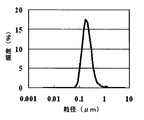
- FIG. 2 is a graph showing a frequency distribution of particle diameters of acicular strontium carbonate particles dispersed in a dispersion prepared in Example 1.
- the surface of the alkaline earth metal carbonate fine powder of the present invention contains a hydrophilic group and a hydrophobic group, and is further treated with a surfactant having a group that forms an anion in water separately from the hydrophilic group. ing.
- a hydrophilic group and a hydrophobic group are preferably bonded, and a hydrophilic group and a group that forms an anion in water are preferably bonded.
- the group that forms an anion is preferably a carboxylic acid group (—CO 2 H), a sulfuric acid group (—OSO 3 H), or a phosphoric acid group (—OPO 3 H 2 ).
- the hydrogen atom of these acid groups may be substituted with an alkali metal such as sodium or potassium, or ammonium.
- the hydrophilic group is preferably an oxyalkylene group having 1 to 4 carbon atoms.
- the hydrophobic group is preferably an alkyl group having 3 to 30 carbon atoms, a phenyl group, or an alkylphenyl group having 7 to 30 carbon atoms.
- the surfactant in which the anion-forming group is a carboxylic acid group is preferably a compound represented by the following formula (I).
- R 1 represents an alkyl group having 3 to 30 carbon atoms, a phenyl group, or an alkylphenyl group having 7 to 30 carbon atoms
- L 1 represents the number of carbon atoms.
- M 1 represents hydrogen, alkali metal or ammonium
- k represents a number in the range of 2 to 10.
- R 1 is preferably an alkyl group or an alkylphenyl group having 10 to 18 carbon atoms.
- L 1 is preferably an ethylene group.
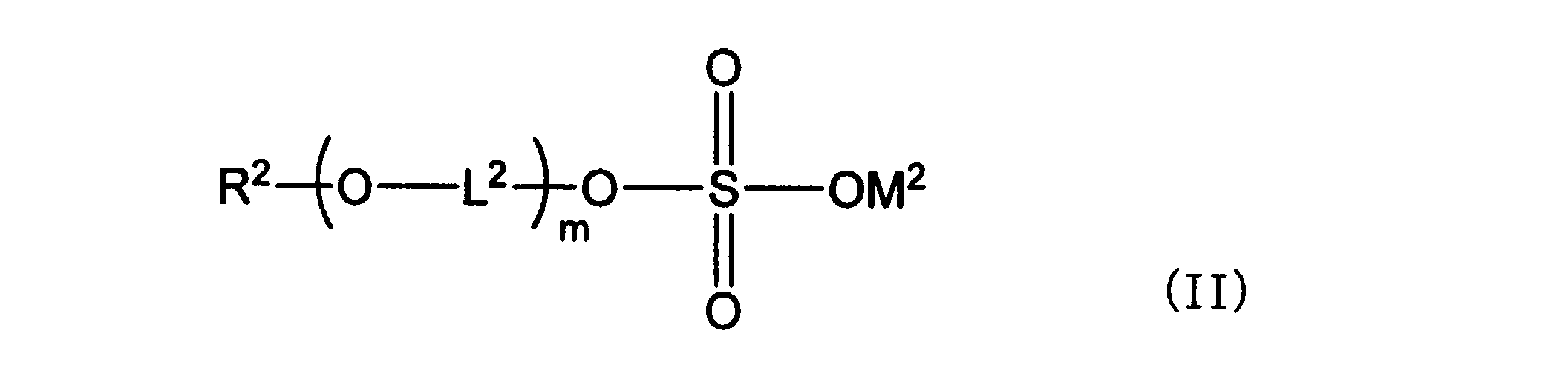
- the surfactant in which the anion-forming group is a sulfate group is preferably a compound represented by the following formula (II).
- R 2 represents an alkyl group having 3 to 30 carbon atoms, a phenyl group or an alkylphenyl group having 7 to 30 carbon atoms, and L 2 represents the number of carbon atoms.
- M 2 represents hydrogen, an alkali metal or ammonium
- m represents a number in the range of 2 to 10.
- R 2 is preferably an alkyl group having 12 to 18 carbon atoms or an alkylphenyl group.
- the surfactant in which the anion-forming group is a phosphate group is preferably a compound represented by the following formula (III).
- R 3 represents an alkyl group having 3 to 30 carbon atoms, a phenyl group, or an alkylphenyl group having 7 to 30 carbon atoms
- L 3 represents the number of carbon atoms.
- M 3 and M 4 each independently represent hydrogen, an alkali metal or ammonium
- n represents a number in the range of 2 to 10.
- R 3 is preferably an alkyl group or alkylphenyl group having 12 to 18 carbon atoms.
- the surfactant and the alkaline earth metal carbonate fine powder are contacted in the aqueous suspension.
- a method of drying the alkaline earth metal carbonate fine powder can be used.
- the surfactant adheres to the surface of the alkaline earth metal carbonate fine powder through the anion formed in the aqueous suspension.
- the surfactant is added to the aqueous suspension in which the alkaline earth metal carbonate fine powder is dispersed.
- any one of a method, a method of adding alkaline earth metal carbonate fine powder to an aqueous solution in which a surfactant is dissolved, and a method of simultaneously adding surfactant and alkaline earth metal carbonate fine powder to water Can be used.
- the amount of the surfactant used is generally in the range of 1 to 30 parts by mass, preferably in the range of 5 to 20 parts by mass with respect to 100 parts by mass of the alkaline earth metal carbonate fine powder.
- a spray drying method can be used as a method of drying the alkaline earth metal carbonate fine powder.
- alkaline earth metal carbonate fine powder examples include magnesium carbonate fine powder, calcium carbonate fine powder, strontium carbonate fine powder and barium carbonate fine powder. Strontium carbonate fine powder is preferred.
- the alkaline earth metal carbonate fine powder used in the present invention is not particularly limited as to the particle shape, and may be granular particles having an average aspect ratio (major axis / minor axis) of less than 2 (particularly 1.5 or less). Further, it may be acicular particles having an average aspect ratio of 2 or more (particularly 2.5 or more).
- the granular particles preferably have an average particle diameter in the range of 10 to 200 nm.
- the acicular particles preferably have an average length of the major axis in the range of 10 to 500 nm, and more preferably in the range of 10 to 200 nm.
- the average aspect ratio of the acicular particles is preferably in the range of 2 to 10, and more preferably in the range of 2.5 to 10.
- the granular particles of strontium carbonate are prepared by, for example, introducing carbon dioxide gas into an aqueous solution or aqueous suspension while stirring the aqueous solution or aqueous suspension of strontium hydroxide to carbonize strontium hydroxide to strontium carbonate. It can be produced by producing particles and then grinding the strontium carbonate particles.
- concentration of the aqueous solution or suspension of strontium hydroxide is generally in the range of 1 to 20% by mass, preferably in the range of 2 to 15% by mass, more preferably in the range of 3 to 8% by mass.
- the amount of carbon dioxide gas introduced is generally in the range of 0.5 to 200 mL / min, preferably in the range of 0.5 to 100 mL / min, with respect to 1 g of strontium hydroxide in the aqueous solution or suspension of strontium hydroxide. More preferably, it is in the range of 1 to 50 mL / min.
- the carboxylic acid having a hydroxyl group include citric acid, tartaric acid, malic acid and gluconic acid.
- the amount of the carboxylic acid having a hydroxyl group is generally in the range of 0.1 to 20 parts by mass, preferably in the range of 1 to 10 parts by mass with respect to 100 parts by mass of strontium hydroxide.
- the needle-like particles of strontium carbonate are, for example, the aqueous solution or aqueous suspension in the presence of the dicarboxylic acid represented by the following formula (IV) while stirring the aqueous solution or aqueous suspension of strontium hydroxide. It can be produced by introducing carbon dioxide gas into strontium hydroxide and carbonating it.
- L is a divalent chain hydrocarbon group having 1 to 4 carbon atoms.
- the chain hydrocarbon group may have a double bond.
- the number of carbon atoms in the chain hydrocarbon group is preferably in the range of 1 to 3, and preferably 1 or 2.
- the chain hydrocarbon group is preferably not bonded to a hydroxyl group.
- all or part of the hydrogen atoms are preferably substituted with an alkyl group having 1 to 6 carbon atoms, particularly a methyl group or an ethyl group.
- These dicarboxylic acids are preferably dissolved in an aqueous solution or suspension of strontium hydroxide in an amount of 1 to 20 parts by mass with respect to 100 parts by mass of strontium hydroxide. It is more preferable that it is dissolved in the range.
- the concentration of the aqueous solution or suspension of strontium hydroxide and the amount of carbon dioxide gas introduced are the same as the production conditions for the granular particles.
- the alkaline earth metal carbonate fine powder of the present invention has high dispersibility in an organic solvent.
- the alkaline earth metal carbonate fine powder of the present invention is dispersed in the organic solvent as primary particles or fine particles close thereto by putting into an organic solvent and performing a normal dispersion treatment such as stirring treatment or ultrasonic treatment. Can do.
- the organic solvent in which the alkaline earth metal carbonate fine powder is dispersed is preferably a polar organic solvent.
- Examples of polar organic solvents in which the alkaline earth metal carbonate fine powder can be suitably dispersed include alcohols (eg, ethanol, 1-propanol, 2-propanol, 1-butanol, ethylene glycol), methylene chloride and Mention may be made of tetrahydrofuran.
- preferred solvents are methylene chloride and tetrahydrofuran.
- Example 1 (1) Preparation of aqueous suspension of strontium carbonate particles 366 g of strontium hydroxide octahydrate was added to 3 L of pure water having a water temperature of 40 ° C. and stirred to obtain an aqueous suspension of strontium hydroxide having a concentration of 5.6% by mass. Prepared. To this aqueous strontium hydroxide suspension, 8.6 g of dimethylmalonic acid (5.1 parts by mass with respect to 100 parts by mass of strontium hydroxide) was added and dissolved by stirring. Next, while maintaining the liquid temperature of the aqueous strontium hydroxide suspension at 40 ° C.
- carbon dioxide gas was supplied to the aqueous suspension at a flow rate of 0.5 L / min (based on 1 g of strontium hydroxide).
- the aqueous suspension was blown at a flow rate of 3.0 mL / min until the pH of the aqueous suspension became 7, so that strontium carbonate particles were generated, and then the stirring was continued for another 30 minutes.
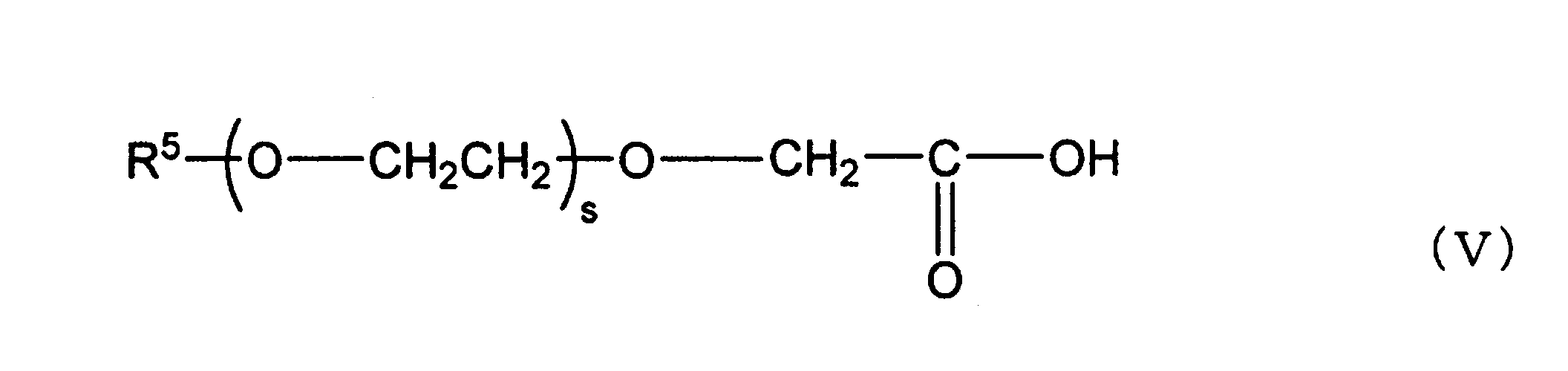
- strontium carbonate particle aqueous suspension produced in (1) above was subjected to the following formula ( V) 20 g of surfactant (10 parts by mass with respect to 100 parts by mass of strontium carbonate) was added, and then a homomixer (Primix Co., Ltd., TK homomixer Mark II) was used. The stirring blade was rotated at a peripheral speed of 7.85 m / sec and mixed with stirring for 1 hour. After the stirring and mixing, the aqueous strontium carbonate suspension was dried using a drum dryer to obtain fine strontium carbonate powder.
- V 20 g of surfactant (10 parts by mass with respect to 100 parts by mass of strontium carbonate) was added, and then a homomixer (Primix Co., Ltd., TK homomixer Mark II) was used. The stirring blade was rotated at a peripheral speed of 7.85 m / sec and mixed with stirring for 1 hour. After the stirring and mixing, the aqueous strontium carbonate suspension was dried using a drum dryer to obtain fine
- R 5 is an alkyl group having 10 to 15 carbon atoms, and s is a number in the range of 2 to 7.
- the obtained strontium carbonate fine powder was observed using a scanning electron microscope (SEM), it was confirmed that the particle shape was needle-like. Further, the aspect ratio and the major axis of 300 acicular strontium carbonate particles were measured by image analysis from an enlarged photograph of SEM, and the average value was obtained. As a result, the average aspect ratio was 2.70, and the average length of the major axis was 110 nm. Further, the BET specific surface area of the obtained strontium carbonate fine powder was 48.7 m 2 / g.
- FIG. 1 shows the frequency distribution of the particle diameter of the acicular strontium carbonate particles dispersed in the dispersion. From the results shown in FIG. 1, it can be seen that the distribution range of the particle diameter is narrow, and the acicular strontium carbonate particles are dispersed in the dispersion as primary particles or fine aggregate particles close thereto.
- Example 2 In the preparation of the aqueous suspension of strontium carbonate particles in Example 1, 8.6 g of methylmaleic acid (5.1 parts by mass with respect to 100 parts by mass of strontium hydroxide) was added instead of dimethylmalonic acid. Except for the above, in the same manner as in Example 1, strontium carbonate fine powder surface-treated with a surfactant having a hydrophilic group, a hydrophobic group, and a carboxylic acid group was produced.
- the obtained fine strontium carbonate powder is a powder composed of needle-like particles having an average aspect ratio of 2.78 by image analysis and an average length of 103 nm, and a BET specific surface area of 57.0 m 2 / g. It was.
- 0.2 g of the obtained fine powder of strontium carbonate was put into 20 mL of methylene chloride, and ultrasonic dispersion treatment was performed for 5 minutes using an ultrasonic homogenizer to prepare a strontium carbonate particle dispersion.
- the average particle diameter of the acicular strontium carbonate particles in the obtained dispersion was 0.3 ⁇ m (300 nm), and the acicular strontium carbonate particles were uniformly dispersed.
- Example 1 The aqueous strontium carbonate particle suspension prepared in (1) of Example 1 was dried using a drum dryer to obtain fine strontium carbonate powder. 0.2 g of the obtained fine powder of strontium carbonate was put into 20 mL of methylene chloride, and ultrasonic dispersion treatment was performed for 5 minutes using an ultrasonic homogenizer to prepare a strontium carbonate particle dispersion. The average particle diameter of the acicular strontium carbonate particles of the obtained dispersion was 1.4 ⁇ m (1400 nm), and the dispersibility of the acicular strontium carbonate particles was lower than that of the dispersion obtained in Example 1. .
Landscapes
- Chemical & Material Sciences (AREA)
- Organic Chemistry (AREA)
- Engineering & Computer Science (AREA)
- Geology (AREA)
- Inorganic Chemistry (AREA)
- Life Sciences & Earth Sciences (AREA)
- Nanotechnology (AREA)
- Polymers & Plastics (AREA)
- Health & Medical Sciences (AREA)
- Medicinal Chemistry (AREA)
- Chemical Kinetics & Catalysis (AREA)
- Physics & Mathematics (AREA)
- Composite Materials (AREA)
- Condensed Matter Physics & Semiconductors (AREA)
- General Physics & Mathematics (AREA)
- Materials Engineering (AREA)
- Crystallography & Structural Chemistry (AREA)
- Compounds Of Alkaline-Earth Elements, Aluminum Or Rare-Earth Metals (AREA)
- Pigments, Carbon Blacks, Or Wood Stains (AREA)
Abstract
Description
特許文献1には、粒子サイズがサブミクロンからナノサイズのアルカリ土類金属炭酸塩微粉末を樹脂フィルムの充填材として用いることによって、透明性をある程度維持したまま引張強度や巻き取り時のブロックキング防止といった取り扱い性が向上するなど高い効果が得られることが記載されている。この文献には、上記の粒子サイズがサブミクロンからナノサイズのアルカリ土類金属炭酸塩微粉末が有機溶媒中で凝集しないようにするための方法として、有機溶媒中に分散させた炭酸塩微粒子の表面をカルボン酸基を有する表面改質剤で湿式処理した後、ノニオン性活性剤などの分散剤で表面処理する方法が記載されている。
従って、本発明の目的は、高分子樹脂中及び有機溶媒中に一次粒子もしくはそれに近い微粒子の状態で容易に分散させることができるアルカリ土類金属炭酸塩微粉末(乾燥粉末)を提供することにある。本発明の目的はまた、容易に製造することができる、アルカリ土類金属炭酸塩微粉末が有機溶媒中に一次粒子もしくはそれに近い微粒子の状態で分散している分散液を提供することにもある。
(1)上記界面活性剤のアニオンを形成する基が、カルボン酸基、硫酸基又はリン酸基である。
(2)上記界面活性剤の親水性基が、炭素原子数が1~4の範囲にあるオキシアルキレン基である。
(3)上記界面活性剤の疎水性基が、炭素原子数が3~30の範囲にあるアルキル基、フェニル基又は炭素原子数が7~30の範囲にあるアルキルフェニル基である。
(4)アルカリ土類金属炭酸塩微粉末が、平均粒子径が10~200nmの範囲にある粒子の粉末である。
(5)アルカリ土類金属炭酸塩微粉末が、長径の平均長さが10~500nmの範囲にあり、平均アスペクト比が2~10の範囲にある針状粒子の粉末である。
(6)アルカリ土類金属炭酸塩微粉末が炭酸ストロンチウム微粉末である。


(1)炭酸ストロンチウム粒子水性懸濁液の調製
水温40℃の純水3Lに水酸化ストロンチウム八水和物366gを投入し、撹拌して濃度5.6質量%の水酸化ストロンチウム水性懸濁液を調製した。この水酸化ストロンチウム水性懸濁液にジメチルマロン酸8.6g(水酸化ストロンチウム100質量部に対して5.1質量部)を加えて撹拌して溶解させた。次いで、水酸化ストロンチウム水性懸濁液の液温を40℃に維持しつつ、撹拌を続けながら、該水性懸濁液に二酸化炭素ガスを0.5L/分の流量(水酸化ストロンチウム1gに対して3.0mL/分の流量)にて、該水性懸濁液のpHが7になるまで吹き込んで、炭酸ストロンチウム粒子を生成させた後、さらに30分間撹拌を続けて、炭酸ストロンチウム粒子水性懸濁液を得た。
上記(1)で製造した炭酸ストロンチウム粒子水性懸濁液に、下記の式(V)で表される界面活性剤を20g(炭酸ストロンチウム100質量部に対して10質量部)を添加した後、ホモミキサー(プライミクス(株)製、T.K.ホモミキサーMarkII)を用いて、撹拌羽根を7.85m/秒の周速で回転させて1時間撹拌混合した。撹拌混合終了後、炭酸ストロンチウム水性懸濁液を、ドラムドライヤーを用いて乾燥して炭酸ストロンチウム微粉末を得た。
上記(2)で得られた、界面活性剤で表面処理された炭酸ストロンチウム微粉末0.2gを塩化メチレン20mLに投入して、超音波ホモジナイザーを用いて5分間超音波分散処理を行なって炭酸ストロンチウム粒子分散液を調製した。次いで、調製した分散液中の炭酸ストロンチウム粒子の平均粒子径を動的光散乱法粒度分布測定装置(ナノトラックUPA、日機装(株)製)により測定した。その結果、分散液に分散している針状炭酸ストロンチウム粒子の平均粒子径は0.170μm(170nm)であり、SEMの拡大写真から求めた長径の平均長さ(110nm)とほぼ同等であった。また、図1に分散液に分散している針状炭酸ストロンチウム粒子の粒子径の頻度分布を示す。図1の結果から粒子径の分布範囲は狭く、針状炭酸ストロンチウム粒子が一次粒子もしくはそれに近い微細な凝集粒子として分散液中に分散していることが分かる。
実施例1の(1)炭酸ストロンチウム粒子水性懸濁液の調製において、ジメチルマロン酸の代わりにメチルマレイン酸を8.6g(水酸化ストロンチウム100質量部に対して5.1質量部)加えたこと以外は、実施例1と同様にして、親水性基と疎水性基とカルボン酸基を有する界面活性剤で表面処理された炭酸ストロンチウム微粉末を製造した。得られた炭酸ストロンチウム微粉末は、画像解析による平均アスペクト比が2.78で、長径の平均長さが103nmの針状粒子からなる粉末であり、BET比表面積は57.0m2/gであった。得られた炭酸ストロンチウム微粉末0.2gを塩化メチレン20mLに投入して、超音波ホモジナイザーを用いて超音波分散処理を5分間行なって、炭酸ストロンチウム粒子分散液を調製した。得られた分散液の針状炭酸ストロンチウム粒子の平均粒子径は0.3μm(300nm)であり、針状炭酸ストロンチウム粒子は均一に分散していた。
実施例1の(1)で調製した炭酸ストロンチウム粒子水性懸濁液をドラムドライヤーを用いて乾燥して炭酸ストロンチウム微粉末を得た。得られた炭酸ストロンチウム微粉末0.2gを塩化メチレン20mLに投入し、超音波ホモジナイザーを用いて超音波分散処理を5分間行なって、炭酸ストロンチウム粒子分散液を調製した。得られた分散液の針状炭酸ストロンチウム粒子の平均粒子径は1.4μm(1400nm)であり、実施例1で得られた分散液と比較して、針状炭酸ストロンチウム粒子の分散性は低かった。
Claims (10)
- 親水性基と疎水性基とを含み、更に水中でアニオンを形成する基を有する界面活性剤で表面が処理されているアルカリ土類金属炭酸塩微粉末。
- 上記界面活性剤のアニオンを形成する基が、カルボン酸基、硫酸基又はリン酸基である請求項1に記載のアルカリ土類金属炭酸塩微粉末。
- 上記界面活性剤の親水性基が、炭素原子数が1~4の範囲にあるオキシアルキレン基である請求項1に記載のアルカリ土類金属炭酸塩微粉末。
- 上記界面活性剤の疎水性基が、炭素原子数が3~30の範囲にあるアルキル基、フェニル基又は炭素原子数が7~30の範囲にあるアルキルフェニル基である請求項1に記載のアルカリ土類金属炭酸塩微粉末。
- アルカリ土類金属炭酸塩微粉末が、平均粒子径が10~200nmの範囲にある粒子の粉末である請求項1に記載のアルカリ土類金属炭酸塩微粉末。
- アルカリ土類金属炭酸塩微粉末が、長径の平均長さが10~500nmの範囲にあり、平均アスペクト比が2~10の範囲にある針状粒子の粉末である請求項1に記載のアルカリ土類金属炭酸塩微粉末。
- アルカリ土類金属炭酸塩微粉末が炭酸ストロンチウム微粉末である請求項1に記載のアルカリ土類金属炭酸塩微粉末。
- 有機溶媒中に、請求項1に記載のアルカリ土類金属炭酸塩微粉末を分散させることによって得られたアルカリ土類金属炭酸塩粉末分散液。
- 平均粒子径が10~200nmの範囲にあるアルカリ土類金属炭酸塩微粉末を、その水性懸濁液中で、親水性基と疎水性基とを含み、更に水中でアニオンを形成する基を有する界面活性剤と接触させた後、乾燥することを特徴とする、有機溶媒中での分散性が向上したアルカリ土類金属炭酸塩微粉末の製造方法。
- 長径の平均長さが10~500nmの範囲にあり、平均アスペクト比が2~10の範囲にある針状アルカリ土類金属炭酸塩微粉末を、その水性懸濁液中で、親水性基と疎水性基とを含み、更に水中でアニオンを形成する基を有する界面活性剤と接触させた後、乾燥することを特徴とする、有機溶媒中での分散性が向上したアルカリ土類金属炭酸塩微粉末の製造方法。
Priority Applications (2)
| Application Number | Priority Date | Filing Date | Title |
|---|---|---|---|
| JP2012557986A JP6260759B2 (ja) | 2011-02-15 | 2012-02-15 | アルカリ土類金属炭酸塩微粉末 |
| US13/985,328 US9102810B2 (en) | 2011-02-15 | 2012-02-15 | Alkaline earth metal carbonate micropowder |
Applications Claiming Priority (2)
| Application Number | Priority Date | Filing Date | Title |
|---|---|---|---|
| JP2011029946 | 2011-02-15 | ||
| JP2011-029946 | 2011-02-15 |
Publications (1)
| Publication Number | Publication Date |
|---|---|
| WO2012111692A1 true WO2012111692A1 (ja) | 2012-08-23 |
Family
ID=46672607
Family Applications (1)
| Application Number | Title | Priority Date | Filing Date |
|---|---|---|---|
| PCT/JP2012/053480 Ceased WO2012111692A1 (ja) | 2011-02-15 | 2012-02-15 | アルカリ土類金属炭酸塩微粉末 |
Country Status (4)
| Country | Link |
|---|---|
| US (1) | US9102810B2 (ja) |
| JP (1) | JP6260759B2 (ja) |
| TW (1) | TWI542621B (ja) |
| WO (1) | WO2012111692A1 (ja) |
Cited By (9)
| Publication number | Priority date | Publication date | Assignee | Title |
|---|---|---|---|---|
| JP2014080360A (ja) * | 2012-09-28 | 2014-05-08 | Ube Material Industries Ltd | 針状炭酸ストロンチウム微粉末 |
| WO2015060438A1 (ja) | 2013-10-25 | 2015-04-30 | 宇部マテリアルズ株式会社 | 針状炭酸ストロンチウム微粉末及びその製造方法 |
| JP2015083522A (ja) * | 2013-10-25 | 2015-04-30 | 宇部マテリアルズ株式会社 | 針状炭酸ストロンチウム微粉末 |
| WO2015141817A1 (ja) * | 2014-03-20 | 2015-09-24 | 宇部マテリアルズ株式会社 | 針状炭酸ストロンチウム微粒子及びその分散液 |
| JP2015193488A (ja) * | 2014-03-31 | 2015-11-05 | 宇部マテリアルズ株式会社 | 炭酸ストロンチウム微粉末及びその製造方法 |
| WO2016047757A1 (ja) * | 2014-09-26 | 2016-03-31 | 宇部興産株式会社 | 高分散性アルカリ土類金属化合物微粉末、光学フィルム、画像表示装置及び高分散性アルカリ土類金属化合物微粉末の製造方法並びに微粉末分散性評価方法及び微粉末分散性評価装置 |
| WO2017014219A1 (ja) * | 2015-07-21 | 2017-01-26 | 宇部興産株式会社 | 位相差調整組成物並びにそれを用いた接着層、位相差フィルム、光学積層体及び画像表示装置 |
| WO2017029995A1 (ja) * | 2015-08-20 | 2017-02-23 | 宇部興産株式会社 | 光学フィルム及び画像表示装置 |
| WO2020032238A1 (ja) * | 2018-08-09 | 2020-02-13 | 宇部興産株式会社 | アルカリ土類金属炭酸塩微粉末とその製造方法、及びアルカリ土類金属炭酸塩微粉末含有ポリマー組成物とその製造方法 |
Citations (3)
| Publication number | Priority date | Publication date | Assignee | Title |
|---|---|---|---|---|
| JP2002220547A (ja) * | 2001-01-29 | 2002-08-09 | Maruo Calcium Co Ltd | 表面処理連鎖状炭酸カルシウム及びこれを配合してなる樹脂組成物 |
| JP2008015118A (ja) * | 2006-07-04 | 2008-01-24 | Konica Minolta Opto Inc | 光学フィルム製造方法、それを用いて製造されたセルロースエステルフィルム、並びに、そのセルロースエステルフィルムを用いた偏光板及び液晶表示装置 |
| JP2008222496A (ja) * | 2007-03-13 | 2008-09-25 | Ube Material Industries Ltd | 高分散性炭酸ストロンチウム微粉末 |
Family Cites Families (10)
| Publication number | Priority date | Publication date | Assignee | Title |
|---|---|---|---|---|
| JPS56120742A (en) * | 1980-02-29 | 1981-09-22 | Idemitsu Petrochem Co Ltd | Polypropylene composition |
| JPH1160950A (ja) * | 1997-08-21 | 1999-03-05 | Maruo Calcium Co Ltd | 硬化型組成物及びそれからなるシーリング材 |
| TWI283235B (en) * | 2001-11-16 | 2007-07-01 | Maruo Calcium | Surface-treated calcium carbonate, production method thereof, and resin composition containing the calcium carbonate |
| DE10209698A1 (de) * | 2002-03-06 | 2003-09-18 | Sachtleben Chemie Gmbh | Verfahren zur Herstellung von gecoateten, feinteiligen, anorganischer Festkörpern und deren Verwendung |
| JP2006518777A (ja) * | 2003-01-13 | 2006-08-17 | アイメリーズ ピグメンツ, インコーポレーテッド | インクジェットコーティングインク受容層のためのカチオン性炭酸塩顔料 |
| JP2008101051A (ja) * | 2006-10-17 | 2008-05-01 | Konica Minolta Holdings Inc | 炭酸塩微粒子の表面処理方法、並びに該微粒子を配合してなる樹脂組成物及びフィルム |
| JP2008141967A (ja) * | 2006-12-06 | 2008-06-26 | Kao Corp | 麦類の増収方法 |
| JP5105470B2 (ja) * | 2007-02-22 | 2012-12-26 | 協和化学工業株式会社 | 懸濁安定性を有する懸濁液組成物 |
| JP2010077337A (ja) * | 2008-09-29 | 2010-04-08 | Pilot Ink Co Ltd | ボールペン用水性インキ組成物及びそれを収容したボールペン |
| CN102712788B (zh) * | 2010-01-29 | 2014-05-28 | 丸尾钙株式会社 | 树脂用表面处理碳酸钙填充剂及含有该填充剂的树脂组合物 |
-
2012
- 2012-02-15 JP JP2012557986A patent/JP6260759B2/ja active Active
- 2012-02-15 TW TW101105188A patent/TWI542621B/zh not_active IP Right Cessation
- 2012-02-15 US US13/985,328 patent/US9102810B2/en not_active Expired - Fee Related
- 2012-02-15 WO PCT/JP2012/053480 patent/WO2012111692A1/ja not_active Ceased
Patent Citations (3)
| Publication number | Priority date | Publication date | Assignee | Title |
|---|---|---|---|---|
| JP2002220547A (ja) * | 2001-01-29 | 2002-08-09 | Maruo Calcium Co Ltd | 表面処理連鎖状炭酸カルシウム及びこれを配合してなる樹脂組成物 |
| JP2008015118A (ja) * | 2006-07-04 | 2008-01-24 | Konica Minolta Opto Inc | 光学フィルム製造方法、それを用いて製造されたセルロースエステルフィルム、並びに、そのセルロースエステルフィルムを用いた偏光板及び液晶表示装置 |
| JP2008222496A (ja) * | 2007-03-13 | 2008-09-25 | Ube Material Industries Ltd | 高分散性炭酸ストロンチウム微粉末 |
Cited By (19)
| Publication number | Priority date | Publication date | Assignee | Title |
|---|---|---|---|---|
| US9067799B2 (en) | 2012-09-28 | 2015-06-30 | Ube Material Industries, Ltd. | Acicular strontium carbonate fine powder treated with a combination of compounds containing a polyoxyalkylene group |
| JP2014080360A (ja) * | 2012-09-28 | 2014-05-08 | Ube Material Industries Ltd | 針状炭酸ストロンチウム微粉末 |
| KR20160075563A (ko) | 2013-10-25 | 2016-06-29 | 우베 마테리알즈 가부시키가이샤 | 침상 탄산스트론튬 미분말 및 그 제조 방법 |
| WO2015060438A1 (ja) | 2013-10-25 | 2015-04-30 | 宇部マテリアルズ株式会社 | 針状炭酸ストロンチウム微粉末及びその製造方法 |
| JP2015083522A (ja) * | 2013-10-25 | 2015-04-30 | 宇部マテリアルズ株式会社 | 針状炭酸ストロンチウム微粉末 |
| KR102251155B1 (ko) | 2013-10-25 | 2021-05-11 | 우베 고산 가부시키가이샤 | 침상 탄산스트론튬 미분말 및 그 제조 방법 |
| EP3061728A4 (en) * | 2013-10-25 | 2017-06-21 | Ube Material Industries, Ltd. | Needle-like strontium carbonate fine powder and method for producing same |
| WO2015141817A1 (ja) * | 2014-03-20 | 2015-09-24 | 宇部マテリアルズ株式会社 | 針状炭酸ストロンチウム微粒子及びその分散液 |
| KR20160138991A (ko) | 2014-03-20 | 2016-12-06 | 우베 마테리알즈 가부시키가이샤 | 침상 탄산스트론튬 미립자 및 그 분산액 |
| JPWO2015141817A1 (ja) * | 2014-03-20 | 2017-04-13 | 宇部マテリアルズ株式会社 | 針状炭酸ストロンチウム微粒子及びその分散液 |
| JP2015193488A (ja) * | 2014-03-31 | 2015-11-05 | 宇部マテリアルズ株式会社 | 炭酸ストロンチウム微粉末及びその製造方法 |
| WO2016047757A1 (ja) * | 2014-09-26 | 2016-03-31 | 宇部興産株式会社 | 高分散性アルカリ土類金属化合物微粉末、光学フィルム、画像表示装置及び高分散性アルカリ土類金属化合物微粉末の製造方法並びに微粉末分散性評価方法及び微粉末分散性評価装置 |
| JPWO2016047757A1 (ja) * | 2014-09-26 | 2017-07-13 | 宇部興産株式会社 | 高分散性アルカリ土類金属化合物微粉末、光学フィルム、画像表示装置及び高分散性アルカリ土類金属化合物微粉末の製造方法並びに微粉末分散性評価方法及び微粉末分散性評価装置 |
| WO2017014219A1 (ja) * | 2015-07-21 | 2017-01-26 | 宇部興産株式会社 | 位相差調整組成物並びにそれを用いた接着層、位相差フィルム、光学積層体及び画像表示装置 |
| JPWO2017014219A1 (ja) * | 2015-07-21 | 2018-06-14 | 宇部興産株式会社 | 位相差調整組成物並びにそれを用いた接着層、位相差フィルム、光学積層体及び画像表示装置 |
| WO2017029995A1 (ja) * | 2015-08-20 | 2017-02-23 | 宇部興産株式会社 | 光学フィルム及び画像表示装置 |
| WO2020032238A1 (ja) * | 2018-08-09 | 2020-02-13 | 宇部興産株式会社 | アルカリ土類金属炭酸塩微粉末とその製造方法、及びアルカリ土類金属炭酸塩微粉末含有ポリマー組成物とその製造方法 |
| JPWO2020032238A1 (ja) * | 2018-08-09 | 2021-08-12 | 宇部興産株式会社 | アルカリ土類金属炭酸塩微粉末とその製造方法、及びアルカリ土類金属炭酸塩微粉末含有ポリマー組成物とその製造方法 |
| JP7439757B2 (ja) | 2018-08-09 | 2024-02-28 | Ube株式会社 | アルカリ土類金属炭酸塩微粉末とその製造方法、及びアルカリ土類金属炭酸塩微粉末含有ポリマー組成物とその製造方法 |
Also Published As
| Publication number | Publication date |
|---|---|
| US9102810B2 (en) | 2015-08-11 |
| TW201237083A (en) | 2012-09-16 |
| JPWO2012111692A1 (ja) | 2014-07-07 |
| JP6260759B2 (ja) | 2018-01-17 |
| US20140053757A1 (en) | 2014-02-27 |
| TWI542621B (zh) | 2016-07-21 |
Similar Documents
| Publication | Publication Date | Title |
|---|---|---|
| JP6260759B2 (ja) | アルカリ土類金属炭酸塩微粉末 | |
| JP6834990B2 (ja) | 被覆アルカリ土類金属化合物微粒子、有機溶媒分散液、樹脂組成物及び画像表示装置 | |
| US9771268B2 (en) | Nano-diamond dispersion solution and method for preparing same | |
| JP6555483B2 (ja) | 針状炭酸ストロンチウム微粒子及びその分散液 | |
| CN105452164A (zh) | 制备负ζ纳米金刚石分散体的方法和负ζ纳米金刚石分散体 | |
| JP6158020B2 (ja) | 針状炭酸ストロンチウム微粉末 | |
| CN101679062A (zh) | 高分散性碱土金属碳酸盐细粉末 | |
| JP2010013312A (ja) | カーボンナノチューブ分散剤、カーボンナノチューブ分散液およびその製造方法 | |
| TWI552868B (zh) | Strontium carbonate fine powder and its manufacturing method | |
| JP5035545B2 (ja) | アルカリ性ジルコニアゾルの製造方法 | |
| TWI652225B (zh) | Acicular strontium carbonate micro powder and manufacturing method thereof | |
| JP5201855B2 (ja) | 高分散性炭酸ストロンチウム微粉末 | |
| JP5798574B2 (ja) | 針状炭酸ストロンチウム粒子の製造方法 | |
| JP2023105988A (ja) | 粉体の製造方法および粉体 | |
| JP6244164B2 (ja) | 針状炭酸ストロンチウム微粉末 | |
| JP2015205802A (ja) | 正方晶酸化ジルコニウムナノ粒子の製造方法 | |
| BR112020013222B1 (pt) | Carbonato de cálcio modificado na superfície e seu processo de produção | |
| JP2001329129A (ja) | 塩化ビニルペーストゾル組成物 |
Legal Events
| Date | Code | Title | Description |
|---|---|---|---|
| 121 | Ep: the epo has been informed by wipo that ep was designated in this application |
Ref document number: 12747449 Country of ref document: EP Kind code of ref document: A1 |
|
| ENP | Entry into the national phase |
Ref document number: 2012557986 Country of ref document: JP Kind code of ref document: A |
|
| NENP | Non-entry into the national phase |
Ref country code: DE |
|
| WWE | Wipo information: entry into national phase |
Ref document number: 13985328 Country of ref document: US |
|
| 122 | Ep: pct application non-entry in european phase |
Ref document number: 12747449 Country of ref document: EP Kind code of ref document: A1 |