WO2012013554A1 - Zellen und verfahren zur herstellung von rhamnolipiden - Google Patents

Zellen und verfahren zur herstellung von rhamnolipiden Download PDF

Info

Publication number
WO2012013554A1
WO2012013554A1 PCT/EP2011/062441 EP2011062441W WO2012013554A1 WO 2012013554 A1 WO2012013554 A1 WO 2012013554A1 EP 2011062441 W EP2011062441 W EP 2011062441W WO 2012013554 A1 WO2012013554 A1 WO 2012013554A1
Authority
WO
WIPO (PCT)
Prior art keywords
sequence
seq
enzyme
putida
pbbr1 mcs
Prior art date
Legal status (The legal status is an assumption and is not a legal conclusion. Google has not performed a legal analysis and makes no representation as to the accuracy of the status listed.)
Ceased
Application number
PCT/EP2011/062441
Other languages
English (en)
French (fr)
Inventor
Steffen Schaffer
Mirja Wessel
Anja Thiessenhusen
Nadine Stein
Current Assignee (The listed assignees may be inaccurate. Google has not performed a legal analysis and makes no representation or warranty as to the accuracy of the list.)
Evonik Goldschmidt GmbH
Original Assignee
Evonik Goldschmidt GmbH
Priority date (The priority date is an assumption and is not a legal conclusion. Google has not performed a legal analysis and makes no representation as to the accuracy of the date listed.)
Filing date
Publication date
Priority to BR122020023808-9A priority Critical patent/BR122020023808B1/pt
Priority to JP2013521067A priority patent/JP6066908B2/ja
Priority to CN201180037007.5A priority patent/CN103038357B/zh
Priority to EP18184367.3A priority patent/EP3418388B1/de
Priority to BR112013002124-1A priority patent/BR112013002124B1/pt
Priority to RU2013108700A priority patent/RU2619877C2/ru
Priority to CN201810413325.0A priority patent/CN108587995B/zh
Priority to US13/812,625 priority patent/US9005928B2/en
Application filed by Evonik Goldschmidt GmbH filed Critical Evonik Goldschmidt GmbH
Priority to EP11734101.6A priority patent/EP2598646B1/de
Priority to ES11734101T priority patent/ES2713479T3/es
Priority to CA2806430A priority patent/CA2806430C/en
Publication of WO2012013554A1 publication Critical patent/WO2012013554A1/de
Anticipated expiration legal-status Critical
Priority to US14/642,879 priority patent/US9580720B2/en
Ceased legal-status Critical Current

Links

Classifications

    • CCHEMISTRY; METALLURGY
    • C12BIOCHEMISTRY; BEER; SPIRITS; WINE; VINEGAR; MICROBIOLOGY; ENZYMOLOGY; MUTATION OR GENETIC ENGINEERING
    • C12PFERMENTATION OR ENZYME-USING PROCESSES TO SYNTHESISE A DESIRED CHEMICAL COMPOUND OR COMPOSITION OR TO SEPARATE OPTICAL ISOMERS FROM A RACEMIC MIXTURE
    • C12P19/00Preparation of compounds containing saccharide radicals
    • C12P19/44Preparation of O-glycosides, e.g. glucosides
    • CCHEMISTRY; METALLURGY
    • C12BIOCHEMISTRY; BEER; SPIRITS; WINE; VINEGAR; MICROBIOLOGY; ENZYMOLOGY; MUTATION OR GENETIC ENGINEERING
    • C12NMICROORGANISMS OR ENZYMES; COMPOSITIONS THEREOF; PROPAGATING, PRESERVING, OR MAINTAINING MICROORGANISMS; MUTATION OR GENETIC ENGINEERING; CULTURE MEDIA
    • C12N15/00Mutation or genetic engineering; DNA or RNA concerning genetic engineering, vectors, e.g. plasmids, or their isolation, preparation or purification; Use of hosts therefor
    • C12N15/09Recombinant DNA-technology
    • C12N15/63Introduction of foreign genetic material using vectors; Vectors; Use of hosts therefor; Regulation of expression
    • C12N15/74Vectors or expression systems specially adapted for prokaryotic hosts other than E. coli, e.g. Lactobacillus, Micromonospora
    • C12N15/78Vectors or expression systems specially adapted for prokaryotic hosts other than E. coli, e.g. Lactobacillus, Micromonospora for Pseudomonas
    • AHUMAN NECESSITIES
    • A01AGRICULTURE; FORESTRY; ANIMAL HUSBANDRY; HUNTING; TRAPPING; FISHING
    • A01NPRESERVATION OF BODIES OF HUMANS OR ANIMALS OR PLANTS OR PARTS THEREOF; BIOCIDES, e.g. AS DISINFECTANTS, AS PESTICIDES OR AS HERBICIDES; PEST REPELLANTS OR ATTRACTANTS; PLANT GROWTH REGULATORS
    • A01N43/00Biocides, pest repellants or attractants, or plant growth regulators containing heterocyclic compounds
    • A01N43/02Biocides, pest repellants or attractants, or plant growth regulators containing heterocyclic compounds having rings with one or more oxygen or sulfur atoms as the only ring hetero atoms
    • A01N43/04Biocides, pest repellants or attractants, or plant growth regulators containing heterocyclic compounds having rings with one or more oxygen or sulfur atoms as the only ring hetero atoms with one hetero atom
    • A01N43/14Biocides, pest repellants or attractants, or plant growth regulators containing heterocyclic compounds having rings with one or more oxygen or sulfur atoms as the only ring hetero atoms with one hetero atom six-membered rings
    • A01N43/16Biocides, pest repellants or attractants, or plant growth regulators containing heterocyclic compounds having rings with one or more oxygen or sulfur atoms as the only ring hetero atoms with one hetero atom six-membered rings with oxygen as the ring hetero atom
    • AHUMAN NECESSITIES
    • A61MEDICAL OR VETERINARY SCIENCE; HYGIENE
    • A61KPREPARATIONS FOR MEDICAL, DENTAL OR TOILETRY PURPOSES
    • A61K8/00Cosmetics or similar toiletry preparations
    • A61K8/18Cosmetics or similar toiletry preparations characterised by the composition
    • A61K8/30Cosmetics or similar toiletry preparations characterised by the composition containing organic compounds
    • A61K8/60Sugars; Derivatives thereof
    • AHUMAN NECESSITIES
    • A61MEDICAL OR VETERINARY SCIENCE; HYGIENE
    • A61PSPECIFIC THERAPEUTIC ACTIVITY OF CHEMICAL COMPOUNDS OR MEDICINAL PREPARATIONS
    • A61P17/00Drugs for dermatological disorders
    • AHUMAN NECESSITIES
    • A61MEDICAL OR VETERINARY SCIENCE; HYGIENE
    • A61QSPECIFIC USE OF COSMETICS OR SIMILAR TOILETRY PREPARATIONS
    • A61Q19/00Preparations for care of the skin
    • CCHEMISTRY; METALLURGY
    • C12BIOCHEMISTRY; BEER; SPIRITS; WINE; VINEGAR; MICROBIOLOGY; ENZYMOLOGY; MUTATION OR GENETIC ENGINEERING
    • C12NMICROORGANISMS OR ENZYMES; COMPOSITIONS THEREOF; PROPAGATING, PRESERVING, OR MAINTAINING MICROORGANISMS; MUTATION OR GENETIC ENGINEERING; CULTURE MEDIA
    • C12N15/00Mutation or genetic engineering; DNA or RNA concerning genetic engineering, vectors, e.g. plasmids, or their isolation, preparation or purification; Use of hosts therefor
    • C12N15/09Recombinant DNA-technology
    • C12N15/11DNA or RNA fragments; Modified forms thereof; Non-coding nucleic acids having a biological activity
    • C12N15/52Genes encoding for enzymes or proenzymes
    • CCHEMISTRY; METALLURGY
    • C12BIOCHEMISTRY; BEER; SPIRITS; WINE; VINEGAR; MICROBIOLOGY; ENZYMOLOGY; MUTATION OR GENETIC ENGINEERING
    • C12NMICROORGANISMS OR ENZYMES; COMPOSITIONS THEREOF; PROPAGATING, PRESERVING, OR MAINTAINING MICROORGANISMS; MUTATION OR GENETIC ENGINEERING; CULTURE MEDIA
    • C12N15/00Mutation or genetic engineering; DNA or RNA concerning genetic engineering, vectors, e.g. plasmids, or their isolation, preparation or purification; Use of hosts therefor
    • C12N15/09Recombinant DNA-technology
    • C12N15/63Introduction of foreign genetic material using vectors; Vectors; Use of hosts therefor; Regulation of expression
    • C12N15/70Vectors or expression systems specially adapted for E. coli
    • CCHEMISTRY; METALLURGY
    • C12BIOCHEMISTRY; BEER; SPIRITS; WINE; VINEGAR; MICROBIOLOGY; ENZYMOLOGY; MUTATION OR GENETIC ENGINEERING
    • C12NMICROORGANISMS OR ENZYMES; COMPOSITIONS THEREOF; PROPAGATING, PRESERVING, OR MAINTAINING MICROORGANISMS; MUTATION OR GENETIC ENGINEERING; CULTURE MEDIA
    • C12N15/00Mutation or genetic engineering; DNA or RNA concerning genetic engineering, vectors, e.g. plasmids, or their isolation, preparation or purification; Use of hosts therefor
    • C12N15/09Recombinant DNA-technology
    • C12N15/63Introduction of foreign genetic material using vectors; Vectors; Use of hosts therefor; Regulation of expression
    • C12N15/74Vectors or expression systems specially adapted for prokaryotic hosts other than E. coli, e.g. Lactobacillus, Micromonospora
    • C12N15/77Vectors or expression systems specially adapted for prokaryotic hosts other than E. coli, e.g. Lactobacillus, Micromonospora for Corynebacterium; for Brevibacterium
    • CCHEMISTRY; METALLURGY
    • C12BIOCHEMISTRY; BEER; SPIRITS; WINE; VINEGAR; MICROBIOLOGY; ENZYMOLOGY; MUTATION OR GENETIC ENGINEERING
    • C12NMICROORGANISMS OR ENZYMES; COMPOSITIONS THEREOF; PROPAGATING, PRESERVING, OR MAINTAINING MICROORGANISMS; MUTATION OR GENETIC ENGINEERING; CULTURE MEDIA
    • C12N9/00Enzymes; Proenzymes; Compositions thereof; Processes for preparing, activating, inhibiting, separating or purifying enzymes
    • C12N9/10Transferases (2.)
    • C12N9/1048Glycosyltransferases (2.4)
    • C12N9/1051Hexosyltransferases (2.4.1)
    • CCHEMISTRY; METALLURGY
    • C12BIOCHEMISTRY; BEER; SPIRITS; WINE; VINEGAR; MICROBIOLOGY; ENZYMOLOGY; MUTATION OR GENETIC ENGINEERING
    • C12NMICROORGANISMS OR ENZYMES; COMPOSITIONS THEREOF; PROPAGATING, PRESERVING, OR MAINTAINING MICROORGANISMS; MUTATION OR GENETIC ENGINEERING; CULTURE MEDIA
    • C12N9/00Enzymes; Proenzymes; Compositions thereof; Processes for preparing, activating, inhibiting, separating or purifying enzymes
    • C12N9/14Hydrolases (3)
    • CCHEMISTRY; METALLURGY
    • C12BIOCHEMISTRY; BEER; SPIRITS; WINE; VINEGAR; MICROBIOLOGY; ENZYMOLOGY; MUTATION OR GENETIC ENGINEERING
    • C12YENZYMES
    • C12Y306/00Hydrolases acting on acid anhydrides (3.6)
    • C12Y306/04Hydrolases acting on acid anhydrides (3.6) acting on acid anhydrides; involved in cellular and subcellular movement (3.6.4)
    • C12Y306/04013RNA helicase (3.6.4.13)
    • YGENERAL TAGGING OF NEW TECHNOLOGICAL DEVELOPMENTS; GENERAL TAGGING OF CROSS-SECTIONAL TECHNOLOGIES SPANNING OVER SEVERAL SECTIONS OF THE IPC; TECHNICAL SUBJECTS COVERED BY FORMER USPC CROSS-REFERENCE ART COLLECTIONS [XRACs] AND DIGESTS
    • Y02TECHNOLOGIES OR APPLICATIONS FOR MITIGATION OR ADAPTATION AGAINST CLIMATE CHANGE
    • Y02PCLIMATE CHANGE MITIGATION TECHNOLOGIES IN THE PRODUCTION OR PROCESSING OF GOODS
    • Y02P20/00Technologies relating to chemical industry
    • Y02P20/50Improvements relating to the production of bulk chemicals
    • Y02P20/52Improvements relating to the production of bulk chemicals using catalysts, e.g. selective catalysts

Definitions

  • the invention relates to cells and nucleic acids and their use for the production of rhamnolipids as well as processes for the preparation of rhamnolipids.
  • Rhamnolipids consist of one (Monorhamnosyllipide) or two rhamnose residues
  • Vegetable oils are, however, compared to other carbon sources such as glucose, sucrose or polysaccharides such as e.g. Starch, cellulose and
  • Hemicellulose, glycerine, CO, C0 2 or CH 4 comparatively expensive raw materials.
  • rhamnolipids are characterized by their presence in
  • Fermentation tend to strong foaming. This is especially the case when lipophilic substrates are used. This problem is when using water-soluble substrates such as glucose, sucrose, polysaccharides (starch, cellulose, hemicellulose) or glycerol significantly reduced.
  • water-soluble substrates such as glucose, sucrose, polysaccharides (starch, cellulose, hemicellulose) or glycerol significantly reduced.
  • Rhamnolipids are to a large extent as surfactants in household, cleaning, cosmetic, food processing, pharmaceutical, plant protection and other
  • rhamnolipids have already been produced in GRAS organisms (generally regarded as save) based on favorable carbon sources, such as glucose or glycerol, these are exclusively monorhamnosyl lipids (Ochsner et al., Appl., Environ., Microbiol., 1995. 61 (9): 3503-3506).
  • This modulation can be carried out, for example, by a balanced provision of the individual enzyme activities, which reduces the accumulation of monorhamnosyl lipids.
  • this modulation can also be carried out, for example, by the use of enzymes having particular properties, for example with regard to substrate specificity and thus, for example, the chain length of the hydroxyfatty acids incorporated in rhamnolipids.
  • the present invention therefore an object of the invention to provide a way to produce rhamnolipids with safe production hosts from readily available carbon sources.
  • the present invention therefore relates to cells which are capable of forming rhamnolipids and at least one increased activity of one of their wild type
  • Gene product of homologues of the gene products rhIA, rhIB and rhIC exhibit.
  • Another object of the invention is a process for the preparation of rhamnolipids using the aforementioned cells as a biocatalyst and simple carbon sources.
  • An advantage of the present invention is that organisms can be used which are non-pathogenic and easy to cultivate.
  • Another advantage is that the use of oils as sole or co-substrate is not necessary.
  • Another advantage is that it is possible with the aid of the invention to produce rhamnolipids with defined and modulatable properties.
  • Yet another advantage of the present invention is that dirhamnosyllipids can be prepared.
  • a cell preferably an isolated cell, which is able to form at least one rhamnolipid of the general formula (I) or its salt,
  • n 2, 1 or 0, in particular 1 or 0,
  • n 1 or 0, in particular 1,
  • R 1 and R 2 independently identical or different organic radical having 2 to 24, preferably 5 to 13 carbon atoms, in particular optionally branched, optionally substituted, in particular hydroxy-substituted, optionally
  • 1% of the amino acid residues relative to the reference sequence SEQ ID NO: 2 are altered by deletion, insertion, substitution or a combination thereof and which is still at least 10%, preferably 50%, particularly preferably 80% %, in particular more than 90% of the enzymatic activity of the enzyme having the reference sequence Seq ID No. 2, wherein enzymatic activity for an enzyme E 1a is understood as the ability, preferably 3-hydroxydecanoyl-ACP via 3-hydroxydecanoyl-3-hydroxydecanoic acid ACP too
  • amino acid residues relative to the reference sequence SEQ ID NO: 18 are altered by deletion, insertion, substitution or a combination thereof and which is still at least 10%, preferably 50%, especially preferably 80%, in particular more than 90% of the enzymatic activity of the enzyme with the reference sequence SEQ ID NO. possesses 18, wherein under enzymatic activity of an enzyme e 1 b is meant the ability, 3- Hydroxytetradekanoyl-ACP preferably about 3 Hydroxytetradekanoyl- Convert 3-hydroxytetradecanoic acid ACP to hydroxytetradecanoyl-3-hydroxytetradecanoic acid,
  • an enzyme E 1 d with polypeptide sequence Seq ID No. 80 or with a polypeptide sequence at up to 25%, preferably up to 20%, particularly preferably up to 15%, in particular up to 10, 9, 8, 7, 6, 5, 4, 3, 2, 1% of the amino acid residues relative to the reference sequence SEQ ID NO: 80 are altered by deletion, insertion, substitution or a combination thereof and which is still at least 10%, preferably 50%, especially preferably 80%, in particular more than 90%, of the enzymatic activity of the enzyme having the reference sequence Seq ID No. 80, whereby enzymatic activity for an enzyme E 1d means the ability, preferably 3
  • an enzyme E 1e having polypeptide sequence SEQ ID NO: 82 or having a polypeptide sequence of up to 25%, preferably up to 20%, more preferably up to 15% especially up to 10, 9, 8, 7, 6, 5, 4 , 3, 2, 1% of the amino acid residues compared to the reference sequence Seq ID No. 82 are altered by deletion, insertion, substitution or a combination thereof and which are still at least 10%, preferably 50%, particularly preferably 80%, in particular more than 90% enzymatic activity of the enzyme having the reference sequence Seq ID No.
  • enzymatic activity for an enzyme E 1e is understood as the ability, preferably 3-hydroxytetradecanoyl-ACP via 3-hydroxytetradekanoyl-3-hydroxytetradecanoic acid ACP to hydroxytetradecanoyl-3
  • enzymatic activity for an enzyme E 1e is understood as the ability, preferably 3-hydroxytetradecanoyl-ACP via 3-hydroxytetradekanoyl-3-hydroxytetradecanoic acid ACP to hydroxytetradecanoyl-3
  • an enzyme E 2a having polypeptide sequence SEQ ID NO: 4 or having a polypeptide sequence of up to 25%, preferably up to 20%, more preferably up to 15%, in particular up to 10, 9, 8, 7, 6, 5, 4 , 3, 2, 1% of the amino acid residues relative to the reference sequence Seq ID No. 4 are altered by deletion, insertion, substitution or a combination thereof and which are still at least 10%, preferably 50%, particularly preferably 80%, in particular more than 90% enzymatic activity of the enzyme having the reference sequence Seq ID No.
  • enzymatic activity for an enzyme E 2a is understood to mean the ability, preferably dTDP-rhamnose and 3-hydroxydecanoyl-3-hydroxydecanoic acid to give aL-rhamnopyranosyl-3-hydroxydecanoyl- Reacting 3-hydroxydecanoic acid,
  • an enzyme E 2b having polypeptide sequence SEQ ID NO: 20 or having a polypeptide sequence of up to 25%, preferably up to 20%, more preferably up to 15%, in particular up to 10, 9, 8, 7, 6, 5, 4 , 3, 2, 1% of the amino acid residues relative to the reference sequence Seq ID No. 20 are altered by deletion, insertion, substitution or a combination thereof and which is still at least 10%, preferably 50%, particularly preferably 80%, in particular more than 90% the enzymatic activity of the enzyme having the reference sequence Seq ID No.
  • enzymatic activity for an enzyme E 2 is understood to mean the ability, preferably dTDP- Reacting rhamnose and 3-hydroxytetradecanoyl-3-hydroxytetradecanoic acid to give aL-rhamnopyranosyl-3-hydroxytetradecanoyl-3-hydroxytetradecanoic acid,
  • an enzyme E 2c having polypeptide sequence SEQ ID NO: 84 or having a polypeptide sequence of up to 25%, preferably up to 20%, more preferably up to 15%, in particular up to 10, 9, 8, 7, 6, 5, 4 , 3, 2, 1% of the amino acid residues relative to the reference sequence Seq ID No. 84 are modified by deletion, insertion, substitution or a combination thereof and which is still at least 10%, preferably 50%, particularly preferably 80%, in particular more than 90% the enzymatic activity of the enzyme having the reference sequence Seq ID No.
  • enzymatic activity for an enzyme E 2c is understood to mean the ability, preferably dTDP-rhamnose and 3-hydroxytetradecanoyl-3-hydroxytetradecanoic acid to give aL-rhamnopyranosyl-3-hydroxytetradecanoyl- To react 3-hydroxytetradecanoic acid,
  • an enzyme E 2d having polypeptide sequence SEQ ID NO: 86 or having a polypeptide sequence of up to 25%, preferably up to 20%, more preferably up to 15% especially up to 10, 9, 8, 7, 6, 5, 4 , 3, 2, 1% of the amino acid residues relative to the reference sequence Seq ID No. 86 are modified by deletion, insertion, substitution or a combination thereof and which is still at least 10%, preferably 50%, particularly preferably 80%, in particular more than 90% enzymatic activity of the enzyme having the reference sequence Seq ID No.
  • enzymatic activity for an enzyme E 2d is understood to mean the ability, preferably dTDP-rhamnose and 3-hydroxytetradecanoyl-3-hydroxytetradecanoic acid to give aL-rhamnopyranosyl-3-hydroxytetradecanoyl- To implement 3-hydroxytetradecanoic acid, and
  • an enzyme E 2e having polypeptide sequence SEQ ID NO: 88 or having a polypeptide sequence of up to 25%, preferably up to 20%, more preferably up to 15%, in particular up to 10, 9, 8, 7, 6, 5, 4 , 3, 2, 1% of the amino acid residues relative to the reference sequence Seq ID No. 88 are modified by deletion, insertion, substitution or a combination thereof and which is still at least 10%, preferably 50%, particularly preferably 80%, in particular more than 90% enzymatic activity of the enzyme having the reference sequence Seq ID No.
  • enzymatic activity for an enzyme E 2e is understood to mean the ability, dTDP-rhamnose and 3-hydroxytetradekanoyl-3-hydroxytetradecanoic acid are preferred to form aL-rhamnopyranosyl-3-hydroxytetradecanoyl- Implement 3-hydroxytetradecanoic acid, and at least one enzyme E 3 selected from
  • Deletion, insertion, substitution or a combination thereof are modified and still at least 10%, preferably 50%, more preferably 80%, in particular more than 90% of the enzymatic activity of the enzyme having the reference sequence Seq ID No.
  • E 3a is understood to be the ability, preferably dTDP rhamnose and aL-Rhamnopyranosyl-3-hydroxydecanoyl-3-hydroxydecanoic acid to convert aL-rhamnopyranosyl- (1-2) -alpha rhamnopyranosyl-3-hydroxydecanoyl-3-hydroxydecanoic acid .
  • an enzyme E 3 having polypeptide sequence SEQ ID NO: 22 or having a polypeptide sequence of up to 25%, preferably up to 20%, more preferably up to 15%, in particular up to 10, 9, 8, 7, 6, 5, 4 , 3, 2, 1% of the amino acid residues with respect to the reference sequence SEQ ID NO: 22 are altered by deletion, insertion, substitution or a combination thereof and which is still at least 10%, preferably 50%, particularly preferably 80%, in particular more than 90% enzymatic activity of the enzyme having the reference sequence Seq ID No.
  • enzymatic activity for an enzyme E 3 being understood to mean the ability, preferably dTDP-rhamnose and aL-rhamnopyranosyl-3-hydroxytetradecanoyl-3-hydroxytetradecanoic acid to give aL-rhamnopyranosyl Reacting (1-2) - ⁇ L-rhamnopyranosyl-3-hydroxytetradecanoyl-3-hydroxytetradecanoic acid,
  • an enzyme E 3c having polypeptide sequence SEQ ID NO: 90 or having a polypeptide sequence of up to 25%, preferably up to 20%, more preferably up to 15%, especially up to 10, 9, 8, 7, 6, 5, 4 , 3, 2, 1% of the amino acid residues relative to the reference sequence Seq ID No. 90 are altered by deletion, insertion, substitution or a combination thereof and which is still at least 10%, preferably 50%, particularly preferably 80%, in particular more than 90% enzymatic activity of the enzyme having the reference sequence Seq ID No.
  • enzymatic activity for an enzyme E 3c is understood to mean the ability, preferably dTDP-rhamnose and aL-rhamnopyranosyl-3-hydroxytetradecanoyl-3-hydroxytetradecanoic acid to aL-rhamnopyranosyl Reacting (1-2) - ⁇ L-rhamnopyranosyl-3-hydroxytetradecanoyl-3-hydroxytetradecanoic acid, and
  • an enzyme E 3d having polypeptide sequence SEQ ID NO: 92 or having a polypeptide sequence of up to 25%, preferably up to 20%, more preferably up to 15%, in particular up to 10, 9, 8, 7, 6, 5, 4 , 3, 2, 1% of the amino acid residues compared to the reference sequence Seq ID No. 92 are modified by deletion, insertion, substitution or a combination thereof and which is at least 10%, preferably 50%, particularly preferably 80%, in particular more than 92% the enzymatic activity of the enzyme having the reference sequence Seq ID No.
  • enzymatic activity for an enzyme E 3d is understood to mean the ability, preferably dTDP- Rhamnose and aL-rhamnopyranosyl-3-hydroxytetradecanoyl-3-hydroxytetradecanoic acid to give aL-rhamnopyranosyl- (1-2) -aL-rhamnopyranosyl-3-hydroxytetradecanoyl-3-hydroxytetradecanoic acid.
  • wild-type of a cell is meant herein a cell whose genome is in a state as naturally evolved by evolution. The term is used for both the entire cell and for individual genes therefore in particular not such cells or genes whose gene sequences have been at least partially modified by humans by means of recombinant methods.
  • rhamnolipid in connection with the present invention is understood to mean a compound of the general formula (I) or its salt.
  • Measuring method for a given enzyme is present.
  • an enzyme which is a substrate having an unbranched, saturated C 10 alkyl also - albeit possibly with reduced activity - will implement such substrates that have a C 6 - comprise or Ci 6 alkyl which optionally also may be branched or unsaturated.
  • the term "increased activity of an enzyme” is preferably to be understood as an increased intracellular activity.
  • an increase in enzymatic activity can be achieved by increasing the copy number of the gene sequence or of the gene sequences which code for the enzyme, using a strong promoter or an improved ribosome binding site, attenuating a negative regulation of gene expression, for example by transcriptional regulators, or a positive regulation of gene expression, for example by
  • Amplified transcriptional regulators modifies the codon usage of the gene, variously increases the half-life of the mRNA or the enzyme, modifies the regulation of expression of the gene, or utilizes a gene or allele that is responsible for a corresponding gene or allele Enzyme encoded with an increased activity and optionally combined these measures.
  • Genetically modified cells according to the invention are produced for example by transformation, transduction, conjugation or a combination of these methods with a vector which contains the desired gene, an allele of this gene or parts thereof and optionally a promoter which enables the expression of the gene.
  • heterologous expression is achieved by integration of the gene or alleles into the chromosome of the cell or an extrachromosomally replicating vector.
  • Protein separations between wild type and genetically engineered cell can be determined.
  • a common method for preparing the protein gels in coryneform bacteria and for identifying the proteins is that described by Hermann et al. (Electrophoresis, 22: 1712.23 (2001)).
  • the protein concentration can also be determined by Western blot hybridization with an antibody specific for the protein to be detected (Sambrook et al., Molecular Cloning: a laboratory manual, 2nd ed Cold Spring Harbor Laboratory Press, Cold Spring Harbor, NY USA, 1989) and subsequent optical evaluation with appropriate software for concentration determination (Lohaus and Meyer (1989) Biospektrum, 5: 32-39; Lottspeich (1999) Angewandte Chemie 11 1: 2630-2647).
  • DNA-binding proteins can be measured by DNA band shift assays (also called gel retardation) (Wilson et al., (2001) Journal of Bacteriology, 183: 2151-2155).
  • DNA band shift assays also called gel retardation
  • the effect of DNA-binding proteins on the expression of other genes can be demonstrated by various well-described methods of the reporter gene assay (Sambrook et al., Molecular Cloning: a laboratory manual, 2nd Ed. Cold Spring Harbor
  • the intracellular enzymatic activities can be determined by various methods described (Donahue et al., (2000) Journal of Bacteriology 182 (19): 5624-5627; Ray et al. (2000) Journal of Bacteriology 182 (8): 2277-2284; Freedberg et al. (1973) Journal of Bacteriology 115 (3): 816-823).
  • the determination of the increase in the enzyme activity and also the determination of the reduction of an enzyme activity are preferably carried out by means of the methods described in Hermann et al., Electophoresis, 22: 1712-23 ( 2001), Lohaus et al., Biospektrum 5 32-39 (1998), Lottspeich, Angewandte Chemie 1 11: 2630-2647 (1999) and Wilson et al., Journal of Bacteriology 183: 2151-2155 (2001).
  • mutations can be generated either undirected by classical methods, such as by UV irradiation or by mutagenic chemicals, or specifically by genetic engineering methods such as deletion (s), insertion (s) and or
  • Nucleotide substitution results in altered cells.
  • Particularly preferred mutants of enzymes are, in particular, also those enzymes which are no longer, or at least in comparison with the wild-type enzyme, less susceptible to feedback, product or substrate inhibition.
  • one increases the copy number of the corresponding genes or mutates the promoter and regulatory region or the ribosome binding site, which is located upstream of the structural gene.
  • expression cassettes act, which are installed upstream of the structural gene.
  • Inducible promoters also make it possible to increase expression at any time.
  • the enzyme gene can be assigned as regulatory sequences but also so-called “enhancers” which also cause an increased gene expression via an improved interaction between RNA polymerase and DNA. Measures to extend the lifetime of mRNA also improve expression.
  • genes or gene constructs are either present in plasmids with different copy numbers or are integrated and amplified in the chromosome. Alternatively, a further
  • episomal plasmids are used, for example.
  • all embodiments which are available to the person skilled in the art for this purpose are suitable as plasmids or vectors.
  • Vectors can, for. B. the brochures of the companies Novagen, Promega, New England Biolabs, Clontech or Gibco BRL be removed. Further preferred plasmids and vectors can be found in: Glover, D.M. (1985) DNA cloning: a practical approach, Vol. I-III, I RL Press Ltd. , Oxford; Rodriguez, R.L. and Denhardt, D.T (eds) (1988) Vectors: a survey of molecular cloning vectors and their uses, 179-204, Butterworth, Stoneham; Goeddel, D.V. (1990) Systems for Heterologous Gene Expression, Methods Enzymol. 185, 3-7; Sambrook, J .; Fritsch, E.F. and Maniatis, T. (1989), Molecular cloning: a laboratory manual, 2nd ed., Cold Spring Harbor Laboratory Press, New York.
  • the plasmid vector containing the gene to be amplified is then passed through
  • Conjugation or transformation into the desired strain is described, for example, in Schwarzerbach et al., Applied and Environmental Microbiology 60: 756-759 (1994). Methods for transformation are described, for example, in Thierbach et al., Applied Microbiology and Biotechnology 29: 356-362 (1988), Dunican and Shivnan, Bio / Technology 7: 1067-1070 (1989), and Tauch et al., FEMS Microbiology Letters 123: 343-347 (1994). After homologous recombination by means of a cross-over event, the resulting strain contains at least two copies of the gene of interest.
  • an increased activity of an enzyme E x which is increased in comparison with its wild type, is preferably always a factor greater than or equal to at least 2, particularly preferably at least 10, more preferably at least 100, moreover even more preferably from at least 1,000 and most preferably from at least 10,000 increased activity of the respective enzyme E x
  • the cell according to the invention comprises "an activity of an enzyme E x increased compared to its wild type, in particular also a cell whose Wild type has no or at least no detectable activity of this enzyme E x and only after increasing the enzyme activity, for example by overexpression, a
  • detectable activity of this enzyme E x shows.
  • the term includes "Overexpression” or the expression “increase in expression” used in the following also the case that a starting cell, for example a wild-type cell, has no or at least no detectable expression and only by recombinant method induces a detectable synthesis of the enzyme E x becomes.
  • amino acid residues of a given polypeptide sequence which do not result in significant changes in the properties and function of the given polypeptide are known to those skilled in the art.
  • conserved amino acids can be exchanged for each other; Examples of such suitable amino acids
  • Amino acid substitutions are: Ala versus Ser; Arg against Lys; Asn versus Gin or His; Asp against Glu; Cys versus Ser; Gin vs Asn; Glu vs Asp; Gly vs Pro; His against Asn or Gin; against Leu or Val; Leu vs Met or Val; Lys versus Arg or Gin or Glu; Mead against Leu or hell; Phe versus Met or Leu or Tyr; Ser against Thr; Thr against Ser; Trp against Tyr; Tyr against Trp or Phe; Val against hell or leu. It is also known that
  • the activity of an enzyme can be determined by digesting cells containing this activity in a manner known to those skilled in the art, for example by means of a ball mill, a French press or an ultrasonic disintegrator and then intact cells, cell debris and digestion aids How to separate glass beads by centrifuging for 10 minutes at 13,000 rpm and 4 ° C.
  • the resulting cell-free crude extract can then be subjected to enzyme assays with subsequent LC-ESI-MS detection of the products.
  • the enzyme may be enriched or purified to homogeneity in a manner known to those skilled in the art by chromatographic techniques (such as nickel nitrilotriacetic acid affinity chromatography, streptavidin affinity chromatography, gel filtration chromatography or ion exchange chromatography).
  • a standard assay contains 100 ⁇ E. coli ACP, 1 mM ⁇ -mercaptoethanol, 200 ⁇ malonyl-coenzyme A, 40 ⁇ octanoyl-coenzyme A (for E 1a ) or Dodekanoyl-coenzyme A (e 1 b), 100 ⁇ NADPH, 2 ug E. coli FabD, 2 ug Mycobacterium tuberculosis FabH, 1 ⁇ g E. coli FabG, 0.1 M sodium phosphate buffer, pH 7.0, and 5 enzyme egg in a final volume of 120 ⁇ .
  • ACP, ⁇ -mercaptoethanol and sodium phosphate buffer are preincubated at 37 ° C for 30 minutes to completely reduce ACP.
  • the reaction is started by adding enzyme egg.
  • the reactions are stopped with 2 ml of water which has been acidified with HCl to pH 2.0 and then twice with 2 ml
  • the activity of the enzyme E 2 is then determined as follows with the samples obtained as follows: a standard assay may consist of 185 ⁇ M 10 mM Tris-HCl (pH 7.5), 10 ⁇ M 125 mM dTDP rhamnose and 50 ⁇ M crude protein extract (ca. 1 mg total protein) or purified protein in solution (5 ⁇ g purified protein).
  • the reaction is started by the addition of 10 ⁇ 10 mM ethanolic solution of 3-hydroxydecanoyl-3-hydroxydecanoic acid (for E 2a ) or 3-hydroxytetradekanoyl-3-hydroxytetradecanoic acid (for E 2b ) and shaking at 30 ° C. for 1 h ( 600 rpm). Subsequently, the reaction is mixed with 1 ml of acetone. Undissolved constituents are purified by centrifugation (16,100 g, 5 min, RT).
  • the activity of the enzyme E 3 is then determined using the samples obtained as follows: a standard assay can be prepared from 185 ⁇ M 10 mM Tris-HCl (pH 7.5), 10 ⁇ M 125 mM dTDP rhamnose and 50 ⁇ M crude protein extract (ca. 1 mg total protein) or purified protein in solution (5 ⁇ g purified protein).
  • the reaction is started by the addition of 10 ⁇ l 10mM ethanolic solution of aL-rhamnopyranosyl-3-hydroxydecanoyl-3-hydroxydecanoic acid (for E 3a ) or aL-rhamnopyranosyl-3-hydroxytetradecanoyl-3-hydroxytetradecanoic acid (for E 3 ), and 1 h incubated at 30 ° C with shaking (600 rpm). Subsequently, the reaction is mixed with 1 ml of acetone. Undissolved constituents are sedimented by centrifugation (16,100 g, 5 min, RT) and the sample is analyzed by means of LC-ESI-MS. The identification of the products is done by analyzing the corresponding mass traces and the MS 2 spectra. According to the invention, cells are preferred which have increased activities of the following enzyme combinations:
  • n 1
  • the cells of the invention may be prokaryotes or eukaryotes. These may be mammalian cells (such as human cells), plant cells, or microorganisms such as yeasts, fungi or bacteria, with microorganisms being most preferred and bacteria and yeasts being most preferred.
  • mammalian cells such as human cells
  • plant cells such as plant cells
  • microorganisms such as yeasts, fungi or bacteria, with microorganisms being most preferred and bacteria and yeasts being most preferred.
  • bacteria, yeasts or fungi are those bacteria, yeasts or fungi which are deposited in the German Collection of Microorganisms and Cell Cultures GmbH (DSMZ), Braunschweig, Germany, as bacterial, yeast or fungal strains.
  • Bacteria suitable according to the invention belong to the genera listed under http://www.dsmz.de/species/bacteria.htm.
  • Preferred cells according to the invention are those of the genera Aspergillus,
  • Corynebacterium Brevibacterium, Bacillus, Acinetobacter, Alcaligenes, Lactobacillus, Paracoccus, Lactococcus, Candida, Pichia, Hansenula, Kluyveromyces, Saccharomyces,
  • Rhodospirillum Rhodobacter, Burkholderia, Clostridium and Cupriavidus, with Aspergillus nidulans, Aspergillus niger, Alcaligenes latus, Bacillus megaterium, Bacillus subtilis,
  • brasilensis B. caledonica, B. caribensis, B. caryophylli, B. fungorum, B. gladioli, B. glathei, B. glumae, B. graminis, B. hospita, B. kururiensis, B. phenazinium, B. phymatum, Phytofirmans,
  • B. plantarii B. sacchari, B. singaporensis, B. sordidicola, B. terricola, B. tropica, B. tuberum, B. ubonensis, B. unamae, B. xenovorans, B. anthina, B. pyrrocinia, B.
  • thailandensis Candida blankii, Candida rugosa, Corynebacterium glutamicum, Corynebacterium efficiens, Escherichia coli, Hansenula polymorpha, Kluveromyces lactis, Methylobacterium extorquens, Paracoccus versutus, Pseudomonas argentinensis, P. borbori, P. citronellolis, P. flavescens, P. mendocina,
  • cremoricolorata P. fulva, P. monteilii, P. mosselii, P. parafulva, P. putida, P. balearica, P.
  • P. perolens P. poae, P. pohangensis, P. psychrophila, P. psychrotolerans, P. rathonis, P.
  • Cells preferred according to the invention are able to form no or no detectable amounts of rhamnolipids as wild-type and, moreover, preferably have no or no detectable activity of the enzymes E as wild-type . , E 2 and E 3 on.
  • the cell of the invention is a cell which is able to form 6 as a wild-type polyhydroxyalkanoates having chain lengths of the mono-Alkanoates of C 6 to C.
  • Such cells are, for example, Burkholderia sp., Burkholderia thailandensis, Pseudomonas sp., Pseudomonas putida, Pseudomonas aeruginosa, Pseudomonas
  • oleovorans Pseudomonas stutzeri, Pseudomonas fluorescens, Pseudomonas citronellolis, Pseudomonas resinovorans, Comamonas testosteroni, Aeromonas hydrophila, Cupriavidus necator, Alcaligenes latus and Ralstonia eutropha.
  • preferred cells of the invention are engineered such that they are capable of forming less polyhydroxyalkanoates compared to their wild-type.
  • Such a cell capable of producing less polyhydroxyalkanoate compared to its wild-type is in particular characterized in that it has a reduced activity of at least one enzyme E 9 or E 10 compared to its wild-type, where E 9 is a polyhydroxyalkanoate synthase, EC: 2.3.1
  • E 9 is a polyhydroxyalkanoate synthase
  • EC: 2.3.1 In particular with polypeptide sequence SEQ ID NO: 30 or SEQ ID NO: 32 or with a polypeptide sequence of up to 25%, preferably up to 20%, more preferably up to 15%, especially up to 10, 9, 8, 7 , 6, 5, 4, 3, 2, 1% of the amino acid residues opposite to the respective reference sequence SEQ ID NO: 30 or SEQ ID NO: 32 are altered by deletion, insertion, substitution or a combination thereof and which are still at least 10% preferred 50%, more preferably 80%, in particular more than 90% of the enzymatic activity of the enzyme having the respective reference sequence SEQ ID NO: 30 or SEQ ID NO: 32 possesses, wherein under
  • Eio a 3-hydroxyalkanoyl-ACP coenzyme A transferase, in particular with polypeptide sequence Seq ID No. 34 or SEQ ID No. 36 or with a polypeptide sequence of up to 25%, preferably up to 20%, more preferably up to 15%, in particular up to 10, 9, 8, 7, 6, 5, 4, 3, 2, 1% of the amino acid residues relative to the respective reference sequence Seq ID No. 34 or SEQ ID NO 36 is altered by deletion, insertion, substitution or a combination thereof and which is at least 10%, preferably 50%, particularly preferably 80%, in particular more than 90% of the enzymatic activity of the enzyme having the respective reference sequence Seq ID No. 34 or Seq ID No.
  • enzymatic activity for an enzyme Eio is the ability to convert 3-hydroxyalkanoyl-ACP to 3-hydroxyalkananoyl-coenzyme A, in particular 3-hydroxyalkanoano-ACP to 3-hydroxytetradecanoyl-coenzyme A,
  • the activity of the enzyme E 9 is then determined with the samples obtained as described above for the enzymes Ei to E 3 , by first 560 ⁇ 100 mM Tris / HCl, pH 7.5, 20 ⁇ 35 mM DTNB in DMSO and 20 ⁇ 41 mM 3-hydroxydecanoyl-coenzyme A are mixed.
  • the activity of the enzyme E 10 is then determined using the samples obtained as described above for the enzymes up to E 3 .
  • the standard assay contains 3 mM MgCl 2 , 40 ⁇
  • the phrase "decreased activity” also does not include any detectable activity ("zero activity”).
  • the reduction of the activity of a specific enzyme can be carried out, for example, by targeted mutation or by other measures known to those skilled in the art for reducing the activity of a particular enzyme. Methods for reducing enzymatic activities in microorganisms are known to those skilled in the art.
  • Preferred cells according to the invention are characterized in that the reduction of the enzymatic activity is achieved by modification of a gene comprising one of said nucleic acid sequences, wherein the modification is selected from the group comprising, preferably consisting of, insertion of foreign DNA into the gene, deletion at least of parts of the gene, point mutations in the gene sequence, RNA interference (siRNA), antisense RNA or modification (insertion, deletion or point mutations) of regulatory sequences, such as promoters and terminators or of
  • Ribosome binding sites flanking the gene.
  • foreign DNA in this context any DNA sequence which is “foreign” to the gene (and not to the organism), i.e. endogenous DNA sequences may also function as “foreign DNA” in this context.
  • the gene is disrupted by insertion of a selection marker gene, thus the foreign DNA is a selection marker gene, preferably insertion being by homologous recombination into the gene locus.
  • the cell is Pseudomonas putida cells which have a reduced polyhydroxyalkanoate synthesis compared to their wild type.
  • Pseudomonas putida cells which have a reduced polyhydroxyalkanoate synthesis compared to their wild type.
  • Such cells are described, for example, in Ren et al., Journal Applied Microbiology and Biotechnology 1998 Jun, 49 (6): 743-50 as GPp121, GPp122, GPp123 and GPp124, in Huisman et al., J Biol Chem. 1991 Feb 5; 266 (4): 2191-8 as GPp104 and in De Eugenio et al., Environ Microbiol. 2010. 12 (1): 207-21 as KT42C1 and in Ouyang et al. Macromol Biosci. 2007. 7 (2): 227-33 described as KTOY01 and KTOY02 and represent preferred cells according to the invention.
  • Hydroxytetradecanoic acid 3-hydroxytetradecanoyl-3-hydroxydodecanoic acid, 3-hydroxytetradecanoyl-3-hydroxytetradecanoic acid, 3-hydroxyhexadecananoyl-3-hydroxytetradecanoic acid,
  • the cells of the invention are able to form mixtures of rhamnolipids of the general formula (I) which are characterized
  • Rhamnolipide n 1 and the particular R 1 and R 2 radical at less than 10 wt .-%, preferably less than 5 wt .-%, more preferably less than 2 wt .-% of the formed rhamnolipids derived from 3-hydroxydecanoyl-3-hydroxyoctanoic acid or 3-hydroxyoctanoyl-3-hydroxydecanoic acid,
  • the cell according to the invention has additionally been genetically modified with respect to egg to E 3 in such a way that compared to its wild type it has an increased activity as specified below of at least one of the enzymes selected from the group consisting of at least one enzyme E 4 , a dTTP: aD-glucose-1-phosphate thymidylyltransferase, EC 2.7.7.24, especially one with polypeptide sequence SEQ ID NO: 10 or with a
  • Polypeptide sequence in which up to 25%, preferably up to 20%, more preferably up to 15%, in particular up to 10, 9, 8, 7, 6, 5, 4, 3, 2, 1% of the amino acid residues over the
  • Reference sequence Seq I D no. 10 are modified by deletion, insertion, substitution or a combination thereof and the at least 10%, preferably 50%, particularly preferably 80%, in particular more than 90% of the enzymatic activity of the enzyme with the
  • Reference sequence Seq ID No. 10 whereby enzymatic activity for an enzyme E 4 is understood to mean the ability to convert aD-glucose-1-phosphate and dTTP to dTDP-glucose, at least one enzyme E 5 , a dTTP-glucose-4, 6-Hydrolyase, EC 4.2.1.46, in particular one with polypeptide sequence Seq ID No. 12 or with a polypeptide sequence in which up to 25%, preferably up to 20%, particularly preferably up to 15%, in particular up to 10, 9, 8, 7, 6, 5, 4, 3, 2, 1% of the amino acid residues relative to the reference sequence Seq ID No. 12 are altered by deletion, insertion, substitution or a combination thereof and which is still at least 10%, preferably 50%, particularly preferably 80% %, in particular more than 90% of
  • enzymatic activity for an enzyme E 5 is understood to be the ability to convert dTDP-glucose into dTDP-4-dehydro-6-deoxy-D-glucose, at least one enzyme E 6 , a dTDP-4-dehydrorhamnose-3,5-epimerase, EC 5.1 .3.13, in particular one with polypeptide sequence SEQ ID No. 14 or with a polypeptide sequence in which up to 25%, preferably up to 20%, particularly preferably up to 15%, in particular up to 10, 9, 8, 7, 6, 5, 4, 3, 2, 1% of the amino acid residues relative to the reference sequence Seq ID No.
  • enzymatic activity for an enzyme E 6 is understood to mean the ability to convert dTDP-4-dehydro-6-deoxy-D-glucose to dTDP-4 Reacting dehydro-6-deoxy-L-mannose and at least one enzyme E 7 , a dTDP-4-dehydrorhamnose reductase , EC 1.1 .1.133, in particular one with polypeptide sequence Seq ID No.
  • enzymatic activity for an enzyme E 7 is understood to mean the ability to form dTDP-4-dehydro-6-deoxy-L-mannose to dTDP-6 Deoxy-L-mannose, has.
  • the activity of the enzyme E 4 is determined with the samples obtained as described above for the enzymes Ei to E 3 , by adding ⁇ -D-glucose-1-phosphate (1.3 mM) with dTTP (5 mM) and 5 ⁇ g of purified enzyme E 4 in 50 ⁇ sodium phosphate buffer, pH 8.5, incubated and after 5, 10 and 20 min incubation at 30 ° C, the reaction by the addition of 20 ⁇ chloroform is stopped. The mixture is then vortexed for 5 min at 16,000 g and room temperature
  • aqueous phase is transferred to a new reaction vessel and the organic phase extracted again with 80 .mu.l of water. Both aqueous phases are combined and analyzed by HPLC.
  • One is a Phenosphere ODS2 column (250 x 4.6 mm, Phenomenex, Torrance, USA) or a Spheresorb ODS2 column (250 x 4.6 mm; Milford, USA) are used.
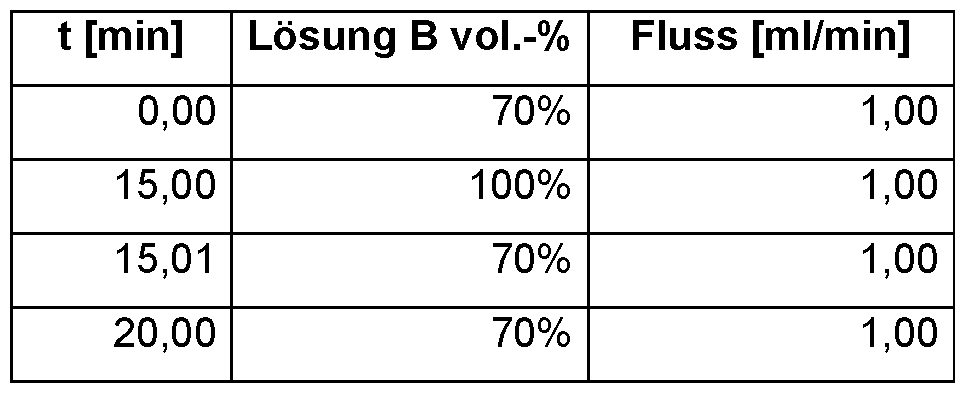
  • the elution of the analytes is carried out at a flow rate of 1 ml min -1 with 0.5 M KH 2 P0 4 (eluent A) for 15 min, followed by a linear gradient up to 80% Eluent A and 20% methanol over a period of 14 min at a flow rate of 0.7 ml min.
  • " Analytes eluting from the ODS2 columns are then injected into a Phenosphere-SAX ion exchange column (250 x 4.6 mm; Phenomenex, Torrance, USA);
  • the activity of the enzyme E 5 is then determined with the samples obtained as described above for the enzymes Ei to E 3 , by reacting dTDP- ⁇ D-glucose (1.3 mM) with 5 ⁇ g of purified enzyme E 5 in 50 ⁇ M sodium phosphate buffer, pH 8.5, incubated and after 5, 10 and 20 min
  • Spheresorb ODS2 column 250 x 4.6 mm; Waters, Milford, USA.
  • the elution of the analytes is carried out at a flow rate of 1 ml min -1 with 0.5 M KH 2 PO 4 (eluent A) for 15 min, followed by a linear gradient up to 80% Eluent A and 20% methanol over a period of 14 min at a flow rate of 0.7 ml min -1 .
  • Analytes eluting from the ODS2 columns are then injected into a Phenosphere-SAX ion exchange column (250 x 4.6 mm, Phenomenex, Torrance, USA) and the analytes at a flow rate of 1 ml min -1 and a linear Ammonium formate gradient (2 to 600 mM over 25 min) eluted.
  • the quantification of dTDP-glucose and dTDP-4-dehydro-6-deoxy-D-glucose then takes place via their UV absorption with a photodiode array detector (DAD).
  • DAD photodiode array detector
  • Absorption maximum of thymidine is 267 nm.
  • the calibration is carried out by means of
  • the activity of the enzyme E 6 is then determined with the samples obtained as described above for the enzymes up to E 3 , by first dTDP-aD-glucose (1, 3 mM) with 5 ug of purified enzyme E 5 in 50 ⁇ sodium phosphate buffer, pH 8.5, incubated for 10 min at 30 ° C. become. Subsequently, 0.5 g purified enzyme E 6 are added, and after 5, 10 and 20 min incubation at 30 ° C, the reaction stopped by the addition of 20 ⁇ chloroform. The mixture is then vortexed and centrifuged for 5 min at 16,000 g and room temperature. The aqueous phase is transferred to a new reaction vessel and the organic phase extracted again with 80 .mu.l of water.
  • aqueous phases are combined and analyzed by HPLC.
  • a Phenosphere ODS2 column 250 x 4.6 mm, Phenomenex, Torrance, USA
  • a Spheresorb ODS2 column 250 x 4.6 mm, Waters, Milford, USA
  • the elution of the analytes is carried out at a flow rate of 1 ml min -1 with 0.5 M KH 2 PO 4 (eluent A) for 15 min, followed by a linear gradient up to 80% Eluent A and 20% methanol over a period of 14 min at a flow rate of 0.7 ml min -1 .
  • Analytes eluting from the ODS2 columns are then injected into a Phenosphere-SAX ion exchange column (250 x 4.6 mm, Phenomenex, Torrance, USA) and the analytes at a flow rate of 1 ml min -1 and a linear Ammonium formate gradient (2 to 600 mM over 25 min) eluted.
  • the quantification of dTDP-glucose, dTDP-4-dehydro-6-deoxy-D-glucose and dTDP-6-deoxy-L-mannose then takes place via their UV absorption with a photodiode array detector (DAD).
  • DAD photodiode array detector
  • the absorption maximum of thymidine is 267 nm.
  • the calibration is carried out by means of authentic nucleotide sugar (Sigma-Aldrich, Kunststoff, USA).
  • the activity of the enzyme E 7 is then determined using the samples obtained as described above for enzymes EI to E 3 , by firstly dTDP- ⁇ D-glucose (1.3 mM) with 5 ⁇ g of purified enzyme E 5 in 50 ⁇ M sodium phosphate buffer , pH 8.5, for 10 min at 30 ° C are incubated. Subsequently, 5 ⁇ g of purified enzyme E 6 and 0.5 ⁇ g purified enzyme E 7 and NADPH (10 mM) are added, and after 5, 10 and 20 min incubation at 30 ° C, the reaction stopped by addition of 20 ⁇ chloroform. The mixture is then vortexed and centrifuged for 5 min at 16,000 g and room temperature. The aqueous phase is transformed into a new one
  • Phenosphere ODS2 column 250 x 4.6 mm, Phenomenex, Torrance, USA
  • Spheresorb ODS2 column 250 x 4.6 mm; Waters, Milford, USA.
  • the elution of the analytes is carried out at a flow rate of 1 ml min -1 with 0.5 M KH 2 P0 4 (eluent A) for 15 min, followed by a linear gradient up to 80% Eluent A and 20% methanol over a period of 14 min at a flow rate of 0.7 ml min -1 .
  • Analytes eluting from the ODS2 columns are then injected into a Phenosphere-SAX ion exchange column (250 x 4.6 mm, Phenomenex, Torrance, USA) and the analytes at a flow rate of 1 ml min -1 and a linear ammonium formate gradient (2 to 600 mM over 25 min).
  • the quantification of dTDP-glucose, dTDP-4-dehydro-6-deoxy-D-glucose, dTDP-6-deoxy-L-mannose and dTDP-4-dehydro-6-deoxy-L-mannose then takes place via their UV Absorption with a photodiode array detector (DAD).
  • DAD photodiode array detector
  • the absorption maximum of thymidine is 267 nm.
  • the calibration is carried out by means of authentic nucleotide sugar (Sigma-Aldrich, Kunststoff, USA).
  • cells are preferred which have the following activities
  • the cell according to the invention has been genetically engineered in the fatty acid biosynthesis in such a way that the enzymatic reactions used to convert acyl-ACP and malonyl-coenzyme A to 3-ketoacyl-ACP and / or
  • the cell according to the invention has been genetically engineered in the .beta.-oxidation of fatty acids such that the enzymatic reactions necessary for the conversion of acyl-coenzyme A to frans-2-enoyl-coenzyme A and / or for the conversion of frans-2-enoyl-coenzyme A to (S) -3-hydroxyalkanoyl-coenzyme A. Additionally or alternatively, it may be advantageous according to the invention if the
  • Cell according to the invention in the ß-oxidation of fatty acids has been genetically engineered such that the enzymatic reactions for the conversion of (S) -3-hydroxyalkanoyl coenzyme A to 3-ketoacyl-coenzyme A and / or for the reaction of 3-ketoacyl Coenzyme A lead to acyl-coenzyme A and acetyl-coenzyme A, are attenuated.
  • the cells according to the invention can be used advantageously for the preparation of rhamnolipids and since these lipids are subsequently purified, it is advantageous if the cells according to the invention have an increased activity of at least one enzyme E 8 compared to their wild type, which comprises exporting a rhamnolipid of the general formula (I) from the cell into the surrounding medium catalyzes.
  • proteins E 8 are preferably selected from the group consisting of
  • a further, preferred embodiment of cells according to the invention is characterized
  • nucleic acids or vectors Having nucleic acids or vectors.
  • Another object of the invention is the use of cells according to the invention for the preparation of compounds of general formula (I).
  • a further subject of the present invention is a process for the preparation of rhamnolipids of the general formula (I)
  • n 2, 1 or 0, in particular 1 or 0,
  • n 1 or 0, in particular 1,
  • the genetically modified cells of the invention can be used continuously or discontinuously in the batch process (batch culturing) or in the fed-batch process
  • the culture medium to be used must suitably satisfy the requirements of the respective strains. Descriptions of culture media of various yeast strains are included, for example, in “Nonconventional yeast in biotechnology” (Ed. Klaus Wolf, Springer-Verlag Berlin, 1996).
  • carbohydrates such as glucose, sucrose, arabinose, xylose, lactose, fructose, maltose, molasses, starch, cellulose and hemicellulose, vegetable and animal oils and fats such.
  • Fatty acids such as. Caprylic acid, capric acid, lauric acid, myristic acid, palmitic acid, palmitolenic acid, stearic acid, arachidonic acid, behenic acid, oleic acid, linoleic acid,
  • Linolenic acid gamma-linolenic acid and their methyl or ethyl esters
  • Fatty acid mixtures mono-, di- and triglycerides with the just mentioned fatty acids, alcohols such as As glycerol, ethanol and methanol, hydrocarbons such as methane, carbonaceous gases and gas mixtures, such as CO, C0 2 , synthesis or flue gas, amino acids such as L-glutamate or L-valine or organic acids such.
  • acetic acid can be used.
  • These substances can be used individually or as a mixture. Particular preference is given to the use of carbohydrates, in particular monosaccharides, oligosaccharides or
  • Polysaccharides as a carbon source as described in US 6,01,494 and US 6,136,576 and of hydrocarbons, in particular of alkanes, alkenes and alkynes and the monocarboxylic acids derived therefrom and derived from these monocarboxylic mono-, di- and triglycerides, as well as glycerol and acetate.
  • a major advantage of the present invention is that the cells of the invention are able to form rhamnolipids from simplest carbon sources such as glucose, sucrose or glycerol, so that it is not necessary to provide longer-chain C sources in the medium during the process according to the invention.
  • the medium in step I) of the process of the invention contains no or no detectable amounts of carboxylic acids having a chain length greater than six carbon atoms or esters or glycerides derivable therefrom.
  • organic nitrogen-containing compounds such as peptones, yeast extract, meat extract, malt extract, corn steep liquor, soybean meal and urea or
  • Inorganic compounds such as ammonium sulfate, ammonium chloride, ammonium phosphate, ammonium carbonate and ammonium nitrate, ammonia, ammonium hydroxide or
  • Ammonia water can be used.
  • the nitrogen sources can be used singly or as a mixture.
  • a phosphorus source can phosphoric acid, potassium dihydrogen phosphate or
  • Dipotassium hydrogen phosphate or the corresponding sodium-containing salts are used.
  • the culture medium must continue to contain salts of metals such.
  • essential growth factors such as amino acids and vitamins can be used in addition to the above-mentioned substances.
  • suitable precursors can be added to the culture medium become. The said starting materials can be added to the culture in the form of a one-time batch or fed in during the cultivation in a suitable manner.
  • Phosphoric acid or sulfuric acid used in a suitable manner.
  • Foaming can anti-foaming agents such.
  • B. fatty acid polyglycol esters are used.
  • the medium suitable selective substances such.
  • B. antibiotics are added.
  • oxygen or oxygen-containing gas mixtures such as oxygen is introduced into the culture.
  • the temperature of the culture is usually more than 20 ° C, preferably more than 25 ° C, it may also be more than 40 ° C, advantageously a
  • Cultivation temperature of 95 ° C, more preferably 90 ° C and most preferably 80 ° C is not exceeded.
  • step III) of the method according to the invention those formed by the cells
  • rhamnolipids can be isolated from the cells and / or the nutrient medium, all methods known to those skilled in the art for isolating low molecular weight substances from complex compositions being suitable, such as, for example, filtration, extraction, adsorption (chromatography) or crystallization.
  • the product phase contains residues of biomass and various organic radicals
  • Impurities such as oils, fatty acids and other nutrient media components.
  • the separation of the impurities is preferably carried out in a solvent-free process.
  • the product phase may be diluted with water to facilitate adjustment of the pH.
  • the product and aqueous phases can then be homogenized by converting the rhamnolipids into a water-soluble form by lowering or raising the pH by means of acids or alkalis. Potentially, solubilization of the rhamnolipids in the aqueous phase can be achieved by incubation at higher temperatures, e.g. at 60 to 90 ° C, and constant mixing are supported. By subsequently raising or lowering the pH by lyes or acids, the rhamnolipids can then be returned to a solvent-free process.
  • the product phase may be diluted with water to facilitate adjustment of the pH.
  • the product and aqueous phases can then be homogenized by converting the rhamnolipids into a water-soluble form by lowering or
  • Oil residues can be separated, for example by extraction by means of suitable solvents advantageously by means of organic solvents.
  • the preferred solvent is an alkane such as n-hexane.
  • Separation of the product from the aqueous phase may alternatively be carried out with the solvent-free process described above with a suitable solvent, e.g. an ester such as ethyl acetate or butyl acetate.
  • a suitable solvent e.g. an ester such as ethyl acetate or butyl acetate.
  • Extraction steps can be performed in any order.
  • solvents are preferably used, in particular organic compound
  • Solvent for example, a distillation. Subsequently, the lyophilized product, for example by means of chromatographic methods, be further purified.
  • the precipitation by means of suitable solvents, the extraction by means of suitable solvents, the complexation, for example by means of cyclodextrins or cyclodextrin derivatives, crystallization, purification or isolation by means of chromatographic methods or the conversion of the rhamnolipids into readily separable derivatives may be mentioned at this point.
  • the rhamnolipids which can be prepared by the process according to the invention are likewise.
  • the rhamnolipids and mixtures which can be prepared by the process according to the invention can advantageously be used in cleaning compositions, in cosmetic or pharmaceutical formulations and in crop protection formulations.
  • a further object of the present invention is the use of the rhamnolipids obtained by the process according to the invention for the production of cosmetic, dermatological or pharmaceutical formulations, crop protection formulations and of care and cleaning agents and surfactant concentrates.
  • care products is understood here to mean a formulation which fulfills the purpose of obtaining an object in its original form, the effects of external influences (eg time, light, temperature, pressure, pollution, chemical reaction with others, with the object contacting reactive compounds) such as aging, soiling, material fatigue, fading, reducing or avoiding or even enhancing desired positive properties of the article be called as an improved hair shine or greater elasticity of the subject.
  • external influences eg time, light, temperature, pressure, pollution, chemical reaction with others, with the object contacting reactive compounds
  • crop protection formulations are meant those formulations which are manifestly used for crop protection by the manner in which they are prepared, in particular when at least one of the classes of herbicides, fungicides, insecticides, acaricides, is included in the formulation , Nematicides, bird repellants, plant nutrients and soil conditioners.
  • rhamnolipids prepared by the process according to the invention are preferably used in household and industrial care and cleaning preparations, in particular for hard surfaces, leather or textiles.
  • a contribution to the achievement of the object is achieved by an isolated nucleic acid which has at least one sequence each selected from the three groups [A1 to G1], [A2 to G2] and [A3 to G3],
  • A1a a sequence according to Seq ID No. 1, this sequence coding for a protein which is capable of
  • B1a an intron-free sequence which is derived from a sequence according to A1a) and which encodes the same protein or peptide as the sequence according to SEQ ID No. 1,
  • C1 a a sequence which encodes a protein or peptide which comprises the amino acid sequence according to SEQ ID No. 2, and which is preferably capable of
  • D1 a a sequence having a sequence according to one of the groups A1 a) to C1a), more preferably according to group A1a), at least 70%, particularly preferably at least 90%, moreover preferably at least 95% and most preferably at least 99% identical, this sequence preferably coding for a protein or peptide which is capable of
  • E1a) a sequence which would hybridize with the opposite strand of a sequence according to one of the groups A1 a) to D1a), more preferably according to group A1 a), or would hybridize in consideration of the degeneracy of the genetic code, this sequence preferably for a protein or Encodes peptide that is capable of
  • F1a by substitution, addition, inversion and / or deletion of at least one base, preferably of at least 2 bases, moreover preferably of at least 5 bases, and most preferably at least 10 bases, but preferably not more than 100 bases, more preferably from not more than 50 bases and most preferably not more than 25 bases derivative of a sequence according to one of the groups A1 a) to E1 a), particularly preferably according to group A1 a), this derivative preferably coding for a protein or peptide, which is able to
  • G1a a complementary sequence to a sequence according to one of the groups A1 a) to F1 a), particularly preferably according to group A1 a),
  • A1 b a sequence according to SEQ ID No. 17, this sequence coding for a protein which is capable of
  • C1 b a sequence which codes for a protein or peptide which comprises the amino acid sequence according to SEQ ID No. 18, and which is preferably capable of
  • E1 b) a sequence which would hybridize with the opposite strand of a sequence according to one of the groups A1 b) to D1 b), particularly preferably according to group A1 b), or would hybridize taking into account the degeneracy of the genetic code, this sequence preferably for a Encoding protein or peptide that is capable of
  • Gi b) a complementary sequence to a sequence according to one of the groups A1 b) to F1 b), more preferably according to group A1 b), and
  • A1c a sequence according to Seq ID No. 77, this sequence coding for a protein which is capable of
  • B1c an intron-free sequence which is derived from a sequence according to A1c) and which codes the same protein or peptide as the sequence according to Seq ID No. 77,
  • D1 c) a sequence having a sequence according to one of the groups A1 c) to C1c), more preferably according to group A1c), at least 70%, particularly preferably at least 90%, moreover preferably at least 95% and most preferably at least 99% identical, this sequence preferably coding for a protein or peptide which is capable of
  • E1c) a sequence which would hybridise with the opposite strand of a sequence according to one of the groups A1 c) to D1c), particularly preferably according to group A1c), or would hybridize in consideration of the degeneracy of the genetic code, this sequence preferably for a protein or peptide encoded, which is able to
  • F1c by substitution, addition, inversion and / or deletion of at least one base, preferably of at least 2 bases, moreover preferably of at least 5 bases, and most preferably at least 10 bases, but preferably not more than 100 bases, more preferably from not more than 50 bases and most preferably not more than 25 bases derivative of a sequence according to one of the groups A1 c) to E1c), more preferably according to group A1 c), this derivative preferably encodes a protein or peptide which be able to,
  • G1c a complementary sequence to a sequence according to one of the groups A1 c) to F1 c), more preferably according to group A1 c), and
  • A1d a sequence according to Seq ID No. 79, this sequence coding for a protein which is capable of
  • B1d an intron-free sequence which is derived from a sequence according to A1d) and which encodes the same protein or peptide as the sequence according to Seq ID No. 79,
  • Ci d a sequence which codes for a protein or peptide which comprises the amino acid sequence according to Seq ID No. 80, and which is preferably capable of
  • D1 d a sequence having a sequence according to one of the groups A1 d) to Cid), more preferably according to group A1d), at least 70%, particularly preferably at least 90%, moreover preferably at least 95% and most preferably at least 99% identical, this sequence preferably coding for a protein or peptide which is capable of
  • F1d) a by substitution, addition, inversion and / or deletion of at least one base, preferably of at least 2 bases, more preferably of at least 5 bases, and most preferably at least 10 bases, but preferably not more than 100 bases, more preferably from not more than 50 bases and most preferably not more than 25 bases derivative of a sequence according to one of groups A1 d) to E1 d), more preferably according to group A1 d), this derivative preferably coding for a protein or peptide, which is able to
  • G1d a complementary sequence to a sequence according to one of the groups A1 d) to F1 d), more preferably according to group A1 d), and
  • A1e a sequence according to Seq ID No. 81, this sequence coding for a protein which is capable of
  • B1e an intron-free sequence which is derived from a sequence according to A1e) and which encodes the same protein or peptide as the sequence according to Seq ID No. 81,
  • C1 e a sequence which encodes a protein or peptide which comprises the amino acid sequence according to SEQ ID NO: 82, and which is preferably capable of
  • E1e Reacting 3-hydroxytetradecanoyl-ACP via 3-hydroxytetradecanoyl-3-hydroxytetradecanoyl-ACP to give 3-hydroxytetradecanoyl-3-hydroxytetradecanoic acid, E1e) a sequence which would hybridize with the opposite strand of a sequence according to one of the groups A1 e) to die), particularly preferably according to group A1 e), or would hybridize taking into account the degeneracy of the genetic code, this sequence preferably for a protein or Encodes peptide that is capable of
  • F1e by substitution, addition, inversion and / or deletion of at least one base, preferably of at least 2 bases, moreover preferably of at least 5 bases, and most preferably at least 10 bases, but preferably not more than 100 bases, more preferably from not more than 50 bases, and most preferably not more than 25 bases, of a sequence according to one of the groups A1 e) to E1 e), particularly preferably according to group A1 e), this derivative preferably coding for a protein or peptide, which is able to
  • G1e a complementary sequence to a sequence according to one of the groups A1 e) to F1 e), particularly preferably according to group A1 e), and
  • A2a a sequence according to SEQ ID No. 3, this sequence coding for a protein which is capable of
  • B2a an intron-free sequence which is derived from a sequence according to A2a) and which encodes the same protein or peptide as the sequence according to Seq ID No. 3,
  • C2a a sequence which encodes a protein or peptide which comprises the amino acid sequence according to SEQ ID NO: 4, and which is preferably capable of
  • D2a a sequence having a sequence according to one of the groups A2a) to C2a), more preferably according to group A2a), at least 80%, particularly preferably at least 90%, moreover preferably at least 95% and most preferably is at least 99% identical, this sequence preferably encodes a protein or peptide which in able to
  • E2a a sequence which would hybridize with the complementary strand of a sequence according to one of the groups A2a) to D2a), particularly preferably according to group A2a), or would hybridize taking into account the degeneracy of the genetic code, this sequence preferably coding for a protein or peptide which is able to
  • F2a by substitution, addition, inversion and / or deletion of at least one base, preferably of at least 2 bases, moreover preferably of at least 5 bases, and most preferably at least 10 bases, but preferably not more than 100 bases, more preferably from not more than 50 bases and most preferably not more than 25 bases derivative of a sequence according to one of the groups A2a) to E2a), particularly preferably according to group A2a), this derivative preferably coding for a protein or peptide which in the Location is
  • G2a a complementary sequence to a sequence according to one of the groups A2a) to F2a), more preferably according to group A2a),
  • A2b a sequence according to SEQ ID No. 19, this sequence coding for a protein which is capable of
  • B2b an intron-free sequence which is derived from a sequence according to A2b) and which encodes the same protein or peptide as the sequence according to Seq ID No. 19,
  • C2b a sequence which encodes a protein or peptide which comprises the amino acid sequence according to SEQ ID NO: 20 and which is preferably capable of
  • D2b a sequence having a sequence according to one of the groups A2b) to C2b), more preferably according to group A2b), at least 70%, particularly preferably at least 90%, moreover preferably at least 95% and most preferably is at least 99% identical, this sequence preferably encodes a protein or peptide which in able to
  • E2b a sequence which would hybridize with the complementary strand of a sequence according to one of the groups A2b) to D2b), particularly preferably according to group A2b), or would hybridize taking into account the degeneracy of the genetic code, this sequence preferably coding for a protein or peptide which is able to
  • F2b by substitution, addition, inversion and / or deletion of at least one base, preferably of at least 2 bases, more preferably of at least 5 bases, and most preferably at least 10 bases, but preferably not more than 100 bases, more preferably from not more than 50 bases and most preferably not more than 25 bases derivative of a sequence according to one of the groups A2b) to E2b), more preferably according to group A2b), this derivative preferably coding for a protein or peptide which is described in the Location is
  • A2c a sequence according to Seq ID No. 83, this sequence coding for a protein which is capable of
  • B2c an intron-free sequence which is derived from a sequence according to A2c) and which encodes the same protein or peptide as the sequence according to Seq ID No. 83,
  • C2c a sequence which encodes a protein or peptide comprising the amino acid sequence according to SEQ ID NO: 84, and which is preferably capable of
  • D2c) a sequence having a sequence according to one of the groups A2c) to C2c), more preferably according to group A2c), at least 70%, particularly preferably at least 90%, moreover preferably at least 95% and most preferably is at least 99% identical, this sequence preferably encodes a protein or peptide which in able to
  • E2c a sequence which would hybridize with the opposite strand of a sequence according to one of the groups A2c) to D2c), particularly preferably according to group A2c), or would hybridize in consideration of the degeneracy of the genetic code, this sequence preferably coding for a protein or peptide which is able to
  • F2c by substitution, addition, inversion and / or deletion of at least one base, preferably of at least 2 bases, moreover preferably of at least 5 bases, and most preferably at least 10 bases, but preferably not more than 100 bases, more preferably from not more than 50 bases and most preferably not more than 25 bases derivative of a sequence according to one of the groups A2c) to E2c), more preferably according to group A2c), this derivative preferably coding for a protein or peptide which in the Location is
  • A2d a sequence according to Seq ID No. 85, this sequence coding for a protein which is capable of
  • B2d an intron-free sequence which is derived from a sequence according to A2d) and which encodes the same protein or peptide as the sequence according to Seq ID No. 85,
  • C2d a sequence which encodes a protein or peptide comprising the amino acid sequence according to Seq ID No. 86, and which is preferably capable of
  • D2d a sequence having a sequence according to one of the groups A2d) to C2d), more preferably according to group A2d), at least 70%, particularly preferably at least 90%, moreover preferably at least 95% and most preferably is at least 99% identical, this sequence preferably encodes a protein or peptide which in able to
  • E2d a sequence which would hybridize with the complementary strand of a sequence according to one of the groups A2d) to D2d), particularly preferably according to group A2d), or would hybridize taking into account the degeneracy of the genetic code, this sequence preferably coding for a protein or peptide which is able to
  • F2d by substitution, addition, inversion and / or deletion of at least one base, preferably of at least 2 bases, moreover preferably of at least 5 bases, and most preferably at least 10 bases, but preferably not more than 100 bases, more preferably from not more than 50 bases and most preferably not more than 25 bases derivative of a sequence according to one of the groups A2d) to E2d), particularly preferably according to group A2d), this derivative preferably coding for a protein or peptide which in the Location is
  • A2e a sequence according to SEQ ID No. 87, this sequence coding for a protein which is capable of
  • B2e an intron-free sequence which is derived from a sequence according to A2e) and which codes the same protein or peptide as the sequence according to Seq ID No. 87,
  • C2e a sequence which encodes a protein or peptide which comprises the amino acid sequence according to SEQ ID NO: 88, and which is preferably capable of
  • D2e a sequence having a sequence according to one of the groups A2e) to C2e), more preferably according to group A2e), at least 70%, particularly preferably at least 90%, moreover preferably at least 95% and most preferably is at least 99% identical, this sequence preferably encodes a protein or peptide which in able to
  • E2e a sequence which would hybridize with the complementary strand of a sequence according to one of the groups A2e) to D2e), particularly preferably according to group A2e), or would hybridize taking into account the degeneracy of the genetic code, this sequence preferably coding for a protein or peptide which is able to
  • F2e by substitution, addition, inversion and / or deletion of at least one base, preferably of at least 2 bases, moreover preferably of at least 5 bases, and most preferably at least 10 bases, but preferably not more than 100 bases, more preferably from not more than 50 bases and most preferably not more than 25 bases derivative of a sequence according to one of the groups A2e) to E2e), more preferably according to group A2e), this derivative preferably coding for a protein or peptide which in the Location is
  • A3a a sequence according to Seq ID No. 5, this sequence coding for a protein which is capable of
  • B3a an intron-free sequence which is derived from a sequence according to A3a) and which encodes the same protein or peptide as the sequence according to SEQ ID No. 5,
  • C3a a sequence which encodes a protein or peptide which comprises the amino acid sequence according to SEQ ID No. 6, and which is preferably capable of
  • D3a a sequence having a sequence according to one of the groups A3a) to C3a), particularly preferably according to group A3a), at least 80%, particularly preferably at least 90%, moreover preferably at least 95% and most preferably at least 99% identical, this sequence preferably coding for a protein or peptide which is capable of
  • E3a a sequence which would hybridize with the complementary strand of a sequence according to one of the groups A3a) to D3a), particularly preferably according to group A3a), or would hybridize taking into account the degeneracy of the genetic code, this sequence preferably coding for a protein or peptide which is able to
  • F3a by substitution, addition, inversion and / or deletion of at least one base, preferably of at least 2 bases, moreover preferably of at least 5 bases, and most preferably at least 10 bases, but preferably not more than 100
  • Bases more preferably of not more than 50 bases and most preferably of not more than 25 bases derived derivative of a sequence according to one of the groups A3a) to E3a), more preferably according to group A3a), said derivative preferably for a protein or peptide coded,
  • G3a a complementary sequence to a sequence according to one of the groups A3a) to F3a), more preferably according to group A3a),
  • A3b a sequence according to Seq ID No. 21, this sequence coding for a protein which is capable of
  • B3b an intron-free sequence which is derived from a sequence according to A3b) and which encodes the same protein or peptide as the sequence according to Seq. ID No. 21,
  • C3b a sequence which encodes a protein or peptide which comprises the amino acid sequence according to SEQ ID NO: 22, and which is preferably capable of
  • D3b) a sequence having a sequence according to one of the groups A3b) to C3b), more preferably according to group A3b), at least 60%, particularly preferably at least 90%, moreover preferably at least 95% and most preferably at least 99% identical, this sequence preferably coding for a protein or peptide which is capable of
  • E3b a sequence which would hybridize with the opposite strand of a sequence according to one of the groups A3b) to D3b), particularly preferably according to group A3b), or would hybridize in consideration of the degeneracy of the genetic code, this sequence preferably coding for a protein or peptide which is able to
  • F3b by substitution, addition, inversion and / or deletion of at least one base, preferably of at least 2 bases, moreover preferably of at least 5 bases, and most preferably at least 10 bases, but preferably not more than 100 bases, more preferably from not more than 50 bases and most preferably not more than 25 bases derivative of a sequence according to one of the groups A3b) to E3b), particularly preferably according to group A3b), this derivative preferably coding for a protein or peptide,
  • G3b a complementary sequence to a sequence according to one of the groups A3b) to F3b), particularly preferably according to group A3b),
  • A3c a sequence according to SEQ ID No. 89, this sequence coding for a protein which is capable of
  • B3c an intron-free sequence which is derived from a sequence according to A3c) and which encodes the same protein or peptide as the sequence according to Seq ID No. 89,
  • C3c a sequence which encodes a protein or peptide comprising the amino acid sequence according to SEQ ID NO: 90, and which is preferably capable of
  • D3c) a sequence having a sequence according to one of the groups A3c) to C3c), more preferably according to group A3c), at least 60%, particularly preferably at least 90%, moreover preferably at least 95% and most preferably at least 99% identical, this sequence preferably coding for a protein or peptide which is capable of
  • E3c a sequence which would hybridize with the opposite strand of a sequence according to one of the groups A3c) to D3c), particularly preferably according to group A3c), or would hybridize in consideration of the degeneracy of the genetic code, this sequence preferably coding for a protein or peptide which is able to
  • F3c by substitution, addition, inversion and / or deletion of at least one base, preferably of at least 2 bases, moreover preferably of at least 5 bases, and most preferably at least 10 bases, but preferably not more than 100 Bases, more preferably of not more than 50 bases and most preferably of not more than 25 bases derived derivative of a sequence according to one of the groups A3c) to E3c), more preferably according to group A3c), said derivative preferably for a protein or peptide coded,
  • G3c a complementary sequence to a sequence according to one of the groups A3c) to F3c), particularly preferably according to group A3c) and
  • A3d a sequence according to SEQ ID No. 91, this sequence coding for a protein which is capable of
  • B3d an intron-free sequence which is derived from a sequence according to A3d) and which encodes the same protein or peptide as the sequence according to Seq ID No. 91,
  • C3d a sequence which encodes a protein or peptide comprising the amino acid sequence according to SEQ ID NO: 92, and which is preferably capable of
  • D3d a sequence having a sequence according to one of the groups A3d) to C3d), more preferably according to group A3d), at least 60%, particularly preferably at least 90%, moreover preferably at least 95% and most preferably at least 99% identical, this sequence preferably coding for a protein or peptide which is capable of
  • E3d a sequence which would hybridize with the complementary strand of a sequence according to one of the groups A3d) to D3d), particularly preferably according to group A3d), or would hybridize taking into account the degeneracy of the genetic code, this sequence preferably coding for a protein or peptide which is able to reacting dTDP-rhamnose and aL-rhamnopyranosyl-3-hydroxytetradecanoyl-3-hydroxytetradecanoic acid to give aL-rhamnopyranosyl (1-2) - ⁇ L-rhamnopyranosyl-3-hydroxytetradecanoyl-3-hydroxytetradecanoic acid,
  • F3d by substitution, addition, inversion and / or deletion of at least one base, preferably of at least 2 bases, moreover preferably of at least 5 bases, and most preferably at least 10 bases, but preferably not more than 100 bases, more preferably from not more than 50 bases and most preferably not more than 25 bases derivative of a sequence according to one of the groups A3d) to E3d), more preferably according to group A3d), this derivative preferably coding for a protein or peptide,
  • G3d has a complementary sequence to a sequence according to one of the groups A3d) to F3d), particularly preferably according to group A3d).
  • nucleotide identity or amino acid identity is determined herein by known methods. In general, special computer programs with algorithms are under
  • Computer identity determination programs include, but are not limited to, the GCG program package, including
  • GAP Garnier, J. et al., Nucleic Acid Research 12 (1984), page 387, Genetics Computer Group University of Wisconsin, Medicine (Wi), and BLASTP, BLASTN and FASTA (Altschul, S. et al., Journal of Molecular Biology 215 (1990), pp. 403-410
  • the BLAST program can be obtained from the National Center For Biotechnology Information (NCBI) and from other sources (BLAST Handbook, Altschul S. et al, NCBI NLM NIH Bethesda ND 22894, Altschul S et al., supra).
  • nucleotide identity is a parameter that is used to determine nucleotide identity. Preferred parameters for determining "nucleotide identity" are when using the BLASTN program (Altschul, S. et al., Journal of Molecular Biology 215 (1990), p. 403-
  • the above parameters are the default parameters in nucleotide sequence comparison.
  • the GAP program is also suitable for use with the above parameters.
  • compositional adjustments Conditional compositional score matrix adjustment
  • the above parameters are the default parameters in the amino acid sequence comparison.
  • the GAP program is also suitable for use with the above parameters.
  • An identity of 60% according to the above algorithm means 60% identity in the context of the present invention. The same applies to higher identities.
  • sequence which would hybridize to the counterstrand of a sequence or hybridize in consideration of the degeneracy of the genetic code indicates a sequence which would hybridize under preferably stringent conditions to the opposite strand of a reference sequence or hybridize in consideration of the degeneracy of the genetic code
  • the hybridizations can be carried out at 68 ° C. in 2 ⁇ SSC or according to the protocol of the digoxigenin labeling kit from Boehringer (Mannheim) Preferred hybridization conditions are, for example, incubation at 65 ° C. overnight in 7% SDS, 1% BSA, 1mM EDTA, 250mM sodium phosphate buffer (pH 7.2) followed by washing at 65 ° C with 2 x SSC; 0, 1% SDS.
  • Derivatives of the isolated DNA according to the invention which according to alternative F1), F2) or F3) by substitution, addition, inversion and / or deletion of one or more bases of a sequence according to one of the groups A1) to E1), A2) to E2) and A3) to E3) include, in particular, those sequences which in the protein which they encode to conservative amino acid substitution, such.
  • Such functionally neutral mutations are referred to as sense mutations and do not lead to any fundamental change in the activity of the polypeptide. Furthermore, it is known that
  • the nucleic acid according to the invention is preferably a vector, in particular a
  • Suitable vectors are all vectors known to those skilled in the art, which are usually used for introducing DNA into a host cell. These vectors can both replicate autonomously because they have origins of replication, such as those of the 2 ⁇ - ⁇ 33 ⁇ ⁇ 3 or ARS (autonomously replicating sequences), or integrate into the chromosomes (non-replicative plasmids). Vectors are also understood to mean linear DNA fragments that have no origins of replication, such as gene insertion or gene over expression cassettes.
  • Gene expression cassettes usually consist of a marker, the
  • Preferred vectors are selected from the group consisting of plasmids and tapes, such as E. co // 'Yeast shuttle plasmids, particularly preferred are expression vectors or Geninsertions-
  • Gene expression cassettes in particular the vectors Seq ID No. 38, Seq ID No. 40, Seq ID No. 42, Seq ID No. 45 and Seq ID No. 47 described below. According to a preferred embodiment of the vector according to the invention are
  • At least one constitutive or regulatable promoter which is used to express the polypeptide encoded by these DNA sequences in the cell of a microorganism
  • a bacterial, yeast or fungal cell wherein Aspergillus nidulans, Aspergillus niger, Alcaligenes latus, Bacillus megaterium, Bacillus subtilis, Brevibacterium flavum,
  • Candida blankii Candida rugosa, Corynebacterium glutamicum, Corynebacterium efficiens, Escherichia coli, Hansenula polymorpha, Kluveromyces lactis, Methylobacterium extorquens, Paracoccus versutus,
  • cremoricolorata P. fulva, P. monteilii, P. mosselii, P. parafulva, P. putida, P. balearica, P.
  • constitutive promoters are lac, lacUV5, tac, trc (each in the absence of the LacI repressor in the cells of the invention), Ltet-01 (in the absence of the TetR repressor in the cells of the invention), T5 and gap.
  • inducible promoters are lac, lacUV5, tac, trc (each in the presence of the LacI repressor in the cells of the invention), Ltet-01 (in the presence of the TetR repressor in the cells of the invention), T5 (in combination with a / ac Operator and the presence of the LacI repressor in the cells of the invention), SP6 and T7 (in the presence of the gene coding for the cognate RNA polymerase, the expression of which in turn is regulated).
  • the vector according to the invention should, in addition to a promoter, preferably a
  • Ribosome binding site and a terminator include. It is particularly preferred that the nucleic acid according to the invention is incorporated into an expression cassette of the vector comprising the promoter, the ribosome binding site and the terminator.
  • the vector may further comprise selection genes known to those skilled in the art.
  • Figure 1 fatty acid biosynthesis, ß-oxidation of fatty acids and linkage of these
  • FIG. 2 Dirhamnosyl lipid formation (mg / l / OD 600 nm) of the recombinant strains P. putida KT2440 pBBR1 MCS-2 and pBBR1 MCS-2 :: ABC and GPp104 pBBR1 MCS-2 and pBBRI MCS- 2 :: ABC after 48 h, 72 h and 96 h culture in CMP medium. The rhamnolipid concentration was analyzed by HPLC.
  • FIG. 3 Monorhamnosyl lipid formation (peak area / OD 600 nm) of the recombinant strains P. putida KT2440 pBBR1 MCS-2, pBBR1 MCS-2 :: AB and pBBR1 MCS-2 :: ABM and GPp104 pBBR1 MCS-2, pBBR1 MCS-2: : AB and pBBR1 MCS-2 :: ABM after 48 h, 72 h and 96 h culture in CMP medium. The rhamnolipid concentration was analyzed by HPLC.
  • a vector pBBR1MCS-2 for the heterologous expression of Pseudomonas aeruginosa 1707 genes rhIA and rhIB in Pseudomonas putida
  • the plasmid pBBR1 MCS-2 for the heterologous expression of Pseudomonas aeruginosa DSM 1707 genes rhIA and rhIB, the plasmid pBBR1 MCS-2 :: AB (Seq ID No. 38).
  • the synthetic operon rhIAB (Seq ID No. 37) was synthesized by GeneArt AG (Regensburg) and intercloned in the commercial vector pMA (GeneArt AG).
  • the basis for the synthesis was the already known genomic sequence of Pseudomonas aeruginosa DSM 1707.
  • the synthetic operon was cut out of the vector by means of BglW and Xba ⁇ and then inserted into the expression vector pBBR1 MCS- cut with ⁇ mHI and Xba ⁇ . 2 (SEQ ID NO: 49) (described in Kovach et al., 1995: Four new derivatives of the broad-host-range cloning vector pBBRI MCS carrying different antibiotic-resistance cassettes genes, 166: 175-176).
  • the resulting plasmid pBBR1 MCS-2 is 7422 base pairs in size.
  • the ligation and the transformation of chemically competent E. coli DH5a cells were carried out in a manner known to the person skilled in the art. The authenticity of the insert was verified by DNA sequence analysis.
  • pBBR1 MCS-2 (SEQ ID NO: 49) and pBBR1 MCS-2 :: AB were as previously described (Iwasaki et al., Biosci, Biotech, Biochem., 1994, 58 (5): 851-854).
  • the plasmid DNA of 10 clones was isolated and analyzed.
  • the resulting strains carrying the plasmids were P. putida KT2440 pBBR1 MCS-2, P.putida GPp104 pBBR1 MCS-2, P.putida KT2440 pBBR1 MCS-2 :: AB and P.putida GPp104 pBBR1 MCS-2 :: AB, respectively called. 2.
  • the synthetic operon was cut out of the vector by means of ⁇ o / II and Xba ⁇ and subsequently into the expression vector pBBR1 cut with ⁇ mHI and Xba ⁇ MCS-2 (SEQ ID NO: 49) (Kovach et al., 1995: Four new derivatives of broad-host-range cloning vector pBBRI MCS carrying different antibiotic-resistance cassettes, Gene, 166: 175-176).
  • the resulting plasmid pBBR1 MCS-2 :: ABC (SEQ ID NO: 40) is 8409 base pairs in size.
  • the ligation and the transformation of chemically competent E. coli DH5a cells (Gibco-BRL, Düsseldorf) were carried out in a manner known to the person skilled in the art. The authenticity of the insert was verified by DNA sequence analysis.
  • pBBR1 MCS-2 ABC was as previously described (Iwasaki et al., Biosci, Biotech, Biochem., 1994, 58 (5): 851-854). The plasmid DNA of 10 clones each was isolated and analyzed. The
  • Plasmid-carrying strains were named P. putida KT2440 pBBR1 MCS-2 :: ABC and P.putida GPp104 pBBR1 MCS-2 :: ABC, respectively.
  • the plasmid pBBR1 MCS-2 :: ABM (SEQ ID NO: 42) was constructed.
  • the synthetic operon rhlAB-pa 1131 (SEQ ID NO: 41) was synthesized by GeneArt AG (Regensburg) and intercloned in the commercial vector pMA (GeneArt AG). The basis for the synthesis was the already known genomic sequence of Pseudomonas aeruginosa DSM 1707.
  • pBBR1 MCS-2 ABM was as previously described (Iwasaki et al., Biosci, Biotech, Biochem., 1994, 58 (5): 851-854). The plasmid DNA of 10 clones each was isolated and analyzed. The
  • plasmid-carrying strains were named P. putida KT2440 pBBR1 MCS-2 :: ABM and P.putida GPp104 pBBR1 MCS-2 :: ABM, respectively.
  • putida GPp104 pBBR1 MCS-2 :: AB
  • P.putida GPp104 pBBRI MCS-2 : ABC
  • P.putida GPp104 pBBR1 MCS-2 :: ABM were grown on LB agar kanamycin (50 vg / ml) - Cultivated plates.
  • CMP medium For the production of rhamnolipids, the medium referred to below as CMP medium was used. This consists of 2% (w / v) glucose, 0.007% (w / v) KH 2 P0 4 , 0, 11% Na 2 HP0 4 x 2 H 2 0, 0.2% (w / v) NaN0 3 , 0.04% (w / v) MgSO 4 x H 2 O, 0.01% (w / v) CaCl 2 x 2 H 2 O and 0.2% (v / v) of a trace element solution.
  • Evaporative Light Scattering Detector (Sedex LT-ELSD Model 85LT) was used to detect and quantify rhamnolipids. The actual measurement was performed using Agilent Technologies 1200 Series (Santa Clara, Calif.) And Zorbax SB-C8 Rapid Resolution Column (4.6 x 150 mm, 3.5 ⁇ , Agilent). The injection volume was 5 ⁇ and the duration of the method was 20 min. The mobile phase used was aqueous 0.1% TFA (trifluoroacetic acid, solution A) and methanol (solution B). The
  • P. putida KT2440 pBBR1 MCS-2 and GPp104 pBBR1 MCS-2 did not produce rhamnolipids, in the recombinant strains P. putida KT2440 pBBR1 MCS-2 :: AB, P. putida KT2440 pBBR1 MCS-2 :: ABC, P.
  • putida KT2440 pBBR1 MCS-2 ABM
  • P.putida GPp104 pBBR1 MCS-2 AB
  • P.putida GPp104 pBBR1 MCS-2 ABC
  • P.putida GPp104 pBBRI MCS-2 ABM the formation of different rhamnolipid species ascertainable (FIGS. 2 and 3).
  • putida KT2440 pBBR1 MCS-2 :: AB and P.putida GPp104 pBBR1 MCS-2 :: AB about 39 (P.putida KT2440 pBBR1 MCS-2 :: AB) and 23 peak areas rhamnolipids / OD 600 nm, respectively (Putida GPp104 pBBR1 MCS-2 :: AB) after 120 h, the strains P. putida KT2440 pBBR1 MCS-2 :: ABM and P. putida GPp104 pBBR1 MCS-2 :: ABM formed about 50 (P.
  • the resulting plasmid pBBRI MCS-2 is 9663 base pairs in size.
  • the ligation and the transformation of chemically competent E. coli DH5a cells were carried out in a manner known to the person skilled in the art. The authenticity of the insert was verified by DNA sequence analysis.
  • pBBR1 MCS-2 ABMC was as previously described (Iwasaki et al., Biosci, Biotech, Biochem., 1994, 58 (5): 851-854). The plasmid DNA of 10 clones each was isolated and analyzed. The resulting plasmid-carrying strains were named P. putida KT2440 pBBR1 MCS-2 :: ABMC and P.putida GPp104 pBBR1 MCS-2 :: ABMC, respectively.
  • pBBR1 MCS-2 ABMC and P. aeruginosa DSM 19880 were cultured on LB agar kanamycin (50 ⁇ g / ml, P. putida) and LB agar plates (P. aeruginosa), respectively.
  • CMP medium the medium referred to below as CMP medium was used.
  • This consists of 2% (w / v) glucose, 0.007% (w / v) KH 2 P0 4 , 0, 11% Na 2 HP0 4 x 2 H 2 0, 0.2% (w / v) NaN0 3 , 0.04% (w / v) MgSO 4 x H 2 O, 0.01% (w / v) CaCl 2 x 2 H 2 O and 0.2% (v / v) of a trace element solution.
  • This consists of 0.2% (w / v) FeS0 4 x 7 H 2 0, 0.15% (w / v) MnS0 4 x H 2 0 and 0.06% (w / v) (NH 4 ) M0 7 0 24 x 4 H 2 0.
  • the pH of the medium was adjusted to 6.7 with NaOH and the medium next sterilized by autoclaving (121 ° C, 20 min). It was not necessary to adjust the pH during the cultivation.
  • the precultures were used to inoculate 50 ml of CMP medium in the 250 ml Erlenmeyer flask (start OD 6 oo 0, 1).
  • the cultures were cultured at 200 rpm and 30 ° C for a maximum of 120 h.
  • a sample of 1 ml broth was removed from the culture flask.
  • the sample preparation for the subsequent chromatographic analyzes was carried out as follows:
  • the detection was carried out by means of a DAD detector in the wavelength range of 200-600 nm and mass-selective with a high-resolution FT-ICR mass spectrometer LTQ-FT (Thermo Scientific, Dreieich) in the scan range m / z 100-1000.
  • the ionization was carried out by means of ESI
  • strain P. putida GPp104 pBBR1 MCS-2 did not form any
  • aeruginosa DSM 19880 was approximately 2: 1.
  • the P.putida GPp104 pBBR1 MCS-2 was approximately 2: 1.
  • the P.putida GPp104 pBBR1 MCS-2 was approximately 2: 1.
  • the P.putida GPp104 pBBR1 MCS-2 was approximately 2: 1.
  • the P.putida GPp104 pBBR1 MCS-2 ABMC strain, unlike P. aeruginosa DSM 19880, produced little or no rhamnolipids with a residue derived from R 1 and R 2 derived from 3-hydroxyoctanoyl-3-hydroxydecanoic acid or 3 -Hydroxydekanoyl-3-hydroxy octanoic acid.
  • rhamnose biosynthesis opera rfbBDAC was amplified starting from chromosomal DNA of Pseudomonas putida KT2440.
  • the following primers were used: RL1: 5'-TATATATAGAATTCGCGTCATCTGTCTACGACAACAC -3 '(SEQ ID NO: 48)
  • the vector pBBR1 MCS-2 (Kovach et al., 1995: Four new derivatives of the broad-host-range cloning vector pBBRI MCS carrying different antibiotic-resistance cassettes, Gene, 166: 175-176) was applied to the same way cut.
  • pBBR1 MCS-2 were assembled by conventional ligation.
  • the resulting vector pBBR1 MCS-2 :: rfbBDAC (SEQ ID NO: 45) was also transformed into E. coli DH5a (New England Biolabs, Frankfurt). Some candidates of the transformants were examined for successful uptake of the plasmid.
  • the vector pBBR1 MCS-2 served as a template for a PCR.
  • the following oligonucleotides were used: RL_Xbal-fw: 5'-TAT AT AT CT AG AATTA ATG CAGCTGGCACGAC -3 '(SEQ ID NO: 44) RL_Xba_rev: 5'-GGCCGCTCTAGAACTAGTGGA -3' (SEQ ID NO: 46)
  • the PCR was performed using the Phusion TM High-Fidelity Master Mix from New England Biolabs
  • Target vector pBBR1 MCS-2 :: ABC_rfbBDAC (Seq ID No. 47) has a size of 12249
  • the insert of the vector was sequenced.
  • the implementation of the PCR the verification of the successful amplification of the PCR by agarose gel electrophoresis, ethidium bromide staining of the DNA, determination of the PCR fragment size, purification of the PCR Products and DNA concentration determination were carried out in a manner known to the person skilled in the art.
  • pBBR1 MCS-2 ABC_rfbBDAC was as previously described (Iwasaki et al., Biosci, Biotech, Biochem., 1994, 58 (5): 851-854).
  • the plasmid DNA of 10 clones each was isolated and analyzed.
  • the resulting plasmid-carrying strains are called P. putida KT2440 pBBR1 MCS-2 :: ABC_rfbBDAC and P.putida GPp104 pBBR1 MCS-2 :: ABC_rfbBDAC.
  • CMP medium For the production of rhamnolipids, the medium referred to below as CMP medium is used. This consists of 2% (w / v) glucose, 0.007% (w / v) KH 2 P0 4 , 0, 11% Na 2 HP0 4 x 2 H 2 0, 0.2% (w / v) NaN0 3 , 0.04% (w / v) MgSO 4 x H 2 O, 0.01% (w / v) CaCl 2 x 2 H 2 O and 0.2% (v / v) of a trace element solution.
  • Recombinant P. putida strains are cultured in LB medium to which 50 ⁇ g / ml kanamycin is added. The cultivation of the P. putida strains took place at 30 ° C. and 200 rpm overnight.
  • the precultures are used to inoculate 50 ml of CMP medium in the 250 ml Erlenmeyer flask (start OD 6 oo 0, 1).
  • the cultures are cultured at 200 rpm and 30 ° C for a maximum of 120 h.
  • a sample of 1 ml broth is removed from the culture flask.
  • the sample preparation for the subsequent chromatographic analyzes is carried out as follows:
  • the Scattering detector (Sedex LT-ELSD Model 85LT) used. The actual measurement is performed using Agilent Technologies 1200 Series (Santa Clara, California) and the Zorbax SB-C8 Rapid Resolution column (4.6 x 150 mm, 3.5 ⁇ , Agilent). The injection volume is 5 ⁇ and the duration of the method is 20 min.
  • the mobile phase used is aqueous 0.1% TFA (trifluoroacetic acid, solution A) and methanol (solution B).
  • the column temperature is 40 ° C.
  • the detectors used are the ELSD (detector temperature 60 ° C) and the DAD (diode array, 210 nm).
  • the gradient used in the method is:
  • P. putida KT2440 pBBR1 MCS-2 and GPp104 pBBR1 MCS-2 do not produce rhamnolipids, in the recombinant strains P. putida KT2440 pBBR1 MCS-2 :: ABC, P.putida KT2440 pBBR1 MCS-2 :: ABC_rfbBDAC; P. putida GPp104 pBBR1MCS-2 :: ABC and P.putida GPp104 pBBR1 MCS-2 :: ABC_rfbBDAC detectable formation of rhamnolipids.
  • P. putida KT2440 pBBR1 MCS-2 :: ABC_rfbBDAC shows in comparison to P. putida KT2440 pBBR1 MCS-2 :: ABC and P.putida GPp104 pBBR1 MCS-2 :: ABC_rfbBDAC compared to P.putida GPp104 pBBR1 MCS-2: : ABC increased formation of di- and monorhamnosyl lipids. This clearly shows the positive influence of the enhancement of the expression of rfbBDAC on the formation of mono- and dirhamnosyl lipids. When comparing the mono- and dirhamnosyllipid biosynthesis of P.
  • putida KT2440 pBBRI MCS-2 : ABC_rfbBDAC and P.putida GPp104 pBBR1 MCS-2 :: ABC_rfbBDAC strains, the PHA-negative mutant P. putida GPp104 pBBR1 MCS-2 is compared. : ABC_rfbBDAC detects enhanced mono- and dirhamnosyl lipid synthesis.
  • ramnolipid biosynthesis is enhanced when using a parent background inactivated in PHA synthesis.
  • E. coli W3110 Transformation of E. coli W3110 was performed as previously described (Miller JH A Short Course in Bacterial Genetics: A Laboratory Manual and Handbook for Escherichia coli and Related Bacteria, Plainview, NY: Cold Spring Harbor Lab, Press, 1992) by electroporation. The plasmid DNA of 10 clones each was isolated and analyzed. The resulting plasmid-carrying strains were named E. coli W31 10 pBBR1 MCS-2 :: ABC_rfbBDAC and E. coli W31 10 pBBR1 MCS-2 :: ABC_rfbBDAC.
  • E. coli W3110 pBBR1 MCS-2; E. coli W3110 pBBR1 MCS-2 :: ABC and E. coli W31 10 pBBR1 MCS-2 :: ABC_rfbBDAC are cultured on LB agar kanamycin (50 ⁇ g / ml) plates.
  • CMP medium For the production of rhamnolipids, the medium referred to below as CMP medium is used. This consists of 2% (w / v) glucose, 0.007% (w / v) KH 2 P0 4 , 0, 11% Na 2 HP0 4 x 2 H 2 0, 0.2% (w / v) NaN0 3 , 0.04% (w / v) MgSO 4 x H 2 O, 0.01% (w / v) CaCl 2 x 2 H 2 O and 0.2% (v / v) of a trace element solution.
  • E. coli strains are cultured in LB medium to which 50 ⁇ g / ml kanamycin is added. The cultivation of the E. coli strains took place at 37 ° C. and 200 rpm overnight. The precultures are used to inoculate 50 ml of CMP medium in the 250 ml Erlenmeyer flask (start OD 6 oo 0, 1). The cultures are cultured at 200 rpm and 30 ° C for a maximum of 120 h. At intervals of 24 h, a sample of 1 ml broth is removed from the culture flask. The sample preparation for the subsequent chromatographic analyzes is carried out as follows:
  • the Scattering detector (Sedex LT-ELSD Model 85LT) used. The actual measurement is performed using Agilent Technologies 1200 Series (Santa Clara, California) and the Zorbax SB-C8 Rapid Resolution column (4.6 x 150 mm, 3.5 ⁇ , Agilent). The injection volume is 5 ⁇ and the duration of the method is 20 min.
  • the mobile phase used is aqueous 0.1% TFA (trifluoroacetic acid, solution A) and methanol (solution B).
  • the column temperature is 40 ° C.
  • the detectors used are the ELSD (detector temperature 60 ° C) and the DAD (diode array, 210 nm).
  • the gradient used in the method is:
  • E. coli W3110 // pBBR1 MCS-2 produces' no rhamnolipids is W3110 pBBR1 MCS-2 :: ABC and E. co // W31 10 pBBR1 MCS-2 :: ABC_rfbBDAC in the recombinant strains E. co // The formation of mono- and dirhamnosyl lipids was detectable, with E. coli W3110 pBBRI MCS-2 :: ABC_rfbBDAC forming significantly more mono- and dirhamnosyl lipids than E. coli W31 10 pBBR1 MCS-2 :: ABC.
  • the synthetic operon BTHJI1077, BTJI1080 and BTJI1081 (SEQ ID NO: 70) is synthesized by the company DNA 2.0 (Menlo Park, CA) and intervened in the commercial vector pJ294 (DNA 2.0, Menlo Park, CA, USA). Basis for the synthesis is the genomic sequence of the strain B. thailandensis E264. Starting from the vector pJ294-BTH_II 1077-II 1080-II 1081, the synthetic operon is cut out of this vector by means of Xba1 and subsequently ligated into the vector also cut with oil pBBRI MCS-2 :: ABC (SEQ ID No. 40).
  • the obtained target vector pBBR1 MCS-2 has a size of 13768 base pairs.
  • the insert of the vector is sequenced.
  • the implementation of the PCR, the verification of the successful amplification of the PCR by means of agarose gel electrophoresis, ethidium bromide staining of the DNA, determination of the PCR fragment size, purification of the PCR products and DNA concentration determination are carried out in a manner known to the person skilled in the art.
  • pBBR1 MCS-2 ABC-BTHJI 1077-II 1080-II 1081 (SEQ ID NO: 69) is as previously described (Iwasaki et al., Biosci, Biotech, Biochem., 1994, 58 (5): 851-854).
  • the plasmid DNA of 10 clones each is isolated and analyzed.
  • the plasmid-carrying strains obtained are P. putida KT2440 pBBR1 MCS-2 :: ABC-BTH_N 1077-II 1080-II 1081 and P.putida GPp104 pBBR1 MCS-2 :: ABC-BTHJI 1077-II 1080-II 1081, respectively called. 12.
  • putida KT2440 pBBR1 MCS- 2 :: ABC-BTHJI 1077-II 1080-II 1081P putida GPp104 pBBR1 MCS-2 :: ABC and P.putida GPp104 pBBR1 MCS-2 :: ABC-BTHJI 1077-N 1080-Il 1081 are grown on LB agar Kanamycin (50 ⁇ g / ml) plates.
  • M9 medium For the production of rhamnolipids, the medium referred to below as M9 medium is used. This medium consists of 2% (w / v) glucose, 0.3% (w / v) KH 2 P0 4 , 0.679% Na 2 HP0 4 , 0.05% (w / v) NaCl, 0.2% ( w / v) NH 4 Cl, 0.049% (w / v) MgSO 4 x 7 H 2 O and 0.1% (v / v) of a trace element solution.
  • a preculture is first prepared.
  • a Impferia a freshly streaked on LB agar plate strain is used and inoculated 10 ml of LB medium in a 100 ml Erlenmeyer flask. All
  • Recombinant P. putida strains are cultured in LB medium to which 50 ⁇ g / ml kanamycin has been added. Cultivation of the P. putida strains takes place at 37 ° C. and 200 rpm overnight.
  • the precultures are used to inoculate 50 ml of M9 medium (+ 50 ⁇ g / ml kanamycin) in the 250 ml Erlenmeyer flask (start OD 6 oo 0, 1).
  • the cultures are cultured at 200 rpm and 30 ° C.
  • a sample of 1 ml broth is removed from the culture flask.
  • the sample preparation for the subsequent chromatographic analyzes and the chromatographic analyzes themselves are carried out as described in Example 4.
  • thailandensis E264 enhances the formation of mono- and dirhamnosyl lipids in P.pi / f / da strains with the Pseudomonas aeruginosa DSM1707 genes rhIABC.
  • strains P. putida KT2440 pBBR1 MCS-2 :: AB
  • P. putida KT2440 pBBR1 MCS-2 ABC
  • P. putida KT2440 pBBR1 MCS-2 AB-BTH_N 1077-111080-111081
  • P. putida KT2440 pBBR1 MCS-2 ABC-BTHJI 1077-111080-111081 substantially less mono () or mono- and dirhamnosyl lipids () are able to form than the
  • the plasmid pBBR1 MCS-2 :: ABCM (SEQ ID NO: 58) was constructed.
  • the gene pa1131 (SEQ ID NO: 59) starting from genomic DNA of the strain Pseudomonas aeruginosa PA01 (DSM 1707) with the oligonucleotides MFS2.0_xbal_fw: 5'-AGGAAATCTAGATGAGAGGCCGGCAAGGATAC-3 '(Seq ID No. 60) MFS2.0_Xbal_rev: 5'-CCAGGTTCTAGACGCCAGGATTGAACAGTACC-3 '(SEQ ID NO: 61). Amplification of the PCR product (1483 base pairs) was performed with the Phusion TM High-Fidelity Master Mix from New England Biolabs (Frankfurt) Polymerase.
  • the PCR product was cut with oil and ligated into the vector also cut with oil pBBR1 MCS-2 :: ABC (SEQ ID NO: 40) using the Fast Link Ligation Kit (Epicenter Technologies, Madison, WI, USA).
  • the resulting target vector pBBR1 MCS-2 :: ABCM (SEQ ID NO: 58) has a size of 9892 base pairs.
  • the insert of the vector was sequenced.
  • Chromosomal DNA was isolated by DNeasy Blood and Tissue Kit (Qiagen; Hilden) according to the manufacturer's instructions.
  • the performance of the PCR, the verification of the successful amplification of the PCR by means of agarose gel electrophoresis, ethidium bromide staining of the DNA, determination of the PCR fragment size, purification of the PCR products and DNA concentration determination were carried out in a manner known to the person skilled in the art.
  • pBBR1 MCS-2 :: ABCM was as previously described (Iwasaki et al., Biosci, Biotech, Biochem., 1994, 58 (5): 851-854). The plasmid DNA of 10 clones each was isolated and analyzed. The resulting plasmid-carrying strains were named P. putida KT2440 pBBR1 MCS-2 :: ABCM and P.putida GPp104 pBBR1 MCS-2 :: ABCM, respectively.
  • putida KT2440 pBBR1 MCS-2 : ABCM
  • P.putida KT2440 pBBR1 MCS-2 : ABC
  • P.putida GPp104 pBBR1 MCS-2 :: ABCM
  • results show that the overexpression of the P. aeruginosa gene pa1131 in both parent backgrounds (KT2440: wild type or GPp104 with inactivated polyhydroxybutyrate formation) leads to an increased formation of di- and monorhamnosyl lipids.
  • results further show that the attenuation of polyhydroxybutyrate formation in GPp104 generally leads to increased formation of rhamnosyl lipids.
  • the plasmid pEC-XT99A :: AB (SEQ ID NO: 52) is constructed.
  • the synthetic operon rhIAB (SEQ ID NO: 37) from GeneArt AG
  • C. glutamicum ATCC13032 with the vector pEC-XT99A :: AB is carried out as previously described (Liebl et al., FEMS Microbiol. Lett. 53: 299-303 (1989)).
  • the selection of the transformants is carried out on LBHIS agar plates (18.5 g / L brain-heart infusion Boullion, 0.5 M Sorbitol, Bacto tryptone 5 g / L, Bacto yeast extract 2.5 g / L, NaCl 5 g / L and Bacto agar 18 g / L supplemented with 5 mg / L tetracycline). The plates were incubated for two days at 33 ° C. The resulting strain carrying the plasmid is called C. glutamicum pEC-XT99A :: AB.
  • the plasmid pEC-XT99A is constructed.
  • the synthetic operon rhIABC was purchased from the company
  • C. glutamicum ATCC13032 with the vector pEC-XT99A :: ABC is carried out as previously described (Liebl et al., FEMS Microbiol. Lett. 53: 299-303 (1989)).
  • the selection of transformants is carried out on LBHIS agar plates (18.5 g / L Brain Heart Infusion Boullion, 0.5 M sorbitol, 5 g / L Bacto-tryptone, 2.5 g / L Bacto-yeast extract, 5 g / L NaCl and 18 g / L Bacto agar supplemented with 5 mg / L tetracycline). The plates were incubated for two days at 33 ° C. The resulting plasmid-carrying strain is called C. glutamicum pEC-XT99A :: ABC.
  • the plasmid pEC-XT99A :: ABM (SEQ ID No. 54) is constructed.
  • the synthetic operon rhIABM (Seq ID No. 41) was from the company GeneArt AG (Regensburg) and intercloned in the commercial vector pMA (GeneArt AG). The basis for the synthesis was the already known genomic sequence of Pseudomonas aeruginosa DSM 1707.
  • the synthetic operon is cut out of the vector by means of BglW and Xba ⁇ and subsequently into the expression vector pEC-XT99A cut with ⁇ mHI and Xba ⁇ (US Patent 71 18904).
  • the resulting plasmid pEC-XT99A :: ABM (SEQ ID NO: 54) is 1 1073 base pairs in size.
  • the ligation and the transformation of chemically competent E. coli DH5a cells (Gibco-BRL, Düsseldorf) is carried out in a manner known to the person skilled in the art. The authenticity of the insert is checked by DNA sequence analysis.
  • C. glutamicum ATCC13032 with the vector pEC-XT99A :: ABM is carried out as previously described (Liebl et al., FEMS Microbiol. Lett. 53: 299-303 (1989)).
  • the selection of the transformants is carried out on LBHIS agar plates (18.5 g / L Brain Heart Infusion Boullion, 0.5 M sorbitol, 5 g / L Bacto-tryptone, 2.5 g / L Bacto-yeast extract, 5 g / L NaCl and 18 g / L Bacto agar supplemented with 5 mg / L tetracycline). The plates were incubated for two days at 33 ° C. The resulting plasmid-carrying strain is called C. glutamicum pEC-XT99A :: ABM.
  • the plasmid pEC-XT99A is constructed.
  • the gene was pa 1131 (Seq ID No. 59) starting from genomic DNA of the strain Pseudomonas aeruginosa PA01 (DSM 1707) with the oligonucleotides
  • MFS2.0_xbal_fw 5'-AGGAAATCTAGATGAGAGGCCGGCAAGGATAC-3 '(SEQ ID NO: 60)
  • MFS2.0_Xbal_rev 5'-CCAGGTTCTAGACGCCAGGATTGAACAGTACC-3' (SEQ ID NO: 61).
  • Amplification of the PCR product (1483 base pairs) was performed with the Phusion TM High-Fidelity Master Mix from New England Biolabs (Frankfurt) Polymerase.
  • the PCR product was cut with saline and inserted into the similarly cut vector pBBR1 MCS-2 :: ABC (SEQ ID NO: 40) by means of the Fast Link Ligation Kit (Epicenter Technologies; Madison, WI, USA).
  • the resulting target vector pEC-XT99A has a size of 12263 base pairs.
  • the insert of the vector was sequenced.
  • Chromosomal DNA was isolated by DNeasy Blood and Tissue Kit (Qiagen; Hilden) according to the manufacturer's instructions.
  • the performance of the PCR, the verification of the successful amplification of the PCR by means of agarose gel electrophoresis, ethidium bromide staining of the DNA, determination of the PCR fragment size, purification of the PCR products and DNA concentration determination were carried out in a manner known to the person skilled in the art.
  • Transformation of C. glutamicum ATCC13032 with the vector pEC-XT99A :: ABCM is as previously described (Liebl et al., FEMS Microbiol. Lett. 53: 299-303 (1989)).
  • the selection of the transformants is carried out on LBHIS agar plates (18.5 g / L Brain Heart Infusion Boullion, 0.5 M sorbitol, 5 g / L Bacto-tryptone, 2.5 g / L Bacto-yeast extract, 5 g / L NaCl and 18 g / L Bacto agar supplemented with 5 mg / L tetracycline). The plates were incubated for two days at 33 ° C. The resulting plasmid-carrying strain is called C. glutamicum pEC-XT99A :: ABCM.
  • the vector pVWEXI :: rfbBDAC (SEQ ID NO: 57) is constructed.
  • the vector pBBR1 MCS-2 :: rfbBDAC (Seq ID No. 45) is digested with Xöal and the fragment rfbBDAC from P. putida KT2440 and the / ac promoter containing fragment (3840 bp)
  • Transformation of chemically competent E. coli DH5a cells (Gibco-BRL, Düsseldorf) is carried out in a manner known to the person skilled in the art. The authenticity of the insert is checked by DNA sequence analysis.
  • LBHIS agar plates (18.5 g / L Brain Heart Infusion Boullion, 0.5 M sorbitol, 5 g / L Bacto-tryptone, 2.5 g / L Bacto-yeast extract, 5 g / L NaCl and 18 g / L Bacto agar supplemented with 5 mg / L tetracycline and 25 mg / L kanamycin).
  • the plates were incubated for two days at 33 ° C.
  • the preserved, the Plasmid-carrying strains are C. glutamicum pEC-XT99A pVWEXI :: rfbBDAC, C.
  • glutamicum pEC-XT99A :: AB pVWEX1 :: rfbBDAC, C. glutamicum pEC-XT99A :: ABM
  • pVWEX1 :: rfbBDAC
  • C. glutamicum pEC-XT99A :: ABC pVWEX1 :: rfbBDAC
  • C. glutamicum pEC-XT99A :: ABCM pVWEX1 :: rfbBDAC.
  • the recombinant strains generated in Examples 15 to 19 are C. glutamicum strains C. glutamicum pEC-XT99A, C. glutamicum pEC-XT99A :: AB, C. glutamicum pEC-XT99A :: ABC, C. glutamicum pEC-XT99A :: ABM, C. glutamicum pEC-XT99A :: ABCM, C. glutamicum pEC-XT99A pVWEX1 :: rfbBDAC, C. glutamicum pEC-XT99A :: AB pVWEX1 :: rfbBDAC, C.
  • glutamicum pEC-XT99A :: ABM pVWEXI :: rfbBDAC
  • C. glutamicum pEC-XT99A :: ABC pVWEX1 :: rfbBDAC
  • C. glutamicum pEC-XT99A :: ABCM pVWEXI :: rfbBDAC
  • a loop of a strain freshly streaked on an LBHIS agar plate is used and 10 ml of LBHIS medium (18.5 g / L Brain Heart Infusion Boullion, 0.5 M sorbitol, 5 g / L Bacto-tryptone, 2.5 g / L bacto-yeast extract and 5 g / L NaCl supplemented with 5 mg / L tetracycline or 5 mg / L tetracycline and 25 mg / L kanamycin) in a 100 ml Erlenmeyer flask.
  • the cultivation of the strains takes place at 33 ° C and 200 rpm overnight.
  • CGXII medium containing 5 mg / L tetracycline or 5 mg / L tetracycline and 25 mg / L kanamycin
  • 50 ml of CGXII medium containing 5 mg / L tetracycline or 5 mg / L tetracycline and 25 mg / L kanamycin
  • baffles containing 1 ml of the preculture (starting OD 600 0, 1).
  • the cultures are cultured at 200 rpm and 33 ° C to an optical density (600 nm) of 0.4-0.6. At this optical density, the cultures are replaced by the addition of IPTG
  • C. glutamicum pEC-XT99A does not produce rhamnolipids
  • C. glutamicum pEC-XT99A :: AB C. glutamicum pEC-XT99A :: ABC
  • C. glutamicum pEC-XT99A :: ABM C. glutamicum pEC -XT99A :: ABCM detectable the formation of rhamnolipids.
  • Reference materials show that C. glutamicum pEC-XT99A :: AB and C. glutamicum pEC-XT99A :: ABM produce only monorhamnosyl lipids while C. glutamicum pEC-XT99A :: ABC, C. glutamicum pEC-XT99A :: ABM and C.
  • glutamicum pEC-XT99A ABCM dirhamnosyllipids and monorhamnosyllipids. Furthermore, it is shown that C. glutamicum pEC-XT99A :: ABM and C. glutamicum pEC-XT99A :: ABCM more monorhamnosyl lipids and dirhamnosyllipids and
  • Monorhamnosyllipids are able to form as the respective reference strains C. glutamicum pEC-XT99A :: AB and C. glutamicum pEC-XT99A :: ABC without amplification of the pa 1131 gene from Pseudomonas aeruginosa.
  • the strains C. glutamicum pEC-XT99A :: AB
  • pVWEX1 :: rfbBDAC C. glutamicum pEC-XT99A :: ABM pVWEX1 :: rfbBDAC, C. glutamicum pEC-XT99A :: ABC pVWEX1 :: rfbBDAC and C. glutamicum pEC-XT99A :: ABCM pVWEX1 :: rfbBDAC significantly more mono- (C. glutamicum pEC-XT99A :: AB pVWEX1 :: rfbBDAC and C.
  • glutamicum pEC-XT99A ABM pVWEXI :: rfbBDAC
  • mono- and dirhamnosyl lipids C. glutamicum pEC-XT99A :: ABC pVWEX1 :: rfbBDAC and C. glutamicum pEC-XT99A :: ABCM pVWEX1 :: rfbBDAC
  • C. glutamicum pEC-XT99A :: ABC
  • C. glutamicum pEC-XT99A ABCM without amplification of the rfbBDA genes from P. putida.
  • the plasmids pBBR1 MCS-2, pBBR1 MCS-2 :: AB, pBBR1 MCS-2 :: ABC, pBBR1 MCS-2 :: ABM and pBBR1 MCS-2 :: ABCM are transformed into Pseudomonas fluorescens DSM 50090, Pseudomonas fluorescens DSM 9958, Pseudomonas putida DSM 6899, Pseudomonas putida DSM 50204, Pseudomonas putida 50194, P. brassicacearum DSM 13227, P. support DSM 10701,
  • Pseudomonas stutzeri DSM 4166 and Pseudomonas fulva DSM 17717 introduced by electroporation.
  • the transformation of Psei domonas strains is as described above (Iwasaki et al., Biosci, Biotech, Biochem., 1994, 58 (5): 851-854). The selection of
  • Transformants are on nutrient agar plates (5 g / L peptone, 3 g / L meat extract, 15 g / L agar, pH 7 supplemented with 50 mg / L kanamycin). The plates are incubated for two days at 30 ° C and 28 ° C, respectively. The resulting strains carrying the plasmids are
  • Pseudomonas fluorescens DSM 50090 pBBR1 MCS-2, Pseudomonas fluorescens DSM 9958 pBBR1 MCS-2, Pseudomonas putida DSM 6899 pBBR1 MCS-2, Pseudomonas putida DSM 50204 pBBR1 MCS-2, Pseudomonas putida 50194 pBBR1 MCS-2, P. brassicacearum DSM 13227 pBBR1 MCS-2, P.
  • Pseudomonas fluorescens DSM 50090 pBBR1 MCS-2 :: ABC, Pseudomonas fluorescens DSM 9958 pBBR1 MCS-2 :: ABC, Pseudomonas putida DSM 6899 pBBR1 MCS-2 :: ABC, Pseudomonas putida DSM 50204 pBBR1 MCS-2 :: ABC, Pseudomonas putida 50194 pBBR1 MCS-2 :: ABC, P. brassicacearum DSM 13227 pBBR1 MCS-2 :: ABC, P.
  • Pseudomonas fluorescens DSM 9958 pBBR1 MCS-2 :: ABCM, Pseudomonas putida DSM 6899 pBBR1 MCS-2 :: ABCM, Pseudomonas putida DSM 50204 pBBR1 MCS-2 :: ABCM, Pseudomonas putida 50194 pBBR1 MCS-2 :: ABCM, P. brassicacearum DSM 13227 pBBR1 MCS-2 :: ABCM, P.
  • Example 21 Pseudomonas Strains Pseudomonas fluorescens DSM 50090, Pseudomonas fluorescens DSM 9958 pBBR1 MCS-2, Pseudomonas putida DSM 6899 pBBR1 MCS-2, Pseudomonas putida DSM 50204 pBBR1 MCS-2, Pseudomonas putida 50194 pBBR1 MCS-2 P. brassicacearum DSM 13227 pBBR1 MCS-2, P.
  • DSM 10701 pBBR1 MCS-2 Pseudomonas support DSM 4166 pBBR1 MCS-2, Pseudomonas fulva DSM 17717 pBBR1 MCS-2, Pseudomonas fluorescens DSM 50090 pBBR1 MCS-2 :: AB, Pseudomonas fluorescens DSM 9958 pBBR1 MCS-2 :: AB, Pseudomonas putida DSM 6899 pBBR1 MCS-2 :: AB, Pseudomonas putida DSM 50204 pBBR1 MCS-2 :: AB, Pseudomonas putida 50194 pBBR1 MCS-2 :: AB, P.
  • brassicacearum DSM 13227 pBBRI MCS-2 :: AB
  • Pseudomonas fluorescens DSM 50090 pBBR1 MCS-2 :: ABC, Pseudomonas fluorescens
  • DSM 9958 pBBR1 MCS-2 :: ABC
  • Pseud omonas putida DSM 50204 pBBR1 MCS-2 :: ABC
  • Pseudomonas putida 50194 pBBR1 MCS-2 :: ABC, P.
  • brassicacearum DSM 13227 pBBR1 MCS-2 : ABC
  • P. support DSM 10701 pBBR1 MCS-2 : ABC
  • Pseudomonas support DSM 4166 pBBR1 MCS-2 : ABC
  • Pseudomonas fulva DSM 17717 pBBR1 MCS-2 : ABC
  • Pseudomonas fluorescens DSM 50090 pBBR1 MCS-2 :: ABCM, Pseudomonas fluorescens
  • DSM 9958 pBBR1 MCS-2 :: ABCM
  • Pseudomonas putida DSM 6899 pBBR1 MCS-2 :: ABCM
  • Pseudomonas putida DSM 50204 pBBR1 MCS-2 :: ABCM
  • Pseudomonas putida 50194 pBBR1 MCS-2 :: ABCM, P.
  • brassicacearum DSM 13227 pBBR1 MCS-2 : ABCM
  • P. support DSM 10701 pBBR1 MCS-2 : ABCM
  • Pseudomonas support DSM 4166 pBBRI MCS-2 : ABCM
  • Pseudomonas fulva DSM 17717 pBBR1 MCS-2 : ABCM
  • Pseudomonas fluorescens DSM 50090 pBBR1 MCS-2 :: ABM, Pseudomonas fluorescens
  • DSM 9958 pBBR1 MCS-2 :: ABM
  • Pseudomonas putida DSM 6899 pBBR1 MCS-2 :: ABM
  • Pseudomonas putida DSM 50204 pBBR1 MCS- 2 : ABM
  • Pseudomonas putida 50194 pBBR1 MCS-2 :: ABM, Pseu
  • brassicacearum DSM 13227 pBBR1 MCS-2 :: ABM, P. support DSM 10701 pBBR1 MCS-2 :: ABM, Pseudomonas support DSM 4166 pBBR1 MCS-2 :: ABM and Pseudomonas fulva DSM 17717 pBBRI MCS-2 :: ABM are transfected on LB agar kanamycin (50 min cultured.
  • the subsequent cultivation for the production of rhamnolipids is carried out as described in Example 12.
  • the sample preparation for the subsequent chromatographic analyzes and the chromatographic analyzes themselves are carried out as described in Example 4.
  • Pseudomonas stutzeri DSM 4166 pBBR1 MCS-2, Pseudomonas fulva DSM 17717 pBBRI MCS-2 do not produce rhamnolipids is present in the recombinant strains Pseudomonas fluorescens DSM 50090 pBBR1 MCS-2 :: AB, Pseudomonas fluorescens DSM 9958 pBBR1 MCS-2 :: AB, Pseudomonas putida DSM 6899 pBBR1 MCS-2:: AB, Pseudomonas putida DSM 50204 pBBR1 MCS-2:: AB, Pseudomonas putida 50194 pBBR1 MCS-2:: AB, P.
  • Pseudomonas fluorescens DSM 50090 pBBR1 MCS-2 :: ABM, Pseudomonas fluorescens DSM 9958 pBBR1 MCS-2 :: ABM, Pseudomonas putida DSM 6899 pBBR1 MCS-2 :: ABM,
  • pBBR1 MCS-2 ABM, P. brassicacearum DSM 13227 pBBR1 MCS-2 :: ABM, P. stutzeri DSM 10701 pBBR1 MCS-2 :: ABM, Pseudomonas stutzeri DSM 4166 pBBR1 MCS-2 :: ABM and Pseudomonas fulva DSM 17717 pBBR1 MCS-2 :: ABM the formation of monorhamnosyl lipids as well as in the strains Pseudomonas fluorescens DSM 50090 pBBR1 MCS-2 :: ABC,
  • Pseudomonas fluorescens DSM 9958 pBBR1 MCS-2 :: ABC, Pseudomonas putida DSM 6899 pBBR1 MCS-2 :: ABC, Pseudomonas putida DSM 50204 pBBR1 MCS-2 :: ABC, Pseudomonas putida 50194 pBBR1 MCS-2 :: ABC, P. brassicacearum DSM 13227 pBBR1 MCS-2 :: ABC, P.
  • Pseudomonas stutzeri DSM 4166 pBBR1 MCS-2 :: ABCM and Pseudomonas fulva DSM 17717 pBBR1 MCS-2 :: ABCM detectable formation of mono- and dirhamnosyl lipids.
  • pBBR1 MCS-2 ABM, Pseudomonas putida DSM 6899 pBBR1 MCS-2 :: ABM, Pseudomonas putida DSM 50204 pBBR1 MCS-2 :: ABM, Pseudomonas putida 50194 pBBR1 MCS-2 :: ABM, P. brassicacearum DSM 13227 pBBR1 MCS -2 :: ABM, P.
  • Pseudomonas strains Pseudomonas fluorescens DSM 50090 pBBR1 MCS-2 :: ABCM,
  • Pseudomonas fluorescens DSM 9958 pBBR1 MCS-2 :: ABCM, Pseudomonas putida DSM 6899 pBBR1 MCS-2 :: ABCM, Pseudomonas putida DSM 50204 pBBR1 MCS-2 :: ABCM, Pseudomonas putida 50194 pBBR1 MCS-2 :: ABCM, P. brassicacearum DSM 13227 pBBR1 MCS-2 :: ABCM, P.
  • brassicacearum DSM 13227 pBBR1 MCS-2 : ABC
  • P. support DSM 10701 pBBR1 MCS-2 : ABC
  • Pseudomonas support DSM 4166 pBBRI MCS-2 : ABC
  • Pseudomonas fulva DSM 17717 pBBR1 MCS-2 : ABC without amplification of pal 131 gene from Pseudomonas aeruginosa.
  • the plasmids pBBR1 MCS-2 :: ABPA01 (SEQ ID NO. 62) and pBBR1 MCS-2 :: ABPA7 (SEQ ID NO. 63).
  • rhIABPAOI SEQ ID NO: 64
  • rhIABPAI SEQ ID NO: 65
  • DNA 2.0 Manton, CA, U.S.A.
  • pJ294 DNA 2.0
  • Basis for the synthesis is the already known genomic sequence of the strains Pseudomonas aeruginosa PA01 and Pseudomonas aeruginosa PA7.
  • the synthetic operons are cut out of the vectors by means of Kpn ⁇ and Xba ⁇ and then inserted into the expression vector pBBR1 MCS-2 cut with Kpn ⁇ and Xba ⁇ (Seq ID No. 49) (Kovach et al., 1995: Four new derivatives of the broad-host-range cloning vector pBBRI MCS carrying different antibiotic resistance cassettes., Gene, 166: 175-176).
  • pBBRI MCS-2 ABPA01 (SEQ ID NO: 62) and pBBR1 MCS-2 :: ABPA7 (SEQ ID NO: 63) are 7332 and 7354 base pairs, respectively.
  • the ligation and the transformation of chemically competent E. coli DH5a cells are carried out in a manner known to the person skilled in the art.
  • Authenticity of the insert is checked by DNA sequence analysis.
  • plasmids pBBR1 MCS-2 :: ABPA01-C1 (SEQ ID NO: 66) and pBBR1 MCS-2 :: ABPA7-CE264 (SEQ ID NO: 67) are generated.
  • the rhIC genes from Pseudomonas aeruginosa 1 (SEQ ID NO: 68) and Burkholderia thailandensis E264 (SEQ ID NO: 76) are synthesized by the company DNA 2.0 (Menlo Park, CA) and are identified in the commercial vector pJ294 (DNA 2.0 ) between cloned.
  • pBBR1 MCS-2 ABPA01-C1 (SEQ ID NO: 66) and pBBR1 MCS-2 :: ABPA7-CE264 (SEQ ID NO: 67) are 8325 and 8335 base pairs, respectively.
  • the ligation and the transformation of chemically competent E. coli DH5a cells (Gibco-BRL, Düsseldorf) is carried out in a manner known to the person skilled in the art. The authenticity of the insert is checked by DNA sequence analysis.
  • putida GPp104 pBBR1 MCS-2 :: ABPA01-C1 and P.putida GPp104 pBBR1 MCS-2 :: ABPA7- CE264.
  • the recombinant strains P. putida strains generated in Example 23 are cultured on LB agar kanamycin (50 ⁇ g / ml) plates.
  • the subsequent cultivation for the production of rhamnolipids is carried out as described in Example 12.
  • the sample preparation for the subsequent chromatographic analyzes and the chromatographic analyzes themselves are carried out as described in Example 4. While the strains P. putida KT2440 pBBR1 MCS-2 and P.putida GPp104 pBBR1 MCS-2 are unable to produce mono- and dirhamnosyl lipids, the strains form P.
  • putida GPp104 pBBR1 MCS-2 are capable of producing more mono- and dirhamnosyl lipids than the strains without attenuating polyhydroxybutyrate formation (P. putida KT2440 pBBR1 MCS-2 :: ABPA01-C1 and P. putida KT2440 pBBR1 MCS-2 :: ABPA7-CE264).
  • pBBR1 MCS-2 For the construction of the vectors pBBR1 MCS-2 :: AB_rfbBDAC, pBBR1 MCS-2 :: ABM_rfbBDAC and pBBR1 MCS-2 :: ABMC_rfbBDAC for the overexpression of the P. putida rfbBDAC operon in P. putida and E. coli, the P. first putida rfbBDAC operon amplified by PCR.
  • the vector pBBR1 MCS-2 :: rfbBDAC (SEQ ID NO: 45) served as a template for a PCR.
  • the following oligonucleotides were used:
  • RL_Agel-fw 5'-AT AT ATA ACCG GTATTA ATG CAGCTGGCACGAC -3 '(SEQ ID NO: 71)
  • RL_Agel_rev 5'-GGCCGACCGGTACTAGTGGA -3' (SEQ ID NO: 72)
  • the PCR was performed using the Phusion TM High-Fidelity Master Mix from New England Biolabs
  • pBBRI MCS-2 ABMC (Seq ID No. 51) by conventional ligation methods.
  • the resulting vectors pBBR1 MCS-2 :: AB_rfbBDAC (SEQ ID NO: 73), pBBR1 MCS-2 :: ABM_rfbBDAC (SEQ ID NO: 74), and pBBR1 MCS-2 :: ABMC_rfbBDAC (SEQ ID NO: 75) have sizes of 1 1960, 13289 and 14250 base pairs, respectively.
  • the inserts of the vectors were sequenced.
  • pBBR1 MCS-2 ABM_rfbBDAC and P. putida KT2440 pBBR1 MCS-2 :: ABMC_rfbBDAC.
  • the recombinant strains P. putida strains generated in Examples 2, 7 and 25 are cultured on LB agar kanamycin (50 ⁇ g / ml) plates.
  • the subsequent cultivation for the production of rhamnolipids is carried out as described in Example 12.
  • the sample preparation for the subsequent chromatographic analyzes and the chromatographic analyzes themselves are carried out as described in Example 4.
  • KT2440 pBBR1 MCS-2 :: ABMC_rfbBDAC
  • P.putida KT2440 pBBR1 MCS-2 :: ABC_rfbBDAC
  • P.putida KT2440 pBBR1 MCS-2 :: ABC
  • P. putida KT2440 pBBR1 MCS-2 :: ABMC are capable of mono- and dirhamnosyllipids.
  • pBBR1 MCS-2 can form more mono- and dirhamnosyl lipids than the corresponding control strains
  • Dirhamnosyllipids (P.putida KT2440 pBBR1 MCS-2 :: ABC_rfbBDAC and P.putida KT2440 pBBR1 MCS-2 :: ABMC_rfbBDAC) are capable of forming the respective control strains P. putida KT2440 pBBR1 MCS-2 :: AB, P. putida KT2440 pBBR1 MCS-2 :: ABM, P. putida KT2440 pBBR1 MCS-2 :: ABC, P. putida KT2440 pBBR1 MCS-2 :: ABMC without amplification of P. putida genes rfbBDAC.
  • E. coli W3110 pBBR1MCS-2 :: AB
  • E. coli W3110 pBBRIMCS-2 ABM
  • E. coli W3110 pBBR1MCS-2 ABC
  • E. coli W3110 pBBR1MCS-2 :: ABCM
  • E. coli W3110 pBBR1 MCS-2 :: AB_rfbBDAC
  • E. coli W3110 pBBR1 MCS-2 :: ABM_rfbBDAC
  • E. coli W3110 pBBR1 MCS-2 :: ABC_rfbBDAC
  • E. coli W3110 pBBR 1 MCS-2 :: ABCM_rfbBDAC
  • E. coli W3110 Transformation of E. coli W3110 was performed as previously described (Miller JH A Short Course in Bacterial Genetics: A Laboratory Manual and Handbook for Escherichia coli and Related Bacteria, Plainview, NY: Cold Spring Harbor Lab, Press, 1992) by electroporation.
  • the plasmid DNA of 10 clones each was isolated and analyzed.
  • the resulting strains carrying the plasmids were E. coli W3110 pBBR1 MCS-2 :: AB, E. coli W3110 pBBRI MCS-2 :: ABM, E. coli W3110 pBBR1 MCS-2 :: ABC, E. coli W3110 pBBR1 MCS -2 :: ABCM, E.
  • E. coli W3110 pBBRIMCS-2 Quantification of rhamnolipid production by recombinant E. coli W3110 pBBRIMCS-2 :: AB, E. coli W3110 pBBR1MCS-2 :: ABM, E. coli W3110 pBBR1MCS-2 :: ABC, E. coli W3110 pBBR1MCS-2 :: ABCM E. coli W3110 pBBR1 MCS-2 :: AB_rfbBDAC, E. coli W3110 pBBRIMCS-2 :: ABM_rfbBDAC, E. coli W3110 pBBR1 MCS-2 :: ABC_rfbBDAC and E. coli W3110
  • Example 27 The recombinant E. coli strains generated in Example 27 are cultured on LB agar kanamycin (50 ⁇ g / ml) plates. Subsequent cultivation for the production of rhamnolipids is carried out as described in Example 10. The sample preparation for the subsequent chromatographic analyzes and the chromatographic analyzes themselves are carried out as described in Example 4.
  • E. coli W31 10 pBBR1 MCS-2 :: AB
  • E. coli W3110 pBBR1 MCS-2 :: AB_rfbBDAC
  • E. coli W3110 pBBR1 MCS-2 :: ABM_rfbBDAC
  • E. coli W3110 pBBR1 MCS-2 :: ABM_rfbBDAC
  • E. coli W3110 pBBR1 MCS-2 :: ABC
  • E. coli W31 10 pBBR1 MCS-2 :: ABCM
  • E. coli W3110 pBBR1 MCS- 2 : ABC_rfbBDAC and E.
  • coli W3110 pBBR1 MCS-2 ABCM_rfbBDAC are able to form mono- and dirhamnosyl lipids. Furthermore, it is shown that E. coli W3110 pBBR1 MCS-2 :: ABM and E. co // W3110 pBBR1 MCS-2 :: ABM_rfbBDAC form more monorhamnosyl lipids than E. co // W31 10
  • pBBR1 MCS-2 :: AB and E. co // W31 10 pBBR1 MCS-2:: AB_rfbBDAC without enhancement of the Pseudomonas aeruginosa gene pa 1131.
  • E. coli W31 10 pBBR1 MCS-2 :: ABCM and E. co // W3110 pBBR1 MCS-2 :: ABCM_rfbBDAC form more mono- and dirhamnosyl lipids than E. coli W3110 pBBR1 MCS-2 ::: ABC and E. coli W3110 pBBR1 MCS-2 :: ABC_rfbBDAC without amplification of the Pseudomonas aeruginosa gene pa 1131. It is further shown that E. coli W3110 pBBR1 MCS-2 :: ABM and E. co // W3110 pBBR1 MCS-2 :: ABM_rfbBDAC more
  • Monorhamnosyl lipids form as E. coli W31 10 pBBR1 MCS-2 :: AB and E. co // W31 10 pBBR1 MCS-2 :: AB_rfbBDAC without amplification of the Pseudomonas aeruginosa gene pa 1131. Finally, it is shown that E. co // W31 10 pBBR1 MCS-2:: AB_rfbBDAC, E. co // W3110 pBBR1 MCS-2:: ABM_rfbBDAC, E.

Landscapes

  • Health & Medical Sciences (AREA)
  • Life Sciences & Earth Sciences (AREA)
  • Genetics & Genomics (AREA)
  • Engineering & Computer Science (AREA)
  • Chemical & Material Sciences (AREA)
  • Organic Chemistry (AREA)
  • Zoology (AREA)
  • Wood Science & Technology (AREA)
  • Bioinformatics & Cheminformatics (AREA)
  • General Health & Medical Sciences (AREA)
  • General Engineering & Computer Science (AREA)
  • Biotechnology (AREA)
  • Biomedical Technology (AREA)
  • Biochemistry (AREA)
  • Microbiology (AREA)
  • Molecular Biology (AREA)
  • Plant Pathology (AREA)
  • Physics & Mathematics (AREA)
  • Biophysics (AREA)
  • Medicinal Chemistry (AREA)
  • Veterinary Medicine (AREA)
  • Public Health (AREA)
  • Animal Behavior & Ethology (AREA)
  • Chemical Kinetics & Catalysis (AREA)
  • General Chemical & Material Sciences (AREA)
  • Pest Control & Pesticides (AREA)
  • Dentistry (AREA)
  • Agronomy & Crop Science (AREA)
  • Environmental Sciences (AREA)
  • Dermatology (AREA)
  • Epidemiology (AREA)
  • Birds (AREA)
  • Nuclear Medicine, Radiotherapy & Molecular Imaging (AREA)
  • Pharmacology & Pharmacy (AREA)
  • Micro-Organisms Or Cultivation Processes Thereof (AREA)
  • Preparation Of Compounds By Using Micro-Organisms (AREA)
  • Medicinal Preparation (AREA)
  • Cosmetics (AREA)
  • Saccharide Compounds (AREA)

Abstract

Gegenstand der Erfindung sind Zellen und Nukleinsäuren sowie deren Verwendung zur Herstellung von Rhamnolipiden als auch Verfahren zur Herstellung von Rhamnolipiden.

Description

Zellen und Verfahren zur Herstellung von Rhamnolipiden
Gebiet der Erfindung
Gegenstand der Erfindung sind Zellen und Nukleinsäuren sowie deren Verwendung zur Herstellung von Rhamnolipiden als auch Verfahren zur Herstellung von Rhamnolipiden.
Stand der Technik
Surfactants werden heutzutage im Wesentlichen basierend auf Basis petrochemischer
Rohstoffe hergestellt. Die Nutzung von Surfactants auf Basis nachwachsender Rohstoffe ist aufgrund der absehbaren Verknappung petrochemischer Rohstoffe und zunehmender
Nachfrage nach Produkten, die auf nachwachsenden Rohstoffen basieren bzw. biologisch abbaubar sind, eine entsprechende Alternative.
Rhamnolipide bestehen aus ein (Monorhamnosyllipide) oder zwei Rhamnoseresten
(Dirhamnosyllipide) und ein oder zwei 3-Hydroxyfettsäureresten (siehe Handbook of
Hydrocarbon and Lipid Microbiology, 2010, Seiten 3037-51). Sie besitzen oberflächenaktive Eigenschaften, die man zum Einsatz als Surfactant in verschiedensten Anwendungen benötigt (siehe Leitermann et ai, 2009).
Diese Lipide werden heutzutage mit Wildtyp-Isolaten verschiedener human- und tierpathogener Bakterien, insbesondere Vertreter der Gattungen Pseudomonas und Burkholderia, hergestellt (siehe Handbook of Hydrocarbon and Lipid Microbiology, 2010, Seiten 3037-51). Die Tatsache, dass diese Produktionsorganismen in der Lage sind Krankheiten auszulösen, reduziert die Kundenakzeptanz für die konventionell hergestellten Rhamnolipide ganz erheblich. Zudem wirken sich höhere Sicherheitsanforderungen durch ein erhöhtes Investitionsvolumen und ggf. zusätzliche Aufarbeitungsschritte auch auf die Herstell kosten aus.
Obwohl mit Hilfe dieser Produktionsorganismen z.T. hohe Produkttiter, sowie Raum-Zeit- bzw. Kohlenstoffausbeuten erzielt werden können, setzt dies den Einsatz von pflanzlichen Ölen als alleiniges oder Co-Substrat voraus (siehe Handbook of Hydrocarbon and Lipid Microbiology, 2010, Seiten 3037-51). Pflanzliche Öle sind jedoch im Vergleich zu anderen Kohlenstoffquellen, wie etwa Glukose, Saccharose oder Polysacchariden wie z.B. Stärke, Zellulose und
Hemizellulose, Glyzerin, CO, C02 oder CH4 vergleichsweise teure Rohstoffe. Zudem zeichnen sich Rhamnolipide aufgrund ihres Tensidcharakters dadurch aus, dass sie in
Fermentationsprozessen zu starkem Schäumen neigen. Dies ist insbesondere dann der Fall, wenn lipophile Substrate eingesetzt werden. Diese Problematik wird bei Verwendung wasserlöslicher Substrate wie etwa Glukose, Saccharose, Polysaccharide (Stärke, Zellulose, Hemizellulose) oder Glyzerin deutlich reduziert.
Schließlich sind die Eigenschaften der von den Wildtyp-Isolaten produzierten Rhamnolipide nur eingeschränkt beeinflussbar. Dies findet bisher ausschließlich über die Optimierung der Prozessführung (pH-Wert, Sauerstoffversorgung, Medienzusammensetzung, feeding-
Strategien, Stickstoffversorgung, Temperatur, Substratwahl, etc.) statt. Jedoch wäre eine sehr gezielte Beeinflussung bestimmter Produkteigenschaften, wie etwa das Verhältnis der verschiedenen Rhamnolipidspezies (Anzahl von Rhamnose- und 3-Hydroxyfettsäure-Resten) oder Kettenlänge und Sättigungsgrad der 3-Hydroxyfettsäureresten wünschenswert, um die für die Anwendung relevanten Produkteigenschaften modulieren zu können.
Rhamnolipide werden, sollen sie im großen Maße als Surfactants in Haushalt-, Reinigungs-, Kosmetik-, Nahrungsmittelprozessierungs-, Pharma-, Pflanzenschutz- und anderen
Anwendungen eingesetzt werden, in den Wettbewerb mit den heutzutage eingesetzten
Surfactants treten müssen. Diese sind großvolumige Chemikalien, die zu sehr niedrigen Kosten, ohne offensichtliche gesundheitliche Risiken für den Kunden und mit klar definierten und modulierbaren Produktspezifikationen hergestellt werden können. Daher müssen auch Rhamnolipide zu möglichst niedrigen Kosten, ohne gesundheitliche Risiken für den Kunden und mit möglichst definierten Eigenschaften hergestellt werden können.
Zwar sind Rhamnolipide bereits in GRAS-Organismen (generally regarded as save) basierend auf günstigen Kohlenstoff-Quellen, wie etwa Glukose oder Glyzerin hergestellt worden, jedoch handelt es sich dabei ausschließlich um Monorhamnosyllipide (Ochsner et al. Appl. Environ. Microbiol. 1995. 61 (9): 3503-3506).
Cha et al. in Bioresour Technol. 2008. 99(7):2192-9 beschreiben andererseits die Herstellung von Monorhamnosyllipiden aus Soyaöl in P. putida durch Einbringen der Gene rhIA und rhIB aus Pseudomonas aeruginosa.
Es besteht daher ein steigender Bedarf an der kostengünstigen und aus gesundheitlicher Sicht sicheren Herstellung von Mono- und Dirhamnosyllipiden mit definierten sowie modulierbaren Eigenschaften.
Diese Modulation kann beispielsweise durch eine ausgewogene Bereitstellung der einzelnen Enzymaktivitäten erfolgen, welche die Anreicherung von Monorhamnosyllipiden reduziert. Diese Modulation kann aber auch beispielsweise erfolgen durch die Verwendung von Enzymen mit bestimmten Eigenschaften z.B. bzgl. Substratspezifität und somit etwa der Kettenlänge der in Rhamnolipide eingebauten Hydroxyfettsäuren. Der vorliegenden Erfindung lag daher die Aufgabe zugrunde, eine Möglichkeit bereitzustellen, Rhamnolipide mit sicheren Produktionswirten aus gut zugänglichen Kohlenstoffquellen herzustellen.
Beschreibung der Erfindung
Überraschenderweise wurde gefunden, dass die im Folgenden beschriebenen Zellen sowie Verfahren, in denen diese Zellen eingesetzt werden, einen Beitrag leisten, die der Erfindung gestellte Aufgabe zu lösen.
Gegenstand der vorliegenden Erfindung sind daher Zellen, welche Rhamnolipide zu bilden vermögen und verglichen zu ihrem Wildtyp mindestens eine gesteigerte Aktivität eines
Genproduktes von Homologen der Genprodukte rhIA, rhIB und rhIC aufweisen.
Ein weiterer Gegenstand der Erfindung ist ein Verfahren zur Herstellung von Rhamnolipiden unter Einsatz der vorgenannten Zellen als Biokatalysator und einfacher Kohlenstoffquellen.
Ein Vorteil der vorliegenden Erfindung ist es, dass Organismen eingesetzt werden können, die nicht pathogen und einfach zu kultivieren sind.
Ein weiterer Vorteil ist es, dass ein Einsatz von Ölen als alleiniges oder Co-Substrat nicht notwendig ist.
Noch ein Vorteil ist es, dass sich mit Hilfe der Erfindung Rhamnolipide mit definierten sowie modulierbaren Eigenschaften herstellen lassen.
Noch ein Vorteil der vorliegenden Erfindung ist es, dass sich Dirhamnosyllipide darstellen lassen.
Ein weiterer Vorteil ist, dass sich Rhamnolipide mit höheren Raum-Zeit- und
Kohlenstoffausbeuten als mit Zellen ohne Verstärkung dieser Aktivitäten herstellen lassen.
Einen Beitrag zur Lösung der eingangs genannten Aufgabe leistet eine Zelle, bevorzugt eine isolierte Zelle, welche mindestens ein Rhamnolipid der allgemeinen Formel (I) oder dessen Salz zu bilden vermag,
Figure imgf000005_0001
Formel (I)
wobei
m = 2, 1 oder 0, insbesondere 1 oder 0,
n = 1 oder 0, insbesondere 1 ,
R1 und R2 = unabhängig voneinander gleicher oder verschiedener organischer Rest mit 2 bis 24, bevorzugt 5 bis 13 Kohlenstoffatomen, insbesondere gegebenenfalls verzweigter, gegebenenfalls substituierter, insbesondere hydroxy-substituierter, gegebenenfalls
ungesättigter, insbesondere gegebenenfalls einfach, zweifach oder dreifach ungesättigter, Alkylrest, bevorzugt solcher ausgewählt aus der Gruppe bestehend aus Pentenyl, Heptenyl, Nonenyl, Undekenyl und Tridekenyl und (CH2)0-CH3 mit o = 1 bis 23, bevorzugt 4 bis 12, dadurch gekennzeichnet, dass sie derart gentechnisch verändert wurde, dass sie verglichen zu ihrem Wildtyp eine gesteigerte Aktivität mindestens eines der Enzyme Ei , E2 und E3 aufweist, wobei das Enzym Ei die Umsetzung von 3-Hydroxyalkanoyl-ACP über 3-Hydroxyalkanoyl-3- Hydroxyalkansäure-ACP zu Hydroxyalkanoyl-3-Hydroxyalkansäure zu katalysieren vermag, das Enzym E2 eine Rhamnosyltransferase I ist und die Umsetzung von dTDP-Rhamnose und 3- Hydroxyalkanoyl-3-Hydroxyalkanoat zu a-L-Rhamnopyranosyl-3-Hydroxyalkanoyl-3- Hydroxyalkanoat zu katalysieren vermag und das Enzym E3 eine Rhamnosyltransferase II ist und die Umsetzung von dTDP-Rhamnose und a-L-Rhamnopyranosyl-3-Hydroxyalkanoyl-3- Hydroxyalkanoat zu α -L-rhamnopyranosyl-(1 -2)-a -L-rhamnopyranosyl-3-Hydroxyalkanoyl-3- Hydroxyalkanoat zu katalysieren vermag, wobei diese Enzyme E^ E2 und E3 bevorzugt ausgewählt werden aus der Gruppe bestehend aus, mindestens ein Enzym Ei ausgewählt aus
ein Enzym E1 a mit Polypeptidsequenz Seq I D Nr. 2 oder mit einer Polypeptidsequenz bei der bis zu 25%, bevorzugt bis zu 20%, besonders bevorzugt bis zu 15% insbesondere bis zu 10, 9, 8,
7, 6, 5, 4, 3, 2, 1 % der Aminosäurereste gegenüber der Bezugssequenz Seq I D Nr. 2 durch Deletion, Insertion, Substitution oder eine Kombination davon verändert sind und die noch mindestens 10%, bevorzugt 50%, besonders bevorzugt 80%, insbesondere mehr als 90% der enzymatischen Aktivität des Enzyms mit der Bezugssequenz Seq I D Nr. 2 besitzt, wobei unter enzymatischer Aktivität für ein Enzym E1a die Fähigkeit verstanden wird, bevorzugt 3- Hydroxydekanoyl-ACP über 3-Hydroxydekanoyl-3-Hydroxydekansäure-ACP zu
Hydroxydekanoyl-3-Hydroxydekansäure umzusetzen,
ein Enzym E1 b mit Polypeptidsequenz Seq I D Nr. 18 oder mit einer Polypeptidsequenz bei der bis zu 25%, bevorzugt bis zu 20%, besonders bevorzugt bis zu 15% insbesondere bis zu 10, 9,
8, 7, 6, 5, 4, 3, 2, 1 % der Aminosäurereste gegenüber der Bezugssequenz Seq I D Nr. 18 durch Deletion, Insertion, Substitution oder eine Kombination davon verändert sind und die noch mindestens 10%, bevorzugt 50%, besonders bevorzugt 80%, insbesondere mehr als 90% der enzymatischen Aktivität des Enzyms mit der Bezugssequenz Seq I D Nr. 18 besitzt, wobei unter enzymatischer Aktivität für ein Enzym E1 b die Fähigkeit verstanden wird, bevorzugt 3- Hydroxytetradekanoyl-ACP über 3-Hydroxytetradekanoyl-3-Hydroxytetradekansäure-ACP zu Hydroxytetradekanoyl-3-Hydroxytetradekansäure umzusetzen,
ein Enzym E1 c mit Polypeptidsequenz Seq I D Nr. 78 oder mit einer Polypeptidsequenz bei der bis zu 25%, bevorzugt bis zu 20%, besonders bevorzugt bis zu 15% insbesondere bis zu 10, 9, 8, 7, 6, 5, 4, 3, 2, 1 % der Aminosäurereste gegenüber der Bezugssequenz Seq I D Nr. 78 durch Deletion, Insertion, Substitution oder eine Kombination davon verändert sind und die noch mindestens 10%, bevorzugt 50%, besonders bevorzugt 80%, insbesondere mehr als 90% der enzymatischen Aktivität des Enzyms mit der Bezugssequenz Seq I D Nr. 78 besitzt, wobei unter enzymatischer Aktivität für ein Enzym E1c die Fähigkeit verstanden wird, bevorzugt 3-
Hydroxytetradekanoyl-ACP über 3-Hydroxytetradekanoyl-3-Hydroxytetradekansäure-ACP zu Hydroxytetradekanoyl-3-Hydroxytetradekansäure umzusetzen,
ein Enzym E1 d mit Polypeptidsequenz Seq I D Nr. 80 oder mit einer Polypeptidsequenz bei der bis zu 25%, bevorzugt bis zu 20%, besonders bevorzugt bis zu 15% insbesondere bis zu 10, 9, 8, 7, 6, 5, 4, 3, 2, 1 % der Aminosäurereste gegenüber der Bezugssequenz Seq ID Nr. 80 durch Deletion, Insertion, Substitution oder eine Kombination davon verändert sind und die noch mindestens 10%, bevorzugt 50%, besonders bevorzugt 80%, insbesondere mehr als 90% der enzymatischen Aktivität des Enzyms mit der Bezugssequenz Seq ID Nr. 80 besitzt, wobei unter enzymatischer Aktivität für ein Enzym E1d die Fähigkeit verstanden wird, bevorzugt 3-
Hydroxytetradekanoyl-ACP über 3-Hydroxytetradekanoyl-3-Hydroxytetradekansäure-ACP zu Hydroxytetradekanoyl-3-Hydroxytetradekansäure umzusetzen, und
ein Enzym E1e mit Polypeptidsequenz Seq ID Nr. 82 oder mit einer Polypeptidsequenz bei der bis zu 25%, bevorzugt bis zu 20%, besonders bevorzugt bis zu 15% insbesondere bis zu 10, 9, 8, 7, 6, 5, 4, 3, 2, 1 % der Aminosäurereste gegenüber der Bezugssequenz Seq ID Nr. 82 durch Deletion, Insertion, Substitution oder eine Kombination davon verändert sind und die noch mindestens 10%, bevorzugt 50%, besonders bevorzugt 80%, insbesondere mehr als 90% der enzymatischen Aktivität des Enzyms mit der Bezugssequenz Seq ID Nr. 82 besitzt, wobei unter enzymatischer Aktivität für ein Enzym E1e die Fähigkeit verstanden wird, bevorzugt 3- Hydroxytetradekanoyl-ACP über 3-Hydroxytetradekanoyl-3-Hydroxytetradekansäure-ACP zu Hydroxytetradekanoyl-3-Hydroxytetradekansäure umzusetzen, mindestens ein Enzym E2 mit Polypeptidsequenz ausgewählt aus
ein Enzym E2a mit Polypeptidsequenz Seq ID Nr. 4 oder mit einer Polypeptidsequenz bei der bis zu 25%, bevorzugt bis zu 20%, besonders bevorzugt bis zu 15% insbesondere bis zu 10, 9, 8, 7, 6, 5, 4, 3, 2, 1 % der Aminosäurereste gegenüber der Bezugssequenz Seq ID Nr. 4 durch Deletion, Insertion, Substitution oder eine Kombination davon verändert sind und die noch mindestens 10%, bevorzugt 50%, besonders bevorzugt 80%, insbesondere mehr als 90% der enzymatischen Aktivität des Enzyms mit der Bezugssequenz Seq ID Nr. 4 besitzt, wobei unter enzymatischer Aktivität für ein Enzym E2a die Fähigkeit verstanden wird, bevorzugt dTDP- Rhamnose und 3-Hydroxydekanoyl-3-Hydroxydekansäure zu a-L-Rhamnopyranosyl-3- Hydroxydekanoyl-3-Hydroxydekansäure umzusetzen,
ein Enzym E2b mit Polypeptidsequenz Seq ID Nr. 20 oder mit einer Polypeptidsequenz bei der bis zu 25%, bevorzugt bis zu 20%, besonders bevorzugt bis zu 15% insbesondere bis zu 10, 9, 8, 7, 6, 5, 4, 3, 2, 1 % der Aminosäurereste gegenüber der Bezugssequenz Seq ID Nr. 20 durch Deletion, Insertion, Substitution oder eine Kombination davon verändert sind und die noch mindestens 10%, bevorzugt 50%, besonders bevorzugt 80%, insbesondere mehr als 90% der enzymatischen Aktivität des Enzyms mit der Bezugssequenz Seq ID Nr. 20 besitzt, wobei unter enzymatischer Aktivität für ein Enzym E2 die Fähigkeit verstanden wird, bevorzugt dTDP- Rhamnose und 3-Hydroxytetradekanoyl-3-Hydroxytetradekansäure zu a-L-Rhamnopyranosyl-3- Hydroxytetradekanoyl-3-Hydroxytetradekansäure umzusetzen,
ein Enzym E2c mit Polypeptidsequenz Seq ID Nr. 84 oder mit einer Polypeptidsequenz bei der bis zu 25%, bevorzugt bis zu 20%, besonders bevorzugt bis zu 15% insbesondere bis zu 10, 9, 8, 7, 6, 5, 4, 3, 2, 1 % der Aminosäurereste gegenüber der Bezugssequenz Seq ID Nr. 84 durch Deletion, Insertion, Substitution oder eine Kombination davon verändert sind und die noch mindestens 10%, bevorzugt 50%, besonders bevorzugt 80%, insbesondere mehr als 90% der enzymatischen Aktivität des Enzyms mit der Bezugssequenz Seq ID Nr. 84 besitzt, wobei unter enzymatischer Aktivität für ein Enzym E2c die Fähigkeit verstanden wird, bevorzugt dTDP- Rhamnose und 3-Hydroxytetradekanoyl-3-Hydroxytetradekansäure zu a-L-Rhamnopyranosyl-3- Hydroxytetradekanoyl-3-Hydroxytetradekansäure umzusetzen,
ein Enzym E2d mit Polypeptidsequenz Seq ID Nr. 86 oder mit einer Polypeptidsequenz bei der bis zu 25%, bevorzugt bis zu 20%, besonders bevorzugt bis zu 15% insbesondere bis zu 10, 9, 8, 7, 6, 5, 4, 3, 2, 1 % der Aminosäurereste gegenüber der Bezugssequenz Seq ID Nr. 86 durch Deletion, Insertion, Substitution oder eine Kombination davon verändert sind und die noch mindestens 10%, bevorzugt 50%, besonders bevorzugt 80%, insbesondere mehr als 90% der enzymatischen Aktivität des Enzyms mit der Bezugssequenz Seq ID Nr. 86 besitzt, wobei unter enzymatischer Aktivität für ein Enzym E2d die Fähigkeit verstanden wird, bevorzugt dTDP- Rhamnose und 3-Hydroxytetradekanoyl-3-Hydroxytetradekansäure zu a-L-Rhamnopyranosyl-3- Hydroxytetradekanoyl-3-Hydroxytetradekansäure umzusetzen, und
ein Enzym E2e mit Polypeptidsequenz Seq ID Nr. 88 oder mit einer Polypeptidsequenz bei der bis zu 25%, bevorzugt bis zu 20%, besonders bevorzugt bis zu 15% insbesondere bis zu 10, 9, 8, 7, 6, 5, 4, 3, 2, 1 % der Aminosäurereste gegenüber der Bezugssequenz Seq ID Nr. 88 durch Deletion, Insertion, Substitution oder eine Kombination davon verändert sind und die noch mindestens 10%, bevorzugt 50%, besonders bevorzugt 80%, insbesondere mehr als 90% der enzymatischen Aktivität des Enzyms mit der Bezugssequenz Seq ID Nr. 88 besitzt, wobei unter enzymatischer Aktivität für ein Enzym E2e die Fähigkeit verstanden wird, bevorzugt dTDP- Rhamnose und 3-Hydroxytetradekanoyl-3-Hydroxytetradekansäure zu a-L-Rhamnopyranosyl-3- Hydroxytetradekanoyl-3-Hydroxytetradekansäure umzusetzen, und mindestens ein Enzym E3 ausgewählt aus
ein Enzym E3a mit Polypeptidsequenz Seq ID Nr. 6 oder mit einer Polypeptidsequenz bei der bis zu 25%, bevorzugt bis zu 20%, besonders bevorzugt bis zu 15% insbesondere bis zu 10, 9, 8, 7, 6, 5, 4, 3, 2, 1 % der Aminosäurereste gegenüber der Bezugssequenz Seq ID Nr. 6 durch Deletion, Insertion, Substitution oder eine Kombination davon verändert sind und die noch mindestens 10%, bevorzugt 50%, besonders bevorzugt 80%, insbesondere mehr als 90% der enzymatischen Aktivität des Enzyms mit der Bezugssequenz Seq ID Nr. 6 besitzt, wobei unter enzymatischer Aktivität für ein Enzym E3a die Fähigkeit verstanden wird, bevorzugt dTDP- Rhamnose und a-L-Rhamnopyranosyl-3-Hydroxydekanoyl-3-Hydroxydekansäure zu a-L- Rhamnopyranosyl-(1-2)-a-L-Rhamnopyranosyl-3-Hydroxydekanoyl-3-Hydroxydekansäure umzusetzen,
ein Enzym E3 mit Polypeptidsequenz Seq ID Nr. 22 oder mit einer Polypeptidsequenz bei der bis zu 25%, bevorzugt bis zu 20%, besonders bevorzugt bis zu 15% insbesondere bis zu 10, 9, 8, 7, 6, 5, 4, 3, 2, 1 % der Aminosäurereste gegenüber der Bezugssequenz Seq ID Nr. 22 durch Deletion, Insertion, Substitution oder eine Kombination davon verändert sind und die noch mindestens 10%, bevorzugt 50%, besonders bevorzugt 80%, insbesondere mehr als 90% der enzymatischen Aktivität des Enzyms mit der Bezugssequenz Seq ID Nr. 22 besitzt, wobei unter enzymatischer Aktivität für ein Enzym E3 die Fähigkeit verstanden wird, bevorzugt dTDP- Rhamnose und a-L-Rhamnopyranosyl-3-Hydroxytetradekanoyl-3-Hydroxytetradekansäure zu a-L-Rhamnopyranosyl-(1-2)-a-L-Rhamnopyranosyl-3-Hydroxytetradekanoyl-3- Hydroxytetradekansäure umzusetzen,
ein Enzym E3c mit Polypeptidsequenz Seq ID Nr. 90 oder mit einer Polypeptidsequenz bei der bis zu 25%, bevorzugt bis zu 20%, besonders bevorzugt bis zu 15% insbesondere bis zu 10, 9, 8, 7, 6, 5, 4, 3, 2, 1 % der Aminosäurereste gegenüber der Bezugssequenz Seq ID Nr. 90 durch Deletion, Insertion, Substitution oder eine Kombination davon verändert sind und die noch mindestens 10%, bevorzugt 50%, besonders bevorzugt 80%, insbesondere mehr als 90% der enzymatischen Aktivität des Enzyms mit der Bezugssequenz Seq ID Nr. 90 besitzt, wobei unter enzymatischer Aktivität für ein Enzym E3c die Fähigkeit verstanden wird, bevorzugt dTDP- Rhamnose und a-L-Rhamnopyranosyl-3-Hydroxytetradekanoyl-3-Hydroxytetradekansäure zu a-L-Rhamnopyranosyl-(1-2)-a-L-Rhamnopyranosyl-3-Hydroxytetradekanoyl-3- Hydroxytetradekansäure umzusetzen, und
ein Enzym E3d mit Polypeptidsequenz Seq ID Nr. 92 oder mit einer Polypeptidsequenz bei der bis zu 25%, bevorzugt bis zu 20%, besonders bevorzugt bis zu 15% insbesondere bis zu 10, 9, 8, 7, 6, 5, 4, 3, 2, 1 % der Aminosäurereste gegenüber der Bezugssequenz Seq ID Nr. 92 durch Deletion, Insertion, Substitution oder eine Kombination davon verändert sind und die noch mindestens 10%, bevorzugt 50%, besonders bevorzugt 80%, insbesondere mehr als 92% der enzymatischen Aktivität des Enzyms mit der Bezugssequenz Seq ID Nr. 92 besitzt, wobei unter enzymatischer Aktivität für ein Enzym E3d die Fähigkeit verstanden wird, bevorzugt dTDP- Rhamnose und a-L-Rhamnopyranosyl-3-Hydroxytetradekanoyl-3-Hydroxytetradekansäure zu a-L-Rhamnopyranosyl-(1-2)-a-L-Rhamnopyranosyl-3-Hydroxytetradekanoyl-3- Hydroxytetradekansäure umzusetzen. Zur Übersicht vergleiche Figur 1.
Mit„Wildtyp" einer Zelle wird hierin eine Zelle bezeichnet, deren Genom in einem Zustand vorliegt, wie er natürlicherweise durch die Evolution entstanden ist. Der Begriff wird sowohl für die gesamte Zelle als auch für einzelne Gene verwendet. Unter den Begriff„Wildtyp" fallen daher insbesondere nicht solche Zellen bzw. solche Gene, deren Gensequenzen zumindest teilweise durch den Menschen mittels rekombinanter Verfahren verändert worden sind.
Unter dem Begriff„Rhamnolipid" wird im Zusammenhang mit der vorliegenden Erfindung eine Verbindung der allgemeinen Formel (I) oder dessen Salz verstanden.
Es ist offenbar, dass die oben konkret angegebenen Aktivitäten für die Enzyme E1a bis E3 nur eine spezielle beispielhafte Auswahl eines breiteren Aktivitätsspektrum der vorgenannten Enzyme darstellt; die jeweilig genannte Aktivität ist diejenige, für die ein verlässliches
Messverfahren bei gegebenem Enzym vorhanden ist. So ist es offensichtlich, dass ein Enzym, welches ein Substrat mit einem unverzweigten, gesättigten C10-Alkylrest ebenfalls - wenn auch gegebenenfalls mit verringerter Aktivität - solche Substrate umsetzen wird, die einen C6- oder Ci6-Alkylrest aufweisen, der gegebenenfalls auch verzweigt oder ungesättigt sein kann.
Der Begriff„gesteigerte Aktivität eines Enzyms" ist vorzugsweise als gesteigerte intrazelluläre Aktivität zu verstehen.
Die nun folgenden Ausführungen zur Erhöhung der Enzymaktivität in Zellen gelten sowohl für die Erhöhung der Aktivität des Enzyms Ei bis E3 als auch für alle nachfolgend genannten Enzyme, deren Aktivität gegebenenfalls erhöht werden kann.
Grundsätzlich lässt sich eine Steigerung der enzymatischen Aktivität dadurch erzielen, dass man die Kopiezahl der Gensequenz bzw. der Gensequenzen erhöht, welche für das Enzym kodieren, einen starken Promotor oder eine verbesserte Ribosomenbindungsstelle verwendet, eine negative Regulation der Genexpression, beispielsweise durch Transkriptionsregulatoren, abschwächt, oder eine positive Regulation der Genexpression, beispielsweise durch
Transkriptionsregulatoren, verstärkt, die Kodonnutzung des Gens verändert, auf verschiedene Art und Weise die Halbwertszeit der mRNA oder des Enzyms erhöht, die Regulation der Expression des Gens modifiziert oder ein Gen oder Allel nutzt, das für ein entsprechendes Enzym mit einer gesteigerten Aktivität kodiert und gegebenenfalls diese Maßnahmen kombiniert. Erfindungsgemäß gentechnisch veränderte Zellen werden beispielsweise durch Transformation, Transduktion, Konjugation oder eine Kombination dieser Methoden mit einem Vektor erzeugt, der das gewünschte Gen, ein Allel dieses Gens oder Teile davon und gegebenenfalls einen die Expression des Gens ermöglichenden Promotor enthält. Die heterologe Expression wird insbesondere durch Integration des Gens oder der Allele in das Chromosom der Zelle oder einen extrachromosomal replizierenden Vektor erzielt.
Einen Überblick über die Möglichkeiten zur Erhöhung der Enzym-Aktivität in Zellen am Beispiel der Pyruvat-Carboxylase gibt DE-A-100 31 999, die hiermit als Referenz eingeführt wird und deren Offenbarungsgehalt hinsichtlich der Möglichkeiten zur Erhöhung der Enzym-Aktivität in Zellen einen Teil der Offenbarung der vorliegenden Erfindung bildet.
Die Expression der vorstehend und aller nachfolgend genannten Enzyme bzw. Gene ist mit Hilfe von 1- und 2-dimensionaler Proteingelauftrennung und anschließender optischer
Identifizierung der Proteinkonzentration mit entsprechender Auswertesoftware im Gel nachweisbar. Wenn die Erhöhung einer Enzymaktivität ausschließlich auf einer Erhöhung der Expression des entsprechenden Gens basiert, so kann die Quantifizierung der Erhöhung der Enzymaktivität in einfacher Weise durch einen Vergleich der 1- oder 2-dimensionalen
Proteinauftrennungen zwischen Wildtyp und gentechnisch veränderter Zelle bestimmt werden. Eine gebräuchliche Methode zur Präparation der Proteingele bei coryneformen Bakterien und zur Identifizierung der Proteine ist die von Hermann et al. (Electrophoresis, 22: 1712.23 (2001)) beschriebene Vorgehensweise. Die Proteinkonzentration kann ebenfalls durch Western-Blot- Hybridisierung mit einem für das nachzuweisende Protein spezifischen Antikörper (Sambrook et al., Molecular Cloning: a laboratory manual, 2nd Ed. Cold Spring Harbor Laboratory Press, Cold Spring Harbor, N.Y. USA, 1989) und anschliessende optische Auswertung mit entsprechender Software zur Konzentrationsbestimmung (Lohaus und Meyer (1989) Biospektrum, 5: 32-39; Lottspeich (1999) Angewandte Chemie 11 1 : 2630-2647) analysiert werden. Die Aktivität von DNA-bindenden Proteinen kann mittels DNA-Band-Shift-Assays (auch als Gelretardation bezeichnet) gemessen werden (Wilson et al. (2001) Journal of Bacteriology, 183: 2151-2155). Die Wirkung von DNA-bindenden Proteinen auf die Expression anderer Gene kann durch verschiedene gut beschriebene Methoden des Reportergen-Assays nachgewiesen werden (Sambrook et al., Molecular Cloning: a laboratory manual, 2nd Ed. Cold Spring Harbor
Laboratory Press, Cold Spring Harbor, N.Y. USA, 1989). Die intrazellulären enzymatischen Aktivitäten können nach verschiedenen beschriebenen Methoden (Donahue et al. (2000) Journal of Bacteriology 182 (19): 5624-5627; Ray et al. (2000) Journal of Bacteriology 182 (8): 2277-2284; Freedberg et al. (1973) Journal of Bacteriology 115 (3): 816-823) bestimmt werden. Sofern in den nachfolgenden Ausführungen keine konkreten Methoden zur Bestimmung der Aktivität eines bestimmten Enzyms angegeben werden, erfolgt die Bestimmung der Steigerung der Enzymaktivität und auch die Bestimmung der Verminderung einer Enzymaktivität vorzugsweise mittels der in Hermann et al., Electophoresis, 22: 1712-23 (2001), Lohaus et al., Biospektrum 5 32-39 (1998), Lottspeich, Angewandte Chemie 1 11 : 2630-2647 (1999) und Wilson et al., Journal of Bacteriology 183: 2151-2155 (2001) beschriebenen Methoden.
Wird die Erhöhung der Enzymaktivität durch Mutation des endogenen Gens bewerkstelligt, so können derartige Mutationen entweder nach klassischen Methoden ungerichtet erzeugt werden, wie etwa durch UV-Bestrahlung oder durch mutationsauslösende Chemikalien, oder gezielt mittels gentechnologischer Methoden wie Deletion(en), Insertion(en) und/oder
Nukleotidaustausch(e). Durch diese Mutationen werden veränderte Zellen erhalten. Besonders bevorzugte Mutanten von Enzymen sind insbesondere auch solche Enzyme, die nicht mehr oder zumindest im Vergleich zum Wildtyp-Enzym vermindert feedback-, produkt- oder substrat- inhibierbar sind.
Wird die Erhöhung der Enzymaktivität durch Erhöhung der Synthese eines Enzyms
bewerkstelligt, so erhöht man beispielsweise die Kopiezahl der entsprechenden Gene oder mutiert die Promotor- und Regulationsregion oder die Ribosomenbindungsstelle, die sich stromaufwärts des Strukturgens befindet. In gleicher Weise wirken Expressionskassetten, die stromaufwärts des Strukturgens eingebaut werden. Durch induzierbare Promotoren ist es zusätzlich möglich, die Expression zu jedem beliebigen Zeitpunkt zu steigern. Des Weiteren können dem Enzym-Gen als regulatorische Sequenzen aber auch sogenannte "Enhancer" zugeordnet sein, die über eine verbesserte Wechselwirkung zwischen RNA-Polymerase und DNA ebenfalls eine erhöhte Genexpression bewirken. Durch Maßnahmen zur Verlängerung der Lebensdauer der mRNA wird ebenfalls die Expression verbessert. Weiterhin wird durch
Verhinderung des Abbaus des Enzymproteins ebenfalls die Enzymaktivität verstärkt. Die Gene oder Genkonstrukte liegen dabei entweder in Plasmiden mit unterschiedlicher Kopiezahl vor oder sind im Chromosom integriert und amplifiziert. Alternativ kann weiterhin eine
Überexpression der betreffenden Gene durch Veränderung der Medienzusammensetzung und Kulturführung erreicht werden. Anleitungen hierzu findet der Fachmann unter anderem bei
Martin et al. (Bio/Technology 5, 137-146 (1987)), bei Guerrero et al. (Gene 138, 35-41 (1994)), Tsuchiya und Morinaga (Bio/Technology 6, 428-430 (1988)), bei Eikmanns et al. (Gene 102, 93- 98 (1991)), in EP-A-0 472 869, in US 4,601 ,893, bei Schwarzer und Pühler (Bio/Technology 9, 84-87 (1991), bei Reinscheid et al. (Applied and Environmental Microbiology 60, 126-132 (1994)), bei LaBarre et al. (Journal of Bacteriology 175, 1001-1007 (1993)), in WO-A-96/15246, bei Malumbres et al. (Gene 134, 15-24 (1993)), in JP-A- 10-229891 , bei Jensen und Hammer (Biotechnology and Bioengineering 58, 191-195 (1998)) und in bekannten Lehrbüchern der Genetik und Molekularbiologie. Die vorstehend beschriebenen Maßnahmen führen ebenso wie die Mutationen zu gentechnisch veränderten Zellen.
Zur Erhöhung der Expression der jeweiligen Gene werden zum Beispiel episomale Plasmide eingesetzt. Als Plasmide bzw. Vektoren kommen im Prinzip alle dem Fachmann für diesen Zweck zur Verfügung stehenden Ausführungsformen in Frage. Derartige Plasmide und
Vektoren können z. B. den Broschüren der Firmen Novagen, Promega, New England Biolabs, Clontech oder Gibco BRL entnommen werden. Weitere bevorzugte Plasmide und Vektoren können gefunden werden in: Glover, D. M. (1985) DNA cloning: a practical approach, Vol. I-Ill, I RL Press Ltd. , Oxford; Rodriguez, R.L. und Denhardt, D. T (eds) (1988) Vectors : a survey of molecular cloning vectors and their uses, 179-204, Butterworth, Stoneham; Goeddel, D. V. (1990) Systems for heterologous gene expression, Methods Enzymol. 185, 3-7; Sambrook, J.; Fritsch, E. F. und Maniatis, T. (1989), Molecular cloning: a laboratory manual, 2nd ed., Cold Spring Harbor Laboratory Press, New York.
Der Plasmidvektor, der das zu amplifizierende Gen enthält, wird anschließend durch
Konjugation oder Transformation in den gewünschten Stamm überführt. Die Methode der Konjugation ist beispielsweise bei Schäfer et al., Applied and Environmental Microbiology 60: 756-759 (1994) beschrieben. Methoden zur Transformation sind beispielsweise bei Thierbach et al., Applied Microbiology and Biotechnology 29: 356-362 (1988), Dunican und Shivnan, Bio/Technology 7: 1067-1070 (1989) und Tauch et al., FEMS Microbiology Let-ters 123: 343- 347 (1994) beschrieben. Nach homologer Rekombination mittels eines„cross-over"-Ereignisses enthält der resultierende Stamm mindestens zwei Kopien des betreffenden Gens.
Unter der vorstehend und in den nachfolgenden Ausführungen verwendeten Formulierung„eine im Vergleich zu ihrem Wildtyp gesteigerte Aktivität eines Enzyms Ex" ist vorzugsweise stets eine um einen Faktor von mindestens 2, besonders bevorzugt von mindestens 10, darüber hinaus bevorzugt von mindestens 100, darüber hinaus noch mehr bevorzugt von mindestens 1.000 und am meisten bevorzugt von mindestens 10.000 gesteigerte Aktivität des jeweiligen Enzyms Ex zu verstehen. Weiterhin umfasst die erfindungsgemäße Zelle, welche„eine gegenüber ihrem Wildtyp gesteigerte Aktivität eines Enzyms Ex" aufweist, insbesondere auch eine Zelle, deren Wildtyp keine oder zumindest keine nachweisbare Aktivität dieses Enzyms Ex aufweist und die erst nach Erhöhung der Enzymaktivität, beispielsweise durch Überexpression, eine
nachweisbare Aktivität dieses Enzyms Ex zeigt. In diesem Zusammenhang umfasst der Begriff „Überexpression" oder die in den nachfolgenden Ausführungen verwendete Formulierung „Erhöhung der Expression" auch den Fall, dass eine Ausgangszelle, beispielsweise eine Wildtyp-Zelle, keine oder zumindest keine nachweisbare Expression aufweist und erst durch rekombinante Verfahren eine nachweisbare Synthese des Enzyms Ex induziert wird.
Änderungen von Aminosäureresten einer gegebenen Polypeptidsequenz, die zu keinen wesentlichen Änderungen der Eigenschaften und Funktion des gegebenen Polypeptides führen, sind dem Fachmann bekannt. So können beispielsweise sogenannte konservierte Aminosäuren gegeneinander ausgetauscht werden; Beispiele für solche geeigneten
Aminosäuresubstitutionen sind: Ala gegen Ser; Arg gegen Lys; Asn gegen Gin oder His; Asp gegen Glu; Cys gegen Ser; Gin gegen Asn; Glu gegen Asp; Gly gegen Pro; His gegen Asn oder Gin; lle gegen Leu oder Val; Leu gegen Met oder Val; Lys gegen Arg oder Gin oder Glu; Met gegen Leu oder lle; Phe gegen Met oder Leu oder Tyr; Ser gegen Thr; Thr gegen Ser; Trp gegen Tyr; Tyr gegen Trp oder Phe; Val gegen lle oder Leu. Ebenso ist bekannt, dass
Änderungen besonders am N- oder C-Terminus eines Polypeptides in Form von beispielsweise Aminosäureinsertionen oder -deletionen oft keinen wesentlichen Einfluss auf die Funktion des Polypeptides ausüben.
Die Aktivität eines Enzyms kann bestimmt werden, indem Zellen, welche diese Aktivität enthalten, auf dem Fachmann bekannte Art und Weise aufgeschlossen werden, beispielsweise mit Hilfe einer Kugelmühle, einer French Press oder eines Ultraschall-Desintegrators und anschließend intakte Zellen, Zellbruchstücke und Aufschluss-Hilfsmittel, wie etwa Glaskugeln durch 10 Minuten Zentrifugation bei 13.000 rpm und 4°C abgetrennt werden. Mit dem
resultierenden zellfreien Rohextrakt können dann Enzymassays mit anschließender LC-ESI-MS Detektion der Produkte durchgeführt werden. Alternativ kann das Enzym in dem Fachmann bekannter Art und Weise durch chromatographische Methoden (wie Nickel-Nitrilotriessigsäure- Affinitäts-Chromatographie, Streptavidin-Affinitäts-Chromatographie, Gelfiltrations- Chromatographie oder lonenaustausch-Chromatographie) angereichert oder auch bis zu Homogenität gereinigt werden.
Die Aktivität des Enzyms Ei wird dann mit den wie oben beschrieben gewonnenen Proben folgendermaßen bestimmt: Ein Standardassay enthält 100 μΜ E. coli ACP, 1 mM ß- Mercaptoethanol, 200 μΜ Malonyl-Coenzym A, 40 μΜ Octanoyl-Coenzym A (für E1a) oder Dodekanoyl-Coenzym A (für E1 b), 100 μΜ NADPH, 2 μg E. coli FabD, 2 μg Mycobacterium tuberculosis FabH, 1 μg E. coli FabG, 0, 1 M Natriumphosphat-Puffer, pH 7,0, and 5 Enzym Ei in einem finalen Volumen von 120 μί. ACP, ß-Mercaptoethanol und Natriumphosphat-Puffer werden 30 min bei 37°C vorinkubiert, um das ACP vollständig zu reduzieren. Die Reaktion wird gestartet durch Zugabe von Enzym Ei . Die Reaktionen werden abgestoppt mit 2 ml Wasser, welches mit HCl auf pH 2,0, angesäuert worden ist und anschließend zweimal mit 2 ml
Chloroform/Methanol (2:1 (v:v)) extrahiert. Es erfolgt Phasentrennung durch Zentrifugation (16.100 g, 5 min, RT). Die untere organische Phase wird abgenommen, in der
Vakuumzentrifuge vollständig verdampft und das Sediment in 50 μΙ Methanol aufgenommen. Ungelöste Bestandteile werden durch Zentrifugation (16.100 g, 5 min, RT) sedimentiert und die Probe mittels LC-ESI-MS analysiert. Die Identifizierung der Produkte erfolgt durch Analyse der entsprechenden Massenspuren und der MS2-Spektren.
Die Aktivität des Enzyms E2 wird dann mit den wie oben beschrieben gewonnenen Proben folgendermaßen bestimmt: ein Standardassay kann aus 185 μΙ 10 mM Tris-HCI (pH 7,5), 10 μΙ 125 mM dTDP-Rhamnose und 50 μΙ Proteinrohextrakt (ca. 1 mg Gesamtprotein) oder gereinigtem Protein in Lösung (5 μg gereinigtes Protein) bestehen. Die Reaktion wird durch die Zugabe von 10 μΙ 10 mM ethanolischer Lösung von 3-Hydroxydekanoyl-3-Hydroxydekansäure (für E2a) oder 3-Hydroxytetradekanoyl-3-Hydroxytetradekansäure (für E2b) gestartet und 1 h bei 30°C unter Schütteln (600 rpm) inkubiert. Anschließend wird die Reaktion mit 1 ml Aceton versetzt. Ungelöste Bestandteile werden durch Zentrifugation (16.100 g, 5 min, RT)
sedimentiert und die Probe mittels LC-ESI-MS analysiert. Die Identifizierung der Produkte erfolgt durch Analyse der entsprechenden Massenspuren und der MS2-Spektren.
Die Aktivität des Enzyms E3 wird dann mit den wie oben beschrieben gewonnenen Proben folgendermaßen bestimmt: ein Standardassay kann aus 185 μΙ 10 mM Tris-HCI (pH 7,5), 10 μΙ 125 mM dTDP-Rhamnose und 50 μΙ Proteinrohextrakt (ca. 1 mg Gesamtprotein) oder gereinigtem Protein in Lösung (5 μg gereinigtes Protein) bestehen. Die Reaktion wird durch die Zugabe von 10 μΙ 10 mM ethanolischer Lösung von a-L-Rhamnopyranosyl-3-Hydroxydekanoyl- 3-Hydroxydekansäure (für E3a) oder a-L-Rhamnopyranosyl-3-Hydroxytetradekanoyl-3- Hydroxytetradekansäure (für E3 ) gestartet und 1 h bei 30°C unter Schütteln (600 rpm) inkubiert. Anschließend wird die Reaktion mit 1 ml Aceton versetzt. Ungelöste Bestandteile werden durch Zentrifugation (16.100 g, 5 min, RT) sedimentiert und die Probe mittels LC-ESI-MS analysiert. Die Identifizierung der Produkte erfolgt durch Analyse der entsprechenden Massenspuren und der MS2-Spektren. Es werden erfindungsgemäß Zellen bevorzugt, die gesteigerte Aktivitäten folgender Enzymkombinationen aufweisen:
Figure imgf000016_0001
wovon die Kombination
E2, E2E3 und E! E2E3, insbesondere E! E2E3
besonders bevorzugt ist.
In einer bevorzugten Ausgestaltungsform der erfindungsgemäßen Zelle, die eine gesteigerte Aktivität der Enzymkombination E^ E2EZ aufweist, ist n bevorzugt =1.
Die erfindungsgemäßen Zellen können Prokaryonten oder Eukaryonten sein. Dabei kann es sich um Säugetierzellen (wie etwa Zellen aus dem Menschen), um pflanzliche Zellen oder um Mikroorganismen wie Hefen, Pilze oder Bakterien handeln, wobei Mikroorganismen besonders bevorzugt und Bakterien und Hefen am meisten bevorzugt sind.
Als Bakterien, Hefen oder Pilze sind insbesondere diejenigen Bakterien, Hefen oder Pilze geeignet, die bei der Deutschen Sammlung von Mikroorganismen und Zellkulturen GmbH (DSMZ), Braunschweig, Deutschland, als Bakterien-, Hefe- oder Pilz-Stämme hinterlegt sind. Erfindungsgemäß geeignete Bakterien gehören zu den Gattungen, die unter http://www.dsmz.de/species/bacteria.htm aufgeführt sind, erfindungsgemäß geeignete Hefen gehören zu denjenigen Gattungen, die unter http://www.dsmz.de/species/yeasts.htm aufgeführt sind und erfindungsgemäß geeignete Pilze sind diejenigen, die unter http://www.dsmz.de/species/fungi.htm aufgeführt sind.
Erfindungsgemäß bevorzugte Zellen sind diejenigen der Gattungen Aspergillus,
Corynebacterium, Brevibacterium, Bacillus, Acinetobacter, Alcaligenes, Lactobacillus, Paracoccus, Lactococcus, Candida, Pichia, Hansenula, Kluyveromyces, Saccharomyces,
Escherichia, Zymomonas, Yarrowia, Methylobacterium, Ralstonia, Pseudomonas,
Rhodospirillum, Rhodobacter, Burkholderia, Clostridium und Cupriavidus, wobei Aspergillus nidulans, Aspergillus niger, Alcaligenes latus, Bacillus megaterium, Bacillus subtilis,
Brevibacterium flavum, Brevibacterium lactofermentum, Burkholderia andropogonis, B.
brasilensis, B. caledonica, B. caribensis, B. caryophylli, B. fungorum, B. gladioli, B. glathei, B. glumae, B. graminis, B. hospita, B. kururiensis, B. phenazinium, B. phymatum, B. phytofirmans,
B. plantarii, B. sacchari, B. singaporensis, B. sordidicola, B. terricola, B. tropica, B. tuberum, B. ubonensis, B. unamae, B. xenovorans, B. anthina, B. pyrrocinia, B. thailandensis, Candida blankii, Candida rugosa, Corynebacterium glutamicum, Corynebacterium efficiens, Escherichia coli, Hansenula polymorpha, Kluveromyces lactis, Methylobacterium extorquens, Paracoccus versutus, Pseudomonas argentinensis, P. borbori, P. citronellolis, P. flavescens, P. mendocina,
P. nitroreducens, P. oleovorans, P. pseudoalcaligenes, P. resinovorans, P. straminea, P.
aurantiaca, P. aureofaciens, P. chlororaphis, P. fragt, P. lundensis, P. taetrolens, P. antarctica, P. azotoformans, P. blatchfordae', P. brassicacearum, P. brennen, P. cedrina, P. corrugata, P. fluorescens, P. gessardii, P. libanensis, P. mandelii, P. marginalis, P. mediterranea, P.
meridiana, P. migulae, P. mucidolens, P. orientalis, P. panacis, P. proteolytica, P. rhodesiae, P. synxantha, P. thivervalensis, P. tolaasii, P. veronii, P. denitrificans, P. pertucinogena, P.
cremoricolorata, P. fulva, P. monteilii, P. mosselii, P. parafulva, P. putida, P. balearica, P.
stützen, P. amygdali, P. avellanae, P. caricapapayae, P. cichorii, P. coronafaciens, P.
ficuserectae, P. helianthi', P. meliae, P. savastanoi, P. syringae, P. tomato, P. viridiflava, P. abietaniphila, P. acidophila, P. agarici, P. alcaliphila, P. alkanolytica, P. amyloderamosa, P. asplenii, P. azotifigens, P. cannabina, P. coenobios, P. congelans, P. costantinii, P. cruciviae, P. delhiensis, P. excibis, P. extremorientalis, P. frederiksbergensis, P. fuscovaginae, P. gelidicola, P. grimontii, P. indica, P. jessenii, P. jinjuensis, P. kilonensis, P. knackmussii, P. koreensis, P.
Uni, P. lutea, P. moraviensis, P. otitidis, P. pachastrellae, P. palleroniana, P. papaveris, P. peli,
P. perolens, P. poae, P. pohangensis, P. psychrophila, P. psychrotolerans, P. rathonis, P.
reptilivora, P. resiniphila, P. rhizosphaerae, P. rubescens, P. salomonii, P. segitis, P. septica, P. simiae, P. suis, P. thermotolerans, P. aeruginosa, P. tremae, P. trivialis, P. turbinellae, P.
tuticorinensis, P. umsongensis, P. vancouverensis, P. vranovensis, P. xanthomarina, Ralstonia eutropha, Rhodospirillum rubrum, Rhodobacter sphaeroides, Saccharomyces cerevisiae,
Yarrowia lipolytica und Zymomonas mobilis,
insbesondere Pseudomonas putida, Escherichia coli und Burkholderia thailandensis besonders bevorzugt sind. Erfindungsgemäß bevorzugte Zellen vermögen als Wildtyp keine oder keine nachweisbaren Mengen an Rhamnolipiden zu bilden und weisen darüber hinaus als Wildtyp bevorzugt keine oder keine nachweisbare Aktivität der Enzyme E! ,E2 und E3 auf.
Es ist erfindungsgemäß vorteilhaft, wenn die erfindungsgemäße Zelle eine Zelle ist, welche als Wildtyp Polyhydroxyalkanoate mit Kettenlängen des Mono-Alkanoates von C6 bis Ci6 zu bilden vermag. Solche Zellen sind beispielsweise Burkholderia sp., Burkholderia thailandensis, Pseudomonas sp., Pseudomonas putida, Pseudomonas aeruginosa, Pseudomonas
oleovorans, Pseudomonas stutzeri, Pseudomonas fluorescens, Pseudomonas citronellolis, Pseudomonas resinovorans, Comamonas testosteroni, Aeromonas hydrophila, Cupriavidus necator, Alcaligenes latus und Ralstonia eutropha. In diesem Zusammenhang sind bevorzugte erfindungsgemäße Zellen derart gentechnisch verändert, dass sie verglichen zu ihrem Wildtyp weniger Polyhydroxyalkanoate zu bilden vermögen.
Solche Zellen sind beispielsweise beschrieben in De Eugenio et al., Environ Microbiol. 2010. 12(1):207-21 und Rehm et at., Appl Environ Microbiol. 2001. 67(7):3102-9.
Solch eine, verglichen zu ihrem Wildtyp weniger Polyhydroxyalkanoate zu bilden vermögende Zelle ist insbesondere dadurch gekennzeichnet, dass sie verglichen zu ihrem Wildtyp eine verminderte Aktivität mindestens eines Enzymes E9 oder E10 aufweist, wobei E9 eine Polyhydroxyalkanoat-Synthase, EC:2.3.1.-, insbesondere mit Polypeptidsequenz Seq ID Nr. 30 oder Seq ID Nr. 32 oder mit einer Polypeptidsequenz bei der bis zu 25%, bevorzugt bis zu 20%, besonders bevorzugt bis zu 15% insbesondere bis zu 10, 9, 8, 7, 6, 5, 4, 3, 2, 1 % der Aminosäurereste gegenüber der jeweiligen Bezugssequenz Seq ID Nr. 30 oder Seq ID Nr. 32 durch Deletion, Insertion, Substitution oder eine Kombination davon verändert sind und die noch mindestens 10%, bevorzugt 50%, besonders bevorzugt 80%, insbesondere mehr als 90% der enzymatischen Aktivität des Enzyms mit der jeweiligen Bezugssequenz Seq I D Nr. 30 oder Seq ID Nr. 32 besitzt, darstellt, wobei unter enzymatischer Aktivität für ein Enzym E9 die Fähigkeit verstanden wird, 3-Hydroxyalkanoyl-Coenzym A zu Poly-3-Hydroxyalkansäure, insbesondere 3-Hydroxytetradekanoyl-Coenzym A zu Poly-3-Hydroxytetradekansäure, umzusetzen, und
Eio eine 3-Hydroxyalkanoyl-ACP:Coenzym A-Transferase, insbesondere mit Polypeptidsequenz Seq ID Nr. 34 oder Seq ID Nr. 36 oder mit einer Polypeptidsequenz bei der bis zu 25%, bevorzugt bis zu 20%, besonders bevorzugt bis zu 15% insbesondere bis zu 10, 9, 8, 7, 6, 5, 4, 3, 2, 1 % der Aminosäurereste gegenüber der jeweiligen Bezugssequenz Seq ID Nr. 34 oder Seq ID Nr. 36 durch Deletion, Insertion, Substitution oder eine Kombination davon verändert sind und die noch mindestens 10%, bevorzugt 50%, besonders bevorzugt 80%, insbesondere mehr als 90% der enzymatischen Aktivität des Enzyms mit der jeweiligen Bezugssequenz Seq ID Nr. 34 oder Seq ID Nr. 36 besitzt, darstellt, wobei unter enzymatischer Aktivität für ein Enzym Eio die Fähigkeit verstanden wird, 3-Hydroxyalkanoyl-ACP zu 3-Hydroxyalkananoyl-Coenzym A, insbesondere 3-Hydroxyalkananoyl-ACP zu 3-Hydroxytetradekanoyl-Coenzym A,
umzusetzen.
Zur Übersicht vergleiche Figur 1.
Die Aktivität des Enzyms E9 wird dann mit den wie oben für die Enzyme Ei bis E3 beschrieben gewonnenen Proben bestimmt, indem zunächst 560 μΙ 100 mM Tris/HCI, pH 7,5, 20 μΙ 35 mM DTNB in DMSO und 20 μΙ 41 mM 3-Hydroxydekanoyl-Coenzym A gemischt werden.
Anschließend werden 5 μg gereinigtes Enzym E9 in 100 μΙ Tris/HCI, pH 7,5, zugesetzt und anschließend für 1 min kontinuierlich im Spektrophotometer die Zunahme der Extinktion bei 412 nm (verursacht durch Anlagerung von 5,5'-Dithiobis(2-Nitrobenzoat) (DTNB) an freie SH- Gruppen) über die Zeit aufgenommen (ΔΕ/min).
Die Aktivität des Enzyms E10 wird dann mit den wie oben für die Enzyme bis E3 beschrieben gewonnenen Proben bestimmt. Der Standard-Assay enthält 3 mM MgCI2, 40 μΜ
Hydroxydekanoyl-Coenzym A und 20 μΜ E. coli ACP in 50 mM Tris-HCI, pH 7,5, in einem Gesamtvolumen von 200 μΙ. Die Reaktion wird gestartet durch Zugabe von 5 μg gereinigtem Enzym E10 in 50 μΙ Tris/HCI, pH 7,5 und für 1 h bei 30°C inkubiert. Die Reaktion wird abgestoppt durch Zugabe von 50% (w/v) Trichloressigsäure und 10 mg/ml BSA (30 μΙ). Freigesetztes Coenzym A wird spektrophotometrisch bestimmt, indem die Zunahme der Extinktion bei 412 nm, verursacht durch Anlagerung von 5,5'-Dithiobis(2-Nitrobenzoat) (DTNB) an freie SH- Gruppen, über die Zeit aufgenommen wird.
Unter der verwendeten Formulierung„verminderte Aktivität eines Enzyms Ex" wird
dementsprechend vorzugsweise eine um einen Faktor von mindestens 0,5, besonders bevorzugt von mindestens 0, 1 , darüber hinaus bevorzugt von mindestens 0,01 , darüber hinaus noch mehr bevorzugt von mindestens 0,001 und am meisten bevorzugt von mindestens 0,0001 verminderte Aktivität verstanden. Die Formulierung„verminderte Aktivität" beinhaltet auch keine detektierbare Aktivität („Aktivität von null"). Die Verminderung der Aktivität eines bestimmten Enzyms kann beispielsweise durch gezielte Mutation oder durch andere, dem Fachmann bekannte Maßnahmen zur Verminderung der Aktivität eines bestimmten Enzyms erfolgen. Verfahren zur Verminderung von enzymatischen Aktivitäten in Mikroorganismen sind dem Fachmann bekannt.
Insbesondere molekularbiologische Techniken bieten sich hier an. Anleitung zur Modifikation und Verminderung von Proteinexpressionen und damit einhergehender
Enzymaktivitätsverringerung speziell für Pseudomonas und Burkholderia, insbesondere zum Unterbrechen spezieller Gene findet der Fachmann beispielsweise in Dubeau et al. 2009. BMC Microbiology 9:263; Singh & Röhm. Microbiology. 2008. 154:797-809 oder Lee et al. FEMS Microbiol Lett. 2009. 297(1):38-48.
Erfindungsgemäß bevorzugte Zellen sind dadurch gekennzeichnet, dass die Verminderung der enzymatischen Aktivität erreicht wird durch Modifikation eines Genes umfassend eine der genannten Nukleinsäuresequenzen, wobei die Modifikation ausgewählt ist aus der Gruppe umfassend, bevorzugt bestehend aus, Insertion von Fremd-DNA in das Gen, Deletion mindestens von Teilen des Gens, Punktmutationen in der Gensequenz, RNA-Interferenz (siRNA), antisense- RNA oder Modifikation (Insertion, Deletion oder Punktmutationen) von regulatorischen Sequenzen, wie etwa Promotoren und Terminatoren oder von
Ribosomenbindestellen, welche das Gen flankieren.
Unter Fremd-DNA ist in diesem Zusammenhang jegliche DNA-Sequenz zu verstehen, die dem Gen (und nicht dem Organismus)„fremd" ist, d.h. auch endogene DNA-Sequenzen können in diesem Zusammenhang als„Fremd-DNA" fungieren.
In diesem Zusammenhang ist es insbesondere bevorzugt, dass das Gen durch Insertion eines Selektionsmarkergens unterbrochen wird, somit die Fremd-DNA ein Selektionsmarkergen ist, wobei bevorzugt die Insertion durch homologe Rekombination in den Genlocus erfolgte.
In einer bevorzugten Ausführungsform der erfindungsgemäßen Zelle handelt es sich bei der Zelle um Pseudomonas putida Zellen, welche eine verminderte Polyhydroxyalkanoat-Synthese verglichen zu ihrem Wildtyp aufweisen. Solche Zellen werden beispielsweise in Ren et al., Journal Applied Microbiology and Biotechnology 1998 Jun, 49(6):743-50 als GPp121 , GPp122, GPp123 und GPp124, in Huisman ei al., J Biol Chem. 1991 Feb 5;266(4):2191-8 als GPp104 sowie in De Eugenio et al., Environ Microbiol. 2010. 12(1):207-21 als KT42C1 und in Ouyang et al. Macromol Biosci. 2007. 7(2):227-33 als KTOY01 und KTOY02 beschrieben und stellen bevorzugte erfindungsgemäße Zellen dar.
Für den Fall, dass die erfindungsgemäße Zelle ein Rhamnolipid mit m=1 zu bilden vermag, ist es bevorzugt, dass sich der über R1 und R2 bestimmte Rest
Figure imgf000021_0001
ableitet von 3-Hydroxyoctanoyl-3-Hydroxyoctansäure, 3-Hydroxyoctanoyl-3- Hydroxydekansäure, 3-Hydroxydekanoyl-3-Hydroxyoctansäure, 3-Hydroxyoctanoyl-3- Hydroxydecensäure, 3-Hydroxydecenoyl-3-Hydroxyoctansäure, 3-Hydroxyoctanoyl-3- Hydroxydodekansäure, 3-Hydroxydodekanoyl-3-Hydroxyoctansäure, 3-Hydroxyoctanoyl-3- Hydroxydodecensäure, 3-Hydroxydodecenoyl-3-Hydroxyoctansäure, 3-Hydroxydekanoyl-3- Hydroxydekansäure, 3-Hydroxydekanoyl-3-Hydroxydecensäure, 3-Hydroxydecenoyl-3- Hydroxydekansäure, 3-Hydroxydecenoyl-3-Hydroxydecensäure, 3-Hydroxydekanoyl-3- Hydroxydodekansäure, 3-Hydroxydodekanoyl-3-Hydroxydekansäure, 3-Hydroxydekanoyl-3- Hydroxydodecensäure, 3-Hydroxydekanoyl-3-Hydroxytetradecensäure, 3-
Hydroxytetradekanoyl-3-Hydroxydecensäure, 3-Hydroxydodecenoyl-3-Hydroxydekansäure, 3- Hydroxydekanoyl-3-Hydroxytetradekansäure, 3-Hydroxytetradekanoyl-3-Hydroxydekansäure, 3- Hydroxydekanoyl-3-Hydroxytetradecensäure, 3-Hydroxytetradecenoyl-3-Hydroxydekansäure, 3- Hydroxydodekanoyl-3-Hydroxydodekansäure, 3-Hydroxydodecenoyl-3-Hydroxydodekansäure, 3-Hydroxydodekanoyl-3-Hydroxydodecensäure, 3-Hydroxydodekanoyl-3-
Hydroxytetradekansäure, 3-Hydroxytetradekanoyl-3-Hydroxydodekansäure, 3- Hydroxytetradekanoyl-3-Hydroxytetradekansäure, 3-Hydroxyhexadekanoyl-3- Hydroxytetradekansäure,
3-Hydroxytetradekanoyl-3-Hydroxyhexadekansäure oder 3-Hydroxyhexadekanoyl-3- Hydroxyhexadekansäure. Es ist dem Fachmann ersichtlich, dass eine erfindungsgemäße Zelle auch Mischungen verschiedener Rhamnolipide der allgemeinen Formel (I) zu bilden vermag.
In diesem Zusammenhang ist es bevorzugt, dass die erfindungsgemäßen Zellen Mischungen von Rhamnolipiden der allgemeinen Formel (I) zu bilden vermögen, die dadurch
gekennzeichnet sind, dass in mehr als 80 Gew.-%, bevorzugt mehr als 90 Gew.-%, besonders bevorzugt mehr als 95 Gew.-% der gebildeten Rhamnolipide n=1 ist und sich der über R1 und R2 bestimmte Rest bei weniger als 10 Gew.-%, bevorzugt weniger als 5 Gew.-%, besonders bevorzugt weniger als 2 Gew.-% der gebildeten Rhamnolipide von 3-Hydroxydekanoyl-3- Hydroxyoctansäure oder 3-Hydroxyoctanoyl-3-Hydroxydekansäure ableitet,
wobei sich die angegebenen Gew.-% auf die Summe aller gebildeten Rhamnolipide der allgemeinen Formel (I) bezieht.
Es ist vorteilhaft, wenn die erfindungsgemäße Zelle zusätzlich in Bezug auf Ei bis E3 derart gentechnisch verändert wurde, dass sie verglichen zu ihrem Wildtyp eine gesteigerte, wie jeweils im Folgenden spezifizierte Aktivität mindestens eines der Enzyme ausgewählt aus der Gruppe bestehend aus mindestens ein Enzym E4, eine dTTP:a-D-Glukose-1-Phosphat Thymidylyltransferase, EC 2.7.7.24, insbesondere eine mit Polypeptidsequenz Seq I D Nr. 10 oder mit einer
Polypeptidsequenz bei der bis zu 25%, bevorzugt bis zu 20%, besonders bevorzugt bis zu 15% insbesondere bis zu 10, 9, 8, 7, 6, 5, 4, 3, 2, 1 % der Aminosäurereste gegenüber der
Bezugssequenz Seq I D Nr. 10 durch Deletion, Insertion, Substitution oder eine Kombination davon verändert sind und die noch mindestens 10%, bevorzugt 50%, besonders bevorzugt 80%, insbesondere mehr als 90% der enzymatischen Aktivität des Enzyms mit der
Bezugssequenz Seq I D Nr. 10 besitzt, wobei unter enzymatischer Aktivität für ein Enzym E4 die Fähigkeit verstanden wird, a-D-Glukose-1-Phosphat und dTTP zu dTDP-Glukose umzusetzen, mindestens ein Enzym E5, eine dTTP-Glukose-4,6-Hydrolyase, EC 4.2.1.46, insbesondere eine mit Polypeptidsequenz Seq I D Nr. 12 oder mit einer Polypeptidsequenz bei der bis zu 25%, bevorzugt bis zu 20%, besonders bevorzugt bis zu 15% insbesondere bis zu 10, 9, 8, 7, 6, 5, 4, 3, 2, 1 % der Aminosäurereste gegenüber der Bezugssequenz Seq I D Nr. 12 durch Deletion, Insertion, Substitution oder eine Kombination davon verändert sind und die noch mindestens 10%, bevorzugt 50%, besonders bevorzugt 80%, insbesondere mehr als 90% der
enzymatischen Aktivität des Enzyms mit der Bezugssequenz Seq I D Nr. 12 besitzt, wobei unter enzymatischer Aktivität für ein Enzym E5 die Fähigkeit verstanden wird, dTDP-Glukose zu dTDP-4-Dehydro-6-Deoxy-D-Glukose umzusetzen, mindestens ein Enzym E6, eine dTDP-4-Dehydrorhamnose-3,5-Epimerase, EC 5.1 .3.13, insbesondere eine mit Polypeptidsequenz Seq I D Nr. 14 oder mit einer Polypeptidsequenz bei der bis zu 25%, bevorzugt bis zu 20%, besonders bevorzugt bis zu 15% insbesondere bis zu 10, 9, 8, 7, 6, 5, 4, 3, 2, 1 % der Aminosäurereste gegenüber der Bezugssequenz Seq I D Nr. 14 durch Deletion, Insertion, Substitution oder eine Kombination davon verändert sind und die noch mindestens 10%, bevorzugt 50%, besonders bevorzugt 80%, insbesondere mehr als 90% der enzymatischen Aktivität des Enzyms mit der Bezugssequenz Seq I D Nr. 14 besitzt, wobei unter enzymatischer Aktivität für ein Enzym E6 die Fähigkeit verstanden wird, dTDP-4-Dehydro- 6- Deoxy- D-Glukose zu dTDP-4-Dehydro-6-Deoxy-L-Mannose umzusetzen und mindestens ein Enzym E7, eine dTDP-4-Dehydrorhamnose-Reduktase, EC 1.1 .1.133, insbesondere eine mit Polypeptidsequenz Seq I D Nr. 16 oder mit einer Polypeptidsequenz bei der bis zu 25%, bevorzugt bis zu 20%, besonders bevorzugt bis zu 15% insbesondere bis zu 10, 9, 8, 7, 6, 5, 4, 3, 2, 1 % der Aminosäurereste gegenüber der Bezugssequenz Seq I D Nr. 16 durch Deletion, Insertion, Substitution oder eine Kombination davon verändert sind und die noch mindestens 10%, bevorzugt 50%, besonders bevorzugt 80%, insbesondere mehr als 90% der enzymatischen Aktivität des Enzyms mit der Bezugssequenz Seq I D Nr. 16 besitzt, wobei unter enzymatischer Aktivität für ein Enzym E7 die Fähigkeit verstanden wird, dTDP-4-Dehydro- 6-Deoxy-L-Mannose zu dTDP-6-Deoxy-L-Mannose umzusetzen, aufweist.
Die Aktivität des Enzyms E4 wird mit den wie oben für die Enzyme Ei bis E3 beschrieben gewonnenen Proben bestimmt, indem α -D-Glukose-1-Phosphat (1 ,3 mM) mit dTTP (5 mM) und 5 μg gereinigtem Enzym E4 in 50 μΙ Natriumphosphat-Puffer, pH 8,5, inkubiert und nach 5, 10 und 20 min Inkubation bei 30°C die Reaktion durch Zugabe von 20 μΙ Chloroform abgestoppt wird. Die Mixtur wird dann gevortexed und 5 min bei 16.000 g und Raumtemperatur
zentrifugiert. Die wässrige Phase wird in ein neues Reaktionsgefäß überführt und die organische Phase erneut mit 80 μΙ Wasser extrahiert. Beide wässrige Phasen werden vereinigt und mittels HPLC analysiert. Dabei kommt eine Phenosphere-ODS2-Säule (250 x 4,6 mm; Phenomenex, Torrance, USA) oder eine Spheresorb-ODS2-Säule (250 x 4,6 mm; Waters, Milford, USA) zum Einsatz. Die Elution der Analyten erfolgt mit einer Flussrate von 1 ml min-1 mit 0,5 M KH2P04 (Eluent A) für 15 min, gefolgt von einem linearen Gradienten bis zu 80% Eluent A und 20% Methanol über einen Zeitraum von 14 min bei einer Flußrate von 0,7 ml min" Analyten, welche von den ODS2-Säulen eluieren, werden dann in eine Phenosphere-SAX Ionenaustauscher-Säule (250 x 4,6 mm; Phenomenex, Torrance, USA) injiziert und die
Analyten mit einer Flußrate von 1 ml min-1 und einem linearen Ammoniumformiat-Gradienten (2 bis 600 mM über 25 min) eluiert. Die Quantifizierung von dTDP-Glukose erfolgt dann über ihre UV-Absorption mit einem Photodiodenarray-Detektor (DAD). Das Absorptionsmaximum von Thymidin liegt bei 267 nm. Die Kalibration erfolgt mittels authentischer Nukleotidzucker (Sigma- Aldrich, München, USA).
Die Aktivität des Enzyms E5 wird dann mit den wie oben für die Enzyme Ei bis E3 beschrieben gewonnenen Proben bestimmt, indem dTDP-a-D-Glukose (1 ,3 mM) mit 5 μg gereinigtem Enzym E5 in 50 μΙ Natriumphosphat-Puffer, pH 8,5, inkubiert und nach 5, 10 und 20 min
Inkubation bei 30°C die Reaktion durch Zugabe von 20 μΙ Chloroform abgestoppt wird. Die Mixtur wird dann gevortexed und 5 min bei 16.000 g und Raumtemperatur zentrifugiert. Die wässrige Phase wird in ein neues Reaktionsgefäß überführt und die organische Phase erneut mit 80 μΙ Wasser extrahiert. Beide wässrige Phasen werden vereinigt und mittels HPLC analysiert. Dabei kommt eine Phenosphere-ODS2-Säule (250 x 4,6 mm; Phenomenex,
Torrance, USA) oder eine Spheresorb-ODS2-Säule (250 x 4,6 mm; Waters, Milford, USA) zum Einsatz. Die Elution der Analyten erfolgt mit einer Flußrate von 1 ml min-1 mit 0,5 M KH2P04 (Eluent A) für 15 min, gefolgt von einem linearen Gradienten bis zu 80% Eluent A und 20% Methanol über einen Zeitraum von 14 min bei einer Flußrate von 0,7 ml min-1. Analyten, welche von den ODS2-Säulen eluieren, werden dann in eine Phenosphere-SAX lonenaustauscher- Säule (250 x 4,6 mm; Phenomenex, Torrance, USA) injiziert und die Analyten mit einer Flußrate von 1 ml min-1 und einem linearen Ammoniumformiat-Gradienten (2 bis 600 mM über 25 min) eluiert. Die Quantifizierung von dTDP-Glukose und dTDP-4-Dehydro-6-Deoxy-D-Glukose erfolgt dann über ihre UV-Absorption mit einem Photodiodenarray-Detektor (DAD). Das
Absorptionsmaximum von Thymidin liegt bei 267 nm. Die Kalibration erfolgt mittels
authentischer Nukleotidzucker (Sigma-Aldrich, München, USA).
Die Aktivität des Enzyms E6 wird dann mit den wie oben für die Enzyme bis E3 beschrieben gewonnenen Proben bestimmt, indem zunächst dTDP-a-D- Glukose (1 ,3 mM) mit 5 μg gereinigtem Enzym E5 in 50 μΙ Natriumphosphat-Puffer, pH 8,5, für 10 min bei 30°C inkubiert werden. Anschließend werden 0,5 gereinigtes Enzym E6 zugesetzt, und nach 5, 10 und 20 min Inkubation bei 30°C die Reaktion durch Zugabe von 20 μΙ Chloroform abgestoppt. Die Mixtur wird dann gevortexed und 5 min bei 16.000 g und Raumtemperatur zentrifugiert. Die wässrige Phase wird in ein neues Reaktionsgefäß überführt und die organische Phase erneut mit 80 μΙ Wasser extrahiert. Beide wässrige Phasen werden vereinigt und mittels HPLC analysiert. Dabei kommt eine Phenosphere-ODS2-Säule (250 x 4,6 mm; Phenomenex, Torrance, USA) oder eine Spheresorb-ODS2-Säule (250 x 4,6 mm; Waters, Milford, USA) zum Einsatz. Die Elution der Analyten erfolgt mit einer Flußrate von 1 ml min-1 mit 0,5 M KH2P04 (Eluent A) für 15 min, gefolgt von einem linearen Gradienten bis zu 80% Eluent A und 20% Methanol über einen Zeitraum von 14 min bei einer Flußrate von 0,7 ml min-1. Analyten, welche von den ODS2-Säulen eluieren, werden dann in eine Phenosphere-SAX Ionenaustauscher- Säule (250 x 4,6 mm; Phenomenex, Torrance, USA) injiziert und die Analyten mit einer Flußrate von 1 ml min-1 und einem linearen Ammoniumformiat-Gradienten (2 bis 600 mM über 25 min) eluiert. Die Quantifizierung von dTDP-Glukose, dTDP-4-Dehydro-6-Deoxy-D-Glukose und dTDP-6-Deoxy-L-Mannose erfolgt dann über ihre UV-Absorption mit einem Photodiodenarray- Detektor (DAD). Das Absorptionsmaximum von Thymidin liegt bei 267 nm. Die Kalibration erfolgt mittels authentischer Nukleotidzucker (Sigma-Aldrich, München, USA).
Die Aktivität des Enzyms E7 wird dann mit den wie oben für die Enzyme Ei bis E3 beschrieben gewonnenen Proben bestimmt, indem zunächst dTDP-a-D-Glukose (1 ,3 mM) mit 5 μg gereinigtem Enzym E5 in 50 μΙ Natriumphosphat-Puffer, pH 8,5, für 10 min bei 30°C inkubiert werden. Anschließend werden 5 μg gereinigtes Enzym E6 und 0,5 μg gereinigtes Enzym E7 sowie NADPH (10 mM) zugesetzt, und nach 5, 10 und 20 min Inkubation bei 30°C die Reaktion durch Zugabe von 20 μΙ Chloroform abgestoppt. Die Mixtur wird dann gevortexed und 5 min bei 16.000 g und Raumtemperatur zentrifugiert. Die wässrige Phase wird in ein neues
Reaktionsgefäß überführt und die organische Phase erneut mit 80 μΙ Wasser extrahiert. Beide wässrige Phasen werden vereinigt und mittels HPLC analysiert. Dabei kommt eine
Phenosphere-ODS2-Säule (250 x 4,6 mm; Phenomenex, Torrance, USA) oder eine
Spheresorb-ODS2-Säule (250 x 4,6 mm; Waters, Milford, USA) zum Einsatz. Die Elution der Analyten erfolgt mit einer Flußrate von 1 ml min-1 mit 0,5 M KH2P04 (Eluent A) für 15 min, gefolgt von einem linearen Gradienten bis zu 80% Eluent A and 20% Methanol über einen Zeitraum von 14 min bei einer Flußrate von 0,7 ml min-1. Analyten, welche von den ODS2- Säulen eluieren, werden dann in eine Phenosphere-SAX Ionenaustauscher-Säule (250 x 4,6 mm; Phenomenex, Torrance, USA) injiziert und die Analyten mit einer Flußrate von 1 ml min-1 und einem linearen Ammoniumformiat-Gradienten (2 bis 600 mM über 25 min) eluiert. Die Quantifizierung von dTDP-Glukose, dTDP-4-Dehydro-6-Deoxy-D-Glukose, dTDP-6-Deoxy-L- Mannose und dTDP-4-Dehydro-6-Deoxy-L-Mannose erfolgt dann über ihre UV-Absorption mit einem Photodiodenarray-Detektor (DAD). Das Absorptionsmaximum von Thymidin liegt bei 267 nm. Die Kalibration erfolgt mittels authentischer Nukleotidzucker (Sigma-Aldrich, München, USA).
Es werden erfindungsgemäß Zellen bevorzugt, die gesteigerte Aktivitäten folgender
Enzymkombinationen aufweisen:
E4E5, E4E6, E4E7, E5E6, E5E7, ΕβΕγ, E4E5E6, E4E5E7, E5E6E7, E4E6E7, E4E5E6E7,
wovon die Kombination besonders bevorzugt ist. Es kann erfindungsgemäß vorteilhaft sein, wenn die erfindungsgemäße Zelle in der Fettsäure- Biosynthese derart gentechnisch verändert wurde, dass die enzymatischen Reaktionen, die zur Umsetzung von Acyl-ACP und Malonyl-Coenzym A zu 3-Ketoacyl-ACP und/oder zur
Umsetzung von 3-Ketoacyl-ACP zu (f?)-3-Hydroxyalkanoyl-ACP führen, verstärkt werden. Zusätzlich oder alternativ kann es erfindungsgemäß vorteilhaft sein, wenn die
erfindungsgemäße Zelle in der Fettsäure-Biosynthese derart gentechnisch verändert wurde, dass die enzymatischen Reaktionen, die zur Umsetzung von (f?)-3-Hydroxyalkanoyl-ACP zu frans-2-Enoyl-ACP und/oder zur Umsetzung von frans-2-Enoyl-ACP zu Acyl-ACP führen, abgeschwächt werden.
Genauso vorteilhaft kann es sein, wenn die erfindungsgemäße Zelle in der ß-Oxidation von Fettsäuren derart gentechnisch verändert wurde, dass die enzymatischen Reaktionen, die zur Umsetzung von Acyl-Coenzym A zu frans-2-Enoyl-Coenzym A und/oder zur Umsetzung von frans-2-Enoyl-Coenzym A zu (S)-3-Hydroxyalkanoyl-Coenzym A führen, verstärkt werden. Zusätzlich oder alternativ kann es erfindungsgemäß vorteilhaft sein, wenn die
erfindungsgemäße Zelle in der ß-Oxidation von Fettsäuren derart gentechnisch verändert wurde, dass die enzymatischen Reaktionen, die zur Umsetzung von (S)-3-Hydroxyalkanoyl- Coenzym A zu 3-Ketoacyl-Coenzym A und/oder zur Umsetzung von 3-Ketoacyl-Coenzym A zu Acyl-Coenzym A und Acetyl-Coenzym A führen, abgeschwächt werden.
Zur Übersicht vergleiche Figur 1 . Da sich die erfindungsgemäße Zellen vorteilhaft zur Herstellung von Rhamnolipiden verwenden lassen und da diese Lipide anschließend gegebenenfalls aufgereinigt werden, ist es vorteilhaft, wenn die erfindungsgemäßen Zellen eine gegenüber ihrem Wildtyp erhöhte Aktivität mindestens eines Enzyms E8 aufweisen, welches den Export eines Rhamnolipids der allgemeinen Formel (I) aus der Zelle in das umgebende Medium katalysiert.
Bevorzugt werden in diesem Zusammenhang Proteine E8 ausgewählt aus der Gruppe bestehend aus
ein Enzym E8 mit Polypeptidsequenz Seq ID Nr. 8, Seq ID Nr. 24, Seq ID Nr. 26 oder Seq ID Nr. 28 oder mit einer Polypeptidsequenz bei der bis zu 25%, bevorzugt bis zu 20%, besonders bevorzugt bis zu 15% insbesondere bis zu 10, 9, 8, 7, 6, 5, 4, 3, 2, 1 % der Aminosäurereste gegenüber der jeweiligen Bezugssequenz Seq ID Nr. 8, Seq ID Nr. 24, Seq ID Nr. 26 oder Seq ID Nr. 28 durch Deletion, Insertion, Substitution oder eine Kombination davon verändert sind und die noch mindestens 50%, bevorzugt 65%, besonders bevorzugt 80%, insbesondere mehr als 90% der enzymatischen Aktivität des Enzyms mit der jeweiligen Bezugssequenz Seq ID Nr. 8, Seq ID Nr. 24, Seq ID Nr. 26 oder Seq ID Nr. 28 besitzt, wobei unter enzymatischer Aktivität für ein Enzym E8 die Fähigkeit verstanden wird, ein Rhamnolipid der allgemeinen Formel (I) aus der Zelle in das umgebende Medium zu exportieren.
Eine weitere, bevorzugte Ausführungsform erfindungsgemäßer Zellen ist dadurch
gekennzeichnet, dass sie mindestens eine der unten genannten erfindungsgemäßen
Nukleinsäuren oder Vektoren aufweist.
Erfindungsgemäße Zellen lassen sich vorteilhaft zur Herstellung von Rhamnolipiden
verwenden.
Somit ist ein weiterer Gegenstand der Erfindung die Verwendung erfindungsgemäßer Zellen zur Herstellung von Verbindungen der allgemeinen Formel (I).
Ein weiterer Gegenstand der vorliegenden Erfindung ist ein Verfahren zur Herstellung von Rhamnolipiden der allgemeinen Formel (I),
wobei
m = 2, 1 oder 0, insbesondere 1 oder 0,
n = 1 oder 0, insbesondere 1 ,
R1 und R2 = unabhängig voneinander gleicher oder verschiedener organischer Rest mit 2 bis 24, bevorzugt e bis 13 Kohlenstoffatomen, insbesondere gegebenenfalls verzweigter, gegebenenfalls substituierter, insbesondere hydroxy-substituierter, gegebenenfalls ungesättigter, insbesondere gegebenenfalls einfach, zweifach oder dreifach ungesättigter, Alkylrest, bevorzugt solcher ausgewählt aus der Gruppe bestehend aus Pentenyl-, Heptenyl, Nonenyl, Undekenyl und Tridekenyl und (CH2)o-CH3 mit o = 1 bis 23, bevorzugt 4 bis 12, umfassend die Verfahrensschritte
I) in Kontakt Bringen der erfindungsgemäßen Zelle mit einem Medium beinhaltend eine Kohlenstoffquelle
II) Kultivieren der Zelle unter Bedingungen, die es der Zelle ermöglichen, aus der
Kohlenstoffquelle Rhamnolipid zu bilden und
III) gegebenenfalls Isolierung der gebildeten Rhamnolipide.
Die erfindungsgemäßen, gentechnisch veränderten Zellen können kontinuierlich oder diskontinuierlich im batch-Verfahren (Satzkultivierung) oder im fed-batch-Verfahren
(Zulaufverfahren) oder repeated-fed-batch-Verfahren (repetitives Zulaufverfahren) zum Zwecke der Produktion der vorstehend genannten Produkte mit dem Nährmedium in Kontakt gebracht und somit kultiviert werden. Denkbar ist auch ein semi-kontinuierliches Verfahren, wie es in der GB-A-1009370 beschrieben wird. Eine Zusammenfassung über bekannte
Kultivierungsmethoden sind im Lehrbuch von Chmiel („Bioprozesstechnik 1. Einführung in die Bioverfahrenstechnik" (Gustav Fischer Verlag, Stuttgart, 1991)) oder im Lehrbuch von Storhas („Bioreaktoren und periphere Einrichtungen", Vieweg Verlag, Braunschweig/Wiesbaden, 1994) beschrieben.
Das zu verwendende Kulturmedium muss in geeigneter weise den Ansprüchen der jeweiligen Stämme genügen. Beschreibungen von Kulturmedien verschiedener Hefestämme sind beispielsweise in„Nonconventional yeast in biotechnology" (Hrsg. Klaus Wolf, Springer-Verlag Berlin, 1996) enthalten.
Als Kohlenstoffquelle können Kohlehydrate wie z. B. Glukose, Saccharose, Arabinose, Xylose, Laktose, Fructose, Maltose, Melasse, Stärke, Cellulose und Hemicellulose, pflanzliche und tierische Öle und Fette wie z. B. Sojaöl, Distelöl, Erdnussöl, Hanföl, Jatrophaöl, Kokosnussfett, Kürbiskernöl, Leinöl, Maisöl, Mohnöl, Nachtkerzenöl, Olivenöl, Palmkernöl, Palmöl, Rapsöl, Sesamöl, Sonnenblumenöl, Traubenkernöl, Walnussöl, Weizenkeimöl und Kokosfett,
Fettsäuren, wie z. B. Caprylsäure, Caprinsäure, Laurinsäure, Myristinsäure, Palmitinsäure, Palmitolensäure, Stearinsäure, Arachidonsäure, Behensäure, Ölsäure, Linolsäure,
Linolensäure, Gamma-Linolensäure und deren Methyl- oder Ethylester sowie
Fettsäuregemische, Mono-, Di- und Triglyceride mit den gerade erwähnten Fettsäuren, Alkohole wie z. B. Glyzerin, Ethanol und Methanol, Kohlenwasserstoffe wie Methan, kohlenstoffhaltige Gase und Gasgemische, wie CO, C02, Synthese- oder Rauchgas, Aminosäuren wie L- Glutamat oder L-Valin oder organische Säuren wie z. B. Essigsäure verwendet werden. Diese Stoffe können einzeln oder als Mischung verwendet werden. Besonders bevorzugt ist der Einsatz von Kohlehydraten, insbesondere von Monosacchariden, Oligosacchariden oder
Polysacchariden, als Kohlenstoffquelle wie dies in US 6,01 ,494 und US 6, 136,576 beschrieben ist sowie von Kohlenwasserstoffen, insbesondere von Alkanen, Alkenen und Alkinen sowie den daraus abgeleiteten Monocarbonsäuren und den aus diesen Monocarbonsäuren abgeleiteten Mono-, Di- und Triglyceriden, sowie von Glyzerin und Acetat. Ganz besonders bevorzugt sind Mono-, Di- und Triglyceride, enthaltend die Veresterungsprodukte von Glyzerin mit Caprylsäure, Caprinsäure, Laurinsäure, Myristinsäure, Palmitinsäure, Palmitolensäure, Stearinsäure, Arachidonsäure, Behensäure, Ölsäure, Linolsäure, Linolensäure und/oder Gamma- Linolensäure.
Ein großer Vorteil der vorliegenden Erfindung ist es, dass die erfindungsgemäßen Zellen Rhamnolipide von einfachsten Kohlenstoffquellen wie beispielsweise Glukose, Saccharose oder Glyzerin zu bilden vermögen, so dass eine Bereitstellung von längerkettigen C-Quellen im Medium während des erfindungsgemäßen Verfahrens nicht notwendig ist. Somit ist es bei mangelnder Verfügbarkeit vorteilhaft, dass das Medium in Schritt I) des erfindungsgemäßen Verfahren keine oder keine nachweisbaren Mengen an Carbonsäuren mit einer Kettenlänge von größer sechs Kohlenstoffatomen oder von diesen ableitbare Ester oder Glyceride enthält.
Als Stickstoffquelle können organische stickstoffhaltige Verbindungen wie Peptone, Hefeextrakt, Fleischextrakt, Malzextrakt, Maisquellwasser, Sojabohnenmehl und Harnstoff oder
anorganische Verbindungen wie Ammoniumsulfat, Ammoniumchlorid, Ammoniumphosphat, Ammoniumcarbonat und Ammoniumnitrat, Ammoniak, Ammoniumhydroxid oder
Ammoniakwasser verwendet werden. Die Stickstoffquellen können einzeln oder als Mischung verwendet werden.
Als Phosphorquelle können Phosphorsäure, Kaliumdihydrogenphosphat oder
Dikaliumhydrogenphosphat oder die entsprechenden Natrium-haltigen Salze verwendet werden. Das Kulturmedium muss weiterhin Salze von Metallen enthalten wie z. B.
Magnesiumsulfat oder Eisensulfat, die für das Wachstum notwendig sind. Schließlich können essentielle Wuchsstoffe wie Aminosäuren und Vitamine zusätzlich zu den oben genannten Stoffen eingesetzt werden. Dem Kulturmedium können überdies geeignete Vorstufen zugesetzt werden. Die genannten Einsatzstoffe können zur Kultur in Form eines einmaligen Ansatzes hinzugegeben oder in geeigneter weise während der Kultivierung zugefüttert werden.
Zur pH-Kontrolle der Kultur werden basische Verbindungen wie Natriumhydroxid,
Kaliumhydroxid, Ammoniak bzw. Ammoniakwasser oder saure Verbindungen wie
Phosphorsäure oder Schwefelsäure in geeigneter Weise eingesetzt. Zur Kontrolle der
Schaumentwicklung können Antischaummittel wie z. B. Fettsäurepolyglykolester eingesetzt werden. Zur Aufrechterhaltung der Stabilität von Plasmiden können dem Medium geeignete selektiv wirkende Stoffe wie z. B. Antibiotika hinzugefügt werden. Um aerobe Bedingungen aufrechtzuerhalten, werden Sauerstoff oder sauerstoffhaltige Gasmischungen wie z. B. Luft in die Kultur eingetragen.
Die Temperatur der Kultur liegt normalerweise bei mehr als 20°C, vorzugsweise bei mehr als 25°C, sie kann auch mehr als 40°C betragen, wobei vorteilhafterweise eine
Kultivierungstemperatur von 95°C, besonders bevorzugt 90°C und am meisten bevorzugt 80°C nicht überschritten wird.
Im Schritt III) des erfindungsgemäßen Verfahrens können die durch die Zellen gebildeten
Rhamnolipide gegebenenfalls aus den Zellen und/oder dem Nährmedium isoliert werden, wobei zur Isolierung alle dem Fachmann bekannten Methoden zur Isolierung von niedermolekularen Substanzen aus komplexen Zusammensetzungen in Betracht kommen wie beispielsweise Filtration, Extraktion, Adsorption (Chromatographie) oder Kristallisation.
Darüber hinaus enthält die Produktphase Reste an Biomasse und verschiedene
Verunreinigungen, wie Öle, Fettsäuren und andere Nährmedienbestandteile. Die Abtrennung der Verunreinigungen erfolgt bevorzugt in einem lösungsmittelfreien Prozess. So kann zum Beispiel die Produktphase mit Wasser verdünnt werden, um die Einstellung des pH-Werts zu erleichtern. Produkt- und wässrige Phase können dann homogenisiert werden, indem die Rhamnolipide durch Senken oder Anheben des pH-Werts durch Säuren oder Laugen in eine wasserlösliche Form überführt werden. Potentiell kann die Solubilisierung der Rhamnolipide in der wässrigen Phase durch Inkubation bei höheren Temperaturen, z.B. bei 60 bis 90 °C, und konstantes Mischen unterstützt werden. Durch anschließendes Anheben oder Senken des pH- Werts durch Laugen oder Säuren können dann die Rhamnolipide wieder in eine
wasserunlösliche Form überführt werden, so dass sie leicht von der wässrigen Phase getrennt werden können. Die Produktphase kann dann noch ein- oder mehrmals mit Wasser gewaschen werden, um wasserlösliche Verunreinigungen zu entfernen. Ölreste können beispielsweise durch Extraktion mittels geeigneter Lösungsmittel vorteilhafterweise mittels organischer Lösungsmittel abgetrennt werden. Bevorzugt wird als Lösungsmittel ein Alkan wie z.B. n-Hexan.
Die Abtrennung des Produkts von der wässrigen Phase kann alternativ zu dem oben beschriebenen lösungsmittelfreien Prozess mit einem geeigneten Lösungsmittel, z.B. einem Ester wie beispielsweise Ethylacetat oder Butylacetat erfolgen. Die genannten
Extraktionsschritte können in beliebiger Reihenfolge durchgeführt werden.
Hierbei werden vorzugsweise Lösungsmittel eingesetzt, insbesondere organische
Lösungsmittel. Bevorzugt wird als Lösungsmittel n-Pentanol. Zur Entfernung des
Lösungsmittels erfolgt beispielsweise eine Destillation. Anschließend kann das lyophilisierte Produkt, beispielsweise mittels chromatographischer Methoden, weiter aufgereinigt werden. Beispielhaft seien an dieser Stelle die Fällung mittels geeigneter Lösungsmittel, die Extraktion mittels geeigneter Lösungsmittel, die Komplexierung, beispielsweise mittels Cyclodextrinen oder Cyclodextrin-Derivaten, die Kristallisation, die Aufreinigung bzw. Isolierung mittels chromatographischer Methoden oder die Überführung der Rhamnolipide in leicht abtrennbare Derivate genannt.
Die mit dem erfindungsgemäßen Verfahren herstellbaren Rhamnolipide sind ebenfalls
Gegenstand der vorliegenden Erfindung, insbesondere auch die oben beschriebenen, mit erfindungsgemäßem Verfahren herstellbaren Rhamnolipid-Mischungen.
Die mit dem erfindungsgemäßen Verfahren herstellbaren Rhamnolipide und Mischungen lassen sich vorteilhaft in Reinigungsmitteln, in kosmetischen oder pharmazeutischen Formulierungen sowie in Pflanzenschutz-Formulierungen einsetzen.
Somit ist ein weiterer Gegenstand der vorliegenden Erfindung die Verwendung der mit dem erfindungsgemäßen Verfahren erhaltenen Rhamnolipide zur Herstellung von kosmetischen, dermatologischen oder pharmazeutischen Formulierungen, von Pflanzenschutz-Formulierungen sowie von Pflege- und Reinigungsmitteln und Tensidkonzentraten.
Unter dem Begriff„Pflegemittel" wird hier eine Formulierung verstanden, die den Zweck erfüllt, einen Gegenstand in seiner ursprünglichen Form zu erhalten, die Auswirkungen äußerer Einflüsse (z.B. Zeit, Licht, Temperatur, Druck, Verschmutzung, chemische Reaktion mit anderen, mit dem Gegenstand in Kontakt tretenden reaktiven Verbindungen) wie beispielsweise Altern, Verschmutzen, Materialermüdung, Ausbleichen, zu mindern oder zu vermeiden oder sogar gewünschte positive Eigenschaften des Gegenstandes zu verbessern. Für letzten Punkt sei etwa ein verbesserter Haarglanz oder eine größere Elastizität des betrachteten Gegenstandes genannt.
Unter„Pflanzenschutz-Formulierungen" sind solche Formulierungen zu verstehen, die von der Art ihrer Herrichtung nach augenfällig zum Pflanzenschutz verwendet werden; dies ist insbesondere dann der Fall, wenn in der Formulierung mindestens eine Verbindung aus den Klassen der Herbizide, Fungizide, Insektizide, Akarizide, Nematizide, Schutzstoffe gegen Vogelfraß, Pflanzennährstoffe und Bodenstrukturverbesserungsmittel enthalten ist.
Erfindungsgemäß bevorzugt werden mit dem erfindungsgemäßen Verfahren hergestellten Rhamnolipide in Pflege- und Reinigungsmitteln für Haushalt, Industrie, insbesondere für harte Oberflächen, Leder oder Textilien verwendet.
Einen Beitrag zur Lösung der Aufgabe leistet eine isolierte Nukleinsäure, welche mindestens jeweils eine Sequenz ausgewählt aus den drei Gruppen [A1 bis G1], [A2 bis G2] und [A3 bis G3] aufweist,
wobei die Gruppe [A1 bis G1] aus den folgenden Sequenzen besteht:
A1a) eine Sequenz gemäß Seq ID Nr. 1 , wobei diese Sequenz für ein Protein kodiert, welches in der Lage ist,
3-Hydroxydekanoyl-ACP über 3-Hydroxydekanoyl-3-Hydroxydekanoyl-ACP zu 3- Hydroxydekanoyl-3-Hydroxydekansäure umzusetzen,
B1a) eine intronfreie Sequenz, die von einer Sequenz nach A1a) abgeleitet ist und die das gleiche Protein oder Peptid kodiert wie die Sequenz nach Seq ID Nr. 1 ,
C1 a) eine Sequenz, die ein Protein oder Peptid kodiert, das die Aminosäuresequenz gemäß Seq ID Nr. 2 umfasst, und das bevorzugt in der Lage ist,
3-Hydroxydekanoyl-ACP über 3-Hydroxydekanoyl-3-Hydroxydekanoyl-ACP zu 3- Hydroxydekanoyl-3-Hydroxydekansäure umzusetzen,
D1 a) eine Sequenz, die mit einer Sequenz nach einer der Gruppen A1 a) bis C1a), besonders bevorzugt nach Gruppe A1a), zu mindestens 70%, besonders bevorzugt zu mindestens 90%, darüber hinaus bevorzugt zu mindestens 95% und am meisten bevorzugt zu mindestens 99% identisch ist, wobei diese Sequenz vorzugsweise für ein Protein oder Peptid kodiert, welches in der Lage ist,
3-Hydroxydekanoyl-ACP über 3-Hydroxydekanoyl-3-Hydroxydekanoyl-ACP zu 3- Hydroxydekanoyl-3-Hydroxydekansäure umzusetzen, E1a) eine Sequenz, die mit dem Gegenstrang einer Sequenz nach einer der Gruppen A1 a) bis D1a), besonders bevorzugt nach Gruppe A1 a), hybridisiert oder unter Berücksichtigung der Degeneration des genetischen Codes hybridisieren würde, wobei diese Sequenz vorzugsweise für ein Protein oder Peptid kodiert, welches in der Lage ist,
3-Hydroxydekanoyl-ACP über 3-Hydroxydekanoyl-3-Hydroxydekanoyl-ACP zu 3- Hydroxydekanoyl-3-Hydroxydekansäure umzusetzen,
F1a) ein durch Substitution, Addition, Inversion und/oder Deletion mindestens einer Base, vorzugsweise von mindestens 2 Basen, darüber hinaus bevorzugt von mindestens 5 Basen und am meisten bevorzugt mindestens 10 Basen, jedoch vorzugsweise von nicht mehr als 100 Basen, besonders bevorzugt von nicht mehr als 50 Basen und am meisten bevorzugt von nicht mehr als 25 Basen erhaltenes Derivat einer Sequenz nach einer der Gruppen A1 a) bis E1 a), besonders bevorzugt nach Gruppe A1 a), wobei dieses Derivat vorzugsweise für ein Protein oder Peptid kodiert, welches in der Lage ist,
3-Hydroxydekanoyl-ACP über 3-Hydroxydekanoyl-3-Hydroxydekanoyl-ACP zu 3- Hydroxydekanoyl-3-Hydroxydekansäure umzusetzen,
G1a) eine komplementäre Sequenz zu einer Sequenz nach einer der Gruppen A1 a) bis F1 a), besonders bevorzugt nach Gruppe A1 a),
A1 b) eine Sequenz gemäß Seq ID Nr. 17, wobei diese Sequenz für ein Protein kodiert, welches in der Lage ist,
3-Hydroxytetradekanoyl-ACP über 3-Hydroxytetradekanoyl-3-Hydroxytetradekanoyl-ACP zu 3- Hydroxytetradekanoyl-3-Hydroxytetradekansäure umzusetzen,
B1 b) eine intronfreie Sequenz, die von einer Sequenz nach A1 b) abgeleitet ist und die das gleiche Protein oder Peptid kodiert wie die Sequenz nach Seq ID Nr. 17,
C1 b) eine Sequenz, die ein Protein oder Peptid kodiert, das die Aminosäuresequenz gemäß Seq ID Nr. 18 umfasst, und das bevorzugt in der Lage ist,
3-Hydroxytetradekanoyl-ACP über 3-Hydroxytetradekanoyl-3-Hydroxytetradekanoyl-ACP zu 3- Hydroxytetradekanoyl-3-Hydroxytetradekansäure umzusetzen,
D1 b) eine Sequenz, die mit einer Sequenz nach einer der Gruppen A1 b) bis C1 b), besonders bevorzugt nach Gruppe A1 b), zu mindestens 70%, besonders bevorzugt zu mindestens 90%, darüber hinaus bevorzugt zu mindestens 95% und am meisten bevorzugt zu mindestens 99% identisch ist, wobei diese Sequenz vorzugsweise für ein Protein oder Peptid kodiert, welches in der Lage ist,
3-Hydroxytetradekanoyl-ACP über 3-Hydroxytetradekanoyl-3-Hydroxytetradekanoyl-ACP zu 3- Hydroxytetradekanoyl-3-Hydroxytetradekansäure umzusetzen, E1 b) eine Sequenz, die mit dem Gegenstrang einer Sequenz nach einer der Gruppen A1 b) bis D1 b), besonders bevorzugt nach Gruppe A1 b), hybridisiert oder unter Berücksichtigung der Degeneration des genetischen Codes hybridisieren würde, wobei diese Sequenz vorzugsweise für ein Protein oder Peptid kodiert, welches in der Lage ist,
3-Hydroxytetradekanoyl-ACP über 3-Hydroxytetradekanoyl-3-Hydroxytetradekanoyl-ACP zu 3- Hydroxytetradekanoyl-3-Hydroxytetradekansäure umzusetzen,
F1 b) ein durch Substitution, Addition, Inversion und/oder Deletion mindestens einer Base, vorzugsweise von mindestens 2 Basen, darüber hinaus bevorzugt von mindestens 5 Basen und am meisten bevorzugt mindestens 10 Basen, jedoch vorzugsweise von nicht mehr als 100 Basen, besonders bevorzugt von nicht mehr als 50 Basen und am meisten bevorzugt von nicht mehr als 25 Basen erhaltenes Derivat einer Sequenz nach einer der Gruppen A1 b) bis El b), besonders bevorzugt nach Gruppe A1 b), wobei dieses Derivat vorzugsweise für ein Protein oder Peptid kodiert, welches in der Lage ist,
3-Hydroxytetradekanoyl-ACP über 3-Hydroxytetradekanoyl-3-Hydroxytetradekanoyl-ACP zu 3- Hydroxytetradekanoyl-3-Hydroxytetradekansäure umzusetzen, und
Gi b) eine komplementäre Sequenz zu einer Sequenz nach einer der Gruppen A1 b) bis F1 b), besonders bevorzugt nach Gruppe A1 b), und
A1c) eine Sequenz gemäß Seq ID Nr. 77, wobei diese Sequenz für ein Protein kodiert, welches in der Lage ist,
3-Hydroxytetradekanoyl-ACP über 3-Hydroxytetradekanoyl-3-Hydroxytetradekanoyl-ACP zu 3- Hydroxytetradekanoyl-3-Hydroxytetradekansäure umzusetzen,
B1c) eine intronfreie Sequenz, die von einer Sequenz nach A1c) abgeleitet ist und die das gleiche Protein oder Peptid kodiert wie die Sequenz nach Seq ID Nr. 77,
C1 c) eine Sequenz, die ein Protein oder Peptid kodiert, das die Aminosäuresequenz gemäß Seq ID Nr. 78 umfasst, und das bevorzugt in der Lage ist,
3-Hydroxytetradekanoyl-ACP über 3-Hydroxytetradekanoyl-3-Hydroxytetradekanoyl-ACP zu 3- Hydroxytetradekanoyl-3-Hydroxytetradekansäure umzusetzen,
D1 c) eine Sequenz, die mit einer Sequenz nach einer der Gruppen A1 c) bis C1c), besonders bevorzugt nach Gruppe A1c), zu mindestens 70%, besonders bevorzugt zu mindestens 90%, darüber hinaus bevorzugt zu mindestens 95% und am meisten bevorzugt zu mindestens 99% identisch ist, wobei diese Sequenz vorzugsweise für ein Protein oder Peptid kodiert, welches in der Lage ist,
3-Hydroxytetradekanoyl-ACP über 3-Hydroxytetradekanoyl-3-Hydroxytetradekanoyl-ACP zu 3- Hydroxytetradekanoyl-3-Hydroxytetradekansäure umzusetzen, E1c) eine Sequenz, die mit dem Gegenstrang einer Sequenz nach einer der Gruppen A1 c) bis D1c), besonders bevorzugt nach Gruppe A1c), hybridisiert oder unter Berücksichtigung der Degeneration des genetischen Codes hybridisieren würde, wobei diese Sequenz vorzugsweise für ein Protein oder Peptid kodiert, welches in der Lage ist,
3-Hydroxytetradekanoyl-ACP über 3-Hydroxytetradekanoyl-3-Hydroxytetradekanoyl-ACP zu 3- Hydroxytetradekanoyl-3-Hydroxytetradekansäure umzusetzen,
F1c) ein durch Substitution, Addition, Inversion und/oder Deletion mindestens einer Base, vorzugsweise von mindestens 2 Basen, darüber hinaus bevorzugt von mindestens 5 Basen und am meisten bevorzugt mindestens 10 Basen, jedoch vorzugsweise von nicht mehr als 100 Basen, besonders bevorzugt von nicht mehr als 50 Basen und am meisten bevorzugt von nicht mehr als 25 Basen erhaltenes Derivat einer Sequenz nach einer der Gruppen A1 c) bis E1c), besonders bevorzugt nach Gruppe A1 c), wobei dieses Derivat vorzugsweise für ein Protein oder Peptid kodiert, welches in der Lage ist,
3-Hydroxytetradekanoyl-ACP über 3-Hydroxytetradekanoyl-3-Hydroxytetradekanoyl-ACP zu 3- Hydroxytetradekanoyl-3-Hydroxytetradekansäure umzusetzen, und
G1c) eine komplementäre Sequenz zu einer Sequenz nach einer der Gruppen A1 c) bis F1 c), besonders bevorzugt nach Gruppe A1 c), und
A1d) eine Sequenz gemäß Seq ID Nr. 79, wobei diese Sequenz für ein Protein kodiert, welches in der Lage ist,
3-Hydroxytetradekanoyl-ACP über 3-Hydroxytetradekanoyl-3-Hydroxytetradekanoyl-ACP zu 3- Hydroxytetradekanoyl-3-Hydroxytetradekansäure umzusetzen,
B1d) eine intronfreie Sequenz, die von einer Sequenz nach A1d) abgeleitet ist und die das gleiche Protein oder Peptid kodiert wie die Sequenz nach Seq ID Nr. 79,
Ci d) eine Sequenz, die ein Protein oder Peptid kodiert, das die Aminosäuresequenz gemäß Seq ID Nr. 80 umfasst, und das bevorzugt in der Lage ist,
3-Hydroxytetradekanoyl-ACP über 3-Hydroxytetradekanoyl-3-Hydroxytetradekanoyl-ACP zu 3- Hydroxytetradekanoyl-3-Hydroxytetradekansäure umzusetzen,
D1 d) eine Sequenz, die mit einer Sequenz nach einer der Gruppen A1 d) bis Cid), besonders bevorzugt nach Gruppe A1d), zu mindestens 70%, besonders bevorzugt zu mindestens 90%, darüber hinaus bevorzugt zu mindestens 95% und am meisten bevorzugt zu mindestens 99% identisch ist, wobei diese Sequenz vorzugsweise für ein Protein oder Peptid kodiert, welches in der Lage ist,
3-Hydroxytetradekanoyl-ACP über 3-Hydroxytetradekanoyl-3-Hydroxytetradekanoyl-ACP zu 3- Hydroxytetradekanoyl-3-Hydroxytetradekansäure umzusetzen, E1d) eine Sequenz, die mit dem Gegenstrang einer Sequenz nach einer der Gruppen A1 d) bis D1d), besonders bevorzugt nach Gruppe A1 d), hybridisiert oder unter Berücksichtigung der Degeneration des genetischen Codes hybridisieren würde, wobei diese Sequenz vorzugsweise für ein Protein oder Peptid kodiert, welches in der Lage ist,
3-Hydroxytetradekanoyl-ACP über 3-Hydroxytetradekanoyl-3-Hydroxytetradekanoyl-ACP zu 3- Hydroxytetradekanoyl-3-Hydroxytetradekansäure umzusetzen,
F1d) ein durch Substitution, Addition, Inversion und/oder Deletion mindestens einer Base, vorzugsweise von mindestens 2 Basen, darüber hinaus bevorzugt von mindestens 5 Basen und am meisten bevorzugt mindestens 10 Basen, jedoch vorzugsweise von nicht mehr als 100 Basen, besonders bevorzugt von nicht mehr als 50 Basen und am meisten bevorzugt von nicht mehr als 25 Basen erhaltenes Derivat einer Sequenz nach einer der Gruppen A1 d) bis E1 d), besonders bevorzugt nach Gruppe A1 d), wobei dieses Derivat vorzugsweise für ein Protein oder Peptid kodiert, welches in der Lage ist,
3-Hydroxytetradekanoyl-ACP über 3-Hydroxytetradekanoyl-3-Hydroxytetradekanoyl-ACP zu 3- Hydroxytetradekanoyl-3-Hydroxytetradekansäure umzusetzen, und
G1d) eine komplementäre Sequenz zu einer Sequenz nach einer der Gruppen A1 d) bis F1 d), besonders bevorzugt nach Gruppe A1 d), und
A1e) eine Sequenz gemäß Seq ID Nr. 81 , wobei diese Sequenz für ein Protein kodiert, welches in der Lage ist,
3-Hydroxytetradekanoyl-ACP über 3-Hydroxytetradekanoyl-3-Hydroxytetradekanoyl-ACP zu 3- Hydroxytetradekanoyl-3-Hydroxytetradekansäure umzusetzen,
B1e) eine intronfreie Sequenz, die von einer Sequenz nach A1e) abgeleitet ist und die das gleiche Protein oder Peptid kodiert wie die Sequenz nach Seq ID Nr. 81 ,
C1 e) eine Sequenz, die ein Protein oder Peptid kodiert, das die Aminosäuresequenz gemäß Seq ID Nr. 82 umfasst, und das bevorzugt in der Lage ist,
3-Hydroxytetradekanoyl-ACP über 3-Hydroxytetradekanoyl-3-Hydroxytetradekanoyl-ACP zu 3- Hydroxytetradekanoyl-3-Hydroxytetradekansäure umzusetzen,
Di e) eine Sequenz, die mit einer Sequenz nach einer der Gruppen A1 e) bis C1e), besonders bevorzugt nach Gruppe A1e), zu mindestens 70%, besonders bevorzugt zu mindestens 90%, darüber hinaus bevorzugt zu mindestens 95% und am meisten bevorzugt zu mindestens 99% identisch ist, wobei diese Sequenz vorzugsweise für ein Protein oder Peptid kodiert, welches in der Lage ist,
3-Hydroxytetradekanoyl-ACP über 3-Hydroxytetradekanoyl-3-Hydroxytetradekanoyl-ACP zu 3- Hydroxytetradekanoyl-3-Hydroxytetradekansäure umzusetzen, E1e) eine Sequenz, die mit dem Gegenstrang einer Sequenz nach einer der Gruppen A1 e) bis Die), besonders bevorzugt nach Gruppe A1 e), hybridisiert oder unter Berücksichtigung der Degeneration des genetischen Codes hybridisieren würde, wobei diese Sequenz vorzugsweise für ein Protein oder Peptid kodiert, welches in der Lage ist,
3-Hydroxytetradekanoyl-ACP über 3-Hydroxytetradekanoyl-3-Hydroxytetradekanoyl-ACP zu 3- Hydroxytetradekanoyl-3-Hydroxytetradekansäure umzusetzen,
F1e) ein durch Substitution, Addition, Inversion und/oder Deletion mindestens einer Base, vorzugsweise von mindestens 2 Basen, darüber hinaus bevorzugt von mindestens 5 Basen und am meisten bevorzugt mindestens 10 Basen, jedoch vorzugsweise von nicht mehr als 100 Basen, besonders bevorzugt von nicht mehr als 50 Basen und am meisten bevorzugt von nicht mehr als 25 Basen erhaltenes Derivat einer Sequenz nach einer der Gruppen A1 e) bis E1 e), besonders bevorzugt nach Gruppe A1 e), wobei dieses Derivat vorzugsweise für ein Protein oder Peptid kodiert, welches in der Lage ist,
3-Hydroxytetradekanoyl-ACP über 3-Hydroxytetradekanoyl-3-Hydroxytetradekanoyl-ACP zu 3- Hydroxytetradekanoyl-3-Hydroxytetradekansäure umzusetzen, und
G1e) eine komplementäre Sequenz zu einer Sequenz nach einer der Gruppen A1 e) bis F1 e), besonders bevorzugt nach Gruppe A1 e), und
die Gruppe [A2 bis G2] aus den folgenden Sequenzen besteht:
A2a) eine Sequenz gemäß Seq ID Nr. 3, wobei diese Sequenz für ein Protein kodiert, welches in der Lage ist,
dTDP-Rhamnose und 3-Hydroxydekanoyl-3-Hydroxydekansäure zu a-L-Rhamnopyranosyl-3- Hydroxydekanoyl-3-Hydroxydekansäure umzusetzen,
B2a) eine intronfreie Sequenz, die von einer Sequenz nach A2a) abgeleitet ist und die das gleiche Protein oder Peptid kodiert wie die Sequenz nach Seq ID Nr. 3,
C2a) eine Sequenz, die ein Protein oder Peptid kodiert, das die Aminosäuresequenz gemäß Seq ID Nr. 4 umfasst, und welches bevorzugt in der Lage ist,
dTDP-Rhamnose und 3-Hydroxydekanoyl-3-Hydroxydekansäure zu a-L-Rhamnopyranosyl-3- Hydroxydekanoyl-3-Hydroxydekansäure umzusetzen,
D2a) eine Sequenz, die mit einer Sequenz nach einer der Gruppen A2a) bis C2a), besonders bevorzugt nach Gruppe A2a), zu mindestens 80%, besonders bevorzugt zu mindestens 90%, darüber hinaus bevorzugt zu mindestens 95% und am meisten bevorzugt zu mindestens 99% identisch ist, wobei diese Sequenz vorzugsweise für ein Protein oder Peptid kodiert, welches in der Lage ist,
dTDP-Rhamnose und 3-Hydroxydekanoyl-3-Hydroxydekansäure zu a-L-Rhamnopyranosyl-3- Hydroxydekanoyl-3-Hydroxydekansäure umzusetzen,
E2a) eine Sequenz, die mit dem Gegenstrang einer Sequenz nach einer der Gruppen A2a) bis D2a), besonders bevorzugt nach Gruppe A2a), hybridisiert oder unter Berücksichtigung der Degeneration des genetischen Codes hybridisieren würde, wobei diese Sequenz vorzugsweise für ein Protein oder Peptid kodiert, welches in der Lage ist,
dTDP-Rhamnose und 3-Hydroxydekanoyl-3-Hydroxydekansäure zu a-L-Rhamnopyranosyl-3- Hydroxydekanoyl-3-Hydroxydekansäure umzusetzen,
F2a) ein durch Substitution, Addition, Inversion und/oder Deletion mindestens einer Base, vorzugsweise von mindestens 2 Basen, darüber hinaus bevorzugt von mindestens 5 Basen und am meisten bevorzugt mindestens 10 Basen, jedoch vorzugsweise von nicht mehr als 100 Basen, besonders bevorzugt von nicht mehr als 50 Basen und am meisten bevorzugt von nicht mehr als 25 Basen erhaltenes Derivat einer Sequenz nach einer der Gruppen A2a) bis E2a), besonders bevorzugt nach Gruppe A2a), wobei dieses Derivat vorzugsweise für ein Protein oder Peptid kodiert, welches in der Lage ist,
dTDP-Rhamnose und 3-Hydroxydekanoyl-3-Hydroxydekansäure zu a-L-Rhamnopyranosyl-3- Hydroxydekanoyl-3-Hydroxydekansäure umzusetzen,
G2a) eine komplementäre Sequenz zu einer Sequenz nach einer der Gruppen A2a) bis F2a), besonders bevorzugt nach Gruppe A2a),
A2b) eine Sequenz gemäß Seq ID Nr. 19, wobei diese Sequenz für ein Protein kodiert, welches in der Lage ist,
dTDP-Rhamnose und 3-Hydroxytetradekanoyl-3-Hydroxytetradekansäure zu a-L- Rhamnopyranosyl-3-Hydroxytetradekanoyl-3-Hydroxytetradekansäure umzusetzen,
B2b) eine intronfreie Sequenz, die von einer Sequenz nach A2b) abgeleitet ist und die das gleiche Protein oder Peptid kodiert wie die Sequenz nach Seq ID Nr. 19,
C2b) eine Sequenz, die ein Protein oder Peptid kodiert, das die Aminosäuresequenz gemäß Seq ID Nr. 20 umfasst, und welches bevorzugt in der Lage ist,
dTDP-Rhamnose und 3-Hydroxytetradekanoyl-3-Hydroxytetradekansäure zu a-L- Rhamnopyranosyl-3-Hydroxytetradekanoyl-3-Hydroxytetradekansäure umzusetzen,
D2b) eine Sequenz, die mit einer Sequenz nach einer der Gruppen A2b) bis C2b), besonders bevorzugt nach Gruppe A2b), zu mindestens 70%, besonders bevorzugt zu mindestens 90%, darüber hinaus bevorzugt zu mindestens 95% und am meisten bevorzugt zu mindestens 99% identisch ist, wobei diese Sequenz vorzugsweise für ein Protein oder Peptid kodiert, welches in der Lage ist,
dTDP-Rhamnose und 3-Hydroxytetradekanoyl-3-Hydroxytetradekansäure zu a-L- Rhamnopyranosyl-3-Hydroxytetradekanoyl-3-Hydroxytetradekansäure umzusetzen,
E2b) eine Sequenz, die mit dem Gegenstrang einer Sequenz nach einer der Gruppen A2b) bis D2b), besonders bevorzugt nach Gruppe A2b), hybridisiert oder unter Berücksichtigung der Degeneration des genetischen Codes hybridisieren würde, wobei diese Sequenz vorzugsweise für ein Protein oder Peptid kodiert, welches in der Lage ist,
dTDP-Rhamnose und 3-Hydroxytetradekanoyl-3-Hydroxytetradekansäure zu a-L- Rhamnopyranosyl-3-Hydroxytetradekanoyl-3-Hydroxytetradekansäure umzusetzen,
F2b) ein durch Substitution, Addition, Inversion und/oder Deletion mindestens einer Base, vorzugsweise von mindestens 2 Basen, darüber hinaus bevorzugt von mindestens 5 Basen und am meisten bevorzugt mindestens 10 Basen, jedoch vorzugsweise von nicht mehr als 100 Basen, besonders bevorzugt von nicht mehr als 50 Basen und am meisten bevorzugt von nicht mehr als 25 Basen erhaltenes Derivat einer Sequenz nach einer der Gruppen A2b) bis E2b), besonders bevorzugt nach Gruppe A2b), wobei dieses Derivat vorzugsweise für ein Protein oder Peptid kodiert, welches in der Lage ist,
dTDP-Rhamnose und 3-Hydroxytetradekanoyl-3-Hydroxytetradekansäure zu a-L- Rhamnopyranosyl-3-Hydroxytetradekanoyl-3-Hydroxytetradekansäure umzusetzen, und G2b) eine komplementäre Sequenz zu einer Sequenz nach einer der Gruppen A2b) bis F2b), besonders bevorzugt nach Gruppe A2b),
A2c) eine Sequenz gemäß Seq ID Nr. 83, wobei diese Sequenz für ein Protein kodiert, welches in der Lage ist,
dTDP-Rhamnose und 3-Hydroxytetradekanoyl-3-Hydroxytetradekansäure zu a-L- Rhamnopyranosyl-3-Hydroxytetradekanoyl-3-Hydroxytetradekansäure umzusetzen,
B2c) eine intronfreie Sequenz, die von einer Sequenz nach A2c) abgeleitet ist und die das gleiche Protein oder Peptid kodiert wie die Sequenz nach Seq ID Nr. 83,
C2c) eine Sequenz, die ein Protein oder Peptid kodiert, das die Aminosäuresequenz gemäß Seq ID Nr. 84 umfasst, und welches bevorzugt in der Lage ist,
dTDP-Rhamnose und 3-Hydroxytetradekanoyl-3-Hydroxytetradekansäure zu a-L- Rhamnopyranosyl-3-Hydroxytetradekanoyl-3-Hydroxytetradekansäure umzusetzen,
D2c) eine Sequenz, die mit einer Sequenz nach einer der Gruppen A2c) bis C2c), besonders bevorzugt nach Gruppe A2c), zu mindestens 70%, besonders bevorzugt zu mindestens 90%, darüber hinaus bevorzugt zu mindestens 95% und am meisten bevorzugt zu mindestens 99% identisch ist, wobei diese Sequenz vorzugsweise für ein Protein oder Peptid kodiert, welches in der Lage ist,
dTDP-Rhamnose und 3-Hydroxytetradekanoyl-3-Hydroxytetradekansäure zu a-L- Rhamnopyranosyl-3-Hydroxytetradekanoyl-3-Hydroxytetradekansäure umzusetzen,
E2c) eine Sequenz, die mit dem Gegenstrang einer Sequenz nach einer der Gruppen A2c) bis D2c), besonders bevorzugt nach Gruppe A2c), hybridisiert oder unter Berücksichtigung der Degeneration des genetischen Codes hybridisieren würde, wobei diese Sequenz vorzugsweise für ein Protein oder Peptid kodiert, welches in der Lage ist,
dTDP-Rhamnose und 3-Hydroxytetradekanoyl-3-Hydroxytetradekansäure zu a-L- Rhamnopyranosyl-3-Hydroxytetradekanoyl-3-Hydroxytetradekansäure umzusetzen,
F2c) ein durch Substitution, Addition, Inversion und/oder Deletion mindestens einer Base, vorzugsweise von mindestens 2 Basen, darüber hinaus bevorzugt von mindestens 5 Basen und am meisten bevorzugt mindestens 10 Basen, jedoch vorzugsweise von nicht mehr als 100 Basen, besonders bevorzugt von nicht mehr als 50 Basen und am meisten bevorzugt von nicht mehr als 25 Basen erhaltenes Derivat einer Sequenz nach einer der Gruppen A2c) bis E2c), besonders bevorzugt nach Gruppe A2c), wobei dieses Derivat vorzugsweise für ein Protein oder Peptid kodiert, welches in der Lage ist,
dTDP-Rhamnose und 3-Hydroxytetradekanoyl-3-Hydroxytetradekansäure zu a-L- Rhamnopyranosyl-3-Hydroxytetradekanoyl-3-Hydroxytetradekansäure umzusetzen, und G2c) eine komplementäre Sequenz zu einer Sequenz nach einer der Gruppen A2c) bis F2c), besonders bevorzugt nach Gruppe A2c),
A2d) eine Sequenz gemäß Seq ID Nr. 85, wobei diese Sequenz für ein Protein kodiert, welches in der Lage ist,
dTDP-Rhamnose und 3-Hydroxytetradekanoyl-3-Hydroxytetradekansäure zu a-L- Rhamnopyranosyl-3-Hydroxytetradekanoyl-3-Hydroxytetradekansäure umzusetzen,
B2d) eine intronfreie Sequenz, die von einer Sequenz nach A2d) abgeleitet ist und die das gleiche Protein oder Peptid kodiert wie die Sequenz nach Seq ID Nr. 85,
C2d) eine Sequenz, die ein Protein oder Peptid kodiert, das die Aminosäuresequenz gemäß Seq ID Nr. 86 umfasst, und welches bevorzugt in der Lage ist,
dTDP-Rhamnose und 3-Hydroxytetradekanoyl-3-Hydroxytetradekansäure zu a-L- Rhamnopyranosyl-3-Hydroxytetradekanoyl-3-Hydroxytetradekansäure umzusetzen,
D2d) eine Sequenz, die mit einer Sequenz nach einer der Gruppen A2d) bis C2d), besonders bevorzugt nach Gruppe A2d), zu mindestens 70%, besonders bevorzugt zu mindestens 90%, darüber hinaus bevorzugt zu mindestens 95% und am meisten bevorzugt zu mindestens 99% identisch ist, wobei diese Sequenz vorzugsweise für ein Protein oder Peptid kodiert, welches in der Lage ist,
dTDP-Rhamnose und 3-Hydroxytetradekanoyl-3-Hydroxytetradekansäure zu a-L- Rhamnopyranosyl-3-Hydroxytetradekanoyl-3-Hydroxytetradekansäure umzusetzen,
E2d) eine Sequenz, die mit dem Gegenstrang einer Sequenz nach einer der Gruppen A2d) bis D2d), besonders bevorzugt nach Gruppe A2d), hybridisiert oder unter Berücksichtigung der Degeneration des genetischen Codes hybridisieren würde, wobei diese Sequenz vorzugsweise für ein Protein oder Peptid kodiert, welches in der Lage ist,
dTDP-Rhamnose und 3-Hydroxytetradekanoyl-3-Hydroxytetradekansäure zu a-L- Rhamnopyranosyl-3-Hydroxytetradekanoyl-3-Hydroxytetradekansäure umzusetzen,
F2d) ein durch Substitution, Addition, Inversion und/oder Deletion mindestens einer Base, vorzugsweise von mindestens 2 Basen, darüber hinaus bevorzugt von mindestens 5 Basen und am meisten bevorzugt mindestens 10 Basen, jedoch vorzugsweise von nicht mehr als 100 Basen, besonders bevorzugt von nicht mehr als 50 Basen und am meisten bevorzugt von nicht mehr als 25 Basen erhaltenes Derivat einer Sequenz nach einer der Gruppen A2d) bis E2d), besonders bevorzugt nach Gruppe A2d), wobei dieses Derivat vorzugsweise für ein Protein oder Peptid kodiert, welches in der Lage ist,
dTDP-Rhamnose und 3-Hydroxytetradekanoyl-3-Hydroxytetradekansäure zu a-L- Rhamnopyranosyl-3-Hydroxytetradekanoyl-3-Hydroxytetradekansäure umzusetzen, und G2d) eine komplementäre Sequenz zu einer Sequenz nach einer der Gruppen A2d) bis F2d), besonders bevorzugt nach Gruppe A2d), und
A2e) eine Sequenz gemäß Seq ID Nr. 87, wobei diese Sequenz für ein Protein kodiert, welches in der Lage ist,
dTDP-Rhamnose und 3-Hydroxytetradekanoyl-3-Hydroxytetradekansäure zu a-L- Rhamnopyranosyl-3-Hydroxytetradekanoyl-3-Hydroxytetradekansäure umzusetzen,
B2e) eine intronfreie Sequenz, die von einer Sequenz nach A2e) abgeleitet ist und die das gleiche Protein oder Peptid kodiert wie die Sequenz nach Seq ID Nr. 87,
C2e) eine Sequenz, die ein Protein oder Peptid kodiert, das die Aminosäuresequenz gemäß Seq ID Nr. 88 umfasst, und welches bevorzugt in der Lage ist,
dTDP-Rhamnose und 3-Hydroxytetradekanoyl-3-Hydroxytetradekansäure zu a-L- Rhamnopyranosyl-3-Hydroxytetradekanoyl-3-Hydroxytetradekansäure umzusetzen,
D2e) eine Sequenz, die mit einer Sequenz nach einer der Gruppen A2e) bis C2e), besonders bevorzugt nach Gruppe A2e), zu mindestens 70%, besonders bevorzugt zu mindestens 90%, darüber hinaus bevorzugt zu mindestens 95% und am meisten bevorzugt zu mindestens 99% identisch ist, wobei diese Sequenz vorzugsweise für ein Protein oder Peptid kodiert, welches in der Lage ist,
dTDP-Rhamnose und 3-Hydroxytetradekanoyl-3-Hydroxytetradekansäure zu a-L- Rhamnopyranosyl-3-Hydroxytetradekanoyl-3-Hydroxytetradekansäure umzusetzen,
E2e) eine Sequenz, die mit dem Gegenstrang einer Sequenz nach einer der Gruppen A2e) bis D2e), besonders bevorzugt nach Gruppe A2e), hybridisiert oder unter Berücksichtigung der Degeneration des genetischen Codes hybridisieren würde, wobei diese Sequenz vorzugsweise für ein Protein oder Peptid kodiert, welches in der Lage ist,
dTDP-Rhamnose und 3-Hydroxytetradekanoyl-3-Hydroxytetradekansäure zu a-L- Rhamnopyranosyl-3-Hydroxytetradekanoyl-3-Hydroxytetradekansäure umzusetzen,
F2e) ein durch Substitution, Addition, Inversion und/oder Deletion mindestens einer Base, vorzugsweise von mindestens 2 Basen, darüber hinaus bevorzugt von mindestens 5 Basen und am meisten bevorzugt mindestens 10 Basen, jedoch vorzugsweise von nicht mehr als 100 Basen, besonders bevorzugt von nicht mehr als 50 Basen und am meisten bevorzugt von nicht mehr als 25 Basen erhaltenes Derivat einer Sequenz nach einer der Gruppen A2e) bis E2e), besonders bevorzugt nach Gruppe A2e), wobei dieses Derivat vorzugsweise für ein Protein oder Peptid kodiert, welches in der Lage ist,
dTDP-Rhamnose und 3-Hydroxytetradekanoyl-3-Hydroxytetradekansäure zu a-L- Rhamnopyranosyl-3-Hydroxytetradekanoyl-3-Hydroxytetradekansäure umzusetzen, und G2e) eine komplementäre Sequenz zu einer Sequenz nach einer der Gruppen A2e) bis F2e), besonders bevorzugt nach Gruppe A2e),
und die Gruppe [A3 bis G3] aus den folgenden Sequenzen besteht:
A3a) eine Sequenz gemäß Seq ID Nr. 5, wobei diese Sequenz für ein Protein kodiert, welches in der Lage ist,
dTDP-Rhamnose und a-L-Rhamnopyranosyl-3-Hydroxydekanoyl-3-Hydroxydekansäure zu a-L- Rhamnopyranosyl-(1-2)- a-L-Rhamnopyranosyl-3-Hydroxydekanoyl-3-Hydroxydekansäure umzusetzen,
B3a) eine intronfreie Sequenz, die von einer Sequenz nach A3a) abgeleitet ist und die das gleiche Protein oder Peptid kodiert wie die Sequenz nach Seq ID Nr. 5,
C3a) eine Sequenz, die ein Protein oder Peptid kodiert, das die Aminosäuresequenz gemäß Seq ID Nr. 6 umfasst, und welches bevorzugt in der Lage ist,
dTDP-Rhamnose und a-L-Rhamnopyranosyl-3-Hydroxydekanoyl-3-Hydroxydekansäure zu a-L- Rhamnopyranosyl-(1-2)- a-L-Rhamnopyranosyl-3-Hydroxydekanoyl-3-Hydroxydekansäure umzusetzen,
D3a) eine Sequenz, die mit einer Sequenz nach einer der Gruppen A3a) bis C3a), besonders bevorzugt nach Gruppe A3a), zu mindestens 80%, besonders bevorzugt zu mindestens 90%, darüber hinaus bevorzugt zu mindestens 95% und am meisten bevorzugt zu mindestens 99% identisch ist, wobei diese Sequenz vorzugsweise für ein Protein oder Peptid kodiert, welches in der Lage ist,
dTDP-Rhamnose und a-L-Rhamnopyranosyl-3-Hydroxydekanoyl-3-Hydroxydekansäure zu a-L- Rhamnopyranosyl-(1-2)- a-L-Rhamnopyranosyl-3-Hydroxydekanoyl-3-Hydroxydekansäure umzusetzen,
E3a) eine Sequenz, die mit dem Gegenstrang einer Sequenz nach einer der Gruppen A3a) bis D3a), besonders bevorzugt nach Gruppe A3a), hybridisiert oder unter Berücksichtigung der Degeneration des genetischen Codes hybridisieren würde, wobei diese Sequenz vorzugsweise für ein Protein oder Peptid kodiert, welches in der Lage ist,
dTDP-Rhamnose und a-L-Rhamnopyranosyl-3-Hydroxydekanoyl-3-Hydroxydekansäure zu a-L- Rhamnopyranosyl-(1-2)- a-L-Rhamnopyranosyl-3-Hydroxydekanoyl-3-Hydroxydekansäure umzusetzen,
F3a) ein durch Substitution, Addition, Inversion und/oder Deletion mindestens einer Base, vorzugsweise von mindestens 2 Basen, darüber hinaus bevorzugt von mindestens 5 Basen und am meisten bevorzugt mindestens 10 Basen, jedoch vorzugsweise von nicht mehr als 100
Basen, besonders bevorzugt von nicht mehr als 50 Basen und am meisten bevorzugt von nicht mehr als 25 Basen erhaltenes Derivat einer Sequenz nach einer der Gruppen A3a) bis E3a), besonders bevorzugt nach Gruppe A3a), wobei dieses Derivat vorzugsweise für ein Protein oder Peptid kodiert,
welches in der Lage ist,
dTDP-Rhamnose und a-L-Rhamnopyranosyl-3-Hydroxydekanoyl-3-Hydroxydekansäure zu a-L- Rhamnopyranosyl-(1-2)- a-L-Rhamnopyranosyl-3-Hydroxydekanoyl-3-Hydroxydekansäure umzusetzen,
G3a) eine komplementäre Sequenz zu einer Sequenz nach einer der Gruppen A3a) bis F3a), besonders bevorzugt nach Gruppe A3a),
A3b) eine Sequenz gemäß Seq ID Nr. 21 , wobei diese Sequenz für ein Protein kodiert, welches in der Lage ist,
dTDP-Rhamnose und a-L-Rhamnopyranosyl-3-Hydroxytetradekanoyl-3- Hydroxytetradekansäure zu a-L-Rhamnopyranosyl-(1-2)- a-L-Rhamnopyranosyl-3- Hydroxytetradekanoyl-3-Hydroxytetradekansäure umzusetzen,
B3b) eine intronfreie Sequenz, die von einer Sequenz nach A3b) abgeleitet ist und die das gleiche Protein oder Peptid kodiert wie die Sequenz nach Seq ID Nr. 21 ,
C3b) eine Sequenz, die ein Protein oder Peptid kodiert, das die Aminosäuresequenz gemäß Seq ID Nr. 22 umfasst, und welches bevorzugt in der Lage ist,
dTDP-Rhamnose und a-L-Rhamnopyranosyl-3-Hydroxytetradekanoyl-3- Hydroxytetradekansäure zu a-L-Rhamnopyranosyl-(1-2)- a-L-Rhamnopyranosyl-3- Hydroxytetradekanoyl-3-Hydroxytetradekansäure umzusetzen,
D3b) eine Sequenz, die mit einer Sequenz nach einer der Gruppen A3b) bis C3b), besonders bevorzugt nach Gruppe A3b), zu mindestens 60%, besonders bevorzugt zu mindestens 90%, darüber hinaus bevorzugt zu mindestens 95% und am meisten bevorzugt zu mindestens 99% identisch ist, wobei diese Sequenz vorzugsweise für ein Protein oder Peptid kodiert, welches in der Lage ist,
dTDP-Rhamnose und a-L-Rhamnopyranosyl-3-Hydroxytetradekanoyl-3-
Hydroxytetradekansäure zu a-L-Rhamnopyranosyl-(1-2)- a-L-Rhamnopyranosyl-3- Hydroxytetradekanoyl-3-Hydroxytetradekansäure umzusetzen,
E3b) eine Sequenz, die mit dem Gegenstrang einer Sequenz nach einer der Gruppen A3b) bis D3b), besonders bevorzugt nach Gruppe A3b), hybridisiert oder unter Berücksichtigung der Degeneration des genetischen Codes hybridisieren würde, wobei diese Sequenz vorzugsweise für ein Protein oder Peptid kodiert, welches in der Lage ist,
dTDP-Rhamnose und a-L-Rhamnopyranosyl-3-Hydroxytetradekanoyl-3- Hydroxytetradekansäure zu a-L-Rhamnopyranosyl-(1-2)- a-L-Rhamnopyranosyl-3- Hydroxytetradekanoyl-3-Hydroxytetradekansäure umzusetzen,
F3b) ein durch Substitution, Addition, Inversion und/oder Deletion mindestens einer Base, vorzugsweise von mindestens 2 Basen, darüber hinaus bevorzugt von mindestens 5 Basen und am meisten bevorzugt mindestens 10 Basen, jedoch vorzugsweise von nicht mehr als 100 Basen, besonders bevorzugt von nicht mehr als 50 Basen und am meisten bevorzugt von nicht mehr als 25 Basen erhaltenes Derivat einer Sequenz nach einer der Gruppen A3b) bis E3b), besonders bevorzugt nach Gruppe A3b), wobei dieses Derivat vorzugsweise für ein Protein oder Peptid kodiert,
welches in der Lage ist,
dTDP-Rhamnose und a-L-Rhamnopyranosyl-3-Hydroxytetradekanoyl-3- Hydroxytetradekansäure zu a-L-Rhamnopyranosyl-(1-2)-a-L-Rhamnopyranosyl-3- Hydroxytetradekanoyl-3-Hydroxytetradekansäure umzusetzen, und
G3b) eine komplementäre Sequenz zu einer Sequenz nach einer der Gruppen A3b) bis F3b), besonders bevorzugt nach Gruppe A3b),
A3c) eine Sequenz gemäß Seq ID Nr. 89, wobei diese Sequenz für ein Protein kodiert, welches in der Lage ist,
dTDP-Rhamnose und a-L-Rhamnopyranosyl-3-Hydroxytetradekanoyl-3- Hydroxytetradekansäure zu a-L-Rhamnopyranosyl-(1-2)- a-L-Rhamnopyranosyl-3- Hydroxytetradekanoyl-3-Hydroxytetradekansäure umzusetzen,
B3c) eine intronfreie Sequenz, die von einer Sequenz nach A3c) abgeleitet ist und die das gleiche Protein oder Peptid kodiert wie die Sequenz nach Seq ID Nr. 89,
C3c) eine Sequenz, die ein Protein oder Peptid kodiert, das die Aminosäuresequenz gemäß Seq ID Nr. 90 umfasst, und welches bevorzugt in der Lage ist,
dTDP-Rhamnose und a-L-Rhamnopyranosyl-3-Hydroxytetradekanoyl-3- Hydroxytetradekansäure zu a-L-Rhamnopyranosyl-(1-2)- a-L-Rhamnopyranosyl-3- Hydroxytetradekanoyl-3-Hydroxytetradekansäure umzusetzen,
D3c) eine Sequenz, die mit einer Sequenz nach einer der Gruppen A3c) bis C3c), besonders bevorzugt nach Gruppe A3c), zu mindestens 60%, besonders bevorzugt zu mindestens 90%, darüber hinaus bevorzugt zu mindestens 95% und am meisten bevorzugt zu mindestens 99% identisch ist, wobei diese Sequenz vorzugsweise für ein Protein oder Peptid kodiert, welches in der Lage ist,
dTDP-Rhamnose und a-L-Rhamnopyranosyl-3-Hydroxytetradekanoyl-3- Hydroxytetradekansäure zu a-L-Rhamnopyranosyl-(1-2)- a-L-Rhamnopyranosyl-3- Hydroxytetradekanoyl-3-Hydroxytetradekansäure umzusetzen,
E3c) eine Sequenz, die mit dem Gegenstrang einer Sequenz nach einer der Gruppen A3c) bis D3c), besonders bevorzugt nach Gruppe A3c), hybridisiert oder unter Berücksichtigung der Degeneration des genetischen Codes hybridisieren würde, wobei diese Sequenz vorzugsweise für ein Protein oder Peptid kodiert, welches in der Lage ist,
dTDP-Rhamnose und a-L-Rhamnopyranosyl-3-Hydroxytetradekanoyl-3- Hydroxytetradekansäure zu a-L-Rhamnopyranosyl-(1-2)- a-L-Rhamnopyranosyl-3- Hydroxytetradekanoyl-3-Hydroxytetradekansäure umzusetzen,
F3c) ein durch Substitution, Addition, Inversion und/oder Deletion mindestens einer Base, vorzugsweise von mindestens 2 Basen, darüber hinaus bevorzugt von mindestens 5 Basen und am meisten bevorzugt mindestens 10 Basen, jedoch vorzugsweise von nicht mehr als 100 Basen, besonders bevorzugt von nicht mehr als 50 Basen und am meisten bevorzugt von nicht mehr als 25 Basen erhaltenes Derivat einer Sequenz nach einer der Gruppen A3c) bis E3c), besonders bevorzugt nach Gruppe A3c), wobei dieses Derivat vorzugsweise für ein Protein oder Peptid kodiert,
welches in der Lage ist,
dTDP-Rhamnose und a-L-Rhamnopyranosyl-3-Hydroxytetradekanoyl-3- Hydroxytetradekansäure zu a-L-Rhamnopyranosyl-(1-2)-a-L-Rhamnopyranosyl-3- Hydroxytetradekanoyl-3-Hydroxytetradekansäure umzusetzen, und
G3c) eine komplementäre Sequenz zu einer Sequenz nach einer der Gruppen A3c) bis F3c), besonders bevorzugt nach Gruppe A3c) und
A3d) eine Sequenz gemäß Seq ID Nr. 91 , wobei diese Sequenz für ein Protein kodiert, welches in der Lage ist,
dTDP-Rhamnose und a-L-Rhamnopyranosyl-3-Hydroxytetradekanoyl-3- Hydroxytetradekansäure zu a-L-Rhamnopyranosyl-(1-2)- a-L-Rhamnopyranosyl-3- Hydroxytetradekanoyl-3-Hydroxytetradekansäure umzusetzen,
B3d) eine intronfreie Sequenz, die von einer Sequenz nach A3d) abgeleitet ist und die das gleiche Protein oder Peptid kodiert wie die Sequenz nach Seq ID Nr. 91 ,
C3d) eine Sequenz, die ein Protein oder Peptid kodiert, das die Aminosäuresequenz gemäß Seq ID Nr. 92 umfasst, und welches bevorzugt in der Lage ist,
dTDP-Rhamnose und a-L-Rhamnopyranosyl-3-Hydroxytetradekanoyl-3-
Hydroxytetradekansäure zu a-L-Rhamnopyranosyl-(1-2)- a-L-Rhamnopyranosyl-3- Hydroxytetradekanoyl-3-Hydroxytetradekansäure umzusetzen,
D3d) eine Sequenz, die mit einer Sequenz nach einer der Gruppen A3d) bis C3d), besonders bevorzugt nach Gruppe A3d), zu mindestens 60%, besonders bevorzugt zu mindestens 90%, darüber hinaus bevorzugt zu mindestens 95% und am meisten bevorzugt zu mindestens 99% identisch ist, wobei diese Sequenz vorzugsweise für ein Protein oder Peptid kodiert, welches in der Lage ist,
dTDP-Rhamnose und a-L-Rhamnopyranosyl-3-Hydroxytetradekanoyl-3- Hydroxytetradekansäure zu a-L-Rhamnopyranosyl-(1-2)- a-L-Rhamnopyranosyl-3- Hydroxytetradekanoyl-3-Hydroxytetradekansäure umzusetzen,
E3d) eine Sequenz, die mit dem Gegenstrang einer Sequenz nach einer der Gruppen A3d) bis D3d), besonders bevorzugt nach Gruppe A3d), hybridisiert oder unter Berücksichtigung der Degeneration des genetischen Codes hybridisieren würde, wobei diese Sequenz vorzugsweise für ein Protein oder Peptid kodiert, welches in der Lage ist, dTDP-Rhamnose und a-L-Rhamnopyranosyl-3-Hydroxytetradekanoyl-3- Hydroxytetradekansäure zu a-L-Rhamnopyranosyl-(1-2)- a-L-Rhamnopyranosyl-3- Hydroxytetradekanoyl-3-Hydroxytetradekansäure umzusetzen,
F3d) ein durch Substitution, Addition, Inversion und/oder Deletion mindestens einer Base, vorzugsweise von mindestens 2 Basen, darüber hinaus bevorzugt von mindestens 5 Basen und am meisten bevorzugt mindestens 10 Basen, jedoch vorzugsweise von nicht mehr als 100 Basen, besonders bevorzugt von nicht mehr als 50 Basen und am meisten bevorzugt von nicht mehr als 25 Basen erhaltenes Derivat einer Sequenz nach einer der Gruppen A3d) bis E3d), besonders bevorzugt nach Gruppe A3d), wobei dieses Derivat vorzugsweise für ein Protein oder Peptid kodiert,
welches in der Lage ist,
dTDP-Rhamnose und a-L-Rhamnopyranosyl-3-Hydroxytetradekanoyl-3- Hydroxytetradekansäure zu a-L-Rhamnopyranosyl-(1-2)-a-L-Rhamnopyranosyl-3- Hydroxytetradekanoyl-3-Hydroxytetradekansäure umzusetzen, und
G3d) eine komplementäre Sequenz zu einer Sequenz nach einer der Gruppen A3d) bis F3d), besonders bevorzugt nach Gruppe A3d).
Die„Nukleotid-Identität" oder„Aminosäure-Identität" wird hier mit Hilfe bekannter Verfahren bestimmt. Generell werden besondere Computerprogramme mit Algorithmen unter
Berücksichtigung spezieller Erfordernisse verwendet.
Bevorzugte Verfahren zur Bestimmung der Identität erzeugen zunächst die größte
Übereinstimmung zwischen den zu vergleichenden Sequenzen. Computer-Programme zur Bestimmung der Identität umfassen, sind jedoch nicht beschränkt auf, das GCG- Programmpaket, einschließlich
GAP (Deveroy, J. et al., Nucleic Acid Research 12 (1984), Seite 387, Genetics Computer Group University of Wisconsin, Medicine (Wi), und BLASTP, BLASTN und FASTA (Altschul, S. et ai, Journal of Molecular Biology 215 (1990), Seiten 403-410. Das BLAST-Programm kann erhalten werden vom National Center For Biotechnology Information (NCBI) und aus weiteren Quellen (BLAST Handbuch, Altschul S. et ai, NCBI NLM NIH Bethesda ND 22894; Altschul S. et ai, vorstehend).
Der bekannte Smith-Waterman Algorithmus kann ebenso zur Bestimmung der Nukleotid- Identität verwendet werden. Bevorzugte Parameter für die Bestimmung der„Nukleotid-Identität" sind bei Verwendung des BLASTN-Programms (Altschul, S. et al., Journal of Molecular Biology 215 (1990), Seiten 403-
410:
Expect Threshold: 10
Word size: 28
Match Score: 1
Mismatch Score: -2
Gap costs: Linear
Die vorstehenden Parameter sind die default-Parameter im Nukleotidsequenzvergleich.
Das GAP-Programm ist ebenso zur Verwendung mit den vorstehenden Parametern geeignet.
Bevorzugte Parameter für die Bestimmung der„Aminosäure-Identität" sind bei Verwendung des BLASTP-Programms (Altschul, S. et al., Journal of Molecular Biology 215 (1990), Seiten 403- 410:
Expect Threshold: 10
Word size: 3
Matrix: BLOSUM62
Gap costs: Existence: 1 1 ; Extension: 1
Compositional adjustments: Conditional compositional score matrix adjustment
Die vorstehenden Parameter sind die default-Parameter im Aminosäuresequenzvergleich. Das GAP-Programm ist ebenso zur Verwendung mit den vorstehenden Parametern geeignet.
Eine Identität von 60% gemäß dem vorstehenden Algorithmus bedeutet im Zusammenhang mit der vorliegenden Erfindung 60% Identität. Das gleiche gilt für höhere Identitäten.
Das Merkmal„Sequenz, die mit dem Gegenstrang einer Sequenz hybridisiert oder unter Berücksichtigung der Degeneration des genetischen Codes hybridisieren würde" weist auf eine Sequenz hin, die unter vorzugsweise stringenten Bedingungen mit dem Gegenstrang einer Bezugssequenz hybridisiert oder unter Berücksichtigung der Degeneration des genetischen Codes hybridisieren würde. Beispielsweise können die Hybridisierungen bei 68°C in 2 x SSC oder nach dem Protokoll des Digoxigenin-Labelling-Kits der Firma Boehringer (Mannheim) durchgeführt werden. Bevorzugte Hybridisierungsbedingungen sind z. B. Inkubation bei 65°C über Nacht in 7% SDS, 1 % BSA, 1 mM EDTA, 250 mM Natriumphosphatpuffer (pH 7,2) und nachfolgendes Waschen bei 65°C mit 2 x SSC; 0, 1 % SDS.
Zu den Derivaten der erfindungsgemäßen isolierten DNA, welche gemäß Alternative F1), F2) oder F3) durch Substitution, Addition, Inversion und/oder Deletion einer oder mehrerer Basen einer Sequenz nach einer der Gruppen A1) bis E1), A2) bis E2) und A3) bis E3) erhalten werden können, gehören insbesondere solche Sequenzen, welche in dem Protein, welches sie kodieren, zu konservativen Aminosäureaustauschen, wie z. B. dem Austausch von Glycin gegen Alanin oder von Asparaginsäure gegen Glutaminsäure führen. Solche funktionsneutralen Mutationen werden als Sinnmutationen (sense mutations) bezeichnet und führen zu keiner grundsätzlichen Veränderung der Aktivität des Polypeptids. Weiterhin ist bekannt, dass
Änderungen am N- und/oder C-Terminus eines Polypeptids dessen Funktion nicht wesentlich beeinträchtigen oder dieses sogar stabilisieren können, so dass dementsprechend auch DNA- Sequenzen, bei denen am 3'-Ende oder am 5'-Ende der Sequenz mit den erfindungsgemäßen Nukleinsäuren Basen angefügt sind, von der vorliegenden Erfindung umfasst sind. Angaben hierzu findet der Fachmann unter anderem bei Ben-Bassat et al. (Journal of Bacteriology 169:751-757 (1987)), bei O'Regan et al. (Gene 77:237-251 (1989)), bei Sahin-Toth et al.
(Protein Sciences 3:240-247 (1994)), bei Hochuli et at. (Bio/Technology 6: 1321-1325 (1988)) und in bekannten Lehrbüchern der Genetik und Molekularbiologie. Die erfindungsgemäße Nukleinsäure ist bevorzugt ein Vektor, insbesondere ein
Expressionsvektor oder eine Genüberexpressionskassette. Als Vektoren kommen alle dem Fachmann bekannten Vektoren in Betracht, die üblicherweise zum Einschleusen von DNA in eine Wirtzelle eingesetzt werden. Diese Vektoren können sowohl autonom replizieren, da sie Replikationsursprünge, wie etwa jenen des 2μ-Ρΐ33ΓΤ^3 oder ARS (autonom replizierende Sequenzen) besitzen oder in die Chromosomen integrieren (nicht-replikative Plasmide). Unter Vektoren werden auch lineare DNA-Fragmente verstanden, die keinerlei Replikationsursprünge besitzen, wie etwa Geninsertions- oder Genüberexpressionskassetten.
Genüberexpressionskassetten bestehen üblicherweise aus einem Marker, den
überzuexprimierenden Genen sowie für die Expression der Gene relevanten regulatorischen Bereichen, wie etwa Promotoren und Terminatoren. Bevorzugte Vektoren sind ausgewählt aus der Gruppe umfassend Plasmide und Kassetten, wie etwa E. co//'-Hefe-Shuttle-Plasmide, besonders bevorzugt sind Expressionsvektoren, Geninsertions- oder
Genüberexpressionskassetten, insbesondere die unten beschriebenen Vektoren Seq ID Nr. 38, Seq ID Nr. 40, Seq ID Nr. 42, Seq ID Nr. 45 und Seq ID Nr. 47. Gemäß einer bevorzugten Ausführungsform des erfindungsgemäßen Vektors liegen die
Sequenzen der Gruppen [A1 bis G1], [A2 bis G2] und [A3 bis G3] unter der Kontrolle
mindestens eines konstitutiven oder regulierbaren Promotors, welcher zur Expression des von diesen DNA-Sequenzen kodierten Polypeptids in der Zelle eines Mikroorganismus,
vorzugsweise einer Bakterien-, Hefe- oder Pilzzelle, wobei Aspergillus nidulans, Aspergillus niger, Alcaligenes latus, Bacillus megaterium, Bacillus subtilis, Brevibacterium flavum,
Brevibacterium lactofermentum, Burkholderia andropogonis, B. brasilensis, B. caledonica, B. caribensis, B. caryophylli, B. fungorum, B. gladioli, B. glathei, B. glumae, B. graminis, B.
hospita, B. kururiensis, B. phenazinium, B. phymatum, B. phytofirmans, B. plantarii, B. sacchari, B. singaporensis, B. sordidicola, B. terricola, B. tropica, B. tuberum, B. ubonensis, B. unamae, B. xenovorans, B. anthina, B. pyrrocinia, B. thailandensis, Candida blankii, Candida rugosa, Corynebacterium glutamicum, Corynebacterium efficiens, Escherichia coli, Hansenula polymorpha, Kluveromyces lactis, Methylobacterium extorquens, Paracoccus versutus,
Pseudomonas argentinensis, P. borbori, P. citronellolis, P. flavescens, P. mendocina, P.
nitroreducens, P. oleovorans, P. pseudoalcaligenes, P. resinovorans, P. straminea, P.
aurantiaca, P. aureofaciens, P. chlororaphis, P. fragt, P. lundensis, P. taetrolens, P. antarctica, P. azotoformans, P. blatchfordae', P. brassicacearum, P. brennen, P. cedrina, P. corrugata, P. fluorescens, P. gessardii, P. libanensis, P. mandelii, P. marginalis, P. mediterranea, P.
meridiana, P. migulae, P. mucidolens, P. orientalis, P. panacis, P. proteolytica, P. rhodesiae, P. synxantha, P. thivervalensis, P. tolaasii, P. veronii, P. denitrificans, P. pertucinogena, P.
cremoricolorata, P. fulva, P. monteilii, P. mosselii, P. parafulva, P. putida, P. balearica, P.
stützen, P. amygdali, P. avellanae, P. caricapapayae, P. cichorii, P. coronafaciens, P.
ficuserectae, P. helianthi', P. meliae, P. savastanoi, P. syringae, P. tomato, P. viridiflava, P. abietaniphila, P. acidophila, P. agarici, P. alcaliphila, P. alkanolytica, P. amyloderamosa, P. asplenii, P. azotifigens, P. cannabina, P. coenobios, P. congelans, P. costantinii, P. cruciviae, P. delhiensis, P. excibis, P. extremorientalis, P. frederiksbergensis, P. fuscovaginae, P. gelidicola, P. grimontii, P. indica, P. jessenii, P. jinjuensis, P. kilonensis, P. knackmussii, P. koreensis, P. Uni, P. lutea, P. moraviensis, P. otitidis, P. pachastrellae, P. palleroniana, P. papaveris, P. peli, P. perolens, P. poae, P. pohangensis, P. psychrophila, P. psychrotolerans, P. rathonis, P.
reptilivora, P. resiniphila, P. rhizosphaerae, P. rubescens, P. salomonii, P. segitis, P. septica, P. simiae, P. suis, P. thermotolerans, P. aeruginosa, P. tremae, P. trivialis, P. turbinellae, P.
tuticorinensis, P. umsongensis, P. vancouverensis, P. vranovensis, P. xanthomarina, Ralstonia eutropha, Rhodospirillum rubrum, Rhodobacter sphaeroides, Saccharomyces cerevisiae, Yarrowia lipolytica, Zymomonas mobilis,
insbesondere Pseudomonas putida, Escherichia coli und Burkholderia thailandensis besonders bevorzugt sind, geeignet ist. Beispiele für konstitutive Promotoren sind lac, lacUV5, tac, trc (jeweils in Abwesenheit des Lacl-Repressors in den erfindungsgemäßen Zellen), Ltet-01 (in Abwesenheit des TetR-Repressors in den erfindungsgemäßen Zellen), T5 und gap. Beispiele für induzierbare Promotoren sind lac, lacUV5, tac, trc (jeweils in Gegenwart des Lacl- Repressors in den erfindungsgemäßen Zellen), Ltet-01 (in Gegenwart des TetR-Repressors in den erfindungsgemäßen Zellen), T5 (in Kombination mit einem /ac-Operator und der Gegenwart des Lacl-Repressors in den erfindungsgemäßen Zellen), SP6 und T7 (in Gegenwart des das die kognate RNA-Polymerase kodierenden Genes, dessen Expression seinerseits reguliert ist). Der erfindungsgemäße Vektor sollte neben einem Promotor vorzugsweise eine
Ribosomenbindungsstelle sowie einen Terminator umfassen. Dabei ist es besonders bevorzugt, dass die erfindungsgemäße Nukleinsäure in eine Expressionskassette des Vektors umfassend den Promotor, die Ribosomenbindungsstelle und den Terminator eingebaut ist. Neben den vorstehend genannten strukturellen Elementen kann der Vektor des Weiteren dem Fachmann bekannte Selektionsgene umfassen.
Alle angegebenen Prozent (%) sind wenn nicht anders angegeben Massenprozent.
In den nachfolgend aufgeführten Beispielen wird die vorliegende Erfindung beispielhaft beschrieben, ohne dass die Erfindung, deren Anwendungsbreite sich aus der gesamten Beschreibung und den Ansprüchen ergibt, auf die in den Beispielen genannten
Ausführungsformen beschränkt sein soll. Kurze Beschreibung der Figuren:
Figur 1 : Fettsäure-Biosynthese, ß-Oxidation von Fettsäuren und Verknüpfung dieser
Stoffwechselwege mit der Biosynthese von Rhamnolipiden (Enzyme Ei , E2 und E3) und
Polyhydroxyalkanoaten (Enzyme E9 und E10). Dargestellt sind die Kohlenstoffflüsse in
Fettsäure- Biosynthese, ß-Oxidation von Fettsäuren, Rhamnolipid-Biosynthese und
Polyhydroxyalkanoat-Biosynthese. Verbrauch und Bildung von Coenzymen, Redoxäquivalenten sowie Nukleotiden sind nicht gezeigt.
Figur 2: Dirhamnosyllipidbildung (mg/l/OD 600 nm) der rekombinanten Stämme P. putida KT2440 pBBR1 MCS-2 und pBBR1 MCS-2::ABC sowie GPp104 pBBR1 MCS-2 und pBBRI MCS- 2::ABC nach 48 h, 72 h und 96 h Kultivierung in CMP-Medium. Die Analyse der Rhamnolipidkonzentration erfolgte mittels HPLC.
Figur 3: Monorhamnosyllipidbildung (Peaklfläche/OD 600 nm) der rekombinanten Stämme P. putida KT2440 pBBR1 MCS-2, pBBR1 MCS-2::AB und pBBR1 MCS-2::ABM sowie GPp104 pBBR1 MCS-2, pBBR1 MCS-2::AB und pBBR1 MCS-2::ABM nach 48 h, 72 h und 96 h Kultivierung in CMP-Medium. Die Analyse der Rhamnolipidkonzentration erfolgte mittels HPLC.
Beispiele:
1. Konstruktion eines Vektors pBBR1MCS-2::AB zur heterologen Expression der Pseudomonas aeruginosa 1707 Gene rhIA und rhIB in Pseudomonas putida Zur heterologen Expression der Pseudomonas aeruginosa DSM 1707 Gene rhIA und rhIB wurde das Plasmid pBBR1 MCS-2::AB (Seq ID Nr. 38) konstruiert. Dazu wurde das synthetische Operon rhIAB (Seq ID Nr. 37) von der Firma GeneArt AG (Regensburg) synthetisiert und im kommerziellen Vektor pMA (GeneArt AG) zwischenkloniert. Grundlage für die Synthese war die bereits bekannte genomische Sequenz des Pseudomonas aeruginosa DSM 1707. Ausgehend vom Vektor pMA::AB wurde das synthetische Operon mittels BglW und Xba\ aus dem Vektor geschnitten und anschließend in den mit ßamHI und Xba\ geschnittenen Expressionsvektor pBBR1 MCS-2 (Seq ID Nr. 49) (beschrieben bei Kovach et al., 1995: Four new derivatives of the broad-host-range cloning vector pBBRI MCS carrying different antibiotic-resistance cassettes. Gene, 166: 175-176) ligiert. Das resultierende Plasmid pBBR1 MCS-2::AB (Seq ID Nr. 38) ist 7422 Basenpaare groß. Die Ligation sowie die Transformation chemisch kompetenter E. coli DH5a-Zellen (Gibco-BRL, Karlsruhe) erfolgte in dem Fachmann bekannter Art und Weise. Die Authentizität des Inserts wurde durch DNA-Sequenzanalyse überprüft.
Die Transformation von Pseudomonas putida KT2440 und GPp104 mit den Vektoren
pBBR1 MCS-2 (Seq ID Nr. 49) und pBBR1 MCS-2::AB erfolgte wie vorbeschrieben (Iwasaki et al. Biosci. Biotech. Biochem. 1994. 58(5):851-854). Die Plasmid-DNA von 10 Klonen wurde isoliert und analysiert. Die erhaltenen, die Plasmide tragenden Stämme wurden P. putida KT2440 pBBR1 MCS-2, P. putida GPp104 pBBR1 MCS-2, P. putida KT2440 pBBR1 MCS-2::AB bzw. P. putida GPp104 pBBR1 MCS-2::AB genannt. 2. Konstruktion eines Vektors pBBR1MCS-2::ABC zur heterologen Expression der Pseudomonas aeruginosa DSM1707 Gene rhIA, rhIB und rhIC in Pseudomonas putida Zur heterologen Expression der Pseudomonas aeruginosa DSM 1707 Gene rhIA, rhIB und rhIC wurde das Plasmid pBBR1 MCS-2::ABC (Seq ID Nr. 40) konstruiert. Dazu wurde das
synthetische Operon rhIABC (Seq ID Nr. 39) von der Firma GeneArt AG (Regensburg) synthetisiert und im kommerziellen Vektor pMA (GeneArt AG) zwischenkloniert. Grundlage für die Synthese war die bereits bekannte genomische Sequenz des Pseudomonas aeruginosa DSM 1707. Ausgehend vom Vektor pMA::ABC wurde das synthetische Operon mittels ßo/ll und Xba\ aus dem Vektor geschnitten und anschließend in den mit ßamHI und Xba\ geschnittenen Expressionsvektor pBBR1 MCS-2 (Seq ID Nr. 49) (Kovach et al., 1995: Four new derivatives of the broad-host-range cloning vector pBBRI MCS carrying different antibiotic-resistance cassettes. Gene, 166: 175-176) ligiert. Das resultierende Plasmid pBBR1 MCS-2::ABC (Seq ID Nr. 40) ist 8409 Basenpaare groß. Die Ligation sowie die Transformation chemisch kompetenter E. coli DH5a-Zellen (Gibco-BRL, Karlsruhe) erfolgte in dem Fachmann bekannter Art und Weise. Die Authentizität des Inserts wurde durch DNA-Sequenzanalyse überprüft.
Die Transformation von Pseudomonas putida KT2440 und GPp104 mit dem Vektor
pBBR1 MCS-2::ABC erfolgte wie vorbeschrieben (Iwasaki et al. Biosci. Biotech. Biochem. 1994. 58(5):851-854). Die Plasmid-DNA von je 10 Klonen wurde isoliert und analysiert. Die
erhaltenen, die Plasmide tragenden Stämme wurden P. putida KT2440 pBBR1 MCS-2::ABC bzw. P. putida GPp104 pBBR1 MCS-2::ABC genannt.
3. Konstruktion eines Vektors pBBR1 MCS-2::ABM zur heterologen Expression der
Pseudomonas aeruginosa DSM1707 Gene rhIA, rhIB und pa 1131 in Pseudomonas putida
Zur heterologen Expression der Pseudomonas aeruginosa DSM 1707 Gene rhIA, rhIB und pa1131 wurde das Plasmid pBBR1 MCS-2::ABM (Seq ID Nr. 42) konstruiert. Dazu wurde das synthetische Operon rhlAB-pa 1131 (Seq ID Nr. 41) von der Firma GeneArt AG (Regensburg) synthetisiert und im kommerziellen Vektor pMA (GeneArt AG) zwischenkloniert. Grundlage für die Synthese war die bereits bekannte genomische Sequenz des Pseudomonas aeruginosa DSM 1707. Ausgehend vom Vektor pMA::ABM wurde das synthetische Operon mittels ßo/ll und Xba\ aus dem Vektor geschnitten und anschließend in dem mit ßamHI und Xba\ geschnittenen Expressionsvektor pBBR1 MCS-2 (Seq ID Nr. 49) (Kovach et al., 1995: Four new derivatives of the broad-host-range cloning vector pBBRI MCS carrying different antibiotic-resistance cassettes. Gene, 166: 175-176) ligiert. Das resultierende Plasmid pBBR1 MCS-2::ABM (Seq ID Nr. 42) ist 8702 Basenpaare groß. Die Ligation sowie die Transformation chemisch kompetenter E. coli DH5a-Zellen (Gibco-BRL, Karlsruhe) erfolgte in dem Fachmann bekannter Art und Weise. Die Authentizität des Inserts wurde durch DNA-Sequenzanalyse überprüft.
Die Transformation von Pseudomonas putida KT2440 und GPp104 mit dem Vektor
pBBR1 MCS-2::ABM erfolgte wie vorbeschrieben (Iwasaki et al. Biosci. Biotech. Biochem. 1994. 58(5):851-854). Die Plasmid-DNA von je 10 Klonen wurde isoliert und analysiert. Die
erhaltenen, die Plasmide tragenden Stämme wurden P. putida KT2440 pBBR1 MCS-2::ABM bzw. P. putida GPp104 pBBR1 MCS-2::ABM genannt.
4. Quantifizierung der Rhamnolipidproduktion durch rekombinante P. putida-Sfämme
Die rekombinanten Stämme P. putida KT2440 pBBR1 MCS-2; P. putida KT2440 pBBRI MCS- 2::AB; P. putida KT2440 pBBR1 MCS-2::ABC; P. putida KT2440 pBBR1 MCS-2::ABM; P. putida GPp104 pBBR1 MCS-2; P. putida GPp104 pBBR1 MCS-2::AB, P. putida GPp104 pBBRI MCS- 2::ABC und P. putida GPp104 pBBR1 MCS-2::ABM wurden auf LB-Agar-Kanamycin (50 vg/m\)- Platten kultiviert.
Zur Produktion der Rhamnolipide wurde das im Folgenden als CMP-Medium bezeichnete Medium verwendet. Dieses besteht aus 2% (w/v) Glukose, 0,007% (w/v) KH2P04, 0, 11 % Na2HP04 x 2 H20, 0,2% (w/v) NaN03, 0,04% (w/v) MgS04 x H20, 0,01 % (w/v) CaCI2 x 2 H20 und 0,2% (v/v) einer Spurenelementlösung. Diese besteht aus 0,2% (w/v) FeS04 x 7 H20, 0, 15% (w/v) MnS04 x H20 und 0,06% (w/v) (NH4)M07024 x 4 H20. Der pH-Wert des Mediums wurde mit NaOH auf 6,7 eingestellt und das Medium folgend mittels Autoklav (121 °C, 20 min) sterilisiert. Ein Einstellen des pH-Wertes während der Kultivierung war nicht nötig. Zur Untersuchung der Rhamnolipidproduktion im Schüttelkolben wurde zunächst eine Vorkultur angesetzt. Hierzu wurde eine Impföse eines frisch auf LB-Agar-Platte ausgestrichenen
Stammes verwendet und 10 ml LB-Medium in einem 100 ml Erlenmeyerkolben beimpft. Alle rekombinanten P. putida Stämme wurden im LB-Medium, dem 50 μg/ml Kanamycin zugesetzt wurde. Die Kultivierung der Stämme erfolgte bei 30 °C und 200 rpm über Nacht. Die Vorkulturen wurden verwendet, um 50 ml CMP-Medium im 250 ml Erlenmeyerkolben zu beimpfen (Start-OD600 0, 1). Die Kulturen wurden bei 200 rpm und 30 °C für maximal 120 h kultiviert. Im Abstand von 24 h wurde eine Probe von 1 ml Brühe dem Kulturkolben entnommen. Die Probenvorbereitung für die nachfolgenden chromatographischen Analysen erfolgte folgendermaßen:
Mit einer Verdrängerpipette (Combitip) wurde in einem 2 ml-Reaktionsgefäß 1 ml Aceton vorgelegt und das Reaktionsgefäß zur Minimierung von Verdunstung unmittelbar verschlossen. Es folgte die Zugabe von 1 ml Brühe. Nach Vortexen des Brühe/Acetongemisches wurde dieses für 3 min bei 13.000 rpm abzentrifugiert, und 800 μΙ des Überstands in ein HPLC-Gefäß überführt.
Zum Nachweis und zur Quantifizierung von Rhamnolipiden wurde ein Evaporative Light Scattering Detektor (Sedex LT-ELSD Model 85LT) benutzt. Die eigentliche Messung wurde mittels Agilent Technologies 1200 Series (Santa Clara, Kalifornien) und der Zorbax SB-C8 Rapid Resolution Säule (4,6 x 150 mm, 3,5 μηι, Agilent) durchgeführt. Das Injektionsvolumen betrug 5 μΙ und die Laufzeit der Methode lag bei 20 min. Als mobile Phase wurde wässrige 0, 1 % TFA (Trifluoressigsäure, Lösung A) und Methanol (Lösung B) verwendet. Die
Säulentemperatur betrug 40 °C. Als Detektoren dienten der ELSD (Detektortemperatur 60 °C) und der DAD (Diodenarray, 210 nm). Der in der Methode verwendete Gradient war:
Figure imgf000055_0001
Während P. putida KT2440 pBBR1 MCS-2 und GPp104 pBBR1 MCS-2 keine Rhamnolipide produzierten, war in den rekombinanten Stämmen P. putida KT2440 pBBR1 MCS-2::AB, P. putida KT2440 pBBR1 MCS-2::ABC, P. putida KT2440 pBBR1 MCS-2::ABM, P. putida GPp104 pBBR1 MCS-2::AB, P. putida GPp104 pBBR1 MCS-2::ABC und P. putida GPp104 pBBRI MCS- 2::ABM die Bildung von unterschiedlichen Rhamnolipidspezies feststellbar (Fig. 2 und 3).
Durch die Einbringung des pBBR1 MCS-2::AB bzw. pBBR1 MCS-2::ABM in P. putida konnten Monorhamnosyllipide generiert werden (Fig. 3). Da kein Referenzmaterial für Monorhamnosyllipide vorhanden war, erfolgte die Identifizierung der Produkte durch Analyse der entsprechenden Massenspuren und der MS2-Spektren bei LC-MS.
Wurde zusätzlich rhIC (pBBR1 MCS-2::ABC) in die Stämme eingebracht, so wurden Mono- und Dirhamnosyllipide produziert (Fig. 2).
Der direkte vergleich der Rhamnolipidbildung durch P. putida pBBR1 MCS-2::AB bzw. P. putida pBBR1 MCS-2::ABM zeigt, dass die Coexpression von P. aeruginosa p3111 mit P. aeruginosa rhlAB zu einer Verbesserung der Rhamnolipidbiosynthese führt (Fig. 3). Während die Stämme P. putida KT2440 pBBR1 MCS-2::AB und P. putida GPp104 pBBR1 MCS-2::AB etwa 39 (P. putida KT2440 pBBR1 MCS-2::AB) bzw. 23 Peakflächen Rhamnolipide/OD 600 nm (P putida GPp104 pBBR1 MCS-2::AB) nach 120 h produziert hatten, bildeten die Stämme P. putida KT2440 pBBR1 MCS-2::ABM und P. putida GPp104 pBBR1 MCS-2::ABM etwa 50 (P. putida KT2440 pBBR1 MCS-2::ABM) bzw. 62 Peakflächen Rhamnolipide/OD 600 nm (P putida GPp104 pBBR1 MCS-2::ABM) nach 120 h.
Wurde die Monorhamnosyllipidsynthese der Stämme P putida KT2440 pBBR1 MCS-2::ABM und P putida GPp104 pBBR1 MCS-2::ABM verglichen, so konnten in der PHA-negativen Mutante P. putida GPp104 pBBR1 MCS-2::ABM 62 Peakflächen/OD 600 nm (120 h
Kultivierung) und mit P putida KT2440 pBBR1 MCS-2::ABM 50 Area/OD 600 nm
Monorhamnosyllipide detektiert werden (Fig. 3).
Eine vergleichende Analyse der Dirhamnosyllipidbildung (mg/l/OD 600 nm) in den Stämmen P putida KT2440 und GPp104 zeigte ebenfalls eine stärkere Bildung der Dirhamnosyllipide im PHA-negativen Stammhintergrund des P putida GPp104. P putida GPp104 pBBRI MCS- 2::ABC bildete durchschnittlich 113 mg/l/OD 600 nm Dirhamnosyllipide (96 h), wohingegen mit P putida KT2440 pBBR1 MCS-2::ABC nur 55 mg/L/OD 600 nm Dirhamnosyllipide nach 96 h nachzuweisen waren (Figur 2).
Somit konnte gezeigt werden, dass die Verwendung eines bezüglich PHA-Synthese
abgeschwächten Stammhintergrunds zu einer Verbesserung der Rhamnolipidbiosynthese führt.
5. Konstruktion eines Vektors pBBR1 MCS-2::ABMC zur heterologen Expression der
Pseudomonas aeruginosa DSM1707 Gene rhIA, rhIB, pal 131 und rhIC in Pseudomonas putida Zur heterologen Expression der Pseudomonas aeruginosa DSM1707 Gene rhIA, rhIB, pa1131 und rhIC wurde das Plasmid pBBR1 MCS-2::ABMC (Seq ID Nr. 51) konstruiert. Dazu wurde das synthetische Operon rhlAB-pa 1131-rhlC (Seq ID Nr. 50) von der Firma GeneArt AG
(Regensburg) synthetisiert und im kommerziellen Vektor pMA (GeneArt AG) zwischenkloniert. Grundlage für die Synthese war die bereits bekannte genomische Sequenz des Pseudomonas aeruginosa DSM 1707. Ausgehend vom Vektor pMA::ABMC wurde das synthetische Operon mittels BglW und Xba\ aus dem Vektor geschnitten und anschließend in dem mit ßamHI und Xba\ geschnittenen Expressionsvektor pBBR1 MCS-2 (Seq ID Nr. 49) (Kovach et al., 1995: Four new derivatives of the broad-host-range cloning vector pBBRI MCS carrying different antibiotic- resistance cassettes. Gene, 166: 175-176) ligiert. Das resultierende Plasmid pBBRI MCS- 2::ABMC (Seq ID Nr. 51) ist 9663 Basenpaare groß. Die Ligation sowie die Transformation chemisch kompetenter E. coli DH5a-Zellen (Gibco-BRL, Karlsruhe) erfolgte in dem Fachmann bekannter Art und Weise. Die Authentizität des Inserts wurde durch DNA-Sequenzanalyse überprüft.
Die Transformation von Pseudomonas putida KT2440 und GPp104 mit dem Vektor
pBBR1 MCS-2::ABMC erfolgte wie vorbeschrieben (Iwasaki et al. Biosci. Biotech. Biochem. 1994. 58(5): 851-854). Die Plasmid-DNA von je 10 Klonen wurde isoliert und analysiert. Die erhaltenen, die Plasmide tragenden Stämme wurden P. putida KT2440 pBBR1 MCS-2::ABMC bzw. P. putida GPp104 pBBR1 MCS-2::ABMC genannt.
6. Qualitativer Vergleich der Rhamnolipidproduktion durch rekombinante P. putida-Sfämme und P. aeruginosa-Sfämme
Die rekombinanten Stämme P. putida GPp104 pBBR1 MCS-2 und P. putida GPp104
pBBR1 MCS-2::ABMC sowie P. aeruginosa DSM 19880 wurden auf LB-Agar-Kanamycin (50 μg/ml; P. putida)- bzw. LB-Agar- Platten (P. aeruginosa) kultiviert. Zur Produktion der Rhamnolipide wurde das im Folgenden als CMP-Medium bezeichnete Medium verwendet. Dieses besteht aus 2% (w/v) Glukose, 0,007% (w/v) KH2P04, 0, 11 % Na2HP04 x 2 H20, 0,2% (w/v) NaN03, 0,04% (w/v) MgS04 x H20, 0,01 % (w/v) CaCI2 x 2 H20 und 0,2% (v/v) einer Spurenelementlösung. Diese besteht aus 0,2% (w/v) FeS04 x 7 H20, 0, 15% (w/v) MnS04 x H20 und 0,06% (w/v) (NH4)M07024 x 4 H20. Der pH-Wert des Mediums wurde mit NaOH auf 6,7 eingestellt und das Medium folgend mittels Autoklav (121 °C, 20 min) sterilisiert. Ein Einstellen des pH-Wertes während der Kultivierung war nicht nötig.
Zur Untersuchung der Rhamnolipidproduktion im Schüttelkolben wurde zunächst eine Vorkultur angesetzt. Hierzu wurde eine Impföse eines frisch auf LB-Agar-Platte ausgestrichenen
Stammes verwendet und 10 ml LB-Medium in einem 100 ml Erlenmeyerkolben beimpft. Die rekombinanten P. putida Stämme wurden im LB-Medium, dem 50 μg/ml Kanamycin zugesetzt wurde, kultiviert. P. aeruginosa wurde im LB-Medium kultiviert. Die Kultivierung der Stämme erfolgte bei 30 °C und 200 rpm über Nacht.
Die Vorkulturen wurden verwendet, um 50 ml CMP-Medium im 250 ml Erlenmeyerkolben zu beimpfen (Start-OD6oo 0, 1). Die Kulturen wurden bei 200 rpm und 30 °C für maximal 120 h kultiviert. Im Abstand von 24 h wurde eine Probe von 1 ml Brühe dem Kulturkolben entnommen. Die Probenvorbereitung für die nachfolgenden chromatographischen Analysen erfolgte folgendermaßen:
Mit einer Verdrängerpipette (Combitip) wurde in einem 2 ml-Reaktionsgefäß 1 ml Aceton vorgelegt und das Reaktionsgefäß zur Minimierung von Verdunstung unmittelbar verschlossen. Es folgte die Zugabe von 1 ml Brühe. Nach Vortexen des Brühe/Acetongemisches wurde dieses für 3 min bei 13.000 rpm abzentrifugiert, und 800 μΙ des Überstands in ein HPLC-Gefäß überführt.
Für die Identifizierung der entstandenen Produkte wurden 5 μΙ in eine UPLC-Anlage Accela (Thermo Scientific, Dreieich) injiziert. Die zu untersuchenden Substanzen wurden mit einer semi UPLC-Säule„Pursuit XRs ULTRA (C8, 2,8 μητι, 2, 1 x 100 mm) (Varian, Darmstadt) analysiert. Die Trennung erfolgte innerhalb von 25 min mittels eines Gradienten bestehend aus der mobilen Phase A1 (H20, 0, 1 % (v/v) TFA) und der mobilen Phase B1 (Methanol, 0, 1 % (v/v) TFA) mit einer Flussrate von 0,3 ml/min bei 40 °C. Der zeitliche Verlauf des Gradienten war der folgende: Zeit [min] Mobile Phase Mobile Phase
A1 [%] B1 [%]
0 30 70
15 0 100
25 0 100
25,01 30 70
32 30 70
Die Detektion erfolgte mittels DAD-Detektor im Wellenlängenbereich von 200 - 600 nm sowie massenselektiv mit einem hochauflösenden FT-ICR Massenspektrometer LTQ-FT (Thermo Scientific, Dreieich) im Scanbereich m/z 100 - 1000. Die Ionisierung erfolgte mittels ESI
(electrospray ionization). Exakte Massen und chemische Summenformeln wurden mit Hilfe des FT-ICR Massenanalysators, mit einer Auflösung von R = 100000 und einer Massengenauigkeit von < 2 ppm ermittelt. Die Identifizierung der Produkte erfolgt durch Analyse der
entsprechenden Massenspuren und der MS2-Spektren. Um die Stämme vergleichen zu können, wurden die Peakflächen der entsprechenden Substanzen gegenübergestellt.
Wie in Figur 4 dargestellt bildete der Stamm P. putida GPp104 pBBR1 MCS-2 keinerlei
Rhamnolipide. P. putida GPp104 pBBR1 MCS-2::ABMC sowie P. aeruginosa DSM 19880 bildeten Rhamnolipide, wobei das Verhältnis zwischen gebildeten Di- und
Monorhamnosyllipiden bei P. putida GPp104 pBBR1 MCS-2::ABMC etwa bei 4: 1 , bei P.
aeruginosa DSM 19880 etwa bei 2: 1 lag. Außerdem bildete der Stamm P. putida GPp104 pBBR1 MCS-2::ABMC im Gegensatz zu P. aeruginosa DSM 19880 keine oder nur sehr wenige Rhamnolipide mit einem über R1 und R2 bestimmten Rest abgeleitet von 3-Hydroxyoctanoyl-3- Hydroxydekansäure oder 3-Hydroxydekanoyl-3-Hydroxyoctansäure.
7. Konstruktion eines Vektors pBBR1 MCS-2::rfbBDAC und pBBR1 MCS-2::ABC_rfbBDAC zur heterologen Expression in Pseudomonas putida
Bei der Firma Trenzyme GmbH (Konstanz) wurde ausgehend von chromosomaler DNA des Pseudomonas putida KT2440 das Rhamnose-Biosyntheseoperon rfbBDAC amplifiziert. Dazu wurden folgende Primer verwendet: RL1 : 5'- TATATATAGAATTCGCGTCATCTGTCTACGACAACAC -3' (Seq ID Nr. 48)
RL2: 5'- TATATATAGAATTCGGCTGCGCTACCGCAGCCCTTC -3' (Seq ID Nr. 43) Das erhaltende PCR Produkt wurde in Trenzyme's Alligator Cloning System zwischenkloniert und in E. coli DH5a (New England Biolabs; Frankfurt) transformiert. Vektoren unterschiedlicher Kandidaten wurden analysiert und sequenziert. Nach erfolgreicher und fehlerfreier DNA- Sequenzierung, wurde der Vektor mittels EcoRI geschnitten und das Zielfragment rfbBDAC isoliert. Für eine weitere Zwischenklonierung wurde der Vektor pBBR1 MCS-2 (Kovach et al., 1995: Four new derivatives of the broad-host-range cloning vector pBBRI MCS carrying different antibiotic-resistance cassettes. Gene, 166: 175-176) auf die gleiche Art und Weise geschnitten. Das geschnittene Zielfragment (rfbBDAC) und der geschnittene Vektor
(pBBR1 MCS-2) wurden durch konventionelle Ligation zusammengeführt. Der entstandene Vektor pBBR1 MCS-2::rfbBDAC (Seq ID Nr. 45) wurde ebenfalls in E. coli DH5a (New England Biolabs; Frankfurt) transformiert. Einige Kandidaten der Transformanten wurden hinsichtlich der erfolgreichen Aufnahme des Plasmids untersucht.
Der Vektor pBBR1 MCS-2::rfbBDAC diente als Matrize für eine PCR. Es wurden folgende Oligonukleotide verwendet: RL_Xbal-fw: 5'- TAT AT AT AT CT AG AATTA ATG CAGCTGGCACGAC -3' (Seq ID Nr. 44) RL_Xba_rev: 5'- GGCCGCTCTAGAACTAGTGGA -3' (Seq ID Nr. 46)
Die PCR wurde mit der Phusion™ High-Fidelity Master Mix von New England Biolabs
(Frankfurt) Polymerase durchgeführt. Sie erfolgte in dem Fachmann bekannter Art und Weise. Die Zielsequenz (/ac-Promotor und rfbBDAC) wurde ins Trenzyme Alligator Cloning System zwischenkloniert. E. coli DH5a (New England Biolabs; Frankfurt) Transformanten wurden selektioniert und die Plasmid-DNA verschiedener Kandidaten isoliert und sequenziert. Nachdem die Sequenz überprüft und auf die Richtigkeit untersucht worden ist, wurde der Vektor mit öal geschnitten. Das Zielfragment wurde in den ebenfalls mit öal geschnittenen pBBRI MCS- 2::ABC (siehe oben) mittels herkömmlichen Ligierungsmethoden ligiert. Der erhaltende
Zielvektor pBBR1 MCS-2::ABC_rfbBDAC (Seq ID Nr. 47) hat eine Größe von 12249
Basenpaare. Das Insert des Vektors wurde sequenziert. Die Durchführung der PCR, die Überprüfung der erfolgreichen Amplifikation der PCR mittels Agarosegel-Elektrophorese, Ethidiumbromidfärbung der DNA, Bestimmung der PCR-Fragmentgröße, Reinigung der PCR- Produkte und DNA-Konzentrationsbestimmung erfolgte in dem Fachmann bekannter Art und Weise.
Die Transformation von Pseudomonas putida KT2440 und GPp104 mit dem Vektor
pBBR1 MCS-2::ABC_rfbBDAC erfolgte wie vorbeschrieben (Iwasaki et al. Biosci. Biotech. Biochem. 1994. 58(5):851-854). Die Plasmid-DNA von je 10 Klonen wurde isoliert und analysiert. Die erhaltenen, die Plasmide tragenden Stämme werden P. putida KT2440 pBBR1 MCS-2::ABC_rfbBDAC und P. putida GPp104 pBBR1 MCS-2::ABC_rfbBDAC genannt.
8. Quantifizierung der Rhamnolipidproduktion durch rekombinante P. putida-Sfämme mit und ohne Überexpression des rfbBDAC-Operons
Die rekombinanten Stämme P. putida KT2440 pBBR1 MCS-2; P. putida KT2440 pBBRI MCS- 2::ABC, P. putida KT2440 pBBR1 MCS-2::ABC_rfbBDAC, P. putida GPp104 pBBR1 MCS-2, P. putida GPp104 pBBR1 MCS-2::ABC und P. putida GPp104 pBBR1 MCS-2::ABC_rfbBDAC werden auf LB-Agar-Kanamycin (50 μg/ml)- Platten kultiviert.
Zur Produktion der Rhamnolipide wird das im Folgenden als CMP-Medium bezeichnete Medium verwendet. Dieses besteht aus 2% (w/v) Glukose, 0,007% (w/v) KH2P04, 0, 11 % Na2HP04 x 2 H20, 0,2% (w/v) NaN03, 0,04% (w/v) MgS04 x H20, 0,01 % (w/v) CaCI2 x 2 H20 und 0,2% (v/v) einer Spurenelementlösung. Diese besteht aus 0,2% (w/v) FeS04 x 7 H20, 0, 15% (w/v) MnS04 x H20 und 0,06% (w/v) (NH4)M07024 x 4 H20. Der pH-Wert des Mediums wird mit NaOH auf 6,7 eingestellt und das Medium folgend mittels Autoklav (121 °C, 20 min) sterilisiert. Ein Einstellen des pH-Wertes während der Kultivierung ist nicht nötig. Zur Untersuchung der Rhamnolipidproduktion im Schüttelkolben wird zunächst eine Vorkultur angesetzt. Hierzu wird eine Impföse eines frisch auf LB-Agar- Platte ausgestrichenen Stammes verwendet und 10 ml LB-Medium in einem 100 ml Erlenmeyerkolben beimpft. Alle
rekombinanten P. putida Stämme werden im LB-Medium, dem 50 μg/ml Kanamycin zugesetzt wird, kultiviert. Die Kultivierung der P. putida Stämme erfolge bei 30 °C und 200 rpm über Nacht.
Die Vorkulturen werden verwendet, um 50 ml CMP-Medium im 250 ml Erlenmeyerkolben zu beimpfen (Start-OD6oo 0, 1). Die Kulturen werden bei 200 rpm und 30 °C für maximal 120 h kultiviert. Im Abstand von 24 h wird eine Probe von 1 ml Brühe dem Kulturkolben entnommen. Die Probenvorbereitung für die nachfolgenden chromatographischen Analysen erfolgt folgendermaßen:
Mit einer Verdrängerpipette (Combitip) wird in einem 2 ml-Reaktionsgefäß 1 ml Aceton vorgelegt und das Reaktionsgefäß zur Minimierung von Verdunstung unmittelbar verschlossen. Es folgt die Zugabe von 1 ml Brühe. Nach Vortexen des Brühe/Acetongemisches wird dieses für 3 min bei 13.000 rpm abzentrifugiert, und 800 μΙ des Überstands in ein HPLC-Gefäß überführt.
Zum Nachweis und zur Quantifizierung von Rhamnolipiden wird ein Evaporative Light
Scattering Detektor (Sedex LT-ELSD Model 85LT) benutzt. Die eigentliche Messung wird mittels Agilent Technologies 1200 Series (Santa Clara, Kalifornien) und der Zorbax SB-C8 Rapid Resolution Säule (4,6 x 150 mm, 3,5 μηι, Agilent) durchgeführt. Das Injektionsvolumen beträg 5 μΙ und die Laufzeit der Methode ist 20 min. Als mobile Phase wird wässrige 0, 1 % TFA (Trifluor-Essigsäure, Lösung A) und Methanol (Lösung B) verwendet. Die Säulentemperatur beträgt 40 °C. Als Detektoren dienen der ELSD (Detektortemperatur 60 °C) und der DAD (Diodenarray, 210 nm). Der in der Methode verwendete Gradient ist:
Figure imgf000062_0001
Während P. putida KT2440 pBBR1 MCS-2 und GPp104 pBBR1 MCS-2 keine Rhamnolipide produzieren, ist in den rekombinanten Stämmen P. putida KT2440 pBBR1 MCS-2::ABC, P. putida KT2440 pBBR1 MCS-2::ABC_rfbBDAC; P. putida GPp104 pBBR1MCS-2::ABC und P. putida GPp104 pBBR1 MCS-2::ABC_rfbBDAC die Bildung von Rhamnolipiden feststellbar.
P. putida KT2440 pBBR1 MCS-2::ABC_rfbBDAC zeigt im Vergleich zu P. putida KT2440 pBBR1 MCS-2::ABC und P. putida GPp104 pBBR1 MCS-2::ABC_rfbBDAC im Vergleich zu P. putida GPp104 pBBR1 MCS-2::ABC eine verstärkte Bildung der Di- und Monorhamnosyllipide. Dies zeigt deutlich den positiven Einfluss der Verstärkung der Expression von rfbBDAC auf die Bildung von Mono- und Dirhamnosyllipiden. Wird die Mono- und Dirhamnosyllipidbiosynthese der Stämme P. putida KT2440 pBBRI MCS- 2::ABC_rfbBDAC und P. putida GPp104 pBBR1 MCS-2::ABC_rfbBDAC verglichen, so wird in der PHA-negativen Mutante P. putida GPp104 pBBR1 MCS-2::ABC_rfbBDAC eine verstärkte Mono- und Dirhamnosyllipidsynthese detektiert.
Wie bereits oben beschrieben, ist bei der Verwendung eines in der PHA-Synthese inaktivierten Stammhintergrunds die Rhamnolipidbiosynthese verstärkt.
9. Generierung rekombinanter E. coli W3110 pBBR1MCS-2::ABC und E. coli W3110 pBBR 1 MCS-2::ABC_rfbBDAC
Die Transformation von E. coli W3110 erfolgte wie vorbeschrieben (Miller JH. A Short Course in Bacterial Genetics: A Laboratory Manual and Handbook for Escherichia coli and Related Bacteria. Plainview, NY: Cold Spring Harbor Lab. Press; 1992) mittels Elektroporation. Die Plasmid-DNA von je 10 Klonen wurde isoliert und analysiert. Die erhaltenen, die Plasmide tragenden Stämme wurden E. coli W31 10 pBBR1 MCS-2::ABC_rfbBDAC und E. coli W31 10 pBBR1 MCS-2::ABC_rfbBDAC genannt.
10. Quantifizierung der Rhamnolipidproduktion durch rekombinante E. coli-Sfämme mit und ohne Überexpression des rfbBDAC-Operons
Die rekombinanten Stämme E. coli W3110 pBBR1 MCS-2; E. coli W3110 pBBR1 MCS-2::ABC und E. coli W31 10 pBBR1 MCS-2::ABC_rfbBDAC werden auf LB-Agar-Kanamycin (50 Mg/ml)- Platten kultiviert.
Zur Produktion der Rhamnolipide wird das im Folgenden als CMP-Medium bezeichnete Medium verwendet. Dieses besteht aus 2 % (w/v) Glukose, 0,007 % (w/v) KH2P04, 0, 11 % Na2HP04 x 2 H20, 0,2 % (w/v) NaN03, 0,04 % (w/v) MgS04 x H20, 0,01 % (w/v) CaCI2 x 2 H20 und 0,2 % (v/v) einer Spurenelementlösung. Diese besteht aus 0,2 % (w/v) FeS04 x 7 H20, 0, 15 % (w/v) MnS04 x H20 und 0,06 % (w/v) (NH4)M07024 x 4 H20. Der pH-Wert des Mediums wird mit NaOH auf 6,7 eingestellt und das Medium folgend mittels Autoklav (121 °C, 20 min) sterilisiert. Ein Einstellen des pH-Wertes während der Kultivierung ist nicht nötig. Zur Untersuchung der Rhamnolipidproduktion im Schüttelkolben wird zunächst eine Vorkultur angesetzt. Hierzu wird eine Impföse eines frisch auf LB- Agar- Platte ausgestrichenen Stammes verwendet und 10 ml LB-Medium in einem 100 ml Erlenmeyerkolben beimpft. Alle
rekombinanten E. coli Stämme werden im LB-Medium, dem 50 μg/ml Kanamycin zugesetzt wird, kultiviert. Die Kultivierung der E. coli Stämme erfolge bei 37 °C und 200 rpm über Nacht. Die Vorkulturen werden verwendet, um 50 ml CMP-Medium im 250 ml Erlenmeyerkolben zu beimpfen (Start-OD6oo 0, 1). Die Kulturen werden bei 200 rpm und 30 °C für maximal 120 h kultiviert. Im Abstand von 24 h wird eine Probe von 1 ml Brühe dem Kulturkolben entnommen. Die Probenvorbereitung für die nachfolgenden chromatographischen Analysen erfolgt folgendermaßen:
Mit einer Verdrängerpipette (Combitip) wird in einem 2 ml-Reaktionsgefäß 1 ml Aceton vorgelegt und das Reaktionsgefäß zur Minimierung von Verdunstung unmittelbar verschlossen. Es folgt die Zugabe von 1 ml Brühe. Nach Vortexen des Brühe/Acetongemisches wird dieses für 3 min bei 13.000 rpm abzentrifugiert, und 800 μΙ des Überstands in ein HPLC-Gefäß überführt.
Zum Nachweis und zur Quantifizierung von Rhamnolipiden wird ein Evaporative Light
Scattering Detektor (Sedex LT-ELSD Model 85LT) benutzt. Die eigentliche Messung wird mittels Agilent Technologies 1200 Series (Santa Clara, Kalifornien) und der Zorbax SB-C8 Rapid Resolution Säule (4,6 x 150 mm, 3,5 μηι, Agilent) durchgeführt. Das Injektionsvolumen beträg 5 μΙ und die Laufzeit der Methode ist 20 min. Als mobile Phase wird wässrige 0, 1 % TFA (Trifluor-Essigsäure, Lösung A) und Methanol (Lösung B) verwendet. Die Säulentemperatur beträgt 40 °C. Als Detektoren dienen der ELSD (Detektortemperatur 60 °C) und der DAD (Diodenarray, 210 nm). Der in der Methode verwendete Gradient ist:
Figure imgf000064_0001
Während E. co//' W3110 pBBR1 MCS-2 keine Rhamnolipide produziert, ist in den rekombinanten Stämmen E. co// W3110 pBBR1 MCS-2::ABC und E. co// W31 10 pBBR1 MCS-2::ABC_rfbBDAC die Bildung von Mono- und Dirhamnosyllipiden feststellbar, wobei E. coli W3110 pBBRI MCS- 2::ABC_rfbBDAC signifikant mehr Mono- und Dirhamnosyllipide bildet als E. co// W31 10 pBBR1 MCS-2::ABC. Dies zeigt, dass die heterologe Expression von rhIABC aus Pseudomonas aeruginosa DSM1707 zur Bildung von Mono- und Dirhamnosyllipiden in E. coli führt. Dies zeigt weiterhin den positiven Einfluss der Verstärkung der Expression von rfbBDAC auf die Bildung von Mono- und Dirhamnosyllipiden.
11. Konstruktion eines Vektors pBBR1MCS-2::ABC-BTH_IH077- II1080-II1081 zur heterologen Expression der Pseudomonas aeruginosa DSM1707 Gene rhIA, rhIB und rhIC sowie der Burkholderia thailandensis E264-Gene BTH_II 1077, BTJI 1080 und BTJI1081 in Pseudomonas putida
Zur heterologen Expression der Pseudomonas aeruginosa DSM 1707 Gene rhIA, rhIB und rhIC sowie der B. thailandensis E264-Gene BTHJI1077, BTJI1080 und BTJI1081 in Pseudomonas putida wird das Plasmid pBBR1 MCS-2::ABC-BTHJI 1077- 111080-111081 (Seq ID Nr. 69) konstruiert. Dazu wird das synthetische Operon BTHJI1077, BTJI1080 und BTJI1081 (Seq ID Nr. 70) von der Firma DNA 2.0 (Menlo Park, CA, USA) synthetisiert und im kommerziellen Vektor pJ294 (DNA 2.0; Menlo Park, CA, USA) zwischenkloniert. Grundlage für die Synthese ist die genomische Sequenz des Stammes B. thailandensis E264. Ausgehend vom Vektor pJ294- BTH_II 1077- II 1080-II 1081 wird das synthetische Operon mittels Xba\ aus diesem Vektor geschnitten und anschließend in den ebenfalls mit öal geschnittenen Vektor pBBRI MCS- 2::ABC (Seq ID Nr. 40) ligiert. Der erhaltene Zielvektor pBBR1 MCS-2::ABC-BTH_N 1077- 111080-111081 (Seq ID Nr. 69) hat eine Größe von 13768 Basenpaaren. Das Insert des Vektors wird sequenziert. Die Durchführung der PCR, die Überprüfung der erfolgreichen Amplifikation der PCR mittels Agarosegel-Elektrophorese, Ethidiumbromidfärbung der DNA, Bestimmung der PCR-Fragmentgröße, Reinigung der PCR-Produkte und DNA-Konzentrationsbestimmung erfolgt in dem Fachmann bekannter Art und Weise.
Die Transformation von Pseudomonas putida KT2440 und GPp104 mit dem Vektor
pBBR1 MCS-2::ABC-BTHJI 1077- II 1080-II 1081 (Seq ID Nr. 69) erfolgt wie vorbeschrieben (Iwasaki et al. Biosci. Biotech. Biochem. 1994. 58(5): 851-854). Die Plasmid-DNA von je 10 Klonen wird isoliert und analysiert. Die erhaltenen, die Plasmide tragenden Stämme werden P. putida KT2440 pBBR1 MCS-2::ABC-BTH_N 1077- II 1080-II 1081 bzw. P. putida GPp104 pBBR1 MCS-2::ABC-BTHJI 1077- II 1080-II 1081 genannt. 12. Quantifizierung der Rhamnolipidproduktion durch rekombinante P. putida-Sfämme mit und ohne Überexpression der B. thailandensis E264-Gene BTH_II 1077, BTJI 1080 und BTJI 1081
Die in den Beispielen 1 , 2 und 11 generierten rekombinanten Stämme P. putida -Stämme P. putida KT2440 pBBR1 MCS-2::AB, P. putida KT2440 pBBR1 MCS-2::AB-BTHJI 1077- 111080- 111081 , P. putida GPp104 pBBR1 MCS-2::AB, P. putida GPp104 pBBR1 MCS-2::AB- BTHJI 1077- II 1080-II 1081 , P. putida KT2440 pBBR1 MCS-2::ABC, P. putida KT2440 pBBR1 MCS-2::ABC-BTHJI 1077- II 1080-II 1081 P. putida GPp104 pBBR1 MCS-2::ABC und P. putida GPp104 pBBR1 MCS-2::ABC-BTHJI 1077- N 1080-Il 1081werden auf LB-Agar-Kanamycin (50 μg/ml)-Platten kultiviert.
Zur Produktion der Rhamnolipide wird das im Folgenden als M9-Medium bezeichnete Medium verwendet. Dieses Medium besteht aus 2 % (w/v) Glukose, 0,3 % (w/v) KH2P04, 0,679 % Na2HP04, 0,05 % (w/v) NaCI, 0,2 % (w/v) NH4CI, 0,049 % (w/v) MgS04 x 7 H20 und 0, 1 % (v/v) einer Spurenelementlösung. Diese besteht aus 1 ,78 % (w/v) FeS04 x 7 H20, 0, 191 % (w/v) MnCI2 x 7 H20, 3,65 % (w/v) HCl, 0, 187 % (w/v) ZnS04 x 7 H20, 0,084 % (v/v) Na-EDTA x 2 H20, 0,03 % (v/v) H3BO3, 0,025 % (w/v) Na2Mo04 x 2 H20 und 0,47 % (w/v) CaCI2 x 2 H20. Der pH-Wert des Mediums wird mit NH4OH auf 7,4 eingestellt und das Medium folgend mittels Autoklav (121 °C, 20 min) sterilisiert. Ein Einstellen des pH-Wertes während der Kultivierung ist nicht nötig.
Zur Untersuchung der Rhamnolipidproduktion im Schüttelkolben wird zunächst eine Vorkultur angesetzt. Hierzu wird eine Impföse eines frisch auf LB-Agar- Platte ausgestrichenen Stammes verwendet und 10 ml LB-Medium in einem 100 ml Erlenmeyerkolben beimpft. Alle
rekombinanten P. putida-Stämme werden in LB-Medium, dem 50 μg/ml Kanamycin zugesetzt wurde, kultiviert. Die Kultivierung der P. putida-Stämme erfolgt bei 37 °C und 200 rpm über Nacht.
Die Vorkulturen werden verwendet, um 50 ml M9-Medium (+ 50 μg/ml Kanamycin) im 250 ml Erlenmeyerkolben zu beimpfen (Start-OD6oo 0, 1). Die Kulturen werden bei 200 rpm und 30 °C kultiviert. Im Abstand von 24 h wird eine Probe von 1 ml Brühe dem Kulturkolben entnommen. Die Probenvorbereitung für die nachfolgenden chromatographischen Analysen und die chromatographischen Analysen selbst erfolgen wie in Beispiel 4 beschrieben.
Es wird gezeigt, dass die rekombinanten Stämme P. putida KT2440 pBBR1 MCS-2::AB- BTH_II 1077- II 1080-II 1081 und P. putida GPp104 pBBR1 MCS-2::AB-BTH_N 1077- 111080- 111081 wesentlich mehr Monorhamnosyllipide bilden als die Stämme P. putida KT2440 pBBR1 MCS-2::AB und P. putida GPp104 pBBR1 MCS-2::AB. Dies beweist, dass die Verstärkung von BTHJI1077- II1080-II1081 aus B. thailandensis E264 die Bildung von
Monorhamnosyllipiden in P. pif/da-Stämmen mit den Pseudomonas aeruginosa DSM1707 Genen rhIAB verstärkt.
Es wird weiterhin gezeigt, dass die rekombinanten Stämme P. putida KT2440 pBBRI MCS- 2::ABC-BTH_II 1077- II 1080-II 1081 und P. putida GPp104 pBBR1 MCS-2::ABC-BTHJI 1077- I11080-111081 wesentlich mehr Mono- und Dirhamnosyllipide bilden als die Stämme P. putida KT2440 pBBR1 MCS-2::ABC und P. putida GPp104 pBBR1 MCS-2::ABC. Dies beweist, dass die Verstärkung von BTHJI1077- 111080-111081 aus B. thailandensis E264 die Bildung von Mono- und Dirhamnosyllipiden in P. pi/f/da-Stämmen mit den Pseudomonas aeruginosa DSM1707 Genen rhIABC verstärkt.
Es wird schliesslich gezeigt, dass die Abschwächung der Polyhydroxybutyratbildung im
Stammhintergrund P. putida GPp104 gegenüber dem Stamm P. putida KT2440 zu einer gesteigerten Rhamnolipidbildung führt, da die Stämme P. putida KT2440 pBBR1 MCS-2::AB, P. putida KT2440 pBBR1 MCS-2::ABC, P. putida KT2440 pBBR1 MCS-2::AB-BTH_N 1077- 111080- 111081 und P. putida KT2440 pBBR1 MCS-2::ABC-BTHJI 1077- 111080-111081 wesentlich weniger Mono- () bzw. Mono- und Dirhamnosyllipide () zu bilden vermögen als die
entsprechenden Kontrollstämme P. putida GPp104 pBBR1 MCS-2::AB, P. putida GPp104 pBBR1 MCS-2::ABC, P. putida GPp104 pBBR1 MCS-2::AB-BTHJI 1077- 111080-111081 und P. putida GPp104 pBBR1 MCS-2::ABC-BTHJI 1077- 111080-111081.
13. Konstruktion eines Vektors pBBR1 MCS-2::ABCM zur heterologen Expression der
Pseudomonas aeruginosa DSM1707 Gene rhIA, rhIB, pal 131 und rhIC in Pseudomonas putida Zur heterologen Expression der Pseudomonas aeruginosa DSM1707 Gene rhIA, rhIB, pa1131 und rhIC wurde das Plasmid pBBR1 MCS-2::ABCM (Seq ID Nr. 58) konstruiert. Dazu wurde das Gen pa1131 (Seq ID Nr. 59) ausgehend von genomischer DNA des Stammes Pseudomonas aeruginosa PA01 (DSM 1707) mit den Oligonukleotiden MFS2.0_xbal_fw: 5'-AGGAAATCTAGATGAGAGGCCGGCAAGGATAC-3' (Seq ID Nr. 60) MFS2.0_Xbal_rev:5'-CCAGGTTCTAGACGCCAGGATTGAACAGTACC-3' (Seq ID Nr. 61) amplifiziert. Die Amplifikation des PCR-Produktes (1483 Basenpaare) wurde mit der Phusion™ High-Fidelity Master Mix von New England Biolabs (Frankfurt) Polymerase durchgeführt. Das PCR-Produkt wurde mit öal geschnitten und in den ebenfalls mit öal geschnittenen Vektor pBBR1 MCS-2::ABC (Seq ID Nr. 40) mittels Fast Link Ligation Kit (Epicentre Technologies; Madison, Wl, USA) ligiert. Der erhaltene Zielvektor pBBR1 MCS-2::ABCM (Seq ID Nr. 58) hat eine Größe von 9892 Basenpaaren. Das Insert des Vektors wurde sequenziert. Die
chromosomale DNA wurde mittels DNeasy Blood and Tissue Kit (Qiagen; Hilden) nach Herstellerangaben isoliert. Die Durchführung der PCR, die Überprüfung der erfolgreichen Amplifikation der PCR mittels Agarosegel-Elektrophorese, Ethidiumbromidfärbung der DNA, Bestimmung der PCR-Fragmentgröße, Reinigung der PCR-Produkte und DNA- Konzentrationsbestimmung erfolgte in dem Fachmann bekannter Art und Weise.
Die Transformation von Pseudomonas putida KT2440 und GPp104 mit dem Vektor
pBBR1 MCS-2::ABCM erfolgte wie vorbeschrieben (Iwasaki et al. Biosci. Biotech. Biochem. 1994. 58(5): 851-854). Die Plasmid-DNA von je 10 Klonen wurde isoliert und analysiert. Die erhaltenen, die Plasmide tragenden Stämme wurden P. putida KT2440 pBBR1 MCS-2::ABCM bzw. P. putida GPp104 pBBR1 MCS-2::ABCM genannt.
14. Quantifizierung der Rhamnolipidproduktion durch rekombinante P. putida-Sfämme mit und ohne Überexpression des Pseudomonas aeruginosa DSM1707 pal 131 -Gens Die in den Beispielen 2 und 13 generierten rekombinanten Stämme P. putida -Stämme P. putida KT2440 pBBR1 MCS-2::ABC, P. putida KT2440 pBBR1 MCS-2::ABCM, P. putida KT2440 pBBR1 MCS-2::ABC und P. putida GPp104 pBBR1 MCS-2::ABCM wurden auf LB-Agar- Kanamycin (50 μg/ml)-Platten kultiviert. Die anschliessende Kultivierung zur Produktion der Rhamnolipide erfolgte wie in Beispiel 12 beschrieben.
Die Probenvorbereitung für die nachfolgenden chromatographischen Analysen und die chromatographischen Analysen selbst erfolgten wie in Beispiel 4 beschrieben.
Die Ergebnisse sind in der folgenden Tabelle abgebildet. Bildung von Di- und Monorhamnosyllipiden durch P. putida-Stämme mit und ohne
Überexpression des P. aeruginosa-Gens pa 1131 nach 48 h Inkubation
Figure imgf000069_0001
Die Ergebnisse zeigen, dass die Überexpression des P. aeruginosa-Gens pa1131 in beiden Stammhintergründen (KT2440: Wildtyp bzw. GPp104 mit inaktivierter Polyhydroxybutyrat- Bildung) zu einer erhöhten Bildung von Di- und Monorhamnosyllipiden führt. Die Ergebnisse zeigen weiterhin, dass die Abschwächung der Polyhydroxybutyrat-Bildung in GPp104 generell zu einer verstärkten Bildung von Rhamnosyllipiden führt.
15. Konstruktion eines Vektors pEC-XT99A::AB zur heterologen Expression der Gene rhIA und rhIB aus Pseudomonas aeruginosa DSM1707 in Corynebacterium glutamicum
Zur heterologen Expression der Gene rhIA und rhIB aus Pseudomonas aeruginosa DSM1707 in Corynebacterium glutamicum wird das Plasmid pEC-XT99A::AB (Seq ID Nr. 52) konstruiert. Dazu wurde das synthetische Operon rhIAB (Seq ID Nr. 37) von der Firma GeneArt AG
(Regensburg) synthetisiert und im kommerziellen Vektor pMA (GeneArt AG) zwischenkloniert. Grundlage für die Synthese war die bereits bekannte genomische Sequenz des Pseudomonas aeruginosa DSM1707. Ausgehend vom Vektor pMA::AB wird das synthetische Operon mittels BglW und Xba\ aus dem Vektor geschnitten und anschließend in den mit ßamHI und Xba\ geschnittenen Expressionsvektor pEC-XT99A (US-Patent 71 18904) ligiert. Das resultierende Plasmid pEC-XT99A::AB (Seq ID Nr. 52) ist 9793 Basenpaare groß. Die Ligation sowie die Transformation chemisch kompetenter E. coli DH5a-Zellen (Gibco-BRL, Karlsruhe) erfolgt in dem Fachmann bekannter Art und Weise. Die Authentizität des Inserts wird durch DNA- Sequenzanalyse überprüft.
Die Transformation von C. glutamicum ATCC13032 mit dem Vektor pEC-XT99A::AB erfolgt wie vorbeschrieben (Liebl et al., FEMS Microbiol. Lett. 53:299-303 (1989)). Die Selektion der Transformanten erfolgt auf LBHIS Agar-Platten (18,5 g/L Hirn-Herz-Infusion Boullion, 0.5 M Sorbitol, 5 g/L Bacto-Trypton, 2,5 g/L Bacto- Hefeextrakt, 5 g/L NaCI und 18 g/L Bacto-Agar, supplementiert mit 5 mg/L Tetracyclin). Die Platten wurden zwei Tage bei 33° C inkubiert. Der erhaltene, das Plasmid tragende Stamm, wird C. glutamicum pEC-XT99A::AB genannt.
16. Konstruktion eines Vektors pEC-XT99A::ABC zur heterologen Expression der Gene rhIA, rhIB und rhIC aus Pseudomonas aeruginosa DSM1707 in Corynebacterium glutamicum
Zur heterologen Expression der Gene rhIA, rhIB und rhIC aus Pseudomonas aeruginosa DSM 1707 in Corynebacterium glutamicum wird das Plasmid pEC-XT99A::ABC (Seq ID Nr. 53) konstruiert. Dazu wurde das synthetische Operon rhIABC (Seq ID Nr. 39) von der Firma
GeneArt AG (Regensburg) synthetisiert und im kommerziellen Vektor pMA (GeneArt AG) zwischenkloniert. Grundlage für die Synthese war die bereits bekannte genomische Sequenz des Pseudomonas aeruginosa DSM 1707. Ausgehend vom Vektor pMA::ABC wird das synthetische Operon mittels BglW und Xba\ aus dem Vektor geschnitten und anschließend in den mit ßamHI und Xba\ geschnittenen Expressionsvektor pEC-XT99A (US-Patent 71 18904) ligiert. Das resultierende Plasmid pEC-XT99A::ABC (Seq ID Nr. 53) ist 10780 Basenpaare groß. Die Ligation sowie die Transformation chemisch kompetenter E. coli DH5a-Zellen (Gibco-BRL, Karlsruhe) erfolgt in dem Fachmann bekannter Art und Weise. Die Authentizität des Inserts wird durch DNA-Sequenzanalyse überprüft.
Die Transformation von C. glutamicum ATCC13032 mit dem Vektor pEC-XT99A::ABC erfolgt wie vorbeschrieben (Liebl et al., FEMS Microbiol. Lett. 53:299-303 (1989)). Die Selektion der Transformanten erfolgt auf LBHIS Agar-Platten (18,5 g/L Hirn-Herz-Infusion Boullion, 0.5 M Sorbitol, 5 g/L Bacto-Trypton, 2,5 g/L Bacto-Hefeextrakt, 5 g/L NaCI und 18 g/L Bacto-Agar, supplementiert mit 5 mg/L Tetracyclin). Die Platten wurden zwei Tage bei 33° C inkubiert. Der erhaltene, das Plasmid tragende Stamm, wird C. glutamicum pEC-XT99A::ABC genannt.
17. Konstruktion eines Vektors pEC-XT99A::ABM zur heterologen Expression der Gene rhIA, rhIB und pal 131 aus Pseudomonas aeruginosa DSM1707 in Corynebacterium glutamicum
Zur heterologen Expression der Gene rhIA, rhIB und pa1131 aus Pseudomonas aeruginosa DSM 1707 in Corynebacterium glutamicum wird das Plasmid pEC-XT99A::ABM (Seq ID Nr. 54) konstruiert. Dazu wurde das synthetische Operon rhIABM (Seq ID Nr. 41) von der Firma GeneArt AG (Regensburg) synthetisiert und im kommerziellen Vektor pMA (GeneArt AG) zwischenkloniert. Grundlage für die Synthese war die bereits bekannte genomische Sequenz des Pseudomonas aeruginosa DSM 1707. Ausgehend vom Vektor pMA::ABM wird das synthetische Operon mittels BglW und Xba\ aus dem Vektor geschnitten und anschließend in den mit ßamHI und Xba\ geschnittenen Expressionsvektor pEC-XT99A (US-Patent 71 18904) ligiert. Das resultierende Plasmid pEC-XT99A::ABM (Seq ID Nr. 54) ist 1 1073 Basenpaare groß. Die Ligation sowie die Transformation chemisch kompetenter E. coli DH5a-Zellen (Gibco- BRL, Karlsruhe) erfolgt in dem Fachmann bekannter Art und Weise. Die Authentizität des Inserts wird durch DNA-Sequenzanalyse überprüft.
Die Transformation von C. glutamicum ATCC13032 mit dem Vektor pEC-XT99A::ABM erfolgt wie vorbeschrieben (Liebl et al., FEMS Microbiol. Lett. 53:299-303 (1989)). Die Selektion der Transformanten erfolgt auf LBHIS Agar-Platten (18,5 g/L Hirn-Herz-Infusion Boullion, 0.5 M Sorbitol, 5 g/L Bacto-Trypton, 2,5 g/L Bacto- Hefeextrakt, 5 g/L NaCI und 18 g/L Bacto-Agar, supplementiert mit 5 mg/L Tetracyclin). Die Platten wurden zwei Tage bei 33° C inkubiert. Der erhaltene, das Plasmid tragende Stamm, wird C. glutamicum pEC-XT99A::ABM genannt.
18. Konstruktion eines Vektors pEC-XT99A::ABCM zur heterologen Expression der Gene rhIA, rhIB, pa1131 und rhIC aus Pseudomonas aeruginosa DSM 1707 in Corynebacterium
glutamicum
Zur heterologen Expression der Gene rhIA, rhIB, pa 1131 und rhIC aus Pseudomonas aeruginosa DSM1707 in Corynebacterium glutamicum wird das Plasmid pEC-XT99A::ABCM (Seq ID Nr. 55) konstruiert. Dazu wurde das Gen pa 1131 (Seq ID Nr. 59) ausgehend von genomischer DNA des Stammes Pseudomonas aeruginosa PA01 (DSM 1707) mit den Oligonukleotiden
MFS2.0_xbal_fw: 5'-AGGAAATCTAGATGAGAGGCCGGCAAGGATAC-3' (Seq ID Nr. 60) MFS2.0_Xbal_rev:5'-CCAGGTTCTAGACGCCAGGATTGAACAGTACC-3' (Seq ID Nr. 61) amplifiziert. Die Amplifikation des PCR-Produktes (1483 Basenpaare) wurde mit der Phusion™ High-Fidelity Master Mix von New England Biolabs (Frankfurt) Polymerase durchgeführt. Das PCR-Produkt wurde mit öal geschnitten und in den ebenfalls mit öal geschnittenen Vektor pBBR1 MCS-2::ABC (Seq ID Nr. 40) mittels Fast Link Ligation Kit (Epicentre Technologies; Madison, Wl, USA) ligiert. Der erhaltene Zielvektor pEC-XT99A::ABCM (Seq ID Nr. 55) hat eine Größe von 12263 Basenpaaren. Das Insert des Vektors wurde sequenziert. Die chromosomale DNA wurde mittels DNeasy Blood and Tissue Kit (Qiagen; Hilden) nach Herstellerangaben isoliert. Die Durchführung der PCR, die Überprüfung der erfolgreichen Amplifikation der PCR mittels Agarosegel-Elektrophorese, Ethidiumbromidfärbung der DNA, Bestimmung der PCR- Fragmentgröße, Reinigung der PCR-Produkte und DNA-Konzentrationsbestimmung erfolgte in dem Fachmann bekannter Art und Weise.
Die Transformation von C. glutamicum ATCC13032 mit dem Vektor pEC-XT99A::ABCM erfolgt wie vorbeschrieben (Liebl et al., FEMS Microbiol. Lett. 53:299-303 (1989)). Die Selektion der Transformanten erfolgt auf LBHIS Agar-Platten (18,5 g/L Hirn-Herz-Infusion Boullion, 0.5 M Sorbitol, 5 g/L Bacto-Trypton, 2,5 g/L Bacto- Hefeextrakt, 5 g/L NaCI und 18 g/L Bacto-Agar, supplementiert mit 5 mg/L Tetracyclin). Die Platten wurden zwei Tage bei 33° C inkubiert. Der erhaltene, das Plasmid tragende Stamm, wird C. glutamicum pEC-XT99A::ABCM genannt.
19. Konstruktion eines Vektors pVWEX1::rfbBDAC zur heterologen Expression in C.
glutamicum
Zur heterologen Expression der Gene rfbBDAC aus P. putida unter Kontrolle des lac-Promotors in C. glutamicum wird der Vektors pVWEXI :: rfbBDAC (Seq ID Nr. 57) konstruiert. Dazu wird der Vektor pBBR1 MCS-2::rfbBDAC (Seq ID Nr. 45) mit Xöal verdaut und das die Gene rfbBDAC aus P. putida KT2440 und den /ac-Promotor enthaltende Fragment (3840 bp)
in den mit öal verdauten Vektor pVWEXI (Seq ID Nr. 56) ligiert. Das resultierende Plasmid pVWEXI :: rfbBDAC (Seq ID Nr. 57) ist 12311 Basenpaare groß. Die Ligation sowie die
Transformation chemisch kompetenter E. coli DH5a-Zellen (Gibco-BRL, Karlsruhe) erfolgt in dem Fachmann bekannter Art und Weise. Die Authentizität des Inserts wird durch DNA- Sequenzanalyse überprüft.
Die Transformation von C. glutamicum ATCC 13032 pEC-XT99A, ATCC13032 pEC- XT99A::AB, ATCC13032 pEC-XT99A::ABM, ATCC13032 pEC-XT99A::ABC und ATCC13032 pEC-XT99A::ABCM mit dem Vektor pVWEXI :: rfbBDAC erfolgt wie vorbeschrieben (Liebl et al., FEMS Microbiol. Lett. 53:299-303 (1989)). Die Selektion der Transformanten erfolgt auf LBHIS Agar-Platten (18,5 g/L Hirn-Herz-Infusion Boullion, 0.5 M Sorbitol, 5 g/L Bacto-Trypton, 2,5 g/L Bacto- Hefeextrakt, 5 g/L NaCI und 18 g/L Bacto-Agar, supplementiert mit 5 mg/L Tetracyclin und 25 mg/L Kanamycin). Die Platten wurden zwei Tage bei 33° C inkubiert. Die erhaltenen, die Plasmide tragenden Stämme werden C. glutamicum pEC-XT99A pVWEXI ::rfbBDAC, C.
glutamicum pEC-XT99A::AB pVWEX1 ::rfbBDAC, C. glutamicum pEC-XT99A::ABM
pVWEX1 ::rfbBDAC, C. glutamicum pEC-XT99A::ABC pVWEX1 ::rfbBDAC und C. glutamicum pEC-XT99A::ABCM pVWEX1 ::rfbBDAC genannt.
20. Quantifizierung der Rhamnolipidproduktion durch rekombinante C. glutamicum-Sfämme
Die in den Beispielen 15 bis 19 generierten rekombinanten Stämme C. glutamicum -Stämme C. glutamicum pEC-XT99A, C. glutamicum pEC-XT99A::AB, C. glutamicum pEC-XT99A::ABC, C. glutamicum pEC-XT99A::ABM, C. glutamicum pEC-XT99A::ABCM, C. glutamicum pEC- XT99A pVWEX1 ::rfbBDAC, C. glutamicum pEC-XT99A::AB pVWEX1 ::rfbBDAC, C. glutamicum pEC-XT99A::ABM pVWEXI ::rfbBDAC, C. glutamicum pEC-XT99A::ABC pVWEX1 ::rfbBDAC und C. glutamicum pEC-XT99A::ABCM pVWEXI ::rfbBDAC werden auf LBHIS Agar-Platten mit 5 mg/L Tetracyclin bzw. 5 mg/L Tetracyclin und 25 mg/L Kanamycin kultiviert. Zur Untersuchung der Rhamnolipidproduktion im Schüttelkolben werden zunächst Vorkulturen angesetzt. Hierzu wird eine Impföse eines frisch auf einer LBHIS Agar-Platte ausgestrichenen Stammes verwendet und 10 ml LBHIS-Medium (18,5 g/L Hirn-Herz-Infusion Boullion, 0.5 M Sorbitol, 5 g/L Bacto-Trypton, 2,5 g/L Bacto- Hefeextrakt und 5 g/L NaCI, supplementiert mit 5 mg/L Tetracyclin bzw. 5 mg/L Tetracyclin und 25 mg/L Kanamycin) in einem 100 ml Erlenmeyerkolben beimpft. Die Kultivierung der Stämme erfolgt bei 33 °C und 200 rpm über Nacht. Am nächsten Morgen werden 50 ml CGXII-Medium (mit 5 mg/L Tetracyclin bzw. 5 mg/L Tetracyclin und 25 mg/L Kanamycin) in einem 500 ml Erlenmeyerkolben mit Schikanen mit 1 ml der Vorkultur beimpft (Start-OD600 0, 1).
CGXII-Medium:
• 20 g/l (NH4)2S04 (Merck)
• 5 g/l Harnstoff (Merck)
• 1 g/l KH2P04 (Merck)
· 1 g/l K2HP04 (Merck)
• 0,25 g/l MgS04 · 7 H20 (Merck)
• 10 mg/l CaCI2 (Merck)
• 42 g/l MOPS (Roth)
• 0,2 mg/l Biotin (Merck) • 1 ml/l Spurensalzlösung
• pH 7 mit NaOH einstellen
• nach dem Autoklavieren 1 ml/l Protokatechusäure (30 g/l in verd. NaOH gelöst, sterilfiltriert) und 40 g/l Glucose (Merck) zugeben
Spurensalzlösung:
• 10 g/l FeS04 · 7 H20 (Merck)
• 10 g/l MnS04 · H20 (Merck)
• 1 g/l ZnS04 · 7 H20 (Merck)
» 0,2 g/l CuS04 · 5 H20 (Merck)
• 20 mg/l NiCI2 · 6 H20 (Merck)
• zum Lösen mit HCl auf pH 1 ansäuern
Die Kulturen werden bei 200 rpm und 33 °C bis zu einer optischen Dichte (600 nm) von 0,4 - 0,6 kultiviert. Bei dieser optischen Dichte werden die Kulturen durch die Zugabe von IPTG
(Isopropyl-ß-D-thiogalactopyranosid; 1 mM Endkonzentration) induziert. Die sich anschließende Expression erfolgt ebenfalls bei 33 °C und 200 rpm für 72 h. Im Abstand von 24 h wird eine Probe von 1 ml Brühe dem Kulturkolben entnommen. Die Probenvorbereitung für die
nachfolgenden chromatographischen Analysen und die chromatographischen Analysen selbst erfolgen wie in Beispiel 4 beschrieben.
Während C. glutamicum pEC-XT99A keine Rhamnolipide produziert, ist in den rekombinanten Stämmen C. glutamicum pEC-XT99A::AB, C. glutamicum pEC-XT99A::ABC, C. glutamicum pEC-XT99A::ABM und C. glutamicum pEC-XT99A::ABCM die Bildung von Rhamnolipiden nachweisbar. Anhand von Referenzmaterialien wird gezeigt, dass C. glutamicum pEC- XT99A::AB und C. glutamicum pEC-XT99A::ABM lediglich Monorhamnosyllipide bilden, während C. glutamicum pEC-XT99A::ABC, C. glutamicum pEC-XT99A::ABM und C.
glutamicum pEC-XT99A::ABCM Dirhamnosyllipide und Monorhamnosyllipide zu bilden vermögen. Weiterhin wird gezeigt, dass C. glutamicum pEC-XT99A::ABM und C. glutamicum pEC-XT99A::ABCM mehr Monorhamnosyllipide bzw. Dirhamnosyllipide und
Monorhamnosyllipide zu bilden vermögen als die jeweiligen Referenzstämme C. glutamicum pEC-XT99A::AB und C. glutamicum pEC-XT99A::ABC ohne Verstärkung des pa 1131-Gens aus Pseudomonas aeruginosa. Darüber hinaus wird gezeigt, dass die Stämme C. glutamicum pEC-XT99A::AB
pVWEX1 ::rfbBDAC, C. glutamicum pEC-XT99A::ABM pVWEX1 ::rfbBDAC, C. glutamicum pEC- XT99A::ABC pVWEX1 ::rfbBDAC und C. glutamicum pEC-XT99A::ABCM pVWEX1 ::rfbBDAC wesentlich mehr Mono- (C. glutamicum pEC-XT99A::AB pVWEX1 ::rfbBDAC und C. glutamicum pEC-XT99A::ABM pVWEXI ::rfbBDAC) bzw. Mono- und Dirhamnosyllipide (C. glutamicum pEC- XT99A::ABC pVWEX1 ::rfbBDAC und C. glutamicum pEC-XT99A::ABCM pVWEX1 ::rfbBDAC) bilden als die Stämme, C. glutamicum pEC-XT99A::ABM, C. glutamicum pEC-XT99A::ABC und C. glutamicum pEC-XT99A::ABCM ohne Verstärkung des der rfbBDA-Gene aus P. putida.
21. Konstruktion von Pseudomonas-Sfämmen, die die Plasmide pBBR1MCS-2, pBBRIMCS- 2:: AB, pBBR1MCS-2::ABC, pBBR1MCS-2::ABM und pBBR1MCS-2::ABCM tragen
Die Plasmide pBBR1 MCS-2, pBBR1 MCS-2::AB, pBBR1 MCS-2::ABC, pBBR1 MCS-2::ABM und pBBR1 MCS-2::ABCM werden in Pseudomonas fluorescens DSM 50090, Pseudomonas fluorescens DSM 9958, Pseudomonas putida DSM 6899, Pseudomonas putida DSM 50204, Pseudomonas putida 50194, P. brassicacearum DSM 13227, P. stützen DSM 10701 ,
Pseudomonas stutzeri DSM 4166 und Pseudomonas fulva DSM 17717 per Elektroporation eingebracht. Die Transformation von Psei domonas-Stämmen erfolgt wie vorbeschrieben (Iwasaki et al. Biosci. Biotech. Biochem. 1994. 58(5): 851-854). Die Selektion der
Transformanten erfolgt auf Nutrient-Agar- Platten (5 g/L Pepton; 3 g/L Fleischextrakt; 15 g/L Agar; pH 7; supplementiert mit 50 mg/L Kanamycin). Die Platten werden zwei Tage bei 30° C respektive 28 °C inkubiert. Die erhaltenen, die Plasmide tragenden Stämme, werden
Pseudomonas fluorescens DSM 50090 pBBR1 MCS-2, Pseudomonas fluorescens DSM 9958 pBBR1 MCS-2, Pseudomonas putida DSM 6899 pBBR1 MCS-2, Pseudomonas putida DSM 50204 pBBR1 MCS-2, Pseudomonas putida 50194 pBBR1 MCS-2, P. brassicacearum DSM 13227 pBBR1 MCS-2, P. stutzeri DSM 10701 pBBR1 MCS-2, Pseudomonas stutzeri DSM 4166 pBBR1 MCS-2, Pseudomonas fulva DSM 17717 pBBR1 MCS-2, Pseudomonas fluorescens DSM 50090 pBBR1 MCS-2::AB, Pseudomonas fluorescens DSM 9958 pBBR1 MCS-2::AB, Pseudomonas putida DSM 6899 pBBR1 MCS-2::AB, Pseudomonas putida DSM 50204 pBBR1 MCS-2::AB, Pseudomonas putida 50194 pBBR1 MCS-2::AB, P. brassicacearum DSM 13227 pBBR1 MCS-2::AB, P. stutzeri DSM 10701 pBBR1 MCS-2::AB, Pseudomonas stutzeri DSM 4166 pBBR1 MCS-2::AB, Pseudomonas fulva DSM 17717 pBBR1 MCS-2::AB,
Pseudomonas fluorescens DSM 50090 pBBR1 MCS-2::ABC, Pseudomonas fluorescens DSM 9958 pBBR1 MCS-2::ABC, Pseudomonas putida DSM 6899 pBBR1 MCS-2::ABC, Pseudomonas putida DSM 50204 pBBR1 MCS-2::ABC, Pseudomonas putida 50194 pBBR1 MCS-2::ABC, P. brassicacearum DSM 13227 pBBR1 MCS-2::ABC, P. stützen DSM 10701 pBBR1 MCS-2::ABC, Pseudomonas stützen DSM 4166 pBBR1 MCS-2::ABC, Pseudomonas fulva DSM 17717 pBBR1 MCS-2::ABC, Pseudomonas fluorescens DSM 50090 pBBR1 MCS-2::ABCM,
Pseudomonas fluorescens DSM 9958 pBBR1 MCS-2::ABCM, Pseudomonas putida DSM 6899 pBBR1 MCS-2::ABCM, Pseudomonas putida DSM 50204 pBBR1 MCS-2::ABCM, Pseudomonas putida 50194 pBBR1 MCS-2::ABCM, P. brassicacearum DSM 13227 pBBR1 MCS-2::ABCM, P. stützen DSM 10701 pBBR1 MCS-2::ABCM, Pseudomonas stützen DSM 4166 pBBRI MCS- 2::ABCM, Pseudomonas fulva DSM 17717 pBBR1 MCS-2::ABCM, Pseudomonas fluorescens DSM 50090 pBBR1 MCS-2::ABM, Pseudomonas fluorescens DSM 9958 pBBR1 MCS-2::ABM, Pseudomonas putida DSM 6899 pBBR1 MCS-2::ABM, Pseudomonas putida DSM 50204 pBBR1 MCS-2::ABM, Pseudomonas putida 50194 pBBR1 MCS-2::ABM, P. brassicacearum DSM 13227 pBBR1 MCS-2::ABM, P. stützen DSM 10701 pBBR1 MCS-2::ABM, Pseudomonas stützen DSM 4166 pBBR1 MCS-2::ABM und Pseudomonas fulva DSM 17717 pBBRI MCS- 2::ABM genannt.
22. Quantifizierung der Rhamnolipidproduktion durch rekombinante Pseudomonas-Sfämme
Die in Beispiel 21 generierten rekombinanten Stämme Pseudomonas-Stämme Pseudomonas fluorescens DSM 50090, Pseudomonas fluorescens DSM 9958 pBBR1 MCS-2, Pseudomonas putida DSM 6899 pBBR1 MCS-2, Pseudomonas putida DSM 50204 pBBR1 MCS-2, Pseudomonas putida 50194 pBBR1 MCS-2, P. brassicacearum DSM 13227 pBBR1 MCS-2, P. stützen DSM 10701 pBBR1 MCS-2, Pseudomonas stützen DSM 4166 pBBR1 MCS-2, Pseudomonas fulva DSM 17717 pBBR1 MCS-2, Pseudomonas fluorescens DSM 50090 pBBR1 MCS-2::AB, Pseudomonas fluorescens DSM 9958 pBBR1 MCS-2::AB, Pseudomonas putida DSM 6899 pBBR1 MCS-2::AB, Pseudomonas putida DSM 50204 pBBR1 MCS-2::AB, Pseudomonas putida 50194 pBBR1 MCS-2::AB, P. brassicacearum DSM 13227 pBBRI MCS- 2::AB, P. stützen DSM 10701 pBBR1 MCS-2::AB, Pseudomonas stützen DSM 4166 pBBR1 MCS-2::AB, Pseudomonas fulva DSM 17717 pBBR1 MCS-2::AB, Pseudomonas fluorescens DSM 50090 pBBR1 MCS-2::ABC, Pseudomonas fluorescens DSM 9958 pBBR1 MCS-2::ABC, Pseudomonas putida DSM 6899 pBBR1 MCS-2::ABC, Pseudomonas putida DSM 50204 pBBR1 MCS-2::ABC, Pseudomonas putida 50194 pBBR1 MCS-2::ABC, P. brassicacearum DSM 13227 pBBR1 MCS-2::ABC, P. stützen DSM 10701 pBBR1 MCS-2::ABC, Pseudomonas stützen DSM 4166 pBBR1 MCS-2::ABC, Pseudomonas fulva DSM 17717 pBBR1 MCS-2::ABC, Pseudomonas fluorescens DSM 50090 pBBR1 MCS-2::ABCM, Pseudomonas fluorescens DSM 9958 pBBR1 MCS-2::ABCM, Pseudomonas putida DSM 6899 pBBR1 MCS-2::ABCM, Pseudomonas putida DSM 50204 pBBR1 MCS-2::ABCM, Pseudomonas putida 50194 pBBR1 MCS-2::ABCM, P. brassicacearum DSM 13227 pBBR1 MCS-2::ABCM, P. stützen DSM 10701 pBBR1 MCS-2::ABCM, Pseudomonas stützen DSM 4166 pBBRI MCS- 2::ABCM, Pseudomonas fulva DSM 17717 pBBR1 MCS-2::ABCM, Pseudomonas fluorescens DSM 50090 pBBR1 MCS-2::ABM, Pseudomonas fluorescens DSM 9958 pBBR1 MCS-2::ABM, Pseudomonas putida DSM 6899 pBBR1 MCS-2::ABM, Pseudomonas putida DSM 50204 pBBR1 MCS-2::ABM, Pseudomonas putida 50194 pBBR1 MCS-2::ABM, P. brassicacearum DSM 13227 pBBR1 MCS-2::ABM, P. stützen DSM 10701 pBBR1 MCS-2::ABM, Pseudomonas stützen DSM 4166 pBBR1 MCS-2::ABM und Pseudomonas fulva DSM 17717 pBBRI MCS- 2::ABM werden auf LB-Agar-Kanamycin (50
Figure imgf000077_0001
kultiviert. Die anschliessende Kultivierung zur Produktion der Rhamnolipide erfolgt wie in Beispiel 12 beschrieben. Die Probenvorbereitung für die nachfolgenden chromatographischen Analysen und die chromatographischen Analysen selbst erfolgen wie in Beispiel 4 beschrieben.
Während die Psei/cfomonas-Stämme Pseudomonas fluorescens DSM 50090, Pseudomonas fluorescens DSM 9958 pBBR1 MCS-2, Pseudomonas putida DSM 6899 pBBR1 MCS-2,
Pseudomonas putida DSM 50204 pBBR1 MCS-2, Pseudomonas putida 50194 pBBR1 MCS-2, P. brassicacearum DSM 13227 pBBR1 MCS-2, P. stützen DSM 10701 pBBR1 MCS-2,
Pseudomonas stutzeri DSM 4166 pBBR1 MCS-2, Pseudomonas fulva DSM 17717 pBBRI MCS- 2 keine Rhamnolipide produzieren, ist in den rekombinanten Stämmen Pseudomonas fluorescens DSM 50090 pBBR1 MCS-2: :AB, Pseudomonas fluorescens DSM 9958 pBBR1 MCS- 2::AB, Pseudomonas putida DSM 6899 pBBR1 MCS-2: :AB, Pseudomonas putida DSM 50204 pBBR1 MCS-2: :AB, Pseudomonas putida 50194 pBBR1 MCS-2: :AB, P. brassicacearum DSM 13227 pBBR1 MCS-2::AB, P. stutzeri DSM 10701 pBBR1 MCS-2::AB, Pseudomonas stutzeri DSM 4166 pBBR1 MCS-2: :AB, Pseudomonas fulva DSM 17717 pBBR1 MCS-2: :AB,
Pseudomonas fluorescens DSM 50090 pBBR1 MCS-2::ABM, Pseudomonas fluorescens DSM 9958 pBBR1 MCS-2::ABM, Pseudomonas putida DSM 6899 pBBR1 MCS-2::ABM,
Pseudomonas putida DSM 50204 pBBR1 MCS-2::ABM, Pseudomonas putida 50194
pBBR1 MCS-2::ABM, P. brassicacearum DSM 13227 pBBR1 MCS-2::ABM, P. stutzeri DSM 10701 pBBR1 MCS-2::ABM, Pseudomonas stutzeri DSM 4166 pBBR1 MCS-2::ABM und Pseudomonas fulva DSM 17717 pBBR1 MCS-2::ABM die Bildung von Monorhamnosyllipiden sowie in den Stämmen Pseudomonas fluorescens DSM 50090 pBBR1 MCS-2::ABC,
Pseudomonas fluorescens DSM 9958 pBBR1 MCS-2::ABC, Pseudomonas putida DSM 6899 pBBR1 MCS-2::ABC, Pseudomonas putida DSM 50204 pBBR1 MCS-2::ABC, Pseudomonas putida 50194 pBBR1 MCS-2::ABC, P. brassicacearum DSM 13227 pBBR1 MCS-2::ABC, P. stützen DSM 10701 pBBR1 MCS-2::ABC, Pseudomonas stützen DSM 4166 pBBRI MCS- 2::ABC, Pseudomonas fulva DSM 17717 pBBR1 MCS-2::ABC, Pseudomonas fluorescens DSM 50090 pBBR1 MCS-2::ABCM, Pseudomonas fluorescens DSM 9958 pBBR1 MCS-2::ABCM, Pseudomonas putida DSM 6899 pBBR1 MCS-2::ABCM, Pseudomonas putida DSM 50204 pBBR1 MCS-2::ABCM, Pseudomonas putida 50194 pBBR1 MCS-2::ABCM, P. brassicacearum DSM 13227 pBBR1 MCS-2::ABCM, P. stutzeri DSM 10701 pBBR1 MCS-2::ABCM,
Pseudomonas stutzeri DSM 4166 pBBR1 MCS-2::ABCM und Pseudomonas fulva DSM 17717 pBBR1 MCS-2::ABCM die Bildung von Mono- und Dirhamnosyllipiden feststellbar. Darüberhinaus werden durch die rekombinanten Pseudomonas-Stämme Pseudomonas fluorescens DSM 50090 pBBR1 MCS-2::ABM, Pseudomonas fluorescens DSM 9958
pBBR1 MCS-2::ABM, Pseudomonas putida DSM 6899 pBBR1 MCS-2::ABM, Pseudomonas putida DSM 50204 pBBR1 MCS-2::ABM, Pseudomonas putida 50194 pBBR1 MCS-2::ABM, P. brassicacearum DSM 13227 pBBR1 MCS-2::ABM, P. stutzeri DSM 10701 pBBR1 MCS-2::ABM, Pseudomonas stutzeri DSM 4166 pBBR1 MCS-2::ABM Pseudomonas fulva DSM 17717 pBBR1 MCS-2::ABM weniger Mono-Rhamnosyllipide bzw. durch die rekombinanten
Pseudomonas-Stämme Pseudomonas fluorescens DSM 50090 pBBR1 MCS-2::ABCM,
Pseudomonas fluorescens DSM 9958 pBBR1 MCS-2::ABCM, Pseudomonas putida DSM 6899 pBBR1 MCS-2::ABCM, Pseudomonas putida DSM 50204 pBBR1 MCS-2::ABCM, Pseudomonas putida 50194 pBBR1 MCS-2::ABCM, P. brassicacearum DSM 13227 pBBR1 MCS-2::ABCM, P. stutzeri DSM 10701 pBBR1 MCS-2::ABCM, Pseudomonas stutzeri DSM 4166 pBBRI MCS- 2::ABCM und Pseudomonas fulva DSM 17717 pBBR1 MCS-2::ABCM weniger Mono-und Dirhamnosyllipide gebildet als durch die jeweiligen Referenzstämme ohne das P. aeruginosa- Gen pa1131 Pseudomonas fluorescens DSM 50090 pBBR1 MCS-2::AB, Pseudomonas fluorescens DSM 9958 pBBR1 MCS-2::AB, Pseudomonas putida DSM 6899 pBBR1 MCS-2::AB, Pseudomonas putida DSM 50204 pBBR1 MCS-2::AB, Pseudomonas putida 50194 pBBRI MCS- 2::AB, P. brassicacearum DSM 13227 pBBR1 MCS-2::AB, P. stutzeri DSM 10701 pBBRI MCS- 2::AB, Pseudomonas stutzeri DSM 4166 pBBR1 MCS-2::AB und Pseudomonas fulva DSM 17717 pBBR1 MCS-2::AB bzw. Pseudomonas fluorescens DSM 50090 pBBR1 MCS-2::ABC, Pseudomonas fluorescens DSM 9958 pBBR1 MCS-2::ABC, Pseudomonas putida DSM 6899 pBBR1 MCS-2::ABC, Pseudomonas putida DSM 50204 pBBR1 MCS-2::ABC, Pseudomonas putida 50194 pBBR1 MCS-2::ABC, P. brassicacearum DSM 13227 pBBR1 MCS-2::ABC, P. stützen DSM 10701 pBBR1 MCS-2::ABC, Pseudomonas stützen DSM 4166 pBBRI MCS- 2::ABC und Pseudomonas fulva DSM 17717 pBBR1 MCS-2::ABC ohne Verstärkung des pal 131-Gens aus Pseudomonas aeruginosa.
23. Konstruktion der Vektoren pBBR1MCS-2::ABPA01-C1 und pBBR1MCS-2::ABPA7-CE264 zur heterologen Expression alternativer rhIA-, rhIB- und rhIC-Gene aus Pseudomonas aeruginosa PA01, Pseudomonas aeruginosa PA7, Pseudomonas aeruginosa 1 und
Burkholderia thailandensis E264 in P. putida
Zur heterologen Expression der Gene rhIA, rhIB und rhIC aus Pseudomonas aeruginosa PA01 bzw. Pseudomonas aeruginosa PA7 werden zunächst die Plasmide pBBR1 MCS-2::ABPA01 (Seq ID Nr. 62) und pBBR1 MCS-2::ABPA7 (Seq ID Nr. 63) konstruiert. Dazu werden die synthetischen Operons rhIABPAOI (Seq ID Nr.64) und rhIABPAl (Seq ID Nr. 65) von der Firma DNA 2.0 (Menlo Park, CA, U.S.A) synthetisiert und im kommerziellen Vektor pJ294 (DNA 2.0) zwischenkloniert. Grundlage für die Synthese ist die bereits bekannte genomische Sequenz der Stämme Pseudomonas aeruginosa PA01 und Pseudomonas aeruginosa PA7. Ausgehend von den Vektoren pJ294::ABPA01 und pJ294::ABPA7 werden die synthetischen Operons mittels Kpn\ und Xba\ aus den Vektoren geschnitten und anschließend in den mit Kpn\ und Xba\ geschnittenen Expressionsvektor pBBR1 MCS-2 (Seq ID Nr. 49) (Kovach et al., 1995: Four new derivatives of the broad-host-range cloning vector pBBRI MCS carrying different antibiotic- resistance cassettes. Gene, 166: 175-176) ligiert. Die resultierenden Plasmide pBBRI MCS- 2::ABPA01 (Seq ID Nr. 62) und pBBR1 MCS-2::ABPA7 (Seq I D Nr. 63) sind 7332 bzw. 7354 Basenpaare groß. Die Ligation sowie die Transformation chemisch kompetenter E. coli DH5a- Zellen (Gibco-BRL, Karlsruhe) erfolgt in dem Fachmann bekannter Art und Weise. Die
Authentizität des Inserts wird durch DNA-Sequenzanalyse überprüft.
Im zweiten Schritt werden die Plasmide pBBR1 MCS-2::ABPA01-C1 (Seq ID Nr. 66) und pBBR1 MCS-2::ABPA7-CE264 (Seq ID Nr. 67) erzeugt. Dazu werden die rhIC-Gene aus Pseudomonas aeruginosa 1 (Seq ID Nr. 68) und Burkholderia thailandensis E264 (Seq ID Nr. 76) von der Firma DNA 2.0 (Menlo Park, CA, U.S.A) synthetisiert und im kommerziellen Vektor pJ294 (DNA 2.0) zwischenkloniert. Grundlage für die Synthese ist die bereits bekannte genomische Sequenz der Stämme Pseudomonas aeruginosa 1 und Burkholderia thailandensis E264. Ausgehend von den Vektoren pJ294::C1 und pJ294::CE264 werden die rhIC-Gene mittels Xba und Sac\ aus den Vektoren geschnitten und anschließend in die ebenfalls mit öa und Sac\ geschnittenen Vektoren pBBR1 MCS-2::ABPA01 (Seq ID Nr. 62) bzw. pBBRI MCS- 2::ABPA7 (Seq ID Nr. 63) ligiert. Die resultierenden Plasmide pBBR1 MCS-2::ABPA01-C1 (Seq I D Nr. 66) und pBBR1 MCS-2::ABPA7-CE264 (Seq ID Nr. 67) sind 8325 bzw. 8335 Basenpaare groß. Die Ligation sowie die Transformation chemisch kompetenter E. coli DH5a-Zellen (Gibco- BRL, Karlsruhe) erfolgt in dem Fachmann bekannter Art und Weise. Die Authentizität des Inserts wird durch DNA-Sequenzanalyse überprüft.
Die Transformation von Pseudomonas putida KT2440 und GPp104 mit den Vektoren pBBR1 MCS-2, pBBR1 MCS-2::ABPA01-C1 und pBBR1 MCS-2::ABPA7-CE264 erfolgt wie vorbeschrieben (Iwasaki et al. Biosci. Biotech. Biochem. 1994. 58(5): 851-854). Die Plasmid- DNA von je 10 Klonen werden isoliert und analysiert. Die erhaltenen, die Plasmide tragenden Stämme werden P. putida KT2440 pBBR1 MCS-2, P. putida KT2440 pBBR1 MCS-2::ABPA01- C1 , P. putida KT2440 pBBR1 MCS-2::ABPA7-CE264, P. putida GPp104 pBBR1 MCS-2, P.
putida GPp104 pBBR1 MCS-2::ABPA01-C1 und P. putida GPp104 pBBR1 MCS-2::ABPA7- CE264 genannt.
24. Quantifizierung der Rhamnolipidproduktion durch rekombinante P. putida-Sfämme mit alternativen rhIA-, rhIB- und rhIC-Genen aus Pseudomonas aeruginosa PA01, Pseudomonas aeruginosa PA7, Pseudomonas aeruginosa 1 und Burkholderia thailandensis E264
Die in Beispiel 23 generierten rekombinanten Stämme P. putida -Stämme werden auf LB-Agar- Kanamycin (50 μg/ml)-Platten kultiviert. Die anschliessende Kultivierung zur Produktion der Rhamnolipide erfolgt wie in Beispiel 12 beschrieben. Die Probenvorbereitung für die nachfolgenden chromatographischen Analysen und die chromatographischen Analysen selbst erfolgen wie in Beispiel 4 beschrieben. Während die Stämme P. putida KT2440 pBBR1 MCS-2 und P. putida GPp104 pBBR1 MCS-2 nicht in der Lage sind Mono- und Dirhamnosyllipide zu produzieren, bilden die Stämme P.
putida KT2440 pBBR1 MCS-2::ABPA01-C1 , P. putida KT2440 pBBR1 MCS-2::ABPA7-CE264, P. putida GPp104 pBBR1 MCS-2::ABPA01-C1 und P. putida GPp104 pBBR1 MCS-2::ABPA7- CE264 sowohl Mono- als auch Dirhamnosyllipide. Es wird gezeigt, dass die Stämme mit Abschwächung der Polyhydroxybutyrat-Bildung {P. putida GPp104 pBBR1 MCS-2::ABPA01-C1 und P. putida GPp104 pBBR1 MCS-2::ABPA7-CE264) mehr Mono- und Dirhamnosyllipide zu produzieren vermögen, als die Stämme ohne Abschwächung der Polyhydroxybutyrat-Bildung (P. putida KT2440 pBBR1 MCS-2::ABPA01-C1 und P. putida KT2440 pBBR1 MCS-2::ABPA7- CE264).
25. Konstruktion der Vektoren pBBR1 MCS-2::AB_rfbBDAC, pBBR 1 MCS-2::ABM_rfbBDAC und pBBR 1MCS-2::ABMC_rfbBDAC zur Überexpression des P. putida rfbBDAC-Operons in P. putida und E. coli
Für die Konstruktion der Vektoren pBBR1 MCS-2::AB_rfbBDAC, pBBR1 MCS-2::ABM_rfbBDAC und pBBR1 MCS-2::ABMC_rfbBDAC zur Überexpression des P. putida rfbBDAC-Operons in P. putida und E. coli wurde zunächst das P. putida rfbBDAC-Operon per PCR amplifiziert. Der Vektor pBBR1 MCS-2::rfbBDAC (Seq ID Nr. 45) diente als Matrize für eine PCR. Es wurden folgende Oligonukleotide verwendet:
RL_Agel-fw: 5'- TAT AT ATA ACCG GTATTA ATG CAGCTGGCACGAC -3' (Seq ID Nr. 71) RL_Agel_rev: 5'- GGCCGACCGGTACTAGTGGA -3' (Seq ID Nr. 72)
Die PCR wurde mit der Phusion™ High-Fidelity Master Mix von New England Biolabs
(Frankfurt) Polymerase durchgeführt. Sie erfolgte in dem Fachmann bekannter Art und Weise. Die Zielsequenz (/ac-Promotor und rfbBDAC) wurde ins Trenzyme Alligator Cloning System zwischenkloniert. E. coli DH5a (New England Biolabs; Frankfurt) Transformanten wurden selektioniert und die Plasmid-DNA verschiedener Kandidaten isoliert und sequenziert. Nachdem die Sequenz überprüft und auf die Richtigkeit untersucht worden ist, wurde der Vektor mit Age\ geschnitten. Das Zielfragment wurde in die ebenfalls mit /Agel geschnittenen Vektoren pBBR1 MCS-2::AB (Seq ID Nr. 38), pBBR1 MCS-2::ABM (Seq ID Nr. 42) und pBBRI MCS- 2::ABMC (Seq ID Nr. 51) mittels herkömmlichen Ligierungsmethoden ligiert. Die resultierenden Vektoren pBBR1 MCS-2::AB_rfbBDAC (Seq ID Nr. 73), pBBR1 MCS-2::ABM_rfbBDAC (Seq ID Nr. 74) und pBBR1 MCS-2::ABMC_rfbBDAC (Seq ID Nr. 75) haben Größen von 1 1960, 13289 bzw. 14250 Basenpaare. Die Inserts der Vektoren wurden sequenziert. Die Durchführung der PCR, die Überprüfung der erfolgreichen Amplifikation der PCR mittels Agarosegel- Elektrophorese, Ethidiumbromidfärbung der DNA, Bestimmung der PCR-Fragmentgröße, Reinigung der PCR-Produkte und DNA-Konzentrationsbestimmung erfolgte in dem Fachmann bekannter Art und Weise.
Die Transformation von Pseudomonas putida KT2440 mit den Vektoren pBBRI MCS- 2::AB_rfbBDAC, pBBR1 MCS-2::ABM_rfbBDAC und pBBR1 MCS-2::ABMC_rfbBDAC erfolgte wie vorbeschrieben (Iwasaki et al. Biosci. Biotech. Biochem. 1994. 58(5): 851-854). Die Plasmid- DNA von je 10 Klonen wurde isoliert und analysiert. Die erhaltenen, die Plasmide tragenden Stämme werden P. putida KT2440 pBBR1 MCS-2::AB_rfbBDAC, P. putida KT2440
pBBR1 MCS-2::ABM_rfbBDAC und P. putida KT2440 pBBR1 MCS-2::ABMC_rfbBDAC genannt.
26. Quantifizierung der Rhamnolipidproduktion durch rekombinante P. putida KT2440 pBBR 1 MCS-2::AB_rfbBDAC, P. putida KT2440 pBBR1 MCS-2::ABM_rfbBDAC, P. putida KT2440 pBBR1 MCS-2::ABC_rfbBDAC, P. putida KT2440 pBBR 1 MCS-2::ABMC_rfbBDAC, P. putida KT2440 pBBR1MCS-2::AB, P. putida KT2440 pBBR1MCS-2::ABM, P. putida KT2440 pBBR1MCS-2::ABC und P. putida KT2440 pBBR1MCS-2::ABMC
Die in den Beispielen 2, 7 und 25 generierten rekombinanten Stämme P. putida -Stämme werden auf LB-Agar-Kanamycin (50 μg/ml)-Platten kultiviert. Die anschliessende Kultivierung zur Produktion der Rhamnolipide erfolgt wie in Beispiel 12 beschrieben. Die Probenvorbereitung für die nachfolgenden chromatographischen Analysen und die chromatographischen Analysen selbst erfolgen wie in Beispiel 4 beschrieben.
Es wird gezeigt, dass P. putida KT2440 pBBR1 MCS-2::AB_rfbBDAC, P. putida KT2440 pBBR1 MCS-2::ABM_rfbBDAC, P. putida KT2440 pBBR1 MCS-2::AB und P. putida KT2440 pBBR1 MCS-2::ABM in der Lage sind Monorhamnosyllipide zu bilden, während P. putida
KT2440 pBBR1 MCS-2::ABMC_rfbBDAC, P. putida KT2440 pBBR1 MCS-2::ABC_rfbBDAC, P. putida KT2440 pBBR1 MCS-2::ABC und P. putida KT2440 pBBR1 MCS-2::ABMC in der Lage sind Mono- und Dirhamnosyllipide zu bilden.
Weiterhin wird gezeigt, dass P. putida KT2440 pBBR1 MCS-2::ABM_rfbBDAC, P. putida KT2440 pBBR1 MCS-2::ABM, KT2440 pBBR1 MCS-2::ABMC_rfbBDAC und KT2440
pBBR1 MCS-2::ABMC mehr Mono- und Dirhamnosyllipide zu bilden vermögen als die entsprechenden Kontrollstämme P. putida KT2440 pBBR1 MCS-2::AB_rfbBDAC, P. putida KT2440 pBBR1 MCS-2::AB, KT2440 pBBR1 MCS-2::ABC_rfbBDAC und KT2440 pBBRI MCS- 2::ABC ohne Verstärkung des Pseudomonas aeruginosa-Gens pa1131. Schließlich wird gezeigt, dass P. putida KT2440 pBBR1 MCS-2::AB_rfbBDAC, P. putida KT2440 pBBR1 MCS-2::ABM_rfbBDAC, P. putida KT2440 pBBR1 MCS-2::ABC_rfbBDAC, P. putida KT2440 pBBR1 MCS-2::ABMC_rfbBDAC mehr Mono- (P. putida KT2440 pBBRI MCS- 2::AB_rfbBDAC und P. putida KT2440 pBBR1 MCS-2::ABM_rfbBDAC) bzw. Mono- und
Dirhamnosyllipide (P. putida KT2440 pBBR1 MCS-2::ABC_rfbBDAC und P. putida KT2440 pBBR1 MCS-2::ABMC_rfbBDAC) zu bilden vermögen als die jeweiligen Kontrollstämme P. putida KT2440 pBBR1 MCS-2::AB, P. putida KT2440 pBBR1 MCS-2::ABM, P. putida KT2440 pBBR1 MCS-2::ABC, P. putida KT2440 pBBR1 MCS-2::ABMC ohne Verstärkung der P. putida- Gene rfbBDAC.
27. Generierung rekombinanter E. coli W3110 pBBR1MCS-2::AB, E. coli W3110 pBBRIMCS- 2::ABM, E. coli W3110 pBBR1MCS-2::ABC, E. coli W3110 pBBR1MCS-2::ABCM, E. coli W3110 pBBR1 MCS-2::AB_rfbBDAC, E. coli W3110 pBBR1 MCS-2::ABM_rfbBDAC, E. coli W3110 pBBR1 MCS-2::ABC_rfbBDAC und E. coli W3110 pBBR 1 MCS-2::ABCM_rfbBDAC
Die Transformation von E. coli W3110 erfolgte wie vorbeschrieben (Miller JH. A Short Course in Bacterial Genetics: A Laboratory Manual and Handbook for Escherichia coli and Related Bacteria. Plainview, NY: Cold Spring Harbor Lab. Press; 1992) mittels Elektroporation. Die Plasmid-DNA von je 10 Klonen wurde isoliert und analysiert. Die erhaltenen, die Plasmide tragenden Stämme wurden E. coli W3110 pBBR1 MCS-2::AB, E. coli W3110 pBBRI MCS- 2::ABM, E. coli W3110 pBBR1 MCS-2::ABC, E. coli W3110 pBBR1 MCS-2::ABCM, E. coli W3110 pBBR1 MCS-2::AB_rfbBDAC, E. coli W3110 pBBR1 MCS-2::ABM_rfbBDAC, E. coli W3110 pBBR1 MCS-2::ABC_rfbBDAC und E. coli W3110 pBBR1 MCS-2::ABCM_rfbBDAC genannt.
28. Quantifizierung der Rhamnolipidproduktion durch rekombinante E. coli W3110 pBBRIMCS- 2::AB, E. coli W3110 pBBR1MCS-2::ABM, E. coli W3110 pBBR1MCS-2::ABC, E. coli W3110 pBBR1MCS-2::ABCM, E. coli W3110 pBBR1 MCS-2::AB_rfbBDAC, E. coli W3110 pBBRIMCS- 2::ABM_rfbBDAC, E. coli W3110 pBBR1 MCS-2::ABC_rfbBDAC und E. coli W3110
pBBR 1MCS-2::ABCM_rfbBDAC Die in Beispiel 27 generierten rekombinanten E. coli -Stämme werden auf LB-Agar-Kanamycin (50 μg/ml)-Platten kultiviert. Die anschliessende Kultivierung zur Produktion der Rhamnolipide erfolgt wie in Beispiel 10 beschrieben. Die Probenvorbereitung für die nachfolgenden chromatographischen Analysen und die chromatographischen Analysen selbst erfolgen wie in Beispiel 4 beschrieben.
Es wird gezeigt, dass E. co// W31 10 pBBR1 MCS-2::AB, E. co// W3110 pBBR1 MCS-2: :ABM, E. coli W3110 pBBR1 MCS-2::AB_rfbBDAC und E. coli W3110 pBBR1 MCS-2::ABM_rfbBDAC in der Lage sind Monorhamnosyllipide zu bilden, während E. co// W3110 pBBR1 MCS-2::ABC, E. coli W31 10 pBBR1 MCS-2::ABCM, E. coli W3110 pBBR1 MCS-2: :ABC_rfbBDAC und E. coli W3110 pBBR1 MCS-2: :ABCM_rfbBDAC in der Lage sind Mono- und Dirhamnosyllipide zu bilden. Weiterhin wird gezeigt, dass E. co// W3110 pBBR1 MCS-2: :ABM und E. co// W3110 pBBR1 MCS-2: :ABM_rfbBDAC mehr Monorhamnosyllipide bilden als E. co// W31 10
pBBR1 MCS-2: :AB und E. co// W31 10 pBBR1 MCS-2: :AB_rfbBDAC ohne Verstärkung des Pseudomonas aeruginosa-Gens pa 1131.
Weiterhin wird gezeigt, dass E. co// W31 10 pBBR1 MCS-2: :ABCM und E. co// W3110 pBBR1 MCS-2: :ABCM_rfbBDAC mehr Mono- und Dirhamnosyllipide bilden als E. coli W3110 pBBR1 MCS-2: :ABC und E. coli W3110 pBBR1 MCS-2: :ABC_rfbBDAC ohne Verstärkung des Pseudomonas aeruginosa-Gens pa 1131. Weiterhin wird gezeigt, dass E. coli W3110 pBBR1 MCS-2: :ABM und E. co// W3110 pBBR1 MCS-2: :ABM_rfbBDAC mehr
Monorhamnosyllipide bilden als E. co// W31 10 pBBR1 MCS-2: :AB und E. co// W31 10 pBBR1 MCS-2: :AB_rfbBDAC ohne Verstärkung des Pseudomonas aeruginosa-Gens pa 1131. Schließlich wird gezeigt, dass E. co// W31 10 pBBR1 MCS-2: :AB_rfbBDAC, E. co// W3110 pBBR1 MCS-2: :ABM_rfbBDAC, E. coli W31 10 pBBR1 MCS-2: :ABC_rfbBDAC und E. co// W3110 pBBR1 MCS-2: :ABCM_rfbBDAC mehr Mono- (E. coli W3110 pBBR1 MCS-2: :AB_rfbBDAC, E. coli W31 10 pBBR1 MCS-2: :ABM_rfbBDAC) bzw. Mono- und Dirhamnosyllipide (E. co// W31 10 pBBR1 MCS-2: :ABC_rfbBDAC und E. co// W3110 pBBR1 MCS-2: :ABCM_rfbBDAC) zu bilden vermögen als die jeweiligen Kontrollstämme E co// W31 10 pBBR1 MCS-2: :AB, E. co// W3110 pBBR1 MCS-2: :ABM, E. co// W31 10 pBBR1 MCS-2: :ABC und E co// W31 10 pBBRI MCS- 2::ABCM ohne Verstärkung der P. putida-Gene rfbBDAC.

Claims

Ansprüche
1. Zelle, wel ag,
Figure imgf000085_0001
Formel (I)
wobei
m = 2, 1 oder 0, insbesondere 1 oder 0,
n = 1 oder 0, insbesondere 1 ,
R1 und R2 = unabhängig voneinander gleicher oder verschiedener organischer Rest mit 2 bis 24, insbesondere gegebenenfalls verzweigter, gegebenenfalls substituierter, insbesondere hydroxy-substituierter, gegebenenfalls ungesättigter, insbesondere gegebenenfalls einfach, zweifach oder dreifach ungesättigter, Alkylrest, dadurch gekennzeichnet, dass sie derart gentechnisch verändert wurde, dass sie
verglichen zu ihrem Wildtyp eine gesteigerte Aktivität mindestens eines der Enzyme EL E2 und E3 aufweist, wobei das Enzym Ei die Umsetzung von 3-Hydroxyalkanoyl- ACP über 3-Hydroxyalkanoyl-3-Hydroxyalkansäure-ACP zu Hydroxyalkanoyl-3- Hydroxyalkansäure zu katalysieren vermag, das Enzym E2 eine
Rhamnosyltransferase I ist und die Umsetzung von dTDP-Rhamnose und 3- Hydroxyalkanoyl-3-Hydroxyalkanoat zu a-L-Rhamnopyranosyl-3-Hydroxyalkanoyl-3- Hydroxyalkanoat zu katalysieren vermag und das Enzym E3 eine Rhamnosyltransferase II ist und die Umsetzung von dTDP-Rhamnose und a-L- Rhamnopyranosyl-3-Hydroxyalkanoyl-3-Hydroxyalkanoat zu a -L-rhamnopyranosyl- (1-2)-a-L-rhamnopyranosyl-3-Hydroxyalkanoyl-3-Hydroxyalkanoat zu katalysieren vermag.
Zelle gemäß Anspruch 1 , dadurch gekennzeichnet, die Enzyme E^ E2 und E3
ausgewählt werden aus der Gruppe bestehend aus, mindestens ein Enzym ausgewählt aus
ein Enzym E1a mit Polypeptidsequenz Seq ID Nr. 2 oder mit einer
Polypeptidsequenz bei der bis zu 25% der Aminosäurereste gegenüber der Bezugssequenz Seq ID Nr. 2 durch Deletion, Insertion, Substitution oder eine Kombination davon verändert sind und die noch mindestens 10% der
enzymatischen Aktivität des Enzyms mit der Bezugssequenz Seq ID Nr. 2 besitzt, ein Enzym E1 mit Polypeptidsequenz Seq ID Nr. 18 oder mit einer
Polypeptidsequenz bei der bis zu 25% der Aminosäurereste gegenüber der Bezugssequenz Seq ID Nr. 18 durch Deletion, Insertion, Substitution oder eine Kombination davon verändert sind und die noch mindestens 10% der
enzymatischen Aktivität des Enzyms mit der Bezugssequenz Seq ID Nr. 18 besitzt, ein Enzym E1c mit Polypeptidsequenz Seq ID Nr. 78 oder mit einer
Polypeptidsequenz bei der bis zu 25% der Aminosäurereste gegenüber der Bezugssequenz Seq ID Nr. 78 durch Deletion, Insertion, Substitution oder eine Kombination davon verändert sind und die noch mindestens 10% der
enzymatischen Aktivität des Enzyms mit der Bezugssequenz Seq ID Nr. 78 besitzt, ein Enzym E1d mit Polypeptidsequenz Seq ID Nr. 80 oder mit einer
Polypeptidsequenz bei der bis zu 25% der Aminosäurereste gegenüber der Bezugssequenz Seq ID Nr. 80 durch Deletion, Insertion, Substitution oder eine Kombination davon verändert sind und die noch mindestens 10% der
enzymatischen Aktivität des Enzyms mit der Bezugssequenz Seq ID Nr. 80 besitzt, und
ein Enzym E1e mit Polypeptidsequenz Seq ID Nr. 82 oder mit einer
Polypeptidsequenz bei der bis zu 25% der Aminosäurereste gegenüber der Bezugssequenz Seq ID Nr. 82 durch Deletion, Insertion, Substitution oder eine Kombination davon verändert sind und die noch mindestens 10% der
enzymatischen Aktivität des Enzyms mit der Bezugssequenz Seq ID Nr. 82 besitzt, mindestens ein Enzym E2 ausgewählt aus
ein Enzym E2a mit Polypeptidsequenz Seq ID Nr. 4 oder mit einer
Polypeptidsequenz bei der bis zu 25% der Aminosäurereste gegenüber der Bezugssequenz Seq ID Nr. 4 durch Deletion, Insertion, Substitution oder eine Kombination davon verändert sind und die noch mindestens 10% der
enzymatischen Aktivität des Enzyms mit der Bezugssequenz Seq ID Nr. 4 besitzt, ein Enzym E2b mit Polypeptidsequenz Seq ID Nr. 20 oder mit einer
Polypeptidsequenz bei der bis zu 25% der Aminosäurereste gegenüber der Bezugssequenz Seq ID Nr. 20 durch Deletion, Insertion, Substitution oder eine Kombination davon verändert sind und die noch mindestens 10% der
enzymatischen Aktivität des Enzyms mit der Bezugssequenz Seq ID Nr. 20 besitzt, ein Enzym E2c mit Polypeptidsequenz Seq ID Nr. 84 oder mit einer
Polypeptidsequenz bei der bis zu 25% der Aminosäurereste gegenüber der Bezugssequenz Seq ID Nr. 84 durch Deletion, Insertion, Substitution oder eine Kombination davon verändert sind und die noch mindestens 10% der
enzymatischen Aktivität des Enzyms mit der Bezugssequenz Seq ID Nr. 84 besitzt, ein Enzym E2d mit Polypeptidsequenz Seq ID Nr. 86 oder mit einer
Polypeptidsequenz bei der bis zu 25% der Aminosäurereste gegenüber der Bezugssequenz Seq ID Nr. 86 durch Deletion, Insertion, Substitution oder eine Kombination davon verändert sind und die noch mindestens 10% der
enzymatischen Aktivität des Enzyms mit der Bezugssequenz Seq ID Nr. 86 besitzt, und
ein Enzym E2e mit Polypeptidsequenz Seq ID Nr. 88 oder mit einer
Polypeptidsequenz bei der bis zu 25% der Aminosäurereste gegenüber der Bezugssequenz Seq ID Nr. 88 durch Deletion, Insertion, Substitution oder eine Kombination davon verändert sind und die noch mindestens 10% der
enzymatischen Aktivität des Enzyms mit der Bezugssequenz Seq ID Nr. 88 besitzt, und mindestens ein Enzym E3 ausgewählt aus ein Enzym E3a mit Polypeptidsequenz Seq ID Nr. 6 oder mit einer Polypeptidsequenz bei der bis zu 25% der Aminosäurereste gegenüber der Bezugssequenz Seq ID Nr. 6 durch Deletion, Insertion, Substitution oder eine Kombination davon verändert sind und die noch mindestens 10% der
enzymatischen Aktivität des Enzyms mit der Bezugssequenz Seq ID Nr. 6 besitzt, ein Enzym E3 mit Polypeptidsequenz Seq ID Nr. 22 oder mit einer
Polypeptidsequenz bei der bis zu 25% der Aminosäurereste gegenüber der Bezugssequenz Seq ID Nr. 22 durch Deletion, Insertion, Substitution oder eine Kombination davon verändert sind und die noch mindestens 10% der
enzymatischen Aktivität des Enzyms mit der Bezugssequenz Seq ID Nr. 22 besitzt, ein Enzym E3c mit Polypeptidsequenz Seq ID Nr. 90 oder mit einer
Polypeptidsequenz bei der bis zu 25% der Aminosäurereste gegenüber der Bezugssequenz Seq ID Nr. 90 durch Deletion, Insertion, Substitution oder eine Kombination davon verändert sind und die noch mindestens 10% der
enzymatischen Aktivität des Enzyms mit der Bezugssequenz Seq ID Nr. 90 besitzt und
ein Enzym E3d mit Polypeptidsequenz Seq ID Nr. 92 oder mit einer
Polypeptidsequenz bei der bis zu 25% der Aminosäurereste gegenüber der Bezugssequenz Seq ID Nr. 92 durch Deletion, Insertion, Substitution oder eine Kombination davon verändert sind und die noch mindestens 10% der
enzymatischen Aktivität des Enzyms mit der Bezugssequenz Seq ID Nr. 92 besitzt.
Zelle gemäß Anspruch 1 oder 2, dadurch gekennzeichnet, dass sie gesteigerte Aktivitäten einer Enzymkombination ausgewählt aus
E2, E2E3 und E! E2E3
aufweist.
Zelle gemäß mindestens einem der vorherigen Ansprüche, dadurch gekennzeichnet, dass sie eine gesteigerte Aktivität der Enzymkombination
Ei E2E3 aufweist und
n = 1 ist.
Zelle gemäß mindestens einem der vorherigen Ansprüche, dadurch gekennzeichnet, dass sie ausgewählt ist aus einer Gattung aus der Gruppe bestehend aus Aspergillus, Corynebacterium, Brevibacterium, Bacillus, Acinetobacter, Alcaligenes, Lactobacillus, Paracoccus, Lactococcus, Candida, Pichia, Hansenula, Kluyveromyces, Saccharomyces, Escherichia, Zymomonas, Yarrowia, Methylobacterium, Ralstonia, Pseudomonas, Rhodospirillum, Rhodobacter, Burkholderia, Clostridium und Cupriavidus.
Zelle gemäß mindestens einem der vorherigen Ansprüche, dadurch gekennzeichnet, dass sie als Wildtyp Polyhydroxyalkanoate mit Kettenlängen von C6 bis Ci6 zu bilden vermag, insbesondere solche, die derart gentechnisch verändert wurde, dass sie verglichen zu ihrem Wildtyp weniger Polyhydroxyalkanoate zu bilden vermag.
Zelle gemäß Anspruch 6, dadurch gekennzeichnet, dass die Zelle verglichen zu ihrem Wildtyp eine verminderte Aktivität mindestens eines Enzymes E9 oder E10 aufweist, wobei E9 eine Polyhydroxyalkanoat-Synthase, EC:2.3.1.- mit der Fähigkeit, 3- Hydroxyalkanoyl-Coenzym A zu Poly-3-Hydroxyalkansäure umzusetzen, insbesondere mit Polypeptidsequenz Seq I D Nr. 30 oder Seq I D Nr. 32 oder mit einer Polypeptidsequenz bei der bis zu 25%, der Aminosäurereste gegenüber der jeweiligen Bezugssequenz Seq I D Nr. 30 oder Seq I D Nr. 32 durch Deletion, I nsertion, Substitution oder eine Kombination davon verändert sind und die noch mindestens 10% der enzymatischen Aktivität des Enzyms mit der jeweiligen Bezugssequenz Seq I D Nr. 30 oder Seq I D Nr. 32 besitzt, und
E10 eine 3-Hydroxyalkanoyl-ACP:Coenzym A-Transferase mit der Fähigkeit, 3- Hydroxyalkanoyl-ACP zu 3-Hydroxyalkananoyl-Coenzym A umzusetzen, insbesondere mit Polypeptidsequenz Seq I D Nr. 34 oder Seq I D Nr. 36 oder mit einer Polypeptidsequenz bei der bis zu 25% der Aminosäurereste gegenüber der jeweiligen Bezugssequenz Seq I D Nr. 34 oder Seq I D Nr. 36 durch Deletion, Insertion, Substitution oder eine Kombination davon verändert sind und die noch mindestens 10% der enzymatischen Aktivität des Enzyms mit der jeweiligen Bezugssequenz Seq I D Nr. 34 oder Seq I D Nr. 36 besitzt,
darstellt.
Zelle gemäß Anspruch 5, dadurch gekennzeichnet, dass die Zelle ausgewählt ist aus der Gruppe bestehend aus P. putida GPp121 , P. putida GPp122, P. putida GPp123, P. putida GPp124 und P. putida GPp104, P. putida KT42C1 , P. putida KTOY01 oder P. putida KTOY02.
Zelle gemäß mindestens einem der vorherigen Ansprüche, dadurch gekennzeichnet, dass sie verglichen zu ihrem Wildtyp eine gesteigerte Aktivität mindestens eines der Enzyme ausgewählt aus der Gruppe bestehend aus mindestens ein Enzym E4, eine dTTP:a-D-Glukose-1-Phosphat Thymidylyltransferase, EC 2.7.7.24, insbesondere mit Polypeptidsequenz Seq ID Nr. 10 oder mit einer Polypeptidsequenz bei der bis zu 25% der Aminosäurereste gegenüber der Bezugssequenz Seq ID Nr. 10 durch Deletion, Insertion, Substitution oder eine Kombination davon verändert sind und die noch mindestens 10% der
enzymatischen Aktivität des Enzyms mit der Bezugssequenz Seq ID Nr. 10 besitzt, mindestens ein Enzym E5, eine dTTP-Glukose-4,6-Hydrolyase, EC 4.2.1.46,
insbesondere mit Polypeptidsequenz Seq ID Nr. 12 oder mit einer
Polypeptidsequenz bei der bis zu 25% der Aminosäurereste gegenüber der Bezugssequenz Seq ID Nr. 12 durch Deletion, Insertion, Substitution oder eine Kombination davon verändert sind und die noch mindestens 10% der
enzymatischen Aktivität des Enzyms mit der Bezugssequenz Seq ID Nr. 12 besitzt, mindestens ein Enzym E6, eine dTDP-4-Dehydrorhamnose-3,5-Epimerase, EC 5.1.3.13, insbesondere mit Polypeptidsequenz Seq ID Nr. 14 oder mit einer
Polypeptidsequenz bei der bis zu 25% der Aminosäurereste gegenüber der Bezugssequenz Seq ID Nr. 14 durch Deletion, Insertion, Substitution oder eine Kombination davon verändert sind und die noch mindestens 10% der
enzymatischen Aktivität des Enzyms mit der Bezugssequenz Seq ID Nr. 14 besitzt, und mindestens ein Enzym E7, eine dTDP-4-Dehydrorhamnose-Reduktase, EC 1.1.1.133, insbesondere mit Polypeptidsequenz Seq ID Nr. 16 oder mit einer
Polypeptidsequenz bei der bis zu 25% der Aminosäurereste gegenüber der Bezugssequenz Seq ID Nr. 16 durch Deletion, Insertion, Substitution oder eine Kombination davon verändert sind und die noch mindestens 10% der enzymatischen Aktivität des Enzyms mit der Bezugssequenz Seq ID Nr. 16 besitzt, aufweist.
10. Zelle gemäß mindestens einem der vorherigen Ansprüche, dadurch gekennzeichnet, dass sie verglichen zu ihrem Wildtyp eine gesteigerte Aktivität mindestens eines Enzymes E8, welches den Export eines Rhamnolipids der allgemeinen Formel (I) aus der Zelle in das umgebende Medium katalysiert, bevorzugt mit Polypeptidsequenz Seq ID Nr. 8, Seq ID Nr. 24, Seq ID Nr. 26 oder Seq ID Nr. 28 oder mit einer Polypeptidsequenz bei der bis zu
25% der Aminosäurereste gegenüber der jeweiligen Bezugssequenz Seq ID Nr. 8, Seq ID Nr. 24, Seq ID Nr. 26 oder Seq ID Nr. 28 durch Deletion, Insertion, Substitution oder eine Kombination davon verändert sind und die noch mindestens 10% der enzymatischen Aktivität des Enzyms mit der jeweiligen Bezugssequenz Seq ID Nr. 8, Seq ID Nr. 24, Seq I D Nr. 26 oder Seq ID Nr. 28 besitzt, aufweist.
Zelle gemäß mindestens einem der vorherigen Ansprüche, dadurch gekennzeichnet, dass sie mindestens eine Nukleinsäuren gemäß Anspruch 14 oder mindestens einen Vektor gemäß Anspruch 15 aufweist
Ein weiterer Gegenstand der vorliegenden Erfindung ist ein Verfahren zur Herstellung von Rhamnolipiden der allgemeinen Formel (I),
umfassend die Verfahrensschritte
I) in Kontakt Bringen einer Zelle gemäß mindestens einem der Ansprüche 1 bis 1 1 mit einem Medium beinhaltend eine Kohlenstoffquelle
II) Kultivieren der Zelle unter Bedingungen, die es der Zelle ermöglichen, aus der Kohlenstoffquelle Rhamnolipid zu bilden und
III) gegebenenfalls Isolierung der gebildeten Rhamnolipide.
Verwendung der mit dem Verfahren gemäß Anspruch 12 erhaltenen Rhamnolipide Herstellung von kosmetischen, dermatologischen oder pharmazeutischen
Formulierungen, von Pflanzenschutz-Formulierungen sowie von Pflege- und
Reinigungsmitteln sowie Tensidkonzentraten. Isolierte Nukleinsäure, welche mindestens jeweils eine Sequenz ausgewählt aus den drei
Gruppen [A1 bis G1], [A2 bis G2] und [A3 bis G3] aufweist,
wobei die Gruppe [A1 bis G1] aus den folgenden Sequenzen besteht:
A1a) eine Sequenz gemäß Seq ID Nr. 1 , wobei diese Sequenz für ein Protein kodiert, welches in der Lage ist,
3-Hydroxydekanoyl-ACP über 3-Hydroxydekanoyl-3-Hydroxydekanoyl-ACP zu 3-
Hydroxydekanoyl-3-Hydroxydekansäure umzusetzen,
B1a) eine intronfreie Sequenz, die von einer Sequenz nach A1 a) abgeleitet ist und die das gleiche Protein oder Peptid kodiert wie die Sequenz nach Seq ID Nr. 1 , C1 a) eine Sequenz, die ein Protein oder Peptid kodiert, das die Aminosäuresequenz gemäß Seq ID Nr. 2 umfasst,
D1 a) eine Sequenz, die mit einer Sequenz nach einer der Gruppen A1a) bis C1a) zu mindestens 70% identisch ist,
E1a) eine Sequenz, die mit dem Gegenstrang einer Sequenz nach einer der Gruppen
A1a) bis D1a) hybridisiert oder unter Berücksichtigung der Degeneration des genetischen Codes hybridisieren würde,
F1a) ein durch Substitution, Addition, Inversion und/oder Deletion mindestens einer Base erhaltenes Derivat einer Sequenz nach einer der Gruppen A1 a) bis E1 a),
G1a) eine komplementäre Sequenz zu einer Sequenz nach einer der Gruppen A1a) bis
F1a),
A1 b) eine Sequenz gemäß Seq ID Nr. 17, wobei diese Sequenz für ein Protein kodiert, welches in der Lage ist,
3-Hydroxytetradekanoyl-ACP über 3-Hydroxytetradekanoyl-3-Hydroxytetradekanoyl-
ACP zu 3-Hydroxytetradekanoyl-3-Hydroxytetradekansäure umzusetzen,
B1 b) eine intronfreie Sequenz, die von einer Sequenz nach A1 b) abgeleitet ist und die das gleiche Protein oder Peptid kodiert wie die Sequenz nach Seq ID Nr. 17, C1 b) eine Sequenz, die ein Protein oder Peptid kodiert, das die Aminosäuresequenz gemäß Seq ID Nr. 18 umfasst,
D1 b) eine Sequenz, die mit einer Sequenz nach einer der Gruppen A1 b) bis C1 b) zu mindestens 70% identisch ist, E1 b) eine Sequenz, die mit dem Gegenstrang einer Sequenz nach einer der Gruppen A1 b) bis D1 b) hybridisiert oder unter Berücksichtigung der Degeneration des genetischen Codes hybridisieren würde,
F1 b) ein durch Substitution, Addition, Inversion und/oder Deletion mindestens einer Base erhaltenes Derivat einer Sequenz nach einer der Gruppen A1 b) bis E1 b) und
Gi b) eine komplementäre Sequenz zu einer Sequenz nach einer der Gruppen A1 b) bis F1 b) und die Gruppe [A2 bis G2] aus den folgenden Sequenzen besteht:
A2a) eine Sequenz gemäß Seq ID Nr. 3, wobei diese Sequenz für ein Protein kodiert, welches in der Lage ist,
dTDP-Rhamnose und 3-Hydroxydekanoyl-3-Hydroxydekansäure zu a-L-
Rhamnopyranosyl-3-Hydroxydekanoyl-3-Hydroxydekansäure umzusetzen,
B2a) eine intronfreie Sequenz, die von einer Sequenz nach A2a) abgeleitet ist und die das gleiche Protein oder Peptid kodiert wie die Sequenz nach Seq ID Nr. 3,
C2a) eine Sequenz, die ein Protein oder Peptid kodiert, das die Aminosäuresequenz gemäß Seq ID Nr. 4 umfasst,
D2a) eine Sequenz, die mit einer Sequenz nach einer der Gruppen A2a) bis C2a) zu mindestens 80% identisch ist,
E2a) eine Sequenz, die mit dem Gegenstrang einer Sequenz nach einer der Gruppen
A2a) bis D2a) hybridisiert oder unter Berücksichtigung der Degeneration des genetischen Codes hybridisieren würde,
F2a) ein durch Substitution, Addition, Inversion und/oder Deletion mindestens einer Base erhaltenes Derivat einer Sequenz nach einer der Gruppen A2a) bis E2a),
G2a) eine komplementäre Sequenz zu einer Sequenz nach einer der Gruppen A2a) bis
F2a),
A2b) eine Sequenz gemäß Seq ID Nr. 19, wobei diese Sequenz für ein Protein kodiert, welches in der Lage ist,
dTDP-Rhamnose und 3-Hydroxytetradekanoyl-3-Hydroxytetradekansäure zu a-L- Rhamnopyranosyl-3-Hydroxytetradekanoyl-3-Hydroxytetradekansäure umzusetzen,
B2b) eine intronfreie Sequenz, die von einer Sequenz nach A2b) abgeleitet ist und die das gleiche Protein oder Peptid kodiert wie die Sequenz nach Seq ID Nr. 19, C2b) eine Sequenz, die ein Protein oder Peptid kodiert, das die Aminosäuresequenz gemäß Seq ID Nr. 20 umfasst, D2b) eine Sequenz, die mit einer Sequenz nach einer der Gruppen A2b) bis C2b) zu mindestens 70% identisch ist,
E2b) eine Sequenz, die mit dem Gegenstrang einer Sequenz nach einer der Gruppen
A2b) bis D2b) hybridisiert oder unter Berücksichtigung der Degeneration des genetischen Codes hybridisieren würde,
F2b) ein durch Substitution, Addition, Inversion und/oder Deletion mindestens einer Base erhaltenes Derivat einer Sequenz nach einer der Gruppen A2b) bis E2b) und G2b) eine komplementäre Sequenz zu einer Sequenz nach einer der Gruppen A2b) bis
F2b) und die Gruppe [A3 bis G3] aus den folgenden Sequenzen besteht:
A3a) eine Sequenz gemäß Seq ID Nr. 5, wobei diese Sequenz für ein Protein kodiert, welches in der Lage ist,
dTDP-Rhamnose und a-L-Rhamnopyranosyl-3-Hydroxydekanoyl-3-
Hydroxydekansäure zu a-L-Rhamnopyranosyl-(1-2)-a-L-Rhamnopyranosyl-3-
Hydroxydekanoyl-3-Hydroxydekansäure umzusetzen,
B3a) eine intronfreie Sequenz, die von einer Sequenz nach A3a) abgeleitet ist und die das gleiche Protein oder Peptid kodiert wie die Sequenz nach Seq ID Nr. 5, C3a) eine Sequenz, die ein Protein oder Peptid kodiert, das die Aminosäuresequenz gemäß Seq ID Nr. 6 umfasst,
D3a) eine Sequenz, die mit einer Sequenz nach einer der Gruppen A3a) bis C3a) zu mindestens 80% identisch ist,
E3a) eine Sequenz, die mit dem Gegenstrang einer Sequenz nach einer der Gruppen
A3a) bis D3a) hybridisiert oder unter Berücksichtigung der Degeneration des genetischen Codes hybridisieren würde,
F3a) ein durch Substitution, Addition, Inversion und/oder Deletion mindestens einer Base erhaltenes Derivat einer Sequenz nach einer der Gruppen A3a) bis E3a),
G3a) eine komplementäre Sequenz zu einer Sequenz nach einer der Gruppen A3a) bis
F3a),
A3b) eine Sequenz gemäß Seq ID Nr. 21 , wobei diese Sequenz für ein Protein kodiert, welches in der Lage ist,
dTDP-Rhamnose und a-L-Rhamnopyranosyl-3-Hydroxytetradekanoyl-3- Hydroxytetradekansäure zu a-L-Rhamnopyranosyl-(1-2)-a-L-Rhamnopyranosyl-3- Hydroxytetradekanoyl-3-Hydroxytetradekansäure umzusetzen, B3b) eine intronfreie Sequenz, die von einer Sequenz nach A3b) abgeleitet ist und die das gleiche Protein oder Peptid kodiert wie die Sequenz nach Seq ID Nr. 21 , C3b) eine Sequenz, die ein Protein oder Peptid kodiert, das die Aminosäuresequenz gemäß Seq ID Nr. 22 umfasst,
D3b) eine Sequenz, die mit einer Sequenz nach einer der Gruppen A3b) bis C3b) zu mindestens 60% identisch ist,
E3b) eine Sequenz, die mit dem Gegenstrang einer Sequenz nach einer der Gruppen
A3b) bis D3b) hybridisiert oder unter Berücksichtigung der Degeneration des genetischen Codes hybridisieren würde,
F3b) ein durch Substitution, Addition, Inversion und/oder Deletion mindestens einer Base erhaltenes Derivat einer Sequenz nach einer der Gruppen A3b) bis E3b) und G3b) eine komplementäre Sequenz zu einer Sequenz nach einer der Gruppen A3b) bis
F3b). 15. Vektor, insbesondere ein Expressionsvektor oder eine Genüberexpressionskassette, umfassend mindestens eine Nukleinsäuresequenz ausgewählt aus Seq ID Nr. 38, Seq ID Nr. 40, Seq ID Nr. 42, Seq ID Nr. 45, Seq ID Nr. 47 und Nukleinsäuren gemäß Anspruch 14.
PCT/EP2011/062441 2010-07-28 2011-07-20 Zellen und verfahren zur herstellung von rhamnolipiden Ceased WO2012013554A1 (de)

Priority Applications (12)

Application Number Priority Date Filing Date Title
CN201810413325.0A CN108587995B (zh) 2010-07-28 2011-07-20 用于生产鼠李糖脂的细胞和方法
CN201180037007.5A CN103038357B (zh) 2010-07-28 2011-07-20 用于生产鼠李糖脂的细胞和方法
EP18184367.3A EP3418388B1 (de) 2010-07-28 2011-07-20 Zellen und verfahren zur herstellung von rhamnolipiden
BR112013002124-1A BR112013002124B1 (pt) 2010-07-28 2011-07-20 Células e processo para a produção de ramnolipídeos
RU2013108700A RU2619877C2 (ru) 2010-07-28 2011-07-20 Клетки и способ для получения рамнолипидов
US13/812,625 US9005928B2 (en) 2010-07-28 2011-07-20 Cells and methods for producing rhamnolipids
EP11734101.6A EP2598646B1 (de) 2010-07-28 2011-07-20 Zellen und verfahren zur herstellung von rhamnolipiden
BR122020023808-9A BR122020023808B1 (pt) 2010-07-28 2011-07-20 Célula bacteriana que é capaz de formar pelo menos um ramnolipídeo da fórmula geral (i), processo para a produção de ramnolipídeos da fórmula geral (i), uso de ramnolipídeos e vetor
JP2013521067A JP6066908B2 (ja) 2010-07-28 2011-07-20 ラムノリピドを生産するための細胞および方法
ES11734101T ES2713479T3 (es) 2010-07-28 2011-07-20 Células y procedimiento para la producción de ramnolípidos
CA2806430A CA2806430C (en) 2010-07-28 2011-07-20 Cells and methods for producing rhamnolipids
US14/642,879 US9580720B2 (en) 2010-07-28 2015-03-10 Cells and methods for producing rhamnolipids

Applications Claiming Priority (2)

Application Number Priority Date Filing Date Title
DE102010032484.1 2010-07-28
DE102010032484A DE102010032484A1 (de) 2010-07-28 2010-07-28 Zellen und Verfahren zur Herstellung von Rhamnolipiden

Related Child Applications (2)

Application Number Title Priority Date Filing Date
US13/812,625 A-371-Of-International US9005928B2 (en) 2010-07-28 2011-07-20 Cells and methods for producing rhamnolipids
US14/642,879 Division US9580720B2 (en) 2010-07-28 2015-03-10 Cells and methods for producing rhamnolipids

Publications (1)

Publication Number Publication Date
WO2012013554A1 true WO2012013554A1 (de) 2012-02-02

Family

ID=44478868

Family Applications (1)

Application Number Title Priority Date Filing Date
PCT/EP2011/062441 Ceased WO2012013554A1 (de) 2010-07-28 2011-07-20 Zellen und verfahren zur herstellung von rhamnolipiden

Country Status (11)

Country Link
US (2) US9005928B2 (de)
EP (2) EP2598646B1 (de)
JP (2) JP6066908B2 (de)
CN (2) CN103038357B (de)
BR (2) BR122020023808B1 (de)
CA (1) CA2806430C (de)
DE (1) DE102010032484A1 (de)
ES (2) ES2837485T3 (de)
HU (2) HUE053232T2 (de)
RU (1) RU2619877C2 (de)
WO (1) WO2012013554A1 (de)

Cited By (19)

* Cited by examiner, † Cited by third party
Publication number Priority date Publication date Assignee Title
EP2573172A1 (de) * 2011-09-21 2013-03-27 Heinrich-Heine-Universität Düsseldorf Mittel und Verfahren zur Rhamnolipidherstellung
WO2014039940A1 (en) * 2012-09-10 2014-03-13 Logos Technologies Llc Cells and methods for the production of rhamnolipids
EP2735605A1 (de) 2012-11-26 2014-05-28 Evonik Industries AG Verfahren zur Isolierung von Rhamnolipiden
JP2014201589A (ja) * 2013-04-02 2014-10-27 エヴォニク インダストリーズ アーゲー ラムノ脂質を含む混合組成物
EP2949214A1 (de) 2014-05-26 2015-12-02 Evonik Degussa GmbH Verfahren zur Herstellung von Rhamnolipiden
EP3023431A1 (de) 2014-11-19 2016-05-25 Evonik Degussa GmbH Konzentrierte, niedrigviskose Rhamnolipid-Zusammensetzungen
WO2016131801A1 (en) 2015-02-19 2016-08-25 Evonik Degussa Gmbh Rhamnolipid synthesis
EP3061442A1 (de) 2015-02-27 2016-08-31 Evonik Degussa GmbH Zusammensetzung enthaltend Rhamnolipid und Siloxan
WO2017006252A1 (en) 2015-07-08 2017-01-12 Rheinisch-Westfaelische Technische Hochschule Aachen (Rwth) Extracellular production of designer hydroxyalkanoyloxy alkanoic acids with recombinant bacteria
WO2017144318A1 (de) 2016-02-22 2017-08-31 Evonik Degussa Gmbh Rhamnolipidamide zur haarduftstoff-retention
WO2017144317A1 (de) 2016-02-22 2017-08-31 Evonik Degussa Gmbh Rhamnolipidester als nichtionische tenside zur kosmetischen anwendung
WO2018077701A1 (en) 2016-10-24 2018-05-03 Evonik Degussa Gmbh Cells and method for producing rhamnolipids using alternative glucose transporters
WO2019038125A1 (de) 2017-08-24 2019-02-28 Evonik Degussa Gmbh Rhamnolipidderivate als emulgatoren und dispergierhilfsmittel
WO2021190993A1 (de) 2020-03-24 2021-09-30 Evonik Operations Gmbh Zusammensetzungen enthaltend rhamnolipid, alkyl-polyglykosid und acyl-lactylat
WO2022017844A1 (en) 2020-07-22 2022-01-27 Evonik Operations Gmbh New rhamnolipid oligo-esters
EP4155371A1 (de) 2022-08-29 2023-03-29 Evonik Operations GmbH Mono-rhamnolipidreiche zusammensetzung
WO2023198511A1 (en) 2022-04-13 2023-10-19 Evonik Operations Gmbh Process for the fermentative production of a biosurfactant
WO2025238041A1 (en) 2024-05-16 2025-11-20 Evonik Operations Gmbh A novel rhamnolipid and glucolipid
US12497426B2 (en) 2020-07-22 2025-12-16 Evonik Operations Gmbh Rhamnolipid oligo-esters

Families Citing this family (47)

* Cited by examiner, † Cited by third party
Publication number Priority date Publication date Assignee Title
DE102006025821A1 (de) * 2006-06-02 2007-12-06 Degussa Gmbh Ein Enzym zur Herstellung von Mehylmalonatsemialdehyd oder Malonatsemialdehyd
DE102007052463A1 (de) * 2007-11-02 2009-05-07 Evonik Degussa Gmbh Fermentative Gewinnung von Aceton aus erneuerbaren Rohstoffen mittels neuen Stoffwechselweges
DE102007060705A1 (de) * 2007-12-17 2009-06-18 Evonik Degussa Gmbh ω-Aminocarbonsäuren oder ihre Lactame, herstellende, rekombinante Zellen
DE102008002715A1 (de) * 2008-06-27 2009-12-31 Evonik Röhm Gmbh 2-Hydroxyisobuttersäure produzierende rekombinante Zelle
DE102009009580A1 (de) 2009-02-19 2010-08-26 Evonik Degussa Gmbh Verfahren zur Herstellung freier Säuren aus ihren Salzen
DE102009046623A1 (de) 2009-11-11 2011-05-12 Evonik Röhm Gmbh Verwendung eines zu einem MeaB-Protein homologen Proteins zur Erhöhung der enzymatischen Aktivität einer 3-Hydroxycarbonsäure-CoA-Mutase
DE102009046626A1 (de) 2009-11-11 2011-05-12 Evonik Degussa Gmbh Candida tropicalis Zellen und deren Verwendung
DE102010014680A1 (de) 2009-11-18 2011-08-18 Evonik Degussa GmbH, 45128 Zellen, Nukleinsäuren, Enzyme und deren Verwendung sowie Verfahren zur Herstellung von Sophorolipiden
DE102010015807A1 (de) 2010-04-20 2011-10-20 Evonik Degussa Gmbh Biokatalytisches Oxidationsverfahren mit alkL-Genprodukt
DE102011004465A1 (de) 2010-09-10 2012-03-15 Evonik Degussa Gmbh Verfahren zur direkten Aminierung sekundärer Alkohole mit Ammoniak zu primären Aminen
DE102010043470A1 (de) 2010-11-05 2012-05-10 Evonik Degussa Gmbh Zusammensetzung aus Polyamiden mit niedriger Konzentration an Carbonsäureamidgruppen und elektrisch leitfähigem Kohlenstoff
DE102011075162A1 (de) 2010-12-08 2012-06-14 Evonik Degussa Gmbh Verfahren zur homogen-katalysierte, hochselektiven direkten Aminierung von primären Alkoholen mit Ammoniak zu primären Aminen bei hohem Volumenverhältnis von Flüssig- zu Gasphase und/oder hohen Drücken
WO2012113475A1 (de) 2011-02-21 2012-08-30 Evonik Degussa Gmbh Verfahren zur direkten aminierung von alkoholen mit ammoniak zu primären aminen mittels eines xantphos katalysatorsystems
US9580732B2 (en) 2011-07-20 2017-02-28 Evonik Degussa Gmbh Oxidation and amination of primary alcohols
DE102011084518A1 (de) 2011-10-14 2013-04-18 Evonik Industries Ag Verwendung einer Mehrschichtfolie mit Polyamid- und Polyesterschichten fürdie Herstellung photovoltaischer Module
EP2602328A1 (de) 2011-12-05 2013-06-12 Evonik Industries AG Verfahren zur Oxidation von Alkanen unter Verwendung einer AlkB Alkan 1-Monooxygenase
EP2607479A1 (de) 2011-12-22 2013-06-26 Evonik Industries AG Biotechnologische Herstellung von Alkoholen und Derivaten davon
EP2631298A1 (de) 2012-02-22 2013-08-28 Evonik Industries AG Biotechnologisches Verfahren zur Herstellung von Butanol und Buttersäure
EP2639308A1 (de) 2012-03-12 2013-09-18 Evonik Industries AG Enzymatische omega-Oxidation und -Aminierung von Fettsäuren
EP2647696A1 (de) 2012-04-02 2013-10-09 Evonik Degussa GmbH Verfahren zur aeroben Herstellung von Alanin oder einer unter Verbrauch von Alanin entstehenden Verbindung
EP2746400A1 (de) 2012-12-21 2014-06-25 Evonik Industries AG Herstellung von Aminen und Diaminen aus einer Carbonsäure oder Dicarbonsäure oder eines Monoesters davon
DE102013205755A1 (de) 2013-04-02 2014-10-02 Evonik Industries Ag Waschmittelformulierung für Textilien enthaltend Rhamnolipide mit einem überwiegenden Gehalt an di-Rhamnolipiden
US10190144B2 (en) 2013-06-06 2019-01-29 The United States Of America, As Represented By The Secretary Of Agriculture Production of dirhamnose-lipid in recombinant nonpathogenic bacterium Pseudomonas chlororaphis
EP3245293B1 (de) * 2015-01-12 2025-11-12 Stepan Company Herstellung von rhamnolipidzusammensetzungen
CA2937594A1 (en) 2015-02-26 2016-08-26 Evonik Degussa Gmbh Alkene production
CA2984762C (en) * 2015-05-05 2023-09-19 Logos Technologies Llc A semi-continuous process for the production of rhamnolipids at high yield and titer
BR112018068893B1 (pt) 2016-03-18 2022-12-13 Evonik Operations Gmbh Material granular e seu processo de produção, formulação e seu uso
US11685905B2 (en) 2016-10-24 2023-06-27 Evonik Operations Gmbh Rhamnolipid-producing cell having reduced glucose dehydrogenase activity
KR102431805B1 (ko) 2017-02-06 2022-08-10 스테판 컴파니 농축된 람노리피드 조성물의 탈색
MX2020001213A (es) * 2017-07-31 2020-10-28 Stepan Co Produccion mejorada de ramnolipidos usando al menos dos fuentes de carbono.
CN108060111B (zh) * 2017-10-27 2021-06-04 中国科学院微生物研究所 一种提高鼠李糖脂产量的铜绿假单胞菌及其构建方法
US11993803B2 (en) 2018-02-09 2024-05-28 Evonik Operations Gmbh Mixture composition comprising glucolipids
US11541105B2 (en) 2018-06-01 2023-01-03 The Research Foundation For The State University Of New York Compositions and methods for disrupting biofilm formation and maintenance
CN112481335A (zh) * 2019-09-11 2021-03-12 万华化学集团股份有限公司 一种鼠李糖脂发酵方法
CN115190792B (zh) 2020-03-11 2024-09-20 赢创运营有限公司 包含糖脂和柠檬酸三乙酯的混合物组合物
MX2023004043A (es) * 2020-10-05 2023-08-22 T3 Bioscience Llc Cepas de pseudomonas y sus metabolitos para controlar enfermedades de las plantas.
CN114438000B (zh) * 2020-11-05 2024-02-27 万华化学(四川)有限公司 一株铜绿假单胞菌及其构建方法与应用
CN115290765B (zh) * 2022-04-28 2024-02-13 华东理工大学 一种羧酸标记hplc-uv定量检测鼠李糖脂的方法
KR20250033238A (ko) 2022-06-28 2025-03-07 에보닉 오퍼레이션스 게엠베하 생물계면활성제 및 페르시코마이신을 포함하는 조성물
CH720165A2 (de) 2022-10-26 2024-04-30 Chemtek Ug Zusammensetzungen mit N-Acylglycaminen
CN116286708A (zh) * 2023-02-22 2023-06-23 常州药物研究所有限公司 一种鼠李糖基转移酶突变体及其应用
WO2025036643A1 (en) 2023-08-15 2025-02-20 Evonik Operations Gmbh Biosurfactant for washing wool
WO2025106872A1 (en) * 2023-11-17 2025-05-22 Stepan Company Purification of rhamnolipids via extraction
US20250221913A1 (en) 2024-01-05 2025-07-10 Evonik Operations Gmbh Composition comprising ceramide and mono-rhamnolipid
WO2025146405A1 (en) 2024-01-05 2025-07-10 Evonik Operations Gmbh Highly concentrated mono-rhamnolipid solutions
WO2025168637A1 (en) 2024-02-07 2025-08-14 Lamberti Spa Process for producing rhamnolipids from corn chaff
CN119913228B (zh) * 2025-04-02 2025-06-27 南京大学 一种高产单一组分鼠李糖脂的方法

Citations (12)

* Cited by examiner, † Cited by third party
Publication number Priority date Publication date Assignee Title
US601494A (en) 1898-03-29 Spar for vessels
GB1009370A (en) 1962-12-18 1965-11-10 Ajinomoto I I A process for the production of 1-glutamic acid by fermentation
US4601893A (en) 1984-02-08 1986-07-22 Pfizer Inc. Laminate device for controlled and prolonged release of substances to an ambient environment and method of use
EP0472869A2 (de) 1990-08-30 1992-03-04 Degussa Ag Neue Plasmide aus Corynebacterium glutamicum und davon abgeleitete Plasmidvektoren
WO1996015246A1 (de) 1994-11-11 1996-05-23 Forschungszentrum Jülich GmbH Die genexpression in coryneformen bakterien regulierende dna
JPH10229891A (ja) 1997-02-20 1998-09-02 Mitsubishi Rayon Co Ltd マロン酸誘導体の製造法
US6136576A (en) 1996-11-13 2000-10-24 Genencor International, Inc. Method for the recombinant production of 1,3-propanediol
DE10031999A1 (de) 1999-09-09 2001-04-19 Degussa Verfahren zur fermentativen Herstellung von D-Pantothensäure unter Verwendung coryneformer Bakterien
WO2004050882A1 (en) * 2002-12-05 2004-06-17 Plant Bioscience Limited Bioremediation with transgenic plants
WO2004083385A2 (en) * 2003-03-14 2004-09-30 University Of Iowa Research Foundation Quorum sensing signaling in bacteria
US7118904B2 (en) 1999-10-05 2006-10-10 Degussa Ag Nucleotide sequences which code for the eno gene
US20070020624A1 (en) * 1998-02-18 2007-01-25 Genome Therapeutics Corporation Nucleic acid and amino acid sequences relating to Pseudomonas aeruginosa for diagnostics and therapeutics

Family Cites Families (8)

* Cited by examiner, † Cited by third party
Publication number Priority date Publication date Assignee Title
EP0473869A1 (de) 1990-08-28 1992-03-11 Landis & Gyr Business Support AG Verfahren zur automatischen Sendewiederholung eines Telegramms bei dessen fehlerhaftem Empfang
EP1083225A1 (de) 1999-09-09 2001-03-14 Degussa-Hüls Aktiengesellschaft Verfahren zur fermentativen Herstellung von D-Pantothensäure unter Verwendung coryneformer Bakterien
DE19953206A1 (de) * 1999-11-05 2001-05-10 Degussa Plasmide aus Corynebacterium glutamicum und deren Verwendung
CN100584841C (zh) * 2007-08-08 2010-01-27 暨南大学 穿心莲内酯衍生物及其在制药中的应用
WO2014039940A1 (en) * 2012-09-10 2014-03-13 Logos Technologies Llc Cells and methods for the production of rhamnolipids
EP2949214A1 (de) * 2014-05-26 2015-12-02 Evonik Degussa GmbH Verfahren zur Herstellung von Rhamnolipiden
CN104830889B (zh) * 2015-03-06 2019-01-25 西安海格生物技术研究所有限公司 一种铜绿假单胞菌高产鼠李糖脂的基因重组方法
CN106755031B (zh) * 2016-11-14 2020-04-17 自然资源部天津海水淡化与综合利用研究所 鼠李糖脂生产质粒及其构建方法与大肠杆菌工程菌和应用

Patent Citations (12)

* Cited by examiner, † Cited by third party
Publication number Priority date Publication date Assignee Title
US601494A (en) 1898-03-29 Spar for vessels
GB1009370A (en) 1962-12-18 1965-11-10 Ajinomoto I I A process for the production of 1-glutamic acid by fermentation
US4601893A (en) 1984-02-08 1986-07-22 Pfizer Inc. Laminate device for controlled and prolonged release of substances to an ambient environment and method of use
EP0472869A2 (de) 1990-08-30 1992-03-04 Degussa Ag Neue Plasmide aus Corynebacterium glutamicum und davon abgeleitete Plasmidvektoren
WO1996015246A1 (de) 1994-11-11 1996-05-23 Forschungszentrum Jülich GmbH Die genexpression in coryneformen bakterien regulierende dna
US6136576A (en) 1996-11-13 2000-10-24 Genencor International, Inc. Method for the recombinant production of 1,3-propanediol
JPH10229891A (ja) 1997-02-20 1998-09-02 Mitsubishi Rayon Co Ltd マロン酸誘導体の製造法
US20070020624A1 (en) * 1998-02-18 2007-01-25 Genome Therapeutics Corporation Nucleic acid and amino acid sequences relating to Pseudomonas aeruginosa for diagnostics and therapeutics
DE10031999A1 (de) 1999-09-09 2001-04-19 Degussa Verfahren zur fermentativen Herstellung von D-Pantothensäure unter Verwendung coryneformer Bakterien
US7118904B2 (en) 1999-10-05 2006-10-10 Degussa Ag Nucleotide sequences which code for the eno gene
WO2004050882A1 (en) * 2002-12-05 2004-06-17 Plant Bioscience Limited Bioremediation with transgenic plants
WO2004083385A2 (en) * 2003-03-14 2004-09-30 University Of Iowa Research Foundation Quorum sensing signaling in bacteria

Non-Patent Citations (57)

* Cited by examiner, † Cited by third party
Title
"Bioprozesstechnik 1. Einführung in die Bioverfahrenstechnik", 1991, GUSTAV FISCHER VERLAG
"Bioreaktoren und periphere Einrichtungen", 1994, VIEWEG VERLAG
"Handbook of Hydrocarbon and Lipid Microbiology", 2010, pages: 3037 - 51
"Nonconventional yeast in biotechnology", 1996, SPRINGER-VERLAG
"Vectors : a survey of molecular cloning vectors and their uses", 1988, BUTTERWORTH, pages: 179 - 204
ALTSCHUL S. ET AL.: "BLAST Handbuch", NIH
ALTSCHUL, S. ET AL., JOURNAL OF MOLECULAR BIOLOGY, vol. 215, 1990, pages 403 - 410
BEN-BASSAT ET AL., OURNAL OF BACTERIOLOGY, vol. 169, 1987, pages 751 - 757
CHA ET AL., BIORESOUR TECHNOL., vol. 99, no. 7, 2008, pages 2192 - 9
DATABASE EMBL [online] 6 May 1994 (1994-05-06), "Pseudomonas aeruginosa rhamnosyl transferase genes and regulatory protein gene, complete cds.", XP002657937, retrieved from EBI accession no. EM_PRO:L28170 Database accession no. L28170 *
DE EUGENIO ET AL., ENVIRON MICROBIOL., vol. 12, no. 1, 2010, pages 207 - 21
DEVEROY, J. ET AL., NUCLEIC ACID RESEARCH, vol. 12, 1984, pages 387
DONAHUE ET AL., JOURNAL OF BACTERIOLOGY, vol. 182, no. 19, 2000, pages 5624 - 5627
DUBEAU ET AL., BMC MICROBIOLOGY, vol. 9, 2009, pages 263
DUNICAN, SHIVNAN, BIO/TECHNOLOGY, vol. 7, 1989, pages 1067 - 1070
EIKMANNS ET AL., GENE, vol. 102, 1991, pages 93 - 98
FREEDBERG ET AL., JOURNAL OF BACTERIOLOGY, vol. 115, no. 3, 1973, pages 816 - 823
GLOVER, D. M.: "DNA cloning: a practical approach", vol. 1-111, 1985, IRL PRESS LTD.
GOEDDEL, D. V.: "Systems for heterologous gene expression", METHODS ENZYMOL., vol. 185, 1990, pages 3 - 7
GUERRERO ET AL., GENE, vol. 138, 1994, pages 35 - 41
HERMANN ET AL., ELECTOPHORESIS, vol. 22, 2001, pages 1712 - 23
HOCHULI ET AL., BIO/TECHNOLOGY, vol. 6, 1988, pages 1321 - 1325
HUISMAN ET AL., J BIOL CHEM., vol. 266, no. 4, 5 February 1991 (1991-02-05), pages 2191 - 8
IWASAKI ET AL., BIOSCI. BIOTECH. BIOCHEM., vol. 58, no. 5, 1994, pages 851 - 854
JENSEN, HAMMER, BIOTECHNOLOGY AND BIOENGINEERING, vol. 58, 1998, pages 191 - 195
KOVACH ET AL.: "Four new derivatives of the broad-host-range cloning vector pBBR1 MCS carrying different antibiotic-resistance cassettes", GENE, vol. 166, 1995, pages 175 - 176
KOVACH ET AL.: "Four new derivatives of the broad-host-range cloning vector pBBR1MCS carrying different antibiotic-resistance cassettes", GENE, vol. 166, 1995, pages 175 - 176, XP004043131, DOI: doi:10.1016/0378-1119(95)00584-1
LABARRE ET AL., JOURNAL OF BACTERIOLOGY, vol. 175, 1993, pages 1001 - 1007
LEE ET AL., FEMS MICROBIOL LETT., vol. 297, no. 1, 2009, pages 38 - 48
LIEBL ET AL., FEMS MICROBIOL. LETT., vol. 53, 1989, pages 299 - 303
LOHAUS ET AL., BIOSPEKTRUM, vol. 5, 1998, pages 32 - 39
LOHAUS, MEYER, BIOSPEKTRUM, vol. 5, 1989, pages 32 - 39
LOTTSPEICH, ANGEWANDTE CHEMIE, vol. 111, 1999, pages 2630 - 2647
MALUMBRES ET AL., GENE, vol. 134, 1993, pages 15 - 24
MARTIN ET AL., BIO/TECHNOLOGY, vol. 5, 1987, pages 137 - 146
MILLER JH.: "A Short Course in Bacterial Genetics: A Laboratory Manual and Handbook for Escherichia coli and Related Bacteria", 1992, COLD SPRING HARBOR LAB. PRESS
MILLER JH.: "Plainview", 1992, COLD SPRING HARBOR LAB. PRESS, article "A Short Course in Bacterial Genetics: A Laboratory Manual and Handbook for Escherichia coli and Related Bacteria"
OCHSNER ET AL., APPL. ENVIRON. MICROBIOL., vol. 61, no. 9, 1995, pages 3503 - 3506
OCHSNER: "Production of Pseudomonas aeruginosa rhamnolipid biosurfactants in heterologous hosts", APPLIED AND ENVIRONMENTAL MICROBIOLOGY, vol. 61, no. 9, 1 January 1995 (1995-01-01), pages 3503, XP055005925, ISSN: 0099-2240 *
O'REGAN ET AL., GENE, vol. 77, 1989, pages 237 - 251
OUYANG ET AL., MACROMOL BIOSCI., vol. 7, no. 2, 2007, pages 227 - 33
RAY ET AL., JOURNAL OF BACTERIOLOGY, vol. 182, no. 8, 2000, pages 2277 - 2284
REHM ET AL., APPL ENVIRON MICROBIOL., vol. 67, no. 7, 2001, pages 3102 - 9
REINSCHEID ET AL., APPLIED AND ENVIRONMENTAL MICROBIOLOGY, vol. 60, 1994, pages 126 - 132
REN ET AL., JOURNAL APPLIED MICROBIOLOGY AND BIOTECHNOLOGY, vol. 49, no. 6, June 1998 (1998-06-01), pages 743 - 50
SAHIN-TOTH ET AL., PROTEIN SCIENCES, vol. 3, 1994, pages 240 - 247
SAMBROOK ET AL.: "Molecular Cloning: a laboratory manual", 1989, COLD SPRING HARBOR LABORATORY PRESS
SAMBROOK, J., FRITSCH, E. F., MANIATIS, T.: "Molecular cloning: a laboratory manual", 1989, COLD SPRING HARBOR LABORATORY PRESS
SCHÄFER ET AL., APPLIED AND ENVIRONMENTAL MICROBIOLOGY, vol. 60, 1994, pages 756 - 759
SCHWARZER, PÜHLER, BIO/TECHNOLOGY, vol. 9, 1991, pages 84 - 87
SINGH, RÖHM., MICROBIOLOGY., vol. 154, 2008, pages 797 - 809
TAUCH ET AL., FEMS MICROBIOLOGY LET-TERS, vol. 123, 1994, pages 343 - 347
THIERBACH ET AL., APPLIED MICROBIOLOGY AND BIOTECHNOLOGY, vol. 29, 1988, pages 356 - 362
TSUCHIYA, MORINAGA, BIO/TECHNOLOGY, vol. 6, 1988, pages 428 - 430
VON HERMANN ET AL., ELECTROPHORESIS, vol. 22, 2001
WILSON ET AL., JOURNAL OF BACTERIOLOGY, vol. 183, 2001, pages 2151 - 2155
XIANGDONG FANG ET AL.: "Final Report: Bio-Engineering High Performance Microbial Strains for MEOR by Directed Protein Evolution Technology", no. DOE No. DE-FC26-06NT15525, 2 July 2008 (2008-07-02), pages II-V,1 - 90, XP002657933, Retrieved from the Internet <URL:http://www.netl.doe.gov/technologies/oil-gas/publications/EP/NT15525_FinalReport.PDF> *

Cited By (32)

* Cited by examiner, † Cited by third party
Publication number Priority date Publication date Assignee Title
WO2013041670A1 (en) 2011-09-21 2013-03-28 Heinrich-Heine-Universitaet Means and methods for rhamnolipid production
US9854799B2 (en) 2011-09-21 2018-01-02 Amlika Mercantile Private Limited Means and methods for rhamnolipid production
EP2758526B1 (de) 2011-09-21 2018-08-15 Amlika Mercantile Private Limited (AMPL) Mittel und verfahren zur rhamnolipidherstellung
EP2573172A1 (de) * 2011-09-21 2013-03-27 Heinrich-Heine-Universität Düsseldorf Mittel und Verfahren zur Rhamnolipidherstellung
WO2014039940A1 (en) * 2012-09-10 2014-03-13 Logos Technologies Llc Cells and methods for the production of rhamnolipids
EP2735605A1 (de) 2012-11-26 2014-05-28 Evonik Industries AG Verfahren zur Isolierung von Rhamnolipiden
DE102012221519A1 (de) 2012-11-26 2014-05-28 Evonik Industries Ag Verfahren zur Isolierung von Rhamnolipiden
US9434755B2 (en) 2012-11-26 2016-09-06 Evonik Degussa Gmbh Process for the isolation of rhamnolipids
US10292924B2 (en) 2013-04-02 2019-05-21 Evonik Industries Ag Mixture composition comprising rhamnolipids
JP2014201589A (ja) * 2013-04-02 2014-10-27 エヴォニク インダストリーズ アーゲー ラムノ脂質を含む混合組成物
EP2949214A1 (de) 2014-05-26 2015-12-02 Evonik Degussa GmbH Verfahren zur Herstellung von Rhamnolipiden
RU2694392C2 (ru) * 2014-05-26 2019-07-12 Эвоник Дегусса Гмбх Способы получения рамнолипидов
RU2694392C9 (ru) * 2014-05-26 2019-10-14 Эвоник Дегусса Гмбх Способы получения рамнолипидов
WO2015180907A1 (en) * 2014-05-26 2015-12-03 Evonik Industries Ag Methods of producing rhamnolipids
EP3023431A1 (de) 2014-11-19 2016-05-25 Evonik Degussa GmbH Konzentrierte, niedrigviskose Rhamnolipid-Zusammensetzungen
WO2016078947A1 (de) 2014-11-19 2016-05-26 Evonik Degussa Gmbh Konzentrierte, niedrigviskose rhamnolipid-zusammensetzungen
WO2016131801A1 (en) 2015-02-19 2016-08-25 Evonik Degussa Gmbh Rhamnolipid synthesis
EP3061442A1 (de) 2015-02-27 2016-08-31 Evonik Degussa GmbH Zusammensetzung enthaltend Rhamnolipid und Siloxan
US10544384B2 (en) 2015-02-27 2020-01-28 Evonik Degussa Gmbh Skin cleansing composition containing rhamnolipid and siloxane
US10907180B2 (en) 2015-07-08 2021-02-02 Rheinisch-Westfaelische Technische Hochshule Aachen (RWTH) Extracellular production of designer hydroxyalkanoyloxy alkanoic acids with recombinant bacteria
WO2017006252A1 (en) 2015-07-08 2017-01-12 Rheinisch-Westfaelische Technische Hochschule Aachen (Rwth) Extracellular production of designer hydroxyalkanoyloxy alkanoic acids with recombinant bacteria
WO2017144318A1 (de) 2016-02-22 2017-08-31 Evonik Degussa Gmbh Rhamnolipidamide zur haarduftstoff-retention
WO2017144317A1 (de) 2016-02-22 2017-08-31 Evonik Degussa Gmbh Rhamnolipidester als nichtionische tenside zur kosmetischen anwendung
WO2018077701A1 (en) 2016-10-24 2018-05-03 Evonik Degussa Gmbh Cells and method for producing rhamnolipids using alternative glucose transporters
WO2019038125A1 (de) 2017-08-24 2019-02-28 Evonik Degussa Gmbh Rhamnolipidderivate als emulgatoren und dispergierhilfsmittel
US11696885B2 (en) 2017-08-24 2023-07-11 Evonik Operations Gmbh Rhamnolipid derivatives as emulsifiers and dispersing aids
WO2021190993A1 (de) 2020-03-24 2021-09-30 Evonik Operations Gmbh Zusammensetzungen enthaltend rhamnolipid, alkyl-polyglykosid und acyl-lactylat
WO2022017844A1 (en) 2020-07-22 2022-01-27 Evonik Operations Gmbh New rhamnolipid oligo-esters
US12497426B2 (en) 2020-07-22 2025-12-16 Evonik Operations Gmbh Rhamnolipid oligo-esters
WO2023198511A1 (en) 2022-04-13 2023-10-19 Evonik Operations Gmbh Process for the fermentative production of a biosurfactant
EP4155371A1 (de) 2022-08-29 2023-03-29 Evonik Operations GmbH Mono-rhamnolipidreiche zusammensetzung
WO2025238041A1 (en) 2024-05-16 2025-11-20 Evonik Operations Gmbh A novel rhamnolipid and glucolipid

Also Published As

Publication number Publication date
US9005928B2 (en) 2015-04-14
JP2013537411A (ja) 2013-10-03
BR112013002124B1 (pt) 2021-08-31
EP2598646B1 (de) 2018-11-07
CN108587995A (zh) 2018-09-28
US20130130319A1 (en) 2013-05-23
BR122020023808B1 (pt) 2022-01-11
CN103038357B (zh) 2018-05-25
EP3418388B1 (de) 2020-10-28
RU2013108700A (ru) 2014-09-10
BR112013002124A2 (pt) 2016-09-20
HUE053232T2 (hu) 2021-06-28
EP2598646A1 (de) 2013-06-05
US9580720B2 (en) 2017-02-28
EP3418388A1 (de) 2018-12-26
ES2713479T3 (es) 2019-05-22
US20150247151A1 (en) 2015-09-03
CN103038357A (zh) 2013-04-10
RU2619877C2 (ru) 2017-05-18
CA2806430A1 (en) 2012-02-02
JP2017060523A (ja) 2017-03-30
CN108587995B (zh) 2022-04-01
ES2837485T3 (es) 2021-06-30
HUE042573T2 (hu) 2019-07-29
CA2806430C (en) 2019-06-25
DE102010032484A1 (de) 2012-02-02
JP6066908B2 (ja) 2017-01-25
JP6461078B2 (ja) 2019-01-30

Similar Documents

Publication Publication Date Title
EP2598646B1 (de) Zellen und verfahren zur herstellung von rhamnolipiden
US11236372B2 (en) Lipid production
DE102012201360A1 (de) Zellen und Verfahren zur Herstellung von Rhamnolipiden
WO2011061032A2 (de) Zellen, nukleinsäuren, enzyme und deren verwendung sowie verfahren zur herstellung von sophorolipiden
RU2694392C2 (ru) Способы получения рамнолипидов
DE102007015583A1 (de) Ein Enzym zur Herstellung von Methylmalonyl-Coenzym A oder Ethylmalonyl-Coenzym A sowie dessen Verwendung
DE19539952A1 (de) Verfahren zur Herstellung von O-Acetylserin, L-Cystein und L-Cystein-verwandten Produkten
EP3259363A1 (de) Synthese von rhamnolipid
WO2011154503A1 (de) Mikrobiologische herstellung von c4-körpern aus saccharose und kohlendioxid
DE102004009454A1 (de) Verfahren zur fermentativen Herstellung von L-Aminosäuren unter Verwendung von rekombinanten Mikroorganismen
DE10258127A1 (de) Verfahen zur fermentativen Herstellung von R-α-Liponsäure
EP1924694A1 (de) Verfahren zur produktion von aminosäuren mit mikroorganismen
DE10261579A1 (de) Verfahren zur Herstellung von Trehalose-freien Aminosäuren
DE102007051452A1 (de) Fermentative Gewinnung von α-Ketoglutarsäure aus erneuerbaren Rohstoffen unter erhöhter Stickstoffzufuhr

Legal Events

Date Code Title Description
WWE Wipo information: entry into national phase

Ref document number: 201180037007.5

Country of ref document: CN

121 Ep: the epo has been informed by wipo that ep was designated in this application

Ref document number: 11734101

Country of ref document: EP

Kind code of ref document: A1

ENP Entry into the national phase

Ref document number: 2013521067

Country of ref document: JP

Kind code of ref document: A

WWE Wipo information: entry into national phase

Ref document number: 2011734101

Country of ref document: EP

ENP Entry into the national phase

Ref document number: 2806430

Country of ref document: CA

NENP Non-entry into the national phase

Ref country code: DE

WWE Wipo information: entry into national phase

Ref document number: 13812625

Country of ref document: US

ENP Entry into the national phase

Ref document number: 2013108700

Country of ref document: RU

Kind code of ref document: A

REG Reference to national code

Ref country code: BR

Ref legal event code: B01A

Ref document number: 112013002124

Country of ref document: BR

ENP Entry into the national phase

Ref document number: 112013002124

Country of ref document: BR

Kind code of ref document: A2

Effective date: 20130128