WO2011122616A1 - 発酵によるゼアキサンチンの製造法 - Google Patents
発酵によるゼアキサンチンの製造法 Download PDFInfo
- Publication number
- WO2011122616A1 WO2011122616A1 PCT/JP2011/057794 JP2011057794W WO2011122616A1 WO 2011122616 A1 WO2011122616 A1 WO 2011122616A1 JP 2011057794 W JP2011057794 W JP 2011057794W WO 2011122616 A1 WO2011122616 A1 WO 2011122616A1
- Authority
- WO
- WIPO (PCT)
- Prior art keywords
- zeaxanthin
- culture
- bacterium
- culture solution
- carotenoid
- Prior art date
- Legal status (The legal status is an assumption and is not a legal conclusion. Google has not performed a legal analysis and makes no representation as to the accuracy of the status listed.)
- Ceased
Links
Classifications
-
- C—CHEMISTRY; METALLURGY
- C12—BIOCHEMISTRY; BEER; SPIRITS; WINE; VINEGAR; MICROBIOLOGY; ENZYMOLOGY; MUTATION OR GENETIC ENGINEERING
- C12N—MICROORGANISMS OR ENZYMES; COMPOSITIONS THEREOF; PROPAGATING, PRESERVING, OR MAINTAINING MICROORGANISMS; MUTATION OR GENETIC ENGINEERING; CULTURE MEDIA
- C12N1/00—Microorganisms; Compositions thereof; Processes of propagating, maintaining or preserving microorganisms or compositions thereof; Processes of preparing or isolating a composition containing a microorganism; Culture media therefor
- C12N1/20—Bacteria; Culture media therefor
- C12N1/205—Bacterial isolates
-
- A—HUMAN NECESSITIES
- A23—FOODS OR FOODSTUFFS; TREATMENT THEREOF, NOT COVERED BY OTHER CLASSES
- A23K—FODDER
- A23K20/00—Accessory food factors for animal feeding-stuffs
- A23K20/10—Organic substances
- A23K20/179—Colouring agents, e.g. pigmenting or dyeing agents
-
- A—HUMAN NECESSITIES
- A23—FOODS OR FOODSTUFFS; TREATMENT THEREOF, NOT COVERED BY OTHER CLASSES
- A23L—FOODS, FOODSTUFFS OR NON-ALCOHOLIC BEVERAGES, NOT OTHERWISE PROVIDED FOR; PREPARATION OR TREATMENT THEREOF
- A23L33/00—Modifying nutritive qualities of foods; Dietetic products; Preparation or treatment thereof
- A23L33/10—Modifying nutritive qualities of foods; Dietetic products; Preparation or treatment thereof using additives
- A23L33/105—Plant extracts, their artificial duplicates or their derivatives
-
- A—HUMAN NECESSITIES
- A23—FOODS OR FOODSTUFFS; TREATMENT THEREOF, NOT COVERED BY OTHER CLASSES
- A23L—FOODS, FOODSTUFFS OR NON-ALCOHOLIC BEVERAGES, NOT OTHERWISE PROVIDED FOR; PREPARATION OR TREATMENT THEREOF
- A23L5/00—Preparation or treatment of foods or foodstuffs, in general; Food or foodstuffs obtained thereby; Materials therefor
- A23L5/40—Colouring or decolouring of foods
- A23L5/42—Addition of dyes or pigments, e.g. in combination with optical brighteners
- A23L5/43—Addition of dyes or pigments, e.g. in combination with optical brighteners using naturally occurring organic dyes or pigments, their artificial duplicates or their derivatives
- A23L5/44—Addition of dyes or pigments, e.g. in combination with optical brighteners using naturally occurring organic dyes or pigments, their artificial duplicates or their derivatives using carotenoids or xanthophylls
-
- A—HUMAN NECESSITIES
- A61—MEDICAL OR VETERINARY SCIENCE; HYGIENE
- A61P—SPECIFIC THERAPEUTIC ACTIVITY OF CHEMICAL COMPOUNDS OR MEDICINAL PREPARATIONS
- A61P17/00—Drugs for dermatological disorders
- A61P17/18—Antioxidants, e.g. antiradicals
-
- A—HUMAN NECESSITIES
- A61—MEDICAL OR VETERINARY SCIENCE; HYGIENE
- A61P—SPECIFIC THERAPEUTIC ACTIVITY OF CHEMICAL COMPOUNDS OR MEDICINAL PREPARATIONS
- A61P27/00—Drugs for disorders of the senses
- A61P27/02—Ophthalmic agents
-
- A—HUMAN NECESSITIES
- A61—MEDICAL OR VETERINARY SCIENCE; HYGIENE
- A61P—SPECIFIC THERAPEUTIC ACTIVITY OF CHEMICAL COMPOUNDS OR MEDICINAL PREPARATIONS
- A61P35/00—Antineoplastic agents
-
- A—HUMAN NECESSITIES
- A61—MEDICAL OR VETERINARY SCIENCE; HYGIENE
- A61P—SPECIFIC THERAPEUTIC ACTIVITY OF CHEMICAL COMPOUNDS OR MEDICINAL PREPARATIONS
- A61P39/00—General protective or antinoxious agents
- A61P39/06—Free radical scavengers or antioxidants
-
- C—CHEMISTRY; METALLURGY
- C12—BIOCHEMISTRY; BEER; SPIRITS; WINE; VINEGAR; MICROBIOLOGY; ENZYMOLOGY; MUTATION OR GENETIC ENGINEERING
- C12P—FERMENTATION OR ENZYME-USING PROCESSES TO SYNTHESISE A DESIRED CHEMICAL COMPOUND OR COMPOSITION OR TO SEPARATE OPTICAL ISOMERS FROM A RACEMIC MIXTURE
- C12P23/00—Preparation of compounds containing a cyclohexene ring having an unsaturated side chain containing at least ten carbon atoms bound by conjugated double bonds, e.g. carotenes
-
- C—CHEMISTRY; METALLURGY
- C12—BIOCHEMISTRY; BEER; SPIRITS; WINE; VINEGAR; MICROBIOLOGY; ENZYMOLOGY; MUTATION OR GENETIC ENGINEERING
- C12R—INDEXING SCHEME ASSOCIATED WITH SUBCLASSES C12C - C12Q, RELATING TO MICROORGANISMS
- C12R2001/00—Microorganisms ; Processes using microorganisms
- C12R2001/01—Bacteria or Actinomycetales ; using bacteria or Actinomycetales
Definitions
- the present invention relates to a method for producing a carotenoid containing zeaxanthin by microbial fermentation.
- Carotenoids are natural pigments that are useful as feed additives, food additives, pharmaceuticals, and the like.
- Examples of carotenoids include zeaxanthin, ⁇ -carotene, ⁇ -cryptoxanthin, astaxanthin, canthaxanthin, lycopene, phenicoxanthine, adonixanthin, echinone, asteroidenone, and 3-hydroxyechinenone.
- zeaxanthin is added to feed as a natural yellow pigment contained in various plants such as corn, and is used to improve the color of egg yolk, meat, and skin of poultry such as chickens and as a food coloring agent
- Zeaxanthin has been reported to have a strong antioxidant effect (Non-patent document 1) and anti-tumor effect (Non-patent document 2).
- Non-patent Document 3 it is known that zeaxanthin is present in the retina and lens together with lutein and is involved in maintaining eye health. Based on these physiological effects, zeaxanthin is useful as a health food material, a cosmetic material, and a pharmaceutical material.
- Non-patent Document 2 ⁇ -cryptoxanthin is contained in citrus fruits and is known to have an antitumor effect (Non-patent Document 2), and has been reported to be effective in preventing osteoporosis (Non-patent Document 4). Use as a feed formulation.
- ⁇ -carotene has a provitamin A action and an antioxidant action, and is widely used as a feed additive, food additive, natural colorant and the like.
- Zeaxanthin, ⁇ -cryptoxanthin or ⁇ -carotene is added to poultry feed such as chickens, and when the feed is given to poultry, it accumulates in egg yolk. Because of having an effective physiological action as described above, egg yolk in which these carotenoids are accumulated is useful as a functional egg.
- zeaxanthin for example, a chemical synthesis method (non-patent document 5) using an optically active hydroxyketone obtained by asymmetric reduction of oxoisophorone as a raw material and a method of extracting from corn seed are known. Moreover, although the method of extracting zeaxanthin from marigold is also known (patent document 1), the main component of marigold-derived carotenoid is lutein, and the content of zeaxanthin is low.
- microorganisms that produce zeaxanthin examples include Spirulina algae (Patent Document 2), Nannochloris genus microalgae (Patent Document 3), Flexibacter genus bacteria (Patent Document 4), and Alteromonas genus.
- Bacteria Bacteria (Patent Document 5), bacteria belonging to the genus Flavobacterium and bacteria Agrobacterium aurantiacum (Non-Patent Document 6) are known.
- Paracoccus genus known as a carotenoid producing bacterium for example, Paracoccus zeaxanthinifaciens ATCC 15588 strain (Non-patent Document 7), bacteria Paracoccus carrotinifaciens E -396 strain mutant (Patent Document 6), Paracoccus genus A-581-1 strain (Patent Document 6) and Paracoccus bacterium mutant (Patent Document 7) are known to produce zeaxanthin. ing.
- the zeaxanthin chemical synthesis method described above has problems in terms of safety and recent natural product orientation because it uses an organic solvent. Also, zeaxanthin production by algae culture is not practical because of low productivity. Furthermore, extraction of zeaxanthin from plants has the disadvantage that it is difficult to stably supply because it is too costly due to its low zeaxanthin content and depends on the weather.
- Paracoccus bacteria on the other hand, have advantages such as high growth rate, high productivity, and easy extraction, but the carbon source is wasted in order to produce a significant amount of gluconic acid in the culture solution.
- the accumulated gluconic acid suppressed the production of zeaxanthin, and could not accumulate and produce zeaxanthin at a sufficient concentration in terms of production cost. For this reason, there has been a demand for a highly safe production method of zeaxanthin that is inexpensive and can be stably supplied.
- JP-A-8-92205 Japanese Patent Laid-Open No. 10-155430 Japanese Unexamined Patent Publication No. 7-59558 Japanese Patent Laid-Open No. 5-328978 JP-A-5-49497 JP 2005-87097 A JP 2007-151475 A
- the present invention has been made in view of such a situation, and an object thereof is to provide a method for microbiologically producing zeaxanthin at a high concentration and at a low cost while suppressing the production of gluconic acid.
- the inventors of the present invention have been able to increase the concentration of zeaxanthin in a culture of zeaxanthin-producing bacteria while maintaining a low concentration of gluconic acid by adding biotin to the medium.
- the present inventors have found that production is possible and have completed the present invention.
- the present invention includes the following.
- (1) including a step of culturing a bacterium that produces carotenoids including zeaxanthin in a biotin-containing medium, and the gluconic acid production concentration in the culture solution after completion of the culture is higher than that in the culture solution after completion of the culture in the biotin-free medium.
- bacterium is a bacterium in which the base sequence of DNA corresponding to 16S ribosomal RNA is substantially homologous to the base sequence described in SEQ ID NO: 1.
- a carotenoid composition containing a carotenoid containing zeaxanthin produced by the method according to (1), wherein the PHB content per dry cell in the culture solution after the culture is 30% (w / w) or less The composition as described above.
- zeaxanthin can be produced at low cost while keeping the concentration of gluconic acid low in microbiological production.
- the zeaxanthin-containing carotenoid produced by the present invention is useful as a raw material for feed and food.
- the present invention is a method for producing a carotenoid containing zeaxanthin by culturing a bacterium that produces a carotenoid containing zeaxanthin (hereinafter sometimes referred to as ⁇ carotenoid producing bacterium '' or ⁇ zeaxanthin producing bacterium '') in a biotin-containing medium.
- ⁇ carotenoid producing bacterium '' or ⁇ zeaxanthin producing bacterium '' a carotenoid producing bacterium ''
- This method the gluconic acid production concentration in the culture solution after completion of the culture is low and the zeaxanthin production concentration is high compared to the culture solution of the same carotenoid-producing bacterium after completion of the culture in the biotin-free medium.
- this method by adding biotin to the medium, it is possible to produce a high concentration of zeaxanthin at a low cost while suppressing the production concentration of gluconic
- the bacteria used in the present method are not limited as long as they produce zeaxanthin, but bacteria belonging to the genus Paracoccus are preferably used.
- bacteria belonging to the genus Paracoccus are preferably used.
- Paracoccus carotinifaciens is preferably used.
- Paracoccus marcusii is preferably used.
- Paracoccus ⁇ ⁇ haeundaensis is preferably used.
- Paracoccus zeaxanthinifaciens ze (Paracoccus ⁇ axanthinifaciens ze (Paracoccus ⁇ axanthinifaciens ⁇ ⁇ ⁇ ) preferably used.
- Paracoccus carotinifaciens is preferably used.
- Examples of specific strains of bacteria belonging to the genus Paracoccus include Paracoccus carotinifaciens E-396 strain (FERM BP-4283) and Paracoccus genus bacteria A-581-1 strain (FERM ⁇ BP-4671), and these strains A mutant strain in which zeaxanthin is preferentially produced in comparison with the parent strain is also preferably used in this method.
- Another example of a specific strain of zeaxanthin-producing bacteria is Paracoccus zeaxanthinifaciens ATCC 21588 strain (Non-patent Document 7).
- the zeaxanthin-producing bacterium preferably used is a bacterium whose DNA base sequence corresponding to 16S ribosomal RNA is substantially homologous to the base sequence of E-396 strain described in SEQ ID NO: 1.
- substantially homologous means that the nucleotide sequence is preferably 95% or more, more preferably 96% or more, and still more preferably 97% in consideration of the error frequency when determining the DNA nucleotide sequence.
- particularly preferably means 98% or more, most preferably 99% or more homology.
- the homology can be determined by, for example, gene analysis software Clustal W.
- base sequence of DNA corresponding to 16S ribosomal RNA means a base sequence in which U (uracil) in the base sequence of 16S ribosomal RNA is replaced with T (thymine).
- the classification method of microorganisms based on the homology of the base sequence of the 16S ribosomal RNA has become mainstream.
- the conventional classification method of microorganisms is based on the conventional bacteriological properties such as motility, auxotrophy, sugar utilization, etc. There was a case of misclassification.
- the classification method based on the homology greatly improves the classification reliability compared to the conventional classification method.
- the homology between the base sequences of 16S ribosomal RNA is 99.7%, 99.7%, 99.6 %, 99.4%, 95.7%, and 95.4%, which are taxonomically related strains. Therefore, it can be said that these strains form one group as bacteria producing carotenoids.
- mutant strain in which astaxanthin-producing bacteria are mutated to produce zeaxanthin preferentially as compared with the parent strain can also be used.
- mutant strains include mutant strains disclosed in Patent Document 6 and mutant strains disclosed in Patent Document 7.
- a method for obtaining a mutant strain that preferentially produces zeaxanthin by mutating astaxanthin-producing bacteria is exemplified below.
- Any parent strain may be used as long as it produces astaxanthin, but bacteria belonging to the genus Paracoccus are preferably used.
- bacteria belonging to the genus Paracoccus that produce astaxanthin Paracoccus carotinifaciens, Paracoccus marcusii, Paracocccus haeundaensis are preferably used, and Paracocccus carotinifaciens is particularly preferably used.
- specific bacterial strains belonging to the genus Paracoccus include Paracoccus carotinifaciens E-396 strain (FERM BP-4283) and Paracoccus genus bacteria A-581-1 strain (FERM BP-4671).
- Mutants that have been mutated and have improved astaxanthin productivity are also preferably used as parent strains.
- As the astaxanthin-producing bacterium used as a parent strain for mutation a bacterium whose DNA base sequence corresponding to 16S ribosomal RNA is substantially homologous to the base sequence of E-396 strain described in SEQ ID NO: 1 is preferably used.
- substantially homologous means that the nucleotide sequence is preferably 95% or more, more preferably 96% or more, and still more preferably 97% in consideration of the error frequency when determining the DNA nucleotide sequence. Above, particularly preferably means 98% or more, most preferably 99% or more homology.
- the method for mutation treatment of astaxanthin-producing bacteria is not particularly limited as long as it induces mutation.
- chemical methods using mutants such as N-methyl-N′-nitro-N-nitrosoguanidine (NTG) and ethylmethanesulfonate (EMS), physical methods such as ultraviolet irradiation and X-ray irradiation, genetic recombination and Biological methods such as transposon can be used.
- NTG N-methyl-N′-nitro-N-nitrosoguanidine
- EMS ethylmethanesulfonate
- physical methods such as ultraviolet irradiation and X-ray irradiation
- genetic recombination such as transposon
- transposon can be used.
- This mutation treatment may be performed once, or, for example, a mutation producing a high amount of astaxanthin may be obtained by this mutation treatment, and the mutation treatment may be further performed twice or more.
- colonies can be formed on the solid medium after the
- the method of selecting mutants with a particularly high ratio of zeaxanthin produced to mutants obtained by mutation treatment of astaxanthin-producing bacteria to the total carotenoid content is based on the carotenoids in the culture medium obtained by culturing the mutants. This is accomplished by analyzing the compound.
- This culture method is, for example, as follows. That is, it is cultured in a medium containing a component that is necessary for the growth of the producing bacteria and produces a carotenoid compound.
- the culture method may be any method such as shaking culture in a test tube, flask or the like, or aeration and agitation culture.
- the carotenoid compound may be analyzed by any method that can separate and detect carotenoid compounds.
- zeaxanthin-producing bacterium acquisition of a zeaxanthin-producing bacterium is performed by selecting a mutant strain having a high ratio of zeaxanthin to the total carotenoid content.
- the total amount of carotenoids referred to here is the total amount of carotenoid compounds such as astaxanthin, canthaxanthin, adonixanthin, ⁇ -carotene, echinone, zeaxanthin, ⁇ -cryptoxanthin, 3-hydroxyechinone, astereudenone, adonilbin Show.
- the ratio of zeaxanthin as a reference for selection is higher than the zeaxanthin production ratio of the parent strain before mutation, but preferably 20% (w / w) of zeaxanthin relative to the total amount of carotenoid produced. ) Or more, preferably 40% (w / w) or more, more preferably 60% (w / w) or more mutant strains showing a zeaxanthin ratio is selected.
- a zeaxanthin-producing bacterium may be mutated, a mutant strain with improved zeaxanthin productivity compared with the parent strain may be selected and used.
- a mutant strain with improved zeaxanthin productivity after performing the same mutation treatment as described above, for example, select colonies that exhibit a dark orange color on the agar medium, and test individual mutant strains. Examples include culturing in a tube, flask, etc., quantifying zeaxanthin, and selecting a mutant strain having a high zeaxanthin production concentration.
- a mutant strain in which the ability to produce PHB (poly- ⁇ -hydroxybutyric acid) is lower than that of the parent strain can be used.
- the mutant strain can be derived from a bacterium belonging to the Paracoccus genus described above. Bacteria producing zeaxanthin are known to accumulate PHB in cells as a storage carbon source. If PHB is accumulated, the medium carbon source will be consumed correspondingly, so it is better not to accumulate PHB as much as possible in order to reduce manufacturing costs. Therefore, it is effective to obtain a mutant strain with little or no PHB accumulation by mutation treatment and screening.
- each mutant strain is cultured in a test tube, a flask, an agar medium, etc., and PHB is quantified.
- a method of selecting a mutant strain with a low production amount is mentioned.
- a mutant strain having a reduced ability to produce gluconic acid as compared with the parent strain may be used.
- the mutant strain can be derived from a bacterium belonging to the Paracoccus genus described above. If gluconic acid is produced, the medium carbon source will be consumed correspondingly, and if a significant amount of gluconic acid is accumulated, growth and carotenoid production will be inhibited. Therefore, reducing the production of gluconic acid as much as possible is effective for the production of carotenoids.
- each mutant strain is cultured in a test tube, a flask, etc., and the pH of the culture solution is measured to determine the pH.
- a method of selecting a mutant strain having a small amount of gluconic acid by further measuring gluconic acid in a culture solution after selecting a mutant strain having a small decrease in the amount of gluconate.
- Mutants with favorable properties such as mutants with improved zeaxanthin productivity, mutants with reduced PHB production ability, mutants with reduced gluconic acid production ability, etc. Although it is good, the mutation treatment and the screening can be repeated so that these two or more properties are combined. In addition, a mutant strain having two or more properties concomitantly obtained by combining two or more types of screening for one mutation treatment may be obtained. Mutants having these two or more preferred properties may be used in the present method.
- the E-396 strain mentioned as an example of a carotenoid-producing bacterium used in this method has been deposited internationally as follows in the independent administrative corporation National Institute of Advanced Industrial Science and Technology Patent Organism Depositary.
- ⁇ -carotene, ⁇ -cryptoxanthin, astaxanthin, canthaxanthin , Adonixanthin, phenicoxanthine, echinenone, asteroidenone, 3-hydroxyechinenone and lycopene preferably ⁇ -carotene and ⁇ -cryptoxanthin.
- One kind of carotenoid produced by this method may be used, or a plurality of kinds may be combined.
- the zeaxanthin production medium used for culturing in this method may be any medium as long as it is a medium to which biotin is added and zeaxanthin-producing bacteria grow and produce zeaxanthin.
- a medium containing inorganic salts and, if necessary, vitamins is preferably used. That is, in this method, biotin is added to a medium in which zeaxanthin-producing bacteria grow and can produce zeaxanthin.
- Examples of the carbon source include sugars such as glucose, sucrose, lactose, fructose, trehalose, mannose, mannitol and maltose, and organic acids such as acetic acid, fumaric acid, citric acid, propionic acid, malic acid, malonic acid and pyruvic acid. , Alcohols such as ethanol, propanol, butanol, pentanol, hexanol, isobutanol and glycenol, and fats and oils such as soybean oil, nuka oil, olive oil, corn oil, sesame oil and linseed oil, among which glucose or Sucrose is used. Among these carbon sources, one or more kinds can be used.
- the amount of the carbon source to be added to the medium before culturing varies depending on the type of the carbon source and may be adjusted as appropriate, but is usually 1 to 100 g, preferably 2 to 50 g, per liter of the medium.
- the carbon source is preferably added not only to the starting medium, but also to be added sequentially or continuously during the culture.
- the inorganic nitrogen source examples include ammonium salts such as ammonium nitrate, ammonium sulfate, ammonium chloride, and ammonium phosphate, nitrates such as potassium nitrate, ammonia, urea, and the like. Among these, one or more kinds are used. .
- the addition amount varies depending on the type of nitrogen source and may be adjusted as appropriate, but is usually 0.1 to 20 g, preferably 0.2 to 10 g, per 1 L of the medium.
- organic nitrogen source examples include corn steep liquor (including filtered products), pharma media, soybean meal, soybean meal, peanut meal, sodium glutamate, distilers solver, and dry yeast. 1 type or 2 types or more are used.
- the addition concentration varies depending on the type of nitrogen source and may be adjusted as appropriate, but is usually 0 to 80 g / L, preferably 0 to 30 g / L in the medium.
- An inorganic nitrogen source and an organic nitrogen source are usually added to the starting medium, but it is also preferable to add them sequentially or continuously.
- inorganic salts include phosphates such as potassium dihydrogen phosphate, dipotassium hydrogen phosphate and disodium hydrogen phosphate, magnesium salts such as magnesium sulfate and magnesium chloride, iron salts such as iron sulfate and iron chloride, Calcium salts such as calcium chloride and calcium carbonate, sodium salts such as sodium carbonate and sodium chloride, manganese salts such as manganese sulfate, cobalt salts such as cobalt chloride, copper salts such as copper sulfate, zinc salts such as zinc sulfate, molybdic acid Molybdenum salts such as sodium, nickel salts such as nickel sulfate, selenium salts such as sodium selenate, boric acid and potassium iodide, and the like.
- magnesium salts such as magnesium sulfate and magnesium chloride
- iron salts such as iron sulfate and iron chloride
- Calcium salts such as calcium chloride and calcium carbonate
- the amount to be added varies depending on the type of inorganic salt and may be adjusted as appropriate, but is usually 0.0001 to 15 g per 1 L of the medium.
- the concentration in the medium is preferably 0.02 to 15 g / L.
- Manganese salts, cobalt salts, copper salts, zinc salts, molybdenum salts, nickel salts, selenium salts When boric acid, potassium iodide or the like is added, 0.1 to 15 mg / L is a preferable concentration.
- Inorganic salts are usually added to the starting medium, but may be additionally supplied sequentially or continuously.
- vitamins other than biotin for example, cyanocobalamin, riboflavin, pantothenic acid, pyridoxine, thiamine, ascorbic acid, folic acid, niacin, p-aminobenzoic acid, inositol, choline and the like can be used.
- the addition ratio varies depending on the type of vitamins and may be adjusted as appropriate, but is usually 0.001 to 1000 mg, preferably 0.01 to 100 mg, per 1 L of the medium. Vitamins are usually added to the starting medium, but may be added sequentially or continuously.
- a feature of this method is that zeaxanthin-producing bacteria are cultured in a medium supplemented with biotin. By culturing zeaxanthin-producing bacteria in a biotin-added medium, zeaxanthin can be produced at a high concentration while keeping the gluconic acid concentration low.
- the biotin used in this method may be DL-form or D-form, but preferably D-form is used.
- Biotin is usually added to the starting medium, but may be added intermittently or continuously during the culture, or may be added intermittently or continuously during the culture after addition to the starting medium. .
- Biotin may be sterilized by mixing with the main medium, or may be added after sterilizing separately.
- the biotin sterilization method is not particularly limited, and may be heat sterilization or filter sterilization.
- the concentration of biotin to be added per medium is not particularly limited, but is preferably 0.001 mg / L or more, more preferably 0.005 mg / L or more, further preferably 0.01 mg / L or more, particularly preferably 0.02 mg / L or more. It is.
- the biotin addition concentration is not particularly limited, but is preferably 50 mg / L or less, more preferably 20 mg / L or less, further preferably 10 mg / L or less, particularly preferably 5 mg / L or less, and most preferably 2 mg / L. L or less.
- an antifoaming agent is preferably used in order to suppress foaming of the culture solution.
- Any type of antifoaming agent may be used as long as it suppresses the generation of bubbles or has the effect of eliminating the generated bubbles and has little inhibitory effect on the produced bacteria.
- examples thereof include alcohol-based antifoaming agents, polyether-based antifoaming agents, ester-based antifoaming agents, fatty acid-based antifoaming agents, silicon-based antifoaming agents, and sulfonic acid-based antifoaming agents.
- the addition amount of the antifoaming agent varies depending on the type of the antifoaming agent and may be adjusted as appropriate, but is usually 0.01 g to 10 g with respect to 1 L of the medium.
- Defoamer is usually added to the starting medium before sterilization. Furthermore, you may add an antifoamer continuously or intermittently during culture
- a method of adding an antifoaming agent during the culture for example, a method of automatically adding bubbles by sensing with a sensor, a method of adding by a program timer at regular intervals, a carbon source for feed, nitrogen to be linked to the growth rate Examples thereof include a method of adding a mixture with a source or a pH adjuster.
- the antifoaming agent added to the initial culture medium and the antifoaming agent added to the culture medium during the culture may be the same, but different types may be used according to the action.
- the pH of the medium at the start of culture is adjusted to 2 to 12, preferably 6 to 9, and more preferably 6.5 to 8.0. It is preferable to maintain the pH in the above range during the culture.
- a method for maintaining the pH a method in which the pH of the culture solution is measured online with a pH electrode installed in the fermenter and alkali is automatically supplied is preferable.
- the pH adjuster include an aqueous sodium hydroxide solution, an aqueous potassium hydroxide solution, an aqueous sodium carbonate solution, ammonia water, ammonia gas, an aqueous sulfuric acid solution, or a mixture thereof.
- the medium is sterilized and then used for bacterial culture.
- a person skilled in the art can appropriately perform the sterilization treatment.
- the medium in a suitable container may be heat sterilized with an autoclave. Or what is necessary is just to sterilize by filtration with a sterilization filter. Or what is necessary is just to sterilize by jacket heating and steam blowing.
- Carbon sources such as glucose turn brown when heat sterilized together with other medium components and may be sterilized separately.
- Vitamins and trace metals may be heat sterilized with the main medium, but may be sterilized separately to prevent inactivation and precipitation.
- zeaxanthin-producing bacteria are inoculated into a biotin-added medium prepared as described above and cultured under predetermined conditions. Inoculation is performed by appropriately increasing the number of strains by seed culture using a test tube, flask, fermenter, or the like, and adding the obtained culture solution to a biotin-added medium for producing zeaxanthin.
- the medium used for the seed culture is not particularly limited as long as it is a medium in which zeaxanthin-producing bacteria grow well, whether it is a medium added with biotin or a medium not added with biotin.
- Culture is performed in an appropriate culture vessel.
- the culture vessel can be appropriately selected depending on the culture volume, and examples thereof include a test tube, a flask, and a fermenter.
- the culture temperature is, for example, 15 to 40 ° C., preferably 20 to 35 ° C., more preferably 25 to 32 ° C.
- the culture period is usually 1 to 20 days, preferably 2 to 12 days, more preferably 3 to 9 days, particularly preferably 4 to 7 days, and the culture is performed under aerobic conditions.
- Examples of aerobic conditions include shaking culture or aeration and agitation culture.
- oxygen is insufficient, the growth of zeaxanthin-producing bacteria and carotenoid production are adversely affected, so the dissolved oxygen concentration is always monitored with a dissolved oxygen electrode. It is preferably done. It is preferable to control the dissolved oxygen concentration so that oxygen is not depleted.
- the dissolved oxygen concentration can be controlled, for example, by changing the rotation speed of stirring, the amount of ventilation, the internal pressure, the oxygen concentration in the aerated gas, and the like.
- the dissolved oxygen concentration in the culture solution is preferably controlled to 0.5 ppm or more, more preferably 1 ppm or more, and even more preferably 1.5 ppm or more.
- the upper limit of the control range of the dissolved oxygen concentration in the culture solution is not particularly limited, but is preferably 8 ppm or less, more preferably 7 ppm or less, still more preferably 6 ppm or less, and particularly preferably 5 ppm or less.
- Bacteria used in this method produce gluconic acid in the culture solution. If gluconic acid is produced, the medium carbon source will be consumed correspondingly, and if a significant amount of gluconic acid is accumulated, growth and carotenoid production will be inhibited. Therefore, reducing the production of gluconic acid as much as possible is effective for the production of carotenoids. In this method, the amount of gluconic acid produced can be reduced by adding biotin to the medium.
- the gluconic acid production concentration in the culture solution after completion of the culture finally obtained is preferably 80 g / L or less, more preferably 60 g / L or less, still more preferably 40 g / L or less, and particularly preferably 20 g.
- the amount of gluconic acid produced per carbon source consumed is preferably 30% (w / w) or less, more preferably 20% (w / w) or less, and even more preferably 10% (w / w) or less, particularly preferably 5% (w / w) or less, and there is no lower limit.
- the addition of biotin to the medium can suppress the production of PHB (poly- ⁇ -hydroxybutyric acid).
- the PHB content per dry cell in the culture solution after completion of the culture finally obtained is preferably 30% (w / w) or less, more preferably 20% (w / w) or less, and still more preferably 10%. % (W / w) or less, particularly preferably 5% (w / w) or less, and the lower limit is 0% (w / w).
- a culture solution having a PHB content per dry cell of 30% (w / w) or less in the culture solution after completion of the culture can be suitably used for feed addition.
- quantification of carotenoids in a culture solution obtained by culturing zeaxanthin-producing bacteria or carotenoids collected from the culture solution can be performed, for example, by high performance liquid chromatography.
- the zeaxanthin-producing bacteria are cultured as described above, and the obtained culture solution may be used as it is as a carotenoid, or from the culture solution, for example, a culture supernatant, a cell concentrate (cell concentrate), a wet cell Alternatively, dry cells, cell lysates and the like may be prepared and used. Furthermore, carotenoids can be collected from these culture solutions or preparations by extraction, purification, and the like.
- the culture supernatant may be prepared by removing the cells from the culture solution by subjecting the culture solution to centrifugation or filtration.
- the bacterial cell concentrate (bacterial cell concentrate) can be obtained by centrifuging, centrifuging, or decanting the culture solution.
- the wet cells can be obtained by centrifuging or filtering the culture solution.
- the dried cells can be obtained by drying the culture solution, wet cells, or cell concentrate (cell concentrate) by a general drying method.
- the pH of the culture solution is not particularly limited, but the culture solution may be acidified in order to facilitate the precipitation of carotenoids.
- the acidic condition may be any pH within the acidic range, but is preferably pH 6.5 or less, more preferably pH 5.5 or less, and further preferably pH 5.0 or less.
- the concentration rate of the bacterial cell concentrate with respect to the culture solution is not particularly limited, but is preferably 1.5 to 10 times, more preferably 2 to 6 times.
- the concentration rate means that, for example, if the concentration rate is double, the volume of the bacterial cell concentrate is one-half the volume of the culture solution.
- the amount of water added for dilution is not limited, but is preferably 0 to 10 times, more preferably 0.2 to 6 times, and further preferably 0.3 to 3 times the culture solution volume.
- the centrifuge used for the centrifugation may be a continuous type or a batch type, but a continuous type is preferably used.
- Examples of the type of the centrifuge include a cage type, a multi-chamber type, a decanter type, a disk type (nozzle type, a dispersion type), a tubular type, and a rotor type centrifuge.
- the membrane filtration apparatus used for the filtration separation may be a static type or a cross flow type, but a cross flow type that is easy to prevent clogging is preferable.
- Examples of the material of the membrane include filter paper, filter cloth, chemical fiber, and ceramic.
- the drying method is not particularly limited, and examples thereof include spray drying, fluidized drying, spray fluidized granulation drying, drum drying, freeze drying and the like. In order to make a fine powder after drying, it is also preferable to grind the dried cells.
- the pulverization method is not particularly limited, and examples thereof include a beater mill, a hammer mill, a ball mill, and a bead mill.
- the carotenoid-containing dry bacterial cell composition thus obtained can be used as it is as an additive for feed or food.
- the zeaxanthin content per dry cell composition is preferably 2 mg / g or more, more preferably 4 mg / g or more, and even more preferably 6 mg / g or more.
- the upper limit is not particularly limited, but is preferably 50 mg / g or less, more preferably 40 mg / g or less, and still more preferably 30 mg / g or less.
- the method for collecting carotenoids from the culture solution or preparation is not particularly limited, and any method in which carotenoids are stably and efficiently recovered may be used. Those skilled in the art can perform these methods by appropriately selecting from known extraction and purification techniques.
- the culture solution or preparation Prior to extraction, the culture solution or preparation may be subjected to chemical treatment using an alkaline reagent or surfactant, biochemical treatment using a lytic enzyme, lipolytic enzyme, proteolytic enzyme, or the like, or ultrasonic wave. Or you may use for one process or two or more processes in physical processes, such as a grinding
- the solvent used for extraction and washing is not particularly limited.
- lower alcohols such as methanol, ethanol, isopropanol, acetone, tetrahydrofuran, methyl ethyl ketone, methyl isobutyl ketone
- Examples include dichloromethane, chloroform, dimethylformamide, dimethyl sulfoxide and the like.
- the treatment may be performed in an inert gas atmosphere such as nitrogen gas.
- an inert gas atmosphere such as nitrogen gas.
- the extraction may be performed under conditions where no light is applied.
- the extract thus obtained can be used as it is as a carotenoid, and can be used after further purification.
- the method for separating bacteria and the like from the extract such as the extract after the extraction operation is not particularly limited, and examples thereof include membrane filtration, centrifugation, and decantation.
- the carotenoid pigment may be separated without being concentrated by precipitation of the carotenoid pigment at a low temperature or by precipitation with an acid / alkali agent or various salts. In industrial use, it is desirable to crystallize.
- the obtained carotenoid precipitate may be suspended and stirred using a small amount of a solvent such as a lower alcohol as necessary for washing.
- the method of washing is not particularly limited, and examples of a practically preferable method include a method of filtering after suspension and stirring or a method of passing liquid from above the precipitate.
- the culture solution, preparation, extract or purified product obtained as described above can be used alone as a carotenoid, or these can be mixed and used at an arbitrary ratio.
- the column used was two Inertsil® SIL-100A, 5 ⁇ m ( ⁇ 4.6 ⁇ 250 mm) (made by GL Science) connected together. Elution was performed by flowing 1.0 mL / min of a mobile phase n-hexane / tetrahydrofuran / methanol mixture (40: 20: 1) at a constant temperature near room temperature. In the measurement, the sample was dissolved in tetrahydrofuran and 20 ⁇ L of a 100-fold diluted solution in the mobile phase was used as the injection amount, and the column eluent was detected at a wavelength of 470 nm. Further, ZEAXANTHIN (Cat. No.
- the zeaxanthin concentration of the standard solution was set using the following formula after measuring the absorbance at 453 nm (A) of the standard solution and the area percentage% (B) of the zeaxanthin peak when HPLC analysis was performed under the above conditions. It was.
- Zeaxanthin concentration (mg / L) A ⁇ 2327 ⁇ B ⁇ 100
- Paracoccus carotinifaciens E-396 strain (FERM BP-4283) was mutated with N-methyl-N′-nitro-N-nitrosoguanidine to select yellow-orange colonies. The carotenoid concentration in the culture solution of the selected strain was measured, and a mutant strain ZX-3 having high zeaxanthin-producing ability was selected.
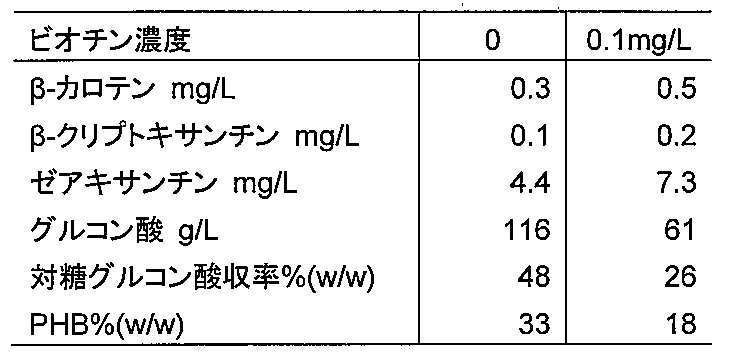
- a medium with the following composition (glucose 20 g / L, corn steep liquor 30 g / L, ammonium sulfate 0.5 g / L, potassium dihydrogen phosphate 2.25 g / L, disodium hydrogen phosphate dodecahydrate 5.7 g / L , Calcium chloride dihydrate 0.1g / L, magnesium sulfate heptahydrate 0.5g / L, iron sulfate heptahydrate 5g / L, alcohol antifoam 0.5g / L) 2.0L 5L fermentation Seven tanks were prepared in a tank. D-biotin was added to the fermenter so as to be 0, 0.001, 0.01, 0.1, 1.0, 10 and 50 mg / L, respectively, and autoclaved at 121 ° C. for 40 minutes.
- the above-mentioned Paracoccus genus zeaxanthin-producing bacterium ZX-3 strain was inoculated in a platinum loop in the seed flask medium, and cultured at 29 ° C for 2 days at 100 rpm. Inoculated in the fermenter. Aerobic culture at 29 ° C. and aeration volume of 1 vvm was performed for 120 hours. The pH was continuously controlled with 15% aqueous ammonia so that the pH during the culture was maintained at 7.1. Glucose was continuously fed so as not to be depleted.
- the minimum stirring speed was set to 100 rpm, and the stirring speed was changed so that the dissolved oxygen concentration in the culture medium at the middle stage of culture (a period when the oxygen consumption of microorganisms was most active) was maintained at 2 ppm.
- an alcohol-based antifoaming agent was automatically added to suppress foaming.
- Example 2 A Paracoccus genus A-581-1 strain (FERM BP-4671) was mutated with ethyl methanesulfonate to select yellow colonies. Carotenoids in the culture broth of the selected strain were analyzed, and a mutant strain ZX-5 producing zeaxanthin was selected.
- a medium having the following composition (sucrose 40 g / L, corn steep liquor 30 g / L, ammonium sulfate 0.5 g / L, potassium dihydrogen phosphate 2.25 g / L, disodium hydrogen phosphate dodecahydrate 5.7 g / L L, calcium chloride dihydrate 0.1 g / L, magnesium sulfate heptahydrate 0.5 g / L, iron sulfate heptahydrate 5 g / L, alcohol-based antifoaming agent 0.5 g / L) Two of these were prepared in a fermenter. D-biotin was added to the fermenter so as to be 0 and 1.0 mg / L, respectively, and autoclaved at 121 ° C. for 30 minutes.
- the above Paracoccus genus zeaxanthin producing strain ZX-5 was inoculated with one platinum ear into the seed flask medium, and cultured at 28 ° C for 2 days at 100 rpm. Inoculated in the fermenter. Aerobic culture was performed at 28 ° C. and aeration volume of 1 vvm for 140 hours. The pH was continuously controlled with 15% aqueous ammonia so that the pH was maintained at 7.2 during the culture. Sucrose was added sequentially so as not to be depleted. In addition, the minimum stirring speed was set to 200 rpm, and the stirring speed was changed so that the dissolved oxygen concentration in the culture medium in the middle of the culture was maintained at 1 ppm. By detecting foaming with a bubble sensor, a silicone-based antifoaming agent was automatically added to suppress foaming.
- Example 3 Medium of the following composition (sucrose 30 g / L, corn steep liquor 30 g / L, potassium dihydrogen phosphate 1.5 g / L, disodium hydrogen phosphate dodecahydrate 3.8 g / L, calcium chloride dihydrate 5.0 g / L, Magnesium sulfate heptahydrate 0.7g / L, Iron sulfate heptahydrate 0.3g / L, pH7.2) 100ml is put into a 500ml Erlenmeyer flask with a cotton stopper and autoclaved at 121 ° C for 20 minutes Sterilized and prepared a flask flask for seed.
- a medium with the following composition (glucose 30 g / L, corn steep liquor 30 g / L, ammonium sulfate 0.5 g / L, potassium dihydrogen phosphate 2.25 g / L, disodium hydrogen phosphate dodecahydrate 5.7 g / L , Calcium chloride dihydrate 0.1 g / L, magnesium sulfate heptahydrate 0.5 g / L, iron sulfate heptahydrate 5 g / L, sodium L-glutamate monohydrate 6 g / L, alcohol-based antifoaming agent 0.5 g / L) 2.0 L was placed in a 5 L fermentor, and two of them were prepared. D-biotin was added to the fermenter so as to be 0 and 0.1 mg / L, respectively, and autoclaved at 121 ° C. for 30 minutes.
- Paracoccus zeaxanthinifaciens ATCC 21588 strain was inoculated into one platinum ear in the seed flask medium, and cultured at 27 ° C for 2 days at 100 rpm with rotary shaking. . Aerobic culture at 27 ° C. and aeration volume of 1 vvm was performed for 120 hours. The pH was continuously controlled with 15% aqueous ammonia so that the pH was maintained at 7.2 during the culture. Glucose was continuously supplied so as not to be depleted. Further, the minimum stirring speed was set to 100 rpm, and the stirring speed was changed so that the dissolved oxygen concentration in the culture medium in the middle of the culture was maintained at 3 ppm. By detecting foaming with a bubble sensor, an alcohol-based antifoaming agent was automatically added to suppress foaming.
- Example 4 Paracoccus carotinifaciens E-396 strain (FERM BP-4283) was mutated by ultraviolet irradiation to select yellow-orange colonies.
- the selected strain was cultured in a test tube, and a mutant strain with a low pH drop in the culture solution was selected.
- the gluconic acid concentration and carotenoid concentration in the test tube culture solution of the selected mutant strain were measured, and a mutant strain ZX-6 having a low gluconic acid-producing ability and a high zeaxanthin-producing ability was selected.
- a medium with the following composition sucrose 30 g / L, Pharmamedia 20 g / L, ammonium sulfate 1.5 g / L, potassium dihydrogen phosphate 1.5 g / L, disodium hydrogen phosphate 12 hydrate 3.8 g / L , Calcium chloride dihydrate 0.1g / L, Magnesium sulfate heptahydrate 4.5g / L, Iron sulfate heptahydrate 5g / L, Sodium L-glutamate monohydrate 6g / L, Silicone defoamer 1 g / L) 2.0 L was put into a 5 L-capacity fermenter, and two of them were prepared. D-biotin was added to the fermenter so as to be 0 and 5 mg / L, respectively, and autoclaved at 121 ° C. for 30 minutes.
- D-biotin was added to the fermenter so as to be 0 and 5 mg / L, respectively, and autoclaved at 121
- the Paracoccus genus zeaxanthin-producing and low-gluconic acid-producing bacterium ZX-6 strain selected above was inoculated with one platinum ear in the seed flask medium, and after 3 days at 28 ° C., after performing rotary shaking culture at 100 rpm, 80 mL of the culture solution was inoculated into each fermentor. Aerobic culture at 28 ° C. and aeration volume of 1 vvm was performed for 120 hours. The pH was continuously controlled with 25% aqueous ammonia so that the pH was maintained at 7.2 during the culture. Sucrose was supplied continuously so as not to be depleted.
- the minimum stirring rotation speed was set to 100 rpm, and the dissolved oxygen concentration in the culture solution was controlled to 4 ppm by changing the stirring rotation speed. Generation of bubbles was suppressed by automatically adding a certain amount of a fatty acid-based antifoaming agent at regular intervals.
- Example 5 Paracoccus carotinifaciens E-396 strain (FERM BP-4283) was mutagenized with N-methyl-N'-nitro-N-nitrosoguanidine to select dark red colonies.
- the selected strain was cultured in a test tube, the PHB content and carotenoid concentration were measured, and a mutant LP-26 strain having a low PHB-producing ability and a high astaxanthin-producing ability was selected.
- LP-26 strain was mutagenized with N-methyl-N′-nitro-N-nitrosoguanidine to select yellow-orange colonies.
- the selected strain was cultured in a test tube, the PHB content and carotenoid concentration were measured, and a mutant strain ZXA-7 having a low PHB production ability and a high zeaxanthin production ability was selected.
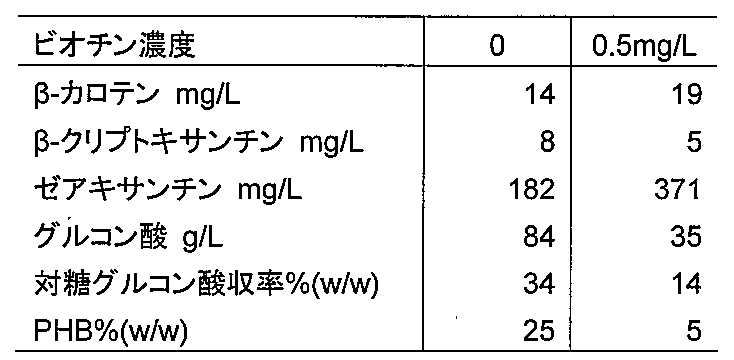
- a medium having the following composition (glucose 40 g / L, corn steep liquor 30 g / L, ammonium sulfate 0.5 g / L, potassium dihydrogen phosphate 2.25 g / L, disodium hydrogen phosphate dodecahydrate 5.7 g / L , Calcium chloride dihydrate 0.1 g / L, magnesium sulfate heptahydrate 0.5 g / L, iron sulfate heptahydrate 5 g / L, sodium L-glutamate monohydrate 6 g / L, alcohol-based antifoaming agent 0.5 g / L) 2.0 L was prepared in a 5 L fermenter. D-biotin was added to the fermenter so as to be 0 and 0.5 mg / L, respectively, and autoclaved at 121 ° C. for 20 minutes.
- Table 5 shows the results of measuring the carotenoid concentration, gluconic acid concentration, and PHB content per dry cell at the end of the culture.
- zeaxanthin productivity was higher than when no biotin was added.
- Yield% of sugar gluconic acid (w / w)” in Table 5 means the ratio of the amount of gluconic acid produced at the end of the culture to the total amount of glucose consumed.
- Example 6 Using the zeaxanthin-producing mutant strain ZX-3 obtained in Example 1, cultivation was performed for 120 hours in a 5 L fermentor under the same culture conditions as in Example 1 with an addition concentration of D-biotin of 1 mg / L. .
- the obtained culture solution is centrifuged with sulfuric acid to pH 4.5, and the resulting concentrate is suspended by adding water to the same volume as the culture solution before concentration, and then centrifuged again. It was. Subsequently, the concentrate was freeze-dried to obtain a dried microbial cell product.
- the zeaxanthin content per obtained dried cell body was 4.1 mg / g.
- the zeaxanthin content per dry cell body obtained by culturing and drying in the same manner without adding biotin was 1.3 mg / g.
- Example 7 Using the zeaxanthin-producing mutant strain ZX-5 obtained in Example 2, the D-biotin addition concentration was 1 mg / L, and culture was performed in a 5 L fermenter under the same culture conditions as in Example 2.
- the obtained culture broth was concentrated 4 times with a micro-za microfiltration membrane (manufactured by Asahi Kasei Chemicals), added with an equal amount of water to the concentrate, and further filtered and concentrated.
- the obtained concentrate was dried with a drum dryer to obtain a dried bacterial cell product.
- the zeaxanthin content per dried bacterial cell product obtained was 2.0 mg / g.
- Example 8 In Example 4, the culture solution obtained by culturing in a 5 L fermentor at a D-biotin addition concentration of 5 mg / L was sterilized at 80 ° C. for 30 minutes. Subsequently, sulfuric acid was added to the culture solution to adjust the pH to 4.6, and an equal amount of water to the culture solution was added, followed by centrifugation and concentration 6 times.
- the zeaxanthin content per dried cell body obtained by drying the concentrate with a spray dryer was 6.6 mg / g.
- Example 9 The culture solution obtained by adding D-biotin to 0.5 mg / L in Example 5 was filtered and concentrated 2.2 times with a cross-flow ceramic filter, and the same amount of water as the concentrate was added. Then, it was filtered again to obtain a concentrated solution.
- the content of zeaxanthin per dried microbial cell obtained by drum drying this concentrated solution was 24 mg / g.
Landscapes
- Life Sciences & Earth Sciences (AREA)
- Chemical & Material Sciences (AREA)
- Health & Medical Sciences (AREA)
- Engineering & Computer Science (AREA)
- Organic Chemistry (AREA)
- Zoology (AREA)
- General Health & Medical Sciences (AREA)
- Polymers & Plastics (AREA)
- Bioinformatics & Cheminformatics (AREA)
- Wood Science & Technology (AREA)
- General Chemical & Material Sciences (AREA)
- Food Science & Technology (AREA)
- Biochemistry (AREA)
- Genetics & Genomics (AREA)
- Chemical Kinetics & Catalysis (AREA)
- Biotechnology (AREA)
- Medicinal Chemistry (AREA)
- Nuclear Medicine, Radiotherapy & Molecular Imaging (AREA)
- Microbiology (AREA)
- Nutrition Science (AREA)
- Animal Behavior & Ethology (AREA)
- Veterinary Medicine (AREA)
- Public Health (AREA)
- General Engineering & Computer Science (AREA)
- Pharmacology & Pharmacy (AREA)
- Tropical Medicine & Parasitology (AREA)
- Mycology (AREA)
- Botany (AREA)
- Virology (AREA)
- Biomedical Technology (AREA)
- Animal Husbandry (AREA)
- Ophthalmology & Optometry (AREA)
- Dermatology (AREA)
- Toxicology (AREA)
- Preparation Of Compounds By Using Micro-Organisms (AREA)
- Acyclic And Carbocyclic Compounds In Medicinal Compositions (AREA)
- Micro-Organisms Or Cultivation Processes Thereof (AREA)
- Cosmetics (AREA)
- Fodder In General (AREA)
Abstract
Description
(旧名称:通商産業省工業技術院生命工学工業技術研究所)
〒305-8566
日本国茨城県つくば市東1丁目1番地1中央第6
識別のための表示:E-396
受託番号:FERM BP-4283
原寄託日:平成5年(1993年)4月27日
また、本方法に使用するカロテノイド産生細菌の他の例として挙げられるA-581-1株は、独立行政法人 産業技術総合研究所 特許生物寄託センターに以下の通り国際寄託されている。
(旧名称:通商産業省工業技術院生命工学工業技術研究所)
〒305-8566
日本国茨城県つくば市東1丁目1番地1中央第6
識別のための表示:A-581-1
受託番号:FERM BP-4671
原寄託日:平成6年(1994年)5月20日
なお、ゼアキサンチン以外に本方法により産生されるカロテノイドとしては、特に限定されないが、例えば、β-カロテン、β-クリプトキサンチン、アスタキサンチン、カンタキサンチン、アドニキサンチン、フェニコキサンチン、エキネノン、アステロイデノン、3-ヒドロキシエキネノン及びリコペンが挙げられ、好ましくは、β-カロテン及びβ-クリプトキサンチンが挙げられる。本方法により製造されるカロテノイドは一種でもよいし、複数種が組み合わされていてもよい。
〔実施例1〕
Paracoccus carotinifaciens E-396株(FERM BP-4283)をN-メチル-N'-ニトロ-N-ニトロソグアニジンで変異処理し、黄色~橙色のコロニーを選択した。選択された株の培養液中のカロテノイド濃度を測定し、ゼアキサンチン生産能が高い変異株ZX-3株を選択した。

Paracoccus属細菌A-581-1株(FERM BP-4671)をエチルメタンスルホネートにより変異処理し、黄色のコロニーを選択した。選択された株の培養液中のカロテノイドを分析し、ゼアキサンチンを産生する変異株ZX-5株を選択した。

以下の組成の培地(シュークロース30g/L、コーンスティープリカー30g/L、リン酸二水素カリウム1.5g/L、リン酸水素二ナトリウム12水和物3.8g/L、塩化カルシウム2水和物5.0g/L、硫酸マグネシウム7水和物0.7g/L、硫酸鉄7水和物0.3g/L、pH7.2)100mlを、500ml容量の綿栓付き三角フラスコに入れ、121℃で20分間オートクレーブ殺菌し、シード用フラスコ培地を調製した。
Paracoccus carotinifaciens E-396株(FERM BP-4283)を紫外線照射で変異処理し、黄色~橙色のコロニーを選択した。選択した菌株を試験管で培養し、培養液のpH低下が少ない変異株を選抜した。選抜された変異株の試験管培養液中のグルコン酸濃度及びカロテノイド濃度を測定し、グルコン酸生産能が低く、且つゼアキサンチン生産能が高い変異株ZX-6株を選択した。

Paracoccus carotinifaciens E-396株(FERM BP-4283)をN-メチル-N'-ニトロ-N-ニトロソグアニジンで変異処理し、赤色の濃いコロニーを選択した。選択した菌株を試験管で培養し、PHB含量及びカロテノイド濃度を測定し、PHB生産能が低く、且つアスタキサンチン生産能が高い変異株LP-26株を選択した。次にLP-26株をN-メチル-N'-ニトロ-N-ニトロソグアニジンで変異処理し、黄色~橙色のコロニーを選択した。選択した菌株を試験管で培養し、PHB含量及びカロテノイド濃度を測定し、PHB生産能が低く、且つゼアキサンチン生産能が高い変異株ZXA-7株を選択した。
実施例1で取得したゼアキサンチン生産変異株ZX-3株を用いて、実施例1と同じ培養条件下で、D-ビオチンの添加濃度を1mg/Lとして5L発酵槽で120時間の培養を行った。
実施例2で得られたゼアキサンチン生産変異株ZX-5株を用いて、D-ビオチン添加濃度を1mg/Lとして実施例2と同じ培養条件下で5L発酵槽における培養を行った。
実施例4においてD-ビオチン添加濃度5mg/Lとして5L容量の発酵槽における培養で得られた培養液を、80℃で30分間殺菌処理した。次いで、培養液に硫酸を加えてpHを4.6に合わせ、培養液と等量の水を加えた後、遠心分離を行い、6倍に濃縮した。
実施例5においてD-ビオチンを0.5mg/Lとなるように添加して得られた培養液を、クロスフロー型セラミックフィルターで2.2倍にろ過濃縮し、濃縮物と等量の水を加えた後、再度ろ過して濃縮液を取得した。
Claims (16)
- ゼアキサンチンを含むカロテノイドを生産する細菌をビオチン含有培地で培養する工程を含み、ビオチン非含有培地における培養終了後の培養液と比較して、培養終了後の培養液におけるグルコン酸生産濃度が低く、且つゼアキサンチン生産濃度が高いことを特徴とする、ゼアキサンチンを含むカロテノイドを製造する方法。
- 培養終了後の培養液におけるグルコン酸生産濃度が80g/L以下であることを特徴とする、請求項1記載の方法。
- 培養終了後の培養液におけるグルコン酸生産量が消費した炭素源の30%(w/w)以下であることを特徴とする、請求項1記載の方法。
- 生産されたカロテノイドがβ-クリプトキサンチンを含有することを特徴とする、請求項1記載の方法。
- 生産されたカロテノイドがβ-カロテンを含有することを特徴とする、請求項1記載の方法。
- ビオチンの培地当たりの濃度が0.001mg/L~50mg/Lであることを特徴とする、請求項1記載の方法。
- 培養終了後の培養液における乾燥菌体当たりのゼアキサンチン含量が2mg/g以上であることを特徴とする、請求項1記載の方法。
- 培養終了後の培養液における乾燥細胞当たりのポリ-β-ヒドロキシ酪酸(PHB)含量が30%(w/w)以下であることを特徴とする、請求項1記載の方法。
- 細菌がパラコッカス(Paracoccus)属に属する細菌であることを特徴とする、請求項1記載の方法。
- 細菌がアスタキサンチンを産生するパラコッカス属細菌を変異処理してゼアキサンチンを産生するようにした変異株であることを特徴とする、請求項1記載の方法。
- 細菌が親株と比較してグルコン酸生産能を低下させた変異株であることを特徴とする、請求項1記載の方法。
- 細菌が親株と比較してPHB生産能を低下させた変異株であることを特徴とする、請求項1記載の方法。
- 細菌が、16SリボソームRNAに対応するDNAの塩基配列が配列番号1記載の塩基配列と実質的に相同である細菌であることを特徴とする、請求項1記載の方法。
- 細菌が、E-396株(FERM BP-4283)又はA-581-1株(FERM BP-4671)に由来する変異株であることを特徴とする、請求項1記載の方法。
- 請求項1記載の方法により製造されたゼアキサンチンを含むカロテノイドを含有するカロテノイド組成物であって、培養終了後の培養液における乾燥細胞当たりのPHB含量が30%(w/w)以下であることを特徴とする、前記組成物。
- 請求項1記載の方法により得られた培養液を乾燥することにより製造されたゼアキサンチンを含むカロテノイド含有乾燥菌体組成物であって、該組成物当たりのゼアキサンチン含量が2mg/g以上であることを特徴とする、前記組成物。
Priority Applications (8)
| Application Number | Priority Date | Filing Date | Title |
|---|---|---|---|
| CA2794882A CA2794882A1 (en) | 2010-03-30 | 2011-03-29 | Method for producing zeaxanthin by fermentation |
| EP11762840.4A EP2554675B1 (en) | 2010-03-30 | 2011-03-29 | Method of manufacturing zeaxanthin by fermentation |
| RU2012145469/10A RU2012145469A (ru) | 2010-03-30 | 2011-03-29 | Способ получения зеаксантина ферментацией |
| US13/637,698 US8883443B2 (en) | 2010-03-30 | 2011-03-29 | Method for producing zeaxanthin by fermentation |
| CN201180027157.8A CN103038358B (zh) | 2010-03-30 | 2011-03-29 | 通过发酵制造玉米黄质的方法 |
| KR1020127026759A KR101848426B1 (ko) | 2010-03-30 | 2011-03-29 | 발효에 의한 제아잔틴 생산방법 |
| AU2011235718A AU2011235718B2 (en) | 2010-03-30 | 2011-03-29 | Method of manufacturing zeaxanthin by fermentation |
| JP2012508339A JP5851392B2 (ja) | 2010-03-30 | 2011-03-29 | 発酵によるゼアキサンチンの製造法 |
Applications Claiming Priority (2)
| Application Number | Priority Date | Filing Date | Title |
|---|---|---|---|
| JP2010-079415 | 2010-03-30 | ||
| JP2010079415 | 2010-03-30 |
Publications (1)
| Publication Number | Publication Date |
|---|---|
| WO2011122616A1 true WO2011122616A1 (ja) | 2011-10-06 |
Family
ID=44712311
Family Applications (1)
| Application Number | Title | Priority Date | Filing Date |
|---|---|---|---|
| PCT/JP2011/057794 Ceased WO2011122616A1 (ja) | 2010-03-30 | 2011-03-29 | 発酵によるゼアキサンチンの製造法 |
Country Status (9)
| Country | Link |
|---|---|
| US (1) | US8883443B2 (ja) |
| EP (1) | EP2554675B1 (ja) |
| JP (1) | JP5851392B2 (ja) |
| KR (1) | KR101848426B1 (ja) |
| CN (1) | CN103038358B (ja) |
| AU (1) | AU2011235718B2 (ja) |
| CA (1) | CA2794882A1 (ja) |
| RU (1) | RU2012145469A (ja) |
| WO (1) | WO2011122616A1 (ja) |
Cited By (4)
| Publication number | Priority date | Publication date | Assignee | Title |
|---|---|---|---|---|
| WO2014157457A1 (ja) * | 2013-03-29 | 2014-10-02 | Jx日鉱日石エネルギー株式会社 | ゼアキサンチンの製造方法及び細菌の培養方法 |
| WO2016002710A1 (ja) * | 2014-06-30 | 2016-01-07 | Jx日鉱日石エネルギー株式会社 | カロテノイドを含有する乾燥菌体粉末およびその製造方法 |
| WO2017115774A1 (ja) * | 2015-12-28 | 2017-07-06 | Jxエネルギー株式会社 | コバルト含有培地によるカロテノイド産生細菌によるカロテノイドの発酵製造方法 |
| WO2022220014A1 (ja) | 2021-04-13 | 2022-10-20 | Eneos株式会社 | カロテノイドを生産する微生物 |
Families Citing this family (2)
| Publication number | Priority date | Publication date | Assignee | Title |
|---|---|---|---|---|
| KR102323664B1 (ko) * | 2019-04-25 | 2021-11-08 | 부경대학교 산학협력단 | 파라코커스 속 균주를 이용한 사료첨가제 |
| KR102414136B1 (ko) | 2021-10-26 | 2022-06-27 | 서울대학교산학협력단 | 제아잔틴을 생산하는 재조합 야로위아 리폴리티카 및 제아잔틴 생산방법 |
Citations (17)
| Publication number | Priority date | Publication date | Assignee | Title |
|---|---|---|---|---|
| JPS4849989A (ja) * | 1971-10-27 | 1973-07-14 | ||
| JPH0549497A (ja) | 1991-08-23 | 1993-03-02 | Kaiyo Bio Technol Kenkyusho:Kk | ゼアキサンチンの製造法 |
| JPH05508532A (ja) * | 1989-08-30 | 1993-12-02 | アプライド フード バイオテクノロジー、インコーポレイテッド | ゼアキサンチン及びゼアキサンチン含有組成物の製造 |
| JPH05328978A (ja) | 1992-06-01 | 1993-12-14 | Kaiyo Bio Technol Kenkyusho:Kk | ゼアキサンチンの製造法及びこれに用いる新規フレキシバクター属微生物 |
| JPH0759558A (ja) | 1993-08-26 | 1995-03-07 | Kaiyo Bio Technol Kenkyusho:Kk | 新規微細藻類及びそれを用いた色素生産方法 |
| JPH0892205A (ja) | 1994-03-17 | 1996-04-09 | Univ America Catholic | ケン化したマリゴールドの含油樹脂からのルテインの単離、精製および再結晶法、およびその使用 |
| JPH0923888A (ja) * | 1995-06-09 | 1997-01-28 | F Hoffmann La Roche Ag | 発酵によるカロテノイドの製造方法 |
| JPH10155430A (ja) | 1996-11-27 | 1998-06-16 | Dainippon Ink & Chem Inc | 高濃度ゼアキサンチン含有家禽卵 |
| JP2005087097A (ja) | 2003-09-17 | 2005-04-07 | Nippon Oil Corp | ゼアキサンチンの製造方法 |
| WO2005118812A1 (ja) | 2004-06-04 | 2005-12-15 | Marine Biotechnology Institute Co., Ltd. | カロテノイドケトラーゼ及びカロテノイドヒドロキシラーゼ遺伝子を利用したアスタキサンチンまたはその代謝物の製造法 |
| JP2007151475A (ja) | 2005-12-06 | 2007-06-21 | Tosoh Corp | 新規微生物およびそれを用いたゼアキサンチンの製造方法 |
| JP2007244205A (ja) | 2006-03-13 | 2007-09-27 | Tosoh Corp | カロテノイド類の製造方法 |
| JP2008118525A (ja) * | 2006-11-07 | 2008-05-22 | Fujitsu Ltd | 中継装置、無線通信システム及びマルチキャスト中継方法 |
| JP2010079415A (ja) | 2008-09-24 | 2010-04-08 | Fuji Xerox Co Ltd | 印刷システムおよび印刷要求装置および印刷制限プログラム |
| WO2010044469A1 (ja) * | 2008-10-17 | 2010-04-22 | 新日本石油株式会社 | カロテノイドの発酵法 |
| JP2010172293A (ja) * | 2009-01-30 | 2010-08-12 | Nippon Oil Corp | カロテノイドの分離法 |
| JP2010193865A (ja) * | 2009-02-27 | 2010-09-09 | Jx Nippon Oil & Energy Corp | カロテノイドの製造方法 |
Family Cites Families (8)
| Publication number | Priority date | Publication date | Assignee | Title |
|---|---|---|---|---|
| US3891504A (en) * | 1970-07-31 | 1975-06-24 | Hoffmann La Roche | Process for the manufacture of zeaxanthin |
| JPH0223888A (ja) | 1988-07-11 | 1990-01-26 | Kyowa Medetsukusu Kk | リゾチーム活性の定量法 |
| JP4427167B2 (ja) * | 2000-06-12 | 2010-03-03 | 新日本石油株式会社 | カロテノイド色素の製法 |
| US7691406B2 (en) * | 2000-10-27 | 2010-04-06 | ZeaVision LLC. | Zeaxanthin formulations for human ingestion |
| AU2004274750B2 (en) * | 2003-09-17 | 2007-05-17 | Nippon Oil Corporation | Process for producing carotenoid compound |
| GB0509341D0 (en) * | 2005-05-07 | 2005-06-15 | Aquapharm Bio Discovery Ltd | Biological prodution of Zeaxanthin |
| EP1956077A4 (en) * | 2005-12-06 | 2009-02-11 | Tosoh Corp | NEW MICROORGANISM AND PROCESS FOR CAROTINOID PRODUCTION THEREWITH |
| JP5762691B2 (ja) * | 2010-03-15 | 2015-08-12 | Jx日鉱日石エネルギー株式会社 | 発酵によるアスタキサンチン製造方法 |
-
2011
- 2011-03-29 KR KR1020127026759A patent/KR101848426B1/ko active Active
- 2011-03-29 US US13/637,698 patent/US8883443B2/en not_active Expired - Fee Related
- 2011-03-29 CA CA2794882A patent/CA2794882A1/en not_active Abandoned
- 2011-03-29 CN CN201180027157.8A patent/CN103038358B/zh active Active
- 2011-03-29 WO PCT/JP2011/057794 patent/WO2011122616A1/ja not_active Ceased
- 2011-03-29 RU RU2012145469/10A patent/RU2012145469A/ru not_active Application Discontinuation
- 2011-03-29 EP EP11762840.4A patent/EP2554675B1/en active Active
- 2011-03-29 AU AU2011235718A patent/AU2011235718B2/en not_active Ceased
- 2011-03-29 JP JP2012508339A patent/JP5851392B2/ja active Active
Patent Citations (17)
| Publication number | Priority date | Publication date | Assignee | Title |
|---|---|---|---|---|
| JPS4849989A (ja) * | 1971-10-27 | 1973-07-14 | ||
| JPH05508532A (ja) * | 1989-08-30 | 1993-12-02 | アプライド フード バイオテクノロジー、インコーポレイテッド | ゼアキサンチン及びゼアキサンチン含有組成物の製造 |
| JPH0549497A (ja) | 1991-08-23 | 1993-03-02 | Kaiyo Bio Technol Kenkyusho:Kk | ゼアキサンチンの製造法 |
| JPH05328978A (ja) | 1992-06-01 | 1993-12-14 | Kaiyo Bio Technol Kenkyusho:Kk | ゼアキサンチンの製造法及びこれに用いる新規フレキシバクター属微生物 |
| JPH0759558A (ja) | 1993-08-26 | 1995-03-07 | Kaiyo Bio Technol Kenkyusho:Kk | 新規微細藻類及びそれを用いた色素生産方法 |
| JPH0892205A (ja) | 1994-03-17 | 1996-04-09 | Univ America Catholic | ケン化したマリゴールドの含油樹脂からのルテインの単離、精製および再結晶法、およびその使用 |
| JPH0923888A (ja) * | 1995-06-09 | 1997-01-28 | F Hoffmann La Roche Ag | 発酵によるカロテノイドの製造方法 |
| JPH10155430A (ja) | 1996-11-27 | 1998-06-16 | Dainippon Ink & Chem Inc | 高濃度ゼアキサンチン含有家禽卵 |
| JP2005087097A (ja) | 2003-09-17 | 2005-04-07 | Nippon Oil Corp | ゼアキサンチンの製造方法 |
| WO2005118812A1 (ja) | 2004-06-04 | 2005-12-15 | Marine Biotechnology Institute Co., Ltd. | カロテノイドケトラーゼ及びカロテノイドヒドロキシラーゼ遺伝子を利用したアスタキサンチンまたはその代謝物の製造法 |
| JP2007151475A (ja) | 2005-12-06 | 2007-06-21 | Tosoh Corp | 新規微生物およびそれを用いたゼアキサンチンの製造方法 |
| JP2007244205A (ja) | 2006-03-13 | 2007-09-27 | Tosoh Corp | カロテノイド類の製造方法 |
| JP2008118525A (ja) * | 2006-11-07 | 2008-05-22 | Fujitsu Ltd | 中継装置、無線通信システム及びマルチキャスト中継方法 |
| JP2010079415A (ja) | 2008-09-24 | 2010-04-08 | Fuji Xerox Co Ltd | 印刷システムおよび印刷要求装置および印刷制限プログラム |
| WO2010044469A1 (ja) * | 2008-10-17 | 2010-04-22 | 新日本石油株式会社 | カロテノイドの発酵法 |
| JP2010172293A (ja) * | 2009-01-30 | 2010-08-12 | Nippon Oil Corp | カロテノイドの分離法 |
| JP2010193865A (ja) * | 2009-02-27 | 2010-09-09 | Jx Nippon Oil & Energy Corp | カロテノイドの製造方法 |
Non-Patent Citations (9)
| Title |
|---|
| AKIHIRO YOKOYAMA; WATARU MIKI, FEMS MICROBIOLOGY LETTERS, vol. 128, 1995, pages 139 - 144 |
| ALAN BERRY ET AL., INTERNATIONAL JOURNAL OF SYSTEMATIC AND EVOLUTIONARY MICROBIOLOGY, vol. 53, 2003, pages 231 - 238 |
| FOOD STYLE 21, vol. 3, no. 3, 1999, pages 50 - 53 |
| INTERNATIONAL JOURNAL OF SYSTEMATIC BACTERIOLOGY, vol. 48, 1998, pages 543 - 548 |
| JAE HYUNG LEE ET AL., INTERNATIONAL JOURNAL OF SYSTEMATIC AND EVOLUTIONARY MICROBIOLOGY, vol. 54, 2004, pages 1699 - 1702 |
| NOBUYOSHI SHIDZU ET AL., FISHERIES SCIENCE, vol. 62, no. 1, 1996, pages 134 - 137 |
| PAUST J ET AL., PURE APPL. CHEM., vol. 63, no. 1, 1991, pages 45 - 58 |
| TSUSHIMA M. ET AL., BIOL. PHARM. BULL., vol. 18, no. 2, 1995, pages 227 - 233 |
| YAMAGUCHI M ET AL., ACS SYMP SER (AM CHEM SOC, vol. 993, 2008, pages 408 - 418 |
Cited By (10)
| Publication number | Priority date | Publication date | Assignee | Title |
|---|---|---|---|---|
| WO2014157457A1 (ja) * | 2013-03-29 | 2014-10-02 | Jx日鉱日石エネルギー株式会社 | ゼアキサンチンの製造方法及び細菌の培養方法 |
| JPWO2014157457A1 (ja) * | 2013-03-29 | 2017-02-16 | Jxエネルギー株式会社 | ゼアキサンチンの製造方法及び細菌の培養方法 |
| WO2016002710A1 (ja) * | 2014-06-30 | 2016-01-07 | Jx日鉱日石エネルギー株式会社 | カロテノイドを含有する乾燥菌体粉末およびその製造方法 |
| JP2016010383A (ja) * | 2014-06-30 | 2016-01-21 | Jx日鉱日石エネルギー株式会社 | カロテノイドを含有する乾燥菌体粉末およびその製造方法 |
| WO2017115774A1 (ja) * | 2015-12-28 | 2017-07-06 | Jxエネルギー株式会社 | コバルト含有培地によるカロテノイド産生細菌によるカロテノイドの発酵製造方法 |
| JPWO2017115774A1 (ja) * | 2015-12-28 | 2017-12-28 | Jxtgエネルギー株式会社 | コバルト含有培地によるカロテノイド産生細菌によるカロテノイドの発酵製造方法 |
| US10947574B2 (en) | 2015-12-28 | 2021-03-16 | Eneos Corporation | Method for producing fermented carotenoid using carotenoid-producing bacteria obtained by using cobalt-containing culturing medium |
| WO2022220014A1 (ja) | 2021-04-13 | 2022-10-20 | Eneos株式会社 | カロテノイドを生産する微生物 |
| JPWO2022220014A1 (ja) * | 2021-04-13 | 2022-10-20 | ||
| KR20230169930A (ko) | 2021-04-13 | 2023-12-18 | 에네오스 가부시키가이샤 | 카로테노이드를 생산하는 미생물 |
Also Published As
| Publication number | Publication date |
|---|---|
| RU2012145469A (ru) | 2014-05-10 |
| US8883443B2 (en) | 2014-11-11 |
| JP5851392B2 (ja) | 2016-02-03 |
| KR20130040823A (ko) | 2013-04-24 |
| AU2011235718B2 (en) | 2014-06-05 |
| EP2554675A4 (en) | 2016-01-13 |
| EP2554675B1 (en) | 2019-05-01 |
| JPWO2011122616A1 (ja) | 2013-07-08 |
| CN103038358A (zh) | 2013-04-10 |
| CA2794882A1 (en) | 2011-10-06 |
| EP2554675A1 (en) | 2013-02-06 |
| US20130030218A1 (en) | 2013-01-31 |
| KR101848426B1 (ko) | 2018-04-12 |
| CN103038358B (zh) | 2016-01-20 |
Similar Documents
| Publication | Publication Date | Title |
|---|---|---|
| JP5762691B2 (ja) | 発酵によるアスタキサンチン製造方法 | |
| JP5714907B2 (ja) | カロテノイドの発酵法 | |
| EP2392666B1 (en) | Method for separating carotenoid | |
| JP5851392B2 (ja) | 発酵によるゼアキサンチンの製造法 | |
| KR102080420B1 (ko) | 코발트 함유 배지에 의한 카로테노이드 산생 세균에 의한 카로테노이드의 발효 제조 방법 | |
| JP6132905B2 (ja) | ゼアキサンチンの製造方法及び細菌の培養方法 | |
| EP4328317A1 (en) | Microbe that produces carotenoid |
Legal Events
| Date | Code | Title | Description |
|---|---|---|---|
| WWE | Wipo information: entry into national phase |
Ref document number: 201180027157.8 Country of ref document: CN |
|
| 121 | Ep: the epo has been informed by wipo that ep was designated in this application |
Ref document number: 11762840 Country of ref document: EP Kind code of ref document: A1 |
|
| WWE | Wipo information: entry into national phase |
Ref document number: 2012508339 Country of ref document: JP |
|
| ENP | Entry into the national phase |
Ref document number: 2794882 Country of ref document: CA |
|
| WWE | Wipo information: entry into national phase |
Ref document number: 13637698 Country of ref document: US |
|
| NENP | Non-entry into the national phase |
Ref country code: DE |
|
| ENP | Entry into the national phase |
Ref document number: 20127026759 Country of ref document: KR Kind code of ref document: A |
|
| WWE | Wipo information: entry into national phase |
Ref document number: 9038/CHENP/2012 Country of ref document: IN |
|
| WWE | Wipo information: entry into national phase |
Ref document number: 2011762840 Country of ref document: EP |
|
| WWE | Wipo information: entry into national phase |
Ref document number: 2012145469 Country of ref document: RU |
|
| ENP | Entry into the national phase |
Ref document number: 2011235718 Country of ref document: AU Date of ref document: 20110329 Kind code of ref document: A |