WO2011111576A1 - 光学用粘着シート - Google Patents
光学用粘着シート Download PDFInfo
- Publication number
- WO2011111576A1 WO2011111576A1 PCT/JP2011/054700 JP2011054700W WO2011111576A1 WO 2011111576 A1 WO2011111576 A1 WO 2011111576A1 JP 2011054700 W JP2011054700 W JP 2011054700W WO 2011111576 A1 WO2011111576 A1 WO 2011111576A1
- Authority
- WO
- WIPO (PCT)
- Prior art keywords
- sensitive adhesive
- pressure
- weight
- adhesive sheet
- haze
- Prior art date
- Legal status (The legal status is an assumption and is not a legal conclusion. Google has not performed a legal analysis and makes no representation as to the accuracy of the status listed.)
- Ceased
Links
Images

Classifications
-
- B—PERFORMING OPERATIONS; TRANSPORTING
- B32—LAYERED PRODUCTS
- B32B—LAYERED PRODUCTS, i.e. PRODUCTS BUILT-UP OF STRATA OF FLAT OR NON-FLAT, e.g. CELLULAR OR HONEYCOMB, FORM
- B32B7/00—Layered products characterised by the relation between layers; Layered products characterised by the relative orientation of features between layers, or by the relative values of a measurable parameter between layers, i.e. products comprising layers having different physical, chemical or physicochemical properties; Layered products characterised by the interconnection of layers
- B32B7/04—Interconnection of layers
- B32B7/12—Interconnection of layers using interposed adhesives or interposed materials with bonding properties
-
- C—CHEMISTRY; METALLURGY
- C09—DYES; PAINTS; POLISHES; NATURAL RESINS; ADHESIVES; COMPOSITIONS NOT OTHERWISE PROVIDED FOR; APPLICATIONS OF MATERIALS NOT OTHERWISE PROVIDED FOR
- C09J—ADHESIVES; NON-MECHANICAL ASPECTS OF ADHESIVE PROCESSES IN GENERAL; ADHESIVE PROCESSES NOT PROVIDED FOR ELSEWHERE; USE OF MATERIALS AS ADHESIVES
- C09J7/00—Adhesives in the form of films or foils
- C09J7/20—Adhesives in the form of films or foils characterised by their carriers
- C09J7/22—Plastics; Metallised plastics
-
- B—PERFORMING OPERATIONS; TRANSPORTING
- B32—LAYERED PRODUCTS
- B32B—LAYERED PRODUCTS, i.e. PRODUCTS BUILT-UP OF STRATA OF FLAT OR NON-FLAT, e.g. CELLULAR OR HONEYCOMB, FORM
- B32B27/00—Layered products comprising a layer of synthetic resin
- B32B27/36—Layered products comprising a layer of synthetic resin comprising polyesters
-
- C—CHEMISTRY; METALLURGY
- C09—DYES; PAINTS; POLISHES; NATURAL RESINS; ADHESIVES; COMPOSITIONS NOT OTHERWISE PROVIDED FOR; APPLICATIONS OF MATERIALS NOT OTHERWISE PROVIDED FOR
- C09J—ADHESIVES; NON-MECHANICAL ASPECTS OF ADHESIVE PROCESSES IN GENERAL; ADHESIVE PROCESSES NOT PROVIDED FOR ELSEWHERE; USE OF MATERIALS AS ADHESIVES
- C09J133/00—Adhesives based on homopolymers or copolymers of compounds having one or more unsaturated aliphatic radicals, each having only one carbon-to-carbon double bond, and at least one being terminated by only one carboxyl radical, or of salts, anhydrides, esters, amides, imides, or nitriles thereof; Adhesives based on derivatives of such polymers
- C09J133/04—Homopolymers or copolymers of esters
- C09J133/06—Homopolymers or copolymers of esters of esters containing only carbon, hydrogen and oxygen, the oxygen atom being present only as part of the carboxyl radical
- C09J133/062—Copolymers with monomers not covered by C09J133/06
- C09J133/066—Copolymers with monomers not covered by C09J133/06 containing -OH groups
-
- C—CHEMISTRY; METALLURGY
- C09—DYES; PAINTS; POLISHES; NATURAL RESINS; ADHESIVES; COMPOSITIONS NOT OTHERWISE PROVIDED FOR; APPLICATIONS OF MATERIALS NOT OTHERWISE PROVIDED FOR
- C09J—ADHESIVES; NON-MECHANICAL ASPECTS OF ADHESIVE PROCESSES IN GENERAL; ADHESIVE PROCESSES NOT PROVIDED FOR ELSEWHERE; USE OF MATERIALS AS ADHESIVES
- C09J133/00—Adhesives based on homopolymers or copolymers of compounds having one or more unsaturated aliphatic radicals, each having only one carbon-to-carbon double bond, and at least one being terminated by only one carboxyl radical, or of salts, anhydrides, esters, amides, imides, or nitriles thereof; Adhesives based on derivatives of such polymers
- C09J133/04—Homopolymers or copolymers of esters
- C09J133/06—Homopolymers or copolymers of esters of esters containing only carbon, hydrogen and oxygen, the oxygen atom being present only as part of the carboxyl radical
- C09J133/08—Homopolymers or copolymers of acrylic acid esters
-
- C—CHEMISTRY; METALLURGY
- C09—DYES; PAINTS; POLISHES; NATURAL RESINS; ADHESIVES; COMPOSITIONS NOT OTHERWISE PROVIDED FOR; APPLICATIONS OF MATERIALS NOT OTHERWISE PROVIDED FOR
- C09J—ADHESIVES; NON-MECHANICAL ASPECTS OF ADHESIVE PROCESSES IN GENERAL; ADHESIVE PROCESSES NOT PROVIDED FOR ELSEWHERE; USE OF MATERIALS AS ADHESIVES
- C09J133/00—Adhesives based on homopolymers or copolymers of compounds having one or more unsaturated aliphatic radicals, each having only one carbon-to-carbon double bond, and at least one being terminated by only one carboxyl radical, or of salts, anhydrides, esters, amides, imides, or nitriles thereof; Adhesives based on derivatives of such polymers
- C09J133/04—Homopolymers or copolymers of esters
- C09J133/14—Homopolymers or copolymers of esters of esters containing halogen, nitrogen, sulfur or oxygen atoms in addition to the carboxy oxygen
-
- C—CHEMISTRY; METALLURGY
- C09—DYES; PAINTS; POLISHES; NATURAL RESINS; ADHESIVES; COMPOSITIONS NOT OTHERWISE PROVIDED FOR; APPLICATIONS OF MATERIALS NOT OTHERWISE PROVIDED FOR
- C09J—ADHESIVES; NON-MECHANICAL ASPECTS OF ADHESIVE PROCESSES IN GENERAL; ADHESIVE PROCESSES NOT PROVIDED FOR ELSEWHERE; USE OF MATERIALS AS ADHESIVES
- C09J7/00—Adhesives in the form of films or foils
- C09J7/30—Adhesives in the form of films or foils characterised by the adhesive composition
- C09J7/38—Pressure-sensitive adhesives [PSA]
-
- B—PERFORMING OPERATIONS; TRANSPORTING
- B32—LAYERED PRODUCTS
- B32B—LAYERED PRODUCTS, i.e. PRODUCTS BUILT-UP OF STRATA OF FLAT OR NON-FLAT, e.g. CELLULAR OR HONEYCOMB, FORM
- B32B2307/00—Properties of the layers or laminate
- B32B2307/20—Properties of the layers or laminate having particular electrical or magnetic properties, e.g. piezoelectric
- B32B2307/202—Conductive
-
- C—CHEMISTRY; METALLURGY
- C09—DYES; PAINTS; POLISHES; NATURAL RESINS; ADHESIVES; COMPOSITIONS NOT OTHERWISE PROVIDED FOR; APPLICATIONS OF MATERIALS NOT OTHERWISE PROVIDED FOR
- C09J—ADHESIVES; NON-MECHANICAL ASPECTS OF ADHESIVE PROCESSES IN GENERAL; ADHESIVE PROCESSES NOT PROVIDED FOR ELSEWHERE; USE OF MATERIALS AS ADHESIVES
- C09J2203/00—Applications of adhesives in processes or use of adhesives in the form of films or foils
- C09J2203/318—Applications of adhesives in processes or use of adhesives in the form of films or foils for the production of liquid crystal displays
-
- C—CHEMISTRY; METALLURGY
- C09—DYES; PAINTS; POLISHES; NATURAL RESINS; ADHESIVES; COMPOSITIONS NOT OTHERWISE PROVIDED FOR; APPLICATIONS OF MATERIALS NOT OTHERWISE PROVIDED FOR
- C09J—ADHESIVES; NON-MECHANICAL ASPECTS OF ADHESIVE PROCESSES IN GENERAL; ADHESIVE PROCESSES NOT PROVIDED FOR ELSEWHERE; USE OF MATERIALS AS ADHESIVES
- C09J2301/00—Additional features of adhesives in the form of films or foils
- C09J2301/30—Additional features of adhesives in the form of films or foils characterized by the chemical, physicochemical or physical properties of the adhesive or the carrier
- C09J2301/312—Additional features of adhesives in the form of films or foils characterized by the chemical, physicochemical or physical properties of the adhesive or the carrier parameters being the characterizing feature
-
- C—CHEMISTRY; METALLURGY
- C09—DYES; PAINTS; POLISHES; NATURAL RESINS; ADHESIVES; COMPOSITIONS NOT OTHERWISE PROVIDED FOR; APPLICATIONS OF MATERIALS NOT OTHERWISE PROVIDED FOR
- C09J—ADHESIVES; NON-MECHANICAL ASPECTS OF ADHESIVE PROCESSES IN GENERAL; ADHESIVE PROCESSES NOT PROVIDED FOR ELSEWHERE; USE OF MATERIALS AS ADHESIVES
- C09J2433/00—Presence of (meth)acrylic polymer
-
- G—PHYSICS
- G02—OPTICS
- G02F—OPTICAL DEVICES OR ARRANGEMENTS FOR THE CONTROL OF LIGHT BY MODIFICATION OF THE OPTICAL PROPERTIES OF THE MEDIA OF THE ELEMENTS INVOLVED THEREIN; NON-LINEAR OPTICS; FREQUENCY-CHANGING OF LIGHT; OPTICAL LOGIC ELEMENTS; OPTICAL ANALOGUE/DIGITAL CONVERTERS
- G02F1/00—Devices or arrangements for the control of the intensity, colour, phase, polarisation or direction of light arriving from an independent light source, e.g. switching, gating or modulating; Non-linear optics
- G02F1/01—Devices or arrangements for the control of the intensity, colour, phase, polarisation or direction of light arriving from an independent light source, e.g. switching, gating or modulating; Non-linear optics for the control of the intensity, phase, polarisation or colour
- G02F1/13—Devices or arrangements for the control of the intensity, colour, phase, polarisation or direction of light arriving from an independent light source, e.g. switching, gating or modulating; Non-linear optics for the control of the intensity, phase, polarisation or colour based on liquid crystals, e.g. single liquid crystal display cells
- G02F1/133—Constructional arrangements; Operation of liquid crystal cells; Circuit arrangements
- G02F1/1333—Constructional arrangements; Manufacturing methods
- G02F1/1335—Structural association of cells with optical devices, e.g. polarisers or reflectors
-
- G—PHYSICS
- G02—OPTICS
- G02F—OPTICAL DEVICES OR ARRANGEMENTS FOR THE CONTROL OF LIGHT BY MODIFICATION OF THE OPTICAL PROPERTIES OF THE MEDIA OF THE ELEMENTS INVOLVED THEREIN; NON-LINEAR OPTICS; FREQUENCY-CHANGING OF LIGHT; OPTICAL LOGIC ELEMENTS; OPTICAL ANALOGUE/DIGITAL CONVERTERS
- G02F2202/00—Materials and properties
- G02F2202/28—Adhesive materials or arrangements
-
- Y—GENERAL TAGGING OF NEW TECHNOLOGICAL DEVELOPMENTS; GENERAL TAGGING OF CROSS-SECTIONAL TECHNOLOGIES SPANNING OVER SEVERAL SECTIONS OF THE IPC; TECHNICAL SUBJECTS COVERED BY FORMER USPC CROSS-REFERENCE ART COLLECTIONS [XRACs] AND DIGESTS
- Y10—TECHNICAL SUBJECTS COVERED BY FORMER USPC
- Y10T—TECHNICAL SUBJECTS COVERED BY FORMER US CLASSIFICATION
- Y10T428/00—Stock material or miscellaneous articles
- Y10T428/26—Web or sheet containing structurally defined element or component, the element or component having a specified physical dimension
- Y10T428/266—Web or sheet containing structurally defined element or component, the element or component having a specified physical dimension of base or substrate
-
- Y—GENERAL TAGGING OF NEW TECHNOLOGICAL DEVELOPMENTS; GENERAL TAGGING OF CROSS-SECTIONAL TECHNOLOGIES SPANNING OVER SEVERAL SECTIONS OF THE IPC; TECHNICAL SUBJECTS COVERED BY FORMER USPC CROSS-REFERENCE ART COLLECTIONS [XRACs] AND DIGESTS
- Y10—TECHNICAL SUBJECTS COVERED BY FORMER USPC
- Y10T—TECHNICAL SUBJECTS COVERED BY FORMER US CLASSIFICATION
- Y10T428/00—Stock material or miscellaneous articles
- Y10T428/28—Web or sheet containing structurally defined element or component and having an adhesive outermost layer
- Y10T428/2852—Adhesive compositions
- Y10T428/2878—Adhesive compositions including addition polymer from unsaturated monomer
- Y10T428/2891—Adhesive compositions including addition polymer from unsaturated monomer including addition polymer from alpha-beta unsaturated carboxylic acid [e.g., acrylic acid, methacrylic acid, etc.] Or derivative thereof
Definitions
- the present invention relates to an optical pressure-sensitive adhesive sheet used for bonding optical members and the like, and for manufacturing optical products.
- a transparent adhesive sheet adheresive tape
- a transparent pressure-sensitive adhesive sheet is used for bonding a touch panel to various display devices and optical members (such as a protective plate) and for bonding components of the touch panel (for example, see Patent Documents 1 to 4).
- pressure-sensitive adhesive sheets used in such devices are required to fully exhibit the characteristics as pressure-sensitive adhesive sheets in various environments. It was. For example, not only is it transparent and colorless in the normal state (hereinafter sometimes referred to as “colorless transparency”), but also has the property of not becoming clouded by humidification (hereinafter sometimes referred to as “whitening resistance”). In addition, there is a demand for whitening resistance to environmental changes from high temperature and high humidity conditions to room temperature conditions. In addition, adhesive reliability at high temperatures is required, such as excellent adhesiveness at high temperatures and properties that do not cause foaming or peeling at high temperatures (hereinafter sometimes referred to as “foaming resistance”).
- Patent Document 5 An adhesive having high transparency and excellent whitening resistance is known (see Patent Document 5).
- the pressure-sensitive adhesive sheet composed of the pressure-sensitive adhesive has a problem that adhesive strength at high temperatures is inferior, such as insufficient adhesive strength at high temperatures and foaming or peeling at high temperatures. That is, the present situation is that a pressure-sensitive adhesive sheet having both whitening resistance and high-temperature adhesive reliability has not yet been obtained.
- the above display devices and input devices there are an increasing number of items including members having a step such as a printing step.
- members having a step such as a printing step.
- a touch panel having a member provided with a frame-like printed portion is used.
- the pressure-sensitive adhesive sheet is required to have the ability to fill a printing step at the same time as the ability to stick and fix a member, that is, excellent step absorbability (step-following property).
- the pressure-sensitive adhesive sheet having the pressure-sensitive adhesive layer having a low elastic modulus in this way is excellent in step absorbability, but the pressure-sensitive adhesive layer easily protrudes from the cut surface when punched, and the pressure-sensitive adhesive protruded.
- the layer adheres to the end surface of the separator (release liner) and “glue” (a phenomenon in which a part of the adhesive layer is pulled in the form of a thread when the separator is peeled off) or “glue chipping” (part of the adhesive layer when the separator is peeled off) The phenomenon that the part is chipped) occurs, and dust adheres to the protruding adhesive layer, resulting in poor workability.
- an object of the present invention is to provide an optical pressure-sensitive adhesive sheet having high colorless transparency, excellent whitening resistance, adhesion reliability at high temperature, step-absorbing property, and excellent workability. is there.
- the acrylic polymer formed from a specific monomer component is contained on at least one side of a specific plastic film substrate, and the shear storage modulus at 23 ° C. is specified.
- an acrylic pressure-sensitive adhesive layer controlled in the range of 60 ° C. and 95% RH in a pressure-sensitive adhesive sheet controlled so that the moisture content after storing for 120 hours in an environment of 95% RH is in a specific range It has been found that an optical pressure-sensitive adhesive sheet having high colorless transparency, excellent in whitening resistance, adhesion reliability at high temperatures, step-absorbing property, and excellent workability can be obtained.
- the present invention has been completed based on these findings.
- the present invention relates to a plastic film substrate having a total light transmittance of 88% or more, an internal haze of 1.5% or less, a b * value of ⁇ 0.5 to 0.5, and a thickness of 12 to 75 ⁇ m.
- At least one side contains an acrylic polymer formed using a monomer having a glass transition temperature of ⁇ 10 ° C. or higher when a homopolymer is formed as an essential monomer component, and has a shear storage modulus of 0 at 23 ° C. .8 ⁇ 10 5 to 5.0 ⁇ 10 5 Pa acrylic adhesive layer having a moisture content of 0.65% by weight or more after storage for 120 hours in an environment of 60 ° C. and 95% RH An optical pressure-sensitive adhesive sheet is provided.
- the optical pressure-sensitive adhesive sheet is 20 ng / cm 2 or less per unit area.
- the optical pressure-sensitive adhesive sheet is provided with a gel fraction of the acrylic pressure-sensitive adhesive layer of 40 to 95%.
- the acrylic polymer is formed from a monomer component having a hydroxyl group-containing (meth) acrylic acid ester content of 5 to 35% by weight relative to the total amount (100% by weight) of the monomer component forming the acrylic polymer.
- the optical pressure-sensitive adhesive sheet is an acrylic polymer.
- the content of the amide compound having a polymerizable functional group represented by the following formula (I) is 5 to 20 with respect to the total amount (100% by weight) of the monomer component forming the acrylic polymer.
- the optical pressure-sensitive adhesive sheet is an acrylic polymer formed from a monomer component having a weight percent.
- R 1 to R 3 are each independently a hydrogen atom or a monovalent organic group, or any two of R 1 to R 3 are bonded to each other to form a ring structure. The remaining one is a monovalent organic group
- the optical pressure-sensitive adhesive sheet of the present invention Since the optical pressure-sensitive adhesive sheet of the present invention has the above-described configuration, it exhibits excellent adhesiveness and anti-foaming peelability at high temperatures, and has excellent adhesion reliability at high temperatures. Moreover, since it has high colorless transparency in a normal state and is excellent in whitening resistance, the appearance of the optical member or optical product obtained using the optical pressure-sensitive adhesive sheet of the present invention is not deteriorated. In particular, when the optical product (optical member) is a display device (display member), the visibility of the display unit is not reduced. Moreover, even when it is affixed to an optical member or the like having a step, such a step is filled and no bubbles are generated in the step portion, and the step absorbability is excellent.
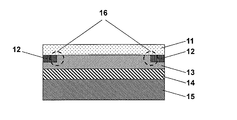
- FIG. 1 is a schematic diagram (a plan view seen from the black print layer side) of a PET film having a black print layer used for evaluation of the step absorbability in Examples.
- FIG. 2 is a schematic diagram (cross-sectional view) of a measurement sample used for evaluation of step absorbability in Examples.
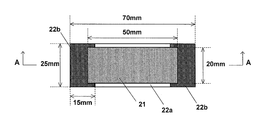
- FIG. 3 is a schematic diagram (plan view) showing a resistance value measurement sample used for evaluation of corrosion resistance in Examples.
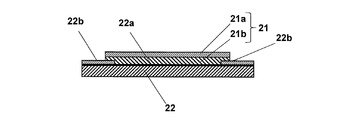
- FIG. 4 is a schematic diagram (a cross-sectional view taken along the line AA in FIG. 3) showing a resistance value measurement sample used for evaluation of corrosion resistance in Examples.
- the optical pressure-sensitive adhesive sheet of the present invention (hereinafter sometimes simply referred to as “the pressure-sensitive adhesive sheet of the present invention”) has a total light transmittance of 88% or more, an internal haze of 1.5% or less, and a b * value of ⁇ 0.
- An essential monomer is a monomer having a glass transition temperature (Tg) of ⁇ 10 ° C. or higher when a homopolymer is formed on at least one side of a plastic film substrate having a thickness of 5 to 0.5 and a thickness of 12 to 75 ⁇ m.
- An acrylic pressure-sensitive adhesive layer containing the acrylic polymer formed as a component and having a shear storage modulus at 23 ° C. of 0.8 ⁇ 10 5 to 5.0 ⁇ 10 5 Pa (hereinafter referred to as “the present invention”). It may be referred to as an “acrylic pressure-sensitive adhesive layer”).
- the pressure-sensitive adhesive sheet of the present invention only needs to have the acrylic pressure-sensitive adhesive layer of the present invention on at least one side of the plastic film substrate, and a pressure-sensitive adhesive layer other than the acrylic pressure-sensitive adhesive layer of the present invention (hereinafter referred to as “ It may be referred to as “another pressure-sensitive adhesive layer”).
- the pressure-sensitive adhesive sheet of the present invention may be a double-sided pressure-sensitive adhesive sheet having pressure-sensitive adhesive layers on both sides of the plastic film substrate, or a single-sided pressure-sensitive adhesive having a pressure-sensitive adhesive layer only on one side of the plastic film substrate. It may be a sheet.
- the term “adhesive sheet” includes a tape-shaped one, that is, “adhesive tape”. Further, the surface of the pressure-sensitive adhesive layer in the pressure-sensitive adhesive sheet of the present invention may be referred to as a “pressure-sensitive adhesive surface”.
- the plastic film substrate in the pressure-sensitive adhesive sheet of the present invention is used together with the pressure-sensitive adhesive layer of the pressure-sensitive adhesive sheet of the present invention when the pressure-sensitive adhesive sheet of the present invention is used (attached) to an adherend (such as an optical member). It is the part affixed to.
- a separator (release liner) that is peeled off when the pressure-sensitive adhesive sheet of the present invention is used (attached) is not included in the “plastic film substrate”.
- the total light transmittance (according to JIS K7361-1) of the plastic film substrate in the visible light wavelength region is 88% or more, preferably 88.5% or more, more preferably 89% or more.
- the total light transmittance can be measured using, for example, a haze meter (manufactured by Murakami Color Research Laboratory, trade name “HM-150”) according to JIS K7361-1.
- the internal haze of the plastic film substrate is 1.5% or less, preferably 1.0% or less, more preferably 0.5% or less. By setting the internal haze to 1.5% or less, the transparency of the pressure-sensitive adhesive sheet is improved.
- the internal haze is, for example, in accordance with JIS K7136, a double-sided pressure-sensitive adhesive sheet (manufactured by Nitto Denko Corporation, trade name “CS9621”) is pasted on both surfaces of a plastic film substrate, And manufactured under the trade name “HM-150”).
- the b * value of the plastic film substrate is ⁇ 0.5 to 0.5, preferably ⁇ 0.4 to 0.4, more preferably ⁇ 0.3 to 0.3.
- the b * value refers to a b * value (chromaticity) in the L * a * b * color system according to JIS Z8729.
- a spectrophotometer (trade name “Murakami Color Research Laboratory,” DOT-3C ").
- the thickness of the plastic film substrate is 12 to 75 ⁇ m, preferably 12 to 50 ⁇ m, more preferably 25 to 50 ⁇ m. By setting the thickness to 12 ⁇ m or more, the workability of the pressure-sensitive adhesive sheet is improved. On the other hand, when the thickness is 75 ⁇ m or less, the step absorbability of the pressure-sensitive adhesive sheet is improved.
- the plastic film substrate in the pressure-sensitive adhesive sheet of the present invention is not particularly limited as long as the total light transmittance, internal haze, b * value and thickness are controlled within the above ranges.
- PET polyethylene terephthalate
- PMMA polymethyl methacrylate
- TAC triacetyl cellulose
- polysulfone polyarylate
- polyimide polyimide
- polyvinyl chloride polyvinyl acetate
- polyethylene polypropylene
- ethylene Plastics composed of plastic materials such as propylene copolymers, cyclic olefin polymers such as trade name “Arton (cyclic olefin polymer; made by JSR)”, trade name “Zeonoa (cyclic olefin polymer; made by Nippon Zeon)” Or the like can be used Irumu.
- the said plastic material may be used individually or in combination of 2 or more types.
- the plastic film substrate is preferably a plastic film composed of a polyester resin, more preferably a polyethylene terephthalate film (PET film), from the viewpoint of colorless transparency and processability.
- PET film polyethylene terephthalate film
- the plastic film substrate may have any form of a single layer and a multilayer.
- plastic film base material for example, brand name "Lumirror T60” (made by Toray Industries, Inc.), brand name “Lumillar F71” (made by Toray Industries, Inc.), brand name “T600” (Mitsubishi) Commercial products such as Resin Co., Ltd. can also be used.
- the surface of the plastic film substrate may be subjected to conventional surface treatment, chromic acid treatment, exposure to ozone, exposure to flame, exposure to high piezoelectric impact, ionizing radiation treatment, if necessary, in order to improve adhesion to the adhesive layer.
- An oxidation treatment or the like by a chemical or physical method such as the above may be performed, or a coating treatment or the like by a primer may be performed.
- the pressure-sensitive adhesive sheet of the present invention can exhibit high workability by having the plastic film substrate as a constituent component. Moreover, since the thickness of the said plastic film base material is controlled by the said range, it is excellent also in level
- the acrylic pressure-sensitive adhesive layer of the present invention is a pressure-sensitive adhesive layer containing an acrylic polymer as a main component.
- an acrylic polymer a monomer having a glass transition temperature of ⁇ 10 ° C. or higher when forming a homopolymer (hereinafter, sometimes referred to as “monomer having a Tg of homopolymer of ⁇ 10 ° C. or higher”) is essential.
- the content of the acrylic polymer in the acrylic pressure-sensitive adhesive layer (100% by weight) of the present invention is 65% by weight or more (for example, 65 to 65% from the viewpoint of adhesive properties at high temperature and appearance properties at high temperature and high humidity). 100% by weight), more preferably 70 to 99.999% by weight.
- the acrylic pressure-sensitive adhesive layer of the present invention varies depending on the method of forming the pressure-sensitive adhesive layer, and is not particularly limited.
- the former includes, for example, a so-called solvent-type pressure-sensitive adhesive composition, and the latter includes, for example, a so-called active energy ray-curable pressure-sensitive adhesive composition.
- the pressure-sensitive adhesive composition may further contain a crosslinking agent and other various additives as necessary.
- compositions for forming an adhesive layer includes the meaning of “composition for forming an adhesive layer”.
- the “monomer mixture” means a mixture composed only of monomer components forming the acrylic polymer.
- the “partially polymerized product” means a composition in which one or more components among the components of the monomer mixture are partially polymerized.
- the acrylic polymer is a polymer formed (configured) with an acrylic monomer as an essential monomer component (monomer component), and a monomer having a homopolymer Tg of ⁇ 10 ° C. or higher is an essential monomer.
- the acrylic polymer is not particularly limited.
- the main monomer component is a (meth) acrylic acid alkyl ester and / or a (meth) acrylic acid alkoxyalkyl ester having a linear or branched alkyl group.
- a polymer formed using a group-containing monomer as a monomer component is preferable.
- the “(meth) acryl” represents “acryl” and / or “methacryl” (any one or both of “acryl” and “methacryl”), and the same applies to others.
- (meth) acrylic acid alkyl ester having a linear or branched alkyl group examples include, for example, methyl (meth) acrylate , Ethyl (meth) acrylate, propyl (meth) acrylate, isopropyl (meth) acrylate, n-butyl (meth) acrylate, isobutyl (meth) acrylate, s-butyl (meth) acrylate, (meth) T-butyl acrylate, pentyl (meth) acrylate, isopentyl (meth) acrylate, hexyl (meth) acrylate, heptyl (meth) acrylate, octyl (meth) acrylate, 2-ethylhexyl (meth) acrylate, Isooctyl (meth) acrylate, nony
- the said (meth) acrylic-acid alkylester can be used individually or in combination of 2 or more types.
- (meth) acrylic acid alkyl esters having 3 to 14 carbon atoms in the alkyl group are preferred, (meth) acrylic acid alkyl esters having 3 to 10 carbon atoms in the alkyl group, more preferably alkyl groups.
- alkyl acrylates having 3 to 10 carbon atoms particularly preferably 2-ethylhexyl acrylate (2EHA) and n-butyl acrylate (BA).
- the (meth) acrylic acid alkoxyalkyl ester [alkoxyalkyl (meth) acrylate] is not particularly limited, and examples thereof include 2-methoxyethyl (meth) acrylate, 2-ethoxyethyl (meth) acrylate, Methoxytriethylene glycol (meth) acrylate, 3-methoxypropyl (meth) acrylate, 3-ethoxypropyl (meth) acrylate, 4-methoxybutyl (meth) acrylate, 4-ethoxybutyl (meth) acrylate, etc. Is mentioned.
- the said (meth) acrylic-acid alkoxyalkylester can be used individually or in combination of 2 or more types. Among these, acrylic acid alkoxyalkyl ester [alkoxyalkyl acrylate] is preferable, and 2-methoxyethyl acrylate (MEA) is more preferable.
- content of said (meth) acrylic-acid alkylester and / or (meth) acrylic-acid alkoxyalkylester is with respect to the monomer component whole quantity (100 weight%) which forms an acrylic polymer from a low-temperature adhesive viewpoint. Therefore, it is preferably 30% by weight or more (for example, 30 to 99% by weight), more preferably 50 to 99% by weight, and still more preferably 50 to 95% by weight.
- (meth) acrylic acid alkyl ester and (meth) acrylic acid alkoxyalkyl ester are used as a monomer component which forms the said acrylic polymer, with respect to these total content (100 weight%)
- the content of the alkoxy alkyl ester of meth) acrylic acid is preferably 1 to 75% by weight, more preferably 1 to 50% by weight.
- Examples of the polar group-containing monomer include 2-hydroxyethyl (meth) acrylate, 3-hydroxypropyl (meth) acrylate, 4-hydroxybutyl (meth) acrylate, 6-hydroxyhexyl (meth) acrylate, Hydroxyl group-containing monomers such as vinyl alcohol and allyl alcohol; (meth) acrylamide, N, N-dimethyl (meth) acrylamide, N-methylol (meth) acrylamide, N-methoxymethyl (meth) acrylamide, N-butoxy Amide group-containing monomers such as methyl (meth) acrylamide and N-hydroxyethyl (meth) acrylamide; aminoethyl (meth) acrylate, dimethylaminoethyl (meth) acrylate, t-butylaminoethyl (meth) acrylate, etc.
- Amino group Monomers epoxy group-containing monomers such as glycidyl (meth) acrylate and methyl glycidyl (meth) acrylate; cyano group-containing monomers such as acrylonitrile and methacrylonitrile; N-vinyl-2-pyrrolidone, (meth) acryloylmorpholine, Heterocycle-containing vinyl monomers such as N-vinylpiperidone, N-vinylpiperazine, N-vinylpyrrole, and N-vinylimidazole; sulfonic acid group-containing monomers such as sodium vinylsulfonate; phosphoric acid such as 2-hydroxyethylacryloyl phosphate Group-containing monomers; imide group-containing monomers such as cyclohexylmaleimide and isopropylmaleimide; and isocyanate group-containing monomers such as 2-methacryloyloxyethyl isocyanate.
- a polyfunctional monomer can be used as the copolymerizable monomer for forming the acrylic polymer.
- the polyfunctional monomer include hexanediol di (meth) acrylate, butanediol di (meth) acrylate, (poly) ethylene glycol di (meth) acrylate, (poly) propylene glycol di (meth) acrylate, and neopentyl.
- the said polyfunctional monomer can be used individually or in combination of 2 or more types.
- dipentaerythritol hexaacrylate can be preferably used from the viewpoint of improving the adhesiveness at high temperature.
- the content of the polyfunctional monomer is preferably 0.5% by weight or less (for example, 0 to 0.5% by weight), more preferably based on the total amount of monomer components (100% by weight) forming the acrylic polymer. 0 to 0.1% by weight. By setting the content to 0.5% by weight or less, it is possible to balance the adhesion reliability at high temperatures and the step absorbability.
- the polyfunctional monomer may not be used. However, when no crosslinking agent is used, the content of the polyfunctional monomer is preferably 0.001 to 0.5% by weight, and more Preferably it is 0.002 to 0.1% by weight.
- copolymerizable monomers other than the above-mentioned polar group-containing monomers and polyfunctional monomers
- the acrylic polymer constituting the acrylic pressure-sensitive adhesive layer of the present invention needs to be formed using a monomer having a homopolymer Tg of ⁇ 10 ° C. or more as an essential monomer component among the above monomer components.
- Monomers having a homopolymer Tg of ⁇ 10 ° C. or higher may have a glass transition temperature (Tg) of ⁇ 10 ° C. or higher when the homopolymer is formed, and the monomer components ((meth) acrylic acid alkyl ester, ( (Meth) acrylic acid alkoxyalkyl ester, polar group-containing monomer, polyfunctional monomer and other copolymerizable monomers).
- the monomer having a homopolymer Tg of ⁇ 10 ° C. or higher has a glass transition temperature (Tg) at the time of forming the homopolymer of ⁇ 10 ° C. or higher (eg, ⁇ 10 to 250 ° C.), preferably ⁇ 10 to 230 ° C, more preferably -10 to 200 ° C.
- Tg glass transition temperature
- the glass transition temperature (Tg) when forming a homopolymer means “the homopolymer of the monomer.
- Glass transition temperature (Tg) specifically, “Polymer Handbook” (3rd edition, John Wiley & Sons, Inc, 1987).
- the Tg of a homopolymer of a monomer not described in the above document refers to, for example, a value obtained by the following measurement method (see JP 2007-51271 A).
- this homopolymer solution is cast-coated on a separator and dried to prepare a test sample (sheet-like homopolymer) having a thickness of about 2 mm.
- This test sample was punched into a disk shape having a diameter of 7.9 mm, sandwiched between parallel plates, and subjected to a shear strain at a frequency of 1 Hz using a viscoelasticity tester (ARES, manufactured by Rheometrics). Viscoelasticity is measured in a shear mode at a heating rate of 150 ° C. and 5 ° C./min, and the peak top temperature of tan ⁇ is defined as Tg of the homopolymer.
- the monomer having a homopolymer Tg of ⁇ 10 ° C. or higher is not particularly limited as long as the Tg in forming the homopolymer is ⁇ 10 ° C. or higher.
- isobornyl (meth) acrylate, N-vinyl Examples include -2-pyrrolidone, N-hydroxyethyl (meth) acrylamide, and methyl methacrylate.
- the monomers having a homopolymer Tg of ⁇ 10 ° C. or higher can be used alone or in combination of two or more.
- isobornyl acrylate (IBXA) (homopolymer Tg: 94 ° C.)
- N-vinyl-2-pyrrolidone (NVP) (homopolymer Tg: 54 ° C.)
- N-hydroxyethylacrylamide N- (2-hydroxyethyl) acrylamide
- HEAA homopolymer Tg: 98 ° C.
- N-vinyl-2-pyrrolidone or N-hydroxyethyl acrylamide because the moisture content of the pressure-sensitive adhesive sheet described later can be effectively increased in addition to the improvement of adhesion reliability at high temperatures.
- the content of the monomer having a Tg of the homopolymer of ⁇ 10 ° C. or higher with respect to the total monomer components (total amount of monomer components) (100% by weight) forming the acrylic polymer is not particularly limited, but is 5% by weight (for example, 5 to 60% by weight) is preferable, more preferably 5 to 50% by weight, still more preferably 5 to 40% by weight, and still more preferably 8 to 40% by weight.
- 5% by weight for example, 5 to 60% by weight
- the content is 60% by weight or less, the acrylic pressure-sensitive adhesive layer does not become too hard, and the step absorbability is excellent.
- the total content of monomers having a homopolymer Tg of ⁇ 10 ° C. or higher should satisfy the above range. .
- the acrylic polymer is preferably a polymer formed using a hydrophilic monomer as a monomer component.
- a hydrophilic monomer is used as a monomer component, the moisture content of the pressure-sensitive adhesive sheet described later can be increased efficiently, and whitening resistance is improved.
- the hydrophilic monomer is not particularly limited as long as it is a monomer having a high affinity for moisture, and can generally be selected from the aforementioned polar group-containing monomers.
- a hydroxyl group-containing (meth) acrylic acid ester and an amide compound described later are preferable from the viewpoint of effectively increasing the moisture content.
- the hydroxyl group-containing (meth) acrylic acid ester is not particularly limited as long as it is a (meth) acrylic acid ester having a hydroxyl group.
- 2-hydroxyethyl (meth) acrylate, 2-hydroxypropyl acrylate examples thereof include 3-hydroxypropyl (meth) acrylate, 4-hydroxybutyl (meth) acrylate, and 6-hydroxyhexyl (meth) acrylate.
- the said hydroxyl-containing (meth) acrylic acid ester can be used individually or in combination of 2 or more types.
- 2-hydroxyethyl acrylate (2HEA), 4-hydroxybutyl acrylate, and 2-hydroxypropyl acrylate are preferred from the viewpoint of adhesion reliability at high temperatures.
- the content of the hydroxyl group-containing (meth) acrylic acid ester is not particularly limited, but is preferably 5 to 35% by weight with respect to the total monomer components (total amount of monomer components) (100% by weight) forming the acrylic polymer, More preferably, it is 10 to 30% by weight, and further preferably 15 to 30% by weight.
- the content is set to 5% by weight or more, the moisture content of the pressure-sensitive adhesive sheet described later can be increased efficiently, and the whitening resistance is improved.
- the content is 35% by weight or less, the cohesive force under high humidity conditions does not become too small.
- the amide compound is a monomer represented by the following formula (I) and having a polymerizable functional group.
- R 1 to R 3 are each independently a hydrogen atom or a monovalent organic group (that is, R 1 to R 3 may be the same or different). Alternatively, any two of R 1 to R 3 are bonded to each other to form a ring structure, and the remaining one is a monovalent organic group.
- R 1 in the above formula (I) is represented by the following formula (II), which is a vinyl group or an isopropenyl group.
- formula (II) examples include amide compounds.
- R 4 is a hydrogen atom or a methyl group.
- R 5 and R 6 are each independently a hydrogen atom or a monovalent organic group, or are bonded to each other to form a ring structure.
- a linear or branched alkyl group For example, a methyl group, an ethyl group, a propyl group, a butyl group, etc.
- a hydroxyalkyl group for example, methylol group
- Hydroxyethyl group etc.
- alkoxyalkyl groups for example, methoxy group, ethoxy group, etc.
- the ring structure (the ring structure formed by combining R 5 and R 6 with each other) is not particularly limited.
- at least one nitrogen atom such as a morpholine ring, piperidine ring, pyrrolidine ring, or piperazine ring is included.
- the heterocyclic structure to contain is mentioned.
- examples of the amide compound represented by the formula (II) include (meth) acrylamide; N, N-dimethyl (meth) N-alkyl (meth) acrylamides such as acrylamide and N, N-diethyl (meth) acrylamide; N-alkoxyalkyl (meth) acrylamides such as N-methoxymethyl (meth) acrylamide and N-butoxymethyl (meth) acrylamide; N -N-hydroxyalkyl (meth) acrylamides such as methylol (meth) acrylamide, N-hydroxyethyl (meth) acrylamide and the like.
- examples of the amide compound represented by the formula (II) include N- (meth) acryloylmorpholine, N- (meth) And N- (meth) acryloyl heterocyclic compounds such as acryloylpiperidine, N- (meth) acryloylpyrrolidine, N- (meth) acryloylpiperazine, and the like.
- R 2 (or R 3 ) in the above formula (I) is a vinyl group
- R 7 is a divalent organic group and is not particularly limited, and examples thereof include a saturated or unsaturated hydrocarbon group, but a saturated hydrocarbon group (for example, Alkylene group having 3 to 5 carbon atoms).
- N-vinyl cyclic amide represented by the above formula (III) examples include N-vinyl-2-pyrrolidone, N-vinyl-2-piperidone, N-vinyl-2-caprolactam and the like.
- the amide compound represented by the above formula (I) and having a polymerizable functional group the amide compound in which R 5 and R 6 are each independently a hydrogen atom or a monovalent organic group in the above formula (II).
- N-vinyl cyclic amide represented by the above formula (III) is preferable, and N-hydroxyethylacrylamide (HEAA) and N-vinyl-2-pyrrolidone (NVP) are more preferable.
- the said amide compound can be used individually or in combination of 2 or more types.
- amide compounds having a polymerizable functional group represented by formula (I)
- those having a Tg of ⁇ 10 ° C. or higher when forming a homopolymer are described in the above-mentioned “Homopolymer”. May be used as a “monomer having a Tg of ⁇ 10 ° C. or higher” (that is, the amide compound and the monomer having a Tg of ⁇ 10 ° C. or higher may overlap).
- Use of such an amide compound is preferable because the moisture content of the pressure-sensitive adhesive sheet described later can be increased, and at the same time, the adhesion reliability at high temperatures is improved.
- Examples of such amide compounds include N-hydroxyethylacrylamide (HEAA), N-vinyl-2-pyrrolidone (NVP), and the like.
- the content of the amide compound is not particularly limited, but is preferably 5 to 20% by weight, more preferably 5 to 17%, based on the total monomer components (total amount of monomer components) (100% by weight) forming the acrylic polymer. % By weight, more preferably 5 to 15% by weight. By setting the content to 5% by weight or more, the adhesion reliability at high temperature is improved. On the other hand, when the content is 20% by weight or less, the step absorbability is improved.
- the content of a carboxyl group-containing monomer as a monomer component for forming the acrylic polymer is set as follows. It is preferable to reduce. Specifically, for example, the content of the carboxyl group-containing monomer is preferably less than 5% by weight, more preferably 2% by weight, based on the total amount of monomer components (100% by weight) forming the acrylic polymer. Or less (for example, 0 to 2% by weight), more preferably 0.5% by weight or less (for example, 0 to 0.5% by weight).
- the corrosion resistance to the metal thin film or the metal oxide thin film is improved.
- the carboxyl group-containing monomer include (meth) acrylic acid, itaconic acid, maleic acid, fumaric acid, crotonic acid, and isocrotonic acid.
- acid anhydrides of these carboxyl group-containing monomers for example, acid anhydride group-containing monomers such as maleic anhydride and itaconic anhydride are also included as the carboxyl group-containing monomers.
- the acrylic polymer can be prepared by polymerizing the monomer component by a known and usual polymerization method.
- the polymerization method of the acrylic polymer include solution polymerization method, emulsion polymerization method, bulk polymerization method and polymerization method by active energy ray irradiation (active energy ray polymerization method).
- active energy ray polymerization method active energy ray polymerization method.
- a solution polymerization method and an active energy ray polymerization method are preferable.
- Examples of the active energy rays irradiated in the active energy ray polymerization (photopolymerization) include ionizing radiation such as ⁇ rays, ⁇ rays, ⁇ rays, neutron rays, and electron beams, and ultraviolet rays. Ultraviolet light is preferred.
- the irradiation energy, irradiation time, irradiation method, and the like of the active energy ray are not particularly limited as long as the photopolymerization initiator can be activated to cause the monomer component to react.
- solvents include esters such as ethyl acetate and n-butyl acetate; aromatic hydrocarbons such as toluene and benzene; aliphatic hydrocarbons such as n-hexane and n-heptane; cyclohexane and methylcyclohexane Organic solvents such as ketones such as methyl ethyl ketone and methyl isobutyl ketone.
- a solvent can be used individually or in combination of 2 or more types.
- a polymerization initiator such as a photopolymerization initiator (photoinitiator) or a thermal polymerization initiator can be used depending on the type of polymerization reaction.
- a polymerization initiator can be used individually or in combination of 2 or more types.
- the photopolymerization initiator is not particularly limited, and examples thereof include benzoin ether photopolymerization initiators, acetophenone photopolymerization initiators, ⁇ -ketol photopolymerization initiators, aromatic sulfonyl chloride photopolymerization initiators, and photopolymerization initiators.
- An active oxime photopolymerization initiator, a benzoin photopolymerization initiator, a benzyl photopolymerization initiator, a benzophenone photopolymerization initiator, a ketal photopolymerization initiator, a thioxanthone photopolymerization initiator, or the like can be used.
- the amount of the photopolymerization initiator used is not particularly limited, but for example, 0.01 to 0.2 parts by weight is preferable with respect to 100 parts by weight of the total amount of monomer components forming the acrylic polymer, and more preferably 0.8. 05 to 0.15 parts by weight.
- benzoin ether photopolymerization initiator examples include benzoin methyl ether, benzoin ethyl ether, benzoin propyl ether, benzoin isopropyl ether, benzoin isobutyl ether, 2,2-dimethoxy-1,2-diphenylethane-1-one. And anisole methyl ether.
- acetophenone photopolymerization initiator examples include 2,2-diethoxyacetophenone, 2,2-dimethoxy-2-phenylacetophenone, 1-hydroxycyclohexyl phenyl ketone, 4-phenoxydichloroacetophenone, and 4- (t-butyl). Examples include dichloroacetophenone.
- Examples of the ⁇ -ketol photopolymerization initiator include 2-methyl-2-hydroxypropiophenone, 1- [4- (2-hydroxyethyl) phenyl] -2-methylpropan-1-one, and the like.
- Examples of the aromatic sulfonyl chloride photopolymerization initiator include 2-naphthalenesulfonyl chloride.
- Examples of the photoactive oxime photopolymerization initiator include 1-phenyl-1,1-propanedione-2- (o-ethoxycarbonyl) -oxime.
- Examples of the benzoin photopolymerization initiator include benzoin.
- Examples of the benzyl photopolymerization initiator include benzyl.
- benzophenone-based photopolymerization initiator examples include benzophenone, benzoylbenzoic acid, 3,3′-dimethyl-4-methoxybenzophenone, polyvinylbenzophenone, ⁇ -hydroxycyclohexyl phenyl ketone, and the like.
- ketal photopolymerization initiator examples include benzyl dimethyl ketal.
- thioxanthone photopolymerization initiator examples include thioxanthone, 2-chlorothioxanthone, 2-methylthioxanthone, 2,4-dimethylthioxanthone, isopropylthioxanthone, 2,4-diisopropylthioxanthone, dodecylthioxanthone, and the like.
- polymerization initiator used when the acrylic polymer is polymerized by solution polymerization examples include azo initiators, peroxide polymerization initiators (eg, dibenzoyl peroxide, tert-butyl permaleate), redox System polymerization initiators and the like.
- azo initiators eg, dibenzoyl peroxide, tert-butyl permaleate
- redox System polymerization initiators e.g., redox System polymerization initiators and the like.
- the azo initiators disclosed in JP-A No. 2002-69411 are particularly preferable.
- Such an azo-based initiator is preferable because a decomposition product of the initiator hardly remains in the acrylic polymer as a part that causes generation of a heat generation gas (outgas).
- azo initiator examples include 2,2′-azobisisobutyronitrile (hereinafter sometimes referred to as AIBN), 2,2′-azobis-2-methylbutyronitrile (hereinafter referred to as AMBN). And 2,2′-azobis (2-methylpropionic acid) dimethyl, 4,4′-azobis-4-cyanovaleric acid and the like.
- AIBN 2,2′-azobisisobutyronitrile
- AMBN 2,2′-azobis-2-methylbutyronitrile
- 2,2′-azobis (2-methylpropionic acid) dimethyl, 4,4′-azobis-4-cyanovaleric acid and the like The amount of the azo initiator used is preferably 0.05 to 0.5 parts by weight, more preferably 0.1 to 0.3 parts by weight, based on 100 parts by weight of the total amount of monomer components forming the acrylic polymer. It is.
- the weight average molecular weight (Mw) of the acrylic polymer is preferably 400,000 to 2,000,000, more preferably 500,000 to 1,500,000.
- Mw weight average molecular weight
- the weight average molecular weight is preferably 400,000 to 2,000,000, more preferably 500,000 to 1,500,000.
- the weight average molecular weight of the acrylic polymer can be controlled by, for example, the type of polymerization initiator, the amount of the polymerization initiator used, the temperature and time during polymerization, the monomer concentration, the monomer dropping rate, and the like.
- the molecular weight distribution (Mw / Mn) of the acrylic polymer is preferably 15 or less, more preferably 12 or less. By setting the molecular weight distribution to 15 or less, the adhesion reliability at high temperature is improved.
- the molecular weight distribution (Mw / Mn) of the acrylic polymer can be controlled by, for example, the type of polymerization initiator, the amount of polymerization initiator, the timing of addition of the polymerization initiator, the polymerization temperature, and the like.
- the weight average molecular weight (Mw) and molecular weight distribution (Mw / Mn) of the acrylic polymer can be measured by a gel permeation chromatograph (GPC) method. More specifically, it can be measured by the method described in “(1) Weight average molecular weight and molecular weight distribution” in (Evaluation) described later.
- GPC gel permeation chromatograph
- the glass transition temperature (Tg) of the acrylic polymer is preferably ⁇ 65 to ⁇ 20 ° C., more preferably ⁇ 60 to ⁇ 30 ° C. from the viewpoint of controlling the shear storage modulus (23 ° C.).
- Tg glass transition temperature
- the glass transition temperature is preferably ⁇ 65 to ⁇ 20 ° C., more preferably ⁇ 60 to ⁇ 30 ° C. from the viewpoint of controlling the shear storage modulus (23 ° C.).
- Tg is the glass transition temperature of the acrylic polymer (unit: K)
- Tg i the monomer i is the glass transition temperature when it is formed into a homopolymer (unit: K)
- all monomer components W i are monomers i
- the above is a calculation formula when the acrylic polymer is composed of n types of monomer components of monomer 1, monomer 2,..., Monomer n.
- the glass transition temperature of the acrylic polymer can be controlled by, for example, the type and content of the monomer that forms the acrylic polymer.
- a crosslinking agent for forming the acrylic pressure-sensitive adhesive layer of the present invention, a crosslinking agent, a crosslinking accelerator, a silane coupling agent, a tackifier resin (rosin) Derivatives, polyterpene resins, petroleum resins, oil-soluble phenols, etc.), anti-aging agents, fillers, colorants (pigments and dyes, etc.), UV absorbers, antioxidants, chain transfer agents, plasticizers, softeners, surfactants Known additives such as an agent and an antistatic agent can be used as long as the characteristics of the present invention are not impaired.
- various general solvents can also be used.
- the type of the solvent is not particularly limited, and those exemplified as the solvent used in the above solution polymerization can be used.
- the acrylic polymer can be crosslinked and the gel fraction of the acrylic pressure-sensitive adhesive layer can be controlled.
- the crosslinking agent include isocyanate crosslinking agents, epoxy crosslinking agents, melamine crosslinking agents, peroxide crosslinking agents, urea crosslinking agents, metal alkoxide crosslinking agents, metal chelate crosslinking agents, metal salt crosslinking agents.
- examples thereof include a crosslinking agent, a carbodiimide crosslinking agent, an oxazoline crosslinking agent, an aziridine crosslinking agent, and an amine crosslinking agent.
- the said crosslinking agent can be used individually or in combination of 2 or more types.
- an isocyanate-based crosslinking agent and an epoxy-based crosslinking agent are preferable from the viewpoint of improving adhesion reliability at high temperatures.
- an isocyanate-based cross-linking agent is used as the cross-linking agent, the anchoring property of the acrylic pressure-sensitive adhesive layer on the plastic film substrate is improved, so that the workability of the pressure-sensitive adhesive sheet is further improved.
- isocyanate-based crosslinking agent examples include, for example, lower aliphatic polyisocyanates such as 1,2-ethylene diisocyanate, 1,4-butylene diisocyanate, 1,6-hexamethylene diisocyanate; cyclopentylene diisocyanate Alicyclic polyisocyanates such as cyclohexylene diisocyanate, isophorone diisocyanate, hydrogenated tolylene diisocyanate, hydrogenated xylene diisocyanate; 2,4-tolylene diisocyanate, 2,6-tolylene diisocyanate, 4,4′-diphenylmethane diisocyanate And aromatic polyisocyanates such as xylylene diisocyanate.
- lower aliphatic polyisocyanates such as 1,2-ethylene diisocyanate, 1,4-butylene diisocyanate, 1,6-hexamethylene diisocyanate
- cyclopentylene diisocyanate Alicyclic polyis
- hexamethylene diisocyanate and xylene diisocyanate are preferable.
- Examples of commercially available products include trimethylolpropane / tolylene diisocyanate adduct [manufactured by Nippon Polyurethane Industry Co., Ltd., trade name “Coronate L”], trimethylolpropane / hexamethylene diisocyanate adduct [manufactured by Nippon Polyurethane Industry Co., Ltd. , Trade name “Coronate HL”], trimethylolpropane / xylylene diisocyanate adduct [manufactured by Mitsui Chemicals, trade name “Takenate 110N”], and the like.
- epoxy crosslinking agent polyfunctional epoxy compound
- examples of the epoxy crosslinking agent include N, N, N ′, N′-tetraglycidyl-m-xylenediamine, diglycidylaniline, and 1,3-bis (N, N-diglycidyl).
- the acrylic pressure-sensitive adhesive layer of the present invention is a pressure-sensitive adhesive composition containing the acrylic polymer and an isocyanate-based crosslinking agent, and is an isocyanate based on the total amount (100 parts by weight) of monomer components forming the acrylic polymer.
- An acrylic pressure-sensitive adhesive layer formed from a pressure-sensitive adhesive composition containing 0.1 to 10 parts by weight of a cross-linking agent is preferable.
- an amine compound containing a plurality of hydroxyl groups can be used as a crosslinking accelerator (crosslinking assistant) for the purpose of speeding up the crosslinking reaction.
- the amine compound containing a plurality of hydroxyl groups is not particularly limited as long as it is an amine compound having at least two hydroxyl groups (alcoholic hydroxyl groups) in the molecule.
- An amine compound containing a plurality of hydroxyl groups disclosed in Japanese Patent No. 079203 can be used particularly preferably.
- the crosslinking rate is increased, so that productivity is improved.
- commercially available products such as trade names “EDP-300”, “EDP-450”, “EDP-1100”, “Pluronic” (manufactured by ADEKA Corporation) are used. You can also.
- the content of the amine-based compound containing a plurality of hydroxyl groups in the pressure-sensitive adhesive composition is, for example, the total amount of monomer components (100 wt. Part by weight) is preferably 0.01 to 5.0 parts by weight, more preferably 0.05 to 1.0 parts by weight.
- the pressure-sensitive adhesive composition may contain a silane coupling agent for the purpose of improving the adhesion to glass.
- the silane coupling agent is not particularly limited, but ⁇ -glycidoxypropyltrimethoxysilane, ⁇ -glycidoxypropyltriethoxysilane, ⁇ -aminopropyltrimethoxysilane, N-phenyl- ⁇ -aminopropyltri Preferred examples include methoxysilane. Of these, ⁇ -glycidoxypropyltrimethoxysilane is preferred.
- the silane coupling agent for example, a commercial product such as a trade name “KBM-403” (manufactured by Shin-Etsu Chemical Co., Ltd.) can be used.
- the content of the silane coupling agent in the pressure-sensitive adhesive composition is, for example, from 0.01 to 1 weight with respect to the total amount of monomer components (100 parts by weight) forming the acrylic polymer from the viewpoint of improving the adhesion to glass. Parts, more preferably 0.03 to 0.5 parts by weight.
- the thickness of the acrylic pressure-sensitive adhesive layer of the present invention is not particularly limited, but is preferably 10 to 500 ⁇ m, more preferably 10 to 250 ⁇ m, and particularly preferably 10 to 200 ⁇ m.
- the thickness is preferably 10 to 500 ⁇ m, more preferably 10 to 250 ⁇ m, and particularly preferably 10 to 200 ⁇ m.
- the shear storage modulus at 23 ° C. (hereinafter referred to as “shear storage modulus (23 ° C.)” or “G ′ (23 ° C.)” of the acrylic pressure-sensitive adhesive layer of the present invention measured by dynamic viscoelasticity measurement. May be 0.8 ⁇ 10 5 to 5.0 ⁇ 10 5 Pa, preferably 0.8 ⁇ 10 5 to 4.0 ⁇ 10 5 Pa, and more preferably 0.8 ⁇ 10 5 to 3.0 ⁇ 10 5 Pa.
- the shear storage modulus (23 ° C.) By setting the shear storage modulus (23 ° C.) to 0.8 ⁇ 10 5 Pa or more, the acrylic pressure-sensitive adhesive layer does not become too soft, and for example, protrusion of the pressure-sensitive adhesive layer from the cut surface during processing is suppressed.
- the shear storage elastic modulus (23 ° C.) is measured by a dynamic viscoelasticity measurement.
- a plurality of the acrylic pressure-sensitive adhesive layers are laminated to have a thickness of about 1.5 mm, and “Advanced Remetric Expansion System (ARES)” manufactured by Reometric Scientific is used in a shear mode at a frequency of 1 Hz. , And can be measured at a rate of temperature rise of 5 ° C./min in the range of ⁇ 70 to 200 ° C.
- AWS Advanced Remetric Expansion System
- the shear storage modulus (23 ° C.) can be controlled by, for example, the Tg and molecular weight (weight average molecular weight, molecular weight distribution) of the acrylic polymer.
- the gel fraction of the acrylic pressure-sensitive adhesive layer of the present invention is preferably from 40 to 95% (% by weight), more preferably from 50 to 90%, from the viewpoint of improving resistance to foaming and peeling.
- the gel fraction can be determined as an ethyl acetate insoluble matter. Specifically, the weight of the insoluble matter after immersing the acrylic pressure-sensitive adhesive layer in ethyl acetate at 23 ° C. for 7 days with respect to the sample before immersion. It is determined as a fraction (unit: wt%). By setting the gel fraction to 40% or more, adhesion reliability at high temperatures is improved. On the other hand, when the gel fraction is 95% or less, the step absorbability is improved.
- the gel fraction is a value calculated by, for example, the following “method for measuring gel fraction”.
- Measurement method of gel fraction About 0.1 g of pressure-sensitive adhesive layer (acrylic pressure-sensitive adhesive layer of the present invention) was collected from the pressure-sensitive adhesive sheet of the present invention, and a porous tetrafluoroethylene sheet (trade name “NTF1122”, Nitto Denko Corporation) having an average pore diameter of 0.2 ⁇ m. After being wrapped in a company), it is bound with a kite string, the weight at that time is measured, and this weight is defined as the weight before immersion.
- the weight before immersion is the total weight of the pressure-sensitive adhesive layer (the acrylic pressure-sensitive adhesive layer of the present invention collected above), the tetrafluoroethylene sheet, and the kite string.
- the total weight of the tetrafluoroethylene sheet and the kite string is also measured, and this weight is defined as the wrapping weight.
- a pressure-sensitive adhesive layer wrapped with a tetrafluoroethylene sheet and bound with a kite string (referred to as “sample”) is placed in a 50 ml container filled with ethyl acetate and allowed to stand at 23 ° C. for 7 days.
- the gel fraction can be controlled by, for example, the monomer composition of the acrylic polymer, the weight average molecular weight, the use amount (addition amount) of the crosslinking agent, and the like.
- the weight average molecular weight of the soluble component (sol component) in the ethyl acetate extraction of the acrylic pressure-sensitive adhesive layer of the present invention (sometimes referred to simply as “sol component”) is preferably 50,000 to 700,000, more preferably 100,000 to 700,000.
- the weight average molecular weight of the sol is 50,000 or more, the anti-foaming peelability is improved.
- the weight average molecular weight of the sol is 700,000 or less, the coatability is improved.
- the above “weight average molecular weight of soluble component (sol component) in ethyl acetate extraction” is calculated by the following measurement method. (Method for measuring weight average molecular weight of soluble component (sol component) in ethyl acetate extraction) About 0.1 g of the pressure-sensitive adhesive layer (the acrylic pressure-sensitive adhesive layer of the present invention) was collected from the pressure-sensitive adhesive sheet of the present invention, and a porous tetrafluoroethylene sheet (trade name “NTF1122”, Nitto Denko Corporation) having an average pore diameter of 0.2 ⁇ m. After wrapping in (made), tie with silk thread.
- the pressure-sensitive adhesive layer wrapped with a tetrafluoroethylene sheet and tied with a kite string is placed in a 50 ml container filled with ethyl acetate and allowed to stand at 23 ° C. for 7 days. Thereafter, the ethyl acetate solution (including the extracted sol content) in the container is taken out and dried under reduced pressure, and the solvent (ethyl acetate) is volatilized to obtain the sol content.
- the sol content is dissolved in tetrahydrofuran (THF), and the weight average molecular weight of the sol content is measured by gel permeation chromatography (GPC).
- the weight average molecular weight of the sol can be controlled by, for example, the weight average molecular weight of the acrylic polymer, the type and amount (addition amount) of the crosslinking agent.
- the haze (according to JIS K7136) of the acrylic pressure-sensitive adhesive layer of the present invention is, for example, preferably 3.0% or less, more preferably 1.5% or less. By setting the haze to 3.0% or less, the transparency of the pressure-sensitive adhesive sheet is improved.
- the haze is obtained by, for example, pasting the acrylic pressure-sensitive adhesive layer of the present invention on a slide glass (for example, having a total light transmittance of 91.8% and a haze of 0.4%), and forming a haze meter (Murakami Color Research Laboratory). , Trade name “HM-150”).
- the total light transmittance (according to JIS K7361-1) in the visible light wavelength region of the acrylic pressure-sensitive adhesive layer of the present invention is, for example, preferably 90% or more, and more preferably 91% or more. By setting the total light transmittance to 90% or more, the transparency of the pressure-sensitive adhesive sheet is improved.
- the total light transmittance is determined by, for example, bonding the acrylic pressure-sensitive adhesive layer of the present invention to a slide glass (for example, a total light transmittance of 91.8% and a haze of 0.4%), and a haze meter (Murakami Color Technology). It can be measured by using a product name “HM-150” manufactured by Research Laboratory.
- a known or conventional method for forming a pressure-sensitive adhesive layer can be used, and it varies depending on the polymerization method of the acrylic polymer and is not particularly limited. Examples include the following methods (1) to (3).
- a composition comprising a monomer component mixture (monomer mixture) or a partial polymer thereof and, if necessary, an additive such as a photopolymerization initiator or a crosslinking agent, a plastic film substrate or separator
- An adhesive layer is formed by applying (coating) on the surface and irradiating active energy rays (particularly, ultraviolet rays are preferable).
- a composition (solution) containing an acrylic polymer, a solvent, and, if necessary, an additive such as a crosslinking agent is applied (coated) on a plastic film substrate or a separator, dried and / or cured. An adhesive layer is formed.
- the pressure-sensitive adhesive layer formed in (1) above is further dried.
- a known coating method can be used for coating (coating) in the method for forming the acrylic pressure-sensitive adhesive layer of the present invention.
- Conventional coaters such as gravure roll coaters, reverse roll coaters, kiss rolls can be used.
- a coater, dip roll coater, bar coater, knife coater, spray coater, comma coater, direct coater and the like can be used for coating (coating) in the method for forming the acrylic pressure-sensitive adhesive layer of the present invention.
- the other pressure-sensitive adhesive layer is not particularly limited.
- a urethane-based pressure-sensitive adhesive an acrylic pressure-sensitive adhesive, a rubber-based pressure-sensitive adhesive, a silicone-based pressure-sensitive adhesive
- known and commonly used pressure-sensitive adhesive layers formed from known pressure-sensitive adhesives such as polyester-based pressure-sensitive adhesives, polyamide-based pressure-sensitive adhesives, epoxy-based pressure-sensitive adhesives, vinyl alkyl ether-based pressure-sensitive adhesives, and fluorine-based pressure-sensitive adhesives.
- the said adhesive can be used individually or in combination of 2 or more types.
- the water content is 0.65% by weight or more (for example, 0.65 to 5.0% by weight). , Preferably 0.65 to 3.0% by weight, more preferably 0.75 to 3.0% by weight. By making the moisture content 0.65% by weight or more, the whitening resistance is improved.
- the white turbidity due to the humidification of the pressure-sensitive adhesive sheet is considered to be a phenomenon caused by, for example, that the pressure-sensitive adhesive sheet absorbs moisture when the pressure-sensitive adhesive sheet is placed in a high-temperature and high-humidity environment, and this moisture absorption moisture is condensed.
- the pressure-sensitive adhesive sheet is placed by controlling the water content of the pressure-sensitive adhesive sheet (water content after storage for 120 hours in an environment of 60 ° C. and 95% RH) to 0.65% by weight or more. Even when the environment changes significantly (especially when the environment changes from high-temperature and high-humidity conditions to room temperature conditions), moisture-absorbing moisture is less likely to condense due to the high water absorption of the adhesive sheet. It is estimated that the performance has improved.
- the moisture content is determined immediately after the pressure-sensitive adhesive sheet of the present invention is stored in an environment of 60 ° C. and 95% RH for 120 hours and taken out to a room temperature environment (23 ° C., 50% RH) (for example, 0 to 10 after taking out). It is preferable that it is a value obtained by measuring at a minute).
- the moisture content of the pressure-sensitive adhesive sheet of the present invention is, for example, stored for 120 hours in an environment of 60 ° C. and 95% RH, and then taken out in an environment of 23 ° C. and 50% RH. Then, it can be measured according to the following [Method of measuring moisture content].
- the adhesive sheet of this invention has a separator, it preserve
- sample preparation and measurement method When the pressure-sensitive adhesive sheet of the present invention is a double-sided pressure-sensitive adhesive sheet, the pressure-sensitive adhesive sheet is cut into a size of 1 cm wide ⁇ 2 cm long (area 2 cm 2 ), and one pressure-sensitive adhesive surface (pressure-sensitive adhesive layer surface) is pasted on an aluminum foil. The sample is prepared with the other adhesive surface open.
- the pressure-sensitive adhesive sheet of the present invention is a single-sided pressure-sensitive adhesive sheet, the sample is cut into a size of width 1 cm ⁇ length 2 cm (area 2 cm 2 ) and the pressure-sensitive adhesive surface is opened. After weighing a sample (sample after storage for 120 hours in an environment of 60 ° C.
- the sample is put into a heating vaporizer and gas generated when heated at 150 ° C. is introduced into the titration cell.
- the moisture content ( ⁇ g) in the sample was measured under the following measurement conditions, and per 1 g of the pressure-sensitive adhesive sheet of the present invention (in the case of a double-sided pressure-sensitive adhesive sheet, The moisture content (per 1 g weight excluding the weight of the aluminum foil from the weight) is determined, and the moisture content (% by weight) of the pressure-sensitive adhesive sheet is calculated.
- the number of measurements (n number) is preferably two times, for example.
- Coulometric titration moisture measuring device Mitsubishi Chemical, CA-06 type Heating vaporizer: Mitsubishi Chemical, VA-06 type (measuring conditions) Method: Heating vaporization method / 150 ° C heating Anolyte: Aquamicron AKX Catholyte: Aquamicron CXU
- the haze (according to JIS K7136) of the pressure-sensitive adhesive sheet of the present invention is, for example, preferably 3.0% or less, and more preferably 1.5% or less.
- the total light transmittance (according to JIS K7361-1) in the visible light wavelength region of the pressure-sensitive adhesive sheet of the present invention is not particularly limited, but is preferably 87% or more, and more preferably 89% or more.
- the b * value of the pressure-sensitive adhesive sheet of the present invention is preferably ⁇ 0.5 to 0.5, more preferably ⁇ 0.4 to 0.4.
- the b * value is obtained by, for example, peeling the separator when a separator is provided, and then sliding glass (for example, total light transmittance 91.8%, haze 0.4%, b * value 0. 18), and using a spectrophotometer (Murakami Color Research Laboratory, trade name “DOT-3C”).
- the haze of the pressure-sensitive adhesive sheet of the present invention after storage for 120 hours in an environment of 60 ° C. and 95% RH (immediately after) (haze after storage for 120 hours in an environment of 60 ° C. and 95% RH (immediately thereafter)) Is sometimes referred to as “haze (immediately after moist heat)”), for example, preferably 3.5% or less, more preferably 2.5% or less.
- the haze (immediately after wet heat) is, for example, when a separator is provided, the separator is peeled off, and a slide glass (for example, having a total light transmittance of 91.8% and a haze of 0.4%) ),
- the adhesive sheet of the present invention was laminated, stored for 120 hours in an environment of 60 ° C. and 95% RH, and immediately after being taken out in an environment of 23 ° C. and 50% RH, a haze meter (Murakami Color Technology Research) It can be measured using a product name “HM-150”).
- the pressure-sensitive adhesive sheet of the present invention is stored in an environment of 60 ° C. and 95% RH for 250 hours, haze immediately after taking out in an environment of 23 ° C. and 50% RH, and haze 30 minutes after taking out.
- the difference between the haze after 1 hour, the haze after 3 hours after removal, and the haze after 6 hours after removal, and the haze before storage in an environment of 60 ° C. and 95% RH for 250 hours, Is preferably less than 7%. That is, the pressure-sensitive adhesive sheet of the present invention is stored in an environment of 60 ° C. and 95% RH for 250 hours and immediately after being taken out in an environment of 23 ° C. and 50% RH, and in an environment of 60 ° C.
- ⁇ (haze before storage in an environment of 60 ° C. and 95% RH for 250 hours and taken out in an environment of 23 ° C. and 50% RH 6 Haze after time)
- ⁇ (haze before storage in an environment of 60 ° C. and 95% RH for 250 hours)] is preferably less than 7% (% point), more preferably less than 5% It is.
- the above-mentioned “haze before being stored in an environment of 60 ° C. and 95% RH for 250 hours” means using the pressure-sensitive adhesive sheet after being conditioned at 23 ° C. and 50% RH for at least 24 hours. Mean haze to be measured.
- the above-mentioned haze difference in the pressure-sensitive adhesive sheet of the present invention can be measured, for example, by the following method.
- slide glass for example, a total light transmittance of 91.8% and a haze of 0.4%.
- slide glass for example, a total light transmittance of 91.8% and a haze of 0.4%.
- a test piece When the pressure-sensitive adhesive sheet of the present invention is a double-sided pressure-sensitive adhesive sheet, a sheet having a 100 ⁇ m-thick PET film (for example, having a haze of 0.6%) bonded to the pressure-sensitive adhesive surface on the opposite side to the slide glass. Use a test piece.
- the haze (the haze before preserve
- the test piece is stored in an environment of 60 ° C. and 95% RH for 250 hours, and then taken out in an environment of 23 ° C. and 50% RH.
- the haze after 6 hours is measured.
- the unit is preferably 20 ng / cm 2 or less (for example, 0 to 20 ng / cm 2 ), more preferably 0 to 17 ng / cm 2 , and still more preferably 0 to 15 ng / cm per unit area of the acrylic pressure-sensitive adhesive layer of the present invention. 2 .
- the amount of the extracted (meth) acrylate ion is the degree of ease of release of the acrylate and methacrylate ions from the pressure-sensitive adhesive layer when the pressure-sensitive adhesive sheet of the present invention is placed in a humidified environment. Represents. Even if the extracted (meth) acrylic acid ion amount is 20 ng / cm 2 or less, the metal thin film is attached to a metal thin film or the like and placed in the presence of moisture such as in a humidified environment. Corrosion resistance is improved and corrosion resistance is improved.
- total amount of acrylate and methacrylate ions extracted with pure water from the pressure-sensitive adhesive sheet of the present invention at 100 ° C. for 45 minutes is measured by the following method. can do.
- the pressure-sensitive adhesive sheet of the present invention is cut out to an appropriate size, and when a separator is provided, the separator is peeled off to expose the pressure-sensitive adhesive surface to obtain a test piece.
- a PET film thinness 25 to 50 ⁇ m
- the pressure-sensitive adhesive surface to be attached to the metal thin film (the surface on the acrylic pressure-sensitive adhesive layer side of the present invention) is exposed.
- the size of the test piece (exposed area of the adhesive surface) is preferably 100 cm 2 .
- the said test piece is put into the pure water of temperature 100 degreeC, and it boils for 45 minutes, and boiled extraction of an acrylate ion and a methacrylate ion is performed.
- the total amount (unit: ng) of the acrylate and methacrylate ions in the extract obtained above was measured by ion chromatography (ion chromatography), and the adhesive surface (exposed adhesive) of the test piece was measured.
- the total amount of acrylate and methacrylate ions per unit area (unit: ng / cm 2 ) is calculated.
- the measurement conditions of the ion chromatography method are not particularly limited, but can be measured, for example, under the following conditions.
- (Meth) acrylic acid ions released from moisture from the pressure-sensitive adhesive sheet are generally attributed to (meth) acrylic acid present in the acrylic pressure-sensitive adhesive layer.
- the (meth) acrylic acid ions are presumed to penetrate into the metal thin film due to moisture under high-temperature and high-humidity conditions and prevent conduction, but cause an increase in resistance of the metal thin film (corrosion of the metal thin film).
- (meth) acrylic acid (especially acrylic acid) is used in a large amount (for example, 10% by weight or more) as a monomer component for forming an acrylic polymer for the purpose of improving the adhesiveness of the pressure-sensitive adhesive sheet.
- the pressure-sensitive adhesive sheet of the present invention can be produced according to a known and commonly used method for producing a pressure-sensitive adhesive sheet.
- the acrylic pressure-sensitive adhesive layer of the present invention may be directly formed on the surface of the plastic film substrate (direct copying method), or after forming the acrylic pressure-sensitive adhesive layer of the present invention on the separator,
- the acrylic pressure-sensitive adhesive layer of the present invention may be provided on a plastic film substrate by transferring (bonding) to the substrate (transfer method).
- the pressure-sensitive adhesive layer surface (pressure-sensitive adhesive surface) of the pressure-sensitive adhesive sheet of the present invention may be protected by a separator (release liner) until use.
- a separator release liner
- each pressure-sensitive adhesive surface may be protected by two separators, or wound in a roll shape with one separator having both surfaces as release surfaces. May be protected in the form.
- the separator is used as a protective material for the pressure-sensitive adhesive layer, and is peeled off when being applied to an adherend. Note that the separator is not necessarily provided.
- a conventional release paper or the like can be used, and is not particularly limited.
- a substrate having a release treatment layer a low adhesive substrate made of a fluoropolymer, a low adhesive substrate made of a nonpolar polymer, etc.
- a base material which has the said peeling process layer the plastic film, paper, etc. which were surface-treated with peeling processing agents, such as a silicone type, a long-chain alkyl type, a fluorine type, and molybdenum sulfide, are mentioned, for example.
- fluorine-based polymer in the low-adhesive substrate made of the above-mentioned fluoropolymer examples include polytetrafluoroethylene, polychlorotrifluoroethylene, polyvinyl fluoride, polyvinylidene fluoride, tetrafluoroethylene-hexafluoropropylene copolymer, chloro Examples include fluoroethylene-vinylidene fluoride copolymer.
- nonpolar polymer olefin resin (for example, polyethylene, a polypropylene, etc.) etc. are mentioned, for example.
- the separator can be formed by a known or common method. Further, the thickness of the separator is not particularly limited.
- the pressure-sensitive adhesive sheet of the present invention has a total light transmittance of 88% or more, an internal haze of 1.5% or less, a b * value of ⁇ 0.5 to 0.5, and a thickness of 12 to 75 ⁇ m.
- the acrylic pressure-sensitive adhesive layer of the present invention has a shear storage elastic modulus at 23 ° C. of 0.8 ⁇ 10 5 to 5.0 ⁇ 10 5 Pa, and has a glass transition temperature when a homopolymer is formed.
- the pressure-sensitive adhesive sheet of the present invention is a pressure-sensitive adhesive sheet having the above-mentioned characteristics particularly required for optical applications at a high level.
- the pressure-sensitive adhesive sheet of the present invention is excellent in colorless transparency and suppresses phenomena such as generation of bubbles and floats that may deteriorate (deteriorate) the visibility and appearance of products (such as touch panels), and white turbidity. A beautifully finished product can be obtained using this adhesive sheet.
- the optical member is a member having optical properties (for example, polarization, light refraction, light scattering, light reflection, light transmission, light absorption, light diffraction, optical rotation, visibility, etc.).
- the optical member is not particularly limited as long as it is a member having optical characteristics.
- it is used for a member constituting an optical product such as a display device (image display device) or an input device, or for these devices (optical product).
- said "plate” and “film” shall include forms, such as plate shape, film shape, and sheet shape, respectively, for example, “polarizing film” shall also include “polarizing plate” and “polarizing sheet”.
- the “functional film” includes “functional plate” and “functional sheet”.
- Examples of the display device include a liquid crystal display device, an organic EL (electroluminescence) display device, a PDP (plasma display panel), and electronic paper. Moreover, a touch panel etc. are mentioned as said input device.
- the optical member is not particularly limited, and examples thereof include members made of acrylic resin, polycarbonate resin, polyethylene terephthalate, glass, metal thin film, and the like (for example, the above-described sheet-like, film-like, and plate-like members). Can be mentioned.
- the “optical member” in the present invention is a member (design film, decorative film, or surface protection) that plays a role of decoration or protection while maintaining the visibility of a display device or an input device as an adherend. Plate etc.).
- the pressure-sensitive adhesive sheet of the present invention can exhibit excellent corrosion resistance when the amount of the extracted (meth) acrylic acid ions is controlled within a specific range, so that it is particularly a metal thin film (metal thin film or metal oxide). It can be preferably used for applications to be attached to a thin film.
- the metal thin film is a thin film made of a metal, a metal oxide, or a mixture thereof, and is not particularly limited. Examples thereof include a thin film of ITO (indium tin oxide), ZnO, SnO, and CTO (cadmium tin oxide).
- the thickness of the metal thin film is not particularly limited, but is preferably 100 to 2000 mm.
- a metal thin film such as ITO is provided on a PET film, for example, and used as a transparent conductive film.
- the acrylic pressure-sensitive adhesive layer surface of the present invention is used as the pressure-sensitive adhesive surface on the metal thin film side.
- a pressure-sensitive adhesive sheet for a touch panel used for touch panel production can be mentioned.
- the said touch panel is not specifically limited, For example, it is used for the mobile telephone etc. which have a touch panel.
- the pressure-sensitive adhesive sheet of the present invention is a double-sided pressure-sensitive adhesive sheet
- the double-sided pressure-sensitive adhesive sheet of the present invention is applied to at least one side of the functional film by pasting and laminating the pressure-sensitive adhesive sheet of the present invention on at least one side of various functional films. It is possible to obtain a pressure-sensitive adhesive functional film having
- Example 1 As monomer components, 69.7 parts by weight of 2-ethylhexyl acrylate (2EHA), 10 parts by weight of 2-methoxyethyl acrylate (MEA), 13 parts by weight of 2-hydroxyethyl acrylate (2HEA), N-vinyl-2- Pyrrolidone (NVP) 6 parts by weight, N-hydroxyethylacrylamide (HEAA) 1.3 parts by weight, 2,2′-azobisisobutyronitrile 0.1 part by weight as a polymerization initiator, and ethyl acetate 200 as a polymerization solvent The weight part was put into a separable flask and stirred for 1 hour while introducing nitrogen gas.
- EHA 2-ethylhexyl acrylate
- MEA 2-methoxyethyl acrylate
- HEP 2-hydroxyethyl acrylate
- NDP N-vinyl-2- Pyrrolidone
- HEAA N-hydroxyethylacryl
- an isocyanate crosslinking agent (trade name “Takenate D110N” manufactured by Mitsui Chemicals, Inc.) as a crosslinking agent with respect to 100 parts by weight of the acrylic polymer, silane coupling 0.15 parts by weight of ⁇ -glycidoxypropyltrimethoxysilane (manufactured by Shin-Etsu Chemical Co., Ltd., trade name “KBM-403”) as an agent, and polyol obtained by adding propylene oxide to ethylenediamine as a crosslinking accelerator (Co., Ltd.) 0.2 parts by weight of ADEKA (trade name “EDP-300”) was added to prepare an adhesive composition (solution).
- an isocyanate crosslinking agent trade name “Takenate D110N” manufactured by Mitsui Chemicals, Inc.
- silane coupling 0.15 parts by weight of ⁇ -glycidoxypropyltrimethoxysilane manufactured by Shin-Etsu Chemical Co., Ltd., trade name “KBM-403”
- the above-mentioned pressure-sensitive adhesive composition (solution) was added to a 25 ⁇ m-thick PET film (trade name “Lumirror T60” manufactured by Toray Industries, Inc., total light transmittance 89.1%, internal haze 0.7%, b * Value 0.07)
- the thickness after drying is 50 ⁇ m, and dried by heating at 60 ° C. for 1 minute and 155 ° C. for 1 minute to form an adhesive layer.
- a separator manufactured by Mitsubishi Plastics, trade name “MRF75” was bonded to the surface of the layer.
- Example 2 As shown in Table 1, as monomer components, 69.7 parts by weight of n-butyl acrylate (BA), 10 parts by weight of 2-methoxyethyl acrylate (MEA), 13 parts by weight of 2-hydroxyethyl acrylate (2HEA) , N-vinyl-2-pyrrolidone (NVP) 6 parts by weight, N-hydroxyethylacrylamide (HEAA) 1.3 parts by weight, without using the silane coupling agent “KBM-403”, as a plastic film substrate Except for using a 12 ⁇ m thick PET film (trade name “Lumirror F71” manufactured by Toray Industries, Inc., total light transmittance 88.9%, internal haze 1.2%, b * value 0.02) In the same manner as in Example 1, a double-sided PSA sheet having a thickness of 112 ⁇ m was obtained.
- BA n-butyl acrylate
- MEA 2-methoxyethyl acrylate
- NDP N-vinyl
- Example 3 As shown in Table 1, as monomer components, 75 parts by weight of 2-ethylhexyl acrylate (2EHA), 11.5 parts by weight of 2-methoxyethyl acrylate (MEA), 5 parts by weight of 2-hydroxyethyl acrylate (2HEA) , 7 parts by weight of N-vinyl-2-pyrrolidone (NVP) and 1.5 parts by weight of N-hydroxyethylacrylamide (HEAA), and a PET film having a thickness of 50 ⁇ m as a plastic film substrate (manufactured by Mitsubishi Plastics, Inc., Double-sided adhesive with a thickness of 150 ⁇ m as in Example 1 except that the product name “Diafoil T600”, total light transmittance 89.1%, internal haze 1.0%, b * value 0.12) was used. A sheet was obtained.
- 2EHA 2-ethylhexyl acrylate
- MEA 2-methoxyethyl acrylate
- NDP N-vinyl-2-pyr
- Example 4 As shown in Table 1, as monomer components, 70 parts by weight of 2-ethylhexyl acrylate (2EHA), 11.5 parts by weight of 2-methoxyethyl acrylate (MEA), 10 parts by weight of 2-hydroxyethyl acrylate (2HEA) A double-sided PSA sheet having a thickness of 125 ⁇ m was obtained in the same manner as in Example 1 except that 7 parts by weight of N-vinyl-2-pyrrolidone (NVP) and 1.5 parts by weight of N-hydroxyethylacrylamide (HEAA) were used. It was.
- NDP N-vinyl-2-pyrrolidone
- HEAA N-hydroxyethylacrylamide
- Example 5 As shown in Table 1, as monomer components, 65 parts by weight of 2-ethylhexyl acrylate (2EHA), 11.5 parts by weight of 2-methoxyethyl acrylate (MEA), 15 parts by weight of 2-hydroxyethyl acrylate (2HEA) A double-sided PSA sheet having a thickness of 125 ⁇ m was obtained in the same manner as in Example 1 except that 7 parts by weight of N-vinyl-2-pyrrolidone (NVP) and 1.5 parts by weight of N-hydroxyethylacrylamide (HEAA) were used. It was.
- NDP N-vinyl-2-pyrrolidone
- HEAA N-hydroxyethylacrylamide
- Example 6 As shown in Table 1, a double-sided PSA sheet having a thickness of 125 ⁇ m was obtained in the same manner as in Example 5 except that the amount of the isocyanate crosslinking agent “Takenate D110N” was changed to 0.12 parts by weight.
- Example 7 As shown in Table 1, a double-sided PSA sheet having a thickness of 125 ⁇ m was obtained in the same manner as in Example 5 except that the amount of the isocyanate crosslinking agent “Takenate D110N” was changed to 0.45 parts by weight.
- Example 8 As shown in Table 1, as monomer components, 60 parts by weight of 2-ethylhexyl acrylate (2EHA), 11.5 parts by weight of 2-methoxyethyl acrylate (MEA), 15 parts by weight of 2-hydroxyethyl acrylate (2HEA) In the same manner as in Example 1, except that 7 parts by weight of N-vinyl-2-pyrrolidone (NVP), 1.5 parts by weight of N-hydroxyethylacrylamide (HEAA), and 5 parts by weight of acrylic acid (AA) were used. A double-sided PSA sheet with a thickness of 125 ⁇ m was obtained.
- NDP N-vinyl-2-pyrrolidone
- HEAA N-hydroxyethylacrylamide
- acrylic acid AA
- Comparative Example 1 As shown in Table 1, 75 parts by weight of 2-ethylhexyl acrylate (2EHA), 24 parts by weight of n-butyl acrylate (BA), and 1 part by weight of 2-hydroxyethyl acrylate (2HEA) were used as monomer components. Except for the above, a double-sided PSA sheet having a thickness of 125 ⁇ m was obtained in the same manner as Example 1.
- Comparative Example 2 As shown in Table 1, as monomer components, 26.5 parts by weight of n-butyl acrylate (BA), 50 parts by weight of ethyl acrylate (EA), 15 parts by weight of 2-hydroxyethyl acrylate (2HEA), N— A double-sided PSA sheet having a thickness of 125 ⁇ m was obtained in the same manner as in Example 1 except that 7 parts by weight of vinyl-2-pyrrolidone (NVP) and 1.5 parts by weight of N-hydroxyethylacrylamide (HEAA) were used.
- BA n-butyl acrylate
- EA ethyl acrylate
- 2HEA 2-hydroxyethyl acrylate
- N— N-hydroxyethylacrylamide
- Comparative Example 3 As shown in Table 1, as monomer components, 65 parts by weight of 2-ethylhexyl acrylate (2EHA), 11.5 parts by weight of 2-methoxyethyl acrylate (MEA), 15 parts by weight of 2-hydroxyethyl acrylate (2HEA) A pressure-sensitive adhesive composition (solution) was prepared in the same manner as in Example 1 except that 7 parts by weight of N-vinyl-2-pyrrolidone (NVP) and 1.5 parts by weight of N-hydroxyethylacrylamide (HEAA) were used. did.
- NDP N-vinyl-2-pyrrolidone
- HEAA N-hydroxyethylacrylamide
- the above-mentioned pressure-sensitive adhesive composition (solution) was applied on the release-treated surface of a separator (trade name “MRF75” manufactured by Mitsubishi Plastics Co., Ltd.) so that the thickness after drying was 50 ⁇ m. Under pressure, it was heat-dried at 60 ° C. for 3 minutes and 155 ° C. for 4 minutes, and further aged at 50 ° C. for 72 hours to obtain a double-sided pressure-sensitive adhesive sheet (baseless double-sided pressure-sensitive adhesive sheet).
- Comparative Example 4 As shown in Table 1, as a plastic film substrate, a PET film having a thickness of 100 ⁇ m (trade name “A4100” manufactured by Toyobo Co., Ltd., total light transmittance of 89.5%, internal haze of 0.5%, b * A double-sided PSA sheet having a thickness of 200 ⁇ m was obtained in the same manner as in Example 5 except that the value 0.09) was used.
- the double-sided pressure-sensitive adhesive sheets obtained in Examples and Comparative Examples, the acrylic pressure-sensitive adhesive layer constituting the double-sided pressure-sensitive adhesive sheet, and the acrylic polymer were evaluated as shown in Table 1.
- the measurement method or evaluation method is as follows.
- the measuring method of the gel fraction of an acrylic adhesive layer, the weight average molecular weight of a sol, and the moisture content of an adhesive sheet (double-sided adhesive sheet) is as above-mentioned.
- the sample piece was heat-treated (heat resistance test) in an oven at 85 ° C. for 5 hours. After this heat resistance test, the adhesion interface of the sample piece (the interface between the acrylic pressure-sensitive adhesive layer and the conductive film) was visually observed. If no bubbles or lifts were observed, ⁇ (no foam peeling) In the case where even a small amount of bubbles or floats was observed, it was judged as x (foaming peeling, poor adhesion reliability at high temperature). The results are shown in the column of “Adhesion reliability at high temperature” in Table 1.
- Step absorbency On one side of a PET film (trade name “A4100”, thickness 188 ⁇ m, manufactured by Toyobo Co., Ltd.), black printing with a thickness of 4 ⁇ m was applied 6 times by screen printing, as shown in FIG.
- a PET film size: length 60 mm ⁇ width 42 mm
- a black frame-shaped black print layer print layer thickness 24 ⁇ m, external dimensions: length 60 mm ⁇ width 42 mm
- one adhesive surface of the double-sided pressure-sensitive adhesive sheet (size: length 60 mm ⁇ width 42 mm) obtained in Examples and Comparative Examples is exposed, and the black printed layer of the PET film having the black printed layer is formed on the adhesive surface.
- the laminate was bonded with a laminator (linear pressure: 5 kg / cm). Furthermore, a PET film (Toyobo Co., Ltd.) in which the separator was peeled off from the laminate of the PET film having the black print layer and the double-sided pressure-sensitive adhesive sheet, and the pressure-sensitive adhesive side of the laminate was previously bonded onto a glass substrate.
- a product sample “A4300”, thickness 125 ⁇ m) (size: length 60 mm ⁇ width 42 mm) was laminated with a laminator (linear pressure: 5 kg / cm) to prepare a measurement sample (see FIG. 2).
- the haze of the test piece was measured using a haze meter (trade name “HM-150”, manufactured by Murakami Color Research Laboratory) in an environment of 23 ° C. and 50% RH.
- HM-150 manufactured by Murakami Color Research Laboratory
- the test piece was stored for 120 hours in an environment of 60 ° C. and 95% RH (in a moist heat environment)
- the haze of the test piece immediately after being taken out in an environment of 23 ° C. and 50% RH is as above. It measured similarly. Comparison of haze before and after storage in an environment of 60 ° C.
- a laminated body (laminated body of the test piece 21 and the conductive PET film 22) is bonded to the conductive surface (ITO film forming surface 22a side) of the silver paste and the adhesive surface of the test piece 21 from which the separator has been peeled off.
- (Resistance value measurement sample) was obtained. This was allowed to stand for 24 hours in an environment of 23 ° C., and then the resistance value was measured, which was defined as “resistance value immediately after pasting”. Next, the laminate was allowed to stand for 168 hours in an environment of 60 ° C. and 95% RH, and then the resistance value was measured, which was defined as “resistance value after wet heat”.
- said resistance value was measured by attaching an electrode to the silver paste portions 22b at both ends of the above laminate using “3540 Milliome HiTester” manufactured by Hioki Electric Co., Ltd. From the “resistance value immediately after sticking” and the “resistance value after wet heat” measured as described above, the resistance value change rate was calculated by the following equation.
- Resistance value change rate (%) [ ⁇ (resistance value after wet heat ⁇ resistance value immediately after application) / resistance value immediately after application ⁇ ⁇ 100]
- rate of change in resistance value is less than 110%, the resistance value due to wet heat is small (small increase in resistance value (good corrosion resistance)), and when it is 110% or more, the resistance value increase due to wet heat is large (corrosion resistance) ).
- the results are shown in the column of “Corrosion resistance” in Table 1.
- the processability was evaluated according to the following evaluation criteria. The results are shown in the column of “workability” in Table 1. Evaluation criteria for workability ⁇ (good workability): No glue chip was observed. X (Poor formability): Adhesive chipping was observed.
- the pressure-sensitive adhesive sheets (Examples) of the present invention were highly colorless and transparent, and were excellent in whitening resistance, adhesion reliability at high temperatures, and step absorbability. Also, after storage under high-temperature and high-humidity conditions and taking out in an environment of 23 ° C. and 50% RH (immediately, 30 minutes, 1 hour, 3 hours, 6 hours), the haze before storage The range of rise against haze was small. Furthermore, it was excellent in workability. In contrast, the monomer having a Tg of ⁇ 10 ° C.
- the optical pressure-sensitive adhesive sheet of the present invention is used for bonding optical members and the like, and manufacturing optical products.
- the pressure-sensitive adhesive sheet of the present invention is used for such applications, the above-described bubbles and floats that can hinder the visibility and appearance of products (such as touch panels) are suppressed, and the phenomenon of white turbidity is suppressed. A product is obtained.
Landscapes
- Chemical & Material Sciences (AREA)
- Organic Chemistry (AREA)
- Physics & Mathematics (AREA)
- Nonlinear Science (AREA)
- Mathematical Physics (AREA)
- Crystallography & Structural Chemistry (AREA)
- General Physics & Mathematics (AREA)
- Optics & Photonics (AREA)
- Adhesive Tapes (AREA)
- Adhesives Or Adhesive Processes (AREA)
- Laminated Bodies (AREA)
- Liquid Crystal (AREA)
Abstract
Description

本発明の粘着シートにおけるプラスチックフィルム基材は、本発明の粘着シートを被着体(光学部材等)に使用(貼付)する際には、本発明の粘着シートが有する粘着剤層とともに被着体に貼付される部分である。本発明の粘着シートの使用時(貼付時)に剥離されるセパレータ(剥離ライナー)は「プラスチックフィルム基材」には含まない。
本発明のアクリル系粘着剤層は、アクリル系ポリマーを主成分として含有する粘着剤層である。上記アクリル系ポリマーとしては、ホモポリマーを形成した際のガラス転移温度が-10℃以上であるモノマー(以下、「ホモポリマーのTgが-10℃以上のモノマー」と称する場合がある)を必須のモノマー成分として形成されたアクリル系ポリマーであればよく、特に限定されない。本発明のアクリル系粘着剤層(100重量%)中の上記アクリル系ポリマーの含有量は、高温での接着特性や高温高湿での外観特性の観点から、65重量%以上(例えば、65~100重量%)が好ましく、より好ましくは70~99.999重量%である。



1/Tg = W1/Tg1+W2/Tg2+・・・+Wn/Tgn
上記式中、Tgはアクリル系ポリマーのガラス転移温度(単位:K)、Tgiはモノマーiがホモポリマーを形成した際のガラス転移温度(単位:K)、Wiはモノマーiの全モノマー成分中の重量分率を表す(i=1、2、・・・・n)。なお、上記はアクリル系ポリマーがモノマー1、モノマー2、・・・、モノマーnのn種類のモノマー成分から構成される場合の計算式である。
(ゲル分率の測定方法)
本発明の粘着シートから粘着剤層(本発明のアクリル系粘着剤層):約0.1gを採取し、平均孔径0.2μmの多孔質テトラフルオロエチレンシート(商品名「NTF1122」、日東電工株式会社製)に包んだ後、凧糸で縛り、その際の重量を測定し、該重量を浸漬前重量とする。なお、該浸漬前重量は、粘着剤層(上記で採取した本発明のアクリル系粘着剤層)と、テトラフルオロエチレンシートと、凧糸との総重量である。また、テトラフルオロエチレンシートと凧糸との合計重量も測定しておき、該重量を包袋重量とする。
次に、粘着剤層をテトラフルオロエチレンシートで包み凧糸で縛ったもの(「サンプル」と称する)を、酢酸エチルで満たした50ml容器に入れ、23℃にて7日間静置する。その後、容器からサンプル(酢酸エチル処理後)を取り出して、アルミニウム製カップに移し、130℃で2時間、乾燥機中で乾燥して酢酸エチルを除去した後、重量を測定し、該重量を浸漬後重量とする。
そして、下記の式からゲル分率を算出する。
ゲル分率(重量%)=((A-B)/(C-B))×100
(上記式において、Aは浸漬後重量であり、Bは包袋重量であり、Cは浸漬前重量である。)
(酢酸エチル抽出における可溶分(ゾル分)の重量平均分子量の測定方法)
本発明の粘着シートから粘着剤層(本発明のアクリル系粘着剤層)を約0.1g採取し、平均孔径0.2μmの多孔質テトラフルオロエチレンシート(商品名「NTF1122」、日東電工株式会社製)に包んだ後、凧糸で縛る。
次に、上記粘着剤層をテトラフルオロエチレンシートで包み凧糸で縛ったものを、酢酸エチルで満たした50ml容器に入れ、23℃にて7日間静置する。その後、容器中の酢酸エチル溶液(抽出されたゾル分を含む)を取り出して、減圧乾燥させて、溶媒(酢酸エチル)を揮発させ、ゾル分を得る。
上記ゾル分をテトラヒドロフラン(THF)に溶解させて、ゲルパーミエーションクロマトグラフ(GPC)法によりゾル分の重量平均分子量を測定する。
本発明の粘着シートが他の粘着剤層を有する場合、他の粘着剤層としては、特に制限されず、例えば、ウレタン系粘着剤、アクリル系粘着剤、ゴム系粘着剤、シリコーン系粘着剤、ポリエステル系粘着剤、ポリアミド系粘着剤、エポキシ系粘着剤、ビニルアルキルエーテル系粘着剤、フッ素系粘着剤などの公知の粘着剤から形成された公知慣用の粘着剤層が挙げられる。上記粘着剤は単独で、又は2種以上を組み合わせて用いることができる。
本発明の粘着シートを60℃、95%RHの環境下に120時間保存した後(直後)の水分率は、0.65重量%以上(例えば、0.65~5.0重量%)であり、好ましくは0.65~3.0重量%、より好ましくは0.75~3.0重量%である。上記水分率を0.65重量%以上とすることにより、耐白化性が向上する。
(試料の調製及び測定方法)
本発明の粘着シートが両面粘着シートである場合には、前記粘着シートを幅1cm×長さ2cm(面積2cm2)のサイズに切り出し、片方の粘着面(粘着剤層表面)をアルミホイルに貼付し、もう一方の粘着面は開放状態として試料を作製する。なお、本発明の粘着シートが片面粘着シートの場合には、幅1cm×長さ2cm(面積2cm2)のサイズに切りだし、粘着面を開放状態としたものを試料とする。
試料(60℃、95%RHの環境下で120時間保存後の試料)の秤量を行った後、加熱気化装置に入れ、150℃で加熱した時に発生したガスを滴定セル内に導入する。次いで、下記の電量滴定式水分測定装置を用い、下記の測定条件にて試料中の水分量(μg)を測定し、本発明の粘着シート1gあたり(両面粘着シートの場合には、上記試料の重量からアルミホイルの重量を除いた重量1gあたり)の水分量を求め、粘着シートの水分率(重量%)を算出する。なお、測定回数(n数)は、例えば、2回が好ましい。
(分析装置)
電量滴定式水分測定装置:三菱化学、CA-06型
加熱気化装置:三菱化学、VA-06型
(測定条件)
方法:加熱気化法/150℃加熱
陽極液:アクアミクロンAKX
陰極液:アクアミクロンCXU
まず、本発明の粘着シートを23℃、50%RHの環境下に少なくとも24時間静置して調湿した後、スライドガラス(例えば、全光線透過率91.8%、ヘイズ0.4%のもの)に貼り合わせて試験片を作製する。なお、本発明の粘着シートが両面粘着シートの場合には、さらに、スライドガラスに対する反対側の粘着面に厚さ100μmのPETフィルム(例えば、ヘイズ0.6%のもの)を貼り合わせたものを試験片とする。そして、上記試験片のヘイズ(60℃、95%RHの環境下に250時間保存する前のヘイズ)を測定する。
次に、上記試験片を、60℃、95%RHの環境下に250時間保存した後、23℃、50%RHの環境下に取り出す。上記試験片について、23℃、50%RHの環境下に取り出した直後のヘイズ、取り出してから30分後のヘイズ、取り出してから1時間後のヘイズ、取り出してから3時間後のヘイズ、取り出してから6時間後のヘイズを測定する。
そして、上記の60℃、95%RHの環境下に250時間保存し23℃、50%RHの環境下に取り出した直後のヘイズ、取り出してから30分後のヘイズ、取り出してから1時間後のヘイズ、取り出してから3時間後のヘイズ、取り出してから6時間後のヘイズのそれぞれと、60℃、95%RHの環境下に250時間保存する前のヘイズとの差を算出する。
より具体的には、後述の(評価)の「(11)ヘイズの差」に記載の方法により測定することができる。
まず、本発明の粘着シートを適切な大きさに切り出し、セパレータが設けられている場合にはセパレータを剥離して、粘着面を露出させ試験片とする。両面粘着シートの場合には、一方の粘着面上にはPETフィルム(厚さ25~50μm)を貼付して、片方の粘着面のみを露出させた形態とする。なお、この際、金属薄膜に貼付する側の粘着面(本発明のアクリル系粘着剤層側の表面)を露出させる。試験片の大きさ(粘着面の露出面積)は100cm2が好ましい。
次いで、上記試験片を、温度100℃の純水中に入れ、45分間煮沸し、アクリル酸イオン及びメタクリル酸イオンの煮沸抽出を行う。
次いで、イオンクロマトグラフ法(イオンクロマトグラフィー)により、上記で得られた抽出液中のアクリル酸イオンおよびメタクリル酸イオンの合計量(単位:ng)を測定し、試験片の粘着面(露出した粘着面)の単位面積あたりのアクリル酸イオンおよびメタクリル酸イオンの合計量(単位:ng/cm2)を算出する。イオンクロマトグラフ法(イオンクロマトグラフィー)の測定条件は、特に限定されないが、例えば、下記の条件で測定することができる。
[イオンクロマトグラフ法の測定条件]
分析装置 : DIONEX社製、DX-320
分離カラム : Ion Pac AS15(4mm×250mm)
ガードカラム : Ion Pac AG15(4mm×50mm)
除去システム : ASRS-ULTRA(エクスターナルモード、100mA)
検出器 : 電気伝導度検出器
溶離液 : 7mM KOH(0~20分)
45mM KOH(20~30分)
(溶離液ジェネレーターEG40を使用)
溶離液流量 : 1.0ml/分
試料注入量 : 250μl
本発明の粘着シートの粘着剤層表面(粘着面)は、使用時まではセパレータ(剥離ライナー)により保護されていてもよい。なお、本発明の粘着シートが両面粘着シートである場合、各粘着面は2枚のセパレータによりそれぞれ保護されていてもよいし、両面が剥離面となっているセパレータ1枚によりロール状に巻回される形態で保護されていてもよい。セパレータは粘着剤層の保護材として用いられており、被着体に貼付する際に剥がされる。なお、セパレータは必ずしも設けられていなくてもよい。上記セパレータとしては、慣用の剥離紙などを使用でき、特に限定されないが、例えば、剥離処理層を有する基材、フッ素ポリマーからなる低接着性基材や無極性ポリマーからなる低接着性基材などを用いることができる。上記剥離処理層を有する基材としては、例えば、シリコーン系、長鎖アルキル系、フッ素系、硫化モリブデン等の剥離処理剤により表面処理されたプラスチックフィルムや紙等が挙げられる。上記フッ素ポリマーからなる低接着性基材におけるフッ素系ポリマーとしては、例えば、ポリテトラフルオロエチレン、ポリクロロトリフルオロエチレン、ポリフッ化ビニル、ポリフッ化ビニリデン、テトラフルオロエチレン-ヘキサフルオロプロピレン共重合体、クロロフルオロエチレン-フッ化ビニリデン共重合体等が挙げられる。また、上記無極性ポリマーとしては、例えば、オレフィン系樹脂(例えば、ポリエチレン、ポリプロピレンなど)等が挙げられる。なお、セパレータは公知乃至慣用の方法により形成することができる。また、セパレータの厚さ等も特に制限されない。
モノマー成分として、アクリル酸2-エチルヘキシル(2EHA)69.7重量部、アクリル酸2-メトキシエチル(MEA)10重量部、アクリル酸2-ヒドロキシエチル(2HEA)13重量部、N-ビニル-2-ピロリドン(NVP)6重量部、N-ヒドロキシエチルアクリルアミド(HEAA)1.3重量部、重合開始剤として2,2'-アゾビスイソブチロニトリル0.1重量部、及び重合溶媒として酢酸エチル200重量部を、セパラブルフラスコに投入し、窒素ガスを導入しながら、1時間撹拌した。このようにして、重合系内の酸素を除去した後、63℃に昇温し、10時間反応させて酢酸エチルを加え、固形分濃度30重量%のアクリル系ポリマー溶液を得た。
表1に示すように、上記アクリル系ポリマー100重量部に対して、架橋剤としてイソシアネート系架橋剤(三井化学(株)製、商品名「タケネートD110N」)を0.2重量部、シランカップリング剤としてγ-グリシドキシプロピルトリメトキシシラン(信越化学工業(株)製、商品名「KBM-403」)0.15重量部、架橋促進剤としてエチレンジアミンにプロピレンオキシドを付加したポリオール((株)ADEKA製、商品名「EDP-300」)0.2重量部を加え、粘着剤組成物(溶液)を調製した。
次に、上記粘着剤組成物(溶液)を、厚さ25μmのPETフィルム(東レ(株)製、商品名「ルミラー T60」、全光線透過率89.1%、内部ヘイズ0.7%、b*値0.07)上に、乾燥後の厚さが50μmとなるように流延塗布し、60℃で1分間および155℃で1分間加熱乾燥して粘着剤層を形成し、該粘着剤層表面にセパレータ(三菱樹脂(株)製、商品名「MRF75」)を貼り合わせた。さらに、前記粘着剤層を形成した側に対する反対側のPETフィルム表面にも同様の操作を施して粘着剤層を形成した後、該粘着剤層表面にセパレータ(三菱樹脂(株)製、商品名「MRF75」)を貼り合わせた。その後、23℃で72時間エージングし、厚さ125μmの両面粘着シートを得た。なお、両側の粘着剤層の厚みはともに50μmであり、粘着剤層のゲル分率(両側の粘着剤層のゲル分率は等しい)は表1に示した通りである。
表1に示すように、モノマー成分として、アクリル酸n-ブチル(BA)69.7重量部、アクリル酸2-メトキシエチル(MEA)10重量部、アクリル酸2-ヒドロキシエチル(2HEA)13重量部、N-ビニル-2-ピロリドン(NVP)6重量部、N-ヒドロキシエチルアクリルアミド(HEAA)1.3重量部を用い、シランカップリング剤「KBM-403」を使用せず、プラスチックフィルム基材として厚さ12μmのPETフィルム(東レ(株)製、商品名「ルミラー F71」、全光線透過率88.9%、内部ヘイズ1.2%、b*値0.02)を使用した以外は実施例1と同様にして、厚さ112μmの両面粘着シートを得た。
表1に示すように、モノマー成分として、アクリル酸2-エチルヘキシル(2EHA)75重量部、アクリル酸2-メトキシエチル(MEA)11.5重量部、アクリル酸2-ヒドロキシエチル(2HEA)5重量部、N-ビニル-2-ピロリドン(NVP)7重量部、N-ヒドロキシエチルアクリルアミド(HEAA)1.5重量部を用い、プラスチックフィルム基材として厚さ50μmのPETフィルム(三菱樹脂(株)製、商品名「ダイアホイル T600」、全光線透過率89.1%、内部ヘイズ1.0%、b*値0.12)を使用した以外は実施例1と同様にして、厚さ150μmの両面粘着シートを得た。
表1に示すように、モノマー成分として、アクリル酸2-エチルヘキシル(2EHA)70重量部、アクリル酸2-メトキシエチル(MEA)11.5重量部、アクリル酸2-ヒドロキシエチル(2HEA)10重量部、N-ビニル-2-ピロリドン(NVP)7重量部、N-ヒドロキシエチルアクリルアミド(HEAA)1.5重量部を用いた以外は実施例1と同様にして、厚さ125μmの両面粘着シートを得た。
表1に示すように、モノマー成分として、アクリル酸2-エチルヘキシル(2EHA)65重量部、アクリル酸2-メトキシエチル(MEA)11.5重量部、アクリル酸2-ヒドロキシエチル(2HEA)15重量部、N-ビニル-2-ピロリドン(NVP)7重量部、N-ヒドロキシエチルアクリルアミド(HEAA)1.5重量部を用いた以外は実施例1と同様にして、厚さ125μmの両面粘着シートを得た。
表1に示すように、イソシアネート系架橋剤「タケネートD110N」の使用量を0.12重量部に変更した以外は実施例5と同様にして、厚さ125μmの両面粘着シートを得た。
表1に示すように、イソシアネート系架橋剤「タケネートD110N」の使用量を0.45重量部に変更した以外は実施例5と同様にして、厚さ125μmの両面粘着シートを得た。
表1に示すように、モノマー成分として、アクリル酸2-エチルヘキシル(2EHA)60重量部、アクリル酸2-メトキシエチル(MEA)11.5重量部、アクリル酸2-ヒドロキシエチル(2HEA)15重量部、N-ビニル-2-ピロリドン(NVP)7重量部、N-ヒドロキシエチルアクリルアミド(HEAA)1.5重量部、アクリル酸(AA)5重量部を用いた以外は実施例1と同様にして、厚さ125μmの両面粘着シートを得た。
表1に示すように、モノマー成分として、アクリル酸2-エチルヘキシル(2EHA)75重量部、アクリル酸n-ブチル(BA)24重量部、アクリル酸2-ヒドロキシエチル(2HEA)1重量部を用いた以外は実施例1と同様にして、厚さ125μmの両面粘着シートを得た。
表1に示すように、モノマー成分として、アクリル酸n-ブチル(BA)26.5重量部、アクリル酸エチル(EA)50重量部、アクリル酸2-ヒドロキシエチル(2HEA)15重量部、N-ビニル-2-ピロリドン(NVP)7重量部、N-ヒドロキシエチルアクリルアミド(HEAA)1.5重量部を用いた以外は実施例1と同様にして、厚さ125μmの両面粘着シートを得た。
表1に示すように、モノマー成分として、アクリル酸2-エチルヘキシル(2EHA)65重量部、アクリル酸2-メトキシエチル(MEA)11.5重量部、アクリル酸2-ヒドロキシエチル(2HEA)15重量部、N-ビニル-2-ピロリドン(NVP)7重量部、N-ヒドロキシエチルアクリルアミド(HEAA)1.5重量部を用いた以外は実施例1と同様にして、粘着剤組成物(溶液)を調製した。
次に、上記粘着剤組成物(溶液)を、セパレータ(三菱樹脂(株)製、商品名「MRF75」)の剥離処理面上に、乾燥後の厚さが50μmとなるように塗布し、常圧下、60℃で3分間及び155℃で4分間加熱乾燥し、さらに50℃で72時間エージングを行い、両面粘着シート(基材レス両面粘着シート)を得た。
表1に示すように、プラスチックフィルム基材として、厚さ100μmのPETフィルム(東洋紡(株)製、商品名「A4100」、全光線透過率89.5%、内部ヘイズ0.5%、b*値0.09)を使用した以外は実施例5と同様にして、厚さ200μmの両面粘着シートを得た。
実施例および比較例で得られた両面粘着シート、該両面粘着シートを構成するアクリル系粘着剤層、アクリル系ポリマーについて、表1に示す評価を行った。測定方法又は評価方法は下記の通りである。なお、アクリル系粘着剤層のゲル分率、ゾル分の重量平均分子量、粘着シート(両面粘着シート)の水分率の測定方法は前述の通りである。
実施例および比較例において、両面粘着シートの製造に用いたアクリル系ポリマー溶液より揮発分を除去し、上記両面粘着シートを構成するアクリル系ポリマーを得た。前記アクリル系ポリマーを10mM-LiBr+10mM-リン酸/DMF溶液(溶離液)に溶解させ、前記アクリル系ポリマーの濃度が2.0g/Lである溶液を調製し、一晩放置した。その後、前記溶液を0.45μmメンブレンフィルターでろ過し、ろ液について下記の測定装置、測定条件にてGPC測定を行い、ポリスチレン換算値により、アクリル系ポリマー(実施例および比較例で得られた両面粘着シートを構成するアクリル系ポリマー)の重量平均分子量(Mw)および分子量分布(Mw/Mn)を算出した。なお、再現性を確認するために、測定回数を2回(n=2)とした。
GPC測定装置
測定装置:商品名「HLC-8120GPC」(東ソー株式会社製)
GPCの測定条件
カラム:商品名「TSKgel,SuperAWM-H+superAW4000+superAW2500」(東ソー株式会社製)
カラムサイズ:各6.0mmI.D.×150mm
溶離液:10mM-LiBr+10mM-リン酸/DMF
流量:0.4mL/min
検出器:示差屈折計(RI)
カラム温度(測定温度):40℃
注入量:20μL
実施例および比較例で得られた両面粘着シートを構成するアクリル系粘着剤層のみを積層して、厚さ約1.5mmのアクリル系粘着剤層の積層体を作製し、測定サンプルとした。
上記測定サンプルを、Rheometric Scientific社製「Advanced Rheometric Expansion System(ARES)」を用いて、せん断モードで、周波数1Hzの条件で、-70~200℃の範囲で昇温速度5℃/分で測定して、アクリル系粘着剤層の23℃におけるせん断貯蔵弾性率を算出した。なお、結果は、表1における「貯蔵弾性率」の欄に示した。
実施例及び比較例で得られた両面粘着シートの片方の粘着面を露出させ、該粘着面にPETフィルム(東レ(株)製、「ルミラーS10」、厚さ25μm)を貼付した後、サイズ:幅10cm×長さ10cmのシート片を切り出した。その後、残りのセパレータを剥離し、片方の粘着面だけを露出させた試験片を作製した(粘着面の露出面積:100cm2)。
次いで、上記試験片を、温度100℃の純水(50ml)中に入れ、45分間煮沸し、煮沸抽出を行い、抽出液を得た。
次いで、イオンクロマトグラフ法(イオンクロマトグラフィー)により、上記で得られた抽出液中のアクリル酸イオン及びメタクリル酸イオンの合計量(単位:ng)を測定し、試験片の粘着面(露出した粘着面)の単位面積あたりのアクリル酸イオン及びメタクリル酸イオンの合計量(単位:ng/cm2)を算出した。なお、抽出(メタ)アクリル酸イオンが検出限界以下(検出限界:2.5ng)であった場合には、表1において「ND」と記載した。
[イオンクロマトグラフ法の測定条件]
分析装置 : DIONEX社製、DX-320
分離カラム : Ion Pac AS15(4mm×250mm)
ガードカラム : Ion Pac AG15(4mm×50mm)
除去システム : ASRS-ULTRA(エクスターナルモード、100mA)
検出器 : 電気伝導度検出器
溶離液 : 7mM KOH(0~20分)
45mM KOH(20~30分)
(溶離液ジェネレーターEG40を使用)
溶離液流量 : 1.0ml/分
試料注入量 : 250μl
実施例、比較例で得られた両面粘着シートの片方の粘着面を露出させ、該粘着面を導電性フィルム(日東電工(株)製、商品名「エレクリスタ V270L-THMP」)をあらかじめ140℃で60分間処理したもののITO膜形成面に貼り合わせ、幅100mm×100mmのフィルム片を作製した。
上記のフィルム片よりセパレータを剥離して、粘着面をソーダライムガラス(1mm厚)に貼り合わせて固定し、「導電性フィルム/両面粘着シート/ソーダライムガラス」の層構造を有するサンプル片を作製した。
上記サンプル片を85℃のオーブン中で5時間熱処理(耐熱性試験)を行った。この耐熱性試験後、サンプル片の接着界面(アクリル系粘着剤層と導電性フィルムとの界面)を目視にて観察し、気泡や浮きが全く見られなかった場合には○(発泡剥がれ無し、高温での接着信頼性良好)、気泡又は浮きが僅かでも見られた場合には×(発泡剥がれ有り、高温での接着信頼性不良)と判定した。なお、結果は、表1における「高温での接着信頼性」の欄に示した。
PETフィルム(東洋紡績(株)製、商品名「A4100」、厚さ188μm)の片面上に、スクリーン印刷で厚さ4μmの黒色印刷を6回施し、図1に示すような額縁状の黒色印刷層(印刷層厚さ24μm、外形寸法:長さ60mm×幅42mm)を有するPETフィルム(サイズ:長さ60mm×幅42mm)を作製した。
次いで、実施例および比較例で得られた両面粘着シート(サイズ:長さ60mm×幅42mm)の片方の粘着面を露出させ、該粘着面を上記黒色印刷層を有するPETフィルムの黒色印刷層を有する側の表面上に、ラミネータ(線圧:5kg/cm)で貼り合わせた。
さらに、上記の黒色印刷層を有するPETフィルムと両面粘着シートの積層体からセパレータを剥離して、該積層体の粘着面側を、予めガラス基板上に貼り合わせたPETフィルム(東洋紡績(株)製、商品名「A4300」、厚さ125μm)(サイズ:長さ60mm×幅42mm)上に、ラミネータ(線圧:5kg/cm)で貼り合わせ、測定サンプル(図2参照)を作製した。
上記測定サンプルを、オートクレーブを用いて、50℃、0.5MPaの条件下で15分間処理した後、ガラス基板側から目視にて段差部分の気泡、浮きの有無を観察した。段差部分に気泡、浮きが全くない場合には○(段差吸収性良好)、気泡又は浮きが少しでも生じている場合には×(段差吸収性不良)と判定した。なお、結果は、表1における「段差吸収性」の欄に示した。
実施例、比較例で得られた両面粘着シートからセパレータを剥離し、該両面粘着シートの一方の粘着面をスライドガラス(松浪硝子(株)製、商品名「MICRO SLIDE GLASS」、品番「S」、厚さ1.3mm、ヘイズ0.1%、水縁磨)に貼り付け、他方の粘着面をPETフィルム(東洋紡績(株)製、商品名「A4100」、厚さ100μm、ヘイズ0.6%)に貼り付けて、「スライドガラス/両面粘着シート/PETフィルム」の構成を有する試験片を作製した。前記試験片のヘイズを、23℃、50%RHの環境下において、ヘイズメータ(村上色彩技術研究所製、商品名「HM-150」)を用いて測定した。
次いで、上記試験片を60℃、95%RHの環境下(湿熱環境下)に120時間保存した後、23℃、50%RHの環境下に取り出した直後の前記試験片のヘイズを、上記と同様に測定した。60℃、95%RHの環境下への保存前後のヘイズを比較し、「(湿熱環境下に保存後のヘイズ)-(湿熱環境下に保存前のヘイズ)」により算出されるヘイズの上昇幅が1.0%(%ポイント)未満の場合を○(加湿濁り無し、耐白化性良好)、保存前に対する保存後のヘイズの上昇幅が1.0%(%ポイント)以上の場合を×(加湿濁り有り、耐白化性不良)として判定した。なお、結果は、表1における「耐白化性」の欄に示した。
実施例、比較例で得られた両面粘着シートの片方の粘着面を露出させ、PETフィルム(東レ(株)製、商品名「ルミラー S-10 #25」、厚さ25μm)を貼り合わせ、幅20mm×長さ50mmのサイズに切り出し、これを試験片とした。
図3及び図4に示すように、導電性PETフィルム22(日東電工(株)製、商品名「エレクリスタ V-270 TFMP」)(サイズ:長さ70mm×幅25mm)の両端部に15mm幅で銀ペーストを塗布し、その導電面(ITO膜形成面22a側)にセパレータを剥離した上記試験片21の粘着面を貼り合わせて積層体(試験片21と導電性PETフィルム22との積層体)(抵抗値測定サンプル)を得た。これを23℃の環境下で24時間放置した後、抵抗値を測定し、これを「貼付直後の抵抗値」とした。次いで、上記積層体を60℃、95%RHの環境下で168時間放置した後、抵抗値を測定し、これを「湿熱後の抵抗値」とした。
なお、上記の抵抗値は、日置電気(株)製「3540 ミリオームハイテスタ」を用いて、上記積層体の両端の銀ペースト部分22bに電極をつけて測定した。
上述のように測定した「貼付直後の抵抗値」および「湿熱後の抵抗値」から、次式にて抵抗値変化率を算出した。
抵抗値変化率(%)=[{(湿熱後の抵抗値-貼付直後の抵抗値)/貼付直後の抵抗値} × 100]
上記抵抗値変化率が、110%未満の場合を○(湿熱による抵抗値の上昇幅小さい(耐腐食性良好))、110%以上の場合を×(湿熱による抵抗値の上昇幅大きい(耐腐食性不良))と判定した。なお、結果は、表1における「耐腐食性」の欄に示した。
実施例および比較例で得られた両面粘着シートの片方の粘着面を露出させ、該粘着面をPETフィルム(東洋紡(株)製、商品名「A4100」、厚さ100μm)に貼り付けた。次いで、プレス機を用いてPETフィルム側から打ち抜いて、これを加工性評価用サンプル(「PETフィルム/両面粘着シート/セパレータ」の構成を有する)とした。該加工性評価用サンプルを、温度:60℃、相対湿度90%RHの雰囲気中に1週間放置した後、PETフィルムに対して反対側に位置するセパレータを剥離した時の糊欠けの有無を観察し、下記の評価基準により、加工性(加工適正)を評価した。なお、結果は、表1における「加工性」の欄に示した。
加工性の評価基準
○(加工性良好):糊欠けが見られなかった。
×(加工性不良):糊欠けが見られた。
実施例および比較例で得られた両面粘着シートからセパレータを剥離し、これをスライドガラス(松浪硝子工業(株)製、商品名「S-1111」、全光線透過率91.8%、ヘイズ0.4%、b*値0.18)に貼り付け、ヘイズメータ「HM-150」(村上色彩技術研究所製)を用いて、可視光波長領域における全光線透過率(%)およびヘイズ(%)[(拡散透過率)/(全光線透過率) ×100]を測定した。
実施例および比較例で得られた両面粘着シートからセパレータを剥離し、これをスライドガラス(松浪硝子工業(株)製、商品名「S-1111」、全光線透過率91.8%、ヘイズ0.4%、b*値0.18)に貼り付け、分光光度計(村上色彩技術研究所製、商品名「DOT-3C」)を用いて、L*a*b*表色系にてb*値を測定した。
実施例、比較例で得られた両面粘着シートからセパレータを剥離し、該両面粘着シートの一方の粘着面をスライドガラス(全光線透過率91.8%、ヘイズ0.4%)に貼り付け、他方の粘着面をPETフィルム(東洋紡績(株)製、商品名「A4100」、厚さ100μm、ヘイズ0.6%)に貼り付けて、「スライドガラス/両面粘着シート/PETフィルム」の構成を有する試験片を作製した。上記試験片のヘイズ(60℃、95%RHの環境下に保存する前のヘイズ)を、23℃、50%RHの環境下において、ヘイズメータ(村上色彩技術研究所製、商品名「HM-150」)を用いて測定した。結果を表2に示した。
次いで、上記試験片を槽内の雰囲気を60℃、95%RHに設定した恒温恒湿機(エスペック(株)製、商品名「SH-261」)に入れて250時間保存し、その後、23℃、50%RHの環境下に取り出した。上記試験片の、23℃、50%RHの環境下に取り出した直後のヘイズ、取り出してから30分後のヘイズ、取り出してから1時間後のヘイズ、取り出してから3時間後のヘイズ、及び取り出してから6時間後のヘイズを上記と同様に測定した。結果を表2に示した。
そして、上記60℃、95%RHの環境下に250時間保存した後(23℃、50%RHの環境下に取り出した直後、30分後、1時間後、3時間後、6時間後)のヘイズのそれぞれと、60℃、95%RHの環境下に保存する前のヘイズとの差(ヘイズの差)を算出した。結果を表2に示した。


2EHA:アクリル酸2-エチルヘキシル
BA:アクリル酸n-ブチル
MEA:アクリル酸2-メトキシエチル
2HEA:アクリル酸2-ヒドロキシエチル
NVP:N-ビニル-2-ピロリドン
HEAA:N-ヒドロキシエチルアクリルアミド
AA:アクリル酸
EA:アクリル酸エチル
タケネートD110N:イソシアネート系架橋剤、三井化学(株)製
KBM-403:γ-グリシドキシプロピルトリメトキシシラン、信越化学工業(株)製
EDP-300:エチレンジアミンにプロピレンオキシドを付加したポリオール、(株)ADEKA製
12 黒色印刷層
13 両面粘着シート
14 PETフィルム
15 ガラス基板
16 段差部分
21 試験片
21a PETフィルム
21b 両面粘着シート
22 導電性PETフィルム
22a 導電性PETフィルム(ITO膜形成面)
22b 導電性PETフィルム(銀ペースト塗布部分)
Claims (6)
- 全光線透過率が88%以上、内部ヘイズが1.5%以下、b*値が-0.5~0.5、厚さが12~75μmであるプラスチックフィルム基材の少なくとも片面側に、ホモポリマーを形成した際のガラス転移温度が-10℃以上であるモノマーを必須のモノマー成分として形成されたアクリル系ポリマーを含有し、かつ、23℃におけるせん断貯蔵弾性率が0.8×10⁵~5.0×10⁵Paであるアクリル系粘着剤層を有し、60℃、95%RHの環境下に120時間保存した後の水分率が0.65重量%以上であることを特徴とする光学用粘着シート。
- イオンクロマトグラフ法で測定される、前記光学用粘着シートより純水で100℃、45分の条件で抽出されたアクリル酸イオンおよびメタクリル酸イオンの合計量が、前記アクリル系粘着剤層の単位面積あたり20ng/cm2以下である請求項1に記載の光学用粘着シート。
- 前記アクリル系粘着剤層のゲル分率が40~95%である請求項1又は2に記載の光学用粘着シート。
- 60℃、95%RHの環境下に250時間保存し、23℃、50%RHの環境下に取り出した直後のヘイズ、取り出してから30分後のヘイズ、取り出してから1時間後のヘイズ、取り出してから3時間後のヘイズ、取り出してから6時間後のヘイズのそれぞれと、60℃、95%RHの環境下に250時間保存する前のヘイズとの差が、いずれも7%未満である請求項1~3のいずれかの項に記載の光学用粘着シート。
- 前記アクリル系ポリマーが、アクリル系ポリマーを形成するモノマー成分全量(100重量%)に対して、水酸基含有(メタ)アクリル酸エステルの含有量が5~35重量%であるモノマー成分より形成されたアクリル系ポリマーである請求項1~4のいずれかの項に記載の光学用粘着シート。
- 前記アクリル系ポリマーが、アクリル系ポリマーを形成するモノマー成分全量(100重量%)に対して、下記式(I)で表され重合可能な官能基を有するアミド化合物の含有量が5~20重量%であるモノマー成分より形成されたアクリル系ポリマーである請求項1~5のいずれかの項に記載の光学用粘着シート。

Priority Applications (4)
| Application Number | Priority Date | Filing Date | Title |
|---|---|---|---|
| CN2011800132325A CN102791815A (zh) | 2010-03-10 | 2011-03-02 | 光学用粘合片 |
| KR1020127026367A KR20130005283A (ko) | 2010-03-10 | 2011-03-02 | 광학용 점착 시트 |
| US13/583,039 US20120328873A1 (en) | 2010-03-10 | 2011-03-02 | Optical pressure-sensitive adhesive sheet |
| JP2012504413A JP5936538B2 (ja) | 2010-03-10 | 2011-03-02 | 光学用粘着シート |
Applications Claiming Priority (4)
| Application Number | Priority Date | Filing Date | Title |
|---|---|---|---|
| JP2010053606 | 2010-03-10 | ||
| JP2010-053606 | 2010-03-10 | ||
| JP2010-053187 | 2010-03-10 | ||
| JP2010053187 | 2010-03-10 |
Publications (1)
| Publication Number | Publication Date |
|---|---|
| WO2011111576A1 true WO2011111576A1 (ja) | 2011-09-15 |
Family
ID=44563380
Family Applications (2)
| Application Number | Title | Priority Date | Filing Date |
|---|---|---|---|
| PCT/JP2011/054700 Ceased WO2011111576A1 (ja) | 2010-03-10 | 2011-03-02 | 光学用粘着シート |
| PCT/JP2011/054694 Ceased WO2011111575A1 (ja) | 2010-03-10 | 2011-03-02 | 光学用粘着シート |
Family Applications After (1)
| Application Number | Title | Priority Date | Filing Date |
|---|---|---|---|
| PCT/JP2011/054694 Ceased WO2011111575A1 (ja) | 2010-03-10 | 2011-03-02 | 光学用粘着シート |
Country Status (6)
| Country | Link |
|---|---|
| US (2) | US8945710B2 (ja) |
| JP (2) | JP5936538B2 (ja) |
| KR (2) | KR20130005283A (ja) |
| CN (3) | CN106987212B (ja) |
| TW (2) | TWI530543B (ja) |
| WO (2) | WO2011111576A1 (ja) |
Cited By (26)
| Publication number | Priority date | Publication date | Assignee | Title |
|---|---|---|---|---|
| JP2012211282A (ja) * | 2011-03-31 | 2012-11-01 | Dic Corp | 両面粘着テープ |
| JP2013075978A (ja) * | 2011-09-30 | 2013-04-25 | Nitto Denko Corp | 粘着シート |
| JP2013122036A (ja) * | 2011-11-10 | 2013-06-20 | Nitto Denko Corp | 粘着シート |
| WO2013088999A1 (ja) * | 2011-12-13 | 2013-06-20 | シャープ株式会社 | 前面板付表示パネル及び表示装置 |
| JP2013127012A (ja) * | 2011-12-16 | 2013-06-27 | Toyo Ink Sc Holdings Co Ltd | 粘着剤、粘着シートおよびディスプレイ |
| JP2013203864A (ja) * | 2012-03-28 | 2013-10-07 | Daio Paper Corp | 粘着シート及び粘着シートが備わる電子端末用画像表示部材 |
| JP2013213159A (ja) * | 2012-04-03 | 2013-10-17 | Showa Denko Packaging Co Ltd | 粘着シート及び導電膜積層体 |
| JP2013228726A (ja) * | 2012-03-30 | 2013-11-07 | Nitto Denko Corp | 偏光フィルム、光学フィルムおよび画像表示装置 |
| JP2014104600A (ja) * | 2012-11-26 | 2014-06-09 | Sony Corp | 積層構造体、積層構造体の製造方法および電子機器 |
| JP2014221864A (ja) * | 2013-05-13 | 2014-11-27 | 積水化学工業株式会社 | 電子機器用粘着シート |
| JP2015004048A (ja) * | 2013-02-14 | 2015-01-08 | 日東電工株式会社 | 光学用粘着剤層、粘着シート、光学部材、及びタッチパネル |
| WO2015068571A1 (ja) * | 2013-11-05 | 2015-05-14 | 日東電工株式会社 | 携帯電子機器部材固定用両面粘着シートおよび携帯電子機器の製造方法 |
| JP2016500713A (ja) * | 2012-09-28 | 2016-01-14 | ユニオン カーバイド ケミカルズ アンド プラスティックス テクノロジー エルエルシー | 第3級アミノ修飾セルロース誘導体を含有する生地及び表面処理組成物 |
| US20160053140A1 (en) * | 2012-08-30 | 2016-02-25 | Nitto Denko Corporation | Double-sided pressure-sensitive adhesive sheet, laminate and method for peeling plates |
| JP2016121301A (ja) * | 2014-12-25 | 2016-07-07 | 王子ホールディングス株式会社 | 粘着性フィルム |
| JP2016135892A (ja) * | 2016-04-27 | 2016-07-28 | 東洋インキScホールディングス株式会社 | 粘着剤、粘着シートおよびディスプレイ |
| JP2018016734A (ja) * | 2016-07-28 | 2018-02-01 | サイデン化学株式会社 | 光学フィルム粘着シート |
| JP2018172537A (ja) * | 2017-03-31 | 2018-11-08 | リンテック株式会社 | 粘着性組成物、粘着剤および粘着シート |
| KR20190064460A (ko) * | 2017-11-30 | 2019-06-10 | 닛토덴코 가부시키가이샤 | 점착 시트 |
| KR20200097216A (ko) | 2019-02-07 | 2020-08-18 | 닛토덴코 가부시키가이샤 | 점착 시트, 광학 적층체 및 화상 표시 장치 |
| US10941321B2 (en) | 2015-09-30 | 2021-03-09 | 3M Innovative Properties Company | Curable and cured adhesive compositions |
| WO2022163705A1 (ja) * | 2021-01-29 | 2022-08-04 | 日東電工株式会社 | 光学用粘着テープ |
| WO2022163700A1 (ja) * | 2021-01-29 | 2022-08-04 | 日東電工株式会社 | 光学用粘着テープ |
| WO2022163707A1 (ja) * | 2021-01-29 | 2022-08-04 | 日東電工株式会社 | 光学用粘着テープ |
| WO2022163703A1 (ja) * | 2021-01-29 | 2022-08-04 | 日東電工株式会社 | 光学用粘着テープ |
| CN114937680A (zh) * | 2022-04-26 | 2022-08-23 | 京东方晶芯科技有限公司 | 显示面板及制备方法、显示装置 |
Families Citing this family (67)
| Publication number | Priority date | Publication date | Assignee | Title |
|---|---|---|---|---|
| JP5851166B2 (ja) * | 2011-09-20 | 2016-02-03 | 藤森工業株式会社 | 粘着剤組成物及び粘着フィルム |
| JP2013122035A (ja) * | 2011-11-10 | 2013-06-20 | Nitto Denko Corp | 粘着シート |
| JP5860297B2 (ja) | 2012-02-06 | 2016-02-16 | 日東電工株式会社 | アクリル系粘着テープ |
| KR20130131795A (ko) * | 2012-05-24 | 2013-12-04 | (주)엘지하우시스 | 유연도가 높은 점착 조성물 |
| CN103455191A (zh) * | 2012-06-05 | 2013-12-18 | 昆山雅森电子材料科技有限公司 | 复合式胶片结构及具有复合式胶片结构的触控面板 |
| JP6140491B2 (ja) * | 2012-08-07 | 2017-05-31 | 日東電工株式会社 | 両面粘着シート及び携帯電子機器 |
| JP6653290B2 (ja) * | 2012-08-07 | 2020-02-26 | 日東電工株式会社 | 両面粘着シート及び携帯電子機器 |
| JP6057600B2 (ja) * | 2012-08-09 | 2017-01-11 | 日東電工株式会社 | 粘着剤、粘着剤層、および粘着シート |
| JP6054725B2 (ja) * | 2012-12-06 | 2016-12-27 | 日本カーバイド工業株式会社 | 偏光板用粘着剤組成物、粘着剤付偏光板及び表示装置 |
| JP6013898B2 (ja) | 2012-12-17 | 2016-10-25 | 藤森工業株式会社 | 粘着剤層、及び粘着フィルム |
| JP6026260B2 (ja) * | 2012-12-17 | 2016-11-16 | 藤森工業株式会社 | 粘着剤層、及び粘着フィルム |
| JP6057693B2 (ja) * | 2012-12-17 | 2017-01-11 | 藤森工業株式会社 | 粘着剤層、及び粘着フィルム |
| JP2014125524A (ja) * | 2012-12-26 | 2014-07-07 | Hitachi Chemical Co Ltd | 画像表示装置用粘着シート、画像表示装置の製造方法及び画像表示装置 |
| KR101645066B1 (ko) * | 2012-12-27 | 2016-08-02 | 제일모직주식회사 | 점착필름 및 이를 포함하는 광학표시장치 |
| KR101628435B1 (ko) * | 2013-01-21 | 2016-06-08 | 제일모직주식회사 | 점착 필름, 이를 위한 점착제 조성물 및 이를 포함하는 디스플레이 부재 |
| US20140226085A1 (en) * | 2013-02-14 | 2014-08-14 | Nitto Denko Corporation | Pressure-sensitive adhesive composition, pressure-sensitive adhesive layer, pressure-sensitive adhesive sheet, optical component and touch panel |
| JP6508869B2 (ja) * | 2013-02-14 | 2019-05-08 | 日東電工株式会社 | 粘着剤組成物、粘着剤層、粘着シート、光学部材、及びタッチパネル |
| US20140227502A1 (en) * | 2013-02-14 | 2014-08-14 | Nitto Denko Corporation | Pressure-sensitive adhesive layer for optical use, pressure-sensitive adhesive sheet, optical component and touch panel |
| JP6423581B2 (ja) * | 2013-03-29 | 2018-11-14 | リンテック株式会社 | 積層体の製造方法 |
| KR101775187B1 (ko) * | 2013-04-05 | 2017-09-05 | 주식회사 엘지화학 | 터치패널용 점착제 조성물, 점착 필름 및 터치 패널 |
| DE102013206369A1 (de) * | 2013-04-11 | 2014-10-16 | Tesa Se | Silan-Primer zur Verbesserung der Adhäsion von Klebebändern auf hydrophilen Oberflächen, insbesondere Glasoberflächen |
| CN104231981A (zh) * | 2013-06-07 | 2014-12-24 | 东洋油墨Sc控股株式会社 | 粘合剂、粘合片及显示器 |
| JP6054832B2 (ja) * | 2013-09-17 | 2016-12-27 | 日東電工株式会社 | 携帯電子機器用粘着シート |
| CN105764686B (zh) * | 2013-11-15 | 2018-03-06 | 旭硝子株式会社 | 带粘接层的透明面材以及显示装置 |
| JP6178229B2 (ja) * | 2013-12-09 | 2017-08-09 | 日東電工株式会社 | 液晶パネル、及び画像表示装置 |
| KR101693074B1 (ko) * | 2014-03-05 | 2017-01-04 | 제일모직주식회사 | 점착 필름, 이를 위한 점착제 조성물 및 이를 포함하는 디스플레이 장치 |
| KR101854493B1 (ko) * | 2014-08-29 | 2018-05-04 | 삼성에스디아이 주식회사 | 점착필름, 및 이를 이용한 디스플레이 부재 |
| US10745597B2 (en) * | 2014-11-01 | 2020-08-18 | Samsung Sdi Co., Ltd. | Adhesive composition, adhesive film prepared from the same and display member including the same |
| JP6635727B2 (ja) * | 2015-01-22 | 2020-01-29 | 日東電工株式会社 | 光学用粘着シート |
| SG11201706310UA (en) * | 2015-02-06 | 2017-09-28 | Asahi Glass Co Ltd | Film, method for its production, and method for producing semiconductor element using the film |
| JP6456723B2 (ja) * | 2015-02-25 | 2019-01-23 | マクセルホールディングス株式会社 | 粘着テープ |
| KR101814247B1 (ko) | 2015-06-30 | 2018-01-05 | 삼성에스디아이 주식회사 | 점착필름 및 이를 포함하는 디스플레이 부재 |
| US20170024062A1 (en) * | 2015-07-21 | 2017-01-26 | Panasonic Avionics Corporation | Scratch resistant layer of ultra-thin glass on a substrate for touch sensitive display |
| JP6646374B2 (ja) * | 2015-07-28 | 2020-02-14 | 藤森工業株式会社 | 粘着剤組成物及び粘着フィルム |
| JP6944759B2 (ja) * | 2015-10-13 | 2021-10-06 | 日東電工株式会社 | 粘着剤層付き偏光板 |
| JP6632349B2 (ja) * | 2015-11-27 | 2020-01-22 | 三星エスディアイ株式会社Samsung SDI Co., Ltd. | 光学フィルム用粘着剤、光学フィルム用粘着剤層、光学部材および画像表示装置 |
| JP6632350B2 (ja) * | 2015-11-27 | 2020-01-22 | 三星エスディアイ株式会社SAMSUNG SDI Co., LTD. | 光学フィルム用粘着剤、粘着剤層、光学部材および画像表示装置 |
| DE102015224734A1 (de) * | 2015-12-09 | 2017-06-14 | Tesa Se | Zusammensetzung zur Herstellung von Haftklebemassen |
| JP6767112B2 (ja) * | 2015-12-28 | 2020-10-14 | 三星エスディアイ株式会社SAMSUNG SDI Co., LTD. | 粘着剤組成物および粘着シート |
| CN108474899B (zh) * | 2016-01-19 | 2021-02-19 | 三星Sdi株式会社 | 偏光板和包括其的光学显示装置 |
| JP6804310B2 (ja) * | 2016-03-07 | 2020-12-23 | 日東電工株式会社 | 光学用粘着シート、粘着剤層付偏光フィルム、および液晶表示装置 |
| JP7280009B2 (ja) * | 2016-04-18 | 2023-05-23 | 日東電工株式会社 | 液晶表示装置 |
| JP2017194672A (ja) | 2016-04-18 | 2017-10-26 | 日東電工株式会社 | 液晶表示装置 |
| JP7280008B2 (ja) * | 2016-04-18 | 2023-05-23 | 日東電工株式会社 | 液晶表示装置 |
| KR102020890B1 (ko) * | 2016-04-26 | 2019-09-11 | 삼성전자 주식회사 | 점착필름, 이를 포함하는 광학부재 및 이를 포함하는 광학표시장치 |
| JP2018031954A (ja) * | 2016-08-26 | 2018-03-01 | 日東電工株式会社 | 偏光板およびその製造方法、ならびに該偏光板を用いた画像表示装置 |
| CN106645547A (zh) * | 2016-12-19 | 2017-05-10 | 深圳市华星光电技术有限公司 | 偏光片离子含量测试方法及qled显示器 |
| KR102112864B1 (ko) | 2016-12-21 | 2020-05-19 | 삼성에스디아이 주식회사 | 편광판 및 이를 포함하는 광학 표시 장치 |
| JP6307189B2 (ja) * | 2017-03-02 | 2018-04-04 | リンテック株式会社 | 粘着性組成物、粘着剤および粘着シート |
| CN108624252A (zh) * | 2017-03-22 | 2018-10-09 | 日东电工株式会社 | 表面保护膜 |
| CN111163938B (zh) | 2017-10-12 | 2022-09-09 | 艾利丹尼森公司 | 低放气清洁胶黏剂 |
| CN108587484A (zh) * | 2018-03-28 | 2018-09-28 | 广州慧谷工程材料有限公司 | 一种用于全贴合的光学膜粘合剂及其制备方法和应用及基于其的光学膜 |
| CN110484152B (zh) * | 2018-05-15 | 2023-04-07 | 德莎欧洲股份公司 | 用于电子设备的抗皮脂的泡棉胶带 |
| CN111886310B (zh) * | 2018-06-01 | 2023-04-18 | 积水化学工业株式会社 | 粘合片 |
| JP7291474B2 (ja) * | 2018-12-04 | 2023-06-15 | 三星エスディアイ株式会社 | 光学フィルム用粘着剤、粘着剤層、光学部材、および画像表示装置 |
| JP7151518B2 (ja) * | 2019-02-01 | 2022-10-12 | 三菱ケミカル株式会社 | 光硬化性粘着シート、剥離シート付き光硬化性粘着シート、光硬化性粘着シート付き光学フィルム、画像表示装置構成用積層体及び画像表示装置 |
| JP7294568B2 (ja) * | 2019-03-20 | 2023-06-20 | 日本カーバイド工業株式会社 | 耐熱性粘着シート用粘着剤組成物、耐熱性粘着シート、及び、積層体 |
| JP7468967B2 (ja) * | 2019-06-04 | 2024-04-16 | 共和レザー株式会社 | 加飾フィルム |
| JP7531269B2 (ja) * | 2019-10-31 | 2024-08-09 | 日東電工株式会社 | 光学用粘着剤組成物 |
| JP7478009B2 (ja) * | 2020-03-30 | 2024-05-02 | リンテック株式会社 | 粘着シート、及び粘着シートの製造方法 |
| JP7328403B2 (ja) * | 2020-04-01 | 2023-08-16 | 藤森工業株式会社 | 粘着剤組成物、粘着フィルム、タッチパネル用フィルム、電子ペーパー用フィルム、有機el用フィルム |
| JP7082232B2 (ja) * | 2020-04-01 | 2022-06-07 | 藤森工業株式会社 | 粘着フィルム |
| CN111607341A (zh) * | 2020-06-15 | 2020-09-01 | 中国科学院福建物质结构研究所 | 一种高性能光学胶及其制备方法和应用 |
| KR102887096B1 (ko) * | 2020-07-07 | 2025-11-14 | 동우 화인켐 주식회사 | 복합 패널 |
| KR102928797B1 (ko) * | 2020-12-31 | 2026-02-19 | 엘지디스플레이 주식회사 | 접착 부재 및 이를 포함하는 표시 장치 |
| CN116806246A (zh) * | 2021-01-29 | 2023-09-26 | 日东电工株式会社 | 光学用粘合带 |
| JPWO2024135432A1 (ja) * | 2022-12-21 | 2024-06-27 |
Citations (9)
| Publication number | Priority date | Publication date | Assignee | Title |
|---|---|---|---|---|
| JPH0959580A (ja) * | 1995-06-16 | 1997-03-04 | Nippon Kayaku Co Ltd | 粘着剤 |
| JP2004133021A (ja) * | 2002-10-08 | 2004-04-30 | Teijin Dupont Films Japan Ltd | 液晶表示装置光拡散板用ポリエステルフィルムおよび光拡散板 |
| JP2004263084A (ja) * | 2003-03-03 | 2004-09-24 | Nitto Denko Corp | プラズマディスプレイ用フィルタの直貼り用粘着剤 |
| JP2007246879A (ja) * | 2006-02-17 | 2007-09-27 | Lintec Corp | 電磁波遮蔽フィルムと光学機能性フィルムとの貼合用粘着剤、及び前記粘着剤を含むディスプレイパネルフィルター要素 |
| JP2007264092A (ja) * | 2006-03-27 | 2007-10-11 | Nitto Denko Corp | 光学用粘着剤、粘着剤付き光学フィルムおよび画像表示装置 |
| WO2009126532A2 (en) * | 2008-04-11 | 2009-10-15 | 3M Innovative Properties Company | Transparent adhesive sheet and image display device including the same |
| JP2009235205A (ja) * | 2008-03-26 | 2009-10-15 | Tomoegawa Paper Co Ltd | 粘着剤組成物及びそれを用いた粘着シート |
| JP2009299047A (ja) * | 2008-05-12 | 2009-12-24 | Saiden Chemical Industry Co Ltd | 偏光板用粘着剤組成物 |
| JP2011099078A (ja) * | 2009-11-09 | 2011-05-19 | Nitto Denko Corp | 光学用粘着シート |
Family Cites Families (13)
| Publication number | Priority date | Publication date | Assignee | Title |
|---|---|---|---|---|
| JP4230080B2 (ja) * | 2000-02-18 | 2009-02-25 | リンテック株式会社 | ウエハ貼着用粘着シート |
| JP2002309201A (ja) * | 2001-04-18 | 2002-10-23 | Nitto Denko Corp | フレキシブルプリント配線板固定用接着シート及びフレキシブルプリント配線板への電子部品の実装方法 |
| JP3880418B2 (ja) | 2002-02-21 | 2007-02-14 | 日東電工株式会社 | 両面粘着シートおよびタッチパネルの表示装置への貼着固定方法 |
| JP4151828B2 (ja) | 2002-05-29 | 2008-09-17 | 日東電工株式会社 | 両面粘着シートおよびタッチパネル付き表示装置 |
| JP4493273B2 (ja) | 2003-01-29 | 2010-06-30 | 日東電工株式会社 | 両面粘着シートおよびタッチパネル付き表示装置 |
| JP4515118B2 (ja) | 2004-03-12 | 2010-07-28 | 日東電工株式会社 | 透明両面粘着テープ又はシート及びタッチパネル |
| US7070051B2 (en) * | 2004-03-26 | 2006-07-04 | Atrion Medical Products, Inc. | Needle counter device including troughs of cohesive material |
| JP5085145B2 (ja) * | 2006-03-15 | 2012-11-28 | 日東電工株式会社 | 両面粘着テープ又はシート、および液晶表示装置 |
| US7935424B2 (en) * | 2006-04-06 | 2011-05-03 | Lintec Corporation | Adhesive sheet |
| JP5328364B2 (ja) * | 2006-11-17 | 2013-10-30 | リンテック株式会社 | ディスプレイ用感圧接着剤組成物 |
| JP5863157B2 (ja) * | 2006-12-18 | 2016-02-16 | 日東電工株式会社 | 粘着シート |
| US7927687B2 (en) * | 2007-03-13 | 2011-04-19 | Epson Toyocom Corporation | Optical element, optical lowpass filter, and solid-state imaging device |
| JP5199917B2 (ja) * | 2009-02-25 | 2013-05-15 | 日東電工株式会社 | 粘着シートとその製造方法および粘着型機能性フィルム |
-
2011
- 2011-03-02 US US13/583,079 patent/US8945710B2/en not_active Expired - Fee Related
- 2011-03-02 JP JP2012504413A patent/JP5936538B2/ja active Active
- 2011-03-02 CN CN201611226889.0A patent/CN106987212B/zh active Active
- 2011-03-02 KR KR1020127026367A patent/KR20130005283A/ko not_active Ceased
- 2011-03-02 US US13/583,039 patent/US20120328873A1/en not_active Abandoned
- 2011-03-02 WO PCT/JP2011/054700 patent/WO2011111576A1/ja not_active Ceased
- 2011-03-02 CN CN2011800132325A patent/CN102791815A/zh active Pending
- 2011-03-02 JP JP2012504412A patent/JP5936537B2/ja active Active
- 2011-03-02 WO PCT/JP2011/054694 patent/WO2011111575A1/ja not_active Ceased
- 2011-03-02 CN CN2011800132024A patent/CN102791814A/zh active Pending
- 2011-03-02 KR KR1020127026366A patent/KR101857303B1/ko active Active
- 2011-03-10 TW TW100108150A patent/TWI530543B/zh active
- 2011-03-10 TW TW100108146A patent/TWI529226B/zh active
Patent Citations (9)
| Publication number | Priority date | Publication date | Assignee | Title |
|---|---|---|---|---|
| JPH0959580A (ja) * | 1995-06-16 | 1997-03-04 | Nippon Kayaku Co Ltd | 粘着剤 |
| JP2004133021A (ja) * | 2002-10-08 | 2004-04-30 | Teijin Dupont Films Japan Ltd | 液晶表示装置光拡散板用ポリエステルフィルムおよび光拡散板 |
| JP2004263084A (ja) * | 2003-03-03 | 2004-09-24 | Nitto Denko Corp | プラズマディスプレイ用フィルタの直貼り用粘着剤 |
| JP2007246879A (ja) * | 2006-02-17 | 2007-09-27 | Lintec Corp | 電磁波遮蔽フィルムと光学機能性フィルムとの貼合用粘着剤、及び前記粘着剤を含むディスプレイパネルフィルター要素 |
| JP2007264092A (ja) * | 2006-03-27 | 2007-10-11 | Nitto Denko Corp | 光学用粘着剤、粘着剤付き光学フィルムおよび画像表示装置 |
| JP2009235205A (ja) * | 2008-03-26 | 2009-10-15 | Tomoegawa Paper Co Ltd | 粘着剤組成物及びそれを用いた粘着シート |
| WO2009126532A2 (en) * | 2008-04-11 | 2009-10-15 | 3M Innovative Properties Company | Transparent adhesive sheet and image display device including the same |
| JP2009299047A (ja) * | 2008-05-12 | 2009-12-24 | Saiden Chemical Industry Co Ltd | 偏光板用粘着剤組成物 |
| JP2011099078A (ja) * | 2009-11-09 | 2011-05-19 | Nitto Denko Corp | 光学用粘着シート |
Cited By (34)
| Publication number | Priority date | Publication date | Assignee | Title |
|---|---|---|---|---|
| JP2012211282A (ja) * | 2011-03-31 | 2012-11-01 | Dic Corp | 両面粘着テープ |
| US9045670B2 (en) | 2011-09-30 | 2015-06-02 | Nitto Denko Corporation | Pressure-sensitive adhesive sheet |
| JP2013075978A (ja) * | 2011-09-30 | 2013-04-25 | Nitto Denko Corp | 粘着シート |
| US9580624B2 (en) | 2011-09-30 | 2017-02-28 | Nitto Denko Corporation | Pressure-sensitive adhesive sheet |
| JP2013122036A (ja) * | 2011-11-10 | 2013-06-20 | Nitto Denko Corp | 粘着シート |
| WO2013088999A1 (ja) * | 2011-12-13 | 2013-06-20 | シャープ株式会社 | 前面板付表示パネル及び表示装置 |
| JP2013127012A (ja) * | 2011-12-16 | 2013-06-27 | Toyo Ink Sc Holdings Co Ltd | 粘着剤、粘着シートおよびディスプレイ |
| JP2013203864A (ja) * | 2012-03-28 | 2013-10-07 | Daio Paper Corp | 粘着シート及び粘着シートが備わる電子端末用画像表示部材 |
| JP2013228726A (ja) * | 2012-03-30 | 2013-11-07 | Nitto Denko Corp | 偏光フィルム、光学フィルムおよび画像表示装置 |
| US9829605B2 (en) | 2012-03-30 | 2017-11-28 | Nitto Denko Corporation | Polarized film, optical film, and image display device |
| JP2013213159A (ja) * | 2012-04-03 | 2013-10-17 | Showa Denko Packaging Co Ltd | 粘着シート及び導電膜積層体 |
| US20160053140A1 (en) * | 2012-08-30 | 2016-02-25 | Nitto Denko Corporation | Double-sided pressure-sensitive adhesive sheet, laminate and method for peeling plates |
| JP2016500713A (ja) * | 2012-09-28 | 2016-01-14 | ユニオン カーバイド ケミカルズ アンド プラスティックス テクノロジー エルエルシー | 第3級アミノ修飾セルロース誘導体を含有する生地及び表面処理組成物 |
| JP2014104600A (ja) * | 2012-11-26 | 2014-06-09 | Sony Corp | 積層構造体、積層構造体の製造方法および電子機器 |
| JP2015004048A (ja) * | 2013-02-14 | 2015-01-08 | 日東電工株式会社 | 光学用粘着剤層、粘着シート、光学部材、及びタッチパネル |
| JP2014221864A (ja) * | 2013-05-13 | 2014-11-27 | 積水化学工業株式会社 | 電子機器用粘着シート |
| WO2015068571A1 (ja) * | 2013-11-05 | 2015-05-14 | 日東電工株式会社 | 携帯電子機器部材固定用両面粘着シートおよび携帯電子機器の製造方法 |
| JP2016121301A (ja) * | 2014-12-25 | 2016-07-07 | 王子ホールディングス株式会社 | 粘着性フィルム |
| US10941321B2 (en) | 2015-09-30 | 2021-03-09 | 3M Innovative Properties Company | Curable and cured adhesive compositions |
| US11608399B2 (en) | 2015-09-30 | 2023-03-21 | 3M Innovative Properties Company | Curable and cured adhesive compositions |
| JP2016135892A (ja) * | 2016-04-27 | 2016-07-28 | 東洋インキScホールディングス株式会社 | 粘着剤、粘着シートおよびディスプレイ |
| JP2018016734A (ja) * | 2016-07-28 | 2018-02-01 | サイデン化学株式会社 | 光学フィルム粘着シート |
| JP2018172537A (ja) * | 2017-03-31 | 2018-11-08 | リンテック株式会社 | 粘着性組成物、粘着剤および粘着シート |
| JP7460315B2 (ja) | 2017-03-31 | 2024-04-02 | リンテック株式会社 | 粘着性組成物、粘着剤および粘着シート |
| JP7166052B2 (ja) | 2017-11-30 | 2022-11-07 | 日東電工株式会社 | 粘着シート |
| KR20190064460A (ko) * | 2017-11-30 | 2019-06-10 | 닛토덴코 가부시키가이샤 | 점착 시트 |
| JP2019099634A (ja) * | 2017-11-30 | 2019-06-24 | 日東電工株式会社 | 粘着シート |
| KR102659187B1 (ko) * | 2017-11-30 | 2024-04-22 | 닛토덴코 가부시키가이샤 | 점착 시트 |
| KR20200097216A (ko) | 2019-02-07 | 2020-08-18 | 닛토덴코 가부시키가이샤 | 점착 시트, 광학 적층체 및 화상 표시 장치 |
| WO2022163705A1 (ja) * | 2021-01-29 | 2022-08-04 | 日東電工株式会社 | 光学用粘着テープ |
| WO2022163703A1 (ja) * | 2021-01-29 | 2022-08-04 | 日東電工株式会社 | 光学用粘着テープ |
| WO2022163707A1 (ja) * | 2021-01-29 | 2022-08-04 | 日東電工株式会社 | 光学用粘着テープ |
| WO2022163700A1 (ja) * | 2021-01-29 | 2022-08-04 | 日東電工株式会社 | 光学用粘着テープ |
| CN114937680A (zh) * | 2022-04-26 | 2022-08-23 | 京东方晶芯科技有限公司 | 显示面板及制备方法、显示装置 |
Also Published As
| Publication number | Publication date |
|---|---|
| CN106987212A (zh) | 2017-07-28 |
| KR20130005283A (ko) | 2013-01-15 |
| CN102791815A (zh) | 2012-11-21 |
| TWI530543B (zh) | 2016-04-21 |
| CN102791814A (zh) | 2012-11-21 |
| WO2011111575A1 (ja) | 2011-09-15 |
| JP5936538B2 (ja) | 2016-06-22 |
| TW201139602A (en) | 2011-11-16 |
| US20120328873A1 (en) | 2012-12-27 |
| JP5936537B2 (ja) | 2016-06-22 |
| US8945710B2 (en) | 2015-02-03 |
| TWI529226B (zh) | 2016-04-11 |
| JPWO2011111576A1 (ja) | 2013-06-27 |
| KR20130050917A (ko) | 2013-05-16 |
| CN106987212B (zh) | 2020-11-03 |
| US20120329970A1 (en) | 2012-12-27 |
| KR101857303B1 (ko) | 2018-05-11 |
| JPWO2011111575A1 (ja) | 2013-06-27 |
| TW201213476A (en) | 2012-04-01 |
Similar Documents
| Publication | Publication Date | Title |
|---|---|---|
| JP5936538B2 (ja) | 光学用粘着シート | |
| JP5968587B2 (ja) | 光学用粘着シート、光学フィルムおよび表示装置 | |
| JP5518436B2 (ja) | 光学用粘着シート | |
| JP5758647B2 (ja) | 光学用粘着シート | |
| JP6062759B2 (ja) | 粘着剤組成物、光学用粘着シート、光学フィルム、及び表示装置 | |
| JP6001316B2 (ja) | 粘着シート | |
| JP2013032483A (ja) | 光学用両面粘着シート、光学部材、タッチパネル、画像表示装置、及び剥離方法 | |
| KR20180018503A (ko) | 양면 점착제층이 형성된 편광 필름 및 화상 표시 장치 | |
| JP2013122035A (ja) | 粘着シート | |
| TW201402744A (zh) | 壓感黏著組合物及壓感黏著片材 | |
| JP2012153788A (ja) | 光学用粘着シート | |
| JP2013173912A (ja) | 粘着剤組成物、及び粘着シート | |
| TW201335311A (zh) | 丙烯酸系壓感黏著帶 | |
| JP2014101457A (ja) | 粘着シートおよびそれを用いた積層体 |
Legal Events
| Date | Code | Title | Description |
|---|---|---|---|
| WWE | Wipo information: entry into national phase |
Ref document number: 201180013232.5 Country of ref document: CN |
|
| 121 | Ep: the epo has been informed by wipo that ep was designated in this application |
Ref document number: 11753235 Country of ref document: EP Kind code of ref document: A1 |
|
| WWE | Wipo information: entry into national phase |
Ref document number: 2012504413 Country of ref document: JP |
|
| WWE | Wipo information: entry into national phase |
Ref document number: 13583039 Country of ref document: US |
|
| NENP | Non-entry into the national phase |
Ref country code: DE |
|
| ENP | Entry into the national phase |
Ref document number: 20127026367 Country of ref document: KR Kind code of ref document: A |
|
| 122 | Ep: pct application non-entry in european phase |
Ref document number: 11753235 Country of ref document: EP Kind code of ref document: A1 |