WO2010104010A1 - カバーフィルム - Google Patents
カバーフィルム Download PDFInfo
- Publication number
- WO2010104010A1 WO2010104010A1 PCT/JP2010/053673 JP2010053673W WO2010104010A1 WO 2010104010 A1 WO2010104010 A1 WO 2010104010A1 JP 2010053673 W JP2010053673 W JP 2010053673W WO 2010104010 A1 WO2010104010 A1 WO 2010104010A1
- Authority
- WO
- WIPO (PCT)
- Prior art keywords
- cover film
- layer
- ethylene
- copolymer resin
- resin
- Prior art date
- Legal status (The legal status is an assumption and is not a legal conclusion. Google has not performed a legal analysis and makes no representation as to the accuracy of the status listed.)
- Ceased
Links
Images


Classifications
-
- B—PERFORMING OPERATIONS; TRANSPORTING
- B32—LAYERED PRODUCTS
- B32B—LAYERED PRODUCTS, i.e. PRODUCTS BUILT-UP OF STRATA OF FLAT OR NON-FLAT, e.g. CELLULAR OR HONEYCOMB, FORM
- B32B27/00—Layered products comprising a layer of synthetic resin
- B32B27/32—Layered products comprising a layer of synthetic resin comprising polyolefins
-
- B—PERFORMING OPERATIONS; TRANSPORTING
- B65—CONVEYING; PACKING; STORING; HANDLING THIN OR FILAMENTARY MATERIAL
- B65D—CONTAINERS FOR STORAGE OR TRANSPORT OF ARTICLES OR MATERIALS, e.g. BAGS, BARRELS, BOTTLES, BOXES, CANS, CARTONS, CRATES, DRUMS, JARS, TANKS, HOPPERS, FORWARDING CONTAINERS; ACCESSORIES, CLOSURES, OR FITTINGS THEREFOR; PACKAGING ELEMENTS; PACKAGES
- B65D73/00—Packages comprising articles attached to cards, sheets or webs
- B65D73/02—Articles, e.g. small electrical components, attached to webs
-
- B—PERFORMING OPERATIONS; TRANSPORTING
- B32—LAYERED PRODUCTS
- B32B—LAYERED PRODUCTS, i.e. PRODUCTS BUILT-UP OF STRATA OF FLAT OR NON-FLAT, e.g. CELLULAR OR HONEYCOMB, FORM
- B32B25/00—Layered products comprising a layer of natural or synthetic rubber
- B32B25/14—Layered products comprising a layer of natural or synthetic rubber comprising synthetic rubber copolymers
-
- B—PERFORMING OPERATIONS; TRANSPORTING
- B32—LAYERED PRODUCTS
- B32B—LAYERED PRODUCTS, i.e. PRODUCTS BUILT-UP OF STRATA OF FLAT OR NON-FLAT, e.g. CELLULAR OR HONEYCOMB, FORM
- B32B27/00—Layered products comprising a layer of synthetic resin
- B32B27/06—Layered products comprising a layer of synthetic resin as the main or only constituent of a layer, which is next to another layer of the same or of a different material
- B32B27/08—Layered products comprising a layer of synthetic resin as the main or only constituent of a layer, which is next to another layer of the same or of a different material of synthetic resin
-
- B—PERFORMING OPERATIONS; TRANSPORTING
- B32—LAYERED PRODUCTS
- B32B—LAYERED PRODUCTS, i.e. PRODUCTS BUILT-UP OF STRATA OF FLAT OR NON-FLAT, e.g. CELLULAR OR HONEYCOMB, FORM
- B32B27/00—Layered products comprising a layer of synthetic resin
- B32B27/18—Layered products comprising a layer of synthetic resin characterised by the use of special additives
- B32B27/20—Layered products comprising a layer of synthetic resin characterised by the use of special additives using fillers, pigments, thixotroping agents
-
- B—PERFORMING OPERATIONS; TRANSPORTING
- B32—LAYERED PRODUCTS
- B32B—LAYERED PRODUCTS, i.e. PRODUCTS BUILT-UP OF STRATA OF FLAT OR NON-FLAT, e.g. CELLULAR OR HONEYCOMB, FORM
- B32B27/00—Layered products comprising a layer of synthetic resin
- B32B27/32—Layered products comprising a layer of synthetic resin comprising polyolefins
- B32B27/322—Layered products comprising a layer of synthetic resin comprising polyolefins comprising halogenated polyolefins, e.g. PTFE
-
- B—PERFORMING OPERATIONS; TRANSPORTING
- B32—LAYERED PRODUCTS
- B32B—LAYERED PRODUCTS, i.e. PRODUCTS BUILT-UP OF STRATA OF FLAT OR NON-FLAT, e.g. CELLULAR OR HONEYCOMB, FORM
- B32B27/00—Layered products comprising a layer of synthetic resin
- B32B27/36—Layered products comprising a layer of synthetic resin comprising polyesters
-
- B—PERFORMING OPERATIONS; TRANSPORTING
- B65—CONVEYING; PACKING; STORING; HANDLING THIN OR FILAMENTARY MATERIAL
- B65D—CONTAINERS FOR STORAGE OR TRANSPORT OF ARTICLES OR MATERIALS, e.g. BAGS, BARRELS, BOTTLES, BOXES, CANS, CARTONS, CRATES, DRUMS, JARS, TANKS, HOPPERS, FORWARDING CONTAINERS; ACCESSORIES, CLOSURES, OR FITTINGS THEREFOR; PACKAGING ELEMENTS; PACKAGES
- B65D65/00—Wrappers or flexible covers; Packaging materials of special type or form
- B65D65/38—Packaging materials of special type or form
- B65D65/40—Applications of laminates for particular packaging purposes
-
- B—PERFORMING OPERATIONS; TRANSPORTING
- B65—CONVEYING; PACKING; STORING; HANDLING THIN OR FILAMENTARY MATERIAL
- B65D—CONTAINERS FOR STORAGE OR TRANSPORT OF ARTICLES OR MATERIALS, e.g. BAGS, BARRELS, BOTTLES, BOXES, CANS, CARTONS, CRATES, DRUMS, JARS, TANKS, HOPPERS, FORWARDING CONTAINERS; ACCESSORIES, CLOSURES, OR FITTINGS THEREFOR; PACKAGING ELEMENTS; PACKAGES
- B65D85/00—Containers, packaging elements or packages, specially adapted for particular articles or materials
-
- B—PERFORMING OPERATIONS; TRANSPORTING
- B32—LAYERED PRODUCTS
- B32B—LAYERED PRODUCTS, i.e. PRODUCTS BUILT-UP OF STRATA OF FLAT OR NON-FLAT, e.g. CELLULAR OR HONEYCOMB, FORM
- B32B2250/00—Layers arrangement
- B32B2250/24—All layers being polymeric
-
- B—PERFORMING OPERATIONS; TRANSPORTING
- B32—LAYERED PRODUCTS
- B32B—LAYERED PRODUCTS, i.e. PRODUCTS BUILT-UP OF STRATA OF FLAT OR NON-FLAT, e.g. CELLULAR OR HONEYCOMB, FORM
- B32B2307/00—Properties of the layers or laminate
- B32B2307/20—Properties of the layers or laminate having particular electrical or magnetic properties, e.g. piezoelectric
- B32B2307/21—Anti-static
-
- B—PERFORMING OPERATIONS; TRANSPORTING
- B32—LAYERED PRODUCTS
- B32B—LAYERED PRODUCTS, i.e. PRODUCTS BUILT-UP OF STRATA OF FLAT OR NON-FLAT, e.g. CELLULAR OR HONEYCOMB, FORM
- B32B2307/00—Properties of the layers or laminate
- B32B2307/30—Properties of the layers or laminate having particular thermal properties
- B32B2307/31—Heat sealable
-
- B—PERFORMING OPERATIONS; TRANSPORTING
- B32—LAYERED PRODUCTS
- B32B—LAYERED PRODUCTS, i.e. PRODUCTS BUILT-UP OF STRATA OF FLAT OR NON-FLAT, e.g. CELLULAR OR HONEYCOMB, FORM
- B32B2307/00—Properties of the layers or laminate
- B32B2307/40—Properties of the layers or laminate having particular optical properties
- B32B2307/412—Transparent
-
- B—PERFORMING OPERATIONS; TRANSPORTING
- B32—LAYERED PRODUCTS
- B32B—LAYERED PRODUCTS, i.e. PRODUCTS BUILT-UP OF STRATA OF FLAT OR NON-FLAT, e.g. CELLULAR OR HONEYCOMB, FORM
- B32B2307/00—Properties of the layers or laminate
- B32B2307/50—Properties of the layers or laminate having particular mechanical properties
- B32B2307/514—Oriented
- B32B2307/518—Oriented bi-axially
-
- B—PERFORMING OPERATIONS; TRANSPORTING
- B32—LAYERED PRODUCTS
- B32B—LAYERED PRODUCTS, i.e. PRODUCTS BUILT-UP OF STRATA OF FLAT OR NON-FLAT, e.g. CELLULAR OR HONEYCOMB, FORM
- B32B2307/00—Properties of the layers or laminate
- B32B2307/50—Properties of the layers or laminate having particular mechanical properties
- B32B2307/546—Flexural strength; Flexion stiffness
-
- B—PERFORMING OPERATIONS; TRANSPORTING
- B32—LAYERED PRODUCTS
- B32B—LAYERED PRODUCTS, i.e. PRODUCTS BUILT-UP OF STRATA OF FLAT OR NON-FLAT, e.g. CELLULAR OR HONEYCOMB, FORM
- B32B2307/00—Properties of the layers or laminate
- B32B2307/50—Properties of the layers or laminate having particular mechanical properties
- B32B2307/582—Tearability
- B32B2307/5825—Tear resistant
-
- B—PERFORMING OPERATIONS; TRANSPORTING
- B32—LAYERED PRODUCTS
- B32B—LAYERED PRODUCTS, i.e. PRODUCTS BUILT-UP OF STRATA OF FLAT OR NON-FLAT, e.g. CELLULAR OR HONEYCOMB, FORM
- B32B2307/00—Properties of the layers or laminate
- B32B2307/70—Other properties
- B32B2307/72—Density
-
- B—PERFORMING OPERATIONS; TRANSPORTING
- B32—LAYERED PRODUCTS
- B32B—LAYERED PRODUCTS, i.e. PRODUCTS BUILT-UP OF STRATA OF FLAT OR NON-FLAT, e.g. CELLULAR OR HONEYCOMB, FORM
- B32B2307/00—Properties of the layers or laminate
- B32B2307/70—Other properties
- B32B2307/732—Dimensional properties
-
- B—PERFORMING OPERATIONS; TRANSPORTING
- B32—LAYERED PRODUCTS
- B32B—LAYERED PRODUCTS, i.e. PRODUCTS BUILT-UP OF STRATA OF FLAT OR NON-FLAT, e.g. CELLULAR OR HONEYCOMB, FORM
- B32B2457/00—Electrical equipment
-
- H—ELECTRICITY
- H10—SEMICONDUCTOR DEVICES; ELECTRIC SOLID-STATE DEVICES NOT OTHERWISE PROVIDED FOR
- H10W—GENERIC PACKAGES, INTERCONNECTIONS, CONNECTORS OR OTHER CONSTRUCTIONAL DETAILS OF DEVICES COVERED BY CLASS H10
- H10W74/00—Encapsulations, e.g. protective coatings
- H10W74/40—Encapsulations, e.g. protective coatings characterised by their materials
- H10W74/47—Encapsulations, e.g. protective coatings characterised by their materials comprising organic materials, e.g. plastics or resins
-
- Y—GENERAL TAGGING OF NEW TECHNOLOGICAL DEVELOPMENTS; GENERAL TAGGING OF CROSS-SECTIONAL TECHNOLOGIES SPANNING OVER SEVERAL SECTIONS OF THE IPC; TECHNICAL SUBJECTS COVERED BY FORMER USPC CROSS-REFERENCE ART COLLECTIONS [XRACs] AND DIGESTS
- Y10—TECHNICAL SUBJECTS COVERED BY FORMER USPC
- Y10T—TECHNICAL SUBJECTS COVERED BY FORMER US CLASSIFICATION
- Y10T428/00—Stock material or miscellaneous articles
- Y10T428/13—Hollow or container type article [e.g., tube, vase, etc.]
- Y10T428/1352—Polymer or resin containing [i.e., natural or synthetic]
-
- Y—GENERAL TAGGING OF NEW TECHNOLOGICAL DEVELOPMENTS; GENERAL TAGGING OF CROSS-SECTIONAL TECHNOLOGIES SPANNING OVER SEVERAL SECTIONS OF THE IPC; TECHNICAL SUBJECTS COVERED BY FORMER USPC CROSS-REFERENCE ART COLLECTIONS [XRACs] AND DIGESTS
- Y10—TECHNICAL SUBJECTS COVERED BY FORMER USPC
- Y10T—TECHNICAL SUBJECTS COVERED BY FORMER US CLASSIFICATION
- Y10T428/00—Stock material or miscellaneous articles
- Y10T428/24—Structurally defined web or sheet [e.g., overall dimension, etc.]
- Y10T428/24355—Continuous and nonuniform or irregular surface on layer or component [e.g., roofing, etc.]
-
- Y—GENERAL TAGGING OF NEW TECHNOLOGICAL DEVELOPMENTS; GENERAL TAGGING OF CROSS-SECTIONAL TECHNOLOGIES SPANNING OVER SEVERAL SECTIONS OF THE IPC; TECHNICAL SUBJECTS COVERED BY FORMER USPC CROSS-REFERENCE ART COLLECTIONS [XRACs] AND DIGESTS
- Y10—TECHNICAL SUBJECTS COVERED BY FORMER USPC
- Y10T—TECHNICAL SUBJECTS COVERED BY FORMER US CLASSIFICATION
- Y10T428/00—Stock material or miscellaneous articles
- Y10T428/24—Structurally defined web or sheet [e.g., overall dimension, etc.]
- Y10T428/24479—Structurally defined web or sheet [e.g., overall dimension, etc.] including variation in thickness
- Y10T428/24612—Composite web or sheet
-
- Y—GENERAL TAGGING OF NEW TECHNOLOGICAL DEVELOPMENTS; GENERAL TAGGING OF CROSS-SECTIONAL TECHNOLOGIES SPANNING OVER SEVERAL SECTIONS OF THE IPC; TECHNICAL SUBJECTS COVERED BY FORMER USPC CROSS-REFERENCE ART COLLECTIONS [XRACs] AND DIGESTS
- Y10—TECHNICAL SUBJECTS COVERED BY FORMER USPC
- Y10T—TECHNICAL SUBJECTS COVERED BY FORMER US CLASSIFICATION
- Y10T428/00—Stock material or miscellaneous articles
- Y10T428/24—Structurally defined web or sheet [e.g., overall dimension, etc.]
- Y10T428/24942—Structurally defined web or sheet [e.g., overall dimension, etc.] including components having same physical characteristic in differing degree
-
- Y—GENERAL TAGGING OF NEW TECHNOLOGICAL DEVELOPMENTS; GENERAL TAGGING OF CROSS-SECTIONAL TECHNOLOGIES SPANNING OVER SEVERAL SECTIONS OF THE IPC; TECHNICAL SUBJECTS COVERED BY FORMER USPC CROSS-REFERENCE ART COLLECTIONS [XRACs] AND DIGESTS
- Y10—TECHNICAL SUBJECTS COVERED BY FORMER USPC
- Y10T—TECHNICAL SUBJECTS COVERED BY FORMER US CLASSIFICATION
- Y10T428/00—Stock material or miscellaneous articles
- Y10T428/28—Web or sheet containing structurally defined element or component and having an adhesive outermost layer
- Y10T428/2813—Heat or solvent activated or sealable
- Y10T428/2817—Heat sealable
- Y10T428/2826—Synthetic resin or polymer
-
- Y—GENERAL TAGGING OF NEW TECHNOLOGICAL DEVELOPMENTS; GENERAL TAGGING OF CROSS-SECTIONAL TECHNOLOGIES SPANNING OVER SEVERAL SECTIONS OF THE IPC; TECHNICAL SUBJECTS COVERED BY FORMER USPC CROSS-REFERENCE ART COLLECTIONS [XRACs] AND DIGESTS
- Y10—TECHNICAL SUBJECTS COVERED BY FORMER USPC
- Y10T—TECHNICAL SUBJECTS COVERED BY FORMER US CLASSIFICATION
- Y10T428/00—Stock material or miscellaneous articles
- Y10T428/31—Surface property or characteristic of web, sheet or block
-
- Y—GENERAL TAGGING OF NEW TECHNOLOGICAL DEVELOPMENTS; GENERAL TAGGING OF CROSS-SECTIONAL TECHNOLOGIES SPANNING OVER SEVERAL SECTIONS OF THE IPC; TECHNICAL SUBJECTS COVERED BY FORMER USPC CROSS-REFERENCE ART COLLECTIONS [XRACs] AND DIGESTS
- Y10—TECHNICAL SUBJECTS COVERED BY FORMER USPC
- Y10T—TECHNICAL SUBJECTS COVERED BY FORMER US CLASSIFICATION
- Y10T428/00—Stock material or miscellaneous articles
- Y10T428/31504—Composite [nonstructural laminate]
- Y10T428/31786—Of polyester [e.g., alkyd, etc.]
- Y10T428/31797—Next to addition polymer from unsaturated monomers
-
- Y—GENERAL TAGGING OF NEW TECHNOLOGICAL DEVELOPMENTS; GENERAL TAGGING OF CROSS-SECTIONAL TECHNOLOGIES SPANNING OVER SEVERAL SECTIONS OF THE IPC; TECHNICAL SUBJECTS COVERED BY FORMER USPC CROSS-REFERENCE ART COLLECTIONS [XRACs] AND DIGESTS
- Y10—TECHNICAL SUBJECTS COVERED BY FORMER USPC
- Y10T—TECHNICAL SUBJECTS COVERED BY FORMER US CLASSIFICATION
- Y10T428/00—Stock material or miscellaneous articles
- Y10T428/31504—Composite [nonstructural laminate]
- Y10T428/31855—Of addition polymer from unsaturated monomers
-
- Y—GENERAL TAGGING OF NEW TECHNOLOGICAL DEVELOPMENTS; GENERAL TAGGING OF CROSS-SECTIONAL TECHNOLOGIES SPANNING OVER SEVERAL SECTIONS OF THE IPC; TECHNICAL SUBJECTS COVERED BY FORMER USPC CROSS-REFERENCE ART COLLECTIONS [XRACs] AND DIGESTS
- Y10—TECHNICAL SUBJECTS COVERED BY FORMER USPC
- Y10T—TECHNICAL SUBJECTS COVERED BY FORMER US CLASSIFICATION
- Y10T428/00—Stock material or miscellaneous articles
- Y10T428/31504—Composite [nonstructural laminate]
- Y10T428/31855—Of addition polymer from unsaturated monomers
- Y10T428/31909—Next to second addition polymer from unsaturated monomers
- Y10T428/31924—Including polyene monomers
-
- Y—GENERAL TAGGING OF NEW TECHNOLOGICAL DEVELOPMENTS; GENERAL TAGGING OF CROSS-SECTIONAL TECHNOLOGIES SPANNING OVER SEVERAL SECTIONS OF THE IPC; TECHNICAL SUBJECTS COVERED BY FORMER USPC CROSS-REFERENCE ART COLLECTIONS [XRACs] AND DIGESTS
- Y10—TECHNICAL SUBJECTS COVERED BY FORMER USPC
- Y10T—TECHNICAL SUBJECTS COVERED BY FORMER US CLASSIFICATION
- Y10T428/00—Stock material or miscellaneous articles
- Y10T428/31504—Composite [nonstructural laminate]
- Y10T428/31855—Of addition polymer from unsaturated monomers
- Y10T428/31931—Polyene monomer-containing
Definitions
- the present invention relates to a cover film for carrier tape used for packaging electronic parts.
- electronic components used are also becoming smaller and higher performance, and in the assembly process of electronic devices, electronic components are automatically mounted on a printed circuit board.
- electronic components for surface mounting are stored in a carrier tape in which pockets for storing electronic components are continuously embossed, and a cover film is placed on the top surface of the carrier tape as a cover material and continuous with a seal bar.
- a cover film Stored and transported in the form of an electronic component package obtained by heat sealing.
- As the cover film a base material made of a biaxially stretched polyester film and a sealant layer made of a thermoplastic resin are laminated.
- the cover film When mounting electronic components in the manufacture of electronic devices, etc., the cover film is peeled off from the carrier tape by an automatic peeling device, and the electronic components stored in the carrier tape are taken out by the pickup device and surface-mounted on the electronic circuit board.
- the cover film it is particularly important for the cover film that the peel strength with the carrier tape is stable within an appropriate range. If the peel strength is too strong, the cover film may be cut off at the time of peeling. Conversely, if the peel strength is too weak, the cover film may be peeled off from the carrier tape at the time of storage / transfer, and the electronic components as contents may fall off.
- the peeling speed of the cover film is also extremely high, 0.1 seconds or less / tact, and a large stress is applied to the cover film during peeling.
- film cut a problem called “film cut” in which the cover film is cut.
- the peel strength when peeling the cover film from the carrier tape is 0.1 to 1.0 N for a carrier tape of 8 mm width and a carrier of 12 to 56 mm width when the peeling speed is 300 mm per minute in JIS C0806-3. It is specified as 0.1 to 1.3 N on the tape.
- the peeling speed is faster than 300 mm per minute, and particularly when storing a large connector part, it is often sealed with a peeling strength close to the upper limit. When the cover film is peeled off, the film breaks easily.
- a sealant resin composition a styrene-butadiene-styrene block copolymer is mixed with polyethylene or polypropylene as a sealant resin composition for the purpose of obtaining a cover film having a low seal temperature dependency and change with time of the peel strength.
- a sealant resin composition a styrene-butadiene-styrene block copolymer is mixed with polyethylene or polypropylene as a sealant resin composition for the purpose of obtaining a cover film having a low seal temperature dependency and change with time of the peel strength.
- the cover film may also require high transparency so that an electronic component that is a stored item can be easily identified.
- a method of discriminating defects such as deformation of IC pins by taking a picture with a CCD camera from a cover film and analyzing the image is performed.
- a cover film having properties is required.
- a cover film having a haze (haze value) of 50% or less and a total light transmittance of 75% or more is required.
- Japanese Patent No. 3241220 Japanese Patent Laid-Open No. 10-250020 JP 2000-327024 A JP 2006-327624 A JP-A-8-324676 JP 2007-90725 A JP 2004-51106 A JP 2005-178073 A
- the present invention provides a cover film that hardly causes “film breakage” even during high-speed peeling, and is excellent in heat sealability, stability of peel strength, and transparency. Furthermore, the present invention provides a cover film in which the occurrence of static electricity damage due to peeling is suppressed in addition to the above characteristics.
- the present invention also provides an electronic component package that is particularly suitable for high-speed mounting of electronic components.
- the present invention employs the following means in order to solve the above problems. That is, according to the present invention, the following cover film or electronic component package is provided. (1) a base material layer, an intermediate layer comprising a resin composition containing 50% by mass or more of a metallocene linear low density polyethylene resin having a density of 0.900 to 0.940 ⁇ 10 3 kg / m 3 , and an olefin component A cover film heat-sealed to a carrier tape containing electronic components, comprising a sealant layer made of an ethylene-based copolymer resin containing 50 to 85% by mass.
- the ethylene copolymer resin constituting the sealant layer is an ethylene-propylene random copolymer resin, an ethylene-1-butene random copolymer resin, an ethylene-vinyl acetate copolymer resin, an ethylene-acrylic acid random copolymer resin, Ethylene-acrylic acid ester random copolymer resin, ethylene-methacrylic acid random copolymer resin, ethylene-methacrylic acid ester random copolymer resin, ethylene-styrene random copolymer resin, hydrogenated product of styrene-butadiene block copolymer resin, styrene The hydrogenated product of isoprene block copolymer resin, the hydrogenated product of st
- the ethylene copolymer resin constituting the sealant layer is an ethylene-acrylate random copolymer resin, an ethylene-methacrylate random copolymer resin, a hydrogenated styrene-butadiene-styrene block copolymer, and
- the cover film according to (3) which is selected from the group consisting of hydrogenated products of styrene-isoprene-styrene block copolymers.
- the cover film according to (1) to (4), wherein the sealant layer contains 5 to 30% by mass of organic fine particles or inorganic fine particles.
- the ratio of the cationic polymer type antistatic agent to the acrylic resin in the resin composition constituting the antistatic layer is 20 to 60% by mass of the cationic polymer type antistatic agent, and the acrylic resin is 40 to 80%.
- the cover film of the present invention can sufficiently suppress the occurrence of “film breakage” during high-speed peeling from a carrier tape, and is excellent in heat sealability, stability of peel strength, and transparency. Furthermore, in addition to the above characteristics, the cover film of the present invention can also suppress electrostatic damage during peeling. Moreover, the electronic component package of the present invention obtained using such a cover film is particularly suitable for high-speed mounting of electronic components.
- the cover film according to this embodiment has at least a base material layer, an intermediate layer, and a sealant layer.
- the base material layer is made of a biaxially stretched polyethylene terephthalate or a resin composition mainly composed of biaxially stretched polyethylene terephthalate.
- a commercially available one can be used, and one obtained by applying or kneading an antistatic agent for antistatic treatment, or one subjected to corona treatment or easy adhesion treatment. It can also be used.
- the base material layer is too thin, it is easy to cause “film breakage” when the cover film is peeled off.
- the base layer is too thick, sufficient heat is not transferred to the sealant layer when the cover film is heat-sealed to the carrier tape. Since it is difficult to obtain a film having a thickness of 12 to 25 ⁇ m, it can be preferably used.
- the intermediate layer is located between the base material layer and the sealant layer, and may be composed of a single layer or may be composed of two or more layers.
- the intermediate layer is made of a resin composition mainly composed of linear low density polyethylene (LLDPE) that has flexibility and high rigidity and has high tear strength at room temperature.
- LLDPE linear low density polyethylene
- m-LLDPE is an olefin having 3 or more carbon atoms as a comonomer, preferably a linear ⁇ -olefin having 3 to 18 carbon atoms, a branched ⁇ -olefin, or an ⁇ -olefin substituted with an aromatic nucleus, and ethylene. It is a copolymer resin.
- linear ⁇ -olefin include propylene, 1-butene, 1-pentene, 1-hexene, 1-octene, 1-nonene, 1-decene, 1-dodecene, 1-tetradecene, 1-hexadecene, 1-octadecene and the like can be mentioned.
- Examples of the branched ⁇ -olefin include 3-methyl-1-butene, 3-methyl-1-pentene, 4-methyl-1-pentene, 2-ethyl-1-hexene, 2,2,4- And trimethyl-1-pentene.
- Examples of the ⁇ -olefin substituted with an aromatic nucleus include styrene. These comonomers can be copolymerized with ethylene singly or in combination of two or more.
- polyenes such as butadiene, isoprene, 1,4-hexadiene, dicyclopentadiene, 5-ethylidene-2-norbornene may be copolymerized.
- the ⁇ -olefin content in the copolymer resin is preferably 1 to 20 mol%, more preferably 10 to 15 mol%, from the viewpoint of obtaining an improvement effect against film breakage.
- m-LLDPE is particularly preferably 50% by mass or more, more preferably 70% by mass or more, based on the resin composition constituting the intermediate layer.
- m-LLDPE preferably has a density in the range of 0.900 to 0.940 ( ⁇ 10 3 kg / m 3 ).
- m-LLDPE has a fluidity of 0.1 to 8.0 g / 10 min when measured under the condition of 190 ° C. ⁇ 5 kg load in accordance with JISK-7112. This is preferable in that stable peel strength is easily obtained when heat sealing.
- the intermediate layer can contain low-density polyethylene in a range of less than 50% by mass with respect to the resin composition constituting the intermediate layer.
- the low density polyethylene preferably has a density in the range of 0.910 to 0.929 ( ⁇ 10 3 kg / m 3 ). By containing low-density polyethylene, the film forming property is further improved.
- the thickness of the intermediate layer is generally 5 to 50 ⁇ m, preferably 10 to 30 ⁇ m. If the thickness of the intermediate layer is less than 5 ⁇ m, the adhesive strength between the base material layer and the intermediate layer may be insufficient. If the thickness exceeds 50 ⁇ m, the total thickness of the cover film increases, and the cover film is heat-sealed on a carrier tape. In this case, heat cannot be sufficiently transmitted to the sealant layer, and it may be difficult to obtain sufficient peel strength when the cover film is heat sealed to the carrier tape.
- the sealant layer has a ratio of 50% to 85% by weight of the olefin component and 15% to 50% by weight of the other comonomer component, more preferably 70% to 80% by weight of the olefin component and 20% of the other comonomer component. It consists of a resin composition containing an ethylene-based copolymer resin that is contained at a ratio of mass% to 30 mass%.
- the “olefin component” refers to monoolefin components such as ethylene, propylene and butene, and diolefin components such as butadiene and isoprene.
- the “ethylene copolymer resin” refers to a copolymer resin in which the main component in the olefin unit is an ethylene unit when the copolymer resin is classified into monomer units.
- a block portion where 1,4-butadiene is polymerized is an ethylene copolymer resin in which an ethylene unit is formed by hydrogenation.
- the ratio of the olefin component in the ethylene copolymer resin is less than 50% by mass, the heat-melt elongation of the ethylene copolymer resin is small, and molding may be difficult.
- the ratio of the olefin component exceeds 85% by mass, it may be difficult to obtain sufficient peel strength when the cover film is heat-sealed on the carrier tape.
- Examples of the ethylene copolymer resin containing a monoolefin component include ethylene-propylene random copolymer resins, ethylene-1-butene random copolymer resins, ethylene-vinyl acetate copolymer resins, ethylene-acrylic acid random copolymer resins, Examples thereof include ethylene-acrylic acid ester random copolymer resins, ethylene-methacrylic acid random copolymer resins, ethylene-methacrylic acid ester random copolymer resins, and ethylene-styrene random copolymer resins.
- ethylene copolymer resin containing a diolefin component a hydrogenated product of a block copolymer resin of an aromatic vinyl compound and a conjugated diene compound can be suitably used.
- examples include hydrogenated styrene-butadiene block copolymer resins, hydrogenated styrene-isoprene block copolymer resins, hydrogenated styrene-butadiene-styrene block copolymer resins, and styrene-isoprene-styrene copolymer resins.
- hydrogenated substances include hydrogenated substances.
- ethylene-acrylic acid ester random copolymer resins include , Polystyrene, polycarbonate, polyethylene terephthalate, etc., which are excellent in heat sealability with a carrier tape, and are less likely to cause film breakage.
- resins such as polyethylene, ethylene-1-butene copolymer, polystyrene, polyacrylic acid ester, and polypropylene are contained in a range of less than 50% by mass. Can be added.
- organic particles such as spherical or crushed acrylic particles, styrene particles, silicone particles, talc particles, silica particles, alumina particles
- Inorganic particles such as mica particles, calcium carbonate, and magnesium carbonate
- acrylic particles and silica particles can be used more favorably because there is little decrease in transparency when added.
- the maximum frequency diameter obtained from the weight distribution curve of the particles is preferably 1 to 20 ⁇ m, more preferably 1 to 15 ⁇ m. If the maximum frequency diameter is less than 1 ⁇ m, the antiblocking effect due to the addition of particles may not be sufficiently exhibited.
- the addition amount of the particles is preferably used in the range of 5 to 30% by mass in the resin composition constituting the sealant layer, more preferably 10 to 20% by mass. When the addition amount is within this range, a good balance can be achieved in any of transparency, heat sealability, and blocking prevention effect.
- the thickness of the sealant layer is preferably 5 ⁇ m to 40 ⁇ m, more preferably 7 to 20 ⁇ m.
- the thickness of the sealant layer is less than 5 ⁇ m, sufficient peel strength cannot be obtained when heat-sealing with the carrier tape, and the film may be cut. If it exceeds 40 ⁇ m, not only will the cost be increased, but the transparency tends to decrease.
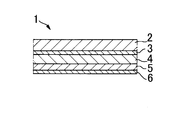
- the method of laminating the base material layer 2, the intermediate layer 4 (or 41 and 42) and the sealant layer 5 is not particularly limited, and a general method can be used.
- the components constituting the sealant layer 5 are blended using a mixer such as a Henschel mixer, a tumbler mixer, or a mazeller, and this is directly formed into a film by an extruder, or Once the pellets are obtained by kneading and extruding with a single or biaxial extruder, the pellets are further extruded with an extruder to form a film.
- a method for forming a film any method such as an inflation method, a T-die method, a casting method, or a calendar method may be used, but an inflation method or a T-die method is usually used.
- a resin composition mainly composed of molten m-LLDPE constituting the intermediate layer 4 is supplied between the film of the sealant layer 5 and the film of the base material layer 2 separately prepared by an extrusion laminating method.
- the cover film 1 which has the layer structure of the base material layer 2, the intermediate
- a T-die can be used as a die for extruding and supplying a resin composition mainly composed of molten m-LLDPE according to the extrusion lamination method.
- a deckle for adjusting the film width may be provided.
- an anchor coating agent such as anchor coating layer 3
- an anchor coating agent such as a urethane resin
- an adhesion aid to the surface of the base material layer 2 on the side in contact with the intermediate layer 4.
- an anchor coating agent such as anchor coating layer 3
- a commonly used one such as a roll coater, a gravure coater, a reverse roll coater, a bar coater or a die coater can be used.
- the resin composition constituting the intermediate layer 4 and the resin composition constituting the sealant layer 5 are melt-kneaded using separate single-screw or twin-screw extruders, and both are fed into a feed block or multi-manifold die. And then co-extrusion from a T die to form a two-layer film in which the intermediate layer 4 and the sealant layer 5 are laminated, and then the intermediate layer 4 side of the two-layer film
- the base material layer 2 may be dry laminated on the surface via an anchor coat agent.
- a general laminator can be used as a laminated film manufacturing machine according to the dry laminating method.
- middle layer 41, and the resin composition which comprises the sealant layer 5 are respectively used for another single-screw or biaxial extruder.
- a two-layer film in which the first intermediate layer 41 and the sealant layer 5 are laminated is manufactured by co-extrusion from the T die.
- a resin composition mainly composed of molten m-LLDPE constituting the second intermediate layer 42 is formed between the surface of the two-layer film on the first intermediate layer 41 side and the base material layer 2.
- the cover film 1 having an intermediate layer composed of a plurality of layers can be produced. Even in this case, it is preferable to apply an anchor coat agent (illustrated as the anchor coat layer 3) such as urethane resin to the surface of the base material layer 2 that is in contact with the second intermediate layer 42.
- an anchor coat agent illustrated as the anchor coat layer 3
- urethane resin such as urethane resin
- an antistatic treatment on the base material layer 2 as necessary.
- an antistatic agent used for the base layer 2 for example, an anionic, cationic, nonionic, betaine type surfactant type antistatic agent, a polymer type antistatic agent, a conductive agent or the like is used. Can do.
- These antistatic agents can be applied to the base layer 2 by a roll coater, a lip coater, a spray or the like using a gravure roll. Further, in order to uniformly apply these antistatic agents, it is preferable to subject the film surface of the base layer 2 to corona discharge treatment or ozone treatment before performing antistatic treatment, and in particular, to perform corona discharge treatment. preferable.
- the cover film having the above-mentioned base material layer, intermediate layer, and sealant layer is less likely to cause “film breakage” even during high-speed peeling, and is excellent in heat sealability, stability of peel strength, and transparency.
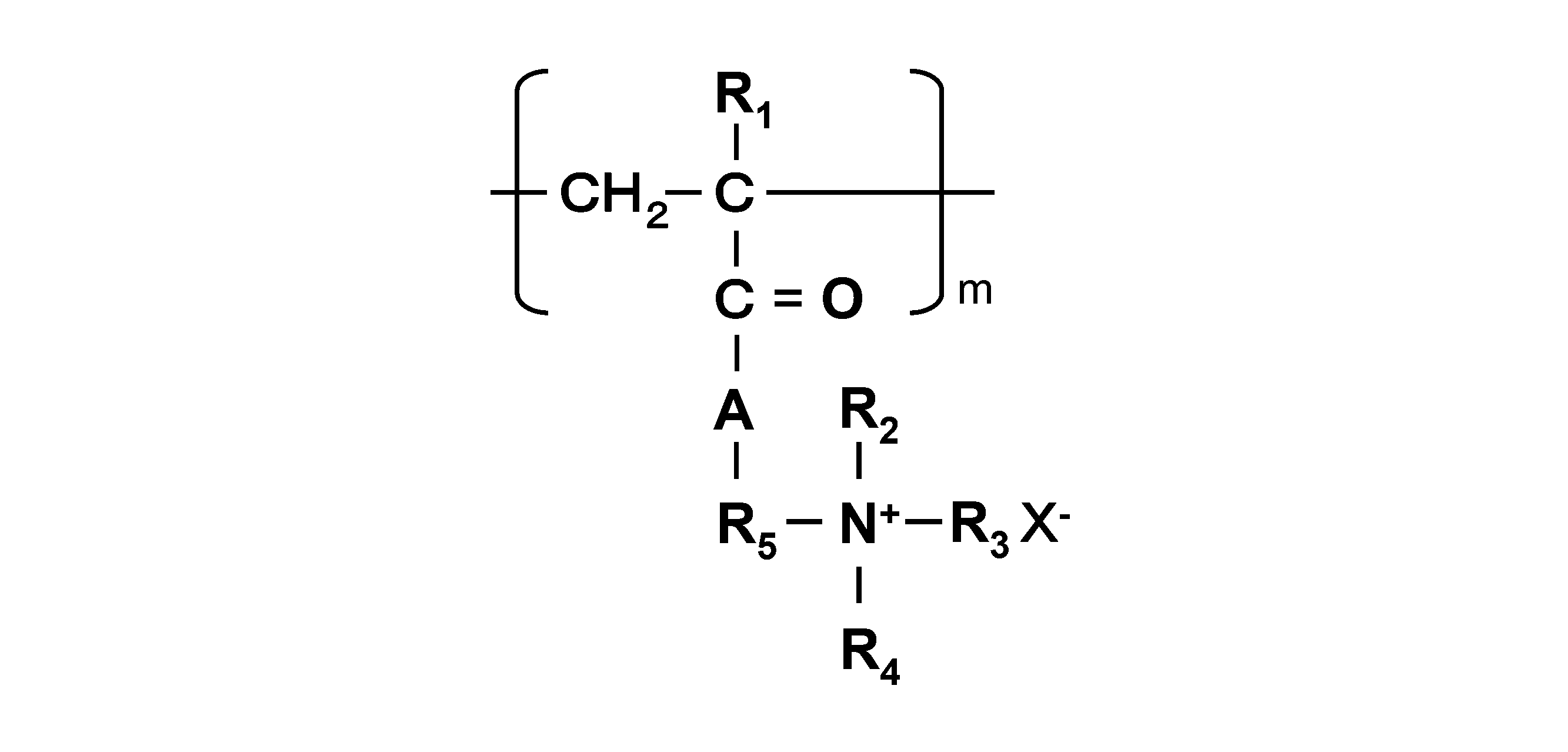
- a cationic polymer type antistatic agent having a repeating unit derived from a monomer represented by the following general formula and having a quaternary ammonium salt in the side chain.
- A represents an oxygen atom or an imino group
- R 1 represents a hydrogen atom or a methyl group
- R 2 , R 3 and R 4 may be the same or different and each has 1 to 18 represents an alkyl group
- R 5 represents an alkylene group having a carbon number of 1 ⁇ 4
- X - represents an anion
- m is an integer ranging from 1 to 5,000.
- X ⁇ includes [B (OCH 3 ) 4 ] ⁇ , [B (OC 2 H 5 ) 4 ] ⁇ , [B (OC 3 H 7 ) 4 ] ⁇ , [B (OC 6 H 5 ) 4 ] ⁇ Borate ester anions such as I ⁇ , Cl ⁇ and the like; H 2 PO 4 ⁇ , BF 4 ⁇ , CH 3 SO 4 ⁇ , C 2 H 5 SO 4 ⁇ , CH 3 COO ⁇ , NO 3 ⁇ , SbF 6 ⁇ , PF 6 — and the like can be mentioned, and may be the same or different for each structural unit.
- halogen anions, CH 3 SO 4 ⁇ , C 2 H 5 SO 4 — and the like are excellent in antistatic properties and can be suitably used.
- cationic polymer type antistatic agent having the structure as described above, known ones can be used, and in particular, an aqueous solution or an aqueous emulsion can be preferably used.
- Commercially available products can be used, and specific products include, for example, Saftmer ST1000, Saftmer ST-2000 (manufactured by Mitsubishi Chemical), ASA-29CP, ASA-31CP (Takamatsu Yushi Co., Ltd.) Manufactured), Bondip PA, Bondip PM (manufactured by Konishi), SF antistatic coating agent M-2 (manufactured by DIC), and the like.
- the antistatic layer is composed of the cationic polymer antistatic agent dispersed in an acrylic resin.
- the proportion is preferably 20 to 60% by weight of a cationic polymer type antistatic agent and 40 to 80% by weight of an acrylic resin, more preferably 30 to 50% by weight of a cationic polymer type antistatic agent, and an acrylic type.
- the resin consists of 50 to 70% by mass.
- the cationic polymer type antistatic agent is less than 20% by mass, it is difficult to obtain sufficient antistatic properties, and when it exceeds 60% by mass, the cover film is heat-sealed on a carrier tape. It may be difficult to obtain sufficient peel strength.
- the acrylic resin used for the antistatic layer is a copolymer resin obtained by polymerizing a monomer of an aliphatic unsaturated carboxylic acid and / or an aliphatic unsaturated carboxylic acid alkyl ester, and an ethylene-aliphatic unsaturated carboxylic acid. It is a copolymer resin of an acid and / or an aliphatic unsaturated carboxylic acid alkyl ester.
- Examples of the aliphatic unsaturated carboxylic acid and / or the aliphatic unsaturated carboxylic acid alkyl ester include acrylic acid or methyl acrylate, ethyl acrylate, propyl acrylate, n-butyl acrylate, hexyl acrylate, 2-acrylic acid 2-
- ester derivatives of C1 to C12 alcohols such as ethylhexyl and acrylic acid
- methacrylic acid or ester derivatives of C1 to C12 alcohols such as methyl methacrylate and ethyl methacrylate and methacrylic acid.
- aliphatic unsaturated carboxylic acid esters are preferably used, and n-butyl methacrylate, ethyl methacrylate, and methyl methacrylate are particularly preferable because of excellent water resistance.
- These aliphatic unsaturated carboxylic acids and / or carboxylic acid alkyl esters may be used alone or in combination of two or more.
- the acrylic resin additives such as a dispersion stabilizer, a lubricant and an antioxidant can be further blended as necessary. Further, the acrylic resin may be crosslinked by adding a crosslinking agent.
- a crosslinking agent for the purpose of preventing blocking, organic particles such as spherical or crushed acrylic particles, styrene particles, and silicone particles, and inorganic particles such as talc particles, silica particles, alumina particles, mica particles, calcium carbonate, and magnesium carbonate Particles can be added.
- silica particles and alumina particles can be used more suitably because of little decrease in transparency when added.
- the amount of these particles added is preferably in the range of 10 to 50% by mass, more preferably 15 to 35% by mass in the resin composition constituting the antistatic layer. If the addition amount is within this range, a balance can be achieved in any of transparency, heat sealability and antiblocking effect.
- the antistatic layer 6 can be formed by directly applying an aqueous solution or water-based emulsion containing the resin composition constituting the antistatic layer 6 to the surface of the sealant layer 5 and drying it.
- the coating method can be carried out by a known technique such as a gravure coater, reverse coater, kiss coater, air knife coater, Mayer bar coater, dip coater and the like.
- the surface of the sealant layer 5 is preferably subjected to corona treatment or ozone treatment, and particularly preferably corona treatment.
- the thickness of the antistatic layer 6 after drying is preferably 0.1 to 1 ⁇ m, particularly preferably 0.1 to 0.4 ⁇ m. If the thickness of the antistatic layer 6 is less than 0.1 ⁇ m, sufficient surface resistivity may not be obtained. If the thickness exceeds 1 ⁇ m, not only is it likely to increase the cost, but the cover film is heated on the carrier tape. When sealed, it may be difficult to obtain a sufficient peel strength.
- the obtained cover film can be used as a cover material for a carrier tape that is a container for electronic components.
- the carrier tape is a belt-like object having a width of about 8 mm to 100 mm in which depressions for storing electronic components are formed at predetermined intervals.
- the carrier tape is not particularly limited, and a commercially available tape can be used.
- the material of the carrier tape is not particularly limited, and for example, paper, polystyrene, polyester, polypropylene, polycarbonate, polyacrylonitrile, polyvinyl chloride, acrylonitrile / butadiene / styrene copolymer resin, and the like can be used.
- Carrier tapes are those imparted with conductivity by kneading carbon black or carbon nanotubes into the resin, those imparted with antistatic properties by kneading antistatic agents or conductive fillers, or surfactants on the surface of the carrier tape.
- An antistatic agent imparted with antistatic properties by applying a coating liquid in which a conductive material such as an antistatic agent, polypyrrole, or polythiophene is dispersed in an organic binder such as acrylic can be used.
- An electronic component package is obtained by storing electronic components etc. in the electronic component storage part of the carrier tape, covering the cover film as a lid, and continuously heat-sealing both edges along the longitudinal direction of the cover film. It is done.
- the electronic component package is usually stored and transported in a state of being wound on a reel.
- the carrier tape When mounting an electronic component housed in an electronic component package on an electronic circuit board or the like, the carrier tape is fed at a high speed from the carrier tape while feeding the carrier tape through a hole for feeding provided in the longitudinal edge of the carrier tape.
- the cover tape is intermittently peeled off, and the electronic components are taken out one by one while confirming the presence, orientation, and position of the electronic components etc. with a pickup device.
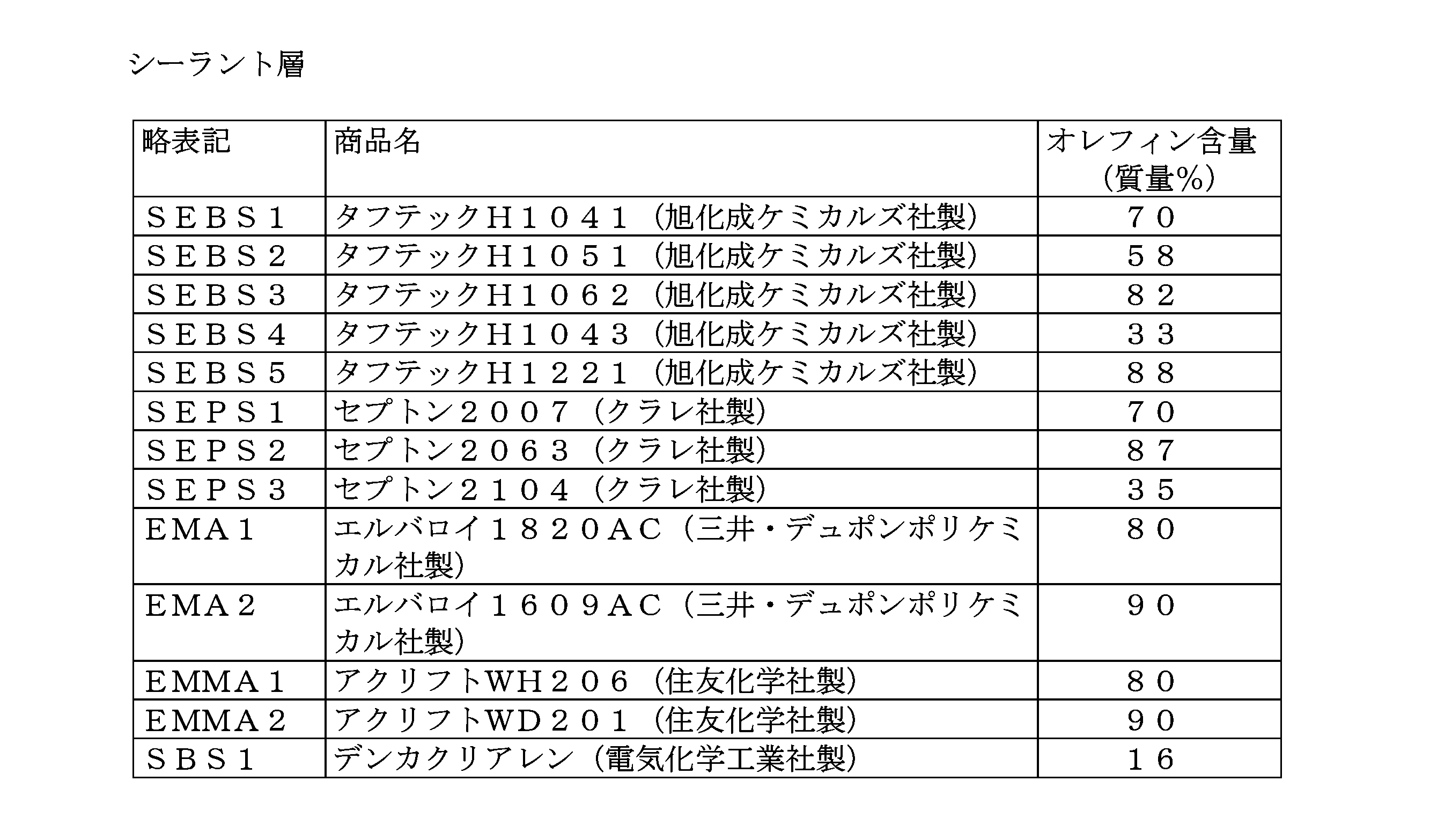
- Table 1 Table 2 and Table 3 show the abbreviations, trade names and / or characteristics of the materials used for the intermediate layer, sealant layer and antistatic layer. In the tables described herein, the abbreviations shown here are used for the sake of brevity.
- m-LLDPE Metallocene linear low density polyethylene
- HIPS High impact polystyrene
- LDPE Low density polyethylene Note (* 1) JISK-7112 compliant, measured at 190 ° C x 5 kg load
- Example 1 100 parts by mass of a hydrogenated product of styrene-butadiene-styrene triblock copolymer “Tuftec H1041” (manufactured by Asahi Kasei Chemicals), 50% by mass of low density polyethylene, 45% by mass of silica, and 5% by mass of talc Anti-blocking agent masterbatch "PEX ABT-16" (manufactured by Tokyo Ink Co., Ltd.) (hereinafter referred to as "blocking inhibitor 1”) 25 parts by mass with a tumbler and uniaxial with a diameter of 40 mm The mixture was kneaded at 200 ° C.
- the resin composition for the sealant layer and the m-LLDPE “Evolue SP3010” (manufactured by Prime Polymer Co., Ltd.) for the first intermediate layer are extruded from individual single-screw extruders and laminated and extruded with a multi-manifold T-die.
- a two-component curable polyurethane anchor coating agent is applied to a biaxially stretched polyethylene terephthalate film (thickness: 16 ⁇ m) constituting the base material layer with a roll coater, and the application surface and the second layer film described above are applied.
- the molten m-LLDPE “Harmolex NH745” (manufactured by Nippon Polyethylene Co., Ltd.) constituting the second intermediate layer is extruded to a thickness of 10 ⁇ m between the surface of the first intermediate layer and the laminated film is formed by an extrusion laminating method. Obtained.
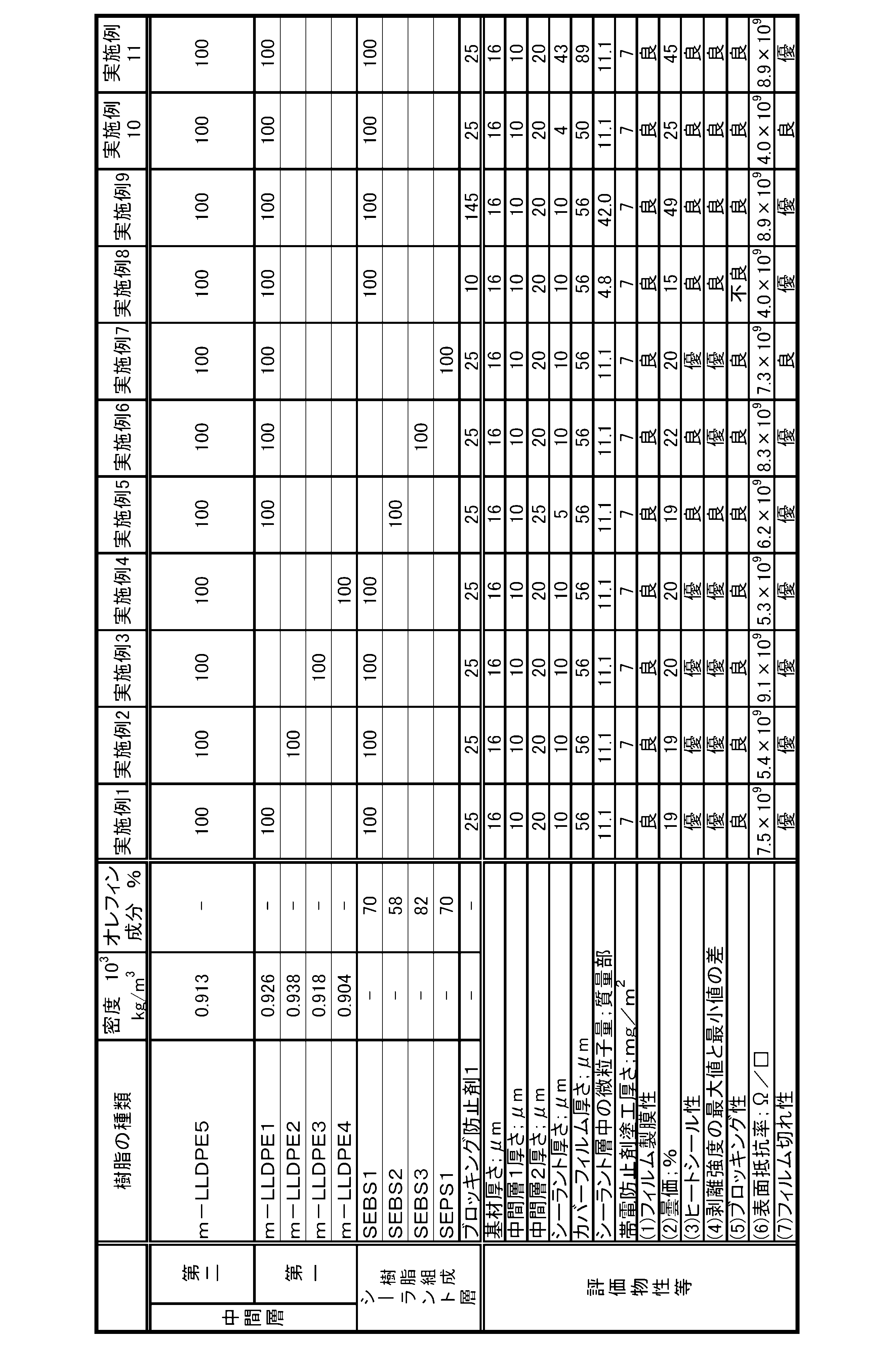
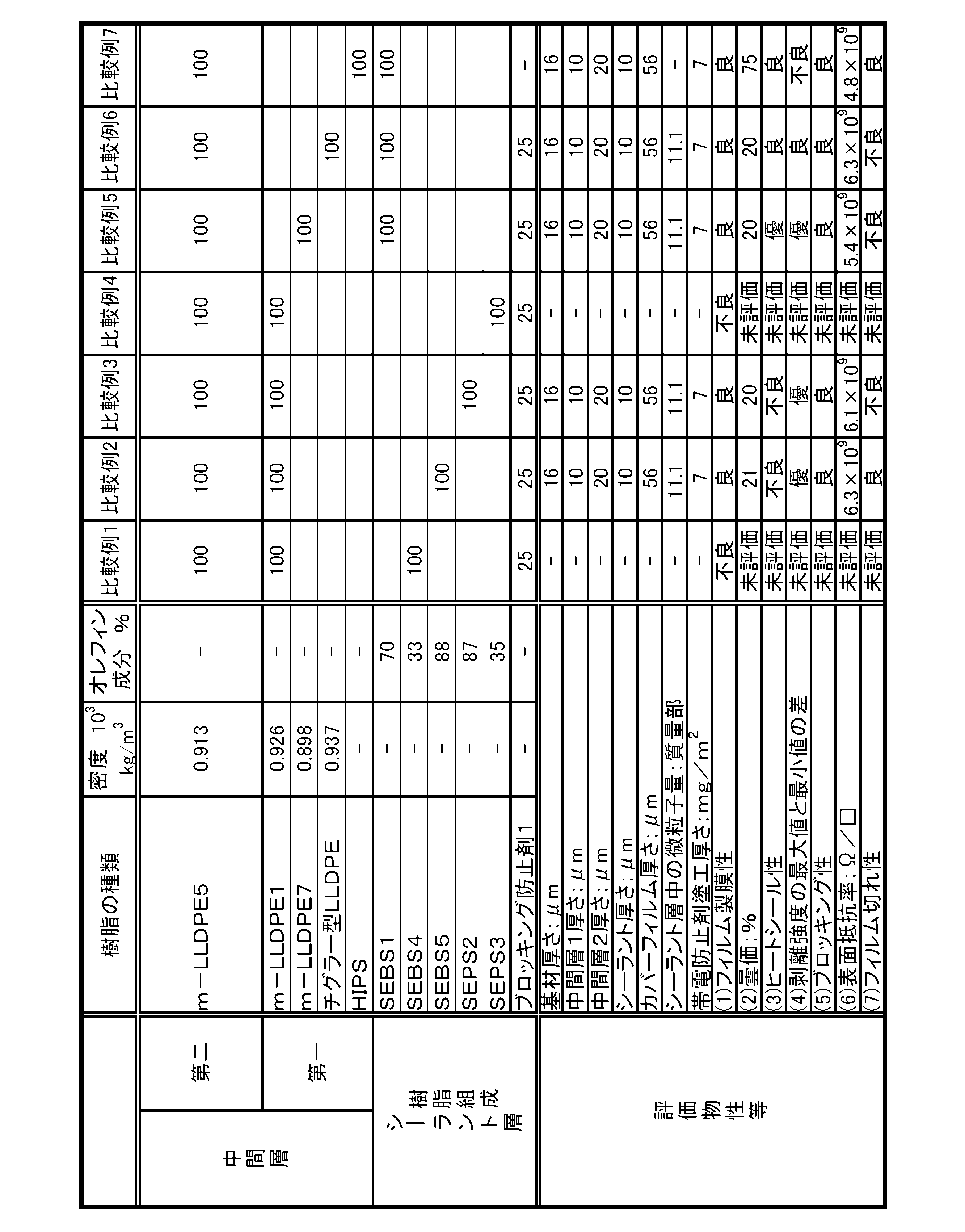
- Examples 2 to 11, Comparative Examples 1 to 7 A cover film was produced in the same manner as in Example 1 except that the resin composition and thickness described in Table 4 and Table 7 below were used.
- Example 12 A two-layer film composed of an intermediate layer (first intermediate layer) / sealant layer was prepared in the same manner as in Example 1 except that the thickness of the first intermediate layer was 30 ⁇ m.
- a two-component curable polyurethane anchor coating agent is applied to a biaxially stretched polyethylene terephthalate film (thickness 16 ⁇ m) constituting the base material layer with a roll coater, and the applied surface and the intermediate layer of the two-layer film described above.
- the side surface was laminated by a dry laminating method to obtain a laminated film.
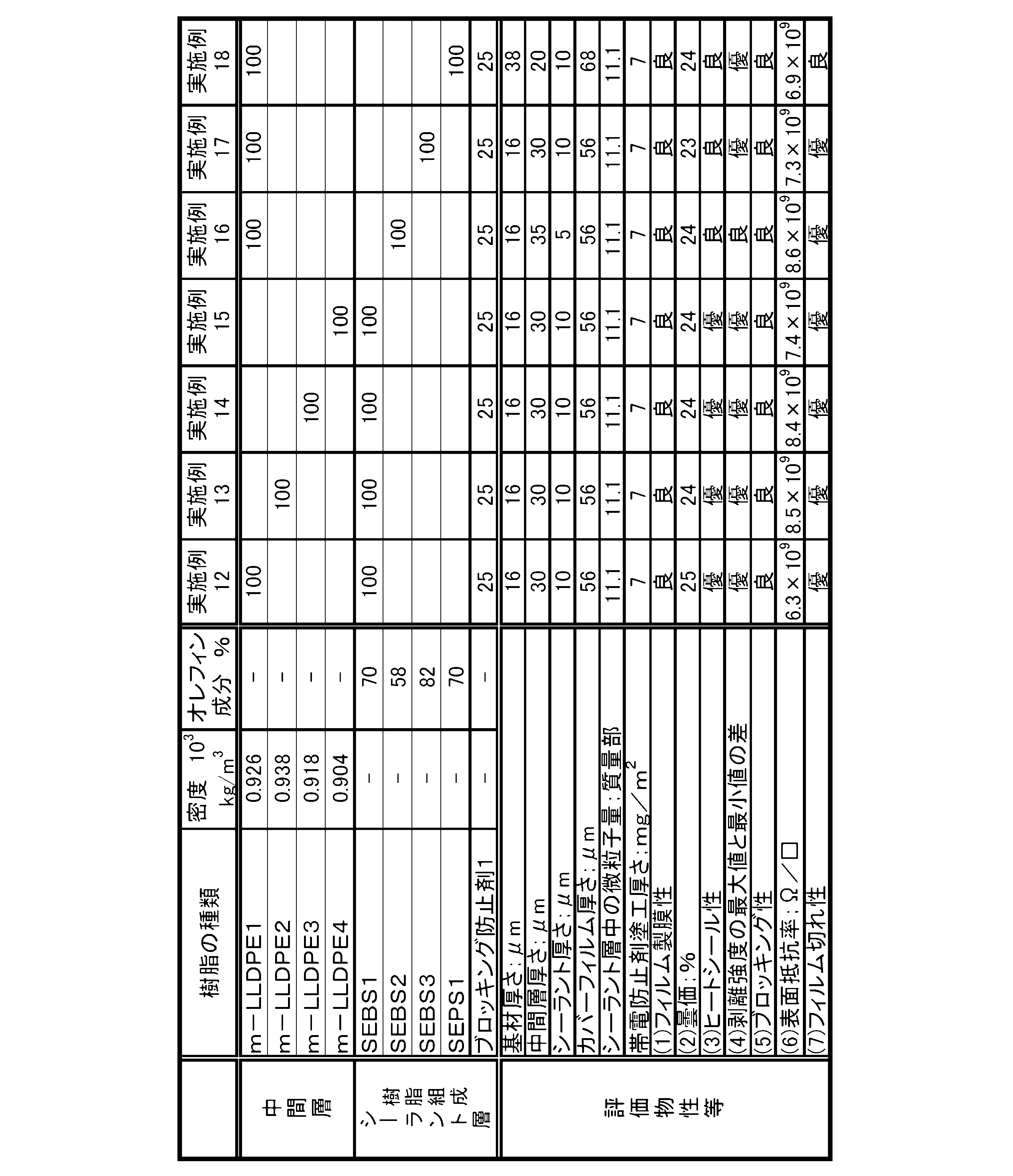
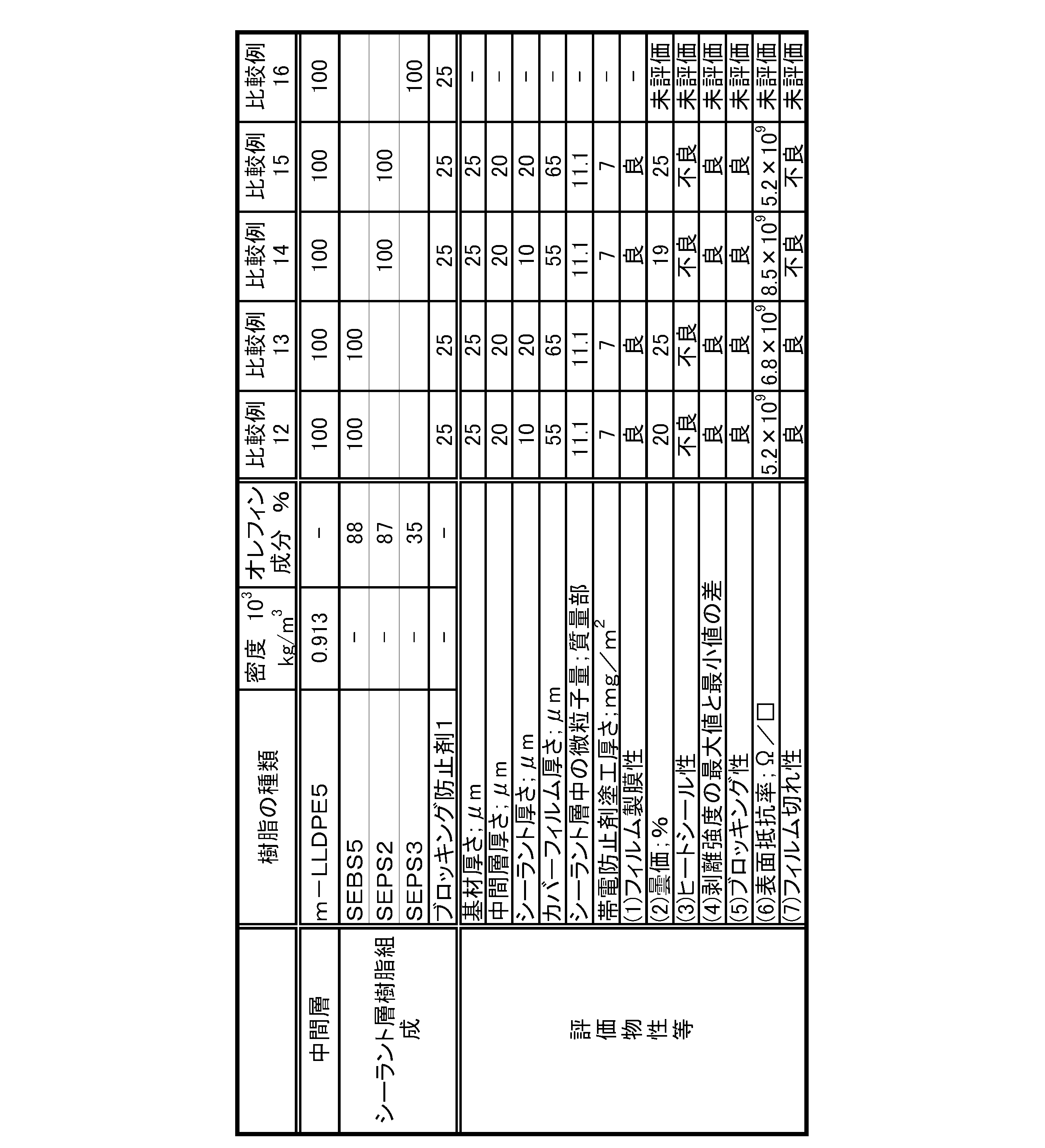
- Example 13 to 18, Comparative Examples 8 to 11 A cover film was produced in the same manner as in Example 12 except that the resins or resin compositions described in Table 5 and Table 8 below were used as raw materials for the intermediate layer or sealant layer.
- Example 19 After applying the urethane anchor coating agent to the surface of the biaxially stretched polyethylene terephthalate film (thickness 25 ⁇ m) constituting the base layer so that the dry thickness is about 1 ⁇ m, the m-LLDPE “Harmolex NH745N constituting the intermediate layer is formed. ”(Manufactured by Nippon Polyethylene Co., Ltd.) was extrusion coated with a T-die so as to have a thickness of 15 ⁇ m, thereby obtaining a two-layer film having a base layer / intermediate layer structure.
- a resin constituting the sealant layer 100 parts by mass of a hydrogenated resin “Tuftec H1041” (manufactured by Asahi Kasei Chemicals) of a triblock copolymer of styrene-butadiene-styrene, and A resin composition consisting of 25 parts by mass of an antiblocking agent master batch “PEX ABT-16” (manufactured by Tokyo Ink Co., Ltd.) was laminated by extrusion coating to a thickness of 20 ⁇ m to obtain a laminated film.
- a hydrogenated resin “Tuftec H1041” manufactured by Asahi Kasei Chemicals
- PEX ABT-16 an antiblocking agent master batch
- a cationic antistatic agent “SAT-6C” (manufactured by Nippon Pure Chemical Co., Ltd.) is applied to both surfaces of the laminated film using a gravure coater. It was applied to obtain a cover film having a layer structure of base material layer / intermediate layer / sealant layer.
- Example 20 to 23 Comparative Examples 12 to 16
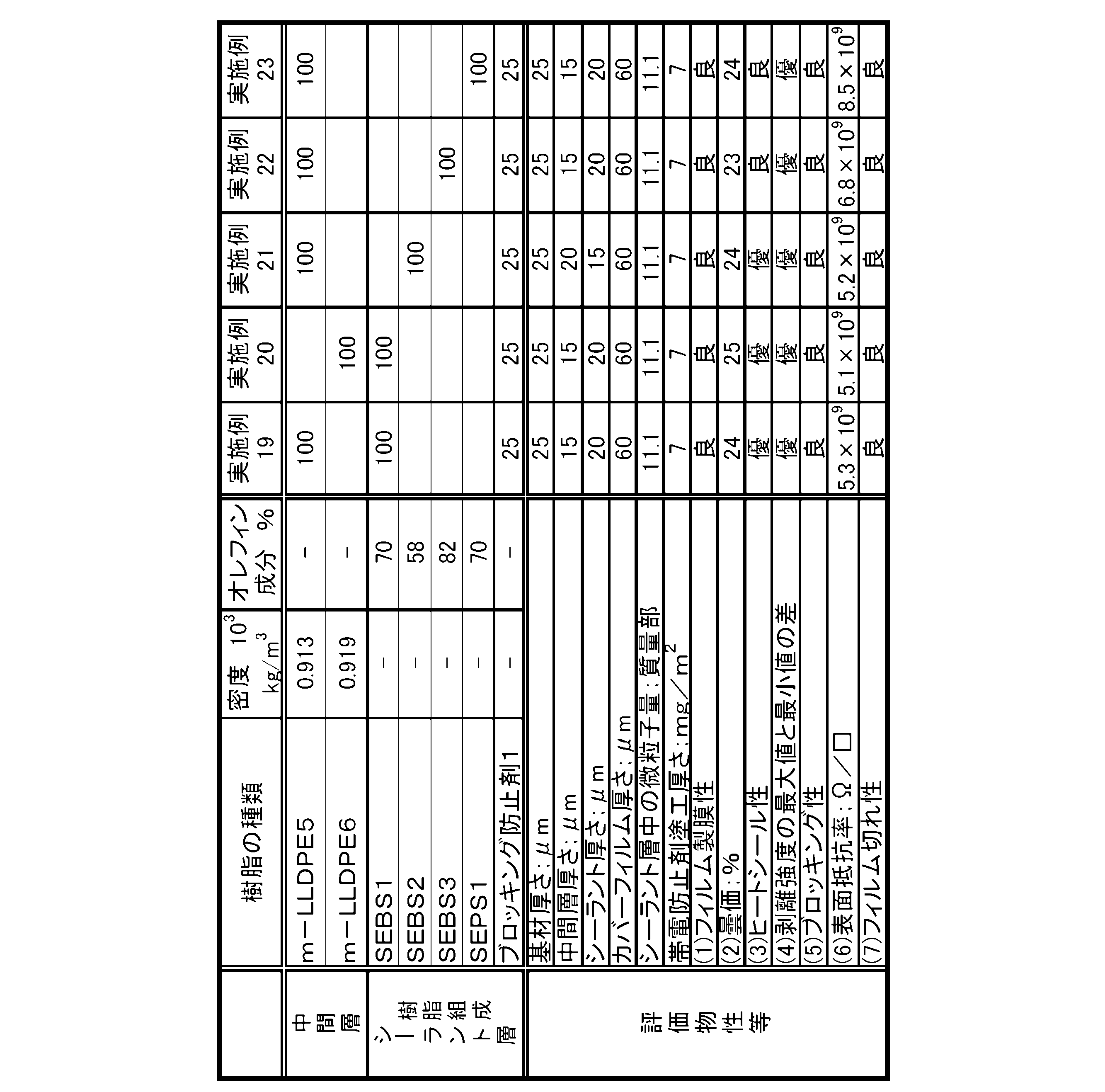
- a cover film was produced in the same manner as in Example 19 except that the resin composition and thickness described in Table 6 and Table 9 below were used.
- the cover film was peeled off at a speed of 300 mm / min and a peeling angle of 180 ° in an atmosphere with a temperature of 23 ° C. and a relative humidity of 50%.
- the average peel strength in the range of 0.3 to 0.9 N when heat-sealed at a seal iron temperature of 190 ° C. is “excellent” and heat-sealed at a seal iron temperature of either 140 ° C. or 190 ° C.
- Those having an average peel strength in the range of 0.3 to 0.9 N were indicated as “good”, and those having an average peel strength outside this range were indicated as “bad”.
- the film forming property was remarkably poor and the film was not obtained, was described as “not evaluated”.
- the temperature of the heat seal iron was adjusted so that the peel strength was 0.4N.
- the difference between the maximum value and the minimum value of the peel strength is less than 0.2N as “excellent”, and the difference between 0.2N and less than 0.3N is “ “Non-defective” and 0.3N or higher were described as “bad”.
- the film forming property was remarkably poor and the film was not obtained, was described as “not evaluated”.
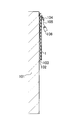
- the film cutting property was evaluated by the method shown in FIG. First, using a taping machine “ST-60” (Systemation), seal head width 0.5 mm ⁇ 2, seal head length 32 mm, seal pressure 3.5 MPa, feed length 16 mm, seal time 0.5 seconds ⁇ 2 Electronic component made of polystyrene having a width of 24 mm and a cover film 1 having a width of 21.5 mm so that the average peel strength is 1.5 N and 2.0 N by adjusting the temperature of the seal head in a single cycle (double sealing).
- the carrier tape 103 was sealed. Next, the carrier tape 103 with the cover film 1 sealed is cut out to a length of 550 mm as shown in FIG.
- the cover film 1 was peeled 50 mm from the upper part of the affixed carrier tape 103, the tip of the peeled cover film 1 was sandwiched between clips 104, and a weight 106 having a mass of 1000 g was attached to the clip 104 via a string 105. After that, when the weight 106 was naturally dropped, “excellent” was obtained when the cover film 1 was not cut even with an average peel strength of 2.0 N, and “good” when the cover film 1 was not cut with an average peel strength of 1.5 N. In addition, the case where breakage was observed at an average peel strength of 1.5 N was described as “bad”. Moreover, the film forming property was remarkably bad and the film could not be obtained was described as “not evaluated”.
- a biaxially stretched polyethylene terephthalate film “E5100” (made by Toyobo Co., Ltd., thickness 16 ⁇ m) constituting the base material layer is coated with a urethane anchor coating agent so that the dry thickness is 2 ⁇ m, and the coated surface And a laminate film having a total thickness of 48 ⁇ m having a layer structure of base material layer / intermediate layer / sealant layer.
- the cationic polymer type antistatic agent “ASA-29CP” (manufactured by Takamatsu Yushi Co., Ltd.) 40 mass% (solid content) and an acrylic resin (methyl acrylate) / Methyl methacrylate copolymer resin emulsion “Viniblanc” (manufactured by Nissin Chemical Co., Ltd.)
- ASA-29CP manufactured by Takamatsu Yushi Co., Ltd.
- an acrylic resin (methyl acrylate) / Methyl methacrylate copolymer resin emulsion “Viniblanc” manufactured by Nissin Chemical Co., Ltd.
- a water-based emulsion comprising 60% by mass (solid content) is applied by a gravure reverse method so that the thickness after drying is 0.4 ⁇ m.
- a cover film having a layer structure of base layer / intermediate layer / sealant layer / antistatic layer was obtained.
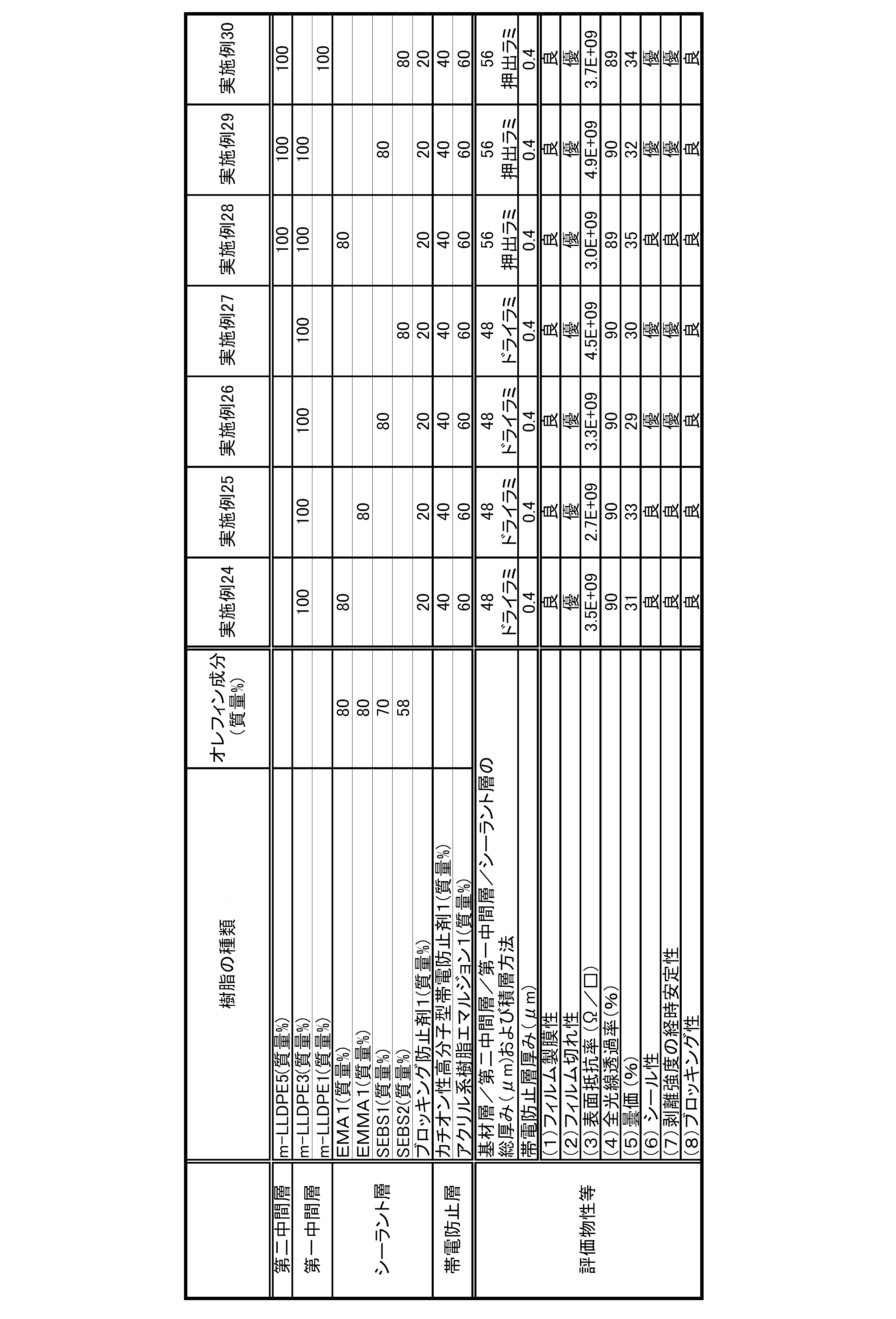
- Example 25 to 27 A cover film was produced in the same manner as in Example 24 using the resins or resin compositions shown in Tables 1 to 3 at the blending amounts shown in Table 10 below.
- Example 28 80% by mass of ethylene-methyl acrylate random copolymer resin “Elvalloy 1820AC” (Mitsui / DuPont Polychemical) and 20% by mass of anti-blocking agent masterbatch “PEX ABT-16” (Tokyo Ink) are used as a tumbler. To obtain a resin composition for the sealant layer. On the other hand, m-LLDPE “Harmolex NF464N” (manufactured by Nippon Polyethylene Co., Ltd.) was prepared as a resin constituting the first intermediate layer.
- each of these resins is extruded from a single screw extruder having a diameter of 40 mm, laminated with a multi-manifold die, the take-up speed is 15 m / min, the thickness of the sealant layer is 10 ⁇ m, and the thickness of the first intermediate layer is 20 ⁇ m.
- a bilayer film having a thickness of 30 ⁇ m composed of a sealant layer / first intermediate layer was produced.
- the biaxially stretched polyethylene terephthalate film “E5100” (made by Toyobo Co., Ltd., thickness 16 ⁇ m) constituting the base material layer is coated with a two-component curable polyurethane anchor coating agent using a roll coater.
- the molten m-LLDPE “Harmolex NH745” (manufactured by Nippon Polyethylene Co., Ltd.) constituting the second intermediate layer is extruded to a thickness of 10 ⁇ m between the above-mentioned two-layer film and the first intermediate layer side surface.
- a laminated film having a total thickness of 56 ⁇ m having a layer structure of base layer / second intermediate layer / first intermediate layer / sealant layer was obtained by an extrusion lamination method.
- cationic polymer type antistatic agent “ASA-29CP” manufactured by Takamatsu Yushi Co., Ltd. 40% by mass (solid content) and acrylic resin (methyl acrylate / methacrylic acid)
- ASA-29CP cationic polymer type antistatic agent 40% by mass (solid content)
- acrylic resin methyl acrylate / methacrylic acid
- a water-based emulsion composed of 60% by mass (solid content) of methyl copolymer resin emulsion “Vinibran” manufactured by Nissin Chemical Co., Ltd.
- An antistatic layer was formed to obtain a cover film having a layer structure of base material layer / second intermediate layer / first intermediate layer / sealant layer / antistatic layer.
- Example 29 to 43 A cover film was produced in the same manner as in Example 28 except that the resin compositions and thicknesses described in Tables 10 to 12 below were used.
- the cover film 1 was peeled 50 mm from the upper part of the affixed carrier tape 103, the tip of the peeled cover film 1 was sandwiched between clips 104, and a weight 106 having a mass of 1000 g was attached to the clip 104 via a string 105. After that, when the weight 106 was naturally dropped, “excellent” was obtained when the cover film 1 was not cut even with an average peel strength of 2.0 N, and “good” when the cover film 1 was not cut with an average peel strength of 1.5 N. In addition, a sample having an average peel strength of 1.5 N and observed to be cut was indicated as “bad”. In addition, the film forming property was remarkably poor and the film was not obtained, was described as “not evaluated”.
- the cover film was peeled off at a speed of 300 mm / min and a peeling angle of 180 ° in an atmosphere with a temperature of 23 ° C. and a relative humidity of 50%.
- the average peel strength when heat-sealed at a seal iron temperature of ⁇ 180 ° C is in the range of 0.3-0.8N, and the average peel when heat-sealed at a seal iron temperature of 140-180 ° C Those with a strength in the range of 0.2 to 1.0 N were marked as “good”, and those with an average peel strength outside this range were marked as “bad”.
- the film forming property was remarkably poor and the film was not obtained, was described as “not evaluated”.
- the sealed carrier tape is wound around a paper tube having a diameter of 95 mm so that the cover film side faces outside, and then left in a 60 ° C. environment for 3 days and 7 days.
- the presence or absence of adhesion was visually observed. Those that showed adhesion when left in an environment of 60 ° C. for 3 days are indicated as “bad”. No adhesion was observed when left for 3 days, and adhesion was seen when left for 7 days. Was marked as “good” and those that did not show adhesion even after being left for 7 days were marked as “excellent”.
- the film forming property was remarkably poor and the film was not obtained, was described as “not evaluated”.
Landscapes
- Engineering & Computer Science (AREA)
- Mechanical Engineering (AREA)
- Laminated Bodies (AREA)
- Packages (AREA)
- Packaging Frangible Articles (AREA)
- Wrappers (AREA)
Abstract
Description
剥離による静電気の発生を低減させる手法として、カバーフィルムのシーラント層中に導電性カーボン粒子、金属酸化物等の導電粉、金属微粒子を練りこむ手法が行われている(例えば特許文献1参照)。しかしながら、金属酸化物等は比較的高価な為、コストアップを招きやすく、また、シーラント層中に金属酸化物等を均一に分散させることは容易ではなく、分散不良によって剥離強度のばらつきを生じることがある。
さらに、上記特性に加えて、剥離による静電気障害の発生が抑制されたカバーフィルムを提供するものである。
また、電子部品の高速実装に特に適している電子部品包装体を提供するものである。
(1)基材層と、密度0.900~0.940×10³kg/m3のメタロセン直鎖状低密度ポリエチレン樹脂を50質量%以上含む樹脂組成物からなる中間層と、オレフィン成分を50~85質量%含むエチレン系共重合樹脂からなるシーラント層とを有する、電子部品を収納するキャリアテープにヒートシールされるカバーフィルム。
(2)シーラント層を構成するエチレン系共重合樹脂のオレフィン成分が、エチレン、プロピレン、ブテン、ブタジエンおよびイソプレンからなる群から選択される(1)記載のカバーフィルム。
(3)シーラント層を構成するエチレン系共重合樹脂が、エチレン-プロピレンランダム共重合樹脂、エチレン-1-ブテンランダム共重合樹脂、エチレン-酢酸ビニル共重合樹脂、エチレン-アクリル酸ランダム共重合樹脂、エチレン-アクリル酸エステルランダム共重合樹脂、エチレン-メタクリル酸ランダム共重樹脂、エチレン-メタクリル酸エステルランダム共重合樹脂、エチレン-スチレンランダム共重合樹脂、スチレン-ブタジエンブロック共重合樹脂の水素添加物、スチレン-イソプレンブロック共重合樹脂の水素添加物、スチレン-ブタジエン-スチレンブロック共重合樹脂の水素添加物、およびスチレン-イソプレン-スチレン共重合樹脂の水素添加物からなる群から選択される(2)記載のカバーフィルム。
(4)シーラント層を構成するエチレン系共重合樹脂が、エチレン-アクリル酸エステルランダム共重合樹脂、エチレン-メタクリル酸エステルランダム共重合樹脂、スチレン-ブタジエン-スチレンブロック共重合体の水素添加物、およびスチレン-イソプレン-スチレンブロック共重合体の水素添加物からなる群から選択される(3)記載のカバーフィルム。
(5)シーラント層が有機系微粒子または無機系微粒子を5~30質量%含む(1)~(4)記載のカバーフィルム。
(6)基材層が、二軸延伸ポリエチレンテレフタレート、または二軸延伸ポリエチレンテレフタレートを含む樹脂組成物からなる(1)~(5)記載のカバーフィルム。
(7)シーラント層側表面に、以下の一般式:

で示される第4級アンモニウム塩を側鎖に持つカチオン性高分子型帯電防止剤をアクリル系樹脂中に分散させた樹脂組成物からなる帯電防止層を有する(1)~(6)記載のカバーフィルム。
(8)帯電防止層を構成する樹脂組成物におけるカチオン性高分子型帯電防止剤とアクリル系樹脂との割合が、カチオン性高分子型帯電防止剤20~60質量%、アクリル系樹脂40~80質量%である(7)記載のカバーフィルム。
(9)帯電防止層が有機系微粒子または無機系微粒子を10~50質量%含む(7)または(8)に記載のカバーフィルム。
(10)上記(1)~(9)のいずれかに記載のカバーフィルムを、電子部品を収納したエンボスキャリアテープにヒートシールした電子部品包装体。
2 基材層
3 アンカーコート層
4 中間層
41 第一中間層
42 第二中間層
5 シーラント層
6 帯電防止層
101 壁
102 両面粘着テープ
103 キャリアテープ
104 クリップ
105 紐
106 錘
本実施形態にかかるカバーフィルムは、少なくとも基材層、中間層、およびシーラント層を有する。
基材層は、二軸延伸ポリエチレンテレフタレート、あるいは二軸延伸ポリエチレンテレフタレートを主成分とする樹脂組成物からなる。二軸延伸ポリエチレンテレフタレートとしては、市販されているものを用いることができ、帯電防止処理のための帯電防止剤が塗布または練り込まれたもの、またはコロナ処理や易接着処理などを施したものを用いることもできる。基材層は、薄すぎるとカバーフィルム剥離時の「フィルム切れ」を発生しやすく、一方厚すぎるとキャリアテープにカバーフィルムをヒートシールする際にシーラント層に十分に熱が伝わらず十分な剥離強度を得ることが困難になるため、通常12~25μmの厚みのものを好適に用いることができる。
中間層は、基材層とシーラント層との間に位置し、単一層からなるものであっても二以上の複数層からなるものであってもよい。
中間層は、柔軟性と高い剛性を持ち常温での引裂き強度が高い直鎖状低密度ポリエチレン(LLDPE)を主成分とする樹脂組成物からなる。LLDPEには、チグラー型触媒で重合されたもの(チグラー型LLDPE)、及びメタロセン系触媒で重合されたもの(m-LLDPE)があるが、m-LLDPEは分子量分布を狭く制御できるため低結晶化に伴う粘着性の発生、融点の必要以上の低下を抑えることができ、とりわけ高い引裂強度を有している点から、中間層を構成するLLDPEとしてはm-LLDPEを用いることが好ましい。
シーラント層は、オレフィン成分を50質量%~85質量%および他のコモノマー成分を15質量%~50質量%の比率、より好ましくはオレフィン成分を70質量%~80質量%および他のコモノマー成分を20質量%~30質量%の比率で含むエチレン系共重合樹脂を含む樹脂組成物からなる。
本発明おいて「オレフィン成分」とは、エチレン、プロピレン、ブテンなどのモノオレフィン成分、およびブタジエン、イソプレンなどのジオレフィン成分を指す。また、本発明おいて「エチレン系共重合樹脂」とは、共重合樹脂を単量体単位に分類した場合に、オレフィン単位中の主成分がエチレン単位である共重合樹脂を指す。例えば、スチレン-ブタジエンブロック共重合樹脂の水素添加物の場合、1,4-ブタジエンが重合したブロック部分が水素添加によりエチレン単位を構成するエチレン系共重合樹脂である。エチレン系共重合樹脂中におけるオレフィン成分の比率が50質量%未満の場合には、エチレン系共重合樹脂の加熱溶融伸びが小さく成形加工が困難となる場合がある。一方、オレフィン成分の比率が85質量%を超えると、キャリアテープにカバーフィルムをヒートシールした場合に十分な剥離強度を得ることが困難となる場合がある。
中でもエチレン-アクリル酸エステルランダム共重合樹脂、エチレン-メタクリル酸エステルランダム共重合樹脂、スチレン-ブタジエン-スチレンブロック共重合体の水素添加物、およびスチレン-イソプレン-スチレンブロック共重合体の水素添加物は、ポリスチレン、ポリカーボネート、ポリエチレンテレフタレートなどから構成されるキャリアテープとのヒートシール性に優れており、またフィルム切れを起こしにくいことから特に好適に用いることができる。
以下において、図1および図2を用いて、基材層/中間層/シーラント層の層構造からなるカバーフィルムの製造方法を説明する。
例えば、図2に示すカバーフィルム1の場合、シーラント層5を構成する各成分をヘンシェルミキサー、タンブラーミキサー、マゼラー等の混合機を用いてブレンドし、これを直接押出機でフィルム化するか、あるいは一度単軸あるいは二軸の押出機で混練押し出ししてペレットを得た後、ペレットを更に押出機で押し出してフィルム化する。フィルム化の方法としては、インフレーション法、Tダイ法、キャスティング法、あるいはカレンダー法等のいずれの方法を用いても差し支えないが、通常はインフレーション法やTダイ法が用いられる。
前記押出ラミレート法に係る溶融したm-LLDPEを主成分とする樹脂組成物を押し出し供給するためのダイは、例えば、T-ダイを用いることができる。また、フィルム幅を調整するためのディッケルを備えていても良い。基材層2の中間層4に接する側の面には、接着助剤としてウレタン樹脂などのアンカーコート剤(アンカーコート層3として図示)を塗布しておくことが好ましい。アンカーコート剤を基材層2に塗布するためのコーターとしては、ロールコーター、グラビアコーター、リバースロールコーター、バーコーター、ダイコーター等の通常使用されているものを用いることができる。
上記の基材層、中間層、およびシーラント層を有するカバーフィルムは、高速剥離の際でも「フィルム切れ」を起こしにくく、かつヒートシール性、剥離強度の安定性、および透明性に優れるが、これらの特性を損なうことなく剥離による静電気障害の発生をさらに抑制するために、シーラント層側表面に帯電防止層を形成することが好ましい。
以下において、図3を用いて、基材層/中間層/シーラント層/帯電防止層の層構造からなるカバーフィルムの製造方法を説明する。
基材層2/中間層4/シーラント層5/帯電防止層6からなる層構造のカバーフィルム1を製造するには、典型的には、上述した方法により基材層2/中間層4/シーラント層5からなる積層フィルムを製造し、その後シーラント層5側表面に帯電防止層6を形成する。
得られたカバーフィルムは、電子部品の収納容器であるキャリアテープの蓋材として用いることができる。
キャリアテープとは、電子部品を収納するための窪みが所定の間隔を空けて形成された幅8mmから100mm程度の帯状物である。キャリアテープは特に限定されず、市販のものを用いることができる。キャリアテープの材質としては、特に限定されるものではないが、例えば紙、ポリスチレン、ポリエステル、ポリプロピレン、ポリカーボネート、ポリアクリロニトリル、ポリ塩化ビニル、アクリロニトリル・ブタジエン・スチレン共重合樹脂等を使用することができる。キャリアテープは、カーボンブラックやカーボンナノチューブを樹脂中に練り込むことにより導電性を付与したもの、帯電防止剤や導電フィラーを練り込んで帯電防止性を付与したもの、あるいはキャリアテープ表面に界面活性剤型の帯電防止剤やポリピロール、ポリチオフェンなどの導電物をアクリルなどの有機バインダーに分散した塗工液を塗布して帯電防止性を付与したものを用いることができる。
キャリアテープの電子部品収納部に電子部品等を収納し、カバーフィルムを蓋材としてかぶせ、カバーフィルムの長手方向に沿って両縁部を連続的にヒートシールすることにより、電子部品包装体が得られる。電子部品包装体は、通常、リールに巻き取った状態で保管、搬送される。
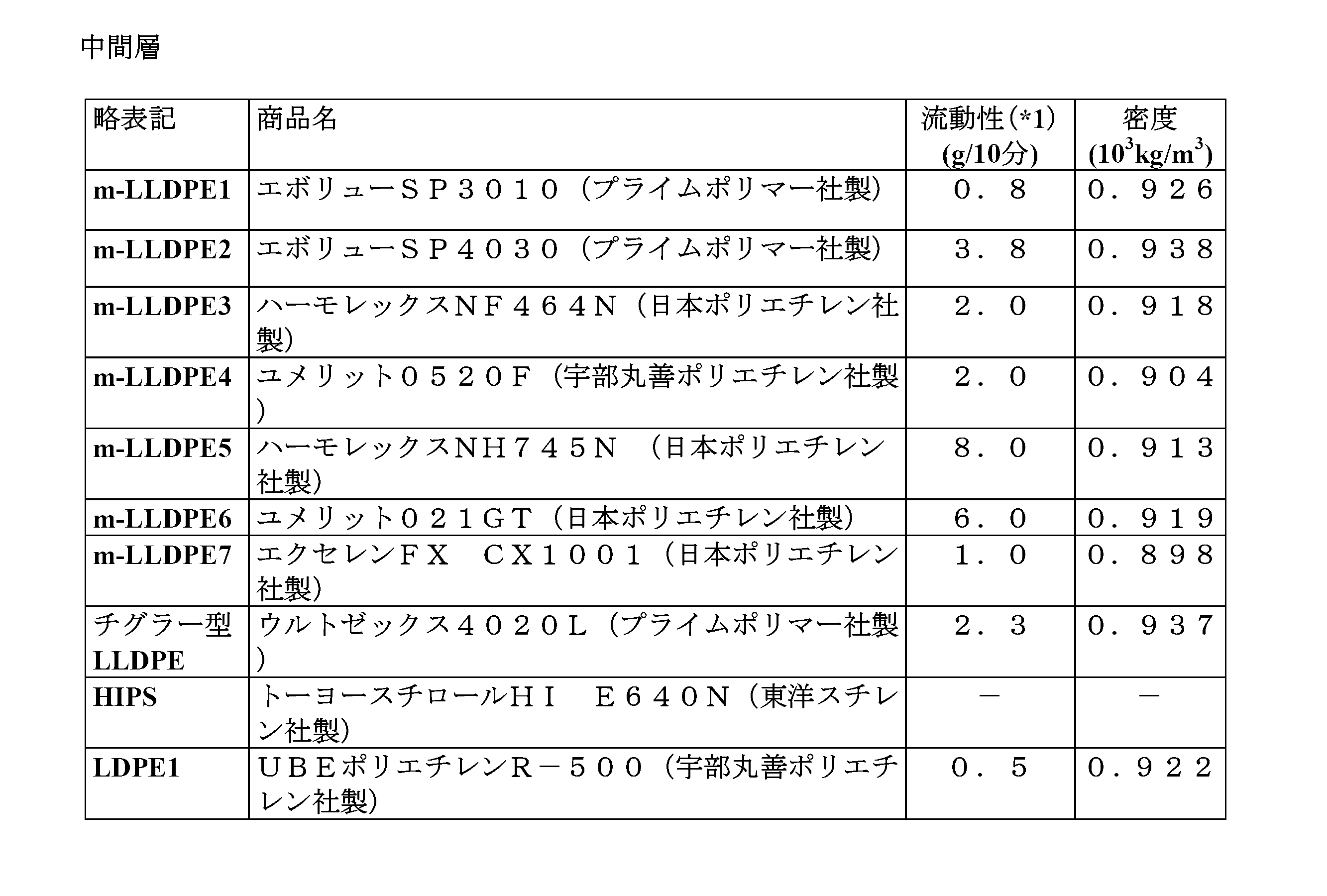
HIPS:ハイインパクトポリスチレン
LDPE:低密度ポリエチレン
注(*1) JISK-7112準拠、 190℃×5kg荷重での測定値

(実施例1)
スチレン-ブタジエン-スチレンのトリブロック共重合体の水素添加物「タフテックH1041」(旭化成ケミカルズ社製)100質量部と、50質量%の低密度ポリエチレン、45質量%のシリカ、および5質量%のタルクからなるブロッキング防止剤マスターバッチ「PEX ABT-16」(東京インキ社製)(以下、「ブロッキング防止剤1」と表記する)25質量部とをタンブラーにてプリブレンドして、径40mmの単軸押出機を用いて200℃で混練し、毎分20mのライン速度でシーラント層用樹脂組成物を得た。
このシーラント層用樹脂組成物と、第一中間層用のm-LLDPE「エボリューSP3010」(プライムポリマー社製)とを、それぞれ個別の単軸押出機から押出し、マルチマニホールドTダイで積層押出することにより、シーラント層および第一中間層の厚みが、それぞれ10μmおよび20μmの二層フィルムを得た。
一方で、基材層を構成する二軸延伸ポリエチレンテレフタレートフィルム(厚み16μm)に2液硬化型ポリウレタン型アンカーコート剤をロールコーターで塗布しておき、当該塗布面と、上述した二層フィルムの第一中間層側表面との間に、第二中間層を構成する溶融したm-LLDPE「ハーモレックスNH745」(日本ポリエチレン社製)を10μmの厚みになるように押出し、押出ラミネート法によって積層フィルムを得た。
この積層フィルムのシーラント層側表面および基材層側表面をコロナ処理した後、グラビアコーターを用いてカチオン型帯電防止剤「SAT-6C」(日本純薬社製)を積層フィルムの両表面に塗布し、基材層/第二中間層/第一中間層/シーラント層の層構造を有するカバーフィルムを得た。
下記の表4および表7に記載した樹脂組成および厚みとしたこと以外は実施例1と同様の方法で、カバーフィルムを作製した。
第一中間層の厚みを30μmとしたこと以外は実施例1と同様にして、中間層(第一中間層)/シーラント層の構成からなる二層フィルムを作成した。
一方で、基材層を構成する二軸延伸ポリエチレンテレフタレートフィルム(厚み16μm)に2液硬化型ポリウレタン型アンカーコート剤をロールコーターで塗布しておき、当該塗布面と上述した二層フィルムの中間層側表面とをドライラミネート法により積層させて積層フィルムを得た。この積層フィルムのシーラント層側表面および基材層側表面をコロナ処理した後、グラビアコーターを用いてカチオン型帯電防止剤「SAT-6C」(日本純薬社製)を積層フィルムの両表面に塗布し、基材層/中間層/シーラント層の層構造を有するカバーフィルムを得た。
中間層またはシーラント層の原料として下記の表5および表8に記載した樹脂または樹脂組成物を用いたこと以外は実施例12と同様にして、カバーフィルムを作成した。
基材層を構成する二軸延伸ポリエチレンテレフタレートフィルム(厚み25μm)の表面にウレタン系アンカーコート剤を乾燥厚みが約1μmになるように塗布した後、中間層を構成するm-LLDPE「ハーモレックスNH745N」(日本ポリエチレン社製)を15μm厚みとなるようにTダイにより押出コーティングすることにより、基材層/中間層の層構造を有する二層フィルムを得た。更にこの二層フィルムの中間層側の面に、シーラント層を構成する樹脂として、スチレン-ブタジエン-スチレンのトリブロック共重合体の水素添加樹脂「タフテックH1041」(旭化成ケミカルズ社製)100質量部およびブロッキング防止剤マスターバッチ「PEX ABT-16」(東京インキ社製)25質量部からなる樹脂組成物を20μmの厚みとなるように押出コーティングで積層して積層フィルムを得た。この積層フィルムのシーラント層側表面および基材層側の表面をコロナ処理した後、グラビアコーターを用いてカチオン型帯電防止剤「SAT-6C」(日本純薬社製)を積層フィルムの両表面に塗布し、基材層/中間層/シーラント層の層構造を有するカバーフィルムを得た。
下記の表6および表9に記載した樹脂組成および厚みとしたこと以外は、実施例19と同様の方法でカバーフィルムを作製した。
上記実施例1~23及び比較例1~16で作製したカバーフィルムについて下記に示す評価を行った。これらの結果を表4から表9に示す。
(1)フィルム製膜性
製膜したカバーフィルムの厚みを、巾方向に11点(40mm間隔)×流れ方向に3点(1m間隔)の計33箇所について測定し、一枚のカバーフィルムにおける厚みの変動を調べた。厚みの変動が±20%以下のものを「良」、±20%を超えるものを「不良」として表記した。
JIS K 7105:1998の測定法Aに準じて、積分球式測定装置を用いて曇価を測定した。フィルム製膜性が著しく悪くフィルムが得られなかったものについては、「未評価」と表記した。
テーピング機「ST-60」(システメーション社)を使用し、シールヘッド幅0.5mm×2、シールヘッド長32mm、ヒートシール圧力3.5MPa、送り長16mm、ヒートシール時間0.2秒×2回(ダブルシール)にてシールコテ温度140℃から190℃まで10℃間隔で5.5mm幅のカバーフィルムを8mm幅のポリスチレン製キャリアテープ(電気化学工業社製)にヒートシールした。温度23℃、相対湿度50%の雰囲気下に24時間放置後、同じく温度23℃、相対湿度50%の雰囲気下にて毎分300mmの速度、剥離角度180°でカバーフィルムを剥離し、140℃および190℃のシールコテ温度でヒートシールした時の平均剥離強度が0.3~0.9Nの範囲にあるものを「優」とし、140℃あるいは190℃のいずれかのシールコテ温度でヒートシールした時の平均剥離強度が0.3~0.9Nの範囲にあるものを「良」とし、平均剥離強度がこの範囲以外のものを「不良」として表記した。また、フィルム製膜性が著しく悪くフィルムが得られなかったものについては、「未評価」と表記した。
テーピング機「ST-60」(システメーション社)を使用し、シールヘッド幅0.5mm×2、シールヘッド長32mm、ヒートシール圧力3.5MPa、送り長16mm、ヒートシール時間0.2秒×2回(ダブルシール)にてシールコテ温度160℃から190℃まで10℃間隔で5.5mm幅のカバーフィルムを8mm幅のポリスチレン製キャリアテープ(電気化学工業社製)にヒートシールした。温度23℃、相対湿度50%の雰囲気下に24時間放置後、同じく温度23℃、相対湿度50%の雰囲気下にて毎分300mmの速度、剥離角度180°でカバーフィルムを剥離した時の平均剥離強度が0.4Nとなるようにヒートシールコテの温度を調整した。この時、キャリアテープ100mm長さ分を剥離した時の、剥離強度の最大値と最小値の差が0.2N未満のものを「優」とし、0.2N以上0.3N未満のものを「良」とし、0.3N以上のものを「不良」として表記した。また、フィルム製膜性が著しく悪くフィルムが得られなかったものについては、「未評価」と表記した。
上記(4)と同様の条件で平均剥離強度が0.4Nとなるようにヒートシールした後、シールしたキャリアテープを直径95mmの紙管にカバーフィルム側が外側になるように巻いた後、40℃の環境に24時間放置した。この時に、ヒートシール箇所以外におけるキャリアテープとカバーフィルムとの接着の有無を目視により観察し、接着がみられないものを「良」とし、接着がみられるものを「不良」として表記した。また、フィルム製膜性が著しく悪くフィルムが得られなかったものについては、「未評価」と表記した。
抵抗率計「ハイレスタUP MCP-HT40」(三菱化学社)を使用してJIS K6911の方法にて、雰囲気温度23℃、雰囲気湿度50%(相対湿度)、印加電圧500Vでカバーフィルムのシーラント面の表面抵抗率を測定した。また、フィルム製膜性が著しく悪くフィルムが得られなかったものについては、「未評価」と表記した。
フィルム切れ性は図4に示す方法によって評価した。
まず、テーピング機「ST-60」(システメーション社)を使用し、シールヘッド幅0.5mm×2、シールヘッド長32mm、シール圧力3.5MPa、送り長16mm、シール時間0.5秒×2回(ダブルシール)にて、シールヘッド温度を調整することにより、平均剥離強度が1.5Nおよび2.0Nとなる様に、21.5mm幅のカバーフィルム1を24mm幅のポリスチレンからなる電子部品用キャリアテープ103にシールした。
次いで、このカバーフィルム1をシールしたキャリアテープ103を、図4に示すように、550mmの長さで切り取り、両面粘着テープ102を貼った垂直な壁101にキャリアテープ103のポケット底部が接するように貼り付けた。貼り付けたキャリアテープ103の上部からカバーフィルム1を50mm剥がし、剥がしたカバーフィルム1の先端をクリップ104で挟み、このクリップ104に紐105を介して質量1000gの錘106を取り付けた。その後、錘106を自然落下させた時に、平均剥離強度2.0Nでもカバーフィルム1が切れなかったものを「優」、平均剥離強度1.5Nでカバーフィルム1が切れなかったものを「良」、平均剥離強度が1.5Nで切れが観察されたものを「不良」として表記した。また、フィルム製膜性が著しく悪くフィルムが得られなかったものについては、「未評価」と表記した。

(実施例24)
エチレン-メチルアクリレートランダム共重合樹脂「エルバロイ1820AC」(三井・デュポンポリケミカル社製)80質量%と、ブロッキング防止剤マスターバッチ「PEX ABT-16」(東京インキ社製)(すなわち「ブロッキング防止剤1」)20質量%とをタンブラーにてブレンドしてシーラント層用樹脂組成物を得た。
また、中間層を構成する樹脂として、m-LLDPE「ハーモレックスNF464N」(日本ポリエチレン社製)を準備した。
これらの樹脂を、それぞれ個別に直径40mmの単軸押出機から押し出し、マルチマニホールドダイで積層し、引取速度を15m/分として、シーラント層の厚さが10μm、中間層の厚さが20μmであるシーラント層/中間層の二層フィルム(厚み:30μm)を作製した。
一方で、基材層を構成する二軸延伸ポリエチレンテレフタレートフィルム「E5100」(東洋紡社製、厚み16μm)にウレタン系のアンカーコート剤を乾燥厚みが2μmになるように塗布しておき、当該塗布面と上記二層フィルムの中間層表面とが接するようにドライラミネート法で積層することにより、基材層/中間層/シーラント層の層構造を有する総厚さ48μmの積層フィルムを得た。
続いて、積層フィルムのシーラント層面へコロナ処理を施した後に、カチオン性高分子型帯電防止剤「ASA-29CP」(高松油脂社製)40質量%(固形分)とアクリル系樹脂(アクリル酸メチル/メタクリル酸メチル共重合樹脂エマルジョン「ビニブラン」(日信化学社製))60質量%(固形分)からなる水系エマルジョンを、グラビアリバース法にて乾燥後の厚みが0.4μmとなるように塗工して帯電防止層を形成し、基材層/中間層/シーラント層/帯電防止層の層構造を有するカバーフィルムを得た。
上記表1~表3の樹脂または樹脂組成物を用いて、下記の表10に示す配合量で、実施例24と同様の方法によってカバーフィルムを作製した。
エチレン-メチルアクリレートランダム共重合樹脂「エルバロイ1820AC」(三井・デュポンポリケミカル社製)80質量%と、ブロッキング防止剤マスターバッチ「PEX ABT-16」(東京インキ社製)20質量%とをタンブラーにてブレンドしてシーラント層用樹脂組成物を得た。
一方、第一中間層を構成する樹脂として、m-LLDPE「ハーモレックスNF464N」(日本ポリエチレン社製)を準備した。
これらの樹脂をそれぞれ個別の直径40mmの単軸押出機から押し出し、マルチマニホールドダイで積層し、引取速度を15m/分として、シーラント層の厚さが10μm、第一中間層の厚さが20μmのシーラント層/第一中間層の構成からなる厚み30μmの二層フィルムを作製した。
一方で、基材層を構成する二軸延伸ポリエチレンテレフタレートフィルム「E5100」(東洋紡社製、厚さ16μm)に2液硬化型ポリウレタン型アンカーコート剤をロールコーターで塗布しておき、この塗布面と上述した二層フィルムの第一中間層側表面との間に、第二中間層を構成する溶融したm-LLDPE「ハーモレックスNH745」(日本ポリエチレン社製)を10μmの厚みになるように押し出し、押出ラミネート法によって、基材層/第二中間層/第一中間層/シーラント層の層構造を有する総厚さ56μmの積層フィルムを得た。
続いて、シーラント層面へコロナ処理を施した後に、カチオン性高分子型帯電防止剤「ASA-29CP」(高松油脂社製)40質量%(固形分)とアクリル系樹脂(アクリル酸メチル/メタクリル酸メチル共重合樹脂エマルジョン「ビニブラン」(日信化学社製))60質量%(固形分)からなる水系エマルジョンを、グラビアリバース法にて乾燥後の厚みが0.4μmとなるように塗工して帯電防止層を形成し、基材層/第二中間層/第一中間層/シーラント層/帯電防止層の層構造を有するカバーフィルムを得た。
下記の表10~12に記載した樹脂組成および厚みとしたこと以外は、実施例28と同様の方法でカバーフィルムを作製した。
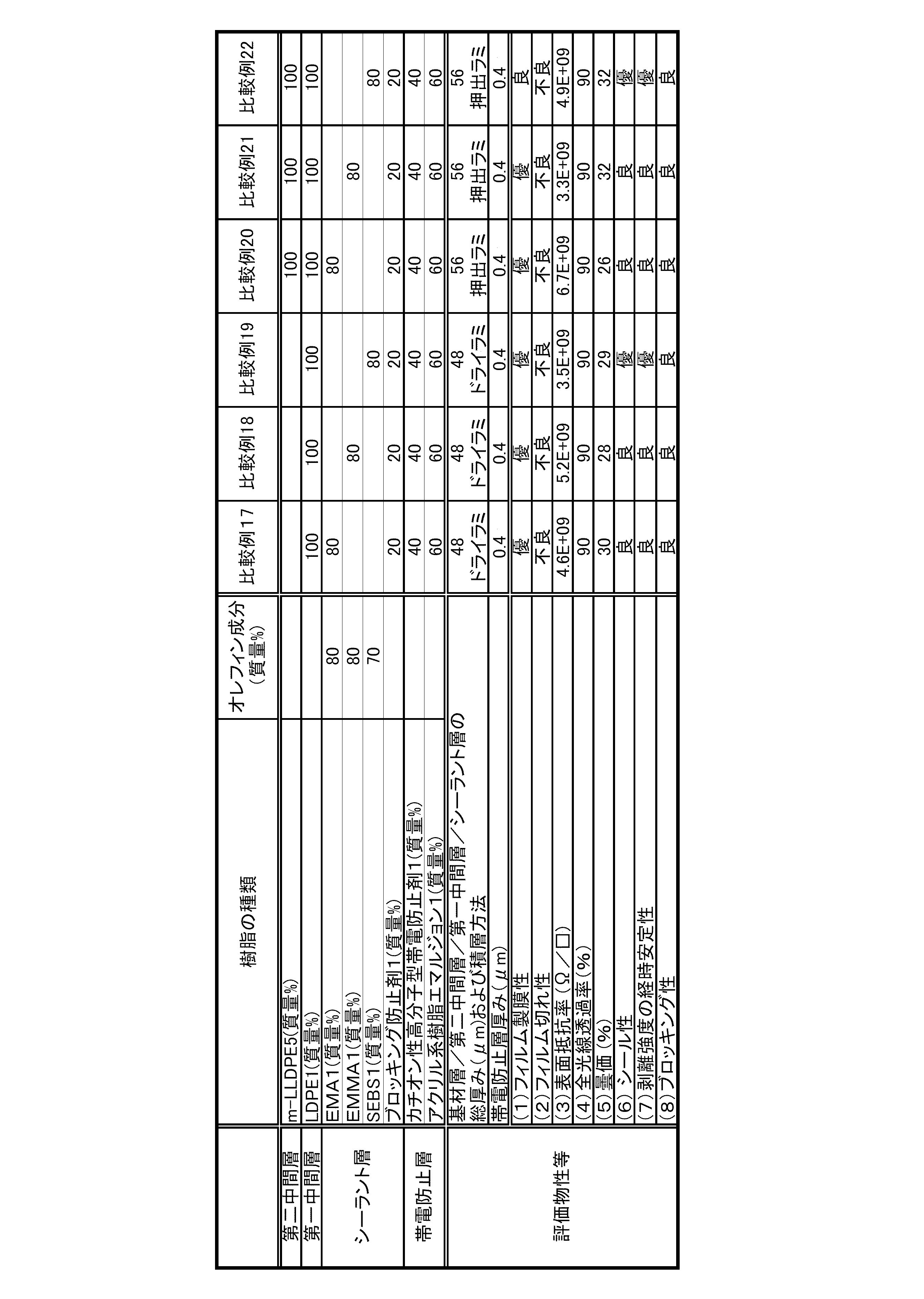
下記の表13に記載した樹脂組成および厚みとしたこと以外は、実施例24と同様の方法でカバーフィルムを作製した。
下記の表13~15に記載した樹脂組成および厚みとしたこと以外は、実施例28と同様の方法でカバーフィルムを作製した。
上記実施例24~43及び比較例17~34で作製したカバーフィルムについて下記に示す評価を行った。これらの結果を表10から表15に示す。
(1)フィルム製膜性
製膜したカバーフィルムの厚みを、巾方向に11点(40mm間隔)×流れ方向に3点(1m間隔)の計33箇所について測定し、一枚のカバーフィルムにおける厚みの変動を調べた。厚みの変動が±10%以下のものを「優」、±20%以下のものを「良」、20%を超えるものを「不良」として表記した。
フィルム切れ性は図4に示す方法によって評価した。
まず、テーピング機「ST-60」(システメーション社)を使用し、シールヘッド幅0.5mm×2、シールヘッド長32mm、シール圧力3.5MPa、送り長16mm、シール時間0.5秒×2回(ダブルシール)にて、シールヘッド温度を調整することにより、平均剥離強度が1.5Nおよび2.0Nとなる様に、21.5mm幅のカバーフィルム1を24mm幅のポリスチレンからなる電子部品用キャリアテープ103にシールした。
次いで、このカバーフィルム1をシールしたキャリアテープ103を、図4に示すように、550mmの長さで切り取り、両面粘着テープ102を貼った垂直な壁101にキャリアテープ103のポケット底部が接するように貼り付けた。貼り付けたキャリアテープ103の上部からカバーフィルム1を50mm剥がし、剥がしたカバーフィルム1の先端をクリップ104で挟み、このクリップ104に紐105を介して質量1000gの錘106を取り付けた。その後、錘106を自然落下させた時に、平均剥離強度2.0Nでもカバーフィルム1が切れなかったものを「優」、平均剥離強度1.5Nでカバーフィルム1が切れなかったものを「良」、平均剥離強度が1.5Nで切れが観察されたものを「不良」として表記した。また、フィルム製膜性が著しく悪くフィルムが得られなかったものについては、「未評価」と表記した。
抵抗率計「ハイレスタUP MCP-HT40」(三菱化学社)を使用してJIS K6911の方法にて、雰囲気温度23℃、雰囲気湿度50%(相対湿度)、印加電圧500Vでカバーフィルムのシーラント面の表面抵抗率を測定した。また、フィルム製膜性が著しく悪くフィルムが得られなかったものについては、「未評価」と表記した。
JIS K 7105:1998に準ずる測定法Aによる積分球式測定装置を用いて全光線透過率、及び曇価(ヘーズ)を測定した。フィルム製膜性が著しく悪くフィルムが得られなかったものについては、「未評価」と表記した。尚、カバーフィルムの曇価が50%以上の場合、カバーフィルムで電子部品を包装した後に内容物が正しく挿入されているかを検査する工程において、内容物の確認が困難になる場合がある。
テーピング機「ST-60」(システメーション社)を使用し、シールヘッド幅0.5mm×2、シールヘッド長32mm、シール圧力3.5MPa、送り長16mm、シール時間0.2秒×2回(ダブルシール)にて、シールコテ温度140℃から180℃まで10℃間隔で21.5mm幅のカバーフィルムを24mm幅のポリスチレン製キャリアテープ(電気化学工業社製)にヒートシールした。温度23℃、相対湿度50%の雰囲気下に24時間放置後、同じく温度23℃、相対湿度50%の雰囲気下にて毎分300mmの速度、剥離角度180°でカバーフィルムを剥離し、140℃~180℃のシールコテ温度でヒートシールした時の平均剥離強度が0.3~0.8Nの範囲にあるものを「優」とし、140℃~180℃のシールコテ温度でヒートシールした時の平均剥離強度が0.2~1.0Nの範囲にあるものを「良」とし、平均剥離強度がこの範囲以外のものを「不良」として表記した。また、フィルム製膜性が著しく悪くフィルムが得られなかったものについては、「未評価」と表記した。
テーピング機「ST-60」(システメーション社)を使用し、シールヘッド幅0.5mm×2、シールヘッド長32mm、シール圧力3.5MPa、送り長16mm、シール時間0.2秒×2回(ダブルシール)にて、シールヘッド温度を調整することにより、温度23℃、相対湿度50%の雰囲気下に24時間放置後、同じく温度23℃、相対湿度50%の雰囲気下にて毎分300mmの速度、剥離角度180°でカバーフィルムを剥離した時の平均剥離強度が0.4Nとなる様に、21.5mm幅のカバーフィルムを24mm幅のポリスチレン製キャリアテープ(電気化学工業社製)にヒートシールした。これを、促進環境試験として、52℃、相対湿度95%の高温多湿環境下にて7日間保管した後、23℃、相対湿度50%の環境下にて24時間放置した後に剥離強度を測定した。高温多湿環境に保管後の平均剥離強度の変化が0.2N以下のものを優、0.3N以下のものを良、上記以外のものを不良として表記した。また、フィルム製膜性が著しく悪くフィルムが得られなかったものについては、「未評価」と表記した。
テーピング機「ST-60」(システメーション社)を使用し、シールヘッド幅0.5mm×2、シールヘッド長32mm、シール圧力3.5MPa、送り長16mm、シール時間0.2秒×2回(ダブルシール)にて、シールヘッド温度を調整することにより、温度23℃、相対湿度50%の雰囲気下に24時間放置後、同じく温度23℃、相対湿度50%の雰囲気下にて毎分300mmの速度、剥離角度180°でカバーフィルムを剥離した時の平均剥離強度が0.4Nとなる様に、21.5mm幅のカバーフィルムを24mm幅のポリスチレン製キャリアテープ(電気化学工業社製)にヒートシールした。
次に、シールしたキャリアテープを直径95mmの紙管にカバーフィルム側が外側になるように巻いた後、60℃の環境に3日間及び7日間放置し、ヒートシール箇所以外におけるキャリアテープとカバーフィルムとの接着の有無を目視にて観察した。60℃の環境に3日間放置した場合に接着が見られたものを「不良」として表記し、3日間放置した場合に接着が見られず、且つ7日間放置した場合に接着が見られたものを「良」として表記し、7日間放置した場合でも接着が見られなかったものを「優」と表記した。また、フィルム製膜性が著しく悪くフィルムが得られなかったものについては、「未評価」と表記した。




Claims (10)
- 基材層と、
密度0.900~0.940×10³kg/m3のメタロセン直鎖状低密度ポリエチレン樹脂を50質量%以上含む樹脂組成物からなる中間層と、
オレフィン成分を50~85質量%含むエチレン系共重合樹脂からなるシーラント層と
を有する、電子部品を収納するキャリアテープにヒートシールされるカバーフィルム。 - シーラント層を構成するエチレン系共重合樹脂のオレフィン成分が、エチレン、プロピレン、ブテン、ブタジエンおよびイソプレンからなる群から選択される、請求項1記載のカバーフィルム。
- シーラント層を構成するエチレン系共重合樹脂が、エチレン-プロピレンランダム共重合樹脂、エチレン-1-ブテンランダム共重合樹脂、エチレン-酢酸ビニル共重合樹脂、エチレン-アクリル酸ランダム共重合樹脂、エチレン-アクリル酸エステルランダム共重合樹脂、エチレン-メタクリル酸ランダム共重合樹脂、エチレン-メタクリル酸エステルランダム共重合樹脂、エチレン-スチレンランダム共重合樹脂、スチレン-ブタジエンブロック共重合樹脂の水素添加物、スチレン-イソプレンブロック共重合樹脂の水素添加物、スチレン-ブタジエン-スチレンブロック共重合樹脂の水素添加物、およびスチレン-イソプレン-スチレン共重合樹脂の水素添加物からなる群から選択される、請求項2記載のカバーフィルム。
- シーラント層を構成するエチレン系共重合樹脂が、エチレン-アクリル酸エステルランダム共重合樹脂、エチレン-メタクリル酸エステルランダム共重合樹脂、スチレン-ブタジエン-スチレンブロック共重合体の水素添加物、およびスチレン-イソプレン-スチレンブロック共重合体の水素添加物からなる群から選択される請求項3記載のカバーフィルム。
- シーラント層が有機系微粒子または無機系微粒子を5~30質量%含む請求項1ないし4のいずれか一項に記載のカバーフィルム。
- 基材層が、二軸延伸ポリエチレンテレフタレート、または二軸延伸ポリエチレンテレフタレートを含む樹脂組成物からなる請求項1ないし5のいずれか一項に記載のカバーフィルム。
- シーラント層側表面に、以下の一般式:

で示される第4級アンモニウム塩を側鎖に持つカチオン性高分子型帯電防止剤をアクリル系樹脂中に分散させた樹脂組成物からなる帯電防止層を有する、請求項1ないし6のいずれか一項に記載のカバーフィルム。 - 帯電防止層を構成する樹脂組成物におけるカチオン性高分子型帯電防止剤とアクリル系樹脂との割合が、カチオン性高分子型帯電防止剤20~60質量%、アクリル系樹脂40~80質量%である、請求項6に記載のカバーフィルム。
- 帯電防止層が有機系微粒子または無機系微粒子を10~50質量%含む請求項7または8に記載のカバーフィルム。
- 請求項1ないし9のいずれか1項に記載のカバーフィルムを、電子部品を収納したエンボスキャリアテープにヒートシールした電子部品包装体。
Priority Applications (4)
| Application Number | Priority Date | Filing Date | Title |
|---|---|---|---|
| SG2011065489A SG174337A1 (en) | 2009-03-13 | 2010-03-05 | Cover film |
| JP2011503796A JP5474930B2 (ja) | 2009-03-13 | 2010-03-05 | カバーフィルム |
| US13/256,138 US8652601B2 (en) | 2009-03-13 | 2010-03-05 | Cover film |
| CN201080012042.7A CN102348609B (zh) | 2009-03-13 | 2010-03-05 | 收纳电子部件的载带上热封的覆盖膜和电子部件包装体 |
Applications Claiming Priority (4)
| Application Number | Priority Date | Filing Date | Title |
|---|---|---|---|
| JP2009060439 | 2009-03-13 | ||
| JP2009-060439 | 2009-03-13 | ||
| JP2009156879 | 2009-07-01 | ||
| JP2009-156879 | 2009-07-01 |
Publications (1)
| Publication Number | Publication Date |
|---|---|
| WO2010104010A1 true WO2010104010A1 (ja) | 2010-09-16 |
Family
ID=42728300
Family Applications (1)
| Application Number | Title | Priority Date | Filing Date |
|---|---|---|---|
| PCT/JP2010/053673 Ceased WO2010104010A1 (ja) | 2009-03-13 | 2010-03-05 | カバーフィルム |
Country Status (8)
| Country | Link |
|---|---|
| US (1) | US8652601B2 (ja) |
| JP (1) | JP5474930B2 (ja) |
| KR (1) | KR101642166B1 (ja) |
| CN (1) | CN102348609B (ja) |
| MY (1) | MY152320A (ja) |
| SG (1) | SG174337A1 (ja) |
| TW (1) | TWI491499B (ja) |
| WO (1) | WO2010104010A1 (ja) |
Cited By (16)
| Publication number | Priority date | Publication date | Assignee | Title |
|---|---|---|---|---|
| WO2012046815A1 (ja) * | 2010-10-07 | 2012-04-12 | 電気化学工業株式会社 | 電子部品包装用シート及びその成形体 |
| WO2012169387A1 (ja) * | 2011-06-08 | 2012-12-13 | 電気化学工業株式会社 | カバーフィルム |
| WO2013029261A1 (en) * | 2011-09-01 | 2013-03-07 | 3M Innovative Properties Company | Heat-sealing cover film for packaging electronic components |
| WO2013171960A1 (ja) * | 2012-05-14 | 2013-11-21 | 信越化学工業株式会社 | 熱伝導性シート供給体及び熱伝導性シートの供給方法 |
| JPWO2012049873A1 (ja) * | 2010-10-13 | 2014-02-24 | 電気化学工業株式会社 | カバーフィルム |
| JP2015047817A (ja) * | 2013-09-03 | 2015-03-16 | 日本マタイ株式会社 | 電子部品搬送用ボトムカバーテープ |
| US9028938B2 (en) | 2010-10-07 | 2015-05-12 | Denki Kagaku Kogyo Kabushiki Kaisha | Styrene resin composition, and molded article thereof |
| JP2015189120A (ja) * | 2014-03-28 | 2015-11-02 | 五洋紙工株式会社 | ポリオレフィン系樹脂積層フィルム |
| WO2016024529A1 (ja) * | 2014-08-15 | 2016-02-18 | 電気化学工業株式会社 | カバーフィルムおよびそれを用いた電子部品包装体 |
| JP2018111523A (ja) * | 2017-01-12 | 2018-07-19 | 信越ポリマー株式会社 | 耐熱カバーテープ及びその製造方法 |
| JP2019043032A (ja) * | 2017-09-01 | 2019-03-22 | 東ソー株式会社 | 易剥離性フィルム |
| CN111040553A (zh) * | 2019-12-31 | 2020-04-21 | 江南大学 | 一种封闭保护剂及其制备方法 |
| JPWO2021187521A1 (ja) * | 2020-03-17 | 2021-09-23 | ||
| JP2021155098A (ja) * | 2020-03-30 | 2021-10-07 | 住友ベークライト株式会社 | カバーテープおよび電子部品包装体 |
| JPWO2022044919A1 (ja) * | 2020-08-24 | 2022-03-03 | ||
| JP2024004735A (ja) * | 2022-06-29 | 2024-01-17 | 大日本印刷株式会社 | 電子部品包装用カバーテープおよび包装体 |
Families Citing this family (15)
| Publication number | Priority date | Publication date | Assignee | Title |
|---|---|---|---|---|
| CN103075166A (zh) * | 2012-12-31 | 2013-05-01 | 北京立高科技股份有限公司 | 复合自粘高分子防水板及其制备方法 |
| KR101429220B1 (ko) * | 2013-09-06 | 2014-08-14 | 대림산업 주식회사 | 우수한 열접착 특성을 갖는 연신 공압출 필름 |
| US10150896B2 (en) | 2014-12-19 | 2018-12-11 | Tredegar Film Products Corporation | Surface protection film |
| CN104960292B (zh) * | 2015-06-17 | 2017-01-25 | 浙江洁美电子科技股份有限公司 | 电子元器件收纳载带的封装带及其制备方法 |
| US9508393B1 (en) * | 2015-06-25 | 2016-11-29 | Western Digital Technologies, Inc. | Hard disk drive enclosure base with a helium sealed gasket |
| CN106346885B (zh) * | 2016-08-22 | 2019-02-12 | 浙江洁美电子科技股份有限公司 | 一种载带用上盖带 |
| KR200484588Y1 (ko) * | 2017-02-14 | 2017-09-27 | (주)우진켐 | 의약품용 어린이 안전 블리스터 포장체 |
| WO2019122228A1 (en) * | 2017-12-22 | 2019-06-27 | Cryovac, Llc | Coextruded multilayer film |
| CN111319869A (zh) * | 2018-12-14 | 2020-06-23 | 科腾聚合物有限责任公司 | 用于半导体封装的热封层 |
| CN119799192A (zh) | 2018-12-18 | 2025-04-11 | 卓德嘉表层保护有限责任公司 | 用于保护敏感基材的掩蔽膜 |
| MY205698A (en) * | 2018-12-19 | 2024-11-07 | Denka Company Ltd | Cover film and electronic component package using same |
| JP6673509B1 (ja) * | 2019-03-04 | 2020-03-25 | 住友ベークライト株式会社 | カバーテープおよび電子部品包装体 |
| PH12022550833A1 (en) * | 2019-10-11 | 2023-07-03 | Dainippon Printing Co Ltd | Cover tape for packing electronic component, package, and package set |
| CN114162462B (zh) * | 2021-12-31 | 2023-07-07 | 浙江洁美电子科技股份有限公司 | 一种盖带及电子元器件包装体 |
| EP4435177A1 (en) | 2023-03-24 | 2024-09-25 | Billerud Aktiebolag (publ) | Coated barrier paper |
Citations (2)
| Publication number | Priority date | Publication date | Assignee | Title |
|---|---|---|---|---|
| JP2003237882A (ja) * | 2002-02-08 | 2003-08-27 | Japan Polyolefins Co Ltd | 電子部品キャリアテープ用カバーフィルム |
| JP2004244115A (ja) * | 1999-08-31 | 2004-09-02 | Denki Kagaku Kogyo Kk | 電子部品のキャリアテープ用カバーフィルム及びその製造方法 |
Family Cites Families (14)
| Publication number | Priority date | Publication date | Assignee | Title |
|---|---|---|---|---|
| US4207109A (en) | 1978-04-05 | 1980-06-10 | Eastman Kodak Company | Element for photographic use containing crosslinkable polymers having acrylamidophenol units |
| DE3842948A1 (de) * | 1988-12-21 | 1990-06-28 | Wolff Walsrode Ag | Heisskaschierbare, gasdichte mehrschichtfolien |
| JPH03241220A (ja) | 1990-02-16 | 1991-10-28 | Matsushita Electric Ind Co Ltd | 燃焼機のポンプ制御装置 |
| JP3241220B2 (ja) | 1994-10-28 | 2001-12-25 | 住友ベークライト株式会社 | チップ型電子部品包装用カバーテープ |
| JP3201507B2 (ja) | 1995-05-30 | 2001-08-20 | 住友ベークライト株式会社 | 電子部品包装用カバーテープ |
| JP3801296B2 (ja) | 1997-03-13 | 2006-07-26 | 信越ポリマー株式会社 | トップカバーテープ |
| JP2000327024A (ja) | 1999-05-17 | 2000-11-28 | Shin Etsu Polymer Co Ltd | カバーテープ |
| US6902795B1 (en) | 1999-08-31 | 2005-06-07 | Denki Kagaku Kogyo Kabushiki Kaisha | Transparent heat-sealing film |
| JP4202685B2 (ja) | 2002-07-16 | 2008-12-24 | 大日本印刷株式会社 | 紙キャリアテープ用カバーテープ |
| TW200426030A (en) * | 2003-04-24 | 2004-12-01 | Dainippon Printing Co Ltd | Electronic part taping packaging cover tape |
| JP2005178073A (ja) | 2003-12-17 | 2005-07-07 | Shin Etsu Polymer Co Ltd | カバーテープおよび包装体 |
| KR101035526B1 (ko) * | 2004-04-26 | 2011-05-23 | 덴끼 가가꾸 고교 가부시키가이샤 | 커버 테이프 및 전자 부품 포장용 캐리어 테이프 시스템 |
| JP4598598B2 (ja) | 2005-05-26 | 2010-12-15 | 大日本印刷株式会社 | カバーテープおよびその製造方法 |
| JP4712502B2 (ja) | 2005-09-29 | 2011-06-29 | 電気化学工業株式会社 | カバーフィルム |
-
2010
- 2010-03-05 JP JP2011503796A patent/JP5474930B2/ja active Active
- 2010-03-05 US US13/256,138 patent/US8652601B2/en not_active Expired - Fee Related
- 2010-03-05 CN CN201080012042.7A patent/CN102348609B/zh active Active
- 2010-03-05 MY MYPI2011004255A patent/MY152320A/en unknown
- 2010-03-05 WO PCT/JP2010/053673 patent/WO2010104010A1/ja not_active Ceased
- 2010-03-05 SG SG2011065489A patent/SG174337A1/en unknown
- 2010-03-05 KR KR1020117023329A patent/KR101642166B1/ko active Active
- 2010-03-12 TW TW099107190A patent/TWI491499B/zh active
Patent Citations (2)
| Publication number | Priority date | Publication date | Assignee | Title |
|---|---|---|---|---|
| JP2004244115A (ja) * | 1999-08-31 | 2004-09-02 | Denki Kagaku Kogyo Kk | 電子部品のキャリアテープ用カバーフィルム及びその製造方法 |
| JP2003237882A (ja) * | 2002-02-08 | 2003-08-27 | Japan Polyolefins Co Ltd | 電子部品キャリアテープ用カバーフィルム |
Cited By (32)
| Publication number | Priority date | Publication date | Assignee | Title |
|---|---|---|---|---|
| JPWO2012046815A1 (ja) * | 2010-10-07 | 2014-02-24 | 電気化学工業株式会社 | 電子部品包装用シート及びその成形体 |
| US10202506B2 (en) | 2010-10-07 | 2019-02-12 | Denka Company Limited | Electronic component packaging sheet, and formed article thereof |
| WO2012046815A1 (ja) * | 2010-10-07 | 2012-04-12 | 電気化学工業株式会社 | 電子部品包装用シート及びその成形体 |
| US9028938B2 (en) | 2010-10-07 | 2015-05-12 | Denki Kagaku Kogyo Kabushiki Kaisha | Styrene resin composition, and molded article thereof |
| JPWO2012049873A1 (ja) * | 2010-10-13 | 2014-02-24 | 電気化学工業株式会社 | カバーフィルム |
| WO2012169387A1 (ja) * | 2011-06-08 | 2012-12-13 | 電気化学工業株式会社 | カバーフィルム |
| KR101935978B1 (ko) * | 2011-06-08 | 2019-01-07 | 덴카 주식회사 | 커버 필름 |
| CN103619725B (zh) * | 2011-06-08 | 2016-04-20 | 电化株式会社 | 覆盖膜 |
| CN103619725A (zh) * | 2011-06-08 | 2014-03-05 | 电气化学工业株式会社 | 覆盖膜 |
| JPWO2012169387A1 (ja) * | 2011-06-08 | 2015-02-23 | 電気化学工業株式会社 | カバーフィルム |
| US9327880B2 (en) | 2011-06-08 | 2016-05-03 | Denka Company Limited | Cover film |
| WO2013029261A1 (en) * | 2011-09-01 | 2013-03-07 | 3M Innovative Properties Company | Heat-sealing cover film for packaging electronic components |
| CN103764513A (zh) * | 2011-09-01 | 2014-04-30 | 3M创新有限公司 | 用于包装电子元件的热密封包覆膜 |
| US9385063B2 (en) | 2012-05-14 | 2016-07-05 | Shin-Etsu Chemical Co., Ltd. | Thermally conductive sheet feeder and method for feeding thermally conductive sheet |
| JP2013239525A (ja) * | 2012-05-14 | 2013-11-28 | Shin Etsu Chem Co Ltd | 熱伝導性シート供給体及び熱伝導性シートの供給方法 |
| WO2013171960A1 (ja) * | 2012-05-14 | 2013-11-21 | 信越化学工業株式会社 | 熱伝導性シート供給体及び熱伝導性シートの供給方法 |
| JP2015047817A (ja) * | 2013-09-03 | 2015-03-16 | 日本マタイ株式会社 | 電子部品搬送用ボトムカバーテープ |
| JP2015189120A (ja) * | 2014-03-28 | 2015-11-02 | 五洋紙工株式会社 | ポリオレフィン系樹脂積層フィルム |
| WO2016024529A1 (ja) * | 2014-08-15 | 2016-02-18 | 電気化学工業株式会社 | カバーフィルムおよびそれを用いた電子部品包装体 |
| JPWO2016024529A1 (ja) * | 2014-08-15 | 2017-06-01 | デンカ株式会社 | カバーフィルムおよびそれを用いた電子部品包装体 |
| JP2018111523A (ja) * | 2017-01-12 | 2018-07-19 | 信越ポリマー株式会社 | 耐熱カバーテープ及びその製造方法 |
| JP7018173B2 (ja) | 2017-09-01 | 2022-02-10 | 東ソー株式会社 | 易剥離性フィルム |
| JP2019043032A (ja) * | 2017-09-01 | 2019-03-22 | 東ソー株式会社 | 易剥離性フィルム |
| CN111040553A (zh) * | 2019-12-31 | 2020-04-21 | 江南大学 | 一种封闭保护剂及其制备方法 |
| JPWO2021187521A1 (ja) * | 2020-03-17 | 2021-09-23 | ||
| JP2021176674A (ja) * | 2020-03-17 | 2021-11-11 | 大日本印刷株式会社 | 電子部品包装用カバーテープおよび包装体 |
| JP7197052B2 (ja) | 2020-03-17 | 2022-12-27 | 大日本印刷株式会社 | 電子部品包装用カバーテープおよび包装体 |
| JP2021155098A (ja) * | 2020-03-30 | 2021-10-07 | 住友ベークライト株式会社 | カバーテープおよび電子部品包装体 |
| JP7289816B2 (ja) | 2020-03-30 | 2023-06-12 | 住友ベークライト株式会社 | カバーテープおよび電子部品包装体 |
| JPWO2022044919A1 (ja) * | 2020-08-24 | 2022-03-03 | ||
| WO2022044919A1 (ja) * | 2020-08-24 | 2022-03-03 | デンカ株式会社 | カバーテープ及び電子部品包装体 |
| JP2024004735A (ja) * | 2022-06-29 | 2024-01-17 | 大日本印刷株式会社 | 電子部品包装用カバーテープおよび包装体 |
Also Published As
| Publication number | Publication date |
|---|---|
| TW201036814A (en) | 2010-10-16 |
| KR101642166B1 (ko) | 2016-07-22 |
| CN102348609B (zh) | 2014-04-02 |
| JP5474930B2 (ja) | 2014-04-16 |
| JPWO2010104010A1 (ja) | 2012-09-13 |
| KR20110137341A (ko) | 2011-12-22 |
| CN102348609A (zh) | 2012-02-08 |
| US8652601B2 (en) | 2014-02-18 |
| US20120003429A1 (en) | 2012-01-05 |
| TWI491499B (zh) | 2015-07-11 |
| MY152320A (en) | 2014-09-15 |
| SG174337A1 (en) | 2011-11-28 |
Similar Documents
| Publication | Publication Date | Title |
|---|---|---|
| JP5474930B2 (ja) | カバーフィルム | |
| CN106604816B (zh) | 覆盖膜及使用其的电子部件包装体 | |
| JP5291115B2 (ja) | カバーテープ | |
| EP2695735B1 (en) | Cover film | |
| TWI515115B (zh) | 覆蓋帶 | |
| JP5296564B2 (ja) | カバーフィルム | |
| EP2700593B1 (en) | Cover film | |
| JP7126841B2 (ja) | 透明両面導電性カバーテープと帯電防止層用樹脂組成物 | |
| JP2022059023A (ja) | 透明導電性カバーテープ | |
| WO2012169387A1 (ja) | カバーフィルム | |
| JP7138651B2 (ja) | カバーフィルム | |
| WO2005102860A1 (ja) | カバーテープ及び電子部品包装用キャリアテープシステム | |
| JP2008273602A (ja) | カバーフィルム | |
| TWI890281B (zh) | 電子零件包裝用蓋帶及電子零件包裝體 | |
| TWI522239B (zh) | 覆蓋膜 | |
| TW201821566A (zh) | 透明導電性封裝膠帶 | |
| WO2025089367A1 (ja) | カバーテープ及びそれを含む電子部品包装体 | |
| TW202448678A (zh) | 覆蓋膠帶及包含其之電子零件包裝體 |
Legal Events
| Date | Code | Title | Description |
|---|---|---|---|
| WWE | Wipo information: entry into national phase |
Ref document number: 201080012042.7 Country of ref document: CN |
|
| 121 | Ep: the epo has been informed by wipo that ep was designated in this application |
Ref document number: 10750764 Country of ref document: EP Kind code of ref document: A1 |
|
| WWE | Wipo information: entry into national phase |
Ref document number: 2011503796 Country of ref document: JP |
|
| WWE | Wipo information: entry into national phase |
Ref document number: 12011501817 Country of ref document: PH |
|
| NENP | Non-entry into the national phase |
Ref country code: DE |
|
| ENP | Entry into the national phase |
Ref document number: 20117023329 Country of ref document: KR Kind code of ref document: A |
|
| WWE | Wipo information: entry into national phase |
Ref document number: 13256138 Country of ref document: US |
|
| 122 | Ep: pct application non-entry in european phase |
Ref document number: 10750764 Country of ref document: EP Kind code of ref document: A1 |