WO2009119863A1 - カメラモジュール用液晶ポリエステル樹脂組成物 - Google Patents
カメラモジュール用液晶ポリエステル樹脂組成物 Download PDFInfo
- Publication number
- WO2009119863A1 WO2009119863A1 PCT/JP2009/056410 JP2009056410W WO2009119863A1 WO 2009119863 A1 WO2009119863 A1 WO 2009119863A1 JP 2009056410 W JP2009056410 W JP 2009056410W WO 2009119863 A1 WO2009119863 A1 WO 2009119863A1
- Authority
- WO
- WIPO (PCT)
- Prior art keywords
- parts
- resin composition
- liquid crystal
- crystal polyester
- mass
- Prior art date
- Legal status (The legal status is an assumption and is not a legal conclusion. Google has not performed a legal analysis and makes no representation as to the accuracy of the status listed.)
- Ceased
Links
Classifications
-
- C—CHEMISTRY; METALLURGY
- C08—ORGANIC MACROMOLECULAR COMPOUNDS; THEIR PREPARATION OR CHEMICAL WORKING-UP; COMPOSITIONS BASED THEREON
- C08K—Use of inorganic or non-macromolecular organic substances as compounding ingredients
- C08K3/00—Use of inorganic substances as compounding ingredients
- C08K3/18—Oxygen-containing compounds, e.g. metal carbonyls
- C08K3/20—Oxides; Hydroxides
- C08K3/22—Oxides; Hydroxides of metals
-
- C—CHEMISTRY; METALLURGY
- C08—ORGANIC MACROMOLECULAR COMPOUNDS; THEIR PREPARATION OR CHEMICAL WORKING-UP; COMPOSITIONS BASED THEREON
- C08K—Use of inorganic or non-macromolecular organic substances as compounding ingredients
- C08K3/00—Use of inorganic substances as compounding ingredients
- C08K3/02—Elements
- C08K3/04—Carbon
-
- C—CHEMISTRY; METALLURGY
- C08—ORGANIC MACROMOLECULAR COMPOUNDS; THEIR PREPARATION OR CHEMICAL WORKING-UP; COMPOSITIONS BASED THEREON
- C08K—Use of inorganic or non-macromolecular organic substances as compounding ingredients
- C08K7/00—Use of ingredients characterised by shape
- C08K7/22—Expanded, porous or hollow particles
- C08K7/24—Expanded, porous or hollow particles inorganic
- C08K7/28—Glass
-
- C—CHEMISTRY; METALLURGY
- C08—ORGANIC MACROMOLECULAR COMPOUNDS; THEIR PREPARATION OR CHEMICAL WORKING-UP; COMPOSITIONS BASED THEREON
- C08L—COMPOSITIONS OF MACROMOLECULAR COMPOUNDS
- C08L67/00—Compositions of polyesters obtained by reactions forming a carboxylic ester link in the main chain; Compositions of derivatives of such polymers
- C08L67/02—Polyesters derived from dicarboxylic acids and dihydroxy compounds
- C08L67/03—Polyesters derived from dicarboxylic acids and dihydroxy compounds the dicarboxylic acids and dihydroxy compounds having the carboxyl- and the hydroxy groups directly linked to aromatic rings
-
- C—CHEMISTRY; METALLURGY
- C09—DYES; PAINTS; POLISHES; NATURAL RESINS; ADHESIVES; COMPOSITIONS NOT OTHERWISE PROVIDED FOR; APPLICATIONS OF MATERIALS NOT OTHERWISE PROVIDED FOR
- C09K—MATERIALS FOR MISCELLANEOUS APPLICATIONS, NOT PROVIDED FOR ELSEWHERE
- C09K19/00—Liquid crystal materials
- C09K19/04—Liquid crystal materials characterised by the chemical structure of the liquid crystal components, e.g. by a specific unit
- C09K19/38—Polymers
- C09K19/3804—Polymers with mesogenic groups in the main chain
- C09K19/3809—Polyesters; Polyester derivatives, e.g. polyamides
-
- G—PHYSICS
- G03—PHOTOGRAPHY; CINEMATOGRAPHY; ANALOGOUS TECHNIQUES USING WAVES OTHER THAN OPTICAL WAVES; ELECTROGRAPHY; HOLOGRAPHY
- G03B—APPARATUS OR ARRANGEMENTS FOR TAKING PHOTOGRAPHS OR FOR PROJECTING OR VIEWING THEM; APPARATUS OR ARRANGEMENTS EMPLOYING ANALOGOUS TECHNIQUES USING WAVES OTHER THAN OPTICAL WAVES; ACCESSORIES THEREFOR
- G03B9/00—Exposure-making shutters; Diaphragms
-
- H—ELECTRICITY
- H04—ELECTRIC COMMUNICATION TECHNIQUE
- H04N—PICTORIAL COMMUNICATION, e.g. TELEVISION
- H04N23/00—Cameras or camera modules comprising electronic image sensors; Control thereof
- H04N23/50—Constructional details
-
- H—ELECTRICITY
- H04—ELECTRIC COMMUNICATION TECHNIQUE
- H04N—PICTORIAL COMMUNICATION, e.g. TELEVISION
- H04N23/00—Cameras or camera modules comprising electronic image sensors; Control thereof
- H04N23/57—Mechanical or electrical details of cameras or camera modules specially adapted for being embedded in other devices
Definitions
- the present invention relates to a material for a power module, and more specifically, has high heat resistance, can withstand solder reflow, surface mounting (solder paste) A technology that places materials on a substrate coated with printing, etc., melts the solder in a reflow furnace, and fixes it to the substrate.
- SMT Surface Mount Technology
- CM ⁇ S (image sensor) frame the part where the barrel is mounted and fixed to the substrate
- CMOS image sensor
- a camera module As the main device used to input and output information. It is installed in mobile phones, laptop computers, digital cameras, digital video cameras, etc., and not only a static still shooting function but also a dynamic monitoring function (such as the rear monitor of an automobile).
- a liquid crystal polymer that has high heat resistance and can be molded thinly has a “lens barrel part” (the part on which the lens is mounted) and a “mount holder part” (the part where the barrel is mounted and fixed to the substrate), and also “CMOS” (Image sensor frame) ”and“ Shutter and shutter popin part ”(see Patent Document 1).
- CMOS Image sensor frame
- a CMOS image sensor
- a power camera module equipped with a general fixed-focus optical system a CMOS (image sensor) has a configuration in which a multilayer chip is mounted on a signal processing chip.
- Focus adjustment (adjustment that optimizes the focal length by screwing the lens barrel part screwed into the mount holder with a screw to change the distance between the lens and the image sensor) is required (see Patent Document 1) ).
- the lens barrel portion is screwed, the lens barrel, the threaded portion of both mount holders, and the resin composition from the surfaces of both molded products are used.
- the resulting powder (particle) drops on the CMOS (image sensor) or on the (IR power) filter, which is one of the major causes of image defects. Powder fall-off may occur during the use of products incorporating the component.
- a strict molded product such as this application can be obtained by further adding titanium oxide to a liquid crystal polyester resin containing talc and glass fibers.
- a liquid crystal polyester resin containing talc and glass fibers As for the knowledge of the plate-like materials such as talc and the like, and the fibrous materials such as glass fiber, titanium oxide, etc. Not obtained.
- Patent Document 1 • JP 2 0 0 6 1 2 4 6 4 6 1
- Patent Document 2 • JP 2 0 0 8 0 2 8 8 3 8
- Patent Document 3 • JP 2 0 0 8 0 3 4 4 5 3
- Patent Document 4 • Japanese Patent Laid-Open No. 0 4-1 3 7 5 8
- Patent Document 5 • JP 2 0 0 1 1 2 0 7 0 5 4
- Patent Document 6 • Japanese Patent Laid-Open No. 0 6 ⁇ 2 0 7 0 8 3
- Patent Document 7 • JP 2 0 0 3 ⁇ 1 2 8 8 9 3
- Patent Document 8 • Japanese Laid-Open Patent Publication No. 0 4-7 6 0 4 9
- Patent Document 9 Japanese Patent Application Laid-Open No. 10- 2 1 9 0 8 5
- Patent Document 10 Japanese Patent Laid-Open No. 2 00 0-1 7 8 4 4 3
- Patent Document 1 1 Japanese Patent Laid-Open No. 2 00 2-2 9 4 0 3 8
- Patent Document 1 2 Japanese Patent Laid-Open No. 2 2003-2 4 6 9 2 3
- Patent Literature 1 3 Japanese Patent Publication No. 0 6 1 3 8 5 2 0
- Patent Document 14 Japanese Patent Application Laid-Open No. 2004-2 5 6 6 7 3
- Patent Document 15 Japanese Patent Application Laid-Open No. 2007-0 1-8 25 50
- Patent Document 16 Japanese Patent Application Laid-Open No. 08-300 0 1 2
- a camera module made of a conventional liquid crystal polymer resin composition. While maintaining the rigidity, heat resistance, thin-wall processability, and mechanical strength of the good properties of the liquid crystal polymer resin composition, such as the lens barrel member and mount holder member of Joule, the camera module assembly process and At present, it is not possible to control the generation of particles (particles) that reduce product acceptance and product performance during use.
- the present invention is currently unsolved, but is intended to solve an important problem, and has a good balance of rigidity, heat resistance, thin-wall processability, and mechanical strength, and a camera module.
- An object of the present invention is to provide a molding material comprising a liquid crystal polyester resin composition suitable for a camera module member, which generates a small amount of powder (particles) during the assembly process and in use.
- the present inventors have found that a specific amount of talc having a specific particle size, a specific amount of specific glass fiber, and a specific amount of titanium oxide are added to a liquid crystal polyester having a specific viscosity range.
- a specific amount of talc having a specific particle size, a specific amount of specific glass fiber, and a specific amount of titanium oxide are added to a liquid crystal polyester having a specific viscosity range.
- the Mela module member was found to generate less dust during the assembly process, and has sufficient mechanical strength even in the weld portion, and the present invention was achieved.
- talc having a number average particle size of 10 to 50 m is 50 to 110 parts by mass, and bonbon 2 to 10 parts by mass with respect to 100 parts by mass of the liquid crystalline polyester.
- the present invention relates to a liquid crystal polyester resin composition for modules.
- the number of fallen objects from the surface of the molded product according to the following definition is 200.
- Number of falling objects 7 mm (outer diameter) X 6 mm (inner diameter) X 4 mm (height) cylinder with a threaded structure with a pitch of 0.3 mm and a groove depth of 0.2 mm inside the cylinder 2 injection moldings of 40 kHz in 4 6 6 mL of pure water, 4 kHz
- the third aspect of the present invention is that talc having a number average particle diameter of 10 to 50 m is 15 to 60 parts by mass, and the number average fiber length is 100 to 20 parts per 100 parts by mass of the liquid crystalline polyester. 0 m glass fiber 2 5 to 50 parts by weight
- the present invention relates to a liquid crystal polyester resin composition for a camera module.
- a fourth aspect of the present invention is characterized in that when the third resin composition of the present invention is molded by injection molding, the number of fallen objects as defined above from the surface of the molded product is 2 80 or less.
- the present invention relates to a third liquid crystal polyester resin composition of the present invention.
- the third liquid crystal polyester resin for a camera module according to the present invention, wherein 6 to 20 parts by mass of titanium oxide is further blended with 100 parts by mass of the liquid crystal polyester. It relates to the composition.
- a sixth aspect of the present invention is characterized in that when the fifth resin composition of the present invention is molded by injection molding, the number of fallen objects as defined above from the surface of the molded product is 2500 or less.
- the present invention relates to a fifth liquid crystal polyester resin composition of the present invention.
- the seventh of the present invention is the injection molding of the first to sixth resin compositions of the present invention. More specifically, the present invention relates to the first to sixth liquid crystal polyester resin compositions of the present invention, wherein the molded product has a weld strength of 3 OMPa or more.
- the eighth aspect of the present invention relates to a camera module component manufactured by injection molding from any one of the first to seventh liquid crystal diol resin compositions of the present invention.
- the molded body made of the liquid crystalline polyester resin composition according to the present invention has excellent rigidity, heat resistance, thin-wall processability, mechanical strength, and excellent surface transferability and surface dropout characteristics. SMT) It is possible to provide a member for an optimal force mellar module that is capable of generating less powder (particles) during the assembly process and in use. BEST MODE FOR CARRYING OUT THE INVENTION
- the liquid crystal polyester resin used in the present invention forms an anisotropic melt, and among these, a wholly aromatic liquid crystal polyester obtained by a polycondensation reaction of substantially only an aromatic compound is preferable. .
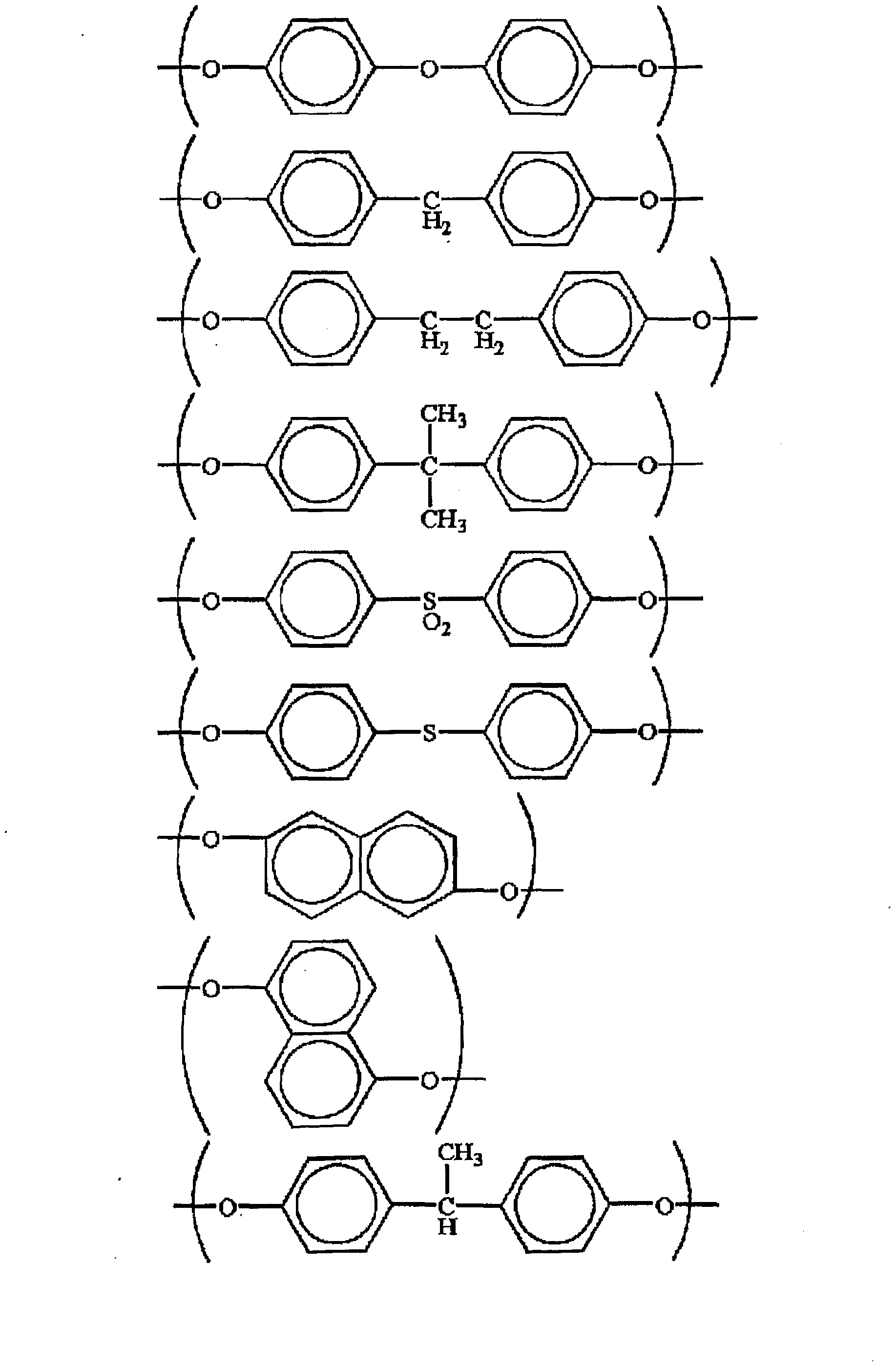
- Examples of the structural unit of the liquid crystalline polyester resin constituting the liquid crystalline polyester resin composition of the present invention include, for example, those composed of a combination of an aromatic dicarboxylic acid, an aromatic diol and an aromatic hydroxycarboxylic acid, Those composed of aromatic hydroxycarboxylic acids, those composed of combinations of aromatic hydroxycarboxylic acids, aromatic dicarboxylic acids and aromatic diols, polyesters such as polyethylene terephthalate and those reacted with aromatic hydroxycarboxylic acids, etc.
- Specific examples of the structural unit include the following.
- Structural units derived from aromatic hydroxycarboxylic acids Structural units derived from aromatic dicarboxylic acids:
- preferred liquid crystal polyester resins are those having the above structural unit (A 1) of 30 mol% or more, more preferably (A 1) and (B 1). The total content is 60 mol% or more.
- Particularly preferred liquid crystalline polyesters include p-hydroxybenzoic acid (I), terephthalic acid (11), 4,4′-dihydroxybiphenyl (III) (including these derivatives) from 80 to L; Mol% (provided that the sum of (I) and (II) is 60 mol% or more) and (I) (II) (III) and any other aromatic compound capable of decondensation reaction ⁇ 20 mol% polycondensation of fully aromatic liquid crystalline polyester with a melting point of 320 ° C or higher, or p-hydroxybenzoic acid (1), terephthalic acid (11), 4,4'-dihydroxybiphenyl ( III) It contains repeating units of (A 3), (B 4) and (C 3) which are these derivatives.
- the particularly preferred monomer composition ratio is p-hydroxy Benzoic acid, terephthalic acid, 4,4'-dihydroxybiphenyl (including these derivatives (including repeating units (A 3), (B 4), (C 3)) from 80 to 100 mol%
- Aromatic compounds selected from the group consisting of aromatic diols other than these, aromatic hydride oxydicarboxylic acids and aromatic dicarboxylic acids 0 to 20 mol% (both are 100 mol% in total. ) Is a wholly aromatic liquid crystal polyester resin.
- P-hydroxybenzoic acid and terephthalic acid 4,4′-dihydroxybifuel are less than 80 mol%, the heat resistance tends to decrease, which is not preferable.
- a method for producing the liquid crystal polyester resin used in the present invention a known method can be employed, and a production method using only melt polymerization or a production method using two-stage polymerization of melt polymerization and solid phase polymerization can be used.
- a monomer selected from an aromatic dihydroxy compound, an aromatic hydroxycarboxylic acid compound, and an aromatic dicarboxylic acid compound is charged into a reactor, acetic anhydride is added to acetylate the hydroxyl group of the monomer , Produced by deacetic acid polycondensation reaction.
- p-hydroxybenzoic acid, terephthalic acid, isophthalic acid, and 4,4′-dihydroxybiphenyl are charged into a reactor under a nitrogen atmosphere, acetic anhydride is added, and acetoxylation is performed under acetic anhydride reflux. Thereafter, the temperature is raised, and a method of producing a polyester resin by performing deacetic acid melt polycondensation while distilling off acetic acid in a temperature range of 1550 to 3500C can be mentioned.
- the polymerization time can be selected in the range of 1 hour to several tens of hours.
- the monomer may or may not be dried before production.
- the polymer obtained by melt polymerization is further subjected to solid phase polymerization
- the polymer obtained by melt polymerization is solidified and then pulverized into powder or flakes, and then a known solid phase polymerization method such as nitrogen is used.
- a method such as a time heat treatment is preferably selected.
- the solid phase polymerization may be performed with stirring, or may be performed in a state of standing without stirring.
- a catalyst may be used or may not be used.
- the catalyst to be used those conventionally known as polycondensation polycondensation catalysts can be used.
- the polymerization reaction apparatus in the melt polymerization is not particularly limited, but a reaction apparatus used for reaction of a general high viscosity fluid is preferably used.
- reaction apparatuses include, for example, a vertical tank type, a multistage type, a spiral band type, a spiral shaft type, or a stirring tank type polymerization reaction apparatus having a stirring apparatus having various shapes of stirring blades, or
- a kneader, a roll mill, a Banbury mixer, and the like are generally used for resin kneading.
- the shape of the liquid crystalline polyester resin used in the present invention may be any of powder, granules and pellets, but powder or granules are preferred from the viewpoint of dispersibility when mixed with the filler.
- the talc used in the present invention is not particularly limited in terms of chemical composition as long as it is a known talc used as a material constituting the resin composition.
- the theoretical chemical structure is hydrous magnesium silicate, it may contain impurities such as iron oxide and aluminum oxide, especially in the case of natural products.
- the total amount of impurities contained in talc is 1 Talc that is less than 0% by mass is preferred as the talc used in the present invention.
- the flaky and smooth physical shape is rigid, low wear
- the power that is considered to be involved in the balance of properties related to the property, the balance can be most effectively demonstrated by the number average particle size determined by the laser single diffraction method.
- the average particle size is preferably 10 to 50 ⁇ m.
- the blending amount of talc is in the range of 50 to 110 parts by weight with respect to 100 parts by weight of the liquid crystalline polyester. Is preferred. When the amount of talc exceeds 110 parts by mass, the strength and impact resistance of the composition of the present invention are lowered. Further, when the amount of talc is less than 50 parts by mass, the compounding effect is insufficient, and the object of the present invention, that is, the fallen substance from the surface of the molded product can be reduced by improving the surface transferability. .
- the range of 15 to 60 parts by mass with respect to 100 parts by mass of the liquid crystalline polyester is preferable.
- the amount of talc exceeds 60 parts by mass, the strength and impact resistance of the composition of the present invention are lowered.
- the amount of talc is less than 15 parts by mass, the compounding effect is insufficient, and the object of the present invention, that is, reduction of fallout from the surface of the molded product by improving surface transferability, cannot be achieved. .
- the glass fiber used in the third and fifth resin compositions of the present invention is a known glass fiber used as a material constituting the resin composition, and the number average fiber diameter is not particularly limited. None but more than 8 m
- the number average fiber length is preferably from 100 to 200 m.
- talc a relatively small amount
- glass fiber In the case of the present invention, which is blended together as an essential material, it is preferable because of its uniform dispersibility in these molded products, but when it exceeds 200 zm, the surface becomes rough, and the surface transferability is improved.
- the effect of improving fluidity and heat resistance is insufficient.
- the range of 25 to 50 parts by mass with respect to 100 parts by mass of the liquid crystalline polyester is preferable. If the glass fiber content is less than 25 parts by mass, the effect of improving strength and heat resistance is insufficient, and if the glass fiber content exceeds 50 parts by mass, the surface becomes rough and the surface
- the object of the present invention that is, the reduction of falling off the surface of the molded product by improving the transferability, cannot be achieved.
- Titanium oxide used in the fifth of the resin composition of the present invention by a T i 0 2, those which are widely used as a white pigment.
- a rutile type which is stable at a high temperature and a number average particle diameter of 0.1 to 0.5 / zm is preferable.
- those treated with a hydrous oxide such as A] and Si can also be used.
- the blending amount of titanium oxide is liquid crystal, although it depends on the balance with the blended amount of talc and glass fiber.
- a range of 6 to 20 parts by mass with respect to 100 parts by mass of polyester is preferred.
- titanium oxide When the compounding amount is less than 6 parts by mass, the improvement effect of reducing the falling off from the surface of the molded product due to the improvement of surface transferability is reduced, and when the compounding amount of titanium oxide exceeds 20 parts by mass, the fluidity is reduced. descend.
- the carbon black used in the present invention is not particularly limited and is generally available for use in resin coloring.
- the primary particle diameter is less than 20 nm, it is applied to the surface of the obtained molded product. It is not preferable because a large amount of (fine, bubbly projections with agglomerated carbon black) occur and the surface tends to become rough.
- the blending amount of carbon black is preferably in the range of 2 to 10 parts by mass with respect to 100 parts by mass of the liquid crystalline polyester. If the carbon black content is less than 2 parts by mass, the jet blackness of the resulting resin composition will be lowered, and the light-shielding property will become uneasy, and if it exceeds 10 parts by mass, it will be uneconomical. Moreover, the possibility of occurrence of bumps is increased.
- the composition of the present invention includes an antioxidant and a heat stabilizer (for example, hindered phenol, hydroquinone, phosphites, and their substitutes), an ultraviolet absorber, and the like within a range that does not impair the object of the present invention.
- a heat stabilizer for example, hindered phenol, hydroquinone, phosphites, and their substitutes
- an ultraviolet absorber and the like within a range that does not impair the object of the present invention.
- a heat stabilizer for example, hindered phenol, hydroquinone, phosphites, and their substitutes
- an ultraviolet absorber and the like within a range that does not impair the object of the present invention.
- lubricants and mold release agents such as montanic acid and its salt, its ester, its eightyester, stearyl alcohol, stear amide and polyethylene wax
- Ordinary additives such as plasticizers, antistatic agents, and flame retardants, and other thermoplastic resins can be added to impart pre
- the liquid crystal polyester resin composition according to the present invention is obtained by melting liquid crystal polyester and kneading with other components.
- the equipment and operation method used for melt kneading are generally used for melt kneading of liquid crystal polyester. If there is no particular limitation.
- the preferred method is to add liquid crystal polyester, talc, and (pellet-like) carbon black from the popper, melt knead, and extrude to form pellets. These are called twin-screw kneaders.
- the liquid crystal polyester resin composition thus obtained has a melt viscosity of 10 to 100 (P a * S) measured at a shear rate of 100 sec—370 ° C. Must be in range. If the resin viscosity is out of this range, the surface properties of the injection-molded product will be deteriorated, resulting in an increase in the amount of fallout.
- Melt viscosity was measured using a capillary rheometer (Mode 1 2 10 1 0) manufactured by Intesco Co., Ltd. with a diameter of 1. 00 mm, length of 40 mm, and inflow angle of 90 °. Shear rate Measure the apparent viscosity while heating at a constant rate from 320 ° C to +4 ° CZ in 1 0 sec for 1 to obtain the apparent viscosity at 3700 ° C.
- the deflection temperature under load of the injection-molded product of the liquid crystal polyester resin composition obtained as described above is 2220 ° C. or higher.
- the deflection temperature under load means the deflection temperature under load (DTUL) measured according to AS TM D 6 4 8. This is because if the deflection temperature under load is outside this range, there may be a problem with heat resistance during solder reflow in surface mounting.
- the camera module member of the present invention is obtained from the above composition by injection molding.
- the melt viscosity range described above is essential for exhibiting the desired rigidity and sliding performance of the molded product.
- the minimum thickness of the member is 0.2 to 0.8 mm
- 0.2 to 0.8 mm in the mold is used.
- the space of thickness is injected and filled at high speed, it can flow uniformly in the mold, and a molded product free from compositional deviation can be obtained.
- the camera module member obtained in this way is excellent in mechanical strength and rigidity, and is prevented from falling off from the surface of the molded product.
- the above load deflection temperature range is indispensable for exhibiting the desired solder reflow performance for molded products.
- the injection molding conditions or injection molding machine used in the present invention is not particularly limited as long as it is a known one generally used for molding liquid crystal polyester.
- thermotropic liquid crystal polyester resin compositions in Examples and Comparative Examples and molded articles obtained therefrom are shown below.
- the melt viscosity of the thermo-pick liquid crystal polyester resin composition was measured using a capillary rheometer (20 100) manufactured by INTESCO Co., Ltd. with a diameter of 1.0 mm and a length of 40 mm. even the use of a inflow angle 9 0 ° to, 3 0 0 ° at a shear rate of 1 0 0 sec 1 (: reluctant + 4 ° perform constant speed heating viscosity measured apparent while at ⁇ min heating rate, 3 The apparent viscosity at 70 ° C was determined and used as the test value. A resin composition dried at 150 ° C. for 4 hours in a oven was used.
- the pellet of the resin composition thus obtained was used with an injection molding machine (manufactured by Nissei Plastic Industrial Co., Ltd., UH—100 ° C.), the maximum cylinder temperature was 3700 ° C, and the ejection speed was 300 mm. / sec, injection molding at a mold temperature of 80 ° C, and injection molding with weld at the center of 13 mm (width) X 80 mm (length) XI. 0 mm (thickness)
- a test piece for strength measurement was obtained. For each test piece, the bending strength of the welded portion was measured in accordance with A STM D 790 with a span interval of 25 mm.
- pellets of the obtained resin composition were used. Cylinder maximum temperature 3700 ° C, injection speed 100 mmZsec, mold temperature At 80 ° C., an injection molded body having a width of 13 mm (width) X 13 mm (length) X 3 mm (thickness) was obtained and used as a test piece for measuring the deflection temperature under load. For each specimen, the deflection temperature under load was measured according to AS TM D 6 4 8.
- the pellets of the resin composition thus obtained were subjected to a maximum cylinder temperature of 3700 ° C and an injection speed of 300 mm / sec, with a mold temperature of 80, and a threaded structure with a pitch of 0.3 mm and a groove depth of 0.2 mm inside a 7 mm (outer diameter) X 6 mm (inner diameter) X 4 mm (height) cylinder.
- a cylindrical injection-molded body (referred to as a carrier) was obtained and used as a test piece for measuring the number of dropped objects.
- thermotropic liquid crystal polyester A Production of thermotropic liquid crystal polyester A
- P-hydroxybenzoic acid manufactured by Ueno Pharmaceutical Co., Ltd. 2 9 8 kg in a polymerization tank (made by Kobe Steel Co., Ltd.) with an internal volume of SUS 3 1 6 and having a double helical stirring blade 2.16 kgmol),, 4'-dihydroxybiphenyl (Honshu Chemical Co., Ltd.) 1 3 4 kg (0.72 kgmol), terephthalic acid (Mitsui Chemicals) 9 0 kg (0.5 4 kgmol), Isophthalic acid (manufactured by AG International Chemical Co., Ltd.) 30 kg (0.18 kgmol), and as a catalyst, Rhitoacetate (manufactured by Kishida Chemical Co., Ltd.) 0.04 kg, magnesium acetate (Made by Kishida Chemical Co., Ltd.) 0.1 0 kg was charged, and after substituting nitrogen under reduced pressure in the polymerization tank twice, acetic anhydride 3 86 kg (3.78 mole) The temperature of
- Inter-acetylation reaction was performed. After the acetylation is completed, acetic acid is distilled off and the temperature is raised to 0.5 ° CZ. When the reactor temperature reaches 300 ° C, the polymer is taken out from the outlet at the bottom of the reactor. It cooled and solidified with the cooling device. The obtained polymer was pulverized to a size passing through a sieve having a mesh size of 2.0 mm with a powder mill manufactured by Hosoka Micron Corporation to obtain a prepolymer.
- the obtained prepolymer was subjected to solid phase polymerization using a rotary kiln manufactured by Takasago Industry Co., Ltd. Fill the kiln with prebolimer, circulate nitrogen at a flow rate of 16 N m 3 / hr, raise the heater temperature from room temperature to 3500 ° C in 1 hour at a rotation speed of 2 rpm, Hold at 50 for 10 hours. After confirming that the temperature of the resin powder in the kiln reached 295 ° C., the heating was stopped and the rotary kiln was rotated and cooled for 4 hours to obtain a powdery liquid crystal polyester. Melting point is 3600 ° C, melt viscosity is 70 P a ⁇ S.
- thermo-pick liquid crystal polyester A A prepolymer was obtained in the same manner as for the thermo-pick liquid crystal polyester A.
- the obtained prepolymer was subjected to solid phase polymerization using a rotary kiln manufactured by Takasago Industry Co., Ltd. Fill the kiln with prebolimer and add nitrogen
- thermotropic liquid crystal polyester C Production of thermotropic liquid crystal polyester C
- thermotropic liquid crystal polyester A A prepolymer was obtained in the same manner as thermotropic liquid crystal polyester A.
- the obtained prepolymer was subjected to solid phase polymerization using a rotary kiln manufactured by Takasago Industry Co., Ltd. Fill the kiln with prebolimer, circulate nitrogen at a flow rate of 16 N m 3 / hr, raise the heater temperature from room temperature to 3500 ° C in 1 hour at a rotation speed of 2 rpm, Hold for 1 hour at 0 ° C. After confirming that the temperature of the resin powder in the kiln reached 300 ° C, the heating was stopped and the kiln was rotated overnight and cooled for 4 hours to obtain a powdered liquid crystalline polyester. . The melting point was 3700 ° C, and the melt viscosity was 1440 Pa ⁇ S.
- Talc A “M S—K Y” manufactured by Nippon Talc Co., Ltd. (number average particle size 2 3 a m)
- Glass fiber (G F) C manufactured by Taichi Iwen Corning Co., Ltd., P X-1 (number average fiber length 3mm, number average fiber diameter 10 xm)
- Titanium oxide manufactured by Sakai Chemical Industry Co., Ltd., D—2 3 7 8 (number average particle size 0.25 m)
- Example 1 In the same manner as in Example 1, except that powdered liquid crystal polyester, talc, and force-pump racks have the compositions shown in Table 1, the same liquid crystal polyester resin composition as in Example 1 was used. Of pellets. In addition, using the pellet obtained in the same manner as in Example 1, Each physical property was measured by the test method. The results are shown in Table 1. Table 1
- Example 4 Except that powdered liquid crystal polyester, talc, glass fiber, and carbon black have the compositions shown in Table 2, the same equipment and operation method as in Example 4 were used for each liquid crystal polyester resin. A pellet of the composition was produced. Further, using the pellets obtained in the same manner as in Example 4, each physical property was measured by the above test method. The results are shown in Table 2. Table 1 2
- Example 8 As in Example 8, except that powdered liquid crystal polyester, talc, glass fiber, titanium oxide, and carbon black have the compositions shown in Table 3, the same equipment and operating method as in Example 8 were used. A pellet of a liquid crystal polyester resin composition was produced. Further, using the pellets obtained in the same manner as in Example 8, each physical property was measured by the above test method. The results are shown in Table 3. Table 1 3
- the resin composition for a camera module of the present invention and the camera module part obtained from the composition have high heat resistance, can withstand solder reflow, and have very little falling off from the part.
- Phone, laptop computer, digital camera, digital video Used for various purposes such as lens barrels, mount holders, and “camera frame”, “shutter and shut turbo bins” that can be surface-mounted in cameras, etc. I can do it.
Landscapes
- Chemical & Material Sciences (AREA)
- Organic Chemistry (AREA)
- Medicinal Chemistry (AREA)
- Health & Medical Sciences (AREA)
- Chemical Kinetics & Catalysis (AREA)
- Polymers & Plastics (AREA)
- Engineering & Computer Science (AREA)
- Signal Processing (AREA)
- Multimedia (AREA)
- Physics & Mathematics (AREA)
- General Physics & Mathematics (AREA)
- Crystallography & Structural Chemistry (AREA)
- Materials Engineering (AREA)
- Compositions Of Macromolecular Compounds (AREA)
Abstract
Description




Claims
Priority Applications (2)
| Application Number | Priority Date | Filing Date | Title |
|---|---|---|---|
| CN2009801113254A CN101981123B (zh) | 2008-03-28 | 2009-03-24 | 照相机模块用液晶聚酯树脂组合物 |
| US12/933,967 US8192645B2 (en) | 2008-03-28 | 2009-03-24 | Liquid crystal polyester resin composition for camera module |
Applications Claiming Priority (6)
| Application Number | Priority Date | Filing Date | Title |
|---|---|---|---|
| JP2008087490A JP5951168B2 (ja) | 2008-03-28 | 2008-03-28 | カメラモジュール用液晶ポリエステル樹脂組成物 |
| JP2008087494A JP5951169B2 (ja) | 2008-03-28 | 2008-03-28 | カメラモジュール用液晶ポリエステル樹脂組成物 |
| JP2008-087485 | 2008-03-28 | ||
| JP2008-087494 | 2008-03-28 | ||
| JP2008-087490 | 2008-03-28 | ||
| JP2008087485A JP5951167B2 (ja) | 2008-03-28 | 2008-03-28 | カメラモジュール用液晶ポリエステル樹脂組成物 |
Publications (1)
| Publication Number | Publication Date |
|---|---|
| WO2009119863A1 true WO2009119863A1 (ja) | 2009-10-01 |
Family
ID=41114048
Family Applications (1)
| Application Number | Title | Priority Date | Filing Date |
|---|---|---|---|
| PCT/JP2009/056410 Ceased WO2009119863A1 (ja) | 2008-03-28 | 2009-03-24 | カメラモジュール用液晶ポリエステル樹脂組成物 |
Country Status (5)
| Country | Link |
|---|---|
| US (1) | US8192645B2 (ja) |
| KR (1) | KR101591541B1 (ja) |
| CN (1) | CN101981123B (ja) |
| TW (1) | TWI444427B (ja) |
| WO (1) | WO2009119863A1 (ja) |
Cited By (6)
| Publication number | Priority date | Publication date | Assignee | Title |
|---|---|---|---|---|
| WO2010050576A1 (ja) * | 2008-10-28 | 2010-05-06 | 住友化学株式会社 | 樹脂組成物、反射板及び発光装置 |
| WO2011036927A1 (ja) * | 2009-09-28 | 2011-03-31 | 新日本石油株式会社 | 液晶ポリエステル樹脂組成物 |
| CN102061068A (zh) * | 2009-11-16 | 2011-05-18 | 住友化学株式会社 | 用于连接器的液晶聚酯组合物和使用该组合物的连接器 |
| WO2014087842A1 (ja) * | 2012-12-03 | 2014-06-12 | ポリプラスチックス株式会社 | カメラモジュール用液晶性樹脂組成物及びそれを用いたカメラモジュール |
| EP2540778A4 (en) * | 2011-02-28 | 2015-04-01 | Toray Industries | LIQUID CRYSTAL POLYESTER RESIN COMPOSITION AND METALLIC COMPOSITE MOLDED ARTICLE USING THE SAME |
| JP2015108036A (ja) * | 2013-12-03 | 2015-06-11 | Jx日鉱日石エネルギー株式会社 | 全芳香族液晶ポリエステル樹脂組成物およびその射出成形品を構成部材として含むカメラモジュール部品 |
Families Citing this family (58)
| Publication number | Priority date | Publication date | Assignee | Title |
|---|---|---|---|---|
| WO2009119863A1 (ja) * | 2008-03-28 | 2009-10-01 | 新日本石油株式会社 | カメラモジュール用液晶ポリエステル樹脂組成物 |
| JP5325442B2 (ja) * | 2008-03-28 | 2013-10-23 | Jx日鉱日石エネルギー株式会社 | カメラモジュール用液晶ポリエステル樹脂組成物 |
| JP2011157422A (ja) * | 2010-01-29 | 2011-08-18 | Sumitomo Chemical Co Ltd | 液晶ポリエステル組成物、その製造方法及びコネクター |
| EP2465896A1 (de) * | 2010-12-14 | 2012-06-20 | LANXESS Deutschland GmbH | Polyester Zusammensetzungen |
| TWI586750B (zh) * | 2011-02-28 | 2017-06-11 | 住友化學股份有限公司 | 液晶聚酯組成物及其製造方法 |
| JP5721217B2 (ja) * | 2011-03-16 | 2015-05-20 | 住友化学株式会社 | 液晶ポリエステル樹脂組成物および成形体 |
| JP5730704B2 (ja) * | 2011-07-27 | 2015-06-10 | 上野製薬株式会社 | 液晶ポリマー組成物 |
| JP5806063B2 (ja) * | 2011-09-29 | 2015-11-10 | 住友化学株式会社 | 液晶ポリエステル組成物及びコネクタ |
| KR101773204B1 (ko) * | 2011-10-31 | 2017-09-01 | 심천 워트 어드밴스드 머티리얼즈 주식회사 | 대전방지 특성을 갖는 전방향족 액정 폴리에스테르 수지 컴파운드 및 물품 |
| US8906259B2 (en) | 2011-11-15 | 2014-12-09 | Ticona Llc | Naphthenic-rich liquid crystalline polymer composition with improved flammability performance |
| US8932483B2 (en) | 2011-11-15 | 2015-01-13 | Ticona Llc | Low naphthenic liquid crystalline polymer composition |
| KR101947215B1 (ko) | 2011-11-15 | 2019-02-12 | 티코나 엘엘씨 | 미세 피치 전기 커넥터 및 그에 사용하기 위한 열가소성 조성물 |
| KR102098411B1 (ko) * | 2011-11-15 | 2020-04-07 | 티코나 엘엘씨 | 콤팩트 카메라 모듈 |
| WO2013074467A1 (en) | 2011-11-15 | 2013-05-23 | Ticona Llc | Low naphthenic liquid crystalline polymer composition for use in molded parts of a small dimensional tolerance |
| JP5914934B2 (ja) * | 2012-02-28 | 2016-05-11 | 住友化学株式会社 | 液晶ポリエステル組成物、成形体及び発光装置 |
| CN104040422B (zh) * | 2012-02-29 | 2016-04-13 | 宝理塑料株式会社 | 照相机模块用液晶性树脂组合物 |
| JP5869983B2 (ja) * | 2012-08-02 | 2016-02-24 | ポリプラスチックス株式会社 | 液晶性樹脂組成物 |
| JP6462576B2 (ja) | 2012-10-16 | 2019-01-30 | ティコナ・エルエルシー | 静電気防止液晶ポリマー組成物 |
| JP6009319B2 (ja) * | 2012-11-01 | 2016-10-19 | セイコープレシジョン株式会社 | 羽根駆動装置及び光学機器 |
| US9355753B2 (en) | 2012-12-05 | 2016-05-31 | Ticona Llc | Conductive liquid crystalline polymer composition |
| US9340656B2 (en) | 2012-12-19 | 2016-05-17 | Ticona Llc | Liquid crystalline composition having a dark black color |
| US11136445B2 (en) * | 2013-03-13 | 2021-10-05 | Ticona Llc | Liquid crystalline polymer composition |
| JP6174406B2 (ja) * | 2013-07-23 | 2017-08-02 | ポリプラスチックス株式会社 | カメラモジュール用液晶性樹脂組成物 |
| WO2015094486A1 (en) | 2013-12-19 | 2015-06-25 | Ticona Llc | Liquid crystalline composition having a pearly luster |
| US10287421B2 (en) | 2014-04-09 | 2019-05-14 | Ticona Llc | Antistatic polymer composition |
| CN106164172B (zh) | 2014-04-09 | 2019-07-26 | 提克纳有限责任公司 | 摄像模组 |
| JP6547277B2 (ja) * | 2014-10-31 | 2019-07-24 | 住友ベークライト株式会社 | 成形材料および成形品 |
| CN107427155A (zh) * | 2015-03-26 | 2017-12-01 | 住友化学株式会社 | 烤箱器皿及烤箱器皿成型用树脂组合物 |
| JP2018020502A (ja) * | 2016-08-04 | 2018-02-08 | 住友化学株式会社 | オーブンウェア、オーブンウェアの製造方法及びオーブンウェア成形用樹脂組成物 |
| JP6774329B2 (ja) | 2016-12-28 | 2020-10-21 | 住友化学株式会社 | 液晶ポリエステル樹脂組成物 |
| WO2019112847A1 (en) | 2017-12-05 | 2019-06-13 | Ticona Llc | Aromatic polymer composition for use in a camera module |
| WO2020095997A1 (ja) * | 2018-11-09 | 2020-05-14 | 住友化学株式会社 | 液晶ポリエステル樹脂組成物及び成形品 |
| CN113710738A (zh) | 2019-03-20 | 2021-11-26 | 提克纳有限责任公司 | 用于相机模块的致动器组件 |
| US11086200B2 (en) | 2019-03-20 | 2021-08-10 | Ticona Llc | Polymer composition for use in a camera module |
| US12441879B2 (en) | 2019-08-21 | 2025-10-14 | Ticona Llc | Polymer composition for laser direct structuring |
| US11258184B2 (en) | 2019-08-21 | 2022-02-22 | Ticona Llc | Antenna system including a polymer composition having a low dissipation factor |
| US11637365B2 (en) | 2019-08-21 | 2023-04-25 | Ticona Llc | Polymer composition for use in an antenna system |
| US12209164B2 (en) | 2019-09-10 | 2025-01-28 | Ticona Llc | Polymer composition and film for use in 5G applications |
| US11912817B2 (en) | 2019-09-10 | 2024-02-27 | Ticona Llc | Polymer composition for laser direct structuring |
| US12142820B2 (en) | 2019-09-10 | 2024-11-12 | Ticona Llc | 5G system containing a polymer composition |
| US11555113B2 (en) | 2019-09-10 | 2023-01-17 | Ticona Llc | Liquid crystalline polymer composition |
| US12294185B2 (en) | 2019-09-10 | 2025-05-06 | Ticona Llc | Electrical connector formed from a polymer composition having a low dielectric constant and dissipation factor |
| US11917753B2 (en) | 2019-09-23 | 2024-02-27 | Ticona Llc | Circuit board for use at 5G frequencies |
| US11646760B2 (en) | 2019-09-23 | 2023-05-09 | Ticona Llc | RF filter for use at 5G frequencies |
| US11721888B2 (en) | 2019-11-11 | 2023-08-08 | Ticona Llc | Antenna cover including a polymer composition having a low dielectric constant and dissipation factor |
| KR20220145385A (ko) | 2020-02-26 | 2022-10-28 | 티코나 엘엘씨 | 회로 구조체 |
| JP7737383B2 (ja) | 2020-02-26 | 2025-09-10 | ティコナ・エルエルシー | 電子デバイス |
| JP2023514988A (ja) | 2020-02-26 | 2023-04-12 | ティコナ・エルエルシー | 電子デバイス用ポリマー組成物 |
| EP4110885A4 (en) | 2020-02-26 | 2024-04-24 | Ticona LLC | ELECTRONIC DEVICE |
| US11728065B2 (en) | 2020-07-28 | 2023-08-15 | Ticona Llc | Molded interconnect device |
| CN116438245B (zh) * | 2020-10-29 | 2024-08-27 | 大塚化学株式会社 | 液晶聚合物组合物、液晶聚合物成型体和电气电子设备 |
| US12104010B2 (en) | 2021-02-04 | 2024-10-01 | Ticona Llc | Polymer composition for an electric circuit protection device |
| US11728559B2 (en) | 2021-02-18 | 2023-08-15 | Ticona Llc | Polymer composition for use in an antenna system |
| KR20230170663A (ko) | 2021-04-15 | 2023-12-19 | 오츠카 가가쿠 가부시키가이샤 | 액정 폴리머 조성물, 액정 폴리머 성형체 및 전기 전자 기기 |
| US12209163B2 (en) | 2021-05-06 | 2025-01-28 | Ticona Llc | Polymer composition for use in a camera module |
| TW202340697A (zh) | 2021-12-13 | 2023-10-16 | 美商堤康那責任有限公司 | 樣品之滾珠凹部性質之測試技術 |
| WO2024060060A1 (en) * | 2022-09-21 | 2024-03-28 | Ticona Llc | Lens assembly for use in a head-mounted display device |
| KR102874880B1 (ko) | 2022-12-29 | 2025-10-22 | 삼성전기주식회사 | 액정성 수지 조성물 및 이를 이용하여 제조된 볼베어링 접동 부품 |
Citations (3)
| Publication number | Priority date | Publication date | Assignee | Title |
|---|---|---|---|---|
| JP2000339665A (ja) * | 1999-05-24 | 2000-12-08 | Toray Ind Inc | 磁気記録媒体 |
| JP2004256629A (ja) * | 2003-02-25 | 2004-09-16 | Kanegafuchi Chem Ind Co Ltd | 熱可塑性ポリエステル樹脂組成物 |
| WO2005017028A1 (ja) * | 2003-08-19 | 2005-02-24 | Idemitsu Kosan Co., Ltd. | 燃料電池部材用樹脂組成物 |
Family Cites Families (20)
| Publication number | Priority date | Publication date | Assignee | Title |
|---|---|---|---|---|
| JP2935054B2 (ja) | 1990-05-08 | 1999-08-16 | 日本石油化学株式会社 | タルク配合サーモトロピック液晶ポリマー組成物およびその製造法 |
| JP3139007B2 (ja) | 1990-07-19 | 2001-02-26 | 東レ株式会社 | 液晶ポリエステル樹脂組成物 |
| JP3287059B2 (ja) | 1992-06-02 | 2002-05-27 | 住友化学工業株式会社 | 液晶ポリエステル樹脂組成物、電子部品用キャリヤーおよびic用耐熱トレー |
| TW401454B (en) | 1992-06-02 | 2000-08-11 | Sumitomo Chemical Co | Liquid crystal polyester resin composition and molded article |
| JPH0638520A (ja) | 1992-07-09 | 1994-02-10 | Murata Mfg Co Ltd | Dc−dcコンバータの過電流保護回路 |
| JP3598578B2 (ja) | 1995-05-10 | 2004-12-08 | 住友化学工業株式会社 | 液晶ポリエステル樹脂組成物およびそれを用いた成形方法 |
| JP3387766B2 (ja) | 1997-02-03 | 2003-03-17 | 住友化学工業株式会社 | 液晶ポリエステル樹脂組成物 |
| US6121369A (en) * | 1997-06-06 | 2000-09-19 | Eastman Chemical Company | Liquid crystalline polyester compositions containing carbon black |
| JP4118425B2 (ja) | 1998-12-18 | 2008-07-16 | ポリプラスチックス株式会社 | コネクター用液晶性ポリマー組成物およびコネクター |
| JP2001207054A (ja) | 2000-01-24 | 2001-07-31 | Polyplastics Co | 液晶性ポリマー成形品 |
| JP2002294038A (ja) | 2001-03-28 | 2002-10-09 | Sumitomo Chem Co Ltd | 液晶ポリエステル樹脂組成物 |
| JP4368078B2 (ja) | 2001-10-29 | 2009-11-18 | Dic株式会社 | 液晶ポリエステル樹脂組成物 |
| JP4019731B2 (ja) | 2002-02-25 | 2007-12-12 | 住友化学株式会社 | コネクター用液晶性ポリエステル樹脂組成物 |
| WO2003080728A1 (en) * | 2002-03-27 | 2003-10-02 | Teijin Chemicals, Ltd. | Flame-retardant aromatic polycarbonate resin composition |
| JP2004256673A (ja) | 2003-02-26 | 2004-09-16 | Sumitomo Chem Co Ltd | 反射板用液晶性ポリエステル樹脂 |
| TW200632506A (en) | 2005-03-02 | 2006-09-16 | Premier Image Technology Corp | Camera module and its manufacturing process |
| JP5507785B2 (ja) | 2006-01-06 | 2014-05-28 | Jx日鉱日石エネルギー株式会社 | 全芳香族サーモトロピック液晶ポリエステルの製造方法およびその使用 |
| JP2008028838A (ja) | 2006-07-24 | 2008-02-07 | Sharp Corp | カメラモジュールおよびその製造方法 |
| JP2008034453A (ja) | 2006-07-26 | 2008-02-14 | Kyocera Corp | カメラモジュール |
| WO2009119863A1 (ja) * | 2008-03-28 | 2009-10-01 | 新日本石油株式会社 | カメラモジュール用液晶ポリエステル樹脂組成物 |
-
2009
- 2009-03-24 WO PCT/JP2009/056410 patent/WO2009119863A1/ja not_active Ceased
- 2009-03-24 KR KR1020107024246A patent/KR101591541B1/ko active Active
- 2009-03-24 TW TW098109567A patent/TWI444427B/zh active
- 2009-03-24 CN CN2009801113254A patent/CN101981123B/zh not_active Expired - Fee Related
- 2009-03-24 US US12/933,967 patent/US8192645B2/en active Active
Patent Citations (3)
| Publication number | Priority date | Publication date | Assignee | Title |
|---|---|---|---|---|
| JP2000339665A (ja) * | 1999-05-24 | 2000-12-08 | Toray Ind Inc | 磁気記録媒体 |
| JP2004256629A (ja) * | 2003-02-25 | 2004-09-16 | Kanegafuchi Chem Ind Co Ltd | 熱可塑性ポリエステル樹脂組成物 |
| WO2005017028A1 (ja) * | 2003-08-19 | 2005-02-24 | Idemitsu Kosan Co., Ltd. | 燃料電池部材用樹脂組成物 |
Cited By (12)
| Publication number | Priority date | Publication date | Assignee | Title |
|---|---|---|---|---|
| WO2010050576A1 (ja) * | 2008-10-28 | 2010-05-06 | 住友化学株式会社 | 樹脂組成物、反射板及び発光装置 |
| US8692272B2 (en) | 2008-10-28 | 2014-04-08 | Sumitomo Chemical Company, Limited | Resin composition, reflective board and light-emitting apparatus |
| WO2011036927A1 (ja) * | 2009-09-28 | 2011-03-31 | 新日本石油株式会社 | 液晶ポリエステル樹脂組成物 |
| US8658057B2 (en) | 2009-09-28 | 2014-02-25 | Jx Nippon Oil & Energy Corporation | Liquid crystal polyester resin composition |
| CN102061068A (zh) * | 2009-11-16 | 2011-05-18 | 住友化学株式会社 | 用于连接器的液晶聚酯组合物和使用该组合物的连接器 |
| US8231805B2 (en) * | 2009-11-16 | 2012-07-31 | Sumitomo Chemical Company, Limited | Liquid crystalline polyester composition for connector and connector using the same |
| EP2540778A4 (en) * | 2011-02-28 | 2015-04-01 | Toray Industries | LIQUID CRYSTAL POLYESTER RESIN COMPOSITION AND METALLIC COMPOSITE MOLDED ARTICLE USING THE SAME |
| US9045621B2 (en) | 2011-02-28 | 2015-06-02 | Toray Industries, Inc. | Liquid crystalline polyester composition and metal composite molded product using the same |
| WO2014087842A1 (ja) * | 2012-12-03 | 2014-06-12 | ポリプラスチックス株式会社 | カメラモジュール用液晶性樹脂組成物及びそれを用いたカメラモジュール |
| JP5826411B2 (ja) * | 2012-12-03 | 2015-12-02 | ポリプラスチックス株式会社 | カメラモジュール用液晶性樹脂組成物及びそれを用いたカメラモジュール |
| JP2015108036A (ja) * | 2013-12-03 | 2015-06-11 | Jx日鉱日石エネルギー株式会社 | 全芳香族液晶ポリエステル樹脂組成物およびその射出成形品を構成部材として含むカメラモジュール部品 |
| WO2015083759A1 (ja) * | 2013-12-03 | 2015-06-11 | Jx日鉱日石エネルギー株式会社 | 全芳香族液晶ポリエステル樹脂組成物およびその射出成形品を構成部材として含むカメラモジュール部品 |
Also Published As
| Publication number | Publication date |
|---|---|
| CN101981123A (zh) | 2011-02-23 |
| KR101591541B1 (ko) | 2016-02-03 |
| US20110089371A1 (en) | 2011-04-21 |
| TW200942574A (en) | 2009-10-16 |
| KR20100139105A (ko) | 2010-12-31 |
| TWI444427B (zh) | 2014-07-11 |
| US8192645B2 (en) | 2012-06-05 |
| CN101981123B (zh) | 2012-11-21 |
Similar Documents
| Publication | Publication Date | Title |
|---|---|---|
| WO2009119863A1 (ja) | カメラモジュール用液晶ポリエステル樹脂組成物 | |
| JP5325442B2 (ja) | カメラモジュール用液晶ポリエステル樹脂組成物 | |
| JP5951169B2 (ja) | カメラモジュール用液晶ポリエステル樹脂組成物 | |
| JP5951167B2 (ja) | カメラモジュール用液晶ポリエステル樹脂組成物 | |
| JP5951168B2 (ja) | カメラモジュール用液晶ポリエステル樹脂組成物 | |
| CN102510879B (zh) | 液晶聚酯树脂组合物 | |
| JP5695389B2 (ja) | 液晶ポリエステル樹脂組成物及びカメラモジュール部品 | |
| JP6165608B2 (ja) | 全芳香族液晶ポリエステル樹脂組成物およびその射出成形品を構成部材として含むカメラモジュール部品 | |
| JP6063373B2 (ja) | 液晶ポリエステルアミド樹脂組成物、およびその射出成形体を構成部材として含むカメラモジュール部品 | |
| WO2011033892A1 (ja) | 液晶ポリエステル樹脂組成物の成形方法および成形体 | |
| WO2018079611A1 (ja) | 液晶ポリエステル樹脂組成物 | |
| JPWO2015178500A1 (ja) | 全芳香族液晶ポリエステル樹脂、およびその樹脂組成物の射出成形体 |
Legal Events
| Date | Code | Title | Description |
|---|---|---|---|
| WWE | Wipo information: entry into national phase |
Ref document number: 200980111325.4 Country of ref document: CN |
|
| 121 | Ep: the epo has been informed by wipo that ep was designated in this application |
Ref document number: 09726088 Country of ref document: EP Kind code of ref document: A1 |
|
| NENP | Non-entry into the national phase |
Ref country code: DE |
|
| ENP | Entry into the national phase |
Ref document number: 20107024246 Country of ref document: KR Kind code of ref document: A |
|
| WWE | Wipo information: entry into national phase |
Ref document number: 12933967 Country of ref document: US |
|
| 122 | Ep: pct application non-entry in european phase |
Ref document number: 09726088 Country of ref document: EP Kind code of ref document: A1 |