WO2009093364A1 - 熱硬化型エポキシ樹脂組成物 - Google Patents
熱硬化型エポキシ樹脂組成物 Download PDFInfo
- Publication number
- WO2009093364A1 WO2009093364A1 PCT/JP2008/069085 JP2008069085W WO2009093364A1 WO 2009093364 A1 WO2009093364 A1 WO 2009093364A1 JP 2008069085 W JP2008069085 W JP 2008069085W WO 2009093364 A1 WO2009093364 A1 WO 2009093364A1
- Authority
- WO
- WIPO (PCT)
- Prior art keywords
- epoxy resin
- curing agent
- resin composition
- aluminum
- aluminum chelate
- Prior art date
- Legal status (The legal status is an assumption and is not a legal conclusion. Google has not performed a legal analysis and makes no representation as to the accuracy of the status listed.)
- Ceased
Links
Images

Classifications
-
- C—CHEMISTRY; METALLURGY
- C08—ORGANIC MACROMOLECULAR COMPOUNDS; THEIR PREPARATION OR CHEMICAL WORKING-UP; COMPOSITIONS BASED THEREON
- C08G—MACROMOLECULAR COMPOUNDS OBTAINED OTHERWISE THAN BY REACTIONS ONLY INVOLVING UNSATURATED CARBON-TO-CARBON BONDS
- C08G59/00—Polycondensates containing more than one epoxy group per molecule; Macromolecules obtained by polymerising compounds containing more than one epoxy group per molecule using curing agents or catalysts which react with the epoxy groups
- C08G59/18—Macromolecules obtained by polymerising compounds containing more than one epoxy group per molecule using curing agents or catalysts which react with the epoxy groups ; e.g. general methods of curing
- C08G59/68—Macromolecules obtained by polymerising compounds containing more than one epoxy group per molecule using curing agents or catalysts which react with the epoxy groups ; e.g. general methods of curing characterised by the catalysts used
- C08G59/70—Chelates
-
- C—CHEMISTRY; METALLURGY
- C08—ORGANIC MACROMOLECULAR COMPOUNDS; THEIR PREPARATION OR CHEMICAL WORKING-UP; COMPOSITIONS BASED THEREON
- C08G—MACROMOLECULAR COMPOUNDS OBTAINED OTHERWISE THAN BY REACTIONS ONLY INVOLVING UNSATURATED CARBON-TO-CARBON BONDS
- C08G59/00—Polycondensates containing more than one epoxy group per molecule; Macromolecules obtained by polymerising compounds containing more than one epoxy group per molecule using curing agents or catalysts which react with the epoxy groups
- C08G59/18—Macromolecules obtained by polymerising compounds containing more than one epoxy group per molecule using curing agents or catalysts which react with the epoxy groups ; e.g. general methods of curing
- C08G59/40—Macromolecules obtained by polymerising compounds containing more than one epoxy group per molecule using curing agents or catalysts which react with the epoxy groups ; e.g. general methods of curing characterised by the curing agents used
- C08G59/4007—Curing agents not provided for by the groups C08G59/42 - C08G59/66
- C08G59/4085—Curing agents not provided for by the groups C08G59/42 - C08G59/66 silicon containing compounds
-
- C—CHEMISTRY; METALLURGY
- C08—ORGANIC MACROMOLECULAR COMPOUNDS; THEIR PREPARATION OR CHEMICAL WORKING-UP; COMPOSITIONS BASED THEREON
- C08L—COMPOSITIONS OF MACROMOLECULAR COMPOUNDS
- C08L63/00—Compositions of epoxy resins; Compositions of derivatives of epoxy resins
-
- C—CHEMISTRY; METALLURGY
- C08—ORGANIC MACROMOLECULAR COMPOUNDS; THEIR PREPARATION OR CHEMICAL WORKING-UP; COMPOSITIONS BASED THEREON
- C08K—Use of inorganic or non-macromolecular organic substances as compounding ingredients
- C08K5/00—Use of organic ingredients
- C08K5/0091—Complexes with metal-heteroatom-bonds
Definitions
- the present invention relates to a thermosetting epoxy resin composition containing an aluminum chelate curing agent and a glycidyl ether type epoxy resin.
- thermosetting epoxy resin composition in which a silane coupling agent having a polymerizable group such as a vinyl group and a trialkoxy group and an epoxy resin are blended with the aluminum chelate-based latent curing agent is a one-component type. In spite of this, it is said that it has excellent storage stability and has the property of being rapidly cured at low temperature by cationic polymerization (the same patent document).
- thermosetting epoxy resin composition containing an aluminum chelate-based latent curing agent, a silane coupling agent, and an epoxy resin disclosed in Patent Document 1
- a polymerization (curing) reaction is started by heating
- the silanolate anion generated from the silane coupling agent was added to the ⁇ -position carbon of the epoxy group of the epoxy resin to cause a polymerization termination reaction.
- the aluminum chelate-based latent curing agent disclosed in Patent Document 1 it is difficult to polymerize a glycidyl ether-based epoxy resin that is likely to cause a ⁇ -carbon addition reaction without causing a polymerization termination reaction.
- an alicyclic epoxy compound was inevitably used, although the production cost was high but the addition reaction to the ⁇ -position carbon due to the silanolate anion was difficult to occur.
- the object of the present invention is to solve the above-mentioned problems of the conventional technology, and without using an alicyclic epoxy compound, a low temperature rapid curing of a glycidyl ether epoxy resin with an aluminum chelate latent curing agent. Is to be able to do it.
- the present inventors use a highly sterically hindered silanol compound having a specific chemical structure that has not been conventionally used as a silane coupling agent in combination with an aluminum chelate latent curing agent, the specific silanol compound is unexpectedly formed.
- the polymerization termination reaction can be suppressed and the formation of a cation catalyst can be promoted, so that the above-mentioned object can be achieved, and the present invention has been completed.
- thermosetting epoxy resin composition containing an aluminum chelate-based latent curing agent, a silanol compound of the formula (A), and a glycidyl ether type epoxy resin.
- n 2 or 3
- Ar is an aryl group which may be substituted.
- thermosetting epoxy resin composition of the present invention containing a glycidyl ether type epoxy resin, which has been considered not to be sufficiently polymerized with an aluminum chelate-based latent curing agent, has a high steric hindrance in addition to the aluminum chelate-based latent curing agent. It contains silanol compounds with special characteristics. For this reason, the polymerization termination reaction can be suppressed and the formation of a cation catalyst can be promoted. Accordingly, the thermosetting epoxy resin composition of the present invention can be rapidly cured at low temperature with an aluminum chelate-based latent curing agent, even though it contains a glycidyl ether type epoxy resin.
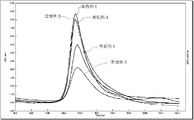
- FIG. 1 is a DSC measurement diagram of thermosetting epoxy resin compositions of Examples 1 and 2 and Comparative Examples 1 to 3.
- FIG. 1 is a DSC measurement diagram of thermosetting epoxy resin compositions of Example 1 and Examples 3 to 6.
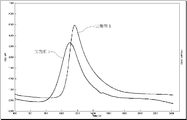
- FIG. It is a DSC measurement figure of the thermosetting type epoxy resin composition of Example 1 and Example 7.
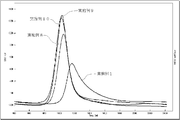
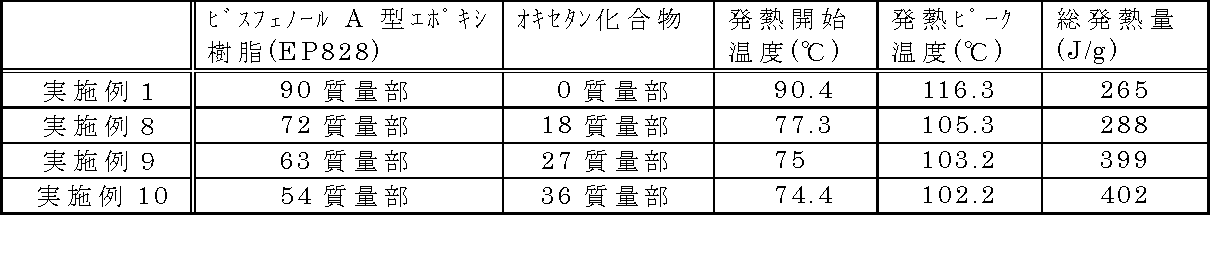
- 1 is a DSC measurement diagram of thermosetting epoxy resin compositions of Example 1 and Examples 8 to 10.
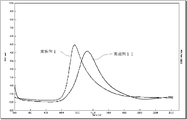
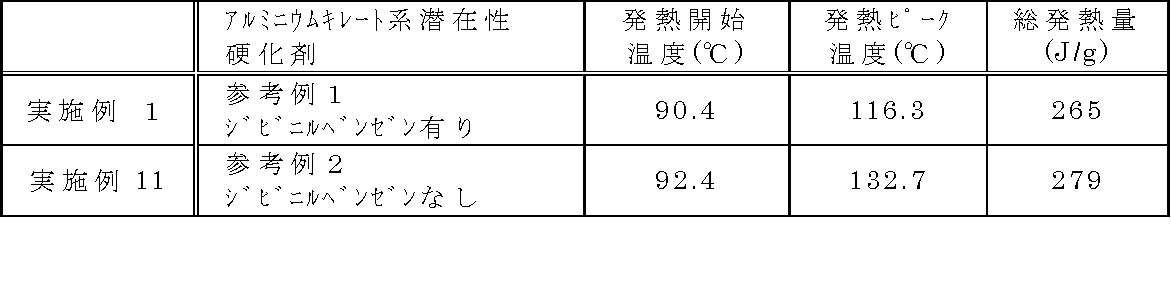
- FIG. It is a DSC measurement figure of the thermosetting type epoxy resin composition of Example 1 and Example 11.
- thermosetting epoxy resin composition of the present invention contains an aluminum chelate-based latent curing agent, a silanol compound, and a glycidyl ether type epoxy resin.
- this silanol compound is an arylsilaneol having a chemical structure of the following formula (A).
- m is 2 or 3, provided that the sum of m and n is 4. Therefore, the silanol compound of the formula (A) becomes a mono or diol form.
- “Ar” is an aryl group which may be substituted, and examples of the aryl group include a phenyl group, a naphthyl group, an anthracenyl group, an azulenyl group, a fluorenyl group, a thienyl group, a furyl group, a pyrrolyl group, an imidazolyl group, and a pyridyl group. Etc. Of these, a phenyl group is preferable from the viewpoint of availability and cost.
- the m Ars may be the same or different, but are preferably the same from the viewpoint of availability.
- aryl groups may have 1 to 3 substituents such as halogen such as chloro and bromo; trifluoromethyl; nitro; sulfo; alkoxycarbonyl such as carboxyl, methoxycarbonyl and ethoxycarbonyl; formyl and the like Electron-withdrawing groups, alkyl such as methyl, ethyl and propyl; alkoxy such as methoxy and ethoxy; hydroxy; amino; monoalkylamino such as monomethylamino; and electron-donating groups such as dialkylamino such as dimethylamino.
- substituents such as halogen such as chloro and bromo; trifluoromethyl; nitro; sulfo; alkoxycarbonyl such as carboxyl, methoxycarbonyl and ethoxycarbonyl; formyl and the like
- Electron-withdrawing groups alkyl such as methyl, ethyl and propyl; alkoxy such as meth
- the acidity of the hydroxyl group of silanol can be increased by using an electron withdrawing group as a substituent, and conversely, the acidity can be lowered by using an electron donating group, so that the curing activity can be controlled.
- the substituents may be different for each of the m Ars, but the substituents are preferably the same for the m Ars from the viewpoint of availability. Further, only some Ar may have a substituent, and other Ar may not have a substituent.
- triphenylsilanol or diphenylsilanol is preferable. Particularly preferred is triphenylsilanol.
- thermosetting epoxy resin composition of the present invention regarding the content of the silanol compound of the formula (A), the content of the silanol compound relative to the sum of the silanol compound and the glycidyl ether type epoxy resin is insufficiently cured. If the amount is too large, the resin properties (flexibility, etc.) deteriorate, so the content is preferably 5 to 30% by mass, more preferably 5 to 20% by mass.
- the glycidyl ether type epoxy resin constituting the thermosetting epoxy resin composition of the present invention is used as a film forming component.
- a glycidyl ether type epoxy resin may be liquid or solid, and preferably has an epoxy equivalent of usually about 100 to 4000 and having two or more epoxy groups in the molecule.
- bisphenol A type epoxy resin, phenol novolac type epoxy resin, cresol novolac type epoxy resin, ester type epoxy resin and the like can be mentioned.
- bisphenol A type epoxy resins can be preferably used from the viewpoint of resin characteristics.
- These epoxy resins also include monomers and oligomers.
- thermosetting epoxy resin composition of the present invention an alicyclic epoxy compound or the like can be used as a resin component in addition to a glycidyl ether type epoxy resin. Further, an oxetane compound can be used in combination in order to sharpen the exothermic peak.
- Preferred oxetane compounds include 3-ethyl-3-hydroxymethyloxetane, 1,4-bis ⁇ [(3-ethyl-3-oxetanyl) methoxy] methyl ⁇ benzene, 4,4′-bis [(3-ethyl- 3-Oxetanyl) methoxymethyl] biphenyl, 1,4-benzenedicarboxylic acid bis [(3-ethyl-3-oxetanyl)] methyl ester, 3-ethyl-3- (phenoxymethyl) oxetane, 3-ethyl-3- ( 2-ethylhexyloxymethyl) oxetane, di [1-ethyl (3-oxetanyl)] methyl ether, 3-ethyl-3- ⁇ [3- (triethoxysilyl) propoxy] methyl ⁇ oxetane, oxetanylsilsesquioxane, Phenol
- Examples of the aluminum chelate-based latent curing agent constituting the thermosetting epoxy resin composition of the present invention include those in which the aluminum chelate-based curing agent is made latent by various known methods, for example, a microencapsulation method. Can do.
- Examples of preferable aluminum chelate-based latent curing agents include those in which an aluminum chelating agent is held in a porous resin obtained by interfacial polymerization of a polyfunctional isocyanate compound. More specifically, the aluminum chelating agent is not a microcapsule having a simple structure in which the periphery of the core of the aluminum chelate curing agent is covered with a porous resin shell, but in a large number of fine pores existing in the porous resin matrix. Can be mentioned.
- the aluminum chelate-based latent curing agent will be described.
- the aluminum chelate-based latent curing agent is produced using an interfacial polymerization method, its shape is spherical, and its particle size is preferably 0.5 to 100 ⁇ m from the viewpoint of curability and dispersibility.
- the pore size is preferably 5 to 150 nm from the viewpoint of curability and latency.
- the aluminum chelate-based latent curing agent has a tendency to decrease if the degree of crosslinking of the porous resin to be used is too small, and if too large, the thermal responsiveness tends to decrease. It is preferable to use a porous resin whose degree of crosslinking is adjusted. Here, the degree of crosslinking of the porous resin can be measured by a micro compression test.
- the aluminum chelate-based latent curing agent substantially does not contain an organic solvent used during the interfacial polymerization, specifically, 1 ppm or less.
- the content of the porous resin and the aluminum chelating agent in the aluminum chelate-based latent curing agent is such that if the aluminum chelating agent content is too small, the thermal responsiveness is lowered, and if it is too much, the latency is lowered.
- the aluminum chelating agent is preferably 10 to 200 parts by weight, more preferably 10 to 150 parts by weight, based on 100 parts by weight of the conductive resin.
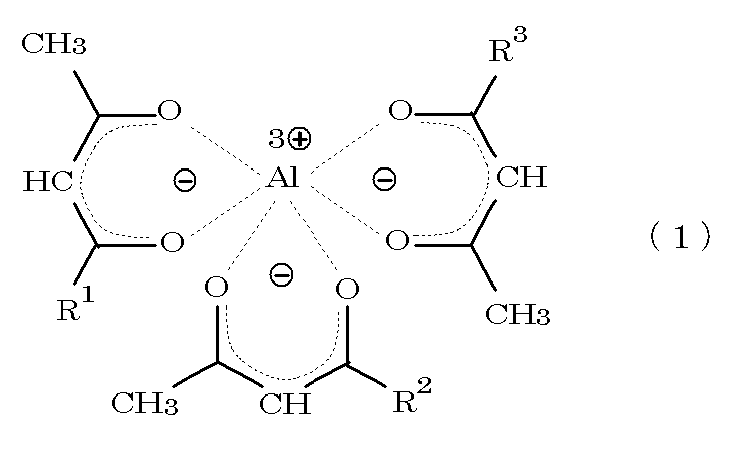
- examples of the aluminum chelating agent include a complex compound in which three ⁇ -ketoenolate anions represented by the formula (1) are coordinated to aluminum.
- R 1 , R 2 and R 3 are each independently an alkyl group or an alkoxyl group.
- the alkyl group include a methyl group and an ethyl group.
- the alkoxyl group include a methoxy group, an ethoxy group, and an oleyloxy group.
- the aluminum chelating agent represented by the formula (1) include aluminum tris (acetylacetonate), aluminum tris (ethylacetoacetate), aluminum monoacetylacetonate bis (ethylacetoacetate), aluminum monoacetylacetonate Examples thereof include bisoleyl acetoacetate, ethyl acetoacetate aluminum diisopropylate, and alkyl acetoacetate aluminum diisopropylate.
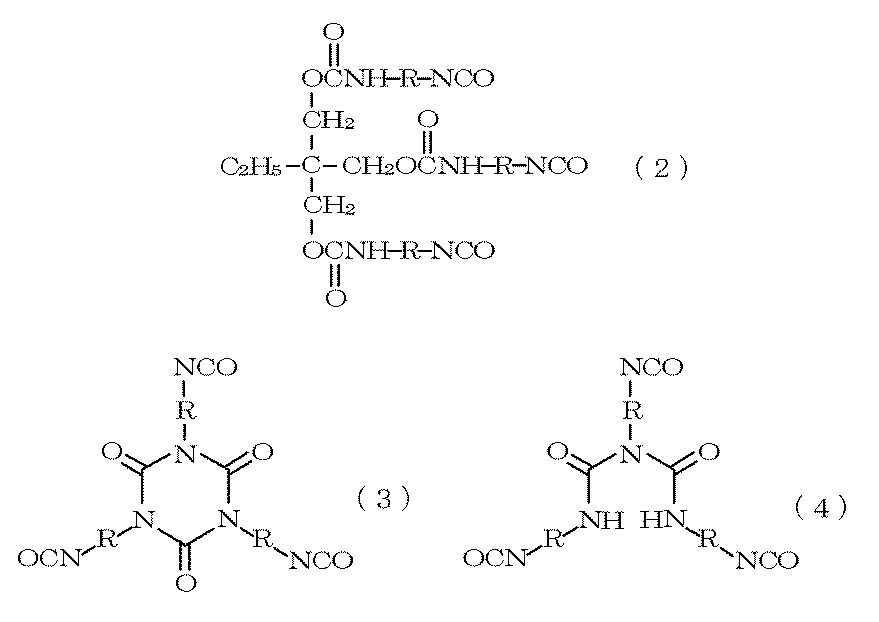
- the polyfunctional isocyanate compound is preferably a compound having two or more isocyanate groups, preferably three isocyanate groups in one molecule.
- a TMP adduct of formula (2) obtained by reacting 3 mol of a diisocyanate compound with 1 mol of trimethylolpropane, and a formula (3) obtained by self-condensing 3 mol of a diisocyanate compound.
- An isocyanurate of formula (4) and a biuret of formula (4) obtained by condensing the remaining 1 mol of diisocyanate with diisocyanate urea obtained from 2 mol of 3 mol of diisocyanate compound.
- the substituent R is a portion excluding the isocyanate group of the diisocyanate compound.
- diisocyanate compounds include toluene 2,4-diisocyanate, toluene 2,6-diisocyanate, m-xylylene diisocyanate, hexamethylene diisocyanate, hexahydro-m-xylylene diisocyanate, isophorone diisocyanate, methylene diphenyl-4. , 4'-diisocyanate and the like.
- porous resin obtained by interfacial polymerization of such a polyfunctional isocyanate compound part of the isocyanate group undergoes hydrolysis during the interfacial polymerization to become an amino group, and the amino group reacts with the isocyanate group. It is a porous polyurea that forms a urea bond to polymerize.
- An aluminum chelate-based latent curing agent comprising such a porous resin and an aluminum chelating agent retained in the pores is retained for a clear reason when heated for curing, although the reason is unknown.
- the aluminum chelating agent can come into contact with the silanol compound of formula (A) and the thermosetting resin coexisting with the latent curing agent, and the curing reaction can proceed.
- a radical polymerizable monomer such as divinylbenzene and a radical polymerization initiator may be allowed to coexist to improve the mechanical properties of the microcapsule wall.
- the thermal response speed at the time of hardening of an epoxy resin can be increased.
- the aluminum chelating agent is also present on the surface, but it is inactivated by water present in the system during the interfacial polymerization, and the aluminum chelating agent is Only what is retained inside the porous resin retains activity, and it is considered that the resulting curing agent has acquired the potential.
- the aluminum chelate-based latent curing agent is prepared by dissolving an aluminum chelating agent and a polyfunctional isocyanate compound in a volatile organic solvent, putting the obtained solution into an aqueous phase containing a dispersant, and heating and stirring the interface. It can manufacture by the manufacturing method characterized by making it superpose
- an aluminum chelating agent and a polyfunctional isocyanate compound are dissolved in a volatile organic solvent to prepare a solution that becomes an oil phase in interfacial polymerization.
- the reason for using the volatile organic solvent is as follows. That is, when a high-boiling solvent having a boiling point exceeding 300 ° C. as used in a normal interfacial polymerization method is used, the organic solvent does not volatilize during the interfacial polymerization, so the contact probability with isocyanate-water does not increase. This is because the degree of progress of interfacial polymerization between them becomes insufficient.
- thermosetting resin composition a volatile thing is used as an organic solvent used when preparing an oil phase.
- Such a volatile organic solvent is a good solvent of an aluminum chelating agent and a polyfunctional isocyanate compound (the solubility of each is preferably at least 0.1 g / ml (organic solvent)), and is substantially free from water.
- the solubility of each is preferably at least 0.1 g / ml (organic solvent)
- those having a water solubility of 0.5 g / ml (organic solvent) or less and a boiling point of 100 ° C. or less under atmospheric pressure are preferable.
- Specific examples of such volatile organic solvents include alcohols, acetate esters, ketones and the like. Among these, ethyl acetate is preferable in terms of high polarity, low boiling point, and poor water solubility.
- the use amount of the volatile organic solvent is preferably from 100 to 100% because the latent amount is lowered when the amount is too small and the thermal response is lowered when the amount is too large with respect to 100 parts by mass of the total amount of the aluminum chelating agent and the polyfunctional isocyanate compound. 500 parts by mass.
- the viscosity of the oil phase solution can be lowered by using a relatively large amount of the volatile organic solvent within the range of the volatile organic solvent used.
- the oil phase droplets in the reaction system can be made finer and more uniform, and the resulting latent hardener particle size can be controlled to submicron to several microns.
- the particle size distribution can be monodispersed.
- the viscosity of the solution to be the oil phase is preferably set to 1 to 2.5 mPa ⁇ s.
- the hydroxyl group of PVA reacts with the polyfunctional isocyanate compound, so that by-products adhere around the latent curing agent particles as foreign substances. Or the particle shape itself may be deformed. In order to prevent this phenomenon, the reactivity between the polyfunctional isocyanate compound and water is promoted, or the reactivity between the polyfunctional isocyanate compound and PVA is suppressed.
- the blending amount of the aluminum chelating agent is preferably 1 ⁇ 2 or less, more preferably 3 or less by weight of the polyfunctional isocyanate compound.
- the blending amount of the aluminum chelating agent is preferably at least equal to the weight of the polyfunctional isocyanate compound, more preferably 1.0 to 2.0 times.
- concentration in the oil phase droplet surface falls.
- the polyfunctional isocyanate compound has a higher reaction rate (interfacial polymerization) with the amine formed by hydrolysis than the hydroxyl group, the reaction probability between the polyfunctional isocyanate compound and PVA can be lowered.
- the aluminum chelating agent and the polyfunctional isocyanate compound When the aluminum chelating agent and the polyfunctional isocyanate compound are dissolved in the volatile organic solvent, they may be mixed and stirred at room temperature under atmospheric pressure, but may be heated as necessary.
- an oil phase solution in which an aluminum chelating agent and a polyfunctional isocyanate compound are dissolved in a volatile organic solvent is put into an aqueous phase containing a dispersant, and subjected to interfacial polymerization by heating and stirring.
- a dispersing agent what is used in normal interfacial polymerization methods, such as polyvinyl alcohol, carboxymethylcellulose, gelatin, can be used.
- the amount of the dispersant used is usually 0.1 to 10.0% by mass of the aqueous phase.
- the blending amount of the oil phase solution with respect to the aqueous phase is preferably 5 to 50 parts by mass with respect to 100 parts by mass of the aqueous phase because polydispersion occurs when the amount of the oil phase solution is too small, and aggregation occurs due to refinement when the amount is too large. .
- stirring conditions are preferably set so that the size of the oil phase is preferably 0.5 to 100 ⁇ m.
- the temperature is 30 to 80 ° C. under atmospheric pressure.
- the conditions of stirring with heating for 2 to 12 hours can be given.
- the polymer fine particles are filtered off and air-dried to obtain an aluminum chelate-based latent curing agent that can be used in the present invention.
- the curing characteristics of the aluminum chelate-based latent curing agent can be controlled by changing the type and usage of the polyfunctional isocyanate compound, the type and usage of the aluminum chelating agent, and the interfacial polymerization conditions. For example, if the polymerization temperature is lowered, the curing temperature can be lowered, and conversely, if the polymerization temperature is raised, the curing temperature can be raised.
- the content of the aluminum chelate-based latent curing agent in the thermosetting epoxy resin composition of the present invention is too small, it will not be cured sufficiently, and if it is too large, the resin properties of the cured product of the composition (for example, flexibility) 1) to 70 parts by weight, preferably 1 to 50 parts by weight, based on 100 parts by weight of the glycidyl ether type epoxy resin composition.
- curing agent is aluminum to the porous resin obtained by carrying out the interfacial polymerization of the polyfunctional isocyanate compound at the same time as the porous resin obtained by carrying out the radical polymerization of divinylbenzene at the same time.
- a silanol compound of the formula (A) may be impregnated in order to improve low-temperature rapid curing properties.
- an aluminum chelate-based latent curing agent composed of an aluminum chelate-based curing agent held in such a porous resin is dispersed in an organic solvent (for example, ethanol), and a formula ( A) Silanol compound (for example, triphenylsilanol) and, if necessary, an aluminum chelate-based curing agent (for example, isopropanol solution of monoacetylacetonate bis (ethylacetoacetate)) are charged at a temperature of about room temperature to about 50 ° C. And a method in which stirring is continued for several hours to overnight.
- an organic solvent for example, ethanol
- thermosetting epoxy resin composition of the present invention further contains a silane coupling agent, a filler such as silica or mica, a pigment, an antistatic agent, etc., if necessary, separately from the silanol compound of the formula (A). be able to.
- the silane coupling agent is a cationic polymerization of a thermosetting resin (for example, a thermosetting epoxy resin) in cooperation with an aluminum chelating agent.
- a thermosetting resin for example, a thermosetting epoxy resin
- an aluminum chelating agent Has the function of starting. Therefore, the effect of accelerating the curing of the epoxy resin can be obtained by using a small amount of such a silane coupling agent.
- silane coupling agent one having 1 to 3 lower alkoxy groups in the molecule, a group having reactivity with the functional group of the thermosetting resin in the molecule, such as a vinyl group, It may have a styryl group, an acryloyloxy group, a methacryloyloxy group, an epoxy group, an amino group, a mercapto group, and the like.
- a coupling agent having an amino group or a mercapto group should be used when the latent curing agent of the present invention is a cationic curing agent, so that the amino group or mercapto group does not substantially trap the generated cationic species. Can do.
- silane coupling agents include vinyltris ( ⁇ -methoxyethoxy) silane, vinyltriethoxysilane, vinyltrimethoxysilane, ⁇ -styryltrimethoxysilane, ⁇ -methacryloxypropyltrimethoxysilane, ⁇ - Acryloxypropyltrimethoxysilane, ⁇ - (3,4-epoxycyclohexyl) ethyltrimethoxysilane, ⁇ -glycidoxypropyltrimethoxysilane, ⁇ -glycidoxypropylmethyldiethoxysilane, N- ⁇ - (aminoethyl) ) - ⁇ -aminopropyltrimethoxysilane, N- ⁇ - (aminoethyl) - ⁇ -aminopropylmethyldimethoxysilane, ⁇ -aminopropyltriethoxysilane, N-phenyl- ⁇ -aminopropy
- the amount is 1 to 300 parts by weight, preferably 1 to 100 parts by weight, based on 100 parts by weight of the chelate-based latent curing agent.
- thermosetting epoxy resin composition of the present invention an aluminum chelate-based latent curing agent, a silanol compound of formula (A) and a glycidyl ether type epoxy resin, and, if necessary, an additive are uniformly mixed and stirred according to a conventional method.
- an aluminum chelate latent curing agent impregnated with a silanol compound of formula (A) is used without mixing the aluminum chelate latent curing agent and the silanol compound of formula (A) separately. May be.
- Examples of the impregnation method include a method in which an aluminum chelate-based latent curing agent is dispersed and mixed in an alcohol (ethanol, propanol, etc.) solution of silanol of the formula (A) for about several hours. After mixing, it may be pulled up from the liquid and dried.
- an alcohol ethanol, propanol, etc.
- thermosetting epoxy resin composition of the present invention uses an aluminum chelate-based latent curing agent as a curing agent.
- an aluminum chelate-based latent curing agent as a curing agent.
- the curable epoxy resin composition can be cationically polymerized by low temperature rapid curing.
- Reference Example 1 (Production of aluminum chelate-based latent curing agent) 800 parts by weight of distilled water, 0.05 part by weight of a surfactant (Newlex RT, Nippon Oil & Fats Co., Ltd.), and 4 parts by weight of polyvinyl alcohol (PVA-205, Kuraray Co., Ltd.) as a dispersant. The mixture was placed in a 3 liter interfacial polymerization vessel equipped with a thermometer and mixed uniformly.
- a surfactant Newlex RT, Nippon Oil & Fats Co., Ltd.
- PVA-205 polyvinyl alcohol
- the polymerization reaction solution was allowed to cool to room temperature, and the interfacially polymerized particles were separated by filtration and naturally dried to obtain 100 parts by mass of a spherical aluminum chelate-based latent curing agent having a particle size of about 2 ⁇ m.
- Reference Example 2 (Production of aluminum chelate-based latent curing agent) 800 parts by weight of distilled water, 0.05 part by weight of a surfactant (Newlex RT, Nippon Oil & Fats Co., Ltd.), and 4 parts by weight of polyvinyl alcohol (PVA-205, Kuraray Co., Ltd.) as a dispersant. The mixture was placed in a 3 liter interfacial polymerization vessel equipped with a thermometer and mixed uniformly.
- a surfactant Newlex RT, Nippon Oil & Fats Co., Ltd.
- PVA-205 polyvinyl alcohol
- the polymerization reaction solution was allowed to cool to room temperature, and the interfacially polymerized particles were separated by filtration and air dried to obtain 20 parts by mass of a spherical aluminum chelate-based latent curing agent having a particle size of about 2 ⁇ m.
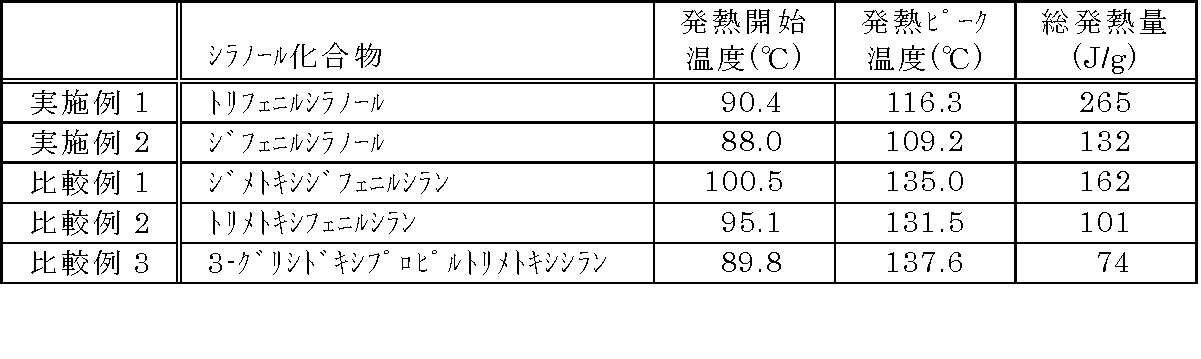
- Examples 1-2 and Comparative Examples 1-3 10 parts by mass of the aluminum chelate-based latent curing agent of Reference Example 1, 10 parts by mass of the silanol compound of Table 1, and 90 parts by mass of bisphenol A type epoxy resin (EP828, Japan Epoxy Resin Co., Ltd.) are uniformly mixed. Thus, a thermosetting epoxy resin composition was prepared. Of the silanol compounds, triphenylsilanol was used which was dissolved by heating in bisphenol A type epoxy resin at 80 ° C. for 2 hours.
- thermosetting epoxy resin composition was subjected to thermal analysis using a differential thermal analyzer (DSC) (DSC6200, Seiko Instruments Inc.).
- DSC differential thermal analyzer
- Table 1 the exothermic start temperature
- the exothermic peak temperature means the temperature at which curing is most active
- the exothermic end temperature is the curing It means end temperature
- peak area means calorific value
- thermosetting epoxy resins of Examples 1 and 2 using a bulky silanol compound compared with Comparative Examples 1 and 2 using an alkoxyphenylsilane, It can be seen that the exothermic peak temperature is shifted to the low temperature side and exhibits low temperature rapid curability.
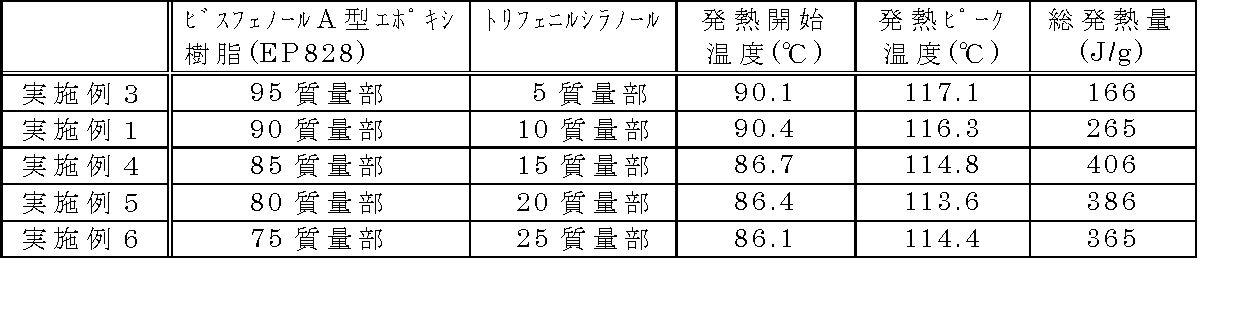
- thermosetting epoxy resin composition was prepared by uniformly mixing. Of the silanol compounds, triphenylsilanol was used which was dissolved by heating in bisphenol A type epoxy resin at 80 ° C. for 2 hours.
- thermosetting epoxy resin composition was subjected to thermal analysis using a differential thermal analyzer (DSC) (DSC6200, Seiko Instruments Inc.).
- DSC differential thermal analyzer
- thermosetting epoxy resin composition when the content of triphenylsilanol is in the range of at least 5 to 30% by mass with respect to the total of triphenylsilanol and bisphenol A type epoxy resin, a thermosetting epoxy resin composition is preferable. It can be seen that the low temperature rapid curability was exhibited.
- Example 7 10 parts by mass of the aluminum chelate-based latent curing agent obtained in Reference Example 1 was added to 40 parts by mass of a 24% isopropanol solution of aluminum monoacetylacetonate bis (ethylacetoacetate) (Aluminum Chelate D, Kawaken Fine Chemical Co., Ltd.).
- An aluminum chelate-based latent curing agent impregnated with triphenylsilanol was added to a mixed solution of 20 parts by mass of triphenylsilanol and 40 parts by mass of ethanol, continuously stirred at 40 ° C., filtered and dried. Obtained.
- thermosetting epoxy resin composition was subjected to thermal analysis using a differential thermal analyzer (DSC) (DSC6200, Seiko Instruments Inc.).
- DSC differential thermal analyzer
- Example 7 using the aluminum chelate latent curing agent impregnated with triphenylsilanol, compared to Example 1 using the aluminum chelate latent curing agent not impregnated with triphenylsilanol, Further, it can be seen that the low temperature rapid curability is improved.
- thermosetting epoxy resin composition was prepared by uniformly mixing [1-ethyl (3-oxetanyl)] methyl ether (OXT-221, Toa Gosei Co., Ltd.). Of the silanol compounds, triphenylsilanol was used which was dissolved by heating in bisphenol A type epoxy resin at 80 ° C. for 2 hours.
- thermosetting epoxy resin composition was subjected to thermal analysis using a differential thermal analyzer (DSC) (DSC6200, Seiko Instruments Inc.).
- DSC differential thermal analyzer
- Example 11 Heat is obtained by uniformly mixing 10 parts by mass of the aluminum chelate-based latent curing agent of Reference Example 2, 10 parts by mass of triphenylsilanol, and 90 parts by mass of bisphenol A type epoxy resin (EP828, Japan Epoxy Resin Co., Ltd.).
- a curable epoxy resin composition was prepared.
- silanol compounds triphenylsilanol was used which was dissolved by heating in bisphenol A type epoxy resin at 80 ° C. for 2 hours.
- thermosetting epoxy resin composition was subjected to thermal analysis using a differential thermal analyzer (DSC) (DSC6200, Seiko Instruments Inc.).
- DSC differential thermal analyzer
- the aluminum chelate latent curing agent of the present invention contains an inexpensive and general-purpose glycidyl ether type epoxy resin as an epoxy resin, it is cured at a low temperature in a short time with an aluminum chelate latent curing agent. Therefore, it is useful as a curing agent for an adhesive that can be connected at a low temperature for a short time.
Landscapes
- Chemical & Material Sciences (AREA)
- Health & Medical Sciences (AREA)
- Chemical Kinetics & Catalysis (AREA)
- Medicinal Chemistry (AREA)
- Polymers & Plastics (AREA)
- Organic Chemistry (AREA)
- Epoxy Resins (AREA)
- Polyethers (AREA)
Abstract
Description


蒸留水800質量部と、界面活性剤(ニューレックスR-T、日本油脂(株))0.05質量部と、分散剤としてポリビニルアルコール(PVA-205、(株)クラレ)4質量部とを、温度計を備えた3リットルの界面重合容器に入れ、均一に混合した。この混合液に、更に、アルミニウムモノアセチルアセトネートビス(エチルアセトアセテート)の24%イソプロパノール溶液(アルミキレートD、川研ファインケミカル(株))100質量部と、メチレンジフェニル-4,4´-ジイソシアネート(3モル)のトリメチロールプロパン(1モル)付加物(D-109、三井武田ケミカル(株))70質量部と、ジビニルベンゼン(メルク(株))30質量部と、ラジカル重合開始剤(パーロイルL、日本油脂(株))0.30質量部とを、酢酸エチル100質量部に溶解した油相溶液を投入し、ホモジナイザー(10000rpm/5分)で乳化混合後、80℃で6時間界面重合させた。
蒸留水800質量部と、界面活性剤(ニューレックスR-T、日本油脂(株))0.05質量部と、分散剤としてポリビニルアルコール(PVA-205、(株)クラレ)4質量部とを、温度計を備えた3リットルの界面重合容器に入れ、均一に混合した。この混合液に、更に、アルミニウムモノアセチルアセトネートビス(エチルアセトアセテート)の24%イソプロパノール溶液(アルミキレートD、川研ファインケミカル(株))11質量部と、メチレンジフェニル-4,4´-ジイソシアネート(3モル)のトリメチロールプロパン(1モル)付加物(D-109、三井武田ケミカル(株))11質量部とを、酢酸エチル30質量部に溶解した油相溶液を投入し、ホモジナイザー(11000rpm/10分)で乳化混合後、60℃で一晩界面重合させた。
参考例1のアルミニウムキレート系潜在性硬化剤10質量部、表1のシラノール化合物10質量部、及びビスフェノールA型エポキシ樹脂(EP828、ジャパンエポキシレジン(株))90質量部を、均一に混合することにより熱硬化型エポキシ樹脂組成物を調製した。なお、シラノール化合物のうち、トリフェニルシラノールは、ビスフェノールA型エポキシ樹脂中に80℃で2時間加熱溶解したものを使用した。
参考例1のアルミニウムキレート系潜在性硬化剤10質量部と、表2の配分でトリフェニルシラノールとビスフェノールA型エポキシ樹脂(EP828、ジャパンエポキシレジン(株))とを合わせて100質量部(表2の配分)とを均一に混合することにより熱硬化型エポキシ樹脂組成物を調製した。なお、シラノール化合物のうち、トリフェニルシラノールは、ビスフェノールA型エポキシ樹脂中に80℃で2時間加熱溶解したものを使用した。
参考例1で得られたアルミニウムキレート系潜在性硬化剤10質量部を、アルミニウムモノアセチルアセトネートビス(エチルアセトアセテート)の24%イソプロパノール溶液(アルミキレートD、川研ファインケミカル(株))40質量部とトリフェニルシラノール20質量部とエタノール40質量部との混合液に投入し、40℃で一晩撹拌を続け、濾過回収して乾燥し、トリフェニルシラノールが含浸したアルミニウムキレート系潜在性硬化剤を得た。

参考例1のアルミニウムキレート系潜在性硬化剤10質量部と、トリフェニルシラノール10質量部と、表4の配合量のビスフェノールA型エポキシ樹脂(EP828、ジャパンエポキシレジン(株))とオキセタン化合物(ジ[1-エチル(3-オキセタニル)]メチルエーテル(OXT-221、東亜合成(株)))とを均一に混合することにより熱硬化型エポキシ樹脂組成物を調製した。なお、シラノール化合物のうち、トリフェニルシラノールは、ビスフェノールA型エポキシ樹脂中に80℃で2時間加熱溶解したものを使用した。
参考例2のアルミニウムキレート系潜在性硬化剤10質量部と、トリフェニルシラノール10質量部及びビスフェノールA型エポキシ樹脂(EP828、ジャパンエポキシレジン(株))90質量部とを均一に混合することにより熱硬化型エポキシ樹脂組成物を調製した。なお、シラノール化合物のうち、トリフェニルシラノールは、ビスフェノールA型エポキシ樹脂中に80℃で2時間加熱溶解したものを使用した。
Claims (9)
- アルミニウムキレート系硬化剤と、式(A)のシラノール化合物と、グリシジルエーテル型エポキシ樹脂とを含有する熱硬化型エポキシ樹脂組成物。
(式中、mは2又は3であり、但しmとnとの和は4である。Arは、置換されてもよいアリール基である。)
- Arが、フェニルである請求項1記載の熱硬化型エポキシ樹脂組成物。
- シラノール化合物が、トリフェニルシラノール又はジフェニルシラノールである請求項1又は2記載の熱硬化型エポキシ樹脂組成物。
- シラノール化合物とグリシジルエーテル型エポキシ樹脂との合計に対する当該シラノール化合物の含有割合が5~30質量%である請求項1~3のいずれかに記載の熱硬化型エポキシ樹脂組成物。
- グリシジルエーテル型エポキシ樹脂が、ビスフェノールA型エポキシ樹脂である請求項1~4のいずれかに記載の熱硬化型エポキシ樹脂組成物。
- 更に、オキセタン化合物を含有する請求項1~5のいずれかに記載の熱硬化型エポキシ樹脂組成物。
- アルミニウムキレート系硬化剤が、多官能イソシアネート化合物を界面重合させて得た多孔性樹脂にアルミニウムキレート剤を保持してなるアルミニウム潜在性硬化剤である請求項1~6のいずれかに記載の熱硬化型エポキシ樹脂組成物。
- アルミニウムキレート系硬化剤が、多官能イソシアネート化合物を界面重合させると同時にジビニルベンゼンをラジカル重合させて得た多孔性樹脂にアルミニウムキレート剤を保持してなるアルミニウムキレート系潜在性硬化剤である請求項1~6のいずれかに記載の熱硬化型エポキシ樹脂組成物。
- 該アルミニウムキレート系潜在性硬化剤が、式(A)のシラノール化合物を含浸している請求項7又は8記載の熱硬化型エポキシ樹脂組成物。
Priority Applications (3)
| Application Number | Priority Date | Filing Date | Title |
|---|---|---|---|
| CN2008801254972A CN101925628B (zh) | 2008-01-25 | 2008-10-22 | 热固化型环氧树脂组合物 |
| US12/734,291 US8349973B2 (en) | 2008-01-25 | 2008-10-22 | Thermosetting epoxy resin composition |
| HK11106279.6A HK1152324B (en) | 2008-01-25 | 2008-10-22 | Thermosetting epoxy resin composition |
Applications Claiming Priority (4)
| Application Number | Priority Date | Filing Date | Title |
|---|---|---|---|
| JP2008-014427 | 2008-01-25 | ||
| JP2008014427 | 2008-01-25 | ||
| JP2008044587A JP5707662B2 (ja) | 2008-01-25 | 2008-02-26 | 熱硬化型エポキシ樹脂組成物 |
| JP2008-044587 | 2008-02-26 |
Publications (1)
| Publication Number | Publication Date |
|---|---|
| WO2009093364A1 true WO2009093364A1 (ja) | 2009-07-30 |
Family
ID=40900880
Family Applications (1)
| Application Number | Title | Priority Date | Filing Date |
|---|---|---|---|
| PCT/JP2008/069085 Ceased WO2009093364A1 (ja) | 2008-01-25 | 2008-10-22 | 熱硬化型エポキシ樹脂組成物 |
Country Status (5)
| Country | Link |
|---|---|
| US (1) | US8349973B2 (ja) |
| JP (1) | JP5707662B2 (ja) |
| CN (1) | CN101925628B (ja) |
| TW (1) | TWI382036B (ja) |
| WO (1) | WO2009093364A1 (ja) |
Cited By (2)
| Publication number | Priority date | Publication date | Assignee | Title |
|---|---|---|---|---|
| WO2010084804A1 (ja) * | 2009-01-21 | 2010-07-29 | ソニーケミカル&インフォメーションデバイス株式会社 | アルミニウムキレート系潜在性硬化剤及びその製造方法 |
| US20120119156A1 (en) * | 2010-06-28 | 2012-05-17 | Sony Chemical & Information Device Corporation | Aluminum chelate latent curing agent |
Families Citing this family (14)
| Publication number | Priority date | Publication date | Assignee | Title |
|---|---|---|---|---|
| JP4381255B2 (ja) * | 2003-09-08 | 2009-12-09 | ソニーケミカル&インフォメーションデバイス株式会社 | 潜在性硬化剤 |
| JP5146645B2 (ja) * | 2007-08-28 | 2013-02-20 | デクセリアルズ株式会社 | マイクロカプセル型潜在性硬化剤 |
| JP5481995B2 (ja) * | 2009-07-24 | 2014-04-23 | デクセリアルズ株式会社 | アルミニウムキレート系潜在性硬化剤及びそれらの製造方法 |
| JP5476988B2 (ja) * | 2009-12-30 | 2014-04-23 | デクセリアルズ株式会社 | 電気装置及びそれに用いるエポキシ樹脂組成物 |
| EP2998287B1 (en) * | 2013-05-16 | 2023-07-19 | Shin-Etsu Chemical Co., Ltd. | Aluminium chelate compound, and room-temperature-curable resin composition including same |
| KR102055114B1 (ko) | 2015-06-02 | 2019-12-12 | 데쿠세리아루즈 가부시키가이샤 | 접착제 조성물 |
| KR102036751B1 (ko) * | 2015-12-17 | 2019-10-25 | 데쿠세리아루즈 가부시키가이샤 | 알루미늄 킬레이트계 잠재성 경화제의 제조 방법 및 열경화형 에폭시 수지 조성물 |
| JP2017122144A (ja) * | 2016-01-05 | 2017-07-13 | デクセリアルズ株式会社 | 接着剤組成物 |
| JP6948114B2 (ja) | 2016-06-15 | 2021-10-13 | デクセリアルズ株式会社 | 熱硬化型エポキシ樹脂組成物、及びその製造方法 |
| JP6670688B2 (ja) * | 2016-06-15 | 2020-03-25 | デクセリアルズ株式会社 | 潜在性硬化剤、及びその製造方法、並びに熱硬化型エポキシ樹脂組成物 |
| JP7257736B2 (ja) * | 2017-07-06 | 2023-04-14 | デクセリアルズ株式会社 | カチオン硬化性組成物 |
| JP7009201B2 (ja) * | 2017-12-21 | 2022-02-10 | デクセリアルズ株式会社 | 化合物、カチオン硬化剤、及びカチオン硬化性組成物 |
| JP7117166B2 (ja) * | 2018-06-13 | 2022-08-12 | デクセリアルズ株式会社 | カチオン硬化性組成物、及び硬化物の製造方法 |
| CN113861490B (zh) * | 2021-11-16 | 2022-12-23 | 西北工业大学 | 一种基于液态环氧树脂制备环氧微孔泡沫材料的方法 |
Citations (7)
| Publication number | Priority date | Publication date | Assignee | Title |
|---|---|---|---|---|
| JPS62227923A (ja) * | 1986-03-31 | 1987-10-06 | Toshiba Corp | エボキシ樹脂組成物 |
| JPH08319342A (ja) * | 1995-05-25 | 1996-12-03 | Dainippon Ink & Chem Inc | 硬化性樹脂組成物 |
| JPH09100349A (ja) * | 1995-10-02 | 1997-04-15 | Shin Etsu Chem Co Ltd | 熱硬化性樹脂組成物 |
| JP2006070051A (ja) * | 2003-09-08 | 2006-03-16 | Sony Chem Corp | 潜在性硬化剤 |
| WO2006132133A1 (ja) * | 2005-06-06 | 2006-12-14 | Sony Chemical & Information Device Corporation | 潜在性硬化剤 |
| JP2007211056A (ja) * | 2006-02-07 | 2007-08-23 | Sony Chemical & Information Device Corp | 潜在性硬化剤 |
| WO2008090719A1 (ja) * | 2007-01-24 | 2008-07-31 | Sony Chemical & Information Device Corporation | 潜在性硬化剤 |
Family Cites Families (6)
| Publication number | Priority date | Publication date | Assignee | Title |
|---|---|---|---|---|
| JPS6067531A (ja) * | 1983-09-22 | 1985-04-17 | Toshiba Corp | 樹脂組成物 |
| JP2002212537A (ja) | 2001-01-24 | 2002-07-31 | Sony Chem Corp | 接着剤及び電気装置 |
| JP4089562B2 (ja) * | 2003-08-29 | 2008-05-28 | 日油株式会社 | 熱硬化性組成物 |
| WO2005090325A1 (ja) * | 2004-03-18 | 2005-09-29 | Daicel Chemical Industries, Ltd. | 高純度脂環式 エポキシ化合物、その製造方法、硬化性エポキシ樹脂組成物、その硬化物、および用途 |
| JP4300418B2 (ja) * | 2004-04-30 | 2009-07-22 | 信越化学工業株式会社 | エポキシ・シリコーン混成樹脂組成物及び発光半導体装置 |
| JP5321082B2 (ja) * | 2009-01-21 | 2013-10-23 | デクセリアルズ株式会社 | アルミニウムキレート系潜在性硬化剤及びその製造方法 |
-
2008
- 2008-02-26 JP JP2008044587A patent/JP5707662B2/ja active Active
- 2008-10-22 WO PCT/JP2008/069085 patent/WO2009093364A1/ja not_active Ceased
- 2008-10-22 CN CN2008801254972A patent/CN101925628B/zh active Active
- 2008-10-22 US US12/734,291 patent/US8349973B2/en active Active
- 2008-10-29 TW TW097141550A patent/TWI382036B/zh active
Patent Citations (7)
| Publication number | Priority date | Publication date | Assignee | Title |
|---|---|---|---|---|
| JPS62227923A (ja) * | 1986-03-31 | 1987-10-06 | Toshiba Corp | エボキシ樹脂組成物 |
| JPH08319342A (ja) * | 1995-05-25 | 1996-12-03 | Dainippon Ink & Chem Inc | 硬化性樹脂組成物 |
| JPH09100349A (ja) * | 1995-10-02 | 1997-04-15 | Shin Etsu Chem Co Ltd | 熱硬化性樹脂組成物 |
| JP2006070051A (ja) * | 2003-09-08 | 2006-03-16 | Sony Chem Corp | 潜在性硬化剤 |
| WO2006132133A1 (ja) * | 2005-06-06 | 2006-12-14 | Sony Chemical & Information Device Corporation | 潜在性硬化剤 |
| JP2007211056A (ja) * | 2006-02-07 | 2007-08-23 | Sony Chemical & Information Device Corp | 潜在性硬化剤 |
| WO2008090719A1 (ja) * | 2007-01-24 | 2008-07-31 | Sony Chemical & Information Device Corporation | 潜在性硬化剤 |
Cited By (5)
| Publication number | Priority date | Publication date | Assignee | Title |
|---|---|---|---|---|
| WO2010084804A1 (ja) * | 2009-01-21 | 2010-07-29 | ソニーケミカル&インフォメーションデバイス株式会社 | アルミニウムキレート系潜在性硬化剤及びその製造方法 |
| US8198342B2 (en) | 2009-01-21 | 2012-06-12 | Sony Chemical And Information Device Corporation | Aluminum chelate latent curing agent and production method thereof |
| US20120119156A1 (en) * | 2010-06-28 | 2012-05-17 | Sony Chemical & Information Device Corporation | Aluminum chelate latent curing agent |
| US8835572B2 (en) * | 2010-06-28 | 2014-09-16 | Dexerials Corporation | Aluminum chelate latent curing agent |
| EP2586817A4 (en) * | 2010-06-28 | 2017-10-18 | Dexerials Corporation | Aluminum chelate-based latent curing agent |
Also Published As
| Publication number | Publication date |
|---|---|
| US8349973B2 (en) | 2013-01-08 |
| JP2009197206A (ja) | 2009-09-03 |
| CN101925628A (zh) | 2010-12-22 |
| TWI382036B (zh) | 2013-01-11 |
| CN101925628B (zh) | 2013-11-13 |
| JP5707662B2 (ja) | 2015-04-30 |
| US20100249338A1 (en) | 2010-09-30 |
| TW200936633A (en) | 2009-09-01 |
| HK1152324A1 (en) | 2012-02-24 |
Similar Documents
| Publication | Publication Date | Title |
|---|---|---|
| JP5707662B2 (ja) | 熱硬化型エポキシ樹脂組成物 | |
| JP5321082B2 (ja) | アルミニウムキレート系潜在性硬化剤及びその製造方法 | |
| JP5458596B2 (ja) | アルミニウムキレート系潜在性硬化剤、その製造方法及び熱硬化型エポキシ樹脂組成物 | |
| JP5481995B2 (ja) | アルミニウムキレート系潜在性硬化剤及びそれらの製造方法 | |
| JP6489494B2 (ja) | アルミニウムキレート系潜在性硬化剤、その製造方法及び熱硬化型エポキシ樹脂組成物 | |
| JP5365811B2 (ja) | アルミニウムキレート系潜在性硬化剤 | |
| JP5664366B2 (ja) | 熱潜在性硬化剤及びその製造方法並びに熱硬化型エポキシ樹脂組成物 | |
| WO2017104244A1 (ja) | アルミニウムキレート系潜在性硬化剤の製造方法及び熱硬化型エポキシ樹脂組成物 | |
| JP6670688B2 (ja) | 潜在性硬化剤、及びその製造方法、並びに熱硬化型エポキシ樹脂組成物 | |
| JP2017101164A (ja) | アルミニウムキレート系潜在性硬化剤、その製造方法及び熱硬化型エポキシ樹脂組成物 | |
| JP5354192B2 (ja) | 熱硬化型導電ペースト組成物 | |
| JP2017105949A (ja) | アルミニウムキレート系潜在性硬化剤の製造方法及び熱硬化型エポキシ樹脂組成物 | |
| JP6915671B2 (ja) | アルミニウムキレート系潜在性硬化剤、その製造方法及び熱硬化型エポキシ樹脂組成物 | |
| HK1161609B (en) | Aluminum chelate type latent hardener and process for producing same | |
| HK1152324B (en) | Thermosetting epoxy resin composition |
Legal Events
| Date | Code | Title | Description |
|---|---|---|---|
| WWE | Wipo information: entry into national phase |
Ref document number: 200880125497.2 Country of ref document: CN |
|
| 121 | Ep: the epo has been informed by wipo that ep was designated in this application |
Ref document number: 08871206 Country of ref document: EP Kind code of ref document: A1 |
|
| WWE | Wipo information: entry into national phase |
Ref document number: 12734291 Country of ref document: US |
|
| NENP | Non-entry into the national phase |
Ref country code: DE |
|
| 122 | Ep: pct application non-entry in european phase |
Ref document number: 08871206 Country of ref document: EP Kind code of ref document: A1 |