US12338159B2 - Thermally strengthened consumer electronic glass and related systems and methods - Google Patents
Thermally strengthened consumer electronic glass and related systems and methods Download PDFInfo
- Publication number
- US12338159B2 US12338159B2 US18/403,845 US202418403845A US12338159B2 US 12338159 B2 US12338159 B2 US 12338159B2 US 202418403845 A US202418403845 A US 202418403845A US 12338159 B2 US12338159 B2 US 12338159B2
- Authority
- US
- United States
- Prior art keywords
- glass
- cover glass
- sheet
- glass sheet
- thickness
- Prior art date
- Legal status (The legal status is an assumption and is not a legal conclusion. Google has not performed a legal analysis and makes no representation as to the accuracy of the status listed.)
- Active
Links
Images




Classifications
-
- C—CHEMISTRY; METALLURGY
- C03—GLASS; MINERAL OR SLAG WOOL
- C03B—MANUFACTURE, SHAPING, OR SUPPLEMENTARY PROCESSES
- C03B27/00—Tempering or quenching glass products
- C03B27/012—Tempering or quenching glass products by heat treatment, e.g. for crystallisation; Heat treatment of glass products before tempering by cooling
-
- C—CHEMISTRY; METALLURGY
- C03—GLASS; MINERAL OR SLAG WOOL
- C03C—CHEMICAL COMPOSITION OF GLASSES, GLAZES OR VITREOUS ENAMELS; SURFACE TREATMENT OF GLASS; SURFACE TREATMENT OF FIBRES OR FILAMENTS MADE FROM GLASS, MINERALS OR SLAGS; JOINING GLASS TO GLASS OR OTHER MATERIALS
- C03C23/00—Other surface treatment of glass not in the form of fibres or filaments
- C03C23/007—Other surface treatment of glass not in the form of fibres or filaments by thermal treatment
-
- B—PERFORMING OPERATIONS; TRANSPORTING
- B32—LAYERED PRODUCTS
- B32B—LAYERED PRODUCTS, i.e. PRODUCTS BUILT-UP OF STRATA OF FLAT OR NON-FLAT, e.g. CELLULAR OR HONEYCOMB, FORM
- B32B17/00—Layered products essentially comprising sheet glass, or glass, slag, or like fibres
- B32B17/06—Layered products essentially comprising sheet glass, or glass, slag, or like fibres comprising glass as the main or only constituent of a layer, next to another layer of a specific material
- B32B17/10—Layered products essentially comprising sheet glass, or glass, slag, or like fibres comprising glass as the main or only constituent of a layer, next to another layer of a specific material of synthetic resin
- B32B17/10005—Layered products essentially comprising sheet glass, or glass, slag, or like fibres comprising glass as the main or only constituent of a layer, next to another layer of a specific material of synthetic resin laminated safety glass or glazing
- B32B17/10009—Layered products essentially comprising sheet glass, or glass, slag, or like fibres comprising glass as the main or only constituent of a layer, next to another layer of a specific material of synthetic resin laminated safety glass or glazing characterized by the number, the constitution or treatment of glass sheets
- B32B17/10036—Layered products essentially comprising sheet glass, or glass, slag, or like fibres comprising glass as the main or only constituent of a layer, next to another layer of a specific material of synthetic resin laminated safety glass or glazing characterized by the number, the constitution or treatment of glass sheets comprising two outer glass sheets
-
- B—PERFORMING OPERATIONS; TRANSPORTING
- B60—VEHICLES IN GENERAL
- B60J—WINDOWS, WINDSCREENS, NON-FIXED ROOFS, DOORS, OR SIMILAR DEVICES FOR VEHICLES; REMOVABLE EXTERNAL PROTECTIVE COVERINGS SPECIALLY ADAPTED FOR VEHICLES
- B60J1/00—Windows; Windscreens; Accessories therefor
- B60J1/001—Double glazing for vehicles
-
- C—CHEMISTRY; METALLURGY
- C03—GLASS; MINERAL OR SLAG WOOL
- C03B—MANUFACTURE, SHAPING, OR SUPPLEMENTARY PROCESSES
- C03B27/00—Tempering or quenching glass products
- C03B27/016—Tempering or quenching glass products by absorbing heat radiated from the glass product
-
- C—CHEMISTRY; METALLURGY
- C03—GLASS; MINERAL OR SLAG WOOL
- C03B—MANUFACTURE, SHAPING, OR SUPPLEMENTARY PROCESSES
- C03B27/00—Tempering or quenching glass products
- C03B27/04—Tempering or quenching glass products using gas
-
- C—CHEMISTRY; METALLURGY
- C03—GLASS; MINERAL OR SLAG WOOL
- C03B—MANUFACTURE, SHAPING, OR SUPPLEMENTARY PROCESSES
- C03B27/00—Tempering or quenching glass products
- C03B27/04—Tempering or quenching glass products using gas
- C03B27/0404—Nozzles, blow heads, blowing units or their arrangements, specially adapted for flat or bent glass sheets
-
- C—CHEMISTRY; METALLURGY
- C03—GLASS; MINERAL OR SLAG WOOL
- C03B—MANUFACTURE, SHAPING, OR SUPPLEMENTARY PROCESSES
- C03B27/00—Tempering or quenching glass products
- C03B27/04—Tempering or quenching glass products using gas
- C03B27/0413—Stresses, e.g. patterns, values or formulae for flat or bent glass sheets
-
- C—CHEMISTRY; METALLURGY
- C03—GLASS; MINERAL OR SLAG WOOL
- C03B—MANUFACTURE, SHAPING, OR SUPPLEMENTARY PROCESSES
- C03B27/00—Tempering or quenching glass products
- C03B27/04—Tempering or quenching glass products using gas
- C03B27/044—Tempering or quenching glass products using gas for flat or bent glass sheets being in a horizontal position
-
- C—CHEMISTRY; METALLURGY
- C03—GLASS; MINERAL OR SLAG WOOL
- C03B—MANUFACTURE, SHAPING, OR SUPPLEMENTARY PROCESSES
- C03B27/00—Tempering or quenching glass products
- C03B27/04—Tempering or quenching glass products using gas
- C03B27/044—Tempering or quenching glass products using gas for flat or bent glass sheets being in a horizontal position
- C03B27/048—Tempering or quenching glass products using gas for flat or bent glass sheets being in a horizontal position on a gas cushion
-
- C—CHEMISTRY; METALLURGY
- C03—GLASS; MINERAL OR SLAG WOOL
- C03B—MANUFACTURE, SHAPING, OR SUPPLEMENTARY PROCESSES
- C03B27/00—Tempering or quenching glass products
- C03B27/04—Tempering or quenching glass products using gas
- C03B27/052—Tempering or quenching glass products using gas for flat or bent glass sheets being in a vertical position
-
- C—CHEMISTRY; METALLURGY
- C03—GLASS; MINERAL OR SLAG WOOL
- C03B—MANUFACTURE, SHAPING, OR SUPPLEMENTARY PROCESSES
- C03B27/00—Tempering or quenching glass products
- C03B27/04—Tempering or quenching glass products using gas
- C03B27/052—Tempering or quenching glass products using gas for flat or bent glass sheets being in a vertical position
- C03B27/0526—Stresses, e.g. patterns, values or formulae
-
- C—CHEMISTRY; METALLURGY
- C03—GLASS; MINERAL OR SLAG WOOL
- C03B—MANUFACTURE, SHAPING, OR SUPPLEMENTARY PROCESSES
- C03B29/00—Reheating glass products for softening or fusing their surfaces; Fire-polishing; Fusing of margins
- C03B29/04—Reheating glass products for softening or fusing their surfaces; Fire-polishing; Fusing of margins in a continuous way
- C03B29/06—Reheating glass products for softening or fusing their surfaces; Fire-polishing; Fusing of margins in a continuous way with horizontal displacement of the products
- C03B29/08—Glass sheets
- C03B29/12—Glass sheets being in a horizontal position on a fluid support, e.g. a gas or molten metal
-
- C—CHEMISTRY; METALLURGY
- C03—GLASS; MINERAL OR SLAG WOOL
- C03B—MANUFACTURE, SHAPING, OR SUPPLEMENTARY PROCESSES
- C03B29/00—Reheating glass products for softening or fusing their surfaces; Fire-polishing; Fusing of margins
- C03B29/04—Reheating glass products for softening or fusing their surfaces; Fire-polishing; Fusing of margins in a continuous way
- C03B29/14—Reheating glass products for softening or fusing their surfaces; Fire-polishing; Fusing of margins in a continuous way with vertical displacement of the products
- C03B29/16—Glass sheets
-
- C—CHEMISTRY; METALLURGY
- C03—GLASS; MINERAL OR SLAG WOOL
- C03B—MANUFACTURE, SHAPING, OR SUPPLEMENTARY PROCESSES
- C03B35/00—Transporting of glass products during their manufacture, e.g. hot glass lenses, prisms
- C03B35/14—Transporting hot glass sheets or ribbons, e.g. by heat-resistant conveyor belts or bands
- C03B35/22—Transporting hot glass sheets or ribbons, e.g. by heat-resistant conveyor belts or bands on a fluid support bed, e.g. on molten metal
- C03B35/24—Transporting hot glass sheets or ribbons, e.g. by heat-resistant conveyor belts or bands on a fluid support bed, e.g. on molten metal on a gas support bed
-
- C—CHEMISTRY; METALLURGY
- C03—GLASS; MINERAL OR SLAG WOOL
- C03C—CHEMICAL COMPOSITION OF GLASSES, GLAZES OR VITREOUS ENAMELS; SURFACE TREATMENT OF GLASS; SURFACE TREATMENT OF FIBRES OR FILAMENTS MADE FROM GLASS, MINERALS OR SLAGS; JOINING GLASS TO GLASS OR OTHER MATERIALS
- C03C21/00—Treatment of glass, not in the form of fibres or filaments, by diffusing ions or metals in the surface
- C03C21/001—Treatment of glass, not in the form of fibres or filaments, by diffusing ions or metals in the surface in liquid phase, e.g. molten salts, solutions
- C03C21/002—Treatment of glass, not in the form of fibres or filaments, by diffusing ions or metals in the surface in liquid phase, e.g. molten salts, solutions to perform ion-exchange between alkali ions
-
- C—CHEMISTRY; METALLURGY
- C03—GLASS; MINERAL OR SLAG WOOL
- C03C—CHEMICAL COMPOSITION OF GLASSES, GLAZES OR VITREOUS ENAMELS; SURFACE TREATMENT OF GLASS; SURFACE TREATMENT OF FIBRES OR FILAMENTS MADE FROM GLASS, MINERALS OR SLAGS; JOINING GLASS TO GLASS OR OTHER MATERIALS
- C03C3/00—Glass compositions
- C03C3/04—Glass compositions containing silica
- C03C3/076—Glass compositions containing silica with 40% to 90% silica, by weight
- C03C3/11—Glass compositions containing silica with 40% to 90% silica, by weight containing halogen or nitrogen
-
- Y—GENERAL TAGGING OF NEW TECHNOLOGICAL DEVELOPMENTS; GENERAL TAGGING OF CROSS-SECTIONAL TECHNOLOGIES SPANNING OVER SEVERAL SECTIONS OF THE IPC; TECHNICAL SUBJECTS COVERED BY FORMER USPC CROSS-REFERENCE ART COLLECTIONS [XRACs] AND DIGESTS
- Y10—TECHNICAL SUBJECTS COVERED BY FORMER USPC
- Y10T—TECHNICAL SUBJECTS COVERED BY FORMER US CLASSIFICATION
- Y10T428/00—Stock material or miscellaneous articles
- Y10T428/31—Surface property or characteristic of web, sheet or block
- Y10T428/315—Surface modified glass [e.g., tempered, strengthened, etc.]
Definitions
- the disclosure relates generally to thermally conditioned (e.g., strengthened, tempered, heated, etc.) cover glass for consumer electronic applications, and specifically relates to thermally strengthened glass and to related methods and systems for the thermal strengthening of glass for consumer electronic applications, particularly for thin consumer electronic glass sheets (also called “cover glass” herein).
- thermally conditioned e.g., strengthened, tempered, heated, etc.
- Thermal strengthening of glass also is distinguished from glass strengthened by processes in which exterior portions of the glass are strengthened or arranged by combining two types of glass. In such processes, layers of glass compositions that have differing coefficients of thermal expansion are combined or laminated together while hot. For example, by sandwiching molten glass with a higher coefficient of thermal expansion (CTE) between layers of molten glass with a lower CTE, positive tension in the interior glass compresses the outer layers when the glasses cool, again forming compressive stress on the surface to balance the positive tensile stress. This surface compressive stress provides strengthening.
- CTE coefficient of thermal expansion
- thinner glasses require higher cooling rates to achieve a given stress.
- thinner glass generally requires higher values of surface compressive stress and central tension stress to achieve dicing into small particles upon breaking. Accordingly, achieving desirable levels of tempering in glass with thicknesses of around 3 mm or less has been exceedingly challenging, if not impossible.
- This disclosure relates, in part, to highly strengthened thin consumer electronic glass or cover glass sheets and articles, and to methods, processes, and systems that achieve surprisingly high levels of heat strengthening of consumer electronic glass or cover glass sheets at thicknesses not achieved in the past.
- the process and method of the current disclosure is believed to surpass the consumer electronic glass or cover glass thickness limits and heat transfer rates provided by conventional convective gas thermal strengthening processes without the need to contact the consumer electronic glass or cover glass with liquid or solid heat sinks.
- the cover glass is contacted only with a gas.
- the systems and methods disclosed enable thermal strengthening, including up to “full temper” or dicing behavior, in cover glass sheets having thicknesses down to at least as thin as 0.1 mm (in at least some contemplated embodiments); and in some embodiments, provides this strengthening in a thin cover glass sheet that also has a low roughness and a high degree of flatness resulting from the lack of liquid or solid contact during quenching.
- these advantageous cover glass sheet material properties are provided by a system and method with substantially lower quenching power requirements, as compared to conventional convective glass tempering systems.
- One embodiment of the disclosure relates to a process for thermally strengthening a consumer electronic glass or cover glass material.
- the process includes providing article formed from a glass material.
- the process includes heating the article above a glass transition temperature of the cover glass material.
- the process includes moving the heated article into a cooling station.
- the cooling station includes a heat sink having a heat sink surface facing the heated article and a gas gap separating the heat sink surface from the heated article such that the heat sink surface does not touch the heated article.
- the process includes cooling the heated article to a temperature below the cover glass transition temperature such that surface compressive stresses and central tensile stresses are created within the article.
- the article is cooled by transferring thermal energy from the heated article to the heat sink by conduction across the gap such that more than 20% of the thermal energy leaving the heated article crosses the gap and is received by the heat sink.
- the system includes a heating station including a heating element delivering heat to the cover glass sheet, and the cover glass sheet includes a first major surface, a second major surface and a thickness between the first and second major surfaces.
- the system includes a cooling station, including opposing first and second heat sink surfaces defining a channel therebetween such that during cooling the cover glass sheet is located within the channel.
- the system includes a gas bearing delivering pressurized gas to the channel such that the cover glass sheet is supported within the channel without touching the first and second heat sink surfaces, and the gas bearing defines a gap area.
- the gas bearing delivers a gas into the channel such that a total mass flow rate of gas into the channel is greater than zero and less than 2 k/gC p per square meter of gap area, where k is the thermal conductivity of a gas within the channel evaluated in the direction of heat conduction, g is the distance between the cover glass sheet and the heat sink surface, and C p is the specific heat capacity of the gas within the channel.
- the article includes a first major surface, a second major surface opposite the first major surface and an interior region located between the first and second major surfaces.
- the article includes an average thickness between the first major surface and second major surface of less than 2 mm.
- the article includes at least 70% silicon dioxide by weight.
- An ion content and chemical constituency of at least a portion of both the first major surface and the second major surface is the same as an ion content and chemical constituency of at least a portion of the interior region.
- the first major surface and the second major surfaces are under compressive stress and the interior region is under tensile stress, and the compressive stress is greater than 150 MPa.
- a surface roughness of the first major surface is between 0.2 and 2.0 nm R a roughness.
- the consumer electronic product includes an electronic display with a front surface, a back surface, and at least one side surface.
- a glass-based layer or cover glass is provided at least partially over the electronic display.
- the glass-based layer or cover glass includes a first major surface opposite a second major surface with an interior region located therebetween.
- the glass-based layer or cover glass includes an average thickness between the first major surface and second major surface of less than 2 mm.
- an ion content and chemical constituency of at least a portion of both the first major surface and the second major surface is the same as an ion content and chemical constituency of at least a portion of the interior region.
- the first major surface and the second major surfaces are under compressive stress and the interior region is under tensile stress, and the compressive stress is greater than 150 MPa.
- a surface roughness of the first major surface is between 0.2 and 2.0 nm R a roughness.
- the consumer electronic product includes a housing with a front surface, a back surface, and at least one side surface.
- electrical components including at least a controller, a memory, and a display, are provided at least partially internal to the housing.
- a glass-based layer or back glass is provided on or over the back surface of the housing.
- the glass-based layer or back glass includes a first major surface opposite a second major surface with an interior region located therebetween.
- the glass-based layer or back glass includes an average thickness between the first major surface and second major surface of less than 2 mm.
- an ion content and chemical constituency of at least a portion of both the first major surface and the second major surface is the same as an ion content and chemical constituency of at least a portion of the interior region.
- the first major surface and the second major surfaces are under compressive stress and the interior region is under tensile stress, and the compressive stress is greater than 150 MPa.
- a surface roughness of the first major surface is between 0.2 and 2.0 nm R a roughness.
- the consumer electronic product includes a housing with a front surface, a back surface, and at least one side surface.
- electrical components are provided at least partially internal to the housing.
- the electrical components include at least a display.
- the consumer electronic glass or cover glass is provided as or adjacent the front surface of the housing.
- the glass based layer or cover glass includes a first major surface and a second major surface separated by the thickness.
- the first major surface of the glass-based layer or cover glass is flat to 100 ⁇ m total indicator run-out (TIR) along any 50 mm or less profile of the first major surface of the glass-based layer or cover glass.
- the glass-based layer or cover glass includes a glass material having a low temperature linear CTE, expressed in 1/° C., of a ⁇ S CTE , a high temperature linear CTE, expressed in 1/° C., of ⁇ L CTE , an elastic modulus, expressed in GPa, of E, a strain temperature, expressed in units of ° C., of T strain , and a softening temperature, expressed in units of ° C., of T soft .
- the first major surface of the second glass-based layer has a thermally induced surface compressive stress of less than 600 MPa and greater than
- h is greater than or equal to 0.020 cal/s ⁇ cm 2 ⁇ ° C.
- the consumer electronic product includes a housing with a front surface, a back surface, and at least one side surface.
- electrical components including at least a controller, a memory, and a display, are provided at least partially internal to the housing.
- a glass-based layer or cover glass is provided at or adjacent the front surface of the housing.
- the glass-based layer or cover glass is provided at least partially over the display.
- the glass-based layer or cover glass includes a first major surface opposite a second major surface with an interior region located therebetween.
- the first major surface is flat to 100 ⁇ m total indicator run-out (TIR) along any 50 mm or less profile of the first major surface.
- the glass-based layer cover glass includes a glass matieral having a softening temperature, expressed in units of ° C., of T soft and an annealing temperature, expressed in units of ° C., of T anneal , and a surface fictive temperature measured on the first major surface represented by Tfs, when expressed in units of ° C.
- the glass-based layer or cover glass having a non-dimensional surface fictive temperature parameter ⁇ s given by (Tfs ⁇ T anneal )/(T soft ⁇ T anneal ).
- the parameter ⁇ s is in the range of from 0.20 to 0.9.
- FIG. 1 is a graph of blower power required for “full tempering” as a function of glass thickness.
- FIG. 2 is a graph of blower power required for “full tempering” as a function of glass thickness for an old process or machine O and a newer process or machine N.
- FIG. 3 (Prior Art) is a graph of the old curve O and the new curve N of FIG. 2 scaled to match and superimposed upon the graph of FIG. 1 .
- FIG. 4 is a perspective view of a consumer electronic/cover glass or glass-ceramic article or sheet according to an exemplary embodiment.
- FIG. 6 is a graphical representation of estimated tensile stress versus thickness for a glass or glass-ceramic article according to an exemplary embodiment.
- FIG. 7 shows a portion of a fractured cover glass or glass-ceramic article according to an exemplary embodiment.
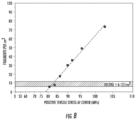
- FIG. 8 is a plot of fragmentation per square centimeter as a function of positive tensile stress from experiment.
- FIG. 9 is a plot of the magnitude of negative tensile stress at the surface as a function of initial hot zone temperature from experiment, showing a threshold to achieve dicing.
- FIG. 10 is a plot of the non-dimensional surface fictive temperature parameter ⁇ s for fictive temperatures obtained by one or more embodiments of methods and systems of the present invention.
- FIG. 11 is a plot of surface compression stresses calculated by simulation for differing glass compositions, plotted against a proposed temperability parameter ⁇ for the various compositions shown.
- FIGS. 12 and 13 are graphs of two parameters P 1 and P 2 as functions of heat transfer coefficient h.
- FIG. 14 is a graph of MPa of surface compression of a glass sheet as a function of thickness t of the sheet in millimeters, showing regions of performance newly opened by one or more embodiments of the systems and methods of the present disclosure.
- FIG. 15 is a graph showing compressive stress as a function of thickness plotted for selected exemplary embodiments of tempered glass sheets of the present disclosure.
- FIG. 16 is a flow chart illustrating some aspects of a method according to the present disclosure.
- FIG. 17 is a flow chart illustrating some aspects of another method according to the present disclosure.
- FIG. 18 is the graph of FIG. 3 with a region R and points A, B, A′ and B′ marked thereon to show a region in which the methods and systems of the present disclosure allow operation, in contrast to the prior art.
- FIG. 19 is another representation of the region R and points A, B, A′ and B′ of FIG. 18 , but shown adjacent to (and positioned relative to the scale) of a reduced size copy of FIG. 2 .
- FIG. 20 (Prior Art) is a graph of the required heat transfer coefficient needed for tempering as a function of glass thickness.
- FIG. 21 is a diagrammatic cross-section of a glass sheet being cooled by conduction more than by convection, according to an exemplary embodiment.
- FIG. 23 is a perspective cut-away view of another embodiment of a system similar to that of FIG. 22 according to an exemplary embodiment.
- FIG. 26 is a flow chart illustrating some aspects of yet another method according to an exemplary embodiment.
- FIG. 28 is a perspective view of a display on a countertop according to an exemplary embodiment.
- sheet thickness also imposes significant limits on the achievable temperature differential during quenching.
- Liquid contact strengthening in the form of immersion in liquid baths or flowing liquids, as well as in the form of spraying, has been used to achieve higher cooling rates than convective gas strengthening, but has the drawback of causing excessive thermal variations across a sheet during the cooling process.
- immersion or immersion-like spraying or flowing of liquids large thermal variations over small areas can occur due to convection currents that arise spontaneously within the liquid bath or liquid flow.
- finer spraying the discrete spray droplets and the effects of nozzle spray patterns also produce significant thermal variations. Excessive thermal variations tend to cause glass breakage during thermal strengthening by liquid contact, which can be mitigated by limiting the cooling rates, but limiting cooling rates also lowers the resulting strengths that can be achieved.
- a strengthened cover glass or glass-ceramic article 500 (e.g., sheet, beam, plate), includes a first major surface 510 , a second major surface 520 (dotted line to back side of the sheet 500 , which may be translucent as disclosed herein), and a body 522 extending therebetween.
- the second major surface 520 is on an opposite side of the body 522 from the first major surface 510 such that a thickness t of the strengthened cover glass or glass-ceramic sheet 500 is defined as a distance between the first and second major surfaces 510 , 520 , where the thickness t is also a dimension of depth.
- a width, w, of the strengthened cover glass or glass-ceramic sheet 500 is defined as a first dimension of one of the first or second major surfaces 510 , 520 orthogonal to the thickness t.
- a length, l, of the strengthened cover glass or glass-ceramic sheet 500 is defined as a second dimension of one of the first or second major surfaces 510 , 520 orthogonal to both the thickness t and the width w.
- thickness t of cover glass sheet 500 is less than length l of cover glass sheet 500 . In other exemplary embodiments, thickness t of cover glass sheet 500 is less than width w of cover glass sheet 500 . In yet other exemplary embodiments, thickness t of cover glass sheet 500 is less than both length l and width w of cover glass sheet 500 . As shown in FIG. 5 , cover glass sheet 500 further has regions of permanent thermally induced compressive stress 530 and 540 at and/or near the first and second major surfaces 510 , 520 , balanced by a region of permanent thermally induced central tensile stress 550 (i.e., tension) in the central portion of the sheet.
- regions of permanent thermally induced compressive stress 530 and 540 at and/or near the first and second major surfaces 510 , 520 , balanced by a region of permanent thermally induced central tensile stress 550 (i.e., tension) in the central portion of the sheet.
- thickness t of cover glass sheet 500 ranges from 0.1 mm to 5.7 or 6.0 mm, including, in addition to the end point values, 0.2 mm, 0.28 mm, 0.4 mm, 0.5 mm, 0.55 mm, 0.7 mm, 1 mm, 1.1 mm, 1.5 mm, 1.8 mm, 2 mm, and 3.2 mm.
- Contemplated embodiments include thermally strengthened cover glass sheets 500 having thicknesses t in ranges from 0.1 to 20 mm, from 0.1 to 16 mm, from 0.1 to 12 mm, from 0.1 to 8 mm, from 0.1 to 6 mm, from 0.1 to 4 mm, from 0.1 to 3 mm, from 0.1 to 2 mm, from 0.1 to less than 2 mm, from 0.1 to 1.5 mm, from 0.1 to 1 mm, from 0.1 to 0.7 mm, from 0.1 to 0.5 mm and from 0.1 to 0.3 mm.
- thermally strengthened cover glass sheets have high aspect ratios—i.e., the length and width to thickness ratios are large. Because the thermal tempering processes discussed herein do not rely on high pressures or large volumes of air, various cover glass sheet properties, such as surface roughness and flatness, can be maintained after tempering by the use of gas bearings and high thermal transfer rate systems discussed herein. Similarly, the thermal tempering processes discussed herein allow high aspect ratio cover glass sheets (i.e., cover glass sheets with high ratio of length to thickness, or of width to thickness, or both) to be thermally strengthened while retaining the desired or necessary shape.
- high aspect ratio cover glass sheets i.e., cover glass sheets with high ratio of length to thickness, or of width to thickness, or both
- the length l of the strengthened cover glass or glass-ceramic sheet 500 is greater than or equal to the width w, such as greater than twice the width w, greater than five times the width w, and/or no more than fifty times the width w.
- the width w of the strengthened cover glass or glass-ceramic sheet 500 is greater than or equal to the thickness t, such as greater than twice the thickness t, greater than five times the thickness t, and/or no more than fifty times the thickness t.
- the length l of the cover glass or glass-ceramic sheet 500 is at least 1 cm, such as at least 3 cm, at least 5 cm, at least 7.5 cm, at least 20 cm, at least 50 cm, and/or no more than 50 m, such as no more than 10 m, no more than 7.5 m, no more than 5 m.
- the width w of the cover glass or glass-ceramic sheet 500 is at least 1 cm, such as at least 3 cm, at least 5 cm, at least 7.5 cm, at least 20 cm, at least 50 cm, and/or no more than 50 m, such as no more than 10 m, no more than 7.5 m, no more than 5 m.
- cover glass or glass-ceramic is in the form a sheet 500 has a thickness t that is thinner than 5 cm, such as 2.5 cm or less, 1 cm or less, 5 mm or less, 2.5 mm or less, 2 mm or less, 1.7 mm or less, 1.5 mm or less, 1.2 mm or less, or even 1 mm or less in contemplated embodiments, such as 0.8 mm or less; and/or the thickness t is at least 10 ⁇ m, such as at least 50 ⁇ m, at least 100 ⁇ m, at least 300 ⁇ m.
- the cover glass or glass-ceramic article may be sized other than as disclosed herein.
- the length l, width w, and/or thickness t of the cover glass or glass-ceramic articles may vary, such as for more complex geometries (see generally FIG. 30 ), where dimensions disclosed herein at least apply to aspects of the corresponding cover glass or glass-ceramic articles having the above-described definitions of length l, width w, and thickness t with respect to one another.
- first and/or second surfaces 510 , 520 of cover glass sheet 500 has a relatively large surface area.
- first and/or second surfaces 510 , 520 having areas of at least 100 mm 2 , such as at least 900 mm 2 , at least 2500 mm 2 , at least 5000 mm 2 , at least 100 cm 2 , at least 900 cm 2 , at least 2500 cm 2 , at least 5000 cm 2 , and/or no more than 2500 m 2 , such as no more than 100 m 2 , no more than 5000 cm 2 , no more than 2500 cm 2 , no more than 1000 cm 2 , no more than 500 cm 2 , no more than 100 cm 2 .
- the cover glass or glass-ceramic sheet 500 may have a relatively large surface area; which, except by methods and systems disclosed herein, may be difficult or impossible to thermally strengthen particularly while having the thicknesses, surface qualities, and/or strain homogeneities of the cover glass sheets discussed herein. Further, except by methods and systems disclosed herein, it may be difficult or impossible to achieve the stress profile, particularly the negative tensile stress portion of the stress profile (see generally FIG. 6 ), without relying upon ion-exchange or a change in the type of cover glass.
- the thermally strengthened cover glass sheets discussed herein may have surprisingly high surface compressive stresses, e.g., in regions 530 , 540 shown in FIG. 5 , surprisingly high central tensile stresses, e.g., in region 550 shown in FIG. 5 , and/or unique stress profiles (see FIG. 6 ). This is particularly true considering the low thickness and/or other unique physical properties (e.g., very low roughness, high degree of flatness, various optical properties, fictive temperature properties, etc.) of cover glass sheet 500 as discussed herein.
- cover glasses e.g., in regions 530 , 540 shown in FIG. 5
- Compressive stresses of cover glasses can vary as a function of thickness t of the cover glasses.
- cover glasses e.g., cover glass sheet 500 , having a thickness of 3 mm or less have a compressive stress (e.g., surface compressive stress) of at least 80 MPa, at least 100 MPa, at least 150 MPa, at least 200 MPa, at least 250 MPa, at least 300 MPa, at least 350 MPa, at least 400 MPa, and/or no more than 1 GPa.
- a compressive stress e.g., surface compressive stress
- a conceptual stress profile 560 at room temperature of 25° C. and standard atmospheric pressure, of the strengthened cover glass or glass-ceramic sheet 500 of FIG. 4 , shows an interior portion 550 of the strengthened cover glass or glass-ceramic sheet 500 under positive tensile stress and portions 530 , 540 of the strengthened cover glass or glass-ceramic sheet 500 exterior to and adjoining the interior portion 550 under negative tensile stress (e.g., positive compressive stress).
- negative tensile stress at least in part fortifies the strengthened cover glass or glass-ceramic sheet 500 by limiting initiation and/or propagation of cracks therethrough.
- tensile stress in the stress profile 560 sharply transitions between the positive tensile stress of the interior portion 550 and the negative tensile stress of the portions 530 , 540 exterior to and adjoining the interior portion 550 .
- the rate of change of the tensile stress does not exceed 7000 MPa divided by 1 mm, such as no more than 5000 MPa divided by 1 mm.
- the difference in peak values of the positive and negative tensile stresses is at least 50 MPa, such as at least 100 MPa, at least 150 MPa, at least 200 MPa, at least 250 MPa, at least 300 MPa, at least 400 MPa, at least 500 MPa, and/or no more than 50 GPa.
- the cover glass or glass-ceramic sheet 500 has a peak negative tensile stress of at least 50 MPa in magnitude, such as at least 100 MPa, at least 150 MPa, at least 200 MPa, at least 250 MPa, at least 300 MPa, at least 400 MPa, at least 500 MPa.
- the steep tensile curve transitions generated by the system and method discussed herein are believed to be indicative of the ability to achieve higher magnitudes of negative tensile stress at a surface of a cover glass sheet for a given thickness and/or to manufacture thinner cover glass articles to a higher degree of negative tensile stress, such as to achieve a fragmentation potential for dicing as disclosed herein.
- Conventional thermal tempering approaches may be unable to achieve such steep tensile stress curves.
- the high rate of change of tensile stress is at least one of the above-described magnitudes or greater sustained over a thickness-wise stretch of the stress profile 560 that is at least 2% of the thickness, such as at least 5% of the thickness, at least 10% of the thickness, at least 15% of the thickness, or at least 25% of the thickness of cover glass sheet 500 .
- the strengthening extends deep into the strengthened cover glass or glass-ceramic sheet 500 such that the thickness-wise stretch with the high rate of change of tensile stress is centered at a depth of between 20% and 80% into the thickness from the first surface, which may further distinguish chemical tempering for example.
- the strengthened cover glass or glass-ceramic article includes a change in the composition thereof in terms of ion content, conceptually shown as dotted line 562 in FIG. 6 .
- the composition of the strengthened cover glass or glass-ceramic article 500 in such embodiments includes exchanged or implanted ions that influence the stress profile 560 .
- the exchanged or implanted ions do not extend fully through the portions 530 , 540 of the strengthened cover glass or glass-ceramic article 500 under the negative tensile stress because the negative tensile stress is also a result of the thermal tempering as disclosed herein.
- the curve of the tensile stress profile 560 with ion exchange strength augmentation includes a discontinuity or sudden change 564 in direction where tangents of the curve differ from one another on either side of the discontinuity or sudden change 564 .
- the sudden change 564 is located within the portions 530 , 540 under negative tensile stress such that the tensile stress is negative on either side immediately adjacent to the discontinuity or sudden change 564 .
- the discontinuity or sudden change 564 may correspond to the depth of the different ion content, however in some such embodiments other parts of the portions 530 , 540 under negative tensile stress still have the same composition in terms of ion content as the portion 550 under positive tensile stress.
- Such structure may simplify the composition of the strengthened cover glass or glass-ceramic sheet 500 at least to a degree by providing sufficient strength without and/or with less chemical tempering. Further, such structure may reduce stress concentrations within the strengthened cover glass or glass-ceramic sheet 500 due to discontinuity/changes in composition, possibly reducing chances of delamination and/or cracking at the composition discontinuity.
- cover glass sheet is considered to dice when an area of the cover glass sheet 25 cm 2 breaks into 40 or more pieces. In some embodiments, dicing is used as a qualitative measure of showing that the cover glass sheet is “fully tempered” (i.e., for 2 mm or thicker cover glass, where the cover glass sheet has a compressive stress of at least 65 MPa or an edge compression of at least 67 MPa). In various embodiments, cover glass sheet 500 has sufficient tensile stress in region of tensile stress 550 such that a 25 cm 2 piece of cover glass sheet 500 breaks into 40 or more pieces.
- a cover glass or glass-ceramic article 610 having properties as disclosed herein with respect to the cover glass or glass-ceramic sheets, such as sheet 500 , has been fractured, such as using a prick punch or other instrument and/or generally in accordance with American National Standards Institute (ANSI) Z97.1 (impact test) and the ASTM 1048 standard.
- the cover glass or glass ceramic article 610 has been strengthened to a degree that dicing has occurred upon the fracture, forming a plurality of small granular chunks 616 (e.g., fragments, pieces).
- the cover glass or glass-ceramic article 610 has a thermally-induced stress sufficient to produce a number of granular chunks 616 that is not less than 40 within an area of 50-by-50 mm of the cover glass or glass-ceramic article 610 in a fragmentation test in which an impact is applied with a hammer or a punch to initiate cracking of the cover glass into granular pieces.
- a standard office thumb tack 612 with a metal pin length 614 of about 1 cm is shown for reference.
- the stress profile (see generally FIG. 6 ) imparts a high fragmentation potential of the strengthened cover glass or glass-ceramic article 610 such that when fractured the strengthened cover glass or glass-ceramic article 610 shatters into particularly small granular chunks 616 , those having an area on either the first or second surface of less than 90 mm 2 , such as less than 50 mm 2 , such as less than 20 mm 2 , such as less than 10 mm 2 , such as less than 5 mm 2 , and/or at least 10 ⁇ m 2 .
- the fragmentation potential of the strengthened cover glass or glass-ceramic article 610 is such that at least 20% (e.g., at least 50%, at least 70%, at least 95%) of the granular chunks 616 have an area of at least one of the first or second surfaces of one of the above-described amounts when the strengthened cover glass or glass-ceramic article is fractured.
- the fragmentation potential of the strengthened cover glass or glass-ceramic article 610 is such that, when fractured, the strengthened cover glass or glass-ceramic article 610 shatters into particularly low-volume granular chunks, those having a volume of less than 50 mm 3 , such as less than 40 mm 3 , such as less than 30 mm 3 , such as less than 25 mm 3 , and/or at least a volume of 50 ⁇ m 3 .
- the fragmentation potential of the strengthened cover glass or glass-ceramic article 610 is such that, when fractured, the strengthened cover glass or glass-ceramic article 610 shatters into at least 100 granular chunks 616 of at least of 50 ⁇ m 3 in volume, such as at least 200, at least 400, at least 1000, at least 4000 granular chunks 616 of at least of 50 ⁇ m 3 in volume.
- the thermally strengthened cover glass sheets formed by the systems and methods discussed herein have high fictive temperatures.
- high fictive temperatures of the cover glass materials discussed herein relate to the high level of tempering, high central tensile stresses and/or high compressive surface stress of cover glass sheet 500 .
- Surface fictive temperatures may be determined by any suitable method, including differential scanning calorimetry, Brillouin spectroscopy, or Raman spectroscopy.
- the cover glass or glass-ceramic sheet 500 has a portion thereof, such as at or near the first and/or second surfaces 510 , 520 , that has a particularly high fictive temperature, such as at least 500° C., such as at least 600° C., or even at least 700° C. in some embodiments, such as for soda-lime glass.
- the cover glass or glass-ceramic sheet 500 has a portion thereof, such as at or near the first and/or second surfaces 510 , 520 , that has a particularly high fictive temperature relative to annealed glass of the same chemical composition, such as at least 10° C. greater, at least 30° C. greater, at least 50° C.
- High fictive temperature may be achieved by the presently disclosed inventive technology at least in part due to the rapid transition from the hot to the cooling zones in the strengthening system (see e.g., FIG. 21 , FIG. 22 and FIG. 23 ). Applicant believes that high fictive temperature may correspond or relate to increased damage resistance of glass.
- the peak near 1090 cm ⁇ 1 in soda-lime glass and in glass 2 corresponds to the 1050 cm ⁇ 1 peak observed in silica glass.
- T f ( ° ⁇ C . ) [ ⁇ ⁇ ( c ⁇ m - 1 ) - 111066 ⁇ ( cm - 1 ) - 0 . 0 ⁇ 2 ⁇ 8 ⁇ 2 ⁇ ( cm - 1 ° ⁇ C . ) ] + 2 [ 0 . 0 ⁇ 8 ⁇ 2 * ⁇ c ( MPa ) ] ( 1 )
- the equation applicable to glass 2 is:
- T f ( ° ⁇ C . ) [ ⁇ ⁇ ( cm - 1 ) - 1102 ⁇ ( cm - 1 ) - 0 . 0 ⁇ 231 ⁇ ( cm - 1 ° ⁇ C . ) ] + 2 [ 0 . 0 ⁇ 9 ⁇ 9 ⁇ 6 * ⁇ c ( MPa ) ] ( 2 )
- ⁇ is the measured peak wavenumber for the peak near 1090 cm ⁇ 1
- ⁇ c is the surface compressive stress measured by any suitable technique, yielding stress-corrected measurement of fictive temperature in ° C.
- SLG soda-lime glass
- CS surface compressive stress
- the 50% cracking threshold (defined as the load at which the average number of cracks appearing is two out of the four points of the indenter at which cracks tend to initiate) was determined for each sample.
- the Vickers crack initiation threshold improved to greater than 10 N, a 10-fold increase over the Vickers damage resistance imparted by conventional tempering.
- the T fs minus T g was at least 50° C., or at least 75° C., or at least 90° C., or in the range of from approximately 75° C. to 100° C. Even in embodiments comprising lower levels of heat strengthening, the embodied glasses can still provide increased resistance, at levels such as 5 N, for instance.
- the 50% cracking threshold after a 15 second Vickers crack initiation test may be equal to or greater than 5 N, 10 N, 20 N, or 30 N.
- the following non-dimensional fictive temperature parameter ⁇ can be used to compare the relative performance of a thermal strengthening process in terms of the fictive temperature produced.
- ⁇ s ( T fs ⁇ T anneal )/( T soft ⁇ T anneal ) (3)
- T fs is the surface fictive temperature
- FIG. 10 is a plot of ⁇ s for measured surface fictive temperatures as a function of heat transfer rate, h, applied during thermal strengthening for two different glasses. As shown in FIG. 10 , the results for the two different glasses overlie each other fairly closely. This means that parameter ⁇ provides a means to compare the fictive temperatures of different glasses compared directly, in relation to the heat transfer rate h required to produce them. The vertical range of results at each h corresponds to variation in the value of T 0 , the initial temperature at the start of quenching.
- parameter ⁇ s comprises from about (e.g., plus or minus 10%) 0.2 to about 0.9, or 0.21 to 0.09, or 0.22 to 0.09, or 0.23 to 0.09, or 0.24 to 0.09, or 0.25 to 0.09, or 0.30 to 0.09, or 0.40 to 0.09, or 0.5 to 0.9, or 0.51 to 0.9, or 0.52 to 0.9, or 0.53 to 0.9, or 0.54 to 0.9, or 0.54 to 0.9, or 0.55 to 0.9, or 0.6 to 0.9, or even 0.65 to 0.9.
- the thermally strengthened cover glass sheets formed by the systems and methods discussed herein have a high temperability and/or heat transfer value.
- the “specific thermal stress” of a glass is given by:
- ⁇ is the (low temperature linear) CTE of the glass
- E is the modulus of elasticity of the glass material
- ⁇ is Poisson's ratio of the glass material. This value is used to indicate the level of stress produced within a given glass composition when subjected to a temperature gradient. It may also be used as an estimator of thermal “temperability.” At higher thermal transfer rates (such as at about 800 W/m 2 K and above, for example), however, the high temperature or “liquidus” CTE of the glass begins to affect tempering performance.
- ⁇ S CTE is the low temperature linear CTE (equivalent to the average linear expansion coefficient from 0-300° C. for the glass), expressed in 1/° C. (° C. ⁇ 1 )
- ⁇ L CTE is the high temperature linear CTE (equivalent to the high-temperature plateau value which is observed to occur somewhere between the glass transition and softening point), expressed in 1/° C. (° C.
- E is the elastic modulus of the glass, expressed in GPa (not MPa) (which allows values of the (non-dimensional) parameter ⁇ to range generally between 0 and 1)
- the thermal strengthening process and resulting surface compressive stresses were modeled for glasses having varying properties to determine the tempering parameter, ⁇ .
- the glasses were modeled at the same starting viscosity of 10 8.2 Poise and at varying heat transfer coefficients.
- the properties of the various glasses are shown in Table II, together with the temperature for each glass at 10 8.2 Poise and the calculated value of the temperability parameter ⁇ for each.
- a similar expression may be used to predict the central tension (CT) of a thermally strengthened cover glass sheet, particularly at a thickness of 6 mm and less, and the thermal transfer coefficient, such as 800 W/m 2 K and up, by simply dividing the compressive stress predicted under the same conductions by 2.
- CT central tension
- expected central tension may be given by
- the heat transfer value rates (h and h CT ) may be from about 0.024 to about 0.15, about 0.026 to about 0.10, or about 0.026 to about 0.075 cal/s ⁇ cm 2 ⁇ ° C.
- the trace labeled 704 represents stresses achievable by one or more embodiments of the presently disclosed methods and systems at a heat transfer rate of 0.20 cal/s ⁇ cm 2 ⁇ ° C. (or about 8370 W/m 2 K) and an initial temperature, just before quenching, of 704° C.
- the level of stress on the cover glass sheet thus achievable represents almost the same scope of improvement over liquid tempering strength levels as liquid tempering represents over state of the art gas convective tempering.
- the trace labeled 704 is not an upper limit—embodiments have been shown to be viable above this value due to the good control of form and flatness achievable in a small-gap gas bearing thermal strengthening at even higher temperatures (at lower viscosities of the cover glass).
- thermally strengthened cover glass sheets have a surface roughness on at least a first surface in the range from 0.2 to 1.5 nm R a roughness, 0.2 to 2.0 nm R a roughness, 0.2 to 0.7 nm, 0.2 to 0.4 nm or even such as 0.2 to 0.3 nm, over at least an area of 10 ⁇ 10 ⁇ m.
- Surface roughness may be measured over an area of 10 ⁇ 10 ⁇ m in exemplary embodiments, or in some embodiments, 15 ⁇ 15 ⁇ m.
- thermally strengthened cover glass sheets have surface roughness on at least a first surface in the range of at least 0.2 nm and/or no more than 1.5 nm R a roughness, such as no more than 0.7 nm, such as no more than 0.4 nm or even such as no more than 0.3 nm, or have thermally strengthened sheets having coatings thereon of the type that may be applied before strengthening, or have combinations of these low roughness values and coatings, are obtained from the present process used with corresponding cover glass sheets as starting material.
- the strengthened cover glass or glass-ceramic articles discussed herein have a high-degree of dimensional consistency such that the thickness t thereof along a 1 cm lengthwise stretch of the body 522 does not change by more than 50 ⁇ m, such as, by not more than 10 ⁇ m, not more than 5 ⁇ m, not more than 2 nm.
- dimensional consistency may not be achievable for given thicknesses, areas, and/or magnitudes of negative tensile stress, as disclosed herein, by solid quenching due to practical considerations, such as cooling plate alignment and/or surface irregularities that may distort the dimensions.
- the compressive stress of low CTE glasses can comprise at least 50 MPa, at least 100 MPa, at least 125 MPa, at least 150 MPa, at least 200 MPa, at least 250 MPa, at least 300 MPa, or at least 400 MPa for cover glass sheets having a thickness of no more than 1 cm, no more than 5 mm, no more than 3 mm, no more 2 mm, no more than 1.5 mm, no more than 1 mm, no more than 0.75 mm, no more than 0.5 mm, no more than 0.3 mm, no more than 0.2 mm, or no more than 0.1 mm.
- Cover glass sheets formed according to the present disclosure have a multitude of applications in consumer electronic devices, for example in electronic devices, mobile phones, portable media players, televisions, notebook computers, watches, household appliances, tablet computer displays and in laminates, such as glass-interlayer-glass laminates used in various consumer electronic devices. Stronger and thinner laminates can be produced, resulting in weight and cost savings and fuel efficiency increases. Desirably, a thermally strengthened thin sheet may be cold bent and laminated to a formed thicker glass, providing an easy and reliable manufacturing process not requiring any hot forming of the thin sheet.
- Table IV shows results obtained by the methods of the present disclosure (indicated as “Source of Method” I in the table), and a figure of merit, Alpha, that is a rough measure of the coefficient of heat exchange obtained within the tempering process.
- Alpha is given by:
- a process for strengthening a cover glass sheet comprises supporting or guiding at least a portion of a cover glass sheet, such as cover glass sheet 500 , into a cool or quenching zone in which the sheet is rapidly cooled creating a strengthened cover glass sheet having one or more of the properties discussed herein.
- the cover glass sheet is supported at least in part by a flow or a pressure of a gas delivered to a gap between the surfaces of the cover glass sheet and one or more heat sinks.
- the temperature of the glass sheet is above the transition temperature of the glass when the sheet is moved into the cool zone, and in various embodiments, the cover glass sheet is cooled within the cooling zone by thermal conduction more than by convection.
- Conduction is a process of heat transfer where energy is transmitted through interactions between adjacent molecules
- convection is a process of heat transfer where energy is communicated via motion of a fluid (e.g., air, helium, etc.), such as where heated fluid moves away from a heat source and is replaced by cooler fluid.
- a fluid e.g., air, helium, etc.
- an overall process for strengthening a cover glass sheet comprises heating a cover glass sheet in a hot zone and then cooling the cover glass sheet in a cooling zone.
- the cover glass is heated sufficiently to bring the cover glass sheet above the transition temperature, and then moved into a cooling zone.
- the cover glass can be transitioned from the hot zone to a cool zone through a transition zone.
- the surfaces of the cover glass sheet are positioned adjacent to heat sinks, one on either side of the cover glass sheet, each with a gap in between one of the cover glass surfaces and an opposing surface of the heat sink.
- Gas is delivered into the gaps through multiple apertures in the heat sinks, and in some embodiments, this delivered gas forms an air bearing which supports the cover glass between the heat sinks such that the cover glass surfaces are not in contact with the heat sinks.
- the cover glass sheet is cooled by conduction more than by convection and is cooled sufficiently to fix or create a thermally induced surface compression and a thermally induced central tension of the sheet which provides the increased strength as discussed herein.
- primarily cooling via conduction is achieved by having a very low gap size within the cooling zone such that the cover glass sheet is close to, but not touching, the opposing surfaces of the heat sinks.
- An apparatus for enabling the processes described can include a heating zone for heating a cover glass sheet to a temperature above the transition temperature and a cooling zone for cooling the heated cover glass sheet to provide a strengthened cover glass sheet.
- the apparatus can include an optional transition zone between the heating zone and the cooling zone.
- the cooling zone may include a heat sink having a pair of opposing surfaces defining a gap, within which the heated cover glass sheet is received.
- the cooling zone can comprise a pair of gas bearings disposed on opposite sides of that gap that acts to support the cover glass sheet within the gap.
- the gap can be configured to cool the heated cover glass sheet by conduction more than by convection.
- the gas bearings can include a plurality of apertures for delivering the gas to the gap, and the gas bearing surfaces act as the heat sinks, capable of conducting heat away from the heated cover glass sheet by conduction more than by convection.
- Strengthening processes and equipment disclosed herein allow for strengthening of cover glass or glass-ceramic articles (see generally FIGS. 4 - 7 and 27 - 30 ) by an inventive form of thermal tempering.
- the processes allow for steep, tensile stress versus thickness/depth curves (see generally FIG. 6 ), particularly steep in slope near the surface of the cover glass or glass-ceramic articles, which enable strengthening of the cover glass or glass ceramic articles to particularly high levels of negative tensile stress for a given thickness near the surface of the respective articles, without requiring strengthening by ion-exchange or laminating different glasses.
- the thermal tempering processes disclosed herein may be augmented with ion-exchange or applied to glass-to-glass laminations.
- the thermal tempering processes disclosed herein enable particularly high levels of strengthening in large-area articles (e.g., sheets) that may be too large for strengthening via conventional thermal tempering methods, such as due to alignment limitations of contact quench equipment, cooling rate limitations of conventional convection systems, and/or warping damage associated with liquid quench tempering.
- cover glass or glass ceramic articles as disclosed herein may be manufactured with at least some solid or liquid quenching, such as in combination with the unique strengthening processes disclosed herein.
- the method or process 100 includes a step 140 of providing a cover glass sheet that is at a temperature above a transition temperature of the glass sheet.
- the method or process 100 also includes the step 160 of supporting a cover glass sheet at least in part by a gas (through gas flow and pressure).
- Step 160 includes, while the cover glass sheet is support by the gas, cooling the sheet: 1) by conduction more than by convection through the gas to a heat sink, and 2) sufficiently to create or fix a thermally-induced surface compression stress and a thermally-induced central tension stress, of the sheet when at ambient temperature.
- the method can include the step 110 of heating a cover glass sheet sufficiently such that the sheet is above a transition temperature of the glass.
- the method 100 ′ further comprises, in step 120 , providing a heat sink (whether as a single piece or in separate pieces) having first and second heat sink surfaces (see generally FIGS. 21 - 25 ), each having apertures therein.
- the method further includes positioning a first sheet surface facing a first heat sink surface across a first gap and, in step 130 B, positioning the second sheet surface facing a second heat sink surface across a second gap.
- the heat sink surfaces can include apertures and/or can be porous.
- the method 100 ′ can further include, in step 160 , cooling the sheet, by conduction more than by convection through a gas to the respective heat sink surfaces, sufficiently to strengthen the cover glass (e.g., to sufficiently create or fix in the sheet a thermally-induced surface compression stress and a thermally-induced central tension stress).
- the step 160 also can include delivering the gas to the first and second gaps through the apertures or porous heat sink, and in some such embodiments, the gas is delivered to form air bearings that support the cover glass sheet adjacent the heat sinks. In some embodiments, the gas is delivered only through the apertures of the heat sink or only through the pores or pores and apertures of the porous heat sink.
- gas flow and gap size can be selected, controlled or optimized for other purposes, such as for controlling stiffness of the gas cushion in the gap, for supporting the sheet, for flattening or otherwise shaping a sheet, for optimizing heat conduction, for maintaining sheet flatness and/or shape during thermal strengthening, and/or for balancing ease of sheet handling with high cooling rates.
- helium becomes an economically viable alternative to air in the system of the present disclosure due to the very low gas flow rates that support the gas bearing, and in such embodiments, helium offers thermal conductivity about five times that of air. Even helium with prices assumed at multiples of those available today becomes an economically viable alternative at the low flow rates of the system of the present disclosure.
- the systems and methods discussed herein decrease the potential risk of deformation of hot thin sheets of cover glass typically caused by the high speed, high volume air flows needed in conventional convection based tempering systems. This also allows softer, higher temperature cover glass sheets to be handled with no or minimal distortion, further improving the achievable degree of strengthening. Eliminating high air flow rates also eases problems sometimes seen in transporting the sheet into the quenching chamber (moving against the high air flow) and in keeping the high-flow, cooler air from entering into and cooling the adjacent parts of the furnace used to heat the sheet.
- conduction through a gas, may mitigate contact damage, warping, shaping, etc. associated with conventional liquid contact or solid contact quench tempering.
- Use of a gas as an intermediate conductor preserves the surface quality of the processed articles by avoiding solid-to-solid contact. Mediating the high conduction rates through a gas also avoids liquid contact.
- Some types of liquid quenching can introduce unwanted distortions, spatial variation in tempering and contamination of the cover glass surfaces.
- Points A and B of FIG. 18 and FIG. 19 represent a high-end estimate of peak power use of the air bearing, per square meter of cover glass sheet, by a compressed air supply at relatively high flow. Practical low-end peak power use of compressed air could be as little as 1/16 of the values shown. Points A and B do not include active cooling of the heat sink, however, which can be included in some embodiments, especially where a machine is in continuous, quasi-continuous or high frequency operation.
- points A′ and B′ represent the conservatively estimated peak power levels for operation of the air bearing at points A and B when active cooling of the heat sink surfaces is factored in, assuming the thermal load equivalent of a 300° C. drop in cover glass sheet temperature is accomplished by an active cooling system having a thermal-to-mechanical (or electrical) efficiency ratio of 7.5 to 1, within a time limit of 2.1 seconds for point A′ and within 1 second for point B′. (These points correspond approximately to cover glass sheets actually tempered in the apparatus described herein.)
- the difference in total energy demands would tend to be greater than the difference for peak power demand, which is represented in the figure.
- the processes described herein have peak powers of less than 120 KW/m 2 , less than 100 KW/m 2 , less than 80 KW/m 2 to thermally strengthen a cover glass sheet of 2 mm thickness or less.
- heat transfer from the thin cover glass sheet in the system and process of the present disclosure includes a conduction component, a convection component and a radiant component.
- the thermal tempering system of the present disclosure provides for thin cover glass tempering by utilizing conductive heat transfer as the primary mechanism for quenching the thin cover glass sheets.
- the amount of thermal conduction at conditions embodied in processes using systems described herein can be determined via the following.
- a cover glass sheet may be at a temperature of 670° C., for example, while the heat sink surface may start at 30° C., for example. Accordingly, the average temperature of the air in the gap would be 350° C., at which dry air has a thermal conductivity of about 0.047 W/m ⁇ K; more than 75% higher than its thermal conductivity at room temperature and sufficiently high to conduct large amounts of heat energy through gaps of the sizes within the system of the present disclosure, as discussed below, assuming the sheet is finished to a reasonably high degree of surface and thickness consistency.
- Q cond the conductive component of the rate of heat transfer through a gap of distance g which gap has an area A g (in a direction everywhere perpendicular to the direction of the gap distance g) may be given by:
- Q cond A g ⁇ k ⁇ ( T S - T HS ) g ( 14 )
- k is the thermal conductivity of the material (gas) in the gap evaluated in the direction of (or opposite of) heat conduction
- T S is the temperature of the cover glass surface
- T HS is the temperature of the heat sink surface (or the heat source surface, for other embodiments).
- k may be taken as the value of k for the gas in the gap when at the average of the temperatures of the two surfaces, T S and T HS .
- another embodiment includes heating (or heating and/or cooling) through a gas by conduction more than by convection.
- heating or heating and/or cooling
- the convective Q conv component of the rate of heat transfer across the gap (or gaps) may be given by:
- B is less than 0.9, 0.8, 0.7, 0.6, 0.5, 0.4, 0.1, 5 ⁇ 10 ⁇ 2 , 1 ⁇ 10 ⁇ 2 , 5 ⁇ 10 ⁇ 3 , 1 ⁇ 10 ⁇ 3 , 5 ⁇ 10 ⁇ 3 , 1 ⁇ 10 ⁇ 3 , 5 ⁇ 10 ⁇ 5 , 1 ⁇ 10 ⁇ 5 , 5 ⁇ 10 ⁇ 6 , 1 ⁇ 10 ⁇ 6 , 5 ⁇ 10 ⁇ 7 , 1 ⁇ 10 ⁇ 7 , 5 ⁇ 10 ⁇ 8 , or 1 ⁇ 10 ⁇ 8 .
- in is minimized, consistent with the needs of using the gas flow to support and control the sheet position relative to the heat sink surface(s). In other embodiments, in should be selected to control the position of the heat exchange surfaces themselves, relative to the sheet.
- the cover glass sheet has first and second sheet surfaces, and cooling of the cover glass sheet is performed by positioning the first sheet surface (e.g., a lower surface of the cover glass sheet) adjacent to a first heat sink surface (e.g., a surface of a lower heat sink) such that a first gap is located between the first sheet surface and the first heat sink surface and by positioning the second sheet surface (e.g., an upper surface of the cover glass sheet) adjacent to a second heat sink surface (e.g., a surface of an upper heat sink) such that a second gap is located between the second sheet surface and the second heat sink surface.
- first sheet surface e.g., a lower surface of the cover glass sheet
- a first heat sink surface e.g., a surface of a lower heat sink
- second sheet surface e.g., an upper surface of the cover glass sheet
- a second heat sink surface e.g., a surface of an upper heat sink
- the first gap has a length across the first gap of g 1 and an area of the first gap of A g1
- the second gap has a length across the second gap of g 2 and an area of the second gap of A g2 .
- a first flow of a first gas to the first gap is provided, and a second flow of a second gas to the second gap is provided.
- the first gas has a heat capacity C p1 and a thermal conductivity k 1 , and the first flow is provided at a mass flow rate ⁇ dot over (m) ⁇ 1 .
- ⁇ dot over (m) ⁇ 1 is greater than zero and less than (2k 1 A g1 )/(g 1 C p1 i).
- the second gas has a heat capacity C p2 and a thermal conductivity k 2 , and the second flow is provided at a mass flow rate ⁇ dot over (m) ⁇ 2 .
- ⁇ dot over (m) ⁇ 2 is greater than zero and less than (2k 2 A g2 )/(g 2 C p2 ).
- the first and second flows contact the cover glass sheet such that the cover glass sheet is supported without touching the heat sink surfaces. In this manner, the sheet is cooled by conduction more than by convection in a manner to create a surface compressive stress and a central tension of the sheet.
- a hot glass sheet 200 has its first and second (major) surfaces 200 a, 200 b each facing a respective first and second surface 201 b, 202 b of respective first and second heat sinks 201 a, 202 a across respective gaps 204 a and 204 b.
- Gas 230 is fed through the first and second surfaces 201 b, 202 b as represented by the arrows, to supply the gaps 204 a, 204 b, and to assist in keeping the cover glass sheet centered or otherwise positioned between the heat sinks 201 a, 202 a.
- cover glass sheet 200 will be cooled more by conduction than convection.
- cover glass sheet 200 is cooled by heat sinks 201 a and 202 a such that more than 20%, specifically more than 50%, and more specifically more than 80%, of the thermal energy leaving a heated article, such as cover glass sheet 200 , crosses the gaps, such as gaps 204 a and 204 b, and is received by the heat sink 201 a and 202 a.
- the gaps 204 a, 204 b are configured to have a thickness or distance across the gap sufficient such that the heated cover glass sheet is cooled by conduction more than by convention.
- size of gaps 204 a, 204 b generally is the distance between the major cover glass surfaces and the opposing heat sink surfaces.
- gaps 204 a and 204 b may have a thicknesses of about (e.g., plus or minus 1%) 100 ⁇ m or greater (e.g., in the ranges from about 100 ⁇ m to about 200 ⁇ m, from about 100 ⁇ m to about 190 ⁇ m, from about 100 ⁇ m to about 180 ⁇ m, from about 100 ⁇ m to about 170 ⁇ m, from about 100 ⁇ m to about 160 ⁇ m, from about 100 ⁇ m to about 150 ⁇ m, from about 110 ⁇ m to about 200 ⁇ m, from about 120 ⁇ m to about 200 ⁇ m, from about 130 ⁇ m to about 200 ⁇ m, or from about 140 ⁇ m to about 200 ⁇ m).
- gaps 204 a and 204 b may have a thicknesses of about (e.g., plus or minus 1%) 100 ⁇ m or less (e.g., in the ranges from about 10 ⁇ m to about 100 ⁇ m, from about 20 ⁇ m to about 100 ⁇ m, from about 30 ⁇ m to about 100 ⁇ m, from about 40 ⁇ m to about 100 ⁇ m, from about 10 ⁇ m to about 90 ⁇ m, from about 10 ⁇ m to about 80 ⁇ m, from about 10 ⁇ m to about 70 ⁇ m, from about 10 ⁇ m to about 60 ⁇ m, or from about 10 ⁇ m to about 50 ⁇ m).
- Heat sinks 201 a, 202 a may be solid or porous configurations. Suitable materials include, but are not limited to, aluminum, bronze, carbon or graphite, stainless steel, etc. Heat sink dimensions may be designed to be sufficient to address the size of the cover glass sheet and to efficiently and effectively transfer heat without changing the heat sink temperature significantly. In the case where heat sinks 201 a and/or 202 a are porous, they may still include additional apertures or holes for flowing gas or may use the porous structure to provide flow, or both. In some embodiments, the heat sinks further comprise passages to allow fluid flow for controlling the temperature of the heat sink, described in more detail in FIGS. 23 - 25 and below.
- apertures may be less than 2 mm, less than 1.5 mm, less than 1 mm, less than 0.5 mm, less than 0.25 mm, or less than or equal to 200, 150, 100, 50, 30, 20, or 10 ⁇ m, when measured in the smallest direction (e.g., diameter in the case of circular apertures).
- the apertures are from about (e.g., plus or minus 1%) 10 ⁇ m to about 1 mm, about 20 ⁇ m to about 1 mm, or about 50 ⁇ m to about 1 mm.
- Spacing between adjacent apertures 206 can be from about (e.g., plus or minus 1%) 10 ⁇ m to about 3 mm, about 20 ⁇ m to about 2 mm, or about 50 ⁇ m to about 1 mm, measured edge-to-edge of apertures.
- Small apertures or pores may function as individual flow restrictors, providing high-performance, gas-bearing-type dynamics, such as high levels of stiffness and consistency of support of the sheet to position the sheet and control gap size, allowing for high homogeneity of thermal strengthening effects to avoid or reduce stress birefringence. Further, because very small pores or apertures may be used, the relative amount of solid matter at the surface of the heat sink facing the sheet surface across the gap(s) can be maximized, thereby increasing conductive heat flow.
- apertures 206 as the only path for providing gas to the gaps 204 a, 204 b, and desirably using apertures 206 that lie in directions close to normal to the heat sink surface 201 b, 202 b, ensures that air-bearing type dynamics are optimized, and not compromised by gas flows from larger apertures, or from sources other than through the heat sink surface(s) 201 b, 202 b adjacent to the sheet 200 , or by other excessive lateral flow.
- gas may be provided to the gaps 204 a, 204 b via other sources, such as in addition to the apertures 206 or pores. Accordingly, aspects of the present disclosure allow for power and energy savings by use of low gas flows and solid-gas-solid conduction, such as relative to conventional convective tempering processes.
- FIGS. 22 - 25 show an exemplary embodiment of a cover glass strengthening system 300 according to this disclosure.
- FIG. 22 shows a schematic cross-sectional diagram of the system 300 , in which a cover glass sheet can be cooled via conduction of heat from the cover glass sheet, through a gas into a conductive heat sink.
- the apparatus includes a hot zone 310 , a cold zone 330 , and a transition gas bearing 320 .
- Transition gas bearing 320 moves or directs a cover glass article (e.g., cover glass sheet 400 a ) from the hot zone 310 to the cold zone 330 such that no contact or substantially no contact occurs between the cover glass and the bearings.
- the hot zone 310 has gas bearings 312 each fed from a hot zone plenum 318 , and the bearings 312 have cartridge heaters 314 inserted into holes through the bearings 312 , which serve to heat the hot zone gas bearings 312 to a desired starting process temperature.
- a cover glass sheet (hot zone) 400 a is kept between the hot zone gas bearings 312 for a duration long enough to bring it to a desired pre-cooling temperature (e.g., above the transition temperature).
- heating the sheet in the hot zone may be done predominantly via conduction of heat from a heat sink through a thin gas barrier.
- the conductive heating processes used in the hot zone can be similar to, but the reverse of the cooling processes described herein (e.g., pushing heat into the cover glass sheet).
- gaps 316 between the hot zone gas bearings 312 and the cover glass sheet 400 a, may be relatively large, on the order of 0.05′′ (1.27 mm) to 0.125′′ (3.175 mm) or greater, since the cover glass sheet 400 a may be heated up relatively slowly and thermal radiation from the hot gas bearings 312 into the cover glass sheet 400 a is adequate for this purpose.
- hot zone gap size may be as small as 150 microns per side or 500 microns per side. Smaller gaps may be advantageous, in some embodiments, because they enable the bearings to have better “stiffness”— i.e., ability to centralize the cover glass and therefore flatten it while it is in its softened state.
- the process may re-form the cover glass sheets—flattening them—in the initial heating step, for example via the pressure supplied by the gas bearings 312 .
- the top and bottom hot zone bearings may be on actuators, allowing for changing the gap width in a continuous manner or, alternatively, allowing the cover glass to be brought into the hot zone when the gap is large and then compressing the gap to flatten the cover glass while it is still soft.
- Process temperatures are dependent on a number of factors, including cover glass composition, cover glass thickness, cover glass properties (CTE, etc.), and desired level of strengthening.
- the starting process temperature may be any value between the cover glass transition temperature and the Littleton softening point, or in some embodiments, even higher.
- system 300 heats the cover glass sheet 400 a to a temperature between about (e.g., plus or minus 1%) 640 to about 730° C. or between about 690 to about 730° C.
- system 300 heats the glass sheet 400 a to a temperature from about (e.g., plus or minus 1%) 620 to about 800° C., about 640 to about 770° C., about 660 to about 750° C., about 680 to about 750° C., about 690 to about 740° C., or about 690 to about 730° C.
- the cover glass sheet 400 a is heated to its desired starting process temperature (e.g., above the cover glass transition temperature), and it is then moved from the hot zone 310 to the cold zone 330 using any suitable means.
- moving the cover glass sheet 400 a from the hot zone 310 to the cold zone 330 may be accomplished by, for example (1) tilting the entire assembly such that gravity acting on the cover glass sheet forces it to move to the cold zone, (2) blocking off the gas flow from the leftmost exit of the hot zone 310 (the sides are enclosed in this embodiment), thereby forcing all of the gas emanating from all of the gas bearings to exit from the rightmost exit of the cold zone, causing fluid forces to be exerted on the cover glass sheet 400 a and causing it to move to the cold zone 330 , or (3) by a combination of (1) and (2))
- the transition gas bearings 320 may be supplied with gas by transition bearing plenums 328 .
- the solid material thickness behind the surfaces of the transition gas bearings 320 may be thin, of low thermal mass and/or low thermal conductivity, allowing for reduced heat conduction from the hot zone 310 to the cold zone 330 .
- the transition gas bearings 320 may serve as a thermal break or transition between the two zones 310 and 330 and may serve to transition from the larger gaps 316 of the hot zone down to small gaps 336 of the cold zone 330 . Further, the low thermal mass and/or low thermal conductivity of transition gas bearings 320 limit(s) the amount of heat transfer and therefore cooling experienced by cover glass sheet 400 a while passing past transition gas bearings 320 .
- stop gate 341 a mechanical stop or any other suitable blocking mechanism, shown as stop gate 341 .
- the stop gate 341 may be moved, unblocking cold zone channel 330 a, and then the cover glass sheet 400 b may be removed from the system 300 . If desired, the cover glass sheet 400 b may be left in the cold zone 330 until somewhere near room temperature before removal.
- the cold zone 330 includes a channel 330 a for receiving heated cover glass sheet 400 b through an opening 330 b, conveying the cover glass sheet 400 b, and cooling the cover glass sheet 400 b in the cold zone.
- the channel 330 a includes a conveyance system that may include gas bearings, roller wheels, conveyor belt, or other means to physically transport the cover glass sheet through the cold zone.
- cold zone 330 includes gas bearings 332 which are fed plenums 338 that are separate from hot zone plenums 318 and transition plenums 328 .
- the cold zone 330 includes one or more heat sinks 331 disposed adjacent to the channel 330 a. Where two heat sinks are utilized, such heat sinks may be disposed on opposite sides of the channel 330 a, facing each other across a channel gap 330 a.
- the heat sinks include a plurality of apertures 331 a which form part of the gas bearing 332 , and the surfaces of the cold gas bearings 332 of the cold zone 330 serve as the two heat sink surfaces.
- cover glass sheet 400 b is cooled within cold zone 330 primarily by conduction of heat from the cover glass sheet across the gap and into the solid heat sinks 331 , without the cover glass sheet 400 b touching the heat sink surfaces.
- the heat sinks and/or the surfaces thereof may be segmented.
- the heat sinks may be porous, and in such embodiments, the apertures through which the gas for gas bearings 332 is delivered are the pores of the porous heat sinks.
- the plurality of apertures 332 b, a gas source and the channel gap 330 a may be in fluid communication.
- the gas flows through the apertures 331 a to form gas cushions, layers or bearings in the channel gap 330 a.
- the gas cushions of some embodiments prevent the cover glass sheet 400 b from contacting the heat sink 331 surfaces.
- the gas also serves as the gas through which the cover glass sheet 400 b is cooled by conduction more than by convection.
- the sheet may be (1) introduced quickly into the cold zone, optionally at higher speeds than those typically used in convection-based quenching and/or (2) the process is operated in a quasi-continuous mode, in which multiple sheets are heated and cooled one after the other in a continuous stream with little space between them, and where the heat sink is actively cooled such that it reaches a thermal equilibrium so that the front and trailing edges of the large sheets have similar thermal history.
- the gas flowed through the apertures 331 a cools the heat sinks.
- the gas flowed through the apertures both facilitates heat conduction, from the cover glass, across the gap, into the heat sinks, and also cools the heat sinks 331 .
- a separate gas or fluid may be used to cool the heat sinks 331 .
- the heat sinks 331 may include passages 334 , for flowing a cooling fluid therethrough to cool the heat sinks 331 , as is more fully described with respect to FIG. 23 .
- the passages 334 can be enclosed.
- one or more gas sources may be used to provide a gas to the channel gap 330 a.
- the gas sources may include the same gas as one another or different gases.
- the channel gap 330 a may, therefore, include one gas, a mixture of gases from different gas sources, or the same gas source.
- Exemplary gases include air, nitrogen, carbon dioxide, helium or other noble gases, hydrogen and various combinations thereof.
- the gas may be described by its thermal conductivity when it enters the channel 330 a just before it begins to conductively cool the cover glass sheet 400 b.
- the gas may have a thermal conductivity of about (e.g., plus or minus 1%) 0.02 W/(m ⁇ K) or greater, about 0.025 W/(m ⁇ K) or greater, about 0.03 W/(m ⁇ K) or greater, about 0.035 W/(m ⁇ K) or greater, about 0.04 W/(m ⁇ K) or greater, about 0.045 W/(m ⁇ K) or greater, about 0.05 W/(m ⁇ K) or greater, about 0.06 W/(m ⁇ K) or greater, about 0.07 W/(m ⁇ K) or greater, about 0.08 W/(m ⁇ K) or greater, about 0.09 W/(m ⁇ K) or greater, about 0.1 W/(m ⁇ K) or greater, about 0.15 W/(m ⁇ K) or greater, or about 0.2 W/(m ⁇ K) or greater).
- a thermal conductivity of about (e.g., plus or minus 1%) 0.02 W/(m ⁇ K) or greater, about 0.025 W/(m ⁇ K) or greater
- the processes and systems described herein allow for high heat transfer rates which, as discussed above, allow for a strengthening degree of temperature differential to form within even a very thin cover glass sheet.
- heat transfer rates as high as 350, 450, 550, 650, 750, 1000, and 1200 kW/m 2 or more are possible through conduction alone.
- heat transfer rates of 5000 kW/m 2 or more can be achieved.
- the heat sinks 331 of one or more embodiments may be stationary or may be movable to modify the thickness of the channel gap 330 a.
- the thickness of the cover glass sheet 400 b may be in a range from about 0.4 times the thickness to about 0.6 times the thickness of channel gap 300 a, which is defined as the distance between the opposing surfaces of the heat sinks 331 (e.g., upper and lower surface of heat sinks 331 in the arrangement of FIG. 22 ).
- the channel gap is configured to have a thickness sufficient such that the heated cover glass sheet is cooled by conduction more than by convection.
- the channel gap may have a thickness such that when cover glass sheet 400 b is being conveyed through the channel, the distance between the cover glass sheet and the heat sink surface (the gap or gaps 336 ) is about (e.g., plus or minus 1%) 100 ⁇ m or less (e.g., in the range from about 10 ⁇ m to about 100 ⁇ m, from about 20 ⁇ m to about 100 ⁇ m, from about 30 ⁇ m to about 100 ⁇ m, from about 40 ⁇ m to about 100 ⁇ m, from about 10 ⁇ m to about 90 ⁇ m, from about 10 ⁇ m to about 80 ⁇ m, from about 10 ⁇ m to about 70 ⁇ m, from about 10 ⁇ m to about 60 ⁇ m, or from about 10 ⁇ m to about 50 ⁇ m).
- the gap or gaps 336 the distance between the cover glass sheet and the heat sink surface (the gap or gaps 336 ) is about (e.g., plus or minus 1%) 100 ⁇ m or less (e.g., in the range from about
- the total thickness of the channel gap 330 a is dependent on the thickness of the cover glass sheet 400 b, but can be generally characterized as 2 times the distance between the heat sink surface and the cover glass sheet, plus the thickness of the cover glass sheet. In some embodiments, the distance or gaps 336 between the cover glass sheet and the heat sinks may not be equal. In such embodiments, the total thickness of the channel gap 330 a may be characterized as the sum of the distances between the cover glass sheet and each heat sink surface, plus the thickness of the cover glass sheet.
- the total thickness of the channel gap may be less than about (e.g., plus or minus 1%) 2500 ⁇ m (e.g., in the range from about 120 ⁇ m to about 2500 ⁇ m, about 150 ⁇ m to about 2500 ⁇ m, about 200 ⁇ m to about 2500 ⁇ m, about 300 ⁇ m to about 2500 ⁇ m, about 400 ⁇ m to about 2500 ⁇ m, about 500 ⁇ m to about 2500 ⁇ m, about 600 ⁇ m to about 2500 ⁇ m, about 700 ⁇ m to about 2500 ⁇ m, about 800 ⁇ m to about 2500 ⁇ m, about 900 ⁇ m to about 2500 ⁇ m, about 1000 ⁇ m to about 2500 ⁇ m, about 120 ⁇ m to about 2250 ⁇ m, about 120 ⁇ m to about 2000 ⁇ m, about 120 ⁇ m to about 1800 ⁇ m, about 120 ⁇ m to about 1600 ⁇ m, about 120 ⁇ m to about 1500 ⁇ m, about 120 ⁇ m to about
- the total thickness of the channel gap may be about 2500 ⁇ m or more (e.g., in the range from about 2500 ⁇ m to about 10,000 ⁇ m, about 2500 ⁇ m to about 9,000 ⁇ m, about 2500 ⁇ m to about 8,000 ⁇ m, about 2500 ⁇ m to about 7,000 ⁇ m, about 2500 ⁇ m to about 6,000 ⁇ m, about 2500 ⁇ m to about 5,000 ⁇ m, about 2500 ⁇ m to about 4,000 ⁇ m, about 2750 ⁇ m to about 10,000 ⁇ m, about 3000 ⁇ m to about 10,000 ⁇ m, about 3500 ⁇ m to about 10,000 ⁇ m, about 4000 ⁇ m to about 10,000 ⁇ m, about 4500 ⁇ m to about 10,000 ⁇ m, or about 5000 ⁇ m to about 10,000 ⁇ m).
- the apertures 331 a in the heat sink 331 may be positioned to be perpendicular to the heat sink surface or may be positioned at an angle of 20 degrees or less, such as about (e.g., plus or minus 1%) 15 degrees or less, about 10 degrees or less or about 5 degrees or less) from perpendicular to the heat sink surface.
- the material behind the heat sink (cold bearing 332 ) surfaces can be any suitable material having high heat transfer rates, including metals (e.g., stainless steel, copper, aluminum), ceramics, carbon, etc. This material may be relatively thick compared to the material behind the surfaces of the transition bearings 320 , as shown in FIG. 22 , such that heat sink can easily accept relatively large amounts of thermal energy.
- the material of the heat sinks 331 is stainless steel.
- heat sink 331 /gas bearing 332 a has a region of reduced cross section in the solid material of the gas nozzle design, relative to the solid material nearest the cover glass surface.
- the reduced cross section region is generally positioned between the active cooling fluid and cover glass sheet under treatment, in order to give a high-volume path for the large volume of heated gas returning from the sheet.
- cover glass strengthening processes and systems described herein in relation to FIGS. 16 - 26 may be used or operated to form a cover glass or glass ceramic article (such as cover glass sheet 500 ) having any combination of features, characteristics, dimensions, physical properties, etc. of any of the cover glass article embodiments discussed herein.
- Cover glass sheets having undergone the thermal strengthening processes described herein may be further processed by undergoing ion exchange to further enhance their strength.
- Ion-exchanging the surface of cover glasses heat strengthened as described herein may increase the above-described compressive stresses by at least 20 MPa, such as at least 50 MPa, such as at least 70 MPa, such as at least 80 MPa, such as at least 100 MPa, such as at least 150 MPa, such as at least 200 MPa, such as at least 300 MPa, such as at least 400 MPa, such as at least 500 MPa, such as at least 600 MPa and/or no more than 1 GPa, in some such contemplated embodiments.
- the processes and systems described herein can be used for additional thermal conditioning processes as well. While cooling is specifically discussed herein, the systems and processes can be used to transfer heat into the cover glass sheet via a conductive method. Accordingly, additional embodiments of the processes of the current disclosure, including heating through a gas by conduction more than convection. Such a process or method 700 is illustrated in the flow chart of FIG. 26 .
- the method 700 includes two main steps.
- the first step, step 710 involves providing an article, such as a cover glass sheet, having at least one surface.
- the second step, step 720 involves heating or cooling a portion of the surface of the article, up to and including the entire surface of the article.
- Step 720 is performed by conduction more than by convection through a gas from or to a heat source or a heat sink source as shown in sub-part 720 a, and is performed sufficiently to complete thermal conditioning of the article or the portion of the surface of the article in sub-part 720 b, and the conduction of the cooling/heating of step 720 is performed at a high rate of heat transfer, at least 450 kW/m 2 of the area of the portion in sub-part 720 b.
- an article can be thermally conditioned—i.e., either heated or cooled—by cooling or heating a portion of the surface of the article, up to and including the entire surface of the article(the portion having an area), by conduction more than by convection, the conduction mediated through a gas to or from a heat sink or a heat source and not through solid-to-solid contact, sufficiently to complete a thermal conditioning of the article or of the portion of the surface of the article, and the conduction being performed, during at least some time of the heating or cooling, at a rate of at least 450, 550, 650, 750, 800, 900, 1000, 1100, 1200, 1500, 2000, 3000, 4000 or even 5000 or more kW per square meter.
- the high rates of thermal power transfer allow for thermal processing or conditioning of all kinds, including heating and cooling during tempering, edge strengthening of cover glass, firing or sintering of ceramics, glasses, or other materials, and so forth. Additionally, since the heat is extracted or delivered primarily by conduction, tight control is provided over the thermal history and the heat distribution in the treated article while preserving surface smoothness and quality. Accordingly, in yet another aspect of the present disclosure, tight control is provided over the thermal history and the heat distribution in the treated article, since the heat is extracted or delivered primarily by conduction, yet surface smoothness and quality are preserved.
- cover glass or glass-ceramic articles and sheets discussed herein have a wide range of uses in a wide range of articles, devices, products, structures, etc. Discussion of cover glass or glass-ceramics herein is also referred to as consumer electronic glass.
- the cover glass or glass-ceramic of according to the present disclosure may be used on any surface of electronic devices, mobile phones, portable media players, televisions, notebook computers, watches, user wearable devices (e.g., Fitbit), cameras lenses, camera displays, household appliances, tablet computer displays, and any other electronic devices which may require a surface according to the properties and dimensions described herein.
- a structure 1010 such as a building, house, vehicle, etc., includes a glass or glass-ceramic article 1012 in the form of a window, portion of walls (e.g., surfaces), dividers, etc.
- the glass or ceramic article 1012 may be strengthened such that the glass or ceramic article 1012 has a negative tensile stress on or near surfaces thereof, balanced by a positive tensile stress internal thereto, as disclosed herein.
- the glass or glass-ceramic article 1012 may have a composition that resists chemicals and/or corrosion as may be present in outdoor environments by having a relatively high silicon dioxide content, such as at least 70% silicon dioxide by weight, such as at least 75% by weight.
- the glass or glass-ceramic article 1012 has major surfaces orthogonal to a thickness thereof (see generally sheet 500 as shown in FIG. 4 ), where the major surfaces have a large area (e.g., at least 5 cm 2 , at least 9 cm 2 , at least 15 cm 2 , at least 50 cm 2 , at least 250 cm 2 ) relative to glass or glass-ceramic articles used in other applications (e.g., lenses, battery components, etc.).
- a large area e.g., at least 5 cm 2 , at least 9 cm 2 , at least 15 cm 2 , at least 50 cm 2 , at least 250 cm 2
- Thin thicknesses of the glass or glass-ceramic article 1012 may not harm the function of the glass or glass-ceramic article 1012 in architectural, automotive, or other applications relative to conventional articles because the high level of strength of the glass or glass-ceramic article 1012 provided by the inventive processes disclosed herein.
- Thin glass or glass-ceramic articles 1012 may be particularly useful in such architectural, automotive, consumer electronics, or other applications because the glass or glass ceramic article 1012 may be lighter than conventional such articles, reducing the weight of the corresponding overall structure.
- a result may be greater fuel efficiency.
- buildings a result may be sturdier or less resource-intensive structures.
- a lighter device with greater impact resistance and/or resilience to recurring drops or impacts are examples of the glass or glass-ceramic article 1012 may be particularly useful in such architectural, automotive, consumer electronics, or other applications because the glass or glass ceramic article 1012 may be lighter than conventional such articles, reducing the weight of the corresponding overall structure.
- a result may be greater fuel efficiency.
- buildings
- the processes are ideally suited for glass compositions having moderate to high CTEs.
- a device 1210 (e.g., handheld computer, tablet, portable computer, cellular phone, television, watch, display board, etc.) includes one or more cover glass or glass-ceramic articles 1212 , 1214 , 1216 , manufactured as disclosed herein and/or with any combination of stress profiles, structures and/or physical properties as disclosed herein, and further includes electronic components 1218 (e.g., a display, and electrical display, a controller, a memory, a microchip, etc.) and a housing 1220 .
- electrical components 1218 and/or the electrical display may include a liquid crystal display and/or at least one light emitting diode (LED).
- the electronic display may be a touch sensitive display.
- the glass-based layer is provided at or adjacent the front surface of housing 1220 .
- the glass-based layer may include a surface feature on the first or second major surface for haptic feedback for a user.
- a surface feature on the first or second major surface for haptic feedback for a user For example, raised projections, ridges, contours, or bumps are non-limiting example surface features for haptic feedback.
- glass based layer e.g., 1212 , 1214 , 1216
- a cover glass or glass-ceramic article 1310 manufactured according to processes disclosed herein and/or with any combination of stress profiles, structures and/or physical properties as disclosed herein, has curvature and/or a variable cross-sectional dimension D.
- Such articles may have thicknesses disclosed herein as an average of dimension D or as a maximum value of dimension D.
- the cover glass or glass-ceramic article 1310 is shown as a curved sheet, other shapes, such as more complex shapes, may be strengthened by processes disclosed herein.
- the cover glass or glass ceramic article 1310 may be used as a front pane, back pane, or on any surface of a consumer electronic product.
- cover glasses strengthened via the processes and systems discussed herein have CTEs of greater than 40 ⁇ 10 ⁇ 7 /° C., greater than 50 ⁇ 10 ⁇ 7 /° C., greater than 60 ⁇ 10 ⁇ 7 /° C., greater than 70 ⁇ 10 ⁇ 7 /° C., greater than 80 ⁇ 10 ⁇ 7 /° C., or greater than 90 ⁇ 10 ⁇ 7 /° C.
- cover glasses strengthened via the processes and systems discussed herein may have a composition configured for chemical durability.
- the composition comprises at least 70% silicon dioxide by weight, and/or at least 10% sodium oxide by weight, and/or at least 7% calcium oxide by weight.
- Conventional articles of such compositions may be difficult to chemically temper to a deep depth, and/or may be difficult, if not impossible, to thermally temper by conventional processes to a sufficient magnitude of negative surface tensile stress for thin thicknesses, such as due to fragility and forces of conventional processes.
- cover glass or glass-ceramic sheets or articles discussed herein are boro-aluminosilicate glasses.
- cover glass or glass ceramic sheets or articles discussed herein for example articles 1212 , 1214 of the device 1210 shown in FIG. 29 , are generally non-alkali glasses, yet still have stress profiles and structures as disclosed herein. Such composition may reduce the degree of relaxation of the glass, facilitating coupling of transistors thereto.
- the cover glass sheets/articles discussed herein are flexible glass sheets.
- the cover glass sheets/articles discussed herein comprise a laminate of two or more cover glass sheets.
- cover glasses strengthened via the processes and systems discussed herein may include an amorphous substrate, a crystalline substrate or a combination thereof, such as a glass-ceramic substrate.
- Cover glasses strengthened via the processes and systems discussed herein may include an alkali aluminosilicate glass, alkali containing borosilicate glass, alkali aluminophosphosilicate glass or alkali aluminoborosilicate glass.
- cover glasses strengthened via the processes and systems discussed herein may include a cover glass having a composition, in mole percent (mol %), including: SiO 2 in the range from about (e.g., plus or minus 1%) 40 to about 80 mol %, Al 2 O 3 in the range from about 10 to about 30 mol %, B 2 O 3 in the range from about 0 to about 10 mol %, R 2 O in the range from about 0 to about 20 mol %, and/or RO in the range from about 0 to about 15 mol %.
- SiO 2 in the range from about (e.g., plus or minus 1%) 40 to about 80 mol %
- Al 2 O 3 in the range from about 10 to about 30 mol %
- B 2 O 3 in the range from about 0 to about 10 mol %
- R 2 O in the range from about 0 to about 20 mol %
- RO in the range from about 0 to about 15 mol %.
- compositions used for the strengthened cover glass or glass-ceramic sheet or article discussed herein may be batched with 0-2 mol % of at least one fining agent selected from a group that includes Na 2 SO 4 , NaCl, NaF, NaBr, K 2 SO 4 , KCl, KF, KBr, and SnO 2 .
- the cover glass composition according to one or more embodiments may further include SnO 2 in the range from about 0 to about 2 mol %, from about 0 to about 1 mol %, from about 0.1 to about 2 mol %, from about 0.1 to about 1 mol %, or from about 1 to about 2 mol %.
- Cover glass compositions disclosed herein for the strengthened cover glass or glass-ceramic sheet 500 may be substantially free of As 2 O 3 and/or Sb 2 O 3 , in some embodiments.
- the strengthened cover glass or glass-ceramic sheet or article discussed herein may include alkali aluminosilicate cover glass compositions or alkali aluminoborosilicate glass compositions that are further strengthened via an ion exchange process.
- One example cover glass composition comprises SiO 2 , B 2 O 3 and Na 2 O, where (SiO 2 +B 2 O 3 ) ⁇ 66 mol. %, and/or Na 2 O ⁇ 9 mol. %.
- the cover glass composition includes at least 6 wt. % aluminum oxide.
- the strengthened cover glass or glass-ceramic sheet or article discussed herein may include a glass composition with one or more alkaline earth oxides, such that a content of alkaline earth oxides is at least 5 wt. %.
- Suitable cover glass compositions in some embodiments, further comprise at least one of K 2 O, MgO and CaO.
- the cover glass compositions used in the strengthened cover glass or glass-ceramic sheet or article discussed herein can comprise 61-75 mol. % SiO 2 ; 7-15 mol. % Al 2 O 3 ; 0-12 mol. % B 2 O 3 ; 9-21 mol. % Na 2 O; 0-4 mol. % K 2 O; 0-7 mol. % MgO; and/or 0-3 mol. % CaO.
- a further example cover glass composition suitable for the strengthened cover glass or glass-ceramic sheet or article discussed herein comprises: 60-70 mol. % SiO 2 ; 6-14 mol. % Al 2 O 3 ; 0-15 mol. % B 2 O 3 ; 0-15 mol. % Li 2 O; 0-20 mol. % Na 2 O; 0-10 mol. % K 2 O; 0-8 mol. % MgO; 0-10 mol. % CaO; 0-5 mol. % ZrO 2 ; 0-1 mol. % SnO 2 ; 0-1 mol.
- a still further example glass composition suitable for the strengthened cover glass or glass-ceramic sheet or article discussed herein comprises: 63.5-66.5 mol. % SiO 2 ; 8-12 mol. % Al 2 O 3 ; 0-3 mol. % B2O 3 ; 0-5 mol. % Li 2 O; 8-18 mol. % Na 2 O; 0-5 mol.
- an alkali aluminosilicate glass composition suitable for the strengthened cover glass or glass-ceramic sheet or article discussed herein comprises alumina, at least one alkali metal and, in some embodiments, greater than 50 mol. % SiO 2 , in other embodiments at least 58 mol. % SiO 2 , and in still other embodiments at least 60 mol. % SiO 2 , wherein the ratio (Al 2 O 3 +B 2 O 3 )/ ⁇ modifiers (i.e., sum of modifiers) is greater than 1, where in the ratio the components are expressed in mol. % and the modifiers are alkali metal oxides.
- This cover glass composition in particular embodiments, comprises: 58-72 mol.
- the strengthened cover glass or glass-ceramic sheet 500 may include an alkali aluminosilicate glass composition comprising: 64-68 mol. % SiO 2 ; 12-16 mol. % Na 2 O; 8-12 mol. % Al 2 O 3 ; 0-3 mol. % B 2 O 3 ; 2-5 mol.
- the strengthened cover glass or glass-ceramic sheet or articles discussed herein may comprise an alkali aluminosilicate glass composition comprising: 2 mol. % or more of Al 2 O 3 and/or ZrO 2 , or 4 mol. % or more of Al 2 O 3 and/or ZrO 2 .
- examples of suitable glass ceramics for the strengthened cover glass or glass-ceramic sheet or articles discussed herein may include Li 2 O—Al 2 O 3 —SiO 2 system (i.e. LAS-System) glass ceramics, MgO—Al 2 O 3 —SiO 2 system (i.e. MAS-System) glass ceramics, and/or glass ceramics that include a predominant crystal phase including ⁇ -quartz solid solution, ⁇ -spodumene ss, cordierite, and lithium disilicate.
- the strengthened cover glass or glass-ceramic sheet or article discussed herein may be characterized by the manner in which it is formed.
- the strengthened cover glass or glass-ceramic sheet or article discussed herein may be characterized as float-formable (i.e., formed by a float process), down-drawable and, in particular, fusion-formable or slot-drawable (i.e., formed by a down draw process such as a fusion draw process or a slot draw process).
- float-formable i.e., formed by a float process
- fusion-formable or slot-drawable i.e., formed by a down draw process such as a fusion draw process or a slot draw process
- a float-formable strengthened cover glass or glass-ceramic sheet or article may be characterized by smooth surfaces and consistent thickness, and is made by floating molten cover glass on a bed of molten metal, typically tin.
- molten cover glass or glass-ceramic that is fed onto the surface of the molten tin bed forms a floating glass or glass-ceramic ribbon.
- the temperature is gradually decreased until the cover glass or glass-ceramic ribbon solidifies into a solid cover glass or glass-ceramic article that can be lifted from the tin onto rollers.
- the cover glass or glass-ceramic article can be cooled further and annealed to reduce internal stress.
- the cover glass or glass-ceramic article formed from the float process may be subjected to a ceramming process by which one or more crystalline phases are generated.
- Down-draw processes produce cover glass or glass-ceramic articles having a consistent thickness that possess relatively pristine surfaces. Because the average flexural strength of the cover glass or glass-ceramic article is controlled by the amount and size of surface flaws, a pristine surface that has had minimal contact has a higher initial strength. When this high strength cover glass or glass-ceramic article is then further strengthened (e.g., chemically), the resultant strength can be higher than that of a cover glass or glass-ceramic article with a surface that has been lapped and polished. Down-drawn cover glass or glass-ceramic articles may be drawn to a thickness of less than about 2 mm.
- cover glass or glass-ceramic articles have a very flat, smooth surface that can be used in its final application without costly grinding and polishing.
- the cover glass or glass-ceramic article formed from the down-draw process may be subjected to a ceramming process by which one or more crystalline phases are generated.
- the fusion draw process uses a drawing tank that has a channel for accepting molten glass raw material.
- the channel has weirs that are open at the top along the length of the channel on both sides of the channel.
- the molten glass overflows the weirs. Due to gravity, the molten glass flows down the outside surfaces of the drawing tank as two flowing glass films. These outside surfaces of the drawing tank extend down and inwardly so that they join at an edge below the drawing tank. The two flowing glass films join at this edge to fuse and form a single flowing cover glass article.
- the fusion draw method offers the advantage that, because the two cover glass films flowing over the channel fuse together, neither of the outside surfaces of the resulting cover glass article comes in contact with any part of the apparatus. Thus, the surface properties of the fusion drawn cover glass article are not affected by such contact.
- the cover glass or glass-ceramic article is a glass ceramic
- the cover glass or glass-ceramic article formed from the fusion process may be subjected to a ceramming process by which one or more crystalline phases are generated.
- the slot draw process is distinct from the fusion draw method.
- the molten raw material glass is provided to a drawing tank.
- the bottom of the drawing tank has an open slot with a nozzle that extends the length of the slot.
- the molten glass flows through the slot/nozzle and is drawn downward as a continuous cover glass article and into an annealing region.
- the cover glass or glass-ceramic article is a glass ceramic
- the cover glass article formed from the slot draw process may be subjected to a ceramming process by which one or more crystalline phases are generated.
- the cover glass article may be formed using a thin rolling process, as described in U.S. Pat. Nos. 8,713,972, 9,003,835, U.S. Patent Publication No. 2015/0027169, and U.S. Patent Publication No. 20050099618, the contents of which are incorporated herein by reference in their entirety. More specifically the cover glass or glass-ceramic article may be formed by supplying a vertical stream of molten glass, forming the supplied stream of molten glass or glass-ceramic with a pair of forming rolls, maintained at a surface temperature of about 500° C. or higher or about 600° C.
- the apparatus used to form the cover glass ribbon may include a glass feed device for supplying a supplied stream of molten glass; a pair of forming rolls maintained at a surface temperature of about 500° C.
- the forming rolls being spaced closely adjacent each other, defining a glass forming gap between the forming rolls with the glass forming gap located vertically below the glass feed device for receiving the supplied stream of molten glass and thinning the supplied stream of molten glass between the forming rolls to form a formed glass ribbon having a formed thickness; and a pair of sizing rolls maintained at a surface temperature of about 400° C. or lower, the sizing rolls being spaced closely adjacent each other, defining a glass sizing gap between the sizing rolls with the cover glass sizing gap located vertically below the forming rolls for receiving the formed cover glass ribbon and thinning the formed cover glass ribbon to produce a sized cover glass ribbon having a desired thickness and a desired thickness consistency.
- the thin rolling process may be utilized where the viscosity of the glass does not permit use of fusion or slot draw methods.
- thin rolling can be utilized to form the cover glass or glass-ceramic articles when the glass exhibits a liquidus viscosity less than 100 kP.
- the cover glass or glass-ceramic article may be acid polished or otherwise treated to remove or reduce the effect of surface flaws.
- the cover glass or glass-ceramic sheet or article discussed herein has a composition that differs by side surface.
- an exemplary composition is: 69-75 wt. % SiO 2 , 0-1.5 wt. % Al 2 O 3 , 8-12 wt. % CaO, 0-0.1 wt. % Cl, 0-500 ppm Fe, 0-500 ppm K, 0.0-4.5 wt. % MgO, 12-15 wt. % Na 2 O, 0-0.5 wt. % SO 3 , 0-0.5 wt. % SnO 2 , 0-0.1 wt.
- an exemplary composition is: 73.16 wt. % SiO 2 , 0.076 wt. % Al 2 O 3 , 9.91 wt. % CaO, 0.014 wt. % Cl, 0.1 wt. % Fe 2 O 3 , 0.029 wt. % K 2 O, 2.792 wt. % MgO, 13.054 wt. % Na 2 O, 0.174 wt.
- % SO 3 0.001 SnO 2 , 0.01 wt. % SrO, 0.01 wt. % TiO 2 , 0.002 wt. % ZnO, and/or 0.005 wt. % ZrO 2 .
- composition of the cover glass or glass-ceramic sheet or article discussed herein includes SiO 2 55-85 wt. %, Al 2 O 3 0-30 wt. %, B 2 O 3 0-20 wt. %, Na 2 O 0-25 wt. %, CaO 0-20 wt. %, K 2 O 0-20 wt. %, MgO 0-15 wt. %, BaO 5-20 wt. %, Fe 2 O 3 0.002-0.06 wt. %, and/or Cr 2 O 3 0.0001-0.06 wt. %.
- composition of the cover glass or glass-ceramic sheet or article discussed herein includes SiO 2 60-72 mol. %, Al 2 O 3 3.4-8 mol. %, Na 2 O 13-16 mol. %, K 2 O 0-1 mol. %, MgO 3.3-6 mol. %, TiO 2 0-0.2 mol. %, Fe 2 O 3 0.01-0.15 mol. %, CaO 6.5-9 mol. %, and/or SO 3 0.02-0.4 mol. %.
- the apparatus comprises three zones—a hot zone, a transition zone, and a cool or quench zone.
- the gaps between the top and bottom thermal bearings (heat sinks) in the hot zone and the quench zone are set to the desired spacings.
- Gas flow rates in the hot zone, transition zone, and quench zone are set to ensure centering of the glass material, sheet or part on the air-bearing.
- the hot zone is pre-heated to the desired T 0 , the temperature from which the glass article will be subsequently quenched.
- cover glass articles are pre-heated in a separate pre-heating apparatus, such as a batch or continuous furnace. Generally, cover glass sheets are pre-heated for greater than 5 minutes prior to loading in the hot zone.
- T 0 can be determined by the level of strengthening/tempering desired, but is generally kept in the range between the softening point and the glass transition temperature.
- the time to equilibration is dependent at least on the thickness of the cover glass. For example, for cover glass sheets of approximately 1.1 mm or less, equilibration occurs in approximately 10 seconds. For 3 mm cover glass sheets, equilibration occurs in approximately 10 seconds to 30 seconds.
- the equilibration time may be on the order of 60 seconds.
- Example 1 A soda-lime silicate glass plate (e.g., glass comprising at least 70% silicon dioxide by weight, and/or at least 10% sodium oxide by weight, and/or at least 7% calcium oxide by weight) of 5.7 mm thickness is pre-heated for 10 minutes at 450° C. before transferring to the hot zone where it is held at a T 0 of 690° C. for 60 seconds. After equilibrating to To, it is rapidly transferred to the quench zone filled with helium, which has a gap of 91 ⁇ m (wherein the gap is the distance between the surface of the glass sheet and the nearest heat sink), where it is held for 10 seconds.
- the resulting article has a surface compression of ⁇ 312 MPa, a central tension of 127 MPa, and a flatness of 83 ⁇ m.
- Example 2 A soda-lime silicate glass plate of 5.7 mm thickness is pre-heated for 10 minutes at 450° C. before transferring to the hot zone where it is held at a T 0 of 690° C. for 60 seconds. After equilibrating it is rapidly transferred to the quench zone, which has a gap of 91 ⁇ m, where it is held for 10 seconds.
- the resulting article has a surface compression of ⁇ 317 MPa, a central tension of 133 MPa, and a flatness of about 89.7 micrometers.
- Example 3 A soda-lime silicate glass plate of 1.1 mm thickness is pre-heated for 10 minutes at 450° C. before transferring to the hot zone where it is held at a T 0 of 700° C. for 10 seconds. After equilibrating it is rapidly transferred to the quench zone filled with helium, which has a gap of 56 ⁇ m, where it is held for 10 seconds.
- the resulting article has a surface fictive temperature measured to be 661° C., a surface compression of ⁇ 176 MPa, a central tension of 89 MPa, a flatness of 190 ⁇ m, and a Vicker's cracking threshold of 10-20 N.
- Example 4 A soda-lime silicate glass plate of 0.55 mm thickness is pre-heated for 10 minutes at 450° C. before transferring to the hot zone where it is held at a T 0 of 720° C. for 10 seconds. After equilibrating it is rapidly transferred to the quench zone, which has a gap of 25 ⁇ m, where it is held for 10 seconds, resulting in an effective heat transfer rate of 0.184 cal/(cm 2 -s-° C.). The resulting article has a surface compression of ⁇ 176 MPa and a central tension of 63 MPa. Also, the resulting strengthened articles had a flatness of about 168 (for the initial 710° C. temperature sample) and 125 micrometers (for the initial 720° C. temperature sample).
- Example 5 A CORNING® GORILLA® Glass plate of 1.5 mm thickness is pre-heated for 10 minutes at 550° C. before transferring to the hot zone where it is held at a T 0 of 790° C. for 30 seconds. After equilibrating it is rapidly transferred to the quench zone, which has a gap of 226 ⁇ m, where it is held for 10 seconds.
- the glass article has an improvement in flatness measured to be 113 ⁇ m pre-processing and 58 ⁇ m post-processing.
- Example 7 A Borofloat-33 glass plate of 3.3 mm thickness is pre-heated for 10 minutes at 550° C. before transferring to the hot zone where it is held at a T 0 of 800° C. for 30 seconds. After equilibrating it is rapidly transferred to the quench zone, which has a gap of 119 um, where it is held for 10 seconds. The resulting article has a flatness of 120 ⁇ . Upon fracture of the part it is observed to “dice” (using standard terminology for 2 mm or greater thickness sheet dicing—i.e., a 5 ⁇ 5 cm square of glass sheet breaks into 40 or more pieces) showing that the sheet is fully tempered.
- “dice” using standard terminology for 2 mm or greater thickness sheet dicing—i.e., a 5 ⁇ 5 cm square of glass sheet breaks into 40 or more pieces
- Example 8 A soda-lime silicate glass plate of 3.2 mm thickness is pre-heated for 10 minutes at 450° C. before transferring to the hot zone where it is held at a T 0 of 690° C. for 30 seconds. After equilibrating it is rapidly transferred to the quench zone, which has a gap of 84 ⁇ m, where it is held for 10 seconds.
- the resulting article has a surface compression of ⁇ 218 MPa, a central tension of 105 MPa, and a flatness of 84 ⁇ m.
- Example 9 A soda-lime silicate glass plate of 0.3 mm thickness is pre-heated for 10 minutes at 450° C. before transferring to the hot zone where it is held at a T 0 of 630° C. for 10 seconds. After equilibrating it is rapidly transferred to the quench zone, which has a gap of 159 ⁇ m, where it is held for 10 seconds.
- the resulting article has membrane stresses which are observable by gray field polarimetry, suggesting the glass has incorporated the thermal stress.
- Example 10 A CORNING® GORILLA® Glass plate of 0.1 mm thickness is pre-heated for 10 minutes at 550° C. before transferring to the hot zone where it is held at a T 0 of 820° C. for 10 seconds. After equilibrating it is rapidly transferred to the quench zone, which has a gap of 141 ⁇ m, where it is held for 10 seconds, resulting in an effective heat transfer rate of 0.033 cal/(cm 2 -s-° C.). Upon fracture, the resulting article displays behavior consistent with a residually stressed glass.
- Example 11 A soda-lime silicate glass plate of 1.1 mm thickness is pre-heated for 10 minutes at 450° C. before transferring to the hot zone where it is held at a T 0 of 700° C. for 10 seconds. After equilibrating it is rapidly transferred to the quench zone, which has a gap of 65 ⁇ m, where it is held for 10 seconds, resulting in an effective heat transfer rate of 0.07 cal/(cm 2 -s-° C.). The resulting article has a surface fictive temperature measured to be 657° C., a surface compression of ⁇ 201 MPa, a central tension of 98 MPa, a flatness of 158 ⁇ m, and a Vicker's cracking threshold of 10-20 N.
- Example 12 A CORNING® GORILLA® Glass plate of 1.1 mm thickness is pre-heated for 10 minutes at 550° C. before transferring to the hot zone where it is held at a T 0 of 810° C. for 10 seconds. After equilibrating it is rapidly transferred to the quench zone which has a gap of 86 ⁇ m, where it is held for 10 seconds, resulting in an effective heat transfer rate of 0.058 cal/(cm 2 -s-° C.). The resulting article has a surface fictive temperature measured to be 711° C., a surface compression of ⁇ 201 MPa, a central tension of 67 MPa, and a Vicker's cracking threshold of 20-30 N.
- Example 13 A CORNING® GORILLA® Glass plate of 1.1 mm thickness is pre-heated for 10 minutes at 550° C. before transferring to the hot zone where it is held at a T 0 of 800° C. for 10 seconds. After equilibrating it is rapidly transferred to the quench zone, which has a gap of 91 ⁇ m, where it is held for 10 seconds.
- the resulting article has a surface fictive temperature measured to be 747° C., a surface compression of ⁇ 138 MPa, a central tension of 53 MPa, a flatness of 66 ⁇ m, and a Vicker's cracking threshold of 20-30 N.
- a 1.1 mm thick sheet of glass comprising at least 70% silicon dioxide by weight, and/or at least 10% sodium oxide by weight, and/or at least 7% calcium oxide by weight was run with helium gas and gaps 204 a, 204 b ( FIG. 21 ) of about 160 micrometers.
- the glass was heated to an initial temperature of about 680° C. and quickly cooled.
- the resulting strengthened article had a negative tensile stress of about 112 MPa on surfaces thereof and a positive tensile stress of about 54 MPa in the center.
- the sheet of glass Prior to strengthening, had a flatness of about 96 micrometers, but the resulting strengthened article had a flatness of about 60 micrometers. Accordingly, the strengthening process also flattened the strengthened glass or glass ceramic article.
- cover glass and glass-ceramic as shown in the various exemplary embodiments, are illustrative only. Although only a few embodiments have been described in detail in this disclosure, many modifications are possible (e.g., variations in sizes, dimensions, structures, shapes, and proportions of the various elements, values of parameters, mounting arrangements, use of materials, colors, orientations) without materially departing from the novel teachings and advantages of the subject matter described herein. Some elements shown as integrally formed may be constructed of multiple parts or elements, the position of elements may be reversed or otherwise varied, and the nature or number of discrete elements or positions may be altered or varied. The order or sequence of any process, logical algorithm, or method steps may be varied or re-sequenced according to alternative embodiments. Other substitutions, modifications, changes and omissions may also be made in the design, operating conditions and arrangement of the various exemplary embodiments without departing from the scope of the present inventive technology.
Landscapes
- Chemical & Material Sciences (AREA)
- Engineering & Computer Science (AREA)
- Materials Engineering (AREA)
- Organic Chemistry (AREA)
- Physics & Mathematics (AREA)
- Thermal Sciences (AREA)
- Chemical Kinetics & Catalysis (AREA)
- Geochemistry & Mineralogy (AREA)
- General Chemical & Material Sciences (AREA)
- Mathematical Physics (AREA)
- Life Sciences & Earth Sciences (AREA)
- Mechanical Engineering (AREA)
- Surface Treatment Of Glass (AREA)
Abstract
Description
in units of MPa;
wherein P1 is given by
P2 is given by
and h is greater than or equal to 0.020 cal/s·cm2·° C.
The equation applicable to
| TABLE I | ||||
| Thickness | CS | Surface Tf | Cracking | |
| Sample | (mm) | (MPa) | (° C.) | Threshold (N) |
| Control | 1.1 | Annealed | ~Tg (550) | 0-1 |
| |
6 | Annealed | ~Tg (550) | 0-1 |
| Thin low strength | 1.1 | −72 | 626 | 10-20 |
| Thick |
6 | −66 | 575 | 1-2 |
| Thin medium strength | 1.1 | −106 | 642 | 10-20 |
| Thick |
6 | −114 | 586 | 1-2 |
θs=(T fs −T anneal)/(T soft −T anneal) (3)
where Tfs is the surface fictive temperature, Tanneal (the temperature of the glass at a viscosity of η=1013.2 Poise) is the annealing point and Tsoft (the temperature of the glass at a viscosity of η=107.6 Poise) is the softening point of the glass of the sheet.
Thermally Tempered Cover Glass Sheet Temperability Parameter
where α is the (low temperature linear) CTE of the glass, E is the modulus of elasticity of the glass material and μ is Poisson's ratio of the glass material. This value is used to indicate the level of stress produced within a given glass composition when subjected to a temperature gradient. It may also be used as an estimator of thermal “temperability.” At higher thermal transfer rates (such as at about 800 W/m2K and above, for example), however, the high temperature or “liquidus” CTE of the glass begins to affect tempering performance. Therefore, under such conditions, the temperability parameter Ψ, based on an approximation of integration over the changing CTE values across the viscosity curve, is found to be useful:
Ψ=E·[T strain·αS CTE+αL CTE·(T soft −T strain)] (5)
where αS CTE is the low temperature linear CTE (equivalent to the average linear expansion coefficient from 0-300° C. for the glass), expressed in 1/° C. (° C.−1) , αL CTE is the high temperature linear CTE (equivalent to the high-temperature plateau value which is observed to occur somewhere between the glass transition and softening point), expressed in 1/° C. (° C.−1), E is the elastic modulus of the glass, expressed in GPa (not MPa) (which allows values of the (non-dimensional) parameter Ψ to range generally between 0 and 1), Tstrain is the strain point temperature of the glass, (the temperature of the glass at a viscosity of η=1014.7 Poise) expressed in ° C., and Tsoft is the softening point of the glass (the temperature of the glass at a viscosity of η=107.6 Poise), expressed in ° C.
| |
|||||||
| 108.2 | Softening | Strain | |||||
| CTE | CTE | Poise | Point | Point | |||
| Glass | Modulus | low | high | ° C. | ° C. | ° C. | Ψ |
| SLG | 72 | 8.8 | 27.61 | 705 | 728 | 507 | 0.76 |
| 2 | 73.3 | 8.53 | 20.49 | 813 | 837 | 553 | 0.77 |
| 3 | 65.5 | 8.26 | 26 | 821 | 862 | 549 | 0.83 |
| 4 | 65 | 8.69 | 20.2 | 864 | 912 | 608 | 0.74 |
| 5 | 63.9 | 10.61 | 22 | 849 | 884 | 557 | 0.84 |
| 6 | 58.26 | 3.5 | 20.2 | 842 | 876 | 557 | 0.49 |
| 7 | 73.6 | 3.6 | 13.3 | 929 | 963 | 708 | 0.44 |
| 8 | 81.1 | 3.86 | 12.13 | 968 | 995 | 749 | 0.48 |
or with the expression for Ψ substituted in, the curve of compressive stress σCS (Glass,h,t) is given by:
where the constants P1, P2, in either (6) or (7) above, are each continuous functions of the heat transfer value, h, given by:
The constants P1, P2, are graphed as functions of h in
Where P1CT and P2CT are given as follows:
In some embodiments, h and hCT, may have the same value for a given physical instance of thermal strengthening. However, in some embodiments, they may vary, and providing separate variables and allowing variation between them allows for capturing, within descriptive performance curves, instances in which the typical ratio of 2:1 CS/CT does not hold.
| TABLE III |
| h and hCT values according to exemplary embodiments |
| cal/s · cm2 · ° C. | W/m2K | ||
| 0.010 | 418.68 | ||
| 0.013 | 544.284 | ||
| 0.018 | 753.624 | ||
| 0.019 | 795.492 | ||
| 0.020 | 837.36 | ||
| 0.021 | 879.228 | ||
| 0.022 | 921.096 | ||
| 0.023 | 962.964 | ||
| 0.027 | 1130.436 | ||
| 0.028 | 1172.304 | ||
| 0.029 | 1214.172 | ||
| 0.030 | 1256.04 | ||
| 0.031 | 1297.908 | ||
| 0.033 | 1381.644 | ||
| 0.034 | 1423.512 | ||
| 0.038 | 1590.984 | ||
| 0.040 | 1674.72 | ||
| 0.041 | 1716.588 | ||
| 0.042 | 1758.456 | ||
| 0.045 | 1884.06 | ||
| 0.047 | 1967.796 | ||
| 0.048 | 2009.664 | ||
| 0.049 | 2051.532 | ||
| 0.050 | 2093.4 | ||
| 0.051 | 2135.268 | ||
| 0.052 | 2177.136 | ||
| 0.053 | 2219.004 | ||
| 0.054 | 2260.872 | ||
| 0.055 | 2302.74 | ||
| 0.060 | 2512.08 | ||
| 0.061 | 2553.948 | ||
| 0.062 | 2595.816 | ||
| 0.063 | 2637.684 | ||
| 0.065 | 2721.42 | ||
| 0.067 | 2805.156 | ||
| 0.069 | 2888.892 | ||
| 0.070 | 2930.76 | ||
| 0.071 | 2972.628 | ||
| 0.078 | 3265.704 | ||
| 0.080 | 3349.44 | ||
| 0.081 | 3391.308 | ||
| 0.082 | 3433.176 | ||
| 0.095 | 3977.46 | ||
| 0.096 | 4019.328 | ||
| 0.102 | 4270.536 | ||
| 0.104 | 4354.272 | ||
| 0.105 | 4396.14 | ||
| 0.127 | 5317.236 | ||
| 0.144 | 6028.992 | ||
| 0.148 | 6196.464 | ||
| 0.149 | 6238.332 | ||
| 0.184 | 7703.712 | ||
where CS is physical compressive stress (in MPa), t is thickness in millimeters, CTE is the coefficient of thermal expansion in ° C.−1, and E is the elasticity of the glass in (MPa), and yields units in ° C./mm.
| TABLE IV | |||||||
| Source | |||||||
| Sample | of | Thickness | CS | CTE | E | Alpha | |
| No. | Method | Glass | (mm) | (MPa) | (1/C) | (MPa)** | (C/mm) |
| 1 | I | SLG | 1.84 | 150 | 9.20E−06 | 68900 | 129 |
| 2 | I | SLG | 1.84 | 172 | 9.20E−06 | 68900 | 147 |
| 3 | I | SLG | 1.07 | 190 | 9.20E−06 | 68900 | 230 |
where k is the thermal conductivity of the material (gas) in the gap evaluated in the direction of (or opposite of) heat conduction, TS is the temperature of the cover glass surface and THS is the temperature of the heat sink surface (or the heat source surface, for other embodiments). As mentioned above, to evaluate k rigorously would require integrating the thermal conductivity of the gas along (or against) the direction of conductive heat flow, as the thermal conductivity of the gas varies with temperature—but as a good approximation, k may be taken as the value of k for the gas in the gap when at the average of the temperatures of the two surfaces, TS and THS.
so the effective heat transfer coefficient for conduction across the gap is the thermal conductivity of the medium in the gap (air in this case) (in units of W/mK) divided by the length of the gap (in meters), giving a value of Watts per meter squared per degree of temperature difference. Table V shows the heat transfer coefficients (k/g), due to conduction alone, for air and helium filled gaps of gap sizes from 10 μm up to 200 μm in steps of 10 μm each.
| TABLE V | |
| Air | Helium |
| conductivity (W/m/K) 0.047 | conductivity (W/m/K) 0.253 |
| heat trans coeff. | heat trans coeff. |
| Gap (m) | W/m2/K | cal/s/cm2 | Gap (m) | W/m2/K | cal/s/cm2 |
| 0.00001 | 4700 | 0.11226 | 0.00001 | 25300 | 0.604291 |
| 0.00002 | 2350 | 0.05613 | 0.00002 | 12650 | 0.302145 |
| 0.00003 | 1566.67 | 0.03742 | 0.00003 | 8433.33 | 0.20143 |
| 0.00004 | 1175 | 0.028065 | 0.00004 | 6325 | 0.151073 |
| 0.00005 | 940 | 0.022452 | 0.00005 | 5060 | 0.120858 |
| 0.00006 | 783.333 | 0.01871 | 0.00006 | 4216.67 | 0.100715 |
| 0.00007 | 671.429 | 0.016037 | 0.00007 | 3614.29 | 0.086327 |
| 0.00008 | 587.5 | 0.014032 | 0.00008 | 3162.5 | 0.075536 |
| 0.00009 | 522.222 | 0.012473 | 0.00009 | 2811.11 | 0.067143 |
| 0.0001 | 470 | 0.011226 | 0.0001 | 2530 | 0.060429 |
| 0.00011 | 427.273 | 0.010205 | 0.00011 | 2300 | 0.054936 |
| 0.00012 | 391.667 | 0.009355 | 0.00012 | 2108.33 | 0.050358 |
| 0.00013 | 361.538 | 0.008635 | 0.00013 | 1946.15 | 0.046484 |
| 0.00014 | 335.714 | 0.008019 | 0.00014 | 1807.14 | 0.043164 |
| 0.00015 | 313.333 | 0.007484 | 0.00015 | 1686.67 | 0.040286 |
| 0.00016 | 293.75 | 0.007016 | 0.00016 | 1581.25 | 0.037768 |
| 0.00017 | 276.471 | 0.006604 | 0.00017 | 1488.24 | 0.035547 |
| 0.00018 | 261.111 | 0.006237 | 0.00018 | 1405.56 | 0.033572 |
| 0.00019 | 247.368 | 0.005908 | 0.00019 | 1331.58 | 0.031805 |
| 0.0002 | 235 | 0.005613 | 0.0002 | 1265 | 0.030215 |
where {dot over (m)} is the mass flow rate of the gas, Cp is the specific heat capacity of the gas, Ti is the inlet temperature of the gas as it flows into the gap, and e is the effectiveness of the heat exchange between the gas flowing in the gap, the sheet surface and the surface of the heat sink/source (the “walls” of the gap). The value of e varies from 0 (representing zero surface-to-gas heat exchange) to 1 (representing the gas fully reaching the temperature of the surfaces). The value of e can be computed by those skilled in the art of heat transfer using, for example, the e-NTU method.
Qcond>Qconv (18)
Combining (18) with equations (14) and (17) gives the following conditional:
which, when held, will essentially ensure that the sheet, in the area of the gap at issue, is cooled (or heated) principally by conduction. Accordingly, the mass flow rate {dot over (m)} of the gas should be less than 2 kAg/gCp, or 2 k/gCp per square meter of gap area. In an embodiment, {dot over (m)}<B·(2 kAg/gC p), where B is the ratio of convective cooling to conductive cooling. As used herein, B is a positive constant less than one and greater than zero, specifically having a value of ⅔ or less, or even ⅘ or 9/10 or less. Generally, {dot over (m)} should be kept as low as possible, consistent with the needs of using the gas flow to control the position of the cover glass sheet (e.g.,
| TABLE VI | ||||||||||
| Thickness | Gaps | CS | CT | Flatmaster | Fictive | Vickers | ||||
| Example | (mm) | Composition | (um) | T0 | Gas | (MPa) | (MPa) | (um) | (° C.) | (N) |
| 1 | 5.7 | SLG | 91 | 690 | Helium | −312 | 127 | 83 | — | — |
| 2 | 5.7 | SLG | 91 | 690 | Helium | −317 | 133 | 90 | — | — |
| 3 | 1.1 | SLG | 56 | 700 | Helium | −176 | 89 | 190 | 661.3 | 10-20 |
| 4 | 0.55 | SLG | 25 | 720 | Helium | −176 | 63 | 125 | — | — |
| 5 | 1.5 | GG | 226 | 790 | Helium | — | — | 113 before/ | — | — |
| 58 after | ||||||||||
| 6 | 0.7 | SLG | 31 | 730 | Helium | −206 | 100 | 82 | — | — |
| 7 | 3.3 | Borofloat 33 | 119 | 800 | Helium | — | — | 121 | — | — |
| 8 | 3.2 | SLG | 84 | 690 | Helium | −218 | 105 | 81 | — | — |
| 9 | 0.3 | SLG | 159 | 630 | Helium | — | — | — | — | — |
| 10 | 0.1 | GG | 141 | 820 | Helium | — | — | — | — | — |
| 11 | 1.1 | SLG | 65 | 700 | Helium | −201 | 98 | 158 | 657 | 10-20 |
| 12 | 1.1 | GG | 86 | 810 | Helium | −201 | 67 | — | 711 | 20-30 |
| 13 | 1.1 | GG | 91 | 800 | Helium | −138 | 53 | 66 | 747 | 20-30 |
Claims (18)
Priority Applications (2)
| Application Number | Priority Date | Filing Date | Title |
|---|---|---|---|
| US18/403,845 US12338159B2 (en) | 2015-07-30 | 2024-01-04 | Thermally strengthened consumer electronic glass and related systems and methods |
| US19/086,211 US20250243104A1 (en) | 2015-07-30 | 2025-03-21 | Thermally strengthened consumer electronic glass and related systems and methods |
Applications Claiming Priority (13)
| Application Number | Priority Date | Filing Date | Title |
|---|---|---|---|
| US14/814,335 US10077204B2 (en) | 2014-07-31 | 2015-07-30 | Thin safety glass having improved mechanical characteristics |
| US14/814,319 US9975801B2 (en) | 2014-07-31 | 2015-07-30 | High strength glass having improved mechanical characteristics |
| US14/814,363 US10005691B2 (en) | 2014-07-31 | 2015-07-30 | Damage resistant glass article |
| US14/814,293 US9802853B2 (en) | 2014-07-31 | 2015-07-30 | Fictive temperature in damage-resistant glass having improved mechanical characteristics |
| US14/814,303 US9783448B2 (en) | 2014-07-31 | 2015-07-30 | Thin dicing glass article |
| US14/814,232 US9296638B2 (en) | 2014-07-31 | 2015-07-30 | Thermally tempered glass and methods and apparatuses for thermal tempering of glass |
| US14/814,274 US9776905B2 (en) | 2014-07-31 | 2015-07-30 | Highly strengthened glass article |
| US201562236296P | 2015-10-02 | 2015-10-02 | |
| US201662286192P | 2016-01-22 | 2016-01-22 | |
| PCT/US2016/044406 WO2017019840A1 (en) | 2015-07-30 | 2016-07-28 | Thermally strengthened consumer electronic glass and related systems and methods |
| US201815749015A | 2018-01-30 | 2018-01-30 | |
| US17/380,461 US11891324B2 (en) | 2014-07-31 | 2021-07-20 | Thermally strengthened consumer electronic glass and related systems and methods |
| US18/403,845 US12338159B2 (en) | 2015-07-30 | 2024-01-04 | Thermally strengthened consumer electronic glass and related systems and methods |
Related Parent Applications (1)
| Application Number | Title | Priority Date | Filing Date |
|---|---|---|---|
| US17/380,461 Continuation US11891324B2 (en) | 2014-07-31 | 2021-07-20 | Thermally strengthened consumer electronic glass and related systems and methods |
Related Child Applications (1)
| Application Number | Title | Priority Date | Filing Date |
|---|---|---|---|
| US19/086,211 Continuation US20250243104A1 (en) | 2015-07-30 | 2025-03-21 | Thermally strengthened consumer electronic glass and related systems and methods |
Publications (2)
| Publication Number | Publication Date |
|---|---|
| US20240140852A1 US20240140852A1 (en) | 2024-05-02 |
| US12338159B2 true US12338159B2 (en) | 2025-06-24 |
Family
ID=90835393
Family Applications (2)
| Application Number | Title | Priority Date | Filing Date |
|---|---|---|---|
| US18/403,845 Active US12338159B2 (en) | 2015-07-30 | 2024-01-04 | Thermally strengthened consumer electronic glass and related systems and methods |
| US19/086,211 Pending US20250243104A1 (en) | 2015-07-30 | 2025-03-21 | Thermally strengthened consumer electronic glass and related systems and methods |
Family Applications After (1)
| Application Number | Title | Priority Date | Filing Date |
|---|---|---|---|
| US19/086,211 Pending US20250243104A1 (en) | 2015-07-30 | 2025-03-21 | Thermally strengthened consumer electronic glass and related systems and methods |
Country Status (1)
| Country | Link |
|---|---|
| US (2) | US12338159B2 (en) |
Citations (493)
| Publication number | Priority date | Publication date | Assignee | Title |
|---|---|---|---|---|
| US1951950A (en) | 1933-05-29 | 1934-03-20 | Corning Glass Works | Method and apparatus for cooling glass articles |
| US2106527A (en) | 1936-06-27 | 1938-01-25 | Corning Glass Works | Refractory for contacting molten glass |
| US2145119A (en) | 1935-04-17 | 1939-01-24 | Corning Glass Works | Tempering glass articles |
| US2177336A (en) | 1935-07-01 | 1939-10-24 | Corning Glass Works | Glass vessel |
| SU95854A1 (en) | 1950-11-30 | 1952-11-30 | Н.И. Амосов | The method of tempering flat glass products |
| US3107196A (en) | 1951-04-21 | 1963-10-15 | Saint Gobain | Heat treatment of glass and product |
| US3169900A (en) | 1955-01-31 | 1965-02-16 | Libbey Owens Ford Glass Co | Stress pattern tempered glass sheet and method of making the same |
| US3174839A (en) | 1960-07-15 | 1965-03-23 | Glaces De Boussois S A | Method and apparatus for heat treatment of glass |
| GB996423A (en) | 1963-02-27 | 1965-06-30 | Ford Motor Co | Method of and apparatus for tempering of sheets of glass |
| US3223499A (en) | 1962-06-04 | 1965-12-14 | Pittsburgh Plate Glass Co | Method of treating and conveying glass sheets |
| US3223501A (en) | 1962-05-18 | 1965-12-14 | Pittsburgh Plate Glass Co | Method and apparatus for treating glass on a pressurized fluid bed |
| US3223549A (en) | 1964-11-09 | 1965-12-14 | Pittsburgh Plate Glass Co | Coating of glass sheet while deformable and supported on gas |
| US3225349A (en) | 1962-12-17 | 1965-12-21 | Gen Electric | Moving target indicating radar system |
| GB1026770A (en) | 1963-09-09 | 1966-04-20 | Corning Glass Works | Glass article and method of treatment |
| US3287200A (en) | 1962-10-04 | 1966-11-22 | Pittsburgh Plate Glass Co | Method of strengthening glass by ion exchange and articles therefrom |
| US3293015A (en) | 1961-09-22 | 1966-12-20 | Pittsburgh Plate Glass Co | Method and apparatus for tempering glass sheets on a gas support bed |
| US3332759A (en) | 1963-11-29 | 1967-07-25 | Permaglass | Method of and apparatus for manufacturing glass sheets on a gas support bed |
| GB1103192A (en) | 1964-03-13 | 1968-02-14 | Pittsburgh Plate Glass Co | Process for tempering glass sheets |
| US3374078A (en) | 1964-12-24 | 1968-03-19 | Pittsburgh Plate Glass Co | Apparatus for supporting and heating glass sheets on a gas bed |
| GB1112781A (en) | 1961-09-22 | 1968-05-08 | Pittsburgh Plate Glass Co | Method and apparatus for bending a glass sheet |
| US3409422A (en) | 1961-09-22 | 1968-11-05 | Ppg Industries Inc | Method and apparatus for forming a compound bend in a glass sheet on a gas support bed |
| US3423198A (en) | 1965-06-14 | 1969-01-21 | Permaglass | Method for tempering glass utilizing an organic polymer gaseous suspension |
| US3445316A (en) | 1966-04-14 | 1969-05-20 | Corning Glass Works | Method of differential chemical tempering glass and article |
| US3449102A (en) | 1964-03-25 | 1969-06-10 | Saint Gobain | Method and apparatus for supporting sheets on a gaseous bed |
| GB1160284A (en) | 1966-11-17 | 1969-08-06 | Libbey Owens Ford Company Form | Tempering |
| US3497340A (en) | 1968-07-29 | 1970-02-24 | Ppg Industries Inc | Method of tempering and reshaping glass sheets |
| US3556757A (en) | 1968-02-05 | 1971-01-19 | Corning Glass Works | Alkali metal salt bath with alkali metal acetate additive for treatment of glasses and glass-ceramics |
| US3558415A (en) | 1969-01-13 | 1971-01-26 | Ppg Industries Inc | Glass window having a compressively stressed outer glass sheet |
| US3607169A (en) | 1968-11-07 | 1971-09-21 | Exxon Research Engineering Co | Method for producing evacuated glass microspheres |
| GB1253681A (en) | 1968-02-27 | 1971-11-17 | Pilkington Brothers Ltd | Improvements in or relating to the toughening of glass |
| US3637453A (en) | 1966-06-17 | 1972-01-25 | Owens Illinois Inc | Glass-ceramic articles having an integral compressive stress surface layer |
| US3673049A (en) | 1970-10-07 | 1972-06-27 | Corning Glass Works | Glass laminated bodies comprising a tensilely stressed core and a compressively stressed surface layer fused thereto |
| US3679388A (en) | 1969-01-08 | 1972-07-25 | Pilkington Brothers Ltd | Toughening of glass |
| GB1282720A (en) | 1969-01-08 | 1972-07-26 | Triplex Safety Glass Co | Improvements in or relating to the toughening of glass |
| GB1289488A (en) | 1968-12-24 | 1972-09-20 | ||
| DE2233057A1 (en) | 1971-08-24 | 1973-03-08 | Ppg Industries Inc | QUENCHING MODULE |
| US3744921A (en) | 1971-05-07 | 1973-07-10 | Cooper Ind Inc | Glue gun construction |
| US3753674A (en) | 1970-02-11 | 1973-08-21 | Ppg Industries Inc | Thermal tempering of glass having short strain point-to-softening point interval |
| US3776712A (en) | 1966-04-25 | 1973-12-04 | Pilkington Brothers Ltd | Treatment of glass sheet |
| US3793127A (en) | 1966-12-28 | 1974-02-19 | E Wartenberg | Toughened glass |
| US3794476A (en) | 1972-12-26 | 1974-02-26 | Ppg Industries Inc | Method for thermally tempering glass sheet by liquid quenching |
| US3830540A (en) | 1971-01-21 | 1974-08-20 | Ppg Industries Inc | Treating glass sheets |
| SU443845A1 (en) | 1972-12-02 | 1974-09-25 | Саратовский Филиал Государственного Научно-Исследовательского Института Стекла | Gas cushion making device |
| US3844758A (en) | 1971-03-01 | 1974-10-29 | E Wartenberg | Thermal treatment of glass |
| US3850679A (en) | 1972-12-15 | 1974-11-26 | Ppg Industries Inc | Chemical vapor deposition of coatings |
| US3883339A (en) | 1974-05-07 | 1975-05-13 | Ppg Industries Inc | Method of two stage tempering of glass |
| US3890128A (en) | 1968-02-27 | 1975-06-17 | Pilkington Brothers Ltd | Method of toughening glass |
| US3902884A (en) | 1973-07-20 | 1975-09-02 | Triplex Safety Glass Co | Apparatus and method for toughening glass |
| US3929442A (en) | 1974-05-07 | 1975-12-30 | Ppg Industries Inc | Tempering glass sheets by heat of sublimation |
| US3931438A (en) | 1971-11-08 | 1976-01-06 | Corning Glass Works | Differential densification strengthening of glass-ceramics |
| US3936291A (en) | 1972-08-14 | 1976-02-03 | Mcmaster Harold | Glass sheet tempering blasthead |
| US3973943A (en) | 1975-03-12 | 1976-08-10 | Ppg Industries, Inc. | Apparatus for supporting shaped glass sheets for tempering |
| JPS51103920A (en) | 1975-03-07 | 1976-09-14 | Libbey Owens Ford Co | MAGESHORISARETAUSUDENOKYOKAITAGARASUNOSEIZOHOHOTO SORENISHOSURUSOCHI |
| US3994711A (en) | 1975-09-15 | 1976-11-30 | Mcmaster Harold | Glass tempering system including oscillating roller furnace |
| SU537960A1 (en) | 1975-05-30 | 1976-12-05 | Государственный научно-исследовательский институт стекла | The method of tempering glass sheets |
| FR2326386A1 (en) | 1975-09-19 | 1977-04-29 | Inst Tekhn Sp | Float chamber for mfg. glass sheet - contains coolant pipes and inductors at outlet end for rapid cooling of sheet |
| US4081254A (en) | 1976-05-07 | 1978-03-28 | Asahi Glass Company, Ltd. | Method of tempering glass product |
| US4091163A (en) | 1974-06-13 | 1978-05-23 | General Electric Company | Fused silica article having titania-silicate barrier zone |
| US4107460A (en) | 1976-12-06 | 1978-08-15 | Threshold Technology, Inc. | Apparatus for recognizing words from among continuous speech |
| SU631464A1 (en) | 1977-05-11 | 1978-11-05 | Предприятие П/Я А-7727 | Method of strengthening sheet glass |
| US4124367A (en) | 1977-11-16 | 1978-11-07 | Ppg Industries, Inc. | Method of making bent laminated glass windshields with drilled apertures |
| US4128690A (en) | 1976-03-05 | 1978-12-05 | Triplex Safety Glass Company Limited | Toughened glass sheets |
| US4194898A (en) | 1977-09-29 | 1980-03-25 | Pilkington Brothers Limited | Method and apparatus for treatment of articles in a fluidized bed |
| US4198463A (en) | 1977-06-23 | 1980-04-15 | Triplex Safety Glass Company Limited | Toughened glass sheets |
| US4204845A (en) | 1978-09-25 | 1980-05-27 | Ppg Industries, Inc. | Method of heat treating moving glass sheets on modified gas bed |
| US4214886A (en) | 1979-04-05 | 1980-07-29 | Corning Glass Works | Forming laminated sheet glass |
| JPS55104935A (en) | 1979-01-29 | 1980-08-11 | Asahi Glass Co Ltd | Tempered glass plate, said plate manufacturing method and apparatus |
| US4286052A (en) | 1980-01-10 | 1981-08-25 | Ppg Industries, Inc. | Method for making stained glass photomasks using stabilized glass |
| US4300936A (en) | 1978-07-21 | 1981-11-17 | Bfg Glassgroup | Process of cooling glass in a fluidized bed |
| JPS56155030A (en) | 1980-04-30 | 1981-12-01 | Ishizuka Glass Ltd | Quenched tempered glass container |
| JPS56155031A (en) | 1980-04-30 | 1981-12-01 | Ishizuka Glass Ltd | Quenched tempered glass container |
| US4314836A (en) | 1980-08-04 | 1982-02-09 | Ppg Industries, Inc. | Glass sheet tempering apparatus with nozzle arrangement providing fluid escape paths and method of tempering glass sheets |
| US4319907A (en) | 1980-09-15 | 1982-03-16 | Ppg Industries, Inc. | Method for bending and tempering an apertured glass sheet |
| JPS5767035A (en) | 1980-10-07 | 1982-04-23 | Ishizuka Glass Ltd | Tempered glass container and its manufacture |
| JPS5767036A (en) | 1980-10-07 | 1982-04-23 | Ishizuka Glass Ltd | Tempered glass container |
| US4332605A (en) | 1979-10-23 | 1982-06-01 | Pilkington Brothers Limited | Thermally treating articles with particulate material and apparatus therefor |
| SU556593A1 (en) | 1975-06-19 | 1982-08-30 | Саратовский Филиал Государственного Научно-Исследовательского Института Стекла | Method for making sheet glass |
| US4372774A (en) | 1978-08-17 | 1983-02-08 | Pilkington Brothers Limited | Thermal treatment of glass |
| JPS5888132A (en) | 1981-11-18 | 1983-05-26 | Nippon Sheet Glass Co Ltd | Method and apparatus for manufacture of tempered glass |
| JPS5891042A (en) | 1981-11-26 | 1983-05-30 | Nippon Sheet Glass Co Ltd | Tempered glass |
| US4400193A (en) | 1978-08-17 | 1983-08-23 | Pilkington Brothers Limited | Method of thermal toughening of glass in a fluidized bed |
| JPS598629A (en) | 1982-07-06 | 1984-01-17 | Asahi Glass Co Ltd | Preparation of heat-treated glass plate |
| JPS598627A (en) | 1982-07-02 | 1984-01-17 | Asahi Glass Co Ltd | Heat-treated glass plate and preparation thereof |
| JPS598628A (en) | 1982-07-06 | 1984-01-17 | Asahi Glass Co Ltd | Method for heat-treating glass plate |
| JPS598626A (en) | 1982-07-02 | 1984-01-17 | Asahi Glass Co Ltd | Heat-treated glass plate and preparation thereof |
| JPS598631A (en) | 1982-07-06 | 1984-01-17 | Asahi Glass Co Ltd | Preparation of improved heat-treated glass plate |
| JPS598630A (en) | 1982-07-06 | 1984-01-17 | Asahi Glass Co Ltd | Method for heat-treating glass plate |
| JPS5957923A (en) | 1982-09-29 | 1984-04-03 | Nippon Sheet Glass Co Ltd | Apparatus for manufacturing tempered bent glass |
| SU1098916A1 (en) | 1982-12-16 | 1984-06-23 | Борский Ордена Ленина Стекольный Завод Им.М.Горького | Apparatus for creating fluidized bed in tempering glass |
| US4470838A (en) | 1983-02-28 | 1984-09-11 | Glasstech, Inc. | Composite blasthead for quench station of glass sheet tempering system |
| US4471024A (en) | 1981-10-29 | 1984-09-11 | Ceraver | Method of manufacturing a tempered glass dielectric material for use as an electrical insulator and insulator fabricated therefrom |
| US4494972A (en) | 1982-02-01 | 1985-01-22 | Pilkington Brothers P.L.C. | Thermally toughening glass |
| SU1150234A1 (en) | 1982-12-14 | 1985-04-15 | Научно-Исследовательский Институт Механики И Физики При Саратовском Ордена Трудового Красного Знамени Государственном Университете Им.Н.Г.Чернышевского | Arrangement for heating material,mainly sheet glass |
| US4516999A (en) | 1980-01-21 | 1985-05-14 | Jenaer Glaswerk, Schott & Gen. | Process for the thermal tempering of glass |
| JPS60171245A (en) | 1984-02-17 | 1985-09-04 | Asahi Glass Co Ltd | Film coated glass plate |
| EP0173418A2 (en) | 1984-08-31 | 1986-03-05 | Kawamura Glass Manufacturing Co., Ltd. | Method of making a tempered glass lid |
| JPS6172637A (en) | 1984-09-17 | 1986-04-14 | Central Glass Co Ltd | Tempering of flag glass |
| JPS61141756A (en) | 1984-12-12 | 1986-06-28 | Hitachi Chem Co Ltd | Polyimide precursor resin composition |
| JPS6236030A (en) | 1985-08-08 | 1987-02-17 | Sasaki Glass Kk | Method and apparatus for tempering mouth part of glass ware by air cooling |
| US4662926A (en) | 1983-11-16 | 1987-05-05 | Central Glass Company Limited | Method of toughening glass sheet by quenching |
| US4690871A (en) | 1986-03-10 | 1987-09-01 | Gordon Roy G | Protective overcoat of titanium nitride films |
| US4744676A (en) | 1986-03-18 | 1988-05-17 | Skf Nova Ab | Gas bearing and method of making it |
| US4773926A (en) | 1983-06-14 | 1988-09-27 | Saint-Gobain Vitrage | Tempering of glass |
| JPS63270330A (en) | 1987-04-24 | 1988-11-08 | Ishizuka Glass Ltd | How to improve the heat resistance of soda lime glass containers |
| US4816051A (en) | 1986-10-22 | 1989-03-28 | U.S. Philips Corp. | Method of manufacturing glass bodies by means of extrusion |
| US4826525A (en) | 1987-07-29 | 1989-05-02 | Pilkington Plc | Process of coating glass for reheating |
| US4913720A (en) | 1988-09-29 | 1990-04-03 | Glasstech, Inc. | Glass sheet modulated quenching |
| JPH02102436A (en) | 1988-10-08 | 1990-04-16 | Kanzaki Paper Mfg Co Ltd | Retardation measurement method |
| JPH02175624A (en) | 1988-12-28 | 1990-07-06 | Asahi Glass Co Ltd | Heat-treated glass plate and production thereof |
| US4973163A (en) | 1988-10-08 | 1990-11-27 | Kanzaki Paper Manufacturing Co., Ltd. | Method for measuring birefringence |
| GB2232978A (en) | 1989-04-05 | 1991-01-02 | Central Glass Co Ltd | Method of tempering glass sheet by quenching |
| US4985275A (en) | 1986-06-05 | 1991-01-15 | Ushio Denki Kabushiki Kaisha | Method for producing a fused silica envelope for discharge lamp |
| EP0413254A1 (en) | 1989-08-14 | 1991-02-20 | Ppg Industries, Inc. | Flat glass composition with improved melting and tempering properties |
| JPH0345526A (en) | 1989-07-12 | 1991-02-27 | Asahi Glass Co Ltd | Heat treatment of glass plate |
| US5009694A (en) | 1989-05-31 | 1991-04-23 | Central Glass Company, Ltd. | Method for heat treatment of glass plate to strengthen its peripheral region |
| EP0426363A2 (en) | 1989-10-30 | 1991-05-08 | Stratasys Inc. | Apparatus and method for creating three-dimensional objects |
| SU1655920A1 (en) | 1986-01-21 | 1991-06-15 | Предприятие П/Я А-7840 | Glass hardening device |
| US5057375A (en) | 1988-04-15 | 1991-10-15 | Gordon Roy G | Titanium silicide-coated glass windows |
| JPH03271127A (en) | 1990-03-19 | 1991-12-03 | Central Glass Co Ltd | Heat-treatment of glass plate |
| JPH0598631A (en) | 1991-10-11 | 1993-04-20 | Fudo Constr Co Ltd | Deep mixing processing method and apparatus |
| JPH0598630A (en) | 1991-10-07 | 1993-04-20 | Raito Kogyo Co Ltd | Clogging preventing device for pressure feed line |
| JPH0598628A (en) | 1991-10-04 | 1993-04-20 | Toa Harbor Works Co Ltd | Anchor for drain material |
| JPH0598629A (en) | 1991-10-07 | 1993-04-20 | Teruhiko Yamazaki | Moisture dehydrating method for colloid-incorporating muddy material and device thereof |
| JPH0598626A (en) | 1991-04-08 | 1993-04-20 | Tatsumi Kogyo Kk | Effluent oil recovering method and device used therefor |
| JPH0598627A (en) | 1991-10-08 | 1993-04-20 | Taisei Corp | Improving method for soft ground |
| US5213440A (en) | 1991-09-26 | 1993-05-25 | Yeh Jien Wei | Method of making yellow transparent tempered glass and glass product |
| US5236488A (en) | 1990-07-04 | 1993-08-17 | Tamglass Oy | Method and apparatus for heat-strengthening glass sheets |
| JPH05330835A (en) | 1992-06-04 | 1993-12-14 | Nippon Electric Glass Co Ltd | Slow cooling method for glass plate |
| US5285517A (en) | 1983-06-24 | 1994-02-08 | Canyon Materials, Inc. | High energy beam sensitive glasses |
| JPH06236030A (en) | 1993-02-10 | 1994-08-23 | Sumitomo Chem Co Ltd | Positive type resist composition |
| JPH06336533A (en) | 1993-05-27 | 1994-12-06 | Kanegafuchi Chem Ind Co Ltd | Polyimide film with improved adhesion |
| JPH0789739A (en) | 1993-07-30 | 1995-04-04 | Asahi Glass Co Ltd | Method and apparatus for quenching and tempering glass plate |
| JPH07157322A (en) | 1993-12-09 | 1995-06-20 | Asahi Glass Co Ltd | Glass plate heat treatment equipment |
| JPH07267664A (en) | 1994-03-23 | 1995-10-17 | Asahi Glass Co Ltd | Blow-out fluid temperature and pressure control method in the production of heat-treated glass. |
| CA2171323A1 (en) | 1994-07-08 | 1996-01-25 | Horst Seidel | Process for producing flat or curved glass plates |
| US5500287A (en) | 1992-10-30 | 1996-03-19 | Innovation Associates, Inc. | Thermal insulating material and method of manufacturing same |
| US5626911A (en) | 1992-06-15 | 1997-05-06 | Bertin; Aulis | Method for the pre-treatment of coated glasses before heat treatment |
| US5643649A (en) | 1995-07-31 | 1997-07-01 | International Business Machines Corporation | Method for improving the flatness of glass disk substrates |
| US5654057A (en) | 1994-12-28 | 1997-08-05 | Hoya Corporation | Sheet glass flattening method, method of manufacturing glass substrate for an information recording disk using flattened glass, method of manufacturing a magnetic recording disk using glass substrate, and magnetic recording medium |
| JPH09278468A (en) | 1996-04-15 | 1997-10-28 | Nippon Sheet Glass Co Ltd | Thermally tempered sheet glass |
| JPH09301732A (en) | 1996-01-24 | 1997-11-25 | Asahi Glass Co Ltd | Glass composition for substrates |
| US5735923A (en) | 1993-07-30 | 1998-04-07 | Asahi Glass Company Ltd. | Method of and apparatus for cooling and tempering a glass plate |
| US5795659A (en) | 1992-09-05 | 1998-08-18 | International Inc. | Aluminide-silicide coatings coated products |
| EP0882681A1 (en) | 1997-06-05 | 1998-12-09 | Nippon Sheet Glass Co., Ltd. | Method for manufacturing bent and tempered glass sheets and apparatus for manufacturing the same |
| CN1208266A (en) | 1997-08-12 | 1999-02-17 | 鸿海精密工业股份有限公司 | Electrical connector with shielding housing |
| US5885316A (en) | 1996-11-25 | 1999-03-23 | Fuji Photo Optical Co., Ltd. | Nozzle tip for glass injection cartridge |
| JPH11199257A (en) | 1997-06-13 | 1999-07-27 | Asahi Glass Co Ltd | Tempered glass plate, cooling method and cooling device for glass plate |
| US5931981A (en) | 1998-07-31 | 1999-08-03 | Glasstech, Inc. | Process for quenching glass sheets with a cryogenic liquid and pressurized air |
| US5938808A (en) | 1998-07-31 | 1999-08-17 | Glasstech, Inc. | Process for cryogenically quenching glass sheets |
| US5939175A (en) | 1996-04-11 | 1999-08-17 | Nippon Sheet Glass Co., Ltd. | Method of finishing heat-reinforced plate glass and edge regions thereof |
| US5938810A (en) | 1996-10-23 | 1999-08-17 | Donnelly Corporation | Apparatus for tempering and bending glass |
| KR100218143B1 (en) | 1997-04-08 | 1999-09-01 | 유병섭 | Tempered Glass Manufacturing Equipment |
| WO1999044952A1 (en) | 1998-03-02 | 1999-09-10 | Saint-Gobain Vitrage | Glass sheet designed to be heat tempered |
| US5972513A (en) | 1997-06-27 | 1999-10-26 | Nippon Sheet Glass Co., Ltd. | Laminated glass |
| JPH11310430A (en) | 1998-04-27 | 1999-11-09 | Asahi Glass Co Ltd | Glass composition for use as a substrate |
| JP2000072463A (en) | 1998-08-21 | 2000-03-07 | Asahi Glass Co Ltd | Method and apparatus for strengthening glass sheet |
| JP2000103632A (en) | 1998-09-30 | 2000-04-11 | Asahi Glass Co Ltd | Tempered glass, method and apparatus for manufacturing tempered glass |
| US6053011A (en) | 1996-03-21 | 2000-04-25 | Lisec; Peter | Process and plant for hardening glass plates |
| JP2000172202A (en) | 1998-12-09 | 2000-06-23 | Canon Inc | Flat panel image display device and method of manufacturing the same |
| RU2151750C1 (en) | 1998-11-11 | 2000-06-27 | Шутов Александр Иванович | Glass quenching method |
| US6094943A (en) | 1995-12-28 | 2000-08-01 | Central Glass Company, Limited | Toughened glass sheet |
| US6117283A (en) | 1996-07-26 | 2000-09-12 | International Business Machines Corporation | Silicon coating on air bearing surface for magnetic thin film heads |
| JP2000327355A (en) | 1999-05-13 | 2000-11-28 | Asahi Glass Co Ltd | Glass plate support ring |
| JP2001002434A (en) | 1999-06-17 | 2001-01-09 | Asahi Glass Co Ltd | Air cooling equipment for glass plate |
| US6183565B1 (en) | 1997-07-08 | 2001-02-06 | Asm International N.V | Method and apparatus for supporting a semiconductor wafer during processing |
| WO2001016040A1 (en) | 1999-09-01 | 2001-03-08 | Pilkington Plc | Improvements in or relating to tempered glazings, and glass for use therein |
| US6200665B1 (en) | 1998-06-08 | 2001-03-13 | Asahi Glass Company Ltd. | Stepped glass sheet |
| WO2001034531A1 (en) | 1999-11-11 | 2001-05-17 | Nippon Sheet Glass Co., Ltd. | Flat glass to be tempered |
| JP2001180967A (en) | 1999-12-21 | 2001-07-03 | Central Glass Co Ltd | Manufacturing method of glass composition |
| US20010007723A1 (en) | 1999-12-24 | 2001-07-12 | Takahiro Tokumoto | Glass substrate for magnetic recording medium, manufacturing method thereof, and magnetic recording medium incorporating the glass substrate |
| US6295842B1 (en) | 1998-10-21 | 2001-10-02 | Glasstech, Inc. | Uniform distribution quenching of formed glass sheets |
| JP2001307662A (en) | 2000-04-18 | 2001-11-02 | Asahi Glass Co Ltd | Glass panel for cathode ray tube |
| JP2001348245A (en) | 2000-06-02 | 2001-12-18 | Hoya Corp | Reinforced glass, method for manufacturing the same and glass for display |
| US6336775B1 (en) | 1998-08-20 | 2002-01-08 | Matsushita Electric Industrial Co., Ltd. | Gas floating apparatus, gas floating-transporting apparatus, and thermal treatment apparatus |
| US20020011481A1 (en) | 2000-04-08 | 2002-01-31 | Sabine Melson | Cooking arrangement for cooking food such as a stove, a cooktop, and other cooking appliances, with an easy-to-clean surface |
| WO2002016277A1 (en) | 2000-08-19 | 2002-02-28 | Pilkington Plc | Soda-lime-silica glass compositions |
| US6353283B1 (en) | 1997-10-20 | 2002-03-05 | Corning Incorporated | Implosion-resistant cathode ray tube envelope |
| US6370917B1 (en) | 1997-06-13 | 2002-04-16 | Asahi Glass Company Ltd. | Quenching method and apparatus for tempering a glass sheet |
| EP1215039A2 (en) | 2000-12-06 | 2002-06-19 | Asahi Glass Co., Ltd. | Laminated glass and glass plate used for producing laminated glass |
| US6412309B1 (en) | 1999-07-13 | 2002-07-02 | Nippon Sheet Glass Co., Ltd. | Glass quenching apparatus |
| KR20020061567A (en) | 2002-06-19 | 2002-07-24 | 유병섭 | A cooling device of strengthened glass manufacture system |
| US6442017B1 (en) | 2000-08-09 | 2002-08-27 | Server Technology, Inc. | Battery-power distribution panel for network equipment |
| EP1245545A1 (en) | 2001-03-30 | 2002-10-02 | Asahi Glass Company Ltd. | Glass plate and method for tempering a glass plate |
| US20020145213A1 (en) | 2001-04-10 | 2002-10-10 | Junhai Liu | Layer manufacturing of a multi-material or multi-color 3-D object using electrostatic imaging and lamination |
| US6472800B2 (en) | 2000-09-18 | 2002-10-29 | Nippon Sheet Glass Co., Ltd. | Filter substrate and display device |
| JP2003040635A (en) | 1995-10-16 | 2003-02-13 | Central Glass Co Ltd | Production method for fireproof glass |
| WO2003014035A1 (en) | 2001-08-09 | 2003-02-20 | Isg-Interver Special Glass Ltd. | Method for thermally tempering glass panes |
| RU2199496C2 (en) | 2001-06-27 | 2003-02-27 | Белгородская государственная технологическая академия строительных материалов | Sheet glass hardening unit |
| US20030037569A1 (en) | 2001-03-20 | 2003-02-27 | Mehran Arbab | Method and apparatus for forming patterned and/or textured glass and glass articles formed thereby |
| JP2003137603A (en) | 2001-10-25 | 2003-05-14 | Sun Tec Corp Kk | Thermally tempered glass formed body having photocatalyst layer and method of manufacturing the same |
| US6598427B1 (en) | 1997-09-11 | 2003-07-29 | Saint-Gobain Glass France | Device for cooling convex glass sheets |
| JP2003261344A (en) | 2002-03-08 | 2003-09-16 | Nippon Sheet Glass Co Ltd | Method for manufacturing thermally tempered glass article and manufacturing apparatus used for the same |
| US20030177790A1 (en) | 2000-09-14 | 2003-09-25 | Andreas Langsdorf | Method and device for storing and transporting flat glass in a contactless manner |
| US6642017B2 (en) | 2000-03-16 | 2003-11-04 | The Children's Hospital Of Philadelphia | Modulating production of pneumococcal capsular polysaccharide |
| JP2003321255A (en) | 2002-05-07 | 2003-11-11 | Nippon Sheet Glass Co Ltd | Translucent glass panel |
| JP2003342030A (en) | 2002-05-27 | 2003-12-03 | Asahi Glass Co Ltd | Cooling reinforcement method of glass plate |
| EP1380550A1 (en) | 2002-07-10 | 2004-01-14 | Asahi Glass Co., Ltd. | Tempered glass sheet having a central zone of higher compressive stress, process and apparatus therefor |
| JP2004091311A (en) | 2002-07-10 | 2004-03-25 | Asahi Glass Co Ltd | Tempered glass plate, manufacturing method thereof and manufacturing apparatus |
| US6713180B1 (en) | 1999-09-01 | 2004-03-30 | Pilkington Plc | Improvements in or relating to tempered glazings and glass for use therein |
| JP2004115358A (en) | 2002-09-04 | 2004-04-15 | Central Glass Co Ltd | Thermally tempered glass, its manufacturing method and apparatus |
| US6722160B1 (en) | 1999-06-17 | 2004-04-20 | Asahi Glass Company, Limited | Method for air-cooled reinforcing of glass sheet |
| US20040107733A1 (en) | 2001-01-18 | 2004-06-10 | Hideo Yashizawa | Method and apparatus for forcedly cooling sheet glass and tempered sheet glass |
| US6770851B2 (en) | 1999-12-29 | 2004-08-03 | Asm International N.V. | Method and apparatus for the treatment of substrates |
| RU2237621C1 (en) | 2003-01-27 | 2004-10-10 | Белгородская государственная технологическая академия строительных материалов | Glass hardening process |
| US6826929B2 (en) | 2001-09-19 | 2004-12-07 | Premakaran T. Boaz | Method for simultaneously heating and cooling glass to produce tempered glass |
| US6877250B2 (en) | 1999-12-29 | 2005-04-12 | Asm International N.V. | Apparatus, method and system for the treatment of a wafer |
| US6881485B2 (en) | 2001-04-27 | 2005-04-19 | Asahi Glass Company, Limited | Tempered glass sheet and method therefor |
| US6881931B2 (en) | 1999-11-01 | 2005-04-19 | Uniglass Engineering Oy | Method and apparatus for heating glass |
| US20050099618A1 (en) | 2003-11-10 | 2005-05-12 | Baker Hughes Incorporated | Method and apparatus for a downhole spectrometer based on electronically tunable optical filters |
| EP1533282A1 (en) | 2003-11-21 | 2005-05-25 | Linde Aktiengesellschaft | Method for fire-polishing of glass using burner control |
| CN1693247A (en) | 2004-05-07 | 2005-11-09 | 肖特股份有限公司 | Lithium aluminosilicate flat float glass with high thermal stability |
| US20050266247A1 (en) | 2004-06-01 | 2005-12-01 | Hideo Yoshizawa | Curved glass plate |
| US6977710B2 (en) | 2002-03-26 | 2005-12-20 | Kabushiki Kaisha Toshiba | Display device with an adhesion layer and a thin glass layer on adhesion layer and method of manufacturing the same |
| US20060054774A1 (en) | 2001-12-27 | 2006-03-16 | Yuval Yassour | High-performance non-contact support platforms |
| US7022627B2 (en) | 2003-10-31 | 2006-04-04 | Asm International N.V. | Method for the heat treatment of substrates |
| US7048488B1 (en) | 1999-05-07 | 2006-05-23 | Asm International N.V. | Apparatus for transferring wafer and ring |
| WO2006083902A1 (en) | 2005-02-02 | 2006-08-10 | Cardinal Ig Company | Edge treatment for glass panes |
| US20060191292A1 (en) | 2003-03-28 | 2006-08-31 | Pilkington Plc | Tempering bent glass sheets |
| US20060219605A1 (en) | 2004-11-08 | 2006-10-05 | Devitt Andrew J | Non-contact porous air bearing and glass flattening device |
| WO2006110145A1 (en) | 2005-04-11 | 2006-10-19 | Ppg Industries Ohio, Inc. | Method of and apparatus for strengthening edges of one or more glass sheets |
| US20060238100A1 (en) | 2005-04-20 | 2006-10-26 | Motoyuki Miyata | Flat panel display |
| CN1896020A (en) | 2005-07-15 | 2007-01-17 | 肖特股份有限公司 | Method of making a float glass convertible into a glass ceramic and float glass made thereby |
| KR100690381B1 (en) | 2006-06-08 | 2007-03-12 | 케미테크산업 주식회사 | Manufacturing method of reinforced safety mirror |
| US7215262B2 (en) | 2004-09-16 | 2007-05-08 | Sony Corporation | Digital signal processing apparatus and digital signal processing method |
| RU2299184C1 (en) | 2005-11-14 | 2007-05-20 | Открытое акционерное общество "Саратовский институт стекла" | Device for strengthening lower surface of float-glass band |
| US20070122580A1 (en) | 2005-11-29 | 2007-05-31 | Krall William R Jr | Apparatus and method for tempering glass sheets |
| JP2007191319A (en) | 2006-01-17 | 2007-08-02 | National Institute Of Advanced Industrial & Technology | Manufacturing method of glass molded product |
| US7261939B2 (en) | 2001-05-02 | 2007-08-28 | Phoqus Limited | Tablets with coloured patterns and preparation thereof |
| JP2007261850A (en) | 2006-03-28 | 2007-10-11 | Covalent Materials Corp | Glass round bar spiral processing equipment |
| US20070271957A1 (en) | 2004-12-27 | 2007-11-29 | The Furukawa Electric Co., Ltd. | Process for Producing Glass Strip, Glass Strip and Glass Substrate |
| WO2008020509A1 (en) | 2006-08-14 | 2008-02-21 | Asahi Glass Company, Limited | Heat-resistant tempered glass and process for producing the same |
| DE102006042538A1 (en) | 2006-09-11 | 2008-03-27 | Futech Gmbh | Composite glass used as safety glass comprises a first thick glass made from hardened soda-lime glass and a first thin glass having a functionalized surface |
| US20080160321A1 (en) | 2007-01-03 | 2008-07-03 | 3M Innovative Properties Company | Single pane glazing laminates |
| US7410355B2 (en) | 2003-10-31 | 2008-08-12 | Asm International N.V. | Method for the heat treatment of substrates |
| JP2008282863A (en) | 2007-05-08 | 2008-11-20 | Nippon Electric Glass Co Ltd | Glass substrate for solar cell and method of manufacturing the same |
| WO2008143999A1 (en) | 2007-05-18 | 2008-11-27 | Corning Incorporated | Down-drawable, chemically strengthened glass for cover plate |
| WO2008147558A1 (en) | 2007-05-25 | 2008-12-04 | Corning Incorporated | Apparatus for handling a glass sheet |
| US20080314403A1 (en) | 2005-03-08 | 2008-12-25 | Amorepacific Corporation | Mascara Brush |
| US20090069163A1 (en) | 2006-05-31 | 2009-03-12 | George Halsey Beall | Tough cordierite glass-ceramics |
| US7566673B2 (en) | 2003-10-31 | 2009-07-28 | Konica Minolta Opto, Inc. | Glass substrate for an information recording medium and information recording medium employing it |
| KR100909835B1 (en) | 2006-12-30 | 2009-07-29 | 주식회사 모젬 | Window manufacturing method of display device, display device window and portable wireless terminal having same |
| US20090220761A1 (en) | 2008-02-29 | 2009-09-03 | Matthew John Dejneka | Ion exchanged, fast cooled glasses |
| KR100918577B1 (en) | 2007-11-29 | 2009-09-24 | 주식회사 신성씨앤씨 | Tempered Glass and Manufacturing Method |
| KR100937889B1 (en) | 2008-04-21 | 2010-01-21 | (주)국제안전유리 | Manufacturing Process of Tempered Glass |
| US20100035038A1 (en) | 2008-08-08 | 2010-02-11 | Barefoot Kristen L | Strengthened glass articles and methods of making |
| CN101671112A (en) | 2009-09-18 | 2010-03-17 | 信义超薄玻璃(东莞)有限公司 | A thermally enhanced glass air mattress device |
| JP4438126B2 (en) | 1998-06-08 | 2010-03-24 | 旭硝子株式会社 | Stepped glass plate |
| US20100084016A1 (en) | 2008-10-06 | 2010-04-08 | Bruce Gardiner Aitken | Intermediate Thermal Expansion Coefficient Glass |
| FR2936794A1 (en) | 2008-10-08 | 2010-04-09 | Saint Gobain | Composition, useful as glass substrate, comprises silicon dioxide, aluminum oxide, boric oxide, calcium oxide, potassium oxide, sodium oxide, potassium oxide and sodium oxide, zirconium oxide, fluorine, and magnesium oxide |
| US7694532B1 (en) | 2002-09-19 | 2010-04-13 | Boaz Premakaran T | System and method for tempering glass containers |
| US20100130251A1 (en) | 2008-11-24 | 2010-05-27 | Samsung Electronics Co., Ltd. | Method and apparatus for displaying background image on portable terminal using location information |
| US20100162761A1 (en) | 2008-12-30 | 2010-07-01 | Stephen Carney | Flame polishing of flat glass |
| WO2010076903A1 (en) | 2008-12-29 | 2010-07-08 | Dug-Kyu Kim | Touch screen window for applying to display panel such as lcd panel and method for preparing the same |
| CN101774751A (en) | 2008-11-21 | 2010-07-14 | 康宁股份有限公司 | Stabilized glass sheet and method of making same |
| US20100183767A1 (en) | 2007-07-10 | 2010-07-22 | Bertus Noordam | Yeast autolysates |
| CN101801869A (en) | 2007-09-27 | 2010-08-11 | 日本电气硝子株式会社 | Reinforced glass, reinforced glass substrate, and method for producing the same |
| US20100279068A1 (en) | 2009-05-04 | 2010-11-04 | Glen Bennett Cook | Embossed glass articles for anti-fingerprinting applications and methods of making |
| US20100279067A1 (en) | 2009-04-30 | 2010-11-04 | Robert Sabia | Glass sheet having enhanced edge strength |
| US20100300535A1 (en) | 2009-05-29 | 2010-12-02 | Bruce Gardiner Aitken | Fusion formable sodium containing glass |
| JP2010270330A (en) | 2009-05-15 | 2010-12-02 | Merck Patent Gmbh | Pigment mixture |
| US20100300536A1 (en) | 2009-05-29 | 2010-12-02 | Bruce Gardiner Aitken | Fusion formable sodium free glass |
| KR101000677B1 (en) | 2010-06-18 | 2010-12-10 | 정숙자 | Laminated Glass Tempered Heat Treatment Equipment |
| US7867932B2 (en) | 2007-08-28 | 2011-01-11 | Corning Incorporated | Refractory glass ceramics |
| US20110045961A1 (en) | 2009-08-21 | 2011-02-24 | Matthew John Dejneka | Zircon compatible glasses for down draw |
| KR101032825B1 (en) | 2010-07-28 | 2011-05-06 | 김한곤 | Curved heat treatment device for thin glass |
| US20110123832A1 (en) | 2009-08-10 | 2011-05-26 | Hoya Corporation | Glass for magnetic recording medium substrate, magnetic recording medium substrate and method of manufacturing the same, and magnetic recording medium |
| US20110123833A1 (en) | 2009-11-20 | 2011-05-26 | Asahi Glass Company, Limited | Glass substrate for information recording medium and magnetic disk |
| CN102112407A (en) | 2008-07-30 | 2011-06-29 | 法孚斯坦因公司 | Unit and process for treating surface of flat glass with thermal conditioning of glass |
| JP4722371B2 (en) | 2002-06-11 | 2011-07-13 | 旭硝子株式会社 | Method and apparatus for producing tempered glass |
| KR20110087774A (en) | 2010-01-27 | 2011-08-03 | 삼성코닝정밀소재 주식회사 | Tempered Glass Manufacturing System |
| US20110200804A1 (en) | 2010-02-12 | 2011-08-18 | Masahiro Tomamoto | Reinforced plate glass and method for manufacturing the same |
| KR20110106629A (en) | 2010-03-23 | 2011-09-29 | 삼성코닝정밀소재 주식회사 | Apparatus for manufacturing a tempered glass |
| WO2011122678A1 (en) | 2010-03-30 | 2011-10-06 | 旭硝子株式会社 | Method for strengthening glass sheet, and device thereof |
| KR20110112503A (en) | 2010-04-07 | 2011-10-13 | 허성관 | Plate glass strengthening device |
| US20110281093A1 (en) | 2010-05-14 | 2011-11-17 | Suresh Thakordas Gulati | Damage-resistant glass articles and method |
| US20110289971A1 (en) | 2010-05-25 | 2011-12-01 | Brown Steven J | Post-Manufacture Glass Container Thermal Strengthening Method |
| US20110289972A1 (en) | 2010-05-25 | 2011-12-01 | Brown Steven J | Post-Manufacture Glass Container Thermal Strengthening on a Conveyor |
| US8074473B2 (en) | 2006-12-01 | 2011-12-13 | Glasstech, Inc. | Method for quenching formed glass sheets |
| KR101093947B1 (en) | 2009-12-29 | 2011-12-13 | 김한곤 | Thin Glass Reinforced Heat Treatment Equipment Using Trolley Conveyor |
| US20120052271A1 (en) | 2010-08-26 | 2012-03-01 | Sinue Gomez | Two-step method for strengthening glass |
| KR101120262B1 (en) | 2011-09-23 | 2012-03-16 | 주식회사 도우인시스 | Furnace apparatus for manufacturing of tempered glass |
| KR20120051220A (en) | 2010-11-12 | 2012-05-22 | 삼성코닝정밀소재 주식회사 | Apparatus for manufacturing a tempered glass |
| US20120144867A1 (en) | 2010-12-13 | 2012-06-14 | Cardinal Fg Company | System and method for producing patterned heat-strengthened glass |
| US20120145991A1 (en) | 2009-08-27 | 2012-06-14 | Seoul Opto Device Co., Ltd. | High-quality non-polar/semi-polar semiconductor element on tilt substrate and fabrication method thereof |
| CN102503103A (en) | 2011-10-18 | 2012-06-20 | 玻石机械(天津)有限公司 | Heat treatment method and equipment for heat-strengthened glass plate |
| US20120164314A1 (en) | 2010-12-28 | 2012-06-28 | E.I. Du Pont De Nemours And Company | THICK FILM RESISTIVE HEATER COMPOSITIONS COMPRISING Ag & RuO2, AND METHODS OF MAKING SAME |
| KR20120070450A (en) | 2010-12-21 | 2012-06-29 | 엘지이노텍 주식회사 | Tempered glass substrate and method for manufacturing the same |
| US8233433B2 (en) | 2008-02-26 | 2012-07-31 | Kyocera Corporation | Apparatus, system and method for initiating WLAN service using beacon signals |
| US20120194974A1 (en) | 2010-02-02 | 2012-08-02 | Apple Inc. | Enhanced chemical strengthening glass for portable electronic devices |
| CN102659305A (en) | 2012-04-18 | 2012-09-12 | 无锡海达安全玻璃有限公司 | Novel semi-tempering process for back plate glass of thin-film solar cells |
| WO2012125857A1 (en) | 2011-03-16 | 2012-09-20 | Apple Inc. | Controlled chemical strengthening of thin glass |
| US20120247063A1 (en) | 2011-03-29 | 2012-10-04 | Richard Robert Grzybowski | Light-weight strengthened, low-emittance vacuum insulated glass (vig) windows |
| US20120258250A1 (en) | 2011-04-07 | 2012-10-11 | Stratasys, Inc. | Extrusion-based additive manufacturing process with part annealing |
| US8289342B2 (en) | 2010-02-22 | 2012-10-16 | Casio Computer Co., Ltd. | Image processing apparatus and storage medium having stored therein an image processing program |
| RU2464243C1 (en) | 2011-02-22 | 2012-10-20 | Открытое акционерное общество "Обнинское научно-производственное предприятие "Технология" | Method of hardening glass articles |
| WO2012142629A1 (en) | 2011-04-18 | 2012-10-26 | Inova Lisec Technologiezentrum Gmbh | Method and device for tempering glass |
| US20120281279A1 (en) | 2010-12-16 | 2012-11-08 | Nitto Denko Corporation | Method of producing polarizing film |
| US20120291707A1 (en) | 2009-11-19 | 2012-11-22 | Levitech B.V. | Floating wafer track with lateral stabilization mechanism |
| JP2012232882A (en) | 2011-04-18 | 2012-11-29 | Asahi Glass Co Ltd | Method for producing chemically tempered glass, and glass for chemical tempering |
| US20120328843A1 (en) | 2011-06-24 | 2012-12-27 | Cleary Thomas M | Light-weight hybrid glass laminates |
| WO2013001841A1 (en) | 2011-06-30 | 2013-01-03 | Hoya株式会社 | Glass substrate for magnetic disk and method for manufacturing same |
| CN102863146A (en) | 2011-07-06 | 2013-01-09 | 常州亚玛顿股份有限公司 | Physical toughened glass, solar cell panel and manufacture methods of physical toughened glass and solar cell panel |
| EP2543644A2 (en) | 2011-07-06 | 2013-01-09 | Changzhou Almaden Co., Ltd. | Physical tempered glass, solar cover plate, solar backsheet and solar panel |
| WO2013016157A1 (en) | 2011-07-25 | 2013-01-31 | Corning Incorporated | Laminated and ion- exchanged strengthened glass laminates and their manufacturing method |
| US20130047673A1 (en) | 2011-08-31 | 2013-02-28 | Samsung Corning Precision Materials Co., Ltd. | Glass Tempering Method And Apparatus |
| US20130052347A1 (en) | 2010-02-01 | 2013-02-28 | Levitech B.V. | Dynamic fluid valve and method for establishing the same |
| US20130059120A1 (en) | 2010-05-20 | 2013-03-07 | Avery Dennison Corporation | Surface Treated Film and/or Laminate |
| SU254731A1 (en) | 1966-07-12 | 2013-03-10 | И.А. Богуславский | METHOD OF STRENGTHENING GLASSES AND GLASS-CRYSTALLINE MATERIALS |
| US20130065795A1 (en) | 2010-02-16 | 2013-03-14 | Nancy Allbritton | Array of micromolded structures for sorting adherent cells |
| US20130071666A1 (en) | 2011-08-21 | 2013-03-21 | Hiroshi Komori | Method of producing tempered glass sheet |
| KR101248380B1 (en) | 2010-12-30 | 2013-03-28 | 삼성코닝정밀소재 주식회사 | Apparatus and method for manufacturing a patterned and tempered glass |
| US20130122284A1 (en) | 2011-11-16 | 2013-05-16 | Timothy Michael Gross | Ion exchangeable glass with high crack initiation threshold |
| WO2013078039A1 (en) | 2011-11-23 | 2013-05-30 | Corning Incorporated | Strengthened glass and glass laminates having asymmetric impact resistance |
| CN103201230A (en) | 2010-09-14 | 2013-07-10 | 康宁股份有限公司 | Electric pallet and its installation |
| KR101286131B1 (en) | 2011-03-14 | 2013-07-15 | 포항공과대학교 산학협력단 | fabrication method of silicate glass including Lead sulfide quantum dots containing silver nano-particle |
| US20130199448A1 (en) | 2010-07-07 | 2013-08-08 | Ernst Hendrik August Granneman | Method and apparatus for contactlessly advancing substrates |
| CN103253857A (en) | 2012-02-20 | 2013-08-21 | 王世忠 | Thermal tempering production method and equipment for thin glass |
| US8524804B2 (en) | 2008-01-24 | 2013-09-03 | Sumitomo Chemical Company, Limited | Surface-treated fiber, resin composition, and molded article of the composition |
| WO2013130665A2 (en) | 2012-02-29 | 2013-09-06 | Corning Incorporated | Low cte, ion-exchangeable glass compositions and glass articles comprising the same |
| WO2013130700A1 (en) | 2012-02-29 | 2013-09-06 | Corning Incorporated | High cte potassium borosilicate core glasses and glass articles comprising the same |
| JP2013177253A (en) | 2010-06-30 | 2013-09-09 | Asahi Glass Co Ltd | Method of improving strength of glass substrate for front face plate of display device |
| CN103319082A (en) | 2013-06-27 | 2013-09-25 | 长治市晟龙实业有限公司 | Manufacturing method of ultrathin heat-reinforced glass |
| US20130255314A1 (en) | 2012-03-27 | 2013-10-03 | Douglas C. Allan | Method for fusion drawing ion-exchangeable glass |
| CN103359934A (en) | 2012-03-31 | 2013-10-23 | 肖特玻璃科技(苏州)有限公司 | Deformation-resistant high-yield-point and light zirconium boron-alumina silicate glass |
| TW201343591A (en) | 2012-02-28 | 2013-11-01 | Corning Inc | High strain point aluminosilicate glasses |
| US20130291598A1 (en) | 2011-01-11 | 2013-11-07 | Asahi Glass Company, Limited | Method of cutting strengthened glass plate |
| US8585463B2 (en) | 2010-06-29 | 2013-11-19 | Konica Minolta Advanced Layers, Inc. | Process for producing glass substrate for information recording medium |
| US20130323444A1 (en) | 2012-05-31 | 2013-12-05 | Karl David Ehemann | Cover glass article |
| JP2014001121A (en) | 2012-06-21 | 2014-01-09 | Nippon Electric Glass Co Ltd | Method for manufacturing tempered glass |
| US20140010992A1 (en) | 2004-12-10 | 2014-01-09 | Juan Luis Rendon Granados | Chemical Process for Obtaining Anti-Reflective Glass, Comprising Immersion in an Acid Solution, for Simultaneous and Continuous Production |
| CN103534216A (en) | 2011-08-26 | 2014-01-22 | 斯德莱特技术有限公司 | Glass composition for strengthened cover glass |
| US20140026622A1 (en) | 2011-04-18 | 2014-01-30 | Corning Incorporated | Methods and apparatus for convective heat treatment of thin glass sheets |
| WO2014024583A1 (en) | 2012-08-06 | 2014-02-13 | オイレス工業株式会社 | Air bearing device and coating device |
| WO2014030682A1 (en) | 2012-08-24 | 2014-02-27 | 旭硝子株式会社 | Reinforced glass |
| US20140065401A1 (en) | 2012-08-31 | 2014-03-06 | Corning Incorporated | Glass articles with high flexural strength and method of making |
| US20140106172A1 (en) | 2012-05-31 | 2014-04-17 | Corning Incorporated | Ion exchangeable glass with high damage resistance |
| US20140113854A1 (en) | 2011-04-20 | 2014-04-24 | National Research Council Of Canada | Locally-Active Anticoagulants and Anti-Inflammatory Agents |
| JP2014073952A (en) | 2012-06-08 | 2014-04-24 | Nippon Electric Glass Co Ltd | Strengthened glass, strengthened glass plate and glass for strengthening |
| WO2014060108A2 (en) | 2012-10-19 | 2014-04-24 | Audi Ag | Control element for a motor vehicle |
| US20140120279A1 (en) | 2012-02-29 | 2014-05-01 | Corning Incorporated | Glass packaging ensuring container integrity |
| US8713972B2 (en) | 2011-05-31 | 2014-05-06 | Corning Incorporated | Precision glass roll forming process and apparatus |
| TW201418174A (en) | 2012-08-31 | 2014-05-16 | Corning Inc | Edge treating a cut edge of a glass piece |
| CN103827051A (en) | 2011-09-22 | 2014-05-28 | 旭硝子株式会社 | Glass plate for tempering |
| US20140162000A1 (en) | 2011-08-11 | 2014-06-12 | Lg Hausys, Ltd | Heat-strengthened vacuum glass |
| US8759238B2 (en) | 2010-05-27 | 2014-06-24 | Corning Incorporated | Ion exchangeable glasses |
| US20140178663A1 (en) | 2012-10-15 | 2014-06-26 | Saxon Glass Technologies, Inc. | Strengthened glass and methods for making using heat treatment |
| US8776548B2 (en) | 2007-01-30 | 2014-07-15 | Corning Incorporated | Ultra thin glass drawing and blowing |
| KR101413626B1 (en) | 2013-12-31 | 2014-08-06 | 김호권 | Manufacturing Apparatus and Process of Glass Plate using Chemical Reinforcement |
| US20140218867A1 (en) | 2011-10-26 | 2014-08-07 | Research & Business Foundation Sungkyunkwan University | Passive layer for attenuation of near-field electromagnetic waves and heatdissipation including graphene, and electromagnetic device including the same |
| US20140230492A1 (en) | 2009-01-21 | 2014-08-21 | Nippon Electric Glass Co., Ltd. | Tempered glass and glass |
| WO2014128714A1 (en) | 2013-02-19 | 2014-08-28 | Council Of Scientific & Industrial Research | Energy efficient soda lime silicate glass compositions using borax pentahydrate |
| US8821999B2 (en) | 2008-11-05 | 2014-09-02 | Corning Incorporated | Vacuum-insulated glass windows with glass-bump spacers |
| JP2014166938A (en) | 2012-06-13 | 2014-09-11 | Nippon Electric Glass Co Ltd | Tempered glass, tempered glass plate and glass for tempering |
| KR20140110364A (en) | 2013-03-07 | 2014-09-17 | 김한곤 | Heat treat apparatus for tempering a thin glass |
| WO2014139147A1 (en) | 2013-03-15 | 2014-09-18 | Schott Glass Technologies (Suzhou) Co. Ltd. | Chemically toughened flexible ultrathin glass |
| US20140290310A1 (en) | 2012-05-14 | 2014-10-02 | Richard Green | Systems and methods for altering stress profiles of glass |
| US8854623B2 (en) | 2012-10-25 | 2014-10-07 | Corning Incorporated | Systems and methods for measuring a profile characteristic of a glass sample |
| CN104103385A (en) | 2014-07-21 | 2014-10-15 | 国家电网公司 | Overhung composite insulator string and method for printing same by using 3D |
| JP5614607B2 (en) | 2008-08-04 | 2014-10-29 | 日本電気硝子株式会社 | Tempered glass and method for producing the same |
| CN104144877A (en) | 2011-11-28 | 2014-11-12 | 康宁股份有限公司 | Methods of Improving Strength of Glass Articles |
| WO2014182776A1 (en) | 2013-05-10 | 2014-11-13 | Corning Incorporated | Laser welding transparent glass sheets using low melting glass or thin absorbing films |
| WO2014182641A1 (en) | 2013-05-07 | 2014-11-13 | Corning Incorporated | Compensated molds for manufacturing ion exchange strengthened, 3d glass covers |
| US20140356605A1 (en) | 2013-05-31 | 2014-12-04 | Corning Incorporated | Antimicrobial Articles and Methods of Making and Using Same |
| US20140352355A1 (en) | 2011-11-23 | 2014-12-04 | Coming Incorporated | Vapor deposition systems and processes for the protection of glass sheets |
| CN104211288A (en) | 2014-08-25 | 2014-12-17 | 中国南玻集团股份有限公司 | Glass tempering processing system and glass air cushion heating device thereof |
| WO2014201315A1 (en) | 2013-06-14 | 2014-12-18 | Corning Incorporated | Laminated sealing sheet |
| US20140370303A1 (en) | 2013-06-17 | 2014-12-18 | Corning Incorporated | Antimicrobial glass articles and methods of making and using same |
| US20140370302A1 (en) | 2013-06-17 | 2014-12-18 | Corning Incorporated | Antimicrobial Glass Articles with Improved Strength and Methods of Making and Using Same |
| US8916013B2 (en) | 2011-01-18 | 2014-12-23 | Graphene Square, Inc. | Method for transferring graphene using a hot press |
| CN104260569A (en) | 2014-09-26 | 2015-01-07 | 惠州市颂誉玻璃有限公司 | 3D (three dimensional) printing method on glass surface |
| JP2015006650A (en) | 2013-06-26 | 2015-01-15 | 須知 晃一 | Manufacturing method and constituent materials of cell structure structure cell composite objects |
| CN104295448A (en) | 2014-09-23 | 2015-01-21 | 熊凌云 | All-weather clean energy comprehensive electricity generating and energy saving method and facility manufacturing method thereof |
| CN104310773A (en) | 2014-10-15 | 2015-01-28 | 芜湖新利德玻璃制品有限公司 | Cesium-potassium salt masking liquid, cesium-potassium glass and preparation method of cesium-potassium salt masking liquid and cesium-potassium glass |
| US20150030834A1 (en) | 2013-07-26 | 2015-01-29 | Corning Incorporated | Strengthened glass articles having improved survivability |
| US20150027169A1 (en) | 2013-07-25 | 2015-01-29 | Corning Incorporated | Methods and apparatus for forming a glass ribbon |
| US20150031752A1 (en) | 2004-12-27 | 2015-01-29 | Silence Therapeutics Ag | Coated lipid complexes and their use |
| US8946103B2 (en) | 2012-05-31 | 2015-02-03 | Corning Incorporated | Zircon compatible, ion exchangeable glass with high damage resistance |
| KR20150013166A (en) | 2012-05-09 | 2015-02-04 | 코닝 인코포레이티드 | Method of making a cover glass |
| CN104355530A (en) | 2014-09-03 | 2015-02-18 | 宁波市合鑫玻璃科技有限公司 | Production process for flat tempered glass |
| JP2015034123A (en) | 2013-07-08 | 2015-02-19 | 日本電気硝子株式会社 | Tempered glass and tempered glass |
| US20150051061A1 (en) | 2013-08-15 | 2015-02-19 | Corning Incorporated | Intermediate to high cte glasses and glass articles comprising the same |
| US20150052949A1 (en) | 2010-01-07 | 2015-02-26 | Corning Incorporated | Impact-damage-resistant glass sheet |
| WO2015031148A1 (en) | 2013-08-26 | 2015-03-05 | Corning Incorporated | Methods for localized annealing of chemically strengthened glass |
| WO2015031594A2 (en) | 2013-08-29 | 2015-03-05 | Corning Incorporated | Thin glass laminate structures |
| WO2015033562A1 (en) | 2013-09-09 | 2015-03-12 | 日本板硝子株式会社 | Glass composition and strengthened glass sheet |
| CN104428262A (en) | 2011-11-23 | 2015-03-18 | 康宁股份有限公司 | Method and system for making glass articles |
| JP2015054790A (en) | 2013-09-11 | 2015-03-23 | 日本電気硝子株式会社 | Antibacterial function-fitted strengthened glass and method for producing the same |
| US20150083200A1 (en) | 2010-05-20 | 2015-03-26 | Cardinal Fg Company | Glass substrates for high temperature applications |
| US20150082834A1 (en) | 2013-09-25 | 2015-03-26 | Glaston Finland Oy | Method and apparatus for tempering glass sheets |
| CN104479282A (en) | 2014-12-11 | 2015-04-01 | 四川威玻股份有限公司 | Glass fiber composite material for 3D printing and preparation method of glass fiber composite material |
| JP2015061808A (en) | 2012-12-21 | 2015-04-02 | 日本電気硝子株式会社 | Strengthened glass, strengthened glass plate, strengthened glass container, and glass for strengthening |
| US8997521B2 (en) | 2010-01-11 | 2015-04-07 | Glaston Services Ltd. Oy | Method and apparatus for supporting and heating glass sheets on a hot gas cushion |
| US20150096331A1 (en) | 2013-10-03 | 2015-04-09 | Glaston Finland Oy | Apparatus for conveying a glass sheet on an air support table in a heating furnace |
| US9003835B2 (en) | 2011-05-31 | 2015-04-14 | Corning Incorporated | Precision roll forming of textured sheet glass |
| CN104541233A (en) | 2012-03-15 | 2015-04-22 | 康宁股份有限公司 | Touch screen assemblies for electronic devices |
| WO2015057552A2 (en) | 2013-10-14 | 2015-04-23 | Corning Incorporated | Ion exchange process and chemically strengthened glass substrates resulting therefrom |
| JP2015086080A (en) | 2013-10-28 | 2015-05-07 | 旭硝子株式会社 | Physically tempered glass and method for producing physically tempered glass |
| KR20150051166A (en) | 2013-11-01 | 2015-05-11 | 한국에너지기술연구원 | Inorganic fiber reinforced organic-inorganic hybrid ion exchange membrane with high dimensional stability and high thermal resistance and method for manufacturing the same |
| CN104619622A (en) | 2012-07-31 | 2015-05-13 | 简·探针公司 | Systems, methods and devices for automated incubation |
| US9039886B2 (en) | 2012-02-24 | 2015-05-26 | Cheil Industries, Inc. | Method of transferring graphene |
| EP2876092A1 (en) | 2012-07-18 | 2015-05-27 | Nippon Electric Glass Co., Ltd. | Glass for pharmaceutical product container, pharmaceutical product container glass tube using same, method for manufacturing pharmaceutical product container, and pharmaceutical product container |
| US20150158276A1 (en) | 2013-12-10 | 2015-06-11 | Solutia Inc. | Polymer interlayers comprising uv absorbers |
| WO2015088010A1 (en) | 2013-12-13 | 2015-06-18 | 旭硝子株式会社 | Glass for chemical strengthening, chemically-strengthened glass, and method for producing chemically-strengthened glass |
| US20150166390A1 (en) | 2012-06-12 | 2015-06-18 | Corning Precision Materials Co., Ltd. | Tempered glass cutting method and cutting apparatus |
| US20150166401A1 (en) | 2012-09-14 | 2015-06-18 | Asahi Glass Company, Limited | Glass for chemical strengthening and chemical strengthened glass, and manufacturing method of glass for chemical strengthening |
| JP2015112929A (en) | 2013-12-10 | 2015-06-22 | 須知 晃一 | Manufacturing method and components of flying body for individual's aerial work |
| US9073291B2 (en) | 2009-05-08 | 2015-07-07 | Corning Incorporated | Polymer over molding of strengthened glass |
| CN104781201A (en) | 2012-08-17 | 2015-07-15 | 康宁股份有限公司 | Ultra-thin tempered glass |
| US20150202845A1 (en) | 2012-08-03 | 2015-07-23 | Corning Incorporated | Multi-layer transparent light-weight safety glazings |
| JP2015151329A (en) | 2014-02-19 | 2015-08-24 | 日本電気硝子株式会社 | Method for manufacturing strengthened glass, and strengthened glass |
| US20150240038A1 (en) | 2014-02-26 | 2015-08-27 | National University Of Singapore | Method and apparatus for transferring graphene to a polymeric substrate |
| US20150251353A1 (en) | 2012-11-21 | 2015-09-10 | Stratasys, Inc. | Method for printing three-dimensional items wtih semi-crystalline build materials |
| JP2015163574A (en) | 2008-06-27 | 2015-09-10 | 日本電気硝子株式会社 | Tempered glass and method for producing the same |
| US20150251377A1 (en) | 2014-03-07 | 2015-09-10 | Corning Incorporated | Glass laminate structures for head-up display system |
| US9137892B2 (en) | 2012-11-26 | 2015-09-15 | Sony Corporation | Laminated structure, method of manufacturing laminated structure, and electronic apparatus |
| US20150266235A1 (en) | 2014-03-19 | 2015-09-24 | Autodesk, Inc. | Systems and methods for improved 3d printing |
| US9145329B2 (en) | 2011-10-25 | 2015-09-29 | Corning Incorporated | Alkaline earth alumino-silicate glass compositions with improved chemical and mechanical durability |
| WO2015156262A1 (en) | 2014-04-09 | 2015-10-15 | 旭硝子株式会社 | Manufacturing method for chemically strengthened glass |
| US20150307385A1 (en) | 2014-04-25 | 2015-10-29 | Massachusetts Institute Of Technology | Methods and apparatus for additive manufacturing of glass |
| US20150314571A1 (en) | 2014-05-02 | 2015-11-05 | Corning Incorporated | Strengthened glass and compositions therefor |
| KR20150129703A (en) | 2013-03-15 | 2015-11-20 | 루비콘 테크놀로지, 주식회사 | Method of growing aluminum oxide onto substrates by use of an aluminum source in an oxygen environment to create transparent, scratch resistant windows |
| US20150343704A1 (en) | 2014-05-30 | 2015-12-03 | Apple, Inc. | Method And Apparatus For Three Dimensional Printing Of Colored Objects |
| US20150368153A1 (en) | 2014-06-19 | 2015-12-24 | Corning Incorporated | Strengthened glass with deep depth of compression |
| CN105271762A (en) | 2015-11-16 | 2016-01-27 | 秦皇岛爱迪特高技术陶瓷有限公司 | Composition and method for preparing lithium disilicate glass ceramics |
| WO2016019171A1 (en) | 2014-07-31 | 2016-02-04 | Corning Incorporated | Glass or glass-ceramic for windows, countertops, and other applications |
| TW201609589A (en) | 2014-07-04 | 2016-03-16 | Asahi Glass Co Ltd | Glass for chemical strengthening, and chemically strengthened glass |
| WO2016037793A1 (en) | 2014-09-12 | 2016-03-17 | Schott Ag | Coated glass substrate or glass ceramic substrate with resistant multi-functional surface properties, method for production thereof and use thereof |
| US20160082705A1 (en) | 2013-04-22 | 2016-03-24 | Corning Incorporated | Laminated glass structures having high glass to polymer interlayer adhesion |
| WO2016057590A1 (en) | 2014-10-07 | 2016-04-14 | Corning Incorporated | Glass article with determined stress profile and method of producing the same |
| CN205275454U (en) | 2016-01-12 | 2016-06-01 | 中建材衢州金格兰石英有限公司 | Automatic flame polish device of quartz glass stick |
| US20160168023A1 (en) | 2014-12-11 | 2016-06-16 | Corning Incorporated | X-ray induced coloration in glass or glass-ceramic articles |
| US20160194233A1 (en) | 2015-01-06 | 2016-07-07 | Koninklijke Philips N.V. | Printer head for 3d printing |
| US20160250982A1 (en) | 2015-02-26 | 2016-09-01 | Corning Incorporated | Thin laminate structures with enhanced acoustic performance |
| US20160250825A1 (en) | 2013-10-07 | 2016-09-01 | Corning Incorporated | Glass laminate structures having improved edge strength |
| US20160281233A1 (en) | 2013-03-18 | 2016-09-29 | Asm International N.V. | Substrate processing apparatus |
| US20160304352A1 (en) | 2013-12-05 | 2016-10-20 | National University Of Singapore | Graphene tape |
| US9478449B2 (en) | 2011-07-14 | 2016-10-25 | Asm International N.V. | Floating substrate monitoring and control device, and method for the same |
| CN106045283A (en) | 2016-07-31 | 2016-10-26 | 中国科学院宁波材料技术与工程研究所 | Glass-melting extrusion 3D (three-dimensional) printing device |
| WO2016183059A1 (en) | 2015-05-11 | 2016-11-17 | Corning Incorporated | Surface display units with opaque screen |
| US20170008377A1 (en) | 2015-07-10 | 2017-01-12 | Corning Incorporated | Cold formed laminates |
| US9552836B2 (en) | 2013-12-23 | 2017-01-24 | Seagate Technology Llc | Slider including one or more fluid pathways, and related apparatuses and methods |
| US20170022100A1 (en) | 2015-07-24 | 2017-01-26 | Corning Incorporated | Glass bumps on glass articles and methods of laser-induced growth |
| WO2017019837A1 (en) | 2015-07-30 | 2017-02-02 | Corning Incorporated | Thermally strengthened architectural glass and related systems and methods |
| WO2017020041A1 (en) | 2015-07-30 | 2017-02-02 | Corning Incorporated | Thermally strengthened glass and related systems and methods |
| US9586861B2 (en) | 2011-10-28 | 2017-03-07 | Corning Incorporated | Glass articles with discrete metallic silver layers and methods for making the same |
| US20170072613A2 (en) | 2013-10-21 | 2017-03-16 | Micron 3Dp | Detachable Filament Guide and Nozzle Module for 3D Printers |
| US20170097554A1 (en) | 2014-03-18 | 2017-04-06 | Nlt Technologies, Ltd. | Light-modulating element and smart glass |
| WO2017066243A1 (en) | 2015-10-14 | 2017-04-20 | Corning Incorporated | Laminated glass article with determined stress profile and method for forming the same |
| US20170113440A1 (en) | 2014-06-12 | 2017-04-27 | Corning Incorporated | Laminating thin glass structures |
| WO2017071911A1 (en) | 2015-10-28 | 2017-05-04 | Vlyte Innovations Limited | An autonomous vehicle that minimizes human reactions |
| WO2017079540A1 (en) | 2015-11-05 | 2017-05-11 | Corning Incorporated | Laminated glass article with determined modulus contrast and method for forming the same |
| US20170158543A1 (en) | 2015-12-05 | 2017-06-08 | Spiral Arts, Inc. | Method and Apparatus For Additive Manufacturing of Objects Using Droplets of Molten Glass |
| US20170174564A1 (en) | 2014-03-27 | 2017-06-22 | Coming Incorporated | Glass article |
| US20170197870A1 (en) | 2016-01-12 | 2017-07-13 | Corning Incorporated | Thin thermally and chemically strengthened glass-based articles |
| US9725359B2 (en) | 2011-03-16 | 2017-08-08 | Apple Inc. | Electronic device having selectively strengthened glass |
| WO2017139552A1 (en) | 2016-02-10 | 2017-08-17 | Corning Incorporated | Composite light guide plate |
| US20170361574A1 (en) | 2014-12-08 | 2017-12-21 | Corning Incorporated | Laminated glass article with low compaction and method for forming the same |
| WO2018089562A1 (en) | 2016-11-09 | 2018-05-17 | Corning Incorporated | Dimmable window pane with reduced bow and insulated glazing unit comprising the same |
| US20180200955A1 (en) | 2015-07-15 | 2018-07-19 | Apium Additive Technologies Gmbh | 3-d printing device |
| WO2018136384A1 (en) | 2017-01-18 | 2018-07-26 | Corning Incorporated | Glass-based articles with engineered stress profiles and methods of manufacture |
| WO2018136388A1 (en) | 2017-01-18 | 2018-07-26 | Corning Incorporated | Coated glass-based articles with engineered stress profiles and methods of manufacture |
| US20180210308A1 (en) | 2009-06-11 | 2018-07-26 | Switch Materials, Inc. | Variable transmittance optical filter and uses thereof |
| US20190022979A1 (en) | 2016-09-23 | 2019-01-24 | Apple Inc. | Thermoformed cover glass for an electronic device |
| US20190030861A1 (en) | 2017-07-27 | 2019-01-31 | Corning Incorporated | Composite laminate with high depth of compression |
| US10195778B2 (en) | 2013-10-15 | 2019-02-05 | Wolf & Associates, Inc. | Three-dimensional printer systems and methods |
| JP2019042935A (en) | 2017-08-30 | 2019-03-22 | 日本ゼオン株式会社 | Method of manufacturing laminate |
| US10253550B1 (en) | 2015-10-30 | 2019-04-09 | Corning Incorporated | Vacuum insulated glass units and methodology for manufacturing the same |
| US20190161402A1 (en) | 2017-11-30 | 2019-05-30 | Corning Incorporated | Glass-based articles having stress profiles with high stored energy and methods of manufacture |
| US20190160787A1 (en) | 2016-09-23 | 2019-05-30 | Apple Inc. | Electronic device having a glass component with crack hindering internal stress regions |
| US20190227357A1 (en) | 2016-08-19 | 2019-07-25 | Pilkington Group Limited | Switchable glazing unit |
| US20190391337A1 (en) | 2017-03-07 | 2019-12-26 | Nippon Sheet Glass Company, Limited | Optical component and method of manufacturing optical component |
| US20200039146A1 (en) | 2016-11-16 | 2020-02-06 | Robert Bosch Gmbh | 3d printhead comprising additional termperature control means |
| WO2021025981A1 (en) | 2019-08-06 | 2021-02-11 | Corning Incorporated | Glass laminate with buried stress spikes to arrest cracks and methods of making the same |
| US11097974B2 (en) | 2014-07-31 | 2021-08-24 | Corning Incorporated | Thermally strengthened consumer electronic glass and related systems and methods |
| US20220144682A1 (en) | 2019-02-13 | 2022-05-12 | Corning Incorporated | Additive manufacturing system, method, and article |
| JP2024103920A (en) | 2023-01-23 | 2024-08-02 | 株式会社三共 | Gaming Machines |
| JP2024104935A (en) | 2023-01-25 | 2024-08-06 | 住友ゴム工業株式会社 | Method for producing a plant body having no water-soaked tissue from a plant body having water-soaked tissue |
| JP2024155031A (en) | 2023-04-20 | 2024-10-31 | 日本圧着端子製造株式会社 | Waterproof Connector |
| JP2024155030A (en) | 2023-04-20 | 2024-10-31 | 日本電気株式会社 | Information processing device, information processing method, and program |
| JP2024171245A (en) | 2023-05-29 | 2024-12-11 | 株式会社エムテイシー | DESIGN SUPPORT DEVICE, DESIGN SUPPORT PROGRAM, AND DESIGN SUPPORT METHOD |
| JP2025008629A (en) | 2023-07-05 | 2025-01-20 | 三菱重工業株式会社 | Waste liquid extraction system and cell culture system |
| JP2025008630A (en) | 2023-07-05 | 2025-01-20 | 三菱重工業株式会社 | Sterilization unit, unit set, cell culture system, and sterilization method |
| JP2025008626A (en) | 2023-07-05 | 2025-01-20 | 株式会社Agri Smile | Plant growth promoting composition |
| JP2025008631A (en) | 2023-07-05 | 2025-01-20 | 住友ゴム工業株式会社 | Industrial vehicle solid tires and industrial vehicles |
| JP2025008627A (en) | 2023-07-05 | 2025-01-20 | トヨタ自動車株式会社 | Information processing device |
| JP2025008628A (en) | 2023-07-05 | 2025-01-20 | 三菱重工業株式会社 | Flask tray, flask unit and cell culture system |
| JP2025036030A (en) | 2023-08-30 | 2025-03-14 | 株式会社デンソーエレクトロニクス | Wiper control device |
| JP2025057923A (en) | 2023-09-28 | 2025-04-09 | ダイキン工業株式会社 | Refrigeration Cycle Equipment |
| JP2025067035A (en) | 2023-10-12 | 2025-04-24 | 旭化成エレクトロニクス株式会社 | Information processing device, information processing method, and program |
| JP2025067036A (en) | 2023-10-12 | 2025-04-24 | 東海旅客鉄道株式会社 | Vehicle passenger compartment |
| JP2025072637A (en) | 2013-08-01 | 2025-05-09 | 株式会社半導体エネルギー研究所 | Electronics |
| JP2025088132A (en) | 2023-11-30 | 2025-06-11 | パナソニックIpマネジメント株式会社 | Lighting fixtures |
| JP2025091042A (en) | 2023-12-06 | 2025-06-18 | 本田技研工業株式会社 | Driving evaluation device and driving evaluation method |
-
2024
- 2024-01-04 US US18/403,845 patent/US12338159B2/en active Active
-
2025
- 2025-03-21 US US19/086,211 patent/US20250243104A1/en active Pending
Patent Citations (621)
| Publication number | Priority date | Publication date | Assignee | Title |
|---|---|---|---|---|
| US1951950A (en) | 1933-05-29 | 1934-03-20 | Corning Glass Works | Method and apparatus for cooling glass articles |
| US2145119A (en) | 1935-04-17 | 1939-01-24 | Corning Glass Works | Tempering glass articles |
| US2177336A (en) | 1935-07-01 | 1939-10-24 | Corning Glass Works | Glass vessel |
| US2106527A (en) | 1936-06-27 | 1938-01-25 | Corning Glass Works | Refractory for contacting molten glass |
| SU95854A1 (en) | 1950-11-30 | 1952-11-30 | Н.И. Амосов | The method of tempering flat glass products |
| US3107196A (en) | 1951-04-21 | 1963-10-15 | Saint Gobain | Heat treatment of glass and product |
| US3169900A (en) | 1955-01-31 | 1965-02-16 | Libbey Owens Ford Glass Co | Stress pattern tempered glass sheet and method of making the same |
| US3174839A (en) | 1960-07-15 | 1965-03-23 | Glaces De Boussois S A | Method and apparatus for heat treatment of glass |
| US3293015A (en) | 1961-09-22 | 1966-12-20 | Pittsburgh Plate Glass Co | Method and apparatus for tempering glass sheets on a gas support bed |
| US3409422A (en) | 1961-09-22 | 1968-11-05 | Ppg Industries Inc | Method and apparatus for forming a compound bend in a glass sheet on a gas support bed |
| GB1112781A (en) | 1961-09-22 | 1968-05-08 | Pittsburgh Plate Glass Co | Method and apparatus for bending a glass sheet |
| US3223501A (en) | 1962-05-18 | 1965-12-14 | Pittsburgh Plate Glass Co | Method and apparatus for treating glass on a pressurized fluid bed |
| US3223499A (en) | 1962-06-04 | 1965-12-14 | Pittsburgh Plate Glass Co | Method of treating and conveying glass sheets |
| US3287200A (en) | 1962-10-04 | 1966-11-22 | Pittsburgh Plate Glass Co | Method of strengthening glass by ion exchange and articles therefrom |
| US3225349A (en) | 1962-12-17 | 1965-12-21 | Gen Electric | Moving target indicating radar system |
| US3279906A (en) | 1963-02-27 | 1966-10-18 | Ford Motor Co | Apparatus for press forming and tempering of glass |
| GB996423A (en) | 1963-02-27 | 1965-06-30 | Ford Motor Co | Method of and apparatus for tempering of sheets of glass |
| GB1026770A (en) | 1963-09-09 | 1966-04-20 | Corning Glass Works | Glass article and method of treatment |
| US3332759A (en) | 1963-11-29 | 1967-07-25 | Permaglass | Method of and apparatus for manufacturing glass sheets on a gas support bed |
| GB1103192A (en) | 1964-03-13 | 1968-02-14 | Pittsburgh Plate Glass Co | Process for tempering glass sheets |
| US3449102A (en) | 1964-03-25 | 1969-06-10 | Saint Gobain | Method and apparatus for supporting sheets on a gaseous bed |
| US3223549A (en) | 1964-11-09 | 1965-12-14 | Pittsburgh Plate Glass Co | Coating of glass sheet while deformable and supported on gas |
| US3374078A (en) | 1964-12-24 | 1968-03-19 | Pittsburgh Plate Glass Co | Apparatus for supporting and heating glass sheets on a gas bed |
| US3423198A (en) | 1965-06-14 | 1969-01-21 | Permaglass | Method for tempering glass utilizing an organic polymer gaseous suspension |
| US3445316A (en) | 1966-04-14 | 1969-05-20 | Corning Glass Works | Method of differential chemical tempering glass and article |
| US3776712A (en) | 1966-04-25 | 1973-12-04 | Pilkington Brothers Ltd | Treatment of glass sheet |
| US3637453A (en) | 1966-06-17 | 1972-01-25 | Owens Illinois Inc | Glass-ceramic articles having an integral compressive stress surface layer |
| SU254731A1 (en) | 1966-07-12 | 2013-03-10 | И.А. Богуславский | METHOD OF STRENGTHENING GLASSES AND GLASS-CRYSTALLINE MATERIALS |
| GB1160284A (en) | 1966-11-17 | 1969-08-06 | Libbey Owens Ford Company Form | Tempering |
| US3793127A (en) | 1966-12-28 | 1974-02-19 | E Wartenberg | Toughened glass |
| US3556757A (en) | 1968-02-05 | 1971-01-19 | Corning Glass Works | Alkali metal salt bath with alkali metal acetate additive for treatment of glasses and glass-ceramics |
| US3890128A (en) | 1968-02-27 | 1975-06-17 | Pilkington Brothers Ltd | Method of toughening glass |
| GB1253681A (en) | 1968-02-27 | 1971-11-17 | Pilkington Brothers Ltd | Improvements in or relating to the toughening of glass |
| US3497340A (en) | 1968-07-29 | 1970-02-24 | Ppg Industries Inc | Method of tempering and reshaping glass sheets |
| US3607169A (en) | 1968-11-07 | 1971-09-21 | Exxon Research Engineering Co | Method for producing evacuated glass microspheres |
| GB1289488A (en) | 1968-12-24 | 1972-09-20 | ||
| GB1282720A (en) | 1969-01-08 | 1972-07-26 | Triplex Safety Glass Co | Improvements in or relating to the toughening of glass |
| US3679388A (en) | 1969-01-08 | 1972-07-25 | Pilkington Brothers Ltd | Toughening of glass |
| US3558415A (en) | 1969-01-13 | 1971-01-26 | Ppg Industries Inc | Glass window having a compressively stressed outer glass sheet |
| US3753674A (en) | 1970-02-11 | 1973-08-21 | Ppg Industries Inc | Thermal tempering of glass having short strain point-to-softening point interval |
| US3673049A (en) | 1970-10-07 | 1972-06-27 | Corning Glass Works | Glass laminated bodies comprising a tensilely stressed core and a compressively stressed surface layer fused thereto |
| US3830540A (en) | 1971-01-21 | 1974-08-20 | Ppg Industries Inc | Treating glass sheets |
| US3844758A (en) | 1971-03-01 | 1974-10-29 | E Wartenberg | Thermal treatment of glass |
| US3744921A (en) | 1971-05-07 | 1973-07-10 | Cooper Ind Inc | Glue gun construction |
| AU4265772A (en) | 1971-08-24 | 1973-11-29 | Ppg Industries Inc | Method and apparatus for tempering glass sheets |
| DE2233057A1 (en) | 1971-08-24 | 1973-03-08 | Ppg Industries Inc | QUENCHING MODULE |
| US3931438A (en) | 1971-11-08 | 1976-01-06 | Corning Glass Works | Differential densification strengthening of glass-ceramics |
| US3936291A (en) | 1972-08-14 | 1976-02-03 | Mcmaster Harold | Glass sheet tempering blasthead |
| SU443845A1 (en) | 1972-12-02 | 1974-09-25 | Саратовский Филиал Государственного Научно-Исследовательского Института Стекла | Gas cushion making device |
| US3850679A (en) | 1972-12-15 | 1974-11-26 | Ppg Industries Inc | Chemical vapor deposition of coatings |
| US3794476A (en) | 1972-12-26 | 1974-02-26 | Ppg Industries Inc | Method for thermally tempering glass sheet by liquid quenching |
| US3902884A (en) | 1973-07-20 | 1975-09-02 | Triplex Safety Glass Co | Apparatus and method for toughening glass |
| US3883339A (en) | 1974-05-07 | 1975-05-13 | Ppg Industries Inc | Method of two stage tempering of glass |
| US3929442A (en) | 1974-05-07 | 1975-12-30 | Ppg Industries Inc | Tempering glass sheets by heat of sublimation |
| US4091163A (en) | 1974-06-13 | 1978-05-23 | General Electric Company | Fused silica article having titania-silicate barrier zone |
| JPS51103920A (en) | 1975-03-07 | 1976-09-14 | Libbey Owens Ford Co | MAGESHORISARETAUSUDENOKYOKAITAGARASUNOSEIZOHOHOTO SORENISHOSURUSOCHI |
| US3973943A (en) | 1975-03-12 | 1976-08-10 | Ppg Industries, Inc. | Apparatus for supporting shaped glass sheets for tempering |
| SU537960A1 (en) | 1975-05-30 | 1976-12-05 | Государственный научно-исследовательский институт стекла | The method of tempering glass sheets |
| SU556593A1 (en) | 1975-06-19 | 1982-08-30 | Саратовский Филиал Государственного Научно-Исследовательского Института Стекла | Method for making sheet glass |
| US3994711A (en) | 1975-09-15 | 1976-11-30 | Mcmaster Harold | Glass tempering system including oscillating roller furnace |
| US3994711B1 (en) | 1975-09-15 | 1990-07-03 | Glasstech Inc | |
| FR2326386A1 (en) | 1975-09-19 | 1977-04-29 | Inst Tekhn Sp | Float chamber for mfg. glass sheet - contains coolant pipes and inductors at outlet end for rapid cooling of sheet |
| SU548188A1 (en) | 1975-09-19 | 1982-09-07 | Саратовский Филиал Государственного Научно-Исследовательского Института Стекла | Method for making sheet glass from glass melt |
| US4128690A (en) | 1976-03-05 | 1978-12-05 | Triplex Safety Glass Company Limited | Toughened glass sheets |
| US4081254A (en) | 1976-05-07 | 1978-03-28 | Asahi Glass Company, Ltd. | Method of tempering glass product |
| US4107460A (en) | 1976-12-06 | 1978-08-15 | Threshold Technology, Inc. | Apparatus for recognizing words from among continuous speech |
| SU631464A1 (en) | 1977-05-11 | 1978-11-05 | Предприятие П/Я А-7727 | Method of strengthening sheet glass |
| US4198463A (en) | 1977-06-23 | 1980-04-15 | Triplex Safety Glass Company Limited | Toughened glass sheets |
| US4198226A (en) | 1977-09-29 | 1980-04-15 | Pilkington Brothers Limited | Method and apparatus for controlling a fluidized bed |
| US4194898A (en) | 1977-09-29 | 1980-03-25 | Pilkington Brothers Limited | Method and apparatus for treatment of articles in a fluidized bed |
| US4124367A (en) | 1977-11-16 | 1978-11-07 | Ppg Industries, Inc. | Method of making bent laminated glass windshields with drilled apertures |
| US4300936A (en) | 1978-07-21 | 1981-11-17 | Bfg Glassgroup | Process of cooling glass in a fluidized bed |
| CA1148742A (en) | 1978-07-21 | 1983-06-28 | Jean C. Quillevere | Process of cooling glass |
| US4400193A (en) | 1978-08-17 | 1983-08-23 | Pilkington Brothers Limited | Method of thermal toughening of glass in a fluidized bed |
| US4372774A (en) | 1978-08-17 | 1983-02-08 | Pilkington Brothers Limited | Thermal treatment of glass |
| US4204845A (en) | 1978-09-25 | 1980-05-27 | Ppg Industries, Inc. | Method of heat treating moving glass sheets on modified gas bed |
| JPS55104935A (en) | 1979-01-29 | 1980-08-11 | Asahi Glass Co Ltd | Tempered glass plate, said plate manufacturing method and apparatus |
| US4214886A (en) | 1979-04-05 | 1980-07-29 | Corning Glass Works | Forming laminated sheet glass |
| US4332605A (en) | 1979-10-23 | 1982-06-01 | Pilkington Brothers Limited | Thermally treating articles with particulate material and apparatus therefor |
| US4286052A (en) | 1980-01-10 | 1981-08-25 | Ppg Industries, Inc. | Method for making stained glass photomasks using stabilized glass |
| US4516999A (en) | 1980-01-21 | 1985-05-14 | Jenaer Glaswerk, Schott & Gen. | Process for the thermal tempering of glass |
| JPS56155031A (en) | 1980-04-30 | 1981-12-01 | Ishizuka Glass Ltd | Quenched tempered glass container |
| JPS56155030A (en) | 1980-04-30 | 1981-12-01 | Ishizuka Glass Ltd | Quenched tempered glass container |
| US4314836A (en) | 1980-08-04 | 1982-02-09 | Ppg Industries, Inc. | Glass sheet tempering apparatus with nozzle arrangement providing fluid escape paths and method of tempering glass sheets |
| US4319907A (en) | 1980-09-15 | 1982-03-16 | Ppg Industries, Inc. | Method for bending and tempering an apertured glass sheet |
| JPS5767036A (en) | 1980-10-07 | 1982-04-23 | Ishizuka Glass Ltd | Tempered glass container |
| JPS5767035A (en) | 1980-10-07 | 1982-04-23 | Ishizuka Glass Ltd | Tempered glass container and its manufacture |
| US4471024A (en) | 1981-10-29 | 1984-09-11 | Ceraver | Method of manufacturing a tempered glass dielectric material for use as an electrical insulator and insulator fabricated therefrom |
| CA1176468A (en) | 1981-10-29 | 1984-10-23 | Laurent Pargamin | Method for making a dielectric tempered glass insulator, and product this made |
| JPS5888132A (en) | 1981-11-18 | 1983-05-26 | Nippon Sheet Glass Co Ltd | Method and apparatus for manufacture of tempered glass |
| JPS5891042A (en) | 1981-11-26 | 1983-05-30 | Nippon Sheet Glass Co Ltd | Tempered glass |
| US4494972A (en) | 1982-02-01 | 1985-01-22 | Pilkington Brothers P.L.C. | Thermally toughening glass |
| JPS598626A (en) | 1982-07-02 | 1984-01-17 | Asahi Glass Co Ltd | Heat-treated glass plate and preparation thereof |
| JPS598627A (en) | 1982-07-02 | 1984-01-17 | Asahi Glass Co Ltd | Heat-treated glass plate and preparation thereof |
| JPS598629A (en) | 1982-07-06 | 1984-01-17 | Asahi Glass Co Ltd | Preparation of heat-treated glass plate |
| JPS598630A (en) | 1982-07-06 | 1984-01-17 | Asahi Glass Co Ltd | Method for heat-treating glass plate |
| JPS598631A (en) | 1982-07-06 | 1984-01-17 | Asahi Glass Co Ltd | Preparation of improved heat-treated glass plate |
| JPS598628A (en) | 1982-07-06 | 1984-01-17 | Asahi Glass Co Ltd | Method for heat-treating glass plate |
| JPS5957923A (en) | 1982-09-29 | 1984-04-03 | Nippon Sheet Glass Co Ltd | Apparatus for manufacturing tempered bent glass |
| SU1150234A1 (en) | 1982-12-14 | 1985-04-15 | Научно-Исследовательский Институт Механики И Физики При Саратовском Ордена Трудового Красного Знамени Государственном Университете Им.Н.Г.Чернышевского | Arrangement for heating material,mainly sheet glass |
| SU1098916A1 (en) | 1982-12-16 | 1984-06-23 | Борский Ордена Ленина Стекольный Завод Им.М.Горького | Apparatus for creating fluidized bed in tempering glass |
| US4470838A (en) | 1983-02-28 | 1984-09-11 | Glasstech, Inc. | Composite blasthead for quench station of glass sheet tempering system |
| US4773926A (en) | 1983-06-14 | 1988-09-27 | Saint-Gobain Vitrage | Tempering of glass |
| US5285517A (en) | 1983-06-24 | 1994-02-08 | Canyon Materials, Inc. | High energy beam sensitive glasses |
| US4662926A (en) | 1983-11-16 | 1987-05-05 | Central Glass Company Limited | Method of toughening glass sheet by quenching |
| JPS60171245A (en) | 1984-02-17 | 1985-09-04 | Asahi Glass Co Ltd | Film coated glass plate |
| EP0173418A2 (en) | 1984-08-31 | 1986-03-05 | Kawamura Glass Manufacturing Co., Ltd. | Method of making a tempered glass lid |
| JPS6172637A (en) | 1984-09-17 | 1986-04-14 | Central Glass Co Ltd | Tempering of flag glass |
| JPS61141756A (en) | 1984-12-12 | 1986-06-28 | Hitachi Chem Co Ltd | Polyimide precursor resin composition |
| JPS6236030A (en) | 1985-08-08 | 1987-02-17 | Sasaki Glass Kk | Method and apparatus for tempering mouth part of glass ware by air cooling |
| SU1655920A1 (en) | 1986-01-21 | 1991-06-15 | Предприятие П/Я А-7840 | Glass hardening device |
| US4690871A (en) | 1986-03-10 | 1987-09-01 | Gordon Roy G | Protective overcoat of titanium nitride films |
| US4744676A (en) | 1986-03-18 | 1988-05-17 | Skf Nova Ab | Gas bearing and method of making it |
| US4985275A (en) | 1986-06-05 | 1991-01-15 | Ushio Denki Kabushiki Kaisha | Method for producing a fused silica envelope for discharge lamp |
| US4816051A (en) | 1986-10-22 | 1989-03-28 | U.S. Philips Corp. | Method of manufacturing glass bodies by means of extrusion |
| JPS63270330A (en) | 1987-04-24 | 1988-11-08 | Ishizuka Glass Ltd | How to improve the heat resistance of soda lime glass containers |
| US4826525A (en) | 1987-07-29 | 1989-05-02 | Pilkington Plc | Process of coating glass for reheating |
| US5057375A (en) | 1988-04-15 | 1991-10-15 | Gordon Roy G | Titanium silicide-coated glass windows |
| WO1990003337A1 (en) | 1988-09-29 | 1990-04-05 | Glasstech, Inc. | Glass sheet modulated quenching |
| US4913720A (en) | 1988-09-29 | 1990-04-03 | Glasstech, Inc. | Glass sheet modulated quenching |
| EP0441804A1 (en) | 1988-09-29 | 1991-08-21 | Glasstech, Inc. | Glass sheet modulated quenching |
| JPH02102436A (en) | 1988-10-08 | 1990-04-16 | Kanzaki Paper Mfg Co Ltd | Retardation measurement method |
| US4973163A (en) | 1988-10-08 | 1990-11-27 | Kanzaki Paper Manufacturing Co., Ltd. | Method for measuring birefringence |
| JPH02175624A (en) | 1988-12-28 | 1990-07-06 | Asahi Glass Co Ltd | Heat-treated glass plate and production thereof |
| GB2232978A (en) | 1989-04-05 | 1991-01-02 | Central Glass Co Ltd | Method of tempering glass sheet by quenching |
| US5009694A (en) | 1989-05-31 | 1991-04-23 | Central Glass Company, Ltd. | Method for heat treatment of glass plate to strengthen its peripheral region |
| JPH0345526A (en) | 1989-07-12 | 1991-02-27 | Asahi Glass Co Ltd | Heat treatment of glass plate |
| US5071796A (en) | 1989-08-14 | 1991-12-10 | Ppg Industries, Inc. | Flat glass composition with improved melting and tempering properties |
| EP0413254A1 (en) | 1989-08-14 | 1991-02-20 | Ppg Industries, Inc. | Flat glass composition with improved melting and tempering properties |
| US5121329A (en) | 1989-10-30 | 1992-06-09 | Stratasys, Inc. | Apparatus and method for creating three-dimensional objects |
| US5340433A (en) | 1989-10-30 | 1994-08-23 | Stratasys, Inc. | Modeling apparatus for three-dimensional objects |
| EP0426363A2 (en) | 1989-10-30 | 1991-05-08 | Stratasys Inc. | Apparatus and method for creating three-dimensional objects |
| JPH03271127A (en) | 1990-03-19 | 1991-12-03 | Central Glass Co Ltd | Heat-treatment of glass plate |
| US5236488A (en) | 1990-07-04 | 1993-08-17 | Tamglass Oy | Method and apparatus for heat-strengthening glass sheets |
| JPH0598626A (en) | 1991-04-08 | 1993-04-20 | Tatsumi Kogyo Kk | Effluent oil recovering method and device used therefor |
| US5213440A (en) | 1991-09-26 | 1993-05-25 | Yeh Jien Wei | Method of making yellow transparent tempered glass and glass product |
| JPH0598628A (en) | 1991-10-04 | 1993-04-20 | Toa Harbor Works Co Ltd | Anchor for drain material |
| JPH0598629A (en) | 1991-10-07 | 1993-04-20 | Teruhiko Yamazaki | Moisture dehydrating method for colloid-incorporating muddy material and device thereof |
| JPH0598630A (en) | 1991-10-07 | 1993-04-20 | Raito Kogyo Co Ltd | Clogging preventing device for pressure feed line |
| JPH0598627A (en) | 1991-10-08 | 1993-04-20 | Taisei Corp | Improving method for soft ground |
| JPH0598631A (en) | 1991-10-11 | 1993-04-20 | Fudo Constr Co Ltd | Deep mixing processing method and apparatus |
| JPH05330835A (en) | 1992-06-04 | 1993-12-14 | Nippon Electric Glass Co Ltd | Slow cooling method for glass plate |
| US5626911A (en) | 1992-06-15 | 1997-05-06 | Bertin; Aulis | Method for the pre-treatment of coated glasses before heat treatment |
| US5795659A (en) | 1992-09-05 | 1998-08-18 | International Inc. | Aluminide-silicide coatings coated products |
| US5500287A (en) | 1992-10-30 | 1996-03-19 | Innovation Associates, Inc. | Thermal insulating material and method of manufacturing same |
| JPH06236030A (en) | 1993-02-10 | 1994-08-23 | Sumitomo Chem Co Ltd | Positive type resist composition |
| JPH06336533A (en) | 1993-05-27 | 1994-12-06 | Kanegafuchi Chem Ind Co Ltd | Polyimide film with improved adhesion |
| JPH0789739A (en) | 1993-07-30 | 1995-04-04 | Asahi Glass Co Ltd | Method and apparatus for quenching and tempering glass plate |
| US5735923A (en) | 1993-07-30 | 1998-04-07 | Asahi Glass Company Ltd. | Method of and apparatus for cooling and tempering a glass plate |
| JPH07157322A (en) | 1993-12-09 | 1995-06-20 | Asahi Glass Co Ltd | Glass plate heat treatment equipment |
| JPH07267664A (en) | 1994-03-23 | 1995-10-17 | Asahi Glass Co Ltd | Blow-out fluid temperature and pressure control method in the production of heat-treated glass. |
| CA2171323A1 (en) | 1994-07-08 | 1996-01-25 | Horst Seidel | Process for producing flat or curved glass plates |
| US5676722A (en) | 1994-07-08 | 1997-10-14 | Vetrotech Ag | Method for producing flat or arcuate glass plates |
| US5654057A (en) | 1994-12-28 | 1997-08-05 | Hoya Corporation | Sheet glass flattening method, method of manufacturing glass substrate for an information recording disk using flattened glass, method of manufacturing a magnetic recording disk using glass substrate, and magnetic recording medium |
| US5643649A (en) | 1995-07-31 | 1997-07-01 | International Business Machines Corporation | Method for improving the flatness of glass disk substrates |
| JP2003040635A (en) | 1995-10-16 | 2003-02-13 | Central Glass Co Ltd | Production method for fireproof glass |
| US6094943A (en) | 1995-12-28 | 2000-08-01 | Central Glass Company, Limited | Toughened glass sheet |
| JPH09301732A (en) | 1996-01-24 | 1997-11-25 | Asahi Glass Co Ltd | Glass composition for substrates |
| JP3804115B2 (en) | 1996-01-24 | 2006-08-02 | 旭硝子株式会社 | Glass substrate |
| US6053011A (en) | 1996-03-21 | 2000-04-25 | Lisec; Peter | Process and plant for hardening glass plates |
| US5939175A (en) | 1996-04-11 | 1999-08-17 | Nippon Sheet Glass Co., Ltd. | Method of finishing heat-reinforced plate glass and edge regions thereof |
| JPH09278468A (en) | 1996-04-15 | 1997-10-28 | Nippon Sheet Glass Co Ltd | Thermally tempered sheet glass |
| US6805749B2 (en) | 1996-07-08 | 2004-10-19 | Asm International, N.V. | Method and apparatus for supporting a semiconductor wafer during processing |
| US6461439B1 (en) | 1996-07-08 | 2002-10-08 | Asm International N.V. | Apparatus for supporting a semiconductor wafer during processing |
| US7312156B2 (en) | 1996-07-08 | 2007-12-25 | Asm International N.V. | Method and apparatus for supporting a semiconductor wafer during processing |
| US6117283A (en) | 1996-07-26 | 2000-09-12 | International Business Machines Corporation | Silicon coating on air bearing surface for magnetic thin film heads |
| US5938810A (en) | 1996-10-23 | 1999-08-17 | Donnelly Corporation | Apparatus for tempering and bending glass |
| US5885316A (en) | 1996-11-25 | 1999-03-23 | Fuji Photo Optical Co., Ltd. | Nozzle tip for glass injection cartridge |
| KR100218143B1 (en) | 1997-04-08 | 1999-09-01 | 유병섭 | Tempered Glass Manufacturing Equipment |
| EP0882681A1 (en) | 1997-06-05 | 1998-12-09 | Nippon Sheet Glass Co., Ltd. | Method for manufacturing bent and tempered glass sheets and apparatus for manufacturing the same |
| US6079227A (en) | 1997-06-05 | 2000-06-27 | Nippon Sheet Glass Co., Ltd. | Method for manufacturing bent and tempered glass sheet and apparatus for manufacturing the same |
| US6370917B1 (en) | 1997-06-13 | 2002-04-16 | Asahi Glass Company Ltd. | Quenching method and apparatus for tempering a glass sheet |
| JPH11199257A (en) | 1997-06-13 | 1999-07-27 | Asahi Glass Co Ltd | Tempered glass plate, cooling method and cooling device for glass plate |
| US5972513A (en) | 1997-06-27 | 1999-10-26 | Nippon Sheet Glass Co., Ltd. | Laminated glass |
| US6183565B1 (en) | 1997-07-08 | 2001-02-06 | Asm International N.V | Method and apparatus for supporting a semiconductor wafer during processing |
| US6613685B1 (en) | 1997-07-08 | 2003-09-02 | Asm International N.V. | Method for supporting a semiconductor wafer during processing |
| CN1208266A (en) | 1997-08-12 | 1999-02-17 | 鸿海精密工业股份有限公司 | Electrical connector with shielding housing |
| US6598427B1 (en) | 1997-09-11 | 2003-07-29 | Saint-Gobain Glass France | Device for cooling convex glass sheets |
| US6353283B1 (en) | 1997-10-20 | 2002-03-05 | Corning Incorporated | Implosion-resistant cathode ray tube envelope |
| US7153798B2 (en) | 1998-03-02 | 2006-12-26 | Saint-Gobain Glass France | Glass sheet designed to be heat tempered |
| WO1999044952A1 (en) | 1998-03-02 | 1999-09-10 | Saint-Gobain Vitrage | Glass sheet designed to be heat tempered |
| JPH11310430A (en) | 1998-04-27 | 1999-11-09 | Asahi Glass Co Ltd | Glass composition for use as a substrate |
| JP4438126B2 (en) | 1998-06-08 | 2010-03-24 | 旭硝子株式会社 | Stepped glass plate |
| US6200665B1 (en) | 1998-06-08 | 2001-03-13 | Asahi Glass Company Ltd. | Stepped glass sheet |
| US5938808A (en) | 1998-07-31 | 1999-08-17 | Glasstech, Inc. | Process for cryogenically quenching glass sheets |
| US5931981A (en) | 1998-07-31 | 1999-08-03 | Glasstech, Inc. | Process for quenching glass sheets with a cryogenic liquid and pressurized air |
| US6336775B1 (en) | 1998-08-20 | 2002-01-08 | Matsushita Electric Industrial Co., Ltd. | Gas floating apparatus, gas floating-transporting apparatus, and thermal treatment apparatus |
| JP2000072463A (en) | 1998-08-21 | 2000-03-07 | Asahi Glass Co Ltd | Method and apparatus for strengthening glass sheet |
| JP2000103632A (en) | 1998-09-30 | 2000-04-11 | Asahi Glass Co Ltd | Tempered glass, method and apparatus for manufacturing tempered glass |
| US6295842B1 (en) | 1998-10-21 | 2001-10-02 | Glasstech, Inc. | Uniform distribution quenching of formed glass sheets |
| RU2151750C1 (en) | 1998-11-11 | 2000-06-27 | Шутов Александр Иванович | Glass quenching method |
| JP2000172202A (en) | 1998-12-09 | 2000-06-23 | Canon Inc | Flat panel image display device and method of manufacturing the same |
| US7048488B1 (en) | 1999-05-07 | 2006-05-23 | Asm International N.V. | Apparatus for transferring wafer and ring |
| JP2000327355A (en) | 1999-05-13 | 2000-11-28 | Asahi Glass Co Ltd | Glass plate support ring |
| JP2001002434A (en) | 1999-06-17 | 2001-01-09 | Asahi Glass Co Ltd | Air cooling equipment for glass plate |
| US6722160B1 (en) | 1999-06-17 | 2004-04-20 | Asahi Glass Company, Limited | Method for air-cooled reinforcing of glass sheet |
| US6412309B1 (en) | 1999-07-13 | 2002-07-02 | Nippon Sheet Glass Co., Ltd. | Glass quenching apparatus |
| US6713180B1 (en) | 1999-09-01 | 2004-03-30 | Pilkington Plc | Improvements in or relating to tempered glazings and glass for use therein |
| WO2001016040A1 (en) | 1999-09-01 | 2001-03-08 | Pilkington Plc | Improvements in or relating to tempered glazings, and glass for use therein |
| US6881931B2 (en) | 1999-11-01 | 2005-04-19 | Uniglass Engineering Oy | Method and apparatus for heating glass |
| JP4951838B2 (en) | 1999-11-11 | 2012-06-13 | 日本板硝子株式会社 | Tempered glass |
| WO2001034531A1 (en) | 1999-11-11 | 2001-05-17 | Nippon Sheet Glass Co., Ltd. | Flat glass to be tempered |
| JP2001180967A (en) | 1999-12-21 | 2001-07-03 | Central Glass Co Ltd | Manufacturing method of glass composition |
| US20010007723A1 (en) | 1999-12-24 | 2001-07-12 | Takahiro Tokumoto | Glass substrate for magnetic recording medium, manufacturing method thereof, and magnetic recording medium incorporating the glass substrate |
| US6877250B2 (en) | 1999-12-29 | 2005-04-12 | Asm International N.V. | Apparatus, method and system for the treatment of a wafer |
| US6770851B2 (en) | 1999-12-29 | 2004-08-03 | Asm International N.V. | Method and apparatus for the treatment of substrates |
| US6642017B2 (en) | 2000-03-16 | 2003-11-04 | The Children's Hospital Of Philadelphia | Modulating production of pneumococcal capsular polysaccharide |
| US20020011481A1 (en) | 2000-04-08 | 2002-01-31 | Sabine Melson | Cooking arrangement for cooking food such as a stove, a cooktop, and other cooking appliances, with an easy-to-clean surface |
| JP2001307662A (en) | 2000-04-18 | 2001-11-02 | Asahi Glass Co Ltd | Glass panel for cathode ray tube |
| JP2001348245A (en) | 2000-06-02 | 2001-12-18 | Hoya Corp | Reinforced glass, method for manufacturing the same and glass for display |
| US6442017B1 (en) | 2000-08-09 | 2002-08-27 | Server Technology, Inc. | Battery-power distribution panel for network equipment |
| WO2002016277A1 (en) | 2000-08-19 | 2002-02-28 | Pilkington Plc | Soda-lime-silica glass compositions |
| US20030177790A1 (en) | 2000-09-14 | 2003-09-25 | Andreas Langsdorf | Method and device for storing and transporting flat glass in a contactless manner |
| US6472800B2 (en) | 2000-09-18 | 2002-10-29 | Nippon Sheet Glass Co., Ltd. | Filter substrate and display device |
| EP1925952A1 (en) | 2000-09-18 | 2008-05-28 | Matsushita Electric Industrial Co., Ltd. | Filter substrate for a display device |
| US6656597B2 (en) | 2000-12-06 | 2003-12-02 | Asahi Glass Company, Limited | Laminated glass and glass plate used for producing laminated glass |
| EP1215039A2 (en) | 2000-12-06 | 2002-06-19 | Asahi Glass Co., Ltd. | Laminated glass and glass plate used for producing laminated glass |
| US20040107733A1 (en) | 2001-01-18 | 2004-06-10 | Hideo Yashizawa | Method and apparatus for forcedly cooling sheet glass and tempered sheet glass |
| US20030037569A1 (en) | 2001-03-20 | 2003-02-27 | Mehran Arbab | Method and apparatus for forming patterned and/or textured glass and glass articles formed thereby |
| CN1501892A (en) | 2001-03-20 | 2004-06-02 | PPG��ҵ����˾ | Method and apparatus for forming patterned and/or patterned glass and glass articles formed therefrom |
| EP1245545A1 (en) | 2001-03-30 | 2002-10-02 | Asahi Glass Company Ltd. | Glass plate and method for tempering a glass plate |
| US7341968B2 (en) | 2001-03-30 | 2008-03-11 | Asahi Glass Company, Limited | Glass plate and method for tempering a glass plate |
| US20020145213A1 (en) | 2001-04-10 | 2002-10-10 | Junhai Liu | Layer manufacturing of a multi-material or multi-color 3-D object using electrostatic imaging and lamination |
| JP5334005B2 (en) | 2001-04-27 | 2013-11-06 | 旭硝子株式会社 | Tempered glass plate |
| US6881485B2 (en) | 2001-04-27 | 2005-04-19 | Asahi Glass Company, Limited | Tempered glass sheet and method therefor |
| US7261939B2 (en) | 2001-05-02 | 2007-08-28 | Phoqus Limited | Tablets with coloured patterns and preparation thereof |
| RU2199496C2 (en) | 2001-06-27 | 2003-02-27 | Белгородская государственная технологическая академия строительных материалов | Sheet glass hardening unit |
| WO2003014035A1 (en) | 2001-08-09 | 2003-02-20 | Isg-Interver Special Glass Ltd. | Method for thermally tempering glass panes |
| EP1414762A1 (en) | 2001-08-09 | 2004-05-06 | ISG-Interver Special Glass Ltd. | Method for thermally tempering glass panes |
| US6826929B2 (en) | 2001-09-19 | 2004-12-07 | Premakaran T. Boaz | Method for simultaneously heating and cooling glass to produce tempered glass |
| US7367205B1 (en) | 2001-09-19 | 2008-05-06 | Boaz Premakaran T | System for simultaneously heating and cooling glass |
| JP2003137603A (en) | 2001-10-25 | 2003-05-14 | Sun Tec Corp Kk | Thermally tempered glass formed body having photocatalyst layer and method of manufacturing the same |
| US20060054774A1 (en) | 2001-12-27 | 2006-03-16 | Yuval Yassour | High-performance non-contact support platforms |
| JP2003261344A (en) | 2002-03-08 | 2003-09-16 | Nippon Sheet Glass Co Ltd | Method for manufacturing thermally tempered glass article and manufacturing apparatus used for the same |
| US6977710B2 (en) | 2002-03-26 | 2005-12-20 | Kabushiki Kaisha Toshiba | Display device with an adhesion layer and a thin glass layer on adhesion layer and method of manufacturing the same |
| US20050138892A1 (en) | 2002-05-07 | 2005-06-30 | Nippon Sheet Glass Company, Limited | Light-transmitting glass panel |
| JP2003321255A (en) | 2002-05-07 | 2003-11-11 | Nippon Sheet Glass Co Ltd | Translucent glass panel |
| JP2003342030A (en) | 2002-05-27 | 2003-12-03 | Asahi Glass Co Ltd | Cooling reinforcement method of glass plate |
| JP4722371B2 (en) | 2002-06-11 | 2011-07-13 | 旭硝子株式会社 | Method and apparatus for producing tempered glass |
| KR20020061567A (en) | 2002-06-19 | 2002-07-24 | 유병섭 | A cooling device of strengthened glass manufacture system |
| JP2004091311A (en) | 2002-07-10 | 2004-03-25 | Asahi Glass Co Ltd | Tempered glass plate, manufacturing method thereof and manufacturing apparatus |
| US7306848B2 (en) | 2002-07-10 | 2007-12-11 | Asahi Glass Company, Limited | Tempered glass sheet, process and apparatus therefor |
| EP1380550A1 (en) | 2002-07-10 | 2004-01-14 | Asahi Glass Co., Ltd. | Tempered glass sheet having a central zone of higher compressive stress, process and apparatus therefor |
| US20060121281A1 (en) | 2002-09-04 | 2006-06-08 | Central Glass Company, Limited | Thermally tempered glass, and method and apparatus for manufacturing the glass |
| JP4397196B2 (en) | 2002-09-04 | 2010-01-13 | セントラル硝子株式会社 | Thermally tempered glass and manufacturing method and apparatus thereof |
| JP2004115358A (en) | 2002-09-04 | 2004-04-15 | Central Glass Co Ltd | Thermally tempered glass, its manufacturing method and apparatus |
| US7694532B1 (en) | 2002-09-19 | 2010-04-13 | Boaz Premakaran T | System and method for tempering glass containers |
| RU2237621C1 (en) | 2003-01-27 | 2004-10-10 | Белгородская государственная технологическая академия строительных материалов | Glass hardening process |
| US20060191292A1 (en) | 2003-03-28 | 2006-08-31 | Pilkington Plc | Tempering bent glass sheets |
| US7410355B2 (en) | 2003-10-31 | 2008-08-12 | Asm International N.V. | Method for the heat treatment of substrates |
| US7566673B2 (en) | 2003-10-31 | 2009-07-28 | Konica Minolta Opto, Inc. | Glass substrate for an information recording medium and information recording medium employing it |
| US7022627B2 (en) | 2003-10-31 | 2006-04-04 | Asm International N.V. | Method for the heat treatment of substrates |
| US20050099618A1 (en) | 2003-11-10 | 2005-05-12 | Baker Hughes Incorporated | Method and apparatus for a downhole spectrometer based on electronically tunable optical filters |
| EP1533282A1 (en) | 2003-11-21 | 2005-05-25 | Linde Aktiengesellschaft | Method for fire-polishing of glass using burner control |
| CN1693247A (en) | 2004-05-07 | 2005-11-09 | 肖特股份有限公司 | Lithium aluminosilicate flat float glass with high thermal stability |
| JP4557606B2 (en) | 2004-06-01 | 2010-10-06 | 日本板硝子株式会社 | Folded glass plate |
| US20050266247A1 (en) | 2004-06-01 | 2005-12-01 | Hideo Yoshizawa | Curved glass plate |
| US7215262B2 (en) | 2004-09-16 | 2007-05-08 | Sony Corporation | Digital signal processing apparatus and digital signal processing method |
| US7908885B2 (en) | 2004-11-08 | 2011-03-22 | New Way Machine Components, Inc. | Non-contact porous air bearing and glass flattening device |
| US20060219605A1 (en) | 2004-11-08 | 2006-10-05 | Devitt Andrew J | Non-contact porous air bearing and glass flattening device |
| US20140010992A1 (en) | 2004-12-10 | 2014-01-09 | Juan Luis Rendon Granados | Chemical Process for Obtaining Anti-Reflective Glass, Comprising Immersion in an Acid Solution, for Simultaneous and Continuous Production |
| US20150031752A1 (en) | 2004-12-27 | 2015-01-29 | Silence Therapeutics Ag | Coated lipid complexes and their use |
| US20070271957A1 (en) | 2004-12-27 | 2007-11-29 | The Furukawa Electric Co., Ltd. | Process for Producing Glass Strip, Glass Strip and Glass Substrate |
| US20060179722A1 (en) | 2005-02-02 | 2006-08-17 | Spindler Robert G | Edge treatment for glass panes |
| WO2006083902A1 (en) | 2005-02-02 | 2006-08-10 | Cardinal Ig Company | Edge treatment for glass panes |
| US20080314403A1 (en) | 2005-03-08 | 2008-12-25 | Amorepacific Corporation | Mascara Brush |
| JP4642107B2 (en) | 2005-03-08 | 2011-03-02 | 株式会社アモーレパシフィック | Mascara brush |
| WO2006110145A1 (en) | 2005-04-11 | 2006-10-19 | Ppg Industries Ohio, Inc. | Method of and apparatus for strengthening edges of one or more glass sheets |
| JP2006298691A (en) | 2005-04-20 | 2006-11-02 | Hitachi Ltd | Flat image display device |
| US20060238100A1 (en) | 2005-04-20 | 2006-10-26 | Motoyuki Miyata | Flat panel display |
| US8728961B2 (en) | 2005-07-15 | 2014-05-20 | Schott Ag | Method of making a float glass convertible into a glass ceramic and float glass made thereby |
| CN1896020A (en) | 2005-07-15 | 2007-01-17 | 肖特股份有限公司 | Method of making a float glass convertible into a glass ceramic and float glass made thereby |
| RU2299184C1 (en) | 2005-11-14 | 2007-05-20 | Открытое акционерное общество "Саратовский институт стекла" | Device for strengthening lower surface of float-glass band |
| US8234883B2 (en) | 2005-11-29 | 2012-08-07 | Ppg Industries Ohio, Inc. | Apparatus and method for tempering glass sheets |
| US20070122580A1 (en) | 2005-11-29 | 2007-05-31 | Krall William R Jr | Apparatus and method for tempering glass sheets |
| CN101312919A (en) | 2005-11-29 | 2008-11-26 | Ppg工业俄亥俄公司 | Apparatus and method for tempering glass sheets |
| JP2007191319A (en) | 2006-01-17 | 2007-08-02 | National Institute Of Advanced Industrial & Technology | Manufacturing method of glass molded product |
| JP2007261850A (en) | 2006-03-28 | 2007-10-11 | Covalent Materials Corp | Glass round bar spiral processing equipment |
| US20090069163A1 (en) | 2006-05-31 | 2009-03-12 | George Halsey Beall | Tough cordierite glass-ceramics |
| KR100690381B1 (en) | 2006-06-08 | 2007-03-12 | 케미테크산업 주식회사 | Manufacturing method of reinforced safety mirror |
| WO2008020509A1 (en) | 2006-08-14 | 2008-02-21 | Asahi Glass Company, Limited | Heat-resistant tempered glass and process for producing the same |
| KR20140135846A (en) | 2006-08-14 | 2014-11-26 | 아사히 가라스 가부시키가이샤 | Heat-resistant tempered glass and process for producing the same |
| DE102006042538A1 (en) | 2006-09-11 | 2008-03-27 | Futech Gmbh | Composite glass used as safety glass comprises a first thick glass made from hardened soda-lime glass and a first thin glass having a functionalized surface |
| US8074473B2 (en) | 2006-12-01 | 2011-12-13 | Glasstech, Inc. | Method for quenching formed glass sheets |
| KR100909835B1 (en) | 2006-12-30 | 2009-07-29 | 주식회사 모젬 | Window manufacturing method of display device, display device window and portable wireless terminal having same |
| US20080160321A1 (en) | 2007-01-03 | 2008-07-03 | 3M Innovative Properties Company | Single pane glazing laminates |
| US8776548B2 (en) | 2007-01-30 | 2014-07-15 | Corning Incorporated | Ultra thin glass drawing and blowing |
| JP2008282863A (en) | 2007-05-08 | 2008-11-20 | Nippon Electric Glass Co Ltd | Glass substrate for solar cell and method of manufacturing the same |
| WO2008143999A1 (en) | 2007-05-18 | 2008-11-27 | Corning Incorporated | Down-drawable, chemically strengthened glass for cover plate |
| US7666511B2 (en) | 2007-05-18 | 2010-02-23 | Corning Incorporated | Down-drawable, chemically strengthened glass for cover plate |
| WO2008147558A1 (en) | 2007-05-25 | 2008-12-04 | Corning Incorporated | Apparatus for handling a glass sheet |
| US20090092472A1 (en) | 2007-05-25 | 2009-04-09 | Weiwei Luo | Apparatus and system for handling a glass sheet |
| US20100183767A1 (en) | 2007-07-10 | 2010-07-22 | Bertus Noordam | Yeast autolysates |
| US7867932B2 (en) | 2007-08-28 | 2011-01-11 | Corning Incorporated | Refractory glass ceramics |
| CN101801869A (en) | 2007-09-27 | 2010-08-11 | 日本电气硝子株式会社 | Reinforced glass, reinforced glass substrate, and method for producing the same |
| US20110014475A1 (en) | 2007-09-27 | 2011-01-20 | Takashi Murata | Reinforced glass, reinforced glass substrate, and method for producing the same |
| KR100918577B1 (en) | 2007-11-29 | 2009-09-24 | 주식회사 신성씨앤씨 | Tempered Glass and Manufacturing Method |
| US8524804B2 (en) | 2008-01-24 | 2013-09-03 | Sumitomo Chemical Company, Limited | Surface-treated fiber, resin composition, and molded article of the composition |
| US8233433B2 (en) | 2008-02-26 | 2012-07-31 | Kyocera Corporation | Apparatus, system and method for initiating WLAN service using beacon signals |
| TWI393686B (en) | 2008-02-29 | 2013-04-21 | Corning Inc | Ion exchanged, fast cooled glasses |
| US20090220761A1 (en) | 2008-02-29 | 2009-09-03 | Matthew John Dejneka | Ion exchanged, fast cooled glasses |
| KR100937889B1 (en) | 2008-04-21 | 2010-01-21 | (주)국제안전유리 | Manufacturing Process of Tempered Glass |
| JP2015163574A (en) | 2008-06-27 | 2015-09-10 | 日本電気硝子株式会社 | Tempered glass and method for producing the same |
| CN102112407A (en) | 2008-07-30 | 2011-06-29 | 法孚斯坦因公司 | Unit and process for treating surface of flat glass with thermal conditioning of glass |
| JP5614607B2 (en) | 2008-08-04 | 2014-10-29 | 日本電気硝子株式会社 | Tempered glass and method for producing the same |
| CN102149649A (en) | 2008-08-08 | 2011-08-10 | 康宁股份有限公司 | Strengthened glass article and method of making same |
| US20100035038A1 (en) | 2008-08-08 | 2010-02-11 | Barefoot Kristen L | Strengthened glass articles and methods of making |
| US8415013B2 (en) | 2008-08-08 | 2013-04-09 | Corning Incorporated | Strengthened glass articles and methods of making |
| US20100084016A1 (en) | 2008-10-06 | 2010-04-08 | Bruce Gardiner Aitken | Intermediate Thermal Expansion Coefficient Glass |
| FR2936794A1 (en) | 2008-10-08 | 2010-04-09 | Saint Gobain | Composition, useful as glass substrate, comprises silicon dioxide, aluminum oxide, boric oxide, calcium oxide, potassium oxide, sodium oxide, potassium oxide and sodium oxide, zirconium oxide, fluorine, and magnesium oxide |
| US8821999B2 (en) | 2008-11-05 | 2014-09-02 | Corning Incorporated | Vacuum-insulated glass windows with glass-bump spacers |
| CN101774751A (en) | 2008-11-21 | 2010-07-14 | 康宁股份有限公司 | Stabilized glass sheet and method of making same |
| US8713967B2 (en) | 2008-11-21 | 2014-05-06 | Corning Incorporated | Stable glass sheet and method for making same |
| US20100130251A1 (en) | 2008-11-24 | 2010-05-27 | Samsung Electronics Co., Ltd. | Method and apparatus for displaying background image on portable terminal using location information |
| WO2010076903A1 (en) | 2008-12-29 | 2010-07-08 | Dug-Kyu Kim | Touch screen window for applying to display panel such as lcd panel and method for preparing the same |
| US20100162761A1 (en) | 2008-12-30 | 2010-07-01 | Stephen Carney | Flame polishing of flat glass |
| US20140230492A1 (en) | 2009-01-21 | 2014-08-21 | Nippon Electric Glass Co., Ltd. | Tempered glass and glass |
| JP5622069B2 (en) | 2009-01-21 | 2014-11-12 | 日本電気硝子株式会社 | Tempered glass, tempered glass and method for producing tempered glass |
| US20100279067A1 (en) | 2009-04-30 | 2010-11-04 | Robert Sabia | Glass sheet having enhanced edge strength |
| US20100279068A1 (en) | 2009-05-04 | 2010-11-04 | Glen Bennett Cook | Embossed glass articles for anti-fingerprinting applications and methods of making |
| US9073291B2 (en) | 2009-05-08 | 2015-07-07 | Corning Incorporated | Polymer over molding of strengthened glass |
| JP2010270330A (en) | 2009-05-15 | 2010-12-02 | Merck Patent Gmbh | Pigment mixture |
| US20100300535A1 (en) | 2009-05-29 | 2010-12-02 | Bruce Gardiner Aitken | Fusion formable sodium containing glass |
| TW201111317A (en) | 2009-05-29 | 2011-04-01 | Corning Inc | Fusion formable sodium containing glass |
| CN102574726A (en) | 2009-05-29 | 2012-07-11 | 康宁股份有限公司 | Fusible formable sodium-containing glass |
| US20100300536A1 (en) | 2009-05-29 | 2010-12-02 | Bruce Gardiner Aitken | Fusion formable sodium free glass |
| TW201119967A (en) | 2009-05-29 | 2011-06-16 | Corning Inc | Fusion formable sodium free glass |
| US20180210308A1 (en) | 2009-06-11 | 2018-07-26 | Switch Materials, Inc. | Variable transmittance optical filter and uses thereof |
| US20110123832A1 (en) | 2009-08-10 | 2011-05-26 | Hoya Corporation | Glass for magnetic recording medium substrate, magnetic recording medium substrate and method of manufacturing the same, and magnetic recording medium |
| US20110045961A1 (en) | 2009-08-21 | 2011-02-24 | Matthew John Dejneka | Zircon compatible glasses for down draw |
| US8802581B2 (en) | 2009-08-21 | 2014-08-12 | Corning Incorporated | Zircon compatible glasses for down draw |
| US20120145991A1 (en) | 2009-08-27 | 2012-06-14 | Seoul Opto Device Co., Ltd. | High-quality non-polar/semi-polar semiconductor element on tilt substrate and fabrication method thereof |
| CN101671112A (en) | 2009-09-18 | 2010-03-17 | 信义超薄玻璃(东莞)有限公司 | A thermally enhanced glass air mattress device |
| US20120291707A1 (en) | 2009-11-19 | 2012-11-22 | Levitech B.V. | Floating wafer track with lateral stabilization mechanism |
| US20110123833A1 (en) | 2009-11-20 | 2011-05-26 | Asahi Glass Company, Limited | Glass substrate for information recording medium and magnetic disk |
| KR101093947B1 (en) | 2009-12-29 | 2011-12-13 | 김한곤 | Thin Glass Reinforced Heat Treatment Equipment Using Trolley Conveyor |
| US20150052949A1 (en) | 2010-01-07 | 2015-02-26 | Corning Incorporated | Impact-damage-resistant glass sheet |
| US8997521B2 (en) | 2010-01-11 | 2015-04-07 | Glaston Services Ltd. Oy | Method and apparatus for supporting and heating glass sheets on a hot gas cushion |
| KR20110087774A (en) | 2010-01-27 | 2011-08-03 | 삼성코닝정밀소재 주식회사 | Tempered Glass Manufacturing System |
| US20130052347A1 (en) | 2010-02-01 | 2013-02-28 | Levitech B.V. | Dynamic fluid valve and method for establishing the same |
| US20120194974A1 (en) | 2010-02-02 | 2012-08-02 | Apple Inc. | Enhanced chemical strengthening glass for portable electronic devices |
| US20110200804A1 (en) | 2010-02-12 | 2011-08-18 | Masahiro Tomamoto | Reinforced plate glass and method for manufacturing the same |
| US20130065795A1 (en) | 2010-02-16 | 2013-03-14 | Nancy Allbritton | Array of micromolded structures for sorting adherent cells |
| US8289342B2 (en) | 2010-02-22 | 2012-10-16 | Casio Computer Co., Ltd. | Image processing apparatus and storage medium having stored therein an image processing program |
| KR20110106629A (en) | 2010-03-23 | 2011-09-29 | 삼성코닝정밀소재 주식회사 | Apparatus for manufacturing a tempered glass |
| US20130019639A1 (en) | 2010-03-30 | 2013-01-24 | Asahi Glass Company, Limited | Method for tempering glass sheet, and apparatus therefor |
| US8769990B2 (en) | 2010-03-30 | 2014-07-08 | Asahi Glass Company, Limited | Method for tempering glass sheet, and apparatus therefor |
| WO2011122678A1 (en) | 2010-03-30 | 2011-10-06 | 旭硝子株式会社 | Method for strengthening glass sheet, and device thereof |
| KR20110112503A (en) | 2010-04-07 | 2011-10-13 | 허성관 | Plate glass strengthening device |
| US20110281093A1 (en) | 2010-05-14 | 2011-11-17 | Suresh Thakordas Gulati | Damage-resistant glass articles and method |
| US20130059120A1 (en) | 2010-05-20 | 2013-03-07 | Avery Dennison Corporation | Surface Treated Film and/or Laminate |
| US20150083200A1 (en) | 2010-05-20 | 2015-03-26 | Cardinal Fg Company | Glass substrates for high temperature applications |
| JP5714701B2 (en) | 2010-05-25 | 2015-05-07 | エムハート・グラス・ソシエテ・アノニム | Thermal strengthening of glass containers on conveyor after production |
| US20110289972A1 (en) | 2010-05-25 | 2011-12-01 | Brown Steven J | Post-Manufacture Glass Container Thermal Strengthening on a Conveyor |
| US20110289971A1 (en) | 2010-05-25 | 2011-12-01 | Brown Steven J | Post-Manufacture Glass Container Thermal Strengthening Method |
| US8759238B2 (en) | 2010-05-27 | 2014-06-24 | Corning Incorporated | Ion exchangeable glasses |
| KR101000677B1 (en) | 2010-06-18 | 2010-12-10 | 정숙자 | Laminated Glass Tempered Heat Treatment Equipment |
| US8585463B2 (en) | 2010-06-29 | 2013-11-19 | Konica Minolta Advanced Layers, Inc. | Process for producing glass substrate for information recording medium |
| JP2013177253A (en) | 2010-06-30 | 2013-09-09 | Asahi Glass Co Ltd | Method of improving strength of glass substrate for front face plate of display device |
| US20130199448A1 (en) | 2010-07-07 | 2013-08-08 | Ernst Hendrik August Granneman | Method and apparatus for contactlessly advancing substrates |
| KR101032825B1 (en) | 2010-07-28 | 2011-05-06 | 김한곤 | Curved heat treatment device for thin glass |
| US20120052271A1 (en) | 2010-08-26 | 2012-03-01 | Sinue Gomez | Two-step method for strengthening glass |
| CN103201230A (en) | 2010-09-14 | 2013-07-10 | 康宁股份有限公司 | Electric pallet and its installation |
| KR20120051220A (en) | 2010-11-12 | 2012-05-22 | 삼성코닝정밀소재 주식회사 | Apparatus for manufacturing a tempered glass |
| WO2012082709A1 (en) | 2010-12-13 | 2012-06-21 | Cardinal Fg Company | System and method for producing patterned heat-strengthened glass |
| US20120144867A1 (en) | 2010-12-13 | 2012-06-14 | Cardinal Fg Company | System and method for producing patterned heat-strengthened glass |
| US20120281279A1 (en) | 2010-12-16 | 2012-11-08 | Nitto Denko Corporation | Method of producing polarizing film |
| KR20120070450A (en) | 2010-12-21 | 2012-06-29 | 엘지이노텍 주식회사 | Tempered glass substrate and method for manufacturing the same |
| US20120164314A1 (en) | 2010-12-28 | 2012-06-28 | E.I. Du Pont De Nemours And Company | THICK FILM RESISTIVE HEATER COMPOSITIONS COMPRISING Ag & RuO2, AND METHODS OF MAKING SAME |
| KR101248380B1 (en) | 2010-12-30 | 2013-03-28 | 삼성코닝정밀소재 주식회사 | Apparatus and method for manufacturing a patterned and tempered glass |
| US20130291598A1 (en) | 2011-01-11 | 2013-11-07 | Asahi Glass Company, Limited | Method of cutting strengthened glass plate |
| US8916013B2 (en) | 2011-01-18 | 2014-12-23 | Graphene Square, Inc. | Method for transferring graphene using a hot press |
| RU2464243C1 (en) | 2011-02-22 | 2012-10-20 | Открытое акционерное общество "Обнинское научно-производственное предприятие "Технология" | Method of hardening glass articles |
| KR101286131B1 (en) | 2011-03-14 | 2013-07-15 | 포항공과대학교 산학협력단 | fabrication method of silicate glass including Lead sulfide quantum dots containing silver nano-particle |
| US9725359B2 (en) | 2011-03-16 | 2017-08-08 | Apple Inc. | Electronic device having selectively strengthened glass |
| WO2012125857A1 (en) | 2011-03-16 | 2012-09-20 | Apple Inc. | Controlled chemical strengthening of thin glass |
| US8679599B2 (en) | 2011-03-29 | 2014-03-25 | Corning Incorporated | Light-weight strengthened, low-emittance vacuum insulated glass (VIG) windows |
| US20120247063A1 (en) | 2011-03-29 | 2012-10-04 | Richard Robert Grzybowski | Light-weight strengthened, low-emittance vacuum insulated glass (vig) windows |
| US20120258250A1 (en) | 2011-04-07 | 2012-10-11 | Stratasys, Inc. | Extrusion-based additive manufacturing process with part annealing |
| JP2012232882A (en) | 2011-04-18 | 2012-11-29 | Asahi Glass Co Ltd | Method for producing chemically tempered glass, and glass for chemical tempering |
| US20140026622A1 (en) | 2011-04-18 | 2014-01-30 | Corning Incorporated | Methods and apparatus for convective heat treatment of thin glass sheets |
| WO2012142629A1 (en) | 2011-04-18 | 2012-10-26 | Inova Lisec Technologiezentrum Gmbh | Method and device for tempering glass |
| CN103781733A (en) | 2011-04-18 | 2014-05-07 | 李赛克奥地利有限公司 | Method and device for tempering glass |
| US20140053605A1 (en) | 2011-04-18 | 2014-02-27 | Lisec Austria Gmbh | Method and Device for Tempering Glass |
| US20140113854A1 (en) | 2011-04-20 | 2014-04-24 | National Research Council Of Canada | Locally-Active Anticoagulants and Anti-Inflammatory Agents |
| US8713972B2 (en) | 2011-05-31 | 2014-05-06 | Corning Incorporated | Precision glass roll forming process and apparatus |
| US9003835B2 (en) | 2011-05-31 | 2015-04-14 | Corning Incorporated | Precision roll forming of textured sheet glass |
| JP2014523389A (en) | 2011-06-24 | 2014-09-11 | コーニング インコーポレイテッド | Lightweight composite laminated glass |
| US20120328843A1 (en) | 2011-06-24 | 2012-12-27 | Cleary Thomas M | Light-weight hybrid glass laminates |
| WO2013001841A1 (en) | 2011-06-30 | 2013-01-03 | Hoya株式会社 | Glass substrate for magnetic disk and method for manufacturing same |
| US20140050912A1 (en) | 2011-06-30 | 2014-02-20 | Hoya Corporation | Glass substrate for magnetic disk and method for manufacturing glass substrate for magnetic disk |
| CN102863146A (en) | 2011-07-06 | 2013-01-09 | 常州亚玛顿股份有限公司 | Physical toughened glass, solar cell panel and manufacture methods of physical toughened glass and solar cell panel |
| US20130008500A1 (en) | 2011-07-06 | 2013-01-10 | Changzhou Almaden Co., Ltd. | Physical tempered glass, solar cover plate, solar backsheet and solar panel |
| EP2543644A2 (en) | 2011-07-06 | 2013-01-09 | Changzhou Almaden Co., Ltd. | Physical tempered glass, solar cover plate, solar backsheet and solar panel |
| US9478449B2 (en) | 2011-07-14 | 2016-10-25 | Asm International N.V. | Floating substrate monitoring and control device, and method for the same |
| US20140141217A1 (en) | 2011-07-25 | 2014-05-22 | Corning Incorporated | Laminated and ion-exchanged strengthened glass laminates |
| US9522836B2 (en) | 2011-07-25 | 2016-12-20 | Corning Incorporated | Laminated and ion-exchanged strengthened glass laminates |
| WO2013016157A1 (en) | 2011-07-25 | 2013-01-31 | Corning Incorporated | Laminated and ion- exchanged strengthened glass laminates and their manufacturing method |
| JP2014521586A (en) | 2011-08-11 | 2014-08-28 | エルジー・ハウシス・リミテッド | Double strength vacuum glass |
| US20140162000A1 (en) | 2011-08-11 | 2014-06-12 | Lg Hausys, Ltd | Heat-strengthened vacuum glass |
| US20130071666A1 (en) | 2011-08-21 | 2013-03-21 | Hiroshi Komori | Method of producing tempered glass sheet |
| CN103534216A (en) | 2011-08-26 | 2014-01-22 | 斯德莱特技术有限公司 | Glass composition for strengthened cover glass |
| KR20130024484A (en) | 2011-08-31 | 2013-03-08 | 삼성코닝정밀소재 주식회사 | Manufacture method for tempered glass and manufacture apparatus for tempered glass |
| US20130047673A1 (en) | 2011-08-31 | 2013-02-28 | Samsung Corning Precision Materials Co., Ltd. | Glass Tempering Method And Apparatus |
| CN103827051A (en) | 2011-09-22 | 2014-05-28 | 旭硝子株式会社 | Glass plate for tempering |
| US20140242391A1 (en) | 2011-09-22 | 2014-08-28 | Asahi Glass Company, Limited | Glass plate to be tempered |
| KR101120262B1 (en) | 2011-09-23 | 2012-03-16 | 주식회사 도우인시스 | Furnace apparatus for manufacturing of tempered glass |
| CN102503103A (en) | 2011-10-18 | 2012-06-20 | 玻石机械(天津)有限公司 | Heat treatment method and equipment for heat-strengthened glass plate |
| US9145329B2 (en) | 2011-10-25 | 2015-09-29 | Corning Incorporated | Alkaline earth alumino-silicate glass compositions with improved chemical and mechanical durability |
| US20140218867A1 (en) | 2011-10-26 | 2014-08-07 | Research & Business Foundation Sungkyunkwan University | Passive layer for attenuation of near-field electromagnetic waves and heatdissipation including graphene, and electromagnetic device including the same |
| US9586861B2 (en) | 2011-10-28 | 2017-03-07 | Corning Incorporated | Glass articles with discrete metallic silver layers and methods for making the same |
| US20130122313A1 (en) | 2011-11-16 | 2013-05-16 | Timothy Michael Gross | Ion exchangeable glass with high crack initiation threshold |
| US9156724B2 (en) | 2011-11-16 | 2015-10-13 | Corning Incorporated | Ion exchangeable glass with high crack initiation threshold |
| KR20140095564A (en) | 2011-11-16 | 2014-08-01 | 코닝 인코포레이티드 | Ion exchangeable glass with high crack initiation threshold |
| US8765262B2 (en) | 2011-11-16 | 2014-07-01 | Corning Incorporated | Ion exchangeable glass with high crack initiation threshold |
| US20130122284A1 (en) | 2011-11-16 | 2013-05-16 | Timothy Michael Gross | Ion exchangeable glass with high crack initiation threshold |
| WO2013078039A1 (en) | 2011-11-23 | 2013-05-30 | Corning Incorporated | Strengthened glass and glass laminates having asymmetric impact resistance |
| CN104428262A (en) | 2011-11-23 | 2015-03-18 | 康宁股份有限公司 | Method and system for making glass articles |
| US20140352355A1 (en) | 2011-11-23 | 2014-12-04 | Coming Incorporated | Vapor deposition systems and processes for the protection of glass sheets |
| EP2782753A1 (en) | 2011-11-23 | 2014-10-01 | Corning Incorporated | Strengthened glass and glass laminates having asymmetric impact resistance |
| CN104144877A (en) | 2011-11-28 | 2014-11-12 | 康宁股份有限公司 | Methods of Improving Strength of Glass Articles |
| CN103253857A (en) | 2012-02-20 | 2013-08-21 | 王世忠 | Thermal tempering production method and equipment for thin glass |
| US9039886B2 (en) | 2012-02-24 | 2015-05-26 | Cheil Industries, Inc. | Method of transferring graphene |
| TW201343591A (en) | 2012-02-28 | 2013-11-01 | Corning Inc | High strain point aluminosilicate glasses |
| US20150030827A1 (en) | 2012-02-29 | 2015-01-29 | One Incorporated | Low cte, ion-exchangeable glass compositions and glass articles comprising the same |
| TW201343590A (en) | 2012-02-29 | 2013-11-01 | Corning Inc | High CTE potassium borosilicate core glasses and glass articles comprising the same |
| CN104379532A (en) | 2012-02-29 | 2015-02-25 | 康宁股份有限公司 | Low CTE, ion-exchangeable glass compositions and glass articles comprising the same |
| EP2819965A2 (en) | 2012-02-29 | 2015-01-07 | Corning Incorporated | Low cte, ion-exchangeable glass compositions and glass articles comprising the same |
| WO2013130700A1 (en) | 2012-02-29 | 2013-09-06 | Corning Incorporated | High cte potassium borosilicate core glasses and glass articles comprising the same |
| WO2013130665A2 (en) | 2012-02-29 | 2013-09-06 | Corning Incorporated | Low cte, ion-exchangeable glass compositions and glass articles comprising the same |
| US20140120279A1 (en) | 2012-02-29 | 2014-05-01 | Corning Incorporated | Glass packaging ensuring container integrity |
| US20150037552A1 (en) | 2012-02-29 | 2015-02-05 | Corning Incorporated | High cte potassium borosilicate core glasses and glass articles comprising the same |
| CN104364213A (en) | 2012-02-29 | 2015-02-18 | 康宁股份有限公司 | High cte potassium borosilicate core glasses and glass articles comprising the same |
| CN104541233A (en) | 2012-03-15 | 2015-04-22 | 康宁股份有限公司 | Touch screen assemblies for electronic devices |
| US20130255314A1 (en) | 2012-03-27 | 2013-10-03 | Douglas C. Allan | Method for fusion drawing ion-exchangeable glass |
| CN103359934A (en) | 2012-03-31 | 2013-10-23 | 肖特玻璃科技(苏州)有限公司 | Deformation-resistant high-yield-point and light zirconium boron-alumina silicate glass |
| CN102659305A (en) | 2012-04-18 | 2012-09-12 | 无锡海达安全玻璃有限公司 | Novel semi-tempering process for back plate glass of thin-film solar cells |
| KR20150013166A (en) | 2012-05-09 | 2015-02-04 | 코닝 인코포레이티드 | Method of making a cover glass |
| US20140290310A1 (en) | 2012-05-14 | 2014-10-02 | Richard Green | Systems and methods for altering stress profiles of glass |
| US8946103B2 (en) | 2012-05-31 | 2015-02-03 | Corning Incorporated | Zircon compatible, ion exchangeable glass with high damage resistance |
| US20140106172A1 (en) | 2012-05-31 | 2014-04-17 | Corning Incorporated | Ion exchangeable glass with high damage resistance |
| CN104520249A (en) | 2012-05-31 | 2015-04-15 | 康宁股份有限公司 | Cover glass article |
| US20130323444A1 (en) | 2012-05-31 | 2013-12-05 | Karl David Ehemann | Cover glass article |
| US8951927B2 (en) | 2012-05-31 | 2015-02-10 | Corning Incorporated | Zircon compatible, ion exchangeable glass with high damage resistance |
| US10173923B2 (en) | 2012-06-08 | 2019-01-08 | Nippon Electric Glass Co., Ltd. | Tempered glass, tempered glass plate, and glass for tempering |
| JP2014073952A (en) | 2012-06-08 | 2014-04-24 | Nippon Electric Glass Co Ltd | Strengthened glass, strengthened glass plate and glass for strengthening |
| US20150166390A1 (en) | 2012-06-12 | 2015-06-18 | Corning Precision Materials Co., Ltd. | Tempered glass cutting method and cutting apparatus |
| JP2014166938A (en) | 2012-06-13 | 2014-09-11 | Nippon Electric Glass Co Ltd | Tempered glass, tempered glass plate and glass for tempering |
| US20150175469A1 (en) | 2012-06-21 | 2015-06-25 | Nippon Electric Glass Co., Ltd. | Method for producing tempered glass |
| KR20150002816A (en) | 2012-06-21 | 2015-01-07 | 니폰 덴키 가라스 가부시키가이샤 | Method for producing tempered glass |
| JP2014001121A (en) | 2012-06-21 | 2014-01-09 | Nippon Electric Glass Co Ltd | Method for manufacturing tempered glass |
| EP2876092A1 (en) | 2012-07-18 | 2015-05-27 | Nippon Electric Glass Co., Ltd. | Glass for pharmaceutical product container, pharmaceutical product container glass tube using same, method for manufacturing pharmaceutical product container, and pharmaceutical product container |
| US20150246846A1 (en) | 2012-07-18 | 2015-09-03 | Nippon Electric Glass Co., Ltd. | Glass for pharmaceutical containers, glass tube for pharmaceutical containers obtained therefrom, method for producing pharmaceutical container, and pharmaceutical container |
| CN104619622A (en) | 2012-07-31 | 2015-05-13 | 简·探针公司 | Systems, methods and devices for automated incubation |
| US20150202845A1 (en) | 2012-08-03 | 2015-07-23 | Corning Incorporated | Multi-layer transparent light-weight safety glazings |
| WO2014024583A1 (en) | 2012-08-06 | 2014-02-13 | オイレス工業株式会社 | Air bearing device and coating device |
| CN104781201A (en) | 2012-08-17 | 2015-07-15 | 康宁股份有限公司 | Ultra-thin tempered glass |
| CN104583141A (en) | 2012-08-24 | 2015-04-29 | 旭硝子株式会社 | Reinforced glass |
| US20150158757A1 (en) | 2012-08-24 | 2015-06-11 | Asahi Glass Company, Limited | Tempered glass |
| WO2014030682A1 (en) | 2012-08-24 | 2014-02-27 | 旭硝子株式会社 | Reinforced glass |
| US20140065401A1 (en) | 2012-08-31 | 2014-03-06 | Corning Incorporated | Glass articles with high flexural strength and method of making |
| TW201418174A (en) | 2012-08-31 | 2014-05-16 | Corning Inc | Edge treating a cut edge of a glass piece |
| US20150218045A1 (en) | 2012-08-31 | 2015-08-06 | Corning Incorporated | Edge treating a cut edge of a glass piece |
| US20150166401A1 (en) | 2012-09-14 | 2015-06-18 | Asahi Glass Company, Limited | Glass for chemical strengthening and chemical strengthened glass, and manufacturing method of glass for chemical strengthening |
| US20140178663A1 (en) | 2012-10-15 | 2014-06-26 | Saxon Glass Technologies, Inc. | Strengthened glass and methods for making using heat treatment |
| US20150274015A1 (en) | 2012-10-19 | 2015-10-01 | Audi Ag | Control element for a motor vehicle |
| WO2014060108A2 (en) | 2012-10-19 | 2014-04-24 | Audi Ag | Control element for a motor vehicle |
| US8854623B2 (en) | 2012-10-25 | 2014-10-07 | Corning Incorporated | Systems and methods for measuring a profile characteristic of a glass sample |
| US20150251353A1 (en) | 2012-11-21 | 2015-09-10 | Stratasys, Inc. | Method for printing three-dimensional items wtih semi-crystalline build materials |
| US9137892B2 (en) | 2012-11-26 | 2015-09-15 | Sony Corporation | Laminated structure, method of manufacturing laminated structure, and electronic apparatus |
| JP2015061808A (en) | 2012-12-21 | 2015-04-02 | 日本電気硝子株式会社 | Strengthened glass, strengthened glass plate, strengthened glass container, and glass for strengthening |
| US20150329406A1 (en) | 2012-12-21 | 2015-11-19 | Nippon Electric Glass Co., Ltd. | Strengthened glass, strengthened glass plate, strengthened glass container, and glass for strengthening |
| CN104619662A (en) | 2012-12-21 | 2015-05-13 | 日本电气硝子株式会社 | Tempered glass, tempered glass plate, tempered glass container, and tempered glass |
| WO2014128714A1 (en) | 2013-02-19 | 2014-08-28 | Council Of Scientific & Industrial Research | Energy efficient soda lime silicate glass compositions using borax pentahydrate |
| KR20140110364A (en) | 2013-03-07 | 2014-09-17 | 김한곤 | Heat treat apparatus for tempering a thin glass |
| US20160002103A1 (en) | 2013-03-15 | 2016-01-07 | Schott Glass Technologies (Suzhou) Co. Ltd. | Chemically Toughened Flexible Ultrathin Glass |
| WO2014139147A1 (en) | 2013-03-15 | 2014-09-18 | Schott Glass Technologies (Suzhou) Co. Ltd. | Chemically toughened flexible ultrathin glass |
| KR20150129703A (en) | 2013-03-15 | 2015-11-20 | 루비콘 테크놀로지, 주식회사 | Method of growing aluminum oxide onto substrates by use of an aluminum source in an oxygen environment to create transparent, scratch resistant windows |
| US20160281233A1 (en) | 2013-03-18 | 2016-09-29 | Asm International N.V. | Substrate processing apparatus |
| US20160082705A1 (en) | 2013-04-22 | 2016-03-24 | Corning Incorporated | Laminated glass structures having high glass to polymer interlayer adhesion |
| WO2014182641A1 (en) | 2013-05-07 | 2014-11-13 | Corning Incorporated | Compensated molds for manufacturing ion exchange strengthened, 3d glass covers |
| US20140331716A1 (en) | 2013-05-07 | 2014-11-13 | Corning Incorporated | Compensated molds for manufacturing ion exchange strengthened, 3d glass covers |
| WO2014182776A1 (en) | 2013-05-10 | 2014-11-13 | Corning Incorporated | Laser welding transparent glass sheets using low melting glass or thin absorbing films |
| US9761828B2 (en) | 2013-05-10 | 2017-09-12 | Corning Incorporated | Laser welding transparent glass sheets using low melting glass or thin absorbing films |
| US20140356605A1 (en) | 2013-05-31 | 2014-12-04 | Corning Incorporated | Antimicrobial Articles and Methods of Making and Using Same |
| WO2014201315A1 (en) | 2013-06-14 | 2014-12-18 | Corning Incorporated | Laminated sealing sheet |
| US20140370303A1 (en) | 2013-06-17 | 2014-12-18 | Corning Incorporated | Antimicrobial glass articles and methods of making and using same |
| US20140370302A1 (en) | 2013-06-17 | 2014-12-18 | Corning Incorporated | Antimicrobial Glass Articles with Improved Strength and Methods of Making and Using Same |
| JP2015006650A (en) | 2013-06-26 | 2015-01-15 | 須知 晃一 | Manufacturing method and constituent materials of cell structure structure cell composite objects |
| CN103319082A (en) | 2013-06-27 | 2013-09-25 | 长治市晟龙实业有限公司 | Manufacturing method of ultrathin heat-reinforced glass |
| JP2015034123A (en) | 2013-07-08 | 2015-02-19 | 日本電気硝子株式会社 | Tempered glass and tempered glass |
| US20150027169A1 (en) | 2013-07-25 | 2015-01-29 | Corning Incorporated | Methods and apparatus for forming a glass ribbon |
| US20150030834A1 (en) | 2013-07-26 | 2015-01-29 | Corning Incorporated | Strengthened glass articles having improved survivability |
| JP2025072637A (en) | 2013-08-01 | 2025-05-09 | 株式会社半導体エネルギー研究所 | Electronics |
| US20150051061A1 (en) | 2013-08-15 | 2015-02-19 | Corning Incorporated | Intermediate to high cte glasses and glass articles comprising the same |
| TW201509858A (en) | 2013-08-15 | 2015-03-16 | Corning Inc | Intermediate to high CTE glasses and glass articles comprising the same |
| CN105980147A (en) | 2013-08-15 | 2016-09-28 | 康宁公司 | Intermediate to high CTE glasses and glass articles comprising the same |
| WO2015031148A1 (en) | 2013-08-26 | 2015-03-05 | Corning Incorporated | Methods for localized annealing of chemically strengthened glass |
| US20160207819A1 (en) | 2013-08-26 | 2016-07-21 | Corning Incorporated | Methods for localized annealing of chemically strengthened glass |
| WO2015031594A2 (en) | 2013-08-29 | 2015-03-05 | Corning Incorporated | Thin glass laminate structures |
| WO2015033562A1 (en) | 2013-09-09 | 2015-03-12 | 日本板硝子株式会社 | Glass composition and strengthened glass sheet |
| US20160194239A1 (en) | 2013-09-09 | 2016-07-07 | Nippon Sheet Glass Company, Limited | Glass composition and strengthened glass sheet |
| JP2015054790A (en) | 2013-09-11 | 2015-03-23 | 日本電気硝子株式会社 | Antibacterial function-fitted strengthened glass and method for producing the same |
| EP2853517A1 (en) | 2013-09-25 | 2015-04-01 | Glaston Finland Oy | Method and apparatus for tempering glass sheets |
| US20150082834A1 (en) | 2013-09-25 | 2015-03-26 | Glaston Finland Oy | Method and apparatus for tempering glass sheets |
| US20150096331A1 (en) | 2013-10-03 | 2015-04-09 | Glaston Finland Oy | Apparatus for conveying a glass sheet on an air support table in a heating furnace |
| US20160250825A1 (en) | 2013-10-07 | 2016-09-01 | Corning Incorporated | Glass laminate structures having improved edge strength |
| US20170226007A1 (en) | 2013-10-14 | 2017-08-10 | Corning Incorporated | Ion exchange processes and chemically strengthened glass substrates resulting therefrom |
| WO2015057552A2 (en) | 2013-10-14 | 2015-04-23 | Corning Incorporated | Ion exchange process and chemically strengthened glass substrates resulting therefrom |
| US10195778B2 (en) | 2013-10-15 | 2019-02-05 | Wolf & Associates, Inc. | Three-dimensional printer systems and methods |
| US20170072613A2 (en) | 2013-10-21 | 2017-03-16 | Micron 3Dp | Detachable Filament Guide and Nozzle Module for 3D Printers |
| JP2015086080A (en) | 2013-10-28 | 2015-05-07 | 旭硝子株式会社 | Physically tempered glass and method for producing physically tempered glass |
| KR20150051166A (en) | 2013-11-01 | 2015-05-11 | 한국에너지기술연구원 | Inorganic fiber reinforced organic-inorganic hybrid ion exchange membrane with high dimensional stability and high thermal resistance and method for manufacturing the same |
| KR20150129302A (en) | 2013-11-01 | 2015-11-19 | 한국에너지기술연구원 | Inorganic fiber reinforced organic-inorganic hybrid cationic exchange membrane with high dimensional stability and high thermal resistance and method for manufacturing the same |
| US20160304352A1 (en) | 2013-12-05 | 2016-10-20 | National University Of Singapore | Graphene tape |
| US20150158276A1 (en) | 2013-12-10 | 2015-06-11 | Solutia Inc. | Polymer interlayers comprising uv absorbers |
| JP2015112929A (en) | 2013-12-10 | 2015-06-22 | 須知 晃一 | Manufacturing method and components of flying body for individual's aerial work |
| WO2015088010A1 (en) | 2013-12-13 | 2015-06-18 | 旭硝子株式会社 | Glass for chemical strengthening, chemically-strengthened glass, and method for producing chemically-strengthened glass |
| US9552836B2 (en) | 2013-12-23 | 2017-01-24 | Seagate Technology Llc | Slider including one or more fluid pathways, and related apparatuses and methods |
| KR101413626B1 (en) | 2013-12-31 | 2014-08-06 | 김호권 | Manufacturing Apparatus and Process of Glass Plate using Chemical Reinforcement |
| US20160326051A1 (en) | 2013-12-31 | 2016-11-10 | Ho Kwon KIM | Device for manufacturing tempered glass using chemical strengthening and manufacturing method therefor |
| WO2015125584A1 (en) | 2014-02-19 | 2015-08-27 | 日本電気硝子株式会社 | Method for manufacturing tempered glass and tempered glass |
| JP2015151329A (en) | 2014-02-19 | 2015-08-24 | 日本電気硝子株式会社 | Method for manufacturing strengthened glass, and strengthened glass |
| US20150240038A1 (en) | 2014-02-26 | 2015-08-27 | National University Of Singapore | Method and apparatus for transferring graphene to a polymeric substrate |
| US20150251377A1 (en) | 2014-03-07 | 2015-09-10 | Corning Incorporated | Glass laminate structures for head-up display system |
| US20170097554A1 (en) | 2014-03-18 | 2017-04-06 | Nlt Technologies, Ltd. | Light-modulating element and smart glass |
| US20180250748A1 (en) | 2014-03-19 | 2018-09-06 | Autodesk, Inc. | Systems and methods for improved 3d printing |
| US20150266235A1 (en) | 2014-03-19 | 2015-09-24 | Autodesk, Inc. | Systems and methods for improved 3d printing |
| US20170174564A1 (en) | 2014-03-27 | 2017-06-22 | Coming Incorporated | Glass article |
| WO2015156262A1 (en) | 2014-04-09 | 2015-10-15 | 旭硝子株式会社 | Manufacturing method for chemically strengthened glass |
| US20170081236A1 (en) | 2014-04-25 | 2017-03-23 | Massachusetts Institute Of Technology | Methods and apparatus for additive manufacturing of glass |
| US20150307385A1 (en) | 2014-04-25 | 2015-10-29 | Massachusetts Institute Of Technology | Methods and apparatus for additive manufacturing of glass |
| US20150314571A1 (en) | 2014-05-02 | 2015-11-05 | Corning Incorporated | Strengthened glass and compositions therefor |
| US20150343704A1 (en) | 2014-05-30 | 2015-12-03 | Apple, Inc. | Method And Apparatus For Three Dimensional Printing Of Colored Objects |
| US20170113440A1 (en) | 2014-06-12 | 2017-04-27 | Corning Incorporated | Laminating thin glass structures |
| US20150368153A1 (en) | 2014-06-19 | 2015-12-24 | Corning Incorporated | Strengthened glass with deep depth of compression |
| TW201609589A (en) | 2014-07-04 | 2016-03-16 | Asahi Glass Co Ltd | Glass for chemical strengthening, and chemically strengthened glass |
| CN104103385A (en) | 2014-07-21 | 2014-10-15 | 国家电网公司 | Overhung composite insulator string and method for printing same by using 3D |
| WO2016019171A1 (en) | 2014-07-31 | 2016-02-04 | Corning Incorporated | Glass or glass-ceramic for windows, countertops, and other applications |
| US9783448B2 (en) | 2014-07-31 | 2017-10-10 | Corning Incorporated | Thin dicing glass article |
| US10005691B2 (en) | 2014-07-31 | 2018-06-26 | Corning Incorporated | Damage resistant glass article |
| TW201623168A (en) | 2014-07-31 | 2016-07-01 | 康寧公司 | Hot tempered glass and method and apparatus for heat tempered glass |
| US9975801B2 (en) | 2014-07-31 | 2018-05-22 | Corning Incorporated | High strength glass having improved mechanical characteristics |
| US20160031741A1 (en) | 2014-07-31 | 2016-02-04 | Corning Incorporated | Fictive temperature in damage-resistant glass having improved mechanical characteristics |
| US11891324B2 (en) * | 2014-07-31 | 2024-02-06 | Corning Incorporated | Thermally strengthened consumer electronic glass and related systems and methods |
| US11097974B2 (en) | 2014-07-31 | 2021-08-24 | Corning Incorporated | Thermally strengthened consumer electronic glass and related systems and methods |
| US10077204B2 (en) | 2014-07-31 | 2018-09-18 | Corning Incorporated | Thin safety glass having improved mechanical characteristics |
| US9802853B2 (en) | 2014-07-31 | 2017-10-31 | Corning Incorporated | Fictive temperature in damage-resistant glass having improved mechanical characteristics |
| US20160031743A1 (en) | 2014-07-31 | 2016-02-04 | Corning Incorporated | Thin safety glass having improved mechanical characteristics |
| US20160031752A1 (en) | 2014-07-31 | 2016-02-04 | Corning Incorporated | Glass or glass-ceramic for windows, countertops, and other applications |
| US9296638B2 (en) | 2014-07-31 | 2016-03-29 | Corning Incorporated | Thermally tempered glass and methods and apparatuses for thermal tempering of glass |
| US9776905B2 (en) | 2014-07-31 | 2017-10-03 | Corning Incorporated | Highly strengthened glass article |
| US20160031739A1 (en) | 2014-07-31 | 2016-02-04 | Corning Incorporated | Thermally tempered glass and methods and apparatuses for thermal tempering of glass |
| US20160031744A1 (en) | 2014-07-31 | 2016-02-04 | Corning Incorporated | Damage resistant glass article |
| US20160031753A1 (en) | 2014-07-31 | 2016-02-04 | Corning Incorporated | Thin dicing glass article |
| US20160031742A1 (en) | 2014-07-31 | 2016-02-04 | Corning Incorporated | High strength glass having improved mechanical characteristics |
| CN104211288A (en) | 2014-08-25 | 2014-12-17 | 中国南玻集团股份有限公司 | Glass tempering processing system and glass air cushion heating device thereof |
| CN104355530A (en) | 2014-09-03 | 2015-02-18 | 宁波市合鑫玻璃科技有限公司 | Production process for flat tempered glass |
| WO2016037793A1 (en) | 2014-09-12 | 2016-03-17 | Schott Ag | Coated glass substrate or glass ceramic substrate with resistant multi-functional surface properties, method for production thereof and use thereof |
| US20170233287A1 (en) | 2014-09-12 | 2017-08-17 | Schott Ag | Coated glass substrate or glass ceramic substrate with resistant multifunctional surface properties, method for production thereof, and use of thereof |
| CN104295448A (en) | 2014-09-23 | 2015-01-21 | 熊凌云 | All-weather clean energy comprehensive electricity generating and energy saving method and facility manufacturing method thereof |
| CN104260569A (en) | 2014-09-26 | 2015-01-07 | 惠州市颂誉玻璃有限公司 | 3D (three dimensional) printing method on glass surface |
| WO2016057590A1 (en) | 2014-10-07 | 2016-04-14 | Corning Incorporated | Glass article with determined stress profile and method of producing the same |
| CN104310773A (en) | 2014-10-15 | 2015-01-28 | 芜湖新利德玻璃制品有限公司 | Cesium-potassium salt masking liquid, cesium-potassium glass and preparation method of cesium-potassium salt masking liquid and cesium-potassium glass |
| US20170361574A1 (en) | 2014-12-08 | 2017-12-21 | Corning Incorporated | Laminated glass article with low compaction and method for forming the same |
| CN104479282A (en) | 2014-12-11 | 2015-04-01 | 四川威玻股份有限公司 | Glass fiber composite material for 3D printing and preparation method of glass fiber composite material |
| US10150699B2 (en) | 2014-12-11 | 2018-12-11 | Corning Incorporated | X-ray induced coloration in glass or glass-ceramic articles |
| WO2016094262A1 (en) | 2014-12-11 | 2016-06-16 | Corning Incorporated | X-ray induced coloration in glass or glass-ceramic articles |
| US20160168023A1 (en) | 2014-12-11 | 2016-06-16 | Corning Incorporated | X-ray induced coloration in glass or glass-ceramic articles |
| US20160194233A1 (en) | 2015-01-06 | 2016-07-07 | Koninklijke Philips N.V. | Printer head for 3d printing |
| US20160250982A1 (en) | 2015-02-26 | 2016-09-01 | Corning Incorporated | Thin laminate structures with enhanced acoustic performance |
| WO2016183059A1 (en) | 2015-05-11 | 2016-11-17 | Corning Incorporated | Surface display units with opaque screen |
| US20170008377A1 (en) | 2015-07-10 | 2017-01-12 | Corning Incorporated | Cold formed laminates |
| US20180200955A1 (en) | 2015-07-15 | 2018-07-19 | Apium Additive Technologies Gmbh | 3-d printing device |
| US20170022100A1 (en) | 2015-07-24 | 2017-01-26 | Corning Incorporated | Glass bumps on glass articles and methods of laser-induced growth |
| WO2017019837A1 (en) | 2015-07-30 | 2017-02-02 | Corning Incorporated | Thermally strengthened architectural glass and related systems and methods |
| WO2017020041A1 (en) | 2015-07-30 | 2017-02-02 | Corning Incorporated | Thermally strengthened glass and related systems and methods |
| WO2017066243A1 (en) | 2015-10-14 | 2017-04-20 | Corning Incorporated | Laminated glass article with determined stress profile and method for forming the same |
| US20180304588A1 (en) | 2015-10-14 | 2018-10-25 | Corning Incorporated | Laminated glass article with determined stress profile and method for forming the same |
| WO2017071911A1 (en) | 2015-10-28 | 2017-05-04 | Vlyte Innovations Limited | An autonomous vehicle that minimizes human reactions |
| US10253550B1 (en) | 2015-10-30 | 2019-04-09 | Corning Incorporated | Vacuum insulated glass units and methodology for manufacturing the same |
| WO2017079540A1 (en) | 2015-11-05 | 2017-05-11 | Corning Incorporated | Laminated glass article with determined modulus contrast and method for forming the same |
| CN105271762A (en) | 2015-11-16 | 2016-01-27 | 秦皇岛爱迪特高技术陶瓷有限公司 | Composition and method for preparing lithium disilicate glass ceramics |
| US20170158543A1 (en) | 2015-12-05 | 2017-06-08 | Spiral Arts, Inc. | Method and Apparatus For Additive Manufacturing of Objects Using Droplets of Molten Glass |
| CN205275454U (en) | 2016-01-12 | 2016-06-01 | 中建材衢州金格兰石英有限公司 | Automatic flame polish device of quartz glass stick |
| US9957190B2 (en) | 2016-01-12 | 2018-05-01 | Corning Incorporated | Thin thermally and chemically strengthened glass-based articles |
| CN206970472U (en) | 2016-01-12 | 2018-02-06 | 康宁股份有限公司 | Thin heat strengthens and chemical enhanced glass based articles |
| US20170197870A1 (en) | 2016-01-12 | 2017-07-13 | Corning Incorporated | Thin thermally and chemically strengthened glass-based articles |
| WO2017139552A1 (en) | 2016-02-10 | 2017-08-17 | Corning Incorporated | Composite light guide plate |
| CN106045283A (en) | 2016-07-31 | 2016-10-26 | 中国科学院宁波材料技术与工程研究所 | Glass-melting extrusion 3D (three-dimensional) printing device |
| US20190227357A1 (en) | 2016-08-19 | 2019-07-25 | Pilkington Group Limited | Switchable glazing unit |
| US20190022979A1 (en) | 2016-09-23 | 2019-01-24 | Apple Inc. | Thermoformed cover glass for an electronic device |
| US20190160787A1 (en) | 2016-09-23 | 2019-05-30 | Apple Inc. | Electronic device having a glass component with crack hindering internal stress regions |
| WO2018089562A1 (en) | 2016-11-09 | 2018-05-17 | Corning Incorporated | Dimmable window pane with reduced bow and insulated glazing unit comprising the same |
| US20190270284A1 (en) | 2016-11-09 | 2019-09-05 | Corning Incorporated | Dimmable window pane with reduced bow and insulated glazing unit comprising the same |
| US20200039146A1 (en) | 2016-11-16 | 2020-02-06 | Robert Bosch Gmbh | 3d printhead comprising additional termperature control means |
| WO2018136388A1 (en) | 2017-01-18 | 2018-07-26 | Corning Incorporated | Coated glass-based articles with engineered stress profiles and methods of manufacture |
| WO2018136384A1 (en) | 2017-01-18 | 2018-07-26 | Corning Incorporated | Glass-based articles with engineered stress profiles and methods of manufacture |
| US20190391337A1 (en) | 2017-03-07 | 2019-12-26 | Nippon Sheet Glass Company, Limited | Optical component and method of manufacturing optical component |
| US20190030861A1 (en) | 2017-07-27 | 2019-01-31 | Corning Incorporated | Composite laminate with high depth of compression |
| JP2019042935A (en) | 2017-08-30 | 2019-03-22 | 日本ゼオン株式会社 | Method of manufacturing laminate |
| US20190161402A1 (en) | 2017-11-30 | 2019-05-30 | Corning Incorporated | Glass-based articles having stress profiles with high stored energy and methods of manufacture |
| US20220144682A1 (en) | 2019-02-13 | 2022-05-12 | Corning Incorporated | Additive manufacturing system, method, and article |
| WO2021025981A1 (en) | 2019-08-06 | 2021-02-11 | Corning Incorporated | Glass laminate with buried stress spikes to arrest cracks and methods of making the same |
| JP2024103920A (en) | 2023-01-23 | 2024-08-02 | 株式会社三共 | Gaming Machines |
| JP2024104935A (en) | 2023-01-25 | 2024-08-06 | 住友ゴム工業株式会社 | Method for producing a plant body having no water-soaked tissue from a plant body having water-soaked tissue |
| JP2024155030A (en) | 2023-04-20 | 2024-10-31 | 日本電気株式会社 | Information processing device, information processing method, and program |
| JP2024155031A (en) | 2023-04-20 | 2024-10-31 | 日本圧着端子製造株式会社 | Waterproof Connector |
| JP2024171245A (en) | 2023-05-29 | 2024-12-11 | 株式会社エムテイシー | DESIGN SUPPORT DEVICE, DESIGN SUPPORT PROGRAM, AND DESIGN SUPPORT METHOD |
| JP2025008627A (en) | 2023-07-05 | 2025-01-20 | トヨタ自動車株式会社 | Information processing device |
| JP2025008626A (en) | 2023-07-05 | 2025-01-20 | 株式会社Agri Smile | Plant growth promoting composition |
| JP2025008631A (en) | 2023-07-05 | 2025-01-20 | 住友ゴム工業株式会社 | Industrial vehicle solid tires and industrial vehicles |
| JP2025008630A (en) | 2023-07-05 | 2025-01-20 | 三菱重工業株式会社 | Sterilization unit, unit set, cell culture system, and sterilization method |
| JP2025008628A (en) | 2023-07-05 | 2025-01-20 | 三菱重工業株式会社 | Flask tray, flask unit and cell culture system |
| JP2025008629A (en) | 2023-07-05 | 2025-01-20 | 三菱重工業株式会社 | Waste liquid extraction system and cell culture system |
| JP2025036030A (en) | 2023-08-30 | 2025-03-14 | 株式会社デンソーエレクトロニクス | Wiper control device |
| JP2025057923A (en) | 2023-09-28 | 2025-04-09 | ダイキン工業株式会社 | Refrigeration Cycle Equipment |
| JP2025067035A (en) | 2023-10-12 | 2025-04-24 | 旭化成エレクトロニクス株式会社 | Information processing device, information processing method, and program |
| JP2025067036A (en) | 2023-10-12 | 2025-04-24 | 東海旅客鉄道株式会社 | Vehicle passenger compartment |
| JP2025088132A (en) | 2023-11-30 | 2025-06-11 | パナソニックIpマネジメント株式会社 | Lighting fixtures |
| JP2025091042A (en) | 2023-12-06 | 2025-06-18 | 本田技研工業株式会社 | Driving evaluation device and driving evaluation method |
Non-Patent Citations (146)
| Title |
|---|
| "Application Note AN 527: Depth profiling of complex samples using confocal Raman microscopy", Bruker Optics Inc., 2012, 3 pages. |
| "Architectural FCH2(Trademark)", Architectural Glass Systems, Glasstech, Inc., 2011, 2 pages. |
| "Corning(Registered) Gorilla(Trademark) Glass", Corning Incorporated, 2009, 2 pages. |
| "Effects of ion exchange on the Young's modulus of glass"; John D. Mackenzie, J. Wakaki; Journal of Non-crystalline Solids; vols. 38-39, Part 1 May-Jun. 1980, pp. 385-390 (Year: 1980). |
| "Energy Curable Resins", https://www.allnex.com/en/technologies/energy-curable-resins; retrieved on Oct. 10, 2022. |
| "Heat Treated Glass for Architectural Glazing", Glass Technical Document: TD-138, PPG Glass Technology, PPG Industries, Inc., Nov. 2011, 8 pages. |
| "New Way Air Bearings", 28th Annual Workshop on Mathematical Problems in Industry, University of Delaware, Jun. 2012, 16 slides. |
| "Products, Glazing Techniques and Maintenance Section 4: GGF Datasheet for the Quality of Thermally Toughened Soda Lime Silicate Safety Glass for Building", Glass and Glazing Federation, Aug. 2009, 12 pages. |
| "Properties of Soda-Lime Silica Float Glass Technical Bulletin", NSG; Group; Pilkington North America , Inc. Jan. 14, 2013. |
| "Scratch and dig numbers", Sizes, Inc., Last Revised: Jun. 24, 2010, 5 pages, http://www.sizes.com/units/scratch_and_dig.him. |
| "Solar FCH-S(Trademark)", Solar Glass Systems, Glasstech, Inc., 2011, 2 pages. |
| "Subject Index", pp. 277-282, Retrieved Apr. 24, 2015. |
| "Tempered Glass," Tecnoglass, www.tecnoglass.com/tempered.pdf, Date Unknown, 5 pages, Retrieved Jul. 28, 2015. |
| "Thermal Tempering," EuropTec GmbH, Nov. 6, 2014, 2 pages. |
| "Young Modulus of the elements", Wolfram Research Inc.; http://periodictable.com/Properties/A/YoungModulus.v.html, printed Mar. 7, 2019. |
| Aben et al., "2.7 Stresses Due to Heterogeneities", Photoelasticity of Glass, Springer-Verlag, New York, 1993, p. 46. |
| Acloque, Paul, "Comparison Between Heat-Transfer Conditions and Setting Up of Strain in Glass During Heat-Treatment", Journal of the American Ceramic Society, vol. 44, No. 7, Jul. 1961, pp. 364-373. |
| Agarwal et al., "A simple IR spectroscopic method for determining Active temperature of silica glasses", Journal of Non-Crystalline Solids, vol. 185, 1995, pp. 191-198. |
| Agarwal et al., "Determination of Fictive Temperature of Soda-Lime Silicate Glass", Journal of the American Ceramic Society, vol. 78, No. 3, Mar. 1995, pp. 827-829. |
| Akeyoshi et al., "Mechanical Properties of Tempered Glass", Proceedings of the 7th International Glass Congress, vol. 14, 1965, pp. 80-85. |
| Alexiades et al., "The New WaylGlaston Problem", 28th Annual Workshop on Mathematical Problems in Industry, University of Delaware, Jun. 2012, 30 slides. |
| Argon, A. S., "Chapter 3: Inelastic Deformation and Fracture in Oxide, Metallic, and Polymeric Glasses", In "Glass: Science and Technology", vol. 5, Elasticity and Strength in Glass, Academic Press, May 28, 1980, pp. 79-132. |
| ASTM C1048-4, "Standard Specification for Heat-Treated Flat Glass—Kind HS, Kind FT Coated and Uncoated Glass," ASTM International Standard, 2009, 7 pages. |
| ASTM C1499-09, "Standard Test Method for Monotonic Equibiaxial Flexural Strength of Advanced Ceramics at Ambient Temperature", 2013, 14 pages. |
| ASTM C158-02, "Standard Test Methods for Strength of Glass by Flexure" (Determination of Modulus of Rupture), 2012, 9 pages. |
| Ayinder et al., "Thermal-Tempering Analysis of Bulk Metallic Glass Plates Using an Instant-Freezing Model", Metallurgical and Materials Transactions A, vol. 32A, Nov. 2001, pp. 2709-2715. |
| Baldwin et al., "Confocal Raman Microspectroscopy through a Planar Interface", Applied Spectroscopy, vol. 55, No. 5, 2001, pp. 517-524. |
| Bandyopadhyay et al., "Application of Fused Deposition in Controlled Microstructure Metal-Ceramic Composites", Rapid Prototyping Journal, vol. 12 Issue 3, pp. 121 128 (2006). |
| Barr, J. W., "Glass Tempering by Numbers", Aug. 2008, 8 pages. |
| Barr, Jonathan W., "The Tempering Process", Cardinal Waxachachie Tempering Seminar, Mar. 26, 2008, 36 slides. |
| Barr, Jonathan, "The Glass Tempering Handbook—Understanding the Glass Tempering Process", Self Published, 2015, 52 pages, http://www.lambertgtservices.co.uk/book/TheGlassTemperingHandbook.pdf. |
| Barsom, "Fracture of Tempered Glass", J. Am. Ceram. Soc., 51[2] 75-78 (1968). |
| Bartholomew et al., "Chapter 6: Chemical Strengthening of Glass", In "Glass: Science and Technology", vol. 5, Elasticity and Strength in Glass, Academic Press, May 28, 1980, pp. 217-270. |
| Beauchamp et al., "Dynamics of Window Glass Fracture in Explosions", Sandia Report SAND98-0598 UC-700, Sandia National Laboratories, May 1998, 74 pages. |
| Bird et al., Transport Phenomena—Chapter 11: The Equations of Change for Nonisothermal Systems, Wiley, (1960) pp. 349-373. |
| Bird et al., Transport Phenomena—Chapter 3: The Equations of Change for Isothermal Systems, Wiley, (1960) pp. 75-113. |
| Boaz, Prem, "Thin glass processing with radio wave assist", Glass on Web, Last Reviewed: Jan. 2013, 6 pages, http://www.glassonweb.com/articles/article/561/. |
| Boguslavskii, I. A., "Studying the Nature of the Super-Strength of Glasses Strengthened by the Thermophysical Method", Glass and Ceramics, vol. 21, No. 10, Oct. 1964, pp. 562-567. |
| Brown, Angus M., "Nonlinear regression analysis of data using a spreadsheet", Application Note, ISC, Oct. 2001, pp. 58-59. |
| Chen et al., "Nanopatterned Graphene on a Polymer Substrate by a Direct Peel-off Technique", ACS Appl. Mater. Interfaces, vol. 7, Issue 10, 2015, pp. 5938-5943. |
| Chinese Patent Application No. 201680054630.4 First Office Action dated Sep. 1, 2020; 12 Pages (English Translation Only) Chinese Patent Office. |
| Chinese Search Report; 201680054630.4; Mailed Aug. 24, 2020; 4 Pages; (2 pages of English Translation and 2 pages of Original Document). Chinese Patent Office. |
| Choi et al., "Influence of removing PMMA residues on surface of CVD graphene using a contact-mode atomic force Microscope", RSC Adv., vol. 7, 2017, pp. 6943-6949. |
| CN101671112A English Translation Performed by USPTO Translations Service Center Apr. 2017. |
| Conradt, Reinhard, "I. Fragility and its Relation to Other Glass Properties", IMI-NFG's MITT Course on Relaxation Processes in Glass Lecture 21, Apr. 6-8, 2010, 61 slides. |
| Conradt, Reinhard, "II. Networks", IIMI-NFG's Min Course on Relaxation Processes in Glass Lecture 22, Apr. 6-8, 2010, 61 slides. |
| Conway et al., "Use of Crack Branching Data for Measuring Near-Surface Residual Stresses in Tempered Glass", Journal of the American Ceramic Society, vol. 72, No. 9, Sep. 1989, pp. 1584-1587. |
| Cox, Chris, "Lecture 3: Complex exponential function, Fourier and Laplace transforms", IMI-NFG's MITT Course on Relaxation Processes in Glass and Polymers Lecture 3, 2010, 25 slides. |
| Cox, Chris, "Lecture 4: Differential Equations", IMI-NFG's Min Course on Relaxation Processes in Glass and Polymers Lecture 4, 2010, 24 slides. |
| Daudeville et al., "Numerical Simulation of Soda-Lime Silicate Glass Tempering", Journal de Physique IV, France, vol. 6, No. C1, Jan. 1996, pp. C1-175-C1-185. |
| Daudeville et al., "Thermal Tempering Simulation of Glass Plates: Inner and Edge Residual Stresses", Journal of Thermal Stresses, vol. 21, 1998, pp. 667-689. |
| De Grauw et al., "Axial resolution of confocal Raman microscopes: Gaussian beam theory and practice", Journal of Microscopy, vol. 188, PI. 3, Dec. 1997, pp. 273-279. |
| Deschamps et al., "Soda-lime silicate glass under hydrostatic pressure and indentation: a micro-Raman study," Journal of Physics: Condensed Matter, 23(3), 2011, 035402, Abstract, 2011, 1 page. |
| Electronic Cooling Editors, "The Thermal Conductivity of Gases", Design, Materials, Adhesives, Substrates, No. 3, Technical Data, Test & Measurement, vol. 4, Gases, Thermal Conductivity, Sep. 1, 1998, 2 pages. |
| English Translation of CN104211288A, Performed by Phoenix Translations Jun. 2016. |
| Ernsberger, F. M., "Chapter 1: Elastic Properties of Glasses", In "Glass: Science and Technology", vol. 5, Elasticity and Strength in Glasses, Academic Press, Inc., May 28, 1980, pp. 1-19. |
| Europtec, "Themal Tempering", Europtec GmbH, DIC, Jun. 11, 2014, www.europtec.de. |
| Everall et al., "Optimizing Depth Resolution in Confocal Raman Microscopy: A Comparison of Metallurgical, Dry Corrected, and Oil Immersion Objectives", Applied Spectroscopy, vol. 61, No. 3, 2007, pp. 251-259. |
| Everall, Neil J., "Confocal Raman Microscopy: Why the Depth Resolution and Spatial Accuracy Can Be Much Worse then You Think", Applied Spectroscopy, vol. 54, No. 10, 2000, pp. 1515-1520. |
| Fotheringham, Ulrich, "Lecture 1: Internet teaching set-up", IMI-NFG's MITT Course on Relaxation Processes in Glass and Polymers Lecture 1, 2010, 6 slides. |
| Fotheringham, Ulrich, "Lecture 2: Phenomenology of viscoelasticity & glass transition", IMI-NFG's MITT Course on Relaxation Processes in Glass and Polymers Lecture 2, 2010, 17 slides. |
| Fotheringham, Ulrich, "Lecture 5: Viscoelasticity I—Shear", IMI-NFG's MITI Course on Relaxation Processes in Glass and Polymers Lecture 5, 2010, 19 slides. |
| Fotheringham, Ulrich, "Lecture 6: Viscoelasticity II—Bulk Viscoelasticity", IMI-NFG's MITI Course on Relaxation Processes in Glass and Polymers Lecture 6, 2010, 16 slides. |
| Fotheringham, Ulrich, "Lecture 7: Viscoelasticity III—Dynamic Testing", IMI-NFG's MITI Course on Relaxation Processes in Glass and Polymers Lecture 7, 2010, 19 slides. |
| Freiman, S. W., "Chapter 2: Fracture Mechanics of Glass", In "Glass: Science and Technology", vol. 5, Elasticity and Strength in Glasses, Academic Press, Inc., May 28, 1980, pp. 21-78. |
| Gammelgaard et al., "Graphene transport properties upon exposure to PMMA processing and heat treatments", 2D Materials, vol. 1, 2014, 035005, 12 pages. |
| Gang, Zhang Ming, "Manufacturing and Properties of Glass Used in Construction", Guangdong Golden Glass Technologies Ltd, Dec. 27, 2002, 11 pages. |
| Gao, "Glass weathering and methods for preventing it", Wuhan University of Technology Press, Dec. 31, 1995, 5 pages (Translation Attached). |
| Gardon, "Thermal Tempering of Glass", pp. 146-216 In Glass: Science and Technology, vol. 5, Elasticity and Strentth in Glasses, Ed. by D.R. Uhlmann and N.J. Kreidl, Academic Press, New York, 1980. |
| Gardon, Robert, "Variation of Densities and Refractive Indices in Tempered Glass", Journal of the American Ceramic Society, vol. 61, No. 3-4, Mar.-Apr. 1978, pp. 143-146. |
| Glass et al., "Processing and Properties of lon Exchanged Glasses", Glass and Optical Materials Division Fall Meeting, Nov. 6-12, 2004, Cape Canaveral, FL, 33 slides. |
| Glass Unlimited, "AGC Technical Data Sheet Planibel", Nov. 2011. |
| Global Dossier Translation of JP 2018-504918 Office Action Dated Jul. 15, 2020; 2 Pages; Japanese Patent Office. |
| Gross et al., "A glass with high crack initiation load: Role of fictive temperature-independent mechanical properties", Journal of Non-crystalline Solids 355 (2009) pp. 563-568. |
| Guillemet, C., "Annealing and Tempering of Glass", Journal of Non-Crystalline Solids, vol. 123, 1990, pp. 415-426. |
| Gulati, "Frangibility of Tempered Soda-Lime Glass Sheet", pp. 13-15 In Glass Performance Days, 1997. |
| Guo et al., "Unified approach for determining the enthalpic fictive temperature of glasses with arbitrary thermal history", Journal of Non-Crystalline Solids, vol. 357, 2011, pp. 3230-3236. |
| Gupta et al., "The laboratory glass transition," The Journal of Chemical Physics, vol. 126, 2007, 9 pages. |
| Gupta, Prabhat, "Landscape Approach to Glass Transition and Relaxation: Basic Concepts (contd.)", IMI-NFG's MITT Course on Relaxation Processes in Glass Lecture 18, Mar. 25, 2010, 23 slides. |
| Gupta, Prabhat, "Landscape Approach to Glass Transition and Relaxation: Four lectures on ‘The Landscape Approach’", IMI-NFG's MITT Course on Relaxation Processes in Glass Lecture 17, Mar. 23, 2010, 28 slides. |
| Gupta, Prabhat, "Landscape Approach to Glass Transition and Relaxation: Liquid to Glass Transition", IMI-NFG's MITT Course on Relaxation Processes in Glass Lecture 19, Mar. 30, 2010, 25 slides. |
| Gupta, Prabhat, "Landscape Approach to Glass Transition and Relaxation: Relaxation in the glassy state", IMI-NFG's Min Course on Relaxation Processes in Glass Lecture 20, Apr. 1, 2010, 20 slides. |
| Gy, Rene, "Ion exchange for glass strengthening", Materials Science and Engineering B, vol. 149, 2008, pp. 159-165. |
| Hara et al., "Vickers Hardness of Toughened Sheet Glass", Reports of the Research Laboratory, Asahi Glass Co., LtdF., vol. 12, No. 2, 1962, pp. 99-104. |
| Hibino et al., "Raman study on silica optical fibers subjected to high tensile stress", Applied Physics Letters, vol. 47, No. 8, Oct. 15, 1985, pp. 812-814. |
| Hodge, Ian M., "Physical Aging in Polymer Glasses", Science, vol. 267, , No. 5206, Mar. 31, 1995, pp. 1945-1947. |
| Hrma et al., "Thermal Healing of Cracks in Glass", Journal of Non-Crystalline Solids, vol. 102, (1988), pp. 88-94. |
| Huang et al., "Polyamorphic transitions in vitreous B203 under pressure", Journal of Physics: Condensed Matter, vol. 20, 2008, 8 pages. |
| Hubert, Mathieu, "Lecture 9: Annealing and tempering," IMI-NFG Course on Processing in Glass—Lecture 9, Feb. 19, 2015, 72 slides. |
| Hutchins et al., "Glass", Kirk-Othmer Encyclopedia of Chemical Technology, 2nd Edition, vol. 10, 1966, pp. 533-604. |
| Ito, Setsuro, "Brittleness and Nano-Structure of Glass", 4th International Workshop on Flow and Fracture of Advanced Glasses Presentation, Nov. 5-7, 2007, Shiga, Japan, 37 slides. |
| Jain, Himanshu, "Electrical Relaxation—Topic 2: Universal dielectric response (UDR)", IMI-NFG's MITT Course on Relaxation Processes in Glass Lecture 24, Advanced Vitreous State, The Properties of Glass: Dielectric Properties—Lecture 1, 2010, 22 slides. |
| Karlsson et al., "The technology of chemical glass strengthening—a review", Glass Technology, European Journal of Glass Science Technology Part A, vol. 51, No. 2, Apr. 2010, pp. 41-54. |
| Kiefer et al, "Method for Thermal Prestressing of Glass, " Strength of Inorganic Glass, Plenum Press, New York, 1985, pp. 501-511. |
| Kishii, Toru, "Surface Stress Meters Utilising the Optical Waveguide Effect of Chemically Tempered Glasses," Optics and Lasers in Engineering, vol. 4, 1983, pp. 25-38. |
| Kistler, S. S., "Stresses in Glass Produced by Nonuniform Exchange of Monovalent Ions," Journal of the American Ceramic Society, vol. 45, No. 2, Feb. 1962, pp. 59-68. |
| Klein et al., "Additive Manufacturing of Optically Transparent Glass", 3D Printing and Additive Manufacturing, vol. 2, Issue 3, 2015, pp. 92-105. |
| Koike et al., "Sub-critical crack growth rate of soda-lime-silicate glass and less brittle glass as a function of fictive temperature", Journal of Non-Crystalline Solids, vol. 353, Issue 27, pp. 2675-2680; Jun. 2007. |
| Kong et al., "Residual Stress Analysis with Improved Numerical Methods for Tempered Plate Glasses Based on Structural Relaxation Model", Metals and Materials International, vol. 13. No. 1 (2007), pp. 67-75. |
| Lee et al., "Glass Thickness and Fragmentation Behavior in Stressed Glasses", New Journal of Glass and Ceramics, vol. 2, 2012, pp. 138-143. |
| Lin et al., "Graphene annealing: how clean can it be?", Nano Lett., vol. 12, Issue 1, 2012, pp. 414-419. |
| Loucks, "Lecture 14: Relaxation and the Tool-Narayanaswamy-Moynihan Equation", IMI-NFG's MITT Course on Relaxation Processes in Glass Lecture 14, Mar. 4, 2010, 27 Slides. |
| Loucks, Roger, "Lecture 16: The Tool-Narayanaswamy-Moynihan Equation Part II and DSC", IMI-NFG's MITT on Relaxation Processes in Glass Lecture 16, Mar. 11, 2010, 32 slides. |
| Luo et al., "Additive Manufacturing of Glass for Optical Applications", Proc. of SPIE, vol. 9738, 2016, pp. 97380Y-1-97380Y-9. |
| Luo et al., "Competing Indentation Deformation Mechanisms in Glass Using Different Strengthening Methods", Frontiers in Materials, vol. 3, No. 52, 2016, 11 pages. |
| Martin, Steve, "Lecture 10: Thermodynamic Functions", IMI-NFG's MITT Course on Relaxation Processes in Glass Lecture 10, 2010, 25 slides. |
| Massen et al., "Power-law distributions for the areas of the basins of attraction on a potential energy landscape", Physical Review E, The American Physical Society, vol. 75, 2007, 4 pages. |
| McGlinchy, Timothy B., "Energy Efficient Tripe IG Automation EEE (Triple-E)", DE-EE0000167, GED Integrated Solutions, Feb. 28, 2013, 45 pages. |
| McMaster et al., "Annealed and Tempered Glass", Engineered Materials Handbook, vol. 4, Ceramics and Glasses, 1991, 9 pages. |
| Merriam-Webster Online Dictionary, "Coextensive", 2009, 1 page. Retrieved from: https://www.merriam-webster.com/dictionary/coextensive. |
| Mikowski et al., "Statistical analysis of threshold load for radial crack nucleation by Vickers indentation in commercial soda-lime silica glass", Journal of Non-Crystalline Solids, vol. 352, 2006, pp. 3544-3549. |
| Mognato, Ennio et al., "Thermally toughened safety glass," Glass on Web, Last Reviewed: Jul. 2011, 9 pages, http://www.glassonweb.com/articles/article/727/. |
| Morey, "The Effect of Boric Oxide on the Devitrification of the Soda-Lime-Silica Glasses. The Quaternary System, Na2O—CaO—B2O3—SiO2", Journal of the Amercian Ceramic Society, vol. 15, Issue 9, pp. 457-475 (1932). |
| Moynihan et al., "Structural Relaxation in Vitreous Materials", Annals of the New York Academic of Sciences, vol. 279, Oct. 1976, pp. 15-35. |
| Narayanaswamy, O. S., "Stress and Structural Relaxation in Tempering Glass", Journal of the American Ceramic Society, vol. 61, No. 3-4, Mar.-Apr. 1978, pp. 146-152. |
| Ohlberg et al., "Thermal Stress Calculations Based on a Linear Viscoelastic Deviatoric Response and a Fictive Temperature Component for the Volumetric Response", Journal of Non-Crystalline Solids, 14 280-286 (1974). |
| Paschel, Richard, "History of the Safety Glazing Certification Council", Safety Glazing Certification Council, 1971, 11 pages. |
| Rekson, S. M., "Structural Relaxation and Shear Stresses in the Glass-Transition Region," Soviet Journal of Glass Physics and Chemistry, 1975, pp. 417-421. |
| Sastry, Srikanth, "The relationship between fragility, configurational entropy and the potential energy landscape of glass-forming liquids", Nature, vol. 409, Jan. 11, 2001, pp. 164-167. |
| Scherer, George W., "Use of the Adam-Gibbs Equation in the Analysis of Structural Relaxation", Journal of the American Ceramic Society, vol. 67, No. 7, Jul. 1984, pp. 504-511. |
| Sciortino, Francesco, "Potential energy landscape description of supercooled liquids and glasses", Journal of Statistical Mechanics: Theory and Experiment, May 31, 2005, 35 pages. |
| Sehgal et al., "A New Low-Biillleness Glass in the Soda-Lime-Silica Glass Family", Journal of the American Ceramic Society, vol. 81, No. 9, Sep. 1998, pp. 2485-2488. |
| Sglavo et al., "Processing of Glasses with Engineered Stress Profiles", Journal of Non-Crystalline Solids, 344 (2004), 73-78. |
| Shelby, "Introduction to Glass Science and Technology", The Royal Chemical Society, 2nd Edition, 2005; p. 193. |
| Shinkai et al., "Indentation Fracture of Tempered Glasses", Reports of the Research Laboratory, Asahi Glass Co., Ltd., vol. 23, No. 2, 1973, pp. 83-99. |
| Shouyuan et al., "Influence of Temperature and Time on Glass Strength During Chemical Tempering", Journal of Shangdong Institute of Light Industry (Natural Science Edition), Feb. 1996, 3 pages. |
| Shutov et al., "Prediction of the Character of Tempered Glass Fracture", Glass and Ceramics, vol. 55, Nos. 1-2, 1998, pp. 8-10. |
| Soules et al., "Finite-Element Calculation of Stresses in Glass Parts Undergoing Viscous Relaxation", Journal of the American Ceramic Society, vol. 70, No. 2, Feb. 1987, pp. 90-95. |
| Southard, "The Thermal Properties of Crystalline and Glassy Boron Trioxide", Journal of the American Chemical Society, vol. 63, No. 11, Nov. 1941, pp. 3147-3150. |
| Spaght et al., "Studies on Glass. VIII. The Coefficient of Thermal Expansion of Boron Trioxide", Journal of Physical Chemistry, vol. 38, No. 1, 1934, pp. 103-110. |
| Specialty Glass Products, "Soda Lime/AR/Flint Glass"; http://www.sgpinc.com/sodalime.htm accessed Aug. 11, 2016. |
| Tailant et al., "The Effects of Tensile Stress on the Raman Spectrum of the Silica Glass", Journal of Non-Crystalline Solids, vol. 106, 1988, pp. 380-383. |
| Timoshenko et al., "Theory of Elasticity", 2nd Ed; p. 146. Mcgraw-Hill Book Co., New York, 1951. |
| To et al., "Failure analysis of tempered glass structures with pin-loaded joints", Engineering Failure Analysis, vol. 14, Issue 5, Jul. 2007, pp. 841-850. |
| Tomlinson et al., "A Photoelastic Investigation Into Spontaneous Glass Fracture", Proceedings of the XIth International Congress and Exposition, (Jun. 2008) 8 pgs. |
| Varughese et al., "Effect of Active temperature on mechanical strength of soda-lime glasses," Journal of Non-Crystalline Solids, vol. 241, 1998, pp. 134-139. |
| Walrafen et al., "Raman investigation of optical fibers under high tensile stress", Journal of Applied Physics, vol. 52, No. 4, Apr. 1981, pp. 2832-2836. |
| Wang et al., "Glass and Hot Extrusion by ME Module for 3D Additive Manufacturing", IEEE International Conference on Industrial Technology (ICIT), 2016, pp. 1167-1171. |
| Wang et al., "Pressure Raman effects and internal stress in network glasses", Physical Review B, vol. 71, 2005, 32 pages. |
| Weissmann, Rand D. Durkop, "A Novel Method for Measuring Stresses in Flat Glass", XV International Congress on Glass Leningrad 1989, Proceeding 3b, O. V. Mazurin, ed., pp. 217-220. |
| WO-2016037793-A1—Bib Dta (Year: 2016). |
| Yamane, Masayuki, "Chapter 3: Thermal Processing", Glass Engineering Handbook, Asakura Publishing Co. Ltd., Jul. 1999, pp. 410-417. |
| Yue et al., "Determination of the fictive temperature for a hyperquenched glass", Chemical Physics Letters, vol. 357, Issues 1-2, May 3, 2002, pp. 20-24. |
| Zaccaria et al., "Thermal Healing of Realistic Flaws in Glass", J. Mater. Civ. Eng 2016, 28(2), pp. 04015127-1-04015127-9. |
| Zaman et al., "Cooling of a Plate with General Boundary Conditions", International Journal of Mathematics and Mathematical Sciences, vol. 23, No. 7, 2000, pp. 477-485. |
| Zhi-hai, L., "Development status and trend of tempered glass", Glass, Apr. 30, 2004, pp. 49-52 (Original Document Only ). |
Also Published As
| Publication number | Publication date |
|---|---|
| US20250243104A1 (en) | 2025-07-31 |
| US20240140852A1 (en) | 2024-05-02 |
Similar Documents
| Publication | Publication Date | Title |
|---|---|---|
| US11891324B2 (en) | Thermally strengthened consumer electronic glass and related systems and methods | |
| US20190002329A1 (en) | Strengthened glass and related systems and methods | |
| US10611664B2 (en) | Thermally strengthened architectural glass and related systems and methods | |
| CA2994236A1 (en) | Thermally strengthened architectural glass and related systems and methods | |
| WO2017019851A1 (en) | Thermally strengthened automotive glass | |
| WO2017020041A1 (en) | Thermally strengthened glass and related systems and methods | |
| EP3365750A2 (en) | Strengthened glass and related systems and methods | |
| US20190002330A1 (en) | Thermally strengthened automotive glass | |
| KR102544090B1 (en) | Thermally strengthened consumer electronics glass and systems and methods therefor | |
| US20190047893A1 (en) | Thermally strengthened photochromic glass and related systems and methods | |
| US12338159B2 (en) | Thermally strengthened consumer electronic glass and related systems and methods |
Legal Events
| Date | Code | Title | Description |
|---|---|---|---|
| AS | Assignment |
Owner name: CORNING INCORPORATED, NEW YORK Free format text: ASSIGNMENT OF ASSIGNORS INTEREST;ASSIGNORS:LEZZI, PETER JOSEPH;MASCHMEYER, RICHARD ORR;THOMAS, JOHN CHRISTOPHER;AND OTHERS;SIGNING DATES FROM 20180209 TO 20180302;REEL/FRAME:066015/0640 |
|
| FEPP | Fee payment procedure |
Free format text: ENTITY STATUS SET TO UNDISCOUNTED (ORIGINAL EVENT CODE: BIG.); ENTITY STATUS OF PATENT OWNER: LARGE ENTITY |
|
| STPP | Information on status: patent application and granting procedure in general |
Free format text: DOCKETED NEW CASE - READY FOR EXAMINATION |
|
| STPP | Information on status: patent application and granting procedure in general |
Free format text: NON FINAL ACTION MAILED |
|
| STPP | Information on status: patent application and granting procedure in general |
Free format text: RESPONSE TO NON-FINAL OFFICE ACTION ENTERED AND FORWARDED TO EXAMINER |
|
| STPP | Information on status: patent application and granting procedure in general |
Free format text: NOTICE OF ALLOWANCE MAILED -- APPLICATION RECEIVED IN OFFICE OF PUBLICATIONS |
|
| STCF | Information on status: patent grant |
Free format text: PATENTED CASE |
|
| CC | Certificate of correction |