EP4074433B1 - Feuerfestes produkt und dessen verwendung - Google Patents
Feuerfestes produkt und dessen verwendung Download PDFInfo
- Publication number
- EP4074433B1 EP4074433B1 EP20898142.3A EP20898142A EP4074433B1 EP 4074433 B1 EP4074433 B1 EP 4074433B1 EP 20898142 A EP20898142 A EP 20898142A EP 4074433 B1 EP4074433 B1 EP 4074433B1
- Authority
- EP
- European Patent Office
- Prior art keywords
- volume
- mass
- refractory product
- less
- raw material
- Prior art date
- Legal status (The legal status is an assumption and is not a legal conclusion. Google has not performed a legal analysis and makes no representation as to the accuracy of the status listed.)
- Active
Links
Images
Classifications
-
- B—PERFORMING OPERATIONS; TRANSPORTING
- B22—CASTING; POWDER METALLURGY
- B22D—CASTING OF METALS; CASTING OF OTHER SUBSTANCES BY THE SAME PROCESSES OR DEVICES
- B22D41/00—Casting melt-holding vessels, e.g. ladles, tundishes, cups or the like
- B22D41/50—Pouring-nozzles
- B22D41/52—Manufacturing or repairing thereof
- B22D41/54—Manufacturing or repairing thereof characterised by the materials used therefor
-
- B—PERFORMING OPERATIONS; TRANSPORTING
- B22—CASTING; POWDER METALLURGY
- B22D—CASTING OF METALS; CASTING OF OTHER SUBSTANCES BY THE SAME PROCESSES OR DEVICES
- B22D41/00—Casting melt-holding vessels, e.g. ladles, tundishes, cups or the like
- B22D41/14—Closures
- B22D41/22—Closures sliding-gate type, i.e. having a fixed plate and a movable plate in sliding contact with each other for selective registry of their openings
- B22D41/28—Plates therefor
- B22D41/30—Manufacturing or repairing thereof
- B22D41/32—Manufacturing or repairing thereof characterised by the materials used therefor
-
- C—CHEMISTRY; METALLURGY
- C04—CEMENTS; CONCRETE; ARTIFICIAL STONE; CERAMICS; REFRACTORIES
- C04B—LIME, MAGNESIA; SLAG; CEMENTS; COMPOSITIONS THEREOF, e.g. MORTARS, CONCRETE OR LIKE BUILDING MATERIALS; ARTIFICIAL STONE; CERAMICS; REFRACTORIES; TREATMENT OF NATURAL STONE
- C04B35/00—Shaped ceramic products characterised by their composition; Ceramics compositions; Processing powders of inorganic compounds preparatory to the manufacturing of ceramic products
- C04B35/01—Shaped ceramic products characterised by their composition; Ceramics compositions; Processing powders of inorganic compounds preparatory to the manufacturing of ceramic products based on oxide ceramics
- C04B35/03—Shaped ceramic products characterised by their composition; Ceramics compositions; Processing powders of inorganic compounds preparatory to the manufacturing of ceramic products based on oxide ceramics based on magnesium oxide, calcium oxide or oxide mixtures derived from dolomite
- C04B35/04—Shaped ceramic products characterised by their composition; Ceramics compositions; Processing powders of inorganic compounds preparatory to the manufacturing of ceramic products based on oxide ceramics based on magnesium oxide, calcium oxide or oxide mixtures derived from dolomite based on magnesium oxide
- C04B35/043—Refractories from grain sized mixtures
-
- C—CHEMISTRY; METALLURGY
- C04—CEMENTS; CONCRETE; ARTIFICIAL STONE; CERAMICS; REFRACTORIES
- C04B—LIME, MAGNESIA; SLAG; CEMENTS; COMPOSITIONS THEREOF, e.g. MORTARS, CONCRETE OR LIKE BUILDING MATERIALS; ARTIFICIAL STONE; CERAMICS; REFRACTORIES; TREATMENT OF NATURAL STONE
- C04B35/00—Shaped ceramic products characterised by their composition; Ceramics compositions; Processing powders of inorganic compounds preparatory to the manufacturing of ceramic products
- C04B35/01—Shaped ceramic products characterised by their composition; Ceramics compositions; Processing powders of inorganic compounds preparatory to the manufacturing of ceramic products based on oxide ceramics
- C04B35/10—Shaped ceramic products characterised by their composition; Ceramics compositions; Processing powders of inorganic compounds preparatory to the manufacturing of ceramic products based on oxide ceramics based on aluminium oxide
- C04B35/101—Refractories from grain sized mixtures
-
- C—CHEMISTRY; METALLURGY
- C04—CEMENTS; CONCRETE; ARTIFICIAL STONE; CERAMICS; REFRACTORIES
- C04B—LIME, MAGNESIA; SLAG; CEMENTS; COMPOSITIONS THEREOF, e.g. MORTARS, CONCRETE OR LIKE BUILDING MATERIALS; ARTIFICIAL STONE; CERAMICS; REFRACTORIES; TREATMENT OF NATURAL STONE
- C04B35/00—Shaped ceramic products characterised by their composition; Ceramics compositions; Processing powders of inorganic compounds preparatory to the manufacturing of ceramic products
- C04B35/01—Shaped ceramic products characterised by their composition; Ceramics compositions; Processing powders of inorganic compounds preparatory to the manufacturing of ceramic products based on oxide ceramics
- C04B35/10—Shaped ceramic products characterised by their composition; Ceramics compositions; Processing powders of inorganic compounds preparatory to the manufacturing of ceramic products based on oxide ceramics based on aluminium oxide
- C04B35/101—Refractories from grain sized mixtures
- C04B35/1015—Refractories from grain sized mixtures containing refractory metal compounds other than those covered by C04B35/103 - C04B35/106
-
- C—CHEMISTRY; METALLURGY
- C04—CEMENTS; CONCRETE; ARTIFICIAL STONE; CERAMICS; REFRACTORIES
- C04B—LIME, MAGNESIA; SLAG; CEMENTS; COMPOSITIONS THEREOF, e.g. MORTARS, CONCRETE OR LIKE BUILDING MATERIALS; ARTIFICIAL STONE; CERAMICS; REFRACTORIES; TREATMENT OF NATURAL STONE
- C04B35/00—Shaped ceramic products characterised by their composition; Ceramics compositions; Processing powders of inorganic compounds preparatory to the manufacturing of ceramic products
- C04B35/01—Shaped ceramic products characterised by their composition; Ceramics compositions; Processing powders of inorganic compounds preparatory to the manufacturing of ceramic products based on oxide ceramics
- C04B35/10—Shaped ceramic products characterised by their composition; Ceramics compositions; Processing powders of inorganic compounds preparatory to the manufacturing of ceramic products based on oxide ceramics based on aluminium oxide
- C04B35/101—Refractories from grain sized mixtures
- C04B35/103—Refractories from grain sized mixtures containing non-oxide refractory materials, e.g. carbon
-
- C—CHEMISTRY; METALLURGY
- C04—CEMENTS; CONCRETE; ARTIFICIAL STONE; CERAMICS; REFRACTORIES
- C04B—LIME, MAGNESIA; SLAG; CEMENTS; COMPOSITIONS THEREOF, e.g. MORTARS, CONCRETE OR LIKE BUILDING MATERIALS; ARTIFICIAL STONE; CERAMICS; REFRACTORIES; TREATMENT OF NATURAL STONE
- C04B35/00—Shaped ceramic products characterised by their composition; Ceramics compositions; Processing powders of inorganic compounds preparatory to the manufacturing of ceramic products
- C04B35/01—Shaped ceramic products characterised by their composition; Ceramics compositions; Processing powders of inorganic compounds preparatory to the manufacturing of ceramic products based on oxide ceramics
- C04B35/10—Shaped ceramic products characterised by their composition; Ceramics compositions; Processing powders of inorganic compounds preparatory to the manufacturing of ceramic products based on oxide ceramics based on aluminium oxide
- C04B35/101—Refractories from grain sized mixtures
- C04B35/106—Refractories from grain sized mixtures containing zirconium oxide or zircon (ZrSiO4)
-
- C—CHEMISTRY; METALLURGY
- C04—CEMENTS; CONCRETE; ARTIFICIAL STONE; CERAMICS; REFRACTORIES
- C04B—LIME, MAGNESIA; SLAG; CEMENTS; COMPOSITIONS THEREOF, e.g. MORTARS, CONCRETE OR LIKE BUILDING MATERIALS; ARTIFICIAL STONE; CERAMICS; REFRACTORIES; TREATMENT OF NATURAL STONE
- C04B35/00—Shaped ceramic products characterised by their composition; Ceramics compositions; Processing powders of inorganic compounds preparatory to the manufacturing of ceramic products
- C04B35/01—Shaped ceramic products characterised by their composition; Ceramics compositions; Processing powders of inorganic compounds preparatory to the manufacturing of ceramic products based on oxide ceramics
- C04B35/14—Shaped ceramic products characterised by their composition; Ceramics compositions; Processing powders of inorganic compounds preparatory to the manufacturing of ceramic products based on oxide ceramics based on silica
-
- C—CHEMISTRY; METALLURGY
- C04—CEMENTS; CONCRETE; ARTIFICIAL STONE; CERAMICS; REFRACTORIES
- C04B—LIME, MAGNESIA; SLAG; CEMENTS; COMPOSITIONS THEREOF, e.g. MORTARS, CONCRETE OR LIKE BUILDING MATERIALS; ARTIFICIAL STONE; CERAMICS; REFRACTORIES; TREATMENT OF NATURAL STONE
- C04B35/00—Shaped ceramic products characterised by their composition; Ceramics compositions; Processing powders of inorganic compounds preparatory to the manufacturing of ceramic products
- C04B35/01—Shaped ceramic products characterised by their composition; Ceramics compositions; Processing powders of inorganic compounds preparatory to the manufacturing of ceramic products based on oxide ceramics
- C04B35/48—Shaped ceramic products characterised by their composition; Ceramics compositions; Processing powders of inorganic compounds preparatory to the manufacturing of ceramic products based on oxide ceramics based on zirconium or hafnium oxides, zirconates, zircon or hafnates
- C04B35/482—Refractories from grain sized mixtures
-
- C—CHEMISTRY; METALLURGY
- C04—CEMENTS; CONCRETE; ARTIFICIAL STONE; CERAMICS; REFRACTORIES
- C04B—LIME, MAGNESIA; SLAG; CEMENTS; COMPOSITIONS THEREOF, e.g. MORTARS, CONCRETE OR LIKE BUILDING MATERIALS; ARTIFICIAL STONE; CERAMICS; REFRACTORIES; TREATMENT OF NATURAL STONE
- C04B38/00—Porous mortars, concrete, artificial stone or ceramic ware; Preparation thereof
- C04B38/0051—Porous mortars, concrete, artificial stone or ceramic ware; Preparation thereof characterised by the pore size, pore shape or kind of porosity
- C04B38/0054—Porous mortars, concrete, artificial stone or ceramic ware; Preparation thereof characterised by the pore size, pore shape or kind of porosity the pores being microsized or nanosized
-
- C—CHEMISTRY; METALLURGY
- C04—CEMENTS; CONCRETE; ARTIFICIAL STONE; CERAMICS; REFRACTORIES
- C04B—LIME, MAGNESIA; SLAG; CEMENTS; COMPOSITIONS THEREOF, e.g. MORTARS, CONCRETE OR LIKE BUILDING MATERIALS; ARTIFICIAL STONE; CERAMICS; REFRACTORIES; TREATMENT OF NATURAL STONE
- C04B2235/00—Aspects relating to ceramic starting mixtures or sintered ceramic products
- C04B2235/02—Composition of constituents of the starting material or of secondary phases of the final product
- C04B2235/30—Constituents and secondary phases not being of a fibrous nature
- C04B2235/32—Metal oxides, mixed metal oxides, or oxide-forming salts thereof, e.g. carbonates, nitrates, (oxy)hydroxides, chlorides
- C04B2235/3205—Alkaline earth oxides or oxide forming salts thereof, e.g. beryllium oxide
- C04B2235/3206—Magnesium oxides or oxide-forming salts thereof
-
- C—CHEMISTRY; METALLURGY
- C04—CEMENTS; CONCRETE; ARTIFICIAL STONE; CERAMICS; REFRACTORIES
- C04B—LIME, MAGNESIA; SLAG; CEMENTS; COMPOSITIONS THEREOF, e.g. MORTARS, CONCRETE OR LIKE BUILDING MATERIALS; ARTIFICIAL STONE; CERAMICS; REFRACTORIES; TREATMENT OF NATURAL STONE
- C04B2235/00—Aspects relating to ceramic starting mixtures or sintered ceramic products
- C04B2235/02—Composition of constituents of the starting material or of secondary phases of the final product
- C04B2235/30—Constituents and secondary phases not being of a fibrous nature
- C04B2235/32—Metal oxides, mixed metal oxides, or oxide-forming salts thereof, e.g. carbonates, nitrates, (oxy)hydroxides, chlorides
- C04B2235/3205—Alkaline earth oxides or oxide forming salts thereof, e.g. beryllium oxide
- C04B2235/3208—Calcium oxide or oxide-forming salts thereof, e.g. lime
-
- C—CHEMISTRY; METALLURGY
- C04—CEMENTS; CONCRETE; ARTIFICIAL STONE; CERAMICS; REFRACTORIES
- C04B—LIME, MAGNESIA; SLAG; CEMENTS; COMPOSITIONS THEREOF, e.g. MORTARS, CONCRETE OR LIKE BUILDING MATERIALS; ARTIFICIAL STONE; CERAMICS; REFRACTORIES; TREATMENT OF NATURAL STONE
- C04B2235/00—Aspects relating to ceramic starting mixtures or sintered ceramic products
- C04B2235/02—Composition of constituents of the starting material or of secondary phases of the final product
- C04B2235/30—Constituents and secondary phases not being of a fibrous nature
- C04B2235/32—Metal oxides, mixed metal oxides, or oxide-forming salts thereof, e.g. carbonates, nitrates, (oxy)hydroxides, chlorides
- C04B2235/3217—Aluminum oxide or oxide forming salts thereof, e.g. bauxite, alpha-alumina
-
- C—CHEMISTRY; METALLURGY
- C04—CEMENTS; CONCRETE; ARTIFICIAL STONE; CERAMICS; REFRACTORIES
- C04B—LIME, MAGNESIA; SLAG; CEMENTS; COMPOSITIONS THEREOF, e.g. MORTARS, CONCRETE OR LIKE BUILDING MATERIALS; ARTIFICIAL STONE; CERAMICS; REFRACTORIES; TREATMENT OF NATURAL STONE
- C04B2235/00—Aspects relating to ceramic starting mixtures or sintered ceramic products
- C04B2235/02—Composition of constituents of the starting material or of secondary phases of the final product
- C04B2235/30—Constituents and secondary phases not being of a fibrous nature
- C04B2235/32—Metal oxides, mixed metal oxides, or oxide-forming salts thereof, e.g. carbonates, nitrates, (oxy)hydroxides, chlorides
- C04B2235/3231—Refractory metal oxides, their mixed metal oxides, or oxide-forming salts thereof
- C04B2235/3241—Chromium oxides, chromates, or oxide-forming salts thereof
-
- C—CHEMISTRY; METALLURGY
- C04—CEMENTS; CONCRETE; ARTIFICIAL STONE; CERAMICS; REFRACTORIES
- C04B—LIME, MAGNESIA; SLAG; CEMENTS; COMPOSITIONS THEREOF, e.g. MORTARS, CONCRETE OR LIKE BUILDING MATERIALS; ARTIFICIAL STONE; CERAMICS; REFRACTORIES; TREATMENT OF NATURAL STONE
- C04B2235/00—Aspects relating to ceramic starting mixtures or sintered ceramic products
- C04B2235/02—Composition of constituents of the starting material or of secondary phases of the final product
- C04B2235/30—Constituents and secondary phases not being of a fibrous nature
- C04B2235/32—Metal oxides, mixed metal oxides, or oxide-forming salts thereof, e.g. carbonates, nitrates, (oxy)hydroxides, chlorides
- C04B2235/3231—Refractory metal oxides, their mixed metal oxides, or oxide-forming salts thereof
- C04B2235/3244—Zirconium oxides, zirconates, hafnium oxides, hafnates, or oxide-forming salts thereof
-
- C—CHEMISTRY; METALLURGY
- C04—CEMENTS; CONCRETE; ARTIFICIAL STONE; CERAMICS; REFRACTORIES
- C04B—LIME, MAGNESIA; SLAG; CEMENTS; COMPOSITIONS THEREOF, e.g. MORTARS, CONCRETE OR LIKE BUILDING MATERIALS; ARTIFICIAL STONE; CERAMICS; REFRACTORIES; TREATMENT OF NATURAL STONE
- C04B2235/00—Aspects relating to ceramic starting mixtures or sintered ceramic products
- C04B2235/02—Composition of constituents of the starting material or of secondary phases of the final product
- C04B2235/30—Constituents and secondary phases not being of a fibrous nature
- C04B2235/34—Non-metal oxides, non-metal mixed oxides, or salts thereof that form the non-metal oxides upon heating, e.g. carbonates, nitrates, (oxy)hydroxides, chlorides
- C04B2235/3418—Silicon oxide, silicic acids or oxide forming salts thereof, e.g. silica sol, fused silica, silica fume, cristobalite, quartz or flint
-
- C—CHEMISTRY; METALLURGY
- C04—CEMENTS; CONCRETE; ARTIFICIAL STONE; CERAMICS; REFRACTORIES
- C04B—LIME, MAGNESIA; SLAG; CEMENTS; COMPOSITIONS THEREOF, e.g. MORTARS, CONCRETE OR LIKE BUILDING MATERIALS; ARTIFICIAL STONE; CERAMICS; REFRACTORIES; TREATMENT OF NATURAL STONE
- C04B2235/00—Aspects relating to ceramic starting mixtures or sintered ceramic products
- C04B2235/02—Composition of constituents of the starting material or of secondary phases of the final product
- C04B2235/30—Constituents and secondary phases not being of a fibrous nature
- C04B2235/38—Non-oxide ceramic constituents or additives
- C04B2235/3817—Carbides
- C04B2235/3821—Boron carbides
-
- C—CHEMISTRY; METALLURGY
- C04—CEMENTS; CONCRETE; ARTIFICIAL STONE; CERAMICS; REFRACTORIES
- C04B—LIME, MAGNESIA; SLAG; CEMENTS; COMPOSITIONS THEREOF, e.g. MORTARS, CONCRETE OR LIKE BUILDING MATERIALS; ARTIFICIAL STONE; CERAMICS; REFRACTORIES; TREATMENT OF NATURAL STONE
- C04B2235/00—Aspects relating to ceramic starting mixtures or sintered ceramic products
- C04B2235/02—Composition of constituents of the starting material or of secondary phases of the final product
- C04B2235/30—Constituents and secondary phases not being of a fibrous nature
- C04B2235/38—Non-oxide ceramic constituents or additives
- C04B2235/3817—Carbides
- C04B2235/3826—Silicon carbides
-
- C—CHEMISTRY; METALLURGY
- C04—CEMENTS; CONCRETE; ARTIFICIAL STONE; CERAMICS; REFRACTORIES
- C04B—LIME, MAGNESIA; SLAG; CEMENTS; COMPOSITIONS THEREOF, e.g. MORTARS, CONCRETE OR LIKE BUILDING MATERIALS; ARTIFICIAL STONE; CERAMICS; REFRACTORIES; TREATMENT OF NATURAL STONE
- C04B2235/00—Aspects relating to ceramic starting mixtures or sintered ceramic products
- C04B2235/02—Composition of constituents of the starting material or of secondary phases of the final product
- C04B2235/30—Constituents and secondary phases not being of a fibrous nature
- C04B2235/40—Metallic constituents or additives not added as binding phase
- C04B2235/401—Alkaline earth metals
-
- C—CHEMISTRY; METALLURGY
- C04—CEMENTS; CONCRETE; ARTIFICIAL STONE; CERAMICS; REFRACTORIES
- C04B—LIME, MAGNESIA; SLAG; CEMENTS; COMPOSITIONS THEREOF, e.g. MORTARS, CONCRETE OR LIKE BUILDING MATERIALS; ARTIFICIAL STONE; CERAMICS; REFRACTORIES; TREATMENT OF NATURAL STONE
- C04B2235/00—Aspects relating to ceramic starting mixtures or sintered ceramic products
- C04B2235/02—Composition of constituents of the starting material or of secondary phases of the final product
- C04B2235/30—Constituents and secondary phases not being of a fibrous nature
- C04B2235/40—Metallic constituents or additives not added as binding phase
- C04B2235/402—Aluminium
-
- C—CHEMISTRY; METALLURGY
- C04—CEMENTS; CONCRETE; ARTIFICIAL STONE; CERAMICS; REFRACTORIES
- C04B—LIME, MAGNESIA; SLAG; CEMENTS; COMPOSITIONS THEREOF, e.g. MORTARS, CONCRETE OR LIKE BUILDING MATERIALS; ARTIFICIAL STONE; CERAMICS; REFRACTORIES; TREATMENT OF NATURAL STONE
- C04B2235/00—Aspects relating to ceramic starting mixtures or sintered ceramic products
- C04B2235/02—Composition of constituents of the starting material or of secondary phases of the final product
- C04B2235/30—Constituents and secondary phases not being of a fibrous nature
- C04B2235/42—Non metallic elements added as constituents or additives, e.g. sulfur, phosphor, selenium or tellurium
- C04B2235/422—Carbon
-
- C—CHEMISTRY; METALLURGY
- C04—CEMENTS; CONCRETE; ARTIFICIAL STONE; CERAMICS; REFRACTORIES
- C04B—LIME, MAGNESIA; SLAG; CEMENTS; COMPOSITIONS THEREOF, e.g. MORTARS, CONCRETE OR LIKE BUILDING MATERIALS; ARTIFICIAL STONE; CERAMICS; REFRACTORIES; TREATMENT OF NATURAL STONE
- C04B2235/00—Aspects relating to ceramic starting mixtures or sintered ceramic products
- C04B2235/02—Composition of constituents of the starting material or of secondary phases of the final product
- C04B2235/30—Constituents and secondary phases not being of a fibrous nature
- C04B2235/42—Non metallic elements added as constituents or additives, e.g. sulfur, phosphor, selenium or tellurium
- C04B2235/428—Silicon
-
- C—CHEMISTRY; METALLURGY
- C04—CEMENTS; CONCRETE; ARTIFICIAL STONE; CERAMICS; REFRACTORIES
- C04B—LIME, MAGNESIA; SLAG; CEMENTS; COMPOSITIONS THEREOF, e.g. MORTARS, CONCRETE OR LIKE BUILDING MATERIALS; ARTIFICIAL STONE; CERAMICS; REFRACTORIES; TREATMENT OF NATURAL STONE
- C04B2235/00—Aspects relating to ceramic starting mixtures or sintered ceramic products
- C04B2235/02—Composition of constituents of the starting material or of secondary phases of the final product
- C04B2235/50—Constituents or additives of the starting mixture chosen for their shape or used because of their shape or their physical appearance
- C04B2235/54—Particle size related information
-
- C—CHEMISTRY; METALLURGY
- C04—CEMENTS; CONCRETE; ARTIFICIAL STONE; CERAMICS; REFRACTORIES
- C04B—LIME, MAGNESIA; SLAG; CEMENTS; COMPOSITIONS THEREOF, e.g. MORTARS, CONCRETE OR LIKE BUILDING MATERIALS; ARTIFICIAL STONE; CERAMICS; REFRACTORIES; TREATMENT OF NATURAL STONE
- C04B2235/00—Aspects relating to ceramic starting mixtures or sintered ceramic products
- C04B2235/70—Aspects relating to sintered or melt-casted ceramic products
- C04B2235/74—Physical characteristics
- C04B2235/77—Density
-
- C—CHEMISTRY; METALLURGY
- C04—CEMENTS; CONCRETE; ARTIFICIAL STONE; CERAMICS; REFRACTORIES
- C04B—LIME, MAGNESIA; SLAG; CEMENTS; COMPOSITIONS THEREOF, e.g. MORTARS, CONCRETE OR LIKE BUILDING MATERIALS; ARTIFICIAL STONE; CERAMICS; REFRACTORIES; TREATMENT OF NATURAL STONE
- C04B2235/00—Aspects relating to ceramic starting mixtures or sintered ceramic products
- C04B2235/70—Aspects relating to sintered or melt-casted ceramic products
- C04B2235/96—Properties of ceramic products, e.g. mechanical properties such as strength, toughness, wear resistance
-
- C—CHEMISTRY; METALLURGY
- C04—CEMENTS; CONCRETE; ARTIFICIAL STONE; CERAMICS; REFRACTORIES
- C04B—LIME, MAGNESIA; SLAG; CEMENTS; COMPOSITIONS THEREOF, e.g. MORTARS, CONCRETE OR LIKE BUILDING MATERIALS; ARTIFICIAL STONE; CERAMICS; REFRACTORIES; TREATMENT OF NATURAL STONE
- C04B2235/00—Aspects relating to ceramic starting mixtures or sintered ceramic products
- C04B2235/70—Aspects relating to sintered or melt-casted ceramic products
- C04B2235/96—Properties of ceramic products, e.g. mechanical properties such as strength, toughness, wear resistance
- C04B2235/9607—Thermal properties, e.g. thermal expansion coefficient
-
- C—CHEMISTRY; METALLURGY
- C04—CEMENTS; CONCRETE; ARTIFICIAL STONE; CERAMICS; REFRACTORIES
- C04B—LIME, MAGNESIA; SLAG; CEMENTS; COMPOSITIONS THEREOF, e.g. MORTARS, CONCRETE OR LIKE BUILDING MATERIALS; ARTIFICIAL STONE; CERAMICS; REFRACTORIES; TREATMENT OF NATURAL STONE
- C04B2235/00—Aspects relating to ceramic starting mixtures or sintered ceramic products
- C04B2235/70—Aspects relating to sintered or melt-casted ceramic products
- C04B2235/96—Properties of ceramic products, e.g. mechanical properties such as strength, toughness, wear resistance
- C04B2235/963—Surface properties, e.g. surface roughness
-
- C—CHEMISTRY; METALLURGY
- C04—CEMENTS; CONCRETE; ARTIFICIAL STONE; CERAMICS; REFRACTORIES
- C04B—LIME, MAGNESIA; SLAG; CEMENTS; COMPOSITIONS THEREOF, e.g. MORTARS, CONCRETE OR LIKE BUILDING MATERIALS; ARTIFICIAL STONE; CERAMICS; REFRACTORIES; TREATMENT OF NATURAL STONE
- C04B2235/00—Aspects relating to ceramic starting mixtures or sintered ceramic products
- C04B2235/70—Aspects relating to sintered or melt-casted ceramic products
- C04B2235/96—Properties of ceramic products, e.g. mechanical properties such as strength, toughness, wear resistance
- C04B2235/9669—Resistance against chemicals, e.g. against molten glass or molten salts
-
- C—CHEMISTRY; METALLURGY
- C04—CEMENTS; CONCRETE; ARTIFICIAL STONE; CERAMICS; REFRACTORIES
- C04B—LIME, MAGNESIA; SLAG; CEMENTS; COMPOSITIONS THEREOF, e.g. MORTARS, CONCRETE OR LIKE BUILDING MATERIALS; ARTIFICIAL STONE; CERAMICS; REFRACTORIES; TREATMENT OF NATURAL STONE
- C04B2235/00—Aspects relating to ceramic starting mixtures or sintered ceramic products
- C04B2235/70—Aspects relating to sintered or melt-casted ceramic products
- C04B2235/96—Properties of ceramic products, e.g. mechanical properties such as strength, toughness, wear resistance
- C04B2235/9669—Resistance against chemicals, e.g. against molten glass or molten salts
- C04B2235/9684—Oxidation resistance
Definitions
- the present invention relates to a refractory product which is not impregnated with tar or pitch, and to a use of a refractory product for a sliding nozzle used for performing control of the flow rate of molten steel, etc., during discharge of the molten steel from a ladle or tundish in continuous casting of steel, or a nozzle installed on an upstream or downstream side of the sliding nozzle to form a molten steel-passing path (these nozzles will hereinafter be also referred to correctively and simply as "nozzle").
- the SNP is a plate-shaped refractory product which is formed with a molten steel-passing hole around the center thereof, and used in a sliding nozzle when pouring molten steel from a ladle for molten steel to a tundish, or from the tundish to a mold.
- the sliding nozzle comprises a stack of two or three SNPs, and is configured to slide one of the SNPs to adjust the degree of overlap between the molten steel-passing holes, i.e., the degree of opening, thereby controlling the flow rate of molten steel.
- the SNPs are housed in a sliding nozzle device (hereinafter also referred to as "SN device") comprising a metal frame having a sliding function and/or a pressure-applying function, and used in a constrained environment where a pressure is applied to each of the SNPs from a lateral direction (direction perpendicular to a side surface thereof), simultaneously with a contact surface pressure.
- SN device sliding nozzle device
- the SNP is used under harsh conditions where a high-temperature fluid passes through the hole thereof in the constrained environment, and it is often the case that casting is performed in a state in which the degree of overlap between the molten steel-passing holes is reduced, so-called “narrowed or restricted pouring", during the flow rate adjustment.
- the damage of the SNP includes chemical damage and physical damage which progress simultaneously.
- gas-phase oxidation also progresses in an area exposed to a high-temperature oxidizing atmosphere.
- the above chemical wear phenomenon causes the progression of dissolved loss around the molten steel-passing hole, surface roughness of the sliding surface, and metal infiltration arising from oxidation, over casting time, which will hinder control of the flow rate of molten steel.
- edge chipping As the physical damage, particularly in a SNP for a ladle or the like to be used in a casting environment where large thermal shocks are applied thereto, there is a phenomenon that radial cracks occur around the molten steel-passing hole of the SNP, or chipping occurs in edge portions of the SNP around the molten steel-passing hole (such chipping will hereinafter be also referred to as "edge chipping").
- the SNP Since the SNP is used in the constrained environment, it requires sufficient strength and elastic modulus enough to be resistant to deformation and cracking. Since the occurrence of cracks impairs a gas sealing property of the SNP, it can promote the chemical damage and thus the metal infiltration and dissolved loss locally progress around cracked parts, which will hinder the flow rate control, and is likely to lead to leakage of molten steel, in some cases.
- the SNP in order to maintain the flow rate control function of a SNP for a long period of time, the SNP requires well-balanced quality of strength property for suppressing the chemical damage and suppressing cracking and deformation.
- a plate brick for a sliding nozzle device which is obtained by: preparing a shaped body formed of a mixture of a refractory material containing metal powders and 1 to 10% by mass of carbon raw material, and an organic binder; burning the shaped body in a weak oxidizing atmosphere whose oxygen partial pressure is adjusted to 10 to 10000 ppm, at a temperature of 700 to 1500°C for 6 to 48 hours; and subjecting the resulting body to impregnation with tar and then caulking treatment; and a production method for the plate brick.
- Patent Document 2 there is disclosed a plate brick which is characterized in that it is composed of a carbon-free, magnesia-alumina based spinel having a composition of 40 to 80% by mass of alumina, 20 to 60% by mass of magnesia, and 8.0% by mass or less of unavoidable impurities, wherein the plate brick has a dynamic elastic modulus of 40 GPa or more, and wherein the plate brick is subjected to pitch or tar-impregnation treatment.
- the impregnation treatment can be performed by immersing the plate brick after burning in a tar or pitch melting bath preliminarily set at a given temperature of 100 to 400°C, wherein the impregnation treatment may be performed after performing degassing treatment for removing air in the plate brick. Further, the impregnation step and an additional burning step may be repeated plural times", and in Examples, there is also disclosed an example in which the impregnation step is repeatedly performed twice.
- Patent Document 3 there is disclosed a method of producing a plate refractory product for a sliding nozzle, which comprises: forming a refractory raw material into a shaped body having a given shape; burning the shaped body; and then subjecting the resulting burned product to pitch-impregnation treatment and heat treatment, wherein the method is characterized in that pitch or the like used in the pitch-impregnation treatment has a quinoline insoluble content of 1% by mass or less and a fixed carbon amount of 25% by mass or more.
- Patent Document 4 Differently from the techniques disclosed in the Patent Documents 1 to 3 in which impregnating a refractory body with tar, pitch or the like is used as primary means to suppress the chemical damage, for example, in the below-mentioned Patent Document 4, with a view to obtaining a slide gate plate having low porosity and excellent corrosion-erosion resistance, without performing any impregnation, there is disclosed a carbon-containing slide gate plate in which a refractory inorganic raw material, a carbonaceous raw material and a metallic raw material form a continuous particle size distribution system having a particle size of 0.1 ⁇ m to 4,000 ⁇ m, wherein the continuous particle size distribution system is adjusted such that, when particle sizes therein are divided by the square root of 2 in order from the largest particle size to the smallest particle size, and then segmented into a plurality of particle size distributions, the volume ratio r between two groups of particles included in respective particle size ranges of mutually adjacent ones of the particle size distributions (i.e., a
- Patent Document 5 describes a polycrystalline MgO sintered body which is obtained through a uniaxial pressure sintering process of sintering an MgO raw material powder under a uniaxial pressure, the polycrystalline MgO sintered body satisfying the disclosed relations.
- Patent Document 6 is a scientific report which compares the making a dense refractory by fusion casting or by sintering, but does not describe any any total void volume of pores, or any gas permeability.
- Patent Document 7 describes a refractory object comprising a specific chemical composition and having at least a certain creep rate, percentage of a theoretical density, apparent porosity, a glass overflow trough or a forming block.
- Patent Document 8 describes an oxide based ceramic cutting tool with performance to cost ratio, useful for machining metals.
- Patent Document 9 describes a shaped refractory product comprising high density refractory material made by the described process to form a refractory material having calcium aluminate as its most prevalent phase.
- Patent Document 10 desribes a carbon-containing slide gate plate having low porosity and excellent corrosion resistance.
- Patent Document 11 describes a refractory for steel casting, a plate for a sliding nozzle device, and a method for producing the refractory for steel casting, to suppress destruction of a refractory which contains a metal aluminum.
- Patent Document 12 describes a process for producing alumina-carbon-based refractory plates for a sliding nozzle from alumina powder and carbon powder of specific particle diameter, in addition to the conventional refractory materials.
- a refractory product is produced by: forming a mixture into a shaped body by means of friction press or oil press; and then subjecting the shaped body to heat treatment in a non-oxidizing atmosphere at about 500 to 1400°C (such a refractory product will hereinafter be also referred to as "just-burned product").
- a caulking treatment may be generally performed at a temperature of 400 to 800°C, for the purpose of removing a harmful, pitch-derived, volatile component, or of allowing pitch or the like to sufficiently impregnate a deep part of the microstructure of the refractory product during the second pitch or the like-impregnation treatment.
- the pitch or the like-impregnation treatment is performed once or, in some cases, plural times, and the caulking treatment is performed in conjunction with the pitch or the like-impregnation treatment, or on an as-needed basis.
- the apparent porosity of the refractory product after the pitch or the like-impregnation treatment and the caulking treatment is generally 1 to 7%, which means that the pitch or the like-impregnation treatment or the like is effective as means to provide improved denseness.
- the pitch or the like-impregnation treatment has an advantage, in terms of production, of being able to complement or restore variations in the quality or microstructure of a just-burned product, thereby providing higher quality. This is considered to be another reason that the pitch or the like-impregnation treatment is commonly used.
- the pitch or the like-impregnation treatment has the following problem.
- Patent Document 4 is intended to solve the problem (1) of the refractory product subjected to the pitch or the like-impregnation treatment, and provide a refractory product which is dense and excellent in corrosion-erosion resistance, without performing any pitch or the like-impregnation treatment.
- SNP sliding nozzle plate
- the present invention provides a refractory product as defined in claims 1 and 2, and the use of the inventive refractory product as described in claim 3.
- the present inventors have found that suppression of the chemical damage requires densifying the microstructure of a refractory product to the level of apparent porosity obtainable by impregnation treatment, without performing impregnation treatment with pitch or the like in a production process of the refractory product.
- pitch or the like-impregnation treatment is capable of achieving densification of the microstructure of a refractory product
- a substance existing among particles of the microstructure is changed to a pitch or the like-derived carbon component (so-called residual carbon) during casting.
- residual carbon a carbon component exhibits an excellent effect of suppressing the penetration of slag components into the microstructure of the refractory product, but has a feature that it is easily dissolved into molten steel by contact with molten steel, or oxidized and lost by contact with oxidizing gas.
- the loss of the carbon component on the surface of the refractory product leads to an increase in porosity or pore size, a rise in gas permeability, and thus quality deterioration such as decrease in strength of a sliding surface of the refractory product.
- infiltratability of foreign components such as molten steel and slag increases to promote surface roughness due to decrease in strength, and a gasification reaction, causing fusion/ peeling.
- the present inventors have found that it is most important for a nozzle such as a SNP to maintain low gas permeability by suppressing an increase in porosity or pore size, and a decrease in strength, during casting, in order to maintain a high level of corrosion-erosion resistance, etc., even under severe conditions where the nozzle is used for a long time or multiple times, i.e., in order to suppress the chemical damage of the nozzle to the extent that it can withstand the long-time or multi-time usage.
- an apparent porosity is 7% or less; a total void volume of pores having a pore diameter of 1 ⁇ m or less is 80% or more of an integrated void volume of pores of the entire sample of the refractory product; and a gas permeability is 50 ⁇ 10 -17 m 2 or less.
- the present inventors have also found that, in order to obtain such physical properties, it is necessary to allow refractory inorganic particles to lie as close as possible in a shaping step to extremely increase the density of a green body in the shaping step.
- the internal microstructure of a refractory product has a configuration in which: relatively large open pores continuously extend up to a deep part of the refractory product; and a matrix microstructure among the particles is extremely thin, so that the particles lie mutually at extremely short distances, or there is no matrix micro structure among the particles, so that the particles lie in direct contact with each other.
- a refractory product having such a microstructural configuration can withstand use immediately after production or at the early stage of casting to some extent. However, along with the elapse of usage time, it becomes impossible to suppress penetration of oxygen and molten steel-derived components into the microstructure of the refractory product, so that resistance to the chemical damage deteriorates, and resistance to the physical damage such as abrasion and mechanical fracture also deteriorates.
- the present inventors have found that, as a result of the above, durability deteriorates at a rate equal or nearly equal to that of deterioration in durability due to the phenomenon shown in the aforementioned problem (2) of the refractory product subjected to the pitch or the like-impregnation treatment, and further due to coarse particles lying in direct contact with each other, thermal expansion of the particles can be directly propagated to surrounding particles without being mitigated, causing deterioration in thermal shock resistance and mechanical fracture resistance.
- the present inventors further found that it is effective to allow the microstructure of the refractory product to have a configuration in which a matrix layer comprised of raw material particles having a particle size of less than 1 mm, or a carbonaceous composition, etc., is interposed between one of a plurality of inorganic raw material particles having a particle size of 1 mm or more and one of the remaining inorganic raw material particles, thereby preventing the one inorganic raw material particle from coming into direct contact with the one of the remaining inorganic raw material particles.
- This makes it possible to increase denseness, and corrosion-erosion resistance and physical damage suppression effect by suppression of the chemical damage, and increase sustainability of these functions.
- the denseness and configuration of the microstructure of the refractory product of the present invention it is preferable that they have high homogeneity. If the properties including the denseness have low homogeneity, it is impossible to ensure the chemical damage resistance and the physical damage resistance in the entire refractory product, particularly in a relatively large nozzle or the like, and ensure long-time sustainability or the like thereof.
- the present inventers have found that it is effective to evaluate and specify the homogeneity of the physical properties including the denseness in the microstructure of the refractory product by a Weibull modulus (shape index) obtained from a three-point bending test, and to set the Weibull modulus to 15 or more. That is, by setting the Weibull modulus to 15 or more, it becomes possible to obtain a significant effect of improving the chemical damage resistance and the physical damage resistance, i.e., solve the technical problem, and to attain long-time sustainability or the like thereof.
- a Weibull modulus shape index
- the refractory product is formed as a sliding nozzle plate
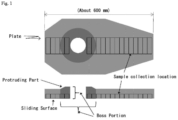
- the Weibull modulus is obtained from a three-point bending test of a sample cut out of a portion of the sliding nozzle plate other than a boss portion of the sliding nozzle plate.
- the term "boss portion” here means a part of a plate-shaped object protruding outwardly from either one of front and back surfaces thereof formed as parallel or approximately parallel planar surfaces.
- the "boss portion” in the present invention includes an area of the plate-shaped object located just below the protruding part (see FIG. 1 ).
- a sample obtained from the boss portion includes a sample partially comprised of the boss portion. That is, in FIG. 1 , each of the fourth to seventh samples corresponds to the sample obtained from the boss portion (sample cut out of the boss portion).
- the apparent porosity of the sample of the refractory product as measured after heat-treating the sample in a non-oxidizing atmosphere at 1200°C is greater than 7%, or the gas permeability is greater than 50 ⁇ 10 -17 m 2 , surface roughness and dissolved loss phenomenon due to infiltration phenomenon of slag, metal or the like become significant. Further, if the total void volume of pores having a pore diameter of 1 ⁇ m or less is less than 80% even when the apparent porosity is 7% or less, slag or metal infiltration or dissolved loss increases, i.e., the chemical damage resistance deteriorates.
- the shaping is performed using a mixture composed of inorganic raw material particles whose particle size composition is set such that it mainly consists of coarse particles and fine particles by restraining an intermediate particle size, as described in detail later, and in which a covering layer exhibiting plasticity and containing a fine powder having a particle size of 45 ⁇ m or less, and an organic resin, is formed on a surface of each of at least a part of the inorganic raw material particles having a particle size of 1 mm or more.
- a covering layer exhibiting plasticity and containing a fine powder having a particle size of 45 ⁇ m or less, and an organic resin
- the present inventers have found that it is effective to adjust the particle size composition such that, with respect to 100% by volume of a total amount of inorganic raw material particles (including metals and carbide particles) except for carbonaceous particles (except for carbon compound particles) and organic particles in a mixture to be subjected to the shaping, the ratio (Vf/Vr) of a percent by volume Vf of fine particles having a particle size of 45 ⁇ m or less in the inorganic raw material particles to a percent by volume Vr of coarse particles having a particle size of 1 mm or more in the inorganic raw material particles is 1.0 to 1.6, and the sum (Vf +Vr) of the percent by volume Vf and the percent by volume Vr is 50% by volume to 80% by volume.
- the ratio (Vf/Vr) is less than 1.0, a coverage on the coarse particles is reduced, so that a frictional force during the shaping increase, resulting in failing to obtain desired denseness.
- the ratio (Vf/Vr) is greater than 1.6, due to an excessive amount of fine particles, a contact area and a friction force among the fine particles becomes large increases during the shaping, resulting in failing to obtain desired denseness, and in deterioration of quality in terms of corrosion-erosion resistance and thermal shock resistance.
- the sum (Vf +Vr) of the percents by volume is less than 50%, intermediate particles will increase. In this case, the friction force also increases during the shaping, resulting in failing to obtain desired denseness.
- a commonly-used refractory product is indented to be formed as a refractory product having both excellent thermal shock resistance and excellent corrosion-erosion resistance, by mixing several types of inorganic raw material particles different in chemical component or mineral phase, wherein the raw materials are appropriately mixed within a particle size distribution from a coarse particle fraction (about 1 mm or more) to a fine particle fraction (submicron range), e.g., within a continuous distribution.
- a coarse particle fraction about 1 mm or more
- fine particle fraction submicron range
- component segregation and particle size segregation quite often occur within the microstructure of a refractory product, resulting in significant deterioration in the properties of the refractory product.
- a covering layer comprising a fine powder having a particle size of 45 ⁇ m or less together with an organic resin is formed on a part or an entirety of the surfaces of the inorganic raw material particles having a particle size of 1 mm or more in the aforementioned particle size composition, whereby the shapability is extremely improved, thereby providing a dense and homogeneous microstructure with few defects.
- the Weibull modulus is used as an index of homogeneity, it also has an aspect of an evaluation criterion of the resistance to fracture.
- the refractory product is formed as a sliding nozzle plate, an average strength ratio derived from dividing an average strength of a boss portion of the sliding nozzle plate by an average strength of a portion of the sliding nozzle plate other than the boss portion can be used as an evaluation criterion of the resistance to edge dissolved loss and edge chipping which are known as damage forms of the boss portion.
- the average strength ratio as the evaluation criterion of the resistance to the edge dissolved loss and the edge chipping is set to 0.9 or more, which is greater than the average strength ratio of a conventional refractory product, and closer to 1.
- the refractory product of the present invention has a variation of, i.e., a distribution width of strength level, depending on locations of a shaped body due to the shape of the shaped body, which is less than that of the conventional refractory body. This shows that the mixture used for the present invention can more easily flow during the shaping, to allow a resulting shaped body to be more easily homogenized, as compared to a mixture used for the conventional refractory product.
- the effect of the present invention regarding the homogeneity is produced by the flow property of the mixture.
- this effect can be obtained even if there are differences in size among a plurality of sliding nozzle plates, in dimensions among different locations of a sliding nozzle plate, etc.
- the above means make it possible to provide a refractory product which is resistant to chemical damage and physical damage, beyond the properties of a refractory product subjected to the pitch or the like-impregnation treatment.
- the present invention provides a refractory product which is formed as a sliding nozzle plate (SNP), which has durability equal to or better than that of a refractory product subjected to a pitch or the like-impregnation treatment, without generating any harmful volatile matter, and has higher corrosion-erosion resistance and thermal shock resistance as compared to the refractory product subjected to the pitch or the like-impregnation treatment.
- SNP sliding nozzle plate
- a production process of the refractory product of the present invention does not include the pitch or the like-impregnation treatment.
- the present invention makes it possible to shorten a required time for production, and suppress a rise in production cost.
- FIG. 1 is a diagram showing an example of the shape of a sliding nozzle plate, and an example of a collection location of samples to be cut out of the sliding nozzle plate to obtain bending strength and the Weibull modulus based on the bending strength (the sample collection location is the entire region extending from a long side to a short side of a sliding surface of the sliding nozzle plate).
- a mixture to be subjected to shaping contains, with respect to 100% by mass of the entire chemical components of the mixture: one selected from the chemical components consisting of Al 2 O 3 , SiO 2 , MgO and ZrO 2 in an amount of 84% by mass to 97% by mass, or two or more selected from the chemical components consisting of Al 2 O 3 , SiO 2 , MgO, ZrO 2 , Cr 2 O 3 and CaO, or one or more compounds or solid solutions of the two or more chemical components, in a total amount of 84% by mass to 97% by mass; one or more carbide components selected from SiC and B 4 C in a total amount of less than 4% by mass; one or more selected from the group consisting of Al, Si and Mg as metals in a total amount of 1% by mass to less than 7% by mass; and a carbon component in an amount of 1% by mass to less than 4% by mass.
- the one or more carbide components selected from SiC and B 4 C have a function of suppressing mainly oxidation of the refractory product.
- the one or more selected from the group consisting of Al, Si and Mg as metals have a function of increasing the strength of the refractory product after heat treatment, and suppressing mainly oxidation of the refractory product.
- Inorganic raw material particles usable in the present invention may be selected from commonly-used raw materials, such as Al 2 O 3 -based (including corundum, mullite, and sillimanite groups), Al 2 O 3 -MgO, ZrO 2 , Al 2 O 3 -ZrO 2 , ZrO 2 -2 Al 2 O 3 ⁇ SiO 2 , ZrO 2 -CaO, SiO 2 -based, SiC and B 4 C raw materials, each containing one or more minerals comprised of the one or the two or more selected from the above-mentioned chemical components, or one or more compounds or solid solutions of the two or more chemical components.
- the oxide particles are added to mainly give corrosion-erosion resistance and thermal shock resistance.
- a refractory raw material for the corrosion-erosion resistance may be appropriately selected from components such as Al 2 O 3 -based, Al 2 O 3 -MgO, MgO and ZrO 2 raw materials, depending on steel type.
- an Al 2 O 3 -based raw material which is a neutral oxide-based material is selected.
- special steels containing basic inclusions such as calcium-treated steel, high-manganese steel and high-oxygen steel, it is preferable to use a basic Al 2 O 3 -MgO or MgO raw material.
- a thermal shock resistance property improvement of durability can be expected by selecting a raw material having a hysteresis as a thermal expansion property or a raw material exhibiting a low expansion property, such as an Al 2 O 3 -ZrO 2 raw material, a ZrO 2 -2 Al 2 O 3 ⁇ SiO 2 raw material, or an unstabilized ZrO 2 raw material.
- a raw material having a hysteresis as a thermal expansion property or a raw material exhibiting a low expansion property
- a raw material exhibiting a low expansion property such as an Al 2 O 3 -ZrO 2 raw material, a ZrO 2 -2 Al 2 O 3 ⁇ SiO 2 raw material, or an unstabilized ZrO 2 raw material.
- a similar improvement can be expected, irrespective of whether it is brown alumina, white alumina, or calcined alumina, and irrespective of whether it is a fused raw material or a sintered raw material. This is also applied to mineral components or
- the ratio (Vf/Vr) of a percent by volume Vf of the total amount of a part of the inorganic raw material particles having a particle size of 45 ⁇ m or less to a percent by volume Vr of the total amount of a part of the inorganic raw material particles having a particle size of 1 mm or more is set in the range of 1.0 to 1.6, and the sum (Vf +Vr) of the percent by volume Vf and the percent by volume Vr is set in the range of 50% by volume to 80% by volume.
- the volume of each of a plurality of raw materials is calculated by dividing the mass of the raw material derived from a mixing ratio table (mass ratio) by the density of the raw material, and, with respect to 100% by volume of the total volume of the raw materials, a percent by volume of an oversize fraction of each of the raw materials and a percent by volume of an undersize fraction of each of the raw materials, as measured after subjecting each of the raw materials to sieving with a 45 ⁇ m-mesh sieve, are defined as Vr and Vf, respectively.
- the density of each of the raw materials is measured by a constant volume expansion method.
- SiC and/or B 4 C are added to improve mainly oxidation resistance of a material.
- these raw materials oxidizes by itself to undergo volume expansion to reduce a pore size and increase gas-flow resistance, thereby suppressing oxidation of the material.
- the amount of addition thereof is preferably set to less than 4% by mass in total. If one or more of them are added in an amount of 4% by mass or more, the corrosion-erosion resistance is likely to deteriorate.
- the carbon component in the present invention is mainly composed of a carbon component derived from an organic resin having a high carbonization yield, such as phenol resin, pitch or the like, or furan resin, but may be composed of a carbon fine powder, such as a graphite fine powder, an amorphous graphite powder or a carbon black powder.
- the organic resin is added for the purpose of improving plasticity of the mixture during the shaping, and for formation of a carbonaceous bond by heat treatment, and development of strength by reaction with active metals.
- the carbon fine powder is supplementarily added to improve shapability as a solid lubricating filler with respect to the organic resin, and to suppress defects in the carbonaceous bond.
- an active metal such as Al, Si, or Mg in the form of a simple metal or an alloy thereof.
- Al can be used by itself.
- Al in a case where a shaped body is subjected to heat treatment at 800°C or more in a production stage, it is preferable to use Al in combination with Si to suppress slaking of aluminum carbide.
- the total content of the active metal component is set in the range of 1% by mass to less than 7% by mass. If the total content is less than 1% by mass, a sufficient effect cannot be expected, and if the total content is equal to or greater than 7% by mass, the thermal shock resistance deteriorates, resulting in increased physical damage.
- a microstructure comprising a resin part and a fine powder incorporating the fine particle fraction of the inorganic raw material particles is formed to uniformly cover all around coarse particles of the inorganic raw material particles, so that it becomes possible to reduce a frictional force among the coarse particles in the shaping step and obtain a dense microstructure in which the raw material particles lie close to each other, and to obtain a homogeneous refractory microstructure in which component segregation or particle size segregation is less likely to occur.
- the carbon component containing resin-derived carbon is contained in an amount of 1% by mass to less than 4% by mass. If the content is less than 1% by mass, it becomes difficult to obtain a sufficient bond part, and if the content is equal to or greater than 4% by mass, roughening and degradation of the microstructure is more likely to occur due to elution of the carbon content into molten steel, oxidation of the carbon content, etc., leading to deterioration in durability.
- the aforementioned technique is used to maximize shapability and form a shaped body in which the inorganic raw material particles lie as close as possible in the shaping step, thereby reducing the apparent porosity of a just-burned product to 7% or less.
- the apparent porosity is greater than 7%, surface roughness due to infiltration phenomenon of slag, metal or the like becomes significant. Further, even when the apparent porosity is equal to or less than 7%, the total void volume of pores having a pore diameter of 1 ⁇ m or less is important. Specifically, it has been found that the total void volume of pores having a pore diameter of 1 ⁇ m or less needs to be 80% or more of the integrated void volume of pores of the entire refractory product. It has been confirmed that if the total void volume of pores having a pore diameter of 1 ⁇ m or less is less than 80%, the chemical damage resistance deteriorates due to increases in slag and metal infiltration, and dissolved loss.
- a mixture having a particle size distribution in the aforementioned range is divided into a coarse particle size fraction (particle size of 1 mm or more), an intermediate particle size fraction (particle size of greater than 45 ⁇ m to less than 1 mm), a fine particle size fraction (particle size of 45 ⁇ m or less), and a binder (organic resin), and each of the divided parts is subjected to weighting.
- the coarse particle size fraction and the intermediate particle size fraction of the inorganic raw material particles After putting all of the coarse particle size fraction and the intermediate particle size fraction of the inorganic raw material particles into a commonly-used mixer such as a pan-type mixer, an Eirich mixer, a planetary mixer, or a high-speed mixer, about 50 to 80% of the entire binder is added thereto, and the resulting mixture will be kneaded for a given time. Lastly, the remaining binder and all of the fine particle size fraction are added, and the resulting mixture is kneaded such that the coarse, intermediate and fine particle size fractions of the inorganic raw material particles and the organic resin become a homogeneous mixture. The mixture is kneaded for a given time until it is densified, and a volatile matter content reaches a level required for shaping.
- a commonly-used mixer such as a pan-type mixer, an Eirich mixer, a planetary mixer, or a high-speed mixer.
- an organic resin having high carbonization yield such as phenol resin, pitch or the like, and furan resin.
- Any form of organic resin can be used, such as liquid form, liquid + powder form, or powder form, as long as it enables a binder effect, fixing of the fine powder layer, and densification.
- the amount of addition of the organic resin is in the range of 0.5 to 10% by mass, preferably in the range of 1 to 5% by mass, with respect to and in addition to 100% by mass of the raw material mixture.
- the kneaded mixture obtained in the above manner is formed into a given shape using a normally-employed press machine such as an oil press or friction press.
- a kneading duration necessary to allow the mixture to be densified while a volatile matter content reaches a level required for shaping may be appropriately optimized depending on various conditions in a kneading machine, a shaping machine, a kneading step, a shaping step, etc.
- a resulting shaped body is subjected to curing and drying at a temperature of 100 to 300°C, and then subjected to burning in a non-oxidizing atmosphere at 500 to 1400°C, preferably 850 to 1300°C.
- Experimental Example A is an example in which each of the apparent porosity, the percent of the total void volume of pores having a pore diameter of 1 ⁇ m or less and the gas permeability was changed to check an influence on the thermal shock resistance, the surface roughness, the corrosion-erosion resistance, etc..
- a raw material for the refractory product in Experimental Example A comprises: a primary component consisting of the most common Al 2 O 3 -based artificial particles composed of corundum; Al 2 O 3 -ZrO 2 based particles, a SiC powder, a B 4 C powder and a metal A1 powder, wherein a mixture to be subjected to shaping was adjusted such that the ratio (Vf/Vr) derived by the aforementioned method was set in the range of 1.0 to 1.6, and the sum (Vf + Vr) derived by the aforementioned method was set in the range of 50 to 80% by volume, and wherein these values became approximately the same in each sample.
- Pig iron was melted in a high-frequency induction furnace, and kept at 1600°C. Then, a 40-mm square prism-shaped sample (which is equivalent to a sample of the refractory product, wherein the sample has been subjected to heat treatment in a non-oxidizing atmosphere at 1200°C. The same is also applied to the following description) was immersed in the molted pig iron for 3 minutes and then subjected to air cooling. After repeating the above process five times, a surface state of the sample was observed. As a result, when almost no crack was observed, when a crack was observed on the surface, and when a crack developed to cause peel-off, the sample was evaluated as ⁇ (Excellent), ⁇ (Good) and ⁇ (NG), respectively.
- Two 20 ⁇ 20 ⁇ 40 mm samples were heated to a temperature equal to or higher than a melting point of synthetic slag in which CaO/Al 2 O 3 is 2, and fused together under pressure to prepare a test piece for a compression shear test. A shearing force was applied to the fused part to cause breaking. As a result, when the matrix of one of the samples was peeled off, the sample was evaluated as ⁇ (NG), and when peel-off occurred at a slag interface and a matrix microstructure was kept healthy, the sample was evaluated as ⁇ .
- NG ⁇
- molten iron and FeO as a corrosive/erosive agent were put in a crucible lined by a sample, and the corrosion-erosion resistance was evaluated by a corrosion-erosion rate.
- the corrosion-erosion rate is 5 ⁇ m/min
- the corrosion-erosion rate is greater than 5 to less than 10 ⁇ m/min
- the corrosion-erosion rate is equal to or greater than 10 ⁇ m/min
- the sample was evaluated as ⁇ (Excellent), ⁇ (Good) and ⁇ (NG), respectively.
- molten iron and CaOas a corrosive/erosive agent were put in a crucible lined by a sample, and the corrosion-erosion resistance was evaluated by a corrosion-erosion rate.
- the corrosion-erosion rate is 5 ⁇ m/min
- the corrosion-erosion rate is greater than 5 to less than 10 ⁇ m/min
- the corrosion-erosion rate is equal to or greater than 10 ⁇ m/min
- the sample was evaluated as ⁇ (Excellent), ⁇ (Good) and ⁇ (NG), respectively.
- the apparent porosity, the percent of the total void volume of pores having a pore diameter of 1 ⁇ m or less (pore size distribution) , the gas permeability and the Weibull modulus were derived, respectively, by: JIS R 2205: 1992 (Testing method for apparent porosity, water absorption specific gravity of refractory bricks ); JIS R 1655: 2003 (Test methods for pore size distribution of fine ceramic green body by mercury porosimetry ); JIS R 2115: 2008 (Testing method for permeability to gases of refractory products ): and JIS R 1625: 2010 (Weibull statistics of strength data for fine ceramics ), using a refractory sample having a sample shape of 18 ⁇ 18 ⁇ 80 mm, subjected to heat treatment in a non-oxidizing atmosphere at 1200°C. The n number for deriving the Weibull modulus of a sample cut out of a portion of the SNP other than a boss portion of the SNP was set to 15 or more
- a covered state of particles having a particle size of 1 mm or more was determined by microscopic observation.
- Table 1 shows that it is also possible to obtain a Weibull modulus of 15 or more, and obtain high homogeneity. In Comparative Examples each failing to satisfy all the requirements (1), (2) and (3), the Weibull modulus was less than 15.
- Experimental Example B is an example in which each of the apparent porosity and the percent of the total void volume of pores having a pore diameter of 1 ⁇ m or less the parameters was changed to check an influence on the thermal shock resistance, the surface roughness, the corrosion-erosion resistance, etc.
- Table 2 shows that in conjunction with a change in the ratio (Vf/Vr), each of the apparent porosity, the percent of the total void volume of pores having a pore diameter of 1 ⁇ m or less and the gas permeability also changes.
- the ratio (Vf/Vr) is 1.0 to 1.6 was comprehensively evaluated as Acceptable (evaluated as ⁇ (Excellent) or ⁇ (Good) in terms of all the thermal shock resistance, the surface roughness, the corrosion-erosion resistance (to FeO), and the corrosion-erosion resistance (to CaO)), or had a result superior to Comparative Example 5 (Table 1) which is a refractory product subjected to the pitch or the like-impregnation treatment.
- Experimental Example C is an example in which each of the apparent porosity and the gas permeability was changed to check an influence on the thermal shock resistance, the surface roughness, the corrosion-erosion resistance, etc.
- Table 3 shows that in conjunction with a change in the sum (Vf + Vr), the gas permeability also changes.
- Each of Inventive Examples satisfying that the sum (Vf + Vr) is 50% by volume to 80% by volume was comprehensively evaluated as Acceptable (evaluated as ⁇ (Excellent) or ⁇ (Good) in terms of all the thermal shock resistance, the surface roughness, the corrosion-erosion resistance (to FeO), and the corrosion-erosion resistance (to CaO)), or had a result superior to Comparative Example 5 (Table 1) which is a refractory product subjected to the pitch or the like-impregnation treatment.
- Experimental Example D is an example in which chemical components of a refractory product, i.e., a composition constituting the refractory product, were changed to check an influence on the thermal shock resistance, the surface roughness, the corrosion-erosion resistance, etc.
- Example in Experimental Example D was obtained by adjusting a mixing rate of each raw material (including resin) such that a composition of a sample of the refractory product becomes equal to the composition as described in Table 4 as measured after after heat-treating the sample in a non-oxidizing atmosphere at 1200°C.
- the total amount of SiC and B 4 C was set to a percent obtained by adding a percent to be reduced by heat treatment, and the total amount of Al, Si and Mg is set to a percent obtained by adding a percent to be reduced by heat treatment, to each component as a metal.
- each of SiC and B 4 C has a function of adjusting oxidation resistance and strength of a refractory product mainly in a high-temperature region, they were handled as one raw material (total amount). Further, since each of Al, Si and Mg as metals has a function of adjusting oxidation resistance and strength of a refractory product mainly from a low-temperature region, they were handled as one raw material (total amount).
- the remnant thereof mainly comprised oxide raw material particles such as Al 2 O 3 raw material particles (main mineral: corundum), and ZrO2-containing Al 2 O 3 -based raw material particles.
- the amount of C (carbon) as shown in Table 4 includes a carbonaceous substrate such as a particle, and resin, i.e., binder-derived C (carbon) (this is also applied to Table 1 to 3).
- the composition and type of molten steel, the type and content of inclusions in molten steel, or the like exert an influence on damage form and durability of the refractory product.
- the most common component (mainly Al 2 O 3 -based raw material) was used as a main component.
- various raw materials inclosing one selected from the chemical components consisting of Al 2 O 3 , SiO 2 , MgO and ZrO 2 ; two or more selected from the chemical components consisting of Al 2 O 3 , SiO 2 , MgO, ZrO 2 , Cr 2 O 3 and CaO; and one or more compounds or solid solutions of the two or more chemical components.
Landscapes
- Engineering & Computer Science (AREA)
- Chemical & Material Sciences (AREA)
- Ceramic Engineering (AREA)
- Manufacturing & Machinery (AREA)
- Structural Engineering (AREA)
- Materials Engineering (AREA)
- Organic Chemistry (AREA)
- Mechanical Engineering (AREA)
- Nanotechnology (AREA)
- Composite Materials (AREA)
- Casting Support Devices, Ladles, And Melt Control Thereby (AREA)
- Compositions Of Oxide Ceramics (AREA)
- Porous Artificial Stone Or Porous Ceramic Products (AREA)
Claims (3)
- Ein feuerfestes Produkt, das nicht mit Teer oder Pech imprägniert ist, wobei eine Probe des feuerfesten Produkts, gemessen nach Wärmebehandlung der Probe in einer nicht oxidierenden Atmosphäre bei 1200°C, physikalische Eigenschaften bereitstellt, wobei eine scheinbare Porosität 7% oder weniger beträgt;ein Gesamthohlraumvolumen von Poren mit einem Porendurchmesser von 1 µm oder weniger 80% oder mehr eines integrierten Hohlraumvolumens der Poren der gesamten Probe des feuerfesten Produkts beträgt; undeine Gasdurchlässigkeit 50 × 10-17 m2 oder weniger beträgt,wobeidie scheinbare Porosität durch JIS R 2205: 1992 gemessen wird,das Gesamthohlraumvolumen von Poren mit einem Porendurchmesser von 1 µm oder weniger durch JIS R 1655: 2003 gemessen wird unddie Gasdurchlässigkeit durch JIS R 2115: 2008 gemessen wird,wobei eine feuerfeste Probe mit einer Probenform von 18 × 18 × 80 mm verwendet wird;wobei das feuerfeste Produkt als eine Gleitdüsenplatte gebildet ist, wobei ein Weibull-Modul (Formindex), erhalten aus einem Dreipunkt-Biegeversuch einer Probe, die aus einem Abschnitt der Gleitdüsenplatte ausgeschnitten ist, der kein Vorsprungsabschnitt der Gleitdüsenplatte ist, 15 oder mehr beträgt,wobei der Weibull-Modul durch JIS R 1625: 2010 unter Verwendung einer feuerfesten Probe mit einer Probenform von 18 × 18 × 80 mm, die einer Wärmebehandlung in einer nicht oxidierenden Atmosphäre bei 1200°C unterzogen wurde, gemessen wird;wobei in dem feuerfesten Produkt ein Gemisch, das einer Formgebung unterzogen werden soll, bezogen auf 100 Massen-% der gesamten chemischen Komponenten des Gemischs, enthält:eines, ausgewählt aus den chemischen Komponenten bestehend aus Al2O3, SiO2, MgO und ZrO2, in einer Menge von 84 Massen-% bis 97 Massen-%, oder zwei oder mehrere, ausgewählt aus den chemischen Komponenten bestehend aus Al2O3, SiO2, MgO, ZrO2, Cr2O3 und CaO, oder eine oder mehrere Verbindungen oder feste Lösungen der zwei oder mehreren chemischen Komponenten in einer Gesamtmenge von 84 Massen-% bis 97 Massen-%;eine oder mehrere Karbidkomponenten, ausgewählt aus SiC und B4C, in einer Gesamtmenge von weniger als 4 Massen-%;eine oder mehrere, ausgewählt aus der Gruppe bestehend aus Al, Si und Mg, als Metalle in einer Gesamtmenge von 1 Massen-% bis weniger als 7 Massen-%; undeine Kohlenstoffkomponente in einer Menge von 1 Massen-% bis weniger als 4 Massen-%.
- Das feuerfeste Produkt wie in Anspruch 1 beansprucht, welches durch ein Verfahren hergestellt wird, das Kneten, Formen und Wärmebehandlung umfasst, wobei:bezogen auf 100 Vol.-% einer Gesamtmenge von Ausgangsmaterialteilchen mit Ausnahme kohlenstoffhaltiger Teilchen (mit Ausnahme von Kohlenstoffverbindungsteilchen) und organischen Teilchen in einem Gemisch, das der Formgebung unterzogen werden soll (die Ausgangsmaterialteilchen werden nachstehend als "anorganische Ausgangsmaterialteilchen" bezeichnet), ein Verhältnis (Vf/Vr) eines Volumenprozentsatzes Vf einer Gesamtmenge eines Teils der anorganischen Ausgangsmaterialteilchen mit einer Teilchengröße von 45 µm oder weniger zu einem Volumenprozentsatz Vr einer Gesamtmenge eines Teils der anorganischen Rohmaterialteilchen mit einer Teilchengröße von 1 mm oder mehr 1,0 bis 1,6 beträgt und eine Summe (Vf + Vr) des Volumenprozentsatzes Vf und des Volumenprozentsatzes Vr 50 Vol.-% bis 80 Vol.-% beträgt; undeine Deckschicht, die ein feines Pulver mit einer Teilchengröße von 45 µm oder weniger zusammen mit einem organischen Harz umfasst, auf jeder Oberfläche von mindestens dem Teil der anorganischen Ausgangsmaterialteilchen mit einer Teilchengröße von 1 mm oder mehr gebildet ist,wobei der Volumenprozentsatz Vr und der Volumenprozentsatz Vf gemäß der Beschreibung gemessen werden.
- Verwendung des feuerfesten Produkts wie in einem der Ansprüche 1 oder 2 beansprucht für eine Gleitdüse, die zum Stranggießen von Stahl verwendet wird, oder eine Düse, die auf einer stromaufwärts oder stromabwärts gelegenen Seite der Gleitdüse montiert ist, um einen Durchflussweg für geschmolzenen Stahl zu bilden.
Applications Claiming Priority (2)
| Application Number | Priority Date | Filing Date | Title |
|---|---|---|---|
| JP2019223106 | 2019-12-10 | ||
| PCT/JP2020/045737 WO2021117742A1 (ja) | 2019-12-10 | 2020-12-08 | 耐火物 |
Publications (4)
| Publication Number | Publication Date |
|---|---|
| EP4074433A1 EP4074433A1 (de) | 2022-10-19 |
| EP4074433A4 EP4074433A4 (de) | 2023-04-12 |
| EP4074433C0 EP4074433C0 (de) | 2025-05-14 |
| EP4074433B1 true EP4074433B1 (de) | 2025-05-14 |
Family
ID=75267936
Family Applications (1)
| Application Number | Title | Priority Date | Filing Date |
|---|---|---|---|
| EP20898142.3A Active EP4074433B1 (de) | 2019-12-10 | 2020-12-08 | Feuerfestes produkt und dessen verwendung |
Country Status (6)
| Country | Link |
|---|---|
| US (1) | US12350737B2 (de) |
| EP (1) | EP4074433B1 (de) |
| JP (1) | JP6855646B1 (de) |
| CN (1) | CN114728852B (de) |
| BR (1) | BR112022010079A2 (de) |
| CA (1) | CA3158450C (de) |
Citations (1)
| Publication number | Priority date | Publication date | Assignee | Title |
|---|---|---|---|---|
| EP2802543B1 (de) * | 2012-01-11 | 2019-06-05 | Saint-Gobain Ceramics & Plastics, Inc. | Feuerfestes objekt |
Family Cites Families (25)
| Publication number | Priority date | Publication date | Assignee | Title |
|---|---|---|---|---|
| JPS6246951A (ja) * | 1985-08-22 | 1987-02-28 | 黒崎窯業株式会社 | スライディングノズル用プレ−ト耐火物の製造方法 |
| JPS6442766U (de) * | 1987-09-04 | 1989-03-14 | ||
| JPH05228594A (ja) * | 1992-02-21 | 1993-09-07 | Kawasaki Refract Co Ltd | アルミナ・カ−ボン質スライディングノズルプレ−ト |
| SE507705C2 (sv) * | 1994-01-28 | 1998-07-06 | Sandvik Ab | Whiskerförstärkt oxidbaserat keramiskt skär |
| JP3031192B2 (ja) * | 1995-02-01 | 2000-04-10 | 住友金属工業株式会社 | スライディングノズル用プレート耐火物 |
| JP3825162B2 (ja) | 1998-01-14 | 2006-09-20 | 東芝セラミックス株式会社 | 炭素含有スライドゲートプレー卜 |
| JP2000302534A (ja) * | 1999-04-14 | 2000-10-31 | Toray Ind Inc | セラミックブロックおよびその製造方法 |
| JP2001151558A (ja) | 1999-11-25 | 2001-06-05 | Toshiba Ceramics Co Ltd | スライドゲート用プレートの製造方法 |
| KR100726312B1 (ko) * | 2000-03-30 | 2007-06-08 | 신닛뽄세이테쯔 카부시키카이샤 | 탄소질 내화물 및 그의 제조 방법 |
| EP1178023A1 (de) * | 2000-08-04 | 2002-02-06 | Alcoa Chemie GmbH | Calciumhexaaluminat enthaltendes feuerfestes Material hoher Dichte |
| JP4768927B2 (ja) * | 2001-05-11 | 2011-09-07 | 新日本製鐵株式会社 | 打音検査物の非破壊検査方法、及び品質管理方法 |
| JP2002362969A (ja) | 2001-06-06 | 2002-12-18 | Shinagawa Refract Co Ltd | プレートれんが |
| JP4009451B2 (ja) | 2001-12-03 | 2007-11-14 | 黒崎播磨株式会社 | スライディングノズル装置用プレートれんがとその製造法 |
| JP4903114B2 (ja) | 2007-11-14 | 2012-03-28 | 株式会社リコー | 画像形成装置 |
| JP5231823B2 (ja) * | 2008-01-28 | 2013-07-10 | 日本タングステン株式会社 | 多結晶MgO焼結体及びその製造方法、並びにスパッタリング用MgOターゲット |
| AU2009229913B2 (en) * | 2008-03-25 | 2011-12-22 | Krosakiharima Corporation | Plate brick and manufacturing method therefor |
| US8889062B2 (en) * | 2009-02-17 | 2014-11-18 | Nippon Steel & Sumitomo Metal Corporation | Carbonaceous refractory and method of production of same and also blast furnace bottom or side walls |
| WO2013133222A1 (ja) * | 2012-03-05 | 2013-09-12 | Jfeスチール株式会社 | 定形耐火物およびその製造方法 |
| JP5878884B2 (ja) | 2013-03-05 | 2016-03-08 | 黒崎播磨株式会社 | 耐火物及び耐火物構造体 |
| JP6094348B2 (ja) | 2013-04-11 | 2017-03-15 | 品川リフラクトリーズ株式会社 | スライディングノズル用プレート耐火物の製造方法 |
| PL3112054T3 (pl) * | 2014-02-28 | 2020-08-24 | Krosakiharima Corporation | Element ogniotrwały do odlewów staliwnych, płyta do urządzenia dyszy przesuwnej oraz sposób wytwarzania elementu ogniotrwałego do odlewów staliwnych |
| KR20170139656A (ko) * | 2015-04-24 | 2017-12-19 | 코닝 인코포레이티드 | 결합된 지르코니아 내화물 및 이를 제조하는 방법 |
| JP6845645B2 (ja) | 2016-09-26 | 2021-03-24 | タテホ化学工業株式会社 | 酸化マグネシウム含有スピネル粉末及びその製造方法 |
| CA3037462C (en) * | 2016-09-27 | 2021-04-27 | Krosakiharima Corporation | A refractory material for sliding nozzle plate and a method for producing the same |
| JP6978404B2 (ja) | 2017-02-22 | 2021-12-08 | 黒崎播磨株式会社 | 鋼の鋳造用耐火物,及びスライディングノズル装置用のプレート |
-
2020
- 2020-12-08 EP EP20898142.3A patent/EP4074433B1/de active Active
- 2020-12-08 BR BR112022010079A patent/BR112022010079A2/pt not_active Application Discontinuation
- 2020-12-08 US US17/780,392 patent/US12350737B2/en active Active
- 2020-12-08 CN CN202080081449.9A patent/CN114728852B/zh active Active
- 2020-12-08 JP JP2020568574A patent/JP6855646B1/ja active Active
- 2020-12-08 CA CA3158450A patent/CA3158450C/en active Active
Patent Citations (1)
| Publication number | Priority date | Publication date | Assignee | Title |
|---|---|---|---|---|
| EP2802543B1 (de) * | 2012-01-11 | 2019-06-05 | Saint-Gobain Ceramics & Plastics, Inc. | Feuerfestes objekt |
Also Published As
| Publication number | Publication date |
|---|---|
| CN114728852A (zh) | 2022-07-08 |
| US20230028785A1 (en) | 2023-01-26 |
| EP4074433A1 (de) | 2022-10-19 |
| EP4074433C0 (de) | 2025-05-14 |
| CA3158450C (en) | 2024-05-28 |
| EP4074433A4 (de) | 2023-04-12 |
| CA3158450A1 (en) | 2021-06-17 |
| US12350737B2 (en) | 2025-07-08 |
| JPWO2021117742A1 (ja) | 2021-12-09 |
| BR112022010079A2 (pt) | 2022-08-30 |
| JP6855646B1 (ja) | 2021-04-07 |
| CN114728852B (zh) | 2023-06-09 |
Similar Documents
| Publication | Publication Date | Title |
|---|---|---|
| KR101722041B1 (ko) | 내화물 및 주조용 노즐 | |
| JP5016609B2 (ja) | 高耐用性スリーブれんが | |
| JP4634263B2 (ja) | マグネシアカーボンれんが | |
| KR101896642B1 (ko) | 주조용 내화물과 이를 사용한 주조용 노즐 및 슬라이딩 노즐용 플레이트 | |
| JPWO2018155030A1 (ja) | 鋼の鋳造用耐火物,及びスライディングノズル装置用のプレート | |
| JP2015193511A (ja) | 鋳造用耐火物、並びにそれを使用した鋳造用ノズル及びスライディングノズル用プレート | |
| JP2020100511A (ja) | マグネシアカーボンれんがの製造方法 | |
| EP4074433B1 (de) | Feuerfestes produkt und dessen verwendung | |
| WO2017150333A1 (ja) | 鋳造用耐火物及びスライディングノズル装置用のプレート | |
| TWI762076B (zh) | 耐火物 | |
| JP4456443B2 (ja) | ピッチ含有難付着性連続鋳造ノズル | |
| EP4450478A1 (de) | Feuerfestes produkt zur verwendung beim stranggiessen und feuerfestes produktelement | |
| JP4589151B2 (ja) | 連続鋳造用ノズルおよび連続鋳造方法 | |
| JP4533052B2 (ja) | 難付着性連続鋳造ノズル | |
| JP6744555B2 (ja) | スライディング・ゲート型プレート耐火物 | |
| JP3692387B2 (ja) | スライドゲートプレートの製造方法 | |
| JPH0747465A (ja) | ジルコニア質スライディングノズルプレート | |
| JPH0825786B2 (ja) | 連続鋳造用耐火物及びその製造方法 | |
| JP2006063251A (ja) | 有機樹脂粉末含有有機樹脂バインダー及び該有機樹脂バインダーを用いた炭素含有耐火物 | |
| JP2016185890A (ja) | 耐火物及びスライディングノズル用プレート |
Legal Events
| Date | Code | Title | Description |
|---|---|---|---|
| STAA | Information on the status of an ep patent application or granted ep patent |
Free format text: STATUS: THE INTERNATIONAL PUBLICATION HAS BEEN MADE |
|
| PUAI | Public reference made under article 153(3) epc to a published international application that has entered the european phase |
Free format text: ORIGINAL CODE: 0009012 |
|
| STAA | Information on the status of an ep patent application or granted ep patent |
Free format text: STATUS: REQUEST FOR EXAMINATION WAS MADE |
|
| 17P | Request for examination filed |
Effective date: 20220701 |
|
| AK | Designated contracting states |
Kind code of ref document: A1 Designated state(s): AL AT BE BG CH CY CZ DE DK EE ES FI FR GB GR HR HU IE IS IT LI LT LU LV MC MK MT NL NO PL PT RO RS SE SI SK SM TR |
|
| DAV | Request for validation of the european patent (deleted) | ||
| DAX | Request for extension of the european patent (deleted) | ||
| A4 | Supplementary search report drawn up and despatched |
Effective date: 20230313 |
|
| RIC1 | Information provided on ipc code assigned before grant |
Ipc: C04B 35/482 20060101ALI20230306BHEP Ipc: C04B 35/14 20060101ALI20230306BHEP Ipc: C04B 35/101 20060101ALI20230306BHEP Ipc: C04B 35/043 20060101ALI20230306BHEP Ipc: C04B 35/106 20060101ALI20230306BHEP Ipc: C04B 35/103 20060101ALI20230306BHEP Ipc: B22D 41/32 20060101ALI20230306BHEP Ipc: B22D 11/10 20060101AFI20230306BHEP |
|
| STAA | Information on the status of an ep patent application or granted ep patent |
Free format text: STATUS: EXAMINATION IS IN PROGRESS |
|
| 17Q | First examination report despatched |
Effective date: 20240524 |
|
| REG | Reference to a national code |
Ref country code: DE Ref legal event code: R079 Free format text: PREVIOUS MAIN CLASS: B22D0011100000 Ipc: B22D0041320000 Ref country code: DE Ref legal event code: R079 Ref document number: 602020051427 Country of ref document: DE Free format text: PREVIOUS MAIN CLASS: B22D0011100000 Ipc: B22D0041320000 |
|
| GRAP | Despatch of communication of intention to grant a patent |
Free format text: ORIGINAL CODE: EPIDOSNIGR1 |
|
| STAA | Information on the status of an ep patent application or granted ep patent |
Free format text: STATUS: GRANT OF PATENT IS INTENDED |
|
| RIC1 | Information provided on ipc code assigned before grant |
Ipc: C04B 35/482 20060101ALI20241211BHEP Ipc: C04B 35/14 20060101ALI20241211BHEP Ipc: C04B 35/106 20060101ALI20241211BHEP Ipc: C04B 35/103 20060101ALI20241211BHEP Ipc: C04B 35/101 20060101ALI20241211BHEP Ipc: C04B 35/043 20060101ALI20241211BHEP Ipc: B22D 41/32 20060101AFI20241211BHEP |
|
| INTG | Intention to grant announced |
Effective date: 20250107 |
|
| GRAS | Grant fee paid |
Free format text: ORIGINAL CODE: EPIDOSNIGR3 |
|
| GRAA | (expected) grant |
Free format text: ORIGINAL CODE: 0009210 |
|
| STAA | Information on the status of an ep patent application or granted ep patent |
Free format text: STATUS: THE PATENT HAS BEEN GRANTED |
|
| AK | Designated contracting states |
Kind code of ref document: B1 Designated state(s): AL AT BE BG CH CY CZ DE DK EE ES FI FR GB GR HR HU IE IS IT LI LT LU LV MC MK MT NL NO PL PT RO RS SE SI SK SM TR |
|
| REG | Reference to a national code |
Ref country code: GB Ref legal event code: FG4D |
|
| REG | Reference to a national code |
Ref country code: CH Ref legal event code: EP |
|
| REG | Reference to a national code |
Ref country code: DE Ref legal event code: R096 Ref document number: 602020051427 Country of ref document: DE |
|
| REG | Reference to a national code |
Ref country code: IE Ref legal event code: FG4D |
|
| U01 | Request for unitary effect filed |
Effective date: 20250526 |
|
| U07 | Unitary effect registered |
Designated state(s): AT BE BG DE DK EE FI FR IT LT LU LV MT NL PT RO SE SI Effective date: 20250603 |
|
| PG25 | Lapsed in a contracting state [announced via postgrant information from national office to epo] |
Ref country code: ES Free format text: LAPSE BECAUSE OF FAILURE TO SUBMIT A TRANSLATION OF THE DESCRIPTION OR TO PAY THE FEE WITHIN THE PRESCRIBED TIME-LIMIT Effective date: 20250514 |
|
| PG25 | Lapsed in a contracting state [announced via postgrant information from national office to epo] |
Ref country code: NO Free format text: LAPSE BECAUSE OF FAILURE TO SUBMIT A TRANSLATION OF THE DESCRIPTION OR TO PAY THE FEE WITHIN THE PRESCRIBED TIME-LIMIT Effective date: 20250814 Ref country code: GR Free format text: LAPSE BECAUSE OF FAILURE TO SUBMIT A TRANSLATION OF THE DESCRIPTION OR TO PAY THE FEE WITHIN THE PRESCRIBED TIME-LIMIT Effective date: 20250815 |
|
| PG25 | Lapsed in a contracting state [announced via postgrant information from national office to epo] |
Ref country code: PL Free format text: LAPSE BECAUSE OF FAILURE TO SUBMIT A TRANSLATION OF THE DESCRIPTION OR TO PAY THE FEE WITHIN THE PRESCRIBED TIME-LIMIT Effective date: 20250514 |
|
| PG25 | Lapsed in a contracting state [announced via postgrant information from national office to epo] |
Ref country code: HR Free format text: LAPSE BECAUSE OF FAILURE TO SUBMIT A TRANSLATION OF THE DESCRIPTION OR TO PAY THE FEE WITHIN THE PRESCRIBED TIME-LIMIT Effective date: 20250514 |
|
| PG25 | Lapsed in a contracting state [announced via postgrant information from national office to epo] |
Ref country code: RS Free format text: LAPSE BECAUSE OF FAILURE TO SUBMIT A TRANSLATION OF THE DESCRIPTION OR TO PAY THE FEE WITHIN THE PRESCRIBED TIME-LIMIT Effective date: 20250814 |
|
| PG25 | Lapsed in a contracting state [announced via postgrant information from national office to epo] |
Ref country code: IS Free format text: LAPSE BECAUSE OF FAILURE TO SUBMIT A TRANSLATION OF THE DESCRIPTION OR TO PAY THE FEE WITHIN THE PRESCRIBED TIME-LIMIT Effective date: 20250914 |
|
| PG25 | Lapsed in a contracting state [announced via postgrant information from national office to epo] |
Ref country code: SM Free format text: LAPSE BECAUSE OF FAILURE TO SUBMIT A TRANSLATION OF THE DESCRIPTION OR TO PAY THE FEE WITHIN THE PRESCRIBED TIME-LIMIT Effective date: 20250514 |
|
| PG25 | Lapsed in a contracting state [announced via postgrant information from national office to epo] |
Ref country code: CZ Free format text: LAPSE BECAUSE OF FAILURE TO SUBMIT A TRANSLATION OF THE DESCRIPTION OR TO PAY THE FEE WITHIN THE PRESCRIBED TIME-LIMIT Effective date: 20250514 |
|
| PG25 | Lapsed in a contracting state [announced via postgrant information from national office to epo] |
Ref country code: SK Free format text: LAPSE BECAUSE OF FAILURE TO SUBMIT A TRANSLATION OF THE DESCRIPTION OR TO PAY THE FEE WITHIN THE PRESCRIBED TIME-LIMIT Effective date: 20250514 |
|
| U20 | Renewal fee for the european patent with unitary effect paid |
Year of fee payment: 6 Effective date: 20251229 |
|
| PLBE | No opposition filed within time limit |
Free format text: ORIGINAL CODE: 0009261 |
|
| STAA | Information on the status of an ep patent application or granted ep patent |
Free format text: STATUS: NO OPPOSITION FILED WITHIN TIME LIMIT |
|
| REG | Reference to a national code |
Ref country code: CH Ref legal event code: L10 Free format text: ST27 STATUS EVENT CODE: U-0-0-L10-L00 (AS PROVIDED BY THE NATIONAL OFFICE) Effective date: 20260325 |