EP3603422B1 - Moringa-komplex zur verwendung in der behandlung von einer parodontalkrankheit - Google Patents
Moringa-komplex zur verwendung in der behandlung von einer parodontalkrankheit Download PDFInfo
- Publication number
- EP3603422B1 EP3603422B1 EP18771148.6A EP18771148A EP3603422B1 EP 3603422 B1 EP3603422 B1 EP 3603422B1 EP 18771148 A EP18771148 A EP 18771148A EP 3603422 B1 EP3603422 B1 EP 3603422B1
- Authority
- EP
- European Patent Office
- Prior art keywords
- extract
- composition
- moringa
- pomegranate
- eucommia bark
- Prior art date
- Legal status (The legal status is an assumption and is not a legal conclusion. Google has not performed a legal analysis and makes no representation as to the accuracy of the status listed.)
- Active
Links
Images


Classifications
-
- A—HUMAN NECESSITIES
- A23—FOODS OR FOODSTUFFS; TREATMENT THEREOF, NOT COVERED BY OTHER CLASSES
- A23L—FOODS, FOODSTUFFS OR NON-ALCOHOLIC BEVERAGES, NOT OTHERWISE PROVIDED FOR; PREPARATION OR TREATMENT THEREOF
- A23L33/00—Modifying nutritive qualities of foods; Dietetic products; Preparation or treatment thereof
- A23L33/10—Modifying nutritive qualities of foods; Dietetic products; Preparation or treatment thereof using additives
- A23L33/105—Plant extracts, their artificial duplicates or their derivatives
-
- A—HUMAN NECESSITIES
- A61—MEDICAL OR VETERINARY SCIENCE; HYGIENE
- A61K—PREPARATIONS FOR MEDICAL, DENTAL OR TOILETRY PURPOSES
- A61K36/00—Medicinal preparations of undetermined constitution containing material from algae, lichens, fungi or plants, or derivatives thereof, e.g. traditional herbal medicines
- A61K36/18—Magnoliophyta (angiosperms)
- A61K36/185—Magnoliopsida (dicotyledons)
- A61K36/46—Eucommiaceae (Eucommia family), e.g. hardy rubber tree
-
- A—HUMAN NECESSITIES
- A23—FOODS OR FOODSTUFFS; TREATMENT THEREOF, NOT COVERED BY OTHER CLASSES
- A23L—FOODS, FOODSTUFFS OR NON-ALCOHOLIC BEVERAGES, NOT OTHERWISE PROVIDED FOR; PREPARATION OR TREATMENT THEREOF
- A23L2/00—Non-alcoholic beverages; Dry compositions or concentrates therefor; Preparation or treatment thereof
-
- A—HUMAN NECESSITIES
- A23—FOODS OR FOODSTUFFS; TREATMENT THEREOF, NOT COVERED BY OTHER CLASSES
- A23L—FOODS, FOODSTUFFS OR NON-ALCOHOLIC BEVERAGES, NOT OTHERWISE PROVIDED FOR; PREPARATION OR TREATMENT THEREOF
- A23L2/00—Non-alcoholic beverages; Dry compositions or concentrates therefor; Preparation or treatment thereof
- A23L2/52—Adding ingredients
-
- A—HUMAN NECESSITIES
- A61—MEDICAL OR VETERINARY SCIENCE; HYGIENE
- A61K—PREPARATIONS FOR MEDICAL, DENTAL OR TOILETRY PURPOSES
- A61K31/00—Medicinal preparations containing organic active ingredients
- A61K31/33—Heterocyclic compounds
- A61K31/335—Heterocyclic compounds having oxygen as the only ring hetero atom, e.g. fungichromin
- A61K31/365—Lactones
- A61K31/366—Lactones having six-membered rings, e.g. delta-lactones
-
- A—HUMAN NECESSITIES
- A61—MEDICAL OR VETERINARY SCIENCE; HYGIENE
- A61K—PREPARATIONS FOR MEDICAL, DENTAL OR TOILETRY PURPOSES
- A61K36/00—Medicinal preparations of undetermined constitution containing material from algae, lichens, fungi or plants, or derivatives thereof, e.g. traditional herbal medicines
- A61K36/18—Magnoliophyta (angiosperms)
- A61K36/185—Magnoliopsida (dicotyledons)
-
- A—HUMAN NECESSITIES
- A61—MEDICAL OR VETERINARY SCIENCE; HYGIENE
- A61K—PREPARATIONS FOR MEDICAL, DENTAL OR TOILETRY PURPOSES
- A61K36/00—Medicinal preparations of undetermined constitution containing material from algae, lichens, fungi or plants, or derivatives thereof, e.g. traditional herbal medicines
- A61K36/18—Magnoliophyta (angiosperms)
- A61K36/185—Magnoliopsida (dicotyledons)
- A61K36/48—Fabaceae or Leguminosae (Pea or Legume family); Caesalpiniaceae; Mimosaceae; Papilionaceae
-
- A—HUMAN NECESSITIES
- A61—MEDICAL OR VETERINARY SCIENCE; HYGIENE
- A61K—PREPARATIONS FOR MEDICAL, DENTAL OR TOILETRY PURPOSES
- A61K45/00—Medicinal preparations containing active ingredients not provided for in groups A61K31/00 - A61K41/00
- A61K45/06—Mixtures of active ingredients without chemical characterisation, e.g. antiphlogistics and cardiaca
-
- A—HUMAN NECESSITIES
- A61—MEDICAL OR VETERINARY SCIENCE; HYGIENE
- A61P—SPECIFIC THERAPEUTIC ACTIVITY OF CHEMICAL COMPOUNDS OR MEDICINAL PREPARATIONS
- A61P1/00—Drugs for disorders of the alimentary tract or the digestive system
- A61P1/02—Stomatological preparations, e.g. drugs for caries, aphtae, periodontitis
-
- A—HUMAN NECESSITIES
- A23—FOODS OR FOODSTUFFS; TREATMENT THEREOF, NOT COVERED BY OTHER CLASSES
- A23V—INDEXING SCHEME RELATING TO FOODS, FOODSTUFFS OR NON-ALCOHOLIC BEVERAGES AND LACTIC OR PROPIONIC ACID BACTERIA USED IN FOODSTUFFS OR FOOD PREPARATION
- A23V2002/00—Food compositions, function of food ingredients or processes for food or foodstuffs
-
- A—HUMAN NECESSITIES
- A23—FOODS OR FOODSTUFFS; TREATMENT THEREOF, NOT COVERED BY OTHER CLASSES
- A23V—INDEXING SCHEME RELATING TO FOODS, FOODSTUFFS OR NON-ALCOHOLIC BEVERAGES AND LACTIC OR PROPIONIC ACID BACTERIA USED IN FOODSTUFFS OR FOOD PREPARATION
- A23V2200/00—Function of food ingredients
- A23V2200/30—Foods, ingredients or supplements having a functional effect on health
- A23V2200/312—Foods, ingredients or supplements having a functional effect on health having an effect on dental health
-
- A—HUMAN NECESSITIES
- A61—MEDICAL OR VETERINARY SCIENCE; HYGIENE
- A61K—PREPARATIONS FOR MEDICAL, DENTAL OR TOILETRY PURPOSES
- A61K2300/00—Mixtures or combinations of active ingredients, wherein at least one active ingredient is fully defined in groups A61K31/00 - A61K41/00
Definitions
- the present invention relates to a composition for use in preventing and improving a periodontal disease. More specifically, it relates to a composition for use in preventing and improving periodontal disease, comprising a moringa extract and a eucommia bark extract as active ingredients, wherein a weight ratio of the moringa extract and the eucommia bark extract is 2:1 to 4:1 (moringa extract: eucommia bark extract).
- Periodontal diseases are representative chronic inflammatory diseases [Williams, 1990; Williams and Paquette, 2000]. Gingivitis and the loss of alveolar bone related thereto are known [Sallay et al., 1982; Samejima et al., 1990]. Proliferation of various bacteria and inflammations caused by them are thought as primary causes [Listgarten, 1987].
- the present invention is directed to providing a composition for preventing, improving or treating a periodontal disease including gingivitis and periodontitis, which contains a natural substance as an active ingredient.
- the present invention aims at developing a food composition and a pharmaceutical composition for preventing, improving or treating a periodontal disease, which has an effect of regenerating damaged gingival tissues or directly treating alveolar bone loss beyond alleviating the symptoms of a periodontal disease.
- the present invention provides a composition for use in preventing or improving a periodontal disease, comprsing a moringa extract and a eucommia bark extract as active ingredients wherein a weight ratio of the moringa extract and the eucommia bark extract is 2: 1 to 4: 1 (moringa extract: eucommia bark extract).
- Disclosed herein - not being part of the invention - is also a method for preparing the same and a use thereof.
- a composition for use wherein the moringa extract is a moringa leaf extract and the eucommia bark extract is a eucommia bark extract.
- the present invention provides a composition for use wherein an extraction solvent of the moringa extract and the eucommia bark extract is water, a C 1 -C 4 lower alcohol or a mixture thereof.
- the present invention provides a composition for use wherein a weight ratio of the moringa extract and the eucommia bark extract is 2:1 or 4:1 (moringa extract: eucommia bark extract.
- the present invention provides a composition for use wherein an extraction solvent of the moringa leaf extract or the eucommia bark extract is water, a C 1 -C 4 alcohol or a mixture thereof.
- the present invention provides a composition for use wherein the periodontal disease is gingivitis or periodontitis.
- the present invention provides a composition for use in preventing or improving gingivitis and periodontitis, which is a food composition or a pharmaceutical composition.
- the present invention provides a composition for use which further contains one or more extract selected from a group consisting of pomegranate, balloon flower root, gardeniae fructus, scutellariae radix, lotus leaf, Chinese mulberry leaf, ginger, peony root, achyranthis radix, red clover, dandelion and dandelion root extracts as an active ingredient.
- one or more extract selected from a group consisting of pomegranate, balloon flower root, gardeniae fructus, scutellariae radix, lotus leaf, Chinese mulberry leaf, ginger, peony root, achyranthis radix, red clover, dandelion and dandelion root extracts as an active ingredient.
- the present invention provides a composition for use wherein the pomegranate extract contains 0.5-3 mg/g of ellagic acid.
- the present invention provides a composition for use wherein an extraction solvent of the balloon flower root, gardeniae fructus, scutellariae radix, lotus leaf, Chinese mulberry leaf, ginger, peony root, achyranthis radix, red clover, dandelion and dandelion root extracts is water, a C 1 -C 4 lower alcohol or a mixture thereof.
- the inventors of the present invention have investigated the efficacy of various natural substances safe for human of improving periodontal diseases. In doing so, they have identified that use of a moringa extract and a eucommia bark extract together provides a significant synergistic effect in improving periodontal diseases. Especially, an effect of regenerating damaged gingival tissues or directly treating alveolar bone loss has been identified beyond alleviating the symptoms of a periodontal diseases.
- composition for use according to the present invention contains a moringa extract and a eucommia bark extract as active ingredients.
- composition for use according to the present invention optionally contains one or more extract selected from a group consisting of pomegranate, balloon flower root, gardeniae fructus, scutellariae radix, lotus leaf, Chinese mulberry leaf, ginger, peony root, achyranthis radix, red clover, dandelion and dandelion root extracts as active ingredients.
- the pomegranate extract refers to a pomegranate concentrate.
- Moringa is a small tree native to India. But, it is cultivated throughout the world and grows wildly in the regions where the moringa is used widely.
- the family Moringaceae contains 13 species. The most widely known species is Moringa oleifera. Moringa oleifera is an umbrella-shaped shrub with a height of 4-8 meters. It has 30-70 cm long deciduous leaves. Flowers are white and fragrant and triangular, long green fruits (pods) are 30-40 cm long. It is a multipurpose tree which grows wildly in the foothills of Himalayas in northwestern India and cultivated throughout the tropics.
- Moringa Moringa oleifera
- various pharmacological activities including antihyperglycemic, anti-inflammatory and anticancer activities. It is known that phytochemicals such as vitamins, flavonoids, amino acids, etc. are abundant in the flower, root, seed, leaf and fruit of moringa as compared to other plants.
- the leaf is used for antioxidant purposes because it is rich in ⁇ -carotene, proteins, vitamin C, calcium, etc. and is reported to be effective in skin inflammations or skin wounds.
- the moringa leaf is reported to be effective in protecting the liver function, inducing the apoptosis and inhibiting the proliferation of cancer cells, or the like. Specifically, the moringa leaf is used in the present invention.
- Eucommia bark refers to the stem bark of eucommia tree ( Eucommia ulmoides Oliver (family Eucommiaceae)) with the periderm removed. It is board-shaped and the edge portions are somewhat curved inwardly. The length and width are not uniform and the thickness is 3-7 mm.
- the outer surface is light brown or gray-brown. Some have distinct wrinkle patterns or vertically split patterns and some are relatively thin. Distinct lenticels are observed when the coarse bark is unscraped.
- the inner surface is smooth and brown or dark brown and has vertical wrinkles. The surface is weak and breaks easily. When it is broken, fine, dense, silvery and elastic rubber threads appear.
- the thick rhytidome is located at the outermost side. Inside the rhytidome, several layers of cork cells are aligned regularly. The cell walls of these cells are lignified and the phelloderm lies therebelow. The phloem takes up most of the area with stone cell rings in a transverse arrangement of 5-7 rows, each ring with 3-5 stone cells. The medullary rays consist of 2-3 rows of cells, located close to the cork layer, sometimes leaning to one side. Parenchyma cells including white gutta-percha can be observed near the pith. These parenchyma cells are particularly abundant inside the phloem. Eucommia bark has been used as a representative herbal medicine for hypertension, viral infections, kidney diseases and liver diseases [Hsieh and Yen, 2000; Yaman et al., 2003; Zhao et al., 2008].
- Balloon flower root is the root of balloon flower ( Platycodon grandiflorum A. De Candolle, family Campanulaceae), with the periderm removed or unremoved. It has a thin, long fusiform or conical shape and is often branched.
- the main root is 10-15 cm in length and 1-3 cm in diameter.
- the external surface is grayish brown, pale brown or white.
- the upper end of the root has dented scars of removed stems.
- the neighborhood of the root has fine lateral wrinkles and longitudinal furrows.
- the greater part of the root, except the crown, is covered with coarse longitudinal wrinkles, lateral furrows and lenticel-like lateral lines.
- the texture is hard but easy to break.
- the transverse section is not fibrous.
- the cortex is slightly thinner than the xylem, almost white with scattered cracks.
- the xylem is white to pale brown and the tissue is slightly denser than the cortex.
- the phloem is wide, the phloem rays on the outside are bent and the phloem bundles are mostly compressed and degenerated.
- the lactiferous tubes are scattered in bundles and contain a yellow-brown granular substance. Bundles of lactiferous tubes are arranged in the inside phloem along with sieve tubes. The cambium forms a ring.
- the xylem has wide medullary rays and polygonal vessels, solitary or gathered together in a radiating arrangement.
- Gardeniae fructus is the well ripe fruit of Gardenia jasminoides Ellis (family Rubiaceae) or the fruit passed through hot water.
- gardeniae Gardenia jasminoides Ellis
- mountain gardeniae )
- Korean gardeniae Gardenia jasminoides Ellis var. grandiflora Nakai
- big gardeniae ) or aqua gardeniae ( ).
- Nomenclature of Korean Plants regards the two as the same species.
- Gardeniae is distributed in Japan, Taiwan and China and its fruit is known to have fever-alleviating, choleretic and hemostatic activities.
- Scutellariae radix is the root of Scutellaria baicalensis Georgi (family Labiatae), with or without the periderm removed.
- the conical root is twisted and curved.
- the external surface is yellow-brown to deep yellow.
- the texture is hard but brittle and easy to cut.
- the cut surface yellow and the middle part is red-brown.
- Scutellariae radix is odorless and tastes slightly bitter. It is known to have antibacterial, anti-inflammatory, hypotensive, hemostatic, liver-treating, fever-alleviating, antiemetic and diuretic activities.
- Major chemical ingredients include forsythol, sterol compounds, saponins, oleanolic acid, etc.
- Lotus leaf is the leaf of lotus ( Nelumbo nucifera ) .
- the leaf and flower of lotus emerge respectively from the long leafstalk and the long flower stalk arising from the rhizome and float on top of the water surface.
- the leaf arises from the rhizome and hangs on the tip of the leafstalk which has grown to a height of 1-2 m. It is around 40 cm in diameter and does not get wet with water.
- the veins diverge radially and the edge is flat.
- the leafstalk is thorny and the holes inside communicate with those of the subterranean stem. Because fine hairs invisible to the naked eye are densely packed on the surface of the leaf, water drops roll on the leaf and it does not get wet.
- the lotus leaf is effective in defeating heat and moisture, stopping bleeding and relieving thrombosis. Therefore, it stops diarrhea caused by heat and moisture, quenches thirst, treats dizziness by clearing the wind-heat of the head and eyes and is helpful in treating various types of hemorrhage, such as hemoptysis, nosebleed, hematuria, metrorrhagia, etc.
- the lotus leaf is also known to have antibacterial and hypotensive activities, strengthen the stomach and be helpful in beauty care and vigor.
- the leaf of Chinese mulberry ( Cudrania tricuspidata Bureau) is about 6-10 cm in length and grows in alteration from the branch.
- the leaf has a pointed or blunt oval shape.
- the edge is often divided into 2 or 3 parts and is not saw-toothed.
- the leaf of the tree growing between rocks or on hills is small and has a distinctly split edge and a long tail.
- the leaf is thick.
- the front side and the leafstalk have fine hairs.
- the back side has piles.
- the leaf turns yellow in autumn.
- Ginger ( Zingiber officinale ) is a perennial plant in the family Zingiberaceae, order Zingiberales. It is native to Southeast Asia and is cultivated as a vegetable. The rhizome grows sideways. It is fleshy, lumpy and yellow, tastes pungent and smells fragrant. A fake stem made of sheaths stands upright from each node of the rhizome. Its height reaches 30-50 cm and leaves are arranged in two rows in the upper part. The leaves growing in alternation are lancet-shaped, with small widths and long sheaths at the bottom. Flowers do not bloom in Korea.
- Peony root refers to root of peony ( Paeonia lactiflora Pallas) or other plants of the genus Paeonia (family Paeoniaceae). It is cylindrical, sometimes curved, 5-20 cm in length and 10-25 mm in diameter. The large root is cut lengthwise. The external surface is white or brown, with distinct longitudinal wrinkles, often with wrinkles or scars of lateral roots and with laterally elongated lenticels. The upper part of the root often has scars of the stem or unremoved brown cortex. The texture is hard and difficult to fracture. The transverse section is granular and very dense. Under a magnifying glass, the cambium is distinct, milky white or brown, and a radial path is observed.
- Achyranthis radix is the root of Achyranthes japonica Nakai or Achyranthes bidentata Blume (family Amaranthaceae). It is a cylindrical main root with numerous lateral roots, 5-20 cm in length and 3-5 mm in diameter, with short remains of the rhizome at the top.
- the external surface is grayish yellow to pale yellow.
- the texture is hard and brittle and the fractured surface is horn-like, yellowish white to yellowish brown.
- Red clover Trifolium pratense L
- Trifolium pratense L Trifolium pratense L
- Red clover is a perennial grass in the family Fabaceae. It has many other names including trifolium. It is native to the shores of the Mediterranean Sea and Southwest Asia and is widely distributed and cultivated throughout the world. Red clover is used as a fodder and the young leaves are often eaten as a vegetable after being slightly dipped in boiling water in spring. Red clover is known to be effective in treating cough or asthma due to its expectorant effect. It can be divided into the aerial part and the root part. Specifically, the aerial part may be used.
- Dandelion ( Taraxacum platycarpum ) is a plant belonging to the class Dicotyledoneae of the phylum Angiospermae and grows on the sunny side of the field. It has no stem and the leaves grow in clusters from the root and spread sideways.
- the leaf has a shape of an inverted lancet, is 6-15 cm in length and 1.2-5 cm in width. It has deep indentations like feather and is saw-toothed and slightly hairy at the edge.
- the root of dandelion is 7-8.5 mm in length and the pappus is 6 mm in length and is pale white.
- extract includes an extract obtained from extraction and extracts of all forms that can be obtained from the extract, including a diluted or concentrated solution of the extract, a dried product obtained by drying the extract, a crude purification product or a purification product of the extract, a mixture thereof, etc.
- the extract according to the present invention may contain, in addition to the specified part of each plant, its leaf, stem, bark, root, flower, flower bud, fruit, seed, sap and whole plant.
- the extract according to the present invention may be prepared by those of ordinary skill using any appropriate method known in the art.
- it may be prepared by solvent extraction.
- a solvent extract may be obtained by pulverizing the whole plant or any part of it (e.g., using a blender) and then treating with an extraction solvent.
- a drying process may precede the pulverization.
- the solvent extract may be prepared into a powder through an addition process such as distillation under reduced pressure, freeze-drying, spray drying, etc.
- the extraction solvent is not particularly limited any solvent known in the art may be used.
- Non-limiting examples of the extraction solvent include: water; a C 1 -C 4 lower alcohol such as methanol, ethanol, propyl alcohol, butyl alcohol, etc.; a polyhydric alcohol such as glycerin, butylene glycol, propylene glycol, etc.; a hydrocarbon-based solvent such as methyl acetate, ethyl acetate, acetone, benzene, hexane, diethyl ether, dichloromethane, etc.; or a mixture thereof.
- water or a C 1 -C 4 lower alcohol may be used either alone or in combination.
- a solvent extract may be prepared by conducting extraction one or more times using the solvent and the solvent extract may be prepared into a dried extract by conducting distillation under reduced pressure and then freeze-drying or spray-drying the same.
- the amount of the extraction solvent may vary depending on the extraction solvent used. For example, it may be used in an amount of 1-20 times or 5-20 times, more specifically 5-10 times, most specifically 5-8 times, based on the dry weight of the corresponding plant.
- the solvent extraction may be performed at a 100-150 °C and 0.1-0.3 MPa for 5-10 hours, although not being limited thereto.
- various extraction processes known in the art e.g., maceration, infusion, percolation, digestion, decoction, hot continuous extraction, aqueous-alcoholic extraction, countercurrent extraction, microwave-assisted extraction, ultrasonic extraction, supercritical fluid extraction, phytonic extraction (e.g., using a hydrofluorocarbon solvent), etc. may be used either alone or in combination.
- the red clover extract according to the present invention may contain 50-400 mg/g of isoflavones based on the total red clover extract. It is thought that the reason why the red clover extract according to the present invention may contain isoflavones of the above-described concentration is because of the difference in region, used part, preparation method (e.g., extraction solvent), etc. However, the present invention is not limited thereby.
- the eucommia bark extract according to the present invention may contain 1.0-15 mg/g of pinoresinol diglucoside based on the total eucommia bark extract. It is thought that the reason why the eucommia bark extract according to the present invention may contain pinoresinol diglucoside of the above-described concentration is because of the difference in region, used part, preparation method (e.g., extraction solvent), etc. However, the present invention is not limited thereby.
- the moringa extract according to the present invention may contain 1.2-5 mg/g of astragalin based on the total moringa extract. It is thought that the reason why the moringa extract according to the present invention may contain astragalin of the above-described concentration is because of the difference in region, used part, preparation method (e.g., extraction solvent), etc. However, the present invention is not limited thereby.
- Pomegranate Punica granatum L
- Punica granatum L is a plant native to southeastern Asia, northwestern India and California of the USA and is widely distributed in subtropical and tropical regions at present.
- pomegranate especially red pomegranate
- It is known to have good effects on prevention of hypertension and arteriosclerosis. It contains water-soluble sugars in large quantities of 38-47% and also contains various vitamins and minerals.
- the pomegranate used in the present invention may be red pomegranate, although not being specially limited thereto.
- red pomegranate from Iran, California, Taiwan, Uzbekistan, Turkey or Korea may be used.
- Turkish pomegranate cultivars include Hicaznar pomegranate cv., Cekirdeksiz VI pomegranate cv., Silifke Asisi pomegranate cv., Katirbasi pomegranate cv., Lefan pomegranate cv., etc., although not being limited thereto.
- the pomegranate extract according to the present invention may vary depending on the region, harvest time, etc. of the pomegranate.
- concentrate includes a concentrate obtained by the method described below and concentrates of all forms that can be obtained from the concentrate, including a diluted solution of the concentrate, a dried product obtained by drying the concentrate, a crude purification product or a purification product of the concentrate, a mixture thereof, etc.
- pomegranate pulp may be used to prepare the pomegranate concentrate.
- the pomegranate concentrate may be prepared as follows. For example, after washing pomegranate, the rind and seeds are completely removed. After sterilizing at high temperature in a short time, polysaccharides such as starch contained in the pomegranate are degraded by adding a starch-degrading enzyme. Then, after optionally controlling the turbidity, color, viscosity, etc. of the pomegranate concentrate by adding an additive such as gelatin, silicon dioxide, bentonite, silica sol, tannin, cellulose, potassium caseinate, etc., the pomegranate concentrate may be prepared by concentrating under heating. In addition, a filtering step may be included in between the respective steps. For example, one or more filtering step may be included between the step of removing the rind and seeds and the step of sterilizing at high temperature, between the step of treating with the starch-degrading enzyme and the concentration step or after the concentration step.
- the concentrate may be prepared through the following steps:
- a filtering step may be included between the step S1 and the step S2, between the step S3 and the step S4 or after the step S4.
- the present disclosure provides an extract using only the pomegranate pulp not containing the rind and seeds of pomegranate.
- the rind and seeds of pomegranate may cause side effects.
- pomegranate certain alkaloids contained in the rind may negatively affect the body function and poisoning may cause seizure, convulsion, stupor, etc. by affecting the respiratory system and muscles.
- the extract of pomegranate seeds may cause allergic side effects such as tongue swelling in some people.
- the pomegranate pulp is sterilized and then cooled.
- the sterilization is performed at 100-105 °C for 50-80 seconds, more specifically quickly for 55-70 seconds, and the cooling is performed specifically at 48-55 °C.
- the cooled pomegranate pulp is treated with a starch-degrading enzyme.
- the treatment may be performed specifically at 48-55 °C for 10-60 minutes, more specifically at 48-55 °C for 20-40 minutes.
- starch-degrading enzyme various starch-degrading enzymes known in the art may be used without particular limitation.
- pectinase, proteinase, amylase, cellulase, etc. may be used.
- pectinase may be used.
- the degraded pomegranate pulp is concentrated under heating sequentially at high temperature and high pressure and at low temperature and low pressure.
- it may be concentrated under heating at high temperature and high pressure for two or more times, more specifically three or more times, and may be concentrated under heating at low temperature and low pressure for one or more time, more specifically two or more times, for a total of three or more times.
- the concentration under heating at high temperature and high pressure is performed at 70-100 °C and 400-850 mbar.
- the temperature and pressure may be varied for each run of the concentration under heating without limitation.
- the concentration under heating may be performed firstly at 70-85 °C and 400-550 mbar, secondly at 85-92 °C and 550-750 mbar and thirdly at 92-100 °C and 750-850 mbar.
- the concentration under heating may be performed firstly at 78-82 °C and 450-500 mbar, secondly at 85-90 °C and 600-650 mbar and thirdly at 92-98 °C and 800-850 mbar.
- the concentration under heating at low temperature and low pressure is performed at 40-80 °C and 100-350 mbar.
- the temperature and pressure may be varied for each run of the concentration under heating without limitation. Specifically, the concentration under heating may be performed fourthly at 60-80 °C and 250-350 mbar and fifthly at 40-60 °C and 100-250 mbar. More specifically, the concentration under heating may be performed fourthly at 65-72 °C and 300-330 mbar and fifthly at 45-55 °C and 100-150 mbar.
- the pomegranate concentrate according to the present invention contains 0.5-3 mg/g of ellagic acid based on the total weight of the pomegranate concentrate. It is thought that the reason why the pomegranate concentrate according to the present invention contains ellagic acid at the high content is because of the difference in region, use of the pulp only, preparation method (e.g., concentration method, heating temperature and pressure), etc. However, the present invention is not limited thereby.
- the present invention provides a composition for use in preventing or improving a periodontal disease. More specifically, the present invention provides a composition for use in preventing or improving a periodontal disease, which contains a moringa extract and a eucommia bark extract as active ingredients.
- composition for use according to the present invention contains a moringa extract and a eucommia bark extract as active ingredients.
- composition for use according to the present invention optionally contains one or more extract selected from a group consisting of pomegranate, balloon flower root, gardeniae fructus, scutellariae radix, lotus leaf, Chinese mulberry leaf, ginger, peony root, achyranthis radix, red clover, dandelion and dandelion root extracts as an active ingredient.
- extracts selected from a group consisting of pomegranate, balloon flower root, gardeniae fructus, scutellariae radix, lotus leaf, Chinese mulberry leaf, ginger, peony root, achyranthis radix, red clover, dandelion and dandelion root extracts as an active ingredient.
- "contains as an active ingredient” means addition in an amount capable of exhibiting the effect of preventing, improving or treating a periodontal disease with the composition according to the present invention.
- various adjuvant ingredients for delivery to target cells, stabilization, etc. may be added for formulation into various forms.
- the respective ingredients may be contained at the following ratios.
- a weight ratio of the moringa extract and the eucommia bark extract may be 1:1-8:1 or 8:1-2:1 (moringa extract: eucommia bark extract). More specifically, the weight ratio of the moringa extract and the eucommia bark extract is 2:1-4:1 (moringa extract: eucommia bark extract). A superior synergistic effect is achieved within the above weight ratio ranges.
- each extract (and concentrate) of the composition may be contained in the final composition within a range of about 0.0001-90%, 0.001-90%, 0.01-90%, 0.1-90%, 0.1-90%, 0.1-80%, 0.1-70%, 0.1-60%, 0.1-50%, 0.1-40%, 0.1-30%, 0.1-20% or 0.1-10%.
- composition may contain the complex of the present invention within a range of about 0.0001%, 0.001%, 0.01%, 0.1%, 1%, 5%, 10%, 15%, 20%, 25%, 30%, 35%, 40%, 45%, 50%, 60%, 65%, 70%, 75%, 80%, 85%, 90% or 99% or higher.
- the % may be calculated as weight based on the total weight or volume based on the total volume of the composition and the concentration may be controlled depending on the desired effect of the composition or the product in which the composition is used.
- the composition may be prepared by mixing a moringa extract and a eucommia bark extract prepared by the method described above.
- it may be prepared by optionally mixing with one or more extract selected from a group consisting of pomegranate, balloon flower root, gardeniae fructus, scutellariae radix, lotus leaf, Chinese mulberry leaf, ginger, peony root, achyranthis radix, red clover, dandelion and dandelion root extracts prepared by the method described above.
- an additional process may be introduced to improve the storage, distribution and stability properties of the composition.
- composition for use according to the present invention may be prepared into various products. For example, it may be prepared into a food composition, a pharmaceutical composition, an oral product, etc.
- Disclosed herein is also a pharmaceutical composition containing one of the compositions described above.
- the present disclosure provides a method for preventing, improving or treating a periodontal disease by administering one of the compositions described above.
- the pharmaceutical composition may contain a pharmaceutically effective amount of the moringa extract and the eucommia bark extract alone and, optionally, one or more extract selected from a group consisting of pomegranate, balloon flower root, gardeniae fructus, scutellariae radix, lotus leaf, Chinese mulberry leaf, ginger, peony root, achyranthis radix, red clover, dandelion and dandelion root extracts.
- it may further contain one or more pharmaceutically acceptable carrier, excipient or diluent.
- pharmaceutically acceptable means a nontoxic composition which is physiologically acceptable and, when administered to a human, generally does not cause allergic reactions such as gastrointestinal disorder and dizziness or reactions similar thereto while not negatively affecting the action of the active ingredients.
- the carrier, excipient or diluent may include lactose, dextrose, sucrose, sorbitol, mannitol, xylitol, erythritol, maltitol, starch, acacia gum, alginate, gelatin, calcium phosphate, calcium silicate, cellulose, methyl cellulose, polyvinylpyrrolidone, water, methyl hydroxybenzoate, propyl hydroxybenzoate, talc, magnesium stearate, mineral oil, etc.
- the pharmaceutical composition may further contain a filler, an anticoagulant, a lubricant, a wetting agent, a fragrance, an emulsifier, an antiseptic, etc.
- the "pharmaceutically effective amount” refers to an amount exhibiting a desired effect as compared to a negative control group, specifically an amount sufficient to improve, prevent and/or treat a periodontal disease.
- the pharmaceutical composition may be prepared into a formulation that can provide fast, continued or delayed release of the active ingredient after being administered to a mammal using the method known in the art.
- the formulation may be a powder, a granule, a tablet, an emulsion, a syrup, an aerosol, a soft or hard gelatin capsule, a sterile injection solution or a sterilized powder.
- the pharmaceutical composition may be administered orally or parenterally although the administration route is not limited thereto.
- parenteral administration routes may include transdermal, intranasal, intraabdominal, intramuscular, subcutaneous or intravenous routes.
- the composition may be formulated as a tablet, a capsule, a cachet, a gelcap, a solution, a suspension, etc.
- the tablet or capsule may be prepared by a commonly employed method together with a pharmaceutically acceptable excipient such as a binder (e.g., pregelatinized cornstarch, polyvinylpyrrolidone or hydropxypropyl methyl cellulose), a filler (e.g., lactose, microcrystalline cellulose or calcium hydrogen phosphate), a lubricant (e.g., magnesium stearate, talc or silica), a disintegrant (e.g., potato starch or sodium starch glycolate) or a wetting agent (e.g., sodium lauryl sulfate).
- a binder e.g., pregelatinized cornstarch, polyvinylpyrrolidone or hydropxypropyl methyl cellulose
- a filler e.g., lactose, microcrystalline cellulose or calcium hydrogen phosphate
- a lubricant e.g., magnesium stearate, talc or silic
- a liquid formulation for oral administration may be a solution, a syrup or a suspension, although not being limited thereto. Before being used, it may exist as an anhydrous form to be mixed with water or another suitable vehicle.
- the liquid formulation may be prepared by a commonly employed method using a pharmaceutically acceptable additive such as a suspending agent (e.g., sorbitol syrup, cellulose derivative or hydrogenated edible fat), an emulsifier (e.g., lecithin or acacia gum), a nonaqueous vehicle (e.g., almond oil, oily ester, ethyl alcohol or fractionated vegetable oil) or an antiseptic (e.g., methyl or propyl p-hydroxybenzoate or sorbic acid).
- the formulation may contain a buffering salt, a flavor, a colorant or a sweetener as occasion demands.
- the formulation for oral administration may be prepared to provide slow, controlled or continued release of the active ingredient to treat a periodontal disease.
- a preferred administration dosage of the composition may be adequately determined by those skilled in the art although it varies depending on the condition and body weight of a patient, degree of a disease, composition type, administration route and administration period.
- the composition may be used either alone or in combination with surgery, radiation therapy, hormone therapy, chemotherapy or a method using a biological response modifier.
- the pharmaceutical composition may be administered or in combination with a compound known to have an effect of improving, preventing and/or treating a periodontal disease.
- Disclosed herein is also a food composition containing the composition.
- the present disclosure also provides a method for preventing or improving a periodontal disease by administering the composition.
- the food composition may contain a sitologically effective amount of a moringa extract and a eucommia bark extract alone or may further contain one or more sitologically acceptable carrier, excipient or diluent.
- the food composition includes all types of processed natural substances, including a food, a functional food, a nutritional supplement, a health food, a food additive, etc.
- the food composition may be prepared into various forms according to common methods known in the art.
- the type of food is not particularly limited.
- examples of the food to which the active ingredient can be added include a drink, a meat, a sausage, a bread, a biscuit, a rice cake, a chocolate, a candy, a snack, a cookie, a pizza, an instant noodle, other noodles, a gum, a dairy product including ice cream, a soup, a beverage, an alcohol beverage, a vitamin complex, a milk product, a processed milk product and common health foods.
- the complex of the moringa extract and the eucommia bark extract may be added to a food either alone or in combination with another food or a food ingredient and may be used adequately according to a common method.
- the mixing amount of the active ingredient may be determined appropriately depending on the purpose of use (for prevention or improvement). Generally, the amount of the complex in a health food may be 0.1-90 wt% based on the total weight of the food. However, the amount may be smaller when it is ingested for a long period of time for the purpose of health or hygiene. In addition, the active ingredient may be used in a larger amount than the above-described range because it has no safety problem.
- the food composition may contain, in addition to the complex of the moringa extract and the eucommia bark extract of the specified ratio as an essential ingredient, other ingredients without particular limitation. It may contain optionally one or more extract selected from a group consisting of pomegranate, balloon flower root, gardeniae fructus, scutellariae radix, lotus leaf, Chinese mulberry leaf, ginger, peony root, achyranthis radix, red clover, dandelion and dandelion root extracts and may further contain various flavors, natural carbohydrates, etc. commonly used in drinks.
- Examples of the natural carbohydrate include a sugar such as a monosaccharide, e.g., glucose, fructose, etc., a disaccharide, e.g., maltose, sucrose, etc. and a polysaccharide, e.g., dextrin, cyclodextrin, etc. and a sugar alcohol such as xylitol, sorbitol, erythritol, etc.
- a sugar such as a monosaccharide, e.g., glucose, fructose, etc.
- a disaccharide e.g., maltose, sucrose, etc.
- a polysaccharide e.g., dextrin, cyclodextrin, etc.
- a sugar alcohol such as xylitol, sorbitol, erythritol, etc.
- a natural flavor thaumatin or stevia extract (e.g., rebaudioside A, glycyrrhizin, etc.)
- a synthetic flavor sacharin, aspartame, etc.
- the food composition may contain various nutrients, vitamins, minerals (electrolytes), flavors such as synthetic flavors and natural flavors, colorants, extenders (cheese, chocolate, etc.), pectic acid and salts thereof, alginic acid and salts thereof, organic acids, protective colloidal thickeners, pH control agents, stabilizers, antiseptics, glycerin, alcohols, carbonating agents used in carbonated beverages, etc.
- it may contain a pulp for preparing a natural fruit juice, a fruit juice drink or a vegetable drink.
- the oral product is effective in preventing or improving a periodontal disease.
- the oral product may be a toothpaste, a mouth rinse, an oral spray, a gum, an ointment, a patch, etc.
- the oral product may further contain an adequate amount of a commonly used additive selected from a group consisting of an abrasive, a humectant, a binder, a foaming agent, a sweetener, an antiseptic, a remedial agent, a flavor, an acidity-controlling agent, a whitening agent, etc. depending on the type and purpose of use.
- a commonly used additive selected from a group consisting of an abrasive, a humectant, a binder, a foaming agent, a sweetener, an antiseptic, a remedial agent, a flavor, an acidity-controlling agent, a whitening agent, etc. depending on the type and purpose of use.
- the abrasive may be one or more selected from a group consisting of dicalcium phosphate, precipitated silica, calcium carbonate, hydrated alumina, kaolin, sodium bicarbonate (NaHCOs), etc.
- the humectant may be one or more selected from a group consisting of glycerin, sorbitol, non-crystalline sorbitol, propylene glycol, polyethylene glycol, xylitol, etc., although not being limited thereto.
- the binder may be one or more selected from a group consisting of carrageenan, xanthan gum, sodium carboxymethyl cellulose, carboxyvinyl polymer, sodium alginate, laponite, etc., although not being limited thereto.
- the foaming agent may include one or more selected from a group of an anionic surfactant such as sodium lauryl sulfate, sodium lauroyl sarcosinate, etc., a condensed polymer such as sorbitan fatty acid ester, polyoxyethylene hydrogenated castor oil, polyoxyethylene, polyoxyepropylene, etc., although not being limited thereto.
- the sweetener may include one or more than two selected from a group of sodium saccharin, aspartame, glycyrrhizinic acid etc., although not being limited thereto.
- the antiseptic may include one or more selected from a group of p-oxybenzoic acid ester, sodium benzoate, etc.
- the remedial agent may be sodium fluoride, sodium fluorophosphate, tin fluoride, amine fluoride, chlorhexidine, tranexamic acid, allantoin, caproic acid, polyphosphate, an enzyme, a herbal extract, etc.
- the flavor may be peppermint oil, spearmint oil, menthol, carvone, etc. mixed in appropriate ratios.
- the acidity-controlling agent may be phosphoric acid, sodium phosphate, citric acid, sodium citrate, succinic acid, sodium succinate, tartaric acid, sodium tartrate, etc. and the preferred acidity is about 5-8.
- the whitening agent may be titanic oxide, although not being limited thereto.
- composition may be provided as a kit.
- the composition is contained in a container.
- the container may include a bottle, a metal tube, a laminate tube, a plastic tube, a dispenser, a pressurized container, a barrier container, a package, a compartment, a compact container, a pan that can hold a composition, or other types of containers such as a plastic container injection- or blow-molded into a bottle, dispenser or package in which a dispersion medium or a composition is retained, although not being limited thereto.
- the kit may contain an instruction about the use of the kit or the composition. The instruction may be described in a separate paper or may be described on the surface of the container or on the surface of a packaging material of the container.
- the instruction may include a word, a phrase, an abbreviation, a picture, a symbol, etc., although not being limited thereto.
- the instruction may include instructions about how to use, apply or maintain the kit or the composition.
- the container may contain a predetermined amount of the composition.
- composition according to the present disclosure is effective in improving, preventing and/or treating a periodontal disease.
- composition according to the present disclosure has an effect of alleviating and improving the symptoms of a periodontal disease and, furthermore, directly treating damage to the gingiva and the periodontium through wound healing, anti-inflammation and inhibition of alveolar bone loss and regeneration thereof.
- the periodontal disease may be one or more disease selected from a group consisting of stomatitis, gingivitis, periodontitis, alveolar bone breakage, alveolar bone osteoporosis, alveolar bone osteomalacia, alveolar bone osteopenia, alveolar bone osteodystrophy, etc. Specifically, it may be gingivitis or periodontitis.
- the composition is safe for the human body because it contains natural substances as active ingredients. Especially, it has an effect of treating damage from gingiva and periodontium directly through wound healing, anti-inflammation and inhibition of alveolar bone loss and regeneration thereof beyond alleviating the symptoms of gingivitis and periodontitis. Accordingly, it can be usefully used as a composition for preventing, improving or treating a periodontal disease including gingivitis and periodontitis in various applications (food, medicine, quasi-drugs, etc.).
- Extracts of pomegranate, balloon flower root, gardeniae fructus, scutellariae radix, moringa, lotus leaf, Chinese mulberry leaf, ginger, peony root, achyranthis radix, eucommia bark, red clover, dandelion and dandelion root (i.e., 14 natural substances) were prepared according to the preparation process described below. For each raw material, two or more lots were prepared under the described extraction conditions and extraction yield, contents of ingredients, properties, etc. were analyzed.
- a pomegranate concentrate was prepared as follows.
- the mixture was stirred at 48-55 °C for 10 minutes. Then, after filtering through 1.5-mm and 1-mm filters under reduced pressure, the mixture was concentrated under heating (sequentially, at 80 °C and 475 mbar to 12 Brix, at 87 °C and 626 mbar to 17 Brix, at 95 °C and 847 mbar to 31 Brix, at 70 °C and 312 mbar to 43 Brix, and at 49 °C and 118 mbar to 65 Brix).
- pomegranate concentrate containing 1.8-3.0 mg/g of ellagic acid was obtained by filtering the mixture through a 0.15-mm filter.
- a concentrated pomegranate powder containing 0.5-3 mg/g of ellagic acid was prepared by mixing the pomegranate concentrate with dextrin at a ratio of 9:1 and then spray-drying the same.
- Balloon flower root, gardeniae fructus, scutellariae radix, moringa, lotus leaf, Chinese mulberry leaf, ginger, peony root, achyranthis radix, eucommia bark, dandelion and dandelion root extracts were prepared as follows.
- eucommia bark dried (roasted) eucommia bark was used.
- moringa moringa leaf was used.
- red clover extract one containing 8% isoflavone was purchased from Biosearch Life Co. Ltd. (Spain).
- the gingivitis- and periodontitis-improving effect of the concentrated pomegranate powder prepared in 1.1 and the 13 samples prepared in 1.2 was investigated for an EPD model.
- the gingivitis- and periodontitis-improving effect was evaluated using rats with ligature-induced experimental periodontitis (EPD). 24 hours after the ligature of the cervical portion, each extract dissolved in sterilized distilled water was orally administered at a dosage of 5 mL/kg (200 mg/kg) once a day for 10 days and the change in the amount of interleukin (IL)-1 ⁇ in the gingival tissue and the alveolar bone volume was observed along with histopathological changes. A group to which 5 mg/kg indomethacin (IND), which is a nonsteroidal anti-inflammatory drug (NSAID), was orally administered was used as a control group.
- IND indomethacin
- NSAID nonsteroidal anti-inflammatory drug
- Each of the concentrated pomegranate powder and the 13 extracts containing moringa leaf (balloon flower root, gardeniae fructus, scutellariae radix, moringa, lotus leaf, Chinese mulberry leaf, ginger, peony root, achyranthis radix, eucommia bark, red clover, dandelion and dandelion root) was dissolved in sterilized distilled water to a concentration of 40 mg/mL and orally administered at a dosage of 5 mL/kg (200 mg/kg) from 24 hours after the ligature of the cervical portion once a day for 10 days.
- moringa leaf balloon flower root, gardeniae fructus, scutellariae radix, moringa, lotus leaf, Chinese mulberry leaf, ginger, peony root, achyranthis radix, eucommia bark, red clover, dandelion and dandelion root
- IND dissolved in sterilized distilled water to a concentration of 1 mg/mL was orally administered at a dosage of 5 mL/kg (5 mg/kg) from 24 hours after the ligature of the cervical portion once a day for 10 days.
- a normal control group and an EPD (periodontal disease) control group only sterilized distilled water was administered instead of the natural substance extract with the same dosage and frequency.
- the gingival tissue was homogenized and subjected to measurement with the IL-1 ⁇ rat ELISA kit (Abcam, Cambridge, UK). The experiment was conducted according to the manufacturer's instructions. 100 ⁇ L of the homogenized sample and reference standard were added to each well and then incubated in a 37 °C incubator for 2 hours. After removing the supernatant and adding 100 ⁇ L of a 1x biotin-conjugated antibody to each well, incubation was conducted in a 37 °C incubator for 1 hour.
- Alveolar bone loss was measured according to the method of Crawford et al. [1987].
- the rat was sacrificed 10 days after the sample administration (11 days after EPD 11) and the teeth and the gingiva were exposed as much as possible.
- the area between the end of the gingiva and the end of the incisor between the two teeth subjected to EPD was expressed as mm/rat.
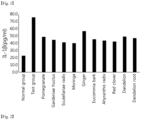
- the IL-1 ⁇ in the gingival tissue was significantly increased (p ⁇ 0.01) as compared to the normal control group.
- the groups administered with IND and moringa leaf, scutellariae radix, red clover, achyranthis radix, gardeniae fructus, eucommia bark, dandelion root, pomegranate, dandelion, ginger and balloon flower root extracts showed significantly decrease (p ⁇ 0.01) in the IL-1 ⁇ content as compared to the EPD control group, in that order.
- the groups administered with lotus leaf, Chinese mulberry leaf and peony root extracts did not show significant change in the IL-1 ⁇ content in the gingival tissue as compared to the EPD control group.
- the alveolar bone volume was significantly decreased (p ⁇ 0.01) as compared to the normal control group.
- the groups administered with IND and red clover, eucommia bark, moringa leaf, achyranthis radix and gardeniae fructus extracts showed significantly increase (p ⁇ 0.01 or p ⁇ 0.05) in the alveolar bone volume as compared to the EPD control group, in that order.
- the groups administered with pomegranate, balloon flower root, scutellariae radix, lotus leaf, Chinese mulberry leaf, ginger, peony root, dandelion and dandelion root did not show significant change in the alveolar bone volume as compared to the EPD control group.
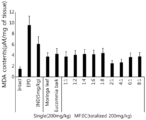
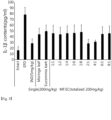
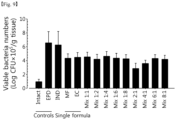
- the gingivitis- and periodontitis-improving effect was evaluated using rats with ligature-induced experimental periodontitis (EPD).
- MF moringa
- MF or EC An adequate amount of MF or EC was dissolved directly in sterilized distilled water and orally administered at a dosage of 5 mL/kg once a day for 10 days from 24 hours after ligation of the cervical portion.
- the composition of MF or EC only was dissolved in sterilized distilled water to a concentration of 40 mg/mL and orally administered at a dosage of 5 mL/kg (200 mg/kg).
- MF:EC complex compositions (1:1, 1:2, 1:4, 1:6, 1:8, 2: 1, 4:1, 6:1 and 8:1) were prepared by dissolving MF and EC (100:100, 66:134, 40:160, 28:172, 22:178, 134:66, 160:40, 172:28 and 178:22 mg:mg) in 5 mL of distilled water and orally administered at a dosage of 5 mL/kg (200 mg/kg).
- IND was dissolved in sterilized distilled water to a concentration of 1 mg/mL and orally administered at a dosage of 5 mL/kg (5 mg/kg) once a day for 10 days from 24 hours after ligation of the cervical portion.
- IND was dissolved in sterilized distilled water to a concentration of 1 mg/mL and orally administered at a dosage of 5 mL/kg (5 mg/kg) once a day for 10 days from 24 hours after ligation of the cervical portion.
- the sterilized distilled water
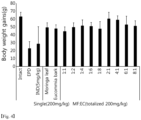
- weight gain For measurement of weight gain, the change in body weight was measured throughout the experiment period using an electronic scale. The weight gain was measured by measuring body weight on the first day of sample administration 1 day after the ligation and on the final day of sample administration 10 days later.
- Weight gain body weight on the day of scarification - body weight at the beginning of sample administration (24 hours after the ligation).
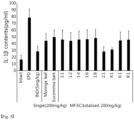
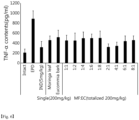
- the gingival tissue was homogenized and subjected to measurement with the IL-1 ⁇ and TNF- ⁇ rat ELISA kits (Abeam, Cambridge, UK). The experiment was conducted according to the manufacturer's instructions. 100 ⁇ L of the homogenized sample and reference standard were added to each well and then incubated in a 37 °C incubator for 2 hours. After removing the supernatant and adding 100 ⁇ L of a 1x biotin-conjugated antibody to each well, incubation was conducted in a 37 °C incubator for 1 hour.
- gingival tissue was detached from the portion adjacent to the ligated portion of the tooth and homogenized with a homogenizer by adding to a 50 mM Tris-HCl, 0.1 mM EGTA and 1 mM phenylmethylsulfonyl fluoride (pH 7.4) buffer. 200 ⁇ L of a reaction mixture (8.1% (w/v) sodium dodecyl sulfate, 1500 ⁇ L of 20% (v/v) acetic acid, 1500 ⁇ L of 0.8% (w/v) thiobarbituric acid and 700 ⁇ L of DW) was added to 100 ⁇ L of the homogenized gingival tissue. After incubation at 95 °C for 1 hour and conducting centrifugation at 3000 x g for 10 minutes, the absorbance of the supernatant was measured at 650 nm using a UV/VIS spectrophotometer.
- the number of osteoclasts was determined by staining with TRAP and counting the number of TRAP-positive multinucleated cells.
- the TRAP staining was conducted using the TRAP staining kit (Sigma-Aldrich, St. Louis, MO, USA) according to the manufacturer's instructions. Following deparaffinization and hydration, the slide was immersed in a fixative solution (25 mL of a citrate solution, 65 mL of acetone, 8 mL of 37% formaldehyde) for 30 seconds and then washed with running water for 10 minutes.
- a fixative solution 25 mL of a citrate solution, 65 mL of acetone, 8 mL of 37% formaldehyde
- Alveolar bone loss was measured according to the method of Crawford et al. [1987].
- the rat was sacrificed 10 days after the sample administration (11 days after EPD 11) and the teeth and the gingiva were exposed as much as possible.
- the area between the end of the gingiva and the end of the incisor between the two teeth subjected to EPD was expressed as mm/rat.
- the ligated left incisor was pull out and the periodontal tissue was taken and immersed in 0.3 mL of a brain heart infusion broth (BHI, Becton, Dickenson and Company, USA).
- BHI brain heart infusion broth
- the tissue was homogenized, diluted to 1:100 and 1:1000 and then inoculated to blood agar. After incubating at 37 °C for 48 hours under the condition of 5% CO 2 , the number of colonies was counted and the number of viable bacteria was calculated.
- Number of viable bacteria the number of colonies ⁇ 10 5 CFU/g tissue.
- the EPD control group showed 715.63% of change in the number of osteoclasts as compared to the normal control group.
- the groups administered with IND, MF and EC compositions alone and MF:EC 1:1, 1:2, 1:4, 1:6, 1:8, 2:1, 4:1, 6:1 and 8:1 complex compositions with a dosage of 200 mg/kg showed change of -50.19, -34.48, -43.68, -36.40, - 43.30, -41.00, -35.63, -34.87, -63.22, -57.09, -41.76 and -34.48%, respectively, as compared to the EPD control group.
Landscapes
- Health & Medical Sciences (AREA)
- Life Sciences & Earth Sciences (AREA)
- Natural Medicines & Medicinal Plants (AREA)
- Chemical & Material Sciences (AREA)
- Medicinal Chemistry (AREA)
- Engineering & Computer Science (AREA)
- Veterinary Medicine (AREA)
- Pharmacology & Pharmacy (AREA)
- Animal Behavior & Ethology (AREA)
- General Health & Medical Sciences (AREA)
- Public Health (AREA)
- Epidemiology (AREA)
- Botany (AREA)
- Mycology (AREA)
- Biotechnology (AREA)
- Medical Informatics (AREA)
- Microbiology (AREA)
- Alternative & Traditional Medicine (AREA)
- Food Science & Technology (AREA)
- Polymers & Plastics (AREA)
- Nutrition Science (AREA)
- Organic Chemistry (AREA)
- Chemical Kinetics & Catalysis (AREA)
- General Chemical & Material Sciences (AREA)
- Nuclear Medicine, Radiotherapy & Molecular Imaging (AREA)
- Bioinformatics & Cheminformatics (AREA)
- Medicines Containing Plant Substances (AREA)
- Cosmetics (AREA)
- Coloring Foods And Improving Nutritive Qualities (AREA)
Claims (9)
- Zusammensetzung zur Verwendung bei der Vorbeugung gegen eine oder Linderung einer Parodontalkrankheit, umfassend ein Moringa-Extrakt und ein Eucommia-Rinden-Extrakt als Wirkstoffe,
wobei ein Gewichtsverhältnis des Moringa-Extrakts und des Eucommia-Rinden-Extrakts zwischen 2 : 1 und 4 : 1 (Moringa-Extrakt : Eucommia-Rinden-Extrakt) liegt. - Zusammensetzung zur Verwendung nach Anspruch 1, wobei die Zusammensetzung eine Nahrungsmittelzusammensetzung oder eine pharmazeutische Zusammensetzung ist.
- Zusammensetzung zur Verwendung nach Anspruch 1 oder 2, wobei das Moringa Extrakt ein Moringa-Blatt-Extrakt ist.
- Zusammensetzung zur Verwendung nach Anspruch 1 oder 2, wobei das Moringa-Extrakt und das Eucommia-Rinden-Extrakt hergestellt werden, indem Wasser, ein niederer C1-C4-Alkohol oder eine Mischung davon als Extraktionslösungsmittel verwendet werden.
- Zusammensetzung zur Verwendung nach Anspruch 1 oder 2, wobei ein Gewichtsverhältnis des Moringa-Extrakts und des Eucommia-Rinden-Extrakts bei 2 : 1 oder 4 : 1 (Moringa-Extrakt : Eucommia-Rinden-Extrakt) liegt.
- Zusammensetzung zur Verwendung nach Anspruch 1 oder 2, wobei die Parodontalkrankheit Gingivitis oder Parodontitis ist.
- Zusammensetzung für die Anwendung nach Anspruch 1 oder 2, wobei die Zusammensetzung ferner ein oder mehrere Extrakte aus einer Gruppe bestehend aus Extrakten aus Granatapfel, Ballonblumenwurzel, Gardeniae fructus, Scutellariae-Wurzel, Lotusblättern, Blättern des Seidenraupenbaumes, Ingwer, Pfingstrosenwurzel, Achyranthis-Wurzel, Rotklee, Löwenzahn und Löwenzahnwurzel als Wirkstoff umfasst.
- Zusammensetzung zur Verwendung nach Anspruch 7, wobei das Granatapfel-Extrakt 0,5-3 mg/g Ellagsäure umfasst.
- Zusammensetzung zur Verwendung nach Anspruch 7, wobei die Extrakte aus Ballonblumenwurzel, Gardeniae fructus, Scutellariae-Wurzel, Lotusblättern, Blättern des Seidenraupenbaumes, Ingwer, Pfingstrosenwurzel, Achyranthis-Wurzel, Rotklee, Löwenzahn und Löwenzahnwurzel hergestellt werden, indem Wasser, ein niederer C1-C4-Alkohol oder eine Mischung davon als Extraktionslösungsmittel verwendet werden.
Applications Claiming Priority (2)
| Application Number | Priority Date | Filing Date | Title |
|---|---|---|---|
| KR1020170037935A KR102380781B1 (ko) | 2017-03-24 | 2017-03-24 | 모링가잎 추출물 및 두충추출 복합물의 항균, 항산화, 항염, 치주골 소실 억제 및 재생에 의한 치은염 및 치주염 개선 방법 |
| PCT/KR2018/003348 WO2018174589A1 (ko) | 2017-03-24 | 2018-03-22 | 모링가잎 추출물 및 두충추출 복합물의 항균, 항산화, 항염, 치주골 소실 억제 및 재생에 의한 치은염 및 치주염 개선 방법 |
Publications (3)
| Publication Number | Publication Date |
|---|---|
| EP3603422A1 EP3603422A1 (de) | 2020-02-05 |
| EP3603422A4 EP3603422A4 (de) | 2020-12-16 |
| EP3603422B1 true EP3603422B1 (de) | 2024-03-13 |
Family
ID=63581402
Family Applications (1)
| Application Number | Title | Priority Date | Filing Date |
|---|---|---|---|
| EP18771148.6A Active EP3603422B1 (de) | 2017-03-24 | 2018-03-22 | Moringa-komplex zur verwendung in der behandlung von einer parodontalkrankheit |
Country Status (6)
| Country | Link |
|---|---|
| US (1) | US10155019B2 (de) |
| EP (1) | EP3603422B1 (de) |
| JP (1) | JP6929954B2 (de) |
| KR (1) | KR102380781B1 (de) |
| CN (1) | CN110519997B (de) |
| WO (1) | WO2018174589A1 (de) |
Families Citing this family (8)
| Publication number | Priority date | Publication date | Assignee | Title |
|---|---|---|---|---|
| CN109602769A (zh) * | 2018-12-29 | 2019-04-12 | 南昌大学第附属医院 | 辣木叶提取物及其制备方法和应用 |
| WO2020180801A1 (en) * | 2019-03-01 | 2020-09-10 | University Of Louisville Research Foundation, Inc. | Plant-derived exosome-like nanoparticles inhibit bacterial pathogenicity |
| CN109998952A (zh) * | 2019-04-10 | 2019-07-12 | 伊春五加参药业有限责任公司 | 一种用于治疗口腔疾病的牙膏 |
| KR102236635B1 (ko) | 2019-09-04 | 2021-04-13 | 경북대학교 산학협력단 | Meox2 억제제를 유효성분으로 포함하는 발치와 골 재생 촉진용 조성물 |
| KR20210133852A (ko) * | 2020-04-29 | 2021-11-08 | 한국 한의학 연구원 | 화살나무 추출물을 유효성분으로 함유하는 골질환의 예방, 개선 또는 치료용 조성물 |
| CN113367242A (zh) * | 2021-06-10 | 2021-09-10 | 中国农业科学院草原研究所 | 一种从荨麻中提取生物碱的方法及其作为促生长类添加剂的应用 |
| CN114591402B (zh) * | 2022-04-06 | 2023-12-22 | 云南农业大学 | 一种辣木抗氧化肽及其制备方法和应用 |
| KR102735377B1 (ko) | 2024-02-28 | 2024-11-29 | 주식회사 에이바이오머티리얼즈 | 계혈등, 두충, 초피나무 유래 엑소좀을 유효성분으로 함유하는 치주질환 예방, 개선 또는 치료용 조성물 |
Family Cites Families (17)
| Publication number | Priority date | Publication date | Assignee | Title |
|---|---|---|---|---|
| KR20020086109A (ko) * | 2001-05-11 | 2002-11-18 | 김성진 | 두충 추출물을 포함하는 경조직 재생 촉진제 조성물 |
| US7524518B2 (en) * | 2001-05-11 | 2009-04-28 | Kim Sung-Jin | Composition for promoting regeneration of hard tissues comprising an extract of cortex eucommiae |
| FR2825267B1 (fr) * | 2001-05-29 | 2009-08-28 | Philippe Jean Louis Thurot | Compositions pour l'hygiene buccale ou corporelle ou la proprete ou la sante comprenant des graines ou un broyat de graines ou un extrait de graines du genre moringa |
| CA2652041A1 (en) * | 2006-05-12 | 2007-11-22 | Interleukin Genetics, Inc. | Food compositions and methods of treating periodontal disease |
| JP2008104394A (ja) * | 2006-10-25 | 2008-05-08 | Pola Chem Ind Inc | マトリックスメタロプロテアーゼ阻害用の経口投与組成物 |
| KR101121755B1 (ko) * | 2009-05-15 | 2012-03-23 | 황철수 | 치아미백용 치약 조성물 및 그 제조방법 |
| JP5881287B2 (ja) * | 2010-11-09 | 2016-03-09 | 花王株式会社 | オートインデューサー−2阻害剤 |
| KR20130071216A (ko) * | 2011-12-20 | 2013-06-28 | 주식회사 진생사이언스 | 항골다공증 활성을 나타내는 skg 추출물을 함유하는 식품첨가물 |
| US20150157553A1 (en) * | 2013-12-09 | 2015-06-11 | Kehinde A. Ayoola | Non-cariogenic, sugar-free confectionery compositions containing anti-plaque components and natural tree, plants and tea extracts for oral and systemic health benefits |
| CN104013556A (zh) * | 2014-06-25 | 2014-09-03 | 周时敏 | 一种含有辣木成分的牙膏 |
| CA2865150A1 (en) * | 2014-10-10 | 2016-04-10 | Mike Ficocelli | Bio plant science for production of multiple medications |
| CN104605150B (zh) * | 2014-12-17 | 2017-11-03 | 湖南美可达生物资源股份有限公司 | 一种复合植物提取物动物保健品及其应用 |
| CN105012183B (zh) * | 2015-07-23 | 2017-12-01 | 贵阳中医学院 | 一种杜仲牙膏及其制作方法 |
| CN105012514A (zh) | 2015-08-31 | 2015-11-04 | 许晶 | 一种治疗牙周炎的中药组合物及其制备方法 |
| CN105233176A (zh) * | 2015-11-12 | 2016-01-13 | 孙绪连 | 一种治疗牙周病的中药汤剂 |
| CN106047593A (zh) * | 2016-05-26 | 2016-10-26 | 靳登山 | 一种辣木籽保健米酒 |
| KR20170037935A (ko) | 2017-03-30 | 2017-04-05 | 김낭주 | 즉석 제조용 젓갈 보리비빔밥의 제조방법 |
-
2017
- 2017-03-24 KR KR1020170037935A patent/KR102380781B1/ko active Active
-
2018
- 2018-03-21 US US15/927,464 patent/US10155019B2/en active Active
- 2018-03-22 JP JP2019547377A patent/JP6929954B2/ja active Active
- 2018-03-22 CN CN201880020141.6A patent/CN110519997B/zh active Active
- 2018-03-22 WO PCT/KR2018/003348 patent/WO2018174589A1/ko not_active Ceased
- 2018-03-22 EP EP18771148.6A patent/EP3603422B1/de active Active
Also Published As
| Publication number | Publication date |
|---|---|
| CN110519997A (zh) | 2019-11-29 |
| KR20180108331A (ko) | 2018-10-04 |
| EP3603422A4 (de) | 2020-12-16 |
| US10155019B2 (en) | 2018-12-18 |
| WO2018174589A1 (ko) | 2018-09-27 |
| US20180271925A1 (en) | 2018-09-27 |
| KR102380781B1 (ko) | 2022-03-30 |
| CN110519997B (zh) | 2023-06-02 |
| JP2020508681A (ja) | 2020-03-26 |
| EP3603422A1 (de) | 2020-02-05 |
| JP6929954B2 (ja) | 2021-09-01 |
Similar Documents
| Publication | Publication Date | Title |
|---|---|---|
| EP3603422B1 (de) | Moringa-komplex zur verwendung in der behandlung von einer parodontalkrankheit | |
| Vijay Yogiraj et al. | Carica papaya Linn: an overview. | |
| KR20120007275A (ko) | 식물혼합추출물을 함유하는 면역증강용 조성물 | |
| KR20200106577A (ko) | 복합 식물 추출물을 포함하는 항산화, 항염증 및 붓기 완화용 조성물 | |
| KR101817055B1 (ko) | 항산화 및 면역기능 증진 활성을 갖는 덖음차 조성물 | |
| KR101292837B1 (ko) | 가래나무 추출물을 유효성분으로 함유하는 피부 주름 개선용 조성물 | |
| KR101663978B1 (ko) | 잇몸에 좋은 한방 발효 추출물을 함유하는 구강용 조성물 | |
| KR102012872B1 (ko) | 복분자, 차전자, 오미자, 구기자, 토사자 및 사상자로 이루어지는 음료용 고농축액 제조방법 및 이로부터 제조된 음료용 고농축액 | |
| KR101525877B1 (ko) | 피부 주름 개선 및 피부 노화 방지를 위한 조성물 | |
| KR101981678B1 (ko) | 모발 성장 촉진 및 두피 및 모발 개선용 복합 항산화 추출물 및 화장료 조성물 | |
| KR102323101B1 (ko) | 산수국 추출물을 포함하는 모발과 두피 상태 개선용 조성물 | |
| KR102387371B1 (ko) | 항산화 활성이 증대된 멀꿀 발효물 및 이의 용도 | |
| KR101473940B1 (ko) | 당약, 작약, 쇠뜨기 및 복숭아 복합추출물을 함유하는 탈모예방 및 두피개선용 화장료 조성물 | |
| KR102081156B1 (ko) | 산수유 추출물을 유효성분으로 포함하는 양성 전립선 비대증 예방 또는 치료용 조성물 | |
| KR20100029559A (ko) | 닥나무 물 추출물을 함유하는 면역기능 강화용 조성물 | |
| KR101988295B1 (ko) | 한약재 혼합 추출물을 유효성분으로 함유하는 피부 보습 및 주름 개선용 조성물 | |
| KR20170111769A (ko) | 송로버섯 균사체, 산뽕나무, 배초향, 장딸기 및 대추나무의 복합추출물을 포함하는 미백 또는 항산화용 조성물 | |
| Ilyina et al. | Alimentary and medicinal plants in functional nutrition | |
| KR20160081205A (ko) | 산수국 추출물을 포함하는 비만 예방 또는 개선용 조성물 | |
| Roy et al. | Herbs Used In Peptic Ulcer: A Review. | |
| KR20200142768A (ko) | 한방 추출물을 포함하는 숙취 해소용 조성물 | |
| KR20190133085A (ko) | 종대황 추출물과 산사나무 추출물을 주성분으로 하는 탈모 방지 및 모발생장 촉진용 조성물 및 이의 제조방법 | |
| Khanpara et al. | A review on medicinal activities of mulberry weed | |
| HK40012754A (en) | Method for alleviating gingivitis and periodontitis by antibiosis, antioxidation, anti-inflammation, suppression of periodontal bone loss, and regeneration of periodontal bone of complex of moringa oleifera leaf extract and eucommia ulmoides extract | |
| KR102410704B1 (ko) | 화살나무속 식물 추출물을 유효성분으로 함유하는 골질환의 예방, 개선 또는 치료용 조성물 |
Legal Events
| Date | Code | Title | Description |
|---|---|---|---|
| STAA | Information on the status of an ep patent application or granted ep patent |
Free format text: STATUS: THE INTERNATIONAL PUBLICATION HAS BEEN MADE |
|
| PUAI | Public reference made under article 153(3) epc to a published international application that has entered the european phase |
Free format text: ORIGINAL CODE: 0009012 |
|
| STAA | Information on the status of an ep patent application or granted ep patent |
Free format text: STATUS: REQUEST FOR EXAMINATION WAS MADE |
|
| 17P | Request for examination filed |
Effective date: 20191023 |
|
| AK | Designated contracting states |
Kind code of ref document: A1 Designated state(s): AL AT BE BG CH CY CZ DE DK EE ES FI FR GB GR HR HU IE IS IT LI LT LU LV MC MK MT NL NO PL PT RO RS SE SI SK SM TR |
|
| AX | Request for extension of the european patent |
Extension state: BA ME |
|
| DAV | Request for validation of the european patent (deleted) | ||
| DAX | Request for extension of the european patent (deleted) | ||
| REG | Reference to a national code |
Ref country code: DE Ref legal event code: R079 Free format text: PREVIOUS MAIN CLASS: A23L0033105000 Ipc: A61K0036480000 Ref country code: DE Ref legal event code: R079 Ref document number: 602018066602 Country of ref document: DE Free format text: PREVIOUS MAIN CLASS: A23L0033105000 Ipc: A61K0036480000 |
|
| A4 | Supplementary search report drawn up and despatched |
Effective date: 20201117 |
|
| RIC1 | Information provided on ipc code assigned before grant |
Ipc: A61K 36/48 20060101AFI20201112BHEP Ipc: A61K 31/366 20060101ALI20201112BHEP Ipc: A61P 1/02 20060101ALI20201112BHEP Ipc: A23L 33/105 20160101ALI20201112BHEP Ipc: A61K 45/06 20060101ALI20201112BHEP Ipc: A61K 36/46 20060101ALI20201112BHEP Ipc: A61K 36/185 20060101ALI20201112BHEP |
|
| STAA | Information on the status of an ep patent application or granted ep patent |
Free format text: STATUS: EXAMINATION IS IN PROGRESS |
|
| 17Q | First examination report despatched |
Effective date: 20230214 |
|
| TPAC | Observations filed by third parties |
Free format text: ORIGINAL CODE: EPIDOSNTIPA |
|
| GRAP | Despatch of communication of intention to grant a patent |
Free format text: ORIGINAL CODE: EPIDOSNIGR1 |
|
| STAA | Information on the status of an ep patent application or granted ep patent |
Free format text: STATUS: GRANT OF PATENT IS INTENDED |
|
| INTG | Intention to grant announced |
Effective date: 20231106 |
|
| RAP3 | Party data changed (applicant data changed or rights of an application transferred) |
Owner name: HLSCIENCE CO., LTD |
|
| GRAS | Grant fee paid |
Free format text: ORIGINAL CODE: EPIDOSNIGR3 |
|
| GRAA | (expected) grant |
Free format text: ORIGINAL CODE: 0009210 |
|
| STAA | Information on the status of an ep patent application or granted ep patent |
Free format text: STATUS: THE PATENT HAS BEEN GRANTED |
|
| AK | Designated contracting states |
Kind code of ref document: B1 Designated state(s): AL AT BE BG CH CY CZ DE DK EE ES FI FR GB GR HR HU IE IS IT LI LT LU LV MC MK MT NL NO PL PT RO RS SE SI SK SM TR |
|
| REG | Reference to a national code |
Ref country code: GB Ref legal event code: FG4D |
|
| REG | Reference to a national code |
Ref country code: CH Ref legal event code: EP |
|
| REG | Reference to a national code |
Ref country code: DE Ref legal event code: R096 Ref document number: 602018066602 Country of ref document: DE |
|
| P01 | Opt-out of the competence of the unified patent court (upc) registered |
Effective date: 20240226 |
|
| REG | Reference to a national code |
Ref country code: IE Ref legal event code: FG4D |
|
| PG25 | Lapsed in a contracting state [announced via postgrant information from national office to epo] |
Ref country code: LT Free format text: LAPSE BECAUSE OF FAILURE TO SUBMIT A TRANSLATION OF THE DESCRIPTION OR TO PAY THE FEE WITHIN THE PRESCRIBED TIME-LIMIT Effective date: 20240313 |
|
| REG | Reference to a national code |
Ref country code: LT Ref legal event code: MG9D |
|
| PG25 | Lapsed in a contracting state [announced via postgrant information from national office to epo] |
Ref country code: GR Free format text: LAPSE BECAUSE OF FAILURE TO SUBMIT A TRANSLATION OF THE DESCRIPTION OR TO PAY THE FEE WITHIN THE PRESCRIBED TIME-LIMIT Effective date: 20240614 |
|
| REG | Reference to a national code |
Ref country code: NL Ref legal event code: MP Effective date: 20240313 |
|
| PG25 | Lapsed in a contracting state [announced via postgrant information from national office to epo] |
Ref country code: HR Free format text: LAPSE BECAUSE OF FAILURE TO SUBMIT A TRANSLATION OF THE DESCRIPTION OR TO PAY THE FEE WITHIN THE PRESCRIBED TIME-LIMIT Effective date: 20240313 Ref country code: RS Free format text: LAPSE BECAUSE OF FAILURE TO SUBMIT A TRANSLATION OF THE DESCRIPTION OR TO PAY THE FEE WITHIN THE PRESCRIBED TIME-LIMIT Effective date: 20240613 |
|
| PG25 | Lapsed in a contracting state [announced via postgrant information from national office to epo] |
Ref country code: ES Free format text: LAPSE BECAUSE OF FAILURE TO SUBMIT A TRANSLATION OF THE DESCRIPTION OR TO PAY THE FEE WITHIN THE PRESCRIBED TIME-LIMIT Effective date: 20240313 |
|
| PG25 | Lapsed in a contracting state [announced via postgrant information from national office to epo] |
Ref country code: RS Free format text: LAPSE BECAUSE OF FAILURE TO SUBMIT A TRANSLATION OF THE DESCRIPTION OR TO PAY THE FEE WITHIN THE PRESCRIBED TIME-LIMIT Effective date: 20240613 Ref country code: NO Free format text: LAPSE BECAUSE OF FAILURE TO SUBMIT A TRANSLATION OF THE DESCRIPTION OR TO PAY THE FEE WITHIN THE PRESCRIBED TIME-LIMIT Effective date: 20240613 Ref country code: LT Free format text: LAPSE BECAUSE OF FAILURE TO SUBMIT A TRANSLATION OF THE DESCRIPTION OR TO PAY THE FEE WITHIN THE PRESCRIBED TIME-LIMIT Effective date: 20240313 Ref country code: HR Free format text: LAPSE BECAUSE OF FAILURE TO SUBMIT A TRANSLATION OF THE DESCRIPTION OR TO PAY THE FEE WITHIN THE PRESCRIBED TIME-LIMIT Effective date: 20240313 Ref country code: GR Free format text: LAPSE BECAUSE OF FAILURE TO SUBMIT A TRANSLATION OF THE DESCRIPTION OR TO PAY THE FEE WITHIN THE PRESCRIBED TIME-LIMIT Effective date: 20240614 Ref country code: FI Free format text: LAPSE BECAUSE OF FAILURE TO SUBMIT A TRANSLATION OF THE DESCRIPTION OR TO PAY THE FEE WITHIN THE PRESCRIBED TIME-LIMIT Effective date: 20240313 Ref country code: ES Free format text: LAPSE BECAUSE OF FAILURE TO SUBMIT A TRANSLATION OF THE DESCRIPTION OR TO PAY THE FEE WITHIN THE PRESCRIBED TIME-LIMIT Effective date: 20240313 Ref country code: BG Free format text: LAPSE BECAUSE OF FAILURE TO SUBMIT A TRANSLATION OF THE DESCRIPTION OR TO PAY THE FEE WITHIN THE PRESCRIBED TIME-LIMIT Effective date: 20240313 |
|
| REG | Reference to a national code |
Ref country code: AT Ref legal event code: MK05 Ref document number: 1665124 Country of ref document: AT Kind code of ref document: T Effective date: 20240313 |
|
| PG25 | Lapsed in a contracting state [announced via postgrant information from national office to epo] |
Ref country code: SE Free format text: LAPSE BECAUSE OF FAILURE TO SUBMIT A TRANSLATION OF THE DESCRIPTION OR TO PAY THE FEE WITHIN THE PRESCRIBED TIME-LIMIT Effective date: 20240313 Ref country code: LV Free format text: LAPSE BECAUSE OF FAILURE TO SUBMIT A TRANSLATION OF THE DESCRIPTION OR TO PAY THE FEE WITHIN THE PRESCRIBED TIME-LIMIT Effective date: 20240313 |
|
| PG25 | Lapsed in a contracting state [announced via postgrant information from national office to epo] |
Ref country code: NL Free format text: LAPSE BECAUSE OF FAILURE TO SUBMIT A TRANSLATION OF THE DESCRIPTION OR TO PAY THE FEE WITHIN THE PRESCRIBED TIME-LIMIT Effective date: 20240313 |
|
| PG25 | Lapsed in a contracting state [announced via postgrant information from national office to epo] |
Ref country code: NL Free format text: LAPSE BECAUSE OF FAILURE TO SUBMIT A TRANSLATION OF THE DESCRIPTION OR TO PAY THE FEE WITHIN THE PRESCRIBED TIME-LIMIT Effective date: 20240313 |
|
| PG25 | Lapsed in a contracting state [announced via postgrant information from national office to epo] |
Ref country code: IS Free format text: LAPSE BECAUSE OF FAILURE TO SUBMIT A TRANSLATION OF THE DESCRIPTION OR TO PAY THE FEE WITHIN THE PRESCRIBED TIME-LIMIT Effective date: 20240713 |
|
| PG25 | Lapsed in a contracting state [announced via postgrant information from national office to epo] |
Ref country code: PT Free format text: LAPSE BECAUSE OF FAILURE TO SUBMIT A TRANSLATION OF THE DESCRIPTION OR TO PAY THE FEE WITHIN THE PRESCRIBED TIME-LIMIT Effective date: 20240715 Ref country code: SM Free format text: LAPSE BECAUSE OF FAILURE TO SUBMIT A TRANSLATION OF THE DESCRIPTION OR TO PAY THE FEE WITHIN THE PRESCRIBED TIME-LIMIT Effective date: 20240313 |
|
| PG25 | Lapsed in a contracting state [announced via postgrant information from national office to epo] |
Ref country code: EE Free format text: LAPSE BECAUSE OF FAILURE TO SUBMIT A TRANSLATION OF THE DESCRIPTION OR TO PAY THE FEE WITHIN THE PRESCRIBED TIME-LIMIT Effective date: 20240313 Ref country code: CZ Free format text: LAPSE BECAUSE OF FAILURE TO SUBMIT A TRANSLATION OF THE DESCRIPTION OR TO PAY THE FEE WITHIN THE PRESCRIBED TIME-LIMIT Effective date: 20240313 |
|
| PG25 | Lapsed in a contracting state [announced via postgrant information from national office to epo] |
Ref country code: AT Free format text: LAPSE BECAUSE OF FAILURE TO SUBMIT A TRANSLATION OF THE DESCRIPTION OR TO PAY THE FEE WITHIN THE PRESCRIBED TIME-LIMIT Effective date: 20240313 |
|
| PG25 | Lapsed in a contracting state [announced via postgrant information from national office to epo] |
Ref country code: PL Free format text: LAPSE BECAUSE OF FAILURE TO SUBMIT A TRANSLATION OF THE DESCRIPTION OR TO PAY THE FEE WITHIN THE PRESCRIBED TIME-LIMIT Effective date: 20240313 |
|
| PG25 | Lapsed in a contracting state [announced via postgrant information from national office to epo] |
Ref country code: SK Free format text: LAPSE BECAUSE OF FAILURE TO SUBMIT A TRANSLATION OF THE DESCRIPTION OR TO PAY THE FEE WITHIN THE PRESCRIBED TIME-LIMIT Effective date: 20240313 |
|
| PG25 | Lapsed in a contracting state [announced via postgrant information from national office to epo] |
Ref country code: SM Free format text: LAPSE BECAUSE OF FAILURE TO SUBMIT A TRANSLATION OF THE DESCRIPTION OR TO PAY THE FEE WITHIN THE PRESCRIBED TIME-LIMIT Effective date: 20240313 Ref country code: SK Free format text: LAPSE BECAUSE OF FAILURE TO SUBMIT A TRANSLATION OF THE DESCRIPTION OR TO PAY THE FEE WITHIN THE PRESCRIBED TIME-LIMIT Effective date: 20240313 Ref country code: RO Free format text: LAPSE BECAUSE OF FAILURE TO SUBMIT A TRANSLATION OF THE DESCRIPTION OR TO PAY THE FEE WITHIN THE PRESCRIBED TIME-LIMIT Effective date: 20240313 Ref country code: PT Free format text: LAPSE BECAUSE OF FAILURE TO SUBMIT A TRANSLATION OF THE DESCRIPTION OR TO PAY THE FEE WITHIN THE PRESCRIBED TIME-LIMIT Effective date: 20240715 Ref country code: PL Free format text: LAPSE BECAUSE OF FAILURE TO SUBMIT A TRANSLATION OF THE DESCRIPTION OR TO PAY THE FEE WITHIN THE PRESCRIBED TIME-LIMIT Effective date: 20240313 Ref country code: IS Free format text: LAPSE BECAUSE OF FAILURE TO SUBMIT A TRANSLATION OF THE DESCRIPTION OR TO PAY THE FEE WITHIN THE PRESCRIBED TIME-LIMIT Effective date: 20240713 Ref country code: EE Free format text: LAPSE BECAUSE OF FAILURE TO SUBMIT A TRANSLATION OF THE DESCRIPTION OR TO PAY THE FEE WITHIN THE PRESCRIBED TIME-LIMIT Effective date: 20240313 Ref country code: CZ Free format text: LAPSE BECAUSE OF FAILURE TO SUBMIT A TRANSLATION OF THE DESCRIPTION OR TO PAY THE FEE WITHIN THE PRESCRIBED TIME-LIMIT Effective date: 20240313 Ref country code: AT Free format text: LAPSE BECAUSE OF FAILURE TO SUBMIT A TRANSLATION OF THE DESCRIPTION OR TO PAY THE FEE WITHIN THE PRESCRIBED TIME-LIMIT Effective date: 20240313 |
|
| REG | Reference to a national code |
Ref country code: CH Ref legal event code: PL |
|
| PG25 | Lapsed in a contracting state [announced via postgrant information from national office to epo] |
Ref country code: LU Free format text: LAPSE BECAUSE OF NON-PAYMENT OF DUE FEES Effective date: 20240322 |
|
| PG25 | Lapsed in a contracting state [announced via postgrant information from national office to epo] |
Ref country code: LU Free format text: LAPSE BECAUSE OF NON-PAYMENT OF DUE FEES Effective date: 20240322 |
|
| PG25 | Lapsed in a contracting state [announced via postgrant information from national office to epo] |
Ref country code: IT Free format text: LAPSE BECAUSE OF FAILURE TO SUBMIT A TRANSLATION OF THE DESCRIPTION OR TO PAY THE FEE WITHIN THE PRESCRIBED TIME-LIMIT Effective date: 20240313 |
|
| REG | Reference to a national code |
Ref country code: DE Ref legal event code: R097 Ref document number: 602018066602 Country of ref document: DE Ref country code: BE Ref legal event code: MM Effective date: 20240331 |
|
| PG25 | Lapsed in a contracting state [announced via postgrant information from national office to epo] |
Ref country code: IT Free format text: LAPSE BECAUSE OF FAILURE TO SUBMIT A TRANSLATION OF THE DESCRIPTION OR TO PAY THE FEE WITHIN THE PRESCRIBED TIME-LIMIT Effective date: 20240313 |
|
| PG25 | Lapsed in a contracting state [announced via postgrant information from national office to epo] |
Ref country code: MC Free format text: LAPSE BECAUSE OF FAILURE TO SUBMIT A TRANSLATION OF THE DESCRIPTION OR TO PAY THE FEE WITHIN THE PRESCRIBED TIME-LIMIT Effective date: 20240313 |
|
| PG25 | Lapsed in a contracting state [announced via postgrant information from national office to epo] |
Ref country code: DK Free format text: LAPSE BECAUSE OF FAILURE TO SUBMIT A TRANSLATION OF THE DESCRIPTION OR TO PAY THE FEE WITHIN THE PRESCRIBED TIME-LIMIT Effective date: 20240313 |
|
| PG25 | Lapsed in a contracting state [announced via postgrant information from national office to epo] |
Ref country code: BE Free format text: LAPSE BECAUSE OF NON-PAYMENT OF DUE FEES Effective date: 20240331 |
|
| PLBE | No opposition filed within time limit |
Free format text: ORIGINAL CODE: 0009261 |
|
| STAA | Information on the status of an ep patent application or granted ep patent |
Free format text: STATUS: NO OPPOSITION FILED WITHIN TIME LIMIT |
|
| PG25 | Lapsed in a contracting state [announced via postgrant information from national office to epo] |
Ref country code: IE Free format text: LAPSE BECAUSE OF NON-PAYMENT OF DUE FEES Effective date: 20240322 |
|
| PG25 | Lapsed in a contracting state [announced via postgrant information from national office to epo] |
Ref country code: MC Free format text: LAPSE BECAUSE OF FAILURE TO SUBMIT A TRANSLATION OF THE DESCRIPTION OR TO PAY THE FEE WITHIN THE PRESCRIBED TIME-LIMIT Effective date: 20240313 Ref country code: IE Free format text: LAPSE BECAUSE OF NON-PAYMENT OF DUE FEES Effective date: 20240322 Ref country code: DK Free format text: LAPSE BECAUSE OF FAILURE TO SUBMIT A TRANSLATION OF THE DESCRIPTION OR TO PAY THE FEE WITHIN THE PRESCRIBED TIME-LIMIT Effective date: 20240313 Ref country code: BE Free format text: LAPSE BECAUSE OF NON-PAYMENT OF DUE FEES Effective date: 20240331 Ref country code: CH Free format text: LAPSE BECAUSE OF NON-PAYMENT OF DUE FEES Effective date: 20240331 |
|
| 26N | No opposition filed |
Effective date: 20241216 |
|
| PGFP | Annual fee paid to national office [announced via postgrant information from national office to epo] |
Ref country code: DE Payment date: 20250224 Year of fee payment: 8 |
|
| PG25 | Lapsed in a contracting state [announced via postgrant information from national office to epo] |
Ref country code: SI Free format text: LAPSE BECAUSE OF FAILURE TO SUBMIT A TRANSLATION OF THE DESCRIPTION OR TO PAY THE FEE WITHIN THE PRESCRIBED TIME-LIMIT Effective date: 20240313 |
|
| PGFP | Annual fee paid to national office [announced via postgrant information from national office to epo] |
Ref country code: FR Payment date: 20250128 Year of fee payment: 8 |
|
| PGFP | Annual fee paid to national office [announced via postgrant information from national office to epo] |
Ref country code: GB Payment date: 20250128 Year of fee payment: 8 |
|
| PG25 | Lapsed in a contracting state [announced via postgrant information from national office to epo] |
Ref country code: CY Free format text: LAPSE BECAUSE OF FAILURE TO SUBMIT A TRANSLATION OF THE DESCRIPTION OR TO PAY THE FEE WITHIN THE PRESCRIBED TIME-LIMIT; INVALID AB INITIO Effective date: 20180322 |
|
| PG25 | Lapsed in a contracting state [announced via postgrant information from national office to epo] |
Ref country code: HU Free format text: LAPSE BECAUSE OF FAILURE TO SUBMIT A TRANSLATION OF THE DESCRIPTION OR TO PAY THE FEE WITHIN THE PRESCRIBED TIME-LIMIT; INVALID AB INITIO Effective date: 20180322 |