EP3553190A2 - Entphosphorungsflussmittel und verfahren zur herstellung davon - Google Patents
Entphosphorungsflussmittel und verfahren zur herstellung davon Download PDFInfo
- Publication number
- EP3553190A2 EP3553190A2 EP17881160.0A EP17881160A EP3553190A2 EP 3553190 A2 EP3553190 A2 EP 3553190A2 EP 17881160 A EP17881160 A EP 17881160A EP 3553190 A2 EP3553190 A2 EP 3553190A2
- Authority
- EP
- European Patent Office
- Prior art keywords
- caf
- nahco
- dephosphorization
- dephosphorizing
- flux
- Prior art date
- Legal status (The legal status is an assumption and is not a legal conclusion. Google has not performed a legal analysis and makes no representation as to the accuracy of the status listed.)
- Granted
Links
Images
Classifications
-
- C—CHEMISTRY; METALLURGY
- C21—METALLURGY OF IRON
- C21C—PROCESSING OF PIG-IRON, e.g. REFINING, MANUFACTURE OF WROUGHT-IRON OR STEEL; TREATMENT IN MOLTEN STATE OF FERROUS ALLOYS
- C21C7/00—Treating molten ferrous alloys, e.g. steel, not covered by groups C21C1/00 - C21C5/00
- C21C7/0037—Treating molten ferrous alloys, e.g. steel, not covered by groups C21C1/00 - C21C5/00 by injecting powdered material
-
- C—CHEMISTRY; METALLURGY
- C21—METALLURGY OF IRON
- C21C—PROCESSING OF PIG-IRON, e.g. REFINING, MANUFACTURE OF WROUGHT-IRON OR STEEL; TREATMENT IN MOLTEN STATE OF FERROUS ALLOYS
- C21C7/00—Treating molten ferrous alloys, e.g. steel, not covered by groups C21C1/00 - C21C5/00
- C21C7/04—Removing impurities by adding a treating agent
- C21C7/064—Dephosphorising; Desulfurising
-
- C—CHEMISTRY; METALLURGY
- C21—METALLURGY OF IRON
- C21C—PROCESSING OF PIG-IRON, e.g. REFINING, MANUFACTURE OF WROUGHT-IRON OR STEEL; TREATMENT IN MOLTEN STATE OF FERROUS ALLOYS
- C21C7/00—Treating molten ferrous alloys, e.g. steel, not covered by groups C21C1/00 - C21C5/00
- C21C7/04—Removing impurities by adding a treating agent
- C21C7/064—Dephosphorising; Desulfurising
- C21C7/0645—Agents used for dephosphorising or desulfurising
-
- C—CHEMISTRY; METALLURGY
- C21—METALLURGY OF IRON
- C21C—PROCESSING OF PIG-IRON, e.g. REFINING, MANUFACTURE OF WROUGHT-IRON OR STEEL; TREATMENT IN MOLTEN STATE OF FERROUS ALLOYS
- C21C7/00—Treating molten ferrous alloys, e.g. steel, not covered by groups C21C1/00 - C21C5/00
- C21C7/04—Removing impurities by adding a treating agent
- C21C7/076—Use of slags or fluxes as treating agents
-
- C—CHEMISTRY; METALLURGY
- C22—METALLURGY; FERROUS OR NON-FERROUS ALLOYS; TREATMENT OF ALLOYS OR NON-FERROUS METALS
- C22C—ALLOYS
- C22C33/00—Making ferrous alloys
- C22C33/04—Making ferrous alloys by melting
-
- C—CHEMISTRY; METALLURGY
- C22—METALLURGY; FERROUS OR NON-FERROUS ALLOYS; TREATMENT OF ALLOYS OR NON-FERROUS METALS
- C22C—ALLOYS
- C22C38/00—Ferrous alloys, e.g. steel alloys
- C22C38/04—Ferrous alloys, e.g. steel alloys containing manganese
-
- Y—GENERAL TAGGING OF NEW TECHNOLOGICAL DEVELOPMENTS; GENERAL TAGGING OF CROSS-SECTIONAL TECHNOLOGIES SPANNING OVER SEVERAL SECTIONS OF THE IPC; TECHNICAL SUBJECTS COVERED BY FORMER USPC CROSS-REFERENCE ART COLLECTIONS [XRACs] AND DIGESTS
- Y02—TECHNOLOGIES OR APPLICATIONS FOR MITIGATION OR ADAPTATION AGAINST CLIMATE CHANGE
- Y02P—CLIMATE CHANGE MITIGATION TECHNOLOGIES IN THE PRODUCTION OR PROCESSING OF GOODS
- Y02P10/00—Technologies related to metal processing
- Y02P10/20—Recycling
Definitions
- the present disclosure herein relates to a dephosphorizing flux and a method for preparing the same, and more particularly, to a dephosphorizing flux which is capable of improving the dephosphorization efficiency for ferro-manganese and a method for preparing the same.
- Ferro-manganese used as a ferro alloy for steel is being used to adjust a manganese component in general carbon steel, and used by adding ferro-manganese according to the content of manganese (Mn).
- Mn manganese
- C carbon
- P phosphorous
- the representative Mn-alloy element for increasing the Mn content of steel products are Mn metals containing a very high Mn content of at least 99%, and FeMn products containing 15-30 wt% of Fe.
- the content of carbon (C) contained in FeMn is lowered to the range of 0.5-7 wt% through a dephosphorization process for reducing carbon (C) by blowing oxygen in a dephosphorization refining furnace.
- the carbon (C) content may be controlled to be further lowered, if necessary.
- the content thereof may be controlled by a method of minimizing nitrogen mixing in a process of producing FeMn, and thus, there is no serious problem.
- the dephosphorization technology for lowering the phosphorous (P) content in FeMn includes a method of using FeMn slag. This method is a production method using slag generated together with high-carbon FeMn that is produced in an electric furnace for producing FeMn.
- This method is a production method using slag generated together with high-carbon FeMn that is produced in an electric furnace for producing FeMn.
- phosphorous (P) is mostly distributed toward high-carbon FeMn due to high affinity of phosphorous (P) to Mn, there is a characteristic in that phosphorous is contained in a very small content in the electric furnace slag.
- FeMn is produced by reducing Mn oxides contained in the slag produced in the electric furnace, and the method has a merit in that FeMn with a very low content of carbon (C) may be produced with a very low content of phosphorous (P).
- SiMn or Al that contains silicon (Si), which is a reducing agent for reducing slag, should be produced or procured, a large scale furnace body should be operated in which the slag produced in the electric furnace are to be warmed and temperature controlled, and a production process such as a process for inducing reaction of the slag and the reducing agent is complicated and require a very long time, and thus, there is a very adverse effect in the aspects of productivity and cost management.
- a dephosphorization technique for directly removing phosphorous (P) from a high-carbon molten steel produced in an electric furnace.
- Representative technology is a method for dephosphorizing high-carbon FeMn through KR agitation and dephosphorizing flux powder blowing methods using a BaCO 3 -based flux.
- the technique for adjusting the ratio of BaCO 3 -BaO has a problem in that a process becomes complicated because a process stage should be undergone in which calcinations reaction of BaCO 3 is induced and BaO should be generated in order to prepare the dephosphorizing flux.
- BaO should be produced or procured, but there is a problem in that the production of BaO is difficult in itself, and it is also not easy to store BAO due to a strong hydration reaction.
- NaF has both functions for a flux and for improving the dephosphorization efficiency, but is designated as a harmful chemical substance.
- various safety devices and environmental pollution prevention facilities are being required.
- NaF is expensive due to production characteristics, there is a problem of causing a burden of an increase in production cost.
- the present disclosure herein provides a dephosphorizing flux capable of improving a dephosphorization efficiency for ferro-manganese and a method for preparing the same.
- the present disclosure herein also provides a dephosphorizing flux capable of lowering the melting point of slag and securing fluidity and a method for preparing the same.
- the present disclosure herein also provides a dephosphorizing flux capable of preventing the occurrence of plugging of a lower blowing nozzle that is provided under a converter, in which dephosphorization is performed, and that blows a gas, and a method for preparing the same.
- the present disclosure herein also provides a dephosphorizing flux that has a few environment polluting element and is capable of reducing production costs and a method for preparing the same.
- a dephosphorizing flux configured to adjust a phosphorous component contained in molten steel, the dephosphorizing flux including a main material including BaCO 3 and a supplementary material, wherein the supplementary material includes a first material containing either of NaHCO 3 or Na 2 CO 3 and a second material containing CaF 2 .
- the first material may include NaHCO 3 such that the content ratio (CaF 2 wt%/NaHCO 3 wt%) of the second material to the first material is greater than 0 and not greater than 2.3.
- the first material may include NaHCO 3 such that the content ratio (CaF 2 wt%/NaHCO 3 wt%) of the second material to the first material is greater than 0 and not greater than 1.4.
- the first material may include NaHCO 3 such that the content ratio (CaF 2 wt%/NaHCO 3 wt%) of the second material to the first material is 0.5 to 1 inclusive.
- the first material may include Na 2 CO 3 such that the content ratio (CaF 2 wt%/Na 2 CO 3 wt%) of the second material to the first material is greater than 0 and not greater than 4.
- the first material may include Na 2 CO 3 such that the content ratio (CaF 2 wt%/Na 2 CO 3 wt%) of the second material to the first material is 0.7 to 2 inclusive.
- the supplementary material may be greater than 0 wt% and not greater than 30 wt% with respect to the total of the dephosphorizing flux.
- the supplementary material may be greater than 0 wt% and not greater than 20 wt% with respect to the total of the dephosphorizing flux.
- the second material may be at least 2 wt% with respect to the total of the supplementary material.
- a method for preparing a dephosphorizing flux configured to adjust a phosphorous component contained in molten steel, the method including: preparing BaCO 3 which is a main material; preparing a supplementary material comprising a first material comprising either of NaHCO 3 or Na 2 CO 3 and a second material comprising CaF 2 ; and mixing the main material and the supplementary material.
- the content ratio (CaF 2 wt%/NaHCO 3 wt%) of the second material to the first material may be configured to be greater than 0 and not greater than 2.3.
- the content ratio (CaF 2 wt%/NaHCO 3 wt%) of the second material to the first material may be configured to be greater than 0 and not greater than 1.4.
- the content ratio (CaF 2 wt%/NaHCO 3 wt%) of the second material to the first material may be configured to be 0.5 to 1 inclusive.
- the content ratio (CaF 2 wt%/Na 2 CO 3 wt%) of the second material to the first material may be configured to be greater than 0 and not greater than 4.
- the content ratio (CaF 2 wt%/Na 2 CO 3 wt%) of the second material to the first material may be configured to be 0.7 to 2 inclusive.
- the supplementary material may be added to be at most 30 wt% with respect to the total of the dephosphorizing flux.
- the supplementary material may be added to be at most 20 wt% with respect to the total of the dephosphorizing flux.
- the second material may be added to be at least 2 wt% with respect to the total of the supplementary material.
- the plugging of a lower blowing nozzle that blows a carrier gas during dephosphorization may be prevented while improving a dephosphorization ratio.
- environment polluting substances are not used as in conventional arts, environment pollution risk may be reduced, and the cost burden due to the facility for pollution prevention and harmful substance management may be alleviated.
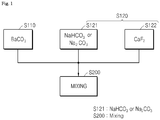
- FIG. 1 is a flowchart showing a method for preparing a dephosphorizing flux in accordance with an exemplary embodiment.
- the present disclosure herein provides a dephosphorizing flux used for lowering the content of phosphorous (P) in a ferro-manganese (FeMn) molten steel and a method for producing the same. More specifically, the present disclosure herein provides a dephosphorizing flux which is capable of lowering the melting point of a dephosphorizing flux and slag and improving the dephosphorization efficiency of the ferro-manganese while securing fluidity, has a few environment-polluting elements, and is capable of reducing production costs, and a method for producing the same.
- the present disclosure provides a dephosphorizing flux with which dephosphorization is performed with regard to a high-carbon ferro-manganese (FeMn) molten steel having a carbon content of 5-7 wt%, and a method for producing the same.
- FeMn ferro-manganese
- the present disclosure herein also provides a dephosphorizing flux which has a dephosphorization ratio due to the dephosphorizing flux is at least 30% and is capable of causing no-plugging of a lower blowing nozzle or preventing the occurrence of plugging of the lower blowing nozzle, and a method for producing the same.
- the dephosphorizing flux in accordance with an exemplary embodiment includes at least any one among BaCo3, NaHCO 3 or Na 2 CO 3 , which is a highly alkaline material, and CaF 2 .
- the dephosphorizing flux including BaCO 3 which is a highly alkaline material is added into a ferro-manganese molten steel
- phosphorous (P) in the ferro-manganese and oxygen react to form a phosphate (P 2 O 5 )
- the phosphate (P 2 O 5 ) is collected by the highly alkaline material and transits into a stable phase.
- a highly alkaline oxide is used for the dephosphorizing flux, since the oxide should be present in a liquid phase sate in order to promote a reaction with the phosphate (P 2 O 5 ), a flux is used for lowering the melting point of slag.
- the dephosphorizing flux in accordance with an exemplary embodiment is configured to contain, with respect to the total wt% (100 wt%) of the dephosphorizing flux, at least 70 wt% of a main material and at most 30 wt% of supplementary materials. More favorably, at least 80 wt% of main material and at most 20 wt% of supplementary materials are configured to be contained.
- the main material may be BaCO 3
- the supplementary materials include at least any one of NaHCO 3 or Na 2 CO 3 , and CaF 2 .
- FIG. 1 is a flowchart showing a method for preparing a dephosphorizing flux in accordance with an exemplary embodiment.
- FIG. 1 a method for preparing a dephosphorizing flux in accordance with an exemplary embodiment will be described.
- a method for preparing a dephosphorizing flux in accordance with an exemplary embodiment includes: preparing BaCO 3 , which is a main material (S110); preparing supplementary materials (S120); and mixing the main material and the supplementary materials (S200).
- the preparing of the supplementary materials (120) includes preparing a first material and a second material (S121 and S122).
- the first material includes either of NaHCO 3 or Na 2 CO 3
- the second material includes CaF 2 .
- NaHCO 3 or Na 2 CO 3 functions as a flux for lowering the melting points of the dephosphorizing flux and slag.
- CaF 2 functions as an additive for improving the dephosphorization efficiency.
- the supplementary materials are added so as to be at most 30 wt%, more favorably, at most 20 wt% with respect to the total of the dephosphorizing flux.
- the supplementary materials exceed 30 wt%, there is a problem in that the highly alkaline effect due to the use of BaCO 3 is reduced, and the dephosphorization ratio decreases.
- the supplementary material is a mixture of the first material and the second material, and NaHCO 3 or Na 2 CO 3 are used as the first material and CaF 2 is used as the second material. That is, the supplementary material in accordance with an exemplary embodiment may be configured to include, for example, NaHCO 3 and CaF 2 or to include Na 2 CO 3 and CaF 2 .
- the dephosphorizing flux in accordance with an exemplary embodiment may be configured to include, for example, NaHCO 3 and CaF 2 or to include Na 2 CO 3 and CaF 2 .
- reaction formula 1 When adding a powder-state dephosphorizing flux including NaHCO 3 is added into molten steel, a reaction such as the following reaction formula 1 from a low temperature of 60°C and a large quantity of H 2 O and CO 2 are generated simultaneously with blowing. Due to this gas, there is an effect of improving agitating capability of the molten steel, and thus, an additional effect of increasing dephosphorization efficiency may be exhibited.
- Na 2 CO 3 is a material having a low melting point of 851°C, and functions as a flux that lowers the melting point of generated dephosphorization slag.
- the supplementary material may include Na 2 CO 3 as the first material, and CaF 2 as the second material.
- the supplementary material may include Na 2 CO 3 as the first material, and CaF 2 as the second material.
- the dephosphorization ratio may be improved by at least 30%.
- the melting points of the dephosphorizing flux and the slag may be lowered and a high fluidity may thereby be maintained, a reaction efficiency with molten steel is high, and since being provided under a converter, the plugging of lower blowing nozzle that blows a carrier gas may be prevented.
- the dephosphorization ratio may further be improved by appropriately adjusting the weight ratio of the second material to the first material.
- the weight ratio (that is, CaF 2 wt%/NaHCO 3 wt%) of the second material (CaF 2 ) to the first material (NaHCO 3 ) is adjusted to be greater than 0 and not greater than 2.3.
- the weight ratio (that is, CaF 2 wt%/NaHCO 3 wt%) of the second material (CaF 2 ) to the first material (NaHCO 3 ) is adjusted to be greater than approximately 0 and not greater than 1.4, or more favorably, to be 0.5 to 1 inclusive.
- the weight ratio (that is, CaF 2 wt%/NaHCO 3 wt%) of the second material (CaF 2 ) to the first material (NaHCO 3 ) may be adjusted by adjusting the adding amount of the first material, or adjusting the adding amount of the second material.
- the second material (CaF 2 ) in order to improve the dephosphorization efficiency, it is effective to add the second material (CaF 2 ) to be at least 2 wt% with respect to the total of the supplementary material. That is, there is a tendency that a higher dephosphorization ratio is exhibited when the weight ratio (that is, CaF 2 wt%/NaHCO 3 wt%) of the second material (CaF 2 ) to the first material (NaHCO 3 ) is greater than 0 and not greater than 2.3, than that when the second material (CaF 2 ) is at least 2 wt%, and thus, it is more effective tat the second material (CaF 2 ) is added to be at least 2 wt% with respect to the total of the supplementary material.
- the second material (CaF 2 ) when the second material (CaF 2 ) is less than 2 wt%, there is a method of increasing the content of the first material (NaHCO 3 ) in order to adjust the weight ratio (that is, CaF 2 wt%/NaHCO 3 wt%) of the second material (CaF 2 ) to the first material (NaHCO 3 ) to be at most 2.3.
- the dephosphorization ratio is relatively low than that when the second material (CaF 2 ) is at least 2 wt% and the weight ratio (that is, CaF 2 wt%/NaHCO 3 wt%) of the second material (CaF 2 ) is adjusted to be at most 2.3.
- the weight ratio (that is, CaF 2 wt%/NaHCO 3 wt%) of the second material (CaF 2 ) to the first material (NaHCO 3 ) to be at most 2.3, favorably greater than 0 and not greater than 1.4, and more favorably, 0.5 to 1 inclusive.
- the weight ratio (that is, CaF 2 wt%/Na 2 CO 3 wt%) of the second material (CaF 2 ) to the first material (Na 2 CO 3 ) is favorably adjusted to greater than 0 and not greater than 4, and more favorably adjusted to be 0.7 to 2 inclusive.
- the weight ratio (that is, CaF 2 wt%/Na 2 CO 3 wt%) of the second material (CaF 2 ) to the first material (Na 2 CO 3 ) may be adjusted by adjusting the adding amount of the first material, or adjusting the adding amount of the second material.
- the second material (CaF 2 ) is added to be at least 2 wt% with respect to the total of the supplementary material. That is, there is a tendency that a higher dephosphorization ratio is exhibited when the weight ratio (that is, CaF 2 wt%/Na 2 CO 3 wt%) of the second material (CaF 2 ) to the first material (NaHCO 3 ) is at most 4 than that when the second material (CaF 2 ) is less than 2 wt%, and thus, it is effective tat the second material (CaF 2 ) is added to be at least 2 wt% with respect to the total of the supplementary material.
- the second material (CaF 2 ) when the second material (CaF 2 ) is less than 2 wt%, there is a method of increasing the content of the first material (Na 2 CO 3 ) in order to adjust the weight ratio (that is, CaF 2 wt%/Na 2 CO 3 wt%) of the second material (CaF 2 ) to the first material (Na 2 CO 3 ) to be at most 4.
- the dephosphorization ratio is relatively low than that when the second material (CaF 2 ) is at least 2 wt% and the weight ratio (that is, CaF 2 wt%/Na 2 CO 3 wt%) of the second material (CaF 2 ) is adjusted to be at most 4.
- the weight ratio (that is, CaF 2 wt%/Na 2 CO 3 wt%) of the second material (CaF 2 ) to the first material (Na 2 CO 3 ) to be greater than 0 and not greater than 4, and more favorably, 0.7 to 2 inclusive.
- Table 1 shows the composition of the dephosphorizing fluxes in accordance with first to sixth comparative examples
- Table 3 shows the dephosphorization ratio when using the dephosphorizing fluxes in accordance with the first to sixth comparative examples and shows whether a lower blowing nozzle provided under a converter is plugged.
- Table 2 shows the composition of the dephosphorizing fluxes in accordance with first to ninth examples
- Table 4 shows the dephosphorization ratio when using the dephosphorizing fluxes in accordance with the first to ninth examples and shows whether a lower blowing nozzle provided under a converter is plugged.
- the first comparative example is a dephosphorizing flux (BaCO 3 100 wt%) which includes only BaCO 3 , does not include NaHCO 3 or Na 2 CO 3 , and does not include CaF 2 .
- the second comparative example is a dephosphorizing flux which includes BaCO 3 and 10 wt% of NaHCO 3 , and does not include CaF 2 .
- the third and fourth comparative examples are dephosphorizing fluxes which include BaCO 3 and Na 2 CO 3 , the third comparative example contains 10 wt% of Na 2 CO 3 , and the fourth example contains 20 wt% of Na 2 CO 3 .
- the fifth and sixth comparative examples are dephosphorizing fluxes which include BaCO 3 and CaF 2 , and do not include NaHCO 3 or Na 2 CO 3 .
- the content of CaF 2 are different in the fifth and sixth comparative examples
- the dephosphorizing fluxes in accordance with the first to ninth comparative examples each include BaCO 3 as the main material, NaHCO 3 or Na 2 CO 3 as the first material for the supplementary material, and CaF 2 as the second material.
- the dephosphorizing fluxes in accordance with the first to fifth comparative examples each include BaCO 3 , NaHCO 3 , and CaF 2 , and each have different composition contents of respective components.
- the dephosphorizing fluxes in accordance with the sixth to ninth comparative examples each include BaCO 3 , Na 2 CO 3 , and CaF 2 , and each have different composition contents of respective components.
- the BaCO 3 content is the remaining content excluding the supplementary material with respect to total dephosphorizing flux of 100 wt%.
- dephosphorization was performed with respect to high-carbon ferro-manganese molten steel containing 5-7 wt% of carbon.
- the dephosphorization method was performed such that a lance was immersed in the ferro-manganese molten steel, and then while blowing a carrier gas through a lower blowing nozzle provided under a converter, a dephosphorizing flux was blown into the molten steel.
- the same unit of the flux of 140 kg/ton was blown, and the final temperature when completing the blowing of the dephosphorizing flux and completing a dephosphorization process were managed to be the same, that is, to be at most 1,310°C.
- the dephosphorizing fluxes in accordance with the first to sixth examples and ninth examples have higher dephosphorization ratio than the first comparative example. This is resulted in the example, by an effect of lowering the melting point due to NaHCo3 or Na 2 CO 3 , an effect of securing fluidity and improving agitating efficiency, and an effect of improving dephosphorization ratio due to CaF 2 . Meanwhile, in case of the first comparative example, since the dephosphorizing flux includes only BaCO 3 , which is highly alkaline substance and contains a large quantity of BaCO 3 , the melting points of the dephosphorizing flux and slag are raised, and thus, the fluidity is lowered. Therefore, the dephosphorization ratio is lower than those in the first to sixth examples and ninth examples.
- the dephosphorization ratios in the first to fifth examples are 1.9 times higher than that in the second comparative example. More specifically, the dephosphorization ratio in the fifth example is 1.9 times higher than that in the first comparative example, and the dephosphorization ratios in the first to fourth examples are 2 times higher, and among these, those in the second and third examples are at least 2.5 times higher.
- the dephosphorization ratio in the second comparative example is higher than that in the third comparative example including 10 wt% of Na 2 CO 3 , and is similar to that in the fourth comparative example including 20 wt% of Na 2 CO 3 , but is lower than those of the dephosphorizing fluxes in accordance with the first to ninth examples. This is because the second comparative example does not include CaF 2 that directly affects the dephosphorization ratio.
- the dephosphorization ratio in the sixth to ninth examples are approximately 1.4 times higher than those in the third and fourth comparative examples. This is because the third and fourth comparative examples do not include CaF 2 , but the sixth to ninth examples include CaF 2 aside from Na 2 CO 3 .
- the dephosphorizing fluxes (the third and fourth comparative examples) in which only Na 2 CO 3 is added as the supplementary material functions as a flux in the initial dephosphorization stage, lowers the melting point of the dephosphorizing flux and maintains a molten state, but as the dephosphorization operation is performed, a phenomenon occurs in which the function as the flux may not be performed while Na 2 CO 3 is volatized together with the generation of Mn oxides, and thus, the dephosphorization ratio decreases due to solidification of the dephosphorization slag.
- the dephosphorization slag is solidified due to CaO generated while the dephosphorization progresses.
- the fluidity of the slag that covers a melt surface becomes very low, and this causes the plugging of a lower blowing nozzle which is provided under a converter and blows an inert gas or a carrier gas in order to move or agitate the powder-like dephosphorizing flux. Therefore, a scattering phenomenon of the molten steel remarkably occurs while the dephosphorization progresses, and in a severe case, a phenomenon of flooding outside a ladle also occurs, and thus, there is a problem of substantially degrading operability.
- the reaction rate with the molten steel is decreased due to the degradation in the fluidity of the dephosphorizing flux, the dephosphorization ratio is lower than those of the first to sixth examples and the ninth example.
- the dephosphorizing fluxes in accordance with exemplary embodiments are configured to include BaCO 3 , NaHCO 3 and CaF 2 or to include BaCO 3 , Na 2 CO 3 and CaF 2 , so that the lower blowing nozzle plugging phenomenon may be prevented while having a dephosphorization ratio of at least 30%.
- the dephosphorization ratio may further increased by adjusting the ratio of the first material to the second material (CaF 2 wt%/NaHCO 3 wt% or CaF 2 wt%/Na 2 CO 3 wt%) that constitutes the supplementary material.
- the dephosphorization ratios of the dephosphorizing fluxes in accordance with the first to third examples in which the ratio of the first material to the second material (CaF 2 wt%/NaHCO 3 wt% or CaF 2 wt%/Na 2 CO 3 wt%) is greater than 0 and not greater than 1.4, exceed 1.4, and this is higher than those of the fourth to fifth examples in which dephosphorization ratio is at most 2.3.
- the supplementary materials similarly include NAHCO 3 and CaF 2 in the first to fifth examples, but in case of the first to third examples the weight ratio of CaF 2 to NaHCO 3 (that is, CaF 2 wt%/NaHCO 3 wt%) is adjusted to be at most 1.4 while adjusting the NaHCO 3 content corresponding to the CaF 2 content.
- the weight ratio of CaF 2 to NaHCO 3 (that is, CaF 2 wt%/NaHCO 3 wt%) is at most 1.4 while the adding ratio of CAF 2 is reduced compared to those in the fourth to fifth examples, a larger melting point lowering effect due to NaHCO 3 is exhibited in the first to third examples than those in the fourth to fifth examples.
- the dephosphorization ratios of the dephosphorizing fluxes in accordance with the second to third examples, in which the ratio of the first material to the second material (CaF 2 wt%/NaHCO 3 wt%) is 0.5 to 1 inclusive, are higher than those in the first, fourth and fifth examples in which the ratio of the first material to the second material exceeds approximately 1.
- the weight ratio of CAF 2 to NaHCO 3 (that is, CaF 2 wt%/NaHCO 3 wt%) is 0.5 to 1 inclusive, and thus, a larger melting point lowering effect due to NaHCO 3 is exhibited in the second and third examples than those in the first, fourth and fifth examples.
- the third example shows the result in which dephosphorization was performed in the same manner after mixing NaHCO 3 and CaF 2 while the content ratio of NaHCO 3 is increased up to 12 wt% with respect to the CaF 2 content of 7 wt% in the same manner as the second example.
- the third example exhibited the equal or a similar level of dephosphorization ratio to the second example.
- the dephosphorization ratios of the dephosphorizing fluxes in accordance with the first and fourth examples, in which the weight ratio of CAF 2 to NaHCO 3 (that is, CaF 2 wt%/NaHCO 3 wt%) is greater than 1 and not greater than 2, are higher than those of the first to sixth comparative examples, and the plugging of the lower blowing nozzle does not occur.
- the dephosphorization ratio of the dephosphorizing fluxes in accordance with the sixth example is higher than those of the dephosphorizing fluxes in accordance with the seventh to ninth examples. This is because in case of the dephosphorizing fluxes in accordance with the sixth example, the weight ratio of CaF 2 to Na 2 CO 3 is adjusted to be 0.7 to 2 inclusive, and the degree of increase in the melting point of slag due to an increase in CaO according to a progress in dephosphorization is relatively lower than those in the seventh to ninth examples, and the reaction efficiency is relatively high.
- the sixth example which includes BaCO 3 , Na 2 CO 3 and CaF 2 and in which the weight ratio of CaF 2 to Na 2 CO 3 is 0.7 to 2 inclusive, exhibits a dephosphorization ratio which is equal or similar to those of the second and third examples which includes BaCO 3 , NaHCO 3 and CaF 2 and in which the weight ratio of CaF 2 to NaHCO 3 is 0.5 to 1.4 inclusive.
- the plugging of the lower blowing nozzle that blows a carrier gas during dephosphorization may be prevented while securing a dephosphorization ratio of at least 30%.
- the supplementary material for the dephosphorizing flux in configuring the supplementary material for the dephosphorizing flux,
- the occurrence of nozzle plugging may be prevented or suppressed while securing a dephosphorization ratio of at least 41% by adjusting the weight ratio (that is, CaF 2 wt%/NaHCO 3 wt%) of the second material (CaF 2 ) to the first material (NaHCO 3 ) to be greater than 0 and not greater than 2.3.
- the occurrence of nozzle plugging may be prevented or suppressed while securing a dephosphorization ratio of at least 49% by adjusting the weight ratio (that is, CaF 2 wt%/NaHCO 3 wt%) of the second material (CaF 2 ) to the first material (NaHCO 3 ) to be greater than 0 and not greater than 1.4.
- the occurrence of nozzle plugging may be prevented or suppressed while securing a dephosphorization ratio of at least 55% by adjusting the weight ratio (that is, CaF 2 wt%/NaHCO 3 wt%) of the second material (CaF 2 ) to the first material (NaHCO 3 ) to be greater than 0.5 and not greater than 1.
- the occurrence of nozzle plugging may be prevented or suppressed while securing a dephosphorization ratio of at least 30% by adjusting the weight ratio (that is, CaF 2 wt%/NaHCO 3 wt%) of the second material (CaF 2 ) to the first material (NaHCO 3 ) to be greater than 0 and not greater than 4. More favorably, the occurrence of nozzle plugging may be prevented or suppressed while securing a dephosphorization ratio of at least 40% by adjusting the weight ratio (that is, CaF 2 wt%/NaHCO 3 wt%) of the second material (CaF 2 ) to the first material (NaHCO 3 ) to be 0.7 to 2 inclusive.
- the plugging of a lower blowing nozzle that blows a carrier gas during dephosphorization may be prevented while improving a dephosphorization ratio.
- environment polluting substances are not used as in conventional arts, environment pollution risk may be reduced, and the cost burden due to the facility for pollution prevention and harmful substance management may be alleviated.
Landscapes
- Chemical & Material Sciences (AREA)
- Engineering & Computer Science (AREA)
- Materials Engineering (AREA)
- Metallurgy (AREA)
- Organic Chemistry (AREA)
- Mechanical Engineering (AREA)
- Treatment Of Steel In Its Molten State (AREA)
- Refinement Of Pig-Iron, Manufacture Of Cast Iron, And Steel Manufacture Other Than In Revolving Furnaces (AREA)
- Manufacture And Refinement Of Metals (AREA)
- Nonmetallic Welding Materials (AREA)
Applications Claiming Priority (3)
| Application Number | Priority Date | Filing Date | Title |
|---|---|---|---|
| KR20160168540 | 2016-12-12 | ||
| KR1020170058727A KR101960934B1 (ko) | 2016-12-12 | 2017-05-11 | 탈린 플럭스 및 그 제조방법 |
| PCT/KR2017/014456 WO2018110914A2 (ko) | 2016-12-12 | 2017-12-11 | 탈린 플럭스 및 그 제조방법 |
Publications (3)
| Publication Number | Publication Date |
|---|---|
| EP3553190A2 true EP3553190A2 (de) | 2019-10-16 |
| EP3553190A4 EP3553190A4 (de) | 2020-01-22 |
| EP3553190B1 EP3553190B1 (de) | 2021-03-24 |
Family
ID=62769977
Family Applications (1)
| Application Number | Title | Priority Date | Filing Date |
|---|---|---|---|
| EP17881160.0A Active EP3553190B1 (de) | 2016-12-12 | 2017-12-11 | Entphosphorungsflussmittel und verfahren zur herstellung davon |
Country Status (5)
| Country | Link |
|---|---|
| US (1) | US11225695B2 (de) |
| EP (1) | EP3553190B1 (de) |
| JP (1) | JP6788742B2 (de) |
| KR (1) | KR101960934B1 (de) |
| CN (1) | CN110073009B (de) |
Family Cites Families (43)
| Publication number | Priority date | Publication date | Assignee | Title |
|---|---|---|---|---|
| JPS6037250A (ja) * | 1983-08-10 | 1985-02-26 | Kawasaki Steel Corp | 鋼の連続鋳造用鋳型添加剤 |
| JPS62112716A (ja) | 1985-11-12 | 1987-05-23 | Kobe Steel Ltd | クロムを含む溶湯の脱燐方法 |
| JPH01116023A (ja) | 1987-10-29 | 1989-05-09 | Hitachi Metals Ltd | 含クロム鋼用吹込脱燐剤 |
| JPH0649895B2 (ja) | 1988-02-29 | 1994-06-29 | 日本鋼管株式会社 | クロム含有溶鉄の脱燐方法 |
| JPH0790337A (ja) * | 1993-07-27 | 1995-04-04 | Kawasaki Steel Corp | 溶銑の同時脱燐脱硫予備処理方法 |
| JP2897640B2 (ja) | 1994-04-07 | 1999-05-31 | 住友金属工業株式会社 | 高クロム高マンガン溶融合金鉄の脱りん方法 |
| CN1039832C (zh) * | 1995-10-16 | 1998-09-16 | 李林 | 钢铁泡沫脱磷剂 |
| UA82962C2 (en) | 2005-12-02 | 2008-05-26 | Sms Demag Ag | Method and smelting unit for obtaining steel with high manganese and low carbon content |
| JP2006188769A (ja) | 2006-03-31 | 2006-07-20 | Jfe Steel Kk | 低燐溶銑の製造方法 |
| KR101047912B1 (ko) | 2007-12-31 | 2011-07-08 | 주식회사 포스코 | 망간 함유 강의 제조 방법 |
| KR101045967B1 (ko) | 2007-12-31 | 2011-07-04 | 주식회사 포스코 | 망간 함유 강의 제조 방법 |
| KR100889859B1 (ko) | 2008-05-06 | 2009-03-24 | 주식회사 동부메탈 | 페로망간 슬래그를 활용한 극저탄소 극저인 페로망간제조방법 |
| KR101036317B1 (ko) | 2008-12-19 | 2011-05-23 | 주식회사 포스코 | 페로 망간용 탈린제, 페로 망간의 탈린 부산물 재활용 방법, 페로 망간의 탈린 부산물 회수 방법 및 제강용 탈린제 |
| KR101036321B1 (ko) | 2008-12-26 | 2011-05-23 | 주식회사 포스코 | 페로망간 탈린 장치 및 탈린 방법 |
| KR101089327B1 (ko) | 2009-03-02 | 2011-12-02 | 주식회사 동부메탈 | 저인고탄소페로망간 및 저인중저탄소페로망간 제조방법 |
| KR101259370B1 (ko) | 2010-12-22 | 2013-04-30 | 주식회사 포스코 | 페로망간 처리방법 |
| KR101280942B1 (ko) * | 2011-09-09 | 2013-07-02 | 주식회사 포스코 | 부산물 회수 방법 |
| KR101367301B1 (ko) | 2011-09-17 | 2014-02-28 | 주식회사 포스코 | 플럭스 공급장치 및 공급방법 |
| KR101321849B1 (ko) * | 2011-12-12 | 2013-10-22 | 주식회사 포스코 | 매용제 및 이를 이용한 생석회의 재화 촉진 방법 |
| KR101366304B1 (ko) * | 2011-12-12 | 2014-02-21 | 주식회사 포스코 | 용선 탈황제 |
| KR101353208B1 (ko) | 2011-12-15 | 2014-01-20 | 주식회사 포스코 | 용강에 대한 탈린 및 탈황 방법 |
| KR20130075278A (ko) | 2011-12-27 | 2013-07-05 | 주식회사 포스코 | 페로망간의 탈린 방법 |
| KR101381856B1 (ko) | 2011-12-27 | 2014-04-04 | 주식회사 포스코 | 페로망간의 탈린용 플럭스 |
| KR101326050B1 (ko) | 2012-03-19 | 2013-11-07 | 주식회사 포스코 | 용융물 처리장치 및 그 처리방법 |
| KR101366298B1 (ko) | 2012-06-26 | 2014-02-21 | 주식회사 포스코 | 용강 정련 장치 |
| KR101403583B1 (ko) | 2012-10-10 | 2014-06-03 | 주식회사 포스코 | 임펠러 및 이를 이용한 용탕 처리 방법 |
| KR101460197B1 (ko) | 2012-10-12 | 2014-11-10 | 주식회사 포스코 | 플럭스 및 그 제조방법 |
| KR101403581B1 (ko) | 2012-10-12 | 2014-06-03 | 주식회사 포스코 | 플럭스 및 그 제조방법 |
| CN104755634B (zh) | 2012-10-10 | 2017-06-09 | 浦项制铁公司 | 叶轮及使用其的熔池处理方法 |
| KR101443785B1 (ko) | 2012-10-25 | 2014-09-23 | 주식회사 포스코 | 프로브 및 이를 이용한 용탕 성분 분석 방법 |
| CN103789497A (zh) | 2012-11-03 | 2014-05-14 | 无锡成博科技发展有限公司 | 一种不锈钢冶炼用脱磷剂的制备方法 |
| KR101504972B1 (ko) | 2013-02-08 | 2015-03-23 | 주식회사 포스코 | 유도 가열로 |
| KR20140106118A (ko) | 2013-02-26 | 2014-09-03 | 손인철 | 원료 배출 장치 및 원료 배출 방법 |
| KR101460192B1 (ko) | 2013-02-27 | 2014-11-10 | 주식회사 포스코 | 페로망간 용탕의 정련 방법 |
| KR101485528B1 (ko) | 2013-03-07 | 2015-01-22 | 주식회사 포스코 | 배출장치 및 배출관 |
| PL2985359T3 (pl) | 2013-04-11 | 2019-03-29 | Posco | Sposób wytwarzania stopionej stali zawierającej mangan |
| KR101485529B1 (ko) | 2013-08-07 | 2015-01-22 | 주식회사 포스코 | 용탕의 정련 방법 및 그 장치 |
| KR101504973B1 (ko) | 2013-08-29 | 2015-03-23 | 주식회사 포스코 | 정련 장치 및 정련 방법 |
| KR20160072663A (ko) * | 2014-12-15 | 2016-06-23 | 주식회사 포스코 | 플럭스 및 그 제조방법 |
| KR101666058B1 (ko) | 2014-12-26 | 2016-10-13 | 주식회사 포스코 | 망간 함유 합금강 생산 설비용 내화물 및 이의 제조 방법 |
| KR101723443B1 (ko) | 2015-08-19 | 2017-04-18 | 주식회사 포스코 | 배출장치 및 배출방법 |
| KR101796088B1 (ko) | 2016-08-29 | 2017-11-10 | 주식회사 포스코 | 용강의 정련방법 |
| KR101853769B1 (ko) | 2016-08-29 | 2018-05-02 | 주식회사 포스코 | 합금강 제조방법 |
-
2017
- 2017-05-11 KR KR1020170058727A patent/KR101960934B1/ko active Active
- 2017-12-11 JP JP2019530743A patent/JP6788742B2/ja active Active
- 2017-12-11 CN CN201780076874.7A patent/CN110073009B/zh active Active
- 2017-12-11 EP EP17881160.0A patent/EP3553190B1/de active Active
- 2017-12-11 US US16/468,811 patent/US11225695B2/en active Active
Also Published As
| Publication number | Publication date |
|---|---|
| CN110073009B (zh) | 2021-10-29 |
| KR101960934B1 (ko) | 2019-07-17 |
| JP2020503434A (ja) | 2020-01-30 |
| KR20180067392A (ko) | 2018-06-20 |
| US20190309381A1 (en) | 2019-10-10 |
| EP3553190A4 (de) | 2020-01-22 |
| CN110073009A (zh) | 2019-07-30 |
| JP6788742B2 (ja) | 2020-11-25 |
| US11225695B2 (en) | 2022-01-18 |
| EP3553190B1 (de) | 2021-03-24 |
Similar Documents
| Publication | Publication Date | Title |
|---|---|---|
| KR100889859B1 (ko) | 페로망간 슬래그를 활용한 극저탄소 극저인 페로망간제조방법 | |
| JP5152442B2 (ja) | 環境保全溶鋼脱硫フラックス | |
| KR20100071660A (ko) | 페로 망간용 탈린제, 페로 망간의 탈린 부산물 재활용 방법, 페로 망간의 탈린 부산물 회수 방법 및 제강용 탈린제 | |
| KR20180021167A (ko) | 용철의 탈린제, 정련제 및 탈린 방법 | |
| CN102296152A (zh) | 一种新型转炉炼钢脱磷剂及其制备方法 | |
| EP3553190B1 (de) | Entphosphorungsflussmittel und verfahren zur herstellung davon | |
| KR102156718B1 (ko) | 정련제 및 이를 이용한 용선 정련 방법 | |
| KR101381856B1 (ko) | 페로망간의 탈린용 플럭스 | |
| CN105463230B (zh) | 一种低碳低熔点硅氮合金生产方法 | |
| JP3987704B2 (ja) | 溶銑の脱燐方法 | |
| KR101300740B1 (ko) | 페로망간 탈린 슬래그의 안정화 방법 | |
| JPH07278644A (ja) | 高クロム高マンガン溶融合金鉄の脱りん方法 | |
| KR101597713B1 (ko) | 슬래그 안정화 방법 | |
| KR20160072663A (ko) | 플럭스 및 그 제조방법 | |
| KR20110108964A (ko) | 전기로 조업방법 | |
| KR20130075278A (ko) | 페로망간의 탈린 방법 | |
| CN112322841A (zh) | 一种工业助熔剂及其制备方法 | |
| WO2018110914A2 (ko) | 탈린 플럭스 및 그 제조방법 | |
| KR100554139B1 (ko) | 저망간 용선의 전로 조업을 위한 저융점 매용제 조성물과그 조업방법 | |
| KR102396819B1 (ko) | 용선 탈린 방법 | |
| KR20220149648A (ko) | 철강 부산물을 이용한 칼슘-페라이트계 플럭스 및 이의 제조방법 | |
| KR100267270B1 (ko) | 망간 회수율을 향상시킬수있는 망간광석의 환원방법 | |
| JPH0734114A (ja) | 高マンガン溶融合金鉄の脱りん方法 | |
| KR101252551B1 (ko) | 전기로 제강조업 중 망간광석 활용방법 | |
| JP2002194414A (ja) | 溶銑の脱燐方法 |
Legal Events
| Date | Code | Title | Description |
|---|---|---|---|
| STAA | Information on the status of an ep patent application or granted ep patent |
Free format text: STATUS: THE INTERNATIONAL PUBLICATION HAS BEEN MADE |
|
| PUAI | Public reference made under article 153(3) epc to a published international application that has entered the european phase |
Free format text: ORIGINAL CODE: 0009012 |
|
| STAA | Information on the status of an ep patent application or granted ep patent |
Free format text: STATUS: REQUEST FOR EXAMINATION WAS MADE |
|
| 17P | Request for examination filed |
Effective date: 20190606 |
|
| AK | Designated contracting states |
Kind code of ref document: A2 Designated state(s): AL AT BE BG CH CY CZ DE DK EE ES FI FR GB GR HR HU IE IS IT LI LT LU LV MC MK MT NL NO PL PT RO RS SE SI SK SM TR |
|
| AX | Request for extension of the european patent |
Extension state: BA ME |
|
| A4 | Supplementary search report drawn up and despatched |
Effective date: 20200102 |
|
| RIC1 | Information provided on ipc code assigned before grant |
Ipc: C22C 33/04 20060101ALI20191217BHEP Ipc: C21C 7/076 20060101ALI20191217BHEP Ipc: C21C 1/02 20060101ALI20191217BHEP Ipc: C21C 7/064 20060101AFI20191217BHEP Ipc: C21C 7/00 20060101ALI20191217BHEP Ipc: C22C 38/04 20060101ALI20191217BHEP |
|
| DAV | Request for validation of the european patent (deleted) | ||
| DAX | Request for extension of the european patent (deleted) | ||
| RIC1 | Information provided on ipc code assigned before grant |
Ipc: C22C 33/04 20060101ALN20200804BHEP Ipc: C21C 7/076 20060101ALI20200804BHEP Ipc: C22C 33/00 20060101ALN20200804BHEP Ipc: C21C 7/00 20060101ALI20200804BHEP Ipc: C21C 1/06 20060101ALN20200804BHEP Ipc: C21B 3/00 20060101ALN20200804BHEP Ipc: C21C 7/064 20060101AFI20200804BHEP Ipc: C22C 38/04 20060101ALN20200804BHEP Ipc: C21C 1/00 20060101ALI20200804BHEP Ipc: C21C 1/02 20060101ALI20200804BHEP |
|
| RIC1 | Information provided on ipc code assigned before grant |
Ipc: C21B 3/00 20060101ALN20200817BHEP Ipc: C21C 7/076 20060101ALI20200817BHEP Ipc: C21C 1/06 20060101ALN20200817BHEP Ipc: C21C 7/00 20060101ALI20200817BHEP Ipc: C21C 1/00 20060101ALI20200817BHEP Ipc: C22C 38/04 20060101ALN20200817BHEP Ipc: C21C 1/02 20060101ALI20200817BHEP Ipc: C21C 7/064 20060101AFI20200817BHEP Ipc: C22C 33/04 20060101ALN20200817BHEP Ipc: C22C 33/00 20060101ALN20200817BHEP |
|
| GRAP | Despatch of communication of intention to grant a patent |
Free format text: ORIGINAL CODE: EPIDOSNIGR1 |
|
| STAA | Information on the status of an ep patent application or granted ep patent |
Free format text: STATUS: GRANT OF PATENT IS INTENDED |
|
| INTG | Intention to grant announced |
Effective date: 20200930 |
|
| GRAS | Grant fee paid |
Free format text: ORIGINAL CODE: EPIDOSNIGR3 |
|
| GRAA | (expected) grant |
Free format text: ORIGINAL CODE: 0009210 |
|
| STAA | Information on the status of an ep patent application or granted ep patent |
Free format text: STATUS: THE PATENT HAS BEEN GRANTED |
|
| AK | Designated contracting states |
Kind code of ref document: B1 Designated state(s): AL AT BE BG CH CY CZ DE DK EE ES FI FR GB GR HR HU IE IS IT LI LT LU LV MC MK MT NL NO PL PT RO RS SE SI SK SM TR |
|
| REG | Reference to a national code |
Ref country code: GB Ref legal event code: FG4D |
|
| REG | Reference to a national code |
Ref country code: CH Ref legal event code: EP |
|
| REG | Reference to a national code |
Ref country code: IE Ref legal event code: FG4D |
|
| REG | Reference to a national code |
Ref country code: AT Ref legal event code: REF Ref document number: 1374578 Country of ref document: AT Kind code of ref document: T Effective date: 20210415 Ref country code: DE Ref legal event code: R096 Ref document number: 602017035465 Country of ref document: DE |
|
| REG | Reference to a national code |
Ref country code: SE Ref legal event code: TRGR |
|
| REG | Reference to a national code |
Ref country code: LT Ref legal event code: MG9D |
|
| PG25 | Lapsed in a contracting state [announced via postgrant information from national office to epo] |
Ref country code: BG Free format text: LAPSE BECAUSE OF FAILURE TO SUBMIT A TRANSLATION OF THE DESCRIPTION OR TO PAY THE FEE WITHIN THE PRESCRIBED TIME-LIMIT Effective date: 20210624 Ref country code: NO Free format text: LAPSE BECAUSE OF FAILURE TO SUBMIT A TRANSLATION OF THE DESCRIPTION OR TO PAY THE FEE WITHIN THE PRESCRIBED TIME-LIMIT Effective date: 20210624 Ref country code: GR Free format text: LAPSE BECAUSE OF FAILURE TO SUBMIT A TRANSLATION OF THE DESCRIPTION OR TO PAY THE FEE WITHIN THE PRESCRIBED TIME-LIMIT Effective date: 20210625 Ref country code: FI Free format text: LAPSE BECAUSE OF FAILURE TO SUBMIT A TRANSLATION OF THE DESCRIPTION OR TO PAY THE FEE WITHIN THE PRESCRIBED TIME-LIMIT Effective date: 20210324 Ref country code: HR Free format text: LAPSE BECAUSE OF FAILURE TO SUBMIT A TRANSLATION OF THE DESCRIPTION OR TO PAY THE FEE WITHIN THE PRESCRIBED TIME-LIMIT Effective date: 20210324 |
|
| PG25 | Lapsed in a contracting state [announced via postgrant information from national office to epo] |
Ref country code: LV Free format text: LAPSE BECAUSE OF FAILURE TO SUBMIT A TRANSLATION OF THE DESCRIPTION OR TO PAY THE FEE WITHIN THE PRESCRIBED TIME-LIMIT Effective date: 20210324 Ref country code: RS Free format text: LAPSE BECAUSE OF FAILURE TO SUBMIT A TRANSLATION OF THE DESCRIPTION OR TO PAY THE FEE WITHIN THE PRESCRIBED TIME-LIMIT Effective date: 20210324 |
|
| REG | Reference to a national code |
Ref country code: NL Ref legal event code: MP Effective date: 20210324 |
|
| REG | Reference to a national code |
Ref country code: AT Ref legal event code: MK05 Ref document number: 1374578 Country of ref document: AT Kind code of ref document: T Effective date: 20210324 |
|
| PG25 | Lapsed in a contracting state [announced via postgrant information from national office to epo] |
Ref country code: NL Free format text: LAPSE BECAUSE OF FAILURE TO SUBMIT A TRANSLATION OF THE DESCRIPTION OR TO PAY THE FEE WITHIN THE PRESCRIBED TIME-LIMIT Effective date: 20210324 |
|
| PG25 | Lapsed in a contracting state [announced via postgrant information from national office to epo] |
Ref country code: EE Free format text: LAPSE BECAUSE OF FAILURE TO SUBMIT A TRANSLATION OF THE DESCRIPTION OR TO PAY THE FEE WITHIN THE PRESCRIBED TIME-LIMIT Effective date: 20210324 Ref country code: CZ Free format text: LAPSE BECAUSE OF FAILURE TO SUBMIT A TRANSLATION OF THE DESCRIPTION OR TO PAY THE FEE WITHIN THE PRESCRIBED TIME-LIMIT Effective date: 20210324 Ref country code: LT Free format text: LAPSE BECAUSE OF FAILURE TO SUBMIT A TRANSLATION OF THE DESCRIPTION OR TO PAY THE FEE WITHIN THE PRESCRIBED TIME-LIMIT Effective date: 20210324 Ref country code: SM Free format text: LAPSE BECAUSE OF FAILURE TO SUBMIT A TRANSLATION OF THE DESCRIPTION OR TO PAY THE FEE WITHIN THE PRESCRIBED TIME-LIMIT Effective date: 20210324 Ref country code: AT Free format text: LAPSE BECAUSE OF FAILURE TO SUBMIT A TRANSLATION OF THE DESCRIPTION OR TO PAY THE FEE WITHIN THE PRESCRIBED TIME-LIMIT Effective date: 20210324 |
|
| PG25 | Lapsed in a contracting state [announced via postgrant information from national office to epo] |
Ref country code: SK Free format text: LAPSE BECAUSE OF FAILURE TO SUBMIT A TRANSLATION OF THE DESCRIPTION OR TO PAY THE FEE WITHIN THE PRESCRIBED TIME-LIMIT Effective date: 20210324 Ref country code: RO Free format text: LAPSE BECAUSE OF FAILURE TO SUBMIT A TRANSLATION OF THE DESCRIPTION OR TO PAY THE FEE WITHIN THE PRESCRIBED TIME-LIMIT Effective date: 20210324 Ref country code: PL Free format text: LAPSE BECAUSE OF FAILURE TO SUBMIT A TRANSLATION OF THE DESCRIPTION OR TO PAY THE FEE WITHIN THE PRESCRIBED TIME-LIMIT Effective date: 20210324 Ref country code: PT Free format text: LAPSE BECAUSE OF FAILURE TO SUBMIT A TRANSLATION OF THE DESCRIPTION OR TO PAY THE FEE WITHIN THE PRESCRIBED TIME-LIMIT Effective date: 20210726 Ref country code: IS Free format text: LAPSE BECAUSE OF FAILURE TO SUBMIT A TRANSLATION OF THE DESCRIPTION OR TO PAY THE FEE WITHIN THE PRESCRIBED TIME-LIMIT Effective date: 20210724 |
|
| REG | Reference to a national code |
Ref country code: DE Ref legal event code: R097 Ref document number: 602017035465 Country of ref document: DE |
|
| PG25 | Lapsed in a contracting state [announced via postgrant information from national office to epo] |
Ref country code: ES Free format text: LAPSE BECAUSE OF FAILURE TO SUBMIT A TRANSLATION OF THE DESCRIPTION OR TO PAY THE FEE WITHIN THE PRESCRIBED TIME-LIMIT Effective date: 20210324 Ref country code: AL Free format text: LAPSE BECAUSE OF FAILURE TO SUBMIT A TRANSLATION OF THE DESCRIPTION OR TO PAY THE FEE WITHIN THE PRESCRIBED TIME-LIMIT Effective date: 20210324 Ref country code: DK Free format text: LAPSE BECAUSE OF FAILURE TO SUBMIT A TRANSLATION OF THE DESCRIPTION OR TO PAY THE FEE WITHIN THE PRESCRIBED TIME-LIMIT Effective date: 20210324 |
|
| PLBE | No opposition filed within time limit |
Free format text: ORIGINAL CODE: 0009261 |
|
| STAA | Information on the status of an ep patent application or granted ep patent |
Free format text: STATUS: NO OPPOSITION FILED WITHIN TIME LIMIT |
|
| PG25 | Lapsed in a contracting state [announced via postgrant information from national office to epo] |
Ref country code: SI Free format text: LAPSE BECAUSE OF FAILURE TO SUBMIT A TRANSLATION OF THE DESCRIPTION OR TO PAY THE FEE WITHIN THE PRESCRIBED TIME-LIMIT Effective date: 20210324 |
|
| 26N | No opposition filed |
Effective date: 20220104 |
|
| PG25 | Lapsed in a contracting state [announced via postgrant information from national office to epo] |
Ref country code: IS Free format text: LAPSE BECAUSE OF FAILURE TO SUBMIT A TRANSLATION OF THE DESCRIPTION OR TO PAY THE FEE WITHIN THE PRESCRIBED TIME-LIMIT Effective date: 20210724 |
|
| PG25 | Lapsed in a contracting state [announced via postgrant information from national office to epo] |
Ref country code: MC Free format text: LAPSE BECAUSE OF FAILURE TO SUBMIT A TRANSLATION OF THE DESCRIPTION OR TO PAY THE FEE WITHIN THE PRESCRIBED TIME-LIMIT Effective date: 20210324 |
|
| REG | Reference to a national code |
Ref country code: CH Ref legal event code: PL |
|
| REG | Reference to a national code |
Ref country code: DE Ref legal event code: R081 Ref document number: 602017035465 Country of ref document: DE Owner name: POSCO CO., LTD, POHANG-SI, KR Free format text: FORMER OWNER: POSCO, POHANG-SI, GYEONGSANGBUK-DO, KR Ref country code: DE Ref legal event code: R081 Ref document number: 602017035465 Country of ref document: DE Owner name: POSCO CO., LTD, POHANG- SI, KR Free format text: FORMER OWNER: POSCO, POHANG-SI, GYEONGSANGBUK-DO, KR Ref country code: DE Ref legal event code: R081 Ref document number: 602017035465 Country of ref document: DE Owner name: POSCO HOLDINGS INC., KR Free format text: FORMER OWNER: POSCO, POHANG-SI, GYEONGSANGBUK-DO, KR |
|
| REG | Reference to a national code |
Ref country code: BE Ref legal event code: MM Effective date: 20211231 |
|
| PG25 | Lapsed in a contracting state [announced via postgrant information from national office to epo] |
Ref country code: LU Free format text: LAPSE BECAUSE OF NON-PAYMENT OF DUE FEES Effective date: 20211211 Ref country code: IE Free format text: LAPSE BECAUSE OF NON-PAYMENT OF DUE FEES Effective date: 20211211 |
|
| REG | Reference to a national code |
Ref country code: GB Ref legal event code: 732E Free format text: REGISTERED BETWEEN 20221027 AND 20221102 |
|
| PG25 | Lapsed in a contracting state [announced via postgrant information from national office to epo] |
Ref country code: BE Free format text: LAPSE BECAUSE OF NON-PAYMENT OF DUE FEES Effective date: 20211231 |
|
| PG25 | Lapsed in a contracting state [announced via postgrant information from national office to epo] |
Ref country code: LI Free format text: LAPSE BECAUSE OF NON-PAYMENT OF DUE FEES Effective date: 20211231 Ref country code: CH Free format text: LAPSE BECAUSE OF NON-PAYMENT OF DUE FEES Effective date: 20211231 |
|
| PG25 | Lapsed in a contracting state [announced via postgrant information from national office to epo] |
Ref country code: IT Free format text: LAPSE BECAUSE OF FAILURE TO SUBMIT A TRANSLATION OF THE DESCRIPTION OR TO PAY THE FEE WITHIN THE PRESCRIBED TIME-LIMIT Effective date: 20210324 |
|
| REG | Reference to a national code |
Ref country code: DE Ref legal event code: R081 Ref document number: 602017035465 Country of ref document: DE Owner name: POSCO CO., LTD, POHANG-SI, KR Free format text: FORMER OWNER: POSCO HOLDINGS INC., SEOUL, KR Ref country code: DE Ref legal event code: R081 Ref document number: 602017035465 Country of ref document: DE Owner name: POSCO CO., LTD, POHANG- SI, KR Free format text: FORMER OWNER: POSCO HOLDINGS INC., SEOUL, KR |
|
| PG25 | Lapsed in a contracting state [announced via postgrant information from national office to epo] |
Ref country code: CY Free format text: LAPSE BECAUSE OF FAILURE TO SUBMIT A TRANSLATION OF THE DESCRIPTION OR TO PAY THE FEE WITHIN THE PRESCRIBED TIME-LIMIT Effective date: 20210324 |
|
| PG25 | Lapsed in a contracting state [announced via postgrant information from national office to epo] |
Ref country code: HU Free format text: LAPSE BECAUSE OF FAILURE TO SUBMIT A TRANSLATION OF THE DESCRIPTION OR TO PAY THE FEE WITHIN THE PRESCRIBED TIME-LIMIT; INVALID AB INITIO Effective date: 20171211 |
|
| PG25 | Lapsed in a contracting state [announced via postgrant information from national office to epo] |
Ref country code: MK Free format text: LAPSE BECAUSE OF FAILURE TO SUBMIT A TRANSLATION OF THE DESCRIPTION OR TO PAY THE FEE WITHIN THE PRESCRIBED TIME-LIMIT Effective date: 20210324 |
|
| PG25 | Lapsed in a contracting state [announced via postgrant information from national office to epo] |
Ref country code: MT Free format text: LAPSE BECAUSE OF FAILURE TO SUBMIT A TRANSLATION OF THE DESCRIPTION OR TO PAY THE FEE WITHIN THE PRESCRIBED TIME-LIMIT Effective date: 20210324 |
|
| PGFP | Annual fee paid to national office [announced via postgrant information from national office to epo] |
Ref country code: FR Payment date: 20250925 Year of fee payment: 9 |
|
| PGFP | Annual fee paid to national office [announced via postgrant information from national office to epo] |
Ref country code: SE Payment date: 20250923 Year of fee payment: 9 |
|
| PG25 | Lapsed in a contracting state [announced via postgrant information from national office to epo] |
Ref country code: TR Free format text: LAPSE BECAUSE OF FAILURE TO SUBMIT A TRANSLATION OF THE DESCRIPTION OR TO PAY THE FEE WITHIN THE PRESCRIBED TIME-LIMIT Effective date: 20210324 |
|
| PGFP | Annual fee paid to national office [announced via postgrant information from national office to epo] |
Ref country code: DE Payment date: 20250922 Year of fee payment: 9 |
|
| PGFP | Annual fee paid to national office [announced via postgrant information from national office to epo] |
Ref country code: GB Payment date: 20251001 Year of fee payment: 9 |