EP3489292B1 - Low-dielectric porous polymer film and film for millimeter-wave antenna - Google Patents
Low-dielectric porous polymer film and film for millimeter-wave antenna Download PDFInfo
- Publication number
- EP3489292B1 EP3489292B1 EP17833757.2A EP17833757A EP3489292B1 EP 3489292 B1 EP3489292 B1 EP 3489292B1 EP 17833757 A EP17833757 A EP 17833757A EP 3489292 B1 EP3489292 B1 EP 3489292B1
- Authority
- EP
- European Patent Office
- Prior art keywords
- film
- recited
- base material
- polymer
- porous
- Prior art date
- Legal status (The legal status is an assumption and is not a legal conclusion. Google has not performed a legal analysis and makes no representation as to the accuracy of the status listed.)
- Not-in-force
Links
Images


Classifications
-
- C—CHEMISTRY; METALLURGY
- C08—ORGANIC MACROMOLECULAR COMPOUNDS; THEIR PREPARATION OR CHEMICAL WORKING-UP; COMPOSITIONS BASED THEREON
- C08J—WORKING-UP; GENERAL PROCESSES OF COMPOUNDING; AFTER-TREATMENT NOT COVERED BY SUBCLASSES C08B, C08C, C08F, C08G or C08H
- C08J9/00—Working-up of macromolecular substances to porous or cellular articles or materials; After-treatment thereof
- C08J9/34—Chemical features in the manufacture of articles consisting of a foamed macromolecular core and a macromolecular surface layer having a higher density than the core
-
- C—CHEMISTRY; METALLURGY
- C08—ORGANIC MACROMOLECULAR COMPOUNDS; THEIR PREPARATION OR CHEMICAL WORKING-UP; COMPOSITIONS BASED THEREON
- C08J—WORKING-UP; GENERAL PROCESSES OF COMPOUNDING; AFTER-TREATMENT NOT COVERED BY SUBCLASSES C08B, C08C, C08F, C08G or C08H
- C08J9/00—Working-up of macromolecular substances to porous or cellular articles or materials; After-treatment thereof
- C08J9/26—Working-up of macromolecular substances to porous or cellular articles or materials; After-treatment thereof by elimination of a solid phase from a macromolecular composition or article, e.g. leaching out
-
- B—PERFORMING OPERATIONS; TRANSPORTING
- B32—LAYERED PRODUCTS
- B32B—LAYERED PRODUCTS, i.e. PRODUCTS BUILT-UP OF STRATA OF FLAT OR NON-FLAT, e.g. CELLULAR OR HONEYCOMB, FORM
- B32B27/00—Layered products comprising a layer of synthetic resin
- B32B27/06—Layered products comprising a layer of synthetic resin as the main or only constituent of a layer, which is next to another layer of the same or of a different material
- B32B27/08—Layered products comprising a layer of synthetic resin as the main or only constituent of a layer, which is next to another layer of the same or of a different material of synthetic resin
-
- B—PERFORMING OPERATIONS; TRANSPORTING
- B32—LAYERED PRODUCTS
- B32B—LAYERED PRODUCTS, i.e. PRODUCTS BUILT-UP OF STRATA OF FLAT OR NON-FLAT, e.g. CELLULAR OR HONEYCOMB, FORM
- B32B27/00—Layered products comprising a layer of synthetic resin
- B32B27/28—Layered products comprising a layer of synthetic resin comprising synthetic resins not wholly covered by any one of the sub-groups B32B27/30 - B32B27/42
- B32B27/281—Layered products comprising a layer of synthetic resin comprising synthetic resins not wholly covered by any one of the sub-groups B32B27/30 - B32B27/42 comprising polyimides
-
- B—PERFORMING OPERATIONS; TRANSPORTING
- B32—LAYERED PRODUCTS
- B32B—LAYERED PRODUCTS, i.e. PRODUCTS BUILT-UP OF STRATA OF FLAT OR NON-FLAT, e.g. CELLULAR OR HONEYCOMB, FORM
- B32B7/00—Layered products characterised by the relation between layers; Layered products characterised by the relative orientation of features between layers, or by the relative values of a measurable parameter between layers, i.e. products comprising layers having different physical, chemical or physicochemical properties; Layered products characterised by the interconnection of layers
- B32B7/02—Physical, chemical or physicochemical properties
- B32B7/022—Mechanical properties
-
- B—PERFORMING OPERATIONS; TRANSPORTING
- B32—LAYERED PRODUCTS
- B32B—LAYERED PRODUCTS, i.e. PRODUCTS BUILT-UP OF STRATA OF FLAT OR NON-FLAT, e.g. CELLULAR OR HONEYCOMB, FORM
- B32B7/00—Layered products characterised by the relation between layers; Layered products characterised by the relative orientation of features between layers, or by the relative values of a measurable parameter between layers, i.e. products comprising layers having different physical, chemical or physicochemical properties; Layered products characterised by the interconnection of layers
- B32B7/02—Physical, chemical or physicochemical properties
- B32B7/025—Electric or magnetic properties
-
- C—CHEMISTRY; METALLURGY
- C08—ORGANIC MACROMOLECULAR COMPOUNDS; THEIR PREPARATION OR CHEMICAL WORKING-UP; COMPOSITIONS BASED THEREON
- C08G—MACROMOLECULAR COMPOUNDS OBTAINED OTHERWISE THAN BY REACTIONS ONLY INVOLVING UNSATURATED CARBON-TO-CARBON BONDS
- C08G73/00—Macromolecular compounds obtained by reactions forming a linkage containing nitrogen with or without oxygen or carbon in the main chain of the macromolecule, not provided for in groups C08G12/00 - C08G71/00
- C08G73/06—Polycondensates having nitrogen-containing heterocyclic rings in the main chain of the macromolecule
- C08G73/10—Polyimides; Polyester-imides; Polyamide-imides; Polyamide acids or similar polyimide precursors
- C08G73/1003—Preparatory processes
- C08G73/1007—Preparatory processes from tetracarboxylic acids or derivatives and diamines
-
- C—CHEMISTRY; METALLURGY
- C08—ORGANIC MACROMOLECULAR COMPOUNDS; THEIR PREPARATION OR CHEMICAL WORKING-UP; COMPOSITIONS BASED THEREON
- C08G—MACROMOLECULAR COMPOUNDS OBTAINED OTHERWISE THAN BY REACTIONS ONLY INVOLVING UNSATURATED CARBON-TO-CARBON BONDS
- C08G73/00—Macromolecular compounds obtained by reactions forming a linkage containing nitrogen with or without oxygen or carbon in the main chain of the macromolecule, not provided for in groups C08G12/00 - C08G71/00
- C08G73/06—Polycondensates having nitrogen-containing heterocyclic rings in the main chain of the macromolecule
- C08G73/10—Polyimides; Polyester-imides; Polyamide-imides; Polyamide acids or similar polyimide precursors
- C08G73/1067—Wholly aromatic polyimides, i.e. having both tetracarboxylic and diamino moieties aromatically bound
- C08G73/1071—Wholly aromatic polyimides containing oxygen in the form of ether bonds in the main chain
-
- C—CHEMISTRY; METALLURGY
- C08—ORGANIC MACROMOLECULAR COMPOUNDS; THEIR PREPARATION OR CHEMICAL WORKING-UP; COMPOSITIONS BASED THEREON
- C08J—WORKING-UP; GENERAL PROCESSES OF COMPOUNDING; AFTER-TREATMENT NOT COVERED BY SUBCLASSES C08B, C08C, C08F, C08G or C08H
- C08J5/00—Manufacture of articles or shaped materials containing macromolecular substances
- C08J5/18—Manufacture of films or sheets
-
- H—ELECTRICITY
- H01—ELECTRIC ELEMENTS
- H01Q—ANTENNAS, i.e. RADIO AERIALS
- H01Q1/00—Details of, or arrangements associated with, antennas
- H01Q1/36—Structural form of radiating elements, e.g. cone, spiral, umbrella; Particular materials used therewith
- H01Q1/38—Structural form of radiating elements, e.g. cone, spiral, umbrella; Particular materials used therewith formed by a conductive layer on an insulating support
-
- H—ELECTRICITY
- H10—SEMICONDUCTOR DEVICES; ELECTRIC SOLID-STATE DEVICES NOT OTHERWISE PROVIDED FOR
- H10W—GENERIC PACKAGES, INTERCONNECTIONS, CONNECTORS OR OTHER CONSTRUCTIONAL DETAILS OF DEVICES COVERED BY CLASS H10
- H10W70/00—Package substrates; Interposers; Redistribution layers [RDL]
- H10W70/60—Insulating or insulated package substrates; Interposers; Redistribution layers
- H10W70/67—Insulating or insulated package substrates; Interposers; Redistribution layers characterised by their insulating layers or insulating parts
- H10W70/69—Insulating materials thereof
- H10W70/695—Organic materials
-
- B—PERFORMING OPERATIONS; TRANSPORTING
- B32—LAYERED PRODUCTS
- B32B—LAYERED PRODUCTS, i.e. PRODUCTS BUILT-UP OF STRATA OF FLAT OR NON-FLAT, e.g. CELLULAR OR HONEYCOMB, FORM
- B32B2250/00—Layers arrangement
- B32B2250/02—2 layers
-
- B—PERFORMING OPERATIONS; TRANSPORTING
- B32—LAYERED PRODUCTS
- B32B—LAYERED PRODUCTS, i.e. PRODUCTS BUILT-UP OF STRATA OF FLAT OR NON-FLAT, e.g. CELLULAR OR HONEYCOMB, FORM
- B32B2305/00—Condition, form or state of the layers or laminate
- B32B2305/02—Cellular or porous
- B32B2305/026—Porous
-
- B—PERFORMING OPERATIONS; TRANSPORTING
- B32—LAYERED PRODUCTS
- B32B—LAYERED PRODUCTS, i.e. PRODUCTS BUILT-UP OF STRATA OF FLAT OR NON-FLAT, e.g. CELLULAR OR HONEYCOMB, FORM
- B32B2307/00—Properties of the layers or laminate
- B32B2307/20—Properties of the layers or laminate having particular electrical or magnetic properties, e.g. piezoelectric
- B32B2307/204—Di-electric
-
- B—PERFORMING OPERATIONS; TRANSPORTING
- B32—LAYERED PRODUCTS
- B32B—LAYERED PRODUCTS, i.e. PRODUCTS BUILT-UP OF STRATA OF FLAT OR NON-FLAT, e.g. CELLULAR OR HONEYCOMB, FORM
- B32B2307/00—Properties of the layers or laminate
- B32B2307/70—Other properties
- B32B2307/726—Permeability to liquids, absorption
- B32B2307/7265—Non-permeable
-
- B—PERFORMING OPERATIONS; TRANSPORTING
- B32—LAYERED PRODUCTS
- B32B—LAYERED PRODUCTS, i.e. PRODUCTS BUILT-UP OF STRATA OF FLAT OR NON-FLAT, e.g. CELLULAR OR HONEYCOMB, FORM
- B32B2307/00—Properties of the layers or laminate
- B32B2307/70—Other properties
- B32B2307/732—Dimensional properties
-
- C—CHEMISTRY; METALLURGY
- C08—ORGANIC MACROMOLECULAR COMPOUNDS; THEIR PREPARATION OR CHEMICAL WORKING-UP; COMPOSITIONS BASED THEREON
- C08J—WORKING-UP; GENERAL PROCESSES OF COMPOUNDING; AFTER-TREATMENT NOT COVERED BY SUBCLASSES C08B, C08C, C08F, C08G or C08H
- C08J2201/00—Foams characterised by the foaming process
- C08J2201/04—Foams characterised by the foaming process characterised by the elimination of a liquid or solid component, e.g. precipitation, leaching out, evaporation
- C08J2201/046—Elimination of a polymeric phase
- C08J2201/0464—Elimination of a polymeric phase using water or inorganic fluids
-
- C—CHEMISTRY; METALLURGY
- C08—ORGANIC MACROMOLECULAR COMPOUNDS; THEIR PREPARATION OR CHEMICAL WORKING-UP; COMPOSITIONS BASED THEREON
- C08J—WORKING-UP; GENERAL PROCESSES OF COMPOUNDING; AFTER-TREATMENT NOT COVERED BY SUBCLASSES C08B, C08C, C08F, C08G or C08H
- C08J2379/00—Characterised by the use of macromolecular compounds obtained by reactions forming in the main chain of the macromolecule a linkage containing nitrogen with or without oxygen, or carbon only, not provided for in groups C08J2361/00 - C08J2377/00
- C08J2379/04—Polycondensates having nitrogen-containing heterocyclic rings in the main chain; Polyhydrazides; Polyamide acids or similar polyimide precursors
- C08J2379/08—Polyimides; Polyester-imides; Polyamide-imides; Polyamide acids or similar polyimide precursors
-
- Y—GENERAL TAGGING OF NEW TECHNOLOGICAL DEVELOPMENTS; GENERAL TAGGING OF CROSS-SECTIONAL TECHNOLOGIES SPANNING OVER SEVERAL SECTIONS OF THE IPC; TECHNICAL SUBJECTS COVERED BY FORMER USPC CROSS-REFERENCE ART COLLECTIONS [XRACs] AND DIGESTS
- Y02—TECHNOLOGIES OR APPLICATIONS FOR MITIGATION OR ADAPTATION AGAINST CLIMATE CHANGE
- Y02P—CLIMATE CHANGE MITIGATION TECHNOLOGIES IN THE PRODUCTION OR PROCESSING OF GOODS
- Y02P20/00—Technologies relating to chemical industry
- Y02P20/50—Improvements relating to the production of bulk chemicals
- Y02P20/54—Improvements relating to the production of bulk chemicals using solvents, e.g. supercritical solvents or ionic liquids
Definitions
- the present invention relates to a low-dielectric porous polymer film.
- the present invention relates to a low-dielectric porous polymer film useful as a sheet for a millimeter-wave antenna.
- a millimeter wave is an electromagnetic wave having a frequency of 30 GHz to 300 GHz, which is called like that because the wavelength thereof is in a millimeter order (1 mm to 10 mm).
- an electromagnetic wave having a frequency lower than the millimeter wave such as a microwave
- the millimeter wave has difficulty in being used in long-range wireless communications, because it undergoes attenuation due to rain, and attenuation due to resonance absorption caused by oxygen or water molecules in the air.
- the millimeter wave is capable of transmitting a larger amount of data at one time. Further, in a case where the millimeter wave is applied to imaging techniques, resolution is enhanced, so that it is expected to obtain an image having a higher definition than that obtainable by microwave imaging. Therefore, the millimeter wave is expected to be used for short-range wireless communications and for a radar to be mounted to a vehicle such as an automobile.
- An antenna for use in a millimeter-wave communication module typically has a structure in which an array of antenna electrodes formed of wires is provided on a resin or ceramic substrate.
- a power loss of an antenna is proportional to wiring loss and antenna radiation loss, wherein the wiring loss is proportional to the square root of the dielectric constant of the substrate, and the antenna radiation loss is proportional to the dielectric constant of the substrate, respectively. Therefore, in order to enhance the gain of the millimeter-wave antenna to increase a millimeter-wave communication range as long as possible, it is effective to lower the dielectric constant of the substrate.
- the dielectric constant of a plastic material such as a resin is generally determined by a molecular structure.
- the dielectric constants are, respectively, about 2.3 and about 2.1, so that there are limits to lower the dielectric constant of a plastic material by means of control of the molecular structure thereof.
- the modification of the molecular structure is likely to lead to a problem that physical properties, such as strength and linear expansion coefficient, of a film formed using the plastic material undesirably changes.
- a polyimide resin is widely used as a material for components or elements requiring reliability, e.g., electronic or electric components and devices such as a circuit board, from a viewpoint of its characteristics such as high insulation, dimensional stability, formability and lightweight.
- the electric or electronic devices are required to achieve faster transmission of information, and elements for use in these devices are also required to comply with such higher-speed transmission.
- polyimide to be used for such devices or elements it is attempted to lower the dielectric constant and the dielectric loss tangent thereof so as to provide electric properties complying with the higher-speed transmission.
- JP H09-100363A discloses a heat-resistant, low-dielectric, plastic insulating film usable in a printed-wiring board of an electronic device and for slot insulation in a rotary machine, wherein the film comprises porous plastic having a porosity of 10 vol% or more, and has a heat resistant temperature of 100°C or more and a dielectric constant of 2.5 or less.
- JP 2012-101438A discloses a laminate of a metal foil layer and a polyimide layer including a porous polyimide layer, which is useful as a board for a printed-wiring board, wherein the polyimide layer comprises a non-porous polyimide layer, a porous polyimide layer and a non-porous polyimide layer which are laminated on one surface of the metal foil layer in this order, and wherein a total thickness of the polyimide layers is from 10 to 500 ⁇ m, and the thickness of the porous polyimide layer falls within the range of 10% to 90% with respect to the total thickness of the polyimide layers.
- JP 2003-201362A discloses a further low dielectric porous polyimide film which can be used in a board for millimeter-wave antenna.
- Examples of a conventional method for obtaining a porous polymer include a dry method and a wet method.
- a dry method there have been known a physical foaming method and a chemical foaming method.
- the physical foaming method comprises: dispersing, as a foaming agent, a low-boiling-point solvent such as chlorofluorocarbon or hydrocarbon, in a polymer to prepare a mixture; and then heating the mixture to volatilize the foaming agent to thereby obtain a porous body.
- a low-boiling-point solvent such as chlorofluorocarbon or hydrocarbon
- the chemical forming method comprises: adding a foaming agent to a polymer to prepare a mixture; and thermally decomposing the mixture to form cells by means of gas generated through the thermal decomposition to thereby obtain a foamed body.
- Foaming based on the physical approach involves various environmental problems such as hazardous properties of a substance used as the foaming agent and destruction of the ozone layer.
- the physical approach is suitably used to obtain a foamed body having a cell diameter of several ten ⁇ m or more, but has a difficulty in obtaining a foamed body having cells with fine and uniform diameters.
- a method for obtaining a porous body having a small cell diameter and a high cell density there has been proposed a method comprising: dissolving an inert gas such as nitrogen gas or carbon dioxide gas, in a polymer at a high pressure; and then, after releasing the pressure, heating the polymer up to around a glass-transition temperature or a softening temperature thereof to thereby form cells.
- This foaming method is designed to form nuclei from a thermodynamically instable state, and allow the formed nuclei to expand and grow to thereby form cells, so that it has an advantage of being able to obtain a previously-unattainable microporous foamed body.
- JP 2001-081225A discloses a process for a porous body usable as, e.g., a circuit board of an electronic device, wherein the porous body has fine cells and exhibits a low dielectric constant and a heat-resisting property.
- the process comprises removing, from a polymer composition having a microphase-separated structure in which non-continuous phases having an average diameter of less than 10 ⁇ m are dispersed over a continuous phase of a polymer, a component constituting the non-continuous phase, by at least one operation selected from vaporization and decomposition, and an extraction operation, to thereby porosify the polymer composition, wherein liquefied carbon dioxide or carbon dioxide being in a supercritical state is used as an extraction solvent for the component constituting the non-continuous phase
- JP 2002-146085A discloses a process for a porous polyimide usable as a circuit board of an electronic device, wherein the porous polyimide has a fine cell structure and exhibits a heat-resisting property.
- the process comprises: removing, from a polymer composition having a microphase-separated structure in which non-continuous phases composed of a dispersible compound B and having an average diameter of less than 10 ⁇ m are dispersed over a continuous phase composed of a polyimide precursor A, the dispersible compound B; and then converting the polyimide precursor A into a polyimide to thereby produce the porous polyimide, wherein an interaction parameter ⁇ AB between the polyimide precursor A and the dispersible compound B satisfies the following relationship: 3 ⁇ ⁇ AB , and wherein supercritical carbon dioxide is used as an extraction solvent for the dispersible compound B.
- a low-dielectric porous polymer film comprising a base material layer made of a polymer material and formed with fine pores dispersed therein to have a substantially smooth skin layer made of the same polymer material of the base material layer and formed on a surface of the base material layer, and have finally reached the present invention.
- the present invention provides a low-dielectric porous polymer film which comprises: a base material layer made of a polymer material and formed with fine pores dispersed therein; and a substantially smooth skin layer made of the same polymer material as that of the base material layer and formed on at least one of the surfaces of the base material layer, as defined in present claim 1.
- the skin layer has a thickness which is preferably less than 10%, more preferably equal to or less than 5%, of a total thickness of the film.
- the skin layer has a thickness of 1 to 5 ⁇ m.
- the skin layer may be formed on both of the surfaces of the base material layer.
- the skin layer may be liquid-impermeable.
- the film according to the present invention has a porosity which is 60% or more, preferably 95% or less.
- the pores of the base material layer have an average pore diameter of 10 ⁇ m or less.
- the pores have a pore diameter distribution with a full width at half maximum which is preferably 10 ⁇ m or less, more preferably 5 ⁇ m or less.
- a porous structure of the film may be an independent-cell structure or may be an interconnected-cell structure, in view of a dielectric property.
- an independent-cell structure is preferable.
- the term "independent-cell structure" as a type of porous structure of the film may include not only a structure having only a plurality of independent pores (each of which is not in communication with adjacent ones of the remaining pores) but also a structure additionally having an interconnected pore (composed of some adjacent pores communicating with each other) to the extent that does not impair the advantageous effects of the present invention.
- the independent-cell structure may be formed as a porous structure in which the independent pores account for 80% or more of the entire pores.
- porous structure of the film according to the present invention is the independent-cell structure can be checked using a liquid penetrant to be used in, e.g., the Penetration Test defined in JIS (JIS Z 2343-1).
- a liquid penetrant having a contact angle with respect to a polymer surface of 25° or less, and a viscosity of 2.4 mm 2 /s (37.8°C).
- the porous polymer film is cut approximately perpendicularly with respect to a surface thereof so as to form a porous cross-section (cut surface) exposed to the outside, and, after immersing this cross-section in a penetrant such as a red penetrant for 5 minutes, a liquid penetration length (a distance by which the liquid penetrant penetrates into the porous polymer film from the cross-section) is measured.
- this liquid penetration length is 500 ⁇ m or less, preferably 300 ⁇ m or less, the porous structure of the film according to the present invention can be considered to be the independent-cell structure.
- porous structure of the film according the present invention as the independent-cell structure, it is desirable to use polyoxyethylene dimethyl ether as a porosifying agent (or pore-forming agent) for use in production of the film, and, as needed, a nucleus agent such as a polytetrafluoroethylene (PTFE) powder.
- a porosifying agent or pore-forming agent
- a nucleus agent such as a polytetrafluoroethylene (PTFE) powder.
- the film according to the present invention has a dielectric constant as measured at 60 GHz which is 2.0 or less, preferably 1.4 or less.
- the polymer or a precursor of the polymer is soluble in an organic solvent such as N-methylpyrrolidone (NMP).
- NMP N-methylpyrrolidone
- the polymer is selected from the group consisting of polyimide, polyetherimide, fluorinated polyimide, and polycarbonate.
- the film according to the present invention has a thickness of 50 ⁇ m to 500 ⁇ m.
- the film according to the present invention may be used in a board for a millimeter-wave antenna.
- a low-dielectric porous polymer film having a low dielectric constant at high millimeter-wave frequencies it is possible to obtain a low-dielectric porous polymer film having a low dielectric constant at high millimeter-wave frequencies, and use this film in a substrate of a millimeter-wave antenna, thereby enhancing the gain of the millimeter-wave antenna to increase a millimeter-wave communication range.
- the film according to the present invention comprises a base material layer made of a polymer material in which fine pores are dispersed, and a substantially smooth skin layer made of the same polymer material as that of the base material layer and formed on the surface of the base material layer.
- the skin layer is formed on one or both of the surfaces of the base material layer, and made of the same polymer material as that of the base material layer.
- the state of the film according to the present invention in which the base material layer has fine pores dispersedly formed therein, whereas the skin layer is devoid of such pores and is substantially smooth, can be checked, for example, by microscope observation.
- the thickness of the skin layer is preferably less than 10%, more preferably equal to or less than 5%, of the total thickness of the film. Further, from a viewpoint of forming a smooth skin layer while keeping the dielectric constant of the entire film low, the thickness of the skin layer is in the range of 1 to 5 ⁇ m. The thickness of the skin layer can be measured by scanning electron microscope (SEM) observation.
- the skin layer is preferably liquid-impermeable.
- the film according to the present invention In order to obtain a high antenna gain, it is desirable for the film according to the present invention to have a lowered dielectric constant. From this view point, the porosity of the film is 60% or more. Further, the porosity of the film is preferably 95% or less. The porosity of the film can be obtained by calculation based on the specific gravity of a film without pores and the specific gravity of the film with pores, each measured by an electronic specific gravity meter.
- the film according to the present invention is formed such that the pores have an average pore diameter of 10 ⁇ m or less.
- the skin layer is useful in forming antenna wires on the surface of the porous polymer film.
- the skin layer needs to be smooth.
- the dielectric constant of the entire film undesirably rises.
- the skin layer needs to be thin.
- the average pore diameter of the pores is set to 10 ⁇ m or less. This makes it possible to easily realize formation of a thin and smooth skin layer as a surface layer of the porous polymer film.
- the pores preferably have a pore diameter distribution with a full width at half maximum of 10 ⁇ m or less.
- the average pore diameter of the pores and the full width at half maximum in the pore diameter distribution of the pores can be measured by image analysis of an SEM photograph of a cross-section of the film.
- the film can be obtained by forming a polymer composition having a microphase-separated structure through the following drying-induced phase separation method, and then using a supercritical extraction method.
- a porosifying agent is added to a solution of a polyimide precursor using an organic solvent (NMP) at a given mixing ratio, and the resulting solution is formed in a desired shape (e.g., a sheet, a film), for example, by applying it onto a substrate such as a PET film, a copper foil.
- NMP organic solvent
- the solvent is removed from the resulting shaped body by drying, and the porosifying agent is insolubilized within the polyimide precursor to obtain a polymer composition having a microphase structure in which non-continuous phases comprised of the porosifying agent are dispersed over a continuous phase of the polyimide precursor.
- the porosifying agent is extracted using supercritical carbon dioxide and then the polyimide precursor is converted to polyimide (imidized).
- the drying is performed at a relatively low temperature for a relatively short time period to intentionally allow part of the organic solvent such as NMP to remain, and, in this state, the porosifying agent is extracted using supercritical carbon dioxide, whereby a film having a desired porosity and a desired average pore diameter can be obtained.
- the polyimide precursor usable for obtaining the film according to the present invention may be any intermediate capable of being converted to polyimide, and can be obtained by a known or commonly-used method.
- the polyimide precursor can be obtained from a reaction between an organic tetracarboxylic dianhydride and a diamino compound (diamine).
- organic tetracarboxylic dianhydride examples include pyromelletic dianhydride, 3,3',4,4'-biphenyltetracarboxylic dianhydride, 2,2-bis(2,3-dicarboxyphenyl)-1,1,1,3,3,3-hexafluoropropane dianhydride, 2,2-bis(3,4-dicarboxyphenyl)-1,1,1,3,3,3-hexafluoropropane dianhydride, 3,3'4,4'-benzophenonetetracarboxylic dianhydride, bis(3,4-dicarboxyphenyl)-ether dianhydride, and bis(3,4-dicarboxyphenyl)-sulfonic dianhydride.
- organic tetracarboxylic dianhydrides may be used independently or in the form of a mixture of two or more of them.
- diamino compound examples include m-phenylenediamine, p-phenylenediamine, 3,4'-diaminodiphenyl ether, 4,4'-diaminodiphenyl ether, 4,4'-diaminodiphenyl sulfone, 3,3'-diaminodiphenyl sulfone, 2,2-bis(4-aminophenoxyphenyl) propane, 2,2-bis(4-aminophenoxyphenyl) hexafluoropropane, 1,3-bis(4-aminophenoxy) benzene, 1,4-bis(4-aminophenoxy)benzene, 2,4-diaminotoluene, 2,6-diaminotoluene, diaminodiphenylmethane, 4,4'-diamino-2,2-dimethylbiphenyl, and 2,2-bis(trifluoromethyl)-4,4'-dia
- the polyimide precursor can be obtained by causing a reaction between the organic tetracarboxylic dianhydride and the diamino compound (diamine), typically in an organic solvent at 0 to 90°C for 1 to 24 hours.
- organic solvent include polar solvents such as N-methyl-2-pyrrolidone, N,N-dimethylacetamide, N,N-dimethylformamide, and dimethylsulfoxide.
- N-methyl-2-pyrrolidone whose remaining amount can be easily controlled through control of a drying condition, in a production process of the film, as described later,
- the porosifying agent usable for obtaining the film according the present invention may be a component comprising the non-continuous phases in the microphase-separated structure (corresponding to pores in the porous polymer film) and capable of dispersing in the polyimide precursor upon being mixed with the polyimide precursor, more specifically a compound capable of being separated with respect to the polyimide precursor, in the form of fine particle-shaped microphases, so as to form a sea-island structure. More preferably, the porosifying agent is a component removable from the polyimide precursor by an extractive removal operation using supercritical carbon dioxide.
- examples of the porosifying agent include: polyalkylene glycol such as polyethylene glycol or polypropylene glycol; a compound in which either or both of the terminals of the polyalkylene glycols is blocked by methyl or (meth)acrylate; a compound in which one of the terminals of polyalkylene glycol such as phenoxypolyethylene glycol (meth)acrylate is blocked by an alkyl or aryl group, and the other terminal is blocked by (meth)acrylate; urethane prepolymer; polyhydric alcohol poly(meth)acrylates such as trimethylolpropane tri(meth)acrylate and dipentaerythritol hexa(meth)acrylate; and a (meth)acrylate-based compound such as ⁇ -caprolactone (meth)acrylate, urethane (meth)acrylates, epoxy (meth)acrylates, and oligoester (meth)acrylates.
- These porosifying agent may be used by selecting one of
- the porosifying agent polyoxyethylene dimethyl ether.
- a nucleus agent such as a polytetrafluoroethylene (PTFE) powder, if necessary.
- the porosifying agent is added to a solution of the polyimide precursor using the organic solvent at a given mixing ratio, and, after forming the resulting solution into a sheet, a film or the like, the solvent is removed from the sheet by drying, as mentioned above.
- the temperature of the drying for removing the solvent may be set in the range of 60 to 180°C, preferably in the range of 60 to 120°C, although it varies depending on a type of solvent used. Further, the time period of the drying is preferably set in the range of 5 to 60 minutes, more preferably in the range of about 5 to 30 minutes.
- a film having a high porosity and a small average pore diameter which could not be obtained by conventional techniques can be obtained by performing the drying at a lower temperature for a shorter time period than those in the conventional techniques to thereby intentionally create the state in which part of the organic solvent such as NMP remains in the film, and, in this state, extracting the porosifying agent using supercritical carbon dioxide.
- a remaining amount of the solvent is preferably set in the range of 15 to 250 parts by weight, particularly in the range of 25 to 250 parts by weight, more preferably in the range of 50 to 150 parts by weight, with respect to the amount of the polyimide precursor.
- the porosifying agent is preferably added in an amount of 200 parts by weight or less with respect to 100 parts by weight of the polyimide precursor. Further, from a viewpoint of setting the dielectric constant of the film to a sufficiently small value, the porosifying agent is preferably added in an amount of 10 parts by weight or more with respect to 100 parts by weight of the polyimide precursor.
- a porous structure is formed by removing the porosifying agent from a polymer composition having a microphase-separated structure composed of the polyimide precursor and the porosifying agent.
- a method for removing the porosifying agent is not particularly limited, and the removal may be performed by any method like vaporization or decomposition, a removal method using an extraction operation is preferred. The removal using the extraction operation may involve decomposition or transformation of the porosifying agent, or may be performed after decomposition or transformation.
- the solvent used for the extractive removal of the porosifying agent is not particularly limited, as long as it is capable of solving the porosifying agent.
- Carbon dioxide, particularly supercritical carbon dioxide is preferred from a viewpoint of its removal performance and harmlessness.
- a temperature for performing the method is equal to or greater than the critical point of supercritical carbon dioxide.
- the temperature is preferably set in a range where imidization of the polyimide precursor is not extremely progressed in the course of the removal.
- solubility of the porosifying agent to the supercritical carbon dioxide becomes lower. Therefore, a temperature during removal of the porosifying agent using supercritical carbon dioxide (extraction temperature) is preferably set in the range of 32 to 230°C, more preferably in the range of 40 to 200°C.
- the pressure of the supercritical carbon dioxide during the removal is equal to or greater than the critical point of supercritical carbon dioxide.
- the extraction pressure is preferably set in the range of 7.3 to 100 MPa, more preferably in the range of 10 to 50 MPa.
- the supercritical carbon dioxide may be pressurized and then continuously supplied to a pressure-resistant container containing the polymer composition having the microphase-separated structure by using a metering pump, or the supercritical carbon dioxide pre-pressurized at a given pressure may be injected into the pressure-resistant container.
- the time period of the extraction is set in the range of about 1 to 10 hours, and can be varied depending on the extraction temperature, the extraction pressure, and the amount of the porosifying agent added to the polyimide precursor.
- the porosified polyimide precursor from which the porosifying agent has been removed in the above manner is subsequently converted to a porous polyimide through, e.g., dehydration ring-closure reaction.
- the dehydration ring-closure reaction of the polyimide precursor is performed by heating to the temperature of about 300 to 400°C, or by utilizing a cyclodehydrating agent such as a mixture of acetic anhydride and pyridine.
- the film according to the present invention which can be produced by the above method has a dielectric constant as measured at 60 GHz of 2.0 or less, from a viewpoint of lowering of dielectric constant.
- the dielectric constant of the film can be measured by an open resonator method.
- the polymer is polyimide
- the polymer is preferably selected from the group consisting of polyimide, polyetherimide, fluorinated polyimide, and polycarbonate, from a viewpoint that a drying-induced phase separation method and a supercritical extraction method can be applied to the film according to the present invention.
- the film according to the present invention preferably has a thickness of 50 ⁇ m to 500 ⁇ m, from a viewpoint that the film is formed through the coating and drying process.
- the film according to the present invention is suitably usable as a film for use in a board for a millimeter-wave antenna.
- the thickness of the skin layer, the average pore diameter and the pore diameter distribution were evaluated by observing a porous configuration using an scanning electron microscope (JSM-6510LV manufactured by JEOL Ltd.). A sample was cut by a razor to expose a cross-section (cut surface). Further, the cross-section was subjected to platinum evaporation deposition, and then observed. The average pore diameter and the pore diameter distribution (full-width at half-maximum) were calculated by SEM image analysis. In the image analysis, an SEM image was subjected to binarization to identify pores, and then pore diameters were calculated to form a histogram. As for software for the analysis, ImageJ was used. The maximum pore diameter best representing an actual structure was used as a value of the pore diameter in the evaluation of the pore diameter.
- the dielectric constant (relative permittivity) and the dielectric loss tangent at 10 GHz were measured using a PNA network analyzer (Agilent Technologies Inc.) and a split post dielectric resonator (SPDR). Further, the dielectric constant and the dielectric loss tangent at 60 GHz were measured using a vector network analyzer and an open resonator.
- the mechanical strength by bending was evaluated by bending a porous polyimide film by an angle of 90° and observing whether or not breaking occurs during the bending.
- the obtained film was subjected to sputtering and electrolytic plating to form a 12 ⁇ m-thick Cu foil layer, and, after undergoing an actual wiring pattern-forming process (subtractive process), subjected to a confirmation test for checking whether or not a plating solution intrudes into the film. Subsequently, the cross-section of the film was analyzed using an X-ray microanalyzer (XMA) to check the presence or absence of detection of an element originating from the plating (such as Cu or S). In case of no detection, the film was evaluated as having processability.
- XMA X-ray microanalyzer
- a porous polyimide body was cut by a razor to expose a resulting cross-section.
- the cross-section was immersed in a red penetrant (NRC-ALII manufactured by Taiyo Bussan Co. Ltd.) for 5 minutes, and the penetrant adhering to the cross-section was cleaned off.
- the porous polyimide body was further cut perpendicularly to the exposed cross-section to evaluate the liquid penetration length by an optical microscope.
- a porous polyimide body was cut into a size of 50 mm ⁇ 50 mm, and a resulting sample was pressed by hot-press at 180°C and 3 MPa for 60 munities. Respective thicknesses of the sample before and after the press were measured, and, based on the measured values, a reduction in thickness of the sample after the press was calculated as change rate.
- a plurality of through-holes each having a bore diameter of 0.3 mm were made in a porous polyimide body at a pitch of 1.52 mm, and a positive electrode and a negative electrode are formed in each of the through-holes. Then, a voltage of 60 V was applied between the positive and negative electrodes at 85°C and 85%RH to measure an insulation resistance value.
- PDA p-phenylenediamine
- DPE diaminodiphenyl ether
- NMP N-methyl-2-pyrolidone
- BPDA biphenyltetracarboxylic acid dianhydride
- This film was immersed in carbon dioxide circulated at 40°C while being pressurized to 30 MPa, for 8 hours, to promote extractive removal of the polypropylene glycol, phase separation of residual NMP, and pore formation. Subsequently, the carbon dioxide was depressurized to obtain a porous polyimide precursor film.
- porous polyimide precursor film was subjected to heat treatment under vacuum at 380°C for 2 hours to promote removal of remaining components and imidization to thereby obtain a porous polyimide film.
- This film was immersed in carbon dioxide circulated at 40°C while being pressurized to 30 MPa, for 8 hours, to promote extractive removal of the polypropylene glycol, phase separation of residual NMP, and pore formation. Subsequently, the carbon dioxide was depressurized to obtain a porous polyimide precursor film.
- porous polyimide precursor film was subjected to heat treatment under vacuum at 380°C for 2 hours to promote removal of remaining components and imidization to thereby obtain a porous polyimide film.
- This film was immersed in carbon dioxide circulated at 40°C while being pressurized to 30 MPa, for 8 hours, to extractively remove the polypropylene glycol. Subsequently, the carbon dioxide was depressurized to obtain a porous polyimide precursor film.
- porous polyimide precursor film was subjected to heat treatment under vacuum at 380°C for 2 hours to promote removal of remaining components and imidization to thereby obtain a porous polyimide film.
- This film was immersed in carbon dioxide circulated at 40°C while being pressurized to 30 MPa, for 8 hours, to promote extractive removal of the polyoxyethylene dimethyl ether, phase separation of residual NMP, and pore formation. Subsequently, the carbon dioxide was depressurized to obtain a porous polyimide precursor film.
- porous polyimide precursor film was subjected to heat treatment under vacuum at 380°C for 2 hours to promote removal of remaining components and imidization to thereby obtain a porous polyimide film.
- This film was immersed in carbon dioxide circulated at 40°C while being pressurized to 30 MPa, for 8 hours, to promote extractive removal of the polyoxyethylene dimethyl ether, phase separation of residual NMP, and pore formation. Subsequently, the carbon dioxide was depressurized to obtain a porous polyimide precursor film.
- porous polyimide precursor film was subjected to heat treatment under vacuum at 380°C for 2 hours to promote removal of remaining components and imidization to thereby obtain a porous polyimide film.
- This film was immersed in carbon dioxide circulated at 40°C while being pressurized to 30 MPa, for 8 hours, to extractively remove the polypropylene glycol. Subsequently, the carbon dioxide was depressurized to obtain a porous polyimide precursor film.
- porous polyimide precursor film was subjected to heat treatment under vacuum at 380°C for 2 hours to promote removal of remaining components and imidization to thereby obtain a porous polyimide film.
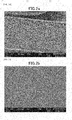
- FIGS, 1a and 1b (Inventive Example 1)
- FIGS, 2a and 2b (Inventive Example 2)
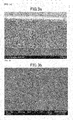
- FIGS, 3a and 3b (Inventive Example 3)
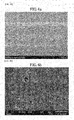
- FIGS, 4a and 4b (Comparative Example)
- FIG. Xa presents an SEM image of the cross-section
- FIG. Xb presents an SEM image of the surface, where X denotes an integer number of 1 to 4.
- each of the films obtained in Inventive Examples 1 to 3 has a surface layer formed as a smooth skin layer and a cross-section with no pore, whereas the film obtained in Comparative Example is devoid of such a skin layer, wherein there are pores in its cross-section uniformly, and the presence of irregularities is observed in its surface.
- the skin layer formed in each of the films obtained in Inventive Examples 1 to 3 has a thickness shown in Table 1.
- Table 1 Thickness of Skin Layer ( ⁇ m) Total thickness of Film ( ⁇ m) Rate of Thickness of Skin Layer (%) Inventive Example 1 2.2 130 1.7 Inventive Example 2 3.6 121 3.0 Inventive Example 3 3.7 108 3.4
- the film according to the present invention exhibits a relatively low dielectric constant and a relatively low dielectric loss tangent, i.e., has excellent electric properties, at high frequencies.
- the films obtained in Inventive Examples 1 to 3 and Comparative Example were evaluated in regard to the plating property.
- the film obtained in Comparative Example has a problem of liquid penetration, whereas the films obtained in Inventive Examples 1 to 3 could be adequately plated without such a problem.
- the films according to the present invention are also excellent in terms of a mechanical or physical property during bending.
- the film according to the present invention whose porous structure is an independent-cell structure is excellent in terms of liquid penetration and pressing resistance, as well as excellent electric properties, and exhibits a high insulation resistance value even after processing, so that it is excellent in terms of processability of a circuit board.
Landscapes
- Chemical & Material Sciences (AREA)
- Engineering & Computer Science (AREA)
- Health & Medical Sciences (AREA)
- Chemical Kinetics & Catalysis (AREA)
- Medicinal Chemistry (AREA)
- Polymers & Plastics (AREA)
- Organic Chemistry (AREA)
- Materials Engineering (AREA)
- Manufacturing & Machinery (AREA)
- Mechanical Engineering (AREA)
- Manufacture Of Porous Articles, And Recovery And Treatment Of Waste Products (AREA)
- Laminated Bodies (AREA)
- Details Of Aerials (AREA)
- Compositions Of Macromolecular Compounds (AREA)
- Manufacturing Of Printed Wiring (AREA)
- Organic Insulating Materials (AREA)
- Manufacture Of Macromolecular Shaped Articles (AREA)
Applications Claiming Priority (2)
| Application Number | Priority Date | Filing Date | Title |
|---|---|---|---|
| JP2016145541 | 2016-07-25 | ||
| PCT/JP2017/014375 WO2018020746A1 (ja) | 2016-07-25 | 2017-04-06 | 多孔質の低誘電性ポリマーフィルム及びミリ波アンテナ用フィルム |
Publications (3)
| Publication Number | Publication Date |
|---|---|
| EP3489292A1 EP3489292A1 (en) | 2019-05-29 |
| EP3489292A4 EP3489292A4 (en) | 2020-03-04 |
| EP3489292B1 true EP3489292B1 (en) | 2021-12-08 |
Family
ID=61016640
Family Applications (1)
| Application Number | Title | Priority Date | Filing Date |
|---|---|---|---|
| EP17833757.2A Not-in-force EP3489292B1 (en) | 2016-07-25 | 2017-04-06 | Low-dielectric porous polymer film and film for millimeter-wave antenna |
Country Status (7)
| Country | Link |
|---|---|
| US (1) | US20190263995A1 (enExample) |
| EP (1) | EP3489292B1 (enExample) |
| JP (3) | JP6567591B2 (enExample) |
| KR (1) | KR102302832B1 (enExample) |
| CN (1) | CN109496223B (enExample) |
| TW (2) | TWI692890B (enExample) |
| WO (1) | WO2018020746A1 (enExample) |
Families Citing this family (18)
| Publication number | Priority date | Publication date | Assignee | Title |
|---|---|---|---|---|
| JP6567722B2 (ja) * | 2017-04-06 | 2019-08-28 | 日東電工株式会社 | ミリ波アンテナ用フィルム |
| CN111902570B (zh) * | 2018-03-27 | 2022-11-08 | 三井金属矿业株式会社 | 表面处理铜箔、覆铜层叠板及印刷电路板的制造方法 |
| JP2020049905A (ja) * | 2018-09-28 | 2020-04-02 | 日東電工株式会社 | 低誘電基板材 |
| JP7082932B2 (ja) * | 2018-09-28 | 2022-06-09 | 日東電工株式会社 | 低誘電基板材 |
| JP7305328B2 (ja) * | 2018-10-01 | 2023-07-10 | 日東電工株式会社 | 多孔質体の製造方法 |
| JP7222727B2 (ja) * | 2019-01-24 | 2023-02-15 | 日東電工株式会社 | 低誘電基板材およびその製造方法 |
| CN114765917A (zh) | 2021-01-13 | 2022-07-19 | 华为技术有限公司 | 印刷电路板及其制作方法,以及一种电子通讯设备 |
| JP7751974B2 (ja) * | 2021-02-15 | 2025-10-09 | 太陽ホールディングス株式会社 | 多孔質膜形成用ポリマー組成物、多孔質膜の製造方法、多孔質膜、フレキシブル金属張積層板及び電子基板 |
| JP7825815B2 (ja) * | 2021-03-22 | 2026-03-09 | 株式会社カナック | ポリイミド成形体の成形方法 |
| JP7700483B2 (ja) * | 2021-03-26 | 2025-07-01 | 富士フイルムビジネスイノベーション株式会社 | ポリイミド前駆体含有水性組成物、ポリイミド膜の製造方法、及び多孔質ポリイミド膜の製造方法 |
| JP7823654B2 (ja) * | 2021-03-31 | 2026-03-04 | 三菱ケミカル株式会社 | 通信機器用成形体、及びポリシアヌレート |
| CN117178012A (zh) * | 2021-04-19 | 2023-12-05 | 日东电工株式会社 | 低介电基板材料 |
| JP2022165324A (ja) * | 2021-04-19 | 2022-10-31 | 日東電工株式会社 | 金属層積層板用フィルム |
| WO2022224899A1 (ja) * | 2021-04-19 | 2022-10-27 | 日東電工株式会社 | 低誘電基板材 |
| JP7846995B2 (ja) * | 2022-01-28 | 2026-04-16 | 日東電工株式会社 | 低誘電基板材 |
| JP2023091635A (ja) * | 2021-12-20 | 2023-06-30 | 富士フイルムビジネスイノベーション株式会社 | ポリイミド前駆体溶液、多孔質ポリイミドフィルム、及び絶縁電線 |
| CN120187783A (zh) * | 2022-11-22 | 2025-06-20 | 日东电工株式会社 | 多孔的低介电性聚合物膜 |
| CN116844761B (zh) * | 2023-06-29 | 2026-06-26 | 航天科工(长沙)新材料研究院有限公司 | 一种纳米多孔结构的银纳米线-聚酰亚胺柔性透明电极薄膜及其制备方法和电极 |
Family Cites Families (22)
| Publication number | Priority date | Publication date | Assignee | Title |
|---|---|---|---|---|
| EP0052936A1 (en) * | 1980-11-07 | 1982-06-02 | Exxon Research And Engineering Company | Microcellular structures and process for their preparation |
| US5670102A (en) * | 1993-02-11 | 1997-09-23 | Minnesota Mining And Manufacturing Company | Method of making thermoplastic foamed articles using supercritical fluid |
| JP3115215B2 (ja) | 1995-10-05 | 2000-12-04 | 松下電器産業株式会社 | 低誘電率プラスチック絶縁フィルムおよびその製造方法 |
| JP3687448B2 (ja) * | 1999-11-29 | 2005-08-24 | 宇部興産株式会社 | 多孔質ポリイミドフィルムの製造法及びフィルム |
| JP4117986B2 (ja) * | 1999-06-07 | 2008-07-16 | 日東電工株式会社 | 耐熱性ポリマ発泡体とその製造法、及び発泡体基板 |
| JP4159199B2 (ja) | 1999-09-16 | 2008-10-01 | 日東電工株式会社 | 多孔質体及び多孔質体の製造方法 |
| JP4557409B2 (ja) | 2000-11-13 | 2010-10-06 | 日東電工株式会社 | 多孔質ポリイミドの製造方法及び多孔質ポリイミド |
| US7658989B2 (en) * | 2001-03-28 | 2010-02-09 | North Carolina State University | Nano-and micro-cellular foamed thin-walled material, and processes and apparatuses for making the same |
| JP4896309B2 (ja) * | 2001-07-13 | 2012-03-14 | 日東電工株式会社 | 多孔質ポリイミド樹脂の製造方法 |
| JP2003201363A (ja) * | 2002-01-09 | 2003-07-18 | Hitachi Ltd | 多孔質ポリイミドフィルムとその配線基板及びその製造法並びにその用途 |
| JP2003201362A (ja) * | 2002-01-09 | 2003-07-18 | Hitachi Ltd | 多孔質ポリイミドフィルムおよび多孔質ポリイミド回路基板 |
| JP4069725B2 (ja) * | 2002-11-07 | 2008-04-02 | 東レ株式会社 | 多孔性芳香族ポリアミド系フィルムおよびその製造方法 |
| WO2005061227A1 (ja) * | 2003-12-24 | 2005-07-07 | Teijin Limited | 積層体 |
| JP2006111708A (ja) * | 2004-10-14 | 2006-04-27 | Inoac Corp | 低誘電率発泡材料とその製造方法 |
| JP5179640B2 (ja) * | 2005-04-08 | 2013-04-10 | 日東電工株式会社 | 発泡部材 |
| JP5117150B2 (ja) * | 2007-09-21 | 2013-01-09 | 株式会社ダイセル | 多孔質層を有する積層体及びその製造方法、並びに多孔質膜及びその製造方法 |
| JP5636960B2 (ja) * | 2008-10-02 | 2014-12-10 | 宇部興産株式会社 | 多孔質ポリイミド膜及びその製造方法 |
| JP2012077294A (ja) * | 2010-09-11 | 2012-04-19 | Nitto Denko Corp | 多孔質樹脂シート及びその製造方法 |
| JP5734623B2 (ja) | 2010-11-10 | 2015-06-17 | ユニチカ株式会社 | 積層体の製造方法 |
| JP2014231533A (ja) * | 2011-02-03 | 2014-12-11 | 日東電工株式会社 | 多孔質樹脂成型体、多孔体基板およびその製造方法 |
| JP5916498B2 (ja) * | 2011-06-06 | 2016-05-11 | 日東電工株式会社 | ポリイミド多孔質体及びその製造方法 |
| JP6567590B2 (ja) * | 2016-07-25 | 2019-08-28 | 日東電工株式会社 | ミリ波アンテナ用フィルム |
-
2017
- 2017-04-06 CN CN201780046368.3A patent/CN109496223B/zh active Active
- 2017-04-06 US US16/320,056 patent/US20190263995A1/en active Pending
- 2017-04-06 KR KR1020197004006A patent/KR102302832B1/ko active Active
- 2017-04-06 WO PCT/JP2017/014375 patent/WO2018020746A1/ja not_active Ceased
- 2017-04-06 EP EP17833757.2A patent/EP3489292B1/en not_active Not-in-force
- 2017-04-06 JP JP2017076009A patent/JP6567591B2/ja active Active
- 2017-07-25 TW TW106124864A patent/TWI692890B/zh active
- 2017-07-25 TW TW109112465A patent/TWI740453B/zh active
-
2019
- 2019-07-31 JP JP2019140883A patent/JP2019199615A/ja active Pending
-
2021
- 2021-05-31 JP JP2021090948A patent/JP7179912B2/ja active Active
Also Published As
| Publication number | Publication date |
|---|---|
| JP6567591B2 (ja) | 2019-08-28 |
| TW201810753A (zh) | 2018-03-16 |
| TW202029544A (zh) | 2020-08-01 |
| KR20190027887A (ko) | 2019-03-15 |
| JP7179912B2 (ja) | 2022-11-29 |
| EP3489292A4 (en) | 2020-03-04 |
| CN109496223B (zh) | 2022-05-24 |
| EP3489292A1 (en) | 2019-05-29 |
| CN109496223A (zh) | 2019-03-19 |
| TWI740453B (zh) | 2021-09-21 |
| KR102302832B1 (ko) | 2021-09-15 |
| TWI692890B (zh) | 2020-05-01 |
| WO2018020746A1 (ja) | 2018-02-01 |
| US20190263995A1 (en) | 2019-08-29 |
| JP2019199615A (ja) | 2019-11-21 |
| JP2021152165A (ja) | 2021-09-30 |
| JP2018021172A (ja) | 2018-02-08 |
Similar Documents
| Publication | Publication Date | Title |
|---|---|---|
| EP3489292A1 (en) | Low-dielectric porous polymer film and film for millimeter-wave antenna | |
| JP7206323B2 (ja) | ミリ波アンテナ用フィルム | |
| EP3489288A1 (en) | Film for millimeter-wave antenna | |
| KR20140025569A (ko) | 폴리이미드 다공질체 및 그의 제조 방법 | |
| US20130209741A1 (en) | Porous resin sheet and method for producing the same | |
| JP2024128384A (ja) | 多孔質液晶ポリマーシート、及び多孔質液晶ポリマーシートの製造方法 |
Legal Events
| Date | Code | Title | Description |
|---|---|---|---|
| STAA | Information on the status of an ep patent application or granted ep patent |
Free format text: STATUS: THE INTERNATIONAL PUBLICATION HAS BEEN MADE |
|
| PUAI | Public reference made under article 153(3) epc to a published international application that has entered the european phase |
Free format text: ORIGINAL CODE: 0009012 |
|
| STAA | Information on the status of an ep patent application or granted ep patent |
Free format text: STATUS: REQUEST FOR EXAMINATION WAS MADE |
|
| 17P | Request for examination filed |
Effective date: 20190130 |
|
| AK | Designated contracting states |
Kind code of ref document: A1 Designated state(s): AL AT BE BG CH CY CZ DE DK EE ES FI FR GB GR HR HU IE IS IT LI LT LU LV MC MK MT NL NO PL PT RO RS SE SI SK SM TR |
|
| AX | Request for extension of the european patent |
Extension state: BA ME |
|
| DAV | Request for validation of the european patent (deleted) | ||
| DAX | Request for extension of the european patent (deleted) | ||
| A4 | Supplementary search report drawn up and despatched |
Effective date: 20200203 |
|
| RIC1 | Information provided on ipc code assigned before grant |
Ipc: C08J 9/34 20060101AFI20200128BHEP Ipc: H01L 23/14 20060101ALI20200128BHEP Ipc: H01Q 1/38 20060101ALI20200128BHEP |
|
| GRAP | Despatch of communication of intention to grant a patent |
Free format text: ORIGINAL CODE: EPIDOSNIGR1 |
|
| STAA | Information on the status of an ep patent application or granted ep patent |
Free format text: STATUS: GRANT OF PATENT IS INTENDED |
|
| INTG | Intention to grant announced |
Effective date: 20210705 |
|
| RIN1 | Information on inventor provided before grant (corrected) |
Inventor name: NAKAMURA, MASAYOSHI Inventor name: HODONO, MASAYUKI Inventor name: ITO, TAKAHIKO Inventor name: NAGAOKA, NAOKI Inventor name: HISHIKI, TOMOAKI |
|
| GRAS | Grant fee paid |
Free format text: ORIGINAL CODE: EPIDOSNIGR3 |
|
| GRAA | (expected) grant |
Free format text: ORIGINAL CODE: 0009210 |
|
| STAA | Information on the status of an ep patent application or granted ep patent |
Free format text: STATUS: THE PATENT HAS BEEN GRANTED |
|
| AK | Designated contracting states |
Kind code of ref document: B1 Designated state(s): AL AT BE BG CH CY CZ DE DK EE ES FI FR GB GR HR HU IE IS IT LI LT LU LV MC MK MT NL NO PL PT RO RS SE SI SK SM TR |
|
| REG | Reference to a national code |
Ref country code: GB Ref legal event code: FG4D |
|
| REG | Reference to a national code |
Ref country code: AT Ref legal event code: REF Ref document number: 1453738 Country of ref document: AT Kind code of ref document: T Effective date: 20211215 Ref country code: CH Ref legal event code: EP |
|
| REG | Reference to a national code |
Ref country code: DE Ref legal event code: R096 Ref document number: 602017050710 Country of ref document: DE |
|
| REG | Reference to a national code |
Ref country code: IE Ref legal event code: FG4D |
|
| REG | Reference to a national code |
Ref country code: FI Ref legal event code: FGE |
|
| REG | Reference to a national code |
Ref country code: SE Ref legal event code: TRGR |
|
| REG | Reference to a national code |
Ref country code: LT Ref legal event code: MG9D |
|
| REG | Reference to a national code |
Ref country code: NL Ref legal event code: MP Effective date: 20211208 |
|
| PG25 | Lapsed in a contracting state [announced via postgrant information from national office to epo] |
Ref country code: RS Free format text: LAPSE BECAUSE OF FAILURE TO SUBMIT A TRANSLATION OF THE DESCRIPTION OR TO PAY THE FEE WITHIN THE PRESCRIBED TIME-LIMIT Effective date: 20211208 Ref country code: LT Free format text: LAPSE BECAUSE OF FAILURE TO SUBMIT A TRANSLATION OF THE DESCRIPTION OR TO PAY THE FEE WITHIN THE PRESCRIBED TIME-LIMIT Effective date: 20211208 Ref country code: BG Free format text: LAPSE BECAUSE OF FAILURE TO SUBMIT A TRANSLATION OF THE DESCRIPTION OR TO PAY THE FEE WITHIN THE PRESCRIBED TIME-LIMIT Effective date: 20220308 |
|
| REG | Reference to a national code |
Ref country code: AT Ref legal event code: MK05 Ref document number: 1453738 Country of ref document: AT Kind code of ref document: T Effective date: 20211208 |
|
| PG25 | Lapsed in a contracting state [announced via postgrant information from national office to epo] |
Ref country code: NO Free format text: LAPSE BECAUSE OF FAILURE TO SUBMIT A TRANSLATION OF THE DESCRIPTION OR TO PAY THE FEE WITHIN THE PRESCRIBED TIME-LIMIT Effective date: 20220308 Ref country code: LV Free format text: LAPSE BECAUSE OF FAILURE TO SUBMIT A TRANSLATION OF THE DESCRIPTION OR TO PAY THE FEE WITHIN THE PRESCRIBED TIME-LIMIT Effective date: 20211208 Ref country code: HR Free format text: LAPSE BECAUSE OF FAILURE TO SUBMIT A TRANSLATION OF THE DESCRIPTION OR TO PAY THE FEE WITHIN THE PRESCRIBED TIME-LIMIT Effective date: 20211208 Ref country code: GR Free format text: LAPSE BECAUSE OF FAILURE TO SUBMIT A TRANSLATION OF THE DESCRIPTION OR TO PAY THE FEE WITHIN THE PRESCRIBED TIME-LIMIT Effective date: 20220309 Ref country code: ES Free format text: LAPSE BECAUSE OF FAILURE TO SUBMIT A TRANSLATION OF THE DESCRIPTION OR TO PAY THE FEE WITHIN THE PRESCRIBED TIME-LIMIT Effective date: 20211208 |
|
| PG25 | Lapsed in a contracting state [announced via postgrant information from national office to epo] |
Ref country code: NL Free format text: LAPSE BECAUSE OF FAILURE TO SUBMIT A TRANSLATION OF THE DESCRIPTION OR TO PAY THE FEE WITHIN THE PRESCRIBED TIME-LIMIT Effective date: 20211208 |
|
| PG25 | Lapsed in a contracting state [announced via postgrant information from national office to epo] |
Ref country code: SM Free format text: LAPSE BECAUSE OF FAILURE TO SUBMIT A TRANSLATION OF THE DESCRIPTION OR TO PAY THE FEE WITHIN THE PRESCRIBED TIME-LIMIT Effective date: 20211208 Ref country code: SK Free format text: LAPSE BECAUSE OF FAILURE TO SUBMIT A TRANSLATION OF THE DESCRIPTION OR TO PAY THE FEE WITHIN THE PRESCRIBED TIME-LIMIT Effective date: 20211208 Ref country code: RO Free format text: LAPSE BECAUSE OF FAILURE TO SUBMIT A TRANSLATION OF THE DESCRIPTION OR TO PAY THE FEE WITHIN THE PRESCRIBED TIME-LIMIT Effective date: 20211208 Ref country code: PT Free format text: LAPSE BECAUSE OF FAILURE TO SUBMIT A TRANSLATION OF THE DESCRIPTION OR TO PAY THE FEE WITHIN THE PRESCRIBED TIME-LIMIT Effective date: 20220408 Ref country code: EE Free format text: LAPSE BECAUSE OF FAILURE TO SUBMIT A TRANSLATION OF THE DESCRIPTION OR TO PAY THE FEE WITHIN THE PRESCRIBED TIME-LIMIT Effective date: 20211208 Ref country code: CZ Free format text: LAPSE BECAUSE OF FAILURE TO SUBMIT A TRANSLATION OF THE DESCRIPTION OR TO PAY THE FEE WITHIN THE PRESCRIBED TIME-LIMIT Effective date: 20211208 |
|
| PGFP | Annual fee paid to national office [announced via postgrant information from national office to epo] |
Ref country code: SE Payment date: 20220421 Year of fee payment: 6 |
|
| PG25 | Lapsed in a contracting state [announced via postgrant information from national office to epo] |
Ref country code: PL Free format text: LAPSE BECAUSE OF FAILURE TO SUBMIT A TRANSLATION OF THE DESCRIPTION OR TO PAY THE FEE WITHIN THE PRESCRIBED TIME-LIMIT Effective date: 20211208 Ref country code: AT Free format text: LAPSE BECAUSE OF FAILURE TO SUBMIT A TRANSLATION OF THE DESCRIPTION OR TO PAY THE FEE WITHIN THE PRESCRIBED TIME-LIMIT Effective date: 20211208 |
|
| PGFP | Annual fee paid to national office [announced via postgrant information from national office to epo] |
Ref country code: FI Payment date: 20220421 Year of fee payment: 6 |
|
| REG | Reference to a national code |
Ref country code: DE Ref legal event code: R097 Ref document number: 602017050710 Country of ref document: DE |
|
| PG25 | Lapsed in a contracting state [announced via postgrant information from national office to epo] |
Ref country code: IS Free format text: LAPSE BECAUSE OF FAILURE TO SUBMIT A TRANSLATION OF THE DESCRIPTION OR TO PAY THE FEE WITHIN THE PRESCRIBED TIME-LIMIT Effective date: 20220408 |
|
| PLBE | No opposition filed within time limit |
Free format text: ORIGINAL CODE: 0009261 |
|
| STAA | Information on the status of an ep patent application or granted ep patent |
Free format text: STATUS: NO OPPOSITION FILED WITHIN TIME LIMIT |
|
| PG25 | Lapsed in a contracting state [announced via postgrant information from national office to epo] |
Ref country code: DK Free format text: LAPSE BECAUSE OF FAILURE TO SUBMIT A TRANSLATION OF THE DESCRIPTION OR TO PAY THE FEE WITHIN THE PRESCRIBED TIME-LIMIT Effective date: 20211208 Ref country code: AL Free format text: LAPSE BECAUSE OF FAILURE TO SUBMIT A TRANSLATION OF THE DESCRIPTION OR TO PAY THE FEE WITHIN THE PRESCRIBED TIME-LIMIT Effective date: 20211208 |
|
| REG | Reference to a national code |
Ref country code: DE Ref legal event code: R119 Ref document number: 602017050710 Country of ref document: DE |
|
| 26N | No opposition filed |
Effective date: 20220909 |
|
| PG25 | Lapsed in a contracting state [announced via postgrant information from national office to epo] |
Ref country code: SI Free format text: LAPSE BECAUSE OF FAILURE TO SUBMIT A TRANSLATION OF THE DESCRIPTION OR TO PAY THE FEE WITHIN THE PRESCRIBED TIME-LIMIT Effective date: 20211208 |
|
| REG | Reference to a national code |
Ref country code: CH Ref legal event code: PL |
|
| GBPC | Gb: european patent ceased through non-payment of renewal fee |
Effective date: 20220406 |
|
| REG | Reference to a national code |
Ref country code: BE Ref legal event code: MM Effective date: 20220430 |
|
| PG25 | Lapsed in a contracting state [announced via postgrant information from national office to epo] |
Ref country code: MC Free format text: LAPSE BECAUSE OF FAILURE TO SUBMIT A TRANSLATION OF THE DESCRIPTION OR TO PAY THE FEE WITHIN THE PRESCRIBED TIME-LIMIT Effective date: 20211208 Ref country code: LU Free format text: LAPSE BECAUSE OF NON-PAYMENT OF DUE FEES Effective date: 20220406 Ref country code: LI Free format text: LAPSE BECAUSE OF NON-PAYMENT OF DUE FEES Effective date: 20220430 Ref country code: GB Free format text: LAPSE BECAUSE OF NON-PAYMENT OF DUE FEES Effective date: 20220406 Ref country code: FR Free format text: LAPSE BECAUSE OF NON-PAYMENT OF DUE FEES Effective date: 20220430 Ref country code: DE Free format text: LAPSE BECAUSE OF NON-PAYMENT OF DUE FEES Effective date: 20221103 Ref country code: CH Free format text: LAPSE BECAUSE OF NON-PAYMENT OF DUE FEES Effective date: 20220430 |
|
| PG25 | Lapsed in a contracting state [announced via postgrant information from national office to epo] |
Ref country code: BE Free format text: LAPSE BECAUSE OF NON-PAYMENT OF DUE FEES Effective date: 20220430 |
|
| PG25 | Lapsed in a contracting state [announced via postgrant information from national office to epo] |
Ref country code: IE Free format text: LAPSE BECAUSE OF NON-PAYMENT OF DUE FEES Effective date: 20220406 |
|
| PG25 | Lapsed in a contracting state [announced via postgrant information from national office to epo] |
Ref country code: IT Free format text: LAPSE BECAUSE OF FAILURE TO SUBMIT A TRANSLATION OF THE DESCRIPTION OR TO PAY THE FEE WITHIN THE PRESCRIBED TIME-LIMIT Effective date: 20211208 |
|
| P01 | Opt-out of the competence of the unified patent court (upc) registered |
Effective date: 20230515 |
|
| REG | Reference to a national code |
Ref country code: SE Ref legal event code: EUG |
|
| PG25 | Lapsed in a contracting state [announced via postgrant information from national office to epo] |
Ref country code: SE Free format text: LAPSE BECAUSE OF NON-PAYMENT OF DUE FEES Effective date: 20230407 Ref country code: FI Free format text: LAPSE BECAUSE OF NON-PAYMENT OF DUE FEES Effective date: 20230406 |
|
| PG25 | Lapsed in a contracting state [announced via postgrant information from national office to epo] |
Ref country code: HU Free format text: LAPSE BECAUSE OF FAILURE TO SUBMIT A TRANSLATION OF THE DESCRIPTION OR TO PAY THE FEE WITHIN THE PRESCRIBED TIME-LIMIT; INVALID AB INITIO Effective date: 20170406 |
|
| PG25 | Lapsed in a contracting state [announced via postgrant information from national office to epo] |
Ref country code: MK Free format text: LAPSE BECAUSE OF FAILURE TO SUBMIT A TRANSLATION OF THE DESCRIPTION OR TO PAY THE FEE WITHIN THE PRESCRIBED TIME-LIMIT Effective date: 20211208 Ref country code: CY Free format text: LAPSE BECAUSE OF FAILURE TO SUBMIT A TRANSLATION OF THE DESCRIPTION OR TO PAY THE FEE WITHIN THE PRESCRIBED TIME-LIMIT Effective date: 20211208 |
|
| PG25 | Lapsed in a contracting state [announced via postgrant information from national office to epo] |
Ref country code: MT Free format text: LAPSE BECAUSE OF FAILURE TO SUBMIT A TRANSLATION OF THE DESCRIPTION OR TO PAY THE FEE WITHIN THE PRESCRIBED TIME-LIMIT Effective date: 20211208 |
|
| PG25 | Lapsed in a contracting state [announced via postgrant information from national office to epo] |
Ref country code: TR Free format text: LAPSE BECAUSE OF FAILURE TO SUBMIT A TRANSLATION OF THE DESCRIPTION OR TO PAY THE FEE WITHIN THE PRESCRIBED TIME-LIMIT Effective date: 20211208 |