EP3349649B1 - Navigation of tubular networks - Google Patents
Navigation of tubular networks Download PDFInfo
- Publication number
- EP3349649B1 EP3349649B1 EP16847447.6A EP16847447A EP3349649B1 EP 3349649 B1 EP3349649 B1 EP 3349649B1 EP 16847447 A EP16847447 A EP 16847447A EP 3349649 B1 EP3349649 B1 EP 3349649B1
- Authority
- EP
- European Patent Office
- Prior art keywords
- data
- estimated state
- image
- tubular network
- storage medium
- Prior art date
- Legal status (The legal status is an assumption and is not a legal conclusion. Google has not performed a legal analysis and makes no representation as to the accuracy of the status listed.)
- Active
Links
Images









Classifications
-
- A—HUMAN NECESSITIES
- A61—MEDICAL OR VETERINARY SCIENCE; HYGIENE
- A61B—DIAGNOSIS; SURGERY; IDENTIFICATION
- A61B1/00—Instruments for performing medical examinations of the interior of cavities or tubes of the body by visual or photographical inspection, e.g. endoscopes; Illuminating arrangements therefor
- A61B1/00002—Operational features of endoscopes
- A61B1/00004—Operational features of endoscopes characterised by electronic signal processing
- A61B1/00009—Operational features of endoscopes characterised by electronic signal processing of image signals during a use of endoscope
- A61B1/000094—Operational features of endoscopes characterised by electronic signal processing of image signals during a use of endoscope extracting biological structures
-
- A—HUMAN NECESSITIES
- A61—MEDICAL OR VETERINARY SCIENCE; HYGIENE
- A61B—DIAGNOSIS; SURGERY; IDENTIFICATION
- A61B1/00—Instruments for performing medical examinations of the interior of cavities or tubes of the body by visual or photographical inspection, e.g. endoscopes; Illuminating arrangements therefor
- A61B1/00147—Holding or positioning arrangements
-
- A—HUMAN NECESSITIES
- A61—MEDICAL OR VETERINARY SCIENCE; HYGIENE
- A61B—DIAGNOSIS; SURGERY; IDENTIFICATION
- A61B1/00—Instruments for performing medical examinations of the interior of cavities or tubes of the body by visual or photographical inspection, e.g. endoscopes; Illuminating arrangements therefor
- A61B1/00147—Holding or positioning arrangements
- A61B1/00149—Holding or positioning arrangements using articulated arms
-
- A—HUMAN NECESSITIES
- A61—MEDICAL OR VETERINARY SCIENCE; HYGIENE
- A61B—DIAGNOSIS; SURGERY; IDENTIFICATION
- A61B1/00—Instruments for performing medical examinations of the interior of cavities or tubes of the body by visual or photographical inspection, e.g. endoscopes; Illuminating arrangements therefor
- A61B1/00147—Holding or positioning arrangements
- A61B1/0016—Holding or positioning arrangements using motor drive units
-
- A—HUMAN NECESSITIES
- A61—MEDICAL OR VETERINARY SCIENCE; HYGIENE
- A61B—DIAGNOSIS; SURGERY; IDENTIFICATION
- A61B1/00—Instruments for performing medical examinations of the interior of cavities or tubes of the body by visual or photographical inspection, e.g. endoscopes; Illuminating arrangements therefor
- A61B1/00163—Optical arrangements
- A61B1/00194—Optical arrangements adapted for three-dimensional imaging
-
- A—HUMAN NECESSITIES
- A61—MEDICAL OR VETERINARY SCIENCE; HYGIENE
- A61B—DIAGNOSIS; SURGERY; IDENTIFICATION
- A61B1/00—Instruments for performing medical examinations of the interior of cavities or tubes of the body by visual or photographical inspection, e.g. endoscopes; Illuminating arrangements therefor
- A61B1/005—Flexible endoscopes
-
- A—HUMAN NECESSITIES
- A61—MEDICAL OR VETERINARY SCIENCE; HYGIENE
- A61B—DIAGNOSIS; SURGERY; IDENTIFICATION
- A61B1/00—Instruments for performing medical examinations of the interior of cavities or tubes of the body by visual or photographical inspection, e.g. endoscopes; Illuminating arrangements therefor
- A61B1/04—Instruments for performing medical examinations of the interior of cavities or tubes of the body by visual or photographical inspection, e.g. endoscopes; Illuminating arrangements therefor combined with photographic or television appliances
-
- A—HUMAN NECESSITIES
- A61—MEDICAL OR VETERINARY SCIENCE; HYGIENE
- A61B—DIAGNOSIS; SURGERY; IDENTIFICATION
- A61B1/00—Instruments for performing medical examinations of the interior of cavities or tubes of the body by visual or photographical inspection, e.g. endoscopes; Illuminating arrangements therefor
- A61B1/267—Instruments for performing medical examinations of the interior of cavities or tubes of the body by visual or photographical inspection, e.g. endoscopes; Illuminating arrangements therefor for the respiratory tract, e.g. laryngoscopes or bronchoscopes
- A61B1/2676—Bronchoscopes
-
- A—HUMAN NECESSITIES
- A61—MEDICAL OR VETERINARY SCIENCE; HYGIENE
- A61B—DIAGNOSIS; SURGERY; IDENTIFICATION
- A61B34/00—Computer-aided surgery; Manipulators or robots specially adapted for use in surgery
- A61B34/20—Surgical navigation systems; Devices for tracking or guiding surgical instruments, e.g. for frameless stereotaxis
-
- A—HUMAN NECESSITIES
- A61—MEDICAL OR VETERINARY SCIENCE; HYGIENE
- A61B—DIAGNOSIS; SURGERY; IDENTIFICATION
- A61B34/00—Computer-aided surgery; Manipulators or robots specially adapted for use in surgery
- A61B34/30—Surgical robots
-
- A—HUMAN NECESSITIES
- A61—MEDICAL OR VETERINARY SCIENCE; HYGIENE
- A61B—DIAGNOSIS; SURGERY; IDENTIFICATION
- A61B5/00—Measuring for diagnostic purposes; Identification of persons
- A61B5/06—Devices, other than using radiation, for detecting or locating foreign bodies ; Determining position of diagnostic devices within or on the body of the patient
- A61B5/061—Determining position of a probe within the body employing means separate from the probe, e.g. sensing internal probe position employing impedance electrodes on the surface of the body
-
- A—HUMAN NECESSITIES
- A61—MEDICAL OR VETERINARY SCIENCE; HYGIENE
- A61B—DIAGNOSIS; SURGERY; IDENTIFICATION
- A61B6/00—Apparatus or devices for radiation diagnosis; Apparatus or devices for radiation diagnosis combined with radiation therapy equipment
- A61B6/02—Arrangements for diagnosis sequentially in different planes; Stereoscopic radiation diagnosis
- A61B6/03—Computed tomography [CT]
- A61B6/032—Transmission computed tomography [CT]
-
- G—PHYSICS
- G06—COMPUTING OR CALCULATING; COUNTING
- G06T—IMAGE DATA PROCESSING OR GENERATION, IN GENERAL
- G06T15/00—Three-dimensional [3D] image rendering
- G06T15/10—Geometric effects
- G06T15/20—Perspective computation
- G06T15/205—Image-based rendering
-
- G—PHYSICS
- G06—COMPUTING OR CALCULATING; COUNTING
- G06T—IMAGE DATA PROCESSING OR GENERATION, IN GENERAL
- G06T17/00—Three-dimensional [3D] modelling for computer graphics
-
- G—PHYSICS
- G06—COMPUTING OR CALCULATING; COUNTING
- G06T—IMAGE DATA PROCESSING OR GENERATION, IN GENERAL
- G06T7/00—Image analysis
- G06T7/0002—Inspection of images, e.g. flaw detection
- G06T7/0012—Biomedical image inspection
-
- G—PHYSICS
- G06—COMPUTING OR CALCULATING; COUNTING
- G06T—IMAGE DATA PROCESSING OR GENERATION, IN GENERAL
- G06T7/00—Image analysis
- G06T7/10—Segmentation; Edge detection
- G06T7/149—Segmentation; Edge detection involving deformable models, e.g. active contour models
-
- G—PHYSICS
- G06—COMPUTING OR CALCULATING; COUNTING
- G06T—IMAGE DATA PROCESSING OR GENERATION, IN GENERAL
- G06T7/00—Image analysis
- G06T7/20—Analysis of motion
- G06T7/246—Analysis of motion using feature-based methods, e.g. the tracking of corners or segments
- G06T7/248—Analysis of motion using feature-based methods, e.g. the tracking of corners or segments involving reference images or patches
-
- G—PHYSICS
- G06—COMPUTING OR CALCULATING; COUNTING
- G06T—IMAGE DATA PROCESSING OR GENERATION, IN GENERAL
- G06T7/00—Image analysis
- G06T7/30—Determination of transform parameters for the alignment of images, i.e. image registration
- G06T7/32—Determination of transform parameters for the alignment of images, i.e. image registration using correlation-based methods
-
- G—PHYSICS
- G06—COMPUTING OR CALCULATING; COUNTING
- G06T—IMAGE DATA PROCESSING OR GENERATION, IN GENERAL
- G06T7/00—Image analysis
- G06T7/70—Determining position or orientation of objects or cameras
- G06T7/73—Determining position or orientation of objects or cameras using feature-based methods
-
- A—HUMAN NECESSITIES
- A61—MEDICAL OR VETERINARY SCIENCE; HYGIENE
- A61B—DIAGNOSIS; SURGERY; IDENTIFICATION
- A61B17/00—Surgical instruments, devices or methods
- A61B2017/00743—Type of operation; Specification of treatment sites
- A61B2017/00809—Lung operations
-
- A—HUMAN NECESSITIES
- A61—MEDICAL OR VETERINARY SCIENCE; HYGIENE
- A61B—DIAGNOSIS; SURGERY; IDENTIFICATION
- A61B34/00—Computer-aided surgery; Manipulators or robots specially adapted for use in surgery
- A61B34/10—Computer-aided planning, simulation or modelling of surgical operations
- A61B2034/101—Computer-aided simulation of surgical operations
- A61B2034/105—Modelling of the patient, e.g. for ligaments or bones
-
- A—HUMAN NECESSITIES
- A61—MEDICAL OR VETERINARY SCIENCE; HYGIENE
- A61B—DIAGNOSIS; SURGERY; IDENTIFICATION
- A61B34/00—Computer-aided surgery; Manipulators or robots specially adapted for use in surgery
- A61B34/10—Computer-aided planning, simulation or modelling of surgical operations
- A61B2034/107—Visualisation of planned trajectories or target regions
-
- A—HUMAN NECESSITIES
- A61—MEDICAL OR VETERINARY SCIENCE; HYGIENE
- A61B—DIAGNOSIS; SURGERY; IDENTIFICATION
- A61B34/00—Computer-aided surgery; Manipulators or robots specially adapted for use in surgery
- A61B34/20—Surgical navigation systems; Devices for tracking or guiding surgical instruments, e.g. for frameless stereotaxis
- A61B2034/2046—Tracking techniques
- A61B2034/2048—Tracking techniques using an accelerometer or inertia sensor
-
- A—HUMAN NECESSITIES
- A61—MEDICAL OR VETERINARY SCIENCE; HYGIENE
- A61B—DIAGNOSIS; SURGERY; IDENTIFICATION
- A61B34/00—Computer-aided surgery; Manipulators or robots specially adapted for use in surgery
- A61B34/20—Surgical navigation systems; Devices for tracking or guiding surgical instruments, e.g. for frameless stereotaxis
- A61B2034/2046—Tracking techniques
- A61B2034/2051—Electromagnetic tracking systems
-
- A—HUMAN NECESSITIES
- A61—MEDICAL OR VETERINARY SCIENCE; HYGIENE
- A61B—DIAGNOSIS; SURGERY; IDENTIFICATION
- A61B34/00—Computer-aided surgery; Manipulators or robots specially adapted for use in surgery
- A61B34/20—Surgical navigation systems; Devices for tracking or guiding surgical instruments, e.g. for frameless stereotaxis
- A61B2034/2046—Tracking techniques
- A61B2034/2055—Optical tracking systems
-
- A—HUMAN NECESSITIES
- A61—MEDICAL OR VETERINARY SCIENCE; HYGIENE
- A61B—DIAGNOSIS; SURGERY; IDENTIFICATION
- A61B34/00—Computer-aided surgery; Manipulators or robots specially adapted for use in surgery
- A61B34/25—User interfaces for surgical systems
- A61B2034/252—User interfaces for surgical systems indicating steps of a surgical procedure
-
- A—HUMAN NECESSITIES
- A61—MEDICAL OR VETERINARY SCIENCE; HYGIENE
- A61B—DIAGNOSIS; SURGERY; IDENTIFICATION
- A61B34/00—Computer-aided surgery; Manipulators or robots specially adapted for use in surgery
- A61B34/30—Surgical robots
- A61B2034/301—Surgical robots for introducing or steering flexible instruments inserted into the body, e.g. catheters or endoscopes
-
- A—HUMAN NECESSITIES
- A61—MEDICAL OR VETERINARY SCIENCE; HYGIENE
- A61B—DIAGNOSIS; SURGERY; IDENTIFICATION
- A61B90/00—Instruments, implements or accessories specially adapted for surgery or diagnosis and not covered by any of the groups A61B1/00 - A61B50/00, e.g. for luxation treatment or for protecting wound edges
- A61B90/36—Image-producing devices or illumination devices not otherwise provided for
- A61B90/361—Image-producing devices, e.g. surgical cameras
- A61B2090/3614—Image-producing devices, e.g. surgical cameras using optical fibre
-
- A—HUMAN NECESSITIES
- A61—MEDICAL OR VETERINARY SCIENCE; HYGIENE
- A61B—DIAGNOSIS; SURGERY; IDENTIFICATION
- A61B90/00—Instruments, implements or accessories specially adapted for surgery or diagnosis and not covered by any of the groups A61B1/00 - A61B50/00, e.g. for luxation treatment or for protecting wound edges
- A61B90/36—Image-producing devices or illumination devices not otherwise provided for
- A61B90/37—Surgical systems with images on a monitor during operation
- A61B2090/376—Surgical systems with images on a monitor during operation using X-rays, e.g. fluoroscopy
- A61B2090/3762—Surgical systems with images on a monitor during operation using X-rays, e.g. fluoroscopy using computed tomography systems [CT]
-
- A—HUMAN NECESSITIES
- A61—MEDICAL OR VETERINARY SCIENCE; HYGIENE
- A61B—DIAGNOSIS; SURGERY; IDENTIFICATION
- A61B34/00—Computer-aided surgery; Manipulators or robots specially adapted for use in surgery
- A61B34/25—User interfaces for surgical systems
-
- A—HUMAN NECESSITIES
- A61—MEDICAL OR VETERINARY SCIENCE; HYGIENE
- A61B—DIAGNOSIS; SURGERY; IDENTIFICATION
- A61B90/00—Instruments, implements or accessories specially adapted for surgery or diagnosis and not covered by any of the groups A61B1/00 - A61B50/00, e.g. for luxation treatment or for protecting wound edges
- A61B90/30—Devices for illuminating a surgical field, the devices having an interrelation with other surgical devices or with a surgical procedure
-
- G—PHYSICS
- G06—COMPUTING OR CALCULATING; COUNTING
- G06T—IMAGE DATA PROCESSING OR GENERATION, IN GENERAL
- G06T2207/00—Indexing scheme for image analysis or image enhancement
- G06T2207/10—Image acquisition modality
- G06T2207/10068—Endoscopic image
-
- G—PHYSICS
- G06—COMPUTING OR CALCULATING; COUNTING
- G06T—IMAGE DATA PROCESSING OR GENERATION, IN GENERAL
- G06T2207/00—Indexing scheme for image analysis or image enhancement
- G06T2207/10—Image acquisition modality
- G06T2207/10072—Tomographic images
- G06T2207/10081—Computed x-ray tomography [CT]
-
- G—PHYSICS
- G06—COMPUTING OR CALCULATING; COUNTING
- G06T—IMAGE DATA PROCESSING OR GENERATION, IN GENERAL
- G06T2207/00—Indexing scheme for image analysis or image enhancement
- G06T2207/30—Subject of image; Context of image processing
- G06T2207/30004—Biomedical image processing
- G06T2207/30061—Lung
-
- G—PHYSICS
- G06—COMPUTING OR CALCULATING; COUNTING
- G06T—IMAGE DATA PROCESSING OR GENERATION, IN GENERAL
- G06T2207/00—Indexing scheme for image analysis or image enhancement
- G06T2207/30—Subject of image; Context of image processing
- G06T2207/30196—Human being; Person
Definitions
- This description generally relates to surgical robotics, and particularly to navigation of a medical instrument within a tubular network of a patient's body.
- Bronchoscopy is a medical procedure that allows a physician to examine the inside conditions of a patient's lung airways, such as bronchi and bronchioles.
- the lung airways carry air from the trachea, or windpipe, to the lungs.
- a thin, flexible tubular tool known as a bronchoscope, may be inserted into the patient's mouth and passed down the patient's throat into his/her lung airways, and patients are generally anesthetized in order to relax their throats and lung cavities for surgical examinations and operations during the medical procedure.
- a conventional bronchoscope typically includes a light source and a small camera that allows a physician to inspect a patient's windpipe and airways, and a rigid tube may be used in conjunction with the bronchoscope for surgical purposes, e.g., when there is a significant amount of bleeding in the lungs of the patient or when a large object obstructs the throat of the patient.
- the rigid tube When the rigid tube is used, the patient is often anesthetized.
- Robotic bronchoscopes provide tremendous advantages in navigation through tubular networks. They are easy to use and allow therapy and biopsies to be administered conveniently even during the bronchoscopy stage.
- CT computerized tomography
- 3D three dimensional
- the methods and apparatus disclosed herein provide improved navigation through tubular networks such as lung airways by providing improved estimation of location and orientation information of a medical instrument like a flexible or rigid elongated medical instrument (e.g., an endoscope) within the tubular network.
- a medical instrument like a flexible or rigid elongated medical instrument (e.g., an endoscope) within the tubular network.
- the apparatus is a robotic endoscopic tool to acquire "raw" location and orientation information (collectively, input data) of a desired anatomical site or of the endoscopic tool within the tubular network.
- the endoscopic tool includes a flexible tip and an instrument device manipulator (IDM) coupled to the endoscopic tool.
- IDM instrument device manipulator
- Devices such as an electromagnetic sensor (EM sensor), an imaging device (e.g., optical sensor), and a robotic control system controlling the medical instrument are coupled to the instrument tip to collect the input data as the endoscopic tool enters and navigates through the tubular network.
- the IDM is used to control movement and position of different robotic components (e.g., the endoscopic tool) of the surgical robotic system.
- a processor is coupled to the endoscopic tool to receive the input data to determine moment-by-moment movements and location and orientation information of the medical instrument (e.g., a instrument tip) within the tubular network.
- the processor is instructed by a navigation configuration system to use the input data to estimate the state of the medical instrument, which may include information such as position, orientation, relative and absolute depth, branch selection, etc.
- the processor may be Document WO 2015/061756 discloses an endolumenal robotic system that provides the surgeon with the ability to drive a robotically-driven endoscopic device to a desired anatomical position in a patient.
- This document discloses an endoscopic tool coupled to a first instrument device manipulator, the endoscopic tool comprising a primary elongated body.
- an electromagnetic tracker is coupled to the distal section of the primary elongated body.
- an accelerometer is coupled to the distal section of the primary elongated body. further instructed to use the estimated state to locate a specific site within a tubular network and/or to determine navigation information for what positions/orientations the medical instrument should travel through to arrive at the specific site, which may be referred to as the output data or navigation data.
- the navigation configuration system further includes multiple algorithm modules employing various navigation algorithms for providing the estimated state and navigation data.
- Example algorithms used include EM-based algorithms, image-based algorithms, and robot-based algorithms.
- the estimated state and navigation data generated after employing these various algorithms makes use of any one or more of the EM-based input data, image-based input data, and robot-based input data.
- probability distributions together with confidence values are generated by the algorithm modules, which are used to determine the medical instrument's estimated state.
- the "probability” of the “probability distribution”, as used herein, refers to a likelihood of an estimation or identification of location and/or orientation of the medical instrument being correct. For example, different probabilities may be calculated indicating the relative likelihood that the medical instrument is in one of several different possible airways within the lung.
- the "confidence value, as used herein, reflects a measure of confidence in the estimation of the state provided by one of the algorithms. For example, relatively close to the airway opening, a particular algorithm may have a high confidence in its estimations of medical instrument position and orientation; but further into the bottom of the lung the medical instrument travels, that confidence value may drop.
- the confidence value is based on one or more "external" factors relating to the process by which a result is determined, whereas probability is a relative measure that arises when trying to determine possible results from a single algorithm.
- the algorithms, probabilities, and confidence values may be variously combined to arrive at the estimated state and navigation data.
- a sequence of pre-operative steps employing the improved navigation of surgical instruments (e.g., endoscopic) within a tubular network of the patient may be taken.
- a CT scan of the tubular network is obtained to generate a 3D model of the tubular network.
- a target area e.g., a lesion to biopsy
- a corresponding path for a surgical instrument to travel through the tubular network to reach the target area is automatically planned and displayed to a user (e.g., a physician responsible for the surgical operation).
- a virtual endoscopic may be applied to travel through the tubular network to arrive at the target area.
- the CT scan, the generated 3D model as well as other input data e.g., image data, EM data, robot data collected over the duration of the surgery
- input data e.g., image data, EM data, robot data collected over the duration of the surgery
- the surgical configuration system to provide an estimation of the real-time movement information and location/orientation information of the surgical instrument (e.g., the endoscope) within the tubular network along with navigation information, which allows for more convenient operations by the physician.
- FIG. 1A shows an example surgical robotic system 100, according to one embodiment.
- the surgical robotic system 100 includes a base 101 coupled to one or more robotic arms, e.g., robotic arm 102.
- the base 101 is communicatively coupled to a command console, which is further described with reference to FIG. 2 in Section II. COMMAND CONSOLE.
- the base 101 can be positioned such that the robotic arm 102 has access to perform a surgical procedure on a patient, while a user such as a physician may control the surgical robotic system 100 from the comfort of the command console.
- the base 101 may be coupled to a surgical operating table or bed for supporting the patient. Though not shown in FIG.
- the base 101 may include subsystems such as control electronics, pneumatics, power sources, optical sources, and the like.
- the robotic arm 102 includes multiple arm segments 110 coupled at joints 111, which provides the robotic arm 102 multiple degrees of freedom, e.g., seven degrees of freedom corresponding to seven arm segments.
- the base 101 may contain a source of power 112, pneumatic pressure 113, and control and sensor electronics 114-including components such as a central processing unit, data bus, control circuitry, and memory-and related actuators such as motors to move the robotic arm 102.
- the electronics 114 in the base 101 may also process and transmit control signals communicated from the command console.
- the base 101 includes wheels 115 to transport the surgical robotic system 100.
- Mobility of the surgical robotic system 100 helps accommodate space constraints in a surgical operating room as well as facilitate appropriate positioning and movement of surgical equipment. Further, the mobility allows the robotic arms 102 to be configured such that the robotic arms 102 do not interfere with the patient, physician, anesthesiologist, or any other equipment. During procedures, a user may control the robotic arms 102 using control devices such as the command console.
- the robotic arm 102 includes set up joints that use a combination of brakes and counter-balances to maintain a position of the robotic arm 102.
- the counter-balances may include gas springs or coil springs.
- the brakes e.g., fail safe brakes, may be include mechanical and/or electrical components.
- the robotic arms 102 may be gravity-assisted passive support type robotic arms.
- Each robotic arm 102 may be coupled to an instrument device manipulator (IDM) 117 using a mechanism changer interface (MCI) 116.
- the IDM 117 can be removed and replaced with a different type of IDM, for example, a first type of IDM manipulates an endoscope, while a second type of IDM manipulates a laparoscope.
- the MCI 116 includes connectors to transfer pneumatic pressure, electrical power, electrical signals, and optical signals from the robotic arm 102 to the IDM 117.
- the MCI 116 can be a set screw or base plate connector.
- the IDM 117 manipulates surgical instruments such as the endoscope 118 using techniques including direct drive, harmonic drive, geared drives, belts and pulleys, magnetic drives, and the like.
- the MCI 116 is interchangeable based on the type of IDM 117 and can be customized for a certain type of surgical procedure.
- the robotic 102 arm can include a joint level torque sensing and a wrist at a distal end, such as the KUKA AG ® LBR5 robotic arm.
- the endoscope 118 is a tubular and flexible surgical instrument that is inserted into the anatomy of a patient to capture images of the anatomy (e.g., body tissue).
- the endoscope 118 includes one or more imaging devices (e.g., cameras or other types of optical sensors) that capture the images.
- the imaging devices may include one or more optical components such as an optical fiber, fiber array, or lens.
- the optical components move along with the tip of the endoscope 118 such that movement of the tip of the endoscope 118 results in changes to the images captured by the imaging devices.
- the endoscope 118 is further described with reference to FIGs. 3A-4B in Section IV. Endoscope.
- Robotic arms 102 of the surgical robotic system 100 manipulate the endoscope 118 using elongate movement members.
- the elongate movement members may include pull wires, also referred to as pull or push wires, cables, fibers, or flexible shafts.
- the robotic arms 102 actuate multiple pull wires coupled to the endoscope 118 to deflect the tip of the endoscope 118.
- the pull wires may include both metallic and non-metallic materials such as stainless steel, Kevlar, tungsten, carbon fiber, and the like.
- the endoscope 118 may exhibit nonlinear behavior in response to forces applied by the elongate movement members. The nonlinear behavior may be based on stiffness and compressibility of the endoscope 118, as well as variability in slack or stiffness between different elongate movement members.
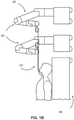
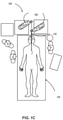
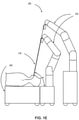
- FIGs. 1B-1F show various perspective views of the surgical robotic system 100 coupled to a robotic platform 150 (or surgical bed), according to various embodiments.
- FIG. 1B shows a side view of the surgical robotic system 100 with the robotic arms 102 manipulating the endoscopic 118 to insert the endoscopic inside a patient's body, and the patient is lying on the robotic platform 150.
- FIG. 1C shows a top view of the surgical robotic system 100 and the robotic platform 150, and the endoscopic 118 manipulated by the robotic arms is inserted inside the patient's body.
- FIG. 1D shows a perspective view of the surgical robotic system 100 and the robotic platform 150, and the endoscopic 118 is controlled to be positioned horizontally parallel with the robotic platform.
- FIG. 1B shows a side view of the surgical robotic system 100 with the robotic arms 102 manipulating the endoscopic 118 to insert the endoscopic inside a patient's body, and the patient is lying on the robotic platform 150.
- FIG. 1C shows a top view of the surgical robotic system 100 and the robotic platform 150,
- FIG. 1E shows another perspective view of the surgical robotic system 100 and the robotic platform 150, and the endoscopic 118 is controlled to be positioned relatively perpendicular to the robotic platform.
- the angle between the horizontal surface of the robotic platform 150 and the endoscopic 118 is 75 degree.
- FIG. 1F shows the perspective view of the surgical robotic system 100 and the robotic platform 150 shown in FIG. IE, and in more detail, the angle between the endoscopic 118 and the virtual line 160 connecting one end 180 of the endoscopic and the robotic arm 102 that is positioned relatively farther away from the robotic platform is 90 degree.
- FIG. 2 shows an example command console 200 for the example surgical robotic system 100, according to one embodiment.
- the command console 200 includes a console base 201, display modules 202, e.g., monitors, and control modules, e.g., a keyboard 203 and joystick 204.
- one or more of the command console 200 functionality may be integrated into a base 101 of the surgical robotic system 100 or another system communicatively coupled to the surgical robotic system 100.
- a user 205 e.g., a physician, remotely controls the surgical robotic system 100 from an ergonomic position using the command console 200.
- the console base 201 may include a central processing unit, a memory unit, a data bus, and associated data communication ports that are responsible for interpreting and processing signals such as camera imagery and tracking sensor data, e.g., from the endoscope 118 shown in FIG. 1 . In some embodiments, both the console base 201 and the base 101 perform signal processing for load-balancing.
- the console base 201 may also process commands and instructions provided by the user 205 through the control modules 203 and 204.
- the control modules may include other devices, for example, computer mice, trackpads, trackballs, control pads, video game controllers, and sensors (e.g., motion sensors or cameras) that capture hand gestures and finger gestures.
- the user 205 can control a surgical instrument such as the endoscope 118 using the command console 200 in a velocity mode or position control mode.
- velocity mode the user 205 directly controls pitch and yaw motion of a distal end of the endoscope 118 based on direct manual control using the control modules.
- movement on the joystick 204 may be mapped to yaw and pitch movement in the distal end of the endoscope 118.
- the joystick 204 can provide haptic feedback to the user 205.
- the joystick 204 vibrates to indicate that the endoscope 118 cannot further translate or rotate in a certain direction.
- the command console 200 can also provide visual feedback (e.g., pop-up messages) and/or audio feedback (e.g., beeping) to indicate that the endoscope 118 has reached maximum translation or rotation.
- the command console 200 uses a three-dimensional (3D) map of a patient and pre-determined computer models of the patient to control a surgical instrument, e.g., the endoscope 118.
- the command console 200 provides control signals to robotic arms 102 of the surgical robotic system 100 to manipulate the endoscope 118 to a target location. Due to the reliance on the 3D map, position control mode requires accurate mapping of the anatomy of the patient.
- users 205 can manually manipulate robotic arms 102 of the surgical robotic system 100 without using the command console 200.
- the users 205 may move the robotic arms 102, endoscopes 118, and other surgical equipment to access a patient.
- the surgical robotic system 100 may rely on force feedback and inertia control from the users 205 to determine appropriate configuration of the robotic arms 102 and equipment.
- the display modules 202 may include electronic monitors, virtual reality viewing devices, e.g., goggles or glasses, and/or other means of display devices.
- the display modules 202 are integrated with the control modules, for example, as a tablet device with a touchscreen.
- the user 205 can both view data and input commands to the surgical robotic system 100 using the integrated display modules 202 and control modules.
- the display modules 202 can display 3D images using a stereoscopic device, e.g., a visor or goggle.
- the 3D images provide an "endo view” (i.e., endoscopic view), which is a computer 3D model illustrating the anatomy of a patient.
- the "endo view” provides a virtual environment of the patient's interior and an expected location of an endoscope 118 inside the patient.
- a user 205 compares the "endo view” model to actual images captured by a camera to help mentally orient and confirm that the endoscope 118 is in the correct-or approximately correct-location within the patient.
- the "endo view” provides information about anatomical structures, e.g., the shape of an intestine or colon of the patient, around the distal end of the endoscope 118.
- the display modules 202 can simultaneously display the 3D model and computerized tomography (CT) scans of the anatomy the around distal end of the endoscope 118. Further, the display modules 202 may overlay the already determined navigation paths of the endoscope 118 on the 3D model and CT scans.
- CT computerized tomography
- a model of the endoscope 118 is displayed with the 3D models to help indicate a status of a surgical procedure.
- the CT scans identify a lesion in the anatomy where a biopsy may be necessary.
- the display modules 202 may show a reference image captured by the endoscope 118 corresponding to the current location of the endoscope 118.
- the display modules 202 may automatically display different views of the model of the endoscope 118 depending on user settings and a particular surgical procedure. For example, the display modules 202 show an overhead fluoroscopic view of the endoscope 118 during a navigation step as the endoscope 118 approaches an operative region of a patient.
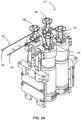
- FIG. 3A shows an isometric view of an example independent drive mechanism of the IDM 117 shown in FIG. 1 , according to one embodiment.
- the independent drive mechanism can tighten or loosen the pull wires 321, 322, 323, and 324 (e.g., independently from each other) of an endoscope by rotating the output shafts 305, 306, 307, and 308 of the IDM 117, respectively.
- the output shafts 305, 306, 307, and 308 transfer force down pull wires 321, 322, 323, and 324, respectively, through angular motion
- the pull wires 321, 322, 323, and 324 transfer force back to the output shafts.
- the IDM 117 and/or the surgical robotic system 100 can measure the transferred force using a sensor, e.g., a strain gauge further described below.
- FIG. 3B shows a conceptual diagram that shows how forces may be measured by a strain gauge 334 of the independent drive mechanism shown in FIG. 3A , according to one embodiment.
- a force 331 may direct away from the output shaft 305 coupled to the motor mount 333 of the motor 337. Accordingly, the force 331 results in horizontal displacement of the motor mount 333. Further, the strain gauge 334 horizontally coupled to the motor mount 333 experiences strain in the direction of the force 331. The strain may be measured as a ratio of the horizontal displacement of the tip 335 of strain gauge 334 to the overall horizontal width 336 of the strain gauge 334.
- the IDM 117 includes additional sensors, e.g., inclinometers or accelerometers, to determine an orientation of the IDM 117. Based on measurements from the additional sensors and/or the strain gauge 334, the surgical robotic system 100 can calibrate readings from the strain gauge 334 to account for gravitational load effects. For example, if the IDM 117 is oriented on a horizontal side of the IDM 117, the weight of certain components of the IDM 117 may cause a strain on the motor mount 333. Accordingly, without accounting for gravitational load effects, the strain gauge 334 may measure strain that did not result from strain on the output shafts.
- additional sensors e.g., inclinometers or accelerometers
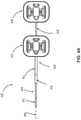
- FIG. 4A shows a top view of an example endoscope 118, according to one embodiment.
- the endoscope 118 includes a leader 415 tubular component nested or partially nested inside and longitudinally-aligned with a sheath 411 tubular component.
- the sheath 411 includes a proximal sheath section 412 and distal sheath section 413.
- the leader 415 has a smaller outer diameter than the sheath 411 and includes a proximal leader section 416 and distal leader section 417.
- the sheath base 414 and the leader base 418 actuate the distal sheath section 413 and the distal leader section 417, respectively, for example, based on control signals from a user of a surgical robotic system 100.
- the sheath base 414 and the leader base 418 are, e.g., part of the IDM 117 shown in FIG. 1 .
- Both the sheath base 414 and the leader base 418 include drive mechanisms (e.g., the independent drive mechanism further described with reference to FIG. 3A-B in Section III. Instrument Device Manipulator) to control pull wires coupled to the sheath 411 and leader 415.
- the sheath base 414 generates tensile loads on pull wires coupled to the sheath 411 to deflect the distal sheath section 413.
- the leader base 418 generates tensile loads on pull wires coupled to the leader 415 to deflect the distal leader section 417.
- Both the sheath base 414 and leader base 418 may also include couplings for the routing of pneumatic pressure, electrical power, electrical signals, or optical signals from IDMs to the sheath 411 and leader 414, respectively.
- a pull wire may include a steel coil pipe along the length of the pull wire within the sheath 411 or the leader 415, which transfers axial compression back to the origin of the load, e.g., the sheath base 414 or the leader base 418, respectively.
- the endoscope 118 can navigate the anatomy of a patient with ease due to the multiple degrees of freedom provided by pull wires coupled to the sheath 411 and the leader 415.
- pull wires coupled to the sheath 411 and the leader 415.
- four or more pull wires may be used in either the sheath 411 and/or the leader 415, providing eight or more degrees of freedom.
- up to three pull wires may be used, providing up to six degrees of freedom.
- the sheath 411 and leader 415 may be rotated up to 360 degrees along a longitudinal axis 406, providing more degrees of motion.
- the combination of rotational angles and multiple degrees of freedom provides a user of the surgical robotic system 100 with a user friendly and instinctive control of the endoscope 118.
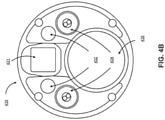
- FIG. 4B illustrates an example endoscope tip 430 of the endoscope 118 shown in FIG. 4A , according to one embodiment.
- the endoscope tip 430 includes an imaging device 431 (e.g., a camera), illumination sources 432, and ends of EM coils 434.
- the illumination sources 432 provide light to illuminate an interior portion of an anatomical space. The provided light allows the imaging device 431 to record images of that space, which can then be transmitted to a computer system such as command console 200 for processing as described herein.
- Electromagnetic coils 434 located on the tip 430 may be used with an electromagnetic tracking system to detect the position and orientation of the endoscope tip 430 while it is disposed within an anatomical system.
- the coils may be angled to provide sensitivity to electromagnetic fields along different axes, giving the ability to measure a full 6 degrees of freedom: three positional and three angular.
- only a single coil may be disposed within the endoscope tip 430, with its axis oriented along the endoscope shaft of the endoscope 118; due to the rotational symmetry of such a system, it is insensitive to roll about its axis, so only 5 degrees of freedom may be detected in such a case.
- the endoscope tip 430 further comprises a working channel 436 through which surgical instruments, such as biopsy needles, may be inserted along the endoscope shaft, allowing access to the area near the endoscope tip.
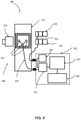
- FIG. 5 shows an example schematic setup of an EM tracking system 505 included in a surgical robotic system 500, according to one embodiment.
- multiple robot components e.g., window field generator, reference sensors as described below
- the robotic surgical system 500 includes a surgical bed 511 to hold a patient's body.
- Beneath the bed 511 is the window field generator (WFG) 512 configured to sequentially activate a set of EM coils (e.g., the EM coils 434 shown in FIG. 4B ).
- the WFG 512 generates an alternating current (AC) magnetic field over a wide volume; for example, in some cases it may create an AC field in a volume of about 0.5 x 0.5 x 0.5 m.
- AC alternating current
- a planar field generator may be attached to a system arm adjacent to the patient and oriented to provide an EM field at an angle.
- Reference sensors 513 may be placed on the patient's body to provide local EM fields to further increase tracking accuracy.
- Each of the reference sensors 513 may be attached by cables 514 to a command module 515.
- the cables 514 are connected to the command module 515 through interface units 516 which handle communications with their respective devices as well as providing power.
- the interface unit 516 is coupled to a system control unit (SCU) 517 which acts as an overall interface controller for the various entities mentioned above.
- SCU system control unit
- the SCU 517 also drives the field generators (e.g., WFG 512), as well as collecting sensor data from the interface units 516, from which it calculates the position and orientation of sensors within the body.
- the SCU 517 may be coupled to a personal computer (PC) 518 to allow user access and control.
- PC personal computer
- the command module 515 is also connected to the various IDMs 519 coupled to the surgical robotic system 500 as described herein.
- the IDMs 519 are typically coupled to a single surgical robotic system (e.g., the surgical robotic system 500) and are used to control and receive data from their respective connected robotic components; for example, robotic endoscope tools or robotic arms. As described above, as an example, the IDMs 519 are coupled to an endoscopic tool (not shown here) of the surgical robotic system 500
- the command module 515 receives data passed from the endoscopic tool.
- the type of received data depends on the corresponding type of instrument attached.
- example received data includes sensor data (e.g., image data, EM data), robot data (e.g., endoscopic and IDM physical motion data), control data, and/or video data.
- sensor data e.g., image data, EM data
- robot data e.g., endoscopic and IDM physical motion data
- control data e.g., endoscopic and IDM physical motion data
- video data e.g., video data.
- a field-programmable gate array (FPGA) 520 may be configured to handle image processing. Comparing data obtained from the various sensors, devices, and field generators allows the SCU 517 to precisely track the movements of different components of the surgical robotic system 500, and for example, positions and orientations of these components.
- FPGA field-programmable gate array
- the EM tracking system 505 may require a process known as "registration,” where the system finds the geometric transformation that aligns a single object between different coordinate systems. For instance, a specific anatomical site on a patient has two different representations in the 3D model coordinates and in the EM sensor coordinates. To be able to establish consistency and common language between these two different coordinate systems, the EM tracking system 505 needs to find the transformation that links these two representations, i.e., registration. For example, the position of the EM tracker relative to the position of the EM field generator may be mapped to a 3D coordinate system to isolate a location in a corresponding 3D model.
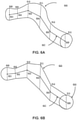
- FIGs. 6A-6B show an example anatomical lumen 600 and an example 3D model 620 of the anatomical lumen, according to one embodiment. More specifically, FIGs. 6A-6B illustrate relationship of centerline coordinates, diameter measurements and anatomical spaces between the actual anatomical lumen 600 and its 3D model 620.
- the anatomical lumen 600 is roughly tracked longitudinally by centerline coordinates 601, 602, 603, 604, 605, and 606 where each centerline coordinate roughly approximates the center of the tomographic slice of the lumen.
- the centerline coordinates are connected and visualized by a centerline 607.
- the volume of the lumen can be further visualized by measuring the diameter of the lumen at each centerline coordinate, e.g., coordinates 608, 609, 610, 611, 612, and 613 represent the measurements of the lumen 600 corresponding to coordinates 601, 602, 603, 604, 605, and 606.
- coordinates 608, 609, 610, 611, 612, and 613 represent the measurements of the lumen 600 corresponding to coordinates 601, 602, 603, 604, 605, and 606.
- FIG. 6B shows the example 3D model 620 of the anatomical lumen 600 shown in FIG. 6A , according to one embodiment.
- the anatomical lumen 600 is visualized in 3D space by first locating the centerline coordinates 601, 602, 603, 604, 605, and 606 in 3D space based on the centerline 607.
- the lumen diameter is visualized as a 2D circular space (e.g., the 2D circular space 630) with diameters 608, 609, 610, 611, 612, and 613.
- the anatomical lumen 600 is approximated and visualized as the 3D model 620.
- Centerline coordinates may also include markers to indicate point of interest for the physician, including lesions.
- a pre-operative software package is also used to analyze and derive a navigation path based on the generated 3D model of the anatomical space. For example, the software package may derive a shortest navigation path to a single lesion (marked by a centerline coordinate) or to several lesions. This navigation path may be presented to the operator intra-operatively either in two-dimensions or three-dimensions depending on the operator's preference.
- FIG. 7 shows a computer-generated 3D model 700 representing an anatomical space, according to one embodiment.
- the 3D model 700 may be generated using centerline 701 that was obtained by reviewing CT scans that were generated preoperatively.
- computer software may be able to map the navigation path 702 within the tubular network to access an operative site 703 within the 3D model 700.
- the operative site 703 may be linked to an individual centerline coordinate 704, which allows a computer algorithm to topologically search the centerline coordinates of the 3D model 700 for the optimum path 702 within the tubular network.
- the distal end of the endoscopic tool within the patient's anatomy is tracked, and the tracked location of the endoscopic tool within the patient's anatomy is mapped and placed within a computer model, which enhances the navigational capabilities of the tubular network.
- a number of approaches may be employed, either individually or in combination.
- a sensor such as an electromagnetic (EM) tracker
- EM electromagnetic
- an EM tracker embedded in the endoscopic tool, measures the variation in the electromagnetic field created by one or more EM transmitters.
- the transmitters or field generators
- the transmitters may be placed close to the patient (e.g., as part of the surgical bed) to create a low intensity magnetic field. This induces small-currents in sensor coils in the EM tracker, which are correlated to the distance and angle between the sensor and the generator.
- the electrical signal may then be digitized by an interface unit (on-chip or PCB) and sent via cables/wiring back to the system cart and then to the command module.
- the data may then be processed to interpret the current data and calculate the precise location and orientation of the sensor relative to the transmitters.
- Multiple sensors may be used at different locations in the endoscopic tool, for instance in leader and sheath in order to calculate the individual positions of those components. Accordingly, based on readings from an artificially-generated EM field, the EM tracker may detect changes in field strength as it moves through the patient's anatomy.
- FIGs. 8A-8D show example graphs 810-840 illustrating on-the-fly registration of an EM system to a 3D model of a path through a tubular network, according to one embodiment.
- the navigation configuration system described herein allows for on-the-fly registration of the EM coordinates to the 3D model coordinates without the need for independent registration prior to an endoscopic procedure.
- FIG. 8A shows that the coordinate systems of the EM tracking system and the 3D model are initially not registered to each other, and the graph 810 in FIG.
- FIG. 8A shows the registered (or expected) location of an endoscope tip 801 moving along a planned navigation path 802 through a branched tubular network (not shown here), and the registered location of the instrument tip 801 as well as the planned path 802 are derived from the 3D model.
- the actual position of the tip is repeatedly measured by the EM tracking system 505, resulting in multiple measured location data points 803 based on EM data.
- the data points 803 derived from EM tracking are initially located far from the registered location of the endoscope tip 801 expected from the 3D model, reflecting the lack of registration between the EM coordinates and the 3D model coordinates. There may be several reasons for this, for example, even if the endoscope tip is being moved relatively smoothly through the tubular network, there may still be some visible scatter in the EM measurement, due to breathing movement of the lungs of the patient.
- the points on the 3D model may also be determined and adjusted based on correlation between the 3D model itself, image data received from optical sensors (e.g., cameras) and robot data from robot commands.
- the 3D transformation between these points and collected EM data points will determine the initial registration of the EM coordinate system to the 3D model coordinate system.
- FIG. 8B shows a graph 820 at a later temporal stage compared with the graph 810, according to one embodiment. More specifically, the graph 820 shows the expected location of the endoscope tip 801 expected from the 3D model has been moved farther along the preplanned navigation path 802, as illustrated by the shift from the original expected position of the instrument tip 801 shown in FIG. 8A along the path to the position shown in FIG. 8B .
- additional data points 803 have been recorded by the EM tracking system but the registration has not yet been updated based on the newly collected EM data. As a result, the data points 803 in FIG.
- sufficient data e.g., EM data
- a relatively more accurate estimate can be derived from the transform needed to register the EM coordinates to those of the 3D model.
- the determination of sufficient data may be made by threshold criteria such as total data accumulated or number of changes of direction. For example, in a branched tubular network such as a bronchial tube network, it may be judged that sufficient data have been accumulated after arriving at two branch points.
- FIG. 8C shows a graph 830 shortly after the navigation configuration system has accumulated a sufficient amount of data to estimate the registration transform from EM to 3D model coordinates, according to one embodiment.
- the data points 803 in FIG. 8C have now shifted from their previous position as shown in FIG. 8B as a result of the registration transform.
- the data points 803 derived from EM data is now falling along the planned navigation path 802 derived from the 3D model, and each data point among the data points 803 is now reflecting a measurement of the expected position of endoscope tip 801 in the coordinate system of the 3D model.
- the registration transform may be updated to increase accuracy.
- the data used to determine the registration transformation may be a subset of data chosen by a moving window, so that the registration may change over time, which gives the ability to account for changes in the relative coordinates of the EM and 3D models-for example, due to movement of the patient.
- FIG. 8D shows an example graph 840 in which the expected location of the endoscope tip 801 has reached the end of the planned navigation path 802, arriving at the target location in the tubular network, according to one embodiment.
- the recorded EM data points 803 is now generally tracks along the planned navigation path 802, which represents the tracking of the endoscope tip throughout the procedure.
- Each data point reflects a transformed location due to the updated registration of the EM tracking system to the 3D model.
- each of the graphs shown in FIGs. 8A-8D can be shown sequentially on a display visible to a user as the endoscope tip is advanced in the tubular network.
- the processor can be configured with instructions from the navigation configuration system such that the model shown on the display remains substantially fixed when the measured data points are registered to the display by shifting of the measured path shown on the display in order to allow the user to maintain a fixed frame of reference and to remain visually oriented on the model and on the planned path shown on the display.
- FIGs. 8E-8F show effect of an example registration of the EM system to a 3D model of a branched tubular network, according to one embodiment.
- 3D graphs showing electromagnetic tracking data 852 and a model of a patient's bronchial system 854 are illustrated without (shown in FIG. 8E ) and with (shown in FIG. 8F ) a registration transform.
- tracking data 860 have a shape that corresponds to a path through the bronchial system 854, but that shape is subjected to an arbitrary offset and rotation.
- FIG. 8F by applying the registration, the tracking data 852 are shifted and rotated, so that they correspond to a path through the bronchial system 854.
- a registration matrix can be used to perform the registration between the EM tracking system and the 3D model, and as one example, the matrix may represent a translation and rotation in 6 dimensions.
- a rotational matrix and a translation vector can be used for performing the registration.
- applying a registration transform involves a shift from one coordinate system (x,y,z) to a new coordinate system (x',y',z') that may in general have its axes rotated to a different 3D orientation as well as having its origin shifted an arbitrary amount in each dimension.
- a rotation to an azimuthal angle of radians ⁇ may be expressed by the matrix M 1
- a rotation to an inclination angle of ⁇ radians may be expressed by the matrix M 2 etc.
- further rotational matrices may be written as the product of rotation matrices.
- a translation vector of ( ⁇ x ⁇ y ⁇ z) may be chosen to represent a translation of the origin in the x, y and z axes by ⁇ x, ⁇ y, and ⁇ z respectively.
- the registration transform may be determined by such methods as singular value decomposition on a cross correlation matrix between measured EM positions and estimated positions in the 3D model.
- the transformation matrix components may then be extracted from the decomposition, e.g., by identifying the appropriate principle components.
- An error signal may also be generated from the residuals of the determined transform, and the size of the error signal may be used to determine a level of confidence in the position. As further data are taken and the registration transform is determined more accurately, this error signal may decrease, indicating an increasing confidence in positions estimated in this manner.
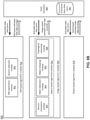
- FIGs. 9A-9C show example block diagrams of a navigation configuration system 900, according to one embodiment. More specifically, FIG. 9A shows a high-level overview of an example block diagram of the navigation configuration system 900, according to one embodiment.
- the navigation configuration system 900 includes multiple input data stores, a navigation module 905 that receives various types of input data from the multiple input data stores, and an output navigation data store 990 that receives output navigation data from the navigation module.
- the block diagram of the navigation configuration system 900 shown in FIG. 9A is merely one example, and in alternative embodiments not shown, the navigation configuration system 900 can include different and/or addition entities. Likewise, functions performed by various entities of the system 900 may differ according to different embodiments.
- the input data refers to raw data gathered from and/or processed by input devices (e.g., command module, optical sensor, EM sensor, IDM) for generating estimated state information for the endoscope as well as output navigation data.
- the multiple input data stores 910-940 include an image data store 910, an EM data store 920, a robot data store 930, and a 3D model data store 940.
- Each type of the input data stores stores the name-indicated type of data for access and use by the navigation module 905.
- Image data may include one or more image frames captured by the imaging device at the instrument tip, as well as information such as frame rates or timestamps that allow a determination of the time elapsed between pairs of frames.
- Robot data includes data related to physical movement of the medical instrument or part of the medical instrument (e.g., the instrument tip or sheath) within the tubular network.
- Example robot data includes command data instructing the instrument tip to reach a specific anatomical site and/or change its orientation (e.g., with a specific pitch, roll, yaw, insertion, and retraction for one or both of a leader and a sheath) within the tubular network, insertion data representing insertion movement of the part of the medical instrument (e.g., the instrument tip or sheath), IDM data, and mechanical data representing mechanical movement of an elongate member of the medical instrument, for example motion of one or more pull wires, tendons or shafts of the endoscope that drive the actual movement of the medial instrument within the tubular network.
- EM data is collected by EM sensors and/or the EM tracking system as described above.
- 3D model data is derived from 2D CT scans as described above.
- the output navigation data store 990 receives and stores output navigation data provided by the navigation module 905.
- Output navigation data indicates information to assist in directing the medical instrument through the tubular network to arrive at a particular destination within the tubular network, and is based on estimated state information for the medical instrument at each instant time, the estimated state information including the location and orientation of the medical instrument within the tubular network.
- the output navigation data indicating updates of movement and location/orientation information of the medical instrument is provided in real time, which better assists its navigation through the tubular network.
- the navigation module 905 locates (or determines) the estimated state of the medical instrument within a tubular network.
- the navigation module 905 further includes various algorithm modules, such as an EM-based algorithm module 950, an image-based algorithm module 960, and a robot-based algorithm module 970, that each may consume mainly certain types of input data and contribute a different type of data to a state estimator 980.
- algorithm modules such as an EM-based algorithm module 950, an image-based algorithm module 960, and a robot-based algorithm module 970, that each may consume mainly certain types of input data and contribute a different type of data to a state estimator 980.
- the different kinds of data output by these modules labeled EM-based data, the image-based data, and the robot-based data, may be generally referred to as "intermediate data" for sake of explanation.
- intermediate data for sake of explanation.
- the detailed composition of each algorithm module and of the state estimator 980 is more fully described in FIG. 9B below.
- FIG. 9B shows an example block diagram of the navigation module 905 shown in FIG. 9A , according to one embodiment.
- the navigation module 905 further includes a state estimator 980 as well as multiple algorithm modules that employ different algorithms for navigating through a tubular network.
- the state estimator 980 is described first, followed by the description of the various modules that exchange data with the state estimator 980.
- the state estimator 980 included in the navigation module 905 receives various intermediate data and provides the estimated state of the instrument tip as a function of time, where the estimated state indicates the estimated location and orientation information of the instrument tip within the tubular network.
- the estimated state data are stored in the estimated data store 985 that is included in the state estimator 980.
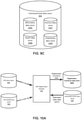
- FIG. 9C shows an example block diagram of the estimated state data store 985 included in the state estimator 980, according to one embodiment.
- the estimated state data store 985 may include a bifurcation data store 1086, a position data store 1087, a depth data store 1088, and an orientation data store 1089, however this particular breakdown of data storage is merely one example, and in alternative embodiments not shown, different and/or additional data stores can be included in the estimated state data store 985.
- bifurcation data refers to the location of the medical instrument with respect to the set of branches (e.g., bifurcation, trifurcation or a division into more than three branches) within the tubular network.
- the bifurcation data can be set of branch choices elected by the instrument as it traverses through the tubular network, based on a larger set of available branches as provided, for example, by the 3D model which maps the entirety of the tubular network.
- the bifurcation data can further include information in front of the location of the instrument tip, such as branches (bifurcations) that the instrument tip is near but has not yet traversed through, but which may have been detected, for example, based on the tip's current position information relative to the 3D model, or based on images captured of the upcoming bifurcations.
- branches branches
- Position data indicates three-dimensional position of some part of the medical instrument within the tubular network or some part of the tubular network itself. Position data can be in the form of absolute locations or relative locations relative to, for example, the 3D model of the tubular network. As one example, position data can include the position of a specific branch.
- Depth data indicates depth information of the instrument tip within the tubular network.
- Example depth data includes the total insertion (absolute) depth of the medical instrument into the patient as well as the (relative) depth within an identified branch. Depth data may be determined based on position data regarding both the tubular network and medical instrument.
- Orientation data indicates orientation information of the instrument tip, and may include overall roll, pitch, and yaw in relation to the 3D model as well as pitch, roll, raw within an identified branch.
- the state estimator 980 provides the estimated state data back to the algorithm modules for generating more accurate intermediate data, which the state estimator uses to generate improved and/or updated estimated states, and so on forming a feedback loop.
- the EM-based algorithm module 950 recieves prior EM-based estimated state data (not shown in FIG. 9B ), also referred to as data associated with timestamp "t-1.”
- the state estimator 980 uses this data to generate "estimated state data (prior)" that is associated with timestamp "t-1,” It then provides the data back to the EM-based algorithm module.
- the "estimated state data (prior)" may be based on a combination of different types of intermediate data (e.g., robotic data, image data) that is associated with timestamp "t-1" as generated and received from different algorithm modules.
- the EM- based algorithm module 950 runs its algorithms using the estimated state data (prior) to output to the state estimator 980 improved and updated EM-based estimated state data, which is represented by "EM-based estimated state data (current)" here and associated with timestamp t. This process continues to repeat for future timestamps as well.
- the state estimator 980 may use several different kinds of intermediate data to arrive at its estimates of the state of the medical instrument within the tubular network
- the state estimator 980 is configured to account for the various different kinds of errors and uncertainty in both measurement and analysis that each type of underlying data (robotic, EM, image) and each type of algorithm module might create or carry through into the intermediate data used for consideration in determining the estimated state.
- robot EM
- image a type of underlying data
- each type of algorithm module might create or carry through into the intermediate data used for consideration in determining the estimated state.
- the "probability" of the “probability distribution”, as used herein, refers to a likelihood of an estimation of a possible location and/or orientation of the medical instrument being correct. For example, different probabilities may be calculated by one of the algorithm modules indicating the relative likelihood that the medical instrument is in one of several different possible branches within the tubular network.
- the type of probability distribution e.g., discrete distribution or continuous distribution
- is chosen to match features of an estimated state e.g., type of the estimated state, for example continuous position information vs. discrete branch choice).
- estimated states for identifying which segment the medical instrument is in for a trifurcation may be represented by a discrete probability distribution, and may include three discrete values of 20%, 30% and 50% representing chance as being in the location inside each of the three branches as determined by one of the algorithm modules.
- the estimated state may include a roll angle of the medical instrument of 40 ⁇ 5 degrees and a segment depth of the instrument tip within a branch may be is 4 ⁇ 1 mm, each represented by a Gaussian distribution which is a type of continuous probability distribution. Different methods can be used to generate the probabilities, which will vary by algorithm module as more fully described below with reference to later figures.
- the "confidence value,” as used herein, reflects a measure of confidence in the estimation of the state provided by one of the algorithms based one or more factors.
- factors such as distortion to EM Field, inaccuracy in EM registration, shift or movement of the patient, and respiration of the patient may affect the confidence in estimation of the state.
- the confidence value in estimation of the state provided by the EM-based algorithms may depend on the particular respiration cycle of the patient, movement of the patient or the EM field generators, and the location within the anatomy where the instrument tip locates.
- examples factors that may affect the confidence value in estimation of the state include illumination condition for the location within the anatomy where the images are captured, presence of fluid, tissue, or other obstructions against or in front of the optical sensor capturing the images, respiration of the patient, condition of the tubular network of the patient itself (e.g., lung) such as the general fluid inside the tubular network and occlusion of the tubular network, and specific operating techniques used in, e.g., navigating or image capturing.
- one factor may be that a particular algorithm has differing levels of accuracy at different depths in a patient's lungs, such that relatively close to the airway opening, a particular algorithm may have a high confidence in its estimations of medical instrument location and orientation, but the further into the bottom of the lung the medical instrument travels that confidence value may drop.
- the confidence value is based on one or more systemic factors relating to the process by which a result is determined, whereas probability is a relative measure that arises when trying to determine the correct result from multiple possibilities with a single algorithm based on underlying data.
- C EM , C Image , and C Robot represents confidence value corresponding to EM-based algorithm, image-based algorithm, and robot-based algorithm
- P i,EM' P i , Image , and P i , Robot represent the probabilities for segment i.
- a user is trying to identify segment where a instrument tip is located in a certain trifurcation within a central airway (the predicted region) of the tubular network, and three algorithms modules are used including EM-based algorithm, image-based algorithm, and robot-based algorithm.
- EM-based algorithm the probability distribution corresponding to the EM-based algorithm may be 20% in the first branch, 30% in the second branch, and 50% in the third (last) branch, and the confidence value applied to this EM-based algorithm and the central airway is 80%.
- a probability distribution corresponding to the image-based algorithm may be 40%, 20%, 40% for the first, second, and third branch, and the confidence value applied to this image-based algorithm is 30%; while a probability distribution corresponding to the robot-based algorithm may be 10%, 60%, 30% for the first, second, and third branch, and the confidence value applied to this image-based algorithm is 20%.
- the difference of confidence values applied to the EM-based algorithm and the image-based algorithm indicates that the EM-based algorithm may be a better choice for segment identification in the central airway, compared with the image-based algorithm.
- An example mathematical calculation of a final estimated state can be:
- the output estimated state for the instrument tip can be the result values (e.g., the resulting 30%, 42% and 58%), or derivative value from these result values such as the determination that the instrument tip is in the third branch.
- the estimated state may be represented in a number of different ways.
- the estimated state may further include an absolute depth from airway to location of the tip of the instrument, as well as a set of data representing the set of branches traversed by the instrument within the tubular network, the set being a subset of the entire set of branches provided by the 3D model of the patient's lungs, for example.
- the application of probability distribution and confidence value on estimated states allows improved accuracy of estimation of location and/or orientation of the instrument itp within the tubular network.
- the algorithm modules include an EM-based algorithm module 950, an image-based algorithm module 960, and a robot-based algorithm module 970.
- the algorithm modules shown in FIG. 9B is merely one example, and in alternative embodiments, different and/additional algorithm modules involving different and/or additional navigation algorithms can also be included in the navigation module 905.
- the EM-based algorithm module 950 further includes an EM registration module 952 and a branch selection module 954.
- the EM registration module 952 performs registration of EM coordinates to 3D model coordinates.
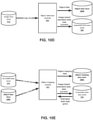
- FIG. 10A shows an example block diagram of the EM registration module 952, according to one embodiment.
- the EM registration module 952 receives as input, estimated state data (prior) (e.g., bifurcation data) from the estimated state data store 1086, the EM data from the EM data store 920, the 3D model data from the 3D model data store 940.
- estimated state data e.g., bifurcation data
- the EM registration module 952 performs on-the-fly registration of the EM tracking data to the 3D model. After the initial registration is determined, the EM registration module 952 continually updates its estimate of the registration transform based on received data, so as to increase transform accuracy as well as to compensate for changes to the navigation configuration system 900, e.g., changes due to movement of the patient.
- the EM registration module 952 outputs registration transform data to the registration transform data store 1053.
- the registration transform data reflects the best fit registration transform, and it can also be sent to the state estimator 980, as well as to the branch selection module 954.
- FIG. 10B shows an example block diagram of the branch selection module 954, according to one embodiment.
- the branch selection module 954 receives as inputs, estimated state data (prior) (e.g., bifurcation data) from the estimated state data store 985, the EM data from the EM data store 920, registration transform data from the registration transform data store 1053, as well as 3D model data from the 3D model data store 940. Based on the received data, the branch selection module 954 determines an estimate of the position and orientation of the endoscope tip relative to the 3D model of the tubular network and provides EM-based estimated state data (current) to the state estimator 980.
- estimated state data e.g., bifurcation data
- the EM-based estimated state data may be represented as a probability distribution (e.g., a discrete distribution of 20%, 30% and 50% for three segments of a trifurcation, as described above.) Additionally, when at a bifurcation as indicated by the received bifurcation data, the branch selection module 954 may compare the pitch and yaw of the tip to the angles of each branch in the 3D model to estimate which branch has been selected by the user for traversal. The branch selection module 954 outputs the EM-based estimated state data (current) to the estimated data store 985.
- a probability distribution e.g., a discrete distribution of 20%, 30% and 50% for three segments of a trifurcation, as described above.
- the image-based algorithm module 960 uses image data to determine the estimated state of the instrument within the tubular network.
- the image-based algorithm module 960 further includes one or more different types of image-based algorithm modules that employ different image-based algorithms. As shown in FIG. 9B , one example including an object-based algorithm module 962 is shown. In alternative embodiments not shown, other types of image-based algorithms may be employed and corresponding algorithm modules may be included in the image-based algorithm module 960.
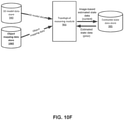
- the object-based algorithm module 962 detects and analyzes objects present in the field of view of the image data, such as branch openings or particles, to determine estimated state. In one embodiment, it includes an object detection module 963, and object mapping module 964, a topological reasoning module 965, and a motion estimation module 966. In some embodiments, it may or may not be necessary to apply the different modules 963, 964, 965 and 966 in a fixed sequential order, and when actually executing a process of object-based algorithm described by the object-based algorithm module 962, the order of employing each module within the module 962 is a different order than shown in FIG. 9B .
- the motion estimation module 963 receives as inputs image data from the image data store 910, estimated state data (prior) (specifically bifurcation data), from the estimated state data store 985as well as the 3D model data from the 3D model data store 940. Based on the received image data, the motion estimation module 963 measures a movement of the medical instrument between multiple image frames based on the received image data.
- Example techniques used include optical flow and image registration techniques, among others. This measurement determines a differential movement, such as forward-backward motion or roll motion, of the instrument tip in its own local frame of reference. This movement can be combined with the prior estimated state input to calculate a new estimated state.
- a forward (or backward) movement can translate into an increase (or decrease) in depth relative to a prior estimated state.
- a differential roll translates into a change in roll angle relative to a prior estimated state.
- this movement measurement may include an identification of an estimated new branch that the instrument tip is estimated to be entering or have entered. For example, if the bifurcation data indicates that the endoscope tip is at a branch point, pitch and yaw movements can be measured to determine changes in pointing angle, and the new estimated angle can be compared with the expected angles of different branches in the 3D model of the tubular network. A determination can then be made of which branch the endoscope is facing towards when it is moved into a new branch. Estimated state data reflecting each of these estimates of new position, orientation, and/or branch entry are output to the state estimator 980.
- FIG. 10D shows an example block diagram of the object detection module 964, according to one example.
- the object detection module 964 receives as inputs image data (e.g., image frames), and outputs object data to an object data store 1063 as well as estimated state data to the estimated state data store 985.
- Object data indicates information about what objects were identified, as well as positions, orientations, and sizes of objects represented as probabilities.
- the object detection module 964 detects, within an image, one or more objects and one or more features of the object(s) that may indicate branch points in a tubular network, and then determines their position, size, and orientation.
- Objects may be calculated or represented in the object detection module 964 as being two-dimensional shapes, such as circles/ovals/ellipses for detected branch points. This corresponds to the fact that the image data used to capture the objects are images from the camera on the instrument tip pointed usually along an axis substantially parallel to the direction of the segment in which the instrument is located.
- objects such as branches in the tubular network appear as simple shapes such as ellipses in the images.
- each branch will typically appear as a dark, approximately elliptical region, and these regions may be detected automatically by a processor, using region-detection algorithms such as maximally stable extremal regions (MSER) as objects. These regions may then be fit to define an object (e.g., ellipse), with appropriate free parameters such as ellipse center, major and minor axes, and angle within the image.
- MSER maximally stable extremal regions
- the roll measurement and the identified matching between model lumens and lumens in the image are also output to the state estimator 980, as well as topological reasoning module 966.
- An example of identified objects superimposed on an image of a bronchial network, along with a link joining their centers, is described with reference to FIGs. 11A-11B .
- airway can also be identified as an object present in the image data.
- the object detection module 964 may use light reflective intensity combined with other techniques to identify airways.
- the object detection module 964 may further track detected objects across a set of sequential image frames to detect which branch has been entered from among a set of possible branches in the tubular network. Tracking the relative positions of the objects within the image frames may be used to determine a local, absolute measurement of roll angle within a branched network.
- FIG. 10E shows an example block diagram of the object mapping module 965, according to one embodiment.
- the object mapping module 965 receives as inputs 3D model data from the 3D model data store 940, object data (e.g., detected objects such as shapes representing possible branches in the tubular network) from the object data store 1063, and estimated state data (prior) from the estimated state data store 985.
- object data e.g., detected objects such as shapes representing possible branches in the tubular network
- estimated state data prior
- the object mapping module 965 Based on the received input data, the object mapping module 965 outputs object mapping data to an object mapping data store 1065 as well as image-based estimated state data (current) to the estimated state data store 985.
- the object mapping data indicates mapping information between physical branches (lumens) shown in image data (based on the detected objects) and virtual branch information generated by 3D model.
- the estimated state data (current) generated by module 965 includes identification of each branch of the tubular network visible within the image as well as an estimate of the roll of the endoscope tip relative to the 3D model.
- the estimated state data (current) can be represented as a probability distribution.
- the identification of the visible lumens may include coordinates in x and y of each identified lumen center within the image, for example based on object sizes correlated with the 3D model virtual image data, as well as an association of each identified lumen location with a particular branch of the tubular network.
- the virtual images of the tubular network may be pre-computed to speed up processing.
- the tubular network may be represented by a structure such as a tree diagram of lumen midlines, with each such midline describing a 3D path, so that an expected position of local branch centers as seen from any arbitrary perspective may be compared to the identified actual locations of branch centers based on EM data and/or robot data.
- FIGs. 11A-11B show an example object-to-lumen mapping performed by the object mapping module 965, according to one embodiment. More specifically, FIG. 11A shows two example identified objects 1101 and 1102 superimposed on an image of a bronchial network 1105 along with a link 1103 connecting centers of the two objects, according to one embodiment. In the illustrated example, the identified objects 1101 and 1102 are ellipse-shaped.
- FIG. 11B shows a matching between airway lumens in an actual image 1110 of a real bronchial network and a corresponding virtual image 1120 from a 3D model of that same network, according to on embodiment.
- ellipses are identified corresponding to two different branches, located with identified centers 1111 and 1112, which, in one embodiment, indicates centerline coordinates of the branches as described above in FIGs. 6A-6B .
- the 3D model virtual image 1120 is a simulated representation of the real bronchial network shown in the actual image 1110, and the estimated centers 1121 and 1122 of the endoscope tip as determined by the state estimator 980 are shown corresponding to the positions of the identified centers 1111 and 1112.
- the 3D model image 1120 may be rotated or translated to increase the closeness of fit between actual image 1110 and virtual image 1120, and the amount of roll needed for the rotation or translation can be output as a correction to the current estimated state (e.g., roll of the instrument tip).
- the probability applied to a possible estimated state as generated by the object mapping module 965 is based on the closeness of fit between the identified centers 1111 and 1112 detected in the actual image 1110 and estimated centers 1121 and 1121 in the 3D model image 1120, and as one example, the probability of being in the lumen with identified center 1112 drops as the distance between the estimated center 1122 and identified center 1112 increases.
- FIG. 10F shows an example block diagram of the topological reasoning module 966, according to one embodiment.
- the topological reasoning module 966 receives as input image data from the 3D model data from the 3D model data store 940, object mapping data from the object mapping data store 1065, and estimated state data (prior) from the estimated state data store 985.
- the topological reasoning module 966 determines which branch the endoscope tip is facing towards, thereby generating a prediction of which branch will be entered if the endoscope is moved forward. As above, the determination may be represented as a probability distribution. In one embodiment, when the instrument tip is moving forward, the topological reasoning module 966 determines that a new branch of the tubular network has been entered and identifies which branch the tip has moved into. The determination of which branch is being faced and which segment is entered may be made, for example, by comparing the relative sizes and locations of different identified objects (e.g., ellipses). As one example, as a particular lumen branch is entered, a corresponding detected object will grow larger in successive image frames, and will also become more centered in those frames.
- identified objects e.g., ellipses
- the topological reasoning module 966 assigns an increasingly large probability to a corresponding estimated state as the endoscope tip moves towards the lumen associated with that object. Other branches are assigned correspondingly lower probabilities, until finally their object shapes disappear from images entirely. In one embodiment, the probability of the medical instrument being in those branches depends only on the probability that the branches were misidentified by the object mapping module 964.
- the output of the topological reasoning module 966 is image-based estimated state data representing estimated probabilities of being in each of a set of possible branches within the branched network.
- the robot-based algorithm module 970 uses robot data to provide robot-based estimated state data to the state estimator 980.
- FIG. 9B illustrates that the robot-based algorithm module 970 receives estimated state data (prior) and provides estimated state data (current) to state estimator 980.
- Robot data includes data related to physical movement of the medical instrument or part of the medical instrument (e.g., the instrument tip) within the tubular network.
- Example robot data includes command data instructing the instrument tip to reach a specific anatomical site and/or change its orientation (e.g., with a specific pitch, roll, yaw, insertion, and retraction for one or both of a leader and a sheath) within the tubular network, insertion data representing insertion movement of the part of the medical instrument (e.g., the instrument tip or sheath), IDM data, and mechanical data representing mechanical movement of an elongate member of the medical instrument, for example motion of one or more pull wires, tendons or shafts of the endoscope that drive the actual movement of the medical instrument within the tubular network.
- command data instructing the instrument tip to reach a specific anatomical site and/or change its orientation (e.g., with a specific pitch, roll, yaw, insertion, and retraction for one or both of a leader and a sheath) within the tubular network
- insertion data representing insertion movement of the part of the medical instrument (e.g., the instrument tip
- the estimated state data provided by the raw robotic input data is just that, an estimate as to actual motion.
- the estimated state data determined from the robotic data may be represented in a probabilistic manner to represent this uncertainty in actual position information.
- FIG. 12 shows an example process of generating a probability distribution over multiple values to determine an estimated state as may be performed by any of the individual algorithm modules described above, according to one embodiment. For sake of example, this process is described with respect to the estimated state module 980, but in practice may be used by any algorithm module.
- the state estimator 980 first determines 1201 a prior probability distribution for the estimated state. As this stage, this probability distribution may be an initialized value distribution based, for example, on user input identifying a starting point near an entry point to a branched network. Subsequently, the distribution is determined from its previous output state estimate, adjusted based on the robotic, image, or EM input data.
- the new or updated probability distribution may be estimated as centered 1 mm forward compared to the previous probability distribution. More generally, if a robot command is expected to change a variable x by a certain amount, represented by an expected distribution of value changes Q(Ax), the new estimated distribution P' (x) may be expressed as a convolution of the previous distribution P(x) with Q(Ax). This new estimated state is treated as a prior probability estimate of the variable for the subsequent steps.
- the state estimator 980 receives an estimated value distribution for the estimated state based on one or more algorithm modules.
- This value distribution may be represented in various ways, such as an expected value and an error range, or as an explicit distribution function over values, for example.
- the value distribution contains, implicitly or explicitly, an expected value of the variable and some estimate of a range of error.
- the state estimator 980 may treat the estimated value distribution as a normal distribution with a mean at the expected value and a standard deviation determined by the error range.
- the estimated value distribution will typically comprise one or more probability values assigned to each of one or more branches, such that the total probability sums to one (or 100%).
- some branches may not be assigned with explicit probabilities, and the total probability may be less than 1, in which case the remaining probability can be treated as being uniformly distributed over all other branches.
- the state estimator 980 generates a posterior probability distribution based on the received estimated value distribution from step 1202 and the determined prior probability distribution from step 1201.
- this posterior probability distribution is calculated as an application of Bayes' Theorem, which states that for an observation A, the posterior probability P ( x
- A P A
- the state estimator 980 determines each of the quantities P(x), P(A), and P ( A
- the probability, P(A), of observing the tip to be in any given branch may be set as 1/10.
- a model may be implemented to weight the possible observations A variably, for example, where branch sizes vary, P ( A ) may be set proportional to the size of branch A divided by the sum of all branch sizes, representing the idea that a randomly-placed tip is more likely to be found in a large branch than a small one.
- P (A) will be a probability density function over all possible observations A.
- the result of step 1203 is a new probability distribution for values of the variable/state.
- the multiple independent measurements may be adjusted sequentially by taking the output of step 1203 as an input to step 1201, and using each new measurement as the estimated value distribution of step 1202. This generates a loop 1205 over measurements.
- step 1202 may incorporate a plurality of independent estimated value distribution which may be combined into a single updated estimate in step 1203, using Bayesian conditional updating on multiple measurements.
- the motion estimation module 963 may employ method 1200 with a process of taking the prior probability distribution of step 1201 as over an amount of movement (for example, an expected range of movement based on robot data), receiving an estimated value distribution in step 1202 over differential movement measurements, and generating a posterior probability distribution in step 1203 to estimate actual values of movement.
- This output may then be convolved with a prior estimated variable values (from a prior estimated state) to generate a posterior probability distribution for multiple values of the state.
- this new probability distribution is reported out in step 1204.
- the process 1200 may be applied in parallel to generate new probability distributions for a plurality of variables (states), such as position, orientation, roll, depth, and/or branch.
- states such as position, orientation, roll, depth, and/or branch.
- the outputs of step 1204 for each such process may be combined together to generate a new estimated state (E) 1202, which represents the output of the motion estimation module 963.
- the navigation module 905 allows estimates of variables even when certain input data is not available. For example, prior to registration of the EM system, the output of the branch selection module 954 is ignored by the state estimator 980. Nonetheless, states representing location and/or orientation (e.g., tip insertion depth) may still be estimated based on available input data like the robot input data. Each time the instrument tip is ordered to move deeper into the branched network, the estimate state for the tip insertion depth may be updated based on this estimated movement. Thus, prior to registration, the tip insertion depth may be estimated based on robot data, and after registration, the depth may be estimated based on data from the branch selection module 954, but also partially based on robot data, with a weighting function.
- states representing location and/or orientation e.g., tip insertion depth
- the estimate state for the tip insertion depth may be updated based on this estimated movement.
- the tip insertion depth may be estimated based on robot data, and after registration, the depth may be estimated based on data from the branch selection module 954,
- the navigation configuration system 900 demonstrates the ability to recover from errors by using the measurements from one module to contradict the measurements from another, allowing the system to "change its mind" about a previously-made determination. An example of how an error can be corrected is more fully described below with reference to FIG. 13 .
- FIG. 13 shows an example of how an error can be corrected with navigation through a tubular network by the navigation configuration system 900, according to one embodiment.
- a simplified model of a bronchial tree 1300 with estimated states is shown at four different temporal stages: states 1310, 1320, 1330, and 1340.
- states 1310, 1320, 1330, and 1340 For each temporal stage, an estimated position (1312, 1322, 1332, and 1342, respectively) of an instrument tip used for the navigation is illustrated, and a corresponding actual position (1311, 1321, 1331, and 1341, respectively) of the tip is also illustrated.
- the accuracy of the estimated states may vary, e.g., the estimated states may first begin accurate, then becomes inaccurate, and then becomes accurate again.
- the actual position of the tip is 1311, at the upper branch of the bronchial tree 1300, and the navigation configuration system 900 accurately estimates that location as estimated position 1312.
- one or more modules inside the system 900 may misidentify the branch based on probabilities provided by one or more of the algorithm modules, causing the system to conclude that the tip is entering the left branch 1345, when it is actually entering the right branch 1346.
- the state estimator 980 initially assigns an 80% chance of being in the left branch and a 20% chance of being in the right branch.
- the branch selection module 954 may thus more and more confidently report that the tip is probably in the right branch 1346 based on the shift in the probabilities provided by the underlying modules. Accordingly, the state estimator's 980 aggregate probability estimate may also shift, thereby resulting in an increase in the probability of being in the right branch 1346 and a corresponding decreasing the probability of being in the left branch 1345.
- the system 900 may proceed to a state 1330, in which the tip is at the actual position 1331, arriving at a division into three branches. However, at this point in time state estimator 980 may still be estimating that the most likely state to be at estimated position 1332.
- the state estimator 980 may be expecting a certain distance until the next branch division, in this example a two-way division, rather than three-way branch division.
- the branch selection module 954 and the object mapping module 964 may strongly estimate that the tip is located in the branch shown on the right, which further strongly adjusts the probabilities of being in the left and right branches, leading to an almost certain assignment of the tip location to the correct branch, the right branch 1346 here.
- the state estimator 980 correctly estimates the instrument tip be at estimated position 1342, very close to its actual location 1341. If the endoscope is along the user's desired path, the system 900 can now proceed to determine which branch of the three-way branch division is entered next. Alternately, the user can backtrack to travel down the left lumen of bronchial tree 1300. In some embodiments, this updated estimate is shown to a user on a display, so that the user can perceive that the previous estimates were in error, and that error has now been corrected.
- FIGs. 14A-14C show example pre-operative steps for preparation of a surgical instrument (e.g., an instrument tip) to navigation through an example tubular network, according to various embodiments.
- a surgical instrument e.g., an instrument tip
- FIG. 14A shows an example pre-operative sequence of steps of a method 1400 for navigating the instrument tip to a particular site within the tubular network, according to one embodiment. Alongside each step of the method 1400, a corresponding image is shown to illustrate a representation of the involved data for planning a path and navigating through the tubular network.
- a CT scan of the tubular network is obtained, and the data from the CT scan provides 3D information about the structure and connectivity of the tubular network.
- the image in step 1405 shows a tomographic slice of a patient's lungs.
- a 3D model is generated based on the obtained CT scan data, and the generated 3D model can be used to assign each branch of the tubular network with a unique identity, enabling convenient navigation within the network.
- the image in step 1410 shows a 3D model of a patient's bronchial network.
- a target 1416 is selected, and this target may be, for example, a lesion to biopsy, or a portion of organ tissue to repair surgically.
- the user is capable of selecting the location of the target by interfacing with a computer display that can show the 3D model, such as by clicking with a mouse or touching a touchscreen. The selected target may then be displayed to the user.
- the target 1416 is marked within the 3D bronchial model generated from step 1410.
- a path 1421 is automatically planned from an entry point 1422 to the target 1416, and the path 1421 identifies a sequence of branches within the network to travel through, so as to reach the target 1416.
- the tubular network may be tree-like, the path 1421 may be uniquely determined by the structure of the tubular network, while in another embodiment, the tubular network may be cyclic, and the path may be found by an appropriate algorithm such as a shortest-path algorithm.
- virtual endoscopy 1425 may be performed to give the user a preview of the endoscopic procedure.
- the 3D model generated from step 1410 is used to generate a sequence of 2D images as though seen by an endoscope tip while navigating the network corresponding to the 3D model.
- the path 1421 may be shown as a curve that may be followed to get from the entry point 1422 to the target 1416.
- a virtual tool alignment procedure 1430 may be performed to illustrate to the user how to manipulate endoscopic tools in order to perform a surgical procedure at the target.
- a virtual endoscopic biopsy needle 1431 is maneuvered by the user in order to biopsy a lesion 1432 located beneath the surface of a bronchial tube. The lesion location is highlighted so that the user can align the needle to it, and then use the needle to pierce the surface of the bronchial tube and access the lesion underneath. This mimics the steps that will be taken during the actual surgical procedure, allowing the user to practice before performing surgery.
- FIG. 14B shows an example user interface 1434 for navigation of a surgical instrument through a tubular network, according to one embodiment.
- the user interface 1434 allows the user to have various views of the tubular network during an endoscopic procedure.
- the user interface 1434 may show various navigation views to the user.
- the location of the endoscope tip may be superimposed on a tomographic segment of the CT scan 1435, with a marker (e.g., crosshairs 1436) showing the location of the instrument.
- the CT image is of a patient's lungs, and the endoscope used is a bronchoscope.
- the user interface 1434 also shows a view 1440 representing a 3D model with a highlighted path 1441 and icons showing the endoscope location 1442 and the target location 1443. Some additional icons 1444 are also shown in the view 1440 for user interface controls enabling features as map pan and zoom.
- View 1445 shows a virtual endoscope view from the estimated location of the tip that can be compared with a real-time view to confirm that the tip location has been estimated accurately.
- a path indicator 1446 and location/orientation indicator 1447 for aid in navigation is also shown in the view 1446.
- the upper left shows state information 1448 determined by the state estimator 980, indicating that the current distance to target "t1" is 5.4 cm, and that the calculated roll angle is -139 degrees.
- View 1450 shows a virtual view of the endoscope shaft 1451, displayed from a "third-person" viewpoint to the rear of the endoscope tip.
- the virtual view can be generated by assuming that the endoscope shaft lies along the path already traversed by the tip, and the view of the surrounding area is generated based on the 3D model in the vicinity of the chosen viewpoint. Alternately, the view may be generated from images taken while passing through that area earlier in the procedure.
- the virtual viewpoint may project ahead of the endoscope tip location, to show the next bifurcation. This view may further highlight the intended path, to inform the user in advance which way to steer when the endoscope tip reaches the next bifurcation.
- FIG. 14C shows an example user interface 1480 for tool alignment and control during an endoscopic procedure, according to one embodiment.
- View 1455 shows a tomographic view at a later stage in the procedure than view 1435, in which the endoscope tip is near the target and an endoscopic tool-in this case, a biopsy needle-has been deployed from the endoscope's working channel.
- the crosshairs 1436 highlights the new position of the tip. Since the bronchoscope in the image is farther into the patient's lungs, the tomographic slice has changed to show a deeper cross-sectional segment.
- the icon locating the endoscope tip has been replaced with one indicating the location and orientation of the needle.
- View 1460 shows a map view of the 3D model, zoomed in around the target location 1443 and the tool icon 1461 representing the biopsy needle.
- Located at target 1443 is a biopsy location 1466 to which a biopsy needle is to be applied.
- the endoscope tip has been navigated to nearly the end of path 1441, to arrive at a location close enough to the target location 1443 so that the needle may reach the biopsy location 1466.
- View 1465 shows a virtual view in the vicinity of target location 1443, highlighting a biopsy location 1466 to help the user visualize precisely where the needle is to be inserted to collect tissue for biopsy. Additional information, such as target size and distance to target may optionally be overlaid on the image.
- View 1670 shows a close-up view of a 3D icon 1471 representing a biopsy needle, superimposed on a tomographic image of the patient's lungs.
- the roll of the instrument is indicated by a multicolored pattern 1475 on the rear of the 3D icon 1471.
- this particular orientation represents a roll of 0 degrees, and the needle is currently 4 mm from the biopsy location 1466.
- a path 1474 is displayed showing how the needle should be oriented and moved in order to contact the biopsy location 1466.
- a processor within the computer system may comprise one or more components to process electronic signals, and may comprise one or more of a central processor unit, a video processor, logic circuitry, gate array logic, filed programmable gate array, integrated circuit, or application specific integrated circuit.
- the computer system includes a central processing unit (CPU, also "processor” and “computer processor” herein), which can be a single core or multi core processor, or a plurality of processors for parallel processing.
- the CPU can execute a sequence of machine-readable instructions, which can be embodied in a program or software.
- the instructions may be stored in a memory location. Examples of operations performed by the CPU can include fetch, decode, execute, and writeback.
- the CPU can be part of a circuit, such as an integrated circuit.
- One or more other components of the system can be included in the circuit.
- the circuit comprises an application specific integrated circuit (ASIC).
- ASIC application specific integrated circuit
- the computer system may also include one or more of memory or memory locations (e.g., random-access memory, read-only memory, flash memory), electronic storage units (e.g., hard disk), communication interfaces (e.g., network adapters) for communicating with one or more other systems, and peripheral devices, such as caches, other memory, data storage and/or electronic display adapters.
- memory or memory locations e.g., random-access memory, read-only memory, flash memory
- electronic storage units e.g., hard disk
- communication interfaces e.g., network adapters
- peripheral devices such as caches, other memory, data storage and/or electronic display adapters.
- the memory, storage unit, interface, and peripheral devices are in communication with the CPU through a communication bus, such as a motherboard.
- the storage unit can be a data storage unit (or data repository) for storing data.
- the computer system can be operatively coupled to a computer network ("network") with the aid of the communication interface.
- the network can be the Internet, an internet and/or extranet, or an intranet and/or extranet that is in communication with the Internet.
- the network in some cases is a telecommunication and/or data network, and can include can include one or more computer servers.
- the storage unit can store files, such as drivers, libraries and saved programs.
- the storage unit can store user data, e.g., user preferences and user programs.
- the computer system in some cases can include one or more additional data storage units that are external to the computer system, such as located on a remote server that is in communication with the computer system through an intranet or the Internet.
- Methods as described herein can be implemented by way of machine (e.g., computer processor) executable code stored on an electronic storage location of the computer system, such as, for example, on the memory or electronic storage unit.
- the machine executable or machine readable code can be provided in the form of software.
- the code can be executed by the processor.
- the code can be retrieved from the storage unit and stored on the memory for ready access by the processor.
- the electronic storage unit can be precluded, and machine-executable instructions are stored on memory.
- the code can be pre-compiled and configured for use with a machine have a processer adapted to execute the code, or can be compiled during runtime.
- the code can be supplied in a programming language that can be selected to enable the code to execute in a pre-compiled or as-compiled fashion.
- Methods and systems of the present disclosure can be implemented by way of one or more methods.
- a method can be implemented with a processor as described herein, for example by way of software upon execution by one or more computer processors.
- any reference to " one embodiment” or “ an embodiment” means that a particular element, feature, structure, or characteristic described in connection with the embodiment is included in at least one embodiment.
- the appearances of the phrase “ in one embodiment” in various places in the specification are not necessarily all referring to the same embodiment.
- Coupled may be described using the expression “ coupled” and “connected” along with their derivatives.
- some embodiments may be described using the term “ coupled” to indicate that two or more elements are in direct physical or electrical contact.
- coupled may also mean that two or more elements are not in direct contact with each other, but yet still co-operate or interact with each other.
- the embodiments are not limited in this context unless otherwise explicitly stated.
- the terms “ comprises,” “ comprising,” “ includes,” “ including,” “ has,” “ having” or any other variation thereof, are intended to cover a non-exclusive inclusion.
- a process, method, article, or apparatus that comprises a list of elements is not necessarily limited to only those elements but may include other elements not expressly listed or inherent to such process, method, article, or apparatus.
- " or” refers to an inclusive or and not to an exclusive or. For example, a condition A or B is satisfied by any one of the following: A is true (or present) and B is false (or not present), A is false (or not present) and B is true (or present), and both A and B are true (or present).
Landscapes
- Health & Medical Sciences (AREA)
- Engineering & Computer Science (AREA)
- Life Sciences & Earth Sciences (AREA)
- Surgery (AREA)
- Physics & Mathematics (AREA)
- Medical Informatics (AREA)
- General Health & Medical Sciences (AREA)
- Biomedical Technology (AREA)
- Animal Behavior & Ethology (AREA)
- Veterinary Medicine (AREA)
- Public Health (AREA)
- Heart & Thoracic Surgery (AREA)
- Molecular Biology (AREA)
- Nuclear Medicine, Radiotherapy & Molecular Imaging (AREA)
- Pathology (AREA)
- Biophysics (AREA)
- Radiology & Medical Imaging (AREA)
- Optics & Photonics (AREA)
- Theoretical Computer Science (AREA)
- General Physics & Mathematics (AREA)
- Computer Vision & Pattern Recognition (AREA)
- Pulmonology (AREA)
- Geometry (AREA)
- Computer Graphics (AREA)
- Software Systems (AREA)
- Robotics (AREA)
- Human Computer Interaction (AREA)
- Signal Processing (AREA)
- Otolaryngology (AREA)
- Physiology (AREA)
- Multimedia (AREA)
- High Energy & Nuclear Physics (AREA)
- Quality & Reliability (AREA)
- Computing Systems (AREA)
- Oral & Maxillofacial Surgery (AREA)
- Endoscopes (AREA)
Priority Applications (1)
| Application Number | Priority Date | Filing Date | Title |
|---|---|---|---|
| EP22159944.2A EP4070723B1 (en) | 2015-09-18 | 2016-09-16 | Navigation of tubular networks |
Applications Claiming Priority (2)
| Application Number | Priority Date | Filing Date | Title |
|---|---|---|---|
| US201562220770P | 2015-09-18 | 2015-09-18 | |
| PCT/US2016/052257 WO2017049163A1 (en) | 2015-09-18 | 2016-09-16 | Navigation of tubular networks |
Related Child Applications (1)
| Application Number | Title | Priority Date | Filing Date |
|---|---|---|---|
| EP22159944.2A Division EP4070723B1 (en) | 2015-09-18 | 2016-09-16 | Navigation of tubular networks |
Publications (3)
| Publication Number | Publication Date |
|---|---|
| EP3349649A1 EP3349649A1 (en) | 2018-07-25 |
| EP3349649A4 EP3349649A4 (en) | 2019-05-08 |
| EP3349649B1 true EP3349649B1 (en) | 2022-03-09 |
Family
ID=58282690
Family Applications (2)
| Application Number | Title | Priority Date | Filing Date |
|---|---|---|---|
| EP16847447.6A Active EP3349649B1 (en) | 2015-09-18 | 2016-09-16 | Navigation of tubular networks |
| EP22159944.2A Active EP4070723B1 (en) | 2015-09-18 | 2016-09-16 | Navigation of tubular networks |
Family Applications After (1)
| Application Number | Title | Priority Date | Filing Date |
|---|---|---|---|
| EP22159944.2A Active EP4070723B1 (en) | 2015-09-18 | 2016-09-16 | Navigation of tubular networks |
Country Status (7)
| Country | Link |
|---|---|
| US (7) | US9727963B2 (enExample) |
| EP (2) | EP3349649B1 (enExample) |
| JP (3) | JP6824967B2 (enExample) |
| KR (2) | KR102793431B1 (enExample) |
| CN (1) | CN108778113B (enExample) |
| AU (2) | AU2016323982A1 (enExample) |
| WO (1) | WO2017049163A1 (enExample) |
Families Citing this family (332)
| Publication number | Priority date | Publication date | Assignee | Title |
|---|---|---|---|---|
| US8414505B1 (en) | 2001-02-15 | 2013-04-09 | Hansen Medical, Inc. | Catheter driver system |
| US7972298B2 (en) | 2004-03-05 | 2011-07-05 | Hansen Medical, Inc. | Robotic catheter system |
| JP2009500086A (ja) | 2005-07-01 | 2009-01-08 | ハンセン メディカル,インク. | ロボットガイドカテーテルシステム |
| US9232959B2 (en) | 2007-01-02 | 2016-01-12 | Aquabeam, Llc | Multi fluid tissue resection methods and devices |
| US12290277B2 (en) | 2007-01-02 | 2025-05-06 | Aquabeam, Llc | Tissue resection with pressure sensing |
| EP3622910B1 (en) | 2008-03-06 | 2024-07-10 | AquaBeam LLC | Tissue ablation and cautery with optical energy carried in fluid stream |
| US8218847B2 (en) | 2008-06-06 | 2012-07-10 | Superdimension, Ltd. | Hybrid registration method |
| WO2013130895A1 (en) | 2012-02-29 | 2013-09-06 | Aquabeam, Llc | Automated image-guided tissue resection and treatment |
| US9254123B2 (en) | 2009-04-29 | 2016-02-09 | Hansen Medical, Inc. | Flexible and steerable elongate instruments with shape control and support elements |
| US8672837B2 (en) | 2010-06-24 | 2014-03-18 | Hansen Medical, Inc. | Methods and devices for controlling a shapeable medical device |
| US8961533B2 (en) | 2010-09-17 | 2015-02-24 | Hansen Medical, Inc. | Anti-buckling mechanisms and methods |
| US20120191083A1 (en) | 2011-01-20 | 2012-07-26 | Hansen Medical, Inc. | System and method for endoluminal and translumenal therapy |
| US20130030363A1 (en) | 2011-07-29 | 2013-01-31 | Hansen Medical, Inc. | Systems and methods utilizing shape sensing fibers |
| US9452276B2 (en) | 2011-10-14 | 2016-09-27 | Intuitive Surgical Operations, Inc. | Catheter with removable vision probe |
| US20130303944A1 (en) | 2012-05-14 | 2013-11-14 | Intuitive Surgical Operations, Inc. | Off-axis electromagnetic sensor |
| US10238837B2 (en) | 2011-10-14 | 2019-03-26 | Intuitive Surgical Operations, Inc. | Catheters with control modes for interchangeable probes |
| US9387048B2 (en) | 2011-10-14 | 2016-07-12 | Intuitive Surgical Operations, Inc. | Catheter sensor systems |
| US10383765B2 (en) | 2012-04-24 | 2019-08-20 | Auris Health, Inc. | Apparatus and method for a global coordinate system for use in robotic surgery |
| US20130317519A1 (en) | 2012-05-25 | 2013-11-28 | Hansen Medical, Inc. | Low friction instrument driver interface for robotic systems |
| US20140148673A1 (en) | 2012-11-28 | 2014-05-29 | Hansen Medical, Inc. | Method of anchoring pullwire directly articulatable region in catheter |
| US10231867B2 (en) | 2013-01-18 | 2019-03-19 | Auris Health, Inc. | Method, apparatus and system for a water jet |
| US9668814B2 (en) | 2013-03-07 | 2017-06-06 | Hansen Medical, Inc. | Infinitely rotatable tool with finite rotating drive shafts |
| US10149720B2 (en) | 2013-03-08 | 2018-12-11 | Auris Health, Inc. | Method, apparatus, and a system for facilitating bending of an instrument in a surgical or medical robotic environment |
| US10080576B2 (en) | 2013-03-08 | 2018-09-25 | Auris Health, Inc. | Method, apparatus, and a system for facilitating bending of an instrument in a surgical or medical robotic environment |
| US9057600B2 (en) | 2013-03-13 | 2015-06-16 | Hansen Medical, Inc. | Reducing incremental measurement sensor error |
| US9566414B2 (en) | 2013-03-13 | 2017-02-14 | Hansen Medical, Inc. | Integrated catheter and guide wire controller |
| US20140277334A1 (en) | 2013-03-14 | 2014-09-18 | Hansen Medical, Inc. | Active drives for robotic catheter manipulators |
| US9498601B2 (en) | 2013-03-14 | 2016-11-22 | Hansen Medical, Inc. | Catheter tension sensing |
| US11213363B2 (en) | 2013-03-14 | 2022-01-04 | Auris Health, Inc. | Catheter tension sensing |
| US9326822B2 (en) | 2013-03-14 | 2016-05-03 | Hansen Medical, Inc. | Active drives for robotic catheter manipulators |
| US9173713B2 (en) | 2013-03-14 | 2015-11-03 | Hansen Medical, Inc. | Torque-based catheter articulation |
| US10849702B2 (en) | 2013-03-15 | 2020-12-01 | Auris Health, Inc. | User input devices for controlling manipulation of guidewires and catheters |
| US9629595B2 (en) | 2013-03-15 | 2017-04-25 | Hansen Medical, Inc. | Systems and methods for localizing, tracking and/or controlling medical instruments |
| US9283046B2 (en) | 2013-03-15 | 2016-03-15 | Hansen Medical, Inc. | User interface for active drive apparatus with finite range of motion |
| US20140276647A1 (en) | 2013-03-15 | 2014-09-18 | Hansen Medical, Inc. | Vascular remote catheter manipulator |
| US9408669B2 (en) | 2013-03-15 | 2016-08-09 | Hansen Medical, Inc. | Active drive mechanism with finite range of motion |
| US10376672B2 (en) | 2013-03-15 | 2019-08-13 | Auris Health, Inc. | Catheter insertion system and method of fabrication |
| US9014851B2 (en) | 2013-03-15 | 2015-04-21 | Hansen Medical, Inc. | Systems and methods for tracking robotically controlled medical instruments |
| US20140276936A1 (en) | 2013-03-15 | 2014-09-18 | Hansen Medical, Inc. | Active drive mechanism for simultaneous rotation and translation |
| US9452018B2 (en) | 2013-03-15 | 2016-09-27 | Hansen Medical, Inc. | Rotational support for an elongate member |
| US9271663B2 (en) | 2013-03-15 | 2016-03-01 | Hansen Medical, Inc. | Flexible instrument localization from both remote and elongation sensors |
| US11020016B2 (en) | 2013-05-30 | 2021-06-01 | Auris Health, Inc. | System and method for displaying anatomy and devices on a movable display |
| WO2014201165A1 (en) | 2013-06-11 | 2014-12-18 | Auris Surgical Robotics, Inc. | System for robotic assisted cataract surgery |
| US10426661B2 (en) | 2013-08-13 | 2019-10-01 | Auris Health, Inc. | Method and apparatus for laser assisted cataract surgery |
| US9763741B2 (en) | 2013-10-24 | 2017-09-19 | Auris Surgical Robotics, Inc. | System for robotic-assisted endolumenal surgery and related methods |
| EP2923669B1 (en) | 2014-03-24 | 2017-06-28 | Hansen Medical, Inc. | Systems and devices for catheter driving instinctiveness |
| US10046140B2 (en) | 2014-04-21 | 2018-08-14 | Hansen Medical, Inc. | Devices, systems, and methods for controlling active drive systems |
| US10569052B2 (en) | 2014-05-15 | 2020-02-25 | Auris Health, Inc. | Anti-buckling mechanisms for catheters |
| US9561083B2 (en) | 2014-07-01 | 2017-02-07 | Auris Surgical Robotics, Inc. | Articulating flexible endoscopic tool with roll capabilities |
| US9744335B2 (en) | 2014-07-01 | 2017-08-29 | Auris Surgical Robotics, Inc. | Apparatuses and methods for monitoring tendons of steerable catheters |
| US10159533B2 (en) | 2014-07-01 | 2018-12-25 | Auris Health, Inc. | Surgical system with configurable rail-mounted mechanical arms |
| US10792464B2 (en) | 2014-07-01 | 2020-10-06 | Auris Health, Inc. | Tool and method for using surgical endoscope with spiral lumens |
| US9633431B2 (en) | 2014-07-02 | 2017-04-25 | Covidien Lp | Fluoroscopic pose estimation |
| US9603668B2 (en) | 2014-07-02 | 2017-03-28 | Covidien Lp | Dynamic 3D lung map view for tool navigation inside the lung |
| KR102292155B1 (ko) | 2014-09-30 | 2021-08-25 | 아우리스 헬스, 인크. | 가상 레일 및 가요성 내시경을 구비하는 구성 변경 가능한 로봇 수술 시스템 |
| US10499999B2 (en) | 2014-10-09 | 2019-12-10 | Auris Health, Inc. | Systems and methods for aligning an elongate member with an access site |
| US10314463B2 (en) | 2014-10-24 | 2019-06-11 | Auris Health, Inc. | Automated endoscope calibration |
| US9974525B2 (en) | 2014-10-31 | 2018-05-22 | Covidien Lp | Computed tomography enhanced fluoroscopic system, device, and method of utilizing the same |
| EP3062142B1 (en) | 2015-02-26 | 2018-10-03 | Nokia Technologies OY | Apparatus for a near-eye display |
| US11819636B2 (en) | 2015-03-30 | 2023-11-21 | Auris Health, Inc. | Endoscope pull wire electrical circuit |
| US20160287279A1 (en) * | 2015-04-01 | 2016-10-06 | Auris Surgical Robotics, Inc. | Microsurgical tool for robotic applications |
| WO2016164824A1 (en) | 2015-04-09 | 2016-10-13 | Auris Surgical Robotics, Inc. | Surgical system with configurable rail-mounted mechanical arms |
| US9622827B2 (en) | 2015-05-15 | 2017-04-18 | Auris Surgical Robotics, Inc. | Surgical robotics system |
| US10716525B2 (en) | 2015-08-06 | 2020-07-21 | Covidien Lp | System and method for navigating to target and performing procedure on target utilizing fluoroscopic-based local three dimensional volume reconstruction |
| US10674982B2 (en) | 2015-08-06 | 2020-06-09 | Covidien Lp | System and method for local three dimensional volume reconstruction using a standard fluoroscope |
| US10702226B2 (en) | 2015-08-06 | 2020-07-07 | Covidien Lp | System and method for local three dimensional volume reconstruction using a standard fluoroscope |
| KR102714284B1 (ko) | 2015-09-09 | 2024-10-11 | 아우리스 헬스, 인크. | 수술 로봇 시스템을 위한 기구 장치 조작기 |
| CN108778113B (zh) | 2015-09-18 | 2022-04-15 | 奥瑞斯健康公司 | 管状网络的导航 |
| US10359458B2 (en) * | 2015-10-05 | 2019-07-23 | Covidien Lp | Systems and methods for automated mapping and accuracy-testing |
| US10231793B2 (en) | 2015-10-30 | 2019-03-19 | Auris Health, Inc. | Object removal through a percutaneous suction tube |
| US9955986B2 (en) | 2015-10-30 | 2018-05-01 | Auris Surgical Robotics, Inc. | Basket apparatus |
| US9949749B2 (en) | 2015-10-30 | 2018-04-24 | Auris Surgical Robotics, Inc. | Object capture with a basket |
| US10143526B2 (en) | 2015-11-30 | 2018-12-04 | Auris Health, Inc. | Robot-assisted driving systems and methods |
| US10226199B2 (en) * | 2015-12-21 | 2019-03-12 | Canon Kabushiki Kaisha | Medical-image processing apparatus, method for controlling the same, and storage medium |
| US10932861B2 (en) | 2016-01-14 | 2021-03-02 | Auris Health, Inc. | Electromagnetic tracking surgical system and method of controlling the same |
| US10932691B2 (en) | 2016-01-26 | 2021-03-02 | Auris Health, Inc. | Surgical tools having electromagnetic tracking components |
| US11324554B2 (en) | 2016-04-08 | 2022-05-10 | Auris Health, Inc. | Floating electromagnetic field generator system and method of controlling the same |
| US10454347B2 (en) | 2016-04-29 | 2019-10-22 | Auris Health, Inc. | Compact height torque sensing articulation axis assembly |
| KR102387222B1 (ko) | 2016-06-30 | 2022-04-18 | 인튜어티브 서지컬 오퍼레이션즈 인코포레이티드 | 영상 안내식 시술 중에 안내 정보를 디스플레이하기 위한 그래픽 사용자 인터페이스 |
| EP4710890A3 (en) | 2016-06-30 | 2026-05-27 | Intuitive Surgical Operations, Inc. | Graphical user interface for displaying guidance information in a plurality of modes during an image-guided procedure |
| US10739772B2 (en) | 2016-07-19 | 2020-08-11 | Christopher Andrew Tacklind | Two wheel in-line robots |
| US11037464B2 (en) | 2016-07-21 | 2021-06-15 | Auris Health, Inc. | System with emulator movement tracking for controlling medical devices |
| US10463439B2 (en) | 2016-08-26 | 2019-11-05 | Auris Health, Inc. | Steerable catheter with shaft load distributions |
| US11241559B2 (en) | 2016-08-29 | 2022-02-08 | Auris Health, Inc. | Active drive for guidewire manipulation |
| US20190003840A1 (en) * | 2016-08-30 | 2019-01-03 | Faraday&Future Inc. | Map registration point collection with mobile drone |
| KR20230096148A (ko) | 2016-08-31 | 2023-06-29 | 아우리스 헬스, 인코포레이티드 | 길이 보존 수술용 기구 |
| US9931025B1 (en) | 2016-09-30 | 2018-04-03 | Auris Surgical Robotics, Inc. | Automated calibration of endoscopes with pull wires |
| US10543048B2 (en) | 2016-12-28 | 2020-01-28 | Auris Health, Inc. | Flexible instrument insertion using an adaptive insertion force threshold |
| US10136959B2 (en) | 2016-12-28 | 2018-11-27 | Auris Health, Inc. | Endolumenal object sizing |
| US10244926B2 (en) | 2016-12-28 | 2019-04-02 | Auris Health, Inc. | Detecting endolumenal buckling of flexible instruments |
| US10650552B2 (en) | 2016-12-29 | 2020-05-12 | Magic Leap, Inc. | Systems and methods for augmented reality |
| EP4300160A3 (en) | 2016-12-30 | 2024-05-29 | Magic Leap, Inc. | Polychromatic light out-coupling apparatus, near-eye displays comprising the same, and method of out-coupling polychromatic light |
| WO2018133098A1 (zh) * | 2017-01-23 | 2018-07-26 | 上海联影医疗科技有限公司 | 血管壁应力应变状态获取方法及系统 |
| US11793579B2 (en) | 2017-02-22 | 2023-10-24 | Covidien Lp | Integration of multiple data sources for localization and navigation |
| JP6824078B2 (ja) * | 2017-03-16 | 2021-02-03 | 富士フイルム株式会社 | 内視鏡位置特定装置、方法およびプログラム |
| JP6745748B2 (ja) * | 2017-03-16 | 2020-08-26 | 富士フイルム株式会社 | 内視鏡位置特定装置、その作動方法およびプログラム |
| JP7159192B2 (ja) | 2017-03-28 | 2022-10-24 | オーリス ヘルス インコーポレイテッド | シャフト作動ハンドル |
| AU2018243364B2 (en) | 2017-03-31 | 2023-10-05 | Auris Health, Inc. | Robotic systems for navigation of luminal networks that compensate for physiological noise |
| AU2018250049B2 (en) * | 2017-04-07 | 2023-06-29 | Auris Health, Inc. | Patient introducer alignment |
| US10285574B2 (en) | 2017-04-07 | 2019-05-14 | Auris Health, Inc. | Superelastic medical instrument |
| US11369440B2 (en) * | 2017-04-17 | 2022-06-28 | The John Hopkins University | Tactile augmented reality for medical interventions |
| EP3613057B1 (en) | 2017-04-18 | 2025-06-04 | Intuitive Surgical Operations, Inc. | Graphical user interface for planning a procedure |
| US11937880B2 (en) | 2017-04-18 | 2024-03-26 | Intuitive Surgical Operations, Inc. | Graphical user interface for monitoring an image-guided procedure |
| US10881482B2 (en) * | 2017-05-09 | 2021-01-05 | Boston Scientific Scimed, Inc. | Operating room devices, methods, and systems |
| KR102695556B1 (ko) | 2017-05-12 | 2024-08-20 | 아우리스 헬스, 인코포레이티드 | 생검 장치 및 시스템 |
| KR102576296B1 (ko) | 2017-05-17 | 2023-09-08 | 아우리스 헬스, 인코포레이티드 | 교환 가능한 작업 채널 |
| US10575907B2 (en) * | 2017-06-21 | 2020-03-03 | Biosense Webster (Israel) Ltd. | Registration with trajectory information with shape sensing |
| US10022192B1 (en) * | 2017-06-23 | 2018-07-17 | Auris Health, Inc. | Automatically-initialized robotic systems for navigation of luminal networks |
| WO2019005872A1 (en) | 2017-06-28 | 2019-01-03 | Auris Health, Inc. | INSTRUMENT INSERTION COMPENSATION |
| EP3644885B1 (en) | 2017-06-28 | 2023-10-11 | Auris Health, Inc. | Electromagnetic field generator alignment |
| US11026758B2 (en) | 2017-06-28 | 2021-06-08 | Auris Health, Inc. | Medical robotics systems implementing axis constraints during actuation of one or more motorized joints |
| CN118121324A (zh) | 2017-06-28 | 2024-06-04 | 奥瑞斯健康公司 | 检测电磁失真的系统 |
| US10699448B2 (en) | 2017-06-29 | 2020-06-30 | Covidien Lp | System and method for identifying, marking and navigating to a target using real time two dimensional fluoroscopic data |
| US10426559B2 (en) | 2017-06-30 | 2019-10-01 | Auris Health, Inc. | Systems and methods for medical instrument compression compensation |
| US10578870B2 (en) | 2017-07-26 | 2020-03-03 | Magic Leap, Inc. | Exit pupil expander |
| JP7213867B2 (ja) * | 2017-08-16 | 2023-01-27 | インテュイティブ サージカル オペレーションズ, インコーポレイテッド | 医療処置中に患者の動きをモニタするためのシステムおよび方法 |
| DE102017008148A1 (de) * | 2017-08-29 | 2019-02-28 | Joimax Gmbh | Sensoreinheit, intraoperatives Navigationssystem und Verfahren zur Detektion eines chirurgischen Instruments |
| US10464209B2 (en) | 2017-10-05 | 2019-11-05 | Auris Health, Inc. | Robotic system with indication of boundary for robotic arm |
| US10016900B1 (en) | 2017-10-10 | 2018-07-10 | Auris Health, Inc. | Surgical robotic arm admittance control |
| US10145747B1 (en) | 2017-10-10 | 2018-12-04 | Auris Health, Inc. | Detection of undesirable forces on a surgical robotic arm |
| US10893843B2 (en) | 2017-10-10 | 2021-01-19 | Covidien Lp | System and method for identifying and marking a target in a fluoroscopic three-dimensional reconstruction |
| US11058493B2 (en) | 2017-10-13 | 2021-07-13 | Auris Health, Inc. | Robotic system configured for navigation path tracing |
| US10555778B2 (en) | 2017-10-13 | 2020-02-11 | Auris Health, Inc. | Image-based branch detection and mapping for navigation |
| US10646284B2 (en) | 2017-12-05 | 2020-05-12 | Covidien Lp | Multi-rigid registration of magnetic navigation to a computed tomography volume |
| WO2019113249A1 (en) | 2017-12-06 | 2019-06-13 | Auris Health, Inc. | Systems and methods to correct for uncommanded instrument roll |
| EP3684438B1 (en) | 2017-12-08 | 2024-09-11 | Auris Health, Inc. | Systems employing directed fluidics |
| AU2018378810B2 (en) * | 2017-12-08 | 2024-02-22 | Auris Health, Inc. | System and method for medical instrument navigation and targeting |
| KR20250138816A (ko) | 2017-12-10 | 2025-09-22 | 매직 립, 인코포레이티드 | 광학 도파관들 상의 반사―방지 코팅들 |
| JP7080986B2 (ja) | 2017-12-11 | 2022-06-06 | オーリス ヘルス インコーポレイテッド | 器具ベースの挿入アーキテクチャのためのシステム及び方法 |
| FR3077479A1 (fr) * | 2017-12-13 | 2019-08-09 | Antoine Poirier | Dispositif pour l'insemination artificielle, les observations et prelevements vagniaux et uterins d'animaux d'elevage |
| JP7322026B2 (ja) * | 2017-12-14 | 2023-08-07 | オーリス ヘルス インコーポレイテッド | 器具の位置推定のシステムおよび方法 |
| EP3684283B1 (en) | 2017-12-18 | 2026-01-14 | Auris Health, Inc. | System for instrument tracking and navigation within luminal networks |
| KR102761610B1 (ko) | 2017-12-20 | 2025-01-31 | 매직 립, 인코포레이티드 | 증강 현실 뷰잉 디바이스용 인서트 |
| US11475291B2 (en) | 2017-12-27 | 2022-10-18 | X Development Llc | Sharing learned information among robots |
| US10730181B1 (en) | 2017-12-27 | 2020-08-04 | X Development Llc | Enhancing robot learning |
| US11017317B2 (en) | 2017-12-27 | 2021-05-25 | X Development Llc | Evaluating robot learning |
| USD901694S1 (en) | 2018-01-17 | 2020-11-10 | Auris Health, Inc. | Instrument handle |
| CN111867511A (zh) | 2018-01-17 | 2020-10-30 | 奥瑞斯健康公司 | 具有改进的机器人臂的外科机器人系统 |
| USD901018S1 (en) | 2018-01-17 | 2020-11-03 | Auris Health, Inc. | Controller |
| USD932628S1 (en) | 2018-01-17 | 2021-10-05 | Auris Health, Inc. | Instrument cart |
| MX2020007623A (es) | 2018-01-17 | 2020-09-14 | Auris Health Inc | Plataforma quirurgica con soportes de brazo regulable. |
| USD924410S1 (en) | 2018-01-17 | 2021-07-06 | Auris Health, Inc. | Instrument tower |
| USD873878S1 (en) | 2018-01-17 | 2020-01-28 | Auris Health, Inc. | Robotic arm |
| US11364004B2 (en) | 2018-02-08 | 2022-06-21 | Covidien Lp | System and method for pose estimation of an imaging device and for determining the location of a medical device with respect to a target |
| US10930064B2 (en) | 2018-02-08 | 2021-02-23 | Covidien Lp | Imaging reconstruction system and method |
| US10905498B2 (en) | 2018-02-08 | 2021-02-02 | Covidien Lp | System and method for catheter detection in fluoroscopic images and updating displayed position of catheter |
| US11464576B2 (en) | 2018-02-09 | 2022-10-11 | Covidien Lp | System and method for displaying an alignment CT |
| JP7301884B2 (ja) | 2018-02-13 | 2023-07-03 | オーリス ヘルス インコーポレイテッド | 医療用器具を駆動するためのシステム及び方法 |
| US10881472B2 (en) | 2018-02-20 | 2021-01-05 | Verb Surgical Inc. | Correcting a robotic surgery user interface device tracking input |
| KR20200136931A (ko) * | 2018-03-01 | 2020-12-08 | 아우리스 헬스, 인코포레이티드 | 매핑 및 내비게이션을 위한 방법 및 시스템 |
| US10755676B2 (en) | 2018-03-15 | 2020-08-25 | Magic Leap, Inc. | Image correction due to deformation of components of a viewing device |
| CN110913791B (zh) * | 2018-03-28 | 2021-10-08 | 奥瑞斯健康公司 | 用于显示所估计的器械定位的系统和方法 |
| CN110891469B (zh) * | 2018-03-28 | 2023-01-13 | 奥瑞斯健康公司 | 用于定位传感器的配准的系统和方法 |
| WO2019190657A1 (en) | 2018-03-28 | 2019-10-03 | Auris Health, Inc. | Medical instruments with variable bending stiffness profiles |
| US12380572B2 (en) | 2018-04-12 | 2025-08-05 | Veran Medical Technologies, Inc. | Methods for the segmentation of lungs, lung vasculature and lung lobes from CT data and clinical applications |
| US10643333B2 (en) * | 2018-04-12 | 2020-05-05 | Veran Medical Technologies | Apparatuses and methods for navigation in and Local segmentation extension of anatomical treelike structures |
| CN108904049B (zh) * | 2018-04-26 | 2021-01-15 | 西安理工大学 | 一种临床插管手术应用装置 |
| CN108904050B (zh) * | 2018-04-26 | 2021-01-15 | 西安理工大学 | 一种插管手术机器人 |
| US10872449B2 (en) | 2018-05-02 | 2020-12-22 | Covidien Lp | System and method for constructing virtual radial ultrasound images from CT data and performing a surgical navigation procedure using virtual ultrasound images |
| TR201806307A2 (tr) * | 2018-05-04 | 2018-06-21 | Elaa Teknoloji Ltd Sti | Akci̇ğer havayollarinda yönlendi̇rme si̇stemi̇ i̇le güvenli̇ bi̇yopsi̇ alinmasinin gerçekleşti̇ri̇lmesi̇ne yöneli̇k bi̇r yöntem ve algori̇tma |
| US11179213B2 (en) | 2018-05-18 | 2021-11-23 | Auris Health, Inc. | Controllers for robotically-enabled teleoperated systems |
| EP3801190A4 (en) * | 2018-05-30 | 2022-03-02 | Auris Health, Inc. | SYSTEMS AND METHODS FOR SENSOR-BASED BRANCH LOCATION PREDICTION |
| EP3801348B1 (en) | 2018-05-31 | 2024-05-01 | Auris Health, Inc. | Image-based airway analysis and mapping |
| WO2019231891A1 (en) | 2018-05-31 | 2019-12-05 | Auris Health, Inc. | Path-based navigation of tubular networks |
| JP7214757B2 (ja) * | 2018-05-31 | 2023-01-30 | オーリス ヘルス インコーポレイテッド | 生理学的ノイズを検出する管腔網のナビゲーションのためのロボットシステム及び方法 |
| US11885871B2 (en) | 2018-05-31 | 2024-01-30 | Magic Leap, Inc. | Radar head pose localization |
| CN112218596B (zh) | 2018-06-07 | 2025-05-16 | 奥瑞斯健康公司 | 具有高力器械的机器人医疗系统 |
| KR102712920B1 (ko) | 2018-06-27 | 2024-10-07 | 아우리스 헬스, 인코포레이티드 | 의료 기구를 위한 정렬 및 부착 시스템 |
| WO2020005370A1 (en) | 2018-06-27 | 2020-01-02 | Auris Health, Inc. | Systems and techniques for providing multiple perspectives during medical procedures |
| CN112367928A (zh) | 2018-06-28 | 2021-02-12 | 奥瑞斯健康公司 | 结合滑轮共享的医疗系统 |
| WO2020010097A1 (en) | 2018-07-02 | 2020-01-09 | Magic Leap, Inc. | Pixel intensity modulation using modifying gain values |
| US11856479B2 (en) | 2018-07-03 | 2023-12-26 | Magic Leap, Inc. | Systems and methods for virtual and augmented reality along a route with markers |
| JP7374981B2 (ja) | 2018-07-10 | 2023-11-07 | マジック リープ, インコーポレイテッド | クロス命令セットアーキテクチャプロシージャ呼出のためのスレッドウィービング |
| WO2020015836A1 (en) | 2018-07-20 | 2020-01-23 | Brainlab Ag | Method for automatic detection of instrument orientation for robotic surgery |
| US11598651B2 (en) | 2018-07-24 | 2023-03-07 | Magic Leap, Inc. | Temperature dependent calibration of movement detection devices |
| US11705238B2 (en) | 2018-07-26 | 2023-07-18 | Covidien Lp | Systems and methods for providing assistance during surgery |
| US11071591B2 (en) | 2018-07-26 | 2021-07-27 | Covidien Lp | Modeling a collapsed lung using CT data |
| EP3830631A4 (en) | 2018-08-03 | 2021-10-27 | Magic Leap, Inc. | DRIFT CORRECTION BASED ON UNMERGED LAYING OF MELTED LAYING OF A TOTEM IN A USER INTERACTION SYSTEM |
| KR102612146B1 (ko) * | 2018-08-07 | 2023-12-13 | 아우리스 헬스, 인코포레이티드 | 카테터 제어와의 변형-기반 형상 감지의 조합 |
| WO2020036854A1 (en) * | 2018-08-13 | 2020-02-20 | Rensselaer Polytechnic Institute | Autonomous vehicle-based affordable tomography analytics robot (avatar) |
| US11311257B2 (en) * | 2018-08-14 | 2022-04-26 | General Electric Company | Systems and methods for a mobile x-ray imaging system |
| EP3806772A4 (en) | 2018-08-15 | 2022-03-30 | Auris Health, Inc. | Medical instruments for tissue cauterization |
| CN112566567B (zh) | 2018-08-17 | 2024-10-29 | 奥瑞斯健康公司 | 双极医疗器械 |
| CN112955073B (zh) * | 2018-08-22 | 2025-01-28 | 奇跃公司 | 患者观察系统 |
| US10881280B2 (en) | 2018-08-24 | 2021-01-05 | Auris Health, Inc. | Manually and robotically controllable medical instruments |
| GB2576574B (en) * | 2018-08-24 | 2023-01-11 | Cmr Surgical Ltd | Image correction of a surgical endoscope video stream |
| US11612438B2 (en) * | 2018-09-05 | 2023-03-28 | Point Robotics Medtech Inc. | Navigation system and method for medical operation by a robotic system using a tool |
| MX2021003099A (es) | 2018-09-17 | 2021-05-13 | Auris Health Inc | Sistemas y metodos para procedimientos medicos concomitantes. |
| EP3813634B1 (en) | 2018-09-26 | 2025-10-22 | Auris Health, Inc. | Articulating medical instruments |
| WO2020068303A1 (en) | 2018-09-26 | 2020-04-02 | Auris Health, Inc. | Systems and instruments for suction and irrigation |
| US10765487B2 (en) | 2018-09-28 | 2020-09-08 | Auris Health, Inc. | Systems and methods for docking medical instruments |
| CN119924988A (zh) | 2018-09-28 | 2025-05-06 | 奥瑞斯健康公司 | 用于伴随内窥镜和经皮医学规程的机器人系统和方法 |
| US11944388B2 (en) | 2018-09-28 | 2024-04-02 | Covidien Lp | Systems and methods for magnetic interference correction |
| WO2020069080A1 (en) | 2018-09-28 | 2020-04-02 | Auris Health, Inc. | Devices, systems, and methods for manually and robotically driving medical instruments |
| US11576738B2 (en) | 2018-10-08 | 2023-02-14 | Auris Health, Inc. | Systems and instruments for tissue sealing |
| US11877806B2 (en) | 2018-12-06 | 2024-01-23 | Covidien Lp | Deformable registration of computer-generated airway models to airway trees |
| US11045075B2 (en) | 2018-12-10 | 2021-06-29 | Covidien Lp | System and method for generating a three-dimensional model of a surgical site |
| US11617493B2 (en) | 2018-12-13 | 2023-04-04 | Covidien Lp | Thoracic imaging, distance measuring, surgical awareness, and notification system and method |
| US11801113B2 (en) | 2018-12-13 | 2023-10-31 | Covidien Lp | Thoracic imaging, distance measuring, and notification system and method |
| US11950863B2 (en) | 2018-12-20 | 2024-04-09 | Auris Health, Inc | Shielding for wristed instruments |
| EP3866718A4 (en) | 2018-12-20 | 2022-07-20 | Auris Health, Inc. | Systems and methods for robotic arm alignment and docking |
| CN113454507B (zh) | 2018-12-21 | 2024-05-07 | 奇跃公司 | 用于促进波导内的全内反射的气穴结构 |
| WO2020140072A1 (en) | 2018-12-28 | 2020-07-02 | Auris Health, Inc. | Percutaneous sheath for robotic medical systems and methods |
| CN122296796A (zh) | 2018-12-28 | 2026-06-30 | 奥瑞斯健康公司 | 具有可关节运动区段的医疗器械 |
| US11357593B2 (en) | 2019-01-10 | 2022-06-14 | Covidien Lp | Endoscopic imaging with augmented parallax |
| DE102019100820A1 (de) * | 2019-01-14 | 2020-07-16 | Lufthansa Technik Aktiengesellschaft | Verfahren und Vorrichtung zur Inspektion schwer erreichbarer Komponenten |
| WO2020154100A1 (en) | 2019-01-25 | 2020-07-30 | Auris Health, Inc. | Vessel sealer with heating and cooling capabilities |
| US11625825B2 (en) | 2019-01-30 | 2023-04-11 | Covidien Lp | Method for displaying tumor location within endoscopic images |
| US11925333B2 (en) | 2019-02-01 | 2024-03-12 | Covidien Lp | System for fluoroscopic tracking of a catheter to update the relative position of a target and the catheter in a 3D model of a luminal network |
| US11564751B2 (en) | 2019-02-01 | 2023-01-31 | Covidien Lp | Systems and methods for visualizing navigation of medical devices relative to targets |
| US11744643B2 (en) | 2019-02-04 | 2023-09-05 | Covidien Lp | Systems and methods facilitating pre-operative prediction of post-operative tissue function |
| CN113423359A (zh) | 2019-02-08 | 2021-09-21 | 奥瑞斯健康公司 | 机器人控制的凝块操纵和移除 |
| US11202683B2 (en) | 2019-02-22 | 2021-12-21 | Auris Health, Inc. | Surgical platform with motorized arms for adjustable arm supports |
| EP4663093A3 (en) * | 2019-02-26 | 2026-01-21 | Intuitive Surgical Operations, Inc. | Systems for registration of patient anatomy |
| JP7483741B2 (ja) | 2019-03-08 | 2024-05-15 | オーリス ヘルス インコーポレイテッド | 医療システム用の傾斜機構及び用途 |
| EP3939030B1 (en) | 2019-03-12 | 2025-10-29 | Magic Leap, Inc. | Registration of local content between first and second augmented reality viewers |
| US12478444B2 (en) | 2019-03-21 | 2025-11-25 | The Board Of Trustees Of The Leland Stanford Junior University | Systems and methods for localization based on machine learning |
| CN113613580B (zh) | 2019-03-22 | 2025-02-18 | 奥瑞斯健康公司 | 用于使医疗器械上的输入部对准的系统和方法 |
| US11534248B2 (en) | 2019-03-25 | 2022-12-27 | Auris Health, Inc. | Systems and methods for medical stapling |
| US11617627B2 (en) | 2019-03-29 | 2023-04-04 | Auris Health, Inc. | Systems and methods for optical strain sensing in medical instruments |
| US11819285B2 (en) | 2019-04-05 | 2023-11-21 | Covidien Lp | Magnetic interference detection systems and methods |
| JP2022527834A (ja) | 2019-04-08 | 2022-06-06 | オーリス ヘルス インコーポレイテッド | 付随する処置のためのシステム、方法、及びワークフロー |
| WO2020223636A1 (en) | 2019-05-01 | 2020-11-05 | Magic Leap, Inc. | Content provisioning system and method |
| EP3989862B1 (en) | 2019-06-25 | 2026-06-10 | Auris Health, Inc. | Medical instruments including wrists with hybrid redirect surfaces |
| EP3989841A4 (en) | 2019-06-26 | 2023-09-20 | Auris Health, Inc. | SYSTEMS AND METHODS FOR ALIGNING AND DOCKING ROBOTIC ARMS |
| US11369386B2 (en) | 2019-06-27 | 2022-06-28 | Auris Health, Inc. | Systems and methods for a medical clip applier |
| WO2020264418A1 (en) | 2019-06-28 | 2020-12-30 | Auris Health, Inc. | Console overlay and methods of using same |
| EP3989863A4 (en) | 2019-06-28 | 2023-10-11 | Auris Health, Inc. | MEDICAL INSTRUMENTS INCLUDING WRISTS WITH HYBRID REORIENTATION SURFACES |
| US12611266B2 (en) | 2019-06-28 | 2026-04-28 | Auris Health, Inc. | Patient introducer for a robotic system |
| US12232744B2 (en) | 2019-07-15 | 2025-02-25 | Stryker Corporation | Robotic hand-held surgical instrument systems and methods |
| WO2021021670A1 (en) | 2019-07-26 | 2021-02-04 | Magic Leap, Inc. | Systems and methods for augmented reality |
| US12089902B2 (en) | 2019-07-30 | 2024-09-17 | Coviden Lp | Cone beam and 3D fluoroscope lung navigation |
| EP4007678B1 (en) | 2019-08-02 | 2026-03-04 | Auris Health, Inc. | Systems and methods for adjusting remote center distances in medical procedures |
| USD975275S1 (en) | 2019-08-15 | 2023-01-10 | Auris Health, Inc. | Handle for a medical instrument |
| US11246672B2 (en) * | 2019-08-15 | 2022-02-15 | Auris Health, Inc. | Axial motion drive devices, systems, and methods for a robotic medical system |
| KR20220050151A (ko) | 2019-08-15 | 2022-04-22 | 아우리스 헬스, 인코포레이티드 | 다수의 굽힘 섹션을 갖는 의료 장치 |
| USD978348S1 (en) | 2019-08-15 | 2023-02-14 | Auris Health, Inc. | Drive device for a medical instrument |
| US11896330B2 (en) | 2019-08-15 | 2024-02-13 | Auris Health, Inc. | Robotic medical system having multiple medical instruments |
| US12059281B2 (en) | 2019-08-19 | 2024-08-13 | Covidien Lp | Systems and methods of fluoro-CT imaging for initial registration |
| US11269173B2 (en) | 2019-08-19 | 2022-03-08 | Covidien Lp | Systems and methods for displaying medical video images and/or medical 3D models |
| CN110587621B (zh) * | 2019-08-30 | 2023-06-06 | 深圳智慧林网络科技有限公司 | 机器人、基于机器人的病人看护方法和可读存储介质 |
| US11207141B2 (en) | 2019-08-30 | 2021-12-28 | Auris Health, Inc. | Systems and methods for weight-based registration of location sensors |
| KR20220058918A (ko) | 2019-08-30 | 2022-05-10 | 아우리스 헬스, 인코포레이티드 | 기구 이미지 신뢰성 시스템 및 방법 |
| WO2021044297A1 (en) | 2019-09-03 | 2021-03-11 | Auris Health, Inc. | Electromagnetic distortion detection and compensation |
| US11931111B2 (en) | 2019-09-09 | 2024-03-19 | Covidien Lp | Systems and methods for providing surgical guidance |
| US11864935B2 (en) | 2019-09-09 | 2024-01-09 | Covidien Lp | Systems and methods for pose estimation of a fluoroscopic imaging device and for three-dimensional imaging of body structures |
| US11234780B2 (en) | 2019-09-10 | 2022-02-01 | Auris Health, Inc. | Systems and methods for kinematic optimization with shared robotic degrees-of-freedom |
| US11627924B2 (en) | 2019-09-24 | 2023-04-18 | Covidien Lp | Systems and methods for image-guided navigation of percutaneously-inserted devices |
| EP4034350A1 (en) | 2019-09-26 | 2022-08-03 | Auris Health, Inc. | Systems and methods for collision avoidance using object models |
| WO2021059099A1 (en) | 2019-09-26 | 2021-04-01 | Auris Health, Inc. | Systems and methods for collision detection and avoidance |
| US11737845B2 (en) | 2019-09-30 | 2023-08-29 | Auris Inc. | Medical instrument with a capstan |
| WO2021072289A1 (en) * | 2019-10-10 | 2021-04-15 | Alume Biosciences, Inc. | Methods and systems using peptides for targeting and mapping human nerves in image guided surgery, diagnostics and therapeutic delivery |
| US11737835B2 (en) | 2019-10-29 | 2023-08-29 | Auris Health, Inc. | Braid-reinforced insulation sheath |
| WO2021097318A1 (en) | 2019-11-14 | 2021-05-20 | Magic Leap, Inc. | Systems and methods for virtual and augmented reality |
| EP4058979A4 (en) | 2019-11-15 | 2023-01-11 | Magic Leap, Inc. | VISUALIZATION SYSTEM FOR USE IN A SURGICAL ENVIRONMENT |
| EP4061238A1 (en) | 2019-11-21 | 2022-09-28 | Auris Health, Inc. | Systems and methods for draping a surgical system |
| CN114727850A (zh) | 2019-11-21 | 2022-07-08 | 奥瑞斯健康公司 | 用于覆盖外科系统的系统和方法 |
| US12119119B2 (en) * | 2019-12-09 | 2024-10-15 | Medtronic Minimed, Inc. | Methods and systems for real-time sensor measurement simulation |
| US12102298B2 (en) | 2019-12-10 | 2024-10-01 | Covidien Lp | Lymphatic system tracking |
| EP3838159A1 (en) * | 2019-12-17 | 2021-06-23 | Koninklijke Philips N.V. | Navigating bronchial pathways |
| US11596481B2 (en) | 2019-12-24 | 2023-03-07 | Biosense Webster (Israel) Ltd. | 3D pathfinder visualization |
| WO2021137104A1 (en) | 2019-12-31 | 2021-07-08 | Auris Health, Inc. | Dynamic pulley system |
| WO2021137109A1 (en) | 2019-12-31 | 2021-07-08 | Auris Health, Inc. | Alignment techniques for percutaneous access |
| EP4084724A4 (en) | 2019-12-31 | 2023-12-27 | Auris Health, Inc. | ADVANCED BASKET TRAINING MODE |
| KR20260020213A (ko) | 2019-12-31 | 2026-02-10 | 아우리스 헬스, 인코포레이티드 | 경피 접근을 위한 정렬 인터페이스 |
| WO2021137072A1 (en) | 2019-12-31 | 2021-07-08 | Auris Health, Inc. | Anatomical feature identification and targeting |
| US11380060B2 (en) | 2020-01-24 | 2022-07-05 | Covidien Lp | System and method for linking a segmentation graph to volumetric data |
| US11847730B2 (en) | 2020-01-24 | 2023-12-19 | Covidien Lp | Orientation detection in fluoroscopic images |
| JP7537785B2 (ja) | 2020-01-29 | 2024-08-21 | ボスイーグル サージカル インコーポレイテッド | 内視鏡手術用ロボットシステム |
| US11633247B2 (en) * | 2020-03-03 | 2023-04-25 | Verb Surgical Inc. | Graphical user guidance for a robotic surgical system |
| WO2021176664A1 (ja) * | 2020-03-05 | 2021-09-10 | オリンパス株式会社 | 検査支援システム、検査支援方法、及び、プログラム |
| US11737663B2 (en) | 2020-03-30 | 2023-08-29 | Auris Health, Inc. | Target anatomical feature localization |
| EP4125689A4 (en) | 2020-03-30 | 2024-04-17 | Auris Health, Inc. | WORKSPACE OPTIMIZATION FOR ROBOTIC SURGERY |
| DE102020205091A1 (de) * | 2020-04-22 | 2021-10-28 | Siemens Healthcare Gmbh | Verfahren zum Erzeugen eines Steuersignals |
| US12064191B2 (en) | 2020-06-03 | 2024-08-20 | Covidien Lp | Surgical tool navigation using sensor fusion |
| US11701492B2 (en) | 2020-06-04 | 2023-07-18 | Covidien Lp | Active distal tip drive |
| JP2023103499A (ja) | 2020-06-15 | 2023-07-27 | ソニーグループ株式会社 | 医用画像処理システム、手術画像制御装置、及び、手術画像制御方法 |
| WO2021258113A1 (en) | 2020-06-19 | 2021-12-23 | Remedy Robotics, Inc. | Systems and methods for guidance of intraluminal devices within the vasculature |
| CN111759464B (zh) * | 2020-06-22 | 2022-10-21 | 广东省精格医疗技术有限公司 | 基于双向反馈的血管机器人的控制系统及方法 |
| CN115802975A (zh) | 2020-06-29 | 2023-03-14 | 奥瑞斯健康公司 | 用于检测连杆与外部对象之间的接触的系统和方法 |
| US11357586B2 (en) | 2020-06-30 | 2022-06-14 | Auris Health, Inc. | Systems and methods for saturated robotic movement |
| CN115734765A (zh) | 2020-06-30 | 2023-03-03 | 奥瑞斯健康公司 | 具有碰撞接近度指示器的机器人医疗系统 |
| CN111844041B (zh) * | 2020-07-23 | 2021-11-09 | 上海商汤临港智能科技有限公司 | 定位辅助装置、机器人和视觉定位系统 |
| US11950950B2 (en) | 2020-07-24 | 2024-04-09 | Covidien Lp | Zoom detection and fluoroscope movement detection for target overlay |
| EP3944834A1 (en) * | 2020-07-30 | 2022-02-02 | Koninklijke Philips N.V. | Navigation operation instructions |
| US12383352B2 (en) | 2020-08-13 | 2025-08-12 | Covidien Lp | Endoluminal robotic (ELR) systems and methods |
| US12256923B2 (en) | 2020-08-13 | 2025-03-25 | Covidien Lp | Endoluminal robotic systems and methods for suturing |
| JP7584200B2 (ja) | 2020-08-26 | 2024-11-15 | オーリス ヘルス インコーポレイテッド | ロボット制御可能な電磁場発生器 |
| CN112116575A (zh) * | 2020-09-18 | 2020-12-22 | 上海商汤智能科技有限公司 | 一种图像处理方法及装置、电子设备和存储介质 |
| US12161309B2 (en) | 2020-09-24 | 2024-12-10 | Covidien Lp | Articulating mechanism for the laparoscopic ablation device for blunt dissection |
| EP4150526A1 (en) * | 2020-10-15 | 2023-03-22 | Google LLC | Transporter network for determining robot actions |
| CN112288716B (zh) * | 2020-10-28 | 2023-10-27 | 中冶赛迪信息技术(重庆)有限公司 | 一种钢卷打捆状态检测方法、系统、终端及介质 |
| CN112641514B (zh) * | 2020-12-17 | 2022-10-18 | 杭州堃博生物科技有限公司 | 一种微创介入导航系统与方法 |
| US12369997B2 (en) * | 2021-01-04 | 2025-07-29 | The Regents Of The University Of Colorado, A Body Corporate | Autonomous navigation and intervention in the gastrointestinal tract |
| US12087007B2 (en) | 2021-03-31 | 2024-09-10 | Auris Health, Inc. | Vision-based 6DOF camera pose estimation in bronchoscopy |
| JP7660427B2 (ja) * | 2021-04-26 | 2025-04-11 | 川崎重工業株式会社 | 検体採取ロボットシステムおよびロボットシステム |
| JP7653518B2 (ja) | 2021-06-22 | 2025-03-28 | オリンパスメディカルシステムズ株式会社 | 画像処理装置、マニピュレータシステム及び画像処理装置の作動方法 |
| EP4360014A1 (en) * | 2021-06-22 | 2024-05-01 | Boston Scientific Scimed, Inc. | Systems and methods utilizing machine-learning for in vivo navigation |
| US12121307B2 (en) | 2021-07-01 | 2024-10-22 | Remedy Robotics, Inc. | Vision-based position and orientation determination for endovascular tools |
| WO2023278789A1 (en) | 2021-07-01 | 2023-01-05 | Remedy Robotics, Inc. | Vision-based position and orientation determination for endovascular tools |
| US11707332B2 (en) | 2021-07-01 | 2023-07-25 | Remedy Robotics, Inc. | Image space control for endovascular tools |
| KR102495465B1 (ko) * | 2021-07-05 | 2023-02-06 | 재단법인 대구경북첨단의료산업진흥재단 | Mri 기반의 생검 시술 로봇을 위한 바늘 위치 예측 방법 및 시스템 |
| EP4373442A1 (en) | 2021-07-20 | 2024-05-29 | Apreo Health, Inc. | Endobronchial implants and related technology |
| US20250005744A1 (en) * | 2021-07-28 | 2025-01-02 | Artrya Limited | A coronary artery disease analysis system |
| US12272056B1 (en) | 2021-09-02 | 2025-04-08 | Kentucky Imaging Technologies, LLC | Stable visualization of tubular objects by the fly-in method with applications to computed tomography colonography |
| CN113712674B (zh) * | 2021-09-13 | 2023-05-09 | 上海微创微航机器人有限公司 | 导管机器人及系统与控制方法、可读存储介质及电子设备 |
| CN113616336B (zh) * | 2021-09-13 | 2023-04-14 | 上海微创微航机器人有限公司 | 手术机器人仿真系统、仿真方法及可读存储介质 |
| US12636086B2 (en) | 2021-11-29 | 2026-05-26 | Siemens Healthineers Ag | Risk management for robotic catheter navigation systems |
| CN113952033B (zh) * | 2021-12-21 | 2022-04-19 | 广东欧谱曼迪科技有限公司 | 一种双源内窥手术导航系统及方法 |
| CN114224495A (zh) * | 2022-01-14 | 2022-03-25 | 苏州欧畅医疗科技有限公司 | 一种带有磁导航的介入式机器人及其使用方法 |
| CN114391946A (zh) * | 2022-01-14 | 2022-04-26 | 苏州欧畅医疗科技有限公司 | 一种介入式机器人及其使用方法 |
| US12303220B2 (en) | 2022-01-26 | 2025-05-20 | Covidien Lp | Autonomous endobronchial access with an EM guided catheter |
| US20230320711A1 (en) * | 2022-04-11 | 2023-10-12 | Intuitive Surgical Operations, Inc. | Articulation control of flexible medical systems |
| EP4531749A4 (en) | 2022-05-24 | 2026-05-20 | Noah Medical Corp | ROBOTIC ENDOSCOPE SELF-ALIGNMENT AND ADJUSTMENT SYSTEMS AND METHODS |
| CN118973513A (zh) * | 2022-05-24 | 2024-11-15 | 诺亚医疗集团公司 | 用于机器人内窥镜的自对准和调节的系统和方法 |
| US12558164B2 (en) | 2022-05-27 | 2026-02-24 | Covidien Lp | Creating a navigation pathway to a target in the lung and method of navigating to the target |
| US12257082B2 (en) | 2022-06-30 | 2025-03-25 | Covidien Lp | Cone beam computed tomography integration for creating a navigation pathway to a target in the lung and method of navigating to the target |
| WO2024098240A1 (zh) * | 2022-11-08 | 2024-05-16 | 中国科学院深圳先进技术研究院 | 一种消化内镜视觉重建导航系统及方法 |
| CN115713514B (zh) * | 2022-11-17 | 2026-04-03 | 北京有竹居网络技术有限公司 | 一种对象抓取方法、装置、计算机设备及存储介质 |
| US12303222B2 (en) * | 2022-11-22 | 2025-05-20 | Metal Industries Research & Development Centre | Surgical robotic arm control system and control method thereof |
| TWI839981B (zh) * | 2022-11-30 | 2024-04-21 | 財團法人工業技術研究院 | 手術機器人的導航系統、其導航裝置及應用其之導航方法 |
| JP2026503631A (ja) * | 2023-01-25 | 2026-01-29 | アプレオ ヘルス, インコーポレイテッド | 気管支内インプラントを送達するためのロボットシステムおよび関連技術 |
| DE102023101953A1 (de) * | 2023-01-26 | 2024-08-01 | B. Braun New Ventures GmbH | Chirurgisches Assistenzsystem und Verfahren zur Datenvisualisierung für einen chirurgischen Eingriff |
| WO2024163259A1 (en) | 2023-02-01 | 2024-08-08 | The Penn State Research Foundation | Extemporaneous route planning during live endoscopic surgical procedures |
| WO2024195020A1 (ja) * | 2023-03-22 | 2024-09-26 | 日本電気株式会社 | 内視鏡検査支援装置、内視鏡検査支援方法、及び、記録媒体 |
| DE102023206855A1 (de) * | 2023-07-19 | 2025-01-23 | Siemens Healthineers Ag | Ortung des distalen Endes eines medizinischen Instruments |
| AU2024326326A1 (en) | 2023-08-16 | 2026-03-05 | Remedy Robotics, Inc. | Image space controlled manual catheter |
| CN117169898B (zh) * | 2023-09-07 | 2024-08-16 | 南京安透可智能系统有限公司 | 一种基于椭圆拟合的地下管网支管和尺寸检测方法 |
| US20250098937A1 (en) * | 2023-09-26 | 2025-03-27 | Covidien Lp | Autonomous lumen centering of endobronchial access devices |
| WO2025187838A1 (ja) * | 2024-03-08 | 2025-09-12 | オリンパス株式会社 | 医療用マニピュレータシステム、駆動装置および医療用マニピュレータシステムの組み立て方法 |
| US20250302332A1 (en) * | 2024-03-29 | 2025-10-02 | Auris Health, Inc. | Motion compensation for imaging system to sensor system registration and instrument navigation |
| WO2026036311A1 (zh) | 2024-08-15 | 2026-02-19 | 乐博智励医疗私人有限公司 | 一种用于手术辅助系统的控制方法及相关装置 |
Family Cites Families (484)
| Publication number | Priority date | Publication date | Assignee | Title |
|---|---|---|---|---|
| US4745908A (en) | 1987-05-08 | 1988-05-24 | Circon Corporation | Inspection instrument fexible shaft having deflection compensation means |
| WO1991009375A1 (en) | 1989-12-11 | 1991-06-27 | Caterpillar Inc. | Integrated vehicle positioning and navigation system, apparatus and method |
| JP2750201B2 (ja) * | 1990-04-13 | 1998-05-13 | オリンパス光学工業株式会社 | 内視鏡の挿入状態検出装置 |
| US5550953A (en) | 1994-04-20 | 1996-08-27 | The United States Of America As Represented By The Administrator Of The National Aeronautics And Space Administration | On-line method and apparatus for coordinated mobility and manipulation of mobile robots |
| US5603318A (en) | 1992-04-21 | 1997-02-18 | University Of Utah Research Foundation | Apparatus and method for photogrammetric surgical localization |
| US5526812A (en) | 1993-06-21 | 1996-06-18 | General Electric Company | Display system for enhancing visualization of body structures during medical procedures |
| US6059718A (en) * | 1993-10-18 | 2000-05-09 | Olympus Optical Co., Ltd. | Endoscope form detecting apparatus in which coil is fixedly mounted by insulating member so that form is not deformed within endoscope |
| DE69532829T2 (de) | 1994-10-07 | 2005-01-27 | St. Louis University | Vorrichtung zur benutzung mit einem chirurgischen navigationssystem |
| US6690963B2 (en) | 1995-01-24 | 2004-02-10 | Biosense, Inc. | System for determining the location and orientation of an invasive medical instrument |
| US6246898B1 (en) | 1995-03-28 | 2001-06-12 | Sonometrics Corporation | Method for carrying out a medical procedure using a three-dimensional tracking and imaging system |
| US5935075A (en) | 1995-09-20 | 1999-08-10 | Texas Heart Institute | Detecting thermal discrepancies in vessel walls |
| ES2241037T3 (es) * | 1996-02-15 | 2005-10-16 | Biosense Webster, Inc. | Determinacion precisa de la posicion de endoscopios. |
| WO1997029709A1 (en) | 1996-02-15 | 1997-08-21 | Biosense, Inc. | Medical procedures and apparatus using intrabody probes |
| US6063095A (en) | 1996-02-20 | 2000-05-16 | Computer Motion, Inc. | Method and apparatus for performing minimally invasive surgical procedures |
| US5746694A (en) | 1996-05-16 | 1998-05-05 | Wilk; Peter J. | Endoscope biopsy channel liner and associated method |
| JP3585643B2 (ja) | 1996-05-17 | 2004-11-04 | 三菱電機株式会社 | ナビゲーション装置 |
| US6047080A (en) | 1996-06-19 | 2000-04-04 | Arch Development Corporation | Method and apparatus for three-dimensional reconstruction of coronary vessels from angiographic images |
| US5831614A (en) | 1996-07-01 | 1998-11-03 | Sun Microsystems, Inc. | X-Y viewport scroll using location of display with respect to a point |
| WO1998032388A2 (en) | 1997-01-24 | 1998-07-30 | Koninklijke Philips Electronics N.V. | Image display system |
| US6580938B1 (en) | 1997-02-25 | 2003-06-17 | Biosense, Inc. | Image-guided thoracic therapy and apparatus therefor |
| US6246784B1 (en) | 1997-08-19 | 2001-06-12 | The United States Of America As Represented By The Department Of Health And Human Services | Method for segmenting medical images and detecting surface anomalies in anatomical structures |
| US6810281B2 (en) | 2000-12-21 | 2004-10-26 | Endovia Medical, Inc. | Medical mapping system |
| US20080177285A1 (en) * | 1998-02-24 | 2008-07-24 | Hansen Medical, Inc. | Surgical instrument |
| FR2779339B1 (fr) | 1998-06-09 | 2000-10-13 | Integrated Surgical Systems Sa | Procede et appareil de mise en correspondance pour la chirurgie robotisee, et dispositif de mise en correspondance en comportant application |
| US6425865B1 (en) | 1998-06-12 | 2002-07-30 | The University Of British Columbia | Robotically assisted medical ultrasound |
| US6665554B1 (en) | 1998-11-18 | 2003-12-16 | Steve T. Charles | Medical manipulator for use with an imaging device |
| US6493608B1 (en) | 1999-04-07 | 2002-12-10 | Intuitive Surgical, Inc. | Aspects of a control system of a minimally invasive surgical apparatus |
| US6464632B1 (en) | 1999-02-13 | 2002-10-15 | James M. Taylor | Flexible inner liner for the working channel of an endoscope |
| US6501981B1 (en) | 1999-03-16 | 2002-12-31 | Accuray, Inc. | Apparatus and method for compensating for respiratory and patient motions during treatment |
| US6775404B1 (en) | 1999-03-18 | 2004-08-10 | University Of Washington | Apparatus and method for interactive 3D registration of ultrasound and magnetic resonance images based on a magnetic position sensor |
| US6594552B1 (en) | 1999-04-07 | 2003-07-15 | Intuitive Surgical, Inc. | Grip strength with tactile feedback for robotic surgery |
| US8442618B2 (en) * | 1999-05-18 | 2013-05-14 | Mediguide Ltd. | Method and system for delivering a medical device to a selected position within a lumen |
| US7386339B2 (en) | 1999-05-18 | 2008-06-10 | Mediguide Ltd. | Medical imaging and navigation system |
| US9572519B2 (en) | 1999-05-18 | 2017-02-21 | Mediguide Ltd. | Method and apparatus for invasive device tracking using organ timing signal generated from MPS sensors |
| FI114282B (fi) | 1999-11-05 | 2004-09-30 | Polar Electro Oy | Menetelmä, järjestely ja sykemittari sydämen lyönnin tunnistamiseksi |
| US6466198B1 (en) | 1999-11-05 | 2002-10-15 | Innoventions, Inc. | View navigation and magnification of a hand-held device with a display |
| US6755797B1 (en) | 1999-11-29 | 2004-06-29 | Bowles Fluidics Corporation | Method and apparatus for producing oscillation of a bladder |
| US7747312B2 (en) | 2000-01-04 | 2010-06-29 | George Mason Intellectual Properties, Inc. | System and method for automatic shape registration and instrument tracking |
| DE10011790B4 (de) | 2000-03-13 | 2005-07-14 | Siemens Ag | Medizinisches Instrument zum Einführen in ein Untersuchungsobjekt, sowie medizinisches Untersuchungs- oder Behandlungsgerät |
| US7181289B2 (en) | 2000-03-20 | 2007-02-20 | Pflueger D Russell | Epidural nerve root access catheter and treatment methods |
| DE10025285A1 (de) | 2000-05-22 | 2001-12-06 | Siemens Ag | Vollautomatische, robotergestützte Kameraführung unter Verwendung von Positionssensoren für laparoskopische Eingriffe |
| DE10033723C1 (de) | 2000-07-12 | 2002-02-21 | Siemens Ag | Visualisierung von Positionen und Orientierung von intrakorporal geführten Instrumenten während eines chirurgischen Eingriffs |
| US6865498B2 (en) | 2001-11-30 | 2005-03-08 | Thermwood Corporation | System for calibrating the axes on a computer numeric controlled machining system and method thereof |
| US6812842B2 (en) | 2001-12-20 | 2004-11-02 | Calypso Medical Technologies, Inc. | System for excitation of a leadless miniature marker |
| TW200304608A (en) | 2002-03-06 | 2003-10-01 | Z Kat Inc | System and method for using a haptic device in combination with a computer-assisted surgery system |
| DE10210646A1 (de) | 2002-03-11 | 2003-10-09 | Siemens Ag | Verfahren zur Bilddarstellung eines in einen Untersuchungsbereich eines Patienten eingebrachten medizinischen Instruments |
| JP2003265409A (ja) | 2002-03-15 | 2003-09-24 | Olympus Optical Co Ltd | 内視鏡装置 |
| JP4171833B2 (ja) | 2002-03-19 | 2008-10-29 | 国立大学法人東京工業大学 | 内視鏡誘導装置および方法 |
| US20050256398A1 (en) | 2004-05-12 | 2005-11-17 | Hastings Roger N | Systems and methods for interventional medicine |
| EP1499235B1 (en) | 2002-04-17 | 2016-08-17 | Covidien LP | Endoscope structures and techniques for navigating to a target in branched structure |
| US7998062B2 (en) | 2004-03-29 | 2011-08-16 | Superdimension, Ltd. | Endoscope structures and techniques for navigating to a target in branched structure |
| US7822466B2 (en) | 2002-04-25 | 2010-10-26 | The Johns Hopkins University | Robot for computed tomography interventions |
| WO2003101300A2 (en) | 2002-06-04 | 2003-12-11 | Koninklijke Philips Electronics N.V. | Rotational angiography based hybrid 3-d reconstruction of coronary arterial structure |
| AU2003231915A1 (en) | 2002-06-17 | 2003-12-31 | Mazor Surgical Technologies Ltd. | Robot for use with orthopaedic inserts |
| US20040047044A1 (en) | 2002-06-25 | 2004-03-11 | Dalton Michael Nicholas | Apparatus and method for combining three-dimensional spaces |
| JP4022114B2 (ja) | 2002-08-30 | 2007-12-12 | オリンパス株式会社 | 内視鏡装置 |
| KR100449765B1 (ko) | 2002-10-12 | 2004-09-22 | 삼성에스디아이 주식회사 | 리튬전지용 리튬메탈 애노드 |
| US6899672B2 (en) | 2002-11-08 | 2005-05-31 | Scimed Life Systems, Inc. | Endoscopic imaging system including removable deflection device |
| JP4804005B2 (ja) | 2002-11-13 | 2011-10-26 | コーニンクレッカ フィリップス エレクトロニクス エヌ ヴィ | 境界構造を検出するための医用ビューイングシステム及び方法 |
| US7599730B2 (en) | 2002-11-19 | 2009-10-06 | Medtronic Navigation, Inc. | Navigation system for cardiac therapies |
| US7697972B2 (en) | 2002-11-19 | 2010-04-13 | Medtronic Navigation, Inc. | Navigation system for cardiac therapies |
| US20040186349A1 (en) | 2002-12-24 | 2004-09-23 | Usgi Medical Corp. | Apparatus and methods for achieving endoluminal access |
| FR2852226B1 (fr) | 2003-03-10 | 2005-07-15 | Univ Grenoble 1 | Instrument medical localise a ecran orientable |
| US20070055142A1 (en) | 2003-03-14 | 2007-03-08 | Webler William E | Method and apparatus for image guided position tracking during percutaneous procedures |
| US7203277B2 (en) | 2003-04-25 | 2007-04-10 | Brainlab Ag | Visualization device and method for combined patient and object image data |
| US7822461B2 (en) | 2003-07-11 | 2010-10-26 | Siemens Medical Solutions Usa, Inc. | System and method for endoscopic path planning |
| EP2316328B1 (en) | 2003-09-15 | 2012-05-09 | Super Dimension Ltd. | Wrap-around holding device for use with bronchoscopes |
| US7835778B2 (en) | 2003-10-16 | 2010-11-16 | Medtronic Navigation, Inc. | Method and apparatus for surgical navigation of a multiple piece construct for implantation |
| DE10357184A1 (de) | 2003-12-08 | 2005-07-07 | Siemens Ag | Verfahren zur fusionierten Bilddarstellung |
| WO2005058137A2 (en) | 2003-12-12 | 2005-06-30 | University Of Washington | Catheterscope 3d guidance and interface system |
| DE10359981A1 (de) * | 2003-12-19 | 2005-07-21 | Siemens Ag | System und Verfahren zur In Vivo Positions- und Orientierungsbestimmung einer Endoskopie-Kapsel bzw. eines Endoroboters im Rahmen einer kabellosen Endoskopie |
| US8021301B2 (en) | 2003-12-26 | 2011-09-20 | Fujifilm Corporation | Ultrasonic image processing apparatus, ultrasonic image processing method and ultrasonic image processing program |
| JP2005192632A (ja) * | 2003-12-26 | 2005-07-21 | Olympus Corp | 被検体内移動状態検出システム |
| US20050193451A1 (en) | 2003-12-30 | 2005-09-01 | Liposonix, Inc. | Articulating arm for medical procedures |
| US20050182319A1 (en) | 2004-02-17 | 2005-08-18 | Glossop Neil D. | Method and apparatus for registration, verification, and referencing of internal organs |
| FI20040255L (fi) | 2004-02-18 | 2005-08-19 | Jurilab Ltd Oy | Menetelmä pre-eklampsian riskin havaitsemiseksi |
| US7972298B2 (en) | 2004-03-05 | 2011-07-05 | Hansen Medical, Inc. | Robotic catheter system |
| US7850642B2 (en) | 2004-03-05 | 2010-12-14 | Hansen Medical, Inc. | Methods using a robotic catheter system |
| US7811294B2 (en) | 2004-03-08 | 2010-10-12 | Mediguide Ltd. | Automatic guidewire maneuvering system and method |
| ES2552252T3 (es) | 2004-03-23 | 2015-11-26 | Boston Scientific Limited | Sistema de visualización in vivo |
| EP1731093B1 (en) | 2004-03-29 | 2013-01-09 | Olympus Corporation | System for detecting position in examinee |
| US20070208252A1 (en) | 2004-04-21 | 2007-09-06 | Acclarent, Inc. | Systems and methods for performing image guided procedures within the ear, nose, throat and paranasal sinuses |
| US7720521B2 (en) | 2004-04-21 | 2010-05-18 | Acclarent, Inc. | Methods and devices for performing procedures within the ear, nose, throat and paranasal sinuses |
| US7462175B2 (en) | 2004-04-21 | 2008-12-09 | Acclarent, Inc. | Devices, systems and methods for treating disorders of the ear, nose and throat |
| US8155403B2 (en) | 2004-05-05 | 2012-04-10 | University Of Iowa Research Foundation | Methods and devices for airway tree labeling and/or matching |
| US7632265B2 (en) | 2004-05-28 | 2009-12-15 | St. Jude Medical, Atrial Fibrillation Division, Inc. | Radio frequency ablation servo catheter and method |
| US20060209019A1 (en) | 2004-06-01 | 2006-09-21 | Energid Technologies Corporation | Magnetic haptic feedback systems and methods for virtual reality environments |
| US7772541B2 (en) | 2004-07-16 | 2010-08-10 | Luna Innnovations Incorporated | Fiber optic position and/or shape sensing based on rayleigh scatter |
| US20060025668A1 (en) | 2004-08-02 | 2006-02-02 | Peterson Thomas H | Operating table with embedded tracking technology |
| US8239002B2 (en) | 2004-08-12 | 2012-08-07 | Novatek Medical Ltd. | Guiding a tool for medical treatment by detecting a source of radioactivity |
| US7536216B2 (en) | 2004-10-18 | 2009-05-19 | Siemens Medical Solutions Usa, Inc. | Method and system for virtual endoscopy with guidance for biopsy |
| US9049954B2 (en) | 2004-11-03 | 2015-06-09 | Cambridge International, Inc. | Hanger bar assembly for architectural mesh and the like |
| JP4874259B2 (ja) | 2004-11-23 | 2012-02-15 | ヌームアールエックス・インコーポレーテッド | 標的部位にアクセスするための操縦可能な装置 |
| AU2005317128B2 (en) | 2004-12-15 | 2011-08-18 | Cook Medical Technologies Llc | Flexible surgical needle device |
| US8611983B2 (en) | 2005-01-18 | 2013-12-17 | Philips Electronics Ltd | Method and apparatus for guiding an instrument to a target in the lung |
| US7907991B2 (en) | 2005-03-02 | 2011-03-15 | C. R. Bard, Inc. | System and method for marking body cavities |
| US8335357B2 (en) | 2005-03-04 | 2012-12-18 | Kabushiki Kaisha Toshiba | Image processing apparatus |
| US7789874B2 (en) | 2005-05-03 | 2010-09-07 | Hansen Medical, Inc. | Support assembly for robotic catheter system |
| US20060258935A1 (en) | 2005-05-12 | 2006-11-16 | John Pile-Spellman | System for autonomous robotic navigation |
| US10555775B2 (en) | 2005-05-16 | 2020-02-11 | Intuitive Surgical Operations, Inc. | Methods and system for performing 3-D tool tracking by fusion of sensor and/or camera derived data during minimally invasive robotic surgery |
| US9789608B2 (en) | 2006-06-29 | 2017-10-17 | Intuitive Surgical Operations, Inc. | Synthetic representation of a surgical robot |
| US7756563B2 (en) | 2005-05-23 | 2010-07-13 | The Penn State Research Foundation | Guidance method based on 3D-2D pose estimation and 3D-CT registration with application to live bronchoscopy |
| US7889905B2 (en) | 2005-05-23 | 2011-02-15 | The Penn State Research Foundation | Fast 3D-2D image registration method with application to continuously guided endoscopy |
| JP4813190B2 (ja) * | 2005-05-26 | 2011-11-09 | オリンパスメディカルシステムズ株式会社 | カプセル型医療装置 |
| GB2428110A (en) | 2005-07-06 | 2007-01-17 | Armstrong Healthcare Ltd | A robot and method of registering a robot. |
| EP1945123A1 (en) | 2005-07-14 | 2008-07-23 | Enhanced Medical System LLC | Robot for minimally invasive interventions |
| US8583220B2 (en) | 2005-08-02 | 2013-11-12 | Biosense Webster, Inc. | Standardization of catheter-based treatment for atrial fibrillation |
| US8657814B2 (en) | 2005-08-22 | 2014-02-25 | Medtronic Ablation Frontiers Llc | User interface for tissue ablation system |
| US9661991B2 (en) | 2005-08-24 | 2017-05-30 | Koninklijke Philips N.V. | System, method and devices for navigated flexible endoscopy |
| WO2007033379A2 (en) | 2005-09-14 | 2007-03-22 | Neoguide Systems, Inc. | Methods and apparatus for performing transluminal and other procedures |
| US20070073136A1 (en) | 2005-09-15 | 2007-03-29 | Robert Metzger | Bone milling with image guided surgery |
| WO2007039905A2 (en) * | 2005-10-05 | 2007-04-12 | Uc-Care Ltd. | Method and apparatus for positioning a medical instrument |
| US20070106147A1 (en) | 2005-11-01 | 2007-05-10 | Altmann Andres C | Controlling direction of ultrasound imaging catheter |
| EP3788944B1 (en) | 2005-11-22 | 2024-02-28 | Intuitive Surgical Operations, Inc. | System for determining the shape of a bendable instrument |
| US8303505B2 (en) | 2005-12-02 | 2012-11-06 | Abbott Cardiovascular Systems Inc. | Methods and apparatuses for image guided medical procedures |
| US8190238B2 (en) | 2005-12-09 | 2012-05-29 | Hansen Medical, Inc. | Robotic catheter system and methods |
| DE102005059271B4 (de) | 2005-12-12 | 2019-02-21 | Siemens Healthcare Gmbh | Kathetervorrichtung |
| US8672922B2 (en) | 2005-12-20 | 2014-03-18 | Intuitive Surgical Operations, Inc. | Wireless communication in a robotic surgical system |
| US9266239B2 (en) | 2005-12-27 | 2016-02-23 | Intuitive Surgical Operations, Inc. | Constraint based control in a minimally invasive surgical apparatus |
| US7930065B2 (en) | 2005-12-30 | 2011-04-19 | Intuitive Surgical Operations, Inc. | Robotic surgery system including position sensors using fiber bragg gratings |
| US9962066B2 (en) | 2005-12-30 | 2018-05-08 | Intuitive Surgical Operations, Inc. | Methods and apparatus to shape flexible entry guides for minimally invasive surgery |
| US20070203396A1 (en) | 2006-02-28 | 2007-08-30 | Mccutcheon John G | Endoscopic Tool |
| US8191359B2 (en) | 2006-04-13 | 2012-06-05 | The Regents Of The University Of California | Motion estimation using hidden markov model processing in MRI and other applications |
| JP4822142B2 (ja) | 2006-05-02 | 2011-11-24 | 国立大学法人名古屋大学 | 内視鏡挿入支援システム及び内視鏡挿入支援方法 |
| DE102006021373A1 (de) | 2006-05-08 | 2007-11-15 | Siemens Ag | Röntgendiagnostikeinrichtung |
| WO2007137208A2 (en) | 2006-05-19 | 2007-11-29 | Neoguide Systems, Inc. | Methods and apparatus for displaying three-dimensional orientation of a steerable distal tip of an endoscope |
| CA2654343C (en) | 2006-06-05 | 2015-02-10 | Technion Research & Development Foundation Ltd. | Controlled steering of a flexible needle |
| CN104688349B (zh) | 2006-06-13 | 2017-05-10 | 直观外科手术操作公司 | 微创手术系统 |
| US7505810B2 (en) | 2006-06-13 | 2009-03-17 | Rhythmia Medical, Inc. | Non-contact cardiac mapping, including preprocessing |
| US8040127B2 (en) | 2006-08-15 | 2011-10-18 | General Electric Company | Multi-sensor distortion mapping method and system |
| US8150498B2 (en) | 2006-09-08 | 2012-04-03 | Medtronic, Inc. | System for identification of anatomical landmarks |
| US7824328B2 (en) | 2006-09-18 | 2010-11-02 | Stryker Corporation | Method and apparatus for tracking a surgical instrument during surgery |
| CN100546540C (zh) | 2006-09-19 | 2009-10-07 | 上海宏桐实业有限公司 | 心内膜三维导航系统 |
| DE602007012450D1 (de) | 2006-10-02 | 2011-03-24 | Hansen Medical Inc | System für dreidimensionale ultraschall-abbildung |
| US7940977B2 (en) | 2006-10-25 | 2011-05-10 | Rcadia Medical Imaging Ltd. | Method and system for automatic analysis of blood vessel structures to identify calcium or soft plaque pathologies |
| US9129359B2 (en) | 2006-11-10 | 2015-09-08 | Covidien Lp | Adaptive navigation technique for navigating a catheter through a body channel or cavity |
| US7936922B2 (en) | 2006-11-22 | 2011-05-03 | Adobe Systems Incorporated | Method and apparatus for segmenting images |
| RU2468436C2 (ru) | 2006-11-27 | 2012-11-27 | Конинклейке Филипс Электроникс, Н.В. | Система и способ для объединения ультразвуковых изображений в реальном времени с ранее полученными медицинскими изображениями |
| US20100067803A1 (en) | 2006-12-01 | 2010-03-18 | Thomson Licensing | Estimating a location of an object in an image |
| WO2008076910A1 (en) * | 2006-12-15 | 2008-06-26 | The Board Of Trustees Of The Leland Stanford Junior University | Image mosaicing systems and methods |
| US9220439B2 (en) | 2006-12-29 | 2015-12-29 | St. Jude Medical, Atrial Fibrillation Division, Inc. | Navigational reference dislodgement detection method and system |
| US8473030B2 (en) * | 2007-01-12 | 2013-06-25 | Medtronic Vascular, Inc. | Vessel position and configuration imaging apparatus and methods |
| US20080183068A1 (en) | 2007-01-25 | 2008-07-31 | Warsaw Orthopedic, Inc. | Integrated Visualization of Surgical Navigational and Neural Monitoring Information |
| US20080183188A1 (en) | 2007-01-25 | 2008-07-31 | Warsaw Orthopedic, Inc. | Integrated Surgical Navigational and Neuromonitoring System |
| US20080183064A1 (en) | 2007-01-30 | 2008-07-31 | General Electric Company | Multi-sensor distortion detection method and system |
| US9037215B2 (en) | 2007-01-31 | 2015-05-19 | The Penn State Research Foundation | Methods and apparatus for 3D route planning through hollow organs |
| US8672836B2 (en) | 2007-01-31 | 2014-03-18 | The Penn State Research Foundation | Method and apparatus for continuous guidance of endoscopy |
| US20090036900A1 (en) | 2007-02-02 | 2009-02-05 | Hansen Medical, Inc. | Surgery methods using a robotic instrument system |
| JP4914735B2 (ja) | 2007-02-14 | 2012-04-11 | オリンパスメディカルシステムズ株式会社 | 処置具の位置制御を行う内視鏡システム |
| US20080243142A1 (en) | 2007-02-20 | 2008-10-02 | Gildenberg Philip L | Videotactic and audiotactic assisted surgical methods and procedures |
| EP2358269B1 (en) | 2007-03-08 | 2019-04-10 | Sync-RX, Ltd. | Image processing and tool actuation for medical procedures |
| US10433929B2 (en) | 2007-03-09 | 2019-10-08 | St. Jude Medical, Atrial Fibrillation Division, Inc. | System and method for local deformable registration of a catheter navigation system to image data or a model |
| US8821376B2 (en) | 2007-03-12 | 2014-09-02 | David Tolkowsky | Devices and methods for performing medical procedures in tree-like luminal structures |
| US20080275349A1 (en) | 2007-05-02 | 2008-11-06 | Earlysense Ltd. | Monitoring, predicting and treating clinical episodes |
| US8934961B2 (en) | 2007-05-18 | 2015-01-13 | Biomet Manufacturing, Llc | Trackable diagnostic scope apparatus and methods of use |
| US20080300478A1 (en) | 2007-05-30 | 2008-12-04 | General Electric Company | System and method for displaying real-time state of imaged anatomy during a surgical procedure |
| US20090030307A1 (en) | 2007-06-04 | 2009-01-29 | Assaf Govari | Intracorporeal location system with movement compensation |
| US9084623B2 (en) | 2009-08-15 | 2015-07-21 | Intuitive Surgical Operations, Inc. | Controller assisted reconfiguration of an articulated instrument during movement into and out of an entry guide |
| US9089256B2 (en) | 2008-06-27 | 2015-07-28 | Intuitive Surgical Operations, Inc. | Medical robotic system providing an auxiliary view including range of motion limitations for articulatable instruments extending out of a distal end of an entry guide |
| US9138129B2 (en) | 2007-06-13 | 2015-09-22 | Intuitive Surgical Operations, Inc. | Method and system for moving a plurality of articulated instruments in tandem back towards an entry guide |
| US20080319491A1 (en) | 2007-06-19 | 2008-12-25 | Ryan Schoenefeld | Patient-matched surgical component and methods of use |
| US20130165945A9 (en) | 2007-08-14 | 2013-06-27 | Hansen Medical, Inc. | Methods and devices for controlling a shapeable instrument |
| EP2187830A1 (en) | 2007-08-14 | 2010-05-26 | Hansen Medical, Inc. | Robotic instrument systems and methods utilizing optical fiber sensor |
| US20090076476A1 (en) | 2007-08-15 | 2009-03-19 | Hansen Medical, Inc. | Systems and methods employing force sensing for mapping intra-body tissue |
| WO2009097461A1 (en) * | 2008-01-29 | 2009-08-06 | Neoguide Systems Inc. | Apparatus and methods for automatically controlling an endoscope |
| US9295378B2 (en) * | 2008-02-04 | 2016-03-29 | University Hospitals Of Cleveland | Universal handle |
| EP2247236B1 (en) | 2008-02-12 | 2014-07-30 | Covidien LP | Controlled perspective guidance system |
| KR100927096B1 (ko) | 2008-02-27 | 2009-11-13 | 아주대학교산학협력단 | 기준 좌표상의 시각적 이미지를 이용한 객체 위치 측정방법 |
| US8219179B2 (en) | 2008-03-06 | 2012-07-10 | Vida Diagnostics, Inc. | Systems and methods for navigation within a branched structure of a body |
| US20090228020A1 (en) | 2008-03-06 | 2009-09-10 | Hansen Medical, Inc. | In-situ graft fenestration |
| US8808164B2 (en) | 2008-03-28 | 2014-08-19 | Intuitive Surgical Operations, Inc. | Controlling a robotic surgical tool with a display monitor |
| US9002076B2 (en) | 2008-04-15 | 2015-04-07 | Medtronic, Inc. | Method and apparatus for optimal trajectory planning |
| US8532734B2 (en) | 2008-04-18 | 2013-09-10 | Regents Of The University Of Minnesota | Method and apparatus for mapping a structure |
| US8218846B2 (en) | 2008-05-15 | 2012-07-10 | Superdimension, Ltd. | Automatic pathway and waypoint generation and navigation method |
| JP5372407B2 (ja) | 2008-05-23 | 2013-12-18 | オリンパスメディカルシステムズ株式会社 | 医療機器 |
| WO2009148317A1 (en) | 2008-06-05 | 2009-12-10 | Technische Universiteit Delft | Automatic catheter positioning system |
| US20100030061A1 (en) | 2008-07-31 | 2010-02-04 | Canfield Monte R | Navigation system for cardiac therapies using gating |
| US8290571B2 (en) | 2008-08-01 | 2012-10-16 | Koninklijke Philips Electronics N.V. | Auxiliary cavity localization |
| ES2608820T3 (es) | 2008-08-15 | 2017-04-17 | Stryker European Holdings I, Llc | Sistema y método de visualización del interior de un cuerpo |
| WO2010044852A2 (en) | 2008-10-14 | 2010-04-22 | University Of Florida Research Foundation, Inc. | Imaging platform to provide integrated navigation capabilities for surgical guidance |
| JP5762962B2 (ja) | 2008-10-20 | 2015-08-12 | ザ・ジョンズ・ホプキンス・ユニバーシティ | 環境特性推定および画像表示 |
| KR20110081940A (ko) | 2008-10-31 | 2011-07-15 | 셰브론 필립스 케미컬 컴퍼니 엘피 | 올리고머화 촉매시스템 및 올레핀 올리고머화 방법 |
| US20100121139A1 (en) | 2008-11-12 | 2010-05-13 | Ouyang Xiaolong | Minimally Invasive Imaging Systems |
| US8317746B2 (en) | 2008-11-20 | 2012-11-27 | Hansen Medical, Inc. | Automated alignment |
| WO2010068783A1 (en) | 2008-12-12 | 2010-06-17 | Corindus Inc. | Remote catheter procedure system |
| US8335590B2 (en) | 2008-12-23 | 2012-12-18 | Intuitive Surgical Operations, Inc. | System and method for adjusting an image capturing device attribute using an unused degree-of-freedom of a master control device |
| WO2010082383A1 (ja) * | 2009-01-15 | 2010-07-22 | オリンパスメディカルシステムズ株式会社 | 内視鏡システム |
| KR100961661B1 (ko) | 2009-02-12 | 2010-06-09 | 주식회사 래보 | 수술용 항법 장치 및 그 방법 |
| US8120301B2 (en) | 2009-03-09 | 2012-02-21 | Intuitive Surgical Operations, Inc. | Ergonomic surgeon control console in robotic surgical systems |
| EP3859682A1 (en) | 2009-03-26 | 2021-08-04 | Intuitive Surgical Operations, Inc. | System for providing visual guidance for steering a tip of an endoscopic device towards one or more landmarks and assisting an operator in endoscopic navigation |
| US8337397B2 (en) | 2009-03-26 | 2012-12-25 | Intuitive Surgical Operations, Inc. | Method and system for providing visual guidance to an operator for steering a tip of an endoscopic device toward one or more landmarks in a patient |
| US10004387B2 (en) | 2009-03-26 | 2018-06-26 | Intuitive Surgical Operations, Inc. | Method and system for assisting an operator in endoscopic navigation |
| US9002427B2 (en) | 2009-03-30 | 2015-04-07 | Lifewave Biomedical, Inc. | Apparatus and method for continuous noninvasive measurement of respiratory function and events |
| EP2429438A1 (en) * | 2009-04-24 | 2012-03-21 | Medtronic, Inc. | Electromagnetic navigation of medical instruments for cardiothoracic surgery |
| WO2010125481A1 (en) | 2009-04-29 | 2010-11-04 | Koninklijke Philips Electronics, N.V. | Real-time depth estimation from monocular endoscope images |
| JP2012525898A (ja) | 2009-05-08 | 2012-10-25 | コーニンクレッカ フィリップス エレクトロニクス エヌ ヴィ | 電磁式追跡及び術前のロードマップ走査のないリアルタイムでのスコープの追跡及び分枝のラベリング |
| US8675736B2 (en) | 2009-05-14 | 2014-03-18 | Qualcomm Incorporated | Motion vector processing |
| WO2010131500A1 (ja) | 2009-05-15 | 2010-11-18 | シャープ株式会社 | 画像処理装置および画像処理方法 |
| US20100292565A1 (en) | 2009-05-18 | 2010-11-18 | Andreas Meyer | Medical imaging medical device navigation from at least two 2d projections from different angles |
| US20120069167A1 (en) | 2009-05-18 | 2012-03-22 | Koninklijke Philips Electronics N.V. | Marker-free tracking registration and calibration for em-tracked endoscopic system |
| ES2388029B1 (es) | 2009-05-22 | 2013-08-13 | Universitat Politècnica De Catalunya | Sistema robótico para cirugia laparoscópica. |
| US8423186B2 (en) | 2009-06-30 | 2013-04-16 | Intuitive Surgical Operations, Inc. | Ratcheting for master alignment of a teleoperated minimally-invasive surgical instrument |
| GB0915200D0 (en) * | 2009-09-01 | 2009-10-07 | Ucl Business Plc | Method for re-localising sites in images |
| US20110092808A1 (en) | 2009-10-20 | 2011-04-21 | Magnetecs, Inc. | Method for acquiring high density mapping data with a catheter guidance system |
| JP2013509902A (ja) | 2009-11-04 | 2013-03-21 | コーニンクレッカ フィリップス エレクトロニクス エヌ ヴィ | 距離センサを使用した衝突の回避と探知 |
| WO2011058893A1 (ja) | 2009-11-10 | 2011-05-19 | オリンパスメディカルシステムズ株式会社 | 多関節マニピュレータ装置及びそれを有する内視鏡システム |
| EP2501320A4 (en) * | 2009-11-19 | 2014-03-26 | Univ Johns Hopkins | Low-cost image-guided navigation and intervention systems using cooperative sets of local sensors |
| US20110184238A1 (en) | 2010-01-28 | 2011-07-28 | The Penn State Research Foundation | Image-based global registration system and method applicable to bronchoscopy guidance |
| JP4728456B1 (ja) | 2010-02-22 | 2011-07-20 | オリンパスメディカルシステムズ株式会社 | 医療機器 |
| DE102010012621A1 (de) | 2010-03-24 | 2011-09-29 | Siemens Aktiengesellschaft | Verfahren und Vorrichtung zur automatischen Adaption eines Referenzbildes |
| US8425455B2 (en) | 2010-03-30 | 2013-04-23 | Angiodynamics, Inc. | Bronchial catheter and method of use |
| IT1401669B1 (it) | 2010-04-07 | 2013-08-02 | Sofar Spa | Sistema di chirurgia robotizzata con controllo perfezionato. |
| US8581905B2 (en) | 2010-04-08 | 2013-11-12 | Disney Enterprises, Inc. | Interactive three dimensional displays on handheld devices |
| CA2797302C (en) | 2010-04-28 | 2019-01-15 | Ryerson University | System and methods for intraoperative guidance feedback |
| US8845631B2 (en) | 2010-04-28 | 2014-09-30 | Medtronic Ablation Frontiers Llc | Systems and methods of performing medical procedures |
| US20120101369A1 (en) | 2010-06-13 | 2012-04-26 | Angiometrix Corporation | Methods and systems for determining vascular bodily lumen information and guiding medical devices |
| US8672837B2 (en) | 2010-06-24 | 2014-03-18 | Hansen Medical, Inc. | Methods and devices for controlling a shapeable medical device |
| US8460236B2 (en) | 2010-06-24 | 2013-06-11 | Hansen Medical, Inc. | Fiber optic instrument sensing system |
| EP3659490B1 (en) | 2010-08-20 | 2025-10-01 | Veran Medical Technologies, Inc. | Apparatus and method for four dimensional soft tissue navigation |
| US8961533B2 (en) | 2010-09-17 | 2015-02-24 | Hansen Medical, Inc. | Anti-buckling mechanisms and methods |
| JP5669529B2 (ja) | 2010-11-17 | 2015-02-12 | オリンパス株式会社 | 撮像装置、プログラム及びフォーカス制御方法 |
| WO2012075631A1 (en) | 2010-12-08 | 2012-06-14 | Industrial Technology Research Institute | Methods for generating stereoscopic views from monoscopic endoscope images and systems using the same |
| US8812079B2 (en) | 2010-12-22 | 2014-08-19 | Biosense Webster (Israel), Ltd. | Compensation for magnetic disturbance due to fluoroscope |
| US9414770B2 (en) | 2010-12-29 | 2016-08-16 | Biosense Webster (Israel) Ltd. | Respiratory effect reduction in catheter position sensing |
| US20120191083A1 (en) | 2011-01-20 | 2012-07-26 | Hansen Medical, Inc. | System and method for endoluminal and translumenal therapy |
| US10391277B2 (en) | 2011-02-18 | 2019-08-27 | Voxel Rad, Ltd. | Systems and methods for 3D stereoscopic angiovision, angionavigation and angiotherapeutics |
| WO2012109760A1 (en) | 2011-02-18 | 2012-08-23 | Traumis Surgical Systems Inc. | Tool with integrated navigation and guidance system and related apparatus and methods |
| JP6195822B2 (ja) * | 2011-03-31 | 2017-09-13 | コーニンクレッカ フィリップス エヌ ヴェKoninklijke Philips N.V. | 医療処置を支援する形状検出 |
| US10918307B2 (en) | 2011-09-13 | 2021-02-16 | St. Jude Medical, Atrial Fibrillation Division, Inc. | Catheter navigation using impedance and magnetic field measurements |
| US10362963B2 (en) | 2011-04-14 | 2019-07-30 | St. Jude Medical, Atrial Fibrillation Division, Inc. | Correction of shift and drift in impedance-based medical device navigation using magnetic field information |
| WO2012143885A2 (en) * | 2011-04-21 | 2012-10-26 | Koninklijke Philips Electronics N.V. | Mpr slice selection for visualization of catheter in three-dimensional ultrasound |
| US9572481B2 (en) | 2011-05-13 | 2017-02-21 | Intuitive Surgical Operations, Inc. | Medical system with multiple operating modes for steering a medical instrument through linked body passages |
| US8900131B2 (en) | 2011-05-13 | 2014-12-02 | Intuitive Surgical Operations, Inc. | Medical system providing dynamic registration of a model of an anatomical structure for image-guided surgery |
| DE102011076188B4 (de) | 2011-05-20 | 2013-03-21 | Siemens Aktiengesellschaft | Vorrichtung und Verfahren zur Planung einer endovaskulären Prozedur mit einem medizinischen Instrument |
| JP6061926B2 (ja) | 2011-06-27 | 2017-01-18 | コーニンクレッカ フィリップス エヌ ヴェKoninklijke Philips N.V. | 身体管腔のライブ3d画像を提供するためのシステム、その作動方法及びコンピュータプログラム |
| US20130030363A1 (en) | 2011-07-29 | 2013-01-31 | Hansen Medical, Inc. | Systems and methods utilizing shape sensing fibers |
| US9173683B2 (en) | 2011-08-31 | 2015-11-03 | DePuy Synthes Products, Inc. | Revisable orthopedic anchor and methods of use |
| CN102973317A (zh) | 2011-09-05 | 2013-03-20 | 周宁新 | 微创手术机器人机械臂布置结构 |
| SG11201400446WA (en) | 2011-09-08 | 2014-09-26 | Apn Health Llc | Automatically determining 3d catheter location and orientation using 2d fluoroscopy only |
| US9918681B2 (en) | 2011-09-16 | 2018-03-20 | Auris Surgical Robotics, Inc. | System and method for virtually tracking a surgical tool on a movable display |
| EP2766083B1 (en) | 2011-10-14 | 2019-05-29 | Intuitive Surgical Operations, Inc. | Catheter systems |
| US9452276B2 (en) | 2011-10-14 | 2016-09-27 | Intuitive Surgical Operations, Inc. | Catheter with removable vision probe |
| US9504604B2 (en) | 2011-12-16 | 2016-11-29 | Auris Surgical Robotics, Inc. | Lithotripsy eye treatment |
| US20130246334A1 (en) | 2011-12-27 | 2013-09-19 | Mcafee, Inc. | System and method for providing data protection workflows in a network environment |
| JP5918548B2 (ja) | 2012-01-24 | 2016-05-18 | 富士フイルム株式会社 | 内視鏡画像診断支援装置およびその作動方法並びに内視鏡画像診断支援プログラム |
| WO2013116240A1 (en) | 2012-01-30 | 2013-08-08 | Inneroptic Technology, Inc. | Multiple medical device guidance |
| DE102012100848B4 (de) | 2012-02-01 | 2019-05-29 | Hans Pfriem | System und Verfahren zur stereoskopischen Darstellung von Aufnahmen eines Endoskops |
| EP3488803B1 (en) | 2012-02-03 | 2023-09-27 | Intuitive Surgical Operations, Inc. | Steerable flexible needle with embedded shape sensing |
| EP2811933B1 (en) * | 2012-02-09 | 2023-07-26 | Koninklijke Philips N.V. | Shaft tracker for real-time navigation tracking |
| US9138165B2 (en) | 2012-02-22 | 2015-09-22 | Veran Medical Technologies, Inc. | Systems, methods and devices for forming respiratory-gated point cloud for four dimensional soft tissue navigation |
| US10758209B2 (en) * | 2012-03-09 | 2020-09-01 | The Johns Hopkins University | Photoacoustic tracking and registration in interventional ultrasound |
| US20140142591A1 (en) | 2012-04-24 | 2014-05-22 | Auris Surgical Robotics, Inc. | Method, apparatus and a system for robotic assisted surgery |
| US10383765B2 (en) | 2012-04-24 | 2019-08-20 | Auris Health, Inc. | Apparatus and method for a global coordinate system for use in robotic surgery |
| US10039473B2 (en) | 2012-05-14 | 2018-08-07 | Intuitive Surgical Operations, Inc. | Systems and methods for navigation based on ordered sensor records |
| US20130317339A1 (en) * | 2012-05-23 | 2013-11-28 | Biosense Webster (Israel), Ltd. | Endobronchial catheter |
| JP2015528713A (ja) | 2012-06-21 | 2015-10-01 | グローバス メディカル インコーポレイティッド | 手術ロボットプラットフォーム |
| JP6633391B2 (ja) | 2012-06-28 | 2020-01-22 | コーニンクレッカ フィリップス エヌ ヴェKoninklijke Philips N.V. | 血管の視覚化及び監視のための光ファイバセンサ誘導ナビゲーション |
| DE102012220116A1 (de) | 2012-06-29 | 2014-01-02 | Fraunhofer-Gesellschaft zur Förderung der angewandten Forschung e.V. | Mobil handhabbare Vorrichtung, insbesondere zur Bearbeitung oder Beobachtung eines Körpers, und Verfahren zur Handhabung, insbesondere Kalibrierung, einer Vorrichtung |
| JP6255401B2 (ja) | 2012-08-15 | 2017-12-27 | インテュイティブ サージカル オペレーションズ, インコーポレイテッド | 機械本体の動きを操作するためのファントム自由度 |
| US9183354B2 (en) | 2012-08-15 | 2015-11-10 | Musc Foundation For Research Development | Systems and methods for image guided surgery |
| AU2013305559A1 (en) | 2012-08-24 | 2015-04-09 | University Of Houston | Robotic device and systems for image-guided and robot-assisted surgery |
| WO2014035882A1 (en) | 2012-08-27 | 2014-03-06 | Facet Technologies, Llc | Twist-to-charge mechanism of lancing device |
| WO2014036034A1 (en) | 2012-08-27 | 2014-03-06 | University Of Houston | Robotic device and system software, hardware and methods of use for image-guided and robot-assisted surgery |
| US9330454B2 (en) | 2012-09-12 | 2016-05-03 | Bruce Reiner | Method and apparatus for image-centric standardized tool for quality assurance analysis in medical imaging |
| WO2014058838A1 (en) * | 2012-10-12 | 2014-04-17 | Intuitive Surgical Operations, Inc. | Determining position of medical device in branched anatomical structure |
| US20140107390A1 (en) | 2012-10-12 | 2014-04-17 | Elekta Ab (Publ) | Implementation and experimental results of real-time 4d tumor tracking using multi-leaf collimator (mlc), and/or mlc-carriage (mlc-bank), and/or treatment table (couch) |
| WO2014062728A1 (en) * | 2012-10-18 | 2014-04-24 | C.R. Bard, Inc. | Magnetic element-equipped needle assemblies |
| US9121455B2 (en) | 2012-11-07 | 2015-09-01 | Dana Automotive Systems Group, Llc | Clutch management system |
| WO2014081725A2 (en) | 2012-11-20 | 2014-05-30 | University Of Washington Through Its Center For Commercialization | Electromagnetic sensor integration with ultrathin scanning fiber endoscope |
| LU92104B1 (en) | 2012-11-28 | 2014-05-30 | Iee Sarl | Method and system for determining a ventilatory threshold |
| US8894610B2 (en) | 2012-11-28 | 2014-11-25 | Hansen Medical, Inc. | Catheter having unirail pullwire architecture |
| JP6045417B2 (ja) | 2012-12-20 | 2016-12-14 | オリンパス株式会社 | 画像処理装置、電子機器、内視鏡装置、プログラム及び画像処理装置の作動方法 |
| US10231867B2 (en) | 2013-01-18 | 2019-03-19 | Auris Health, Inc. | Method, apparatus and system for a water jet |
| KR101457789B1 (ko) | 2013-02-13 | 2014-11-03 | 동아제약 주식회사 | 상처 치료용 필름형성 약제학적 조성물 및 그의 제조방법 |
| US11172809B2 (en) | 2013-02-15 | 2021-11-16 | Intuitive Surgical Operations, Inc. | Vision probe with access port |
| BR112015020589B8 (pt) * | 2013-02-26 | 2022-03-22 | Sinan Kabakci Ahmet | Sistema manipulador robótico |
| US9459087B2 (en) * | 2013-03-05 | 2016-10-04 | Ezono Ag | Magnetic position detection system |
| WO2014136576A1 (ja) | 2013-03-06 | 2014-09-12 | オリンパスメディカルシステムズ株式会社 | 内視鏡システム |
| US9867635B2 (en) | 2013-03-08 | 2018-01-16 | Auris Surgical Robotics, Inc. | Method, apparatus and system for a water jet |
| WO2014138652A1 (en) * | 2013-03-08 | 2014-09-12 | C.R. Bard, Inc. | Iconic representations relating to systems for placing a medical device |
| US10149720B2 (en) | 2013-03-08 | 2018-12-11 | Auris Health, Inc. | Method, apparatus, and a system for facilitating bending of an instrument in a surgical or medical robotic environment |
| US10080576B2 (en) | 2013-03-08 | 2018-09-25 | Auris Health, Inc. | Method, apparatus, and a system for facilitating bending of an instrument in a surgical or medical robotic environment |
| US20140296655A1 (en) | 2013-03-11 | 2014-10-02 | ROPAMedics LLC | Real-time tracking of cerebral hemodynamic response (rtchr) of a subject based on hemodynamic parameters |
| EP2904958A4 (en) | 2013-03-12 | 2016-08-24 | Olympus Corp | ENDOSCOPE SYSTEM |
| US9057600B2 (en) | 2013-03-13 | 2015-06-16 | Hansen Medical, Inc. | Reducing incremental measurement sensor error |
| US20170303941A1 (en) | 2013-03-14 | 2017-10-26 | The General Hospital Corporation | System and method for guided removal from an in vivo subject |
| US20140277334A1 (en) | 2013-03-14 | 2014-09-18 | Hansen Medical, Inc. | Active drives for robotic catheter manipulators |
| US9326822B2 (en) | 2013-03-14 | 2016-05-03 | Hansen Medical, Inc. | Active drives for robotic catheter manipulators |
| US20170238807A9 (en) | 2013-03-15 | 2017-08-24 | LX Medical, Inc. | Tissue imaging and image guidance in luminal anatomic structures and body cavities |
| US10849702B2 (en) | 2013-03-15 | 2020-12-01 | Auris Health, Inc. | User input devices for controlling manipulation of guidewires and catheters |
| US9452018B2 (en) | 2013-03-15 | 2016-09-27 | Hansen Medical, Inc. | Rotational support for an elongate member |
| US20140276392A1 (en) | 2013-03-15 | 2014-09-18 | Hansen Medical, Inc. | Input device for robotic catheter and guide wire system |
| US9301723B2 (en) | 2013-03-15 | 2016-04-05 | Covidien Lp | Microwave energy-delivery device and system |
| US9459770B2 (en) | 2013-03-15 | 2016-10-04 | Covidien Lp | Pathway planning system and method |
| US20140276647A1 (en) | 2013-03-15 | 2014-09-18 | Hansen Medical, Inc. | Vascular remote catheter manipulator |
| US9014851B2 (en) | 2013-03-15 | 2015-04-21 | Hansen Medical, Inc. | Systems and methods for tracking robotically controlled medical instruments |
| US9271663B2 (en) | 2013-03-15 | 2016-03-01 | Hansen Medical, Inc. | Flexible instrument localization from both remote and elongation sensors |
| US10376672B2 (en) | 2013-03-15 | 2019-08-13 | Auris Health, Inc. | Catheter insertion system and method of fabrication |
| US9408669B2 (en) | 2013-03-15 | 2016-08-09 | Hansen Medical, Inc. | Active drive mechanism with finite range of motion |
| US20140276394A1 (en) | 2013-03-15 | 2014-09-18 | Hansen Medical, Inc. | Input device for controlling a catheter |
| US9498291B2 (en) | 2013-03-15 | 2016-11-22 | Hansen Medical, Inc. | Touch-free catheter user interface controller |
| US10271810B2 (en) | 2013-04-02 | 2019-04-30 | St. Jude Medical International Holding S.à r. l. | Enhanced compensation of motion in a moving organ using processed reference sensor data |
| US20140309527A1 (en) | 2013-04-12 | 2014-10-16 | Ninepoint Medical, Inc. | Multiple aperture, multiple modal optical systems and methods |
| US9592095B2 (en) | 2013-05-16 | 2017-03-14 | Intuitive Surgical Operations, Inc. | Systems and methods for robotic medical system integration with external imaging |
| US11020016B2 (en) | 2013-05-30 | 2021-06-01 | Auris Health, Inc. | System and method for displaying anatomy and devices on a movable display |
| US20140364739A1 (en) | 2013-06-06 | 2014-12-11 | General Electric Company | Systems and methods for analyzing a vascular structure |
| WO2014201165A1 (en) | 2013-06-11 | 2014-12-18 | Auris Surgical Robotics, Inc. | System for robotic assisted cataract surgery |
| JP6037964B2 (ja) | 2013-07-26 | 2016-12-07 | オリンパス株式会社 | マニピュレータシステム |
| US10426661B2 (en) | 2013-08-13 | 2019-10-01 | Auris Health, Inc. | Method and apparatus for laser assisted cataract surgery |
| EP3033132B1 (en) | 2013-08-15 | 2021-01-06 | Intuitive Surgical Operations, Inc. | Graphical user interface for catheter positioning and insertion |
| US10098566B2 (en) | 2013-09-06 | 2018-10-16 | Covidien Lp | System and method for lung visualization using ultrasound |
| US9295372B2 (en) | 2013-09-18 | 2016-03-29 | Cerner Innovation, Inc. | Marking and tracking an area of interest during endoscopy |
| CN105592790A (zh) | 2013-10-02 | 2016-05-18 | 皇家飞利浦有限公司 | 用于光学形状感测配准的集线器设计和方法 |
| US9763741B2 (en) | 2013-10-24 | 2017-09-19 | Auris Surgical Robotics, Inc. | System for robotic-assisted endolumenal surgery and related methods |
| US9980785B2 (en) | 2013-10-24 | 2018-05-29 | Auris Health, Inc. | Instrument device manipulator with surgical tool de-articulation |
| US9314191B2 (en) | 2013-11-19 | 2016-04-19 | Pacesetter, Inc. | Method and system to measure cardiac motion using a cardiovascular navigation system |
| CN105979899B (zh) * | 2013-12-09 | 2019-10-01 | 直观外科手术操作公司 | 用于设备感知柔性工具配准的系统和方法 |
| CN103705307B (zh) | 2013-12-10 | 2017-02-22 | 中国科学院深圳先进技术研究院 | 手术导航系统及医疗机器人 |
| CN103735313B (zh) | 2013-12-11 | 2016-08-17 | 中国科学院深圳先进技术研究院 | 一种手术机器人及其状态监测方法 |
| EP3085324B1 (en) | 2013-12-20 | 2019-02-20 | Olympus Corporation | Guide member for flexible manipulator, and flexible manipulator |
| JP6659547B2 (ja) | 2013-12-20 | 2020-03-04 | インテュイティブ サージカル オペレーションズ, インコーポレイテッド | 医療処置トレーニングのためのシミュレータシステム |
| WO2015110928A1 (en) | 2014-01-24 | 2015-07-30 | Koninklijke Philips N.V. | Virtual image with optical shape sensing device perspective |
| KR20210156301A (ko) | 2014-02-04 | 2021-12-24 | 인튜어티브 서지컬 오퍼레이션즈 인코포레이티드 | 중재 도구의 가상 항행을 위한 조직의 비강체 변형을 위한 시스템 및 방법 |
| SG10201806489TA (en) | 2014-02-05 | 2018-08-30 | Nat Univ Singapore | Systems and methods for tracking and displaying endoscope shape and distal end orientation |
| US20150223902A1 (en) | 2014-02-07 | 2015-08-13 | Hansen Medical, Inc. | Navigation with 3d localization using 2d images |
| EP3104803B1 (en) | 2014-02-11 | 2021-09-15 | KB Medical SA | Sterile handle for controlling a robotic surgical system from a sterile field |
| JP6270537B2 (ja) | 2014-02-27 | 2018-01-31 | オリンパス株式会社 | 医療用システム |
| US11067387B2 (en) * | 2014-02-28 | 2021-07-20 | Koninklijke Philips N.V. | Adaptive instrument kinematic model optimization for optical shape sensed instruments |
| KR20150103938A (ko) | 2014-03-04 | 2015-09-14 | 현대자동차주식회사 | 리튬황 배터리 분리막 |
| US10952751B2 (en) | 2014-03-17 | 2021-03-23 | Marksman Targeting, Inc. | Surgical targeting systems and methods |
| CN104931059B (zh) | 2014-03-21 | 2018-09-11 | 比亚迪股份有限公司 | 车载救援导航系统和方法 |
| US10912523B2 (en) * | 2014-03-24 | 2021-02-09 | Intuitive Surgical Operations, Inc. | Systems and methods for anatomic motion compensation |
| EP2923669B1 (en) | 2014-03-24 | 2017-06-28 | Hansen Medical, Inc. | Systems and devices for catheter driving instinctiveness |
| US10046140B2 (en) | 2014-04-21 | 2018-08-14 | Hansen Medical, Inc. | Devices, systems, and methods for controlling active drive systems |
| US20150305650A1 (en) | 2014-04-23 | 2015-10-29 | Mark Hunter | Apparatuses and methods for endobronchial navigation to and confirmation of the location of a target tissue and percutaneous interception of the target tissue |
| KR20150128049A (ko) | 2014-05-08 | 2015-11-18 | 삼성전자주식회사 | 수술 로봇 및 그 제어방법 |
| CN104055520B (zh) | 2014-06-11 | 2016-02-24 | 清华大学 | 人体器官运动监测方法和手术导航系统 |
| WO2016001782A1 (en) | 2014-06-30 | 2016-01-07 | Koninklijke Philips N.V. | Integrated active fixation system for scope navigation |
| US9561083B2 (en) | 2014-07-01 | 2017-02-07 | Auris Surgical Robotics, Inc. | Articulating flexible endoscopic tool with roll capabilities |
| US9744335B2 (en) | 2014-07-01 | 2017-08-29 | Auris Surgical Robotics, Inc. | Apparatuses and methods for monitoring tendons of steerable catheters |
| US20170007337A1 (en) | 2014-07-01 | 2017-01-12 | Auris Surgical Robotics, Inc. | Driver-mounted torque sensing mechanism |
| US20160270865A1 (en) | 2014-07-01 | 2016-09-22 | Auris Surgical Robotics, Inc. | Reusable catheter with disposable balloon attachment and tapered tip |
| US10159533B2 (en) | 2014-07-01 | 2018-12-25 | Auris Health, Inc. | Surgical system with configurable rail-mounted mechanical arms |
| US9788910B2 (en) | 2014-07-01 | 2017-10-17 | Auris Surgical Robotics, Inc. | Instrument-mounted tension sensing mechanism for robotically-driven medical instruments |
| US10792464B2 (en) | 2014-07-01 | 2020-10-06 | Auris Health, Inc. | Tool and method for using surgical endoscope with spiral lumens |
| CN106659374B (zh) | 2014-07-02 | 2021-04-02 | 柯惠有限合伙公司 | 在3d导航时提供距离和取向反馈的系统和方法 |
| US9603668B2 (en) | 2014-07-02 | 2017-03-28 | Covidien Lp | Dynamic 3D lung map view for tool navigation inside the lung |
| US9770216B2 (en) | 2014-07-02 | 2017-09-26 | Covidien Lp | System and method for navigating within the lung |
| US20160000414A1 (en) | 2014-07-02 | 2016-01-07 | Covidien Lp | Methods for marking biopsy location |
| EP3182921B1 (en) | 2014-08-22 | 2024-01-03 | Intuitive Surgical Operations, Inc. | Systems and methods for adaptive input mapping |
| JP6463038B2 (ja) | 2014-08-27 | 2019-01-30 | 富士フイルム株式会社 | 画像位置合せ装置、方法およびプログラム |
| KR102292155B1 (ko) | 2014-09-30 | 2021-08-25 | 아우리스 헬스, 인크. | 가상 레일 및 가요성 내시경을 구비하는 구성 변경 가능한 로봇 수술 시스템 |
| US10499999B2 (en) | 2014-10-09 | 2019-12-10 | Auris Health, Inc. | Systems and methods for aligning an elongate member with an access site |
| US10037841B2 (en) | 2014-10-15 | 2018-07-31 | Vincent Suzara | Magnetic field structures, field generators, navigation and imaging for untethered robotic device enabled medical procedure |
| US10314463B2 (en) | 2014-10-24 | 2019-06-11 | Auris Health, Inc. | Automated endoscope calibration |
| DE102014222293A1 (de) | 2014-10-31 | 2016-05-19 | Siemens Aktiengesellschaft | Verfahren zur automatischen Überwachung des Eindringverhaltens eines von einem Roboterarm gehaltenen Trokars und Überwachungssystem |
| KR20170088883A (ko) | 2014-11-11 | 2017-08-02 | 벤더르빌트 유니버시티 | 급성 신장 손상을 제한하기 위한 방법 |
| JP7017931B2 (ja) | 2014-11-13 | 2022-02-09 | インテュイティブ サージカル オペレーションズ, インコーポレイテッド | 位置特定データをフィルタリングするシステム及び方法 |
| JP6342794B2 (ja) | 2014-12-25 | 2018-06-13 | 新光電気工業株式会社 | 配線基板及び配線基板の製造方法 |
| US9931168B2 (en) | 2015-01-12 | 2018-04-03 | Biomet Manufacuturing. LLC | Plan implementation |
| WO2016134297A1 (en) | 2015-02-20 | 2016-08-25 | Nostix, Llc | Medical device position location systems, devices and methods |
| JP6348078B2 (ja) | 2015-03-06 | 2018-06-27 | 富士フイルム株式会社 | 分岐構造判定装置、分岐構造判定装置の作動方法および分岐構造判定プログラム |
| JP6371729B2 (ja) * | 2015-03-25 | 2018-08-08 | 富士フイルム株式会社 | 内視鏡検査支援装置、内視鏡検査支援装置の作動方法および内視鏡支援プログラム |
| US20160287279A1 (en) | 2015-04-01 | 2016-10-06 | Auris Surgical Robotics, Inc. | Microsurgical tool for robotic applications |
| WO2016164824A1 (en) | 2015-04-09 | 2016-10-13 | Auris Surgical Robotics, Inc. | Surgical system with configurable rail-mounted mechanical arms |
| CN104758066B (zh) | 2015-05-06 | 2017-05-10 | 中国科学院深圳先进技术研究院 | 用于手术导航的设备及手术机器人 |
| US9622827B2 (en) | 2015-05-15 | 2017-04-18 | Auris Surgical Robotics, Inc. | Surgical robotics system |
| CN107613839B (zh) | 2015-06-11 | 2019-10-01 | 奥林巴斯株式会社 | 内窥镜装置和内窥镜装置的工作方法 |
| WO2016205653A1 (en) | 2015-06-19 | 2016-12-22 | SolidEnergy Systems | Multi-layer polymer coated li anode for high density li metal battery |
| JP6750194B2 (ja) | 2015-06-19 | 2020-09-02 | ソニー株式会社 | 医療用画像処理装置、医療用画像処理方法、及び、医療用観察システム |
| GB2540757B (en) | 2015-07-22 | 2021-03-31 | Cmr Surgical Ltd | Torque sensors |
| DE102015112411A1 (de) | 2015-07-29 | 2017-02-02 | Universal Consulting GmbH | System zur stereoskopischen Darstellung von Aufnahmen eines Endoskops |
| EP4657376A3 (en) | 2015-08-14 | 2026-03-04 | Intuitive Surgical Operations, Inc. | Systems and methods of registration for image-guided surgery |
| WO2017030916A1 (en) | 2015-08-14 | 2017-02-23 | Schlumberger Technology Corporation | Inline viscosity determination technique |
| US11202680B2 (en) | 2015-08-14 | 2021-12-21 | Intuitive Surgical Operations, Inc. | Systems and methods of registration for image-guided surgery |
| JP6987040B2 (ja) | 2015-08-28 | 2021-12-22 | コーニンクレッカ フィリップス エヌ ヴェKoninklijke Philips N.V. | 運動関係を決定する方法及び装置 |
| EP3344123B1 (en) | 2015-08-31 | 2022-10-26 | Masimo Corporation | Wireless patient monitoring methods |
| DE112016003687T5 (de) * | 2015-09-09 | 2018-05-03 | Fujifilm Corporation | Zuordnungsbild-anzeigesteuervorrichtung, -verfahren und -programm |
| KR102714284B1 (ko) | 2015-09-09 | 2024-10-11 | 아우리스 헬스, 인크. | 수술 로봇 시스템을 위한 기구 장치 조작기 |
| JP6594133B2 (ja) * | 2015-09-16 | 2019-10-23 | 富士フイルム株式会社 | 内視鏡位置特定装置、内視鏡位置特定装置の作動方法および内視鏡位置特定プログラム |
| US11311343B2 (en) | 2015-09-17 | 2022-04-26 | Endomaster Pte Ltd | Flexible robotic endoscopy system |
| CN108778113B (zh) | 2015-09-18 | 2022-04-15 | 奥瑞斯健康公司 | 管状网络的导航 |
| AU2016339822B9 (en) | 2015-10-13 | 2021-07-08 | Lightlab Imaging, Inc. | Intravascular imaging system and methods to determine cut plane view angle of side branch |
| US10231793B2 (en) | 2015-10-30 | 2019-03-19 | Auris Health, Inc. | Object removal through a percutaneous suction tube |
| US9949749B2 (en) | 2015-10-30 | 2018-04-24 | Auris Surgical Robotics, Inc. | Object capture with a basket |
| US9955986B2 (en) | 2015-10-30 | 2018-05-01 | Auris Surgical Robotics, Inc. | Basket apparatus |
| US10143526B2 (en) | 2015-11-30 | 2018-12-04 | Auris Health, Inc. | Robot-assisted driving systems and methods |
| US11172895B2 (en) | 2015-12-07 | 2021-11-16 | Covidien Lp | Visualization, navigation, and planning with electromagnetic navigation bronchoscopy and cone beam computed tomography integrated |
| CN105511881A (zh) | 2015-12-10 | 2016-04-20 | 中国航空工业集团公司西安航空计算技术研究所 | 一种通用机载交互数据的管理方法 |
| CN105559850B (zh) | 2015-12-17 | 2017-08-25 | 天津工业大学 | 一种用于机器人辅助外科具有力传感功能的手术钻器械 |
| JP2018514862A (ja) | 2015-12-18 | 2018-06-07 | イノベーロン インコーポレイテッドInovalon,Inc. | オンデマンドリアルタイム患者固有データ解析計算プラットフォームを提供するシステムおよび方法 |
| US10646289B2 (en) * | 2015-12-29 | 2020-05-12 | Koninklijke Philips N.V. | System, controller and method using virtual reality device for robotic surgery |
| US10932861B2 (en) | 2016-01-14 | 2021-03-02 | Auris Health, Inc. | Electromagnetic tracking surgical system and method of controlling the same |
| US10932691B2 (en) | 2016-01-26 | 2021-03-02 | Auris Health, Inc. | Surgical tools having electromagnetic tracking components |
| US10470719B2 (en) | 2016-02-01 | 2019-11-12 | Verily Life Sciences Llc | Machine learnt model to detect REM sleep periods using a spectral analysis of heart rate and motion |
| EP3419543B1 (en) | 2016-02-26 | 2023-04-05 | Intuitive Surgical Operations, Inc. | System for collision avoidance using virtual boundaries |
| EP3432984B1 (en) | 2016-03-24 | 2019-07-31 | Koninklijke Philips N.V. | Treatment assessment device |
| US20190105112A1 (en) | 2016-03-31 | 2019-04-11 | Koninklijke Philips N.V. | Image guided robot for catheter placement |
| US11324554B2 (en) | 2016-04-08 | 2022-05-10 | Auris Health, Inc. | Floating electromagnetic field generator system and method of controlling the same |
| US10470839B2 (en) | 2016-06-02 | 2019-11-12 | Covidien Lp | Assessment of suture or staple line integrity and localization of potential tissue defects along the suture or staple line |
| US10806516B2 (en) | 2016-06-20 | 2020-10-20 | General Electric Company | Virtual 4D stent implantation path assessment |
| WO2018002109A1 (en) | 2016-06-30 | 2018-01-04 | Koninklijke Philips N.V. | Medical navigation system employing optical position sensing and method of operation thereof |
| EP4710890A3 (en) | 2016-06-30 | 2026-05-27 | Intuitive Surgical Operations, Inc. | Graphical user interface for displaying guidance information in a plurality of modes during an image-guided procedure |
| US11037464B2 (en) | 2016-07-21 | 2021-06-15 | Auris Health, Inc. | System with emulator movement tracking for controlling medical devices |
| US11241559B2 (en) | 2016-08-29 | 2022-02-08 | Auris Health, Inc. | Active drive for guidewire manipulation |
| US10238455B2 (en) | 2016-08-31 | 2019-03-26 | Covidien Lp | Pathway planning for use with a navigation planning and procedure system |
| KR20230096148A (ko) | 2016-08-31 | 2023-06-29 | 아우리스 헬스, 인코포레이티드 | 길이 보존 수술용 기구 |
| US20180055576A1 (en) | 2016-09-01 | 2018-03-01 | Covidien Lp | Respiration motion stabilization for lung magnetic navigation system |
| WO2018049196A1 (en) | 2016-09-09 | 2018-03-15 | GYS Tech, LLC d/b/a Cardan Robotics | Methods and systems for display of patient data in computer-assisted surgery |
| US9931025B1 (en) | 2016-09-30 | 2018-04-03 | Auris Surgical Robotics, Inc. | Automated calibration of endoscopes with pull wires |
| US10278778B2 (en) | 2016-10-27 | 2019-05-07 | Inneroptic Technology, Inc. | Medical device navigation using a virtual 3D space |
| US10244926B2 (en) | 2016-12-28 | 2019-04-02 | Auris Health, Inc. | Detecting endolumenal buckling of flexible instruments |
| US10543048B2 (en) | 2016-12-28 | 2020-01-28 | Auris Health, Inc. | Flexible instrument insertion using an adaptive insertion force threshold |
| US10136959B2 (en) | 2016-12-28 | 2018-11-27 | Auris Health, Inc. | Endolumenal object sizing |
| US11842030B2 (en) | 2017-01-31 | 2023-12-12 | Medtronic Navigation, Inc. | Method and apparatus for image-based navigation |
| US11071594B2 (en) | 2017-03-16 | 2021-07-27 | KB Medical SA | Robotic navigation of robotic surgical systems |
| JP7159192B2 (ja) | 2017-03-28 | 2022-10-24 | オーリス ヘルス インコーポレイテッド | シャフト作動ハンドル |
| US10475235B2 (en) | 2017-03-29 | 2019-11-12 | Fujifilm Corporation | Three-dimensional image processing apparatus, three-dimensional image processing method, and three-dimensional image processing program |
| AU2018243364B2 (en) | 2017-03-31 | 2023-10-05 | Auris Health, Inc. | Robotic systems for navigation of luminal networks that compensate for physiological noise |
| US10285574B2 (en) | 2017-04-07 | 2019-05-14 | Auris Health, Inc. | Superelastic medical instrument |
| AU2018250049B2 (en) | 2017-04-07 | 2023-06-29 | Auris Health, Inc. | Patient introducer alignment |
| US10643330B2 (en) | 2017-04-21 | 2020-05-05 | Biosense Webster (Israel) Ltd. | Registration of an anatomical image with a position-tracking coordinate system based on proximity to bone tissue |
| US12380585B2 (en) | 2017-04-25 | 2025-08-05 | Best Medical International, Inc. | Tissue imaging system and method for tissue imaging |
| KR102695556B1 (ko) | 2017-05-12 | 2024-08-20 | 아우리스 헬스, 인코포레이티드 | 생검 장치 및 시스템 |
| KR102576296B1 (ko) | 2017-05-17 | 2023-09-08 | 아우리스 헬스, 인코포레이티드 | 교환 가능한 작업 채널 |
| US10022192B1 (en) | 2017-06-23 | 2018-07-17 | Auris Health, Inc. | Automatically-initialized robotic systems for navigation of luminal networks |
| EP3644885B1 (en) | 2017-06-28 | 2023-10-11 | Auris Health, Inc. | Electromagnetic field generator alignment |
| CN118121324A (zh) | 2017-06-28 | 2024-06-04 | 奥瑞斯健康公司 | 检测电磁失真的系统 |
| US11026758B2 (en) | 2017-06-28 | 2021-06-08 | Auris Health, Inc. | Medical robotics systems implementing axis constraints during actuation of one or more motorized joints |
| WO2019005872A1 (en) | 2017-06-28 | 2019-01-03 | Auris Health, Inc. | INSTRUMENT INSERTION COMPENSATION |
| US10426559B2 (en) | 2017-06-30 | 2019-10-01 | Auris Health, Inc. | Systems and methods for medical instrument compression compensation |
| EP3445048B8 (en) | 2017-08-15 | 2026-01-14 | Augmedics, Inc. | A graphical user interface for a surgical navigation system for providing an augmented reality image during operation |
| US10593052B2 (en) | 2017-08-23 | 2020-03-17 | Synaptive Medical (Barbados) Inc. | Methods and systems for updating an existing landmark registration |
| US10765429B2 (en) | 2017-09-29 | 2020-09-08 | Ethicon Llc | Systems and methods for providing alerts according to the operational state of a surgical instrument |
| US10464209B2 (en) | 2017-10-05 | 2019-11-05 | Auris Health, Inc. | Robotic system with indication of boundary for robotic arm |
| US10145747B1 (en) | 2017-10-10 | 2018-12-04 | Auris Health, Inc. | Detection of undesirable forces on a surgical robotic arm |
| US10016900B1 (en) | 2017-10-10 | 2018-07-10 | Auris Health, Inc. | Surgical robotic arm admittance control |
| US10555778B2 (en) | 2017-10-13 | 2020-02-11 | Auris Health, Inc. | Image-based branch detection and mapping for navigation |
| US11058493B2 (en) | 2017-10-13 | 2021-07-13 | Auris Health, Inc. | Robotic system configured for navigation path tracing |
| WO2019113249A1 (en) | 2017-12-06 | 2019-06-13 | Auris Health, Inc. | Systems and methods to correct for uncommanded instrument roll |
| EP3684438B1 (en) | 2017-12-08 | 2024-09-11 | Auris Health, Inc. | Systems employing directed fluidics |
| AU2018378810B2 (en) | 2017-12-08 | 2024-02-22 | Auris Health, Inc. | System and method for medical instrument navigation and targeting |
| JP7080986B2 (ja) | 2017-12-11 | 2022-06-06 | オーリス ヘルス インコーポレイテッド | 器具ベースの挿入アーキテクチャのためのシステム及び方法 |
| JP7322026B2 (ja) | 2017-12-14 | 2023-08-07 | オーリス ヘルス インコーポレイテッド | 器具の位置推定のシステムおよび方法 |
| EP3684283B1 (en) | 2017-12-18 | 2026-01-14 | Auris Health, Inc. | System for instrument tracking and navigation within luminal networks |
| CN111867511A (zh) | 2018-01-17 | 2020-10-30 | 奥瑞斯健康公司 | 具有改进的机器人臂的外科机器人系统 |
| MX2020007623A (es) | 2018-01-17 | 2020-09-14 | Auris Health Inc | Plataforma quirurgica con soportes de brazo regulable. |
| JP7301884B2 (ja) | 2018-02-13 | 2023-07-03 | オーリス ヘルス インコーポレイテッド | 医療用器具を駆動するためのシステム及び方法 |
| KR20200136931A (ko) | 2018-03-01 | 2020-12-08 | 아우리스 헬스, 인코포레이티드 | 매핑 및 내비게이션을 위한 방법 및 시스템 |
| JP2019154816A (ja) | 2018-03-13 | 2019-09-19 | ソニー・オリンパスメディカルソリューションズ株式会社 | 医療用画像処理装置、医療用観察装置、及び医療用観察装置の作動方法 |
| WO2019190657A1 (en) | 2018-03-28 | 2019-10-03 | Auris Health, Inc. | Medical instruments with variable bending stiffness profiles |
| CN110913791B (zh) | 2018-03-28 | 2021-10-08 | 奥瑞斯健康公司 | 用于显示所估计的器械定位的系统和方法 |
| CN110891469B (zh) | 2018-03-28 | 2023-01-13 | 奥瑞斯健康公司 | 用于定位传感器的配准的系统和方法 |
| US20190298465A1 (en) | 2018-03-29 | 2019-10-03 | Auris Health, Inc. | Robotically-enabled medical systems with multifunction end effectors having rotational offsets |
| EP3801190A4 (en) | 2018-05-30 | 2022-03-02 | Auris Health, Inc. | SYSTEMS AND METHODS FOR SENSOR-BASED BRANCH LOCATION PREDICTION |
| EP3801348B1 (en) | 2018-05-31 | 2024-05-01 | Auris Health, Inc. | Image-based airway analysis and mapping |
| WO2019231891A1 (en) | 2018-05-31 | 2019-12-05 | Auris Health, Inc. | Path-based navigation of tubular networks |
| JP7214757B2 (ja) | 2018-05-31 | 2023-01-30 | オーリス ヘルス インコーポレイテッド | 生理学的ノイズを検出する管腔網のナビゲーションのためのロボットシステム及び方法 |
| US10744981B2 (en) | 2018-06-06 | 2020-08-18 | Sensata Technologies, Inc. | Electromechanical braking connector |
| CN112218596B (zh) | 2018-06-07 | 2025-05-16 | 奥瑞斯健康公司 | 具有高力器械的机器人医疗系统 |
| KR102712920B1 (ko) | 2018-06-27 | 2024-10-07 | 아우리스 헬스, 인코포레이티드 | 의료 기구를 위한 정렬 및 부착 시스템 |
| WO2020005370A1 (en) | 2018-06-27 | 2020-01-02 | Auris Health, Inc. | Systems and techniques for providing multiple perspectives during medical procedures |
| CN112367928A (zh) | 2018-06-28 | 2021-02-12 | 奥瑞斯健康公司 | 结合滑轮共享的医疗系统 |
| KR102612146B1 (ko) | 2018-08-07 | 2023-12-13 | 아우리스 헬스, 인코포레이티드 | 카테터 제어와의 변형-기반 형상 감지의 조합 |
| EP3806772A4 (en) | 2018-08-15 | 2022-03-30 | Auris Health, Inc. | Medical instruments for tissue cauterization |
| CN112566567B (zh) | 2018-08-17 | 2024-10-29 | 奥瑞斯健康公司 | 双极医疗器械 |
| US10881280B2 (en) | 2018-08-24 | 2021-01-05 | Auris Health, Inc. | Manually and robotically controllable medical instruments |
| MX2021003099A (es) | 2018-09-17 | 2021-05-13 | Auris Health Inc | Sistemas y metodos para procedimientos medicos concomitantes. |
| WO2020068303A1 (en) | 2018-09-26 | 2020-04-02 | Auris Health, Inc. | Systems and instruments for suction and irrigation |
| EP3813634B1 (en) | 2018-09-26 | 2025-10-22 | Auris Health, Inc. | Articulating medical instruments |
| CN119924988A (zh) | 2018-09-28 | 2025-05-06 | 奥瑞斯健康公司 | 用于伴随内窥镜和经皮医学规程的机器人系统和方法 |
| WO2020069080A1 (en) | 2018-09-28 | 2020-04-02 | Auris Health, Inc. | Devices, systems, and methods for manually and robotically driving medical instruments |
| US10765487B2 (en) | 2018-09-28 | 2020-09-08 | Auris Health, Inc. | Systems and methods for docking medical instruments |
| US11576738B2 (en) | 2018-10-08 | 2023-02-14 | Auris Health, Inc. | Systems and instruments for tissue sealing |
| US11950863B2 (en) | 2018-12-20 | 2024-04-09 | Auris Health, Inc | Shielding for wristed instruments |
| WO2020140072A1 (en) | 2018-12-28 | 2020-07-02 | Auris Health, Inc. | Percutaneous sheath for robotic medical systems and methods |
| US11202683B2 (en) | 2019-02-22 | 2021-12-21 | Auris Health, Inc. | Surgical platform with motorized arms for adjustable arm supports |
| JP7483741B2 (ja) | 2019-03-08 | 2024-05-15 | オーリス ヘルス インコーポレイテッド | 医療システム用の傾斜機構及び用途 |
| US12478444B2 (en) | 2019-03-21 | 2025-11-25 | The Board Of Trustees Of The Leland Stanford Junior University | Systems and methods for localization based on machine learning |
| CN113613580B (zh) | 2019-03-22 | 2025-02-18 | 奥瑞斯健康公司 | 用于使医疗器械上的输入部对准的系统和方法 |
| US11534248B2 (en) | 2019-03-25 | 2022-12-27 | Auris Health, Inc. | Systems and methods for medical stapling |
| US11617627B2 (en) | 2019-03-29 | 2023-04-04 | Auris Health, Inc. | Systems and methods for optical strain sensing in medical instruments |
| JP2022527834A (ja) | 2019-04-08 | 2022-06-06 | オーリス ヘルス インコーポレイテッド | 付随する処置のためのシステム、方法、及びワークフロー |
| CN116997928B (zh) | 2021-01-15 | 2026-07-31 | 波士顿科学国际有限公司 | 使用诊断图像生成解剖模型的方法和设备 |
-
2016
- 2016-09-16 CN CN201680061053.1A patent/CN108778113B/zh active Active
- 2016-09-16 EP EP16847447.6A patent/EP3349649B1/en active Active
- 2016-09-16 KR KR1020247013625A patent/KR102793431B1/ko active Active
- 2016-09-16 JP JP2018514862A patent/JP6824967B2/ja active Active
- 2016-09-16 WO PCT/US2016/052257 patent/WO2017049163A1/en not_active Ceased
- 2016-09-16 KR KR1020187010930A patent/KR102661990B1/ko active Active
- 2016-09-16 US US15/268,238 patent/US9727963B2/en active Active
- 2016-09-16 EP EP22159944.2A patent/EP4070723B1/en active Active
- 2016-09-16 AU AU2016323982A patent/AU2016323982A1/en not_active Abandoned
-
2017
- 2017-08-04 US US15/669,258 patent/US10169875B2/en active Active
-
2018
- 2018-12-17 US US16/222,686 patent/US10796432B2/en active Active
-
2019
- 2019-04-01 US US16/372,093 patent/US10482599B2/en active Active
-
2020
- 2020-08-27 US US17/004,669 patent/US11403759B2/en active Active
-
2021
- 2021-01-13 JP JP2021003293A patent/JP7293265B2/ja active Active
- 2021-05-31 AU AU2021203525A patent/AU2021203525B2/en active Active
-
2022
- 2022-07-27 US US17/875,365 patent/US12089804B2/en active Active
-
2023
- 2023-06-07 JP JP2023093821A patent/JP7631416B2/ja active Active
-
2024
- 2024-08-29 US US18/820,233 patent/US12653374B2/en active Active
Non-Patent Citations (1)
| Title |
|---|
| None * |
Also Published As
Similar Documents
| Publication | Publication Date | Title |
|---|---|---|
| US12089804B2 (en) | Navigation of tubular networks | |
| US12364552B2 (en) | Path-based navigation of tubular networks | |
| US20230157524A1 (en) | Robotic systems and methods for navigation of luminal network that detect physiological noise | |
| EP3801190A1 (en) | Systems and methods for location sensor-based branch prediction |
Legal Events
| Date | Code | Title | Description |
|---|---|---|---|
| STAA | Information on the status of an ep patent application or granted ep patent |
Free format text: STATUS: THE INTERNATIONAL PUBLICATION HAS BEEN MADE |
|
| PUAI | Public reference made under article 153(3) epc to a published international application that has entered the european phase |
Free format text: ORIGINAL CODE: 0009012 |
|
| STAA | Information on the status of an ep patent application or granted ep patent |
Free format text: STATUS: REQUEST FOR EXAMINATION WAS MADE |
|
| 17P | Request for examination filed |
Effective date: 20180417 |
|
| AK | Designated contracting states |
Kind code of ref document: A1 Designated state(s): AL AT BE BG CH CY CZ DE DK EE ES FI FR GB GR HR HU IE IS IT LI LT LU LV MC MK MT NL NO PL PT RO RS SE SI SK SM TR |
|
| AX | Request for extension of the european patent |
Extension state: BA ME |
|
| DAV | Request for validation of the european patent (deleted) | ||
| DAX | Request for extension of the european patent (deleted) | ||
| A4 | Supplementary search report drawn up and despatched |
Effective date: 20190408 |
|
| RIC1 | Information provided on ipc code assigned before grant |
Ipc: A61B 90/00 20160101ALI20190402BHEP Ipc: A61B 8/12 20060101ALI20190402BHEP Ipc: A61B 34/10 20160101ALI20190402BHEP Ipc: A61B 17/00 20060101ALI20190402BHEP Ipc: A61B 5/05 20060101AFI20190402BHEP Ipc: A61B 34/20 20160101ALI20190402BHEP Ipc: A61B 34/00 20160101ALI20190402BHEP Ipc: A61B 34/30 20160101ALI20190402BHEP Ipc: A61B 5/06 20060101ALI20190402BHEP Ipc: A61B 1/00 20060101ALI20190402BHEP |
|
| RAP1 | Party data changed (applicant data changed or rights of an application transferred) |
Owner name: AURIS HEALTH, INC. |
|
| STAA | Information on the status of an ep patent application or granted ep patent |
Free format text: STATUS: EXAMINATION IS IN PROGRESS |
|
| 17Q | First examination report despatched |
Effective date: 20191216 |
|
| GRAP | Despatch of communication of intention to grant a patent |
Free format text: ORIGINAL CODE: EPIDOSNIGR1 |
|
| STAA | Information on the status of an ep patent application or granted ep patent |
Free format text: STATUS: GRANT OF PATENT IS INTENDED |
|
| INTG | Intention to grant announced |
Effective date: 20210927 |
|
| GRAS | Grant fee paid |
Free format text: ORIGINAL CODE: EPIDOSNIGR3 |
|
| GRAA | (expected) grant |
Free format text: ORIGINAL CODE: 0009210 |
|
| STAA | Information on the status of an ep patent application or granted ep patent |
Free format text: STATUS: THE PATENT HAS BEEN GRANTED |
|
| AK | Designated contracting states |
Kind code of ref document: B1 Designated state(s): AL AT BE BG CH CY CZ DE DK EE ES FI FR GB GR HR HU IE IS IT LI LT LU LV MC MK MT NL NO PL PT RO RS SE SI SK SM TR |
|
| REG | Reference to a national code |
Ref country code: CH Ref legal event code: EP Ref country code: AT Ref legal event code: REF Ref document number: 1473476 Country of ref document: AT Kind code of ref document: T Effective date: 20220315 |
|
| REG | Reference to a national code |
Ref country code: IE Ref legal event code: FG4D |
|
| REG | Reference to a national code |
Ref country code: DE Ref legal event code: R096 Ref document number: 602016069920 Country of ref document: DE |
|
| REG | Reference to a national code |
Ref country code: LT Ref legal event code: MG9D |
|
| REG | Reference to a national code |
Ref country code: NL Ref legal event code: MP Effective date: 20220309 |
|
| PG25 | Lapsed in a contracting state [announced via postgrant information from national office to epo] |
Ref country code: SE Free format text: LAPSE BECAUSE OF FAILURE TO SUBMIT A TRANSLATION OF THE DESCRIPTION OR TO PAY THE FEE WITHIN THE PRESCRIBED TIME-LIMIT Effective date: 20220309 Ref country code: RS Free format text: LAPSE BECAUSE OF FAILURE TO SUBMIT A TRANSLATION OF THE DESCRIPTION OR TO PAY THE FEE WITHIN THE PRESCRIBED TIME-LIMIT Effective date: 20220309 Ref country code: NO Free format text: LAPSE BECAUSE OF FAILURE TO SUBMIT A TRANSLATION OF THE DESCRIPTION OR TO PAY THE FEE WITHIN THE PRESCRIBED TIME-LIMIT Effective date: 20220609 Ref country code: LT Free format text: LAPSE BECAUSE OF FAILURE TO SUBMIT A TRANSLATION OF THE DESCRIPTION OR TO PAY THE FEE WITHIN THE PRESCRIBED TIME-LIMIT Effective date: 20220309 Ref country code: HR Free format text: LAPSE BECAUSE OF FAILURE TO SUBMIT A TRANSLATION OF THE DESCRIPTION OR TO PAY THE FEE WITHIN THE PRESCRIBED TIME-LIMIT Effective date: 20220309 Ref country code: BG Free format text: LAPSE BECAUSE OF FAILURE TO SUBMIT A TRANSLATION OF THE DESCRIPTION OR TO PAY THE FEE WITHIN THE PRESCRIBED TIME-LIMIT Effective date: 20220609 |
|
| REG | Reference to a national code |
Ref country code: AT Ref legal event code: MK05 Ref document number: 1473476 Country of ref document: AT Kind code of ref document: T Effective date: 20220309 |
|
| PG25 | Lapsed in a contracting state [announced via postgrant information from national office to epo] |
Ref country code: LV Free format text: LAPSE BECAUSE OF FAILURE TO SUBMIT A TRANSLATION OF THE DESCRIPTION OR TO PAY THE FEE WITHIN THE PRESCRIBED TIME-LIMIT Effective date: 20220309 Ref country code: GR Free format text: LAPSE BECAUSE OF FAILURE TO SUBMIT A TRANSLATION OF THE DESCRIPTION OR TO PAY THE FEE WITHIN THE PRESCRIBED TIME-LIMIT Effective date: 20220610 Ref country code: FI Free format text: LAPSE BECAUSE OF FAILURE TO SUBMIT A TRANSLATION OF THE DESCRIPTION OR TO PAY THE FEE WITHIN THE PRESCRIBED TIME-LIMIT Effective date: 20220309 |
|
| PG25 | Lapsed in a contracting state [announced via postgrant information from national office to epo] |
Ref country code: NL Free format text: LAPSE BECAUSE OF FAILURE TO SUBMIT A TRANSLATION OF THE DESCRIPTION OR TO PAY THE FEE WITHIN THE PRESCRIBED TIME-LIMIT Effective date: 20220309 |
|
| PG25 | Lapsed in a contracting state [announced via postgrant information from national office to epo] |
Ref country code: SM Free format text: LAPSE BECAUSE OF FAILURE TO SUBMIT A TRANSLATION OF THE DESCRIPTION OR TO PAY THE FEE WITHIN THE PRESCRIBED TIME-LIMIT Effective date: 20220309 Ref country code: SK Free format text: LAPSE BECAUSE OF FAILURE TO SUBMIT A TRANSLATION OF THE DESCRIPTION OR TO PAY THE FEE WITHIN THE PRESCRIBED TIME-LIMIT Effective date: 20220309 Ref country code: RO Free format text: LAPSE BECAUSE OF FAILURE TO SUBMIT A TRANSLATION OF THE DESCRIPTION OR TO PAY THE FEE WITHIN THE PRESCRIBED TIME-LIMIT Effective date: 20220309 Ref country code: PT Free format text: LAPSE BECAUSE OF FAILURE TO SUBMIT A TRANSLATION OF THE DESCRIPTION OR TO PAY THE FEE WITHIN THE PRESCRIBED TIME-LIMIT Effective date: 20220711 Ref country code: ES Free format text: LAPSE BECAUSE OF FAILURE TO SUBMIT A TRANSLATION OF THE DESCRIPTION OR TO PAY THE FEE WITHIN THE PRESCRIBED TIME-LIMIT Effective date: 20220309 Ref country code: EE Free format text: LAPSE BECAUSE OF FAILURE TO SUBMIT A TRANSLATION OF THE DESCRIPTION OR TO PAY THE FEE WITHIN THE PRESCRIBED TIME-LIMIT Effective date: 20220309 Ref country code: CZ Free format text: LAPSE BECAUSE OF FAILURE TO SUBMIT A TRANSLATION OF THE DESCRIPTION OR TO PAY THE FEE WITHIN THE PRESCRIBED TIME-LIMIT Effective date: 20220309 Ref country code: AT Free format text: LAPSE BECAUSE OF FAILURE TO SUBMIT A TRANSLATION OF THE DESCRIPTION OR TO PAY THE FEE WITHIN THE PRESCRIBED TIME-LIMIT Effective date: 20220309 |
|
| PG25 | Lapsed in a contracting state [announced via postgrant information from national office to epo] |
Ref country code: PL Free format text: LAPSE BECAUSE OF FAILURE TO SUBMIT A TRANSLATION OF THE DESCRIPTION OR TO PAY THE FEE WITHIN THE PRESCRIBED TIME-LIMIT Effective date: 20220309 Ref country code: IS Free format text: LAPSE BECAUSE OF FAILURE TO SUBMIT A TRANSLATION OF THE DESCRIPTION OR TO PAY THE FEE WITHIN THE PRESCRIBED TIME-LIMIT Effective date: 20220709 Ref country code: AL Free format text: LAPSE BECAUSE OF FAILURE TO SUBMIT A TRANSLATION OF THE DESCRIPTION OR TO PAY THE FEE WITHIN THE PRESCRIBED TIME-LIMIT Effective date: 20220309 |
|
| REG | Reference to a national code |
Ref country code: DE Ref legal event code: R097 Ref document number: 602016069920 Country of ref document: DE |
|
| PLBE | No opposition filed within time limit |
Free format text: ORIGINAL CODE: 0009261 |
|
| STAA | Information on the status of an ep patent application or granted ep patent |
Free format text: STATUS: NO OPPOSITION FILED WITHIN TIME LIMIT |
|
| PG25 | Lapsed in a contracting state [announced via postgrant information from national office to epo] |
Ref country code: DK Free format text: LAPSE BECAUSE OF FAILURE TO SUBMIT A TRANSLATION OF THE DESCRIPTION OR TO PAY THE FEE WITHIN THE PRESCRIBED TIME-LIMIT Effective date: 20220309 |
|
| 26N | No opposition filed |
Effective date: 20221212 |
|
| PG25 | Lapsed in a contracting state [announced via postgrant information from national office to epo] |
Ref country code: SI Free format text: LAPSE BECAUSE OF FAILURE TO SUBMIT A TRANSLATION OF THE DESCRIPTION OR TO PAY THE FEE WITHIN THE PRESCRIBED TIME-LIMIT Effective date: 20220309 |
|
| PG25 | Lapsed in a contracting state [announced via postgrant information from national office to epo] |
Ref country code: MC Free format text: LAPSE BECAUSE OF FAILURE TO SUBMIT A TRANSLATION OF THE DESCRIPTION OR TO PAY THE FEE WITHIN THE PRESCRIBED TIME-LIMIT Effective date: 20220309 |
|
| REG | Reference to a national code |
Ref country code: CH Ref legal event code: PL |
|
| REG | Reference to a national code |
Ref country code: BE Ref legal event code: MM Effective date: 20220930 |
|
| PG25 | Lapsed in a contracting state [announced via postgrant information from national office to epo] |
Ref country code: LU Free format text: LAPSE BECAUSE OF NON-PAYMENT OF DUE FEES Effective date: 20220916 |
|
| PG25 | Lapsed in a contracting state [announced via postgrant information from national office to epo] |
Ref country code: LI Free format text: LAPSE BECAUSE OF NON-PAYMENT OF DUE FEES Effective date: 20220930 Ref country code: IT Free format text: LAPSE BECAUSE OF FAILURE TO SUBMIT A TRANSLATION OF THE DESCRIPTION OR TO PAY THE FEE WITHIN THE PRESCRIBED TIME-LIMIT Effective date: 20220309 Ref country code: IE Free format text: LAPSE BECAUSE OF NON-PAYMENT OF DUE FEES Effective date: 20220916 Ref country code: CH Free format text: LAPSE BECAUSE OF NON-PAYMENT OF DUE FEES Effective date: 20220930 |
|
| PG25 | Lapsed in a contracting state [announced via postgrant information from national office to epo] |
Ref country code: BE Free format text: LAPSE BECAUSE OF NON-PAYMENT OF DUE FEES Effective date: 20220930 |
|
| PG25 | Lapsed in a contracting state [announced via postgrant information from national office to epo] |
Ref country code: HU Free format text: LAPSE BECAUSE OF FAILURE TO SUBMIT A TRANSLATION OF THE DESCRIPTION OR TO PAY THE FEE WITHIN THE PRESCRIBED TIME-LIMIT; INVALID AB INITIO Effective date: 20160916 |
|
| PG25 | Lapsed in a contracting state [announced via postgrant information from national office to epo] |
Ref country code: CY Free format text: LAPSE BECAUSE OF FAILURE TO SUBMIT A TRANSLATION OF THE DESCRIPTION OR TO PAY THE FEE WITHIN THE PRESCRIBED TIME-LIMIT Effective date: 20220309 |
|
| PG25 | Lapsed in a contracting state [announced via postgrant information from national office to epo] |
Ref country code: MK Free format text: LAPSE BECAUSE OF FAILURE TO SUBMIT A TRANSLATION OF THE DESCRIPTION OR TO PAY THE FEE WITHIN THE PRESCRIBED TIME-LIMIT Effective date: 20220309 |
|
| PG25 | Lapsed in a contracting state [announced via postgrant information from national office to epo] |
Ref country code: MT Free format text: LAPSE BECAUSE OF FAILURE TO SUBMIT A TRANSLATION OF THE DESCRIPTION OR TO PAY THE FEE WITHIN THE PRESCRIBED TIME-LIMIT Effective date: 20220309 |
|
| PGFP | Annual fee paid to national office [announced via postgrant information from national office to epo] |
Ref country code: DE Payment date: 20250730 Year of fee payment: 10 |
|
| PGFP | Annual fee paid to national office [announced via postgrant information from national office to epo] |
Ref country code: GB Payment date: 20250731 Year of fee payment: 10 |
|
| PGFP | Annual fee paid to national office [announced via postgrant information from national office to epo] |
Ref country code: FR Payment date: 20250808 Year of fee payment: 10 |
|
| PG25 | Lapsed in a contracting state [announced via postgrant information from national office to epo] |
Ref country code: TR Free format text: LAPSE BECAUSE OF FAILURE TO SUBMIT A TRANSLATION OF THE DESCRIPTION OR TO PAY THE FEE WITHIN THE PRESCRIBED TIME-LIMIT Effective date: 20220309 |