EP3059211B1 - Stöchiometrisch gesteuerte lithiumkobaltoxidbasierte verbindungen mit einer spinel phase die in der raumgruppe fd-3m indiziert werden kann - Google Patents
Stöchiometrisch gesteuerte lithiumkobaltoxidbasierte verbindungen mit einer spinel phase die in der raumgruppe fd-3m indiziert werden kann Download PDFInfo
- Publication number
- EP3059211B1 EP3059211B1 EP16154652.8A EP16154652A EP3059211B1 EP 3059211 B1 EP3059211 B1 EP 3059211B1 EP 16154652 A EP16154652 A EP 16154652A EP 3059211 B1 EP3059211 B1 EP 3059211B1
- Authority
- EP
- European Patent Office
- Prior art keywords
- metal oxide
- lithium metal
- lco
- mixture
- powder
- Prior art date
- Legal status (The legal status is an assumption and is not a legal conclusion. Google has not performed a legal analysis and makes no representation as to the accuracy of the status listed.)
- Active
Links
Images













Classifications
-
- C—CHEMISTRY; METALLURGY
- C01—INORGANIC CHEMISTRY
- C01G—COMPOUNDS CONTAINING METALS NOT COVERED BY SUBCLASSES C01D OR C01F
- C01G51/00—Compounds of cobalt
-
- C—CHEMISTRY; METALLURGY
- C01—INORGANIC CHEMISTRY
- C01D—COMPOUNDS OF ALKALI METALS, i.e. LITHIUM, SODIUM, POTASSIUM, RUBIDIUM, CAESIUM, OR FRANCIUM
- C01D15/00—Lithium compounds
- C01D15/02—Oxides; Hydroxides
-
- C—CHEMISTRY; METALLURGY
- C01—INORGANIC CHEMISTRY
- C01G—COMPOUNDS CONTAINING METALS NOT COVERED BY SUBCLASSES C01D OR C01F
- C01G51/00—Compounds of cobalt
- C01G51/40—Complex oxides containing cobalt and at least one other metal element
- C01G51/42—Complex oxides containing cobalt and at least one other metal element containing alkali metals, e.g. LiCoO2
-
- H—ELECTRICITY
- H01—ELECTRIC ELEMENTS
- H01B—CABLES; CONDUCTORS; INSULATORS; SELECTION OF MATERIALS FOR THEIR CONDUCTIVE, INSULATING OR DIELECTRIC PROPERTIES
- H01B1/00—Conductors or conductive bodies characterised by the conductive materials; Selection of materials as conductors
- H01B1/02—Conductors or conductive bodies characterised by the conductive materials; Selection of materials as conductors mainly consisting of metals or alloys
-
- H—ELECTRICITY
- H01—ELECTRIC ELEMENTS
- H01M—PROCESSES OR MEANS, e.g. BATTERIES, FOR THE DIRECT CONVERSION OF CHEMICAL ENERGY INTO ELECTRICAL ENERGY
- H01M4/00—Electrodes
- H01M4/02—Electrodes composed of, or comprising, active material
- H01M4/13—Electrodes for accumulators with non-aqueous electrolyte, e.g. for lithium-accumulators; Processes of manufacture thereof
- H01M4/131—Electrodes based on mixed oxides or hydroxides, or on mixtures of oxides or hydroxides, e.g. LiCoOx
-
- H—ELECTRICITY
- H01—ELECTRIC ELEMENTS
- H01M—PROCESSES OR MEANS, e.g. BATTERIES, FOR THE DIRECT CONVERSION OF CHEMICAL ENERGY INTO ELECTRICAL ENERGY
- H01M4/00—Electrodes
- H01M4/02—Electrodes composed of, or comprising, active material
- H01M4/36—Selection of substances as active materials, active masses, active liquids
- H01M4/362—Composites
- H01M4/366—Composites as layered products
-
- H—ELECTRICITY
- H01—ELECTRIC ELEMENTS
- H01M—PROCESSES OR MEANS, e.g. BATTERIES, FOR THE DIRECT CONVERSION OF CHEMICAL ENERGY INTO ELECTRICAL ENERGY
- H01M4/00—Electrodes
- H01M4/02—Electrodes composed of, or comprising, active material
- H01M4/36—Selection of substances as active materials, active masses, active liquids
- H01M4/48—Selection of substances as active materials, active masses, active liquids of inorganic oxides or hydroxides
- H01M4/485—Selection of substances as active materials, active masses, active liquids of inorganic oxides or hydroxides of mixed oxides or hydroxides for inserting or intercalating light metals, e.g. LiTi2O4 or LiTi2OxFy
-
- H—ELECTRICITY
- H01—ELECTRIC ELEMENTS
- H01M—PROCESSES OR MEANS, e.g. BATTERIES, FOR THE DIRECT CONVERSION OF CHEMICAL ENERGY INTO ELECTRICAL ENERGY
- H01M4/00—Electrodes
- H01M4/02—Electrodes composed of, or comprising, active material
- H01M4/36—Selection of substances as active materials, active masses, active liquids
- H01M4/48—Selection of substances as active materials, active masses, active liquids of inorganic oxides or hydroxides
- H01M4/50—Selection of substances as active materials, active masses, active liquids of inorganic oxides or hydroxides of manganese
- H01M4/505—Selection of substances as active materials, active masses, active liquids of inorganic oxides or hydroxides of manganese of mixed oxides or hydroxides containing manganese for inserting or intercalating light metals, e.g. LiMn2O4 or LiMn2OxFy
-
- H—ELECTRICITY
- H01—ELECTRIC ELEMENTS
- H01M—PROCESSES OR MEANS, e.g. BATTERIES, FOR THE DIRECT CONVERSION OF CHEMICAL ENERGY INTO ELECTRICAL ENERGY
- H01M4/00—Electrodes
- H01M4/02—Electrodes composed of, or comprising, active material
- H01M4/36—Selection of substances as active materials, active masses, active liquids
- H01M4/48—Selection of substances as active materials, active masses, active liquids of inorganic oxides or hydroxides
- H01M4/52—Selection of substances as active materials, active masses, active liquids of inorganic oxides or hydroxides of nickel, cobalt or iron
- H01M4/525—Selection of substances as active materials, active masses, active liquids of inorganic oxides or hydroxides of nickel, cobalt or iron of mixed oxides or hydroxides containing iron, cobalt or nickel for inserting or intercalating light metals, e.g. LiNiO2, LiCoO2 or LiCoOxFy
-
- C—CHEMISTRY; METALLURGY
- C01—INORGANIC CHEMISTRY
- C01P—INDEXING SCHEME RELATING TO STRUCTURAL AND PHYSICAL ASPECTS OF SOLID INORGANIC COMPOUNDS
- C01P2002/00—Crystal-structural characteristics
- C01P2002/70—Crystal-structural characteristics defined by measured X-ray, neutron or electron diffraction data
- C01P2002/72—Crystal-structural characteristics defined by measured X-ray, neutron or electron diffraction data by d-values or two theta-values, e.g. as X-ray diagram
-
- C—CHEMISTRY; METALLURGY
- C01—INORGANIC CHEMISTRY
- C01P—INDEXING SCHEME RELATING TO STRUCTURAL AND PHYSICAL ASPECTS OF SOLID INORGANIC COMPOUNDS
- C01P2002/00—Crystal-structural characteristics
- C01P2002/80—Crystal-structural characteristics defined by measured data other than those specified in group C01P2002/70
- C01P2002/86—Crystal-structural characteristics defined by measured data other than those specified in group C01P2002/70 by NMR- or ESR-data
-
- C—CHEMISTRY; METALLURGY
- C01—INORGANIC CHEMISTRY
- C01P—INDEXING SCHEME RELATING TO STRUCTURAL AND PHYSICAL ASPECTS OF SOLID INORGANIC COMPOUNDS
- C01P2004/00—Particle morphology
- C01P2004/01—Particle morphology depicted by an image
- C01P2004/03—Particle morphology depicted by an image obtained by SEM
-
- C—CHEMISTRY; METALLURGY
- C01—INORGANIC CHEMISTRY
- C01P—INDEXING SCHEME RELATING TO STRUCTURAL AND PHYSICAL ASPECTS OF SOLID INORGANIC COMPOUNDS
- C01P2004/00—Particle morphology
- C01P2004/51—Particles with a specific particle size distribution
-
- C—CHEMISTRY; METALLURGY
- C01—INORGANIC CHEMISTRY
- C01P—INDEXING SCHEME RELATING TO STRUCTURAL AND PHYSICAL ASPECTS OF SOLID INORGANIC COMPOUNDS
- C01P2004/00—Particle morphology
- C01P2004/80—Particles consisting of a mixture of two or more inorganic phases
-
- C—CHEMISTRY; METALLURGY
- C01—INORGANIC CHEMISTRY
- C01P—INDEXING SCHEME RELATING TO STRUCTURAL AND PHYSICAL ASPECTS OF SOLID INORGANIC COMPOUNDS
- C01P2004/00—Particle morphology
- C01P2004/80—Particles consisting of a mixture of two or more inorganic phases
- C01P2004/82—Particles consisting of a mixture of two or more inorganic phases two phases having the same anion, e.g. both oxidic phases
-
- C—CHEMISTRY; METALLURGY
- C01—INORGANIC CHEMISTRY
- C01P—INDEXING SCHEME RELATING TO STRUCTURAL AND PHYSICAL ASPECTS OF SOLID INORGANIC COMPOUNDS
- C01P2004/00—Particle morphology
- C01P2004/80—Particles consisting of a mixture of two or more inorganic phases
- C01P2004/82—Particles consisting of a mixture of two or more inorganic phases two phases having the same anion, e.g. both oxidic phases
- C01P2004/84—Particles consisting of a mixture of two or more inorganic phases two phases having the same anion, e.g. both oxidic phases one phase coated with the other
-
- C—CHEMISTRY; METALLURGY
- C01—INORGANIC CHEMISTRY
- C01P—INDEXING SCHEME RELATING TO STRUCTURAL AND PHYSICAL ASPECTS OF SOLID INORGANIC COMPOUNDS
- C01P2006/00—Physical properties of inorganic compounds
- C01P2006/11—Powder tap density
-
- C—CHEMISTRY; METALLURGY
- C01—INORGANIC CHEMISTRY
- C01P—INDEXING SCHEME RELATING TO STRUCTURAL AND PHYSICAL ASPECTS OF SOLID INORGANIC COMPOUNDS
- C01P2006/00—Physical properties of inorganic compounds
- C01P2006/40—Electric properties
-
- C—CHEMISTRY; METALLURGY
- C01—INORGANIC CHEMISTRY
- C01P—INDEXING SCHEME RELATING TO STRUCTURAL AND PHYSICAL ASPECTS OF SOLID INORGANIC COMPOUNDS
- C01P2006/00—Physical properties of inorganic compounds
- C01P2006/80—Compositional purity
-
- H—ELECTRICITY
- H01—ELECTRIC ELEMENTS
- H01M—PROCESSES OR MEANS, e.g. BATTERIES, FOR THE DIRECT CONVERSION OF CHEMICAL ENERGY INTO ELECTRICAL ENERGY
- H01M10/00—Secondary cells; Manufacture thereof
- H01M10/05—Accumulators with non-aqueous electrolyte
- H01M10/052—Li-accumulators
-
- H—ELECTRICITY
- H01—ELECTRIC ELEMENTS
- H01M—PROCESSES OR MEANS, e.g. BATTERIES, FOR THE DIRECT CONVERSION OF CHEMICAL ENERGY INTO ELECTRICAL ENERGY
- H01M4/00—Electrodes
- H01M4/02—Electrodes composed of, or comprising, active material
- H01M2004/021—Physical characteristics, e.g. porosity, surface area
-
- H—ELECTRICITY
- H01—ELECTRIC ELEMENTS
- H01M—PROCESSES OR MEANS, e.g. BATTERIES, FOR THE DIRECT CONVERSION OF CHEMICAL ENERGY INTO ELECTRICAL ENERGY
- H01M4/00—Electrodes
- H01M4/02—Electrodes composed of, or comprising, active material
- H01M4/36—Selection of substances as active materials, active masses, active liquids
- H01M4/48—Selection of substances as active materials, active masses, active liquids of inorganic oxides or hydroxides
- H01M4/50—Selection of substances as active materials, active masses, active liquids of inorganic oxides or hydroxides of manganese
-
- H—ELECTRICITY
- H01—ELECTRIC ELEMENTS
- H01M—PROCESSES OR MEANS, e.g. BATTERIES, FOR THE DIRECT CONVERSION OF CHEMICAL ENERGY INTO ELECTRICAL ENERGY
- H01M4/00—Electrodes
- H01M4/02—Electrodes composed of, or comprising, active material
- H01M4/36—Selection of substances as active materials, active masses, active liquids
- H01M4/48—Selection of substances as active materials, active masses, active liquids of inorganic oxides or hydroxides
- H01M4/52—Selection of substances as active materials, active masses, active liquids of inorganic oxides or hydroxides of nickel, cobalt or iron
-
- Y—GENERAL TAGGING OF NEW TECHNOLOGICAL DEVELOPMENTS; GENERAL TAGGING OF CROSS-SECTIONAL TECHNOLOGIES SPANNING OVER SEVERAL SECTIONS OF THE IPC; TECHNICAL SUBJECTS COVERED BY FORMER USPC CROSS-REFERENCE ART COLLECTIONS [XRACs] AND DIGESTS
- Y02—TECHNOLOGIES OR APPLICATIONS FOR MITIGATION OR ADAPTATION AGAINST CLIMATE CHANGE
- Y02E—REDUCTION OF GREENHOUSE GAS [GHG] EMISSIONS, RELATED TO ENERGY GENERATION, TRANSMISSION OR DISTRIBUTION
- Y02E60/00—Enabling technologies; Technologies with a potential or indirect contribution to GHG emissions mitigation
- Y02E60/10—Energy storage using batteries
Definitions
- the invention relates to high voltage stable and high density lithium metal oxide powderous compounds, containing a core having stoichiometrically controlled lithium content and an electron insulating surface.
- the compounds may comprise known elements such as Mg, Ti and Al for obtaining improved high voltage electrochemical performances and improved energy density. Also a method to manufacture these materials is disclosed.
- the lithium transition metal oxide powder can be used as a cathode active material in rechargeable lithium batteries.
- lithium-ion batteries Due to their high energy density, rechargeable lithium and lithium-ion batteries can be used in a variety of portable electronics applications, such as cellular phones, laptop computers, digital cameras and video cameras.
- Commercially available lithium-ion batteries typically consist of graphite-based anode and LiCoOz-based cathode materials.
- the mechanism is based on a so-called "lithium-flux effect" where the Li-excess acts as a flux enhancing the growth of LiCoO 2 particles which eventually increases the packing density.
- Typical packing densities of ca. 3.70 g/cm 3 are achieved for 18 ⁇ m) particles.
- Authors also emphasize that large pressed densities are preferable and obtained with monolithic, potato-shaped and non agglomerated primary LiCoO 2 particles.
- Use of larger Li:Co excesses to achieve larger monolithic particles results however in poor electrochemical performances, with lower C-rate and lower discharge capacity, which in return cancels energy density gains achieved by increasing the particle size.
- Li:Co values also increase pH, free base content and carbon content, which impairs safety, storage and bulging properties of charged cathodes.
- Levasseur, in Chem. Mater., 2002, 14, 3584-3590 establishes a clear relationship between the increase of structural defect concentrations, as evidenced by means of 7 Li MAS NMR, and the increase of Li:Co excess.
- LiCoO 2 materials are usually coated (for example with Al 2 O 3 ) or otherwise chemically modified (e.g. by providing a fluorinated surface).
- coated dense LiCoO 2 often has a lower reversible capacity, so that a part of the gain of energy density by charging to higher voltage is annulled by lower intrinsic capacity. This effect can be observed for aluminum oxide protective and LiF protective coatings, but similar effects are observed for other coating approaches such as ZrO 2 , AlPO 4 ....
- the invention can provide a lithium metal oxide powder as defined in claim 1.
- the core has a layered structure - it is known that lithium cobaltite consists of layers of lithium that lie between slabs or layers of octahedra formed by cobalt and oxygen atoms - and may be substantially free from oxygen vacancies and Li substitution for M in the MOz layers of the layered crystal structure.
- the core material may be substantially free from paramagnetic metals such as Co 2+ and intermediate spin Co 3+ and Co 4+ . All of the metals in M may be diamagnetic and trivalent.
- the Li in the core may thus occupy a crystallographic site surrounded by trivalent diamagnetic metals.
- the thickness of the surface layer may be less than 0.008 times the average particle size D50.
- the powder has the general formula LiCo 1-a-b M' a M" b O 2 , with 0 ⁇ a ⁇ 0.05 and 0 ⁇ b ⁇ 0.02, M' comprising either one or more elements from the group Al, Mg, Ti, Fe, Cu, Ca, Ba, Y, B, Sn, Sb, Na, Ga, Zn; M" comprising either one or more elements from the group F, P, S, Zr.
- the elements F, P and S may be present on the surface under the form of LiF, Li 3 PO 4 and Li 2 SO 4 .
- the concentration of M' and M" at the surface of the lithium metal oxide powder is at least 5 times the concentration of M' and M" in the bulk of the powder.
- M' consists of Al, Mg and Ti, the Al content being between 0.1 and 1 mol%, the Mg content being between 0.1 and 1 mol%, and the Ti content between 0.1 and 0.5 mol%.
- the lithium metal oxide powder of the different embodiments may have a mean particle size D50 of at least 5 ⁇ m, preferably at least 8 ⁇ m, and more preferably at least 12 ⁇ m. In one embodiment the powder has a mean particle size D50 of at least 15 ⁇ m.
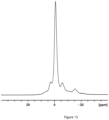
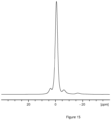
- the powder has a 7 Li MAS NMR spectrum characterized by a single Li contribution centered around -0.5ppm, and wherein the powder has a reversible electrode capacity of at least 200 mAh/g, preferably 210 mAh/g and most preferably 215 mAh/g when used as an active component in a cathode which is cycled between 3.0 and 4.6 V vs. Li + /Li at a discharge rate of 0.1C, preferably at 1C at 25°C.
- This lithium metal oxide powder may have a 1C rate capacity fading below 60%, preferably below 40% and most preferably below 30%.
- the lithium metal oxide powder may also have a 1C capacity fading inferior to 60%, preferably inferior to 40% and most preferably inferior to 30%.
- the lithium metal oxide powder has a spin lattice relaxation time T1 of at least 500 ms, preferably at least 750 ms and most preferably at least 900 ms.
- the lithium metal oxide powder of the invention may also have a total base content of less than 50 ⁇ mol/g, preferably less than 25 ⁇ mol/g, and more preferably less than 15 ⁇ mol/g.
- the lithium metal oxide powder may have a carbon content less than 50 ppm, preferably ⁇ 35 ppm, and more preferably ⁇ 25 ppm.
- the lithium metal oxide powder may have an electrical conductivity less than 10 -4 S/cm.
- the lithium metal oxide powder of the invention may comprise at least 97 mol% of a stoichiometric compound having the general formula Li Co 1-a M a O 2 , with 0 ⁇ a ⁇ 0.05, preferably 0 ⁇ a ⁇ 0.01, and M comprising either one or more elements from the group Al, B and Ga.
- the lithium metal based powder has a bimodal particle shape distribution with a small and a large particle size fraction, where the small particle size fraction has a D50 ⁇ 5 ⁇ m and represents between 3 to 20 Vol%, and where the large particle size fraction has a D50 ⁇ 12 ⁇ m, preferably D50 ⁇ 15 ⁇ m.
- the invention can provide a method as defined in claim 11.
- the method for manufacturing a lithium metal oxide powder comprises the following steps:
- the step of providing a second Co- or Co and M'-comprising precursor powder comprises the substeps of:
- the first and the second Co- or Co and M'-comprising precursor may be the same "M-precursor" compound.
- the first, the second and the third Co-comprising precursor powders may be either one of the group consisting of cobalt oxide, cobalt oxy-hydroxide, cobalt hydroxide, cobalt carbonate and cobalt oxalate.
- the first, the second and the third Co-comprising precursor powders further comprise at least one element of the group consisting of Ti, Mg, F, Zr and Ca.
- the ratio of the average particle sizes of the Li-enriched lithium metal oxide and the second Co- or Co and M'-comprising precursor powder is at least 3:1, preferably at least 4:1 and most preferably at least 5:1.
- the particles of the Li-enriched lithium metal oxide and the second M-comprising precursor powders retain a bimodal particle size distribution upon second firing.
- the pressed density of the bimodal particle size powder is at least 0.1 g/cm 3 higher than the pressed density of the Li-enriched lithium metal oxide.
- the invention can provide the use of the lithium metal oxide powder described before as a cathode in an electrochemical cell.
- the present invention discloses a cathode material having a high packing density, a high rate performance, improved discharge capacity and showing high stability during extended cycling at high charge voltage. This is achieved by a powderous lithium metal oxide consisting of a core material consisting of the elements Li, the metal M and oxygen, wherein the Li content is stoichiometrically controlled; and an electron-insulating surface layer consisting of a mixture of the elements of the core materials or inorganic N-based oxides or combination thereof, wherein N is either one or more metals of the group consisting of Mg, Ti, Fe, Cu, Ca, Ba, Y, Sn, Sb, Na, Zn, Zr and Si.
- the core material has hexagonal layered crystal structure described as an ordered rock salt-type crystal structure with space group R-3m.
- the core may be substantially free from structural defects such as oxygen vacancies and Li substitution for M in the MO 2 layers, and also substantially free from paramagnetic metals such as Co 2+ , intermediate spin Co 3+ and Co 4+ .
- a defect-free core is an inherent feature of the cathode material of the actual invention.
- the inventors observed that a defect-free core, enabling faster diffusion of Li ions into the particles, is related to the high observed rate performance and improved discharge capacity of the disclosed cathode materials.
- the surface layer has an inhomogeneous composition compared to the core with a compositional gradient of the different M, M', Li and O elements.
- the surface is enriched of elements N such as Mg, Ti, Fe, Cu, Ca, Ba, Y, Sn, Sb, Na, Zn, Zr and Si and, in one embodiment, is formed by segregation from the core and accumulation of these metal dopants at the surface of the particles. In the core, these dopants are substantially absent.
- the surface is densely and continuously connected to the core and cannot be physically separated from the particle.
- concentration in N metals - with increasing distance from the surface - decreases, possibly in a gradient-like manner and approaches zero in the inside of the particles.
- the N-enriched surface of the particles feature two additional and unexpected properties:
- the surface layer is typically between 20 nm to 200 nm, and preferably between 20 nm and 100 nm thick, and is primarily affected by two parameters:
- an essential feature of LiCoOz-based cathode materials is a high packing density, which allows increasing the energy density of commercial secondary batteries.
- a preferred morphology embodiment to achieve high packing density consists in monolithic, potato-shaped and non-agglomerated particles.
- a monolithic particle does not exhibit inner porosity, and it does not consist of agglomerates of smaller primary particles.
- a typical particle size (D50) is a least 5 ⁇ m or even at least 10 ⁇ m, and preferably above 15 ⁇ m.
- the pressed density is typically in the range of over 3.40 g/cm 3 and preferably at least 3.70 g/cm 3 . In one embodiment, the pressed density is as high as 3.90 g/cm 3 .
- the pressed density is at least 3.40 g/cm 3 for a powder with an average particle size above 6 ⁇ m. In still another embodiment the pressed density is at least 3.75 g/cm 3 for a powder with an average particle size above 15 ⁇ m.
- a process for manufacturing the high-density and high stability compounds of the present invention runs as follows:
- steps (i) and (ii) are further referred as “the first firing” and steps (iii), (iv) and (v) as the “second firing”.
- steps (i) and (ii) are further referred as “the first firing” and steps (iii), (iv) and (v) as the “second firing”.
- the first M-comprising precursor and second M-comprising precursor can be a mixture of cobalt containing precursor and M' containing precursor.
- suitable cobalt containing precursors include cobalt oxide, hydroxide, oxyhydroxide, carbonate and oxalate.
- the M' containing precursor can be an oxide, hydroxide or organic complex, preferably having sub-micrometric powderous morphology in order to achieve homogeneous distribution and easy blending process.
- either one or both of the first M-, the second M- and the first Li-comprising precursor powders further comprise at least one dopant (M' or N) from the group consisting of Al, Mg, Fe, Cu, Ti, Ca, Ba, Y, B, Sn, Sb, Na, Ga, Zn, F, P, S, and Zr.
- M' or N dopant
- either one or both of the first M- and the first Li-comprising precursor powders further comprise at least one element of the group consisting of Mg, Fe, Cu, Ti, Ca, Ba, Y, Sn, Sb, Na, Zn, Zr, F, P, S and Si.
- the homogeneous dispersion of N dopants is improved when the second M-comprising precursor powder further comprises at least one element of the N dopant element group consisting of Mg, Fe, Cu, Ti, Ca, Ba, Y, Sn, Sb, Na, Zn, Zr and Si.
- suitable compounds comprising N elements are oxides (such as MgO, TiO 2 , SiO 2 , ...), fluorites (such as MgF 2 ”) with sub-micrometric particle size.
- Ti and Mg preferably in the form of TiO 2 and MgO particles with a D50 of respectively less than 100 nm, and less than 1 ⁇ m, are added to either one or both of the first and second mixtures described above.
- Al preferably in the form of Al 2 O 3 particles with a D50 of less than 100 nm is added to the second mixture described above.
- the Li-enriched lithium metal oxide compound is LiCoO 2 with dense monolithic particles of at least 5 and preferably at least 10 to 20 micrometers. Many commercial prior art LiCoO 2 materials already have this desired morphology.
- the second M comprising precursor features a particle size distribution with a D50 of less than 1/3, preferably less than 1/4 of the D50 of the Li-enriched lithium metal oxide compound.
- the size ratio between the second M comprising precursor and the Li-enriched lithium metal oxide compound is 1/6. In the latter case and after the second firing, a bimodal distribution is obtained wherein the LiMO 2 -based particles originating from the second M comprising precursor are small enough to (a) support a very high C rate and (b) fit nicely in the voids of the larger lithium metal oxide particles packing, which allows for low porosity electrodes and a high volumetric energy density.
- the Li-enriched lithium metal oxide compound referred as the state of the art compound, obtained after the first sintering step, is further characterized by:
- the Li content of the materials of the present invention is stoichiometrically controlled meaning that the Li:M molar ratio is in the range of 1.00 ⁇ 0.01.
- Authors have observed that if the targeted Li:M is above 1.01, then the electrochemical performances, such as lower discharge capacity and lower high voltage stability, and physical properties such as an increase of base content and carbon content, of the resulting material are inferior.
- the targeted Li:M is below 0.99, then the materials, though retaining very good high voltage stability, undergo two undesirable effects: (i) less active materials is available and the discharge capacity is lowered, and, (ii) a surface enriched in cobalt-based spinel is formed at the surface of particles, which increases the cell polarization.
- the inventors have made two surprising observations, which are believed to be essential aspects of the invention: First observation: The core of the particles is lithium stoichiometric and substantially free from defects.
- the lithium metal oxide according to the present invention shows electrochemical properties different from those of lithium metal oxides, which are prepared according to state of the art methods, and which contain the same components as the lithium metal oxide of the present invention. This change in physical properties can be observed by 7 Li-NMR.
- 7 Li-NMR when a strong magnetic field is externally applied to a lithium-containing material, Li chemical shift values will be shifted due to various hyperfine interactions between a lithium nucleus having a nuclear magnetic moment and the unpaired electrons of metal components contained in the lithium-containing material.
- the local structural and electronic characteristics of a specific component in the crystal structure of the lithium-containing material can be assessed by measuring the different contributions to the 7 Li NMR spectrum caused by such chemical shift values.
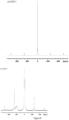
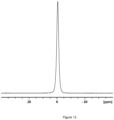
- the lithium metal oxide of the present invention shows a unique Li peak around -0.5ppm though having the same components and composition as those of a lithium metal oxide prepared according to a state of the art method. Consequently, Ex1, Ex2, Ex3, Ex4 and Ex5 (see below) contain only one Li site environment solely surrounded by diamagnetic trivalent metal ions such as Co 3+ (t 2g 6 e g 0 ) or Al 3+ (2p 6 ).
- the core of the Example materials is therefore substantially free from paramagnetic impurities, structural defects and dopants N such as Mg 2+ , Ti 3+ or Ti 4+ .
- cathode materials of the present invention are their "insulating" nature. These cathode materials have conductivities which are at least 2-3 orders lower than those of the least conductive currently known cathode material.
- commercial LiCoO 2 has a relatively high electrical conductivity in the range of 10 -2 to 10 -3 S/cm. That such insulating cathodes can yield excellent electrochemical performance, namely a large discharge capacity and C-rate performance, is a surprise because it is commonly accepted that high electrical conductivity is needed for the Li + cation diffusion within the solid cathode and across the interface between electrolyte and cathode.
- the low conductivity provided by the surface layer is the main reason for the high voltage stability of the cathode materials of the present invention.
- a LiCoOz-based cathode When a LiCoOz-based cathode is charged to high voltage - meaning the cathode is strongly de-intercalated - we achieve a Li x CoO 2 (x ⁇ 1) composition where most of the cobalt ions are in the 4+ valence state.
- Tetravalent-cobalt containing Li x CoO 2 is a very strong oxidizer and is highly reactive.
- the electrolyte becomes thermodynamically unstable when in contact with such an oxidizing surface. A reaction with the electrolyte (being the reducing agent) is strongly preferred energetically.
- a cathode material protected by an insulating surface layer will solve this problem by physically separating tetravalent cobalt ions from the electrolyte and eventually preventing further electrolyte reduction.
- the process allows to achieve an in-situ coating of the final powder with a layer that is enriched in oxidized compounds, like MgO and TiO 2 , that may also be lithiated. This inert coating layer provides additional safety when the powders are in contact with the electrolyte of the battery.
- Measurement of the electrical conductivity is performed under an applied pressure of 63,7 MPa in the 4-probe configuration.
- the value of 63 MPa is also mentioned as round-off, when the actual pressure of 63,7 MPa is applied.
- Electrochemical performances are tested in CR2032 coin type cells, with a Li foil as counter electrode in a lithium hexafluorite (LiPF 6 ) type electrolyte at 25 °C.
- the active material loading is 10.5 ( ⁇ 0.5) mg/cm 2 .
- Cells are charged to 4.3V and discharged to 3.0V to measure rate performance and capacity.
- the high voltage discharge capacity and capacity retentions during extended cycling are measured at 4.5V and 4.6V charge voltages.
- a specific capacity of 160 mAh/g is chosen for the determination of the discharge rates. For example, for the discharge at 2 C, a specific current of 320 mA/g is used.
- Cycle number Charge condition Discharge condition Test description 1 4.3V cutoff at 0.1C 3.0V cutoff at 0.1C Voltage profile 2 to 6 4.3V cutoff at 0.25C 3.0V cutoff at 0.2, 0.5, 1, 2 and 3C Rate performance 7 and 31 4.5V (or 4.6V*) cutoff at 0.25 C 3.0V cutoff at 0.1C Slow reference cycle before and after stability.
- Cycle 7 (31) gives the discharge capacity 0.1C at 4.5V (or 4.6V*).
- 8 and 32 4.5V (or 4.6V*) cutoff at 0.25 C 3.0V cutoff at 1C Fast reference cycle before and after stability.
- Cycle 8 (32) gives the discharge capacity 1C at 4.5V (or 4.6V*) 9 to 30 4.5V (or 4.6V*) cutoff at 0.25 C 3.0V cutoff at 0.5C Stability test at high voltage *: as specified in the Examples
- Q capacity
- D Discharge
- C Charge
- Q capacity
- D Discharge
- C Charge
- Irreversible capacity Qirr % is CQ 1 ⁇ DQ 1 / CQ 1 ⁇ 100 .
- Rate performance is defined by the ratio of DQ at respectively 0.2, 0.5, 1, 2 and 3 C versus DQ at 0.1C, converted to and expressed in %.
- Capacity fade rate - expressed in % - at 0.1C per 100 cycles is calculated as follows: (1-(DQ31/DQ7)) ⁇ 100/23. Likewise, capacity fade rate at 1C per 100 cycles is: 1 ⁇ DQ 32 / DQ 8 ⁇ 100 / 23 .
- Energy fade rates at 0.1C and 1C are calculated in a similar way than capacity fade rate but instead of the discharge capacity DQ the discharge energy (defined as DQ ⁇ average discharge voltage) is used in the calculation.
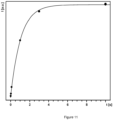
- T1 spin-lattice relaxation times are measured using the inversion-recovery sequence on static samples.
- the T1 is determined by single exponential fitting of the magnetization recovery intensity as function of the recovery delay (from 100 ⁇ s to 100s).
- Short acquisition time control spectra are recorded at the beginning and at the end of each experiment to confirm the non-degradation of the samples.
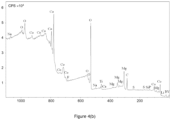
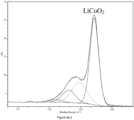
- the binding energy scale is calibrated from LiCoO 2 peaks (Co2p, Co3p and O1s). Core peaks are analyzed using a non-linear Shirley-type background. The peak positions and areas are optimized by a weighted least-square fitting method using 70% Gaussian and 30% Lorentzian line shapes. Quantification was performed on the basis of Scofield's relative sensitivity factors. For depth profiling experiments, the depth has been calculated relatively to a sample of Ta 2 O 5 for which an argon etching speed of 0.32 nm/s has been observed.
- the base content is a material surface property that can be quantitatively measured by the analysis of reaction products between the surface and water. If powder is immersed into water a surface reaction occurs. During the reaction the pH of the water increases ("base dissolves") so the base is quantified by a pH titration. The result of the titration is the "soluble base content" (SBC).
- SBC soluble base content
- the content of soluble base can be measured as follows: 100 ml of de-ionized water is added to 7.5g of cathode, followed by stirring for 8 minutes. Settling-down is allowed for typically 3 minutes, then the solution is removed and passed through a 1 ⁇ m syringe filter, thereby achieving > 90g of a clear solution which contains the soluble base.
- the content of soluble base is titrated by logging the pH profile during addition of 0.1 M HCl at a rate of 0.5 ml/min until the pH reaches 3 under stirring.
- a reference voltage profile is obtained by titrating suitable mixtures of LiOH and Li 2 CO 3 dissolved in low concentration in DI water. In almost all cases two distinct plateaus are observed. The upper plateau is OH - /H 2 O followed by CO 3 2- /HCO 3 - , the lower plateau is HCO 3 - /H 2 CO 3 .
- the inflection point between the first and second plateau as well as the inflection point after the second plateau is obtained from the corresponding minima of the derivative d pH /d Vol of the pH profile. The second inflection point generally is near to pH 4.7. Results are listed as micromole of base per g of cathode.
- the amount of base which goes into solution is very reproducible, and is directly related to surface properties of the cathode. Since these have a significant influence on the stability (i.e. safety and overcharge/high T storage properties of the final battery) there is a correlation between base content and stability.
- the soluble base content is discussed more in detail in co-pending application EP11000945.3 .
- Li:Co stoichiometrically-controlled lithium cobalt based oxides demonstrate that Li:Co stoichiometrically-controlled doped lithium cobalt based oxides featuring a 7 Li MAS NMR spectrum characterized by a single Li contribution centered around -0.5ppm and an increased T1 spin-lattice relaxation time is also characterized by a high voltage cycling stability.
- the improved stability, single contribution 7 Li MAS NMR spectrum and longer T1 are obtained by optimizing lithium to metal ratio.
- Li-stoichiometry controlled LiCoO 2 -based cathode materials i.e. having a Li/Co ratio of 1.00 ⁇ 0.01, comprising a core where Li atoms occupy a single site surrounded by trivalent diamagnetic metals, and having an electron insulating surface comprising the elements of the core material (Li, Co) and inorganic metal oxides comprising Mg and Ti show improved features for high voltage applications.
- LCO-1 0.25 mol% titanium and 0.5 mol% magnesium doped Co(OH) 2 as precursor for LiCoO 2 is prepared in a pilot line according to the process explained in WO2010-139404 .
- Typical Li:Co molar ratio used in the Li 2 CO 3 - doped Co(OH) 2 blend is 1.06 to 1.12.
- the average particle size of LCO-1 is 20 ⁇ m.
- the final Li:Co mol ratio of LCO-1 after firing measured by ICP is 1.053 and will be used to determine Li:Co ratio for examples 1 and 2.
- LCO-1 is also referred to as the lithium doped cobalt oxide "parent" of Example 1 and Example 2.
- Example 1 Preparation of Example 1 (noted Ex1): 95 mol% of LCO-1 and 5 mol% of 0.25 mol% Ti and 0.5 mol% Mg doped Co(OH) 2 ; corresponding to respectively 95.24wt.% and 4.76wt.%; are mixed in order to target a final Li:Co mol ratio of 1.000.
- the mass of reagents has been calculated assuming a cobalt weight content in LCO-1 and Co(OH) 2 of respectively 60.21wt.% and 63.40wt.%, resulting in an absolute error of less than 0.2% in the calculation of Li:Co.
- Example 2 Preparation of Example 2 (noted Ex2): 94 mol% of LCO-1 and 6 mol% of 0.25 mol% Ti and 0.5 mol% Mg doped Co(OH) 2 ; corresponding to respectively 94.28wt.% and 5.72wt.% ; are mixed in order to target a final Li:Co mol ratio of 0.990 ⁇ 0.002.
- the homogeneous mixture is placed in an alumina crucible and heated at 925°C for 12 hours under constant air flow. After cooling, the resulting powder (Ex2) is sieved and characterized. The average particle size of Ex2 is found to be 20 ⁇ m.
- Example 3 The characterization of Example 3 will demonstrate that Li-stoichiometry controlled LiCoO 2 -based cathode materials, comprising a core where Li atoms occupy a single site surrounded by trivalent diamagnetic metals, where Co is partly substituted by Al 3+ , and having an electron insulating surface comprising the elements of the core material (Li, Co and Al) and inorganic metal oxides comprising Mg and Ti, show improved high voltage features and large pressed densities.
- Li-stoichiometry controlled LiCoO 2 -based cathode materials comprising a core where Li atoms occupy a single site surrounded by trivalent diamagnetic metals, where Co is partly substituted by Al 3+ , and having an electron insulating surface comprising the elements of the core material (Li, Co and Al) and inorganic metal oxides comprising Mg and Ti, show improved high voltage features and large pressed densities.
- LCO-3 state of the art titanium and magnesium doped LiCoO 2 (noted LCO-3) is obtained by means of a standard high temperature solid state synthesis by dry-mixing powders of Co 3 O 4 with TiO 2 , MgO and Li 2 CO 3 .
- LCO-3 contains 0.25 mol% titanium and 0.25 mol% magnesium.
- Typical Li:Co molar ratio used for the blend is 1.10.
- the average particle size of LCO-3 is 18 ⁇ m.
- the final Li:Co mol ratio of LCO-3 after firing - as measured by ICP - is 1.070, and is used to set the Li:(Co+Al) ratio for Example 3.
- Example 3 A cathode powder material is prepared by mixing 85.40wt.% of LCO-3, 10.51wt.% Co 3 O 4 with mean particle size of 3 ⁇ m, 3.47wt% Li 2 CO 3 , 0.05wt% of MgO, 0.05wt% of TiO 2 and 0.52wt% Al 2 O 3 , so as to adjust the AI:Co mol ratio to 0.01:0.99 (or 1 mol% Al substitution on Co sites) and the final Li:(Co+Al) molar ratio to 1.000 ⁇ 0.002.
- the homogeneous mixture is placed in an alumina crucible and heated at 980° C for 12 hours under constant air flow. After cooling, the resulting powder (Ex3) is sieved and characterized.
- the average particle size of Ex3 is found to be 16 ⁇ m), and a bimodal distribution is obtained.
- Example 4 The characterization of Example 4 will demonstrate that LiCoO 2 -based cathode materials comprising a core with Li stoichiometry control, where Li occupy a single site surrounded by trivalent diamagnetic metals, and having an electron insulating surface comprising the elements of the core material (Li, Co) and inorganic metal oxides comprising Mg and Ti, are suitable for high power applications where maintaining high C-rate and high average voltage are required.
- the core material Li, Co
- inorganic metal oxides comprising Mg and Ti
- LCO-4 state of the art titanium and magnesium doped LiCoO 2 (noted LCO-4) is obtained by means of a standard high temperature solid state synthesis by dry-mixing powders of Co 3 O 4 with TiO2, MgO and Li 2 CO 3 .
- LCO-4 contains 0.18 mol% titanium and 0.40 mol% magnesium.
- Typical Li:Co molar ratio used for the blend is 1.03.
- the average particle size of LCO-4 is 6 ⁇ m.
- the final Li:Co mol ratio of LCO-4 after firing - as measured by ICP - is 1.015, and is used to set the Li:Co ratio for Example 4.
- Example 4 Preparation of Example 4 (noted Ex4): 98.5 mol% of LCO-4 and 1.5 mol% of Ti (0.18 mol%) and Mg (0.4 mol%) doped Co 3 O 4 ; corresponding to respectively 98.77wt.% and 1.23wt.%; are mixed homogeneously in order to target a final Li:Co mol ratio of 1.000 ⁇ 0.002.
- the mass of reagents has been calculated assuming a cobalt weight content in LCO-3 and Co 3 O 4 of respectively 60.21wt.% and 73.42wt.%.
- the mixture is placed in an alumina crucible and heated at 1000°C for 12 hours under constant air flow. After cooling, the resulting powder (Ex4) is sieved and characterized.
- Example 5 The characterization of Example 5 will demonstrate that high electrochemical performances are only achieved when targeting a lithium stoichiometry of 1.00 ⁇ 0.01. Lithium overstoichiometry, as usually observed in state-of the art LiCoOz-based materials, lead to systematic impairment of the discharge capacity, C-rate and high voltage stability.
- Example 5a-5e (noted Ex5a - 5e): A cathode powder material is prepared by mixing 88.91wt.% of LCO-3, 10.94wt.% Co 3 O 4 with mean particle size of 3 ⁇ m, 0.12wt% of MgO and 0.03wt% of TiO 2 . Li 2 CO 3 is further added so as to adjust the final Li:Co (or Li:M) ratio to 1.00 (Ex5a), 1.01 (Ex5b), 1.02 (Ex5c), 1.03 (Ex5d) and 1.04 (Ex5e). The homogeneous mixture are placed in alumina crucibles and heated at 980°C for 12 hours under constant air flow. After cooling, the resulting powders (Ex5a-5e) are sieved and characterized.
- the electrochemical properties of Ex5a-5e are shown in Table 1.
- the rate discharge capacity DQ7 and DQ8 and the 3C rate performances are strongly improved when the Li:M ratio decreases and is close to 1.00 ⁇ 0.01.
- the capacity fading at 4.5V is also significantly improved when the Li:M ratio is near stoichiometry.
- the electrical conductivity is also strongly decreased when Li:M tends to 1.00 and 3 to 4 orders of magnitude lower compared to LCO-3.
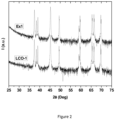
- XRD patterns of LCO-3, LCO-4, Ex3 and Ex4 are interpreted using the same structural model and similar lattice parameters. Though containing large surface base contents such as LiOH and Li 2 CO 3 , LCO-1, LCO-3 and LCO-4 XRD patterns don't allow identifying such compounds, suggesting that their content is below XRD detection limit and/or that the surface base are in amorphous forms.
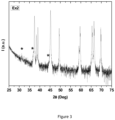
- Ex2 The XRD pattern of Ex2 is shown on Fig 3 .
- Ex2 therefore comprises ca. 99 mol% Li stoichiometrically controlled LiCoOz-based materials and ca. 1 mol% cobalt spinel-based impurity.
- the surface base and carbon contents of the different materials are listed on Table 2.
- the base and carbon contents are strongly reduced after the second firing for Ex1, Ex2, Ex3 and Ex4 when compared to LCO-1, LCO-3 and LCO-4.
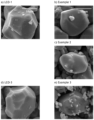
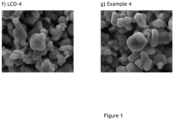
- This result supports, as shown by SEM, that the surfaces of LCO-1, LCO-3 and LCO-4 are partly covered with unreacted excess Li salts, such as LiOH and Li 2 CO 3 , and that the surfaces of Ex1, Ex2, Ex3 and Ex4 are mostly free from such impurities.
- Table 2 total base content and carbon content of the Examples. Name Base content ( ⁇ m ⁇ l/g) Carbon content (ppm) LCO-1 64.2 161 Ex1 9.9 25 Ex2 9.9 28 LCO-3 99.2 338 Ex3 5.5 10 LCO-4 23.1 103 Ex4 12.0 43
- XPS X-ray photoelectron spectroscopy
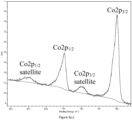
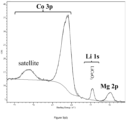
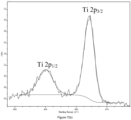
- the cobalt 2p and 3p XPS peaks are shown on Fig 5 .
- Spin-orbit coupling splits the Co2p spectra into two components - 2p 3/2 and 2P 1/2 - with an intensity ratio of about 2:1.
- Each component presents a main line at 780 and 795 eV and a ligand-to-metal charge transfer satellite peak at 790 and 805 eV.
- the Co3p spectrum also consists of a main line and a satellite at 61 and 71 eV, respectively; 3p 3/2 and 3P 1/2 energy splitting is however too small to be observed.
- Mg and Ti as function of particle depth has been monitored for Ex-1 by means of XPS depth profiling as shown on Fig 8 .
- concentration of Mg and Ti decreases rapidly over the first 50 nm of the particles.
- the amounts of Mg and Ti do not decrease down to zero, as could be expected, even not after a long time of etching. This is due to side effects of argon ion sputtering, where the implantation of argon ions deep inside the sample results in the forced mixing of atoms of subsequent layers.
- Table 5 pressed density Sample Avg. Particle Size ( ⁇ m) Pressed density (g/cm 3 ) LCO-1 20 3.77 Ex1 20 3.76 Ex2 20 3.76 LCO-3 18 3.80 Ex3 16 3.90 LCO-4 6 3.44 Ex4 6 3.42
- the pressed density is measured as follows: 3 grams of powder is filled into a press mold with a diameter "d" of 1.300 cm. A uniaxial load of 2.8t, corresponding to a pressure of 207 MPa, is applied for 30 seconds. After relaxing the load, the thickness "t" of the pressed powder is measured. The pellet density is then calculated as follows: 3/( ⁇ (d/2) 2 ⁇ t) in g/cm 3 .
- All the materials feature very high pressed densities in excess of 3.40 g/cm 3 for LCO-4 and Ex4 with an average particle size of 6 ⁇ m and in excess of 3.75 g/cm 3 for LCO-1, LCO-3, Ex1, Ex2 and Ex3 with an average particle size above 15 ⁇ m.
- the pressed density of Ex3 is increased by 0.1 g/cm 3 when compared to LCO-3 which is attributed to the ability of the 3 ⁇ m particles to accommodate the vacancies resulting from the packing of 18 ⁇ m particles.
- Figure 4 shows the evolution of volume distribution and cumulative volume distribution as function of the particle size for Ex3.
- Ex3 retains a bimodal particle size distribution after the second firing where the centers of mass of the two contributions are around 3 and 18 ⁇ m.
- the volume fraction of the 3 ⁇ m contribution determined by fitting the experimental data with two Gaussian functions, amounts to 13% in good agreement with the initial composition of 3 and 18 ⁇ m particles.
- No agglomeration of 3 and 18 ⁇ m particles occurs upon second firing which is believed to be prevented by either or both of the two factors: (a) the accumulation of Mg and Ti species at the surface of the particles as previously evidences by XPS and (b) controlling the lithium stoichiometry which prevent further growth of particles by "lithium-flux effect".
- Efforts to preserve the bimodal distribution of samples refired with excess lithium (final Li:Co>1.01) and without Mg and Ti dopants failed and large particle agglomeration and coalescence are observed resulting in strong decrease of the pressed density.
- the relative absence of structural defects is further characterized by measuring the T1 spin-lattice relaxation time as shown in Table 6.
- the T1 value of LCO-1, LCO-2 and LCO-4 is not defined and cannot be accurately determined due to several spin-lattice relaxation mechanisms.
- the characteristic relaxation time of each individual mechanism is however shorter than 0.1 s.
- T1 values for Ex1-4 are successfully determined by a single exponential fit of the magnetization recovery as shown on Fig 11 .
- Example 7 The electrochemical performances of Examples 1-4 are shown in Table 7. The electrochemical properties are unexpectedly improved compared to LCO-1, LCO-3 and LCO-4. At 4.3V, Ex1, Ex2, Ex3 and Ex4 show very small irreversible capacity and better rate performance compared to LCO-1, LCO-3 and LCO-4. 4.5V high voltage performances of Ex1, Ex2, Ex3 and Ex4 are enhanced and feature very high capacity and very good cycle life. 4.6V performances of Ex1, Ex2, Ex3 and Ex4 are exceptional with a capacity fading at 1C below 40% and are, to the extent of authors knowledge, unequalled in literature. These data show a perfect correlation between the relatively low defect concentration as evidenced by 7 Li MAS NMR and the improved high voltage properties of stoichiometrically controlled LiCo 1-x M x O 2 .
- Table 8 shows the discharge capacity, C-rate performances and average voltage at 4.4V of Ex4 and LCO-4.
- the C-rate and average voltage of Ex4 are improved when compared to LCO-4 resulting in an increase of the specific energy Es, defined as the product of the average discharge voltage and discharge capacity, by about 4%.
- Ex4 by featuring improved cycle life and specific energy is highly suitable for high power applications where maintaining high specific energy at high C-rate is required.
- Table 8 discharge capacity, C-rate properties, average voltage ⁇ V> at 15C and specific energy Es for LCO-4 and Ex4 at 4.4V.
Landscapes
- Chemical & Material Sciences (AREA)
- Inorganic Chemistry (AREA)
- Organic Chemistry (AREA)
- Electrochemistry (AREA)
- Chemical Kinetics & Catalysis (AREA)
- General Chemical & Material Sciences (AREA)
- Composite Materials (AREA)
- Engineering & Computer Science (AREA)
- Materials Engineering (AREA)
- Battery Electrode And Active Subsutance (AREA)
- Inorganic Compounds Of Heavy Metals (AREA)
- Manufacturing & Machinery (AREA)
- Secondary Cells (AREA)
Claims (13)
- Lithiummetalloxidpulver zur Verwendung als ein Kathodenmaterial in einer wiederaufladbaren Batterie, bestehend aus einem Kernmaterial und einer Oberflächenschicht, der Kern aufweisend eine geschichtete Kristallstruktur, bestehend aus den Elementen Li, einem Metall M und Sauerstoff, wobei das Metall M die Formel M=Co1-aM'a mit 0≤a≤0,05 aufweist, wobei M' entweder ein oder mehrere Metalle der Gruppe bestehend aus Al, Ga und B ist; und die Oberflächenschicht umfassend ein Gemisch der Elemente des Kernmaterials Li, M und Sauerstoff, anorganischen N-basierten Oxiden oder einer Cobalt-basierten Spinellphase, wobei N entweder ein oder mehrere Metalle der Gruppe ist, bestehend aus Mg, Ti, Fe, Cu, Ca, Ba, Y, Sn, Sb, Na, Zn, Zr und Si.
- Lithiummetalloxidpulver nach Anspruch 1, wobei die Spinellphase in der Raumgruppe Fd-3m indiziert ist.
- Lithiummetalloxidpulver nach Anspruch 1 oder 2, wobei der Li-Gehalt auf einen Li : M-Wert von 0,99 oder weniger eingestellt ist.
- Lithiummetalloxidpulver nach Anspruch 1 oder 2, wobei das Pulver eine elektrische Leitfähigkeit von weniger als 10-5 S/cm aufweist, wobei die elektrische Leitfähigkeit bei einem angelegten Druck von 63,7 MPa gemessen wird.
- Lithiummetalloxidpulver nach Anspruch 1 oder 2, aufweisend ein 7Li-MAS-NMR-Spektrum, das eine einzigartige Resonanz bei etwa -0,5 ppm besitzt.
- Lithiummetalloxidpulver nach Anspruch 1 oder 2, wobei 0<a≤0.03.
- Lithiummetalloxidpulver nach einem der Ansprüche 1 oder 2, wobei die Dicke der Oberflächenschicht weniger als 100 nm beträgt.
- Lithiummetalloxidpulver nach Anspruch 1 oder 2, wobei N aus Mg und Ti besteht und der Mg-Gehalt zwischen 0,1 und 1 mol% und der Ti-Gehalt zwischen 0,1 und 0,5 mol% liegt.
- Lithiummetalloxidpulver nach Anspruch 1 oder 2, wobei die N-basierten Oxide Oxide umfassen, aufweisend eingebaute Li-Atome.
- Pulver auf Lithiummetallbasis nach Anspruch 1 oder 2, wobei das Kernmaterial im Wesentlichen frei von paramagnetischen Metallen Co2+, Intermediate-Spin-Co3+ und -Co4+ ist.
- Verfahren zum Herstellen eines Lithiummetalloxidpulvers, bestehend aus einem Kernmaterial und einer Oberflächenschicht, das Kernmaterial aufweisend eine geschichtete Kristallstruktur, bestehend aus den Elementen Li, einem Metall M und Sauerstoff, wobei das Metall M die Formel M=Co1-aM'a aufweist, mit 0≤a≤0,05, vorzugsweise 0≤a≤0,01, wobei M' entweder ein oder mehrere Metalle der Gruppe, bestehend aus Al, Ga und B, ist; und die Oberflächenschicht aus einem Gemisch der Elemente des Kernmaterials Li, M und Sauerstoff, anorganischen Oxiden auf N-Basis und einer Spinellphase auf Kobaltbasis besteht, wobei N entweder ein oder mehrere Metalle aus der Gruppe ist, bestehend aus Mg, Ti, Fe, Cu, Ca, Ba, Y, Sn, Sb, Na, Zn, Zr und Si, umfassend die Schritte:- Bereitstellen eines ersten Gemisches aus einem ersten Co- oder Co und M'-umfassenden und einem ersten Li-umfassenden Vorläuferpulver, das erste Gemisch aufweisend ein Molverhältnis von Li zu Metall von >1,01,- Sintern des ersten Gemisches in einer Sauerstoff-umfassenden Atmosphäre bei einer Temperatur T1 von mindestens 600 °C, wobei dadurch eine mit Li angereicherte Lithium-Metalloxid-Verbindung entsteht,- Bereitstellen eines zweiten Co- oder Co und M'-umfassenden Vorläuferpulvers, und- Mischen der mit Li angereicherten Lithium-Metalloxid-Verbindung mit dem zweiten Co- oder Co und M'-umfassenden Vorläuferpulver, wobei dadurch ein zweites Gemisch entsteht, wobei das Molverhältnis von Li zu Metall ≤0,99 beträgt, und- Sintern des zweiten Gemisches in einer Sauerstoff-umfassenden Atmosphäre bei einer Temperatur T2 von mindestens 600 °C;
wobei entweder eines oder mehrere des ersten Co- oder Co und M'-umfassenden, des ersten Li-umfassenden und des zweiten Co- oder Co und M'-umfassenden Vorläuferpulvers ferner mindestens ein Element der Gruppe umfasst, bestehend aus Mg, Ti, Fe, Cu, Ca, Ba, Y, Sn, Sb, Na, Zn, Zr und Si. - Verfahren nach Anspruch 11, wobei das erste Gemisch ein Molverhältnis von Li zu Metall zwischen 1,02 und 1,12 aufweist.
- Verwendung des Lithiummetalloxidpulvers nach einem der Ansprüche 1 oder 2 als eine Kathode in einer elektrochemischen Zelle.
Applications Claiming Priority (3)
| Application Number | Priority Date | Filing Date | Title |
|---|---|---|---|
| US201161498038P | 2011-06-17 | 2011-06-17 | |
| PCT/EP2012/059986 WO2012171780A1 (en) | 2011-06-17 | 2012-05-29 | Lithium metal oxide partcles coated with a mixture of the elements of the core material and one or more metal oxides |
| EP12723710.5A EP2720981B1 (de) | 2011-06-17 | 2012-05-29 | Lithium-metall-oxidpartikel mit einer beschichtung aus einer mischung von kernmaterialelementen und einem oder mehreren metalloxiden |
Related Parent Applications (2)
| Application Number | Title | Priority Date | Filing Date |
|---|---|---|---|
| EP12723710.5A Division EP2720981B1 (de) | 2011-06-17 | 2012-05-29 | Lithium-metall-oxidpartikel mit einer beschichtung aus einer mischung von kernmaterialelementen und einem oder mehreren metalloxiden |
| EP12723710.5A Division-Into EP2720981B1 (de) | 2011-06-17 | 2012-05-29 | Lithium-metall-oxidpartikel mit einer beschichtung aus einer mischung von kernmaterialelementen und einem oder mehreren metalloxiden |
Publications (2)
| Publication Number | Publication Date |
|---|---|
| EP3059211A1 EP3059211A1 (de) | 2016-08-24 |
| EP3059211B1 true EP3059211B1 (de) | 2024-08-07 |
Family
ID=46168506
Family Applications (2)
| Application Number | Title | Priority Date | Filing Date |
|---|---|---|---|
| EP16154652.8A Active EP3059211B1 (de) | 2011-06-17 | 2012-05-29 | Stöchiometrisch gesteuerte lithiumkobaltoxidbasierte verbindungen mit einer spinel phase die in der raumgruppe fd-3m indiziert werden kann |
| EP12723710.5A Active EP2720981B1 (de) | 2011-06-17 | 2012-05-29 | Lithium-metall-oxidpartikel mit einer beschichtung aus einer mischung von kernmaterialelementen und einem oder mehreren metalloxiden |
Family Applications After (1)
| Application Number | Title | Priority Date | Filing Date |
|---|---|---|---|
| EP12723710.5A Active EP2720981B1 (de) | 2011-06-17 | 2012-05-29 | Lithium-metall-oxidpartikel mit einer beschichtung aus einer mischung von kernmaterialelementen und einem oder mehreren metalloxiden |
Country Status (7)
| Country | Link |
|---|---|
| US (2) | US10170763B2 (de) |
| EP (2) | EP3059211B1 (de) |
| JP (3) | JP5905086B2 (de) |
| KR (2) | KR101820617B1 (de) |
| CN (2) | CN105753071B (de) |
| TW (2) | TWI540099B (de) |
| WO (1) | WO2012171780A1 (de) |
Families Citing this family (69)
| Publication number | Priority date | Publication date | Assignee | Title |
|---|---|---|---|---|
| KR101811111B1 (ko) * | 2012-12-14 | 2017-12-20 | 유미코아 | 충전식 배터리에 사용되는 바이모달 리튬 전이금속계 산화물 분말 |
| CN104904038B (zh) | 2012-12-14 | 2018-09-21 | 尤米科尔公司 | 用于可再充电电池的低孔隙率电极 |
| CN105009333B (zh) * | 2012-12-26 | 2018-04-17 | 汉阳大学校产学协力团 | 用于锂二次电池的正极活性材料 |
| JP6194235B2 (ja) * | 2013-11-20 | 2017-09-06 | 日本化学工業株式会社 | リチウム二次電池用正極活物質、リチウム二次電池用正極活物質の製造方法及びリチウム二次電池 |
| JP6722454B2 (ja) | 2013-12-13 | 2020-07-15 | 株式会社三徳 | 正極活物質粉末、該粉末を有する正極及び二次電池 |
| KR101785265B1 (ko) * | 2013-12-17 | 2017-10-16 | 삼성에스디아이 주식회사 | 복합 양극 활물질, 이를 포함하는 양극, 리튬 전지, 및 이의 제조방법 |
| KR20150100406A (ko) * | 2014-02-25 | 2015-09-02 | 삼성에스디아이 주식회사 | 양극 활물질, 그 제조방법, 이를 포함하는 리튬 이차 전지용 양극 및 이를 채용한 리튬 이차 전지 |
| JP6663172B2 (ja) * | 2014-05-12 | 2020-03-11 | 住友化学株式会社 | 正極活物質、その製造方法、正極およびリチウムイオン二次電池 |
| KR101762508B1 (ko) | 2014-10-02 | 2017-07-27 | 주식회사 엘지화학 | 리튬 이차전지용 양극활물질, 이의 제조방법 및 이를 포함하는 리튬 이차전지 |
| KR101758992B1 (ko) * | 2014-10-02 | 2017-07-17 | 주식회사 엘지화학 | 리튬 이차전지용 양극활물질, 이의 제조방법 및 이를 포함하는 리튬 이차전지 |
| KR101777466B1 (ko) * | 2014-10-02 | 2017-09-11 | 주식회사 엘지화학 | 리튬 이차전지용 양극활물질, 이의 제조방법 및 이를 포함하는 리튬 이차전지 |
| JP6538859B2 (ja) * | 2015-01-23 | 2019-07-03 | ユミコア | 高電圧リチウムイオンバッテリのためのリチウムニッケルマンガンコバルト酸化物のカソード用粉末 |
| EP3317909A4 (de) | 2015-07-02 | 2019-05-15 | Umicore | Kobaltbasiertes lithium-metalloxid-kathodenmaterial |
| CN106356507B (zh) * | 2015-07-13 | 2021-05-04 | 三星电子株式会社 | 用于锂电池的复合正极活性材料、其制备方法、用于锂电池的正极和锂电池 |
| US10333135B2 (en) | 2015-07-22 | 2019-06-25 | Umicore | Cathode material for rechargeable solid state lithium ion battery |
| EP3350865B1 (de) | 2015-09-16 | 2020-02-12 | Umicore | Lithiumbatterie mit kathodenmaterial und elektrolytadditiven für hochspannungsanwendung |
| CN108140829B (zh) | 2015-11-30 | 2021-06-18 | 株式会社Lg化学 | 二次电池用正极活性物质以及包含该物质的二次电池 |
| JP6613952B2 (ja) * | 2016-02-23 | 2019-12-04 | Tdk株式会社 | 正極活物質、及びそれを用いた正極ならびにリチウムイオン二次電池 |
| CN105938917A (zh) * | 2016-07-01 | 2016-09-14 | 深圳市振华新材料股份有限公司 | 锂离子二次电池钴酸锂正极材料及其制法和应用 |
| CN110993940A (zh) | 2016-07-05 | 2020-04-10 | 株式会社半导体能源研究所 | 正极活性物质 |
| US10693136B2 (en) * | 2016-07-11 | 2020-06-23 | Ecopro Bm Co., Ltd. | Lithium complex oxide for lithium secondary battery positive active material and method of preparing the same |
| PL3279977T3 (pl) * | 2016-08-02 | 2020-08-24 | Ecopro Bm Co., Ltd. | Tlenek kompleksu litu do dodatniego materiału aktywnego baterii litowych ogniw wtórnych i sposób jego przygotowania |
| PL3279978T3 (pl) * | 2016-08-02 | 2021-04-19 | Ecopro Bm Co., Ltd. | Złożony tlenek litu dla dodatniego materiału aktywnego baterii akumulatorowej i sposób jego wytwarzania |
| KR102120271B1 (ko) * | 2016-09-01 | 2020-06-08 | 주식회사 엘지화학 | 리튬 코발트 산화물을 포함하는 코어 및 리튬이 결핍인 쉘을 포함하는 리튬 이차전지용 양극 활물질 및 이를 제조하는 방법 |
| US12308421B2 (en) | 2016-09-12 | 2025-05-20 | Semiconductor Energy Laboratory Co., Ltd. | Electrode and power storage device comprising graphene compound |
| JP6797619B2 (ja) * | 2016-09-16 | 2020-12-09 | 株式会社東芝 | 非水電解質電池、電池パック及び車両 |
| CN116387601A (zh) * | 2016-10-12 | 2023-07-04 | 株式会社半导体能源研究所 | 正极活性物质粒子以及正极活性物质粒子的制造方法 |
| US20180145317A1 (en) * | 2016-11-18 | 2018-05-24 | Semiconductor Energy Laboratory Co., Ltd. | Positive electrode active material, method for manufacturing positive electrode active material, and secondary battery |
| US11489151B2 (en) | 2017-05-12 | 2022-11-01 | Semiconductor Energy Laboratory Co., Ltd. | Positive electrode active material particle |
| CN117038959A (zh) | 2017-05-19 | 2023-11-10 | 株式会社半导体能源研究所 | 锂离子二次电池的制造方法 |
| KR102529620B1 (ko) | 2017-06-26 | 2023-05-04 | 가부시키가이샤 한도오따이 에네루기 켄큐쇼 | 양극 활물질의 제작 방법 및 이차 전지 |
| US12021226B2 (en) * | 2017-06-30 | 2024-06-25 | Uchicago Argonne, Llc | Cathode materials for secondary batteries |
| CN107565108B (zh) * | 2017-08-02 | 2020-07-24 | 上海纳米技术及应用国家工程研究中心有限公司 | 富锂镍钴锰酸锂电池正极材料制备方法及其产品和应用 |
| KR102217105B1 (ko) * | 2017-09-19 | 2021-02-22 | 주식회사 엘지화학 | 이차전지용 양극 활물질 전구체, 양극 활물질 및 이를 포함하는 리튬 이차전지 |
| JP7062200B2 (ja) * | 2017-11-13 | 2022-05-06 | エルジー エナジー ソリューション リミテッド | リチウムコバルト系正極活物質、その製造方法、これを含む正極及び二次電池 |
| WO2019098200A1 (ja) * | 2017-11-14 | 2019-05-23 | 旭化成株式会社 | 非水系リチウム型蓄電素子 |
| KR20190056680A (ko) * | 2017-11-17 | 2019-05-27 | 삼성에스디아이 주식회사 | 리튬 이차 전지용 양극 활물질 및 이를 포함하는 리튬 이차 전지 |
| PL3723172T3 (pl) | 2017-12-04 | 2024-12-02 | Samsung Sdi Co., Ltd. | Aktywny materiał katodowy do akumulatora litowego, metoda jego przygotowania i akumulator litowy zawierający elektrodę dodatnią zawierającą aktywny materiał katodowy |
| US11522189B2 (en) | 2017-12-04 | 2022-12-06 | Samsung Sdi Co., Ltd. | Positive electrode for rechargeable lithium battery, preparing method thereof, and rechargeable lithium battery comprising positive electrode |
| US11670754B2 (en) | 2017-12-04 | 2023-06-06 | Samsung Sdi Co., Ltd. | Positive active material for rechargeable lithium battery, preparing method thereof and rechargeable lithium battery comprising positive electrode including positive active material |
| KR102853967B1 (ko) | 2021-05-28 | 2025-09-01 | 삼성에스디아이 주식회사 | 리튬 이차 전지용 양극 활물질, 이의 제조 방법 및 이를 포함하는 리튬 이차 전지 |
| KR102424398B1 (ko) | 2020-09-24 | 2022-07-21 | 삼성에스디아이 주식회사 | 리튬 이차 전지용 양극, 그 제조 방법, 및 이를 포함한 리튬 이차 전지 |
| US11777075B2 (en) | 2017-12-04 | 2023-10-03 | Samsung Sdi Co., Ltd. | Positive active material for rechargeable lithium battery, preparing method thereof and rechargeable lithium battery comprising positive electrode including positive active material |
| US11271203B2 (en) | 2017-12-22 | 2022-03-08 | Umicore | Positive electrode material for rechargeable lithium ion batteries and methods of making thereof |
| PL3759753T3 (pl) * | 2018-03-02 | 2023-09-25 | Umicore | Materiał elektrody dodatniej do akumulatorów litowo-jonowych wielokrotnego ładowania |
| PL3774661T3 (pl) | 2018-03-29 | 2022-09-19 | Umicore | Sposoby do sporządzania materiału elektrody dodatniej do akumulatorów litowo-jonowych |
| KR102258083B1 (ko) * | 2018-05-17 | 2021-05-27 | 삼성에스디아이 주식회사 | 리튬 이차 전지용 양극 활물질 및 이를 포함하는 리튬 이차 전지 |
| US10770751B2 (en) | 2018-05-17 | 2020-09-08 | Samsung Electronics Co., Ltd. | Solid state lithium-ion conductor |
| KR20250048814A (ko) | 2018-06-22 | 2025-04-10 | 가부시키가이샤 한도오따이 에네루기 켄큐쇼 | 양극 활물질, 양극, 이차 전지, 및 양극의 제작 방법 |
| KR20210035206A (ko) * | 2018-08-03 | 2021-03-31 | 가부시키가이샤 한도오따이 에네루기 켄큐쇼 | 양극 활물질 및 양극 활물질의 제작 방법 |
| KR20210092247A (ko) * | 2018-11-16 | 2021-07-23 | 가부시키가이샤 한도오따이 에네루기 켄큐쇼 | 양극 활물질, 이차 전지, 전자 기기, 및 차량 |
| CN113016094A (zh) * | 2018-11-21 | 2021-06-22 | 株式会社半导体能源研究所 | 正极活性物质、及二次电池 |
| US12278366B2 (en) * | 2018-12-17 | 2025-04-15 | Semiconductor Energy Laboratory Co., Ltd. | Lithium cobalt aluminum oxide positive electrode active material including aluminum-containing coating film and secondary battery |
| US12227430B2 (en) * | 2018-12-19 | 2025-02-18 | Umicore | Cobalt oxide as a precursor of positive electrode materials for rechargeable lithium ion batteries |
| US20210028455A1 (en) * | 2019-07-23 | 2021-01-28 | Umicore | Powderous lithium cobalt-based oxide compound for rechargeable lithium ion batteries and a method for making thereof |
| KR102462560B1 (ko) * | 2019-08-07 | 2022-11-02 | 주식회사 엘 앤 에프 | 이차전지용 활물질 |
| US11554968B2 (en) | 2019-09-11 | 2023-01-17 | Nippon Chemical Industrial Co., Ltd. | Positive electrode active substance for lithium secondary battery and lithium secondary battery |
| JP7030865B2 (ja) * | 2019-09-11 | 2022-03-07 | 日本化学工業株式会社 | リチウム二次電池用正極活物質の製造方法 |
| KR20210066723A (ko) | 2019-11-28 | 2021-06-07 | 가부시키가이샤 한도오따이 에네루기 켄큐쇼 | 양극 활물질, 이차 전지, 전자 기기 |
| JP7413038B2 (ja) * | 2020-01-21 | 2024-01-15 | 住友金属鉱山株式会社 | リチウムイオン二次電池用正極活物質、リチウムイオン二次電池 |
| KR102857424B1 (ko) * | 2020-03-03 | 2025-09-09 | 삼성에스디아이 주식회사 | 전고체 이차전지용 양극 및 이를 포함하는 전고체이차전지 |
| KR102862241B1 (ko) | 2020-03-03 | 2025-09-19 | 삼성에스디아이 주식회사 | 전고체이차전지용 양극 및 이를 포함하는 전고체이차전지 |
| KR20230029793A (ko) | 2020-06-26 | 2023-03-03 | 가부시키가이샤 한도오따이 에네루기 켄큐쇼 | 이차 전지, 이차 전지의 제작 방법, 전자 기기, 및 차량 |
| KR102813996B1 (ko) * | 2020-12-28 | 2025-05-27 | 주식회사 엘지에너지솔루션 | 이차전지 |
| KR20220120316A (ko) * | 2021-02-23 | 2022-08-30 | 주식회사 엘지에너지솔루션 | 가스 발생량이 저감된 희생 양극재 및 이를 포함하는 리튬 이차전지 |
| JP2022173119A (ja) * | 2021-05-07 | 2022-11-17 | 株式会社半導体エネルギー研究所 | 正極活物質 |
| JP7148685B1 (ja) * | 2021-08-03 | 2022-10-05 | 住友化学株式会社 | リチウム二次電池用正極活物質、リチウム二次電池用正極及びリチウム二次電池 |
| KR20240125031A (ko) * | 2021-12-23 | 2024-08-19 | 유미코아 | 이차 리튬 이온 배터리용 양극 활물질 |
| WO2024023220A1 (en) * | 2022-07-27 | 2024-02-01 | Basf Se | Coated particulate material for use in an electrode of an electrochemical cell |
Citations (2)
| Publication number | Priority date | Publication date | Assignee | Title |
|---|---|---|---|---|
| US20030180615A1 (en) * | 2002-01-29 | 2003-09-25 | The University Of Chicago | Protective coating on positive lithium-metal-oxide electrodes for lithium batteries |
| WO2010053222A1 (en) * | 2008-11-10 | 2010-05-14 | Daejung Em Co., Ltd. | Cathode active material for lithium secondary batteries with high safety and method of preparing for the same and lithium secondary batteries comprising the same |
Family Cites Families (22)
| Publication number | Priority date | Publication date | Assignee | Title |
|---|---|---|---|---|
| US6372385B1 (en) | 1998-02-10 | 2002-04-16 | Samsung Display Devices Co., Ltd. | Active material for positive electrode used in lithium secondary battery and method of manufacturing same |
| JP3209175B2 (ja) * | 1998-02-23 | 2001-09-17 | 日本電気株式会社 | 薄膜キャパシタの製造方法 |
| EP1100094A3 (de) | 1999-11-10 | 2004-10-27 | Littelfuse Ireland Development Company Limited | Herstellung passiver Elemente |
| DE10014884A1 (de) * | 2000-03-24 | 2001-09-27 | Merck Patent Gmbh | Beschichtete Lithium-Mischoxid-Partikel und ein Verfahren zu deren Herstellung |
| CN1278438C (zh) * | 2000-09-25 | 2006-10-04 | 三星Sdi株式会社 | 用于可充电锂电池的正电极活性材料及其制备方法 |
| US20030071661A1 (en) | 2001-10-15 | 2003-04-17 | Fumio Eguchi | Input circuit |
| KR100399642B1 (ko) | 2001-10-24 | 2003-09-29 | 삼성에스디아이 주식회사 | 리튬 이차 전지용 양극 활물질 및 그 제조방법 |
| JP4245888B2 (ja) * | 2001-11-22 | 2009-04-02 | 日本化学工業株式会社 | リチウムコバルト系複合酸化物、その製造方法、リチウム二次電池正極活物質及びリチウム二次電池 |
| KR20030083476A (ko) * | 2002-04-23 | 2003-10-30 | 주식회사 엘지화학 | 수명 특성과 안전성이 우수한 리튬 금속 복합 산화물 및이의 제조 방법 |
| US7364793B2 (en) | 2004-09-24 | 2008-04-29 | Lg Chem, Ltd. | Powdered lithium transition metal oxide having doped interface layer and outer layer and method for preparation of the same |
| JP4582579B2 (ja) | 2004-12-07 | 2010-11-17 | Agcセイミケミカル株式会社 | リチウム二次電池用正極材料 |
| JP4968872B2 (ja) | 2005-04-04 | 2012-07-04 | 日本化学工業株式会社 | リチウム二次電池正極活物質、その製造方法及びリチウム二次電池 |
| JP4992200B2 (ja) * | 2005-05-27 | 2012-08-08 | ソニー株式会社 | リチウムイオン二次電池用正極活物質およびリチウムイオン二次電池 |
| CN101208269B (zh) * | 2005-11-02 | 2011-09-28 | Agc清美化学股份有限公司 | 含锂复合氧化物及其制造方法 |
| KR100875605B1 (ko) | 2006-03-20 | 2008-12-24 | 주식회사 엘지화학 | 화학양론적 리튬 코발트 산화물 및 그 제조방법 |
| EP2005503B1 (de) * | 2006-03-20 | 2019-12-11 | LG Chem, Ltd. | Kathodenmaterialien für eine lithiumbatterie mit höherer leistungsfähigkeit |
| JP4586991B2 (ja) * | 2006-03-24 | 2010-11-24 | ソニー株式会社 | 正極活物質およびその製造方法、並びに二次電池 |
| CN101489936A (zh) * | 2006-12-28 | 2009-07-22 | Agc清美化学股份有限公司 | 含锂复合氧化物及其制造方法 |
| JP5482977B2 (ja) * | 2007-06-15 | 2014-05-07 | 戸田工業株式会社 | 非水電解液二次電池用コバルト酸リチウム粒子粉末及びその製造方法、並びに非水電解液二次電池 |
| US8337727B2 (en) * | 2007-06-29 | 2012-12-25 | Umicore | High density lithium cobalt oxide for rechargeable batteries |
| US9172086B2 (en) * | 2008-12-05 | 2015-10-27 | Samsung Sdi Co., Ltd. | Cathode and lithium battery using the same |
| CN102574698A (zh) | 2009-06-05 | 2012-07-11 | 尤米科尔公司 | 用于稳定锂阴极材料的纳米粒子掺杂前体 |
-
2012
- 2012-05-29 EP EP16154652.8A patent/EP3059211B1/de active Active
- 2012-05-29 WO PCT/EP2012/059986 patent/WO2012171780A1/en not_active Ceased
- 2012-05-29 US US14/125,431 patent/US10170763B2/en active Active
- 2012-05-29 JP JP2014513995A patent/JP5905086B2/ja active Active
- 2012-05-29 EP EP12723710.5A patent/EP2720981B1/de active Active
- 2012-05-29 KR KR1020167014964A patent/KR101820617B1/ko active Active
- 2012-05-29 CN CN201610112587.4A patent/CN105753071B/zh active Active
- 2012-05-29 KR KR1020137031415A patent/KR101630821B1/ko active Active
- 2012-05-29 CN CN201280029766.1A patent/CN103635431B/zh active Active
- 2012-06-06 TW TW101120311A patent/TWI540099B/zh active
- 2012-06-06 TW TW105104291A patent/TWI621589B/zh active
-
2015
- 2015-09-16 US US14/855,456 patent/US9979021B2/en active Active
- 2015-12-18 JP JP2015247687A patent/JP6151346B2/ja active Active
-
2016
- 2016-02-23 JP JP2016031868A patent/JP6105774B2/ja active Active
Patent Citations (2)
| Publication number | Priority date | Publication date | Assignee | Title |
|---|---|---|---|---|
| US20030180615A1 (en) * | 2002-01-29 | 2003-09-25 | The University Of Chicago | Protective coating on positive lithium-metal-oxide electrodes for lithium batteries |
| WO2010053222A1 (en) * | 2008-11-10 | 2010-05-14 | Daejung Em Co., Ltd. | Cathode active material for lithium secondary batteries with high safety and method of preparing for the same and lithium secondary batteries comprising the same |
Also Published As
| Publication number | Publication date |
|---|---|
| JP5905086B2 (ja) | 2016-04-20 |
| WO2012171780A1 (en) | 2012-12-20 |
| US10170763B2 (en) | 2019-01-01 |
| TW201300320A (zh) | 2013-01-01 |
| EP3059211A1 (de) | 2016-08-24 |
| US20140212759A1 (en) | 2014-07-31 |
| KR20160069523A (ko) | 2016-06-16 |
| JP6151346B2 (ja) | 2017-06-21 |
| TWI540099B (zh) | 2016-07-01 |
| KR20140009526A (ko) | 2014-01-22 |
| CN105753071A (zh) | 2016-07-13 |
| US9979021B2 (en) | 2018-05-22 |
| CN103635431A (zh) | 2014-03-12 |
| KR101630821B1 (ko) | 2016-06-16 |
| TW201632464A (zh) | 2016-09-16 |
| JP6105774B2 (ja) | 2017-03-29 |
| EP2720981B1 (de) | 2016-11-16 |
| EP2720981A1 (de) | 2014-04-23 |
| JP2016041659A (ja) | 2016-03-31 |
| JP2014523840A (ja) | 2014-09-18 |
| KR101820617B1 (ko) | 2018-01-22 |
| CN103635431B (zh) | 2016-06-01 |
| CN105753071B (zh) | 2017-10-24 |
| JP2016131156A (ja) | 2016-07-21 |
| US20160006032A1 (en) | 2016-01-07 |
| TWI621589B (zh) | 2018-04-21 |
Similar Documents
| Publication | Publication Date | Title |
|---|---|---|
| EP3059211B1 (de) | Stöchiometrisch gesteuerte lithiumkobaltoxidbasierte verbindungen mit einer spinel phase die in der raumgruppe fd-3m indiziert werden kann | |
| US9859550B2 (en) | Lithium metal oxide particles coated with a mixture of the elements of the core material and one or more metal oxides | |
| US10044035B2 (en) | Lithium cobalt oxide based compounds with a cubic secondary phase | |
| Jeong et al. | Stabilizing effects of Al-doping on Ni-rich LiNi0. 80Co0. 15Mn0. 05O2 cathode for Li rechargeable batteries | |
| Jung et al. | Revisiting the role of Zr doping in Ni-rich layered cathodes for lithium-ion batteries | |
| CN113611821B (zh) | 基于钴的锂金属氧化物阴极材料 | |
| EP3155680B1 (de) | Positive elektrodenmaterialien mit hoher härtefestigkeit | |
| EP3859841A1 (de) | Aktivmaterial, positivelektrodenmischung und festkörperbatterie mit diesem aktivmaterial | |
| EP3504160B1 (de) | Kathodenaktivmaterial für eine hochspannungssekundärbatterie |
Legal Events
| Date | Code | Title | Description |
|---|---|---|---|
| PUAI | Public reference made under article 153(3) epc to a published international application that has entered the european phase |
Free format text: ORIGINAL CODE: 0009012 |
|
| AC | Divisional application: reference to earlier application |
Ref document number: 2720981 Country of ref document: EP Kind code of ref document: P |
|
| AK | Designated contracting states |
Kind code of ref document: A1 Designated state(s): AL AT BE BG CH CY CZ DE DK EE ES FI FR GB GR HR HU IE IS IT LI LT LU LV MC MK MT NL NO PL PT RO RS SE SI SK SM TR |
|
| STAA | Information on the status of an ep patent application or granted ep patent |
Free format text: STATUS: REQUEST FOR EXAMINATION WAS MADE |
|
| 17P | Request for examination filed |
Effective date: 20170224 |
|
| RBV | Designated contracting states (corrected) |
Designated state(s): AL AT BE BG CH CY CZ DE DK EE ES FI FR GB GR HR HU IE IS IT LI LT LU LV MC MK MT NL NO PL PT RO RS SE SI SK SM TR |
|
| STAA | Information on the status of an ep patent application or granted ep patent |
Free format text: STATUS: EXAMINATION IS IN PROGRESS |
|
| 17Q | First examination report despatched |
Effective date: 20210617 |
|
| GRAP | Despatch of communication of intention to grant a patent |
Free format text: ORIGINAL CODE: EPIDOSNIGR1 |
|
| STAA | Information on the status of an ep patent application or granted ep patent |
Free format text: STATUS: GRANT OF PATENT IS INTENDED |
|
| RIC1 | Information provided on ipc code assigned before grant |
Ipc: H01M 4/525 20100101ALI20240507BHEP Ipc: H01M 4/485 20100101ALI20240507BHEP Ipc: H01M 4/36 20060101ALI20240507BHEP Ipc: C01D 15/02 20060101ALI20240507BHEP Ipc: C01G 51/00 20060101AFI20240507BHEP |
|
| INTG | Intention to grant announced |
Effective date: 20240603 |
|
| GRAS | Grant fee paid |
Free format text: ORIGINAL CODE: EPIDOSNIGR3 |
|
| GRAA | (expected) grant |
Free format text: ORIGINAL CODE: 0009210 |
|
| STAA | Information on the status of an ep patent application or granted ep patent |
Free format text: STATUS: THE PATENT HAS BEEN GRANTED |
|
| AC | Divisional application: reference to earlier application |
Ref document number: 2720981 Country of ref document: EP Kind code of ref document: P |
|
| AK | Designated contracting states |
Kind code of ref document: B1 Designated state(s): AL AT BE BG CH CY CZ DE DK EE ES FI FR GB GR HR HU IE IS IT LI LT LU LV MC MK MT NL NO PL PT RO RS SE SI SK SM TR |
|
| REG | Reference to a national code |
Ref country code: GB Ref legal event code: FG4D |
|
| REG | Reference to a national code |
Ref country code: CH Ref legal event code: EP |
|
| REG | Reference to a national code |
Ref country code: IE Ref legal event code: FG4D |
|
| REG | Reference to a national code |
Ref country code: DE Ref legal event code: R096 Ref document number: 602012080988 Country of ref document: DE |
|
| P01 | Opt-out of the competence of the unified patent court (upc) registered |
Free format text: CASE NUMBER: APP_54186/2024 Effective date: 20241001 |
|
| REG | Reference to a national code |
Ref country code: LT Ref legal event code: MG9D |
|
| REG | Reference to a national code |
Ref country code: NL Ref legal event code: MP Effective date: 20240807 |
|
| PG25 | Lapsed in a contracting state [announced via postgrant information from national office to epo] |
Ref country code: NO Free format text: LAPSE BECAUSE OF FAILURE TO SUBMIT A TRANSLATION OF THE DESCRIPTION OR TO PAY THE FEE WITHIN THE PRESCRIBED TIME-LIMIT Effective date: 20241107 |
|
| REG | Reference to a national code |
Ref country code: AT Ref legal event code: MK05 Ref document number: 1710764 Country of ref document: AT Kind code of ref document: T Effective date: 20240807 |
|
| PG25 | Lapsed in a contracting state [announced via postgrant information from national office to epo] |
Ref country code: FI Free format text: LAPSE BECAUSE OF FAILURE TO SUBMIT A TRANSLATION OF THE DESCRIPTION OR TO PAY THE FEE WITHIN THE PRESCRIBED TIME-LIMIT Effective date: 20240807 Ref country code: NL Free format text: LAPSE BECAUSE OF FAILURE TO SUBMIT A TRANSLATION OF THE DESCRIPTION OR TO PAY THE FEE WITHIN THE PRESCRIBED TIME-LIMIT Effective date: 20240807 Ref country code: PT Free format text: LAPSE BECAUSE OF FAILURE TO SUBMIT A TRANSLATION OF THE DESCRIPTION OR TO PAY THE FEE WITHIN THE PRESCRIBED TIME-LIMIT Effective date: 20241209 Ref country code: PL Free format text: LAPSE BECAUSE OF FAILURE TO SUBMIT A TRANSLATION OF THE DESCRIPTION OR TO PAY THE FEE WITHIN THE PRESCRIBED TIME-LIMIT Effective date: 20240807 Ref country code: GR Free format text: LAPSE BECAUSE OF FAILURE TO SUBMIT A TRANSLATION OF THE DESCRIPTION OR TO PAY THE FEE WITHIN THE PRESCRIBED TIME-LIMIT Effective date: 20241108 |
|
| PG25 | Lapsed in a contracting state [announced via postgrant information from national office to epo] |
Ref country code: BG Free format text: LAPSE BECAUSE OF FAILURE TO SUBMIT A TRANSLATION OF THE DESCRIPTION OR TO PAY THE FEE WITHIN THE PRESCRIBED TIME-LIMIT Effective date: 20240807 |
|
| PG25 | Lapsed in a contracting state [announced via postgrant information from national office to epo] |
Ref country code: LV Free format text: LAPSE BECAUSE OF FAILURE TO SUBMIT A TRANSLATION OF THE DESCRIPTION OR TO PAY THE FEE WITHIN THE PRESCRIBED TIME-LIMIT Effective date: 20240807 |
|
| PG25 | Lapsed in a contracting state [announced via postgrant information from national office to epo] |
Ref country code: IS Free format text: LAPSE BECAUSE OF FAILURE TO SUBMIT A TRANSLATION OF THE DESCRIPTION OR TO PAY THE FEE WITHIN THE PRESCRIBED TIME-LIMIT Effective date: 20241207 Ref country code: AT Free format text: LAPSE BECAUSE OF FAILURE TO SUBMIT A TRANSLATION OF THE DESCRIPTION OR TO PAY THE FEE WITHIN THE PRESCRIBED TIME-LIMIT Effective date: 20240807 |
|
| PG25 | Lapsed in a contracting state [announced via postgrant information from national office to epo] |
Ref country code: HR Free format text: LAPSE BECAUSE OF FAILURE TO SUBMIT A TRANSLATION OF THE DESCRIPTION OR TO PAY THE FEE WITHIN THE PRESCRIBED TIME-LIMIT Effective date: 20240807 |
|
| PG25 | Lapsed in a contracting state [announced via postgrant information from national office to epo] |
Ref country code: RS Free format text: LAPSE BECAUSE OF FAILURE TO SUBMIT A TRANSLATION OF THE DESCRIPTION OR TO PAY THE FEE WITHIN THE PRESCRIBED TIME-LIMIT Effective date: 20241107 Ref country code: ES Free format text: LAPSE BECAUSE OF FAILURE TO SUBMIT A TRANSLATION OF THE DESCRIPTION OR TO PAY THE FEE WITHIN THE PRESCRIBED TIME-LIMIT Effective date: 20240807 |
|
| PG25 | Lapsed in a contracting state [announced via postgrant information from national office to epo] |
Ref country code: RS Free format text: LAPSE BECAUSE OF FAILURE TO SUBMIT A TRANSLATION OF THE DESCRIPTION OR TO PAY THE FEE WITHIN THE PRESCRIBED TIME-LIMIT Effective date: 20241107 Ref country code: PT Free format text: LAPSE BECAUSE OF FAILURE TO SUBMIT A TRANSLATION OF THE DESCRIPTION OR TO PAY THE FEE WITHIN THE PRESCRIBED TIME-LIMIT Effective date: 20241209 Ref country code: PL Free format text: LAPSE BECAUSE OF FAILURE TO SUBMIT A TRANSLATION OF THE DESCRIPTION OR TO PAY THE FEE WITHIN THE PRESCRIBED TIME-LIMIT Effective date: 20240807 Ref country code: NO Free format text: LAPSE BECAUSE OF FAILURE TO SUBMIT A TRANSLATION OF THE DESCRIPTION OR TO PAY THE FEE WITHIN THE PRESCRIBED TIME-LIMIT Effective date: 20241107 Ref country code: NL Free format text: LAPSE BECAUSE OF FAILURE TO SUBMIT A TRANSLATION OF THE DESCRIPTION OR TO PAY THE FEE WITHIN THE PRESCRIBED TIME-LIMIT Effective date: 20240807 Ref country code: LV Free format text: LAPSE BECAUSE OF FAILURE TO SUBMIT A TRANSLATION OF THE DESCRIPTION OR TO PAY THE FEE WITHIN THE PRESCRIBED TIME-LIMIT Effective date: 20240807 Ref country code: IS Free format text: LAPSE BECAUSE OF FAILURE TO SUBMIT A TRANSLATION OF THE DESCRIPTION OR TO PAY THE FEE WITHIN THE PRESCRIBED TIME-LIMIT Effective date: 20241207 Ref country code: HR Free format text: LAPSE BECAUSE OF FAILURE TO SUBMIT A TRANSLATION OF THE DESCRIPTION OR TO PAY THE FEE WITHIN THE PRESCRIBED TIME-LIMIT Effective date: 20240807 Ref country code: GR Free format text: LAPSE BECAUSE OF FAILURE TO SUBMIT A TRANSLATION OF THE DESCRIPTION OR TO PAY THE FEE WITHIN THE PRESCRIBED TIME-LIMIT Effective date: 20241108 Ref country code: FI Free format text: LAPSE BECAUSE OF FAILURE TO SUBMIT A TRANSLATION OF THE DESCRIPTION OR TO PAY THE FEE WITHIN THE PRESCRIBED TIME-LIMIT Effective date: 20240807 Ref country code: ES Free format text: LAPSE BECAUSE OF FAILURE TO SUBMIT A TRANSLATION OF THE DESCRIPTION OR TO PAY THE FEE WITHIN THE PRESCRIBED TIME-LIMIT Effective date: 20240807 Ref country code: BG Free format text: LAPSE BECAUSE OF FAILURE TO SUBMIT A TRANSLATION OF THE DESCRIPTION OR TO PAY THE FEE WITHIN THE PRESCRIBED TIME-LIMIT Effective date: 20240807 Ref country code: AT Free format text: LAPSE BECAUSE OF FAILURE TO SUBMIT A TRANSLATION OF THE DESCRIPTION OR TO PAY THE FEE WITHIN THE PRESCRIBED TIME-LIMIT Effective date: 20240807 |
|
| PG25 | Lapsed in a contracting state [announced via postgrant information from national office to epo] |
Ref country code: RO Free format text: LAPSE BECAUSE OF FAILURE TO SUBMIT A TRANSLATION OF THE DESCRIPTION OR TO PAY THE FEE WITHIN THE PRESCRIBED TIME-LIMIT Effective date: 20240807 Ref country code: SM Free format text: LAPSE BECAUSE OF FAILURE TO SUBMIT A TRANSLATION OF THE DESCRIPTION OR TO PAY THE FEE WITHIN THE PRESCRIBED TIME-LIMIT Effective date: 20240807 Ref country code: DK Free format text: LAPSE BECAUSE OF FAILURE TO SUBMIT A TRANSLATION OF THE DESCRIPTION OR TO PAY THE FEE WITHIN THE PRESCRIBED TIME-LIMIT Effective date: 20240807 |
|
| PG25 | Lapsed in a contracting state [announced via postgrant information from national office to epo] |
Ref country code: EE Free format text: LAPSE BECAUSE OF FAILURE TO SUBMIT A TRANSLATION OF THE DESCRIPTION OR TO PAY THE FEE WITHIN THE PRESCRIBED TIME-LIMIT Effective date: 20240807 |
|
| PG25 | Lapsed in a contracting state [announced via postgrant information from national office to epo] |
Ref country code: CZ Free format text: LAPSE BECAUSE OF FAILURE TO SUBMIT A TRANSLATION OF THE DESCRIPTION OR TO PAY THE FEE WITHIN THE PRESCRIBED TIME-LIMIT Effective date: 20240807 |
|
| PG25 | Lapsed in a contracting state [announced via postgrant information from national office to epo] |
Ref country code: SK Free format text: LAPSE BECAUSE OF FAILURE TO SUBMIT A TRANSLATION OF THE DESCRIPTION OR TO PAY THE FEE WITHIN THE PRESCRIBED TIME-LIMIT Effective date: 20240807 |
|
| REG | Reference to a national code |
Ref country code: DE Ref legal event code: R097 Ref document number: 602012080988 Country of ref document: DE |
|
| PLBE | No opposition filed within time limit |
Free format text: ORIGINAL CODE: 0009261 |
|
| STAA | Information on the status of an ep patent application or granted ep patent |
Free format text: STATUS: NO OPPOSITION FILED WITHIN TIME LIMIT |
|
| PGFP | Annual fee paid to national office [announced via postgrant information from national office to epo] |
Ref country code: DE Payment date: 20250402 Year of fee payment: 14 |
|
| 26N | No opposition filed |
Effective date: 20250508 |
|
| PGFP | Annual fee paid to national office [announced via postgrant information from national office to epo] |
Ref country code: FR Payment date: 20250401 Year of fee payment: 14 |
|
| PG25 | Lapsed in a contracting state [announced via postgrant information from national office to epo] |
Ref country code: SE Free format text: LAPSE BECAUSE OF FAILURE TO SUBMIT A TRANSLATION OF THE DESCRIPTION OR TO PAY THE FEE WITHIN THE PRESCRIBED TIME-LIMIT Effective date: 20240807 |
|
| REG | Reference to a national code |
Ref country code: CH Ref legal event code: H13 Free format text: ST27 STATUS EVENT CODE: U-0-0-H10-H13 (AS PROVIDED BY THE NATIONAL OFFICE) Effective date: 20251223 |
|
| PG25 | Lapsed in a contracting state [announced via postgrant information from national office to epo] |
Ref country code: LU Free format text: LAPSE BECAUSE OF NON-PAYMENT OF DUE FEES Effective date: 20250529 |
|
| PG25 | Lapsed in a contracting state [announced via postgrant information from national office to epo] |
Ref country code: CH Free format text: LAPSE BECAUSE OF NON-PAYMENT OF DUE FEES Effective date: 20250531 |
|
| GBPC | Gb: european patent ceased through non-payment of renewal fee |
Effective date: 20250529 |
|
| PG25 | Lapsed in a contracting state [announced via postgrant information from national office to epo] |
Ref country code: IT Free format text: LAPSE BECAUSE OF FAILURE TO SUBMIT A TRANSLATION OF THE DESCRIPTION OR TO PAY THE FEE WITHIN THE PRESCRIBED TIME-LIMIT Effective date: 20240807 |
|
| PG25 | Lapsed in a contracting state [announced via postgrant information from national office to epo] |
Ref country code: MC Free format text: LAPSE BECAUSE OF FAILURE TO SUBMIT A TRANSLATION OF THE DESCRIPTION OR TO PAY THE FEE WITHIN THE PRESCRIBED TIME-LIMIT Effective date: 20240807 |