EP2678312B1 - Verfahren zur herstellung von 2-hydroxy-4-(methylthio)buttersäurenitril aus 3-(methylthio)propanal und cyanwasserstoff - Google Patents
Verfahren zur herstellung von 2-hydroxy-4-(methylthio)buttersäurenitril aus 3-(methylthio)propanal und cyanwasserstoff Download PDFInfo
- Publication number
- EP2678312B1 EP2678312B1 EP12704512.8A EP12704512A EP2678312B1 EP 2678312 B1 EP2678312 B1 EP 2678312B1 EP 12704512 A EP12704512 A EP 12704512A EP 2678312 B1 EP2678312 B1 EP 2678312B1
- Authority
- EP
- European Patent Office
- Prior art keywords
- reaction zone
- mmp
- weight
- acid
- hydrogen cyanide
- Prior art date
- Legal status (The legal status is an assumption and is not a legal conclusion. Google has not performed a legal analysis and makes no representation as to the accuracy of the status listed.)
- Active
Links
Images

Classifications
-
- C—CHEMISTRY; METALLURGY
- C07—ORGANIC CHEMISTRY
- C07C—ACYCLIC OR CARBOCYCLIC COMPOUNDS
- C07C319/00—Preparation of thiols, sulfides, hydropolysulfides or polysulfides
- C07C319/14—Preparation of thiols, sulfides, hydropolysulfides or polysulfides of sulfides
- C07C319/20—Preparation of thiols, sulfides, hydropolysulfides or polysulfides of sulfides by reactions not involving the formation of sulfide groups
-
- C—CHEMISTRY; METALLURGY
- C07—ORGANIC CHEMISTRY
- C07C—ACYCLIC OR CARBOCYCLIC COMPOUNDS
- C07C255/00—Carboxylic acid nitriles
- C07C255/01—Carboxylic acid nitriles having cyano groups bound to acyclic carbon atoms
- C07C255/11—Carboxylic acid nitriles having cyano groups bound to acyclic carbon atoms containing cyano groups and singly-bound oxygen atoms bound to the same saturated acyclic carbon skeleton
- C07C255/12—Carboxylic acid nitriles having cyano groups bound to acyclic carbon atoms containing cyano groups and singly-bound oxygen atoms bound to the same saturated acyclic carbon skeleton containing cyano groups and hydroxy groups bound to the carbon skeleton
-
- C—CHEMISTRY; METALLURGY
- C07—ORGANIC CHEMISTRY
- C07B—GENERAL METHODS OF ORGANIC CHEMISTRY; APPARATUS THEREFOR
- C07B61/00—Other general methods
-
- C—CHEMISTRY; METALLURGY
- C07—ORGANIC CHEMISTRY
- C07C—ACYCLIC OR CARBOCYCLIC COMPOUNDS
- C07C253/00—Preparation of carboxylic acid nitriles
- C07C253/08—Preparation of carboxylic acid nitriles by addition of hydrogen cyanide or salts thereof to unsaturated compounds
-
- C—CHEMISTRY; METALLURGY
- C07—ORGANIC CHEMISTRY
- C07C—ACYCLIC OR CARBOCYCLIC COMPOUNDS
- C07C319/00—Preparation of thiols, sulfides, hydropolysulfides or polysulfides
- C07C319/26—Separation; Purification; Stabilisation; Use of additives
-
- C—CHEMISTRY; METALLURGY
- C07—ORGANIC CHEMISTRY
- C07C—ACYCLIC OR CARBOCYCLIC COMPOUNDS
- C07C319/00—Preparation of thiols, sulfides, hydropolysulfides or polysulfides
- C07C319/26—Separation; Purification; Stabilisation; Use of additives
- C07C319/28—Separation; Purification
-
- C—CHEMISTRY; METALLURGY
- C07—ORGANIC CHEMISTRY
- C07C—ACYCLIC OR CARBOCYCLIC COMPOUNDS
- C07C323/00—Thiols, sulfides, hydropolysulfides or polysulfides substituted by halogen, oxygen or nitrogen atoms, or by sulfur atoms not being part of thio groups
- C07C323/10—Thiols, sulfides, hydropolysulfides or polysulfides substituted by halogen, oxygen or nitrogen atoms, or by sulfur atoms not being part of thio groups containing thio groups and singly-bound oxygen atoms bound to the same carbon skeleton
- C07C323/11—Thiols, sulfides, hydropolysulfides or polysulfides substituted by halogen, oxygen or nitrogen atoms, or by sulfur atoms not being part of thio groups containing thio groups and singly-bound oxygen atoms bound to the same carbon skeleton having the sulfur atoms of the thio groups bound to acyclic carbon atoms of the carbon skeleton
- C07C323/12—Thiols, sulfides, hydropolysulfides or polysulfides substituted by halogen, oxygen or nitrogen atoms, or by sulfur atoms not being part of thio groups containing thio groups and singly-bound oxygen atoms bound to the same carbon skeleton having the sulfur atoms of the thio groups bound to acyclic carbon atoms of the carbon skeleton the carbon skeleton being acyclic and saturated
-
- C—CHEMISTRY; METALLURGY
- C07—ORGANIC CHEMISTRY
- C07C—ACYCLIC OR CARBOCYCLIC COMPOUNDS
- C07C323/00—Thiols, sulfides, hydropolysulfides or polysulfides substituted by halogen, oxygen or nitrogen atoms, or by sulfur atoms not being part of thio groups
- C07C323/50—Thiols, sulfides, hydropolysulfides or polysulfides substituted by halogen, oxygen or nitrogen atoms, or by sulfur atoms not being part of thio groups containing thio groups and carboxyl groups bound to the same carbon skeleton
- C07C323/51—Thiols, sulfides, hydropolysulfides or polysulfides substituted by halogen, oxygen or nitrogen atoms, or by sulfur atoms not being part of thio groups containing thio groups and carboxyl groups bound to the same carbon skeleton having the sulfur atoms of the thio groups bound to acyclic carbon atoms of the carbon skeleton
- C07C323/52—Thiols, sulfides, hydropolysulfides or polysulfides substituted by halogen, oxygen or nitrogen atoms, or by sulfur atoms not being part of thio groups containing thio groups and carboxyl groups bound to the same carbon skeleton having the sulfur atoms of the thio groups bound to acyclic carbon atoms of the carbon skeleton the carbon skeleton being acyclic and saturated
-
- C—CHEMISTRY; METALLURGY
- C07—ORGANIC CHEMISTRY
- C07C—ACYCLIC OR CARBOCYCLIC COMPOUNDS
- C07C323/00—Thiols, sulfides, hydropolysulfides or polysulfides substituted by halogen, oxygen or nitrogen atoms, or by sulfur atoms not being part of thio groups
- C07C323/50—Thiols, sulfides, hydropolysulfides or polysulfides substituted by halogen, oxygen or nitrogen atoms, or by sulfur atoms not being part of thio groups containing thio groups and carboxyl groups bound to the same carbon skeleton
- C07C323/51—Thiols, sulfides, hydropolysulfides or polysulfides substituted by halogen, oxygen or nitrogen atoms, or by sulfur atoms not being part of thio groups containing thio groups and carboxyl groups bound to the same carbon skeleton having the sulfur atoms of the thio groups bound to acyclic carbon atoms of the carbon skeleton
- C07C323/57—Thiols, sulfides, hydropolysulfides or polysulfides substituted by halogen, oxygen or nitrogen atoms, or by sulfur atoms not being part of thio groups containing thio groups and carboxyl groups bound to the same carbon skeleton having the sulfur atoms of the thio groups bound to acyclic carbon atoms of the carbon skeleton the carbon skeleton being further substituted by nitrogen atoms, not being part of nitro or nitroso groups
- C07C323/58—Thiols, sulfides, hydropolysulfides or polysulfides substituted by halogen, oxygen or nitrogen atoms, or by sulfur atoms not being part of thio groups containing thio groups and carboxyl groups bound to the same carbon skeleton having the sulfur atoms of the thio groups bound to acyclic carbon atoms of the carbon skeleton the carbon skeleton being further substituted by nitrogen atoms, not being part of nitro or nitroso groups with amino groups bound to the carbon skeleton
-
- C—CHEMISTRY; METALLURGY
- C07—ORGANIC CHEMISTRY
- C07C—ACYCLIC OR CARBOCYCLIC COMPOUNDS
- C07C323/00—Thiols, sulfides, hydropolysulfides or polysulfides substituted by halogen, oxygen or nitrogen atoms, or by sulfur atoms not being part of thio groups
- C07C323/50—Thiols, sulfides, hydropolysulfides or polysulfides substituted by halogen, oxygen or nitrogen atoms, or by sulfur atoms not being part of thio groups containing thio groups and carboxyl groups bound to the same carbon skeleton
- C07C323/51—Thiols, sulfides, hydropolysulfides or polysulfides substituted by halogen, oxygen or nitrogen atoms, or by sulfur atoms not being part of thio groups containing thio groups and carboxyl groups bound to the same carbon skeleton having the sulfur atoms of the thio groups bound to acyclic carbon atoms of the carbon skeleton
- C07C323/60—Thiols, sulfides, hydropolysulfides or polysulfides substituted by halogen, oxygen or nitrogen atoms, or by sulfur atoms not being part of thio groups containing thio groups and carboxyl groups bound to the same carbon skeleton having the sulfur atoms of the thio groups bound to acyclic carbon atoms of the carbon skeleton with the carbon atom of at least one of the carboxyl groups bound to nitrogen atoms
Definitions
- MMP-CN 2-hydroxy-4- (methylthio) butterklarenitril
- HCN hydrogen cyanide
- the invention describes a process for the preparation of storage-stable MMP-CN using stoichiometric quantities of hydrocyanic acid, wherein the product contains more than stoichiometric amounts of hydrogen cyanide in relation to the unconverted or in equilibrium with the MMP-CN standing MMP.
- MMP-cyanohydrin 2-Hydroxy-4- (methylthio) butyric acid nitrile
- MMP-cyanohydrin 2-Hydroxy-4- (methylthio) butyric acid nitrile
- Methionine is an essential amino acid which i.a. is used as a supplement in animal feed.
- MHA is a liquid methionine substitute with lower bioavailability.
- MMP can be prepared by reaction with hydrogen cyanide (hydrocyanic acid) using suitable catalysts, the MMP cyanohydrin (2-hydroxy-4- (methylthio) butyronitrile) produce.
- Suitable catalysts are, for example, pyridine or triethylamine.
- Hydrolysis of MMP cyanohydrin with, for example, mineral acids gives MHA.
- Methionine is formed by reaction of MMP cyanohydrin with ammonium bicarbonate to form hydantoin, which is reacted with a base, eg Potassium carbonate or sodium hydroxide can be saponified. The release of methionine is done with carbon dioxide or sulfuric acid.
- MMP cyanohydrin is prepared by addition of HCN to MMP in the presence of triethylamine.
- the amount of HCN used corresponds to 1.05 mol with respect to the amount of MMP used.
- the MMP cyanohydrin is reacted with ammonia in a second step to form the 2-amino-4-methylthiobutyronitrile, which is then hydrolyzed in a third step in the presence of a ketone and an alkali hydroxide to form the methylthiobutyramide, which eventually becomes a Alkaline methioninate is saponified.
- 2-hydroxy-4-methylthiobutyric acid MHA
- 2-hydroxy-4-methylthio-butyronitrile is obtained by reacting MMP and HCN in a medium containing pyridine or an amine (see US Pat. No. 2,745,745 , Column 2, lines 52 to 55). Excess HCN is only distilled off, for example in vacuo. The resulting 2-hydroxy-4-methylthio-butyronitrile is then hydrolyzed with sulfuric acid to directly form the amide of 2-hydroxy-4-methylthiobutyric acid and finally the 2-hydroxy-4-methylthiobutyric acid.
- a similar procedure is also in EP A 330 527 A1 or in US 4,912,257 described.
- trialkylamines having from three to eighteen carbon atoms in each of the alkyl substituents bonded to the nitrogen atom and tertiary amines in which at least one of the non-hydrogen substituents bonded to the nitrogen atom as described above also contain an aryl group can serve to enhance the reaction between MMP and Hydrogen cyanide to catalyze MMP cyanohydrin.
- the hydrogen cyanide is used in a molar excess of about 2% based on MMP.
- WO 2006/015684 A2 finally discloses a process for the particularly continuous production of MMP or of MMP cyanohydrin, in which heterogeneous amine catalysts are used in each case for the addition reaction.
- the residual content of HCN reacts due to absorption or condensation with the aldehyde to cyanohydrin. Due to the effective removal of the HCN from the gas phase, it is possible, unlike the methods known in the literature, to use a hydrogen cyanide to aldehyde molar ratio of 0.99 to 1.01, which represents a major economic advantage to the process.
- the invention relates in particular to a process for the addition reaction of hydrogen cyanide to MMP in the presence of a base, in particular an amine, wherein the process is designed such that residual contents of gaseous hydrogen cyanide outside a main reaction zone at temperatures of about 0 ° C to 25 ° C in absorbed a liquid mixture of the aldehyde MMP and the reaction product of MMP with hydrogen cyanide and catalyst and then reacted further with MMP.
- Aldehydes containing 1 to 6 carbon atoms which are optionally substituted by alkyl, alkoxy or alkylthio, are advantageously reacted with hydrogen cyanide by the process according to the invention.
- the mixture contained in the absorption and post-reaction zone at least partially originates from the main reaction zone. This is contrary to US 5,756,803 prevents dilution with foreign substances or solvents.
- the main reaction zone may include both a stirred reactor or a loop reactor. Both embodiments lead to a fast and good mixing and fast turnover of MMP and HCN.
- the main reaction zone may also include a jet pump in addition. This leads to a further intensification of the mixture of the components and can be used with particular advantage for sucking HCN into the main reaction zone.
- the post-reaction can take place as indicated above between a gas containing HCN and a liquid. It then takes place in an absorption and post-reaction zone, which preferably contains a device for bringing a gas into contact with a liquid, in particular a column such as a tray column, a packed column, a bubble column reactor, a drop column or optionally a mechanical reactor stirred tank or a submersible jet reactor.
- a device for bringing a gas into contact with a liquid in particular a column such as a tray column, a packed column, a bubble column reactor, a drop column or optionally a mechanical reactor stirred tank or a submersible jet reactor.
- the absorption zone and the post-reaction zone may also be part of a loop reactor, which causes a high mixing and rapid reaction of the components.
- essentially gaseous hydrogen cyanide is introduced into the main reaction zone, preferably a hydrogen cyanide-containing product gas from a hydrogen cyanide production process.
- the hydrogen cyanide content of the gas mixture used ranges from 1 to 99% by weight, preferably from 5 to 75% by weight, particularly preferably from 6 to 22% by weight.
- the hydrogen cyanide is in particular according to the Andrussow method according to DE 102007034715A1 or according to the so-called BMA method (Hydrocyanic acid from methane and ammonia) according to DE1041476 (reactor ) produced. Both methods are also described in Ullmann's Encyclopaedia of Industrial Chemistry, 1987 VCH Verlagsgesellschaft mbH, chapter “Cyano Compounds Inorganic", section 1.2.1 -1.2.2 , The ammonia contained is removed from the product gas.
- the product gas from the Andrussow process (Andrussow gas) after ammonia separation typically contains about 10% by weight of hydrogen cyanide, while the product gas from the BMA process (BMA gas) contains about 70% by weight of hydrogen cyanide.
- the typical product gas compositions of the Andrussow process have approximately the following contents: 10.3% by weight of HCN, 3.7% by weight of H 2 O 1.3% by weight of H 2 , 75.8% by weight of N 2 , 0 , 4 wt.% O 2 , 6, 3 wt.% CO, 0.6 wt.% CO 2 , 0.4 wt.% CH 4 , 1, 3 wt.% Ar, those of the BMA method about 68, 3 wt.% HCN, 6.7 wt.% H 2 O, 17.3 wt.% H 2, 3.6 wt.% N 2, 4 wt.% CH 4.
- the residual gas from the MMP cyanohydrin and hydrogen cyanide production can then be jointly used or incinerated. In the latter case, the energy gained thereby can be reused for the operation of both methods which means more freedom and a significant economic benefit.
- the supply of the aldehyde can be carried out separately or together with the catalyst ((2), (3)).
- the supply of the catalyst can for example also take place via the path (4). In this case, the catalyst via the path (13) proportionately also get into the head circulation.
- the in the stream (6) contained Residual amounts of HCN are reacted with the supplied aldehyde in the residence time vessel (G), the (second) post-reaction zone, completely or almost completely to cyanohydrin.
- the stream in the heat exchanger (H) is cooled to 0 ° C to 25 ° C to ensure the most complete condensation / absorption of HCN.
- the intermediate sump (D), the absorption and condensation part (E) and the residence time container (G) serve as the absorption and post-reaction zone. Due to the amounts of cyanohydrin present in the stream (5) and the cooling which has taken place, the residual gases leaving the top of the column also contain only very few residual amounts of the aldehyde so that there is no need for any additional scrubbing to recover the aldehyde from the residual gas.
- the concentration of the cyanohydrin can be adjusted via an appropriate dosage from the column bottom (13) preferably in the range of 10 wt .-% to 70 wt .-% in the stream (5).
- the purified gases are advantageously passed into a combustion plant.
- the product leaving stream (9) has a molar ratio of hydrogen cyanide to unreacted aldehyde greater than 1, which contributes significantly to the stabilization of the product. Furthermore, the product is clear and only slightly colored, which underlines the extraordinarily high selectivity of this process version.
- the product stream thus obtained is mixed with an acid.
- a suitable mixing element (M) is used for this purpose.
- the adjusted pH of the product (stream (11)) is between 1 and 4, preferably between 2 and 3.
- the MMP reactant stream of the described method usually contains a small proportion of methyl mercaptan (MC), which would pass for the most part in the exhaust stream (12).
- MC methyl mercaptan
- This excess MC can also optionally with acrolein, the z. B. via stream (14) can be converted to MMP and subsequently with HCN to MMP-CN and thus the yield can be further increased.
- the catalyst used may be low molecular weight or heterogeneous amines or solutions of inorganic bases or mixtures of acids and low molecular weight amines. These are also used to adjust the optimal pH range of about 4.5 to 6.0, preferably 5.0 to 5.5, needed for the reaction, which can be adjusted with a pH electrode (type: "Aquatrode Plus with Pt 1000 ", manufacturer: Metrohm Schwarz AG) directly in the cyanohydrin with a typical water content of 2 - 14 wt.% Is measured. The measurements are carried out at a temperature of about 23 ° in a stirred vessel, wherein the pH measurement is temperature-compensated.
- each measurement takes about 30 seconds.
- the measurement can also be carried out directly during the reaction online in the reaction system at the temperature set there and converted to the pH at 23 ° C, which further simplifies the process control.
- Low molecular weight amines preferably having 1 to 36 carbon atoms, have the particular advantage of virtually unlimited miscibility with the reaction medium, which in turn favors a rapid reaction.
- Preferred low molecular weight amines are tri- (C 1 -C 12 -alkyl) -amines, preferably triethylamine or triisopropanolamine, dialkylaralkylamines, preferably dimethylbenzylamine, dialkylarylamines, preferably N, N-dimethylaniline, heterocyclic amines, preferably nicotinamide, imidazole, benzimidazole, 2- Fluoropyridine, 4-dimethylaminopyridine, picoline or pyrazine.
- the catalyst according to formula I is a polymer-bound base selected from the group of homologous dialkylaminoalkylpolystyrenes or dialkylaminomakroretikulth resins.
- the catalyst according to formula I is diethylaminoethylpolystyrene, diethylaminomethylpolystyrene, dimethylaminomethylpolystyrene, diethylaminomethylmacroreticular resin or dimethylaminoethylpolystyrene.
- alkali hydroxide preferably NaOH or KOH
- alkali cyanide preferably NaCN or KCN
- alkali carbonate preferably Na 2 CO 3 or K 2 CO 3
- alkali hydrogencarbonate preferably NaHCO 3 or KHCO 3
- mixtures of acids and the above-mentioned low molecular weight amines can be used in an advantageous manner in order to better adjust the pH in the desired range and to be able to stabilize by the buffer effect.
- Particularly advantageous here is the use of organic acids such as short-chain fatty acids such as acetic acid, formic acid, citric acid, and organic sulfonic acids, z.
- organic acids such as short-chain fatty acids such as acetic acid, formic acid, citric acid, and organic sulfonic acids, z.
- the temperature in the main reaction zone is chosen so that the released heat of reaction can be discharged to cooling water corresponding to the ambient temperature, which means a further great economic advantage of the method.
- the main reaction zone is operated at a temperature of from 20 ° C to 80 ° C, preferably from 30 ° C to 70 ° C, more preferably from 35 ° C to 65 ° C. In this area, the reaction is also relatively fast.
- the absorption and post-reaction zone is operated at a temperature of 0 ° C to 30 ° C, preferably from 4 ° C to 15 ° C. This provides a particularly efficient absorption of the hydrogen cyanide and still allows a substantial conversion of HCN with the MMP to MMP cyanohydrin.
- a second post-reaction zone just before the product discharge point of MMP cyanohydrin is operated at a similar temperature to the main reaction zone from 20 ° C to 80 ° C, preferably from 40 ° C to 70 ° C, more preferably from 45 ° C to 65 ° C.
- the inventive method is advantageously operated under an absolute pressure of 0.9 to 5 bar, preferably from 1.0 to 3 bar, more preferably from 1 to 1.5 bar. This has the effect of preventing a rapid outgassing of the absorbed HCN from the solution and thus corresponding losses.
- the inventive method is further characterized in that a molar ratio of hydrogen cyanide to 3- (methylthio) propanal of 0.98 to 1.03, preferably from 0.99 to 1.01 can be adjusted.
- a molar ratio of hydrogen cyanide to 3- (methylthio) propanal 0.98 to 1.03, preferably from 0.99 to 1.01 can be adjusted.
- losses of hydrocyanic acid are avoided, which are just on a large scale of great economic disadvantage.
- undesired hydrocyanic acid degradation products such as e.g. polymeric hydrocyanic acid or the saponification product formic acid, which has corrosive properties against various metallic materials, avoided and thus corresponding adverse effects in the downstream process steps to methionine.
- a weight ratio of catalyst to 3- (methylthio) propanal of 0.00005 to 0.002, particularly preferably 0.0001 to 0.001 is preferably used. This has the effect of a particularly low by-product formation at the same time high reaction rate.
- the process according to the invention can optionally be carried out batchwise, semicontinuously or else continuously, the continuous embodiment being able to be operated particularly economically on an industrial scale of more than 10,000 tons / a.
- the molar yields based on MMP are typically from 99.50 to 99.99%.
- the reaction product obtained by a process according to the invention containing methylthiopropionaldehyde cyanohydrin can be used in a particularly advantageous manner directly for the preparation of methionine and of 2-hydroxy-4-methylthiobutyric acid. It is either aminated (aminonitrile) or reacted with a mixture of ammonia and carbon dioxide (hydantoin) to form the methionine or hydrolyzed directly to 2-hydroxy-4-methylthiobutyric acid (methionine hydroxy analog, MHA).
- the content of H 2 O in MMP-CN was determined by the method of titration with biamperometric indication of the end point (Karl Fischer titration).
- titration medium for example Hydranal Solvent 5, from Fluka
- titrant for example Hydranal Titrant 5, from Fluka
- a sample of about 500 mg was added to the titrated template (plastic disposable syringe) and titrated with titrant to the end point. The exact sample weight was determined by differential weighing.
- the determination of the product content of free hydrocyanic acid was carried out according to the principle of ion chromatography (IC) with amperometric cyanide detection on an Ag working electrode, wherein as sample preparation, a separation of the free hydrocyanic acid from the sample matrix was carried out by preparative column chromatography.
- IC ion chromatography
- the preparation of the preparative Cyanidabtrennung took place z. B. at room temperature on a PRP-X 300 - separation column, 250 mm length x 4.1 mm inner diameter of the company. Hamilton.
- the mobile phase consisted of a 5 mmolaren Sulfuric acid.
- 100 ⁇ l of the sample solution (0.1 g of sample in 10 ml of mobile phase) was injected.
- the column eluate from 4 min to 8 min was collected in a 100 ml volumetric flask, made up to the mark with ultrapure water, and 100 ⁇ l injected into the IC for cyanide determination.
- a NaCN calibration solution was subjected to the known content of the preparative separation by means of column chromatography and 100 ⁇ l was injected into the IC for cyanide determination.
- the performance of the ion chromatographic cyanide determination was carried out at room temperature e.g. on a Carbo Pac PA1 separation column, 250 mm length x 4.0 mm inner diameter from Dionex.
- the mobile phase consisted of a solution of 1.5 g of sodium chloride and 1 ml of ethylenediamine in 1 1 of a 50 mmolaren sodium hydroxide solution. At a flow of 1.0 ml / min, 100 ⁇ l of sample or calibration solution was injected.
- the evaluation was carried out by peak area comparison by means of the external standard method.
- the determination of the product content of MMP-CN and MMP was carried out by isocratic ion exclusion chromatography on a cation exchanger with subsequent UV detection at 205 nm.
- the mobile phase consisted of a 5 mmol sulfuric acid.
- 100 ⁇ l of the respective sample solution 0.5 g sample for MMP determination or 0.06 g sample for MMP-CN determination in 50 ml solvent
- Calibration was carried out by injection of suitable calibration solutions (0.5 mg MMP in 50 ml solvent or 50 mg MMP-CN in 50 ml solvent).
- the solvent consisted of a mixture of 500 ul 0.5M H 2 SO 4 and 5 ml of acetonitrile which was diluted with ultrapure water to 50 ml.
- the evaluation was carried out by peak area comparison by means of the external standard method.
- HCN-containing educt gas nitrogen (N 2 ), carbon monoxide (CO), carbon dioxide (CO 2 ), methane (CH 4 ), ammonia (NH 3 ), hydrocyanic acid (HCN), water (H 2 O), Argon (Ar) / oxygen (O 2 ) (either / or), hydrogen (H 2 ) (limited) and benzene as the internal standard were purified by gas chromatography.
- the gas chromatograph was used for this analysis with three separation columns: 1. HP-CPWAX 52CB 25m * 0.32mm * 0.2 ⁇ m (here were NH 3 , HCN, water and Benzene separated), 2.
- Molsieb 30m * 0.32mm * 12 ⁇ m (here H 2 , N 2 , O 2 , CO and methane were separated) and 3rd plot Q 30m * 0.32mm * 20 ⁇ m (here were CO 2 and benzene Separately), two heat conductivity detectors (WLD), a pressure measuring unit and a mass flow meter (MDM) for helium equipped.
- WLD heat conductivity detector
- MDM mass flow meter
- MC methylmercaptan
- MMP methylmercaptopropionaldehyde
- AC acrolein
- FIG. 1 There was an apparatus like in Fig. 1 shown used with a column of 70 mm diameter, which was equipped with 2 packs (C) and (E) and which had a height of 2500 and 1700 mm, respectively. Between the packs was an intermediate sump (D), to which a stream (6) can be taken for the operation of a top circulation. Below the column was the bottom of the column with a volume of 4 liters. The scheme of this device is attached (see FIG. 1 ).
- the molar reactant ratio HCN / MMP corresponded to 1.
- the product left the column bottom at 4.20 kg / h and had the following composition by weight: MMP-CN: 90.43%, H 2 O: 7.82%, MMP: 0.14%, HCN: 0.16%, MC: 0.01%.
- the exhaust gas left the column head at 8.07 kg / h and had the following composition by weight: HCN: 0.00%, MMP: 0.07%, MC: 0.05%, H 2 O: 1.34% , H 2 : 1.48%, N 2 : 86, O 2 %, O 2 : 1.64%, CO: 6.31%, CO 2 : 1.26%, CH 4 : 0.44%.
- the gases were fed to a combustion plant.
- Example 1 The apparatus of Example 1 was used.
Landscapes
- Chemical & Material Sciences (AREA)
- Organic Chemistry (AREA)
- Chemical Kinetics & Catalysis (AREA)
- Health & Medical Sciences (AREA)
- Toxicology (AREA)
- Organic Low-Molecular-Weight Compounds And Preparation Thereof (AREA)
- Low-Molecular Organic Synthesis Reactions Using Catalysts (AREA)
- Catalysts (AREA)
Description
- Gegenstand der Erfindung ist ein katalytisches Verfahren zur Herstellung von 2-Hydroxy-4-(methylthio)buttersäurenitril (MMP-CN) aus 3-(Methylthio)propanal (= Methylmercapto-propionaldehyd, MMP) und Cyanwasserstoff (HCN). Insbesondere beschreibt die Erfindung einen Prozess zur Darstellung von lagerstabilem MMP-CN unter Verwendung stöchiometrischer Blausäuremengen, wobei das Produkt im Verhältnis zum nicht umgesetzten bzw. zum im Gleichgewicht zum MMP-CN stehenden MMP überstöchiometrische Mengen an Blausäure enthält.
- 2-Hydroxy-4-(methylthio)buttersäurenitril (MMP-Cyanhydrin) ist ein Intermediat für die Darstellung von D,L-Methionin und dem Methionin-Hydroxy-Analogen 2-Hydroxy-4-methylthio-buttersäure (MHA). Methionin ist eine essentielle Aminosäure, die u.a. als Ergänzung in Futtermitteln eingesetzt wird. MHA ist ein flüssiger Methioninersatzstoff mit geringerer biologischer Verfügbarkeit.
- Aus MMP lässt sich durch Reaktion mit Cyanwasserstoff (Blausäure) unter Verwendung geeigneter Katalysatoren das MMP-Cyanhydrin (2-Hydroxy-4-(methylthio)buttersäurenitril) herstellen. Geeignete Katalysatoren sind z.B. Pyridin oder Triethylamin. Durch Hydrolyse von MMP-Cyanhydrin mit z.B. Mineralsäuren erhält man MHA. Methionin entsteht durch Reaktion von MMP-Cyanhydrin mit Ammoniumhydrogencarbonat unter Bildung von Hydantoin, das mit einer Base, z.B. Kaliumcarbonat oder Natriumhydroxid verseift werden kann. Die Freisetzung des Methionins geschieht mit Kohlendioxid oder Schwefelsäure.
- Es ist beispielsweise aus dem
Patent US A 4 960 932 bekannt, Methionin nach einem vierstufigen Verfahren herzustellen. Im ersten Schritt wird durch Addition von HCN an MMP in Gegenwart von Triethylamin das MMP-Cyanhydrin hergestellt. Die eingesetzte Menge an HCN entspricht 1,05 Mol in Bezug zur eingesetzten Menge an MMP. Dann wird das MMP-Cyanhydrin in einem zweiten Schritt mit Ammoniak umgesetzt, wodurch das 2-Amino- 4-methylthiobutyronitril gebildet wird, das dann in einem dritten Schritt in Gegenwart eines Ketons und eines Alkalihydroxids unter Bildung des Methylthiobutyramids hydrolysiert wird, das schließlich zu einem Alkalimethioninat verseift wird. - Im Falle der Herstellung von 2-Hydroxy-4-methylthiobuttersäure (MHA) wird das 2-Hydroxy-4-methylthio-butyronitril durch Umsetzung von MMP und HCN in einem Medium erhalten, das Pyridin oder ein Amin enthält (siehe
Patent US A 2 745 745 , Spalte 2, Zeilen 52 bis 55). Überschüssiges HCN wird lediglich abdestilliert, z.B. im Vakuum. Das erhaltene 2-Hydroxy-4-methylthio-butyronitril wird dann mit Schwefelsäure hydrolysiert, wodurch unmittelbar das Amid von 2-Hydroxy-4-methylthiobuttersäure und schließlich die 2-Hydroxy-4-methylthiobuttersäure gebildet wird. Ein ähnliches Verfahren ist auch inEP A 330 527 A1 US 4 912 257 beschrieben. - Weiterhin wird in
WO 96/40631 A1 - Vorzugsweise wird dabei der Cyanwasserstoff in einem molaren Überschuss von etwa 2 % bezogen auf MMP eingesetzt.
-
WO 2006/015684 A2 offenbart schließlich ein Verfahren zur insbesondere kontinuierlichen Herstellung von MMP bzw. von MMP-Cyanhydrin, bei dem jeweils heterogene AminKatalysatoren für die Additionsreaktion verwendet werden. - Weiterhin ist aus dem
Patent US 5 756 803 bekannt, einen Aldehyd mit Cyanwasserstoff in Gegenwart eines Puffers, mit dem der pH-Wert der Lösung über 4 eingestellt werden kann, umzusetzen, wobei Amine ausgenommen sind. Ganz allgemein können als Puffer Gemische von Alkalisalzen von Säuren und Säuren oder Gemische von Säuren und Alkalihydroxiden verwendet werden. Der Puffer wird verwendet, um einerseits die Zersetzung der Ausgangsstoffe und des gewünschten Produktes zu vermeiden und andererseits die zur Stabilisierung von Cyanwasserstoff verwendeten Säuren zu neutralisieren. Ebenfalls wird hier HCN in molarem Überschuss zum MMP dosiert, wobei der molare Überschuss vorzugsweise im Bereich von 2 % bis 5 % liegt. Bei der Umsetzung des MMP mit HCN in Gegenwart der üblicherweise verwendeten Basen erhöhen diese unter den angegebenen Bedingungen zwar die Reaktionsgeschwindigkeit, führen jedoch schnell zu einer Zersetzung des gebildeten Cyanhydrins und einer Zersetzung des anfänglich eingesetzten Aldehyds unter Bildung einer stark gefärbten Lösung. - Um die im Abgas des Reaktivabsorbers enthaltenen Restmengen an nicht umgesetzter HCN und MMP zurückzugewinnen, werden diese mittels eines Wasserwäschers ausgewaschen, wobei das Waschwasser in das Produkt gelangt. Der Wassergehalt im Produkt beträgt ca. 48 Gew-%.
- Die wesentlichen Nachteile der bisher in der Literatur beschriebenen Verfahren bestehen darin, dass zur Erreichung einer hohen MMP-CN-Ausbeute hohe molare Überschüsse an HCN eingesetzt werden müssen. Die überschüssigen Mengen an HCN gehen in den beschriebenen Verfahren verloren und bedeuten einen großen wirtschaftlichen Nachteil. Weiterhin fördern die eingesetzten Katalysatoren in den beschriebenen Verfahren auch die Bildung von unerwünschten Nebenprodukten aus den eingesetzten Aldehyden, die zu einer nicht tolerierbaren Verunreinigung des Produktes führen. Ein Ansatz zur Lösung dieses Problems der Bildung von Nebenprodukten wird in
US 5 756 803 beschrieben, wobei allerdings große Mengen an Wasser in das Produkt gelangen, die einerseits zur Herstellung von Methionin wenigstens teilweise wieder entfernt werden müssen und die andererseits wiederum die Zersetzung des MMP-Cyanhydrins begünstigen, was jeweils einen nicht unerheblichen Nachteil bedeutet. Daher ist das in demPatent US 5 756 803 beschriebene Produkt nicht lagerstabil und muss zur Lagerung und insbesondere für den Transport aufwändig mittels destillativer Abtrennung des Wassers aufgearbeitet werden, was einen hohen wirtschaftlichen Nachteil des Verfahrens bedeutet. - Es war Aufgabe dieser Erfindung, ein katalytisches Verfahren bereitzustellen, das sowohl die Reaktion von Aldehyd, insbesondere von MMP mit Cyanwasserstoff katalysiert, als auch ein lagerstabiles Cyanhydrin bereitstellt, wobei das Verfahren gleichzeitig deutliche Verbesserungen hinsichtlich der Ausbeuten bzgl. des eingesetzten Aldehyds und des Cyanwasserstoffs aufweisen sollte.
- Diese und weitere Aufgaben werden gelöst durch ein Verfahren zur Herstellung von 2-Hydroxy-4-(methylthio)-buttersäurenitril, bei dem 3-(Methylmercapto)-propionaldehyd mit Cyanwasserstoff in Gegenwart einer Base als Katalysator in einer Hauptreaktionszone zum Nitril umgesetzt wird und Restmengen an gasförmigem Cyanwasserstoff (HCN), welche die Hauptreaktionszone verlassen in einer Absorptions- und Nachreaktionszone enthaltend eine Mischung aus 3-(Methylmercapto)-propionaldehyd und Katalysator und wahlweise 2-Hydroxy-4-(methylthio) buttersäurenitril absorbiert und weiter umgesetzt werden.
- Der Restgehalt von HCN reagiert infolge der Absorption bzw. Kondensation mit dem Aldehyd zum Cyanhydrin. Aufgrund der effektiven Entfernung des HCN aus der Gasphase ist es möglich, im Unterschied zu den in der Literatur bekannten Verfahren ein Molverhältnis von Cyanwasserstoff zu Aldehyd von 0,99 bis 1,01 zu verwenden, was einen großen wirtschaftlichen Vorteil für das Verfahren bedeutet.
- Die Erfindung bezieht sich insbesondere auf ein Verfahren zur Additionsreaktion von Cyanwasserstoff an MMP in Gegenwart einer Base, insbeondere eines Amins, wobei das Verfahren derart ausgestaltet ist, dass Restgehalte an gasförmigem Cyanwasserstoff außerhalb einer Hauptreaktionszone bei Temperaturen von etwa 0 °C bis 25 °C in eine flüssigen Mischung aus dem Aldehyd MMP und dem Reaktionsprodukt aus MMP mit Cyanwasserstoff und Katalysator absorbiert und dann mit MMP weiterumgesetzt werden.
- Mit dem erfindungsgemäßen Verfahren können generell Aldehyde enthaltend 1 bis 6 Kohlenstoffatome, die gegebenenfalls mit Alkyl, Alkoxy oder Alkylthio substituiert sind, vorteilhaft mit Cyanwasserstoff umgesetzt werden.
- Dabei bevorzugt ist, dass die in der Absorptions- und Nachreaktionszone enthaltene Mischung zumindest teilweise aus der Hauptreaktionszone stammt. Dadurch wird im Gegensatz zu
US 5,756,803 eine Verdünnung mit Fremdstoffen oder -Lösemitteln verhindert. - Die Hauptreaktionszone kann sowohl einen Rührreaktor oder einen Schlaufenreaktor beinhalten. Beide Ausführungsformen führen zu einer schnellen und guten Durchmischung und einem schnellen Umsatz von MMP und HCN.
- Die Hauptreaktionszone kann auch zusätzlich eine Strahlpumpe beinhalten. Dies führt zu einer weiteren Intensivierung der Mischung der Komponenten und kann besonders vorteilhaft zum Einsaugen von HCN in die Hauptreaktionszone mit verwendet werden.
- Die Nachreaktion kann wie oben angegeben zwischen einem HCN-haltigen Gas und einer Flüssigkeit erfolgen. Sie findet dann in einer Absorptions- und Nachreaktionszone statt, die vorzugsweise eine Vorrichtung zum In-Kontakt-Bringen eines Gases mit einer Flüssigkeit beinhaltet, insbesondere eine Kolonne wie beispielsweise eine Bodenkolonne, eine Füllkörperkolonne, einen Blasensäulenreaktor, eine Tropfenkolonne oder wahlweise einen Reaktor mit mechanisch gerührtem Behälter oder einem Tauchstrahlreaktor.
- Die Absorptionszone und die Nachreaktionszone kann auch Teil eines Schlaufenreaktors sein, was eine hohe Vermischung und schnelle Umsetzung der Komponenten bewirkt.
- Beim erfindungsgemäßen Verfahren wird im Wesentlichen gasförmiger Cyanwasserstoff in die Hauptreaktionszone eingebracht, vorzugsweise ein cyanwasserstoffhaltiges Produktgas aus einem Cyanwasserstoffproduktionsverfahren.
- Der Cyanwasserstoff-Gehalt des eingesetzten Gasgemisches reicht von 1 bis 99 Gew.%, vorzugsweise von 5 bis 75 Gew.%, besonders bevorzugt von 6-22 Gew.%. Der Cyanwasserstoff wird insbesondere nach dem Andrussow-Verfahren gemäß
DE 102007034715A1 oder auch nach dem sogenannten BMA-Verfahren (Blausäure aus Methan und Ammonik) gemäßDE1041476 (Reaktor ) hergestellt. Beide Verfahren sind auch beschrieben in Ullmann's Encyclopedia of Industrial Chemistry, 1987 VCH-Verlagsgesellschaft mbH,Kapitel "Cyano Compounds Inorganic", Abschnitt 1.2.1 -1.2.2. Der enthaltene Ammoniak wird jeweils aus dem Produktgas entfernt. Das Produktgas aus dem Andrussow-Verfahren (Andrussow-Gas) enthält nach der Ammoniakabtrennung typischerweise etwa 10 Gew.% Cyanwasserstoff, das Produktgas aus dem BMA-Verfahren (BMA-Gas) dagegen etwa 70 Gew.% Cyanwasserstoff. - So weisen die typischen Produktgaszusammensetzungen des Andrussow-Verfahrens etwa folgende Gehalte auf: 10,3 Gew.% HCN, 3,7 Gew. % H2O 1,3 Ges.% H2, 75,8 Gew.% N2, 0,4 Gew.% O2, 6, 3 Gew. % CO, 0,6 Gew. % CO2, 0,4 Gew. % CH4, 1, 3 Gew.% Ar, die des BMA-Verfahrens etwa 68,3 Gew.% HCN, 6,7 Gew.% H2O, 17,3 Gew. % H2, 3,6 Gew.% N2, 4 Gew. % CH4.
- Die direkte Verwendung des Produktgases hat den erheblichen Vorteil, dass keine vorgeschaltete und energieintensive Verflüssigung des Cyanwasserstoffs erfolgen muss und bei entsprechender Kopplung mit einer Anlage zur Herstellung von Cyanwasserstoffgas erhebliche Investitionen in entsprechende Verfahrensstufen zur Absorption und Destillation des HCN eingespart werden. Die weiteren Gasanteile neben HCN haben überraschenderweise keinen nachteiligen Einfluss auf die Cyanhydrin-Ausbeute.
- Das Restgas der MMP-Cyanhydrin- und der CyanwasserstoffHerstellung kann anschließend gemeinsam verwertet oder verbrannt werden. Im letzten Fall kann die dabei gewonnene Energie für den Betrieb beider Verfahren wiederverwendet werden, was mehr Freiheitsgrade und einen erheblichen wirtschaftlichen Vorteil bedeutet.
- Eine bevorzugte Ausführungsform des erfindungsgemäßen Verfahrens bzw. einer entsprechenden Vorrichtung ist in
Fig. 1 skizziert, welche nachstehend näher erläutert wird: - Bei Verwendung einer Bodenkolonne oder einer Füllkörperkolonne zur reaktiven Absorption wird der Gasfluss, der die Blausäure enthält, in den Sumpf (A) der Kolonne (C) zugeführt oder vorzugsweise bereits über einen Gasventilator (B) mit der Aldehydlösung in Kontakt gebracht, die mittels einer Pumpe (I) im Kreis (8) gefördert wird. Die Temperatureinstellung im Sumpf der Kolonne erfolgt mittels Wärmeübertrager (J). Insbesondere der Sumpf (A) und die Kolonne (C) dienen als Hauptreaktionszone, wobei die Kolonne C gesondert mittels Wärmeübertrager (K) temperiert werden kann. Dabei wird die Temperatur der Ströme (7) und (8) so gewählt, dass die Reaktionswärme mit Kühlwasser entsprechend der Umgebungstemperatur abgegeben werden kann und die Reaktion zwischen Aldehyd und HCN im Kolonnenteil (C) zu 80 % bis 99,9 % abgeschlossen ist.
- Die Zufuhr des Aldehyds kann getrennt oder zusammen mit dem Katalysator erfolgen((2),(3)). Vorzugsweise wird der Aldehyd oder die Aldehyd / Katalysatormischung (2) + (3) mit einem Teilstrom (6) aus dem Absorptions- und Kondensationsteil (E) der Kolonne, der einem Zwischensumpf (D) entnommen wird, vermischt. Die Zufuhr des Katalysators kann z.B. auch über den Weg (4) erfolgen. In diesem Fall sollte der Katalysator über den Weg (13) anteilig auch in den Kopfkreislauf gelangen. Die im Strom (6) enthaltenen Restmengen an HCN werden mit dem zugeführten Aldehyd im Verweilzeitbehälter (G), der (zweiten) Nachreaktionszone, vollständig bzw. nahezu vollständig zum Cyanhydrin umgesetzt. Danach wird der Strom im Wärmetauscher (H) auf 0 °C bis 25 °C abgekühlt, um die möglichst vollständige Kondensation/Absorption von HCN zu gewährleisten. Insbesondere der Zwischensumpf (D), der Absorptions- und Kondensationsteil (E) und der Verweilzeitbehälter (G) dienen als Absorptions- und Nachreaktionszone. Aufgrund der im Strom (5) enthaltenen Mengen an Cyanhydrin und der erfolgten Abkühlung enthalten die am Kolonnenkopf austretenden Restgase auch nur ganz wenige Restmengen des Aldehyds, sodass es keinerlei zusätzlicher Wäsche zur Rückgewinnung des Aldehyds aus dem Restgas bedarf. Die Konzentration des Cyanhydrins kann über eine entsprechende Dosierung aus dem Kolonnensumpf (13) vorzugsweise im Bereich von 10 Gew.-% bis 70 Gew.-% im Strom (5) eingestellt werden. Die gereinigten Gase werden vorteilhaft in eine Verbrennungsanlage geleitet. Das mit Strom (9) austretende Produkt hat ein Molverhältnis von Cyanwasserstoff zu nicht umgesetztem Aldehyd von größer als 1, was zur Stabilisierung des Produktes wesentlich beiträgt. Weiterhin ist das Produkt klar und nur schwach gefärbt, was die außerordentlich hohe Selektivität dieser Verfahrensausführung unterstreicht.
- Nach dem Passieren eines Nachreaktors (L), in dem gegebenenfalls enthaltene Restanteile des Aldehyds bis zum Erreichen des Gleichgewichtes mit Cyanwasserstoff abreagieren, wird der so erhaltene Produktstrom mit einer Säure vermischt. Hierzu wird ein geeignetes Mischorgan (M) verwendet. Der dabei eingestellte pH-Wert des Produktes (Strom (11)) liegt zwischen 1 und 4, bevorzugt zwischen 2 und 3.
- Handelt es sich beim Aldehyd um MMP, wie in
Fig.1 dargestellt, so enthält der MMP-Eduktstrom des beschriebenen Verfahrens in der Regel einen kleinen Anteil an Methylmercaptan (MC), das zum überwiegenden Teil in den Abgasstrom (12) gelangen würde. Dieses überschüssige MC kann auch wahlweise mit Acrolein, das dem Verfahren z. B. über Strom (14) zugeführt werden kann, zu MMP und in Folge mit HCN zu MMP-CN umgesetzt werden und damit die Ausbeute weiter gesteigert werden. - Beim erfindungsgemäßen Verfahren können als Katalysator niedermolekulare oder heterogene Amine oder Lösungen von anorganischen Basen oder Mischungen aus Säuren und niedermolekularen Aminen verwendet werden. Diese werden auch gebraucht, um den für die Reaktion benötigten optimalen pH-Bereich von ca. 4,5 bis 6,0, vorzugsweise 5,0 -5,5 einzustellen, der mit einer pH-Elektrode (Typ: "Aquatrode Plus mit Pt 1000", Hersteller: Metrohm Schweiz AG) direkt im Cyanhydrin mit einem typischen Wassergehalt von 2 - 14 Gew.% gemessen wird. Die Messungen erfolgen bei einer Temperatur von etwa 23° in einem gerührten Gefäß, wobei die pH-Messung temperaturkompensiert ist. Zur zeitnahen Nachverfolgung der Reaktionsbedingungen und zur Eliminierung von Messfehlern erfolgt im Abstand einer Stunde jeweils eine 4-fach-Messung des pH-Wertes mit Bildung des Mittelwertes, wobei jede Messung ungefähr 30 Sekunden lang dauert. Die Messung kann aber auch direkt während der Reaktion online im Reaktions-system bei der dort eingestellten Temperatur durchgeführt werden und auf den pH-Wert bei 23 °C umgerechnet werden, was die Verfahrenskontrolle weiter vereinfacht.
- Niedermolekulare Amine, vorzugsweise mit 1 bis 36 C-Atomen, haben den besonderen Vorteil der praktisch unbegrenzten Mischbarkeit mit dem Reaktionsmedium, was wiederum eine schnelle Reaktion begünstigt.
- Dabei bevorzugte niedermolekulare Amine sind Tri-(C1-C12-alkyl)-amine, vorzugsweise Triethylamin oder Triisopropanolamin, Dialkylaralkylamine, vorzugsweise Dimethylbenzylamin, Dialkylarylamine, vorzugsweise N,N-Dimethylanilin, heterozyklische Amine, vorzugsweise Nicotinamid, Imidazol, Benzimidazol, 2-Fluorpyridin, 4-Dimethylaminopyridin, Picolin oder Pyrazin.
- Alternativ können auch heterogene Amine der allgemeinen Formel

- R1 und R2 Wasserstoff, Alkyl mit Kettenlängen zwischen C1 und C12, Aryl oder Heteroaryl sind;
- R1 kann verschieden von R2 sein
- X ist eine Zahl zwischen 0 und 6, und
- A ist ein natürliches oder synthetisches Harz, vorzugsweise ein Polystyrol. Diese und die damit verbundenen Vorteile wie etwa leichtere Abtrennbarkeit, geringe Verschleppung in nachfolgende Reaktionsstufen sind bereits in der
WO 2006/015684 beschrieben. - Dabei bevorzugt ist, dass der Katalysator gemäß Formel I eine Polymer-gebundene Base ausgewählt aus der Gruppe der homologen Dialkylaminoalkylpolystyrole oder Dialkylaminomakroretikulären Harze ist.
- Besonders bevorzugt wird, dass der Katalysator gemäß Formel I Diethylaminoethylpolystyrol, Diethylaminomethylpolystyrol, Dimethylaminomethylpolystyrol, Diethylaminomethylmakroretikuläres Harz oder Dimethylaminoethylpolystyrol ist.
- Als anorganische Base können vorteilhafterweise Alkalihydroxid, vorzugsweise NaOH oder KOH, Alkalicyanid, vorzugsweise NaCN oder KCN, Alkalicarbonat, vorzugsweise Na2CO3 oder K2CO3, oder Alkalihydrogencarbonat, vorzugsweise NaHCO3 oder KHCO3, alleine oder in gemischter Form verwendet werden. Diese haben den Vorteil der besonders hohen katalytischen Wirkung, was wiederum eine sehr schnelle Reaktion begünstigt sowie des geringen Störpotentials der daraus entstehenden geringen Salzanteile im nachfolgenden Verfahren. Allerdings muß hier für extrem gute Durchmischung und Temperaturkontrolle gesorgt werden, damit keine nennenswerte Nebenproduktbildung erfolgt.
- Als Katalysatoren können in vorteilhafter Weise auch Mischungen aus Säuren und den oben genannten niedermolekularen Aminen eingesetzt werden, um den pH-Wert im gewünschten Bereich besser einstellen und durch die Pufferwirkung stabilisieren zu können. Besonders vorteilhaft hierbei ist die Verwendung von organischen Säuren wie kurzkettigen Fettsäuren z.B. Essigsäure, Ameisensäure, Zitronensäure, und organische Sulfonsäuren, z. B. Trifluormethansulfonsäure oder die Verwendung von Mineralsäuren, wie z.B. Schwefelsäure oder Phosphorsäure in Verbindung mit den niedermolekularen Aminen.
- Nach einer weiteren bevorzugten Ausführungsform der Erfindung wird die Temperatur in der Hauptreaktionszone so gewählt, dass die frei werdende Rektionswärme an Kühlwasser entsprechend der Umgebungstemperatur abgegeben werden kann, was einen weiteren großen wirtschaftlichen Vorteil des Verfahrens bedeutet.
- Entsprechend wird die Hauptreaktionszone bei einer Temperatur von 20°C bis 80°C, vorzugsweise von 30°C bis 70°C , besonders bevorzugt von 35°C bis 65°C betrieben. In diesem Bereich verläuft die Reaktion auch vergleichsweise schnell.
- Beim erfindungsgemäßen Verfahren ist weiter bevorzugt, dass die Absorptions- und Nachreaktionszone bei einer Temperatur von 0°C bis 30°C, vorzugsweise von 4°C bis 15°C betrieben wird. Dies sorgt für eine besonders effiziente Absorption des Cyanwasserstoffs und ermöglicht immer noch eine weitgehende Umsetzung von HCN mit dem MMP zum MMP-Cyanhydrin.
- Außerdem vorteilhaft ist die Verwendung einer zweiten Nachreaktionszone kurz vor der Produktaustragsstelle des MMP-Cyanhydrins. Diese wird bei einer ähnlichen Temperatur wie die Hauptreaktionszone von 20°C bis 80°C, vorzugsweise von 40°C bis 70°C, besonders bevorzugt von 45°C bis 65°C betrieben. So wird eine schnelle und praktisch quantitative Vervollständigung der Umsetzung von HCN und MMP zum MMP-Cyanhydrin kurz vor dem Produktaustrag gewährleistet.
- Das erfindungsgemäße Verfahren wird vorteilhafterweise unter einem Absolutdruck von 0,9 bis 5 bar, vorzugsweise von 1,0 bis 3 bar, besonders bevorzugt von 1 bis 1,5 bar betrieben. Dies hat den Effekt, dass ein schnelles Ausgasen des absorbierten HCN aus der Lösung und damit entsprechende Verluste verhindert werden.
- Das erfindungsgemäße Verfahren ist ferner dadurch gekennzeichnet, dass ein molares Verhältnis von Blausäure zu 3-(Methylthio)propanal von 0,98 bis 1,03, bevorzugt von 0,99 bis 1,01 eingestellt werden kann. Zum einen werden dadurch Verluste von Blausäure vermieden, die gerade im großtechnischen Maßstab von großem wirtschaftlichen Nachteil sind. Zum anderen werden unerwünschte Blausäureabbauprodukte wie z.B. polymere Blausäure oder das Verseifungsprodukt Ameisensäure, welches korrosive Eigenschaften gegenüber diversen metallischen Werkstoffen hat, vermieden und damit entsprechende nachteilige Wirkungen in den nachgeschalteten Verfahrensstufen zum Methionin.
- Beim erfindungsgemäßen Verfahren wird vorzugsweise ein Gewichtsverhältnis von Katalysator zu 3-(Methylthio)propanal von 0,00005 bis 0,002, besonders bevorzugt von 0,0001 bis 0,001 verwendet. Dies hat den Effekt einer besonders geringen Nebenproduktbildung bei gleichzeitig hoher Reaktionsgeschwindigkeit.
- Das erfindungsgemäße Verfahren kann wahlweise im Batch, halbkontinuierlich oder auch kontinuierlich durchgeführt wird, wobei die kontinuierliche Ausführungsform im großtechnischen Maßstab von über 10,000 tons/a besonders wirtschaftlich zu betreiben ist.
- Das erfindungsgemäß hergestellte MMP-Cyanhydrin hat typischerweise folgende Zusammensetzung:
- MMP-CN: 86 - 97 Gew%,
- MMP: 0 - 1 Gew%,
- HCN: 0,05 - 0,5 Gew%,
- H2O: 2 - 14 Gew%,
- Oligomere: 0,01 - 0,1 Gew%.
- Die molaren Ausbeuten bezogen auf MMP betragen typischerweise 99,50 bis 99,99 %.
- Das nach einem erfindungsgemäßen Verfahren erhaltene Methylthiopropionaldehydcyanhydrin (MMP-Cyanhydrin) enthaltende Reaktionsprodukt kann in besonders vorteilhafter Weise direkt verwendet werden zur Herstellung von Methionin und von 2-Hydroxy-4-methylthiobuttersäure. Dazu wird es entweder aminiert (Aminonitrilweg) oder mit einem Gemisch von Ammoniak und Kohlendioxid umgesetzt (Hydantoinweg), um das Methionin zu bilden oder direkt zu 2-Hydroxy-4-methylthiobuttersäure (Methioninhydroxyanaloges, MHA) hydrolysiert. Es wurde darüber hinaus überraschenderweise gefunden, dass in MMP bereits vorhandene hochsiedende MMP-Oligomere im erfindungsgemäßen Verfahren zum überwiegenden Teil zum gewünschten MMP-Cyanhydrin umgesetzt werden. Dies zeigt sich z.B. daran, dass der bei der Destillation der Produkte entstehende Rückstand nach der Reaktion deutlich geringer ausfällt als vor der Reaktion zum MMP-Cyanhydrin.
- Die vorliegende Erfindung wird anhand der folgenden Beispiele näher erläutert.
- Der Gehalt an H2O in MMP-CN wurde nach der Methode der Titration mit biamperometrischer Indikation des Endpunktes (Karl-Fischer-Titration) bestimmt.
- Hierzu wurden im Titriergefäß 20-30 ml Titriermedium (z.B. Hydranal Solvent 5, Fa. Fluka) vorgelegt und mit Titriermittel (z.B. Hydranal Titrant 5, Fa. Fluka) trockentitriert. Eine Probenmenge von ca. 500 mg wurde der austitrierten Vorlage zugesetzt (Kunststoffeinwegspritze) und mit Titriermittel bis zum Endpunkt titriert. Die Bestimmung der genauen Probeneinwaage erfolgte durch Differenzwägung.
- Die Durchführung dieser Standardmethode ist dem Fachmann bekannt (siehe z.B. P. A. Bruttel, R. Schlink: Wasserbestimmung durch Karl-Fischer-Titration Metrohm AG).
- Die Bestimmung des Produktgehaltes an freier Blausäure erfolgte nach dem Prinzip der Ionenchromatographie (IC) mit amperometrischer Cyaniddetektion an einer Ag-Arbeitselektrode, wobei als Probenvorbereitung eine Abtrennung der freien Blausäure von der Probenmatrix mittels präparativer Säulenchromatographie erfolgte.
- Die Durchführung der präparativen Cyanidabtrennung erfolgte z. B. bei Raumtemperatur an einer PRP-X 300 - Trennsäule, 250 mm Länge x 4,1 mm Innendurchmesser der Fa. Hamilton. Die mobile Phase bestand aus einer 5 mmolaren Schwefelsäure. Bei einem Fluss von 1,0 ml/min wurden 100 µl der Probelösung (0,1 g Probe in 10 ml mobiler Phase) injiziert. Das Säuleneluat von 4 min bis 8 min wurde in einem 100 ml-Messkolben gesammelt, mit Reinstwasser zur Marke aufgefüllt und 100 µl in den IC zur Cyanid-Bestimmung injiziert.
- Analog der Probelösung wurde eine NaCN-Kalibrierlösung bekannten Gehaltes der präparativen Abtrennung mittels Säulenchromatographie unterzogen und 100 µl in den IC zur Cyanidbestimmung injiziert.
- Die Durchführung der ionenchromatographischen Cyanidbestimmung erfolgte bei Raumtemperatur z.B. an einer Carbo Pac PA1-Trennsäule, 250 mm Länge x 4,0 mm Innendurchmesser der Fa. Dionex. Die mobile Phase bestand aus einer Lösung von 1,5 g Natriumchlorid und 1 ml Ethylendiamin in 1 1 einer 50 mmolaren Natronlauge. Bei einem Fluss von 1,0 ml/min wurden 100 µl Probe- bzw. Kalibrierlösung injiziert. Die Auswertung erfolgte durch Peakflächenvergleich mittels der externen Standardmethode.
- Die Durchführung dieser Standardmethode ist dem Fachmann bekannt.
- Die Bestimmung des Produktgehaltes an MMP-CN und MMP erfolgte mittels isokratischer Ionenausschlusschromatographie an einem Kationenaustauscher mit anschließender UV-Detektion bei 205 nm. Die Durchführung der Bestimmung erfolgte z. B. an einer PRP-X 300-Trennsäule, 250 mm Länge x 4,1 mm Innendurchmesser der Fa. Hamilton bei einer Temperatur von 25 °C. Die mobile Phase bestand aus einer 5 mmolaren Schwefelsäure. Bei einem Fluss von 1,0 ml/min wurden 100 µl der jeweiligen Probelösung (0,5 g Probe für MMP-Bestimmung bzw. 0,06 g Probe für MMP-CN-Bestimmung in 50 ml Lösungsmittel) injiziert. Die Kalibrierung erfolgte durch Injektion von geeigneten Kalibrierlösungen (0,5 mg MMP in 50 ml Lösungsmittel bzw. 50 mg MMP-CN in 50 ml Lösungsmittel).
- Das Lösungsmittel bestand aus einer Mischung von 500 µl 0,5 molare H2SO4 und 5 ml Acetonitril, die mit Reinstwasser zu 50 ml verdünnt wurde.
- Die Auswertung erfolgte durch Peakflächenvergleich mittels der externen Standardmethode.
- Die Durchführung dieser Standardmethode ist dem Fachmann bekannt.
- Die Bestimmung der Komponenten im HCN-haltigen Eduktgas Stickstoff (N2), Kohlenmonoxid (CO), Kohlendioxid (CO2), Methan (CH4), Ammoniak (NH3), Blausäure (HCN), Wasser (H2O) , Argon (Ar) / Sauerstoff (O2) (entweder/oder), Wasserstoff (H2) (nur bedingt) und Benzol als internem Standard erfolgte mittels Gaschomatographie. Verwendet wurde hierbei der Gaschromatograph 6890 (Agilent, auf Basis des HP 6890) Der Gaschromatograph war für diese Analytik mit drei Trennsäulen: 1. HP-CPWAX 52CB 25m*0,32mm*0,2µm (hier wurden NH3, HCN, Wasser und Benzol getrennt), 2. Molsieb 30m*0,32mm*12µm (hier wurden H2, N2, O2, CO und Methan getrennt) und 3. Plot Q 30m*0,32mm*20µm (hier wurden CO2 und Benzol getrennt), zwei Wärmeleitfähigkeitsdetektoren (WLD), einer Druckmesseinheit und einem Massendurchflußmesser (MDM) für Helium ausgestattet. Die Säule 1 war über einen Back Injektor mit dem Back Detektor verbunden. Die Säulen 2 und 3 waren mit einem Front Injektor mit dem Front Detektor verbunden.
- Die Durchführung dieser Standardmethode ist dem Fachmann bekannt.
- Die Die Bestimmung der Komponenten Methylmercaptan (MC) und Methylmercaptopropionaldehyd (MMP) und Acrolein (AC) des im Kolonnenkopf austretenden Restgases erfolgte mittels Gaschromatographie. Verwendet wurde hierbei der Gaschromatograph 7890A (Agilent). Der Gaschromatograph war für diese Analytik mit einer Trennsäule (HP-INNOWAX 60m*0,32mm*0, 25µm) und einem Back Detektor (FID) ausgestattet. Die Durchführung dieser Standardmethode ist dem Fachmann bekannt.
- Es wurde eine Apparatur wie in
Fig. 1 gezeigt mit einer Kolonne von 70 mm Durchmesser verwendet, die mit 2 Packungen (C) und (E) ausgestattet war und die eine Höhe von jeweils 2500 und 1700 mm aufwiesen. Zwischen den Packungen befand sich ein Zwischensumpf (D), dem zum Betrieb eines Kopfkreislaufs ein Strom (6) entnommen werden kann. Unterhalb der Kolonne befand sich der Kolonnensumpf mit einem Volumen von 4 Litern. Das Schema dieser Vorrichtung ist beigefügt (sieheFigur 1 ). - Mit dem Strom (1) wurden 8,98 kg/h rohes Produktgas der Cyanwasserstoffherstellung nach dem Andrussow-Verfahren über den Gasventilator (B) in den Kolonnensumpf A zugeführt, das auf das Gewicht bezogen enthielt: HCN: 8,87%, H2O: 3, 88 %, H2: 1,33 %, N2: 76,01 %, O2: 1,48 %, CO: 5,67 %, CO2: 1,13 %, CH4: 0,39 %. Das eintretende Gas wurde an der Strahlpumpe (B) mit einem umlaufenden Strom (8) von 300 kg/h vermischt. Der Umlaufstrom war dabei so temperiert, dass im Kolonnensumpf (A) bei einem Füllstand von 50% eine Temperatur von 50 °C herrschte. Der Zulaufstrom (7) auf die Packung (C) hatte bei 40 kg/h eine Temperatur von 35 °C.
- Der Methylthiopropionaldehyd wurde mit einem Durchsatz von 2,966 kg/h über die Zuführung (2) in den Reaktor (G) eingeführt. Er enthielt auf das Gewicht bezogen:
- MMP: 96,46 %, H2O: 2,77 %, MC: 0,2 %. Über die Zuleitung (3) wurden gleichzeitig 0,211 kg/h eines Gemisches aus 99 Gew.% MMP in der oben beschriebenen Zusammensetzung und 1 Gew.% Triethanolamin als Katalysator in den Reaktor (G) eingeführt. Der Gesamtstrom (5) bestehend aus den Edukten und dem Kreislaufstrom (6) betrug in der Zuführung zur oberen Packung (E) 40 kg/h bei einer Temperatur von 6 °C.
- Das molare Eduktverhältnis HCN/MMP entsprach 1. Das Produkt verließ den Kolonnensumpf mit 4,20 kg/h und hatte bezogen auf das Gewicht folgende Zusammensetzung: MMP-CN: 90,43 %, H2O: 7,82 %, MMP: 0,14 %, HCN: 0,16 %, MC: 0,01 %. Das Abgas verließ den Kolonnenkopf mit 8,07 kg/h und hatte bezogen auf das Gewicht folgende Zusammensetzung: HCN: 0,00 %, MMP: 0,07 %, MC: 0,05 %, H2O: 1,34 %, H2: 1,48 %, N2: 86, 02 %, O2: 1,64 %, CO: 6,31 %, CO2: 1,26 %, CH4: 0,44 %. Die Gase wurden einer Verbrennungsanlage zugeführt.
- Es wurde die Apparatur aus Beispiel 1 verwendet.
- Mit dem Strom (1) wurden 8,94 kg/h rohes Produktgas der Cyanwasserstoffherstellung nach dem Andrussow-Verfahren über den Gasventilator (B) in den Kolonnensumpf A zugeführt, das auf das Gewicht bezogen enthielt: HCN: 8,9 %, H2O: 3,7 %, H2: 1,3 %, N2: 76,3 %, O2: 1,5 %, CO: 5,6 %, CO2: 1,1 %, CH4: 0, 4 %. Das eintretende Gas wurde an der Strahlpumpe (B) mit einem umlaufenden Strom (8) von 280 kg/h vermischt. Der Umlaufstrom war dabei so temperiert, dass im Kolonnensumpf (A) bei einem Füllstand von 50% eine Temperatur von 49,8 °C herrschte. Der Zulaufstrom (7) auf die Packung (C) hatte bei 40 kg/h eine Temperatur von 35 °C.
- Der Methylthiopropionaldehyd wurde mit einem Durchsatz von 2,976 kg/h über die Zuführung (2) in den Reaktor (G) eingeführt. Er enthielt auf das Gewicht bezogen:
- MMP: 96,9 %, H2O: 2,8 %, MC: 0,2 %. Über die Zuleitung (3) wurden gleichzeitig 0,2 kg/h eines Gemisches aus 99 Gew.% MMP in der oben beschriebenen Zusammensetzung und 1 Gew.% Triethanolamin als Katalysator in den Reaktor (G) eingeführt. Weiterhin wurden 2 kg/h des Sumpfproduktes über den Weg (13) in den Reaktor (G) eingeführt. Der Gesamtstrom (5) bestehend aus den Edukten und dem Kreislaufstrom (6) und dem Produktstrom (13) betrug in der Zuführung zur oberen Packung (E) 42 kg/h bei einer Temperatur von 5,5 °C.
- Das molare Eduktverhältnis HCN/MMP entsprach 1. Das Produkt verließ den Kolonnensumpf mit 4,25 kg/h und hatte bezogen auf das Gewicht folgende Zusammensetzung:
- MMP-CN: 90,06 %, H2O: 8,81 %, MMP: 0,75 %, HCN: 0,21 %, MC: 0,01 %. Das Abgas verließ den Kolonnenkopf mit 7,88 kg/h und hatte bezogen auf das Gewicht folgende Zusammensetzung:
- HCN: 0,00 %, MMP: 0,09 %, MC: 0, 10 %, H2O: 0, %, H2: 1,50 %, N2: 86, 60 %, O2: 1,70 %, CO: 6,40 %, CO2: 1,20 %, CH4: 0,50 %. Die Gase wurden einer Verbrennungsanlage zugeführt.
Claims (24)
- Verfahren zur Herstellung von 2-Hydroxy-4-(methylthio)buttersäurenitril, bei dem 3-Methylmercapto-propionaldehyd mit Cyanwasserstoff in Gegenwart einer Base als Katalysator in einer Hauptreaktionszone zum Nitril umgesetzt wird und Restmengen an gasförmigem Cyanwasserstoff, welche die Hauptreaktionszone verlassen in einer Absorptions- und Nachreaktionszone enthaltend eine Mischung aus 3-Methylmercaptopropion-aldehyd und Katalysator und wahlweise 2-Hydroxy-4-(methylthio)buttersäurenitril absorbiert und weiter umgesetzt werden.
- Verfahren gemäß Anspruch 1, dadurch gekennzeichnet, dass die in der Absorptions- und Nachreaktionszone enthaltene Mischung zumindest teilweise aus der Hauptreaktionszone stammt.
- Verfahren gemäß Anspruch 1, dadurch gekennzeichnet, dass die Hauptreaktionszone einen Rührreaktor oder Schlaufenreaktor beinhaltet.
- Verfahren gemäß Anspruch 3, dadurch gekennzeichnet, dass die Hauptreaktionszone zusätzlich eine Strahlpumpe beinhaltet.
- Verfahren gemäß einem der Ansprüche 1 bis 4, dadurch gekennzeichnet, dass die Absorptions- und Nachreaktionszone eine Vorrichtung zum In-Kontakt-Bringen eines Gases mit einer Flüssigkeit beinhaltet, vorzugsweise eine Kolonne, insbesondere eine Bodenkolonne, eine Füllkörperkolonne, einen Blasensäulenreaktor, eine Tropfenkolonne oder wahlweise einen Reaktor mit mechanisch gerührtem Behälter, einem Tauchstrahlreaktor oder eine Strahlpumpe beinhaltet.
- Verfahren gemäß einem der Ansprüche 1 bis 5, dadurch gekennzeichnet, dass die Absorptions- und Nachreaktionszone Teil eines Schlaufenreaktors sind.
- Verfahren gemäß einem der Ansprüche 1 bis 6, dadurch gekennzeichnet, dass im Wesentlichen gasförmiger Cyanwasserstoff in die Hauptreaktionszone eingebracht wird, vorzugsweise ein cyanwasserstoffhaltiges Produktgas aus einer Anlage zur Herstellung von Cyanwasserstoff.
- Verfahren gemäß Anspruch 7 dadurch gekennzeichnet, dass der Cyanwasserstoff-Gehalt des eingesetzten Gases von 1 bis 99 Gew.%, vorzugsweise von 5 bis 75 Gew.%, besonders bevorzugt von 6-22 Gew.% beträgt.
- Verfahren gemäß einem der Ansprüche 1 bis 8 dadurch gekennzeichnet, dass als Katalysator niedermolekulare oder heterogene Amine, Lösungen von anorganischen Basen oder Mischungen aus Säuren und niedermolekularen Aminen verwendet werden.
- Verfahren gemäß Anspruch 9 dadurch gekennzeichnet, dass als niedermolekulare Amine Tri-(C1-C12-alkyl)-amine, vorzugsweise Triethylamin oder Triisopropanolamin, Dialkylaralkylamine, vorzugsweise Dimethylbenzylamin, Dialkylarylamine, vorzugsweise N,N-Dimethylanilin, heterozyklische Amine, vorzugsweise Nicotinamid, Imidazol, Benzimidazol, 2-Fluorpyridin, 4-Dimethylaminopyridin, Picolin oder Pyrazin, verwendet werden.
- Verfahren gemäß Anspruch 9, dadurch gekennzeichnet, dass heterogene Amine der allgemeinen Formel
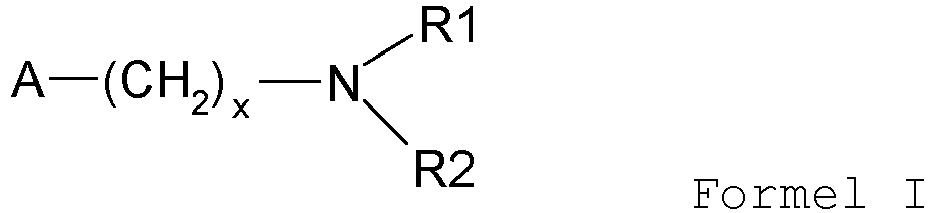 R1 und R2 Wasserstoff, Alkyl mit Kettenlängen zwischen C1 und C12, Aryl oder Heteroaryl sind;R1 kann verschieden von R2 seinX ist eine Zahl zwischen 0 und 6, undA ist ein natürliches oder synthetisches Harz, vorzugsweise ein Polystyrol.
 - Verfahren gemäß Anspruch 11, dadurch gekennzeichnet dass der Katalysator gemäß Formel I eine Polymer-gebundene Base ausgewählt aus der Gruppe der homologen Dialkylaminoalkylpolystyrole oder Dialkylaminomakroretikulären Harze ist.
- Verfahren gemäß Anspruch 12, dadurch gekennzeichnet, dass der Katalysator gemäß Formel I Diethylaminoethylpolystyrol, Diethylaminomethylpolystyrol, Dimethylaminomethylpolystyrol, Diethylaminomethylmakroretikuläres Harz oder Dimethylaminoethylpolystyrol ist.
- Verfahren gemäß Anspruch 9 dadurch gekennzeichnet, dass als anorganische Base Alkalihydroxid, vorzugsweise NaOH oder KOH, Alkalicyanid, vorzugsweise NaCN oder KCN, Alkalicarbonat, vorzugsweise Na2CO3 oder K2CO3, oder Alkalihydrogencarbonat, vorzugsweise NaHCO3 oder KHCO3, alleine oder in gemischter Form verwendet werden.
- Verfahren gemäß Anspruch 9, dadurch gekennzeichnet, dass als Säure in den Mischungen aus Säuren und niedermolekularen Aminen organischen Säuren, vorzugsweise, kurzkettigen Fettsäuren, insbesondere Essigsäure, Ameisensäure, Zitronensäure, oder organische Sulfonsäuren, vorzugsweise Trifluormethansulfonsäure oder Mineralsäuren, vorzugsweise Schwefelsäure oder Phosphorsäure verwendet werden.
- Verfahren gemäß einem der Ansprüche 1 bis 15, dadurch gekennzeichnet, dass ein pH-Wert von 4,5 bis 6,0, vorzugsweise 5,0-5,5 gemessen mit einer pH-Elektrode bei 23°C und einem Wassergehalt von 2 bis 14 Gew.% in der Hauptreaktionszone und der Absorptions-und Nachreaktionszone eingestellt wird.
- Verfahren gemäß einem der Ansprüche 1 bis 16, dadurch gekennzeichnet, dass die Hauptreaktionszone bei einer Temperatur von 20°C bis 80°C, vorzugsweise von 30°C bis 70°C, besonders bevorzugt von 35°C bis 65°C betrieben wird.
- Verfahren gemäß einem der Ansprüche 1 bis 17, dadurch gekennzeichnet, dass die Absorptions- und Nachreaktionszone bei einer Temperatur von 0°C bis 30°C, vorzugsweise von 4°C bis 15°C betrieben wird.
- Verfahren gemäß einem der Ansprüche 1 bis 18, dadurch gekennzeichnet, dass eine weitere Nachreaktionszone vor der Produktaustragsstelle von MMP-Cyanhydrin zur Vervollständigung der Umsetzung von HCN und MMP zum MMP-Cyanhydrin bei einer Temperatur von 20°C bis 80°C, vorzugsweise von 40°C bis 70°C , besonders bevorzugt von 45°C bis 65°C betrieben wird.
- Verfahren gemäß einem der Ansprüche 1 bis 19 dadurch gekennzeichnet, dass unter einem Absolutdruck von 0,9 bis 5 bar, vorzugsweise von 1,0 bis 3 bar, besonders bevorzugt von 1 bis 1,5 bar gearbeitet wird.
- Verfahren gemäß einem der Ansprüche 1 bis 20, dadurch gekennzeichnet, dass das molare Verhältnis von Blausäure zu 3-(Methylthio)propanal von 0,98 bis 1,03, bevorzugt von 0,99 bis 1,01 ist.
- Verfahren gemäß einem der Ansprüche 1 bis 21, dadurch gekennzeichnet, dass ein Gewichtsverhältnis von Katalysator zu 3-(Methylthio)propanal von 0,00005 bis 0,002 vorzugsweise von 0,0001 bis 0,001 verwendet wird.
- Verfahren gemäß einem der Ansprüche 1 bis 22, dadurch gekennzeichnet, dass das Verfahren im Batch, halbkontinuierlich oder kontinuierlich durchgeführt wird.
- Verwendung eines gemäß einem der Ansprüche 1 bis 23 hergestellten MMP-Cyanhydrin-haltigen Reaktionsproduktes zur Herstellung von D,L-Methionin oder von 2-Hydroxy-4-methylthiobuttersäure.
Applications Claiming Priority (2)
| Application Number | Priority Date | Filing Date | Title |
|---|---|---|---|
| US201161445781P | 2011-02-23 | 2011-02-23 | |
| PCT/EP2012/052367 WO2012113664A1 (de) | 2011-02-23 | 2012-02-13 | Verfahren zur herstellung von 2-hydroxy-4-(methylthio)buttersäurenitril aus 3-(methylthio)propanal und cyanwasserstoff |
Publications (2)
| Publication Number | Publication Date |
|---|---|
| EP2678312A1 EP2678312A1 (de) | 2014-01-01 |
| EP2678312B1 true EP2678312B1 (de) | 2017-10-11 |
Family
ID=45688166
Family Applications (1)
| Application Number | Title | Priority Date | Filing Date |
|---|---|---|---|
| EP12704512.8A Active EP2678312B1 (de) | 2011-02-23 | 2012-02-13 | Verfahren zur herstellung von 2-hydroxy-4-(methylthio)buttersäurenitril aus 3-(methylthio)propanal und cyanwasserstoff |
Country Status (12)
| Country | Link |
|---|---|
| US (3) | US8729288B2 (de) |
| EP (1) | EP2678312B1 (de) |
| JP (1) | JP5930329B2 (de) |
| KR (1) | KR101911563B1 (de) |
| CN (1) | CN103347854B (de) |
| BR (1) | BR112013018092B1 (de) |
| ES (1) | ES2649612T3 (de) |
| MX (3) | MX341594B (de) |
| MY (1) | MY174539A (de) |
| RU (1) | RU2604534C2 (de) |
| SG (1) | SG192565A1 (de) |
| WO (1) | WO2012113664A1 (de) |
Families Citing this family (27)
| Publication number | Priority date | Publication date | Assignee | Title |
|---|---|---|---|---|
| MX341594B (es) | 2011-02-23 | 2016-08-26 | Evonik Degussa Gmbh | Metodo para producir 2-hidroxi-4-(metiltio)butironitrilo a partir de 3-(metiltio)propanal y cianuro de hidrogeno. |
| DE102011081828A1 (de) | 2011-08-30 | 2013-02-28 | Evonik Degussa Gmbh | Verfahren zur Umsetzung von Methylmercaptopropionaldehyd aus Roh-Acrolein und Roh-Methylmercaptan |
| MY171361A (en) | 2011-08-30 | 2019-10-10 | Evonik Operations Gmbh | Method for producing a methionine salt |
| MX346043B (es) | 2012-01-06 | 2017-03-03 | Novus Int Inc | Tensioactivos basados en sulfoxido. |
| US9200805B2 (en) * | 2012-03-30 | 2015-12-01 | Alstom Technology Ltd | Condenser and method for heat recovery and cooling |
| CN103420883A (zh) * | 2013-08-28 | 2013-12-04 | 重庆紫光化工股份有限公司 | 利用粗氢氰酸气体制备2-羟基-4-甲硫基丁腈的方法 |
| CN103641760B (zh) * | 2013-11-19 | 2016-03-30 | 重庆紫光化工股份有限公司 | 廉价的高纯度的d,l-2-羟基-4-甲硫基丁酰胺的制备方法 |
| CN103641759B (zh) * | 2013-11-19 | 2015-11-18 | 重庆紫光化工股份有限公司 | 高纯度的环境友好的d,l-2-羟基-4-甲硫基丁酰胺的制备方法 |
| CN103641756B (zh) * | 2013-11-19 | 2016-03-30 | 重庆紫光化工股份有限公司 | 高纯度和高堆积密度d,l-2-羟基-4-甲硫基丁酸钙的制备方法 |
| CN104725274A (zh) * | 2014-11-21 | 2015-06-24 | 枣阳市金鹿化工有限公司 | 一种合成被取代的α-羟基苯乙腈的方法 |
| CN104926701B (zh) * | 2015-06-30 | 2017-05-03 | 西安蓝晓科技新材料股份有限公司 | 一种蛋氨酸纯化的工艺 |
| SG11201803979PA (en) | 2015-11-12 | 2018-06-28 | Novus Int Inc | Sulfur-containing compounds as solvents |
| CN105543886B (zh) * | 2015-12-17 | 2017-08-01 | 浙江工业大学 | 芳香腈的电化学催化合成方法 |
| CN105732450A (zh) * | 2016-01-22 | 2016-07-06 | 曾庆云 | 3-甲硫基丙醛制备装置及其制备方法 |
| JP6428708B2 (ja) * | 2016-04-28 | 2018-11-28 | コベルコ建機株式会社 | 建設機械 |
| EP3339289A1 (de) * | 2016-12-21 | 2018-06-27 | Evonik Degussa GmbH | Verfahren zur herstellung von methionin |
| CN107243300B (zh) * | 2017-05-17 | 2020-02-18 | 山东新和成氨基酸有限公司 | 一种氰醇的制备装置及其制备方法 |
| CN107417570B (zh) * | 2017-09-14 | 2020-04-14 | 哈尔滨理工大学 | 利用丙酮氰醇制备α-羟基腈的方法 |
| US10669233B2 (en) | 2017-12-28 | 2020-06-02 | Sunresin New Materials Co. Ltd., Xi'an | Process of purifying methionine |
| EP3604222A1 (de) | 2018-07-30 | 2020-02-05 | Evonik Operations GmbH | Verfahren zur reinigung von cyanwasserstoff |
| CN109369481A (zh) * | 2018-10-15 | 2019-02-22 | 禄丰天宝磷化工有限公司 | 一种dl-2-羟基-4-甲硒基丁腈的制备和稳定存储的方法 |
| CN111116437B (zh) * | 2018-11-01 | 2021-02-05 | 山东新和成氨基酸有限公司 | 制备2-羟基-4-甲硫基丁酸及其中间体的方法和装置 |
| CN113166045B (zh) * | 2018-12-14 | 2024-03-08 | 赢创运营有限公司 | 生产甲硫氨酸的方法 |
| CN109665974B (zh) * | 2019-02-14 | 2022-02-11 | 天宝动物营养科技股份有限公司 | 一种稳定存储氰醇类产品的方法 |
| FR3120367B1 (fr) | 2021-03-04 | 2024-02-16 | Adisseo France Sas | Procédé de préparation du 2-hydroxy-4-méthylthiobutyronitrile ou de son équivalent sélénié et applications |
| CN115650890A (zh) * | 2022-04-28 | 2023-01-31 | 宁夏紫光天化蛋氨酸有限责任公司 | 2-羟基-4-甲硫基丁腈的生产尾气处理方法 |
| FI130915B1 (en) * | 2023-05-22 | 2024-05-27 | Chempolis Oy | Heteroazeotrope extractive distillation process device and method |
Family Cites Families (35)
| Publication number | Priority date | Publication date | Assignee | Title |
|---|---|---|---|---|
| US2745745A (en) | 1952-10-30 | 1956-05-15 | Monsanto Chemicals | Poultry feed |
| BE543073A (de) | 1954-09-18 | 1900-01-01 | ||
| FR2590896B1 (fr) * | 1985-12-03 | 1988-07-22 | Aec Chim Organ Biolog | Procede de preparation d'une solution aqueuse d'un sel alcalin de la methionine |
| ES2005784A6 (es) * | 1988-02-22 | 1989-03-16 | Desarrollo Tecnico Ind S A Soc | Un procedimiento para preparar soluciones acuosas de acido 2-hidroxi-4-metil-tiobutirico. |
| US5498790A (en) * | 1993-06-09 | 1996-03-12 | Novus International, Inc. | Regeneration of sulfuric acid from sulfate by-products of 2-hydroxy-4-(methylthio)butyric acid manufacture |
| FR2733231B1 (fr) * | 1995-04-24 | 1997-07-04 | Rhone Poulenc Nutrition Animal | Procede de condensation de l'acide cyanhydrique avec un aldehyde |
| US5663409A (en) * | 1995-06-07 | 1997-09-02 | Novus International, Inc. | Process for the preparation of 3-(methylthio) propanal and 2-hydroxy-4-(methylthio) butanenitrile |
| AR002174A1 (es) * | 1995-06-07 | 1998-01-07 | Novus Int Inc | Proceso para la preparacion de 3-(metiltio)propanal y 2-hidroxi-4-metiltio) butanonitrilo |
| DE19547236A1 (de) | 1995-12-18 | 1997-07-03 | Degussa | Verfahren zur Herstellung von D,L-Methionin oder dessen Salz |
| DE19548538C2 (de) | 1995-12-23 | 1997-12-18 | Degussa | Verfahren zur Gewinnung von 2-Hydroxy-4-methylthiobuttersäure (MHA) |
| US5866379A (en) * | 1997-01-28 | 1999-02-02 | Novus International | Enzymatic conversion of α-hydroxynitriles to the corresponding .alpha. |
| DE19707380A1 (de) | 1997-02-25 | 1998-08-27 | Degussa | Verfahren zur Herstellung eines rieselfähigen Tierfuttermittelsupplements auf Methioninsalzbasis und das so erhältliche Granulat |
| DE19735332A1 (de) | 1997-08-14 | 1999-02-18 | Degussa | Aliphatische Alkanale mit verbesserter Lagerstabilität und Verfahren zur Verbesserung der Lagerstabilität |
| DE19822099A1 (de) | 1998-05-16 | 1999-11-18 | Degussa | Verfahren zur Herstellung von wäßrigen Natriummethioninat-Lösungen und Verwendung dieser Lösungen zur Herstellung eines Granulats |
| JP4517486B2 (ja) * | 2000-09-25 | 2010-08-04 | 住友化学株式会社 | 2−ヒドロキシ−4−メチルチオブタンニトリルの製造方法 |
| DE10160358A1 (de) | 2001-12-08 | 2003-06-18 | Degussa | Verfahren zur Herstellung von Methionin |
| DE10238212A1 (de) | 2002-08-21 | 2004-03-04 | Degussa Ag | Verfahren zur Herstellung von α-Aminosäuren durch Hydrolyse von Hydantoinen bei erhöhtem Druck und erhöhter Temperatur |
| DE10316110A1 (de) * | 2003-04-09 | 2004-10-28 | Degussa Ag | Verfahren zur Herstellung von 2-Hydroxy-4-methylthio-buttersäure Ammoniumsalz |
| DE10359636A1 (de) | 2003-12-18 | 2005-07-28 | Degussa Ag | Verfahren zur Abtrennung von Methylmercaptan aus Reaktionsgemischen |
| ATE509908T1 (de) | 2004-02-14 | 2011-06-15 | Evonik Degussa Gmbh | Verfahren zur herstellung von methionin |
| DE102004035465A1 (de) | 2004-07-22 | 2006-02-16 | Degussa Ag | Verfahren zur Reinigung von CO2-Gasströmen |
| DE102004038053A1 (de) * | 2004-08-05 | 2006-04-27 | Degussa Ag | Verfahren zur Herstellung von 3-(Methylthio)propanal |
| DE102007034715A1 (de) | 2007-07-23 | 2009-01-29 | Evonik Röhm Gmbh | Reaktor zur Herstellung von Cyanwasserstoff nach dem Andrussow-Verfahren |
| DE102008040544A1 (de) | 2008-07-18 | 2010-01-21 | Evonik Degussa Gmbh | Reaktionsbehälter und Verfahren zur Verwendung |
| JP2010111665A (ja) * | 2008-10-10 | 2010-05-20 | Sumitomo Chemical Co Ltd | 2−ヒドロキシ−4−メチルチオブタン酸の製造方法 |
| JP2010111642A (ja) * | 2008-11-07 | 2010-05-20 | Sumitomo Chemical Co Ltd | メチオニンの製造方法 |
| DE102008044218A1 (de) * | 2008-12-01 | 2010-06-02 | Evonik Röhm Gmbh | Verfahren zur Herstellung von einem Carbonsäureamid aus einer Carbonylverbindung und Blausäure |
| EP2468383A1 (de) | 2010-12-22 | 2012-06-27 | Evonik Degussa GmbH | Verfahren zur thermischen Nachverbrennung von Abgasen aus der Acrolein- und aus der Blausäureherstellung |
| DE102010064250A1 (de) | 2010-12-28 | 2012-06-28 | Evonik Degussa Gmbh | Verfahren zur Herstellung von Methylmercaptopropionaldehyd |
| MX341594B (es) | 2011-02-23 | 2016-08-26 | Evonik Degussa Gmbh | Metodo para producir 2-hidroxi-4-(metiltio)butironitrilo a partir de 3-(metiltio)propanal y cianuro de hidrogeno. |
| RU2597264C2 (ru) | 2011-02-23 | 2016-09-10 | Эвоник Дегусса Гмбх | Стабильный при хранении нитрил 2-гидрокси-4-(метилтио)масляной кислоты |
| MY171361A (en) | 2011-08-30 | 2019-10-10 | Evonik Operations Gmbh | Method for producing a methionine salt |
| DE102011081828A1 (de) | 2011-08-30 | 2013-02-28 | Evonik Degussa Gmbh | Verfahren zur Umsetzung von Methylmercaptopropionaldehyd aus Roh-Acrolein und Roh-Methylmercaptan |
| EP2641898A1 (de) | 2012-03-20 | 2013-09-25 | Evonik Industries AG | Verfahren zur Herstellung von Methionin |
| EP2679579A1 (de) | 2012-06-27 | 2014-01-01 | Evonik Industries AG | Integriertes Verfahren zur Herstellung von Acrolein und 3-Methylmercaptopropionaldehyd |
-
2012
- 2012-02-13 MX MX2015017788A patent/MX341594B/es unknown
- 2012-02-13 WO PCT/EP2012/052367 patent/WO2012113664A1/de not_active Ceased
- 2012-02-13 MX MX2013009640A patent/MX337247B/es active IP Right Grant
- 2012-02-13 JP JP2013554846A patent/JP5930329B2/ja active Active
- 2012-02-13 ES ES12704512.8T patent/ES2649612T3/es active Active
- 2012-02-13 MY MYPI2013002442A patent/MY174539A/en unknown
- 2012-02-13 RU RU2013142825/04A patent/RU2604534C2/ru active
- 2012-02-13 MX MX2015017786A patent/MX341595B/es unknown
- 2012-02-13 EP EP12704512.8A patent/EP2678312B1/de active Active
- 2012-02-13 BR BR112013018092-7A patent/BR112013018092B1/pt not_active IP Right Cessation
- 2012-02-13 SG SG2013049465A patent/SG192565A1/en unknown
- 2012-02-13 CN CN201280007703.6A patent/CN103347854B/zh active Active
- 2012-02-13 KR KR1020137022169A patent/KR101911563B1/ko not_active Expired - Fee Related
- 2012-02-22 US US13/402,041 patent/US8729288B2/en active Active
-
2014
- 2014-03-27 US US14/227,418 patent/US9133113B2/en active Active
-
2015
- 2015-03-27 US US14/671,435 patent/US9206121B2/en active Active
Non-Patent Citations (1)
| Title |
|---|
| None * |
Also Published As
| Publication number | Publication date |
|---|---|
| SG192565A1 (en) | 2013-09-30 |
| CN103347854B (zh) | 2017-04-26 |
| BR112013018092B1 (pt) | 2021-04-27 |
| EP2678312A1 (de) | 2014-01-01 |
| US20120215022A1 (en) | 2012-08-23 |
| US20150197489A1 (en) | 2015-07-16 |
| US20140213819A1 (en) | 2014-07-31 |
| MX341594B (es) | 2016-08-26 |
| MX337247B (es) | 2016-02-19 |
| JP5930329B2 (ja) | 2016-06-08 |
| MY174539A (en) | 2020-04-24 |
| KR20140007390A (ko) | 2014-01-17 |
| WO2012113664A1 (de) | 2012-08-30 |
| US8729288B2 (en) | 2014-05-20 |
| BR112013018092A2 (pt) | 2020-10-27 |
| CN103347854A (zh) | 2013-10-09 |
| ES2649612T3 (es) | 2018-01-15 |
| US9206121B2 (en) | 2015-12-08 |
| RU2604534C2 (ru) | 2016-12-10 |
| MX341595B (es) | 2016-08-26 |
| KR101911563B1 (ko) | 2018-10-24 |
| RU2013142825A (ru) | 2015-04-10 |
| MX2013009640A (es) | 2013-09-26 |
| US9133113B2 (en) | 2015-09-15 |
| JP2014513668A (ja) | 2014-06-05 |
Similar Documents
| Publication | Publication Date | Title |
|---|---|---|
| EP2678312B1 (de) | Verfahren zur herstellung von 2-hydroxy-4-(methylthio)buttersäurenitril aus 3-(methylthio)propanal und cyanwasserstoff | |
| EP2678313B1 (de) | Lagerstabiles 2-hydroxy-4-(methylthio)buttersäurenitril | |
| DE69615022T2 (de) | Verfahren zur herstellung von 3-(methylthio)propanal und 2-hydroxy-4-(methylthio)butansäurenitril | |
| DE69623377T2 (de) | Verfahren zur Kondensation von Cyanwasserstoff mit einem Aldehyd | |
| DE102010064250A1 (de) | Verfahren zur Herstellung von Methylmercaptopropionaldehyd | |
| MXPA97009461A (en) | Process for the preparation of 3- (methylene) propanal and 2-hydroxy-4- (methylthy) butanonitr | |
| DE68912878T2 (de) | Integriertes Verfahren zur Herstellung von Aminoacetonitrilen. | |
| EP3558941B1 (de) | Verfahren zur herstellung von methionin | |
| DE60316011T2 (de) | Verfahren zur herstellung von 3-methylthiopropanal | |
| DE2140506B2 (de) | Verfahren zur herstellung von dl- methionin | |
| EP3205643A1 (de) | Verfahren zur herstellung von 3-methylthiopropionaldehyd | |
| EP3894389B1 (de) | Verfahren zur herstellung von methionin | |
| EP0375920A1 (de) | Verfahren zur Herstellung von gegebenenfalls substituierten Alkyl- oder Alkenylchloriden | |
| WO2020104589A1 (de) | Lagerstabile form von 3-methylthiopropionaldehyd | |
| DE2700167A1 (de) | Verfahren zum transport von formonitril |
Legal Events
| Date | Code | Title | Description |
|---|---|---|---|
| PUAI | Public reference made under article 153(3) epc to a published international application that has entered the european phase |
Free format text: ORIGINAL CODE: 0009012 |
|
| 17P | Request for examination filed |
Effective date: 20130805 |
|
| AK | Designated contracting states |
Kind code of ref document: A1 Designated state(s): AL AT BE BG CH CY CZ DE DK EE ES FI FR GB GR HR HU IE IS IT LI LT LU LV MC MK MT NL NO PL PT RO RS SE SI SK SM TR |
|
| DAX | Request for extension of the european patent (deleted) | ||
| GRAP | Despatch of communication of intention to grant a patent |
Free format text: ORIGINAL CODE: EPIDOSNIGR1 |
|
| INTG | Intention to grant announced |
Effective date: 20170602 |
|
| GRAS | Grant fee paid |
Free format text: ORIGINAL CODE: EPIDOSNIGR3 |
|
| GRAA | (expected) grant |
Free format text: ORIGINAL CODE: 0009210 |
|
| AK | Designated contracting states |
Kind code of ref document: B1 Designated state(s): AL AT BE BG CH CY CZ DE DK EE ES FI FR GB GR HR HU IE IS IT LI LT LU LV MC MK MT NL NO PL PT RO RS SE SI SK SM TR |
|
| REG | Reference to a national code |
Ref country code: GB Ref legal event code: FG4D Free format text: NOT ENGLISH |
|
| REG | Reference to a national code |
Ref country code: CH Ref legal event code: EP |
|
| REG | Reference to a national code |
Ref country code: IE Ref legal event code: FG4D Free format text: LANGUAGE OF EP DOCUMENT: GERMAN |
|
| REG | Reference to a national code |
Ref country code: AT Ref legal event code: REF Ref document number: 935877 Country of ref document: AT Kind code of ref document: T Effective date: 20171115 |
|
| REG | Reference to a national code |
Ref country code: DE Ref legal event code: R096 Ref document number: 502012011423 Country of ref document: DE |
|
| REG | Reference to a national code |
Ref country code: ES Ref legal event code: FG2A Ref document number: 2649612 Country of ref document: ES Kind code of ref document: T3 Effective date: 20180115 |
|
| REG | Reference to a national code |
Ref country code: NL Ref legal event code: MP Effective date: 20171011 |
|
| REG | Reference to a national code |
Ref country code: FR Ref legal event code: PLFP Year of fee payment: 7 |
|
| REG | Reference to a national code |
Ref country code: LT Ref legal event code: MG4D |
|
| PG25 | Lapsed in a contracting state [announced via postgrant information from national office to epo] |
Ref country code: NL Free format text: LAPSE BECAUSE OF FAILURE TO SUBMIT A TRANSLATION OF THE DESCRIPTION OR TO PAY THE FEE WITHIN THE PRESCRIBED TIME-LIMIT Effective date: 20171011 |
|
| PG25 | Lapsed in a contracting state [announced via postgrant information from national office to epo] |
Ref country code: SE Free format text: LAPSE BECAUSE OF FAILURE TO SUBMIT A TRANSLATION OF THE DESCRIPTION OR TO PAY THE FEE WITHIN THE PRESCRIBED TIME-LIMIT Effective date: 20171011 Ref country code: LT Free format text: LAPSE BECAUSE OF FAILURE TO SUBMIT A TRANSLATION OF THE DESCRIPTION OR TO PAY THE FEE WITHIN THE PRESCRIBED TIME-LIMIT Effective date: 20171011 Ref country code: NO Free format text: LAPSE BECAUSE OF FAILURE TO SUBMIT A TRANSLATION OF THE DESCRIPTION OR TO PAY THE FEE WITHIN THE PRESCRIBED TIME-LIMIT Effective date: 20180111 Ref country code: FI Free format text: LAPSE BECAUSE OF FAILURE TO SUBMIT A TRANSLATION OF THE DESCRIPTION OR TO PAY THE FEE WITHIN THE PRESCRIBED TIME-LIMIT Effective date: 20171011 |
|
| PG25 | Lapsed in a contracting state [announced via postgrant information from national office to epo] |
Ref country code: IS Free format text: LAPSE BECAUSE OF FAILURE TO SUBMIT A TRANSLATION OF THE DESCRIPTION OR TO PAY THE FEE WITHIN THE PRESCRIBED TIME-LIMIT Effective date: 20180211 Ref country code: LV Free format text: LAPSE BECAUSE OF FAILURE TO SUBMIT A TRANSLATION OF THE DESCRIPTION OR TO PAY THE FEE WITHIN THE PRESCRIBED TIME-LIMIT Effective date: 20171011 Ref country code: GR Free format text: LAPSE BECAUSE OF FAILURE TO SUBMIT A TRANSLATION OF THE DESCRIPTION OR TO PAY THE FEE WITHIN THE PRESCRIBED TIME-LIMIT Effective date: 20180112 Ref country code: HR Free format text: LAPSE BECAUSE OF FAILURE TO SUBMIT A TRANSLATION OF THE DESCRIPTION OR TO PAY THE FEE WITHIN THE PRESCRIBED TIME-LIMIT Effective date: 20171011 Ref country code: RS Free format text: LAPSE BECAUSE OF FAILURE TO SUBMIT A TRANSLATION OF THE DESCRIPTION OR TO PAY THE FEE WITHIN THE PRESCRIBED TIME-LIMIT Effective date: 20171011 Ref country code: BG Free format text: LAPSE BECAUSE OF FAILURE TO SUBMIT A TRANSLATION OF THE DESCRIPTION OR TO PAY THE FEE WITHIN THE PRESCRIBED TIME-LIMIT Effective date: 20180111 |
|
| REG | Reference to a national code |
Ref country code: DE Ref legal event code: R097 Ref document number: 502012011423 Country of ref document: DE |
|
| PG25 | Lapsed in a contracting state [announced via postgrant information from national office to epo] |
Ref country code: CZ Free format text: LAPSE BECAUSE OF FAILURE TO SUBMIT A TRANSLATION OF THE DESCRIPTION OR TO PAY THE FEE WITHIN THE PRESCRIBED TIME-LIMIT Effective date: 20171011 Ref country code: DK Free format text: LAPSE BECAUSE OF FAILURE TO SUBMIT A TRANSLATION OF THE DESCRIPTION OR TO PAY THE FEE WITHIN THE PRESCRIBED TIME-LIMIT Effective date: 20171011 Ref country code: EE Free format text: LAPSE BECAUSE OF FAILURE TO SUBMIT A TRANSLATION OF THE DESCRIPTION OR TO PAY THE FEE WITHIN THE PRESCRIBED TIME-LIMIT Effective date: 20171011 Ref country code: SK Free format text: LAPSE BECAUSE OF FAILURE TO SUBMIT A TRANSLATION OF THE DESCRIPTION OR TO PAY THE FEE WITHIN THE PRESCRIBED TIME-LIMIT Effective date: 20171011 |
|
| PLBE | No opposition filed within time limit |
Free format text: ORIGINAL CODE: 0009261 |
|
| STAA | Information on the status of an ep patent application or granted ep patent |
Free format text: STATUS: NO OPPOSITION FILED WITHIN TIME LIMIT |
|
| PG25 | Lapsed in a contracting state [announced via postgrant information from national office to epo] |
Ref country code: RO Free format text: LAPSE BECAUSE OF FAILURE TO SUBMIT A TRANSLATION OF THE DESCRIPTION OR TO PAY THE FEE WITHIN THE PRESCRIBED TIME-LIMIT Effective date: 20171011 Ref country code: IT Free format text: LAPSE BECAUSE OF FAILURE TO SUBMIT A TRANSLATION OF THE DESCRIPTION OR TO PAY THE FEE WITHIN THE PRESCRIBED TIME-LIMIT Effective date: 20171011 Ref country code: PL Free format text: LAPSE BECAUSE OF FAILURE TO SUBMIT A TRANSLATION OF THE DESCRIPTION OR TO PAY THE FEE WITHIN THE PRESCRIBED TIME-LIMIT Effective date: 20171011 Ref country code: SM Free format text: LAPSE BECAUSE OF FAILURE TO SUBMIT A TRANSLATION OF THE DESCRIPTION OR TO PAY THE FEE WITHIN THE PRESCRIBED TIME-LIMIT Effective date: 20171011 |
|
| REG | Reference to a national code |
Ref country code: CH Ref legal event code: PL |
|
| 26N | No opposition filed |
Effective date: 20180712 |
|
| PG25 | Lapsed in a contracting state [announced via postgrant information from national office to epo] |
Ref country code: MT Free format text: LAPSE BECAUSE OF FAILURE TO SUBMIT A TRANSLATION OF THE DESCRIPTION OR TO PAY THE FEE WITHIN THE PRESCRIBED TIME-LIMIT Effective date: 20171011 Ref country code: MC Free format text: LAPSE BECAUSE OF FAILURE TO SUBMIT A TRANSLATION OF THE DESCRIPTION OR TO PAY THE FEE WITHIN THE PRESCRIBED TIME-LIMIT Effective date: 20171011 |
|
| GBPC | Gb: european patent ceased through non-payment of renewal fee |
Effective date: 20180213 |
|
| REG | Reference to a national code |
Ref country code: IE Ref legal event code: MM4A |
|
| PG25 | Lapsed in a contracting state [announced via postgrant information from national office to epo] |
Ref country code: SI Free format text: LAPSE BECAUSE OF FAILURE TO SUBMIT A TRANSLATION OF THE DESCRIPTION OR TO PAY THE FEE WITHIN THE PRESCRIBED TIME-LIMIT Effective date: 20171011 Ref country code: LI Free format text: LAPSE BECAUSE OF NON-PAYMENT OF DUE FEES Effective date: 20180228 Ref country code: LU Free format text: LAPSE BECAUSE OF NON-PAYMENT OF DUE FEES Effective date: 20180213 Ref country code: CH Free format text: LAPSE BECAUSE OF NON-PAYMENT OF DUE FEES Effective date: 20180228 |
|
| PG25 | Lapsed in a contracting state [announced via postgrant information from national office to epo] |
Ref country code: IE Free format text: LAPSE BECAUSE OF NON-PAYMENT OF DUE FEES Effective date: 20180213 |
|
| PG25 | Lapsed in a contracting state [announced via postgrant information from national office to epo] |
Ref country code: GB Free format text: LAPSE BECAUSE OF NON-PAYMENT OF DUE FEES Effective date: 20180213 |
|
| REG | Reference to a national code |
Ref country code: AT Ref legal event code: MM01 Ref document number: 935877 Country of ref document: AT Kind code of ref document: T Effective date: 20180213 |
|
| PG25 | Lapsed in a contracting state [announced via postgrant information from national office to epo] |
Ref country code: AT Free format text: LAPSE BECAUSE OF NON-PAYMENT OF DUE FEES Effective date: 20180213 |
|
| REG | Reference to a national code |
Ref country code: DE Ref legal event code: R081 Ref document number: 502012011423 Country of ref document: DE Owner name: EVONIK OPERATIONS GMBH, DE Free format text: FORMER OWNER: EVONIK DEGUSSA GMBH, 45128 ESSEN, DE |
|
| PG25 | Lapsed in a contracting state [announced via postgrant information from national office to epo] |
Ref country code: TR Free format text: LAPSE BECAUSE OF FAILURE TO SUBMIT A TRANSLATION OF THE DESCRIPTION OR TO PAY THE FEE WITHIN THE PRESCRIBED TIME-LIMIT Effective date: 20171011 |
|
| PG25 | Lapsed in a contracting state [announced via postgrant information from national office to epo] |
Ref country code: HU Free format text: LAPSE BECAUSE OF FAILURE TO SUBMIT A TRANSLATION OF THE DESCRIPTION OR TO PAY THE FEE WITHIN THE PRESCRIBED TIME-LIMIT; INVALID AB INITIO Effective date: 20120213 Ref country code: PT Free format text: LAPSE BECAUSE OF FAILURE TO SUBMIT A TRANSLATION OF THE DESCRIPTION OR TO PAY THE FEE WITHIN THE PRESCRIBED TIME-LIMIT Effective date: 20171011 |
|
| REG | Reference to a national code |
Ref country code: ES Ref legal event code: PC2A Owner name: EVONIK OPERATIONS GMBH Effective date: 20200623 |
|
| PG25 | Lapsed in a contracting state [announced via postgrant information from national office to epo] |
Ref country code: CY Free format text: LAPSE BECAUSE OF FAILURE TO SUBMIT A TRANSLATION OF THE DESCRIPTION OR TO PAY THE FEE WITHIN THE PRESCRIBED TIME-LIMIT Effective date: 20171011 Ref country code: MK Free format text: LAPSE BECAUSE OF NON-PAYMENT OF DUE FEES Effective date: 20171011 |
|
| PG25 | Lapsed in a contracting state [announced via postgrant information from national office to epo] |
Ref country code: AL Free format text: LAPSE BECAUSE OF FAILURE TO SUBMIT A TRANSLATION OF THE DESCRIPTION OR TO PAY THE FEE WITHIN THE PRESCRIBED TIME-LIMIT Effective date: 20171011 |
|
| REG | Reference to a national code |
Ref country code: BE Ref legal event code: HC Owner name: EVONIK OPERATIONS GMBH; DE Free format text: DETAILS ASSIGNMENT: CHANGE OF OWNER(S), CHANGEMENT DE NOM DU PROPRIETAIRE; FORMER OWNER NAME: EVONIK DEGUSSA GMBH Effective date: 20200403 |
|
| P01 | Opt-out of the competence of the unified patent court (upc) registered |
Effective date: 20230526 |
|
| PGFP | Annual fee paid to national office [announced via postgrant information from national office to epo] |
Ref country code: DE Payment date: 20250218 Year of fee payment: 14 |
|
| PGFP | Annual fee paid to national office [announced via postgrant information from national office to epo] |
Ref country code: BE Payment date: 20250218 Year of fee payment: 14 |
|
| PGFP | Annual fee paid to national office [announced via postgrant information from national office to epo] |
Ref country code: FR Payment date: 20250221 Year of fee payment: 14 |
|
| PGFP | Annual fee paid to national office [announced via postgrant information from national office to epo] |
Ref country code: ES Payment date: 20250331 Year of fee payment: 14 |