EP2665783B1 - Slippery liquid-infused porous surfaces and biological applications thereof - Google Patents
Slippery liquid-infused porous surfaces and biological applications thereof Download PDFInfo
- Publication number
- EP2665783B1 EP2665783B1 EP12705182.9A EP12705182A EP2665783B1 EP 2665783 B1 EP2665783 B1 EP 2665783B1 EP 12705182 A EP12705182 A EP 12705182A EP 2665783 B1 EP2665783 B1 EP 2665783B1
- Authority
- EP
- European Patent Office
- Prior art keywords
- liquid
- slips
- fluid
- lubricating
- lubricating liquid
- Prior art date
- Legal status (The legal status is an assumption and is not a legal conclusion. Google has not performed a legal analysis and makes no representation as to the accuracy of the status listed.)
- Active
Links
Images





















Classifications
-
- C—CHEMISTRY; METALLURGY
- C09—DYES; PAINTS; POLISHES; NATURAL RESINS; ADHESIVES; COMPOSITIONS NOT OTHERWISE PROVIDED FOR; APPLICATIONS OF MATERIALS NOT OTHERWISE PROVIDED FOR
- C09D—COATING COMPOSITIONS, e.g. PAINTS, VARNISHES OR LACQUERS; FILLING PASTES; CHEMICAL PAINT OR INK REMOVERS; INKS; CORRECTING FLUIDS; WOODSTAINS; PASTES OR SOLIDS FOR COLOURING OR PRINTING; USE OF MATERIALS THEREFOR
- C09D5/00—Coating compositions, e.g. paints, varnishes or lacquers, characterised by their physical nature or the effects produced; Filling pastes
- C09D5/16—Antifouling paints; Underwater paints
- C09D5/1693—Antifouling paints; Underwater paints as part of a multilayer system
-
- C—CHEMISTRY; METALLURGY
- C09—DYES; PAINTS; POLISHES; NATURAL RESINS; ADHESIVES; COMPOSITIONS NOT OTHERWISE PROVIDED FOR; APPLICATIONS OF MATERIALS NOT OTHERWISE PROVIDED FOR
- C09D—COATING COMPOSITIONS, e.g. PAINTS, VARNISHES OR LACQUERS; FILLING PASTES; CHEMICAL PAINT OR INK REMOVERS; INKS; CORRECTING FLUIDS; WOODSTAINS; PASTES OR SOLIDS FOR COLOURING OR PRINTING; USE OF MATERIALS THEREFOR
- C09D5/00—Coating compositions, e.g. paints, varnishes or lacquers, characterised by their physical nature or the effects produced; Filling pastes
- C09D5/16—Antifouling paints; Underwater paints
-
- A—HUMAN NECESSITIES
- A61—MEDICAL OR VETERINARY SCIENCE; HYGIENE
- A61L—METHODS OR APPARATUS FOR STERILISING MATERIALS OR OBJECTS IN GENERAL; DISINFECTION, STERILISATION OR DEODORISATION OF AIR; CHEMICAL ASPECTS OF BANDAGES, DRESSINGS, ABSORBENT PADS OR SURGICAL ARTICLES; MATERIALS FOR BANDAGES, DRESSINGS, ABSORBENT PADS OR SURGICAL ARTICLES
- A61L15/00—Chemical aspects of, or use of materials for, bandages, dressings or absorbent pads
- A61L15/16—Bandages, dressings or absorbent pads for physiological fluids such as urine or blood, e.g. sanitary towels, tampons
- A61L15/22—Bandages, dressings or absorbent pads for physiological fluids such as urine or blood, e.g. sanitary towels, tampons containing macromolecular materials
- A61L15/24—Macromolecular compounds obtained by reactions only involving carbon-to-carbon unsaturated bonds; Derivatives thereof
-
- A—HUMAN NECESSITIES
- A61—MEDICAL OR VETERINARY SCIENCE; HYGIENE
- A61L—METHODS OR APPARATUS FOR STERILISING MATERIALS OR OBJECTS IN GENERAL; DISINFECTION, STERILISATION OR DEODORISATION OF AIR; CHEMICAL ASPECTS OF BANDAGES, DRESSINGS, ABSORBENT PADS OR SURGICAL ARTICLES; MATERIALS FOR BANDAGES, DRESSINGS, ABSORBENT PADS OR SURGICAL ARTICLES
- A61L15/00—Chemical aspects of, or use of materials for, bandages, dressings or absorbent pads
- A61L15/16—Bandages, dressings or absorbent pads for physiological fluids such as urine or blood, e.g. sanitary towels, tampons
- A61L15/22—Bandages, dressings or absorbent pads for physiological fluids such as urine or blood, e.g. sanitary towels, tampons containing macromolecular materials
- A61L15/34—Oils, fats, waxes or natural resins
-
- A—HUMAN NECESSITIES
- A61—MEDICAL OR VETERINARY SCIENCE; HYGIENE
- A61L—METHODS OR APPARATUS FOR STERILISING MATERIALS OR OBJECTS IN GENERAL; DISINFECTION, STERILISATION OR DEODORISATION OF AIR; CHEMICAL ASPECTS OF BANDAGES, DRESSINGS, ABSORBENT PADS OR SURGICAL ARTICLES; MATERIALS FOR BANDAGES, DRESSINGS, ABSORBENT PADS OR SURGICAL ARTICLES
- A61L15/00—Chemical aspects of, or use of materials for, bandages, dressings or absorbent pads
- A61L15/16—Bandages, dressings or absorbent pads for physiological fluids such as urine or blood, e.g. sanitary towels, tampons
- A61L15/42—Use of materials characterised by their function or physical properties
-
- A—HUMAN NECESSITIES
- A61—MEDICAL OR VETERINARY SCIENCE; HYGIENE
- A61L—METHODS OR APPARATUS FOR STERILISING MATERIALS OR OBJECTS IN GENERAL; DISINFECTION, STERILISATION OR DEODORISATION OF AIR; CHEMICAL ASPECTS OF BANDAGES, DRESSINGS, ABSORBENT PADS OR SURGICAL ARTICLES; MATERIALS FOR BANDAGES, DRESSINGS, ABSORBENT PADS OR SURGICAL ARTICLES
- A61L15/00—Chemical aspects of, or use of materials for, bandages, dressings or absorbent pads
- A61L15/16—Bandages, dressings or absorbent pads for physiological fluids such as urine or blood, e.g. sanitary towels, tampons
- A61L15/42—Use of materials characterised by their function or physical properties
- A61L15/46—Deodorants or malodour counteractants, e.g. to inhibit the formation of ammonia or bacteria
-
- A—HUMAN NECESSITIES
- A61—MEDICAL OR VETERINARY SCIENCE; HYGIENE
- A61L—METHODS OR APPARATUS FOR STERILISING MATERIALS OR OBJECTS IN GENERAL; DISINFECTION, STERILISATION OR DEODORISATION OF AIR; CHEMICAL ASPECTS OF BANDAGES, DRESSINGS, ABSORBENT PADS OR SURGICAL ARTICLES; MATERIALS FOR BANDAGES, DRESSINGS, ABSORBENT PADS OR SURGICAL ARTICLES
- A61L27/00—Materials for grafts or prostheses or for coating grafts or prostheses
- A61L27/28—Materials for coating prostheses
-
- A—HUMAN NECESSITIES
- A61—MEDICAL OR VETERINARY SCIENCE; HYGIENE
- A61L—METHODS OR APPARATUS FOR STERILISING MATERIALS OR OBJECTS IN GENERAL; DISINFECTION, STERILISATION OR DEODORISATION OF AIR; CHEMICAL ASPECTS OF BANDAGES, DRESSINGS, ABSORBENT PADS OR SURGICAL ARTICLES; MATERIALS FOR BANDAGES, DRESSINGS, ABSORBENT PADS OR SURGICAL ARTICLES
- A61L27/00—Materials for grafts or prostheses or for coating grafts or prostheses
- A61L27/28—Materials for coating prostheses
- A61L27/34—Macromolecular materials
-
- A—HUMAN NECESSITIES
- A61—MEDICAL OR VETERINARY SCIENCE; HYGIENE
- A61L—METHODS OR APPARATUS FOR STERILISING MATERIALS OR OBJECTS IN GENERAL; DISINFECTION, STERILISATION OR DEODORISATION OF AIR; CHEMICAL ASPECTS OF BANDAGES, DRESSINGS, ABSORBENT PADS OR SURGICAL ARTICLES; MATERIALS FOR BANDAGES, DRESSINGS, ABSORBENT PADS OR SURGICAL ARTICLES
- A61L27/00—Materials for grafts or prostheses or for coating grafts or prostheses
- A61L27/50—Materials characterised by their function or physical properties, e.g. injectable or lubricating compositions, shape-memory materials, surface modified materials
-
- A—HUMAN NECESSITIES
- A61—MEDICAL OR VETERINARY SCIENCE; HYGIENE
- A61L—METHODS OR APPARATUS FOR STERILISING MATERIALS OR OBJECTS IN GENERAL; DISINFECTION, STERILISATION OR DEODORISATION OF AIR; CHEMICAL ASPECTS OF BANDAGES, DRESSINGS, ABSORBENT PADS OR SURGICAL ARTICLES; MATERIALS FOR BANDAGES, DRESSINGS, ABSORBENT PADS OR SURGICAL ARTICLES
- A61L33/00—Antithrombogenic treatment of surgical articles, e.g. sutures, catheters, prostheses, or of articles for the manipulation or conditioning of blood; Materials for such treatment
-
- A—HUMAN NECESSITIES
- A61—MEDICAL OR VETERINARY SCIENCE; HYGIENE
- A61L—METHODS OR APPARATUS FOR STERILISING MATERIALS OR OBJECTS IN GENERAL; DISINFECTION, STERILISATION OR DEODORISATION OF AIR; CHEMICAL ASPECTS OF BANDAGES, DRESSINGS, ABSORBENT PADS OR SURGICAL ARTICLES; MATERIALS FOR BANDAGES, DRESSINGS, ABSORBENT PADS OR SURGICAL ARTICLES
- A61L33/00—Antithrombogenic treatment of surgical articles, e.g. sutures, catheters, prostheses, or of articles for the manipulation or conditioning of blood; Materials for such treatment
- A61L33/0094—Physical treatment, e.g. plasma treatment
-
- A—HUMAN NECESSITIES
- A61—MEDICAL OR VETERINARY SCIENCE; HYGIENE
- A61L—METHODS OR APPARATUS FOR STERILISING MATERIALS OR OBJECTS IN GENERAL; DISINFECTION, STERILISATION OR DEODORISATION OF AIR; CHEMICAL ASPECTS OF BANDAGES, DRESSINGS, ABSORBENT PADS OR SURGICAL ARTICLES; MATERIALS FOR BANDAGES, DRESSINGS, ABSORBENT PADS OR SURGICAL ARTICLES
- A61L33/00—Antithrombogenic treatment of surgical articles, e.g. sutures, catheters, prostheses, or of articles for the manipulation or conditioning of blood; Materials for such treatment
- A61L33/06—Use of macromolecular materials
- A61L33/064—Use of macromolecular materials obtained by reactions only involving carbon-to-carbon unsaturated bonds
-
- B—PERFORMING OPERATIONS; TRANSPORTING
- B01—PHYSICAL OR CHEMICAL PROCESSES OR APPARATUS IN GENERAL
- B01L—CHEMICAL OR PHYSICAL LABORATORY APPARATUS FOR GENERAL USE
- B01L3/00—Containers or dishes for laboratory use, e.g. laboratory glassware; Droppers
-
- C—CHEMISTRY; METALLURGY
- C09—DYES; PAINTS; POLISHES; NATURAL RESINS; ADHESIVES; COMPOSITIONS NOT OTHERWISE PROVIDED FOR; APPLICATIONS OF MATERIALS NOT OTHERWISE PROVIDED FOR
- C09D—COATING COMPOSITIONS, e.g. PAINTS, VARNISHES OR LACQUERS; FILLING PASTES; CHEMICAL PAINT OR INK REMOVERS; INKS; CORRECTING FLUIDS; WOODSTAINS; PASTES OR SOLIDS FOR COLOURING OR PRINTING; USE OF MATERIALS THEREFOR
- C09D5/00—Coating compositions, e.g. paints, varnishes or lacquers, characterised by their physical nature or the effects produced; Filling pastes
- C09D5/16—Antifouling paints; Underwater paints
- C09D5/1656—Antifouling paints; Underwater paints characterised by the film-forming substance
-
- C—CHEMISTRY; METALLURGY
- C09—DYES; PAINTS; POLISHES; NATURAL RESINS; ADHESIVES; COMPOSITIONS NOT OTHERWISE PROVIDED FOR; APPLICATIONS OF MATERIALS NOT OTHERWISE PROVIDED FOR
- C09D—COATING COMPOSITIONS, e.g. PAINTS, VARNISHES OR LACQUERS; FILLING PASTES; CHEMICAL PAINT OR INK REMOVERS; INKS; CORRECTING FLUIDS; WOODSTAINS; PASTES OR SOLIDS FOR COLOURING OR PRINTING; USE OF MATERIALS THEREFOR
- C09D5/00—Coating compositions, e.g. paints, varnishes or lacquers, characterised by their physical nature or the effects produced; Filling pastes
- C09D5/16—Antifouling paints; Underwater paints
- C09D5/1681—Antifouling coatings characterised by surface structure, e.g. for roughness effect giving superhydrophobic coatings or Lotus effect
-
- F—MECHANICAL ENGINEERING; LIGHTING; HEATING; WEAPONS; BLASTING
- F15—FLUID-PRESSURE ACTUATORS; HYDRAULICS OR PNEUMATICS IN GENERAL
- F15D—FLUID DYNAMICS, i.e. METHODS OR MEANS FOR INFLUENCING THE FLOW OF GASES OR LIQUIDS
- F15D1/00—Influencing flow of fluids
- F15D1/02—Influencing flow of fluids in pipes or conduits
-
- F—MECHANICAL ENGINEERING; LIGHTING; HEATING; WEAPONS; BLASTING
- F15—FLUID-PRESSURE ACTUATORS; HYDRAULICS OR PNEUMATICS IN GENERAL
- F15D—FLUID DYNAMICS, i.e. METHODS OR MEANS FOR INFLUENCING THE FLOW OF GASES OR LIQUIDS
- F15D1/00—Influencing flow of fluids
- F15D1/10—Influencing flow of fluids around bodies of solid material
-
- A—HUMAN NECESSITIES
- A61—MEDICAL OR VETERINARY SCIENCE; HYGIENE
- A61L—METHODS OR APPARATUS FOR STERILISING MATERIALS OR OBJECTS IN GENERAL; DISINFECTION, STERILISATION OR DEODORISATION OF AIR; CHEMICAL ASPECTS OF BANDAGES, DRESSINGS, ABSORBENT PADS OR SURGICAL ARTICLES; MATERIALS FOR BANDAGES, DRESSINGS, ABSORBENT PADS OR SURGICAL ARTICLES
- A61L2400/00—Materials characterised by their function or physical properties
- A61L2400/12—Nanosized materials, e.g. nanofibres, nanoparticles, nanowires, nanotubes; Nanostructured surfaces
-
- B—PERFORMING OPERATIONS; TRANSPORTING
- B05—SPRAYING OR ATOMISING IN GENERAL; APPLYING FLUENT MATERIALS TO SURFACES, IN GENERAL
- B05D—PROCESSES FOR APPLYING FLUENT MATERIALS TO SURFACES, IN GENERAL
- B05D5/00—Processes for applying liquids or other fluent materials to surfaces to obtain special surface effects, finishes or structures
- B05D5/08—Processes for applying liquids or other fluent materials to surfaces to obtain special surface effects, finishes or structures to obtain an anti-friction or anti-adhesive surface
- B05D5/083—Processes for applying liquids or other fluent materials to surfaces to obtain special surface effects, finishes or structures to obtain an anti-friction or anti-adhesive surface involving the use of fluoropolymers
Definitions
- the present disclosure relates generally to surfaces that prevent adsorption or deposition from fluids, solids, or mixtures of fluids and solids of biological origin, and uses thereof.
- Biofilms Bacteria exist in their natural state predominantly as members of biofilms - structured, multicellular communities adherent to surfaces in natural and anthropogenic environments. These communities are composed of many cells embedded within a polymeric organic matrix. Biofilm formation is of concern to industry and healthcare because it causes contamination of plumbing, oil wells, heat exchangers, building ventilation, food storage, medical implants, and other systems. Biofilms threaten human health by triggering an immune response, releasing harmful endotoxins and exotoxins, and clogging indwelling catheters; in fact, biofilms are responsible for nearly 100,000 nosocomial deaths annually in the United States and 80% or more of all microbial infections in humans.
- biocides Systemic and topical antimicrobial products have become extensively used to combat biofilm contamination in health care, agriculture, and industrial settings, and increasingly by the general public as well.
- Commercial products employ a wide variety of active chemical agents, or biocides, often delivered in liquid form and sometimes as vapor.
- active chemical agents or biocides
- One review of antiseptics and disinfectants identifies 12 classes of liquid agents and 5 common types of vapor-phase sterilants.
- biocides must be able to reach the target cell to cause damage. At the multicellular level, therefore, the effective biocide must penetrate into the extracellular matrix (ECM)-the slime-like "cement" of biofilm.
- ECM extracellular matrix
- Biofilms offer their member cells protection from environmental threats.
- ECM acts as a diffusion barrier and as a charged binding filter for certain antibiotics, and that it complements enzymes and multidrug resistance pumps on cells that remove antimicrobials.
- the resistance to threats covers a wide range of treatments: biofilms exposed to chlorine bleach for 60 minutes are reported to still have live cells; biofilms in pipes continuously flushed over 7 days with multiple biocides recolonize the pipes, and biofilms have been reported to survive in bottled iodine solution for up to 15 months.
- Biofilms' resistance to antimicrobials may be related to the extreme nonwettability of their surface as well as resistance to vapor penetration.
- JP 2004 037764 A relates to an image fixing device and electrophotographic system using the same.
- JP 5 240251 A relates to stabilizing lubricating characteristics of a sintered bearing molding by impregnating with perfluoro polyether oil.
- JP 1 170932 A relates to the formation of a porous thin film on a surface for which a low-friction treatment is necessary and the thin film is impregnated with a straight-chained perfluoropolyether oil.
- US 5 624 713 A relates to a method of increasing the lubricity of snow skis by applying an effective amount of a non-functional perfluoropolyether to the base of the snow skis.
- WO 99/36490 A1 relates to methods and compositions for increasing lubricity of rubber surfaces.
- Holger F. Bohn et al: "Insect aquaplaning: Nepenthes pitcher plants capture prey with the peristome, a fully wettable water-lubricated anisotropic surface", Proceedings of the National Academy of Sciences, 21 September 2008 (2008-09-21), pages 14138-14143 relates to pitcher plants of the genus Nepenthes which have highly specialised leaves that are adapted to attract, capture, retain and digest arthropod prey.
- WO 2006/091235 A1 relates to a composite material having a nanostructured hydrophobic surface that includes a support layer having a first composition and a plurality of spaced apart nanostructured features disposed on the support layer and protruding from the surface of the support layer.
- WO 93/17077 A1 relates to a coating comprising at least two sequentially applied layers: a primer layer of suitable binder resin that is bonded to the clean surface of a substrate and a layer or layers of particles of polytetrafluoroethylene (PTFE).
- PTFE polytetrafluoroethylene
- SLIPS synthetic slippery liquid-infused porous surfaces
- the invention is directed to a method according to claim 1.
- the invention is directed to a device according to claim 5.
- an optically transparent device that prevents adhesion of biological material.
- a roughened surface that is a transparent window is wetted by a lubricating fluid that adheres to the roughened surface to form an over-coated layer.
- the roughened surface of the transparent window has a greater affinity towards the lubricating fluid as compared to a biological material.
- the index of refraction of the lubricating liquid is substantially similar to the index of refraction of the roughened surface.
- the lubricating liquid and the biological material are substantially chemically inert with each other.
- the device is a biological sensor window.
- an article having a low adhesion surface for preventing or reducing biofilm attachment comprises a solid substrate having a roughened surface and a lubricating fluid that adheres to and preferentially wets the substrate to form a liquid upper surface.
- the liquid upper surface is configured and arranged to contact a biological material of interest.
- the lubricating fluid is immiscible with the biological material, and the biological material exhibits little or no adhesion to the article.
- the following two conditions are satisfied when the article is exposed to Medium X, where X is air/gas/water/immiscible biological material: R ( ⁇ BX cos ⁇ BX - ⁇ AX cos ⁇ AX ) - ⁇ AB > 0 (e2) and R ( ⁇ BX cos ⁇ BX - ⁇ AX cos ⁇ AX ) + ⁇ AX - ⁇ BX > 0 (e3), wherein ⁇ AX is the interfacial energies of the biological material with a surrounding medium, ⁇ BX is the interfacial energies of the lubricating fluid with the surrounding medium, ⁇ AB is the interfacial energies of the biological material and the lubricating fluid interface, ⁇ AX is the equilibrium contact angle of the biological material on a flat solid surface immersed under the surrounding medium, ⁇ BX is the equilibrium contact angle of the lubricating fluid on a flat solid surface immersed under the surrounding medium, and R is
- the lubricating fluid prevents adhesion, coagulation, or clot formation of biological materials.
- the method further mediates inflammation, wound healing, plaque disposition, or foreign body response.
- the method inhibits inflammation, wound healing, plaque disposition, or foreign body response.
- the method prevents inflammation, wound healing, plaque disposition, or foreign body response.
- the method further prevents bacterial contamination.
- wherein the biological material is contacted with the surface at a fluid impact pressures is on the order of 10 3 -10 7 Pa.
- the surface is selected from the group consisting of a cannula, connector, catheter, needle, capillary tube, tubing, syringe and combinations thereof.
- the surface is selected from the group consisting of a slide, plate, film, work surface, well, well plate, Petri dish, tile, jar, flask, beaker, vial, test tube, column, container, cuvette, bottle, drum, vat, tank, and combinations thereof.
- the surface is selected from the group consisting of a clamp, skin hook, cuff, retractor, shunt, needle, capillary tube, tubing, and combinations thereof.
- the surface is selected from the group consisting of an endotracheal tube, ventilator, associated ventilator tubing, drug delivery vehicle, syringe, endoscope, dialysis equipment, central veno-venous hemofiltration device, extracorporeal membrane oxygenation equipment, and combinations thereof.
- the surface is selected from the group consisting of an organ, artificial organ, implant, and combinations thereof.
- the surface is selected from the group consisting of a biosensor, biological microelectromechanical devices (bioMEMs), bioelectrode, and combinations thereof.
- the surface is a wound dressing.
- the substrate is preferentially wetted by the lubricating fluid. In one or more aspects, the lubricating fluid infiltrates the substrate by capillary action.
- the solid substrate is electrically conductive, nonconductive, magnetic, non-magnetic, elastic, non-elastic, light sensitive, or not light sensitive.
- the solid substrate is silanized.
- the substrate is a roughened surface comprising a porous material.
- microparticles or nanoparticles are applied to a flat substrate to form a roughened, porous substrate.
- microparticles or nanoparticles are applied to the substrate using photolithography, projection lithography, e-beam writing or lithography, depositing nanowire arrays, growing nanostructures on the surface of a substrate, soft lithography, replica molding, solution deposition, solution polymerization, electropolymerization, electrospinning, electroplating, vapor deposition, layered deposition, rotary jet spinning of polymer nanofibers, contact printing, etching, transfer patterning, microimprinting, self-assembly, boehmite ( ⁇ -AlO(OH)) formation, spray coated, and combinations thereof.
- the substrate consists of a fluoropolymer.
- the biological material is a fluid selected from the group consisting of whole blood, plasma, serum, sweat, feces, urine, saliva, tears, vaginal fluid, prostatic fluid, gingival fluid, amniotic fluid, intraocular fluid, cerebrospinal fluid, seminal fluid, sputum, ascites fluid, pus, nasopharengal fluid, wound exudate fluid, aqueous humour, vitreous humour, bile, cerumen, endolymph, perilymph, gastric juice, mucus, peritoneal fluid, pleural fluid, sebum, vomit, and combinations thereof.
- the biological material is a solution or suspension containing bacteria selected from the group consisting of Actinobacillus (e.g., Actinobacillus actinomycetemcomitans), Acinetobacter (e.g., Acinetobacter baumannii), Aeromonas, Bordetella (e.g., Bordetella pertussis, Bordetella bronchiseptica, and Bordetella parapertussis), Brevibacillus, Brucella, Bacteroides (e.g., Bacteroides fragilis), Burkholderia (e.g., Burkholderia cepacia and Burkholderiapseudomallei ), Borelia (e.g., Borelia burgdorfen ), Bacillus (e.g., Bacillus anthracis and Bacillus subtilis), Campylobacter (e.g., Campylobacter jejuni), Capnocytophaga , Cardiobacterium (e.g., Actinobac
- Eikenella corrodens Enterobacter, Escherichia (e.g., Escherichia coli), Francisella (e.g., Francisella tularensis), Fusobacterium, Flavobacterium, Haemophilus (e.g., Haemophilus ducreyi or Haemophilus influenzae), Helicobacter (e.g., Helicobacter pylori), Kingella (e.g., Kingella kingae), Klebsiella (e.g., Klebsiella pneumoniae), Legionella (e.g., Legionella pneumophila), Listeria (e.g., Listeria monocytogenes), Leptospirae, Moraxella (e.g., Moraxella catarrhalis ), Morganella , Mycoplasma (e.g., Mycoplasma hominis and Mycoplasma pneumoniae), Mycobacterium (e.g., Mycobacterium tuberculosis or Myco
- Vibrio cholerae Vibrio parahaemolyticus, and Vibrio vulnificus
- Yersinia e.g., Yersinia enterocolitica, Yersinia pestis, and Yersinia pseudotuberculosis
- Xanthomonas e.g., Xanthomonas maltophilia
- the biological material is a solution or suspension containing particles selected from the group consisting of a member of the genus Aspergillus (e.g., Aspergillus flavus, Aspergillus fumigatus, Aspergillus glaucus, Aspergillus nidulans, Aspergillus niger, and Aspergillus terreus), Blastomyces dermatitidis, Candida (e.g., Candida albicans, Candida glabrata, Candida tropicalis, Candida parapsilosis, Candida krusei, and Candida guillermondii), Coccidioides immitis, Cryptococcus (e.g., Cryptococcus neoformans, Cryptococcus albidus, and Cryptococcus laurentii), Histoplasma capsulatum var.
- Aspergillus e.g., Aspergillus flavus, Aspergillus fumigatus, Aspergillus gla
- capsulatum Histoplasma capsulatum var. duboisii, Paracoccidioides brasiliensis, Sporothrix schenckii, Absidia corymbifera ; Rhizomucor pusillus, Rhizopus arrhizous, and combinations thereof.
- the biological material is a solution or suspension containing particles selected from the group consisting of normal cells, diseased cells, parasitized cells, cancer cells, foreign cells, stem cells, and infected cells, microorganisms, viruses, virus-like particles, bacteria, bacteriophage, proteins, cellular components, cell organelles, cell fragments, cell membranes, cell membrane fragments, viruses, virus-like particles, cytosolic proteins, secreted proteins, signaling molecules, embedded proteins, nucleic acid/protein complexes, nucleic acid precipitants, chromosomes, nuclei, mitochondria, chloroplasts, flagella, biominerals, protein complexes, and minicells.
- particles selected from the group consisting of normal cells, diseased cells, parasitized cells, cancer cells, foreign cells, stem cells, and infected cells, microorganisms, viruses, virus-like particles, bacteria, bacteriophage, proteins, cellular components, cell organelles, cell fragments, cell membranes, cell membrane fragments, viruses, virus-like particles,
- the lubricating fluid is capable of self-healing by wicking back to the damaged region of the substrate after physical damage of the substrate to form an ultra-smooth surface.
- a recovery time for self-healing occurs in less than 50 ms, 60 ms, 70 ms, 80 ms, 90 ms, 100 ms, 110 ms, 120 ms, 130 ms, 140 ms, 150 ms, 160 ms, 170 ms, 180 ms, 190 ms, 200 ms, 210 ms, 220 ms, 230 ms, 240 ms, 250 ms, 1 second, 5 seconds 10 seconds, 30 seconds, 60 seconds, 90 seconds, or 120 seconds or more.
- the substrate has a plurality of holes, three-dimensionally interconnected network of holes and one or more materials, or random array of fibrous materials.
- the substrate consists of a material selected from the group consisting of polymers, metals, sapphire, glass, diamond, graphite, black carbon, or ceramics.
- the substrate is a hemocompatible material.
- the hemocompatible material is a silicon rubber or polysulfone.
- the substrate is a polymer selected from the group consisting of polytetrafluoroethylene, polyvinylfluoride, polyvinylidene fluoride, and fluorinated ethylene propylene.
- the lubricating fluid has a density greater than the density of the biological material.
- the lubricating fluid has a density greater than lubricating fluid has a density that is more than 1.0 g/cm 3 , 1.6 g/cm 3 , or 1.9 g/cm 3 .
- the lubricating fluid comprises a fluid selected from the group consisting of tertiary perfluoroalkylamines,perfluorotri-n-butylamine, perfluoroalkyl sulfides, perfluoroalkylsulfoxides, perfluoroalkyl ethers, perfluorocycloethers, perfluoropolyethers, perfluoroalkylphosphines, and perfluoroalkylphosphineoxides, and combinations thereof.
- SLIPS synthetic slippery liquid-infused porous surfaces
- Liquid A liquid-infused porous surfaces
- Object A solids
- Adhesion and absorption of material of biological origin are also reduced or prevented by SLIPS.
- SLIPS are synthetic surfaces that consist of nano/microstructured substrates infused with a lubricating fluid that is locked in place by a substrate to form a stable, defect-free, inert "slippery" interface capable of repelling complex fluids, gases, and molecules or particulates contained within liquids of varying surface tensions (together referred to as Liquid A), as well as solids.
- liquids such as hydrocarbons, organic solvents, and the like can be repelled.
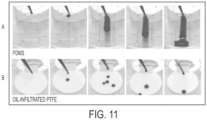
- the biological liquids refer to both pure liquids and complex fluids, such as blood flow (see, e.g., FIG. 11 and FIG. 12 ) .
- solids like bacteria, proteins, and the like can be repelled by SLIPS.
- natural and synthetic solutions such as those used in medicines, intravenous solutions, pharmaceutical manufacturing, and medication delivery systems can be repelled by SLIPS.
- the SLIPS consists of a porous surface layer, or a 'rough' layer of raised surface features in an array, which is infiltrated with a low surface energy liquid.
- the combination of lubricating fluid over a rough surface creates an ultra-smooth surface that is slippery and resists or reduces adhesion by particles and immiscible liquids.
- the lubricating fluid is stabilized in place by the underlying substrate.
- the lubricating fluid is reduced to the level of the features of the substrate.
- SLIPS are also capable of restoring their exceptional liquid repellency when physically damaged.
- the fast self-healing times are a result of the lubricating fluid wicking fluid into damaged sites on the underlying substrate to restore SLIPS to a smooth defect-free surface.
- These surfaces can be used in laboratories, as a coating on medical devices and medical equipment, and for medical applications such as anticoagulation and anti-biofilm formation.
- SLIPS can be manufactured by providing a liquid (e.g., chemically-inert, high-density fluid) over a roughened surface featuring micro- or nanoscale topographies, where the fluid fills the voids and spaces defined by the roughened surface and covers the topographical features.
- a liquid e.g., chemically-inert, high-density fluid
- the fluid repellency and the self-healing property of SLIPS can be attributed to the ultra-smoothness of the surface of the fluid, which is capable of recovering its original shape upon external deformation.
- ultra-smooth surface means a surface having a roughness factor that is equal or close to 1, where the roughness factor (R) is defined by the ratio of the real surface area to the projected surface area.
- ultra-smooth can have an average surface roughness is on the order of or less than about 1 nm.
- ultra-smooth may refer to a substantially molecularly or even atomically flat surface. The absence of any defects or roughness on such a surface may aid in minimizing the pinning points for a sliding fluid, thus reducing the contact angle hysteresis, rendering it nearly friction-free and slippery.
- Patent Application No. 61/434,217 filed on January 19, 2011
- U.S. Patent Application No. 61/466,352 filed on March 22, 2011
- FIG. 1 A schematic of the overall design of SLIPS is illustrated in FIG. 1 .
- the article includes a surface 100 having raised features 110 that provide a certain roughness with lubricating fluid applied thereon.
- Lubricating fluid 130 wets the roughened surface, filling the hills and valleys of the roughened surface 110, and forming an ultra-smooth surface 135 over the roughened surface.
- SEM scanning electron microscope
- FIG. 6 (A) shows a scanning electron microscope image of the surface morphologies of a 3D porous solid.
- FIG. 6(B) shows a photograph at the same magnification of a slippery surface formed by infiltrating the 3D porous solid shown in FIG. 6(A) with lubricating fluid.
- the lubricating fluid overcoats the surface topographies of the porous solid to form an ultra-smooth layer without asperity (e.g., average roughness on the order of or less than about 1 nm based on high resolution atomic force microscopy measurements).
- the average surface roughness of SLIPS is on the order of or less than about 1 nm based on high resolution atomic force microscopy measurements.
- the presence of the micro/nanostructures can significantly enhance the wetting of lubricating fluid, thereby creating a uniformly-coated slippery functional layer over the topographies.
- SLIPS reduces the adhesion, adsorption, or attachment of biological materials on surfaces.
- SLIPS significantly reduces adhesion, adsorption, or attachment of biological materials on surfaces.
- SLIPS reduces adhesion, adsorption, or attachment of materials of biological origin on surfaces by 50%, 60%, 70%, 80%, 90%, 95%, 98%, or 99%.
- polar and non-polar liquids as well as polar and non-polar liquids in their solidified forms can be repelled by SLIPS.
- hydrocarbons and their mixtures e.g., from pentane up to hexadecane and mineral oil, ketones (e.g., acetone, etc.), alcohols (e.g., methanol, ethanol, isopropanol, dipropylene glycol, ethylene glycol, and glycerol, etc.), water (with a broad range of salinity, e.g., sodium chloride from 0 to 6.1 M; potassium chloride from 0 to 4.6 M, etc.), physiological buffers, acids (e.g., concentrated hydrofluoric acid, hydrochloric acid, nitric acid, etc), bases (e.g., potassium hydroxide, sodium hydroxide, etc), ice, and the like can be repelled.
- acids e.g., concentrated hydrofluoric acid, hydrochloric acid,
- biological objects such as small animals, protozoa, bacteria, viruses, and the like can be repelled by surfaces made in accordance with the present disclosure.
- solid particles suspended in liquid can be repelled by SLIPS.
- Non-limiting examples of such solid particles in liquid include bodily fluids, fecal matter, and the like.
- the substrate is a low-surface energy porous solid.
- the substrate is preferentially wetted by the lubricating fluid rather than by the fluid to be repelled. It can have a roughened or smooth surface.
- the term "roughened surface” is a substrate that includes both the surface of a three-dimensionally porous material as well as solid surface having certain topographies, whether they have regular, quasi-regular, or random patterns.
- the substrate is roughened by incorporation of microtextures.
- the substrate is roughened by incorporation of nanotextures. Physically, the large surface area provided by micro/nanoscale roughness not only facilitates complete wetting by the lubricating fluid but also strengthens the adhesion of lubricating fluid (Liquid B) within the porous solid.
- the geometry of the substrate can be any shape, form, or configuration to suit various-shaped materials and devices.
- the porous surface can be manufactured over any suitable materials and geometries, such as medical devices, inside of pipes (e.g., metallic or metallized pipes), optical windows, biological sensor windows, medical tubing, hollow metallic structures, patterned electrodes, meshes, wires, porous conductive surfaces, and the like that come into contact with biological materials.
- pipes e.g., metallic or metallized pipes
- optical windows e.g., biological sensor windows
- medical tubing e.g., metallic or metallized pipes
- hollow metallic structures e.g., patterned electrodes, meshes, wires, porous conductive surfaces, and the like that come into contact with biological materials.
- FIGS. 7A-E Some exemplary shapes over which the porous surface can be formed are shown in FIGS. 7A-E .
- Non-limiting examples of shapes, forms, and configurations SLIPS can take include generally spherical (e.g., bead, magnetic particles, and the like), tubular (e.g., for a cannula, connector, catheter, needle, capillary tube, tubing, or syringe) (see FIG. 7A(j) ), planar (e.g., for application to a microscope slide, plate, film, or laboratory work surface) (see FIG. 7A(c) ), or arbitrarily shaped (e.g., well, well plate, Petri dish, tile, jar, flask, beaker, vial, test tube, column, container, cuvette, bottle, drum, vat, or tank) (see FIG.
- spherical e.g., bead, magnetic particles, and the like
- tubular e.g., for a cannula, connector, catheter, needle, capillary tube, tubing, or syringe
- planar e.
- FIG. 7A (a)-(b), (d)-(i) ).
- SLIPS can be applied to spherical surfaces, such as magnetic particles that can be actuated inside the body for drug delivery.
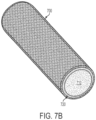
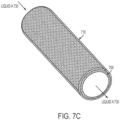
- FIG. 7B-E are perspective illustrations that show how SLIPS can be incorporated into a catheter tube.
- FIG. 7B shows a SLIPS 700 attached to the outer surface of a cylindrical solid core 710 with a reservoir 720 for Liquid B.
- SLIPS can also be attached to the inner surfaces of the tubes, pipes, and other irregularly shaped substrates.
- SLIPS 700 can be can be applied to the inner surface of a cylindrical tube 710 for low drag flow of Liquid A 730.
- SLIPS can be applied onto both the inner and outer surfaces of a tube/needle for low drag flow of Liquid A and remain slippery/non-sticking to the outside environments where the tube/needle is exposed to.
- SLIPS can be applied onto a Liquid-B-soaked porous tubing for low drag flow of Liquid A and remain slippery/non-sticking to the outside environments where the porous tube/needle is exposed to.
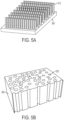
- FIG. 5A to FIG. 5D show some exemplary roughened surfaces.
- the roughened surface is formed over a two-dimensionally flat surface 500 by providing certain raised structures 510 or protrusions (see FIG. 5A ).
- the roughened surface is formed by forming pores 520 over a two-dimensionally flat surface 500 to yield a porous material (see FIG. 5B ).
- Pores can take any geometry and can have pathways, columns (as illustrated in FIG. 5B or more random pathways.
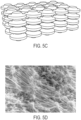
- a three-dimensionally interconnected network of regular or random pores is used (see FIG. 5C and FIG. 5D ).
- FIG. 5C and FIG. 5D show some exemplary roughened surfaces.
- FIG. 10 shows images of substrate structures and topologies that can be used to generate SLIPS surfaces; (A) open-cell bricks, (B) post arrays, (C) parallel grooves, (D) open porosity PTFE (ePTFE), (E) plasma-etched PTFE, and (F) sand-blasted polypropylene (PP).
- A open-cell bricks
- B post arrays
- C parallel grooves
- D open porosity PTFE
- E plasma-etched PTFE
- PP polypropylene
- a range of surface structures with different feature sizes and porosities can be used.
- Feature sizes can be in the range of hundreds of nanometers to microns (e.g., 100 to 1000 nm), and have aspect ratios from about 1:1 to 10:1.
- Porous nano-fibrous structures can be generated in situ on the inner surfaces of metallic microfluidic devices using electrochemical deposition using techniques known in the art ( Aizenberg, J., Kim, P. Hierarchical Structured Surfaces Resistant to Wetting by Liquids.
- the surface has a large surface area that is readily wetted by the lubricating fluid and which entrains lubricating fluid and retains it on the substrate surface.
- the substrate surface is a hierarchical surface containing surface features on multiple dimension scales.
- the surface can have a first topological feature having dimensions on the microscale and a second topological feature on the nanoscale.
- the first topological feature supports the second smaller topological feature.
- the second topological features are referred to as "primary structures" as they are meant to denote the smallest feature sizes of the hierarchical structure.
- the primary structures can include structures, such as nanofibers, nanodots, and the like.
- Such nanoscale “primary structures” can have at least one kind of feature sizes that are a few to tens or hundreds of nanometers in size, such as less than 5 nm to 200 nm. For example, nanofibers having diameters of approximate 5, 10, 25, 50, or even 100 nm. In such cases, when “primary structures” having feature sizes of about 100 nm diameter is utilized, “secondary structures” having feature sizes that are larger than 100 nm, such as 150 nm, 300 nm, 500 nm, or 1000 nm, and larger. Additional higher order structures, such as “tertiary structures” and the like, which each has larger feature sizes than the lower order structures are contemplated.
- hierarchical structures having nanofibers as the primary structures may provide a high degree of three-dimensional porosity that may be well-suited for use as porous surfaces described herein.
- a detailed discussion of hierarchical surfaces suitable for use with a liquid to be repelled is found in International Application No. PCT/US11/44553 entitled “Hierarchically structures surfaces to control wetting by liquids,” filed on July 19, 2011 , which is incorporated in their entirety by reference.
- the roughened surface may have a periodic array of surface protrusions (e.g., posts, peaks, etc.) or any random patterns or roughness (see, e.g., FIG. 5A ).
- the size of the features producing a roughened surface range from 10 nm to 100 ⁇ m with geometries ranging from regular posts/open-grid structures to randomly oriented spiky structures.
- the widths of the raised structures are constant along their heights. In some embodiments, the widths of the raised structures increase as they approach the basal surface from the distal ends.
- the raised structures can be raised posts of a variety of cross-sections, including, but not limited to, circles, ellipses, or polygons (such as triangles, squares, pentagons, hexagons, octagons, and the like), forming cylindrical, pyramidal, conical or prismatic columns.
- the exemplary substrates described above illustrate raised posts having uniform shape and size, the shape, orientation and/or size of raised posts on a given substrate can vary.
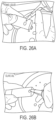
- FIG. 35 shows images of a process for fabricating a SLIPS tubing from ePTFE membranes in which (A) A tubular structure (center) is formed from two flat ePTFE membranes (1.0 ⁇ m pore size) by being pressed between two U-shaped channel molds (left and right). (B) One ePTFE membrane is pressed between the negative and positive molds, producing an indented channel structure for fluidic flow. This structure was then covered and bound to a flat ePTFE membrane to construct the SLIPS U-shape tube shown in (A).
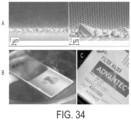
- FIG. 33 shows images of ePTFE tubing (Zeus Inc) of increasing inner diameter (ID), from 0.075" to 0.236" (wall thickness is -0.040" for all) (A).
- ID inner diameter
- the 0.180" ePTFE tubing (which provides a porous microtexture to the substrate) can be fit with an elastic, external, silicone tube casing (VWR), for example, to provide a fluid flow barrier and/or to facilitate peristaltic pumping.
- VWR silicone tube casing
- High magnification SEM of the porous ePTFE surface within the tubing is also shown (B).
- the roughened surface has a roughness factor, R , greater than 1, where the roughness factor is defined as the ratio between the real surface area and the projected surface area.
- R roughness factor
- the roughness factor of the roughened surface is greater or equal to that defined by the Wenzel relationship (i.e., R ⁇ 1/cos ⁇ , where ⁇ is the contact angle of lubricating fluid on a flat solid surface). For example, if lubricating fluid has a contact angle of 50° on a flat surface of a specific material, it is desirable for the corresponding roughened surface to have a roughness factor greater than -1.5.
- the roughened surface material can be selected to be chemically inert to the lubricating fluid and to have good wetting properties with respect to lubricating fluid.
- the roughened surface topographies can be varied over a range of geometries and size scale to provide the desired interaction, e.g., wettability, with lubricating fluid.
- the micro/nanoscale topographies beneath the lubricating fluid enhance the liquid-wicking property and the adherence of lubricating fluid to the roughened surface.
- the lubricating fluid can uniformly coat the roughened surface and get entrapped inside at any tilting angles.
- porous materials include solid substrates having holes (e.g., high aspect ratio holes, cylinders, columns, etc.), three-dimensionally interconnected network of holes and one or more materials (e.g., 3-D ordered colloidal assemblies, block copolymers, etc.), and random array of fibrous materials (e.g., filter paper, fabrics, electrospun films).
- holes e.g., high aspect ratio holes, cylinders, columns, etc.
- materials e.g., 3-D ordered colloidal assemblies, block copolymers, etc.
- random array of fibrous materials e.g., filter paper, fabrics, electrospun films.
- porous or rough surface structures that can be used include polymers (e.g., polysulfone, PDMS, and polypyrrole) and hydrophobic porous (e.g., Teflon) materials.
- the roughened surface can be manufactured from polymers (e.g., epoxy, polycarbonate, polyester, nylon, etc.), metals, sapphire, glass, carbon in different forms (such as diamond, graphite, black carbon, etc.), ceramics (e.g., alumina), and the like.
- fluoropolymers such as polytetrafluoroethylene (PTFE), polyvinylfluoride, polyvinylidene fluoride, fluorinated ethylene propylene, and the like can be used as substrates.
- PTFE polytetrafluoroethylene
- Many porous materials are commercially available, or can be made by a number of well-established manufacturing techniques.
- polytetrafluoroethylene also known by the trade name "Teflon” and abbreviation "PTFE”
- filter materials are commercially available.
- the roughened surface is manufactured from a hemocompatible material, non-limiting examples of which include silicon rubber and polysulfones.
- the roughened surface is manufactured from any suitable materials.
- the surfaces of such material and shapes can be rendered electrically conductive by applying a thin layer of conductive material, such as through vapor deposition techniques, sputtering, metallization techniques, and the like.
- a thin layer of conductive material such as through vapor deposition techniques, sputtering, metallization techniques, and the like.
- the porous surface can be readily formed on large surface area materials that are commercially important.
- surface functionalization can be carried out to modify the solid surfaces so that the lubricating layer preferentially wets the roughened surface as compared to Liquid A.
- the raised structures can be produced by any known method for fabricating raised structures onto substrates.
- Non-limiting examples include molding into the device structure, conventional photolithography, projection lithography, e-beam writing or lithography, depositing nanowire arrays, growing nanostructures on the surface of a substrate, soft lithography, replica molding, solution deposition, solution polymerization, electropolymerization, electrospinning, electroplating, vapor deposition, contact printing, etching, bead blasting, sand blasting, transfer patterning, microimprinting, self-assembly, and the like.
- the roughened surface can be made, for example, by replica molding procedure described in B. Pokroy, A. K. Epstein, M. C. M. Persson-Gulda, J. Aizenberg, Adv. Mater. 21, 463 (2009 ).
- Patterned surfaces can also be obtained as replicas (e.g., epoxy replicas) by a soft lithographic method (see, e.g., J. Aizenberg and B. Pokroy, WO2009158631 .
- Polymer films with patterned surfaces can be fabricated by means known in the art (e.g., roll-to-roll imprinting or embossing).
- negative replicas of pre-generated patterns can be made from polydimethylsiloxane, PDMS (e.g., Dow-Sylgard 184) by pouring mixture of prepolymer and curing agent (e.g., 10:1 ratio) on the patterns followed by thermal curing in an oven. After cooling, the negative PDMS mold can be peeled off and used for fabricating the final replica by pouring the desired material (e.g. UV-curable epoxy resin) into the negative mold. After solidifying the material, the negative mold can be peeled off, leaving the replica of the original pattern. Then, the surface of the replica can be chemically functionalized with low surface energy coating such as (tridecafluoro-1,1,2,2-tetrahydrooctyl)-trichlorosilane.
- PDMS polydimethylsiloxane
- curing agent e.g. 10:1 ratio
- a silicon substrate having a post array such as is illustrated in FIG. 5A can be fabricated by photolithography using the Bosch reactive ion etching method (as described in Plasma Etching: Fundamentals and Applications, M. Sugawara, et al., Oxford University Press, (1998), ISBN-10: 019856287X .
- Arrays of hydrophobic raised surface structures can be made at the micrometer scale using micromolding techniques.
- rough surface structures can be arrays of hydrophobic raised surface structures at the micrometer scale, such as posts and intersecting walls patterned in polymers such as epoxy ( FIG. 10A-C ).
- the roughened surface may be the surface of a three-dimensionally porous material (see, e.g., FIG. 5B to FIG. 5D ).
- the porous material can be any suitable porous network having a sufficient thickness to stabilize lubricating fluid, such as a thickness from about 5 ⁇ m to about 1 mm.
- the porous material can have any suitable pore sizes to stabilize the lubricating fluid, such as from about 10 nm to about 100 ⁇ m.
- porous alumina is manufactured by the process of anodization as shown in FIG. 5B , where an aluminum substrate is electrochemically oxidized under constant electrical potential.
- the pore size, inter-pore spacing, and aspect ratio of the pores can be tuned by adjusting the operating parameters of the electrochemical oxidation process.
- Such a process generates porous through-holes into the substrate, where the size of the porous holes are on the order of 50 nm with aspect ratio larger than 10000 (see, Lee et al., Nature Mater. 5, 741-47, 2006 .
- mechanical or (electro)chemical methods can be used to roughen metal surfaces.
- Roughening and non-wetting materials can be spray coated directly onto metal surfaces.
- Boehmite ( ⁇ -AlO(OH)) formation on aluminum surface by boiling in water can also be used to roughen metallic surfaces such as aluminum.
- Rotary jet spinning of hydrophobic polymer nanofibers and layered deposition of an appropriate primer can also be used to roughen substrates for use in SLIPS.
- long range ordered porous structures of silica can be produced by evaporative co-assembly method of sacrificial polymeric colloidal particles together with a hydrolyzed silicate sol-gel precursor solution.
- a method generates a crack-free porous surface on the order of centimeters or larger, with pore sizes of about 100 nm to about 1000 nm and porosity of about 75%.
- polymer-based porous membrane (such as medical grade PTFE) can be made by mixing PTFE powders with lubricating fluid to form a paste. Then, the paste can be molded into the desired shape by methods such an extrusion molding. The molded PTFE membrane can then be heated up to less than its melting point to drive off the lubricants. Thereafter, a porous PTFE membrane can be formed (see U.S. Patent No. 5,476,589 ).
- the electrodeposition condition can be controlled so that nanofibers of electrically conductive polymer can be formed over an electrically conductive surface.
- the electrodeposition conditions can further be controlled to provide a desired nanofiber diameter and spacing.
- the electrodeposition condition can be controlled to provide any other desirable morphology that can provide additional means to stabilize the lubricating layer.
- the morphology of the conducting organic polymers can be controlled by varying the deposition conditions such as the concentration of monomer, the types of electrolytes and buffers, the deposition temperature and time, and the electrochemical conditions such as applied potential.
- the deposition conditions such as the concentration of monomer, the types of electrolytes and buffers, the deposition temperature and time, and the electrochemical conditions such as applied potential.
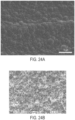
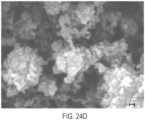
- increasing the concentration of monomer in the electrochemical solution, the applied potential, and/or the temperature generally leads to a faster polymerization rate and many parasitic nucleation sites during growth resulting in a morphology that is similar to a cauliflower (see FIG. 24A ).
- lower concentrations of monomer, lower applied potential, and lower temperatures can lead to nanofibrile growth with substantially uniform diameters (see FIG. 24B ). Further decrease in concentration of monomer or applied potential can lead to short rods of polymer nanofibers with low surface coverage (see FIG.
- the applied voltage can be cycled leading to different oxidation states of the deposited polymer layer which is often manifested as a color change (e.g., from dark blue to a green then to a pale yellow color with increasing applied voltage).
- the applied voltage can be pulsed at a constant voltage to form polymers only on the tip of the underlying micropost structures, leading to a mushroom-like morphology (see FIG. 24E ). Accordingly, the morphology of conducting organic polymers can be finely controlled from nanometers to over micrometer scales, and surface coatings with precisely controlled morphology can be produced by simple modifications, which promise the customization of various surface properties by design and control of the morphology.
- the roughened surface is further functionalized to improve wetting by lubricating fluid.
- Surface coating can be achieved by methods well known in the art, including plasma assisted chemical vapor deposition, chemical functionalization, solution deposition, and vapor deposition.
- surfaces containing hydroxyl groups i.e., -OH
- fluorosilanes e.g., tridecafluoro-1,1,2,2-tetrahydrooctyl-trichlorosilane, heptadecafluoro-1,1,2,2-tetra-hydrodecyl trichlorosilane, etc.
- many materials having native oxides can be activated to contain -OH functional groups using techniques such as plasma treatment.
- either vapor or solution deposition techniques can be used to attach silanes so that surfaces with low surface energy can be produced.
- vapor deposition the deposition can be carried out by exposing the surface to silane vapors.
- solution deposition the deposition can be carried out by immersing the surface in a silane solution, followed by rinsing and blow-drying after deposition.
- layered deposition layered deposition of a primer is followed by application of a mixture of sacrificial beads and Liquid B, which is dried and cured. The beads are removed to produce a contiguous porous Teflon-like surface.
- the surface can be functionalized by first coating it with thin films of metals, such as gold or platinum, and the thin metal films can be functionalized with various commercially available thiols of low surface energy (e.g., heptane thiol, perfluorodecanethiol, etc.).
- thiols of low surface energy e.g., heptane thiol, perfluorodecanethiol, etc.
- vapor or solution deposition techniques can be carried out similar to that describe for silane deposition using, for example, alkane thiol solutions.
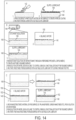
- the roughened, porous substrate can be generated by a spraying method, where emulsions consisting of micro/nanoparticles are sprayed onto a flat solid surface ( FIG. 14A1 ). These particles assemble into roughened solid layer upon solvent drying. Such a solid layer can then be infiltrated by lubricating fluid ( FIG. 14A2 ) (which can also be applied by additional spraying).
- FIG. 14A shows a surface roughened by a spray method.
- the substrate 140 is roughened by spraying or depositing a particulate matter 142 on the substrate 140 to create a porous coating (A1) and the roughened surface is infiltrated with lubricating liquid 144.
- Non-limiting examples of micro/ nanoparticles that can be sprayed onto a flat solid surface to form roughened, porous material include titanium dioxide, silicon dioxide, nanodiamonds, metals such as silver, gold, platinum, copper, gold, palladium, zinc, and titanium, hydroxyapatite (HAp) nanoparticles.
- the roughened, porous substrate is generated by chemical or physical etching, which includes mechanical roughening such as bead blasting and sand blasting.
- the substrate 140 is roughened by etching ( B1 ).
- the etchant 148 is carried by a preformed pipe 146 and deposited onto the substrate 140 to create a roughened surface. Once the surface is roughened, it is functionalized (B2) with a liquid (not shown) or vapor silane 150, and infiltrated with a lubricating liquid 144 (B3).
- the roughened, porous substrate is made by growing a nanostructured material on the surface.
- a nanostructured material 152 is grown on the surface of the substrate 140 to create a roughened surface (C1) that is functionalized (C2)) with a liquid (not shown) or vapor silane 150 and infused with a lubricating liquid 144 (C3).
- these nanostructures include PPy nanofibers, carbon nanotubes, and the like.
- the surface can be chemically functionalized by silanization ( FIG. 14C2 ) and infiltrated with a lubricating liquid ( FIG. 14C3 ).
- the roughened surface can be formed over or applied to a variety of planar or non-planar surface (see FIG. 7 and FIG. 8A-B ).
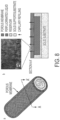
- FIG. 8B shows a porous membrane attached to the outer surface of a cylindrical solid core. It can also be attached to the inner surfaces, outer surfaces, or inner and outer surfaces of tubes and other irregularly shaped substrates.
- the solid surface may be substantially flat. This situation may be applicable when the critical surface energy of the flat surface is higher than the surface tension of the functional lubricating fluid.
- the roughened surface can have pores that are comparable or smaller than the material to be repelled.
- pore sizes that are smaller than the size of protozoa (e.g., 10 ⁇ m), bacteria (e.g., 1 ⁇ m), viruses (e.g., 0.1 ⁇ m), and the like can be utilized.
- non-limiting examples of surface to which SLIPS is applied include a cannula, connector, catheter (e.g ., central line, peripherally inserted central catheter (PICC) line, urinary, vascular, peritoneal dialysis, and central venous catheters), catheter connector (e.g ., Leur-Lok and needleless connectors), clamp, skin hook, cuff, retractor, shunt, needle, capillary tube, endotracheal tube, ventilator, associated ventilator tubing, drug delivery vehicle, syringe, microscope slide, plate, film, laboratory work surface, well, well plate, Petri dish, tile, jar, flask, beaker, vial, test tube, tubing connector, column, container, cuvette, bottle, drum, vat, tank, organ, organ implant, or organ component (e.g ., intrauterine device, defibrillator, corneal, breast, knee replacement, and hip replacement implants), artificial organ or a component
- PICC peripherally inserted central catheter
- bioelectrode e.g., glucose and insulin monitor, blood oxygen sensor, hemoglobin sensor, biological microelectromechanical devices (bioMEMs), sepsis diagnostic sensor, and other protein and enzyme sensors
- bioelectrode e.g., glucose and insulin monitor, blood oxygen sensor, hemoglobin sensor, biological microelectromechanical devices (bioMEMs), sepsis diagnostic sensor, and other protein and enzyme sensors
- bioelectrode hysteroscope, cystoscope, amnioscope, laparoscope, gastroscope, mediastinoscope, bronchoscope, esophagoscope, rhinoscope, arthroscope, proctoscope, colonoscope, nephroscope, angioscope, thoracoscope, esophagoscope, laryngoscope, and encephaloscope
- wound dressing e.g ., bandages, sutures, staples
- Lubricating fluids are selected to create a fluid surface that is intrinsically smooth, stable, and defect free.
- the lubricating fluid should infiltrate, wet, and stably adhere to the substrate. Moreover, it should be chemically inert with respect to the solid substrate and the fluid to be repelled.
- a lubricating fluid possesses the ability to form a substantially molecularly flat surface when provided over a roughened surface.
- a lubricating fluid possesses the ability to form a substantially atomically flat surface when provided over a roughened surface.
- the lubricant is substantially incompressible.
- the lubricating fluid is capable of repelling immiscible fluids, and in particular biological fluids of any surface tension.
- the enthalpy of mixing between the fluid to be repelled and lubricating fluids be may be sufficiently high (e.g., water and oil) that they phase separate from each other when mixed together.
- the lubricating fluid can be selected such that the fluid to be repelled has a small or substantially no contact angle hysteresis.
- contact angle hysteresis less than about 5°, 2.5°, 2°, or even less than 1° can be obtained.
- Low contact angle hysteresis encourages sliding at low tilt angles (e.g., ⁇ 5°), further enhancing fluid repellant properties of the surface.
- lubricating fluid is inert with respect to the solid surface and biological fluid. Lubricating fluid flows readily into the recesses of the roughened surface and generally possesses the ability to form an ultra-smooth surface when provided over the roughened surface.
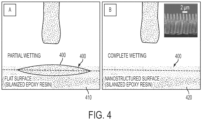
- FIG. 4A shows a droplet 400 of perfluoro-tripentylamine (herein referred to by the trade name "FC-70”) lubricating fluid on an unstructured surface 410 of a flat surface prepared from a slanted epoxy resin. The dashed line represents the location of the upper surface of the substrate. The droplet spreads out on the flat surface, but retains a droplet form.
- FC-70 perfluoro-tripentylamine
- the resulting ultra-smooth surface is capable of repelling fluids including, but not limited to biological fluids and particles in solution or suspension.
- Lubricating fluid can be selected from a number of different fluids. These fluids can be selected based on their biocompatibility, low (or high) toxicity, anti-clotting performance, chemical stability under physiological conditions, and levels of leaching from the surfaces of the devices. For example, compounds that are approved for use in biomedical applications (e.g., blood substitutes, MRI contrast agents), such as perfluorinated hydrocarbons and organosilicone compounds (e.g. silicone elastomer) can be used as lubricating fluids.
- biomedical applications e.g., blood substitutes, MRI contrast agents
- organosilicone compounds e.g. silicone elastomer
- the lubricating fluid is a chemically-inert, high-density biocompatible fluid, non-limiting examples of which include tertiary perfluoroalkylamines (such as perfluorotri-n-pentylamine, FC-70, perfluorotri-n-butylamine FC-40, etc ), perfluoroalkyl sulfides and perfluoroalkylsulfoxides, perfluoroalkyl ethers, perfluorocycloethers (like FC-77) and perfluoropolyethers (such as KRYTOX family of lubricants by DuPont), perfluoroalkylphosphines and perfluoroalkylphosphineoxides, and combinations thereof are used.
- tertiary perfluoroalkylamines such as perfluorotri-n-pentylamine, FC-70, perfluorotri-n-butylamine FC-40, etc
- Liquid B long-chain perfluorinated carboxylic acids (e.g., perfluorooctadecanoic acid and other homologues), fluorinated phosphonic acids, fluorinated silanes, and combinations thereof can be used as Liquid B.
- Perfluoroalkyls can be linear or branched.
- the lubricating fluid has a high density.
- the lubricating fluid has a density that is more than 1.0 g/cm 3 , 1.6 g/cm 3 , or even 1.9 g/cm 3 .
- the density of the lubricating fluid is greater than that of the biological fluid to enhance fluid repellency. High density fluids reduce the tendency of an impacting fluid to 'sink' below the surface of lubricating fluid and to become entrained therein.
- the density of Liquid A may be lower than that of the lubricating liquid.
- density of Liquid A may be at least ⁇ 1.5 times lower than that of the lubricating liquid.
- the lubricating fluid has a low evaporation rate, such as less than 100 nm/s, less than 10 nm/s, or even less than 1-2 nm/s.
- the lubricating fluid should be applied in a thickness sufficient to cover the rough surface of the substrate and provide an ultra-smooth surface. Taking a typical thickness of the lubricating fluid to be about 10 ⁇ m and an evaporation rate of about 1-2 nm/s, SLIPS can remain highly fluid-repellant for a long period of time without any refilling mechanisms.
- lubricating fluid has a low freezing temperature, such as less than -5°C, -25°C, or even less than -50°C. Having a low freezing temperature allows lubricating fluid to maintain its slippery behavior to repel a variety of liquids or solidified fluids, such as ice and the like and over a range of temperatures.
- Object A can become highly mobile on the surface of the lubricating liquid when the kinematic viscosity of the lubricating liquid is less than 1 cm 2 /s. Since liquid viscosity is a function of temperature (i.e., liquid viscosity reduces with increasing temperature), choosing the appropriate lubricant that operates at the aforementioned viscosity (i.e., ⁇ 1 cm 2 /s) at specific temperature range is desirable.
- various different commercially available lubricating liquid can be found at the specified viscosity, such as perfluorinated oils (e.g., 3M TM Fluorinert TM and DuPont TM Krytox ® oils), at temperatures ranging from less than - 80 °C to greater than 260 °C.
- perfluorinated oils e.g., 3M TM Fluorinert TM and DuPont TM Krytox ® oils
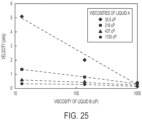
- the viscosities of both Object A and Liquid B affect the performance of SLIPS. Because the liquid repellency of SLIPS is conferred by the presence of the Liquid B, the viscosity of Liquid B can affect the physical characteristics of liquid repellency of SLIPS, such as the velocity of Object A. The more viscous the Liquid B, the less mobile the given Liquid A will be.
- Liquid A of constant viscosity For a Liquid A of constant viscosity, its velocity on SLIPS reduces with increasing viscosity of Liquid B.
- a Liquid B of viscosities of 13 cP, 140 cP, and 990 cP are ⁇ 17 cm/s, ⁇ 5.8 cm/s, and -0.98 cm/s, respectively. Therefore, to enhance the velocity of Liquid A on SLIPS, it is desirable to use a Liquid B having a lower viscosity. This general trend is consistent for Liquid A of viscosities ranging from 1 cP to 1000 cP.
- Lubricating fluid can be deposited in any desired thickness, provided the top surface of lubricating fluid forms an ultra-smooth surface and is retained and interacts with the underlying surface. If the liquid layer is too thick, the upper surface is ⁇ unbound' from the underlying surface and will flow with Liquid A from the SLIPS surface.
- the liquid layer that interacts with and is retained by the underlying surface is referred to as the 'characteristic thickness' of the liquid layer.
- the characteristic thickness will vary depending on the underlying surface and the ambient conditions, e.g., temperature, pressure, etc. Film thicknesses substantially on the order of the surface roughness peak-to-valley distance provide good fluid-solid interaction between the substrate and lubricating fluid.
- lubricating fluids with thicknesses below a characteristic length scale remain substantially adhered to the roughened surface, whereas fluid layers above the characteristic length can flow, creating flow lines (surface defects) and disrupting the flatness of the fluid surface.
- non-limiting thicknesses for the lubrication fluid are on the order of 5-20 ⁇ m when the peak to valley height is ⁇ 5 ⁇ m.
- lubricating fluid can be applied by pupating drops of the fluid onto the roughened surface, or by dipping the roughened surface into a reservoir carrying lubricating fluid.
- lubricating fluid can be sprayed, cast, or drawn onto the roughened surface.
- the lubricating liquid can infiltrate the roughened surface by capillary action, which can wet the roughened surface and form a film on top of it.
- Lubricating fluid and the roughened surface can be both generated by a double-spraying process, where emulsions consisting of nano/microparticles are first sprayed onto a flat solid surface to form a substantially roughened solid layer, and then lubricating fluid can be sprayed onto this freshly formed layer for further infiltration.
- lubricating fluid may infiltrate into the pores of the roughened surface by capillary action and form an ultra-smooth film on top of the roughened surface.
- the lubricating fluid may wet the entire roughened surface structure and form an ultra-smooth film over the underlying roughened surface.
- porous materials may be the presence of the capillary network within the bulk materials, which can further enhance transport of Liquid B through the pores.
- the porous structure can provide a replenishing fluid at the surface and may be useful to address evaporation or other materials loss of Liquid B from the SLIPS surface. For example, in the case where a portion of Liquid B is reduced at the surface of the materials due to evaporation, sudden pressure purging, physical damage or the like, Liquid B can be replenished by the capillary action in these networks. Replenishing Liquid B is drawn through the porous body of the substrate by capillary wicking to refresh the upper surface of SLIPS.
- the porous material itself can be utilized as a fluid reservoir to store Liquid B for subsequent capillary refilling purpose.
- the porous material 905 can be connected to an external fluid reservoir 903 sitting on a solid substrate 901, where the capillary networks within the porous material 905 can help transfer (e.g., via wicking) the Liquid B from the fluid reservoir 903 to the porous material 905.
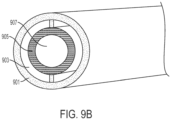
- FIG. 9B shows an alternate embodiment where SLIPS having a porous material 905 as the roughened surface is formed in an inner surface of a cylindrical tube.
- the cylindrical tube 901 has a first annular region 903 serving as a fluid reservoir for Liquid B, followed by an inner annular region of SLIPS having a porous material 905, which surrounds a hollow region 907 for the flow of Liquid A.
- Liquid B in annular region 903 transfers into the (e.g., via wicking) the porous material 905 to form a SLIPS and Liquid A can flow through the hollow region with little to no drag at the interface between 905 and 907.
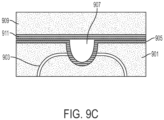
- FIG. 9C shows yet another embodiment where SLIPS is formed in an inner surface of an arbitrarily shaped flow path.
- the bottom substrate 901 has a channel 903 serving as a fluid replenishment source for Liquid B that is coupled to the porous material 905 of SLIPS.
- Porous material 905 is formed by combining a bottom substrate 901 having a depressed region mated with a top substrate 909 having a substantially flat porous material 911 formed thereon. The combination of the top and bottom substrate portions forms a hollow region 907 for the flow of Liquid A.
- FIG. 9D shows some optical micrographs on how the bottom substrate 901 and SLIPS 905 of FIG. 9C can be formed.
- a TEFLON filter paper 930 having a three-dimensionally random network of pores can be placed between a male mold 940 and female mold 950 defining an arbitrary flow path and the male mold 940 and female mold 950 can be pressed together to replicate the flow path pattern on the TEFLON filter paper 930.
- the template TEFLON filter paper 930 can be placed inside the female mold 950, which now serves as bottom substrate 901 of FIG. 9C , and a substantially flat substrate 909 having another substantially flat TEFLON filter paper, serving as SLIPS 911, can be applied thereon (not shown) to form the flow path 907 shown in FIG. 9C .
- the female mold 950 may further contain channel 903 (not shown) that serves to replenish Liquid B as needed.
- FIG. 35 shows several other non-limiting embodiments of SLIPS and how Liquid B can be replenished to the SLIPS in each of those embodiments.
- the left column corresponds to systems where SLIPS is exposed to both Medium X and Liquid A (shown as a droplet).
- the right column corresponds to systems where SLIPS is exposed to substantially only Liquid A (shown as a plug between two SLIPS).
- Liquid B can be replenished to SLIPS as needed.
- the top row shows scenarios where there is a finite amount of Liquid B.
- the middle row shows scenarios where there is a large source (e.g., practically infinite source from the viewpoint of the amount of Liquid B needed to replenish the SLIPS) of Liquid B.
- the bottom row shows scenarios where Liquid B can be replenished by spraying Liquid B as needed, either manually or automatically. As shown, many different configurations and their derivatives are possible.
- SLIPS can sustain fluid impact pressures on the order of 10 3 -10 7 Pa (e.g., at least from an order of magnitude to five orders of magnitude higher than the current state-of-the-art surface) and are capable of restoring themselves to exceptional liquid repellency upon critical physical damages with a fast self-healing time on the orders of 100 ms to 1 s (i.e., 4 orders of magnitude faster than the current state-of-the-art surface).
- the lubricating liquid and the roughened surface can be selected so that they have fast self-healing properties.
- self-healing refers to re-formation of an ultra-smooth (and even substantially molecularly flat) surface after physical impact (e.g., damage).
- the lubricating fluid is a self-healing coating that rapidly restores the fluid-repellant function following damage to the porous material by abrasion or impact. Self healing occurs when the lubricating fluid flows toward the damaged area of the substrate by surface energy-driven capillary action to spontaneously fill the physical void. The recovery time is a function of lubricant viscosity.
- the self-healing time is on the order of 150 ms to 1 s.
- the self-healing time is on the order of O(10s) or more.
- the recovery time for a fluid displacement is less than one second. In other embodiments, the recovery time is a fraction of a second.
- the recovery time is 50 ms, 60 ms, 70 ms, 80 ms, 90 ms, 100 ms, 110 ms, 120 ms, 130 ms, 140 ms, 150 ms, 160 ms, 170 ms, 180 ms, 190 ms, 200 ms, 210 ms, 220 ms, 230 ms, 240 ms, 250 ms, 1 second, 5 seconds 10 seconds, 30 seconds, 60 seconds, 90 seconds, 120 seconds, or more depending on the amount of damage sustained, and the characteristics of the lubricating fluid and substrate used.
- the self-healing behavior of the liquid repellant surfaces can be a function of the interaction between the lubricating liquid and the roughened surface, as well as the viscosity of the lubricating liquid.
- Typical kinematic viscosities of the lubricating liquid are in the range of 0.10 cm 2 /s to 10 cm 2 /s.
- particle impact or scratching can damage the surface by, for example, breaking or removing the topographical features of the surface in a small area.
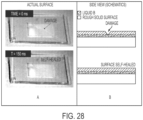
- the measured self-recovery time for a ⁇ 50 ⁇ m fluid displacement of FC-70 lubrication fluid on epoxy-resin-based SLIPS was only -150 ms ( FIG. 28A ).
- FIG. 28A shows time-lapse images showing self-healing capability of SLIPS from a ⁇ 50 ⁇ m-wide physical damage on a time scale on the order of 100 ms.
- FIG. 28B is a schematic illustration of the type of damage that may occur and the healing process that restores the smooth liquid surface. A reservoir with extra fluid can be available to ⁇ top off the fluid layer thickness to maintain the desired thickness.
- the roughened surface may be functionalized so that the critical surface energy of the roughened surface is higher than the surface energy of lubricating liquid; under these conditions, complete wetting of the lubricating liquid can spontaneously occur throughout the roughened surface.
- the roughened surface when the critical surface energy of the roughened surface is lower than the surface energy of the lubricating liquid, the roughened surface may be provided with a high degree of roughness to promote wetting of the lubricating liquid within the pores of the roughened surface.
- the lubricating liquid has a surface energy that is less than the surface energy of the roughened surface.
- the surface energy of the liquid B is such that the spreading parameter S is positive.
- the critical surface tension of the roughened surface i.e., ⁇ c-S
- the surface tension of the lubricating liquid i.e., ⁇ LV-B
- the critical surface tension of the roughened surface may be at least 1.25 times lower than the surface tension of the lubricating liquid.
- the lubricating liquid may be non-reactive with the roughened surface.
- the roughened surface and the lubricating liquid (or liquid to be repelled) can be chosen so that the roughened surface does not dissolve upon contact with the lubricating liquid (or liquid to be repelled).
- perfluorinated liquids (the lubricating liquid) work exceptionally well to repel a broad range of polar and non-polar Liquids A and their solidified forms.
- any suitable combination of the roughened surface and the lubricating liquid described above can be employed.
- a perfluorinated liquid as the lubricating liquid and a nanostructured surface made out of polymer (for example, epoxy resin, silicone, and Teflon) that are chemically functionalized with end-functional group of -CF 3 or other similar fluorocarbon groups can be utilized as the roughened surface.
- polymer for example, epoxy resin, silicone, and Teflon
- Other materials including sapphire, diamonds, silicon, glass, and metals (e.g., aluminum) can be also used with suitable chemical functionalization schemes.
- the working combinations of the solid/lubricant/immiscible test liquid may be chosen by satisfying the condition shown in Equation (e1).
- ⁇ E 0 ⁇ BX cos ⁇ BX ⁇ ⁇ AX cos ⁇ AX > 0
- ⁇ AX , and ⁇ BX represent the surface energies of the Object A-medium X interface, and the lubricating liquid-medium X interface, respectively.
- ⁇ AX , and ⁇ BX are the equilibrium contact angles of Object A and the lubricating fluid on a flat solid surface immersed under medium X environment, respectively.
- the density difference between the Object A and Medium X can also play a role for the fluid repellency.
- the density of Object A, ⁇ A may desirably be greater than that of the Medium X, ⁇ X (i.e., ⁇ A > ⁇ X ).
- the size of Object A may be on the order of, or greater than, its capillary length.
- capillary length is a characteristic length scale that quantifies the dominance of body force over surface force on an object, which can be quantitatively expressed as ( ⁇ / ⁇ g ) 1/2 , where ⁇ , ⁇ , and g are surface tension and density of the liquid, and gravity, respectively.
- Table 2A shows examples of working combinations of the solid, Liquids A and B of the slippery surface based on the predictions from the proposed relationship, R( ⁇ BX cos ⁇ BX - ⁇ AX cos ⁇ AX ) + ⁇ AX - ⁇ BX > 0.
- the lubricating liquid will stay in intimate contact with the porous solid without being displaced by Liquid A. Note that the equilibrium contact angles were estimated from the average values of the advancing and receding contact angles of Liquid A and the lubricating liquid on the flat solid surface.
- Satisfying the relationship can help promote the operation stability of the slippery surface where the liquid layer is substantially completely covered by the test liquid (i.e., two-phase environments that involve a single fluid interface between the test liquid and the liquid layer) and where the liquid layer contacts a droplet of the test fluid as well as air (i.e., three-phase environments that involve three fluid interfaces of (i) test liquid-liquid layer, (ii) test liquid-air, and (iii) liquid layer-air).
- ⁇ A and ⁇ B are equivalent to ⁇ AX and ⁇ BX defined in the text, and medium X is air specifically in this context.
- Variable ⁇ AB represents the interfacial tension for Object A-Liquid B interface.
- non-polar Liquid B with fluorocarbon functional groups may adhere well with roughened solid surface that is functionalized with fluorocarbon groups (e.g., -CF 3 , -CF 2 ).
- polar Liquid B may adhere well with roughened solid surface that is functionalized with hydroxyl groups (i.e., -OH).
- the surface energies of the roughened solid and Liquid B may be lower than the surface energy of Liquid A so that Liquid A will not displace Liquid B from the roughened solid.
- the roughened surface may be functionalized with low surface energy coatings (e.g., less than 30 mJ/m 2 ), such as -CF 3 , -CF 2 H, -CF 3 and -CF 2 -, -CF 2 -CF 3 , -CF 2 -CFH-, -CF 2 -CH 2 -, -CFH-CH 2 -, and the like.
- low surface energy coatings e.g., less than 30 mJ/m 2
- Liquid B may be selected to also exhibit low surface energy (e.g., less than 20 mJ/m 2 ), such as perfluorotributylamine, perfluorotri-n-pentylamine, perfluorohexane, perfluoro(2-butyltetrahydrofuran), perfluorocycloether, perfluoro n-alkyl morpholines, perfluoroalkyl ethers, perfluorotripropylamine, and the like.
- low surface energy e.g., less than 20 mJ/m 2
- Liquid A when Liquid A is a high surface tension liquid (e.g., water, condensation) or a solidified fluid, Liquid B can be selected from other higher surface energy fluids (i.e., ⁇ 20 mJ/m 2 or higher), such as polydimethylsiloxane, other liquid silicone elastomers or commercial food grade lubricants (e.g., KRYTOX(TM) FG lubricants), oils (e.g, vegetable or mineral oil (see FIG. 26B )), and the like.
- FIG. 26 shows a SLIPS surface generated using an infiltration of polydimethylsiloxane (PDMS) liquid (500 MW, X viscosity, OH-terminated, Sigma Aldrich) into an ePTFE membrane (1 ⁇ m, Sterlitech).
- Image (B) in FIG. 26 shows a SLIPS surface generated using an infiltration of olive oil into an ePTFE membrane (1 ⁇ m, Sterlitech). In both cases the blood was found to not wet the surface, and rolled off without adhering to the surfaces.
- PDMS polydimethylsiloxane
- the roughened surface may be functionalized with low surface energy coatings (e.g., less than 30 mJ/m 2 ), such as -CF 3 , - CF 2 H, -CF 3 and -CF 2 -, -CF 2 -CF 3 , -CF 2 -CFH-, -CF 2 -CH 2 -, -CFH-CH 2 -, and the like.
- low surface energy coatings e.g., less than 30 mJ/m 2
- the solid substrate can be selected from the group consisting of polydimethylsiloxane, polypropylene, polytetrafluoroethylene, and the like.
- lubricating liquids such as liquid silicone elastomers (e.g., polydimethylsiloxane), vegetable or mineral oil, liquid hydrocarbons, and combinations thereof can be applied to the solid substrate to create a SLIPS surface to repel materials such as simple aqueous fluids (e.g., water), complex aqueous fluids (e.g., blood), solidified fluids, and combinations thereof (Table 3, row 1).
- the solid substrate can be selected from the group consisting of fluoro-silanized metals (e.g., fluoro-silanized aluminum, silver, gold, platinum, copper, gold, palladium, zinc, titanium, and the like), fluoro-silanized natural polymers (e.g., fluoro-silanized synthetic polymers (e.g., fluoro-silanized epoxy resin, silicone, silicone rubber, latex, polytetrafluoroethylene, polyvinylfluoride, polyvinylidene fluoride, fluorinated ethylene propylene, thermoplastic elastomers, Teflon, and the like), and combinations thereof.
- fluoro-silanized metals e.g., fluoro-silanized aluminum, silver, gold, platinum, copper, gold, palladium, zinc, titanium, and the like
- fluoro-silanized natural polymers e.g., fluoro-silanized synthetic polymers (e.g
- Lubricating liquids such as perfluorinated fluids can be applied these solid substrates to repel any non-perfluorinated liquid (Table 3, row 2).
- Table 3 Examples of Combinations of Materials for Making SLIPS Surfaces Row# Solid Liquid B Liquid A 1 polydimethylsiloxane; polypropylene; polytetrafluoroethylene polydimethylsiloxane; vegetable or mineral oil; liquid hydrocarbons simple aqueous fluids; complex aqueous fluids; solidified fluids, 2 polytetrafluoroethylene; fluoro-silanized metals; all perfluorinated fluids all non-perfluorinated fluids fluoro-silanized natural polymers; fluoro-silanized synthetic polymers
- FIG. 16A-C shows optical images showing enhanced optical transparency of an epoxy-resin-based SLIPS (left) as compared to significant scattering in the non-infused super hydrophobic nanostructured surface (right) in the visible light range.
- FIG. 16B shows optical transmission measurements for epoxy-resin-based SLIPS in the visible light range (400-750 nm).
- FIG. 64 shows images of a transparent SLIPS surface made by the infiltration of a highly-ordered nanoporous SiO2 glass layer (A) with perfluorocarbon (FC-70) (B). When fully infiltrated, the layer is highly transparent (C).
- An equilibrium contact angle is the angle at which a liquid/vapor interface meets a solid surface, which is determined by the interactions across the three interfaces, e.g., solid/liquid/vapor.
- ⁇ is the angle at which a liquid/vapor interface meets a solid surface, which is determined by the interactions across the three interfaces, e.g., solid/liquid/vapor.
- contact angle measurement can be performed by a number of different well-established techniques, such as the sessile drop method and the Wilhelmy method.
- the sessile drop method is among the most popular technique for contact angle measurement.
- a liquid droplet is deposited on a targeted solid surface, where the liquid profile is captured by an optical system of a goniometer and geometrically fitted to obtain the contact angle.
- the contact angle measured from a static liquid droplet deposited on the surface is known as the static contact angle, ⁇ static .
- advancing contact angle, ⁇ A can be measured while the volume of the drop is increasing until the wetting line starts to advance.
- Receding contact angle, ⁇ R can be measured by decreasing the volume of the drop and determining the contact angle just before the wetting line recedes.
- the advancing and the receding angles of the liquid drop can also be determined by gradually tilting the solid surface until the liquid drop starts to move.
- Fluid-fluid interfacial tension can be measured by many well-established techniques, such as the Wilhelmy plate method, the Du Noüy ring method, and the pendant drop method (e.g., see Drelich et al., in Encyclopedia of Surface and Colloid Science, pp. 3152 - 3166, Marcel Dekker Inc, 2002 ).
- the pendant drop method is among the most popular and versatile technique, which can be easily extended to a two-liquid system.
- the pendant drop method measures the shape of a fluid-fluid interface and quantifies the shape distortion due to the competition between the fluid-fluid interfacial tension and gravity.
- a drop of denser fluid e.g., Object A
- medium X i.e., air/water/the lubricating fluid
- the denser liquid droplet will be deformed as the liquid volume increases.
- the shape profile of the liquid droplet is captured by an optical system and subsequently analyzed by a computer software when the liquid volume is increased to the maximum possible size (i.e., before the liquid drop is detached from the syringe needle).
- ⁇ ⁇ ⁇ g D 2 / H
- ⁇ ⁇ the density difference between the two immiscible fluids
- g gravity
- D equatorial diameter of the liquid droplet
- H drop shape dependent parameters which is a function of the shape profile of the droplet.
- Roughness of a surface can be quantitatively estimated by a number of indirect and direct approaches.
- one of the simplest indirect methods to quantify surface roughness is the use of Wenzel's relationship to estimate the roughness by measuring the apparent contact angle of a surface.
- the surface roughness is quantitatively measured by using an atomic force microscope or by a scanning electron microscope.
- AFM atomic force microscope
- a suitable AFM probe is selected for the measurements depending on the aspect ratio of the surface features (note: aspect ratio is defined as the ratio between the height and the width of the surface features).
- aspect ratio is defined as the ratio between the height and the width of the surface features.
- sharp AFM probes i.e., radius of tip curvature ⁇ 10 nm
- very high aspect ratio i.e. > 10
- the use of scanning electron microscope can also be used for the measurement of the top view and cross sectional view of the surface morphologies for the estimation of the surface roughness.
- the roughness of a 3-D porous material can be estimated by measuring the surface morphology of the top-most layer of the porous material. Particularly, the estimation may be particularly well-suited when complete wetting of a surface is predominately induced by the roughness at the surface layer of the material that is in intimate contact with the fluid.
- the lubricating fluid is an organofluorine oil, (i.e., perfluorinated oils including, without limitation, tertiary perfluoroalkylamines (such as perfluorotri-n-pentylamine, FC-70; perfluorotri-n-butylamine FC-40, etc), perfluoroalkyl sulfides, perfluoroalkylsulfoxides, perfluoroalkyl ethers, perfluorocycloethers (like FC-77), perfluoropolyethers (such as KRYTOX family of lubricants by DuPont), perfluoroalkylphosphines, and perfluoroalkylphosphineoxides).
- organofluorine oil i.e., perfluorinated oils including, without limitation, tertiary perfluoroalkylamines (such as perfluorotri-n-pentylamine, FC-70; perfluorotri
- the slippery surface of the present disclosure has a coefficient of friction that is lower than polytetrafluoroethylene (PTFE or TEFLON). In certain embodiments, the coefficient of friction is less than 0.1, less than 0.05, or even less than 0.04. In certain embodiments, the coefficient of friction can be measured against polished steel, Teflon, or the slippery surface of the present disclosure itself (e.g., slippery surface/slippery surface).
- PTFE polytetrafluoroethylene
- TEFLON polytetrafluoroethylene
- the coefficient of friction is less than 0.1, less than 0.05, or even less than 0.04. In certain embodiments, the coefficient of friction can be measured against polished steel, Teflon, or the slippery surface of the present disclosure itself (e.g., slippery surface/slippery surface).
- the lubricating liquid (Liquid B) overcoats the roughened solid surface, and forms an ultra-smooth surface.
- Liquid B can wet the roughened surface, filling the hills and valleys of the roughened surface, and forming an ultra-smooth surface over the roughened surface.
- Liquid B can form a liquid layer over the roughened surface so that the liquid layer covers the roughened surface to form an ultra-smooth surface of Liquid B ( FIGS. 6A and 6B ).
- the average surface roughness of the surface is on the order of or less than about 1 nm based on high resolution atomic force microscopy measurements.
- the presence of the micro/nanostructures can significantly enhance the wetting of Liquid B, thereby creating a uniformly-coated slippery functional layer over the topographies.
- the first configuration may be useful for repelling a liquid, gas, or molecules or particulates contained within liquids.
- the lubricating fluid (Liquid B) infiltrates within the solid textures, forming a composite solid-liquid interface.
- the lubricating fluid (Liquid B) can infiltrate the roughened solid surface and form a thin coating thereon that follows the topography of the underlying roughened solid surface.
- the thin coating may be conformally coating the top surface of the roughened surface.
- “conformal coating” can encompass forming a molecular monolayer or multiple molecular layers that surround the materials of the roughened surface. However, the "conformal coating" is not thick enough to form an over-coat layer to form an ultra-smooth surface, such as described in FIG. 27A .
- the second configuration may be particularly useful for repelling materials in their solid forms.
- the lubricating fluid (Liquid B) In order for the lubricating fluid (Liquid B) to remain attached with the roughened surface, at least the following three properties are desirable: (1) the lubricating fluid (Liquid B) readily imbibes into, wets, and stably adheres within the substrate, (2) the roughened surface is preferentially wetted by the lubricating fluid (Liquid B) rather than by the material to be repelled, and (3) the lubricating fluid (Liquid B) and the material to be repelled are immiscible.
- the solidification temperature of the lubricating liquid may be lower than that of Liquid A.
- the lubricating liquid can maintain its liquid state below the solidification temperature of Liquid A, thereby retaining its slippery property. Without wishing to be bound by theory, there may be at least two reasons to maintain the lubricating liquid in a liquid state even while Liquid A solidifies.
- having the lubricating liquid maintained in the liquid state may result in reduced adhesion at the interface between Object A and the lubricating liquid in the directions normal and tangential to the substrate surface, as compared to that of the interface between the solidified form of the material to be repelled and other solid surfaces (i.e., roughened surfaces).
- Adhesion between surfaces may be proportional to the contact surface area, where the smoothness of the lubricating liquid surface can minimize contact area between Object A and the lubricating liquid, due to the smaller surface area at the interface compared to a roughened surface.
- the reduced adhesion may facilitate removal of Object A from the lubricating liquid surface at much reduced force per unit area.
- the ultra-smooth surface of the lubricating liquid may also reduce the condensation of Liquid A from the air (i.e., assuming the vaporized form of Liquid A is present in air) when the surface of the lubricating liquid is cooled to the temperature below the solidification temperature of Liquid A. This may be due to the fact that there are few or even no nucleation sites on the lubricating liquid surface, which greatly reduce the nucleation probability of the repelled liquid.
- the formation of fog and frost i.e., solidified form of the repelled liquid at the micro- and nanoscale
- the solidification temperature of the lubricating liquid may be 25 °C lower than that of Liquid A at atmospheric pressure.
- the boiling temperature of the lubricating liquid may be higher than the solidification temperature of Liquid A.
- the lubricating liquid may be able to maintain its liquid state above the solidification temperature of Liquid A. Additionally, maintaining the liquid state may facilitate the removal of Liquid A from the lubricating liquid surface due to the aforementioned liquid-slippery function, while the surface is held at a temperature above the solidification temperature of Liquid A. This may be particularly important for applications in surface defrosting, where the lubricating liquid may be defrosted using minimal energy input (e.g., at a lower temperature) as compared to other solid surfaces.
- the boiling temperature of the lubricating liquid may be 215 °C higher than the solidification temperature of Liquid A at atmospheric pressure.
- the solid to be repelled may slide off from the surface of the lubricating liquid by gravity when the surface is tilted at an angle with respect to the horizontal, given that Object A is larger than a characteristic size.
- the effect of gravity on Object A may be more dominant when its size is much larger than the capillary length of Liquid A.
- capillary length is a characteristic length scale that quantifies the dominance of body force over surface force on an object, which can be quantitatively expressed as ( ⁇ / ⁇ g ) 1/2 , where ⁇ , ⁇ , and g are surface tension and density of the liquid, and gravity, respectively.
- Object A may be at least 3 times larger than the capillary length of Liquid A.
- the lubricating liquid may be selected to satisfy additional criteria needed for Solid A or Object A.
- the lubricating liquid can be selected so that the lubricating liquid is not toxic to Object A so that facile transport of Object A to desired locations without reducing the biological activity of Object A.
- the lubricating liquid can be selected so that the lubricating liquid is toxic to Object A so that removal of Object A can be further coupled with reducing the biological activity of Object A.
- use of a porous material having a high degree of physical roughness for the roughened surface may be particularly advantageous.
- the presence of such physical roughness may induce not only the complete wetting of the lubricating fluid, but also provide additional capillary adhesion for the lubricating fluid within the porous solid to further enhance the mechanical stability, wicking characteristics and the ability to "hold” Liquid B "in place” even at high tilt angles.
- porous material can be a self-supporting, free-standing membrane which can be attached/glued/adhered to the external or internal surfaces of materials with any kind of geometry (see FIGS. 7 and 8 ).
- one of the unique features of using porous materials may be the presence of the capillaries network within the bulk materials, which can further enhance transport of Liquid B through the pores.
- the porous material itself can be utilized as a fluid reservoir to store the fluorinated liquid for subsequent capillary refilling (see FIG. 8 ).
- the porous material can also be connected to an external fluid reservoir or larger storage capacity, where the capillary networks can help autonomously transfer the liquids from the fluid reservoir to the bulk material itself (see FIG. 8 ).
- the pore size of the porous material can roughly be on the order of the capillary length of Liquid B or smaller. Such size may allow stabilizing Liquid B in the porous material.
- the surface tension of fluorinated liquids is in the range of about 10 - 20 mN/m at a typical density of about 1800 kg/m 3 .
- Typical pore sizes can range from about 50 nm to about 100 ⁇ m or up to about 1 mm, such as about 750 ⁇ m - 1 mm.
- use of a porous material for the roughened surface may provide even higher resistance to pressure change than the high pressure changes that can be obtained using solid surfaces having certain topographies.
- a porous material e.g., Teflon membrane
- use of a porous material may be able to tolerate pressure change up to about 6 ⁇ 10 6 Pa per second without displacing Liquid B.
- the improved pressure tolerance of the 3D porous material can be attributed to the enhanced capillary interactions between the intricate 3D porous network and Liquid B.
- use of a porous material for the roughened surface may provide even higher pressure stabilities than the high pressure stability that can be obtained using solid surfaces having certain topographies (e.g., "2.5D" nanostructured surface).
- a porous material e.g., Teflon membrane
- use of a porous material may be able to tolerate absolute pressure up to about 6.9 ⁇ 10 7 Pa while maintaining its liquid slippery function.
- the improved pressure tolerance of the 3D porous material can be attributed to the incompressibility of the lubricating layer, as well as the resistance of liquid penetration into the porous structure.
- Biofilms Materials (Object As) that can be repelled by SLIPS include microbes such as bacteria.
- Bacteria primarily exist in robust, surface-associated communities known as biofilms, which are ubiquitous in both natural and anthropogenic environments. Contamination of surfaces by microbial attachment occurs easily, and is the first step towards the development of bacterial biofilms as multicellular communal super-organisms ( De Beer, D. & Stoodley, P. Microbial Biofilms. Prokaryotes 1:904-937 (2006 ); O'Toole, G., Kaplan, H.B. & Kolter, R. Biofilm Formation as Microbial Development. Annu. Rev. Microbiol. 54:49-79 (2000 )). Mature biofilms resist a wide range of antimicrobial treatments and pose persistent pathogenic threats.
- Bacteria can physically attach to a vast variety of surfaces - from hydrophilic to hydrophobic, by a variety of mechanisms (O'Toole et al., 2000; De Beer et al., 2006; O'Toole 2003; Christensen et al., 1985; Costerton et al., 1987; Gristina, 1987; Jacques et al., 1987).
- the typical mechanisms include an initial deposition of proteins, known as conditioning layer, by physical or chemical adsorption, which precedes the attachment of the bacteria itself.
- Conditioning films which may contain fibronectin, fibrinogen, collagen, and other proteins, coat a biomaterial surface almost immediately and provide receptor sites for bacterial or tissue adhesion (Gristina, 1987).
- Biofilm formation is of concern to industry and healthcare because it causes contamination of plumbing, oil wells, heat exchangers, building ventilation, food storage, medical implants, and other systems. Biofilms threaten human health by triggering an immune response, releasing harmful endotoxins and exotoxins, and clogging indwelling catheters; in fact, biofilms are responsible for nearly 100,000 nosocomial deaths annually in the United States and 80% or more of all microbial infections in humans.
- any defects or voids in the surface chemistry could serve as nucleation sites for bacterial attachment.
- Structured superhydrophobic surfaces in the Cassie (trapped air) state are prone to irreversible wetting (Wenzel transition), especially with the production of bacterial surfactant, which seriously limits their lifetime in submerged environments ( Poetes, R., et al., Metastable Underwater Superhydrophobicity. Physical Review Letters, 2010. 105(16 )).
- biocides Systemic and topical antimicrobial products have become extensively used to combat biofilm contamination in health care, agriculture, and industrial settings, and increasingly by the general public as well.
- Commercial products employ a wide variety of active chemical agents, or biocides, often delivered in liquid form and sometimes as vapor.
- active chemical agents or biocides
- One review of antiseptics and disinfectants identifies 12 classes of liquid agents and 5 common types of vapor-phase sterilants.
- biocides must be able to reach the target cell to cause damage. At the multicellular level, therefore, the effective biocide must penetrate into the extracellular matrix (ECM)-the slime-like "cement" of biofilm.
- ECM extracellular matrix
- Biofilms offer their member cells protection from environmental threats.
- ECM acts as a diffusion barrier and as a charged binding filter for certain antibiotics, and that it complements enzymes and multidrug resistance pumps on cells that remove antimicrobials.
- the resistance to threats covers a wide range of treatments: biofilms exposed to chlorine bleach for 60 minutes are reported to still have live cells; biofilms in pipes continuously flushed over 7 days with multiple biocides recolonize the pipes, and biofilms have been reported to survive in bottled iodine solution for up to 15 months.
- Biofilms' resistance to antimicrobials may be related to the extreme nonwettability of their surface as well as resistance to vapor penetration.
- SLIPS can repel various types of bacteria and prevent biofilm formation. SLIPS can repel, or prevent or reduce attachment of bacteria suspended in solution, airborne bacteria, and the like. In one embodiment, the type of bacteria repelled by SLIPS is gram positive bacteria. In another embodiment, the type of bacteria repelled by SLIPS is a gram negative bacteria.
- Non-limiting examples of bacteria repelled by SLIPS include members of the genus selected from the group consisting of Actinobacillus (e.g., Actinobacillus actinomycetemcomitans), Acinetobacter (e.g., Acinetobacter baumannii ), Aeromonas, Bordetella ( e.g., Bordetella pertussis, Bordetella bronchiseptica, and Bordetella parapertussis ) , Brevibacillus, Brucella, Bacteroides (e.g., Bacteroides fragilis), Burkholderia ( e .g., Burkholderia cepacia and Burkholderiapseudomallei ) , Borelia ( e.g., Borelia burgdorfen ), Bacillus ( e.g., Bacillus anthracis and Bacillus subtilis), Campylobacter (e.g., Campylobacter jejuni )
- SLIPS has been shown to prevent 99.6% of common bacterial biofilm attachment under both flow and static conditions, which represents at least a 30x reduction in biofilm attachment over best-case-scenario, state-of-the-art surface treatments based on PEGylation.
- SLIPS can repel various types of fungi.
- Non-limiting examples of fungi repelled by SLIPS include members of the genus Aspergillus (e.g., Aspergillus flavus, Aspergillus fumigatus, Aspergillus glaucus, Aspergillus nidulans, Aspergillus niger, and Aspergillus terreus), Blastomyces dermatitidis, Candida (e.g., Candida albicans, Candida glabrata, Candida tropicalis, Candida parapsilosis, Candida krusei, and Candida guillermondii), Coccidioides immitis, Cryptococcus (e.g., Cryptococcus neoformans, Cryptococcus albidus, and Cryptococcus laurentii), Histoplasma capsulatum var.
- Aspergillus e.g., Aspergillus flavus, Aspergillus fumigat
- capsulatum Histoplasma capsulatum var. duboisii, Paracoccidioides brasiliensis, Sporothrix schenckii, Absidia corymbifera; Rhizomucor pusillus, Rhizopus arrhizous, and combinations thereof.
- SLIPS can also repel various types of viruses and virus-like particles.
- the virus repelled by SLIPS is selected from the group consisting of dsDNA viruses, ssDNA viruses, dsRNA viruses, (+)ssRNA viruses, (-)ssRNA viruses, ssRNA-RT viruses, dsDNA-RT viruses, and combinations thereof.
- Non-limiting examples of viruses repelled by SLIPS include cytomegalovirus (CMV), dengue, Epstein-Barr, Hantavirus, human T-cell lymphotropic virus (HTLV I/II), Parvovirus, hepatitides (e.g., hepatitis A, hepatitis B, and hepatitis C), human papillomavirus (HPV), human immunodeficiency virus (HIV), acquired immunodeficiency syndrome (AIDS), respiratory syncytial virus (RSV), Varicella zoster, West Nile, herpes, polio, smallpox, yellow fever, rhinovirus, coronavirus, Orthomyxoviridae (influenza viruses) (e.g ., Influenzavirus A, Influenzavirus B, Influenzavirus C, Isavirus and Thogotovirus), and combinations thereof.
- CMV cytomegalovirus
- HTLV I/II human T-cell lymphotropic virus
- Parvovirus
- SLIPS is capable of repelling particles in suspension or solution without causing surface adhesion, surface-mediated clot formation, fouling, or aggregation.
- the omniphobic nature of SLIPS allows it to protect surfaces from a wide range of contaminants.
- Non-limiting examples of a particles in suspension or solution include cells (e.g., normal cells, diseased cells, parasitized cells, cancer cells, foreign cells, stem cells, and infected cells), microorganisms (e.g., viruses, virus-like particles, bacteria, bacteriophages), proteins and cellular components (e.g., cell organelles, cell fragments, cell membranes, cell membrane fragments, viruses, virus-like particles, bacteriophage, cytosolic proteins, secreted proteins, signaling molecules, embedded proteins, nucleic acid/protein complexes, nucleic acid precipitants, chromosomes, nuclei, mitochondria, chloroplasts, flagella, biominerals, protein complexes, and minicells).
- cells e.g., normal cells, diseased cells, parasitized cells, cancer cells, foreign cells, stem cells, and infected cells
- microorganisms e.g., viruses, virus-like particles, bacteria, bacteriophages
- proteins and cellular components e.
- SLIPS repels natural and synthetic solutions used in medicines, intravenous solutions, pharmaceutical manufacturing, and medication delivery systems.
- SLIPS is used to prevent or reduce protein adsorption.
- Biocompatibility and contamination issues associated with the contact of foreign surfaces involve nonspecific protein adsorption. Biocompatibility is the ability of a material to allow an appropriate host response in a specific environment or application. In general, foreign surfaces of medical instruments and medical devices attract a variety of biological adsorption events and biological responses, and it is very difficult to prevent, reduce, or control these processes ( Ratner (Ed.), Biomaterials Science, Academic Press (2004 )). There is a complex variety of biological responses to foreign surfaces, in vivo and ex vivo, associated with biofouling events, immune response, protein adsorption, thrombus formation, and the like ( Ratner (Ed.), Biomaterials Science, Academic Press (2004 )).
- Proteins have an inherent tendency to deposit on surfaces as a tightly bound adsorbate, which strongly influences subsequent cellular (or microbial) interactions with the surface ( Ratner (Ed.), Biomaterials Science, Academic Press (2004 )). Bacteria attach to surfaces by means of a conditioning layer of proteins. Implanted biomaterials or medical devices are rapidly coated by constituents of the blood serum and surrounding matrix, which include fibronectin, osteonectin, vitronectin, albumin, fibrinogen, laminin, collagen and covalently-bound short-chain oligosaccharides ( Ratner (Ed.), Biomaterials Science, Academic Press (2004 ); Gristina, A.G., et al., Biomaterial-centered sepsis and the total artificial heart. Microbial adhesion vs tissue integration. JAMA 259:870-874 (1988 )). Both bacteria and tissue cells can then attach to these various proteins.
- SLIPS can be used to prevent or reduce adsorption of proteins that come into contact with SLIPS.
- Fluids such as biological fluids that are applied to, or come into contact with, SLIPS are strongly repelled by the lubricating fluid.
- fluids includes fluids and particles in suspensions or solution, including those from living organisms and synthetic solutions used in medicines.
- Non-limiting examples of biological fluids that can be repelled by SLIPS without causing surface adhesion or aggregation include whole blood, serum, plasma, water, sweat, feces, urine, saliva, tears, vaginal fluid, prostatic fluid, gingival fluid, amniotic fluid, intraocular fluid, cerebrospinal fluid, seminal fluid, sputum, ascites fluid, pus, nasopharengal fluid, wound exudate fluid, aqueous humour, vitreous humour, bile, cerumen, endolymph, perilymph, gastric juice, mucus, peritoneal fluid, pleural fluid, sebum, vomit, synthetic fluid (e.g., synthetic blood, hormones, nutrients), and combinations thereof.
- synthetic fluid e.g., synthetic blood, hormones, nutrients
- SLIPS is applied to a medial device that comes into contact with complex fluids such as blood to create an anti-coagulation surface.
- Blood clotting on synthetic surfaces is a long-standing and widespread problem in medicine ( Thompson, A.R. & Harker, L.A. Manual of Hemostasis and Thrombosis, (F. A. Davis, Philadelphia, 1983 ); Colman, R.W., Hirsch, J., Marder, V.J. & Salzman, E.W. (eds.).
- Thrombosis is initiated on surfaces first by protein absorption, which promotes platelet adhesion, activation and release of thrombin that cleaves fibrinogen and activates fibrin clot formation (( Thompson, A.R. & Harker, L.A. Manual of Hemostasis and Thrombosis, (F. A. Davis, Philadelphia, 1983 ); Colman, R.W., Hirsch, J., Marder, V.J. & Salzman, E.W. (eds.). Hemostasis and Thrombosis, (Lippincott Williams and Wilkins, 2005 ))).
- Anti-coagulation surfaces disclosed herein represent a novel and surprisingly effective method for controlling the adhesion of blood components, such as platelets and fibrin, involved in the clotting cascade mechanism. Anti-coagulation surfaces do not allow blood to wet, or adhere to, SLIPS by creating an ultra-low drag clot free surface, much like living endothelium does.
- FIG. 1 shows the porous or rough layer with the low surface energy, chemically inert, perfluorinated liquid, infiltrated around it. The perfluorinated oil may be held in place by the features of SLIPS structures. This combination leads to a physically smooth, ultra-repellant, and chemically homogeneous lubricating film on the surface of the substrate because the porous structure holds the low energy fluid in place.
- the presence of the physical roughness of the porous material not only induces the complete wetting of the lubricating fluid, but can also provide additional adhesion for the lubricating fluid within the porous solid.
- Thin lubricating film minimizes surface inhomogeneities, reduces retention forces, and enhances fluid mobility along SLIPS, not unlike the lipid bilayer in the endothelial cell membrane. As a result, the drag forces on fluid in contact with SLIPS are minimal, and the fluid remains highly mobile on SLIPS.
- the lubricating film is generated through a fluid infiltration process induced by the porous materials.
- SLIPS supports blood flow at 100 mL/hr for 1, 2, 3, 4, 5, or 10 hours or more without platelet activation or clotting. In other aspects, SLIPS supports blood flow at 500 mL/hr for 8, 10, 15, or 20 hours or more without platelet activation or clotting. In still other aspects, SLIPS supports blood flow at 1000 mL/hr for 12, 15, 20, or 24 hours or more without platelet activation or clotting. In other aspects, SLIPS supports blood flow at 1250 mL/hr for 24, 36, or 48 or more hours without platelet activation or clotting. In still other aspects, SLIPS supports blood flow at 1250 mL/hr for a period of days, months, or years.
- SLIPS is incorporated into medical devices to prevent or reduce adhesion of proteins, microbes, blood, tissue, and the like.
- Medical devices and biomedical implants in the body can cause injury to the tissue surrounding the device or implant. Inflammation, wound healing, plaque disposition, and foreign body response are common reactions to these injuries. Medical devices and implants can cause chronic inflammation, formation of granulation tissue, and an end-stage healing response of fibrosis or fibrous encapsulation ( Ratner (Ed.), Biomaterials Science, Academic Press (2004 )). However, no device or coating exists that prevents these injuries from occurring.
- catheters, cannulas, and shunts are commonly used inside and outside the body to allow drainage, administration of fluids or gases, or access by surgical instruments. They can be temporary or permanent ( e.g ., indwelling catheter). These medical devices can be made of a range of polymers, including silicone rubber, latex, and thermoplastic elastomers. Bacterial infection and colonization of catheters and cannulas and shunts often cause serious related medical conditions such as sepsis ( Crnich, C.J. & G. Maki, D.G. The Promise of Novel Technology for the Prevention of Intravascular Device-Related Bloodstream Infection. II. Long-Term Devices. Clinical Infectious Diseases 34:1362-1368 (2002 )).
- Stents commonly fail or malfunction because of infection or clogging ( Tuli, S., Drake, J., Lawless, J., Wigg, M. & Lamberti-Pasculli, M. Risk factors for repeated cerebrospinal shunt failures in pediatric patients with hydrocephalus. J. Neurosurg. 92:31-38 (2000 ); Noetzel, M.J. & Baker, R.P. Shunt fluid examination: risks and benefits in the evaluation of shunt malfunction and infection. J. Neurosurg. 61:328-332 (1984 )).
- stents are also prone to bacterial contamination that can cause serious infections in the body.
- a stent is inserted into a natural passage or conduit in the body to prevent or counteract a disease-induced, localized flow constriction. It can also be used to temporarily hold a natural conduit open during surgery. Stents are often heparinized to reduce thrombosis and the effects of bacterial infection.
- problems associated with clot formation, infection, wound response, and bacterial colonization persist ( Garg, N., Garg, R., Gordon, C., Singh, R. & Singh, A.
- Adhesion, attachment, and wound responses often occur when biosensors and bioelectrodes are implanted in the body.
- the useful life of in vivo biosensors is typically limited due to infection, fouling, and inflammatory response ( Wilson, G.S. & Gifford, R. Biosensors for real-time in vivo measurements. Biosens. Bioelectron. 20:2388-2403 (2005 ); Reichert, W.M., Koschwanez, H.E., Yap, F.Y. & Klitzman, B. In vitro and in vivo characterization of porous poly-L-lactic acid coatings for subcutaneously implanted glucose sensors.
- pacemakers, and bioelectrodes, such as neural electrodes also face frequent problems of infection, fouling and inflammatory response ( S. Karnam, et al. Mycobacterium phlei, a previously unreported cause of pacemaker infection: thinking outside the box in cardiac device infections. Cardiology Journal 17 (2010 ); Sohail, M.R., et al. Risk factor analysis of permanent pacemaker infection. Clin Infect Dis 45:166-173 (2007 )).
- Endoscopes are difficult to clean and sterilize, and therefore present issues related to the transfer of bacterial, fungal, or viral infection from one patient to another ( Beilenhoff, U., et al. ESGE-ESGENA guideline: Cleaning and disinfection in gastrointestinal endoscopy Update 2008. Endoscopy 40:939-957 (2008 ); Banerjee, S., et al. Infection control during GI endoscopy. GastrointestEndosc 67:781-790 (2008 )). Further, endotracheal tubes, ventilators, and associated ventilator tubing are typically contaminated with persistent bacterial biofilms, and thus require frequent cleaning and replacement ( Afessa, B., et al. Association Between a Silver-Coated Endotracheal Tube and Reduced Mortality in Patients With Ventilator-Associated Pneumonia. Chest 137: 1015-1021 (2010 )).
- SLIPS are used to prevent, reduce, or delay various fluids and other biological materials from wetting surfaces and particles from adhering to surfaces.
- SLIPS can be incorporated into a microfluidic device, which controls the flow of minute amounts of fluids or gases (e.g., a lab-on-a-chip), for manipulating biological fluids.
- SLIPS surfaces are useful for preventing, reducing, or delaying inflammatory responses, blood coagulation, antifouling, and adhesion of other products of biological origin in and on devices including wound dressings catheters, stents, and other biomedical devices (e.g., stents, dialysis machines, central veno-venous hemofiltration device, extracorporeal membrane oxygenation equipment, and linking catheters), so that devices can support flow of fluids without permitting wetting of fluids, attachment, or adhesion of particles (see, e.g., FIG. 22A-B ).
- Surfaces of medical instruments and medical devices attract a variety of biological adsorption events and biological responses that are difficult to prevent, reduce, and control.
- SLIPS can be applied to medical instruments and medical devices to reduce, prevent, or mediate processes associated with protein adsorption, cell attachment, bacterial infection, and inflammatory response.
- SLIPS can be used in wound care, including wounds caused by, e.g., cuts, bruises, punctures, scrapes, tears, and burns.
- SLIPS is used to prevent or reduce further damage to damaged skin and to oxygenate the tissue that the SLIPS surface covers.
- One aspect of this embodiment is burn wound care. Burn wounds become hypoxic because of the layer of damaged tissue. Current burn treatments involve exposing the damaged tissue to high levels of oxygen. This can be accomplished in, e.g., a hyperbaric chamber. However, such wounds must either be covered by a wound dressing, which prevents or reduces the damaged tissue from being exposed to much needed oxygen, or be left exposed and vulnerable to infection.
- a SLIPS-treated wound dressing that has been infused with oxygenated lubricating fluid can be used to both protect the wound from infection caused by exposure to the environment without adhering to the wound, and provide the wound with oxygen to promote healing.
- Bloodstream infection caused by surgical instrument-related bacterial contamination is a frequent and serious complication associated with procedures involving catheters and implants (Costerton et al., 1987; Gristina, 1988). Such infections trigger an immune response in the body, which can lead to inflammation of the infection site.
- Surgical instruments and intravascular devices such as catheters have many potential sources for infection.
- the adherence of microorganisms to catheter surfaces is among the most important characteristics associated with the pathogenesis of infection caused by catheter use. Even a single bacterium cell that successfully adheres to surface can develop into a robust and infectious bacterial film and cause disease. Therefore an effective strategy for prevention or reduction of bacterial adhesion is needed.
- SLIPS is incorporated into a wound dressing.
- SLIPS surfaces do not permit adhesion of proteins or cells when contacted with biological fluids.
- perfluorocarbons have a high solubility for oxygen ( Clark, Leland C.; Gollan, F. Science 152(3720):1755-56 (1966 ); Shaffer, T.H. et al., Pulmonol. 14:102-109 (1992 )).
- a wound dressing that incorporates SLIPS with, e.g., a perfluorocarbon substrate, provides a breathable surface that prevents adhesion of proteins or cells to promote faster wound healing (see, e.g., FIG. 23 ).
- a set of SLIPS was fabricated to repel fluids spanning a broad range of surface tensions.
- two types of porous solids were tested. The porous solids were periodically ordered and random: (i) arrays of nanoposts functionalized with a low-surface-energy polyfluoroalkyl silane, and (ii) a random network of Teflon nanofibres distributed throughout the bulk substrate ( FIG. 17 ).
- Low-surface-tension perfluorinated liquids e.g.
- FC-70, ⁇ B 17.1 mN/m; or Dupont TM Krytox ® oils) that are non-volatile and immiscible with both aqueous and hydrocarbon phases and therefore able to form a stable, slippery interface with substrates (i.e., ⁇ E 1 > 0 and ⁇ E 2 > 0) for a variety of polar and nonpolar liquids including water, acids and bases, alkanes, alcohols, and ketones ( FIG. 15 and FIG. 17 ) were chosen for the lubricating fluid.
- the SLIPS were generated through liquid infiltration into the porous materials, which resulted in a homogeneous and nearly molecularly smooth surface with a roughness of ⁇ 1 nm.
- Each of these SLIPS exhibited extreme fluid repellency as signified by very low contact angle hysteresis (CAH, ⁇ ⁇ ' ⁇ 2.5°, FIG. 17 and FIG. 18A ) and by very low sliding angles ( ⁇ ⁇ 5° for droplet volume ⁇ 2 ⁇ L) against fluids of surface tension ranging from -17.2 ⁇ 0.5 mN/m (i.e., n-pentane) to 72.3 ⁇ 0.3 mN/m (i.e., water).
- very low contact angle hysteresis CAH, ⁇ ⁇ ' ⁇ 2.5°, FIG. 17 and FIG. 18A
- very low sliding angles ⁇ ⁇ 5° for droplet volume ⁇ 2 ⁇ L against fluids of surface tension ranging from -17.2 ⁇ 0.5 mN/m (i.e., n-pentane) to 72.3 ⁇ 0.3 mN/m (i.e., water).
- CAH the difference between the advancing and receding contact angles of a moving droplet, and sliding angle, the surface tilt required for droplet motion, directly characterize resistance to mobility; the low values therefore confirm a lack of pinning, consistent with a nearly defect-free surface.
- the fluid-repellency of SLIPS was insensitive to texture geometry ( FIG. 18A ), provided that the lubricating layer covered the textures. Additionally, unlike lotus-based omniphobic surfaces where CAH depends on fluid surface tension and increases dramatically upon decrease of surface tension ( FIG. 18A ), such a dependence was absent for SLIPS due to the chemical homogeneity and physical smoothness of the fluid-fluid interface.
- the disclosed surfaces provide an ultra-smooth surface capable of preventing, reducing, or delaying surface wetting of fluids that come into contact with SLIPS.
- FIG. 11 shows sequential images of the blood sample being added to PDMS ( FIG.
- FIG. 11A and microstructured PTFE impregnated with perfluorinated oil ( FIG. 11B ).
- the SLIPS that consisted of microstructured PTFE impregnated with perfluorinated oil ( FIG. 11B ) caused the blood sample to immediately bead into droplets and slide along SLIPS.
- FIG. 13 subsequent analysis of these surfaces using optical (FIGS. 12(A)(i), 12(B)(i)) and scanning (FIGS. 12(A)(ii), 12(B)(ii)) electron microscopy, to show that while blood species such as cells, platelets, and proteins are visibly deposited on the untreated glass, PDMS, and PTFE control surfaces, there is nothing visible on the oil-infiltrated PTFE material. Thus, this 'fluid-like' surface appears to be extremely effective at preventing or reducing adhesion of platelets and fibrin clot formation when in contact with fresh unheparinized human blood.
- Leaching can also be monitored by extracting fluid that has passed over SLIPS into a fluorinated solvent followed by followed by chromatography and mass spectrometry and 19F-NMR.
- the slippery surfaces produced in accordance with the present methods showed excellent prevention of attachment and/or facilitation of low-force detachment of mature bacterial biofilm incubated on the surface. Specifically, this capability is demonstrated for Pseudomonas aeruginosa, a human opportunistic pathogen, and one of the most common nosocomial infections in the lining of catheters and the lungs of cystic fibrosis patients.
- the surface was fabricated by wicking 100 ⁇ L of various commercial fluids satisfying criteria for a lubricating fluid into 30 mm round Teflon filter membranes with 0.2 ⁇ m pore size, which were then mounted onto standard polystyrene Petri dishes. Atop the slippery surfaces, 2 mL tryptone broth puddles for 24 hours that were inoculated at 1% with Pseudomonas aeruginosa preculture were deposited and statically incubated. The bacteria formed a mature biofilm during this timeframe, and the slime-like matrix binding the constituent cells tends to gel the puddle.
- the slippery surfaces produced in accordance with the present disclosure caused the slimy mass to readily slide off when tilted, as shown in FIG. 19 , even at tilt angles below 10°.
- the effective slide-off removal of biofilm slime on the slippery surfaces produced in accordance with the present disclosure contrasts to the adhesion and pinning of the basal layer of slime on unfilled 0.2 ⁇ m Teflon filters (left of FIG. 19 ) as well as on fluorosilanized super hydrophobic silicon micro/nanostructure arrays (right of FIG. 19 ), whose fluid repellency properties failed during the conditioning film and slime production of biofilm.
- the slippery surfaces produced in accordance with the present disclosure showed nearly no adherent bacteria on the surfaces. Any remaining adherent bacteria was fixed with 5% glutaraldehyde in phosphate buffered saline, permeabilized, and marked with a nucleic acid stain for fluorescent cell imaging. Fluorescent microscopy revealed a lack of biofilm structures or any microcolonies remaining on the slippery surfaces produced in accordance with the present methods following 24 hour incubation, as shown in FIG. 20 .
- the slippery surfaces produced in accordance with the present disclosure can be designed to be nontoxic by appropriate selection of the lubricating fluid, enabling applications with medical and environmental requirements.
- the commercial fluids already available eight products that can satisfy the requirements for a lubricating fluid were screened and five candidates were identified for low toxicity (see FIG. 21 ).
- the toxicity screening assay was based on adding 1% and 0.01% of each commercial product to 10 mL aliquots of tryptone broth, which were inoculated with 1% initial seeding concentration of Pseudomonas aeruginosa (PA-14) preculture and incubated at 37° C overnight in an orbital shaker.
- PA-14 Pseudomonas aeruginosa
- CFU colony forming unit
- Teflon and silicon wafer SLIPS surfaces prepared in accordance with the present disclosure were shown to prevent bacterial attachment.
- lubricating liquid (Dupont TM Krytox ® 100 and 103) was added onto the porous solids, Teflon membranes with average pore sizes of ⁇ 200 nm and about 60 - 80 ⁇ m thick (Sterlitech Corporation, WA, USA), to form an over-coated layer.
- the fluid spread spontaneously onto the whole substrate through capillary wicking.
- Superhydrophobic microstructure arrays were fabricated on a 4" silicon wafer by the Bosch process ( M. Sugawara, e.a., Plasma Etching: Fundamentals and Applications. Series on semiconductor science and technology. Vol. 7. 1998, New York: Oxford University Press ).
- the wafer was rinsed with EtOH, oxygen plasma treated for 30 seconds, and was rendered hydrophobic by putting the sample in a vacuum desiccator overnight with a glass vial containing 0.2 mL heptadecafluoro-1,1,2,2-tetrahydrodecyltrichlorosilane (Gelest Inc).
- Bacterial strains Pseudomonas aeruginosa PA14, Staphylococcus aureus SC01, and Escherichia coli ZK2686 were each grown in LB medium (EMD LB Broth Miller) overnight at 37°C in loosely capped tubes on an orbital shaker to the stationary phase. This LB preculture was then seeded at 1% concentration in one of the following: TB growth medium (BD Bacto Tryptone) for P. aeruginosa; TSB medium supplemented with 0.5% glucose and 3% NaCl for S. aureus; or M9 medium for E. coli. These cultures were incubated on the bench at room temperature during experiments.
- TB growth medium BD Bacto Tryptone
- TSB medium supplemented with 0.5% glucose and 3% NaCl for S. aureus
- M9 medium for E. coli.
- the tubing was configured to allow flow in series through the two chambers.
- the bottom surface and sidewalls of each chamber were lined with press-fit porous Teflon membrane; one was infused with Krytox 103 to create a SLIPS and the other was left untreated as a control.
- Bacterial culture was pumped into each tube until the loop was full and trapped air had been eliminated though a bubble escape, after which the pump was operated at 10 mL/min.
- the PTFE substrates mounted in the flow cell were removed, gently rinsed in phosphate buffered saline (PBS) (1x) (Lonza Biowhittaker), and the adherent bacteria were fixed by 5% glutaraldehyde solution for at least 1 hour.
- PBS phosphate buffered saline
- PBST phosphate buffered saline
- Triton X100 in PBS (PBST) was used to permeabilized the bacteria membranes over 15 minutes, after which the cells were stained with 0.5 ⁇ M SYTOX green nucleic acid stain (Invitrogen) in PBST for 30 minutes. Imaging was performed on a Leica DMX microscope.
- the average intensity image of each sample's micrograph set was generated in ImageJ and the average [(R+G+B)/3] pixel value and standard deviation were computed for each average intensity image.
- PTFE substrates were carefully sectioned with a scalpel into 3 x 3 cm segments, removed from the flow cell, gently rinsed in PBS, and stained by 0.1% crystal violet for 20 minutes. The stained samples were rinsed in a DIW bath and the bound crystal violet on each was eluted into 4 mL of 100% EtOH. Absorbance values at 590 nm were measured on a Perkin Elmer Lambda 40 UV-Vis spectrometer.
- FIG. 36A A porous PTFE membrane (0.2 ⁇ m pore size) served as a flat, conventional low-adhesive control surface; a fluorosilanized patterned silicon wafer (not shown) featuring four different high-aspect-ratio micropost arrays presented superhydrophobicity, the capacity to repel and roll off water; and a PTFE membrane infused with Krytox-103 provided a SLIPS liquid slippery surface.
- the viable cell concentration of the imposed bacterial cultures on both surfaces was on the order of 10 8 mL -1 .
- the bacteria were fixed and stained, and the fluorescence micrographs of resulting growth are shown in FIG. 36A , insets. While robust and uniform biofilm coverage was observed on both flat PTFE and superhydrophobic silicon (not shown), only sparse and isolated cells were seen on the SLIPS (see, e.g., FIG. 36C ) .
- test surfaces were manually tilted to compare the adhesion of the macroscopic biofilm slime.
- Biofilm grown on the control and superhydrophobic substrates showed complete wetting of the surface and left a film of slime on the PTFE as it was tilted.
- biofilm on the SLIPS substrate slid readily without leaving any slime film or other visible residue behind.
- Biofilm growing in contact with the bare polystyrene Petri dish at the edge of the SLIPS remained pinned. However, it was not attached to the SLIPS substrate underneath: when part of the pinned puddle was disconnected from the edge and manipulated toward the center, it became fully mobile.
- the contact line pinning characteristics of the surfaces were characterized by monitoring the evaporation dynamics of the bacterial culture droplets as well as the stains that remained on the surfaces upon drying. In the absence of pinning, the droplet should follow a nearly constant contact angle mode of evaporation without the formation of a coffee ring stain.
- aeruginosa on Ti-coated glass slides was found to differ by ⁇ 19% from PTFE, indicating similar long-term biofilm attachment on these two controls and thus a similar starting point for attachment reduction. Even if PEG desorption is assumed to not occur due to recent advances in multi-tether attachment, and even if no chemical masking occurred after 7 days submerged in bacterial culture, the 14% of remaining biofilm would be ⁇ 35 times more than on the SLIPS substrate.
- the average fluorescence intensities of 20 representative fields of view per substrate were computed as numeric pixel averages [(R+G+B)/3]. While not fully capturing intensity from out-of-focus biofilm structure on the control surface, the control values may be considered a lower bound; thus there is at least a 98% average intensity reduction in the fluorescence signal from PTFE to SLIPS, similar to the global quantification by crystal violet.
- FIG. 31A shows the experimental setup in included a 24" loop of SLIPS tubing (ePTFE+FC70) and a 24" loop of standard silicone tubing (0.250"ID) as a control.
- the preformed ePTFE tube was saturated with PFC FC70 oil, and encased in a silicone tube to help prevent oil loss and evaporation.
- Both the ePTFE SLIPS tube and the silicone tube control were filled with 12 mL of the diluted blood.
- a 24" preformed ePTFE tube was saturated with PFC FC-70, and encased in a silicone tube where it interfaced with a peristaltic pump and Tygon tubing in other regions to create an FC-70 reservoir.
- Fresh whole human blood (12 mL, diluted 1:1 with saline) free of anticoagulant was pumped through both sets of tubing at 3,000 mL/hr. After 20 minutes, there was no sign of clotting within the entire length of tubing ( FIG. 30 and FIG. 31B ). There was some staining (surface adsorption) in the region of the peristaltic pump roller contact ( FIG. 30B ), suggesting potential mechanical damage and infiltration of blood into the ePTFE at this site. After 30 min of flow there was no sign of clotting and minimal surface adhesion within the entire length of SLIPS tubing ( FIG. 31C ). In the silicone tubing there were signs of clotting and significant surface adhesion within the tube.
Landscapes
- Health & Medical Sciences (AREA)
- Chemical & Material Sciences (AREA)
- Engineering & Computer Science (AREA)
- Life Sciences & Earth Sciences (AREA)
- Public Health (AREA)
- Veterinary Medicine (AREA)
- Epidemiology (AREA)
- Animal Behavior & Ethology (AREA)
- General Health & Medical Sciences (AREA)
- Materials Engineering (AREA)
- Hematology (AREA)
- Organic Chemistry (AREA)
- Medicinal Chemistry (AREA)
- Transplantation (AREA)
- Wood Science & Technology (AREA)
- Oral & Maxillofacial Surgery (AREA)
- Dermatology (AREA)
- Physics & Mathematics (AREA)
- Surgery (AREA)
- Fluid Mechanics (AREA)
- Mechanical Engineering (AREA)
- General Engineering & Computer Science (AREA)
- Chemical Kinetics & Catalysis (AREA)
- Plasma & Fusion (AREA)
- Crystallography & Structural Chemistry (AREA)
- Oil, Petroleum & Natural Gas (AREA)
- Clinical Laboratory Science (AREA)
- Materials For Medical Uses (AREA)
- Polymers & Plastics (AREA)
- Medicines Containing Material From Animals Or Micro-Organisms (AREA)
Applications Claiming Priority (8)
| Application Number | Priority Date | Filing Date | Title |
|---|---|---|---|
| US201161434217P | 2011-01-19 | 2011-01-19 | |
| US201161466352P | 2011-03-22 | 2011-03-22 | |
| US201161470973P | 2011-04-01 | 2011-04-01 | |
| US201161496883P | 2011-06-14 | 2011-06-14 | |
| US201161509488P | 2011-07-19 | 2011-07-19 | |
| US201161529734P | 2011-08-31 | 2011-08-31 | |
| US201161538100P | 2011-09-22 | 2011-09-22 | |
| PCT/US2012/021929 WO2012100100A2 (en) | 2011-01-19 | 2012-01-19 | Slippery liquid-infused porous surfaces and biological applications thereof |
Publications (2)
| Publication Number | Publication Date |
|---|---|
| EP2665783A2 EP2665783A2 (en) | 2013-11-27 |
| EP2665783B1 true EP2665783B1 (en) | 2024-06-19 |
Family
ID=49919888
Family Applications (1)
| Application Number | Title | Priority Date | Filing Date |
|---|---|---|---|
| EP12705182.9A Active EP2665783B1 (en) | 2011-01-19 | 2012-01-19 | Slippery liquid-infused porous surfaces and biological applications thereof |
Country Status (8)
| Country | Link |
|---|---|
| US (3) | US9932484B2 (enExample) |
| EP (1) | EP2665783B1 (enExample) |
| JP (1) | JP6563173B2 (enExample) |
| KR (1) | KR101966272B1 (enExample) |
| CN (1) | CN103703085B (enExample) |
| AU (3) | AU2012207206B2 (enExample) |
| CA (1) | CA2825012C (enExample) |
| WO (1) | WO2012100100A2 (enExample) |
Families Citing this family (195)
| Publication number | Priority date | Publication date | Assignee | Title |
|---|---|---|---|---|
| BRPI0811530B1 (pt) | 2007-05-14 | 2019-01-02 | Research Foundation Of State Univ Of New York | composição compreendendo indutor(es) de resposta fisiológica à dispersão ácido decanóico, superfície, solução, método ex vivo de tratamento ou inibição da formação de um biofilme sobre uma superfície |
| MX345403B (es) | 2009-05-13 | 2017-01-30 | Sio2 Medical Products Inc | Revestimiento por pecvd utilizando un precursor organosilícico. |
| US9545360B2 (en) | 2009-05-13 | 2017-01-17 | Sio2 Medical Products, Inc. | Saccharide protective coating for pharmaceutical package |
| US9458536B2 (en) | 2009-07-02 | 2016-10-04 | Sio2 Medical Products, Inc. | PECVD coating methods for capped syringes, cartridges and other articles |
| US11624115B2 (en) | 2010-05-12 | 2023-04-11 | Sio2 Medical Products, Inc. | Syringe with PECVD lubrication |
| WO2012012441A1 (en) * | 2010-07-19 | 2012-01-26 | President And Fellows Of Harvard College | Hierarchically structured surfaces to control wetting characteristics |
| US9878101B2 (en) | 2010-11-12 | 2018-01-30 | Sio2 Medical Products, Inc. | Cyclic olefin polymer vessels and vessel coating methods |
| WO2012100100A2 (en) | 2011-01-19 | 2012-07-26 | President And Fellows Of Harvard College | Slippery liquid-infused porous surfaces and biological applications thereof |
| AU2012207205C1 (en) | 2011-01-19 | 2016-09-08 | President And Fellows Of Harvard College | Slippery surfaces with high pressure stability, optical transparency, and self-healing characteristics |
| US9272095B2 (en) | 2011-04-01 | 2016-03-01 | Sio2 Medical Products, Inc. | Vessels, contact surfaces, and coating and inspection apparatus and methods |
| CA2847545A1 (en) | 2011-08-03 | 2013-02-07 | Massachusetts Institute Of Technology | Articles for manipulating impinging liquids and methods of manufacturing same |
| JP2014531989A (ja) * | 2011-08-05 | 2014-12-04 | マサチューセッツ インスティテュート オブ テクノロジー | 液体含浸表面、作製方法、およびそれらを組み込んだデバイス |
| US11116695B2 (en) | 2011-11-11 | 2021-09-14 | Sio2 Medical Products, Inc. | Blood sample collection tube |
| US9554968B2 (en) | 2013-03-11 | 2017-01-31 | Sio2 Medical Products, Inc. | Trilayer coated pharmaceutical packaging |
| EP2776603B1 (en) | 2011-11-11 | 2019-03-06 | SiO2 Medical Products, Inc. | PASSIVATION, pH PROTECTIVE OR LUBRICITY COATING FOR PHARMACEUTICAL PACKAGE, COATING PROCESS AND APPARATUS |
| WO2013130118A1 (en) * | 2012-02-29 | 2013-09-06 | Massachusetts Institute Of Technology | Articles and methods for modifying condensation on surfaces |
| CN104349984A (zh) | 2012-03-23 | 2015-02-11 | 麻省理工学院 | 用于食品包装和食品加工设备的自润滑表面 |
| WO2013141953A2 (en) | 2012-03-23 | 2013-09-26 | Massachusetts Institute Of Technology | Liquid-encapsulated rare-earth based ceramic surfaces |
| US20130337027A1 (en) | 2012-05-24 | 2013-12-19 | Massachusetts Institute Of Technology | Medical Devices and Implements with Liquid-Impregnated Surfaces |
| US9625075B2 (en) | 2012-05-24 | 2017-04-18 | Massachusetts Institute Of Technology | Apparatus with a liquid-impregnated surface to facilitate material conveyance |
| JP2015525132A (ja) | 2012-06-13 | 2015-09-03 | マサチューセッツ インスティテュート オブ テクノロジー | 表面上の液体を浮上させるための物品および方法ならびにそれを組み入れたデバイス |
| US20150297800A1 (en) | 2012-07-03 | 2015-10-22 | Sio2 Medical Products, Inc. | SiOx BARRIER FOR PHARMACEUTICAL PACKAGE AND COATING PROCESS |
| CA2878683C (en) | 2012-07-12 | 2021-07-20 | President And Fellows Of Harvard College | Slippery self-lubricating polymer surfaces |
| US9630224B2 (en) | 2012-07-13 | 2017-04-25 | President And Fellows Of Harvard College | Slippery liquid-infused porous surfaces having improved stability |
| EP2872575A2 (en) * | 2012-07-13 | 2015-05-20 | President and Fellows of Harvard College | Structured flexible supports and films for liquid-infused omniphobic surfaces |
| KR101660886B1 (ko) | 2012-07-13 | 2016-09-28 | 도요세이칸 그룹 홀딩스 가부시키가이샤 | 내용물에 대한 미끄러짐성이 뛰어난 포장용기 |
| US20150210951A1 (en) | 2012-07-13 | 2015-07-30 | President And Fellows Of Harvard College | Multifunctional repellent materials |
| JP6062199B2 (ja) * | 2012-09-28 | 2017-01-18 | ユニ・チャーム株式会社 | 吸収性物品 |
| CA2890066C (en) | 2012-11-01 | 2021-11-09 | Sio2 Medical Products, Inc. | Coating inspection method |
| US9670304B2 (en) * | 2012-11-05 | 2017-06-06 | Liang Wang | Composite for preventing ice adhesion |
| US9903782B2 (en) | 2012-11-16 | 2018-02-27 | Sio2 Medical Products, Inc. | Method and apparatus for detecting rapid barrier coating integrity characteristics |
| US20140178611A1 (en) | 2012-11-19 | 2014-06-26 | Massachusetts Institute Of Technology | Apparatus and methods employing liquid-impregnated surfaces |
| CN105188967B (zh) * | 2012-11-19 | 2021-07-09 | 麻省理工学院 | 采用液体浸渍表面的装置和方法 |
| KR102211950B1 (ko) | 2012-11-30 | 2021-02-04 | 에스아이오2 메디컬 프로덕츠, 인크. | 의료용 주사기 카트리지 등의 pecvd 증착 균일성 제어 |
| US9764093B2 (en) | 2012-11-30 | 2017-09-19 | Sio2 Medical Products, Inc. | Controlling the uniformity of PECVD deposition |
| WO2014110511A1 (en) | 2013-01-11 | 2014-07-17 | President And Fellows Of Harvard College | Protective barriers for preventing or reducing transfer of microorganisms |
| WO2014123217A1 (ja) | 2013-02-08 | 2014-08-14 | 東洋製罐株式会社 | 流動性内容物に対する滑り性に優れた容器 |
| BR112015019509A2 (pt) * | 2013-02-13 | 2017-07-18 | Cartiheal 2009 Ltd | substratos sólidos para atenuar ou prevenir a adesão e vascularização de tecidos e células |
| EP2957519B1 (en) | 2013-02-14 | 2021-08-04 | Toyo Seikan Group Holdings, Ltd. | Pouring tool exhibiting excellent slip properties for fluid substance |
| KR20150125666A (ko) | 2013-02-15 | 2015-11-09 | 메사추세츠 인스티튜트 오브 테크놀로지 | 적상 응축을 위한 그래프팅된 중합체 표면, 및 연관된 용도 및 제조의 결합 방법 |
| US20160015898A1 (en) | 2013-03-01 | 2016-01-21 | Sio2 Medical Products, Inc. | Plasma or cvd pre-treatment for lubricated pharmaceutical package, coating process and apparatus |
| US9937099B2 (en) | 2013-03-11 | 2018-04-10 | Sio2 Medical Products, Inc. | Trilayer coated pharmaceutical packaging with low oxygen transmission rate |
| US10385181B2 (en) | 2013-03-13 | 2019-08-20 | President And Fellows Of Harvard College | Solidifiable composition for preparaton of liquid-infused slippery surfaces and methods of applying |
| WO2014145528A1 (en) * | 2013-03-15 | 2014-09-18 | President And Fellows Of Harvard College | Antifouling microfluidic devices and methods thereof |
| US9863042B2 (en) | 2013-03-15 | 2018-01-09 | Sio2 Medical Products, Inc. | PECVD lubricity vessel coating, coating process and apparatus providing different power levels in two phases |
| EP3406353B1 (en) * | 2013-03-15 | 2021-02-24 | Liquiglide Inc. | Methods for liquid-impregnated surfaces with enhanced durability |
| WO2014149465A1 (en) * | 2013-03-15 | 2014-09-25 | President And Fellows Of Harvard College | Omniphobic paper devices |
| BR112015025890A8 (pt) | 2013-04-16 | 2020-01-14 | Massachusetts Inst Technology | método para separar duas ou mais fases de mistura de emulsão |
| WO2014179283A2 (en) * | 2013-04-29 | 2014-11-06 | Gvd Corporation | Liquid-impregnated coatings and devices containing the same |
| US11148309B2 (en) * | 2013-06-05 | 2021-10-19 | The Gillette Company Llc | Razor components with novel coating |
| JP5673870B1 (ja) | 2013-07-26 | 2015-02-18 | 東洋製罐グループホールディングス株式会社 | 表面に液層を有する樹脂構造体 |
| US9585757B2 (en) | 2013-09-03 | 2017-03-07 | Massachusetts Institute Of Technology | Orthopaedic joints providing enhanced lubricity |
| WO2015048504A2 (en) | 2013-09-27 | 2015-04-02 | The Regents Of The University Of California | Liquid-repellent surfaces made of any materials |
| CN105705429B (zh) * | 2013-11-06 | 2019-05-14 | 宝洁公司 | 带有通气孔系统的柔性容器 |
| US20150122841A1 (en) | 2013-11-06 | 2015-05-07 | The Procter & Gamble Company | Easy to empty flexible containers |
| RU2016114466A (ru) | 2013-11-06 | 2017-12-07 | Дзе Проктер Энд Гэмбл Компани | Эластичные контейнеры с эластичными клапанами |
| US20150179321A1 (en) | 2013-12-20 | 2015-06-25 | Massachusetts Institute Of Technology | Controlled liquid/solid mobility using external fields on lubricant-impregnated surfaces |
| US10099027B2 (en) | 2014-01-24 | 2018-10-16 | Cole Research & Design | Oral suction device |
| US11066745B2 (en) | 2014-03-28 | 2021-07-20 | Sio2 Medical Products, Inc. | Antistatic coatings for plastic vessels |
| US10226566B2 (en) * | 2014-04-23 | 2019-03-12 | Genadyne Biotechnologies, Inc. | System and process for removing bodily fluids from a body opening |
| JP6554886B2 (ja) | 2014-04-25 | 2019-08-07 | 東洋製罐グループホールディングス株式会社 | 表面に液膜を有する構造体 |
| FR3020669B1 (fr) | 2014-04-30 | 2018-10-26 | L'air Liquide, Societe Anonyme Pour L'etude Et L'exploitation Des Procedes Georges Claude | Procede et appareil d’epuration et de refroidissement d’un melange gazeux |
| WO2015179410A1 (en) * | 2014-05-19 | 2015-11-26 | President And Fellows Of Harvard College | Robust cementitious materials with mobile liquid-infused barrier layer |
| WO2015196052A1 (en) | 2014-06-19 | 2015-12-23 | Massachusetts Institute Of Technology | Lubricant-impregnated surfaces for electrochemical applications, and devices and systems using same |
| CN104310302A (zh) * | 2014-09-30 | 2015-01-28 | 中国科学院深圳先进技术研究院 | 一种超滑表面的制作方法 |
| US20160122677A1 (en) * | 2014-10-30 | 2016-05-05 | The Trustees Of Princeton University | Liquid-Infused Surfaces Featuring Reduced Drag Characteristics, and Methods for Fabricating the Same |
| US10927005B2 (en) | 2015-01-26 | 2021-02-23 | The Regents Of The University Of California | Method for manufacturing doubly re-entrant microstructures |
| WO2016164686A1 (en) | 2015-04-10 | 2016-10-13 | The Procter & Gamble Company | Flexible containers with product dispensing visibility |
| EP3280658B1 (en) | 2015-04-10 | 2024-06-26 | The Procter & Gamble Company | Flexible containers with integral dispensing spout |
| JP5968491B1 (ja) | 2015-04-20 | 2016-08-10 | 東洋製罐株式会社 | 液膜を有する構造体及びその製造方法 |
| JP6587823B2 (ja) | 2015-04-24 | 2019-10-09 | 東洋製罐株式会社 | 表面に固体粒子が分布している容器 |
| WO2016172561A1 (en) | 2015-04-24 | 2016-10-27 | The Penn State Research Foundation | Slippery rough surfaces |
| CN104759019A (zh) * | 2015-04-28 | 2015-07-08 | 贺鹏举 | 泪道旁路重建管 |
| EP3292586A4 (en) * | 2015-05-07 | 2018-12-05 | Landsdowne Laboratories, Inc. | Biocompatible hydrophobic batteries, systems and methods related thereto |
| WO2016179588A1 (en) * | 2015-05-07 | 2016-11-10 | President And Fellows Of Harvard College | Dynamic immiscible liquid interfaces for cell sheet detachment |
| JP6001726B1 (ja) | 2015-05-21 | 2016-10-05 | 東洋製罐株式会社 | 表面にゲル状被覆を有する構造体 |
| MY190147A (en) * | 2015-07-01 | 2022-03-30 | Shell Int Research | A method of expanding a tubular and expandable tubular |
| JP6069426B2 (ja) | 2015-07-09 | 2017-02-01 | 東洋製罐グループホールディングス株式会社 | 内面がオレフィン系樹脂層により形成されている容器 |
| MY176949A (en) * | 2015-07-17 | 2020-08-27 | Nissan Motor | Antifouling structure and method for producing the same |
| US11801332B2 (en) * | 2015-08-03 | 2023-10-31 | The Administrators Of The Tulane Educational Fund | Load-induced hydrodynamic lubrication of porous substrates |
| CN108138316A (zh) | 2015-08-18 | 2018-06-08 | Sio2医药产品公司 | 具有低氧气传输速率的药物和其他包装 |
| US11168276B2 (en) | 2015-08-28 | 2021-11-09 | Battelle Memorial Institute | Reinforced composites with repellent and slippery properties |
| US10221321B2 (en) | 2015-08-28 | 2019-03-05 | Battelle Memorial Institute | Paintable hydrophobic and lubricant-infused surface coatings and processes for making and using same |
| JP7194019B2 (ja) * | 2015-10-05 | 2022-12-21 | ビーブイダブリュ ホールディング エージー | マイクロ構造表面を備える低垂直力牽引装置 |
| CN108367861B (zh) | 2015-12-01 | 2022-07-01 | 东洋制罐集团控股株式会社 | 低温环境下贮存用包装体及其使用方法 |
| US10577511B2 (en) | 2016-01-20 | 2020-03-03 | Battelle Memorial Institute | Stretchable hydrophobic materials and methods for making the same |
| JP6706419B2 (ja) * | 2016-03-14 | 2020-06-10 | 住友ゴム工業株式会社 | ゴムチューブおよびその作製方法 |
| US20170266931A1 (en) * | 2016-03-21 | 2017-09-21 | Massachusetts Institute Of Technology | Omniphobic materials for bio-applications |
| JP6598138B2 (ja) * | 2016-03-23 | 2019-10-30 | 日産自動車株式会社 | 防汚構造体及び該防汚構造体を備える自動車部品 |
| US10557042B2 (en) * | 2016-03-28 | 2020-02-11 | Wisconsin Alumni Research Foundation | Slippery liquid-infused porous surfaces that prevent microbial surface fouling |
| US12600865B2 (en) | 2016-04-27 | 2026-04-14 | President And Fellows Of Harvard College | Anti-fouling endoscopes and uses thereof |
| MX377085B (es) | 2016-05-20 | 2025-03-07 | Nissan Motor | Estructura antiincrustante y componente de automóvil provisto con dicha estructura antiincrustante. |
| EP3249004A1 (en) | 2016-05-24 | 2017-11-29 | Clariant International Ltd | Release components to increase anti-adhesion properties of thermoplastic packaging material |
| WO2017218787A1 (en) * | 2016-06-16 | 2017-12-21 | Cardiac Pacemakers, Inc. | Hydrophilization and antifouling of enhanced metal surfaces |
| EP3484563B1 (en) | 2016-07-15 | 2021-04-21 | Koninklijke Philips N.V. | Aerosolizaton device and an aerosol drug delivery device |
| DE102016113956A1 (de) * | 2016-07-28 | 2018-02-01 | Leibniz-Institut Für Neue Materialien Gemeinnützige Gmbh | Vorrichtung mit einer strukturierten Beschichtung |
| WO2018031692A1 (en) | 2016-08-09 | 2018-02-15 | Cardiac Pacemakers, Inc. | Functionalized peg for implantable medical devices |
| CN106245011B (zh) * | 2016-08-19 | 2019-01-04 | 南京理工大学 | 一种疏液超滑界面及其制备方法 |
| JP6642844B2 (ja) | 2016-09-13 | 2020-02-12 | 日産自動車株式会社 | 防汚構造体 |
| WO2018056584A1 (ko) | 2016-09-21 | 2018-03-29 | 삼성전자 주식회사 | 피부 상태 측정 방법 및 이를 위한 전자 장치 |
| GB201616777D0 (en) | 2016-10-03 | 2016-11-16 | Univ Southampton | A frame for an implantable medical device and a method of manufacturing a frame for an implantable medical device |
| JP7199350B2 (ja) * | 2016-11-18 | 2023-01-05 | ザ・ペン・ステート・リサーチ・ファンデーション | 撥液性、粘弾性物質撥性、および生物付着防止性のコーティング |
| CN106442701B (zh) * | 2016-11-28 | 2023-07-21 | 山东省分析测试中心 | 一种基于单像素固相萃取技术的质谱成像分析方法及其应用 |
| CN106806038B (zh) * | 2017-03-21 | 2018-08-14 | 上海市第一人民医院 | 一种具有超疏水疏油复合纳米涂层的血管置入物 |
| EP3609797A4 (en) * | 2017-04-13 | 2021-02-24 | Liquiglide Inc. | RESISTANT SLIDING SURFACES |
| EP3619506B1 (en) * | 2017-05-05 | 2024-10-16 | Brighton Technologies LLC | Method and device for measuring a minute volume of liquid |
| KR101985094B1 (ko) * | 2017-09-14 | 2019-05-31 | 고려대학교 산학협력단 | 정형외과적인 인공 금속물 및 이의 제조 방법 |
| US11709155B2 (en) | 2017-09-18 | 2023-07-25 | Waters Technologies Corporation | Use of vapor deposition coated flow paths for improved chromatography of metal interacting analytes |
| US12180581B2 (en) | 2017-09-18 | 2024-12-31 | Waters Technologies Corporation | Use of vapor deposition coated flow paths for improved chromatography of metal interacting analytes |
| US11709156B2 (en) | 2017-09-18 | 2023-07-25 | Waters Technologies Corporation | Use of vapor deposition coated flow paths for improved analytical analysis |
| US12181452B2 (en) | 2017-09-18 | 2024-12-31 | Waters Technologies Corporation | Use of vapor deposition coated flow paths for improved chromatography of metal interacting analytes |
| WO2019067950A1 (en) | 2017-09-28 | 2019-04-04 | Maxterial, Inc. | ARTICLES COMPRISING SURFACE COATINGS AND METHODS OF PRODUCING THE SAME |
| CN107759818A (zh) * | 2017-09-30 | 2018-03-06 | 昆明理工大学 | 一种超滑聚四氟乙烯多孔表面的制备方法 |
| US11225628B2 (en) | 2017-10-17 | 2022-01-18 | Industry-University Cooperation Foundation Hanyang University | Coating composition for producing article having slippery surface |
| WO2019136401A1 (en) * | 2018-01-05 | 2019-07-11 | Freeflow Medical Devices Llc | Extracorporeal membrane oxygenation apparatuses and methods of their preparation and use |
| WO2019136560A1 (en) | 2018-01-09 | 2019-07-18 | Mcmaster University | Fluorosilinated liquid-infused surfaces with embedded biomolecules, methods of making and uses thereof |
| EP3768207A4 (en) | 2018-03-20 | 2021-12-29 | President and Fellows of Harvard College | Designs for tympanostomy conduits or subannular ventilation conduits and other medical and fluidic conduits |
| JP2021520478A (ja) | 2018-04-04 | 2021-08-19 | アクティブ エナジー システムズ | 相変化材料を凍結するための熱交換システム及び相変化材料を凍結する方法 |
| CN108543116B (zh) * | 2018-05-02 | 2021-04-27 | 深圳市华异生物科技有限责任公司 | 海藻酸钠与明胶复合水凝胶3d胰岛支架及其制备方法 |
| WO2019222652A1 (en) | 2018-05-17 | 2019-11-21 | Hollister Incorporated | Hydrophilic medical products and hydration mediums for hydrating the same |
| DE102018208469B4 (de) * | 2018-05-29 | 2024-02-08 | Kautex Textron Gmbh & Co. Kg | Anordnung und verfahren zum entleeren mindestens einer mit einem flüssigkeitstank verbundenen leitung |
| US11541105B2 (en) | 2018-06-01 | 2023-01-03 | The Research Foundation For The State University Of New York | Compositions and methods for disrupting biofilm formation and maintenance |
| EP3603577A1 (de) | 2018-07-30 | 2020-02-05 | Technische Universität Berlin | Inertisierung von materialoberflächen durch funktionalisierte perfluorierte moleküle |
| CN109504616B (zh) * | 2018-09-30 | 2020-06-30 | 中国石油大学(华东) | 一株原油降解菌及其在石油污染修复中的应用 |
| EP3860754A4 (en) * | 2018-10-02 | 2022-06-15 | President and Fellows of Harvard College | Hydrophobic barrier layer for ceramic indirect evaporative cooling systems |
| WO2020077160A1 (en) * | 2018-10-11 | 2020-04-16 | Freeflow Medical Devices Llc | Fluoropolymer based anti-thrombotic coatings |
| WO2020077161A1 (en) | 2018-10-11 | 2020-04-16 | Freeflow Medical Devices Llc | Packaging for medical devices coated with perfluorinated liquids or dispersions thereof |
| CN109453966A (zh) * | 2018-10-24 | 2019-03-12 | 北京科技大学 | 一种长效防护的液态自分泌超滑涂层及制备方法 |
| KR102255551B1 (ko) * | 2018-12-05 | 2021-05-24 | 한국세라믹기술원 | 자기조립단분자막을 포함하는 slips 오염 방지 구조체 및 그 제조방법 |
| US12123097B2 (en) | 2019-01-04 | 2024-10-22 | Northwestern University | Self-healing coating compositions |
| US12121829B2 (en) | 2019-02-27 | 2024-10-22 | Waters Technologies Corporation | Chromatographic seal and coated flow paths for minimizing analyte adsorption |
| CN110052385A (zh) * | 2019-03-20 | 2019-07-26 | 湖北大学 | 通过嫁接聚二甲基硅氧烷刷制备固定润滑层的稳定超滑表面的方法 |
| CN110253873B (zh) * | 2019-04-24 | 2024-06-04 | 常州三提新材料有限公司 | 在薄膜上生成微纳米多孔结构的设备、方法和制得的薄膜 |
| KR102277536B1 (ko) * | 2019-04-25 | 2021-07-15 | 동국대학교 산학협력단 | 생물오손 방지를 위한 체내 삽입형 의료기기 및 체내 삽입형 의료기기의 표면에 생물오손 방지막의 형성방법 |
| CN109932354B (zh) * | 2019-05-06 | 2021-10-08 | 中山大学 | 一种用于表面增强拉曼光谱痕量分析的原位分离富集装置及应用 |
| WO2020236619A1 (en) * | 2019-05-17 | 2020-11-26 | Art, Ltd | Improved intraocular lens |
| CA3140215C (en) | 2019-05-24 | 2025-02-04 | Shelverton Holdings Pty Ltd | CATHETER COMPRISING AN ASYMMETRICALLY INCLINED LUMEN IN A TIP PORTION |
| KR102222511B1 (ko) * | 2019-06-04 | 2021-03-03 | (주)옵토레인 | Pcr용 웰 어레이 |
| CN110201244B (zh) * | 2019-07-17 | 2022-09-20 | 山东百多安医疗器械股份有限公司 | 一种疏液低粘功能性导管 |
| US11324581B2 (en) * | 2019-08-24 | 2022-05-10 | Conical Cover LLC | Silicone prosthesis delivery apparatus and methods of use |
| AU2020346964B2 (en) | 2019-09-13 | 2025-12-18 | Spotless Materials Inc. | Formulations and processes to generate repellent surfaces |
| CN110596429B (zh) * | 2019-10-11 | 2020-11-03 | 中国石油大学(北京) | 嵌段式聚合物调控油滴力学行为的表征方法 |
| CN110591980A (zh) * | 2019-10-22 | 2019-12-20 | 中国石油化工股份有限公司 | 一种用于降解高凝油的微生物复合菌剂及其应用 |
| DK4054662T3 (da) | 2019-11-08 | 2024-07-22 | Hollister Inc | Hydrofile medicinske produkter og hydratiseringsmedier til hydratisering heraf |
| FR3103397A1 (fr) | 2019-11-26 | 2021-05-28 | Centre National De La Recherche Scientifique | Surface non-adhérente et utilisation dans des applications anti-biofilm |
| WO2021105633A1 (fr) | 2019-11-26 | 2021-06-03 | Structurys Biotech | Procédé de fabrication d'un subtrat dont au moins une surface est non-adhérente |
| FR3103492A1 (fr) | 2019-11-26 | 2021-05-28 | Centre National De La Recherche Scientifique | Procédé de fabrication d’un subtrat dont au moins une surface est non-adhérente |
| CN110811944A (zh) * | 2019-12-13 | 2020-02-21 | 东华大学 | 一种具有仿猪笼草超光滑表面的支架系统 |
| EP4090157B1 (en) | 2020-01-13 | 2025-04-23 | The Regents of The University of California | Devices and methods for high-stability supercooling of aqueous media and biological matter |
| US11918936B2 (en) | 2020-01-17 | 2024-03-05 | Waters Technologies Corporation | Performance and dynamic range for oligonucleotide bioanalysis through reduction of non specific binding |
| CN111237297B (zh) * | 2020-03-09 | 2025-02-18 | 三金集团湖南三金制药有限责任公司 | 一种流体均流单元、分流模块和均流装置 |
| EP3915373A1 (de) * | 2020-05-26 | 2021-12-01 | AGXX Intellectual Property Holding GmbH | Bioaktive zusammensetzung zur abtötung von zellen |
| US11825845B2 (en) | 2020-07-30 | 2023-11-28 | Wisconsin Alumni Research Foundation | Slippery liquid-infused porous surfaces that release hydrophilic and hydrophobic agents |
| WO2022064447A1 (en) | 2020-09-24 | 2022-03-31 | Waters Technologies Corporation | Chromatographic hardware improvements for the separation of reactive molecules |
| CN112144287B (zh) * | 2020-09-28 | 2021-09-28 | 江南大学 | 一种改性空心微球接枝润滑油制备超滑防污表面的方法 |
| US12558474B2 (en) | 2020-11-19 | 2026-02-24 | C. R. Bard, Inc. | Dynamic pressure response system |
| US12702791B2 (en) | 2020-11-20 | 2026-08-11 | Hollister Incorporated | Reduced-spill hydrophilic catheter product with foamed hydration liquid |
| CN112546434B (zh) * | 2020-12-11 | 2025-03-07 | 深圳先进技术研究院 | 可植入的柔性微电极阵列及其制备方法 |
| US12408853B2 (en) | 2020-12-17 | 2025-09-09 | C. R. Bard, Inc. | Smart bag to measure urine output via catheter |
| CN112472877B (zh) * | 2020-12-18 | 2022-03-08 | 南京鼓楼医院 | 用于医疗导管的润滑油灌注的超滑多孔表面的制备方法 |
| US12364423B2 (en) | 2020-12-21 | 2025-07-22 | C. R. Bard, Inc. | Automated urinary output-measuring systems and methods |
| CN112697661B (zh) * | 2020-12-25 | 2024-01-26 | 环必静(苏州)环境科技有限公司 | 一种滚筒式水体表层富集有机物浓度检测装置及其检测方法 |
| US20220240825A1 (en) * | 2021-02-01 | 2022-08-04 | C. R. Bard, Inc. | Non-Invasive Urinary Output Measuring System |
| US20240228801A9 (en) * | 2021-02-12 | 2024-07-11 | University Of Georgia Research Foundation, Inc. | Superhydrophobic antifouling coating compositions and applications thereof |
| WO2022182794A1 (en) | 2021-02-23 | 2022-09-01 | C. R. Bard, Inc. | Self-learning and non-invasive bladder monitoring systems and methods |
| EP4067448A1 (en) | 2021-04-01 | 2022-10-05 | Friedrich-Alexander-Universität Erlangen-Nürnberg | Silicone- or fluorosilicone-coated solid substrates and process for their preparation |
| US12291651B2 (en) | 2021-04-07 | 2025-05-06 | Wisconsin Alumni Research Foundation | Liquid crystal-infused slippery anti-fouling surfaces |
| CN113185578B (zh) * | 2021-04-25 | 2022-05-27 | 中国地质大学(武汉) | 一种模块化多肽-aie探针mp及其合成方法、包含其的试剂盒 |
| EP4334024A4 (en) | 2021-05-05 | 2025-03-26 | Salus Discovery, LLC | STABLE INTERFACE SYSTEMS AND COMPOSITIONS |
| US12280325B2 (en) | 2021-05-24 | 2025-04-22 | Samsung Electronics Co., Ltd. | Porous composite structure, method of preparing the same, article including the same, and air purifier including the same |
| CA3220173A1 (en) | 2021-06-04 | 2022-12-08 | Satwinder S. Panesar | Methods of making sleeved hydrophilic catheter products |
| CA3224552A1 (en) | 2021-06-18 | 2022-12-22 | Maxterial, Inc. | Coated surfaces, coatings and articles using them |
| US12667479B2 (en) | 2021-07-23 | 2026-06-30 | C. R. Bard, Inc. | Urine output collection and monitoring systems, devices, and methods |
| US12446813B2 (en) | 2021-08-23 | 2025-10-21 | C. R. Bard, Inc. | Automated urine output system for attachment to hospital bed |
| CN113528010A (zh) * | 2021-08-27 | 2021-10-22 | 电子科技大学 | 一种具有长效疏冰特性的超滑涂层的制备及其应用 |
| CN114292593B (zh) * | 2022-01-17 | 2022-08-26 | 山东中凯华瑞工程材料有限公司 | 一种纳米微米和亚微米微米间隔结构仿生全疏材料及其制备方法 |
| CN114470340A (zh) * | 2022-01-25 | 2022-05-13 | 徐州工程学院 | 一种功能液体复合的多孔医用导管及其制备方法 |
| US20230234000A1 (en) * | 2022-01-27 | 2023-07-27 | University Of Massachusetts | Liquid infused membrane and uses thereof |
| US20230258415A1 (en) * | 2022-02-17 | 2023-08-17 | The Trustees Of Princeton University | Liquid-infused surfaces for increasing heat transfer |
| CN119173294A (zh) * | 2022-05-12 | 2024-12-20 | 阿比奥梅德公司 | 可扩张鞘筒及其衬垫 |
| CN115028888B (zh) * | 2022-05-12 | 2022-12-13 | 中国石油大学(华东) | 一种基于激光诱导仿生织构化的水下柔性防污皮肤装置 |
| JP2025523292A (ja) * | 2022-06-09 | 2025-07-18 | ヴォルタ ラブズ,インク. | 流体操作のための表面構造 |
| CN117339853A (zh) * | 2022-06-28 | 2024-01-05 | 中国科学院宁波材料技术与工程研究所 | 一种防腐蚀减阻复合超滑涂层及其制备方法与应用 |
| WO2024019949A2 (en) * | 2022-07-20 | 2024-01-25 | BioChoric, Inc. | Method and apparatus for reducing excess pressure in isochoric systems |
| KR102794359B1 (ko) | 2022-08-26 | 2025-04-10 | 포항공과대학교 산학협력단 | 해양생명체의 표피를 자연모사한 저마찰 및 방오 표면의 제조방법 |
| WO2024077022A2 (en) * | 2022-10-03 | 2024-04-11 | The Penn State Research Foundation | Chimeric surfaces and uses thereof |
| CN116329735A (zh) * | 2023-04-11 | 2023-06-27 | 西南科技大学 | 一种具有超低冰粘附强度的仿白车轴草表面及其制备方法和应用 |
| WO2025091003A1 (en) * | 2023-10-27 | 2025-05-01 | The Texas A&M University System | Solid‐liquid composites |
| WO2025174552A1 (en) * | 2024-02-13 | 2025-08-21 | Board Of Regents, The University Of Texas System | Examining latent fingerprints using atomic force microscopy |
| CN119060634A (zh) * | 2024-09-10 | 2024-12-03 | 陕西师范大学 | 一种蛋白质粘附超滑涂层及其应用 |
| CN119424767B (zh) * | 2024-10-25 | 2026-02-06 | 北京化工大学 | 一种金表面抗凝血涂层结构及其制备方法、应用 |
| CN119897257B (zh) * | 2025-04-01 | 2025-06-24 | 东北大学 | 一种高粘附生物被膜结构的超滑防污涂层及其制备方法 |
| CN120661132A (zh) * | 2025-06-24 | 2025-09-19 | 天津大学温州安全(应急)研究院 | 一种应急医学救援用感染伤口监测与干预的智能柔性贴片 |
| CN121543516B (zh) * | 2026-01-20 | 2026-03-20 | 中国海洋大学 | 一种改进co2封存容量估算的方法 |
| CN121610183A (zh) * | 2026-02-03 | 2026-03-06 | 北京大学 | 减阻涂层及其制备方法、减阻器件和应用 |
Citations (1)
| Publication number | Priority date | Publication date | Assignee | Title |
|---|---|---|---|---|
| EP0497204A2 (en) * | 1991-01-28 | 1992-08-05 | Matsushita Electric Industrial Co., Ltd. | Medical member and method of manufacturing the same |
Family Cites Families (140)
| Publication number | Priority date | Publication date | Assignee | Title |
|---|---|---|---|---|
| DE1248945B (de) | 1959-08-10 | 1967-08-31 | Minnesota Mining and Manufacturing Company, St Paul, Minn (V St A) | Verfahren zur Herstellung von fluorhaltigen Blockmischpolymerisaten |
| US3274007A (en) | 1963-08-01 | 1966-09-20 | Lockheed Aircraft Corp | High-temperature resistant self-healing coating and method of application |
| JPS5126119A (ja) | 1974-08-27 | 1976-03-03 | Mitsubishi Heavy Ind Ltd | Rinteninsatsukiniokeru oriki |
| US4386170A (en) | 1980-10-31 | 1983-05-31 | Dow Corning Corporation | Curable fluorinated silicone elastomer |
| JPS57134318A (en) | 1981-02-12 | 1982-08-19 | Nissan Motor Co Ltd | Air mixing construction of air conditioner |
| AU566085B2 (en) | 1984-06-04 | 1987-10-08 | Terumo Kabushiki Kaisha | Medical instrument with surface treatment |
| JPS60259269A (ja) | 1984-06-04 | 1985-12-21 | テルモ株式会社 | 医療用具およびその製造方法 |
| FR2573079B1 (fr) | 1984-11-13 | 1987-08-14 | Atochem | Fluorosilanes et leur procede de preparation |
| JPS6263219A (ja) | 1985-09-13 | 1987-03-19 | Ibiden Co Ltd | セラミツクス質複合体からなる摺動部材 |
| JPS6291560A (ja) | 1985-10-18 | 1987-04-27 | Asahi Glass Co Ltd | 潤滑性樹脂組成物 |
| JPS62252477A (ja) | 1986-04-24 | 1987-11-04 | Chugoku Toryo Kk | 着氷雪防止塗料組成物 |
| US4861511A (en) | 1987-06-26 | 1989-08-29 | Nalco Chemical Company | Toilet bowl cleaner and stain-inhibiting composition |
| JPH01170932A (ja) | 1987-12-25 | 1989-07-06 | Nippon Sheet Glass Co Ltd | 低摩擦薄膜付き製品 |
| US5013717A (en) | 1988-04-18 | 1991-05-07 | Becton, Dickinson And Company | Blood compatible, lubricious article and composition and method therefor |
| EP0361034A3 (de) | 1988-09-28 | 1990-07-11 | Siemens Aktiengesellschaft | Tintenschreibkopf |
| US5091205A (en) | 1989-01-17 | 1992-02-25 | Union Carbide Chemicals & Plastics Technology Corporation | Hydrophilic lubricious coatings |
| GB9026687D0 (en) | 1990-12-07 | 1991-01-23 | Vascutek Ltd | Process for providing a low-energy surface on a polymer |
| CA2060294C (en) | 1991-02-06 | 2000-01-18 | Kazufumi Ogawa | Chemically absorbed film and method of manufacturing the same |
| JPH04270649A (ja) | 1991-02-26 | 1992-09-28 | Toray Ind Inc | 離型フイルム |
| DE69211181T2 (de) | 1991-02-27 | 1996-10-10 | Matsushita Electric Industrial Co., Ltd., Kadoma, Osaka | Selbstschmierende Vorrichtung |
| FR2675377B1 (fr) | 1991-04-22 | 1995-02-03 | Oreal | Microspheres poreuses enrobees a l'aide d'une huile perfluoree, d'une huile de silicone fluoree ou d'une gomme de silicone et leur utilisation en cosmetique. |
| KR100233702B1 (ko) | 1992-01-27 | 1999-12-01 | 이노우에 노리유끼 | 섬유제품 처리제, 섬유제품 처리방법 및 처리된 섬유제품 |
| JPH05229402A (ja) | 1992-02-19 | 1993-09-07 | Railway Technical Res Inst | 着雪氷防止体 |
| AU3663693A (en) * | 1992-02-21 | 1993-09-13 | Ronald K. Dunton | Poly(fluorinated ethylene) coatings |
| JPH05240251A (ja) * | 1992-02-28 | 1993-09-17 | Ntn Corp | 焼結含油軸受 |
| JP3387139B2 (ja) | 1992-03-31 | 2003-03-17 | ソニー株式会社 | 光磁気ディスク |
| JP2593080Y2 (ja) | 1992-12-21 | 1999-03-31 | 住友ベークライト株式会社 | 医療用チューブ導入用具 |
| CA2119286A1 (en) | 1993-04-15 | 1994-10-16 | Hubert S. Smith, Iii | Internally lubricated elastomers for use in biomedical applications |
| DE4414982A1 (de) | 1993-05-13 | 1994-11-17 | Gen Electric | Silicon-Haftkleber-Zusammensetzungen |
| CA2132783C (en) | 1993-10-18 | 2001-12-25 | Leonard Pinchuk | Lubricious silicone surface modification |
| JPH07242769A (ja) | 1994-01-12 | 1995-09-19 | Daikin Ind Ltd | 含油多孔体 |
| BE1009209A3 (nl) | 1995-03-14 | 1996-12-03 | Pharo Ltd | Vloeistofwerende afdeklaag. |
| US5476589A (en) | 1995-03-10 | 1995-12-19 | W. L. Gore & Associates, Inc. | Porpous PTFE film and a manufacturing method therefor |
| JPH11507678A (ja) | 1995-06-07 | 1999-07-06 | リー カウンティー モスキート コントロール ディストリクト | 潤滑剤組成物および方法 |
| US5798409A (en) | 1995-10-03 | 1998-08-25 | Minnesota Mining & Manufacturing Company | Reactive two-part polyurethane compositions and optionally self-healable and scratch-resistant coatings prepared therefrom |
| US5804318A (en) | 1995-10-26 | 1998-09-08 | Corvita Corporation | Lubricious hydrogel surface modification |
| US5624713A (en) * | 1996-01-25 | 1997-04-29 | Zardoz Llc | Method of increasing lubricity of snow ski bases |
| US6060546A (en) | 1996-09-05 | 2000-05-09 | General Electric Company | Non-aqueous silicone emulsions |
| JPH10183049A (ja) | 1996-11-08 | 1998-07-07 | Daikin Ind Ltd | 被膜形成組成物 |
| US6156389A (en) | 1997-02-03 | 2000-12-05 | Cytonix Corporation | Hydrophobic coating compositions, articles coated with said compositions, and processes for manufacturing same |
| DE19818956A1 (de) | 1997-05-23 | 1998-11-26 | Huels Chemische Werke Ag | Materialien mit mikrorauhen, bakterienabweisenden Oberflächen |
| EP0893164A2 (de) * | 1997-06-28 | 1999-01-27 | Hüls Aktiengesellschaft | Bioaktive Beschichtung von Oberflächen unter Mitverwendung von Vernetzern |
| JPH1164772A (ja) | 1997-08-25 | 1999-03-05 | Koyo Seiko Co Ltd | ポリゴンミラ−のスキャナモ−タ用軸受 |
| US6071981A (en) | 1997-09-30 | 2000-06-06 | Aveka, Inc. | Anti-immunoresponsive polymeric material and its use in biological applications |
| US6127320A (en) * | 1998-01-19 | 2000-10-03 | University Of Cincinnati | Methods and compositions for increasing lubricity of rubber surfaces |
| JPH11345441A (ja) | 1998-06-01 | 1999-12-14 | Sony Chem Corp | 保護膜用組成物及び光学的記録媒体 |
| KR20010052510A (ko) | 1998-06-04 | 2001-06-25 | 미노루 마쯔무라 | 발수막 피복물품의 제조방법, 발수막 피복물품 및 발수막피복용 액상조성물 |
| JP3500973B2 (ja) | 1998-07-15 | 2004-02-23 | 信越化学工業株式会社 | オイルブリード性シリコーンゴム組成物 |
| US6485794B1 (en) | 1999-07-09 | 2002-11-26 | Ecolab Inc. | Beverage container and beverage conveyor lubricated with a coating that is thermally or radiation cured |
| US6247603B1 (en) | 1999-08-20 | 2001-06-19 | Continental Plastic Containers, Inc. | Container coating for increasing product outage |
| JP3527866B2 (ja) | 1999-11-04 | 2004-05-17 | 株式会社久留米リサーチ・パーク | 海洋生物の付着を防止した加硫ゴム組成物及び海洋生物付着防止方法 |
| CA2406343A1 (en) | 2000-04-13 | 2001-10-25 | Emory University | Antithrombogenic membrane mimetic compositions and methods |
| WO2002009647A2 (en) | 2000-07-28 | 2002-02-07 | Emory University | Biological component comprising artificial membrane |
| JP2002194378A (ja) * | 2000-12-27 | 2002-07-10 | Nippon Zeon Co Ltd | 潤滑層形成用組成物、潤滑層の形成方法及び潤滑層を有する物品 |
| US7232932B2 (en) * | 2001-07-10 | 2007-06-19 | E. I. Du Pont De Nemours And Company | Thermally stable perfluoropolyethers and processes therefor and therewith |
| DE10138036A1 (de) | 2001-08-03 | 2003-02-20 | Creavis Tech & Innovation Gmbh | Strukturierte Oberflächen mit Lotus-Effekt |
| JP2004136630A (ja) | 2001-11-08 | 2004-05-13 | Nippon Sheet Glass Co Ltd | 機能性皮膜被覆物品、およびその製造方法 |
| JP3944633B2 (ja) | 2001-12-06 | 2007-07-11 | 株式会社ブリヂストン | ハードコート用フィルム及びハードコートフィルム被着体 |
| GB0206930D0 (en) | 2002-03-23 | 2002-05-08 | Univ Durham | Method and apparatus for the formation of hydrophobic surfaces |
| US6887836B2 (en) | 2002-05-09 | 2005-05-03 | The Procter & Gamble Company | Home care compositions comprising a dicarboxy functionalized polyorganosiloxane |
| JP2004037764A (ja) * | 2002-07-02 | 2004-02-05 | Fuji Xerox Co Ltd | 画像定着装置、およびそれを用いた電子写真装置 |
| JP2004076231A (ja) | 2002-08-21 | 2004-03-11 | Du Pont Kk | 撥水撥油防汚性に優れた高強力耐熱有機繊維と繊維製品及びそれらの製造方法 |
| US20100210745A1 (en) | 2002-09-09 | 2010-08-19 | Reactive Surfaces, Ltd. | Molecular Healing of Polymeric Materials, Coatings, Plastics, Elastomers, Composites, Laminates, Adhesives, and Sealants by Active Enzymes |
| US7192993B1 (en) | 2003-03-04 | 2007-03-20 | The United States Of America As Represented By The Secretary Of The Army | Self-healing coating and microcapsules to make same |
| US7431989B2 (en) | 2003-05-06 | 2008-10-07 | Tribofilm Research, Inc. | Article with lubricated surface and method |
| JP2007515498A (ja) | 2003-07-22 | 2007-06-14 | ライプニッツ−インスティトゥート フィア ノイエ マテリアーリエン ゲマインニュッツィゲ ゲゼルシャフト ミット ベシュレンクタ ハフトゥンク | 撥液性コーティング組成物及び高アルカリ耐性を有するコーティング |
| JP2005082848A (ja) | 2003-09-08 | 2005-03-31 | Mitsubishi Alum Co Ltd | 耐食性、親水持続性、成形性に優れた表面処理アルミニウム材 |
| US7666514B2 (en) | 2003-09-16 | 2010-02-23 | Shin-Etsu Chemical Co., Ltd. | Antifouling condensation curing organopolysiloxane composition and underwater structure |
| US7189934B2 (en) | 2003-11-13 | 2007-03-13 | Honeywell International Inc. | Self-healing liquid contact switch |
| US7560492B1 (en) | 2003-11-25 | 2009-07-14 | Advanced Cardiovascular Systems, Inc. | Polysulfone block copolymers as drug-eluting coating material |
| JP4467300B2 (ja) | 2003-12-26 | 2010-05-26 | 株式会社日立製作所 | 配線基板 |
| US7732555B2 (en) | 2004-01-27 | 2010-06-08 | Ppg Industries Ohio, Inc. | Urethane polyol precursors for coating compositions |
| JP4620363B2 (ja) | 2004-02-17 | 2011-01-26 | 三菱鉛筆株式会社 | 内容物可視型筆記具用部材及び筆記具 |
| JP4716407B2 (ja) | 2004-03-24 | 2011-07-06 | 昭和電工株式会社 | 架橋された自己ドープ型導電性高分子、その製造方法、その被覆物品および電子デバイス |
| US7703983B2 (en) | 2004-06-10 | 2010-04-27 | Ntn Corporation | Sliding material and sliding bearing |
| US7258731B2 (en) * | 2004-07-27 | 2007-08-21 | Ut Battelle, Llc | Composite, nanostructured, super-hydrophobic material |
| US7655275B2 (en) | 2004-08-02 | 2010-02-02 | Hewlett-Packard Delopment Company, L.P. | Methods of controlling flow |
| DE102004046385A1 (de) | 2004-09-24 | 2006-04-06 | Construction Research & Technology Gmbh | Flüssige fluorhaltige Zusammensetzungen für die Oberflächenbehandlung mineralischer und nichtmineralischer Untergründe |
| US20060159645A1 (en) | 2004-10-04 | 2006-07-20 | Jonathan Miller | Method of providing lubricious surfaces |
| MX2007011388A (es) | 2005-03-18 | 2007-11-13 | Cinv Ag | Proceso para la preparacion de materiales metalicos sinterizados porosos. |
| JP4649567B2 (ja) | 2005-04-05 | 2011-03-09 | アルケア株式会社 | 排泄物収容装具用パウチのための潤滑性組成物及び排泄物収容装具用パウチ |
| US20060240060A1 (en) * | 2005-04-22 | 2006-10-26 | Cardiac Pacemakers, Inc. | Lubricious compound and medical device made of the same |
| EP1885647A1 (en) | 2005-04-22 | 2008-02-13 | Seldon Technologies, LLC | Article comprising carbon nanotubes and method of using the same for purifying fluids |
| EP1907482B1 (en) | 2005-05-04 | 2011-06-08 | SupraPolix B.V. | Hydrogen bonded hydrogels |
| CN100457834C (zh) | 2005-06-21 | 2009-02-04 | 中国科学院合肥物质科学研究院 | 氧化铝绝缘涂层及其制备方法 |
| US7811666B2 (en) | 2005-07-01 | 2010-10-12 | Carolyn Dry | Multiple function, self-repairing composites with special adhesives |
| US8308927B2 (en) | 2005-08-17 | 2012-11-13 | University Of Cincinnati | Electrofluidic textiles and cleaning implements using such electrofluidic textiles |
| KR101398906B1 (ko) * | 2005-10-17 | 2014-05-26 | 가부시키가이샤 가네카 | 의료용 카테터 튜브 및 그 제조 방법 |
| US8017687B2 (en) | 2005-11-15 | 2011-09-13 | Momentive Performance Materials Inc. | Swollen silicone composition and process of producing same |
| US20070141306A1 (en) | 2005-12-21 | 2007-06-21 | Toshihiro Kasai | Process for preparing a superhydrophobic coating |
| EP1973972A2 (en) | 2006-01-05 | 2008-10-01 | The Board Of Trustees Of The University Of Illinois | Self-healing coating system |
| US20070166344A1 (en) | 2006-01-18 | 2007-07-19 | Xin Qu | Non-leaching surface-active film compositions for microbial adhesion prevention |
| US7581568B2 (en) | 2006-02-07 | 2009-09-01 | International Textile Group, Inc. | Water jet woven air bag fabric made from sized yarns |
| AU2007248387A1 (en) | 2006-03-03 | 2007-11-15 | C. R. Bard, Inc. | Antimicrobial coating |
| EP1832629B1 (en) | 2006-03-10 | 2016-03-02 | Max-Planck-Gesellschaft zur Förderung der Wissenschaften e.V. | Corrosion inhibiting pigment comprising nanoreservoirs of corrosion inhibitor |
| US7998559B2 (en) | 2006-03-23 | 2011-08-16 | Alcatel Lucent | Super-phobic surface structures |
| US20070254000A1 (en) | 2006-04-28 | 2007-11-01 | Xiaoping Guo | Biocompatible self-lubricating polymer compositions and their use in medical and surgical devices |
| US20080004394A1 (en) * | 2006-06-30 | 2008-01-03 | Stefan Reinartz | Method of providing repellency |
| JP2009544807A (ja) | 2006-07-25 | 2009-12-17 | フジフィルム ハント スマート サーフェイシーズ,エルエルシー | ポリシロキサンベースのinsituポリマー混合物−組成物、物品およびその調整方法 |
| DE102006037067B4 (de) * | 2006-08-08 | 2011-06-16 | Metoxit Ag | Verfahren zum Herstellen eines Implantats mit einer porösen, keramischen Oberflächenschicht |
| WO2008049108A1 (en) | 2006-10-19 | 2008-04-24 | Northwestern University | Surface-independent, surface-modifying, multifunctional coatings and applications thereof |
| JP2008223003A (ja) | 2006-12-28 | 2008-09-25 | Toto Ltd | 自己浄化性部材およびコーティング組成物 |
| WO2008098924A2 (en) | 2007-02-13 | 2008-08-21 | Cinvention Ag | Medical devices with extended or multiple reservoirs |
| CN101675156A (zh) * | 2007-03-29 | 2010-03-17 | 犹他州立大学研究基金会 | 使用具有生物衍生官能团的载体用于从流体中除去污染物的材料以及形成和使用该材料的方法 |
| JPWO2008120505A1 (ja) | 2007-03-29 | 2010-07-15 | コニカミノルタホールディングス株式会社 | 撥水性物品と建築用窓ガラス及び車両用窓ガラス |
| US7877968B2 (en) | 2007-05-15 | 2011-02-01 | Kraft Foods Global Brands Llc | Method for forming a container with improved release properties |
| US20100009583A1 (en) | 2007-09-21 | 2010-01-14 | Bigsky Technologies Llc | Flame retardant, stain and soil resistant textile article |
| GB2456853B (en) | 2007-10-03 | 2013-03-06 | Accentus Medical Plc | Metal treatment |
| US20090092821A1 (en) | 2007-10-09 | 2009-04-09 | Dharan C K Hari | Fiber-reinforced foamed resin structural composite materials and methods for producing composite materials |
| US7998529B2 (en) | 2007-10-10 | 2011-08-16 | Ppg Industries Ohio, Inc. | Methods for making polymeric substrates comprising a haze-free, self-healing coating and coated substrates made thereby |
| US8512731B2 (en) | 2007-11-13 | 2013-08-20 | Medtronic Minimed, Inc. | Antimicrobial coatings for medical devices and methods for making and using them |
| US20090209922A1 (en) | 2008-02-15 | 2009-08-20 | Nypro Inc. | Self-Lubricating Elastomeric Components for Use in Medical Devices |
| KR101677123B1 (ko) | 2008-04-16 | 2016-11-18 | 다우 코닝 코포레이션 | 실리콘 마이크로에멀젼의 제조 |
| US7841022B2 (en) | 2008-07-15 | 2010-11-30 | Luthai Textile Co., Ltd. | Garment having various functional finishes |
| US7976692B2 (en) | 2008-07-25 | 2011-07-12 | Xerox Corporation | Metallization process for making fuser members |
| EP2163295A1 (en) | 2008-09-15 | 2010-03-17 | Services Pétroliers Schlumberger | A micro-structured surface having tailored wetting properties |
| WO2010042804A2 (en) | 2008-10-10 | 2010-04-15 | Ndsu Research Foundation | Zwitterionic/amphiphilic pentablock copolymers and coatings therefrom |
| CA2745440C (en) | 2008-12-05 | 2017-09-12 | Semprus Biosciences Corp. | Non-fouling, anti-microbial, anti-thrombogenic graft-from compositions |
| CN101444777B (zh) | 2008-12-29 | 2011-07-20 | 大连海事大学 | 一种提高船体表面材料防污性能的方法 |
| JP5258595B2 (ja) | 2009-01-23 | 2013-08-07 | 株式会社豊田中央研究所 | 流動抵抗低減構造 |
| KR20110139228A (ko) | 2009-02-17 | 2011-12-28 | 더 보드 오브 트러스티즈 오브 더 유니버시티 오브 일리노이 | 플렉서블 마이크로구조화 초소수성 재료 |
| FR2943066B1 (fr) | 2009-03-13 | 2011-04-22 | Veronique Roulleaux | Formulation aqueuse d'un systeme de revetement antisalissure de supports immerges,son procede de traitement et son utilisation |
| FI20095392A0 (fi) | 2009-04-09 | 2009-04-09 | Upm Kymmene Corp | Menetelmä substraatin pinnan käsittelemiseksi |
| CN101538395B (zh) | 2009-04-23 | 2010-12-08 | 宁波登天氟材有限公司 | 一种防油污的聚四氟乙烯微孔薄膜及其加工方法 |
| CN101580753B (zh) | 2009-06-19 | 2012-09-26 | 大庆石油学院 | 新型聚醚醚酮自润滑耐磨复合材料及其制备方法 |
| BR112012000647B8 (pt) * | 2009-07-10 | 2021-06-22 | Medicaltree Patent Ltd | dispositivo de lubrificação implantável |
| EP2453834A4 (en) | 2009-07-16 | 2014-04-16 | Micell Technologies Inc | MEDICAL DEVICE DISPENSING MEDICINE |
| KR101884772B1 (ko) | 2009-10-23 | 2018-08-03 | 다우 실리콘즈 코포레이션 | 팽윤된 실리콘 겔을 포함하는 실리콘 조성물 |
| EP2363438A1 (en) | 2010-02-26 | 2011-09-07 | Severn Marine Technologies, LLC | Optically clear biofouling resistant coating compositions for marine instruments and application methods |
| US8563485B2 (en) * | 2010-05-20 | 2013-10-22 | GM Global Technology Operations LLC | Tribo-system and method for reducing particle conglomeration therein |
| CA2799639C (en) | 2010-06-09 | 2016-10-04 | Semprus Biosciences Corp. | Articles having non-fouling surfaces and processes for preparing the same without altering bulk physical properties |
| JP5240251B2 (ja) | 2010-08-06 | 2013-07-17 | ダイキン工業株式会社 | 梱包材 |
| US9371498B2 (en) | 2010-10-25 | 2016-06-21 | Aktiebolaget Skf | Lubricant system and method of forming the same |
| US20120141052A1 (en) | 2010-12-05 | 2012-06-07 | New Hampshire Ball Bearings, Inc. | Self lubricated bearing compositions and methods of making the same |
| WO2012100100A2 (en) * | 2011-01-19 | 2012-07-26 | President And Fellows Of Harvard College | Slippery liquid-infused porous surfaces and biological applications thereof |
| AU2012207205C1 (en) | 2011-01-19 | 2016-09-08 | President And Fellows Of Harvard College | Slippery surfaces with high pressure stability, optical transparency, and self-healing characteristics |
| JP2014531989A (ja) | 2011-08-05 | 2014-12-04 | マサチューセッツ インスティテュート オブ テクノロジー | 液体含浸表面、作製方法、およびそれらを組み込んだデバイス |
| US20130110222A1 (en) | 2011-08-19 | 2013-05-02 | Joram Slager | Medical devices including superhydrophobic or superoleophobic surfaces |
| WO2013115868A2 (en) | 2011-11-04 | 2013-08-08 | President And Fellows Of Harvard College | Dynamic and switchable slippery surfaces |
| EP3441433B1 (en) | 2012-01-10 | 2020-06-17 | President and Fellows of Harvard College | Modification of medical device surfaces for fluid and solid repellency |
-
2012
- 2012-01-19 WO PCT/US2012/021929 patent/WO2012100100A2/en not_active Ceased
- 2012-01-19 CN CN201280012210.1A patent/CN103703085B/zh active Active
- 2012-01-19 US US13/980,858 patent/US9932484B2/en active Active
- 2012-01-19 EP EP12705182.9A patent/EP2665783B1/en active Active
- 2012-01-19 CA CA2825012A patent/CA2825012C/en active Active
- 2012-01-19 JP JP2013550592A patent/JP6563173B2/ja active Active
- 2012-01-19 AU AU2012207206A patent/AU2012207206B2/en active Active
- 2012-01-19 KR KR1020137021610A patent/KR101966272B1/ko active Active
-
2016
- 2016-01-06 AU AU2016200048A patent/AU2016200048B2/en active Active
-
2017
- 2017-10-05 AU AU2017239543A patent/AU2017239543B2/en active Active
-
2018
- 2018-04-03 US US15/944,619 patent/US10550272B2/en active Active
-
2020
- 2020-02-03 US US16/780,792 patent/US10982100B2/en active Active
Patent Citations (1)
| Publication number | Priority date | Publication date | Assignee | Title |
|---|---|---|---|---|
| EP0497204A2 (en) * | 1991-01-28 | 1992-08-05 | Matsushita Electric Industrial Co., Ltd. | Medical member and method of manufacturing the same |
Also Published As
| Publication number | Publication date |
|---|---|
| US20140187666A1 (en) | 2014-07-03 |
| JP6563173B2 (ja) | 2019-08-21 |
| US9932484B2 (en) | 2018-04-03 |
| CA2825012A1 (en) | 2012-07-26 |
| EP2665783A2 (en) | 2013-11-27 |
| WO2012100100A3 (en) | 2012-10-18 |
| US10550272B2 (en) | 2020-02-04 |
| AU2016200048A1 (en) | 2016-01-28 |
| US10982100B2 (en) | 2021-04-20 |
| AU2017239543A1 (en) | 2017-10-26 |
| US20200291246A1 (en) | 2020-09-17 |
| US20180298203A1 (en) | 2018-10-18 |
| CA2825012C (en) | 2021-03-23 |
| WO2012100100A2 (en) | 2012-07-26 |
| AU2012207206B2 (en) | 2015-10-08 |
| AU2017239543B2 (en) | 2019-02-28 |
| CN103703085A (zh) | 2014-04-02 |
| AU2016200048B2 (en) | 2017-07-06 |
| JP2014504519A (ja) | 2014-02-24 |
| KR101966272B1 (ko) | 2019-04-08 |
| KR20140004723A (ko) | 2014-01-13 |
| CN103703085B (zh) | 2016-09-28 |
Similar Documents
| Publication | Publication Date | Title |
|---|---|---|
| US10982100B2 (en) | Slippery liquid-infused porous surfaces and biological applications thereof | |
| AU2012207206A1 (en) | Slippery liquid-infused porous surfaces and biological applications thereof | |
| JP2017140405A (ja) | 易滑性液体を注入した多孔質表面およびその生物学的用途 | |
| Han et al. | Combinational biomimicking of lotus leaf, mussel, and sandcastle worm for robust superhydrophobic surfaces with biomedical multifunctionality: antithrombotic, antibiofouling, and tissue closure capabilities | |
| AU2012207205A1 (en) | Slippery surfaces with high pressure stability, optical transparency, and self-healing characteristics | |
| Jia et al. | Recent developments in slippery liquid-infused porous surface coatings for biomedical applications | |
| US20150209198A1 (en) | Selective Wetting and Transport Surfaces | |
| US20240132732A1 (en) | Superhydrophobic antifouling coating compositions and applications thereof | |
| HK1196632A (en) | Slippery liquid-infused porous surfaces and biological applications thereof |
Legal Events
| Date | Code | Title | Description |
|---|---|---|---|
| PUAI | Public reference made under article 153(3) epc to a published international application that has entered the european phase |
Free format text: ORIGINAL CODE: 0009012 |
|
| 17P | Request for examination filed |
Effective date: 20130819 |
|
| AK | Designated contracting states |
Kind code of ref document: A2 Designated state(s): AL AT BE BG CH CY CZ DE DK EE ES FI FR GB GR HR HU IE IS IT LI LT LU LV MC MK MT NL NO PL PT RO RS SE SI SK SM TR |
|
| RIN1 | Information on inventor provided before grant (corrected) |
Inventor name: WONG, TAK, SING Inventor name: AIZENBERG, JOANNA Inventor name: INGBER, DONALD, ELLIOTT Inventor name: HATTON, BENJAMIN Inventor name: SUPER, MICHAEL |
|
| DAX | Request for extension of the european patent (deleted) | ||
| STAA | Information on the status of an ep patent application or granted ep patent |
Free format text: STATUS: REQUEST FOR EXAMINATION WAS MADE |
|
| STAA | Information on the status of an ep patent application or granted ep patent |
Free format text: STATUS: EXAMINATION IS IN PROGRESS |
|
| 17Q | First examination report despatched |
Effective date: 20170609 |
|
| GRAP | Despatch of communication of intention to grant a patent |
Free format text: ORIGINAL CODE: EPIDOSNIGR1 |
|
| STAA | Information on the status of an ep patent application or granted ep patent |
Free format text: STATUS: GRANT OF PATENT IS INTENDED |
|
| RIC1 | Information provided on ipc code assigned before grant |
Ipc: B05D 5/08 20060101ALI20230301BHEP Ipc: F15D 1/10 20060101ALI20230301BHEP Ipc: F15D 1/02 20060101ALI20230301BHEP Ipc: A61L 33/06 20060101ALI20230301BHEP Ipc: A61L 33/00 20060101ALI20230301BHEP Ipc: A61L 27/50 20060101ALI20230301BHEP Ipc: A61L 27/34 20060101ALI20230301BHEP Ipc: A61L 27/28 20060101ALI20230301BHEP Ipc: A61L 15/46 20060101ALI20230301BHEP Ipc: A61L 15/42 20060101ALI20230301BHEP Ipc: A61L 15/34 20060101ALI20230301BHEP Ipc: A61L 15/24 20060101ALI20230301BHEP Ipc: B01L 3/00 20060101ALI20230301BHEP Ipc: C09D 5/16 20060101AFI20230301BHEP |
|
| INTG | Intention to grant announced |
Effective date: 20230330 |
|
| GRAJ | Information related to disapproval of communication of intention to grant by the applicant or resumption of examination proceedings by the epo deleted |
Free format text: ORIGINAL CODE: EPIDOSDIGR1 |
|
| STAA | Information on the status of an ep patent application or granted ep patent |
Free format text: STATUS: EXAMINATION IS IN PROGRESS |
|
| INTC | Intention to grant announced (deleted) | ||
| GRAP | Despatch of communication of intention to grant a patent |
Free format text: ORIGINAL CODE: EPIDOSNIGR1 |
|
| STAA | Information on the status of an ep patent application or granted ep patent |
Free format text: STATUS: GRANT OF PATENT IS INTENDED |
|
| INTG | Intention to grant announced |
Effective date: 20240110 |
|
| GRAS | Grant fee paid |
Free format text: ORIGINAL CODE: EPIDOSNIGR3 |
|
| GRAA | (expected) grant |
Free format text: ORIGINAL CODE: 0009210 |
|
| STAA | Information on the status of an ep patent application or granted ep patent |
Free format text: STATUS: THE PATENT HAS BEEN GRANTED |
|
| P01 | Opt-out of the competence of the unified patent court (upc) registered |
Effective date: 20240425 |
|
| AK | Designated contracting states |
Kind code of ref document: B1 Designated state(s): AL AT BE BG CH CY CZ DE DK EE ES FI FR GB GR HR HU IE IS IT LI LT LU LV MC MK MT NL NO PL PT RO RS SE SI SK SM TR |
|
| REG | Reference to a national code |
Ref country code: GB Ref legal event code: FG4D |
|
| REG | Reference to a national code |
Ref country code: CH Ref legal event code: EP |
|
| REG | Reference to a national code |
Ref country code: DE Ref legal event code: R096 Ref document number: 602012080876 Country of ref document: DE |
|
| PG25 | Lapsed in a contracting state [announced via postgrant information from national office to epo] |
Ref country code: BG Free format text: LAPSE BECAUSE OF FAILURE TO SUBMIT A TRANSLATION OF THE DESCRIPTION OR TO PAY THE FEE WITHIN THE PRESCRIBED TIME-LIMIT Effective date: 20240619 |
|
| PG25 | Lapsed in a contracting state [announced via postgrant information from national office to epo] |
Ref country code: HR Free format text: LAPSE BECAUSE OF FAILURE TO SUBMIT A TRANSLATION OF THE DESCRIPTION OR TO PAY THE FEE WITHIN THE PRESCRIBED TIME-LIMIT Effective date: 20240619 Ref country code: FI Free format text: LAPSE BECAUSE OF FAILURE TO SUBMIT A TRANSLATION OF THE DESCRIPTION OR TO PAY THE FEE WITHIN THE PRESCRIBED TIME-LIMIT Effective date: 20240619 |
|
| REG | Reference to a national code |
Ref country code: LT Ref legal event code: MG9D |
|
| PG25 | Lapsed in a contracting state [announced via postgrant information from national office to epo] |
Ref country code: GR Free format text: LAPSE BECAUSE OF FAILURE TO SUBMIT A TRANSLATION OF THE DESCRIPTION OR TO PAY THE FEE WITHIN THE PRESCRIBED TIME-LIMIT Effective date: 20240920 |
|
| REG | Reference to a national code |
Ref country code: NL Ref legal event code: MP Effective date: 20240619 |
|
| PG25 | Lapsed in a contracting state [announced via postgrant information from national office to epo] |
Ref country code: LV Free format text: LAPSE BECAUSE OF FAILURE TO SUBMIT A TRANSLATION OF THE DESCRIPTION OR TO PAY THE FEE WITHIN THE PRESCRIBED TIME-LIMIT Effective date: 20240619 |
|
| PG25 | Lapsed in a contracting state [announced via postgrant information from national office to epo] |
Ref country code: NO Free format text: LAPSE BECAUSE OF FAILURE TO SUBMIT A TRANSLATION OF THE DESCRIPTION OR TO PAY THE FEE WITHIN THE PRESCRIBED TIME-LIMIT Effective date: 20240919 Ref country code: LV Free format text: LAPSE BECAUSE OF FAILURE TO SUBMIT A TRANSLATION OF THE DESCRIPTION OR TO PAY THE FEE WITHIN THE PRESCRIBED TIME-LIMIT Effective date: 20240619 Ref country code: HR Free format text: LAPSE BECAUSE OF FAILURE TO SUBMIT A TRANSLATION OF THE DESCRIPTION OR TO PAY THE FEE WITHIN THE PRESCRIBED TIME-LIMIT Effective date: 20240619 Ref country code: GR Free format text: LAPSE BECAUSE OF FAILURE TO SUBMIT A TRANSLATION OF THE DESCRIPTION OR TO PAY THE FEE WITHIN THE PRESCRIBED TIME-LIMIT Effective date: 20240920 Ref country code: FI Free format text: LAPSE BECAUSE OF FAILURE TO SUBMIT A TRANSLATION OF THE DESCRIPTION OR TO PAY THE FEE WITHIN THE PRESCRIBED TIME-LIMIT Effective date: 20240619 Ref country code: BG Free format text: LAPSE BECAUSE OF FAILURE TO SUBMIT A TRANSLATION OF THE DESCRIPTION OR TO PAY THE FEE WITHIN THE PRESCRIBED TIME-LIMIT Effective date: 20240619 Ref country code: RS Free format text: LAPSE BECAUSE OF FAILURE TO SUBMIT A TRANSLATION OF THE DESCRIPTION OR TO PAY THE FEE WITHIN THE PRESCRIBED TIME-LIMIT Effective date: 20240919 |
|
| PG25 | Lapsed in a contracting state [announced via postgrant information from national office to epo] |
Ref country code: NL Free format text: LAPSE BECAUSE OF FAILURE TO SUBMIT A TRANSLATION OF THE DESCRIPTION OR TO PAY THE FEE WITHIN THE PRESCRIBED TIME-LIMIT Effective date: 20240619 |
|
| REG | Reference to a national code |
Ref country code: AT Ref legal event code: MK05 Ref document number: 1695911 Country of ref document: AT Kind code of ref document: T Effective date: 20240619 |
|
| PG25 | Lapsed in a contracting state [announced via postgrant information from national office to epo] |
Ref country code: NL Free format text: LAPSE BECAUSE OF FAILURE TO SUBMIT A TRANSLATION OF THE DESCRIPTION OR TO PAY THE FEE WITHIN THE PRESCRIBED TIME-LIMIT Effective date: 20240619 |
|
| PG25 | Lapsed in a contracting state [announced via postgrant information from national office to epo] |
Ref country code: PT Free format text: LAPSE BECAUSE OF FAILURE TO SUBMIT A TRANSLATION OF THE DESCRIPTION OR TO PAY THE FEE WITHIN THE PRESCRIBED TIME-LIMIT Effective date: 20241021 |
|
| PG25 | Lapsed in a contracting state [announced via postgrant information from national office to epo] |
Ref country code: PT Free format text: LAPSE BECAUSE OF FAILURE TO SUBMIT A TRANSLATION OF THE DESCRIPTION OR TO PAY THE FEE WITHIN THE PRESCRIBED TIME-LIMIT Effective date: 20241021 |
|
| PG25 | Lapsed in a contracting state [announced via postgrant information from national office to epo] |
Ref country code: PL Free format text: LAPSE BECAUSE OF FAILURE TO SUBMIT A TRANSLATION OF THE DESCRIPTION OR TO PAY THE FEE WITHIN THE PRESCRIBED TIME-LIMIT Effective date: 20240619 |
|
| PG25 | Lapsed in a contracting state [announced via postgrant information from national office to epo] |
Ref country code: EE Free format text: LAPSE BECAUSE OF FAILURE TO SUBMIT A TRANSLATION OF THE DESCRIPTION OR TO PAY THE FEE WITHIN THE PRESCRIBED TIME-LIMIT Effective date: 20240619 |
|
| PG25 | Lapsed in a contracting state [announced via postgrant information from national office to epo] |
Ref country code: IS Free format text: LAPSE BECAUSE OF FAILURE TO SUBMIT A TRANSLATION OF THE DESCRIPTION OR TO PAY THE FEE WITHIN THE PRESCRIBED TIME-LIMIT Effective date: 20241019 Ref country code: AT Free format text: LAPSE BECAUSE OF FAILURE TO SUBMIT A TRANSLATION OF THE DESCRIPTION OR TO PAY THE FEE WITHIN THE PRESCRIBED TIME-LIMIT Effective date: 20240619 |
|
| PG25 | Lapsed in a contracting state [announced via postgrant information from national office to epo] |
Ref country code: CZ Free format text: LAPSE BECAUSE OF FAILURE TO SUBMIT A TRANSLATION OF THE DESCRIPTION OR TO PAY THE FEE WITHIN THE PRESCRIBED TIME-LIMIT Effective date: 20240619 |
|
| PG25 | Lapsed in a contracting state [announced via postgrant information from national office to epo] |
Ref country code: RO Free format text: LAPSE BECAUSE OF FAILURE TO SUBMIT A TRANSLATION OF THE DESCRIPTION OR TO PAY THE FEE WITHIN THE PRESCRIBED TIME-LIMIT Effective date: 20240619 Ref country code: SK Free format text: LAPSE BECAUSE OF FAILURE TO SUBMIT A TRANSLATION OF THE DESCRIPTION OR TO PAY THE FEE WITHIN THE PRESCRIBED TIME-LIMIT Effective date: 20240619 |
|
| PG25 | Lapsed in a contracting state [announced via postgrant information from national office to epo] |
Ref country code: ES Free format text: LAPSE BECAUSE OF FAILURE TO SUBMIT A TRANSLATION OF THE DESCRIPTION OR TO PAY THE FEE WITHIN THE PRESCRIBED TIME-LIMIT Effective date: 20240619 Ref country code: SM Free format text: LAPSE BECAUSE OF FAILURE TO SUBMIT A TRANSLATION OF THE DESCRIPTION OR TO PAY THE FEE WITHIN THE PRESCRIBED TIME-LIMIT Effective date: 20240619 |
|
| PG25 | Lapsed in a contracting state [announced via postgrant information from national office to epo] |
Ref country code: SM Free format text: LAPSE BECAUSE OF FAILURE TO SUBMIT A TRANSLATION OF THE DESCRIPTION OR TO PAY THE FEE WITHIN THE PRESCRIBED TIME-LIMIT Effective date: 20240619 Ref country code: SK Free format text: LAPSE BECAUSE OF FAILURE TO SUBMIT A TRANSLATION OF THE DESCRIPTION OR TO PAY THE FEE WITHIN THE PRESCRIBED TIME-LIMIT Effective date: 20240619 Ref country code: RO Free format text: LAPSE BECAUSE OF FAILURE TO SUBMIT A TRANSLATION OF THE DESCRIPTION OR TO PAY THE FEE WITHIN THE PRESCRIBED TIME-LIMIT Effective date: 20240619 Ref country code: PL Free format text: LAPSE BECAUSE OF FAILURE TO SUBMIT A TRANSLATION OF THE DESCRIPTION OR TO PAY THE FEE WITHIN THE PRESCRIBED TIME-LIMIT Effective date: 20240619 Ref country code: IS Free format text: LAPSE BECAUSE OF FAILURE TO SUBMIT A TRANSLATION OF THE DESCRIPTION OR TO PAY THE FEE WITHIN THE PRESCRIBED TIME-LIMIT Effective date: 20241019 Ref country code: ES Free format text: LAPSE BECAUSE OF FAILURE TO SUBMIT A TRANSLATION OF THE DESCRIPTION OR TO PAY THE FEE WITHIN THE PRESCRIBED TIME-LIMIT Effective date: 20240619 Ref country code: EE Free format text: LAPSE BECAUSE OF FAILURE TO SUBMIT A TRANSLATION OF THE DESCRIPTION OR TO PAY THE FEE WITHIN THE PRESCRIBED TIME-LIMIT Effective date: 20240619 Ref country code: CZ Free format text: LAPSE BECAUSE OF FAILURE TO SUBMIT A TRANSLATION OF THE DESCRIPTION OR TO PAY THE FEE WITHIN THE PRESCRIBED TIME-LIMIT Effective date: 20240619 Ref country code: AT Free format text: LAPSE BECAUSE OF FAILURE TO SUBMIT A TRANSLATION OF THE DESCRIPTION OR TO PAY THE FEE WITHIN THE PRESCRIBED TIME-LIMIT Effective date: 20240619 |
|
| PG25 | Lapsed in a contracting state [announced via postgrant information from national office to epo] |
Ref country code: IT Free format text: LAPSE BECAUSE OF FAILURE TO SUBMIT A TRANSLATION OF THE DESCRIPTION OR TO PAY THE FEE WITHIN THE PRESCRIBED TIME-LIMIT Effective date: 20240619 |
|
| REG | Reference to a national code |
Ref country code: DE Ref legal event code: R097 Ref document number: 602012080876 Country of ref document: DE |
|
| PG25 | Lapsed in a contracting state [announced via postgrant information from national office to epo] |
Ref country code: DK Free format text: LAPSE BECAUSE OF FAILURE TO SUBMIT A TRANSLATION OF THE DESCRIPTION OR TO PAY THE FEE WITHIN THE PRESCRIBED TIME-LIMIT Effective date: 20240619 |
|
| PLBE | No opposition filed within time limit |
Free format text: ORIGINAL CODE: 0009261 |
|
| STAA | Information on the status of an ep patent application or granted ep patent |
Free format text: STATUS: NO OPPOSITION FILED WITHIN TIME LIMIT |
|
| 26N | No opposition filed |
Effective date: 20250320 |
|
| REG | Reference to a national code |
Ref country code: CH Ref legal event code: PL |
|
| PG25 | Lapsed in a contracting state [announced via postgrant information from national office to epo] |
Ref country code: SE Free format text: LAPSE BECAUSE OF FAILURE TO SUBMIT A TRANSLATION OF THE DESCRIPTION OR TO PAY THE FEE WITHIN THE PRESCRIBED TIME-LIMIT Effective date: 20240619 |
|
| PG25 | Lapsed in a contracting state [announced via postgrant information from national office to epo] |
Ref country code: MC Free format text: LAPSE BECAUSE OF FAILURE TO SUBMIT A TRANSLATION OF THE DESCRIPTION OR TO PAY THE FEE WITHIN THE PRESCRIBED TIME-LIMIT Effective date: 20240619 Ref country code: LU Free format text: LAPSE BECAUSE OF NON-PAYMENT OF DUE FEES Effective date: 20250119 |
|
| PG25 | Lapsed in a contracting state [announced via postgrant information from national office to epo] |
Ref country code: BE Free format text: LAPSE BECAUSE OF NON-PAYMENT OF DUE FEES Effective date: 20250131 |
|
| PG25 | Lapsed in a contracting state [announced via postgrant information from national office to epo] |
Ref country code: CH Free format text: LAPSE BECAUSE OF NON-PAYMENT OF DUE FEES Effective date: 20250131 |
|
| REG | Reference to a national code |
Ref country code: BE Ref legal event code: MM Effective date: 20250131 |
|
| PG25 | Lapsed in a contracting state [announced via postgrant information from national office to epo] |
Ref country code: IE Free format text: LAPSE BECAUSE OF NON-PAYMENT OF DUE FEES Effective date: 20250119 |
|
| PGFP | Annual fee paid to national office [announced via postgrant information from national office to epo] |
Ref country code: GB Payment date: 20260127 Year of fee payment: 15 |
|
| PGFP | Annual fee paid to national office [announced via postgrant information from national office to epo] |
Ref country code: DE Payment date: 20260128 Year of fee payment: 15 |
|
| PGFP | Annual fee paid to national office [announced via postgrant information from national office to epo] |
Ref country code: FR Payment date: 20260126 Year of fee payment: 15 |
|
| PG25 | Lapsed in a contracting state [announced via postgrant information from national office to epo] |
Ref country code: CY Free format text: LAPSE BECAUSE OF FAILURE TO SUBMIT A TRANSLATION OF THE DESCRIPTION OR TO PAY THE FEE WITHIN THE PRESCRIBED TIME-LIMIT Effective date: 20240619 |
|
| PG25 | Lapsed in a contracting state [announced via postgrant information from national office to epo] |
Ref country code: TR Free format text: LAPSE BECAUSE OF FAILURE TO SUBMIT A TRANSLATION OF THE DESCRIPTION OR TO PAY THE FEE WITHIN THE PRESCRIBED TIME-LIMIT Effective date: 20240619 |
|
| PG25 | Lapsed in a contracting state [announced via postgrant information from national office to epo] |
Ref country code: LT Free format text: LAPSE BECAUSE OF FAILURE TO SUBMIT A TRANSLATION OF THE DESCRIPTION OR TO PAY THE FEE WITHIN THE PRESCRIBED TIME-LIMIT Effective date: 20240619 |