EP2663683B1 - Improved cleaning method - Google Patents
Improved cleaning method Download PDFInfo
- Publication number
- EP2663683B1 EP2663683B1 EP12700731.8A EP12700731A EP2663683B1 EP 2663683 B1 EP2663683 B1 EP 2663683B1 EP 12700731 A EP12700731 A EP 12700731A EP 2663683 B1 EP2663683 B1 EP 2663683B1
- Authority
- EP
- European Patent Office
- Prior art keywords
- particles
- optionally
- solid particulate
- polymeric
- cleaning
- Prior art date
- Legal status (The legal status is an assumption and is not a legal conclusion. Google has not performed a legal analysis and makes no representation as to the accuracy of the status listed.)
- Active
Links
Images


Classifications
-
- D—TEXTILES; PAPER
- D06—TREATMENT OF TEXTILES OR THE LIKE; LAUNDERING; FLEXIBLE MATERIALS NOT OTHERWISE PROVIDED FOR
- D06F—LAUNDERING, DRYING, IRONING, PRESSING OR FOLDING TEXTILE ARTICLES
- D06F35/00—Washing machines, apparatus, or methods not otherwise provided for
- D06F35/005—Methods for washing, rinsing or spin-drying
- D06F35/006—Methods for washing, rinsing or spin-drying for washing or rinsing only
-
- C—CHEMISTRY; METALLURGY
- C11—ANIMAL OR VEGETABLE OILS, FATS, FATTY SUBSTANCES OR WAXES; FATTY ACIDS THEREFROM; DETERGENTS; CANDLES
- C11D—DETERGENT COMPOSITIONS; USE OF SINGLE SUBSTANCES AS DETERGENTS; SOAP OR SOAP-MAKING; RESIN SOAPS; RECOVERY OF GLYCEROL
- C11D17/00—Detergent materials or soaps characterised by their shape or physical properties
- C11D17/04—Detergent materials or soaps characterised by their shape or physical properties combined with or containing other objects
- C11D17/041—Compositions releasably affixed on a substrate or incorporated into a dispensing means
- C11D17/046—Insoluble free body dispenser
-
- C—CHEMISTRY; METALLURGY
- C11—ANIMAL OR VEGETABLE OILS, FATS, FATTY SUBSTANCES OR WAXES; FATTY ACIDS THEREFROM; DETERGENTS; CANDLES
- C11D—DETERGENT COMPOSITIONS; USE OF SINGLE SUBSTANCES AS DETERGENTS; SOAP OR SOAP-MAKING; RESIN SOAPS; RECOVERY OF GLYCEROL
- C11D3/00—Other compounding ingredients of detergent compositions covered in group C11D1/00
- C11D3/02—Inorganic compounds ; Elemental compounds
- C11D3/12—Water-insoluble compounds
- C11D3/1206—Water-insoluble compounds free metals, e.g. aluminium grit or flakes
-
- C—CHEMISTRY; METALLURGY
- C11—ANIMAL OR VEGETABLE OILS, FATS, FATTY SUBSTANCES OR WAXES; FATTY ACIDS THEREFROM; DETERGENTS; CANDLES
- C11D—DETERGENT COMPOSITIONS; USE OF SINGLE SUBSTANCES AS DETERGENTS; SOAP OR SOAP-MAKING; RESIN SOAPS; RECOVERY OF GLYCEROL
- C11D3/00—Other compounding ingredients of detergent compositions covered in group C11D1/00
- C11D3/02—Inorganic compounds ; Elemental compounds
- C11D3/12—Water-insoluble compounds
- C11D3/1213—Oxides or hydroxides, e.g. Al2O3, TiO2, CaO or Ca(OH)2
-
- C—CHEMISTRY; METALLURGY
- C11—ANIMAL OR VEGETABLE OILS, FATS, FATTY SUBSTANCES OR WAXES; FATTY ACIDS THEREFROM; DETERGENTS; CANDLES
- C11D—DETERGENT COMPOSITIONS; USE OF SINGLE SUBSTANCES AS DETERGENTS; SOAP OR SOAP-MAKING; RESIN SOAPS; RECOVERY OF GLYCEROL
- C11D3/00—Other compounding ingredients of detergent compositions covered in group C11D1/00
- C11D3/02—Inorganic compounds ; Elemental compounds
- C11D3/12—Water-insoluble compounds
- C11D3/124—Silicon containing, e.g. silica, silex, quartz or glass beads
-
- C—CHEMISTRY; METALLURGY
- C11—ANIMAL OR VEGETABLE OILS, FATS, FATTY SUBSTANCES OR WAXES; FATTY ACIDS THEREFROM; DETERGENTS; CANDLES
- C11D—DETERGENT COMPOSITIONS; USE OF SINGLE SUBSTANCES AS DETERGENTS; SOAP OR SOAP-MAKING; RESIN SOAPS; RECOVERY OF GLYCEROL
- C11D3/00—Other compounding ingredients of detergent compositions covered in group C11D1/00
- C11D3/02—Inorganic compounds ; Elemental compounds
- C11D3/12—Water-insoluble compounds
- C11D3/14—Fillers; Abrasives ; Abrasive compositions; Suspending or absorbing agents not provided for in one single group of C11D3/12; Specific features concerning abrasives, e.g. granulometry or mixtures
-
- C—CHEMISTRY; METALLURGY
- C11—ANIMAL OR VEGETABLE OILS, FATS, FATTY SUBSTANCES OR WAXES; FATTY ACIDS THEREFROM; DETERGENTS; CANDLES
- C11D—DETERGENT COMPOSITIONS; USE OF SINGLE SUBSTANCES AS DETERGENTS; SOAP OR SOAP-MAKING; RESIN SOAPS; RECOVERY OF GLYCEROL
- C11D3/00—Other compounding ingredients of detergent compositions covered in group C11D1/00
- C11D3/16—Organic compounds
- C11D3/37—Polymers
-
- C—CHEMISTRY; METALLURGY
- C11—ANIMAL OR VEGETABLE OILS, FATS, FATTY SUBSTANCES OR WAXES; FATTY ACIDS THEREFROM; DETERGENTS; CANDLES
- C11D—DETERGENT COMPOSITIONS; USE OF SINGLE SUBSTANCES AS DETERGENTS; SOAP OR SOAP-MAKING; RESIN SOAPS; RECOVERY OF GLYCEROL
- C11D3/00—Other compounding ingredients of detergent compositions covered in group C11D1/00
- C11D3/16—Organic compounds
- C11D3/37—Polymers
- C11D3/3703—Macromolecular compounds obtained otherwise than by reactions only involving carbon-to-carbon unsaturated bonds
- C11D3/3715—Polyesters or polycarbonates
-
- C—CHEMISTRY; METALLURGY
- C11—ANIMAL OR VEGETABLE OILS, FATS, FATTY SUBSTANCES OR WAXES; FATTY ACIDS THEREFROM; DETERGENTS; CANDLES
- C11D—DETERGENT COMPOSITIONS; USE OF SINGLE SUBSTANCES AS DETERGENTS; SOAP OR SOAP-MAKING; RESIN SOAPS; RECOVERY OF GLYCEROL
- C11D3/00—Other compounding ingredients of detergent compositions covered in group C11D1/00
- C11D3/16—Organic compounds
- C11D3/37—Polymers
- C11D3/3703—Macromolecular compounds obtained otherwise than by reactions only involving carbon-to-carbon unsaturated bonds
- C11D3/3719—Polyamides or polyimides
-
- C—CHEMISTRY; METALLURGY
- C11—ANIMAL OR VEGETABLE OILS, FATS, FATTY SUBSTANCES OR WAXES; FATTY ACIDS THEREFROM; DETERGENTS; CANDLES
- C11D—DETERGENT COMPOSITIONS; USE OF SINGLE SUBSTANCES AS DETERGENTS; SOAP OR SOAP-MAKING; RESIN SOAPS; RECOVERY OF GLYCEROL
- C11D3/00—Other compounding ingredients of detergent compositions covered in group C11D1/00
- C11D3/16—Organic compounds
- C11D3/37—Polymers
- C11D3/3703—Macromolecular compounds obtained otherwise than by reactions only involving carbon-to-carbon unsaturated bonds
- C11D3/3726—Polyurethanes
-
- C—CHEMISTRY; METALLURGY
- C11—ANIMAL OR VEGETABLE OILS, FATS, FATTY SUBSTANCES OR WAXES; FATTY ACIDS THEREFROM; DETERGENTS; CANDLES
- C11D—DETERGENT COMPOSITIONS; USE OF SINGLE SUBSTANCES AS DETERGENTS; SOAP OR SOAP-MAKING; RESIN SOAPS; RECOVERY OF GLYCEROL
- C11D3/00—Other compounding ingredients of detergent compositions covered in group C11D1/00
- C11D3/16—Organic compounds
- C11D3/37—Polymers
- C11D3/3746—Macromolecular compounds obtained by reactions only involving carbon-to-carbon unsaturated bonds
- C11D3/3749—Polyolefins; Halogenated polyolefins; Natural or synthetic rubber; Polyarylolefins or halogenated polyarylolefins
-
- C—CHEMISTRY; METALLURGY
- C11—ANIMAL OR VEGETABLE OILS, FATS, FATTY SUBSTANCES OR WAXES; FATTY ACIDS THEREFROM; DETERGENTS; CANDLES
- C11D—DETERGENT COMPOSITIONS; USE OF SINGLE SUBSTANCES AS DETERGENTS; SOAP OR SOAP-MAKING; RESIN SOAPS; RECOVERY OF GLYCEROL
- C11D3/00—Other compounding ingredients of detergent compositions covered in group C11D1/00
- C11D3/16—Organic compounds
- C11D3/38—Products with no well-defined composition, e.g. natural products
- C11D3/382—Vegetable products, e.g. soya meal, wood flour, sawdust
-
- C—CHEMISTRY; METALLURGY
- C11—ANIMAL OR VEGETABLE OILS, FATS, FATTY SUBSTANCES OR WAXES; FATTY ACIDS THEREFROM; DETERGENTS; CANDLES
- C11D—DETERGENT COMPOSITIONS; USE OF SINGLE SUBSTANCES AS DETERGENTS; SOAP OR SOAP-MAKING; RESIN SOAPS; RECOVERY OF GLYCEROL
- C11D7/00—Compositions of detergents based essentially on non-surface-active compounds
- C11D7/02—Inorganic compounds
-
- C—CHEMISTRY; METALLURGY
- C11—ANIMAL OR VEGETABLE OILS, FATS, FATTY SUBSTANCES OR WAXES; FATTY ACIDS THEREFROM; DETERGENTS; CANDLES
- C11D—DETERGENT COMPOSITIONS; USE OF SINGLE SUBSTANCES AS DETERGENTS; SOAP OR SOAP-MAKING; RESIN SOAPS; RECOVERY OF GLYCEROL
- C11D7/00—Compositions of detergents based essentially on non-surface-active compounds
- C11D7/02—Inorganic compounds
- C11D7/20—Water-insoluble oxides
-
- C—CHEMISTRY; METALLURGY
- C11—ANIMAL OR VEGETABLE OILS, FATS, FATTY SUBSTANCES OR WAXES; FATTY ACIDS THEREFROM; DETERGENTS; CANDLES
- C11D—DETERGENT COMPOSITIONS; USE OF SINGLE SUBSTANCES AS DETERGENTS; SOAP OR SOAP-MAKING; RESIN SOAPS; RECOVERY OF GLYCEROL
- C11D7/00—Compositions of detergents based essentially on non-surface-active compounds
- C11D7/22—Organic compounds
- C11D7/40—Products in which the composition is not well defined
- C11D7/44—Vegetable products
-
- C—CHEMISTRY; METALLURGY
- C11—ANIMAL OR VEGETABLE OILS, FATS, FATTY SUBSTANCES OR WAXES; FATTY ACIDS THEREFROM; DETERGENTS; CANDLES
- C11D—DETERGENT COMPOSITIONS; USE OF SINGLE SUBSTANCES AS DETERGENTS; SOAP OR SOAP-MAKING; RESIN SOAPS; RECOVERY OF GLYCEROL
- C11D2111/00—Cleaning compositions characterised by the objects to be cleaned; Cleaning compositions characterised by non-standard cleaning or washing processes
- C11D2111/10—Objects to be cleaned
- C11D2111/12—Soft surfaces, e.g. textile
-
- Y—GENERAL TAGGING OF NEW TECHNOLOGICAL DEVELOPMENTS; GENERAL TAGGING OF CROSS-SECTIONAL TECHNOLOGIES SPANNING OVER SEVERAL SECTIONS OF THE IPC; TECHNICAL SUBJECTS COVERED BY FORMER USPC CROSS-REFERENCE ART COLLECTIONS [XRACs] AND DIGESTS
- Y02—TECHNOLOGIES OR APPLICATIONS FOR MITIGATION OR ADAPTATION AGAINST CLIMATE CHANGE
- Y02B—CLIMATE CHANGE MITIGATION TECHNOLOGIES RELATED TO BUILDINGS, e.g. HOUSING, HOUSE APPLIANCES OR RELATED END-USER APPLICATIONS
- Y02B40/00—Technologies aiming at improving the efficiency of home appliances, e.g. induction cooking or efficient technologies for refrigerators, freezers or dish washers
Definitions
- the present invention relates to the aqueous cleaning of soiled substrates, specifically textile fibres and fabrics, using a cleaning system which comprises non-polymeric particles, or mixtures of polymeric and non-polymeric particles. More specifically, the invention is concerned with the use of such particles in a system adapted to optimise mechanical interaction between said particles and substrates, and to facilitate the easy removal of said particles from said substrates after completion of cleaning, thereby facilitating re-use of the particles for subsequent cleaning operations.
- Aqueous cleaning processes are a mainstay of both domestic and industrial textile fabric washing.
- the efficacy of such processes is usually characterised by their levels of consumption of energy, water and detergent.
- the lower the requirements with regard to these three components the more efficient the washing process is deemed.
- the downstream effect of reduced water and detergent consumption is also significant, as this minimises the need for disposal of aqueous effluent, which is both extremely costly and detrimental to the environment.
- washing processes whether involving domestic washing machines or their industrial equivalents (usually referred to as washer extractors) involve aqueous submersion of fabrics followed by soil removal, aqueous soil suspension, and water rinsing.
- level of energy or temperature
- water and detergent which is used, the better the cleaning.
- the key issue concerns water consumption, as this sets the energy requirements (in order to heat the wash water), and the detergent dosage (to achieve the desired detergent concentration).
- the water usage level defines the mechanical action of the process on the fabric, which is another important performance parameter; this is the agitation of the cloth surface during washing, which plays a key role in releasing embedded soil.
- EU Directive 92/75/CEE sets a standard which defines washing machine energy consumption in kWh/cycle (cotton setting at 60°C), such that an efficient domestic washing machine will typically consume ⁇ 0.19 kWh/kg of washload in order to obtain an 'A' rating. If water consumption is also considered, then 'A' rated machines use ⁇ 9.7 litres/kg of washload.
- the resulting figure is then multiplied by 220 - the assumed average number of washes per annum, to calculate the annual energy consumption (AEc) in KWh.
- SAEc [47 x c] + 51.7)
- c the washload capacity for the machine.
- An EEI value of ⁇ 46 results in an A+++ energy efficiency rating.
- a similar approach is taken with the water consumption to arrive at the AWc (the water consumption for the same weekly set of wash cycles, averaged to daily consumption and annualised). This value is, however, simply displayed as an annual consumption in litres/annum.
- Detergent dosage is then driven by manufacturer recommendations but, again, in the domestic market, for a concentrated liquid formulation, a figure of 35 ml (or 37 g) for a 4-6 kg washload in soft and medium hardness water, increasing to 52 ml (or 55 g) for a 6-8 kg washload (or in hard water or for very dirty items) is typical (see, for example, Unilever pack dosage instructions for Persil ® Small & Mighty). Hence, for a 4-6 kg washload in soft/medium water hardness, this equates to a detergent dosage of 7.4-9.2 g/kg whilst, for a 6-8 kg washload (or in hard water or for very dirty items), the range is 6.9-9.2 g/kg.
- a method and formulation for cleaning a soiled substrate comprising the treatment of the moistened substrate with a formulation comprising a multiplicity of polymeric particles, wherein the formulation is free of organic solvents.
- the substrate is wetted so as to achieve a substrate to water ratio of between 1:0.1 to 1:5 w/w, and optionally, the formulation additionally comprises at least one cleaning material, which typically comprises a surfactant, which most preferably has detergent properties.
- the substrate comprises a textile fibre and the polymeric particles may, for example, comprise particles of polyamides, polyesters, polyalkenes, polyurethanes or their copolymers, but are most preferably in the form of nylon beads.
- a further apparatus which facilitates efficient separation of cleaning particles from the cleaned substrate at the conclusion of the cleaning operation, and which comprises a perforated drum and a removable outer drum skin which is adapted to prevent the ingress or egress of fluids and solid particulate matter from the interior of the drum, the cleaning method requiring attachment of the outer skin to the drum during a wash cycle, after which the skin is removed prior to operating a separation cycle to remove the cleaning particles, following which the cleaned substrate is removed from the drum.
- the polymeric particle-based cleaning method, and the separation of said cleaning particles from the cleaned substrate are both further improved by careful control of polymeric particle size, shape and density, as well as process parameters.
- a cleaning process is achieved which facilitates excellent cleaning performance at surprisingly low cleaning temperatures (i.e. low energy), and with reduced levels of added detergents, whilst also maintaining the original low water consumption.
- even further improvements to this cleaning process are achieved by the use of enhanced methods which move away from the use of only polymeric cleaning particles.
- EP-A-477052 discloses a method for washing articles which involves introducing, into the drum of a rotating drum washing machine, large elements having a flattened shape with rounded edges. Premature, controlled wear of the articles may be achieved by increasing the number of such elements, and/or by addition of an enzyme complex and/or a power having similar properties and/or a material such as pumice. This allows for a considerable reduction in the quantities of detergent which are required for washing.
- DE-A-2819233 relates to a method of machine washing and cleaning materials such as textiles using washing and cleaning agents in which the cleaning liquid contains a water-soluble calcium ion-binding chelating agent which is continuously or intermittently circulated through a calcium ion binding hydrous aluminosilicate having a particle size of 0.05-1 mm which is disposed in the circulatory system of a vortex chamber.
- EP-A-635595 teaches a process and an apparatus for the surface treatment of textiles by means of mechanical stress on their surface in order, for example, to produce wash-out and ageing effects.
- a container with water for receiving the textiles to be treated the water having embedded therein wooden bodies which have such a specific gravity that they float either on and/or in a depth region of the water, wherein the textiles are kept in motion within the water and between the wooden bodies by means of an agitator device.
- non-polymeric particles can enhance the mechanical action in the wash process such that, most particularly in combination with polymeric particles, there is a surprising benefit achieved in overall cleaning performance.
- high density (> 3.5 g/cm 3 ) non-polymeric particles of similar size and shape to those described in PCT Patent Application No. PCT/GB2011/052117 have been found to provide this enhanced effect.
- the non-polymeric particles are significantly more dense than the polymeric particles they are mixed with, due to the nature of the different materials used (the specific examples of non-polymeric particles are glass and metal).
- the benefit of the present invention is in still further enhancing cleaning performance even at the already low cleaning temperatures, reduced levels of added detergents, and low water consumptions disclosed in PCT Patent Application No. PCT/GB2011/052117 .
- removal levels of the non-polymeric particles from the fabric washload at the end of the cleaning process are at least as efficient as for the removal of polymeric particles in PCT Patent Application No. PCT/GB2011/052117 .
- the present invention derives from an appreciation on the part of the inventors that optimum cleaning performance can be achieved as a result of improved mechanical interaction between substrate and cleaning media, as well as controlled soil adsorption and absorption onto the surface of the media. This can be effected as a function of the chemical composition, number, size, shape, density, and hence mass, of the particles of cleaning media and the free volume within the vessel in which the cleaning operation takes place, in addition to the G force dictated by its speed of rotation.
- Free volume in this context refers to the space inside the vessel which remains unoccupied by washload or particulate cleaning media, and G force is defined on the basis of the centripetal forces which are acting.
- Non-polymeric particles such as glass and metals
- Glasses, ceramics and metals for example, have chemically inert surfaces, so there is little adsorption and no absorption of soil at the particle surface.
- the advantage of such non-polymeric particles is that they are much more dense than the equivalent sized and shaped polymeric particles; hence, they have much stronger mechanical actions. In mixing these two particle types therefore, a skilled person might expect that where the mechanical action of the polymeric particle is relatively poor, adding non-polymeric particles would give rise to some improvement in cleaning performance.
- this improvement should be governed by the ratio of polymeric to non-polymeric particles, and that a rule of mixtures may apply (i.e. a linear relationship as the mixture ratio changes from 100% polymeric to 100% non-polymeric particles). If the polymer already has reasonably good mechanical action, however, the addition of non-polymeric particles should have less effect.
- non-polymeric particles alone can also enhance cleaning performance over conventional aqueous wash processes, but to a lesser extent than is achieved by the use of mixtures of non-polymeric and polymeric particles.
- a method for the cleaning of a soiled substrate comprising treating the substrate with a solid particulate cleaning material and wash water, said treatment being carried out in an apparatus comprising a drum comprising perforated side walls and having a capacity of between 5 and 50 litres for each kg of fabric in the washload, wherein said solid particulate cleaning material comprises a multiplicity of non-polymeric particles at a particle to fabric addition level of 0.1:1-10:1 by mass, each of said particles being substantially cylindrical or spherical in shape and having an average density in the range of 3.5-12.0 g/cm 3 and an average volume in the range of 5-275 mm 3 , and wherein said drum comprising perforated side walls is rotated at a speed which generates G forces in the range of from 0.05 to 900 G.
- said solid particulate cleaning material additionally comprises a multiplicity of polymeric particles, each of said particles being substantially cylindrical or spherical in shape and having an average density in the range of 0.5-2.5 g/cm 3 and an average volume in the range of 5-275 mm 3 .
- the non-polymeric particles may comprise particles of glass, silica, stone, wood, or any of a variety of metals or ceramic materials.
- Suitable metals include, but are not limited to, zinc, titanium, chromium, manganese, iron, cobalt, nickel, copper, tungsten, aluminium, tin and lead, and alloys thereof.
- Suitable ceramics include, but are not limited to, alumina, zirconia, tungsten carbide, silicon carbide and silicon nitride.
- the polymeric particles may comprise either foamed or unfoamed polymeric materials. Furthermore, the polymeric particles may comprise polymers which are either linear or crosslinked.
- the polymeric particles preferably comprise polyalkenes such as polyethylene and polypropylene, polyamides, polyesters or polyurethanes.
- said polymeric particles comprise polyamide or polyester particles, most particularly particles of nylon, polyethylene terephthalate or polybutylene terephthalate, most preferably in the form of beads.
- Said polyamides and polyesters are found to be particularly effective for aqueous stain/soil removal, whilst polyalkenes are especially useful for the removal of oil-based stains.
- copolymers of the above polymeric materials may be employed for the purposes of the invention.
- the properties of the polymeric materials may be tailored to specific requirements by the inclusion of monomeric units which confer particular properties on the copolymer.
- the copolymers may be adapted to attract particular staining materials by comprising monomers which, inter alia, are ionically charged, or include polar moieties or unsaturated organic groups.
- said solid particulate cleaning material comprises a multiplicity of non-polymeric particles and a multiplicity of polymeric particles
- said polymeric particles may be present in any amount, typically from 0.1% to 99.9%. Consequently, embodiments of the invention are envisaged wherein the ratio of non-polymeric particles to polymeric particles may be anywhere from 99.9%:0.1% to 0.1%:99.9%. Certain embodiments envisage ratios of from 90.0%:10.0% to 25.0%:75.0%, or from 85.0%:15.0% to 40.0%:60.0%, of non-polymeric particles to polymeric particles.
- said non-polymeric particles may comprise coated non-polymeric particles.
- said non-polymeric particles may comprise a non-polymeric core material and a shell comprising a coating of a polymeric material.
- said core may comprise a metal core, typically a steel core, and said shell may comprise a polyamide coating, for example a coating of nylon.
- the drum comprising perforated side walls comprises a rotatably mounted cylindrical cage.
- the volume of wash water added to the system provides a wash water to fabric ratio which is typically between 5.0:1 and 0.1:1 w/w, and the overall volumes of water which are employed (including rinse water) are significantly lower than in conventional washing processes.
- the formulation additionally comprises at least one additional cleaning agent, which most preferably comprises at least one detergent composition.
- G is a function of the drum size and the speed of rotation of the drum and, specifically, is the ratio of the centripetal force generated at the inner surface of the cage to the static weight of the washload.
- a cylindrical drum having a diameter of 98 cm is rotated at a speed of 30-800 rpm in order to generate G forces of 0.49-350.6 at different stages during the cleaning process.
- a 48 cm diameter drum rotating at 1600 rpm can generate 688 G, whilst a 60 cm diameter drum at the same speed of rotation generates 860 G.
- the claimed method additionally provides for separation and recovery of the non-polymeric particles, and polymeric particles which are preferably present, and these may then be re-used in subsequent washes.
- the non-polymeric particles, and polymeric particles which are preferably present, are of such a shape and size as to allow for good flowability and intimate contact with the soiled substrate, which typically comprises a textile fabric.
- a variety of shapes of particles can be used, such as cylindrical, spherical or cuboid; appropriate cross-sectional shapes can be employed including, for example, annular ring, dog-bone and circular.
- Non-polymeric particles comprising naturally occurring materials such as stone may have various shapes, dependent on their propensity to cleave in a variety of different ways during manufacture. Most preferably, however, said particles comprise cylindrical or spherical beads.
- the combination of particle size, shape and density is such that the mechanical action of the particle with the fabric is optimised, it being sufficiently vigorous to provide effective cleaning but, at the same time, uniform and gentle enough to reduce fabric damage when compared with conventional aqueous processes. It is, in particular, the uniformity of the mechanical action generated by the chosen particles across the entire fabric surface that is the key factor in this regard.
- the particle parameters are also controlled so as to allow for easy separation of the particles from the fabric washload at the end of the wash process.
- particle size and shape may be controlled in order to minimise entanglement with the fabric, and the combination of suitable particle density with low G ( ⁇ 1) and high free volume in the washing machine tumbling process together promote particle removal under gravity through the perforations in the drum sidewall.
- Non-polymeric particles have an average density in the range of from 3.5-12.0 g/cm 3 , preferably from 5.0-10.0 g/cm 3 , more preferably from 6.0-9.0 g/cm 3 .
- Polymeric particles have an average density in the range of 0.5-2.5 g/cm 3 , preferably from 0.55-2.0 g/cm 3 , more preferably from 0.6-1.9 g/cm 3 .
- the average volume of both the non-polymeric and polymeric particles is in the range of 5-275 mm 3 , preferably from 8-140 mm 3 , more preferably from 10-120 mm 3 .
- the major cross section axis length, a is typically in the range of from 2.0-6.0 mm, more typically from 2.2-5.0 mm, most typically from 2.4-4.5 mm
- the minor cross section axis length, b is typically in the range of from 1.3-5.0 mm, more typically from 1.5-4.0 mm, and most typically from 1.7-3.5 mm (a > b).
- the length of such particles, h is typically from 1.5-6.0 mm, more typically from 1.7-5.0 mm, and most typically from 2.0-4.5 mm (h/b is typically in the range of from 0.5-10).
- the typical cross section diameter, d c is in the range of from 1.3-6.0 mm, more typically from 1.5-5.0 mm, and most typically from 1.7-45.5 mm.
- the typical length, h c , of such particles is again from 1.5-6.0 mm, more typically from 1.7-5.0 mm, and most typically from 2.0-4.5 mm (h c /d c is typically in the range of from 0.5-10).
- the diameter, d s is typically in the range of from 2.0-8.0 mm, more typically in the range of from 2.2-5.5 mm, and most typically from 2.4-5.0 mm.
- the diameter, d ps is typically in the range of from 2.0-8.0 mm, more typically from 3.0-7.0 mm, and most typically from 4.0-6.5 mm.
- the selection of specific particle type (non-polymeric and polymeric if used) for a given cleaning operation is particularly important in optimising fabric care.
- particle size, shape, mass and material must all be considered carefully in respect of the particular substrate which is to be cleaned, so that particle selection is dependent on the nature of the garments to be cleaned, i.e. whether they comprise cotton, polyester, polyamide, silk, wool, or any of the other common textile fibres or blends which are commonly in use.
- Said rotatably mounted cylindrical cage is comprised in any suitable cleaning apparatus comprising a housing and access means, allowing access to the interior of said cylindrical cage, suitable examples of which are disclosed in WO-A-2010/094959 , WO-A-2011/064581 and WO-A-2011/098815 .
- said rotatably mounted cylindrical cage may be concentrically located within a rotatably mounted cylindrical drum having a greater diameter than said cage, wherein said cage and said drum are concentrically located within a stationary cylindrical drum having a greater diameter than said rotatably mounted drum, and wherein said rotatably mounted cylindrical cage and said rotatably mounted cylindrical drum are adapted to rotate independently.
- said rotatably mounted cylindrical cage is mounted in a first chamber within said housing means, which also comprises a second chamber located adjacent said cylindrical cage.
- Said apparatus typically also comprises at least one recirculation means and a multiplicity of delivery means.
- said apparatus additionally comprises sealing means, removably attached to the outer surface of the cylindrical side walls of said rotatably mounted cylindrical cage, and adapted to prevent the ingress or egress of fluids and solid particulate matter from the interior of said cage.
- said apparatus additionally comprises pumping means, and said rotatably mounted cylindrical cage comprises a drum comprising perforated side walls, wherein up to 60% of the surface area of said side walls comprises perforations, and said perforations comprise holes having a diameter of no greater than 25.0 mm.
- Removal of the particles from the fabric washload at the end of the cleaning process is expedited on the basis of the specific size, shape and density of the particles used, and also by control of process parameters, in order to enable bead re-use in subsequent cleaning processes.
- the present inventors have provided a process for the cleaning of soiled substrates which provides improved cleaning performance, reduced damage to the substrate being cleaned, and significantly reduced consumption of energy, detergent and water. These improvements result from improved mechanical interaction between the cleaning material and the substrate, which result from the careful selection of both apparatus parameters and the physical properties of the solid particulate cleaning material as hereinbefore defined. Furthermore, by virtue of this selection of parameters and properties, the process allows for the efficient collection of the solid particulate cleaning material after completion of the process such that it may be re-used in subsequent cleaning procedures.
- a further aspect of the invention envisages a cleaning composition as hereinbefore defined comprising a solid particulate cleaning composition and at least one additional cleaning agent.
- said at least one additional cleaning agent comprises at least one detergent composition.
- Said solid particulate cleaning material comprises a multiplicity of non-polymeric particles and, in particularly favoured embodiments of the invention, said solid particulate cleaning material additionally comprises a multiplicity of polymeric particles.
- the access means typically comprises a hinged door mounted in the housing, which may be opened to allow access to the inside of the cylindrical cage, and which may be closed in order to provide a substantially sealed system.
- the door includes a window.
- Said rotatably mounted cylindrical cage may be mounted vertically within said housing means but, most preferably, is mounted horizontally within said housing means. Consequently, in preferred embodiments of the invention, said access means is located in the front of the apparatus, providing a front-loading facility. When the rotatably mounted cylindrical cage is vertically mounted within the housing means, the access means is located in the top of the apparatus, providing a top-loading facility.
- Rotation of said rotatably mounted cylindrical cage is effected by use of drive means, which typically comprises electrical drive means, in the form of an electric motor. Operation of said drive means is effected by control means which may be programmed by an operative.
- drive means typically comprises electrical drive means, in the form of an electric motor.
- control means which may be programmed by an operative.
- the method according to the invention preferably comprises performing, in sequence, the steps of:
- Said solid particulate cleaning material typically comprises a multiplicity of non-polymeric particles and, in particularly favoured embodiments of the invention, said solid particulate cleaning material additionally comprises a multiplicity of polymeric particles.
- Said first separation of cleaning particles typically removes > 50% of the particles, whilst the second separation of cleaning particles ensures removal of > 99% of these particles.
- the first separation of cleaning particles can be extended to provide removal of > 99.9% of particles, but it is more efficient to take advantage of steps (d) and (e), as these also inherently remove some particles, before moving to step (g) for final separation. This is particularly true if steps (d) and (e) are repeated.
- steps (d) and (e) are repeated several times, typically at least 2-3 times, but possibly up to 10 times.
- Said rotatably mounted cylindrical cage more preferably has a volume of between 5 and 50 litres for each kg of fabric in the washload. Preferred rates of rotation of said rotatably mounted cylindrical cage are sufficient to give G forces of between 0.05 and 900 G.
- the washing process is carried out at between 0.05 and 0.95 G, and the rinsing water is added under similar conditions, before extraction of the excess water at higher G force, typically 5.5 to 350 G.
- Separation of the particles from the fabric is carried out at 0.05 to 0.95 G. After separation, the particles are recovered for re-use in subsequent cleaning processes.
- the speeds of rotation are advantageously in the range of 10-800 rpm.
- the washing process is carried out between 10 and 42 rpm and the rinsing water is added under similar conditions, before extraction of the excess water takes place at 100-800 rpm.
- Separation of the particles from the fabric is carried out at 10-42 rpm, and the separated particles are recovered for re-use in subsequent cleaning processes.
- said apparatus operates in conjunction with soiled substrates and cleaning media comprising solid particulate material, which is in the form of a multiplicity of non-polymeric particles which preferably additionally comprises a multiplicity of polymeric particles.
- these particles are required to be efficiently circulated to promote optimum cleaning performance and the apparatus, therefore, preferably includes circulation means.
- the inner surface of the cylindrical side walls of said rotatably mounted cylindrical cage preferably comprises a multiplicity of spaced apart elongated protrusions affixed essentially perpendicularly to said inner surface.
- said protrusions additionally comprise air amplifiers which are typically driven pneumatically and are adapted so as to promote circulation of a current of air within said cage.
- said apparatus comprises from 3 to 10, most preferably 4, of said protrusions, which are commonly referred to as lifters.
- agitation is provided by rotation of said rotatably mounted cylindrical cage.
- additional agitating means in order to facilitate the efficient removal of residual solid particulate material at the conclusion of the cleaning operation.
- said agitating means comprises an air jet.
- Said housing means is connected to standard plumbing features, thereby preferably providing at least one recirculation means, in addition to a multiplicity of delivery means, by virtue of which at least water and, optionally, cleaning agents such as surfactants, enzymes and bleaches may be introduced into the apparatus.
- Said apparatus may additionally comprise means for circulating air within said housing means, and for adjusting the temperature and humidity therein.
- Said means may typically include, for example, a recirculating fan, an air heater, a water atomiser and/or a steam generator. Additionally, sensing means may also be provided for determining the temperature and humidity levels within the apparatus, and for communicating this information to the control means.
- the at least one recirculation means facilitates recirculation of said solid particulate material from a second chamber to said rotatably mounted cylindrical cage, for re-use in subsequent cleaning processes.
- first recirculation means comprises ducting connecting said chamber and said rotatably mounted cylindrical cage. More preferably, said ducting comprises separating means for separating said solid particulate material from water and control means, adapted to control entry of said solid particulate material into said cylindrical cage.
- Recirculation of solid particulate matter from said chamber to said rotatably mounted cylindrical cage is achieved by the use of pumping means comprised in said first recirculation means, wherein said pumping means are adapted to deliver said solid particulate matter to said separating means and said control means, adapted to control the re-entry of said solid particulate matter into said rotatably mounted cylindrical cage.
- said apparatus additionally includes a second recirculation means, allowing for the return of water separated by said separating means to said second chamber, thereby facilitating re-use of said water in an environmentally beneficial manner.
- said chamber comprises additional pumping means to promote circulation and mixing of the contents thereof.
- soiled garments are first placed into said rotatably mounted cylindrical cage. Tumbling begins (G ⁇ 1) and, then, the necessary amount of wash water is added, together with any required additional cleaning agent, to said rotatably mounted cylindrical cage.
- the solid particulate cleaning material is also added to the rotatably mounted cylindrical cage.
- said materials are introduced via the first recirculation means into the cylindrical cage.
- said additional cleaning agent may, for example, be pre-mixed with said wash water and added via said separating means located adjacent said cylindrical cage.
- the fluids and a quantity of the solid particulate material exit through the perforations in the cage and into a second chamber of the apparatus. Thereafter, the solid particulate material may be re circulated via the first recirculation means such that it is transferred to said separating means, from which it is returned, in a manner controlled by said control means, to the cylindrical cage for continuation of the washing operation. This process of continuous circulation of the solid particulate material continues throughout the washing operation until cleaning is completed.
- the solid particulate material which exits through the perforations in the walls of said rotatably mounted cylindrical cage and into said second chamber is recirculated and reintroduced through said separation means and, by operation of control means, through said feeder means, back into said cage, thereby to continue the cleaning operation.
- a wash cycle according the method of the invention comprises the steps of:
- said solid particulate cleaning material and water may be introduced into said rotatably mounted cylindrical cage via recirculating means. More preferably, however, said solid particulate cleaning material and water are introduced into said rotatably mounted cylindrical cage via dosing means such as, for example, a fixedly mounted spray nozzle. Most conveniently, said spray nozzle may be fixedly mounted on said access means.
- additional cleaning agents are employed in said method, as further discussed below.
- Said additional cleaning agents may be added to said second chamber of said apparatus with said solid particulate cleaning material and introduced, via the first recirculation means, into the cylindrical cage.
- an additional cleaning agent is pre-mixed with water and added to said cylindrical cage via the separating means during step (v). More preferably, however, said additional cleaning agents are added to said cylindrical cage via said dosing means.
- the method of the invention facilitates the use of reduced quantities of said additional cleaning agents.
- said cleaning agents may be added to said cylindrical cage in multiple dosing steps during the cleaning operation, rather than a single dosing step.
- pumping of said fresh and recycled solid particulate cleaning material proceeds at a rate sufficient to maintain approximately the same level of cleaning material in said rotatably mounted cylindrical cage throughout the cleaning operation, and to ensure that the ratio of cleaning material to soiled substrate stays substantially constant until the wash cycle has been completed.
- said method may additionally comprise a rinsing operation, wherein additional water may be added to said rotatably mounted cylindrical cage in order to effect complete removal of any additional cleaning agent employed in the cleaning operation.
- Water may be added to said cylindrical cage via said separating means, or via dosing means such as, for example, a fixedly mounted spray nozzle.
- said spray nozzle may be fixedly mounted on said access means.
- Water may also be added by overfilling the second chamber of said apparatus with water such that it enters the first chamber and thereby enters into said rotatably mounted cylindrical cage.
- said rinse cycle may be used for the purposes of substrate treatment, involving the addition of treatment agents such as fluorescent brighteners, perfumes, softeners and starch to the rinse water.
- treatment agents such as fluorescent brighteners, perfumes, softeners and starch
- Said solid particulate cleaning material is preferably subjected to a cleaning operation in said second chamber by sluicing said chamber with clean water in the presence or absence of a cleaning agent, which may be selected from at least one of surfactants, enzymes and bleaches.
- a cleaning agent which may be selected from at least one of surfactants, enzymes and bleaches.
- cleaning of the solid particulate cleaning material may be achieved as a separate stage in said rotatably mounted cylindrical cage. After cleaning, the solid particulate cleaning material is recovered such that is available for use in subsequent cleaning processes.
- any remaining solid particulate cleaning material on said at least one substrate may be easily removed by shaking the at least one substrate. If necessary, however, further remaining solid particulate cleaning material may be removed by suction means, preferably comprising a vacuum wand.
- the method of the invention may be applied to the cleaning of any of a wide range of substrates including, for example, plastics materials, leather, paper, cardboard, metal, glass or wood.
- said method is principally applied to the cleaning of substrates comprising textile fibres and fabrics, and has been shown to be particularly successful in achieving efficient cleaning of textile fabrics which may, for example, comprise either natural fibres, such as cotton, or man-made and synthetic textile fibres, for example nylon 6,6, polyester, cellulose acetate, or fibre blends thereof.
- the solid particulate cleaning material typically comprises a multiplicity of non-polymeric particles which comprise particles of glass, silica, stone, wood, or any of a variety of metals or ceramic materials, which particles may be solid or hollow in structure.
- the solid particulate cleaning material additionally comprises a multiplicity of polymeric particles, which may also be solid or hollow in structure, and which comprise polyamide or polyester particles, most particularly particles of nylon, polyethylene terephthalate or polybutylene terephthalate, or copolymers thereof.
- the polymers may be foamed or unfoamed, and may be linear or crosslinked.
- nylon or polyester homo- or co-polymers may be used including, but not limited to, Nylon 6, Nylon 6,6, polyethylene terephthalate and polybutylene terephthalate.
- the nylon comprises Nylon 6,6 homopolymer having a molecular weight in the region of from 5000 to 30000 Daltons, preferably from 10000 to 20000 Daltons, most preferably from 15000 to 16000 Daltons.
- the polyester will typically have a molecular weight corresponding to an intrinsic viscosity measurement in the range of from 0.3-1.5 dl/g as measured by a solution technique such as ASTM D-4603.
- the properties of the copolymers may be adapted, for example in order to attract particular staining materials, by including monomer units in the polymer chain which, inter alia, are ionically charged, or include polar moieties or unsaturated organic groups.
- groups may include, for example, acid or amino groups, or salts thereof, or pendant alkenyl groups.
- said polymeric particles may be present in any amount, typically from 0.1% to 99.9%, so that the ratio of non-polymeric particles to polymeric particles is generally anywhere from 99.9%:0.1% to 0.1%:99.9%. In specific embodiments, ratios of from 90.0%:10.0% to 25.0%:75.0%, or from 85.0%:15.0% to 40.0%:60.0%, of non-polymeric particles to polymeric particles may be employed.
- the volume of wash water added to the system is calculated so as to achieve a wash water to fabric ratio which is preferably between 5.0:1 and 0.1:1 w/w; more preferably, the ratio is between 2.0:1 and 0.8:1, with particularly favourable results having been achieved at ratios such as 1.75:1, 1.5:1, 1.2:1 and 1.1:1.
- the required amount of water is introduced into the rotatably mounted cylindrical cage of the apparatus after loading of the soiled substrate into said cage. An additional amount of water will migrate into the cage during the circulation of the solid particulate cleaning material, but the amount of carry over is minimised by the action of the separating means.
- the method of the invention envisages the cleaning of a soiled substrate by the treatment of a moistened substrate with a formulation which essentially consists only of a multiplicity of non-polymeric particles, or of a multiplicity of non-polymeric particles and polymeric particles, in the absence of any further additives, in more preferred embodiments the formulation additionally comprises at least one additional cleaning agent.
- Said at least one cleaning agent preferably comprises at least one detergent composition.
- the principal components of the detergent composition comprise cleaning components and post-treatment components.
- the cleaning components comprise surfactants, enzymes and bleach
- the post-treatment components include, for example, anti-redeposition additives, perfumes and optical brighteners.
- the detergent formulation may optionally include one or more other additives such as, for example builders, chelating agents, dye transfer inhibiting agents, dispersants, enzyme stabilizers, catalytic materials, bleach activators, polymeric dispersing agents, clay soil removal agents, suds suppressors, dyes, structure elasticizing agents, fabric softeners, starches, carriers, hydrotropes, processing aids and/or pigments.
- additives such as, for example builders, chelating agents, dye transfer inhibiting agents, dispersants, enzyme stabilizers, catalytic materials, bleach activators, polymeric dispersing agents, clay soil removal agents, suds suppressors, dyes, structure elasticizing agents, fabric softeners, starches, carriers, hydrotropes, processing aids and/or pigments.
- Suitable surfactants may be selected from non-ionic and/or anionic and/or cationic surfactants and/or ampholytic and/or zwitterionic and/or semi-polar nonionic surfactants.
- the surfactant is typically present at a level of from about 0.1 %, from about 1%, or even from about 5% by weight of the cleaning compositions to about 99.9%, to about 80%, to about 35%, or even to about 30% by weight of the cleaning compositions.
- compositions may include one or more detergent enzymes which provide cleaning performance and/or fabric care benefits.
- suitable enzymes include, but are not limited to, hemicellulases, peroxidases, proteases, other cellulases, other xylanases, lipases, phospholipases, esterases, cutinases, pectinases, keratanases, reductases, oxidases, phenoloxidases, lipoxygenases, ligninases, pullulanases, tannases, pentosanases, malanases, [beta]-glucanases, arabinosidases, hyaluronidase, chondroitinase, laccase, and amylases, or mixtures thereof.
- a typical combination may comprise a mixture of enzymes such as protease, lipase, cutinase and/or cellulase in conjunction with amylase.
- enzyme stabilisers may also be included amongst the cleaning components.
- enzymes for use in detergents may be stabilised by various techniques, for example by the incorporation of water-soluble sources of calcium and/or magnesium ions in the compositions.
- compositions may include one or more bleach compounds and associated activators.
- bleach compounds include, but are not limited to, peroxygen compounds, including hydrogen peroxide, inorganic peroxy salts, such as perborate, percarbonate, perphosphate, persilicate, and mono persulphate salts (e.g. sodium perborate tetrahydrate and sodium percarbonate), and organic peroxy acids such as peracetic acid, monoperoxyphthalic acid, diperoxydodecanedioic acid, N,N'-terephthaloyl-di(6-aminoperoxycaproic acid), N,N'-phthaloylaminoperoxycaproic acid and amidoperoxyacid.
- Bleach activators include, but are not limited to, carboxylic acid esters such as tetraacetylethylenediamine and sodium nonanoyloxybenzene sulfonate.
- Suitable builders may be included in the formulations and these include, but are not limited to, the alkali metal, ammonium and alkanolammonium salts of polyphosphates, alkali metal silicates, alkaline earth and alkali metal carbonates, aluminosilicates, polycarboxylate compounds, ether hydroxypolycarboxylates, copolymers of maleic anhydride with ethylene or vinyl methyl ether, 1,3,5-trihydroxybenzene-2,4,6-trisulphonic acid, and carboxymethyl-oxysuccinic acid, various alkali metal, ammonium and substituted ammonium salts of polyacetic acids such as ethylenediamine tetraacetic acid and nitrilotriacetic acid, as well as polycarboxylates such as mellitic acid, succinic acid, oxydisuccinic acid, polymaleic acid, benzene 1,3,5-tricarboxylic acid, carboxymethyloxysuccinic acid,
- compositions may also optionally contain one or more copper, iron and/or manganese chelating agents and/or one or more dye transfer inhibiting agents.
- Suitable polymeric dye transfer inhibiting agents include, but are not limited to, polyvinylpyrrolidone polymers, polyamine N-oxide polymers, copolymers of N-vinylpyrrolidone and N-vinylimidazole, polyvinyloxazolidones and polyvinylimidazoles or mixtures thereof.
- the detergent formulations can also contain dispersants.
- Suitable water-soluble organic materials are the homo- or co-polymeric acids or their salts, in which the polycarboxylic acid may comprise at least two carboxyl radicals separated from each other by not more than two carbon atoms.
- Said anti-redeposition additives are physico-chemical in their action and include, for example, materials such as polyethylene glycol, polyacrylates and carboxy methyl cellulose.
- compositions may also contain perfumes Suitable perfumes are generally multi-component organic chemical formulations which can contain alcohols, ketones, aldehydes, esters, ethers and nitrile alkenes, and mixtures thereof.
- Commercially available compounds offering sufficient substantivity to provide residual fragrance include Galaxolide (1,3,4,6,7,8-hexahydro-4,6,6,7,8,8-hexamethylcyclopenta(g)-2-benzopyran), Lyral (3- and 4-(4-hydroxy-4-methyl-pentyl) cyclohexene-1-carboxaldehyde and Ambroxan ((3aR,5aS,9aS,9bR)-3a,6,6,9a-tetramethyl-2,4,5,5a,7,8,9,9b-octahydro-1H-benzo[e][1] benzofuran).
- One example of a commercially available fully formulated perfume is Amour Japonais supplied by Symrise ® AG.
- Suitable optical brighteners fall into several organic chemical classes, of which the most popular are stilbene derivatives, whilst other suitable classes include benzoxazoles, benzimidazoles, 1,3-diphenyl-2-pyrazolines, coumarins, 1,3,5-triazin-2-yls and naphthalimides.
- Examples of such compounds include, but are not limited to, 4,4'-bis[[6-anilino-4(methylamino)-1,3,5-triazin-2-yl]amino]stilbene-2,2'-disulfonic acid, 4,4'-bis[[6-anilino-4-[(2-hydroxyethyl)methylamino]-1,3,5-triazin-2-yl]amino]stilbene-2,2'-disulphonic acid, disodium salt, 4,4'-Bis[[2-anilino-4-[bis(2-hydroxyethyl)amino]-1,3,5-triazin-6-yl]amino]stilbene-2,2'-disulfonic acid, disodium salt, 4,4'-bis[(4,6-dianilino-1,3,5-triazin-2-yl)amino]stilbene-2,2'-disulphonic acid, disodium salt, 7-diethylamino-4-methylcoumarin
- Said agents may be used either alone or in any desired combination and may be added to the cleaning system at appropriate stages during the cleaning cycle in order to maximise their effects.
- the ratio of solid particulate cleaning material to substrate is generally in the range of from 0.1:1 to 10:1 w/w, preferably in the region of from 0.5:1 to 5:1 w/w, with particularly favourable results being achieved with a ratio of between 1:1 and 3:1 w/w, and especially at around 2:1 w/w.
- a ratio of between 1:1 and 3:1 w/w and especially at around 2:1 w/w.
- the ratio of solid particulate cleaning material to substrate is maintained at a substantially constant level throughout the wash cycle.
- the method of the present invention may be used for either small or large scale batchwise processes and finds application in both domestic and industrial cleaning processes.
- the method of the invention finds particular application in the cleaning of textile fabrics.
- the conditions employed in such a cleaning system do, however, allow the use of significantly reduced temperatures from those which typically apply to the conventional wet cleaning of textile fabrics and, as a consequence, offer significant environmental and economic benefits.
- typical procedures and conditions for the wash cycle require that fabrics are generally treated according to the method of the invention at, for example, temperatures of between 5 and 40°C for a duration of between 5 and 45 minutes in a substantially sealed system.
- temperatures of between 5 and 40°C for a duration of between 5 and 45 minutes in a substantially sealed system.
- the method of the invention also shows benefits in terms of reducing washing-related fabric damage.
- fabric creasing readily occurs in conventional aqueous washing, and this acts to concentrate the stresses from the mechanical action of the wash at each crease, resulting in localised fabric damage.
- Prevention of such fabric damage (or fabric care) is of primary concern to the domestic consumer and industrial user.
- the addition of non-polymeric particles, or mixtures of non-polymeric and polymeric particles, according to the method of the invention effectively reduces creasing in the wash by acting as a pinning layer on the fabric surface in order to help prevent the folding action.
- the particles also inhibit interaction between separate pieces of fabric in the wash by acting as a separation or spacing layer, thereby reducing entanglement which is another major cause of localised fabric damage.
- mechanical action is still present but, critically, this is much more uniformly distributed as a result of the action of the non-polymeric particles. It is the localised aspect of the damage that determines the lifetime of a garment under multiple washing.
- the method of the present invention provides for enhanced cleaning performance in comparison with the methods of the prior art under equivalent energy, water and detergent conditions; alternatively, equivalent cleaning performance may be achieved at lower levels of all of energy water and detergent, together with reduced fabric damage, as illustrated in the Examples appended hereto.
- removal of the particles from the fabric washload at the end of the cleaning process is expedited on the basis of the specific size, shape and density of the particles used, and also by control of process parameters, in order to enable particle re-use in subsequent cleaning processes.
- a soiled substrate is placed in a rotatably mounted cylindrical cage of 98 cm diameter and a detergent formulation comprising surfactant and enzymes is added in combination with a small amount of wash water at ambient temperature via a spray nozzle mounted on the door of the apparatus.
- the cage is rotated at 40 rpm to give a G force of 0.88.
- the solid particulate cleaning material is introduced into said cage from said second chamber and the process, comprising continuous recirculation of said material, is continued for 5-50 minutes.
- a further amount of wash water containing bleach is added during this time at either ambient or elevated temperature (in the former instance, the bleach is a low temperature activated compound). Rotation is continued for several minutes after the bleach solution has been added. Circulation is then discontinued in order to end the wash process.
- the extraction stage of the cycle is then carried out in order to remove water from the system, by rotating for about 2 minutes at a high G force of greater than 5.5; preferably, said cage is rotated at about 600 rpm in order to generate a G force of around 197.2. High speed rotation then ceases and a low G tumble (at around 40 rpm) is carried out for approximately 5 minutes to remove the majority (> 50%) of the solid particulate cleaning material remaining in the washload. Rinse water is then sprayed into said cage via the nozzle for a few minutes, after which further rotation of the cage at around 600 rpm takes place to remove the rinse water. The rinse process may be repeated several times, generally up to 10 times, more preferably up to 5 times, typically around 3 times.
- the rinse water which is added is not sufficient to submerge the fabric in water, and is only used to the extent of resaturating the fabric ahead of the next extraction stage.
- fluorescent brighteners, perfumes, conditioners and the like may be added during the course of the final spray rinse, following which the cage is again rotated at low G (40 rpm) in order to allow for removal of the remaining solid particulate cleaning material. The clean fabric may then be removed from the apparatus.
- an initial addition of solid particulate cleaning material (approximately 43 kg) is added to a washload of soiled substrate (15 kg) in a 98 cm diameter rotatably mounted cylindrical cage, whilst rotating to generate 0.88 G (40 rpm). Thereafter, further solid particulate cleaning material (10 kg) is pumped into said rotatably mounted cylindrical cage via the separating means and control means approximately every 30 seconds throughout the duration of the wash cycle which may typically continue for around 30 minutes.
- the system is thereby designed to pump and add solid particulate cleaning material at a sufficient rate to maintain roughly the same level of solid particulate cleaning material in the rotatably mounted cylindrical cage (approximately 2.9:1 by weight, for 43 kg of beads and 15 kg of fabric) throughout the wash.
- the solid particulate cleaning material is continually falling out of the rotatably mounted cylindrical cage through its perforations, and is being recycled and added, together with fresh cleaning material, via the separating means and control means.
- This process may either be controlled manually, or operated automatically.
- the rate of exit of the solid particulate cleaning material from the rotatably mounted cylindrical cage is essentially controlled by means of its specific design.
- the key parameters in this regard include the size of the perforations, the number of perforations, the arrangement of the perforations within the cage and the G force (or rotational speed) which is employed.
- the perforations are sized at around 2-3 times the average particle diameter of the solid particulate cleaning material which, in a typical example, results in perforations having a diameter of no greater than 25.0 mm.
- a rotatably mounted cylindrical cage would be drilled so that only around 34% of the surface area of the cylindrical walls of the cage comprises perforations.
- the perforations are banded in stripes or distributed evenly over the cylindrical walls of the rotatably mounted cylindrical cage, but could be exclusively located, for example, in one half of the cage.
- the rate of exit of the solid particulate cleaning material from the rotatably mounted cylindrical cage is also affected by the speed of rotation of said cage, with higher rotation speeds increasing the G force, although at G > 1 the fabric adheres to the sides of the cage and prevents exit of the cleaning material.
- slower rotational speeds have been found to provide optimum results in this regard, as they allow the beads to fall from the fabric and through the perforations as the fabric opens out more during tumbling.
- Rotational speeds resulting in a G force of ⁇ 1 are therefore required (10-42 rpm in a 98 cm diameter cage).
- the G force (or rotational speed) is also controlled so as to maximise the beneficial effect of the mechanical action of the cleaning material on the substrate, and the most suitable G is generally found to be in the region of 0.9 G (40 rpm in a 98 cm diameter cage).
- the moisture level in the wash also has an effect, with wetter substrates tending to retain cleaning material for a longer time than drier substrates. Consequently, overwetting of substrate can, if necessary, be employed in order to further control the rate of exit of solid particulate cleaning material.
- the rinsing cycles are then carried out as hereinbefore described and the rotation G and rotational speed are finally returned to the same values of ⁇ 1 and low (40) rpm as in the wash cycle in order to complete the removal of cleaning material; this removal of particles generally takes around 20 minutes, as do each of the wash and rinse cycles in a typical operation, giving a total overall cycle time in the region of 1 hour.
- the method of the invention has been shown to be successful in the removal of cleaning material from the cleaned substrate after processing and tests have indicated particle removal efficacy such that on average ⁇ 20 particles per garment remain in the washload at the end of the bead separation cycle. Generally, this can be further reduced to an average of ⁇ 10 particles per garment and, in optimised cases wherein a 20 minute separation cycle is employed, an average of ⁇ 5 particles per garment is typically achieved. With drier garments, achieved using higher G forces during the water extraction stage of the process, this particle per garment figure can be even further reduced.
- the washload comprised 4.0 kg in total, including 1 WFK PCMS-55_05-05x05 professional laundry stain monitor, and 4 SBL-2004 sebum cloths, with the remaining washload made up with cotton ballast.
- the detergent used was Procter & Gamble Professional Ariel ® Liquid, at the manufacturer's recommended dosage.
- the load was rinsed in a domestic washing machine (BEKO WM5120W - standard rinse cycle), and the stain monitors allowed to air dry. Each wash was repeated twice. The particles were rinsed clean between washes.
- a Konica Minolta CM-3600A spectrophotometer was used to record the CIE Lab L, a and b colour co-ordinates of the various stains on the WFK PCMS-55_05-05x05 stain monitor, and these were then used to calculate ⁇ E as a measure of the degree of cleaning achieved versus the unwashed equivalent (the higher the ⁇ E value the better the cleaning).
- ⁇ E as a measure of the degree of cleaning achieved versus the unwashed equivalent (the higher the ⁇ E value the better the cleaning).
- Table 3 averaged over the repeat washes), with comments made on the basis that a difference of 1 unit in ⁇ E is discernible by eye.
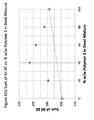
- a 20%/80% polymer/steel particles mixture contained 1.6 kg of polymer particles and 6.4 kg of steel particles (total 8.0 kg, i.e. 2:1 particle:cloth).
- a 60%/40% polymer/steel particles mixture contained 4.8 kg of polymer particles and 3.2 kg of steel particles, etc.
- the washload comprised 4.0 kg in total, including 1 WFK PCMS-55_05-05x05 professional laundry stain monitor, and 4 SBL-2004 sebum cloths, with the remaining washload made up with cotton ballast.
- the detergent used was Procter & Gamble Professional Ariel ® Liquid, at the manufacturer's recommended dosage.
- the load was rinsed in a domestic washing machine (BEKO WM5120W - standard rinse cycle), and the stain monitors allowed to air dry. Each wash was repeated twice. The particles were rinsed clean between washes.
- a Konica Minolta CM-3600A spectrophotometer was used to record the CIE Lab L, a and b colour co-ordinates of the various stains on the WFK PCMS-55_05-05x05 stain monitor, and these were then used to calculate ⁇ E as a measure of the degree of cleaning achieved versus the unwashed equivalent (the higher the ⁇ E value the better the cleaning).
- the results are shown in Tables 6(a) & (b) (averaged over the repeat washes), with comments made on the basis that a difference of 1 unit in ⁇ E is discernible by eye.
- the steel particle again shows cleaning benefit versus the no particle control (improvement with 5 stains - 10C, 10D, 20D, 90PB and 90MF, parity for 4 stains, and 4 with poorer performance).
- the higher particle:cloth w/w ratio here has changed the balance of cleaning performance across the stain range slightly, but overall improvement in cleaning is still evident.
- the polymer 1 particle also shows cleaning benefit versus the no particle control (improvement with 5 stains - 10C, 10D, 20D, 90RM and 90PB, parity for 6 stains, and 2 with poorer performance).
Landscapes
- Chemical & Material Sciences (AREA)
- Engineering & Computer Science (AREA)
- Life Sciences & Earth Sciences (AREA)
- Wood Science & Technology (AREA)
- Chemical Kinetics & Catalysis (AREA)
- Oil, Petroleum & Natural Gas (AREA)
- Organic Chemistry (AREA)
- Inorganic Chemistry (AREA)
- Textile Engineering (AREA)
- Detergent Compositions (AREA)
- Cleaning By Liquid Or Steam (AREA)
- Accessory Of Washing/Drying Machine, Commercial Washing/Drying Machine, Other Washing/Drying Machine (AREA)
Applications Claiming Priority (2)
| Application Number | Priority Date | Filing Date | Title |
|---|---|---|---|
| GBGB1100627.7A GB201100627D0 (en) | 2011-01-14 | 2011-01-14 | Improved cleaning method |
| PCT/GB2012/050085 WO2012095677A2 (en) | 2011-01-14 | 2012-01-16 | Improved cleaning method |
Publications (2)
| Publication Number | Publication Date |
|---|---|
| EP2663683A2 EP2663683A2 (en) | 2013-11-20 |
| EP2663683B1 true EP2663683B1 (en) | 2015-03-18 |
Family
ID=43736445
Family Applications (1)
| Application Number | Title | Priority Date | Filing Date |
|---|---|---|---|
| EP12700731.8A Active EP2663683B1 (en) | 2011-01-14 | 2012-01-16 | Improved cleaning method |
Country Status (11)
| Country | Link |
|---|---|
| US (1) | US9803307B2 (https=) |
| EP (1) | EP2663683B1 (https=) |
| JP (1) | JP5937618B2 (https=) |
| KR (1) | KR101826943B1 (https=) |
| CN (1) | CN103348049B (https=) |
| AU (1) | AU2012206446B2 (https=) |
| BR (1) | BR112013017710A2 (https=) |
| CA (1) | CA2823899A1 (https=) |
| GB (1) | GB201100627D0 (https=) |
| TW (1) | TWI572758B (https=) |
| WO (1) | WO2012095677A2 (https=) |
Cited By (2)
| Publication number | Priority date | Publication date | Assignee | Title |
|---|---|---|---|---|
| CN108950972A (zh) * | 2018-09-03 | 2018-12-07 | 张太平 | 一种颗粒清洗智能家居洗衣机 |
| EP4066916A2 (en) | 2017-12-19 | 2022-10-05 | Xeros Limited | Filter for a treatment apparatus |
Families Citing this family (37)
| Publication number | Priority date | Publication date | Assignee | Title |
|---|---|---|---|---|
| GB201002245D0 (en) * | 2010-02-10 | 2010-03-31 | Xeros Ltd | Improved cleaning apparatus and method |
| GB201006076D0 (en) | 2010-04-12 | 2010-05-26 | Xeros Ltd | Novel cleaning apparatus and method |
| GB201015277D0 (en) | 2010-09-14 | 2010-10-27 | Xeros Ltd | Novel cleaning method |
| CN102154801B (zh) | 2011-01-11 | 2016-08-17 | 海尔集团公司 | 节水滚筒洗衣机及洗衣方法 |
| GB201100918D0 (en) | 2011-01-19 | 2011-03-02 | Xeros Ltd | Improved drying method |
| CN102828379B (zh) * | 2011-06-15 | 2016-01-06 | 海尔集团公司 | 使用聚合物固体颗粒的洗涤方法 |
| GB201212096D0 (en) * | 2012-07-06 | 2012-08-22 | Xeros Ltd | Improved cleaning formulation and method |
| GB201212098D0 (en) | 2012-07-06 | 2012-08-22 | Xeros Ltd | New cleaning material |
| GB201305121D0 (en) | 2013-03-20 | 2013-05-01 | Xeros Ltd | Improved drying apparatus and method |
| GB201305120D0 (en) | 2013-03-20 | 2013-05-01 | Xeros Ltd | Improved cleaning apparatus and method |
| GB201305122D0 (en) | 2013-03-20 | 2013-05-01 | Xeros Ltd | New cleaning apparatus and method |
| GB201306607D0 (en) | 2013-04-11 | 2013-05-29 | Xeros Ltd | Method for treating an animal substrate |
| GB201306986D0 (en) | 2013-04-17 | 2013-05-29 | Crown Packaging Technology Inc | Can production process |
| WO2015027970A1 (de) * | 2013-08-26 | 2015-03-05 | Coin Consulting Ug (Haftungsbeschränkt) | Dreiphasen-vollwaschmitteltuch und verfahren zu dessen herstellung |
| GB201319782D0 (en) | 2013-11-08 | 2013-12-25 | Xeros Ltd | Cleaning method and apparatus |
| GB201320784D0 (en) | 2013-11-25 | 2014-01-08 | Xeros Ltd | Improved cleaning Apparatus and method |
| DE102014213312A1 (de) * | 2014-07-09 | 2016-01-14 | Henkel Ag & Co. Kgaa | Waschmaschine mit Entfärbungseinrichtung und Reservoir für wasserunlösliche feste Teilchen |
| DE102014213313A1 (de) * | 2014-07-09 | 2016-01-14 | Henkel Ag & Co. Kgaa | Waschmaschine mit Entfärbungseinrichtung und Reservoir für wasserunlösliche feste Teilchen |
| GB201417487D0 (en) | 2014-10-03 | 2014-11-19 | Xeros Ltd | Method for treating an animal substrate |
| GB201418007D0 (en) | 2014-10-10 | 2014-11-26 | Xeros Ltd | Animal skin substrate Treatment apparatus and method |
| GB201418006D0 (en) | 2014-10-10 | 2014-11-26 | Xeros Ltd | Animal skin substrate treatment apparatus and method |
| GB201421293D0 (en) | 2014-12-01 | 2015-01-14 | Xeros Ltd | New cleaning method, apparatus and use |
| AU2015357303B2 (en) | 2014-12-01 | 2019-04-18 | Basf Se | Thermoplastic polyamide particles |
| WO2017017176A1 (en) * | 2015-07-29 | 2017-02-02 | Basf Se | Cleaning particles and their use |
| GB201513346D0 (en) | 2015-07-29 | 2015-09-09 | Xeros Ltd | Cleaning method, apparatus and use |
| US9927411B2 (en) * | 2015-09-08 | 2018-03-27 | International Business Machines Corporation | Humidity and sulfur concentration in test chamber |
| AR108127A1 (es) * | 2016-04-13 | 2018-07-18 | Xeros Ltd | Método y aparato de tratamiento de pieles de animales |
| WO2017178832A1 (en) | 2016-04-13 | 2017-10-19 | Xeros Limited | Method of treatment using a solid particulate material and apparatus therefor |
| EP3443058A2 (en) * | 2016-04-15 | 2019-02-20 | Xeros Limited | Method and apparatus for treating a substrate with solid particles |
| CN109415507B (zh) | 2016-04-26 | 2022-03-08 | 巴斯夫欧洲公司 | 热塑性聚酰胺颗粒 |
| CN107881714A (zh) * | 2016-09-30 | 2018-04-06 | 段焕立 | 一种皮衣皮草的洗涤方法 |
| CN106635473A (zh) * | 2016-10-11 | 2017-05-10 | 安徽卡塔门窗有限公司 | 一种窗户的高效清洁剂及其制备方法 |
| GB201704736D0 (en) | 2017-03-24 | 2017-05-10 | Xeros Ltd | Treatment apparatus and method |
| GB201811568D0 (en) | 2018-07-13 | 2018-08-29 | Xeros Ltd | Apparatus and method for treating a substrate with solid particles |
| GB201811569D0 (en) | 2018-07-13 | 2018-08-29 | Xeros Ltd | Apparatus and method for treating subsrtate with solid particles |
| CN113684646A (zh) * | 2020-05-18 | 2021-11-23 | 青岛海尔滚筒洗衣机有限公司 | 洗涤设备的循环喷淋控制方法 |
| WO2022225898A1 (en) * | 2021-04-19 | 2022-10-27 | Decon Water Technologies, LLC | Industrial laundry systems and methods |
Family Cites Families (181)
| Publication number | Priority date | Publication date | Assignee | Title |
|---|---|---|---|---|
| US2970464A (en) | 1958-12-19 | 1961-02-07 | Gen Electric | Combination washer and dryer with improved clothes receptacle |
| US3119773A (en) | 1960-10-10 | 1964-01-28 | Whirlpool Co | Pivoting deflector water balance system for centrifugal extractor apparatus |
| US3321843A (en) | 1964-07-10 | 1967-05-30 | Singer Co | Laundering machines |
| US3333344A (en) | 1965-11-22 | 1967-08-01 | Phillips Petroleum Co | Rotary dryer |
| GB1256064A (en) | 1967-10-26 | 1971-12-08 | Iws Nominee Co Ltd | Continuous scouring process |
| DE1900002A1 (de) | 1969-01-02 | 1970-07-30 | Henkel & Cie Gmbh | Wasch- und Reinigungsmittel |
| GB1297316A (https=) | 1969-09-29 | 1972-11-22 | ||
| US3647354A (en) | 1969-11-24 | 1972-03-07 | Gen Electric | Fabric-treating method |
| US3650673A (en) | 1969-11-24 | 1972-03-21 | Gen Electric | Dry wash fabric cleaning method and apparatus |
| GB1379742A (en) | 1971-03-25 | 1975-01-08 | Neil & Spencer Ltd | Dry cleaning |
| US3805406A (en) | 1971-09-03 | 1974-04-23 | A Castonoli | Interchangeable path drying apparatus |
| DE2501464A1 (de) | 1974-01-29 | 1975-07-31 | Procter & Gamble | Bleichverfahren |
| US4055248A (en) | 1974-12-17 | 1977-10-25 | The Procter & Gamble Company | Fabric treating compositions and articles |
| US4188807A (en) | 1975-12-04 | 1980-02-19 | Bosch-Siemens Hausgerate Gmbh | Automatic washing machine for textiles having separate containers for washing substances, meters and common pre-mix channel for metered substances |
| GB2013100B (en) * | 1977-12-29 | 1982-03-31 | Henkel Kgaa | Process and apparatus for machine washing and cleaning |
| DE2819233A1 (de) | 1978-05-02 | 1979-11-15 | Henkel Kgaa | Verfahren und vorrichtung zum maschinellen waschen und reinigen |
| US4326971A (en) | 1978-12-11 | 1982-04-27 | Colgate Palmolive Company | Detergent softener compositions |
| DE3070945D1 (en) | 1979-04-02 | 1985-09-12 | Carl Goran Christer Mosell | Cleaning machine |
| US4493783A (en) | 1981-04-20 | 1985-01-15 | Alcon Laboratories, Inc. | Cleaning agent for optical surfaces |
| US4434067A (en) | 1981-07-27 | 1984-02-28 | Milliken Research Corporation | Powdered cleaning composition |
| DE3210976C2 (de) | 1982-03-25 | 1984-11-29 | Alu Plast Aluminium-Plastik Recycling GmbH, 5440 Mayen | Waschvorrichtung und Verfahren zum Waschen von Kunststoffkleinteilen |
| FR2525645A1 (fr) | 1982-04-23 | 1983-10-28 | Thomson Brandt | Lave-linge a faible consommation en eau |
| JPS5948078A (ja) | 1982-09-14 | 1984-03-19 | Matsushita Electric Works Ltd | 固定化酵素の製法 |
| SE8301624D0 (sv) | 1983-03-24 | 1983-03-24 | Carl Goran Christer Mosell | Sett vid rengoringsmaskin |
| JPS59196758A (ja) | 1983-04-21 | 1984-11-08 | Kataoka Tekkosho:Kk | パチンコ球の浄化装置に使用するペレツトの洗浄方法 |
| US4655952A (en) | 1984-03-02 | 1987-04-07 | Vorwerk & Co. Interholding Gmbh | Detergent and method for producing the same |
| GB8418566D0 (en) | 1984-07-20 | 1984-08-22 | Unilever Plc | Fabric cleaning compositions |
| US4575887A (en) | 1984-08-29 | 1986-03-18 | Viramontes Julio C | Method for abrading fabric garments |
| DE3527724A1 (de) | 1985-08-02 | 1987-02-12 | Licentia Gmbh | Trommelwaschmaschine |
| US4637890A (en) | 1986-01-23 | 1987-01-20 | The Procter & Gamble Company | Detergent composition providing rinse cycle suds and turbidity control containing a soap, quaternary ammonium salt and a silicone |
| JPS62224289A (ja) | 1986-03-25 | 1987-10-02 | Agency Of Ind Science & Technol | 固定化酵素及びその製造方法 |
| US4750227A (en) * | 1986-10-28 | 1988-06-14 | Dexter Chemical Corporation | Abrasive structures and methods for abrading fabrics |
| US4809854A (en) | 1987-01-12 | 1989-03-07 | Nelmor Co., Inc. | Flotation apparatus for reclaiming bonded, two-resin articles |
| EP0312278A3 (en) | 1987-10-12 | 1990-07-11 | Unilever Plc | Detergent composition |
| DE3803195C2 (de) | 1988-02-03 | 1994-08-18 | Bosch Siemens Hausgeraete | Mitnehmerschöpfrippe für eine Waschtrommel |
| US4839969A (en) | 1988-02-26 | 1989-06-20 | Permian Research Corporation | Drying method and apparatus |
| JPH01285188A (ja) | 1988-05-12 | 1989-11-16 | S T Chem Co Ltd | リパーゼ固定ポリアクリル酸系材料およびその利用 |
| JPH0257295A (ja) | 1988-08-23 | 1990-02-27 | Yoshikatsu Kotaki | 洗濯機 |
| CA1284407C (en) | 1988-11-18 | 1991-05-28 | Kent Dickinson | Method for dry carpet cleaning |
| US4951366A (en) | 1989-02-07 | 1990-08-28 | Geller George R | Method for modifying fabrics to produce varied effects |
| JPH03146094A (ja) | 1989-11-02 | 1991-06-21 | Masayoshi Kodesen | 洗濯方法、ストーンウォッシュ方法及びオゾン水製造装置 |
| FR2666101B1 (fr) * | 1990-08-23 | 1994-10-14 | Sylvie Dameron | Procede et dispositif pour le lavage d'objets a l'aide d'une machine a laver a tambour rotatif. |
| JP2696593B2 (ja) | 1990-08-24 | 1998-01-14 | 新東工業株式会社 | 食器洗浄方法 |
| GB9023006D0 (en) | 1990-10-23 | 1990-12-05 | Bp Chem Int Ltd | Bleach activators |
| JPH04241165A (ja) | 1991-01-07 | 1992-08-28 | Rakutou Kasei Kogyo Kk | 染色天然繊維材料にストーン・ウオッシュ様外観を付与する処理方法 |
| SE469507B (sv) | 1991-03-01 | 1993-07-19 | Viptop Ab | Granuldiskmaskin innefattande en skiljevaegg med ett svaengbart nedre parti foer separering av granuler ur rengoeringsvaetskan |
| US5503840A (en) | 1991-08-09 | 1996-04-02 | E. I. Du Pont De Nemours And Company | Antimicrobial compositions, process for preparing the same and use |
| US5324649A (en) | 1991-10-07 | 1994-06-28 | Genencor International, Inc. | Enzyme-containing granules coated with hydrolyzed polyvinyl alcohol or copolymer thereof |
| US5367734A (en) * | 1991-11-04 | 1994-11-29 | Terry; Raymond | Pliable abrasive pellet for abrading fabrics |
| SE9201117D0 (sv) | 1992-04-08 | 1992-04-08 | Svemo Mekaniska Ab | Anordning foer diskmaskiner |
| SE500315C2 (sv) | 1992-04-24 | 1994-05-30 | Pw System Ab | Rengöringsmaskin för behandling av gods med vätska och granuler |
| US5305533A (en) | 1993-01-27 | 1994-04-26 | Alexander Donald J | Combined direct and indirect rotary dryer with reclaimer |
| JPH06240297A (ja) | 1993-02-16 | 1994-08-30 | Toray Ind Inc | 酵素固定化洗浄用助剤 |
| DE4324624B4 (de) | 1993-07-22 | 2004-06-17 | Hamann, Hans-Jörg | Vorrichtung zur Oberflächenbehandlung von Textilien |
| US5849684A (en) | 1994-04-14 | 1998-12-15 | The Procter & Gamble Company | Detergent additives comprising dye transfer inhibitors, and process for making them |
| US5993839A (en) | 1994-05-09 | 1999-11-30 | Phoenix Medical Technology, Inc. | Antimicrobial gloves and a method of manufacture thereof |
| DE19505921A1 (de) | 1995-02-21 | 1996-08-22 | Andreas Kiehne | Waschmittel für eine Waschmaschine und Verfahren zu dessen Herstellung |
| MX9707450A (es) | 1995-03-30 | 1997-12-31 | Procter & Gamble | Articulo para limpieza en seco. |
| US5547476A (en) | 1995-03-30 | 1996-08-20 | The Procter & Gamble Company | Dry cleaning process |
| US5605491A (en) | 1995-06-02 | 1997-02-25 | Church & Dwight Co., Inc. | Blast media with defoamers |
| CA2224693A1 (en) | 1995-06-22 | 1997-01-09 | Reckitt & Colman Inc. | Spot pretreatment compositions for home dry cleaning |
| CN1160758A (zh) * | 1996-03-27 | 1997-10-01 | 李滨利 | 手面油污清洗剂(粉) |
| IL120617A (en) | 1996-05-17 | 1999-12-31 | Rohm & Haas | Method for removing liquid contaminants from a surface |
| GB2328691B (en) | 1996-06-05 | 2000-12-06 | Rainer Clover | Inhibition of microbial growth |
| US5925195A (en) | 1996-07-25 | 1999-07-20 | King; Paul | Portable dip cleaning system |
| CN1105545C (zh) | 1997-01-31 | 2003-04-16 | 花王株式会社 | 用去污剂浸渗的清洁用品 |
| GB9703813D0 (en) | 1997-02-24 | 1997-04-16 | Ici Plc | Dyeing of textiles |
| US5978994A (en) | 1997-03-12 | 1999-11-09 | Vision International Production, Inc. | Device and method for use in cleaning laundry |
| US20070151312A1 (en) | 2005-12-30 | 2007-07-05 | Bruce Beihoff C | Modular fabric revitalizing system |
| JPH10309550A (ja) * | 1997-05-12 | 1998-11-24 | Yoshinori Miyano | 洗浄処理方法 |
| DE69906689T2 (de) | 1998-02-03 | 2003-12-24 | Tencel Ltd., Spondon | Verfahren zum färben und veredeln von cellulosischen geweben |
| US6280301B1 (en) | 1998-04-17 | 2001-08-28 | National Conveyor Corp. | Granule dishwashing apparatus and method of use |
| JP2002533502A (ja) | 1998-12-22 | 2002-10-08 | フイルメニツヒ ソシエテ アノニム | 吸着性を有する多孔質ポリメチルシルセスキオキサン |
| GB9913549D0 (en) | 1999-06-10 | 1999-08-11 | Unilever Plc | Detergent compositions |
| ES2252027T3 (es) | 1999-07-09 | 2006-05-16 | Henkel Kommanditgesellschaft Auf Aktien | Porcion de agente detergente o limpiador. |
| US7097715B1 (en) | 2000-10-11 | 2006-08-29 | R. R. Street Co. Inc. | Cleaning system utilizing an organic cleaning solvent and a pressurized fluid solvent |
| CA2325620C (en) | 1999-11-15 | 2004-05-11 | The Procter & Gamble Company | Bleach-containing non-aqueous detergent formulated to control dye transfer and sudsing in high efficiency washing machines |
| AU1706301A (en) | 1999-12-13 | 2001-06-25 | Henkel Kommanditgesellschaft Auf Aktien | Washing agent, rinsing agent or cleaning agent portions with controlled active ingredient release |
| US6235705B1 (en) | 2000-02-15 | 2001-05-22 | Bath & Body Works, Inc. | Dryer pearls |
| EP1280879B1 (en) | 2000-05-09 | 2005-07-27 | Unilever Plc | Soil release polymers and laundry detergent compositions containing them |
| US6691536B2 (en) * | 2000-06-05 | 2004-02-17 | The Procter & Gamble Company | Washing apparatus |
| ATE225162T1 (de) | 2000-07-13 | 2002-10-15 | Oreal | Kosmetisches reinigungsmittel |
| US20020058595A1 (en) | 2000-07-27 | 2002-05-16 | The Procter & Gamble Company | Process and a device for deodorizing and/or fragrancing an environment |
| GB2365648A (en) | 2000-08-07 | 2002-02-20 | Dentpark Ltd | Colour correction in image processing |
| DE60139499D1 (de) | 2000-11-24 | 2009-09-17 | Unilever Nv | Reinigungsmittelzusammensetzungen |
| DE10060373A1 (de) | 2000-12-05 | 2002-06-06 | Basf Ag | Reaktiv modifizierte, teilchenförmige Polymerisate zur Behandlung der Oberflächen textiler und nicht-textiler Materialien |
| DE10128894A1 (de) | 2001-06-15 | 2002-12-19 | Basf Ag | Verfahren zur schmutzablösungsfördernden Behandlung von Oberflächen textiler und nicht-textiler Materialien |
| FR2826548B1 (fr) | 2001-06-28 | 2007-01-19 | Rhodianyl | Particule comprenant une matrice et au moins un agent bioactif, son procede de preparation et ses applications |
| DE60113567T2 (de) | 2001-07-13 | 2006-06-22 | 3M Innovative Properties Co., St. Paul | SCHLElFGEGENSTAND FÜR REINIGUNGSZWECKE MIT PARFÜMIERTEN SCHLEIFFASERN |
| US6780205B2 (en) | 2001-08-21 | 2004-08-24 | E. I. Du Pont De Nemours And Company | Vat acid dyeing of textile fibers |
| EP1443885B1 (en) | 2001-11-02 | 2015-01-21 | The Procter & Gamble Company | Composition containing a cationic polymer and water insoluble solid material |
| DE10163331A1 (de) | 2001-12-21 | 2003-07-10 | Henkel Kgaa | Trägerfixierte Bleichkatalysatorkomplexverbindungen geeignet als Katalysatoren für Persauerstoffverbindungen |
| DE10215522A1 (de) | 2002-04-09 | 2003-10-30 | Basf Ag | Kationisch modifizierte anionische Polyurethandispersionen |
| US20050204477A1 (en) | 2004-03-22 | 2005-09-22 | Casella Victor M | Fabric treatment for stain release |
| EP1371718A1 (en) | 2002-06-14 | 2003-12-17 | Rohm And Haas Company | Polymeric nanoparticle formulations and their use as fabric care additives |
| JP2005530883A (ja) | 2002-06-24 | 2005-10-13 | インペリアル・ケミカル・インダストリーズ・ピーエルシー | 布地の洗浄方法 |
| US7528102B2 (en) | 2002-08-09 | 2009-05-05 | Henkel Kgaa | Fragrance release system |
| DE10247289A1 (de) | 2002-10-10 | 2004-04-22 | Symrise Gmbh & Co. Kg | Riechstoffhaltige feste Reinigungsmittel |
| JP2004167345A (ja) | 2002-11-19 | 2004-06-17 | Sumitomo Chem Co Ltd | 固体粒子の洗浄方法 |
| MX271467B (es) | 2003-01-27 | 2009-11-03 | Procter & Gamble | Composicion para la limpieza personal que contiene particulas de forma irregular y particulas esfericas. |
| JP2004238602A (ja) | 2003-02-07 | 2004-08-26 | Iwata Kokogyo Kk | 洗濯石およびそれを用いた洗濯小袋、および洗濯機の付着黴の除去方法 |
| CN1654617A (zh) | 2004-02-10 | 2005-08-17 | 捷时雅株式会社 | 清洗用组合物和半导体基板的清洗方法及半导体装置的制造方法 |
| US7494512B2 (en) | 2004-02-20 | 2009-02-24 | Brown Steven E | Compositions and methods for cleaning textile substrates |
| US20050183208A1 (en) | 2004-02-20 | 2005-08-25 | The Procter & Gamble Company | Dual mode laundry apparatus and method using the same |
| EP1618970A1 (en) | 2004-07-22 | 2006-01-25 | Linde Aktiengesellschaft | Carbon dioxide cleaning method |
| WO2006020789A1 (en) | 2004-08-11 | 2006-02-23 | The Procter & Gamble Company | A highly water-soluble solid laundry detergent composition that forms a clear wash liquor upon dissolution in water |
| GB0422533D0 (en) | 2004-10-11 | 2004-11-10 | Univ Leeds | Non-aqueous treatment method |
| EP1693438A1 (en) | 2005-02-21 | 2006-08-23 | The Procter & Gamble Company | A particulate laundry detergent composition comprising a detersive surfactant, carbonate and a cellulosic polymer |
| CN2789299Y (zh) | 2005-04-05 | 2006-06-21 | 苏州三星电子有限公司 | 一体化的全自动洗衣机 |
| JP2006326434A (ja) | 2005-05-24 | 2006-12-07 | Eco Techno:Kk | 汚染土壌の浄化方法 |
| US20060287212A1 (en) | 2005-06-02 | 2006-12-21 | Novozymes A/S | Blends of inactive particles and active particles |
| DE102005026522B4 (de) | 2005-06-08 | 2007-04-05 | Henkel Kgaa | Verstärkung der Reinigungsleistung von Waschmitteln durch Polymer |
| US8258066B2 (en) | 2005-12-12 | 2012-09-04 | Milliken & Company | Cleaning device |
| GB0607047D0 (en) * | 2006-04-07 | 2006-05-17 | Univ Leeds | Novel cleaning method |
| US20070270327A1 (en) | 2006-05-22 | 2007-11-22 | The Procter & Gamble Company | Dryer-added fabric care articles imparting fabric feel benefits |
| US20090276966A1 (en) | 2006-07-06 | 2009-11-12 | Bsh Bosch Und Siemens Hausgerate Gmbh | Washing machine with hollow agitators |
| AU2008243977A1 (en) | 2007-04-25 | 2008-11-06 | Reckitt Benckiser N.V. | Composition |
| US8490440B2 (en) | 2007-05-07 | 2013-07-23 | Whirlpool Corporation | Timing control and timed wash cycle for an automatic washer |
| JP5631205B2 (ja) | 2007-06-11 | 2014-11-26 | ビーエーエスエフ ソシエタス・ヨーロピアBasf Se | 抗菌性ポリオレフィン及びポリエステル組成物 |
| DE102007029485B4 (de) | 2007-06-26 | 2010-06-17 | D'heureuse, Hans-Joachim | Verfahren zur Reinigung insbesondere empfindlichen Reinigungsgutes |
| DE102007037984A1 (de) | 2007-08-10 | 2009-02-12 | Leibniz-Institut für Plasmaforschung und Technologie e.V. | Verfahren zur Textilreinigung und Desinfektion mittels Plasma und Plasmaschleuse |
| US7637129B2 (en) | 2007-10-04 | 2009-12-29 | Sheng-Ming Wang | Air jet pressurized clothes washing machine |
| KR101461950B1 (ko) | 2008-04-30 | 2014-11-14 | 엘지전자 주식회사 | 세탁기 |
| GB0724644D0 (en) | 2007-12-19 | 2008-01-30 | Harman Technology Ltd | Polymer compositions |
| US7781387B2 (en) | 2008-01-22 | 2010-08-24 | Access Business Group International, Llc. | Automatic phosphate-free dishwashing detergent providing improved spotting and filming performance |
| DE102008009462A1 (de) | 2008-02-15 | 2009-08-20 | Henkel Ag & Co. Kgaa | Wasch- und Reinigungsmittel mit porösen Polyamidpartikeln |
| EP2103677A1 (en) | 2008-03-14 | 2009-09-23 | Unilever PLC | Laundry treatment compositions |
| WO2009112296A1 (en) | 2008-03-14 | 2009-09-17 | Unilever Plc | Laundry treatment compositions |
| SE0850054A1 (sv) | 2008-10-24 | 2010-04-25 | Gs Dev Ab | Granul för diskmaskiner |
| GB0902619D0 (en) | 2009-02-17 | 2009-04-01 | Xeros Ltd | Cleaning apparatus |
| US20100281928A1 (en) | 2009-05-08 | 2010-11-11 | Actervis Gmbh | Washer friendly laundry ball |
| GB0907943D0 (en) | 2009-05-08 | 2009-06-24 | Xeros Ltd | Novel cleaning method |
| CN101886321A (zh) | 2009-05-11 | 2010-11-17 | 海尔集团公司 | 洗涤方法 |
| GB0908642D0 (en) | 2009-05-20 | 2009-06-24 | Reckitt Benckiser Nv | Composition |
| KR101698854B1 (ko) | 2009-05-28 | 2017-01-24 | 엘지전자 주식회사 | 세탁장치의 제조방법 |
| GB0909362D0 (en) | 2009-06-01 | 2009-07-15 | Reckitt Benckiser Nv | Composition |
| KR20120052271A (ko) | 2009-08-03 | 2012-05-23 | 디에스엠 아이피 어셋츠 비.브이. | 폴리아마이드 담체 및 원소 은 나노입자를 포함하는 물 살균용 항균 물질 |
| GB2473224A (en) | 2009-09-03 | 2011-03-09 | John Vincent Flanagan | Detergent-less washing machine |
| DE102009046170A1 (de) | 2009-10-29 | 2011-05-05 | Henkel Ag & Co. Kgaa | Waschen mit Polymerkörpern |
| CN102061589B (zh) | 2009-11-16 | 2012-03-28 | 海尔集团公司 | 洗衣机 |
| CN102061588B (zh) | 2009-11-16 | 2014-02-05 | 海尔集团公司 | 洗衣机、洗涤方法及洗衣筒 |
| GB0920565D0 (en) | 2009-11-24 | 2010-01-06 | Xeros Ltd | Improved cleaning apparatus |
| GB201002245D0 (en) | 2010-02-10 | 2010-03-31 | Xeros Ltd | Improved cleaning apparatus and method |
| GB201006076D0 (en) | 2010-04-12 | 2010-05-26 | Xeros Ltd | Novel cleaning apparatus and method |
| CN101885605B (zh) * | 2010-06-28 | 2013-09-04 | 深圳市成为生物科技有限公司 | 具有吸附性、离子交换和产生负离子功能的陶瓷颗粒及制备方法 |
| GB201015277D0 (en) | 2010-09-14 | 2010-10-27 | Xeros Ltd | Novel cleaning method |
| GB201015276D0 (en) | 2010-09-14 | 2010-10-27 | Xeros Ltd | Polymer treatment method |
| GB201018318D0 (en) | 2010-10-29 | 2010-12-15 | Xeros Ltd | Improved cleaning method |
| KR20130135288A (ko) | 2010-12-24 | 2013-12-10 | 유니레버 엔.브이. | 응집 방법 및 장치 |
| CN102154801B (zh) | 2011-01-11 | 2016-08-17 | 海尔集团公司 | 节水滚筒洗衣机及洗衣方法 |
| GB201100918D0 (en) | 2011-01-19 | 2011-03-02 | Xeros Ltd | Improved drying method |
| US20130316430A1 (en) | 2011-02-01 | 2013-11-28 | Maharshi Dayanand University | Polyvinyl chloride surface co-immobilized with enzymes and uses thereof |
| GB201106409D0 (en) | 2011-04-15 | 2011-06-01 | Revolymer Ltd | Novel composite |
| CN102817208B (zh) | 2011-06-09 | 2017-03-01 | 塞罗斯有限公司 | 洗涤用固体颗粒及其洗涤方法 |
| CN102828379B (zh) | 2011-06-15 | 2016-01-06 | 海尔集团公司 | 使用聚合物固体颗粒的洗涤方法 |
| EP2749684A4 (en) | 2011-08-22 | 2015-01-07 | Haier Group Corp | WASHING MACHINE AND WASHING METHOD |
| CN102953249B (zh) | 2011-08-22 | 2016-09-28 | 海尔集团公司 | 滚筒洗衣机及洗涤方法 |
| CN103031693B (zh) | 2011-09-30 | 2017-05-24 | 塞罗斯有限公司 | 洗衣机及洗涤方法 |
| CN103031691B (zh) | 2011-09-30 | 2016-05-25 | 海尔集团公司 | 洗衣机及洗涤方法 |
| CN103161049B (zh) | 2011-12-13 | 2015-11-25 | 海尔集团技术研发中心 | 洗衣机及洗涤方法 |
| CN103173961B (zh) | 2011-12-23 | 2016-04-06 | 青岛海日高科模型有限公司 | 一种洗衣机及洗涤方法 |
| CN202401272U (zh) | 2011-12-23 | 2012-08-29 | 青岛海日高科模型有限公司 | 一种洗衣机 |
| CN202500017U (zh) | 2012-02-22 | 2012-10-24 | 青岛海尔模具有限公司 | 一种洗衣机的视窗装置及使用该视窗装置的洗衣机 |
| CN202543635U (zh) | 2012-04-24 | 2012-11-21 | 海尔集团技术研发中心 | 一种洗衣机提升筋及洗衣机 |
| US20150027173A1 (en) | 2012-04-17 | 2015-01-29 | Haier Group Technique R&D Center | Washing machine drum baffle and washing machine therewith |
| GB201212098D0 (en) | 2012-07-06 | 2012-08-22 | Xeros Ltd | New cleaning material |
| GB201212096D0 (en) | 2012-07-06 | 2012-08-22 | Xeros Ltd | Improved cleaning formulation and method |
| GB201216101D0 (en) | 2012-09-10 | 2012-10-24 | Xeros Ltd | Improved cleaning apparatus and method |
| GB201305121D0 (en) | 2013-03-20 | 2013-05-01 | Xeros Ltd | Improved drying apparatus and method |
| GB201305122D0 (en) | 2013-03-20 | 2013-05-01 | Xeros Ltd | New cleaning apparatus and method |
| GB201305120D0 (en) | 2013-03-20 | 2013-05-01 | Xeros Ltd | Improved cleaning apparatus and method |
| GB201306607D0 (en) | 2013-04-11 | 2013-05-29 | Xeros Ltd | Method for treating an animal substrate |
| GB201312159D0 (en) | 2013-07-05 | 2013-08-21 | Xeros Ltd | Method of treating a metal substrate |
| GB201312158D0 (en) | 2013-07-05 | 2013-08-21 | Xeros Ltd | Method of treating a metal substrate |
| GB201312189D0 (en) | 2013-07-08 | 2013-08-21 | Xeros Ltd | New cleaning formulation and method |
| GB201317557D0 (en) | 2013-10-03 | 2013-11-20 | Xeros Ltd | Improved cleaning apparatus and method |
| GB201317558D0 (en) | 2013-10-03 | 2013-11-20 | Xeros Ltd | Cleaning apparatus |
| GB201319782D0 (en) | 2013-11-08 | 2013-12-25 | Xeros Ltd | Cleaning method and apparatus |
| GB201320784D0 (en) | 2013-11-25 | 2014-01-08 | Xeros Ltd | Improved cleaning Apparatus and method |
| US20160197998A1 (en) | 2015-01-02 | 2016-07-07 | Xeros Limited | Monitoring system |
| US20160195409A1 (en) | 2015-01-02 | 2016-07-07 | Xeros Limited | Monitoring system |
-
2011
- 2011-01-14 GB GBGB1100627.7A patent/GB201100627D0/en not_active Ceased
-
2012
- 2012-01-16 BR BR112013017710A patent/BR112013017710A2/pt not_active IP Right Cessation
- 2012-01-16 CN CN201280005122.9A patent/CN103348049B/zh active Active
- 2012-01-16 KR KR1020137019968A patent/KR101826943B1/ko not_active Expired - Fee Related
- 2012-01-16 JP JP2013548893A patent/JP5937618B2/ja not_active Expired - Fee Related
- 2012-01-16 CA CA2823899A patent/CA2823899A1/en not_active Abandoned
- 2012-01-16 AU AU2012206446A patent/AU2012206446B2/en not_active Ceased
- 2012-01-16 EP EP12700731.8A patent/EP2663683B1/en active Active
- 2012-01-16 WO PCT/GB2012/050085 patent/WO2012095677A2/en not_active Ceased
- 2012-01-16 US US13/979,392 patent/US9803307B2/en not_active Expired - Fee Related
- 2012-01-16 TW TW101101651A patent/TWI572758B/zh not_active IP Right Cessation
Cited By (3)
| Publication number | Priority date | Publication date | Assignee | Title |
|---|---|---|---|---|
| EP4066916A2 (en) | 2017-12-19 | 2022-10-05 | Xeros Limited | Filter for a treatment apparatus |
| CN108950972A (zh) * | 2018-09-03 | 2018-12-07 | 张太平 | 一种颗粒清洗智能家居洗衣机 |
| CN108950972B (zh) * | 2018-09-03 | 2020-06-16 | 南京溧水高新创业投资管理有限公司 | 一种颗粒清洗智能家居洗衣机 |
Also Published As
| Publication number | Publication date |
|---|---|
| TWI572758B (zh) | 2017-03-01 |
| JP2014507205A (ja) | 2014-03-27 |
| US20130283542A1 (en) | 2013-10-31 |
| US9803307B2 (en) | 2017-10-31 |
| GB201100627D0 (en) | 2011-03-02 |
| KR20140005940A (ko) | 2014-01-15 |
| KR101826943B1 (ko) | 2018-02-07 |
| WO2012095677A2 (en) | 2012-07-19 |
| BR112013017710A2 (pt) | 2016-10-11 |
| CN103348049B (zh) | 2016-09-21 |
| AU2012206446B2 (en) | 2016-05-19 |
| TW201233869A (en) | 2012-08-16 |
| CN103348049A (zh) | 2013-10-09 |
| EP2663683A2 (en) | 2013-11-20 |
| WO2012095677A3 (en) | 2013-07-18 |
| CA2823899A1 (en) | 2012-07-19 |
| JP5937618B2 (ja) | 2016-06-22 |
Similar Documents
| Publication | Publication Date | Title |
|---|---|---|
| EP2663683B1 (en) | Improved cleaning method | |
| EP2976451B1 (en) | Improved cleaning apparatus and method | |
| US9850455B2 (en) | Cleaning method | |
| AU2012206446A1 (en) | Improved cleaning method | |
| EP2976453B1 (en) | New cleaning apparatus and method | |
| EP2534293B1 (en) | Improved cleaning apparatus and method | |
| AU2011303606B2 (en) | Polymer treatment method | |
| WO2014037729A1 (en) | Improved cleaning apparatus and method | |
| WO2014080192A1 (en) | Improved cleaning apparatus and method | |
| HK1217980B (en) | Improved cleaning apparatus and method | |
| HK1217982B (en) | New cleaning apparatus and method |
Legal Events
| Date | Code | Title | Description |
|---|---|---|---|
| PUAI | Public reference made under article 153(3) epc to a published international application that has entered the european phase |
Free format text: ORIGINAL CODE: 0009012 |
|
| 17P | Request for examination filed |
Effective date: 20130813 |
|
| AK | Designated contracting states |
Kind code of ref document: A2 Designated state(s): AL AT BE BG CH CY CZ DE DK EE ES FI FR GB GR HR HU IE IS IT LI LT LU LV MC MK MT NL NO PL PT RO RS SE SI SK SM TR |
|
| DAX | Request for extension of the european patent (deleted) | ||
| GRAJ | Information related to disapproval of communication of intention to grant by the applicant or resumption of examination proceedings by the epo deleted |
Free format text: ORIGINAL CODE: EPIDOSDIGR1 |
|
| GRAP | Despatch of communication of intention to grant a patent |
Free format text: ORIGINAL CODE: EPIDOSNIGR1 |
|
| GRAP | Despatch of communication of intention to grant a patent |
Free format text: ORIGINAL CODE: EPIDOSNIGR1 |
|
| INTG | Intention to grant announced |
Effective date: 20140703 |
|
| INTG | Intention to grant announced |
Effective date: 20140709 |
|
| GRAP | Despatch of communication of intention to grant a patent |
Free format text: ORIGINAL CODE: EPIDOSNIGR1 |
|
| GRAJ | Information related to disapproval of communication of intention to grant by the applicant or resumption of examination proceedings by the epo deleted |
Free format text: ORIGINAL CODE: EPIDOSDIGR1 |
|
| GRAP | Despatch of communication of intention to grant a patent |
Free format text: ORIGINAL CODE: EPIDOSNIGR1 |
|
| INTG | Intention to grant announced |
Effective date: 20141113 |
|
| INTC | Intention to grant announced (deleted) | ||
| INTG | Intention to grant announced |
Effective date: 20141205 |
|
| GRAS | Grant fee paid |
Free format text: ORIGINAL CODE: EPIDOSNIGR3 |
|
| GRAA | (expected) grant |
Free format text: ORIGINAL CODE: 0009210 |
|
| AK | Designated contracting states |
Kind code of ref document: B1 Designated state(s): AL AT BE BG CH CY CZ DE DK EE ES FI FR GB GR HR HU IE IS IT LI LT LU LV MC MK MT NL NO PL PT RO RS SE SI SK SM TR |
|
| REG | Reference to a national code |
Ref country code: GB Ref legal event code: FG4D |
|
| REG | Reference to a national code |
Ref country code: CH Ref legal event code: EP |
|
| REG | Reference to a national code |
Ref country code: IE Ref legal event code: FG4D |
|
| REG | Reference to a national code |
Ref country code: AT Ref legal event code: REF Ref document number: 716656 Country of ref document: AT Kind code of ref document: T Effective date: 20150415 |
|
| REG | Reference to a national code |
Ref country code: DE Ref legal event code: R096 Ref document number: 602012005970 Country of ref document: DE Effective date: 20150430 |
|
| REG | Reference to a national code |
Ref country code: NL Ref legal event code: VDEP Effective date: 20150318 |
|
| REG | Reference to a national code |
Ref country code: NL Ref legal event code: VDEP Effective date: 20150318 |
|
| PG25 | Lapsed in a contracting state [announced via postgrant information from national office to epo] |
Ref country code: SE Free format text: LAPSE BECAUSE OF FAILURE TO SUBMIT A TRANSLATION OF THE DESCRIPTION OR TO PAY THE FEE WITHIN THE PRESCRIBED TIME-LIMIT Effective date: 20150318 Ref country code: FI Free format text: LAPSE BECAUSE OF FAILURE TO SUBMIT A TRANSLATION OF THE DESCRIPTION OR TO PAY THE FEE WITHIN THE PRESCRIBED TIME-LIMIT Effective date: 20150318 Ref country code: HR Free format text: LAPSE BECAUSE OF FAILURE TO SUBMIT A TRANSLATION OF THE DESCRIPTION OR TO PAY THE FEE WITHIN THE PRESCRIBED TIME-LIMIT Effective date: 20150318 Ref country code: NO Free format text: LAPSE BECAUSE OF FAILURE TO SUBMIT A TRANSLATION OF THE DESCRIPTION OR TO PAY THE FEE WITHIN THE PRESCRIBED TIME-LIMIT Effective date: 20150618 Ref country code: LT Free format text: LAPSE BECAUSE OF FAILURE TO SUBMIT A TRANSLATION OF THE DESCRIPTION OR TO PAY THE FEE WITHIN THE PRESCRIBED TIME-LIMIT Effective date: 20150318 |
|
| REG | Reference to a national code |
Ref country code: AT Ref legal event code: MK05 Ref document number: 716656 Country of ref document: AT Kind code of ref document: T Effective date: 20150318 |
|
| REG | Reference to a national code |
Ref country code: LT Ref legal event code: MG4D |
|
| PG25 | Lapsed in a contracting state [announced via postgrant information from national office to epo] |
Ref country code: RS Free format text: LAPSE BECAUSE OF FAILURE TO SUBMIT A TRANSLATION OF THE DESCRIPTION OR TO PAY THE FEE WITHIN THE PRESCRIBED TIME-LIMIT Effective date: 20150318 Ref country code: GR Free format text: LAPSE BECAUSE OF FAILURE TO SUBMIT A TRANSLATION OF THE DESCRIPTION OR TO PAY THE FEE WITHIN THE PRESCRIBED TIME-LIMIT Effective date: 20150619 Ref country code: LV Free format text: LAPSE BECAUSE OF FAILURE TO SUBMIT A TRANSLATION OF THE DESCRIPTION OR TO PAY THE FEE WITHIN THE PRESCRIBED TIME-LIMIT Effective date: 20150318 |
|
| PG25 | Lapsed in a contracting state [announced via postgrant information from national office to epo] |
Ref country code: NL Free format text: LAPSE BECAUSE OF FAILURE TO SUBMIT A TRANSLATION OF THE DESCRIPTION OR TO PAY THE FEE WITHIN THE PRESCRIBED TIME-LIMIT Effective date: 20150318 |
|
| PG25 | Lapsed in a contracting state [announced via postgrant information from national office to epo] |
Ref country code: ES Free format text: LAPSE BECAUSE OF FAILURE TO SUBMIT A TRANSLATION OF THE DESCRIPTION OR TO PAY THE FEE WITHIN THE PRESCRIBED TIME-LIMIT Effective date: 20150318 Ref country code: RO Free format text: LAPSE BECAUSE OF FAILURE TO SUBMIT A TRANSLATION OF THE DESCRIPTION OR TO PAY THE FEE WITHIN THE PRESCRIBED TIME-LIMIT Effective date: 20150318 Ref country code: EE Free format text: LAPSE BECAUSE OF FAILURE TO SUBMIT A TRANSLATION OF THE DESCRIPTION OR TO PAY THE FEE WITHIN THE PRESCRIBED TIME-LIMIT Effective date: 20150318 Ref country code: PT Free format text: LAPSE BECAUSE OF FAILURE TO SUBMIT A TRANSLATION OF THE DESCRIPTION OR TO PAY THE FEE WITHIN THE PRESCRIBED TIME-LIMIT Effective date: 20150720 Ref country code: CZ Free format text: LAPSE BECAUSE OF FAILURE TO SUBMIT A TRANSLATION OF THE DESCRIPTION OR TO PAY THE FEE WITHIN THE PRESCRIBED TIME-LIMIT Effective date: 20150318 Ref country code: SK Free format text: LAPSE BECAUSE OF FAILURE TO SUBMIT A TRANSLATION OF THE DESCRIPTION OR TO PAY THE FEE WITHIN THE PRESCRIBED TIME-LIMIT Effective date: 20150318 |
|
| PG25 | Lapsed in a contracting state [announced via postgrant information from national office to epo] |
Ref country code: IS Free format text: LAPSE BECAUSE OF FAILURE TO SUBMIT A TRANSLATION OF THE DESCRIPTION OR TO PAY THE FEE WITHIN THE PRESCRIBED TIME-LIMIT Effective date: 20150718 Ref country code: PL Free format text: LAPSE BECAUSE OF FAILURE TO SUBMIT A TRANSLATION OF THE DESCRIPTION OR TO PAY THE FEE WITHIN THE PRESCRIBED TIME-LIMIT Effective date: 20150318 Ref country code: AT Free format text: LAPSE BECAUSE OF FAILURE TO SUBMIT A TRANSLATION OF THE DESCRIPTION OR TO PAY THE FEE WITHIN THE PRESCRIBED TIME-LIMIT Effective date: 20150318 |
|
| REG | Reference to a national code |
Ref country code: FR Ref legal event code: PLFP Year of fee payment: 5 |
|
| REG | Reference to a national code |
Ref country code: DE Ref legal event code: R097 Ref document number: 602012005970 Country of ref document: DE |
|
| PG25 | Lapsed in a contracting state [announced via postgrant information from national office to epo] |
Ref country code: IT Free format text: LAPSE BECAUSE OF FAILURE TO SUBMIT A TRANSLATION OF THE DESCRIPTION OR TO PAY THE FEE WITHIN THE PRESCRIBED TIME-LIMIT Effective date: 20150318 |
|
| PLBE | No opposition filed within time limit |
Free format text: ORIGINAL CODE: 0009261 |
|
| STAA | Information on the status of an ep patent application or granted ep patent |
Free format text: STATUS: NO OPPOSITION FILED WITHIN TIME LIMIT |
|
| PG25 | Lapsed in a contracting state [announced via postgrant information from national office to epo] |
Ref country code: DK Free format text: LAPSE BECAUSE OF FAILURE TO SUBMIT A TRANSLATION OF THE DESCRIPTION OR TO PAY THE FEE WITHIN THE PRESCRIBED TIME-LIMIT Effective date: 20150318 |
|
| 26N | No opposition filed |
Effective date: 20151221 |
|
| PG25 | Lapsed in a contracting state [announced via postgrant information from national office to epo] |
Ref country code: SI Free format text: LAPSE BECAUSE OF FAILURE TO SUBMIT A TRANSLATION OF THE DESCRIPTION OR TO PAY THE FEE WITHIN THE PRESCRIBED TIME-LIMIT Effective date: 20150318 |
|
| PG25 | Lapsed in a contracting state [announced via postgrant information from national office to epo] |
Ref country code: BE Free format text: LAPSE BECAUSE OF NON-PAYMENT OF DUE FEES Effective date: 20160131 |
|
| PG25 | Lapsed in a contracting state [announced via postgrant information from national office to epo] |
Ref country code: BE Free format text: LAPSE BECAUSE OF FAILURE TO SUBMIT A TRANSLATION OF THE DESCRIPTION OR TO PAY THE FEE WITHIN THE PRESCRIBED TIME-LIMIT Effective date: 20150318 Ref country code: LU Free format text: LAPSE BECAUSE OF FAILURE TO SUBMIT A TRANSLATION OF THE DESCRIPTION OR TO PAY THE FEE WITHIN THE PRESCRIBED TIME-LIMIT Effective date: 20160116 |
|
| REG | Reference to a national code |
Ref country code: CH Ref legal event code: PL |
|
| PG25 | Lapsed in a contracting state [announced via postgrant information from national office to epo] |
Ref country code: MC Free format text: LAPSE BECAUSE OF FAILURE TO SUBMIT A TRANSLATION OF THE DESCRIPTION OR TO PAY THE FEE WITHIN THE PRESCRIBED TIME-LIMIT Effective date: 20150318 |
|
| PG25 | Lapsed in a contracting state [announced via postgrant information from national office to epo] |
Ref country code: LI Free format text: LAPSE BECAUSE OF NON-PAYMENT OF DUE FEES Effective date: 20160131 Ref country code: CH Free format text: LAPSE BECAUSE OF NON-PAYMENT OF DUE FEES Effective date: 20160131 |
|
| REG | Reference to a national code |
Ref country code: IE Ref legal event code: MM4A |
|
| REG | Reference to a national code |
Ref country code: FR Ref legal event code: PLFP Year of fee payment: 6 |
|
| PG25 | Lapsed in a contracting state [announced via postgrant information from national office to epo] |
Ref country code: IE Free format text: LAPSE BECAUSE OF NON-PAYMENT OF DUE FEES Effective date: 20160116 |
|
| PG25 | Lapsed in a contracting state [announced via postgrant information from national office to epo] |
Ref country code: MT Free format text: LAPSE BECAUSE OF FAILURE TO SUBMIT A TRANSLATION OF THE DESCRIPTION OR TO PAY THE FEE WITHIN THE PRESCRIBED TIME-LIMIT Effective date: 20150318 |
|
| REG | Reference to a national code |
Ref country code: FR Ref legal event code: PLFP Year of fee payment: 7 |
|
| PG25 | Lapsed in a contracting state [announced via postgrant information from national office to epo] |
Ref country code: SM Free format text: LAPSE BECAUSE OF FAILURE TO SUBMIT A TRANSLATION OF THE DESCRIPTION OR TO PAY THE FEE WITHIN THE PRESCRIBED TIME-LIMIT Effective date: 20150318 Ref country code: CY Free format text: LAPSE BECAUSE OF FAILURE TO SUBMIT A TRANSLATION OF THE DESCRIPTION OR TO PAY THE FEE WITHIN THE PRESCRIBED TIME-LIMIT Effective date: 20150318 Ref country code: HU Free format text: LAPSE BECAUSE OF FAILURE TO SUBMIT A TRANSLATION OF THE DESCRIPTION OR TO PAY THE FEE WITHIN THE PRESCRIBED TIME-LIMIT; INVALID AB INITIO Effective date: 20120116 |
|
| PG25 | Lapsed in a contracting state [announced via postgrant information from national office to epo] |
Ref country code: TR Free format text: LAPSE BECAUSE OF FAILURE TO SUBMIT A TRANSLATION OF THE DESCRIPTION OR TO PAY THE FEE WITHIN THE PRESCRIBED TIME-LIMIT Effective date: 20150318 Ref country code: MK Free format text: LAPSE BECAUSE OF FAILURE TO SUBMIT A TRANSLATION OF THE DESCRIPTION OR TO PAY THE FEE WITHIN THE PRESCRIBED TIME-LIMIT Effective date: 20150318 Ref country code: MT Free format text: LAPSE BECAUSE OF FAILURE TO SUBMIT A TRANSLATION OF THE DESCRIPTION OR TO PAY THE FEE WITHIN THE PRESCRIBED TIME-LIMIT Effective date: 20160131 |
|
| PG25 | Lapsed in a contracting state [announced via postgrant information from national office to epo] |
Ref country code: BG Free format text: LAPSE BECAUSE OF FAILURE TO SUBMIT A TRANSLATION OF THE DESCRIPTION OR TO PAY THE FEE WITHIN THE PRESCRIBED TIME-LIMIT Effective date: 20150318 |
|
| PG25 | Lapsed in a contracting state [announced via postgrant information from national office to epo] |
Ref country code: AL Free format text: LAPSE BECAUSE OF FAILURE TO SUBMIT A TRANSLATION OF THE DESCRIPTION OR TO PAY THE FEE WITHIN THE PRESCRIBED TIME-LIMIT Effective date: 20150318 |
|
| P01 | Opt-out of the competence of the unified patent court (upc) registered |
Effective date: 20230516 |
|
| PGFP | Annual fee paid to national office [announced via postgrant information from national office to epo] |
Ref country code: DE Payment date: 20250121 Year of fee payment: 14 |
|
| PGFP | Annual fee paid to national office [announced via postgrant information from national office to epo] |
Ref country code: FR Payment date: 20250127 Year of fee payment: 14 |
|
| PGFP | Annual fee paid to national office [announced via postgrant information from national office to epo] |
Ref country code: GB Payment date: 20250128 Year of fee payment: 14 |