EP2610651A2 - Verfahren zur herstellung eines weissschichtfilms und weissschicht-polyesterfilm - Google Patents
Verfahren zur herstellung eines weissschichtfilms und weissschicht-polyesterfilm Download PDFInfo
- Publication number
- EP2610651A2 EP2610651A2 EP11819908.2A EP11819908A EP2610651A2 EP 2610651 A2 EP2610651 A2 EP 2610651A2 EP 11819908 A EP11819908 A EP 11819908A EP 2610651 A2 EP2610651 A2 EP 2610651A2
- Authority
- EP
- European Patent Office
- Prior art keywords
- film
- resin layer
- resin
- biaxially
- white
- Prior art date
- Legal status (The legal status is an assumption and is not a legal conclusion. Google has not performed a legal analysis and makes no representation as to the accuracy of the status listed.)
- Withdrawn
Links
Images



Classifications
-
- G—PHYSICS
- G02—OPTICS
- G02B—OPTICAL ELEMENTS, SYSTEMS OR APPARATUS
- G02B5/00—Optical elements other than lenses
- G02B5/08—Mirrors
-
- G—PHYSICS
- G02—OPTICS
- G02B—OPTICAL ELEMENTS, SYSTEMS OR APPARATUS
- G02B5/00—Optical elements other than lenses
- G02B5/30—Polarising elements
- G02B5/3083—Birefringent or phase retarding elements
-
- G—PHYSICS
- G02—OPTICS
- G02B—OPTICAL ELEMENTS, SYSTEMS OR APPARATUS
- G02B2207/00—Coding scheme for general features or characteristics of optical elements and systems of subclass G02B, but not including elements and systems which would be classified in G02B6/00 and subgroups
- G02B2207/113—Fluorescence
Definitions
- the present invention relates to improvement of a white film, and more particularly to a white film that is suitable as a reflecting member for a surface light source (reflecting plate and reflector) and is able to have low glossiness, productivity, and reflectance properties.
- a surface light source called backlight is installed at the back of the display to radiate light.
- the backlight needs not only to simply radiate light but also to illuminate the whole screen uniformly.
- a side-light type backlight i.e., a backlight that radiates light from the side of a screen is applied.
- this side-light type employs a light guide plate method in which, using as an illumination source a cold cathode fluorescent lamp at an edge of a light guide plate, a light guide plate which uniformly propagates/diffuses light is utilized to illuminate the whole liquid crystal display uniformly.
- a reflector is arranged around the cold cathode fluorescent lamp, and, in addition, a reflecting plate is arranged under the light guide plate in order to reflect the light diffused from the light guide plate efficiently toward the liquid crystal screen. This reduces the loss of the light from the cold cathode fluorescent lamp and provides a function to brighten the liquid crystal screen.
- an object of the present invention is to provide a process for producing a white film with excellent low glossiness and excellent productivity, which could not be achieved by the conventional study described above.
- Another object is to inexpensively provide a reflecting member for a surface light source with excellent low glossiness by using the white film.
- the present inventors intensively studied to discover that a white film with low glossiness can be produced readily and inexpensively in a stable manner by providing a biaxially-oriented white laminated polyester film having, for example, a coating layer (hereinafter referred to as a resin layer) on at least one surface of the white film, the resin layer having at least five cracks (hereinafter referred to as depressions) with an area of 1 to 20 ⁇ m 2 per 900 ⁇ m 2 of the resin layer.
- a coating layer hereinafter referred to as a resin layer
- depressions at least five cracks with an area of 1 to 20 ⁇ m 2 per 900 ⁇ m 2 of the resin layer.
- the present invention uses the following means.
- a white film with low glossiness can be produced readily and inexpensively in a stable manner
- the present invention is an invention relating to a white film that uniformly and brightly illuminates a liquid crystal screen particularly when the white film is used as a reflecting plate or reflector in a surface light source and that also has excellent scratch resistance.
- the present invention provides a film that shows little quality change even after recovering a film produced by the present production process, making it into a chip for recycling, and forming into a film again.
- the white film used as a substrate film in the present invention is preferably a white polyester film.
- the white laminated polyester film of the present invention is formed by using a white polyester film and a resin layer provided on at least one side thereof, preferably one surface thereof.
- the white film used as a substrate film in the present invention preferably has a degree of whiteness of 50% or more, preferably in the range of 60 to 100%, in terms of reflectance.
- the degree of whiteness is determined from the following equation by measuring XYZ values which represent tristimulus values of the color of a sample by the reflection method using a spectrophotometer SE-2000 manufactured by NIPPON DENSHOKU INDUSTORIES CO., LTD., which is designed based on Richard S. Hunter's color-difference formula, as described in JIS Z 8722 and Z 8730.
- Degree of whiteness 4 ⁇ 0.847 ⁇ Z - 3 ⁇ Y %
- the white film in the present invention preferably contains air bubbles within the film. By containing air bubbles within the film, a white film having high reflectance properties can be readily produced as mentioned below.
- air bubbles contained within the white film may be individual air bubbles or a series of a plurality of air bubbles.
- shape of air bubbles is not particularly restricted, the cross-sectional shape of air bubbles is preferably a circle or an ellipse expanding in the film surface direction in order to form a number of interfaces in the film thickness direction.
- the method in which a mixture containing a principal resin component (A) and an incompatible component (B) with the resin component (A) that constitute the white film is melt extruded, and then stretched in at least one direction to form air bubbles inside, whereby interfaces are formed, is preferred because finer and flatter air bubbles can be formed and good reflective ability and productivity are provided.
- This method is a technique for forming flat air bubbles by utilizing the occurrence of separation during the stretching at the interface between the principal resin component (A) and the incompatible component (B) that constitute the white film.
- biaxial stretching is more preferably used than uniaxial stretching in order to improve reflective ability by increasing the volume occupied by air bubbles and increasing the number of interfaces per film thickness.
- In-line coating is performed in the present invention, and it is preferred that after stretching in one direction of the biaxial stretching, a film be coated with a coating solution and then stretched in the other direction.
- the thickness of the white film in the present invention is preferably from 30 ⁇ m to 500 ⁇ m and more preferably from 50 ⁇ m to 400 ⁇ m. When the thickness is less than 30 ⁇ m, sufficient reflectivity cannot be obtained, which is unfavorable. On the other hand, when the thickness is more than 500 ⁇ m, the demand for thinner liquid crystal displays cannot be met, which is unfavorable.
- the thickness of white film can be in the range mentioned above by controlling the melt extrusion output of the resin from an extruder and the speed of the process of stretching an unstretched sheet.
- the white film in the present invention may be constituted by either a monolayer film or a laminated film composed of two or more layers.
- the monolayer film may be a film produced by the production process mentioned below by using one extruder or by using two or more extruders provided with materials of the same composition.
- a polyester resin (a) is preferably used as a principal resin component (A) that constitutes the white film.
- the polyester resin (a) is a polymer obtained by polycondensation of a diol component and a dicarboxylic acid component
- the dicarboxylic acid component include terephthalic acid, isophthalic acid, phthalic acid, 2,6-naphthalene dicarboxylic acid, adipic acid, sebacic acid, and the like.
- Representative examples of the diol component include ethylene glycol, trimethylene glycol, tetramethylene glycol, cyclohexanedimethanol, and the like.
- polyester resin (a) that can be used include polyethylene terephthalate, polyethylene-2,6-naphthalenedicarboxylate (polyethylene naphthalate), polypropylene terephthalate, polybutylene terephthalate, and the like.
- these polyesters may be a homopolyester or a copolyester, and as a copolymer component, for example, diol components such as diethylene glycol, neopentyl glycol, polyalkylene glycol, and the like and dicarboxylic acid components such as adipic acid, sebacic acid, phthalic acid, isophthalic acid, 2,6-naphthalene dicarboxylic acid, 5-sodium sulfoisophthalic acid, and the like can be used.
- diol components such as diethylene glycol, neopentyl glycol, polyalkylene glycol, and the like
- dicarboxylic acid components such as adipic acid, sebacic acid, phthalic acid, isophthalic acid, 2,6-naphthalene dicarboxylic acid, 5-sodium sulfoisophthalic acid, and the like can be used.
- polyester resin (a) By using the above-mentioned resin as the polyester resin (a), high mechanical strength can be provided when formed into a film while maintaining high uncolorability. More preferably, polyethylene terephthalate and polyethylene naphthalate are preferred because they are inexpensive and have excellent heat resistance.
- the polyester resin (a) may be a mixture of a plurality of polyesters, or a copolyester resin may be contained.
- the copolyester resin include a copolyester resin in which the principal component of diol components is alicyclic glycol and those in which the dicarboxylic acid components are alicyclic dicarboxylic acid and isophthalic acid.
- an amorphous copolyester using cyclohexanedimethanol, one of alicyclic glycols, as a diol component is preferably used in terms of transparency and moldability and in terms of the effect of finely dispersing an incompatible resin mentioned below.
- stretchability and film formability can be improved.
- the percentage of the cyclohexanedimethanol component in diol components is preferably 30 mol% or more.
- copolyester resin allows interaction between a cyclic aliphatic hydrocarbon moiety in the copolyester resin and a cyclic olefin moiety in a cyclic olefin copolymer resin (b1) mentioned below, which allows fine dispersion in a matrix (which refers to a polyester resin hereinafter), and consequently high reflectivity, high whiteness, and lightweight properties can be achieved.
- the content of the copolyester described above is preferably not less than 1% by weight and less than 50% by weight based on all the materials constituting the matrix taken as 100% by weight, more preferably not less than 1.5% by weight and less than 40% by weight, and still more preferably not less than 1.5% by weight and less than 35% by weight.
- the content of such copolyester is less than 1% by weight, it can be difficult to finely disperse a thermoplastic resin (B1) mentioned below in the matrix.
- the content is more than 50% by weight, heat resistance is reduced, and the matrix can soften when a heat treatment of a film is carried out in order to provide dimensional stability; consequently, air bubbles can decrease or disappear, and, for example, reflectance properties can be reduced.
- the heat treatment temperature is lowered in order to maintain the reflectance properties, dimensional stability of the film can be reduced, which is unfavorable.
- the content of the copolyester relative to 100% by weight of all the materials constituting the matrix within the range mentioned above, film formability and mechanical properties can be maintained while fully exerting the dispersion effect of an incompatible component mentioned above, and high reflectance and dimensional stability can be simultaneously achieved.
- the reflectance in the present invention can be determined by a relative reflectance; using an integrating sphere with an inner surface made of barium sulfate, a spectrophotometer equipped with a 10° inclined spacer, and aluminum oxide as a reference white plate, it can be determined by a reflectance obtained by measuring the reflectances in the wavelength range of 560 nm when light is applied at an incidence angle of 10° and averaging the relative reflectances relative to the reflectance of the reference white plate, which is taken as 100%, by the wavelength of 560 nm.
- the incompatible component (B) is not particularly limited as long as it is incompatible with the polyester resin that serves as a matrix, and a thermoplastic resin and inorganic particles that are incompatible with the matrix are both preferably used.
- a thermoplastic resin (B1) and inorganic particles (B2) that are incompatible with the matrix in combination is one of the more preferred embodiments of the white laminated film of the present invention.
- thermoplastic resin (B1) when used as the incompatible component (B), specific examples thereof that are preferably used include linear, branched, and cyclic polyolefin resins such as polyethylene, polypropylene, polybutene, polymethylpentene, and cyclopentadiene; acrylic resins such as poly(meth)acrylate; polystyrene; fluorine resins; and the like.
- Such an incompatible resin may be a homopolymer or a copolymer, and, further, two or more incompatible resins may be used in combination.
- polyolefins are preferably used because they have excellent transparency and excellent heat resistance.
- polypropylene, polymethylpentene, cycloolefin copolymers, and the like are preferably used.
- the resin when used as the incompatible component (B), the resin may be either a crystalline resin or an amorphous resin.
- the crystalline resin polymethylpentene is more preferably used from the standpoint of transparency and heat resistance.
- the polymethylpentene preferred are those which comprise in its molecular skeleton preferably 80 mol% or more, more preferably 85 mol% or more, and particularly preferably 90 mol% or more of a divalent organic group derived from 4-methylpentene-1 as a repeating unit.
- repeating units examples include, for example, ethylene, propylene, butene-1, 3-methylbutene-1, and divalent organic groups derived from C 6 -C 12 hydrocarbons other than 4-methylpentene-1.
- the polymethylpentene may be a homopolymer or a copolymer. Further, a plurality of polymethylpentenes having different composition, melt viscosity, or the like may be used as a mixture, and other olefin resins or other resins may be used in combination.
- the cyclic olefin copolymer resin (b1) is particularly preferably used.
- Cyclic olefin copolymer is a copolymer made of at least one cyclic olefin selected from the group consisting of cycloalkene, bicycloalkene, tricycloalkene, and tetracycloalkene and a linear olefin such as ethylene and propylene.
- cyclic olefin in the cyclic olefin copolymer resin (b1) include bicyclo[2,2,1]hept-2-ene, 6-methyl bicyclo[2,2,1]hept-2-ene, 5,6-dimethyl bicyclo[2,2,1]hept-2-ene, 1-methyl bicyclo[2,2,1]hept-2-ene, 6-ethyl bicyclo[2,2,1]hept-2-ene, 6-n-butyl bicyclo[2,2,1]hept-2-ene, 6-i-butyl bicyclo[2,2,1]hept-2-ene, 7-methyl bicyclo[2,2,1]hept-2-ene, tricyclo[4,3,0,1 2.5 ]-3-decene, 2-methyl-tricyclo[4,3,0,1 2.5 ]-3-decene, 5-methyl-tricyclo[4,3,0,1 2.5 ]-3-decene, tricyclo[4,4,0,1 2.5 ]-3-
- linear olefin in the cyclic olefin copolymer resin (b1) include ethylene, propylene, 1-butene, 1-pentene, 1-hexene, 1-octene, 1-decene, 1-dodecene, 1-tetradecene, 1-hexadecene, 1-octadecene, and the like.
- the cyclic olefin copolymer resin (b1) which is an amorphous resin is particularly preferably used as the thermoplastic resin (B1) because, as mentioned below, it allows finer dispersion due to interaction with alicyclic diol and/or alicyclic dicarboxylic acid contained in the matrix, and, consequently, reflectance properties can be further enhanced.
- the cyclic olefin copolymer resin (b1) is used as the thermoplastic resin (B1) in the present invention
- its glass transition temperature Tg is preferably 110°C or higher. Specifically, it is preferably 130°C or higher, more preferably 150°C or higher, and still more preferably 170°C or higher. That is because the Tg in such a range allows finer dispersion in the matrix during kneading, more certain formation of air bubbles in the stretching process, and more reduced disappearance of air bubbles in the heat treatment process.
- the cyclic olefin copolymer resin (b1) when used as the thermoplastic resin (B1), if its glass transition temperature Tg is less than 110°C, the cyclic olefin copolymer resin (b1), a nucleating agent, can change its shape when a heat treatment of a film is carried out in order to provide dimensional stability; consequently, air bubbles formed from the cyclic olefin copolymer resin (b1) as a nucleus can decrease or disappear, and reflectance properties can be reduced. If the heat treatment temperature is lowered in order to maintain the reflectance properties, then dimensional stability of the film can be reduced, which is unfavorable.
- the thermoplastic resin (B1) when used as the thermoplastic resin (B1), high reflectance and dimensional stability can be simultaneously achieved if its glass transition temperature Tg is 110°C or higher.
- the upper limit of its glass transition temperature is preferably 250°C.
- the glass transition temperature higher than 250°C leads to a higher extrusion temperature during film formation and poor processability, which is unfavorable.
- the cyclic olefin copolymer resin (b1) is used as the thermoplastic resin (B1), to control its glass transition temperature Tg within the above-mentioned range, for example, the content of the cyclic olefin component in the cyclic olefin copolymer is increased, and the content of the linear olefin component such as ethylene is decreased. Specifically, it is preferred that the cyclic olefin component be 60 mol% or more and the content of the linear olefin component such as ethylene be less than 40 mol%.
- the cyclic olefin component is 70 mol% or more, and the content of the linear olefin component such as ethylene is less than 30 mol%; still more preferably, the cyclic olefin component is 80 mol% or more, and the content of the linear olefin component such as ethylene is less than 20 mol%. Particularly preferably, the cyclic olefin component is 90 mol% or more, and the content of the linear olefin component such as ethylene is less than 10 mol%. When the contents are in such ranges, the glass transition temperature Tg of the cyclic olefin copolymer can be increased to the range mentioned above.
- the linear olefin component is not particularly restricted, and the ethylene component is preferred from the standpoint of reactivity. Further, the cyclic olefin component is also not particularly restricted, and bicyclo[2,2,1]hept-2-ene (norbomene) and derivatives thereof are preferred in terms of productivity, transparency, and higher Tg.
- thermoplastic resin (B1) mentioned above is preferably contained in an amount of 3 to 15% by weight based on the total weight, 100% by weight, of the principal resin component (A) and the incompatible component (B) that constitute the white film.
- the content is preferably 4 to 10% by weight and more preferably 5 to 10% by weight.
- thermoplastic resin (B1) if the content of the thermoplastic resin (B1) is less than 3% by weight based on the total weight of the principal resin component (A) and the incompatible component (B) that constitute the white film taken as 100% by weight, air bubbles are not sufficiently formed within the film, and whiteness and light reflective properties can be poor.
- the amount of the thermoplastic resin (B1) when the amount of the thermoplastic resin (B1) is more than 15% by weight, the strength of the film decreases, and breakage during stretching can readily occur. When the content is within such a range, sufficient whiteness, reflectivity, and lightweight properties can be expressed.
- the inorganic particles (B2) when used as the incompatible component (B), examples thereof include glass, silica, barium sulfate, titanium oxide, magnesium sulfate, magnesium carbonate, calcium carbonate, talc, and the like.
- titanium oxide is more preferred, and, in particular, titanium oxide is most preferred.
- additives for example, heat stabilizers, oxidation stabilizers, UV absorbers, ultraviolet ray stabilizers, organic lubricants, organic fine particles, fillers, nucleating agents, dyes, dispersants, coupling agent, and the like in such an amount that the effects of the present invention will not be impaired may be added as required.
- the resin layer in the present invention preferably contains inorganic particles because depressions (cracks) mentioned below can be efficiently formed.
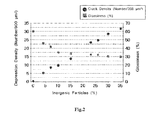
- the content of the inorganic particles is preferably 2 to 25% by weight based on the resin component that forms the resin layer. When the content of the inorganic particles is not less than 2% by weight, depressions can be efficiently formed, and when it is not more than 25% by weight, glossiness can be kept low, which are preferred.
- the resin layer by application of a coating solution to at least one side, preferably one surface, of the white film, and stretching in at least one direction and drying.
- a coating solution to the film after stretching it in one direction of the biaxial stretching and then stretch the film in the other direction for biaxial orientation.
- a method of applying a coating solution for example, a method such as gravure coating, roll coating, spin coating, reverse coating, bar coating, screen coating, blade coating, air knife coating, dipping, or the like can be used.
- depressions can be formed on the resin layer.
- the mechanism of formation of the depressions is thought to be as follows: depressions start from inorganic particles mentioned below, and interaction between the acrylic binder and the lithium salt inhibit the stretchability, resulting in appropriate depressions.
- the component constituting the resin layer in the present invention is not particularly limited as long as it has an adhesion to the white polyester film, which is a base layer, for example, polyester, polycarbonate, epoxy resin, alkyd resin, acrylic resin, urea resin, urethane resin, or the like can be suitably used.
- a base layer for example, polyester, polycarbonate, epoxy resin, alkyd resin, acrylic resin, urea resin, urethane resin, or the like can be suitably used.
- Two or more different resins for example, polyester and urethane resin, polyester and acrylic resin, or urethane resin and acrylic resin may be used in combination.
- Preferred are polyester, acrylic resin, and urethane resin, and acrylic resin is most preferred in terms of application uniformity.
- the composition of the coating solution for forming this resin layer may be any composition as long as depressions are formed, and when the resin layer is acrylic resin, a coating solution containing, for example, an acrylic binder, a lithium salt, inorganic particles, and a pH adjuster is preferred because depressions can be formed on the resin layer by applying the coating solution to a film surface during film formation and then stretching the resultant in the other direction.
- a coating solution containing, for example, an acrylic binder, a lithium salt, inorganic particles, and a pH adjuster is preferred because depressions can be formed on the resin layer by applying the coating solution to a film surface during film formation and then stretching the resultant in the other direction.
- acrylic binder is not particularly limited, and it is preferable to select and use acrylic resin or methacryl resin in order to provide miscibility with a lithium salt, application properties, and further adherence to a receptive layer.
- acrylic resins include copolymers selected from methyl methacrylate, ethyl acrylate, n-butyl acrylate, 2-hydroxyethyl acrylate, acrylamide, N-methylolacrylamide, glycidyl methacrylate, acrylic acid, and the like. These are available from DIC Corporation under the trade name WATERSOL and the like. More preferably, those which comprise a methylol group and/or a condensation reactant thereof are preferred.
- the cross-linking reaction of methylol groups can be controlled by pH, and the control of the cross-linking reaction allows efficient formation of depressions on a resin layer after application.
- These are available, for example, from NIPPON CARBIDE INDUSTRIES CO., INC. under the trade name Nikasol and SHOWA DENKO K.K. under the trade name Polysol.
- the content of the acrylic binder is preferably 50 to 88% by weight and more preferably 55 to 85% by weight based on the solid content in a coating solution, and preferably 35 to 88% by weight and more preferably 40 to 85% by weight based on the solid content other than inorganic particles in a coating solution.
- a coating solution that contains a lithium salt and/or a pH adjuster mentioned below is preferred in terms of depression formation.
- lithium salts include lithium hydroxide, lithium acetate, lithium sulfonate, lithium styrenesulfonate, lithium chloride, lithium carbonate, lithium, sulfate, and the like; sulfonic acid lithium salts are preferred, and more preferred is lithium styrenesulfonate.
- the amount thereof is preferably 4 to 40% by weight and more preferably 8 to 35% by weight based on the solid content in a coating solution, and preferably 8 to 25% by weight and more preferably 8 to 20% by weight based on the solid content other than inorganic particles in a coating solution.
- the coating solution in the present invention may contain inorganic particles.
- inorganic particles By containing inorganic particles, depressions start from the inorganic particles in the stretching process after application, and depressions can be efficiently formed on the resin layer.
- the type of inorganic particles is not particularly limited; for example, silica, alumina, barium sulfate, calcium carbonate, zeolite, kaolin, talc, aluminum hydroxide, aluminum oxide, zinc oxide, zinc sulfide, magnesium silicate, cerium oxide, magnesium oxide, calcium phosphate, mica, mica titanium, clay, calcium fluoride, or a mixture thereof can be used, and silica is preferred.
- the average particle size of the particles is preferably 50 nm to 500 nm and more preferably 200 to 400 nm.
- the average particle size described above is an average particle size measured using a Coulter counter (manufactured by Beckman Coulter, Inc., Multisizer II) by dispersing particles in a solvent that does not swell the particles.
- the shape of particles is not particularly restricted, and it may be spherical or elliptical.
- For the content of inorganic particles if it is 0 to 70% by weight based on the solid content other than the inorganic particles in a coating solution, aggregation of the inorganic particles can be kept small and glossiness becomes low enough for practical use, but it is preferably 5 to 25% by weight and more preferably 8 to 23% by weight.
- the acrylic binder is preferably 2 to 9 times and more preferably 2.5 to 7 times the lithium salt, and the acrylic binder is preferably 0.7 to 20 times, more preferably 2 to 17 times, and still more preferably 2.2 to 15 times the inorganic particles.
- the lithium salt is preferably 0.1 to 6 times, more preferably 0.2 to 6 times, still more preferably 0.3 to 8 times, and most preferably 0.5 to 6 times the inorganic particles.
- depressions can be formed on a resin layer in the stretching process after application by controlling the pH of the resin layer and coating solution.
- a preferred method for controlling the pH of the coating solution is to use the lithium salt mentioned above or a pH adjuster mentioned below.
- the pH adjuster in the present invention refers to a compound or a solvent for maintaining the surface pH of the resin layer mentioned below in a desired range. Specific examples thereof include acetic acid, triethylamine, dimethylaminopyridine, polyethyleneimine, sodium hydroxide, and the like.
- the resin layer cannot follow a stretching motion of a film during the stretching after application to thereby cause depressions, and therefore depressions are formed on the resin layer. By forming depressions on the surface, glossiness, an object of the present invention, can be reduced.
- the pH of the coating solution is preferably in the range of 9 to 11.2. When it is from 9 to 11.2, depressions are readily formed, which is preferred in terms of glossiness.
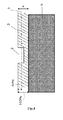
- the depressions (hollows) formed on the resin layer can reduce the gloss.
- at least five depressions with an area of 1 to 20 ⁇ m 2 need to be present per 900 ⁇ m 2 of film surface area.
- the depression herein refers to a depression that satisfies both of (I) and (II) below.
- the depression density can be controlled also by the surface pH of the resin layer. Taking the surface pH of the resin layer as P, and the number density of particles (number/ ⁇ m 2 ) in the resin layer as R, it is preferable to satisfy the following equations (1) to (3) in terms of glossiness and density of depressions. 7.1 ⁇ P ⁇ 8.5 0 ⁇ R ⁇ 5 R ⁇ 7.6 - P Further, it is more preferable to exclude the range where the following equations (4) and (5) are simultaneously satisfied in terms of glossiness. 0.3 ⁇ R ⁇ 0.7 7.1 ⁇ P ⁇ 7.5 Furthermore, when the following equations (6) and (7) are satisfied, the glossiness is in the lowest glossiness range, which is most preferred.
- the surface pH (P) in the equations described above can be controlled by coating solution pH.
- the pH of the coating solution can be controlled by the amount of the pH adjuster mentioned above.
- the number density of particles (R) can be controlled by the amount of the inorganic particles mentioned above.
- a solvent can be added to the extent that the object of the present invention is not impaired for the purpose of improving the handleability during coating and controlling the resin layer thickness.
- alcoholic solvents such as methanol, ethanol, and isopropyl alcohol, purified water, and the like.
- additives for example, cross-linking agents, surfactants, antifoaming agents, leveling agents, heat stabilizers, oxidation stabilizers, organic lubricants, fillers, nucleating agents, dyes, dispersants, and the like may be contained to the extent that the object of the present invention is not impaired.
- the white laminated film of the present invention preferably has a glossiness of not more than 45%, more preferably not more than 43%, and still more preferably not more than 40%.
- the degree of whiteness of the white laminated film is preferably 50% or more, preferably in the range of 60 to 100%, in terms of reflectance. The degree of whiteness is determined from the following equation by measuring XYZ values which represent tristimulus values of the color of a sample by the reflection method using a spectrophotometer SE-2000 manufactured by NIPPON DENSHOKU INDUSTORIES CO., LTD., which is designed based on Richard S.
- the thickness of the resin layer after biaxial stretching is 30 to 400 nm, preferably 50 to 200 nm, it is good enough for practical use, but it is more preferably 30 to 200 nm and still more preferably 50 to 160 nm.
- the thickness is thinner than 30 nm, falling off of the inorganic particles readily occurs, which is unfavorable.
- it is thicker than 200 nm the film undergoes large changes in color tone when the film is recovered, made into a chip for recycling, and formed into a film again, which is unfavorable.
- the surface roughness Rz (ten-point average roughness) on the resin layer-side of the biaxially-oriented white laminated polyester film is preferably 1.0 to 3.5 ⁇ m, more preferably 1.5 to 3.3 ⁇ m, and most preferably 2.0 to 3.3 ⁇ m.
- Rz ten-point average roughness
- polyester resin (a1) The process for producing a polyester resin (a1) will be described by way of an example, but it is not limited to such an example.
- antimony trioxide polymerization catalyst
- a polyethylene terephthalate pellet polyester resin (a1)
- polyester resin (a2) The process for producing a polyester resin (a2) will be described by way of an example, but it is not limited to such an example.
- terephthalic acid as a dicarboxylic acid component and C 4 -C 8 alicyclic diol as a diol component
- magnesium acetate, antimony trioxide, and phosphorous acid as catalysts is added in an amount of 300 ppm in terms of antimony atoms to carry out a polycondensation reaction, whereby a polyester resin (a2) formed by copolymerization of C 4 -C 8 alicyclic diol and terephthalic acid can be obtained.
- a mixture comprising the polyester resin (a1), the polyester resin (a2), the cyclic olefin copolymer resin (b1), the inorganic particles (B2), and a dispersant is thoroughly vacuum dried as required and fed to an heated extruder in a film forming apparatus having the extruder.
- the cyclic olefin copolymer resin (b1) and the inorganic particles (B2) may be added by using a master chip prepared in advance by uniform melt-kneading or may be fed directly to a knead extruder.
- the polyester resin component (a2) may be added when melt-kneading a mixture comprising the polyester resin (a1) and the cyclic olefin copolymer resin (b1) uniformly in advance and adding a master chip or may be fed directly to a knead extruder, and melt-kneading a mixture comprising the polyester resin (a1) and the cyclic olefin copolymer resin (b1) uniformly in advance and adding a master chip is more preferred because the dispersion of the cyclic olefin copolymer resin (b1) is promoted.
- melt extrusion it is preferable to obtain a melt sheet by filtration through a mesh filter having openings of 40 ⁇ m or less, followed by introduction into a T-die head and extrusion molding.
- the melt sheet is solidified by contact cooling on a drum, the surface temperature of which is cooled to 10 to 60°C, using static electricity to produce an unstretched monolayer film.
- the unstretched monolayer film is conducted to a group of rollers heated to a temperature of 70 to 120°C, stretched 2.5 to 4-fold in the longitudinal direction (machine direction, i.e., the travel direction of the film), and cooled with a group of rollers at a temperature of 20 to 50°C.
- Surface heating using an infrared ray heater may be performed during the stretching. Examples of such an infrared ray heater include Twin Tube transparent quartz glass carbon emitter produced by Heraeus K.K.
- the uniaxially stretched film is coated with a coating solution by in-line coating, further, conducted to a tenter with both ends of the film held by clips, and stretched 2.5 to 4-fold in the direction perpendicular to the longitudinal direction (the width direction) in the atmosphere heated to a temperature of 90 to 150°C.
- the stretching magnification is preferably 2 to 4-fold and more preferably 2.5 to 4-fold in the longitudinal direction and the width direction each.
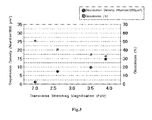
- the area magnification of the stretching magnification (the longitudinal stretching magnification ⁇ the transverse stretching magnification) is preferably 9 to 15-fold.
- the area magnification is less than 9-fold, a resulting biaxially stretched film will have an insufficient reflectance and film strength, and, on the other hand, when the area magnification is more than 15-fold, breakage tends to occur easily during the stretching.
- the biaxially stretched film After completion of crystal orientation of the biaxially stretched film obtained, in order to provide planarity and dimensional stability and to dry the coating solution, the biaxially stretched film is heat treated at a temperature of 150 to 240°C for 1 to 30 seconds continuously in the tenter, slowly cooled uniformly, and then cooled to room temperature. Thereafter, corona discharge treatment or the like is performed as required in order to further enhance adherence to other materials, and the biaxially stretched film is took up with a winder, whereby the white laminated film of the present invention can be obtained.
- relaxation treatment of 3 to 12% in the width direction or the longitudinal direction may be performed as required.
- the white laminated film of the present invention is preferably heat treated at a high temperature (190°C or higher) in the film forming process. This is because the white laminated film of the present invention desirably has constant thermal dimensional stability.
- the white laminated film of the present invention is sometimes used as a reflective film for a surface light source (backlight) installed, for example, in a liquid crystal display. This is because, depending on the backlight, the temperature of the atmosphere inside the backlight can increase to about 100°C.
- the cyclic olefin copolymer resin (b1) serving as a nucleating agent for generating depressions is less thermally deformable (does not crush) even upon heat treatment at a high temperature, and depressions can be formed on the resin layer; as a result, a film having excellent light resistance while maintaining high whiteness, reflectance properties, and lightweight properties can be obtained, which is preferred.
- the white laminated film of the present invention is a white film from which a white film with low glossiness can be produced readily and inexpensively in a stable manner and which has high reflectance properties and, in addition, excellent scratch resistance.
- examples of the preferred application of the white laminated film of the present invention include a plate-like material that is incorporated into a surface light source for light reflection.
- the white laminated film of the present invention is preferably used as a reflecting plate for edge light for a liquid crystal screen, a reflecting plate for a surface light source of direct-type light, a reflector around a cold cathode fluorescent lamp, and the like.
- a cross section of a white laminated film was observed under ⁇ 500 to 5,000 magnification using a field-emission scanning electron microscope "JSM-6700F" (manufactured by JEOL Ltd.) to take a cross-section photograph, from which the thickness of the white film was measured.
- the measurement was made at arbitrarily selected five points, and the mean value was used as a white film thickness.
- the thickness of the resin layer was measured from a distance from the white film surface to the resin layer surface of the cross-section photograph obtained. Because of the presence of irregularities on the resin layer surface, the measurement was made at ten points per one cross-section photograph at intervals of 1 ⁇ m at areas other than protruding portions due to the inorganic particles and hollow portions of depressions. This measurement was made for five photographs, and the mean value of 50 points in total was used as a resin layer thickness.
- a ⁇ 60 integrating sphere 130-0632 (Hitachi Ltd.) (with an inner surface made of barium sulfate) and a 10° inclined spacer were installed in a spectrophotometer U-3410 (Hitachi Ltd.), in which conditions an optical reflectance at 560 nm was determined.
- the value determined by measurement from the resin layer side of the white laminated film was used as a reflectance of the white film.
- a part number 210-0740 (aluminum oxide) available from Hitachi Instruments Service Co., Ltd. was used as a reference white plate.
- a taking-up roll of a winder after transverse stretching was visually observed, and assessment was made according to the criteria below.
- a film sample was left to stand in the ordinary state (temperature 23°C, relative humidity 65%) for 24 hours, and then a surface pH was measured using a pH meter available from HORIBA, Ltd. "COMPACT pH meter twin pH (type B-212)" by the following method.
- Ultrapure water with (23°C) a pH of 7.0 in an amount of 1.0 ml was added dropwise to a sensor to cover the sensor with ultrapure water. Then, a sample that had been cut into a rectangle of 5 ⁇ 15 mm such that two electrodes of the sensor part was covered was set such that a coating surface was in contact with droplets, and a measurement value after 1 minute was read out at a temperature of 23°C and a relative humidity of 65%.
- five from some of the film samples prepared were cut into the above size, and each of the five samples were measured once; the mean value was used as a surface pH value.
- a pH of a coating solution was measured using a pH meter available from HORIBA, Ltd. "COMPACT pH meter twinpH (type B-212)" by the following method.
- a prepared coating solution (23°C) in an amount of 1.0 ml was added dropwise to a sensor to cover the sensor with the coating solution, and a measurement value after 1 minute was read out at a temperature of 23°C and a relative humidity of 65%. The measurement was made five times in a similar manner, and the mean value was used as a pH value of the coating solution.
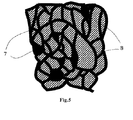
- the resin layer-side surface of the white laminated film was observed under ⁇ 5,000 magnification using a field-emission scanning electron microscope "JSM-6700F" (manufactured by JEOL Ltd.) to take a photograph, from which the particle number in a visual field area of 10 ⁇ m square was counted, and the particle number per ⁇ m 2 was calculated.
- JSM-6700F field-emission scanning electron microscope
- the calculation was carried out in a similar manner at different five visual fields, and the mean value of the values was used as a number density of particles. For aggregation parts where 10 or more particles per 2 ⁇ m square are aggregated when observed in a surface photograph, the value three times the number observed on the surface shall be counted.
- An atomic force microscope was used to scan an image at an area of 100- ⁇ m square measured view of 10000 ⁇ m 2 on the resin layer-side surface of the biaxially-oriented white laminated polyester film.
- AFM atomic force microscope
- a three-dimensional surface roughness was calculated by Off-Line Roughness Analysis to determine a ten-point average roughness Rz. Further, the measurement was made in a similar manner at five visual fields in different areas, and Rz was calculated by the mean value of the values.
- the measurement conditions are as follows:
- antimony trioxide (polymerization catalyst) was added in an amount of 300 ppm in terms of antimony atoms relative to a resulting polyester pellet to carry out a polycondensation reaction, whereby a polyethylene terephthalate pellet (PET) with a limiting viscosity of 0.63 dl/g and a terminal carboxyl group amount of 40 equivalents/ton was obtained.
- PET polyethylene terephthalate pellet
- the heat of crystal fusion was measured to be not less than 4.186 J/g, showing that the polyethylene terephthalate pellet was a crystalline polyester resin.
- the melting point Tm of this resin was measured to be 250°C.
- a cyclic olefin resin "TOPAS” (available from Polyplastics Co., Ltd.) having a glass transition temperature of 178°C and a melt volume rate MVR (260°C/2.16 kg) of 4.5 ml/10 mim was used.
- the heat of crystal fusion was measured to be less than 4.186 J/g, showing that the cyclic olefin resin was an amorphous resin.
- Titanium oxide available from ISHIHARA SANGYO KABUSHIKI KAISHA, LTD., rutile-type titanium dioxide R-980, average particle size 0.24 ⁇ m).
- CHDM (cyclohexanedimethanol) copolymerized PET was used as other additives.
- the heat of crystal fusion was measured to be less than 4.186 J/g, showing that the CHDM copolymerized PET was an amorphous resin.
- CHDM (cyclohexanedimethanol) copolymerized PET was used as other additives.
- the heat of crystal fusion was measured to be less than 4.186 J/g, showing that the CHDM copolymerized PET was an amorphous resin.
- isophthalic acid copolymerized PET was used as other additives.
- the heat of crystal fusion was measured to be less than 4.186 J/g, exhibiting amorphous properties.
- PBT-PAG polybutylene terephthalate-polyalkylene glycol block copolymer
- the resin is a block copolymer of PBT and PAG (mainly, polytetramethylene glycol).
- PAG mainly, polytetramethylene glycol
- WATERSOL PW-1100 (available from DIC Corporation, 45% by weight solution) was diluted with purified water to a 35% by weight solution.
- Nikasol A-08 available from NIPPON CARBIDE INDUSTRIES CO., INC., 35% by weight solution
- Lithium polystyrenesulfonate available from TOSOH ORGANIC CHEMICAL CO., LTD., "SPINOMAR” (registered trademark) LiSS, 16% by weight solution).
- Ammonium polystyrenesulfonate available from TOSOH ORGANIC CHEMICAL CO., LTD., "SPINOMAR” (registered trademark) AmSS, 16% by weight solution).
- a mixture of materials shown in Tables 1 to 4 was vacuum-dried at a temperature of 180°C for 3 hours and then fed to an extruder. After melt extrusion at a temperature of 280°C, the mixture was filtered through a 30- ⁇ m cut filter, and then introduced into a T-die head.
- the mixture was extruded from inside the T-die head into a sheet form to obtain a melt monolayer sheet, and the melt monolayer sheet was solidified by contact cooling on a drum, the surface temperature of which was maintained at 25°C, using the electrostatic application method to obtain an unstretched monolayer film.
- the unstretched monolayer film was stretched 3.6-fold in the longitudinal direction (machine direction) while being irradiated by a infrared ray heater (output: 1.4 kW, distance from the film: 15 mm, irradiation time: 0.72 sec) from both sides, and cooled with a group of rollers at a temperature of 25°C to obtain a uniaxially stretched film.
- the drum-contacting side of the unstretched laminated film was subjected to corona discharge treatment in air, and a coating solution for forming a coated layer described below was applied to the treated surface by the bar coating method using a metering bar.
- the uniaxially stretched film coated with the coating solution for forming a coated layer described above was conducted to a preheating zone at 110°C in a tenter with both ends held by clips, dried while being subjected to 5% slight stretching, and then successively and continuously stretched 3.5-fold in the direction perpendicular to the longitudinal direction (transverse direction) in a heating zone at 120°C.
- the film was subjected to heat treatment of 220°C in a heat treatment zone in the tenter, further, subjected to 4% relaxation treatment at 180°C in the transverse direction, followed by further 1% relaxation treatment at 110°C, and then took up after uniform slow cooling to thereby obtain a white film having the degree of whiteness of 86.0% in which a coated layer with a thickness of 150 nm was provided on a film with a thickness of 188 ⁇ m.
- the composition and production conditions of the film are as shown in Tables 1 to 4.
- the evaluation results of physical properties are shown in Tables 5 and 6.
- each component described above was formulated based on the formulation ratio value in Tables 1 to 4 such that the solid content ratio was as shown in Tables 1 to 4, and purified water was used to make an adjustment such that the solid content concentration after formulation was 6.0%.
- the solid content ratio (% by weight) of each component was calculated based on the total weight of G, K, H, J, and L, components other than the inorganic particles (I).
- the above-described coating agents G, K, H, J, I, and L were formulated into a vessel containing weighed purified water in the order mentioned. After the formulation, the formulation was stirred with a universal stirrer for 10 minutes, and then the coating solution was adjusted.
- Films were produced in the same manner as in Example 1 using the film composition, production conditions, and coating solution composition shown in Tables 1 and 3. The evaluation results of physical properties are shown in Table 5.
- Example 1 Composition of White Film Stretching Composition of Coating Solution (a) (b1) (B2) Other Additives Longitudinal Stretching Transverse Stretching Solid Content Ratio (% by weight) Content (% by weight) Content (% by weight) Content (% by weight) Type Content (% by weight) Magnification (fold) Magnification (fold) G K H J I L
- Example 1 80 5 15 3.6 3.5 70.1 0.0 19.9 0.0 10.0 0.0
- Example 2 75 5 15 (C) 5 3.6 3.5 70.1 0.0 19.9 0.0 10.0 0.0
- Example 3 75 5 15 (D) 5 3.6 3.5 70.1 0.0 19.9 0.0 10.0 0.0
- Example 4 75 5 15 (E) 5 3.6 3.5 70.1 0.0 19.9 0.0 10.0 0.0
- Example 5 75 5 15 (F) 5 3.6 3.5 70.1 0.0 19.9 0.0 10.0 0.0
- Example 6 80 5 15 3.6 3.5 62.3 0.0 17.7 0.0 20.0 0.0
- Example 7 80 5 15 3.6
- Example 1 Film Thickness ( ⁇ m) Resin Layer (Coating Layer) Thickness (nm) Coating Solution pH Glossiness (%) Depression Density (Number/900 ⁇ m 2 ) Surface pH (P) Number Density of Particles (Number/ ⁇ m 2 ) Relative Reflectance (%) Surface Roughness Rz Line Contamination
- Example 1 188 150 7.5 35.1 9.8 7.3 0.8 100.5 1.25 A
- Example 2 188 150 7.5 34.8 10.0 7.2 0.8 100.9 1.28 A
- Example 3 188 150 7.5 34.5 10.6 7.2 0.8 100.8 1.27
- Example 4 188 150 7.5 34.7 10.2 7.3 0.8 101.1 1.26
- Example 5 188 150 7.5 36.1 9.8 7.2 0.8 101.0 1.25 A
- Example 6 188 150 7.5 32.8 17.8 7.3 1.7 100.4 1.45
- Example 7 188 150 7.5 45.8 5.2 7.5 0.4 100.6 1.08
- Example 8 188 150 7.5 41.8 8.
Landscapes
- Physics & Mathematics (AREA)
- General Physics & Mathematics (AREA)
- Optics & Photonics (AREA)
- Laminated Bodies (AREA)
- Optical Elements Other Than Lenses (AREA)
Applications Claiming Priority (2)
| Application Number | Priority Date | Filing Date | Title |
|---|---|---|---|
| JP2010190458 | 2010-08-27 | ||
| PCT/JP2011/068924 WO2012026445A2 (ja) | 2010-08-27 | 2011-08-23 | 白色積層フィルムの製造方法および白色積層ポリエステルフィルム |
Publications (1)
| Publication Number | Publication Date |
|---|---|
| EP2610651A2 true EP2610651A2 (de) | 2013-07-03 |
Family
ID=45723873
Family Applications (1)
| Application Number | Title | Priority Date | Filing Date |
|---|---|---|---|
| EP11819908.2A Withdrawn EP2610651A2 (de) | 2010-08-27 | 2011-08-23 | Verfahren zur herstellung eines weissschichtfilms und weissschicht-polyesterfilm |
Country Status (6)
| Country | Link |
|---|---|
| EP (1) | EP2610651A2 (de) |
| JP (1) | JP5970815B2 (de) |
| KR (1) | KR101816614B1 (de) |
| CN (1) | CN103080784B (de) |
| TW (1) | TWI554403B (de) |
| WO (1) | WO2012026445A2 (de) |
Families Citing this family (9)
| Publication number | Priority date | Publication date | Assignee | Title |
|---|---|---|---|---|
| JP5716507B2 (ja) * | 2011-04-12 | 2015-05-13 | 大日本印刷株式会社 | 面光源装置、及び画像表示装置 |
| JP2014126585A (ja) * | 2012-12-25 | 2014-07-07 | Kao Corp | カラーフィルター用顔料分散体の製造方法 |
| WO2016204234A1 (ja) * | 2015-06-17 | 2016-12-22 | 東レ株式会社 | 反射フィルムおよび面光源装置用反射ユニット |
| KR102004088B1 (ko) * | 2018-03-06 | 2019-07-25 | 도레이첨단소재 주식회사 | 백색 폴리에스테르 반사필름 및 이를 이용한 반사 시트 및 이의 제조방법 |
| KR102231849B1 (ko) * | 2019-03-28 | 2021-03-25 | 도레이첨단소재 주식회사 | 이축 배향 폴리에스테르 반사필름 및 그 제조방법 |
| CN110783512B (zh) * | 2019-10-17 | 2022-01-28 | 江苏海基新能源股份有限公司 | 一种锂离子电池用可溶解型双氟磺酰亚胺锂/硅酸镁锂涂覆隔膜及其制备方法 |
| CN111045123A (zh) * | 2019-12-25 | 2020-04-21 | 合肥乐凯科技产业有限公司 | 一种反射膜及复合导光结构 |
| KR102510619B1 (ko) * | 2021-02-23 | 2023-03-15 | 도레이첨단소재 주식회사 | 이축 연신 폴리에스테르 무광택 필름 및 이의 제조방법 |
| CN113621159A (zh) * | 2021-08-23 | 2021-11-09 | 合肥乐凯科技产业有限公司 | 一种反光膜及其制备方法 |
Family Cites Families (13)
| Publication number | Priority date | Publication date | Assignee | Title |
|---|---|---|---|---|
| JP2737881B2 (ja) * | 1988-06-24 | 1998-04-08 | 東レ株式会社 | 積層ポリエステルフイルム |
| JPH11286092A (ja) * | 1998-04-02 | 1999-10-19 | Toray Ind Inc | 積層ポリエステルフィルムおよびその製造方法 |
| JP2001266629A (ja) * | 2000-03-24 | 2001-09-28 | Kimoto & Co Ltd | 反射フィルム |
| JP3835249B2 (ja) * | 2001-10-29 | 2006-10-18 | 東レ株式会社 | 感熱転写記録用白色積層ポリエステルフィルム |
| JP2003270415A (ja) * | 2002-03-13 | 2003-09-25 | Taisei Laminator Co Ltd | 光反射シートおよび光反射シートを用いた面状光源装置 |
| JP2004090523A (ja) | 2002-09-02 | 2004-03-25 | Toray Ind Inc | 感熱転写記録用白色積層ポリエステルフィルムおよび感熱転写記録媒体 |
| KR101097136B1 (ko) * | 2003-12-26 | 2011-12-22 | 도레이 카부시키가이샤 | 감열전사기록용 2축배향 백색 폴리프로필렌 필름 및그것으로 이루어지는 감열전사기록용 수용시트 |
| JP4563822B2 (ja) * | 2005-01-05 | 2010-10-13 | 帝人デュポンフィルム株式会社 | 二軸配向積層フィルム |
| CN101443193B (zh) * | 2006-05-16 | 2013-08-28 | 东丽株式会社 | 双轴取向白色聚丙烯膜、反射板和热敏转印记录用载片 |
| WO2008093623A1 (ja) * | 2007-01-31 | 2008-08-07 | Toray Industries, Inc. | 白色ポリエステルフィルムおよび反射シート |
| JP5239448B2 (ja) * | 2007-06-04 | 2013-07-17 | 東レ株式会社 | 帯電防止性白色ポリエステルフィルム |
| JP5115083B2 (ja) * | 2007-08-08 | 2013-01-09 | 東レ株式会社 | 液晶ディスプレイ反射板用白色ポリエステルフイルム |
| US20100285302A1 (en) * | 2007-12-26 | 2010-11-11 | Toray Industries, Inc. | White laminated polyester film for reflecting sheet |
-
2011
- 2011-08-23 EP EP11819908.2A patent/EP2610651A2/de not_active Withdrawn
- 2011-08-23 KR KR1020137004647A patent/KR101816614B1/ko not_active Expired - Fee Related
- 2011-08-23 JP JP2011546493A patent/JP5970815B2/ja not_active Expired - Fee Related
- 2011-08-23 WO PCT/JP2011/068924 patent/WO2012026445A2/ja not_active Ceased
- 2011-08-23 CN CN201180041494.2A patent/CN103080784B/zh not_active Expired - Fee Related
- 2011-08-26 TW TW100130600A patent/TWI554403B/zh not_active IP Right Cessation
Non-Patent Citations (1)
| Title |
|---|
| See references of WO2012026445A2 * |
Also Published As
| Publication number | Publication date |
|---|---|
| WO2012026445A2 (ja) | 2012-03-01 |
| JPWO2012026445A1 (ja) | 2013-10-28 |
| KR20130108268A (ko) | 2013-10-02 |
| KR101816614B1 (ko) | 2018-01-09 |
| CN103080784A (zh) | 2013-05-01 |
| JP5970815B2 (ja) | 2016-08-17 |
| CN103080784B (zh) | 2015-04-15 |
| TW201219213A (en) | 2012-05-16 |
| TWI554403B (zh) | 2016-10-21 |
Similar Documents
| Publication | Publication Date | Title |
|---|---|---|
| EP2610651A2 (de) | Verfahren zur herstellung eines weissschichtfilms und weissschicht-polyesterfilm | |
| EP2077458A1 (de) | Weisser polyesterfilm für eine lichtreflexionsplatte | |
| JP3946183B2 (ja) | 白色ポリエステルフィルム | |
| JP2011209499A (ja) | 面光源反射板用白色ポリエステルフィルム及びそれを用いた液晶ディスプレイ用面光源反射板 | |
| CN102686653B (zh) | 白色膜和使用该白色膜的面光源 | |
| JP6295664B2 (ja) | 液晶ディスプレイ用白色ポリエステルフィルム、その製造方法及び液晶ディスプレイ用バックライト | |
| JP2019116099A (ja) | ポリエステルフィルム | |
| TWI679119B (zh) | 聚酯薄膜 | |
| JP6119343B2 (ja) | 空洞含有ポリエステルフィルム | |
| CN107615109B (zh) | 白色反射膜 | |
| JP2013120313A (ja) | 白色ポリエステルフィルム | |
| JP2012137618A (ja) | 面光源反射板用白色ポリエステルフィルム | |
| CN1968813B (zh) | 反射板用积层膜 | |
| JP5817165B2 (ja) | 反射板用白色積層ポリエステルフィルムおよびバックライト装置 | |
| JP4933737B2 (ja) | 積層ポリエステルフィルム | |
| JP2014065817A (ja) | 2軸延伸フィルム | |
| CN107111014B (zh) | 直下型面光源用白色反射膜及使用该膜的直下型面光源 | |
| JP2018125117A (ja) | エッジライト型バックライト用白色反射フィルム及びそれを用いた液晶ディスプレイ用バックライト | |
| JP2012051960A (ja) | 白色フィルム | |
| JP2017027034A (ja) | エッジライト型バックライト用白色反射フィルム及びそれを用いた液晶ディスプレイ用バックライト | |
| WO2016035536A1 (ja) | 液晶ディスプレイ用白色ポリエステルフィルム、およびそれを用いた液晶ディスプレイ用バックライト | |
| JP2016110120A (ja) | 白色ポリエステルフィルム |
Legal Events
| Date | Code | Title | Description |
|---|---|---|---|
| PUAI | Public reference made under article 153(3) epc to a published international application that has entered the european phase |
Free format text: ORIGINAL CODE: 0009012 |
|
| 17P | Request for examination filed |
Effective date: 20130218 |
|
| AK | Designated contracting states |
Kind code of ref document: A2 Designated state(s): AL AT BE BG CH CY CZ DE DK EE ES FI FR GB GR HR HU IE IS IT LI LT LU LV MC MK MT NL NO PL PT RO RS SE SI SK SM TR |
|
| DAX | Request for extension of the european patent (deleted) | ||
| STAA | Information on the status of an ep patent application or granted ep patent |
Free format text: STATUS: THE APPLICATION IS DEEMED TO BE WITHDRAWN |
|
| 18D | Application deemed to be withdrawn |
Effective date: 20180301 |
|
| R17D | Deferred search report published (corrected) |
Effective date: 20120301 |