EP2391455B1 - Production of nanoparticles with high repetition rate ultrashort pulsed laser ablation in liquids - Google Patents
Production of nanoparticles with high repetition rate ultrashort pulsed laser ablation in liquids Download PDFInfo
- Publication number
- EP2391455B1 EP2391455B1 EP09839437.2A EP09839437A EP2391455B1 EP 2391455 B1 EP2391455 B1 EP 2391455B1 EP 09839437 A EP09839437 A EP 09839437A EP 2391455 B1 EP2391455 B1 EP 2391455B1
- Authority
- EP
- European Patent Office
- Prior art keywords
- target
- nanoparticles
- pulsed laser
- repetition rate
- liquid
- Prior art date
- Legal status (The legal status is an assumption and is not a legal conclusion. Google has not performed a legal analysis and makes no representation as to the accuracy of the status listed.)
- Not-in-force
Links
Images
Classifications
-
- B—PERFORMING OPERATIONS; TRANSPORTING
- B02—CRUSHING, PULVERISING, OR DISINTEGRATING; PREPARATORY TREATMENT OF GRAIN FOR MILLING
- B02C—CRUSHING, PULVERISING, OR DISINTEGRATING IN GENERAL; MILLING GRAIN
- B02C19/00—Other disintegrating devices or methods
- B02C19/18—Use of auxiliary physical effects, e.g. ultrasonic waves or irradiation, for disintegrating
-
- B—PERFORMING OPERATIONS; TRANSPORTING
- B01—PHYSICAL OR CHEMICAL PROCESSES OR APPARATUS IN GENERAL
- B01J—CHEMICAL OR PHYSICAL PROCESSES, e.g. CATALYSIS OR COLLOID CHEMISTRY; THEIR RELEVANT APPARATUS
- B01J13/00—Colloid chemistry, e.g. the production of colloidal materials or their solutions, not otherwise provided for; Making microcapsules or microballoons
- B01J13/0004—Preparation of sols
- B01J13/0043—Preparation of sols containing elemental metal
-
- B—PERFORMING OPERATIONS; TRANSPORTING
- B01—PHYSICAL OR CHEMICAL PROCESSES OR APPARATUS IN GENERAL
- B01J—CHEMICAL OR PHYSICAL PROCESSES, e.g. CATALYSIS OR COLLOID CHEMISTRY; THEIR RELEVANT APPARATUS
- B01J19/00—Chemical, physical or physico-chemical processes in general; Their relevant apparatus
- B01J19/08—Processes employing the direct application of electric or wave energy, or particle radiation; Apparatus therefor
- B01J19/12—Processes employing the direct application of electric or wave energy, or particle radiation; Apparatus therefor employing electromagnetic waves
- B01J19/121—Coherent waves, e.g. laser beams
-
- B—PERFORMING OPERATIONS; TRANSPORTING
- B22—CASTING; POWDER METALLURGY
- B22F—WORKING METALLIC POWDER; MANUFACTURE OF ARTICLES FROM METALLIC POWDER; MAKING METALLIC POWDER; APPARATUS OR DEVICES SPECIALLY ADAPTED FOR METALLIC POWDER
- B22F1/00—Metallic powder; Treatment of metallic powder, e.g. to facilitate working or to improve properties
- B22F1/05—Metallic powder characterised by the size or surface area of the particles
- B22F1/054—Nanosized particles
- B22F1/0545—Dispersions or suspensions of nanosized particles
-
- B—PERFORMING OPERATIONS; TRANSPORTING
- B22—CASTING; POWDER METALLURGY
- B22F—WORKING METALLIC POWDER; MANUFACTURE OF ARTICLES FROM METALLIC POWDER; MAKING METALLIC POWDER; APPARATUS OR DEVICES SPECIALLY ADAPTED FOR METALLIC POWDER
- B22F9/00—Making metallic powder or suspensions thereof
- B22F9/02—Making metallic powder or suspensions thereof using physical processes
- B22F9/04—Making metallic powder or suspensions thereof using physical processes starting from solid material, e.g. by crushing, grinding or milling
-
- B—PERFORMING OPERATIONS; TRANSPORTING
- B82—NANOTECHNOLOGY
- B82Y—SPECIFIC USES OR APPLICATIONS OF NANOSTRUCTURES; MEASUREMENT OR ANALYSIS OF NANOSTRUCTURES; MANUFACTURE OR TREATMENT OF NANOSTRUCTURES
- B82Y30/00—Nanotechnology for materials or surface science, e.g. nanocomposites
-
- B—PERFORMING OPERATIONS; TRANSPORTING
- B22—CASTING; POWDER METALLURGY
- B22F—WORKING METALLIC POWDER; MANUFACTURE OF ARTICLES FROM METALLIC POWDER; MAKING METALLIC POWDER; APPARATUS OR DEVICES SPECIALLY ADAPTED FOR METALLIC POWDER
- B22F2999/00—Aspects linked to processes or compositions used in powder metallurgy
Definitions
- This invention relates to pulsed laser ablation and nanoparticle generation.
- these additional chemical ingredients can negatively affect the performance.
- the stabilizing surfactants that are added during the production process can reduce the ability of gold nanoparticles to bind with those molecules that functionalize the nanoparticles for the intended application.
- the catalytic activities of nanoparticles can be reduced by the chemical stabilizers, which reduce the effective surface area of nanoparticles exposed to the reactions.
- One of the physical methods to produce metal nanoparticles is pulsed laser ablation in liquids [Ref. 3-6].
- a pulsed laser beam is focused on the surface of a target that is submerged in a liquid.
- the ablated material re-nucleates in the liquid and form nanoparticles.
- This is a practically very simple and economic method.
- stabilizing chemical agents need to be added in the liquid during the ablation process [Ref. 6].
- tunable plasmon resonant frequency For applications in photonics, another issue is to obtain tunable plasmon resonant frequency, primarily with gold nanoparticles.
- One suggested way is to vary the gold nanoparticle sizes, but the amount of shift of the resonant frequency is limited.
- An alternative way is to form alloy nanoparticles. It is expected that by adjusting the alloy composition, other physical properties such as plasmon resonance wavelength can be tuned accordingly. Again, the issue of preventing particle aggregation needs to be addressed in both chemical and physical methods of making alloy nanoparticles.
- Laser power and pulse repetition rate are factors that limit production speed.
- the repetition rate can be particularly relevant because the amount of material removed by each laser shot is limited by the target material's absorption length at the laser wavelength.
- Standard solid state pulsed lasers such as Nd:YAG and Ti:Sapphire have very high pulse energy, ranging from milli-Joule to Joule, but a limited pulse repetition rate, ranging from 10 Hz to 1 kHz.
- the long irradiation time in the second step further limits the production rate.
- a stable colloid refers to a colloid having nanoparticles that do not aggregate during an extended time period after production.
- Such an extended time period may be at least one week, and more preferably longer than one month.
- a red color of a gold colloid will be preserved for at least one month, and the colloid may be characterized with optical absorption spectroscopy measurements.
- a chemically pure colloid refers to a colloid that contains only a liquid and nanoparticles. Such a chemically pure colloid does not require an additional chemical agent to prevent aggregation among nanoparticles, and does not require such a chemical to stabilize the colloid against coagulation.
- a chemically pure gold-water colloid contains only water and gold nanoparticles, and is substantially free of stabilizing agents, such as a polymer, surfactant, ligand, or similar agents.
- a desirable advancement for production of metal or metal-alloy nanoparticles avoids coagulation, eliminates a requirement for any stabilizing agent, and provides for rapid throughput.
- the problems include but are not limited to colloid stability, colloid purity, variable plasmon resonance, and production rate.
- At least one embodiment provides a physical method of producing nanoparticles, for example metal or metal-alloy nanoparticles, with ultrashort pulsed laser ablation in liquids.
- At least one embodiment includes a method of producing nanoparticle colloids.
- the method includes generating pulsed laser beams at a repetition rate.
- the pulsed laser beams irradiate a target disposed in liquid that is substantially transparent at a wavelength of the pulsed laser beams.
- the target comprises a source material for production of metal or metal-alloy nanoparticles.
- the method includes producing liquid flow, relative motion between the pulsed laser beams and the target, or both.
- At least one embodiment includes a system for carrying out the above method.
- At least one disclosure provides a product comprising a colloid that does not coagulate during an extended time period, for example at least one week.
- the colloid does not contain stabilizing chemical agents.
- At least one disclosure provides a product comprising metal or metal alloy nanoparticles collected from colloids.
- the colloids do not coagulate during an extended time period, for example at least one week.
- the colloid does not contain stabilizing chemical agents.
- the method of producing nanoparticle colloids of the invention is as disclosed in claim 1.
- the system of the invention is as disclosed in claim 11.
- colloids may consist of liquid and nanoparticles, and the nanoparticles may comprise at least one of a metal and metal alloy.
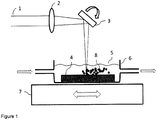
- FIG. 1 schematically illustrates a portion of laser-based system for producing nanoparticles in a liquid.
- laser beam 1 is received from a ultrashort pulse source (not shown), focused by lens 2, and guided by a mechanism for rapid movement of a beam, for example a vibration mirror 3, to a target 4.
- the target is submerged several millimeters below the surface of a liquid 5 that is contained in a container 6, and is preferably submerged less than 1 cm.
- the container 6 is placed on a motion stage 7, for example a translation stage.
- Liquid flow is introduced through the container so that the nanoparticles 8 can be carried away and collected elsewhere. The flow of liquid also cools the laser focal volume.
- the liquid is preferably de-ionized water having resistivity preferably greater than 1 M ohm.cm.
- the liquid may be distilled water, or another suitable liquid.
- a controller (not shown) is operatively coupled to the pulsed source, motion system, and/or circulation system. The controller coordinates beam delivery, liquid flow, and motion. The controller may also be coupled to a system computer, user interface, telecommunication equipment, and/or other standard devices, and configured so as to be programmed from a remote location.
- a laser for nanoparticle generation may have a wavelength of about 1.03 um (a layer of water of a few millimeters has negligible absorption at this wavelength), a pulse energy in the range of about 1 to 10 micro-Joule.
- a pulse duration of about 500 fs, and in the range of 100 femtoseconds to 10 ps, may be used without significantly affecting the formation of nanoparticles.
- a pulse repetition rate may be in the range of about 100 kHz to 5 MHz.
- Water flow, beam movement, or both may be used to avoid heat accumulation at the high repetition rate.
- a vibration mirror 3 is configured for fast rastering or other movement of the laser beam on the target surface.
- the mirror vibration frequency is preferably larger than 10 Hz with angular amplitude preferably larger than 1 mrad. Rastering speed on the target surface greater than 0.01 m/s may be provided.
- Such a mirror can be a piezo-driven mirror, a galvanometer mirror, or other suitable apparatus for beam movement.
- Water flow can be introduced to the container by a circulation system, with flow speed preferably greater than 10 ml/s.
- a circulation system When a circulation system is not available, introducing lateral vibration movement can also cause water flow locally across the ablation spot.
- motion stage 7 may be moved in a direction perpendicular to the laser beam as indicated in Figure 1 .
- the vibration stage preferably has a vibration frequency of several Hz and amplitude of several millimeters.
- stable and chemically pure colloids are produced by controlling both the laser parameters and the liquid flow.
- Laser parameters include pulse duration, pulse energy, pulse repetition rate, and beam movement.
- Ultrashort pulse widths are preferred.
- an ultrashort pulse duration for example in the range of a few picoseconds to several hundreds of femtoseconds, enhances ablation efficiency as a result of very high peak power and a small heat-affected zone.
- a high pulse repetition rate for example at least about 100 KHz, is employed, for at least three reasons.
- the first is the multiple pulse effect in high repetition rate pulsed laser ablation. With a pulse separation of less than 10 micro-seconds (i.e., a high repetition rate greater than 100 kHz), the ablated material, before drifting away from the laser focal volume, will receive multiple laser shots and become highly charged.
- the inventors discovered stable nanoparticle colloids can be made at such high repetition rates without adding additional stabilizing chemical agents.
- the second reason is that upon ablation by multiple pulses, fragmentation of large particles can happen, resulting in a size distribution dominated by nanoparticles.
- the third reason is a high production rate that benefits from a high repetition rate.
- the inventors also discovered fast rastering of the laser beam during ablation is beneficial with high repetition rate operation. For example, without such fast rastering of the laser beam, the stream of nanoparticles produced by the leading laser pulses will eventually block the subsequent laser pulses by scattering and absorption. More importantly, accumulated heating of the water due to the high repetition rate can also induce nanoparticle coagulation.
- liquid motion is also useful in making stable nanoparticles.
- a dispersed suspension of nanoparticles in water is essentially in a metastable state, i.e., a kinetically stable state instead of a thermodynamically stable state.
- Flowing the liquid during production helps to reduce nanoparticle thermal movement that may overcome the kinetic barrier of coagulation.
- fast rastering of the laser beam is also beneficial for reducing nanoparticle thermal motion.
- Some embodiments provide nanoparticles with various plasmon resonance wavelengths. This can be achieved by using metal alloy targets. Earlier studies [Ref. 8] showed that for binary alloys such as NiFe, low fluence ablation near the ablation threshold generates nanoparticles that have the same alloy composition as the original alloy target. Based on these studies, various embodiments employ binary alloy targets and provide a method of making alloy nanoparticles with various compositions and accordingly various plasmon resonance frequencies.
- group IB elements Au, Ag, Cu and their alloys are used as demonstration examples.
- the examples are non-limiting and other metals and metal-alloys may be utilized in various embodiments.
- precious metals may be utilized.
- Such metals include, but are not limited to, platinum, palladium, and alloys containing platinum or palladium.
- Suitable metal or metal-alloy targets are modified with ultrashort pulses. Most preferably, the target material is nonreactive with the liquid, and not oxidized by water or other liquid during laser processing.
- ablation threshold and other laser parameters for ablating other metals will vary to a degree from those of Au as discussed herein; colloids of these metals, or metal-alloys thereof, are within the scope of the present invention
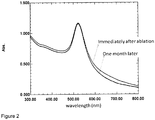
- Figure 2 shows two absorption spectra of a gold nanoparticle colloid made with high repetition rate, ultrashort laser ablation as disclosed above, and measured after one month to determine stability.
- the two spectra are nearly identical near the resonance peak, demonstrating the high stability of the colloid.
- the inventors also produced gold nanoparticle colloids that were stable for an extended time period of about eight months without coagulation.
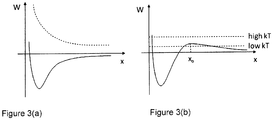
- Figure 3 schematically illustrates two cases of an interaction potential W as a function of distance x between two small particles in a liquid.
- the solid curve in Figure 3(a) illustrates an attractive potential, which in the case of gold particles in water, can be due to (i) the attractive Van de Waals force between gold nanoparticles and (ii) the hydrophobic interaction between gold surface and water, which prefers particle aggregation in order to reduce interfacial energy. If the particles are charged, a Coulomb repulsion, illustrated by the dashed curve, exists between the particles.
- the sum of the two opposite potentials is illustrated in Figure 3(b) , where the positive (i.e., repulsive) barrier near a certain distance x o will serve to prevent particle aggregation.
- Nanoparticle charge may result from a multiple pulse effect in a high repetition rate pulsed laser ablation.
- each single laser shot when sufficiently intense will produce a mixture of ions, electrons, neutrals, and particles, often referred to as "plume".
- Such a mixture may be produced when the laser intensity is above the ablation threshold.
- plume produced by a single laser shot the charge mostly resides in the vapor part, while the solid portion, specifically the nanoparticles, remains mostly neutral.
- the solid portion, specifically the nanoparticles of the plume will receive multiple laser shots before drifting away from the focal volume. It is during this time that the particles are charged by the intense laser field.
- the water under illumination of such a long laser pulse can be heated to a high temperature, easily above its boiling point.
- the heating is manifested with bubbles which can be observed visually during ablation.
- the nanoparticles can therefore acquire sufficient thermal energy such that the repulsive barrier is overcome.
- the nanoparticles fall into the attractive trap and aggregate.
- a high repetition rate laser for example 10 kHz and above
- fast rastering the laser beam can reduce heat accumulation in water. Water flow can also help to bring in fresh and cold water to the focal volume of the laser.
- ablation is carried out with relatively low fluence.
- a fluence about 10 J/cm 2 with a 1 ps pulse may be excessive.
- such an excessive fluence may be several times greater than the ablation threshold (e.g.: about 1 J/cm 2 with a 1 ps pulse for most metals).
- the ablation threshold e.g.: about 1 J/cm 2 with a 1 ps pulse for most metals.
- a pulse intensity may be in the range of about 10 11 to 10 13 W/cm 2 , preferably about 10 12 - low 10 13 W/cm 2 , and most preferably around 0.5x10 12 -3x10 12 W/cm 2 .
- raster operation with a speed from 0.01-1 m/s at the surface and liquid flow of at least about 10 ml/sec is suitable.
- a minimum fluence with 1 ps pulses may be about 0.1 J/cm 2 .
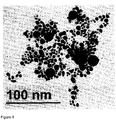
- Figure 4 is a transmission electron microscope (TEM) image of a gold nanoparticle colloid.
- the sample is obtained by drying a drop of colloid on a TEM sampling grid. It is observed that the population is dominated by nanoparticles of 4-5 nm, and there are distinguishingly larger nanoparticles with diameters around 30-50 nm.
- This bimodal particle size distribution is consistent with what was observed on nanoparticles generated with ultrashort pulsed laser ablation of other materials such as Ni in vacuum [Ref. 7].
- the particle size distribution can be improved by employing a flat transverse beam profile instead of a Gaussian beam profile, for example. Nevertheless, for many applications, the bimodal size distribution does affect performance.
- a high repetition rate laser is also preferred. This is yet another reason for use of a high repetition rate source, for example a source that produces at least two pulses with time separation of about 0.1 ⁇ sec of less.
- IMRA America Inc. the assignee of the present application, disclosed several fiber-based chirped pulse amplification systems.
- such systems provide a high repetition rate from 100 kHz to above 1 MHz, an ultrashort pulse duration from 500 femtoseconds to a few picoseconds, and a average power of more than 10 W.
- a fiber-based chirped pulse amplification system FCPA
- FCPA fiber-based chirped pulse amplification system
- the commercially available D-1000 available from IMRA America provides microjoule pulses and an adjustable repetition rate over the range of 100 KHz to 5 MHz, with 1W average power. Output pulse widths are less than 1 ps. These lasers are particularly suited for the current applications.
- fiber-based systems can improve the production rate by one order of magnitude.
- a repetition rate of 200 kHz a pulse energy of 10 micro-Joule per pulse (average power of 2 W), and pulse duration of 500 fs, a 20 ml colloid of gold nanoparticles with an optical density (O.D.) of 1 per centimeter can be produced in 30 min. This is a much faster speed than the reported laser-ablation-based methods such as those in Ref. 6.
- the production speed can be increased by a factor of 5.
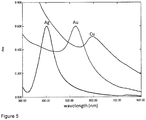
- Figure 5 shows the absorption spectra of nanoparticles of all three elements of the IB group, all presenting a distinguished plasmon resonance peak.
- Another aspect of the various embodiments is to provide metal alloy nanoparticles colloids with various plasmon resonance wavelengths.
- the product nanoparticles have the same alloy composition as the original alloy target. This is also understood as a disintegration of solid bulk into nanoparticles near its critical point, during which alloy phase separation is inhibited. Applying this finding to ablation in water, colloids of alloy nanoparticles of the group IB metals are obtained with various alloy compositions and accordingly various plasmon resonance wavelengths.
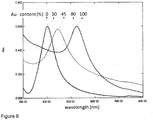
- Figure 6 shows absorption spectra of a series of AuAg alloy colloids with five Au composition varying from 0 (i.e. pure Ag) to 100 (i.e., pure Au) percent. The shift of the plasmon resonance wavelength with the alloy composition is apparent.
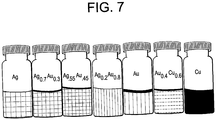
- Figure 7 is an image of several such group IB alloy nanoparticle colloids, including AuAg and AuCu. Various colors result from the different plasmon resonance wavelength.
- the colloidal nanoparticles can be collected as nanoparticle powders, can be condensed to nanoparticle pastes or nanoparticle inks, can be dispersed to solid supporters, and can also be assembled to thin films or 3D structures.
- the applications of these collections or modifications of colloidal nanoparticles include, but not limited to, conductive pastes, inks, catalysts, photonic crystals, chemical and biological sensors, medical and life science products, and environmental products such as antibacterial agents, deodorizing agents, and water purifying agents.
Landscapes
- Chemical & Material Sciences (AREA)
- Engineering & Computer Science (AREA)
- Nanotechnology (AREA)
- Physics & Mathematics (AREA)
- Organic Chemistry (AREA)
- Dispersion Chemistry (AREA)
- Health & Medical Sciences (AREA)
- Toxicology (AREA)
- Chemical Kinetics & Catalysis (AREA)
- Composite Materials (AREA)
- Crystallography & Structural Chemistry (AREA)
- Food Science & Technology (AREA)
- Electromagnetism (AREA)
- Condensed Matter Physics & Semiconductors (AREA)
- General Physics & Mathematics (AREA)
- Materials Engineering (AREA)
- General Health & Medical Sciences (AREA)
- Optics & Photonics (AREA)
- Inorganic Chemistry (AREA)
- Manufacture Of Metal Powder And Suspensions Thereof (AREA)
- Physical Or Chemical Processes And Apparatus (AREA)
- Colloid Chemistry (AREA)
- Disintegrating Or Milling (AREA)
- Powder Metallurgy (AREA)
Applications Claiming Priority (2)
| Application Number | Priority Date | Filing Date | Title |
|---|---|---|---|
| US12/320,617 US8246714B2 (en) | 2009-01-30 | 2009-01-30 | Production of metal and metal-alloy nanoparticles with high repetition rate ultrafast pulsed laser ablation in liquids |
| PCT/US2009/037643 WO2010087869A1 (en) | 2009-01-30 | 2009-03-19 | Production of nanoparticles with high repetition rate ultrashort pulsed laser ablation in liquids |
Publications (3)
| Publication Number | Publication Date |
|---|---|
| EP2391455A1 EP2391455A1 (en) | 2011-12-07 |
| EP2391455A4 EP2391455A4 (en) | 2013-08-07 |
| EP2391455B1 true EP2391455B1 (en) | 2018-05-09 |
Family
ID=42395913
Family Applications (1)
| Application Number | Title | Priority Date | Filing Date |
|---|---|---|---|
| EP09839437.2A Not-in-force EP2391455B1 (en) | 2009-01-30 | 2009-03-19 | Production of nanoparticles with high repetition rate ultrashort pulsed laser ablation in liquids |
Country Status (5)
| Country | Link |
|---|---|
| US (2) | US8246714B2 (enExample) |
| EP (1) | EP2391455B1 (enExample) |
| JP (3) | JP5538432B2 (enExample) |
| CN (1) | CN102292159B (enExample) |
| WO (1) | WO2010087869A1 (enExample) |
Families Citing this family (91)
| Publication number | Priority date | Publication date | Assignee | Title |
|---|---|---|---|---|
| JP5504467B2 (ja) * | 2008-03-25 | 2014-05-28 | 独立行政法人理化学研究所 | 3次元ナノ金属構造体の光還元加工法 |
| US8246714B2 (en) * | 2009-01-30 | 2012-08-21 | Imra America, Inc. | Production of metal and metal-alloy nanoparticles with high repetition rate ultrafast pulsed laser ablation in liquids |
| TWI395613B (zh) * | 2009-03-31 | 2013-05-11 | 胡宇光 | 微粒及其形成方法 |
| BR112012000311B1 (pt) | 2009-07-08 | 2021-12-21 | Clene Nanomedicine, Inc. | Nanocristais com base em ouro para tratamentos médicos e processos eletroquímicos para a fabricação dos mesmos |
| JP5866690B2 (ja) * | 2009-09-04 | 2016-02-17 | 国立研究開発法人産業技術総合研究所 | 球状ナノ粒子の製造方法及び同製造方法によって得られた球状ナノ粒子 |
| US20110192450A1 (en) * | 2010-02-10 | 2011-08-11 | Bing Liu | Method for producing nanoparticle solutions based on pulsed laser ablation for fabrication of thin film solar cells |
| US8836941B2 (en) * | 2010-02-10 | 2014-09-16 | Imra America, Inc. | Method and apparatus to prepare a substrate for molecular detection |
| US8540173B2 (en) * | 2010-02-10 | 2013-09-24 | Imra America, Inc. | Production of fine particles of functional ceramic by using pulsed laser |
| US8992815B2 (en) * | 2010-02-10 | 2015-03-31 | Imra America, Inc. | Production of organic compound nanoparticles with high repetition rate ultrafast pulsed laser ablation in liquids |
| US8858676B2 (en) * | 2010-02-10 | 2014-10-14 | Imra America, Inc. | Nanoparticle production in liquid with multiple-pulse ultrafast laser ablation |
| US8748216B2 (en) | 2010-10-25 | 2014-06-10 | Imra America, Inc. | Non-vacuum method for fabrication of a photovoltaic absorber layer |
| US8409906B2 (en) | 2010-10-25 | 2013-04-02 | Imra America, Inc. | Non-vacuum method for fabrication of a photovoltaic absorber layer |
| US8802234B2 (en) * | 2011-01-03 | 2014-08-12 | Imra America, Inc. | Composite nanoparticles and methods for making the same |
| JP5671724B2 (ja) * | 2011-02-21 | 2015-02-18 | 株式会社奈良機械製作所 | 液相レーザーアブレーション方法及び装置 |
| US8697129B2 (en) * | 2011-03-02 | 2014-04-15 | Imra America, Inc. | Stable colloidal gold nanoparticles with controllable surface modification and functionalization |
| US9849512B2 (en) * | 2011-07-01 | 2017-12-26 | Attostat, Inc. | Method and apparatus for production of uniformly sized nanoparticles |
| KR20140057548A (ko) * | 2011-07-12 | 2014-05-13 | 요게시 나라얀 벤데일 | 신규한 나노 금 및 그의 제조 방법 |
| WO2013085825A1 (en) * | 2011-12-07 | 2013-06-13 | Imra America Inc. | Method of manufacturing ordered inter metallic catalysts |
| CN103178062A (zh) * | 2011-12-20 | 2013-06-26 | 中国科学院微电子研究所 | 一种金属纳米晶存储器 |
| CN102527303B (zh) * | 2011-12-21 | 2014-04-09 | 中国科学院合肥物质科学研究院 | 一种铁磁性Co3C@C核壳纳米结构及其连续制备方法 |
| WO2013109832A1 (en) * | 2012-01-20 | 2013-07-25 | Imra America, Inc. | Stable colloidal suspensions of gold nanoconjugates and the method for preparing the same |
| ITMI20120171A1 (it) * | 2012-02-08 | 2013-08-09 | Alessio Gerardo Maugeri | Impianti per fluidi comprendenti nanomateriali |
| ITMI20120172A1 (it) * | 2012-02-08 | 2013-08-09 | Alessio Gerardo Maugeri | Dispositivi oftalmici e nanomateriali |
| JP2015506986A (ja) | 2012-02-13 | 2015-03-05 | イムラ アメリカ インコーポレイテッド | 液中パルスレーザーアブレーションによって製造された非晶質医薬微粒子およびその製造方法 |
| CN102658076B (zh) * | 2012-05-11 | 2015-06-03 | 中山大学 | 一种微纳米材料及其制备方法、装置、应用 |
| CN102701270B (zh) * | 2012-06-12 | 2014-05-14 | 天津大学 | 胶体硫化锡空心纳米颗粒的制备方法 |
| EP2735389A1 (de) | 2012-11-23 | 2014-05-28 | Universität Duisburg-Essen | Verfahren zur Herstellung reiner, insbesondere kohlenstofffreier Nanopartikel |
| CN102974836B (zh) * | 2012-11-28 | 2014-10-29 | 天津大学 | 激光制备银/碳复合纳米环结构的方法 |
| CN103008680A (zh) * | 2012-12-07 | 2013-04-03 | 天津大学 | 激光化学法合成银-碳复合纳米线的方法 |
| JP5965828B2 (ja) * | 2012-12-14 | 2016-08-10 | 株式会社デンソー | 微粒子の製造方法 |
| WO2014113293A1 (en) * | 2013-01-15 | 2014-07-24 | Lawrence Livermore National Security, Llc | Laser-driven hydrothermal processing |
| DE112014000570T5 (de) | 2013-01-25 | 2015-12-17 | Imra America, Inc. | Verfahren zur Herstellung wässriger Suspensionen von Edelmetall-Nanopartikeln |
| WO2014178935A1 (en) * | 2013-04-29 | 2014-11-06 | Imra America, Inc. | Size controlled suspension of precious metal nanoparticles |
| ITTO20130639A1 (it) * | 2013-07-29 | 2015-01-30 | Fond Istituto Italiano Di Tecnologia | Metodo di preparazione di un substrato per un dispositivo plasmonico |
| TWI624350B (zh) | 2013-11-08 | 2018-05-21 | 財團法人工業技術研究院 | 粉體成型方法及其裝置 |
| WO2015095398A1 (en) | 2013-12-17 | 2015-06-25 | Kevin Hagedorn | Method and apparatus for manufacturing isotropic magnetic nanocolloids |
| JP6140634B2 (ja) * | 2014-04-09 | 2017-05-31 | 株式会社ノリタケカンパニーリミテド | 合金微粒子分散液およびその製造方法 |
| CN103920884B (zh) * | 2014-04-25 | 2016-04-20 | 广东工业大学 | 一种基于激光诱导空化的纳米颗粒制备装置及方法 |
| US9782731B2 (en) * | 2014-05-30 | 2017-10-10 | Battelle Memorial Institute | System and process for dissolution of solids |
| US9919363B2 (en) | 2014-09-23 | 2018-03-20 | Attostat, Inc. | System and method for making non-spherical nanoparticles and nanoparticle compositions made thereby |
| US10190253B2 (en) | 2014-09-23 | 2019-01-29 | Attostat, Inc | Nanoparticle treated fabrics, fibers, filaments, and yarns and related methods |
| US12610952B2 (en) | 2014-09-23 | 2026-04-28 | Evoq Nano, Inc. | Antimicrobial compositions and methods |
| US9885001B2 (en) | 2014-09-23 | 2018-02-06 | Attostat, Inc. | Fuel additive composition and related methods |
| US9883670B2 (en) | 2014-09-23 | 2018-02-06 | Attostat, Inc. | Compositions and methods for treating plant diseases |
| US9434006B2 (en) | 2014-09-23 | 2016-09-06 | Attostat, Inc. | Composition containing spherical and coral-shaped nanoparticles and method of making same |
| KR101659170B1 (ko) * | 2014-11-11 | 2016-09-22 | 한국광기술원 | 플라즈몬 공명주파수를 이용한 금속 나노 입자 제조 장치 및 방법 |
| WO2016079681A1 (en) * | 2014-11-17 | 2016-05-26 | Plasma Diagnostics And Technologies S.R.L. | Method for producing colloids comprising nanoparticles |
| US20160236296A1 (en) * | 2015-02-13 | 2016-08-18 | Gold Nanotech Inc | Nanoparticle Manufacturing System |
| US9839652B2 (en) | 2015-04-01 | 2017-12-12 | Attostat, Inc. | Nanoparticle compositions and methods for treating or preventing tissue infections and diseases |
| US10774429B2 (en) | 2015-04-13 | 2020-09-15 | Attostat, Inc. | Anti-corrosion nanoparticle compositions |
| US11473202B2 (en) | 2015-04-13 | 2022-10-18 | Attostat, Inc. | Anti-corrosion nanoparticle compositions |
| CN104743527B (zh) * | 2015-04-22 | 2017-04-26 | 山东师范大学 | 一种硒化铋纳米颗粒的制备方法 |
| US10201571B2 (en) | 2016-01-25 | 2019-02-12 | Attostat, Inc. | Nanoparticle compositions and methods for treating onychomychosis |
| US10326146B2 (en) * | 2016-04-19 | 2019-06-18 | Dibyendu Mukherjee | Compositions, systems and methods for producing nanoalloys and/or nanocomposites using tandem laser ablation synthesis in solution-galvanic replacement reaction |
| CN106077674B (zh) * | 2016-06-16 | 2019-03-15 | 中国科学院合肥物质科学研究院 | 一种具有高效杀菌性能的银纳米颗粒胶体溶液 |
| WO2018022776A1 (en) * | 2016-07-27 | 2018-02-01 | Imra America, Inc. | Gold-platinum alloy nanoparticles in colloidal solutions and biological applications using the same |
| JP2018040033A (ja) * | 2016-09-07 | 2018-03-15 | 株式会社スギノマシン | レーザアブレーションによる金属ナノコロイド生成方法 |
| AT519146B1 (de) | 2016-10-05 | 2020-03-15 | Univ Wien Tech | Vorrichtung zur Analyse eines Feststoff-Probenmaterials |
| CN106644852B (zh) * | 2016-10-17 | 2019-03-29 | 哈尔滨工业大学 | 基于超短脉冲激光辐照同时获取球形颗粒光学常数与粒径分布的测量方法 |
| CN106496605B (zh) * | 2016-12-23 | 2019-10-11 | 广东工业大学 | 一种制备高分子磁性微球的装置与方法 |
| FR3061052B1 (fr) * | 2016-12-28 | 2019-05-31 | Commissariat A L'energie Atomique Et Aux Energies Alternatives | Procede d'usinage par laser d'un diamant permettant d'obtenir une surface lisse et transparente |
| CN107140607B (zh) * | 2017-05-25 | 2019-04-23 | 四川大学 | 飞秒激光微流道液相烧蚀制备半导体纳米晶的方法 |
| WO2018215893A1 (en) * | 2017-05-26 | 2018-11-29 | King Abdullah University Of Science And Technology | Method and apparatus for fabricating high performance optoelectronic devices |
| KR101982934B1 (ko) * | 2017-09-25 | 2019-05-27 | 한국에너지기술연구원 | 레이저 어블레이션을 이용한 금속 나노 입자의 제조 시스템 |
| KR101982933B1 (ko) * | 2017-09-25 | 2019-08-28 | 한국에너지기술연구원 | 다중 레이저 어블레이션을 이용한 금속 나노 입자의 제조 시스템 |
| US11646453B2 (en) | 2017-11-28 | 2023-05-09 | Attostat, Inc. | Nanoparticle compositions and methods for enhancing lead-acid batteries |
| US11018376B2 (en) | 2017-11-28 | 2021-05-25 | Attostat, Inc. | Nanoparticle compositions and methods for enhancing lead-acid batteries |
| CN108423709B (zh) * | 2018-01-19 | 2020-03-20 | 南京理工大学 | 一种基于双脉冲激光液相烧蚀合成纳米晶的装置的烧蚀方法 |
| UA121340C2 (uk) * | 2018-04-20 | 2020-05-12 | Валерій Анатолійович Яковлев | Спосіб знешкодження техногенних відходів і хвостів |
| CN108635588B (zh) * | 2018-05-07 | 2021-01-05 | 国家纳米科学中心 | 药物小分子修饰的贵金属纳米粒子及其制备方法和应用 |
| DE102018216824A1 (de) * | 2018-10-01 | 2020-04-02 | Universität Duisburg-Essen | Kompakte Vorrichtung und Verfahren zur Herstellung von Nanopartikeln in Suspension |
| CN109590636B (zh) * | 2018-12-11 | 2021-12-07 | 深圳市汉尔信电子科技有限公司 | 一种高存留率纳米复合钎料及其制备方法 |
| US20220118090A1 (en) * | 2019-02-12 | 2022-04-21 | Trumpf Laser- Und Systemtechnik Gmbh | Method and device for treating particles and nanoparticles of an active pharmaceutical ingredient |
| CN111360273A (zh) * | 2019-04-15 | 2020-07-03 | 河南理工大学 | 一种基于高频超声Faraday波的金属颗粒制备方法 |
| CN110253027A (zh) * | 2019-06-24 | 2019-09-20 | 北京莱泽光电技术有限公司 | 纳米粉末合金制备方法以及装置 |
| US12115250B2 (en) | 2019-07-12 | 2024-10-15 | Evoq Nano, Inc. | Use of nanoparticles for treating respiratory infections associated with cystic fibrosis |
| US10899611B1 (en) * | 2019-09-12 | 2021-01-26 | New World Energy LLC | Method of producing hydrogen through laser ablation |
| CN111992877A (zh) * | 2020-07-07 | 2020-11-27 | 上海工程技术大学 | 一种高精度激光增减材的复合制造装置 |
| DE102020004878B4 (de) | 2020-08-11 | 2023-11-09 | Umicore Ag & Co. Kg | Verfahren zur Herstellung geträgerter Metallnanopartikel |
| ES3057406T3 (en) * | 2020-10-01 | 2026-03-02 | Univ South Africa | Method of producing a nanofluid using laser ablation, and laser ablation system for manufacturing nanofluids |
| CN112300580B (zh) * | 2020-11-07 | 2022-04-08 | 芜湖市航创祥路汽车部件有限公司 | 一种具有耐磨性能汽车密封件用复合橡胶 |
| US12456759B2 (en) | 2021-03-30 | 2025-10-28 | Evoq Nano, Inc. | Nanoparticle-enhanced lead-acid electrode paste and improved lead-acid batteries made therefrom |
| CN113275579B (zh) * | 2021-05-24 | 2023-01-24 | 北京科技大学顺德研究生院 | 激光热爆金属箔带制备金属粉末的装置及金属粉末的制备方法 |
| CN113649586A (zh) * | 2021-07-12 | 2021-11-16 | 杭州苏铂科技有限公司 | 一种激光辅助无种子的金纳米星合成方法 |
| CN113732515B (zh) * | 2021-09-26 | 2022-06-14 | 中国科学院宁波材料技术与工程研究所 | 可控液流-振动耦合辅助激光铣抛加工方法与系统 |
| CN114632481A (zh) * | 2022-03-04 | 2022-06-17 | 安徽大学 | 一种制备均分散金属纳米颗粒胶体的方法 |
| CN118871230A (zh) * | 2022-04-11 | 2024-10-29 | 巴斯夫欧洲公司 | 多金属合金过渡金属纳米粒子及其生产方法 |
| CN115283684A (zh) * | 2022-08-05 | 2022-11-04 | 大连理工大学 | 一种使用液相激光烧蚀法连续制备纳米颗粒的装置 |
| CN116371472B (zh) * | 2023-04-11 | 2024-09-06 | 西北工业大学 | 多组分金属纳米胶体颗粒原位植入MOFs复合催化剂及其制备方法和应用 |
| US12337415B2 (en) * | 2023-05-31 | 2025-06-24 | Applied Materials, Inc. | Method and apparatus for laser texturing a component |
| CN119772187B (zh) * | 2024-12-31 | 2025-09-26 | 西北大学 | 一种采用难熔金属制备中熵微纳米合金的方法 |
Family Cites Families (48)
| Publication number | Priority date | Publication date | Assignee | Title |
|---|---|---|---|---|
| US4059759A (en) * | 1976-05-25 | 1977-11-22 | The United States Of America As Represented By The United States Energy Research And Development Administration | Passive and active pulse stacking scheme for pulse shaping |
| US4306771A (en) * | 1980-05-27 | 1981-12-22 | International Business Machines Corporation | Optical pulse shaping device and method |
| JPH06102146B2 (ja) * | 1985-09-12 | 1994-12-14 | 三菱電機株式会社 | 光化学反応による金属コロイドの生成方法 |
| JPH086128B2 (ja) * | 1990-06-29 | 1996-01-24 | 工業技術院長 | 超微粒子懸濁液の作成方法 |
| US5790574A (en) * | 1994-08-24 | 1998-08-04 | Imar Technology Company | Low cost, high average power, high brightness solid state laser |
| US5742634A (en) * | 1994-08-24 | 1998-04-21 | Imar Technology Co. | Picosecond laser |
| US5539764A (en) * | 1994-08-24 | 1996-07-23 | Jamar Technologies Co. | Laser generated X-ray source |
| US5660746A (en) * | 1994-10-24 | 1997-08-26 | University Of South Florida | Dual-laser process for film deposition |
| US5756924A (en) * | 1995-09-28 | 1998-05-26 | The Regents Of The University Of California | Multiple laser pulse ignition method and apparatus |
| US5720894A (en) * | 1996-01-11 | 1998-02-24 | The Regents Of The University Of California | Ultrashort pulse high repetition rate laser system for biological tissue processing |
| GB9621049D0 (en) * | 1996-10-09 | 1996-11-27 | Secr Defence | Dielectric composites |
| US5948483A (en) * | 1997-03-25 | 1999-09-07 | The Board Of Trustees Of The University Of Illinois | Method and apparatus for producing thin film and nanoparticle deposits |
| US6156030A (en) * | 1997-06-04 | 2000-12-05 | Y-Beam Technologies, Inc. | Method and apparatus for high precision variable rate material removal and modification |
| AUPO912797A0 (en) * | 1997-09-11 | 1997-10-02 | Australian National University, The | Ultrafast laser deposition method |
| US6324195B1 (en) * | 1999-01-13 | 2001-11-27 | Kaneka Corporation | Laser processing of a thin film |
| US7723642B2 (en) * | 1999-12-28 | 2010-05-25 | Gsi Group Corporation | Laser-based system for memory link processing with picosecond lasers |
| US6281471B1 (en) * | 1999-12-28 | 2001-08-28 | Gsi Lumonics, Inc. | Energy-efficient, laser-based method and system for processing target material |
| WO2001051243A2 (en) * | 2000-01-10 | 2001-07-19 | Electro Scientific Industries, Inc. | Laser system and method for processing a memory link with a burst of laser pulses having ultrashort pulsewidths |
| US6552301B2 (en) * | 2000-01-25 | 2003-04-22 | Peter R. Herman | Burst-ultrafast laser machining method |
| US6777645B2 (en) * | 2001-03-29 | 2004-08-17 | Gsi Lumonics Corporation | High-speed, precision, laser-based method and system for processing material of one or more targets within a field |
| KR100438408B1 (ko) * | 2001-08-16 | 2004-07-02 | 한국과학기술원 | 금속간의 치환 반응을 이용한 코어-쉘 구조 및 혼합된합금 구조의 금속 나노 입자의 제조 방법과 그 응용 |
| US6664498B2 (en) * | 2001-12-04 | 2003-12-16 | General Atomics | Method and apparatus for increasing the material removal rate in laser machining |
| CN1165372C (zh) * | 2002-05-13 | 2004-09-08 | 福建紫金矿业股份有限公司 | 一种连续制备纯净金溶胶的方法 |
| JP2004202439A (ja) * | 2002-12-26 | 2004-07-22 | National Institute Of Advanced Industrial & Technology | ナノ粒子の製造装置及びナノ粒子の製造方法 |
| US7786178B2 (en) * | 2003-04-28 | 2010-08-31 | Sumitomo Metal Mining Co., Ltd. | Process for producing fine silver particle colloidal dispersion, fine silver particle colloidal dispersion, and conductive silver film |
| US7330301B2 (en) * | 2003-05-14 | 2008-02-12 | Imra America, Inc. | Inexpensive variable rep-rate source for high-energy, ultrafast lasers |
| US7113327B2 (en) * | 2003-06-27 | 2006-09-26 | Imra America, Inc. | High power fiber chirped pulse amplification system utilizing telecom-type components |
| US20060086834A1 (en) | 2003-07-29 | 2006-04-27 | Robert Pfeffer | System and method for nanoparticle and nanoagglomerate fluidization |
| US20050167405A1 (en) * | 2003-08-11 | 2005-08-04 | Richard Stoltz | Optical ablation using material composition analysis |
| CN100593292C (zh) * | 2003-08-19 | 2010-03-03 | 电子科学工业公司 | 产生定制的激光脉冲组 |
| US7486705B2 (en) * | 2004-03-31 | 2009-02-03 | Imra America, Inc. | Femtosecond laser processing system with process parameters, controls and feedback |
| US7529011B2 (en) * | 2004-04-12 | 2009-05-05 | Ricoh Company, Ltd. | Deflector mirror with regions of different flexural rigidity |
| US7879410B2 (en) * | 2004-06-09 | 2011-02-01 | Imra America, Inc. | Method of fabricating an electrochemical device using ultrafast pulsed laser deposition |
| WO2006030605A1 (ja) | 2004-09-15 | 2006-03-23 | Kyoto University | 金属微粒子及びその製造方法 |
| CN100467118C (zh) * | 2005-08-08 | 2009-03-11 | 鸿富锦精密工业(深圳)有限公司 | 纳米粒子制备装置 |
| US8241393B2 (en) | 2005-09-02 | 2012-08-14 | The Curators Of The University Of Missouri | Methods and articles for gold nanoparticle production |
| FI20060181A7 (fi) * | 2006-02-23 | 2007-08-24 | Picodeon Ltd Oy | Menetelmä tuottaa pintoja ja materiaalia laserablaation avulla |
| JP5165204B2 (ja) * | 2006-03-09 | 2013-03-21 | 国立大学法人大阪大学 | パラジウム微粒子の製造方法 |
| JP5062721B2 (ja) * | 2006-06-27 | 2012-10-31 | 国立大学法人京都大学 | ナノサイズワイヤーの製造方法 |
| US20080006524A1 (en) * | 2006-07-05 | 2008-01-10 | Imra America, Inc. | Method for producing and depositing nanoparticles |
| TWI318894B (en) | 2006-08-07 | 2010-01-01 | Ind Tech Res Inst | System for fabricating nano particles |
| CN100457335C (zh) * | 2006-12-19 | 2009-02-04 | 浙江工业大学 | 液相中脉冲激光烧蚀制备金属纳米粒子胶体的装置 |
| US20090246413A1 (en) * | 2008-03-27 | 2009-10-01 | Imra America, Inc. | Method for fabricating thin films |
| US8246714B2 (en) * | 2009-01-30 | 2012-08-21 | Imra America, Inc. | Production of metal and metal-alloy nanoparticles with high repetition rate ultrafast pulsed laser ablation in liquids |
| US8858676B2 (en) * | 2010-02-10 | 2014-10-14 | Imra America, Inc. | Nanoparticle production in liquid with multiple-pulse ultrafast laser ablation |
| US8697129B2 (en) * | 2011-03-02 | 2014-04-15 | Imra America, Inc. | Stable colloidal gold nanoparticles with controllable surface modification and functionalization |
| DE112014000570T5 (de) * | 2013-01-25 | 2015-12-17 | Imra America, Inc. | Verfahren zur Herstellung wässriger Suspensionen von Edelmetall-Nanopartikeln |
| WO2014178935A1 (en) * | 2013-04-29 | 2014-11-06 | Imra America, Inc. | Size controlled suspension of precious metal nanoparticles |
-
2009
- 2009-01-30 US US12/320,617 patent/US8246714B2/en active Active
- 2009-03-19 JP JP2011547905A patent/JP5538432B2/ja not_active Expired - Fee Related
- 2009-03-19 EP EP09839437.2A patent/EP2391455B1/en not_active Not-in-force
- 2009-03-19 WO PCT/US2009/037643 patent/WO2010087869A1/en not_active Ceased
- 2009-03-19 CN CN200980155266.0A patent/CN102292159B/zh not_active Expired - Fee Related
-
2012
- 2012-07-17 US US13/551,253 patent/US20120282134A1/en not_active Abandoned
-
2014
- 2014-02-28 JP JP2014038755A patent/JP5927211B2/ja active Active
-
2016
- 2016-03-15 JP JP2016051151A patent/JP6234498B2/ja active Active
Non-Patent Citations (1)
| Title |
|---|
| None * |
Also Published As
| Publication number | Publication date |
|---|---|
| EP2391455A1 (en) | 2011-12-07 |
| CN102292159A (zh) | 2011-12-21 |
| JP5927211B2 (ja) | 2016-06-01 |
| JP6234498B2 (ja) | 2017-11-22 |
| US8246714B2 (en) | 2012-08-21 |
| EP2391455A4 (en) | 2013-08-07 |
| US20120282134A1 (en) | 2012-11-08 |
| JP2016188428A (ja) | 2016-11-04 |
| CN102292159B (zh) | 2014-07-16 |
| WO2010087869A1 (en) | 2010-08-05 |
| JP2012516391A (ja) | 2012-07-19 |
| US20100196192A1 (en) | 2010-08-05 |
| JP5538432B2 (ja) | 2014-07-02 |
| JP2014129608A (ja) | 2014-07-10 |
Similar Documents
| Publication | Publication Date | Title |
|---|---|---|
| US8246714B2 (en) | Production of metal and metal-alloy nanoparticles with high repetition rate ultrafast pulsed laser ablation in liquids | |
| Zhang et al. | Laser synthesis and processing of colloids: fundamentals and applications | |
| Elsayed et al. | Effect of focusing conditions and laser parameters on the fabrication of gold nanoparticles via laser ablation in liquid | |
| US8858676B2 (en) | Nanoparticle production in liquid with multiple-pulse ultrafast laser ablation | |
| Link et al. | How long does it take to melt a gold nanorod?: A femtosecond pump–probe absorption spectroscopic study | |
| JP5062721B2 (ja) | ナノサイズワイヤーの製造方法 | |
| JP5589168B2 (ja) | 金ナノ粒子およびその分散液、金ナノ粒子の製造方法、ナノ粒子製造システム | |
| CN103796946A (zh) | 用于生产均匀尺寸的纳米颗粒的方法和设备 | |
| Machmudah et al. | Fabrication of gold and silver nanoparticles with pulsed laser ablation under pressurized CO2 | |
| AL DAHASH et al. | Preparation and characterization of ZnO nanoparticles by laser ablation in NaOH aqueous solution | |
| Valverde-Alva et al. | Laser ablation efficiency during the production of Ag nanoparticles in ethanol at a low pulse repetition rate (1–10 Hz) | |
| Santagata et al. | Production of silver-silica core-shell nanocomposites using ultra-short pulsed laser ablation in nanoporous aqueous silica colloidal solutions | |
| Monsa et al. | A simple strategy for enhanced production of nanoparticles by laser ablation in liquids | |
| Hettiarachchi et al. | Uncovering gold nanoparticle synthesis using a microchip laser system through pulsed laser ablation in aqueous solution | |
| Serkov et al. | Laser-induced agglomeration of gold and silver nanoparticles dispersed in liquid | |
| Ahmed et al. | Advances in pulsed laser ablation in liquid for silver and copper synthesis: from plasma generation to nanoparticle formation | |
| Nastulyavichus et al. | Quantitative evaluation of LAL productivity of colloidal nanomaterials: Which laser pulse width is more productive, ergonomic, and economic? | |
| Tarasenka | Laser ablation in liquids for shape-tailored synthesis of nanomaterials: status and challenges | |
| Stašić et al. | Optimization of silver nanoparticles production by laser ablation in water using a 150-ps laser | |
| Ahmadinejad et al. | Laser-assisted synthesis of Ag–Cu alloy nanoparticles with tunable surface plasmon resonance frequency in presence of external electric field | |
| Mafuné et al. | Physical preparation of nanoalloys | |
| Ghalot et al. | Obtaining Nanoparticles by Underwater Laser Ablation–A Brief Review | |
| Singh | Nanosecond pulsed laser-plasma interaction and its applications | |
| Soma et al. | Direct Fabrication of sub 100 nm Nanoneedles in Silver using Femtosecond Laser Direct Writing | |
| Kadhim et al. | Nanofabrication and characterization of gold metal by pulsed laser ablation in SDS solution |
Legal Events
| Date | Code | Title | Description |
|---|---|---|---|
| PUAI | Public reference made under article 153(3) epc to a published international application that has entered the european phase |
Free format text: ORIGINAL CODE: 0009012 |
|
| 17P | Request for examination filed |
Effective date: 20110729 |
|
| AK | Designated contracting states |
Kind code of ref document: A1 Designated state(s): AT BE BG CH CY CZ DE DK EE ES FI FR GB GR HR HU IE IS IT LI LT LU LV MC MK MT NL NO PL PT RO SE SI SK TR |
|
| DAX | Request for extension of the european patent (deleted) | ||
| RIC1 | Information provided on ipc code assigned before grant |
Ipc: B02C 19/00 20060101AFI20130626BHEP |
|
| A4 | Supplementary search report drawn up and despatched |
Effective date: 20130704 |
|
| 17Q | First examination report despatched |
Effective date: 20160309 |
|
| GRAP | Despatch of communication of intention to grant a patent |
Free format text: ORIGINAL CODE: EPIDOSNIGR1 |
|
| STAA | Information on the status of an ep patent application or granted ep patent |
Free format text: STATUS: GRANT OF PATENT IS INTENDED |
|
| RIN1 | Information on inventor provided before grant (corrected) |
Inventor name: LIU, BING Inventor name: MURAKAMI, MAKOTO Inventor name: HU, ZHENDONG Inventor name: CHE, YONG |
|
| INTG | Intention to grant announced |
Effective date: 20171205 |
|
| RIN1 | Information on inventor provided before grant (corrected) |
Inventor name: LIU, BING Inventor name: HU, ZHENDONG Inventor name: CHE, YONG Inventor name: MURAKAMI, MAKOTO |
|
| GRAS | Grant fee paid |
Free format text: ORIGINAL CODE: EPIDOSNIGR3 |
|
| GRAA | (expected) grant |
Free format text: ORIGINAL CODE: 0009210 |
|
| STAA | Information on the status of an ep patent application or granted ep patent |
Free format text: STATUS: THE PATENT HAS BEEN GRANTED |
|
| AK | Designated contracting states |
Kind code of ref document: B1 Designated state(s): AT BE BG CH CY CZ DE DK EE ES FI FR GB GR HR HU IE IS IT LI LT LU LV MC MK MT NL NO PL PT RO SE SI SK TR |
|
| REG | Reference to a national code |
Ref country code: GB Ref legal event code: FG4D |
|
| REG | Reference to a national code |
Ref country code: CH Ref legal event code: EP Ref country code: AT Ref legal event code: REF Ref document number: 997089 Country of ref document: AT Kind code of ref document: T Effective date: 20180515 |
|
| REG | Reference to a national code |
Ref country code: IE Ref legal event code: FG4D |
|
| REG | Reference to a national code |
Ref country code: DE Ref legal event code: R096 Ref document number: 602009052262 Country of ref document: DE |
|
| REG | Reference to a national code |
Ref country code: NL Ref legal event code: MP Effective date: 20180509 |
|
| REG | Reference to a national code |
Ref country code: LT Ref legal event code: MG4D |
|
| PG25 | Lapsed in a contracting state [announced via postgrant information from national office to epo] |
Ref country code: FI Free format text: LAPSE BECAUSE OF FAILURE TO SUBMIT A TRANSLATION OF THE DESCRIPTION OR TO PAY THE FEE WITHIN THE PRESCRIBED TIME-LIMIT Effective date: 20180509 Ref country code: BG Free format text: LAPSE BECAUSE OF FAILURE TO SUBMIT A TRANSLATION OF THE DESCRIPTION OR TO PAY THE FEE WITHIN THE PRESCRIBED TIME-LIMIT Effective date: 20180809 Ref country code: SE Free format text: LAPSE BECAUSE OF FAILURE TO SUBMIT A TRANSLATION OF THE DESCRIPTION OR TO PAY THE FEE WITHIN THE PRESCRIBED TIME-LIMIT Effective date: 20180509 Ref country code: LT Free format text: LAPSE BECAUSE OF FAILURE TO SUBMIT A TRANSLATION OF THE DESCRIPTION OR TO PAY THE FEE WITHIN THE PRESCRIBED TIME-LIMIT Effective date: 20180509 Ref country code: NO Free format text: LAPSE BECAUSE OF FAILURE TO SUBMIT A TRANSLATION OF THE DESCRIPTION OR TO PAY THE FEE WITHIN THE PRESCRIBED TIME-LIMIT Effective date: 20180809 Ref country code: ES Free format text: LAPSE BECAUSE OF FAILURE TO SUBMIT A TRANSLATION OF THE DESCRIPTION OR TO PAY THE FEE WITHIN THE PRESCRIBED TIME-LIMIT Effective date: 20180509 |
|
| PG25 | Lapsed in a contracting state [announced via postgrant information from national office to epo] |
Ref country code: HR Free format text: LAPSE BECAUSE OF FAILURE TO SUBMIT A TRANSLATION OF THE DESCRIPTION OR TO PAY THE FEE WITHIN THE PRESCRIBED TIME-LIMIT Effective date: 20180509 Ref country code: NL Free format text: LAPSE BECAUSE OF FAILURE TO SUBMIT A TRANSLATION OF THE DESCRIPTION OR TO PAY THE FEE WITHIN THE PRESCRIBED TIME-LIMIT Effective date: 20180509 Ref country code: LV Free format text: LAPSE BECAUSE OF FAILURE TO SUBMIT A TRANSLATION OF THE DESCRIPTION OR TO PAY THE FEE WITHIN THE PRESCRIBED TIME-LIMIT Effective date: 20180509 Ref country code: GR Free format text: LAPSE BECAUSE OF FAILURE TO SUBMIT A TRANSLATION OF THE DESCRIPTION OR TO PAY THE FEE WITHIN THE PRESCRIBED TIME-LIMIT Effective date: 20180810 |
|
| REG | Reference to a national code |
Ref country code: AT Ref legal event code: MK05 Ref document number: 997089 Country of ref document: AT Kind code of ref document: T Effective date: 20180509 |
|
| PG25 | Lapsed in a contracting state [announced via postgrant information from national office to epo] |
Ref country code: RO Free format text: LAPSE BECAUSE OF FAILURE TO SUBMIT A TRANSLATION OF THE DESCRIPTION OR TO PAY THE FEE WITHIN THE PRESCRIBED TIME-LIMIT Effective date: 20180509 Ref country code: SK Free format text: LAPSE BECAUSE OF FAILURE TO SUBMIT A TRANSLATION OF THE DESCRIPTION OR TO PAY THE FEE WITHIN THE PRESCRIBED TIME-LIMIT Effective date: 20180509 Ref country code: PL Free format text: LAPSE BECAUSE OF FAILURE TO SUBMIT A TRANSLATION OF THE DESCRIPTION OR TO PAY THE FEE WITHIN THE PRESCRIBED TIME-LIMIT Effective date: 20180509 Ref country code: CZ Free format text: LAPSE BECAUSE OF FAILURE TO SUBMIT A TRANSLATION OF THE DESCRIPTION OR TO PAY THE FEE WITHIN THE PRESCRIBED TIME-LIMIT Effective date: 20180509 Ref country code: EE Free format text: LAPSE BECAUSE OF FAILURE TO SUBMIT A TRANSLATION OF THE DESCRIPTION OR TO PAY THE FEE WITHIN THE PRESCRIBED TIME-LIMIT Effective date: 20180509 Ref country code: AT Free format text: LAPSE BECAUSE OF FAILURE TO SUBMIT A TRANSLATION OF THE DESCRIPTION OR TO PAY THE FEE WITHIN THE PRESCRIBED TIME-LIMIT Effective date: 20180509 Ref country code: DK Free format text: LAPSE BECAUSE OF FAILURE TO SUBMIT A TRANSLATION OF THE DESCRIPTION OR TO PAY THE FEE WITHIN THE PRESCRIBED TIME-LIMIT Effective date: 20180509 |
|
| REG | Reference to a national code |
Ref country code: DE Ref legal event code: R097 Ref document number: 602009052262 Country of ref document: DE |
|
| PG25 | Lapsed in a contracting state [announced via postgrant information from national office to epo] |
Ref country code: IT Free format text: LAPSE BECAUSE OF FAILURE TO SUBMIT A TRANSLATION OF THE DESCRIPTION OR TO PAY THE FEE WITHIN THE PRESCRIBED TIME-LIMIT Effective date: 20180509 |
|
| PLBE | No opposition filed within time limit |
Free format text: ORIGINAL CODE: 0009261 |
|
| STAA | Information on the status of an ep patent application or granted ep patent |
Free format text: STATUS: NO OPPOSITION FILED WITHIN TIME LIMIT |
|
| 26N | No opposition filed |
Effective date: 20190212 |
|
| PG25 | Lapsed in a contracting state [announced via postgrant information from national office to epo] |
Ref country code: SI Free format text: LAPSE BECAUSE OF FAILURE TO SUBMIT A TRANSLATION OF THE DESCRIPTION OR TO PAY THE FEE WITHIN THE PRESCRIBED TIME-LIMIT Effective date: 20180509 |
|
| PG25 | Lapsed in a contracting state [announced via postgrant information from national office to epo] |
Ref country code: MC Free format text: LAPSE BECAUSE OF FAILURE TO SUBMIT A TRANSLATION OF THE DESCRIPTION OR TO PAY THE FEE WITHIN THE PRESCRIBED TIME-LIMIT Effective date: 20180509 |
|
| REG | Reference to a national code |
Ref country code: CH Ref legal event code: PL |
|
| GBPC | Gb: european patent ceased through non-payment of renewal fee |
Effective date: 20190319 |
|
| PG25 | Lapsed in a contracting state [announced via postgrant information from national office to epo] |
Ref country code: LU Free format text: LAPSE BECAUSE OF NON-PAYMENT OF DUE FEES Effective date: 20190319 |
|
| REG | Reference to a national code |
Ref country code: BE Ref legal event code: MM Effective date: 20190331 |
|
| PG25 | Lapsed in a contracting state [announced via postgrant information from national office to epo] |
Ref country code: GB Free format text: LAPSE BECAUSE OF NON-PAYMENT OF DUE FEES Effective date: 20190319 Ref country code: CH Free format text: LAPSE BECAUSE OF NON-PAYMENT OF DUE FEES Effective date: 20190331 Ref country code: IE Free format text: LAPSE BECAUSE OF NON-PAYMENT OF DUE FEES Effective date: 20190319 Ref country code: LI Free format text: LAPSE BECAUSE OF NON-PAYMENT OF DUE FEES Effective date: 20190331 |
|
| PG25 | Lapsed in a contracting state [announced via postgrant information from national office to epo] |
Ref country code: FR Free format text: LAPSE BECAUSE OF NON-PAYMENT OF DUE FEES Effective date: 20190331 Ref country code: BE Free format text: LAPSE BECAUSE OF NON-PAYMENT OF DUE FEES Effective date: 20190331 |
|
| PG25 | Lapsed in a contracting state [announced via postgrant information from national office to epo] |
Ref country code: TR Free format text: LAPSE BECAUSE OF FAILURE TO SUBMIT A TRANSLATION OF THE DESCRIPTION OR TO PAY THE FEE WITHIN THE PRESCRIBED TIME-LIMIT Effective date: 20180509 |
|
| PG25 | Lapsed in a contracting state [announced via postgrant information from national office to epo] |
Ref country code: PT Free format text: LAPSE BECAUSE OF FAILURE TO SUBMIT A TRANSLATION OF THE DESCRIPTION OR TO PAY THE FEE WITHIN THE PRESCRIBED TIME-LIMIT Effective date: 20180910 Ref country code: MT Free format text: LAPSE BECAUSE OF NON-PAYMENT OF DUE FEES Effective date: 20190319 |
|
| PG25 | Lapsed in a contracting state [announced via postgrant information from national office to epo] |
Ref country code: CY Free format text: LAPSE BECAUSE OF FAILURE TO SUBMIT A TRANSLATION OF THE DESCRIPTION OR TO PAY THE FEE WITHIN THE PRESCRIBED TIME-LIMIT Effective date: 20180509 |
|
| PG25 | Lapsed in a contracting state [announced via postgrant information from national office to epo] |
Ref country code: IS Free format text: LAPSE BECAUSE OF FAILURE TO SUBMIT A TRANSLATION OF THE DESCRIPTION OR TO PAY THE FEE WITHIN THE PRESCRIBED TIME-LIMIT Effective date: 20180909 |
|
| PG25 | Lapsed in a contracting state [announced via postgrant information from national office to epo] |
Ref country code: HU Free format text: LAPSE BECAUSE OF FAILURE TO SUBMIT A TRANSLATION OF THE DESCRIPTION OR TO PAY THE FEE WITHIN THE PRESCRIBED TIME-LIMIT; INVALID AB INITIO Effective date: 20090319 |
|
| PG25 | Lapsed in a contracting state [announced via postgrant information from national office to epo] |
Ref country code: MK Free format text: LAPSE BECAUSE OF FAILURE TO SUBMIT A TRANSLATION OF THE DESCRIPTION OR TO PAY THE FEE WITHIN THE PRESCRIBED TIME-LIMIT Effective date: 20180509 |
|
| P01 | Opt-out of the competence of the unified patent court (upc) registered |
Effective date: 20230623 |
|
| PGFP | Annual fee paid to national office [announced via postgrant information from national office to epo] |
Ref country code: DE Payment date: 20240325 Year of fee payment: 16 |
|
| REG | Reference to a national code |
Ref country code: DE Ref legal event code: R119 Ref document number: 602009052262 Country of ref document: DE |
|
| PG25 | Lapsed in a contracting state [announced via postgrant information from national office to epo] |
Ref country code: DE Free format text: LAPSE BECAUSE OF NON-PAYMENT OF DUE FEES Effective date: 20251001 |