EP2385756B1 - Sojabohnen event 127 und damit verbundene verfahren - Google Patents
Sojabohnen event 127 und damit verbundene verfahren Download PDFInfo
- Publication number
- EP2385756B1 EP2385756B1 EP10700081.2A EP10700081A EP2385756B1 EP 2385756 B1 EP2385756 B1 EP 2385756B1 EP 10700081 A EP10700081 A EP 10700081A EP 2385756 B1 EP2385756 B1 EP 2385756B1
- Authority
- EP
- European Patent Office
- Prior art keywords
- nucleic acid
- event
- acid molecule
- soybean
- dna
- Prior art date
- Legal status (The legal status is an assumption and is not a legal conclusion. Google has not performed a legal analysis and makes no representation as to the accuracy of the status listed.)
- Active
Links
Images








Classifications
-
- C—CHEMISTRY; METALLURGY
- C12—BIOCHEMISTRY; BEER; SPIRITS; WINE; VINEGAR; MICROBIOLOGY; ENZYMOLOGY; MUTATION OR GENETIC ENGINEERING
- C12N—MICROORGANISMS OR ENZYMES; COMPOSITIONS THEREOF; PROPAGATING, PRESERVING, OR MAINTAINING MICROORGANISMS; MUTATION OR GENETIC ENGINEERING; CULTURE MEDIA
- C12N15/00—Mutation or genetic engineering; DNA or RNA concerning genetic engineering, vectors, e.g. plasmids, or their isolation, preparation or purification; Use of hosts therefor
- C12N15/09—Recombinant DNA-technology
- C12N15/63—Introduction of foreign genetic material using vectors; Vectors; Use of hosts therefor; Regulation of expression
- C12N15/79—Vectors or expression systems specially adapted for eukaryotic hosts
- C12N15/82—Vectors or expression systems specially adapted for eukaryotic hosts for plant cells, e.g. plant artificial chromosomes (PACs)
- C12N15/8241—Phenotypically and genetically modified plants via recombinant DNA technology
- C12N15/8261—Phenotypically and genetically modified plants via recombinant DNA technology with agronomic (input) traits, e.g. crop yield
- C12N15/8271—Phenotypically and genetically modified plants via recombinant DNA technology with agronomic (input) traits, e.g. crop yield for stress resistance, e.g. heavy metal resistance
- C12N15/8274—Phenotypically and genetically modified plants via recombinant DNA technology with agronomic (input) traits, e.g. crop yield for stress resistance, e.g. heavy metal resistance for herbicide resistance
-
- C—CHEMISTRY; METALLURGY
- C12—BIOCHEMISTRY; BEER; SPIRITS; WINE; VINEGAR; MICROBIOLOGY; ENZYMOLOGY; MUTATION OR GENETIC ENGINEERING
- C12N—MICROORGANISMS OR ENZYMES; COMPOSITIONS THEREOF; PROPAGATING, PRESERVING, OR MAINTAINING MICROORGANISMS; MUTATION OR GENETIC ENGINEERING; CULTURE MEDIA
- C12N15/00—Mutation or genetic engineering; DNA or RNA concerning genetic engineering, vectors, e.g. plasmids, or their isolation, preparation or purification; Use of hosts therefor
- C12N15/09—Recombinant DNA-technology
- C12N15/63—Introduction of foreign genetic material using vectors; Vectors; Use of hosts therefor; Regulation of expression
- C12N15/79—Vectors or expression systems specially adapted for eukaryotic hosts
- C12N15/82—Vectors or expression systems specially adapted for eukaryotic hosts for plant cells, e.g. plant artificial chromosomes (PACs)
- C12N15/8241—Phenotypically and genetically modified plants via recombinant DNA technology
- C12N15/8261—Phenotypically and genetically modified plants via recombinant DNA technology with agronomic (input) traits, e.g. crop yield
- C12N15/8271—Phenotypically and genetically modified plants via recombinant DNA technology with agronomic (input) traits, e.g. crop yield for stress resistance, e.g. heavy metal resistance
- C12N15/8274—Phenotypically and genetically modified plants via recombinant DNA technology with agronomic (input) traits, e.g. crop yield for stress resistance, e.g. heavy metal resistance for herbicide resistance
- C12N15/8275—Glyphosate
-
- C—CHEMISTRY; METALLURGY
- C12—BIOCHEMISTRY; BEER; SPIRITS; WINE; VINEGAR; MICROBIOLOGY; ENZYMOLOGY; MUTATION OR GENETIC ENGINEERING
- C12N—MICROORGANISMS OR ENZYMES; COMPOSITIONS THEREOF; PROPAGATING, PRESERVING, OR MAINTAINING MICROORGANISMS; MUTATION OR GENETIC ENGINEERING; CULTURE MEDIA
- C12N15/00—Mutation or genetic engineering; DNA or RNA concerning genetic engineering, vectors, e.g. plasmids, or their isolation, preparation or purification; Use of hosts therefor
- C12N15/09—Recombinant DNA-technology
- C12N15/63—Introduction of foreign genetic material using vectors; Vectors; Use of hosts therefor; Regulation of expression
- C12N15/79—Vectors or expression systems specially adapted for eukaryotic hosts
- C12N15/82—Vectors or expression systems specially adapted for eukaryotic hosts for plant cells, e.g. plant artificial chromosomes (PACs)
- C12N15/8241—Phenotypically and genetically modified plants via recombinant DNA technology
- C12N15/8261—Phenotypically and genetically modified plants via recombinant DNA technology with agronomic (input) traits, e.g. crop yield
- C12N15/8271—Phenotypically and genetically modified plants via recombinant DNA technology with agronomic (input) traits, e.g. crop yield for stress resistance, e.g. heavy metal resistance
-
- C—CHEMISTRY; METALLURGY
- C12—BIOCHEMISTRY; BEER; SPIRITS; WINE; VINEGAR; MICROBIOLOGY; ENZYMOLOGY; MUTATION OR GENETIC ENGINEERING
- C12Q—MEASURING OR TESTING PROCESSES INVOLVING ENZYMES, NUCLEIC ACIDS OR MICROORGANISMS; COMPOSITIONS OR TEST PAPERS THEREFOR; PROCESSES OF PREPARING SUCH COMPOSITIONS; CONDITION-RESPONSIVE CONTROL IN MICROBIOLOGICAL OR ENZYMOLOGICAL PROCESSES
- C12Q1/00—Measuring or testing processes involving enzymes, nucleic acids or microorganisms; Compositions therefor; Processes of preparing such compositions
- C12Q1/68—Measuring or testing processes involving enzymes, nucleic acids or microorganisms; Compositions therefor; Processes of preparing such compositions involving nucleic acids
- C12Q1/6876—Nucleic acid products used in the analysis of nucleic acids, e.g. primers or probes
- C12Q1/6888—Nucleic acid products used in the analysis of nucleic acids, e.g. primers or probes for detection or identification of organisms
- C12Q1/6895—Nucleic acid products used in the analysis of nucleic acids, e.g. primers or probes for detection or identification of organisms for plants, fungi or algae
-
- Y—GENERAL TAGGING OF NEW TECHNOLOGICAL DEVELOPMENTS; GENERAL TAGGING OF CROSS-SECTIONAL TECHNOLOGIES SPANNING OVER SEVERAL SECTIONS OF THE IPC; TECHNICAL SUBJECTS COVERED BY FORMER USPC CROSS-REFERENCE ART COLLECTIONS [XRACs] AND DIGESTS
- Y02—TECHNOLOGIES OR APPLICATIONS FOR MITIGATION OR ADAPTATION AGAINST CLIMATE CHANGE
- Y02A—TECHNOLOGIES FOR ADAPTATION TO CLIMATE CHANGE
- Y02A40/00—Adaptation technologies in agriculture, forestry, livestock or agroalimentary production
- Y02A40/10—Adaptation technologies in agriculture, forestry, livestock or agroalimentary production in agriculture
- Y02A40/146—Genetically Modified [GMO] plants, e.g. transgenic plants
Definitions
- the invention relates to transgenic soybean plants and parts thereof comprising a heterologous nucleic acid molecule encoding a mutant acetohydroxyacid synthase large subunit (AHASL) protein, wherein the plants are resistant to an AHAS-inhibiting herbicide, as well as related subject matter including methods for identifying such soybean plants or plant parts, and methods utilizing such soybean plants.
- AHASL acetohydroxyacid synthase large subunit
- Soybean ( Glycine max ) is an important crop in many areas of the world. Biotechnological methods have been applied to soybean for improvement of the agronomic traits and the quality of the product.
- One such agronomic trait important in soybean production is herbicide tolerance, in particular, tolerance to glyphosate herbicide.
- tolerance to glyphosate herbicide As use of glyphosate tolerant soybeans has grown, weeds that are tolerant to glyphosate have emerged. Thus, there is a need for soybean plants that have tolerance to herbicides other than glyphosate for managing weeds.
- transgene such as those providing herbicide tolerance
- a plant such as soybean
- the phenotypic expression of a transgene (such as those providing herbicide tolerance) in a plant, such as soybean, is affected by both the structure of the gene itself and by its location of integration in the plant genome.
- the presence of the transgene (in a foreign DNA) at different locations in the genome will influence the overall phenotype of the plant in different ways.
- the agronomically or industrially successful introduction of a commercially interesting trait in a plant by genetic manipulation can be a lengthy procedure dependent on different factors.
- the actual transformation and regeneration of genetically transformed plants are only the first in a series of selection steps, which include extensive genetic characterization, breeding, and evaluation in field trials, eventually leading to the selection of an elite event.
- the present invention provides transgenic soybean plants and parts thereof, isolated nucleic acids, recombinant nucleic acid constructs, nucleic acid primers, kits, methods for increasing the yield of soybean plants of the invention or for producing a soybean crop and increasing crop safety by controlling weeds in the vicinity of growing soybean plants of the invention, methods for identifying soybean plants or parts thereof of the invention, methods for detecting nucleic acids of the invention and polypeptides encoded thereby, and devices useful for such methods as defined in the claims.
- methods for controlling weeds in a cultivated area comprising: applying an effective amount of a non-selective herbicide to the cultivated area having a soybean plant comprising an event 127 nucleic acid molecule.
- methods for controlling glyphosate tolerant weeds in a crop field comprising: applying an effective amount of an AHAS-inhibiting herbicide to the crop field having a soybean plant comprising an event 127 nucleic acid molecule.
- the present invention provides an isolated nucleic acid molecule having the nucleic acid sequence of positions 1312 to 6069 of SEQ ID NO:1.
- the present invention also provides transgenic soybean plants having a heterologous nucleic acid molecule having the nucleic acid sequence of nucleotides 1302 to 6079 of SEQ ID NO: 1.
- the present invention also provides an isolated pair of nucleic acid primers comprising: a first and a second isolated nucleic acid molecule capable of amplifying an event 127 nucleic acid molecule.
- the sequence of the first isolated nucleic acid molecule is selected from SEQ ID NOs:37, 39, 41, 43, and 67; or the sequence of the second isolated nucleic acid molecule is selected from SEQ ID NOs:38, 40, 42, 44, and 68; or the sequence of the first isolated nucleic acid molecule comprises SEQ ID NO:41, and the sequence of the second isolated nucleic acid molecule comprises SEQ ID NO:42.
- the present invention provides a kit for identifying an event 127 nucleic acid molecule in a biological sample, comprising: a first and a second nucleic acid primer, wherein the first and second nucleic acid primers are capable of amplifying an event 127 nucleic acid molecule.
- the first nucleic acid primer comprises a first isolated nucleic acid molecule whose sequence is selected from SEQ ID NOs:37, 39, 41, 43, and 67.
- the second nucleic acid primer comprises a second isolated nucleic acid molecule whose sequence is selected from SEQ ID NOs:38, 40, 42, 44, and 68.
- the present invention also provides methods for identifying an event 127 soybean plant of the invention, comprising: (a) forming a mixture comprising a biological sample containing soybean DNA and a first and second nucleic acid primer capable of amplifying an event 127 specific nucleic acid molecule; (b) reacting the mixture under conditions that allow the first and second nucleic acid primers to amplify an event 127 specific nucleic acid molecule; and (c) detecting the presence of the amplified fragment nucleic acid molecule, wherein the presence of the soybean event 127 specific nucleic acid molecule indicates that the soybean plant is an event 127 soybean plant.
- the present invention provides methods for identifying a soybean plant of the invention having an event 127 nucleic acid molecule, comprising: (a) forming a mixture comprising a biological sample containing soybean DNA and a nucleic acid molecule probe that is capable of hybridizing to an event 127 specific nucleic acid molecule; (b) reacting the mixture under conditions that allow the nucleic acid molecule probe to hybridize to an event 127 specific nucleic acid molecule; and (c) detecting hybridization of the probe to the DNA, wherein the presence of hybridization of the nucleic acid molecule probe to the soybean DNA indicates the presence of an event 127 nucleic acid molecule.
- the present invention further provides methods for increasing yield in a soybean plant of the invention comprising an event 127 nucleic acid molecule, the method comprising: applying an effective amount of an AHAS-inhibiting herbicide to one or more soybean plants comprising an event 127 nucleic acid molecule and the surrounding area, wherein the AHAS-inhibiting herbicide reduces weed growth in the surrounding area; and harvesting seed from the one or more soybean plants.
- methods for breeding an AHAS-inhibiting-herbicide-resistant soybean plant comprising: (a) crossing a soybean plant comprising an event 127 nucleic acid molecule with a second soybean plant; (b) obtaining seed from the cross of step (a); (c) obtaining a DNA sample from the seed; and (d) detecting the presence of an event 127 nucleic acid molecule in the sample, where the presence of the event 127 nucleic acid molecule indicates that the seed is capable of producing an AHAS-inhibiting-herbicide-resistant soybean plant.
- the present invention also provides a seed of a soybean plant of the invention comprising an event 127 nucleic acid molecule.
- the present invention provides methods for detecting the presence of an event 127 nucleic acid molecule in a biological sample, comprising: (a) forming a mixture comprising a biological sample containing DNA and a first and second nucleic acid primer capable of amplifying an event 127 specific nucleic acid molecule; (b) reacting the mixture under conditions that allow the first and second nucleic acid primers to amplify the nucleic acid molecule comprising an event 127 specific nucleic acid molecule; and (c) detecting the presence of the amplified nucleic acid molecule, wherein the presence of the event 127 specific nucleic acid molecule indicates that the sample contains event 127 nucleic acid molecule.
- the present invention provides methods for detecting an event 127 nucleic acid molecule in a biological sample comprising: (a) forming a mixture comprising a biological sample containing DNA and a nucleic acid probe capable of hybridizing to an event 127 specific nucleic acid molecule; (b) reacting the mixture under conditions that allow the probe to hybridize to an event 127 specific nucleic acid molecule; and (c) detecting the presence of a hybridized nucleic acid molecule, wherein the presence of the event 127 specific nucleic acid molecule indicates that the sample contains event 127 nucleic acid molecule.
- the present invention also provides methods for detecting the presence of an event 127 insert nucleic acid molecule in a biological sample, comprising: (a) forming a mixture comprising a biological sample containing DNA and a first and a second primer capable of amplifying an event 127 insert nucleic acid molecule; (b) reacting the mixture under conditions that allow the first and second nucleic acid primers to amplify the nucleic acid molecule comprising an event 127 insert nucleic acid molecule; and (c) detecting the presence of the amplified nucleic acid molecule, wherein the presence of the event 127 insert nucleic acid molecule indicates that the sample contains event 127 insert DNA.
- the present invention provides methods for detecting the presence of an event 127 insert nucleic acid molecule in a biological sample, comprising: (a) forming a mixture comprising a biological sample containing DNA and a first primer capable of annealing to a region of the event 127 insert nucleic acid molecule and a second primer capable of annealing to a flanking nucleic acid molecule in a host cell genome; (b) reacting the mixture under conditions that allow the first and second nucleic acid primers to produce an amplified nucleic acid molecule comprising a fragment of the event 127 insert nucleic acid molecule; and (c) detecting the presence of the amplified nucleic acid molecule, wherein the presence of the fragment of the event 127 insert nucleic acid molecule indicates that the sample contains event 127 insert DNA.
- the present invention provides methods for growing a soybean plant, comprising: (a) providing a soybean seed of the invention comprising an event 127 nucleic acid molecule; (b) planting the soybean seed in a growth medium under conditions that allow the seed to germinate to produce a growing soybean plant comprising an event 127 nucleic acid molecule; and (c) contacting the growth medium, seed, or plant with an herbicidal composition comprising at least one component selected from the group consisting of imidazolinone herbicides, sulfonylurea herbicides, combinations thereof with one another, and combinations thereof with at least one other active ingredient.
- the present invention provides methods for detecting an event 127 polypeptide in a sample, comprising: obtaining a biological sample from a soybean plant; and conducting at least one immunological assay on the sample, wherein the assay is capable of detecting an event 127 polypeptide.
- the present invention also provides devices for use in detecting biological molecules, comprising: a solid support having a surface; and at least one event 127 diagnostic molecule attached to the surface of the solid support.
- the present invention provides transgenic soybean plants that demonstrate tolerance to AHAS-inhibiting herbicides such as imidazolinone herbicides, sulfonylurea herbicides, triazolopyrimidine sulfoanilide herbicides, and/or pyrimidyl oxybenzoate herbicides. Further, soybean plants are described herein which demonstrate such herbicide tolerance and contain an inserted nucleic acid molecule that is located at a characterized position in the soybean genome. Also described are methods and compositions for use with the disclosed soybean plants.
- AHAS-inhibiting herbicides such as imidazolinone herbicides, sulfonylurea herbicides, triazolopyrimidine sulfoanilide herbicides, and/or pyrimidyl oxybenzoate herbicides.
- the terms "soybean” and “soybean plants” means Glycine max plants and includes all plant varieties that can be bred with soybean.
- the term “soybean plant” includes plant parts.
- plant part includes plant cells, plant organs, plant protoplasts, plant cell tissue cultures from which plants can be regenerated, plant calli, plant clumps, and plant cells that are intact in plants or parts of plants such as embryos, pollen, ovules, seeds, seed pods, leaves, flowers, branches, fruit, stalks, roots, root tips, anthers, cotyledons, hypocotyls, and the like.
- Grain is intended to mean the mature seed produced by commercial growers for purposes other than growing or reproducing the species. Progeny, derivatives, variants, and mutants of the regenerated plants are also included within the scope of the invention, provided that these parts comprise an event 127 nucleic acid molecule.
- an "event 127 nucleic acid molecule” refers to a nucleic acid molecule that comprises a nucleic acid sequence from positions 1312-6069 of SEQ ID NO:1; a variant thereof obtained by traditional plant breeding that provides for the expression of a modified form of the AHAS enzyme having an AHASL protein containing an asparagine corresponding to position 653, rather than the natural serine (S653N), where the modified form of the AHAS enzyme exhibits tolerance to an AHAS inhibitor that would normally inhibit the enzymatic activity of the wild-type AHAS enzyme; or the complement of any of these.
- the event 127 nucleic acid molecule may contain additional sequences that flank positions 1312-6069 of SEQ ID NO:1 (or, for variants, additional sequences that flank the 5' and 3' positions).
- An “event 127 region” refers to a nucleic acid molecule that includes at least a fragment of an event 127 nucleic acid molecule and that is indicative of an event 127 plant.
- An event 127 region can include one or more of the, 5' and/or 3' junction regions, insert DNA, or the junction region of the insert DNA's csr1-2 duplication with the remainder of the insert DNA, Also, 5' and/or 3' flanking sequence DNA can further be included therein.
- Event 127 specific nucleic acid molecule refers to a nucleic acid molecule sequence which discriminatively identifies or which is capable of discriminatively identifying event 127 nucleic acid molecules in a sample.
- Event 127 specific nucleic acid molecules may include junction regions and unique mutations or duplications in the insert DNA resulting from the transformation event.
- the use of PCR primers having the nucleic acid sequence of SEQ ID NOs:37 and 38 in a PCR reaction results in the amplification of an amplicon that is indicative of an event 127 nucleic acid molecule.
- event 127 molecule refers to nucleic acid molecules, polypeptide molecules and other biological molecules that are derived from, obtained from, or encoded by an event 127 nucleic acid molecule.
- Event 127 diagnostic molecule refers to molecules that can be used to detect, either directly or indirectly an event 127 nucleic acid molecule.
- Event 127 diagnostic molecules include nucleic acid molecules, such as primers and probes, antibodies and their binding-site-retaining fragments (e.g. Fv, Fab, Fab', F(ab'), and H-domain-deleted antibodies), polypeptides, and derivatives thereof, nucleic acid analogs, aptamers, and the like that can be used in methods for detecting event 127 nucleic acid molecules or polypeptides expressed from such nucleic acid molecules.
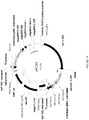
- Event 127 insert nucleic acid and “event 127 insert DNA” refer to a nucleic acid molecule having the nucleic acid sequence of positions 1312-6069 of SEQ ID NO:1 (which differs from the DNA used to generate event 127, i.e., the6156bp Pvu II fragment from the pAC321 construct provided in Figure 12 (SEQ ID NO:4)).
- Event 127 plant, cell, seed, plant part or plant tissue refers to any plant, cell, seed, plant part or plant tissue that contains an event 127 nucleic acid molecule, and preferably contain at least one event 127 specific nucleic acid.
- Event 127 plants include event 127-9 soybean plants containing a nucleic acid molecule having the sequence of SEQ ID NO:1 such as those referred to as BPS-CV127-9.
- flanking DNA refers to genomic DNA naturally present in an organism, such as a plant, immediately upstream or downstream and contiguous with the inserted nucleic acid molecule.
- a "flanking region” or “flanking sequence” as used herein refers to a sequence of at least 10, 20, 50, 100, 200, 300, 400, 1000, 1500, 2000, 2500, or 5000 base pairs or greater which is located either immediately upstream (5') of and contiguous with or immediately downstream (3') of and contiguous with the original foreign insert DNA molecule.
- flanking regions of event 127 are set forth in SEQ ID NOs:2 and 3 and variants and fragments thereof, wherein SEQ ID NO:2 represents positions 1-1311 of SEQ ID NO:1, and SEQ ID NO:3 represents positions 6070-10,656 of SEQ ID NO:1.
- Transformation procedures leading to random integration of the foreign insert DNA will result in individual transformants containing different flanking regions characteristic of and unique for each transformant.
- flanking regions characteristic of and unique for each transformant.
- Individual transformation events will also contain unique junctions between a piece of heterologous insert DNA and genomic DNA, or two pieces of genomic DNA, or two pieces of heterologous DNA.
- junction point is a point where two specific DNA fragments join, for example, where insert DNA joins flanking DNA.
- a junction point also exists in a transformed organism where two DNA fragments join together in a manner that is modified from that found in the native organism.
- junction DNA or “junction region” refers to DNA that comprises a junction point.
- Non-limiting examples of junction points in DNA from the soybean event 127 include sequences as set forth, for example, in SEQ ID NOs:5 and 6, wherein SEQ ID NO:5 represents positions 1311-1312 of SEQ ID NO:1 and SEQ ID NO:6 represents positions 6069-6070 of SEQ ID NO:1.
- transgenic includes any cell, cell line, callus, tissue, plant part, or plant, the genotype of which has been altered by the presence of a heterologous nucleic acid including those transgenics initially so altered as well as those created by sexual crosses or asexual propagation from the initial regenerated event.
- the term "transgenic” as used herein does not encompass the alteration of the genome (chromosomal or extra-chromosomal) by conventional plant breeding methods or by naturally occurring events such as random cross-fertilization, non-recombinant viral infection, non-recombinant bacterial transformation, non-recombinant transposition, or spontaneous mutation.
- Transformation refers to the transfer of a nucleic acid fragment into the genome of a host organism, resulting in genetically stable inheritance. Host organisms containing the transformed nucleic acid fragments are referred to as “transgenic” organisms. Examples of methods of plant transformation include those known in the art and disclosed below.
- a "transgenic event” is produced by transformation of plant cells with a heterologous DNA construct(s), including a nucleic acid expression cassette that comprises a transgene of interest, the regeneration of a population of plants resulting from the insertion of the transgene into the genome of the plant, and selection of a particular regenerated plant characterized by insertion into a particular genome location.
- An event is characterized phenotypically by the expression of the transgene(s).
- an event is part of the genetic makeup of a plant.
- sample includes any sample that contains nucleic acid molecules or polypeptides and is derived from plants, plant material, or in products such as, but not limited to, food or feed products (fresh or processed) comprising, or derived from plant material.
- introducing or “introduced” in the context of transformation is intended presenting to the plant a heterologous DNA construct in such a manner that the construct gains access to the interior of a cell of the plant.
- the plants and methods of the invention do not depend on a particular method for introducing a nucleic acid construct to a plant, only that the nucleic acid construct gains access to the interior of at least one cell of the plant.
- Methods for introducing nucleic acid constructs into plants are known in the art including, but not limited to, stable transformation methods, transient transformation methods, and virus-mediated methods.
- progeny refers to plants produced by a sexual cross (e.g. outcross, self-cross or back-cross) between an event 127 plant and another variety. Even after repeated back-crossing to a recurrent parent, the inserted DNA and/or flanking DNA from the event 127 parent is present in the progeny of the cross at the same chromosomal location and can be identified, for example, by screening for event 127 specific regions.
- nucleic acid molecule in reference to a nucleic acid molecule is a nucleic acid molecule that originates from a foreign species, or, if from the same species, is modified from its native form in composition and/or genomic locus by deliberate human intervention.
- nucleic acid molecule or biologically active portion thereof, is substantially or essentially free from components that normally accompany or interact with the nucleic acid molecule as found in its naturally occurring environment.
- an isolated or purified nucleic acid molecule is substantially free of other cellular material, or culture medium when produced by recombinant techniques, or substantially free of chemical precursors or other chemicals when chemically synthesized.
- a “probe” refers to an isolated nucleic acid molecule to which is attached a detectable label or reporter molecule, e.g., a radioactive isotope, ligand, chemiluminescent agent, enzyme, etc.
- a detectable label or reporter molecule e.g., a radioactive isotope, ligand, chemiluminescent agent, enzyme, etc.
- Such a probe is complementary to a strand of a target nucleic acid molecule, in the instant case, to a strand of isolated DNA from soybean event 127 plant biological material whether from a soybean plant or from a sample that includes DNA from the event.
- Probes include not only deoxyribonucleic or ribonucleic acids but also polyamides and other probe materials that can specifically detect the presence of the target DNA sequence.
- primers are isolated nucleic acid molecules that are capable of annealing to a complementary target DNA strand by nucleic acid hybridization to form a hybrid between the primer and the target DNA strand, which can then be extended along the target DNA strand by a polymerase, e.g., a DNA polymerase.
- Primer pairs refer to a pair of primers for use in amplification of a target nucleic acid molecule, e.g., by the polymerase chain reaction (PCR) or other conventional nucleic-acid amplification methods.
- PCR polymerase chain reaction
- Polymerase chain reaction or "PCR” is a technique used for the amplification of specific DNA segments.
- a “line” or “strain” is a group of individuals of identical parentage that are generally inbred to some degree and that are generally isogenic or near isogenic.
- crossing means the fusion of gametes, e.g., via pollination to produce progeny (i.e., cells, seeds, or plants) in the case of plants.
- progeny i.e., cells, seeds, or plants
- the term encompasses both sexual crosses (the pollination of one plant by another) and, in the case of plants, selfing (self-pollination, i.e., when the pollen and, ovule are from the same plant).
- introduction refers to the transmission of a desired allele of a genetic locus from one genetic background to another.
- the desired alleles can be introgressed through a sexual cross between two parents, wherein at least one of one of the parents has the desired allele in its genome.
- compositions and methods related to transgenic AHAS inhibitor-tolerant soybean plants are provided.
- Such compositions include event 127 soybean plants.
- An event 127 soybean plant has been modified from a wild-type or non-transformed soybean plant by the insertion or introgression of the imidazolinone-tolerant acetohydroxyacid synthase large subunit gene from Arabidopsis thaliana ( csr1-2 ) into the soybean genome as defined herein.
- the insertion of the csr1-2 gene into the soybean genome provides for the expression of a modified form of the acetohydroxyacid synthase (AHAS) enzyme having an AHASL protein containing an asparagine corresponding to position 653, rather than the natural serine (S653N).
- AHAS acetohydroxyacid synthase
- AHAS enzyme is important for branched chain amino acid biosynthesis and is inhibited by certain herbicides (AHAS-inhibiting herbicides).
- AHAS-inhibiting herbicides The modification in the AHAS gene overcomes this inhibition and thus provides tolerance to a wide range of AHAS-inhibiting herbicides.
- a soybean event 127 plant is tolerant to at least one AHAS-inhibiting herbicide or is tolerant of increased amounts of at least one AHAS-inhibiting herbicide compared to a soybean plant lacking an event 127 nucleic acid molecule.
- the nucleic acid molecule conferring the AHAS inhibitor tolerance was found to be inserted at a characterized position in the soybean genome and thereby produces the 127 event.
- the event 127 soybean plant harboring an event 127 nucleic acid molecule at the recited chromosomal location comprises, in one embodiment, one or more genomic/transgene junctions having at least the nucleic acid molecule sequence of SEQ ID NO:5 and/or 6.
- the characterization of the genomic insertion site of the event 127 provides for an enhanced breeding efficiency and enables the use of molecular markers to track the transgene insert in the breeding populations and progeny thereof.
- Various methods and compositions for the identification, detection, and use of the event 127 soybean plants are provided herein.
- the csr1-2 expression cassette a Pvu II fragment from plasmid pAC321, was integrated at a single characterized genetic locus in the soybean genome to result in event 127.
- the inserted csr1-2 cassette in event 127 contains three point mutations relative to the original transformation fragment from plasmid pAC321 with one mutation in the AHAS coding sequence and the other two downstream of the AHASL 3' untranslated region (UTR).
- Such mutations include a G to A mutation in the coding sequence, which results in the expression of an AHAS polypeptide having an amino acid substitution of R 272 to K 272 .
- Southern blot analysis and sequence verification of the point mutation indicate that the insert is stable across at least eight generations.
- the inserted DNA in event 127 also contains a 376 base pair (bp) duplication of a portion of the csrl-2 coding sequence directly before the 3' integration point (the duplication is represented by positions 5694-6069 of SEQ ID NO:1).
- This duplicated 376 bp segment results in a 501 bp open reading frame (ORF) that extends into the 3' flanking sequence.
- the event 127 nucleic acid molecule also contains the majority of the Arabidopsis SEC61 ⁇ subunit gene locus (At3g48570), which is a component of the DNA fragment used for transformation.
- the SEC61 ⁇ subunit gene may be expressed in a Soybean event 127 plant.
- RT-PCR experiments show that the Arabidopsis SEC61 ⁇ subunit gene is weakly transcribed in event 127 leaf tissue.
- a total of about 1.3 kilobases (kb) of 5' flanking soybean DNA has been sequenced together with about 4.6 kb of 3' flanking soybean DNA.
- the flanking sequence information can be used in the development of an event 127-specific qualitative PCR detection method in accordance with the present invention.
- Other characteristics of the event 127 nucleic acid molecules, such as the identified point mutations and duplications, can also be used in methods provided herein for the detection of an event 127 plant, including progeny and derivatives thereof.
- the event 127 plants of the present invention are tolerant to application of AHAS-inhibiting herbicides.
- the event 127 plants exhibit tolerance or enhanced tolerance to levels of AHAS-inhibiting herbicides at levels of application that include amounts equivalent to amounts of herbicide application between 50 g ai/ha and about 500 g ai/ha, between 70 g ai/ha and about 400 g ai/ha, and between 70 g ai/ha and about 300 g ai/ha.
- Such tolerance can also include tolerance to levels of AHAS-inhibiting herbicides of 1X, 2X, 3X, 4X, 5X, or greater amounts of the commercial levels of applications of the herbicide.
- Tolerance to an AHAS-inhibiting herbicide can be determined by any method of determining herbicide tolerance.
- a soybean event 127 plant can demonstrate tolerance to an AHAS-inhibiting herbicide or other chemical if it shows damage in comparison to an appropriate control plant that is less than the damage exhibited by the control plant by at least 5%, 10%, 15%, 20%, 25%, 30%, 35%, 40%, 45%, 50%, 55%, 60%, 65%, 70%, 75%, 80%, 90%, 100%, 150%, 200%, 250%, 300%, 400%, 500%, 600%, 700%, 800%, 900%, or 1000% or more.
- Damage resulting from the herbicide or other chemical treatment is assessed by evaluating any parameter of plant growth or well-being deemed suitable by one of skill in the art. Damage can be assessed by visual inspection and/or by statistical analysis of suitable parameters of individual plants or of a group of plants. Thus, damage can be assessed by evaluating, for example, parameters such as plant height, plant weight, leaf color, flowering, fertility, yield, seed production, and the like. Damage can also be assessed by evaluating the time elapsed to a particular stage of development (e.g., maturity or flowering) or the time elapsed until a plant has recovered from treatment with a particular chemical and/or herbicide.
- stage of development e.g., maturity or flowering
- Damage caused by an AHAS-inhibiting herbicide or other chemical can be assessed at various times after an event 127 plant has been treated or contacted with an herbicide.
- the damage can be assessed at about the time that the control plant exhibits maximum damage, or can be assessed after a period of time in which a control plant that was not treated with the herbicide or other chemical has measurably grown and/or developed in comparison to the size or stage at which the treatment was administered.
- the damage can be assessed at various times, for example, at 12 hours or at 1, 2, 3, 4, 5, 6, 7, 8, 9, 10, 11, 12, 13, 14 days, or three weeks, four weeks, or longer after the test plant was treated with the herbicide. Any time of assessment is suitable as long as it permits detection of a difference in response to a treatment of test and control plants.
- the present invention further includes seed of soybean line CV603 (also known as "BPS-CV127-9") containing event 127 nucleic acid molecules, and deposited as NCIMB Patent Deposit No. 41603 and plants, plant cells, and seed derived therefrom.
- Applicant(s) have made a deposit of at least 2500 seeds of soybean plants containing an event 127 nucleic acid molecule with the National Collections of Industrial, Food, and Marine Bacteria (NCIMB), 23 St. Machar Drive, Aberdeen AB2 1RY, Scotland, United Kingdom, on December 22, 2008, and the deposit was assigned NCIMB accession No. 41603. These deposits will be maintained under the terms of the Budapest Treaty on the International Recognition of the Deposit of Microorganisms for the Purposes of Patent Procedure.
- Applicant(s) have no authority to waive any restrictions imposed by law on the transfer of biological material or its transportation in commerce. Applicant(s) do not waive any infringement of their rights granted under this patent or rights applicable to soybean line CV603 under the Plant Variety Protection Act (7 USC 2321 et seq.). Unauthorized seed multiplication prohibited. The seed may be regulated.
- Event 127 soybean plants of the present invention also include progeny, derivatives, variants, and mutants of the initial transformation event giving rise to event 127 soybean plants. Such plants may be identified using any method for identifying such plants, including, but not limited to, breeding records, herbicide tolerance methods, molecular detection methods, the methods disclosed herein, and combinations thereof.
- soybean plants of the present invention are tolerant to at least one herbicide that interferes with the activity of the endogenous AHAS enzyme (AHAS-inhibiting herbicides) lacking the S653N mutation.
- Herbicides that interfere with the activity of the AHAS enzyme include imidazolinone herbicides, sulfonylurea herbicides, triazolopyrimidine herbicides, pyrimidinyloxybenzoate herbicides, sulfonylamino-carbonyltriazolinone herbicides, or mixtures or combinations thereof.
- such herbicides are an imidazolinone herbicide, a sulfonylurea herbicide, or mixtures thereof.
- Imidazolinone herbicides include, but are not limited to, PURSUIT® (imazethapyr), CADRE® (imazapic), RAPTOR® (imazamox), SCEPTER® (imazaquin), ASSERT® (imazethabenz), ARSENAL® (imazapyr), a derivative of any of the aforementioned herbicides, and a mixture or combination of two or more of the aforementioned herbicides, for example, imazapyr/imazamox (ODYSSEY®).
- the imidazolinone herbicide can also be selected from, but not limited to, 2-(4-isopropyl-4-methyl-5-oxo-2-imidiazolin-2-yl)-nicotinic acid, [2-(4-isopropyl)-4-] [methyl-5-oxo-2-imidazolin-2-yl)-3-quinolinecarboxylic] acid, [5-ethyl-2-(4-isopropyl-]4-methyl-5-oxo-2-imidazolin-2-yl)-nicotinic acid, 2-(4-isopropyl-4-methyl-5-oxo-2-imidazolin-2-yl)-5-(methoxymethyl)-nicotinic acid, [2-(4-isopropyl-4-methyl5-oxo-2-] imidazolin-2-yl)-5-methylnicotinic acid, and a mixture of methyl [6-(4-isopropyl-4-
- 5-ethyl-2-(4-isopropyl-4-methyl-5-oxo-2-imidazolin-2-yl)-nicotinic acid and [2-(4-isopropyl-4-methyl-5-oxo-2-imidazolin-2-]yl)-5-(methoxymethyl)-nicotinic acid are used.
- [2-(4-isopropyl-4-]methyl-5-oxo-2-imidazolin-2-yl)-5-(methoxymethyl)-nicotinic acid is used.
- Sulfonylurea herbicides that can be used in the present invention include, but are not limited to, chlorsulfuron, metsulfuron methyl, sulfometuron methyl, chlorimuron ethyl, thifensulfuron methyl, tribenuron methyl, bensulfuron methyl, nicosulfuron, ethametsulfuron methyl, rimsulfuron, triflusulfuron methyl, triasulfuron, primisulfuron methyl, cinosulfuron, amidosulfiuon, fluzasulfuron, imazosulfuron, pyrazosulfuron ethyl, halo sulfuron, azimsulfuron, cyclosulfuron, ethoxysulfuron, flazasulfuron, flupyrsulfuron methyl, foramsulfuron, iodosulfuron, oxasulfuron, me
- the triazolopyrimidine herbicides described herein include, but are not limited to, cloransulam, diclosulam, florasulam, flumetsulam, metosulam, and penoxsulam.
- the pyrimidinyloxybenzoate (or pyrimidinyl carboxy) herbicides described herein include, but are not limited to, bispyribac, pyrithiobac, pyriminobac, pyribenzoxim and pyriftalid.
- the sulfonylamino-carbonyltriazolinone herbicides include, but are not limited to, flucarbazone and propoxycarbazone.
- pyrimidinyloxybenzoate herbicides are related to the pyrimidinylthiobenzoate herbicides and can be generalized under the heading of pyrimidinylthiobenzoate herbicides by the Weed Science Society of America. Accordingly, the herbicides described herein further include pyrimidinylthiobenzoate herbicides, including, but not limited to, the pyrimidinyloxybenzoate herbicides described above.
- nucleic acid molecule is not intended to limit a nucleic acid molecule to comprise DNA, but can include any nucleotides, such as ribonucleotides and combinations of ribonucleotides and deoxyribonucleotides. Such deoxyribonucleotides and ribonucleotides include both naturally occurring molecules and synthetic analogues.
- the nucleic acid molecules also encompass all forms of sequences including, but not limited to, single-stranded forms, double-stranded forms, hairpins, stem-and-loop structures, and the like.
- the event 127 nucleic acid molecule comprises a nucleic acid molecule having the nucleic acid sequence of positions 1312 to 6069 of SEQ ID NO:1. In one embodiment, the event 127 nucleic acid molecule comprises a nucleic acid molecule having the sequence of nucleotides 1302 to 6079 of SEQ ID NO:1.
- nucleic acid molecules also include fragments of SEQ ID NO:1.
- "Fragments" of a nucleotide sequence can be of any length, such as for example, at least 7, 15, 20, 25, 30, 40, 60, 80, 100, 150, 200, 250, 300, 350, 400, 450, 550, 650, 700, 800, 900, 1000, 1200, 1400, 1600, 1800, 2000, 2200, 2400, 2600, 2800, 3000, 3500, 4000, 4500, or more nucleotides (nt) in length.
- These fragments have numerous uses that include, but are not limited to, diagnostic probes and primers.
- fragments such as those of 601-8000 nt in length are also useful according to the present invention as are fragments corresponding to most, if not all, of the nucleotide sequences SEQ ID NO: 1.
- fragments at least 20 nt in length for example, is intended fragments which include 20 or more contiguous bases from, for example, the nucleotide sequence of SEQ ID NO: 1.
- An event 127 plant comprises a transgenic expression cassette having an AHASL coding sequence having an S653N mutation that is capable of providing resistance or tolerance to imidazolinone-inhibiting herbicides.
- the cassette additionally includes 5' and 3' regulatory sequences operably linked to the AHASL coding sequence.
- "Operably linked” is intended to mean a functional linkage between two or more elements.
- an operable linkage between a nucleic acid molecule of interest and a regulatory sequence e.g., a promoter
- Operably linked elements may be contiguous or non-contiguous. When used to refer to the joining of two protein coding regions, by operably linked it is intended that the coding regions are in the same reading frame.
- the expression cassette in a soybean event 127 plant contains in the 5'-3' direction of transcription, a transcriptional and translational initiation region (e.g., a promoter), an AHASL S653N coding region, and a transcriptional and translational termination region functional in plants.
- a transcriptional and translational initiation region e.g., a promoter
- AHASL S653N coding region e.g., a promoter
- a transcriptional and translational termination region e.g., a promoter
- Promoter refers to a nucleotide sequence capable of controlling the expression of a coding sequence or functional RNA.
- a coding sequence is located 3' to a promoter sequence.
- the promoter sequence can comprise proximal and more distal upstream elements, the latter elements are often referred to as enhancers.
- an “enhancer” is a nucleotide sequence that can stimulate promoter activity and may be an innate element of the promoter or a heterologous element inserted to enhance the level or tissue-specificity of a promoter.
- Promoters may be derived in their entirety from a native gene, or be composed of different elements derived from different promoters found in nature, or even comprise synthetic nucleotide segments. It is understood by those skilled in the art that different promoters may direct the expression of a gene in different tissues or cell types, or at different stages of development, or in response to different environmental conditions. Promoters that cause a nucleic acid fragment to be expressed in most cell types at most times are commonly referred to as "constitutive promoters".
- the expression cassette in a soybean event 127 plant contains, as operably linked components, an AHASL S653N encoding sequence under the control of the Arabidopsis thaliana csr1-2 promoter and the csr1-2 transcription termination region.
- the expression cassette is derived as a Pvu II fragment from the nucleic acid construct pAC321.
- the expression cassette has the sequence of SEQ ID NO:4.
- Isolated nucleic acid molecules are provided that can be used in various methods for the detection and/or identification of the event 127 nucleic acid molecule.
- an "isolated" nucleic acid molecule is free of sequences (e.g. protein encoding sequences) that naturally flank the nucleic acid molecule (i.e., sequences located at the 5' and 3' ends of the nucleic acid) in the genomic DNA of the organism from which the nucleic acid molecule is derived.
- the isolated nucleic acid molecule can contain less than about 5 kb, 4 kb, 3 kb, 2 kb, 1 kb, 0.5 kb, or 0.1 kb of nucleotide sequence that naturally flank the nucleic acid molecule in genomic DNA of the cell from which the nucleic acid molecule is derived.
- the nucleic acid molecules comprise the junction DNA sequence set forth in SEQ ID NO:5 and/or 6. In other embodiments, the nucleic acid molecules comprise the junction DNA sequences set forth in SEQ ID NO:5 and/or 6 or variants and fragments thereof. Fragments and variants of junction DNA sequences are suitable for discriminatively identifying event 127 DNA. As discussed elsewhere herein, such sequences find use as primers and/or probes for use in detecting event 127 insert DNA in a sample.
- nucleic acid molecules are provided that can detect an event 127 plant, event 127 insert DNA, or an event 127 specific nucleic acid molecule.
- sequences include any nucleic acid molecule comprising a nucleic acid molecule set forth in SEQ ID NOs:5 and/or 6 or variants thereof or complements thereof.
- the nucleic acid molecule used to detect an event 127 nucleic acid molecule comprises the sequence set forth in SEQ ID NO:5 and/or 6 or complements thereof. Fragments and variants of nucleic acid molecules that detect an event 127 nucleic acid molecule, an event 127 insert DNA, or an event 127 specific region are suitable for discriminatively identifying event 127 plants.
- isolated DNA nucleotide primer sequences comprising or consisting of a sequence set forth in SEQ ID NO:35, 36, 37, 38, 39, 40, 41, 42, 43, 44, 45, 47, 67, 68, 69, 70, or a complement thereof or variants and fragments of SEQ ID NO:35, 36, 37, 38, 39, 40, 41, 42, 43, 44, 45, 47, 67, 68, 69, 70, or complements thereof.
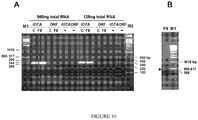
- a specific primer pair for use herein comprises the forward and reverse primers shown below (with relative positions to SEQ ID NO: 1 identified). The primers are predicted to produce a band size of 327 base pairs.
- Direction Primer Sequence 5'-3' Position SEQ ID NO: 1 SEQ ID NO: Forward GCTCCTTCGCCGTTTAGTGTATAG 1108-1131 69 Reverse CGAAATCTCTGAGAGGATCGATTG 1411-1434 70
- variants with regard to nucleic acid sequences refers to substantially similar sequences.
- a variant comprises a nucleic acid molecule having deletions (e.g., truncations) at the 5' and/or 3' end; deletion and/or addition of one or more nucleotides at one or more internal sites in the native nucleic acid molecule; and/or substitution of one or more nucleotides at one or more sites in the native nucleic acid molecule.
- primers can be used in the present invention, such as those disclosed herein, for the detection an event 127 specific region (e.g.., SEQ ID NOs:35, 36, 37, 38, 39, 40, 41, 42, 43, 44, 45, 47, 67, 68, 69, and 70).
- Non-limiting examples of primer pairs include SEQ ID NOs:35and 36; SEQ ID NOs:37 and 38; SEQ ID NOs:39 and 40; SEQ ID NOs:41 and 42; SEQ ID NOs:43 and 44, SEQ ID NOS: 67 and 68, SEQ ID NOS: 69 and 70. Additional primers and primer pairs can also be designed according to the present invention for use in the disclosed methods.
- the probes and primers for use in the methods provided are of sufficient nucleotide length to bind to the target DNA sequence and specifically detect and/or identify a nucleic acid molecule in a biological sample, for example, samples obtained from a plant to be tested. It is recognized that the hybridization conditions or reaction conditions can be determined by the operator to achieve this result.
- This length can be of any length that is useful in a detection method of choice, such as, 8, 10, 11, 14, 16, 18, 20, 22, 24, 26, 28, 30, 40, 50, 75, 100, 200, 300, 400, 500, 600, 700 nucleotides or more, or between about 11-20, 20-30, 30-40, 40-50, 50-100, 100-200, 200-300, 300-400, 400-500, 500-600, 600-700, 700-800, or more nucleotides in length.
- probes and primers can hybridize specifically to a target sequence under high stringency hybridization conditions.
- Probes and primers can have complete DNA sequence identity of contiguous nucleotides with the target sequence, although probes differing from the target DNA sequence and that retain the ability to specifically detect and/or identify a target DNA sequence may be designed by conventional methods. Accordingly, probes and primers can share about 80%, 85%, 90%, 91%, 92%, 93%, 94%, 95%, 96%, 97%, 98%, 99% or greater sequence identity or complementarity to the target nucleic acid molecule(e.g., SEQ ID NO:35, 36, 37, 38, 39, 40, 41, 42, 43, 44), or can differ from the target sequence (e.g., SEQ ID NO:35, 36, 37, 38, 39, 40, 41, 42, 43, 44) by 1, 2, 3, 4, 5, 6 or more nucleotides. Probes can be used as primers, but are generally designed to bind to the target DNA or RNA and are not used in an amplification process.
- specific primers can be used to amplify a fragment of the event DNA to produce an amplicon that can be used as a "specific probe” or the amplicon can itself be detected for identifying event 127 nucleic acid molecules in biological samples.
- a probe can be used during the PCR reaction to allow for the detection of the amplification event (e.g., a Taqman probe or a MGB probe) (so called real time PCR).
- a probe is hybridized with nucleic acid molecules in a biological sample under conditions which allow for the binding of the probe to the sample, this binding can be detected and thus allow for an indication of the presence of event 127 in the biological sample.
- a probe can be used during the PCR reaction to allow for the detection of the amplification event (e.g., a Taqman probe or a MGB probe) (so called real time PCR).
- the probe is a sequence which, under optimized conditions, hybridizes specifically to a region including the 5' or 3' flanking region of the event and also includes a part of the insert DNA contiguous therewith, thus spanning a junction region.
- the specific probe may comprise a sequence of at least 80%, between 80 and 85%, between 85 and 90%, between 90 and 95%, and between 95 and 100% identical (or complementary) to a specific region of the event 127 nucleic acid molecule.
- amplified DNA refers to the product of nucleic acid molecule amplification of a target nucleic acid molecule that is part of a nucleic acid template.
- DNA extracted from the soybean plant tissue sample may be subjected to a nucleic acid molecule amplification method using a DNA primer pair that includes a first primer derived from flanking sequence adjacent to the insertion site of inserted heterologous DNA, and a second primer derived from the inserted heterologous DNA to produce an amplicon that is diagnostic for or indicative of the presence of the event 127 nucleic acid molecule.
- the second primer may be derived from the flanking sequence.
- primer pairs can be derived from flanking sequence on both sides of the inserted DNA so as to produce an amplicon that includes the entire inserted nucleic acid molecule of the expression construct as well as the sequence flanking the transgenic insert, for example SEQ ID NO:1.
- the amplicon is of a length and has a sequence that is also diagnostic for the event (e.g., contains a junction DNA from an event 127 region).
- the amplicon may range in length from the combined length of the primer pairs plus one nucleotide base pair to any length of amplicon producible by a DNA amplification protocol.
- a member of a primer pair derived from the flanking sequence may be located a distance from the inserted DNA sequence, this distance can range from one nucleotide base pair up to the limits of the amplification reaction, or about twenty thousand nucleotide base pairs.
- primer pairs can be designed to amplify the insert DNA, or a fragment of the insert DNA. Such primer pairs are useful to detect the presence of the event 127 insert DNA in a biological sample.
- the use of the term "amplicon" specifically excludes primer dimers that may be formed in the DNA thermal amplification reaction.
- useful primer pairs will include one primer that overlaps with the junction point between the insert DNA and the flanking 5' or 3' genomic DNA.
- Such primers may be designed around the junction point between the 5' flanking DNA and the insert DNA (i.e., the junction between positions 1311 and 1312 of SEQ ID NO:1) as well as around the junction point between the insert DNA and the 3' flanking DNA (i.e., the junction between positions 6069 and 6070 of SEQ ID NO:1).
- Such primers may be designed to hybridize with about 10 nucleotides from either the flanking region or the insert DNA and with at least 1 nucleotide across the junction point in the insert DNA or the flanking region.
- primers may comprise nucleotide sequences designed to hybridize with the nucleotides represented by at least the following positions of SEQ ID NO:1: 1311-1321, 1302-1312, 6060-6070, and/or 6069-6079.
- useful primer pairs will include one primer that overlaps with the junction point between the 5' end of the duplicated portion of the csr1-2 coding sequence of the insert DNA (at position 5694 of SEQ ID NO:1) and the adjacent insert DNA (i.e., at position 5693 of SEQ ID NO:1).
- Such primers may be designed to hybridize with about 10 nucleotides from either the duplicated region or the adjacent insert DNA and with at least 1 nucleotide across the junction point (e.g., at least 5693-5603, or at least 5684-5694 of SEQ ID N0: 1).
- PCR primer pairs can be derived from a known sequence, for example, by using computer programs intended for that purpose such as the PCR primer analysis tool in Vector NTI version 6 (Informax Inc., Bethesda Md.); PrimerSelect (DNASTAR Inc., Madison, Wis.); and Primer (Version 0.5 ⁇ , 1991, Whitehead Institute for Biomedical Research, Cambridge, Mass.). Additionally, the sequence can be visually scanned and primers manually identified using guidelines known to one of skill in the art.
- the disclosed event 127 soybean plants can be used in a breeding program using breeding methods to produce additional event 127 soybean plants, such as progeny plants. Such breeding methods can be used to produce soybean plants for example for use in commercial production in different geographic regions or to produce additional soybean breeding populations.
- event 127 soybean plants may be used in breeding programs using breeding methods to produce soybean plants having additional traits of interest combined with the AHAS-inhibitor tolerance (also referred to as "stacked traits” or “trait stacking”), such as combinations of resistance to additional herbicides, such as glyphosate, glufosinate, and/or dicamba.
- additional traits of interest also referred to as "stacked traits” or “trait stacking”
- additional herbicides such as glyphosate, glufosinate, and/or dicamba.
- the event 127 soybean plants may be used in a breeding program using breeding methods to produce soybean plants having multiple AHAS-inhibiting herbicide resistance coding sequences.
- the disclosed plants may be used in breeding programs using breeding methods to produce plants having the AHAS-inhibiting herbicide tolerance trait combined with other agronomically important traits, including input traits, (such as disease and pathogen resistance, such as those conferred by the Bt gene), and output traits, such as oil and protein quality and quantity.
- input traits such as disease and pathogen resistance, such as those conferred by the Bt gene
- output traits such as oil and protein quality and quantity.
- the disclosed methods of breeding AHAS-inhibiting herbicide resistant soybean plants comprise the steps of (a) crossing an event 127 soybean plant with a second soybean plant; and (b) obtaining seed from the cross.
- the obtained seeds may be further screened to identify seeds that contain DNA having an event 127 nucleic acid molecule.
- Such methods may further involve obtaining a DNA sample from the seed of the cross and assaying the sample for the presence or absence of an event 127 nucleic acid molecule.
- the seeds may be screened for AHAS-inhibiting herbicide tolerance to identify seeds or progeny that contain event 127 DNA.
- An event 127 soybean plant can be bred using any breeding method available for soybean.
- an event 127 soybean plant can be bred by first sexually crossing a first parental soybean plant grown from the transgenic event 127 soybean plant (or progeny thereof derived from transformation with the expression cassettes of the embodiments that confer herbicide tolerance) and a second parental soybean plant that lacks the herbicide tolerance phenotype, thereby producing a plurality of first progeny plants; and then selecting a first progeny plant that displays the desired herbicide tolerance; and selfing the first progeny plant, thereby producing a plurality of second progeny plants; and then selecting from the second progeny plants which display the desired herbicide tolerance.
- steps can further include the back-crossing of the first herbicide tolerant progeny plant or the second herbicide tolerant progeny plant to the second parental soybean plant or a third parental soybean plant, thereby producing a soybean plant that displays the desired herbicide tolerance. It is further recognized that assaying progeny for phenotype is not required.
- Various methods and compositions, as disclosed elsewhere herein, can be used to detect and/or identify the event 127 insert.
- transgenic plants can also be sexually crossed to produce offspring that contain two independently segregating added, exogenous genes. Selfing of appropriate progeny can produce plants that are homozygous for both added, exogenous genes.
- Back-crossing to a parental plant and out-crossing with a non-transgenic plant are also contemplated, as is vegetative propagation. However, any method may be employed to generate such plants.
- Inbred soybean lines containing the event 127 nucleic acid molecule may be developed for use in the production of soybean varieties and for use as parental plants in breeding programs to create new and distinct inbred soybean lines. Inbred soybean lines are often used as targets for the introgression of novel traits through traditional breeding and/or molecular introgression techniques. Many analytical methods are available to determine the homozygosity and phenotypic stability of inbred lines.
- the nucleic acid molecule resulting in the production of the event 127 soybean plant of the invention can be engineered into a molecular stack with a nucleic acid molecule that confers resistance to a second herbicide, such as glyphosate.
- the molecular stack further comprises at least one additional nucleic acid molecule that confers tolerance to a third herbicide.
- the sequence confers tolerance to glufosinate, and in a specific embodiment, the sequence comprises pat.
- the event 127 soybean plant of the invention comprises one or more traits of interest
- the event 127 DNA is stacked with any combination of nucleic acid molecule sequences and/or traits of interest in order to create plants with a desired combination of traits.
- a trait refers to the phenotype derived from a particular sequence or groups of sequences.
- herbicide-tolerance nucleic acid molecules may be stacked with any other nucleic acid molecules encoding polypeptides having pesticidal and/or insecticidal activity, such as Bacillus thuringiensis toxic proteins ( Bt proteins), lectins, and the like.
- Bt proteins Bacillus thuringiensis toxic proteins
- lectins and the like.
- the combinations generated can also include multiple copies of any one of the nucleic acid molecules of interest.
- soybean event 127 DNA can be stacked with other herbicide-tolerance traits to create a transgenic plant of the invention with further improved properties.
- Other herbicide-tolerance nucleic acid molecules that could be used in such embodiments include those conferring tolerance to glyphosate or to AHAS inhibitors by other modes of action, such as, for example, a gene that encodes a glyphosate oxido-reductase enzyme.
- Other traits that could be combined with the soybean event 127 DNA include those derived from nucleic acid molecules that confer on the plant the capacity to produce a higher level of 5-enolpyruvylshikimate-3-phosphate synthase (EPSPS).
- EPSPS 5-enolpyruvylshikimate-3-phosphate synthase
- Other traits that could be combined with the soybean 127 event include those conferring tolerance to sulfonylurea and/or imidazolinone.
- the soybean event 127 DNA may be stacked with, for example, hydroxyphenylpyruvatedioxygenases which are enzymes that catalyze the reaction in which para-hydroxyphenylpyruvate (HPP) is transformed into homogentisate.
- HPP para-hydroxyphenylpyruvate
- Molecules which inhibit this enzyme and which bind to the enzyme in order to inhibit transformation of the HPP into homogentisate are useful as herbicides. Traits conferring tolerance to such herbicides in plants are known in the art.
- herbicide-tolerance traits that could be stacked with the soybean event 127 DNA include aryloxyalkanoate dioxygenase nucleic acid molecules (which reportedly confer tolerance to 2,4-D and other phenoxy auxin herbicides as well as to aryloxyphenoxypropionate herbicides) and dicamba-tolerance nucleic acid molecules.
- herbicide-tolerance traits that could be combined with the soybean event 127 DNA include those conferred by nucleic acid molecules encoding an exogenous phosphinothricin acetyltransferase. Plants containing an exogenous phosphinothricin acetyltransferase can exhibit improved tolerance to glufosinate herbicides, which inhibit the enzyme glutamine synthase. Other examples of herbicide-tolerance traits that could be combined with the soybean event 127 DNA include those conferred by nucleic acid molecules conferring altered protoporphyrinogen oxidase (protox) activity. Plants containing such nucleic acid molecules can exhibit improved tolerance to any of a variety of herbicides which target the protox enzyme (also referred to as "protox inhibitors").
- herbicide-tolerance traits that could be combined with the AHAS-inhibitor tolerance trait include those conferring tolerance to at least one herbicide in a plant such as, for example, a soybean plant.
- Herbicide-tolerant soybeans are known in the art, as are plants that vary in their tolerance to particular herbicides. The trait(s) responsible for these tolerances can be combined by breeding or via other methods with the event 127 soybean plant to provide a plant of the invention as well as methods of use thereof.
- the soybean event 127 DNA can also be combined with at least one other trait to produce plants of the present invention that further comprise a variety of desired trait combinations including, but not limited to, traits desirable for animal feed such as high oil content; amino acid composition, protein content, improved digestibility, or altered fatty acid compositions.
- the soybean event 127 DNA can also be combined with other desirable traits such as, for example, avirulence and disease resistance genes, such as soybean cyst nematode resistance traits, for example SCN, and traits desirable for processing or process products such as increased oil content or modified fatty acid composition (e.g., fatty acid desaturase genes; and polymers or bioplastics (e.g., beta-ketothiolase, polyhydroxybutyrate synthase, and acetoacetyl-CoA reductase) facilitate expression of polyhydroxyalkanoates (PHAs)).
- avirulence and disease resistance genes such as soybean cyst nematode resistance traits, for example SCN
- traits desirable for processing or process products such as increased oil content or modified fatty acid composition (e.g., fatty acid desaturase genes; and polymers or bioplastics (e.g., beta-ketothiolase, polyhydroxybutyrate synthase, and acetoacetyl-CoA reductase)
- nucleic acid molecules can be stacked at any time and in any order.
- the traits can be introduced simultaneously in a co-transformation protocol with the nucleic acid molecules of interest provided by any combination of transformation cassettes.
- the two sequences can be contained in separate transformation cassettes (trans) or contained on the same transformation cassette (cis).
- Expression of the sequences can be driven by the same promoter or by different promoters.
- nucleic acid molecules can be stacked at a desired genomic location using a site-specific recombination system.
- Also provided are methods of breeding soybean plants having the event 127 DNA where the method comprises (a) crossing an event 127 soybean plant or derivative thereof, with a second soybean parent plant; (b) obtaining seed from the cross; (c) obtaining a DNA sample from one or more seeds; and (d) detecting the presence of an event 127 nucleic acid molecule.
- Soybean plants having traits combined with the event 127 trait can also be produced by transformation of plant material or parts obtained from event 127 soybean plants. Additional traits can be combined into event 127 soybean plants using any transformation method available to the artisan.
- the event 127 soybean plants can be used as the source of plant material for use in transformation methods to introduce additional heterologous nucleic acid molecules into an event 127 soybean plant.
- transformation vectors can be prepared to introduce genes of interests into event 127 soybean plants to produce soybean plants having multiple introduced traits.
- the transformation vectors for use in such methods can be used to produce plants transformed with any gene of interest, including those described herein.
- the transformation vector may include a selectable marker and a gene of interest to be introduced and typically expressed in the transformed event 127 soybean plant.
- selectable markers are known in the art.
- the genes of interest vary depending on the desired trait to be introduced. For example, various changes in phenotype can be of interest including modifying the fatty acid composition in a plant, altering the amino acid content of a plant, altering a plant's insect and/or pathogen defense mechanisms, and the like. These results can be achieved by providing expression of heterologous products or increased expression of endogenous products in plants. Alternatively, the results can be achieved by providing for a reduction of expression of one or more endogenous products, particularly enzymes or cofactors in the plant. These changes result in a change in phenotype of the transformed plant.
- Any transformation vector can be used in the methods for preparing plants of the present invention. Numerous plant transformation vectors and methods for transforming plants are available. The transformation methods can be used to stack any trait with the AHAS-inhibiting herbicide tolerance trait provided by the event 127 insert, including those described herein.
- Methods and compositions for identifying and/or detecting event 127 nucleic acid molecules in a biological sample for example from a sample obtained from a soybean plant, including progeny and derivatives, are also provided. Such methods find use in identifying and/or detecting event 127 regions or nucleic acid molecules in any biological material. Such methods include, for example, methods to confirm seed purity and methods for screening seeds in a seed lot for an event 127 nucleic acid molecule.
- a method for identifying 127 insert nucleic acid molecule in a biological sample comprises forming a mixture of a biological sample and a first and a second nucleic acid primer capable of amplifying an event 127 nucleic acid molecule; reacting the mixture under conditions that allow the first and second nucleic acid primers to amplify a soybean event 127 nucleic acid molecule; and, detecting the presence or absence of an amplified event 127 nucleic acid molecule.
- the event 127 nucleic acid molecule is an event 127 specific nucleic acid molecule.
- Also provided are methods for identifying an event 127 nucleic acid molecule in a biological sample comprising forming a mixture containing a biological sample having soybean DNA and a nucleic acid molecule probe that is capable of hybridizing to a soybean event 127 nucleic acid molecule, reacting the mixture under conditions that allow the nucleic acid molecule probe to hybridize to an event 127 nucleic acid molecule, and detecting whether the nucleic acid molecule probe hybridizes to an event 127 nucleic acid molecule in the sample, where the presence of hybridization indicates the presence of an event 127 nucleic acid molecule.
- a method for identifying an event 127 nucleic acid molecule in a biological sample comprises forming a mixture of a biological sample and a first and a second nucleic acid primer capable of amplifying an event 127 insert nucleic acid molecule; reacting the mixture under conditions that allow the first and second nucleic acid primers to amplify an event 127 insert nucleic acid molecule; and, detecting the presence or absence of an amplified event 127 insert nucleic acid molecule.
- Also provided are methods for identifying event 127 nucleic acid molecules in a biological sample comprising forming a mixture containing a biological sample having DNA and a nucleic acid molecule probe that is capable of hybridizing to an event 127 nucleic acid molecule, reacting the mixture under conditions that allow the nucleic acid molecule probe to hybridize to an event 127 nucleic acid molecule, and detecting whether the nucleic acid molecule probe hybridizes to an event 127 nucleic acid molecule in the sample, where the presence of hybridization indicates the presence of an event 127 nucleic acid molecule.
- event 127 regions that can be detected using the methods of the present invention include event 127 insert DNA, 5' junction regions, 3' junction regions, 5' flanking regions, 3' flanking regions, unique mutations or duplications in the insert DNA resulting from the transformation event, or combinations and fragments of any thereof.
- a biological sample can comprise any sample in which one desires to determine if DNA having an event 127 nucleic acid molecule is present.
- a biological sample can comprise any plant material or material comprising or derived from a plant material such as, but not limited to, food or feed products.
- plant material refers to material which is obtained or derived from a plant or plant part.
- the biological sample comprises a soybean tissue.
- the biological sample is obtained from soybean leaf tissue.
- the biological sample is obtained from soybean seed tissue.
- nucleic acid molecules that can be detected include, but are not limited to DNA, mRNA, cDNA, and the like.
- polypeptides encoded by the event 127 nucleic acid molecules can be detected and/or identified using the methods of the present invention.
- the detected and/or identified nucleic acid molecules can encompass any fragment of the event 127 insert DNA, including identified mutations in the insert DNA, for example nucleic acid molecules encoding AHAS polypeptides having S653N or R272K, and the like, promoter sequences, termination sequences, fragments of such sequences, and combinations thereof.
- Primers and probes for use in the methods disclosed herein can be used to confirm (and, if necessary, to correct) the disclosed sequences by conventional methods, e.g., by re-cloning and sequencing such sequences.
- the nucleic acid molecule probes and primers specifically detect a target DNA sequence. Any conventional nucleic acid hybridization or amplification method can be used to detect or identify the presence of a nucleic acid molecule from a transgenic event in a sample.
- the nucleic acid molecule can be used either as a primer to amplify a 127 specific region or the nucleic acid molecule can be used as a probe that hybridizes under stringent conditions to a nucleic acid molecule having an event 127 specific region.
- the level or degree of hybridization which allows for the specific detection of a 127 event or a specific region of a 127 event is sufficient to distinguish the nucleic acid molecule with the 127 specific region from a nucleic acid molecule lacking this region and thereby allow for discriminately identifying an event 127 molecule.
- “stringent conditions” are conditions that permit the primer pair to hybridize to the target nucleic acid molecule to which a primer having the corresponding wild-type sequence (or its complement) would bind and preferably to produce an identifiable amplification product (the amplicon) having an event 127 nucleic acid molecule in a DNA thermal amplification reaction.
- oligonucleotide primers can be designed for use in PCR reactions to amplify an event 127 nucleic acid molecule.
- Primers for use in the disclosed methods can be used to amplify any 127 nucleic acid molecule.
- primer pairs can be designed that are capable of amplifying regions that are indicative of a plant containing an event 127 nucleic acid molecule fragment.
- such primer pairs can amplify a region comprising a single junction, for example 5' junction region or a 3' junction region.
- Such primer pairs include one primer that is capable of priming elongation from a flanking chromosomal region (e.g. 5' or 3' flanking regions) in the direction of the insert DNA, while the second primer is capable of priming from the insert DNA in the direction of the first primer in the flanking chromosomal region.
- primer pairs amplify a nucleic acid molecule that encompasses a junction region.
- one of the primers used in the amplification pair is capable of annealing to a region that spans one of the junction regions (e.g., 5' or 3' junction regions) and is capable of amplification in the direction of the chromosomal region or in the direction of the insert.
- the flanking chromosomal region primers for use in such methods may be capable of annealing to either 5' or 3' flanking chromosomal regions and prime amplification in the direction of the insert.
- primer pairs can be designed that are capable of amplifying two junctions.
- primers capable of annealing to the 5' or 3' flanking regions may be designed for use in such methods and can comprise primer sequences of from about 10 or 12 to about 40 nucleotides capable of annealing to a nucleic acid molecule between positions 1-1311 of SEQ ID NO:1 or positions 6070 to 10,656 of SEQ ID NO:1.
- random primers may be developed that are capable of annealing throughout the plant genome and can be used in conjunction with an insert specific primer to amplify a nucleic acid molecule that encompasses the insert DNA and a fragment of flanking sequence.
- the insert specific primer can be labeled to allow for detection of a fragment amplified using the insert specific primer.
- the resulting amplified nucleic acid molecules can be hybridized with labeled probes to identify or detect event 127 nucleic acid molecules.
- primer pairs can be developed that amplify the entire insert DNA or a portion of the insert that is indicative of event 127 DNA.
- the primer pairs can be designed to amplify the entire insert DNA using primers that prime from the 5' and 3' flanking regions of the insert.
- primer pairs can be designed that are capable of amplifying a region of the event 127 insert alone to identify the presence of the insert.
- primers can be designed to amplify any region within the PvuII fragment of the plasmid pAC321 for use in detecting the presence of the insert in a biological sample.
- primers include those capable of amplifying any of the regions of the insert DNA, including the region between positions 1312 and 6069 of SEQ ID NO:1.
- primer pairs can be developed that are capable of amplifying the Arabidopsis thaliana mutant AHAS coding sequence of the insert DNA (e.g. positions 2762 through 4774 or fragments thereof), or any combination of the coding sequence and regulatory sequences of the insert.
- the amplified nucleic acid molecule can be of any length that allows for the detection of the event 127 nucleic acid molecule.
- the amplicon can be about 10, 50, 100, 200, 300, 500, 700, 100, 2000, 3000, 4000, 5000 nucleotides in length or longer.
- one or more specific regions of the event 127 nucleic acid molecule can be detected.
- any primer that allows an event 127 nucleic acid molecule to be amplified and/or detected can be employed in the methods of the present invention.
- the primers comprise or are complementary to an event 127 nucleic acid molecule, such as for example 8, 10, 11, 12, 13, 14, 15, 16, 17, 18, 19, 20, 21, 22, 23, 24, 25, 26, 27, 28, 29, 30, or more contiguous nucleotides corresponding to, or complementary of, a nucleic acid molecule having a sequence of SEQ ID NO:1.
- the first and second primers comprise a nucleic acid molecule of SEQ ID NO:35, 36, 37, 38, 39, 40, 41, 42, 43, 44, 67, 68, 69, and 70, where the first or the second primer shares sufficient sequence identity or complementarity to the nucleic acid molecule to amplify the event 127 nucleic acid molecule.
- the first and the second primer can comprise any one or any combination of the sequences set forth in SEQ ID NO:35, 36, 37, 38, 39, 40, 41, 42, 43, 44, 67, 68, 69, and 70.
- the primers can be of any length sufficient to amplify a soybean event 127 region including, for example, at least 6, 7, 8, 9, 10, 15, 20, 15, or 30 or about 7-10, 10-15, 15-20, 20-25, 25-30, 30-35, 35-40, 40-45 nucleotides or longer.
- useful primer pairs will include one primer that overlaps with the junction point between the insert DNA and the flanking 5' or 3' genomic DNA.
- Such primers may be designed around the junction point between the 5' flanking DNA and the insert DNA (i.e., the junction between positions 1311 and 1312 of SEQ ID NO:1) as well as around the junction point between the insert DNA and the 3' flanking DNA (i.e., the junction between positions 6069 and 6070 of SEQ ID NO:1).
- Such primers may be designed to hybridize with about 10 nucleotides from either the flanking region or the insert DNA and with at least 1 nucleotide across the junction point in the insert DNA or the flanking region.
- primers may comprise nucleotide sequences designed to hybridize with the nucleotides represented by at least the following positions of SEQ ID NO:1: 1311-1321, 1302-1312, 6060-6070, and/or 6069-6079.
- useful primer pairs will include one primer that overlaps with the junction point between the 5' end of the duplicated portion of the csr1-2 coding sequence of the insert DNA (at position 5694 of SEQ ID NO:1) and the 3' end of the adjacent insert DNA portion (i.e., at position 5693 of SEQ ID NO:1).
- Such primers may be designed to hybridize with about 10 nucleotides from either the duplicated region or the adjacent insert DNA and with at least 1 nucleotide across the junction point (e.g., at least 5693-5603, or at least 5684-5694 of SEQ ID NO:1).
- any method to PCR amplify the event 127 nucleic acid molecule can be employed, including for example, real time PCR.
- a method of detecting the presence of event 127 nucleic acid molecules in a biological sample comprises (a) extracting a DNA sample from the biological sample; (b) providing a pair of DNA primer molecules (e.g., any combination of SEQ ID NOs:35, 36, 37, 38, 39, 40, 41, 42, 43, 44, 67, 68, 69, and 70, where the combination amplifies a soybean event 127 region), including, but not limited to, i) the sequences of SEQ ID NO:35 and SEQ ID NO:36, ii) SEQ ID NO:37 and SEQ ID NO:38, iii) SEQ ID NO:39 and SEQ ID NO:40, iv) SEQ ID NO:41 and SEQ ID NO:42, v) SEQ ID NO:43 and SEQ ID NO:44, vi) SEQ ID NO:67 and SEQ ID NO:68, and vii) SEQ ID NO:69 and SEQ ID NO:70;
- a pair of DNA primer molecules e
- nucleic acid molecule that selectively hybridizes to a target event 127 nucleic acid molecule may be employed.
- stringent conditions or “stringent hybridization conditions” when referring to a nucleic acid molecule probe conditions under which a probe will hybridize to its target sequence to a detectably greater degree than to other sequences (e.g., at least 2-fold over background) are intended.
- stringent conditions are conditions that permit the primer pair to hybridize to the target nucleic acid molecule to which a primer having the corresponding wild-type.
- Stringent conditions are sequence-dependent and will be different in different circumstances. By controlling the stringency of the hybridization and/or washing conditions, target sequences that are 100% complementary to the probe can be identified (homologous probing). Alternatively, stringency conditions can be adjusted to allow some mismatching in sequences so that lower degrees of identity are detected (heterologous probing). Generally, a probe is less than about 1000 nucleotides in length or less than 500 nucleotides in length.
- a substantially identical or complementary sequence is a nucleic acid molecule that will specifically hybridize to the complement of the nucleic acid molecule to which it is being compared under high stringency conditions.
- Appropriate stringency conditions which promote DNA hybridization for example, 6X sodium chloride/sodium citrate (SSC) at about 45° C, followed by a wash of 2X SSC at 50° C, are known to those skilled in the art.
- stringent conditions for hybridization and detection will be those in which the salt concentration is less than about 1.5 M Na ion, typically about 0.01 to 1.0 M Na ion concentration (or other salts) at pH 7.0 to 8.3 and the temperature is at least about 30° C for short probes (e.g., 10 to 50 nucleotides) and at least about 60° C for long probes (e.g., greater than 50 nucleotides).
- Stringent conditions may also be achieved with the addition of destabilizing agents such as formamide.
- Examples of moderate stringency conditions include hybridization in 40 to 45% formamide, 1.0 M NaCl, 1% SDS at 37° C, and a wash in 0.5X to 1X SSC at 55 to 60° C.
- Examples of high stringency conditions include hybridization in 50% formamide, 1 M NaCl, 1% SDS at 37° C, and a wash in 0.1X SSC at 60 to 65° C.
- wash buffers may comprise about 0.1% to about 1% SDS. Duration of hybridization is generally less than about 24 hours, usually about 4 to about 12 hours. The duration of the wash time will be at least a length of time sufficient to reach equilibrium.
- T m 81.5° C+16.6 (log M)+0.41 (% GC)-0.61 (% form)-500/L; where M is the molarity of monovalent cations, % GC is the percentage of guanosine and cytosine nucleotides in the DNA, % form is the percentage of formamide in the hybridization solution, and L is the length of the hybrid in base pairs.
- the T m is the temperature (under defined ionic strength and pH) at which 50% of a complementary target sequence hybridizes to a perfectly matched probe. T m is reduced by about 1° C for each 1% of mismatching; thus, T m , hybridization, and/or wash conditions can be adjusted to hybridize to sequences of the desired identity. For example, if sequences with ⁇ 90% identity are sought, the T m can be decreased 10° C. Generally, stringent conditions are selected to be about 5° C lower than the thermal melting point (T m ) for the specific sequence and its complement at a defined ionic strength and pH.
- the hybridization of the probe to the target DNA molecule can be detected by any number of methods known to those skilled in the art, these can include, but are not limited to, fluorescent tags, radioactive tags, antibody based tags, and chemiluminescent tags.
- a nucleic acid molecule is said to be the "complement” of another nucleic acid molecule if they exhibit complementarity.
- molecules are said to exhibit "complete complementarity" when every nucleotide of one of the nucleic acid molecules is complementary to a nucleotide of the other.
- Two molecules are said to be “minimally complementary” if they can hybridize to one another with sufficient stability to permit them to remain annealed to one another under at least conventional "low-stringency” conditions.
- the molecules are said to be “complementary” if they can hybridize to one another with sufficient stability to permit them to remain annealed to one another under conventional "high-stringency” conditions.
- event 127 plants can be detected or identified by detection of an expressed Arabidopsis thanliana AHAS polypeptide. Any method can be used in the detection of the AHAS polypeptide. For example, antibodies raised against the introduced AHAS protein may be used to detect the presence of an express AHAS polypeptide.
- any method can be used to detect an event 127 nucleic acid molecule or amplicon thereof, including, but not limited to, Genetic Bit Analysis.
- a DNA oligonucleotide is designed which overlaps both the adjacent flanking DNA sequence and the inserted DNA sequence.
- DNA primer oligos are designed to allow for an event 127 specific amplicon.
- the oligonucleotide is immobilized in wells of a microwell plate. Following PCR of the region of interest a single-stranded PCR product can be hybridized to the immobilized oligonucleotide and serve as a template for a single base extension reaction using a DNA polymerase and labeled ddNTPs specific for the expected next base. Readout may be fluorescent or ELISA-based. A signal indicates presence of the insert/flanking sequence due to successful amplification, hybridization, and single base extension.
- Another detection method for use in the methods of the present invention is the Pyrosequencing technique.
- an oligonucleotide is designed that overlaps the adjacent DNA and insert DNA junction or a pair of oligos are employed that can amplify an event 127 specific region.
- the oligonucleotide is hybridized to a single-stranded PCR product from the region of interest (one primer in the inserted sequence and one in the flanking sequence) and incubated in the presence of a DNA polymerase, ATP, sulfurylase, luciferase, apyrase, adenosine 5' phosphosulfate and luciferin.
- dNTPs are added individually and the incorporation results in a light signal which is measured.
- a light signal indicates the presence of the transgene insert/flanking sequence due to successful amplification, hybridization, and single or multi-base extension.
- Fluorescence Polarization may also be used to detect an amplicon of the invention.
- an oligonucleotide is designed which overlaps the flanking and inserted DNA junction or a pair of oligos are employed that can amplify an event 127 specific region.
- the oligonucleotide is hybridized to a single-stranded PCR product from the region of interest (one primer in the inserted DNA and one in the flanking DNA sequence) and incubated in the presence of a DNA polymerase and a fluorescent-labeled ddNTP. Single base extension results in incorporation of the ddNTP. Incorporation can be measured as a change in polarization using a fluorometer. A change in polarization indicates the presence of the transgene insert/flanking sequence due to successful amplification, hybridization, and single base extension.
- Taqman® gene expression assay may also be used for detecting and quantifying the presence of an event 127 nucleic acid molecule.
- a FRET oligonucleotide probe is designed which overlaps the flanking and insert DNA junction or a pair of oligos are employed that can amplify an event 127 nucleic acid molecule.
- the FRET probe and PCR primers are cycled in the presence of a thermostable polymerase and dNTPs. Hybridization of the FRET probe results in cleavage and release of the fluorescent moiety away from the quenching moiety on the FRET probe.
- a fluorescent signal indicates the presence of the flanking/transgene insert sequence due to successful amplification and hybridization.
- Molecular Beacons can also be employed in the disclosed methods. Briefly, a FRET oligonucleotide probe is designed that overlaps the flanking and insert DNA junction or a pair of oligos is employed that can amplify a 127 specific region. The unique structure of the FRET probe results in it containing secondary structure that keeps the fluorescent and quenching moieties in close proximity.
- the FRET probe and PCR primers (one primer in the insert DNA sequence and one in the flanking sequence) are cycled in the presence of a thermostable polymerase and dNTPs. Following successful PCR amplification, hybridization of the FRET probe to the target sequence results in the removal of the probe secondary structure and spatial separation of the fluorescent and quenching moieties. A fluorescent signal results. A fluorescent signal indicates the presence of the flanking/transgene insert sequence due to successful amplification and hybridization.
- a hybridization reaction using a probe specific to a sequence found within the amplicon is yet another method used to detect the amplicon produced by a PCR reaction of the present invention.
- event 127 nucleic acid molecules can be detected or identified by methods of detecting polypeptides produced by the event 127 nucleic acid molecules.
- the expression product of the csr-1 AHAS gene can be detected using the methods disclosed herein. Such methods may involve the use of binding proteins that are capable of binding to polypeptides produced by the inserted event 127 nucleic acid molecule.
- Such methods include, but are not limited to, immunological assays such as, ELISA (enzyme linked immunoabsorbent assays), antigen assays, immunostaining, immuno-hisotchemistry, protein chip assays, radioimmunoprecipitation assays, rapid membrane immunochromatographic assays, and rapid stick immunochromatographic assays (lateral flow tests).
- immunological assays such as, ELISA (enzyme linked immunoabsorbent assays), antigen assays, immunostaining, immuno-hisotchemistry, protein chip assays, radioimmunoprecipitation assays, rapid membrane immunochromatographic assays, and rapid stick immunochromatographic assays (lateral flow tests).
- the methods disclosed herein can be adapted for use in high-throughput techniques, for example, by attaching the diagnostic molecules (such as primers and/or probes) on a substrate, to form a device, for example an array or a microarray, or to multi-well plates.
- the devices may be provided in any useful format, such as chips, slides, plates, membranes, fibers, beads, strips, sticks, mats, lattices, rods, fabrics, vessel walls, and the like.
- the substrates can be made of any material available, such as, glass, ceramics, gels (e.g. hydrogels, microgels, pseudogels), and polymeric materials (e.g. plastics, silicone, fluoropolymers).
- the substrates for use in the devices and methods of the present invention include, but are not limited to, silica chips, nylon membranes, optical fibers, multi-well plates, and the like.
- the probes or other event 127 diagnostic molecules can be attached to the substrate using any attachment methods available, such as, covalent binding, coordinate binding, and noncovalent binding (e.g. ionic binding, hydrogen binding, lipophilic attraction).
- An array-based method for high-throughput detection, identification or monitoring of expression may be utilized to measure event 127 nucleic acid molecule hybridization targets.
- This ' chip'-based approach involves using microarrays of nucleic acid molecules as gene-specific hybridization targets to quantitatively measure expression of the corresponding genes. Every nucleotide in a large sequence can be queried at the same time. Hybridization can be used to efficiently analyze nucleotide sequences.
- a microarray method may compare the sequences to be analyzed by hybridization to a set of oligonucleotides or cDNA molecules representing all possible subsequences.
- a second method hybridizes the sample to an array of oligonucleotide or cDNA probes.
- An array consisting of oligonucleotides or cDNA molecules complementary to subsequences of an event 127 target sequence can be used to determine the identity of a target sequence, measure its amount, and detect differences between the target and a reference sequence.
- Nucleic acid molecules microarrays may also be screened with protein molecules or fragments thereof to determine nucleic acid molecules that specifically bind protein molecules or fragments thereof.
- Other microarray diagnostic methods for use in the methods of the present invention include, for example, those disclosed in U.S Publication No. 2007/0298423 .
- event 127 nucleic acid molecules can be identified or detected in a sample using any method available.
- methods include, but are not limited to, gel separation techniques, nucleic acid blot detection (e.g. Southern hybridization, Northern hybridization), qualitative, semi-quantitative, or quantitative PCR, immunoassays (e.g. ELISA, strip assays (e.g. lateral flow strips) using any immunoglobulins, monoclonal antibodies, single-chain antibodies, or binding-region-retaining antibody fragments) for detection of expression of a modified AHASL, and microarray or "microchip" based detection assays.
- the methods can involve the use of mass spectrometry or nuclear magnetic resonance (NMR) techniques to detect or identify the presence of event 127 nucleic acid molecules in a biological sample.
- NMR nuclear magnetic resonance
- Devices useful in such detection methods are also provided in various embodiments hereof, the devices comprising a solid support having a surface; and attached thereto at least one event 127 diagnostic molecule. These can be hybridization assay devices, immunoassay devices, receptor-ligand binding assay devices, or any others known in the art.
- the present invention also provides kits for detecting an event 127 plant, or event 127 nucleic acid molecule, where the kit comprises a first and a second nucleic acid primer that are capable of amplifying an event 127 nucleic acid molecule.
- the resulting amplified event 127 nucleic acid molecules may be detected directly, or used as hybridization probes in reactions with biological samples containing DNA.
- kit refers to a set of reagents for the purpose of performing the method embodiments, more particularly, the identification and/or the detection of the 127 event in biological samples.
- the kit can be used, and its components can be specifically adjusted, for purposes of quality control (e.g. purity of seed lots), detection of event 127 nucleic acid molecules in plant material, or material comprising or derived from plant material, such as but not limited to food or feed products.
- a kit for identifying event 127 nucleic acid molecules in a biological sample comprises a first and a second primer, wherein the first and second primer are capable of amplifying an event 127 nucleic acid molecule.
- the kit also comprises a nucleic acid molecule for the detection of an event 127 nucleic acid molecule.
- Kits are described herein which comprise, for example, a first primer and a second primer comprising a nucleic acid molecule having the sequence of SEQ ID NOs: 37, 38, 39, 40, 41, 42, 43, and 44, where the first or the second primer shares sufficient sequence homology or complementarity to the nucleic acid molecule to amplify an event 127 nucleic acid molecule.
- the first primer or second primer comprises a fragment of a nucleic acid molecule having the sequence of SEQ ID NO:35, 36, 37, 38, 39, 40, 41, 42, 43, 44, 67, 68, 69, and 70, where the first or the second primer shares sufficient sequence homology or complementarity to the nucleic acid molecule to amplify an event 127 molecule.
- the primer pair can comprise a fragment of a nucleic acid molecule having the sequence of SEQ ID NO:5 and a fragment of a nucleic acid molecule having the sequence of SEQ ID NO:6, or alternatively, the primer pair can be selected from the sequences of i) SEQ ID NO:35 and SEQ ID NO:36, ii) SEQ ID NO:37 and SEQ ID NO:38, iii) SEQ ID NO:39 and SEQ ID NO:40, iv) SEQ ID NO:41 and SEQ ID NO:42, v) SEQ ID NO:43 and SEQ ID NO:44, vi) SEQ ID NO:67 and SEQ ID NO:68, and vii) SEQ ID NO:69 and SEQ ID NO:70.
- the first and the second primer can comprise any one or any combination of the sequences set forth in SEQ ID NO:35, 36, 37, 38, 39, 40, 41, 42, 43, 44, 67, 68, 69, and 70.
- the primers can be of any length sufficient to amplify an event 127 molecule including, for example, at least 6, 7, 8, 9, 10, 15, 20, 15, or 30 or about 7-10, 10-15, 15-20, 20-25, 25-30, 30-35, 35-40, 40-45 nucleotides or longer.
- the first nucleic acid primer comprises an isolated nucleic acid molecule whose sequence is selected from SEQ ID NOs:37, 38, 41, 43, and 67; and the second nucleic acid primer comprises an isolated nucleic acid molecule whose sequence is selected from SEQ ID NOs:38, 40, 42, 44, and 68.
- DNA detection kits comprising at least one nucleic acid molecule that can specifically detect an event 127 region, where the nucleic acid molecule comprises at least one DNA molecule of a sufficient length of contiguous nucleotides homologous or complementary to SEQ ID NO:5 and/or 6.
- the DNA detection kit can comprise a nucleic acid molecule having SEQ ID NO:5 and/or 6 or can comprise a sequence which hybridizes with sequences that specifically detect an event 127 region, such as those selected from the group consisting of SEQ ID NOs:5 and/or 6.
- the present invention also provides methods for increasing a yield of a soybean plant of the invention in a cultivated area or for producing a soybean crop from a soybean plant of the invention and increasing safety of said crop by controlling weeds or undesired plants in the cultivated area or the vicinity of the growing soybean plant.
- the methods generally involve applying an effective amount of one or more non-selective herbicides to a cultivated area or crop field containing one or more event 127 soybean plants.
- any weeds may be controlled by the disclosed methods, in some embodiments, the methods may involve first identifying weeds or undesired plants in an area or field as susceptible to an AHAS-inhibiting herbicide.
- controlling and derivations thereof, for example, as in “controlling weeds” refers to one or more of inhibiting the growth, germination, reproduction, and/or proliferation of; and/or killing, removing, destroying, or otherwise diminishing the occurrence and/or activity of a weed and/or undesired plant.
- the methods of the invention may control weeds or undesired plants in an area by any measurable amount, such as reducing the amount of weeds or undesired plants in an area by at least about 5%, 10%, 20%, 30%, 40%, 50%, 60%, 70%, 80%, 90%, 95% compared to an area that has not been treated with the same amount and type of herbicide.
- the control of weeds or undesired plants can be measured by any reproducible means of measurement.
- the control of weeds or undesired plants is measured by counting the number of weeds or undesired plants growing in an area treated with an herbicide and comparing to the number of weeds or undesired plants growing in an untreated area of similar size.
- the present description also includes methods for controlling weeds or undesired plants by contacting seeds of event 127 soybean plants before sowing and/or after pregermination with an AHAS-inhibiting herbicide.
- the method can further comprise sowing the seeds, for example, in a suitable growth medium, such as field soil or in a potting medium in greenhouse.
- the methods find particular use in controlling weeds and/or undesired plants in the immediate vicinity of the seed.
- Weeds which can be controlled by the methods of the present invention include, for example, dicotyledonous and monocotyledonous weeds.
- Dicotyledonous weeds that can be controlled using the disclosed methods include, but are not limited to, weeds of the genera: Sinapis , Lepidium , Galium , Stellaria , Matricaria, Anthemis, Galinsoga, Chenopodium, Urtica, Senecio, Amaranthus, Portulaca, Xanthium, Convolvulus, Ipomoea, Polygonum, Sesbania, Ambrosia, Cirsium, Carduus, Sonchus, Solanum, Rorippa, Rotala, Lindernia, Lamium, Veronica, Abutilon, Emex, Datura, Viola, Galeopsis, Papaver, Centaurea, Trifolium, Ranunculus, and Taraxacum.
- Monocotyledonous weeds that can be controlled using the disclosed methods include, but are not limited to, weeds of the genera: Echinochloa, Setaria, Panicum, Digitaria, Phleum, Poa, Festuca, Eleusine, Brachiaria, Lolium, Bromus, Avena, Cyperus, Sorghum, Agropyron, Cynodon, Monochoria, Fimbristyslis, Sagittaria, Eleocharis, Scirpus, Paspalum, Ischaemum, Sphenoclea, Dactyloctenium, Agrostis, Alopecurus, and Apera.
- Particular weeds that can be controlled by the methods of the present invention include, but are not limited to, agriculturally important weeds such as Ipomoea spp., Commelina spp., Tridax procumbens, Euphorbia spp., Sida spp, Bidens spp., Galinsoga spp, Solanum spp., Xanthium spp, Chenopodium spp., Spermacoce latifólia, Richardia brasiliensis, Sonchus oleraceous, Conyza spp, Amaranthus spp., Acanthospermum spp., Hyptis spp.
- agriculturally important weeds such as Ipomoea spp., Commelina spp., Tridax procumbens, Euphorbia spp., Sida spp, Bidens spp., Galinsoga spp, Solanum spp
- the disclosed methods are advantageous for the control of difficult to control weeds, such as Commelina spp, Conyza spp., Chamaesise hirta, Spermacoce latifolia, Richardia brasiliensis, Ipomoea spp, Euphorbia heterophylla, Echnochloa spp and Casia obtusifolia.
- weeds that can be controlled by the methods of the present invention include, for example, undesired crop plants that are growing in an identified location.
- a volunteer maize plant that is in a field that predominantly comprises event 127 soybean plants can be considered a weed, if the maize plant is undesired in the field of soybean plants.
- Undesired plants that can be controlled by the methods of the present invention include those plants that were previously planted in a particular field in a previous season, or have been planted in an adjacent area, and include crop plants including soybean, corn, canola, cotton, sunflowers, and the like.
- the crop plants can be tolerant of herbicides, such as glyphosate or glufosinate herbicides, or can be tolerant of AHAS-inhibiting herbicides.
- an “area of cultivation” or “cultivated area” comprises any region in which one desires to grow one or more plants such as an event 127 soybean plant.
- Such areas of cultivations include, but are not limited to, a field in which an event 127 soybean plant is cultivated (such as a crop field, field trial, etc), a greenhouse, a growth chamber, etc.
- the methods comprise planting the area of cultivation with the event 127 soybean seeds or soybean plants, and applying to the crop, seed, weed, undesired plant, soil, or area of cultivation thereof an effective amount of an herbicide of interest.
- the herbicide can be applied at any time during the cultivation of the event 127 soybean plants.
- the herbicide can be applied before or after the crop is planted in the area of cultivation.
- Such herbicide applications can include an application an AHAS inhibiting herbicide, or combinations thereof.
- an effective amount means an amount of the herbicide sufficient to result in any observable measure of weed or undesired plant control in a cultivated area.
- An effective amount of an AHAS-inhibiting herbicide may be in the range of between about 50 g ai/ha to about 500 g ai/ha, between about 50 g ai/ha and about 400 g ai/ha, or between about 50 g ai/ha to about 300 g ai/ha.
- the effective amount of an AHAS-inhibiting herbicide can also be about 70 g ai/ha, 140g ai/ha, or 280 g ai/ha.
- Effective rates of application in the methods of the present invention for an AHAS-inhibiting herbicide can be influenced by many factors including the environment and should be determined under actual use conditions.
- the weed or undesired plant control can be obtained with one or more applications of an AHAS-inhibiting herbicide at a rate similar to or greater than the amount used for such control in areas that do not have an event 127 soybean.
- Such rates of application include those of, or equivalent to, 70 g ai/ha, 140, or 280 g ai/ha.
- Typical commercial rates of application are about 70 g ai/ha of AHAS-inhibiting herbicide, also referred to as a 1X rate of application.
- an effective amount can be an amount of an AHAS-inhibiting herbicide greater than the amount to which the weed or undesired plant to be controlled is tolerant. For example, in embodiments in which a weed or undesired plant is tolerant to an application of 70 g ai/ha but is susceptible to an application of 140 g ai/ha, then an effective amount is 140 g ai/ha.
- the present description provides methods of controlling weeds or undesired plant growth in a cultivated area comprising applying an effective amount of a non-selective herbicide to the cultivated area having one or more event 127 soybean plants.
- Also provided are methods of controlling glyphosate tolerant weeds or plants in a cultivated area comprising applying an effective amount of an AHAS-inhibiting herbicide to a cultivated area having one or more event 127 soybean plants.
- Also provided is a method of controlling AHAS-inhibiting herbicide tolerant weeds or plants in a cultivated area comprising applying an effective amount of an AHAS-inhibiting herbicide to a cultivated area having one or more event 127 soybean plants.
- the effective amount of the AHAS-inhibiting herbicide can be applied in an amount sufficient to control the weeds, while having substantially no effect on the event 127 soybean plants.
- the weeds can be controlled prior to planting seed of event 127 soybean in an area.
- non-selective herbicides such as AHAS-inhibiting herbicides
- AHAS-inhibiting herbicides can be applied to an area prior to planting the seed in an effective amount to reduce or eliminate weeds in an area before planting the seed.
- Such applications may occur any amount of time prior to planting effective for controlling the weeds, for example, 1, 2, 3,4, 5, 6, 7, 8, 9, 10, 11, 12, 13, 14, or more days prior to planting.
- any combination of agricultural compositions can be applied in such methods.
- weeds can be controlled after the planting of the event 127 soybean seed.
- AHAS-inhibiting herbicides can be applied to a growing soybean plant, plant parts, the growing medium (such as soil) surrounding the growing plant and adjacent thereto, or an area, i.e., the local environment, in which a soybean event 127 plant or plants are growing, in an amount effective to control weeds in the area.
- the growing soybean event 127 plant can be at any developmental stage. In some such embodiments, the growing soybean is at least at the first true leaf stage at the time the herbicide is applied.
- any combination of agricultural compositions can be applied in such methods.
- combinations of agricultural compositions may include combinations of herbicides, fungicides, bacteriacides, insecticides, and the like.
- an AHAS-inhibiting herbicide can be combined with other herbicides, such as, 5-enolpyruvylshikimate 3-phosphate synthase (EPSPS)-inhibiting herbicides, glutamine synthase (GS)-inhibiting herbicides, protoporphyrinogen [IX] oxidase (PPO)-inhibiting herbicides, auxinic herbicides, or combinations thereof.
- EPSPS 5-enolpyruvylshikimate 3-phosphate synthase
- GS glutamine synthase
- PPO protoporphyrinogen [IX] oxidase
- Also provided are methods of increasing the yield of a soybean plant or plants comprising applying an effective amount of an AHAS-inhibiting herbicide to a cultivated area having one or more event 127 soybean plants and harvesting seed from the soybean plants.
- the increase in yield of the soybean plant or plants is the result of a decrease in weeds growing in the local area of the soybean plant or plants, which would normally compete with the soybean plant or plants.
- soybean yield in an area can be increased compared to a comparable area not having soybean event 127 plants.
- Yield of soybeans can be increased any amount, including, but not limited to, 5%, 6%, 7%, 8%, 9%, 10%, 11%, 12%, 13%, 14%, 15%, 20%, 25%, or more compared to that obtained from a comparable area in which an effective amount of an AHAS-inhibiting herbicide is applied to an area not having event 127 soybean plants.
- the present description also includes agricultural compositions for application to the disclosed soybean 127 plants.
- Such compositions may include herbicides, fungicides, bacteriacides, fertilizers, and the like.
- the agricultural compositions can be herbicidal compositions comprising one or more herbicides or combinations of one or more herbicides with another agricultural composition, such as a fungicide, bacteriacides, fertilizer, and the like.
- Any herbicide can be applied to the soybean event 127 crop, crop part, or the area of cultivation containing an event 127 soybean plant.
- Classification of herbicides i.e., the grouping of herbicides into classes and subclasses
- HRAC Herbicide Resistance Action Committee
- WSSA the Weed Science Society of America.
- the HRAC classification is available, for example, on the worldwide at the website hracglobal.com/Publications/Classificationof HerbicideModeofAction/tabid/222/Default.aspx.
- An abbreviated version of the HRAC classification (with notes regarding the corresponding WSSA group).
- the methods described herein may involve the use of at least one AHAS inhibiting herbicide selected from the group consisting of imidazolinone herbicides, sulfonylurea herbicides, triazolopyrimidine herbicides, pyrimidinyloxybenzoate herbicides, sulfonylaminocarbonyltriazolinone herbicides, and mixtures thereof.
- the AHAS-inhibiting herbicide can be applied by any method known in the art including, but not limited to, seed treatment, soil treatment, and foliar treatment.
- the AHAS-inhibiting herbicide can be combined with one or more additional agricultural compositions, such as additional herbicides, fungicides, bacteriocides, anti-viral compositions, or combinations thereof.
- additional herbicides for use in the combinations include any herbicide, including sulfamide herbicides, organophosphate herbicides, and benzothiadiazinone herbicides.
- Sulfamide herbicides include, but are not limited to saflufenacil.
- Organophosphate herbicides include, but are not limited to glyphosate and glufosinate.
- Benzothiadiazinone herbicides include, but are not limited to bentazon.
- Fungicides for use in such combinations include, but are not limited to pyraclostrobin.
- Treatment with combinations of AHAS-inhibiting herbicide compositions and/or with one or more AHAS-inhibiting herbicide compositions and one or more additional agricultural compositions may occur by application of a mixture of such compositions, co-application of such compositions, sequential application of such compositions, or any combination thereof.
- the AHAS-inhibiting herbicide compositions comprise at least one A) AHAS-inhibiting herbicide and at least one further active compound, selected from B) herbicides of classes b1) to b15):
- herbicides B which can be used in combination with the AHAS-inhibiting compounds are:
- the active compounds B of groups b1) to b15) and the active compounds C are known herbicides and safeners, see, for example, The Compendium of Pesticide Common Names (available on the worldwide web at the cite hclrss.demon.co.uk/index.html); Farm Chemicals Handbook 2000 Vol. 86, Meister Publishing Company, 2000 ; B. Hock, C. Fedtke, R. R. Schmidt, Herbizide, Georg Thieme Verlag, Stuttgart 1995 ; W. H. Ahrens, Herbicide Handbook, 7th Edition, Weed Science Society of America, 1994 ; and K. K. Hatzios, Herbicide Handbook, Supplement to 7th Edition, Weed Science Society of America, 1998 .
- compositions may comprise at least one of the compounds listed below: benoxacor, cloquintocet, dichlormid, fenchlorazole, fenclorim, fluxofenim, furilazole, isoxadifen, mefenpyr, 2,2,5-trimethyl-3-(dichloracetyl)-1,3-oxazolidine, 4-(dichloroacetyl)-1-oxa-4-azaspiro[4.5]decane and oxabetrinil and/or an agriculturally acceptable salt thereof and/or, in the case of compounds having a COOH group, an agriculturally acceptable derivative.
- compositions that contain combinations of active ingredients can be binary and ternary compositions which comprise at least one AHAS-inhibiting compound as active compound-A and at least one herbicide selected from classes b1) to b15) and, if appropriate, one or more safeners C.
- the weight ratio of the active compounds A:B is may be in the range from 1:500 to 10:1, in the range from 1:100 to 10:1, in the range from 1:50 to 10:1, or in the range from 1:25 to 5:1.
- the weight ratio of the active compounds A:C is usually in the range from 1:100 to 10:1, from 1:50 to 10:1, or in the range from 1:25 to 5:1.
- the relative weight ratios of the components A:B:C may be in the range from 10:1:1 to 1:500:10, from 10:1:1 to 1:100:10, from 10:1:1 to 1:50:1, or from 5:1:1 to 1:25:5.
- the weight ratio of herbicide B to safener C is in the range from 50:1 to 1:10.
- the herbicidally active mixtures described in U.S. Patent No. 7,375,058 may also be used in treatments related to soybean event 127 plants.
- PPO inhibiting herbicides include, but are not limited to diphenylether herbicides (including nitrophenyl ether herbicides), such as acifluorfen (5-[2-chloro-4-(trifluoromethyl)phenoxy]-2-nitrobenzoic acid), bifenox (methyl 5-(2,4-dichlorophenoxy)-2-nitrobenzoate), DPEI (5-[2-chloro-4-(trifluoromethyl)phenoxy]-2-nitroacetophenone oxime-o-(acetic acid, methyl ester)), DPEII (5-[2-chloro-4-(trifluoromethyl)phenoxy]-3-methoxyphthalide), ethoxyfen ((1S)-1-carboxyethyl 2-chloro-5-[2-chloro-4-(trifluoromethyl)
- PPO-inhibiting herbicides also include dicaboximide herbicides such as N-phenyl-phthalimides flumiclorac ([2-chloro-5-(cyclohex-1-ene-1,2-dicarboximido)-4-fluororophenoxy]acetic acid), flumioxazin (N-(7-fluoro-3,4-dihydro-3-oxo-4-prop-2-ynyl-2H-1,4-benzoxazin-6-yl)cyclohex-1-ene-1,2-dicarboxamide).
- dicaboximide herbicides such as N-phenyl-phthalimides flumiclorac ([2-chloro-5-(cyclohex-1-ene-1,2-dicarboximido)-4-fluororophenoxy]acetic acid), flumioxazin (N-(7-fluoro-3,4-dihydro-3-oxo-4-prop-2-ynyl-2H-1,4
- PPO-inhibiting herbicides further include triazolinone herbicides such as carfentrazone ( ⁇ ,2-dichloro-5-[4-(difluoromethyl)-4,5-dihydro-3-methyl-5-oxo-1H-1,2,4-triazol-1-yl]-4-fluorobenzenepropanoic acid), and sulfentrazone (N-[2,4-dichloro-5-[4-(difluoromethyl)-4,5-dihydro-3-methyl-5-oxo-1H-1,2,4-triazol-1-yl]phenyl]methanesulfonamide).
- triazolinone herbicides such as carfentrazone ( ⁇ ,2-dichloro-5-[4-(difluoromethyl)-4,5-dihydro-3-methyl-5-oxo-1H-1,2,4-triazol-1-yl]-4-fluorobenzenepropanoic acid), and sulfen
- PPO-inhibiting herbicides also include phenylpyrazole herbicides, including, but not limited to nipyraclofen (1-[2,6-dichloro-4-(trifluoromethyl)phenyl]-4-nitro-1H-pyrazol-5-amine) and pyraflufen (2-chloro-5-(4-chloro-5-difluoromethoxy-1-methylpyrazol-3-yl)-4-fluorophenoxyacetic acid).
- phenylpyrazole herbicides including, but not limited to nipyraclofen (1-[2,6-dichloro-4-(trifluoromethyl)phenyl]-4-nitro-1H-pyrazol-5-amine) and pyraflufen (2-chloro-5-(4-chloro-5-difluoromethoxy-1-methylpyrazol-3-yl)-4-fluorophenoxyacetic acid).
- PPO-inhibiting herbicides also include oxadiazolone herbicides such as oxadiazon (3-[2,4-dichloro-5-(1-methylethoxy)phenyl]-5-(1,1-dimethylethyl)-1,3,4-oxadiazol-2(3H)-one) and oxadiargyl (5- tert -butyl-3-[2,4-dichloro-5-(prop-2-ynyloxy)phenyl]-1,3,4-oxadiazol-2(3 H ) -one).
- oxadiazolone herbicides such as oxadiazon (3-[2,4-dichloro-5-(1-methylethoxy)phenyl]-5-(1,1-dimethylethyl)-1,3,4-oxadiazol-2(3H)-one) and oxadiargyl (5- tert -butyl-3-[2,4-dichloro-5-(prop-2-
- PPO-inhibiting herbicides further include thiadiazolone herbicides such as fluthiacet ([[2-chloro-4-fluoro-5-[(tetrahydro-3-oxo-1H,3H-[1,3,4]thiadiazolo[3,4-a]pyridazin-1-ylidene)amino]phenyl] thio]acetic acid); as well as those described in section III.4) of US2008254985 to Zagar and Sievernich .
- thiadiazolone herbicides such as fluthiacet ([[2-chloro-4-fluoro-5-[(tetrahydro-3-oxo-1H,3H-[1,3,4]thiadiazolo[3,4-a]pyridazin-1-ylidene)amino]phenyl] thio]acetic acid); as well as those described in section III.4) of US2008254985 to Zagar and Sievernich .
- auxinic herbicides also find use in the compositions described herein.
- Auxinic herbicides include those comprising herbicidal active ingredients whose mode of action is as auxin mimics or auxin inhibitors (antiauxins).
- auxinic herbicides include, but are not limited to, picloram (4-amino-3,5,6-trichloropicolinic acid); dicamba (3,6-dichloro-2-methoxybenzoic acid); clofibric acid ((p-chlorophenoxy)isobutyric acid); 2-(4-chlorophenoxy)-2-methylpropanoic acid); benazolin (4-chloro-2-oxo-3-benzothiazoleacetic acid; 4-chloro-2-oxobenzothiazolin-3-yl-acetic acid); TIBA (2,3,5-triiodobenozic acid); 2,3,6-TBA (2,3,6-trichlorobenzoic acid); triclopyr (3,
- Examples of combinations of agricultural compositions described herein include: imazapyr and imazapic; imazapyr and bentazon; imazapyr, imazapic, and bentazon; imazapyr and pyraclostrobin; imazapyr, imazapic, and pyraclostrobin; imazapyr and saflufenacil; imazapyr, imazapic, and saflufenacil; imazapic, saflufenacil, and glyphosate; imazapyr, imazapic, saflufenacil, and glyphosate; imazapic and glyphosate; imazapyr and glyphosate; imazapyr and glyphosate; imazapyr and glyphosate; imazapyr, saflufenacil, and glyphosate; and saflufenacil and glyphosate.
- the herbicide such as the AHAS-inhibiting herbicide
- the customary formulations for example solutions, emulsions, suspensions, dusts, powders, pastes and granules.
- the use form depends on the particular intended purpose; in each case, it should ensure a fine and even distribution of the compound when used according to the invention.
- the formulations for use in the methods of the present invention can be prepared in any known manner, for example by extending the active compound with auxiliaries suitable for the formulation of agrochemicals, such as solvents and/or carriers, if desired emulsifiers, surfactants and dispersants, preservatives, antifoaming agents, anti-freezing agents, for seed treatment formulation also optionally colorants and/or binders and/or gelling agents.
- auxiliaries suitable for the formulation of agrochemicals such as solvents and/or carriers, if desired emulsifiers, surfactants and dispersants, preservatives, antifoaming agents, anti-freezing agents, for seed treatment formulation also optionally colorants and/or binders and/or gelling agents.
- solvents for use in the formulations include water, aromatic solvents (for example Solvesso products, xylene), paraffins (for example mineral oil fractions), alcohols (for example methanol, butanol, pentanol, benzyl alcohol), ketones (for example cyclohexanone, gamma-butyrolactone), pyrrolidones (NMP, NOP), acetates (glycol diacetate), glycols, fatty acid dimethylamides, fatty acids and fatty acid esters. Solvent mixtures can also be used.
- aromatic solvents for example Solvesso products, xylene
- paraffins for example mineral oil fractions
- alcohols for example methanol, butanol, pentanol, benzyl alcohol
- ketones for example cyclohexanone, gamma-butyrolactone
- NMP pyrrolidones
- acetates glycols
- fatty acid dimethylamides
- Suitable carriers for use in the formulations described herein include ground natural minerals (for example kaolins, clays, talc, chalk) and ground synthetic minerals (for example highly disperse silica, silicates).
- ground natural minerals for example kaolins, clays, talc, chalk
- ground synthetic minerals for example highly disperse silica, silicates.
- Suitable emulsifiers for use in the formulations described herein include nonionic and anionic emulsifiers (for example polyoxyethylene fatty alcohol ethers, alkylsulfonates and arylsulfonates).
- dispersants for use in the formulations described herein include lignin-sulfite waste liquors and methylcellulose.
- Suitable surfactants for use in the formulations described herein include alkali metal, alkaline earth metal and ammonium salts of lignosulfonic acid, naphthalenesulfonic acid, phenolsulfonic acid, dibutylnaphthalenesulfonic acid, alkylarylsulfonates, alkyl sulfates, alkylsulfonates, fatty alcohol sulfates, fatty acids and sulfated fatty alcohol glycol ethers, furthermore condensates of sulfonated naphthalene and naphthalene derivatives with formaldehyde, condensates of naphthalene or of naphthalenesulfonic acid with phenol and formaldehyde, polyoxyethylene octylphenol ether, ethoxylated isooctylphenol, octylphenol, nonylphenol, alkylphenol polyglycol ethers, tribu
- Substances which are suitable for the preparation of directly sprayable solutions, emulsions, pastes or oil dispersions are mineral oil fractions of medium to high boiling point, such as kerosene or diesel oil, furthermore coal tar oils and oils of vegetable or animal origin, aliphatic, cyclic and aromatic hydrocarbons, for example toluene, xylene, paraffin, tetrahydronaphthalene, alkylated naphthalenes or their derivatives, methanol, ethanol, propanol, butanol, cyclohexanol, cyclohexanone, isophorone, highly polar solvents, for example dimethyl sulfoxide, N-methylpyrrolidone or water.
- mineral oil fractions of medium to high boiling point such as kerosene or diesel oil, furthermore coal tar oils and oils of vegetable or animal origin, aliphatic, cyclic and aromatic hydrocarbons, for example toluene, xylene, paraffin
- anti-freezing agents such as glycerin, ethylene glycol, propylene glycol and bactericides such as can be added to the formulation.
- Suitable antifoaming agents for use in the formulations described herein include for example antifoaming agents based on silicon or magnesium stearate.
- Suitable preservatives for use in the formulations described herein include, for example, dichlorophenol and benzylalcoholhemiformaldehyde.
- Seed Treatment formulations as described herein can additionally include binders and optionally colorants.
- Binders can be added to the disclosed seed formuations to improve the adhesion of the active materials on the seeds after treatment.
- Suitable binders are block copolymers EO/PO surfactants but also polyvinylalcohols, polyvinylpyrrolidones, polyacrylates, polymethacrylates, polybutenes, polyisobutylenes, polystyrene, polyethyleneamines, polyethyleneamides, polyethyleneimines (Lupasol®, Polymin®), polyethers, polyurethans, polyvinylacetate, tylose and copolymers derived from these polymers.
- colorants can be included in the formulation.
- Suitable colorants or dyes for seed treatment formulations are Rhodamin B, C.I. Pigment Red 112, C.I. Solvent Red 1, pigment blue 15:4, pigment blue 15:3, pigment blue 15:2, pigment blue 15:1, pigment blue 80, pigment yellow 1, pigment yellow 13, pigment red 112, pigment red 48:2, pigment red 48:1, pigment red 57:1, pigment red 53:1, pigment orange 43, pigment orange 34, pigment orange 5, pigment green 36, pigment green 7, pigment white 6, pigment brown 25, basic violet 10, basic violet 49, acid red 51, acid red 52, acid red 14, acid blue 9, acid yellow 23, basic red 10, basic red 108.
- a suitable gelling agent is carrageen (Satiagel®).
- Powders, materials for spreading, and dustable products can be prepared by mixing or concomitantly grinding the active substances with a solid carrier.
- Granules for example coated granules, impregnated granules and homogeneous granules, can be prepared by binding the active compounds to solid carriers.
- solid carriers are mineral earths such as silica gels, silicates, talc, kaolin, attaclay, limestone, lime, chalk, bole, loess, clay, dolomite, diatomaceous earth, calcium sulfate, magnesium sulfate, magnesium oxide, ground synthetic materials, fertilizers, such as, for example, ammonium sulfate, ammonium phosphate, ammonium nitrate, ureas, and products of vegetable origin, such as cereal meal, tree bark meal, wood meal and nutshell meal, cellulose powders and other solid carriers.
- mineral earths such as silica gels, silicates, talc, kaolin, attaclay, limestone, lime, chalk, bole, loess, clay, dolomite, diatomaceous earth
- the formulations comprise from 0.01 to 95% by weight, preferably from 0.1 to 90% by weight, of the herbicide, for example, the AHAS-inhibiting herbicide.
- the herbicides can be employed in a purity of from 90% to 100% by weight, preferably 95% to 100% by weight (according to NMR spectrum).
- respective formulations can be diluted 2-10 fold leading to concentrations in the ready to use preparations of 0.01 to 60% by weight active compound by weight, preferably 0.1 to 40% by weight.
- An AHAS-inhibiting herbicide described herein can be used as such, in the form of their formulations or the use forms prepared therefrom, for example in the form of directly sprayable solutions, powders, suspensions or dispersions, emulsions, oil dispersions, pastes, dustable products, materials for spreading, or granules, by means of spraying, atomizing, dusting, spreading or pouring.
- the use forms depend entirely on the intended purposes; they are intended to ensure in each case the finest possible distribution of the AHAS-inhibiting herbicide when used according to the invention.
- Aqueous use forms can be prepared from emulsion concentrates, pastes or wettable powders (sprayable powders, oil dispersions) by adding water.
- emulsions, pastes or oil dispersions the substances, as such or dissolved in an oil or solvent, can be homogenized in water by means of a wetter, tackifier, dispersant or emulsifier.
- concentrates composed of active substance, wetter, tackifier, dispersant or emulsifier and, if appropriate, solvent or oil and such concentrates are suitable for dilution with water.
- the active compound concentrations in the ready-to-use preparations can be varied within relatively wide ranges. In general, they are from 0.0001 to 10%, preferably from 0.01 to 1% per weight.
- the AHAS-inhibiting herbicide described herein can also be used successfully in the ultra-low-volume process (ULV), it being possible to apply formulations comprising over 95% by weight of active compound, or even to apply the active compound without additives.
- UUV ultra-low-volume process
- AHAS-inhibiting herbicide formulations for use in the methods of the present invention:
- Conventional seed treatment formulations include for example flowable concentrates FS, solutions LS, powders for dry treatment DS, water dispersible powders for slurry treatment WS, water-soluble powders SS and emulsion ES and EC and gel formulation GF. These formulations can be applied to the seed diluted or undiluted. Application to the seeds is carried out before sowing, or either directly on the seeds.
- an FS formulation is used for seed treatment.
- an FS formulation may comprise 1-800 g/l of active ingredient, 1-200 g/l Surfactant, 0 to 200 g/l antifreezing agent, 0 to 400 g/l of binder, 0 to 200 g/l of a pigment and up to 1 liter of a solvent, preferably water.
- herbicides such as herbicides selected from the group consisting of AHAS-inhibiting herbicides such as amidosulfuron, azimsulfuron, bensulfuron, chlorimuron, chlorsulfuron, cinosulfuron, cyclosulfamuron, ethametsulfuron, ethoxysulfuron, flazasulfuron, flupyrsulfuron, foramsulfuron, halosulfuron, imazosulfuron, iodosulfuron, mesosulfuron, metsulfuron, nicosulfuron, oxasulfuron, primisulfuron, prosulfuron, pyrazosulfuron, rimsulfuron, sulfometuron, sulfosulfuron, thifensulfuron, triasulfuron, tribenuron, tri
- AHAS-inhibiting herbicides such as amidosulfuron
- seed treatment comprises all suitable seed treatment techniques known in the art, such as seed dressing, seed coating, seed dusting, seed soaking, and seed pelleting.
- IFurther described herein is a method of treating soil by the application, in particular into the seed drill: either of a granular formulation containing the AHAS-inhibiting herbicide as a composition/formulation (e.g., a granular formulation, with optionally one or more solid or liquid, agriculturally acceptable carriers and/or optionally with one or more agriculturally acceptable surfactants.
- This method is advantageously employed, for example, in seedbeds of cereals, maize, cotton, and sunflower.
- the present invention also comprises seeds of the invention coated with or containing with a seed treatment formulation comprising at least one AHAS-inhibiting herbicide selected from the group consisting of amidosulfuron, azimsulfuron, bensulfuron, chlorimuron, chlorsulfuron, cinosulfuron, cyclosulfamuron, ethametsulfuron, ethoxysulfuron, flazasulfuron, flupyrsulfuron, foramsulfuron, halo sulfuron, imazosulfuron, iodosulfuron, mesosulfuron, metsulfuron, nicosulfuron, oxasulfuron, primisulfuron, prosulfuron, pyrazosulfuron, rimsulfuron, sulfometuron, sulfosulfuron, thifensulfuron, triasulfuron, tribenuron, trifloxysul
- seed embraces seeds and plant propagules of all kinds including but not limited to true seeds, seed pieces, suckers, corms, bulbs, fruit, tubers, cuttings, cut shoots and the like. In a preferred embodiment true seeds are employed.
- Truste seed refers to a ripened plant ovule containing an embryo, and enclosed within a seed coat or testa, as well as seed-like reproductive structures that can contain these enclosed in a pericarp or shell, for example, as a caryopsis or achene.
- coated with and/or containing generally signifies that the active ingredient is for the most part on the surface of the propagation product at the time of application, although a greater or lesser part of the ingredient may penetrate into the propagation product, depending on the method of application. When the said propagation product is (re)planted, it may absorb the active ingredient.
- the seed treatment application with the AHAS-inhibiting herbicide or with a formulation comprising the AHAS-inhibiting herbicide is carried out by spraying or dusting the seeds before sowing of the plants and before emergence of the plants.
- the corresponding formulations are applied by treating the seeds with an effective amount of the AHAS-inhibiting herbicide or a formulation comprising the AHAS-inhibiting herbicide.
- the application rates are generally from 0.1 g to 10 kg of the a.i. (or of the mixture of a.i. or of the formulation) per 100 kg of seed, preferably from 1 g to 5 kg per 100 kg of seed, in particular from 1 g to 2.5 kg per 100 kg of seed. For specific crops such as lettuce the rate can be higher.
- any herbicide formulation applied over the event 127 soybean plant can be prepared as a "tank-mix" composition.
- each ingredient or a combination of ingredients can be stored separately from one another. The ingredients can then be mixed with one another prior to application. Typically, such mixing occurs shortly before application.
- each ingredient, before mixing typically is present in water or a suitable organic solvent. Methods and guidance for the preparation of such formulations are known in the art.
- the methods further allow for the development of herbicide combinations to be used with the event 127 soybean plants.
- the environmental conditions in an area of cultivation are evaluated.
- Environmental conditions that can be evaluated include, but are not limited to, ground and surface water pollution concerns, intended use of the crop, crop tolerance, soil residuals, weeds present in area of cultivation, soil texture, pH of soil, amount of organic matter in soil, application equipment, and tillage practices.
- an effective amount of a combination of herbicides can be applied to the crop, crop part, seed of the crop or area of cultivation.
- the herbicide applied to the event 127 soybean plants serves to prevent the initiation of growth of susceptible weeds or undesired plants and/or serve to cause damage to weeds or undesired plants that are growing in the area of interest.
- the herbicide or herbicide mixture exert these effects on weeds or undesired plants affecting crops that are subsequently planted in the area of interest (i.e., field or area of cultivation). In the methods, the application of the herbicide combination need not occur at the same time.
- the crop is considered to have been treated with a mixture of herbicides used according to the invention.
- the provided methods encompass applications of herbicide which are "preemergent,” “postemergent,” “preplant incorporation” and/or which involve seed treatment prior to planting.
- methods are described for coating seeds of event 127 soybean plants.
- the methods comprise coating a seed with an effective amount of an herbicide or a combination of herbicides (as disclosed elsewhere herein).
- the seeds can then be planted in an area of cultivation.
- Preemergent refers to an herbicide which is applied to an area of interest (e.g., a field or area of cultivation) before a plant emerges visibly from the soil and/or before germination of seed.
- Postemergent refers to an herbicide which is applied to an area after a plant emerges visibly from the soil.
- preemergent and postemergent are used with reference to a weed or undesired plant in an area of interest, and in some instances these terms are used with reference to a crop plant in an area of interest.
- weed or undesired plant When used with reference to a weed or undesired plant, these terms may apply to only a particular type of weed or species of weed or undesired plant that is present or believed to be present in the area of interest. While any herbicide may be applied in a preemergent and/or postemergent treatment, some herbicides are known to be more effective in controlling a weed or weeds or undesired plants when applied either preemergence or postemergence. For example, rimsulfuron has both preemergence and postemergence activity, while other herbicides have predominately preemergence (metolachlor) or postemergence (glyphosate) activity. These properties of particular herbicides are known in the art and are readily determined by one of skill in the art.
- Preplant incorporation involves the incorporation of compounds into the soil prior to planting.
- improved methods of growing a crop and/or controlling weeds or undesired plants are provided such as, for example, "pre-planting burn down," where an area is treated with one or more herbicides prior to planting the crop of interest in order to better control weeds or undesired plants.
- methods of growing a crop and/or controlling weeds or undesired plants which are "no-till” or “low-till” (also referred to as “reduced tillage”).
- the soil is not cultivated or is cultivated less frequently during the growing cycle in comparison to traditional methods; these methods can save costs that would otherwise be incurred due to additional cultivation, including labor and fuel costs.
- the methods encompass the use of simultaneous and/or sequential applications of multiple classes of herbicides.
- the methods involve treating a plant of the invention and/or an area of interest (e.g., a field or area of cultivation) and/or weed and/or undesired plant with just one herbicide or other chemical such as, for example, an imidazolinone herbicide.
- the time at which an herbicide is applied to an area of interest (and any plants therein) may be important in optimizing weed or undesired plant control.
- the time at which an herbicide is applied may be determined with reference to the size of plants and/or the stage of growth and/or development of plants in the area of interest, e.g., crop plants or weeds or undesired plants growing in the area.
- the stages of growth and/or development of plants are known in the art. For example, soybean plants normally progress through vegetative growth stages known as V E (emergence), V c (unifoliolate), V 1 (first trifoliolate), and V 2 to V N .
- reproductive stages include R 1 (beginning bloom), R 2 (full bloom), R 3 (beginning pod), R 4 (full pod), R 5 (beginning seed), R 6 (full seed), R 7 (beginning maturity), and R 8 (full maturity).
- the time at which an herbicide or other chemical is applied to an area of interest in which plants are growing may be the time at which some or all of the plants in a particular area have reached at least a particular size and/or stage of growth and/or development, or the time at which some or all of the plants in a particular area have not yet reached a particular size and/or stage of growth and/or development.
- the event 127 soybean plants show improved tolerance to postemergence herbicide treatments.
- the event 127 plants may be tolerant to higher doses of herbicide, tolerant to a broader range of herbicides (i.e., tolerance to more AHAS inhibitor chemistries), and/or may be tolerant to doses of herbicide applied at earlier or later times of development in comparison to an appropriate control plant.
- a crop rotation scheme may be chosen based on residual effects from treatments that will be used for each crop and their effect on the crop that will subsequently be grown in the same area.
- herbicides that act to inhibit AHAS vary in their residual activity levels.
- Residual activities for various herbicides are known in the art, and are also known to vary with various environmental factors such as, for example, soil moisture levels, temperature, pH, and soil composition (texture and organic matter).
- soil moisture levels such as, for example, soil moisture levels, temperature, pH, and soil composition (texture and organic matter).
- soil moisture levels such as, for example, soil moisture levels, temperature, pH, and soil composition (texture and organic matter).
- soil composition texture and organic matter
- soybean event 127 plants of the present invention provide improved tolerance to treatment with additional chemicals used on crops in conjunction with herbicide treatments, such as safeners, adjuvants such as ammonium sulfonate, and crop oil concentrate, and the like.
- herbicide treatments such as safeners, adjuvants such as ammonium sulfonate, and crop oil concentrate, and the like.
- the disclosed methods can comprise the use of an AHAS-inhibiting herbicide or a mixture of herbicides, as well as, one or more other insecticides, fungicides, nematocides, bactericides, acaricides, growth regulators, chemosterilants, semiochemicals, repellents, attractants, pheromones, feeding stimulants or other biologically active compounds or entomopathogenic bacteria, virus, or fungi to form a multi-component mixture giving an even broader spectrum of agricultural protection.
- Such agricultural protectants that can be used in methods include: insecticides such as abamectin, acephate, acetamiprid, amidoflumet (S-1955), avermectin, azadirachtin, azinphos-methyl, bifenthrin, bifenazate, buprofezin, carbofuran, cartap, chlorfenapyr, chlorfluazuron, chlorpyrifos, chlorpyrifos-methyl, chromafenozide, clothianidin, cyflumetofen, cyfluthrin, beta-cyfluthrin, cyhalothrin, lambda-cyhalothrin, cypermethrin, cyromazine, deltamethrin, diafenthiuron, diazinon, dieldrin, diflubenzuron, dimefluthrin, dimethoate, dinotefuran, diof
- Bacillus thuringiensis subsp. Kurstaki and the encapsulated delta-endotoxins of Bacillus thuringiensis (e.g., Cellcap, MPV, MPVII); entomopathogenic fungi, such as green muscardine fungus; and entomopathogenic virus including baculovirus, nucleopolyhedro virus (NPV) such as HzNPV, AfNPV; and granulosis virus (GV) such as CpGV.
- the weight ratios of these various mixing partners to other compositions (e.g., herbicides) used in the methods typically are between 100:1 and 1:100, or between 30:1 and 1:30, between 10:1 and 1:10, or between 4:1 and 1:4.
- compositions comprising a biologically effective amount of an AHAS-inhibiting herbicide of interest or a mixture of herbicides, and an effective amount of at least one additional biologically active compound or agent and can further comprise at least one of a surfactant, a solid diluent or a liquid diluent.
- Such biologically active compounds or agents are: insecticides such as abamectin, acephate, acetamiprid, amidoflumet (S-1955), avermectin, azadirachtin, azinphos-methyl, bifenthrin, binfenazate, buprofezin, carbofuran, chlorfenapyr, chlorfluazuron, chlorpyrifos, chlorpyrifos-methyl, chromafenozide, clothianidin, cyfluthrin, beta-cyfluthrin, cyhalothrin, lambda-cyhalothrin, cypermethrin, cyromazine, deltamethrin, diafenthiuron, diazinon, diflubenzuron, dimethoate, diofenolan, emamectin, endosulfan, esfenvalerate, ethi
- Bacillus thuringiensis subsp. Kurstaki, and the encapsulated delta-endotoxins of Bacillus thuringiensis (e.g., Cellcap, MPV, MPVII); entomopathogenic fungi, such as green muscardine fungus; and entomopathogenic virus including baculovirus, nucleopolyhedro virus (NPV) such as HzNPV, AfNPV; and granulosis virus (GV) such as CpGV.
- Methods may also comprise the use of plants genetically transformed to express proteins toxic to invertebrate pests (such as Bacillus thuringiensis delta-endotoxins).
- the effect of exogenously applied invertebrate pest control compounds may be synergistic with the expressed toxin proteins.
- the methods can employ an AHAS-inhibiting herbicide or AHAS-inhibiting herbicide combination and may further comprise the use of insecticides and/or fungicides, and/or other agricultural chemicals such as fertilizers.
- the use of such combined treatments can broaden the spectrum of activity against additional weed species and suppress the proliferation of any resistant biotypes.
- Transgenic soybean ( Glycine max L.) plants were developed using a linearized fragment ( Pvu II) of DNA from plasmid pAC321 containing a mutant acetohydroxyacid synthase large subunit ( AHASL ) coding sequence providing resistance to imidazaolinone herbicides.
- the pAC321 plasmid contains a mutated Arabidopsis thaliana AHASL gene ( csr1-2 ) coding sequence having an asparagine at a position corresponding to position 653, rather than the native serine (S653N).
- the AHAS (S653N) coding sequence is under the control of the native A. thaliana AHAS promoter sequence and transcription termination sequence. See , e . g .
- the PvuII fragment includes the Arabidopsis AHASL promoter, the herbicide-tolerant Arabidopsis AHASLl (csr1-2) coding sequence and the Arabidopsis AHASL terminator. This promoter, coding sequence and terminator cassette is referred to herein as the csr1-2 cassette.
- Embryogenic axis tissue derived from the apical meristem of a single soybean seed of the commercial variety "Conquista” was used for biolistic transformation.
- Biolistic transformation microprojectile or particle bombardment
- Arag ⁇ o, F. J. L., et al., Theor. Appl. Genet. 1996; 93:142-150 was used to produce soybean transformation events containing the csr1-2 gene.
- DNA containing the csr1-2 gene fragment was precipitated onto microscopic gold particles. The precipitated DNA and particles were then placed onto a plastic macrocarrier and accelerated at high velocity such that a stopping screen retained the macrocarrier.
- the initial transformant of soybean event 127 was maintained by self-crossing ("selfing") to the T4 generation as provided in Table 1 below.
- Table 1 Early generation development of soybean event 127 Generation Selection criteria Material Selected to advance T0 50 g ai/ha imazapyr T1 seed from 1 T0 plant T1 100 g ai/ha imazapyr Bulk T2 seed from 3 T1 plants T2 100 g ai/ha imazapyr T3 seed from 10 individual T2 plants T3 100 g ai/ha imazapyr Bulk T4 seed from 10 T3 plants per each of 10 T2:3 families (E01 through E10) T4 50 T4 seeds from each of the 9 T2:3 families
- T3 plants Genetic analysis of seeds from nine T3 plants (E01, E02, E03, E04, E05, E06, E07, E09, and E10) revealed that transgene segregation did not always follow simple Mendelian patterns, suggesting that there more than one active locus.
- the T4 progeny from T3 plants (E09, E10, and E05) that exhibited Medelian segregation for tolerance to imazapyr and which had a normal phenotype were crossed to non-transgenic varieties (BRS137, Conquista, and BR97-7066) to develop four populations (Table 2, Figure 2 ).
- Subsequent field trials using F4 and/or F5 lines from each of four crosses support the selection of the line V03-603, containing event 127 as the elite soybean line for subsequent analysis and development.
- DNA was isolated from soybean leaf tissue via a modified cetyl trimethyl ammonium bromide (CTAB) method (Carlson et al ., 1991). Silica gel-desiccated leaf tissue was frozen with liquid nitrogen and ground with an Autogrinder (Autogen; Holliston, MA).
- CTAB cetyl trimethyl ammonium bromide
- the ground tissue was incubated with preheated extraction buffer consisting of 2% (w/v) CTAB, 100 mM Tris-HCl, 1.4 M NaCl, 1% (w/v) polyvinylpyrrolidone (PVP), 20 mM ethylenediamine tetraacetic acid (EDTA), pH 9.5 (5 ml/60 mg dried leaf tissue) and ⁇ -mercaptoethanol (10 ⁇ l/ml buffer) at 74°C for 20 min. After centrifugation at 2440 x g for 10 min, the supernatant was extracted twice with an equal volume of chloroform/isoamyl alcohol (24:1).
- preheated extraction buffer consisting of 2% (w/v) CTAB, 100 mM Tris-HCl, 1.4 M NaCl, 1% (w/v) polyvinylpyrrolidone (PVP), 20 mM ethylenediamine tetraacetic acid (EDTA), pH 9.5 (5 ml/60 mg dried
- DNA was precipitated with 0.7 volume of isopropanol and dissolved in TE buffer (10 mM Tris-HCl, 1 mM EDTA, pH 8.0) with 0.5 mg/ml RNase A (Invitrogen; Carlsbad, CA) added to a final concentration of about 500 ng/ ⁇ l.
- the isolated DNA was quantified with Hoechst 33258 dye (Invitrogen) with calf thymus DNA (Invitrogen) used as the DNA standard on a Packard FluoroCountTM BF10000 Microplate Fluorometer (Packard Instrument Company; Meriden, CT) according to the fluorometer user manual.
- RNA was extracted from silica gel-desiccated young leaves derived from F7 and F8 generation plants of Event 127 and from leaves of the non-transgenic parental soybean variety Conquista with the Qiagen RNeasy Mini Kit (Qiagen; Valencia, CA). About 25 mg of silica gel-desiccated leaf tissue was frozen with liquid nitrogen and ground with an Autogrinder. The total RNA isolation procedure was carried out according to the manufacturer's directions. On-column DNase digestion was performed with RNase-Free DNase (Qiagen) to eliminate any soybean genomic DNA from the total RNA preparation according to the recommendation in the RNeasy Mini Kit user manual. The isolated RNA was quantitated by measuring the absorbance at 260 nm using a BioMateTM 3 spectrophotometer (Thermo Electron Corporation; Waltham, MA).
- probe 1B The location of DNA fragments used as transgene probes are indicated in Figure 1B .
- the vector backbone probes are indicated in Figure 5C .
- PCR primers for use in generating the identified transgene and vector probes are provided in Table 3 below. Together these 5 overlapping probes span the entire plasmid. Specifically, probe 1 spans the AHASL promoter region, probe 2 the csr1-2 coding sequence, probe 3 the AHASL terminator region, and probes 4 and 5 together cover the complete vector backbone (VB).
- the probe DNA fragments were generated by PCR amplification using plasmid pAC321 as a template.
- the probes (25 - 50 ng each) were radiolabeled with 50 ⁇ Ci of ( ⁇ - 32 P)-dCTP (3000 Ci/mmol) (MP Biomedicals; Irvine, CA) using the RediprimeTM II DNA Labeling System (Amersham; Piscataway, NJ) according to the manufacturer's instructions.
- the labeled probes were purified with a Spin-X® Centrifuge Tube Filter (Corning Costar Corporation; Acton, MA).
- Characteristics of the transgene insert and the flanking genomic soybean DNA in Soybean Event 127 are shown in the lower portion of the figure.
- the DNA between the vertical dotted lines that are drawn between the maps of the PvuII transformation fragment and the transgene insertion region is common to both DNA fragments. Restriction sites relevant to the Southern blot analysis are indicated.
- the numbering system of the PvuII transformation fragment corresponds to that of the pAC321 plasmid map in Figure 1 .
- the numbering system for the Soybean Event 127 insert corresponds to that in Figure 8 , where #1 is the first nucleotide at the 5' end of the soybean genomic flanking sequence (flanking sequences indicated by gray boxes).
- a single NcoI restriction site in the csr1-2 cassette is located at the 5' end of the csr1-2 coding sequence and digestion of genomic DNA of Event 127 with NcoI was predicted to generate two fragments that contain DNA from the csr1-2 cassette. Both fragments are defined by the NcoI site in the csr1-2 cassette and by the nearest NcoI sites in the flanking soybean genomic sequence. There is one SpeI restriction site in the 5' flanking soybean genomic sequence and two SpeI restriction sites downstream of the AHASL 3' UTR in event 127. The XbaI restriction sites flank the complete csr1-2 expression cassette. The number and sizes of the DNA fragments expected to be detected by Southern hybridization are listed in Table 7 below.
- Table 7 The number and sizes of the DNA fragments expected to be detected by Southern hybridization Figure Probe Restriction Enzyme Predicted Fragment Size from Event 127 Insert (bp) a Observed Event 127 Fragment Size Predicted Fragment Size from Plasmid pAC321 (bp) Observed Plasmid Fragment Size 4A 5' UTR NcoI >2760 ⁇ 4500 8669 ⁇ 9000 SpeI 4352 ⁇ 4400 8292 ⁇ 8500 XbaI 10242 ⁇ 10000 5711 b ⁇ 5500 2958 ⁇ 3000 4B AHAS NcoI >7896 ⁇ 9000 8669 ⁇ 9000 SpeI 4352 ⁇ 4400 8292 ⁇ 8500 885 ⁇ 800 c XbaI 10242 ⁇ 10000 5711 ⁇ 5500 4C 3' UTR NcoI >7896 ⁇ 9000 8669 ⁇ 9000 8292 SpeI 4352 ⁇ 4400 280 ⁇ 8
- the predicted fragment sizes are estimated based on the cloned insert and flanking sequences in event 127 plants.
- the 5' UTR probe and the 3' UTR probe each overlap an XbaI site and therefore hybridize to both XbaI fragments of the plasmid pAC321 (marked with dots in lane 11 of Figures 4A and 4C ).
- the sequence analysis of the event 127 region indicated that a small portion of the csr1-2 coding region was duplicated immediately upstream of the 3' transgene integration site, confirming the identity of the 800 bp band identified in the Southern blot results.
- the membranes were prehybridized at 65°C for 2-4 h and hybridized at 65°C overnight in 20 - 30 ml (about 0.2 ml/cm 2 ) of hybridization buffer (2x SSC, 0.6% SDS, 50 mM Na 2 HPO 4 , 1x Denhardt's solution, 2.5 mM EDTA, 5% dextran sulfate, pH 7.2) in a Hybaid MAXI 14 Hybridization Oven (Thermo Electron Corporation).
- hybridization buffer 2x SSC, 0.6% SDS, 50 mM Na 2 HPO 4 , 1x Denhardt's solution, 2.5 mM EDTA, 5% dextran sulfate, pH 7.2
- the membranes were washed with 2x SSC, 0.5% SDS (1 ml/cm 2 ) at room temperature for 15 min, 2x SSC, 0.1% SDS (4 ml/cm 2 ) at 65°C for 30 min, and finally with 0.1x SSC, 0.1% SDS (4 ml/cm 2 ) at 65°C for 15 min. After washing, the membranes were wrapped in plastic wrap and exposed to HyperfilmTM MP film (Amersham) for 2-5 days, depending on the radioactive signal intensity, in cassettes with intensifying screens at -80°C.
- HyperfilmTM MP film Amersham
- the copy number of the insert in Event 127 was evaluated by Southern blot analysis of genomic DNA from Event 127 F8 generation plants digested with NcoI, SpeI and XbaI restriction enzymes using the method described above.
- Genomic DNA of non-transgenic soybean variety Conquista (lanes 1, 5 and 9); Conquista spiked with 1- (lanes 2, 6 and 10); or 2-genome copy equivalents of pAC321 (lanes 3, 7 and 11); and genomic DNA of Soybean Event 127 from the F8 generation (lanes 4, 8 and 12) were digested with NcoI (1-4), SpeI (5-8) and XbaI (9-12) restriction enzymes as described. Blots were hybridized with probe 5' UTR ( Figure 4 A) , probe AHAS ( Figure 4 B) and probe 3' UTR ( Figure 4 C) .
- the first and last lanes (labeled M) contain a ⁇ /HindIII ladder; band sizes are indicated in kilobases.
- Figure 4 D indicates regions of homology between the Southern hybridization probes and the Event 127 insert.
- the arrow in Figure 4 B indicates an approximately 885 bp SpeI fragment containing an additional 376 bp fragment of csr1-2 present in Event 127 at the 3' flanking sequence junction.
- Non-transgenic Conquista DNA digested with all three restriction enzymes and hybridized with the three probes did not show any signal, indicating that neither the endogenous soybean AHASL gene nor the endogenous soybean Sec61 ⁇ subunit gene are detected at the Southern blot stringency conditions used ( Figure 4 , lanes 1, 5 and 9).
- DNA samples from Event 127 F8 generation treated with the different enzyme and probe combinations all gave single bands ( Figure 4A , B, and C, lanes 4, 8 and 12) except for the SpeI digest hybridized with the AHASL coding sequence probe, which had an additional small band of about 800 bp ( Figure 4B , lane 8, arrow).
- the size of this band is consistent with the production of a single DNA fragment defined by the NcoI site within the insert (nt 2761, Figure 4D ) and an NcoI site approximately 4.5 kb upstream in the 5' genomic soybean flanking sequence.
- the same digest probed with either the AtAHASL coding sequence or AtAHASL 3'UTR produced a hybridizing band approximately 9.0 kb in size.
- the size of this band is consistent with a single DNA fragment defined by the NcoI site in the insert (nt 2761, Figure 4D ) and an NcoI site approximately 9.0 kb downstream in the 3' soybean genomic flanking sequence.
- the 0.8 kb hybridizing band was not detected by the At AHASL 3' UTR probe, indicating that At AHASL 3' UTR DNA was not included in the 0.8 kb fragment, and the SpeI nt 5620 site in the insert is adjacent to the 376 bp segment of the csr 1-2 gene. Therefore, SpeI restriction enzyme sites at nucleotide 5622 and 5719 in the linear PvuII fragment of plasmid pAC321 used for transformation (shown in Figure 1B ) were not included in the DNA insert in the event 127 genome. This was confirmed by DNA sequence analysis of the DNA insert (See, Complete Sequence section; Example 3E). The smaller predicted SpeI fragments of 280 and 97 bp in the pAC321-spiked controls would produce signal below the level of detection using this method.
- Event 127 genomic DNA when digested with XbaI and probed with At AHASL 5' UTR shows a single hybridizing band of approximate size 10 kb. Based on the positions of the XbaI restriction sites in the linear DNA used for transformation ( Figure IB), a hybridizing band of approximately 5.7 kb was expected, produced from within the DNA insert in the event 127 genome. However, DNA sequence analysis of the DNA insert in event 127 showed that neither of the XbaI restriction sites in the linear transformation DNA was included in the DNA insert (See, section on Complete Sequence; Example 3E).
- the 10 kb hybridizing band was produced from XbaI restriction sites within the 5' and 3' DNA sequences flanking the insert (nt 410 and 10652, Figure 4D ). Accordingly, the same digest probed with either the At AHASL coding sequence or At AHASL 3' UTR produced the same 10 kb hybridizing band corresponding to the same DNA fragment described above.
- the blot was hybridized with probe VP1 ( Figure 5 A) and probe VP2 ( Figure 5 B) . No hybridizing bands were detected in event 127 F8 generation DNA, indicating that no vector backbone DNA was integrated into the soybean genome in this event.
- Figure 5 C indicates the positions of probes VP1 and VP2 relative to the components of pAC321.
- Genomic DNA (1 ⁇ g) from the event 127 F7 generation was digested with 15 units of XbaI, SpeI, HindIII, NcoI, EcoRI, BamHI or BglII in 20 ⁇ l reaction volumes for 3 h.
- the XbaI, HindIII, NcoI and EcoRI digests were incubated at 65°C for 20 min to inactivate the enzymes while the BamHI and BglII digests were subjected to isopropanol precipitation.
- T4 DNA ligase (800 units, New England Biolabs) was directly added to each digestion reaction. Water was also added to bring the reaction volume to 200 ⁇ l. The reactions were incubated at 16°C overnight and the circularized DNA was directly used as a template for inverse-PCR.
- the transgene flanking sequences were amplified with the GeneAmp® XL PCR kit (Applied Biosystems; Foster City, CA).
- the 100 ⁇ l primary PCR contained 1x manufacturer-supplied PCR buffer, 200 ⁇ M of each dNTP, 25 ng of the circularized genomic DNA fragments, 1.2 mM magnesium acetate, 2 units of rTth DNA polymerase XL, and 0.2 ⁇ M of each primary PCR primer.
- the 100 ⁇ l nested PCR contained the same components as the primary PCR except that 10 ⁇ l of a 1:50 dilution of the primary PCR was used as a template.
- the primary and nested PCRs were carried out on the GeneAmp PCR System 9700 (Applied Biosystems). Sequences of the primary and nested primers are provided in Table 4 below. After an initial one-minute denaturing step at 94°C, 30 cycles of 94°C for 15 sec, 60°C for 8 min and 72°C for 2 min were performed followed by a final 10 min extension step at 72°C.
- Table 8 Primers Used for Obtaining Flanking DNA Sequence Data Purpose Direction Primer Sequence Position ( Fig.
- PCR products were purified with Zymo DNA Clean & ConcentratorTM-5 (Zymo Research; Orange, CA). PCR products were either directly sequenced or sequenced after cloning. When the PCR products or cloned fragments were longer than 1 kb, primer walking was employed to obtain full-length sequence. Both DNA strands were sequenced to obtain a sequence quality of greater than Phred 40 at each base. Sequencing was performed with the BigDyeTM Terminator v3.1 Ready Reaction Cycle Sequencing Kit and ABI 3730 DNA Analyzer from Applied Biosystems.
- the 3' flanking PCR product amplified from the XbaI digest was about 6 kb and the amplification was too weak to obtain enough DNA for direct sequencing. Therefore, the PCR product was digested with SpeI and the resulting restriction fragments, one of about 800 bp and the other of about 5.2 kb, were treated with DNA Polymerase I, Large (Klenow) Fragment (New England Biolabs) to generate blunt ends and cloned into the pCR®-Blunt II-TOPO cloning vector (Zero Blunt® TOPO® PCR Cloning Kit; Invitrogen). Ten clones of each fragment were verified by restriction digestion and were sequenced by primer walking. The junction of the restriction fragments was confirmed by PCR amplification and sequencing across the junction.
- a 3 kb DNA fragment was amplified by inverse PCR from the intramolecularly circularized NcoI digest of event 127 F7 generation genomic DNA. Sequencing of both ends of the fragment indicated that it was specifically amplified from the 5' side of the transgene insert. The fragment was further sequenced to obtain 1.3 kb of the 5' soybean flanking genomic sequence.
- a 6 kb DNA fragment was amplified by inverse PCR from the XbaI digest of event 127 F7 generation genomic DNA and was entirely sequenced after subcloning. The obtained sequence indicates that it flanks the insert on the 3' side. PCR analysis of non-transgenic variety Conquista DNA using primers from the 5' and 3' flanking regions was conducted to confirm that the flanking sequence was native to the plant genome (data not shown).
- PCR primer sets A and B that include one primer in the 5' flanking region and a second primer in the 3' flanking region to amplify the insertion site did not produce an amplified DNA product using genomic DNA from the non-transgenic variety Conquista as a template.
- PCR primer set C with primers specific to the 3' flanking sequence did not produce an amplification product from non-transgenic variety Conquista DNA while the expected amplicon was produced with genomic DNA from event 127 (data not shown).
- PCR-generated amplicons were designed to span the entire insert as well as the junctions with the adjacent soybean genomic sequences ( Figure 7 ).
- the complete sequence of the inserted DNA was obtained by PCR amplification of these six overlapping fragments followed by DNA sequence analysis. Sequences of the primers used for PCR amplification are provided in Table 5.
- PCR amplicons containing sequence discrepancies relative to the sequence of the transformation fragment were re-amplified with rTth DNA polymerase XL.
- PCR products were purified with the Zymo DNA Clean & ConcentratorTM-5 and were sequenced on both strands to a quality level of Phred 40 by direct sequencing and primer walking. DNA sequencing was performed as described above.
- the complete sequence of the inserted DNA was obtained by PCR amplification of six overlapping amplicons with Taq DNA polymerase ( Figure 7 ).
- the complete Soybean event 127 insert sequence is 4758 bp in length and other than the insertion of the 376 bp fragment from csr1-2 at the 3' integration point, the sequence is identical to the sequence of the transformation fragment except for three point mutations ( Figure 8 ; SEQ ID NO:1).
- One of the point mutations is a G to A mutation in the AHASL coding sequence, which results in an amino acid change from R 272 to K 272 .
- the other two mutations include a G to A mutation and a G to C mutation, both of which are located downstream of the 3'UTR of the csrl-2 gene and so are genetically silent.
- an event 127 locus-specific PCR amplicon of 2.5 kb was designed with a forward primer (5'-GCCCTCCTTATTTATCCCCTTA-3'; SEQ ID NO:35) in the 5' flanking sequence and a reverse primer (5'-ACAAACCTACCCAATTCATCGC-3'; SEQ ID NO:36) in the csr1-2 coding sequence.
- PCR products were sequenced directly. Sequence comparison revealed that the G to A mutation also exists in the event 127 T4 generation, indicating that the mutation occurred sometime before the T4 generation (data not shown) and has been maintained for the subsequent eight generations.
- the initial transformation sequence contains a 2.5 kb segment which was originally annotated as the AHASL promoter and 5' UTR. Recent sequence analysis has revealed that this sequence segment also contains a previously unannotated Arabidopsis gene encoding the gamma subunit of SEC61, a multimeric transport protein.
- the event 127 insert sequence contains the majority of the AtSec 61 ⁇ subunit gene including the complete coding sequence.
- the AtSec 61 ⁇ 5' UTR as annotated by The Arabidopsis Information Resource, begins 18 nucleotides downstream from the 5' transgene integration site. As such, it is unlikely that the insert contains the complete native promoter for the AtSec 61 ⁇ gene.
- RNA from Arabidopsis leaf and root tissues without DNase treatment was also used as a positive control.
- Results showed that both endogenous soybean positive controls, Iota and GmSec 61 ⁇ were strongly transcribed in young soybean leaf tissue while the AtSec 61 ⁇ subunit gene in the event 127 F7 generation was only weakly transcribed.
- the arrow in Figure 9 indicates the faint RT-PCR product corresponding to the AtSec 61 ⁇ subunit amplified from event 127.
- the amplified 393 bp AtSec 61 ⁇ subunit DNA band from the F7 generation of event 127 is the same size as that amplified from Arabidopsis leaves and roots ( Figure 9 ).
- the same pair of primers also amplified a band of the expected size, 965 bp, from contaminating genomic DNA in Arabidopsis leaf and root samples.
- To confirm the identity of the event 127 RT-PCR product it was sequenced and compared with the predicted mRNA sequence of the AtSec 61 ⁇ subunit (data not presented). Both sequences matched, indicating that the AtSec 61 ⁇ subunit is weakly transcribed in leaves of event 127.
- Event-specific PCR was developed using the information obtained from both the DNA flanking sequence and the insert sequence. Four pairs of primers were designed with one primer of each pair in the 5' soybean flanking sequence and the other in the csrl-2 cassette. The sequences of the primers for use in event-specific PCR are provided below in Table 10. Table 10: Primers Used for Event-Specific PCR Purpose Direction Primer Sequence Position ( Fig.
- the primers were designed to amplify PCR products between about 200 to about 400 bp in length. Genomic DNA from both Event 127 and the non-transgenic variety Conquista was used as template. PCRs were performed in 25 ⁇ l total volume with 25 ng of the template DNA, 200 ⁇ M of each dNTP, 0.4 ⁇ M of each primer and 1 unit Taq DNA polymerase per reaction. After an initial 4 min denaturation at 94°C, 30 cycles of 94°C for 30 sec, 60°C (Event PCR1 and 3) or 66°C (Event PCR2 and 4) for 30 sec, and 72°C for 45 sec were performed, followed by a final 10 min extension at 72°C. Four plants each of Soybean event 127 and the non-transgenic variety Conquista from six different planting locations were analyzed by qualitative PCR using the "Event PCR3" primer set.
- Event-specific quantitative PCR has been designed to detect and accurately and precisely quantify event 127 nucleic acid in a mixed batch of seeds if event 127 nucleic acid soybeans are present in the sample between 0.08% and 5% of the total amount of nucleic acid present in the sample.
- two pairs of primers along with intervening probes are used.
- the sequences of the primers for use in event-specific PCR are provided below in Table 11.
- Table 11 Primers Used for Q-PCR Analysis Purpose Direction Primer Sequence Position ( Fig.
- the level of event-specific PCR product is compared with that of an endogenous control during each cycle in two different reaction mixes.
- the assay format makes use of standard curves for each of the two PCR systems; each standard curve is comprised of four standard points each derived from triplicate measurements.
- the standards are produced by preparing solutions of 20 ng/ ⁇ l of total genomic DNA containing 10% event 127 soybean DNA (standard 1) and subsequent serial 1:5 dilutions with dilution buffer (standards 2 to 4). Three no-template controls (NTC) per system are run to verify the purity of reagents. Each sample (unknown) is analyzed at 100 ng genomic DNA per reaction.
- Event and endogenous PCR probes are conjugated to FAM (Excitation 495 nm; Emission, 520 nm).
- Primers are designed to produce short amplicons of less than 100 bp in length.
- a mixture of genomic DNA from event 127 soybean (10%) and Conquista (non-GM)(90%) is diluted to 20 ng/ ⁇ l. For the standard curve, this was then diluted with 10 ng/ ⁇ l salmon sperm DNA to 20, 4, and 0.8 ng soybean DNA (volume in reaction is 5 ⁇ l).
- PCR reactions were performed in 25 ⁇ l volumes in 96-well plates, with all standard components (TaqMan Universal PCR master mix with Uracil-N-glycosylase (AmpErase®UNG, ABI)).
- primers are added at a concentration of 400 nM and probes at 100 nM.
- primers are added at a concentration of 150 nM and probes at 50 nM.
- Assays are run on an Applied Biosystems 7500 Fast Real-Time PCR System. After an initial single cycle of 2 min at 50°C and 10 min at 95°C, 45 cycles of 95°C for 15 sec and 60°C for 60 sec are performed. Three samples each of event 127 soybean and the non-transgenic variety Conquista and the mixtures are analyzed by quantitative PCR.
- RT-PCR was conducted to determine if either the 376 bp duplication of a portion of the csr1-2 coding sequence or the AtSec 61 ⁇ gene present in soybean event 127 was transcribed.
- Total RNA was used as template for RT-PCR using the Qiagen OneStep RT-PCR Kit (Qiagen).
- Qiagen OneStep RT-PCR Kit
- Arabidopsis total RNA samples from leaves and roots were also used as positive controls.
- the Arabidopsis total RNA samples were prepared with TRIzol reagent (Invitrogen) without DNase treatment.
- the RT-PCR reactions contained 1x Qiagen OneStep RT-PCR Buffer, 400 ⁇ M of each dNTP, 0.6 ⁇ M of each primer, 2 ⁇ l of Qiagen OneStep RT-PCR Enzyme mix, and 500 ng or 125 ng of total RNA in a total volume of 50 ⁇ l.
- the RT-PCR was conducted using the GeneAmp PCR System 9700. Following a 30 min reverse transcription step at 50°C, PCR amplification was carried out under the following conditions: one 15 min denaturation step at 95°C; 30 cycles at 94°C for 30 sec, 64°C for 30 sec, and 72°C for one min; and one ten-min extension at 72°C.
- the sequences of the primers used for the RT-PCR analysis are provided in Table 12.
- the endogenous soybean Sec61 ⁇ subunit and Iota genes were used as positive controls.
- the soybean Iota subunit gene is expressed constitutively and ubiquitously in soybean (Yamamoto and Knap, 2001).
- Table 12 Primers Used for RT-PCR Analysis Purpose Direction Primer Sequence Position ( Fig.
- PCR primers used in this study were derived from the DNA sequence that was determined for the 5' and 3' genomic regions flanking the novel expression cassette in the genome of Event 127.
- PCR primers for PCRA were designed such that the forward primer would bind in the 5' flanking sequence and the reverse primer would bind in the 3' flanking sequence immediately after the 3' integration point.
- Primers for PCRB were designed so that the forward primer would bind in the 5' flanking sequence while the reverse primer would bind close to the distal end of the 3' flanking sequence. Both primers for PCRC were designed to bind within the 3' flanking sequence.
- Table 13 Primers Used for Analysis of Integration Site Purpose Direction Primer Sequence Position ( Fig.
- PCRA and PCRC were carried out with Qiagen Taq DNA polymerase and PCR2 with GeneAmp® XL PCR kit. Twenty-five ng of either Event 127 or Conquista DNA was used in all PCR amplifications.
- the reaction contained 1x Qiagen PCR buffer, 200 ⁇ M of each dNTP, 0.4 ⁇ M of each primer and 1 unit of Taq DNA polymerase in 25 ⁇ l total volume. After an initial 4 minute denaturation step at 94°C, 30 cycles at 94°C for 30 sec, 66°C for 45 sec and 72°C for 2 min were performed followed by a final 10 minute extension step at 72°C.
- the reaction contained the same components as used in the cloning of flanking sequence except for the template DNA. After an initial 1 min denaturation step at 94°C, 30 cycles at 94°C for 1 min and 66°C for 10 min were performed followed by a final 10 minute extension at 72°C.
- DNA sequence assembly was carried out with Staden Pregap4 and Gap4 (Staden, 1996). Alignment of the cloned and expected insert sequences was conducted with LI-COR AlignIR software (Licor Biotechnology; Lincoln, NE). The flanking sequences were queried against available public DNA databases (all GenBank+EMBL+DDBJ+PDB sequences) and BASF Plant Science proprietary DNA databases via BLAST analysis (Altschul et al ., 1997). Open reading frames of 30 codons or more were identified with the ORF analysis function of Vector NTI v9.0 (Invitrogen).
- soybean event 127 contains a single copy insert of 4758 bp that includes the complete expression cassette of csr1-2 , as well as the 5' UTR, the entire coding sequence, and the 3' UTR of the AtSec 61 ⁇ subunit gene.
- a 376 bp repeat of coding sequence from the csr1-2 gene is also integrated at the 3' junction with the flanking sequence.
- No vector backbone sequence was found to be integrated in the soybean genome.
- the insert was stably inherited across eight breeding generations, demonstrating that the insert is stably integrated in the soybean genome.
- ARS Agricultural Research Station
- CNPAF Embrapa Rice and Beans
- CTP Embrapa-Epamig
- ARS CYPRO Cyperus rotundus
- BOILF Spermacoce latifolia
- COMBE Commelina benghalensis
- EPHHL Euphorbia heterophylla
- SIDRH Sida rombifolia
- RCHBR Richardia brasiliensis
- IPOGR Ipomoea grandifolia .
- the imidazolinone herbicides were applied over imidazolinone tolerant soybean (derived from event 127) and glyphosate was applied over Roundup Ready soybean (Valiosa RR), planted side by side at each location.
- the imidazolinone herbicides (imazapyr and Kifix) were applied with a nonionic adjuvant - Dash - at 0.25% v/v.
- a CO2 backpack sprayer with 80015 low pressure nozzles delivering 170 l/ha at 190 kpa was used for all herbicide applications. All soybean seed were planted 5 cm deep at population of 380,000 seeds/ha in 50 cm row spacing.
- Crop injury was assessed 15 and 30 days after application (DAA) based on a 0 to 100 scale where 0 is no injury and 100 is crop death.
- Herbicide efficacy was assessed at 15, 30 and 60 DAA based on a 0 to 100 scale, where 0 is no control and 100 is total control.
- BRAPL Brachiaria plantaginea
- DIGHO Digitaria horizontalis
- CYPRO Cyperus rotundus
- COMBE Commelina benghalensis
- EPHHL Euphorbia heterophylla
- IPOGR Ipomoea grandifolia
- GASPA Galinsoga parviflora
- BIDPI Bidens pilosa.
- Treatments Rate (g.a.i./ha) Formulation 1.
- Imidazolinone- tolerant soybean derived from event 127 was planted 5 cm deep at population of 380,000 seeds/ha in 50 cm row spacing.
- the imidazolinones herbicides were applied with a nonionic adjuvant, Dash, at 0.25% v/v.
- a CO 2 backpack sprayer with 80015 low pressure nozzles delivering 170 l/ha at 190 kpa was used for all herbicide applications (Table 18).
- Crop injury was assessed 15 and 30 days after planting (DAP) based on a 0 to 100 scale where 0 is no injury and 100 is crop death.
- Herbicide efficacy was assessed at 15, 30 and 60 DAP based on a 0 to 100 scale, where 0 is no control and 100 is total control.
- the Table 19 shows the efficiency of these key treatments over the weeds presented in the areas at burn down application.
- the results at 30 and 60 DAA showed the residual effect of the imidazolinone herbicides compared to glyphosate.
- an imazapyr+imazapic combination was a little better than imazapic, but both were efficient on BRAPL (85%), DIGHO (95%), CYPRO (88%), COMBE (75-94%), EPHHL (95%), IPOGR (75%), GASPA (84-95%) and BIDPI (79-93%).
- Glyphosate had no residual activity and it was not efficient over these 8 weeds at 30 and 60 DAA.
- Example 4C Control of Glyphosate tolerant plants
- imidazolinone herbicides can be used to control glyphosate tolerant weeds and crops either pre- or postemergence.
- One advantage is the ability to use imidazolinone herbicides with event 127 plants to control resistant weeds and undesired plants that glyphosate is no longer effective to control.
- Example 4D Increased Soybean Production Using Soybean Event 127
- the five treatments included in these evaluations represented a combination of the specific soybean genotypes and herbicide formulations (imidazolinone and non-imidazolinone herbicides) required to generate data appropriate to meeting the objectives of these studies.
- Two herbicide treatments were used in these evaluations: 1) imazapyr, sprayed at a rate of 70 g ai/ha, and 2) Volt, a combination of Bentazon (400 g ai/ha) and Acifluorfen (170 g ai/ha), sprayed at a rate of 570 g ai/ha.
- the different soybean genotypes and herbicide formulations were combined to create five treatments (Table 22). These five treatments (T1, T2, T3, T4, T5) constituted a complete replication in the experimental design. Table 22. Experiment treatments (entries) included in each soybean field trial.
- Treatment Genotype Herbicide Treatment 1 (T1) Event 127 Imazapyr (70 g ai/ha) Treatment 2 (T2) Event 127 Volt (570 g ai/ha) Treatment 3 (T3) Isogenic control Volt (570 g ai/ha) Treatment 4 (T4) Monsoy 8001 Volt (570 g ai/ha) Treatment 5 (T5) Coodetec 217 (CD 217) Volt (570 g ai/ha)
- the experiments were planted at seven Experimental Stations in Brazil (Table 23).
- the stations are located in regions that are representative of areas of soybean production and areas in which the soybean genotypes are adapted. All locations had a Certificate of Quality in Biosafety (CQB), an established infrastructure, laboratory facilities and field equipment, and personnel experienced in agricultural research and trained in biosafety. Table 23. Experimental Station locations with location, experiment, and CQB codes.
- phenotypic, phenologic, and agronomic similarities of event 127, isogenic control, and check varieties was determined by recording various characteristics routinely used to describe the phenotype and behavior of a soybean genotype. The characteristics were recorded for all plots at all locations (unless otherwise noted). Tukey's test was used to compare means of sources of variation determined by ANOVA to have a significant effect on a particular characteristic.
- T1 BPS-CV-127-9 treated with imazapyr
- T2 BPS-CV-127-9 treated with Volt
- T3 Isoline Control treated with Volt
- T4 Monsoy 8001 treated with Volt
- T5 Coodetec 217 treated with Volt.
- ⁇ Means followed by the same letter do not differ significantly by the Tukey test at 5% probability.
- soybean lines containing event 127 can be used to maintain levels of yield after application of imidazolinone herbicides having residual activity that are equivalent to other commercial varieties in the absence of such herbicide application.
- a qualitative gel-based PCR assay method was developed for use in the detection of event-127 nucleic acids in seed and grain samples. The method was capable of detecting 0.05% event-127 soybean DNA in a mixture of non-transgenic soybean DNA.
- Genomic DNA was extracted from 0.1 - 1 g ground grain samples using CTAB (Cetyl trimethyl ammonium bromide) buffer followed by chloroform:octanol extraction and alcohol precipitation. The resulting precipitate was dissolved and the remaining inhibitors were removed by anion-exchange chromatography using a Genomic-tip 20/G gravity-flow column (Qiagen; Hilden, Germany).
- the concentration and purity of the DNA was assayed with the spectrophotometer Nanodrop ND-1000 (Peqlab Biotechnologie; Er Weg, Germany) by determining the ratio of sample light absorbance at wavelengths of 260 and 280 nm (A 260/280 ) and at 260 and 230 nm (A 260/230 ). DNA having A 260/280 ratios close to 1.8 and A 260/230 higher than 1.8 were selected for subsequent PCR.
- Another set of primers were developed to amplify an event 127 specific region and a soybean-specific gene was used as an endogenous control.
- the event-specific PCR assay targets the transgene insert-native soybean genomic DNA junction unique to event 127. All PCR amplifications were performed in a T1 Thermal Cycler (Biometra; Göttingen, Germany). One hundred nanograms of genomic DNA were used as template in each of the PCR reactions.
- a soybean-specific PCR system to detect the Glycine max (soybean) lectin gene ( Le 1), (GenBank Accession No. K00821) was used as the reference system.
- the primer sequences and the PCR cycling conditions for the lectin gene PCR were adapted from Hird et al. (J. AOAC Int., 86: 66-71 (2003 )).
- the primer sequences were SoyLec-F (5'- TGGTCGCGCCCTCTACTC) (SEQ ID NO: 65) and SoyLec-R (5'- GGCGAAGCTGGCAACG) (SEQ ID NO: 66).
- the primers were designed to amplify a fragment specific to soybean of 70 base-pairs (bp).
- PCRs for the endogenous controls were performed in 20 ⁇ l total volume with 100 ng of genomic DNA, 200 ⁇ M of dNTP, 2 mM MgCl 2 , 500 nM of each primer and 1 unit Taq DNA polymerase per reaction. After an initial 2 min denaturation at 94°C, 32 cycles of 94°C for 30 sec, 60°C for 30 sec, and 72°C for 30 sec were performed, followed by a final 1 min extension at 72°C.
- the event-specific assay for event 127 soybean was established at the 5' insert-to-genomic soybean DNA junction.
- the forward primer-binding site is located within native genomic soybean DNA (127-61F: 5' - GGGCAAACTAGT CTCGTAATATAT) (SEQ ID NO: 67) and the binding site of the reverse primer is located in the 127 insert (127-176R: 5' - CGGAATTGGTAATCGAAATT) (SEQ ID NO: 68).
- the reaction amplifies a fragment of 116 base pairs (bp).
- the specificity of the event specific primers was determined using 100 ng genomic DNA (from rice ( Oryza sativa ), rapeseed ( Brassica napus ), cotton ( Gossypium hirsutum ), maize ( Zea mays ), Soybean GTS 40-3-2, Soybean 305423, Soybean 356043, Soybean A2704-12, Soybean Conquista, Soybean event 127, and a no template control).
- PCR for the event specific reactions was performed in 20 ⁇ l total volume with 100 ng of the template DNA, 200 ⁇ M of dNTP, 2 mM MgCl 2 , 500 nM of each primer and 1 unit Taq DNA polymerase per reaction. After an initial 2 min denaturation at 94°C, 32 cycles of 94°C for 30 sec, 56°C for 30 sec, and 72°C for 30 sec were performed, followed by a final 1 min extension at 72°C.
- soybean event 127 was determined by separation of amplified event 127-specific 116 bp PCR fragments in an ethidium bromide-stained 4% agarose gel.
- event 127-specific 116 bp PCR fragment was obtained in all reactions corresponding to soybean event 127 samples, while no 127-specific PCR fragment was obtained in any of the other samples.
- the event specific primers 127-61F and 127-176R are capable of specifically detecting DNA from event 127 soybean plants.
- a nucleotide sequence search using the amplified event-specific amplicon sequence did not identify any 100% identical match using a DNA-DNA Basic Local Alignment Search Tool (BLASTN) analysis.
- BLASTN DNA-DNA Basic Local Alignment Search Tool
- Event 127-specific PCR products (116 bp fragment) were detected in all dilutions tested in a range from 0.05% to 100% event 127 DNA. As expected, no event 127-specific bands were detected in non-transgenic soybean samples or no-template controls (NTC) even though all non-transgenic soybean samples were shown to have amplifiable DNA by the presence of the expected amplicon in a soybean-specific PCR amplification. The lowest amount of event 127 DNA in a sample that can be detected reliably using the 127-61F and 127-176R primers is 0.05%.
- the event-specific PCR using 127-61F and 127-176R primers demonstrate a relative LOD of ⁇ 0.1% with 95% confidence.
- the 127-61F and 127-176R primers do not amplify any detectable PCR products in the 0% event 127 reference (100% non-transgenic soybean) or no-template control reactions.
- the qualitative event-specific, gel-based PCR detection method using the 127-61F and 127-176R primers is capable of detecting the event 127-specific target sequence in a mixture of 0.05% event 127 DNA in a non-transgenic soybean DNA background. None of the samples containing only non-transgenic soybean DNA or other transgenic events produced a detectable event 127-specific PCR product, thereby experimentally demonstrating the specificity of the method.
- Example 6 Increased plant health using Soybean Event 127 with combinations of imidazolinones and strobilurins
- Soybean event 127 plants were treated with (1) an imidazolinone herbicide or herbicides, (2) a strobilurin fungicide, and (3) a combination of an imidazolinone herbicide or herbicides along with a strobilurin fungicide.
- Soybean event 127 plants were grown in 25 cm diameter pots with 5 plants/pot.
- the various applications of the herbicide(s) and/or fungicide (described below in Table X) took place 23 days post-seeding for treatments 1-16 and took place 24 days post-seeding for treatments 17-32.
Landscapes
- Health & Medical Sciences (AREA)
- Life Sciences & Earth Sciences (AREA)
- Genetics & Genomics (AREA)
- Engineering & Computer Science (AREA)
- Chemical & Material Sciences (AREA)
- Organic Chemistry (AREA)
- Biotechnology (AREA)
- Wood Science & Technology (AREA)
- Zoology (AREA)
- General Engineering & Computer Science (AREA)
- Molecular Biology (AREA)
- Bioinformatics & Cheminformatics (AREA)
- Biomedical Technology (AREA)
- General Health & Medical Sciences (AREA)
- Biophysics (AREA)
- Microbiology (AREA)
- Biochemistry (AREA)
- Physics & Mathematics (AREA)
- Plant Pathology (AREA)
- Cell Biology (AREA)
- Proteomics, Peptides & Aminoacids (AREA)
- Analytical Chemistry (AREA)
- Botany (AREA)
- Mycology (AREA)
- Immunology (AREA)
- Measuring Or Testing Involving Enzymes Or Micro-Organisms (AREA)
- Breeding Of Plants And Reproduction By Means Of Culturing (AREA)
- Agricultural Chemicals And Associated Chemicals (AREA)
- Developmental Biology & Embryology (AREA)
- Environmental Sciences (AREA)
- Catching Or Destruction (AREA)
- Apparatus Associated With Microorganisms And Enzymes (AREA)
- Physiology (AREA)
Claims (23)
- Transgene Sojapflanze oder Teil davon, umfassend ein heterologes Nukleinsäuremolekül, das die Nukleinsäuresequenz der Positionen 1312 bis 6069 von SEQ ID NO: 1 umfasst, wobei die Sojapflanze gegen ein AHAS-inhibierendes Herbizid resistent ist.
- Sojapflanze oder Teil davon nach Anspruch 1, wobei das Nukleinsäuremolekül die Nukleinsäuresequenz der Nukleotide 1302 bis 6079 von SEQ ID NO: 1 umfasst.
- Sojapflanze oder Teil davon nach Anspruch 1 oder Anspruch 2, wobei das Nukleinsäuremolekül die Nukleinsäuresequenz von SEQ ID NO: 1 umfasst.
- Sojapflanze oder Teil davon nach einem der Ansprüche 1 bis 3, wobei der Teil ein Samen ist, der gegen ein AHAS-inhibierendes Herbizid resistent ist.
- Verfahren zur Steigerung eines Ertrags der Sojapflanze nach einem der Ansprüche 1, 2 oder 3 auf einer Anbaufläche durch Bekämpfen von Unkräutern, die mit der Sojapflanze auf der Anbaufläche konkurrieren, wobei das Verfahren Folgendes umfasst:(a) Anbauen der Sojapflanze auf der Anbaufläche und(b) Aufbringen einer wirksamen Menge eines nichtselektiven Herbizids auf die Anbaufläche mit der Sojapflanze, wobei das nicht-selektive Herbizid Folgendes umfasst (A) ein AHAS-inhibierendes Herbizid, (B) eine Kombination von AHAS-inhibierenden Herbiziden oder (C) eine Kombination von (A) oder (B) mit einem Herbizid, ausgewählt aus der Gruppe, bestehend aus EPSPS-inhibierenden Herbiziden, GS-inhibierenden Herbiziden, PPO-inhibierenden Herbiziden, Auxin-Herbiziden und Kombinationen davon, wobei vorzugsweise das AHAS-inhibierende Herbizid Imazapyr, Imazapic oder eine beliebige der Kombinationen davon umfasst.
- Verfahren nach Anspruch 5, wobei die Unkräuter gegen Glyphosat resistent sind.
- Verfahren nach Anspruch 5, wobei das Verfahren ferner das Aufbringen eines Strobilurins auf die Anbaufläche umfasst, wobei das Strobilurin vorzugsweise Pyraclostrobin umfasst.
- Isolierte Nukleinsäure, umfassend die Nukleinsäuresequenz der Positionen 1312 bis 6069 von SEQ ID NO: 1.
- Rekombinantes Nukleinsäurekonstrukt, umfassend die isolierte Nukleinsäure nach Anspruch 8.
- Isolierte Nukleinsäure zum Amplifizieren oder Nachweisen eines Nukleinsäuremoleküls, wobei das Molekül die Nukleinsäuresequenz von SEQ ID NO: 1 umfasst, wobei die isolierte Nukleinsäure 80% oder mehr Identität mit mindestens einem Abschnitt von SEQ ID NO: 1 hat und damit hybridisierbar ist.
- Isoliertes Paar von Nukleinsäureprimern, umfassend ein erstes und ein zweites isoliertes Nukleinsäuremolekül, das zum Amplifizieren einer Nukleinsäure, die die Nukleinsäuresequenz von SEQ ID NO: 1 oder ein Fragment davon umfasst, fähig ist, vorzugsweise zum Amplifizieren einer Nukleinsäure, die die Nukleinsäuresequenz der Positionen 1312 bis 6069 von SEQ ID NO: 1 oder ein Fragment davon umfasst, fähig ist, wobei(a) die Sequenz des ersten isolierten Nukleinsäuremoleküls aus den SEQ ID NO: 37, 39, 41, 43 und 67 ausgewählt ist, oder(b) die Sequenz des zweiten isolierten Nukleinsäuremoleküls aus den SEQ ID NO: 38, 40, 42, 44 und 68 ausgewählt ist, oder(c) die Sequenz des ersten isolierten Nukleinsäuremoleküls SEQ ID NO: 41 umfasst und die Sequenz des zweiten isolierten Nukleinsäuremoleküls SEQ ID NO: 42 umfasst, wobei vorzugsweise das Paar zum Amplifizieren einer Nukleinsäure mit der Nukleinsäuresequenz von SEQ ID NO: 1 fähig ist.
- Kit zum Identifizieren der Nukleinsäure nach Anspruch 8 in einer biologischen Probe, wobei das Kit einen ersten und einen zweiten Nukleinsäureprimer umfasst, wobei
der erste und der zweite Nukleinsäureprimer zum Amplifizieren (i) der Nukleinsäure oder vorzugsweise (ii) der Nukleinsäuresequenz von SEQ ID NO: 1 oder eines Fragments davon fähig sind,
wobei der erste Nukleinsäureprimer ein erstes isoliertes Nukleinsäuremolekül umfasst, dessen Sequenz aus den SEQ ID NO: 37, 39, 41, 43 und 67 ausgewählt ist, und
der zweite Nukleinsäureprimer ein zweites isoliertes Nukleinsäuremolekül umfasst, dessen Sequenz aus den SEQ ID NO: 38, 40, 42, 44 und 68 ausgewählt ist. - Verfahren zum Identifizieren der Sojapflanze oder des Teils davon nach einem der Ansprüche 1, 2 oder 3, umfassend:(a) Herstellen eines Gemischs, umfassend eine biologische Probe, die Soja-DNA enthält, und einen ersten und einen zweiten Nukleinsäureprimer, die zum Amplifizieren einer Nukleinsäure, die die Nukleinsäuresequenz von SEQ ID NO: 1 oder ein Fragment davon umfasst, fähig sind, vorzugsweise zum Amplifizieren eines Nukleinsäuremoleküls, das die Nukleinsäuresequenz der Positionen 1312 bis 6069 von SEQ ID NO: 1 oder ein Fragment davon umfasst, fähig sind,(b) Umsetzen des Gemischs unter Bedingungen, die es dem ersten und dem zweiten Nukleinsäureprimer gestatten, das Nukleinsäuremolekül zu amplifizieren, und(c) Nachweisen des Vorhandenseins des amplifizierten Nukleinsäuremoleküls, wobei das Vorhandensein des amplifizierten Nukleinsäuremoleküls darauf hinweist, dass es sich bei der Sojapflanze um die Pflanze oder den Teil davon nach einem der Ansprüche 1, 2 oder 3 handelt.
- Verfahren zum Identifizieren der Sojapflanze oder des Teils davon nach einem der Ansprüche 1, 2, 3, umfassend:(a) Herstellen eines Gemischs, umfassend eine biologische Probe, die Soja-DNA enthält, und eine Nukleinsäuremolekülsonde, die zum Hybridisieren mit einem Nukleinsäuremolekül, das die Nukleinsäuresequenz der Positionen 1312 bis 6069 von SEQ ID NO: 1 umfasst, fähig ist,(b) Umsetzen des Gemischs unter Bedingungen, die es der Nukleinsäuremolekülsonde gestatten, mit dem Nukleinsäuremolekül zu hybridisieren, und(c) Nachweisen der Hybridisierung der Nukleinsäuremolekülsonde mit der Soja-DNA, wobei das Vorhandensein einer Hybridisierung der Nukleinsäuremolekülsonde mit der Soja-DNA auf das Vorhandensein des Nukleinsäuremoleküls, das die Nukleinsäuresequenz der Positionen 1312 bis 6069 von SEQ ID NO: 1 umfasst, hinweist.
- Verfahren zur Steigerung des Ertrags in der Sojapflanze nach einem der Ansprüche 1, 2 oder 3, umfassend (i) das Aufbringen einer wirksamen Menge eines AHAS-inhibierenden Herbizids auf eine oder mehrere der Sojapflanzen und eine umgebende Fläche, wobei das AHAS-inhibierende Herbizid das Unkrautwachstum in der umgebenden Fläche verringert, und (ii) Ernten von Samen von der einen oder den mehreren Sojapflanzen.
- Verfahren zum Nachweisen des Vorhandenseins eines Nukleinsäuremoleküls, das die Nukleinsäuresequenz der Positionen 1312 bis 6069 von SEQ ID NO: 1 umfasst, in einer biologischen Probe, wobei das Verfahren Folgendes umfasst:(a) Herstellen eines Gemischs, umfassend die biologische Probe, die DNA enthält, und einen ersten und einen zweiten Nukleinsäureprimer, die zum Amplifizieren des Nukleinsäuremoleküls oder eines Fragments davon fähig sind,(b) Umsetzen des Gemischs unter Bedingungen, die es dem ersten und dem zweiten Nukleinsäureprimer gestatten, das Nukleinsäuremolekül zu amplifizieren, und(c) Nachweisen des Vorhandenseins des amplifizierten Nukleinsäuremoleküls, wobei das Vorhandensein des amplifizierten Nukleinsäuremoleküls darauf hinweist, dass die biologische Probe das Nukleinsäuremolekül enthält.
- Verfahren zum Nachweisen eines Nukleinsäuremoleküls, das die Nukleinsäuresequenz der Positionen 1312 bis 6069 von SEQ ID NO: 1 umfasst, in einer biologischen Probe, wobei das Verfahren Folgendes umfasst:(a) Herstellen eines Gemischs, umfassend die biologische Probe, die DNA enthält, und eine Nukleinsäuresonde, die zum Hybridisieren mit der Nukleinsäure fähig ist,(b) Umsetzen des Gemischs unter Bedingungen, die es der Nukleinsäuresonde gestatten, mit dem Nukleinsäuremolekül zu hybridisieren, und(c) Nachweisen des Vorhandenseins eines hybridisierten Nukleinsäuremoleküls, wobei das Vorhandensein des hybridisierten Nukleinsäuremoleküls darauf hinweist, dass die biologische Probe das Nukleinsäuremolekül umfasst.
- Verfahren nach Anspruch 16 oder Anspruch 17, wobei die biologische Probe von einer Sojapflanze oder einem Teil davon erhalten wird.
- Verfahren zur Produktion eines Sojaernteguts und zum Erhöhen der Erntegutsicherheit durch Bekämpfen von Unkräutern in der Nähe einer wachsenden Sojapflanze, wobei das Verfahren Folgendes umfasst:(A) Bereitstellen des Sojasamens nach Anspruch 4,(B) Pflanzen des Sojasamens in ein Wachstumsmedium unter Bedingungen, die es dem Sojasamen gestatten, zu keimen, um eine wachsende Sojapflanze nach einem der Ansprüche 1, 2 oder 3 herzustellen,(C) Inkontaktbringen des Wachstumsmediums, des Samens oder der Pflanze mit einer Herbizidzusammensetzung, die mindestens eine Komponente umfasst, ausgewählt aus der Gruppe, bestehend aus Imidazolinon-Herbiziden, Sulfonylharnstoff-Herbiziden, Kombinationen davon miteinander und Kombinationen davon mit mindestens einem anderen Wirkstoff.
- Verfahren nach Anspruch 19, wobei(i) Schritt (C) vor Schritt (B) durchgeführt wird und das Inkontaktbringen des Wachstumsmediums mit der Herbizidzusammensetzung umfasst oder(ii) Schritt (C) nach Schritt (B) durchgeführt wird und das Inkontaktbringen der wachsenden Sojapflanze oder des Wachstumsmediums nach dem Auflaufen der wachsenden Sojapflanze aus dem Wachstumsmedium umfasst oder(iii) die Herbizidzusammensetzung eine Kombination von (1) mindestens einem Imidazolinon-Herbizid oder mindestens einem Sulfamid-Herbizid oder von beiden mit (2) mindestens einem anderen Wirkstoff, der aus der Gruppe ausgewählt ist, bestehend aus Fungiziden, Bakteriziden, Organophosphat-Herbiziden, Sulfamid-Herbiziden, Benzothiadiazinon-Herbiziden und Kombinationen davon, umfasst oder(iv) die Herbizidzusammensetzung Imazapyr, Imazapic oder ein beliebiges der Folgenden umfasst:(A) Kombinationen von Imazapyr und Imazapic,(B) Kombinationen von Imazapyr, Imazapic und Bentazon,(C) Kombinationen von Imazapyr, Imazapic und Pyraclostrobin,(D) Kombinationen von Imazapyr, Imazapic und Saflufenacil,(E) Kombinationen von Imazapyr, Imazapic, Saflufenacil und Glyphosat,(F) Kombinationen von Imazaypr und Bentazon,(G) Kombinationen von Imazapyr und Pyraclostrobin,(H) Kombinationen von Imazapyr und Saflufenacil,(I) Kombinationen von Imazapyr, Saflufenacil und Glyphosat,(J) Kombinationen von Imazapyr und Glyphosat,(K) Kombinationen von Imazapic und Glyphosat,(L) Kombinationen von Imazapic, Saflufenacil und Glyphosat und(M) Kombinationen von Saflufenacil und Glyphosat.
- Verfahren zum Nachweisen eines Polypeptids, das von einer Nukleinsäure codiert wird, die die Nukleinsäuresequenz der Positionen 1312 bis 6069 von SEQ ID NO: 1 umfasst, in einer Probe, wobei das Verfahren Folgendes umfasst:Erhalten einer biologischen Probe aus einer Sojapflanze undDurchführen mindestens eines immunologischen Assays an der biologischen Probe, wobei der Assay zum Nachweisen des Polypeptids fähig ist, wobei gegebenenfalls der immunologische Assay aus der Gruppe ausgewählt ist, bestehend aus ELISAs (enzymgebundenen Immunabsorbent-Assays), Immunfärbungs-Assays, Immunhistochemie-Assays, Proteinchip-Assays, Radioimmunpräzipitations-Assays, schnellen Membran-Immunchromatographie-Assays, schnellen Streifen-Immunchromatographie-Assays und Kombinationen davon.
- Vorrichtung für die Verwendung beim Nachweis biologischer Moleküle, umfassend:(a) einen festen Träger mit einer Oberfläche und(b) mindestens ein diagnostisches Molekül für eine Nukleinsäure, die die Sequenz der Positionen 1312 bis 6069 von SEQ ID NO: 1 umfasst, oder für ein davon codiertes Polypeptid, das an die Oberfläche des festen Trägers angeheftet ist, wobei das mindestens eine diagnostische Molekül eine DNA-Sequenz umfasst, ausgewählt aus:(i) einer Verknüpfungsstellen-DNA-Sequenz, umfassend die SEQ ID NO: 5 oder 6, ein beliebiges Komplement davon, eine beliebige Variante davon oder ein beliebiges Fragment davon, und(ii) einer isolierten DNA-Nukleotidprimersequenz, die eine in den SEQ ID NO: 35, 36, 37, 38, 39, 40, 41, 42, 43, 44, 45, 47, 67, 68, 69 oder 70 dargestellte Sequenz, ein beliebiges Komplement davon, eine beliebige Variante davon oder ein beliebiges Fragment davon umfasst oder daraus besteht.
- Vorrichtung nach Anspruch 22, wobei(i) der feste Träger (A) aus der Gruppe ausgewählt ist, bestehend aus Gläsern, Gelen, Polymeren, Kunststoffen, Elastiken, Keramiken, Metallen und Kombinationen davon, oder (B) aus der Gruppe ausgewählt ist, bestehend aus Platten, Chips, Membranen, Stäbchen, Streifen, Kügelchen, Fasern, Matten, Gittern, Textilien, Gefäßwänden und Kombinationen davon, oder (C) sowohl aus (A) als auch aus (B) ausgewählt ist, oder(ii) die diagnostischen Moleküle aus der Gruppe ausgewählt sind, bestehend aus Nukleobasenoligomersonden, Aptameren, Antikörpern und Kombinationen davon, gegebenenfalls(a) wobei die Nukleobasenoligomersonden Nukleinsäureanaloga umfassen oder(b) wobei der Antikörper aus der Gruppe ausgewählt ist, bestehend aus monoklonalen Antikörpern, einkettigen Antikörpern und immunreaktiven Antikörperfragmenten, die Bindungsspezifität für das Polypeptid beibehalten, oder(iii) das diagnostische Molekül bzw. die diagnostischen Moleküle durch ein Verfahren immobilisiert wird/werden, ausgewählt aus kovalenter, koordinativer und nicht-kovalenter Bindung an die Oberfläche, oder(iv) das Substrat einen Immunchromatographiestreifen umfasst oder(v) die Vorrichtung einen Array mit einer Mehrzahl an definierten Zonen umfasst, wobei jede Zone Folgendes umfasst: (a) einen Abschnitt der Oberfläche des festen Trägers und daran angeheftet (b) mindestens ein diagnostisches Molekül, oder(vi) das diagnostische Molekül aus der Gruppe ausgewählt ist, bestehend aus Nukleinsäuremolekülen, Polypeptiden, dafür spezifischen Antikörpern, nachweisbar markierten Formen der Vorstehenden, Derivaten von beliebigen von diesen und Kombinationen davon.
Applications Claiming Priority (2)
| Application Number | Priority Date | Filing Date | Title |
|---|---|---|---|
| US14304909P | 2009-01-07 | 2009-01-07 | |
| PCT/US2010/020252 WO2010080829A1 (en) | 2009-01-07 | 2010-01-06 | Soybean event 127 and methods related thereto |
Publications (2)
| Publication Number | Publication Date |
|---|---|
| EP2385756A1 EP2385756A1 (de) | 2011-11-16 |
| EP2385756B1 true EP2385756B1 (de) | 2019-04-10 |
Family
ID=42111699
Family Applications (1)
| Application Number | Title | Priority Date | Filing Date |
|---|---|---|---|
| EP10700081.2A Active EP2385756B1 (de) | 2009-01-07 | 2010-01-06 | Sojabohnen event 127 und damit verbundene verfahren |
Country Status (18)
| Country | Link |
|---|---|
| US (2) | US9024114B2 (de) |
| EP (1) | EP2385756B1 (de) |
| JP (2) | JP5988585B2 (de) |
| KR (1) | KR101741266B1 (de) |
| CN (2) | CN104789649A (de) |
| AR (1) | AR075124A1 (de) |
| AU (1) | AU2010203708B2 (de) |
| BR (1) | BRPI1006074A2 (de) |
| CA (1) | CA2748973A1 (de) |
| CO (1) | CO6410267A2 (de) |
| MX (2) | MX2011007274A (de) |
| PH (1) | PH12017502150A1 (de) |
| SG (1) | SG173437A1 (de) |
| TW (1) | TWI547560B (de) |
| UA (2) | UA102136C2 (de) |
| UY (1) | UY32377A (de) |
| WO (1) | WO2010080829A1 (de) |
| ZA (1) | ZA201104851B (de) |
Families Citing this family (458)
| Publication number | Priority date | Publication date | Assignee | Title |
|---|---|---|---|---|
| SG173437A1 (en) * | 2009-01-07 | 2011-09-29 | Basf Agrochemical Products Bv | Soybean event 127 and methods related thereto |
| HUE029068T2 (en) | 2009-09-30 | 2017-01-30 | Basf Corp | Low-volatile amine salts of anionic pesticides |
| NZ600375A (en) | 2009-11-23 | 2014-10-31 | Bayer Cropscience Nv | Herbicide tolerant soybean plants and methods for identifying same |
| EP2504454B1 (de) | 2009-11-23 | 2018-11-21 | Bayer CropScience NV | Elite-ereignis ee-gm3 sowie verfahren und kits zur identifikation eines solchen ereignisses in biologischen proben |
| US20130117887A1 (en) * | 2010-06-15 | 2013-05-09 | Agragen Inc | Herbicide resistant Camelina Sativa |
| EP2460404A1 (de) | 2010-12-01 | 2012-06-06 | Basf Se | Zusammensetzungen mit identischen Polyaminsalzen gemischter anionischer Pestizide |
| SG190295A1 (en) | 2010-11-29 | 2013-06-28 | Bayer Ip Gmbh | Alpha,beta-unsaturated imines |
| EP2460407A1 (de) | 2010-12-01 | 2012-06-06 | Bayer CropScience AG | Wirkstoffkombinationen umfassend Pyridylethylbenzamide und weitere Wirkstoffe |
| AP3519A (en) | 2010-12-01 | 2016-01-11 | Bayer Ip Gmbh | Use of fluopyram for controlling nematodes in crops and for increasing yield |
| TWI667347B (zh) | 2010-12-15 | 2019-08-01 | 瑞士商先正達合夥公司 | 大豆品種syht0h2及偵測其之組合物及方法 |
| WO2012120105A1 (en) | 2011-03-10 | 2012-09-13 | Bayer Cropscience Ag | Use of lipochito-oligosaccharide compounds for safeguarding seed safety of treated seeds |
| CN103491785A (zh) | 2011-03-23 | 2014-01-01 | 拜耳知识产权有限责任公司 | 活性化合物组合 |
| JP2014512358A (ja) | 2011-04-08 | 2014-05-22 | バイエル・インテレクチユアル・プロパテイー・ゲー・エム・ベー・ハー | 殺菌剤ヒドロキシモイル−テトラゾール誘導体 |
| EA029682B1 (ru) | 2011-04-22 | 2018-04-30 | Байер Интеллекчуал Проперти Гмбх | Комбинации активных соединений, содержащие производное соединение (тио)карбоксамида и фунгицидное соединение |
| AU2012251750B2 (en) | 2011-05-02 | 2015-07-09 | Basf Se | A method for enhancing the performance of a pesticide with guanidines |
| BR112013029907A2 (pt) | 2011-06-01 | 2016-08-09 | Basf Se | método de controle de vegetação indesejada e uso de uma base |
| EP2720543B1 (de) | 2011-06-14 | 2018-08-22 | Bayer CropScience AG | Verwendung einer enaminocarbonyl-verbindung in kombination mit einem biologischen wirkstoff |
| CA2842346A1 (en) | 2011-08-02 | 2013-02-07 | Basf Se | Aqueous composition comprising a pesticide and a base selected from an alkali salt of hydrogencarbonate |
| AU2012299691B2 (en) | 2011-08-22 | 2015-01-29 | BASF Agricultural Solutions Seed US LLC | Methods and means to modify a plant genome |
| EP2561759A1 (de) | 2011-08-26 | 2013-02-27 | Bayer Cropscience AG | Fluoralkyl-substituierte 2-amidobenzimidazole und ihre Wirkung auf das Pflanzenwachstum |
| JP6002225B2 (ja) | 2011-09-12 | 2016-10-05 | バイエル・インテレクチュアル・プロパティ・ゲゼルシャフト・ミット・ベシュレンクテル・ハフツングBayer Intellectual Property GmbH | 殺菌性4−置換−3−{フェニル[(ヘテロシクリルメトキシ)イミノ]メチル}−1,2,4−オキサジアゾール−5(4h)−オン誘導体 |
| EP2755484A1 (de) | 2011-09-16 | 2014-07-23 | Bayer Intellectual Property GmbH | Verwendung von 5-phenyl- oder 5-benzyl-2-isoxazolin-3-carboxylaten für erhöhten pflanzenertrag |
| MX362112B (es) | 2011-09-16 | 2019-01-07 | Bayer Ip Gmbh | Uso de fenilpirazolin-3-carboxilatos para mejorar el rendimiento de las plantas. |
| CN103929956B (zh) | 2011-09-16 | 2017-02-22 | 拜耳知识产权有限责任公司 | 酰基磺酰胺用于改善植物产量的用途 |
| WO2013050410A1 (en) | 2011-10-04 | 2013-04-11 | Bayer Intellectual Property Gmbh | RNAi FOR THE CONTROL OF FUNGI AND OOMYCETES BY INHIBITING SACCHAROPINE DEHYDROGENASE GENE |
| CN103958531B (zh) | 2011-11-21 | 2016-12-28 | 拜耳知识产权有限责任公司 | 杀真菌剂n‑[(三取代的甲硅烷基)甲基]‑羧酰胺衍生物 |
| CA2857438A1 (en) | 2011-11-30 | 2013-06-06 | Bayer Intellectual Property Gmbh | Fungicidal n-bicycloalkyl and n-tricycloalkyl (thio)carboxamide derivatives |
| CA2859528C (en) * | 2011-12-16 | 2020-10-27 | Basf Agrochemical Products B.V. | Methods and compositions for analyzing ahasl genes in wheat |
| IN2014CN04325A (de) | 2011-12-19 | 2015-09-04 | Bayer Cropscience Ag | |
| JP5976837B2 (ja) | 2011-12-29 | 2016-08-24 | バイエル・インテレクチュアル・プロパティ・ゲゼルシャフト・ミット・ベシュレンクテル・ハフツングBayer Intellectual Property GmbH | 殺菌性3−[(1,3−チアゾール−4−イルメトキシイミノ)(フェニル)メチル]−2−置換−1,2,4−オキサジアゾール−5(2h)−オン誘導体 |
| US9556158B2 (en) | 2011-12-29 | 2017-01-31 | Bayer Intellectual Property Gmbh | Fungicidal 3-[(pyridin-2-ylmethoxyimino)(phenyl)methyl]-2-substituted-1,2,4-oxadiazol-5(2H)-one derivatives |
| EP2806739A1 (de) | 2012-01-25 | 2014-12-03 | Bayer Intellectual Property GmbH | Wirkstoffkombinationen mit fluopyram und einem biologischen pflanzenschutzmittel |
| PL2806740T3 (pl) | 2012-01-25 | 2018-07-31 | Bayer Intellectual Property Gmbh | Kombinacje związków czynnych zawierające fluopyram, Bacillus i środek do zwalczania biologicznego |
| CA2865300C (en) | 2012-02-27 | 2021-02-16 | Bayer Intellectual Property Gmbh | Active compound combinations containing a thiazoylisoxazoline and a fungicide |
| EP2827708A1 (de) | 2012-03-21 | 2015-01-28 | Basf Se | Tankmischungsadjuvans mit einem alkylpolyglucosid und einer base |
| US20150051078A1 (en) | 2012-03-21 | 2015-02-19 | Basf Se | Glyphosate tank mix adjuvant comprising a base selected from a carbonate and/or a phosphate |
| MX2014011298A (es) | 2012-03-21 | 2015-05-11 | Basf Se | Adyuvante de mezcla de tanque liquido o en particulas que comprende una base seleccionada de una mezcla de carbonato y bicarbonato. |
| UY34689A (es) | 2012-03-21 | 2013-09-30 | Basf Se | Adyuvante de mezcla en tanque sólido particulado que comprende una base seleccionada de un carbonato y/o un fosfato |
| WO2013139949A1 (en) | 2012-03-23 | 2013-09-26 | Bayer Intellectual Property Gmbh | Compositions comprising a strigolactame compound for enhanced plant growth and yield |
| EP2836489B1 (de) | 2012-04-12 | 2016-06-29 | Bayer Cropscience AG | N-acyl-2-(cyclo)-alkylpyrrolidine und piperidine und ihre verwendung als fungizide |
| JP2015516396A (ja) | 2012-04-20 | 2015-06-11 | バイエル・クロップサイエンス・アーゲーBayer Cropscience Ag | N−シクロアルキル−n−[(三置換シリルフェニル)メチレン]−(チオ)カルボキサミド誘導体 |
| JP6109295B2 (ja) | 2012-04-20 | 2017-04-05 | バイエル・クロップサイエンス・アクチェンゲゼルシャフト | N−シクロアルキル−n−[(ヘテロシクリルフェニル)メチレン]−(チオ)カルボキサミド誘導体 |
| EP2662360A1 (de) | 2012-05-09 | 2013-11-13 | Bayer CropScience AG | 5-Halogenpyrazol-Indanyl-Carboxamide |
| EP2662361A1 (de) | 2012-05-09 | 2013-11-13 | Bayer CropScience AG | Pyrazol-Indanyl-Carboxamide |
| JP6262208B2 (ja) | 2012-05-09 | 2018-01-17 | バイエル・クロップサイエンス・アクチェンゲゼルシャフト | ピラゾールインダニルカルボキサミド類 |
| EP2662363A1 (de) | 2012-05-09 | 2013-11-13 | Bayer CropScience AG | 5-Halogenpyrazol-Biphenyl-Carboxamide |
| EP2662370A1 (de) | 2012-05-09 | 2013-11-13 | Bayer CropScience AG | 5-Halogenpyrazol-Benzofuranyl-Carboxamide |
| CN104364236B (zh) | 2012-05-09 | 2018-01-16 | 拜尔农作物科学股份公司 | 5‑卤代吡唑二氢茚基甲酰胺 |
| EP2662362A1 (de) | 2012-05-09 | 2013-11-13 | Bayer CropScience AG | Pyrazol-Indanyl-Carboxamide |
| EP2662364A1 (de) | 2012-05-09 | 2013-11-13 | Bayer CropScience AG | Pyrazol-Tetrahydronaphthyl-Carboxamide |
| AR091104A1 (es) | 2012-05-22 | 2015-01-14 | Bayer Cropscience Ag | Combinaciones de compuestos activos que comprenden un derivado lipo-quitooligosacarido y un compuesto nematicida, insecticida o fungicida |
| MX356530B (es) | 2012-05-30 | 2018-06-01 | Bayer Cropscience Ag | Composicion que comprende un agente de control biologico y un fungicida seleccionado de inhibidores de la biosintesis de aminoacidos o proteinas, inhibidores de la produccion de atp e inhibidores de la sintesis de la pared celular. |
| NZ701724A (en) | 2012-05-30 | 2016-11-25 | Bayer Cropscience Ag | Compositions comprising a biological control agent and an insecticide |
| AR091201A1 (es) | 2012-05-30 | 2015-01-21 | Bayer Cropscience Ag | Composicion que comprende un agente de control biologico y un fungicida |
| WO2013178658A1 (en) | 2012-05-30 | 2013-12-05 | Bayer Cropscience Ag | Compositions comprising a biological control agent and an insecticide |
| PT2854548T (pt) | 2012-05-30 | 2018-12-06 | Bayer Cropscience Ag | Composição compreendendo um agente de controlo biológico e um fungicida selecionado a partir de metalaxilo e metalaxil-m |
| US9386773B2 (en) | 2012-05-30 | 2016-07-12 | Bayer Cropscience Ag | Compositions comprising a biological control agent and a fungicide from the group consisting of inhibitors of the respiratory chain at complex I or II |
| EP3300603A3 (de) | 2012-05-30 | 2018-06-27 | Bayer CropScience Aktiengesellschaft | Zusammensetzung mit einem biologischen bekämpfungsmittel und einem fungizid |
| PT2854547T (pt) | 2012-05-30 | 2018-11-16 | Bayer Cropscience Ag | Composição que compreende um agente de controlo biológico e trifloxistrobina |
| CN104394692A (zh) | 2012-06-21 | 2015-03-04 | 巴斯夫欧洲公司 | 包含麦草畏和漂移控制剂的含水组合物 |
| BR112014032267A2 (pt) | 2012-07-03 | 2017-06-27 | Basf Se | composição aquosa, método para a preparação da coposição, método para o combate dos insetos nocivos e método para o controle da vegetação indesejada |
| EP2869699A1 (de) | 2012-07-09 | 2015-05-13 | BASF Corporation | Abdriftsteuerungsmittel mit polypropylenglycol und einem triblockpolymer |
| EP2879493B1 (de) | 2012-07-31 | 2018-09-19 | Bayer CropScience AG | Pestizidzusammensetzungen enthaltend eine terpenmischung und flupyradifuron |
| MY196630A (en) | 2012-09-14 | 2023-04-23 | BASF Agricultural Solutions Seed US LLC | Hppd Variants and Methods of use |
| EP2719280A1 (de) | 2012-10-11 | 2014-04-16 | Bayer CropScience AG | Verwendung von N-Phenylehtylpyrazol-Carboxamid-Derivaten oder Salzen davon für das Resistenzmanagement von phytopathogenen Pilzen |
| EA026839B1 (ru) | 2012-10-19 | 2017-05-31 | Байер Кропсайенс Аг | Комбинации активных соединений, содержащие карбоксамидные соединения |
| UA114648C2 (uk) | 2012-10-19 | 2017-07-10 | Байєр Кропсайнс Аг | Спосіб обробки рослин проти грибів, стійких до фунгіцидів, із застосуванням карбоксамідних або тіокарбоксамідних похідних |
| WO2014060518A1 (en) | 2012-10-19 | 2014-04-24 | Bayer Cropscience Ag | Method of plant growth promotion using carboxamide derivatives |
| EP2908642B1 (de) | 2012-10-19 | 2022-02-23 | Bayer Cropscience AG | Verfahren zur verbesserung der toleranz gegenüber abiotischem stress bei pflanzen mittels carboxamid- oder thiocarboxamidderivaten |
| EP2735231A1 (de) | 2012-11-23 | 2014-05-28 | Bayer CropScience AG | Wirkstoffkombinationen |
| CN104837351A (zh) | 2012-11-30 | 2015-08-12 | 拜耳作物科学股份公司 | 二元杀真菌或杀虫混合物 |
| WO2014082950A1 (en) | 2012-11-30 | 2014-06-05 | Bayer Cropscience Ag | Ternary fungicidal mixtures |
| WO2014083088A2 (en) | 2012-11-30 | 2014-06-05 | Bayer Cropscience Ag | Binary fungicidal mixtures |
| UA117819C2 (uk) | 2012-11-30 | 2018-10-10 | Байєр Кропсайєнс Акцієнгезелльшафт | Подвійні пестицидні і фунгіцидні суміші |
| CA2892712A1 (en) | 2012-11-30 | 2014-06-05 | Bayer Cropscience Ag | Ternary fungicidal and pesticidal mixtures |
| CN105163589A (zh) | 2012-12-03 | 2015-12-16 | 拜耳作物科学股份公司 | 包括生物防治剂及杀真菌剂的组合物 |
| WO2014086749A2 (en) | 2012-12-03 | 2014-06-12 | Bayer Cropscience Ag | Composition comprising a biological control agent and an insecticide |
| BR112015012781A2 (pt) | 2012-12-03 | 2018-06-26 | Bayer Cropscience Ag | composição compreendendo agentes de controle biológico |
| WO2014086764A2 (en) | 2012-12-03 | 2014-06-12 | Bayer Cropscience Ag | Composition comprising a biological control agent and a fungicide |
| WO2014086753A2 (en) | 2012-12-03 | 2014-06-12 | Bayer Cropscience Ag | Composition comprising biological control agents |
| MX2015006631A (es) | 2012-12-03 | 2015-08-05 | Bayer Cropscience Ag | Composicion que comprende un agente de control biologico y un insecticida. |
| US9867377B2 (en) | 2012-12-03 | 2018-01-16 | Bayer Cropscience Ag | Composition comprising a biological control agent and an insecticide |
| WO2014086747A2 (en) | 2012-12-03 | 2014-06-12 | Bayer Cropscience Ag | Composition comprising a biological control agent and a fungicide |
| AR093909A1 (es) | 2012-12-12 | 2015-06-24 | Bayer Cropscience Ag | Uso de ingredientes activos para controlar nematodos en cultivos resistentes a nematodos |
| AR093996A1 (es) | 2012-12-18 | 2015-07-01 | Bayer Cropscience Ag | Combinaciones bactericidas y fungicidas binarias |
| EP2935218A1 (de) | 2012-12-19 | 2015-10-28 | Bayer CropScience AG | Difluormethyl-nikotin-tetrahydronaphtylcarboxamide |
| MX2015010260A (es) | 2013-02-11 | 2016-04-04 | Bayer Cropscience Lp | Composicion que comprenden un agente de control biologico y un fungicida. |
| CA2898725A1 (en) | 2013-02-11 | 2014-08-14 | Bayer Cropscience Lp | Compositions comprising a streptomyces-based biological control agent and an insecticide |
| BR112015018676A2 (pt) | 2013-02-11 | 2017-07-18 | Bayer Cropscience Lp | composições que compreendem gougerotina e um agente de controle biológico |
| BR112015021651B1 (pt) | 2013-03-07 | 2021-12-28 | Bayer Cropscience Lp | Molécula de ácido nucleico recombinante, cassete de expressão, célula hospedeira de bactéria, polipeptídeo recombinante, composição e métodos para aplicação dos mesmos |
| US9554573B2 (en) | 2013-04-19 | 2017-01-31 | Bayer Cropscience Aktiengesellschaft | Binary insecticidal or pesticidal mixture |
| WO2014170345A2 (en) | 2013-04-19 | 2014-10-23 | Bayer Cropscience Ag | Method for improved utilization of the production potential of transgenic plants |
| WO2014177514A1 (en) | 2013-04-30 | 2014-11-06 | Bayer Cropscience Ag | Nematicidal n-substituted phenethylcarboxamides |
| TW201507722A (zh) | 2013-04-30 | 2015-03-01 | Bayer Cropscience Ag | 做為殺線蟲劑及殺體內寄生蟲劑的n-(2-鹵素-2-苯乙基)-羧醯胺類 |
| US9770022B2 (en) | 2013-06-26 | 2017-09-26 | Bayer Cropscience Ag | N-cycloalkyl-N-[(bicyclylphenyl)methylene]-(thio)carboxamide derivatives |
| MX362696B (es) * | 2013-09-26 | 2019-02-01 | Basf Agrochemical Products Bv | Metodo para controlar malezas en plantaciones de caña de azucar. |
| CN103667450B (zh) * | 2013-11-11 | 2015-04-22 | 上海交通大学 | 适用于转基因产品高通量检测的dna芯片 |
| EP3077377B1 (de) | 2013-12-05 | 2020-01-22 | Bayer CropScience Aktiengesellschaft | N-cycloalkyl-n-{[2-(1-cycloalkylsubstituierten)phenyl]methylene}-(thio)carboxamide derivativen |
| RU2685723C1 (ru) | 2013-12-05 | 2019-04-23 | Байер Кропсайенс Акциенгезелльшафт | Производные n-циклоалкил-n-{ [2-(1-замещенный циклоалкил)фенил]метилен} -(тио)карбоксамида |
| EP2885970A1 (de) | 2013-12-21 | 2015-06-24 | Bayer CropScience AG | Fungizide Zusammensetzungen mit Verbindung I, mindestens einem Succinat-Dehydrogenase-Hemmer (SDH) und mindestens einem Triazolfungizid |
| WO2015138394A2 (en) | 2014-03-11 | 2015-09-17 | Bayer Cropscience Lp | Hppd variants and methods of use |
| WO2015160619A1 (en) | 2014-04-16 | 2015-10-22 | Bayer Cropscience Lp | Compositions comprising ningnanmycin and a fungicide |
| WO2015160620A1 (en) | 2014-04-16 | 2015-10-22 | Bayer Cropscience Lp | Compositions comprising ningnanmycin and an insecticide |
| WO2015160618A1 (en) | 2014-04-16 | 2015-10-22 | Bayer Cropscience Lp | Compositions comprising ningnanmycin and a biological control agent |
| EP3569067A3 (de) | 2014-06-26 | 2020-01-22 | BASF Agrochemical Products B.V. | Saatgutbehandlung mit inhibitoren der acetolactatsynthase (als) |
| EP3214938A1 (de) | 2014-11-07 | 2017-09-13 | Basf Se | Agrochemische hilfsstoffhaltige 2-oxo-1,3-dioxolan-4-carboxylate |
| BR112017015652B1 (pt) | 2015-01-22 | 2022-06-07 | BASF Agro B.V. | Combinação herbicida, método de controle de vegetação indesejável e método de tratamento por extermínio de vegetação |
| US10214510B2 (en) | 2015-04-13 | 2019-02-26 | Bayer Cropscience Aktiengesellschaft | N-cycloalkyl-N-(biheterocyclylethylene)-(thio)carboxamide derivatives |
| EP3097782A1 (de) | 2015-05-29 | 2016-11-30 | Bayer CropScience Aktiengesellschaft | Verfahren zur bekämpfung von phytopathogenen nematoden durch kombination von fluopyram und biologischen pflanzenschutzmitteln |
| CN107846889B (zh) | 2015-07-10 | 2020-12-08 | 巴斯夫农业公司 | 包含环庚草醚和派罗克杀草砜的除草组合物 |
| US11219215B2 (en) | 2015-07-10 | 2022-01-11 | BASF Agro B.V. | Herbicidal composition comprising cinmethylin and specific inhibitors of protoporphyrinogen oxidase |
| LT3319434T (lt) | 2015-07-10 | 2019-07-10 | BASF Agro B.V. | Herbicidinė kompozicija, apimanti cinmetiliną ir petoksamidą |
| US11219212B2 (en) | 2015-07-10 | 2022-01-11 | BASF Agro B.V. | Herbicidal composition comprising cinmethylin and imazamox |
| AU2016292677B2 (en) | 2015-07-10 | 2020-09-24 | BASF Agro B.V. | Herbicidal composition comprising cinmethylin and specific quinolinecarboxylic acids |
| BR112018000482B1 (pt) | 2015-07-10 | 2022-11-22 | BASF Agro B.V. | Composição herbicida, uso da composição e método para o controle da vegetação indesejada |
| EA201890259A1 (ru) | 2015-07-10 | 2018-07-31 | Басф Агро Б.В. | Способ борьбы с устойчивыми или толерантными к гербицидам сорняками |
| CN107846891B (zh) | 2015-07-10 | 2024-02-20 | 巴斯夫农业公司 | 包含环庚草醚和特异性色素合成抑制剂的除草组合物 |
| WO2017009140A1 (en) | 2015-07-10 | 2017-01-19 | BASF Agro B.V. | Herbicidal composition comprising cinmethylin and acetochlor or pretilachlor |
| US10813356B2 (en) | 2015-07-10 | 2020-10-27 | BASF Agro B.V. | Herbicidal composition comprising cinmethylin and dimethenamid |
| JP6873979B2 (ja) | 2015-09-11 | 2021-05-19 | バイエル・クロップサイエンス・アクチェンゲゼルシャフト | Hppd変異体および使用方法 |
| CN105483213B (zh) * | 2015-10-27 | 2018-12-18 | 上海速创诊断产品有限公司 | 转基因抗除草剂大豆bps-cv127-9的lamp检测引物组、lamp检测试剂盒及检测方法 |
| US20190159451A1 (en) | 2016-07-29 | 2019-05-30 | Bayer Cropscience Aktiengesellschaft | Active compound combinations and methods to protect the propagation material of plants |
| AU2017305848B2 (en) * | 2016-08-05 | 2023-11-09 | Commissariat A L'energie Atomique Et Aux Energies Alternatives | Constructs and methods for controlling stomatal closure in plants |
| BR112019003834A2 (pt) * | 2016-08-23 | 2019-07-16 | Univ Iowa State Res Found Inc | compostos contendo monoterpenoides / fenilpropanóides e métodos de sua fabricação e uso como herbicidas |
| CN106404970A (zh) * | 2016-11-21 | 2017-02-15 | 河南省农业科学院农业质量标准与检测技术研究所 | 一种铁棍山药中吡唑醚菌酯残留量的检测方法 |
| BR112019010476A2 (pt) | 2016-11-23 | 2019-09-10 | BASF Agricultural Solutions Seed US LLC | molécula de ácido nucleico recombinante, vetor, célula hospedeira, planta transgênica, semente transgênica, polipeptídeo recombinante, composição, método para controlar uma população de pragas, para matar pragas, para produzir um polipeptídeo, planta ou célula vegetal, método para proteger uma planta contra uma praga, para aumentar o rendimento em uma planta, uso e produto primário |
| EP3555056A1 (de) | 2016-12-19 | 2019-10-23 | Basf Se | Substituierte oxadiazole zur bekämpfung phytopathogener pilze |
| EA201991547A1 (ru) | 2016-12-22 | 2020-01-17 | БАСФ АГРИКУЛЬЧУРАЛ СОЛЮШНС СИД УС ЛЛСи | Применение cry14 для борьбы с вредителями нематодами |
| CN110312804A (zh) | 2016-12-22 | 2019-10-08 | 巴斯夫农业种子解决方案美国有限责任公司 | 原种事件ee-gm4及在生物样品中用于鉴定该事件的方法和试剂盒 |
| GB201622007D0 (en) | 2016-12-22 | 2017-02-08 | And See Cambridge Display Tech Ltd Syngenta Participations Ag | Polymorphs |
| UY37549A (es) | 2016-12-22 | 2018-06-29 | Bayer Cropscience Lp | Evento de élite ee-gm5 y métodos y kits para identificar tal evento en muestras biológicas |
| HUE053779T2 (hu) | 2016-12-22 | 2021-07-28 | Syngenta Participations Ag | Polimorfok |
| US11286498B2 (en) | 2017-01-18 | 2022-03-29 | BASF Agricultural Solutions Seed US LLC | Use of BP005 for the control of plant pathogens |
| WO2018136604A1 (en) | 2017-01-18 | 2018-07-26 | Bayer Cropscience Lp | Bp005 toxin gene and methods for its use |
| WO2018153730A1 (en) | 2017-02-21 | 2018-08-30 | Basf Se | Substituted oxadiazoles for combating phytopathogenic fungi |
| UY37623A (es) | 2017-03-03 | 2018-09-28 | Syngenta Participations Ag | Derivados de oxadiazol tiofeno fungicidas |
| CA3055317A1 (en) | 2017-03-07 | 2018-09-13 | BASF Agricultural Solutions Seed US LLC | Hppd variants and methods of use |
| CA3055680A1 (en) | 2017-03-31 | 2018-10-04 | Syngenta Participations Ag | Fungicidal compositions |
| BR112019020134B1 (pt) | 2017-03-31 | 2023-05-09 | Syngenta Participations Ag | Composições fungicidas |
| US20210101874A1 (en) | 2017-04-03 | 2021-04-08 | Syngenta Participations Ag | Microbiocidal oxadiazole derivatives |
| WO2018184982A1 (en) | 2017-04-05 | 2018-10-11 | Syngenta Participations Ag | Microbiocidal oxadiazole derivatives |
| BR112019020734B1 (pt) | 2017-04-05 | 2023-12-05 | Syngenta Participations Ag | Compostos derivados de oxadiazol, composição agroquímica, método para controlar ou prevenir a infestação de plantas úteis por microrganismos fitopatogênicos e uso dos referidos compostos |
| BR112019020819B1 (pt) | 2017-04-05 | 2023-12-05 | Syngenta Participations Ag | Composto de fórmula (i), composição agroquímica, método para controlar ou prevenir a infestação de plantas úteis por micro-organismos fitopatogênicos e uso de um composto de fórmula (i) |
| BR112019020756B1 (pt) | 2017-04-05 | 2023-11-28 | Syngenta Participations Ag | Compostos derivados de oxadiazol microbicidas, composição agroquímica compreendendo os mesmos, método para controlar ou prevenir a infestação de plantas úteis por microrganismos fitopatogênicos e uso desses compostos |
| WO2018184987A1 (en) | 2017-04-05 | 2018-10-11 | Syngenta Participations Ag | Microbiocidal oxadiazole derivatives |
| WO2018184985A1 (en) | 2017-04-05 | 2018-10-11 | Syngenta Participations Ag | Microbiocidal oxadiazole derivatives |
| WO2018185211A1 (en) | 2017-04-06 | 2018-10-11 | Syngenta Participations Ag | Microbiocidal oxadiazole derivatives |
| AU2018247768A1 (en) | 2017-04-07 | 2019-10-03 | Basf Se | Substituted oxadiazoles for combating phytopathogenic fungi |
| WO2018188962A1 (en) | 2017-04-11 | 2018-10-18 | Basf Se | Substituted oxadiazoles for combating phytopathogenic fungi |
| CA3061009A1 (en) | 2017-04-21 | 2018-10-25 | Bayer Cropscience Lp | Method of improving crop safety |
| US11109591B2 (en) | 2017-04-24 | 2021-09-07 | Taminco Bvba | Single phase liquids of alkanolamine salts of dicamba |
| WO2018202487A1 (en) | 2017-05-04 | 2018-11-08 | Basf Se | Substituted 5-(haloalkyl)-5-hydroxy-isoxazoles for combating phytopathogenic fungi |
| WO2018202491A1 (en) | 2017-05-04 | 2018-11-08 | Basf Se | Substituted trifluoromethyloxadiazoles for combating phytopathogenic fungi |
| WO2018219773A1 (en) | 2017-06-02 | 2018-12-06 | Syngenta Participations Ag | Fungicidal compositions |
| WO2018219797A1 (en) | 2017-06-02 | 2018-12-06 | Basf Se | Substituted oxadiazoles for combating phytopathogenic fungi |
| US11447481B2 (en) | 2017-06-02 | 2022-09-20 | Syngenta Participations Ag | Microbiocidal oxadiazole derivatives |
| US11154058B2 (en) | 2017-06-14 | 2021-10-26 | Syngenta Participations Ag | Fungicidal compositions |
| WO2018234139A1 (en) | 2017-06-19 | 2018-12-27 | Basf Se | 2-[[5-(trifluoromethyl)-1,2,4-oxadiazol-3-yl]aryloxy](thio)acetamides for combating phytopathogenic fungi |
| CN110799035A (zh) | 2017-06-28 | 2020-02-14 | 先正达参股股份有限公司 | 杀真菌组合物 |
| BR112020000465B1 (pt) | 2017-07-11 | 2024-02-20 | Syngenta Participations Ag | Derivados oxadiazol microbiocidas |
| BR112020000456A2 (pt) | 2017-07-11 | 2020-07-21 | Syngenta Participations Ag | derivados oxadiazol microbiocidas |
| WO2019011928A1 (en) | 2017-07-11 | 2019-01-17 | Syngenta Participations Ag | MICROBIOCIDE OXADIAZOLE DERIVATIVES |
| WO2019011926A1 (en) | 2017-07-11 | 2019-01-17 | Syngenta Participations Ag | MICROBIOCIDE OXADIAZOLE DERIVATIVES |
| BR112020000371A2 (pt) | 2017-07-12 | 2020-07-14 | Syngenta Participations Ag | derivados de oxadiazol microbiocidas |
| BR112020000414A2 (pt) | 2017-07-12 | 2020-07-21 | Syngenta Participations Ag | derivados de oxadiazol microbicidas |
| BR112020000463A2 (pt) | 2017-07-13 | 2020-07-21 | Syngenta Participations Ag | derivados oxadiazol microbiocidas |
| WO2019025250A1 (en) | 2017-08-04 | 2019-02-07 | Basf Se | SUBSTITUTED TRIFLUOROMETHYLOXADIAZOLES FOR COMBATING PHYTOPATHOGENIC FUNGI |
| WO2019038042A1 (en) | 2017-08-21 | 2019-02-28 | Basf Se | SUBSTITUTED TRIFLUOROMETHYLOXADIAZOLES FOR THE CONTROL OF PHYTOPATHOGENIC FUNGI |
| EP3684761A1 (de) | 2017-09-18 | 2020-07-29 | Basf Se | Substituierte trifluormethyloxadiazole zur bekämpfung phytopathogener pilze |
| UY37913A (es) | 2017-10-05 | 2019-05-31 | Syngenta Participations Ag | Derivados de picolinamida fungicidas que portan un grupo terminal cuaternario |
| UY37912A (es) | 2017-10-05 | 2019-05-31 | Syngenta Participations Ag | Derivados de picolinamida fungicidas que portan grupos terminales heteroarilo o heteroariloxi |
| WO2019068811A1 (en) | 2017-10-06 | 2019-04-11 | Bayer Aktiengesellschaft | COMPOSITIONS COMPRISING FLUOPYRAM AND TIOXAZAFENE |
| WO2019083810A1 (en) | 2017-10-24 | 2019-05-02 | Basf Se | IMPROVING HERBICIDE TOLERANCE FOR 4-HYDROXYPHENYLPYRUVATE DIOXYGENASE (HPPD) INHIBITORS BY NEGATIVE REGULATION OF HPPD EXPRESSION IN SOYBEANS |
| US20210032651A1 (en) | 2017-10-24 | 2021-02-04 | Basf Se | Improvement of herbicide tolerance to hppd inhibitors by down-regulation of putative 4-hydroxyphenylpyruvate reductases in soybean |
| WO2019096709A1 (en) | 2017-11-15 | 2019-05-23 | Syngenta Participations Ag | Microbiocidal picolinamide derivatives |
| WO2019101511A1 (en) | 2017-11-23 | 2019-05-31 | Basf Se | Substituted trifluoromethyloxadiazoles for combating phytopathogenic fungi |
| WO2019121143A1 (en) | 2017-12-20 | 2019-06-27 | Basf Se | Substituted cyclopropyl derivatives |
| WO2019137995A1 (en) | 2018-01-11 | 2019-07-18 | Basf Se | Novel pyridazine compounds for controlling invertebrate pests |
| CN111669972A (zh) | 2018-01-29 | 2020-09-15 | 巴斯夫农业公司 | 新农业化学制剂 |
| WO2019154665A1 (en) | 2018-02-07 | 2019-08-15 | Basf Se | New pyridine carboxamides |
| CA3088722A1 (en) | 2018-02-07 | 2019-08-15 | Basf Se | New pyridine carboxamides |
| WO2019166257A1 (en) | 2018-03-01 | 2019-09-06 | BASF Agro B.V. | Fungicidal compositions of mefentrifluconazole |
| WO2019207062A1 (en) | 2018-04-26 | 2019-10-31 | Syngenta Participations Ag | Microbiocidal oxadiazole derivatives |
| WO2019219464A1 (en) | 2018-05-15 | 2019-11-21 | Basf Se | Substituted trifluoromethyloxadiazoles for combating phytopathogenic fungi |
| WO2019224092A1 (en) | 2018-05-22 | 2019-11-28 | Basf Se | Pesticidally active c15-derivatives of ginkgolides |
| US20210198685A1 (en) * | 2018-05-25 | 2021-07-01 | BASF Agricultural Solutions Seed US LLC | Plants containing elite event ee-gm4 and methods and kits for identifying such event in biological samples, and treatment thereof |
| WO2019227036A1 (en) * | 2018-05-25 | 2019-11-28 | BASF Agricultural Solutions Seed US LLC | Plants containing elite event ee-gm5 and methods and kits for identifying such event in biological samples, and treatment thereof |
| JP2021525774A (ja) | 2018-06-04 | 2021-09-27 | バイエル アクチェンゲゼルシャフトBayer Aktiengesellschaft | 除草活性二環式ベンゾイルピラゾール |
| EP3814339A1 (de) | 2018-06-29 | 2021-05-05 | Syngenta Crop Protection AG | Mikrobiozide oxadiazolderivate |
| CN112714764A (zh) | 2018-07-02 | 2021-04-27 | 先正达农作物保护股份公司 | 作为农用化学杀真菌剂的3-(2-噻吩基)-5-(三氟甲基)-1,2,4-噁二唑衍生物 |
| EP3823966A1 (de) | 2018-07-16 | 2021-05-26 | Syngenta Crop Protection AG | Mikrobiozide oxadiazolderivate |
| EP3613736A1 (de) | 2018-08-22 | 2020-02-26 | Basf Se | Substituierte glutarimidderivate |
| EP3628158A1 (de) | 2018-09-28 | 2020-04-01 | Basf Se | Pestizide zusammensetzung die eine mesoionische verbindung und ein biopestizid enthält |
| BR112021007156A2 (pt) | 2018-10-17 | 2021-07-20 | Syngenta Crop Protection Ag | derivados de oxadiazol microbiocidas |
| AR116628A1 (es) | 2018-10-18 | 2021-05-26 | Syngenta Crop Protection Ag | Compuestos microbiocidas |
| CN109136341A (zh) * | 2018-10-19 | 2019-01-04 | 浙江省农业科学院 | 一种检测转基因大豆a2704-12的引物、探针及试剂盒和方法 |
| JP7443357B2 (ja) | 2018-10-23 | 2024-03-05 | ビーエーエスエフ ソシエタス・ヨーロピア | 三環式の殺有害生物化合物 |
| EP3643705A1 (de) | 2018-10-24 | 2020-04-29 | Basf Se | Pestizidverbindungen |
| EP3670501A1 (de) | 2018-12-17 | 2020-06-24 | Basf Se | Substituierte [1,2,4]triazol-verbindungen als fongizide |
| HRP20230770T8 (hr) | 2019-01-11 | 2024-01-05 | Basf Se | Kristalni oblici 1-(1,2-dimetilpropil)-n-etil-5-metil-n-piridazin-4-il-pirazol-4-karboksamida |
| EP3696177A1 (de) | 2019-02-12 | 2020-08-19 | Basf Se | Heterocyclische verbindungen zur bekämpfung von wirbellosen schädlingen |
| WO2020165403A1 (en) | 2019-02-15 | 2020-08-20 | Syngenta Crop Protection Ag | Phenyl substituted thiazole derivatives as microbiocidal compounds |
| BR112021016416A2 (pt) | 2019-02-20 | 2021-10-13 | Syngenta Crop Protection Ag | Uso de spiropidion |
| GB201903942D0 (en) | 2019-03-22 | 2019-05-08 | Syngenta Crop Protection Ag | Microbiocidal compounds |
| CN113966171A (zh) | 2019-04-10 | 2022-01-21 | 先正达农作物保护股份公司 | 杀真菌组合物 |
| WO2020208095A1 (en) | 2019-04-10 | 2020-10-15 | Syngenta Crop Protection Ag | Microbiocidal picolinamide derivatives |
| WO2020213672A1 (ja) * | 2019-04-16 | 2020-10-22 | 花王株式会社 | ダイズの収量予測方法 |
| CA3139524A1 (en) | 2019-05-10 | 2020-11-19 | Bayer Cropscience Lp | Active compound combinations |
| EP3769623A1 (de) | 2019-07-22 | 2021-01-27 | Basf Se | Mesoionische imidazolverbindungen und derivate zur bekämpfung von tierischen schädlingen |
| EP3975718A1 (de) | 2019-05-29 | 2022-04-06 | Basf Se | Mesoionische imidazolverbindungen und derivate zur bekämpfung von tierischen schädlingen |
| MX2021014864A (es) | 2019-06-06 | 2022-01-18 | Basf Se | N-(pirid-3-il)carboxamidas fungicidas. |
| WO2020244969A1 (en) | 2019-06-06 | 2020-12-10 | Basf Se | Pyridine derivatives and their use as fungicides |
| WO2020244970A1 (en) | 2019-06-06 | 2020-12-10 | Basf Se | New carbocyclic pyridine carboxamides |
| WO2021004968A1 (en) | 2019-07-05 | 2021-01-14 | Syngenta Crop Protection Ag | Microbiocidal picolinamide derivatives |
| GB201910037D0 (en) | 2019-07-12 | 2019-08-28 | Syngenta Crop Protection Ag | Microbiocidal compounds |
| EP3766879A1 (de) | 2019-07-19 | 2021-01-20 | Basf Se | Pestizide pyrazolverbindungen |
| CA3147858A1 (en) | 2019-07-22 | 2021-01-28 | Bayer Aktiengesellschaft | 5-amino substituted pyrazoles and triazoles as pest control agents |
| US12610949B2 (en) | 2019-07-23 | 2026-04-28 | Bayer Aktiengesellschaft | Heteroaryl-triazole compounds as pesticides |
| PH12022550166A1 (en) | 2019-07-23 | 2022-11-14 | Bayer Ag | Novel heteroaryl-triazole compounds as pesticides |
| CA3149206A1 (en) | 2019-08-01 | 2021-02-04 | Bayer Cropscience Lp | Method of improving cold stress tolerance and crop safety |
| EP3701796A1 (de) | 2019-08-08 | 2020-09-02 | Bayer AG | Wirkstoffkombinationen |
| BR112022002280A2 (pt) | 2019-09-03 | 2022-04-26 | Basf Se | Composição para controlar deriva de pulverização, composição aquosa, método para reduzir deriva de pulverização, uso da composição aquosa, e, kit de peças |
| US20220403410A1 (en) | 2019-09-26 | 2022-12-22 | Bayer Aktiengesellschaft | Rnai-mediated pest control |
| KR20220070282A (ko) | 2019-10-02 | 2022-05-30 | 바이엘 악티엔게젤샤프트 | 지방산을 포함하는 활성 화합물 조합물 |
| WO2021063735A1 (en) | 2019-10-02 | 2021-04-08 | Basf Se | New bicyclic pyridine derivatives |
| WO2021063736A1 (en) | 2019-10-02 | 2021-04-08 | Basf Se | Bicyclic pyridine derivatives |
| EP4041393B1 (de) | 2019-10-09 | 2026-04-08 | Bayer Aktiengesellschaft | Neuartige heteroaryl-triazol-verbindungen als pestizide |
| PY2062533A (es) | 2019-10-09 | 2021-10-05 | Bayer Ag | Nuevos compuestos de heteroarilo-triazol como pesticidas |
| AU2020367523A1 (en) | 2019-10-14 | 2022-04-28 | BASF Agricultural Solutions Seed US LLC | Novel insect resistant genes and methods of use |
| CN114555628A (zh) | 2019-10-14 | 2022-05-27 | 巴斯夫农业种子解决方案美国有限责任公司 | 新颖抗虫基因和使用方法 |
| KR20220098170A (ko) | 2019-11-07 | 2022-07-11 | 바이엘 악티엔게젤샤프트 | 동물 해충 방제를 위한 치환된 술포닐 아미드 |
| WO2021097162A1 (en) | 2019-11-13 | 2021-05-20 | Bayer Cropscience Lp | Beneficial combinations with paenibacillus |
| WO2021094132A1 (en) | 2019-11-15 | 2021-05-20 | Basf Corporation | Methods of using a composition comprising an anionic pesticide and a buffer |
| EP4061131A1 (de) | 2019-11-18 | 2022-09-28 | Bayer Aktiengesellschaft | Wirkstoffkombinationen mit fettsäuren |
| TW202134226A (zh) | 2019-11-18 | 2021-09-16 | 德商拜耳廠股份有限公司 | 作為殺蟲劑之新穎雜芳基-三唑化合物 |
| TW202136248A (zh) | 2019-11-25 | 2021-10-01 | 德商拜耳廠股份有限公司 | 作為殺蟲劑之新穎雜芳基-三唑化合物 |
| UY39058A (es) | 2020-01-31 | 2021-08-31 | Pairwise Plants Services Inc | Suppresión de la respuesta de evasión a la sombra en plantas |
| US20230148601A1 (en) | 2020-02-18 | 2023-05-18 | Bayer Aktiengesellschaft | Novel heteroaryl-triazole compounds as pesticides |
| EP3708565A1 (de) | 2020-03-04 | 2020-09-16 | Bayer AG | Pyrimidinyloxyphenylamidine und ihre verwendung als fungizide |
| UY39115A (es) | 2020-03-05 | 2021-10-29 | Syngenta Crop Protection Ag | Mezclas fungicidas de derivados de arilo metoxiacrilato |
| JP2023516197A (ja) | 2020-03-05 | 2023-04-18 | シンジェンタ クロップ プロテクション アクチェンゲゼルシャフト | 殺菌性組成物 |
| US20230212600A1 (en) | 2020-04-16 | 2023-07-06 | Pairwise Plants Services, Inc. | Methods for controlling meristem size for crop improvement |
| WO2021209490A1 (en) | 2020-04-16 | 2021-10-21 | Bayer Aktiengesellschaft | Cyclaminephenylaminoquinolines as fungicides |
| BR112022021264A2 (pt) | 2020-04-21 | 2023-02-14 | Bayer Ag | Derivados heterocíclicos fundidos substituídos por 2-(het)aril como pesticidas |
| EP3903582A1 (de) | 2020-04-28 | 2021-11-03 | Basf Se | Verwendung von verbindungen vom strobilurintyp zur bekämpfung von phytopathogenen pilzen, die eine aminosäuresubstitution f129l in dem mitochondrialen cytochrom-b-protein enthalten, das resistenz gegenüber qo-inhibitoren ii verleiht |
| EP3903583A1 (de) | 2020-04-28 | 2021-11-03 | Basf Se | Verwendung von verbindungen vom strobilurintyp zur bekämpfung von phytopathogenen pilzen, die eine aminosäuresubstitution f129l in dem mitochondrialen cytochrom-b-protein enthalten, das resistenz gegenüber qo-inhibitoren iii verleiht |
| CN115443267B (zh) | 2020-04-28 | 2025-09-05 | 巴斯夫欧洲公司 | 杀害虫化合物 |
| EP3903584A1 (de) | 2020-04-28 | 2021-11-03 | Basf Se | Verwendung von verbindungen vom strobilurintyp zur bekämpfung von phytopathogenen pilzen, die eine aminosäuresubstitution f129l in dem mitochondrialen cytochrom-b-protein enthalten, das resistenz gegenüber qo-inhibitoren iv verleiht |
| EP3903581A1 (de) | 2020-04-28 | 2021-11-03 | Basf Se | Verwendung von strobilurin-verbindungen zur bekämpfung von phytopathogenen pilzen, die eine aminosäuresubstitution f129l im mitochondrialen cytochrom b-protein enthalten, zur vermittlung einer resistenz gegen qo-inhibitoren i |
| GB202006399D0 (en) | 2020-04-30 | 2020-06-17 | Syngenta Crop Protection Ag | Microbiocidal compounds |
| GB202006386D0 (en) | 2020-04-30 | 2020-06-17 | Syngenta Crop Protection Ag | Microbiocidal Compounds |
| GB202006480D0 (en) | 2020-05-01 | 2020-06-17 | Syngenta Crop Protection Ag | Microbiocidal compounds |
| GB202006606D0 (en) | 2020-05-05 | 2020-06-17 | Syngenta Crop Protection Ag | Microbiocidal compounds |
| CN115915941B (zh) | 2020-05-06 | 2025-07-15 | 拜耳公司 | 作为杀真菌化合物的吡啶(硫代)酰胺 |
| TWI891782B (zh) | 2020-05-06 | 2025-08-01 | 德商拜耳廠股份有限公司 | 作為殺蟲劑之新穎雜芳基三唑化合物 |
| BR112022023012A2 (pt) | 2020-05-12 | 2022-12-20 | Bayer Ag | (tio)amidas de triazina e pirimidina como compostos fungicidas |
| EP3909950A1 (de) | 2020-05-13 | 2021-11-17 | Basf Se | Heterocyclische verbindungen zur bekämpfung von wirbellosen schädlingen |
| BR112022023550A2 (pt) | 2020-05-19 | 2023-01-03 | Bayer Cropscience Ag | (tio)amidas azabicíclicas como compostos fungicidas |
| BR112022024489A2 (pt) | 2020-06-02 | 2023-01-31 | Pairwise Plants Services Inc | Métodos para o controle do tamanho do meristema para melhora da cultura agrícola |
| CN115803320B (zh) | 2020-06-04 | 2025-07-15 | 拜耳公司 | 作为新的杀真菌剂的杂环基嘧啶类和杂环基三嗪类 |
| MX2022015625A (es) | 2020-06-10 | 2023-01-11 | Bayer Ag | Heterociclos sustituidos con azabiciclilo como nuevos fungicidas. |
| WO2021249800A1 (en) | 2020-06-10 | 2021-12-16 | Basf Se | Substituted [1,2,4]triazole compounds as fungicides |
| EP3945089A1 (de) | 2020-07-31 | 2022-02-02 | Basf Se | Verwendung von verbindungen vom strobilurintyp zur bekämpfung von phytopathogenen pilzen, die eine aminosäuresubstitution f129l in dem mitochondrialen cytochrom-b-protein enthalten, das resistenz gegenüber qo-inhibitoren v verleiht |
| WO2021254875A1 (en) | 2020-06-15 | 2021-12-23 | Basf Se | A stable, solvent-free, self-emulsifiable concentrate |
| AR122661A1 (es) | 2020-06-17 | 2022-09-28 | Pairwise Plants Services Inc | Métodos para el control del tamaño del meristemo para la mejora de cultivos |
| CN116157017A (zh) | 2020-06-18 | 2023-05-23 | 拜耳公司 | 作为杀菌剂用于作物保护的3-(哒嗪-4-基)-5,6-二氢-4h-1,2,4-噁二嗪衍生物 |
| CA3187291A1 (en) | 2020-06-18 | 2021-12-23 | Bayer Aktiengesellschaft | Composition for use in agriculture |
| WO2021255089A1 (en) | 2020-06-19 | 2021-12-23 | Bayer Aktiengesellschaft | 1,3,4-oxadiazole pyrimidines and 1,3,4-oxadiazole pyridines as fungicides |
| BR112022025692A2 (pt) | 2020-06-19 | 2023-02-28 | Bayer Ag | 1,3,4-oxadiazóis e seus derivados como fungicidas |
| UY39275A (es) | 2020-06-19 | 2022-01-31 | Bayer Ag | 1,3,4-oxadiazol pirimidinas como fungicidas, procesos e intermediarios para su preparación, métodos de uso y usos de los mismos |
| UY39276A (es) | 2020-06-19 | 2022-01-31 | Bayer Ag | Uso de compuestos de 1,3,4–oxadiazol–2–ilpirimidina para controlar microorganismos fitopatógenos, métodos de uso y composiciones. |
| EP3929189A1 (de) | 2020-06-25 | 2021-12-29 | Bayer Animal Health GmbH | Neue heteroarylsubstituierte pyrazinderivate als pestizide |
| US20230247994A1 (en) | 2020-07-02 | 2023-08-10 | Bayer Aktiengesellschaft | Heterocyclene derivatives as pest control agents |
| EP3960727A1 (de) | 2020-08-28 | 2022-03-02 | Basf Se | Verwendung von verbindungen vom strobilurintyp zur bekämpfung von phytopathogenen pilzen, die eine aminosäuresubstitution f129l im mitochondrialen cytochrom-b-protein enthalten, das resistenz gegenüber qo-inhibitoren vi verleiht |
| EP3939961A1 (de) | 2020-07-16 | 2022-01-19 | Basf Se | Strobilurintyp und deren verwendung zur bekämpfung von phytopathogenen pilzen |
| WO2022017836A1 (en) | 2020-07-20 | 2022-01-27 | BASF Agro B.V. | Fungicidal compositions comprising (r)-2-[4-(4-chlorophenoxy)-2-(trifluoromethyl)phenyl]-1- (1,2,4-triazol-1-yl)propan-2-ol |
| EP3970494A1 (de) | 2020-09-21 | 2022-03-23 | Basf Se | Verwendung von verbindungen vom strobilurintyp zur bekämpfung von phytopathogenen pilzen, die eine aminosäuresubstitution f129l in dem mitochondrialen cytochrom-b-protein enthalten, das resistenz gegenüber qo-inhibitoren viii verleiht |
| WO2022033991A1 (de) | 2020-08-13 | 2022-02-17 | Bayer Aktiengesellschaft | 5-amino substituierte triazole als schädlingsbekämpfungsmittel |
| KR20230058455A (ko) | 2020-08-31 | 2023-05-03 | 바스프 에스이 | 식물 수확량 개선 |
| WO2022053453A1 (de) | 2020-09-09 | 2022-03-17 | Bayer Aktiengesellschaft | Azolcarboxamide als schädlingsbekämpfungsmittel |
| WO2022058327A1 (en) | 2020-09-15 | 2022-03-24 | Bayer Aktiengesellschaft | Substituted ureas and derivatives as new antifungal agents |
| GB202014840D0 (en) | 2020-09-21 | 2020-11-04 | Syngenta Crop Protection Ag | Microbiocidal compounds |
| EP3974414A1 (de) | 2020-09-25 | 2022-03-30 | Bayer AG | 5-amino substituierte pyrazole und triazole als schädlingsbekämpfungsmittel |
| IL301396A (en) | 2020-09-30 | 2023-05-01 | Nobell Foods Inc | Recombinant milk proteins and food compositions comprising the same |
| US10947552B1 (en) | 2020-09-30 | 2021-03-16 | Alpine Roads, Inc. | Recombinant fusion proteins for producing milk proteins in plants |
| US10894812B1 (en) | 2020-09-30 | 2021-01-19 | Alpine Roads, Inc. | Recombinant milk proteins |
| WO2022089969A1 (en) | 2020-10-27 | 2022-05-05 | BASF Agro B.V. | Compositions comprising mefentrifluconazole |
| WO2022090069A1 (en) | 2020-11-02 | 2022-05-05 | Basf Se | Compositions comprising mefenpyr-diethyl |
| WO2022090071A1 (en) | 2020-11-02 | 2022-05-05 | Basf Se | Use of mefenpyr-diethyl for controlling phytopathogenic fungi |
| WO2022106304A1 (en) | 2020-11-23 | 2022-05-27 | BASF Agro B.V. | Compositions comprising mefentrifluconazole |
| PY21104302A (es) | 2020-11-27 | 2022-08-09 | Syngenta Crop Protection Ag | Composición plaguicida |
| PY21103556A (es) | 2020-12-02 | 2023-05-03 | Syngenta Crop Protection Ag | Composiciones fungicidas |
| WO2022117650A1 (en) | 2020-12-02 | 2022-06-09 | Syngenta Crop Protection Ag | Fungicidal compositions |
| US20240043431A1 (en) | 2020-12-14 | 2024-02-08 | Basf Se | Sulfoximine Pesticides |
| EP3915971A1 (de) | 2020-12-16 | 2021-12-01 | Bayer Aktiengesellschaft | Phenyl-s(o)n-phenylamidine und verwendung davon als fungizide |
| WO2022129188A1 (en) | 2020-12-18 | 2022-06-23 | Bayer Aktiengesellschaft | 1,2,4-oxadiazol-3-yl pyrimidines as fungicides |
| WO2022129190A1 (en) | 2020-12-18 | 2022-06-23 | Bayer Aktiengesellschaft | (hetero)aryl substituted 1,2,4-oxadiazoles as fungicides |
| WO2022129196A1 (en) | 2020-12-18 | 2022-06-23 | Bayer Aktiengesellschaft | Heterobicycle substituted 1,2,4-oxadiazoles as fungicides |
| EP4262394A1 (de) | 2020-12-18 | 2023-10-25 | Bayer Aktiengesellschaft | Verwendung von dhodh-inhibitor zur bekämpfung phytopathogener pilze in nutzpflanzen |
| EP4036083A1 (de) | 2021-02-02 | 2022-08-03 | Bayer Aktiengesellschaft | 5-oxy substituierte hetereozyklen, als schädlingsbekämpfungsmittel |
| EP4043444A1 (de) | 2021-02-11 | 2022-08-17 | Basf Se | Substituierte isoxazolinderivate |
| EP4291641A1 (de) | 2021-02-11 | 2023-12-20 | Pairwise Plants Services, Inc. | Verfahren und zusammensetzungen zur modifizierung des cytokininoxidasespiegels in pflanzen |
| CN117203227A (zh) | 2021-02-25 | 2023-12-08 | 成对植物服务股份有限公司 | 用于修饰植物中根结构的方法和组合物 |
| AR125089A1 (es) | 2021-03-19 | 2023-06-07 | Syngenta Crop Protection Ag | Composiciones plaguicidas |
| BR112023019400A2 (pt) | 2021-03-30 | 2023-12-05 | Bayer Ag | 3-(hetero)aril-5-clorodifluorometil-1,2,4-oxadiazol como fungicida |
| BR112023019788A2 (pt) | 2021-03-30 | 2023-11-07 | Bayer Ag | 3-(hetero)aril-5-clorodifluorometil-1,2,4-oxadiazol como fungicida |
| AU2022270888A1 (en) | 2021-05-03 | 2023-11-09 | Basf Se | Additives for enhancing the pesticidal effectiveness of pesticidal microorganisms |
| HUE073432T2 (hu) | 2021-05-04 | 2026-01-28 | Syngenta Crop Protection Ag | Kletodim alkalmazása rovarirtásra |
| US20240254121A1 (en) | 2021-05-06 | 2024-08-01 | Bayer Aktiengesellschaft | Alkylamide substituted, annulated imidazoles and use thereof as insecticides |
| EP4337661A1 (de) | 2021-05-12 | 2024-03-20 | Bayer Aktiengesellschaft | 2-(het)aryl-substituierte kondensierte heterocyclen-derivate als schädlingsbekämpfungsmittel |
| EP4091451A1 (de) | 2021-05-17 | 2022-11-23 | BASF Agro B.V. | Zusammensetzungen mit mefentrifluconazol |
| KR20240008857A (ko) | 2021-05-18 | 2024-01-19 | 바스프 에스이 | 살진균제로서의 신규한 치환된 피리딘 |
| JP2024519815A (ja) | 2021-05-18 | 2024-05-21 | ビーエーエスエフ ソシエタス・ヨーロピア | 殺菌剤としての新規な置換ピリジン |
| EP4341257A1 (de) | 2021-05-18 | 2024-03-27 | Basf Se | Neue substituierte chinoline als fungizide |
| WO2022263285A1 (en) | 2021-06-14 | 2022-12-22 | Basf Se | Yield improvement by gene combinations |
| AR126172A1 (es) | 2021-06-17 | 2023-09-27 | Pairwise Plants Services Inc | Modificación de factores de transcripción de la familia de factores reguladores del crecimiento en soja |
| UY39827A (es) | 2021-06-24 | 2023-01-31 | Pairwise Plants Services Inc | Modificación de genes de ubiquitina ligasa e3 hect para mejorar los rasgos de rendimiento |
| CN117794358A (zh) | 2021-07-01 | 2024-03-29 | 成对植物服务股份有限公司 | 用于增强根系发育的方法和组合物 |
| WO2023275116A1 (en) | 2021-07-02 | 2023-01-05 | Syngenta Crop Protection Ag | Use of fluazifop-p-butyl for insect control |
| EP4119547A1 (de) | 2021-07-12 | 2023-01-18 | Basf Se | Triazolverbindungen zur bekämpfung von wirbellosen schädlingen |
| AU2022321882A1 (en) | 2021-08-02 | 2024-02-15 | Basf Se | (3-pirydyl)-quinazoline |
| MX2024001592A (es) | 2021-08-02 | 2024-02-15 | Basf Se | (3-quinolil)-quinazolina. |
| WO2023019188A1 (en) | 2021-08-12 | 2023-02-16 | Pairwise Plants Services, Inc. | Modification of brassinosteroid receptor genes to improve yield traits |
| AU2022326207A1 (en) | 2021-08-13 | 2024-02-15 | Bayer Aktiengesellschaft | Active compound combinations and fungicide compositions comprising those |
| PY2270221A (es) | 2021-08-17 | 2023-03-20 | Pairwise Plants Services Inc | Métodos y composiciones para modificar genes de histidina quinasa receptores de citoquinina en plantas |
| EP4140986A1 (de) | 2021-08-23 | 2023-03-01 | Basf Se | Pyrazolverbindungen zur bekämpfung von wirbellosen schädlingen |
| WO2023025682A1 (en) | 2021-08-25 | 2023-03-02 | Bayer Aktiengesellschaft | Novel pyrazinyl-triazole compounds as pesticides |
| EP4140995A1 (de) | 2021-08-27 | 2023-03-01 | Basf Se | Pyrazin verbindungen zur kontrolle von wirbellosen schädlingen |
| MX2024002276A (es) | 2021-08-30 | 2024-03-07 | Pairwise Plants Services Inc | Modificacion de genes de peptidasa de union a ubiquitinaen plantas para mejorar rasgos de rendimiento. |
| EP4144739A1 (de) | 2021-09-02 | 2023-03-08 | Bayer Aktiengesellschaft | Anellierte pyrazole als schädlingsbekämpfungsmittel |
| AR126938A1 (es) | 2021-09-02 | 2023-11-29 | Pairwise Plants Services Inc | Métodos y composiciones para mejorar la arquitectura de las plantas y los rasgos de rendimiento |
| EP4151631A1 (de) | 2021-09-20 | 2023-03-22 | Basf Se | Heterocyclische verbindungen zur bekämpfung von wirbellosen schädlingen |
| US12540332B2 (en) | 2021-09-21 | 2026-02-03 | Pairwise Plants Services, Inc. | Methods and compositions for reducing pod shatter in canola |
| AR127236A1 (es) | 2021-10-04 | 2024-01-03 | Pairwise Plants Services Inc | Métodos para mejorar la fertilidad de la flor y el rendimiento de semillas |
| EP4413022A2 (de) | 2021-10-07 | 2024-08-14 | Pairwise Plants Services, Inc. | Verfahren zur verbesserung der floretfruchtbarkeit und des samenertrags |
| WO2023072670A1 (en) | 2021-10-28 | 2023-05-04 | Basf Se | Use of strobilurin type compounds for combating phytopathogenic fungi containing an amino acid substitution f129l in the mitochondrial cytochrome b protein conferring resistance to qo inhibitors x |
| WO2023072671A1 (en) | 2021-10-28 | 2023-05-04 | Basf Se | Use of strobilurin type compounds for combating phytopathogenic fungi containing an amino acid substitution f129l in the mitochondrial cytochrome b protein conferring resistance to qo inhibitors ix |
| CN118541353A (zh) | 2021-11-03 | 2024-08-23 | 拜耳公司 | 作为杀真菌化合物的双(杂)芳基硫醚(硫代)酰胺 |
| EP4441049A1 (de) | 2021-11-30 | 2024-10-09 | Bayer Aktiengesellschaft | Bis(hetero)arylthioether-oxadiazine als fungizide verbindungen |
| EP4194453A1 (de) | 2021-12-08 | 2023-06-14 | Basf Se | Pyrazinverbindungen zur bekämpfung von wirbellosen schädlingen |
| AR127904A1 (es) | 2021-12-09 | 2024-03-06 | Pairwise Plants Services Inc | Métodos para mejorar la fertilidad de floretes y el rendimiento de semillas |
| EP4198033A1 (de) | 2021-12-14 | 2023-06-21 | Basf Se | Heterocyclische verbindungen zur bekämpfung von wirbellosen schädlingen |
| EP4198023A1 (de) | 2021-12-16 | 2023-06-21 | Basf Se | Pestizidaktive thiosemicarbazonverbindungen |
| AR128372A1 (es) | 2022-01-31 | 2024-04-24 | Pairwise Plants Services Inc | Supresión de la respuesta de evitación de la sombra en las plantas |
| WO2023148028A1 (en) | 2022-02-01 | 2023-08-10 | Globachem Nv | Methods and compositions for controlling pests |
| CN119156135A (zh) | 2022-02-01 | 2024-12-17 | 环球化学股份有限公司 | 控制在大豆上害虫的方法和组合物 |
| US20250197358A1 (en) | 2022-02-17 | 2025-06-19 | Basf Se | Pesticidally active thiosemicarbazone compounds |
| WO2023156270A1 (en) | 2022-02-18 | 2023-08-24 | Basf Se | Coumarin synthesis and uses thereof |
| PY2314419A (es) | 2022-03-02 | 2023-09-25 | Pairwise Plants Services Inc | Modificación de genes del receptor de brasinoesteroides para mejorar rasgos de rendimiento |
| EP4238971A1 (de) | 2022-03-02 | 2023-09-06 | Basf Se | Substituierte isoxazolinderivate |
| US20260043040A1 (en) | 2022-03-31 | 2026-02-12 | Pairwise Plants Services, Inc. | Early flowering rosaceae plants with improved characteristics |
| AU2023251095A1 (en) | 2022-04-07 | 2024-10-17 | Monsanto Technology Llc | Methods and compositions for improving resistance to fusarium head blight |
| CN119278208A (zh) | 2022-04-21 | 2025-01-07 | 成对植物服务股份有限公司 | 用于改善产量性状的方法和组合物 |
| PY2331827A (es) | 2022-05-02 | 2023-11-08 | Pairwise Plants Services Inc | Métodos y composiciones para mejorar el rendimiento y la resistencia a enfermedades |
| JP2025516326A (ja) | 2022-05-03 | 2025-05-27 | バイエル、アクチエンゲゼルシャフト | (5s)-3-[3-(3-クロロ-2-フルオロフェノキシ)-6-メチルピリダジン-4-イル]-5-(2-クロロ-4-メチルベンジル)-5,6-ジヒドロ-4h-1,2,4-オキサジアジンの結晶形態 |
| CA3256572A1 (en) | 2022-05-03 | 2023-11-09 | Bayer Aktiengesellschaft | USE OF (5S)-3-[3-(3-CHLORO-2-FLUOROPHENOXY)-6-METHYLPYRIDAZIN-4-YL]-5-(2-CHLORO-4-METHYLBENZYL)-5,6-DIHYDRO-4H-1,2,4-OXADIAZINE TO COMBAT UNDESIRABLE MICROORGANISMS |
| UY40255A (es) | 2022-05-05 | 2023-11-15 | Pairwise Plants Services Inc | Métodos y composiciones para modificar la arquitectur radicular y/o mejorar los rangos de rendimient |
| UY40326A (es) | 2022-06-27 | 2023-12-29 | Pairwise Plants Services Inc | Métodos y composiciones para modificar el escape a la sombra en plantas |
| CA3259677A1 (en) | 2022-06-29 | 2024-01-04 | Pairwise Plants Services, Inc. | METHODS AND COMPOSITIONS FOR REGULATING MERISTEMUM SIZE TO IMPROVE CROP PRODUCTION |
| EP4547693A1 (de) | 2022-06-29 | 2025-05-07 | Pairwise Plants Services, Inc. | Verfahren und zusammensetzungen zur steuerung der meristemgrösse zur pflanzenverbesserung |
| AU2023309796A1 (en) | 2022-07-21 | 2025-01-23 | Syngenta Crop Protection Ag | Crystalline forms of 1,2,4-oxadiazole fungicides |
| CA3263381A1 (en) | 2022-08-02 | 2024-02-08 | Basf Se | PYRAZOLO PESTICIDE COMPOUNDS |
| WO2024030984A1 (en) | 2022-08-04 | 2024-02-08 | Pairwise Plants Services, Inc. | Methods and compositions for improving yield traits |
| WO2024033374A1 (en) | 2022-08-11 | 2024-02-15 | Syngenta Crop Protection Ag | Novel arylcarboxamide or arylthioamide compounds |
| AR130164A1 (es) | 2022-08-11 | 2024-11-13 | Pairwise Plants Services Inc | Métodos y composiciones para controlar el tamaño del meristema para la mejora de los cultivos |
| US20240090466A1 (en) | 2022-09-08 | 2024-03-21 | Pairwise Plants Services, Inc. | Methods and compositions for improving yield characteristics in plants |
| EP4342885A1 (de) | 2022-09-20 | 2024-03-27 | Basf Se | N-(3-(aminomethyl)-phenyl)-5-(4-phenyl)-5-(trifluoromethyl)-4,5-dihydroisoxazol-3-amin-derivate und ähnliche verbindungen als pestizide |
| GB202214202D0 (en) | 2022-09-28 | 2022-11-09 | Syngenta Crop Protection Ag | Agricultural methods |
| WO2024068517A1 (en) | 2022-09-28 | 2024-04-04 | Bayer Aktiengesellschaft | 3-(hetero)aryl-5-chlorodifluoromethyl-1,2,4-oxadiazole as fungicide |
| EP4295688A1 (de) | 2022-09-28 | 2023-12-27 | Bayer Aktiengesellschaft | Wirkstoffkombination |
| WO2024068520A1 (en) | 2022-09-28 | 2024-04-04 | Bayer Aktiengesellschaft | 3-(hetero)aryl-5-chlorodifluoromethyl-1,2,4-oxadiazole as fungicide |
| GB202214203D0 (en) | 2022-09-28 | 2022-11-09 | Syngenta Crop Protection Ag | Fungicidal compositions |
| WO2024068518A1 (en) | 2022-09-28 | 2024-04-04 | Bayer Aktiengesellschaft | 3-heteroaryl-5-chlorodifluoromethyl-1,2,4-oxadiazole as fungicide |
| WO2024068519A1 (en) | 2022-09-28 | 2024-04-04 | Bayer Aktiengesellschaft | 3-(hetero)aryl-5-chlorodifluoromethyl-1,2,4-oxadiazole as fungicide |
| EP4361126A1 (de) | 2022-10-24 | 2024-05-01 | Basf Se | Verwendung von strobilurin-derivaten zur bekämpfung von phytopathogenen pilzen mit aminosäuresubstitution f129l |
| WO2024100069A1 (en) | 2022-11-08 | 2024-05-16 | Syngenta Crop Protection Ag | Microbiocidal pyridine derivatives |
| WO2024104815A1 (en) | 2022-11-16 | 2024-05-23 | Basf Se | Substituted benzodiazepines as fungicides |
| EP4619393A1 (de) | 2022-11-16 | 2025-09-24 | Basf Se | Substituierte benzodiazepine als fungizide |
| EP4619399A1 (de) | 2022-11-16 | 2025-09-24 | Basf Se | Substituierte tetrahydrobenzoxazepine |
| CN120202194A (zh) | 2022-11-16 | 2025-06-24 | 巴斯夫欧洲公司 | 作为杀真菌剂的取代的四氢苯并二氮杂䓬 |
| EP4385326A1 (de) | 2022-12-15 | 2024-06-19 | Kimitec Biogorup | Biopestizidzusammensetzung und verfahren zur bekämpfung und behandlung eines breiten spektrum von schädlingen und krankheiten in pflanzen |
| EP4638759A2 (de) | 2022-12-19 | 2025-10-29 | BASF Agricultural Solutions US LLC | Insektentoxingene und verfahren zu deren verwendung |
| EP4389210A1 (de) | 2022-12-21 | 2024-06-26 | Basf Se | Heteroarylverbindungen zur bekämpfung von wirbellosen schädlingen |
| WO2024165343A1 (en) | 2023-02-08 | 2024-08-15 | Basf Se | New substituted quinoline compounds for combatitng phytopathogenic fungi |
| WO2024173622A1 (en) | 2023-02-16 | 2024-08-22 | Pairwise Plants Services, Inc. | Methods and compositions for modifying shade avoidance in plants |
| UY40661A (es) | 2023-03-02 | 2024-10-15 | Pairwise Plants Services Inc | Métodos y composiciones para modificar la evitación de la sombra en plantas |
| UY40664A (es) | 2023-03-09 | 2024-10-15 | Pairwise Plants Services Inc | Modificación de genes de la vía de señalización de brasinoesteroide para mejorar rasgos de rendimien |
| CN120957986A (zh) | 2023-03-17 | 2025-11-14 | 巴斯夫欧洲公司 | 用于对抗植物病原性真菌的取代的吡啶基/吡嗪基二氢苯并硫氮杂䓬化合物 |
| EP4455137A1 (de) | 2023-04-24 | 2024-10-30 | Basf Se | Pyrimidinverbindungen zur bekämpfung von wirbellosen schädlingen |
| EP4702006A1 (de) | 2023-04-26 | 2026-03-04 | Basf Se | Verwendung von strobilurin-derivaten zur bekämpfung von phytopathogenen pilzen mit aminosäuresubstitution f129l |
| PY2439028A (es) | 2023-05-18 | 2025-06-18 | Monsanto Technology Llc | Métodos y composiciones para mejorar las características de rendimiento de las plantas |
| EP4467535A1 (de) | 2023-05-25 | 2024-11-27 | Basf Se | Lactam-pestizidverbindungen |
| CN121464139A (zh) | 2023-07-05 | 2026-02-03 | 巴斯夫欧洲公司 | 用于对抗植物病原性真菌的取代的喹啉基/喹喔啉基二氢吡咯并三嗪化合物 |
| WO2025008446A1 (en) | 2023-07-05 | 2025-01-09 | Bayer Aktiengesellschaft | Composition for use in agriculture |
| WO2025008227A1 (en) | 2023-07-05 | 2025-01-09 | Basf Se | Substituted pyridyl/pyrazinyl dihydropyrrolotriazine compounds for combatting phytopath-ogenic fungi |
| WO2025008447A1 (en) | 2023-07-05 | 2025-01-09 | Bayer Aktiengesellschaft | Composition for use in agriculture |
| EP4488270A1 (de) | 2023-07-06 | 2025-01-08 | Basf Se | Triazolverbindungen zur bekämpfung von wirbellosen schädlingen |
| EP4488269A1 (de) | 2023-07-06 | 2025-01-08 | Basf Se | Triazolverbindungen zur bekämpfung von wirbellosen schädlingen |
| EP4488273A1 (de) | 2023-07-06 | 2025-01-08 | Basf Se | Triazolverbindungen zur bekämpfung von wirbellosen schädlingen |
| CN121548646A (zh) | 2023-07-07 | 2026-02-17 | 巴斯夫农业解决方案美国有限责任公司 | Cry基因用于控制线虫有害生物的用途 |
| AR133164A1 (es) | 2023-07-18 | 2025-09-03 | Pairwise Plants Services Inc | Métodos y composiciones para modificar la arquitectura radicular en plantas |
| AR133310A1 (es) | 2023-07-27 | 2025-09-17 | Pairwise Plants Services Inc | Métodos y composiciones para modificar rasgos de rendimiento de las plantas |
| WO2025026738A1 (en) | 2023-07-31 | 2025-02-06 | Bayer Aktiengesellschaft | 6-[5-(ethylsulfonyl)-1-methyl-1h-imidazol-4-yl]-7-methyl-3-(pentafluoroethyl)-7h-imidazo[4,5-c]pyridazine derivatives as pesticides |
| KR20260042262A (ko) | 2023-08-01 | 2026-03-30 | 글로바켐 엔브이 | 살충 혼합물 |
| EP4501112A1 (de) | 2023-08-01 | 2025-02-05 | Globachem NV | Pflanzenabwehrauslöser |
| WO2025031990A1 (en) | 2023-08-04 | 2025-02-13 | Syngenta Crop Protection Ag | Methods of controlling or preventing infestation of soybean plants by the phytopathogenic microorganism corynespora cassiicola |
| CN121568607A (zh) | 2023-08-04 | 2026-02-24 | 先正达农作物保护股份公司 | 控制或预防植物被植物病原性微生物多主棒孢菌侵染的方法 |
| WO2025031989A1 (en) | 2023-08-04 | 2025-02-13 | Syngenta Crop Protection Ag | Methods of controlling or preventing infestation of plants by the phytopathogenic microorganism corynespora cassiicola |
| CN121693501A (zh) | 2023-08-09 | 2026-03-17 | 拜耳公司 | 作为新的杀菌剂的哒嗪-4-基噁二嗪 |
| CN121646590A (zh) | 2023-08-09 | 2026-03-10 | 巴斯夫欧洲公司 | 用于对抗植物病原性真菌的新型取代的苯并氧氮杂䓬吡啶甲腈化合物 |
| WO2025031668A1 (en) | 2023-08-09 | 2025-02-13 | Bayer Aktiengesellschaft | Azaheterobiaryl-substituted 4,5-dihydro-1h-2,4,5-oxadiazines as novel fungicides |
| WO2025031843A1 (en) | 2023-08-09 | 2025-02-13 | Basf Se | New substituted benzoxazine picolinonitrile compounds for combatting phytopathogenic fungi |
| WO2025064734A1 (en) | 2023-09-21 | 2025-03-27 | Pairwise Plants Services, Inc. | Early flowering black raspberry plants with improved characteristics |
| WO2025068226A2 (en) | 2023-09-29 | 2025-04-03 | Basf Se | Methods for protecting plants using mixtures comprising sulfur and selected terpenes |
| WO2025078181A1 (en) | 2023-10-09 | 2025-04-17 | Basf Se | Fungicidal mixture comprising substituted pyridines |
| AU2024358155A1 (en) | 2023-10-09 | 2026-04-16 | Basf Se | Fungicidal mixture comprising substituted quinazolyl quinolines |
| CN122003403A (zh) | 2023-10-11 | 2026-05-08 | 拜耳公司 | 作为新杀菌剂的哒嗪-3-酮-4-基噁二嗪 |
| WO2025080600A1 (en) | 2023-10-11 | 2025-04-17 | Pairwise Plants Services, Inc. | Methods and compositions for improving crop yield traits |
| AU2024366942A1 (en) | 2023-10-27 | 2026-05-07 | Basf Agricultural Solutions Us Llc | Use of novel genes for the control of nematode pests |
| WO2025098875A1 (en) | 2023-11-10 | 2025-05-15 | Bayer Aktiengesellschaft | Active compound combinations having insecticidal/acaricidal properties |
| WO2025098876A1 (en) | 2023-11-10 | 2025-05-15 | Bayer Aktiengesellschaft | Active compound combinations having insecticidal/acaricidal properties |
| WO2025098874A1 (en) | 2023-11-10 | 2025-05-15 | Bayer Aktiengesellschaft | Active compound combinations having fungicidal/insecticidal/acaricidal properties |
| PY24108853A (es) | 2023-12-08 | 2025-10-06 | Syngenta Crop Protection Ag | Polimorfos |
| WO2025125639A1 (en) | 2023-12-13 | 2025-06-19 | Syngenta Crop Protection Ag | Method of pathogen control in soybean |
| WO2025131902A1 (en) | 2023-12-21 | 2025-06-26 | Basf Se | Methods for protecting plants using mixtures comprising sulfur, selected terpenes and phosphites. |
| EP4574819A1 (de) | 2023-12-22 | 2025-06-25 | Basf Se | Diazinonverbindungen zur bekämpfung von wirbellosen schädlingen |
| WO2025132562A1 (en) | 2023-12-22 | 2025-06-26 | Basf Agricultural Solutions Us Llc | Increased resistance by expression of a defense signal multiplier protein |
| WO2025162985A1 (en) | 2024-01-30 | 2025-08-07 | Basf Plant Science Company Gmbh | Increased plant disease resistance by expression of a glycine-rich protein |
| WO2025168620A1 (en) | 2024-02-07 | 2025-08-14 | Bayer Aktiengesellschaft | Heteroaryl-substituted 4,5-dihydro-1h-2,4,5-oxadiazines as novel fungicides |
| WO2025178902A1 (en) | 2024-02-22 | 2025-08-28 | Pairwise Plants Services, Inc. | Methods and compositions for improving yield characteristics in plants |
| WO2025180964A1 (en) | 2024-03-01 | 2025-09-04 | Basf Se | New substituted benzoxazepine compounds for combatting phytopathogenic fungi |
| WO2025186065A1 (en) | 2024-03-05 | 2025-09-12 | Bayer Aktiengesellschaft | Heteroaryl-substituted (aza)quinoxaline derivatives as pesticides |
| WO2025190927A1 (en) | 2024-03-14 | 2025-09-18 | Bayer Aktiengesellschaft | Active compound combinations having insecticidal/acaricidal properties |
| WO2025202499A1 (en) | 2024-03-28 | 2025-10-02 | Syngenta Crop Protection Ag | Fungicidal compositions |
| WO2025202482A1 (en) | 2024-03-28 | 2025-10-02 | Syngenta Crop Protection Ag | Fungicidal compositions |
| WO2025211272A1 (en) | 2024-04-04 | 2025-10-09 | Nihon Nohyaku Co., Ltd. | Pesticidal mixtures comprising an ethylsulfone compound |
| EP4640052A1 (de) | 2024-04-24 | 2025-10-29 | Basf Se | Mischungen von strobilurin-derivaten zur bekämpfung phytopathogener pilze mit einer aminosäuresubstitution f129l im mitochondrialen cytochrom b protein |
| WO2025223904A1 (en) | 2024-04-24 | 2025-10-30 | Basf Se | Mixtures of strobilurin type compounds for combating phytopathogenic fungi containing an amino acid substitution f129l in the mitochondrial cytochrome b protein conferring resistance to qo inhibitors with at least one further pesticide i |
| EP4652843A1 (de) | 2024-05-21 | 2025-11-26 | Kimitec Biogroup S.L | Biopestizid-zusammensetzung, verfahren zu ihrer herstellung und verfahren zur bekämpfung und behandlung eines breiten schädlingsspektrums in pflanzen |
| EP4652842A1 (de) | 2024-05-21 | 2025-11-26 | Kimitec Biogroup S.L | Biopestizid-zusammensetzung, verfahren zu ihrer herstellung und verfahren zur bekämpfung und behandlung eines breiten spektrums von schädlingen, krankheiten und unkräutern in pflanzen |
| WO2025257122A1 (en) | 2024-06-12 | 2025-12-18 | Bayer Aktiengesellschaft | Active compound combinations having insecticidal/acaricidal properties |
| WO2025257121A1 (en) | 2024-06-12 | 2025-12-18 | Bayer Aktiengesellschaft | Active compound combinations having insecticidal/acaricidal properties |
| WO2026002763A1 (en) | 2024-06-26 | 2026-01-02 | Basf Se | Pesticidal mixtures and applications of beauveria bassiana and dimpropyridaz |
| WO2026010930A1 (en) | 2024-07-05 | 2026-01-08 | BASF Agricultural Solutions Seed US LLC | Use of axmi277 for the control of rotylenchulus reniformis nematode pests |
| WO2026012814A1 (en) | 2024-07-10 | 2026-01-15 | Basf Se | Compositions and methods to enhance crop yield and plant health |
| WO2026021912A1 (en) | 2024-07-23 | 2026-01-29 | Basf Se | New substituted benzothiazine pyridine compounds for combatting phytopathogenic fungi |
| WO2026021909A1 (en) | 2024-07-23 | 2026-01-29 | Basf Se | New substituted benzothiazine pyridine compounds for combatting phytopathogenic fungi |
| WO2026021910A1 (en) | 2024-07-23 | 2026-01-29 | Basf Se | New substituted benzothiazine pyridine compounds for combatting phytopathogenic fungi |
| WO2026021911A1 (en) | 2024-07-23 | 2026-01-29 | Basf Se | New substituted benzothiazine pyridine compounds for combatting phytopathogenic fungi |
| WO2026027375A1 (de) | 2024-07-29 | 2026-02-05 | Bayer Aktiengesellschaft | Hydroxy-dihydropyridinon carboxamide als schädlingsbekämpfungsmittel |
| WO2026037853A1 (en) | 2024-08-14 | 2026-02-19 | Basf Se | Benzoxazole derivatives as pesticidal compounds |
| WO2026041702A1 (en) | 2024-08-21 | 2026-02-26 | Basf Se | Benzoxazole derivatives as pesticidal compounds |
| WO2026057375A1 (en) | 2024-09-11 | 2026-03-19 | Basf Se | Mixtures of ambruticin with at least one further pesticide |
| EP4710766A1 (de) | 2024-09-11 | 2026-03-18 | Basf Se | Mischungen von ambruticin mit mindestens einem weiteren pestizid |
| EP4721566A1 (de) | 2024-10-07 | 2026-04-08 | Kimitec Biogroup S.L | Mikrobielle zusammensetzung basierend auf dem stamm bacillus infantis für landwirtschaftliche zwecke |
| WO2026082481A1 (en) | 2024-10-17 | 2026-04-23 | Bayer Aktiengesellschaft | Active compound combinations having insecticidal/acaricidal properties |
| WO2026082514A1 (en) | 2024-10-18 | 2026-04-23 | Basf Se | Pesticidal mixtures and applications of dimpropyridaz |
| WO2026093251A1 (en) | 2024-10-28 | 2026-05-07 | Basf Se | Pesticidal compounds and uses thereof |
Family Cites Families (18)
| Publication number | Priority date | Publication date | Assignee | Title |
|---|---|---|---|---|
| US5202251A (en) | 1990-08-03 | 1993-04-13 | American Cyanamid Company | Monocot-specific monoclonal antibodies against acetohydroxyacid synthase |
| US5767366A (en) * | 1991-02-19 | 1998-06-16 | Louisiana State University Board Of Supervisors, A Governing Body Of Louisiana State University Agricultural And Mechanical College | Mutant acetolactate synthase gene from Ararbidopsis thaliana for conferring imidazolinone resistance to crop plants |
| DE19505995A1 (de) | 1995-02-21 | 1996-08-22 | Degussa | Verfahren zur Herstellung von Thietanonen |
| WO1997041116A1 (en) | 1996-04-26 | 1997-11-06 | Nippon Soda Co., Ltd. | Benzene derivatives substituted by heterocycles and herbicides |
| AU1670997A (en) | 1996-04-26 | 1997-11-19 | Nippon Soda Co., Ltd. | Novel benzene derivatives substituted by heterocycles and herbicides |
| ATE264856T1 (de) | 1996-04-26 | 2004-05-15 | Nippon Soda Co | Heterocyclisch substituierte benzolderivate und herbizide |
| US20070298423A1 (en) | 2000-03-24 | 2007-12-27 | Eppendorf Array Technologies Sa (Eat) | Identification of multiple biological (micro) organisms by specific amplification and detection of their nucleotide sequences on arrays |
| EP1280928B1 (de) | 2000-05-10 | 2016-11-30 | Board Of Supervisors Of Louisiana State University And Agricultural And Mechanical College | Resistenz gegen acetohydroxyacid synthase-inhibierende herbizide |
| WO2002020811A2 (en) | 2000-09-09 | 2002-03-14 | Basf Plant Science Gmbh | Modified tet-inducible system for regulation of gene expression in plants |
| CA2790951C (en) | 2001-08-09 | 2016-08-30 | University Of Saskatchewan | Wheat plants having increased resistance to imidazolinone herbicides |
| WO2003024221A1 (en) | 2001-09-14 | 2003-03-27 | Basf Aktiengesellschaft | Herbicidal mixtures based on 3-phenyluracils |
| KR100480479B1 (ko) | 2002-04-22 | 2005-04-07 | 주식회사 싸이젠하베스트 | 프로토포르피리노겐 옥시다아제의 엽록체 및 미토콘드리아동시발현을 이용한 작물의 제초제 저항성 증대 방법 및 이유전자를 제초제 저항성 선발 마커로 사용하는 형질전환세포주 선발 방법 |
| EP2292768A1 (de) * | 2002-07-09 | 2011-03-09 | BASF Plant Science GmbH | Verwendung von mutierten AHAS Genen als Selektionsmarker bei der Kartoffeltransformation |
| US7432082B2 (en) * | 2004-03-22 | 2008-10-07 | Basf Ag | Methods and compositions for analyzing AHASL genes |
| BRPI0511857A (pt) * | 2004-06-07 | 2008-01-22 | Basf Plant Science Gmbh | método para produzir uma planta de soja transgênica |
| WO2006108674A2 (en) | 2005-04-08 | 2006-10-19 | Bayer Bioscience N.V. | Elite event a2704-12 and methods and kits for identifying such event in biological samples |
| UA126227C2 (uk) * | 2007-04-04 | 2022-09-07 | Басф Плант Саєнс Гмбх | Злакова рослина, толерантна до імідозолінону або сульфонілсечовини |
| SG173437A1 (en) * | 2009-01-07 | 2011-09-29 | Basf Agrochemical Products Bv | Soybean event 127 and methods related thereto |
-
2010
- 2010-01-06 SG SG2011049830A patent/SG173437A1/en unknown
- 2010-01-06 KR KR1020117018314A patent/KR101741266B1/ko not_active Expired - Fee Related
- 2010-01-06 CN CN201510010560.XA patent/CN104789649A/zh active Pending
- 2010-01-06 JP JP2011545407A patent/JP5988585B2/ja not_active Expired - Fee Related
- 2010-01-06 MX MX2011007274A patent/MX2011007274A/es active IP Right Grant
- 2010-01-06 AU AU2010203708A patent/AU2010203708B2/en not_active Ceased
- 2010-01-06 US US13/143,491 patent/US9024114B2/en not_active Expired - Fee Related
- 2010-01-06 MX MX2015006554A patent/MX355477B/es unknown
- 2010-01-06 WO PCT/US2010/020252 patent/WO2010080829A1/en not_active Ceased
- 2010-01-06 CN CN201080011786.7A patent/CN102368903B/zh not_active Expired - Fee Related
- 2010-01-06 EP EP10700081.2A patent/EP2385756B1/de active Active
- 2010-01-06 CA CA2748973A patent/CA2748973A1/en not_active Abandoned
- 2010-01-06 BR BRPI1006074A patent/BRPI1006074A2/pt not_active Application Discontinuation
- 2010-01-07 UY UY0001032377A patent/UY32377A/es not_active Application Discontinuation
- 2010-01-07 TW TW099100279A patent/TWI547560B/zh not_active IP Right Cessation
- 2010-01-07 AR ARP100100027A patent/AR075124A1/es not_active Application Discontinuation
- 2010-06-01 UA UAA201109876A patent/UA102136C2/uk unknown
- 2010-06-01 UA UAA201109768A patent/UA107923C2/ru unknown
-
2011
- 2011-06-30 ZA ZA2011/04851A patent/ZA201104851B/en unknown
- 2011-07-28 CO CO11095145A patent/CO6410267A2/es not_active Application Discontinuation
-
2015
- 2015-04-06 US US14/679,647 patent/US9961848B2/en not_active Expired - Fee Related
- 2015-08-18 JP JP2015160745A patent/JP2016028041A/ja active Pending
-
2017
- 2017-11-24 PH PH12017502150A patent/PH12017502150A1/en unknown
Non-Patent Citations (1)
| Title |
|---|
| None * |
Also Published As
| Publication number | Publication date |
|---|---|
| CO6410267A2 (es) | 2012-03-30 |
| JP2012514472A (ja) | 2012-06-28 |
| KR20120088532A (ko) | 2012-08-08 |
| CN104789649A (zh) | 2015-07-22 |
| PH12017502150A1 (en) | 2018-07-23 |
| BRPI1006074A2 (pt) | 2017-03-21 |
| TWI547560B (zh) | 2016-09-01 |
| UA107923C2 (en) | 2015-03-10 |
| US9024114B2 (en) | 2015-05-05 |
| SG173437A1 (en) | 2011-09-29 |
| UA102136C2 (en) | 2013-06-10 |
| AR075124A1 (es) | 2011-03-09 |
| WO2010080829A1 (en) | 2010-07-15 |
| KR101741266B1 (ko) | 2017-05-29 |
| CA2748973A1 (en) | 2010-07-15 |
| MX355477B (es) | 2018-04-19 |
| AU2010203708A1 (en) | 2011-07-28 |
| EP2385756A1 (de) | 2011-11-16 |
| US9961848B2 (en) | 2018-05-08 |
| CN102368903A (zh) | 2012-03-07 |
| US20150250129A1 (en) | 2015-09-10 |
| US20120117676A1 (en) | 2012-05-10 |
| JP2016028041A (ja) | 2016-02-25 |
| UY32377A (es) | 2010-08-31 |
| MX2011007274A (es) | 2012-03-29 |
| AU2010203708B2 (en) | 2015-06-25 |
| CN102368903B (zh) | 2016-10-26 |
| RU2011133039A (ru) | 2013-02-20 |
| JP5988585B2 (ja) | 2016-09-14 |
| TW201037076A (en) | 2010-10-16 |
| ZA201104851B (en) | 2014-11-26 |
Similar Documents
| Publication | Publication Date | Title |
|---|---|---|
| US9961848B2 (en) | Soybean event 127 and methods related thereto | |
| US20210324482A1 (en) | Brassica gat event and compositions and methods for the identification and/or detection thereof | |
| US7951995B2 (en) | Soybean event 3560.4.3.5 and compositions and methods for the identification and detection thereof | |
| US7968770B2 (en) | Methods for improving yield using soybean event 3560.4.3.5 | |
| EP2643464B1 (de) | Brassica-gat-sorte dp-073496-4 sowie zusammensetzungen und verfahren zu ihrer identifikation und/oder erkennung | |
| WO2012071039A1 (en) | Brassica gat event dp-061061-7 and compositions and methods for the identification and/or detection thereof | |
| KR20110080154A (ko) | 제초제-저항성 ahas-돌연변이체 및 사용 방법 | |
| CZ305949B6 (cs) | Kukuřičná rostlina PV-ZMGT32(nk) nebo její část, tolerantní ke glyfosfátu, její potomstvo a její semena | |
| RU2574777C2 (ru) | Событие 127 в геноме сои и связанные с ним способы | |
| AU2015268681B2 (en) | Brassica gat event dp-073496-4 and compositions and methods for the identification and/or detection thereof | |
| AU2013206424B2 (en) | Brassica gat event dp-073496-4 and compositions and methods for the identification and/or detection thereof | |
| CA2995972A1 (en) | Brassica gat event dp-073496-4 and compositions and methods for the identification and/or detection thereof |
Legal Events
| Date | Code | Title | Description |
|---|---|---|---|
| PUAI | Public reference made under article 153(3) epc to a published international application that has entered the european phase |
Free format text: ORIGINAL CODE: 0009012 |
|
| 17P | Request for examination filed |
Effective date: 20110805 |
|
| AK | Designated contracting states |
Kind code of ref document: A1 Designated state(s): AT BE BG CH CY CZ DE DK EE ES FI FR GB GR HR HU IE IS IT LI LT LU LV MC MK MT NL NO PL PT RO SE SI SK SM TR |
|
| AX | Request for extension of the european patent |
Extension state: AL BA RS |
|
| RIN1 | Information on inventor provided before grant (corrected) |
Inventor name: ARAGAO, FRANCISCO JOSE, LIMA Inventor name: LINEMANN, UTE Inventor name: YOTSUMOTO, TADASHI Inventor name: ARIAS, CARLOS ALBERTO, ARIAS Inventor name: MALEFYT, TIM Inventor name: LOUZANO, LUIZ Inventor name: CARLSON, DALE Inventor name: LUZZI, BRUCE, M. Inventor name: FILHO, ELIBIO LEOPOLDO, RECH Inventor name: TAN, SIYUAN Inventor name: ULBRICH, ADOLFO |
|
| RIN1 | Information on inventor provided before grant (corrected) |
Inventor name: ARAGAO, FRANCISCO JOSE, LIMA Inventor name: TAN, SIYUAN Inventor name: LUZZI, BRUCE, M. Inventor name: FILHO, ELIBIO LEOPOLDO, RECH Inventor name: CARLSON, DALE Inventor name: ULBRICH, ADOLFO Inventor name: MALEFYT, TIM Inventor name: LOUZANO, LUIZ Inventor name: LINEMANN, UTE Inventor name: YOTSUMOTO, TADASHI Inventor name: ARIAS, CARLOS ALBERTO, ARIAS |
|
| 17Q | First examination report despatched |
Effective date: 20150128 |
|
| STAA | Information on the status of an ep patent application or granted ep patent |
Free format text: STATUS: EXAMINATION IS IN PROGRESS |
|
| GRAP | Despatch of communication of intention to grant a patent |
Free format text: ORIGINAL CODE: EPIDOSNIGR1 |
|
| STAA | Information on the status of an ep patent application or granted ep patent |
Free format text: STATUS: GRANT OF PATENT IS INTENDED |
|
| INTG | Intention to grant announced |
Effective date: 20181018 |
|
| GRAS | Grant fee paid |
Free format text: ORIGINAL CODE: EPIDOSNIGR3 |
|
| GRAA | (expected) grant |
Free format text: ORIGINAL CODE: 0009210 |
|
| STAA | Information on the status of an ep patent application or granted ep patent |
Free format text: STATUS: THE PATENT HAS BEEN GRANTED |
|
| RIN1 | Information on inventor provided before grant (corrected) |
Inventor name: CARLSON, DALE Inventor name: ARAGAO, FRANCISCO JOSE, LIMA Inventor name: LINEMANN, UTE Inventor name: ULBRICH, ADOLFO Inventor name: LOUZANO, LUIZ Inventor name: ARIAS, CARLOS ALBERTO, ARRABAL Inventor name: YOTSUMOTO, TADASHI Inventor name: TAN, SIYUAN Inventor name: MALEFYT, TIM Inventor name: LUZZI, BRUCE, M. Inventor name: FILHO, ELIBIO LEOPOLDO, RECH |
|
| AK | Designated contracting states |
Kind code of ref document: B1 Designated state(s): AT BE BG CH CY CZ DE DK EE ES FI FR GB GR HR HU IE IS IT LI LT LU LV MC MK MT NL NO PL PT RO SE SI SK SM TR |
|
| AX | Request for extension of the european patent |
Extension state: AL BA RS |
|
| REG | Reference to a national code |
Ref country code: GB Ref legal event code: FG4D |
|
| REG | Reference to a national code |
Ref country code: CH Ref legal event code: EP Ref country code: AT Ref legal event code: REF Ref document number: 1117415 Country of ref document: AT Kind code of ref document: T Effective date: 20190415 |
|
| REG | Reference to a national code |
Ref country code: DE Ref legal event code: R096 Ref document number: 602010058124 Country of ref document: DE |
|
| REG | Reference to a national code |
Ref country code: IE Ref legal event code: FG4D |
|
| REG | Reference to a national code |
Ref country code: DE Ref legal event code: R082 Ref document number: 602010058124 Country of ref document: DE Representative=s name: REITSTOETTER KINZEBACH, DE |
|
| REG | Reference to a national code |
Ref country code: NL Ref legal event code: MP Effective date: 20190410 |
|
| REG | Reference to a national code |
Ref country code: LT Ref legal event code: MG4D |
|
| REG | Reference to a national code |
Ref country code: AT Ref legal event code: MK05 Ref document number: 1117415 Country of ref document: AT Kind code of ref document: T Effective date: 20190410 |
|
| PG25 | Lapsed in a contracting state [announced via postgrant information from national office to epo] |
Ref country code: NL Free format text: LAPSE BECAUSE OF FAILURE TO SUBMIT A TRANSLATION OF THE DESCRIPTION OR TO PAY THE FEE WITHIN THE PRESCRIBED TIME-LIMIT Effective date: 20190410 |
|
| PG25 | Lapsed in a contracting state [announced via postgrant information from national office to epo] |
Ref country code: SE Free format text: LAPSE BECAUSE OF FAILURE TO SUBMIT A TRANSLATION OF THE DESCRIPTION OR TO PAY THE FEE WITHIN THE PRESCRIBED TIME-LIMIT Effective date: 20190410 Ref country code: HR Free format text: LAPSE BECAUSE OF FAILURE TO SUBMIT A TRANSLATION OF THE DESCRIPTION OR TO PAY THE FEE WITHIN THE PRESCRIBED TIME-LIMIT Effective date: 20190410 Ref country code: LT Free format text: LAPSE BECAUSE OF FAILURE TO SUBMIT A TRANSLATION OF THE DESCRIPTION OR TO PAY THE FEE WITHIN THE PRESCRIBED TIME-LIMIT Effective date: 20190410 Ref country code: ES Free format text: LAPSE BECAUSE OF FAILURE TO SUBMIT A TRANSLATION OF THE DESCRIPTION OR TO PAY THE FEE WITHIN THE PRESCRIBED TIME-LIMIT Effective date: 20190410 Ref country code: PT Free format text: LAPSE BECAUSE OF FAILURE TO SUBMIT A TRANSLATION OF THE DESCRIPTION OR TO PAY THE FEE WITHIN THE PRESCRIBED TIME-LIMIT Effective date: 20190910 Ref country code: NO Free format text: LAPSE BECAUSE OF FAILURE TO SUBMIT A TRANSLATION OF THE DESCRIPTION OR TO PAY THE FEE WITHIN THE PRESCRIBED TIME-LIMIT Effective date: 20190710 Ref country code: FI Free format text: LAPSE BECAUSE OF FAILURE TO SUBMIT A TRANSLATION OF THE DESCRIPTION OR TO PAY THE FEE WITHIN THE PRESCRIBED TIME-LIMIT Effective date: 20190410 |
|
| PG25 | Lapsed in a contracting state [announced via postgrant information from national office to epo] |
Ref country code: GR Free format text: LAPSE BECAUSE OF FAILURE TO SUBMIT A TRANSLATION OF THE DESCRIPTION OR TO PAY THE FEE WITHIN THE PRESCRIBED TIME-LIMIT Effective date: 20190711 Ref country code: BG Free format text: LAPSE BECAUSE OF FAILURE TO SUBMIT A TRANSLATION OF THE DESCRIPTION OR TO PAY THE FEE WITHIN THE PRESCRIBED TIME-LIMIT Effective date: 20190710 Ref country code: PL Free format text: LAPSE BECAUSE OF FAILURE TO SUBMIT A TRANSLATION OF THE DESCRIPTION OR TO PAY THE FEE WITHIN THE PRESCRIBED TIME-LIMIT Effective date: 20190410 Ref country code: LV Free format text: LAPSE BECAUSE OF FAILURE TO SUBMIT A TRANSLATION OF THE DESCRIPTION OR TO PAY THE FEE WITHIN THE PRESCRIBED TIME-LIMIT Effective date: 20190410 |
|
| PG25 | Lapsed in a contracting state [announced via postgrant information from national office to epo] |
Ref country code: AT Free format text: LAPSE BECAUSE OF FAILURE TO SUBMIT A TRANSLATION OF THE DESCRIPTION OR TO PAY THE FEE WITHIN THE PRESCRIBED TIME-LIMIT Effective date: 20190410 Ref country code: IS Free format text: LAPSE BECAUSE OF FAILURE TO SUBMIT A TRANSLATION OF THE DESCRIPTION OR TO PAY THE FEE WITHIN THE PRESCRIBED TIME-LIMIT Effective date: 20190810 |
|
| REG | Reference to a national code |
Ref country code: DE Ref legal event code: R097 Ref document number: 602010058124 Country of ref document: DE |
|
| PG25 | Lapsed in a contracting state [announced via postgrant information from national office to epo] |
Ref country code: DK Free format text: LAPSE BECAUSE OF FAILURE TO SUBMIT A TRANSLATION OF THE DESCRIPTION OR TO PAY THE FEE WITHIN THE PRESCRIBED TIME-LIMIT Effective date: 20190410 Ref country code: CZ Free format text: LAPSE BECAUSE OF FAILURE TO SUBMIT A TRANSLATION OF THE DESCRIPTION OR TO PAY THE FEE WITHIN THE PRESCRIBED TIME-LIMIT Effective date: 20190410 Ref country code: SK Free format text: LAPSE BECAUSE OF FAILURE TO SUBMIT A TRANSLATION OF THE DESCRIPTION OR TO PAY THE FEE WITHIN THE PRESCRIBED TIME-LIMIT Effective date: 20190410 Ref country code: RO Free format text: LAPSE BECAUSE OF FAILURE TO SUBMIT A TRANSLATION OF THE DESCRIPTION OR TO PAY THE FEE WITHIN THE PRESCRIBED TIME-LIMIT Effective date: 20190410 Ref country code: EE Free format text: LAPSE BECAUSE OF FAILURE TO SUBMIT A TRANSLATION OF THE DESCRIPTION OR TO PAY THE FEE WITHIN THE PRESCRIBED TIME-LIMIT Effective date: 20190410 |
|
| PLBE | No opposition filed within time limit |
Free format text: ORIGINAL CODE: 0009261 |
|
| STAA | Information on the status of an ep patent application or granted ep patent |
Free format text: STATUS: NO OPPOSITION FILED WITHIN TIME LIMIT |
|
| PG25 | Lapsed in a contracting state [announced via postgrant information from national office to epo] |
Ref country code: SM Free format text: LAPSE BECAUSE OF FAILURE TO SUBMIT A TRANSLATION OF THE DESCRIPTION OR TO PAY THE FEE WITHIN THE PRESCRIBED TIME-LIMIT Effective date: 20190410 Ref country code: IT Free format text: LAPSE BECAUSE OF FAILURE TO SUBMIT A TRANSLATION OF THE DESCRIPTION OR TO PAY THE FEE WITHIN THE PRESCRIBED TIME-LIMIT Effective date: 20190410 |
|
| 26N | No opposition filed |
Effective date: 20200113 |
|
| PG25 | Lapsed in a contracting state [announced via postgrant information from national office to epo] |
Ref country code: TR Free format text: LAPSE BECAUSE OF FAILURE TO SUBMIT A TRANSLATION OF THE DESCRIPTION OR TO PAY THE FEE WITHIN THE PRESCRIBED TIME-LIMIT Effective date: 20190410 |
|
| PG25 | Lapsed in a contracting state [announced via postgrant information from national office to epo] |
Ref country code: SI Free format text: LAPSE BECAUSE OF FAILURE TO SUBMIT A TRANSLATION OF THE DESCRIPTION OR TO PAY THE FEE WITHIN THE PRESCRIBED TIME-LIMIT Effective date: 20190410 |
|
| REG | Reference to a national code |
Ref country code: DE Ref legal event code: R119 Ref document number: 602010058124 Country of ref document: DE |
|
| PG25 | Lapsed in a contracting state [announced via postgrant information from national office to epo] |
Ref country code: MC Free format text: LAPSE BECAUSE OF FAILURE TO SUBMIT A TRANSLATION OF THE DESCRIPTION OR TO PAY THE FEE WITHIN THE PRESCRIBED TIME-LIMIT Effective date: 20190410 |
|
| REG | Reference to a national code |
Ref country code: CH Ref legal event code: PL |
|
| GBPC | Gb: european patent ceased through non-payment of renewal fee |
Effective date: 20200106 |
|
| REG | Reference to a national code |
Ref country code: BE Ref legal event code: MM Effective date: 20200131 |
|
| PG25 | Lapsed in a contracting state [announced via postgrant information from national office to epo] |
Ref country code: LU Free format text: LAPSE BECAUSE OF NON-PAYMENT OF DUE FEES Effective date: 20200106 Ref country code: FR Free format text: LAPSE BECAUSE OF NON-PAYMENT OF DUE FEES Effective date: 20200131 Ref country code: GB Free format text: LAPSE BECAUSE OF NON-PAYMENT OF DUE FEES Effective date: 20200106 Ref country code: DE Free format text: LAPSE BECAUSE OF NON-PAYMENT OF DUE FEES Effective date: 20200801 |
|
| PG25 | Lapsed in a contracting state [announced via postgrant information from national office to epo] |
Ref country code: BE Free format text: LAPSE BECAUSE OF NON-PAYMENT OF DUE FEES Effective date: 20200131 Ref country code: LI Free format text: LAPSE BECAUSE OF NON-PAYMENT OF DUE FEES Effective date: 20200131 Ref country code: CH Free format text: LAPSE BECAUSE OF NON-PAYMENT OF DUE FEES Effective date: 20200131 |
|
| PG25 | Lapsed in a contracting state [announced via postgrant information from national office to epo] |
Ref country code: IE Free format text: LAPSE BECAUSE OF NON-PAYMENT OF DUE FEES Effective date: 20200106 |
|
| PG25 | Lapsed in a contracting state [announced via postgrant information from national office to epo] |
Ref country code: MT Free format text: LAPSE BECAUSE OF FAILURE TO SUBMIT A TRANSLATION OF THE DESCRIPTION OR TO PAY THE FEE WITHIN THE PRESCRIBED TIME-LIMIT Effective date: 20190410 Ref country code: CY Free format text: LAPSE BECAUSE OF FAILURE TO SUBMIT A TRANSLATION OF THE DESCRIPTION OR TO PAY THE FEE WITHIN THE PRESCRIBED TIME-LIMIT Effective date: 20190410 |
|
| PG25 | Lapsed in a contracting state [announced via postgrant information from national office to epo] |
Ref country code: MK Free format text: LAPSE BECAUSE OF FAILURE TO SUBMIT A TRANSLATION OF THE DESCRIPTION OR TO PAY THE FEE WITHIN THE PRESCRIBED TIME-LIMIT Effective date: 20190410 |