EP2350268B1 - Method for the production of adenoviral vectors - Google Patents
Method for the production of adenoviral vectors Download PDFInfo
- Publication number
- EP2350268B1 EP2350268B1 EP09744140.6A EP09744140A EP2350268B1 EP 2350268 B1 EP2350268 B1 EP 2350268B1 EP 09744140 A EP09744140 A EP 09744140A EP 2350268 B1 EP2350268 B1 EP 2350268B1
- Authority
- EP
- European Patent Office
- Prior art keywords
- cells
- cell
- rad35
- bioreactor
- adenovirus
- Prior art date
- Legal status (The legal status is an assumption and is not a legal conclusion. Google has not performed a legal analysis and makes no representation as to the accuracy of the status listed.)
- Active
Links
Images

Classifications
-
- C—CHEMISTRY; METALLURGY
- C12—BIOCHEMISTRY; BEER; SPIRITS; WINE; VINEGAR; MICROBIOLOGY; ENZYMOLOGY; MUTATION OR GENETIC ENGINEERING
- C12Q—MEASURING OR TESTING PROCESSES INVOLVING ENZYMES, NUCLEIC ACIDS OR MICROORGANISMS; COMPOSITIONS OR TEST PAPERS THEREFOR; PROCESSES OF PREPARING SUCH COMPOSITIONS; CONDITION-RESPONSIVE CONTROL IN MICROBIOLOGICAL OR ENZYMOLOGICAL PROCESSES
- C12Q1/00—Measuring or testing processes involving enzymes, nucleic acids or microorganisms; Compositions therefor; Processes of preparing such compositions
- C12Q1/02—Measuring or testing processes involving enzymes, nucleic acids or microorganisms; Compositions therefor; Processes of preparing such compositions involving viable microorganisms
-
- C—CHEMISTRY; METALLURGY
- C12—BIOCHEMISTRY; BEER; SPIRITS; WINE; VINEGAR; MICROBIOLOGY; ENZYMOLOGY; MUTATION OR GENETIC ENGINEERING
- C12N—MICROORGANISMS OR ENZYMES; COMPOSITIONS THEREOF; PROPAGATING, PRESERVING, OR MAINTAINING MICROORGANISMS; MUTATION OR GENETIC ENGINEERING; CULTURE MEDIA
- C12N7/00—Viruses; Bacteriophages; Compositions thereof; Preparation or purification thereof
-
- C—CHEMISTRY; METALLURGY
- C12—BIOCHEMISTRY; BEER; SPIRITS; WINE; VINEGAR; MICROBIOLOGY; ENZYMOLOGY; MUTATION OR GENETIC ENGINEERING
- C12M—APPARATUS FOR ENZYMOLOGY OR MICROBIOLOGY; APPARATUS FOR CULTURING MICROORGANISMS FOR PRODUCING BIOMASS, FOR GROWING CELLS OR FOR OBTAINING FERMENTATION OR METABOLIC PRODUCTS, i.e. BIOREACTORS OR FERMENTERS
- C12M3/00—Tissue, human, animal or plant cell, or virus culture apparatus
-
- C—CHEMISTRY; METALLURGY
- C12—BIOCHEMISTRY; BEER; SPIRITS; WINE; VINEGAR; MICROBIOLOGY; ENZYMOLOGY; MUTATION OR GENETIC ENGINEERING
- C12N—MICROORGANISMS OR ENZYMES; COMPOSITIONS THEREOF; PROPAGATING, PRESERVING, OR MAINTAINING MICROORGANISMS; MUTATION OR GENETIC ENGINEERING; CULTURE MEDIA
- C12N2710/00—MICROORGANISMS OR ENZYMES; COMPOSITIONS THEREOF; PROPAGATING, PRESERVING, OR MAINTAINING MICROORGANISMS; MUTATION OR GENETIC ENGINEERING; CULTURE MEDIA dsDNA viruses
- C12N2710/00011—Details
- C12N2710/10011—Adenoviridae
- C12N2710/10311—Mastadenovirus, e.g. human or simian adenoviruses
- C12N2710/10341—Use of virus, viral particle or viral elements as a vector
- C12N2710/10343—Use of virus, viral particle or viral elements as a vector viral genome or elements thereof as genetic vector
-
- C—CHEMISTRY; METALLURGY
- C12—BIOCHEMISTRY; BEER; SPIRITS; WINE; VINEGAR; MICROBIOLOGY; ENZYMOLOGY; MUTATION OR GENETIC ENGINEERING
- C12N—MICROORGANISMS OR ENZYMES; COMPOSITIONS THEREOF; PROPAGATING, PRESERVING, OR MAINTAINING MICROORGANISMS; MUTATION OR GENETIC ENGINEERING; CULTURE MEDIA
- C12N2710/00—MICROORGANISMS OR ENZYMES; COMPOSITIONS THEREOF; PROPAGATING, PRESERVING, OR MAINTAINING MICROORGANISMS; MUTATION OR GENETIC ENGINEERING; CULTURE MEDIA dsDNA viruses
- C12N2710/00011—Details
- C12N2710/10011—Adenoviridae
- C12N2710/10311—Mastadenovirus, e.g. human or simian adenoviruses
- C12N2710/10351—Methods of production or purification of viral material
-
- Y—GENERAL TAGGING OF NEW TECHNOLOGICAL DEVELOPMENTS; GENERAL TAGGING OF CROSS-SECTIONAL TECHNOLOGIES SPANNING OVER SEVERAL SECTIONS OF THE IPC; TECHNICAL SUBJECTS COVERED BY FORMER USPC CROSS-REFERENCE ART COLLECTIONS [XRACs] AND DIGESTS
- Y02—TECHNOLOGIES OR APPLICATIONS FOR MITIGATION OR ADAPTATION AGAINST CLIMATE CHANGE
- Y02A—TECHNOLOGIES FOR ADAPTATION TO CLIMATE CHANGE
- Y02A50/00—TECHNOLOGIES FOR ADAPTATION TO CLIMATE CHANGE in human health protection, e.g. against extreme weather
- Y02A50/30—Against vector-borne diseases, e.g. mosquito-borne, fly-borne, tick-borne or waterborne diseases whose impact is exacerbated by climate change
Definitions
- the invention relates to the field of cell culture and adenovirus production. More particularly, it concerns improved methods for the culturing of mammalian cells, infection of those cells with adenovirus and the production of adenovirus particles therefrom.
- Suspension cell cultures for adenovirus production are routinely achieved between 3 to 20L scale and successful scale-up has been reported up to 100L (Kamen et al., 2004), and 250L (Xie et al., 2003). Experiments are reported in which scaling up to 10.000L is anticipated (Xie et al., 2003).
- the breakpoint related to specific production drop with cell densities at infection is medium dependent. No available commercial medium to date has shown potential to support high yields of virus particles, while maintaining the specific production optimal at cell densities beyond 1x10 6 cells/mL (Kamen et al., 2004). The reasons for this drop is not known yet but might be due to limited nutrient availability for virus production, or due to high metabolites concentrations that are inhibitory for virus production.
- the cells are retained in the bioreactor by hollow fibers, spin filters or acoustic separators while culture medium is perfused through the bioreactor.
- cell densities of >100x10 6 cells/mL can sometimes be reached (e.g., Yallop et al., 2005).
- Infected perfusion cells showed premature cell loss during perfusion with a hollow fiber system. This might be related to their higher shear sensitivity due to the viral infection (Cortin et al., 2004).
- the hydro-dynamical stresses induced in the tubing, the hollow fibers, or the peristaltic pump on more fragile, infected cells was most likely the cause for this phenomenon. Since infected cells are more fragile, particularly the acoustic separator (Henry et al., 2004) has been suggested to be desirable if the perfusion is to be maintained throughout the infection phase.
- infections performed in perfusion mode could only be maintained for cell densities up to 3x10 6 cells/mL with a perfusion rate of 2 vol/day. Infection at a cell density of 6x10 6 cells/mL led to a fivefold reduction in specific productivity (Henry et al., 2004).
- adenoviruses have limited possibilities for use as vaccines since a majority of the human population contain pre-existing neutralizing antibodies against Ad5, and recombinant adenoviruses from other serotypes are therefore more suitable for use as vaccines (see e.g. WO 00/70071 ).
- recombinant adenoviruses from subgroup B, such as Ad35 are especially advantageous for use as vaccines ( WO 00/70071 ).
- WO 2005/080556 discloses production of Ad35 by infecting PER.C6 cells at a density of about 1x10 6 cells/mL.
- rAd35 recombinant adenovirus serotype 35
- rAd5 yields of recombinant adenovirus serotype 5
- the present invention provides an optimized system for production of rAd35 in terms of yield, quality of the rAd35 obtained, and ease of handling of the harvest for down stream processing.
- the invention provides a method for producing recombinant adenovirus serotype 35 (rAd35), the method comprising: a) culturing producer cells in suspension with a perfusion system; b) infecting said cells at a density of between about 10x10 6 viable cells/mL and 16x10 6 viable cells/mL with rAd35; c) further culturing the infected cells with a perfusion system to propagate said rAd35; and d) harvesting said rAd35.
- the producer cells according to the invention are PER.C6 cells.
- the steps a), b), and c) are performed in a bioreactor.
- said cells in step b) are infected with rAd35 at a density of between about 10x10 6 and 14x10 6 viable cells/mL.
- said perfusion system in step c) is an alternating tangential flow (ATF) perfusion system.
- said perfusion system in step a) is an alternating tangential flow (ATF) perfusion system.
- said perfusion system in both steps a) and c) is an alternating tangential flow (ATF) perfusion system.
- the method of the invention further comprises: e) purifying the rAd35. In further embodiments, the method further comprises: f) preparing a pharmaceutical composition containing the purified rAd35.
- said recombinant adenovirus lacks at least a portion of the E1 region, and comprises heterologous nucleic acid.
- the physical particle to infectious particle (VP/IU) ratio of the produced rAd35 is less than 30:1, preferably less than 20:1.
- method for producing at least 1x10 12 rAd35 virus particles (VP)/mL comprising: a) culturing producer cells in suspension with a perfusion system; b) infecting said cells at a density of between about 10x10 6 viable cells/mL and 16x10 6 viable cells/mL with rAd35; c) further culturing the infected cells with a perfusion system to propagate said rAd35, whereby the concentration of rAd35 virus particles reaches at least 1x10 12 VP/mL; and d) harvesting said rAd35 is provided.
- a bioreactor with a working volume of between 2L and 1000L, comprising: culture medium, producer cells, and at least 1x10 12 rAd35 virus particles (VP)/mL.
- the bioreactor may have a working volume of between 50L and 500L.
- the bioreactor may be connected to an ATF perfusion system.
- the present invention describes a new process for the production of large quantities of recombinant adenovirus 35.
- This optimized process relies on the ability to infect cultures at high cell density with preservation of a high virus productivity per cell.
- it offers a method to obtain a harvested virus solution with high virus concentration in a single bioreactor.
- Typical yields of current processes for rAd35 are about 2-3x10 11 VP/mL. Indeed, it is believed that very large quantities of rAd35 particles can be produced using the processes of the present invention, for instance quantities of at least about 5x10 11 VP/mL, preferably at least about 6, 7, 8, or 9x10 11 VP/mL.
- At least 1x10 12 VP/mL of rAd35 are produced, more preferably at least 1.5x10 12 VP/mL, still more preferably at least 2x10 12 VP/mL, e.g. between about 1x10 12 and 5x10 10 VP/mL.
- the process will not yield more than about 1x10 13 VP/mL of rAd35. The yields that can be obtained with the processes according to the present invention, are likely sufficient to prepare the desired amount of certain rAd35 based vaccines in the world, without requiring bioreactor facilities with working volumes larger than 1000L.
- the invention provides a method for producing recombinant adenovirus serotype 35 (rAd35), the method comprising: a) culturing PER.C6 cells in suspension with a perfusion system; b) infecting said cells at a density of at least 10x10 6 viable cells/mL with rAd35; c) further culturing the infected cells with a perfusion system to propagate said rAd35; and d) harvesting said rAd35.
- rAd35 recombinant adenovirus serotype 35
- Said cells in step b) are infected with rAd35 at a density of between about 10x10 6 and 16x10 6 viable cells/mL, for instance at about 10, 11, 12, 13, 14 or 15x10 6 viable cells/mL.
- a producer cell (sometimes also referred to in the art and herein as 'packaging cell' or 'complementing cell' or 'host cell') can be any producer cell wherein a desired adenovirus can be propagated.
- the propagation of recombinant adenovirus vectors is done in producer cells that complement deficiencies in the adenovirus.
- Such producer cells have in their genome at least an adenovirus E1 sequence, and thereby are capable of complementing recombinant adenoviruses with a deletion in the E1 region.
- the adenovirus may have a deletion in the E3 region, which is dispensable from the Ad genome, and hence such a deletion does not have to be complemented.
- the E1-complementing producer cells are human retina cells immortalized by E1, namely PER.C6 cells (ECACC deposit 96022940; see US patent 5,994,128 ), or cells derived therefrom.
- recombinant adenovirus serotype 35 (rAd35) has hitherto unknown, advantageous, properties compared to rAd5 in processes applying high cell density infection.
- rAd35 recombinant adenovirus serotype 35
- the adenovirus of the invention is rAd35.
- the adenoviral vector is deficient in at least one essential gene function of the E1 region, e.g., the E1a region and/or the E1b region, of the adenoviral genome that is required for viral replication.
- the vector is deficient in at least one essential gene function of the E1 region and at least part of the nonessential E3 region.
- the adenoviral vector can be "multiply deficient,” meaning that the adenoviral vector is deficient in one or more essential gene functions in each of two or more regions of the adenoviral genome.
- the aforementioned E1-deficient or E1-, E3-deficient adenoviral vectors can be further deficient in at least one essential gene of the E4 region and/or at least one essential gene of the E2 region (e.g., the E2A region and/or E2B region).
- Adenoviral vectors deleted of the entire E4 region can elicit lower host immune responses.
- adenoviral vectors include adenoviral vectors that lack (a) all or part of the E1 region and all or part of the E2 region, (b) all or part of the E1 region, all or part of the E2 region, and all or part of the E3 region, (c) all or part of the E1 region, all or part of the E2 region, all or part of the E3 region, and all or part of the E4 region, (d) at least part of the E1a region, at least part of the E1b region, at least part of the E2a region, and at least part of the E3 region, (e) at least part of the E1 region, at least part of the E3 region, and at least part of the E4 region, and (f) all essential adenoviral gene products (e.g., adenoviral amplicons comprising ITRs and the packaging signal only).
- all essential adenoviral gene products e.g., adenoviral amplicons comprising ITRs and the packaging
- the functions encoded by these regions have to be provided in trans, preferably by the producer cell, i.e. when parts or whole of E1, E2 and/or E4 regions are deleted from the adenovirus, these have to be present in the producer cell, for instance integrated in the genome, or in the form of so-called helper adenovirus or helper plasmids.
- the replication-deficient adenoviral vector can be generated by using any species, strain, subtype, or mixture of species, strains, or subtypes, of an adenovirus or a chimeric adenovirus as the source of vector DNA (see for instance WO 96/26281 , WO 00/03029 ), which for instance may provide the adenoviral vector with the capability of infecting certain desired cell types.
- rAd35 is used.
- the adenovirus of the invention lacks at least a portion of the E1-region, e.g. E1A and/or E1B coding sequences, and further comprises heterologous nucleic acid.
- Suitable heterologous nucleic acid is well known to the skilled person, and for instance may include transgene open reading frames, for instance open reading frames coding for polypeptides against which an immune response is desired when the rAd vector is used for vaccination purposes, e.g. transgenes suitable to generate an immune response against malaria (see e.g. WO 2004/055187 ), HIV, tuberculosis (see e.g. WO 2006/053871 ), certain viruses, etc, all well known to the skilled person.
- the nature of the heterologous nucleic acid is not critical to the instant invention, may be any heterologous nucleic acid, and hence needs no further elaboration here.
- existing (Ad5-) complementing cell lines such as PER.C6 can be used without modification of the cells for propagation of E1-deficient rAd35, by inclusion of the E4-orf6 coding sequence of Ad5 into the rAd35 vector, as extensively disclosed in for instance WO 03/104467 .
- propagation of adenoviral vectors of any serotype can be done on producer cells using means and methods well known to the person skilled in the art.
- Adenoviral vectors, methods for construction thereof and methods for propagating thereof, are well known in the art and are described in, for example, U.S. Pat. Nos.
- adenoviral vectors The construction of adenoviral vectors is well understood in the art and involves the use of standard molecular biological techniques, such as those described in, for example, Sambrook et al., Molecular Cloning, a Laboratory Manual, 2d ed., Cold Spring Harbor Press, Cold Spring Harbor, N.Y. (1989 ), Watson et al., Recombinant DNA, 2d ed., Scientific American Books (1992 ), and Ausubel et al., Current Protocols in Molecular Biology, Wiley Interscience Publishers, NY (1995 ), and other references mentioned herein.
- Producer cells are cultured to increase cell and virus numbers and/or virus titers. Culturing a cell is done to enable it to metabolize, and/or grow and/or divide and/or produce virus of interest according to the method of the invention. This can be accomplished by methods as such well known to persons skilled in the art, and includes but is not limited to providing nutrients for the cell, for instance in the appropriate culture media. Different culture media can be used, and choosing the optimal culture medium for the cells and circumstances used is part of the routine tasks of the skilled person in this field. Suitable culture media for the purpose of the present invention are thus well known to the skilled person and can generally be obtained from commercial sources in large quantities, or custom-made according to standard protocols.
- Culturing can be done for instance in dishes, roller bottles or in bioreactors, using batch, fed-batch, continuous systems and the like.
- In order to achieve large scale (continuous) production of virus through cell culture it is preferred in the art to have cells capable of growing in suspension, and it is preferred to have cells capable of being cultured in the absence of animal- or human-derived serum or animal- or human-derived serum components.
- Suitable conditions for culturing cells are known (see e.g. Tissue Culture, Academic Press, Kruse and Paterson, editors (1973 ), and R.I. Freshney, Culture of animal cells: A manual of basic technique, fourth edition (Wiley-Liss Inc., 2000, ISBN 0-471-34889-9 ).
- Bioreactors have been widely used for the large-scale production of biological products from suspension dependent animal cell cultures.
- the bioreactors used for adenovirus propagation can for instance be stirred tanks, disposable bioreactors, airlift reactors and the like.
- the bioreactor is a stirred tank.
- the bioreactor has a working volume between about 2L and 2000L, between meaning herein to include the upper and lower limit values disclosed, i.e. 2L being the smallest working volume and 2000L being the largest working volume. Bioreactors having a working volume of any individual value in between these values are meant to be included in the invention.
- the term 'about' for numerical values as used in the present disclosure means the value ⁇ 10%.
- the working volume is between 10L and 1000L, preferably between 20L and 800L, e.g. between 30L and 600L, e.g. between 50L and 500L, e.g. about 250 L or about 500L.
- An advantage of using bioreactors with a working volume according to the invention is that the use of very large volume bioreactors, i.e. those with a working volume of much more than 2000L, preferably 1000L, is avoided, and thus the huge capital and time investment in building such a very large bioreactor is not required. Further, the product, i.e. the rAd, is much more concentrated when use is made of the methods of the present invention, which saves time and costs in harvesting and/or further down stream processing of rAd from the bioreactors.
- the working volume is the effective culture volume in the bioreactor.
- the stirred tanks generally have a height-to-diameter ratio of 1:1 to 3:1.
- the culture is usually mixed with one or more agitators, based on bladed disks or marine propeller patterns. Agitator systems offering less shear forces than blades have been described. Agitation may be driven either directly or indirectly by magnetically coupled drives. Indirect drives reduce the risk of microbial contamination through seals on stirrer shafts.
- Instrumentation and controls of said bioreactors include (without limitation): agitation, temperature, dissolved oxygen, pH and biomass controls.
- the agitation, pH, temperature, dissolved oxygen concentration of the cell culture medium are in principle not critical and depend on the type of cell chosen. Preferably, the agitation, pH, temperature, dissolved oxygen concentration are chosen such that it is optimal for the growth of the cells.
- the optimal agitation is between 50 and 300 rpm, e.g. 100-250 rpm
- the optimal pH is between 6.7 and 7.7
- the optimal temperature between 30 and 39°C, e.g. 34, 35, 36, 37 or 38°C.
- Perfusion culturing of cells has its conventional meaning in the art, i.e. it means that during culturing cells are retained by a separation device in which there is an outflow of liquid having a lower cell density than prior to separation and in which there is an inflow of cell culture medium.
- the use of perfused culture is in response to the challenge of growing cells at high densities (e.g. 10-50 2x10 6 viable cells/mL).
- the medium In order to increase densities beyond 2-4 2x10 6 viable cells/mL, the medium is constantly, or intermittently, replaced with a fresh supply in order to make up for nutritional deficiencies and to remove toxic products. Perfusion also allows for a far better control of the culture environment (pH, dO 2 , nutrient levels, etc.). Perfusion of fresh medium through the culture can be achieved by retaining the cells with a variety of separation devices (e.g. fine mesh spin filter, hollow fiber or flat plate membrane filters, settling tubes). In preferred aspects of the process of the present invention, the separation device is a filter module comprising hollow fibers.
- separation devices e.g. fine mesh spin filter, hollow fiber or flat plate membrane filters, settling tubes.
- the term “hollow fiber” is meant a tubular membrane.
- the internal diameter of the tube is preferably between 0.3 and 6.0 mm, more preferably between 0.5 and 3.0 mm, most preferably between 0.5 and 2.0 mm.
- the mesh size (pore size) in the membrane is chosen such that the size of the pores in the mesh is close to the diameter of the cells, ensuring a high retention of cells while cell debris can pass the filter.
- the mesh size is significantly smaller than the diameter of the cells.
- the mesh size is between 0.1-30 ⁇ m, e.g. between 0.1 and 3 ⁇ m, e.g. about 0.2 ⁇ m.
- Filter modules comprising hollow fibers are commercially available from for example General Electric (formerly Amersham). Significant amounts of adenovirus particles were not observed in the outflow culture medium during the process of the present invention, despite the virus particles being smaller than the applied mesh size.
- Perfusion is used in order to maintain desired levels of certain metabolites and to remove and thereby reduce impurities in the culture medium. Perfusion rates can be measured in various manners, such as in terms of replacement volumes/unit time or in terms of levels of certain metabolites, which must be maintained, during periods of perfusion. It is typically the case that perfusion is not carried out at all times during culturing and is generally carried out only from time to time during culturing as desired. For example, perfusion is not typically initiated until after certain media components such as glucose begin to become exhausted and need to be replaced.
- perfusion system is meant the combination of a bioreactor connected to a separation device.
- the separation device can either be incorporated in the bioreactor (e.g. fine mesh spin filter) or remain outside the bioreactor (e.g. hollow fiber). In both cases, as explained above, the separation device prevents washout of the cell mass from the reactor and enables medium refreshment.
- the bioreactors are operated with (connected to) an ATF perfusion system (e.g. ATF System, Refine Technology, Co., East Hanover, NJ).
- ATF perfusion system e.g. ATF System, Refine Technology, Co., East Hanover, NJ.
- the system consists of a diaphragm pump mounted to one end of a hollow fiber housing. The other end of the housing is attached to a joint assembly, which, in turn, is connected to a bioreactor through an available port.
- the diaphragm pump and control system serve to generate Alternating Tangential Flow through the hollow fibers. This means that there is one flow in the same direction as (i. e.
- Tangential flow can be achieved according to methods known to the person skilled in the art and as described in, for example, in US 6,544,424 .
- ATF perfusion system Operation of the ATF perfusion system has been described (Furey, 2002).
- ATF systems allow the cells to be cultured for a longer period of time and to reach high cell densities without having a blocked filter. Indeed, extremely high cell densities of over 100x10 6 viable cells/mL can be obtained with the use of an ATF perfusion system, e.g. with PER.C6 cells (see e.g. Yallop et al). However, in earlier reports the PER.C6 cells in perfusion systems were used for a completely different purpose and not infected with adenovirus.
- An additional advantage of the ATF system is that the system generates low shear stress. Energy is added to the surface of the liquid, generating a low shear laminar flow. This may be an advantage especially for the present invention, where cells are infected with adenovirus. During perfusion processes, post infection, with the ATF system no loss in cell density was found and no premature cell loss was observed, but rather even cell growth was observed. Since cells remain intact, optimal conditions are created for virus propagation.
- the perfusion with the ATF system is therefore advantageous during the preculture phase (step a according to the present invention), since it allows obtaining very high cell densities, and the cells are in good condition for subsequent infection with adenovirus, possibly contributing to the high yields obtained.
- the culture medium is in certain embodiments at least partially perfused during a portion of time during cell growth of the producer cells (step a). In certain embodiments, perfusion is started once a cell density between about 2x10 6 viable cells/mL and 8x10 6 viable cells/mL is reached.
- both the preculture stage and the post-infection stage of the processes of the invention employ an ATF perfusion system.
- the volume of culture medium used during ATF can be varied according to needs of the cells as can easily be established and adjusted by the skilled person, and typically varies between 0.5-5 vessel volumes/day (vol/d), e.g. between 1-3 vol/d, e.g. about 2 vol/d.
- the refreshment rate is between about 1 and 2 vol/d, as the inventors have shown herein that this gives very good results in terms of yields and quality of the rAd35 obtained, while at the same time medium consumption and therefore costs associated therewith are still reasonable.
- ATF perfusion system is a scalable system. Different size ATF units are available. Since airflow is used to drive the culture through the hollow fiber membrane, one can generate very rapid, low shear tangential flow rates enabling the technology to be used from R&D to production scale up to 1000 L (Furey, 2002). Possibly, further devolpments will allow even further upscaling of the ATF perfusion system.
- rAd5 is produced using a tumor cell line, and therein the complete process is performed in a single bioreactor, which will take about 8-10 days in a production bioreactor.
- two different bioreactors are used, one for the preculture (step a; preculture bioreactor), and one for the infection (step b) and post-infection culture (step c; production bioreactor) of the cells.
- An advantage of the use of two separate bioreactors for these steps is that only about 1.5-5, typically about 2-3 days of culturing in the production bioreactor are required, and therefore much more runs can be performed per year. Addition of a large amount of fresh culture medium during infection is further advantageous for reducing the volume of culture medium required during perfusion in the production bioreactor.
- producer cells are infected with recombinant adenovirus.
- the virus will be exposed to the appropriate producer cell under optimal conditions, permitting uptake of the virus.
- the optimal conditions depend on the type of cell and on the type of adenovirus chosen. The person skilled in the art knows how to find the optimal conditions, i.e. for agitation, pH, temperature, dissolved oxygen (dO 2 or DO), Multiplicity of infection (MOI).
- the optimal agitation is between about 50 and 300 rpm, typically about 100-200, e.g. about 150
- typical DO is 20-60%, e.g.40%
- the optimal pH is between 6.7 and 7.7
- the optimal temperature between 30 and 39°C, e.g.
- adenovirus infects producer cells spontaneously, and bringing the producer cells into contact with rAd particles is sufficient for infection of the cells.
- an adenovirus seed stock is added to the culture to initiate infection, and subsequently the adenovirus propagates in the producer cells. This is all routine for the person skilled in the art.
- perfusion is stopped prior to infection and is resumed after between 1 and 20 hours, e.g. 3-15 hours, e.g. 5 hours post infection. This delay should allow virus particles to enter the cells and prevent the virus particles from being flushed out of the system.
- Perfusion rates, post infection are defined in terms of the glucose level that is maintained by means of the perfusion. For example, the glucose concentration in the medium is usually maintained at a concentration of between about 2 mmol/L and 20 mmol/L, typically between about 5 and 10 mmol/L.
- the specific productivity remains between about 0.5x10 5 and 1.5x10 5 VP/cell.
- the viability of the cell culture prior to infection remains higher then 75%. Meaning that at least 75% of the total amount of cells in the culture is viable at the moment of infection.
- the viability of the cell culture at infection is at least 80%, in further embodiments at least 85%. Viability can be measured using routine methods available to the skilled person, e.g. trypan blue exclusion, Casy cell count, and the like.
- the cell density at infection is between about 10x10 6 and 16x10 6 viable cells/mL, e.g. between about 10x10 6 and 15x10 6 viable cells/mL, e.g. between about 10x10 6 and 14x10 6 viable cells/mL, e.g. about 12-13x10 6 viable cells/mL.
- These cell densities allow for high virus productivity with limited accumulation of cell debris and host cell DNA, which gives an advantage of these embodiments in down stream processing of the adenovirus harvest.
- the present invention provides an optimized process for rAd35 production, yielding high numbers of rAd35 particles of good quality, while at the same time providing a harvest material that is still manageable for down stream processing purposes.
- infection with rAd35 at densities above 10x10 6 viable cells/mL still increased the volumetric productivity of rAd35 with increasing cell densities up to at least 30x10 6 viable cells/mL at infection, using producer cells in suspension with a perfusion system.
- a method for producing at least 1x10 12 rAd35 virus particles (VP)/mL.
- the processes allow the recovery of rAd35 with a physical particle to infectious particle ratio of less than 30:1, which is an important parameter for adenovirus that is to be administered to humans.
- This can be measured as a virus particle (VP)/infectious unit (IU) ratio, for instance employing a QPA assay (Wang et al, 2005).
- VP virus particle
- IU infectious unit
- a lower ratio is advantageous since less virus particles need to be administered to infect the same number of cells in such a case.
- Current FDA regulations require a VP/IU ratio of less than 30:1, and hence the processes of the invention described herein are suitable to prepare large numbers of rAd35 that fulfil this particular requirement.
- the processes of the invention provide batches of rAd35 that have a VP/IU ratio of less than 20:1, e.g. between about 20:1 and about 5:1.
- the lytic characteristics of adenovirus therefore permits two different modes of virus production.
- the first mode is harvesting virus prior to cell lysis, employing external factors to lyse the cells.
- the second mode is harvesting virus supernatant after (almost) complete cell lysis by the produced virus (see e.g. US patent 6,485,958 , describing the harvesting of adenovirus without lysis of the host cells by an external factor).
- the latter mode longer incubation times are required in order to achieve complete cell lysis, and hence high yields of virus.
- the gradual spill of the host cell contents into the medium may be detrimental to the integrity and yield of the obtained viruses.
- Methods that can be used for active cell lysis are known to the person skilled in the art, and have for instance been discussed in WO 98/22588 , p. 28-35.
- Useful methods in this respect are for example, freeze-thaw, solid shear, hypertonic and/or hypotonic lysis, liquid shear, sonication, high pressure extrusion, detergent lysis, combinations of the above, and the like.
- the cells are lysed using at least one detergent.
- Use of a detergent for lysis has the advantage that it is an easy method, and that it is easily scalable.
- Detergents that can be used, and the way they are employed, are generally known to the person skilled in the art. Several examples are for instance discussed in WO 98/22588 , p. 29-33.
- Detergents, as used herein, can include anionic, cationic, zwitterionic, and nonionic detergents. It is clear to the person skilled in the art that the concentration of the detergent may be varied, for instance within the range of about 0.1%-5% (w/w). In one embodiment, the detergent used is Triton X-100.
- Nuclease may be employed to remove contaminating, i.e. mostly producer cell, nucleic acids.
- Exemplary nucleases suitable for use in the present invention include Benzonase ® , Pulmozyme ® , or any other DNase and/or RNase commonly used within the art.
- the nuclease is Benzonase ® , which rapidly hydrolyzes nucleic acids by hydrolyzing internal phosphodiester bonds between specific nucleotides, thereby reducing the viscosity of the cell lysate.
- Benzonase ® can be commercially obtained from Merck KGaA (code W214950).
- the concentration in which the nuclease is employed is preferably within the range of 1-100 units/ml.
- the time of harvest is between about 24 and 120 hours post infection, e.g. between about 48 and 96 hours post infection, e.g. 72 hours post infection.
- the harvested adenovirus is further purified.
- Purification of the adenovirus can be performed in several steps comprising clarification, ultrafiltration, diafiltration or separation with chromatography as described in for instance WO 05/080556 .
- Clarification may be done by a filtration step, removing cell debris and other impurities from the cell lysate.
- Ultrafiltration is used to concentrate the virus solution.
- Diafiltration, or buffer exchange, using ultrafilters is a way for removal and exchange of salts, sugars and the like. The person skilled in the art knows how to find the optimal conditions for each purification step.
- WO 98/22588 describes methods for the production and purification of adenoviral vectors.
- the methods comprise growing host cells, infecting the host cells with adenovirus, harvesting and lysing the host cells, concentrating the crude lysate, exchanging the buffer of the crude lysate, treating the lysate with nuclease, and further purifying the virus using chromatography.
- Purification may for instance be achieved by density gradient centrifugation, as for instance discussed in WO 98/22588 , p. 59-61.
- purification employs at least one chromatography step, as for instance discussed in WO 98/22588 , p. 61-70.
- chromatography steps are included in the process. The person skilled in the art will be aware of these processes, and can vary the exact way of employing chromatographic steps to optimize the process.
- adenovirus purification it is preferred to use at least one anion exchange chromatography step. After the anion exchange chromatography step, the virus may be sufficiently pure. In certain embodiments however a size exclusion chromatography step is further performed to increase the robustness of the process. This step may be prior to or after the anion exchange chromatography step. Obviously, other purification steps may also be suitably combined with an anion exchange chromatography step.
- anion exchange chromatography for adenovirus purification has been extensively described, and this aspect is therefore well within the reach of the person skilled in the art.
- Many different chromatography matrices have been employed for purification of adenovirus and are suitable, and the person skilled in the art can easily find the optimal anion exchange material for purifying the virus, for instance guided by the following art.
- Anion exchange chromatography has been employed with fluidized bed columns for the purification of adenovirus particles, see WO 00/50573 . Further, expanded bed anion exchange chromatography, and certain chromatographic resins for anion exchange chromatography for purification of adenovirus particles have been described in US patent 6,586,226 .
- anion exchange membrane chromatography products such as those produced by Pall (e.g. MustangTM series) and Sartorius (e.g. Sartobind series) are suitable.
- Pall e.g. MustangTM series
- Sartorius e.g. Sartobind series
- US patent 6,537,793 describes the purification of adenoviral particles from host cells using ion-exchange chromatography, in particular teaching a preference for Q Sepharose XL types of chromatographic support for this purpose.
- an adenovirus is further purified using a Q Sepharose XL column.
- the purification process may also suitably employ a size exclusion chromatography step.
- a reversed-phase adsorption step might also be used, as for instance described in WO 03/097797 , p. 26.
- Certain ultrafiltration methods are also very suitable for purification of adenovirus, as disclosed in WO 2006/108707 . Such steps may be performed in addition to or instead of certain chromatographic purification steps.
- the purified adenovirus is formulated into a pharmaceutical composition.
- a pharmaceutical composition This can be done according to a variety of methods and using a variety of buffers all according to routine methods well known to the person skilled in the art. In general, it entails bringing the adenovirus particles in a pharmaceutically acceptable composition, comprising the adenovirus and at least a pharmaceutically acceptable excipient.
- a composition may be prepared under conditions known to the skilled person, and in certain embodiments is suitable for administration to humans.
- the adenovirus may be buffer exchanged during group separation to -and finally stored in- the buffer that is also used for the Adenovirus World Standard ( Hoganson et al, Development of a stable adenoviral vector formulation, Bioprocessing March 2002, p. 43-48 ): 20 mM Tris pH 8, 25 mM NaCl, 2.5% glycerol.
- the adenovirus vectors are used as vaccines, and these are typically held in pharmaceutically acceptable carriers or excipients, and/or diluents.
- Pharmaceutically acceptable carriers or excipients and diluents are well known in the art and used extensively in a wide range of therapeutic products.
- carriers are applied that work well in vaccines.
- the vaccines further comprise an adjuvant.
- Adjuvants are known in the art to further increase the immune response to an applied antigenic determinant, and pharmaceutical compositions comprising adenovirus and an aluminium phosphate adjuvant are for instance disclosed in WO 2007/110409 .
- the rAd35 obtained according to the invention may be employed in pharmaceutical compositions comprising the rAd and a pharmaceutically acceptable carrier or excipient.
- a pharmaceutically acceptable carrier or excipient means that the carrier or excipient, at the dosages and concentrations employed, will not cause any unwanted or harmful effects in the subjects to which they are administered.
- Such pharmaceutically acceptable carriers and excipients are well known in the art (see Remington's Pharmaceutical Sciences, 18th edition, A. R. Gennaro, Ed., Mack Publishing Company [1990 ]; Pharmaceutical Formulation Development of Peptides and Proteins, S. Frokjaer and L.
- the purified rAd preferably is formulated and administered as a sterile solution although lyophilized preparations may also be used. Sterile solutions are prepared by sterile filtration or by other methods known per se in the art. The solutions are then lyophilized or filled into pharmaceutical dosage containers.
- the pH of the solution generally is in the range of pH 3.0 to 9.5, e.g pH 5.0 to 7.5.
- the rAd typically is in a solution having a suitable pharmaceutically acceptable buffer, and the solution of rAd may also contain a salt.
- stabilizing agent may be present, such as albumin.
- Detergent may be added.
- rAd may be formulated into an injectable preparation. These formulations contain effective amounts of rAd, are either sterile liquid solutions, liquid suspensions or lyophilized versions and optionally contain stabilizers or excipients.
- the present invention discloses methods to produce adenoviral vectors, i.e. rAd35, with very high yields, and as far as we are aware the yields obtained and disclosed herein have not been reported before.
- bioreactors are used.
- the bioreactor with the very high number of adenovirus particles per volume is a direct (intermediate) product of said process.
- Discribed is a bioreactor with a working volume of between 2L and 2000L, preferably between 10L and 1000L, comprising: culture medium, producer cells, and at least 1x10 12 rAd35 virus particles (VP)/mL.
- the culture medium can be any culture medium suitable for propagation of the cells and infection for adenovirus, as described above.
- the aspects of the bioreactor volume, the producer cells and the number of rAd35 particles and VP/IU ratio are as described above for the methods of the invention.
- the bioreactor is connected to an ATF perfusion system.
- a method for producing at least 1x10 12 rAd35 virus particles (VP)/mL comprising: a) culturing PER.C6 cells in suspension with a perfusion system; b) infecting said cells at a density of between 10x10 6 viable cells/mL and 16x10 6 viable cells/mL with rAd35; c) further culturing the infected cells with a perfusion system to propagate said rAd35, whereby the concentration of rAd35 virus particles reaches at least 1x10 12 VP/mL; and d) harvesting said rAd35.
- the instant invention discloses that these yields are possible according to methods disclosed herein.
- the physical particle to infectious particle ratio of the harvested rAd35 is less than 30:1.
- Advantageous further embodiments are as described for the methods according to the invention as described supra.
- Example 1 Infection at high cell densities with an Ad5 vector.
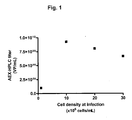
- the volumetric yield of an infection at a cell density of 10x10 6 viable cells/mL was 10 fold higher then at 1x10 6 viable cells/mL. This was somewhat unexpected given the cell density effect reported in earlier reports at much lower densities (i.e., at about 0.5-3x10 6 cells/mL, e.g. Maranga et al., 2005; Kamen et al., 2004; Altaras et al., 2005). However, past the 10x10 6 cells/mL, a cell density effect was observed and volumetric yields decreased.
- Example 2 Infection with rAd35 at low cell densities (1-1.6x10 6 viable cells/mL).
- rAd5 was used.
- different adenovirus serotypes are known and have been described for different purposes. These serotypes may have different properties, and hence processes useful for one serotype are not always necessarily suitable for another serotype. This may especially be relevant in industrial scale processes, where seemingly small differences may be economically of great importance.
- One particularly advantageous serotype for use in for instance vaccines is Ad35, and in the following examples we test the feasibility to improve yields of rAd35 to obtain large quantities thereof.
- This example shows infection with a rAd35 vector at low cell densities, as a comparison to the following examples where cells are infected at higher cell densities.
- the cell suspension was diluted with 5L fresh medium and subsequently infected with rAd35.TB-S (a rAd35 vector; Radosevic et al, 2007) at an MOI of 70 VP/cell.
- Virus propagation was performed at 36°C, pH 7.3 and DO 40%.
- Three days after infection the bioreactors were sampled for cell count and virus production determination. To release the virus, 1 mL sample of each bioreactor was mixed with 100 ⁇ L 10% Triton X-100 and incubated at 37°C for 30 minutes.
- Example 3 Feasibility study of an infection process of rAd35 at high cell densities (>10x10 6 viable cells/mL).
- the remaining cells in the 2L bioreactor were diluted with fresh serum free medium to a cell concentration of 8.7x10 6 total cells/mL (84% viability).
- the bioreactor was infected with Ad35.TB-S at an MOI of 70 VP/cell and incubated at 36°C, pH 7.3 and DO of 40%.
- the ATF system was started 15 hours after infection at a medium refreshment rate of 1 bioreactor volume per day. Day 1, 2, 3, and 4 post infection the bioreactor was sampled for cell count (CASY cell counter) and virus production determination by AEX-HPLC. Sample preparation was performed as described above. The samples were stored below -65°C until analysis by AEX-HPLC was performed.
- a sample of at least 60 mL was taken from the 2L bioreactor and two infections (in 250mL shakers) were started at a volume of 30mL per shaker.
- Day 1 and 2 post infection medium refreshment was performed to mimic the perfusion system. This medium refreshment was performed by a centrifugation step for 5 minutes at 300g and re-suspending the cell pellet in 30mL fresh medium per shaker.
- Day 3 post infection the shakers were harvested and sampled for AEX-HPLC analysis. Sample preparation was performed as described above. The samples were stored below -65°C until analysis by AEX-HPLC was performed.
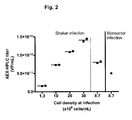
- Results are presented in Fig. 2 .
- Results show that infection between 1.3x10 6 viable cells/mL and 30x10 6 viable cells/mL is possible.
- the total yields of rAd35 increased with increasing cell density at infection even above the 10x10 6 viable cells/mL samples.
- a volumetric yield of 1.4x10 12 VP/mL was reached.
- Example 4 Feasibility of infection at high cell densities with another rAd35 vector.
- the shakers were infected with Ad35.eGFP (rAd35 comprising another transgene, viz. a GFP gene) at an MOI of 70 VP/cell and incubated at 36°C, 10% CO 2 and 100 rpm.
- Day 1 and 2 post infection medium refreshment was performed for the shakers infected at 10, 20, and 30x10 6 viable cells/mL. This medium refreshment was performed by a centrifugation step for 5 minutes at 300g and re-suspending the cell pellet in 30mL fresh medium per shaker.
- Day 3 post infection the shakers were harvested and sampled for AEX-HPLC analysis.
- Example 5 Further experiments of infection at high cell densities with an rAd35 vector.
- the 2L bioreactor was infected with Ad35.TB-S at an MOI of 70 VP/cell and incubated at 36°C, pH 7.3 and DO of 40%.
- the ATF system was started 15 hours post infection at a medium refreshment rate of 5 vessel volume per day. On day 1, 2, 3, and 4 post infection the 2L bioreactor was sampled for cell count and virus production by AEX-HPLC.
- Example 6 Further experiments of infection at high cell densities with an rAd35 vector with reduced perfusion rates.
- the 2L bioreactor was infected with Ad35.TB-S at an MOI of 70 VP/cell and incubated at 36°C, pH 7.3 and DO of 40%.
- the ATF system was started 15 hours post infection at a medium refreshment rate of 2 vessel volume per day. On day 1, 2, and 3 post infection the 2L bioreactor was sampled for cell count and virus production by AEX-HPLC.
- Example 7 Further experiments of infection at high cell densities with an rAd35 vector with reduced perfusion rates
- the 2L bioreactor was infected with Ad35.TB-S at an MOI of 70 VP/cell and incubated at 36°C, pH 7.3 and DO of 40%.
- the ATF system was started 5 hours post infection at a medium refreshment rate of 2 vessel volume per day. On day 2, 3, and 4 post infection the 2L bioreactor was sampled for cell count and virus production by AEX-HPLC.
- Example 8 Further experiments of infection at high cell densities with an rAd35 vector at 50L scale.
- the 10L cell suspension was diluted with fresh medium in a 50L bioreactor to a cell density of 15.5x10 6 total cells/mL (81% viability, hence 12.6x10 6 viable cells/mL).
- the 50L bioreactor was infected with Ad35.TB-S at an MOI of 70 VP/cell and incubated at 36°C, pH 7.3 and DO of 40%.
- the ATF system was started 5 hours post infection at a medium refreshment rate of 2 vessel volume per day. On day 2 and 3 post infection the 50L bioreactor was sampled for cell count and virus production by AEX-HPLC.
Landscapes
- Life Sciences & Earth Sciences (AREA)
- Chemical & Material Sciences (AREA)
- Health & Medical Sciences (AREA)
- Engineering & Computer Science (AREA)
- Organic Chemistry (AREA)
- Wood Science & Technology (AREA)
- Zoology (AREA)
- Bioinformatics & Cheminformatics (AREA)
- Genetics & Genomics (AREA)
- General Health & Medical Sciences (AREA)
- Microbiology (AREA)
- Biomedical Technology (AREA)
- Biochemistry (AREA)
- General Engineering & Computer Science (AREA)
- Biotechnology (AREA)
- Virology (AREA)
- Immunology (AREA)
- Medicinal Chemistry (AREA)
- Proteomics, Peptides & Aminoacids (AREA)
- Cell Biology (AREA)
- Physics & Mathematics (AREA)
- Analytical Chemistry (AREA)
- Biophysics (AREA)
- Sustainable Development (AREA)
- Molecular Biology (AREA)
- Micro-Organisms Or Cultivation Processes Thereof (AREA)
- Apparatus Associated With Microorganisms And Enzymes (AREA)
Priority Applications (2)
| Application Number | Priority Date | Filing Date | Title |
|---|---|---|---|
| EP09744140.6A EP2350268B1 (en) | 2008-11-03 | 2009-10-29 | Method for the production of adenoviral vectors |
| PL09744140T PL2350268T3 (pl) | 2008-11-03 | 2009-10-29 | Sposób wytwarzania wektorów adenowirusowych |
Applications Claiming Priority (4)
| Application Number | Priority Date | Filing Date | Title |
|---|---|---|---|
| US19812208P | 2008-11-03 | 2008-11-03 | |
| EP08168181 | 2008-11-03 | ||
| PCT/EP2009/064265 WO2010060719A1 (en) | 2008-11-03 | 2009-10-29 | Method for the production of adenoviral vectors |
| EP09744140.6A EP2350268B1 (en) | 2008-11-03 | 2009-10-29 | Method for the production of adenoviral vectors |
Publications (2)
| Publication Number | Publication Date |
|---|---|
| EP2350268A1 EP2350268A1 (en) | 2011-08-03 |
| EP2350268B1 true EP2350268B1 (en) | 2014-12-24 |
Family
ID=40344776
Family Applications (1)
| Application Number | Title | Priority Date | Filing Date |
|---|---|---|---|
| EP09744140.6A Active EP2350268B1 (en) | 2008-11-03 | 2009-10-29 | Method for the production of adenoviral vectors |
Country Status (15)
| Country | Link |
|---|---|
| US (1) | US10041049B2 (enExample) |
| EP (1) | EP2350268B1 (enExample) |
| JP (1) | JP5770633B2 (enExample) |
| KR (1) | KR101504392B1 (enExample) |
| CN (1) | CN102203242B (enExample) |
| AU (1) | AU2009319254B2 (enExample) |
| BR (1) | BRPI0921651A2 (enExample) |
| CA (1) | CA2742474C (enExample) |
| DK (1) | DK2350268T3 (enExample) |
| EA (1) | EA019928B1 (enExample) |
| ES (1) | ES2532015T3 (enExample) |
| MX (1) | MX2011004292A (enExample) |
| NZ (1) | NZ593235A (enExample) |
| PL (1) | PL2350268T3 (enExample) |
| WO (1) | WO2010060719A1 (enExample) |
Cited By (4)
| Publication number | Priority date | Publication date | Assignee | Title |
|---|---|---|---|---|
| WO2019086450A1 (en) | 2017-10-31 | 2019-05-09 | Janssen Vaccines & Prevention B.V. | Adenovirus and uses thereof |
| WO2019086461A1 (en) | 2017-10-31 | 2019-05-09 | Janssen Vaccines & Prevention B.V. | Adenovirus vectors and uses thereof |
| WO2019086466A1 (en) | 2017-10-31 | 2019-05-09 | Janssen Vaccines & Prevention B.V. | Adenovirus and uses thereof |
| WO2019086456A1 (en) | 2017-10-31 | 2019-05-09 | Janssen Vaccines & Prevention B.V. | Adenovirus and uses thereof |
Families Citing this family (52)
| Publication number | Priority date | Publication date | Assignee | Title |
|---|---|---|---|---|
| EA019928B1 (ru) | 2008-11-03 | 2014-07-30 | Круселл Холланд Б.В. | Способ получения аденовирусных векторов |
| WO2011045381A1 (en) * | 2009-10-15 | 2011-04-21 | Crucell Holland B.V. | Process for adenovirus purification from high cell density cultures |
| MX2012004222A (es) * | 2009-10-15 | 2012-06-08 | Crucell Holland Bv | Metodo para purificacion de particulas de adenovirus. |
| PL2536829T3 (pl) * | 2010-02-15 | 2016-09-30 | Sposób wytwarzania wektorów adenowirusowych Ad26 | |
| CA2808556A1 (en) | 2010-09-20 | 2012-03-29 | Crucell Holland B.V. | Therapeutic vaccination against active tuberculosis |
| BR112013004582A2 (pt) | 2010-09-27 | 2016-09-06 | Crucell Holland Bv | método para induzir uma resposta imune em um sujeito contra um antígeno de um parasita que causa a malária |
| CN103347595B (zh) | 2011-02-10 | 2016-01-20 | 克鲁塞尔荷兰公司 | 气动交变压力膜细胞分离系统 |
| WO2013074501A1 (en) | 2011-11-14 | 2013-05-23 | Crucell Holland B.V. | Heterologous prime-boost immunization using measles virus-based vaccines |
| US8932607B2 (en) | 2012-03-12 | 2015-01-13 | Crucell Holland B.V. | Batches of recombinant adenovirus with altered terminal ends |
| KR102044051B1 (ko) | 2012-03-12 | 2019-11-12 | 얀센 백신스 앤드 프리벤션 비.브이. | 터미널 말단이 변경된 재조합 아데노바이러스의 배치 |
| JP5845376B2 (ja) | 2012-03-22 | 2016-01-20 | クルセル ホランド ベー ヴェー | Rsvに対するワクチン |
| US9125870B2 (en) | 2012-03-22 | 2015-09-08 | Crucell Holland B.V. | Vaccine against RSV |
| PT2988780T (pt) | 2013-04-25 | 2019-03-25 | Janssen Vaccines & Prevention Bv | Polipeptídeos f de pré-fusão do rsv solúveis estabilizados |
| CN105408348B (zh) | 2013-06-17 | 2021-07-06 | 扬森疫苗与预防公司 | 稳定化的可溶性融合前rsv f多肽 |
| BE1022132B1 (fr) * | 2013-08-30 | 2016-02-19 | Glaxosmithkline Biologicals S.A. | Nouvelle methode. |
| US11008547B2 (en) | 2014-03-25 | 2021-05-18 | Terumo Bct, Inc. | Passive replacement of media |
| EP3421046A1 (en) | 2014-11-04 | 2019-01-02 | Janssen Vaccines & Prevention B.V. | Therapeutic hpv16 vaccines |
| WO2017004592A1 (en) | 2015-07-02 | 2017-01-05 | Terumo Bct, Inc. | Cell growth with mechanical stimuli |
| CN107847580B (zh) | 2015-07-07 | 2022-08-12 | 扬森疫苗与预防公司 | 针对rsv的疫苗 |
| AU2016289496B2 (en) | 2015-07-07 | 2021-02-04 | Janssen Vaccines & Prevention B.V. | Stabilized soluble pre-fusion RSV F polypeptides |
| US9663766B2 (en) | 2015-07-24 | 2017-05-30 | Bio-Rad Laboratories, Inc. | Methods for purifying adenovirus vectors |
| HK1252967A1 (zh) | 2015-08-20 | 2019-06-06 | Janssen Vaccines & Prevention B.V. | 治疗性hpv18疫苗 |
| MX2018012094A (es) | 2016-04-05 | 2019-01-10 | Janssen Vaccines & Prevention Bv | Proteinas f de prefusion del virus respiratorio sincicial (vrs) solubles y estabilizadas. |
| AU2017248018A1 (en) | 2016-04-05 | 2018-09-27 | Janssen Vaccines & Prevention B.V. | Vaccine against RSV |
| EP3442688A4 (en) * | 2016-04-12 | 2019-11-20 | Artemis Biosystems, Inc. | FILTRATION SYSTEMS FOR INFUSION |
| EP3452087A1 (en) | 2016-05-02 | 2019-03-13 | Janssen Vaccines & Prevention B.V. | Therapeutic hpv vaccine combinations |
| WO2017205667A1 (en) | 2016-05-25 | 2017-11-30 | Terumo Bct, Inc. | Cell expansion |
| SG11201810078PA (en) | 2016-05-30 | 2018-12-28 | Janssen Vaccines & Prevention Bv | Stabilized pre-fusion rsv f proteins |
| US11104874B2 (en) | 2016-06-07 | 2021-08-31 | Terumo Bct, Inc. | Coating a bioreactor |
| US11685883B2 (en) | 2016-06-07 | 2023-06-27 | Terumo Bct, Inc. | Methods and systems for coating a cell growth surface |
| US10744196B2 (en) | 2016-07-14 | 2020-08-18 | Janssen Vaccines & Prevention B.V. | HPV vaccines |
| JP7393945B2 (ja) | 2017-03-31 | 2023-12-07 | テルモ ビーシーティー、インコーポレーテッド | 細胞増殖 |
| CA3061278A1 (en) | 2017-05-17 | 2018-11-22 | Janssen Vaccines & Prevention B.V. | Methods and compositions for inducing protective immunity against rsv infection |
| AU2018333566A1 (en) | 2017-09-15 | 2020-02-27 | Janssen Vaccines & Prevention B.V. | Method for the safe induction of immunity against RSV |
| AU2018383679C1 (en) | 2017-12-11 | 2026-05-28 | Amgen Inc. | Continuous manufacturing process for bispecific antibody products |
| CN110317832B (zh) * | 2018-03-28 | 2022-07-05 | 西比曼生物科技(香港)有限公司 | Gmp级规模化制备重组慢病毒载体的纯化制剂的方法 |
| CN110317791A (zh) | 2018-03-29 | 2019-10-11 | 西比曼生物科技(香港)有限公司 | Gmp级无血清悬浮细胞大规模生产慢病毒的方法 |
| WO2019209632A1 (en) | 2018-04-24 | 2019-10-31 | Merck Sharp & Dohme Corp. | Scalable chromatography process for purification of human cytomegalovirus |
| PE20211469A1 (es) | 2018-11-13 | 2021-08-05 | Janssen Vaccines And Prevention B V | Proteinas f de prefusion del vrs estabilizadas |
| CA3144960A1 (en) * | 2019-07-01 | 2021-01-07 | Ology Bioservices, Inc. | Method for cultivation of adherent cells in a multiparallel bioreactor |
| TW202204380A (zh) | 2020-01-31 | 2022-02-01 | 美商詹森藥物公司 | 用於預防及治療冠狀病毒感染之組合物及方法-sars-cov-2疫苗 |
| GB202013940D0 (en) | 2020-09-04 | 2020-10-21 | Synpromics Ltd | Regulatory nucleic acid sequences |
| US20230374542A1 (en) | 2020-10-07 | 2023-11-23 | Asklepios Biopharmaceutical, Inc. | Therapeutic adeno-associated virus delivery of fukutin related protein (fkrp) for treating dystroglycanopathy. disorders including limb girdle 21 (lgmd21) |
| CN116867903A (zh) * | 2020-12-21 | 2023-10-10 | 辉瑞公司 | 用于改进的细胞转染的方法和系统 |
| AU2022249741A1 (en) | 2021-04-01 | 2023-09-21 | Msd International Business Gmbh | Stabilized pre-fusion piv3 f proteins |
| WO2023020939A1 (en) | 2021-08-17 | 2023-02-23 | Janssen Pharmaceuticals, Inc. | Sars-cov-2 vaccines |
| WO2023111725A1 (en) | 2021-12-14 | 2023-06-22 | Janssen Pharmaceuticals, Inc. | Sars-cov-2 vaccines |
| EP4448802A1 (en) | 2021-12-16 | 2024-10-23 | Janssen Vaccines & Prevention B.V. | Stabilized pre-fusion hmpv fusion proteins |
| US20260085096A1 (en) | 2022-09-23 | 2026-03-26 | Janssen Vaccines & Prevention B.V. | Stabilized trimeric class i fusion proteins |
| EP4590690A1 (en) | 2022-09-23 | 2025-07-30 | Janssen Vaccines & Prevention B.V. | Pre-fusion human piv1 f proteins |
| WO2024074584A1 (en) | 2022-10-06 | 2024-04-11 | Janssen Vaccines & Prevention B.V. | Stabilized pre-fusion piv3 f proteins |
| JPWO2024190895A1 (enExample) | 2023-03-15 | 2024-09-19 |
Citations (1)
| Publication number | Priority date | Publication date | Assignee | Title |
|---|---|---|---|---|
| WO2002040665A2 (en) * | 2000-11-15 | 2002-05-23 | Crucell Holland B.V. | Complementing cell lines |
Family Cites Families (72)
| Publication number | Priority date | Publication date | Assignee | Title |
|---|---|---|---|---|
| JPH04241381A (ja) | 1991-01-16 | 1992-08-28 | Brother Ind Ltd | 電子学習機 |
| FR2705686B1 (fr) | 1993-05-28 | 1995-08-18 | Transgene Sa | Nouveaux adénovirus défectifs et lignées de complémentation correspondantes. |
| US5851806A (en) | 1994-06-10 | 1998-12-22 | Genvec, Inc. | Complementary adenoviral systems and cell lines |
| EP0784690B1 (en) | 1994-06-10 | 2006-08-16 | Genvec, Inc. | Complementary adenoviral vector systems and cell lines |
| US5846782A (en) | 1995-11-28 | 1998-12-08 | Genvec, Inc. | Targeting adenovirus with use of constrained peptide motifs |
| US5965541A (en) | 1995-11-28 | 1999-10-12 | Genvec, Inc. | Vectors and methods for gene transfer to cells |
| US5559099A (en) | 1994-09-08 | 1996-09-24 | Genvec, Inc. | Penton base protein and methods of using same |
| US5770442A (en) | 1995-02-21 | 1998-06-23 | Cornell Research Foundation, Inc. | Chimeric adenoviral fiber protein and methods of using same |
| US5837520A (en) | 1995-03-07 | 1998-11-17 | Canji, Inc. | Method of purification of viral vectors |
| DE69633565T3 (de) | 1995-06-15 | 2013-01-17 | Crucell Holland B.V. | Verpackungssysteme für humane, menschliche adenoviren, zur verwendung in die gentherapie |
| JPH11511326A (ja) | 1995-08-30 | 1999-10-05 | ジエンザイム コーポレイション | アデノウィルスおよびaavの精製 |
| US5837511A (en) | 1995-10-02 | 1998-11-17 | Cornell Research Foundation, Inc. | Non-group C adenoviral vectors |
| US5891690A (en) | 1996-04-26 | 1999-04-06 | Massie; Bernard | Adenovirus E1-complementing cell lines |
| JP2000514290A (ja) | 1996-07-01 | 2000-10-31 | ローヌ―プーラン・ロレ・エス・アー | 組換えアデノウイルスの製造方法 |
| FR2751343B1 (fr) | 1996-07-16 | 1998-12-18 | Transgene Sa | Procede de conservation de virus recombinants infectieux, suspension aqueuse virale et utilisation comme medicament |
| EP0968284B1 (en) | 1996-11-20 | 2006-12-13 | Introgen Therapeutics, Inc. | An improved method for the production and purification of adenoviral vectors |
| US7732129B1 (en) | 1998-12-01 | 2010-06-08 | Crucell Holland B.V. | Method for the production and purification of adenoviral vectors |
| US6261823B1 (en) | 1996-12-13 | 2001-07-17 | Schering Corporation | Methods for purifying viruses |
| CA2283253A1 (en) | 1997-03-04 | 1998-09-11 | Baxter International Inc. | Adenovirus e1-complementing cell lines |
| US6020191A (en) | 1997-04-14 | 2000-02-01 | Genzyme Corporation | Adenoviral vectors capable of facilitating increased persistence of transgene expression |
| US6210683B1 (en) | 1997-09-05 | 2001-04-03 | Merck & Co., Inc. | Stabilizers containing recombinant human serum albumin for live virus vaccines |
| KR100918187B1 (ko) | 1998-02-17 | 2009-09-22 | 쉐링 코포레이션 | 바이러스를 포함하는 조성물 및 바이러스 제제의 농축방법 |
| US5981225A (en) | 1998-04-16 | 1999-11-09 | Baylor College Of Medicine | Gene transfer vector, recombinant adenovirus particles containing the same, method for producing the same and method of use of the same |
| DE69927013T2 (de) | 1998-04-22 | 2006-06-29 | Genvec, Inc. | Effiziente reinigung von adenovirus |
| US6113913A (en) | 1998-06-26 | 2000-09-05 | Genvec, Inc. | Recombinant adenovirus |
| US20030017138A1 (en) | 1998-07-08 | 2003-01-23 | Menzo Havenga | Chimeric adenoviruses |
| US20040043489A1 (en) | 1998-07-08 | 2004-03-04 | Menzo Havenga | Gene delivery vectors provided with a tissue tropism for dendritic cells and methods of use |
| EP1133316B1 (en) | 1998-11-16 | 2009-01-21 | Introgen Therapeutics, Inc. | Formulation of adenovirus for gene therapy |
| AU779267B2 (en) | 1998-12-31 | 2005-01-13 | Centelion S.A.S. | Method for separating viral particles |
| CA2364934C (fr) | 1999-02-22 | 2011-10-18 | Transgene S.A. | Procede d'obtention d'une preparation virale purifiee |
| ATE519854T1 (de) | 1999-05-17 | 2011-08-15 | Crucell Holland Bv | Rekombinantes adenovirus auf basis von serotyp 48 (ad48). |
| US6913922B1 (en) | 1999-05-18 | 2005-07-05 | Crucell Holland B.V. | Serotype of adenovirus and uses thereof |
| US20050232900A1 (en) | 1999-05-18 | 2005-10-20 | Crucell Holland B.V. | Serotype of adenovirus and uses thereof |
| WO2003104467A1 (en) | 2002-04-25 | 2003-12-18 | Crucell Holland B.V. | Means and methods for the production of adenovirus vectors |
| DE19955558C2 (de) | 1999-11-18 | 2003-03-20 | Stefan Kochanek | Permanente Amniozyten-Zelllinie, ihre Herstellung und Verwendung zur Herstellung von Gentransfervektoren |
| US6544424B1 (en) | 1999-12-03 | 2003-04-08 | Refined Technology Company | Fluid filtration system |
| EP2420247A1 (en) | 2000-03-07 | 2012-02-22 | Merck Sharp & Dohme Corp. | Adenovirus formulations |
| DE60138403D1 (de) | 2000-09-26 | 2009-05-28 | Crucell Holland Bv | Adenovirale vektoren für die übertragung von genen in zellen der skelettmuskulatur oder myoblasten |
| US20020064860A1 (en) | 2000-11-29 | 2002-05-30 | Schering Corporation | Method for purifying adenoviruses |
| CA2469491A1 (en) | 2001-12-12 | 2003-06-19 | Kerrie Setiawan | Composition for viral preservation |
| EP1516055A4 (en) | 2002-01-24 | 2007-08-08 | Scripps Research Inst | FIBER OPERATING MODIFICATIONS FOR EFFICIENT TARGETS |
| US20030180936A1 (en) | 2002-03-15 | 2003-09-25 | Memarzadeh Bahram Eric | Method for the purification, production and formulation of oncolytic adenoviruses |
| CA2478508C (en) | 2002-04-25 | 2013-07-02 | Crucell Holland B.V. | Stable adenoviral vectors and methods for propagation thereof |
| EP1506287B1 (en) | 2002-05-14 | 2007-04-25 | Merck & Co., Inc. | Methods of adenovirus purification |
| US20080153083A1 (en) | 2003-10-23 | 2008-06-26 | Crucell Holland B.V. | Settings for recombinant adenoviral-based vaccines |
| EP1553983A2 (en) | 2002-10-23 | 2005-07-20 | Crucell Holland B.V. | New settings for recombinant adenoviral-based vaccines |
| EP1573012B1 (en) | 2002-12-17 | 2011-11-30 | Crucell Holland B.V. | Recombinant viral-based malaria vaccines |
| CA2519680A1 (en) | 2003-03-28 | 2004-11-18 | The Scripps Research Institute | Adenovirus particles with enhanced infectivity of dendritic cells and particles with decreased infectivity of hepatocytes |
| CN1863918B (zh) | 2003-10-02 | 2011-03-30 | 克鲁塞尔荷兰公司 | 用于重组腺病毒的包装细胞 |
| CN1922308A (zh) | 2004-02-23 | 2007-02-28 | 克鲁塞尔荷兰公司 | 病毒纯化方法 |
| PL1720972T3 (pl) * | 2004-03-05 | 2014-06-30 | Dpx Holdings Bv | Proces hodowli komórek poprzez ciągłą perfuzję i zmienny przepływ styczny |
| CN101001945B (zh) | 2004-06-04 | 2012-02-08 | 艾克塞勒雷克斯公司 | 一次性生物反应器系统及方法 |
| US7741099B2 (en) | 2004-10-13 | 2010-06-22 | Beth Israel Deaconess Medical Center Inc. | Adenoviral vectors and uses thereof |
| BRPI0518146A (pt) | 2004-10-14 | 2008-10-28 | Crucell Holland Bv | kit de partes, uso de um adenovìrus recombinante defectivo na replicação, e, método de vacinação de um mamìfero para a infecção por malária |
| BRPI0518933A2 (pt) | 2004-11-16 | 2008-12-16 | Crucell Holland B V E Aeras Gl | adenovÍrus recombinante defeituoso de replicaÇço, vetor de polinucleotÍdeo recombinante, vacina multivalente da tuberculose, e, uso do antÍgeno tb10.4 de mycobacterium |
| US20080254059A1 (en) | 2005-02-11 | 2008-10-16 | Bett Andrew J | Adenovirus Serotype 26 Vectors, Nucleic Acid and Viruses Produced Thereby |
| ATE412737T1 (de) | 2005-04-11 | 2008-11-15 | Crucell Holland Bv | Virusreinigung mit ultrafiltration |
| KR20080052512A (ko) | 2005-05-23 | 2008-06-11 | 박신, 인크. | 아데노바이러스-무함유 재조합 아데노바이러스 벡터의 급속생산 |
| EP1917317A2 (en) | 2005-07-22 | 2008-05-07 | Pergo (Europe) AB | Flooring system including a dry glue |
| AU2006279612B2 (en) | 2005-08-15 | 2013-03-21 | Altimmune Inc. | Immunization of avians by administration of non-replicating vectored vaccines |
| WO2007104792A2 (en) | 2006-03-16 | 2007-09-20 | Crucell Holland B.V. | Recombinant adenoviruses based on serotype 26 and 48, and use thereof |
| WO2007110409A1 (en) | 2006-03-27 | 2007-10-04 | Crucell Holland B.V. | Compositions comprising a recombinant adenovirus and an adjuvant |
| JP5222289B2 (ja) | 2006-07-18 | 2013-06-26 | グラクソスミスクライン バイオロジカルズ ソシエテ アノニム | マラリア用ワクチン |
| CN103550764A (zh) | 2007-03-02 | 2014-02-05 | 葛兰素史密丝克莱恩生物有限公司 | 疫苗组合物及其在刺激免疫反应中的用途 |
| US9109193B2 (en) | 2007-07-30 | 2015-08-18 | Ge Healthcare Bio-Sciences Corp. | Continuous perfusion bioreactor system |
| EP2209925A4 (en) | 2007-11-14 | 2017-11-22 | Chun-Chieh Chang | Method and devices for producing air sensitive electrode materials for lithium ion battery applications |
| WO2009117134A2 (en) | 2008-03-21 | 2009-09-24 | National Institutes Of Health | Aerosolized genetic vaccines and methods of use |
| EA019928B1 (ru) | 2008-11-03 | 2014-07-30 | Круселл Холланд Б.В. | Способ получения аденовирусных векторов |
| HRP20140597T1 (hr) | 2009-07-16 | 2014-09-12 | Crucell Holland B.V. | Proizvodnja polio virusa u visokim titrima za proizvodnju cjepiva |
| WO2011045381A1 (en) | 2009-10-15 | 2011-04-21 | Crucell Holland B.V. | Process for adenovirus purification from high cell density cultures |
| US20120315696A1 (en) | 2010-02-15 | 2012-12-13 | Alfred Luitjens | METHOD FOR THE PRODUCTION OF Ad26 ADENOVIRAL VECTORS |
| PL2536829T3 (pl) | 2010-02-15 | 2016-09-30 | Sposób wytwarzania wektorów adenowirusowych Ad26 |
-
2009
- 2009-10-29 EA EA201170638A patent/EA019928B1/ru not_active IP Right Cessation
- 2009-10-29 DK DK09744140.6T patent/DK2350268T3/en active
- 2009-10-29 CA CA2742474A patent/CA2742474C/en active Active
- 2009-10-29 AU AU2009319254A patent/AU2009319254B2/en not_active Ceased
- 2009-10-29 ES ES09744140.6T patent/ES2532015T3/es active Active
- 2009-10-29 US US13/126,978 patent/US10041049B2/en active Active
- 2009-10-29 PL PL09744140T patent/PL2350268T3/pl unknown
- 2009-10-29 JP JP2011533718A patent/JP5770633B2/ja not_active Expired - Fee Related
- 2009-10-29 KR KR1020117010793A patent/KR101504392B1/ko not_active Expired - Fee Related
- 2009-10-29 CN CN2009801438951A patent/CN102203242B/zh not_active Expired - Fee Related
- 2009-10-29 WO PCT/EP2009/064265 patent/WO2010060719A1/en not_active Ceased
- 2009-10-29 EP EP09744140.6A patent/EP2350268B1/en active Active
- 2009-10-29 BR BRPI0921651-0A patent/BRPI0921651A2/pt not_active Application Discontinuation
- 2009-10-29 MX MX2011004292A patent/MX2011004292A/es active IP Right Grant
- 2009-10-29 NZ NZ593235A patent/NZ593235A/xx not_active IP Right Cessation
Patent Citations (1)
| Publication number | Priority date | Publication date | Assignee | Title |
|---|---|---|---|---|
| WO2002040665A2 (en) * | 2000-11-15 | 2002-05-23 | Crucell Holland B.V. | Complementing cell lines |
Non-Patent Citations (12)
| Title |
|---|
| ALFRED LUITJENS: "VACCINE TECHNOLOGY II Session 9", EINGINEERING CONFERENCE INTERNATIONAL, 5 June 2008 (2008-06-05), Grande Real Santa Eulalia Report Albufeira, Algarve, Portugal, XP055118722, Retrieved from the Internet <URL:http://www.engconf.org/pastconf/08aafin.pdf> [retrieved on 20140519] * |
| AMINE KAMEN ET AL: "Development and optimization of an adenovirus production process", THE JOURNAL OF GENE MEDICINE, vol. 6, no. S1, 1 February 2004 (2004-02-01), pages S184 - S192, XP055027359, ISSN: 1099-498X, DOI: 10.1002/jgm.503 * |
| BERDICHEVSKY MARINA ET AL: "Establishment of higher passage PER.C6 cells for adenovirus manufacture", BIOTECHNOLOGY PROGRESS, AMERICAN INSTITUTE OF CHEMICAL ENGINEERS, US, vol. 24, no. 1, 1 January 2008 (2008-01-01), pages 158 - 165, XP002561835, ISSN: 8756-7938, [retrieved on 20071206], DOI: 10.1021/BP070258U * |
| CHUN FANG SHEN ET AL: "Reassessing culture media and critical metabolites that affect adenovirus production", BIOTECHNOLOGY PROGRESS, vol. 26, no. 1, 1 January 2009 (2009-01-01), pages NA - NA, XP055027356, ISSN: 8756-7938, DOI: 10.1002/btpr.286 * |
| CORTIN V ET AL: "High-titer adenovirus vector production in 293S cell perfusion culture", BIOTECHNOLOGY PROGRESS, AMERICAN INSTITUTE OF CHEMICAL ENGINEERS, US, vol. 20, no. 3, 1 May 2004 (2004-05-01), pages 858 - 863, XP002317549, ISSN: 8756-7938, DOI: 10.1021/BP034237L * |
| KENTARO YAMADA ET AL: "Adenovirus vector production using low-multiplicity infection of 293 cells", CYTOTECHNOLOGY, KLUWER ACADEMIC PUBLISHERS, DO, vol. 59, no. 3, 8 July 2009 (2009-07-08), pages 153 - 160, XP019747675, ISSN: 1573-0778, DOI: 10.1007/S10616-009-9208-X * |
| KOVESDI IMRE ET AL: "Adenoviral Producer Cells", VIRUSES-BASEL, vol. 2, no. 8, August 2010 (2010-08-01), pages 1681 - 1703 URL, XP008152094, ISSN: 1999-4915 * |
| LIU H ET AL: "A high-yield and scaleable adenovirus vector production process based on high density perfusion culture of HEK 293 cells as suspended aggregates", JOURNAL OF BIOSCIENCE AND BIOENGINEERING, ELSEVIER, AMSTERDAM, NL, vol. 107, no. 5, 1 May 2009 (2009-05-01), pages 524 - 529, XP026020551, ISSN: 1389-1723, [retrieved on 20090422], DOI: 10.1016/J.JBIOSC.2009.01.004 * |
| M.J.E. HAVENGA ET AL: "Serum-free transient protein production system based on adenoviral vector and PER.C6 technology: High yield and preserved bioactivity", BIOTECHNOLOGY AND BIOENGINEERING, vol. 100, no. 2, 1 January 2008 (2008-01-01), pages 273 - 283, XP055067133, ISSN: 0006-3592, DOI: 10.1002/bit.21757 * |
| PETIOT EMMA ET AL: "Metabolic and Kinetic analyses of influenza production in perfusion HEK293 cell culture", BMC BIOTECHNOLOGY, vol. 11, September 2011 (2011-09-01) * |
| RADOSEVIC KATARINA ET AL: "Protective immune responses to a recombinant adenovirus type 35 tuberculosis vaccine in two mouse strains: CD4 and CD8 T-cell epitope mapping and role of gamma interferon", INFECTION AND IMMUNITY, AMERICAN SOCIETY FOR MACROBIOLOGY, USA, vol. 75, no. 8, 1 August 2007 (2007-08-01), pages 4105 - 4115, XP002544475, ISSN: 0019-9567, DOI: 10.1128/IAI.00004-07 * |
| Y.Y. LEE ET AL: "Low-Glutamine Fed-Batch Cultures of 293-HEK Serum-Free Suspension Cells for Adenovirus Production", BIOTECHNOLOGY PROGRESS, vol. 19, no. 2, 4 April 2003 (2003-04-04), pages 501 - 509, XP055092172, ISSN: 8756-7938, DOI: 10.1021/bp025638o * |
Cited By (4)
| Publication number | Priority date | Publication date | Assignee | Title |
|---|---|---|---|---|
| WO2019086450A1 (en) | 2017-10-31 | 2019-05-09 | Janssen Vaccines & Prevention B.V. | Adenovirus and uses thereof |
| WO2019086461A1 (en) | 2017-10-31 | 2019-05-09 | Janssen Vaccines & Prevention B.V. | Adenovirus vectors and uses thereof |
| WO2019086466A1 (en) | 2017-10-31 | 2019-05-09 | Janssen Vaccines & Prevention B.V. | Adenovirus and uses thereof |
| WO2019086456A1 (en) | 2017-10-31 | 2019-05-09 | Janssen Vaccines & Prevention B.V. | Adenovirus and uses thereof |
Also Published As
| Publication number | Publication date |
|---|---|
| HK1160664A1 (en) | 2012-08-10 |
| KR101504392B1 (ko) | 2015-03-19 |
| MX2011004292A (es) | 2011-05-31 |
| NZ593235A (en) | 2013-02-22 |
| CN102203242A (zh) | 2011-09-28 |
| CA2742474A1 (en) | 2010-06-03 |
| WO2010060719A1 (en) | 2010-06-03 |
| BRPI0921651A2 (pt) | 2015-08-18 |
| EA201170638A1 (ru) | 2011-12-30 |
| JP2012507270A (ja) | 2012-03-29 |
| DK2350268T3 (en) | 2015-03-23 |
| KR20110093793A (ko) | 2011-08-18 |
| AU2009319254B2 (en) | 2015-04-30 |
| JP5770633B2 (ja) | 2015-08-26 |
| US10041049B2 (en) | 2018-08-07 |
| EA019928B1 (ru) | 2014-07-30 |
| US20110207202A1 (en) | 2011-08-25 |
| CN102203242B (zh) | 2013-06-12 |
| EP2350268A1 (en) | 2011-08-03 |
| AU2009319254A1 (en) | 2010-06-03 |
| ES2532015T3 (es) | 2015-03-23 |
| CA2742474C (en) | 2016-05-31 |
| PL2350268T3 (pl) | 2015-05-29 |
Similar Documents
| Publication | Publication Date | Title |
|---|---|---|
| EP2536829B1 (en) | Method for the production of Ad26 adenoviral vectors | |
| CA2742474C (en) | Method for the production of adenoviral vectors | |
| US20180080010A1 (en) | Method for the production of ad26 adenoviral vectors | |
| US8124106B2 (en) | Virus purification methods | |
| EP1869171B1 (en) | Virus purification using ultrafiltration | |
| HK1160664B (en) | Method for the production of adenoviral vectors | |
| HK1180008B (en) | Method for the production of ad26 adenoviral vectors |
Legal Events
| Date | Code | Title | Description |
|---|---|---|---|
| PUAI | Public reference made under article 153(3) epc to a published international application that has entered the european phase |
Free format text: ORIGINAL CODE: 0009012 |
|
| 17P | Request for examination filed |
Effective date: 20110502 |
|
| AK | Designated contracting states |
Kind code of ref document: A1 Designated state(s): AT BE BG CH CY CZ DE DK EE ES FI FR GB GR HR HU IE IS IT LI LT LU LV MC MK MT NL NO PL PT RO SE SI SK SM TR |
|
| AX | Request for extension of the european patent |
Extension state: AL BA RS |
|
| 17Q | First examination report despatched |
Effective date: 20120525 |
|
| REG | Reference to a national code |
Ref country code: HK Ref legal event code: DE Ref document number: 1160664 Country of ref document: HK |
|
| GRAP | Despatch of communication of intention to grant a patent |
Free format text: ORIGINAL CODE: EPIDOSNIGR1 |
|
| INTG | Intention to grant announced |
Effective date: 20140723 |
|
| GRAS | Grant fee paid |
Free format text: ORIGINAL CODE: EPIDOSNIGR3 |
|
| GRAA | (expected) grant |
Free format text: ORIGINAL CODE: 0009210 |
|
| AK | Designated contracting states |
Kind code of ref document: B1 Designated state(s): AT BE BG CH CY CZ DE DK EE ES FI FR GB GR HR HU IE IS IT LI LT LU LV MC MK MT NL NO PL PT RO SE SI SK SM TR |
|
| AX | Request for extension of the european patent |
Extension state: AL BA RS |
|
| REG | Reference to a national code |
Ref country code: GB Ref legal event code: FG4D |
|
| REG | Reference to a national code |
Ref country code: CH Ref legal event code: EP |
|
| REG | Reference to a national code |
Ref country code: IE Ref legal event code: FG4D |
|
| REG | Reference to a national code |
Ref country code: AT Ref legal event code: REF Ref document number: 703138 Country of ref document: AT Kind code of ref document: T Effective date: 20150115 |
|
| REG | Reference to a national code |
Ref country code: DE Ref legal event code: R096 Ref document number: 602009028555 Country of ref document: DE Effective date: 20150219 |
|
| REG | Reference to a national code |
Ref country code: NL Ref legal event code: T3 |
|
| REG | Reference to a national code |
Ref country code: ES Ref legal event code: FG2A Ref document number: 2532015 Country of ref document: ES Kind code of ref document: T3 Effective date: 20150323 Ref country code: DK Ref legal event code: T3 Effective date: 20150316 |
|
| REG | Reference to a national code |
Ref country code: SE Ref legal event code: TRGR |
|
| PG25 | Lapsed in a contracting state [announced via postgrant information from national office to epo] |
Ref country code: LT Free format text: LAPSE BECAUSE OF FAILURE TO SUBMIT A TRANSLATION OF THE DESCRIPTION OR TO PAY THE FEE WITHIN THE PRESCRIBED TIME-LIMIT Effective date: 20141224 Ref country code: NO Free format text: LAPSE BECAUSE OF FAILURE TO SUBMIT A TRANSLATION OF THE DESCRIPTION OR TO PAY THE FEE WITHIN THE PRESCRIBED TIME-LIMIT Effective date: 20150324 |
|
| REG | Reference to a national code |
Ref country code: LT Ref legal event code: MG4D |
|
| PG25 | Lapsed in a contracting state [announced via postgrant information from national office to epo] |
Ref country code: HR Free format text: LAPSE BECAUSE OF FAILURE TO SUBMIT A TRANSLATION OF THE DESCRIPTION OR TO PAY THE FEE WITHIN THE PRESCRIBED TIME-LIMIT Effective date: 20141224 Ref country code: LV Free format text: LAPSE BECAUSE OF FAILURE TO SUBMIT A TRANSLATION OF THE DESCRIPTION OR TO PAY THE FEE WITHIN THE PRESCRIBED TIME-LIMIT Effective date: 20141224 Ref country code: GR Free format text: LAPSE BECAUSE OF FAILURE TO SUBMIT A TRANSLATION OF THE DESCRIPTION OR TO PAY THE FEE WITHIN THE PRESCRIBED TIME-LIMIT Effective date: 20150325 |
|
| REG | Reference to a national code |
Ref country code: PL Ref legal event code: T3 |
|
| REG | Reference to a national code |
Ref country code: FR Ref legal event code: PLFP Year of fee payment: 7 |
|
| PG25 | Lapsed in a contracting state [announced via postgrant information from national office to epo] |
Ref country code: RO Free format text: LAPSE BECAUSE OF FAILURE TO SUBMIT A TRANSLATION OF THE DESCRIPTION OR TO PAY THE FEE WITHIN THE PRESCRIBED TIME-LIMIT Effective date: 20141224 Ref country code: SK Free format text: LAPSE BECAUSE OF FAILURE TO SUBMIT A TRANSLATION OF THE DESCRIPTION OR TO PAY THE FEE WITHIN THE PRESCRIBED TIME-LIMIT Effective date: 20141224 Ref country code: EE Free format text: LAPSE BECAUSE OF FAILURE TO SUBMIT A TRANSLATION OF THE DESCRIPTION OR TO PAY THE FEE WITHIN THE PRESCRIBED TIME-LIMIT Effective date: 20141224 Ref country code: CZ Free format text: LAPSE BECAUSE OF FAILURE TO SUBMIT A TRANSLATION OF THE DESCRIPTION OR TO PAY THE FEE WITHIN THE PRESCRIBED TIME-LIMIT Effective date: 20141224 |
|
| PG25 | Lapsed in a contracting state [announced via postgrant information from national office to epo] |
Ref country code: IS Free format text: LAPSE BECAUSE OF FAILURE TO SUBMIT A TRANSLATION OF THE DESCRIPTION OR TO PAY THE FEE WITHIN THE PRESCRIBED TIME-LIMIT Effective date: 20150424 |
|
| REG | Reference to a national code |
Ref country code: DE Ref legal event code: R097 Ref document number: 602009028555 Country of ref document: DE |
|
| REG | Reference to a national code |
Ref country code: HK Ref legal event code: GR Ref document number: 1160664 Country of ref document: HK |
|
| PLBE | No opposition filed within time limit |
Free format text: ORIGINAL CODE: 0009261 |
|
| STAA | Information on the status of an ep patent application or granted ep patent |
Free format text: STATUS: NO OPPOSITION FILED WITHIN TIME LIMIT |
|
| 26N | No opposition filed |
Effective date: 20150925 |
|
| PG25 | Lapsed in a contracting state [announced via postgrant information from national office to epo] |
Ref country code: SI Free format text: LAPSE BECAUSE OF FAILURE TO SUBMIT A TRANSLATION OF THE DESCRIPTION OR TO PAY THE FEE WITHIN THE PRESCRIBED TIME-LIMIT Effective date: 20141224 |
|
| REG | Reference to a national code |
Ref country code: AT Ref legal event code: UEP Ref document number: 703138 Country of ref document: AT Kind code of ref document: T Effective date: 20141224 |
|
| PG25 | Lapsed in a contracting state [announced via postgrant information from national office to epo] |
Ref country code: LU Free format text: LAPSE BECAUSE OF FAILURE TO SUBMIT A TRANSLATION OF THE DESCRIPTION OR TO PAY THE FEE WITHIN THE PRESCRIBED TIME-LIMIT Effective date: 20151029 |
|
| PG25 | Lapsed in a contracting state [announced via postgrant information from national office to epo] |
Ref country code: MC Free format text: LAPSE BECAUSE OF FAILURE TO SUBMIT A TRANSLATION OF THE DESCRIPTION OR TO PAY THE FEE WITHIN THE PRESCRIBED TIME-LIMIT Effective date: 20141224 |
|
| REG | Reference to a national code |
Ref country code: FR Ref legal event code: PLFP Year of fee payment: 8 |
|
| PG25 | Lapsed in a contracting state [announced via postgrant information from national office to epo] |
Ref country code: HU Free format text: LAPSE BECAUSE OF FAILURE TO SUBMIT A TRANSLATION OF THE DESCRIPTION OR TO PAY THE FEE WITHIN THE PRESCRIBED TIME-LIMIT; INVALID AB INITIO Effective date: 20091029 Ref country code: BG Free format text: LAPSE BECAUSE OF FAILURE TO SUBMIT A TRANSLATION OF THE DESCRIPTION OR TO PAY THE FEE WITHIN THE PRESCRIBED TIME-LIMIT Effective date: 20141224 Ref country code: SM Free format text: LAPSE BECAUSE OF FAILURE TO SUBMIT A TRANSLATION OF THE DESCRIPTION OR TO PAY THE FEE WITHIN THE PRESCRIBED TIME-LIMIT Effective date: 20141224 |
|
| PG25 | Lapsed in a contracting state [announced via postgrant information from national office to epo] |
Ref country code: CY Free format text: LAPSE BECAUSE OF FAILURE TO SUBMIT A TRANSLATION OF THE DESCRIPTION OR TO PAY THE FEE WITHIN THE PRESCRIBED TIME-LIMIT Effective date: 20141224 |
|
| PG25 | Lapsed in a contracting state [announced via postgrant information from national office to epo] |
Ref country code: MT Free format text: LAPSE BECAUSE OF FAILURE TO SUBMIT A TRANSLATION OF THE DESCRIPTION OR TO PAY THE FEE WITHIN THE PRESCRIBED TIME-LIMIT Effective date: 20141224 |
|
| REG | Reference to a national code |
Ref country code: FR Ref legal event code: PLFP Year of fee payment: 9 |
|
| PG25 | Lapsed in a contracting state [announced via postgrant information from national office to epo] |
Ref country code: MK Free format text: LAPSE BECAUSE OF FAILURE TO SUBMIT A TRANSLATION OF THE DESCRIPTION OR TO PAY THE FEE WITHIN THE PRESCRIBED TIME-LIMIT Effective date: 20141224 |
|
| PG25 | Lapsed in a contracting state [announced via postgrant information from national office to epo] |
Ref country code: PT Free format text: LAPSE BECAUSE OF FAILURE TO SUBMIT A TRANSLATION OF THE DESCRIPTION OR TO PAY THE FEE WITHIN THE PRESCRIBED TIME-LIMIT Effective date: 20141224 |
|
| REG | Reference to a national code |
Ref country code: FR Ref legal event code: PLFP Year of fee payment: 10 |
|
| PGFP | Annual fee paid to national office [announced via postgrant information from national office to epo] |
Ref country code: NL Payment date: 20210928 Year of fee payment: 13 |
|
| PGFP | Annual fee paid to national office [announced via postgrant information from national office to epo] |
Ref country code: BE Payment date: 20210916 Year of fee payment: 13 Ref country code: PL Payment date: 20210914 Year of fee payment: 13 |
|
| PGFP | Annual fee paid to national office [announced via postgrant information from national office to epo] |
Ref country code: IE Payment date: 20211012 Year of fee payment: 13 Ref country code: DK Payment date: 20211012 Year of fee payment: 13 Ref country code: FI Payment date: 20211011 Year of fee payment: 13 Ref country code: TR Payment date: 20211027 Year of fee payment: 13 Ref country code: SE Payment date: 20211012 Year of fee payment: 13 Ref country code: AT Payment date: 20210928 Year of fee payment: 13 |
|
| PGFP | Annual fee paid to national office [announced via postgrant information from national office to epo] |
Ref country code: CH Payment date: 20211014 Year of fee payment: 13 |
|
| PGFP | Annual fee paid to national office [announced via postgrant information from national office to epo] |
Ref country code: GB Payment date: 20220908 Year of fee payment: 14 |
|
| PGFP | Annual fee paid to national office [announced via postgrant information from national office to epo] |
Ref country code: FR Payment date: 20220908 Year of fee payment: 14 |
|
| PGFP | Annual fee paid to national office [announced via postgrant information from national office to epo] |
Ref country code: IT Payment date: 20220913 Year of fee payment: 14 Ref country code: ES Payment date: 20221104 Year of fee payment: 14 Ref country code: DE Payment date: 20220621 Year of fee payment: 14 |
|
| REG | Reference to a national code |
Ref country code: DK Ref legal event code: EBP Effective date: 20221031 |
|
| REG | Reference to a national code |
Ref country code: SE Ref legal event code: EUG |
|
| REG | Reference to a national code |
Ref country code: CH Ref legal event code: PL |
|
| REG | Reference to a national code |
Ref country code: NL Ref legal event code: MM Effective date: 20221101 |
|
| REG | Reference to a national code |
Ref country code: AT Ref legal event code: MM01 Ref document number: 703138 Country of ref document: AT Kind code of ref document: T Effective date: 20221029 |
|
| REG | Reference to a national code |
Ref country code: BE Ref legal event code: MM Effective date: 20221031 |
|
| PG25 | Lapsed in a contracting state [announced via postgrant information from national office to epo] |
Ref country code: NL Free format text: LAPSE BECAUSE OF NON-PAYMENT OF DUE FEES Effective date: 20221101 Ref country code: LI Free format text: LAPSE BECAUSE OF NON-PAYMENT OF DUE FEES Effective date: 20221031 Ref country code: CH Free format text: LAPSE BECAUSE OF NON-PAYMENT OF DUE FEES Effective date: 20221031 Ref country code: AT Free format text: LAPSE BECAUSE OF NON-PAYMENT OF DUE FEES Effective date: 20221029 |
|
| PG25 | Lapsed in a contracting state [announced via postgrant information from national office to epo] |
Ref country code: SE Free format text: LAPSE BECAUSE OF NON-PAYMENT OF DUE FEES Effective date: 20221030 |
|
| PG25 | Lapsed in a contracting state [announced via postgrant information from national office to epo] |
Ref country code: BE Free format text: LAPSE BECAUSE OF NON-PAYMENT OF DUE FEES Effective date: 20221031 |
|
| PG25 | Lapsed in a contracting state [announced via postgrant information from national office to epo] |
Ref country code: IE Free format text: LAPSE BECAUSE OF NON-PAYMENT OF DUE FEES Effective date: 20221029 Ref country code: DK Free format text: LAPSE BECAUSE OF NON-PAYMENT OF DUE FEES Effective date: 20221031 |
|
| PG25 | Lapsed in a contracting state [announced via postgrant information from national office to epo] |
Ref country code: FI Free format text: LAPSE BECAUSE OF NON-PAYMENT OF DUE FEES Effective date: 20221029 |
|
| REG | Reference to a national code |
Ref country code: DE Ref legal event code: R119 Ref document number: 602009028555 Country of ref document: DE |
|
| PG25 | Lapsed in a contracting state [announced via postgrant information from national office to epo] |
Ref country code: PL Free format text: LAPSE BECAUSE OF NON-PAYMENT OF DUE FEES Effective date: 20221029 |
|
| GBPC | Gb: european patent ceased through non-payment of renewal fee |
Effective date: 20231029 |
|
| PG25 | Lapsed in a contracting state [announced via postgrant information from national office to epo] |
Ref country code: GB Free format text: LAPSE BECAUSE OF NON-PAYMENT OF DUE FEES Effective date: 20231029 |
|
| PG25 | Lapsed in a contracting state [announced via postgrant information from national office to epo] |
Ref country code: GB Free format text: LAPSE BECAUSE OF NON-PAYMENT OF DUE FEES Effective date: 20231029 Ref country code: FR Free format text: LAPSE BECAUSE OF NON-PAYMENT OF DUE FEES Effective date: 20231031 Ref country code: DE Free format text: LAPSE BECAUSE OF NON-PAYMENT OF DUE FEES Effective date: 20240501 |
|
| PG25 | Lapsed in a contracting state [announced via postgrant information from national office to epo] |
Ref country code: TR Free format text: LAPSE BECAUSE OF NON-PAYMENT OF DUE FEES Effective date: 20221029 |
|
| PG25 | Lapsed in a contracting state [announced via postgrant information from national office to epo] |
Ref country code: IT Free format text: LAPSE BECAUSE OF NON-PAYMENT OF DUE FEES Effective date: 20231029 |
|
| REG | Reference to a national code |
Ref country code: ES Ref legal event code: FD2A Effective date: 20241204 |
|
| PG25 | Lapsed in a contracting state [announced via postgrant information from national office to epo] |
Ref country code: IT Free format text: LAPSE BECAUSE OF NON-PAYMENT OF DUE FEES Effective date: 20231029 |
|
| PG25 | Lapsed in a contracting state [announced via postgrant information from national office to epo] |
Ref country code: ES Free format text: LAPSE BECAUSE OF NON-PAYMENT OF DUE FEES Effective date: 20231030 |
|
| PG25 | Lapsed in a contracting state [announced via postgrant information from national office to epo] |
Ref country code: ES Free format text: LAPSE BECAUSE OF NON-PAYMENT OF DUE FEES Effective date: 20231030 |