EP2180379B1 - Image heating apparatus - Google Patents
Image heating apparatus Download PDFInfo
- Publication number
- EP2180379B1 EP2180379B1 EP09171950A EP09171950A EP2180379B1 EP 2180379 B1 EP2180379 B1 EP 2180379B1 EP 09171950 A EP09171950 A EP 09171950A EP 09171950 A EP09171950 A EP 09171950A EP 2180379 B1 EP2180379 B1 EP 2180379B1
- Authority
- EP
- European Patent Office
- Prior art keywords
- fixing belt
- coil unit
- pressure
- pressing
- pressing member
- Prior art date
- Legal status (The legal status is an assumption and is not a legal conclusion. Google has not performed a legal analysis and makes no representation as to the accuracy of the status listed.)
- Not-in-force
Links
- 238000010438 heat treatment Methods 0.000 title claims abstract description 39
- 239000000463 material Substances 0.000 claims abstract description 67
- 230000007246 mechanism Effects 0.000 claims abstract description 38
- 230000005291 magnetic effect Effects 0.000 claims abstract description 30
- 230000004907 flux Effects 0.000 claims abstract description 15
- 230000006698 induction Effects 0.000 description 13
- 238000000034 method Methods 0.000 description 13
- 230000005674 electromagnetic induction Effects 0.000 description 11
- 230000002093 peripheral effect Effects 0.000 description 11
- 239000002184 metal Substances 0.000 description 10
- 229910052751 metal Inorganic materials 0.000 description 10
- 230000008569 process Effects 0.000 description 8
- 238000007599 discharging Methods 0.000 description 7
- 230000015572 biosynthetic process Effects 0.000 description 6
- PXHVJJICTQNCMI-UHFFFAOYSA-N Nickel Chemical compound [Ni] PXHVJJICTQNCMI-UHFFFAOYSA-N 0.000 description 5
- 239000000758 substrate Substances 0.000 description 5
- XEEYBQQBJWHFJM-UHFFFAOYSA-N Iron Chemical compound [Fe] XEEYBQQBJWHFJM-UHFFFAOYSA-N 0.000 description 4
- 230000009471 action Effects 0.000 description 4
- 230000008901 benefit Effects 0.000 description 3
- 230000006870 function Effects 0.000 description 3
- 230000020169 heat generation Effects 0.000 description 3
- 229920002379 silicone rubber Polymers 0.000 description 3
- 239000004642 Polyimide Substances 0.000 description 2
- 230000003247 decreasing effect Effects 0.000 description 2
- 230000000694 effects Effects 0.000 description 2
- 229920001971 elastomer Polymers 0.000 description 2
- 239000003302 ferromagnetic material Substances 0.000 description 2
- 229910052742 iron Inorganic materials 0.000 description 2
- 229910052759 nickel Inorganic materials 0.000 description 2
- 230000035699 permeability Effects 0.000 description 2
- 229920001721 polyimide Polymers 0.000 description 2
- 229920001343 polytetrafluoroethylene Polymers 0.000 description 2
- 239000004810 polytetrafluoroethylene Substances 0.000 description 2
- 239000004945 silicone rubber Substances 0.000 description 2
- VYZAMTAEIAYCRO-UHFFFAOYSA-N Chromium Chemical compound [Cr] VYZAMTAEIAYCRO-UHFFFAOYSA-N 0.000 description 1
- RYGMFSIKBFXOCR-UHFFFAOYSA-N Copper Chemical compound [Cu] RYGMFSIKBFXOCR-UHFFFAOYSA-N 0.000 description 1
- YCKRFDGAMUMZLT-UHFFFAOYSA-N Fluorine atom Chemical compound [F] YCKRFDGAMUMZLT-UHFFFAOYSA-N 0.000 description 1
- 230000005540 biological transmission Effects 0.000 description 1
- 230000008859 change Effects 0.000 description 1
- 238000006243 chemical reaction Methods 0.000 description 1
- 229910052804 chromium Inorganic materials 0.000 description 1
- 239000011651 chromium Substances 0.000 description 1
- 239000011248 coating agent Substances 0.000 description 1
- 238000000576 coating method Methods 0.000 description 1
- 239000010941 cobalt Substances 0.000 description 1
- 229910017052 cobalt Inorganic materials 0.000 description 1
- GUTLYIVDDKVIGB-UHFFFAOYSA-N cobalt atom Chemical compound [Co] GUTLYIVDDKVIGB-UHFFFAOYSA-N 0.000 description 1
- 239000002131 composite material Substances 0.000 description 1
- 239000004020 conductor Substances 0.000 description 1
- 229920001577 copolymer Polymers 0.000 description 1
- 229910052802 copper Inorganic materials 0.000 description 1
- 239000010949 copper Substances 0.000 description 1
- 238000001514 detection method Methods 0.000 description 1
- RTZKZFJDLAIYFH-UHFFFAOYSA-N ether Substances CCOCC RTZKZFJDLAIYFH-UHFFFAOYSA-N 0.000 description 1
- 230000005294 ferromagnetic effect Effects 0.000 description 1
- 239000011737 fluorine Substances 0.000 description 1
- 229910052731 fluorine Inorganic materials 0.000 description 1
- 239000006260 foam Substances 0.000 description 1
- 239000004519 grease Substances 0.000 description 1
- 230000006872 improvement Effects 0.000 description 1
- 238000009413 insulation Methods 0.000 description 1
- 239000000314 lubricant Substances 0.000 description 1
- 239000007769 metal material Substances 0.000 description 1
- 230000004048 modification Effects 0.000 description 1
- 238000012986 modification Methods 0.000 description 1
- 229920001296 polysiloxane Polymers 0.000 description 1
- -1 polytetrafluoroethylene Polymers 0.000 description 1
- 238000000926 separation method Methods 0.000 description 1
- 238000011144 upstream manufacturing Methods 0.000 description 1
- 229910000859 α-Fe Inorganic materials 0.000 description 1
Images





Classifications
-
- G—PHYSICS
- G03—PHOTOGRAPHY; CINEMATOGRAPHY; ANALOGOUS TECHNIQUES USING WAVES OTHER THAN OPTICAL WAVES; ELECTROGRAPHY; HOLOGRAPHY
- G03G—ELECTROGRAPHY; ELECTROPHOTOGRAPHY; MAGNETOGRAPHY
- G03G15/00—Apparatus for electrographic processes using a charge pattern
- G03G15/20—Apparatus for electrographic processes using a charge pattern for fixing, e.g. by using heat
- G03G15/2003—Apparatus for electrographic processes using a charge pattern for fixing, e.g. by using heat using heat
- G03G15/2014—Apparatus for electrographic processes using a charge pattern for fixing, e.g. by using heat using heat using contact heat
- G03G15/2017—Structural details of the fixing unit in general, e.g. cooling means, heat shielding means
- G03G15/2032—Retractable heating or pressure unit
-
- G—PHYSICS
- G03—PHOTOGRAPHY; CINEMATOGRAPHY; ANALOGOUS TECHNIQUES USING WAVES OTHER THAN OPTICAL WAVES; ELECTROGRAPHY; HOLOGRAPHY
- G03G—ELECTROGRAPHY; ELECTROPHOTOGRAPHY; MAGNETOGRAPHY
- G03G2215/00—Apparatus for electrophotographic processes
- G03G2215/20—Details of the fixing device or porcess
- G03G2215/2003—Structural features of the fixing device
- G03G2215/2016—Heating belt
- G03G2215/2035—Heating belt the fixing nip having a stationary belt support member opposing a pressure member
Definitions
- the present invention relates to an image heating apparatus suitable for use as an image fixing device to be mounted in an image forming apparatus such as an electrophotographic copying machine or an electrophotographic printer.
- JP-A Japanese Laid-Open Patent Application
- JP-A 2000-181258 JP-A 2000-29332
- a magnetic field generated by a magnetic field generating means is caused to act on a heating member having an electroconductive layer to heat the heating member by the action of electromagnetic induction.
- the fixing device has the advantage that thermal capacity can be reduced and thermal responsibility is excellent.
- the magnetic field generating means can be provided not only inside the heating member but also outside the heating member so long as it can exert the magnetic field on the heating member, so that the magnetic field generating means can be disposed at an arbitrary pressure depending on a constitution of the fixing device. That is, in the above-described induction heating type fixing device is employed, there is such an advantage that only a desired portion can be selectively and instantaneously heated by disposing the magnetic field generating means at the arbitrary pressure of the heating member and by exerting the magnetic field on only a portion intended to be heated.
- an induction heating type fixing device utilizing high-frequency induction as a heating source has been proposed ( JP-A Sho 59-33787 ).
- a coil is disposed concentrically outside a thin fixing roller formed of a metal conductor.
- An induced eddy current is generated in the fixing roller by a high-frequency magnetic field generated by passing a high-frequency current through the coil, so that the fixing roller itself is heated through Joule heat by a skin resistance of the fixing roller itself.
- an electro-thermal conversion efficiency can be improved, so that it is possible to reduce a warm-up time from start of energization to the coil to the time when a temperature of the fixing roller reaches a predetermined temperature.
- JP-A 2002-148983 a belt fixing device of the induction heating type in which the fixing roller is replaced with a thin sleeve-like fixing belt has also been proposed ( JP-A 2002-148983 ).
- this fixing device thermal capacity of the fixing belt can be suppressed and it is also possible to reduce the warm-up time.
- an auxiliary pressing member is provided inside a cylindrical flexible fixing belt having an electroconductive layer and the fixing belt is nipped between the auxiliary pressing member and a pressing member by pressing the auxiliary pressing member to form a nip between the pressing member and the fixing belt.
- a cross-sectional shape of the fixing belt at that time is changed from the cylindrical (circular) shape to a partly flattened elliptical shape since the fixing belt is nipped between the auxiliary pressing member and the pressing member.
- a coil unit provided with a coil is provided outside the fixing belt.
- the cross-sectional shape of the coil unit on the fixing belt side is partly flattened so as to follow the shape of the fixing belt, so that a distance (gap) between the coil unit and the fixing belt is decreased. Further, the fixing belt and the coil unit are brought near to each other to dispose the fixing belt in an area in which a magnetic flux density is high, so that the heat generating efficiency of the fixing belt is increased.
- a principal object of the present invention is to provide an image heating apparatus capable of avoiding contact between a belt member and a coil unit even when pressure exerted on the belt member and a pressing member is released and thus a shape of the belt member is changed.
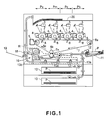
- FIG. 1 is a schematic illustration of an embodiment of an image forming apparatus to which an image heating apparatus according to the present invention is mountable as an image fixing device.
- This image forming apparatus is a color printer of an electrophotographic type.
- the image forming apparatus in Embodiment 1 is configured so that four color toner images different in color can be formed through processes of charging, exposure, development, and transfer by first, second, third and fourth image forming stations (portions) Py, Pm, Pc and Pb provided side by side inside the image forming apparatus.
- the image forming apparatus in Embodiment 1 executes a predetermined image forming sequence depending on an image forming signal output from an external device (not shown) such as a hot computer and then performs an image forming operation in accordance with the image forming sequence. Specifically, the respective image forming stations are successively driven, so that each of photosensitive drums 1 as an image bearing member is rotated in a direction indicated by an arrow at a predetermined peripheral speed (process speed).
- An intermediary transfer belt 7 stretched and extended around a driving roller 6a, a follower roller 6b and a tension roller 6c so as to face the respective photosensitive drums 1 of the image forming stations Py, Pm, Pc and Pb is rotated by the driving roller 6a in a direction indicated by an arrow at a peripheral speed corresponding to the peripheral (rotational) speed of each photosensitive drum 1.
- the surface of the photosensitive drum 1 is electrically charged uniformly to a predetermined polarity and a predetermined potential by a charging device 2. Then, the charged surface of the photosensitive drum 1 is subjected to scanning exposure with laser light emitted from an exposure device 3 correspondingly to image information from the external device. As a result, an electrostatic latent image is formed on the surface of the photosensitive drum 1 correspondingly to the image information. Then the latent image is developed with a yellow toner (developer) by a developing device 4, so that a yellow toner image (developer image) is formed on the surface of the photosensitive drum 1. Similar steps of charging, exposure and development are also performed at the image forming station Pm for magenta as a second color, the image forming station Pc for cyan as a third color, and the image forming station Pb for black as a fourth color.
- Similar steps of charging, exposure and development are also performed at the image forming station Pm for magenta as a second color, the image forming station Pc for
- the respective color toner images formed on the surfaces of the respective photosensitive drums 1 at the image forming stations Py, Pm, Pc and Pb are successively transferred onto an outer peripheral surface of the intermediary transfer belt 7 in a superposition manner by primary transfer blades 8 disposed opposite to the respective photosensitive drums 1 through the intermediary transfer belt 7. As a result, a full-color toner image is carried on the surface of the intermediary transfer belt 7.
- a recording material P is sent by a feeding roller 12 from a sheet-feeding cassette 10 or a manual feeding type recording material tray 11 to registration rollers 14 along a conveying path 13a. Then, the recording material P is sent by the registration rollers 14 to a secondary transfer nip Tn between the intermediary transfer belt 7 and a secondary transfer roller 15 and is nip-conveyed in the secondary transfer nip Tn. During the nip-conveying process, the full-color toner image on the surface of the intermediary transfer belt 7 is transferred onto the recording material P by a secondary transfer roller 15.
- the recording material P carrying thereon the full-color toner image which has not been fixed is introduced into a fixing device 16. Then, the recording material P is nip-conveyed in a nip described later, so that the unfixed full-color toner image is heated and fixed on the recording material P.
- the recording material P is discharged, through switching of a switching flapper 17, on a discharging tray 19 provided on a side surface of the image forming apparatus via a discharging roller 18 or on a discharging tray 20 provided at an upper surface of the image forming apparatus.
- the switching flapper 17 is located at a pressure of a broken line
- the recording material P is discharged on the discharging tray 19 with face up (with the image upward).
- the switching flapper 17 is located at the indicated pressure (of a solid line)
- the recording material P is discharged on the discharging tray 20 with face down (with the image downward).
- the recording material P on which the toner image has been fixed by the fixing device 16 is guided upward by the switching flapper 17 located at the indicated pressure. Then, when a trailing end of the recording material P reaches a reversing point R, the recording material P is switch back-conveyed along a conveying path 13b to be reversed.
- the recording material P is conveyed along a conveying path 13c for both-side (surface) image formation and then is subjected to the same process as that in the case of one-side (surface) image formation, so that the toner image is formed on the other surface of the recording material P and then the recording material P is discharged on the discharging tray 19 or on the discharging tray 20.
- the photosensitive drum 1 after the toner image transfer is subjected to removal of untransferred toner remaining on the surface of the photosensitive drum 1 by a drum cleaner 5 and then is subjected to subsequent image formation.
- the intermediary transfer belt 7 after the full-color toner image transfer is subjected to removal of untransferred toner remaining on the surface of the intermediary transfer belt 7 by a belt cleaner 9 and then is subjected to subsequent image formation.
- a longitudinal direction refers to a direction perpendicular to a recording material conveying direction in a plane of the recording material.
- the longitudinal direction coincides with a rotational axis of the belt member.
- a widthwise direction refers to a direction parallel to the recording material conveying direction in the plane of the recording material.
- a length refers to a dimension with respect to the longitudinal direction.
- a width refers to a dimension with respect to the widthwise direction.
- a widthwise direction refers to a direction perpendicular to the recording material conveying direction in the plane of the recording material.
- a width (of the recording material) refers to a dimension (of the recording material) with respect to the widthwise direction.
- Figure 2 is a schematic cross-sectional view of an embodiment of the fixing device 16.
- Figure 3 is a perspective view showing a positional relationship among a fixing belt 21 and a fixing flange 22 of the fixing device 16, and a pressing roller 25.
- Figure 4 is a schematic view for illustrating a layer structure of the fixing belt 21.
- the fixing device 1 in Embodiment 1 is a belt fixing device of an electromagnetic induction heating type.
- This belt fixing device of the electromagnetic induction heating type uses an electromagnetic induction heat generating element as a heating element.
- an eddy current is generated in the electromagnetic induction heat generating element and Joule heat is generated due to the eddy current.
- the belt fixing device of the electromagnetic induction heating type imparts heat to the recording material, as a material to be heated, by the Joule heat, thus heat-fixing an unfixed toner image on the surface of the recording material.
- the fixing device 16 in Embodiment 1 includes the fixing belt (belt member) 21 as a cylindrical belt member having an electroconductive layer (electromagnetic induction heat generating element) 21b, a pair of fixing flanges 22 and 22 as a holding member, and a coil unit 23 including a coil.
- the fixing device 16 also includes a pressing stay 24 as a first pressing member and the pressing roller 25 as a second pressing member.
- the fixing device 16 is configured to subject the fixing belt 21 to the electromagnetic induction heating from the outside of the fixing belt 21 by the coil unit.
- Each of the fixing belt 21, the coil unit 23, the pressing stay 24 and the pressing roller 25 is an elongated member extending in the longitudinal direction.
- the coil unit 23 is provided outside the fixing belt 21 while keeping a gap of about 0.5 mm to about 2 mm between it and an outer surface of the fixing belt 21.
- This coil unit 23 includes an exciting coil 23a, a magnetic core 23b, and a holder 3c for holding the coil 23a and the core 23b.
- the holder 23c is an elongated box-like member extending in the longitudinal direction of the fixing belt 21 and is held by a coil unit holding plate 32 ( Figure 6 ) along the longitudinal direction of the fixing belt 21.
- a lower surface of the holder 23c on the fixing belt 21 surface side is formed in a dome shape so as to follow the surface of the fixing belt 21 and opposes the surface of the fixing belt 21 with the above-described gap.
- the coil 23a has an elongated elliptical shape extending in the longitudinal direction of the fixing belt 21 with a substantially reversed ship's bottom-like cross section. This shape is such a shape that the coil 23a follows the shape of the fixing belt 21 when the pressing stay 24 is located at an image heating position.
- the coil 23a is disposed inside the holder 23c so as to follow the surface of the fixing belt 21.
- As a core wire of the coil 23a Litz wire prepared by bundling approximately 80 - 160 strands of fine wires having a diameter of 0.1 - 0.3 mm is used.
- As the fine wires insulation coating electric wires are used.
- the Litz wire is wound 8 to 12 times around the core 23b to constitute the coil 23a to be used.
- an exciting circuit (not shown) is connected so that an alternating current can be supplied from the exciting circuit to the coil 23a.
- the coil 23b formed of a ferromagnetic material is configured to surround the coil 23a and a winding center position of the coil 23a.
- the core 23b has the function of efficiently introduce AC magnetic flux generated from the coil 23a into the electroconductive layer 21b of the fixing belt 21. That is, core 23b enhances an efficiency of the exciting circuit formed by the coil 23a and the electroconductive layer 21b.
- a material for the core 23b those such as ferrite having high magnetic permeability and low residual magnetic flux density may preferably be used.
- another core 23b formed of the ferromagnetic material is provided inside the fixing belt 21 so as to oppose the above-described core 23b via the fixing belt 21.
- This core 23b (in the fixing belt 21) is disposed between a pressure holding member 24a, described later, of the pressing stay 24 and an inner peripheral surface (inner surface) of the fixing belt 21.
- the fixing belt 21 is an endless cylindrical member having heat resistivity and flexibility.
- the fixing belt 21 is a complex layer belt including, from the inner surface side to the outer surface side, an inner layer 21a, the electroconductive layer 21b, an elastic layer 21c and a surface parting layer 21d ( Figure 4 ).
- the electroconductive layer 21b causes induction heat generation by the action of electromagnetic induction of the magnetic field (magnetic flux) generated by the coil unit 23.
- an electroconductive layer (metal layer) formed in a thickness of about 50 ⁇ m to about 100 ⁇ m by using a metal material such as iron, cobalt, nickel, copper, or chromium is used.
- ferromagnetic metal metal having high magnetic permeability
- iron ferromagnetic metal
- a layer of nickel having a high electrical conductivity is formed in a small thickness of about 50 ⁇ m and is used.
- the elastic layer 21b is formed of a predetermined material suitable as the elastic layer for the fixing belt 21 and is provided on the electroconductive layer 21b.
- the surface parting layer 21d directly contacts an unfixed toner image t carried on the recording material P.
- the surface parting layer 21d As a material for the surface parting layer 21d, it is necessary to use a material having a good parting property. Specifically, as the surface parting layer 21d, it is possible to use, e.g., layers of tetrafluoroethylene-perfluoroalkylvinyl ether copolymer (PFA), polytetrafluoroethylene (PTFE), and a silicone copolymer, and composite layers of these materials.
- PFA tetrafluoroethylene-perfluoroalkylvinyl ether copolymer
- PTFE polytetrafluoroethylene
- silicone copolymer silicone copolymer
- the thickness of the surface parting layer 21d when the thickness is excessively small, a durability in terms of an anti-wearing property is poor and thus a durability lifetime of the fixing belt 21 is shortened. On the other hand, when the thickness is excessively large, the thermal capacity of the fixing belt 21 becomes large, so that the warm-up time is undesirably increased.
- the pressing roller 25 having the heat resistivity includes a round shaft-like core metal 25a and an elastic layer 25b provided in a roller shape on the outer peripheral surface of the core metal 25a.
- a heat-resistant rubber such as a silicone rubber or a fluorine-containing rubber, a foam member of the silicon rubber, or the like is used.
- the pressing roller 25 is provided in parallel to the fixing belt 21 on an opposite side to the coil unit 23 with respect to the fixing belt 21. Both longitudinal end portions of the core metal 25a are rotatably held by side plates 16F1 and 16F1 ( Figure 6 ) of a device frame 16 through shaft-supporting members.
- the pressing stay 24 is a member having the heat resistivity and is provided inside the fixing belt 21.
- the pressing stay 24 includes a flat plate-like sliding portion 24a contactable to the inner surface of the fixing belt 21 on the opposite side to the coil unit 23 and includes a pressing portion 24b which has a reversed U-shaped cross section and is provided on the sliding portion 24a.
- the sliding portion 24a is provided in parallel to the recording material conveying direction ( Figure 1 ) and the pressing portion 24b is provided at a central portion of the sliding portion 24a with respect to the widthwise direction.
- the fixing flanges 22 and 22 are held by the side plates 16F1 and 16F1 ( Figure 6 ) of the device frame 16 so as to oppose the longitudinal end portions of the pressing portion 24b of the pressing stay 24.
- the fixing flanges 22 and 22 include substrate (base portions) 22a and 22a opposing the longitudinal end portions of the fixing belt 21.
- Each of the substrates 22a and 22a is provided with an engaging recess (not shown).
- the substrates 22a and 22a have inner wall surfaces 22a1 and 22a1, facing the fixing belt 21, which are provided with belt holding portions (not shown) projected toward the fixing belt 21.
- the substrate 22a and 22a include fixing belt portions to be pressed 22b and 22b which are provided on outer wall surfaces of the substrates 22a and 22a on the opposite side to the fixing belt 21 and are projected toward the opposite side to the fixing belt 21.
- the belt holding portions are engaged with portions located inside the longitudinal end portions of the fixing belt 21, thus rotatably holding the fixing belt 21. That is, the fixing flanges 22 and 22 support the fixing belt 21 from the inside of the fixing belt 21 at the longitudinal end portions of the fixing belt 21 and guide the cylindrical shape of the fixing belt 21.
- the inner wall surfaces 22a1 and 22a1 function as preventing surfaces for preventing movement of the fixing belt 21 by contact with longitudinal end surfaces of the fixing belt 21 when the fixing belt 21 is moved in the longitudinal direction.
- the portions to be pressed 22b and 22b of the fixing flanges 22 and 22 are pressed by pressing levers 33 and 33 described later.
- a pressing force of the pressing levers 33 and 33 is exerted on the sliding portion 24a through the pressing portion 24b of the pressing stay 24.
- the sliding portion 24a supplied with the pressing force of the pressing levers 33 and 33 presses the surface of the fixing belt 21 against the surface of the pressing roller 25.
- the fixing belt 21 is deformed so as to follow the surface shape of the sliding portion 24a and at the same time the elastic layer 25b of the pressing roller 25 is also elastically deformed so as to follow the surface shape of the sliding portion 24a.
- a nip (fixing nip) N with a predetermined width is formed between the fixing belt 21 surface and the pressing roller 25 surface.
- projections 32a and 32a of a coil unit holding plate 32 described later are provided in contact with the portions to be pressed 22b and 22b.
- the above-described gap for causing the electroconductive layer 21b to generate heat by the action of the generated magnetic flux from the coil 23a is created between the fixing belt 21 surface and the lower surface of the holder 23c of the coil unit 23.
- the fixing device 16 rotates forward (normally) a fixing motor M as a driving source in accordance with a print signal to rotate a driving gear G ( Figure 3 ), provided to a longitudinal end of the core metal 25a of the pressing roller 25, in a predetermined direction.
- a driving gear G Figure 3
- the pressing roller 25 rotates in a direction indicated by an arrow at a predetermined peripheral speed (process speed).
- the rotation of the pressing roller 25 causes a frictional force between the pressing roller 25 surface and the fixing belt 21 surface in the nip N, so that a driving force is transmitted to the fixing belt 21.
- the fixing belt 21 is rotated by the rotation of the pressing roller 25 while sliding on the sliding portion 24a at its inner surface.
- a lubricant such as a grease is applied between the sliding portion 24a and the inner surface of the fixing belt 21, thus improving a sliding property between the pressing stay 24 and the inner surface of the fixing belt 21.
- the alternating current is supplied to the coil 23a of the coil unit 23 by the exciting circuit.
- the coil 23a generates the AC magnetic flux, which is introduced into the core 23b to generate the eddy current in the fixing belt 21.
- the eddy current generates Joule heat by the specific resistance of the fixing belt 21. That is, by supplying the alternating current to the coil 23a, the fixing belt 21 is placed in an electromagnetic induction heat generation state.
- a temperature of the fixing belt 21 is detected by a thermistor as a temperature detecting member.
- An output signal (a temperature detection signal for the fixing belt 21) from the thermistor is input into the control portion.
- the control portion effects ON/OFF control of the exciting circuit on the basis of the output signal so as to keep the temperature of the fixing belt 21 at a level of a predetermined fixing temperature (a target temperature).
- the recording material P carrying thereon the unfixed toner image t is introduced into the nip N, in which the recording material P is nip-conveyed between the fixing belt 21 surface and the pressing roller 25 surface.
- the toner image t is heat-fixed on the recording material P by being subjected to the heat of the fixing belt 21 and the pressure in the nip N.
- the recording material P coming out of the nip N is separated from the fixing belt 21 surface, thus being discharged from the nip N.
- Figure 5(a) is a schematic view showing a cross-sectional shape of the fixing belt 21 during pressure application.
- Figure 5(b) is a schematic view showing a cross-sectional shape of the fixing belt 21 during pressure-release (a) in which the pressure application to the fixing belt 21 is released by operating the pressing stay 24.
- Figure 5(c) is a schematic view showing a cross-sectional shape of the fixing belt 21 during pressure-release (b) in which the pressure application to the fixing belt 21 is released by operating the pressing stay 24 and the coil unit 23.
- the cross-sectional shape of the fixing belt 21 during the pressure application is changed from a substantially true circular shape before the pressure application to a partly flattened elliptical shape extending in the widthwise direction of the pressing stay 24 due to the nipping between the pressing stay 24 and the pressing roller 25 ( Figure 5(a) ).
- the cross-sectional shape of the coil unit 23 on the fixing belt 21 side (the lower surface shape of the holder 23c) follows the elliptical shape of the fixing belt 21 surface during the pressure application. Further, the coil unit 23 provided outside the fixing belt 21 keeps the gap of about 0.5 mm to about 2 mm between it and the fixing belt 21 surface.
- the pressing stay 24 is moved apart from the fixing belt 21 by a conventional predetermined pressure changing means to release the pressure application to the fixing belt 21.
- a conventional predetermined pressure changing means to release the pressure application to the fixing belt 21.
- the fixing belt 21 surface contacts the lower surface of the holder 23c of the coil unit 23 since the state of the fixing belt 21 is to be returned to the original circular shape state due to rigidity of the fixing belt 21 itself.
- the fixing belt 21 surface is abraded to damage the fixing belt 21.
- the present inventor has studied on the fixing belt 21 constituted as follows.
- a layer of Ni having an inner diameter of 30 mm and a thickness of 50 ⁇ m was used as the electroconductive layer 21b and a 30 ⁇ m-thick polyimide (PI) film is used as the inner layer 21a.
- PI polyimide
- a 300 ⁇ m-thick silicone rubber layer was used as the elastic layer 21c and a 40 ⁇ m-thick PFA layer was used as the surface parting layer. Deformation of the fixing belt 21 was measured when the fixing belt 21 was pressed against the pressing roller 25 with a pressing force of 600 N.
- a movement distance A1 of the fixing belt 21 surface between during the pressure application shown in Figure 5(a) and during the pressure-release shown in Figure 5(b) was about 1.0 mm.
- the movement distance ⁇ 1 corresponds to that due to deformation of the fixing belt 21.
- the fixing belt 21 and the coil unit 23 during the pressure application was brought near to each other so as to provide a gap therebetween of not more than 1.0 mm. In that case, when the pressure application of the pressing roller 25 to the fixing belt 21 is released, the fixing belt 21 contacts (interferes with) the coil unit 23. Therefore, the separation alone of the pressing roller 25 from the fixing belt is insufficient.
- a pressuring and pressure-releasing mechanism which is a moving mechanism capable of moving the coil unit 23 away from the fixing belt 21 by a movement distance ⁇ (> ⁇ 1) so that the coil unit 23 does not contact the fixing belt 21 is provided.
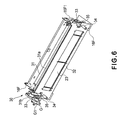
- Figure 6 is a perspective view of an outer appearance of the entire pressuring and pressure-releasing mechanism 30 as a pressure changing mechanism (pressure-releasing mechanism).
- Figure 7 is a perspective view for illustrating a rotational driving shaft 31 of the pressuring and pressure-releasing mechanism 30.
- Figure 8 is a schematic view for illustrating a pressure releasing operation of the pressuring and pressure-releasing mechanism 30.
- the pressuring and pressure-releasing mechanism 30 as a pressuring and pressure-releasing means includes the rotational driving shaft 31 as a rotatable member, the coil unit holding plate 32 as a coil unit holding member, and a part of pressing levers 3 and 33 as a pressing member.
- the pressuring and pressure-releasing mechanism 30 further includes a pair of first spring screws 34 and 34 as a first pressing means and a pair of second spring screws 35 and 35 as a second pressing means.
- the rotational driving shaft 31 includes a shaft 31a provided in parallel to the fixing belt 21.
- the shaft 31a is rotatably held by the side plates 16F1 and 16F1 of the device frame 16F at both longitudinal end portions thereof ( Figure 7 ).
- the shaft 31a is provided with a first larger eccentric cam 31a1 and a second smaller eccentric cam 31a2 at each of the both longitudinal end portions thereof located outside the side plates 16F1 and 16F1 ( Figure 7 and Figure 8 ). Further, at one longitudinal end portions of the shaft 31a, a pressure-releasing gear 31b is provided.
- the rotational driving shaft 31 is provided downstream of the nip N with respect to the recording material conveying direction.
- the coil unit holding plate 32 holding the coil unit 23 is rotatably held by the side plates 16F1 and 16F1 of the device frame 16F at both longitudinal end portions thereof at a position upstream of the nip N with respect to the recording material conveying direction. That is, the contact holding plate 32 is configured so as to be operable with respect to a direction in which the coil unit holding plate 32 is separated from the fixing belt 21 at the both longitudinal end portions thereof as a supporting point C.
- the projections 32a and 32a are provided in the neighborhood of a substantially central portion of the coil unit holding plate 32 with respect to the widthwise direction of the coil unit holding plate 32 and contact the portions to be pressed 22b and 22b of the fixing flanges 22 and 22.
- a first position refers to a position in which the coil unit holding plate 32 contacts the fixing flanges 22 and 22 and keeps the predetermined gap for permitting the heat generation of the electroconductive layer 21b by the action of the generated magnetic flux from the coil 23a.
- the pressing levers 33 and 33 are rotatably held by fixed portions 16F3 and 16F3 at both longitudinal end portions thereof on a downstream side of the nip N with respect to the recording material conveying direction. That is, the pressing levers 33 and 33 are configured so that the pressing levers 33 and 33 are operable with respect to a direction in which the pressing levers 33 and 33 are separated from the fixing belt 21 at the both longitudinal end portions as a supporting point D.
- the pressing levers 33 and 33 contact the portions to be pressed 22b and 22b of the fixing flanges 22 and 22 between the substantially widthwise central portions of the pressing levers 33 and 33 and the both longitudinal end portions of the pressing levers 33 and 33.
- a first position refers to a position in which the fixing belt 21 is deformed so as to form the nip N by applying the pressure to the fixing flanges 22 and 22 so as to press the fixing belt 21 against the pressing roller 25.
- the pressuring and pressure-releasing mechanism 30 functions as not only the pressure-releasing means but also the moving means for moving the coil unit 23.
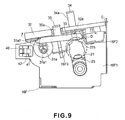
- Figure 9 is a schematic view showing a state in which the coil unit 23 is moved away from the fixing belt 21 by the pressuring and pressure-releasing mechanism 30 to maximize the gap.
- the fixing motor is reversely rotated to rotate a pressure-releasing gear 31b of the rotational driving shaft 31, through a drive transmission gear G1, in a predetermined by a predetermined amount.
- the predetermined amount refers to an amount of the rotation of the rotational driving shaft 31 corresponding to the movement distance ⁇ 2 by which the coil unit 23 is moved away from the fixing belt 21.
- the shaft 31a is rotated.
- the first larger eccentric cams 31a1 and the second smaller eccentric cams 31a2 are rotated in a direction indicated by an arrow ( Figure 8 ).
- the outer peripheral surfaces of the first larger eccentric cams 31a1 contact the coil unit holding plate 32 on the downstream side of the nip N with respect to the recording material conveying direction.
- the first larger eccentric cams 31a1 rotationally move the coil unit holding plate 32 about the supporting point C in the direction in which the coil unit holding plate 32 is moved apart from the fixing belt 21 against the pressing force of the springs 34a of the first spring screws 34.
- the projections 32a and 32a are started to be separated from the portions to be pressed 22b and 22b of the fixing flanges 22 and 22.
- the coil unit 23 is rotationally moved in a direction in which the coil unit 23 is moved away from the fixing belt 21.
- the gap between the coil unit 23 and the fixing belt 21 is gradually increased.
- the second smaller eccentric cams 31a2 When the second smaller eccentric cams 31a2 are further rotated, the second smaller eccentric cams 31a2 rotationally move the pressing levers 33 and 33 about the supporting point D in the direction in which the pressing levers 33 and 33 are moved apart from the portions to be pressed 22b and 22b of the fixing flanges 22 and 22 against the pressing force of the springs 35a of the second spring screws 35.
- a degree of the pressure application to the fixing belt 21 is gradually alleviated, so that the shape of the fixing belt 21 is started to be restored to the original cylindrical shape by the rigidity of the fixing belt 21 itself.
- the predetermined gap between the coil unit 23 and the fixing belt 21 is also maximized.
- the drive of the fixing motor is stopped.
- the stop of the fixing motor is made after a lapse of a preset time from the start of the reverse rotation of the fixing motor.
- a maximum of the above-described gap is set at a predetermined value at which the fixing belt 21 surface does not contact the lower surface of the coil unit 23 when the pressure application to the fixing belt 21 is released. Therefore, with respect to the coil unit holding plate 32, a position in which the distance from the shaft 31a of the rotational driving shaft 31 to the surface of the first larger eccentric cams 31a1 is maximized is set as the second position. That is, with respect to the coil unit holding plate 32, the second position is a position in which the coil unit holding plate 32 keeps the gap larger than that at the above-described first position.
- the rotational driving shaft 31 operates the coil unit holding plate 32 so as to move from the first position to the second position by the rotation of the first larger eccentric cams 31a1 when the pressure application to the fixing flanges 22 and 22 is released.
- a position in which the pressure application to the fixing flanges 22 and 22 is released to restore the shape of the fixing belt 21 to the cylindrical shape before the deformation is set as a second position. That is, with respect to the pressing levers 33 and 33, the second position refers to the position in which the pressure application to the fixing flanges 22 and 22 is released to restore the shape of the fixing belt 21 to that before the deformation.
- the coil unit holding plate 32 is moved from the first position (thereof) to the second position (thereof) through the first larger eccentric cams 31a1.
- the pressing levers 33 and 33 are moved from the first position (thereof) to the second position (thereof) through the second smaller eccentric cams 31a2. Therefore, even when the shape of the fixing belt 21 is restored to the cylindrical shape before the deformation, it is possible to avoid the contact between the fixing belt 21 surface and the coil unit 23 lower surface. Thus, it is possible to prevent the damage of the fixing belt 21.
- Figure 10 is a flow chart showing an example of a procedure of the pressure-releasing operation of the pressuring and pressure-releasing mechanism 30.
- This pressure-releasing operation is performed during non-image formation in which the image is not formed on the recording material.
- the non-image formation may include not only a state in which the image forming operation is stopped due to an occurrence of an error such as jamming but also a state, such as a stand-by state, in which the image forming apparatus awaits an image forming signal.
- a step S1 the fixing motor is reversely rotated.
- step S2 the coil unit holding plate 32 is moved from the first position to the second position through the first larger eccentric cams 31a1 to keep the gap larger than that at the first position.
- a step S3 the pressing levers 33 and 33 are moved from the first position to the second position through the second smaller eccentric cams 31a2 to perform the pressure-release between the pressing roller 25 and the fixing belt 21.
- a step S4 whether or not the position of the first larger eccentric cams 31a1 is optimum is judged. In the case where the position of the first larger eccentric cams 31a1 is not optimum ("NO"), the procedure is returned to the step S1.
- the side plate 16F1 is provided with a flag 41 for detecting a rotational position of the first larger eccentric cam 31a1 and with a flag sensor 42 for detecting the flag 41.
- the control portion the drive control means for controlling the drive of the fixing motor.
- such a constitution that the coil unit is moved by the fixing motor to release the pressing force in the nip is employed but other constitutions may also be employed.
- the constitution in which the pressing stay is moved is employed but it is also possible to achieve the effect of the present invention by employing a similar constitution with respect to the coil unit movement even in the constitution in which the pressing roller is moved.
- the present invention even when the pressure application state between the belt member and the pressing member is released to restore the shape of the belt member to that before the deformation of the belt member, it is possible to provide an image heating apparatus capable of avoiding the contact between the belt member and the coil unit.
- An image heating apparatus includes a coil for generating magnetic flux; a belt member, including an electroconductive layer for generating heat by the magnetic flux generated from the coil, for heating an image on a recording material by the heat generated by the electroconductive layer; a first pressing member contactable to an inner surface of the belt member; a second pressing member for pressing the belt member against the first pressing member to nip and convey the recording material; a coil unit, including the coil, provided oppositely to an outer surface of the belt member; a moving mechanism capable of moving the coil unit between a first position in which the image on the recording material is to be heated and a second position in which the coil unit is moved away from the belt member; and a pressure changing mechanism for changing a pressure between the first pressing member and the second pressing member.
- the pressure changing mechanism reduces the pressure between the first pressing member and the second
Landscapes
- Physics & Mathematics (AREA)
- General Physics & Mathematics (AREA)
- Fixing For Electrophotography (AREA)
Priority Applications (1)
| Application Number | Priority Date | Filing Date | Title |
|---|---|---|---|
| EP11177417.0A EP2405310A3 (en) | 2008-10-02 | 2009-10-01 | Image heating apparatus |
Applications Claiming Priority (1)
| Application Number | Priority Date | Filing Date | Title |
|---|---|---|---|
| JP2008257338A JP5197280B2 (ja) | 2008-10-02 | 2008-10-02 | 像加熱装置 |
Related Child Applications (2)
| Application Number | Title | Priority Date | Filing Date |
|---|---|---|---|
| EP11177417.0A Division EP2405310A3 (en) | 2008-10-02 | 2009-10-01 | Image heating apparatus |
| EP11177417.0 Division-Into | 2011-08-12 |
Publications (2)
| Publication Number | Publication Date |
|---|---|
| EP2180379A1 EP2180379A1 (en) | 2010-04-28 |
| EP2180379B1 true EP2180379B1 (en) | 2012-03-28 |
Family
ID=41509068
Family Applications (2)
| Application Number | Title | Priority Date | Filing Date |
|---|---|---|---|
| EP09171950A Not-in-force EP2180379B1 (en) | 2008-10-02 | 2009-10-01 | Image heating apparatus |
| EP11177417.0A Withdrawn EP2405310A3 (en) | 2008-10-02 | 2009-10-01 | Image heating apparatus |
Family Applications After (1)
| Application Number | Title | Priority Date | Filing Date |
|---|---|---|---|
| EP11177417.0A Withdrawn EP2405310A3 (en) | 2008-10-02 | 2009-10-01 | Image heating apparatus |
Country Status (5)
| Country | Link |
|---|---|
| US (1) | US8055175B2 (enExample) |
| EP (2) | EP2180379B1 (enExample) |
| JP (1) | JP5197280B2 (enExample) |
| CN (1) | CN101713952B (enExample) |
| AT (1) | ATE551636T1 (enExample) |
Families Citing this family (18)
| Publication number | Priority date | Publication date | Assignee | Title |
|---|---|---|---|---|
| JP5197280B2 (ja) | 2008-10-02 | 2013-05-15 | キヤノン株式会社 | 像加熱装置 |
| JP2010145592A (ja) * | 2008-12-17 | 2010-07-01 | Canon Inc | 画像加熱装置 |
| JP5451362B2 (ja) * | 2009-12-22 | 2014-03-26 | キヤノン株式会社 | 像加熱装置 |
| JP5035364B2 (ja) * | 2010-02-22 | 2012-09-26 | ブラザー工業株式会社 | 画像形成装置 |
| JP5541734B2 (ja) | 2010-12-14 | 2014-07-09 | キヤノン株式会社 | 像加熱装置 |
| JP5693196B2 (ja) | 2010-12-14 | 2015-04-01 | キヤノン株式会社 | 像加熱装置 |
| JP5412486B2 (ja) * | 2010-12-17 | 2014-02-12 | 京セラドキュメントソリューションズ株式会社 | 定着装置及びこれを備える画像形成装置 |
| JP5768507B2 (ja) * | 2011-03-17 | 2015-08-26 | 株式会社リコー | 定着装置および画像形成装置 |
| JP5284404B2 (ja) * | 2011-03-30 | 2013-09-11 | 京セラドキュメントソリューションズ株式会社 | Ih定着式画像形成装置 |
| US20120263487A1 (en) * | 2011-04-18 | 2012-10-18 | Toshiba Tec Kabushiki Kaisha | Fixing device, image forming apparatus using the same and controlling mehod of the same |
| JP6108721B2 (ja) * | 2011-09-01 | 2017-04-05 | キヤノン株式会社 | 画像加熱装置 |
| JP5884374B2 (ja) * | 2011-09-29 | 2016-03-15 | ブラザー工業株式会社 | 定着装置 |
| JP5737520B2 (ja) | 2012-01-13 | 2015-06-17 | 株式会社リコー | 定着装置及び画像形成装置 |
| JP6039288B2 (ja) | 2012-07-30 | 2016-12-07 | キヤノン株式会社 | 画像加熱装置 |
| JP6021494B2 (ja) | 2012-07-31 | 2016-11-09 | キヤノン株式会社 | 画像加熱装置 |
| JP5383941B2 (ja) * | 2013-05-28 | 2014-01-08 | 京セラドキュメントソリューションズ株式会社 | Ih定着装置 |
| JP5777765B2 (ja) * | 2014-04-22 | 2015-09-09 | キヤノン株式会社 | 像加熱装置 |
| JP6897188B2 (ja) * | 2017-03-16 | 2021-06-30 | コニカミノルタ株式会社 | 定着装置および画像形成装置 |
Family Cites Families (17)
| Publication number | Priority date | Publication date | Assignee | Title |
|---|---|---|---|---|
| JPS5933787A (ja) | 1982-08-19 | 1984-02-23 | 松下電器産業株式会社 | 高周波誘導加熱ロ−ラ |
| JP2000029332A (ja) | 1998-07-13 | 2000-01-28 | Matsushita Electric Ind Co Ltd | 熱ローラー装置 |
| JP4166886B2 (ja) | 1998-12-18 | 2008-10-15 | 株式会社東芝 | 定着装置 |
| CN1327302C (zh) * | 1999-10-26 | 2007-07-18 | 松下电器产业株式会社 | 电摄影成像设备中的图像加热定影装置 |
| JP3807223B2 (ja) * | 2000-11-10 | 2006-08-09 | 富士ゼロックス株式会社 | 定着装置 |
| JP2003122148A (ja) * | 2001-10-09 | 2003-04-25 | Canon Inc | 画像形成装置の加熱装置 |
| JP3461176B2 (ja) * | 2003-01-29 | 2003-10-27 | 松下電器産業株式会社 | 像加熱装置および画像形成装置 |
| US7107001B2 (en) * | 2004-03-29 | 2006-09-12 | Canon Kabushiki Kaisha | Fixing apparatus with controlled heating members for heating the outer surface of the fixing rotating member |
| JP2005321511A (ja) * | 2004-05-07 | 2005-11-17 | Canon Inc | 画像形成装置および定着装置 |
| US7697881B2 (en) * | 2005-03-17 | 2010-04-13 | Canon Kabushiki Kaisha | Image forming apparatus |
| US7200354B2 (en) * | 2005-06-21 | 2007-04-03 | Canon Kabushiki Kaisha | Image heating apparatus |
| JP4684804B2 (ja) * | 2005-08-24 | 2011-05-18 | キヤノン株式会社 | 画像加熱装置 |
| JP2007212868A (ja) * | 2006-02-10 | 2007-08-23 | Canon Inc | 画像形成装置 |
| JP4574574B2 (ja) * | 2006-03-15 | 2010-11-04 | シャープ株式会社 | 定着装置、定着装置の制御方法、及び画像形成装置 |
| JP2008122771A (ja) | 2006-11-14 | 2008-05-29 | Matsushita Electric Ind Co Ltd | 像加熱装置及びこれを備えた画像形成装置 |
| US7925197B2 (en) * | 2006-11-21 | 2011-04-12 | Kabushiki Kaisha Toshiba | Fixing apparatus of image forming apparatus |
| JP5197280B2 (ja) | 2008-10-02 | 2013-05-15 | キヤノン株式会社 | 像加熱装置 |
-
2008
- 2008-10-02 JP JP2008257338A patent/JP5197280B2/ja not_active Expired - Fee Related
-
2009
- 2009-09-30 US US12/570,726 patent/US8055175B2/en not_active Expired - Fee Related
- 2009-09-30 CN CN200910177493.5A patent/CN101713952B/zh not_active Expired - Fee Related
- 2009-10-01 EP EP09171950A patent/EP2180379B1/en not_active Not-in-force
- 2009-10-01 EP EP11177417.0A patent/EP2405310A3/en not_active Withdrawn
- 2009-10-01 AT AT09171950T patent/ATE551636T1/de active
Also Published As
| Publication number | Publication date |
|---|---|
| EP2405310A2 (en) | 2012-01-11 |
| JP5197280B2 (ja) | 2013-05-15 |
| US20100086335A1 (en) | 2010-04-08 |
| CN101713952A (zh) | 2010-05-26 |
| JP2010085910A (ja) | 2010-04-15 |
| EP2180379A1 (en) | 2010-04-28 |
| EP2405310A3 (en) | 2015-01-21 |
| US8055175B2 (en) | 2011-11-08 |
| CN101713952B (zh) | 2012-04-04 |
| ATE551636T1 (de) | 2012-04-15 |
Similar Documents
| Publication | Publication Date | Title |
|---|---|---|
| US8055175B2 (en) | Image heating apparatus | |
| US6456819B1 (en) | Image heating apparatus | |
| JP5299690B2 (ja) | 定着装置及び画像形成装置 | |
| US7620337B2 (en) | Image heating apparatus and image forming apparatus with controlled switch out of stand-by state | |
| KR101260664B1 (ko) | 정착 장치 및 화상 형성 장치 | |
| JP2011033661A (ja) | 定着装置及び画像形成装置 | |
| US9091975B2 (en) | Fixing device | |
| JP3483413B2 (ja) | 加熱装置 | |
| US9128427B2 (en) | Image heating apparatus | |
| US7098430B2 (en) | Heating apparatus with target temperature control and means for changing target temperature | |
| US8503918B2 (en) | Image heating apparatus | |
| EP2120103B1 (en) | Image heating apparatus | |
| US6847793B2 (en) | Temperature control for an image heating apparatus | |
| JP2007079238A (ja) | 定着装置および定着方法 | |
| JP4261727B2 (ja) | 像加熱装置 | |
| US8437673B2 (en) | Image heating apparatus | |
| JP2006301106A (ja) | 加熱装置 | |
| JPH11135246A (ja) | 加熱装置及び画像形成装置 | |
| US9081341B2 (en) | Image heating apparatus | |
| US7529495B2 (en) | Image heating apparatus | |
| JP4115137B2 (ja) | 定着装置 | |
| JP2005338501A (ja) | 加熱装置 | |
| JP6821347B2 (ja) | 画像加熱装置 | |
| JP2001102163A (ja) | 加熱装置、像加熱装置および画像形成装置 | |
| JP2012194429A (ja) | 定着装置、画像形成装置およびプログラム |
Legal Events
| Date | Code | Title | Description |
|---|---|---|---|
| PUAI | Public reference made under article 153(3) epc to a published international application that has entered the european phase |
Free format text: ORIGINAL CODE: 0009012 |
|
| AK | Designated contracting states |
Kind code of ref document: A1 Designated state(s): AT BE BG CH CY CZ DE DK EE ES FI FR GB GR HR HU IE IS IT LI LT LU LV MC MK MT NL NO PL PT RO SE SI SK SM TR |
|
| AX | Request for extension of the european patent |
Extension state: AL BA RS |
|
| 17P | Request for examination filed |
Effective date: 20101028 |
|
| 17Q | First examination report despatched |
Effective date: 20110204 |
|
| GRAP | Despatch of communication of intention to grant a patent |
Free format text: ORIGINAL CODE: EPIDOSNIGR1 |
|
| RIC1 | Information provided on ipc code assigned before grant |
Ipc: G03G 15/20 20060101AFI20110817BHEP |
|
| GRAS | Grant fee paid |
Free format text: ORIGINAL CODE: EPIDOSNIGR3 |
|
| GRAA | (expected) grant |
Free format text: ORIGINAL CODE: 0009210 |
|
| AK | Designated contracting states |
Kind code of ref document: B1 Designated state(s): AT BE BG CH CY CZ DE DK EE ES FI FR GB GR HR HU IE IS IT LI LT LU LV MC MK MT NL NO PL PT RO SE SI SK SM TR |
|
| REG | Reference to a national code |
Ref country code: GB Ref legal event code: FG4D |
|
| REG | Reference to a national code |
Ref country code: CH Ref legal event code: EP |
|
| REG | Reference to a national code |
Ref country code: AT Ref legal event code: REF Ref document number: 551636 Country of ref document: AT Kind code of ref document: T Effective date: 20120415 |
|
| REG | Reference to a national code |
Ref country code: IE Ref legal event code: FG4D |
|
| REG | Reference to a national code |
Ref country code: DE Ref legal event code: R096 Ref document number: 602009006103 Country of ref document: DE Effective date: 20120524 |
|
| REG | Reference to a national code |
Ref country code: NL Ref legal event code: VDEP Effective date: 20120328 |
|
| PG25 | Lapsed in a contracting state [announced via postgrant information from national office to epo] |
Ref country code: LT Free format text: LAPSE BECAUSE OF FAILURE TO SUBMIT A TRANSLATION OF THE DESCRIPTION OR TO PAY THE FEE WITHIN THE PRESCRIBED TIME-LIMIT Effective date: 20120328 Ref country code: HR Free format text: LAPSE BECAUSE OF FAILURE TO SUBMIT A TRANSLATION OF THE DESCRIPTION OR TO PAY THE FEE WITHIN THE PRESCRIBED TIME-LIMIT Effective date: 20120328 Ref country code: NO Free format text: LAPSE BECAUSE OF FAILURE TO SUBMIT A TRANSLATION OF THE DESCRIPTION OR TO PAY THE FEE WITHIN THE PRESCRIBED TIME-LIMIT Effective date: 20120628 |
|
| LTIE | Lt: invalidation of european patent or patent extension |
Effective date: 20120328 |
|
| PG25 | Lapsed in a contracting state [announced via postgrant information from national office to epo] |
Ref country code: GR Free format text: LAPSE BECAUSE OF FAILURE TO SUBMIT A TRANSLATION OF THE DESCRIPTION OR TO PAY THE FEE WITHIN THE PRESCRIBED TIME-LIMIT Effective date: 20120629 Ref country code: LV Free format text: LAPSE BECAUSE OF FAILURE TO SUBMIT A TRANSLATION OF THE DESCRIPTION OR TO PAY THE FEE WITHIN THE PRESCRIBED TIME-LIMIT Effective date: 20120328 Ref country code: FI Free format text: LAPSE BECAUSE OF FAILURE TO SUBMIT A TRANSLATION OF THE DESCRIPTION OR TO PAY THE FEE WITHIN THE PRESCRIBED TIME-LIMIT Effective date: 20120328 |
|
| REG | Reference to a national code |
Ref country code: AT Ref legal event code: MK05 Ref document number: 551636 Country of ref document: AT Kind code of ref document: T Effective date: 20120328 |
|
| PG25 | Lapsed in a contracting state [announced via postgrant information from national office to epo] |
Ref country code: CY Free format text: LAPSE BECAUSE OF FAILURE TO SUBMIT A TRANSLATION OF THE DESCRIPTION OR TO PAY THE FEE WITHIN THE PRESCRIBED TIME-LIMIT Effective date: 20120328 |
|
| PG25 | Lapsed in a contracting state [announced via postgrant information from national office to epo] |
Ref country code: CZ Free format text: LAPSE BECAUSE OF FAILURE TO SUBMIT A TRANSLATION OF THE DESCRIPTION OR TO PAY THE FEE WITHIN THE PRESCRIBED TIME-LIMIT Effective date: 20120328 Ref country code: SI Free format text: LAPSE BECAUSE OF FAILURE TO SUBMIT A TRANSLATION OF THE DESCRIPTION OR TO PAY THE FEE WITHIN THE PRESCRIBED TIME-LIMIT Effective date: 20120328 Ref country code: SE Free format text: LAPSE BECAUSE OF FAILURE TO SUBMIT A TRANSLATION OF THE DESCRIPTION OR TO PAY THE FEE WITHIN THE PRESCRIBED TIME-LIMIT Effective date: 20120328 Ref country code: BE Free format text: LAPSE BECAUSE OF FAILURE TO SUBMIT A TRANSLATION OF THE DESCRIPTION OR TO PAY THE FEE WITHIN THE PRESCRIBED TIME-LIMIT Effective date: 20120328 Ref country code: IS Free format text: LAPSE BECAUSE OF FAILURE TO SUBMIT A TRANSLATION OF THE DESCRIPTION OR TO PAY THE FEE WITHIN THE PRESCRIBED TIME-LIMIT Effective date: 20120728 Ref country code: RO Free format text: LAPSE BECAUSE OF FAILURE TO SUBMIT A TRANSLATION OF THE DESCRIPTION OR TO PAY THE FEE WITHIN THE PRESCRIBED TIME-LIMIT Effective date: 20120328 Ref country code: PL Free format text: LAPSE BECAUSE OF FAILURE TO SUBMIT A TRANSLATION OF THE DESCRIPTION OR TO PAY THE FEE WITHIN THE PRESCRIBED TIME-LIMIT Effective date: 20120328 Ref country code: EE Free format text: LAPSE BECAUSE OF FAILURE TO SUBMIT A TRANSLATION OF THE DESCRIPTION OR TO PAY THE FEE WITHIN THE PRESCRIBED TIME-LIMIT Effective date: 20120328 |
|
| PG25 | Lapsed in a contracting state [announced via postgrant information from national office to epo] |
Ref country code: SK Free format text: LAPSE BECAUSE OF FAILURE TO SUBMIT A TRANSLATION OF THE DESCRIPTION OR TO PAY THE FEE WITHIN THE PRESCRIBED TIME-LIMIT Effective date: 20120328 Ref country code: PT Free format text: LAPSE BECAUSE OF FAILURE TO SUBMIT A TRANSLATION OF THE DESCRIPTION OR TO PAY THE FEE WITHIN THE PRESCRIBED TIME-LIMIT Effective date: 20120730 |
|
| PG25 | Lapsed in a contracting state [announced via postgrant information from national office to epo] |
Ref country code: AT Free format text: LAPSE BECAUSE OF FAILURE TO SUBMIT A TRANSLATION OF THE DESCRIPTION OR TO PAY THE FEE WITHIN THE PRESCRIBED TIME-LIMIT Effective date: 20120328 Ref country code: NL Free format text: LAPSE BECAUSE OF FAILURE TO SUBMIT A TRANSLATION OF THE DESCRIPTION OR TO PAY THE FEE WITHIN THE PRESCRIBED TIME-LIMIT Effective date: 20120328 Ref country code: DK Free format text: LAPSE BECAUSE OF FAILURE TO SUBMIT A TRANSLATION OF THE DESCRIPTION OR TO PAY THE FEE WITHIN THE PRESCRIBED TIME-LIMIT Effective date: 20120328 |
|
| PLBE | No opposition filed within time limit |
Free format text: ORIGINAL CODE: 0009261 |
|
| STAA | Information on the status of an ep patent application or granted ep patent |
Free format text: STATUS: NO OPPOSITION FILED WITHIN TIME LIMIT |
|
| PG25 | Lapsed in a contracting state [announced via postgrant information from national office to epo] |
Ref country code: IT Free format text: LAPSE BECAUSE OF FAILURE TO SUBMIT A TRANSLATION OF THE DESCRIPTION OR TO PAY THE FEE WITHIN THE PRESCRIBED TIME-LIMIT Effective date: 20120328 |
|
| 26N | No opposition filed |
Effective date: 20130103 |
|
| REG | Reference to a national code |
Ref country code: DE Ref legal event code: R097 Ref document number: 602009006103 Country of ref document: DE Effective date: 20130103 |
|
| PG25 | Lapsed in a contracting state [announced via postgrant information from national office to epo] |
Ref country code: ES Free format text: LAPSE BECAUSE OF FAILURE TO SUBMIT A TRANSLATION OF THE DESCRIPTION OR TO PAY THE FEE WITHIN THE PRESCRIBED TIME-LIMIT Effective date: 20120709 |
|
| PG25 | Lapsed in a contracting state [announced via postgrant information from national office to epo] |
Ref country code: MC Free format text: LAPSE BECAUSE OF NON-PAYMENT OF DUE FEES Effective date: 20121031 |
|
| REG | Reference to a national code |
Ref country code: IE Ref legal event code: MM4A |
|
| REG | Reference to a national code |
Ref country code: FR Ref legal event code: ST Effective date: 20130628 |
|
| PG25 | Lapsed in a contracting state [announced via postgrant information from national office to epo] |
Ref country code: IE Free format text: LAPSE BECAUSE OF NON-PAYMENT OF DUE FEES Effective date: 20121001 Ref country code: BG Free format text: LAPSE BECAUSE OF FAILURE TO SUBMIT A TRANSLATION OF THE DESCRIPTION OR TO PAY THE FEE WITHIN THE PRESCRIBED TIME-LIMIT Effective date: 20120628 |
|
| PG25 | Lapsed in a contracting state [announced via postgrant information from national office to epo] |
Ref country code: FR Free format text: LAPSE BECAUSE OF NON-PAYMENT OF DUE FEES Effective date: 20121031 |
|
| PG25 | Lapsed in a contracting state [announced via postgrant information from national office to epo] |
Ref country code: MT Free format text: LAPSE BECAUSE OF FAILURE TO SUBMIT A TRANSLATION OF THE DESCRIPTION OR TO PAY THE FEE WITHIN THE PRESCRIBED TIME-LIMIT Effective date: 20120328 |
|
| PG25 | Lapsed in a contracting state [announced via postgrant information from national office to epo] |
Ref country code: TR Free format text: LAPSE BECAUSE OF FAILURE TO SUBMIT A TRANSLATION OF THE DESCRIPTION OR TO PAY THE FEE WITHIN THE PRESCRIBED TIME-LIMIT Effective date: 20120328 |
|
| PG25 | Lapsed in a contracting state [announced via postgrant information from national office to epo] |
Ref country code: SM Free format text: LAPSE BECAUSE OF FAILURE TO SUBMIT A TRANSLATION OF THE DESCRIPTION OR TO PAY THE FEE WITHIN THE PRESCRIBED TIME-LIMIT Effective date: 20120328 Ref country code: LU Free format text: LAPSE BECAUSE OF NON-PAYMENT OF DUE FEES Effective date: 20121001 |
|
| REG | Reference to a national code |
Ref country code: CH Ref legal event code: PL |
|
| PG25 | Lapsed in a contracting state [announced via postgrant information from national office to epo] |
Ref country code: LI Free format text: LAPSE BECAUSE OF NON-PAYMENT OF DUE FEES Effective date: 20131031 Ref country code: CH Free format text: LAPSE BECAUSE OF NON-PAYMENT OF DUE FEES Effective date: 20131031 Ref country code: HU Free format text: LAPSE BECAUSE OF FAILURE TO SUBMIT A TRANSLATION OF THE DESCRIPTION OR TO PAY THE FEE WITHIN THE PRESCRIBED TIME-LIMIT Effective date: 20091001 |
|
| PG25 | Lapsed in a contracting state [announced via postgrant information from national office to epo] |
Ref country code: MK Free format text: LAPSE BECAUSE OF FAILURE TO SUBMIT A TRANSLATION OF THE DESCRIPTION OR TO PAY THE FEE WITHIN THE PRESCRIBED TIME-LIMIT Effective date: 20120328 |
|
| PGFP | Annual fee paid to national office [announced via postgrant information from national office to epo] |
Ref country code: GB Payment date: 20181031 Year of fee payment: 10 |
|
| PGFP | Annual fee paid to national office [announced via postgrant information from national office to epo] |
Ref country code: DE Payment date: 20181228 Year of fee payment: 10 |
|
| REG | Reference to a national code |
Ref country code: DE Ref legal event code: R119 Ref document number: 602009006103 Country of ref document: DE |
|
| PG25 | Lapsed in a contracting state [announced via postgrant information from national office to epo] |
Ref country code: DE Free format text: LAPSE BECAUSE OF NON-PAYMENT OF DUE FEES Effective date: 20200501 |
|
| GBPC | Gb: european patent ceased through non-payment of renewal fee |
Effective date: 20191001 |
|
| PG25 | Lapsed in a contracting state [announced via postgrant information from national office to epo] |
Ref country code: GB Free format text: LAPSE BECAUSE OF NON-PAYMENT OF DUE FEES Effective date: 20191001 |