EP2175273B1 - Kokumi-imparting agent - Google Patents
Kokumi-imparting agent Download PDFInfo
- Publication number
- EP2175273B1 EP2175273B1 EP09007706.6A EP09007706A EP2175273B1 EP 2175273 B1 EP2175273 B1 EP 2175273B1 EP 09007706 A EP09007706 A EP 09007706A EP 2175273 B1 EP2175273 B1 EP 2175273B1
- Authority
- EP
- European Patent Office
- Prior art keywords
- glu
- cys
- gly
- val
- met
- Prior art date
- Legal status (The legal status is an assumption and is not a legal conclusion. Google has not performed a legal analysis and makes no representation as to the accuracy of the status listed.)
- Active
Links
Images

Classifications
-
- G—PHYSICS
- G01—MEASURING; TESTING
- G01N—INVESTIGATING OR ANALYSING MATERIALS BY DETERMINING THEIR CHEMICAL OR PHYSICAL PROPERTIES
- G01N33/00—Investigating or analysing materials by specific methods not covered by groups G01N1/00 - G01N31/00
- G01N33/48—Biological material, e.g. blood, urine; Haemocytometers
- G01N33/50—Chemical analysis of biological material, e.g. blood, urine; Testing involving biospecific ligand binding methods; Immunological testing
- G01N33/68—Chemical analysis of biological material, e.g. blood, urine; Testing involving biospecific ligand binding methods; Immunological testing involving proteins, peptides or amino acids
- G01N33/6872—Intracellular protein regulatory factors and their receptors, e.g. including ion channels
-
- A—HUMAN NECESSITIES
- A23—FOODS OR FOODSTUFFS; TREATMENT THEREOF, NOT COVERED BY OTHER CLASSES
- A23L—FOODS, FOODSTUFFS OR NON-ALCOHOLIC BEVERAGES, NOT OTHERWISE PROVIDED FOR; PREPARATION OR TREATMENT THEREOF
- A23L27/00—Spices; Flavouring agents or condiments; Artificial sweetening agents; Table salts; Dietetic salt substitutes; Preparation or treatment thereof
- A23L27/10—Natural spices, flavouring agents or condiments; Extracts thereof
-
- A—HUMAN NECESSITIES
- A23—FOODS OR FOODSTUFFS; TREATMENT THEREOF, NOT COVERED BY OTHER CLASSES
- A23L—FOODS, FOODSTUFFS OR NON-ALCOHOLIC BEVERAGES, NOT OTHERWISE PROVIDED FOR; PREPARATION OR TREATMENT THEREOF
- A23L33/00—Modifying nutritive qualities of foods; Dietetic products; Preparation or treatment thereof
- A23L33/10—Modifying nutritive qualities of foods; Dietetic products; Preparation or treatment thereof using additives
- A23L33/17—Amino acids, peptides or proteins
- A23L33/175—Amino acids
-
- C—CHEMISTRY; METALLURGY
- C07—ORGANIC CHEMISTRY
- C07K—PEPTIDES
- C07K5/00—Peptides containing up to four amino acids in a fully defined sequence; Derivatives thereof
- C07K5/02—Peptides containing up to four amino acids in a fully defined sequence; Derivatives thereof containing at least one abnormal peptide link
- C07K5/0215—Peptides containing up to four amino acids in a fully defined sequence; Derivatives thereof containing at least one abnormal peptide link containing natural amino acids, forming a peptide bond via their side chain functional group, e.g. epsilon-Lys, gamma-Glu
-
- G—PHYSICS
- G01—MEASURING; TESTING
- G01N—INVESTIGATING OR ANALYSING MATERIALS BY DETERMINING THEIR CHEMICAL OR PHYSICAL PROPERTIES
- G01N2333/00—Assays involving biological materials from specific organisms or of a specific nature
- G01N2333/435—Assays involving biological materials from specific organisms or of a specific nature from animals; from humans
- G01N2333/705—Assays involving receptors, cell surface antigens or cell surface determinants
- G01N2333/72—Assays involving receptors, cell surface antigens or cell surface determinants for hormones
- G01N2333/726—G protein coupled receptor, e.g. TSHR-thyrotropin-receptor, LH/hCG receptor, FSH
Definitions
- the present invention relates to a method for producing food or drink or seasoning, and drink imparted with kokumi, and food or drink imparted with kokumi.
- the calcium receptor is also called the calcium sensing receptor (CaSR), and is a. receptor consisting of 1078 amino acids, and is classified into the class C of seven-transmembrane receptors (G protein-coupled receptor; GPCR). Cloning of the gene for this calcium receptor was reported in 1993 (Non-patent document 1), and it is known to cause various cell responses through elevation of intracellular calcium level etc., when it is activated with calcium etc.
- the gene sequence of the human calcium receptor is registered with GenBank Accession No. NM_000388, and is well conserved in animals.
- the aforementioned calcium receptor may act to promote or suppress biological functions. Therefore, at present, therapeutic agents which may act as activators and inhibitors of the calcium receptor are appropriately used in the treatment of neurological diseases, hepatic diseases, cardiovascular diseases, digestive system diseases, and other diseases, depending on pathological conditions.
- the calcium receptor is able to detect increased blood calcium level in the parathyroid, and suppress secretion of the parathyroid hormone (PTH) to correct the blood calcium level. Therefore, an effect of reducing the blood calcium level is expected for a calcium receptor activator. It has been actually clarified that when a calcium receptor activator is used to treat secondary hyperparathyroidism in a hemodialysis patient, it reduces the PTH level without elevating the calcium and phosphorus levels.
- Non-patent document 4 cations such as gadolinium cation, basic peptides such as polyarginine, polyamine such as spermine, amino acids such as phenylalanine, and so forth have been reported as calcium receptor activators (Non-patent document 4).
- activators Although many specific activators have been developed so far as calcium receptor activators as described above, there are few compounds existing in living bodies among them, and the activities of the compounds existing in living bodies are very low. Therefore, therapeutic agents for various diseases containing these activators have serious problems concerning side reaction, permeability and activity. For example, although it is known that amino acids act on the calcium receptors, it is considered that actual application thereof as the activators is difficult since the activity is very weak. Moreover, although macromolecules such as polyarginine have been reported as the activator as described above, it is estimated that the functions are based on the actions as polyvalent cations having irregular structures. That is, it is not known that a peptide having a specific structure is useful as a calcium receptor activator.
- Patent document 1 glutathione
- Patent document 2 heated products of gelatin and tropomyosin
- Patent document 3 sulfone group-containing compounds
- Patent document 4 a peptide containing the Asn-His sequence
- Non-patent document 1 Nature, 1993 Dec 9;366(6455):575-80
- Non-patent document 2 J. Endocrinol., 2000 May, 165(2):173-7
- Non-patent document 3 Eur. J. Pharmacol., 2002 Jul. 5, 447(2-3):271-8
- Patent document 4 Cell Calcium., 2004 Mar., 35(3):209-16
- Patent document 1 Japanese.Patent No.
- Patent document 2 Japanese Patent Laid-open Publication (KOKAI) No. 10-276709
- Patent document 3 Japanese Patent Laid-open Publication (KOKAI) No. 8-289760
- Patent document 4 WO2004/096836
- EP 0 672 354 A1 discloses proteinaceous material containing proteins having 45 amino acids for enhancing food taste quality.
- EP 1 554 939 A discloses a method for modifying food material having improved kokumi.
- An object of the present invention is to provide a method for producing food or drink such as food, seasoning, and drink imparted with kokumi, and food or drink imparted with kokumi.
- the inventors of the present invention found that low molecular peptides, including glutathione, are able to activate the calcium receptor. Moreover, since glutathione is known to be a kokumi-imparting substance, they evaluate whether the low molecular peptides as activators of the calcium receptor imparted kokumi, and found that the low molecular peptides imparted kokumi. The present invention was accomplished on the basis of these findings.
- the present invention provides the followings.
- a method for producing food or drink or seasoning imparted with kokumi, and food or drink imparted with kokumi are provided.
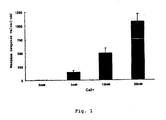
- FIG. 1 Drawing showing an action of calcium on the calcium receptor.
- the human calcium receptor cRNA was introduced into Xenopus laevis oocytes by microinjection. Recorded were values of intracellular response currents which flew when a calcium chloride solution was added at an arbitrary concentration. The maximum values of intracellular currents were considered response current values. It was confirmed that no response was observed in oocytes introduced with distilled water by microinjection as a control.
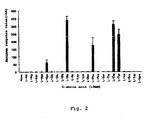
- FIG. 2 Drawing showing an action of L-amino acids on the calcium receptor.
- the human calcium receptor cRNA was introduced into Xenopus laevis oocytes by microinjection. Recorded were values of intracellular response currents which flew when a 10 mM L-amino acid solution was added. The maximum values of intracellular currents were considered response current values. It was confirmed that no response was observed in oocytes introduced with distilled water by microinjection as a control.
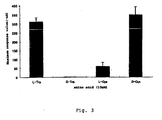
- FIG. 3 Drawing showing an action of D-amino acids on the calcium receptor.
- the human calcium receptor cRNA was introduced into Xenopus laevis oocytes by microinjection. Recorded were values of intracellular response currents which flew when a 10 mM D-amino acid solution was added. The maximum values of intracellular currents were considered response current values. It was confirmed that no response was observed in oocytes introduced with distilled water by microinjection as a control.
- FIG. 4 Drawing showing an action of peptides on the calcium receptor.
- the human calcium receptor cRNA was introduced into Xenopus laevis oocytes by microinjection. Recorded were values of intracellular response currents which flew when a peptide solution was added at an arbitrary concentration. The maximum values of intracellular currents were considered response current values. It was confirmed that no response was observed in oocytes introduced with distilled water by microinjection as a control.
- the “calcium receptor” is also called the calcium sensing receptor (CaSR), and belongs to the class C of seven-transmembrane receptors.
- the “calcium receptor activity” means binding to the aforementioned calcium receptor to activate the guanine nucleotide binding protein and thereby transmit signals.
- the “calcium receptor activator” is a substance that acts on the aforementioned calcium receptor to activate the calcium receptor and control the functions of cells expressing the calcium receptor.
- “kokumi” means a taste that cannot be expressed by the five basic tastes, sweet taste, salty taste, sour taste, bitter taste, and umami, in which, not only the basic tastes, marginal tastes of the basic tastes, such as thickness, growth (mouthfulness), continuity, and harmony are enhanced.
- the "kokumi-imparting agent” or “kokumi-imparting substance” refers to an agent or substance that can enhance the five basic tastes, sweet taste, salty taste, sour taste, bitter taste, and umami, and impart marginal tastes of the basic tastes, such as thickness, growth (mouthfulness), continuity, and harmony accompanying the basic tastes.
- the kokumi-imparting agent can also be used as a sweet taste-enhancing agent, salty taste-enhancing agent, sour taste-enhancing agent, bitter taste-enhancing agent, or umami-enhancing agent.
- intensity of kokumi "first and middle taste” means taste that is felt during the period of 0 to 4 seconds after eating, and "aftertaste” means taste that is felt after 5 seconds following eating.
- the method for screening for a kokumi-imparting substance is characterized by using the calcium receptor activity as an index.
- the screening method comprises the first step of reacting a calcium receptor and a test substance and detecting calcium receptor activity, and the second step of measuring the kokumi-imparting effect of the test substances for which calcium receptor activation activity is detected in the first step.
- the calcium receptor activity is measured by using, for example, a measurement system using cells expressing the calcium receptor.
- the cells may be cells endogenously expressing the calcium receptor, or recombinant cells introduced with a foreign calcium receptor gene.
- any system may be used without particular limitation so long as chosen is a system with which when an extracellular ligand (activator) specific to the calcium receptor is added to the cells expressing the calcium receptor, binding (reaction) of the activator and the calcium receptor can be detected, or a detectable signal is transmitted into cells in response to binding (reaction) of the activator and the calcium receptor.
- test substance used for the screening is not particularly limited, and low molecular compounds, saccharides, peptides, proteins, and so forth can be used.
- the human calcium receptor encoded by the human calcium receptor gene registered with GenBank Accession No. NM_000388 can be exemplified as a preferred example.
- the calcium receptor is not limited to the protein encoded by the gene of the aforementioned sequence, and it may be a protein encoded by a gene having a homology of 60% or more, preferably 80% or more, more preferably 90% or more, to the aforementioned sequence, so long as the protein has the calcium receptor function.
- the GPRC6A receptor and the 5.24 receptor are also known as subtypes of the calcium receptor, and they can be used.
- the calcium receptor function can be examined by expressing a gene of interest in a cell and measuring changes in the electric current, or intracellular calcium ion concentration at the time of the addition of calcium.
- the origin of the calcium receptor is not particularly limited, and examples include, besides the aforementioned human calcium receptor, calcium receptors derived from animals such as mouse, rat, and dog.
- the calcium receptor activity can be confirmed by using live cells which express a calcium receptor or a fragment thereof, cell membranes which express a calcium receptor or a fragment thereof, an in vitro system containing a protein of a calcium receptor or a fragment thereof, or the like.
- the calcium receptor can be expressed in cultured cells such as Xenopus laevis oocytes, hamster ovarian cells, and human fetal kidney cells.
- the calcium receptor can be expressed by cloning a calcium receptor gene in a plasmid that can contain a foreign gene and introducing the plasmid or cRNA obtained by using the plasmid as a template.
- electrophysiological techniques fluorescent indicator reagents that indicate elevation of intracellular calcium level, and so forth, can be used.
- Expression of the calcium receptor is first confirmed based on the response to calcium or a specific activator.
- Oocytes that showed intracellular current with calcium at a concentration of about 5 mM or cultured cells that showed fluorescence of the fluorescent indicator reagent with calcium at a concentration of about 5 mM are used.
- Calcium concentration dependency is determined by changing the calcium concentration.
- a test substance such as a peptide is prepared to a concentration of about 1 ⁇ M to 1 mM, and added to the oocytes or cultured cells, and the calcium receptor activity of the test substance such as the aforementioned peptide is measured.
- the kokumi-imparting agent comprises a kokumi-imparting substance obtainable by the screening method as an active ingredient.
- the kokumi-imparting agent contains, for example, one or more kinds of substances selected from ⁇ -Glu-X-Gly (X represents an amino acid or amino acid derivative except for Cys), ⁇ -Glu-Val-Y (Y represents an amino acid or amino acid derivative), ⁇ -Glu-Ala, ⁇ -Glu-Gly, ⁇ -Glu-Cys, ⁇ -Glu-Met, ⁇ -Glu-Thr, ⁇ -Glu-Val, ⁇ -Glu-Orn, Asp-Gly, Cys-Gly, Cys-Met, Glu-Cys, Gly-Cys, Leu-Asp, D-Cys, ⁇ -Glu-Met(O), ⁇ -Glu- ⁇ -Glu-Val, ⁇ -Glu-Val-NH 2 , ⁇ -Glu-Val-ol, ⁇ -Glu-Ser, ⁇ -
- amino acid means, but not limited to, neutral amino acids such as Gly, Ala, Val, Leu, Ile, Ser, Thr, Cys, Met, Asn, Gln, Pro and Hyp, acidic amino acids such as Asp and Glu, basic amino acids such as Lys, Arg and His, aromatic amino acids such as Phe, Tyr, Trp, and other amino acids such as Homoserine, Citrulline, Ornithine, alpha-Aminobutylic acid, Norvaline, Norleucine and Taurine.
- amino acid residues are as follows:
- amino acid derivative means various types of derivative of above-mentioned amino acids, those can be exemplified as, but not limited to, unusual amino acids, non-natural amino acids, amino alcohols, substituted amino acids of which amino acid side chain, such as carbonyl group, amino group and thiol group, is substituted with various substituents.
- substituents include alkyl group, acyl group, hydroxyl group, amino group, alkylamino group, nitro group, sulfonyl group and various protection groups.
- Such substituted amino acids include, for example, Arg (NO 2 ): N- ⁇ -nitro arginine, Cys (SNO): S-nitrocysteine, Cys (S-Me): S-methyl cysteine, Cys (S-allyl): S-allyl cysteine, Val-NH 2 : valinamide, Val-ol: valinol (2-amino-3-methyl-1-butanol).
- ⁇ -Glu-Cys(SNO)-Gly has the following structural formula, and the "(O)" in the formulas ⁇ -Glu-Met(O) and ⁇ -Glu-Cys(S-Me)(O) indicates a sulfoxide structure.
- the "( ⁇ )” in the formulas ⁇ -Glu indicates that glutamic acid bonds to another amino acid via ⁇ position of carboxy group in the glutamic acid.
- ⁇ -Glu-X-Gly (X represents an amino acid or amino acid derivative except for Cys), ⁇ -Glu-Val-Y (Y represents an amino acid or amino acid derivative), ⁇ -Glu-Ala, ⁇ -Glu-Gly, ⁇ -Glu-Cys, ⁇ -Glu-Met, ⁇ -Glu-Thr, ⁇ -Glu-Val, ⁇ -Glu-Orn, Asp-Gly, Cys-Gly, Cys-Met, Glu-Cys, Gly-Cys, Leu-Asp, D-Cys, ⁇ -Glu-Met(O), ⁇ -Glu- ⁇ -Glu-Val, ⁇ -Glu-Val-NH 2 , ⁇ -Glu-Val-ol, ⁇ -Glu-Ser; ⁇ -Glu-Tau, ⁇ -Glu-Cys(S-Me)(O), ⁇ -Glu-Leu, ⁇ -Glu-Ile, ⁇ -Glu-t-Leu, and ⁇ -Glu-Cys (S-M
- ⁇ -Glu-X-Gly (X represents an amino acid or amino acid derivative except for Cys), ⁇ -Glu-Val-Y (Y represents an amino acid or amino acid derivative), ⁇ -Glu-Ala, ⁇ -Glu-Gly, Gly, ⁇ -Glu-Cys, ⁇ -Glu-Met, ⁇ -Glu-Thr, ⁇ -Glu-Val, ⁇ -Glu-Orn, Asp-Gly, Cys-Gly, Cys-Met, Glu-Cys, Gly-Cys, Leu-Asp, D-Cys, ⁇ -Glu-Met(O), ⁇ -Glu- ⁇ -Glu-Val, ⁇ -Glu-Val-NH 2 , ⁇ -Glu-Val-ol, ⁇ -Glu-Ser, ⁇ -Glu-Tau, ⁇ -Glu-Cys(S-Me)(O), ⁇ -Glu-Leu, ⁇ -Glu-Ile, ⁇ -Glu-t-Leu and ⁇ -Glu-Cys(
- the peptides and amino acids used for the present invention may be independently used, or can be used as a mixture of arbitrary two or more kinds of them.
- compounds having a structural formula: ⁇ -Glu-X-Gly (X represents Cys(SNO), Cys(S-allyl), Gly, Cys(S-Me), Abu, or Ser), or ⁇ -Glu-Val-Y (Y represents Gly, Val, Glu, Lys, Phe, Ser, Pro, Arg, Asp, Met, Thr, His, Orn, Asn, Cys, or Gln) are preferred.
- ⁇ -Glu-X-Gly (X represents Asn, Gln, His, Lys, Orn or Arg), and ⁇ -Glu-Val-Y (Y represents Leu, Ile, Ser, Thr, Met, Cys, Asp, Asn, Gln, Lys, Orn, Arg, Phe, Tyr, Pro, Hyp, Trp, His, or Abu) are novel substances newly synthesized by the inventors of the present invention.
- ⁇ -Glu-X-Gly (X represents Asn, Gln, His, Lys, Orn or Arg) and ⁇ -Glu-Val-Y (Y represents Ser, Thr, Met, Cys, Asp, Asn, Gln, Lys, Orn, Arg, Pro or His) are preferred.
- threshold concentrations minimum concentrations allowing sensing of taste
- MSG threshold concentration of MSG
- the compounds used in the present invention show kokumi enhancing activity from an extremely low concentration of about 0.0001 to 0.1%, and thus they are extremely useful compounds which have extremely high activity.
- the peptides and amino acids used for the present invention if they are available as commercial products, those can be used. Furthermore, the peptides can be obtained by suitably using a known technique such as (1) a method of chemically synthesizing them, or (2) a method of synthesizing them by an enzymatic reaction. Since the number of residues of the contained amino acid residues of the peptides used for the present invention is as comparatively small as 2 or 3 residues, a method of chemically synthesizing them is convenient. When chemically synthesizing them, the oligopeptides can be synthesized or half-synthesized by using a peptide synthesizer.
- Examples of the method of chemically synthesizing them include, for example, a peptide solid phase synthetic method.
- Peptides synthesized as described above can be purified by usual means, for example, ion exchange chromatography, reversed phase high performance liquid chromatography, affinity chromatography, and so forth.
- Such a peptide solid phase synthetic method and the following purification of peptide are well known in this technical field.
- the peptides used for the present invention can also be prepared by an enzymatic reaction.
- the method described in International Patent Publication WO2004/011653 can be used. That is, they can also be prepared by reacting one amino acid or dipeptide of which carboxyl terminus is esterified or amidated and an amino acid having a free amino group (for example, an amino acid of which carboxyl group is protected) in the presence of a peptide producing enzyme, and purifying the produced dipeptide or tripeptide.
- Examples of the peptide producing enzyme include a culture of microorganisms having an ability to produce peptides, microbial cells separated from such culture, processed product of cells of such microorganisms, peptide producing enzymes derived from such microorganisms, and so forth.
- the peptides and amino acids used for the present invention also include those in the form of a salt.
- a salt with an acidic group such as a carboxyl group in the formula include ammonium salts, salts with alkali metals such as sodium, and potassium, salt with alkaline earth metals such as calcium, and magnesium, aluminum salts, zinc salts, salts with organic amines such as triethylamine, ethanolamine, morpholine, pyrrolidine, piperidine, piperazine, and dicyclohexylamine, and salts with basic amino acids such as arginine, and lysine.
- Examples of salts with a basic group in case that a basic group exists in the formula include salts with inorganic acids such as hydrochloric acid, sulfuric acid, phosphoric acid, nitric acid, and hydrobromic acid, salts with organic carboxylic acids such as acetic acid, citric acid, benzoic acid, maleic acid, fumaric acid, tartaric acid, succinic acid, tannic acid, butyric acid, hibenzoic acid, pamoic acid, enanthoic acid, decanoic acid, teoclic acid, salicylic acid, lactic acid, oxalic acid, mandelic acid, and malic acid, and salts with organic sulfonic acids such as methanesulfonic acid, benzenesulfonic acid, and p-toluenesulfonic acid.
- inorganic acids such as hydrochloric acid, sulfuric acid, phosphoric acid, nitric acid, and hydrobromic acid
- the method for using kokumi-imparting substances obtained by the screening method, and kokumi-imparting agents containing one or more kinds of substances selected from'the,peptides and amino acids used for the present invention as an active ingredient is not particularly limited, and they can be used by adding them to food or drink such as seasonings, foods, and drinks.
- the kokumi-imparting substances obtained by the screening method can be used by adding to food or drink such as seasonings, foods, and drinks independently or in combination with other various additives etc.
- the kokumi-imparting agent used in the present invention may consist of, for example, only one or more kinds of substances selected from the aforementioned peptides and amino acids used for the present invention; further, it may also be constituted with other existing compounds having kokumi-imparting activity (such as glutathione and alliin) or other various additives etc. arbitrarily added. Moreover, the kokumi-imparting agent used in the present invention may contain one or more kinds of existing compounds having calcium receptor activation activity, and such a composition also fall within the scope of the present invention.
- Examples of the aforementioned existing compounds having calcium receptor activation activity include cations such as calcium and gadolinium cations, basic peptides such as polyarginine and polylysine, polyamines such as putrescine, spermine and spermidine, proteins such as protamine, amino acids such as phenylalanine and glutathione, cinacalcet, and so forth. These compounds can also be in any acceptable salt form thereof. By the way, it was found by the present inventors that glutathione has calcium receptor activation activity.
- kokumi-imparting activities of those existing compounds having kokumi-imparting activity such as glutathione as well as the kokumi-imparting agent used in the present invention can also be improved when formulated in a composition with compounds having calcium receptor activation activity; That is, such a composition also fall within the scope of the present invention.
- any of those known to be able to be added and mixed with food or drink such as seasonings, foods, and drinks can be used without particular limitation.
- examples of such additives include, for example, perfumes, saccharides, sweetners, dietary fibers, vitamins, amino acids such as sodium glutamate (MSG), nucleic acids such as inosine monophosphate (IMP), inorganic salts such as sodium chloride, water, and so forth.
- the amount of the kokumi-imparting substance which is obtained in the screening method or the kokumi-imparting agent used with respect to food or drink may be an amount effective for imparting kokumi, and it is suitably adjusted depending on the purpose. However, it is for example, in the case of seasoning, food, or drink, it may be 1 mass ppb to 99.9 mass %, preferably 10 mass ppb to 99.9 mass %, more preferably 10 mass ppm to 10 mass % with respect to the seasoning, foodstuff, or drink, in terms of the total amount of the kokumi-imparting agent used in the present invention, or kokumi-imparting substance.
- the kokumi-imparting substances obtained by the screening method, or the kokumi-imparting agents used in the present invention to food or drink so that the food or drink should contain approximately 1 mass ppb to 99.9 mass %, preferably 10 mass ppb to 99.9 mass %, more preferably 10 mass ppm to 10 mass % of the substances or agents, food or drink imparted with kokumi can be produced.
- food or drink imparted with kokumi can also be prepared by adding a seasoning containing 1 mass ppb to 99.9 mass % of one or more kinds of the kokumi-imparting substances obtained by the screening method, or the kokumi-imparting agents used in the present invention to food or drink so that the food or drink should contain 0.01 to 10 mass %, preferably 0.1' to 10 mass %, of the seasoning.
- Form of the kokumi-imparting substance obtained by the screening method or the kokumi-imparting agent used in the present invention at the time of adding it to food or drink may be dry powder, paste, solution, or the like, and the physical properties thereof are not particularly limited.
- the gene of the calcium receptor was prepared as follows. On the basis of the DNA sequence registered at NCBI (calcium receptor: NM_000388), synthetic oligo DNAs (forward primer (N) and reverse primer (C)) used for PCR were designed (Table 1, SEQ ID NOS: 1 and 2). Table 1 Synthetic oligo DNAs (forward primer (N) and reverse primer (C), h: human) Code Sequence (5'-3') hCASR_N ACTAATACGACTCACTATAGGGACCATGGCATTTTATAGCTGCTGCTGG hCASR_C TTATGAATTCACTACGTTTTCTGTAACAG
- hCASR_N SEQ ID NO: 1
- hCASR_C SEQ ID NO: 2
- PCR was performed by using Pfu ultra DNA Polymerase (Stratagene) under the following conditions. After a reaction at 94°C for 3 minutes, a cycle of reactions at 94°C for 30 seconds, 55°C for 30 seconds, and 72°C for 2 minutes was repeated 35 times, and then a reaction was performed at 72°C for 7 minutes. Whether amplification was attained by PCR was detected by performing agarose electrophoresis, staining with a DNA staining reagent, and ultraviolet irradiation.
- the chain lengths of the PCR products were confirmed by comparison with DNA markers of known sizes simultaneously subjected to the electrophoresis.
- the plasmid vector pBR322 (Takara) was digested with the restriction enzyme EcoRV.
- the gene fragment amplified by PCR was ligated to the cleavage site of the plasmid by using Ligation Kit (Promega).
- the Escherichia coli DH5a strain was transformed with each ligation reaction solution, and a transformant harboring the plasmid in which the PCR amplification product was cloned was selected.
- the PCR amplification product was confirmed by DNA sequence analysis.
- cRNA preparation kit cRNA of the calcium receptor gene was prepared.
- L-amino acid samples 23 kinds of special grade amino acids, alanine, arginine, asparagine, aspartic acid, cysteine, glutamine, glutamic acid, glycine, histidine, isoleucine, leucine, lysine, methionine, phenylalanine, proline, serine, threonine, tryptophan, tyrosine, valine, ornithine, taurine (all of these from Ajinomoto), and hydroxyproline (Nakarai Tesque), were used.
- D-Cys and D-Trp (Nakarai Tesque) and calcium chloride those of special grade were used.
- Glutamine and cysteine were prepared upon use, and the other samples were stored at -20°C after preparation.
- the peptides those having a purity of 90% or higher were used.
- ⁇ -Glu-Cys one having a purity of 80% or higher was used.
- the solution dissolving each sample showed an acidic or alkaline pH, the solution was adjusted to an approximately neutral pH by using NaOH or HCl.
- the solution used for dissolution of amino acids and peptides, preparation of Xenopus laevis oocytes, and culture of the oocytes had the following composition: 96 mM NaCl, 2 mM KCl, 1 mM MgCl 2 , 1.8 mM CaCl 2 , 5 mM Hepes, pH 7.2.
- Boc-Val-OH (8.69 g, 40.0 mmol) and Gly-OBzl•HCl (8.07 g, 40.0 mmol) were dissolved in methylene chloride (100 ml), and the solution was kept at 0°C.
- Triethylamine (6.13 ml, 44.0 mmol), HOBt (1-hydroxybenzotriazole, 6.74 g, 44.0 mmol), and WSC•HCl (1-ethyl-3-(3-dimethylaminopropyl) carbodiimide hydrochloride, 8.44 g, 44.0 mmol) were added to the solution, and the mixture was stirred overnight at room temperature.
- the reaction mixture was concentrated under reduced pressure, and the residue was dissolved in ethyl acetate (200 ml).
- the solution was washed with water (50 ml), 5% citric acid aqueous solution (50 ml x twice), saturated brine (50 ml), 5% sodium hydrogencarbonate aqueous solution (50 ml x twice), and saturated brine (50 ml).
- the organic layer was dried over anhydrous magnesium sulfate, magnesium sulfate was removed by filtration, and the filtrate was concentrated under reduced pressure.
- the residue was recrystallized from ethyl acetate/n-hexane to obtain Boc-val-Gly-OBzl (13.2 g, 36.2 mmol) as white crystals.
- Boc-val-Gly-OBzl (5.47 g, 15.0 mmol) was added to 4 N HCl/dioxane solution (40 ml), and the mixture was stirred at room temperature for 50 minutes. Dioxane was removed by concentration under reduced pressure, n-hexane (30 ml) was added to the residue, and the mixture was concentrated under reduced pressure. This procedure was repeated 3 times to quantitatively obtain H-Val-Gly-OBzl•HCl.
- H-Val-Gly-OBzl•HCl and Z-Glu-OBzl (5.57 g, 15.0 mmol) were dissolved in methylene chloride (50 ml), and the solution was kept at 0°C.
- HOBt (1-hydroxybenzotriazole, 2.53 g, 16.5 mmol)
- WSC•HCl (1-ethyl-3-(3-dimethylaminopropyl) carbodiimide hydrochloride, 3.16 g, 16.5 mmol
- the reaction mixture was concentrated under reduced pressure, and the residue was dissolved in heated ethyl acetate (1500 ml).
- the solution was washed with water (200 ml), 5% citric acid aqueous solution (200 ml x twice), saturated brine (150 ml), 5% sodium hydrogencarbonate aqueous solution (200 ml x twice), and saturated brine (150 ml).
- the organic layer was dried over anhydrous magnesium sulfate, magnesium sulfate was removed by filtration, and the filtrate was concentrated under reduced pressure.
- the deposited crystals were collected by filtration, and dried under reduced pressure to obtain Z-Glu(Val-Gly-OBzl)-OBzl (6.51 g, 10.5 mmol) as white crystals.
- ⁇ -Glu-Met(O), ⁇ -Glu-Val-NH 2 , ⁇ -Glu-Val-ol, ⁇ -Glu-Ser, ⁇ -Glu-Tau, ⁇ -Glu-Cys(S-Me)(O), ⁇ -Glu-t-Leu, ⁇ -Glu-Cys(S-allyl)-Gly, and ⁇ -Glu-Cys(S-Me) were synthesized in a manner similar to those of Examples 3 and 4.
- a Ca ion concentration-dependent Cl ionic current measuring method using a Xenopus laevis oocyte expression system was used. If each activator is added to Xenopus laevis oocytes expressing the calcium receptor, intracellular Ca ions increase. Then, the Ca ion concentration-dependent Cl channel opens, and the intracellular current value changes as an ionic current. By measuring the change in this intracellular current value, whether the calcium receptor activation activity is present or not can be known.
- the abdomen of Xenopus laevis was opened, and an egg batch was taken out and treated with a 1% collagenase solution at 20°C for 2 hours to obtain individual oocytes.
- 50 nl of 1 ⁇ g/ ⁇ l receptor cRNA or 50 nl of sterilized water per one oocyte was introduced by using a micro glass capillary, and the oocytes were cultured at 18°C for 2 or 3 days.
- a solution obtained by adding 2 mM pyruvic acid, 10 U/ml of penicillin, and 10 ⁇ g/ml of streptomycin to the solution mentioned in Example 2 was used.
- a test solution was added to the oocytes introduced with cRNA or sterilized water. Electrophysiological measurement was performed by using an amplifier, Geneclamp500 (Axon), and recording software, AxoScope 9.0 (Axon). The oocytes were voltage-clamped at - 70 mV by the double electrode voltage clamp method, and the intracellular current was measured via the Ca ion concentration-dependent Cl ion channel. The maximum value of the intracellular current was considered as the response current value.
- the calcium receptor activation activity of calcium was evaluated by using the method described in Example 6. That is, oocytes introduced with cRNA of the calcium receptor or sterilized water were prepared, and voltage-clamped at -70 mV by the double electrode voltage clamp method. To the voltage-clamped oocytes, calcium was added (2 mM, 5 mM, 10 mM, 20 mM), and Ca ion concentration-dependent Cl response current was measured. The results are shown in Fig. 1 . From these results, it was confirmed that cRNA of the calcium receptor introduced into the oocytes were functionally expressed. Furthermore, since the oocytes introduced with water did not respond to even high concentration calcium, it was confirmed that the calcium receptor is not expressed in the oocytes themselves.
- Calcium receptor activation activity of L-amino acids was evaluated by using the method described in Example 6. That is, oocytes introduced with cRNA of the calcium receptor or sterilized water were prepared, and voltage-clamped at -70 mV by the double electrode voltage clamp method.
- D-cysteine Calcium receptor activation activity of D-cysteine was evaluated by using the method described in Example 6. That is, oocytes introduced with cRNA of the calcium receptor or sterilized water were prepared, and voltage-clamped at -70 mV by the double electrode voltage clamp method. To the voltage-clamped oocytes, D-cysteine (10 mM), L-cysteine (10 mM), D-tryptophan (10 mM), or L-tryptophan (10 mM) was added, and Ca ion concentration-dependent Cl response current was measured. The results are shown in Fig. 3 . By these results, it was demonstrated that D-cysteine had definite calcium receptor activation activity.
- Calcium receptor activation activity of peptides was evaluated by using the method described in Example 6. That is, oocytes introduced with cRNA of the calcium receptor or sterilized water were prepared, and voltage-clamped at -70 mV by the double electrode voltage clamp method.
- Typical examples are selected from the peptides and amino acids, those calcium receptor activation activity was confirmed: ⁇ -Glu-X-Gly (X represents Cys(SNO), Cys(S-allyl), Gly, Cys(S-Me), Abu, or Ser), ⁇ -Glu-Val-Y (Y represents Gly, Val, Glu, Lys, Phe, Ser, Pro, Arg, Asp, Met, Thr, His, Orn, Asn, Cys, or Gln), ⁇ -Glu-Ala, ⁇ -Glu-Gly, ⁇ -Glu-Cys, ⁇ -Glu-Met, ⁇ -Glu-Thr, ⁇ -Glu-Val, ⁇ -Glu-Orn, Asp-Gly, Cys-Gly, Cys-Met, Glu-Cys, Gly-Cys, Leu-Asp, D-Cys, ⁇ -Glu-Met(O), ⁇ -Glu- ⁇ -Glu-val, ⁇ -Glu-Val-NH 2 , ⁇ -
- the sensory evaluation test was performed as follows. To distilled water containing sodium glutamate (0.05 g/dl), inosine monophosphate (0.05 g/dl), and calcium chloride (1 mM), alliin (S-allyl-cysteine sulfoxide: control experiment of Kokumi-imparting activity) , ⁇ -Glu-Cys-Gly, ⁇ -Glu-Cys, ⁇ -Glu-Ala, or ⁇ -Glu-Val was mixed as a sample in an amount of 0.2 g/dl, and whether they had kokumi-imparting activity or not was determined. Sample solutions that became acidic after dissolution of the samples were adjusted to pH 6.8 to 7.2 with NaOH before use. The results are shown in Table 3.
- the quantitative sensory evaluation test was performed as follows. To distilled water containing sodium glutamate (0.05 g/dl), inosine monophosphate (0.05 g/dl), and sodium chloride (0.5 g/dl), ⁇ -Glu-Cys-Gly (glutathione), ⁇ -Glu-Ala, ⁇ -Glu-Met, or ⁇ -Glu-Val was mixed as a sample in an amount of 0.1 g/dl, and intensity of kokumi-imparting activity was measured. Sample solutions that became acidic after dissolution of the samples were adjusted to pH 6.8 to 7.2 with NaOH before use.
- the quantitative sensory evaluation test was performed as follows. To distilled water containing sodium glutamate (0.05 g/dl), inosine monophosphate (0.05 g/dl), and sodium chloride (0.5 g/dl), ⁇ -Glu-Cys-Gly (glutathione), ⁇ -Glu-Cys, ⁇ -Glu-Val, or ⁇ -Glu-Val-Gly was mixed as a sample in an amount of 0.1 g/dl, or 0.01 g/dl as required, and intensity of kokumi-imparting activity was measured. Sample solutions that became acidic after dissolution of the samples were adjusted to pH 6.8 to 7.2 with NaOH before use.
- the quantitative sensory evaluation test was performed as follows. To distilled water containing sodium glutamate (0.05 g/dl), inosine monophosphate (0.05 g/dl), and sodium chloride (0.5 g/dl), ⁇ -Glu-Cys-Gly (glutathione), ⁇ -Glu-Abu-Gly, or ⁇ -Glu-Val-Gly was mixed as a sample in an amount of 0.1 g/dl or 0.01 g/dl, and intensity of kokumi-imparting activity was measured. Sample solutions that became acidic after dissolution of the samples were adjusted to pH 6.8 to 7.2 with NaOH before use.
- the quantitative sensory evaluation test was performed as follows. To distilled water containing sodium glutamate (0.2 g/dl) as a umami standard solution, sucrose (5 g/dl) as a sweet taste standard solution, sodium chloride (0.7 g/dl) as a salty taste standard solution, or citric acid (0.05 g/dl) as a sour taste standard solution, ⁇ -Glu-Cys-Gly (glutathione) or ⁇ -Glu-Val-Gly was mixed as a sample at a concentration of 0.0001 to 1 g/dl, and intensity of activity on basic tastes was measured for each sample.
- Consomme soup was prepared by dissolving consomme soup powder (35% of sodium chloride, 18% of sodium glutamate, 0.2% of inosine monophosphate, 0.3% of white pepper powder, 0.5% of black pepper powder, 8.0% of beef extract powder, 3.0% of white wine powder, 2.0% of celery powder, 8.0% of Chinese cabbage extract powder, 2.5% of onion extract powder, 25.5% of lactose) at a concentration of 5 g/dl.
- ⁇ -Glu-Cys-Gly glutathione
- ⁇ -Glu-Val-Gly was mixed as a sample at a concentration of 0.0001 to 1 g/dl, and intensity of kokumi-imparting activity was measured for each sample.
- the quantitative sensory evaluation test was performed as follows.
- Japanese clear soup was prepared by adding 0.5 g/dl of soy sauce and 0.6 g/dl of sodium chloride to bonito kelp stock (solution obtained by adding 5 g of dried kelp to 3 L of water, heating the water, adding 25 g of dried bonito flakes just before boiling, and then filtering the water containing kelp and bonito flakes).
- ⁇ -Glu-Cys-Gly glutathione
- ⁇ -Glu-Val-Gly was mixed as a sample at a concentration of 0.0001 to 1 g/dl, and intensity of kokumi-imparting activity was measured for each sample.
- the quantitative sensory evaluation test was performed as follows. To commercially available corn soup, ⁇ -Glu-Cys-Gly (glutathione) or ⁇ -Glu-Val-Gly was mixed as a sample at a concentration of 0.0001 to 1 g/dl, and intensity of kokumi-imparting activity was measured for each sample.
- the quantitative sensory evaluation test was performed as follows. To curry sauce prepared in a conventional manner by using commercially available curry roux, ⁇ -Glu-Cys-Gly (glutathione) or ⁇ -Glu-Val-Gly was mixed as a sample at a concentration of 0.0001 to 1 g/dl, and intensity of kokumi-imparting activity was measured for each sample.
- the curry sauces with the samples that became acidic after dissolution of the samples with respect to the curry soup without the samples were adjusted with NaOH to pH not lower or higher by 0.2 than pH of the curry soup without the samples before use.
- the quantitative sensory evaluation test was performed as follows. To distilled water containing sodium glutamate (0.05 g/dl), inosine monophosphate (0.05 g/dl), and sodium chloride (0.5 g/dl), 0.0001 to 1 g/dl of ⁇ -Glu-Cys-Gly (glutathione) or ⁇ -Glu-Val-Gly, or either of these peptides and another calcium receptor activator (calcium lactate, protamine or polylysine) or GABA (addition concentration: 0.0001 to 1 g/dl) were mixed, and intensity of kokumi-imparting activity was measured. Sample solutions that became acidic after dissolution of the samples were adjusted to pH 6.8 to 7.2 with NaOH before use.
- the samples showed kokumi-imparting activity at concentrations within the aforementioned broad concentration range. The results for typical concentrations are shown in Table 12.
- existing compound having kokumi-imparting activity glutathione
- glutathione also show improved kokumi-imparting activity as well as kokumi-imparting agent used in the present invention when used with existing calcium receptor activator or the like, such as calcium.
- the specific amino acids and peptides having calcium receptor activation activity are also useful as kokumi-imparting substances.
- these kinds of dipeptides and tripeptides were newly discovered as kokumi-imparting substances, and since they are peptides, they can be used in the field of foodstuffs in which high safety is demanded.
- high throughput screening can be used, and thus development of a still more highly efficient kokumi substance has become possible.
Landscapes
- Life Sciences & Earth Sciences (AREA)
- Health & Medical Sciences (AREA)
- Chemical & Material Sciences (AREA)
- Engineering & Computer Science (AREA)
- Molecular Biology (AREA)
- Proteomics, Peptides & Aminoacids (AREA)
- Food Science & Technology (AREA)
- Immunology (AREA)
- Urology & Nephrology (AREA)
- Organic Chemistry (AREA)
- Cell Biology (AREA)
- General Health & Medical Sciences (AREA)
- Biomedical Technology (AREA)
- Medicinal Chemistry (AREA)
- Hematology (AREA)
- Biochemistry (AREA)
- Polymers & Plastics (AREA)
- Nutrition Science (AREA)
- Biotechnology (AREA)
- Biophysics (AREA)
- Physics & Mathematics (AREA)
- Analytical Chemistry (AREA)
- General Physics & Mathematics (AREA)
- Pathology (AREA)
- Genetics & Genomics (AREA)
- Microbiology (AREA)
- Mycology (AREA)
- Peptides Or Proteins (AREA)
- Seasonings (AREA)
- Seeds, Soups, And Other Foods (AREA)
- Measuring Or Testing Involving Enzymes Or Micro-Organisms (AREA)
- Coloring Foods And Improving Nutritive Qualities (AREA)
- Medicines That Contain Protein Lipid Enzymes And Other Medicines (AREA)
Priority Applications (3)
| Application Number | Priority Date | Filing Date | Title |
|---|---|---|---|
| EP10012901.4A EP2299271B9 (en) | 2005-11-09 | 2006-11-08 | Kokumi-imparting compositions |
| EP10012900.6A EP2327986B1 (en) | 2005-11-09 | 2006-11-08 | Kokumi-imparting agent |
| PL09007706T PL2175273T3 (pl) | 2005-11-09 | 2006-11-08 | Środek nadający kokumi |
Applications Claiming Priority (5)
| Application Number | Priority Date | Filing Date | Title |
|---|---|---|---|
| JP2005325300 | 2005-11-09 | ||
| US73856205P | 2005-11-22 | 2005-11-22 | |
| JP2006188458 | 2006-07-07 | ||
| US80783106P | 2006-07-20 | 2006-07-20 | |
| EP06823396A EP1946110B1 (en) | 2005-11-09 | 2006-11-08 | Screening method for kokumi-imparting agents |
Related Parent Applications (2)
| Application Number | Title | Priority Date | Filing Date |
|---|---|---|---|
| WOPCT/JP2006/322694 Previously-Filed-Application | 2006-11-08 | ||
| EP06823396.4 Division | 2006-11-08 |
Related Child Applications (4)
| Application Number | Title | Priority Date | Filing Date |
|---|---|---|---|
| EP10012901.4A Division EP2299271B9 (en) | 2005-11-09 | 2006-11-08 | Kokumi-imparting compositions |
| EP10012901.4A Previously-Filed-Application EP2299271B9 (en) | 2005-11-09 | 2006-11-08 | Kokumi-imparting compositions |
| EP10012900.6 Division-Into | 2010-10-01 | ||
| EP10012901.4 Division-Into | 2010-10-01 |
Publications (2)
| Publication Number | Publication Date |
|---|---|
| EP2175273A1 EP2175273A1 (en) | 2010-04-14 |
| EP2175273B1 true EP2175273B1 (en) | 2013-09-04 |
Family
ID=37781723
Family Applications (4)
| Application Number | Title | Priority Date | Filing Date |
|---|---|---|---|
| EP09007706.6A Active EP2175273B1 (en) | 2005-11-09 | 2006-11-08 | Kokumi-imparting agent |
| EP10012900.6A Active EP2327986B1 (en) | 2005-11-09 | 2006-11-08 | Kokumi-imparting agent |
| EP06823396A Active EP1946110B1 (en) | 2005-11-09 | 2006-11-08 | Screening method for kokumi-imparting agents |
| EP10012901.4A Active EP2299271B9 (en) | 2005-11-09 | 2006-11-08 | Kokumi-imparting compositions |
Family Applications After (3)
| Application Number | Title | Priority Date | Filing Date |
|---|---|---|---|
| EP10012900.6A Active EP2327986B1 (en) | 2005-11-09 | 2006-11-08 | Kokumi-imparting agent |
| EP06823396A Active EP1946110B1 (en) | 2005-11-09 | 2006-11-08 | Screening method for kokumi-imparting agents |
| EP10012901.4A Active EP2299271B9 (en) | 2005-11-09 | 2006-11-08 | Kokumi-imparting compositions |
Country Status (6)
| Country | Link |
|---|---|
| US (2) | US8173605B2 (pl) |
| EP (4) | EP2175273B1 (pl) |
| JP (3) | JP4553052B2 (pl) |
| DE (1) | DE602006017421D1 (pl) |
| PL (1) | PL2175273T3 (pl) |
| WO (1) | WO2007055393A1 (pl) |
Families Citing this family (74)
| Publication number | Priority date | Publication date | Assignee | Title |
|---|---|---|---|---|
| US8420144B2 (en) | 2005-11-09 | 2013-04-16 | Ajinomoto Co., Inc. | Kokumi-imparting agent, method of using, and compositions containing same |
| JP4553052B2 (ja) | 2005-11-09 | 2010-09-29 | 味の素株式会社 | コク味付与剤 |
| EP2233137B1 (en) * | 2005-11-09 | 2014-04-30 | Ajinomoto Co., Inc. | Calcium receptor activator |
| JP5110683B2 (ja) * | 2007-02-02 | 2012-12-26 | 株式会社ファンケル | 睡眠誘導剤、ストレス性不眠症改善剤 |
| EP2156846B1 (en) * | 2007-05-08 | 2014-08-13 | Ajinomoto Co., Inc. | Prophylactic or therapeutic agent for diarrhea |
| EP2156752A4 (en) * | 2007-05-08 | 2013-05-22 | Ajinomoto Kk | SWEETENER |
| KR101491995B1 (ko) * | 2007-05-08 | 2015-02-10 | 아지노모토 가부시키가이샤 | 저지방 식품 |
| JPWO2009107660A1 (ja) | 2008-02-25 | 2011-07-07 | 味の素株式会社 | 糖尿病又は肥満病の予防又は治療剤 |
| WO2009107579A1 (ja) * | 2008-02-25 | 2009-09-03 | 味の素株式会社 | コク味付与剤 |
| CN102014669A (zh) | 2008-03-14 | 2011-04-13 | 日本水产株式会社 | 咸味增强剂及含有该咸味增强剂的饮食品 |
| WO2009119554A1 (ja) * | 2008-03-24 | 2009-10-01 | 味の素株式会社 | 消化管の重炭酸分泌促進剤 |
| NZ600306A (en) | 2008-03-24 | 2012-10-26 | Nippon Suisan Kaisha Ltd | Salty taste enhancing agent that contains an ezymatic decomposition product of an animal and an enzymatic product of an plant protein and food or drink containing the same |
| WO2009128523A1 (ja) * | 2008-04-17 | 2009-10-22 | 味の素株式会社 | 免疫賦活剤 |
| CN102187221B (zh) | 2008-08-22 | 2015-08-12 | 电化生研株式会社 | 半胱氨酸蛋白酶抑制剂c吸附抑制剂 |
| EP2345636B1 (en) * | 2008-10-03 | 2016-03-30 | Ajinomoto Co., Inc. | Casr agonist |
| EP2400852A2 (en) | 2009-02-27 | 2012-01-04 | CSM Nederland B.V. | Flour-based bakery product with inhomogeneous nacl bulk distribution and method for making such food product |
| WO2010114022A1 (ja) * | 2009-04-01 | 2010-10-07 | 味の素株式会社 | ペプチドのコク味付与用途 |
| JP5616598B2 (ja) * | 2009-08-20 | 2014-10-29 | 花王株式会社 | 液体調味料 |
| JP2012224547A (ja) * | 2009-08-24 | 2012-11-15 | Ajinomoto Co Inc | 糖尿病又は肥満病の予防又は治療剤 |
| US8524302B2 (en) * | 2009-11-02 | 2013-09-03 | Pepsico | Natural flavour enhancers and methods for making same |
| EP2524925B1 (en) | 2009-12-28 | 2016-08-17 | Ajinomoto Co., Inc. | Lanthionine derivative |
| TWI415575B (zh) * | 2009-12-28 | 2013-11-21 | Ajinomoto Kk | Can give strong flavor agent |
| WO2011081186A1 (ja) * | 2009-12-28 | 2011-07-07 | 味の素株式会社 | コク味付与剤 |
| EP2543660A4 (en) | 2010-03-04 | 2014-04-30 | Ajinomoto Kk | PROPHYLACTIC OR THERAPEUTIC ACTIVE AGAINST DIABETES OR ADIPOSITAS |
| CA2791174C (en) | 2010-03-04 | 2015-11-17 | Ajinomoto Co., Inc. | Alkylamine derivative |
| WO2011118843A1 (ja) | 2010-03-24 | 2011-09-29 | 味の素株式会社 | グルタミン酸エステル誘導体又はその塩 |
| JP5650034B2 (ja) * | 2010-03-31 | 2015-01-07 | サントリーホールディングス株式会社 | コク味付与物質のスクリーニング方法、コク味付与物質及びその利用 |
| WO2011126099A1 (ja) | 2010-04-02 | 2011-10-13 | 味の素株式会社 | 糖尿病又は肥満症の予防又は治療剤 |
| WO2011129462A2 (en) | 2010-04-12 | 2011-10-20 | Ajinomoto Co., Inc. | A YEAST EXTRACT CONTAINING γ-Glu-X OR γ-Glu-X-Gly AND A METHOD FOR PRODUCING THE SAME |
| RU2496864C2 (ru) * | 2010-07-05 | 2013-10-27 | Закрытое акционерное общество "Научно-исследовательский институт "Аджиномото-Генетика" (ЗАО АГРИ) | ДРОЖЖЕВОЙ ЭКСТРАКТ, СОДЕРЖАЩИЙ ГАММА-Glu-X ИЛИ ГАММА-Glu-X-Gly, И СПОСОБ ЕГО ПОЛУЧЕНИЯ |
| JP5978579B2 (ja) * | 2010-09-22 | 2016-08-24 | 味の素株式会社 | γ‐Glu‐X‐Yの製造方法 |
| JP5954178B2 (ja) | 2010-10-05 | 2016-07-20 | 味の素株式会社 | γ−Glu−Abuを含有する酵母及び酵母エキス、並びにそれらの製造方法 |
| JPWO2012108408A1 (ja) * | 2011-02-08 | 2014-07-03 | 味の素株式会社 | ジペプチド及びトリペプチドの製造方法 |
| WO2012113855A1 (en) * | 2011-02-24 | 2012-08-30 | Firmenich Sa | Flavor compounds |
| BR112013032690A2 (pt) * | 2011-06-28 | 2017-01-24 | Ajinomoto Kk | método para produzir um composto, composto, e, uso do mesmo |
| JP6146304B2 (ja) | 2011-10-07 | 2017-06-14 | 味の素株式会社 | 変異型γ−グルタミルトランスフェラーゼ、及び、γ−グルタミルバリルグリシン又はその塩の製造法 |
| WO2013054447A1 (ja) * | 2011-10-14 | 2013-04-18 | 味の素株式会社 | γ‐Glu‐X‐Glyまたはその塩の製造方法、および変異型グルタチオン合成酵素 |
| WO2013061972A1 (ja) * | 2011-10-28 | 2013-05-02 | 味の素株式会社 | 食品組成物 |
| WO2013118742A1 (ja) | 2012-02-06 | 2013-08-15 | 味の素株式会社 | 飲食品にコク味を付与するための組成物 |
| JP2015097474A (ja) * | 2012-03-09 | 2015-05-28 | 味の素株式会社 | 調味料 |
| WO2013164983A1 (ja) * | 2012-05-01 | 2013-11-07 | キリン協和フーズ株式会社 | こく味増強剤 |
| WO2014017485A1 (ja) * | 2012-07-25 | 2014-01-30 | 味の素株式会社 | 果汁含有飲食品 |
| JP6187779B2 (ja) | 2012-08-10 | 2017-08-30 | 味の素株式会社 | γ−グルタミルバリルグリシン結晶の製造方法 |
| EP2948002B1 (en) | 2013-01-22 | 2018-10-17 | Mars, Incorporated | Flavor composition and edible compositions containing same |
| WO2014119535A1 (ja) * | 2013-02-04 | 2014-08-07 | 味の素株式会社 | コク味付与剤 |
| JP6361509B2 (ja) * | 2013-02-07 | 2018-07-25 | 味の素株式会社 | 香辛料風味が増強された飲食品の製造方法 |
| JP6582997B2 (ja) | 2014-01-31 | 2019-10-02 | 味の素株式会社 | 変異型グルタミン酸−システインリガーゼ、及び、γ−グルタミルバリルグリシンの製造法 |
| EP3115463B1 (en) | 2014-03-05 | 2019-09-18 | Ajinomoto Co., Inc. | Method for producing gamma-glutamyl-valyl-glycine |
| JPWO2015137317A1 (ja) * | 2014-03-11 | 2017-04-06 | 味の素株式会社 | コク味付与剤 |
| US10393740B2 (en) | 2014-10-10 | 2019-08-27 | Mars, Incorporated | Methods for identifying modulators of calcium-sensing receptors |
| JP6801196B2 (ja) * | 2015-03-12 | 2020-12-16 | 味の素株式会社 | コク味付与機能を有する組成物 |
| EP3345996B1 (en) | 2015-09-04 | 2022-06-29 | Ajinomoto Co., Inc. | Method for producing gamma-glutamyl-valyl-glycine |
| WO2017141986A1 (ja) * | 2016-02-16 | 2017-08-24 | 味の素株式会社 | コク味付与機能を有する組成物 |
| JP6772511B2 (ja) * | 2016-03-31 | 2020-10-21 | 味の素株式会社 | コク味付与機能を有する組成物 |
| CN109996453A (zh) * | 2016-04-14 | 2019-07-09 | 马斯公司 | 用于调节厚味味道的调节钙敏感受体活性的化合物和含有该化合物的宠物食品 |
| JPWO2018079848A1 (ja) * | 2016-10-31 | 2019-09-19 | 不二製油グループ本社株式会社 | 風味増強剤 |
| JP7031120B2 (ja) * | 2017-01-12 | 2022-03-08 | 味の素株式会社 | コク味を付与するための組成物 |
| EP3398442A1 (en) * | 2017-05-05 | 2018-11-07 | Takasago International Corporation | Use of acetylenic fatty acid compounds as kokumi flavor |
| WO2019013122A1 (ja) | 2017-07-13 | 2019-01-17 | 不二製油グループ本社株式会社 | ペプチド |
| CN107325156B (zh) * | 2017-08-04 | 2020-09-08 | 北京工商大学 | 具有呈味特性多肽及多肽脂质化修饰产物 |
| JP7124338B2 (ja) | 2018-02-27 | 2022-08-24 | 味の素株式会社 | 変異型グルタチオン合成酵素、及び、γ-グルタミルバリルグリシンの製造法 |
| JP7210935B2 (ja) * | 2018-08-28 | 2023-01-24 | 味の素株式会社 | マスキング剤 |
| KR102023188B1 (ko) * | 2018-11-29 | 2019-09-19 | 한국식품연구원 | 디펩타이드-연결 글리칸을 포함하는 코쿠미 증강제 |
| JP2020097531A (ja) * | 2018-12-17 | 2020-06-25 | 協同乳業株式会社 | Glp−1分泌促進剤 |
| CN113316395A (zh) * | 2019-01-16 | 2021-08-27 | 不二制油集团控股株式会社 | 食用油脂组合物及其制造方法 |
| JP2020129993A (ja) * | 2019-02-14 | 2020-08-31 | 株式会社アセラ | 風味改良剤 |
| EP3934446A4 (en) * | 2019-03-05 | 2023-05-03 | Mars Incorporated | PEPTIDES MODULATING CALCIUM SENSING RECEPTOR ACTIVITY TO MODULATE TASTE KOKUMI AND PET FOOD PRODUCTS CONTAINING THEM |
| WO2022244696A1 (ja) | 2021-05-17 | 2022-11-24 | 味の素株式会社 | 異味抑制用組成物 |
| EP4342309A4 (en) | 2021-05-17 | 2025-05-14 | Ajinomoto Co., Inc. | COMPOSITION THAT REMOVES BAD ODORS |
| CA3225755A1 (en) * | 2021-07-01 | 2023-01-05 | Cj Cheiljedang Corporation | Peptide compounds for flavor modulating |
| KR20230090044A (ko) * | 2021-12-14 | 2023-06-21 | 샘표식품 주식회사 | 깊은맛의 식물성 발효물을 위한 감마-글루타밀 펩타이드 증진 제조방법 |
| WO2025041767A1 (ja) * | 2023-08-21 | 2025-02-27 | 味の素株式会社 | 甘味組成物及び味質改善剤 |
| WO2025056442A1 (en) | 2023-09-12 | 2025-03-20 | Société des Produits Nestlé S.A. | Method of making fermented plant-based products having kokumi characteristics and products thereof |
| WO2025192490A1 (ja) * | 2024-03-11 | 2025-09-18 | 味の素株式会社 | 風味増強剤 |
Citations (4)
| Publication number | Priority date | Publication date | Assignee | Title |
|---|---|---|---|---|
| WO1992007267A1 (en) * | 1990-10-16 | 1992-04-30 | Northwestern University | A synthetic peptide and its uses |
| JPH07188282A (ja) * | 1991-04-19 | 1995-07-25 | Suetsuna Yoko | 新規なトリペプチド、その製法およびそれを有効成分と する血圧降下剤 |
| WO2001051629A2 (en) * | 2000-01-13 | 2001-07-19 | Panorama Research, Inc. | Circularly permutated, interaction-activated proteins |
| EP1619201A1 (en) * | 2003-04-25 | 2006-01-25 | Ajinomoto Co., Inc. | Novel glycopeptide or peptide capable of imparting rich taste and method of imparting rich taste to food therewith |
Family Cites Families (62)
| Publication number | Priority date | Publication date | Assignee | Title |
|---|---|---|---|---|
| US3331828A (en) | 1964-09-30 | 1967-07-18 | Merck & Co Inc | Isolation of gamma-l-glutamyl dipeptides from glutamic acid fermentation broths by ion exchange |
| US3924015A (en) * | 1972-04-13 | 1975-12-02 | Firmenich & Cie | Flavoring agent |
| US4277464A (en) * | 1975-09-19 | 1981-07-07 | General Foods Corporation | Preventing tooth demineralization using aspartame |
| US4520112A (en) * | 1983-03-09 | 1985-05-28 | The Johns Hopkins University | Assay method for organic calcium antagonist drugs and a kit for such an assay |
| JPS609465A (ja) * | 1983-06-29 | 1985-01-18 | Ajinomoto Co Inc | こく味調味料又はこく味の増強された食品の製造法 |
| JPS60232071A (ja) * | 1984-05-02 | 1985-11-18 | Ajinomoto Co Inc | こく味調味料又はこく味の増強された食品の製造方法 |
| JPS60237963A (ja) * | 1984-05-02 | 1985-11-26 | Ajinomoto Co Inc | こく味調味料またはこく味の増強された食品の製造法 |
| US4741914A (en) * | 1984-11-13 | 1988-05-03 | Ajinomoto Co., Inc. | Flavor enhancing seasoning containing deodorized garlic extract and process |
| US5409904A (en) | 1984-11-13 | 1995-04-25 | Alcon Laboratories, Inc. | Hyaluronic acid compositions and methods |
| EP0276317B1 (en) | 1986-07-07 | 1993-03-17 | Teijin Limited | Gamma-l-glutamyl-l-cysteine ethyl ester and drug containing it as effective ingredient |
| US4758551A (en) | 1986-07-08 | 1988-07-19 | Cornell Research Foundation, Inc. | Methods for combatting renal toxicity due to metals or nephrotoxic drugs and for selectively modulating in vivo formation of leukotriene types |
| FR2611721B1 (fr) | 1987-02-26 | 1990-01-26 | Roussel Uclaf | Nouveaux derives de l'acide glutamique, leurs sels, procede de preparation, application a titre de medicaments et compositions les renfermant |
| NL9000613A (nl) | 1990-03-16 | 1991-10-16 | Friesland Condensfab | Met calcium verrijkte gefermenteerde melkdrank. |
| JP2903659B2 (ja) * | 1990-07-06 | 1999-06-07 | 味の素株式会社 | 調味料の製造法 |
| US20060229470A1 (en) * | 1991-08-23 | 2006-10-12 | Nps Pharmaceuticals, Inc. | Calcium receptor-active molecules |
| US5962314A (en) * | 1993-02-23 | 1999-10-05 | Nps Pharmaceuticals, Inc. | Calcium receptor-active molecules |
| WO1994022438A1 (en) * | 1993-03-26 | 1994-10-13 | Constantin Romulus Dinu | Pharmaceutical composition for the treatment of certain viruses and autoimmune diseases and the procedure of its preparation |
| DE69517836T2 (de) * | 1994-03-18 | 2001-03-01 | Ajinomoto Co., Inc. | Proteinhaltiges Mittel zur Verbesserung der Geschmacksqualität von Lebensmitteln |
| JP2906113B2 (ja) * | 1994-09-07 | 1999-06-14 | 酒井 美恵子 | 調味料の風味向上方法 |
| JPH08289760A (ja) | 1995-04-21 | 1996-11-05 | Ajinomoto Co Inc | こく味付与剤 |
| JP2627262B2 (ja) * | 1995-06-09 | 1997-07-02 | 日本臓器製薬株式会社 | 新規トリペプチド化合物 |
| JP3509458B2 (ja) | 1997-04-04 | 2004-03-22 | 味の素株式会社 | 新規なコク味調味料 |
| JPH11137212A (ja) * | 1997-11-14 | 1999-05-25 | Sogo Pharmaceut Co Ltd | 美容組成物 |
| ATE319326T1 (de) | 1998-11-26 | 2006-03-15 | Ajinomoto Kk | Verfahren zur herstellung einer geschmacksverstaerkenden verbindung fuer lebensmittel |
| DE60035260T2 (de) | 1999-02-22 | 2007-10-18 | The University Of Connecticut, Farmington | Neue albuminfreie faktor viii formulierungen |
| JP3427775B2 (ja) * | 1999-04-15 | 2003-07-22 | 日本製紙株式会社 | コク味付与剤 |
| US6573299B1 (en) | 1999-09-20 | 2003-06-03 | Advanced Medical Instruments | Method and compositions for treatment of the aging eye |
| JP4633876B2 (ja) * | 1999-11-11 | 2011-02-16 | カルピス株式会社 | トリペプチドの製造方法 |
| FR2803594B1 (fr) * | 2000-01-11 | 2002-07-19 | Centre Nat Rech Scient | Oligomeres de mimes contraints non peptidiques de dipeptides ou de tripeptides, et leurs utilisations |
| JP4453057B2 (ja) * | 2000-05-17 | 2010-04-21 | 味の素株式会社 | システイニルグリシン高含有食品素材および食品の風味増強剤の製造法 |
| CA2418350C (en) | 2000-08-08 | 2010-01-19 | Kao Corporation | Oil/fat composition |
| JP4031218B2 (ja) | 2000-08-08 | 2008-01-09 | 花王株式会社 | 油脂組成物 |
| JP3951584B2 (ja) | 2000-10-10 | 2007-08-01 | 味の素株式会社 | 改質された原料乳の製造方法及びそれを用いた乳製品 |
| US6733797B1 (en) | 2000-11-15 | 2004-05-11 | William K. Summers | Neuroceutical for improving memory and cognitive abilities |
| US20020176900A1 (en) | 2000-11-22 | 2002-11-28 | Inna Yegorova | Compositions and methods for promoting a healthy cardiovascular system and enhancing blood flow |
| WO2002049653A1 (en) | 2000-12-21 | 2002-06-27 | Metabolic Engineering Laboratories Co., Ltd. | Compositions for preservation of organs and blood |
| US20030077564A1 (en) | 2001-10-02 | 2003-04-24 | Board Of Trustees Of Southern Illinois University | Nutrient medium for maintaining neural cells in injured nervous system |
| AU2002359618A1 (en) | 2001-12-06 | 2003-06-23 | Weller Health, Inc. | Medicinal compositions and therapeutic methods |
| US7063865B2 (en) | 2002-05-10 | 2006-06-20 | Jeremy Park Jones | Composition and method for substantially reducing the deleterious effects of alcohol on the body |
| JP2004089181A (ja) * | 2002-07-08 | 2004-03-25 | Ajinomoto Co Inc | 食品素材の改質方法 |
| ATE458056T1 (de) * | 2002-07-26 | 2010-03-15 | Ajinomoto Kk | Verfahren zur herstellung eines tripeptids oder höheren peptids |
| JP2004075568A (ja) * | 2002-08-12 | 2004-03-11 | Univ Nihon | 新規な味覚物質受容体 |
| JP3941056B2 (ja) | 2003-01-14 | 2007-07-04 | 三栄源エフ・エフ・アイ株式会社 | 乳製品用の品質改良剤 |
| JP2004267160A (ja) | 2003-03-11 | 2004-09-30 | Sanei Gen Ffi Inc | 乳製品及びその製造法並びに応用 |
| JP4148058B2 (ja) | 2003-07-31 | 2008-09-10 | 味の素株式会社 | 燻煙香を増強した食品 |
| US20070104709A1 (en) * | 2003-08-06 | 2007-05-10 | Xiaodong Li | T1r hetero-oligomeric taste receptors, cell lines that express said receptors, and taste compounds |
| US8158372B2 (en) * | 2004-04-20 | 2012-04-17 | Deutsches Institut Für Ernährungsforschung Potsdam-Rehbrücke | Agonists of a bitter taste receptor and uses thereof |
| US20050244512A1 (en) | 2004-05-01 | 2005-11-03 | Holekamp Nancy M | Ophthalmic fluid and method of delivering same |
| JP2006158232A (ja) | 2004-12-03 | 2006-06-22 | Taiyo Kagaku Co Ltd | 低脂肪又は無脂肪乳製品の呈味改良用組成物 |
| JP2006180792A (ja) | 2004-12-28 | 2006-07-13 | Ina Food Ind Co Ltd | 呈味改良剤、並びに加工乳、乳飲料、清涼飲料、及び豆乳飲料 |
| US9399030B2 (en) | 2005-02-01 | 2016-07-26 | Ajinomoto Co., Inc. | Topically applied circulation enhancing agent and skin and hair cosmetic and bath agent containing the same |
| JP2007117082A (ja) | 2005-09-27 | 2007-05-17 | Ajinomoto Co Inc | L−アミノ酸生産菌及びl−アミノ酸の製造法 |
| GB0520912D0 (en) | 2005-10-14 | 2005-11-23 | Hofmann Thomas F | Kokumi flavour compounds and use |
| US8420144B2 (en) * | 2005-11-09 | 2013-04-16 | Ajinomoto Co., Inc. | Kokumi-imparting agent, method of using, and compositions containing same |
| EP2233137B1 (en) | 2005-11-09 | 2014-04-30 | Ajinomoto Co., Inc. | Calcium receptor activator |
| JP4553052B2 (ja) | 2005-11-09 | 2010-09-29 | 味の素株式会社 | コク味付与剤 |
| US8007849B2 (en) * | 2005-12-14 | 2011-08-30 | International Flavors & Fragrances Inc. | Unsaturated cyclic and acyclic carbamates exhibiting taste and flavor enhancement effect in flavor compositions |
| JP2008054507A (ja) | 2006-08-29 | 2008-03-13 | Ogawa & Co Ltd | 香味増強剤 |
| KR101491995B1 (ko) | 2007-05-08 | 2015-02-10 | 아지노모토 가부시키가이샤 | 저지방 식품 |
| EP2156752A4 (en) | 2007-05-08 | 2013-05-22 | Ajinomoto Kk | SWEETENER |
| EP2156846B1 (en) | 2007-05-08 | 2014-08-13 | Ajinomoto Co., Inc. | Prophylactic or therapeutic agent for diarrhea |
| WO2010114022A1 (ja) * | 2009-04-01 | 2010-10-07 | 味の素株式会社 | ペプチドのコク味付与用途 |
-
2006
- 2006-11-08 JP JP2008523060A patent/JP4553052B2/ja active Active
- 2006-11-08 PL PL09007706T patent/PL2175273T3/pl unknown
- 2006-11-08 EP EP09007706.6A patent/EP2175273B1/en active Active
- 2006-11-08 EP EP10012900.6A patent/EP2327986B1/en active Active
- 2006-11-08 EP EP06823396A patent/EP1946110B1/en active Active
- 2006-11-08 DE DE602006017421T patent/DE602006017421D1/de active Active
- 2006-11-08 EP EP10012901.4A patent/EP2299271B9/en active Active
- 2006-11-08 WO PCT/JP2006/322694 patent/WO2007055393A1/en not_active Ceased
-
2008
- 2008-05-08 US US12/117,027 patent/US8173605B2/en active Active
-
2010
- 2010-02-19 JP JP2010034162A patent/JP4798293B2/ja active Active
- 2010-12-07 US US12/962,051 patent/US9395376B2/en active Active
-
2011
- 2011-03-24 JP JP2011066637A patent/JP5168378B2/ja active Active
Patent Citations (4)
| Publication number | Priority date | Publication date | Assignee | Title |
|---|---|---|---|---|
| WO1992007267A1 (en) * | 1990-10-16 | 1992-04-30 | Northwestern University | A synthetic peptide and its uses |
| JPH07188282A (ja) * | 1991-04-19 | 1995-07-25 | Suetsuna Yoko | 新規なトリペプチド、その製法およびそれを有効成分と する血圧降下剤 |
| WO2001051629A2 (en) * | 2000-01-13 | 2001-07-19 | Panorama Research, Inc. | Circularly permutated, interaction-activated proteins |
| EP1619201A1 (en) * | 2003-04-25 | 2006-01-25 | Ajinomoto Co., Inc. | Novel glycopeptide or peptide capable of imparting rich taste and method of imparting rich taste to food therewith |
Non-Patent Citations (1)
| Title |
|---|
| UEDA Y ET AL: "Flavor characteristics of glutathione in raw and cooked foodstuffs", BIOSCIENCE BIOTECHNOLOGY BIOCHEMISTRY, JAPAN SOCIETY FOR BIOSCIENCE, BIOTECHNOLOGY, AND AGROCHEMISTRY, TOKYO, JAPAN, vol. 61, no. 12, 1 January 1997 (1997-01-01), pages 1977 - 1980, XP008123781, ISSN: 0916-8451, DOI: 10.1271/BBB.61.1977 * |
Also Published As
| Publication number | Publication date |
|---|---|
| JP4798293B2 (ja) | 2011-10-19 |
| US8173605B2 (en) | 2012-05-08 |
| JP2009514791A (ja) | 2009-04-09 |
| US20110097805A1 (en) | 2011-04-28 |
| PL2175273T3 (pl) | 2014-02-28 |
| US9395376B2 (en) | 2016-07-19 |
| EP1946110A1 (en) | 2008-07-23 |
| JP5168378B2 (ja) | 2013-03-21 |
| EP2327986B1 (en) | 2013-05-29 |
| EP2175273A1 (en) | 2010-04-14 |
| WO2007055393A1 (en) | 2007-05-18 |
| EP2299271B1 (en) | 2013-07-10 |
| US20090239310A1 (en) | 2009-09-24 |
| EP2327986A1 (en) | 2011-06-01 |
| JP2010154862A (ja) | 2010-07-15 |
| EP1946110B1 (en) | 2010-10-06 |
| DE602006017421D1 (de) | 2010-11-18 |
| EP2299271A3 (en) | 2011-07-13 |
| EP2299271A2 (en) | 2011-03-23 |
| EP2299271B9 (en) | 2014-02-26 |
| JP4553052B2 (ja) | 2010-09-29 |
| JP2011115186A (ja) | 2011-06-16 |
Similar Documents
| Publication | Publication Date | Title |
|---|---|---|
| EP2175273B1 (en) | Kokumi-imparting agent | |
| US8420144B2 (en) | Kokumi-imparting agent, method of using, and compositions containing same | |
| CA2686805C (en) | A sweetener comprising a calcium receptor | |
| CA2686795C (en) | Low-fat food comprising a calcium receptor | |
| CN101305281B (zh) | 赋予kokumi的作用剂 | |
| TWI407916B (zh) | 濃郁味道(kokumi)賦予劑 |
Legal Events
| Date | Code | Title | Description |
|---|---|---|---|
| PUAI | Public reference made under article 153(3) epc to a published international application that has entered the european phase |
Free format text: ORIGINAL CODE: 0009012 |
|
| AC | Divisional application: reference to earlier application |
Ref document number: 1946110 Country of ref document: EP Kind code of ref document: P |
|
| AK | Designated contracting states |
Kind code of ref document: A1 Designated state(s): AT BE BG CH CY CZ DE DK EE ES FI FR GB GR HU IE IS IT LI LT LU LV MC NL PL PT RO SE SI SK TR |
|
| 17P | Request for examination filed |
Effective date: 20101013 |
|
| 17Q | First examination report despatched |
Effective date: 20110328 |
|
| REG | Reference to a national code |
Ref country code: DE Ref legal event code: R079 Ref document number: 602006038303 Country of ref document: DE Free format text: PREVIOUS MAIN CLASS: G01N0033566000 Ipc: A23L0001221000 |
|
| RIC1 | Information provided on ipc code assigned before grant |
Ipc: G01N 33/68 20060101ALI20121227BHEP Ipc: C07K 5/02 20060101ALI20121227BHEP Ipc: A23L 1/221 20060101AFI20121227BHEP Ipc: A23L 1/305 20060101ALI20121227BHEP |
|
| GRAP | Despatch of communication of intention to grant a patent |
Free format text: ORIGINAL CODE: EPIDOSNIGR1 |
|
| GRAS | Grant fee paid |
Free format text: ORIGINAL CODE: EPIDOSNIGR3 |
|
| GRAP | Despatch of communication of intention to grant a patent |
Free format text: ORIGINAL CODE: EPIDOSNIGR1 |
|
| GRAA | (expected) grant |
Free format text: ORIGINAL CODE: 0009210 |
|
| INTG | Intention to grant announced |
Effective date: 20130717 |
|
| AC | Divisional application: reference to earlier application |
Ref document number: 1946110 Country of ref document: EP Kind code of ref document: P |
|
| AK | Designated contracting states |
Kind code of ref document: B1 Designated state(s): AT BE BG CH CY CZ DE DK EE ES FI FR GB GR HU IE IS IT LI LT LU LV MC NL PL PT RO SE SI SK TR |
|
| REG | Reference to a national code |
Ref country code: GB Ref legal event code: FG4D |
|
| REG | Reference to a national code |
Ref country code: CH Ref legal event code: NV Representative=s name: BOHEST AG, CH Ref country code: CH Ref legal event code: EP |
|
| REG | Reference to a national code |
Ref country code: AT Ref legal event code: REF Ref document number: 629974 Country of ref document: AT Kind code of ref document: T Effective date: 20130915 |
|
| REG | Reference to a national code |
Ref country code: IE Ref legal event code: FG4D |
|
| REG | Reference to a national code |
Ref country code: DE Ref legal event code: R096 Ref document number: 602006038303 Country of ref document: DE Effective date: 20131031 |
|
| REG | Reference to a national code |
Ref country code: NL Ref legal event code: T3 |
|
| REG | Reference to a national code |
Ref country code: AT Ref legal event code: MK05 Ref document number: 629974 Country of ref document: AT Kind code of ref document: T Effective date: 20130904 |
|
| PG25 | Lapsed in a contracting state [announced via postgrant information from national office to epo] |
Ref country code: SE Free format text: LAPSE BECAUSE OF FAILURE TO SUBMIT A TRANSLATION OF THE DESCRIPTION OR TO PAY THE FEE WITHIN THE PRESCRIBED TIME-LIMIT Effective date: 20130904 Ref country code: LT Free format text: LAPSE BECAUSE OF FAILURE TO SUBMIT A TRANSLATION OF THE DESCRIPTION OR TO PAY THE FEE WITHIN THE PRESCRIBED TIME-LIMIT Effective date: 20130904 Ref country code: AT Free format text: LAPSE BECAUSE OF FAILURE TO SUBMIT A TRANSLATION OF THE DESCRIPTION OR TO PAY THE FEE WITHIN THE PRESCRIBED TIME-LIMIT Effective date: 20130904 Ref country code: CY Free format text: LAPSE BECAUSE OF FAILURE TO SUBMIT A TRANSLATION OF THE DESCRIPTION OR TO PAY THE FEE WITHIN THE PRESCRIBED TIME-LIMIT Effective date: 20130821 |
|
| REG | Reference to a national code |
Ref country code: LT Ref legal event code: MG4D |
|
| PG25 | Lapsed in a contracting state [announced via postgrant information from national office to epo] |
Ref country code: LV Free format text: LAPSE BECAUSE OF FAILURE TO SUBMIT A TRANSLATION OF THE DESCRIPTION OR TO PAY THE FEE WITHIN THE PRESCRIBED TIME-LIMIT Effective date: 20130904 Ref country code: GR Free format text: LAPSE BECAUSE OF FAILURE TO SUBMIT A TRANSLATION OF THE DESCRIPTION OR TO PAY THE FEE WITHIN THE PRESCRIBED TIME-LIMIT Effective date: 20131205 Ref country code: FI Free format text: LAPSE BECAUSE OF FAILURE TO SUBMIT A TRANSLATION OF THE DESCRIPTION OR TO PAY THE FEE WITHIN THE PRESCRIBED TIME-LIMIT Effective date: 20130904 Ref country code: SI Free format text: LAPSE BECAUSE OF FAILURE TO SUBMIT A TRANSLATION OF THE DESCRIPTION OR TO PAY THE FEE WITHIN THE PRESCRIBED TIME-LIMIT Effective date: 20130904 |
|
| REG | Reference to a national code |
Ref country code: PL Ref legal event code: T3 |
|
| PG25 | Lapsed in a contracting state [announced via postgrant information from national office to epo] |
Ref country code: CY Free format text: LAPSE BECAUSE OF FAILURE TO SUBMIT A TRANSLATION OF THE DESCRIPTION OR TO PAY THE FEE WITHIN THE PRESCRIBED TIME-LIMIT Effective date: 20130904 Ref country code: BE Free format text: LAPSE BECAUSE OF FAILURE TO SUBMIT A TRANSLATION OF THE DESCRIPTION OR TO PAY THE FEE WITHIN THE PRESCRIBED TIME-LIMIT Effective date: 20130904 |
|
| PG25 | Lapsed in a contracting state [announced via postgrant information from national office to epo] |
Ref country code: IS Free format text: LAPSE BECAUSE OF FAILURE TO SUBMIT A TRANSLATION OF THE DESCRIPTION OR TO PAY THE FEE WITHIN THE PRESCRIBED TIME-LIMIT Effective date: 20140104 Ref country code: CZ Free format text: LAPSE BECAUSE OF FAILURE TO SUBMIT A TRANSLATION OF THE DESCRIPTION OR TO PAY THE FEE WITHIN THE PRESCRIBED TIME-LIMIT Effective date: 20130904 Ref country code: RO Free format text: LAPSE BECAUSE OF FAILURE TO SUBMIT A TRANSLATION OF THE DESCRIPTION OR TO PAY THE FEE WITHIN THE PRESCRIBED TIME-LIMIT Effective date: 20130904 Ref country code: EE Free format text: LAPSE BECAUSE OF FAILURE TO SUBMIT A TRANSLATION OF THE DESCRIPTION OR TO PAY THE FEE WITHIN THE PRESCRIBED TIME-LIMIT Effective date: 20130904 Ref country code: SK Free format text: LAPSE BECAUSE OF FAILURE TO SUBMIT A TRANSLATION OF THE DESCRIPTION OR TO PAY THE FEE WITHIN THE PRESCRIBED TIME-LIMIT Effective date: 20130904 |
|
| PG25 | Lapsed in a contracting state [announced via postgrant information from national office to epo] |
Ref country code: ES Free format text: LAPSE BECAUSE OF FAILURE TO SUBMIT A TRANSLATION OF THE DESCRIPTION OR TO PAY THE FEE WITHIN THE PRESCRIBED TIME-LIMIT Effective date: 20130904 |
|
| REG | Reference to a national code |
Ref country code: DE Ref legal event code: R097 Ref document number: 602006038303 Country of ref document: DE |
|
| PG25 | Lapsed in a contracting state [announced via postgrant information from national office to epo] |
Ref country code: PT Free format text: LAPSE BECAUSE OF FAILURE TO SUBMIT A TRANSLATION OF THE DESCRIPTION OR TO PAY THE FEE WITHIN THE PRESCRIBED TIME-LIMIT Effective date: 20140106 |
|
| PLBE | No opposition filed within time limit |
Free format text: ORIGINAL CODE: 0009261 |
|
| STAA | Information on the status of an ep patent application or granted ep patent |
Free format text: STATUS: NO OPPOSITION FILED WITHIN TIME LIMIT |
|
| PG25 | Lapsed in a contracting state [announced via postgrant information from national office to epo] |
Ref country code: MC Free format text: LAPSE BECAUSE OF FAILURE TO SUBMIT A TRANSLATION OF THE DESCRIPTION OR TO PAY THE FEE WITHIN THE PRESCRIBED TIME-LIMIT Effective date: 20130904 |
|
| REG | Reference to a national code |
Ref country code: CH Ref legal event code: PCAR Free format text: NEW ADDRESS: HOLBEINSTRASSE 36-38, 4051 BASEL (CH) |
|
| 26N | No opposition filed |
Effective date: 20140605 |
|
| REG | Reference to a national code |
Ref country code: IE Ref legal event code: MM4A |
|
| REG | Reference to a national code |
Ref country code: DE Ref legal event code: R097 Ref document number: 602006038303 Country of ref document: DE Effective date: 20140605 |
|
| PG25 | Lapsed in a contracting state [announced via postgrant information from national office to epo] |
Ref country code: DK Free format text: LAPSE BECAUSE OF FAILURE TO SUBMIT A TRANSLATION OF THE DESCRIPTION OR TO PAY THE FEE WITHIN THE PRESCRIBED TIME-LIMIT Effective date: 20130904 |
|
| PG25 | Lapsed in a contracting state [announced via postgrant information from national office to epo] |
Ref country code: IE Free format text: LAPSE BECAUSE OF NON-PAYMENT OF DUE FEES Effective date: 20131108 |
|
| PG25 | Lapsed in a contracting state [announced via postgrant information from national office to epo] |
Ref country code: BG Free format text: LAPSE BECAUSE OF FAILURE TO SUBMIT A TRANSLATION OF THE DESCRIPTION OR TO PAY THE FEE WITHIN THE PRESCRIBED TIME-LIMIT Effective date: 20130904 Ref country code: HU Free format text: LAPSE BECAUSE OF FAILURE TO SUBMIT A TRANSLATION OF THE DESCRIPTION OR TO PAY THE FEE WITHIN THE PRESCRIBED TIME-LIMIT; INVALID AB INITIO Effective date: 20061108 Ref country code: LU Free format text: LAPSE BECAUSE OF NON-PAYMENT OF DUE FEES Effective date: 20131108 |
|
| REG | Reference to a national code |
Ref country code: FR Ref legal event code: PLFP Year of fee payment: 10 |
|
| REG | Reference to a national code |
Ref country code: FR Ref legal event code: PLFP Year of fee payment: 11 |
|
| REG | Reference to a national code |
Ref country code: FR Ref legal event code: PLFP Year of fee payment: 12 |
|
| REG | Reference to a national code |
Ref country code: FR Ref legal event code: PLFP Year of fee payment: 13 |
|
| P01 | Opt-out of the competence of the unified patent court (upc) registered |
Effective date: 20230512 |
|
| PGFP | Annual fee paid to national office [announced via postgrant information from national office to epo] |
Ref country code: DE Payment date: 20241001 Year of fee payment: 19 |
|
| PGFP | Annual fee paid to national office [announced via postgrant information from national office to epo] |
Ref country code: PL Payment date: 20241014 Year of fee payment: 19 |
|
| PGFP | Annual fee paid to national office [announced via postgrant information from national office to epo] |
Ref country code: GB Payment date: 20241001 Year of fee payment: 19 |
|
| PGFP | Annual fee paid to national office [announced via postgrant information from national office to epo] |
Ref country code: IT Payment date: 20241010 Year of fee payment: 19 |
|
| PGFP | Annual fee paid to national office [announced via postgrant information from national office to epo] |
Ref country code: CH Payment date: 20241201 Year of fee payment: 19 |
|
| PGFP | Annual fee paid to national office [announced via postgrant information from national office to epo] |
Ref country code: TR Payment date: 20241024 Year of fee payment: 19 |
|
| PGFP | Annual fee paid to national office [announced via postgrant information from national office to epo] |
Ref country code: FR Payment date: 20250930 Year of fee payment: 20 |
|
| PGFP | Annual fee paid to national office [announced via postgrant information from national office to epo] |
Ref country code: NL Payment date: 20251003 Year of fee payment: 20 |
|
| REG | Reference to a national code |
Ref country code: CH Ref legal event code: U11 Free format text: ST27 STATUS EVENT CODE: U-0-0-U10-U11 (AS PROVIDED BY THE NATIONAL OFFICE) Effective date: 20251201 |