EP2073060B1 - Neuartige Verbindung und Verfahren zu ihrer Herstellung, Säurenerzeuger, Resistzusammensetzung und Verfahren zur Bildung eines Resistmusters - Google Patents
Neuartige Verbindung und Verfahren zu ihrer Herstellung, Säurenerzeuger, Resistzusammensetzung und Verfahren zur Bildung eines Resistmusters Download PDFInfo
- Publication number
- EP2073060B1 EP2073060B1 EP08172244.9A EP08172244A EP2073060B1 EP 2073060 B1 EP2073060 B1 EP 2073060B1 EP 08172244 A EP08172244 A EP 08172244A EP 2073060 B1 EP2073060 B1 EP 2073060B1
- Authority
- EP
- European Patent Office
- Prior art keywords
- group
- compound
- general formula
- acid
- shown below
- Prior art date
- Legal status (The legal status is an assumption and is not a legal conclusion. Google has not performed a legal analysis and makes no representation as to the accuracy of the status listed.)
- Active
Links
- 0 CCCCCCCC[C@](*)*(CC)CC(C1)C2C3C(C4)(CCCC5)C45*3C(C)C1C2 Chemical compound CCCCCCCC[C@](*)*(CC)CC(C1)C2C3C(C4)(CCCC5)C45*3C(C)C1C2 0.000 description 17
- YUMKSTVKFFLQAM-UHFFFAOYSA-N CC(C1)CC2CC1CC(C)C2 Chemical compound CC(C1)CC2CC1CC(C)C2 YUMKSTVKFFLQAM-UHFFFAOYSA-N 0.000 description 1
- BZGPSWMUFDYPJF-UHFFFAOYSA-N CCN(CC)[O](C)[NH+](C)[O-] Chemical compound CCN(CC)[O](C)[NH+](C)[O-] BZGPSWMUFDYPJF-UHFFFAOYSA-N 0.000 description 1
- YXFVVABEGXRONW-UHFFFAOYSA-N Cc1ccccc1 Chemical compound Cc1ccccc1 YXFVVABEGXRONW-UHFFFAOYSA-N 0.000 description 1
Classifications
-
- C—CHEMISTRY; METALLURGY
- C07—ORGANIC CHEMISTRY
- C07C—ACYCLIC OR CARBOCYCLIC COMPOUNDS
- C07C381/00—Compounds containing carbon and sulfur and having functional groups not covered by groups C07C301/00 - C07C337/00
- C07C381/12—Sulfonium compounds
-
- C—CHEMISTRY; METALLURGY
- C07—ORGANIC CHEMISTRY
- C07C—ACYCLIC OR CARBOCYCLIC COMPOUNDS
- C07C303/00—Preparation of esters or amides of sulfuric acids; Preparation of sulfonic acids or of their esters, halides, anhydrides or amides
- C07C303/32—Preparation of esters or amides of sulfuric acids; Preparation of sulfonic acids or of their esters, halides, anhydrides or amides of salts of sulfonic acids
-
- C—CHEMISTRY; METALLURGY
- C07—ORGANIC CHEMISTRY
- C07C—ACYCLIC OR CARBOCYCLIC COMPOUNDS
- C07C309/00—Sulfonic acids; Halides, esters, or anhydrides thereof
- C07C309/01—Sulfonic acids
- C07C309/02—Sulfonic acids having sulfo groups bound to acyclic carbon atoms
- C07C309/03—Sulfonic acids having sulfo groups bound to acyclic carbon atoms of an acyclic saturated carbon skeleton
- C07C309/06—Sulfonic acids having sulfo groups bound to acyclic carbon atoms of an acyclic saturated carbon skeleton containing halogen atoms, or nitro or nitroso groups bound to the carbon skeleton
-
- C—CHEMISTRY; METALLURGY
- C07—ORGANIC CHEMISTRY
- C07C—ACYCLIC OR CARBOCYCLIC COMPOUNDS
- C07C309/00—Sulfonic acids; Halides, esters, or anhydrides thereof
- C07C309/01—Sulfonic acids
- C07C309/02—Sulfonic acids having sulfo groups bound to acyclic carbon atoms
- C07C309/03—Sulfonic acids having sulfo groups bound to acyclic carbon atoms of an acyclic saturated carbon skeleton
- C07C309/07—Sulfonic acids having sulfo groups bound to acyclic carbon atoms of an acyclic saturated carbon skeleton containing oxygen atoms bound to the carbon skeleton
- C07C309/12—Sulfonic acids having sulfo groups bound to acyclic carbon atoms of an acyclic saturated carbon skeleton containing oxygen atoms bound to the carbon skeleton containing esterified hydroxy groups bound to the carbon skeleton
-
- C—CHEMISTRY; METALLURGY
- C07—ORGANIC CHEMISTRY
- C07C—ACYCLIC OR CARBOCYCLIC COMPOUNDS
- C07C309/00—Sulfonic acids; Halides, esters, or anhydrides thereof
- C07C309/01—Sulfonic acids
- C07C309/02—Sulfonic acids having sulfo groups bound to acyclic carbon atoms
- C07C309/03—Sulfonic acids having sulfo groups bound to acyclic carbon atoms of an acyclic saturated carbon skeleton
- C07C309/17—Sulfonic acids having sulfo groups bound to acyclic carbon atoms of an acyclic saturated carbon skeleton containing carboxyl groups bound to the carbon skeleton
-
- C—CHEMISTRY; METALLURGY
- C07—ORGANIC CHEMISTRY
- C07C—ACYCLIC OR CARBOCYCLIC COMPOUNDS
- C07C309/00—Sulfonic acids; Halides, esters, or anhydrides thereof
- C07C309/01—Sulfonic acids
- C07C309/02—Sulfonic acids having sulfo groups bound to acyclic carbon atoms
- C07C309/19—Sulfonic acids having sulfo groups bound to acyclic carbon atoms of a saturated carbon skeleton containing rings
-
- C—CHEMISTRY; METALLURGY
- C07—ORGANIC CHEMISTRY
- C07D—HETEROCYCLIC COMPOUNDS
- C07D333/00—Heterocyclic compounds containing five-membered rings having one sulfur atom as the only ring hetero atom
- C07D333/02—Heterocyclic compounds containing five-membered rings having one sulfur atom as the only ring hetero atom not condensed with other rings
- C07D333/46—Heterocyclic compounds containing five-membered rings having one sulfur atom as the only ring hetero atom not condensed with other rings substituted on the ring sulfur atom
-
- C—CHEMISTRY; METALLURGY
- C07—ORGANIC CHEMISTRY
- C07D—HETEROCYCLIC COMPOUNDS
- C07D493/00—Heterocyclic compounds containing oxygen atoms as the only ring hetero atoms in the condensed system
- C07D493/12—Heterocyclic compounds containing oxygen atoms as the only ring hetero atoms in the condensed system in which the condensed system contains three hetero rings
- C07D493/18—Bridged systems
-
- G—PHYSICS
- G03—PHOTOGRAPHY; CINEMATOGRAPHY; ANALOGOUS TECHNIQUES USING WAVES OTHER THAN OPTICAL WAVES; ELECTROGRAPHY; HOLOGRAPHY
- G03F—PHOTOMECHANICAL PRODUCTION OF TEXTURED OR PATTERNED SURFACES, e.g. FOR PRINTING, FOR PROCESSING OF SEMICONDUCTOR DEVICES; MATERIALS THEREFOR; ORIGINALS THEREFOR; APPARATUS SPECIALLY ADAPTED THEREFOR
- G03F7/00—Photomechanical, e.g. photolithographic, production of textured or patterned surfaces, e.g. printing surfaces; Materials therefor, e.g. comprising photoresists; Apparatus specially adapted therefor
- G03F7/004—Photosensitive materials
- G03F7/0045—Photosensitive materials with organic non-macromolecular light-sensitive compounds not otherwise provided for, e.g. dissolution inhibitors
-
- G—PHYSICS
- G03—PHOTOGRAPHY; CINEMATOGRAPHY; ANALOGOUS TECHNIQUES USING WAVES OTHER THAN OPTICAL WAVES; ELECTROGRAPHY; HOLOGRAPHY
- G03F—PHOTOMECHANICAL PRODUCTION OF TEXTURED OR PATTERNED SURFACES, e.g. FOR PRINTING, FOR PROCESSING OF SEMICONDUCTOR DEVICES; MATERIALS THEREFOR; ORIGINALS THEREFOR; APPARATUS SPECIALLY ADAPTED THEREFOR
- G03F7/00—Photomechanical, e.g. photolithographic, production of textured or patterned surfaces, e.g. printing surfaces; Materials therefor, e.g. comprising photoresists; Apparatus specially adapted therefor
- G03F7/004—Photosensitive materials
- G03F7/038—Macromolecular compounds which are rendered insoluble or differentially wettable
- G03F7/0382—Macromolecular compounds which are rendered insoluble or differentially wettable the macromolecular compound being present in a chemically amplified negative photoresist composition
-
- G—PHYSICS
- G03—PHOTOGRAPHY; CINEMATOGRAPHY; ANALOGOUS TECHNIQUES USING WAVES OTHER THAN OPTICAL WAVES; ELECTROGRAPHY; HOLOGRAPHY
- G03F—PHOTOMECHANICAL PRODUCTION OF TEXTURED OR PATTERNED SURFACES, e.g. FOR PRINTING, FOR PROCESSING OF SEMICONDUCTOR DEVICES; MATERIALS THEREFOR; ORIGINALS THEREFOR; APPARATUS SPECIALLY ADAPTED THEREFOR
- G03F7/00—Photomechanical, e.g. photolithographic, production of textured or patterned surfaces, e.g. printing surfaces; Materials therefor, e.g. comprising photoresists; Apparatus specially adapted therefor
- G03F7/004—Photosensitive materials
- G03F7/039—Macromolecular compounds which are photodegradable, e.g. positive electron resists
- G03F7/0392—Macromolecular compounds which are photodegradable, e.g. positive electron resists the macromolecular compound being present in a chemically amplified positive photoresist composition
- G03F7/0397—Macromolecular compounds which are photodegradable, e.g. positive electron resists the macromolecular compound being present in a chemically amplified positive photoresist composition the macromolecular compound having an alicyclic moiety in a side chain
-
- C—CHEMISTRY; METALLURGY
- C07—ORGANIC CHEMISTRY
- C07C—ACYCLIC OR CARBOCYCLIC COMPOUNDS
- C07C2603/00—Systems containing at least three condensed rings
- C07C2603/56—Ring systems containing bridged rings
- C07C2603/58—Ring systems containing bridged rings containing three rings
- C07C2603/70—Ring systems containing bridged rings containing three rings containing only six-membered rings
- C07C2603/74—Adamantanes
-
- C—CHEMISTRY; METALLURGY
- C08—ORGANIC MACROMOLECULAR COMPOUNDS; THEIR PREPARATION OR CHEMICAL WORKING-UP; COMPOSITIONS BASED THEREON
- C08K—Use of inorganic or non-macromolecular organic substances as compounding ingredients
- C08K5/00—Use of organic ingredients
- C08K5/16—Nitrogen-containing compounds
- C08K5/17—Amines; Quaternary ammonium compounds
- C08K5/19—Quaternary ammonium compounds
-
- C—CHEMISTRY; METALLURGY
- C08—ORGANIC MACROMOLECULAR COMPOUNDS; THEIR PREPARATION OR CHEMICAL WORKING-UP; COMPOSITIONS BASED THEREON
- C08K—Use of inorganic or non-macromolecular organic substances as compounding ingredients
- C08K5/00—Use of organic ingredients
- C08K5/36—Sulfur-, selenium-, or tellurium-containing compounds
- C08K5/41—Compounds containing sulfur bound to oxygen
- C08K5/42—Sulfonic acids; Derivatives thereof
-
- G—PHYSICS
- G03—PHOTOGRAPHY; CINEMATOGRAPHY; ANALOGOUS TECHNIQUES USING WAVES OTHER THAN OPTICAL WAVES; ELECTROGRAPHY; HOLOGRAPHY
- G03F—PHOTOMECHANICAL PRODUCTION OF TEXTURED OR PATTERNED SURFACES, e.g. FOR PRINTING, FOR PROCESSING OF SEMICONDUCTOR DEVICES; MATERIALS THEREFOR; ORIGINALS THEREFOR; APPARATUS SPECIALLY ADAPTED THEREFOR
- G03F7/00—Photomechanical, e.g. photolithographic, production of textured or patterned surfaces, e.g. printing surfaces; Materials therefor, e.g. comprising photoresists; Apparatus specially adapted therefor
- G03F7/004—Photosensitive materials
- G03F7/0046—Photosensitive materials with perfluoro compounds, e.g. for dry lithography
-
- Y—GENERAL TAGGING OF NEW TECHNOLOGICAL DEVELOPMENTS; GENERAL TAGGING OF CROSS-SECTIONAL TECHNOLOGIES SPANNING OVER SEVERAL SECTIONS OF THE IPC; TECHNICAL SUBJECTS COVERED BY FORMER USPC CROSS-REFERENCE ART COLLECTIONS [XRACs] AND DIGESTS
- Y10—TECHNICAL SUBJECTS COVERED BY FORMER USPC
- Y10S—TECHNICAL SUBJECTS COVERED BY FORMER USPC CROSS-REFERENCE ART COLLECTIONS [XRACs] AND DIGESTS
- Y10S430/00—Radiation imagery chemistry: process, composition, or product thereof
- Y10S430/1053—Imaging affecting physical property or radiation sensitive material, or producing nonplanar or printing surface - process, composition, or product: radiation sensitive composition or product or process of making binder containing
- Y10S430/1055—Radiation sensitive composition or product or process of making
- Y10S430/106—Binder containing
- Y10S430/111—Polymer of unsaturated acid or ester
-
- Y—GENERAL TAGGING OF NEW TECHNOLOGICAL DEVELOPMENTS; GENERAL TAGGING OF CROSS-SECTIONAL TECHNOLOGIES SPANNING OVER SEVERAL SECTIONS OF THE IPC; TECHNICAL SUBJECTS COVERED BY FORMER USPC CROSS-REFERENCE ART COLLECTIONS [XRACs] AND DIGESTS
- Y10—TECHNICAL SUBJECTS COVERED BY FORMER USPC
- Y10S—TECHNICAL SUBJECTS COVERED BY FORMER USPC CROSS-REFERENCE ART COLLECTIONS [XRACs] AND DIGESTS
- Y10S430/00—Radiation imagery chemistry: process, composition, or product thereof
- Y10S430/1053—Imaging affecting physical property or radiation sensitive material, or producing nonplanar or printing surface - process, composition, or product: radiation sensitive composition or product or process of making binder containing
- Y10S430/1055—Radiation sensitive composition or product or process of making
- Y10S430/114—Initiator containing
- Y10S430/12—Nitrogen compound containing
-
- Y—GENERAL TAGGING OF NEW TECHNOLOGICAL DEVELOPMENTS; GENERAL TAGGING OF CROSS-SECTIONAL TECHNOLOGIES SPANNING OVER SEVERAL SECTIONS OF THE IPC; TECHNICAL SUBJECTS COVERED BY FORMER USPC CROSS-REFERENCE ART COLLECTIONS [XRACs] AND DIGESTS
- Y10—TECHNICAL SUBJECTS COVERED BY FORMER USPC
- Y10S—TECHNICAL SUBJECTS COVERED BY FORMER USPC CROSS-REFERENCE ART COLLECTIONS [XRACs] AND DIGESTS
- Y10S430/00—Radiation imagery chemistry: process, composition, or product thereof
- Y10S430/1053—Imaging affecting physical property or radiation sensitive material, or producing nonplanar or printing surface - process, composition, or product: radiation sensitive composition or product or process of making binder containing
- Y10S430/1055—Radiation sensitive composition or product or process of making
- Y10S430/114—Initiator containing
- Y10S430/122—Sulfur compound containing
-
- Y—GENERAL TAGGING OF NEW TECHNOLOGICAL DEVELOPMENTS; GENERAL TAGGING OF CROSS-SECTIONAL TECHNOLOGIES SPANNING OVER SEVERAL SECTIONS OF THE IPC; TECHNICAL SUBJECTS COVERED BY FORMER USPC CROSS-REFERENCE ART COLLECTIONS [XRACs] AND DIGESTS
- Y10—TECHNICAL SUBJECTS COVERED BY FORMER USPC
- Y10S—TECHNICAL SUBJECTS COVERED BY FORMER USPC CROSS-REFERENCE ART COLLECTIONS [XRACs] AND DIGESTS
- Y10S430/00—Radiation imagery chemistry: process, composition, or product thereof
- Y10S430/1053—Imaging affecting physical property or radiation sensitive material, or producing nonplanar or printing surface - process, composition, or product: radiation sensitive composition or product or process of making binder containing
- Y10S430/1055—Radiation sensitive composition or product or process of making
- Y10S430/114—Initiator containing
- Y10S430/122—Sulfur compound containing
- Y10S430/123—Sulfur in heterocyclic ring
Definitions
- the present invention relates to a novel compound useful as an acid generator for a resist composition, and the method of producing the same; an acid generator; a resist composition and a method of forming a resist pattern; and a novel compound useful as an intermediate of the compound useful as an acid generator for a resist composition, and the method of producing the same.
- a resist film composed of a resist material is formed on a substrate, and the resist film is subjected to selective exposure of radial rays such as light or electron beam, followed by development, thereby forming a resist pattern having a predetermined shape on the resist film.
- a resist material in which the exposed portions become soluble in a developing solution is called a positive-type
- a resist material in which the exposed portions become insoluble in a developing solution is called a negative-type.
- miniaturization techniques involve shortening the wavelength of the exposure light source.
- ultraviolet radiation typified by g-line and i-line radiation
- KrF excimer lasers and ArF excimer lasers are now starting to be introduced in mass production.
- lithography techniques that use exposure light source having a wavelength shorter than these excimer lasers, such as F 2 excimer lasers, electron beam, extreme ultraviolet radiation (EUV), and X ray.
- resist materials for use with these types of exposure light sources required improvement in lithography properties such as a high resolution capable of reproducing patterns of minute dimensions, and a high level of sensitivity to these types of exposure light sources.
- a chemically amplified resist is used, which includes a base component that exhibits a changed solubility in an alkali developing solution under action of acid and an acid generator that generates acid upon exposure.
- resins have been mainly used as the base component for these chemically amplified resists.
- PHS polyhydroxystyrene
- PHS-based resins polyhydroxystyrene (PHS) or derivative resins thereof in which the hydroxyl groups are protected with acid dissociable, dissolution inhibiting groups (PHS-based resins), a copolymer derived from (meth)acrylate ester and a resin in which a part of the carboxy groups within such a copolymer are protected with acid dissociable, dissolution inhibiting groups, and the like have been used.
- (meth)acrylate ester is a generic term that includes either or both of the acrylate ester having a hydrogen atom bonded to the ⁇ -position and the methacrylate ester having a methyl group bonded to the ⁇ -position.
- (meth)acrylate is a generic term that includes either or both of the acrylate having a hydrogen atom bonded to the ⁇ -position and the methacrylate having a methyl group bonded to the ⁇ -position.
- (meth)acrylic acid is a generic term that includes either or both of acrylic acid having a hydrogen atom bonded to the ⁇ -position and methacrylic acid having a methyl group bonded to the ⁇ -position.
- Patent Document 1 Japanese Unexamined Patent Application, First Publication No. 2003-241385
- US 2007/122750 and US 2007/027336 disclose salts suitable for an acid generator and chemically amplified resist compositions containing the same.
- US 2007/264596 discloses a thermal acid generator, a resist undercoat material and a patterning process.
- EP 1780 199 discloses fluorohydroxyalkyl sulfonate salts and derivatives, photoacid generators, resist compositions, and patterning processes.
- GB 2 447 789 discloses chemically amplified resist compositions.
- WO 2008/099869 discloses a compound useful as a photoacid generator, a resist composition using the same, and a pattern-forming method.
- GB 2 446 687 and GB 2 446 273 disclose chemically amplified resist compositions.
- EP 1 873 143 discloses a salt suitable as an acid generator and a chemically amplified resist composition containing the same.
- JP 2007 197 432 discloses a salt that can be used as an acid generator for giving a chemically amplifiable resist composition showing high resolution.
- US 2007/0100096 discloses a salt suitable for an acid generator and a chemically amplified resist composition containing the same.
- US 2007/0149702 discloses a resin suitable for an acid generator and a chemically amplified positive resist composition containing the same.
- JP 2006 306 856 discloses a salt for use as an acid generating agent to give a chemical amplification type resist composition that can make up a pattern having a good pattern form and shows a high resolution.
- US 2005/0208420 discloses ionic photoacid generator (PAGs) compounds having relatively environmentally friendly anions with no perfluorooctyl sulfonate (no-PFOS) and photoresist compositions that comprise such compounds.
- PAGs ionic photoacid generator
- JP 2007 145 822 discloses a salt functioning as an acid-generating agent affording a chemically amplified resist composition exhibiting high resolution.
- WO 2006/121096 discloses a radiation-sensitive resin composition which is highly transparent to radiation while being excellent in basic physical properties of a resist such as sensitivity, resolution and pattern shape.
- an onium salt-based acid generator exhibits low affinity for an alkali developing solution. Further, such an onium salt-based acid generator is hard to be uniformly diffused within the resist film. As a result, lithography properties such as resolution and the like are likely to be harmfully affected.
- the perfluoroalkyl chain within the anion moiety is preferably long, as diffusion of acid after exposure can be suppressed.
- a perfluoroalkyl chain of 6 to 10 carbon atoms is hardly decomposable, and hence, for minimizing bioaccumulation to improve safety in handling, a perfluoroalkylsulfonic acid ion of no more than 4 carbon atoms such as a nonafluorobutanesulfonic acid ion or the like has been used.
- the present invention takes the above circumstances into consideration, with an object of providing a novel compound useful as an acid generator for a resist composition, and the method of producing the same; an acid generator; a resist composition and a method of forming a resist pattern; and a novel compound useful as an intermediate of the compound useful as an acid generator for a resist composition, and the method of producing the same.
- the present invention employs the following aspects.
- a first aspect of the present disclosure is a resist composition including a base component (A) which exhibits changed solubility in an alkali developing solution under action of acid and an acid-generator component (B) which generates acid upon exposure, the acid-generator component (B) including an acid generator (B1) consisting of a compound represented by general formula (b1-1) shown below.
- R x represents a hydrocarbon group which may have a substituent exclusive of a nitrogen atom
- each of Q 2 and Q 3 independently represents a single bond or a divalent linkage group
- Y 1 represents an alkylene group or fluorinated, alkyl group of 1 to 4 carbon atoms
- Z + represents an organic cation exclusive of an ion represented by general formula (w-1) shown below.
- each of R 3 to R 6 independently represents a hydrogen atom or a hydrocarbon group which may have a substituent, with the proviso that at least one of R 3 to R 6 represents a hydrocarbon group; and at least two of R 3 to R 6 may be mutually bonded to form a ring.
- the first aspect of the invention is defined by claim 1.
- a second aspect of the present disclosure is a method of forming a resist pattern, including: applying a resist composition of the first aspect to a substrate to form a resist film on the substrate; conducting exposure of the resist film; and alkali-developing the resist film to form a resist pattern.
- the second aspect of the invention is defined by claim 7.
- a third aspect of the present disclosure is compound represented by general formula (b1-1) shown below (hereafter, referred to as "compound (b1-1)").
- R x represents a hydrocarbon group which may have a substituent exclusive of a nitrogen atom
- each of Q 2 and Q 3 independently represents a single bond or a divalent linkage group
- Y 1 represents an alkylene group or fluorinated alkyl group of 1 to 4 carbon atoms
- Z + represents an organic cation exclusive of an ion represented by general formula (w-1) shown below.
- each of R 3 to R 6 independently represents a hydrogen atom or a hydrocarbon group which may have a substituent, with the proviso that at least one of R 3 to R 6 represents a hydrocarbon group; and at least two of R 3 to R 6 may be mutually bonded to form a ring.
- the third aspect of the invention is defined by claim 8.
- a fourth aspect of the present disclosure is a method of producing a compound (b1-1) represented by general formula (b1-1) shown below, including reacting a compound (b0-1) represented by general formula (b0-1) shown below with a compound (b0-02) represented by general formula (b0-02) shown below (hereafter, this method is referred to as "production method of compound (b1-1)").
- each of R 3 to R 6 independently represents a hydrogen atom or a hydrocarbon group which may have a substituent, with the proviso that at least one of R 3 to R 6 represents a hydrocarbon group; and at least two of R 3 to R 6 may be mutually bonded to form a ring.
- the fourth aspect of the invention is defined by claim 9.
- a fifth aspect of the present disclosure is the use as an acid generator of a compound of the third aspect.
- the fifth aspect of the invention is defined by claim 10.
- a sixth aspect of the present disclosure is a compound represented by general formula (b0-1) shown below (hereafter, referred to as "compound (b0-1)").
- R x represents a hydrocarbon group which may have a substituent exclusive of a nitrogen atom
- each of Q 2 and Q 3 independently represents a single bond or a divalent linkage group
- Y 1 represents an alkylene group or fluorinated, alkyl group of 1 to 4 carbon atoms
- each of R 3 to R 6 independently represents a hydrogen atom or a hydrocarbon group which may have a substituent, with the proviso that at least one of R 3 to R 6 represents a hydrocarbon group; and at least two of R 3 to R 6 may be mutually bonded to form a ring.
- the sixth aspect of the invention is defined by claim 11.
- a seventh aspect of the present disclosure is a method of producing a compound (b0-1) represented by general formula (b0-1) shown below, including reacting a compound (1-11) represented by general formula (1-11) shown below and a compound (1-12) represented by general formula (1-12) shown below with an amine or an ammonium salt (hereafter, this method is referred to as "production method (1) compound (b0-1)").
- R x represents a hydrocarbon group which may have a substituent exclusive of a nitrogen atom
- each of Q 2 and Q 3 independently represents a single bond or a divalent linkage group
- Y 1 represents an alkylene group or fluorinated alkyl group of 1 to 4 carbon atoms
- each of R 3 to R 6 independently represents a hydrogen atom or a hydrocarbon group which may have a substituent, with the proviso that at least one of R 3 to R 6 represents a hydrocarbon group; and at least two of R 3 to R 6 may be mutually bonded to form a ring
- X 21 represents a halogen atom
- M + represents an alkali metal ion.
- An eighth aspect of the present disclosure is a method of producing a compound (b0-1) represented by general formula (b0-1) shown below, including reacting a compound (1-21) represented by general formula (1-21) shown below and a compound (1-12) represented by general formula (1-12) shown below with an amine or an ammonium salt (hereafter, this method is referred to as "production method (2) of compound (b0-1)").
- production method (2) of compound (b0-1) R x -Q 3- X 21 ...
- R x represents a hydrocarbon group which may have a substituent exclusive of a nitrogen atom
- each of Q 2 and Q 3 independently represents a single bond or a divalent linkage group
- Y 1 represents an alkylene group or fluorinated alkyl group of 1 to 4 carbon atoms
- each of R 3 to R 6 independently represents a hydrogen atom or a hydrocarbon group which may have a substituent, with the proviso that at least one of R 3 to R 6 represents a hydrocarbon group; and at least two of R 3 to R 6 may be mutually bonded to form a ring
- each of R 3 ' to R 6 ' independently represents a hydrogen atom or a hydrocarbon group which may have a substituent, with the proviso that at least one of R 3 ' to R 6 ' represents a hydrocarbon group
- at least two of R 3 ' to R 6 ' may be mutually bonded to form a ring
- X 21 represents a halogen atom.
- a ninth aspect of the present disclosure is a compound (1-21) represented by general formula (1-21) shown below. wherein Q 2 represents a single bond or a divalent linkage group; Y 1 represents an alkylene group or fluorinated alkyl group of 1 to 4 carbon atoms; each of R 3 ' to R 6 ' independently represents a hydrogen atom or a hydrocarbon group which may have a substituent, with the proviso that at least one of R 3 ' to R 6 ' represents a hydrocarbon group; and at least two of R 3 ' to R 6 ' may be mutually bonded to form a ring.
- the ninth aspect of the invention is defined by claim 14.
- a tenth aspect of the present disclosure is a method of producing a compound (1-21) represented by general formula (1-21) shown below, including reacting a compound (1-11) represented by general formula (1-11) shown below with an ammonium salt (hereafter, this method is referred to as "production method of compound (1-21)").
- Q 2 represents a single bond or a divalent linkage group
- Y 1 represents an alkylene group or fluorinated alkyl group of 1 to 4 carbon atoms
- each of R 3 ' to R 6 ' independently represents a hydrogen atom or a hydrocarbon group which may have a substituent, with the proviso that at least one of R 3 ' to R 6 ' represents a hydrocarbon group; and at least two of R 3 ' to R 6 ' may be mutually bonded to form a ring
- M + represents an alkali metal ion.
- An eleventh aspect of the present disclosure is a method of producing a compound (1-14) represented by general formula (1-14) shown below, including reacting a compound (1-13) represented by general formula (1-13) shown below with an ammonium salt (hereafter, this method is referred to as "production method of compound (1-14)").
- R c represents a hydrocarbon group which may have a substituent exclusive of a nitrogen atom
- Q 4 represents a single bond or a divalent linkage group
- n represents 0 or 1
- Y 1 represents an alkylene group or fluorinated, alkyl group of 1 to 4 carbon atoms
- each of R 3 ' to R 6 ' independently represents a hydrogen atom or a hydrocarbon group which may have a substituent, with the proviso that at least one of R 3 ' to R 6 ' represents a hydrocarbon group; and at least two of R 3 ' to R 6 ' may be mutually bonded to form a ring
- M + represents an alkali metal ion.
- aliphatic is a relative concept used in relation to the term “aromatic”, and defines a group or compound that has no aromaticity.
- alkylene group includes linear, branched or cyclic divalent saturated hydrocarbon, unless otherwise specified.
- alkyl group includes linear, branched or cyclic, monovalent saturated hydrocarbon, unless otherwise specified.
- a "lower alkyl group” is an alkyl group of 1 to 5 carbon atoms.
- structural unit refers to a monomer unit that contributes to the formation of a resin component (polymer).
- exposure is used as a general concept that includes irradiation with any form of radiation.
- a novel compound useful as an acid generator for a resist composition and the method of producing the same; an acid generator; a resist composition and a method of forming a resist pattern; and a novel compound useful as an intermediate of the compound useful as an acid generator for a resist composition, and the method of producing the same.
- the compound (b0-1) according to the sixth aspect of the present disclosure is a compound represented by general formula (b0-1) above.
- the hydrocarbon group for R x may be either an aromatic hydrocarbon group or an aliphatic hydrocarbon group.
- the aromatic hydrocarbon group for R x is a hydrocarbon group having an aromatic ring, and preferably has 3 to 30 carbon atoms, more preferably 5 to 30, still more preferably 5 to 20, still more preferably 6 to 15, and most preferably 6 to 12.
- the number of carbon atoms within a substituent(s) is not included in the number of carbon atoms of the aromatic hydrocarbon group.
- aromatic hydrocarbon groups include an aryl group which is an aromatic hydrocarbon ring having one hydrogen atom removed therefrom, such as a phenyl group, a biphenyl group, a fluorenyl group, a naphthyl group, an anthryl group or a phenanthryl group; a benzyl group; a phenethyl group; and an alkylaryl group such as a 1-naphthylmethyl group, a 2-naphthylmethyl group, a 1-naphthylethyl group, or a 2-naphthylethyl group.
- the alkyl chain within the arylalkyl group preferably has 1 to 4 carbon atom, more preferably 1 or 2, and most preferably 1.
- the aromatic hydrocarbon group may have a substituent.
- a part of the carbon atoms constituting the aromatic ring within the aromatic hydrocarbon group may be substituted with a hetero atom, or a hydrogen atom bonded to the aromatic ring within the aromatic hydrocarbon group may be substituted with a substituent.
- a heteroaryl group in which a part of the carbon atoms constituting the ring within the aforementioned aryl group has been substituted with a hetero atom (exclusive of a nitrogen atom) such as an oxygen atom or a sulfur atom, and a heteroarylalkyl group in which a part of the carbon atoms constituting the aromatic hydrocarbon ring within the aforementioned arylalkyl group has been substituted with the aforementioned heteroatom can be mentioned.
- the alkyl group as the substituent for the aromatic hydrocarbon group is preferably an alkyl group of 1 to 5 carbon atoms, and a methyl group, an ethyl group, a propyl group, an n-butyl group or a tert-butyl group is particularly desirable.
- the alkoxy group as the substituent for the aromatic hydrocarbon group is preferably an alkoxy group having 1 to 5 carbon atoms, more preferably a methoxy group, ethoxy group, n-propoxy group, iso-propoxy group, n-butoxy group or tert-butoxy group, and most preferably a methoxy group or an ethoxy group.
- halogen atom as the substituent for the aromatic hydrocarbon group include a fluorine atom, a chlorine atom, a bromine atom and an iodine atom, and a fluorine atom is preferable.
- Example of the halogenated alkyl group as the substituent for the aromatic hydrocarbon group includes a group in which a part or all of the hydrogen atoms within the aforementioned alkyl group have been substituted with the aforementioned halogen atoms.
- the aliphatic hydrocarbon group for R X may be either a saturated aliphatic hydrocarbon group, or an unsaturated aliphatic hydrocarbon group. Further, the aliphatic hydrocarbon group may be linear, branched or cyclic.
- aliphatic hydrocarbon group for R X a part of the carbon atoms constituting the aliphatic hydrocarbon group may be substituted with a substituent group containing a hetero atom (exclusive of a nitrogen atom), or a part or all of the hydrogen atoms constituting the aliphatic hydrocarbon group may be substituted with a substituent group containing a hetero atom (exclusive of a nitrogen atom).
- hetero atom for R x , there is no particular limitation as long as it is an atom other than a carbon atom, a hydrogen atom and a nitrogen atom.
- hetero atoms include a halogen atom, an oxygen atom and a sulfur atom.
- halogen atoms include a fluorine atom, a chlorine atom, an iodine atom and a bromine atom.
- the substituent group containing a hetero atom may consist of a hetero atom, or may be a group containing a group or atom other than a hetero atom.
- the aliphatic hydrocarbon group is cyclic, the aliphatic hydrocarbon group may contain these substituent groups in the ring structure.
- the aforementioned alkoxy group is preferably an alkoxy group having 1 to 5 carbon atoms, more preferably a methoxy group, ethoxy group, n-propoxy group, iso-propoxy group, n-butoxy group or tert-butoxy group, and most preferably a methoxy group or an ethoxy group.
- halogen atom examples include a fluorine atom, a chlorine atom, a bromine atom and an iodine atom, and a fluorine atom is preferable.
- Example of the aforementioned halogenated alkyl group includes a group in which a part or all of the hydrogen atoms within an alkyl group of 1 to 5 carbon atoms (e.g., a methyl group, an ethyl group, a propyl group, an n-butyl group or a tert-butyl group) have been substituted with the aforementioned halogen atoms.
- an alkyl group of 1 to 5 carbon atoms e.g., a methyl group, an ethyl group, a propyl group, an n-butyl group or a tert-butyl group
- aliphatic hydrocarbon group a linear or branched saturated hydrocarbon group, a linear or branched monovalent unsaturated hydrocarbon group, or a cyclic aliphatic hydrocarbon group is preferable.
- the linear saturated hydrocarbon group preferably has 1 to 20 carbon atoms, more preferably 1 to 15, and most preferably 1 to 10.
- Specific examples include a methyl group, an ethyl group, a propyl group, a butyl group, a pentyl group, a hexyl group, a heptyl group, an octyl group, a nonyl group, a decanyl group, an undecyl group, a dodecyl group, a tridecyl group, an isotridecyl group, a tetradecyl group, a pentadecyl group, a hexadecyl group, an isohexadecyl group, a heptadecyl group, an octadecyl group, a nonadecyl group, an icosyl group, a henicosyl group and a docosyl group.
- the branched saturated hydrocarbon group preferably has 3 to 20 carbon atoms, more preferably 3 to 15, and most preferably 3 to 10.
- Specific examples include a 1-methylethyl group, a 1-methylpropyl group, a 2-methylpropyl group, a 1-methylbutyl group, a 2-methylbutyl group, a 3-methylbutyl group, a 1-ethylbutyl group, a 2-ethylbutyl group, a 1-methylpentyl group, a 2-methylpentyl group, a 3-methylpentyl group and a 4-methylpentyl group.
- the unsaturated hydrocarbon group preferably has 2 to 10 carbon atoms, more preferably 2 to 5, still more preferably 2 to 4, and most preferably 3.
- Examples of linear monovalent unsaturated hydrocarbon groups include a vinyl group, a propenyl group (an allyl group) and a butynyl group.
- Examples of branched monovalent unsaturated hydrocarbon groups include a 1-methylpropenyl group and a 2-methylpropenyl group.
- a propenyl group is particularly desirable.
- the aliphatic cyclic group may be either a monocyclic group or a polycyclic group.
- the aliphatic cyclic group preferably has 3 to 30 carbon atoms, more preferably 5 to 30, still more preferably 5 to 20, still more preferably 6 to 15, and most preferably 6 to 12.
- aliphatic cyclic group a group in which one or more hydrogen atoms have been removed from a monocycloalkane or a polycycloalkane such as a bicycloalkane, tricycloalkane or tetracycloalkane can be mentioned.
- Specific examples include groups in which one or more hydrogen atoms have been removed from a monocycloalkane such as cyclopentane or cyclohexane; and groups in which one or more hydrogen atoms have been removed from a polycycloalkane such as adamantane, norbornane, isobornane, tricyclodecane or tetracyclododecane.
- the aliphatic cyclic group is preferably a polycyclic group, more preferably a group in which one or more hydrogen atoms have been removed from a polycycloalkane, and a group in which one or more hydrogen atoms have been removed from adamantane is particularly desirable.
- Specific examples of such aliphatic cyclic groups include groups represented by formulas (L1) to (L5) and (S1) to (S4) shown below.
- Q represents an alkylene group of 1 to 5 carbon atoms, -O-, -S-, -O-R 94 - or -S-R 95 - (wherein each of R 94 and R 95 independently represents an alkylene group of 1 to 5 carbon atoms); and m represents 0 or 1.
- alkylene group for Q the same alkylene groups as those for R 1 above can be mentioned.
- an alkyl group of 1 to 5 carbon atoms is preferable, and a methyl group, an ethyl group, a propyl group, an n-butyl group or a tert-butyl group is particularly desirable.
- the same groups as the substituent groups for substituting a part or all of the hydrogen atoms can be mentioned.
- a linear alkyl group which may have a substituent, or a cyclic group which may have a substituent is preferable.
- the cyclic group may be either an aromatic hydrocarbon group which may have a substituent, or an aliphatic cyclic group which may have a substituent, and an aliphatic cyclic group which may have a substituent is preferable.
- aromatic hydrocarbon group a naphthyl group which may have a substituent, or a phenyl group which may have a substituent is preferable.
- an aliphatic polycyclic group which may have a substituent is preferable.
- the aliphatic polycyclic group the aforementioned group in which one or more hydrogen atoms have been removed from a polycycloalkane, and groups represented by formulas (L1) to (L5) and (S1) to (S4) are preferable, and an adamantyl group is particularly desirable.
- Each of Q 2 and Q 3 independently represents a single bond or a divalent linkage group.
- divalent linkage groups include an alkylene group and a group containing a hetero atom (hereafter, referred to as a "hetero atom-containing linkage group").
- hetero atom is an atom other than a carbon atom and a hydrogen atom, and examples thereof include an oxygen atom, a sulfur atom and a nitrogen atom
- the alkylene group as the divalent linkage group may be linear or branched.
- the alkylene group preferably has 1 to 12 carbon atoms, more preferably 1 to 5, and most preferably 1 to 3.
- alkylene group examples include a methylene group [-CH 2 -]; alkylmethylene groups such as -CH(CH 3 )-, -CH(CH 2 CH 3 )-, -C(CH 3 ) 2 -, -C(CH 3 )(CH 2 CH 3 )-, -C(CH 3 )(CH 2 CH 2 CH 3 )- and -C(CH 2 CH 3 ) 2 ; an ethylene group [-CH 2 CH 2 -]; alkylethylene groups such as -CH(CH 3 )CH 2 -, -CH(CH 3 )CH(CH 3 )-, -C(CH 3 ) 2 CH 2 - and -CH(CH 2 CH 3 )CH 2 -; a trimethylene group (n-propylene group) [-CH 2 CH 2 CH 2 -]; alkyltrimethylene groups such as -CH(CH 3 )CH 2 CH 2 - and -CH 2 CH(CH 3 )CH 2 ;
- Y 1 represents an alkylene group or fluorinated alkyl group of 1 to 4 carbon atoms.
- alkylene group for Y 1 the alkylene groups for the divalent linkage group which have 1 to 4 carbon atoms can be mentioned.
- fluorinated alkyl group for Y 1 a group in which a part or all of the hydrogen atoms within the aforementioned alkylene group has been substituted with fluorine atoms can be mentioned.
- Y 1 examples include -CF 2 -, -CF 2 CF 2 -, -CF 2 CF 2 CF 2 -, -CF(CF 3 )CF 2 -, -CF(CF 2 CF 3 )-, -C(CF 3 ) 2 -, -CF 2 CF 2 CF 2 -, -CF(CF 3 )CF 2 CF 2 -, -CF(CF 3 )CF 2 -, -CF(CF 3 )CF(CF 3 )-, -C(CF 3 ) 2 CF 2 -, -CF(CF 2 CF 3 )CF 2 -, -CF(CF 2 CF 3 )-, -C(CF 3 )(CF 2 CF 3 )-; -CHF-, -CH 2 CF 2 -, -CH 2 CH 2 CF 2 -, -CH 2 CF 2 CF 2 -, -CH(CF 3 )CH 2
- a fluorinated alkylene group is preferable, and a fluorinated alkylene group in which the carbon atom bonded to the adjacent sulfur atom is fluorinated is particularly desirable.
- fluorinated alkylene groups include -CF 2 -, -CF 2 CF 2 -, -CF 2 CF 2 CF 2 -, -CF(CF 3 )CF 2 -, -CF 2 CF 2 CF 2 -, -CF(CF 3 )CF 2 CF 2 -, -CF 2 CF(CF 3 )CF 2 -, -CF(CF 3 )CF(CF 3 )-, -C(CF 3 ) 2 CF 2 -, -CF(CF 2 CF 3 )CF 2 -; -CH 2 CF 2 -, -CH 2 CH 2 CF 2 -, -CH 2 CF 2 CF 2 -; -CH 2 CH 2 CH 2 CF 2 -, -CH 2 CF 2 -,
- -CF 2 -, -CF 2 CF 2 -, -CF 2 CF 2 CF 2 -, and CH 2 CF 2 CF 2 - are preferable, -CF 2 -, -CF 2 CF 2 - and -CF 2 CF 2 CF 2 - are more preferable, and -CF 2 - is particularly desirable.
- each of R 3 to R 6 independently represents a hydrogen atom or a hydrocarbon group which may have a substituent, with the proviso that at least one of R 3 to R 6 represents a hydrocarbon group.
- hydrocarbon group for R 3 to R 6 the same hydrocarbon groups as those for R x above can be mentioned.
- the hydrocarbon group may be either an aliphatic hydrocarbon group, or an aromatic hydrocarbon group.
- the hydrocarbon group is an aliphatic hydrocarbon group, as the aliphatic hydrocarbon group, an alkyl group of 1 to 12 carbon atoms which may have a substituent is particularly desirable.
- substituent which the hydrocarbon group may have the same substiuents as those which a hydrocarbon group for R X may have can be mentioned, and a hydroxyl group is particularly desirable.
- At least one of R 3 to R 6 represents a hydrocarbon group, and it is preferable that two or three of R 3 to R 6 represents a hydrocarbon group.
- At least two of R 3 to R 6 may be mutually bonded to form a ring.
- two of R 3 to R 6 may be mutually bonded to form a ring, or three of R 3 to R 6 may be mutually bonded to form a ring, or two of R 3 to R 6 may be mutually bonded to form a ring, and the remaining two of R 3 to R 6 may be mutually bonded to form a ring, so as to form two rings.
- the ring formed by at least two of R 3 to R 6 being mutually bonded together with the nitrogen atom within the formula may be either an aliphatic hetero ring or an aromatic hetero ring.
- the hetero ring may be either monocyclic or polycyclic.
- Specific example of the cation moiety (N + (R 3 )(R 4 )(R 5 )(R 6 )) within general formula (b0-1) includes an ammonium ion derived from an amine.
- an ammonium ion derived from an amine refers to an amine having a hydrogen atom bonded to the nitrogen atom to form a cation, or a quaternary ammonium ion which is an amine having an extra substituent bonded to the nitrogen atom.
- the amine for deriving the above-mentioned ammonium ion may be either an aliphatic amine or an aromatic amine.
- an amine in which at least one hydrogen atom of ammonia (NH 3 ) has been substituted with an alkyl group or hydroxyalkyl group of no more than 12 carbon atoms (i.e., alkylamines or alkylalcoholamines), or a cyclic amine is particularly desirable.
- alkylamines and alkylalcoholamines include monoalkylamines such as n-hexylamine, n-heptylamine, n-octylamine, n-nonylamine, and n-decylamine; dialkylamines such as diethylamine, di-n-propylamine, di-n-heptylamine, di-n-octylamine, and dicyclohexylamine; trialkylamines such as trimethylamine, triethylamine, tri-n-propylamine, tri-n-butylamine, tri-n-hexylamine, tri-n-pentylamine, tri-n-heptylamine, tri-n-octylamine, tri-n-nonylamine, tri-n-decanylamine, and tri-n-dodecylamine; and alkyl alcohol amines such as diethanolamine, triethanolamine, di
- Examples of the cyclic amine include heterocyclic compounds containing a nitrogen atom as a hetero atom.
- the heterocyclic compound may be a monocyclic compound (aliphatic monocyclic amine), or a polycyclic compound (aliphatic polycyclic amine).
- aliphatic monocyclic amine examples include piperidine, and piperazine.
- the aliphatic polycyclic amine preferably has 6 to 10 carbon atoms, and specific examples thereof include 1, 5-diazabicyclo[4.3.0]-5-nonene, 1,8-diazabicyclo[5.4.0]-7-undecene, hexamethylenetetramine, and 1,4-diazabicyclo[2.2.2]octane.
- aromatic amines examples include aniline, pyridine, 4-dimethylaminopyridine (DMAP), pyrrole, indole, pyrazole and imidazole.
- quaternary ammonium ions include a tetramethylammonium ion, a tetraethylammonium ion and tetrabutylammonium ion.
- a cation moiety in which three of R 3 to R 6 represent an alkyl group and the remaining one represents a hydrogen atom (trialkylammonium ion), or a cation moiety in which two of R 3 to R 6 represent an alkyl group and one of the remaining two represents a hydrogen atom (dialkylammonium ion) is preferable.
- each of the alkyl groups within the trialkylammonium ion or dialkylammonium ion independently have 1 to 10 carbon atoms, more preferably 1 to 8, and most preferably 1 to 5.
- alkyl groups include a methyl group, an ethyl group, a propyl group, a butyl group, a pentyl group, a hexyl group, a heptyl group, an octyl group, a nonyl group and a decanyl group.
- an ethyl group is particularly desirable.
- the compound (b0-1) be represented by general formula (b0-1-1) shown below, and it is particularly desirable the compound (b0-1) be represented by general formula (b0-1-11) or (b0-1-12) shown below.
- R x , Q 3 , Y 1 and R 3 to R 6 are respectively as defined for R x , Q 3 , Y 1 and R 3 to R 6 in general formula (b0-1); and n represents 0 or 1.
- n, Y 1 and R 3 to R 6 are respectively as defined for n, Y 1 and R 3 to R 6 in general formula (b0-1-1) above;
- R 1 represents an alkylene group;
- each of R b and R c independently represents a hydrocarbon group which may have a substituent exclusive of a nitrogen atom;
- Q 4 represents a single bond or an alkylene group.
- R b the same groups as those for R x above can be mentioned, and a linear or branched saturated hydrocarbon group which may have a substituent, an aliphatic cyclic group which may have a substituent, or an aromatic hydrocarbon group which may have a substituent is preferable.
- a linear saturated hydrocarbon group or an aliphatic cyclic group which may have a substituent is preferable.
- alkylene group for R 1 a linear or branched alkylene group is preferable, and the alkylene group preferably has 1 to 12 carbon atoms, more preferably 1 to 5, and most preferably 1 to 3.
- alkylene groups include the same alkylene groups as those mentioned above for the aforementioned divalent linkage group.
- R c the same groups as those for R x above can be mentioned, and an aliphatic cyclic group which may have a substituent, or an aromatic hydrocarbon group which may have a substituent is preferable. Among these, an aliphatic cyclic group having a hetero atom-containing substituent group in the ring structure thereof is preferable.
- alkylene group for Q 4 the same alkylene groups as those for the aforementioned divalent linkage group can be mentioned.
- n is preferably 1.
- each of n1 to n3 independently represents 0 or 1; each of v1 to v5 independently represents an integer of 0 to 3; each of w1 to w5 independently represents an integer of 0 to 3; and R 7 represents a substituent.
- R 7 (r1 and w1 to w5) represents an integer of 2 or more
- the plurality of R 7 may be the same or different.
- the compound (b0-1) is useful as an intermediate in the synthesis of a compound useful as an acid generator for a resist composition (especially the compound (b1-1) according to the third aspect).
- the compound (b0-1) can be produced, for example, by the production method (1) of the compound (b0-1) according to the seventh aspect described below, or the production method (2) of the compound (b0-1) according to the eighth aspect described below.
- the production method (1) of the compound (b0-1) includes reacting a compound (1-11) represented by general formula (1-11) shown below and a compound (1-12) represented by general formula (1-12) shown below with an amine or an ammonium salt.
- R x , Q 2 , Q 3 , Y 1 and R 3 to R 6 are respectively as defined for R x , Q 2 , Q 3 , Y 1 and R 3 to R 6 in general formula (b0-1) above;
- X 21 represents a halogen atom; and
- M + represents an alkali metal ion.
- the compound (1-11) a commercially available compound may be used, or the compound may be synthesized.
- a compound (1-11) in which Q 2 in general formula (1-11) represents a carbonyl group (hereafter, referred to as "compound (1-11-1)”) can be produced by a method including: heating a compound (0-1) represented by general formula (0-1) shown below in the presence of an alkali, and neutralizing the resultant, thereby obtaining a compound (0-2) represented by general formula (0-2) shown below (hereafter, this step is referred to as "salt-formation step”); and heating the compound (0-2) in the presence of an acid having an acid strength stronger than that of the compound (1-11-1), thereby obtaining the compound (1-11-1) (hereafter, this step is referred to as "carboxylic acid-generation step”).
- R 01 represents an alkyl group
- Y 1 and M + are as defined above.
- a linear or branched alkyl group is preferable, and specific examples include a methyl group, an ethyl group, a propyl group, an isopropyl group, an n-butyl group, an isobutyl group, a tert-butyl group, a pentyl group, an isopentyl group and a neopentyl group.
- an alkyl group of 1 to 4 carbon atoms is preferable, and a methyl group is particularly desirable.
- the compound (0-1) a commercially available compound can be used.
- the salt-formation step can be performed, for example, by dissolving the compound (0-1) in a solvent, and adding an alkali to the resulting solution, followed by heating.
- any solvent which is capable of dissolving the compound (0-1) can be used.
- examples of such a solvent include water and tetrahydrofuran.
- alkali an alkali corresponding to M in formula (0-2) is used.
- alkali metal hydroxides such as sodium hydroxide, potassium hydroxide and lithium hydroxide.
- the amount of the alkali is preferably 1 to 5 moles, more preferably 2 to 4 moles, per 1 mole of the compound (0-1).
- the heating temperature is preferably 20 to 120°C, and more preferably 50 to 100°C.
- the heating time depends on the heating temperature and the like, but in general, the heating time is preferably 0.5 to 12 hours, and more preferably 1 to 5 hours.
- the neutralization following the heating can be conducted by adding an acid such as hydrochloric acid, sulfuric acid, p-toluenesulfonic acid, or the like to the reaction liquid following the heating.
- an acid such as hydrochloric acid, sulfuric acid, p-toluenesulfonic acid, or the like
- the temperature of the reaction liquid during the neutralization is preferably 20 to 30°C, and more preferably 23 to 27°C.
- the compound (0-2) within the reaction liquid may be separated and purified.
- the separation and purification can be conducted by a conventional method. For example, any one of concentration, solvent extraction, distillation, crystallization, recrystallization and chromatography can be used alone, or two or more of these methods may be used in combination.
- the compound (0-2) obtained in the salt-formation step is heated in the presence of an acid having an acid strength stronger than that of the compound (1-11-1), thereby obtaining the compound (1-11-1).
- An acid having an acid strength stronger than that of the compound (1-11-1) refers to an acid having a pKa value (25°C) smaller than that of -COOH within the compound (1-11-1).
- strong acid refers to an acid having a pKa value (25°C) smaller than that of -COOH within the compound (1-11-1).
- the strong acid can be appropriately selected from any conventional acids which exhibit a pKa value smaller than that of -COOH within the compound (1-11-1).
- the pKa value of -COOH within the compound (1-11-1) can be determined by a conventional titration method.
- strong acids include a sulfonic acid, such as an arylsulfonic acid or an alkylsulfonic acid; sulfuric acid; and hydrochloric acid.
- An example of an arylsulfonic acid includes p-toluenesulfonic acid.
- alkylsulfonic acids include methanesulfonic acid and trifluoromethane sulfonic acid. In consideration of solubility in an organic solvent and ease in purification, p-toluenesulfonic acid is particularly desirable as the strong acid.
- the carboxylic acid-generation step can be performed, for example, by dissolving the compound (0-2) in a solvent, and adding a strong acid to the resulting solution, followed by heating.
- any solvent which is capable of dissolving the compound (0-2 can be used.
- solvents include acetonitrile and methyl ethyl ketone.
- the amount of the strong acid is preferably 0.5 to 3 moles, and more preferably 1 to 2 moles, per 1 mole of the compound (0-2).
- the heating temperature is preferably 20 to 150°C, and more preferably 50 to 120°C.
- the heating time depends on the heating temperature and the like, but in general, the heating time is preferably 0.5 to 12 hours, and more preferably 1 to 5 hours.
- the compound (1-11-1) within the reaction liquid may be separated and purified.
- the separation and purification can be conducted by a conventional method. For example, any one of concentration, solvent extraction, distillation, crystallization, recrystallization and chromatography can be used alone, or two or more of these methods may be used in combination.
- compound (1-11-2) can be produced, for example, by a method including: reacting a compound (0-3) represented by general formula (0-3) with the aforementioned compound (1-11-1), thereby obtaining a compound (1-11-2).
- R 1 represents an alkylene group
- R 2 represents an aliphatic group which may have an aromatic group as a substituent
- Y 1 represents an alkylene group or fluorinated alkyl group of 1 to 4 carbon atoms
- M + represents an alkali metal ion.
- the method of reacting the compound (0-3) with the compound (1-11-1) is not particularly limited, and can be performed, for example, by mixing and dissolving the compound (0-3) and the compound (1-11-1) in a solvent, and heating the resulting solution.
- solvents examples include toluene, dichlorobenzene, 1,2-dichloroethane and 1,3-dichloropropane.
- the heating temperature (reaction temperature) is preferably about 20 to 140°C, and more preferably 60 to 130°C.
- the heating time depends on the heating temperature and the like, but in general, the heating time is preferably 1 to 72 hours, and more preferably 6 to 48 hours.
- the reaction may be performed in the presence of an acidic catalyst.
- an acidic catalyst there is no particular limitation, and examples thereof include a sulfonic acid, such as an arylsulfonic acid or an alkylsulfonic acid; sulfuric acid; and hydrochloric acid.
- An example of an arylsulfonic acid includes p-toluenesulfonic acid.
- alkylsulfonic acids include methanesulfonic acid and trifluoromethane sulfonic acid. These acids may be used individually or in a combination of two or more acids. In consideration of solubility in an organic solvent and ease in purification, p-toluenesulfonic acid is particularly desirable.
- the amount of the acidic catalyst is preferably 0.1 to 2 moles, and more preferably 0.1 to 1 mole, per 1 mole of the compound (1-11-1).
- the compound (1-11-2) within the reaction liquid may be separated and purified.
- the separation and purification can be conducted by a conventional method. For example, any one of concentration, solvent extraction, distillation, crystallization, recrystallization and chromatography can be used alone, or two or more of these methods may be used in combination.
- halogen atom for X 21 a bromine atom, a chlorine atom, an iodine atom and a fluorine atom can be mentioned.
- halogen atom for X 21 in terms of reactivity, a bromine atom or a chlorine atom is preferable.
- the compound (1-12) a commercially available compound can be used.
- an amine or ammonium salt corresponding to the cation moiety (N + (R 3 )(R 4 )(R 5 )(R 6 )) in general formula (b0-1) is used.
- amines include alkylamines, dialkylamines, trialkylamines and aromatic amines which have been mentioned above as amines for deriving the aforementioned ammonium ion.
- ammonium salts include quaternary ammonium salts such as tetramethylammonium hydroxide, tetraethylammonium hydroxide and tetrabutylammonium hydroxide.
- the method of reacting the compound (1-11) and the compound (1-12) with an amine or an ammonium salt is not particularly limited, and can be performed, for example, by contacting the compound (1-11), the compound (1-12) and an amine or an ammonium salt in a reaction solvent. Such a method can be performed, for example, by adding the compound (1-12) and an amine or a quaternary ammonium salt to a solution obtained by dissolving the compound (1-11) in a reaction solvent.
- reaction solvent any solvent which is capable of dissolving the compound (1-11) and the compound (1-12) can be used.
- solvents include tetrahydrofuran (THF), acetone, dimethylformamide (DMF), dimethylacetamide, dimethylsulfoxide (DMSO) and acetonitrile.
- the amount of the compound (1-12) is preferably 1 to 3 equivalents, and more preferably 1 to 2 equivalents, based on the amount of the compound (1-11).
- the amount of the amine or the quaternary ammonium salt is preferably 1 to 3 equivalents, and more preferably 1 to 2 equivalents, based on the amount of the compound (1-11).
- the reaction temperature is preferably -20 to 40°C, and more preferably 0 to 30°C.
- the reaction time depends on the reactivity of the compound (1-11) and the compound (1-12), the reaction temperature, and the like, but in general, the reaction temperature is preferably 1 to 120 hours, and more preferably 1 to 48 hours.
- the compound (b0-1) within the reaction liquid may be separated and purified.
- the separation and purification can be conducted by a conventional method. For example, any one of concentration, solvent extraction, distillation, crystallization, recrystallization and chromatography can be used alone, or two or more of these methods may be used in combination.
- the compound (b0-1) has N + (R 3 )(R 4 )(R 5 )(R 6 ) as the cation moiety, the compound (b0-1) is hardly soluble in water. Therefore, the compound (b0-1) can be purified by washing with water.
- the structure of the compound (b0-1) obtained in the above-described manner can be confirmed by a general organic analysis method such as 1 H-nuclear magnetic resonance (NMR) spectrometry, 13 C- NMR spectrometry, 19 F- NMR spectrometry, infrared absorption (IR) spectrometry, mass spectrometry (MS), elementary analysis and X-ray diffraction analysis.
- NMR 1 H-nuclear magnetic resonance
- IR infrared absorption
- MS mass spectrometry
- elementary analysis X-ray diffraction analysis.
- the production method (2) of the compound (b0-1) reacting a compound (1-21) represented by general formula (1-21) shown below and a compound (1-12) represented by general formula (1-12) shown below with an amine or an ammonium salt, thereby obtaining a compound (b0-1) represented by general formula (b0-1) shown below.
- R x , Q 2 , Q 3 , Y 1 and R 3 to R 6 are respectively as defined for R x , Q 2 , Q 3 , Y 1 and R 3 to R 6 in general formula (b0-1) above; each of R 3 ' to R 6 ' independently represents a hydrogen atom or a hydrocarbon group which may have a substituent, with the proviso that at least one of R 3 ' to R 6 ' represents a hydrocarbon group; and at least two of R 3 ' to R 6 ' may be mutually bonded to form a ring; and X 21 represents a halogen atom.
- the cation moiety (N + (R 3 ')(R 4 ')(R 5 ')(R 6 ')) in general formula (1-21) and the cation moiety (N + (R 3 )(R 4 )(R 5 )(R 6 )) in general formula (b0-1) may be the same or different. In terms of simplifying the production steps, it is preferable that the cation moieties be the same.
- the step of reacting a compound (1-21) and a compound (1-12) with an amine or an ammonium salt can be performed in the same manner as in the aforementioned production method (1), except that a compound (1-21) is used instead of a compound (1-11).
- the compound (1-21) used as a starting material in the production method (2) according to the eighth aspect is a novel compound.
- the compound (1-21) can be produced, for example, by the production method of compound (1-21) described below.
- the production method of compound (1-21) includes reacting a compound (1-11) represented by general formula (1-11) shown below with an ammonium salt. H O ⁇ Q 2 ⁇ Y 1 ⁇ SO ⁇ 3 M +
- ammonium salts include the aforementioned alkylamines, dialkylamines, trialkylamines, and a hydrochloride or bromate of an aromatic amine.
- the reaction between a compound (1-11) and an ammonium salt can be conducted in the same manner as in a conventional salt substitution method.
- a compound (1-11) and an ammonium salt can be dissolved in a solvent such as water, dichloromethane, acetonitrile, methanol or chloroform, followed by stirring or the like.
- the reaction temperature is preferably 0 to 150°C, and more preferably 0 to 100°C.
- the reaction time depends on the reactivity of the compound (1-11) and the ammonium salt, reaction temperature, or the like, but in general, the reaction time is preferably 0.5 to 10 hours, more preferably 1 to 5 hours.
- the compound (1-21) within the reaction liquid may be separated and purified.
- the separation and purification can be conducted by a conventional method. For example, any one of concentration, solvent extraction, distillation, crystallization, recrystallization and chromatography can be used alone, or two or more of these methods may be used in combination.
- the structure of the compound (1-21) obtained in the above-described manner can be confirmed by a general organic analysis method such as 1 H-nuclear magnetic resonance (NMR) spectrometry, 13 C- NMR spectrometry, 19 F- NMR spectrometry, infrared absorption (IR) spectrometry, mass spectrometry (MS), elementary analysis and X-ray diffraction analysis.
- NMR 1 H-nuclear magnetic resonance
- IR infrared absorption
- MS mass spectrometry
- elementary analysis X-ray diffraction analysis.
- the production method of compound (1-14) includes reacting a compound (1-13) represented by general formula (1-13) shown below with an ammonium salt.
- R c represents a hydrocarbon group which may have a substituent exclusive of a nitrogen atom
- Q 4 represents a single bond or a divalent linkage group
- n represents 0 or 1
- Y 1 represents an alkylene group or fluorinated, alkyl group of 1 to 4 carbon atoms
- each of R 3 ' to R 6 ' independently represents a hydrogen atom or a hydrocarbon group which may have a substituent, with the proviso that at least one of R 3 ' to R 6 ' represents a hydrocarbon group; and at least two of R 3 ' to R 6 ' may be mutually bonded to form a ring
- M + represents an alkali metal ion.
- R c , Q 4 , n, Y 1 , R 3 ' to R 6 ' and M + are as defined above.
- ammonium salts include the aforementioned alkylamines, dialkylamines, trialkylamines, and a hydrochloride or bromate of an aromatic amine.
- a compound (1-13) can be dissolved in a solvent such as water, dichloromethane, acetonitrile, methanol or chloroform, followed by stirring or the like.
- a solvent such as water, dichloromethane, acetonitrile, methanol or chloroform, followed by stirring or the like.
- the reaction temperature is preferably 0 to 150°C, and more preferably 0 to 100°C.
- the reaction time depends on the reactivity of the compound (1-13) and the ammonium salt, the reaction temperature, or the like, but in general, the reaction time is preferably 0.5 to 10 hours, more preferably 1 to 5 hours.
- the compound (1-14) within the reaction liquid may be separated and purified.
- the separation and purification can be conducted by a conventional method. For example, any one of concentration, solvent extraction, distillation, crystallization, recrystallization and chromatography can be used alone, or two or more of these methods may be used in combination.
- the compound (1-14) has N + (R 3 ')(R 4 ')(R 5 ')(R 6 ') as the cation moiety, the compound (1-14) is hardly soluble in water. Therefore, the compound (1-14) can be purified by washing with water.
- the structure of the compound (1-14) obtained in the above-described manner can be confirmed by a general organic analysis method such as 1 H-nuclear magnetic resonance (NMR) spectrometry, 13 C- NMR spectrometry, 19 F- NMR spectrometry, infrared absorption (IR) spectrometry, mass spectrometry (MS), elementary analysis and X-ray diffraction analysis.
- NMR 1 H-nuclear magnetic resonance
- IR infrared absorption
- MS mass spectrometry
- elementary analysis X-ray diffraction analysis.
- the compound (b0-1) is useful as an intermediate in the synthesis of a compound useful as an acid generator for a resist composition (especially the compound (b1-1) according to the third aspect of the present disclosure).
- an appropriate cation moiety e.g., an organic cation such as a sulfonium ion or an iodonium ion
- Such a compound is useful as an acid generator for a resist composition.
- the compound (b0-1) is useful as an intermediate in the production of a compound useful as an acid generator by conducting salt substitution of the compound (b0-1).
- the compound (b0-1) has N + (R 3 )(R 4 )(R 5 )(R 6 ) as the cation moiety
- the compound (b0-1) can be easily purified by washing with water, and hence, improvement in the purity of the final product can be expected.
- purification by washing with water is difficult because the compound gets dissolved in water.
- a compound produced by salt substitution of the compound (b0-1) is not only useful as an acid generator, but also, when the compound is blended within a resist composition as an acid generator, the compound contributes to improvement in various lithography properties of the resist composition. For example, when a resist pattern is formed from such a resist composition, resolution, mask reproducibility (e.g., mask linearity or the like), exposure margin (EL margin), pattern shape, depth of focus (DOF), and the like are improved.
- the EL margin is the range of the exposure dose at which a resist pattern can be formed with a size within a predetermined range of variation from a target size, when exposure is conducted by changing the exposure dose, i.e., the range of the exposure dose at which a resist pattern faithful to the mask pattern can be formed.
- the larger the exposure margin the smaller the variation in the pattern size depending on the change in the exposure dose, thereby resulting in favorable improvement in the process margin.
- the compound produced by salt substitution of the compound (b0-1) has a structure in which the skeleton "Y 1 -SO 3 - " within the anion moiety has R x -Q 3 -O-Q 2 - bonded thereto.
- the anion moiety of such a component exhibits a high polarity and has a three-dimensionally bulky structure, as compared to a fluorinated alkylsulfonic ion which has been conventionally used as an anion moiety.
- the alkyl chain of the alkylene group or fluorinated alkyl group for Y 1 which may have a substituent exhibits an excellent decomposability, as compared to, for example, a perfluoroalkyl chain of 6 to 10 carbon atoms. Therefore, the effect of minimizing bioaccumulation to improve ease of handling can be achieved.
- the compound (b1-1) is preferably used as an acid generator for the resist composition according to the first aspect of the present disclosure.
- R x , Y 1 , Q 2 and Q 3 are respectively as defined for R x , Y 1 , Q 2 and Q 3 in general formula (b0-1).
- organic cation for Z + there is no particular limitation as long as it is a cation other than an ion represented by general formula (w-1) above, and any of those conventionally known as cation moiety for an onium salt-based acid generator can be appropriately selected for use.
- a sulfonium ion or an iodonium ion is preferable, and a sulfonium ion is particularly desirable.
- a cation moiety represented by general formula (b'-1), (b'-2), (b-5) or (b-6) show below can be preferably used.
- R 1 " to R 3 ", R 5 “ and R 6 " each independently represents an aryl group or alkyl group, wherein two of R 1 " to R 3 " in formula (b'-1) may be bonded to each other to form a ring with the sulfur atom, with the proviso that at least one of R 1 " to R 3 " represents an aryl group, and at least one of R 5 " and R 6 " represents an aryl group.
- R 40 represents a hydrogen atom or an alkyl group
- R 41 represents an alkyl group, an acetyl group, a carboxy group or a hydroxyalkyl group
- each of R 42 to R 46 independently represents an alkyl group, an acetyl group, an alkoxy group, a carboxy group, a hydroxyl group or a hydroxyalkyl group
- each of n 0 to n 5 independently represents an integer of 0 to 3, with the proviso that n 0 + n 1 is 5 or less
- n 6 represents an integer of 0 to 2.
- R 1 " to R 3 " each independently represents an aryl group or an alkyl group.
- two of R 1 " to R 3 " may be bonded to each other to form a ring with the sulfur atom.
- R 1 " to R 3 " at least one group represents an aryl group.
- two or more groups are preferably aryl groups, and it is particularly desirable that all of R 1 " to R 3 " are aryl groups.
- R 4 ' represents an alkylene group of 1 to 5 carbon atoms.
- R 5 ' represents an aryl group.
- the aryl group for R 5 ' the same as the aryl group for R 1 " to R 3 " can be exemplified.
- the unsubstituted aryl group is preferably an aryl group having 6 to 10 carbon atoms because it can be synthesized at a low cost. Specific examples thereof include a phenyl group and naphthyl group.
- the alkyl group as the substituent for the substituted aryl group is preferably an alkyl group having 1 to 5 carbon atoms, and most preferably a methyl group, an ethyl group, a propyl group, an n-butyl group, or a tert-butyl group.
- the alkoxy group as the substituent for the substituted aryl group is preferably an alkoxy group having 1 to 5 carbon atoms, and most preferably a methoxy group, ethoxy group, n-propoxy group, iso-propoxy group, n-butoxy group or tert-butoxy group.
- the halogen atom as the substituent for the substituted aryl group is preferably a fluorine atom.
- alkoxyalkyloxy group as the substituent for the substituted aryl group include a group represented by a general formula: -O-C(R 47 )(R 48 )-O-R 49 (wherein each of R 47 and R 48 independently represents a hydrogen atom or a linear or branched alkyl group; and R 49 represents an alkyl group).
- the alkyl group for R 47 and R 48 preferably has 1 to 5 carbon atoms, and may be either linear or branched, and is preferably an ethyl group or a methyl group, and most preferably a methyl group.
- R 47 and R 48 be a hydrogen atom, and it is particularly desirable that either one of R 47 and R 48 be a hydrogen atom, and the other be a hydrogen atom or a methyl group.
- the alkyl group for R 49 preferably has 1 to 15 carbon atoms, and may be linear, branched or cyclic.
- the linear or branched alkyl group for R 49 preferably has 1 to 5 carbon atoms. Examples thereof include a methyl group, ethyl group, propyl group, n-butyl group and tert-butyl group.
- the cyclic alkyl group for R 49 preferably has 4 to 15 carbon atoms, more preferably 4 to 12 carbon atoms, and most preferably 5 to 10 carbon atoms.
- Specific examples thereof include groups in which one or more hydrogen atoms have been removed from a monocycloalkane or a polycycloalkane such as a bicycloalkane, tricycloalkane or tetracycloalkane, and which may or may not be substituted with alkyl groups of 1 to 5 carbon atoms, fluorine atoms or fluorinated alkyl groups.
- Examples of the monocycloalkane include cyclopentane and cyclohexane.
- polycycloalkane examples include adamantane, norbornane, isobornane, tricyclodecane and tetracyclododecane.
- groups in which one or more hydrogen atoms have been removed from adamantane are preferable.
- the linear or branched alkylene group for R 50 preferably has 1 to 5 carbon atoms, and examples thereof include a methylene group, ethylene group, trimethylene group, tetramethylene group and 1,1-dimethylethylene group.
- tertiary alkyl groups for R 51 include 2-methyl-2-adamantyl group, 2-ethyl-2-adamantyl group, 1-methyl-1-cyclopentyl group, 1-ethyl-1-cyclopentyl group, 1-methyl-1-cyclohexyl group, 1-ethyl-1-cyclohexyl group, 1-(1-adamantyl)-1-methylethyl group, 1-(1-adamantyl)-1-methylpropyl group, 1-(1-adamantyl)-1-methylbutyl group, 1-(1-adamantyl)-1-methylpentyl group, 1-(1-cyclopentyl)-1-methylethyl group, 1-(1-cyclopentyl)-1-methylpropyl group, 1-(1-cyclopentyl)-1-methylbutyl group, 1-(1-cyclopentyl)-1-methylpentyl group, 1-(1-cyclohexyl)-1-methyle
- the aryl group for R 1 " to R 3 " is preferably a phenyl group or a naphthyl group.
- the alkyl group for R 1 " to R 3 " is not particularly limited and includes, for example, a linear, branched or cyclic alkyl group having 1 to 10 carbon atoms.
- the alkyl group preferably has 1 to 5 carbon atoms. Specific examples thereof include a methyl group, an ethyl group, an n-propyl group, an isopropyl group, an n-butyl group, an isobutyl group, an n-pentyl group, a cyclopentyl group, a hexyl group, a cyclohexyl group, a nonyl group, and a decanyl group.
- a methyl; group is preferable because it is excellent in resolution and can be synthesized at a low cost.
- R 1 “ to R 3 " When two of R 1 “ to R 3 " are bonded to each other to form a ring with the sulfur atom, the remaining one of R 1 “ to R 3 " is preferably an aryl group.
- the aryl group the same as the above-mentioned aryl groups for R 1 “ to R 3 " can be exemplified.
- cation moiety represented by general formula (b'-1) include triphenylsulfonium, (3,5-dimethylphenyl)diphenylsulfonium, (4-(2-adamantoxymethyloxy)-3,5-dimethylphenyl)diphenylsulfonium, (4-(2-adamantoxymethyloxy)phenyl)diphenylsulfonium, (4-(tert-butoxycarbonylmethyloxy)phenyl)diphenylsulfonium, (4-(tert-butoxycarbonylmethyloxy)-3,5-dimethylphenyl)diphenylsulfonium, (4-(2-methyl-2-adamantyloxycarbonylmethyloxy)phenyl)diphenylsulfonium, (4-(2-methyl-2-adamantyloxycarbonylmethyloxy)-3,5-dimethylphenyl) diphenylsulfonium, tri(4-methylphenyl)sulfonium,
- R 5 “ and R 6 " each independently represents an aryl group or alkyl group. At least one of R 5 “ and R 6 " represents an aryl group. It is preferable that both of R 5 “ and R 6 " represent an aryl group.
- both of R 5 " and R 6 " represents a phenyl group.
- cation moiety represented by general formula (b'-2) include diphenyliodonium and bis(4-tert-butylphenyl)iodonium.
- the alkyl group is preferably an alkyl group of 1 to 5 carbon atoms, more preferably a linear or branched alkyl group, and most preferably a methyl group, ethyl group, propyl group, isopropyl group, n-butyl group or tert butyl group.
- the alkoxy group is preferably an alkoxy group of 1 to 5 carbon atoms, more preferably a linear or branched alkoxy group, and most preferably a methoxy group or ethoxy group.
- the hydroxyalkyl group is preferably the aforementioned alkyl group in which one or more hydrogen atoms have been substituted with hydroxy groups, and examples thereof include a hydroxymethyl group, hydroxyethyl group and hydroxypropyl group.
- the two or more of the OR 40 group may be the same or different from each other.
- the two or more of the individual R 41 to R 46 group may be the same or different from each other.
- n 0 is preferably 0 or 1.
- n 1 is preferably 0 to 2.
- each of n 2 and n 3 independently represent 0 or 1, and more preferably 0.
- n 4 is preferably 0 to 2, and more preferably 0 or 1.
- n 5 is preferably 0 or 1, and more preferably 0.
- n 6 is preferably 0 or 1.
- a cation moiety represented by general formula (b'-1) or (b-5) is preferable.
- a cation moiety represented by any one of formulas (b'-1-1) to (b'-1-10) and (b-5-1) to (b-5-4) shown below is preferable, and a cation moiety having a triphenyl skeleton such as a cation moiety represented by any one of formulas (b'-1-1) to (b'-1-8) shown below, or a cation moiety represented by formula (b'-1-10) is more preferable.
- each of R 8 and R 9 independently represents a phenyl group, naphthyl group or alkyl group of 1 to 5 carbon atoms which may have a substituent, an alkoxy group or a hydroxy group, and a phenyl group which may have a substituent is preferable.
- u is an integer of 1 to 3, and most preferably 1 or 2.
- a compound represented by general formula (b1-1-1) is preferable.
- R x , Y 1 and Z + are respectively as defined for R x , Y 1 and Z + in general formula (b1-1) above; and R 1 represents an alkylene group.
- R x , Y 1 and Z + are respectively as defined for R x , Y 1 and Z + in general formula (b1-1) above.
- the alkylene group for R 1 may be any of a linear alkylene group, a branched alkylene group and a cyclic alkylene group, preferably a linear or branched alkylene group, and more preferably a linear alkylene group.
- the linear or branched alkylene group preferably has 1 to 12 carbon atoms, more preferably 1 to 5, and still more preferably 1 to 3.
- Specific examples of the alkylene group include a methylene group [-CH 2 -]; alkylmethylene groups such as -CH(CH 3 )-, -CH(CH 2 CH 3 )-, -C(CH 3 ) 2 -, -C(CH 3 )(CH 2 CH 3 )-, -C(CH 3 )(CH 2 CH 2 CH 3 )- and -C(CH 2 CH 3 ) 2 ; an ethylene group [-CH 2 CH 2 -]; alkylethylene groups such as -CH(CH 3 )CH 2 -, -CH(CH 3 )CH(CH 3 )-, -C(CH 3 ) 2 CH 2 - and -CH(CH 2 CH 3 )CH 2 -; a trimethylene group (n-propylene group) [-CH 2 CH 2 CH 2 -]
- a compound represented by any one of general formulas (b1-1-11) to (b1-1-13) shown below are particularly desirable.
- Z + is as defined above;
- p represents an integer of 1 to 3; each of q1 to q3 independently represents an integer of 1 to 12;
- r1 represents an integer of 0 to 3;
- g represents an integer of 1 to 20; and
- R 7 represents a substituent.
- the two or more of R 7 may be the same or different from each other.
- p is preferably 1 or 2.
- each of q1 to q3 independently represent an integer of 1 to 5, and more preferably 1 to 3.
- r1 preferably represents an integer of 0 to 2, and more preferably 0 or 1.
- g preferably represents an integer of 1 to 15, and more preferably 1 to 10.
- the compound (b1-1) is useful as an acid generator for a chemically amplified resist composition, and the compound (b1-1) can be blended within a chemically amplified resist composition as an acid generator.
- the method of producing the compound (b1-1) is not particularly limited.
- the compound (b1-1) can be produced by the production method of compound (b1-1) described below.
- the production method of compound (b1-1) according to the fourth aspect of the present disclosure includes reacting a compound (b0-1) represented by general formula (b0-1) shown below with a compound (b0-02) represented by general formula (b0-02) shown below.
- R x represents a hydrocarbon group which may have a substituent exclusive of a nitrogen atom; each of Q 2 and Q 3 independently represents a single bond or a divalent linkage group;
- Y 1 represents an alkylene group or fluorinated alkyl group of 1 to 4 carbon atoms;
- W + represents an alkali metal ion or an ion represented by general formula (w-1) shown below;
- Z + represents an organic cation exclusive of an ion
- each of R 3 to R 6 independently represents a hydrogen atom or a hydrocarbon group which may have a substituent, with the proviso that at least one of R 3 to R 6 represents a hydrocarbon group; and at least two of R 3 to R 6 may be mutually bonded to form a ring.
- R x , Q 2 , Q 3 , Y 1 and Z + are respectively as defined for R x , Q 2 , Q 3 , Y 1 and Z + in general formula (b1-1).
- W + represents an alkali metal ion or an ion represented by general formula (w-1) above (hereafter, referred to as "substituted ammonium ion").
- alkali metal ion for W + a sodium ion, a potassium ion, a lithium ion and the like can be mentioned.
- R 3 to R 6 are respectively as defined for R 3 to R 6 in general formula (b0-1) above.
- a - represents a non-nucleophilic ion.
- non-nucleophilic ions include a halogen ion such as a bromine ion or a chlorine ion, an ion which is capable of forming an acid exhibiting a lower acidity than the compound (b0-1), BF 4 - , AsF 6 - , SbF 6 - , PF 6 - and ClO 4 - .
- a sulfonic acid ion such as a p-toluenesulfonic acid ion, a methanesulfonic acid ion, a benzenesulfonic acid ion, or a trifluoromethanesulfonic acid ion can be mentioned.
- the compound (b0-1) be a compound (b0-01) represented by general formula (b0-01) shown below
- the compound (b1-1) be a compound (b1-1-1) represented by general formula (b1-1-1) shown below.
- R x , Y 1 and W + are respectively as defined for R x , Y 1 and W + in general formula (b0-1) above
- Z + is as defined for Z + in general formula (b1-1) above
- R 1 is as defined for R 1 in general formula (b0-1-11) above.
- the aforementioned compound (b0-01) can be synthesized, for example, by reacting a compound (1-3) represented by general formula (1-3) shown below with a compound (2-1) represented by general formula (2-1) shown below.
- R x , R 1 , Y 1 and W + are as defined above; and
- X 22 represents a halogen atom.
- halogen atom for X 22 a bromine atom, a chlorine atom, an iodine atom and a fluorine atom can be mentioned.
- a bromine atom or a chlorine atom is preferable, and a chlorine atom is particularly desirable.
- a preferable method of synthesizing such a compound includes reacting a compound (1-1) represented by general formula (1-1) shown below with a compound (1-2) represented by general formula (1-2) shown below, thereby obtaining a compound (1-3').
- R 1 and Y 1 are as defined above;
- R 2 represents an aliphatic group which may have an aromatic group as a substituent;
- M + represents an alkali metal ion.
- R 2 represents an aliphatic group which may have an aromatic group as a substituent.
- the aliphatic group may be either a saturated aliphatic group, or an unsaturated aliphatic group. Further, the aliphatic group may be linear, branched or cyclic, or a combination thereof.
- the aliphatic group may be either an aliphatic hydrocarbon group consisting of carbon atoms and hydrogen atoms, a group in which a part of the carbon atoms constituting the aforementioned aliphatic hydrocarbon group have been substituted with a hetero atom-containing substituent, or a group in which a part or all of the hydrogen atoms constituting the aforementioned aliphatic hydrocarbon group have been substituted with a hetero atom-containing substituent.
- hetero atom there is no particular limitation as long as it is an atom other than a carbon atom and a hydrogen atom.
- hetero atoms include a halogen atom, an oxygen atom, a sulfur atom and a nitrogen atom.
- halogen atoms include a fluorine atom, a chlorine atom, an iodine atom and a bromine atom.
- the hetero atom-containing substituent may consist of a hetero atom, or may be a group containing a group or atom other than a hetero atom.
- the aliphatic hydrocarbon group may contain these substituent groups in the ring structure of the cyclic group.
- the aforementioned alkoxy group is preferably an alkoxy group having 1 to 5 carbon atoms, more preferably a methoxy group, ethoxy group, n-propoxy group, iso-propoxy group, n-butoxy group or tert-butoxy group, and most preferably a methoxy group or an ethoxy group.
- halogen atom examples include a fluorine atom, a chlorine atom, a bromine atom and an iodine atom, and a fluorine atom is preferable.
- Example of the aforementioned halogenated alkyl group includes a group in which a part or all of the hydrogen atoms within an alkyl group of 1 to 5 carbon atoms (e.g., a methyl group, an ethyl group, a propyl group, an n-butyl group or a tert-butyl group) have been substituted with the aforementioned halogen atoms.
- an alkyl group of 1 to 5 carbon atoms e.g., a methyl group, an ethyl group, a propyl group, an n-butyl group or a tert-butyl group
- Each of R 96 and R 97 independently represents a hydrogen atom or a linear, branched or cyclic alkyl group of 1 to 15 carbon atoms.
- alkyl group for R 96 and R 97 is a linear or branched alkyl group, it preferably has 1 to 10 carbon atoms, more preferably 1 to 5, and still more preferably 1 or 2.
- alkyl groups include the same groups as those for the linear or branched monovalent saturated hydrocarbon group described below.
- the alkyl group for R 96 and R 97 is a cyclic group, it may be either a monocyclic group or a polycyclic group.
- the cyclic group preferably has 3 to 15 carbon atoms, more preferably 4 to 12, and still more preferably 5 to 10.
- Specific examples of cyclic groups include the same groups as those for the cyclic monovalent saturated hydrocarbon group described below.
- aliphatic hydrocarbon group a linear or branched saturated hydrocarbon group of 1 to 30 carbon atoms, a linear or branched unsaturated hydrocarbon group of 2 to 10 carbon atoms, or an aliphatic cyclic group (alicyclic group) of 3 to 30 carbon atoms is preferable.
- the linear saturated hydrocarbon group preferably has 1 to 20 carbon atoms, more preferably 1 to 15, and most preferably 1 to 10.
- Specific examples include a methyl group, an ethyl group, a propyl group, a butyl group, a pentyl group, a hexyl group, a heptyl group, an octyl group, a nonyl group, a decanyl group, an undecyl group, a dodecyl group, a tridecyl group, an isotridecyl group, a tetradecyl group, a pentadecyl group, a hexadecyl group, an isohexadecyl group, a heptadecyl group, an octadecyl group, a nonadecyl group, an icosyl group, a henicosyl group and a docosyl group.
- the branched saturated hydrocarbon group preferably has 3 to 20 carbon atoms, more preferably 3 to 15, and most preferably 3 to 10.
- Specific examples include a 1-methylethyl group, a 1-methylpropyl group, a 2-methylpropyl group, a 1-methylbutyl group, a 2-methylbutyl group, a 3-methylbutyl group, a 1-ethylbutyl group, a 2-ethylbutyl group, a 1-methylpentyl group, a 2-methylpentyl group, a 3-methylpentyl group and a 4-methylpentyl group.
- the unsaturated hydrocarbon group preferably has 2 to 5 carbon atoms, more preferably 2 to 4, and most preferably 3.
- linear monovalent unsaturated hydrocarbon groups include a vinyl group, a propenyl group (an allyl group) and a butynyl group.
- branched monovalent unsaturated hydrocarbon groups include a 1-methylpropenyl group and a 2-methylpropenyl group.
- a propenyl group is particularly desirable.
- the aliphatic cyclic group may be either a monocyclic group or a polycyclic group.
- the aliphatic cyclic group preferably has 3 to 30 carbon atoms, more preferably 5 to 30, still more preferably 5 to 20, still more preferably 6 to 15, and most preferably 6 to 12.
- a group in which one or more hydrogen atoms have been removed from a monocycloalkane or a polycycloalkane such as a bicycloalkane, tricycloalkane or tetracycloalkane can be mentioned.
- Specific examples include groups in which one or more hydrogen atoms have been removed from a monocycloalkane such as cyclopentane or cyclohexane; and groups in which one or more hydrogen atoms have been removed from a polycycloalkane such as adamantane, norbornane, isobornane, tricyclodecane or tetracyclododecane.
- the aliphatic group for R 2 may have an aromatic group as a substituent.
- aromatic groups include an aryl group which is an aromatic hydrocarbon ring having one hydrogen atom removed therefrom, such as a phenyl group, a biphenyl group, a fluorenyl group, a naphthyl group, an anthryl group or a phenanthryl group; and a heteroaryl group in which a part of the carbon atoms constituting the aforementioned aryl group has been substituted with a hetero atom such as an oxygen atom, a sulfur atom or a nitrogen atom.
- aryl group which is an aromatic hydrocarbon ring having one hydrogen atom removed therefrom, such as a phenyl group, a biphenyl group, a fluorenyl group, a naphthyl group, an anthryl group or a phenanthryl group
- a heteroaryl group in which a part of the carbon atoms constituting the aforementioned aryl group has been substituted with a hetero atom such as an oxygen atom, a
- the aromatic group may have a substituent such as an alkyl group of 1 to 10 carbon atoms, a halogenated alkyl group, an alkoxy group, a hydroxyl group or a halogen atom.
- the alkyl group or halogenated alkyl group as a substituent preferably has 1 to 8 carbon atoms, and more preferably 1 to 4 carbon atoms.
- the halogenated alkyl group is preferably a fluorinated alkyl group. Examples halogen atoms include a fluorine atom, a chlorine atom, an iodine atom and a bromine atom, and a fluorine atom is preferable.
- the R 2 group in the compound (1-1) represents an aromatic group, i.e., when the oxygen atom adjacent to the R 2 group is directly bonded to an aromatic ring without an aliphatic group, the reaction between the compound (1-1) and the compound (1-2) does not proceed, such that the compound (1-3) cannot be obtained.
- the compounds (1-1) and (1-2) commercially available compounds may be used, or the compounds may be synthesized by a conventional method.
- a method including heating a compound (0-1) represented by general formula (0-1) shown below in the presence of an alkali, and neutralizing the resultant, thereby obtaining a compound (0-2) represented by general formula (0-2) shown below (hereafter, this step is referred to as "salt-formation step”); and heating the compound (0-2) in the presence of acid having an acid strength stronger than that of the compound (1-2), thereby obtaining the compound (1-2) (hereafter, this step is referred to as "carboxylic acid-generation step”)
- R 01 represents an alkyl group
- Y 1 and M + are as defined above.
- a linear or branched alkyl group is preferable, and specific examples include a methyl group, an ethyl group, a propyl group, an isopropyl group, an n-butyl group, an isobutyl group, a tert-butyl group, a pentyl group, an isopentyl group and a neopentyl group.
- an alkyl group of 1 to 4 carbon atoms is preferable, and a methyl group is particularly desirable.
- the compound (0-1) a commercially available compound can be used.
- the salt-formation step can be performed, for example, by dissolving the compound (0-1) in a solvent, and adding an alkali to the resulting solution, followed by heating.
- any solvent which is capable of dissolving the compound (0-1) can be used.
- examples of such a solvent include water and tetrahydrofuran.
- alkali an alkali corresponding to M in formula (0-2) is used.
- alkali metal hydroxides such as sodium hydroxide, potassium hydroxide and lithium hydroxide.
- the amount of the alkali is preferably 1 to 5 moles, more preferably 2 to 4 moles, per 1 mole of the compound (0-1).
- the heating temperature is preferably 20 to 120°C, and more preferably 50 to 100°C.
- the heating time depends on the heating temperature and the like, but in general, the heating time is preferably 0.5 to 12 hours, and more preferably 1 to 5 hours.
- the neutralization following the heating can be conducted by adding an acid such as hydrochloric acid, sulfuric acid, p-toluenesulfonic acid, or the like to the reaction liquid following the heating.
- an acid such as hydrochloric acid, sulfuric acid, p-toluenesulfonic acid, or the like
- the temperature of the reaction liquid during the neutralization is preferably 20 to 30°C, and more preferably 23 to 27°C.
- the compound (0-2) within the reaction liquid may be separated and purified.
- the separation and purification can be conducted by a conventional method. For example, any one of concentration, solvent extraction, distillation, crystallization, recrystallization and chromatography can be used alone, or two or more of these methods may be used in combination.
- the compound (0-2) obtained in the salt-formation step is heated in the presence of acid having an acid strength stronger than that of the compound (1-2), thereby obtaining the compound (1-2).
- An acid having an acid strength stronger than that of the compound (1-2) refers to an acid having a pKa value (25°C) smaller than that of -COOH within the compound (1-2).
- strong acid refers to an acid having a pKa value (25°C) smaller than that of -COOH within the compound (1-2).
- the strong acid can be appropriately selected from any conventional acids which exhibit a pKa value smaller than that of -COOH within the compound (1-2).
- the pKa value of -COOH within the compound (1-2) can be determined by a conventional titration method.
- strong acids include a sulfonic acid, such as an arylsulfonic acid or an alkylsulfonic acid; sulfuric acid; and hydrochloric acid.
- An example of an arylsulfonic acid includes p-toluenesulfonic acid.
- alkylsulfonic acids include methanesulfonic acid and trifluoromethane sulfonic acid. In consideration of solubility in an organic solvent and ease in purification, p-toluenesulfonic acid is particularly desirable as the strong acid.
- the carboxylic acid-generation step can be performed, for example, by dissolving the compound (0-2) in a solvent, and adding a strong acid to the resulting solution, followed by heating.
- any solvent which is capable of dissolving the compound (0-2) can be used.
- examples of such solvents include acetonitrile and methyl ethyl ketone.
- the amount of the strong acid is preferably 0.5 to 3 moles, and more preferably 1 to 2 moles, per 1 mole of the compound (0-2).
- the heating temperature is preferably 20 to 150°C, and more preferably 50 to 120°C.
- the heating time depends on the heating temperature and the like, but in general, the heating time is preferably 0.5 to 12 hours, and more preferably 1 to 5 hours.
- the compound (1-2) within the reaction liquid may be separated and purified.
- the separation and purification can be conducted by a conventional method. For example, any one of concentration, solvent extraction, distillation, crystallization, recrystallization and chromatography can be used alone, or two or more of these methods may be used in combination.
- ammonium salts include the aforementioned alkylamines, dialkylamines, trialkylamines, and a hydrochloride or bromate of an aromatic amine.
- the reaction between a compound (1-3') and an ammonium salt can be conducted, for example, by dissolving a compound (1-3') and an ammonium salt in a solvent such as water, dichloromethane, acetonitrile, methanol or chlororform, followed by stirring or the like.
- a solvent such as water, dichloromethane, acetonitrile, methanol or chlororform
- the reaction temperature is preferably 0 to 150°C, and more preferably 0 to 100°C.
- the reaction time depends on the reactivity of the compound (1-3') and the ammonium salt, reaction temperature, or the like, but in general, the reaction time is preferably 0.5 to 10 hours, more preferably 1 to 5 hours.
- the method of reacting the compound (1-3) with the compound (2-1) is not particularly limited, and can be performed, for example, by contacting the compound (1-3) with the compound (2-1) in a reaction solvent. Such a method can be performed, for example, by adding the compound (2-1) to a solution obtained by dissolving the compound (1-3) in a reaction solvent, in the presence of a base.
- reaction solvent any solvent which is capable of dissolving the compound (1-3) and the compound (2-1) as the raw materials can be used.
- solvents include tetrahydrofuran (THF), acetone, dimethylformamide (DMF), dimethylacetamide, dimethylsulfoxide (DMSO) and acetonitrile.
- bases examples include an organic base such as triethylamine, 4-dimethylaminopyridine (DMAP) and pyridine, and an inorganic base such as K 2 CO 3 and Cs 2 CO 3 .
- organic base such as triethylamine, 4-dimethylaminopyridine (DMAP) and pyridine
- DMAP 4-dimethylaminopyridine
- inorganic base such as K 2 CO 3 and Cs 2 CO 3 .
- the amount of the compound (2-1) is preferably 1 to 3 equivalents, and more preferably 1 to 2 equivalents, based on the amount of the compound (1-3).
- the reaction temperature is preferably -20 to 40°C, and more preferably 0 to 30°C.
- the reaction time depends on the reactivity of the compound (1-3) and the compound (2-1), the reaction temperature, and the like, but in general, the reaction temperature is preferably 1 to 120 hours, and more preferably 1 to 48 hours.
- W + in the compound (b0-01) represents the aforementioned substituted ammonium ion
- such a compound (a compound (b0-01') represented by general formula (b0-O1')) can be produced by a method including simultaneously reacting the compound (1-3'), the compound (2-1) and an amine or an ammonium salt.
- R x , R 1 , Y 1 , W + and X 22 are as defined above.
- the compound (1-3'), the compound (2-1) and the amine or ammonium salt can be reacted in the same manner as in the reaction between the compound (1-3) and the compound (2-1).
- Examples of amines include the aforementioned alkylamines, dialkylamines, trialkylamines, and aromatic amines.
- Examples of ammonium salts include tetraalkylammonium hydroxides (wherein the alkyl group within the tetraalkylammonium independently represents an alkyl group of 1 to 4 carbon atoms) such as tetramethylammonium hydroxide, tetraethylammonium hydroxide and tetrabutylammonium hydroxide.
- the substituted ammonium salt such as the aforementioned compound (1-3") or the aforementioned compound (b0-01') is useful as an intermediate in the production of the compound (b1-1).
- the substituted ammonium salt has N + (R 3 )(R 4 )(R 5 )(R 6 ) as the cation moiety
- the compound (b0-1) can be easily purified by washing with water, and hence, improvement in the purity of the final product can be expected.
- purification by washing with water is difficult because the compound gets dissolved in water.
- the compound (b1-1) be produced from an intermediate having the aforementioned substituted ammonium ion as the cation moiety.
- the reaction between the compound (b0-01) and the compound (b0-02) can be conducted, for example, by dissolving the compound (b0-01) and the compound (b0-02) in a solvent such as water, dichloromethane, acetonitrile, methanol or chlororform, followed by stirring or the like.
- a solvent such as water, dichloromethane, acetonitrile, methanol or chlororform
- the reaction temperature is preferably 0 to 150°C, and more preferably 0 to 100°C.
- the reaction time depends on the reactivity of the compound (b0-01) and the compound (b0-02), the reaction temperature, or the like, but in general, the reaction time is preferably 0.5 to 10 hours, more preferably 1 to 5 hours.
- the compound (b1-1) within the reaction liquid may be separated and purified.
- the separation and purification can be conducted by a conventional method. For example, any one of concentration, solvent extraction, distillation, crystallization, recrystallization and chromatography can be used alone, or two or more of these methods may be used in combination.
- the structure of the compound (b1-1) obtained in the above-described manner can be confirmed by a general organic analysis method such as 1 H-nuclear magnetic resonance (NMR) spectrometry, 13 C- NMR spectrometry, 19 F- NMR spectrometry, infrared absorption (IR) spectrometry, mass spectrometry (MS), elementary analysis and X-ray diffraction analysis.
- NMR 1 H-nuclear magnetic resonance
- IR infrared absorption
- MS mass spectrometry
- elementary analysis X-ray diffraction analysis.
- the acid generator according to the fifth aspect of the present disclosure consists of the aforementioned compound (b1-1).
- the acid generator is useful as an acid generator for a chemically amplified resist composition, for example, an acid-generator component (B) for the resist composition according to the first aspect described below.
- the acid generator consist of a compound represented by general formula (b1-1-1) above.
- the resist composition according to the first aspect of the present invention includes a base component (A) (hereafter, referred to as “component (A)”) which exhibits changed solubility in an alkali developing solution under action of acid and an acid-generator component (B) (hereafter, referred to as “component (B)”) which generates acid upon exposure.
- component (A) base component
- component (B) acid-generator component
- a resist film formed using the resist composition when a selective exposure is conducted during formation of a resist pattern, acid is generated from the component (B), and the generated acid acts on the component (A) to change the solubility of the component (A) in an alkali developing solution.
- the solubility of the exposed portions in an alkali developing solution is changed, whereas the solubility of the unexposed portions in an alkali developing solution remains unchanged. Therefore, the exposed portions are dissolved and removed by alkali developing in the case of a positive resist composition, whereas unexposed portions are dissolved and removed in the case of a negative resist composition, and hence, a resist pattern can be formed.
- the resist composition of the present invention may be either a negative resist composition or a positive resist composition.
- an organic compound typically used as a base component for a chemically amplified resist composition can be used alone, or two or more of such organic compounds can be mixed together.
- base component refers to an organic compound capable of forming a film, and is preferably an organic compound having a molecular weight of 500 or more.
- the organic compound has a molecular weight of 500 or more, the film-forming ability is improved, and a resist pattern of nano level can be easily formed.
- the organic compounds having a molecular weight of 500 or more are broadly classified into low molecular weight organic compounds having a molecular weight of 500 to less than 2,000 (hereafter, frequently referred to as "low molecular weight compounds”) and high molecular weight resins (polymeric materials) having a molecular weight of 2,000 or more.
- low molecular weight compounds low molecular weight compounds
- high molecular weight resins polymeric materials having a molecular weight of 2,000 or more.
- the molecular weight is the polystyrene equivalent value determined by gel permeation chromatography (GPC).
- GPC gel permeation chromatography
- a resin refers to a resin having a molecular weight of 2,000 or more.
- ком ⁇ онент (A) a resin which exhibits changed solubility in an alkali developing solution under action of acid may be used.
- a low molecular weight material which exhibits changed solubility in an alkali developing solution under action of acid may be used.
- the resist composition of the present invention is a negative resist composition
- a base component that is soluble in an alkali developing solution is used, and a cross-linking agent is blended in the negative resist composition.
- the action of the generated acid causes cross-linking between the base component and the cross-linking agent, and the cross-linked portion becomes insoluble in an alkali developing solution. Therefore, in the formation of a resist pattern, by conducting selective exposure of a resist film formed by applying the negative resist composition onto a substrate, the exposed portions become insoluble in an alkali developing solution, whereas the unexposed portions remain soluble in an alkali developing solution, and hence, a resist pattern can be formed by alkali developing.
- alkali-soluble resin a resin that is soluble in an alkali developing solution
- the alkali-soluble resin it is preferable to use a resin having a structural unit derived from at least one of ⁇ -(hydroxyalkyl)acrylic acid and a lower alkyl ester of ⁇ -(hydroxyalkyl)acrylic acid, as it enables formation of a satisfactory resist pattern with minimal swelling.
- ⁇ -(hydroxyalkyl) acrylic acid refers to one or both of acrylic acid in which a hydrogen atom is bonded to the carbon atom on the ⁇ -position having the carboxyl group bonded thereto, and ⁇ -hydroxyalkylacrylic acid in which a hydroxyalkyl group (preferably a hydroxyalkyl group of 1 to 5 carbon atoms) is bonded to the carbon atom on the ⁇ -position.
- an amino-based cross-linking agent such as a glycoluril having a methylol group or alkoxymethyl group is preferable, as it enables formation of a resist pattern with minimal swelling.
- the amount of the cross-linking agent added is preferably within the range from 1 to 50 parts by weight, relative to 100 parts by weight of the alkali-soluble resin.
- the resist composition of the present invention is a positive resist composition
- the component (A) a base component which exhibits increased solubility in an alkali developing solution by action of acid is used.
- the component (A) is insoluble in an alkali developing solution prior to exposure, and when acid is generated from the component (B) upon exposure, the solubility of the component (A) in an alkali developing solution increases. Therefore, in the formation of a resist pattern, by conducting selective exposure of a resist film formed by applying the positive resist composition onto a substrate, the exposed portions changes from an insoluble state to a soluble state in an alkali developing solution, whereas the unexposed portions remain insoluble in an alkali developing solution, and hence, a resist pattern can be formed by alkali developing.
- the component (A) is preferably a base component which exhibits increased solubility in an alkali developing solution under action of acid. That is, the resist composition of the present invention is preferably a positive resist composition.
- the component (A) may be a resin component (A1) which exhibits increased solubility in an alkali developing solution under action of acid (hereafter, referred to as "component (A1)”), a low molecular weight compound (A2) which exhibits increased solubility in an alkali developing solution under action of acid (hereafter, referred to as “component (A2)”), or a mixture of the component (A1) and the component (A2). It is preferable that the component (A) contain the component (A1).
- a resin component (base resin) typically used as a base component for a chemically amplified resist composition can be used alone, or two or more of such resin components can be mixed together.
- the component (A1) include a structural unit derived from an acrylate ester.
- structural unit derived from an acrylate ester refers to a structural unit which is formed by the cleavage of the ethylenic double bond of an acrylate ester.
- acrylate ester is a generic term that includes acrylate esters having a hydrogen atom bonded to the carbon atom on the ⁇ -position, and acrylate esters having a substituent (an atom other than a hydrogen atom or a group) bonded to the carbon atom on the ⁇ -position.
- substituent an atom other than a hydrogen atom or a group
- a lower alkyl group or a halogenated lower alkyl group can be mentioned.
- the " ⁇ -position (the carbon atom on the ⁇ -position) refers to the carbon atom having the carbonyl group bonded thereto, unless specified otherwise.
- the lower alkyl group for the substituent at the ⁇ -position include linear or branched alkyl groups such as a methyl group, ethyl group, propyl group, isopropyl group, n-butyl group, isobutyl group, tert-butyl group, pentyl group, isopentyl group, and neopentyl group.
- halogenated lower alkyl group examples include groups in which some or all of the hydrogen atoms of the aforementioned "lower alkyl group for the substituent at the ⁇ -position" are substituted with halogen atoms.
- halogen atoms include fluorine atoms, chlorine atoms, bromine atoms and iodine atoms, and fluorine atoms are particularly desirable.
- a hydrogen atom, a lower alkyl group or a halogenated lower alkyl group is bonded to the ⁇ -position of the acrylate ester, more preferably a hydrogen atom, a lower alkyl group or a fluorinated lower alkyl group.
- a hydrogen atom or a methyl group is particularly desirable.
- the component (A1) have a structural unit (a1) derived from an acrylate ester containing an acid dissociable, dissolution inhibiting group.
- the component (A1) have a structural unit (a2) derived from an acrylate ester containing a lactone-containing cyclic group, as well as the structural unit (a1).
- the component (A1) have a structural unit (a3) derived from an acrylate ester containing a polar group-containing aliphatic hydrocarbon group, as well as the structural unit (a1), or the structural unit (a1) and the structural unit (a2).
- any of the groups that have been proposed as acid dissociable, dissolution inhibiting groups for the base resins of chemically amplified resists can be used, provided the group has an alkali dissolution-inhibiting effect that renders the entire component (A1) insoluble in an alkali developing solution prior to dissociation, and then following dissociation by action of acid, increases the solubility of the entire component (A1) in the alkali developing solution.
- a tertiary alkyl ester describes a structure in which an ester is formed by substituting the hydrogen atom of a carboxyl group with a chain-like or cyclic tertiary alkyl group, and a tertiary carbon atom within the chain-like or cyclic tertiary alkyl group is bonded to the oxygen atom at the terminal of the carbonyloxy group (-C(O)-O-).
- the action of acid causes cleavage of the bond between the oxygen atom and the tertiary carbon atom.
- the chain-like or cyclic alkyl group may have a substituent.
- tertiary alkyl ester-type acid dissociable, dissolution inhibiting groups groups that exhibit acid dissociability as a result of the formation of a tertiary alkyl ester with a carboxyl group are referred to as "tertiary alkyl ester-type acid dissociable, dissolution inhibiting groups”.
- tertiary alkyl ester-type acid dissociable, dissolution inhibiting groups include aliphatic branched, acid dissociable, dissolution inhibiting groups and aliphatic cyclic group-containing acid dissociable, dissolution inhibiting groups.
- aliphatic branched refers to a branched structure having no aromaticity.
- the "aliphatic branched, acid dissociable, dissolution inhibiting group” is not limited to be constituted of only carbon atoms and hydrogen atoms (not limited to hydrocarbon groups), but is preferably a hydrocarbon group.
- hydrocarbon group may be either saturated or unsaturated, but is preferably saturated.
- Examples of aliphatic branched, acid dissociable, dissolution inhibiting groups include tertiary alkyl groups of 4 to 8 carbon atoms, and specific examples include a tert-butyl group, tert-pentyl group and tert-heptyl group.
- aliphatic cyclic group refers to a monocyclic group or polycyclic group that has no aromaticity.
- the "aliphatic cyclic group" within the structural unit (a1) may or may not have a substituent.
- the basic ring of the "aliphatic cyclic group" exclusive of substituents is not limited to be constituted from only carbon and hydrogen (not limited to hydrocarbon groups), but is preferably a hydrocarbon group. Further, the "hydrocarbon group” may be either saturated or unsaturated, but is preferably saturated. Furthermore, the "aliphatic cyclic group” is preferably a polycyclic group.
- aliphatic cyclic groups groups in which one or more hydrogen atoms have been removed from a monocycloalkane or a polycycloalkane such as a bicycloalkane, tricycloalkane or tetracycloalkane which may or may not be substituted with a lower alkyl group, a fluorine atom or a fluorinated lower alkyl group, may be mentioned.
- Specific examples include groups in which one or more hydrogen atoms have been removed from a monocycloalkane such as cyclopentane and cyclohexane; and groups in which one or more hydrogen atoms have been removed from a polycycloalkane such as adamantane, norbornane, isobornane, tricyclodecane or tetracyclododecane.
- aliphatic cyclic group-containing acid dissociable, dissolution inhibiting group for example, a group which has a tertiary carbon atom on the ring structure of the cycloalkyl group can be mentioned.
- a group which has a tertiary carbon atom on the ring structure of the cycloalkyl group can be mentioned.
- Specific examples include 2-methyl-2-adamantyl group and a 2-ethyl-2-adamantyl group.
- groups having an aliphatic cyclic group such as an adamantyl group, cyclohexyl group, cyclopentyl group, norbornyl group, tricyclodecanyl group or tetracyclododecanyl group, and a branched alkylene group having a tertiary carbon atom bonded thereto, as the groups bonded to the oxygen atom of the carbonyl group (-C(O)-O-) within the structural units represented by general formulas (a1"-1) to (a1"-6) shown below, can be mentioned.
- R represents a hydrogen atom, a lower alkyl group or a halogenated lower alkyl group
- R 15 and R 16 each independently represents an alkyl group (which may be linear or branched, and preferably has 1 to 5 carbon atoms).
- the lower alkyl group or halogenated lower alkyl group for R are the same as the lower alkyl group or halogenated lower alkyl group which can be bonded to the ⁇ -position of the aforementioned acrylate ester.
- An "acetal-type acid dissociable, dissolution inhibiting group” generally substitutes a hydrogen atom at the terminal of an alkali-soluble group such as a carboxy group or hydroxyl group, so as to be bonded with an oxygen atom.
- an alkali-soluble group such as a carboxy group or hydroxyl group
- the generated acid acts to break the bond between the acetal-type acid dissociable, dissolution inhibiting group and the oxygen atom to which the acetal-type, acid dissociable, dissolution inhibiting group is bonded.
- acetal-type acid dissociable, dissolution inhibiting groups include groups represented by general formula (p1) shown below. wherein R 1 ' and R 2 ' each independently represents a hydrogen atom or a lower alkyl group; n represents an integer of 0 to 3; and Y represents a lower alkyl group or an aliphatic cyclic group.
- n is preferably an integer of 0 to 2, more preferably 0 or 1, and most preferably 0.
- R 1 ' and R 2 ' the same lower alkyl groups as those for R above can be mentioned.
- a methyl group or ethyl group is preferable, and a methyl group is particularly desirable.
- R 1 ' and R 2 ' be a hydrogen atom. That is, it is preferable that the acid dissociable, dissolution inhibiting group (p1) is a group represented by general formula (p1-1) shown below. wherein R 1 ', n and Y are as defined above.
- any of the aliphatic monocyclic/polycyclic groups which have been proposed for conventional ArF resists and the like can be appropriately selected for use.
- the same groups described above in connection with the "aliphatic cyclic group" can be mentioned.
- R 17 and R 18 each independently represents a linear or branched alkyl group or a hydrogen atom
- R 19 represents a linear, branched or cyclic alkyl group
- R 17 and R 19 each independently represents a linear or branched alkylene group, wherein the terminal of R 17 is bonded to the terminal of R 19 to form a ring.
- the alkyl group for R 17 and R 18 preferably has 1 to 15 carbon atoms, and may be either linear or branched.
- As the alkyl group an ethyl group or a methyl group is preferable, and a methyl group is most preferable.
- R 17 and R 18 be a hydrogen atom, and the other be a methyl group.
- R 19 represents a linear, branched or cyclic alkyl group which preferably has 1 to 15 carbon atoms, and may be any of linear, branched or cyclic.
- R 19 represents a linear or branched alkyl group, it is preferably an alkyl group of 1 to 5 carbon atoms, more preferably an ethyl group or methyl group, and most preferably an ethyl group.
- R 19 represents a cycloalkyl group, it preferably has 4 to 15 carbon atoms, more preferably 4 to 12 carbon atoms, and most preferably 5 to 10 carbon atoms.
- the cycloalkyl group groups in which one or more hydrogen atoms have been removed from a monocycloalkane or a polycycloalkane such as a bicycloalkane, tricycloalkane or tetracycloalkane, which may or may not be substituted with a fluorine atom or a fluorinated alkyl group, may be mentioned.
- Specific examples include groups in which one or more hydrogen atoms have been removed from a monocycloalkane such as cyclopentane or cyclohexane, and groups in which one or more hydrogen atoms have been removed from a polycycloalkane such as adamantane, norbornane, isobornane, tricyclodecane or tetracyclododecane.
- a group in which one or more hydrogen atoms have been removed from adamantane is preferable.
- R 17 and R 19 may each independently represent a linear or branched alkylene group (preferably an alkylene group of 1 to 5 carbon atoms), and the terminal of R 19 may be bonded to the terminal of R 17 .
- a cyclic group is formed by R 17 , R 19 , the oxygen atom having R 19 bonded thereto and the carbon atom having the oxygen atom and R 17 bonded thereto.
- a cyclic group is preferably a 4 to 7-membered ring, and more preferably a 4 to 6-membered ring.
- Specific examples of the cyclic group include tetrahydropyranyl group and tetrahydrofuranyl group.
- the structural unit (a1) it is preferable to use at least one member selected from the group consisting of structural units represented by formula (a1-0-1) shown below and structural units represented by formula (a1-0-2) shown below.
- R represents a hydrogen atom, a lower alkyl group or a halogenated lower alkyl group
- X 1 represents an acid dissociable, dissolution inhibiting group.
- R represents a hydrogen atom, a lower alkyl group or a halogenated lower alkyl group
- X 2 represents an acid dissociable, dissolution inhibiting group
- Y 2 represents an alkylene group, an aliphatic cyclic group or a divalent linkage group having an ether bond.
- lower alkyl group and halogenated lower alkyl group for R are the same as the lower alkyl group and halogenated lower alkyl group which can be bonded to the ⁇ -position of the aforementioned acrylate ester.
- X 1 is not particularly limited as long as it is an acid dissociable, dissolution inhibiting group.
- examples thereof include the aforementioned tertiary alkyl ester-type acid dissociable, dissolution inhibiting groups and acetal-type acid dissociable, dissolution inhibiting groups, and tertiary alkyl ester-type acid dissociable, dissolution inhibiting groups are preferable.
- R is as defined above.
- X 2 is as defined for X 1 in general formula (a1-0-1).
- Y 2 represents an alkylene group, an aliphatic cyclic group or a divalent linkage group having an ether bond.
- Y 2 is an alkylene group, it is preferably an alkylene group of 1 to 10 carbon atoms, more preferably an alkylene group of 1 to 6 carbon atoms, still more preferably an alkylene group of 1 to 4 carbon atoms, and most preferably an alkylene group of 1 to 3 carbon atoms.
- Y 2 is an aliphatic cyclic group, it is preferably a divalent aliphatic cyclic group.
- the same aliphatic cyclic groups as those mentioned above in connection with the explanation of "aliphatic cyclic group" can be used, except that two hydrogen atoms have been removed therefrom.
- Y 2 represents a divalent aliphatic cyclic group
- the divalent aliphatic cyclic group be a group in which two or more hydrogen atoms have been removed from cyclopentane, cyclohexane, norbornane, isobornane, adamantane, tricyclodecane or tetracyclododecane.
- Y 2 is a divalent linkage group having an ether bond, it is preferably a group represented by the formula: -Y a -O-Y b -.
- Y a represents a divalent hydrocarbon group of 2 or more carbon atoms which may have a substituent.
- the hydrocarbon group may be either an aliphatic hydrocarbon group or an aromatic hydrocarbon group, although an aliphatic hydrocarbon group is preferable.
- aliphatic hydrocarbon group a linear or branched aliphatic hydrocarbon group and an aliphatic hydrocarbon group containing a ring in the structure thereof can be mentioned. More specifically, such groups are the same as the divalent aliphatic cyclic group and alkylene group for Y 2 which have 2 or more carbon atoms. Further, Y a may have a substituent.
- Y a is a linear or branched aliphatic hydrocarbon group
- Y a is an aliphatic hydrocarbon group containing a ring in the structure thereof, as the substituent, the same substituents as those for the aforementioned "aliphatic cyclic group" can be mentioned.
- Y a is preferably a linear aliphatic hydrocarbon group, more preferably a linear alkylene group, still more preferably a linear alkylene group of 2 to 5 carbon atoms, and most preferably an ethylene group.
- Y b represents a divalent hydrocarbon group of 1 or more carbon atoms which may have a substituent.
- hydrocarbon group for Y b the same as the divalent hydrocarbon group of 2 or more carbon atoms for Y a , and a methylene group which may have a substituent can be mentioned.
- substituent which a methylene group may have the same substituents as those which a linear or branched aliphatic hydrocarbon group may have can be mentioned.
- Y b a linear or branched aliphatic hydrocarbon group is preferable, and a methylene group or an alkylmethylene group is particularly desirable.
- the alkyl group within the alkylmethylene group is preferably a linear alkyl group of 1 to 5 carbon atoms, more preferably a linear alkyl group of 1 to 3 carbon atoms, and most preferably a methyl group.
- structural unit (a1) include structural units represented by general formulas (a1-1) to (a1-4) shown below.
- X' represents a tertiary alkyl ester-type acid dissociable, dissolution inhibiting group
- Y represents a lower alkyl group of 1 to 5 carbon atoms or an aliphatic cyclic group
- n represents an integer of 0 to 3
- Y 2 represents an alkylene group, an aliphatic cyclic group or a divalent linkage group having an ether bond
- R is as defined above
- each of R 1 ' and R 2 ' independently represents a hydrogen atom or a lower alkyl group of 1 to 5 carbon atoms.
- tertiary alkyl ester-type acid dissociable, dissolution inhibiting group for X' are the same as the above-mentioned tertiary alkyl ester-type acid dissociable, dissolution inhibiting groups for X 1 .
- R 1 ', R 2 ', n and Y the same as R 1 ', R 2 ', n and Y defined for general formula (p1) described above in connection with the "acetal-type acid dissociable, dissolution inhibiting group" may be mentioned.
- Y 2 the same as Y 2 defined for general formula (a1-0-2) above may be mentioned.
- one type of structural unit may be used alone, or two or more types may be used in combination.
- structural units represented by general formula (a1-1) are preferable. More specifically, at least one structural unit selected from the group consisting of structural units represented by formulas (a1-1-1) to (a-1-1-6), (a1-1-17), (a1-1-18), (a1-1-35) to (a1-1-41), (a1-3-49) and (a1-3-50) is more preferable.
- structural units represented by general formula (a1-1-01) shown below which includes the structural units represented by formulas (a1-1-1) to (a1-1-4), and structural units represented by general formula (a1-1-02) shown below which includes the structural units represented by formulas (a1-1-35) to (a1-1-41) are also preferable.
- R represents a hydrogen atom, a lower alkyl group or a halogenated lower alkyl group
- R 11 represents a lower alkyl group.
- R represents a hydrogen atom, a lower alkyl group or a halogenated lower alkyl group
- R 12 represents a lower alkyl group
- h represents an integer of 1 to 3.
- R is as defined above.
- the lower alkyl group for R 11 is the same as the lower alkyl group for R above, and is preferably a methyl group or an ethyl group.
- R is as defined above.
- the lower alkyl group for R 12 is the same as the lower alkyl group for R above.
- R 12 is preferably a methyl group or an ethyl group, and most preferably an ethyl group.
- h is preferably 1 or 2, and most preferably 2.
- one type of structural unit may be used alone, or two or more types may be used in combination.
- the amount of the structural unit (a1) based on the combined total of all structural units constituting the component (A1) is preferably 10 to 80 mol%, more preferably 20 to 70 mol%, and still more preferably 25 to 50 mol%.
- the amount of the structural unit (a1) is preferably 10 to 80 mol%, more preferably 20 to 70 mol%, and still more preferably 25 to 50 mol%.
- the structural unit (a2) is a structural unit derived from an acrylate ester containing a lactone-containing cyclic group.
- lactone-containing cyclic group refers to a cyclic group including one ring containing a -O-C(O)- structure (lactone ring).
- lactone ring refers to a single ring containing a -O-C(O)- structure, and this ring is counted as the first ring.
- a lactone-containing cyclic group in which the only ring structure is the lactone ring is referred to as a monocyclic group, and groups containing other ring structures are described as polycyclic groups regardless of the structure of the other rings.
- the lactone-containing cyclic group of the structural unit (a2) is effective in improving the adhesion between the resist film and the substrate, and increasing the compatibility with the developing solution containing water.
- the structural unit (a2) there is no particular limitation, and an arbitrary structural unit may be used.
- lactone-containing monocyclic groups include groups in which one hydrogen atom has been removed from ⁇ -butyrolactone.
- lactone-containing polycyclic groups include groups in which one hydrogen atom has been removed from a lactone ring-containing bicycloalkane, tricycloalkane or tetracycloalkane.
- examples of the structural unit (a2) include structural units represented by general formulas (a2-1) to (a2-5) shown below.
- R represents a hydrogen atom, a lower alkyl group or a halogenated lower alkyl group
- R' represents a hydrogen atom, a lower alkyl group, an alkoxy group of 1 to 5 carbon atoms or -COOR", wherein R" represents a hydrogen atom or a linear, branched or cyclic alkyl group of 1 to 15 carbon atoms
- m represents 0 or 1
- A" represents an alkylene group of 1 to 5 carbon atoms which may contain an oxygen atom or a sulfur atom, an oxygen atom, or a sulfur atom.
- R is the same as R in the structural unit (al).
- the lower alkyl group for R' is the same as the lower alkyl group for R in the structural unit (a1).
- R" is a linear or branched alkyl group, it preferably has 1 to 10 carbon atoms, more preferably 1 to 5 carbon atoms.
- R" is a cyclic alkyl group, it preferably has 3 to 15 carbon atoms, more preferably 4 to 12 carbon atoms, and most preferably 5 to 10 carbon atoms.
- examples thereof include groups in which one or more hydrogen atoms have been removed from a monocycloalkane or a polycycloalkane such as a bicycloalkane, tricycloalkane or tetracycloalkane, and which may or may not be substituted with fluorine atoms or fluorinated alkyl groups.
- Specific examples include groups in which one or more hydrogen atoms have been removed from a monocycloalkane such as cyclopentane or cyclohexane, and groups in which one or more hydrogen atoms have been removed from a polycycloalkane such as adamantane, norbornane, isobornane, tricyclodecane or tetracyclododecane.
- R' is preferably a hydrogen atom.
- alkylene group of 1 to 5 carbon atoms for A" which may contain an oxygen atom or a sulfur atom, a methylene group, an ethylene group, an n-propylene group, an isopropylene group, -O-CH 2 -, -CH 2 -O-CH 2 -, -S-CH 2 - and -CH 2 -S-CH 2 - can be mentioned.
- At least one structural unit selected from the group consisting of formulas (a2-1) to (a2-5) is preferable, and at least one structural unit selected from the group consisting of formulas (a2-1) to (a2-3) is more preferable.
- one type of structural unit may be used, or two or more types may be used in combination.
- the amount of the structural unit (a2) based on the combined total of all structural units constituting the component (A1) is preferably 5 to 60 mol%, more preferably 10 to 50 mol%, and still more preferably 20 to 50 mol%.
- the amount of the structural unit (a2) is preferably 5 to 60 mol%, more preferably 10 to 50 mol%, and still more preferably 20 to 50 mol%.
- the structural unit (a3) is a structural unit derived from an acrylate ester containing a polar group-containing aliphatic hydrocarbon group.
- the component (A1) includes the structural unit (a3)
- the hydrophilicity of the component (A1) is improved, and hence, the compatibility of the component (A1) with the developing solution is improved.
- the alkali solubility of the exposed portions improves, which contributes to favorable improvements in the resolution.
- Examples of the polar group include a hydroxyl group, cyano group, carboxyl group, or hydroxyalkyl group in which some of the hydrogen atoms of the alkyl group have been substituted with fluorine atoms, although a hydroxyl group is particularly desirable.
- aliphatic hydrocarbon group examples include linear or branched hydrocarbon groups (and preferably alkylene groups) of 1 to 10 carbon atoms, and polycyclic aliphatic hydrocarbon groups (polycyclic groups). These polycyclic groups can be selected appropriately from the multitude of groups that have been proposed for the resins of resist compositions designed for use with ArF excimer lasers.
- the polycyclic group preferably has 7 to 30 carbon atoms.
- structural units derived from an acrylate ester that include an aliphatic polycyclic group that contains a hydroxyl group, cyano group, carboxyl group or a hydroxyalkyl group in which some of the hydrogen atoms of the alkyl group have been substituted with fluorine atoms are particularly desirable.
- polycyclic groups include groups in which two or more hydrogen atoms have been removed from a bicycloalkane, tricycloalkane, tetracycloalkane or the like.
- groups in which two or more hydrogen atoms have been removed from a polycycloalkane such as adamantane, norbornane, isobornane, tricyclodecane or tetracyclododecane.
- adamantane norbornane
- isobornane tricyclodecane or tetracyclododecane.
- groups in which two or more hydrogen atoms have been removed from adamantane, norbornane or tetracyclododecane are preferred industrially.
- the structural unit (a3) is preferably a structural unit derived from a hydroxyethyl ester of acrylic acid.
- the hydrocarbon group is a polycyclic group, structural units represented by formulas (a3-1), (a3-2), and (a3-3) shown below are preferable.
- R is as defined above; j is an integer of 1 to 3; k is an integer of 1 to 3; t' is an integer of 1 to 3; 1 is an integer of 1 to 5; and s is an integer of 1 to 3.
- j is preferably 1 or 2, and more preferably 1.
- j is 2, it is preferable that the hydroxyl groups be bonded to the 3rd and 5th positions of the adamantyl group.
- j is 1, it is preferable that the hydroxyl group be bonded to the 3rd position of the adamantyl group.
- j is preferably 1, and it is particularly desirable that the hydroxyl group be bonded to the 3rd position of the adamantyl group.
- k is preferably 1.
- the cyano group is preferably bonded to the 5th or 6th position of the norbornyl group.
- t' is preferably 1, 1 is preferably 1 and s is preferably 1. Further, in formula (a3-3), it is preferable that a 2-norbonyl group or 3-norbonyl group be bonded to the terminal of the carboxy group of the acrylic acid.
- the fluorinated alkyl alcohol is preferably bonded to the 5th or 6th position of the norbornyl group.
- one type of structural unit may be used, or two or more types may be used in combination.
- the amount of structural unit (a3) based on the combined total of all structural units constituting the component (A1) is preferably 5 to 50 mol%, more preferably 5 to 40 mol%, and still more preferably 5 to 25 mol%.
- the amount of the structural unit (a3) is made at least as large as the lower limit of the above-mentioned range, the effect of using the structural unit (a3) can be satisfactorily achieved.
- the amount of the structural unit (a3) no more than the upper limit of the above-mentioned range, a good balance can be achieved with the other structural units.
- the component (A1) may also have a structural unit (a4) which is other than the above-mentioned structural units (a1) to (a3), as long as the effects of the present invention are not impaired.
- any other structural unit which cannot be classified as one of the above structural units (a1) to (a3) can be used without any particular limitations, and any of the multitude of conventional structural units used within resist resins for ArF excimer lasers or KrF excimer lasers (and particularly for ArF excimer lasers) can be used.
- the structural unit (a4) a structural unit which contains a non-acid-dissociable aliphatic polycyclic group, and is also derived from an acrylate ester is preferable.
- this polycyclic group include the same groups as those described above in connection with the aforementioned structural unit (a1), and any of the multitude of conventional polycyclic groups used within the resin component of resist compositions for ArF excimer lasers or KrF excimer lasers (and particularly for ArF excimer lasers) can be used.
- At least one polycyclic group selected from amongst a tricyclodecanyl group, adamantyl group, tetracyclododecanyl group, isobornyl group, and norbornyl group is particularly desirable.
- These polycyclic groups may be substituted with a linear or branched alkyl group of 1 to 5 carbon atoms.
- structural unit (a4) include units with structures represented by general formulas (a4-1) to (a4-5) shown below. wherein R is as defined above.
- the amount of the structural unit (a4) based on the combined total of all the structural units that constitute the component (A1) is preferably within the range from 1 to 30 mol%, and more preferably from 10 to 20 mol%.
- the component (A1) preferably contains a copolymer having the structural units (a1), (a2) and (a3).
- a copolymer having the structural units (a1), (a2) and (a3).
- a copolymer consisting of the structural units (a1) and (a2) and (a3) examples include a copolymer consisting of the structural units (a1), (a2), (a3) and (a4).
- the component (A1) can be obtained, for example, by a conventional radical polymerization or the like of the monomers corresponding with each of the structural units, using a radical polymerization initiator such as azobisisobutyronitrile (AIBN).
- a radical polymerization initiator such as azobisisobutyronitrile (AIBN).
- a -C(CF 3 ) 2 -OH group can be introduced at the terminals of the component (A1).
- a chain transfer agent such as HS-CH 2 -CH 2 -CH 2 -C(CF 3 ) 2 -OH
- a -C(CF 3 ) 2 -OH group can be introduced at the terminals of the component (A1).
- Such a copolymer having introduced a hydroxyalkyl group in which some of the hydrogen atoms of the alkyl group are substituted with fluorine atoms is effective in reducing developing defects and LER (line edge roughness: unevenness of the side walls of a line pattern).
- the weight average molecular weight (Mw) (the polystyrene equivalent value determined by gel permeation chromatography) of the component (A1) is not particularly limited, but is preferably 2,000 to 50,000, more preferably 3,000 to 30,000, and most preferably 5,000 to 20,000.
- Mw the polystyrene equivalent value determined by gel permeation chromatography
- the weight average molecular weight (Mw) is not particularly limited, but is preferably 2,000 to 50,000, more preferably 3,000 to 30,000, and most preferably 5,000 to 20,000.
- the dispersity (Mw/Mn) is preferably 1.0 to 5.0, more preferably 1.0 to 3.0, and most preferably 1.2 to 2.5.
- Mn is the number average molecular weight.
- the component (A2) it is preferable to use a compound that has a molecular weight of at least 500 and less than 2,000, contains a hydrophilic group, and also contains an acid dissociable, dissolution inhibiting group mentioned above in connection with the component (A1).
- a compound that has a molecular weight of at least 500 and less than 2,000 contains a hydrophilic group, and also contains an acid dissociable, dissolution inhibiting group mentioned above in connection with the component (A1).
- Specific examples include compounds containing a plurality of phenol skeletons in which a part of the hydrogen atoms within hydroxyl groups have been substituted with the aforementioned acid dissociable, dissolution-inhibiting groups.
- component (A2) examples include low molecular weight phenolic compounds in which a portion of the hydroxyl group hydrogen atoms have been substituted with an aforementioned acid dissociable, dissolution inhibiting group, and these types of compounds are known, for example, as sensitizers or heat resistance improvers for use in non-chemically amplified g-line or i-line resists.
- Examples of these low molecular weight phenol compounds include bis(4-hydroxyphenyl)methane, bis(2,3,4-trihydroxyphenyl)methane, 2-(4-hydroxyphenyl)-2-(4'-hydroxyphenyl)propane, 2-(2,3,4-trihydroxyphenyl)-2-(2',3',4'-trihydroxyphenyl)propane, tris(4-hydroxyphenyl)methane, bis(4-hydroxy-3,5-dimethylphenyl)-2-hydroxyphenylmethane, bis(4-hydroxy-2,5-dimethylphenyl)-2-hydroxyphenylmethane, bis(4-hydroxy-3,5-dimethylphenyl)-3,4-dihydroxyphenylmethane, bis(4-hydroxy-2,5-dimethylphenyl)-3,4-dihydroxyphenylmethane, bis(4-hydroxy-2,5-dimethylphenyl)-3,4-dihydroxyphenylmethane
- one type may be used, or two or more types may be used in combination.
- the amount of the component (A) can be appropriately adjusted depending on the thickness of the resist film to be formed, and the like.
- the component (B) includes an acid generator (B1) (hereafter, referred to as "component (B1)”) consisting of a compound represented by general formula (b1-1) above.
- component (B1) is the same as the aforementioned compound (B1) of the present invention.
- component (B1) one type may be used, or two or more types may be used in combination.
- the amount of the component (B1) within the component (B) is preferably 40% by weight or more, more preferably 70% by weight or more, and may be even 100% by weight. It is particularly desirable that the amount of the component (B1) within the component (B) be 100% by weight.
- an acid generator (B2) other than the aforementioned component (B1) (hereafter, referred to as “component (B2)") may be used in combination with the component (B1).
- component (B2) there is no particular limitation as long as it is an acid generator other than the component (B1), and any of the known acid generators used in conventional chemically amplified resist compositions can be used.
- Examples of these acid generators are numerous, and include onium salt-based acid generators such as iodonium salts and sulfonium salts; oxime sulfonate-based acid generators; diazomethane-based acid generators such as bisalkyl or bisaryl sulfonyl diazomethanes and poly(bis-sulfonyl)diazomethanes; nitrobenzylsulfonate-based acid generators; iminosulfonate-based acid generators; and disulfone-based acid generators.
- onium salt-based acid generators such as iodonium salts and sulfonium salts
- oxime sulfonate-based acid generators such as bisalkyl or bisaryl sulfonyl diazomethanes and poly(bis-sulfonyl)diazomethanes
- nitrobenzylsulfonate-based acid generators iminosulfonate
- R 1 " to R 3 ", R 5 “ and R 6 " each independently represents an aryl group or alkyl group, wherein two of R 1 " to R 3 " in formula (b-1) may be bonded to each other to form a ring with the sulfur atom; and R 4 " represents a linear, branched or cyclic alkyl group or fluorinated alkyl group, with the proviso that at least one of R 1 " to R 3 " represents an aryl group, and at least one of R 5 “ and R 6 " represents an aryl group.
- R 1 " to R 3 " are respectively as defined for R 1 " to R 3 " in general formula (b'-1) above.
- R 4 " represents a linear, branched or cyclic alkyl or fluorinated alkyl group.
- the linear or branched alkyl group preferably has 1 to 10 carbon atoms, more preferably 1 to 8 carbon atoms, and most preferably 1 to 4 carbon atoms.
- the cyclic alkyl group is preferably a cyclic group, as described for R 1 ", having 4 to 15 carbon atoms, more preferably 4 to 10 carbon atoms, and most preferably 6 to 10 carbon atoms.
- the fluorinated alkyl group preferably has 1 to 10 carbon atoms, more preferably 1 to 8 carbon atoms, and most preferably 1 to 4 carbon atoms. Further, the fluorination ratio of the fluorinated alkyl group (percentage of fluorine atoms within the alkyl group) is preferably from 10 to 100%, more preferably from 50 to 100%, and a fluorinated alkyl group in which all hydrogen atoms are substituted with fluorine atoms (i.e., a perfluoroalkyl group) is particularly desirable because the acid strength increases.
- R 4 " is most preferably a linear or cyclic alkyl group or fluorinated alkyl group.
- R 5 “ and R 6 " are respectively as defined for R 5 “ and R 6 " in general formula (b'-2) above.
- suitable onium salt-based acid generators represented by formula (b-1) or (b-2) include diphenyliodonium trifluoromethanesulfonate or nonafluorobutanesulfonate; bis(4-tert-butylphenyl)iodonium trifluoromethanesulfonate or nonafluorobutanesulfonate; triphenylsulfonium trifluoromethanesulfonate, heptafluoropropanesulfonate or nonafluorobutanesulfonate; tri(4-methylphenyl)sulfonium trifluoromethanesulfonate, heptafluoropropanesulfonate or nonafluorobutanesulfonate; dimethyl(4-hydroxynaphthyl)sulfonium trifluoromethanesulfonate, heptafluoropropanesulfonate or nonafluorobuta
- onium salts in which the anion moiety of these onium salts are replaced by methanesulfonate, n-propanesulfonate, n-butanesulfonate, or n-octanesulfonate.
- onium salt-based acid generators in which the anion moiety in general formula (b-1) or (b-2) is replaced by an anion moiety represented by general formula (b-3) or (b-4) shown below (the cation moiety is the same as (b-1) or (b-2)) may be used.
- X represents an alkylene group of 2 to 6 carbon atoms in which at least one hydrogen atom has been substituted with a fluorine atom
- Y" and Z" each independently represents an alkyl group of 1 to 10 carbon atoms in which at least one hydrogen atom has been substituted with a fluorine atom.
- X represents a linear or branched alkylene group in which at least one hydrogen atom has been substituted with a fluorine atom, and the alkylene group has 2 to 6 carbon atoms, preferably 3 to 5 carbon atoms, and most preferably 3 carbon atoms.
- Each of Y" and Z" independently represents a linear or branched alkyl group in which at least one hydrogen atom has been substituted with a fluorine atom, and the alkyl group has 1 to 10 carbon atoms, preferably 1 to 7 carbon atoms, and most preferably 1 to 3 carbon atoms.
- the alkylene group for X" or the alkyl group for Y" and Z it is preferable that the number of hydrogen atoms substituted with fluorine atoms is as large as possible because the acid strength increases and the transparency to high energy radiation of 200 nm or less or electron beam is improved.
- the amount of fluorine atoms within the alkylene group or alkyl group, i.e., fluorination ratio, is preferably from 70 to 100%, more preferably from 90 to 100%, and it is particularly desirable that the alkylene group or alkyl group be a perfluoroalkylene or perfluoroalkyl group in which all hydrogen atoms are substituted with fluorine atoms.
- a sulfonium salt having a cation moiety represented by general formula (b-5) or (b-6) above and an anion moiety other than the anion moiety of the aforementioned component (B1) can be used as an onium salt-based acid generator.
- anion moiety other than the anion moiety of the aforementioned component (B1) any anion moiety which has been conventionally proposed as an anion moiety for an onium salt-based acid generator can be used.
- anion moieties include fluorinated alkylsulfonic acid ions such as anion moieties (R 4 "SO 3 - ) for onium salt-based acid generators represented by general formula (b-1) or (b-2) shown above; and anion moieties represented by general formula (b-3) or (b-4) shown above.
- a fluorinated alkylsulfonic acid ion is preferable, a fluorinated alkylsulfonic acid ion of 1 to 4 carbon atoms is more preferable, and a linear perfluoroalkylsulfonic acid ion of 1 to 4 carbon atoms is particularly desirable.
- Specific examples include a trifluoromethylsulfonic acid ion, a heptafluoro-n-propylsulfonic acid ion and a nonafluoro-n-butylsulfonic acid ion.
- an oximesulfonate-based acid generator is a compound having at least one group represented by general formula (B-1) shown below, and has a feature of generating acid by irradiation.
- Such oximesulfonate-based acid generators are widely used for a chemically amplified resist composition, and can be appropriately selected. wherein R 31 and R 32 each independently represents an organic group.
- the organic group for R 31 and R 32 refers to a group containing a carbon atom, and may include atoms other than carbon atoms (e.g., a hydrogen atom, an oxygen atom, a nitrogen atom, a sulfur atom, a halogen atom (such as a fluorine atom and a chlorine atom) and the like).
- atoms other than carbon atoms e.g., a hydrogen atom, an oxygen atom, a nitrogen atom, a sulfur atom, a halogen atom (such as a fluorine atom and a chlorine atom) and the like).
- a linear, branched, or cyclic alkyl group or aryl group is preferable.
- the alkyl group or the aryl group may have a substituent.
- the substituent is not particularly limited, and examples thereof include a fluorine atom and a linear, branched, or cyclic alkyl group having 1 to 6 carbon atoms.
- the expression "having a substituent" means that some or all of the hydrogen atoms of the alkyl group or the aryl group are substituted with substituents.
- the alkyl group preferably has 1 to 20 carbon atoms, more preferably 1 to 10 carbon atoms, still more preferably 1 to 8 carbon atoms, still more preferably 1 to 6 carbon atoms, and most preferably 1 to 4 carbon atoms.
- a partially or completely halogenated alkyl group (hereinafter, sometimes referred to as a "halogenated alkyl group”) is particularly desirable.
- the "partially halogenated alkyl group” refers to an alkyl group in which some of the hydrogen atoms are substituted with halogen atoms
- the "completely halogenated alkyl group” refers to an alkyl group in which all of the hydrogen atoms are substituted with halogen atoms.
- halogen atom examples include a fluorine atom, a chlorine atom, a bromine atom and an iodine atom, and a fluorine atom is particularly desirable.
- the halogenated alkyl group is preferably a fluorinated alkyl group.
- the aryl group preferably has 4 to 20 carbon atoms, more preferably 4 to 10 carbon atoms, and most preferably 6 to 10 carbon atoms.
- partially or completely halogenated aryl group is particularly desirable.
- the "partially halogenated aryl group” refers to an aryl group in which some of the hydrogen atoms are substituted with halogen atoms, and the “completely halogenated aryl group” refers to an aryl group in which all of hydrogen atoms are substituted with halogen atoms.
- an alkyl group of 1 to 4 carbon atoms which has no substituent or a fluorinated alkyl group of 1 to 4 carbon atoms is particularly desirable.
- organic group for R 32 a linear, branched, or cyclic alkyl group, aryl group, or cyano group is preferable.
- alkyl group and the aryl group for R 32 are the same as those of the alkyl group and the aryl group for R 31 .
- R 32 a cyano group, an alkyl group of 1 to 8 carbon atoms having no substituent or a fluorinated alkyl group of 1 to 8 carbon atoms is particularly desirable.
- Preferred examples of the oxime sulfonate-based acid generator include compounds represented by general formula (B-2) or (B-3) shown below.
- R 33 represents a cyano group, an alkyl group having no substituent or a halogenated alkyl group
- R 34 represents an aryl group
- R 35 represents an alkyl group having no substituent or a halogenated alkyl group.
- R 36 represents a cyano group, an alkyl group having no substituent or a halogenated alkyl group
- R 37 represents a divalent or trivalent aromatic hydrocarbon group
- R 38 represents an alkyl group having no substituent or a halogenated alkyl group
- p" represents 2 or 3.
- the alkyl group having no substituent or the halogenated alkyl group for R 33 preferably has 1 to 10 carbon atoms, more preferably 1 to 8 carbon atoms, and most preferably 1 to 6 carbon atoms.
- a halogenated alkyl group is preferable, and a fluorinated alkyl group is more preferable.
- the fluorinated alkyl group for R 33 preferably has 50% or more of the hydrogen atoms thereof fluorinated, more preferably 70% or more, and most preferably 90% or more.
- Examples of the aryl group for R 34 include groups in which one hydrogen atom has been removed from an aromatic hydrocarbon ring, such as a phenyl group, a biphenyl group, a fluorenyl group, a naphthyl group, an anthryl group, and a phenantryl group, and heteroaryl groups in which some of the carbon atoms constituting the ring(s) of these groups are substituted with hetero atoms such as an oxygen atom, a sulfur atom, and a nitrogen atom.
- a fluorenyl group is preferable.
- the aryl group for R 34 may have a substituent such as an alkyl group of 1 to 10 carbon atoms, a halogenated alkyl group, or an alkoxy group.
- the alkyl group and halogenated alkyl group as the substituent preferably has 1 to 8 carbon atoms, and more preferably 1 to 4 carbon atoms.
- the halogenated alkyl group is preferably a fluorinated alkyl group.
- the alkyl group having no substituent or the halogenated alkyl group for R 35 preferably has 1 to 10 carbon atoms, more preferably 1 to 8 carbon atoms, and most preferably 1 to 6 carbon atoms.
- a halogenated alkyl group is preferable, and a fluorinated alkyl group is more preferable.
- the fluorinated alkyl group for R 35 preferably has 50% or more of the hydrogen atoms fluorinated, more preferably 70% or more, still more preferably 90% or more.
- a completely fluorinated alkyl group in which 100% of the hydrogen atoms are substituted with fluorine atoms is particularly desirable.
- the alkyl group having no substituent and the halogenated alkyl group for R 36 are the same as the alkyl group having no substituent and the halogenated alkyl group for R 33 .
- Examples of the divalent or trivalent aromatic hydrocarbon group for R 37 include groups in which one or two hydrogen atoms have been removed from the aryl group for R 34 .
- alkyl group having no substituent or the halogenated alkyl group for R 38 the same one as the alkyl group having no substituent or the halogenated alkyl group for R 35 can be used.
- p" is preferably 2.
- Suitable oxime sulfonate-based acid generators include ⁇ -(p-toluenesulfonyloxyimino)-benzyl cyanide, ⁇ -(p-chlorobenzenesulfonyloxyimino)-benzyl cyanide, ⁇ -(4-nitrobenzenesulfonyloxyimino)-benzyl cyanide, ⁇ -(4-nitro-2-trifluoromethylbenzenesulfonyloxyimino)-benzyl cyanide, ⁇ -(benzenesulfonyloxyimino)-4-chlorobenzyl cyanide, ⁇ -(benzenesulfonyloxyimino)-2,4-dichlorobenzyl cyanide, ⁇ -(benzenesulfonyloxyimino)-2,6-dichlorobenzyl cyanide, ⁇ -(benzenesulfonyloxy
- oxime sulfonate-based acid generators disclosed in Japanese Unexamined Patent Application, First Publication No. Hei 9-208554 (Chemical Formulas 18 and 19 shown in paragraphs [0012] to [0014]) and oxime sulfonate-based acid generators disclosed in WO 2004/074242A2 (Examples 1 to 40 described at pages 65 to 85) may be preferably used.
- suitable bisalkyl or bisaryl sulfonyl diazomethanes include bis(isopropylsulfonyl)diazomethane, bis(p-toluenesulfonyl)diazomethane, bis(1,1-dimethylethylsulfonyl)diazomethane, bis(cyclohexylsulfonyl)diazomethane, and bis(2,4-dimethylphenylsulfonyl)diazomethane.
- diazomethane-based acid generators disclosed in Japanese Unexamined Patent Application, First Publication No. Hei 11-035551 , Japanese Unexamined Patent Application, First Publication No. Hei 11-035552 and Japanese Unexamined Patent Application, First Publication No. Hei 11-035573 may be preferably used.
- poly(bis-sulfonyl)diazomethanes those disclosed in Japanese Unexamined Patent Application, First Publication No. Hei 11-322707 , including 1,3-bis(phenylsulfonyldiazomethylsulfonyl)propane, 1,4-bis(phenylsulfonyldiazomethylsulfonyl)butane, 1,6-bis(phenylsulfonyldiazomethylsulfonyl)hexane, 1,10-bis(phenylsulfonyldiazomethylsulfonyl)decane, 1,2-bis(cyclohexylsulfonyldiazomethylsulfonyl)ethane, 1,3-bis(cyclohexylsulfonyldiazomethylsulfonyl)propane, 1,6-bis(cyclohexylsulfonyldiazomethylsulfonyl)
- one type of acid generator may be used, or two or more types may be used in combination.
- the total amount of the component (B) within the resist composition of the present invention is typically 0.5 to 30 parts by weight, and preferably 1 to 20 parts by weight, relative to 100 parts by weight of the component (A).
- amount of the component (B) is within the above-mentioned range, formation of a resist pattern can be satisfactorily performed. Further, by virtue of the above-mentioned range, a uniform solution can be obtained and the storage stability becomes satisfactory.
- the resist composition of the present invention for improving the resist pattern shape and the post exposure stability of the latent image formed by the pattern-wise exposure of the resist layer, it is preferable to add a nitrogen-containing organic compound (D) (hereafter referred to as the component (D)).
- D nitrogen-containing organic compound
- An aliphatic amine is an amine having one or more aliphatic groups, and the aliphatic groups preferably have 1 to 12 carbon atoms.
- aliphatic amines examples include amines in which at least one hydrogen atom of ammonia (NH 3 ) has been substituted with an alkyl group or hydroxyalkyl group of no more than 12 carbon atoms (i.e., alkylamines or alkylalcoholamines), and cyclic amines.
- NH 3 hydrogen atom of ammonia
- alkylamines and alkylalcoholamines include monoalkylamines such as n-hexylamine, n-heptylamine, n-octylamine, n-nonylamine, and n-decylamine; dialkylamines such as diethylamine, di-n-propylamine, di-n-heptylamine, di-n-octylamine, and dicyclohexylamine; trialkylamines such as trimethylamine, triethylamine, tri-n-propylamine, tri-n-butylamine, tri-n-hexylamine, tri-n-pentylamine, tri-n-heptylamine, tri-n-octylamine, tri-n-nonylamine, tri-n-decanylamine, and tri-n-dodecylamine; and alkyl alcohol amines such as diethanolamine, triethanolamine, di
- Examples of the cyclic amine include heterocyclic compounds containing a nitrogen atom as a hetero atom.
- the heterocyclic compound may be a monocyclic compound (aliphatic monocyclic amine), or a polycyclic compound (aliphatic polycyclic amine).
- aliphatic monocyclic amine examples include piperidine, and piperazine.
- the aliphatic polycyclic amine preferably has 6 to 10 carbon atoms, and specific examples thereof include 1, 5-diazabicyclo[4.3.0]-5-nonene, 1,8-diazabicyclo[5.4.0]-7-undecene, hexamethylenetetramine, and 1,4-diazabicyclo[2.2.2]octane.
- stearyldiethanolamine can also be preferably used.
- the component (D) is typically used in an amount within a range from 0.01 to 5.0 parts by weight, relative to 100 parts by weight of the component (A).
- At least one compound (E) (hereafter referred to as the component (E)) selected from the group consisting of an organic carboxylic acid, or a phosphorus oxo acid or derivative thereof can be added.
- Suitable organic carboxylic acids include acetic acid, malonic acid, citric acid, malic acid, succinic acid, benzoic acid, and salicylic acid.
- Examples of phosphorus oxo acids or derivatives thereof include phosphoric acid, phosphonic acid and phosphinic acid. Among these, phosphonic acid is particularly desirable.
- oxo acid derivatives include esters in which a hydrogen atom within the above-mentioned oxo acids is substituted with a hydrocarbon group.
- hydrocarbon group include an alkyl group of 1 to 5 carbon atoms and an aryl group of 6 to 15 carbon atoms.
- phosphoric acid derivatives examples include phosphoric acid esters such as di-n-butyl phosphate and diphenyl phosphate.
- phosphonic acid derivatives include phosphonic acid esters such as dimethyl phosphonate, di-n-butyl phosphonate, phenylphosphonic acid, diphenyl phosphonate and dibenzyl phosphonate.
- phosphinic acid derivatives include phosphinic acid esters such as phenylphosphinic acid.
- one type may be used alone, or two or more types may be used in combination.
- an organic carboxylic acid is preferable, and salicylic acid is particularly desirable.
- the component (E) is typically used in an amount within a range from 0.01 to 5.0 parts by weight, relative to 100 parts by weight of the component (A).
- miscible additives can also be added to the resist composition of the present invention.
- miscible additives include additive resins for improving the performance of the resist film, surfactants for improving the applicability, dissolution inhibitors, plasticizers, stabilizers, colorants, halation prevention agents, and dyes.
- the resist composition of the present invention can be prepared by dissolving the materials for the resist composition in an organic solvent (S) (hereafter, frequently referred to as “component (S)").
- S organic solvent
- the component (S) may be any organic solvent which can dissolve the respective components to give a uniform solution, and any one or more kinds of organic solvents can be appropriately selected from those which have been conventionally known as solvents for a chemically amplified resist.
- lactones such as ⁇ -butyrolactone
- ketones such as acetone, methyl ethyl ketone, cyclohexanone, methyl-n-pentyl ketone, methyl isopentyl ketone, and 2-heptanone
- polyhydric alcohols such as ethylene glycol, diethylene glycol, propylene glycol and dipropylene glycol
- compounds having an ester bond such as ethylene glycol monoacetate, diethylene glycol monoacetate, propylene glycol monoacetate, and dipropylene glycol monoacetate
- polyhydric alcohol derivatives including compounds having an ether bond, such as a monoalkylether (e.g., monomethylether, monoethylether, monopropylether or monobutylether) or monophenylether of any of these polyhydric alcohols or compounds having an ester bond (among these, propylene glycol monomethyl ether acetate (PGMEA) and propylene glycol monomethyl
- solvents can be used individually, or in combination as a mixed solvent.
- propylene glycol monomethyl ether acetate PGMEA
- PGME propylene glycol monomethyl ether
- EL ethyl lactate
- a mixed solvent obtained by mixing PGMEA with a polar solvent is preferable.
- the mixing ratio (weight ratio) of the mixed solvent can be appropriately determined, taking into consideration the compatibility of the PGMEA with the polar solvent, but is preferably in the range of 1:9 to 9:1, more preferably from 2:8 to 8:2.
- the PGMEA:EL weight ratio is preferably from 1:9 to 9:1, and more preferably from 2:8 to 8:2.
- the PGMEA:PGME is preferably from 1:9 to 9:1, more preferably from 2:8 to 8:2, and still more preferably 3:7 to 7:3.
- a mixed solvent of at least one of PGMEA and EL with ⁇ -butyrolactone is also preferable.
- the mixing ratio (former:latter) of such a mixed solvent is preferably from 70:30 to 95:5.
- the amount of the organic solvent is not particularly limited, and is appropriately adjusted to a concentration which enables coating of a coating solution to a substrate, depending on the thickness of the coating film.
- the organic solvent is used in an amount such that the solid content of the resist composition becomes within the range from 2 to 20% by weight, and preferably from 5 to 15% by weight.
- the resist composition of the present invention is novel, and was conventionally unknown.
- the resist composition of the present invention contains the compound (b1-1) as an acid generator, various lithography properties are improved. For example, when a resist pattern is formed from such a resist composition, resolution, mask reproducibility (e.g., mask linearity or the like), exposure margin (EL margin), pattern shape, depth of focus (DOF), and the like are improved.
- mask reproducibility e.g., mask linearity or the like
- EL margin exposure margin
- DOE depth of focus
- the EL margin is the range of the exposure dose at which a resist pattern can be formed with a size within a predetermined range of variation from a target size, when exposure is conducted by changing the exposure dose, i.e., the range of the exposure dose at which a resist pattern faithful to the mask pattern can be formed.
- the larger the exposure margin the smaller the variation in the pattern size depending on the change in the exposure dose, thereby resulting in favorable improvement in the process margin.
- the compound (b1-1) has a structure in which the skeleton "Y 1 -SO 3 - " within the anion moiety has R x -Q 3 -O-Q 2 - bonded thereto.
- the anion moiety of such a component exhibits a high polarity and has a three-dimensionally bulky structure, as compared to a fluorinated alkylsulfonic ion which has been conventionally used as an anion moiety.
- the alkyl chain of the alkylene group or fluorinated alkyl group for Y 1 which may have a substituent exhibits an excellent decomposability, as compared to, for example, a perfluoroalkyl chain of 6 to 10 carbon atoms. Therefore, the effect of minimizing bioaccumulation to improve ease of handling can be achieved.
- the method of forming a resist pattern according to the second aspect of the present invention includes: applying a resist composition according to the first aspect of the present invention to a substrate to form a resist film on the substrate; conducting exposure of the resist film; and alkali-developing the resist film to form a resist pattern.
- the method for forming a resist pattern according to the present invention can be performed, for example, as follows. Firstly, a resist composition of the present invention is applied onto a substrate using a spinner or the like, and a prebake (post applied bake (PAB)) is conducted under temperature conditions of 80 to 150°C for 40 to 120 seconds, preferably 60 to 90 seconds to form a resist film. Then, for example, using an ArF exposure apparatus or the like, the resist film is selectively exposed to an ArF excimer laser beam through a desired mask pattern, followed by post exposure bake (PEB) under temperature conditions of 80 to 150°C for 40 to 120 seconds, preferably 60 to 90 seconds.
- PEB post exposure bake
- alkali developing is conducted using an alkali developing solution such as a 0.1 to 10% by weight aqueous solution of tetramethylammonium hydroxide (TMAH), preferably followed by rinsing with pure water, and drying.
- TMAH tetramethylammonium hydroxide
- bake treatment post bake
- a resist pattern that is faithful to the mask pattern can be obtained.
- the substrate is not specifically limited and a conventionally known substrate can be used.
- substrates for electronic components and such substrates having wiring patterns formed thereon can be mentioned.
- Specific examples of the material of the substrate include metals such as silicon wafer, copper, chromium, iron and aluminum; and glass.
- Suitable materials for the wiring pattern include copper, aluminum, nickel, and gold.
- any one of the above-mentioned substrates provided with an inorganic and/or organic film on the surface thereof may be used.
- an inorganic antireflection film inorganic BARC
- organic BARC organic antireflection film
- the wavelength to be used for exposure is not particularly limited and the exposure can be conducted using radiations such as ArF excimer laser, KrF excimer laser, F 2 excimer laser, extreme ultraviolet rays (EUV), vacuum ultraviolet rays (VUV), electron beam (EB), X-rays, and soft X-rays.
- the positive resist composition of the present invention is effective to KrF excimer laser, ArF excimer laser, EB and EUV, and particularly effective to ArF excimer laser.
- the exposure of the resist film can be either a general exposure (dry exposure) conducted in air or an inert gas such as nitrogen, or immersion exposure (immersion lithography).
- immersion lithography exposure (immersion exposure) is conducted in a state where the region between the lens and the resist layer formed on a wafer (which was conventionally filled with air or an inert gas such as nitrogen) is filled with a solvent (a immersion medium) that has a larger refractive index than the refractive index of air.
- the region between the resist film formed in the above-described manner and lens at the lowermost portion of the exposure apparatus is filled with a solvent (a immersion medium) that has a larger refractive index than the refractive index of air, and in this state, the resist film is subjected to exposure (immersion exposure) through a desired mask pattern.
- a solvent a immersion medium
- the immersion medium preferably exhibits a refractive index larger than the refractive index of air but smaller than the refractive index of the resist film to be subjected to immersion exposure.
- the refractive index of the immersion medium is not particularly limited as long at it satisfies the above-mentioned requirements.
- Examples of this immersion medium which exhibits a refractive index that is larger than the refractive index of air but smaller than the refractive index of the resist film include water, fluorine-based inert liquids, silicon-based solvents and hydrocarbon-based solvents.
- fluorine-based inert liquids include liquids containing a fluorine-based compound such as C 3 HCl 2 F 5 , C 4 F 9 OCH 3 , C 4 F 9 OC 2 H 5 or C 5 H 3 F 7 as the main component, which have a boiling point within a range from 70 to 180°C and preferably from 80 to 160°C.
- a fluorine-based inert liquid having a boiling point within the above-mentioned range is advantageous in that the removal of the immersion medium after the exposure can be conducted by a simple method.
- a perfluoroalkyl compound in which all of the hydrogen atoms of the alkyl group are substituted with fluorine atoms is particularly desirable.
- these perfluoroalkyl compounds include perfluoroalkylether compounds and perfluoroalkylamine compounds.
- a suitable perfluoroalkylether compound is perfluoro(2-butyl-tetrahydrofuran) (boiling point 102°C)
- an example of a suitable perfluoroalkylamine compound is perfluorotributylamine (boiling point 174°C).
- the obtained compound (IV) was analyzed by NMR.
- the obtained compound (IV') was analyzed by NMR. As a result, the same spectra as that obtained in Example 1 for the compound (IV) was obtained.
- the obtained compound (VI) was analyzed by NMR.
- the obtained compound (i) was analyzed by NMR.
- the obtained compound (X) was analyzed by NMR.
- An organic anti-reflection film composition (product name: ARC29A, manufactured by Brewer Science Ltd.) was applied onto an 8-inch silicon wafer using a spinner, and the composition was then baked at 205°C for 60 seconds, thereby forming an organic anti-reflection film having a film thickness of 82 nm. Then, each of the positive resist composition obtained above was applied onto the anti-reflection film using a spinner, and was then prebaked (PAB) on a hotplate at 110°C for 60 seconds and dried, thereby forming a resist film having a film thickness of 150 nm.
- PAB prebaked
- PEB post exposure bake
- L/S pattern a line and space pattern with a line width of 120 nm and a pitch of 240 nm was formed on the resist film.
- the optimum exposure dose (Eop; mJ/cm 2 ) with which a L/S pattern having a line width of 120 nm and a pitch of 240 nm was formed was determined. Further, the resolution was determined as the critical resolution with the above Eop. The results are shown in Table 2.
- the cross-sectional shape of the formed L/S patterns having a line width of 120 nm and a pitch of 240 nm was observed using a scanning electron microscope (product name: S-9220, manufactured by Hitachi, Ltd.).
- S-9220 scanning electron microscope
- the line width at 5 points in the lengthwise direction of the line were measured using a measuring scanning electron microscope (SEM) (product name: S-9220, manufactured by Hitachi, Ltd.; acceleration voltage: 800V), and from the results, the value of 3 times the standard deviation s (i.e., 3s) was calculated as a yardstick of LWR.
- SEM scanning electron microscope
- Table 2 The smaller this 3s value is, the lower the level of roughness of the line width, indicating that a L/S pattern with a uniform width was obtained.
- L/S patterns having a target size of 120 nm in line width and 240 nm in pitch were formed in the same manner as described above, except that the exposure dose was changed for each of the L/S patterns.
- L/S patterns were formed using a mask pattern targeting a L/S pattern having a line width of 130 nm and a pitch of 260 nm and a mask pattern targeting a L/S pattern having a line width of 120 nm and a pitch of 260 nm.
- CD 130 and CD 120 represent the respective line widths (nm) of the actual L/S patterns respectively formed using the mask pattern targeting a line width of 130 nm and the mask pattern targeting a line width of 120 nm
- the L/S ratio (ratio of the line width to the space width) of the mask pattern was fixed to 1:1, and the mask size (line width) was changed by 10 nm within the range of 110 to 150 nm to form L/S patterns.
- the size (line width) of the formed L/S patterns was measured. The results are shown in Table 3.
- Example 10 L/S patterns more faithful to the mask size than those in Comparative Example 1 could be formed, even when the Eop for forming a line width of 120 nm was used and the line width departed from 120 nm. Thus, it was confirmed that the resist composition of Example 10 exhibited excellent mask reproducibility when compared to the resist composition of Comparative Example 1.
- Table 3 Ex. 10 Comp. Ex. 1 110 nm 93.5 89.5 120 nm 121.9 119.9 130 nm 118.8 139.1 140 nm 147.4 153.1 150 nm 163.2 167.0
- the resist composition of Example 10 exhibited excellent lithography properties.
- the amounts (total amounts) of the component (B) in Examples 11 to 13 and Comparative Example 2 are in equimolar amounts.
- An organic anti-reflection film composition (product name: ARC29A, manufactured by Brewer Science Ltd.) was applied onto an 8-inch silicon wafer using a spinner, and the composition was then baked at 205°C for 60 seconds, thereby forming an organic anti-reflection film having a film thickness of 89 nm. Then, each of the resist compositions obtained above was applied onto the anti-reflection film using a spinner, and was then prebaked (PAB) on a hotplate at 110°C for 60 seconds and dried, thereby forming a resist film having a film thickness of 150 nm.
- PAB prebaked
- a coating solution for forming a protection film (product name: TILC-035; manufactured by Tokyo Ohka Kogyo Co., Ltd.) was applied onto the resist film using a spinner, and then heated at 90°C for 60 seconds, thereby forming a top coat with a film thickness of 90 nm.
- the resist film having a top coat formed thereon was selectively irradiated with an ArF excimer laser (193 nm) through a mask having a hole pattern.
- PEB post exposure bake
- Dense CH pattern a contact hole pattern in which holes having a hole diameter of 90 nm were equally spaced (pitch: 180 nm) was formed on the resist film.
- Iso CH pattern a contact hole pattern in which holes having a hole diameter of 90 nm were equally spaced (pitch: 570 nm) was formed in each of the examples.
- the focus was appropriately shifted up and down and resist patterns were formed in the same manner as in the evaluation of "formation of resist pattern", and the depth of focus (DOF; unit: nm) with which an Iso CH pattern was formed within the range where the variation in the target size of the Iso CH pattern was ⁇ 5% (i.e., 85.5 to 94.5 nm) was determined.
- DOF depth of focus
- Iso CH patterns were formed by fixing the pitch at 570 nm and changing the target size of the hole diameter to 61 nm, 63 nm, 65 nm, 67 nm and 69 nm.
- the value of the mask error factor was determined as the gradient of a graph obtained by plotting the target size (nm) on the horizontal axis, and the actual hole diameter (nm) of the formed CH patterns on the vertical axis.
- a MEF value gradient of the plotted line closer to 1 indicates that a resist pattern faithful to the mask pattern was formed. The results are shown in Table 5.
- the resist compositions of Examples 11 to 13 exhibited excellent MEF and EL margin as compared to the resist composition of Comparative Example 2. Further, the DOF of the resist compositions of Examples 11 to 13 was at about the same level as that of the resist composition of Comparative Example 2.
- the compound (b0-1) according to the sixth aspect of the present invention is useful as an intermediate in the production of a compound useful as an acid generator, and the compound (b1-1) according to the third aspect of the present invention is useful as an acid generator.
- the amounts (total amounts) of the component (B) in Examples 14 to 20 are in equimolar amounts.
- An organic anti-reflection film composition (product name: ARC29A, manufactured by Brewer Science Ltd.) was applied onto an 12-inch silicon wafer using a spinner, and the composition was then baked at 205°C for 60 seconds, thereby forming an organic anti-reflection film having a film thickness of 70 nm. Then, each of the positive resist composition obtained above was applied onto the anti-reflection film using a spinner, and was then prebaked (PAB) on a hotplate at 110°C for 60 seconds and dried, thereby forming a resist film having a film thickness of 170 nm.
- PAB prebaked
- PEB post exposure bake
- the focus was appropriately shifted up and down and resist patterns were formed in the same manner as in the evaluation of "formation of resist pattern", and the depth of focus (DOF; unit: nm) with which a CH pattern was formed within the range where the variation in the target size of the CH pattern was ⁇ 5% (i.e., 104.5 to 115.5 nm) was determined.
- DOF depth of focus
- CH patterns were formed with the above Eop (wherein the pitch was 210 nm for Dense CH patterns and 780 nm for Iso CH patterns).
- the value of the mask error factor was determined as the gradient of a graph obtained by plotting the target size (nm) on the horizontal axis, and the actual hole diameter (nm) of the formed CH patterns on the vertical axis.
- a MEF value gradient of the plotted line closer to 1 indicates that a resist pattern faithful to the mask pattern was formed.
- the hole diameter (CD) of 54 holes were measured for a Dense CH pattern, and the hole diameter of 26 holes were measured for an Iso CH pattern. From the results, the value of 3 times the standard deviation ⁇ (i.e., 3 ⁇ ) was calculated as a yardstick of CD uniformity (CDU). The smaller this 3 ⁇ value is, the higher the level of CDU of the holes formed in the resist film, meaning that the variation in the hole diameter of holes present in a predetermined range is small.
- the shape of the holes was observed using a measuring SEM (product name: S-9220, manufactured by Hitachi, Ltd.), and evaluated with the following criteria.
- the resist compositions of Examples 14 to 20 exhibited excellent lithography properties (DOF, MEF, CDU, circularity) for both of a Dense CH pattern and an Iso CH pattern. Especially, it was found that the resist compositions of Examples 15 to 19 exhibited excellent properties with respect to the shape of the holes (CDU and circularity).
- the compound (b0-1) according to the sixth aspect of the present invention is useful as an intermediate in the production of a compound useful as an acid generator, and the compound (b1-1) according to the third aspect of the present invention is useful as an acid generator.
- (B)-1 and (S)-2 are respectively the same as (B)-1 and (S)-2 in Table 1, and the other reference characters indicate the following. Further, the values in brackets [ ] indicate the amount (in terms of parts by weight) of the component added.
- the amounts (total amounts) of the component (B) in Examples 24 to 26 are in equimolar amounts.
- the obtained compound (3) was analyzed by 1 H-NMR. The results are shown below.
- the obtained compound (5) was analyzed by 1 H-NMR. The results are shown below.
- the resulting polymerization liquid was concentrated to a solid content of 30% by weight, and dropwise added to 320 ml of n-heptane at room temperature to deposit a copolymer.
- 54 g of a THF solution of the obtained copolymer was prepared, and the THF solution was dropwise added to 320 ml of n-heptane to deposit a copolymer.
- the thus obtained copolymer was dried at 40°C for 3 days, thereby obtaining 12.0 g of a white powder (yield: 74%).
- the obtained copolymer was designated as "polymeric compound (A)-6".
- the structure of the polymeric compound (A)-6 is shown below.
- An organic anti-reflection film composition (product name: ARC29A, manufactured by Brewer Science Ltd.) was applied onto an 12-inch silicon wafer using a spinner, and the composition was then baked at 205°C for 60 seconds, thereby forming an organic anti-reflection film having a film thickness of 89 nm. Then, each of the positive resist compositions obtained in Examples 24 to 26 was applied onto the anti-reflection film using a spinner, and was then prebaked (PAB) on a hotplate at 90°C for 60 seconds and dried, thereby forming a resist film having a film thickness of 120 nm.
- PAB prebaked
- a coating solution for forming a protection film (product name: TSRC-002; manufactured by Tokyo Ohka Kogyo Co., Ltd.) was applied onto the resist film using a spinner, and then heated at 90°C for 60 seconds, thereby forming a top coat with a film thickness of 28 nm.
- the resist film having a top coat formed thereon was selectively irradiated with an ArF excimer laser (193 nm) through a mask pattern (6% halftone).
- the top coat was removed using a protection-film removing solution (product name: TS-Rememover-S; manufactured by Tokyo Ohka Kogyo Co., Ltd.). Then, a post exposure bake (PEB) treatment was conducted under the conditions indicated in Table 8, followed by alkali development for 30 seconds at 23°C in a 2.38% by weight aqueous solution of tetramethylammonium hydroxide (product name: NMD-W; manufactured by Tokyo Ohka Kogyo Co., Ltd.). Then, the resist film was rinsed for 25 seconds with pure water, followed by drying by shaking.
- PEB post exposure bake
Landscapes
- Chemical & Material Sciences (AREA)
- Organic Chemistry (AREA)
- Physics & Mathematics (AREA)
- Spectroscopy & Molecular Physics (AREA)
- General Physics & Mathematics (AREA)
- Organic Low-Molecular-Weight Compounds And Preparation Thereof (AREA)
- Materials For Photolithography (AREA)
Claims (16)
- Fotolackzusammensetzung, umfassend eine Grundkomponente (A), die in einer Alkalientwicklungslösung unter Einwirkung einer Säure eine veränderte Löslichkeit aufweist, und eine Säureerzeugerkomponente (B), die unter Bestrahlung eine Säure erzeugt,
wobei die Säureerzeugerkomponente (B) einen Säureerzeuger (B1) umfasst, der aus einer monomeren Verbindung besteht, die durch die unten gezeigte allgemeine Formel (b1-1-1) dargestellt wird: wobei Rx eine gesättigte aliphatische Kohlenwasserstoffgruppe darstellt,Y1 eine Alkylengruppe oder fluorierte Alkylengruppe mit 1 bis 4 Kohlenstoffatomen darstellt,R1 eine lineare Alkylengruppe darstellt undZ+ ein organisches Kation darstellt, ausgenommen ein Ion, das durch die unten gezeigte allgemeine Formel (w-1) dargestellt wird:
- Fotolackzusammensetzung nach Anspruch 1, wobei die Grundkomponente (A) eine Grundkomponente ist, die in einer Alkalientwicklungslösung unter Einwirkung einer Säure eine erhöhte Löslichkeit aufweist.
- Fotolackzusammensetzung nach Anspruch 1 oder 2, wobei die Grundkomponente (A) eine Harzkomponente (A1) umfasst, die in einer Alkalientwicklungslösung unter Einwirkung einer Säure eine erhöhte Löslichkeit aufweist, und wobei die Harzkomponente (A1) eine Struktureinheit (a1) umfasst, die von einem Acrylatester abgeleitet ist, der eine säuredissoziierbare, Lösung verhindernde Gruppe enthält.
- Fotolackzusammensetzung nach Anspruch 3, wobei die Harzkomponente (A1) ferner eine Struktureinheit (a2) umfasst, die von einem Acrylatester abgeleitet ist, der eine Lacton enthaltende zyklische Gruppe enthält.
- Fotolackzusammensetzung nach Anspruch 3 oder 4, wobei die Harzkomponente (A1) ferner eine Struktureinheit (a3) umfasst, die von einem Acrylatester abgeleitet ist, der eine polare Gruppe enthaltende aliphatische Kohlenwasserstoffgruppe enthält.
- Fotolackzusammensetzung nach einem der Ansprüche 1 bis 5, die ferner eine stickstoffhaltige organische Verbindung (D) umfasst.
- Verfahren zum Ausbilden eines Fotolackmusters, umfassend: Auftragen einer Fotolackzusammensetzung nach einem der Ansprüche 1 bis 6 auf ein Substrat, um einen Fotolackfilm auf dem Substrat auszubilden, Durchführen einer Bestrahlung des Fotolackfilms und Alkalientwicklung des Fotolackfilms, um ein Fotolackmuster auszubilden.
- Monomere Verbindung, die durch die unten gezeigte allgemeine Formel (b1-1-1) dargestellt wird:
 wobei Rx eine gesättigte aliphatische Kohlenwasserstoffgruppe darstellt,Y1 eine Alkylengruppe oder fluorierte Alkylengruppe mit 1 bis 4 Kohlenstoffatomen darstellt,R1 eine lineare Alkylengruppe darstellt undZ+ ein organisches Kation darstellt, ausgenommen ein Ion, das durch die unten gezeigte allgemeine Formel (w-1) dargestellt wird:
- Verfahren zum Herstellen einer monomeren Verbindung (b1-1-1), die durch die unten gezeigte allgemeine Formel (b1-1-1) dargestellt wird, umfassend Reagieren einer Verbindung (b0-1), die durch die unten gezeigte allgemeine Formel (b0-1) dargestellt wird, mit einer Verbindung (b0-02), die durch die unten gezeigte allgemeine Formel (b0-02) dargestellt wird:

Z+ A- ... (b0-02)
 wobei Rx eine gesättigte aliphatische Kohlenwasserstoffgruppe darstellt,Y1 eine Alkylengruppe oder fluorierte Alkylengruppe mit 1 bis 4 Kohlenstoffatomen darstellt,W+ ein Alkalimetallion oder ein Ion darstellt, dass durch die unten gezeigte allgemeine Formel (w-1) dargestellt wird,Z+ ein organisches Kation ist, ausgenommen ein Ion, das durch die unten gezeigte allgemeine Formel (w-1) dargestellt wird,R1 eine lineare Alkylengruppe darstellt undA- ein nicht nukleophiles Ion darstellt:
- Verwendung einer Verbindung nach Anspruch 8 als ein Säureerzeuger in einer Fotolackzusammensetzung.
- Monomere Verbindung, die durch die unten gezeigte allgemeine Formel (b0-1-11) dargestellt wird:
 wobei Rx eine gesättigte aliphatische Kohlenwasserstoffgruppe darstellt,R1 eine Alkylengruppe darstellt,Y1 eine Alkylengruppe oder fluorierte Alkylengruppe mit 1 bis 4 Kohlenstoffatomen darstellt,jedes von R3 bis R6 unabhängig ein Wasserstoffatom oder eine Kohlenwasserstoffgruppe darstellt, die einen Substituenten aufweisen kann, mit der Voraussetzung, dass wenigstens eines von R3 bis R6 eine Kohlenwasserstoffgruppe darstellt, und wenigstens zwei von R3 bis R6 wechselseitig miteinander verbunden sein können, um einen Ring auszubilden.
 - Verfahren zum Herstellen einer monomeren Verbindung (b0-1-11), die durch die unten gezeigte allgemeine Formel (b0-1-11) dargestellt wird, umfassend Reagieren einer Verbindung (1-3'), die durch die unten gezeigte allgemeine Formel (1-3') dargestellt wird, und einer Verbindung (2-1), die durch die unten gezeigte allgemeine Formel (2-1) dargestellt wird, mit einem Amin oder einem Ammoniumsalz:


 wobei Rx eine gesättigte aliphatische Kohlenwasserstoffgruppe darstellt,R1 eine Alkylengruppe darstellt,Y1 eine Alkylengruppe oder fluorierte Alkylengruppe mit 1 bis 4 Kohlenstoffatomen darstellt,jedes von R3 bis R6 unabhängig ein Wasserstoffatom oder eine Kohlenwasserstoffgruppe darstellt, die einen Substituenten aufweisen kann, mit der Voraussetzung, dass wenigstens eines von R3 bis R6 eine Kohlenwasserstoffgruppe darstellt, und wenigstens zwei von R3 bis R6 miteinander verbunden sein können, um einen Ring auszubilden,X22 ein Halogenatom darstellt undM+ ein Alkalimetallion darstellt.
 - Verfahren zum Herstellen einer monomeren Verbindung (b0-1-11), die durch die unten gezeigte allgemeine Formel (b0-1-11) dargestellt wird, umfassend Reagieren einer Verbindung (1-21), die durch die unten gezeigte allgemeine Formel (1-21) dargestellt wird, und einer Verbindung (1-12), die durch die unten gezeigte allgemeine Formel (1-12) dargestellt wird, mit einem Amin oder einem Ammoniumsalz:


 wobei Rx eine gesättigte aliphatische Kohlenwasserstoffgruppe darstellt,R1 eine Alkylengruppe darstellt,Y1 eine Alkylengruppe oder fluorierte Alkylengruppe mit 1 bis 4 Kohlenstoffatomen darstellt,jedes von R3 bis R6 unabhängig ein Wasserstoffatom oder eine Kohlenwasserstoffgruppe darstellt, die einen Substituenten aufweisen kann, mit der Voraussetzung, dass wenigstens eines von R3 bis R6 eine Kohlenwasserstoffgruppe darstellt, und wenigstens zwei von R3 bis R6 miteinander verbunden sein können, um einen Ring auszubilden, undX21 ein Halogenatom darstellt.
 - Verbindung, die durch die unten gezeigte allgemeine Formel (1-3") dargestellt wird:
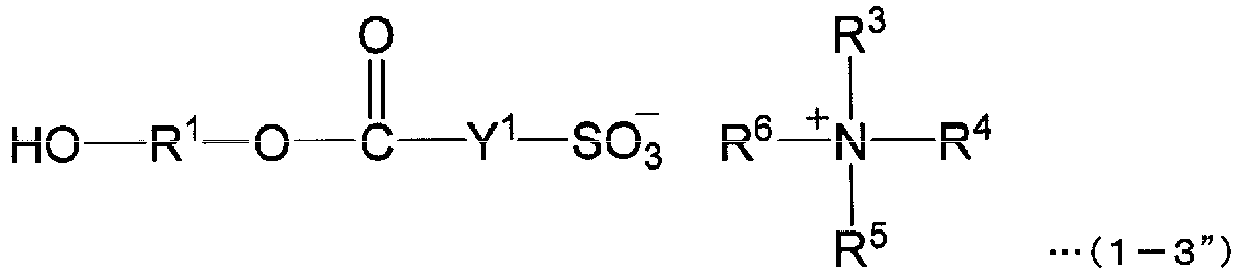 wobei Y1 eine Alkyengruppe oder fluorierte Alkylengruppe mit 1 bis 4 Kohlenstoffatomen darstellt,jedes von R3 bis R6 unabhängig ein Wasserstoffatom oder eine Kohlenwasserstoffgruppe darstellt, die einen Substituenten aufweisen kann, mit der Voraussetzung, dass wenigstens eines von R3 bis R6 eine Kohlenwasserstoffgruppe darstellt, und wenigstens zwei von R3 bis R6 wechselseitig miteinander verbunden sein können, um einen Ring auszubilden, undR1 eine Alkylengruppe darstellt.
 - Verfahren zum Herstellen einer Verbindung (1-3"), die durch die unten gezeigte allgemeine Formel (1-3") dargestellt wird, umfassend Reagieren einer Verbindung (1-3'), die durch die unten gezeigte allgemeine Formel (1-3') dargestellt wird, mit einem Ammoniumsalz:

 wobei Y1 eine Alkylengruppe oder fluorierte Alkylengruppe mit 1 bis 4 Kohlenstoffatomen darstellt,jedes von R3 bis R6 unabhängig ein Wasserstoffatom oder eine Kohlenwasserstoffgruppe darstellt, die einen Substituenten aufweisen kann, mit der Voraussetzung, dass wenigstens eines von R3 bis R6 eine Kohlenwasserstoffgruppe darstellt, und wenigstens zwei von R3 bis R6 miteinander verbunden sein können, um einen Ring auszubilden, undM+ ein Alkalimetallion darstellt undR1 eine Alkylengruppe darstellt.
 - Verfahren zum Herstellen einer monomeren Verbindung (b0-1-11), die durch die unten gezeigte allgemeine Formel (b0-1-11) dargestellt wird, umfassend Reagieren einer Verbindung (1-13), die durch die unten gezeigte allgemeine Formel (1-13) dargestellt wird, mit einem Ammoniumsalz:

 wobei Rx eine gesättigte aliphatische Kohlenwasserstoffgruppe darstellt,R1 eine Alkylengruppe darstellt,n 1 darstellt,Y1 eine Alkylengruppe oder fluorierte Alkylengruppe mit 1 bis 4 Kohlenstoffatomen darstellt,jedes von R3 bis R6 unabhängig ein Wasserstoffatom oder eine Kohlenwasserstoffgruppe darstellt, die einen Substituenten aufweisen kann, mit der Voraussetzung, dass wenigstens eines von R3 bis R6 eine Kohlenwasserstoffgruppe darstellt, und wenigstens zwei von R3 bis R6 miteinander verbunden sein können, um einen Ring auszubilden, undM+ ein Alkalimetallion darstellt.
Applications Claiming Priority (3)
| Application Number | Priority Date | Filing Date | Title |
|---|---|---|---|
| JP2007331163A JP5484671B2 (ja) | 2007-12-21 | 2007-12-21 | 新規な化合物およびその製造方法 |
| JP2007330891 | 2007-12-21 | ||
| JP2008056880A JP5186249B2 (ja) | 2007-12-21 | 2008-03-06 | 新規な化合物およびその製造方法、酸発生剤、レジスト組成物およびレジストパターン形成方法 |
Publications (2)
| Publication Number | Publication Date |
|---|---|
| EP2073060A1 EP2073060A1 (de) | 2009-06-24 |
| EP2073060B1 true EP2073060B1 (de) | 2016-08-24 |
Family
ID=40547955
Family Applications (1)
| Application Number | Title | Priority Date | Filing Date |
|---|---|---|---|
| EP08172244.9A Active EP2073060B1 (de) | 2007-12-21 | 2008-12-19 | Neuartige Verbindung und Verfahren zu ihrer Herstellung, Säurenerzeuger, Resistzusammensetzung und Verfahren zur Bildung eines Resistmusters |
Country Status (2)
| Country | Link |
|---|---|
| US (2) | US9034556B2 (de) |
| EP (1) | EP2073060B1 (de) |
Families Citing this family (24)
| Publication number | Priority date | Publication date | Assignee | Title |
|---|---|---|---|---|
| US9034556B2 (en) | 2007-12-21 | 2015-05-19 | Tokyo Ohka Kogyo Co., Ltd. | Compound and method of producing the same, acid generator, resist composition and method of forming resist pattern |
| CN102866585B (zh) | 2007-12-21 | 2014-09-24 | 东京应化工业株式会社 | 新型化合物及其制造方法、产酸剂、抗蚀剂组合物以及抗蚀剂图案形成方法 |
| JP5544212B2 (ja) * | 2009-04-27 | 2014-07-09 | 東京応化工業株式会社 | レジスト組成物、レジストパターン形成方法、化合物およびその製造方法、酸発生剤 |
| JP5469920B2 (ja) * | 2009-05-29 | 2014-04-16 | 東京応化工業株式会社 | レジスト組成物及びレジストパターン形成方法 |
| JP5687442B2 (ja) * | 2009-06-22 | 2015-03-18 | ローム・アンド・ハース・エレクトロニック・マテリアルズ,エル.エル.シー. | 光酸発生剤およびこれを含むフォトレジスト |
| TW201120576A (en) * | 2009-10-20 | 2011-06-16 | Sumitomo Chemical Co | Photoresist composition |
| JP5542412B2 (ja) * | 2009-10-28 | 2014-07-09 | 東京応化工業株式会社 | ポジ型レジスト組成物、レジストパターン形成方法、高分子化合物 |
| JP5449993B2 (ja) * | 2009-11-12 | 2014-03-19 | 東京応化工業株式会社 | ポジ型レジスト組成物及びレジストパターン形成方法 |
| KR101796331B1 (ko) * | 2010-01-29 | 2017-11-09 | 제이에스알 가부시끼가이샤 | 감방사선성 수지 조성물 |
| JP5969171B2 (ja) | 2010-03-31 | 2016-08-17 | ローム アンド ハース エレクトロニック マテリアルズ エルエルシーRohm and Haas Electronic Materials LLC | 光酸発生剤およびこれを含むフォトレジスト |
| US8932795B2 (en) * | 2010-05-19 | 2015-01-13 | Tokyo Ohka Kogyo Co., Ltd. | Resist composition, method of forming resist pattern, novel compound, and acid generator |
| JP5608009B2 (ja) | 2010-08-12 | 2014-10-15 | 大阪有機化学工業株式会社 | ホモアダマンタン誘導体、その製造方法及びフォトレジスト組成物 |
| KR101794385B1 (ko) * | 2010-08-17 | 2017-11-06 | 제이에스알 가부시끼가이샤 | 감방사선성 조성물 및 신규 화합물 |
| TWI579262B (zh) * | 2011-06-09 | 2017-04-21 | 住友化學股份有限公司 | 鹽、光阻組成物及光阻圖案的製造方法 |
| JP6037689B2 (ja) | 2012-07-10 | 2016-12-07 | 東京応化工業株式会社 | アンモニウム塩化合物の製造方法、及び酸発生剤の製造方法 |
| JP6670601B2 (ja) | 2014-12-15 | 2020-03-25 | 住友化学株式会社 | レジスト組成物及びレジストパターンの製造方法 |
| US9645490B2 (en) | 2014-12-15 | 2017-05-09 | Sumitomo Chemical Company, Limited | Salt, acid generator, photoresist composition, and method for producing photoresist pattern |
| JP6518475B2 (ja) * | 2015-03-20 | 2019-05-22 | 東京応化工業株式会社 | レジスト組成物、レジストパターン形成方法、酸発生剤及び化合物 |
| JP2017019997A (ja) * | 2015-06-01 | 2017-01-26 | ローム アンド ハース エレクトロニック マテリアルズ エルエルシーRohm and Haas Electronic Materials LLC | 酸発生剤化合物及びそれを含むフォトレジスト |
| US10584201B2 (en) * | 2017-01-10 | 2020-03-10 | The Texas A&M University System | Methanesulfonic acid mediated solvent free synthesis of conjugated porous polymer networks |
| JP7101541B2 (ja) | 2018-05-28 | 2022-07-15 | 東京応化工業株式会社 | レジスト組成物及びレジストパターン形成方法 |
| KR102673929B1 (ko) | 2018-05-28 | 2024-06-10 | 도오꾜오까고오교 가부시끼가이샤 | 레지스트 조성물 및 레지스트 패턴 형성 방법 |
| KR102710876B1 (ko) | 2018-05-28 | 2024-09-27 | 도오꾜오까고오교 가부시끼가이샤 | 레지스트 조성물 및 레지스트 패턴 형성 방법 |
| US11221557B2 (en) | 2018-05-28 | 2022-01-11 | Tokyo Ohka Kogyo Co., Ltd. | Resist composition, method of forming resist pattern, compound, and acid generator |
Citations (7)
| Publication number | Priority date | Publication date | Assignee | Title |
|---|---|---|---|---|
| US20050208420A1 (en) * | 2004-03-16 | 2005-09-22 | Ober Christopher K | Environmentally friendly photoacid generators (PAGs) with no perfluorooctyl sulfonates (PFOS) |
| JP2006306856A (ja) * | 2005-03-30 | 2006-11-09 | Sumitomo Chemical Co Ltd | 化学増幅型レジスト組成物の酸発生剤用の塩 |
| WO2006121096A1 (ja) * | 2005-05-11 | 2006-11-16 | Jsr Corporation | 新規化合物および重合体、ならびに感放射線性樹脂組成物 |
| US20070100096A1 (en) * | 2005-10-28 | 2007-05-03 | Sumitomo Chemical Company, Limited | Salt suitable for an acid generator and a chemically amplified resist composition containing the same |
| JP2007145822A (ja) * | 2005-10-28 | 2007-06-14 | Sumitomo Chemical Co Ltd | 化学増幅型レジスト組成物の酸発生剤用の塩 |
| US20070149702A1 (en) * | 2005-12-27 | 2007-06-28 | Sumitomo Chemical Company, Limited | Resin suitable for an acid generator and a chemically amplified positive resist composition containing the same |
| JP2007197432A (ja) * | 2005-12-27 | 2007-08-09 | Sumitomo Chemical Co Ltd | 化学増幅型レジスト組成物の酸発生剤用の塩 |
Family Cites Families (51)
| Publication number | Priority date | Publication date | Assignee | Title |
|---|---|---|---|---|
| JP3315473B2 (ja) | 1992-12-28 | 2002-08-19 | 花王株式会社 | 新規スルホナート、その製造法及びこれを含有するかび取り剤組成物 |
| RO109835B1 (ro) * | 1994-08-22 | 1996-03-29 | Ioan Manzatu | Instalatie si procedeu pentru obtinerea apelor structurate i-activata inhibitor si s-activata stimulator |
| JP3798458B2 (ja) | 1996-02-02 | 2006-07-19 | 東京応化工業株式会社 | オキシムスルホネート化合物及びレジスト用酸発生剤 |
| US5945517A (en) * | 1996-07-24 | 1999-08-31 | Tokyo Ohka Kogyo Co., Ltd. | Chemical-sensitization photoresist composition |
| JP3854689B2 (ja) | 1997-07-24 | 2006-12-06 | 東京応化工業株式会社 | 新規な光酸発生剤 |
| JP3865473B2 (ja) | 1997-07-24 | 2007-01-10 | 東京応化工業株式会社 | 新規なジアゾメタン化合物 |
| JP3980124B2 (ja) | 1997-07-24 | 2007-09-26 | 東京応化工業株式会社 | 新規ビススルホニルジアゾメタン |
| US6231874B1 (en) * | 1998-03-13 | 2001-05-15 | Color Access, Inc. | Structured water for enhanced moisturization |
| US6139855A (en) * | 1998-03-13 | 2000-10-31 | Color Access, Inc. | Structured water in cosmetic compositions |
| US6153733A (en) * | 1998-05-18 | 2000-11-28 | Tokyo Ohka Kogyo Co., Ltd. | (Disulfonyl diazomethane compounds) |
| JP3935267B2 (ja) | 1998-05-18 | 2007-06-20 | 東京応化工業株式会社 | 新規なレジスト用酸発生剤 |
| JP3801398B2 (ja) | 1999-11-01 | 2006-07-26 | 信越化学工業株式会社 | 反射防止膜材料及びパターン形成方法 |
| US6451328B1 (en) * | 2000-08-03 | 2002-09-17 | Color Access, Inc. | Antioxidants in clusters of structured water |
| TWI272451B (en) | 2000-09-25 | 2007-02-01 | Ciba Sc Holding Ag | Chemically amplified photoresist composition, process for preparation of a photoresist, and use of said chemically amplified photoresist composition |
| KR100862281B1 (ko) * | 2000-12-04 | 2008-10-15 | 시바 홀딩 인크 | 오늄 염, 이를 포함하는 화학적으로 증폭된 감광성 내식막 조성물 및 감광성 내식막의 제조방법 |
| US20020187203A1 (en) * | 2001-04-19 | 2002-12-12 | Gheorghe Cioca | Stable antimicrobials in structured water |
| JP2003057825A (ja) | 2001-08-16 | 2003-02-28 | Fuji Photo Film Co Ltd | ポジ型レジスト組成物 |
| JP3895224B2 (ja) | 2001-12-03 | 2007-03-22 | 東京応化工業株式会社 | ポジ型レジスト組成物及びそれを用いたレジストパターン形成方法 |
| TWI314250B (en) * | 2002-02-19 | 2009-09-01 | Sumitomo Chemical Co | Positive resist composition |
| US7323198B2 (en) * | 2002-06-27 | 2008-01-29 | Color Access, Inc. | Antioxidants in clusters of structured water |
| JP2004075864A (ja) | 2002-08-20 | 2004-03-11 | Kyowa Yuka Co Ltd | 樹脂組成物 |
| EP1595182B1 (de) | 2003-02-19 | 2015-09-30 | Basf Se | Halogenierte oxim-derivate und ihre verwendung als latente säuren |
| US6905523B2 (en) * | 2003-03-13 | 2005-06-14 | Aveda Corporation | Hair color application using cluster-modified water |
| US7304175B2 (en) * | 2005-02-16 | 2007-12-04 | Sumitomo Chemical Company, Limited | Salt suitable for an acid generator and a chemically amplified resist composition containing the same |
| TWI394004B (zh) * | 2005-03-30 | 2013-04-21 | Sumitomo Chemical Co | 適合作為酸產生劑之鹽及含有該鹽之化學放大型光阻組成物 |
| TWI402622B (zh) * | 2005-10-28 | 2013-07-21 | Sumitomo Chemical Co | 適用為酸產生劑之鹽以及包含該鹽之化學增幅型阻劑組成物 |
| KR20070045980A (ko) * | 2005-10-28 | 2007-05-02 | 스미또모 가가꾸 가부시키가이샤 | 산 발생제에 적합한 염 및 이를 함유하는 화학증폭형레지스트 조성물 |
| EP1780199B1 (de) | 2005-10-31 | 2012-02-01 | Shin-Etsu Chemical Co., Ltd. | Neuartige Fluorohydroxyalkylsulfonsäuresalze und Derivate, Generatoren von Photosäure, Resistzusammensetzungen, sowie Musterübertragungsverfahren |
| US7786322B2 (en) * | 2005-11-21 | 2010-08-31 | Sumitomo Chemical Company, Limited | Salt suitable for an acid generator and a chemically amplified resist composition containing the same |
| CN1991585B (zh) | 2005-12-27 | 2011-06-01 | 住友化学株式会社 | 适合于酸生成剂的盐和含有该盐的化学放大型抗蚀剂组合物 |
| JP5061612B2 (ja) | 2005-12-27 | 2012-10-31 | 住友化学株式会社 | 化学増幅型ポジ型レジスト組成物用酸発生樹脂 |
| WO2007120971A2 (en) * | 2006-02-10 | 2007-10-25 | Elc Management Llc | Mineral ions in structured water |
| JP4548616B2 (ja) * | 2006-05-15 | 2010-09-22 | 信越化学工業株式会社 | 熱酸発生剤及びこれを含むレジスト下層膜材料、並びにこのレジスト下層膜材料を用いたパターン形成方法 |
| JP4780772B2 (ja) | 2006-06-13 | 2011-09-28 | 東洋ゴム工業株式会社 | タイヤ成型用金型及びそれにより成型された空気入りタイヤ |
| JP4998772B2 (ja) | 2006-06-14 | 2012-08-15 | 独立行政法人産業技術総合研究所 | ハイドレートの製造装置 |
| ATE428690T1 (de) | 2006-06-27 | 2009-05-15 | Sumitomo Chemical Co | Salz, welches für einen sauergenerator geeignet ist, sowie chemisch verstärkte resistzusammensetzung, die dieses enthält |
| JP4718390B2 (ja) * | 2006-08-01 | 2011-07-06 | 信越化学工業株式会社 | レジスト下層膜材料並びにそれを用いたレジスト下層膜基板およびパターン形成方法 |
| JP5245326B2 (ja) | 2006-08-22 | 2013-07-24 | 住友化学株式会社 | 化学増幅型レジスト組成物の酸発生剤用の塩 |
| TWI402249B (zh) | 2006-08-22 | 2013-07-21 | Sumitomo Chemical Co | 適合作為酸產生劑之鹽及含有該鹽之化學放大型正型光阻組成物 |
| JP2008056880A (ja) | 2006-09-04 | 2008-03-13 | Nitto Denko Corp | 粘着剤組成物及び粘着剤層 |
| JP5226994B2 (ja) | 2006-09-11 | 2013-07-03 | 住友化学株式会社 | 化学増幅型レジスト組成物の酸発生剤の中間体 |
| JP4671046B2 (ja) | 2006-10-12 | 2011-04-13 | 信越化学工業株式会社 | レジスト下層膜材料ならびにパターン形成方法 |
| TWI437364B (zh) | 2006-12-14 | 2014-05-11 | Sumitomo Chemical Co | 化學放大型阻劑組成物 |
| CN101236357B (zh) | 2007-01-30 | 2012-07-04 | 住友化学株式会社 | 化学放大型抗蚀剂组合物 |
| KR20110133065A (ko) | 2007-02-15 | 2011-12-09 | 샌트랄 글래스 컴퍼니 리미티드 | 광산발생제용 화합물 및 이를 사용한 레지스트 조성물, 패턴 형성방법 |
| US7741015B2 (en) | 2007-02-16 | 2010-06-22 | Shin-Etsu Chemical Co., Ltd. | Patterning process and resist composition |
| JP5012122B2 (ja) | 2007-03-22 | 2012-08-29 | 住友化学株式会社 | 化学増幅型レジスト組成物 |
| JP5019071B2 (ja) * | 2007-09-05 | 2012-09-05 | 信越化学工業株式会社 | 新規光酸発生剤並びにこれを用いたレジスト材料及びパターン形成方法 |
| JP5347349B2 (ja) * | 2007-09-18 | 2013-11-20 | セントラル硝子株式会社 | 2−ブロモ−2,2−ジフルオロエタノール及び2−(アルキルカルボニルオキシ)−1,1−ジフルオロエタンスルホン酸塩類の製造方法 |
| JP5124260B2 (ja) | 2007-12-21 | 2013-01-23 | 東京応化工業株式会社 | 化合物の製造方法 |
| US9034556B2 (en) | 2007-12-21 | 2015-05-19 | Tokyo Ohka Kogyo Co., Ltd. | Compound and method of producing the same, acid generator, resist composition and method of forming resist pattern |
-
2008
- 2008-12-18 US US12/338,661 patent/US9034556B2/en active Active
- 2008-12-19 EP EP08172244.9A patent/EP2073060B1/de active Active
-
2012
- 2012-03-02 US US13/410,613 patent/US9040220B2/en active Active
Patent Citations (7)
| Publication number | Priority date | Publication date | Assignee | Title |
|---|---|---|---|---|
| US20050208420A1 (en) * | 2004-03-16 | 2005-09-22 | Ober Christopher K | Environmentally friendly photoacid generators (PAGs) with no perfluorooctyl sulfonates (PFOS) |
| JP2006306856A (ja) * | 2005-03-30 | 2006-11-09 | Sumitomo Chemical Co Ltd | 化学増幅型レジスト組成物の酸発生剤用の塩 |
| WO2006121096A1 (ja) * | 2005-05-11 | 2006-11-16 | Jsr Corporation | 新規化合物および重合体、ならびに感放射線性樹脂組成物 |
| US20070100096A1 (en) * | 2005-10-28 | 2007-05-03 | Sumitomo Chemical Company, Limited | Salt suitable for an acid generator and a chemically amplified resist composition containing the same |
| JP2007145822A (ja) * | 2005-10-28 | 2007-06-14 | Sumitomo Chemical Co Ltd | 化学増幅型レジスト組成物の酸発生剤用の塩 |
| US20070149702A1 (en) * | 2005-12-27 | 2007-06-28 | Sumitomo Chemical Company, Limited | Resin suitable for an acid generator and a chemically amplified positive resist composition containing the same |
| JP2007197432A (ja) * | 2005-12-27 | 2007-08-09 | Sumitomo Chemical Co Ltd | 化学増幅型レジスト組成物の酸発生剤用の塩 |
Also Published As
| Publication number | Publication date |
|---|---|
| US9034556B2 (en) | 2015-05-19 |
| US20120164580A1 (en) | 2012-06-28 |
| US20090162788A1 (en) | 2009-06-25 |
| EP2073060A1 (de) | 2009-06-24 |
| US9040220B2 (en) | 2015-05-26 |
Similar Documents
| Publication | Publication Date | Title |
|---|---|---|
| EP2073060B1 (de) | Neuartige Verbindung und Verfahren zu ihrer Herstellung, Säurenerzeuger, Resistzusammensetzung und Verfahren zur Bildung eines Resistmusters | |
| EP2060600B1 (de) | Resistzusammensetzung, Herstellungsverfahren für ein Resistmuster, neuartige Verbindung und Säuregenerator | |
| US8012669B2 (en) | Resist composition and method of forming resist pattern | |
| EP2088466B1 (de) | Resist-Zusammensetzung für Immersionsbelichtung, Verfahren zum Bilden einer Resist-Struktur unter Verwendung der Zusammensetzung und fluorhaltige Verbindung | |
| US8206891B2 (en) | Positive resist composition and method of forming resist pattern | |
| US7927780B2 (en) | Resist composition, method of forming resist pattern, novel compound and method of producing the same, and acid generator | |
| US8338076B2 (en) | Resist composition, method of forming resist pattern, novel compound, and acid generator | |
| US8252505B2 (en) | Compound and method of producing same, acid generator, resist composition, and method of forming resist pattern | |
| US7960091B2 (en) | Resist composition and method of forming resist pattern | |
| JP5186249B2 (ja) | 新規な化合物およびその製造方法、酸発生剤、レジスト組成物およびレジストパターン形成方法 | |
| US8338075B2 (en) | Positive resist composition and method of forming resist pattern | |
| US8415085B2 (en) | Resist composition, method of forming resist pattern, novel compound, and acid generator | |
| US8765352B2 (en) | Resist composition, method of forming resist pattern, novel compound, and acid generator | |
| JP5389411B2 (ja) | レジスト組成物、レジストパターン形成方法、新規な化合物およびその製造方法、ならびに酸発生剤 | |
| US8703387B2 (en) | Resist composition, method of forming resist pattern, novel compound, and acid generator | |
| US20120015299A1 (en) | Resist composition, method of forming resist pattern, novel compound, and acid generator | |
| EP2584409A1 (de) | Lackzusammensetzung, verfahren zur formierung einer lackstruktur, polymere verbindung und verbindung | |
| US20110008728A1 (en) | Resist composition and method of forming resist pattern | |
| JP5276958B2 (ja) | レジスト組成物、およびレジストパターン形成方法 | |
| US20100266955A1 (en) | Positive resist composition and method of forming resist pattern | |
| JP2009230026A (ja) | レジスト組成物およびレジストパターン形成方法 |
Legal Events
| Date | Code | Title | Description |
|---|---|---|---|
| PUAI | Public reference made under article 153(3) epc to a published international application that has entered the european phase |
Free format text: ORIGINAL CODE: 0009012 |
|
| 17P | Request for examination filed |
Effective date: 20081219 |
|
| AK | Designated contracting states |
Kind code of ref document: A1 Designated state(s): AT BE BG CH CY CZ DE DK EE ES FI FR GB GR HR HU IE IS IT LI LT LU LV MC MT NL NO PL PT RO SE SI SK TR |
|
| AX | Request for extension of the european patent |
Extension state: AL BA MK RS |
|
| 17Q | First examination report despatched |
Effective date: 20091117 |
|
| AKX | Designation fees paid |
Designated state(s): AT BE BG CH CY CZ DE DK EE ES FI FR GB GR HR HU IE IS IT LI LT LU LV MC MT NL NO PL PT RO SE SI SK TR |
|
| GRAP | Despatch of communication of intention to grant a patent |
Free format text: ORIGINAL CODE: EPIDOSNIGR1 |
|
| INTG | Intention to grant announced |
Effective date: 20160422 |
|
| GRAS | Grant fee paid |
Free format text: ORIGINAL CODE: EPIDOSNIGR3 |
|
| GRAA | (expected) grant |
Free format text: ORIGINAL CODE: 0009210 |
|
| AK | Designated contracting states |
Kind code of ref document: B1 Designated state(s): AT BE BG CH CY CZ DE DK EE ES FI FR GB GR HR HU IE IS IT LI LT LU LV MC MT NL NO PL PT RO SE SI SK TR |
|
| REG | Reference to a national code |
Ref country code: GB Ref legal event code: FG4D |
|
| REG | Reference to a national code |
Ref country code: CH Ref legal event code: EP |
|
| REG | Reference to a national code |
Ref country code: AT Ref legal event code: REF Ref document number: 823604 Country of ref document: AT Kind code of ref document: T Effective date: 20160915 |
|
| REG | Reference to a national code |
Ref country code: IE Ref legal event code: FG4D |
|
| REG | Reference to a national code |
Ref country code: DE Ref legal event code: R096 Ref document number: 602008045841 Country of ref document: DE |
|
| REG | Reference to a national code |
Ref country code: FR Ref legal event code: PLFP Year of fee payment: 9 |
|
| REG | Reference to a national code |
Ref country code: LT Ref legal event code: MG4D |
|
| REG | Reference to a national code |
Ref country code: NL Ref legal event code: MP Effective date: 20160824 |
|
| REG | Reference to a national code |
Ref country code: AT Ref legal event code: MK05 Ref document number: 823604 Country of ref document: AT Kind code of ref document: T Effective date: 20160824 |
|
| PG25 | Lapsed in a contracting state [announced via postgrant information from national office to epo] |
Ref country code: LT Free format text: LAPSE BECAUSE OF FAILURE TO SUBMIT A TRANSLATION OF THE DESCRIPTION OR TO PAY THE FEE WITHIN THE PRESCRIBED TIME-LIMIT Effective date: 20160824 Ref country code: IT Free format text: LAPSE BECAUSE OF FAILURE TO SUBMIT A TRANSLATION OF THE DESCRIPTION OR TO PAY THE FEE WITHIN THE PRESCRIBED TIME-LIMIT Effective date: 20160824 Ref country code: HR Free format text: LAPSE BECAUSE OF FAILURE TO SUBMIT A TRANSLATION OF THE DESCRIPTION OR TO PAY THE FEE WITHIN THE PRESCRIBED TIME-LIMIT Effective date: 20160824 Ref country code: FI Free format text: LAPSE BECAUSE OF FAILURE TO SUBMIT A TRANSLATION OF THE DESCRIPTION OR TO PAY THE FEE WITHIN THE PRESCRIBED TIME-LIMIT Effective date: 20160824 Ref country code: NL Free format text: LAPSE BECAUSE OF FAILURE TO SUBMIT A TRANSLATION OF THE DESCRIPTION OR TO PAY THE FEE WITHIN THE PRESCRIBED TIME-LIMIT Effective date: 20160824 Ref country code: NO Free format text: LAPSE BECAUSE OF FAILURE TO SUBMIT A TRANSLATION OF THE DESCRIPTION OR TO PAY THE FEE WITHIN THE PRESCRIBED TIME-LIMIT Effective date: 20161124 |
|
| PG25 | Lapsed in a contracting state [announced via postgrant information from national office to epo] |
Ref country code: SE Free format text: LAPSE BECAUSE OF FAILURE TO SUBMIT A TRANSLATION OF THE DESCRIPTION OR TO PAY THE FEE WITHIN THE PRESCRIBED TIME-LIMIT Effective date: 20160824 Ref country code: AT Free format text: LAPSE BECAUSE OF FAILURE TO SUBMIT A TRANSLATION OF THE DESCRIPTION OR TO PAY THE FEE WITHIN THE PRESCRIBED TIME-LIMIT Effective date: 20160824 Ref country code: ES Free format text: LAPSE BECAUSE OF FAILURE TO SUBMIT A TRANSLATION OF THE DESCRIPTION OR TO PAY THE FEE WITHIN THE PRESCRIBED TIME-LIMIT Effective date: 20160824 Ref country code: GR Free format text: LAPSE BECAUSE OF FAILURE TO SUBMIT A TRANSLATION OF THE DESCRIPTION OR TO PAY THE FEE WITHIN THE PRESCRIBED TIME-LIMIT Effective date: 20161125 Ref country code: LV Free format text: LAPSE BECAUSE OF FAILURE TO SUBMIT A TRANSLATION OF THE DESCRIPTION OR TO PAY THE FEE WITHIN THE PRESCRIBED TIME-LIMIT Effective date: 20160824 Ref country code: PT Free format text: LAPSE BECAUSE OF FAILURE TO SUBMIT A TRANSLATION OF THE DESCRIPTION OR TO PAY THE FEE WITHIN THE PRESCRIBED TIME-LIMIT Effective date: 20161226 |
|
| PG25 | Lapsed in a contracting state [announced via postgrant information from national office to epo] |
Ref country code: RO Free format text: LAPSE BECAUSE OF FAILURE TO SUBMIT A TRANSLATION OF THE DESCRIPTION OR TO PAY THE FEE WITHIN THE PRESCRIBED TIME-LIMIT Effective date: 20160824 Ref country code: EE Free format text: LAPSE BECAUSE OF FAILURE TO SUBMIT A TRANSLATION OF THE DESCRIPTION OR TO PAY THE FEE WITHIN THE PRESCRIBED TIME-LIMIT Effective date: 20160824 |
|
| REG | Reference to a national code |
Ref country code: DE Ref legal event code: R097 Ref document number: 602008045841 Country of ref document: DE |
|
| PG25 | Lapsed in a contracting state [announced via postgrant information from national office to epo] |
Ref country code: PL Free format text: LAPSE BECAUSE OF FAILURE TO SUBMIT A TRANSLATION OF THE DESCRIPTION OR TO PAY THE FEE WITHIN THE PRESCRIBED TIME-LIMIT Effective date: 20160824 Ref country code: BG Free format text: LAPSE BECAUSE OF FAILURE TO SUBMIT A TRANSLATION OF THE DESCRIPTION OR TO PAY THE FEE WITHIN THE PRESCRIBED TIME-LIMIT Effective date: 20161124 Ref country code: SK Free format text: LAPSE BECAUSE OF FAILURE TO SUBMIT A TRANSLATION OF THE DESCRIPTION OR TO PAY THE FEE WITHIN THE PRESCRIBED TIME-LIMIT Effective date: 20160824 Ref country code: CZ Free format text: LAPSE BECAUSE OF FAILURE TO SUBMIT A TRANSLATION OF THE DESCRIPTION OR TO PAY THE FEE WITHIN THE PRESCRIBED TIME-LIMIT Effective date: 20160824 Ref country code: DK Free format text: LAPSE BECAUSE OF FAILURE TO SUBMIT A TRANSLATION OF THE DESCRIPTION OR TO PAY THE FEE WITHIN THE PRESCRIBED TIME-LIMIT Effective date: 20160824 |
|
| PLBE | No opposition filed within time limit |
Free format text: ORIGINAL CODE: 0009261 |
|
| STAA | Information on the status of an ep patent application or granted ep patent |
Free format text: STATUS: NO OPPOSITION FILED WITHIN TIME LIMIT |
|
| REG | Reference to a national code |
Ref country code: CH Ref legal event code: PL |
|
| 26N | No opposition filed |
Effective date: 20170526 |
|
| GBPC | Gb: european patent ceased through non-payment of renewal fee |
Effective date: 20161219 |
|
| PG25 | Lapsed in a contracting state [announced via postgrant information from national office to epo] |
Ref country code: SI Free format text: LAPSE BECAUSE OF FAILURE TO SUBMIT A TRANSLATION OF THE DESCRIPTION OR TO PAY THE FEE WITHIN THE PRESCRIBED TIME-LIMIT Effective date: 20160824 |
|
| PG25 | Lapsed in a contracting state [announced via postgrant information from national office to epo] |
Ref country code: MC Free format text: LAPSE BECAUSE OF FAILURE TO SUBMIT A TRANSLATION OF THE DESCRIPTION OR TO PAY THE FEE WITHIN THE PRESCRIBED TIME-LIMIT Effective date: 20160824 |
|
| REG | Reference to a national code |
Ref country code: IE Ref legal event code: MM4A |
|
| PG25 | Lapsed in a contracting state [announced via postgrant information from national office to epo] |
Ref country code: LI Free format text: LAPSE BECAUSE OF NON-PAYMENT OF DUE FEES Effective date: 20161231 Ref country code: CH Free format text: LAPSE BECAUSE OF NON-PAYMENT OF DUE FEES Effective date: 20161231 Ref country code: LU Free format text: LAPSE BECAUSE OF NON-PAYMENT OF DUE FEES Effective date: 20161219 |
|
| REG | Reference to a national code |
Ref country code: FR Ref legal event code: PLFP Year of fee payment: 10 |
|
| PG25 | Lapsed in a contracting state [announced via postgrant information from national office to epo] |
Ref country code: IE Free format text: LAPSE BECAUSE OF NON-PAYMENT OF DUE FEES Effective date: 20161219 Ref country code: GB Free format text: LAPSE BECAUSE OF NON-PAYMENT OF DUE FEES Effective date: 20161219 |
|
| PG25 | Lapsed in a contracting state [announced via postgrant information from national office to epo] |
Ref country code: HU Free format text: LAPSE BECAUSE OF FAILURE TO SUBMIT A TRANSLATION OF THE DESCRIPTION OR TO PAY THE FEE WITHIN THE PRESCRIBED TIME-LIMIT; INVALID AB INITIO Effective date: 20081219 Ref country code: CY Free format text: LAPSE BECAUSE OF FAILURE TO SUBMIT A TRANSLATION OF THE DESCRIPTION OR TO PAY THE FEE WITHIN THE PRESCRIBED TIME-LIMIT Effective date: 20160824 |
|
| PG25 | Lapsed in a contracting state [announced via postgrant information from national office to epo] |
Ref country code: IS Free format text: LAPSE BECAUSE OF FAILURE TO SUBMIT A TRANSLATION OF THE DESCRIPTION OR TO PAY THE FEE WITHIN THE PRESCRIBED TIME-LIMIT Effective date: 20160824 Ref country code: TR Free format text: LAPSE BECAUSE OF FAILURE TO SUBMIT A TRANSLATION OF THE DESCRIPTION OR TO PAY THE FEE WITHIN THE PRESCRIBED TIME-LIMIT Effective date: 20160824 |
|
| PG25 | Lapsed in a contracting state [announced via postgrant information from national office to epo] |
Ref country code: MT Free format text: LAPSE BECAUSE OF NON-PAYMENT OF DUE FEES Effective date: 20161219 |
|
| REG | Reference to a national code |
Ref country code: DE Ref legal event code: R082 Ref document number: 602008045841 Country of ref document: DE Representative=s name: CBDL PATENTANWAELTE GBR, DE Ref country code: DE Ref legal event code: R082 Ref document number: 602008045841 Country of ref document: DE Representative=s name: CBDL PATENTANWAELTE EGBR, DE |
|
| PGFP | Annual fee paid to national office [announced via postgrant information from national office to epo] |
Ref country code: DE Payment date: 20251126 Year of fee payment: 18 |
|
| PGFP | Annual fee paid to national office [announced via postgrant information from national office to epo] |
Ref country code: FR Payment date: 20251119 Year of fee payment: 18 |
|
| PGFP | Annual fee paid to national office [announced via postgrant information from national office to epo] |
Ref country code: BE Payment date: 20251119 Year of fee payment: 18 |