EP1903068B1 - Biodegradable poly(beta-amino esters) and uses thereof - Google Patents
Biodegradable poly(beta-amino esters) and uses thereof Download PDFInfo
- Publication number
- EP1903068B1 EP1903068B1 EP07013193A EP07013193A EP1903068B1 EP 1903068 B1 EP1903068 B1 EP 1903068B1 EP 07013193 A EP07013193 A EP 07013193A EP 07013193 A EP07013193 A EP 07013193A EP 1903068 B1 EP1903068 B1 EP 1903068B1
- Authority
- EP
- European Patent Office
- Prior art keywords
- poly
- polymers
- polymer
- amine
- beta
- Prior art date
- Legal status (The legal status is an assumption and is not a legal conclusion. Google has not performed a legal analysis and makes no representation as to the accuracy of the status listed.)
- Expired - Lifetime
Links
- 0 C*(C)OC(CCC(*)CCCC(ON(C)C)=O)=O Chemical compound C*(C)OC(CCC(*)CCCC(ON(C)C)=O)=O 0.000 description 14
- WNCUVUUEJZEATP-UHFFFAOYSA-N COc(cc1CCN)ccc1OC Chemical compound COc(cc1CCN)ccc1OC WNCUVUUEJZEATP-UHFFFAOYSA-N 0.000 description 2
- ANOUKFYBOAKOIR-UHFFFAOYSA-N COc(ccc(CCN)c1)c1OC Chemical compound COc(ccc(CCN)c1)c1OC ANOUKFYBOAKOIR-UHFFFAOYSA-N 0.000 description 2
- PDNZJLMPXLQDPL-UHFFFAOYSA-N NC1(CO)CCCC1 Chemical compound NC1(CO)CCCC1 PDNZJLMPXLQDPL-UHFFFAOYSA-N 0.000 description 2
- HJORCZCMNWLHMB-UHFFFAOYSA-N NCCCN(CCC1)C1=O Chemical compound NCCCN(CCC1)C1=O HJORCZCMNWLHMB-UHFFFAOYSA-N 0.000 description 2
- FKJVYOFPTRGCSP-UHFFFAOYSA-N NCCCN(CCO)CCO Chemical compound NCCCN(CCO)CCO FKJVYOFPTRGCSP-UHFFFAOYSA-N 0.000 description 2
- CYOIAXUAIXVWMU-UHFFFAOYSA-N NCCN(CCO)CCO Chemical compound NCCN(CCO)CCO CYOIAXUAIXVWMU-UHFFFAOYSA-N 0.000 description 2
- WRXNJTBODVGDRY-UHFFFAOYSA-N NCCN1CCCC1 Chemical compound NCCN1CCCC1 WRXNJTBODVGDRY-UHFFFAOYSA-N 0.000 description 2
- FQUYSHZXSKYCSY-UHFFFAOYSA-N C1CNCCNC1 Chemical compound C1CNCCNC1 FQUYSHZXSKYCSY-UHFFFAOYSA-N 0.000 description 1
- STHIZMRUXPMSCW-UHFFFAOYSA-N C1NCCOCCOCCNCCOC1 Chemical compound C1NCCOCCOCCNCCOC1 STHIZMRUXPMSCW-UHFFFAOYSA-N 0.000 description 1
- XWUNIDGEMNBBAQ-UHFFFAOYSA-N CC(C)(c(cc1)ccc1OCCOC(C=C)=O)c(cc1)ccc1OCCOC(C=C)=O Chemical compound CC(C)(c(cc1)ccc1OCCOC(C=C)=O)c(cc1)ccc1OCCOC(C=C)=O XWUNIDGEMNBBAQ-UHFFFAOYSA-N 0.000 description 1
- MFIGJRRHGZYPDD-UHFFFAOYSA-N CC(C)NCCNC(C)C Chemical compound CC(C)NCCNC(C)C MFIGJRRHGZYPDD-UHFFFAOYSA-N 0.000 description 1
- IIYCJLCAVNGRPZ-UHFFFAOYSA-N CCC(CCCC(C=C)=O)(COC(C=C)=O)COC(c1ccccc1)=O Chemical compound CCC(CCCC(C=C)=O)(COC(C=C)=O)COC(c1ccccc1)=O IIYCJLCAVNGRPZ-UHFFFAOYSA-N 0.000 description 1
- COMCTSSPZRBWPR-UHFFFAOYSA-N CCCC(OCCOc1ccc(C(C)(C)c(cc2)ccc2OCCOC(CCN(C)CC2c3c2[nH]cn3)=O)cc1)=O Chemical compound CCCC(OCCOc1ccc(C(C)(C)c(cc2)ccc2OCCOC(CCN(C)CC2c3c2[nH]cn3)=O)cc1)=O COMCTSSPZRBWPR-UHFFFAOYSA-N 0.000 description 1
- CJKRXEBLWJVYJD-UHFFFAOYSA-N CCNCCNCC Chemical compound CCNCCNCC CJKRXEBLWJVYJD-UHFFFAOYSA-N 0.000 description 1
- DCGTZYLFOBIGAM-UHFFFAOYSA-N CCO[Si+](CCCN)(OCC)OCC Chemical compound CCO[Si+](CCCN)(OCC)OCC DCGTZYLFOBIGAM-UHFFFAOYSA-N 0.000 description 1
- WYTZZXDRDKSJID-UHFFFAOYSA-N CCO[Si](CCCN)(OCC)OCC Chemical compound CCO[Si](CCCN)(OCC)OCC WYTZZXDRDKSJID-UHFFFAOYSA-N 0.000 description 1
- MDKQJOKKKZNQDG-UHFFFAOYSA-N CNCCCCCCNC Chemical compound CNCCCCCCNC MDKQJOKKKZNQDG-UHFFFAOYSA-N 0.000 description 1
- PQYGBJHVVYREGU-UHFFFAOYSA-N CNCCCN(C)CCCNC Chemical compound CNCCCN(C)CCCNC PQYGBJHVVYREGU-UHFFFAOYSA-N 0.000 description 1
- VXPJBVRYAHYMNY-UHFFFAOYSA-N CNCCOCCNC Chemical compound CNCCOCCNC VXPJBVRYAHYMNY-UHFFFAOYSA-N 0.000 description 1
- MRULVAADQTWBTF-UHFFFAOYSA-N CNCCOCCOCCNC Chemical compound CNCCOCCOCCNC MRULVAADQTWBTF-UHFFFAOYSA-N 0.000 description 1
- IMLXLGZJLAOKJN-UHFFFAOYSA-N NC(CC1)CCC1O Chemical compound NC(CC1)CCC1O IMLXLGZJLAOKJN-UHFFFAOYSA-N 0.000 description 1
- PQMCFTMVQORYJC-UHFFFAOYSA-N NC(CCCC1)C1O Chemical compound NC(CCCC1)C1O PQMCFTMVQORYJC-UHFFFAOYSA-N 0.000 description 1
- NTYJJOPFIAHURM-UHFFFAOYSA-N NCCc1c[nH]cn1 Chemical compound NCCc1c[nH]cn1 NTYJJOPFIAHURM-UHFFFAOYSA-N 0.000 description 1
Images










Classifications
-
- C—CHEMISTRY; METALLURGY
- C08—ORGANIC MACROMOLECULAR COMPOUNDS; THEIR PREPARATION OR CHEMICAL WORKING-UP; COMPOSITIONS BASED THEREON
- C08G—MACROMOLECULAR COMPOUNDS OBTAINED OTHERWISE THAN BY REACTIONS ONLY INVOLVING UNSATURATED CARBON-TO-CARBON BONDS
- C08G69/00—Macromolecular compounds obtained by reactions forming a carboxylic amide link in the main chain of the macromolecule
- C08G69/44—Polyester-amides
-
- A—HUMAN NECESSITIES
- A61—MEDICAL OR VETERINARY SCIENCE; HYGIENE
- A61K—PREPARATIONS FOR MEDICAL, DENTAL OR TOILETRY PURPOSES
- A61K47/00—Medicinal preparations characterised by the non-active ingredients used, e.g. carriers or inert additives; Targeting or modifying agents chemically bound to the active ingredient
- A61K47/50—Medicinal preparations characterised by the non-active ingredients used, e.g. carriers or inert additives; Targeting or modifying agents chemically bound to the active ingredient the non-active ingredient being chemically bound to the active ingredient, e.g. polymer-drug conjugates
- A61K47/51—Medicinal preparations characterised by the non-active ingredients used, e.g. carriers or inert additives; Targeting or modifying agents chemically bound to the active ingredient the non-active ingredient being chemically bound to the active ingredient, e.g. polymer-drug conjugates the non-active ingredient being a modifying agent
- A61K47/56—Medicinal preparations characterised by the non-active ingredients used, e.g. carriers or inert additives; Targeting or modifying agents chemically bound to the active ingredient the non-active ingredient being chemically bound to the active ingredient, e.g. polymer-drug conjugates the non-active ingredient being a modifying agent the modifying agent being an organic macromolecular compound, e.g. an oligomeric, polymeric or dendrimeric molecule
- A61K47/59—Medicinal preparations characterised by the non-active ingredients used, e.g. carriers or inert additives; Targeting or modifying agents chemically bound to the active ingredient the non-active ingredient being chemically bound to the active ingredient, e.g. polymer-drug conjugates the non-active ingredient being a modifying agent the modifying agent being an organic macromolecular compound, e.g. an oligomeric, polymeric or dendrimeric molecule obtained otherwise than by reactions only involving carbon-to-carbon unsaturated bonds, e.g. polyureas or polyurethanes
-
- A—HUMAN NECESSITIES
- A61—MEDICAL OR VETERINARY SCIENCE; HYGIENE
- A61K—PREPARATIONS FOR MEDICAL, DENTAL OR TOILETRY PURPOSES
- A61K47/00—Medicinal preparations characterised by the non-active ingredients used, e.g. carriers or inert additives; Targeting or modifying agents chemically bound to the active ingredient
- A61K47/50—Medicinal preparations characterised by the non-active ingredients used, e.g. carriers or inert additives; Targeting or modifying agents chemically bound to the active ingredient the non-active ingredient being chemically bound to the active ingredient, e.g. polymer-drug conjugates
- A61K47/51—Medicinal preparations characterised by the non-active ingredients used, e.g. carriers or inert additives; Targeting or modifying agents chemically bound to the active ingredient the non-active ingredient being chemically bound to the active ingredient, e.g. polymer-drug conjugates the non-active ingredient being a modifying agent
- A61K47/56—Medicinal preparations characterised by the non-active ingredients used, e.g. carriers or inert additives; Targeting or modifying agents chemically bound to the active ingredient the non-active ingredient being chemically bound to the active ingredient, e.g. polymer-drug conjugates the non-active ingredient being a modifying agent the modifying agent being an organic macromolecular compound, e.g. an oligomeric, polymeric or dendrimeric molecule
- A61K47/59—Medicinal preparations characterised by the non-active ingredients used, e.g. carriers or inert additives; Targeting or modifying agents chemically bound to the active ingredient the non-active ingredient being chemically bound to the active ingredient, e.g. polymer-drug conjugates the non-active ingredient being a modifying agent the modifying agent being an organic macromolecular compound, e.g. an oligomeric, polymeric or dendrimeric molecule obtained otherwise than by reactions only involving carbon-to-carbon unsaturated bonds, e.g. polyureas or polyurethanes
- A61K47/593—Polyesters, e.g. PLGA or polylactide-co-glycolide
-
- A—HUMAN NECESSITIES
- A61—MEDICAL OR VETERINARY SCIENCE; HYGIENE
- A61K—PREPARATIONS FOR MEDICAL, DENTAL OR TOILETRY PURPOSES
- A61K47/00—Medicinal preparations characterised by the non-active ingredients used, e.g. carriers or inert additives; Targeting or modifying agents chemically bound to the active ingredient
- A61K47/50—Medicinal preparations characterised by the non-active ingredients used, e.g. carriers or inert additives; Targeting or modifying agents chemically bound to the active ingredient the non-active ingredient being chemically bound to the active ingredient, e.g. polymer-drug conjugates
- A61K47/51—Medicinal preparations characterised by the non-active ingredients used, e.g. carriers or inert additives; Targeting or modifying agents chemically bound to the active ingredient the non-active ingredient being chemically bound to the active ingredient, e.g. polymer-drug conjugates the non-active ingredient being a modifying agent
- A61K47/62—Medicinal preparations characterised by the non-active ingredients used, e.g. carriers or inert additives; Targeting or modifying agents chemically bound to the active ingredient the non-active ingredient being chemically bound to the active ingredient, e.g. polymer-drug conjugates the non-active ingredient being a modifying agent the modifying agent being a protein, peptide or polyamino acid
- A61K47/64—Drug-peptide, drug-protein or drug-polyamino acid conjugates, i.e. the modifying agent being a peptide, protein or polyamino acid which is covalently bonded or complexed to a therapeutically active agent
- A61K47/645—Polycationic or polyanionic oligopeptides, polypeptides or polyamino acids, e.g. polylysine, polyarginine, polyglutamic acid or peptide TAT
-
- A—HUMAN NECESSITIES
- A61—MEDICAL OR VETERINARY SCIENCE; HYGIENE
- A61K—PREPARATIONS FOR MEDICAL, DENTAL OR TOILETRY PURPOSES
- A61K47/00—Medicinal preparations characterised by the non-active ingredients used, e.g. carriers or inert additives; Targeting or modifying agents chemically bound to the active ingredient
- A61K47/50—Medicinal preparations characterised by the non-active ingredients used, e.g. carriers or inert additives; Targeting or modifying agents chemically bound to the active ingredient the non-active ingredient being chemically bound to the active ingredient, e.g. polymer-drug conjugates
- A61K47/69—Medicinal preparations characterised by the non-active ingredients used, e.g. carriers or inert additives; Targeting or modifying agents chemically bound to the active ingredient the non-active ingredient being chemically bound to the active ingredient, e.g. polymer-drug conjugates the conjugate being characterised by physical or galenical forms, e.g. emulsion, particle, inclusion complex, stent or kit
- A61K47/6921—Medicinal preparations characterised by the non-active ingredients used, e.g. carriers or inert additives; Targeting or modifying agents chemically bound to the active ingredient the non-active ingredient being chemically bound to the active ingredient, e.g. polymer-drug conjugates the conjugate being characterised by physical or galenical forms, e.g. emulsion, particle, inclusion complex, stent or kit the form being a particulate, a powder, an adsorbate, a bead or a sphere
- A61K47/6925—Medicinal preparations characterised by the non-active ingredients used, e.g. carriers or inert additives; Targeting or modifying agents chemically bound to the active ingredient the non-active ingredient being chemically bound to the active ingredient, e.g. polymer-drug conjugates the conjugate being characterised by physical or galenical forms, e.g. emulsion, particle, inclusion complex, stent or kit the form being a particulate, a powder, an adsorbate, a bead or a sphere the form being a microcapsule, nanocapsule, microbubble or nanobubble
-
- A—HUMAN NECESSITIES
- A61—MEDICAL OR VETERINARY SCIENCE; HYGIENE
- A61K—PREPARATIONS FOR MEDICAL, DENTAL OR TOILETRY PURPOSES
- A61K9/00—Medicinal preparations characterised by special physical form
- A61K9/48—Preparations in capsules, e.g. of gelatin, of chocolate
- A61K9/50—Microcapsules having a gas, liquid or semi-solid filling; Solid microparticles or pellets surrounded by a distinct coating layer, e.g. coated microspheres, coated drug crystals
- A61K9/51—Nanocapsules; Nanoparticles
- A61K9/5107—Excipients; Inactive ingredients
- A61K9/513—Organic macromolecular compounds; Dendrimers
- A61K9/5138—Organic macromolecular compounds; Dendrimers obtained by reactions only involving carbon-to-carbon unsaturated bonds, e.g. polyvinyl pyrrolidone, poly(meth)acrylates
-
- A—HUMAN NECESSITIES
- A61—MEDICAL OR VETERINARY SCIENCE; HYGIENE
- A61P—SPECIFIC THERAPEUTIC ACTIVITY OF CHEMICAL COMPOUNDS OR MEDICINAL PREPARATIONS
- A61P31/00—Antiinfectives, i.e. antibiotics, antiseptics, chemotherapeutics
-
- A—HUMAN NECESSITIES
- A61—MEDICAL OR VETERINARY SCIENCE; HYGIENE
- A61P—SPECIFIC THERAPEUTIC ACTIVITY OF CHEMICAL COMPOUNDS OR MEDICINAL PREPARATIONS
- A61P31/00—Antiinfectives, i.e. antibiotics, antiseptics, chemotherapeutics
- A61P31/04—Antibacterial agents
-
- A—HUMAN NECESSITIES
- A61—MEDICAL OR VETERINARY SCIENCE; HYGIENE
- A61P—SPECIFIC THERAPEUTIC ACTIVITY OF CHEMICAL COMPOUNDS OR MEDICINAL PREPARATIONS
- A61P31/00—Antiinfectives, i.e. antibiotics, antiseptics, chemotherapeutics
- A61P31/10—Antimycotics
-
- A—HUMAN NECESSITIES
- A61—MEDICAL OR VETERINARY SCIENCE; HYGIENE
- A61P—SPECIFIC THERAPEUTIC ACTIVITY OF CHEMICAL COMPOUNDS OR MEDICINAL PREPARATIONS
- A61P31/00—Antiinfectives, i.e. antibiotics, antiseptics, chemotherapeutics
- A61P31/12—Antivirals
-
- B—PERFORMING OPERATIONS; TRANSPORTING
- B82—NANOTECHNOLOGY
- B82Y—SPECIFIC USES OR APPLICATIONS OF NANOSTRUCTURES; MEASUREMENT OR ANALYSIS OF NANOSTRUCTURES; MANUFACTURE OR TREATMENT OF NANOSTRUCTURES
- B82Y5/00—Nanobiotechnology or nanomedicine, e.g. protein engineering or drug delivery
-
- C—CHEMISTRY; METALLURGY
- C08—ORGANIC MACROMOLECULAR COMPOUNDS; THEIR PREPARATION OR CHEMICAL WORKING-UP; COMPOSITIONS BASED THEREON
- C08G—MACROMOLECULAR COMPOUNDS OBTAINED OTHERWISE THAN BY REACTIONS ONLY INVOLVING UNSATURATED CARBON-TO-CARBON BONDS
- C08G63/00—Macromolecular compounds obtained by reactions forming a carboxylic ester link in the main chain of the macromolecule
- C08G63/02—Polyesters derived from hydroxycarboxylic acids or from polycarboxylic acids and polyhydroxy compounds
- C08G63/12—Polyesters derived from hydroxycarboxylic acids or from polycarboxylic acids and polyhydroxy compounds derived from polycarboxylic acids and polyhydroxy compounds
- C08G63/40—Polyesters derived from ester-forming derivatives of polycarboxylic acids or of polyhydroxy compounds, other than from esters thereof
-
- C—CHEMISTRY; METALLURGY
- C08—ORGANIC MACROMOLECULAR COMPOUNDS; THEIR PREPARATION OR CHEMICAL WORKING-UP; COMPOSITIONS BASED THEREON
- C08G—MACROMOLECULAR COMPOUNDS OBTAINED OTHERWISE THAN BY REACTIONS ONLY INVOLVING UNSATURATED CARBON-TO-CARBON BONDS
- C08G63/00—Macromolecular compounds obtained by reactions forming a carboxylic ester link in the main chain of the macromolecule
- C08G63/68—Polyesters containing atoms other than carbon, hydrogen and oxygen
- C08G63/685—Polyesters containing atoms other than carbon, hydrogen and oxygen containing nitrogen
- C08G63/6854—Polyesters containing atoms other than carbon, hydrogen and oxygen containing nitrogen derived from polycarboxylic acids and polyhydroxy compounds
- C08G63/6856—Dicarboxylic acids and dihydroxy compounds
-
- C—CHEMISTRY; METALLURGY
- C08—ORGANIC MACROMOLECULAR COMPOUNDS; THEIR PREPARATION OR CHEMICAL WORKING-UP; COMPOSITIONS BASED THEREON
- C08G—MACROMOLECULAR COMPOUNDS OBTAINED OTHERWISE THAN BY REACTIONS ONLY INVOLVING UNSATURATED CARBON-TO-CARBON BONDS
- C08G73/00—Macromolecular compounds obtained by reactions forming a linkage containing nitrogen with or without oxygen or carbon in the main chain of the macromolecule, not provided for in groups C08G12/00 - C08G71/00
- C08G73/02—Polyamines
-
- C—CHEMISTRY; METALLURGY
- C08—ORGANIC MACROMOLECULAR COMPOUNDS; THEIR PREPARATION OR CHEMICAL WORKING-UP; COMPOSITIONS BASED THEREON
- C08G—MACROMOLECULAR COMPOUNDS OBTAINED OTHERWISE THAN BY REACTIONS ONLY INVOLVING UNSATURATED CARBON-TO-CARBON BONDS
- C08G73/00—Macromolecular compounds obtained by reactions forming a linkage containing nitrogen with or without oxygen or carbon in the main chain of the macromolecule, not provided for in groups C08G12/00 - C08G71/00
- C08G73/02—Polyamines
- C08G73/0273—Polyamines containing heterocyclic moieties in the main chain
-
- C—CHEMISTRY; METALLURGY
- C08—ORGANIC MACROMOLECULAR COMPOUNDS; THEIR PREPARATION OR CHEMICAL WORKING-UP; COMPOSITIONS BASED THEREON
- C08G—MACROMOLECULAR COMPOUNDS OBTAINED OTHERWISE THAN BY REACTIONS ONLY INVOLVING UNSATURATED CARBON-TO-CARBON BONDS
- C08G73/00—Macromolecular compounds obtained by reactions forming a linkage containing nitrogen with or without oxygen or carbon in the main chain of the macromolecule, not provided for in groups C08G12/00 - C08G71/00
- C08G73/02—Polyamines
- C08G73/028—Polyamidoamines
-
- C—CHEMISTRY; METALLURGY
- C08—ORGANIC MACROMOLECULAR COMPOUNDS; THEIR PREPARATION OR CHEMICAL WORKING-UP; COMPOSITIONS BASED THEREON
- C08G—MACROMOLECULAR COMPOUNDS OBTAINED OTHERWISE THAN BY REACTIONS ONLY INVOLVING UNSATURATED CARBON-TO-CARBON BONDS
- C08G73/00—Macromolecular compounds obtained by reactions forming a linkage containing nitrogen with or without oxygen or carbon in the main chain of the macromolecule, not provided for in groups C08G12/00 - C08G71/00
- C08G73/06—Polycondensates having nitrogen-containing heterocyclic rings in the main chain of the macromolecule
-
- C—CHEMISTRY; METALLURGY
- C08—ORGANIC MACROMOLECULAR COMPOUNDS; THEIR PREPARATION OR CHEMICAL WORKING-UP; COMPOSITIONS BASED THEREON
- C08G—MACROMOLECULAR COMPOUNDS OBTAINED OTHERWISE THAN BY REACTIONS ONLY INVOLVING UNSATURATED CARBON-TO-CARBON BONDS
- C08G73/00—Macromolecular compounds obtained by reactions forming a linkage containing nitrogen with or without oxygen or carbon in the main chain of the macromolecule, not provided for in groups C08G12/00 - C08G71/00
- C08G73/06—Polycondensates having nitrogen-containing heterocyclic rings in the main chain of the macromolecule
- C08G73/0605—Polycondensates containing five-membered rings, not condensed with other rings, with nitrogen atoms as the only ring hetero atoms
- C08G73/0611—Polycondensates containing five-membered rings, not condensed with other rings, with nitrogen atoms as the only ring hetero atoms with only one nitrogen atom in the ring, e.g. polypyrroles
-
- C—CHEMISTRY; METALLURGY
- C08—ORGANIC MACROMOLECULAR COMPOUNDS; THEIR PREPARATION OR CHEMICAL WORKING-UP; COMPOSITIONS BASED THEREON
- C08G—MACROMOLECULAR COMPOUNDS OBTAINED OTHERWISE THAN BY REACTIONS ONLY INVOLVING UNSATURATED CARBON-TO-CARBON BONDS
- C08G73/00—Macromolecular compounds obtained by reactions forming a linkage containing nitrogen with or without oxygen or carbon in the main chain of the macromolecule, not provided for in groups C08G12/00 - C08G71/00
- C08G73/06—Polycondensates having nitrogen-containing heterocyclic rings in the main chain of the macromolecule
- C08G73/0605—Polycondensates containing five-membered rings, not condensed with other rings, with nitrogen atoms as the only ring hetero atoms
- C08G73/0616—Polycondensates containing five-membered rings, not condensed with other rings, with nitrogen atoms as the only ring hetero atoms with only two nitrogen atoms in the ring
-
- C—CHEMISTRY; METALLURGY
- C08—ORGANIC MACROMOLECULAR COMPOUNDS; THEIR PREPARATION OR CHEMICAL WORKING-UP; COMPOSITIONS BASED THEREON
- C08L—COMPOSITIONS OF MACROMOLECULAR COMPOUNDS
- C08L67/00—Compositions of polyesters obtained by reactions forming a carboxylic ester link in the main chain; Compositions of derivatives of such polymers
- C08L67/02—Polyesters derived from dicarboxylic acids and dihydroxy compounds
-
- C—CHEMISTRY; METALLURGY
- C12—BIOCHEMISTRY; BEER; SPIRITS; WINE; VINEGAR; MICROBIOLOGY; ENZYMOLOGY; MUTATION OR GENETIC ENGINEERING
- C12N—MICROORGANISMS OR ENZYMES; COMPOSITIONS THEREOF; PROPAGATING, PRESERVING, OR MAINTAINING MICROORGANISMS; MUTATION OR GENETIC ENGINEERING; CULTURE MEDIA
- C12N15/00—Mutation or genetic engineering; DNA or RNA concerning genetic engineering, vectors, e.g. plasmids, or their isolation, preparation or purification; Use of hosts therefor
- C12N15/09—Recombinant DNA-technology
- C12N15/87—Introduction of foreign genetic material using processes not otherwise provided for, e.g. co-transformation
- C12N15/88—Introduction of foreign genetic material using processes not otherwise provided for, e.g. co-transformation using microencapsulation, e.g. using amphiphile liposome vesicle
-
- C—CHEMISTRY; METALLURGY
- C08—ORGANIC MACROMOLECULAR COMPOUNDS; THEIR PREPARATION OR CHEMICAL WORKING-UP; COMPOSITIONS BASED THEREON
- C08L—COMPOSITIONS OF MACROMOLECULAR COMPOUNDS
- C08L67/00—Compositions of polyesters obtained by reactions forming a carboxylic ester link in the main chain; Compositions of derivatives of such polymers
- C08L67/04—Polyesters derived from hydroxycarboxylic acids, e.g. lactones
-
- C—CHEMISTRY; METALLURGY
- C08—ORGANIC MACROMOLECULAR COMPOUNDS; THEIR PREPARATION OR CHEMICAL WORKING-UP; COMPOSITIONS BASED THEREON
- C08L—COMPOSITIONS OF MACROMOLECULAR COMPOUNDS
- C08L77/00—Compositions of polyamides obtained by reactions forming a carboxylic amide link in the main chain; Compositions of derivatives of such polymers
- C08L77/04—Polyamides derived from alpha-amino carboxylic acids
-
- C—CHEMISTRY; METALLURGY
- C08—ORGANIC MACROMOLECULAR COMPOUNDS; THEIR PREPARATION OR CHEMICAL WORKING-UP; COMPOSITIONS BASED THEREON
- C08L—COMPOSITIONS OF MACROMOLECULAR COMPOUNDS
- C08L79/00—Compositions of macromolecular compounds obtained by reactions forming in the main chain of the macromolecule a linkage containing nitrogen with or without oxygen or carbon only, not provided for in groups C08L61/00 - C08L77/00
- C08L79/02—Polyamines
-
- C—CHEMISTRY; METALLURGY
- C08—ORGANIC MACROMOLECULAR COMPOUNDS; THEIR PREPARATION OR CHEMICAL WORKING-UP; COMPOSITIONS BASED THEREON
- C08L—COMPOSITIONS OF MACROMOLECULAR COMPOUNDS
- C08L89/00—Compositions of proteins; Compositions of derivatives thereof
-
- C—CHEMISTRY; METALLURGY
- C08—ORGANIC MACROMOLECULAR COMPOUNDS; THEIR PREPARATION OR CHEMICAL WORKING-UP; COMPOSITIONS BASED THEREON
- C08L—COMPOSITIONS OF MACROMOLECULAR COMPOUNDS
- C08L99/00—Compositions of natural macromolecular compounds or of derivatives thereof not provided for in groups C08L89/00 - C08L97/00
Definitions
- nucleotide-based drugs such as DNA and RNA
- the treatment of human diseases through the application of nucleotide-based drugs such as DNA and RNA has the potential to revolutionize the medical field ( Anderson Nature 392(Suppl.):25-30, 1996 ; Friedman Nature Med. 2:144-147, 1996 ; Crystal Science 270:404-410, 1995 ; Mulligan Science 260:926-932, 1993 ).
- modified viruses as gene transfer vectors has generally represented the most clinically successful approach to gene therapy. While viral vectors are currently the most efficient gene transfer agents, concerns surrounding the overall safety of viral vectors, which include the potential for unsolicited immune responses, have resulted in parallel efforts to develop non-viral alternatives (for leading references, see: Luo et al. Nat. Biotechnol. 18:33-37,2000 ; Behr Acc. Chem. Res. 26:274-278, 1993 ).
- Cationic polymers have been widely used as transfection vectors due to the facility with which they condense and protect negatively charged strands of DNA.
- Amine-containing polymers such as poly(lysine) ( Zauner et al. Adv. Drug Del. Rev. 30:97-113, 1998 ; Kabanov et al. Bioconjugate Chem. 6:7-20, 1995 ), poly(ethylene imine) (PEI) ( Boussif et al. Proc. Natl. Acad. Sci. USA 92:7297-7301, 1995 ) and poly(amidoamine) dendrimers ( Kukowska-Latallo et al. Proc. Natl. Acad. Sci.
- polyesters bearing cationic side chains have been developed ( Putnam et al. Macromolecules 32:3658-3662, 1999 ; Barrera et al. J. Am. Chem. Soc. 115:11010-11011, 1993 ; Kwon et al. Macromolecules 22:3250-3255, 1989 ; Lim et al. J. Am. Chem. Soc. 121:5633-5639, 1999 ; Zhou et al. Macromolecules 23:3399-3406, 1990 ).
- polyesters include poly(L-lactide-co-L-lysine) ( Barrera et al. J. Am.
- Poly(4-hydroxy-L-proline ester) and poly[a-(4-aminobutyl)-L-glycolic acid] were recently demonstrated to condense plasmid DNA through electrostatic interactions, and to mediate gene transfer ( Putnam et al. Macromolecules 32:3658-3662,1999 ; Lim et al. J. Am. Chem. Soc. 121:5633-5639, 1999 ).
- these new polymers are significantly less toxic than poly(lysine) and PEI, and they degrade into non-toxic metabolites. It is clear from these investigations that the rational design of amine-containing polyesters can be a productive route to the development of safe, effective transfection vectors. Unfortunately, however, present syntheses of these polymers require either the independent preparation of specialized monomers ( Barrera et al. J, Am. Chem. Soc. 115:11010-11011, 1993 ), or the use of stoichiometric amounts of expensive coupling reagents ( Putnam et al. Macromolecules 32:3658-3662, 1999 ). Additionally, the amine functionalities in the monomers must be protected prior to polymerization ( Putnam et al.
- the present invention provides polymers useful in preparing drug delivery devices and pharmaceutical compositions thereof.
- the invention also provides methods of preparing the polymers and methods of preparing microspheres and other pharmaceutical compositions containing the inventive polymers.
- the polymers of the present invention are poly( ⁇ -amino esters) and salts and derivatives thereof.
- Preferred polymers are biodegradable and biocompatible.
- the polymers have one or more tertiary amines in the backbone of the polymer.
- Preferred polymers have one or two tertiary amines per repeating backbone unit.
- the polymers may also be co-polymers in which one of the components is a poly( ⁇ -amino ester).
- the polymers of the invention may readily be prepared by condensing bis(secondary amines) or primary amines with bis(acrylate esters).
- a polymer of the present invention is prepared from a bis(acrylate ester) and an amine, wherein the amine is selected from the group consisting of the formulae 6-94:
- a polymer of the present invention may be represented by the formula below: prepared via the conjugate addition of a primary amine to a bis(acrylate ester) wherein the primary amine is of the formula: wherein
- a polymer of the present invention may also be represented by the formula below: prepared via the conjugate addition of a bis(secondary amine) to a bis(acrylate ester) wherein the bis(secondary amine) is of the formula: wherein
- the polymers are amine-terminated; and in other embodiments, the polymers are acrylate-terminated.
- the groups R 1 and/or R 2 form cyclic structures with the linker A (see the Detailed Description section below).
- Polymers containing such cyclic moieties have the characteristic of being more soluble at lower pH.
- Specifically preferred polymers are those that are insoluble in aqueous solutions at physiologic pH (pH 7.2-7.4) and are soluble in aqueous solutions below physiologic pH (pH ⁇ 7.2).
- Other preferred polymers are those that are soluble in aqueous solution at physiologic pH (pH 7.2-7.4) and below.
- Preferred polymers are useful in the transfection of polynucleotides into cells.
- the present invention provides a method of preparing the inventive polymers.
- Commercially available or readily available monomers bis(secondary amines), primary amines, and bis(acrylate esters), are subjected to conditions which lead to the conjugate addition of the amine to the bis(acrylate ester).
- each of the monomers is dissolved in an organic solvent (e.g ., DMSO, DMF, THF, diethyl ether, methylene chloride, hexanes, etc .), and the resulting solutions are combined and heated for a time sufficient to lead to polymerization of the monomers.
- the polymerization is carried out in the absence of solvent.
- the resulting polymer may then be purified and optionally characterized using techniques known in the art.
- the polymers are used to form nanometer-scale complexes with nucleic acids.
- the polynucleotide/polymer complexes may be formed by adding a solution of polynucleotide to a vortexing solution of the polymer at a desired DNA/polymer concentration.
- the weight to weight ratio of polynucleotide to polymer may range from 1:0.1 to 1:200, preferably from 1:10 to 1:150, more preferably from 1:50 to 1:150.
- the amine monomer to polynucleotide phosphate ratio may be approximately 10:1, 15:1, 20:1, 25:1, 30:1, 35:1, 40:1, 45:1, 50:1, 55:1, 60:1, 65:1, 70:1, 75:1, 80:1, 85:1, 90:1, 95:1, 100:1, 110:1, 120:1, 130:1, 140:1, 150:1 ,160:1, 170:1, 180:1, 190:1, and 200:1.
- the cationic polymers condense the polynucleotide into soluble particles typically 50-500 nm in size. These polynucleotide/polymer complexes may be used in the delivery of polynucleotides to cells.
- these complexes are combined with pharmaceutical excipients to form pharmaceutical compositions suitable for delivery to animals including humans.
- a polymer with a high molecular weight to nitrogen atom ratio e.g. , polylysine, polyethyleneimine
- polylysine, polyethyleneimine e.g., polylysine, polyethyleneimine
- the polymers are used to encapsulate therapeutic, diagnostic, and/or prophylactic agents including polynucleotides to form microparticles.
- these microparticles are an order of magnitude larger than the polynucleotide/polymer complexes.
- the microparticles range from 1 micrometer to 500 micrometers. In a particularly preferred embodiment, these microparticles allow for the delivery of labile small molecules, proteins, peptides, and/or polynucleotides to an individual.
- the microparticles may be prepared using any of the techniques known in the art to make microparticles, such as, for example, double emulsion, phase inversion, and spray drying.
- the microparticles can be used for pH-triggered delivery of the encapsulated contents due to the pH-responsive nature of the polymers ( i . e ., being more soluble at lower pH).
- the invention provides a system for synthesizing and screening a collection of polymers.
- the system takes advantage of techniques known in the art of automated liquid handling and robotics.
- the system of synthesizing and screening may be used with poly(beta-amino ester)s as well as other types of polymers including polyamides, polyesters, polyethers, polycarbamates, polycarbonates, polyureas, polyamines, etc .
- the collection of polymers may be a collection of all one type of polymer (e.g. , all poly(beta-amino esters) or may be a diverse collection of polymers. Thousands of polymers may be synthesized and screened in parallel using the inventive system.
- the polymers are screened for properties useful in the field of gene delivery, transfection, or gene therapy. Some of these properties include solubility at various pHs, ability to complex polynucleotides, ability to transfect a polynucleotide into a cell, etc. Certain poly(beta-amino ester)s found to be useful in transfecting cells include M17, KK89, LL6, and D94 as described in Examples 4 and 5.
- R is alkyl, alkenyl, alkynyl, aryl, carbocylic, heterocyclic, or aromatic heterocyclic.
- An example of an acyl group is acetyl.
- alkyl refers to saturated, straight- or branched-chain hydrocarbon radicals derived from a hydrocarbon moiety containing between one and twenty carbon atoms by removal of a single hydrogen atom.
- the alkyl group employed in the invention contains 1-10 carbon atoms.
- the alkyl group employed contains 1-8 carbon atoms.
- the alkyl group contains 1-6 carbon atoms, In yet another embodiments, the alkyl group contains 1-4 carbons.
- alkyl radicals include, but are not limited to, methyl, ethyl, n-propyl, isopropyl, n-butyl, iso-butyl, sec-butyl, sec-pentyl, iso-pentyl, tert-butyl, n-pentyl, neopentyl, n-hexyl, sec-hexyl, n-heptyl, n-octyl, n-decyl, n-undecyl, dodecyl, and the like, which may bear one or more sustitutents.
- alkoxy refers to a saturated ( i.e. , alkyl-O-) or unsaturated ( i.e. , alkenyl-O- and alkynyl-O-) group attached to the parent molecular moiety through an oxygen atom.
- the alkyl group contains 1-20 aliphatic carbon atoms.
- the akyl, akenyl, and alkynyl groups employed in the invention contain 1-8 aliphatic carbon atoms.
- the alkyl group contains 1-6 aliphatic carbon atoms.
- the alkyl group contains I-4 aliphatic carbon atoms.
- Examples include, but are not limited to, methoxy, ethoxy, propoxy, isopropoxy, n - butoxy, tert -butoxy, i- butoxy, sec -butoxy, neopentoxy, n-hexoxy, and the like.
- alkenyl denotes a monovalent group derived from a hydrocarbon moiety having at least one carbon-carbon double bond by the removal of a single hydrogen atom.
- the alkenyl group employed in the invention contains 1-20 carbon atoms. In some embodiments, the alkenyl group employed in the invention contains 1-10 carbon atoms. In another embodiment, the alkenyl group employed contains 1-8 carbon atoms. In still other embodiments, the alkenyl group contains 1-6 carbon atoms. In yet another embodiments, the alkenyl group contains 1-4 carbons.
- Alkenyl groups include, for example, ethenyl, propenyl, butenyl, 1-methyl-2-buten-1-yl, and the like.
- alkynyl refers to a monovalent group derived form a hydrocarbon having at least one carbon-carbon triple bond by the removal of a single hydrogen atom.
- the alkynyl group employed in the invention contains 1-20 carbon atoms, In some embodiments, the alkynyl group employed in the invention contains 1-10 carbon atoms. In another embodiment, the alkynyl group employed contains 1-8 carbon atoms. In still other embodiments, the alkynyl group contains 1-6 carbon atoms.
- Representative alkynyl groups include, but are not limited to, ethynyl, 2-propynyl (propargyl), 1-propynyl, and the like.
- alkylamino , dialkylamino , and trialkylamino refers to one, two, or three, respectively, alkyl groups, as previously defined, attached to the parent molecular moiety through a nitrogen atom.
- alkylamino refers to a group having the structure -NHR' wherein R' is an alkyl group, as previously defined; and the term dialkylamino refers to a group having the structure -NR'R", wherein R' and R" are each independently selected from the group consisting of alkyl groups.
- trialkylamino refers to a group having the structure -NR'R"R"', wherein R', R", and R"' are each independently selected from the group consisting of alkyl groups.
- the alkyl group contain 1-20 aliphatic carbon atoms.
- the alkyl group contains 1-10 aliphatic carbon atoms.
- the alkyl group contains 1-8 aliphatic carbon atoms.
- the alkyl group contain 1-6 aliphatic carbon atoms.
- the alkyl group contain 1-4 aliphatic carbon atoms.
- R', R", and/or R"' taken together may optionally be -(CH 2 ) k - where k is an integer from 2 to 6.
- examples include, but are not limited to, methylamino, dimethylamino, ethylamino, diethylamino, diethylaminocarbonyl, methylethylamino, iso-propylamino, piperidino, trimethylamino, and propylamino.
- alkylthioether and thioalkoxyl refer to a saturated (i.e., alkyl-S-) or unsaturated (i.e., alkenyl-S- and alkynyl-S-) group attached to the parent molecular moiety through a sulfur atom.
- the alkyl group contains 1-20 aliphatic carbon atoms.
- the alkyl group contains 1-10 aliphatic carbon atoms.
- the alkyl, alkenyl, and alkynyl groups contain 1-8 aliphatic carbon atoms.
- the alkyl, alkenyl, and alkynyl groups contain 1-6 aliphatic carbon atoms. In yet other embodiments, the alkyl, alkenyl, and alkynyl groups contain 1-4 aliphatic carbon atoms.
- thioalkoxyl moieties include, but are not limited to, methylthio, ethylthio, propylthio, isopropylthio, n-butylthio, and the like.
- aryl refers to an unsaturated cyclic moiety comprising at least one aromatic ring.
- aryl group refers to a mono- or bicyclic carbocyclic ring system having one or two aromatic rings including, but not limited to, phenyl, naphthyl, tetrahydronaphthyl, indanyl, indenyl, and the like.
- Aryl groups can be unsubstituted or substituted with substituents selected from the group consisting of branched and unbranched alkyl, alkenyl, alkynyl, haloalkyl, alkoxy, thioalkoxy, amino, alkylamino, dialkylamino, trialkylamino, acylamino, cyano, hydroxy, halo, mercapto, nitro, carboxyaldehyde, carboxy, alkoxycarbonyl, and carboxamide.
- substituted aryl groups include tetrafluorophenyl and pentafluorophenyl.
- carboxylic acid refers to a group of formula-CO 2 H.
- halo and halogen refer to an atom selected from fluorine, chlorine, bromine, and iodine.
- heterocyclic refers to an aromatic or non-aromatic, partially unsaturated or fully saturated, 3- to 10-membered ring system, which includes single rings of 3 to 8 atoms in size and bi- and tri-cyclic ring systems which may include aromatic five- or six-membered aryl or aromatic heterocyclic groups fused to a non-aromatic ring.
- heterocyclic rings include those having from one to three heteroatoms independently selected from oxygen, sulfur, and nitrogen, in which the nitrogen and sulfur heteroatoms may optionally be oxidized and the nitrogen heteroatom may optionally be quaternized.
- heterocylic refers to a non-aromatic 5-, 6-, or 7-membered ring or a polycyclic group wherein at least one ring atom is a heteroatom selected from 0, S, and N (wherein the nitrogen and sulfur heteroatoms may be optionally oxidized), including, but not limited to, a bi- or tri-cyclic group, comprising fused six-membered rings having between one and three heteroatoms independently selected from the oxygen, sulfur, and nitrogen, wherein (i) each 5-membered ring has 0 to 2 double bonds, each 6-membered ring has 0 to 2 double bonds, and each 7-membered ring has 0 to 3 double bonds, (ii) the nitrogen and sulfur heteroatoms may be optionally oxidized, (iii) the nitrogen heteroatom may optionally be quaternized, and (iv) any of the above heterocyclic rings may be fused to an aryl or heteroaryl ring.
- aromatic heterocyclic refers to a cyclic aromatic radical having from five to ten ring atoms of which one ring atom is selected from sulfur, oxygen, and nitrogen; zero, one, or two ring atoms are additional heteroatoms independently selected from sulfur, oxygen, and nitrogen; and the remaining ring atoms are carbon, the radical being joined to the rest of the molecule via any of the ring atoms, such as, for example, pyridyl, pyrazinyl, pyrimidinyl, pyrrolyl, pyrazolyl, imidazolyl, thiazolyl, oxazolyl, isooxazolyl, thiadiazolyl, oxadiazolyl, thiophenyl, furanyl, quinolinyl, isoquinolinyl, and the like.
- Aromatic heterocyclic groups can be unsubstituted or substituted with substituents selected from the group consisting of branched and unbranched alkyl, alkenyl, alkynyl, haloalkyl, alkoxy, thioalkoxy, amino, alkylamino, dialkylamino, trialkylamino, acylamino, cyano, hydroxy, halo, mercapto, nitro, carboxyaldehyde, carboxy, alkoxycarbonyl, and carboxamide.
- heterocyclic and aromatic heterocyclic groups that may be included in the compounds of the invention include; 3-methyl-4-(3-methylphenyl)piperazine, 3 methylpiperidine, 4-(bis-(4-fluorophenyl)methyl)piperazine, 4-(diphenylmethyl)piperazine, 4-(ethoxycarbonyl)piperazine, 4-(ethoxycarbonylmethyl)piperazine, 4-(phenylmethyl)piperazine, 4-(1-phenylethyl)piperazine, 4-(1,1-dimethylethoxycarbonyl)piperazine, 4-(2-(bis-(2-propenyl) amino)ethyl)piperazine, 4-(2-(diethylamino)ethyl)piperazine, 4-(2-chlorophenyl)piperazine, 4-(2-cyanophenyl)piperazine, 4-(2-ethoxyphenyl)piperazine, 4-(2-ethylphenyl)piperazine, 4-(2-fluoroph
- carbamoyl refers to an amide group of the formula -CONH 2 .
- carbonyldioxyl refers to a carbonate group of the formula -O-CO-OR.
- hydrocarbon refers to any chemical group comprising hydrogen and carbon.
- the hydrocarbon may be substituted or unsubstitued,
- the hydrocarbon may be unsaturated, saturated, branched, unbranched, cyclic, polycyclic, or heterocyclic,
- Illustrative hydrocarbons include, for example, methyl, ethyl, n -propyl, iso -propyl, cyclopropyl, allyl, vinyl, n -butyl, tert-butyl, ethynyl, cyclohexyl, methoxy, diethylamino, and the like.
- all valencies must be satisfied in making any substitutions.
- substituted refers to the ability, as appreciated by one skilled in this art, to change one functional group for another functional group provided that the valency of all atoms is maintained.
- substituent may be either the same or different at every position.
- the substituents may also be further substituted (e.g ., an aryl group substituent may have another substituent off it, such as another aryl group, which is further substituted with fluorine at one or more positions).
- thiohydroxyl or thiol refers to a group of the formula-SH.
- ureido refers to a urea group of the formula: -NH-CO-NH 2 .
- the present invention provides improved polymeric encapuslation and delivery systems based on the use of ⁇ -amino ester polymers.
- the sytems may be used in the pharmaccutical/drug delivery arts to delivery polynucleotides, proteins, small molecules, peptides, antigen, drugs, etc. to a patient, tissue, organ, cell, etc.
- the present invention also provides for the preparation and screening of large collections of polymers for "hits" that are useful in the pharmaceutical and drug delivery arts.
- the ⁇ -amino ester polymers of the present invention provide for several different uses in the drug delivery art.
- the polymers with their tertiary amine-containing backbones may be used to complex polynucleotides and thereby enhance the delivery of polynucleotide and prevent their degradation.
- the polymers may also be used in the formation of nanoparticles or microparticles containing encapsulated agents. Due to the polymers' properties of being biocompatible and biodegradable, these formed particles are also biodegradable and biocompatible and may be used to provide controlled, sustained release of the encapsulated agent. These particles may also be responsive to pH changes given the fact that these polymers are typically not substantially soluble in aqueous solution at physiologic pH but are more soluble at lower pH.
- the polymers of the present invention are poly( ⁇ -amino esters) containing tertiary amines in their backbones and salts thereof.
- the molecular weights of the inventive polymers may range from 5,000 g/mol to over 100,000 g/mol, more preferably from 4,000 g/mol to 50,000 g/mol.
- the inventive polymers are relatively non-cytotoxic.
- the inventive polymers are biocompatible and biodegradable.
- the polymers of the present invention have pK a s in the range of 5.5 to 7.5, more preferably between 6.0 and 7.0.
- the polymer may be designed to have a desired pK a between 3.0 and 9.0, more preferably between 5.0 and 8.0.
- inventive polymers are particularly attractive for drug delivery for several reasons: 1) they contain amino groups for interacting with DNA and other negatively charged agents, for buffering the pH, for causing endosomolysis, etc .; 2) they contain degradable polyester linkages; 3) they can be synthesized from commercially available starting materials; and 4) they are pH responsive and future generations could be engineered with a desired pK a .
- the best performing polymers were hydrophobic or the diacrylate monomers were hydrophobic, and many had mono- or di-hydroxyl side chains and/or linear, bis(secondary amines) as part of their structure.
- the polymers of the present invention are prepared from a bis(acrylate ester) and an amine, wherein the amine is selected from the group consisting of the formulae 6-94:
- the polymers include amines 6, 17, 60, 61, 70, 86, 87, 89, or 94.
- the polymers of the present invention can generally be defined by the formula: prepared via the conjugate addition of a primary amine to a bis(acrylate ester) wherein the primary amine is of the formula: wherein
- the polymers of the present invention can generally be defined by the formula: prepared via the conjugate addition of a bis(secondary amine) to a bis(acrylate ester) wherein the bis(secondary amine) is of the formula: wherein
- the bis(acrylate ester) unit in the inventive polymer is chosen from the following group of bis(acrylate ester) units ( A-PP ):
- Particularly preferred bis(acrylate esters) in this group include B, C, D, E, F, M, O, U, AA, II, JJ, KK, and LL.
- Particularly useful poly(beta-amino ester)s include: and
- poly(beta-amino esters) include C86, D60, D61, U94, LL6, C94, F94, JJ94, JJ86, C86, U86, E86, B17, D70, U87, D87, C94, D86, F86, AA94, AA60, A61, D94, U94, E94, B17, M17 and AA61.
- one or both of the linkers A and B are polyethylene polymers. In another particularly preferred embodiment, one or both of the linkers A and B are polyethylene glycol polymers. Other biocompatible, biodegradable polymers may be used as one or both of the linkers A and B.
- the polymers of the present invention are amine-terminated. In other embodiments, the polymers of the present invention are acrylate-terminated. In large part, the termination unit of the polymer is determined by the ratio of amine versus acrylate in the polymer synthesis reaction. An excess of amine monomer yields an amine-terminated polymer. And an excess of acrylate monomer yields an acrylate-terminated polymer.
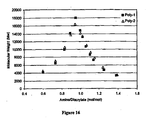
- the average molecular weight of the polymers of the present invention range from 1,000 g/mol to 50,000 g/mol, preferably from 2,000 g/mol to 40,000 g/mol, more preferably from 5,000 g/mol to 20,000 g/mol, and even more preferably from 10,000 g/mol to 17,000 g/mol. Since the polymers of the present invention are prepared by a step polymerization, a broad, statistical distribution of chain lengths is typically obtained. In certain embodiments, the distribution of molecular weights in a polymer sample is narrowed by purification and isolation steps known in the art.
- the molecular weight of the polymer may also be varied by the synthesis of the polymer, for example, as the amount of amine monomers increases, the molecular weight of the resulting polymer decreases.
- the polymer mixture may be a blend of polymers of different molecular weights.
- the polymer of the present invention is a co-polymer wherein one of the repeating units is a poly( ⁇ -amino ester) of the present invention.
- Other repeating units to be used in the co-polymer include, but are not limited to, polyethylene, poly(glycolide-co-lactide) (PLGA), polyglycolic acid, polymethacrylate, etc.
- the inventive polymers may be prepared by any method known in the art. Preferably the polymers are prepared from commercially available starting materials. In another preferred embodiment, the polymers are prepared from easily and/or inexpensively prepared starting materials.
- the inventive polymer is prepared via the conjugate addition of bis(secondary amines) to bis(acrylate esters).
- This reaction scheme is shown below:
- Bis(secondary amine) monomers that are useful in the present inventive method include, but are not limited to, N,N'-dimethylethylenediamine, and 1,2-bis( N -ethylamino)ethylene.
- Diacrylate monomers that are useful in the present invention include, but are not limited to, 1,4-butanediol diacrylate, 1,4-butanediol dimethacrylate, 1,2-ethanediol diacrylate, 1,6-hexanediol diacrylate, 1,5-pentanediol diacrylate, 2,5-hexanediol diacrylate, and 1,3-propanediol diacrylate.
- Each of the monomers is dissolved in an organic solvent (e.g ., THF, CH 2 Cl 2 , MeOH, EtOH, CHCl 3 , hexanes, toluene, benzene, CCl 4 , glyme, diethyl ether, DMSO, DMF, etc .), preferably DMSO.
- organic solvent e.g ., THF, CH 2 Cl 2 , MeOH, EtOH, CHCl 3 , hexanes, toluene, benzene, CCl 4 , glyme, diethyl ether, DMSO, DMF, etc .
- the reaction mixture is then heated to a temperature ranging from 30°C to 200 °C, preferably 40 °C to 150 °C, more preferably 50°C to 100 °C.
- the reaction mixture is heated to approximately 40 °C, 50 °C, 60 °C, 70 °C, 80 °C, or 90 °C.
- the reaction mixture is heated to approximately 75 °C.
- the reaction mixture is heated to approximately 100 °C.
- the polymerization reaction may also be catalyzed.
- the reaction time may range from hours to days depending on the polymerization reaction and the reaction conditions. As would be appreciated by one of skill in the art, heating the reaction tends to speed up the rate of reaction requiring a shorter reaction time.
- the polymer synthesis is carried out in DMSO at approximately 60 °C for approximately 2 days. In other emodiments, the polymer synthesis is carried out without solvent at 95 °C for 8-16 hours.
- the molecular weight of the synthesized polymer may be determined by the reaction conditions (e.g. , temperature, starting materials, concentration, catalyst, solvent, time of reaction, etc. ) used in the synthesis.
- the inventive polymers are prepared by the conjugate addition of a primary amine to a bis(acrylate ester).
- a primary amine rather than bis(secondary amines) allows for a much wider variety of commercially available starting materials.
- the reaction scheme using primary amines rather than secondary amines is shown below:
- Primary amines useful in this method include, but are not limited to, substituted anilines.
- the bis(acrylate esters) useful in this method include, but are not limited to, 1,4-butanediol diacrylate, 1,4-butanediol dimethacrylate, 1,2-ethanediol diacrylate, 1,6-hexanediol diacrylate, 1,5-pentanediol diacrylate, 2,5-hexanediol diacrylate, and 1,3-propanediol diacrylate.
- Each of the monomers is dissolved in an organic solvent (e.g., THF, DMSO, DMF, CH 2 Cl 2 , MeOH, EtOH, CHCl 3 , hexanes, CCl 4 , glyme, diethyl ether, etc .).
- organic solvents are preferred due to the susceptibility of polyesters to hydrolysis.
- the organic solvent used is relatively non-toxic in living systems.
- DMSO is used as the organic solvent because it is relatively non-toxic and is frequently used as a solvent in cell culture and in storing frozen stocks of cells.
- Other preferred solvents include those miscible with water such as DMSO, ethanol, and methanol.
- the resulting solutions of monomers which are preferably at a concentration between 0.01 M and 5 M, between approximately 0.1 M and 2 M, more preferably between 0.5 M and 2 M, and most preferably between 1.3 M and 1.8 M, are combined, and the reaction mixture is heated to yield the desired polymer.
- the reaction is run without solvent.
- Running the polymerization without solvent may decrease the amount of cyclization products resulting from intramolecular conjugate addition reactions.
- the polymerization may be run at a temperature ranging from 20 °C to 200 °C, preferably from 40 °C to 100 °C, more preferably from 50 °C to 75 °C, even more preferably from 50 °C to 60 °C.
- the reaction mixture is maintained at 20 °C. In another particularly preferred embodiment, the reaction mixture is heated to approximately 50 °C. In some embodiments, the reaction mixture is heated to approximately 56 °C. In yet another particularly preferred embodiment, the reaction mixture is heated to approximately 75 °C.
- the reaction mixute may also be cooled to approximately 0 °C.
- the polymerization reaction may also be catalyzed such as with an organometallic catalyste, acid, or base.
- one or more types of amine monomers and/or diacrylate monomers may be used in the polymerization reaction. For example, a combination of ethanolamine and ethylamine may be used to prepare a polymer more hydrophilic than one prepared using ethylamine alone, and also more hydrophobic than one prepared using ethanolamine alone.
- the monomers in the reaction mixture may be combined in different ratio to effect molecular weight, yield, end-termination, etc. of the resulting polymer.
- the ratio of amine monomers to diacrylate monomers may range from 1.6 to 0.4, preferably from 1.4 to 0.6, more preferably from 1.2 to 0.8, even more preferably from 1.1 to 0.9.
- the ratio of amine monomers to diacrylate monomers is approximately 1.4, 1.3, 1.2, 1.1, 1.050, 1.025, 1.0,0.975,0.950,0.900,0.800, and 0.600.
- combining the monomers at a ratio of 1:1 typically results in higher molecular weight polymers and higher overall yields.
- amine-to-acrylate ratio > 1 provides an excess of amine monomers ( i . e ., amine-to-acrylate ratio > 1) results in amine-terminated chains while providing an excess of acrylate monomer ( i . e ., amine-to-acrylate ration ⁇ 1) results in acrylate-terminated chains.
- the ratio of amine monomers to acrylate mononers in the polymer synthesis can affect how the polymer chains are terminated, the molecular weight of the polymers produced, the distribution of molecular weights, and the extent of cross-linking.
- the synthesized polymer may be purified by any technique known in the art including, but not limited to, precipitation, crystallization, extraction, chromatography, etc.
- the polymer is purified through repeated precipitations in organic solvent (e.g., diethyl ether, hexane, etc.).
- organic solvent e.g., diethyl ether, hexane, etc.
- the polymer is isolated as a hydrochloride, phosphate, acetate, or other salt.
- the salt is pharmacuetically acceptable in certain embodiments.
- the resulting polymer may also be used as is without further purification and isolation; thereby making it advantageous to use a solvent compatible with the assays to be used in assessing the polymers.
- the polymers may be prepared in a non-toxic solvent such as DMSO, and the resulting solution of polymer may then be used in cell culture assays involving transfecting a nucleic acid into a cell.
- a non-toxic solvent such as DMSO
- the molecular weight of the synthesized polymer and the extent of cross-linking may be determined by the reaction conditions (e.g., temperature, starting materials, concentration, equivalents of amine, equivalents of acrylate, order of addition, solvent, etc.) used in the synthesis ( Odian Principles of Polymerization 3rd Ed., New York: John Wiley & Sons, 1991 ; Stevens Polymer Chemistry: An Introduction 2nd Ed., New York: Oxford University Press, 1990 ).
- the extent of cross-linking of the prepared polymer may be minimized to between 1-20%, preferably between 1-10%, more preferably between 1-5%, and most preferably less than 2%.
- amines or bis(acrylate ester)s with nucleophlic groups are more susceptible to cross-linking, and measures may need to be taken to reduce cross-linking such as lowering the temperature or changing the concetration of the starting materials in the reaction mixture.
- Acrylates and other moieties with unsaturation or halogens are also susceptible to radical polymerization which can lead to cross-linking.
- the extent of radical polymerization and cross-linking may be reduced by reducing the temperature of the reaction mixture or by other means known in the art.
- a library of different polymers is prepared in parallel.
- the synthesis of a library of polymers may be carried out using any of the teachings known in the art or described herein regarding the synthesis of polymers of the invention.
- a different amine and/or bis(acrylate ester) at a particular amine-to-acrylate ratio is added to each vial in a set of vials used to prepare the library or to each well in a multi-well plate ( e.g ., 96-well plate).
- the monomers are diluted to between 0.1 M and 5 M, more preferably 0.5 M to 2 M, and most preferably at approximately 1.6 M, in an organic solvent such as DMSO.
- the monomers may be combined in different ratio to effect molecular weight, yield, end-termination, etc. For example, combining the monomers at a ratio of 1:1 typically yields higher molecular weight polymers and higher overall yields. Providing an excess of amine monomer results in amine-terminated chains while providing an excess of acrylate monomer results in acrylate-terminated chains. In some embodiments, no solvent is used in the syntheis of the polymer.
- the array of vials or multi-well plate is incubated at a temperature and length of time sufficient to allow polymerization of the monomers to occur as described herein.
- the time and temperature are chosen to effect near complete incorporation (e.g ., 50% conversion, 75% conversion, 80 % conversion, 90% conversion, 95% conversion, >95% conversion, 98% conversion, 99% conversion, or >99% conversion) of all the monomer into polymer.
- the polymerization reaction may be run at any temperatures ranging from 0 °C to 200 °C. In one embodiment, the reaction mixtures are incubated at approximately 45°C for approximately 5 days. In another embodiment, the reaction mixtures are incubated at approximately 56 °C for approximately 5 days. In aother embodiment, the reaction mixtures are incubated at approximately 100 °C for approximately 5 hours.
- the polymers may then be isolated and purified using techniques known in the art, or the resulting solutions of polymers may be used without further isolation or purification.
- over 1000 different polymers are prepared in parallel.
- over 2000 different polymers are prepared in parallel.
- over 3000 different polymers are prepared in parallel.
- the polymers may then be screened using high-throughput techniques to identify polymers with a desired characteristic (e.g ., solubility in water, solubility at different pH's, solubility in various organic solvents, ability to bind polynucleotides, ability to bind heparin, ability to bind small molecules, ability to form microparticles, ability to increase tranfection efficiency, etc. ).
- a desired characteristic e.g ., solubility in water, solubility at different pH's, solubility in various organic solvents, ability to bind polynucleotides, ability to bind heparin, ability to bind small molecules, ability to form microparticles, ability to increase tran
- the polymers of the invention may be screened or used after synthesis without further precipitation, purification, or isolation of the polymer.
- a non-toxic solvent such as DMSO
- the solution of polymer in DMSO may be added to a cell culture or other living system without a toxic effect on the cells.
- the polymers may be screened for properties or characteristics useful in gene therapy (e.g., ability to bind polynucleotides, increase in transfection efficiency, etc.).
- the polymers may be screened for properties or characteristics useful in the art of tissue engineering (e.g ., ability to support tissue or cell growth, ability to promote cell attachment).
- the polymers are synthesized and assayed using semi-automated techniques and/or robotic fluid handling systems.
- Cationic polymers such as poly(lysine) have been prepared and studied for their ability to complex polynucleotides.
- polymers studied to date have incorporated amines at the terminal ends of short, conformationally flexible side chains (e.g ., poly(lysine)) or accessible amines on the surface of spherical or globular polyamines (e.g., PEI and PAMAM dendrimers).
- the interaction of the polymer with the polynucleotide is thought to at least partially prevent the degradation of the polynucleotide.
- the neutral or slightly-positively-charged complex is also able to more easily pass through the hydrophobic membranes (e.g., cytoplasmic, lysosomal, endosomal, nuclear) of the cell.
- the complex is slightly positively charged.
- the complex has a postive ⁇ -potential, more preferably the ⁇ -potential is between +1 and +30.
- agents such as polyacrylic acid (pAA), poly aspartic acid, polyglutamic acid, or poly-maleic acid may be used to prevent the serum inhibition of the polynucleotide/polymer complexes in cultured cells in media with serum ( Trubetskoy et al. "Recharging cationic DNA complexes with highly charged polyanions for in vitro and in vivo gene delivery” Gene Therapy 10:261-271, 2003 ).
- poly( ⁇ -amino esters) of the present invention possess tertiary amines in the backbone of the polymer. Although these amines are more hindered, they are available to interact with a polynucleotide. Polynucleotides or derivatives thereof are contacted with the inventive polymers under conditions suitable to form polynucleotide/polymer complexes.
- the ratio of nitrogen in the polymer (N) to phosphate in the polynucleotide is 10:1, 15:1, 20:1, 25:1, 30:1, 35:1, 40:1, 45:1, 50:1, 55:1, 60:1, 65:1, 70:1, 75:1, 80:1, 85:1, 90:1, 95:1, 100:1,110:1, or 120:1.
- the polymer-to-DNA (w/w) ratio is 10:1, 15:1, 20:1, 25:1, 30:1, 35:1, 40:1, 45:1, 50:1, 55:1, 60:1, 65:1, 70:1, 75:1, 80:1, 85:1, 90:1, 95:1, 100:1,110:1, 120:1, 130:1,140:1, 150:1, or 200:1.
- the polymer is preferably at least partially protonated so as to form a complex with the negatively charged polynucleotide.
- the polynucleotide/polymer complexes form nanoparticles that are useful in the delivery of polynucleotides to cells.
- the diameter of the nanoparticles ranges from 50-500 nm, more preferably the diameter of the nanoparticles ranges from 50-200 nm, and most preferably from 90-150 nm.
- the nanoparticles may be associated with a targeting agent as described below.
- a co-complexing agent is used.
- Co-complexing agents are known to bind polynucleotides and/or increase transfection efficiency. Co-complexing agents usually have a high nitrogen density.
- Polylysine (PLL) and polyethylenimine (PEI) are two examples of polymeric co-complexing agents.
- PLL has a molecular weight to nitrogen atom ratio of 65
- PEI has a molecular weight to nitrogen atom ratio of 43.
- any polymer with a molecular weight to nitrogen atom ratio in the range of 10-100, preferably 25-75, more preferably 40-70, may be useful as a co-complexing agent.
- the inclusion of a co-complexing agent in a complex may allow one to reduce the amount of poly(beta-amino ester) in the complex. This becomes particularly important if the poly(beta-amino ester) is cytotoxic at higher concentrations.
- the co-complexing agent to polynucleotide (w/w) ratio may range from 0 to 2.0, preferably from 0.1 to 1.2, more preferably from 0,1 to 0.6, and even more preferably from 0.1 to 0.4.
- the transfection properties of various complexes of the invention may be determined by in vitro transfection studies (e.g., GFP transfection in cultured cells) or in animal models.
- the complex used for transfection is optimized for a particular cell type, polynucleotide to be delivered, poly(beta-amino ester), co-complexing agent (if one is used), disease process, method of administration (e.g ., inhalation, oral, parenteral, IV, intrathecal, etc .), dosage regimen, etc.
- the polynucleotide to be complexed or encapsulated by the inventive polymers may be any nucleic acid including but not limited to RNA and DNA.
- the polynucleotides may be of any size or sequence, and they may be single- or double-stranded.
- the polynucleotide is greater than 100 base pairs long. In certain other preferred embodiments, the polynucleotide is greater than 1000 base pairs long and may be greater than 10,000 base pairs long.
- the polynucleotide is preferably purified and substantially pure. Preferably, the polynucleotide is greater than 50% pure, more preferably greater than 75% pure, and most preferably greater than 95% pure.
- the polynucleotide may be provided by any means known in the art.
- the polynucleotide has been engineered using recombinant techniques (for a more detailed description of these techniques, please see Ausubel et al. Current Protocols in Molecular Biology (John Wiley & Sons, Inc., New York, 1999 ); Molecular Cloning: A Laboratory Manual, 2nd Ed., ed. by Sambrook, Fritsch, and Maniatis (Cold Spring Harbor Laboratory Press: 1989 ).
- the polynucleotide may also be obtained from natural sources and purified from contaminating components found normally in nature.
- the polynucleotide may also be chemically synthesized in a laboratory. In a preferred embodiment, the polynucleotide is synthesized using standard solid phase chemistry.
- the polynucleotide may be modified by chemical or biological means. In certain preferred embodiments, these modifications lead to increased stability of the polynucleotide. Modifications include methylation, phosphorylation, end-capping, etc.
- Derivatives of polynucleotides may also be used in the present invention. These derivatives include modifications in the bases, sugars, and/or phosphate linkages of the polynucleotide.
- Modified bases include, but are not limited to, those found in the following nucleoside analogs: 2-aminoadenosine, 2-thiothymidine, inosine, pyrrolo-pyrimidine, 3-methyl adenosine, 5-methylcytidine, C5-bromouridine, C5-fluorouridine, C5-iodouridine, CS-propynyl-uridine, C5-propynyl-cytidine, C5-methylcytidine, 7-deazaadenosine, 7-deazaguanosine, 8-oxoadenosine, 8-oxoguanosine, O(6)-methylguanine, and 2-thiocytidine
- Modified sugars include, but are not limited to,
- the nucleosides may be strung together by linkages other than the phosphodiester linkage found in naturally occurring DNA and RNA.
- Modified linkages include, but are not limited to, phosphorothioate and 5'-N-phosphoramidite linkages. Combinations of the various modifications may be used in a single polynucleotide.
- These modified polynucleotides may be provided by any means known in the art; however, as will be appreciated by those of skill in this art, the modified polynucleotides are preferably prepared using synthetic chemistry in vitro.
- the polynucleotides to be delivered may be in any form.
- the polynucleotide may be a circular plasmid, a linearized plasmid, a cosmid, a viral genome, a modified viral genome, an artificial chromosome, etc.
- the polynucleotide may be of any sequence.
- the polynucleotide encodes a protein or peptide.
- the encoded proteins may be enzymes, structural proteins, receptors, soluble receptors, ion channels, pharmaceutically active proteins, cytokines, interleukins, antibodies, antibody fragments, antigens, coagulation factors, albumin, growth factors, hormones, insulin, etc.
- the polynucleotide may also comprise regulatory regions to control the expression of a gene. These regulatory regions may include, but are not limited to, promoters, enhancer elements, repressor elements, TATA box, ribosomal binding sites, stop site for transcription, etc.
- the polynucleotide is not intended to encode a protein.
- the polynucleotide may be used to fix an error in the genome of the cell being transfected.
- the polynucleotide may also be provided as an antisense agent or RNA interference (RNAi) ( Fire et al. Nature 391:806-811, 1998 ).
- RNAi RNA interference
- Antisense therapy is meant to include, e.g. , administration or in situ provision of single- or double-stranded oligonucleotides or their derivatives which specifically hybridize, e.g ., bind, under cellular conditions, with cellular mRNA and/or genomic DNA, or mutants thereof, so as to inhibit expression of the encoded protein, e.g ., by inhibiting transcription and/or translation ( Crooke "Molecular mechanisms of action of antisense drugs” Biochim. Biophys. Acta 1489(1):31-44, 1999 ; Crooke “Evaluating the mechanism of action of antiproliferative antisense drugs” Antisense Nucleic Acid Drug Dev.
- the binding may be by conventional base pair complementarity, or, for example, in the case of binding to DNA duplexes, through specific interactions in the major groove of the double helix (i.e., triple helix formation) ( Chan et al, J. Mol. Med. 75(4):267-282, 1997 ).
- the polynucleotide to be delivered comprises a sequence encoding an antigenic peptide or protein.
- Nanoparticles containing these polynucleotides can be delivered to an individual to induce an immunologic response sufficient to decrease the chance of a subsequent infection and/or lessen the symptoms associated with such an infection.
- the polynucleotide of these vaccines may be combined with interleukins, interferon, cytokines, and adjuvants such as cholera toxin, alum, Freund's adjuvant, etc.
- the antigenic protein or peptides encoded by the polynucleotide may be derived from such bacterial organisms as Streptococccus pneumoniae, Haemophilus influenzae, Staphylococcus aureus, Streptococcus pyrogenes, Corynebacterium diphtheriae, Listeria monocytogenes, Bacillus anthracis, Clostridium tetani, Clostridium botulinum, Clostridium perfringens, Neisseria meningitidis, Neisseria gonorrhoeae, Streptococcus mutans, Pseudomonas aeruginosa, Salmonella typhi, Haemophilus parainfluenzae, Bordetella pertussis, Francisella tularensis, Yersinia pestis, Vibrio cholerae, Legionella pneumophila, Mycobacterium tuberculosis, Mycobacterium
- the poly( ⁇ -amino esters) of the present invention may also be used to form drug delivery devices.
- the inventive polymers may be used to encapsulate agents including polynucleotides, small molecules, proteins, peptides, metals, organometallic compounds, etc .
- the inventive polymers have several properties that make them particularly suitable in the preparation of drug delivery devices. These include 1) the ability of the polymer to complex and "protect” labile agents; 2) the ability to buffer the pH in the endosome; 3) the ability to act as a "proton sponge” and cause endosomolysis; and 4) the ability to neutralize the charge on negatively charged agents.
- the polymers are used to form microparticles containing the agent to be delivered.
- the diameter of the microparticles ranges from between 500 nm to 50 micrometers, more preferably from 1 micrometer to 20 micrometers, and most preferably from 1 micrometer to 10 micrometers. In another particularly preferred embodiment, the microparticles range from 1-5 micrometers.
- the encapsulating inventive polymer may be combined with other polymers (e.g ., PEG, PLGA) to form the microspheres.
- the inventive microparticles may be prepared using any method known in this art. These include, but are not limited to, spray drying, single and double emulsion solvent evaporation, solvent extraction, phase separation, simple and complex coacervation, and other methods well known to those of ordinary skill in the art. Particularly preferred methods of preparing the particles are the double emulsion process and spray drying.
- the conditions used in preparing the microparticles may be altered to yield particles of a desired size or property (e.g ., hydrophobicity, hydrophilicity, external morphology, "stickiness", shape, etc.).
- the method of preparing the particle and the conditions (e.g ., solvent, temperature, concentration, air flow rate, etc.) used may also depend on the agent being encapsulated and/or the composition of the polymer matrix.
- the particles prepared by any of the above methods have a size range outside of the desired range, the particles can be sized, for example, using a sieve.
- the agents to be delivered by the system of the present invention may be therapeutic, diagnostic, or prophylactic agents. Any chemical compound to be administered to an individual may be delivered using the inventive microparticles.
- the agent may be a small molecule, organometallic compound, nucleic acid, protein, peptide, polynucleotide, metal, an isotopically labeled chemical compound, drug, vaccine, immunological agent, etc.
- the agents are organic compounds with pharmaceutical activity.
- the agent is a clinically used drug.
- the drug is an antibiotic, anti-viral agent, anesthetic, steroidal agent, anti-inflammatory agent, anti-neoplastic agent, antigen, vaccine, antibody, decongestant, antihypertensive, sedative, birth control agent, progestational agent, anti-cholinergic, analgesic, anti-depressant, antipsychotic, ⁇ -adrenergic blocking agent, diuretic, cardiovascular active agent, vasoactive agent, non-steroidal anti-inflammatory agent, nutritional agent, etc .
- the agent to be delivered may be a mixture of agents.
- a local anesthetic may be delivered in combination with an anti-inflammatory agent such as a steroid.
- Local anesthetics may also be administered with vasoactive agents such as epinephrine.
- an antibiotic may be combined with an inhibitor of the enzyme commonly produced by bacteria to inactivate the antibiotic (e.g ., penicillin and clavulanic acid).
- Diagnostic agents include gases; metals; commercially available imaging agents used in positron emissions tomography (PET), computer assisted tomography (CAT), single photon emission computerized tomography, x-ray, fluoroscopy, and magnetic resonance imaging (MRI); and contrast agents.
- PET positron emissions tomography
- CAT computer assisted tomography
- MRI magnetic resonance imaging
- suitable materials for use as contrast agents in MRI include gadolinium chelates, as well as iron, magnesium, manganese, copper, and chromium.
- Examples of materials useful for CAT and x-ray imaging include iodine-based materials.
- Prophylactic agents include, but are not limited to, antibiotics, nutritional supplements, and vaccines.
- Vaccines may comprise isolated proteins or peptides, inactivated organisms and viruses, dead organisms and viruses, genetically altered organisms or viruses, and cell extracts.
- Prophylactic agents may be combined with interleukins, interferon, cytokines, and adjuvants such as cholera toxin, alum, Freund's adjuvant, etc.
- Prophylactic agents include antigens of such bacterial organisms as Streptococccus pneumoniae, Haemophilus influenzae, Staphylococcus aureus.
- Streptococcus pyrogenes Corynebacterium diphtheriae, Listeria monocytogenes, Bacillus anthracis, Clostridium tetani, Clostridium botulinum, Clostridium perfringens.
- Neisseria meningitidis Neisseria gonorrhoeae, Streptococcus mutans, Pseudomonas aeruginosa, Salmonella typhi, Haemophilus parainfluenzae, Bordetella pertussis, Francisella tularensis, Yersinia pestis, Vibrio cholerae, Legionella pneumophila, Mycobacterium tuberculosis, Mycobacterium leprae, Treponema pallidum, Leptospirosis interrogans, Borrelia burgdorferi, Camphylobacter jejuni, and the like; antigens of such viruses as smallpox, influenza A and B, respiratory syncytial virus, parainfluenza, measles, HIV, varicella-zoster, herpes simplex 1 and 2, cytomegalovirus, Epstein-Barr virus, rotavirus, rhinovirus, adenovirus, pap
- the inventive micro- and nanoparticles may be modified to include targeting agents since it is often desirable to target a particular cell, collection of cells, or tissue.
- targeting agents that direct pharmaceutical compositions to particular cells are known in the art (see, for example, Cotten et al. Methods Enzym. 217:618, 1993 ).
- the targeting agents may be included throughout the particle or may be only on the surface.
- the targeting agent may be a protein, peptide, carbohydrate, glycoprotein, lipid, small molecule, etc.
- the targeting agent may be used to target specific cells or tissues or may be used to promote endocytosis or phagocytosis of the particle.
- Examples of targeting agents include, but are not limited to, antibodies, fragments of antibodies, low-density lipoproteins (LDLs), transferrin, asialycoproteins, gp 120 envelope protein of the human immunodeficiency virus (HIV), carbohydrates, receptor ligands, sialic acid, etc.
- the targeting agent may be included in the mixture that is used to form the particles.
- the targeting agent may be associated with ( i.e. , by covalent, hydrophobic, hydrogen boding, van der Waals, or other interactions) the formed particles using standard chemical techniques.
- microparticles or nanoparticles may be combined with one or more pharmaceutical excipients to form a pharmaceutical composition that is suitable to administer to animals including humans.
- the excipients may be chosen based on the route of administration as described below, the agent being delivered, time course of delivery of the agent, etc.
- compositions of the present invention and for use in accordance with the present invention may include a pharmaceutically acceptable excipient or carrier.
- pharmaceutically acceptable carrier means a non-toxic, inert solid, semi-solid or liquid filler, diluent, encapsulating material or formulation auxiliary of any type.
- materials which can serve as pharmaceutically acceptable carriers are sugars such as lactose, glucose, and sucrose; starches such as corn starch and potato starch; cellulose and its derivatives such as sodium carboxymethyl cellulose, ethyl cellulose, and cellulose acetate; powdered tragacanth; malt; gelatin; talc; excipients such as cocoa butter and suppository waxes; oils such as peanut oil, cottonseed oil; safflower oil; sesame oil; olive oil; corn oil and soybean oil; glycols such as propylene glycol; esters such as ethyl oleate and ethyl laurate; agar; detergents such as Tween 80; buffering agents such as magnesium hydroxide and aluminum hydroxide; alginic acid; pyrogen-free water; isotonic saline; Ringer's solution; ethyl alcohol; and phosphate buffer solutions, as well as other non-toxic compatible lubricants
- compositions of this invention can be administered to humans and/or to animals, orally, rectally, parenterally, intracisternally, intravaginally, intranasally, intraperitoneally, topically (as by powders, creams, ointments, or drops), bucally, or as an oral or nasal spray.
- Liquid dosage forms for oral administration include pharmaceutically acceptable emulsions, microemulsions, solutions, suspensions, syrups, and elixirs.
- the liquid dosage forms may contain inert diluents commonly used in the art such as, for example, water or other solvents, solubilizing agents and emulsifiers such as ethyl alcohol, isopropyl alcohol, ethyl carbonate, ethyl acetate, benzyl alcohol, benzyl benzoate, propylene glycol, 1,3-butylene glycol, dimethylformamide, oils (in particular, cottonseed, groundnut, corn, germ, olive, castor, and sesame oils), glycerol, tetrahydrofurfuryl alcohol, polyethylene glycols and fatty acid esters of sorbitan, and
- sterile injectable preparations for example, sterile injectable aqueous or oleaginous suspensions may be formulated according to the known art using suitable dispersing or wetting agents and suspending agents.
- the sterile injectable preparation may also be a sterile injectable solution, suspension, or emulsion in a nontoxic parenterally acceptable diluent or solvent, for example, as a solution in 1,3-butanediol.
- acceptable vehicles and solvents that may be employed are water, Ringer's solution, U.S.P. and isotonic sodium chloride solution.
- sterile, fixed oils are conventionally employed as a solvent or suspending medium.
- any bland fixed oil can be employed including synthetic mono- or diglycerides.
- fatty acids such as oleic acid are used in the preparation of injectables.
- the particles are suspended in a carrier fluid comprising 1% (w/v) sodium carboxymethyl cellulose and 0.1% (v/v) Tween 80.
- the injectable formulations can be sterilized, for example, by filtration through a bacteria-retaining filter, or by incorporating sterilizing agents in the form of sterile solid compositions which can be dissolved or dispersed in sterile water or other sterile injectable medium prior to use.
- compositions for rectal or vaginal administration are preferably suppositories which can be prepared by mixing the particles with suitable non-irritating excipients or carriers such as cocoa butter, polyethylene glycol, or a suppository wax which are solid at ambient temperature but liquid at body temperature and therefore melt in the rectum or vaginal cavity and release the microparticles
- suitable non-irritating excipients or carriers such as cocoa butter, polyethylene glycol, or a suppository wax which are solid at ambient temperature but liquid at body temperature and therefore melt in the rectum or vaginal cavity and release the microparticles
- Solid dosage forms for oral administration include capsules, tablets, pills, powders, and granules.
- the particles are mixed with at least one inert, pharmaceutically acceptable excipient or carrier such as sodium citrate or dicalcium phosphate and/or a) fillers or extenders such as starches, lactose, sucrose, glucose, mannitol, and silicic acid, b) binders such as, for example, carboxymethylcellulose, alginates, gelatin, polyvinylpyrrolidinone, sucrose, and acacia, c) humectants such as glycerol, d) disintegrating agents such as agar-agar, calcium carbonate, potato or tapioca starch, alginic acid, certain silicates, and sodium carbonate, e) solution retarding agents such as paraffin, f) absorption accelerators such as quaternary ammonium compounds, g) wetting agents such as, for example, cetyl alcohol and glycerol,
- compositions of a similar type may also be employed as fillers in soft and hard-filled gelatin capsules using such excipients as lactose or milk sugar as well as high molecular weight polyethylene glycols and the like.
- the solid dosage forms of tablets, dragees, capsules, pills, and granules can be prepared with coatings and shells such as enteric coatings and other coatings well known in the pharmaceutical formulating art. They may optionally contain opacifying agents and can also be of a composition that they release the active ingredient(s) only, or preferentially, in a certain part of the intestinal tract, optionally, in a delayed manner. Examples of embedding compositions which can be used include polymeric substances and waxes.
- compositions of a similar type may also be employed as fillers in soft and hard-filled gelatin capsules using such excipients as lactose or milk sugar as well as high molecular weight polyethylene glycols and the like.
- Dosage forms for topical or transdermal administration of an inventive pharmaceutical composition include ointments, pastes, creams, lotions, gels, powders, solutions, sprays, inhalants, or patches.
- the particles are admixed under sterile conditions with a pharmaceutically acceptable carrier and any needed preservatives or buffers as may be required.
- Ophthalmic formulation, ear drops, and eye drops are also contemplated as being within the scope of this invention.
- the ointments, pastes, creams, and gels may contain, in addition to the particles of this invention, excipients such as animal and vegetable fats, oils, waxes, paraffins, starch, tragacanth, cellulose derivatives, polyethylene glycols, silicones, bentonites, silicic acid, talc, and zinc oxide, or mixtures thereof.
- excipients such as animal and vegetable fats, oils, waxes, paraffins, starch, tragacanth, cellulose derivatives, polyethylene glycols, silicones, bentonites, silicic acid, talc, and zinc oxide, or mixtures thereof.
- Powders and sprays can contain, in addition to the particles of this invention, excipients such as lactose, talc, silicic acid, aluminum hydroxide, calcium silicates, and polyamide powder, or mixtures of these substances.
- Sprays can additionally contain customary propellants such as chlorofluorohydrocarbons.
- Transdermal patches have the added advantage of providing controlled delivery of a compound to the body.
- dosage forms can be made by dissolving or dispensing the microparticles or nanoparticles in a proper medium.
- Absorption enhancers can also be used to increase the flux of the compound across the skin. The rate can be controlled by either providing a rate controlling membrane or by dispersing the particles in a polymer matrix or gel.
- THF/0.1 M piperidine was used as the eluent at a flow rate of 1.0 mL/min.
- Data was collected using an Optilab DSP interferometric refractometer (Wyatt Technology, Santa Barbara, CA) and processed using the TriSEC GPC software package (Viscotek Corporation, Houston, TX). The molecular weights and polydispersities of the polymers are reported relative to monodispersed polystyrene standards.
- Aqueous phase GPC was performed by American Polymer Standards (Mentor, OH) using Ultrahydrogel L and 120A columns in series (Waters Corporation, Milford, MA).
- N,N'-dimethylethylenediamine, piperazine, and 4,4'-trimethylenedipiperidine were purchased from Aldrich Chemical Company (Milwaukee, WI).
- 1,4-butanediol diacrylate was purchased from Alfa Aesar Organics (Ward Hill, MA).
- (3-[4,5-dimethylthiazol-2-yl]-2,5-diphenyltetrazolium bromide (MTT) was purchased from Sigma Chemical Company (St. Louis, MO).
- Plasmid DNA (pCMV-Luc) was produced in E. coli (DH5 ⁇ , a kind gift from Zycos, Inc., Cambridge, MA), isolated with a Qiagen kit, and purified by ethanol precipitation.
- NIH 3T3 cells were purchased from American Type Culture Collection (Manassas, VA) and grown at 37 °C, 5% CO 2 in Dulbecco's modified Eagle's medium, 90%; fetal bovine serum, 10%; penicillin, 100 units/mL; streptomycin, 100 ⁇ g/mL. All other materials and solvents were used as received without further purification.
- Polymer 1 was prepared according to the general procedure outlined above.
- 13 C NMR ⁇ (CDCl 3 , 75.47 MHz) 172.55, 64.14, 55.31, 53.39, 42.47, 32.54, 25.53.
- HEPES 1 % agarose gel
- QELS Quasi-Elastic Laser Light Scattering
- Correlation functions were collected at a scattering angle of 90°, and particle sizes were calculated using the MAS option of BIC's particle sizing software (ver. 2.30) using the viscosity and refractive index of pure water at 25 °C. Particle sizes are expressed as effective diameters assuming a lognormal distribution. Average electrophoretic mobilities were measured at 25 °C using BIC PALS zeta potential analysis software and zeta potentials were calculated using the Smoluchowsky model for aqueous suspensions. Three measurements were made on each sample, and the results are reported as average diameters and zeta potentials.
- Immortalized NIH 3T3 cells were grown in 96-well plates at an initial seeding density of 10,000 cells/well in 200 ⁇ L growth medium (90% Dulbecco's modified Eagle's medium, 10% fetal bovine serum, penicillin 100 units/mL, streptomycin 100 ⁇ g/mL). Cells were grown for 24 hours, after which the growth medium was removed and replaced with 180 ⁇ L of serum-free medium.
- growth medium 90% Dulbecco's modified Eagle's medium, 10% fetal bovine serum, penicillin 100 units/mL, streptomycin 100 ⁇ g/mL.
- poly(amino ester) approach presents a particularly attractive basis for the development of new polymeric transfection vectors for several reasons: 1) the polymers contain the requisite amines and readily degradable linkages, 2) multiple analogs could potentially be synthesized directly from commercially available starting materials, and 3) if the resulting polymers were useful as DNA condensing agents, future generations of polymer could easily be engineered to possess amine pK a values spanning the range of physiologically relevant pH. This last point was particularly interesting, because the buffering capacity of polyamines has recently been implicated as a factor influencing the escape of DNA from cell endosomes following endocytosis ( Boussif et al. Proc. Natl. Acad Sci.
- polymers 1-3 were purified through repeated precipitation into diethyl ether or hexane. Polymer 1 was isolated as a clear viscous liquid; polymers 2 and 3 were obtained as white solids after drying under high vacuum. Alternatively, polymers 1-3 could be isolated as solid hydrochloride salts upon addition of diethyl ether/HCl to a solution of polymer in THF or CH 2 Cl 2 . All three polymers were soluble in organic solvents such as THF, CH 2 Cl 2 , CHCl 3 , and MeOH and were also soluble in water at reduced pH. Polymer 1 and the hydrochloride salts of polymers 1-3 were freely soluble in water.
- the molecular weights of polymers 1-3 and their corresponding hydrochloride salts were determined by both organic and aqueous phase gel permeation chromatography (GPC).
- Polymer molecular weights (M n ) ranged from up to 5,800 for polymer 1 to up to 32,000 for polymer 3, relative to polystyrene standards.
- Molecular weight distributions for these polymers were monomodal with polydispersity indices (PDIs) ranging from 1.55 to 2.55.
- Representative molecular weight data are presented in Table 1. While the synthesis of linear poly(amido amines) is generally performed using alcohols or water as solvents ( Danusso et al. Polymer 11:88-113, 1970 ; Ferruti et al.
- polymers 1-3 were confirmed by 1 H and 13 C NMR spectroscopy. These data indicate that the polymers were formed through the conjugate addition of the secondary amines to the acrylate moieties of 1,4-butanediol diacrylate and not through the formation of amide linkages under our reaction conditions. Additionally, the newly formed tertiary amines in the polymer backbones do not participate in subsequent addition reactions with diacrylate monomer, which would lead to branching or polymer crosslinking. This fortunate result appears to be unique to polymers of this type produced from bis(secondary amine) monomers. The synthesis of analogous polymers employing difunctional primary amines as monomers (such as 1,4-diaminobutane) may lead to polymer branching and the formation of insoluble crosslinked polymer networks if conditions are not explicitly controlled.
- difunctional primary amines such as 1,4-diaminobutane
- Polymers 1-3 were specifically designed to degrade via hydrolysis of the ester bonds in the polymer backbones. However, an additional concern surrounding the overall stability and biocompatibility of these polymers is the potential for unwanted degradation to occur through retro-Michael reaction under physiological conditions. Because these polymers were synthesized via the Michael-type reaction of a secondary amine to an acrylate ester, it is possible that the polymers could undergo retro-Michael reaction to regenerate free acrylate groups, particularly under acidic conditions. Acrylate esters are potential DNA-alkylating agents and are therefore suspected carcinogens (for recent examples, see: Schweikl et al. Mutat. Res. 438:P71-P78, 1999 ; Yang et al. Carcinogenesis 19:P1117-P1125, 1998 ).
- Polymers 1-3 displayed similar degradation profiles at pH 5.1, each polymer having a half life of approximately 7-8 hours. In contrast, polymers 1 and 3 were completely degraded in less than 5 hours at pH 7.4. These results are consistent with the pHdegradation profiles of other amine containing polyesters, such as poly(4-hydroxy-L-proline ester), in which pendant amine functionalities are hypothesized to act as intramolecular nucleophilic catalysts and contribute to more rapid degradation at higher pH ( Lim et al. J. Am. Chem. Soc. 121:5633-5639, 1999 ; Lim et al. J. Am. Chem. Soc. 122:6524-6525, 2000 ).
- Poly(lysine) and PEI have been widely studied as DNA condensing agents and transfection vectors ( Luo et al. Nat. Biotechnol. 18:33-37, 2000 ; Behr Acc. Chem. Res. 26:274-278, 1993 ; Zauner et al. Adv. Drug Del. Rev. 30:97-113, 1998 ; Kabanov et al. Bioconjugate Chem. 6:7-20, 1995 ; Boussif et al. Proc. Natl. Acad. Sci.
- the 3T3 cell line is commonly employed as a first level screening population for new transfection vectors, and the MTT assay is generally used as an initial indicator of cytotoxicity, as it determines the influences of added substances on cell growth and metabolism ( Hansen et al. Immunol. Methods 119:203-210, 1989 ).
- polymers 1-3 contain tertiary amines, and those tertiary amines are located in a sterically crowded environment (flanked on two sides by the polymer backbones), we were initially concerned that the protonated amines might not be sufficiently able to interact intimately with DNA.
- Figure 3 depicts the migration of plasmid DNA (pCMV-Luc) on an agarose gel in the presence of increasing concentrations of polymer 1.
- Polymers 2 and 3 completely inhibit the migration of plasmid DNA at DNA/polymer ratios (w/w) above 1:10 and 1:1.5, respectively (data not shown). These results vary markedly from gel retardation experiments conducted using model "monomers.” Since the true monomers and the degradation products of polymers 1-3 do not adequately represent the repeat units of the polymers, we used bis(methyl ester)s 4b - 6b to examine the extent to which the polyvalency and cooperative binding of poly cations 1-3 is necessary to achieve DNA immobilization. "Monomers” 4b - 6b did not inhibit the migration of DNA at DNA/"monomer” ratios (w/w) of up to 1:30 (data not shown).
- polymer 2 should be protonated to a lesser extent than polymer 1 at physiological or near-neutral pH, and would therefore be a less effective DNA condensing agent.
- the range of pK a values for polymer 3 should be higher than the range for polymers 1 and 2 due to the increased distance between the nitrogen atoms. Accordingly, polymer 3 forms complexes with DNA at substantially reduced concentrations relative to polymer 2.
- Agarose gel retardation assays are useful in determining the extent to which polycations interact with DNA.
- polycations must also be able to self-assemble plasmid DNA into polymer/DNA complexes small enough to enter a cell through endocytosis. For most cell types, this size requirement is on the order of 200 nm or less ( Zauner et al. Adv. Drug DeL Rev. 30:97-113, 1998 ) although larger particles can also be accomodated ( Demeneix et al., in Artificial Self-Assembling Systems for Gene Delivery (Felgner et al., Eds.), American Chemical Society, Washington, D.C., 1996, pp. 146-151 ; Kabanov et al., in Self-Assembling Complexes for Gene Delivery: From Laboratory to Clinical Trial, John Wiley and Sons, New York, 1998 ).
- polymers 1-3 The ability of polymers 1-3 to compact plasmid DNA into nanometer-sized structures was determined by quasi-elastic laser light scattering (QELS), and the relative surface charges of the resulting complexes were quantified through ⁇ -potential measurements.
- QELS quasi-elastic laser light scattering
- Polymer 1 formed complexes with diameters ranging from 90-150 nm at DNA/polymer ratios above 1:2 (w/w), and polymer 2 condensed DNA into particles on the order of 60-125 nm at DNA/polymer ratios above 1:10. These results are consistent with the data obtained from agarose gel electrophoresis experiments above. However, the particles in these experiments aggregated over a period of hours to yield larger complexes with diameters in the range of 1-2 microns. The tendency of these particles to aggregate can be rationalized by the low ⁇ -potentials of the DNA/polymer particles observed under these conditions.
- complexes formed from polymer 1 at DNA/polymer ratios above 1:10 had average ⁇ -potentials of +4.51 ( ⁇ 0.50) mV.
- the ⁇ -potentials of complexes formed from polymer 2 at DNA/polymer ratios above 1:20 were lower, reaching a limiting value of+1.04 ( ⁇ 0.57) mV.
- Polymer 3 formed complexes with diameters in the range of 50-150 nm at DNA/polymer ratios above 1:2.
- Figure 4 shows the average effective diameters of particles formed with polymer 3 as a function of polymer concentration.
- the diameters of the particles varied within the above range from experiment to experiment under otherwise identical conditions, possibly due to subtle differences during the stirring or addition of DNA solutions during complex formation (The order of addition of polymer and DNA solutions had considerable impact on the nature of the resulting DNA/polymer complexes.
- the positive ⁇ -potentials of these complexes may be significant beyond the context of particle stability, as net positive charges on particle surfaces may play a role in triggering endocytosis ( Kabanov et al. Bioconjugate Chem. 6:7-20, 1995 ; Lim et al. J. Am. Chem. Soc.
- Particles formed from polymer 3 were also relatively stable at 37°C.
- a bimodal distribution was observed consisting of a fraction averaging 78 nm (>98% by number, 70% by volume) and a fraction of larger aggregates with average diameters of approximately 2.6 microns.
- DNA is compacted into small negatively charged particles at very low polymer concentrations and particle sizes increase with increasing polymer concentration (Accurate light scattering data could not be obtained for DNA alone or for DNA/polymer associated species at DNA/polymer ratios lower than 1:0.5, since flexible, uncondensed DNA does not scatter light as extensively as compacted DNA ( Kabanov et al., in Self-Assembling Complexes for Gene Delivery: From Laboratory to Clinical Trial, John Wiley and Sons, New York, 1998 ).
- Results are expressed as relative light units (RLU) per mg of total cell protein: for complexes of polymer 3 , 1.07 ( ⁇ .43) x10 6 RLU/mg; for PEI complexes, 8.07 ( ⁇ .16) x10 5 RLU/mg).
- RLU relative light units
- Poly( ⁇ -amino esters) 1-3 were synthesized via the conjugate addition of N,N'-dimethylethylenediamine, piperazine, and 4,4'-trimethylenedipiperidine to 1,4-butanediol diacrylate.
- the amines in the bis(secondary amine) monomers actively participate in bond-forming processes during polymerization, obviating the need for amine protection/deprotection processes which characterize the synthesis of other poly(amino esters).
- this approach enables the generation of a variety of structurally diverse polyesters containing tertiary amines in their backbones in a single step from commercially available staring materials.
- Polymers 1-3 degraded hydrolytically in acidic and alkaline media to yield 1,4-butanediol and ⁇ -amino acids 4a-6a and the degradation kinetics were investigated at pH 5.1 and 7,4. The polymers degraded more rapidly at pH 7.4 than at pH 5.1, consistent with the pH/degradation profiles reported for other poly(amino esters).
- An initial screening assay designed to determine the effects of polymers 1-3 on cell growth and metabolism suggested that these polymers and their hydrolytic degradation products were non-cytotoxic relative to PEI, a non-degradable cationic polymer conventionally employed as a transfection vector.
- Polymers 1-3 interacted electrostatically with plasmid DNA at physiological pH, initiating self-assembly processes that resulted in nanometer-scale DNA/polymer complexes.
- Agarose gel electrophoresis, quasi-elastic dynamic light scattering (QELS), and zeta potential measurements were used to determine the extent of the interactions between the oppositely charged polyclectrolytes. All three polymers were found to condense DNA into soluble DNA/polymer particles on the order of 50-200 nm. Particles formed from polymers 1 and 2 aggregated extensively, while particles formed from polymer 3 exhibited positive ⁇ -potentials ( e . g., +10 to +15 mV) and did not aggregate for up to 18 hours.
- polymers 1-3 may be useful as degradable polymeric gene transfection vectors.
- a thorough understanding of structure/activity relationships existing for this class of polymer will expedite the design of safer polymer-based alternatives to viral transfection vectors for gene therapy,
- the secondary emulsion was homogenized for 30 seconds before adding it to a second aqueous PVA solution [100 mL, 0.5% PVA (w/w)].
- Direct analysis of the microsphere suspension using a Coulter microparticle analyzer revealed a mean particle size of approximately 5 micrometers.
- the secondary emulsion was stirred for 2.5 hours at room temperature, transferred to a cold room (4 °C), and stirred for an additional 30 minutes.
- Microspheres were isolated at 4 °C via centrifugation, resuspended in cold water, and centrifuged again to remove excess PVA.
- the spheres were resuspended in water (15 mL) and lyophilized to yield a pink, fluffy powder. Characterization of the lyophilized microspheres was performed by optical, fluorescence, and scanning electron microscopies as described. Zeta potential was determined using a Brookhaven Instruments ZetaPALS analyzer.
- Microparticles formed from biodegradable polymers are attractive for use as delivery devices, and a variety of polymer-based microspheres have been employed for the sustained release of therapeutic compounds ( Anderson Nature 392(Suppl.):25-30, 1996 ; Friedman Nature Med. 2:144-147, 1996 ; Crystal Science 270:404-410,1995 ; Mulligan Science 260:926-932, 1993 ; Luo et al. Nat. Biotechnol. 18:33-37,2000 ; Behr Acc. Chem. Res. 26:274-278, 1993 ).
- New materials that release molecular payloads upon changes in pH within the intracellular range and facilitate escape from hostile intracellular environments could have a fundamental and broad-reaching impact on the administration of hydrolytically- and/or enzymatically-labile drugs ( Zauner et al. Adv. Drug Del. Rev. 30:97-113, 1998 ; Kabanov et al. Bioconjugate Chem. 6:7-20, 1995 ).
- Poly- 1 is hydrolytically degradable, was non-cytotoxic in initial screening assays, and is currently under investigation as a synthetic vector for DNA delivery in gene therapy applications.
- the solubility of the polymer in aqueous media is directly influenced by solution pH. Specifically, the solid, unprotonated polymer is insoluble in aqueous media in the pH range 7.0 to 7.4, and the transition between solubility and insolubility occurs at a pH around 6.5. Based on the differences between extracellular and endosomal pH (7.4 and 5.0 - 6.5, respectively), we hypothesized that microspheres formed from poly- 1 might be useful for the encapsulation and triggered release of compounds within the range of intracellular pH.
- the encapsulation of therapeutic compounds within polymer microspheres is often achieved employing a double emulsion process ( ODonnell et al. Adv. Drug Delivery Rev. 28:25-42, 1997 ).
- the double emulsion process is well established for the fabrication of microspheres from hydrophobic polymers such as poly(lactic-co-glycolic acid) (PLGA), a biodegradable polymer conventionally employed in the development of drug delivery devices ( Anderson et al. Adv. Drug Delivery Rev. 28:5-24, 1997 ; Okada Adv. Drug Delivery Rev. 28:43-70, 1997 ).
- Preliminary experiments demonstrated the feasibility of the double emulsion process for the encapsulation of water-soluble compounds using poly- 1 .
- Rhodamine-conjugated dextran was chosen as a model for subsequent encapsulation and release studies for several reasons: 1) rhodamine is fluorescent, allowing loading and release profiles to be determined by fluorescence spectroscopy, 2) loaded microspheres could be imaged directly by fluorescence microscopy, and 3) the fluorescence intensity of rhodamine is relatively unaffected by pH within the physiological range ( Haugland, Handbook of Fluorescent Probes and Research Chemicals, 6th ed., Molecular Probes, Inc., 1996, p. 29 ).
- Microspheres encapsulating labeled dextran were fabricated from poly- 1 , and compared to controls formed from PLGA.
- the size distributions of microspheres formed from poly-1 correlated well with the distributions of PLGA microspheres within the range of 5-30 ⁇ m. Average particle sizes could be controlled by variations in experimental parameters such as homogenization rates and aqueous/organic solvent ratios ( O'Donnell et al. Adv. Drug Delivery Rev. 28:25-42, 1997 ).
- the zeta potential ( ⁇ ) of microparticle suspensions of poly- 1 microspheres at pH 7 was +3,75 ( ⁇ 0.62) mV, suggesting that the surfaces of the microspheres carry an overall positive charge at physiological pH. This could be relevant to the targeting of these microspheres for cellular uptake, because net positive charges on particle surfaces may play a role in triggering endocytosis ( Zauner et al. Adv. Drug Delivery Rev. 30:97-113, 1998 ).
- Poly-1 microspheres suspended at pH 7.4 remained stable toward aggregation and degradation for several weeks (by visual inspection), but the microspheres dissolved instantly when the pH of the suspending medium was lowered between 5.1 and 6.5.
- the release of labeled dextran from poly-1 microspheres was determined quantitatively by fluorescence microscopy ( Figure 7 ).
- the release profile at pH 7.4 was characterized by a small initial burst in fluorescence (7-8%) which reached a limiting value of about 15% after 48 hours. This experiment demonstrated that the degradation of poly-1 was relatively slow under these conditions and that greater than 90% of encapsulated material could be retained in the polymer matrix for suitably long periods of time at physiological pH.
- One strategy for facilitating endosomal escape is the incorporation of weak bases, or "proton sponges,” which are believed to buffer the acidic environment within an endosome and disrupt endosomal membranes by increasing the internal osmotic pressure within the vesicle ( Demeneix et al., in Artificial Self-Assembling Systems for Gene Delivery (Felgner et al., Eds.), American Chemical Society, Washington, D.C., 1996, pp. 146-151 ).
- Poly-1 microspheres are capable of releasing encapsulated material in the endosomal pH range via a mechanism (dissolution) that involves the protonation of amines in the polymer matrix.
- poly-1 microspheres may also provide a membrane-disrupting means of endosomal escape, enhancing efficacy by prolonging the lifetimes of hydrolytically unstable drugs contained in the polymer matrix.
- Microspheres fabricated from poly- 1 could represent an important addition to the arsenal of pH-responsive materials applied for intracellular drug delivery, such as pH-responsive polymer/liposome formulations ( Gerasimov et al. Adv. Drug Delivery Rev. 38:317-338, 1999 ; Linhart et al. Langmuir 16:122-127, 2000 ; Linhardt et al. Macromolecules 32:4457-4459, 1999 ).
- microspheres are physically robust and can be stored dried for extended periods without deformation, decomposition, or degradation ( Okada Adv. Drug Delivery Rev. 28:43-70, 1997 ) an important consideration for the formulation and packaging of new therapeutic delivery systems.
- the microspheres investigated in this current study fall within the size range of particles commonly used to target delivery to macrophages ( Hanes et al. Adv. Drug Delivery Rev. 28:97-119, 1997 ).
- Primary amine and secondary amine monomers 1-20 were purchased from Aldrich Chemical Company (Milwaukee, WI), Lancaster (Lancashire, UK), Alfa Aesar Organics (Ward Hill, MA), and Fluka (Milwaukee, WI).
- Diacrylate monomers A-G were purchased from Polysciences, Inc. (Warrington, PA), Alfa Aesar, and Scientific Polymer Products, Inc, (Ontario, NY). All monomers were purchased in the highest purity available (from 97% to 99+%) and were used as received without additional purification.
- Plasmid DNA containing the firefly luciferase reporter gene (pCMV-Luc) was purchased from Elim Biopharmaceuticals, Inc. (San Francisco, CA) and used without further purification.
- MTT (3-[4,5-dimethylthiazol-2-yl]-2,5-diphenyltetrazolium bromide (MTT) was purchased from Sigma Chemical Company (St. Louis, MO).
- Monkey kidney fibroblasts (COS-7 cells) used in transfection assays were purchased from American Type Culture Collection (Manassas, VA) and grown at 37° C, 5% CO 2 in Dulbecco's modified Eagle's medium, 90%; fetal bovine serum, 10%; penicillin, 100 units/mL; streptomycin, 100 ⁇ g/mL.
- Luciferase detection kits used in high-throughput transfection assays were purchased from Tropix (Bedford, MA). All other materials and solvents were used as received without additional purification.
- a B C D E F G 1 5900 4725 5220 1690 (1.93) (1.89) (1.95) (1.74) 2 6920 6050 5640 (1.87) (1.78) (1.85) 3 6690 6050 2060 (1.79) (1.78) (1.76) 4 7810 5720 9720 7960 7940 (2.49) (2.20) (2.49) (4.08) (3.25) 5 10800 5000 15 300 17200 15 300 Insol.
- An aqueous solution of plasmid DNA (100 ⁇ L of a 0.04 ⁇ g/ ⁇ L, solution) was added to each well in the plate and the solutions were vigorously mixed using a multichannel pipettor and a mechanical shaker.
- HEPES 1% agarose gel
- Transfection assays were performed in triplicate in the following general manner.
- COS-7 cells were grown in 96-well plates at an initial seeding density of 15,000 calls/well in 200 ⁇ L of phenol red-free growth medium (90% Dulbecco's modified Eagle's medium, 10% fetal bovine serum, penicillin 100 units/mL, streptomycin 100 ⁇ g/mL).
- phenol red-free growth medium 90% Dulbecco's modified Eagle's medium, 10% fetal bovine serum, penicillin 100 units/mL, streptomycin 100 ⁇ g/mL.
- Polymer/DNA complexes prepared from the 56 water-soluble/DNA-complexing polymers previously identified were prepared as described above at a ratio of 1:20 (w/w)) using a commercially available plasmid containing the firefly luciferase reporter gene (pCMV-Luc).
- An appropriate volume of each sample was added to the cells using a multichannel pipettor (e.g., 15 ⁇ L yielded 300 ng DNA/well; 30 ⁇ L yielded 600 ng DNA/well).
- Controls employing poly(ethylene imine) (PEI) and polylysine, prepared at DNA/polymer ratios of 1:1, were prepared in a similar manner and included with DNA and no-DNA controls.
- Controls employing Lipofectamine 2000 were performed at several concentrations (0.1, 0.2, 0.4, and 0.6 ⁇ L) as described in the technical manual for this product (http://lifetechnologies.com). Cells were incubated for 4 hours, after which the serum-free growth medium was removed and replaced with 100 ⁇ L of phenol-red-free growth medium. Cells were incubated for an additional period of time (typically varied between 36 to 60 hours) and luciferase expression was determined using a commercially available assay kit (Tropix, Inc., Bedford, MA), Luminescence was quantified in white, solid-bottom polypropylene 96-well plates using a 96-well bioluminescence plate reader. Luminescence was expressed in relative light units and was not normalized to total cell protein in this assay.
- Poly( ⁇ -amino ester)s are hydrolytically degradable, condense plasmid DNA at physiological pH, and are readily synthesized via the conjugate addition of primary or secondary amines to diacrylates (Eq. 1 and 2) ( Lynn et al. J. Am. Chem. Soc. 122:10761-10768,2000 ).
- An initial screen of model polymers identified these materials as potential gene carriers and demonstrated that structural variations could have a significant impact on DNA binding and transfection efficacies ( Lynn et al. J. Am. Chem. Soc. 122:10761-10768, 2000 ) .
- this library provided a collection of polymers and oligomers suitable for subsequent screening assays.
- samples were mixed with plasmid DNA at ratios of 1:5 and 1:20 (DNA/polymer, w/w) in 96-well plates and loaded into an agarose gel slab capable of assaying up to 500 samples using a multi-channel pipettor. All 70 water-soluble polymer samples were assayed simultaneously at two different DNA/polymer ratios in less than 30 minutes.
- the DNA-complexing materials identified in the above assay were further investigated in transfection assays employing plasmid DNA and the COS-7 cell line. All assays were performed simultaneously with the firefly luciferase reporter gene (pCMV-Luc) and levels of expressed protein were determined using a commercially available assay kit and a 96-well luminescence plate reader.
- Figure 10 displays data generated from an assay employing pCMV-Luc (600 ng/well) at DNA/poly ratios of 1:20 (w/w). The majority of the polymers screened did not mediate transfection above a level typical of "naked" DNA (no polymer) controls under these conditions.
- PEI poly(ethylene imine)
- Lipofectamine 2000 available from Invitrogen Corp. (Carlsbad, CA)
- Structural differences among synthetic polymers typically preclude a general set of optimal transfection conditions.
- polymers C5, C14, and G14 were toxic at the higher concentrations employed above (Determined by the absence of cells in wells containing these polymers as observed upon visual inspection. These polymers were less toxic and mediated transfection at lower concentration.), but mediated transfection at lower DNA and polymer concentrations (data not shown).
- the assay system described above can easily be modified to evaluate polymers as a function of DNA concentration, DNA/polymer ratio, cell seeding densities, or incubation times. Additional investigation will be required to more fully evaluate the potential of this screening library, and experiments to this end are currently underway.
- the polymers containing monomer 14 are structurally similar to other histidine containing "proton sponge" polymers ( Putnam et al. Proc. Natl. Acad. Sci. USA 98:1200-1205, 2001 ; Benns et al. Bioconjugate Chem. 11:637-645, 2000 ; Midoux et al. Bioconjugate Chem. 10:406-411, 1999 ) and could enhance transfection by buffering acidic intracellular compartments and mediating endosomal escape ( Putnam et al. Proc. Natl. Acad Sci. USA 98:1200-1205, 2001 ; Benns et al. Bioconjugate Chem.
- Example 4 Semi-automated synthesis and screening of a large library of degradable cationic polymers for gene delivery
- Non-viral delivery compounds are cationic polymers, which spontaneously bind and condense DNA.
- a wide variety of cationic polymers that transfect in vitro have been characterized, both natural, such as protein ( Fominaya et al. Journal of Biological Chemistry 271:10560 (1996 )) and peptide systems ( Schwartz et al. Curr Opin Mol Ther. 2:162 (2000 )) and synthetic polymers such as poly(ethylene imine) ( Boussif et al. Proceedings of the National Academy of Sciences of the United States of America 92:7297 (1995 ) and dendrimers ( Kabanov et al.
- the first step in preparing for high-throughput synthesis was to identify conditions that would allow for the production of polymer yet possess a manageable viscosity. Small scale, pilot experiments showed that polymerization could be performed effectively at 1.6 M in DMSO at 56°C for 5 days. Based on these experiments, a general strategy was developed for polymer synthesis and testing. All monomers ( Figure 12 ) were diluted to 1.6 M in DMSO, and then using both a fluid-handling robot and a 12 channel micropipettor, we added 150 microliters of each amine and diacrylate monomer into a polypropylene deep well plate and then sealed it with aluminum foil. The plates were placed on an orbital shaker and incubated at 56°C for 5 days.
- N:P rations of 10:1, 20:1, and 40:1 were selected for our initial screens based on previous experience with these types of polymers.
- pCMV-eGFP green fluorescent protein plasmid
- the "hits” identified in the above assays reveal a surprisingly diverse and unexpected collection of polymers. Particularly surpising is the large collection of hydrophobic, D-monomer-based polymers. In fact, the diacrylate monomers used to make the best performing 50 polymers are almost always hydrophobic. Further analysis reveals two more common features of the effective polymers: 1) twelve of the 26 polymers that are better than the best conventional reagent, Lipofectamine 2000, have mono- an di-alcohol side groups, and 2) linear, bis(secondary amines) are also prevelant in the hit structures. Also surprising was the identification of two polymers that transfect at high levels but do not appear to bind DNA (KK89 and M17), Both are also insoluble at pH 5 and pH 7. Their ability to facilitate DNA uptake may be due to permeabilization of the cellular membrane.
- the plates were sealed with aluminum foil, and incubated at 56°C while rotating on an orbital shaker. After 5 days, 1 ml of DMSO was added to each well, and the plates were resealed and stored frozen at 4°C until ready to be used. Transfection experiments .
- 14,000 cos-7 cells (ATCC, Manassas, VA) were seeded into each well of a solid white or clear 96 well plate (Coming-Costar, Kennebunk, ME) and allowed to attached overnight in growth medium, composed of 500 ml phenol red minus DMEM, 50 ml heat inactivated FBS, 5 ml penicillin/streptomycin (Invitrogen, Carlsbad, CA), Each well of a master block 96-well plate was filled with 1 ml of 25 mM sodium acetate pH 5. To this, 40 ⁇ l, 20 ⁇ l, or 10 ⁇ l of the polymer/DMSO solution was added.
- 25 ⁇ l of the diluted polymer was added to 25 ⁇ l of 60 ⁇ g/ml pCMV-luc DNA (Promega, Madison, WI) or pEGFP-N1 (Invitrogen) in a half volume 96 well plate. These were incubated for 10 minutes, and then 30 ⁇ l of the polymer-DNA solution was added to 200 ⁇ l of Optimem with sodium bicarbonate (Invitrogen) in 96 well polystyrene plates. The medium was removed from the cells using a 12-channel wand (V & P Scientific, San Diego, CA) after which 150 ⁇ l of the optimem-polymer-DNA solution was immediately added.
- Luminescence was analyzed using bright-glo assay kits (Promega). Briefly, 100 ⁇ l of bright-glo solution was added to each well of the microtiter plate containing media and cells. Luminescence was measured using a Mithras Luminometer (Berthold, Oak Ridge, TN). In some cases, a neutral density filter (Chroma, Brattleboro, VT) was used to prevent saturation of the luminometer. A standard curve for Luciferase was generated by titration of Luciferase enzyme (Promega) into growth media in white microtiter plates. eGFP expression was examined using a Zeiss Aciovert 200 inverted microscope.
- Poly-1 and Poly-2 polymers were synthesized by adding 1,4-butanediol diacrylate (99+%) and 1,6-hexanediol diacrylate (99%), respectively, to 1-amino butanol (98%). These monomers were purchased from Alfa Aesar (Ward Hill, MA). Twelve versions each of Poly-1 and Poly-2 were generated by varying the amine/diacrylate stoichiometric ratio. To synthesize each of the 24 unique polymers, 400 mg of 1-amino butanol was weighed into an 8 mL sample vial with Telfon-lined screw cap.
- the appropriate amount of diacrylate was added to the vial to yield a stoichiometric ratio between 1,4 and 0.6.
- a small Telfon-coated stir bar was then put in each vial.
- the vials were capped tightly and placed on a multi-position magnetic stir-plate residing in an oven maintained at 100°C. After a reaction time of 5 hr, the vials were removed from the oven and stored at 4°C. All polymers were analyzed by GPC.
- GPC Gel Permeation Chromatography
- COS-7 cells (ATCC, Manassas, VA) were seeded (14,000 cells/well) into each well of an opaque white 96-well plate (Coming-Costar, Kennebunk, ME) and allowed to attach overnight in growth medium.
- Growth medium was composed of 90% phenol red-free DMEM, 10% fetal bovine serum, 100 units/mL penicillin,100 ⁇ g/mL streptomycin (Invitrogen, Carlsbad, CA).
- polymers stock solutions 100 mg/mL were prepared in DMSO solvent. A small residual amount of DMSO in the transfection mixture does not affect transfection efficiency and does not result in any observable cytotoxicity.
- Luciferase expression was analyzed using Bright-Glo assay kits (Promega). Briefly, 100 ⁇ l of Bright-Glo solution was added to each well of the 96-well plate containing media and cells. Luminescence was measured using a Mithras Luminometer (Berthold, Oak Ridge, TN). A 1% neutral density filter (Chroma, Brattleboro, VT) was used to prevent saturation of the luminometer. A standard curve for Luciferase was generated by titration of Luciferase enzyme (Promega) into growth media in an opaque white 96-well plate.
- Cytotoxicity assays were performed in the same manner as the luciferase transfection experiments with the following exception. Instead of assaying for luciferase expression after 3 days, cells were assayed for metabolic activity using the MTT Cell Proliferation Assay kit (ATCC) after 1 day. 10 ⁇ L of MTT Reagent was added to each well. After 2 hr incubation at 37 °C, 100 ⁇ L of Detergent Reagent was added to each well. The plate was then left in the dark at room temperature for 4 hr. Optical absorbance was measured at 570 nm using a SpectaMax 190 microplate reader (Molecular Devices, Sunnyvale, CA) and converted to % viability relative to control (untreated) cells.
- ATCC MTT Cell Proliferation Assay kit
- COS-7 cells were seeded at a concentration of 1.5 x 10 5 cells/well and grown for 24 hours prior to performing the uptake experiments.
- Preparation of polymer/DNA complexes was done in the same manner as in the luciferase transfection experiments, the only differences being an increase in scale (2.5 ⁇ g DNA per well of 12-well plate as opposed to 600 ng DNA per well of 96-well plate) and the use of Cy5-labeled plasmid instead of pCMV-Luc ( Akinc, A. and R. Langer, Measuring the pH environment of DNA delivered using nonviral vectors: Implications for lysosomal trafficking. Biotechnol. Bioeng., 2002. 78(5): p. 503-8 ).
- GFP Transfections were carried in COS-7 (green monkey kidney), NIH 3T3 (murine fibroblast), HepG2 (human hepatocarcinoma), and CHO (Chinese Hamster Ovary) cell lines. All cell lines were obtained from ATCC (Manassas, VA) and maintained in DMEM containing 10% fetal bovine serum, 100 units/mL penicillin, 100 ⁇ /mL streptomycin at 37°C in 5% CO 2 atmosphere. Cells were seeded on 6-well plates and grown to roughly 80-90% confluence prior to performing the transfection experiments.
- Polymer/DNA complexes were prepared as described above using the pEGFP-N1 plasmid (Clontech, Palo Alto, CA) (5 ⁇ g/well). Complexes were diluted in 1 mL Opti-MEM and added to the wells for 1 hr. The complexes were then removed and fresh growth media was added to the wells. After 2 days, cells were harvested and analyzed for GFP expression by flow cytometry. Propidium iodide staining was used to exclude dead cells from the analysis.
- Flow Cytometry was performed with a FACSCalibur (Becton Dickinson) equipped with an argon ion laser capable of exciting GFP (488 nm excitation) and a red diode laser capable of exciting Cy5 (635 nm excitation).
- the emission of GFP was filtered using a 530 nm band pass filter and the emission of Cy5 was filtered using a 650 long pass filter.
- the cells were appropriately gated by forward and side scatter and 30,000 events per sample were collected.
- cyclic chains may also have properties that differ from those of their linear counterparts.
- Molecular weight distributions were monomodal with polydispersity indices (PDIs) ranging from 1.55 to 2.20.
- Luciferase Transfection Results Transfection experiments were performed with all 24 synthesized polymers (12 each of Poly-1 and Poly-2) at 9 different polymer/DNA. ratios to determine the impact of molecular weight, polymer/DNA ratio, and chain end-group on transfection efficiency ( Figures 17 and 18 ).
- a model system we used the COS-7 cell line and a plasmid coding for the firefly luciferase reporter gene (pCMV-Luc) (600 ng/well). To facilitate performance of the nearly 1000 transfections (data obtained in quadruplicate), experiments were done in 96-well plate format. Reporter protein expression levels were determined using a commercially available luciferase assay kit and a 96-well luminescence plate reader.
- the poor uptake levels observed for many of the polymer/DNA complexes may have been attributable to the unsuccessful formation of stable, nanoscale complexes.
- the poor neutral pH solubility of the polymers prevented making dynamic light scattering measurements of complex size using the transfection medium (Opti-MEM reduced serum media, pH 7,2) as the diluent.
- the obtained readings were attributable to polymer precipitates, which were in some cases visible as turbidity in solutions of polymer in Opti-MEM.
- Both Poly-1 and Poly-2 require relatively high polymer/DNA weight ratios to achieve high levels of gene transfer.
- One explanation may be that, compared to other polymers often used to compact DNA (e . g ., polylysine (PLL) and PEI), these polymers have relatively low nitrogen densities.
- Poly- 1 has a molecular weight per nitrogen atom (MW/N) of 301
- Poly- 2 has a MW/N of 329.
- MW/N molecular weight per nitrogen atom
- PLL and PEI these figures are roughly 65 and 43, respectively. It might be possible to reduce the amount of Poly- 1 or Poly- 2 necessary to achieve high levels of transfection by incorporating a small amount of co-complexing agent.
- luciferase and GFP transfection assay systems both measure transfection activity, they provide different types of information.
- the luciferase system quantifies the total amount of exogenous luciferase protein produced by all the cells in a given well, providing a measure of cumulative transfection activity.
- the GFP system can be used to quantify the percentage of cells that have been transfected, providing a cell-by-cell measure of transfection activity. Both systems are useful and offer complementary information regarding the transfection properties of a given gene delivery system.
- GFP transfections were performed in a similar manner as the luciferase experiments, but were scaled up to 6-well plate format (5 ⁇ g plasmid/well).
- Poly-1:PLL:DNA 60:0.1:1 w/w/w
- Poly-1:PLL:DNA 60:0.1:1 w/w/w
- the ability of this vector to mediate transfection in three other commonly used cell lines was also investigated. It is very likely that each of these cell lines have optimal transfection conditions that differ from those used to transfect COS-7 cells; however, as a preliminary evaluation of the ability to transfect multiple cell lines, transfections were performed in the same manner and under the same conditions as the COS-7 transfections.
- the polymerization at 100°C yielded highly cross-linked polymers when certain monomers such as amine 94 were used; therefore, the polymerization reactions were repeated at 50 °C with 2 mL of DMSO added to avoid cross-linking.
- Luciferase Transfection Assay As described in Example 5, COS-7 cells were transfected with pCMV-Luc DNA using each of the polymers at polymer-to-DNA ratios ranging from 10:1 to 100:1 (weight:weight). Luciferase expresseion was analysed using Bright-Glo assay kits (Promega). Luminescence was measured for each transfection, and the luminescence was used to calculate nanograms of Luciferase enzyme as described in Example 5, Experiments were done in quadruplicate, and the values shown in the tables below are the averaged values from the four experiments. These data are shown below for each polymer synthesized.
- the following table shows the synthesis of the polymers listed on the right using ratios of amine monomer to acrylate monomer ranging from 1.4 to 0.6 as described above. Each synthesis of the polymer was then tested for Luciferase transfection using six different polymer to DNA ratios (each experiment was done in quadruplicate). The data in the table represents the Luciferase activity under the best polymer to DNA ratio.
Landscapes
- Health & Medical Sciences (AREA)
- Chemical & Material Sciences (AREA)
- Medicinal Chemistry (AREA)
- Organic Chemistry (AREA)
- Life Sciences & Earth Sciences (AREA)
- Engineering & Computer Science (AREA)
- Chemical Kinetics & Catalysis (AREA)
- Polymers & Plastics (AREA)
- Bioinformatics & Cheminformatics (AREA)
- General Health & Medical Sciences (AREA)
- Pharmacology & Pharmacy (AREA)
- Animal Behavior & Ethology (AREA)
- Public Health (AREA)
- Veterinary Medicine (AREA)
- Epidemiology (AREA)
- Genetics & Genomics (AREA)
- Nanotechnology (AREA)
- Biomedical Technology (AREA)
- Molecular Biology (AREA)
- Biotechnology (AREA)
- General Engineering & Computer Science (AREA)
- Zoology (AREA)
- Wood Science & Technology (AREA)
- Communicable Diseases (AREA)
- Biophysics (AREA)
- Nuclear Medicine, Radiotherapy & Molecular Imaging (AREA)
- Proteomics, Peptides & Aminoacids (AREA)
- General Chemical & Material Sciences (AREA)
- Physics & Mathematics (AREA)
- Oncology (AREA)
- Plant Pathology (AREA)
- Microbiology (AREA)
- Crystallography & Structural Chemistry (AREA)
- Medical Informatics (AREA)
- Biochemistry (AREA)
- Optics & Photonics (AREA)
- Virology (AREA)
- Macromolecular Compounds Obtained By Forming Nitrogen-Containing Linkages In General (AREA)
- Medicinal Preparation (AREA)
- Pharmaceuticals Containing Other Organic And Inorganic Compounds (AREA)
Applications Claiming Priority (2)
| Application Number | Priority Date | Filing Date | Title |
|---|---|---|---|
| US10/446,444 US7427394B2 (en) | 2000-10-10 | 2003-05-28 | Biodegradable poly(β-amino esters) and uses thereof |
| EP04753364A EP1639029B1 (en) | 2003-05-28 | 2004-05-26 | Biodegradable poly(beta-amino esters) and uses thereof |
Related Parent Applications (2)
| Application Number | Title | Priority Date | Filing Date |
|---|---|---|---|
| EP04753364A Division EP1639029B1 (en) | 2003-05-28 | 2004-05-26 | Biodegradable poly(beta-amino esters) and uses thereof |
| EP04753364.1 Division | 2004-05-26 |
Publications (2)
| Publication Number | Publication Date |
|---|---|
| EP1903068A1 EP1903068A1 (en) | 2008-03-26 |
| EP1903068B1 true EP1903068B1 (en) | 2010-07-28 |
Family
ID=33489383
Family Applications (2)
| Application Number | Title | Priority Date | Filing Date |
|---|---|---|---|
| EP07013193A Expired - Lifetime EP1903068B1 (en) | 2003-05-28 | 2004-05-26 | Biodegradable poly(beta-amino esters) and uses thereof |
| EP04753364A Expired - Lifetime EP1639029B1 (en) | 2003-05-28 | 2004-05-26 | Biodegradable poly(beta-amino esters) and uses thereof |
Family Applications After (1)
| Application Number | Title | Priority Date | Filing Date |
|---|---|---|---|
| EP04753364A Expired - Lifetime EP1639029B1 (en) | 2003-05-28 | 2004-05-26 | Biodegradable poly(beta-amino esters) and uses thereof |
Country Status (9)
| Country | Link |
|---|---|
| US (1) | US7427394B2 (https=) |
| EP (2) | EP1903068B1 (https=) |
| JP (3) | JP4740864B2 (https=) |
| AT (2) | ATE475685T1 (https=) |
| CA (1) | CA2527722C (https=) |
| DE (2) | DE602004028418D1 (https=) |
| ES (2) | ES2290737T3 (https=) |
| PT (1) | PT1639029E (https=) |
| WO (1) | WO2004106411A2 (https=) |
Families Citing this family (154)
| Publication number | Priority date | Publication date | Assignee | Title |
|---|---|---|---|---|
| US8137695B2 (en) * | 2006-08-18 | 2012-03-20 | Arrowhead Madison Inc. | Polyconjugates for in vivo delivery of polynucleotides |
| US20080281041A1 (en) | 1999-06-07 | 2008-11-13 | Rozema David B | Reversibly Masked Polymers |
| USRE43612E1 (en) | 2000-10-10 | 2012-08-28 | Massachusetts Institute Of Technology | Biodegradable poly(β-amino esters) and uses thereof |
| US6998115B2 (en) * | 2000-10-10 | 2006-02-14 | Massachusetts Institute Of Technology | Biodegradable poly(β-amino esters) and uses thereof |
| US7223851B2 (en) * | 2003-02-06 | 2007-05-29 | General Dynamics Advanced Information Systems, Inc. | Nucleic acid-binding polymers |
| US7309757B2 (en) | 2003-06-20 | 2007-12-18 | Agency For Science, Technology And Research | Polymers for the delivery of bioactive agents and methods of their preparation |
| US7883720B2 (en) | 2003-07-09 | 2011-02-08 | Wisconsin Alumni Research Foundation | Charge-dynamic polymers and delivery of anionic compounds |
| US7943179B2 (en) * | 2003-09-23 | 2011-05-17 | Massachusetts Institute Of Technology | pH triggerable polymeric particles |
| US20050123596A1 (en) * | 2003-09-23 | 2005-06-09 | Kohane Daniel S. | pH-triggered microparticles |
| WO2005089123A2 (en) * | 2004-03-04 | 2005-09-29 | Massachusetts Institute Of Technology | Therapeutic anti-cancer dna |
| WO2005110438A2 (en) * | 2004-04-15 | 2005-11-24 | Massachusetts Institute Of Technology | Methods and products related to the intracellular delivery of polysaccharides |
| KR20050102295A (ko) * | 2004-04-21 | 2005-10-26 | 학교법인 포항공과대학교 | 리포좀 및 그 제조방법 |
| US7358223B2 (en) * | 2004-10-04 | 2008-04-15 | Nitto Denko Corporation | Biodegradable cationic polymers |
| ES2900801T3 (es) | 2004-12-22 | 2022-03-18 | Nitto Denko Corp | Portador de fármacos y kit de portador de fármacos para inhibir la fibrosis |
| US20120269886A1 (en) | 2004-12-22 | 2012-10-25 | Nitto Denko Corporation | Therapeutic agent for pulmonary fibrosis |
| KR100732013B1 (ko) * | 2005-03-18 | 2007-06-25 | 성균관대학교산학협력단 | pH 민감성 블록 공중합체 및 이를 이용한 고분자 마이셀 |
| WO2006118547A1 (en) * | 2005-04-29 | 2006-11-09 | Agency For Science, Technology And Research | Hyperbranched polymers and their applications |
| US20060257355A1 (en) * | 2005-05-10 | 2006-11-16 | Abiomed, Inc. | Impregnated polymer compositions and devices using them |
| US8101741B2 (en) | 2005-11-02 | 2012-01-24 | Protiva Biotherapeutics, Inc. | Modified siRNA molecules and uses thereof |
| WO2007067733A2 (en) * | 2005-12-09 | 2007-06-14 | Massachusetts Institute Of Technology | Compositions and methods to monitor rna delivery to cells |
| US9572886B2 (en) | 2005-12-22 | 2017-02-21 | Nitto Denko Corporation | Agent for treating myelofibrosis |
| US7700541B2 (en) * | 2006-04-06 | 2010-04-20 | Nitto Denko Corporation | Biodegradable cationic polymers |
| WO2007143659A2 (en) * | 2006-06-05 | 2007-12-13 | Massachusetts Institute Of Technology | Crosslinked, degradable polymers and uses thereof |
| CN100428964C (zh) * | 2006-06-29 | 2008-10-29 | 武汉理工大学 | RGD多肽接枝聚(羟基乙酸-L-赖氨酸-L-乳酸)/β-磷酸三钙复合材料及其制备方法 |
| CA2658768C (en) * | 2006-07-21 | 2016-05-17 | Massachusetts Institute Of Technology | End-modified poly(beta-amino esters) and uses thereof |
| EP2099496A2 (en) * | 2006-12-08 | 2009-09-16 | Massachusetts Institute of Technology | Delivery of nanoparticles and/or agents to cells |
| KR100825519B1 (ko) * | 2007-01-05 | 2008-04-25 | 주식회사 바이오폴리메드 | 키토산 기재 고분자 접합체 및 그 제조방법 |
| WO2008109806A2 (en) * | 2007-03-08 | 2008-09-12 | Massachusetts Institute Of Technology | Electrostatic coating of particles for drug delivery |
| TWI407971B (zh) | 2007-03-30 | 2013-09-11 | 日東電工股份有限公司 | Cancer cells and tumor-related fibroblasts |
| WO2008157372A2 (en) | 2007-06-14 | 2008-12-24 | Massachusetts Institute Of Technology | Self assembled films for protein and drug delivery applications |
| KR20100065190A (ko) | 2007-09-14 | 2010-06-15 | 닛토덴코 가부시키가이샤 | 약물 담체 |
| JP5484339B2 (ja) | 2007-10-05 | 2014-05-07 | ウェイン ステート ユニバーシティー | 合成物の持続的な放出のためのデンドリマー |
| US20090105375A1 (en) * | 2007-10-09 | 2009-04-23 | Lynn David M | Ultrathin Multilayered Films for Controlled Release of Anionic Reagents |
| JP5802389B2 (ja) * | 2007-12-13 | 2015-10-28 | ポリプラス−トランスフェクション | 合成ポリマーを用いた遺伝子サイレンシングに活性な核酸を送達する手段 |
| WO2009082817A1 (en) | 2007-12-27 | 2009-07-09 | Protiva Biotherapeutics, Inc. | Silencing of polo-like kinase expression using interfering rna |
| EP2244697A1 (en) * | 2008-01-29 | 2010-11-03 | Shire Human Genetic Therapies, Inc. | Therapeutic compositions |
| US20110218140A1 (en) * | 2008-02-25 | 2011-09-08 | Gonsalves Kenneth E | Biodegradable therapeutic nanoparticles containing an antimicrobial agent |
| JP2011516094A (ja) | 2008-04-15 | 2011-05-26 | プロチバ バイオセラピューティクス インコーポレイティッド | 干渉rnaを用いたcsn5遺伝子発現のサイレンシング方法 |
| US8324333B2 (en) | 2008-06-05 | 2012-12-04 | Wisconsin Alumni Research Foundation | Anionic charge-dynamic polymers for release of cationic agents |
| CN102137658A (zh) | 2008-06-30 | 2011-07-27 | 斯兰斯德有限公司 | 局部递送药物的方法、组合物和系统 |
| WO2010021973A2 (en) | 2008-08-17 | 2010-02-25 | Massachusetts Institute Of Technology | Controlled delivery of bioactive agents from decomposable films |
| ES2646630T3 (es) | 2008-11-07 | 2017-12-14 | Massachusetts Institute Of Technology | Lipidoides aminoalcohólicos y usos de los mismos |
| HUE037082T2 (hu) | 2008-11-10 | 2018-08-28 | Arbutus Biopharma Corp | Új lipidek és készítmények terápiás hatóanyagok szállítására |
| US8163861B2 (en) * | 2009-01-15 | 2012-04-24 | Living Proof, Inc. | Beta-amino ester compounds and uses thereof |
| WO2010096286A1 (en) * | 2009-02-18 | 2010-08-26 | The Lubrizol Corporation | Composition containing ester compounds and a method of lubricating an internal combustion engine |
| EP2408915A2 (en) | 2009-03-19 | 2012-01-25 | Merck Sharp&Dohme Corp. | RNA INTERFERENCE MEDIATED INHIBITION OF GATA BINDING PROTEIN 3 (GATA3) GENE EXPRESSION USING SHORT INTERFERING NUCLEIC ACID (siNA) |
| WO2010107952A2 (en) | 2009-03-19 | 2010-09-23 | Merck Sharp & Dohme Corp. | RNA INTERFERENCE MEDIATED INHIBITION OF CONNECTIVE TISSUE GROWTH FACTOR (CTGF) GENE EXPRESSION USING SHORT INTERFERING NUCLEIC ACID (siNA) |
| EP2408917A2 (en) | 2009-03-19 | 2012-01-25 | Merck Sharp&Dohme Corp. | RNA INTERFERENCE MEDIATED INHIBITION OF BTB AND CNC HOMOLOGY 1, BASIC LEUCINE ZIPPER TRANSCRIPTION FACTOR 1 (BACH 1) GENE EXPRESSION USING SHORT INTERFERING NUCLEIC ACID (siNA) SEQUENCE LISTING |
| EP2408458A1 (en) | 2009-03-19 | 2012-01-25 | Merck Sharp&Dohme Corp. | RNA INTERFERENCE MEDIATED INHIBITION OF SIGNAL TRANSDUCER AND ACTIVATOR OF TRANSCRIPTION 6 (STAT6) GENE EXPRESSION USING SHORT INTERFERING NUCLEIC ACID (siNA) |
| JP2012521764A (ja) | 2009-03-27 | 2012-09-20 | メルク・シャープ・エンド・ドーム・コーポレイション | 低分子干渉核酸(siNA)を用いた胸腺間質性リンパ球新生因子(TSLP)遺伝子発現のRNA干渉媒介性阻害 |
| JP2012521760A (ja) | 2009-03-27 | 2012-09-20 | メルク・シャープ・エンド・ドーム・コーポレイション | 低分子干渉核酸(siNA)を用いたアポトーシスシグナル調節キナーゼ1(ASK1)遺伝子発現のRNA干渉媒介性阻害 |
| WO2010111471A2 (en) | 2009-03-27 | 2010-09-30 | Merck Sharp & Dohme Corp. | RNA INTERFERENCE MEDIATED INHIBITION OF SIGNAL TRANSDUCER AND ACTIVATOR OF TRANSCRIPTION 1 (STAT1) GENE EXPRESSION USING SHORT INTERFERING NUCLEIC ACID (siNA) |
| AU2010229847A1 (en) | 2009-03-27 | 2011-10-13 | Merck Sharp & Dohme Corp. | RNA interference mediated inhibition of the intercellular adhesion molecule 1 (ICAM-1)gene expression using short interfering nucleic acid (siNA) |
| US20120004281A1 (en) | 2009-03-27 | 2012-01-05 | Merck Sharp & Dohme Corp | RNA Interference Mediated Inhibition of the Nerve Growth Factor Beta Chain (NGFB) Gene Expression Using Short Interfering Nucleic Acid (siNA) |
| WO2010132879A2 (en) | 2009-05-15 | 2010-11-18 | The Johns Hopkins University | Multicomponent degradable cationic polymers |
| US9717694B2 (en) | 2009-05-15 | 2017-08-01 | The Johns Hopkins University | Peptide/particle delivery systems |
| HUE042177T2 (hu) | 2009-12-01 | 2019-06-28 | Translate Bio Inc | Szteroidszármazék mRNS szállítására humán genetikai betegségekben |
| US20110280912A1 (en) * | 2009-12-15 | 2011-11-17 | Massachusetts Institute Of Technology | Degradable polymer nanostructure materials |
| WO2011078457A2 (ko) | 2009-12-22 | 2011-06-30 | 성균관대학교산학협력단 | 다이온성 복합체 마이셀을 형성하는 피에이치 민감성 블록공중합체 및 이를 이용한 약물 또는 단백질 전달체 |
| KR101291642B1 (ko) * | 2010-03-03 | 2013-08-01 | 성균관대학교산학협력단 | 폴리(아미도 아민) 올리고머 하이드로젤 조성물 및 이를 이용한 약물전달체 |
| EP2545100A2 (en) | 2010-03-09 | 2013-01-16 | Council of Scientific & Industrial Research | A biodegradable polymeric hydrogel composition |
| US8349308B2 (en) | 2010-03-26 | 2013-01-08 | Mersana Therapeutics, Inc. | Modified polymers for delivery of polynucleotides, method of manufacture, and methods of use thereof |
| EP2582387A2 (en) | 2010-06-17 | 2013-04-24 | The United States Of America As Represented By The Secretary, National Institutes Of Health | Compositions and methods for treating inflammatory conditions |
| CA2805265A1 (en) | 2010-08-02 | 2012-02-09 | Merck Sharp & Dohme Corp. | Rna interference mediated inhibition of catenin (cadherin-associated protein), beta 1 (ctnnb1) gene expression using short interfering nucleic acid (sina) |
| GB2482709A (en) * | 2010-08-11 | 2012-02-15 | Envirogene Ltd | Tracer |
| WO2012027206A1 (en) | 2010-08-24 | 2012-03-01 | Merck Sharp & Dohme Corp. | SINGLE-STRANDED RNAi AGENTS CONTAINING AN INTERNAL, NON-NUCLEIC ACID SPACER |
| EP2609135A4 (en) | 2010-08-26 | 2015-05-20 | Massachusetts Inst Technology | POLY (BETA AMINO ALCOHOLS), THEIR PREPARATION AND USES THEREOF |
| WO2012027467A1 (en) | 2010-08-26 | 2012-03-01 | Merck Sharp & Dohme Corp. | RNA INTERFERENCE MEDIATED INHIBITION OF PROLYL HYDROXYLASE DOMAIN 2 (PHD2) GENE EXPRESSION USING SHORT INTERFERING NUCLEIC ACID (siNA) |
| WO2012058210A1 (en) | 2010-10-29 | 2012-05-03 | Merck Sharp & Dohme Corp. | RNA INTERFERENCE MEDIATED INHIBITION OF GENE EXPRESSION USING SHORT INTERFERING NUCLEIC ACIDS (siNA) |
| US8642087B1 (en) | 2010-11-05 | 2014-02-04 | University Of Kentucky Research Foundation | Compounds and methods for reducing oxidative stress |
| US9238716B2 (en) | 2011-03-28 | 2016-01-19 | Massachusetts Institute Of Technology | Conjugated lipomers and uses thereof |
| CN103917239B (zh) | 2011-05-27 | 2016-10-05 | 20迈德医疗私人有限公司 | 纳米凝胶 |
| PL3586861T3 (pl) | 2011-06-08 | 2022-05-23 | Translate Bio, Inc. | Kompozycje nanocząstek lipidowych i sposoby dostarczania mrna |
| WO2013040552A2 (en) | 2011-09-16 | 2013-03-21 | Georgia Health Sciences University | Methods of promoting immune tolerance |
| KR102451116B1 (ko) | 2011-10-27 | 2022-10-06 | 메사추세츠 인스티튜트 오브 테크놀로지 | 약물 캡슐화 마이크로스피어를 형성할 수 있는, n-말단 상에 관능화된 아미노산 유도체 |
| AU2012340086A1 (en) | 2011-11-17 | 2014-05-29 | The Regents Of The University Of California | Therapeutic RNA switches compositions and methods of use |
| BR112014014599A2 (pt) | 2011-12-16 | 2017-06-13 | Massachusetts Inst Technology | polímeros de alfa-aminoamidina e uso dos mesmos |
| US9035039B2 (en) | 2011-12-22 | 2015-05-19 | Protiva Biotherapeutics, Inc. | Compositions and methods for silencing SMAD4 |
| EP2817328A1 (en) | 2012-02-21 | 2014-12-31 | Institut National de la Santé et de la Recherche Médicale | Tam receptors as virus entry cofactors |
| EP2817327A1 (en) | 2012-02-21 | 2014-12-31 | Institut National de la Sante et de la Recherche Medicale (INSERM) | Tim receptors as virus entry cofactors |
| WO2013163234A1 (en) | 2012-04-23 | 2013-10-31 | Massachusetts Institute Of Technology | Stable layer-by-layer coated particles |
| EP3536787A1 (en) | 2012-06-08 | 2019-09-11 | Translate Bio, Inc. | Nuclease resistant polynucleotides and uses thereof |
| CA2820236C (en) | 2012-06-15 | 2022-07-19 | The Royal Institution For The Advancement Of Learning/Mcgill University | Non-viral nanoparticle-based delivery system |
| AU2013295242C1 (en) | 2012-07-27 | 2018-08-09 | Institut National De La Sante Et De La Recherche Medicale | CD147 as receptor for pilus-mediated adhesion of meningococci to vascular endothelia |
| EP2882706A1 (en) | 2012-08-13 | 2015-06-17 | Massachusetts Institute of Technology | Amine-containing lipidoids and uses thereof |
| US9687569B2 (en) * | 2012-08-16 | 2017-06-27 | University Of Washington Through Its Center For Commercialization | Theranostic nanoparticle and methods for making and using the nanoparticle |
| KR101445265B1 (ko) * | 2012-09-18 | 2014-09-30 | 포항공과대학교 산학협력단 | 히알루론산-핵산 접합체 및 이를 포함하는 핵산 전달용 조성물 |
| WO2014134029A1 (en) | 2013-02-26 | 2014-09-04 | Massachusetts Institute Of Technology | Nucleic acid particles, methods and use thereof |
| GB201304245D0 (en) * | 2013-03-08 | 2013-04-24 | Inst Quimic De Sarria | Chemical compounds |
| PL3467108T3 (pl) | 2013-03-14 | 2024-09-30 | Translate Bio, Inc. | Sposoby oczyszczania informacyjnego rna |
| KR20210122917A (ko) | 2013-03-14 | 2021-10-12 | 샤이어 휴먼 지네틱 테라피즈 인크. | Cftr mrna 조성물 및 관련 방법 및 사용 |
| WO2014150074A1 (en) | 2013-03-15 | 2014-09-25 | Massachusetts Institute Of Technology | Compositions and methods for nucleic acid delivery |
| WO2014179562A1 (en) | 2013-05-01 | 2014-11-06 | Massachusetts Institute Of Technology | 1,3,5-triazinane-2,4,6-trione derivatives and uses thereof |
| MX2016005238A (es) | 2013-10-22 | 2016-08-12 | Shire Human Genetic Therapies | Formulaciones de lipidos para la administracion de acido ribonucleico mensajero. |
| EA034103B1 (ru) | 2013-10-22 | 2019-12-27 | Транслейт Био, Инк. | СПОСОБ ЛЕЧЕНИЯ ФЕНИЛКЕТОНУРИИ С ПРИМЕНЕНИЕМ мРНК |
| ES2707966T3 (es) | 2013-10-22 | 2019-04-08 | Translate Bio Inc | Terapia de ARNm para la deficiencia en síntesis de argininosuccinato |
| CN105705140A (zh) * | 2013-11-05 | 2016-06-22 | 克隆技术实验室有限公司 | 干转染组合物及其制备和使用方法 |
| PT3134506T (pt) | 2014-04-25 | 2019-10-31 | Translate Bio Inc | Métodos de purificação de rna mensageiro |
| CA2946422C (en) | 2014-04-30 | 2019-03-05 | The Johns Hopkins University | Dendrimer compositions and their use in treatment of diseases of the eye |
| JP6557722B2 (ja) | 2014-05-30 | 2019-08-07 | シャイアー ヒューマン ジェネティック セラピーズ インコーポレイテッド | 核酸の送達のための生分解性脂質 |
| WO2015191693A2 (en) | 2014-06-10 | 2015-12-17 | Massachusetts Institute Of Technology | Method for gene editing |
| EP3160959B1 (en) | 2014-06-24 | 2023-08-30 | Translate Bio, Inc. | Stereochemically enriched compositions for delivery of nucleic acids |
| US9840479B2 (en) | 2014-07-02 | 2017-12-12 | Massachusetts Institute Of Technology | Polyamine-fatty acid derived lipidoids and uses thereof |
| WO2016025643A1 (en) | 2014-08-12 | 2016-02-18 | Massachusetts Institute Of Technology | Brush-poly(glycoamidoamine)-lipids and uses thereof |
| CA2957721C (en) | 2014-08-13 | 2021-04-13 | The Johns Hopkins University | Selective dendrimer delivery to brain tumors |
| EP2995318B1 (en) * | 2014-09-09 | 2022-12-07 | Istanbul Universitesi Rektorlugu | Synthesis of nanoparticular gene carrier systems based on poly(beta-aminoesters) |
| BR112017006679A2 (pt) | 2014-10-02 | 2017-12-26 | Protiva Biotherapeutics Inc | moléculas, composição, partícula, composição farmacêutica, métodos para silenciar a expressão de um gene, usos de uma partícula, métodos para melhorar um ou mais sintomas, métodos para tratar uma infecção, usos de uma composição, método para inibir a replicação do vírus da hepatite d |
| AU2015360794B2 (en) | 2014-12-08 | 2021-07-08 | The Board Of Regents Of The University Of Texas System | Lipocationic polymers and uses thereof |
| US20180245074A1 (en) | 2015-06-04 | 2018-08-30 | Protiva Biotherapeutics, Inc. | Treating hepatitis b virus infection using crispr |
| ES2949540T3 (es) | 2015-06-19 | 2023-09-29 | Massachusetts Inst Technology | 2,5-piperazinadionas sustituidas con alquenilo y su uso en composiciones para suministrar un agente a un sujeto o una célula |
| CN108350455A (zh) | 2015-07-29 | 2018-07-31 | 阿布特斯生物制药公司 | 用于使b型肝炎病毒基因表达沉默的组合物和方法 |
| CN105131182B (zh) * | 2015-09-06 | 2017-07-21 | 山东大学 | 普朗尼克‑聚(β‑氨基酯)聚合物及其合成和应用方法 |
| GB201519375D0 (en) * | 2015-11-03 | 2015-12-16 | Univ Cardiff | Photodynamic therapy complex |
| US10413616B2 (en) | 2015-12-23 | 2019-09-17 | Viking Scientific, Inc. | Hydrogel prodrug for treatment |
| AU2017250295B2 (en) * | 2016-04-14 | 2022-08-25 | Fred Hutchinson Cancer Center | Compositions and methods to program therapeutic cells using targeted nucleic acid nanocarriers |
| US10188749B2 (en) * | 2016-04-14 | 2019-01-29 | Fred Hutchinson Cancer Research Center | Compositions and methods to program therapeutic cells using targeted nucleic acid nanocarriers |
| EP3500294A4 (en) | 2016-08-22 | 2020-07-29 | Arbutus Biopharma Corporation | ANTI-PD-1 ANTIBODIES, OR THEIR FRAGMENTS, FOR THE TREATMENT OF HEPATITIS B |
| JP7348063B2 (ja) | 2017-01-05 | 2023-09-20 | フレッド ハッチンソン キャンサー センター | ワクチン効力を改善するためのシステム及び方法 |
| EA201991747A1 (ru) | 2017-02-27 | 2020-06-04 | Транслейт Био, Инк. | НОВАЯ КОДОН-ОПТИМИЗИРОВАННАЯ мРНК CFTR |
| MX2019013752A (es) | 2017-05-16 | 2020-07-20 | Translate Bio Inc | Tratamiento de la fibrosis quística mediante el suministro de arnm que codifica cftr optimizado en codones. |
| US12059476B2 (en) * | 2017-10-10 | 2024-08-13 | The Johns Hopkins University | Biodegradable biomimetic particles |
| US11464860B2 (en) | 2017-10-27 | 2022-10-11 | Massachusetts Institute Of Technology | Poly (beta-amino esters) and uses thereof |
| WO2019089567A1 (en) | 2017-10-30 | 2019-05-09 | Massachusetts Institute Of Technology | Layer-by-layer nanoparticles for cytokine therapy in cancer treatment |
| EP3713603A1 (en) | 2017-11-23 | 2020-09-30 | Institut National de la Sante et de la Recherche Medicale (INSERM) | New method for treating dengue virus infection |
| CN109954144B (zh) * | 2017-12-14 | 2022-07-08 | 复旦大学 | 基于改性聚β-氨基酯材料的双级pH响应纳米粒及其制备方法 |
| CN111629715A (zh) | 2018-01-18 | 2020-09-04 | 弗莱德哈钦森癌症研究中心 | 通过调节细胞活化状态改变体内免疫细胞的炎症状态 |
| CA3108544A1 (en) | 2018-08-24 | 2020-02-27 | Translate Bio, Inc. | Methods for purification of messenger rna |
| CA3111076A1 (en) | 2018-08-30 | 2020-03-05 | Tenaya Therapeutics, Inc. | Cardiac cell reprogramming with myocardin and ascl1 |
| CA3117781A1 (en) | 2018-10-26 | 2020-04-30 | Massachusetts Institute Of Technology | Polymer-lipids and compositions |
| MX2021005969A (es) | 2018-11-21 | 2021-09-14 | Translate Bio Inc | Tratamiento de la fibrosis quística mediante el suministro de arnm que codifica cftr nebulizado. |
| EP3714913A1 (en) * | 2019-03-29 | 2020-09-30 | Picosun Oy | Color coding |
| US20220202951A1 (en) * | 2019-05-14 | 2022-06-30 | Universidade De Coimbra | Light-triggerable nanoparticle library of formulations for the controlled release of rnas |
| WO2020229744A1 (fr) | 2019-05-16 | 2020-11-19 | Gem Innov | Procede de preparation de microcapsules biodegradables et microcapsules ainsi obtenues |
| WO2021002984A1 (en) | 2019-05-30 | 2021-01-07 | Massachusetts Institute Of Technology | Peptide nucleic acid functionalized hydrogel microneedles for sampling and detection of interstitial fluid nucleic acids |
| WO2021007515A1 (en) | 2019-07-11 | 2021-01-14 | Tenaya Therapeutics, Inc. | Cardiac cell reprogramming with micrornas and other factors |
| JP7759322B2 (ja) | 2019-12-04 | 2025-10-23 | アシュバッタ セラピューティクス, インコーポレイテッド | 眼に薬物送達するためのデンドリマー組成物および方法 |
| CN111568856B (zh) * | 2020-06-24 | 2021-07-06 | 珠海舒桐医疗科技有限公司 | 一种阴道凝胶制剂及其制备方法 |
| US11945946B2 (en) | 2020-09-14 | 2024-04-02 | Encapsys, Llc | Polyurea and poly(beta-amino ester) capsules with enhanced degradability |
| CN115010991B (zh) * | 2020-11-11 | 2025-04-25 | 绍兴瑞康生物科技有限公司 | 空间位阻可调型弱碱光稳定剂及其制备方法和应用 |
| FR3116211A1 (fr) * | 2020-11-17 | 2022-05-20 | Gem'innov | Procede de preparation de microcapsules biodegradables et utilisation des microcapsules ainsi obtenues |
| FR3116212B1 (fr) | 2020-11-18 | 2022-12-30 | Gem Innov | Procede de preparation de microcapsules biodegradables et microcapsules ainsi obtenues |
| EP4000725A1 (en) | 2020-11-19 | 2022-05-25 | The Procter & Gamble Company | Consumer product comprising poly acrylate and poly(beta-amino ester) delivery capsules with enhanced degradability |
| CN116472303A (zh) * | 2020-11-19 | 2023-07-21 | 恩盖普有限公司 | 具有提高的降解性的聚丙烯酸酯和聚(β-酯)胶囊 |
| CN112851934B (zh) * | 2020-12-29 | 2022-05-10 | 浙江大学杭州国际科创中心 | 一种含N-氧化三级胺基团的聚(β-氨基酯)及其制备方法和应用 |
| US12433847B2 (en) | 2021-03-09 | 2025-10-07 | Massachusetts Institute Of Technology | Branched poly(-amino esters) for the delivery of nucleic acids |
| WO2023059806A1 (en) | 2021-10-06 | 2023-04-13 | Massachusetts Institute Of Technology | Lipid nanoparticles for drug delivery to microglia in the brain |
| CN113929904B (zh) * | 2021-10-14 | 2022-10-25 | 西安交通大学 | 一类功能性单链环状聚(β-氨基酯)及其制备方法和基因递送药物应用 |
| CN118660710A (zh) | 2021-10-20 | 2024-09-17 | 罗切斯特大学 | 用于年龄相关白质损失的竞争性治疗的分离神经胶质祖细胞 |
| EP4183884A1 (en) * | 2021-11-19 | 2023-05-24 | Branca Bunus Limited | A method of preparing a fraction of a starting polymer vector for gene therapy |
| EP4441120A1 (en) * | 2021-11-30 | 2024-10-09 | Massachusetts Institute of Technology | Poly(?-amino ester) microparticles for micronutrient fortification |
| JP2026503871A (ja) * | 2022-11-01 | 2026-02-02 | ポステック・リサーチ・アンド・ビジネス・ディベロップメント・ファウンデーション | イオン化部分を有するポリマーベースの核酸分子輸送体 |
| CN116396476B (zh) * | 2023-04-18 | 2026-02-24 | 西安交通大学 | 一类末端为两性离子功能化的高度支化聚(β-氨基酯)及其制备方法和应用 |
| WO2025090427A1 (en) | 2023-10-23 | 2025-05-01 | University Of Rochester | Glial-targeted relief of hyperexcitability in neurodegenerative diseases |
| CN118755084B (zh) * | 2024-06-13 | 2025-09-16 | 浙江工业大学 | 用于mRNA递送的聚合物、利用该聚合物的脂质/聚合物杂化纳米粒及其制备方法和应用 |
Family Cites Families (14)
| Publication number | Priority date | Publication date | Assignee | Title |
|---|---|---|---|---|
| DE1668502A1 (de) * | 1967-11-07 | 1971-09-02 | Nii Monomerow Dlja Sintetitsch | Verfahren zur Herstellung von Akryl-und Methakrylestern |
| US4224365A (en) * | 1978-05-15 | 1980-09-23 | Glass Containers Corporation | Method of coating glass containers and product |
| US4348511A (en) * | 1980-05-07 | 1982-09-07 | Ciba-Geigy Corporation | Process for the preparation of crosslinked, unsaturated polymers and the polymers thus obtained |
| US5462990A (en) * | 1990-10-15 | 1995-10-31 | Board Of Regents, The University Of Texas System | Multifunctional organic polymers |
| US5180424A (en) | 1991-10-07 | 1993-01-19 | Westvaco Corporation | Michael addition aminopolyester resins as dilution extenders for zinc-containing metal resinate inks |
| US5364634A (en) * | 1991-11-08 | 1994-11-15 | Southwest Research Institute | Controlled-release PH sensitive capsule and adhesive system and method |
| US5573934A (en) * | 1992-04-20 | 1996-11-12 | Board Of Regents, The University Of Texas System | Gels for encapsulation of biological materials |
| KR100266912B1 (ko) * | 1992-02-28 | 2000-12-01 | 파라비 레이 | 조직접촉물질이며 방출조절운반체인 광중합성 생분해성 하이드로겔 |
| US6020317A (en) * | 1993-02-19 | 2000-02-01 | Nippon Shinyaku Co. Ltd. | Glycerol derivative, device and pharmaceutical composition |
| US5770637A (en) * | 1996-05-01 | 1998-06-23 | Johnson & Johnson Vision Products, Inc. | Anti-bacterial, UV absorbable, tinted, metal-chelating polymers |
| US5904927A (en) * | 1997-03-14 | 1999-05-18 | Northeastern University | Drug delivery using pH-sensitive semi-interpenetrating network hydrogels |
| US5962520A (en) * | 1998-04-02 | 1999-10-05 | The University Of Akron | Hydrolytically unstable, biocompatible polymer |
| DE19822602A1 (de) * | 1998-05-20 | 1999-11-25 | Goldschmidt Ag Th | Verfahren zur Herstellung von Polyaminosäureestern durch Veresterung von sauren Polyaminosäuren oder Umesterung von Polyaminosäureestern |
| US6998115B2 (en) * | 2000-10-10 | 2006-02-14 | Massachusetts Institute Of Technology | Biodegradable poly(β-amino esters) and uses thereof |
-
2003
- 2003-05-28 US US10/446,444 patent/US7427394B2/en not_active Ceased
-
2004
- 2004-05-26 DE DE602004028418T patent/DE602004028418D1/de not_active Expired - Lifetime
- 2004-05-26 CA CA2527722A patent/CA2527722C/en not_active Expired - Lifetime
- 2004-05-26 PT PT04753364T patent/PT1639029E/pt unknown
- 2004-05-26 JP JP2006533421A patent/JP4740864B2/ja not_active Expired - Lifetime
- 2004-05-26 DE DE602004007518T patent/DE602004007518T2/de not_active Expired - Lifetime
- 2004-05-26 EP EP07013193A patent/EP1903068B1/en not_active Expired - Lifetime
- 2004-05-26 WO PCT/US2004/016521 patent/WO2004106411A2/en not_active Ceased
- 2004-05-26 ES ES04753364T patent/ES2290737T3/es not_active Expired - Lifetime
- 2004-05-26 ES ES07013193T patent/ES2350055T3/es not_active Expired - Lifetime
- 2004-05-26 EP EP04753364A patent/EP1639029B1/en not_active Expired - Lifetime
- 2004-05-26 AT AT07013193T patent/ATE475685T1/de not_active IP Right Cessation
- 2004-05-26 AT AT04753364T patent/ATE366769T1/de not_active IP Right Cessation
-
2010
- 2010-03-24 JP JP2010069008A patent/JP5558154B2/ja not_active Expired - Fee Related
-
2014
- 2014-01-28 JP JP2014013391A patent/JP2014129536A/ja active Pending
Also Published As
| Publication number | Publication date |
|---|---|
| CA2527722C (en) | 2013-04-16 |
| PT1639029E (pt) | 2007-09-26 |
| ES2290737T3 (es) | 2008-02-16 |
| DE602004007518D1 (de) | 2007-08-23 |
| US7427394B2 (en) | 2008-09-23 |
| ATE366769T1 (de) | 2007-08-15 |
| JP2007504353A (ja) | 2007-03-01 |
| EP1639029A2 (en) | 2006-03-29 |
| WO2004106411A3 (en) | 2005-01-20 |
| EP1639029B1 (en) | 2007-07-11 |
| JP5558154B2 (ja) | 2014-07-23 |
| EP1903068A1 (en) | 2008-03-26 |
| ATE475685T1 (de) | 2010-08-15 |
| DE602004028418D1 (de) | 2010-09-09 |
| US20040071654A1 (en) | 2004-04-15 |
| DE602004007518T2 (de) | 2008-03-20 |
| WO2004106411A2 (en) | 2004-12-09 |
| JP4740864B2 (ja) | 2011-08-03 |
| JP2010180412A (ja) | 2010-08-19 |
| CA2527722A1 (en) | 2004-12-09 |
| JP2014129536A (ja) | 2014-07-10 |
| ES2350055T3 (es) | 2011-01-17 |
Similar Documents
| Publication | Publication Date | Title |
|---|---|---|
| EP1903068B1 (en) | Biodegradable poly(beta-amino esters) and uses thereof | |
| USRE43612E1 (en) | Biodegradable poly(β-amino esters) and uses thereof | |
| US9700627B2 (en) | Biodegradable poly (beta-amino esters) and uses thereof | |
| US7943179B2 (en) | pH triggerable polymeric particles | |
| US7883720B2 (en) | Charge-dynamic polymers and delivery of anionic compounds | |
| WO2005055979A2 (en) | Ph triggerable polymeric particles or films containing a poly (beta-amino ester) |
Legal Events
| Date | Code | Title | Description |
|---|---|---|---|
| PUAI | Public reference made under article 153(3) epc to a published international application that has entered the european phase |
Free format text: ORIGINAL CODE: 0009012 |
|
| 17P | Request for examination filed |
Effective date: 20070719 |
|
| AC | Divisional application: reference to earlier application |
Ref document number: 1639029 Country of ref document: EP Kind code of ref document: P |
|
| AK | Designated contracting states |
Kind code of ref document: A1 Designated state(s): AT BE BG CH CY CZ DE DK EE ES FI FR GB GR HU IE IT LI LU MC NL PL PT RO SE SI SK TR |
|
| 17Q | First examination report despatched |
Effective date: 20081009 |
|
| AKX | Designation fees paid |
Designated state(s): AT BE BG CH CY CZ DE DK EE ES FI FR GB GR HU IE IT LI LU MC NL PL PT RO SE SI SK TR |
|
| GRAP | Despatch of communication of intention to grant a patent |
Free format text: ORIGINAL CODE: EPIDOSNIGR1 |
|
| GRAS | Grant fee paid |
Free format text: ORIGINAL CODE: EPIDOSNIGR3 |
|
| GRAA | (expected) grant |
Free format text: ORIGINAL CODE: 0009210 |
|
| AC | Divisional application: reference to earlier application |
Ref document number: 1639029 Country of ref document: EP Kind code of ref document: P |
|
| AK | Designated contracting states |
Kind code of ref document: B1 Designated state(s): AT BE BG CH CY CZ DE DK EE ES FI FR GB GR HU IE IT LI LU MC NL PL PT RO SE SI SK TR |
|
| REG | Reference to a national code |
Ref country code: GB Ref legal event code: FG4D |
|
| REG | Reference to a national code |
Ref country code: CH Ref legal event code: EP |
|
| REG | Reference to a national code |
Ref country code: IE Ref legal event code: FG4D |
|
| REF | Corresponds to: |
Ref document number: 602004028418 Country of ref document: DE Date of ref document: 20100909 Kind code of ref document: P |
|
| REG | Reference to a national code |
Ref country code: NL Ref legal event code: VDEP Effective date: 20100728 |
|
| REG | Reference to a national code |
Ref country code: ES Ref legal event code: FG2A Effective date: 20110104 |
|
| PG25 | Lapsed in a contracting state [announced via postgrant information from national office to epo] |
Ref country code: NL Free format text: LAPSE BECAUSE OF FAILURE TO SUBMIT A TRANSLATION OF THE DESCRIPTION OR TO PAY THE FEE WITHIN THE PRESCRIBED TIME-LIMIT Effective date: 20100728 Ref country code: FI Free format text: LAPSE BECAUSE OF FAILURE TO SUBMIT A TRANSLATION OF THE DESCRIPTION OR TO PAY THE FEE WITHIN THE PRESCRIBED TIME-LIMIT Effective date: 20100728 Ref country code: AT Free format text: LAPSE BECAUSE OF FAILURE TO SUBMIT A TRANSLATION OF THE DESCRIPTION OR TO PAY THE FEE WITHIN THE PRESCRIBED TIME-LIMIT Effective date: 20100728 |
|
| PG25 | Lapsed in a contracting state [announced via postgrant information from national office to epo] |
Ref country code: SI Free format text: LAPSE BECAUSE OF FAILURE TO SUBMIT A TRANSLATION OF THE DESCRIPTION OR TO PAY THE FEE WITHIN THE PRESCRIBED TIME-LIMIT Effective date: 20100728 Ref country code: BG Free format text: LAPSE BECAUSE OF FAILURE TO SUBMIT A TRANSLATION OF THE DESCRIPTION OR TO PAY THE FEE WITHIN THE PRESCRIBED TIME-LIMIT Effective date: 20101028 Ref country code: PT Free format text: LAPSE BECAUSE OF FAILURE TO SUBMIT A TRANSLATION OF THE DESCRIPTION OR TO PAY THE FEE WITHIN THE PRESCRIBED TIME-LIMIT Effective date: 20101129 Ref country code: PL Free format text: LAPSE BECAUSE OF FAILURE TO SUBMIT A TRANSLATION OF THE DESCRIPTION OR TO PAY THE FEE WITHIN THE PRESCRIBED TIME-LIMIT Effective date: 20100728 Ref country code: CY Free format text: LAPSE BECAUSE OF FAILURE TO SUBMIT A TRANSLATION OF THE DESCRIPTION OR TO PAY THE FEE WITHIN THE PRESCRIBED TIME-LIMIT Effective date: 20100728 |
|
| PG25 | Lapsed in a contracting state [announced via postgrant information from national office to epo] |
Ref country code: SE Free format text: LAPSE BECAUSE OF FAILURE TO SUBMIT A TRANSLATION OF THE DESCRIPTION OR TO PAY THE FEE WITHIN THE PRESCRIBED TIME-LIMIT Effective date: 20100728 Ref country code: BE Free format text: LAPSE BECAUSE OF FAILURE TO SUBMIT A TRANSLATION OF THE DESCRIPTION OR TO PAY THE FEE WITHIN THE PRESCRIBED TIME-LIMIT Effective date: 20100728 Ref country code: GR Free format text: LAPSE BECAUSE OF FAILURE TO SUBMIT A TRANSLATION OF THE DESCRIPTION OR TO PAY THE FEE WITHIN THE PRESCRIBED TIME-LIMIT Effective date: 20101029 |
|
| PG25 | Lapsed in a contracting state [announced via postgrant information from national office to epo] |
Ref country code: DK Free format text: LAPSE BECAUSE OF FAILURE TO SUBMIT A TRANSLATION OF THE DESCRIPTION OR TO PAY THE FEE WITHIN THE PRESCRIBED TIME-LIMIT Effective date: 20100728 |
|
| PG25 | Lapsed in a contracting state [announced via postgrant information from national office to epo] |
Ref country code: CZ Free format text: LAPSE BECAUSE OF FAILURE TO SUBMIT A TRANSLATION OF THE DESCRIPTION OR TO PAY THE FEE WITHIN THE PRESCRIBED TIME-LIMIT Effective date: 20100728 Ref country code: SK Free format text: LAPSE BECAUSE OF FAILURE TO SUBMIT A TRANSLATION OF THE DESCRIPTION OR TO PAY THE FEE WITHIN THE PRESCRIBED TIME-LIMIT Effective date: 20100728 Ref country code: RO Free format text: LAPSE BECAUSE OF FAILURE TO SUBMIT A TRANSLATION OF THE DESCRIPTION OR TO PAY THE FEE WITHIN THE PRESCRIBED TIME-LIMIT Effective date: 20100728 Ref country code: EE Free format text: LAPSE BECAUSE OF FAILURE TO SUBMIT A TRANSLATION OF THE DESCRIPTION OR TO PAY THE FEE WITHIN THE PRESCRIBED TIME-LIMIT Effective date: 20100728 |
|
| PLBE | No opposition filed within time limit |
Free format text: ORIGINAL CODE: 0009261 |
|
| STAA | Information on the status of an ep patent application or granted ep patent |
Free format text: STATUS: NO OPPOSITION FILED WITHIN TIME LIMIT |
|
| 26N | No opposition filed |
Effective date: 20110429 |
|
| REG | Reference to a national code |
Ref country code: DE Ref legal event code: R097 Ref document number: 602004028418 Country of ref document: DE Effective date: 20110429 |
|
| PG25 | Lapsed in a contracting state [announced via postgrant information from national office to epo] |
Ref country code: MC Free format text: LAPSE BECAUSE OF NON-PAYMENT OF DUE FEES Effective date: 20110531 |
|
| REG | Reference to a national code |
Ref country code: CH Ref legal event code: PL |
|
| PG25 | Lapsed in a contracting state [announced via postgrant information from national office to epo] |
Ref country code: CH Free format text: LAPSE BECAUSE OF NON-PAYMENT OF DUE FEES Effective date: 20110531 Ref country code: LI Free format text: LAPSE BECAUSE OF NON-PAYMENT OF DUE FEES Effective date: 20110531 |
|
| REG | Reference to a national code |
Ref country code: IE Ref legal event code: MM4A |
|
| PG25 | Lapsed in a contracting state [announced via postgrant information from national office to epo] |
Ref country code: IE Free format text: LAPSE BECAUSE OF NON-PAYMENT OF DUE FEES Effective date: 20110526 |
|
| PG25 | Lapsed in a contracting state [announced via postgrant information from national office to epo] |
Ref country code: LU Free format text: LAPSE BECAUSE OF NON-PAYMENT OF DUE FEES Effective date: 20110526 |
|
| PG25 | Lapsed in a contracting state [announced via postgrant information from national office to epo] |
Ref country code: TR Free format text: LAPSE BECAUSE OF FAILURE TO SUBMIT A TRANSLATION OF THE DESCRIPTION OR TO PAY THE FEE WITHIN THE PRESCRIBED TIME-LIMIT Effective date: 20100728 |
|
| PG25 | Lapsed in a contracting state [announced via postgrant information from national office to epo] |
Ref country code: HU Free format text: LAPSE BECAUSE OF FAILURE TO SUBMIT A TRANSLATION OF THE DESCRIPTION OR TO PAY THE FEE WITHIN THE PRESCRIBED TIME-LIMIT Effective date: 20100728 |
|
| REG | Reference to a national code |
Ref country code: FR Ref legal event code: PLFP Year of fee payment: 13 |
|
| REG | Reference to a national code |
Ref country code: FR Ref legal event code: PLFP Year of fee payment: 14 |
|
| REG | Reference to a national code |
Ref country code: FR Ref legal event code: PLFP Year of fee payment: 15 |
|
| P01 | Opt-out of the competence of the unified patent court (upc) registered |
Effective date: 20230528 |
|
| PGFP | Annual fee paid to national office [announced via postgrant information from national office to epo] |
Ref country code: IT Payment date: 20230519 Year of fee payment: 20 Ref country code: FR Payment date: 20230525 Year of fee payment: 20 Ref country code: ES Payment date: 20230601 Year of fee payment: 20 Ref country code: DE Payment date: 20230530 Year of fee payment: 20 |
|
| PGFP | Annual fee paid to national office [announced via postgrant information from national office to epo] |
Ref country code: GB Payment date: 20230529 Year of fee payment: 20 |
|
| REG | Reference to a national code |
Ref country code: DE Ref legal event code: R071 Ref document number: 602004028418 Country of ref document: DE |
|
| REG | Reference to a national code |
Ref country code: ES Ref legal event code: FD2A Effective date: 20240531 |
|
| REG | Reference to a national code |
Ref country code: GB Ref legal event code: PE20 Expiry date: 20240525 |
|
| PG25 | Lapsed in a contracting state [announced via postgrant information from national office to epo] |
Ref country code: GB Free format text: LAPSE BECAUSE OF EXPIRATION OF PROTECTION Effective date: 20240525 |
|
| PG25 | Lapsed in a contracting state [announced via postgrant information from national office to epo] |
Ref country code: ES Free format text: LAPSE BECAUSE OF EXPIRATION OF PROTECTION Effective date: 20240527 |
|
| PG25 | Lapsed in a contracting state [announced via postgrant information from national office to epo] |
Ref country code: GB Free format text: LAPSE BECAUSE OF EXPIRATION OF PROTECTION Effective date: 20240525 Ref country code: ES Free format text: LAPSE BECAUSE OF EXPIRATION OF PROTECTION Effective date: 20240527 |