EP1737646B1 - Verfahren zur herstellung von dreidimensionalen objekten mittels lasertechnik und auftragen eines absorbers per inkjet-verfahren - Google Patents
Verfahren zur herstellung von dreidimensionalen objekten mittels lasertechnik und auftragen eines absorbers per inkjet-verfahren Download PDFInfo
- Publication number
- EP1737646B1 EP1737646B1 EP05707863A EP05707863A EP1737646B1 EP 1737646 B1 EP1737646 B1 EP 1737646B1 EP 05707863 A EP05707863 A EP 05707863A EP 05707863 A EP05707863 A EP 05707863A EP 1737646 B1 EP1737646 B1 EP 1737646B1
- Authority
- EP
- European Patent Office
- Prior art keywords
- absorber
- process according
- laser
- wavelength
- layer
- Prior art date
- Legal status (The legal status is an assumption and is not a legal conclusion. Google has not performed a legal analysis and makes no representation as to the accuracy of the status listed.)
- Expired - Lifetime
Links
Images
Classifications
-
- B—PERFORMING OPERATIONS; TRANSPORTING
- B29—WORKING OF PLASTICS; WORKING OF SUBSTANCES IN A PLASTIC STATE IN GENERAL
- B29C—SHAPING OR JOINING OF PLASTICS; SHAPING OF MATERIAL IN A PLASTIC STATE, NOT OTHERWISE PROVIDED FOR; AFTER-TREATMENT OF THE SHAPED PRODUCTS, e.g. REPAIRING
- B29C64/00—Additive manufacturing, i.e. manufacturing of three-dimensional [3D] objects by additive deposition, additive agglomeration or additive layering, e.g. by 3D printing, stereolithography or selective laser sintering
- B29C64/10—Processes of additive manufacturing
- B29C64/141—Processes of additive manufacturing using only solid materials
- B29C64/153—Processes of additive manufacturing using only solid materials using layers of powder being selectively joined, e.g. by selective laser sintering or melting
-
- B—PERFORMING OPERATIONS; TRANSPORTING
- B29—WORKING OF PLASTICS; WORKING OF SUBSTANCES IN A PLASTIC STATE IN GENERAL
- B29C—SHAPING OR JOINING OF PLASTICS; SHAPING OF MATERIAL IN A PLASTIC STATE, NOT OTHERWISE PROVIDED FOR; AFTER-TREATMENT OF THE SHAPED PRODUCTS, e.g. REPAIRING
- B29C67/00—Shaping techniques not covered by groups B29C39/00 - B29C65/00, B29C70/00 or B29C73/00
-
- B—PERFORMING OPERATIONS; TRANSPORTING
- B22—CASTING; POWDER METALLURGY
- B22F—WORKING METALLIC POWDER; MANUFACTURE OF ARTICLES FROM METALLIC POWDER; MAKING METALLIC POWDER; APPARATUS OR DEVICES SPECIALLY ADAPTED FOR METALLIC POWDER
- B22F10/00—Additive manufacturing of workpieces or articles from metallic powder
- B22F10/20—Direct sintering or melting
- B22F10/28—Powder bed fusion, e.g. selective laser melting [SLM] or electron beam melting [EBM]
-
- B—PERFORMING OPERATIONS; TRANSPORTING
- B22—CASTING; POWDER METALLURGY
- B22F—WORKING METALLIC POWDER; MANUFACTURE OF ARTICLES FROM METALLIC POWDER; MAKING METALLIC POWDER; APPARATUS OR DEVICES SPECIALLY ADAPTED FOR METALLIC POWDER
- B22F10/00—Additive manufacturing of workpieces or articles from metallic powder
- B22F10/30—Process control
- B22F10/36—Process control of energy beam parameters
-
- B—PERFORMING OPERATIONS; TRANSPORTING
- B22—CASTING; POWDER METALLURGY
- B22F—WORKING METALLIC POWDER; MANUFACTURE OF ARTICLES FROM METALLIC POWDER; MAKING METALLIC POWDER; APPARATUS OR DEVICES SPECIALLY ADAPTED FOR METALLIC POWDER
- B22F12/00—Apparatus or devices specially adapted for additive manufacturing; Auxiliary means for additive manufacturing; Combinations of additive manufacturing apparatus or devices with other processing apparatus or devices
- B22F12/40—Radiation means
- B22F12/41—Radiation means characterised by the type, e.g. laser or electron beam
-
- B—PERFORMING OPERATIONS; TRANSPORTING
- B22—CASTING; POWDER METALLURGY
- B22F—WORKING METALLIC POWDER; MANUFACTURE OF ARTICLES FROM METALLIC POWDER; MAKING METALLIC POWDER; APPARATUS OR DEVICES SPECIALLY ADAPTED FOR METALLIC POWDER
- B22F3/00—Manufacture of workpieces or articles from metallic powder characterised by the manner of compacting or sintering; Apparatus specially adapted therefor ; Presses and furnaces
- B22F3/003—Apparatus, e.g. furnaces
-
- B—PERFORMING OPERATIONS; TRANSPORTING
- B23—MACHINE TOOLS; METAL-WORKING NOT OTHERWISE PROVIDED FOR
- B23K—SOLDERING OR UNSOLDERING; WELDING; CLADDING OR PLATING BY SOLDERING OR WELDING; CUTTING BY APPLYING HEAT LOCALLY, e.g. FLAME CUTTING; WORKING BY LASER BEAM
- B23K26/00—Working by laser beam, e.g. welding, cutting or boring
- B23K26/34—Laser welding for purposes other than joining
- B23K26/342—Build-up welding
-
- B—PERFORMING OPERATIONS; TRANSPORTING
- B23—MACHINE TOOLS; METAL-WORKING NOT OTHERWISE PROVIDED FOR
- B23K—SOLDERING OR UNSOLDERING; WELDING; CLADDING OR PLATING BY SOLDERING OR WELDING; CUTTING BY APPLYING HEAT LOCALLY, e.g. FLAME CUTTING; WORKING BY LASER BEAM
- B23K26/00—Working by laser beam, e.g. welding, cutting or boring
- B23K26/70—Auxiliary operations or equipment
- B23K26/702—Auxiliary equipment
- B23K26/703—Cooling arrangements
-
- B—PERFORMING OPERATIONS; TRANSPORTING
- B28—WORKING CEMENT, CLAY, OR STONE
- B28B—SHAPING CLAY OR OTHER CERAMIC COMPOSITIONS; SHAPING SLAG; SHAPING MIXTURES CONTAINING CEMENTITIOUS MATERIAL, e.g. PLASTER
- B28B1/00—Producing shaped prefabricated articles from the material
- B28B1/001—Rapid manufacturing of 3D objects by additive depositing, agglomerating or laminating of material
-
- B—PERFORMING OPERATIONS; TRANSPORTING
- B29—WORKING OF PLASTICS; WORKING OF SUBSTANCES IN A PLASTIC STATE IN GENERAL
- B29C—SHAPING OR JOINING OF PLASTICS; SHAPING OF MATERIAL IN A PLASTIC STATE, NOT OTHERWISE PROVIDED FOR; AFTER-TREATMENT OF THE SHAPED PRODUCTS, e.g. REPAIRING
- B29C64/00—Additive manufacturing, i.e. manufacturing of three-dimensional [3D] objects by additive deposition, additive agglomeration or additive layering, e.g. by 3D printing, stereolithography or selective laser sintering
- B29C64/40—Structures for supporting 3D objects during manufacture and intended to be sacrificed after completion thereof
-
- B—PERFORMING OPERATIONS; TRANSPORTING
- B29—WORKING OF PLASTICS; WORKING OF SUBSTANCES IN A PLASTIC STATE IN GENERAL
- B29C—SHAPING OR JOINING OF PLASTICS; SHAPING OF MATERIAL IN A PLASTIC STATE, NOT OTHERWISE PROVIDED FOR; AFTER-TREATMENT OF THE SHAPED PRODUCTS, e.g. REPAIRING
- B29C67/00—Shaping techniques not covered by groups B29C39/00 - B29C65/00, B29C70/00 or B29C73/00
- B29C67/02—Moulding by agglomerating
- B29C67/04—Sintering
-
- C—CHEMISTRY; METALLURGY
- C04—CEMENTS; CONCRETE; ARTIFICIAL STONE; CERAMICS; REFRACTORIES
- C04B—LIME, MAGNESIA; SLAG; CEMENTS; COMPOSITIONS THEREOF, e.g. MORTARS, CONCRETE OR LIKE BUILDING MATERIALS; ARTIFICIAL STONE; CERAMICS; REFRACTORIES; TREATMENT OF NATURAL STONE
- C04B35/00—Shaped ceramic products characterised by their composition; Ceramics compositions; Processing powders of inorganic compounds preparatory to the manufacturing of ceramic products
- C04B35/622—Forming processes; Processing powders of inorganic compounds preparatory to the manufacturing of ceramic products
- C04B35/64—Burning or sintering processes
-
- B—PERFORMING OPERATIONS; TRANSPORTING
- B22—CASTING; POWDER METALLURGY
- B22F—WORKING METALLIC POWDER; MANUFACTURE OF ARTICLES FROM METALLIC POWDER; MAKING METALLIC POWDER; APPARATUS OR DEVICES SPECIALLY ADAPTED FOR METALLIC POWDER
- B22F12/00—Apparatus or devices specially adapted for additive manufacturing; Auxiliary means for additive manufacturing; Combinations of additive manufacturing apparatus or devices with other processing apparatus or devices
- B22F12/40—Radiation means
- B22F12/41—Radiation means characterised by the type, e.g. laser or electron beam
- B22F12/43—Radiation means characterised by the type, e.g. laser or electron beam pulsed; frequency modulated
-
- B—PERFORMING OPERATIONS; TRANSPORTING
- B22—CASTING; POWDER METALLURGY
- B22F—WORKING METALLIC POWDER; MANUFACTURE OF ARTICLES FROM METALLIC POWDER; MAKING METALLIC POWDER; APPARATUS OR DEVICES SPECIALLY ADAPTED FOR METALLIC POWDER
- B22F12/00—Apparatus or devices specially adapted for additive manufacturing; Auxiliary means for additive manufacturing; Combinations of additive manufacturing apparatus or devices with other processing apparatus or devices
- B22F12/60—Planarisation devices; Compression devices
- B22F12/67—Blades
-
- B—PERFORMING OPERATIONS; TRANSPORTING
- B29—WORKING OF PLASTICS; WORKING OF SUBSTANCES IN A PLASTIC STATE IN GENERAL
- B29C—SHAPING OR JOINING OF PLASTICS; SHAPING OF MATERIAL IN A PLASTIC STATE, NOT OTHERWISE PROVIDED FOR; AFTER-TREATMENT OF THE SHAPED PRODUCTS, e.g. REPAIRING
- B29C35/00—Heating, cooling or curing, e.g. crosslinking or vulcanising; Apparatus therefor
- B29C35/02—Heating or curing, e.g. crosslinking or vulcanizing during moulding, e.g. in a mould
- B29C35/08—Heating or curing, e.g. crosslinking or vulcanizing during moulding, e.g. in a mould by wave energy or particle radiation
-
- B—PERFORMING OPERATIONS; TRANSPORTING
- B29—WORKING OF PLASTICS; WORKING OF SUBSTANCES IN A PLASTIC STATE IN GENERAL
- B29C—SHAPING OR JOINING OF PLASTICS; SHAPING OF MATERIAL IN A PLASTIC STATE, NOT OTHERWISE PROVIDED FOR; AFTER-TREATMENT OF THE SHAPED PRODUCTS, e.g. REPAIRING
- B29C64/00—Additive manufacturing, i.e. manufacturing of three-dimensional [3D] objects by additive deposition, additive agglomeration or additive layering, e.g. by 3D printing, stereolithography or selective laser sintering
- B29C64/10—Processes of additive manufacturing
- B29C64/106—Processes of additive manufacturing using only liquids or viscous materials, e.g. depositing a continuous bead of viscous material
- B29C64/124—Processes of additive manufacturing using only liquids or viscous materials, e.g. depositing a continuous bead of viscous material using layers of liquid which are selectively solidified
- B29C64/129—Processes of additive manufacturing using only liquids or viscous materials, e.g. depositing a continuous bead of viscous material using layers of liquid which are selectively solidified characterised by the energy source therefor, e.g. by global irradiation combined with a mask
-
- B—PERFORMING OPERATIONS; TRANSPORTING
- B29—WORKING OF PLASTICS; WORKING OF SUBSTANCES IN A PLASTIC STATE IN GENERAL
- B29C—SHAPING OR JOINING OF PLASTICS; SHAPING OF MATERIAL IN A PLASTIC STATE, NOT OTHERWISE PROVIDED FOR; AFTER-TREATMENT OF THE SHAPED PRODUCTS, e.g. REPAIRING
- B29C64/00—Additive manufacturing, i.e. manufacturing of three-dimensional [3D] objects by additive deposition, additive agglomeration or additive layering, e.g. by 3D printing, stereolithography or selective laser sintering
- B29C64/10—Processes of additive manufacturing
- B29C64/165—Processes of additive manufacturing using a combination of solid and fluid materials, e.g. a powder selectively bound by a liquid binder, catalyst, inhibitor or energy absorber
-
- B—PERFORMING OPERATIONS; TRANSPORTING
- B33—ADDITIVE MANUFACTURING TECHNOLOGY
- B33Y—ADDITIVE MANUFACTURING, i.e. MANUFACTURING OF THREE-DIMENSIONAL [3D] OBJECTS BY ADDITIVE DEPOSITION, ADDITIVE AGGLOMERATION OR ADDITIVE LAYERING, e.g. BY 3D PRINTING, STEREOLITHOGRAPHY OR SELECTIVE LASER SINTERING
- B33Y30/00—Apparatus for additive manufacturing; Details thereof or accessories therefor
-
- Y—GENERAL TAGGING OF NEW TECHNOLOGICAL DEVELOPMENTS; GENERAL TAGGING OF CROSS-SECTIONAL TECHNOLOGIES SPANNING OVER SEVERAL SECTIONS OF THE IPC; TECHNICAL SUBJECTS COVERED BY FORMER USPC CROSS-REFERENCE ART COLLECTIONS [XRACs] AND DIGESTS
- Y02—TECHNOLOGIES OR APPLICATIONS FOR MITIGATION OR ADAPTATION AGAINST CLIMATE CHANGE
- Y02P—CLIMATE CHANGE MITIGATION TECHNOLOGIES IN THE PRODUCTION OR PROCESSING OF GOODS
- Y02P10/00—Technologies related to metal processing
- Y02P10/25—Process efficiency
Definitions
- the invention relates to a method for producing three-dimensional objects from a powdery substrate by bonding, for. B. by fusing or sintering of parts of the substrate, wherein the powdery substrate is applied in layers and necessary for melting the substrate electromagnetic energy is generated by a laser having a wavelength between 100 and 3000 nm and introduced into an absorber and via this to the Subregions of the substrate is delivered. These portions are thereby melted layer by layer and combine after cooling to the desired shaped body.
- a disadvantage of the known method is that not all lasers available on the market can be used.
- a CO2 laser is required that is expensive to purchase and expensive in terms of care, handling and maintenance.
- Characteristic of the CO2 laser is the wavelength of 10600 nm; this corresponds to the feminine infrared range.
- a complex mirror system must be used to guide the laser beam over the building level;
- the laser must be cooled permanently.
- the use of fiber optic cables is not possible.
- specially trained personnel must be kept available for operation. As a result, such systems are out of the question for many end users.
- less expensive lasers having a wavelength in the middle or near infrared range, in the range of visible light, or in the ultraviolet range can not be used since plastics generally can not or can not be melted to a degree required for laser sintering.
- DE 199 18 981 discloses a method for producing a three-dimensional object with selective melting of areas of an absorber-containing powder layer by means of introduction of electromagnetic energy by laser having a wavelength between 100 and 3000 nm, of which the subject matter of claim 1 differs in that the absorber is applied in a suspension or a liquid absorber by Injket method selectively on the areas to be sintered.
- WO-A-0138061 discloses a method for producing a three-dimensional object wherein an inhibitor is selectively applied to the areas not to be sintered.
- the task to be solved is the slowness of the procedure.
- WO 2005/011959 A which falls under Article 54 (3) EPC, discloses a method for producing a three-dimensional object by providing a layer of a powdery substrate, wherein the melting of portions of the powder layer by means of infrared radiation, and wherein an absorber per inkjet Method is selectively applied to the areas to be sintered.
- the object of the present invention was therefore to develop a method which enables a cheaper solution for the production of laser-sintered prototypes.
- moldings can be produced by a process with lasers having a wavelength between 100 and 3000 nm, if a special absorber is applied selectively to the areas of the respective layer to be melted by the inkjet method, which passes on the heat generated by the entry of electromagnetic energy to the particle to be sintered.
- the laser beam can be focused as usual.
- a not particularly focused laser such as a diode laser
- the achievable accuracy and the speed of the Process are the same or higher than conventional laser sintering with the CO2 laser.
- the process is much cheaper and easier and more flexible in handling. It is also possible to add further properties to the end product by inkjet process or to print along during the manufacturing process, such as conductive areas or colors.
- the lasers used generate electromagnetic radiation having a wavelength between 100 and 3000 nm, preferably between 800 and 1070 nm or between 1900 and 2100 nm, and most preferably 800 to 1000 nm (diode laser) or 1064 nm (Nd: YAG laser).
- the beam can either be pulsed or continuous (continous wave).
- argon laser with a wavelength of 488 and 514 nm helium-neon laser with a wavelength of 543, 633 and 1150 nm, nitrogen laser with a wavelength of 337 nm , Hydrogen laser with a wavelength of 2600 to 3000 nm, krypton laser with a wavelength of 330 to 360 nm or from 420 to 800 nm, ruby laser with a wavelength of 694 nm
- KTP laser frequency doubled Nd: YAG laser
- a frequency-tripled Nd YAG laser with a wavelength of 355 nm or a frequency-quadrupled Nd: YAG laser with a wavelength of 266 nm
- Alexandrite laser with a wavelength of 755 nm, and YAG laser argon laser with a wavelength of 488 and 514 nm
- helium-neon laser with a wavelength of 543, 633 and 1150 nm nitrogen laser with a wavelength of 337 n
- the YAG lasers have a Yttrium Aluminum Garnet crystal rod as the laser medium.
- the rod is made with rare earth metals such as neodymium (Nd: YAG, wavelength 1060 nm), erbium (Er: YAG, wavelength 2940 nm), holmium (Ho: YAG, wavelength 2070 nm), or thulium (Tm, wavelength 2074 nm) or chromium (Cr), or combinations thereof, doped.
- rare earth metals such as neodymium (Nd: YAG, wavelength 1060 nm), erbium (Er: YAG, wavelength 2940 nm), holmium (Ho: YAG, wavelength 2070 nm), or thulium (Tm, wavelength 2074 nm) or chromium (Cr), or combinations thereof, doped.
- Other examples are Tm: YLF lasers or Ho: YLF lasers that use a different laser medium and also have
- diode lasers with a high power with a wavelength between 800 and 1000 nm as well as excimer lasers with a wavelength of 193 nm or 352 nm can be used.
- excimer lasers are in particular F2 excimer laser with a Wavelength of 157 nm, ArF excimer laser with a wavelength of 193 nm, KrCl excimer laser with a wavelength of 222 nm, KrF excimer laser with a wavelength of 248 nm, XeCl excimer laser with a wavelength of 308 nm and XeF excimer laser with a Wavelength of 351 nm
- the lasers may be solid-state lasers (examples are the ruby or the Nd: YAG laser), semiconductor lasers, or gas lasers (for example, the argon laser, the helium-neon laser or the krypton laser) or to act a fiber laser.
- solid-state lasers examples are the ruby or the Nd: YAG laser
- semiconductor lasers or gas lasers (for example, the argon laser, the helium-neon laser or the krypton laser) or to act a fiber laser.
- gas lasers for example, the argon laser, the helium-neon laser or the krypton laser
- the lasers used can usually operate with a power between 1 and 1200 watts, preferably between 10 and 500 watts, and particularly preferably between 12 and 100 watts.
- the focus of the laser beam is an important factor for the component resolution that can be achieved with the method. It is usually between 0.05 and 1 mm in radius, preferably between 0.1 and 0.4 mm. In this method, however, a coarser focus or beam spot can also be advantageous, since the selectivity is already given by the absorber. A coarser focus or beam spot allows a faster expiration of the exposure of a layer.
- Particularly preferred are the bars known from the diode laser ago, that is, that the energy input takes place over a rectangular larger area. For this purpose, the individual diode bars are assembled into so-called stacks.
- the dimensions of the surface over which the electromagnetic energy is introduced is then in the millimeter, or even in the centimeter range.
- the dimensions of the rectangular area may be, for example, between 0.1 and 100 mm in width; in length, it may favorably be based on the space depth of the RP device or be lower, so that the construction area is quasi-line by the laser beam is concerned.
- the exposure speed is usually between 10 and 10,000 mm / s, preferably between 700 and 5000 mm / s. This refers to the speed with which the laser radiation moves over the powder bed; either the beam can be movable, for example via mirrors or via flexible light-conducting cables, or else the powder bed.
- the process parameters are selected accordingly. For example, the layer thickness, the laser power and speed and the wavelength of the laser and the powder used, and in particular the absorber and the amount of absorber applied per unit area, inter alia, a role. It is advantageous to adapt the amount of absorber to the component conditions; For example, less absorber may be applied in the center of an area, especially if there are already some underlying molten areas. Another advantage can be achieved if the first layer of a region to be melted is covered differently with absorber than the following.
- Absorption is defined as a reduction in the energy of a beam (light, electrons, and the like) when passing through matter. The energy released is in other forms of energy, eg. As heat, converted. Accordingly, an absorber is a piece of material or body that is supposed to absorb radiation (from www. hunters.de). In this text, an absorber is to be understood as an additive which can completely or predominantly absorb laser radiation in the range between 100 and 3000 nm; it is sufficient if parts of the absorber fulfill this function.
- Step a) to e) are repeated until the desired molding has been processed layer by layer.
- Step b) is material-dependent and thus optional.
- Step d) is also optional.
- the thickness of the applied layer is for example between 0.05 and 2 mm, preferably between 0.08 and 0.2 mm.
- An alternative procedure is to omit step e) in the first layer and then to carry out alternatively from step a) onwards from the second layer.
- step e) is performed not in each loop, but only at intervals or, in extreme cases, only once just before steps f) and g).
- the application of the absorber and any other additives can be done with a printhead with one or more nozzles, for example, after the piezoelectric effect or by the bubble jet principle, similar to that of an inkjet printer.
- the energy of the laser can either be focused or not focused, which means a speed advantage of the process.
- movements of the devices or the laser and the working platform relative to one another can also be assumed by a movable work platform. It is also possible to realize the relative movements in the x-direction through the working platform, and the movements in the y-direction of the respective device, or the laser, or vice versa.
- the method according to the invention has the advantage that it is simpler, faster, more accurate and cheaper than conventional methods.
- the selective action of energy at specific locations of the layer is achieved by absorbers suitable for lasers with the wavelength between 100 and 3000 nm, which is applied to the desired areas of the layer.
- a layered automated construction of a three-dimensional object by using lasers with a wavelength between 100 and 3000 nm in combination with a suitable absorber is easily possible.
- Non-absorber treated powder is easy to reuse.
- directly special properties such as electrical conductivity or colors can be "printed". The part can be given in this way selectively selected properties.
- the principle of operation of the present inventive method for producing three-dimensional objects is based in principle on the principle used in all other methods for rapid prototyping.
- the three-dimensional object is built up in layers. The construction takes place in that parts of liquid layers (stereolithography) or powder layers (laser sintering) are solidified or melted together or with parts of underlying layers in which energy is supplied to these parts of the layers. The parts of the layers, to which no energy was supplied, are still present as a liquid or powder.
- a three-dimensional object is obtained in layers. After removal of the unreacted powder or the unreacted liquid, a three-dimensional object is obtained whose resolution (with respect to the contours) in the case of the use of powder, inter alia, on the layer thickness and the particle size of the powdery substrate used
- the energy is not supplied directly to the substrates to be connected, but via an absorber, which absorbs the energy and releases it in the form of heat energy to the surrounding substrate.
- the energy is supplied to the absorber in the process according to the invention in the form of laser radiation having a wavelength between 100 and 3000 nm, preferably between 800 and 1070 or between 1900 and 2100 nm, which is absorbed by the absorber, converted into heat energy and the direct powdery Neighbors of the substrate, which are not or insufficiently able to absorb the radiation of the above-mentioned laser emitted.
- Insufficient extent means in the present case that absorption of radiation by a laser with the wavelength between 100 and 3000 nm, the powdery substrate can not be heated to the extent that it can form a compound by fusing or sintering with adjacent substrate particles or However, the heat released by the absorber is sufficient to connect the powdery substrate adjacent to the absorber to itself and also to the absorber by fusing or sintering. In this way, three-dimensional objects are produced by fusing or sintering a powdery substrate with the method according to the invention
- step c The application of the absorbers in step c), which is usually computer-controlled using CAD applications for calculating the cross-sectional areas, has the result that only treated pulverulent substrates are melted in a subsequent treatment step e).
- the absorber-containing material is therefore applied only to selected areas of the layer of a), which belong to the cross section of the three-dimensional object to be created.
- the application itself can z. B. by a equipped with one or more nozzles printhead.
- Step a) to e) are repeated until the desired molding has been processed layer by layer.
- Step b) is material-dependent and thus optional.
- Step d) is also optional.
- the thickness of the applied layer is for example between 0.05 and 2 mm, preferably between 0.08 and 0.2 mm
- step e) in the first layer and then to carry out alternatively from step a) onwards from the second layer.
- the provision of the powdery layer may, for. Example, by applying a powder material as a substrate to a bottom plate or, if already present on an already existing, according to step b) to e) treated layer.
- the application can be done by doctoring, rolling, piling and subsequent peeling or similar procedures.
- the only requirement that has to meet the provision of the layer is that the layer has a uniform height.
- the layer provided in step a) preferably has a height of less than 3 mm, preferably from 20 to 2000 ⁇ m and particularly preferably from 80 to 200 ⁇ m.
- the height of the layers determines the resolution and thus the smoothness of the outer structure of the produced three-dimensional object.
- the base plate or the apparatus for providing the layer may be designed to be movable in height, so that after performing a step d) or e), either the layer obtained lowered by the height of the layer to be applied next or the apparatus by the height of next layer can be raised compared to the previous layer.
- a powdery substrate powder material has a mean particle size (d 50 ) of 10 to 150 .mu.m, more preferably from 20 to 100 .mu.m and most preferably from 40 to 70 .mu.m.
- particles which has an average particle size of 10 to 45 .mu.m, preferably from 10 to 35 .mu.m and very particularly preferably from 20 to 30 microns.
- Fine material less than 20 microns, especially less than 10 microns is hardly processable, since it does not trickle, and the bulk density drops drastically, which more voids can occur.
- particles which has an average particle size of 60 to 150 .mu.m, preferably from 70 to 120 .mu.m and most preferably from 75 to 100 microns.
- such powder material is preferably used which is prepared by milling, precipitation and / or anionic polymerization or combinations thereof. Subsequent fractionation and / or equipment with a flow aid can be connected.
- a mechanical post-processing, for example in a high-speed mixer, for rounding the sharp-edged particles formed during grinding and thus for better application of thin layers may also be useful.
- the particle size distribution can be chosen arbitrarily at the specified mean particle sizes of the powder materials.
- powder materials are used which have a broad or narrow particle size distribution, preferably a narrow particle size distribution; Bimodal grain distributions are also advantageous.
- Particularly preferred powder materials for use in the process according to the invention have a particle size distribution in which the unevenness, defined as the difference between the D90 and the D10, based on the D50 value, is between 0.05 and 15, preferably between 0.1 and 10, and more preferably between 0.5 and 5.
- the grain distribution is determined for example by means of laser diffraction with the Malvem Mastersizer S
- the particle size distribution is determined by conventional methods of classification, such. B. air views etc. adjustable. By means of the narrowest possible particle size distribution, three-dimensional objects are obtained in the method according to the invention which have a very uniform surface and, if present, have very uniform pores.
- At least part of the powdered substrate used may be amorphous, crystalline or partially crystalline.
- aromatic structures may be included.
- Preferred powder material has a linear or branched structure.
- Particularly preferred powder material used in the process according to the invention has, at least in part, a melting temperature of 50 to 350 ° C, preferably 70 to 200 ° C.
- Suitable substrates in the process according to the invention are substances which, in comparison to the chosen absorber, are heated less favorably by the radiation by a laser with the wavelength between 100 and 3000 nm.
- the powdery substrate used should also have sufficient flowability in the molten state.
- polymers or copolymers selected from polyester, polyvinyl chloride, polyacetal, polypropylene, polyethylene, polystyrene, polycarbonate, polybutylene terephthalate, polyethylene terephthalate, polysulfone, polyarylene ethers, polyurethane, polylactides, thermoplastic elastomers, polyoxyalkylenes, poly (N-methylmethacrylimides) can be used as pulverulent substrates.
- PMMI polymethyl methacrylate
- PMMA polymethyl methacrylate
- ionomer polyamide, copolyesters, copolyamides, silicone polymers, terpolymers, acrylonitrile-butadiene-styrene copolymers (ABS) or mixtures thereof.
- a material as a powdery substrate which comprises a polyamide, preferably at least one polyamide 6, polyamide 11 and / or polyamide 12 or a copolyester or a copolyamide.
- polyamides makes it possible to produce particularly dimensionally stable three-dimensional shaped bodies.
- polyamide 12 powder preferably prepared as described in DE 197 08 946 or DE 44 21 454, and more preferably a melting temperature and a melting enthalpy as indicated in EP 0 911 142. They may be regulated, partially regulated or unregulated, preferably unregulated. They can be linearly aliphatic or also have aromatic building blocks.
- Preferred copolyamides or copolyesters used are preferably those which are obtainable from Degussa AG under the trade name VESTAMELT.
- Particularly preferred copolyamides have a melting temperature, determined by means of differential scanning calometry (DSC) of 76 to 159 ° C, preferably from 98 to 139 ° C and most preferably from 110 to 123 ° C.
- Die Copolyamides orient z. B. by polymerization of mixtures of suitable monomers, for. B.
- laurolactam and / or caprolactam as a bifunctional component, acid, azelaic acid, dodecanedioic acid, adipic acid and / or sebacic acid-bearing component and 1,6-hexanediamine, isophoronediamine and / or methyl-penta-methylene-diamine prepared as a diamine become.
- aromatic building blocks can be used. Suitable further comonomers and rules for their selection are known in the art and described for example in J.G. Dolden, Polymer (1976, 17), pp 875-892.
- the powdery substrate used from 0.05 to 5 wt .-%, preferably from 0.1 to 1 wt .-% of Additives on. Riesel Anlagenn can z.
- pyrogenic silicas, stearates or other literature known Riesel Anlagenn such. Tricalcium phosphate, calcium silicates, Al 2 O 3 , MgO, MgCO 3 or ZnO. Fumed silica is available, for example under the brand name Aerosil ® from Degussa AG.
- a powdered substrate used according to the invention may also have inorganic filler.
- the use of such fillers has the advantage that they essentially retain their shape through the treatment during bonding and thus reduce the shrinkage of the three-dimensional object. Moreover, it is through the use of packing z. B. possible to change the plastic and physical properties of the objects. Thus, by using powder material having metal powder, both the transparency and color as well as the magnetic or electrical properties of the object can be adjusted.
- the powder material z.
- glass particles ceramic particles or metal particles.
- Typical fillers are z. B. Metallgriese, aluminum powder, steel or glass beads.
- the powder material according to the invention of from 1 to 70 wt .-%, preferably from 5 to 50 wt.% And most preferably from 10 to 40 wt .-% of fillers.
- a pulverulent substrate used according to the invention may also have inorganic or organic pigments.
- these pigments can also be pigments which influence other physical properties of the three-dimensional objects to be produced, such as, for example, B. magnetic pigments or conductive pigments, such as. B. conductively modified Titanium dioxide or tin oxide, which change the magnetism or the conductivity of the object.
- the powder material to be used has inorganic or organic color pigments selected from chalk, ocher, umber, green earth, Terra di Siena, graphite, titanium white (titanium dioxide), lead white, zinc white, lithopone, antimony white, carbon black, iron oxide black, manganese black, cobalt black, Antimony black, lead chromate, red lead, zinc yellow, zinc green, cadmium red, cobalt blue, citron blue, ultramarine, manganese violet, cadmium yellow, Schweinfurter green, molybdate orange, molybdate red, chrome orange, chrome red, iron oxide red, chrome oxide green, strontium yellow, metallic effect pigments, pearlescent pigments, luminescent pigments with fluorescence and / or or phosphorescent pigments, umber, gum, bony coal, Kasseler brown, indigo, chlorophyll, azo dyes, indigoids, dioxazine pigments, quinacridone pigments, phthalocyanine pigment
- the powder has grains of a first material having a size smaller than the above dimensions for the powder material.
- the grains are coated with a layer of a second material, wherein the thickness of the layer is selected such that the powder material of combination of grain of the first material and coating with the second material has a size as stated above.
- the grains of the first material preferably have a size that is less than 25%, preferably less than 10%, and most preferably less than 5%, of the size of the powder material.
- the second material which is the coating of the grains, is a material which is inferior to the chosen absorber is heated by the radiation by the laser having a wavelength between 100 and 3000 nm.
- the second material should also have sufficient fluidity in the heated state and be sintered or fused by exposure to heat, the heat being provided by the absorber.
- the powdery substrates may in particular be the above-mentioned polymers or copolymers, preferably selected from polyester, polyvinyl chloride, polyacetal, polypropylene, polyethylene, polystyrene, polycarbonate, polybutylene terephthalate, polyethylene terephthalate, polysulfone, polyarylene ethers, polyurethane, thermoplastic elastomers, polylactides, Polyoxyalkylenes, poly (N-methyhnethacrylimides) (PMMI), polymethyl methacrylate (PMMA), ionomer, polyamide, copolyesters, copolyamides, silicone polymers, terpolymers, acrylonitrile-butadiene-styrene copolymers (ABS) or mixtures thereof, or phenolic resins.
- the first material of this special form of the powder material may comprise grains, for example of sand, ceramic, metal and / or alloys. Particularly
- the absorber is able to transmit a sufficient amount of heat
- metal powder in particular powder of low-melting metals, such as. As lead or tin or alloys, the z. As tin or lead, use.
- this powder material preferably has the above dimensions.
- metal powder it must first be checked whether the metal is suitable for treatment with lasers with a wavelength between 100 and 3000 nm or if sparking or other disturbances occur. Such a check is possible by simple preliminary tests.
- three-dimensional objects can be produced, which can be equipped with one or more functionalized layers.
- a functionalization such.
- the application of the absorber can be carried out analogously to the application of the inhibitor described in WO 01/38061.
- the application of the absorber preferably takes place with a device which is movable in the x, y plane.
- the device has a possibility to deliver liquid and / or pulverulent absorbers at defined locations of the layer provided according to step a).
- the device may, for.
- a printhead having one or more nozzles as used in an ink jet printer may be.
- the control of the device for positioning the print head can also be done in the same manner as the control of the print head of an inkjet printer.
- the absorber is applied at the locations of the provided according to step a) layer to which the substrate should be connected by sintering or fusing
- the absorber it is possible to use all absorbers which are heated by electromagnetic radiation from a laser having a wavelength between 100 and 3000 nm.
- the absorber has a so-called colorant.
- a colorant is understood to mean all colorants according to DIN 55944, which can be classified into inorganic and organic colorants and into natural and synthetic colorants (see Rompps Chemielexikon, 1981, 8th edition, page 1237).
- DIN 55943 Sept. 1984
- DIN 55945 Advantix ⁇ ком ⁇ онент ⁇ ⁇ ⁇ ⁇ ⁇ ⁇ ⁇ ⁇ ⁇ ⁇ ⁇ ⁇ ⁇ ⁇ ⁇ ⁇ ⁇ ⁇ ⁇ ⁇ ⁇ ⁇ ⁇ ⁇ ⁇ ⁇ ⁇ ⁇ ⁇ ⁇ ⁇ ⁇ ⁇ ⁇ ⁇ ⁇ ⁇ ⁇ ⁇ ⁇ ⁇ ⁇ ⁇ ⁇ ⁇ ⁇ ⁇ ⁇ ⁇ ⁇ ⁇ ⁇ ⁇ ⁇ ⁇ ⁇ ⁇ ⁇ ⁇ ⁇ ⁇ ⁇ ⁇ ⁇ ⁇ ⁇ ⁇ ⁇ ⁇ ⁇ ⁇ ⁇ ⁇ ⁇ ⁇ ⁇ ⁇
- the absorber can also receive its absorbing effect in that it has additives.
- additives can be, for example, melamine cyanurate-based flame retardants (Melapur from the DSM) or based on phosphorus, preferably phosphates, phosphites, phosphonites, or elemental red phosphorus.
- suitable carbon fibers preferably ground, glass beads, also hollow, or kaolin, chalk, wollastonite, or graphite
- the absorber contained in the powder according to the invention preferably has carbon black or KHP (Kupferhydroxidphoshat) or chalk, bone charcoal, carbon fibers, graphite, flame retardants or interference pigments as the main component.
- Interference pigments are so-called pearlescent pigments. Based on the natural mineral mica, they are coated with a thin layer of metal oxides, for example titanium dioxide and / or iron oxide, and are available with a mean particle size distribution between 1 and 60 ⁇ m. Interference pigments are offered for example by Merck under the name Iriodin.
- the Iriodin range from Merck includes pearlescent pigments and metal oxide-coated mica pigments, as well as the subclasses: interference pigments, metallic luster effect pigments (iron oxide coating of the Glimxner core), silver-white effect pigments, gold-luster effect pigments (titanium oxide and iron oxide-coated mica core).
- iriodin types of the Iriodin LS series namely Iriodin LS 820, Iriodin LS 825, Iriodin LS 830, Iriodin LS 835 and Iriodin LS 850.
- Iriodin LS 820 and Iriodin LS 825 are particularly preferred.
- mica or mica pigments titanium dioxide, kaolin, organic and inorganic color pigments, antimony (III) oxide, metal pigments, pigments based on bismuth oxychloride (eg Merck series Biflair, high gloss pigment), indium tin oxide (Nano ITO Powder, from Nanogate Technologies GmbH or AdNano tm ITO of Degussa), AdNano tm zinc oxide (Degussa), lanthanum hexachloride, ClearWeld® (WO 0238677) and commercially available flame retardants which melamine cyanurate or phosphorus, preferably phosphates, phosphites, phosphonites or elemental (red ) Phosphorus.
- bismuth oxychloride eg Merck series Biflair, high gloss pigment
- indium tin oxide Na ITO Powder, from Nanogate Technologies GmbH or AdNano tm ITO of Degussa
- AdNano tm zinc oxide AdNan
- the absorber preferably exhibits interference pigments, particularly preferably from the Iriodin LS series from Merck, or Clearweld®.
- the chemical name for the KHP is copper hydroxide phosphate; This is used as a light green, fine crystalline powder with a mean grain diameter of almost 3 microns.
- the carbon black may be prepared by the furnace carbon black process, the gas blacking process or the flame blackening process, preferably by the furnace black process.
- the primary particle size is between 10 and 100 nm, preferably between 20 and 60 nm, the grain distribution can be narrow or wide.
- the BET surface area according to DIN 53601 is between 10 and 600 m 2 / g, preferably between 70 and 400 m 2 / g.
- the soot particles can be oxidatively treated to adjust surface functionalities. They may be hydrophobic (for example Printex 55 or Flegruß 101 from Degussa) or hydrophilic (for example carbon black FW20 or Printex 150 T from Degussa).
- Bone charcoal is a mineral black pigment that contains elemental carbon. It consists of 70 to 90% calcium phosphate and 30 to 10% carbon. The density is typically between 2.3 and 2.8 g / ml.
- the absorbers may be present, for example, as granules, or as a powder or as a liquid. Since it is advantageous for the distribution in a print head with one or more fine nozzles when the particles are as fine as possible, coarse particles or granules can be ground or reground, preferably at low temperatures, and possibly subsequently classified.
- Such additives which are used here as absorbers, are available, for example, from Merck under the name Iriodin®.
- carbon black are meant commercially available standard blacks, such as those offered by the companies Degussa AG, Cabot Corp., or Continental Carbon.
- Suitable absorbers in general are Iriodin® LS 820 or Iriodin® LS 825 or Iriodin® LS 850 from Merck.
- Examples of the carbon black may be Printex 60, Printex A, Printex XE2 or Printex Alpha from Degussa.
- Suitable KHP is also offered by Degussa under the brand name Vestodur FP-LAS.
- liquid containing the absorber In order to be able to be applied to the powdery substrate in a printhead in much the same way as an ink, it is advantageous to produce a liquid containing the absorber. It is possible to use mixtures of solid, liquid or solid and liquid absorbers. It may also be advantageous to suspend absorbers present as solids in liquids which are not absorbers in order to achieve a better distribution of the solid-state absorbers over the entire height of the layer provided. It is also advantageous to add special rheological additives which prevent sedimentation of the solid absorber in the liquid.
- the absorber in particular the liquid absorber or the suspension of a solid absorber in a liquid, is provided with surfactants such as alkylphenol ethoxylates, fatty alcohol ethoxylates, fatty acid ethoxylates, fatty amine ethoxylates.
- the liquid may - without wishing to limit the invention - water, preferably distilled, or alcohols, for example isopropanol, glycerol, diethylene glycol.
- Particularly advantageous may be the use of commercially available dispersions, for example from the series Derussol Degussa.
- liquid absorber such as Clearweld®.
- absorber / substrate combinations are conceivable in this method according to the invention, wherein for the method a sufficiently large difference of absorber and substrate in the ability to be excited by the radiation of the laser with a wavelength between 100 and 3000 nm is important so that in the end the process is a matrix that a clear boundary between molten (ie treated with absorber) substrate and unmelted substrate is achieved. Only in this way it is ensured that the created three-dimensional object has a sufficiently smooth contour and can be easily detached from the unconnected substrate.
- the accuracy of the method is superior to that of laser sintering, for example, because the energy can be introduced much more targeted.
- the boiling point of the absorber or a mixture of absorbers of at least one absorber should be greater than the melting point of the substrate used.
- the dosage of the absorber-containing liquid and the properties of the powder and the absorber and the liquid as a whole must be coordinated so that the absorber, especially when using a liquid absorber, does not pass through the layers, but is absorbed exclusively by the wetted powder areas ,
- the vote can z. B. by adjusting the viscosity and the amount of absorber-containing liquid used.
- the amount of liquid used depends in particular on the layer thickness of the powder, on the porosity of the powder and on the particle size and the proportion of liquid or solid absorber.
- the optimum amount and viscosity can be determined in simple preliminary tests.
- the liquid containing the absorber comprises wetting agents and / or biocides and / or humectants.
- the liquid may, for example, comprise water, preferably distilled, or solvents or alcohols.
- the absorber or the absorber-containing liquid can remain in the melt or in the molding. That can be the case of gain or in the setting of other properties by the absorber (electrical or magnetic conductivity) even be beneficial.
- the carrier liquid if used, either also remains in the component or evaporates or vaporizes.
- the absorbers, liquids and other additives used are non-toxic substances that allow easy handling in office environments.
- the energy required for the heating of the absorber is supplied in the form of electromagnetic radiation in the range between 100 and 3000 nm, preferably between 800 and 1070 or between 1900 and 2100 nm. It may be advantageous to bring the layers to be sintered by adding heat to an elevated temperature or to maintain it at an elevated temperature which is below the melting or sintering temperature of the polymer used. In this way, the electromagnetic energy required for selective melting can be reduced. This requires the presence of a tempered construction field, but reduces the likelihood of the curl (curling of corners and edges out of the building plane, which may make it impossible to repeat step a). It may also be advantageous if the absorber or the liquid containing the absorber is preheated.
- the radiation required for the method according to the invention is generated by a laser emitting electromagnetic radiation in the range between 100 and 3000 nm.
- This can be lasers as described above, whose beam is usually focused, for example with mirrors, lenses, and / or optical fibers.
- it can also be lasers that do not necessarily emit a focused laser beam, such as diode lasers, for example, which, by assembling diode bars into stacks, can irradiate larger, mostly rectangular areas with sufficient power.
- three-dimensional moldings can be produced. These layered three-dimensional objects are present at the end after completion of the method according to the invention in a matrix which is formed of several layers before. From this matrix, which consists of connected and non-bonded powdery substrate and absorber, the object can be removed, while the non-bonded substrate, optionally after a workup z. B. by sieving, can be used again.
- the shaped bodies according to the invention may comprise random packings selected from glass spheres, silicic acids or metal particles.
- movements of the devices or the laser and the working platform relative to one another can also be assumed by a movable work platform. It is also possible to realize the relative movements in the x-direction by the working platform, and the movements in the y-direction of the respective device, or the Laser, or vice versa.
- the device is preferably equipped with a plurality of storage containers, from which the powdery substrate to be processed can be supplied to the device for producing the layers and the absorber (s) used can be fed to the device for applying an absorber to selected regions of the layer of pulverulent substrate.
- the absorber (s) used can be fed to the device for applying an absorber to selected regions of the layer of pulverulent substrate.
- a powder material as described above which is suitable for use in the process according to the invention has an average particle size of 10 to 150 ⁇ m and at least one polymer or copolymer selected from polyester, polyvinyl chloride, polyacetal, polypropylene, polyethylene, polystyrene, polycarbonate, polybutylene terephthalate, Polyethylene terephthalate, polysulfone, polyarylene ethers, polyurethane, thermoplastic elastomers, polylactides, polyoxyalkylenes, poly (N-methyhnethacrylimides) (PMMI), polymethyl methacrylate (PMMA), ionomers, polyamide, copolyesters, copolyamides, silicone polymers, terpolymers, acrylonitrile-butadiene-styrene copolymers (ABS) or mixtures thereof.
- polyester polyvinyl chloride
- polyacetal polypropylene
- polyethylene polystyrene
- polycarbonate polybuty
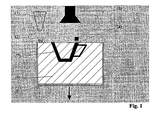
- Fig. 1 shows schematically the device again.
- untreated powdery substrate (2) which is presented in a reservoir (1), constructed into a matrix (8).
- the substrate is distributed by means of a doctor blade (2) to thin layers on the movable floor or previously applied layers
- the absorber (4) or the absorber-containing liquid is applied to selected regions of the layer of pulverulent substrate via a device (3) which can be moved in the x, y plane.
- a new layer of the powdery substrate is applied by means of energy input at a wavelength between 100 and 3000 nm by a laser or other energy source (5), the locations of the deposited substrate which have been treated with the absorber become a three-dimensional object, e.g. B. a cup (7). This step can also be done before the next powder layer is applied.
- a model of a small plate with the dimensions 3 * 20 * 1 mm 3 from a copolyamide powder (VESTAMELT 170, Degussa AG, Marl) is produced.
- the absorber used is a suspension based on KHP (Vestodur FP-LAS from Degussa) which has 40% by mass of distilled water, 40% by mass of KHP and 20% by mass of isopropanol.
- the device has an operating temperature of about 40 ° C.
- the wavelength of the diode laser with the dimensions of the beam spot of 1.5 x 3.5 mm is 940 nm.
- the layer thickness is 0.15 mm per layer, the diode laser with 200 watts of power at a speed of 700 mm / sec line by line on the build platform moved
- the D 50 value of the powder is 60 ⁇ m.
- Example 2 Production of a Platelet from Polyamide 12 by means of Diode Lasers
- a further plate with the dimensions 3 * 20 * 1 mm 3 of a polyamide 12 powder (EOSINT P PA 2200, EOS GmbH Electro Optical Systems, Krailling, Germany) is produced.
- the absorber used is Iriodin® LS 825.
- the liquid distributed by the inkjet method consisted of 30% by weight of iriodin, 59% isopropanol and 1% Pril (Henkel).
- the device has an operating temperature of about 160 ° C.
- the wavelength of the flat diode laser is 940 nm and the Beam spot is 1.5 x 3.5 mm.
- the height at which the powder layers were applied was 0.15 mm.
- the diode laser drives the building level line by line with 200 watts of power and a speed of 500 mm / sec.
- the powder used had a d 50 value of 55 ⁇ m.
- a 10x10 cm open-top box was provided with a bottom, which can be moved by a spindle The floor was moved to half an inch to the upper edge; the remaining space was filled with powder and smoothed with a metal plate.
- the apparatus was placed in the installation space of a Nd: YAG laser Star Mark 65 (manufacturer Carl Basel Laser Technology). The opening of the box was half covered and with a nebulizer (commercial, for perfume), the absorber-containing liquid was applied. It is important to ensure uniform wetting and to avoid dripping. Thereafter, the cover was removed and the entire surface was painted with the laser energy.
- the polymer used was a polyamide 12 from Degussa, namely a Vestosint 2157.
- the absorber used is Printex 60, also Degussa. 10 parts of Printex 60 were mixed with 70 parts of distilled water, 18 parts of isopropanol and 2 parts of Pril (Henkel).
- the device has an operating temperature of approximately 165 C.
- the wavelength of the Nd: YAG laser is 1.064 nm. Per layer, the Nd: YAG laser selectively travels the construction plane with 30 watts of power and a speed of 300 m / sec.
- the powder used had a d 50 value of 55 ⁇ m. In this experiment, a platelet could be made from the absorber-provided area. The non-absorber powder did not melt.
- the temperature control was to be optimized, because of the non-automated handling and the order of cold absorber Curl occurred.
Landscapes
- Engineering & Computer Science (AREA)
- Chemical & Material Sciences (AREA)
- Physics & Mathematics (AREA)
- Manufacturing & Machinery (AREA)
- Materials Engineering (AREA)
- Optics & Photonics (AREA)
- Mechanical Engineering (AREA)
- Plasma & Fusion (AREA)
- Health & Medical Sciences (AREA)
- Toxicology (AREA)
- Ceramic Engineering (AREA)
- Automation & Control Theory (AREA)
- General Health & Medical Sciences (AREA)
- Inorganic Chemistry (AREA)
- Structural Engineering (AREA)
- Organic Chemistry (AREA)
- Oral & Maxillofacial Surgery (AREA)
- Thermal Sciences (AREA)
- Powder Metallurgy (AREA)
Priority Applications (1)
| Application Number | Priority Date | Filing Date | Title |
|---|---|---|---|
| PL05707863T PL1737646T3 (pl) | 2004-03-16 | 2005-01-27 | Sposób i urządzenie do wytwarzania trójwymiarowych obiektów za pomocą techniki laserowej i nanoszenia absorbera metodą "INKJET" |
Applications Claiming Priority (2)
| Application Number | Priority Date | Filing Date | Title |
|---|---|---|---|
| DE102004012682A DE102004012682A1 (de) | 2004-03-16 | 2004-03-16 | Verfahren zur Herstellung von dreidimensionalen Objekten mittels Lasertechnik und Auftragen eines Absorbers per Inkjet-Verfahren |
| PCT/EP2005/050345 WO2005090055A1 (de) | 2004-03-16 | 2005-01-27 | Verfahren und vorrichtung zur herstellung von dreidimensionalen objekten mittels lasertechnik und auftragen eines absorbers per inkjet-verfahren |
Publications (2)
| Publication Number | Publication Date |
|---|---|
| EP1737646A1 EP1737646A1 (de) | 2007-01-03 |
| EP1737646B1 true EP1737646B1 (de) | 2007-05-23 |
Family
ID=34960507
Family Applications (1)
| Application Number | Title | Priority Date | Filing Date |
|---|---|---|---|
| EP05707863A Expired - Lifetime EP1737646B1 (de) | 2004-03-16 | 2005-01-27 | Verfahren zur herstellung von dreidimensionalen objekten mittels lasertechnik und auftragen eines absorbers per inkjet-verfahren |
Country Status (13)
| Country | Link |
|---|---|
| US (2) | US9114567B2 (https=) |
| EP (1) | EP1737646B1 (https=) |
| JP (1) | JP4914341B2 (https=) |
| KR (1) | KR100785584B1 (https=) |
| CN (1) | CN100564007C (https=) |
| AT (1) | ATE362836T1 (https=) |
| AU (1) | AU2005223365A1 (https=) |
| CA (1) | CA2560181A1 (https=) |
| DE (2) | DE102004012682A1 (https=) |
| ES (1) | ES2287901T3 (https=) |
| NO (1) | NO20064551L (https=) |
| PL (1) | PL1737646T3 (https=) |
| WO (1) | WO2005090055A1 (https=) |
Cited By (4)
| Publication number | Priority date | Publication date | Assignee | Title |
|---|---|---|---|---|
| WO2017108019A1 (de) * | 2015-12-21 | 2017-06-29 | Voxeljet Ag | Verfahren und vorrichutng zum herstellen von 3d-formteilen mit schichtaufbautechnik und steuerbarer pulverwalze |
| EP3388169A1 (en) | 2017-04-11 | 2018-10-17 | Fundació Institut de Ciències Fotòniques | A method and a system for producing a three-dimensional object |
| CN109070462A (zh) * | 2016-07-20 | 2018-12-21 | 惠普发展公司,有限责任合伙企业 | 在3d打印中形成微观结构 |
| US10518476B2 (en) | 2014-01-16 | 2019-12-31 | Hewlett-Packard Development Company, L.P. | Generating a three-dimensional object |
Families Citing this family (216)
| Publication number | Priority date | Publication date | Assignee | Title |
|---|---|---|---|---|
| WO2001034371A2 (en) | 1999-11-05 | 2001-05-17 | Z Corporation | Material systems and methods of three-dimensional printing |
| US20010050031A1 (en) | 2000-04-14 | 2001-12-13 | Z Corporation | Compositions for three-dimensional printing of solid objects |
| KR100628841B1 (ko) * | 2001-11-13 | 2006-09-29 | 데구사 아게 | 분해가능한 경화성 결합조립체 |
| CA2526100A1 (en) | 2003-05-21 | 2004-12-29 | Z Corporation | Thermoplastic powder material system for appearance models from 3d printing systems |
| DE102004001324A1 (de) * | 2003-07-25 | 2005-02-10 | Degussa Ag | Pulverförmige Komposition von Polymer und ammoniumpolyphosphathaltigem Flammschutzmittel, Verfahren zu dessen Herstellung und Formkörper, hergestellt aus diesem Pulver |
| GB0317387D0 (en) | 2003-07-25 | 2003-08-27 | Univ Loughborough | Method and apparatus for combining particulate material |
| DE10347665A1 (de) * | 2003-10-09 | 2005-05-19 | Degussa Ag | Vernetzbare Basisschicht für Fixiereinlagen nach dem Doppelpunktverfahren |
| DE10347628A1 (de) * | 2003-10-09 | 2005-05-19 | Degussa Ag | Vernetzbare Basisschicht für Fixiereinlagen nach dem Doppelpunktverfahren |
| DE10353995A1 (de) * | 2003-11-19 | 2005-06-09 | Degussa Ag | Nanoskaliges, kristallines Siliciumpulver |
| DE10353996A1 (de) * | 2003-11-19 | 2005-06-09 | Degussa Ag | Nanoskaliges, kristallines Siliciumpulver |
| DE102004029217A1 (de) * | 2004-06-16 | 2006-01-05 | Degussa Ag | Mehrschichtfolie |
| DE102004041746A1 (de) * | 2004-08-28 | 2006-03-02 | Degussa Ag | Kautschukmischung, enthaltend nanoskalige, magnetische Füllstoffe |
| DE102004041747A1 (de) * | 2004-08-28 | 2006-03-02 | Degussa Ag | Indium-Zinn-Mischoxidpulver |
| DE102004047876A1 (de) | 2004-10-01 | 2006-04-06 | Degussa Ag | Pulver mit verbesserten Recyclingeigenschaften, Verfahren zu dessen Herstellung und Verwendung des Pulvers in einem Verfahren zur Herstellung dreidimensionaler Objekte |
| DE102004051246A1 (de) * | 2004-10-20 | 2006-05-04 | Merck Patent Gmbh | Laserschweißbare Polymere |
| DE102005049136A1 (de) * | 2004-12-01 | 2006-06-08 | Degussa Ag | Zubereitung, enthaltend ein polymerisierbares Monomer und/oder ein Polymer und darin dispergiert ein superparamagnetisches Pulver |
| DE102004062761A1 (de) | 2004-12-21 | 2006-06-22 | Degussa Ag | Verwendung von Polyarylenetherketonpulver in einem dreidimensionalen pulverbasierenden werkzeuglosen Herstellverfahren, sowie daraus hergestellte Formteile |
| DE102004063220A1 (de) * | 2004-12-29 | 2006-07-13 | Degussa Ag | Transparente Formmassen |
| DE102005007664A1 (de) * | 2005-02-19 | 2006-08-31 | Degussa Ag | Transparente Formmasse |
| DE102005008044A1 (de) | 2005-02-19 | 2006-08-31 | Degussa Ag | Polymerpulver mit Blockpolyetheramid, Verwendung in einem formgebenden Verfahren und Formkörper, hergestellt aus diesem Polymerpulver |
| DE102005007665A1 (de) * | 2005-02-19 | 2006-08-31 | Degussa Ag | Folie auf Basis eines Polyamidblends |
| DE102005007663A1 (de) | 2005-02-19 | 2006-08-24 | Degussa Ag | Transparente, dekorierbare mehrschichtige Folie |
| BRPI0609111A2 (pt) * | 2005-04-18 | 2010-02-23 | Roehm Gmbh | processo para a preparação de um material de moldagem ou um molde, material de moldagem ou molde e seu uso |
| DE102005026264A1 (de) | 2005-06-08 | 2006-12-14 | Degussa Ag | Transparente Formmasse |
| DE102005033379A1 (de) | 2005-07-16 | 2007-01-18 | Degussa Ag | Verwendung von cyclischen Oligomeren in einem formgebenden Verfahren und Formkörper, hergestellt nach diesem Verfahren |
| DE102005049718A1 (de) * | 2005-10-14 | 2007-04-19 | Degussa Gmbh | Durch Schweißen im elektromagnetischen Wechselfeld erhältliche Kunststoffverbundformkörper |
| DE102005053071A1 (de) * | 2005-11-04 | 2007-05-16 | Degussa | Verfahren zur Herstellung von ultrafeinen Pulvern auf Basis Polymaiden, ultrafeinen Polyamidpulver sowie deren Verwendung |
| DE102005056286A1 (de) * | 2005-11-24 | 2007-05-31 | Degussa Gmbh | Schweißverfahren mittels elektromagnetischer Strahlung |
| DE102005060121A1 (de) * | 2005-12-16 | 2007-06-21 | Degussa Gmbh | Verfahren zur Herstellung von Zinkoxidpulver |
| DE102006007564A1 (de) * | 2006-02-16 | 2007-08-30 | Röhm Gmbh | Nanoskalige superparamagnetische Poly(meth)acrylatpolymere |
| DE102006015791A1 (de) | 2006-04-01 | 2007-10-04 | Degussa Gmbh | Polymerpulver, Verfahren zur Herstellung und Verwendung eines solchen Pulvers und Formkörper daraus |
| US20070241482A1 (en) * | 2006-04-06 | 2007-10-18 | Z Corporation | Production of three-dimensional objects by use of electromagnetic radiation |
| KR100796218B1 (ko) * | 2006-11-24 | 2008-01-21 | 주식회사 라이온켐텍 | 입자크기분포가 균일하고, 벌크밀도가 높은 레이저 소결용고분자 분말의 제조방법 |
| CN101568422B (zh) | 2006-12-08 | 2013-02-13 | 3D系统公司 | 使用过氧化物固化的三维印刷材料体系和方法 |
| WO2008086033A1 (en) | 2007-01-10 | 2008-07-17 | Z Corporation | Three-dimensional printing material system with improved color, article performance, and ease of use |
| US7968626B2 (en) | 2007-02-22 | 2011-06-28 | Z Corporation | Three dimensional printing material system and method using plasticizer-assisted sintering |
| DE102007019133A1 (de) * | 2007-04-20 | 2008-10-23 | Evonik Degussa Gmbh | Komposit-Pulver, Verwendung in einem formgebenden Verfahren und Formkörper, hergestellt aus diesem Pulver |
| DE102007024469B4 (de) | 2007-05-25 | 2009-04-23 | Eos Gmbh Electro Optical Systems | Verfahren zum schichtweisen Herstellen eines dreidimensionalen Objekts |
| DE102007032439A1 (de) | 2007-07-10 | 2009-01-22 | Volker Dr.-Ing. Grießbach | Verfahren zur Bestimmung von Eigenschaften dreidimensionaler Objekte |
| US10226919B2 (en) * | 2007-07-18 | 2019-03-12 | Voxeljet Ag | Articles and structures prepared by three-dimensional printing method |
| JP5467714B2 (ja) * | 2007-08-08 | 2014-04-09 | テクノポリマー株式会社 | レーザー焼結性粉体およびその造形物 |
| DE102007038578A1 (de) | 2007-08-16 | 2009-02-19 | Evonik Degussa Gmbh | Verfahren zur Dekorierung von Oberflächen |
| KR100783310B1 (ko) * | 2007-08-24 | 2007-12-10 | 주식회사 라이온켐텍 | 입자크기분포가 균일하고, 벌크밀도가 높은 레이저 소결용고분자 분말 |
| CA2717677C (en) | 2008-03-14 | 2016-11-01 | Valspar Sourcing, Inc. | Powder compositions and methods of manufacturing articles therefrom |
| DE102008000755B4 (de) | 2008-03-19 | 2019-12-12 | Evonik Degussa Gmbh | Copolyamidpulver und dessen Herstellung, Verwendung von Copolyamidpulver in einem formgebenden Verfahren und Formkörper, hergestellt aus diesem Copolyamidpulver |
| DE102008002599A1 (de) * | 2008-06-24 | 2009-12-31 | Evonik Degussa Gmbh | Bauteil mit Deckschicht aus einer PA613-Formmasse |
| GB0816308D0 (en) * | 2008-09-05 | 2008-10-15 | Mtt Technologies Ltd | Optical module |
| DE102008047118B4 (de) | 2008-09-15 | 2024-02-01 | Dürr Systems Ag | Lackieranlagenbauteil |
| US20110215076A1 (en) * | 2008-11-13 | 2011-09-08 | Qinetiq Limited | Laser ablation technique |
| DE102008058177A1 (de) * | 2008-11-20 | 2010-06-24 | Eos Gmbh Electro Optical Systems | Verfahren zur Identifizierung von Lasersinterpulvern |
| WO2010075395A2 (en) * | 2008-12-22 | 2010-07-01 | Valspar Sourcing, Inc. | Polyester powder compositions, methods and articles |
| US9889012B2 (en) | 2009-07-23 | 2018-02-13 | Didier NIMAL | Biomedical device, method for manufacturing the same and use thereof |
| EP2456473B1 (en) * | 2009-07-23 | 2016-02-17 | Didier Nimal | Biomedical device, method for manufacturing the same and use thereof |
| DE102009051552A1 (de) * | 2009-10-31 | 2011-05-05 | Mtu Aero Engines Gmbh | Verfahren und Vorrichtung zur Herstellung eines Bauteils |
| ES2514520T3 (es) * | 2009-12-04 | 2014-10-28 | Slm Solutions Gmbh | Unidad de irradiación óptica para una planta para la producción de piezas de trabajo mediante la irradiación de capas de polvo con radiación de láser |
| DE102010062875A1 (de) | 2010-12-13 | 2012-06-14 | Bayerische Motoren Werke Aktiengesellschaft | Verfahren zur Herstellung eines Bauteils durch Lasersintern |
| DE102011003610A1 (de) | 2011-02-03 | 2012-08-09 | Evonik Degussa Gmbh | Vorrichtung zur besseren Inertisierung von Lasersinteranlagen |
| DE102011078720A1 (de) | 2011-07-06 | 2013-01-10 | Evonik Degussa Gmbh | Pulver enthaltend mit Polymer beschichtete Kernpartikel enthaltend Metalle, Metalloxide, Metall- oder Halbmetallnitride |
| DE102011078721A1 (de) | 2011-07-06 | 2013-01-10 | Evonik Degussa Gmbh | Pulver enthaltend mit Polymer beschichtete polymere Kernpartikel |
| DE102011078722A1 (de) | 2011-07-06 | 2013-01-10 | Evonik Degussa Gmbh | Pulver enthaltend mit Polymer beschichtete anorganische Partikel |
| DE102011078719A1 (de) | 2011-07-06 | 2013-01-10 | Evonik Degussa Gmbh | Pulver enthaltend mit Polymer beschichtete Partikel |
| DE102011079521A1 (de) | 2011-07-21 | 2013-01-24 | Evonik Degussa Gmbh | Verbesserte Bauteileigenschaften durch Strahlformung im Laser-Sintern |
| RU2497978C2 (ru) * | 2011-07-22 | 2013-11-10 | Федеральное государственное образовательное учреждение высшего профессионального образования "Ижевская государственная сельскохозяйственная академия" | Способ формирования покрытия и установка для его осуществления |
| DE102011108514B4 (de) | 2011-07-26 | 2014-07-24 | Actech Gmbh | Vorrichtung zur thermischen Nachbehandlung von Formelementen |
| DE102011079812A1 (de) | 2011-07-26 | 2013-01-31 | Evonik Röhm Gmbh | Polymerpulver zur Herstellung dreidimensionaler Objekte |
| FR2983424B1 (fr) * | 2011-12-02 | 2014-09-19 | Nantes Ecole Centrale | Procede et dispositif d'usinage par addition de matiere et mise en forme combinees |
| DE102013004940A1 (de) * | 2012-10-15 | 2014-04-17 | Voxeljet Ag | Verfahren und Vorrichtung zum Herstellen von dreidimensionalen Modellen mit temperiertem Druckkopf |
| CN102990933B (zh) * | 2012-12-13 | 2015-02-18 | 余金文 | 一种选择性激光烧结工艺的实施方法 |
| JP5831440B2 (ja) * | 2012-12-17 | 2015-12-09 | 株式会社ダイヤメット | 粉末冶金用原料粉末 |
| EP2935412B1 (en) | 2012-12-19 | 2021-04-28 | Hexcel Corporation | Method for preparing fine powders for use in selective laser sintering processes |
| CN103170628B (zh) * | 2013-03-13 | 2015-04-08 | 宁波金科磁业有限公司 | 基于3d打印技术的钕铁硼的制备方法 |
| DE102013206542A1 (de) * | 2013-04-12 | 2014-10-16 | Matthias Fockele | Pulveraufbereitungsvorrichtung |
| DE102013212620A1 (de) * | 2013-06-28 | 2014-12-31 | Trumpf Gmbh + Co. Kg | Verfahren und Bearbeitungsmaschine zum Generieren eines dreidimensionalen Bauteils durch selektives Laserschmelzen |
| DE102013011767A1 (de) * | 2013-07-10 | 2015-01-15 | Hochschule Mittweida (Fh) | Verwendung von kurzgepulster Laserstrahlung eines Lasers zum Verfestigen von Schichten aus nichtmetallischen Pulver |
| DE102013019716A1 (de) * | 2013-11-27 | 2015-05-28 | Voxeljet Ag | 3D-Druckverfahren mit Schlicker |
| DE102013114003B4 (de) | 2013-12-13 | 2017-03-16 | Bundesanstalt für Materialforschung und -Prüfung (BAM) | Verfahren zur Sinterherstellung eines dreidimensionalen strukturierten Objektes und Sintervorrichtung hierzu |
| JP6570542B2 (ja) | 2014-01-16 | 2019-09-04 | ヒューレット−パッカード デベロップメント カンパニー エル.ピー.Hewlett‐Packard Development Company, L.P. | 三次元物体の生成 |
| US20170203513A1 (en) | 2014-01-16 | 2017-07-20 | Hewlett-Packard Development Company, L.P. | Generating a three-dimensional object |
| RU2650155C2 (ru) | 2014-01-16 | 2018-04-09 | Хьюлетт-Паккард Дивелопмент Компани, Л.П. | Формирование трехмерных объектов |
| US11273594B2 (en) | 2014-01-16 | 2022-03-15 | Hewlett-Packard Development Company, L.P. | Modifying data representing three-dimensional objects |
| EP2918359A1 (en) * | 2014-03-11 | 2015-09-16 | BAE Systems PLC | Sintering particulate material |
| EP2918394A1 (en) * | 2014-03-11 | 2015-09-16 | BAE Systems PLC | Sintering particulate material |
| WO2015136277A1 (en) | 2014-03-11 | 2015-09-17 | Bae Systems Plc | Forming a three dimensional object |
| US10471657B2 (en) | 2014-03-11 | 2019-11-12 | Bae Systems Plc | Sintering particulate material |
| GB2527492A (en) * | 2014-04-28 | 2015-12-30 | Sivaprakash Shanmugam | 3D Printing material |
| MX375127B (es) * | 2014-04-30 | 2025-03-06 | Hewlett Packard Development Co | Modelo computacional y métodos de impresión tridimensional (3d). |
| US10434708B2 (en) * | 2014-04-30 | 2019-10-08 | Hewlett-Packard Development Company, L.P. | Three-dimensional (3D) printing method |
| WO2015172765A1 (de) * | 2014-05-10 | 2015-11-19 | Ikic, Jovan | Verfahren und vorrichtung zur herstellung von künstlichem brechsand bzw. quetschsand durch thermische behandlung unter der verwendung von sand in form von feinsand (fs/fsa) und/oder rundsand als ausgangsstoff. |
| CN106488819B (zh) | 2014-06-20 | 2018-06-22 | 维洛3D公司 | 用于三维打印的设备、系统和方法 |
| WO2015200280A1 (en) * | 2014-06-23 | 2015-12-30 | Applied Cavitation, Inc. | Systems and methods for additive manufacturing using ceramic materials |
| DE102014110505A1 (de) * | 2014-07-25 | 2016-01-28 | Christian-Albrechts-Universität Zu Kiel | Verfahren zur Herstellung von Mehrkomponentenwerkstücken mittels 3D-Druck |
| WO2016033343A1 (en) * | 2014-08-27 | 2016-03-03 | Nuburu, Inc. | Applications, methods and systems for materials processing with visible raman laser |
| US9650526B2 (en) * | 2014-09-09 | 2017-05-16 | 3D Systems, Inc. | Method of printing a three-dimensional article |
| JP6432236B2 (ja) * | 2014-09-17 | 2018-12-05 | 富士ゼロックス株式会社 | 粉体塗装装置、及び粉体塗装方法 |
| WO2016048348A1 (en) | 2014-09-26 | 2016-03-31 | Hewlett-Packard Development Company, L.P. | Lighting for additive manufacturing |
| EP3197669B1 (en) * | 2014-09-26 | 2020-04-01 | Hewlett-Packard Development Company, L.P. | 3-dimensional printing |
| EP3197667B1 (en) * | 2014-09-26 | 2021-06-02 | Hewlett-Packard Development Company, L.P. | Processssor readable medium and method for additive manufacturing |
| WO2016048380A1 (en) | 2014-09-26 | 2016-03-31 | Hewlett-Packard Development Company, L.P. | 3-dimensional printing |
| JP6472885B2 (ja) * | 2014-09-30 | 2019-02-20 | ヒューレット−パッカード デベロップメント カンパニー エル.ピー.Hewlett‐Packard Development Company, L.P. | 三次元物体の生成 |
| CN106794605B (zh) * | 2014-10-03 | 2019-08-27 | 惠普发展公司有限责任合伙企业 | 控制表面的加热 |
| US11254068B2 (en) | 2014-10-29 | 2022-02-22 | Hewlett-Packard Development Company, L.P. | Three-dimensional (3D) printing method |
| WO2016072966A1 (en) * | 2014-11-03 | 2016-05-12 | Hewlett-Packard Development Company, L.P. | Thermally decomposing material for three-dimensional printing |
| DE102014117519B4 (de) * | 2014-11-28 | 2016-06-09 | Fraunhofer-Gesellschaft zur Förderung der angewandten Forschung e.V. | Verfahren zur Herstellung und Überprüfung von Werkstücken und Werkstück |
| CH710441A2 (de) | 2014-12-02 | 2016-06-15 | Rowak Ag | Pulverförmige Zusammensetzungen aus thermoplastischen Kunststoffen und Verwendung der Zusammensetzungen. |
| DE102015006533A1 (de) * | 2014-12-22 | 2016-06-23 | Voxeljet Ag | Verfahren und Vorrichtung zum Herstellen von 3D-Formteilen mit Schichtaufbautechnik |
| US11117322B2 (en) * | 2015-01-14 | 2021-09-14 | Hewlett-Packard Development Company, L.P. | Additive manufacturing |
| DE102015202476A1 (de) * | 2015-02-12 | 2016-08-18 | Bayerische Motorenwerke Aktiengesellschaft | Verfahren zur Herstellung einer Bauteilschicht eines belastungsoptimierten Bauteils und Verfahren zur Herstellung eines belastungsoptimierten Bauteils |
| CN105984148A (zh) * | 2015-02-17 | 2016-10-05 | 优克材料科技股份有限公司 | 具有喷印单元与烧结用光源的三维打印装置及三维打印方法 |
| CN107771109B (zh) * | 2015-06-19 | 2021-09-07 | 应用材料公司 | 在增材制造中的材料分配和压实 |
| US10919217B2 (en) | 2015-07-23 | 2021-02-16 | Hewlett-Packard Development Company, L.P. | Three-dimensional (3D) printing build material composition |
| WO2017018985A1 (en) | 2015-07-24 | 2017-02-02 | Hewlett-Packard Development Company, L.P. | Three-dimensional (3d) printing |
| EP3325191B1 (en) * | 2015-07-24 | 2020-09-30 | Hewlett-Packard Development Company, L.P. | Stabilizing liquid functional material for three-dimensional (3d) printing |
| CN107530968A (zh) * | 2015-07-30 | 2018-01-02 | 惠普发展公司有限责任合伙企业 | 用于3d打印的受控加热 |
| KR102045231B1 (ko) * | 2015-07-30 | 2019-11-15 | 휴렛-팩커드 디벨롭먼트 컴퍼니, 엘.피. | 3차원 물체 생성 |
| WO2017069778A1 (en) * | 2015-10-23 | 2017-04-27 | Hewlett-Packard Development Company, L.P. | Three-dimensional (3d) printing |
| EP4137256A1 (en) * | 2015-10-30 | 2023-02-22 | Seurat Technologies, Inc. | Additive manufacturing system and method |
| US9676145B2 (en) | 2015-11-06 | 2017-06-13 | Velo3D, Inc. | Adept three-dimensional printing |
| CN108463300A (zh) | 2015-11-16 | 2018-08-28 | 瑞尼斯豪公司 | 用于增材制造设备和方法的模块 |
| DE102015014964A1 (de) * | 2015-11-20 | 2017-05-24 | Voxeljet Ag | Verfahren und Vorrichtung für 3D-Druck mit engem Wellenlängenspektrum |
| US10071422B2 (en) | 2015-12-10 | 2018-09-11 | Velo3D, Inc. | Skillful three-dimensional printing |
| EP3181615A1 (de) | 2015-12-14 | 2017-06-21 | Evonik Degussa GmbH | Polymerpulver für powder bed fusion-verfahren |
| GB201522691D0 (en) * | 2015-12-22 | 2016-02-03 | Lucite Internat Speciality Polymers And Resins Ltd | Additive manufacturing composition |
| WO2017123995A1 (en) * | 2016-01-14 | 2017-07-20 | Arconic Inc. | Methods for producing forged products and other worked products |
| DE102016000435A1 (de) | 2016-01-18 | 2017-07-20 | Audi Ag | Substanz zum Herstellen eines Bauteils |
| CN112936856B (zh) * | 2016-01-25 | 2024-08-02 | 惠普发展公司,有限责任合伙企业 | 三维(3d)物体打印模拟器 |
| WO2017131764A1 (en) * | 2016-01-29 | 2017-08-03 | Hewlett-Packard Development Company, L.P. | Additive manufacturing with irradiation filter |
| JP6956489B2 (ja) * | 2016-02-05 | 2021-11-02 | 一般財団法人ファインセラミックスセンター | 焼結方法及び焼結物の製造方法 |
| CN108602726B (zh) * | 2016-02-05 | 2022-07-15 | 财团法人日本精细陶瓷中心 | 陶瓷烧结体的制造方法、以及陶瓷成型体的制造方法和制造装置 |
| US10583606B2 (en) * | 2016-02-11 | 2020-03-10 | General Electric Company | Method and supports with powder removal ports for additive manufacturing |
| CN108883575A (zh) | 2016-02-18 | 2018-11-23 | 维洛3D公司 | 准确的三维打印 |
| SG11201806148XA (en) * | 2016-02-19 | 2018-09-27 | Basf Se | Kaolin for the mechanical reinforcement of polymeric laser sinter powder |
| CN108367492B (zh) * | 2016-02-25 | 2020-03-06 | 惠普发展公司,有限责任合伙企业 | 使用烧结助剂/固定剂流体和液体功能材料的三维(3d)打印 |
| CN108698324B (zh) * | 2016-03-10 | 2020-09-18 | 惠普发展公司,有限责任合伙企业 | 构造层覆盖分析 |
| WO2017158688A1 (ja) * | 2016-03-14 | 2017-09-21 | 株式会社日立ハイテクノロジーズ | 樹脂粉末材料及び樹脂造形物の製造方法 |
| DE102016204905A1 (de) * | 2016-03-23 | 2017-09-28 | Eos Gmbh Electro Optical Systems | Verfahren und Vorrichtung zum Herstellen eines dreidimensionalen Objekts |
| CN108496055B (zh) | 2016-04-15 | 2020-10-27 | 惠普发展公司,有限责任合伙企业 | 三维印刷的测力传感器部件 |
| JP6680887B2 (ja) | 2016-04-15 | 2020-04-15 | ヒューレット−パッカード デベロップメント カンパニー エル.ピー.Hewlett‐Packard Development Company, L.P. | 複合粒状構築材料 |
| BR112018015436B1 (pt) | 2016-04-28 | 2022-11-29 | Hewlett-Packard Development Company, L.P. | Método de impressão tridimensional de uma peça impressa e conjunto de material de impressão tridimensional |
| EP3448943A4 (en) | 2016-04-28 | 2019-12-25 | Hewlett-Packard Development Company, L.P. | Photoluminescent material sets |
| US11465341B2 (en) | 2016-04-28 | 2022-10-11 | Hewlett-Packard Development Company, L.P. | 3-dimensional printed parts |
| EP3455056B1 (en) | 2016-05-13 | 2021-09-22 | Hewlett-Packard Development Company, L.P. | Material sets |
| US11084210B2 (en) | 2016-05-17 | 2021-08-10 | Hewlett-Packard Development Company, L.P. | 3D printer with tuned coolant droplets |
| US11691343B2 (en) | 2016-06-29 | 2023-07-04 | Velo3D, Inc. | Three-dimensional printing and three-dimensional printers |
| US10286452B2 (en) | 2016-06-29 | 2019-05-14 | Velo3D, Inc. | Three-dimensional printing and three-dimensional printers |
| CN109414880A (zh) * | 2016-07-01 | 2019-03-01 | 宇部兴产株式会社 | 热熔层叠型三维打印用材料及使用了其的热熔层叠型三维打印用长丝 |
| US9987682B2 (en) | 2016-08-03 | 2018-06-05 | 3Deo, Inc. | Devices and methods for three-dimensional printing |
| CA3032821A1 (en) | 2016-08-03 | 2018-02-08 | 3Deo, Inc. | Devices and methods for three-dimensional printing |
| KR20190050807A (ko) | 2016-09-09 | 2019-05-13 | 메르크 파텐트 게엠베하 | 고체 약학적 투여 형태의 제조 방법 |
| WO2018064349A1 (en) | 2016-09-30 | 2018-04-05 | Velo3D, Inc. | Three-dimensional objects and their formation |
| DE102016219080A1 (de) | 2016-09-30 | 2018-04-05 | Evonik Degussa Gmbh | Polyamidpulver für selektive Sinterverfahren |
| DE102016120044A1 (de) * | 2016-10-20 | 2018-04-26 | Cl Schutzrechtsverwaltungs Gmbh | Vorrichtung zur additiven Herstellung dreidimensionaler Objekte |
| US11458675B2 (en) | 2016-10-25 | 2022-10-04 | Hewlett-Packard Development Company, L.P. | Material sets |
| WO2018080537A1 (en) | 2016-10-31 | 2018-05-03 | Hewlett-Packard Development Company, L.P. | 3d printer with a uv light absorbing agent |
| WO2018128695A2 (en) | 2016-11-07 | 2018-07-12 | Velo3D, Inc. | Gas flow in three-dimensional printing |
| CN106626379B (zh) * | 2016-12-29 | 2018-11-09 | 湖南华曙高科技有限责任公司 | 激光制造聚酰胺三维物体的方法和装置 |
| US10611092B2 (en) | 2017-01-05 | 2020-04-07 | Velo3D, Inc. | Optics in three-dimensional printing |
| CN106738908B (zh) * | 2017-01-24 | 2023-08-18 | 广州恒锐电子技术有限公司 | 一种快速多烧结增材制造设备及方法 |
| EP3354632A1 (en) | 2017-01-25 | 2018-08-01 | Siemens Aktiengesellschaft | Method to additively manufacture a fiber-reinforced ceramic matrix composite |
| EP3363561A1 (en) | 2017-02-16 | 2018-08-22 | Höganäs AB | Particles having a sinterable core and a polymeric coating, use thereof, and additive manufacturing method using the same |
| US20180250744A1 (en) | 2017-03-02 | 2018-09-06 | Velo3D, Inc. | Three-dimensional printing of three-dimensional objects |
| US10449696B2 (en) | 2017-03-28 | 2019-10-22 | Velo3D, Inc. | Material manipulation in three-dimensional printing |
| WO2018194564A1 (en) | 2017-04-18 | 2018-10-25 | Hewlett-Packard Development Company, L.P. | Increasing electrical conductivity at selected locations of a 3d object |
| CN108947270B (zh) * | 2017-05-19 | 2020-11-06 | 比亚迪股份有限公司 | 3d装饰玻璃及其制备方法 |
| US10926329B2 (en) * | 2017-05-31 | 2021-02-23 | General Electric Company | Methods and apparatuses to grow compression chambers in powder based additive manufacturing to relieve powder loading on grown part |
| US11338363B2 (en) | 2017-06-28 | 2022-05-24 | Hewlett-Packard Development Company, L.P. | Three-dimensional printing |
| JP7011548B2 (ja) * | 2017-07-14 | 2022-01-26 | キヤノン株式会社 | セラミックス造形用粉体、セラミックス造形物、およびその製造方法 |
| WO2019022755A1 (en) * | 2017-07-28 | 2019-01-31 | Hewlett-Packard Development Company, L.P. | THREE-DIMENSIONAL PRINTER WITH MOVING DEVICE |
| US11152556B2 (en) | 2017-07-29 | 2021-10-19 | Nanohmics, Inc. | Flexible and conformable thermoelectric compositions |
| JP6959790B2 (ja) * | 2017-08-04 | 2021-11-05 | 一般財団法人ファインセラミックスセンター | 焼結方法及び焼結物の製造方法 |
| US20200269493A1 (en) * | 2017-09-28 | 2020-08-27 | National Science And Technology Development Agency | A method for mold-free manufacturing of natural rubber articles |
| US11420384B2 (en) | 2017-10-03 | 2022-08-23 | General Electric Company | Selective curing additive manufacturing method |
| DE102018100508A1 (de) * | 2017-10-18 | 2019-04-18 | Value & Intellectual Properties Management Gmbh | 3D-Schmelzdruckverfahren |
| CN111511531B (zh) * | 2017-10-25 | 2023-03-28 | 惠普发展公司,有限责任合伙企业 | 3d制造系统中的未熔合热支撑区域 |
| EP3477176A1 (de) | 2017-10-25 | 2019-05-01 | Evonik Degussa GmbH | Verfahren zur herstellung eines mit einem inliner ausgekleideten rohres |
| JP7366529B2 (ja) * | 2017-10-27 | 2023-10-23 | キヤノン株式会社 | 造形物の製造方法および造形物 |
| WO2019115455A1 (en) * | 2017-12-15 | 2019-06-20 | Sabic Global Technologies B.V. | Polymer composition for selective sintering |
| US10272525B1 (en) | 2017-12-27 | 2019-04-30 | Velo3D, Inc. | Three-dimensional printing systems and methods of their use |
| US10144176B1 (en) | 2018-01-15 | 2018-12-04 | Velo3D, Inc. | Three-dimensional printing systems and methods of their use |
| US11413816B2 (en) | 2018-03-20 | 2022-08-16 | Hewlett-Packard Development Company, L.P. | Compositions for printing |
| WO2019182577A1 (en) | 2018-03-21 | 2019-09-26 | Hewlett-Packard Development Company, L.P. | Three-dimensional printing |
| US11548216B2 (en) | 2018-03-21 | 2023-01-10 | Hewlett-Packard Development Company, L.P. | Three-dimensional printing |
| EP4624541A3 (en) | 2018-03-21 | 2025-10-08 | Peridot Print LLC | Three-dimensional printing |
| US11396130B2 (en) * | 2018-03-23 | 2022-07-26 | Hewlett-Packard Development Company, L.P. | Three-dimensional printing |
| US11426818B2 (en) | 2018-08-10 | 2022-08-30 | The Research Foundation for the State University | Additive manufacturing processes and additively manufactured products |
| US11712845B2 (en) | 2018-10-16 | 2023-08-01 | Hewlett-Packard Development Company, L.P. | Three-dimensional printing |
| DE102018219302A1 (de) | 2018-11-12 | 2020-05-14 | Eos Gmbh Electro Optical Systems | Selektives Sintern von polymerbasiertem Aufbaumaterial |
| WO2020113200A1 (en) * | 2018-12-01 | 2020-06-04 | Innovamake, Inc. | System and method for three-dimensional production |
| EP3883750A4 (en) * | 2019-01-16 | 2022-06-29 | Hewlett-Packard Development Company, L.P. | Three-dimensional printing |
| EP3698956A1 (de) | 2019-02-21 | 2020-08-26 | Evonik Operations GmbH | Verfahren zur oberflächenbearbeitung von polymeren dreidimensionalen objekten |
| WO2020190260A1 (en) | 2019-03-15 | 2020-09-24 | Hewlett-Packard Development Company, L.P. | Patterns on objects in additive manufacturing |
| EP3840937B1 (en) | 2019-03-15 | 2023-07-26 | Hewlett-Packard Development Company, L.P. | Coloured object generation |
| JP7263863B2 (ja) * | 2019-03-20 | 2023-04-25 | 株式会社リコー | 立体造形物の製造装置、及び立体造形物の製造方法 |
| US11618212B2 (en) * | 2019-03-20 | 2023-04-04 | Desktop Metal, Inc. | Additive fabrication of sinterable metallic parts via application of directed energy |
| US11945168B2 (en) | 2019-04-30 | 2024-04-02 | Hewlett-Packard Development Company, L.P. | Colored object generation |
| EP3741790A1 (de) | 2019-05-20 | 2020-11-25 | Evonik Operations GmbH | Polyamide mit cyclischen terpenoiden substrukturen |
| CN110142968B (zh) * | 2019-06-06 | 2021-07-06 | 珠海天威飞马打印耗材有限公司 | 一种3d打印材料及其制备方法 |
| US11939484B2 (en) | 2019-06-10 | 2024-03-26 | Hewlett-Packard Development Company, L.P. | Three-dimensional printing |
| WO2020254108A1 (de) * | 2019-06-19 | 2020-12-24 | Infinite Flex GmbH | Pulver zum lasersintern und verwendung |
| GB201909269D0 (en) * | 2019-06-27 | 2019-08-14 | Johnson Matthey Plc | Layered sorbent structures |
| EP3969208B1 (en) * | 2019-07-17 | 2024-08-28 | Hewlett-Packard Development Company, L.P. | Three-dimensional printing with metal oxide nanoparticle fusing agents |
| KR20230047214A (ko) | 2019-07-26 | 2023-04-06 | 벨로3디, 인크. | 3차원 물체 형상화에 대한 품질 보증 |
| WO2021080568A1 (en) * | 2019-10-22 | 2021-04-29 | Hewlett-Packard Development Company, L.P. | Three-dimensional printing with gas-atomized stainless steel particles |
| US12145315B2 (en) * | 2019-12-11 | 2024-11-19 | Hewlett-Packard Development Company, L.P. | Three-dimensional printing |
| WO2021201879A1 (en) * | 2020-04-03 | 2021-10-07 | Hewlett-Packard Development Company, L.P. | Three-dimensional printing with thermoplastic elastomeric particles |
| CN111689764B (zh) * | 2020-07-06 | 2022-05-31 | 南京理工大学 | 一种低成本激光选区熔化用陶瓷粉末制备及其离焦成形方法 |
| CN112893764B (zh) * | 2021-01-21 | 2022-04-12 | 大连理工大学 | 一种可用于光纤激光加工的3d打印覆膜硅砂及其制备方法 |
| DE102021110037A1 (de) | 2021-04-21 | 2022-10-27 | Bayerische Motoren Werke Aktiengesellschaft | Verfahren zur Bestimmung einer Dichte einer Schicht aus pulverförmigem Material |
| US12448538B2 (en) | 2021-06-02 | 2025-10-21 | Peridot Print Llc | Three-dimensional printing kits |
| US20240247167A1 (en) * | 2021-06-02 | 2024-07-25 | Hewlett-Packard Development Company, L.P. | Three-dimensional printing with variable dielectric permittivity |
| US12397502B1 (en) | 2021-12-20 | 2025-08-26 | Desktop Metal, Inc. | Polymer-synthesizing binder compositions for additive fabrication and related methods and compositions |
| EP4245506A1 (de) | 2022-03-15 | 2023-09-20 | Evonik Operations GmbH | Pulver zur verarbeitung in einem schichtweisen verfahren mit lasern im sichtbaren und nahinfrarotbereich |
| DE202022000644U1 (de) | 2022-03-15 | 2022-04-21 | Evonik Operations Gmbh | Pulver zur Verarbeitung in einem schichtweisen Verfahren mit Lasern im sichtbaren und Nahinfrarotbereich |
| CN114750411A (zh) * | 2022-06-16 | 2022-07-15 | 季华实验室 | 材料挤出式3d打印方法 |
| EP4417641A1 (de) | 2023-02-16 | 2024-08-21 | Evonik Operations GmbH | Pulver insbesondere für eine schichtweise herstellung von dreidimensionalen objekten |
| CN116748686B (zh) * | 2023-04-25 | 2026-04-17 | 华南理工大学 | 一种乙醇辅助激光加工的梯度疏水钛合金板的工艺 |
| DE102024108444A1 (de) | 2024-03-25 | 2025-09-25 | Eos Gmbh Electro Optical Systems | Kunststoffpulver mit inkorporiertem Absorber für pulverbasierte 3D Druckverfahren |
Family Cites Families (73)
| Publication number | Priority date | Publication date | Assignee | Title |
|---|---|---|---|---|
| JPS5817539B2 (ja) * | 1978-09-18 | 1983-04-07 | 旭化成株式会社 | メラミンシアヌレ−ト含有ポリアミド組成物の製造方法 |
| US4247508B1 (en) * | 1979-12-03 | 1996-10-01 | Dtm Corp | Molding process |
| US4863538A (en) | 1986-10-17 | 1989-09-05 | Board Of Regents, The University Of Texas System | Method and apparatus for producing parts by selective sintering |
| KR960008015B1 (ko) | 1986-10-17 | 1996-06-19 | 보드 오브 리젼츠, 디 유니버시티 오브 텍사스 시스템 | 선택적 소결에 의한 부품의 제조 방법 및 장치 |
| US5132522A (en) * | 1991-01-30 | 1992-07-21 | Olympus Optical Co., Ltd. | Information-reading method |
| DE4137430A1 (de) * | 1991-11-14 | 1993-05-19 | Huels Chemische Werke Ag | Mehrschichtiges kunststoffrohr |
| US5265114C1 (en) * | 1992-09-10 | 2001-08-21 | Electro Scient Ind Inc | System and method for selectively laser processing a target structure of one or more materials of a multimaterial multilayer device |
| US5352405A (en) * | 1992-12-18 | 1994-10-04 | Dtm Corporation | Thermal control of selective laser sintering via control of the laser scan |
| US5393482A (en) * | 1993-10-20 | 1995-02-28 | United Technologies Corporation | Method for performing multiple beam laser sintering employing focussed and defocussed laser beams |
| US5624437A (en) * | 1995-03-28 | 1997-04-29 | Freeman; Jerre M. | High resolution, high speed, programmable laser beam modulating apparatus for microsurgery |
| US6288499B1 (en) * | 1997-06-12 | 2001-09-11 | Biolase Technology, Inc. | Electromagnetic energy distributions for electromagnetically induced mechanical cutting |
| US6156030A (en) * | 1997-06-04 | 2000-12-05 | Y-Beam Technologies, Inc. | Method and apparatus for high precision variable rate material removal and modification |
| DE19723892C1 (de) * | 1997-06-06 | 1998-09-03 | Rainer Hoechsmann | Verfahren zum Herstellen von Bauteilen durch Auftragstechnik |
| AU744727B2 (en) * | 1997-07-21 | 2002-02-28 | Vantico Ag | Sedimentation stabilized radiation-curable filled compositions |
| US6203861B1 (en) * | 1998-01-12 | 2001-03-20 | University Of Central Florida | One-step rapid manufacturing of metal and composite parts |
| US6136497A (en) * | 1998-03-30 | 2000-10-24 | Vantico, Inc. | Liquid, radiation-curable composition, especially for producing flexible cured articles by stereolithography |
| DE19918981A1 (de) | 1999-04-27 | 2000-11-02 | Bayer Ag | Verfahren und Material zur Herstellung von Modellkörpern |
| WO2001038061A1 (en) * | 1999-10-26 | 2001-05-31 | University Of Southern California | Process of making a three-dimensional object |
| US20010050031A1 (en) * | 2000-04-14 | 2001-12-13 | Z Corporation | Compositions for three-dimensional printing of solid objects |
| JP2001334583A (ja) * | 2000-05-25 | 2001-12-04 | Minolta Co Ltd | 三次元造形装置 |
| US6833234B1 (en) * | 2000-08-04 | 2004-12-21 | Massachusetts Institute Of Technology | Stereolithographic patterning with variable size exposure areas |
| US6896839B2 (en) * | 2001-02-07 | 2005-05-24 | Minolta Co., Ltd. | Three-dimensional molding apparatus and three-dimensional molding method |
| JP2002264221A (ja) * | 2001-03-14 | 2002-09-18 | Minolta Co Ltd | 三次元造形装置、および三次元造形方法 |
| DE10140089A1 (de) * | 2001-08-16 | 2003-02-27 | Degussa | Superparamagnetische oxidische Partikel, Verfahren zu deren Herstellung und ihre Verwendung |
| DE10153547A1 (de) * | 2001-10-30 | 2003-05-22 | Degussa | Dispersion, enthaltend pyrogen hergestellte Abrasivpartikel mit superparamagnetischen Domänen |
| KR100628841B1 (ko) * | 2001-11-13 | 2006-09-29 | 데구사 아게 | 분해가능한 경화성 결합조립체 |
| DE10201903A1 (de) * | 2002-01-19 | 2003-07-31 | Degussa | Formmasse auf Basis von Polyetheramiden |
| US20040021256A1 (en) * | 2002-07-25 | 2004-02-05 | Degrange Jeffrey E. | Direct manufacture of aerospace parts |
| DE10235758A1 (de) * | 2002-08-05 | 2004-02-26 | Degussa Ag | Dotiertes Zinkoxidpulver, Verfahren zu seiner Herstellung und Verwendung |
| DE10236697A1 (de) * | 2002-08-09 | 2004-02-26 | Eos Gmbh Electro Optical Systems | Verfahren und Vorrichtung zur Herstellung eines dreidimensionalen Objekts mittels Sintern |
| ATE383939T1 (de) * | 2002-09-21 | 2008-02-15 | Evonik Degussa Gmbh | Verfahren zur herstellung eines dreidimensionalen objektes |
| EP1413594A2 (de) * | 2002-10-17 | 2004-04-28 | Degussa AG | Laser-Sinter-Pulver mit verbesserten Recyclingeigenschaften, Verfahren zu dessen Herstellung und Verwendung des Laser-Sinter-Pulvers |
| DE10248406A1 (de) * | 2002-10-17 | 2004-04-29 | Degussa Ag | Laser-Sinter-Pulver mit Titandioxidpartikeln, Verfahren zu dessen Herstellung und Formkörper, hergestellt aus diesem Laser-Sinterpulver |
| DE10251790A1 (de) * | 2002-11-07 | 2004-05-19 | Degussa Ag | Polyamidpulver mit dauerhafter, gleichbleibend guter Rieselfähigkeit |
| ATE320465T1 (de) * | 2002-11-28 | 2006-04-15 | Degussa | Laser-sinter-pulver mit metallseifen, verfahren zu dessen herstellung und formkörper, hergestellt aus diesem laser-sinter-pulver |
| EP1459871B1 (de) * | 2003-03-15 | 2011-04-06 | Evonik Degussa GmbH | Verfahren und Vorrichtung zur Herstellung von dreidimensionalen Objekten mittels Mikrowellenstrahlung sowie dadurch hergestellter Formkörper |
| DE10311437A1 (de) * | 2003-03-15 | 2004-09-23 | Degussa Ag | Laser-Sinter-Pulver mit PMMI, PMMA und/oder PMMI-PMMA-Copolymeren, Verfahren zu dessen Herstellung und Formkörper, hergestellt aus diesem Laser-Sinterpulver |
| DE10333005A1 (de) * | 2003-07-18 | 2005-02-03 | Degussa Ag | Formmasse auf Basis von Polyetheramiden |
| DE102004001324A1 (de) * | 2003-07-25 | 2005-02-10 | Degussa Ag | Pulverförmige Komposition von Polymer und ammoniumpolyphosphathaltigem Flammschutzmittel, Verfahren zu dessen Herstellung und Formkörper, hergestellt aus diesem Pulver |
| GB0317387D0 (en) * | 2003-07-25 | 2003-08-27 | Univ Loughborough | Method and apparatus for combining particulate material |
| DE10334496A1 (de) * | 2003-07-29 | 2005-02-24 | Degussa Ag | Laser-Sinter-Pulver mit einem Metallsalz und einem Fettsäurederivat, Verfahren zu dessen Herstellung und Formkörper, hergestellt aus diesem Laser-Sinterpulver |
| DE10334497A1 (de) * | 2003-07-29 | 2005-02-24 | Degussa Ag | Polymerpulver mit phosphonatbasierendem Flammschutzmittel, Verfahren zu dessen Herstellung und Formkörper, hergestellt aus diesem Polymerpulver |
| DE10337707A1 (de) | 2003-08-16 | 2005-04-07 | Degussa Ag | Verfahren zur Erhöhung des Molekulargewichts bei Polyamiden |
| DE10343728A1 (de) * | 2003-09-22 | 2005-04-21 | Degussa | Zinkoxidpulver |
| DE10347628A1 (de) * | 2003-10-09 | 2005-05-19 | Degussa Ag | Vernetzbare Basisschicht für Fixiereinlagen nach dem Doppelpunktverfahren |
| DE10347665A1 (de) * | 2003-10-09 | 2005-05-19 | Degussa Ag | Vernetzbare Basisschicht für Fixiereinlagen nach dem Doppelpunktverfahren |
| DE10353995A1 (de) * | 2003-11-19 | 2005-06-09 | Degussa Ag | Nanoskaliges, kristallines Siliciumpulver |
| DE10353996A1 (de) * | 2003-11-19 | 2005-06-09 | Degussa Ag | Nanoskaliges, kristallines Siliciumpulver |
| EP1722984B1 (de) * | 2004-03-04 | 2008-06-04 | Evonik Degussa GmbH | Durch farbmittel transparent, transluzent oder gedeckt eingefärbte laserschweissbare kunststoffmaterialien |
| DE102004010504B4 (de) | 2004-03-04 | 2006-05-04 | Degussa Ag | Hochtransparente lasermarkierbare und laserschweißbare Kunststoffmaterialien, deren Verwendung und Herstellung sowie Verwendung von Metallmischoxiden und Verfahren zur Kennzeichnung von Produktionsgütern |
| DE102004029217A1 (de) * | 2004-06-16 | 2006-01-05 | Degussa Ag | Mehrschichtfolie |
| DE102004041746A1 (de) * | 2004-08-28 | 2006-03-02 | Degussa Ag | Kautschukmischung, enthaltend nanoskalige, magnetische Füllstoffe |
| DE102004047876A1 (de) * | 2004-10-01 | 2006-04-06 | Degussa Ag | Pulver mit verbesserten Recyclingeigenschaften, Verfahren zu dessen Herstellung und Verwendung des Pulvers in einem Verfahren zur Herstellung dreidimensionaler Objekte |
| DE102004062761A1 (de) * | 2004-12-21 | 2006-06-22 | Degussa Ag | Verwendung von Polyarylenetherketonpulver in einem dreidimensionalen pulverbasierenden werkzeuglosen Herstellverfahren, sowie daraus hergestellte Formteile |
| DE102004063220A1 (de) * | 2004-12-29 | 2006-07-13 | Degussa Ag | Transparente Formmassen |
| DE102005002930A1 (de) * | 2005-01-21 | 2006-07-27 | Degussa Ag | Polymerpulver mit Polyamid, Verwendung in einem formgebenden Verfahren und Formkörper, hergestellt aus diesem Polymerpulver |
| DE102005007034A1 (de) | 2005-02-15 | 2006-08-17 | Degussa Ag | Verfahren zur Herstellung von Formteilen unter Erhöhung der Schmelzesteifigkeit |
| DE102005007035A1 (de) | 2005-02-15 | 2006-08-17 | Degussa Ag | Verfahren zur Herstellung von Formteilen unter Erhöhung der Schmelzesteifigkeit |
| DE102005007664A1 (de) * | 2005-02-19 | 2006-08-31 | Degussa Ag | Transparente Formmasse |
| DE102005008044A1 (de) * | 2005-02-19 | 2006-08-31 | Degussa Ag | Polymerpulver mit Blockpolyetheramid, Verwendung in einem formgebenden Verfahren und Formkörper, hergestellt aus diesem Polymerpulver |
| DE102005007663A1 (de) * | 2005-02-19 | 2006-08-24 | Degussa Ag | Transparente, dekorierbare mehrschichtige Folie |
| US7704586B2 (en) * | 2005-03-09 | 2010-04-27 | Degussa Ag | Plastic molded bodies having two-dimensional and three-dimensional image structures produced through laser subsurface engraving |
| BRPI0609111A2 (pt) | 2005-04-18 | 2010-02-23 | Roehm Gmbh | processo para a preparação de um material de moldagem ou um molde, material de moldagem ou molde e seu uso |
| DE102005026264A1 (de) * | 2005-06-08 | 2006-12-14 | Degussa Ag | Transparente Formmasse |
| DE102005040157A1 (de) * | 2005-08-25 | 2007-03-01 | Degussa Ag | Paste aus nanoskaligem Pulver und Dispergiermittel |
| DE102005051126A1 (de) * | 2005-10-26 | 2007-05-03 | Degussa Gmbh | Folie mit Deckschicht aus einer Polyamidzusammensetzung |
| DE102005053071A1 (de) * | 2005-11-04 | 2007-05-16 | Degussa | Verfahren zur Herstellung von ultrafeinen Pulvern auf Basis Polymaiden, ultrafeinen Polyamidpulver sowie deren Verwendung |
| DE102005059405A1 (de) * | 2005-12-13 | 2007-06-14 | Degussa Gmbh | Zinkoxid-Ceroxid-Kompositpartikel |
| DE102005060121A1 (de) * | 2005-12-16 | 2007-06-21 | Degussa Gmbh | Verfahren zur Herstellung von Zinkoxidpulver |
| DE102007021199B4 (de) * | 2006-07-17 | 2016-02-11 | Evonik Degussa Gmbh | Zusammensetzungen aus organischem Polymer als Matrix und anorganischen Partikeln als Füllstoff, Verfahren zu deren Herstellung sowie deren Verwendung und damit hergestellte Formkörper |
| US20080123552A1 (en) | 2006-11-29 | 2008-05-29 | General Electric Company | Method and system for switchless backplane controller using existing standards-based backplanes |
| DE202010005162U1 (de) * | 2010-04-17 | 2010-11-04 | Evonik Degussa Gmbh | Vorrichtung zur Verkleinerung des unteren Bauraums einer Lasersinteranlage |
| CN106536121A (zh) * | 2014-04-17 | 2017-03-22 | 巴克斯特国际公司 | 使用光学反射器在工件上执行环形周向焊接的激光器装置 |
-
2004
- 2004-03-16 DE DE102004012682A patent/DE102004012682A1/de not_active Withdrawn
-
2005
- 2005-01-27 CN CNB2005800150582A patent/CN100564007C/zh not_active Expired - Lifetime
- 2005-01-27 ES ES05707863T patent/ES2287901T3/es not_active Expired - Lifetime
- 2005-01-27 PL PL05707863T patent/PL1737646T3/pl unknown
- 2005-01-27 WO PCT/EP2005/050345 patent/WO2005090055A1/de not_active Ceased
- 2005-01-27 KR KR1020067019070A patent/KR100785584B1/ko not_active Expired - Fee Related
- 2005-01-27 AU AU2005223365A patent/AU2005223365A1/en not_active Abandoned
- 2005-01-27 AT AT05707863T patent/ATE362836T1/de not_active IP Right Cessation
- 2005-01-27 US US10/592,952 patent/US9114567B2/en not_active Expired - Lifetime
- 2005-01-27 DE DE502005000753T patent/DE502005000753D1/de not_active Expired - Lifetime
- 2005-01-27 CA CA002560181A patent/CA2560181A1/en not_active Abandoned
- 2005-01-27 JP JP2007503318A patent/JP4914341B2/ja not_active Expired - Lifetime
- 2005-01-27 EP EP05707863A patent/EP1737646B1/de not_active Expired - Lifetime
-
2006
- 2006-10-06 NO NO20064551A patent/NO20064551L/no not_active Application Discontinuation
-
2015
- 2015-05-20 US US14/717,122 patent/US10118222B2/en not_active Expired - Lifetime
Cited By (10)
| Publication number | Priority date | Publication date | Assignee | Title |
|---|---|---|---|---|
| US10518476B2 (en) | 2014-01-16 | 2019-12-31 | Hewlett-Packard Development Company, L.P. | Generating a three-dimensional object |
| US10625468B2 (en) | 2014-01-16 | 2020-04-21 | Hewlett-Packard Development Company, L.P. | Generating a three-dimensional object |
| US11679560B2 (en) | 2014-01-16 | 2023-06-20 | Hewlett-Packard Development Company, L.P. | Generating a three-dimensional object |
| WO2017108019A1 (de) * | 2015-12-21 | 2017-06-29 | Voxeljet Ag | Verfahren und vorrichutng zum herstellen von 3d-formteilen mit schichtaufbautechnik und steuerbarer pulverwalze |
| US12208572B2 (en) | 2015-12-21 | 2025-01-28 | Voxeljet Ag | Method and device for producing 3D shaped parts using layering technology, and controllable powder roller |
| CN109070462A (zh) * | 2016-07-20 | 2018-12-21 | 惠普发展公司,有限责任合伙企业 | 在3d打印中形成微观结构 |
| CN109070462B (zh) * | 2016-07-20 | 2020-11-03 | 惠普发展公司,有限责任合伙企业 | 在3d打印中形成微观结构 |
| EP3388169A1 (en) | 2017-04-11 | 2018-10-17 | Fundació Institut de Ciències Fotòniques | A method and a system for producing a three-dimensional object |
| WO2018189190A1 (en) | 2017-04-11 | 2018-10-18 | Fundació Institut De Ciències Fotòniques | A method and a system for producing a three-dimensional object |
| US11420264B2 (en) | 2017-04-11 | 2022-08-23 | Fundació Institut De Ciències Fotôniques | Method and a system for producing a three-dimensional object |
Also Published As
| Publication number | Publication date |
|---|---|
| PL1737646T3 (pl) | 2007-10-31 |
| JP2007529340A (ja) | 2007-10-25 |
| CA2560181A1 (en) | 2005-09-29 |
| NO20064551L (no) | 2006-10-06 |
| CN100564007C (zh) | 2009-12-02 |
| KR20060123637A (ko) | 2006-12-01 |
| DE502005000753D1 (de) | 2007-07-05 |
| US20070183918A1 (en) | 2007-08-09 |
| US9114567B2 (en) | 2015-08-25 |
| US10118222B2 (en) | 2018-11-06 |
| ATE362836T1 (de) | 2007-06-15 |
| JP4914341B2 (ja) | 2012-04-11 |
| US20150251247A1 (en) | 2015-09-10 |
| ES2287901T3 (es) | 2007-12-16 |
| DE102004012682A1 (de) | 2005-10-06 |
| KR100785584B1 (ko) | 2007-12-13 |
| EP1737646A1 (de) | 2007-01-03 |
| CN1950192A (zh) | 2007-04-18 |
| AU2005223365A1 (en) | 2005-09-29 |
| WO2005090055A1 (de) | 2005-09-29 |
Similar Documents
| Publication | Publication Date | Title |
|---|---|---|
| EP1737646B1 (de) | Verfahren zur herstellung von dreidimensionalen objekten mittels lasertechnik und auftragen eines absorbers per inkjet-verfahren | |
| EP1740367B1 (de) | Verfahren zur herstellung von dreidimensionalen objekten mittels elektromagnetischer strahlung und auftragen eines absorbers per inkjet-verfahren | |
| EP1459871B1 (de) | Verfahren und Vorrichtung zur Herstellung von dreidimensionalen Objekten mittels Mikrowellenstrahlung sowie dadurch hergestellter Formkörper | |
| EP1400340B1 (de) | Verfahren zur Herstellung eines dreidimensionalen Objektes | |
| EP3237181B1 (de) | Verfahren zum herstellen von 3d-formteilen mittels schichtaufbautechnik | |
| DE69622581T2 (de) | Laserimterstützte herstellung von gegenständen unter verwendung von isostatischer heissverarbeitung | |
| EP3074208B1 (de) | 3d-druckverfahren mit schlicker | |
| DE102007016656B4 (de) | PAEK-Pulver, insbesondere zur Verwendung in einem Verfahren zum schichtweisen Herstellen eines dreidimensionalen Objektes, sowie Verfahren zu dessen Herstellung | |
| WO2005090056A1 (de) | Lasersintern mit lasern mit einer wellenlänge von 100 bis 3000 nm | |
| EP3028842B1 (de) | Pulverförmige zusammensetzungen aus thermoplastischen kunststoffen und verwendung der zusammensetzungen | |
| US11541568B2 (en) | Three-dimensional (3D) printing with a detailing agent fluid and a liquid functional material | |
| DE112014006198T5 (de) | Erzeugen eines dreidimensionalen Gegenstandes | |
| DE10356193A1 (de) | Verfahren zur Herstellung von dreidimensionalen Objekten mittels Mikrowellenstrahlung | |
| EP1706255A1 (de) | Schichtaufbauendes verfahren zur herstellung eines dreidimensionalen gegenstandes sowie daf r geeignete materialsysteme | |
| DE102017211381A1 (de) | Verfahren zum Abkühlen und Abkühlvorrichtung | |
| DE10311446A1 (de) | Polymerpulver für SIV-Verfahren | |
| WO2022022763A1 (de) | Verfahren zum herstellen eines 3d-formkörpers sowie vorrichtung unter verwendung einer siebplatte | |
| DE102015217690A1 (de) | Härtbare Zusammensetzung |
Legal Events
| Date | Code | Title | Description |
|---|---|---|---|
| PUAI | Public reference made under article 153(3) epc to a published international application that has entered the european phase |
Free format text: ORIGINAL CODE: 0009012 |
|
| 17P | Request for examination filed |
Effective date: 20060901 |
|
| AK | Designated contracting states |
Kind code of ref document: A1 Designated state(s): AT BE BG CH CY CZ DE DK EE ES FI FR GB GR HU IE IS IT LI LT LU MC NL PL PT RO SE SI SK TR |
|
| GRAP | Despatch of communication of intention to grant a patent |
Free format text: ORIGINAL CODE: EPIDOSNIGR1 |
|
| RIC1 | Information provided on ipc code assigned before grant |
Ipc: B29C 67/04 20060101ALN20061219BHEP Ipc: B29C 67/00 20060101AFI20061219BHEP |
|
| RTI1 | Title (correction) |
Free format text: METHOD FOR PRODUCING THREE-DIMENSIONAL OBJECTS USING LASER TECHNOLOGY AND BY APPLYING AN ABSORBER USING AN INK-JET METHOD |
|
| RAP1 | Party data changed (applicant data changed or rights of an application transferred) |
Owner name: DEGUSSA GMBH |
|
| GRAS | Grant fee paid |
Free format text: ORIGINAL CODE: EPIDOSNIGR3 |
|
| GRAA | (expected) grant |
Free format text: ORIGINAL CODE: 0009210 |
|
| AK | Designated contracting states |
Kind code of ref document: B1 Designated state(s): AT BE BG CH CY CZ DE DK EE ES FI FR GB GR HU IE IS IT LI LT LU MC NL PL PT RO SE SI SK TR |
|
| DAX | Request for extension of the european patent (deleted) | ||
| REG | Reference to a national code |
Ref country code: GB Ref legal event code: FG4D Free format text: NOT ENGLISH |
|
| REG | Reference to a national code |
Ref country code: CH Ref legal event code: EP |
|
| REG | Reference to a national code |
Ref country code: IE Ref legal event code: FG4D Free format text: LANGUAGE OF EP DOCUMENT: GERMAN |
|
| REF | Corresponds to: |
Ref document number: 502005000753 Country of ref document: DE Date of ref document: 20070705 Kind code of ref document: P |
|
| REG | Reference to a national code |
Ref country code: SE Ref legal event code: TRGR |
|
| GBT | Gb: translation of ep patent filed (gb section 77(6)(a)/1977) |
Effective date: 20070820 |
|
| PG25 | Lapsed in a contracting state [announced via postgrant information from national office to epo] |
Ref country code: IS Free format text: LAPSE BECAUSE OF FAILURE TO SUBMIT A TRANSLATION OF THE DESCRIPTION OR TO PAY THE FEE WITHIN THE PRESCRIBED TIME-LIMIT Effective date: 20070923 |
|
| REG | Reference to a national code |
Ref country code: PL Ref legal event code: T3 |
|
| RAP2 | Party data changed (patent owner data changed or rights of a patent transferred) |
Owner name: EVONIK DEGUSSA GMBH |
|
| ET | Fr: translation filed | ||
| REG | Reference to a national code |
Ref country code: ES Ref legal event code: FG2A Ref document number: 2287901 Country of ref document: ES Kind code of ref document: T3 |
|
| NLT2 | Nl: modifications (of names), taken from the european patent patent bulletin |
Owner name: EVONIK DEGUSSA GMBH Effective date: 20071107 |
|
| PG25 | Lapsed in a contracting state [announced via postgrant information from national office to epo] |
Ref country code: DK Free format text: LAPSE BECAUSE OF FAILURE TO SUBMIT A TRANSLATION OF THE DESCRIPTION OR TO PAY THE FEE WITHIN THE PRESCRIBED TIME-LIMIT Effective date: 20070523 Ref country code: SI Free format text: LAPSE BECAUSE OF FAILURE TO SUBMIT A TRANSLATION OF THE DESCRIPTION OR TO PAY THE FEE WITHIN THE PRESCRIBED TIME-LIMIT Effective date: 20070523 Ref country code: PT Free format text: LAPSE BECAUSE OF FAILURE TO SUBMIT A TRANSLATION OF THE DESCRIPTION OR TO PAY THE FEE WITHIN THE PRESCRIBED TIME-LIMIT Effective date: 20071023 |
|
| PG25 | Lapsed in a contracting state [announced via postgrant information from national office to epo] |
Ref country code: LT Free format text: LAPSE BECAUSE OF FAILURE TO SUBMIT A TRANSLATION OF THE DESCRIPTION OR TO PAY THE FEE WITHIN THE PRESCRIBED TIME-LIMIT Effective date: 20070523 |
|
| PLBI | Opposition filed |
Free format text: ORIGINAL CODE: 0009260 |
|
| 26 | Opposition filed |
Opponent name: EOS GMBH ELECTRO OPTICAL SYSTEMS Effective date: 20080222 |
|
| PG25 | Lapsed in a contracting state [announced via postgrant information from national office to epo] |
Ref country code: GR Free format text: LAPSE BECAUSE OF FAILURE TO SUBMIT A TRANSLATION OF THE DESCRIPTION OR TO PAY THE FEE WITHIN THE PRESCRIBED TIME-LIMIT Effective date: 20070824 |
|
| PLAX | Notice of opposition and request to file observation + time limit sent |
Free format text: ORIGINAL CODE: EPIDOSNOBS2 |
|
| PG25 | Lapsed in a contracting state [announced via postgrant information from national office to epo] |
Ref country code: RO Free format text: LAPSE BECAUSE OF FAILURE TO SUBMIT A TRANSLATION OF THE DESCRIPTION OR TO PAY THE FEE WITHIN THE PRESCRIBED TIME-LIMIT Effective date: 20070523 |
|
| NLR1 | Nl: opposition has been filed with the epo |
Opponent name: EOS GMBH ELECTRO OPTICAL SYSTEMS |
|
| RAP2 | Party data changed (patent owner data changed or rights of a patent transferred) |
Owner name: EVONIK DEGUSSA GMBH |
|
| PG25 | Lapsed in a contracting state [announced via postgrant information from national office to epo] |
Ref country code: MC Free format text: LAPSE BECAUSE OF NON-PAYMENT OF DUE FEES Effective date: 20080131 |
|
| PLAF | Information modified related to communication of a notice of opposition and request to file observations + time limit |
Free format text: ORIGINAL CODE: EPIDOSCOBS2 |
|
| NLT2 | Nl: modifications (of names), taken from the european patent patent bulletin |
Owner name: EVONIK DEGUSSA GMBH Effective date: 20080806 |
|
| PLBB | Reply of patent proprietor to notice(s) of opposition received |
Free format text: ORIGINAL CODE: EPIDOSNOBS3 |
|
| PG25 | Lapsed in a contracting state [announced via postgrant information from national office to epo] |
Ref country code: EE Free format text: LAPSE BECAUSE OF FAILURE TO SUBMIT A TRANSLATION OF THE DESCRIPTION OR TO PAY THE FEE WITHIN THE PRESCRIBED TIME-LIMIT Effective date: 20070523 |
|
| PGFP | Annual fee paid to national office [announced via postgrant information from national office to epo] |
Ref country code: AT Payment date: 20090115 Year of fee payment: 5 Ref country code: LU Payment date: 20090115 Year of fee payment: 5 |
|
| PGFP | Annual fee paid to national office [announced via postgrant information from national office to epo] |
Ref country code: FI Payment date: 20090115 Year of fee payment: 5 Ref country code: NL Payment date: 20090114 Year of fee payment: 5 Ref country code: PL Payment date: 20081230 Year of fee payment: 5 Ref country code: SK Payment date: 20090126 Year of fee payment: 5 |
|
| PG25 | Lapsed in a contracting state [announced via postgrant information from national office to epo] |
Ref country code: CY Free format text: LAPSE BECAUSE OF FAILURE TO SUBMIT A TRANSLATION OF THE DESCRIPTION OR TO PAY THE FEE WITHIN THE PRESCRIBED TIME-LIMIT Effective date: 20070523 |
|
| PG25 | Lapsed in a contracting state [announced via postgrant information from national office to epo] |
Ref country code: BG Free format text: LAPSE BECAUSE OF FAILURE TO SUBMIT A TRANSLATION OF THE DESCRIPTION OR TO PAY THE FEE WITHIN THE PRESCRIBED TIME-LIMIT Effective date: 20070823 |
|
| PGFP | Annual fee paid to national office [announced via postgrant information from national office to epo] |
Ref country code: SE Payment date: 20090114 Year of fee payment: 5 |
|
| REG | Reference to a national code |
Ref country code: CH Ref legal event code: PFA Owner name: EVONIK DEGUSSA GMBH Free format text: DEGUSSA GMBH#BENNIGSENPLATZ 1#40474 DUESSELDORF (DE) -TRANSFER TO- EVONIK DEGUSSA GMBH#RELLINGHAUSER STRASSE 1-11#45128 ESSEN (DE) |
|
| NLT1 | Nl: modifications of names registered in virtue of documents presented to the patent office pursuant to art. 16 a, paragraph 1 |
Owner name: EVONIK DEGUSSA GMBH |
|
| REG | Reference to a national code |
Ref country code: FR Ref legal event code: CA Ref country code: FR Ref legal event code: CD |
|
| REG | Reference to a national code |
Ref country code: SK Ref legal event code: TE4A Ref document number: E 2299 Country of ref document: SK Owner name: EVONIK DEGUSSA GMBH, ESSEN, DE Effective date: 20100426 Ref country code: SK Ref legal event code: TC4A Ref document number: E 2299 Country of ref document: SK Owner name: EVONIK DEGUSSA GMBH, ESSEN, DE Effective date: 20100426 |
|
| PG25 | Lapsed in a contracting state [announced via postgrant information from national office to epo] |
Ref country code: HU Free format text: LAPSE BECAUSE OF FAILURE TO SUBMIT A TRANSLATION OF THE DESCRIPTION OR TO PAY THE FEE WITHIN THE PRESCRIBED TIME-LIMIT Effective date: 20071124 |
|
| REG | Reference to a national code |
Ref country code: NL Ref legal event code: V1 Effective date: 20100801 |
|
| PG25 | Lapsed in a contracting state [announced via postgrant information from national office to epo] |
Ref country code: TR Free format text: LAPSE BECAUSE OF FAILURE TO SUBMIT A TRANSLATION OF THE DESCRIPTION OR TO PAY THE FEE WITHIN THE PRESCRIBED TIME-LIMIT Effective date: 20070523 |
|
| EUG | Se: european patent has lapsed | ||
| REG | Reference to a national code |
Ref country code: SK Ref legal event code: MM4A Ref document number: E 2299 Country of ref document: SK Effective date: 20100127 |
|
| PG25 | Lapsed in a contracting state [announced via postgrant information from national office to epo] |
Ref country code: NL Free format text: LAPSE BECAUSE OF NON-PAYMENT OF DUE FEES Effective date: 20100801 |
|
| PG25 | Lapsed in a contracting state [announced via postgrant information from national office to epo] |
Ref country code: AT Free format text: LAPSE BECAUSE OF NON-PAYMENT OF DUE FEES Effective date: 20100127 Ref country code: SK Free format text: LAPSE BECAUSE OF NON-PAYMENT OF DUE FEES Effective date: 20100127 Ref country code: FI Free format text: LAPSE BECAUSE OF NON-PAYMENT OF DUE FEES Effective date: 20100127 |
|
| REG | Reference to a national code |
Ref country code: PL Ref legal event code: LAPE |
|
| PG25 | Lapsed in a contracting state [announced via postgrant information from national office to epo] |
Ref country code: PL Free format text: LAPSE BECAUSE OF NON-PAYMENT OF DUE FEES Effective date: 20100127 |
|
| PG25 | Lapsed in a contracting state [announced via postgrant information from national office to epo] |
Ref country code: LU Free format text: LAPSE BECAUSE OF NON-PAYMENT OF DUE FEES Effective date: 20100127 Ref country code: SE Free format text: LAPSE BECAUSE OF NON-PAYMENT OF DUE FEES Effective date: 20100128 |
|
| REG | Reference to a national code |
Ref country code: FR Ref legal event code: PLFP Year of fee payment: 12 |
|
| PLAB | Opposition data, opponent's data or that of the opponent's representative modified |
Free format text: ORIGINAL CODE: 0009299OPPO |
|
| PLBP | Opposition withdrawn |
Free format text: ORIGINAL CODE: 0009264 |
|
| R26 | Opposition filed (corrected) |
Opponent name: EOS GMBH ELECTRO OPTICAL SYSTEMS Effective date: 20080222 |
|
| PLBD | Termination of opposition procedure: decision despatched |
Free format text: ORIGINAL CODE: EPIDOSNOPC1 |
|
| REG | Reference to a national code |
Ref country code: DE Ref legal event code: R100 Ref document number: 502005000753 Country of ref document: DE |
|
| PLBM | Termination of opposition procedure: date of legal effect published |
Free format text: ORIGINAL CODE: 0009276 |
|
| STAA | Information on the status of an ep patent application or granted ep patent |
Free format text: STATUS: OPPOSITION PROCEDURE CLOSED |
|
| 27C | Opposition proceedings terminated |
Effective date: 20160415 |
|
| REG | Reference to a national code |
Ref country code: DE Ref legal event code: R079 Ref document number: 502005000753 Country of ref document: DE Free format text: PREVIOUS MAIN CLASS: B29C0067000000 Ipc: B29C0064106000 |
|
| REG | Reference to a national code |
Ref country code: FR Ref legal event code: PLFP Year of fee payment: 13 |
|
| REG | Reference to a national code |
Ref country code: FR Ref legal event code: PLFP Year of fee payment: 14 |
|
| REG | Reference to a national code |
Ref country code: DE Ref legal event code: R081 Ref document number: 502005000753 Country of ref document: DE Owner name: EVONIK OPERATIONS GMBH, DE Free format text: FORMER OWNER: EVONIK DEGUSSA GMBH, 40474 DUESSELDORF, DE |
|
| REG | Reference to a national code |
Ref country code: CH Ref legal event code: PFA Owner name: EVONIK OPERATIONS GMBH, DE Free format text: FORMER OWNER: EVONIK DEGUSSA GMBH, DE |
|
| REG | Reference to a national code |
Ref country code: ES Ref legal event code: PC2A Owner name: EVONIK OPERATIONS GMBH Effective date: 20200622 |
|
| REG | Reference to a national code |
Ref country code: BE Ref legal event code: HC Owner name: EVONIK OPERATIONS GMBH; DE Free format text: DETAILS ASSIGNMENT: CHANGE OF OWNER(S), CHANGEMENT DE NOM DU PROPRIETAIRE Effective date: 20200403 |
|
| P01 | Opt-out of the competence of the unified patent court (upc) registered |
Effective date: 20230526 |
|
| PGFP | Annual fee paid to national office [announced via postgrant information from national office to epo] |
Ref country code: ES Payment date: 20240223 Year of fee payment: 20 Ref country code: IE Payment date: 20240119 Year of fee payment: 20 |
|
| PGFP | Annual fee paid to national office [announced via postgrant information from national office to epo] |
Ref country code: DE Payment date: 20240119 Year of fee payment: 20 Ref country code: CZ Payment date: 20240118 Year of fee payment: 20 Ref country code: CH Payment date: 20240201 Year of fee payment: 20 Ref country code: GB Payment date: 20240119 Year of fee payment: 20 |
|
| PGFP | Annual fee paid to national office [announced via postgrant information from national office to epo] |
Ref country code: IT Payment date: 20240129 Year of fee payment: 20 Ref country code: FR Payment date: 20240124 Year of fee payment: 20 Ref country code: BE Payment date: 20240119 Year of fee payment: 20 |
|
| REG | Reference to a national code |
Ref country code: DE Ref legal event code: R071 Ref document number: 502005000753 Country of ref document: DE |
|
| REG | Reference to a national code |
Ref country code: CH Ref legal event code: PL |
|
| REG | Reference to a national code |
Ref country code: ES Ref legal event code: FD2A Effective date: 20250203 |
|
| REG | Reference to a national code |
Ref country code: GB Ref legal event code: PE20 Expiry date: 20250126 |
|
| REG | Reference to a national code |
Ref country code: IE Ref legal event code: MK9A |
|
| REG | Reference to a national code |
Ref country code: BE Ref legal event code: MK Effective date: 20250127 |
|
| PG25 | Lapsed in a contracting state [announced via postgrant information from national office to epo] |
Ref country code: ES Free format text: LAPSE BECAUSE OF EXPIRATION OF PROTECTION Effective date: 20250128 |
|
| PG25 | Lapsed in a contracting state [announced via postgrant information from national office to epo] |
Ref country code: IE Free format text: LAPSE BECAUSE OF EXPIRATION OF PROTECTION Effective date: 20250127 |
|
| PG25 | Lapsed in a contracting state [announced via postgrant information from national office to epo] |
Ref country code: CZ Free format text: LAPSE BECAUSE OF EXPIRATION OF PROTECTION Effective date: 20250127 |
|
| PG25 | Lapsed in a contracting state [announced via postgrant information from national office to epo] |
Ref country code: GB Free format text: LAPSE BECAUSE OF EXPIRATION OF PROTECTION Effective date: 20250126 |