EP1645552B1 - Dispositifs électroluminescents fabriqués avec composés organiques à configuration spiro doublée - Google Patents
Dispositifs électroluminescents fabriqués avec composés organiques à configuration spiro doublée Download PDFInfo
- Publication number
- EP1645552B1 EP1645552B1 EP05020697A EP05020697A EP1645552B1 EP 1645552 B1 EP1645552 B1 EP 1645552B1 EP 05020697 A EP05020697 A EP 05020697A EP 05020697 A EP05020697 A EP 05020697A EP 1645552 B1 EP1645552 B1 EP 1645552B1
- Authority
- EP
- European Patent Office
- Prior art keywords
- organic
- compounds
- light
- double
- spiro
- Prior art date
- Legal status (The legal status is an assumption and is not a legal conclusion. Google has not performed a legal analysis and makes no representation as to the accuracy of the status listed.)
- Expired - Lifetime
Links
- 0 C1[C@](C2)[C@@]3[C@]2C*CC13 Chemical compound C1[C@](C2)[C@@]3[C@]2C*CC13 0.000 description 9
- DVFLOMOYVIILCX-UHFFFAOYSA-N C(C(C=C1)c2nc(cccc3)c3[s]2)C=C1c1ccc(C2(c3ccccc3-c3ccccc23)c2c(C34c5ccccc5-c5c3cccc5)cccc2)c4c1 Chemical compound C(C(C=C1)c2nc(cccc3)c3[s]2)C=C1c1ccc(C2(c3ccccc3-c3ccccc23)c2c(C34c5ccccc5-c5c3cccc5)cccc2)c4c1 DVFLOMOYVIILCX-UHFFFAOYSA-N 0.000 description 1
- JFUVXOZPXBEDNE-UHFFFAOYSA-N C(C1)C=CC(C(c2nc(cccc3)c3[n]2-c2ccccc2)=C(C2)C3C=CC2c2cc(C4(c5ccccc5-c5ccccc45)c4c(C56c7ccccc7-c7ccccc57)cccc4)c6cc2)=C1C3c1nc2ccccc2[n]1C1=CC=CCC1 Chemical compound C(C1)C=CC(C(c2nc(cccc3)c3[n]2-c2ccccc2)=C(C2)C3C=CC2c2cc(C4(c5ccccc5-c5ccccc45)c4c(C56c7ccccc7-c7ccccc57)cccc4)c6cc2)=C1C3c1nc2ccccc2[n]1C1=CC=CCC1 JFUVXOZPXBEDNE-UHFFFAOYSA-N 0.000 description 1
- CLVMKBNYAMTSFU-UHFFFAOYSA-N C(C1)C=CC(c2ccccc22)=C1C2(c1ccccc1C12c3ccccc3-c3ccccc13)c(cc1)c2cc1-c(cc1)ccc1-c1c(cccc2)c2c(-c2nc(cccc3)c3[n]2-c2ccccc2)c2c1cccc2 Chemical compound C(C1)C=CC(c2ccccc22)=C1C2(c1ccccc1C12c3ccccc3-c3ccccc13)c(cc1)c2cc1-c(cc1)ccc1-c1c(cccc2)c2c(-c2nc(cccc3)c3[n]2-c2ccccc2)c2c1cccc2 CLVMKBNYAMTSFU-UHFFFAOYSA-N 0.000 description 1
- QGCDXTDCHJMIIY-UHFFFAOYSA-N C(C1)CC=CC1N(C(CC1)CCC1C1CCSCC1)C1C=CCCC1 Chemical compound C(C1)CC=CC1N(C(CC1)CCC1C1CCSCC1)C1C=CCCC1 QGCDXTDCHJMIIY-UHFFFAOYSA-N 0.000 description 1
- FYFNTRQHFHTPDX-UHFFFAOYSA-N C(C1c2c3cccc2)C=CC=C1C31c2cc(-c3nc(cccc4)c4[s]3)ccc2C2(c3ccccc3-c3ccccc23)c2ccccc12 Chemical compound C(C1c2c3cccc2)C=CC=C1C31c2cc(-c3nc(cccc4)c4[s]3)ccc2C2(c3ccccc3-c3ccccc23)c2ccccc12 FYFNTRQHFHTPDX-UHFFFAOYSA-N 0.000 description 1
- OBRWEJUNRSDFJQ-UHFFFAOYSA-N C(C1c2ccccc22)C=CC=C1C2(C1C=CC(c2c(cccc3)c3c(-c(cc3)cc4c3nc(-c3ccccc3)c(-c3ccccc3)n4)c3c2cccc3)=CC11)c2ccccc2C11c2ccccc2C2C1=CC=CC2 Chemical compound C(C1c2ccccc22)C=CC=C1C2(C1C=CC(c2c(cccc3)c3c(-c(cc3)cc4c3nc(-c3ccccc3)c(-c3ccccc3)n4)c3c2cccc3)=CC11)c2ccccc2C11c2ccccc2C2C1=CC=CC2 OBRWEJUNRSDFJQ-UHFFFAOYSA-N 0.000 description 1
- NIZZLKWAZHPMIV-UHFFFAOYSA-N C(CC1C2(C(CC3)C4C=C3N(C3CC5C6C=CC=CC66)c7ccccc7C3C=C5N6C(CCC35)=CC3C3(C6C=CC=CC6C6=CC=CCC36)C3C=CC=CC3C53c5ccccc5C5C=CCCC35)c3ccccc3C43c4ccccc4-c4ccccc34)CC=C1C1=C2C=CCC1 Chemical compound C(CC1C2(C(CC3)C4C=C3N(C3CC5C6C=CC=CC66)c7ccccc7C3C=C5N6C(CCC35)=CC3C3(C6C=CC=CC6C6=CC=CCC36)C3C=CC=CC3C53c5ccccc5C5C=CCCC35)c3ccccc3C43c4ccccc4-c4ccccc34)CC=C1C1=C2C=CCC1 NIZZLKWAZHPMIV-UHFFFAOYSA-N 0.000 description 1
- NXNOKYFQVVBZEA-UHFFFAOYSA-N C(CC=CC12)C1c1ccccc1C2(c1ccccc1C12c3ccccc3C3C=CC=CC13)c(cc1)c2cc1-c1c(cccc2)c2c(-c(cc2)ccc2-c2nc(C=CCC3)c3[n]2-c2ccccc2)c2c1cccc2 Chemical compound C(CC=CC12)C1c1ccccc1C2(c1ccccc1C12c3ccccc3C3C=CC=CC13)c(cc1)c2cc1-c1c(cccc2)c2c(-c(cc2)ccc2-c2nc(C=CCC3)c3[n]2-c2ccccc2)c2c1cccc2 NXNOKYFQVVBZEA-UHFFFAOYSA-N 0.000 description 1
- ZVSPDIITBKEIEB-UHFFFAOYSA-N C1C=C(C2(c3c4cccc3)c3cc(-[n]5c6ccccc6c6c5cccc6)ccc3C3(c5ccccc5-c5c3cccc5)c3c2ccc(-[n]2c5ccccc5c5ccccc25)c3)C4=CC1 Chemical compound C1C=C(C2(c3c4cccc3)c3cc(-[n]5c6ccccc6c6c5cccc6)ccc3C3(c5ccccc5-c5c3cccc5)c3c2ccc(-[n]2c5ccccc5c5ccccc25)c3)C4=CC1 ZVSPDIITBKEIEB-UHFFFAOYSA-N 0.000 description 1
- UGMSIQNDHYYRKQ-UHFFFAOYSA-N C1C=Cc2c(-c3nc4ccccc4[s]3)c(cccc3)c3c(-c3cc(C4(c5ccccc5-c5ccccc45)c4ccccc4C45c6ccccc6-c6ccccc46)c5cc3)c2C1 Chemical compound C1C=Cc2c(-c3nc4ccccc4[s]3)c(cccc3)c3c(-c3cc(C4(c5ccccc5-c5ccccc45)c4ccccc4C45c6ccccc6-c6ccccc46)c5cc3)c2C1 UGMSIQNDHYYRKQ-UHFFFAOYSA-N 0.000 description 1
- VMJADSRHZYHNME-UHFFFAOYSA-N N=C(c1ccc(C2(c3ccccc3C3=CC=CCC23)c2ccccc2C23c4ccccc4C4C2=CC=CC4)c3c1)SC1=CCCC=C1 Chemical compound N=C(c1ccc(C2(c3ccccc3C3=CC=CCC23)c2ccccc2C23c4ccccc4C4C2=CC=CC4)c3c1)SC1=CCCC=C1 VMJADSRHZYHNME-UHFFFAOYSA-N 0.000 description 1
- ANNREMVRAKGVFI-UHFFFAOYSA-O Nc(cccc1)c1SCc(cc1C2(c3c4)c5ccccc5C5(c6cc(-c7nc8ccccc8[s]7)ccc6-c6ccc(C7[SH+]c(cccc8)c8N7)cc56)c5ccccc25)ccc1-c3ccc4-c1nc(cccc2)c2[s]1 Chemical compound Nc(cccc1)c1SCc(cc1C2(c3c4)c5ccccc5C5(c6cc(-c7nc8ccccc8[s]7)ccc6-c6ccc(C7[SH+]c(cccc8)c8N7)cc56)c5ccccc25)ccc1-c3ccc4-c1nc(cccc2)c2[s]1 ANNREMVRAKGVFI-UHFFFAOYSA-O 0.000 description 1
Images

Classifications
-
- C—CHEMISTRY; METALLURGY
- C07—ORGANIC CHEMISTRY
- C07C—ACYCLIC OR CARBOCYCLIC COMPOUNDS
- C07C13/00—Cyclic hydrocarbons containing rings other than, or in addition to, six-membered aromatic rings
- C07C13/28—Polycyclic hydrocarbons or acyclic hydrocarbon derivatives thereof
- C07C13/32—Polycyclic hydrocarbons or acyclic hydrocarbon derivatives thereof with condensed rings
- C07C13/72—Spiro hydrocarbons
-
- C—CHEMISTRY; METALLURGY
- C07—ORGANIC CHEMISTRY
- C07C—ACYCLIC OR CARBOCYCLIC COMPOUNDS
- C07C17/00—Preparation of halogenated hydrocarbons
- C07C17/093—Preparation of halogenated hydrocarbons by replacement by halogens
- C07C17/10—Preparation of halogenated hydrocarbons by replacement by halogens of hydrogen atoms
- C07C17/12—Preparation of halogenated hydrocarbons by replacement by halogens of hydrogen atoms in the ring of aromatic compounds
-
- C—CHEMISTRY; METALLURGY
- C07—ORGANIC CHEMISTRY
- C07C—ACYCLIC OR CARBOCYCLIC COMPOUNDS
- C07C17/00—Preparation of halogenated hydrocarbons
- C07C17/35—Preparation of halogenated hydrocarbons by reactions not affecting the number of carbon or of halogen atoms in the reaction
-
- C—CHEMISTRY; METALLURGY
- C07—ORGANIC CHEMISTRY
- C07C—ACYCLIC OR CARBOCYCLIC COMPOUNDS
- C07C211/00—Compounds containing amino groups bound to a carbon skeleton
- C07C211/43—Compounds containing amino groups bound to a carbon skeleton having amino groups bound to carbon atoms of six-membered aromatic rings of the carbon skeleton
- C07C211/54—Compounds containing amino groups bound to a carbon skeleton having amino groups bound to carbon atoms of six-membered aromatic rings of the carbon skeleton having amino groups bound to two or three six-membered aromatic rings
-
- C—CHEMISTRY; METALLURGY
- C07—ORGANIC CHEMISTRY
- C07C—ACYCLIC OR CARBOCYCLIC COMPOUNDS
- C07C211/00—Compounds containing amino groups bound to a carbon skeleton
- C07C211/43—Compounds containing amino groups bound to a carbon skeleton having amino groups bound to carbon atoms of six-membered aromatic rings of the carbon skeleton
- C07C211/57—Compounds containing amino groups bound to a carbon skeleton having amino groups bound to carbon atoms of six-membered aromatic rings of the carbon skeleton having amino groups bound to carbon atoms of six-membered aromatic rings being part of condensed ring systems of the carbon skeleton
- C07C211/61—Compounds containing amino groups bound to a carbon skeleton having amino groups bound to carbon atoms of six-membered aromatic rings of the carbon skeleton having amino groups bound to carbon atoms of six-membered aromatic rings being part of condensed ring systems of the carbon skeleton with at least one of the condensed ring systems formed by three or more rings
-
- C—CHEMISTRY; METALLURGY
- C07—ORGANIC CHEMISTRY
- C07C—ACYCLIC OR CARBOCYCLIC COMPOUNDS
- C07C25/00—Compounds containing at least one halogen atom bound to a six-membered aromatic ring
- C07C25/18—Polycyclic aromatic halogenated hydrocarbons
- C07C25/22—Polycyclic aromatic halogenated hydrocarbons with condensed rings
-
- C—CHEMISTRY; METALLURGY
- C07—ORGANIC CHEMISTRY
- C07C—ACYCLIC OR CARBOCYCLIC COMPOUNDS
- C07C47/00—Compounds having —CHO groups
- C07C47/52—Compounds having —CHO groups bound to carbon atoms of six—membered aromatic rings
- C07C47/546—Compounds having —CHO groups bound to carbon atoms of six—membered aromatic rings polycyclic
-
- C—CHEMISTRY; METALLURGY
- C07—ORGANIC CHEMISTRY
- C07D—HETEROCYCLIC COMPOUNDS
- C07D209/00—Heterocyclic compounds containing five-membered rings, condensed with other rings, with one nitrogen atom as the only ring hetero atom
- C07D209/56—Ring systems containing three or more rings
- C07D209/80—[b, c]- or [b, d]-condensed
- C07D209/82—Carbazoles; Hydrogenated carbazoles
-
- C—CHEMISTRY; METALLURGY
- C07—ORGANIC CHEMISTRY
- C07D—HETEROCYCLIC COMPOUNDS
- C07D209/00—Heterocyclic compounds containing five-membered rings, condensed with other rings, with one nitrogen atom as the only ring hetero atom
- C07D209/56—Ring systems containing three or more rings
- C07D209/80—[b, c]- or [b, d]-condensed
- C07D209/82—Carbazoles; Hydrogenated carbazoles
- C07D209/86—Carbazoles; Hydrogenated carbazoles with only hydrogen atoms, hydrocarbon or substituted hydrocarbon radicals, directly attached to carbon atoms of the ring system
-
- C—CHEMISTRY; METALLURGY
- C07—ORGANIC CHEMISTRY
- C07D—HETEROCYCLIC COMPOUNDS
- C07D209/00—Heterocyclic compounds containing five-membered rings, condensed with other rings, with one nitrogen atom as the only ring hetero atom
- C07D209/56—Ring systems containing three or more rings
- C07D209/80—[b, c]- or [b, d]-condensed
- C07D209/82—Carbazoles; Hydrogenated carbazoles
- C07D209/88—Carbazoles; Hydrogenated carbazoles with hetero atoms or with carbon atoms having three bonds to hetero atoms with at the most one bond to halogen, e.g. ester or nitrile radicals, directly attached to carbon atoms of the ring system
-
- C—CHEMISTRY; METALLURGY
- C07—ORGANIC CHEMISTRY
- C07D—HETEROCYCLIC COMPOUNDS
- C07D235/00—Heterocyclic compounds containing 1,3-diazole or hydrogenated 1,3-diazole rings, condensed with other rings
- C07D235/02—Heterocyclic compounds containing 1,3-diazole or hydrogenated 1,3-diazole rings, condensed with other rings condensed with carbocyclic rings or ring systems
- C07D235/04—Benzimidazoles; Hydrogenated benzimidazoles
- C07D235/18—Benzimidazoles; Hydrogenated benzimidazoles with aryl radicals directly attached in position 2
-
- C—CHEMISTRY; METALLURGY
- C07—ORGANIC CHEMISTRY
- C07D—HETEROCYCLIC COMPOUNDS
- C07D241/00—Heterocyclic compounds containing 1,4-diazine or hydrogenated 1,4-diazine rings
- C07D241/36—Heterocyclic compounds containing 1,4-diazine or hydrogenated 1,4-diazine rings condensed with carbocyclic rings or ring systems
- C07D241/38—Heterocyclic compounds containing 1,4-diazine or hydrogenated 1,4-diazine rings condensed with carbocyclic rings or ring systems with only hydrogen or carbon atoms directly attached to the ring nitrogen atoms
- C07D241/40—Benzopyrazines
- C07D241/42—Benzopyrazines with only hydrogen atoms, hydrocarbon or substituted hydrocarbon radicals, directly attached to carbon atoms of the hetero ring
-
- C—CHEMISTRY; METALLURGY
- C07—ORGANIC CHEMISTRY
- C07D—HETEROCYCLIC COMPOUNDS
- C07D263/00—Heterocyclic compounds containing 1,3-oxazole or hydrogenated 1,3-oxazole rings
- C07D263/52—Heterocyclic compounds containing 1,3-oxazole or hydrogenated 1,3-oxazole rings condensed with carbocyclic rings or ring systems
- C07D263/54—Benzoxazoles; Hydrogenated benzoxazoles
- C07D263/56—Benzoxazoles; Hydrogenated benzoxazoles with only hydrogen atoms, hydrocarbon or substituted hydrocarbon radicals, directly attached in position 2
- C07D263/57—Aryl or substituted aryl radicals
-
- C—CHEMISTRY; METALLURGY
- C07—ORGANIC CHEMISTRY
- C07D—HETEROCYCLIC COMPOUNDS
- C07D277/00—Heterocyclic compounds containing 1,3-thiazole or hydrogenated 1,3-thiazole rings
- C07D277/60—Heterocyclic compounds containing 1,3-thiazole or hydrogenated 1,3-thiazole rings condensed with carbocyclic rings or ring systems
- C07D277/62—Benzothiazoles
- C07D277/64—Benzothiazoles with only hydrocarbon or substituted hydrocarbon radicals attached in position 2
- C07D277/66—Benzothiazoles with only hydrocarbon or substituted hydrocarbon radicals attached in position 2 with aromatic rings or ring systems directly attached in position 2
-
- C—CHEMISTRY; METALLURGY
- C07—ORGANIC CHEMISTRY
- C07D—HETEROCYCLIC COMPOUNDS
- C07D333/00—Heterocyclic compounds containing five-membered rings having one sulfur atom as the only ring hetero atom
- C07D333/02—Heterocyclic compounds containing five-membered rings having one sulfur atom as the only ring hetero atom not condensed with other rings
- C07D333/04—Heterocyclic compounds containing five-membered rings having one sulfur atom as the only ring hetero atom not condensed with other rings not substituted on the ring sulphur atom
- C07D333/06—Heterocyclic compounds containing five-membered rings having one sulfur atom as the only ring hetero atom not condensed with other rings not substituted on the ring sulphur atom with only hydrogen atoms, hydrocarbon or substituted hydrocarbon radicals, directly attached to the ring carbon atoms
- C07D333/08—Hydrogen atoms or radicals containing only hydrogen and carbon atoms
-
- C—CHEMISTRY; METALLURGY
- C07—ORGANIC CHEMISTRY
- C07D—HETEROCYCLIC COMPOUNDS
- C07D333/00—Heterocyclic compounds containing five-membered rings having one sulfur atom as the only ring hetero atom
- C07D333/02—Heterocyclic compounds containing five-membered rings having one sulfur atom as the only ring hetero atom not condensed with other rings
- C07D333/04—Heterocyclic compounds containing five-membered rings having one sulfur atom as the only ring hetero atom not condensed with other rings not substituted on the ring sulphur atom
- C07D333/06—Heterocyclic compounds containing five-membered rings having one sulfur atom as the only ring hetero atom not condensed with other rings not substituted on the ring sulphur atom with only hydrogen atoms, hydrocarbon or substituted hydrocarbon radicals, directly attached to the ring carbon atoms
- C07D333/14—Radicals substituted by singly bound hetero atoms other than halogen
- C07D333/18—Radicals substituted by singly bound hetero atoms other than halogen by sulfur atoms
-
- C—CHEMISTRY; METALLURGY
- C07—ORGANIC CHEMISTRY
- C07D—HETEROCYCLIC COMPOUNDS
- C07D409/00—Heterocyclic compounds containing two or more hetero rings, at least one ring having sulfur atoms as the only ring hetero atoms
- C07D409/02—Heterocyclic compounds containing two or more hetero rings, at least one ring having sulfur atoms as the only ring hetero atoms containing two hetero rings
- C07D409/04—Heterocyclic compounds containing two or more hetero rings, at least one ring having sulfur atoms as the only ring hetero atoms containing two hetero rings directly linked by a ring-member-to-ring-member bond
-
- C—CHEMISTRY; METALLURGY
- C07—ORGANIC CHEMISTRY
- C07D—HETEROCYCLIC COMPOUNDS
- C07D409/00—Heterocyclic compounds containing two or more hetero rings, at least one ring having sulfur atoms as the only ring hetero atoms
- C07D409/02—Heterocyclic compounds containing two or more hetero rings, at least one ring having sulfur atoms as the only ring hetero atoms containing two hetero rings
- C07D409/10—Heterocyclic compounds containing two or more hetero rings, at least one ring having sulfur atoms as the only ring hetero atoms containing two hetero rings linked by a carbon chain containing aromatic rings
-
- C—CHEMISTRY; METALLURGY
- C07—ORGANIC CHEMISTRY
- C07D—HETEROCYCLIC COMPOUNDS
- C07D409/00—Heterocyclic compounds containing two or more hetero rings, at least one ring having sulfur atoms as the only ring hetero atoms
- C07D409/14—Heterocyclic compounds containing two or more hetero rings, at least one ring having sulfur atoms as the only ring hetero atoms containing three or more hetero rings
-
- C—CHEMISTRY; METALLURGY
- C07—ORGANIC CHEMISTRY
- C07D—HETEROCYCLIC COMPOUNDS
- C07D471/00—Heterocyclic compounds containing nitrogen atoms as the only ring hetero atoms in the condensed system, at least one ring being a six-membered ring with one nitrogen atom, not provided for by groups C07D451/00 - C07D463/00
- C07D471/02—Heterocyclic compounds containing nitrogen atoms as the only ring hetero atoms in the condensed system, at least one ring being a six-membered ring with one nitrogen atom, not provided for by groups C07D451/00 - C07D463/00 in which the condensed system contains two hetero rings
- C07D471/04—Ortho-condensed systems
-
- C—CHEMISTRY; METALLURGY
- C07—ORGANIC CHEMISTRY
- C07D—HETEROCYCLIC COMPOUNDS
- C07D487/00—Heterocyclic compounds containing nitrogen atoms as the only ring hetero atoms in the condensed system, not provided for by groups C07D451/00 - C07D477/00
- C07D487/02—Heterocyclic compounds containing nitrogen atoms as the only ring hetero atoms in the condensed system, not provided for by groups C07D451/00 - C07D477/00 in which the condensed system contains two hetero rings
- C07D487/04—Ortho-condensed systems
-
- C—CHEMISTRY; METALLURGY
- C07—ORGANIC CHEMISTRY
- C07F—ACYCLIC, CARBOCYCLIC OR HETEROCYCLIC COMPOUNDS CONTAINING ELEMENTS OTHER THAN CARBON, HYDROGEN, HALOGEN, OXYGEN, NITROGEN, SULFUR, SELENIUM OR TELLURIUM
- C07F5/00—Compounds containing elements of Groups 3 or 13 of the Periodic Table
- C07F5/02—Boron compounds
- C07F5/025—Boronic and borinic acid compounds
-
- C—CHEMISTRY; METALLURGY
- C09—DYES; PAINTS; POLISHES; NATURAL RESINS; ADHESIVES; COMPOSITIONS NOT OTHERWISE PROVIDED FOR; APPLICATIONS OF MATERIALS NOT OTHERWISE PROVIDED FOR
- C09K—MATERIALS FOR MISCELLANEOUS APPLICATIONS, NOT PROVIDED FOR ELSEWHERE
- C09K11/00—Luminescent materials, e.g. electroluminescent or chemiluminescent
- C09K11/06—Luminescent materials, e.g. electroluminescent or chemiluminescent containing organic luminescent materials
-
- H—ELECTRICITY
- H05—ELECTRIC TECHNIQUES NOT OTHERWISE PROVIDED FOR
- H05B—ELECTRIC HEATING; ELECTRIC LIGHT SOURCES NOT OTHERWISE PROVIDED FOR; CIRCUIT ARRANGEMENTS FOR ELECTRIC LIGHT SOURCES, IN GENERAL
- H05B33/00—Electroluminescent light sources
- H05B33/12—Light sources with substantially two-dimensional [2D] radiating surfaces
- H05B33/14—Light sources with substantially two-dimensional [2D] radiating surfaces characterised by the chemical or physical composition or the arrangement of the electroluminescent material, or by the simultaneous addition of the electroluminescent material in or onto the light source
-
- H—ELECTRICITY
- H10—SEMICONDUCTOR DEVICES; ELECTRIC SOLID-STATE DEVICES NOT OTHERWISE PROVIDED FOR
- H10K—ORGANIC ELECTRIC SOLID-STATE DEVICES
- H10K85/00—Organic materials used in the body or electrodes of devices covered by this subclass
- H10K85/60—Organic compounds having low molecular weight
- H10K85/615—Polycyclic condensed aromatic hydrocarbons, e.g. anthracene
- H10K85/626—Polycyclic condensed aromatic hydrocarbons, e.g. anthracene containing more than one polycyclic condensed aromatic rings, e.g. bis-anthracene
-
- H—ELECTRICITY
- H10—SEMICONDUCTOR DEVICES; ELECTRIC SOLID-STATE DEVICES NOT OTHERWISE PROVIDED FOR
- H10K—ORGANIC ELECTRIC SOLID-STATE DEVICES
- H10K85/00—Organic materials used in the body or electrodes of devices covered by this subclass
- H10K85/60—Organic compounds having low molecular weight
- H10K85/649—Aromatic compounds comprising a hetero atom
- H10K85/657—Polycyclic condensed heteroaromatic hydrocarbons
-
- C—CHEMISTRY; METALLURGY
- C07—ORGANIC CHEMISTRY
- C07C—ACYCLIC OR CARBOCYCLIC COMPOUNDS
- C07C2603/00—Systems containing at least three condensed rings
- C07C2603/02—Ortho- or ortho- and peri-condensed systems
- C07C2603/04—Ortho- or ortho- and peri-condensed systems containing three rings
- C07C2603/06—Ortho- or ortho- and peri-condensed systems containing three rings containing at least one ring with less than six ring members
- C07C2603/10—Ortho- or ortho- and peri-condensed systems containing three rings containing at least one ring with less than six ring members containing five-membered rings
- C07C2603/12—Ortho- or ortho- and peri-condensed systems containing three rings containing at least one ring with less than six ring members containing five-membered rings only one five-membered ring
- C07C2603/14—Benz[f]indenes; Hydrogenated benz[f]indenes
-
- C—CHEMISTRY; METALLURGY
- C07—ORGANIC CHEMISTRY
- C07C—ACYCLIC OR CARBOCYCLIC COMPOUNDS
- C07C2603/00—Systems containing at least three condensed rings
- C07C2603/02—Ortho- or ortho- and peri-condensed systems
- C07C2603/04—Ortho- or ortho- and peri-condensed systems containing three rings
- C07C2603/06—Ortho- or ortho- and peri-condensed systems containing three rings containing at least one ring with less than six ring members
- C07C2603/10—Ortho- or ortho- and peri-condensed systems containing three rings containing at least one ring with less than six ring members containing five-membered rings
- C07C2603/12—Ortho- or ortho- and peri-condensed systems containing three rings containing at least one ring with less than six ring members containing five-membered rings only one five-membered ring
- C07C2603/18—Fluorenes; Hydrogenated fluorenes
-
- C—CHEMISTRY; METALLURGY
- C07—ORGANIC CHEMISTRY
- C07C—ACYCLIC OR CARBOCYCLIC COMPOUNDS
- C07C2603/00—Systems containing at least three condensed rings
- C07C2603/02—Ortho- or ortho- and peri-condensed systems
- C07C2603/04—Ortho- or ortho- and peri-condensed systems containing three rings
- C07C2603/22—Ortho- or ortho- and peri-condensed systems containing three rings containing only six-membered rings
- C07C2603/24—Anthracenes; Hydrogenated anthracenes
-
- C—CHEMISTRY; METALLURGY
- C07—ORGANIC CHEMISTRY
- C07C—ACYCLIC OR CARBOCYCLIC COMPOUNDS
- C07C2603/00—Systems containing at least three condensed rings
- C07C2603/02—Ortho- or ortho- and peri-condensed systems
- C07C2603/40—Ortho- or ortho- and peri-condensed systems containing four condensed rings
- C07C2603/42—Ortho- or ortho- and peri-condensed systems containing four condensed rings containing only six-membered rings
-
- C—CHEMISTRY; METALLURGY
- C07—ORGANIC CHEMISTRY
- C07C—ACYCLIC OR CARBOCYCLIC COMPOUNDS
- C07C2603/00—Systems containing at least three condensed rings
- C07C2603/93—Spiro compounds
- C07C2603/95—Spiro compounds containing "not free" spiro atoms
- C07C2603/96—Spiro compounds containing "not free" spiro atoms containing at least one ring with less than six members
-
- C—CHEMISTRY; METALLURGY
- C07—ORGANIC CHEMISTRY
- C07C—ACYCLIC OR CARBOCYCLIC COMPOUNDS
- C07C2603/00—Systems containing at least three condensed rings
- C07C2603/93—Spiro compounds
- C07C2603/95—Spiro compounds containing "not free" spiro atoms
- C07C2603/96—Spiro compounds containing "not free" spiro atoms containing at least one ring with less than six members
- C07C2603/97—Spiro compounds containing "not free" spiro atoms containing at least one ring with less than six members containing five-membered rings
-
- C—CHEMISTRY; METALLURGY
- C09—DYES; PAINTS; POLISHES; NATURAL RESINS; ADHESIVES; COMPOSITIONS NOT OTHERWISE PROVIDED FOR; APPLICATIONS OF MATERIALS NOT OTHERWISE PROVIDED FOR
- C09K—MATERIALS FOR MISCELLANEOUS APPLICATIONS, NOT PROVIDED FOR ELSEWHERE
- C09K2211/00—Chemical nature of organic luminescent or tenebrescent compounds
- C09K2211/10—Non-macromolecular compounds
- C09K2211/1003—Carbocyclic compounds
-
- C—CHEMISTRY; METALLURGY
- C09—DYES; PAINTS; POLISHES; NATURAL RESINS; ADHESIVES; COMPOSITIONS NOT OTHERWISE PROVIDED FOR; APPLICATIONS OF MATERIALS NOT OTHERWISE PROVIDED FOR
- C09K—MATERIALS FOR MISCELLANEOUS APPLICATIONS, NOT PROVIDED FOR ELSEWHERE
- C09K2211/00—Chemical nature of organic luminescent or tenebrescent compounds
- C09K2211/10—Non-macromolecular compounds
- C09K2211/1003—Carbocyclic compounds
- C09K2211/1007—Non-condensed systems
-
- C—CHEMISTRY; METALLURGY
- C09—DYES; PAINTS; POLISHES; NATURAL RESINS; ADHESIVES; COMPOSITIONS NOT OTHERWISE PROVIDED FOR; APPLICATIONS OF MATERIALS NOT OTHERWISE PROVIDED FOR
- C09K—MATERIALS FOR MISCELLANEOUS APPLICATIONS, NOT PROVIDED FOR ELSEWHERE
- C09K2211/00—Chemical nature of organic luminescent or tenebrescent compounds
- C09K2211/10—Non-macromolecular compounds
- C09K2211/1003—Carbocyclic compounds
- C09K2211/1011—Condensed systems
-
- C—CHEMISTRY; METALLURGY
- C09—DYES; PAINTS; POLISHES; NATURAL RESINS; ADHESIVES; COMPOSITIONS NOT OTHERWISE PROVIDED FOR; APPLICATIONS OF MATERIALS NOT OTHERWISE PROVIDED FOR
- C09K—MATERIALS FOR MISCELLANEOUS APPLICATIONS, NOT PROVIDED FOR ELSEWHERE
- C09K2211/00—Chemical nature of organic luminescent or tenebrescent compounds
- C09K2211/10—Non-macromolecular compounds
- C09K2211/1003—Carbocyclic compounds
- C09K2211/1014—Carbocyclic compounds bridged by heteroatoms, e.g. N, P, Si or B
-
- C—CHEMISTRY; METALLURGY
- C09—DYES; PAINTS; POLISHES; NATURAL RESINS; ADHESIVES; COMPOSITIONS NOT OTHERWISE PROVIDED FOR; APPLICATIONS OF MATERIALS NOT OTHERWISE PROVIDED FOR
- C09K—MATERIALS FOR MISCELLANEOUS APPLICATIONS, NOT PROVIDED FOR ELSEWHERE
- C09K2211/00—Chemical nature of organic luminescent or tenebrescent compounds
- C09K2211/10—Non-macromolecular compounds
- C09K2211/1018—Heterocyclic compounds
- C09K2211/1025—Heterocyclic compounds characterised by ligands
- C09K2211/1029—Heterocyclic compounds characterised by ligands containing one nitrogen atom as the heteroatom
- C09K2211/1037—Heterocyclic compounds characterised by ligands containing one nitrogen atom as the heteroatom with sulfur
-
- C—CHEMISTRY; METALLURGY
- C09—DYES; PAINTS; POLISHES; NATURAL RESINS; ADHESIVES; COMPOSITIONS NOT OTHERWISE PROVIDED FOR; APPLICATIONS OF MATERIALS NOT OTHERWISE PROVIDED FOR
- C09K—MATERIALS FOR MISCELLANEOUS APPLICATIONS, NOT PROVIDED FOR ELSEWHERE
- C09K2211/00—Chemical nature of organic luminescent or tenebrescent compounds
- C09K2211/10—Non-macromolecular compounds
- C09K2211/1018—Heterocyclic compounds
- C09K2211/1025—Heterocyclic compounds characterised by ligands
- C09K2211/1044—Heterocyclic compounds characterised by ligands containing two nitrogen atoms as heteroatoms
-
- C—CHEMISTRY; METALLURGY
- C09—DYES; PAINTS; POLISHES; NATURAL RESINS; ADHESIVES; COMPOSITIONS NOT OTHERWISE PROVIDED FOR; APPLICATIONS OF MATERIALS NOT OTHERWISE PROVIDED FOR
- C09K—MATERIALS FOR MISCELLANEOUS APPLICATIONS, NOT PROVIDED FOR ELSEWHERE
- C09K2211/00—Chemical nature of organic luminescent or tenebrescent compounds
- C09K2211/10—Non-macromolecular compounds
- C09K2211/1018—Heterocyclic compounds
- C09K2211/1025—Heterocyclic compounds characterised by ligands
- C09K2211/1092—Heterocyclic compounds characterised by ligands containing sulfur as the only heteroatom
-
- H—ELECTRICITY
- H10—SEMICONDUCTOR DEVICES; ELECTRIC SOLID-STATE DEVICES NOT OTHERWISE PROVIDED FOR
- H10K—ORGANIC ELECTRIC SOLID-STATE DEVICES
- H10K50/00—Organic light-emitting devices
- H10K50/10—OLEDs or polymer light-emitting diodes [PLED]
- H10K50/11—OLEDs or polymer light-emitting diodes [PLED] characterised by the electroluminescent [EL] layers
-
- H—ELECTRICITY
- H10—SEMICONDUCTOR DEVICES; ELECTRIC SOLID-STATE DEVICES NOT OTHERWISE PROVIDED FOR
- H10K—ORGANIC ELECTRIC SOLID-STATE DEVICES
- H10K50/00—Organic light-emitting devices
- H10K50/10—OLEDs or polymer light-emitting diodes [PLED]
- H10K50/14—Carrier transporting layers
-
- H—ELECTRICITY
- H10—SEMICONDUCTOR DEVICES; ELECTRIC SOLID-STATE DEVICES NOT OTHERWISE PROVIDED FOR
- H10K—ORGANIC ELECTRIC SOLID-STATE DEVICES
- H10K50/00—Organic light-emitting devices
- H10K50/10—OLEDs or polymer light-emitting diodes [PLED]
- H10K50/17—Carrier injection layers
-
- H—ELECTRICITY
- H10—SEMICONDUCTOR DEVICES; ELECTRIC SOLID-STATE DEVICES NOT OTHERWISE PROVIDED FOR
- H10K—ORGANIC ELECTRIC SOLID-STATE DEVICES
- H10K50/00—Organic light-emitting devices
- H10K50/10—OLEDs or polymer light-emitting diodes [PLED]
- H10K50/17—Carrier injection layers
- H10K50/171—Electron injection layers
-
- H—ELECTRICITY
- H10—SEMICONDUCTOR DEVICES; ELECTRIC SOLID-STATE DEVICES NOT OTHERWISE PROVIDED FOR
- H10K—ORGANIC ELECTRIC SOLID-STATE DEVICES
- H10K85/00—Organic materials used in the body or electrodes of devices covered by this subclass
-
- H—ELECTRICITY
- H10—SEMICONDUCTOR DEVICES; ELECTRIC SOLID-STATE DEVICES NOT OTHERWISE PROVIDED FOR
- H10K—ORGANIC ELECTRIC SOLID-STATE DEVICES
- H10K85/00—Organic materials used in the body or electrodes of devices covered by this subclass
- H10K85/30—Coordination compounds
- H10K85/321—Metal complexes comprising a group IIIA element, e.g. Tris (8-hydroxyquinoline) gallium [Gaq3]
- H10K85/322—Metal complexes comprising a group IIIA element, e.g. Tris (8-hydroxyquinoline) gallium [Gaq3] comprising boron
-
- H—ELECTRICITY
- H10—SEMICONDUCTOR DEVICES; ELECTRIC SOLID-STATE DEVICES NOT OTHERWISE PROVIDED FOR
- H10K—ORGANIC ELECTRIC SOLID-STATE DEVICES
- H10K85/00—Organic materials used in the body or electrodes of devices covered by this subclass
- H10K85/60—Organic compounds having low molecular weight
- H10K85/615—Polycyclic condensed aromatic hydrocarbons, e.g. anthracene
-
- H—ELECTRICITY
- H10—SEMICONDUCTOR DEVICES; ELECTRIC SOLID-STATE DEVICES NOT OTHERWISE PROVIDED FOR
- H10K—ORGANIC ELECTRIC SOLID-STATE DEVICES
- H10K85/00—Organic materials used in the body or electrodes of devices covered by this subclass
- H10K85/60—Organic compounds having low molecular weight
- H10K85/631—Amine compounds having at least two aryl rest on at least one amine-nitrogen atom, e.g. triphenylamine
- H10K85/633—Amine compounds having at least two aryl rest on at least one amine-nitrogen atom, e.g. triphenylamine comprising polycyclic condensed aromatic hydrocarbons as substituents on the nitrogen atom
-
- H—ELECTRICITY
- H10—SEMICONDUCTOR DEVICES; ELECTRIC SOLID-STATE DEVICES NOT OTHERWISE PROVIDED FOR
- H10K—ORGANIC ELECTRIC SOLID-STATE DEVICES
- H10K85/00—Organic materials used in the body or electrodes of devices covered by this subclass
- H10K85/60—Organic compounds having low molecular weight
- H10K85/649—Aromatic compounds comprising a hetero atom
- H10K85/654—Aromatic compounds comprising a hetero atom comprising only nitrogen as heteroatom
-
- H—ELECTRICITY
- H10—SEMICONDUCTOR DEVICES; ELECTRIC SOLID-STATE DEVICES NOT OTHERWISE PROVIDED FOR
- H10K—ORGANIC ELECTRIC SOLID-STATE DEVICES
- H10K85/00—Organic materials used in the body or electrodes of devices covered by this subclass
- H10K85/60—Organic compounds having low molecular weight
- H10K85/649—Aromatic compounds comprising a hetero atom
- H10K85/655—Aromatic compounds comprising a hetero atom comprising only sulfur as heteroatom
-
- H—ELECTRICITY
- H10—SEMICONDUCTOR DEVICES; ELECTRIC SOLID-STATE DEVICES NOT OTHERWISE PROVIDED FOR
- H10K—ORGANIC ELECTRIC SOLID-STATE DEVICES
- H10K85/00—Organic materials used in the body or electrodes of devices covered by this subclass
- H10K85/60—Organic compounds having low molecular weight
- H10K85/649—Aromatic compounds comprising a hetero atom
- H10K85/656—Aromatic compounds comprising a hetero atom comprising two or more different heteroatoms per ring
-
- Y—GENERAL TAGGING OF NEW TECHNOLOGICAL DEVELOPMENTS; GENERAL TAGGING OF CROSS-SECTIONAL TECHNOLOGIES SPANNING OVER SEVERAL SECTIONS OF THE IPC; TECHNICAL SUBJECTS COVERED BY FORMER USPC CROSS-REFERENCE ART COLLECTIONS [XRACs] AND DIGESTS
- Y10—TECHNICAL SUBJECTS COVERED BY FORMER USPC
- Y10S—TECHNICAL SUBJECTS COVERED BY FORMER USPC CROSS-REFERENCE ART COLLECTIONS [XRACs] AND DIGESTS
- Y10S428/00—Stock material or miscellaneous articles
- Y10S428/917—Electroluminescent
Definitions
- the present invention generally relates to organic electroluminescence. More particularly, the present invention pertains to organic EL device using novel organic compounds having electroluminescent (hereinafter referred to as "EL") characteristics.
- EL electroluminescent
- Organic electroluminescence is one of the instances in which electric current is converted into visible light by internal processes of certain organic molecules.
- Organic molecules having either fluorescent or phosphorescent characteristics generate light emission upon the application of electric current, although they differ in their internal processes and response time. Both organic fluorescent and phosphorescent molecules are referred to as organic EL or light-emitting molecules.
- the organic EL technology has been used in luminescent displays which produce their own light, unlike liquid crystal displays, which require an independent light source.
- Various colors can be generated by using an individual color-generating compound or combining compounds generating basic color elements. This technology is advantageous over LCD technology in its low power consumption, faster response time, higher brightness level, unlimited viewing angle and thinner design.
- a basic construction of an organic EL device includes two opposing electrodes, i.e., a cathode and an anode, and an intervening layer containing an organic light-emitting material.
- an electric voltage between the electrodes When applying an electric voltage between the electrodes, electrons and holes are injected from the cathode and anode, respectively, into the intervening layer.
- the holes and electrons recombine at organic light-emitting molecules in the intervening layer.
- Recombined pairs of electrons and holes, namely excitons move around carrying the energy generated by the recombination and transfer the energy to other organic light-emitting molecules, particularly to those having a smaller band gap near the location of their recombination.
- the transferred energy is used to excite valence electrons of the organic light-emitting molecules, which generates photons when the electrons return to their ground state.
- multiple-layered organic EL devices have been suggested.
- multiple-layered organic EL devices have one or more layers functioning as vehicles for hole injection, hole transportation, light emission, electron transportation, and electron injection.
- One or more layers of the multiple-layered constructions may have more than one function.
- Many organic compounds have been known to have physical properties and characteristics for use in such organic EL devices.
- One aspect of the present invention provides organic EL devices comprising an anode, a cathode, and at least one solid deposition located between the anode and the cathode, wherein the solid deposition comprises at least one light-emitting layer having a double-spiro compound of Chemical Formula I:
- R1 through R24 are substituent groups, identical or different, but not all of R1 through R24 are hydrogen. Examples of the substituent groups R1-R24 will be described in detail.
- R1-R24 substituent groups available for R1-R24, one or more of R1-R24 are selected from the aryl group consisting of phenyl, biphenyl, terphenyl, benzyl, naphtyl, anthracyl, tetracenyl, pentacenyl, perylenyl, coronenyl, and heteroaryl, which are either substituted or unsubstituted.
- the aryl groups are further substituted with one or more phenyl, biphenyl, terphenyl, benzyl, naphtyl, anthracyl, tetracenyl, pentacenyl, perylenyl, coronenyl or heteroaryl, which are either substituted or unsubstituted.
- One or more of the R1-R24 are selected from the heteroaryl group consisting of thiophenyl, thiazolyl, oxazolyl, imidazolyl, and pyrazinyl, either substituted or unsubstituted.
- R1-R24 are selected from the group consisting of amines with at least one aryl substituent and aryl including phenyl, biphenyl, terphenyl, benzyl, naphtyl, anthracyl, tetracenyl, pentacenyl, perylenyl, coronenyl and heteroaryl. At least one of R1-R24 is anthracene or heteroaryl.
- the substituent groups R1 through R24 can be substituted by one or more organic moieties satisfying General Formula I.
- One or more of the R3, R7, R10, R11, R14, R15, R18, and R22 are substituted with non-hydrogen substituent groups.
- One or more pairs of R3 and R7; R18 and R22; R10 and R15; and R11 and R14 are substituted with non-hydrogen substituent groups.
- the chemical compound of General Formula 1 is selected from the group consisting of Chemical Compounds 1-11, 100-137, 200-222, 300-308, and 400-413 as will be shown later.
- the compound has a melting point above about 300 °C.
- the compound has a band-gap corresponding to visible light emission.
- the band-gap for the visible light emission is from about 1.8 eV to about 3.5 eV.
- the band-gap corresponds to blue, green or red light emission.
- the compound has a hole-transporting property.
- Hole mobility in the compound is about 1x10 -7 cm 2 /Vs or greater.
- the compound has an electron-transporting property.
- Electron mobility in the compound is about 1x10 -7 cm 2 /Vs or greater.
- the compound has a hole-injecting property.
- the compound has the highest occupied molecular orbital (HOMO) level from about -4.0 eV to about -6.0 eV.
- the compound has an electron-injecting property.
- the compound has the lowest unoccupied molecular orbital (LUMO) level from about -2.5 eV to about -4.0 eV.
- the chemical compounds comprise one or more double-spiro compounds, wherein the double-spiro compounds comprise at least three substantially planar organic moieties configured such that one planar moiety is interveningly located between the other two planar moieties and that the at least three planar moieties have substantially no overlap with one another; wherein the intervening planar moiety shares an atom with each of the two neighboring planar moieties; wherein the intervening planar moiety is substantially perpendicular to the two neighboring planar moieties; wherein the at least three planar moieties may be the same or different from each other; and wherein each of the planar moiety may be substituted with one or more non-planar moieties.
- one or more double-spiro chemical compounds are in an amorphous form.
- the one or more chemical compounds further comprise one or more non-double-spiro compounds acceptable in organic electroluminescence.
- the one or more non-double-spiro compounds comprise a light-emitting compound.
- the non-double-spiro light-emitting compound has the band gap smaller than the band gap of the double-spiro compound.
- the non-double-spiro light-emitting compound has the band gap greater than the band gap of the double-spiro compound.
- the non-double-spiro light-emitting compound is either fluorescent or phosphorescent compound.
- the solid deposition is in the form of a thin film.
- the solid deposition comprises one or more layers.
- the double-spiro compound has one or more properties selected from the group consisting of visible light emission, electron transportation, electron injection, hole transportation, and hole injection.
- the atoms shared with the neighboring planar moieties are apart from each other in the intervening planar moieties.
- Two or more rings constitute at least one of the substantially planar moieties, and wherein the two or more rings are fused by sharing two or more atoms to form a substantially rigid plane.
- Each planar moiety is isolated from conjugation with its neighboring planar moieties.
- One or more of the planar moieties comprises a C3-C7 ring fused with one or more C4-C7 aromatic rings, and wherein one or more carbon atoms in the rings can be replaced by a heteroatom.
- planar moieties comprises a C5-C6 ring fused with one or more C5-C6 aromatic rings, and wherein one or more carbon atoms in the rings can be replaced by a heteroatom.
- planar moieties are selected from the group consisting of the following organic moieties:
- the double-spiro compound has a melting point above about 300 °C.
- the double-spiro compound satisfies Chemical Formula I.
- the R1 through R24 are one or more substituents selected from the group consisting of hydrogen atom, halogen atoms, substituted or unsubstituted alkyl groups having 1 to 18 carbon atoms, substituted or unsubstituted aryl groups having 6 to 24 carbon atoms, alkoxyl groups having 1 to 18 carbon atoms, substituted or unsubstituted heterocyclic or heteroaryl groups, substituted vinyl groups, amino group, amine groups, nitrile groups, nitro groups, formyl group, alkanoyl groups, substituted or unsubstituted carbazoles, alkyl sulfide groups, and aryl sulfide groups.
- the double-spiro compound are selected from the group consisting of Chemical Compounds 1-12, 100-137, 200-222, 300-308, and 400-413.
- the one or more double-spiro compounds have a band gap corresponding to visible light emission.
- the band-gap for the visible light emission is from about 1.8 eV to about 3.5 eV.
- the band-gap corresponds to blue, green or red light emission.
- the double-spiro compounds have a hole-transporting property.
- Hole mobility in the one or more double-spiro compounds is about 1x10 -7 cm 2 /Vs or greater.
- the double-spiro compounds have a electron-transporting property.
- Electron mobility in the one or more double-spiro compounds is about 1x10 -7 cm 2 /Vs or greater.
- the double-spiro compounds have a hole-injecting property.
- the double-spiro compounds have the highest occupied molecular orbital (HOMO) level from about -4.0 eV to about 6.0 eV.
- the double-spiro compounds have a electron-injecting property.
- the double-spiro compounds has the lowest unoccupied molecular orbital (LUMO) level from about -2.5 eV to about 4.0 eV.
- a method of making the discussed solid deposition comprises providing a support and depositing one or more chemical compounds comprising one or more of the double-spiro compounds.
- the deposition of one or more chemical compounds comprises physical vapor deposition.
- the deposition of one or more chemical compounds comprises forming multiple layers of different compositions of the one or more chemical compounds.
- the light-emitting layer comprises the one or more double-spiro compounds having the band gap corresponding to visible light emission.
- the band-gap for the visible light emission is from about 1.8 eV to about 3.5 eV.
- the light-emitting layer comprises one or more fluorescent or phosphorescent materials.
- the organic EL device is supported by a substrate, and wherein the substrate contacts either the anode or the cathode.
- the one or more layers comprise at least one material having one or more properties selected from the group consisting of electron injection, electron transportation, light emission, hole transportation, and hole injection.
- the light-emitting layer comprises one or more compounds selected from the group consisting of Chemical Compounds 100-137, 200-222, and 400-413.
- the light-emitting layer further comprises one or more non-double-spiro light-emitting compounds.
- the non-double-spiro light-emitting compound has the band gap smaller than the band gap of the double-spiro compound.
- the non-double-spiro light-emitting compound has the band gap greater than the band gap of the double-spiro compound.
- the non-double-spiro light-emitting compound is either fluorescent or phosphorescent compound.
- the one or more layers comprise at least one of the electron-injecting and electron-transporting layers.
- the at least one of the electron-injecting and electron-transporting layers comprises Chemical Compounds 200-222.
- the one or more layers comprise at least one of the hole-injecting and hole-transporting layers.
- the at least one of the hole-injecting and hole-transporting layers comprises Chemical Compounds 300-308 and 400-413.
- Another aspect of the present invention provides an electronic device comprising a display, wherein the display comprises the organic EL device as discussed.
- the organic EL device is capable of generating visible light when electric power is applied between the anode and cathode of the device; the cathode injecting electrons toward the light-emitting layer; the anode injecting holes toward the light-emitting layer; and allowing recombination of at least part of the injected electrons and holes in the light-emitting layer, thereby generating visible light from the light-emitting layer.
- the light-emitting layer comprises the one or more double-spiro compounds having a light-emitting property.
- the light-emitting layer further comprises one or more non-double-spiro light-emitting compounds.
- the one or more layers comprises the double-spiro compound having one or more properties selected from the group consisting of visible light emission, electron transportation, electron injection, hole transportation, and hole injection.
- the organic EL device may be manufactured by a method comprising: providing a substrate; forming a first conductive layer; depositing the one or more chemical compounds comprising one or more of the double-spiro compounds so as to form the solid deposition comprising the light-emitting layer; and forming a second conductive layer, wherein either of the first and second conductive layers corresponds to the anode or cathode.
- the formation of the light-emitting layer comprises depositing one or more of the double-spiro compounds having a light-emitting property.
- the formation of the light-emitting layer comprises co-depositing one or more non-double-spiro light-emitting compounds.
- the deposition of the one or more chemical compounds further comprises forming layers having one or more functions selected from the group consisting of visible light emission, electron transportation, electron injection, hole transportation, and hole injection.
- the formation of the layers having one or more functions comprises depositing one or more of the double-spiro compounds.
- the formation of the layers having one or more functions comprises depositing one or more non-double-spiro compounds.
- the present inventors have invented a group of new organic EL compounds.
- the inventors considered various factors relating to the applicability of chemical compounds to the manufacturing of organic EL devices. These factors include, among other things, electroluminescence of candidate chemical compounds, sublimability of the compounds under given manufacturing conditions, thermal stability of thin film made of the compounds, etc.
- the electroluminescence of compounds is preferred although it is not always necessary for compounds to be used in organic EL devices. In order for an organic compound to generate visible light or to host another light-emitting compound, however, the organic compound needs to have its own electroluminescence. Although certain organic EL compounds have common functional groups or structural similarities, there is not a general rule as to what structures or elements of organic compounds would secure electroluminescence. Thus, it is difficult to find completely new structured organic EL compounds.
- the compounds electroluminesce not only must the compounds electroluminesce, but their colors of emission and efficiency of electroluminescence are also important. The colors and efficiency are considered with other properties of the compounds in determining what functions the organic EL compound can do in organic EL devices. For example, a compound emitting blue color alone may form a layer emitting blue light. Also, the blue light-emitting compound can be used as a blue light-emitting dopant or as a host material for hosting various light-emitting dopants in a full color display. Also, efficiency of electroluminescence may be relevant to the consideration of whether the compound is to be used as a host or a dopant.
- Thermal stability of organic EL devices is a very important consideration. Quality of organic EL devices may deteriorate, as they happen to be subject to a high temperature, for example in a car heated by sunlight.
- organic EL devices have organic compounds in the form of amorphous thin films. The amorphous form of the compounds may crystallize when the temperature goes up above the glass transition temperature of the compounds. Even partial crystallization of the compounds may cause an electrical short between electrodes and result in the loss of electroluminescence. Crystallization in the amorphous films may also occur during the manufacturing process because it involves a high temperature. If crystallization occurs during the manufacturing, the very new products may have defects in the electroluminescence.
- the glass transition temperature of the compounds In order to avoid thermal crystallization of organic compounds, the glass transition temperature of the compounds must be higher than a temperature to which the deposited thin film can possibly be subjected. Generally, organic EL compounds having a glass transition temperature of about 120°C or above are sufficient for use in organic EL devices. As glass transition temperature of a compound has good correlation with the melting point thereof, melting point is often used as a reference instead of glass transition temperature. The relationship between melting point and glass transition temperature is set forth in Molecular Design for Nonpolymeric Organic Dye Glasses with Thermal Stability, J. Phys. Chem. 97, 6240-6248 (1993) , which is hereby incorporated herein by reference.
- crystallinity of the organic compounds is relevant to the crystallization of organic EL compounds in thin films and therefore the stability of the organic EL devices.
- the crystallinity of a compound may be defined as the degree of crystallization or its tendency to crystallize. When an organic compound has high crystallinity, it is more likely to crystallize under a given condition than others having low crystallinity. Accordingly, organic compounds having low crystallinity are preferred. It has been found that organic molecules having high planarity and rigidity tend to crystallize, regardless of their melting points or substrate temperature, when thin-films thereof are formed on a substrate either by solution processing or physical vapor deposition.
- organic EL compounds need to have good sublimability in view of the use of physical vapor deposition (PVD) in the formation of amorphous thin films.
- PVD physical vapor deposition
- organic EL compounds with a high melting point generally have a large molecular weight and a poor sublimability.
- organic EL compounds having high sublimability while having a sufficiently high melting point are organic EL compounds having high sublimability while having a sufficiently high melting point.
- Flat structures such as aromatic rings or hetero-rings may introduce too much pi-orbital overlap, which can be the source of traps impeding carrier transportation and quenching sites, thus reducing quantum efficiency of electroluminescence, by interaction of molecular orbitals, etc.
- organic EL compounds for hole injection require compatibility with the material used for the anode. Also, consideration must be give to whether certain organic EL compounds can be used for more than one function. Multi-functional organic EL compounds enable the construction of a single layer performing multi-functions in organic EL device, and therefore can reduce processing costs, which otherwise would incur to produce additional layers.
- spiro refers to a configuration or structure in an organic molecule in which two planar moieties share an atom and are configured substantially perpendicular to each other.
- double-spiro refers to a configuration of at least three substantially planar moieties, in which one planar moiety is interveningly located between two neighboring planar moieties and the intervening planar moiety shares an atom with each of the two neighboring planar moieties.
- the intervening planar moiety is substantially perpendicular to the two neighboring planar moieties.
- the two atoms shared with the neighboring planar moieties are preferably apart from each other in the intervening planar moieties.
- each planar moiety in the double-spiro structure comprises at least one planar cyclic ring, whether substituted or not.
- the planar cyclic rings advantageously have conjugated double bonds, which provides the planar rigidity in the planar moieties.
- Two or more rings may constitute a planar moiety, in which they are advantageously fused by sharing two or more atoms to form a substantially rigid plane.
- each planar moiety is advantageously isolated from conjugation with its neighboring planar moieties.
- the planar moieties are composed of a C3-C7 ring fused with one or more C4-C7 aromatic rings.
- planar moieties are composed of a C5 or C6 cyclic ring fused with two C5-C6 aromatic rings.
- the carbon atoms in the planar moieties can be replaced by a heteroatom such as nitrogen, sulfur, and oxygen.
- the carbon and heteroatoms of each planar moiety can be substituted with various substituent groups.
- the double-spiro organic compounds generally meet the requirements of a high melting point, high sublimability and low crystallinity.
- the planar moieties with cyclic rings raise the molecular weight of these organic compounds.
- the high molecular weight generally increases the melting point and glass transition temperature.
- the rigidity of the conjugated double bond ring structures and their aromaticity will enhance the sublimability of these compounds.
- the substantially perpendicular configuration of neighboring planar moieties provides steric hindrance effect among the molecules. The steric hindrance will inhibit tight packing of the compounds in an orderly manner, whereby the crystallinity of these compounds is decreased.
- double-spiro structured organic compounds can emit visible light and have other properties including hole-injection, hole-transportation, electron-injection, and electron-transportation.
- These various properties can be provided in the double-spiro organic compounds by introducing appropriate functional groups on one or more of the planar moieties. For example, in one planar moiety a hole-transporting functional group is substituted, and in another planar moiety an electron-transporting functional group can be substituted.
- bi-or multi-functional double-spiro organic EL materials can be prepared. This scheme is feasible particularly because each planar moiety is isolated from conjugation with its neighboring planar moieties and therefore the functional groups introduced in each of the planar moieties would not likely interfere with each other.
- the organic compounds for use in the organic EL devices in accordance with the present invention satisfy General Formula 1 defined below.
- R1 through R24 are identical or different substituent groups, namely hydrogen; halogen; cyano; hydroxyl; mercapto; C1-C18 alkyl which can be monosubstituted or polysubstituted by hydroxyl, carboxyl, C1-C6 alkyloxycarbonyl, formyl or C1-C6 alkylcarbonyl, the carbonyl groups of which can also be present in ketalized form, carbamoyl, N-hydroxycarbamoyl, sulfo, C1-C6 alkyloxy, hydroxy-C1-C6 alkyloxy, C1-C6 alkylthio, C1-C6 alkylsulfinyl, C1-C6 alkylsulfonyl, C2-C6 alkenyloxy, C2-C6 alkenylthio, C2-C6 alkenylsulfinyl or C2-C6 alkenylsulfonyl, and of which
- substituent groups can also be substituted by one or more organic moieties having a spiro or double-spiro configuration, preferably organic moieties of General Formula I.
- the substituent group of phenyl, biphenyl, terphenyl, benzyl, naphtyl, anthracyl, tetracenyl, pentacenyl, perylenyl, coronenyl or heteroaryl are further substituted with one or more phenyl, biphenyl, terphenyl, benzyl, naphtyl, anthracyl, tetracenyl, pentacenyl, perylenyl, coronenyl or heteroaryl.
- heteroaryl is a five- or six-memberd aromatic rings where one or more C atoms are replaced by an oxygen, nitrogen or sulfur atom. More preferably, heteroaryl includes thiophenyl, thiazolyl, oxazolyl, imidazolyl, or pyrazinyl, either substituted or unsubstituted.
- the aryl group of the aryl amines or arylalkyl amines are identical or different and preferably selected from the group consisting of phenyl, biphenyl, terphenyl, benzyl, naphtyl, anthracyl, tetracenyl, pentacenyl, perylenyl, coronenyl and heteroaryl.
- R1-R24 are selected from the group consisting of amines with at least one aryl substituent and aryl including phenyl, biphenyl, terphenyl, benzyl, naphtyl, anthracyl, tetracenyl, pentacenyl, perylenyl, coronenyl and heteroaryl. More preferably, at least one of R1-R24 is anthracene or heteroaryl.
- R3, R7, R10, R11, R14, R15, R18, R22 are substituted with non-hydrogen substituent groups.
- the pairs of R3 and R7; R18 and R22; R10 and R15; and R11 and R14 are substituted with non-hydrogen substituent groups.
- Compounds 100-137, 200-222, 300-308, and 400-413 are examples of the organic EL compounds having the double-spiro structure according to the present invention, the scope of which is not limited thereto.
- Double-spiro organic compounds satisfying General Formula 1 have light-emitting, hole-injecting, hole-transporting, electron injection, electron-transporting properties and characteristics, facilitating their use in the organic EL devices. Also, many of these compounds have more than one property so that they can be used to form a multifunctional layer in organic EL devices.
- double-spiro compounds particularly those satisfying General Formula (I), have the property of emitting visible light when appropriate energy is applied. These double-spiro compounds have their band gaps corresponding to the visible light emission. Advantageously, the band gaps of the present double-spiro compounds range from about 1.8 eV to about 3.5 eV.
- the double-spiro light emitting compounds generate blue, green or red light although not limited thereto.
- the double-spiro light emitting compounds according to the invention include, for example, Chemical Compounds 100-137, 200-222, and 400-413.
- the double-spiro light emitting compounds can be used to form a light-emitting layer of organic EL devices alone or in combination with other light-emitting materials, as will be discussed later.
- these light-emitting double-spiro compounds can be used to host other EL compounds having higher quantum efficiency than their own. Also, these light-emitting compounds can be used as a light-emitting dopant in a light-emitting layer with another host material or in other layers of organic EL devices.
- the double-spiro compounds of the instant invention have good electron mobility. Such compounds are candidates for use in electron transportation because good mobility of electrons in those compounds will reduce the driving voltage of the organic EL devices using the compounds. In other words, free electrons in the compounds having high electron mobility are prone to move at a low electric potential difference.
- the compounds having electron mobility of about 1x10 -7 cm 2 /Vs or greater can be used for electron transportation.
- a general discussion on carrier mobility can be found in Electron Mobility in Tris(8-hydroxy-quinoline)aluminum Thin Films Determined via Transient Electroluminescence From Single- and Multiple-Layer Organic Light-Emitting Diodes, J. Appl.
- the compounds with good electron mobility is a group having their lowest unoccupied molecular orbital (LUMO) level relatively close to the work function of cathode materials.
- This group of compounds is especially suited for electron injection. This is also relevant to the driving voltage of the device because the compounds for electron injection reduce the electric potential barrier in the electron injection.
- the LUMO level of the instant compounds used for electron injection ranges from about -2.5 eV to about -4.0 eV.
- Chemical Compounds 200-222 can be used for electron injection or transportation, or both.
- the double-spiro compounds with the properties of electron injection and/or transportation can be used to form an electron-injecting layer, an electron-transporting layer, or a layer having both electron injection and transportation functions in organic EL devices.
- double-spiro compounds of the present invention have good hole mobility. Such compounds are candidates for use in hole transportation because the good mobility of holes in those compounds will reduce the driving voltage of an organic EL device using the compounds. Holes in the compounds having high hole mobility are prone to move at a low electric potential difference.
- double-spiro compounds having hole mobility of about 1x10 -7 cm 2 /Vs or greater can be used for hole transportation.
- HOMO highest occupied molecular orbital
- This group of compounds is especially suited for hole injection. This is relevant to the driving voltage as well because the compounds for hole injection primarily reduce the electric potential barrier in the hole injection.
- the HOMO level of the instant compounds used for hole injection ranges from about -4.0 eV to about -6.0 eV.
- Chemical Compounds 300-308 and 400-413 can be used for hole injection or transportation, or both.
- the double-spiro compounds with the properties of hole injection and/or transportation can be used to form an hole-injecting layer, an hole-transporting layer, or a layer having both hole injection and transportation functions in organic EL devices.
- Table 1 lists melting points and color of light emission of some exemplary double-spiro compounds of General Formula I.
- Table 1 Chemical Compound Nos. Melting Point (°C) Color of Light Emission 100 >500 Blue 102 >500 Blue 103 430 Blue 107 365.2 Blue 109 448 Blue 110 424.8 Blue 111 475.5 Blue 113 430.3 Blue 117 462.6 Blue 118 409.8 Blue 134 395.2 Blue 135 >500 Green 200 462.9 Blue 305 353 Blue 307 315.9 Blue 308 329.2 Blue 301 370.4 Blue 303 326.0 Blue 400 358.7 Blue 401 489.5 Blue 403 413.0 Blue
- the organic compounds of General Formula I have melting points sufficient to use in organic EL devices.
- the high melting point can be attributed, among other things, to the double-spiro structure with the fused six aromatic rings.
- these organic compounds have a melting point above about 300°C and glass transition temperature above about 120°C.
- the melting point is above about 400°C. Given the high melting point and high glass transition temperature, morphology changes or crystallization in the thin films of these organic compounds will be less likely. Therefore, the production yield and product stability of the organic EL devices will be substantially enhanced.
- the double-spiro organic compounds of General Formula 1 show good sublimability while at the same time the melting points thereof are sufficiently high.
- the sublimability of these compounds can be attributed to the structural rigidity as discussed above.
- each planar moiety in the compounds holds the two dimensional rigidity with its two fused phenyl rings; on the other hand, the whole double-spiro structure has the three dimensional rigidity by balancing the spatial location of the planar moieties.
- the aromatic phenyl units in the compounds can also add the sublimability as well.
- the steric hindrance effect of the substantially perpendicular configuration of each planar moiety makes the crystallinity of the compounds substantially lower than other compounds having the same or a similar number of conjugated double bond rings. If the steric hindrance effect of a compound is high, the melting point of the compound is generally low. In the compounds of General Formula 1, however, even if the steric hindrance effect exists, the high molecular weight keeps the melting point of the compounds sufficiently high, which prevents crystallization at a relatively low temperature.
- the double-spiro compounds of General Formula 1 have relatively low crystallinity while having high aromaticity owing to the existence of six fused phenyl rings.
- compounds having high aromaticity are of high crystallinity and easy to crystallize.
- the conjugation of double bonds in each of the six phenyl rings does not overlap with other phenyl rings in the double-spiro structure. More particularly, the conjugations in the two phenyl groups fused with the pentagonal or hexagonal ring in each planar moiety do not overlap with each other in that planar moiety.
- conjugation in either of the phenyl groups of each planar moiety does not overlap with conjugation in another planer moiety of the double-spiro structure. This means that even if each planar moiety is substituted with groups forming extended conjugation with its phenyl groups, the pi-orbital overlap in the conjugation would not extend over another planar moiety and accordingly the whole molecule either. The lack of overlap of conjugation explains the relatively low crystallinity of these compounds.
- Double-spiro compounds of General Formula 1 can be synthesized in various ways. For example, certain basic double-spiro compounds are first synthesized, and then they are modified to produce more complicated double-spiro compounds.
- the basic double-spiro compounds have one or more reactive atoms and/or functional groups as substituents in a double-spiro skeleton.
- the reactive atoms and/or functional groups are halogen atoms and any acidic leaving groups. More preferably, they are selected from the group of chlorine, bromine, iodine, p-toluenesulfonic acid, and trifluoroacetic acid.
- Some exemplary basic double-spiro molecules are listed below as Chemical Compounds 1-11. In these compounds, "Br" may be substituted with any other reactive atoms or functional groups.
- the basic double-spiro compounds are prepared in multi-step chemical reactions.
- certain precursor molecules are synthesized and further processed to produce basic double-spiro compounds.
- the precursor molecules include 2-bromo-9,10-bis(2-biphenyl-hydroxy)-anthracene and 2,6-dibromo-9,10-bis(2-biphenyl-dihydroxy)-anthracene.
- the basic double-spiro compounds are modified to produce desired double-spiro compounds.
- the modification of the basic double-spiro molecules is to introduce proper substituent groups into the double-spiro moiety of the basic molecules for favorable properties for use in organic electroluminescence. Reactions that can be used in such a modification includes, for example, Suzuki-coupling, Heck-coupling and Wittig reaction.
- the reactive atoms or functional groups of the basic molecules are subject to reaction with boronic acid or molecules having a boronate to produce a double-spiro compounds having a new substituent group.
- the reactive atoms or functional groups are reacted with compounds containing atoms for nucleophilic substitution, such as nitrogen and sulfur, to produce double-spiro compounds having substituent groups linked by a non-carbon atom.
- basic double-spiro molecules can be reacted with compounds containing vinyl groups to obtain double-spiro molecules substituted with olefinic groups.
- double-spiro molecules having olefinic substituent groups can be produced by reacting basic double-spiro molecules with compounds containing a carbonyl group such as an aldehyde under a Wittig reaction condition.
- a carbonyl group such as an aldehyde under a Wittig reaction condition.
- the synthesis of various double-spiro organic compounds will be further discussed in Examples 1-33.
- the present inventors have developed organic EL devices using organic compounds having one or more double-spiro structures. As discussed above, many double-spiro organic compounds have light-emitting property and other properties favorable for use in organic EL devices, including hole injection, hole transportation, electron transportation and electron injection. Various organic EL devices can be constructed with the double-spiro organic compounds of the present invention in combination with any other compounds having characteristics and properties for use in the organic EL devices. Further, some of the double-spiro organic compounds of the present invention have more than one function in the process of organic electroluminescence. With these multi-functional organic EL compounds, further various constructions of organic EL devices can be available.
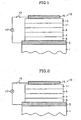
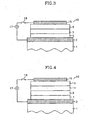
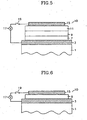
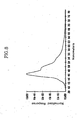
- FIG. 1-6 illustrate various examples of organic EL device constructions composed of a plurality of layers.
- the same reference numbers are used to indicate like components between the embodiments.
- the term "layer” in these illustrations refers to a thin film deposit of one or more compounds.
- the constructions of the organic EL device of the present invention include a substrate 1, an anode 3, a cathode 15 and one or more layers located between the anode 3 and the cathode 15, as illustrated in Figures 1-6 although not limited thereto.
- the one or more intervening layers contain at least one of the instant double-spiro organic compound.
- the double-spiro compounds contained in the one or more intervening layers satisfy General Formula 1.
- the one or more intervening layers include a hole-injecting layer 5, a hole-transporting layer 7, a light-emitting layer 9, an electron-transporting layer 11, an electron-injecting layer 13 and combinations of more than one of these layers.
- the substrate 1 ( Figures 1-6 ) supports the laminated structure of the organic EL device 10.
- the anode 3 ( Figures 1-6 ) and cathode 15 ( Figures 1-6 ) are electrically connected to an electric power source 17 ( Figures 1-6 ) via a switch 19 ( Figures 1-6 ), which is controlled by a controller (not shown).
- the hole-injecting layer 5 ( Figures 1-3 ) facilitates the injection of holes from the anode 3 into the hole-transporting layer 7 ( Figures 1-5 ).
- the electron-injecting layer 13 ( Figures 1 and 4 ) facilitates the injection of electrons from the cathode 15 into the electron-transporting layer 13.
- the hole-transporting layer 7 accelerates the movement of holes away from the anode 3 or hole-injecting layer 5 into, for example, the light-emitting layer 9 ( Figures 1-6 ).
- the electron-transporting layer 11 ( Figures 1, 2 , 4 and 5 ) accelerates the movement of electrons away from the cathode 15 or the electron-injecting layer 13 into, for example, the light-emitting layer 9 ( Figures 1-6 ).
- the transferred holes and electrons recombine and form excitons at light emitting molecules in the light-emitting layer 9.
- the excitons transfer the energy of the recombination to the light-emitting molecules or to other light-emitting molecules, which release the transferred energy in the form of visible light.
- the one or more intervening layers may be multi-functional.
- a multi-functional layer has functions of, for example, hole injection and transportation; electron injection and transportation; hole transportation and light emission; electron transportation and light emission; hole injection, hole transportation and light emission; electron injection, electron transportation and light emission; and so forth.
- Such multi-functional layers can be made of a material having multi-functional properties with or without doping of other functional materials. In the alternative such layers are made of a mixture of more than one material having different functional properties still with or without doping of other functional materials.
- the substrate 1 provides a support on which the laminated construction of the organic EL device can be build. Also, the substrate 1 functions as a protective layer for the construction of the organic EL device once manufactured. Thus, materials for the substrate 1 are selected from those which can stand the conditions of manufacturing processes and usage of the organic EL devices. In some organic EL device constructions of the present invention, the light emitted from the one or more intervening layers 5, 7, 9, 11 and 13 pass through the substrate 1. In such constructions, the substrate 1 is advantageously made of a transparent material to allow the visible light emitted from the light-emitting layer 9 to pass through. Transparent materials, which can be used for the substrate 1, for example, include glass, quartz and any other appropriate artificial materials such as transparent plastics.
- the substrate 1 is advantageously made of highly reflective material satisfying thermodynamic and mechanical requirements for depositing the anode 3 thereon.
- semiconductor wafers, metal oxide, ceramic materials, and non-transparent plastics can be used as the substrate 1.
- a transparent substrate coated with a reflective material can also be used.
- the anode 3 is a conductive electrode electrically connected to an electric power source.
- the anode 3 requires a relatively large work function, advantageously greater than 4 eV.
- conductive materials which can be used for the anode 3, include carbon; aluminum, vanadium, chromium, copper, zinc, silver, gold, similar metals, and alloys of the foregoing metals; zinc oxide, indium oxide, induim tin oxide (hereinafter referred to as "ITO"), indium zinc oxide and similar tin oxide or tin oxide indium-based complex compounds; mixtures of oxides and metals, such as ZnO:Al, SnO 2 :Sb; and conductive polymers, such as poly (3-methylthiophene), poly[3,4-(ethylene-1,2-dioxy) thiophene], polypyrrole and polyaniline.
- Either transparent or non-transparent materials can be selected for the anode 3, depending upon the construction of the light passage in the organic EL device as discussed above in connection with the materials for the substrate 1.
- the anode 3 is made of ITO.
- the anode 3 may be constructed in multiple layers of materials. The thickness of the anode 3 may vary depending on the materials used and its layered structures. However, the anode 3 is advantageously from about 10 nm to about 1000 nm, preferably from about 10 nm to about 500 nm.
- the cathode 15 requires a relatively small work function, advantageously smaller than 4 eV.
- conductive materials which can be used for the cathode 15, include magnesium, calcium, sodium, potassium, titanium, indium, yttrium, lithium, gadolinium, aluminum, silver, tin, lead, similar metals, and alloys of foregoing metals.
- the cathode 15 may be constructed in multiple layers of materials, such as LiF/Al and Li 2 O/Al.
- the cathode 15 is made of aluminum-lithium alloy, LiF/Al or Li 2 O/Al.
- Either transparent or non-transparent materials may be used for the cathode 3, depending upon the construction of the light passage in the organic EL device as discussed above.
- the thickness of the cathode 15 may vary depending on the materials used and its layered structures. However, the cathode 15 is laminated advantageously from about 1 nm to about 10,000 nm, preferably from about 5 nm to about 5,000 nm.
- the hole-injecting layer 5 has the function of enabling a large number of holes to be injected from the anode 3 at a low electric field applied to the device.
- the hole-injecting layer 5 advantageously is formed in the cases either where the interfacial strength between anode layer 3 and hole-transporting layer 7 is not strong enough or where the work function of the anode material is significantly different from the highest occupied molecular orbital (HOMO) level of the material of its neighboring layer 7, 9, 11 or 13.
- the HOMO level of the hole-injecting material is advantageously located between the work function of the anode 3 and the HOMO level of the other neighboring layer 9, 11 or 13, preferably near the middle of the two.
- the hole-injecting material is preferred to be transparent when the construction of the organic EL device allows the light emission through the substrate 1. In otherwise constructions, the hole-injecting material is advantageously non-transparent.
- the hole-injecting layer 5 can be made of one or more of the double-spiro structured compounds.
- the double-spiro compounds are of General Formula 1.
- the hole-injecting layer 5 includes one or more of the Chemical Compounds 300-308 and 400-413, most preferably, Chemical Compounds 300-308.
- one or more non-double-spiro hole-injecting materials may be added.
- the hole-injecting layer 5 can be formed with one or more non-double-spiro hole-injecting materials as long as at least one double-spiro compound is used in the organic EL device.
- the non-double-spiro hole-injecting materials include, for example, metal porphyrine ( U.S. Patent Nos. 4,720,432 and 4,356,429 ); oligothiophene ( U.S. Patent No. 5,540,999 ); arylamines and derivatives thereof ( U.S. Patent Nos. 5,256,945 , 5,609,970 , and 6,074,734 , and Japanese Unexamined Patent Publications 1999-219788 and 1996-269445 ); hexanitrile hexaazatriphenylene; conductive polymers such as derivatives of polyaniline, polythiophene with or without acid dopant; derivatives of quinacridone; derivatives of perylene ( U.S. Patent No. 5,998,803 ); and anthraquinone ( Japanese Unexamined Patent Publication 2000-058267 .).
- metal porphyrine U.S. Patent Nos. 4,720,432 and 4,356,429
- the hole-transporting layer 7 has the function to smoothly transfer the holes from the hole-injecting layer 5 or from anode 3 (in the absence of the hole-injecting layer 5) toward the light-emitting layer 9 or toward an area where light-emitting materials are doped. Materials good for use in the hole-transporting layer 7 are those having high hole mobility therein.
- This hole-transporting layer 7 also has the function of blocking electrons from its neighboring layer 9, 11, or 13 on the side of the cathode 15. Further, the hole-transporting layer 7 functions for both the hole injection and hole transportation in the constructions which do not have a separate hole-injecting layer.
- the hole-transporting layer 7 can be made of one or more of the double-spiro structured compounds.
- the double-spiro compounds are preferably of General Formula 1. More preferably, the hole-transporting layer 7 includes one or more of the Chemical Compounds 300-308 and 400-413.
- one or more non-double-spiro hole-transporting materials may be added.
- the hole-transporting layer 7 can be formed with one or more non-double-spiro hole-transporting materials as long as at least one double-spiro compound is used in the organic EL device.
- the non-double-spiro hole-transporting materials include, for example, arylamine derivatives, conjugated poylmers, block co-polymers with conjugated and nonconjugated repeating units, and the like.
- derivatives of the arylamine, 4,4'-bis[N-(1-naphthyl)-N-phenylamino]biphenyl (NPB) is used for the hole-transporting layer 7.
- the electron-transporting layer 11 contains an electron transfer material to transfer the electron injected from the electron injecting layer 13 or from the cathode 15 (in the absence of the electron-injecting layer 13) to the light-emitting layer 9 or to an area where a light-emitting material is doped. Compounds having high electron mobility is used as an electron-transporting material.
- the electron-transporting layer 11 may also have the function of blocking holes to move thereinto. In the construction without a separate electron-injecting layer, the electron-transporting material is selected from those which can enable a large number of electron to be injected from the cathode 15 at a low electric field applied across the device.
- the electron-transporting layer 11 can be made of one or more of the double-spiro structured compounds.
- the double-spiro compounds are of General Formula 1.
- the electron-transporting layer 11 includes one or more of the Chemical Compounds 200-222.
- one or more non-double-spiro electron-transporting materials may be added.
- the electron-transporting layer 11 can be formed with one or more non-double-spiro electron-transporting materials as long as at least one double-spiro compound is used in the organic EL device.
- the non-double-spiro electron-transporting materials include, for example, aluminum complexes of 8-hydroxyquinoline; organometallic complex compounds including Alq3 ( U.S. Patent No. 5,061,569 and U.S. Patent Application No. 09/540837 ); organic radical compounds ( U.S. Patent No. 5,811,833 ); hydroxyflavon-metal complexes ( U.S. Patent Nos. 5,817,431 and 5,516,577 , Japanese Unexamined Patent Publications 2001-076879 , 2001-123157 and 1998-017860 , and Organic Light-emitting Diodes using 3- or 5-hydroxyflavone-metal Complexes, Appl. Phys. Lett. 71 (23), 3338 (1997 ))..
- the electron-injecting layer 13 is generally to faciliate injection of a large number of electrons from the cathode 15 at a low electric field applied across the device.
- the electron-injecting layer 13 is provided when the work function of the cathode 15 significantly differs from the lowest unoccupied molecular orbital (LUMO) level of the other neighboring layer 5, 7, 9 or 11.
- the electron-injecting layer 13 may be introduced to prevent excitons generated in the neighboring layer 5, 7, 9 or 11 from moving toward the cathode layer 15.
- the electron-injecting layer 13 may be provided to avoid damaging the neighboring layer 5, 7, 9 or 11 in the course of the deposition of the cathode layer 15.
- the LUMO level of the electron-injecting material is advantageously located between the work function of the cathode material and the LUMO level of the other neighboring layer 5, 7, 9 or 11, preferably near the middle of the two. Further, the electron-injecting layer 13 is required to have strong interface with the cathode layer 15.
- the electron-injecting layer 13 can be made of one or more of the double-spiro structured compounds.
- the double-spiro compounds are of General Formula 1.
- the electron-injecting layer 13 includes one or more of the Chemical Compounds 200-222.
- one or more non-double-spiro electron-injecting materials may be added.
- the electron-injecting layer 13 can be formed with one or more non-double-spiro electron-injecting materials as long as at least one double-spiro compound is used in the organic EL device.
- the non-double-spiro electron-injecting materials include, for example, aluminum complexes of 8-hydroxyquinoline, organometallic complex compounds including Alq3, organic radical compounds ( U.S. Patent No. 5,811,833 ); 3- or 5-hydroxyflavone-metal complexes (Organic Light-emitting Diodes using 3- or 5-hydroxyflavone-metal Complexes, Appl. Phys. Lett.
- the light-emitting layer 9 is a layer particularly dedicated to the emission of visible light by the process of recombination of electrons and holes therein although it may have other functions as well.
- the light-emitting layer 9 of the organic EL devices is composed of one light-emitting material alone or a mixture of two or more light-emitting materials without doping.
- the light-emitting layer 9 is composed of one or more light-emitting host materials and a small amount of one or more dopants, as will be discussed below.
- the light-emitting layer 9 can include one or more of the instant double-spiro structured compounds.
- the double-spiro compounds are of General Formula 1 as a light-emitting material.
- the light-emitting layer 9 includes one or more of the Chemical Compounds 100-137, 200-222, and 400-413.
- these double-spiro compounds can be used as a host or as a dopant. In either case, one or more non-double-spiro light-emitting materials may be added as either another host material or another dopant.
- the double-spiro compounds are used as a host material, with or without another host material, for hosting one or more fluorescent or phosphorescent dopants.
- the light-emitting layer 9 may include one or more non-double-spiro light-emitting materials as long as at least one double-spiro compound is used in the organic EL device.
- the non-double-spiro light-emitting materials include, for example, 8-hydroxyquinoline metal complexes including Alq3; carbazole compounds and derivatives thereof; dimerized styryl compounds (U.S Patent No. 5,366,811 ); BAlq ( U.S.
- Patent No 5,150,006 10-hydroxybenzo [h] quinoline-metal complexes
- U.S. Patent No. 5,529,853 2-(2'-hydroxy-5'methylphenyl) benzotriazole metal complexes
- U.S. Patent No. 5,486,406 benzoxazole, benzthiazole, benzimidazole and derivatives thereof
- the light-emitting layer 9 may be constructed with or without a dopant. Dopants are introduced to improve the light-emission efficiency, to tune the color of the emission, and/or to simply emit light from a layer having a non-fluorescent host. Dopants can be added to the light-emitting layer 9 and one or more of the other layers 5, 7, 11 and 13. More than one light-emitting material can be doped together in these layers for various purposes. Also, in some constructions of the organic EL devices according to the present invention, the light-emitting layer 9 may be absent. In such constructions, one or more light-emitting dopants are necessarily put in one or more of the layers 5, 7, 11 or 13 to generate visible light therefrom.
- dopants are selected from fluorescent or phosphorescent materials having higher quantum efficiency than the host material.
- the dopants have a quantum yield close to "1" in a dilute system. This means that most of the energy received from excitons contributes to the light emission rather than releasing it in other forms such as generating heat.
- dopants are selected such that they match energetically with the host material. In other words, excitons are known to have a tendency to transfer their energy to a material having a smaller band gap among materials near the recombination location; thus, dopants are advantageously selected from the light-emitting materials having a band gap slightly smaller than that of the host materials.
- recombination may occur in the host molecules, and the energy of the generated excitons is transferred to the dopants. In this case, visible light is emitted from the dopant molecules. Also, the energy of the excitons may be transferred to another dopant, where the light is emitted. In the alternative, the recombination and light emission may occur in one light-emitting material.
- the double-spiro light-emitting compounds can be used as a dopant in various layers.
- these dopants have the double-spiro structure of General Formula 1.
- Chemical Compounds 100-137, 200-222 and 400-413 can be used as a dopant light-emitting material.
- One or more double-spiro dopants can be used with or without other dopants. Whether or not a separate light-emitting layer is provided, quantum efficiency and lifetime of the organic EL device can be enhanced by selecting an appropriate host materials, one or more matching dopants and their concentrations.
- light-emitting (phosphorescent or fluorescent) materials for doping in the organic EL devices of the present invention include, for example, perylene, rubrene, coumarine, quinacridone, nile red, DCM, and the following organometallic complexes.
- 2-bromo-9,10-bis(2-biphenyl-dihydroxy)-anthracene 9.50 g (16.0 mmol) of 2-bromo-9,10-bis(2-biphenyl-hydroxy)-anthracene synthesized as above was suspended in acetic acid (150 ml), and conc. H 2 SO 4 (20 drops) was added thereto. After the reaction mixture had been stirred at reflux for about 3 hours, it was cooled to room temperature. The precipitate was filtered off with suction, washed with acetic acid, water, and ethanol.
- anthraquinone-2-aldehyde diacetate (16.0 g, 65%.)
- acetic acid 400 ml
- 35% aqueous hydrochloric acid 170 ml
- the reaction mixture had been stirred while refluxing for 15 min, cooled to room temperature, filtered off with suction, and washed with water. After drying, anthraquinone-2-aldehyde (10.0 g, 89%) was obtained.
- Chemical Compound 7 (0.97 g, 1.20 mmol) was prepared by reacting Chemical Compound 11 and N -bromosuccinimide in carbon tetrachloride, diphenylamine (0.61 g, 3.60 mmol), and sodium tert -butoxide (0.28 g, 2.40 mmol). To a suspension of Chemical Compound 7 in xylene (20 ml), palladium acetate (12 mg, 0.05 mmol) and tri- tert -butylphosphine (39 mg, 0.20 mmol) were added.
- a glass substrate coated with a thin film of ITO (indium tin oxide) having thickness of about 1500 ⁇ was ultrasonically cleaned in a solution of a cleaning agent, dried, and transferred into a plasma cleaning device.
- the substrate was cleaned with oxygen plasma for 5 minutes, and transferred to a thermal vapor deposition chamber.
- a hole-injecting layer having thickness of about 500 ⁇ was formed by thermal vacuum deposition of the hexanitrile hexaazatriphenylene, a stable hole-injecting material, over the ITO (anode).
- a hole-transporting layer having thickness of about 600 ⁇ was formed by thermal vacuum deposition of NPB, a hole-transporting material, over the hole-injecting layer.
- An emitting layer having thickness of about 150 ⁇ was formed by thermally vacuum depositing Chemical Compound 12 over the hole-transporting layer.
- 8-hydroxyquinoline Aluminum salt (Alq3) an n-type organic semiconductor, was deposited with thickness of about 300 ⁇ to form an electron-transporting layer.
- a cathode electrode was formed by depositing 5 ⁇ of LiF and about 2500 ⁇ of aluminum on the electron-transporting layer. In the process, the deposition speed was controlled to maintain 1 ⁇ /sec for organic material, 0.2 ⁇ /sec for lithium fluoride, and 3-7 ⁇ /sec for aluminum.
- An organic light-emitting device was produced in the same manner as in Comparative Example A except that Chemical Compound 109 was used as the light-emitting material with thickness of about 400 ⁇ instead of Chemical Compound 12.
- forward bias was applied across the light-emitting device, blue light emission centered at the wavelength of 452 nm was observed.
- the efficiency of the light-emitting device was 2.0 cd/A at a current density of 10 mA/cm 2 .
- An organic light-emitting device was produced in the same manner as in Comparative Example A except that Chemical Compound 102 was used as the light-emitting material with thickness of about 400 ⁇ instead of Chemical Compound 12.
- forward bias was applied across the light-emitting device, blue light emission centered at the wavelength of 464 nm was observed.
- the efficiency of the light-emitting device was 2.5 cd/A at a current density of 10 mA/cm 2 .
- An organic light-emitting device was produced in the same manner as in Comparative Example A except that Chemical Compound 118 was used as the light-emitting material with thickness of 300 ⁇ instead of Chemical Compound 12.
- forward bias was applied across the light-emitting device, blue light emission centered at the wavelength of 464 nm was observed.
- the efficiency of the light-emitting device was 2.1 cd/A at a current density of 10 mA/cm 2 .
- An organic light-emitting device was produced in the same manner as in Comparative Example A except that Chemical Compound 100 was used as the light-emitting material with thickness of about 300 ⁇ instead of Chemical Compound 12.
- forward bias was applied across the light-emitting device, blue light emission centered at the wavelength of 444 nm was observed.
- the efficiency of the light-emitting device was 0.64 cd/A at a current density of 10 mA/cm 2 .
- An organic light-emitting device was produced in the same manner as in Comparative Example A except that Chemical Compound 117 was used as the light-emitting material with thickness of about 150 ⁇ instead of Chemical Compound 12.
- forward bias was applied across the light-emitting device, blue light emission centered at the wavelength of 484 nm was observed.
- the efficiency of the light-emitting device was 2.4 cd/A at a current density of 10 mA/cm 2 .
- An organic light-emitting device was produced in the same manner as in Comparative Example A except that Chemical Compound 113 was used as the light-emitting material with thickness of about 150 ⁇ instead of Chemical Compound 12.
- forward bias was applied across the light-emitting device, blue light emission centered at the wavelength of 452 nm from the compound having a structure of Chemical Compound 113 was observed.
- the efficiency of the light-emitting device was 1.6 cd/A at a current density of 10 mA/cm 2 .
- An organic light-emitting device was produced in the same manner as in Comparative Example A except that Chemical Compound 111 was used as the light-emitting material with thickness of 150 ⁇ instead of Chemical Compound 12.
- forward bias was applied across the light-emitting device, blue light emission centered at the wavelength of 452 nm was observed.
- the efficiency of the light-emitting device was 2.1 cd/A at a current density of 10 mA/cm 2 .
- An organic light-emitting device was produced in the same manner as in Comparative Example A except that Chemical Compound 110 was used as the light-emitting material with thickness of 150 ⁇ instead of Chemical Compound 12.
- When forward bias was applied across the light-emitting device blue light emission centered at the wavelength of 440 nm was observed.
- the efficiency of the light-emitting device was 1.9 cd/A at a current density of 10 mA/cm 2 .
- Figure 7 shows the spectrum of light emission of this device.
- An organic light-emitting device was produced in the same manner as in Comparative Example A except that Chemical Compound 134 was used as the light-emitting material with thickness of 300 ⁇ instead of Chemical Compound 12.
- forward bias was applied across the light-emitting device, green light emission centered at the wavelength of 508 nm was observed.
- the efficiency of the light-emitting device was 1.3 cd/A at a current density of 10 mA/cm 2 .
- An organic light-emitting device having the construction as illustrated in Figure 2 was manufactured, in which Chemical Compound 200 was used as an electron-tiansporting material.
- a glass substrate coated with a thin film of ITO (indium tin oxide) having thickness of about 1500 ⁇ was ultrasonically cleaned in a solution of a cleaning agent, dried, and transferred into a plasma cleaning device. The substrate was cleaned with oxygen plasma for 5 minutes, and transferred to a thermal vapor deposition chamber.
- a hole-injecting layer having thickness of about 500 ⁇ was formed by thermal vacuum deposition of hexanitrile hexaazatriphenylene over the ITO coating (anode).
- a hole-transporting layer having thickness of about 600 ⁇ was formed by thermal vacuum deposition of NPB over the hole-injecting layer.
- An emitting layer having thickness of about 150 ⁇ was formed by thermal vacuum deposition of Chemical Compound 117.
- Chemical Compound 200 was deposited under vacuum with thickness of about 300 ⁇ to form an electron-transporting layer. Then, an cathode electrode was formed by depositing 5 ⁇ of LiF and about 2500 ⁇ of aluminum on the electron-transporting layer. In the process, the deposing speed was controlled to maintain 1 ⁇ /sec for organic material, 0.2 ⁇ /sec for lithium fluoride, and 3-7 ⁇ /sec for aluminum.
- An organic light-emitting device having the construction as illustrated in Figure 2 was manufactured, using Chemical Compound 110 as a host light-emitting molecule and tetra t-butyl perylene as a dopant molecule.
- a glass substrate coated with a thin film of ITO (indium tin oxide) having thickness of about 1500 ⁇ was ultrasonically cleaned in a solution of a cleaning agent, dried, and transferred into a plasma cleaning device.
- the substrate was cleaned with oxygen plasma for 5 minutes, and transferred to a thermal vapor deposition chamber.
- a hole-injecting layer having thickness of about 500 ⁇ was formed by thermal vacuum deposition of hexanitrile hexaazatriphenylene over the ITO (anode).
- a hole-transporting layer having thickness of about 600 ⁇ was formed by thermal vacuum deposition of NPB over the hole-injecting layer.
- An emitting layer having thickness of about 150 ⁇ was formed by co-deposition of Chemical Compound 110 and 1 wt% of tetra t-butyl perylene.
- 8-hydroxyquinoline Aluminum salt (Alq3) was deposited with a thickness of about 300 ⁇ to form an electron-transporting layer.
- a cathode electrode was formed by depositing 5 ⁇ of LiF and about 2500 ⁇ of aluminum on the electron-transporting layer.
- the deposing speed was controlled to maintain 3 ⁇ /sec for the host material and 0.2 ⁇ /sec for lithium fluoride, and 3-7 ⁇ /sec for aluminum.
- An organic light-emitting device having the construction as illustrated in Figure 2 was manufactured, using Chemical Compound 110 as a host light-emitting molecule and DSA amine as a dopant molecule.
- the organic light-emitting device was obtained in the same manner as in Example 45 except that the thickness of the emitting layer was about 300 ⁇ and DSA amine was used codeposited with Chemical Compound 110 as a dopant material instead of tetra t-butyl perylene.
- forward bias was applied across the light-emitting device, blue light emission centered at the wavelength of 460 nm was observed.
- the efficiency of the light-emitting device was 4.6 cd/A at a current density of 10 mA/cm 2 .
- An organic light-emitting device having the construction shown in Figure 3 was manufactured, using Chemical Compound 301 as a hole-transporting material.
- a glass substrate coated with a thin film of ITO (indium tin oxide) having thickness of about 1500 ⁇ was ultrasonically cleaned in a solution of a cleaning agent, dried, and transferred into a plasma cleaning device. The substrate was cleaned with oxygen plasma for 5 minutes, and transferred to a thermal vapor deposition chamber.
- a hole-injecting layer having thickness of about 500 ⁇ was formed by thermal vacuum deposition of hexanitrile hexaazatriphenylene over the ITO coating (anode).
- a hole-transporting layer having thickness of about 400 ⁇ was formed by thermal vacuum deposition of Chemical Compound 301 over the hole-injecting layer.
- Alq3 8-hydroxyquinoline Aluminum salt
- an cathode electrode was formed by depositing 5 ⁇ of LiF and about 2500 ⁇ of aluminum on the electron-transporting layer.
- the deposing speed was controlled to maintain 1 ⁇ /sec for organic material, 0.2 ⁇ /sec for lithium fluoride, and 3-7 ⁇ /sec for aluminum.
- An organic light-emitting device was obtained in the same manner as in Example 46 except that Chemical Compound 400 was used as a hole-transporting material instead of Chemical Compound 301.
- When forward bias was applied across the light-emitting device green light emission from the Alq3 centered at the wavelength of 536 nm was observed.
- the efficiency of the light-emitting device was 3.4 cd/A at a current density of 10 mA/cm 2 .
- An organic light-emitting device was obtained in the same manner as in Example 46 except that Chemical Compound 303 was used as a hole-transporting material instead of Chemical Compound 301.
- When forward bias was applied across the light-emitting device green light emission from the Alq3 centered at the wavelength of 536 nm was observed.
- the efficiency of the light-emitting device was 4.3 cd/A at a current density of 10 mA/cm 2 .
- An organic light-emitting device was obtained in the same manner as in Example 46 except that Chemical Compound 403 was used as a hole-transporting material instead of Chemical Compound 301.
- When forward bias was applied across the light-emitting device green light emission from the Alq3 centered at the wavelength of 540 nm was observed.
- the efficiency of the light-emitting device was 3.7 cd/A at a current density of 10 mA/cm 2 .
- An organic light-emitting device was obtained in the same manner as in Example 46 except that Chemical Compound 305 was used as a hole-transporting material instead of Chemical Compound 301.
- When forward bias was applied across the light-emitting device green light emission from the Alq3 centered at the wavelength of 540 nm was observed.
- the efficiency of the light-emitting device was 4.8 cd/A at a current density of 10 mA/cm 2 .
- Figure 9 illustrates the light-emission spectrum of this device.
- Chemical Compound 305 used in the hole-transporting layer 7 has the band gap corresponding to blue light emission. Because the emitted light is green, not blue, Chemical Compound 305 is assumed to transport holes from the hole-injecting layer 5 to the light-emitting layer 9, rather than emitting light from itself.
- An organic light-emitting device was obtained in the same manner as in Example 46 except that Chemical Compound 308 was used as a hole-transporting material instead of Chemical Compound 301.
- When forward bias was applied across the light-emitting device green light emission from the Alq3 centered at the wavelength of 540 nm was observed.
- the efficiency of the light-emitting device was 2.3 cd/A at a current density of 10 mA/cm 2 .
Landscapes
- Chemical & Material Sciences (AREA)
- Organic Chemistry (AREA)
- Engineering & Computer Science (AREA)
- Materials Engineering (AREA)
- Physics & Mathematics (AREA)
- Spectroscopy & Molecular Physics (AREA)
- Chemical Kinetics & Catalysis (AREA)
- Electroluminescent Light Sources (AREA)
- Indole Compounds (AREA)
- Organic Low-Molecular-Weight Compounds And Preparation Thereof (AREA)
- Heterocyclic Carbon Compounds Containing A Hetero Ring Having Oxygen Or Sulfur (AREA)
Claims (24)
- Dispositif électroluminescent (EL) organique, comprenant :une anode,une cathode,et au moins un dépôt solide situé entre l'anode et la cathode,lequel dépôt solide comprend au moins une couche photo-émettrice contenant un composé de type bispiro, de formule chimique 1 :dans laquelle les symboles R1 à R24 représentent des substituants, identiques ou différents, et ces symboles R1 à R24 ne représentent pas tous des atomes d'hydrogène.

- Dispositif électroluminescent (EL) organique, conforme à la revendication 1, dans lequel l'un ou plusieurs des symboles R1 à R24 représente(nt) un ou des groupe(s) aryle choisi(s) parmi les groupes phényle, biphénylyle, terphénylyle, benzyle, naphtyle, anthracényle, tétracényle, pentacényle, pérylényle, coronényle et hétéroaryle, avec ou sans substituant(s).
- Dispositif électroluminescent (EL) organique, conforme à la revendication 2, dans lequel les groupes aryle portent un ou plusieurs substituant(s) phényle, biphénylyle, terphénylyle, benzyle, naphtyle, anthracényle, tétracényle, pentacényle, pérylényle, coronényle ou hétéroaryle, doté(s) ou non de substituant(s).
- Dispositif électroluminescent (EL) organique, conforme à la revendication 1, dans lequel l'un ou plusieurs des symboles R1 à R24 représente(nt) un ou des groupe(s) hétéroaryle choisi(s) parmi les groupes thiényle, thiazolyle, oxazolyle, imidazolyle et pyrazinyle, avec ou sans substituant(s).
- Dispositif électroluminescent (EL) organique, conforme à la revendication 1, dans lequel l'un ou plusieurs des symboles R1 à R24 représente(nt) une ou des entité(s) choisie(s) parmi les groupes aryle et les groupes constitués d'un groupe amino porteur d'au moins un substituant aryle, ce ou ces groupe(s) ou substituant(s) aryle étant choisi(s) parmi les groupes phényle, biphénylyle, terphénylyle, benzyle, naphtyle, anthracényle, tétracényle, pentacényle, pérylényle, coronényle et hétéroaryle.
- Dispositif électroluminescent (EL) organique, conforme à la revendication 1, dans lequel au moins l'un des symboles R1 à R24 représente un groupe anthracényle ou hétéroaryle.
- Dispositif électroluminescent (EL) organique, conforme à la revendication 1, dans lequel les substituants symbolisés par R1 à R24 portent un ou plusieurs substituant(s) organique(s) correspondant à la formule chimique 1.
- Dispositif électroluminescent (EL) organique, conforme à la revendication 1, dans lequel l'un ou plusieurs des substituants symbolisés par R3, R7, R10, R1, R14, R15, R18 et R22 portent des substituants qui ne sont pas des atomes d'hydrogène.
- Dispositif électroluminescent (EL) organique, conforme à la revendication 1, dans lequel l'une ou plusieurs des paires de substituants symbolisés par R3 et R7, R18 et R22, R10 et R15, et R11 et R14 portent des substituants qui ne sont pas des atomes d'hydrogène.
- Dispositif électroluminescent (EL) organique, conforme à la revendication 1, dans lequel la couche photo-émettrice contient un ou plusieurs composé(s) de type bispiro présentant une bande interdite dont la largeur correspond à l'émission de lumière visible.
- Dispositif électroluminescent (EL) organique, conforme à la revendication 10, dans lequel la largeur de bande interdite correspondant à l'émission de lumière visible vaut de 1,8 à 3,5 eV.
- Dispositif électroluminescent (EL) organique, conforme à la revendication 1, dans lequel la couche photo-émettrice contient en outre une ou plusieurs substance(s) fluorescente(s) ou phosphorescente(s).
- Dispositif électroluminescent (EL) organique, conforme à la revendication 1, lequel dispositif électroluminescent organique est supporté par un substrat qui est en contact avec l'anode ou avec la cathode.
- Dispositif électroluminescent (EL) organique, conforme à la revendication 1, dans lequel il y a au moins une couche qui comporte au moins une substance dotée d'une ou plusieurs propriété(s) choisie(s) parmi l'injection d'électrons, le transport d'électrons, l'émission de lumière, le transport de trous et l'injection de trous.
- Dispositif électroluminescent (EL) organique, conforme à la revendication 1, dans lequel la couche photo-émettrice contient un ou plusieurs composé(s) choisi(s) dans l'ensemble constitué par les Composés chimiques 100 à 137, 200 à 222 et 400 à 413 présentés ci-dessous :


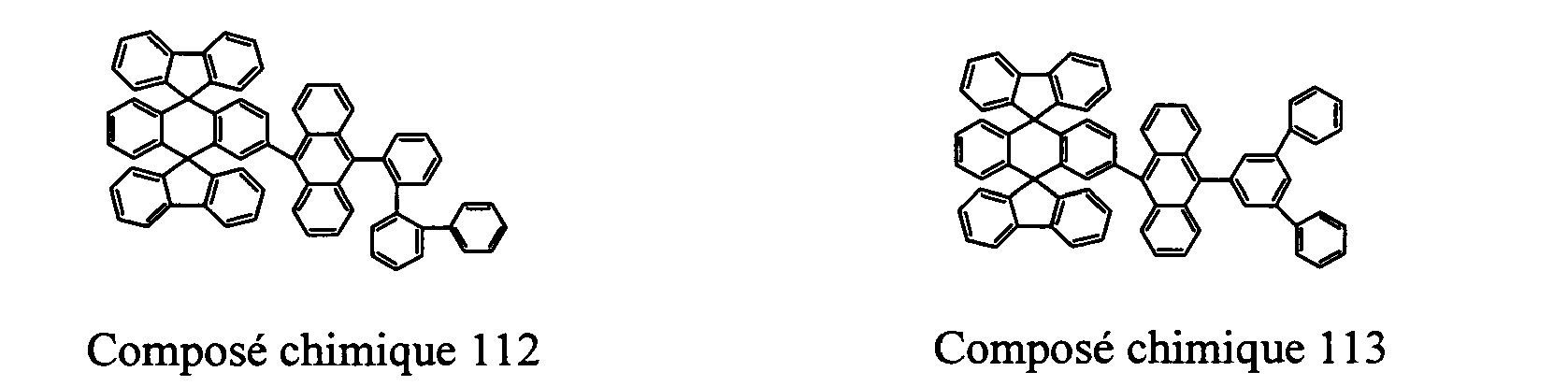


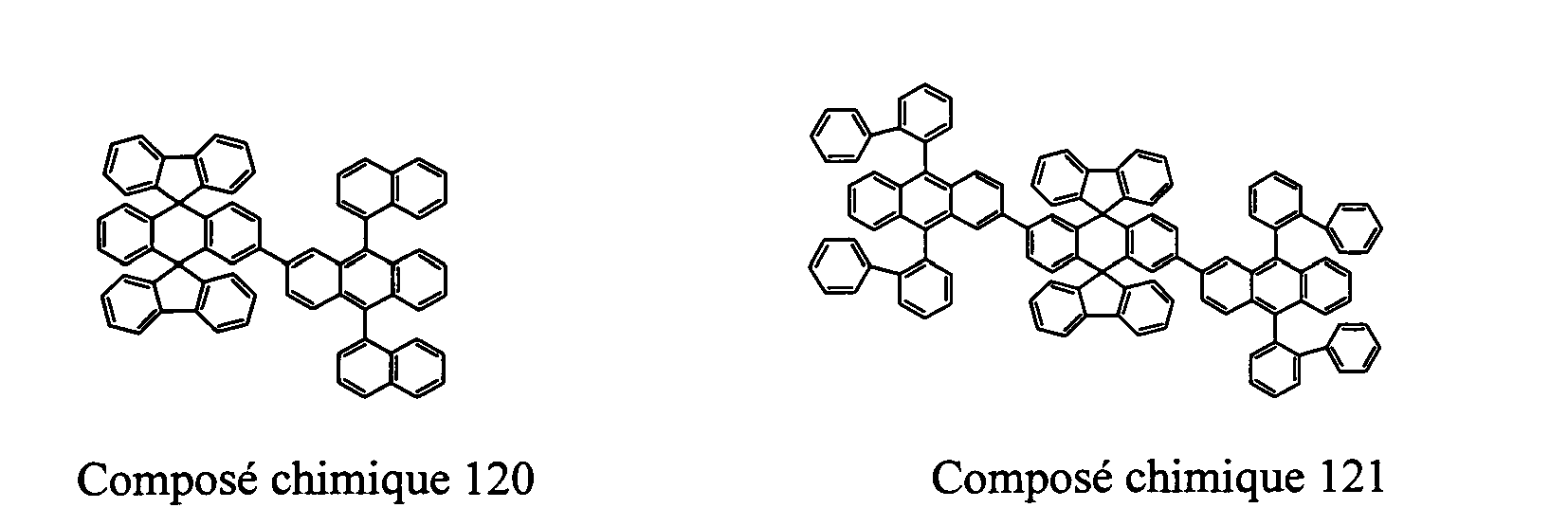


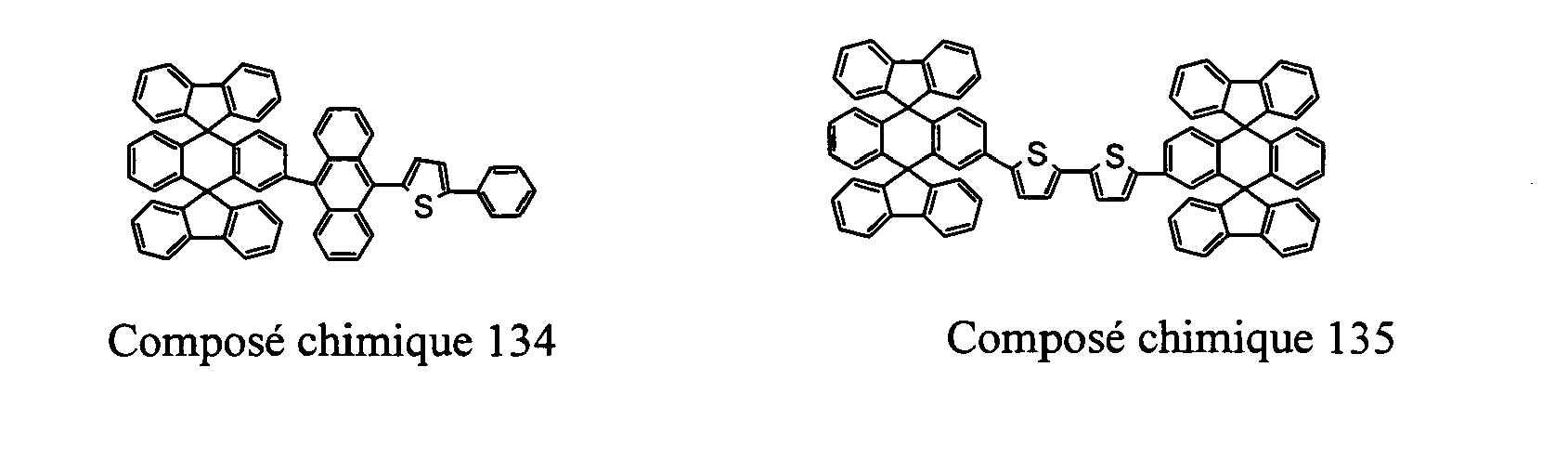

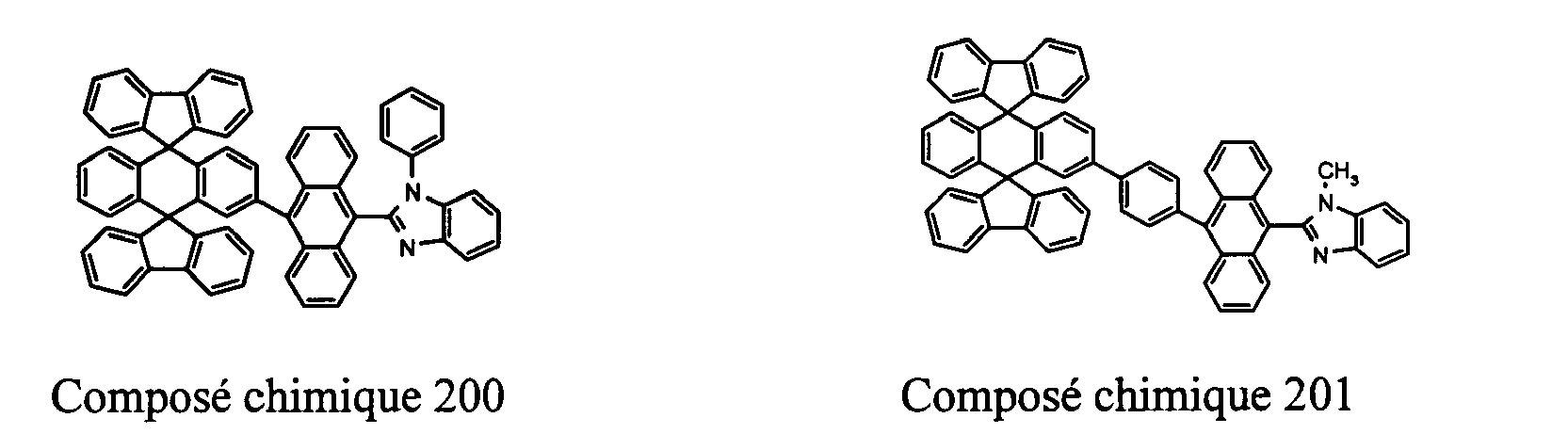
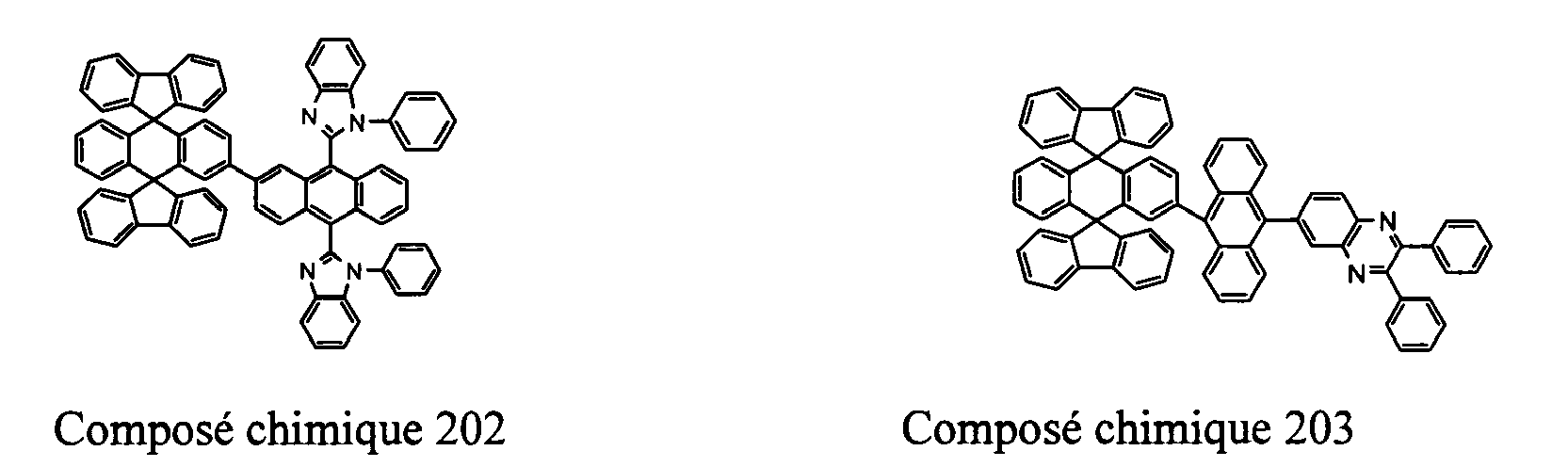


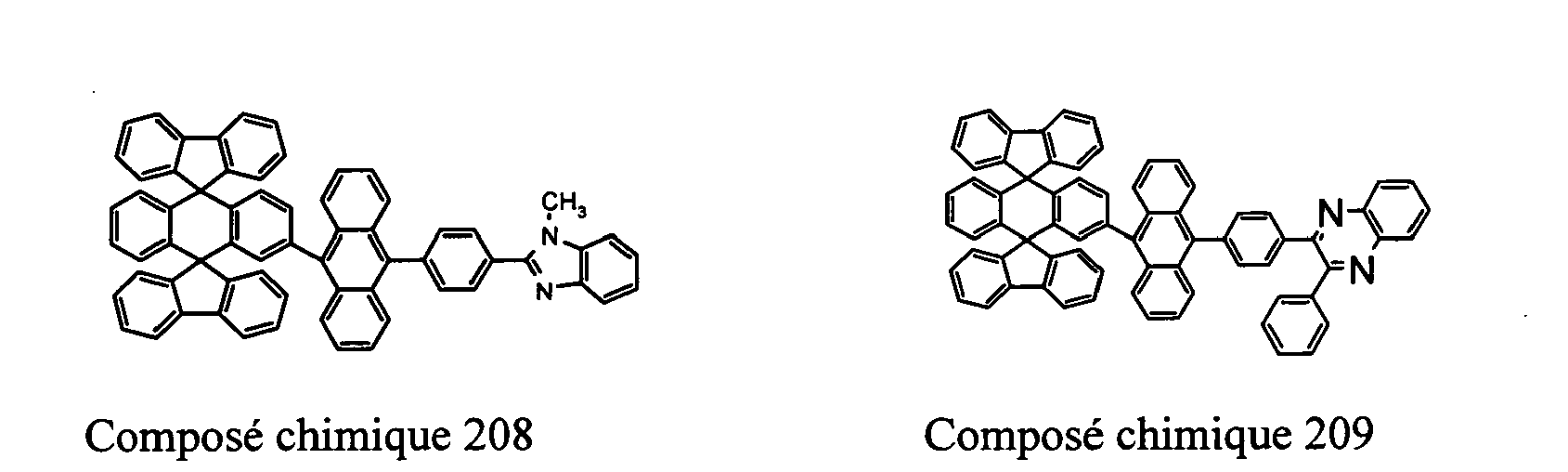
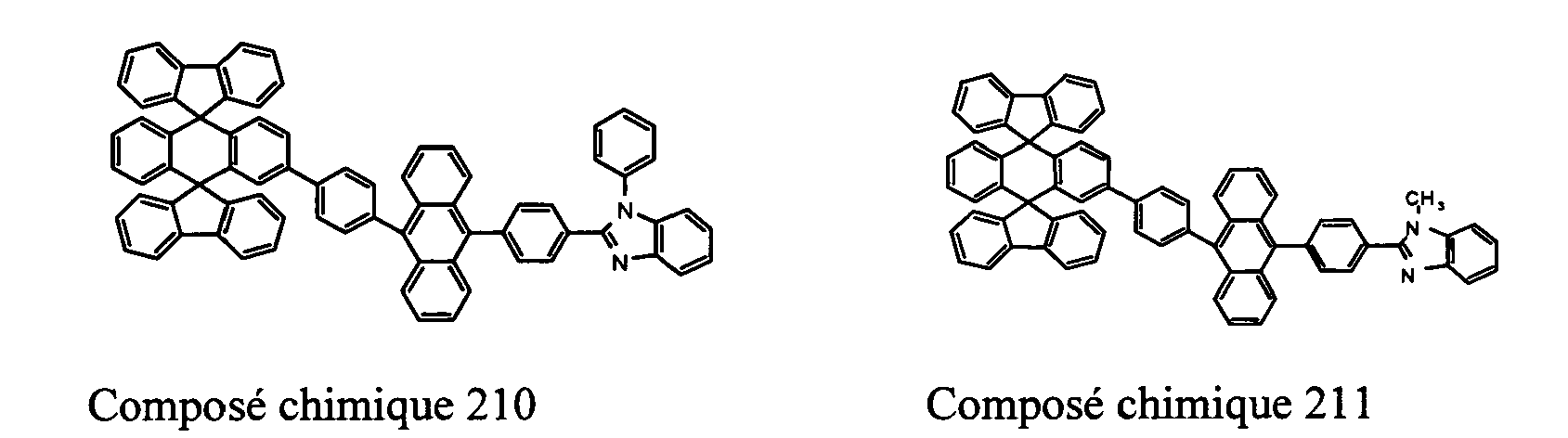

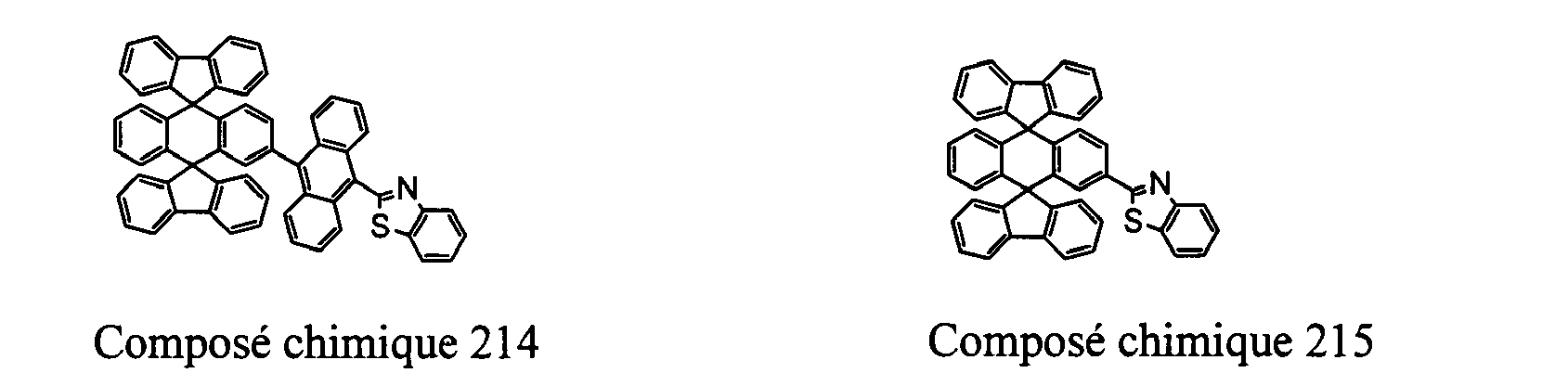
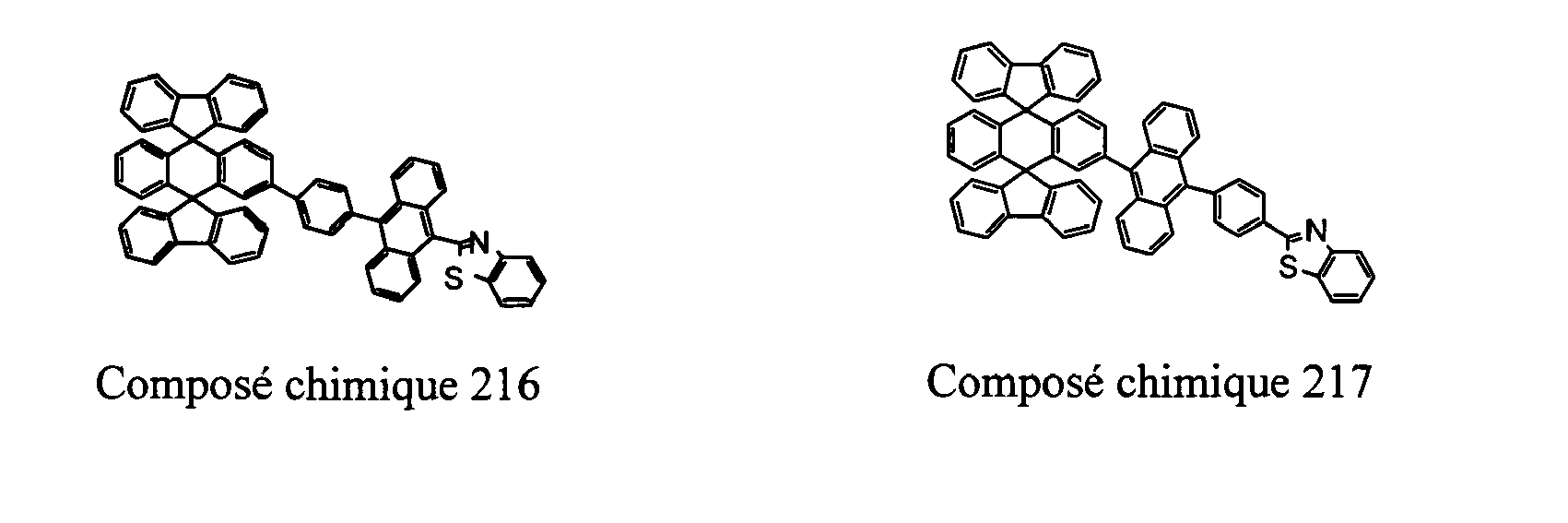


- Dispositif électroluminescent (EL) organique, conforme à la revendication 1, dans lequel la couche photo-émettrice contient en outre un ou plusieurs composé(s) photo-émetteur(s) qui ne sont pas de type bispiro.
- Dispositif électroluminescent (EL) organique, conforme à la revendication 16, dans lequel le composé photo-émetteur non bispiro présente une bande interdite moins large que celle du composé bispiro.
- Dispositif électroluminescent (EL) organique, conforme à la revendication 16, dans lequel le composé photo-émetteur non bispiro présente une bande interdite plus large que celle du composé bispiro.
- Dispositif électroluminescent (EL) organique, conforme à la revendication 16, dans lequel le composé photo-émetteur non bispiro est un composé fluorescent ou phosphorescent.
- Dispositif électroluminescent (EL) organique, conforme à la revendication 1, dans lequel il y a au moins une couche qui comporte en outre au moins une couche choisie parmi les couches à injection d'électrons et les couches à transport d'électrons.
- Dispositif électroluminescent (EL) organique, conforme à la revendication 20, dans lequel la couche, au nombre d'au moins une, à injection d'électrons ou à transport d'électrons contient un ou plusieurs composé(s) choisi(s) dans l'ensemble formé par les Composés chimiques 200 à 222 mentionnés dans la revendication 15 et présentés ci-dessous :


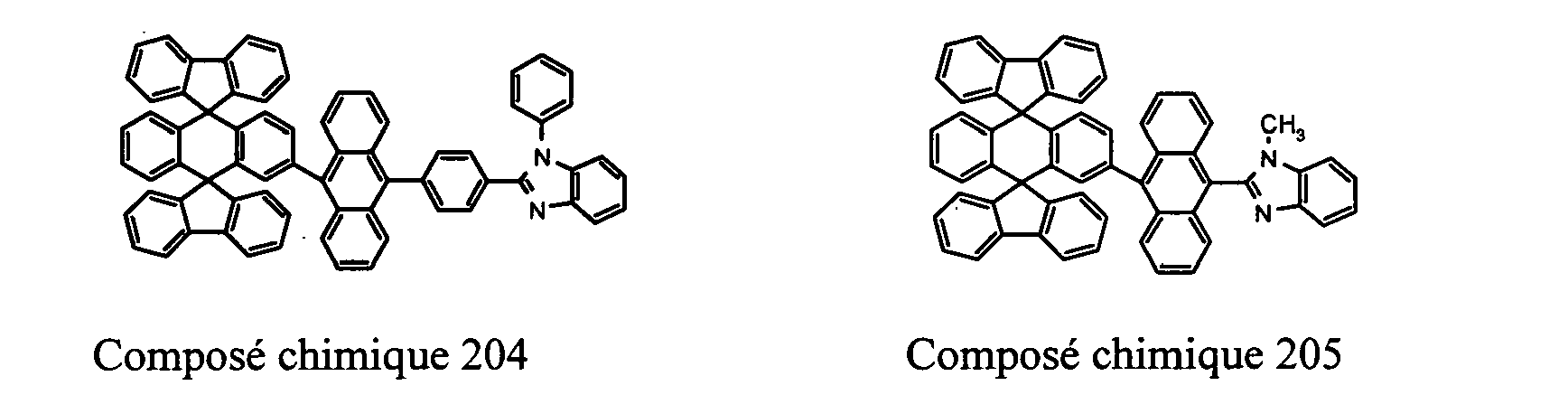
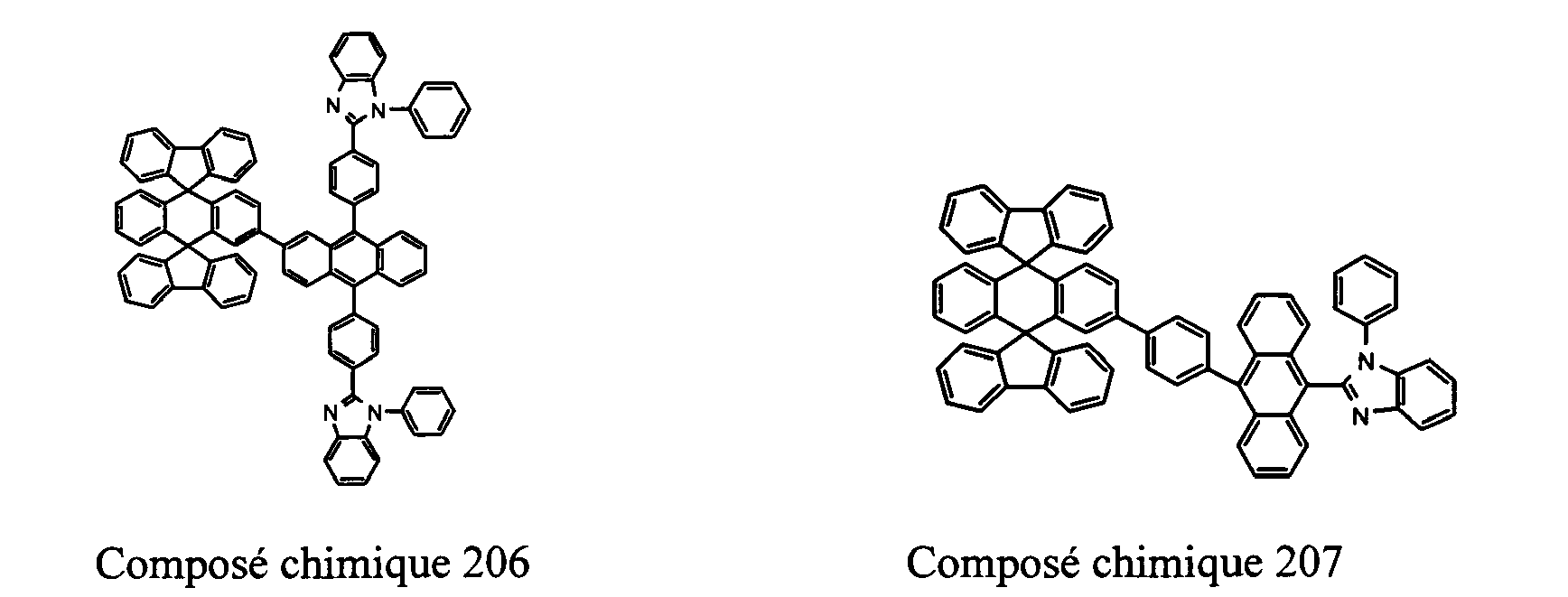


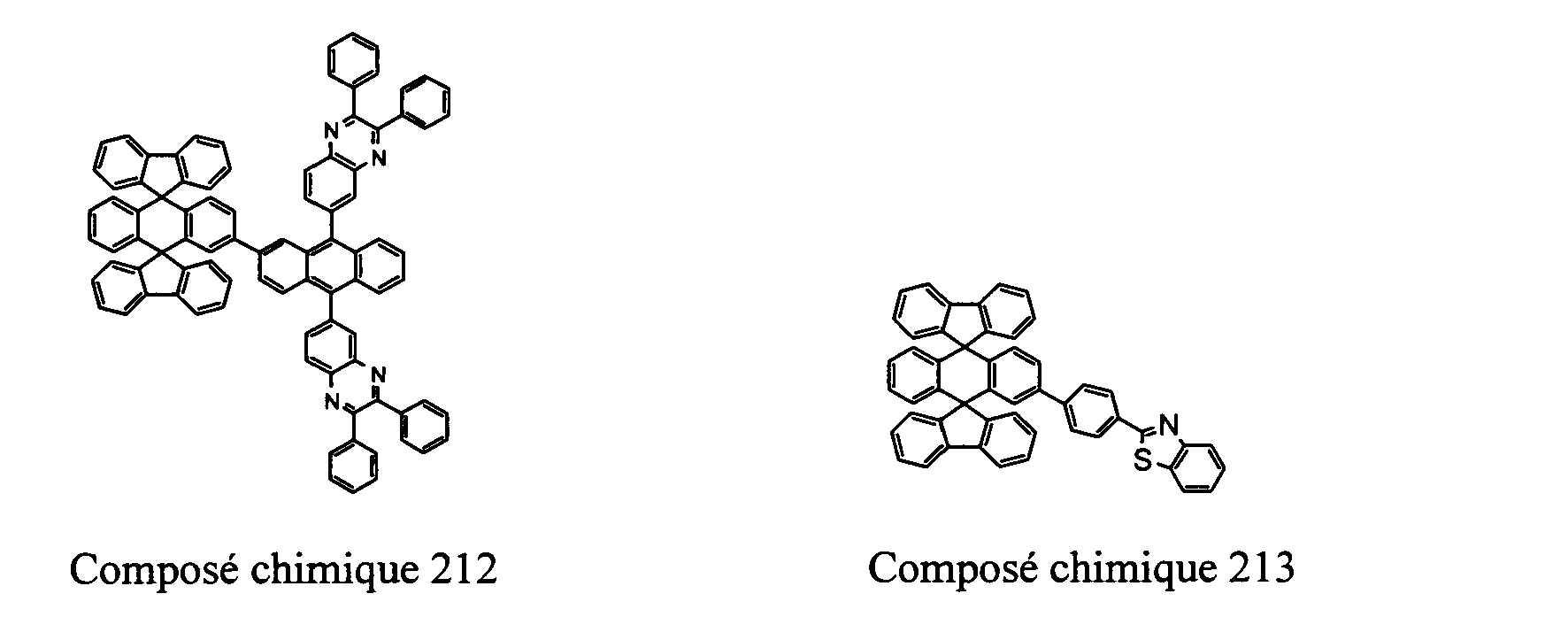


- Dispositif électroluminescent (EL) organique, conforme à la revendication 1, dans lequel il y a au moins une couche qui comporte en outre au moins une couche choisie parmi les couches à injection de trous et les couches à transport de trous.
- Dispositif électroluminescent (EL) organique, conforme à la revendication 22, dans lequel la couche, au nombre d'au moins une, à injection de trous ou à transport de trous contient un ou plusieurs composé(s) choisi(s) dans l'ensemble constitué par les Composés chimiques 300 à 308 présentés ci-dessous et les Composés chimiques 400 à 413 mentionnés dans la revendication 15 et présentés ci-dessous :


- Dispositif électronique comprenant un afficheur qui comporte un dispositif électroluminescent (EL) organique conforme à la revendication 1.
Applications Claiming Priority (3)
| Application Number | Priority Date | Filing Date | Title |
|---|---|---|---|
| KR10-2001-0023038A KR100428642B1 (ko) | 2001-04-27 | 2001-04-27 | 이중 스피로형 유기물질 |
| KR10-2001-0023039A KR100422914B1 (ko) | 2001-04-27 | 2001-04-27 | 이중 스피로형 유기물질을 함유하는 전기 소자 |
| EP02705589A EP1294823B1 (fr) | 2001-04-27 | 2002-03-18 | Composes organiques a configuration spiro double et dispositifs electroluminescents |
Related Parent Applications (2)
| Application Number | Title | Priority Date | Filing Date |
|---|---|---|---|
| EP02705589.6 Division | 2002-03-18 | ||
| EP02705589A Division EP1294823B1 (fr) | 2001-04-27 | 2002-03-18 | Composes organiques a configuration spiro double et dispositifs electroluminescents |
Publications (2)
| Publication Number | Publication Date |
|---|---|
| EP1645552A1 EP1645552A1 (fr) | 2006-04-12 |
| EP1645552B1 true EP1645552B1 (fr) | 2010-05-05 |
Family
ID=26639032
Family Applications (2)
| Application Number | Title | Priority Date | Filing Date |
|---|---|---|---|
| EP05020697A Expired - Lifetime EP1645552B1 (fr) | 2001-04-27 | 2002-03-18 | Dispositifs électroluminescents fabriqués avec composés organiques à configuration spiro doublée |
| EP02705589A Expired - Lifetime EP1294823B1 (fr) | 2001-04-27 | 2002-03-18 | Composes organiques a configuration spiro double et dispositifs electroluminescents |
Family Applications After (1)
| Application Number | Title | Priority Date | Filing Date |
|---|---|---|---|
| EP02705589A Expired - Lifetime EP1294823B1 (fr) | 2001-04-27 | 2002-03-18 | Composes organiques a configuration spiro double et dispositifs electroluminescents |
Country Status (9)
| Country | Link |
|---|---|
| US (2) | US6998487B2 (fr) |
| EP (2) | EP1645552B1 (fr) |
| JP (1) | JP3971310B2 (fr) |
| CN (1) | CN100488923C (fr) |
| AT (2) | ATE348136T1 (fr) |
| DE (2) | DE60216681T2 (fr) |
| ES (1) | ES2274003T3 (fr) |
| TW (1) | TW591096B (fr) |
| WO (1) | WO2002088274A1 (fr) |
Families Citing this family (165)
| Publication number | Priority date | Publication date | Assignee | Title |
|---|---|---|---|---|
| KR100721656B1 (ko) * | 2005-11-01 | 2007-05-23 | 주식회사 엘지화학 | 유기 전기 소자 |
| KR100377321B1 (ko) * | 1999-12-31 | 2003-03-26 | 주식회사 엘지화학 | 피-형 반도체 성질을 갖는 유기 화합물을 포함하는 전기소자 |
| US7560175B2 (en) * | 1999-12-31 | 2009-07-14 | Lg Chem, Ltd. | Electroluminescent devices with low work function anode |
| JP4972844B2 (ja) * | 2001-03-30 | 2012-07-11 | コニカミノルタホールディングス株式会社 | 有機エレクトロルミネッセンス素子 |
| US6855438B2 (en) * | 2001-06-15 | 2005-02-15 | Konica Corporation | Organic electroluminescent element and full color display |
| JP4089331B2 (ja) * | 2001-07-25 | 2008-05-28 | 東レ株式会社 | 発光素子 |
| KR100691543B1 (ko) * | 2002-01-18 | 2007-03-09 | 주식회사 엘지화학 | 새로운 전자 수송용 물질 및 이를 이용한 유기 발광 소자 |
| JP4646494B2 (ja) * | 2002-04-11 | 2011-03-09 | 出光興産株式会社 | 新規含窒素複素環誘導体及びそれを用いた有機エレクトロルミネッセンス素子 |
| AU2003230308A1 (en) | 2002-05-07 | 2003-11-11 | Lg Chem, Ltd. | New organic compounds for electroluminescence and organic electroluminescent devices using the same |
| US6962995B2 (en) | 2002-07-10 | 2005-11-08 | E. I. Du Pont De Nemours And Company | Charge transport compositions and electronic devices made with such compositions |
| EP2295519B1 (fr) * | 2002-07-19 | 2016-05-18 | Idemitsu Kosan Co., Ltd. | Appareil electroluminescent organique et milieu luminescent organique |
| KR100497532B1 (ko) * | 2002-08-16 | 2005-07-01 | 네오뷰코오롱 주식회사 | 발광 스파이로 이합체 및 이를 포함하는 유기 발광 소자 |
| KR100946476B1 (ko) | 2002-08-23 | 2010-03-10 | 이데미쓰 고산 가부시키가이샤 | 유기 전기발광 소자 및 안트라센 유도체 |
| JP4045932B2 (ja) * | 2002-11-21 | 2008-02-13 | コニカミノルタホールディングス株式会社 | 有機エレクトロルミネッセンス素子及び表示装置 |
| EP2759585B1 (fr) * | 2002-11-26 | 2018-08-15 | Konica Minolta Business Technologies, Inc. | Élément électroluminescent organique, affichage et illuminateur |
| KR101064077B1 (ko) * | 2003-01-10 | 2011-09-08 | 이데미쓰 고산 가부시키가이샤 | 질소-함유 헤테로환 유도체 및 이를 이용한 유기 전기발광소자 |
| JP4693336B2 (ja) * | 2003-01-14 | 2011-06-01 | 出光興産株式会社 | 含窒素複素環誘導体及びそれを用いた有機エレクトロルミネッセンス素子 |
| KR20040072004A (ko) * | 2003-02-07 | 2004-08-16 | 삼성에스디아이 주식회사 | 유기 전계 발광 소자용 발광 화합물 및 그를 이용한 유기전계발광 소자 |
| WO2004080975A1 (fr) * | 2003-03-13 | 2004-09-23 | Idemitsu Kosan Co., Ltd. | Derive heterocyclique contenant de l'azote et element electroluminescent organique utilisant ce derive |
| JP2004339136A (ja) * | 2003-05-15 | 2004-12-02 | Idemitsu Kosan Co Ltd | スピロ結合含有化合物、発光性塗膜形成用材料及びそれを用いた有機エレクトロルミネッセンス素子 |
| KR100808790B1 (ko) * | 2003-05-23 | 2008-03-03 | 주식회사 엘지화학 | 질소 플라즈마 처리된 ito 필름 및 이를 양극으로사용한 유기 발광 소자 |
| CN1820550A (zh) | 2003-07-11 | 2006-08-16 | 出光兴产株式会社 | 白色系有机电致发光元件 |
| DE10339772B4 (de) * | 2003-08-27 | 2006-07-13 | Novaled Gmbh | Licht emittierendes Bauelement und Verfahren zu seiner Herstellung |
| CN100335462C (zh) * | 2003-09-05 | 2007-09-05 | 清华大学 | 咔唑衍生物及其在电致发光器件中的应用 |
| US9034482B2 (en) * | 2003-09-19 | 2015-05-19 | Merck Patent Gmbh | Organic electroluminescent element |
| JP4390113B2 (ja) | 2003-11-10 | 2009-12-24 | ケンブリッジ ディスプレイ テクノロジー リミテッド | ジベンゾシロールポリマー及びその製造方法 |
| JP2007518703A (ja) * | 2003-11-26 | 2007-07-12 | チバ スペシャルティ ケミカルズ ホールディング インコーポレーテッド | 2−(p−トリフェニル)−3−フェニルピラジン誘導体を含むエレクトロルミネセンス装置 |
| CN1965052B (zh) * | 2003-12-24 | 2010-09-29 | 礒部信一郎 | 单层有机电致发光元件 |
| TWI428053B (zh) * | 2004-02-09 | 2014-02-21 | Idemitsu Kosan Co | Organic electroluminescent element |
| US7252893B2 (en) | 2004-02-17 | 2007-08-07 | Eastman Kodak Company | Anthracene derivative host having ranges of dopants |
| US7326371B2 (en) * | 2004-03-25 | 2008-02-05 | Eastman Kodak Company | Electroluminescent device with anthracene derivative host |
| US20080036365A1 (en) * | 2004-03-26 | 2008-02-14 | Hodogaya Chemical Co., Ltd. | Carbazole Derivative Containing Fluorene Group and Organic Electroluminescent Element |
| JP5064034B2 (ja) | 2004-05-11 | 2012-10-31 | エルジー・ケム・リミテッド | 有機電気素子 |
| KR100696470B1 (ko) * | 2004-06-15 | 2007-03-19 | 삼성에스디아이 주식회사 | 유기 전계 발광 소자 |
| JP2006028054A (ja) * | 2004-07-14 | 2006-02-02 | Konica Minolta Holdings Inc | 有機薄膜トランジスタ材料、有機薄膜トランジスタ、電界効果トランジスタ及びスイッチング素子 |
| US20060019116A1 (en) * | 2004-07-22 | 2006-01-26 | Eastman Kodak Company | White electroluminescent device with anthracene derivative host |
| WO2006019270A1 (fr) * | 2004-08-19 | 2006-02-23 | Lg Chem. Ltd. | Dispositif lumineux organique comprenant une couche tampon et procede de fabrication correspondant |
| US7683532B2 (en) * | 2004-11-02 | 2010-03-23 | Semiconductor Energy Laboratory Co., Ltd. | Semiconductor device and light emitting device |
| KR100708655B1 (ko) * | 2004-11-27 | 2007-04-18 | 삼성에스디아이 주식회사 | 유기 전계 발광 소자 |
| KR100669790B1 (ko) * | 2004-11-27 | 2007-01-16 | 삼성에스디아이 주식회사 | 유기 전계 발광 소자 |
| CN101894917B (zh) * | 2004-12-06 | 2012-08-29 | 株式会社半导体能源研究所 | 发光元件和使用该元件的发光装置 |
| EP1834946A4 (fr) * | 2005-01-05 | 2009-04-29 | Idemitsu Kosan Co | Derive d'amine aromatique et dispositif organique electroluminescent l'utilisant |
| JP4235619B2 (ja) * | 2005-02-14 | 2009-03-11 | キヤノン株式会社 | 有機発光素子の製造方法 |
| US20060204783A1 (en) * | 2005-03-10 | 2006-09-14 | Conley Scott R | Organic electroluminescent device |
| CN101184732B (zh) * | 2005-03-28 | 2012-05-16 | 株式会社半导体能源研究所 | 蒽衍生物、发光元件用材料、发光元件、发光装置和电子器件 |
| US20060269782A1 (en) * | 2005-05-25 | 2006-11-30 | Eastman Kodak Company | OLED electron-transporting layer |
| EP3064563B1 (fr) * | 2005-05-31 | 2018-12-26 | Universal Display Corporation | Hôtes de triphénylène dans des diodes électroluminescentes phosphorescentes |
| US20070003785A1 (en) * | 2005-06-30 | 2007-01-04 | Eastman Kodak Company | Electroluminescent devices containing benzidine derivatives |
| US8187727B2 (en) * | 2005-07-22 | 2012-05-29 | Lg Chem, Ltd. | Imidazole derivatives, preparation method thereof and organic electronic device using the same |
| KR101359412B1 (ko) * | 2005-08-31 | 2014-02-27 | 가부시키가이샤 한도오따이 에네루기 켄큐쇼 | 카르바졸 유도체, 발광소자용 재료, 발광소자, 발광 장치 및 전자기기 |
| JP5661982B2 (ja) | 2005-09-14 | 2015-01-28 | 住友化学株式会社 | 高分子化合物、発光材料及び発光素子 |
| JP2009512187A (ja) * | 2005-10-07 | 2009-03-19 | ダウ コーニング コーポレイシヨン | 溶剤可溶性材料を用いて形成された電気りん光性有機発光ダイオード |
| KR100890862B1 (ko) * | 2005-11-07 | 2009-03-27 | 주식회사 엘지화학 | 유기 발광 소자 및 이의 제조 방법 |
| US9666826B2 (en) * | 2005-11-30 | 2017-05-30 | Global Oled Technology Llc | Electroluminescent device including an anthracene derivative |
| KR100864364B1 (ko) | 2005-12-13 | 2008-10-17 | 주식회사 엘지화학 | 신규한 이미다조퀴나졸린 유도체, 이의 제조방법 및 이를이용한 유기전기소자 |
| US20070141393A1 (en) * | 2005-12-21 | 2007-06-21 | Eastman Kodak Company | Amino anthracene compounds in OLED devices |
| KR100851739B1 (ko) * | 2006-01-13 | 2008-08-11 | 주식회사 엘지화학 | 발광 물질 및 이를 이용한 유기발광소자 |
| WO2007083918A1 (fr) * | 2006-01-18 | 2007-07-26 | Lg Chem. Ltd. | Delo possédant des unités électroluminescentes organiques empilées |
| US7731377B2 (en) * | 2006-03-21 | 2010-06-08 | Semiconductor Energy Laboratory Co., Ltd. | Backlight device and display device |
| US20070252515A1 (en) * | 2006-04-27 | 2007-11-01 | Eastman Kodak Company | Electroluminescent device including an anthracene derivative |
| US7582508B2 (en) * | 2006-05-31 | 2009-09-01 | Byoung-Choo Park | Method for manufacturing an organic semiconductor device that utilizes ionic salt |
| WO2007139124A1 (fr) * | 2006-06-01 | 2007-12-06 | Semiconductor Energy Laboratory Co., Ltd. | Élément photoémetteur, dispositif photoémetteur et dispositif électronique |
| WO2008026614A1 (fr) * | 2006-08-30 | 2008-03-06 | Semiconductor Energy Laboratory Co., Ltd. | Procédé de synthèse d'un dérivé d'anthracène et dérivé d'anthracène, élément électroluminescent, dispositif électroluminescent, dispositif électronique |
| JP4979333B2 (ja) * | 2006-10-13 | 2012-07-18 | 三井化学株式会社 | アントラセン化合物および該化合物を含有する有機電界発光素子 |
| KR100898073B1 (ko) * | 2006-11-22 | 2009-05-18 | 삼성모바일디스플레이주식회사 | 퀴녹살린 고리 함유 화합물 및 이를 이용한 유기 발광 소자 |
| KR100925323B1 (ko) * | 2006-12-01 | 2009-11-04 | 주식회사 엘지화학 | 신규한 화합물 및 이를 이용한 유기 발광 소자 |
| US9397308B2 (en) * | 2006-12-04 | 2016-07-19 | Semiconductor Energy Laboratory Co., Ltd. | Light emitting element, light emitting device, and electronic device |
| WO2008069153A1 (fr) | 2006-12-04 | 2008-06-12 | Semiconductor Energy Laboratory Co., Ltd. | Élément électroluminescent, dispositif électroluminescent et dispositif électronique |
| US7723722B2 (en) | 2007-03-23 | 2010-05-25 | Semiconductor Energy Laboratory Co., Ltd. | Organic compound, anthracene derivative, and light-emitting element, light-emitting device, and electronic device using anthracene derivative |
| KR100857026B1 (ko) * | 2007-03-28 | 2008-09-05 | (주)그라쎌 | 티아졸계 유기 발광 화합물 및 이를 포함하는 유기 발광소자 |
| US20080286445A1 (en) * | 2007-05-17 | 2008-11-20 | Semiconductor Energy Laboratory Co., Ltd. | Composition, and method of fabricating light-emitting element |
| JP5484690B2 (ja) | 2007-05-18 | 2014-05-07 | ユー・ディー・シー アイルランド リミテッド | 有機電界発光素子 |
| KR101030007B1 (ko) * | 2007-06-15 | 2011-04-20 | 삼성모바일디스플레이주식회사 | 헤테로방향환 함유 화합물, 이의 제조 방법 및 이를 이용한유기 발광 소자 |
| US20090045731A1 (en) * | 2007-07-07 | 2009-02-19 | Idemitsu Kosan Co., Ltd. | Organic electroluminescence device and material for organic electroluminescence device |
| US20090091242A1 (en) * | 2007-10-05 | 2009-04-09 | Liang-Sheng Liao | Hole-injecting layer in oleds |
| TWI479710B (zh) * | 2007-10-19 | 2015-04-01 | Semiconductor Energy Lab | 發光裝置 |
| EP2075308A3 (fr) * | 2007-12-25 | 2010-04-14 | Yamagata Promotional Organization for Industrial Technology | Matériau électroluminescent organique et élément l'utilisant |
| EP2236485A1 (fr) * | 2007-12-25 | 2010-10-06 | National University Corporation Nagoya University | Matériau organique contenant un squelette d'oligophénylène et un dispositif électroluminescent qui l'utilise |
| WO2009116547A1 (fr) | 2008-03-18 | 2009-09-24 | Semiconductor Energy Laboratory Co., Ltd. | Élément électroluminescent, dispositif électroluminescent et dispositif électronique |
| WO2009116605A1 (fr) | 2008-03-18 | 2009-09-24 | Semiconductor Energy Laboratory Co., Ltd. | Élément électroluminescent, dispositif électroluminescent et dispositif électronique |
| JP5611538B2 (ja) * | 2008-05-16 | 2014-10-22 | 株式会社半導体エネルギー研究所 | ベンゾオキサゾール誘導体、およびベンゾオキサゾール誘導体を用いた発光素子、発光装置、照明装置、並びに電子機器 |
| KR101913462B1 (ko) * | 2008-06-30 | 2018-10-30 | 유니버셜 디스플레이 코포레이션 | 황 함유 그룹을 포함하는 정공 수송 물질 |
| WO2010005066A1 (fr) * | 2008-07-08 | 2010-01-14 | Semiconductor Energy Laboratory Co., Ltd. | Dérivé de carbazole, substance d’élément électroluminescent, élément électroluminescent, et dispositif électroluminescent |
| DE102008036982A1 (de) * | 2008-08-08 | 2010-02-11 | Merck Patent Gmbh | Organische Elektrolumineszenzvorrichtung |
| EP2166001B1 (fr) * | 2008-09-19 | 2011-07-20 | Semiconductor Energy Laboratory Co., Ltd. | Dérivé de carbazole et son procédé de fabrication |
| WO2010044607A1 (fr) | 2008-10-14 | 2010-04-22 | Cheil Industries Inc. | Composés de benzimidazole et dispositif photoélectrique organique les comprenant |
| WO2010061315A1 (fr) * | 2008-11-26 | 2010-06-03 | Philips Intellectual Property & Standards Gmbh | Delo à nouveau matériau conducteur de trous |
| EP2200407B1 (fr) | 2008-12-17 | 2017-11-22 | Semiconductor Energy Laboratory Co., Ltd. | Élément électroluminescent, dispositif électroluminescent, et dispositif électronique |
| EP2713415B1 (fr) * | 2008-12-26 | 2018-12-19 | Idemitsu Kosan Co., Ltd | Matériau pour élément électroluminescent organique, et élément électroluminescent organique |
| TWI583253B (zh) | 2009-01-21 | 2017-05-11 | 半導體能源研究所股份有限公司 | 發光元件,發光裝置以及電子裝置 |
| WO2011031086A2 (fr) * | 2009-09-10 | 2011-03-17 | 주식회사 엘지화학 | Nouveau dérivé hétérocyclique et dispositif organique émettant de la lumière l'employant |
| WO2011043083A1 (fr) * | 2009-10-09 | 2011-04-14 | 出光興産株式会社 | Élément organique électroluminescent |
| KR101847222B1 (ko) * | 2009-10-23 | 2018-04-09 | 호도가야 가가쿠 고교 가부시키가이샤 | 유기 일렉트로 루미네센스 소자 |
| JP5697599B2 (ja) * | 2009-10-23 | 2015-04-08 | 新日鉄住金化学株式会社 | 有機電界発光素子 |
| CN102598343B (zh) * | 2009-10-23 | 2015-07-08 | 保土谷化学工业株式会社 | 有机电致发光器件 |
| DE102009051172A1 (de) * | 2009-10-29 | 2011-05-05 | Merck Patent Gmbh | Materialien für elektronische Vorrichtungen |
| JP5578832B2 (ja) * | 2009-11-05 | 2014-08-27 | キヤノン株式会社 | 新規フルオレニルアミン化合物およびそれを有する有機発光素子 |
| US8617720B2 (en) * | 2009-12-21 | 2013-12-31 | E I Du Pont De Nemours And Company | Electroactive composition and electronic device made with the composition |
| EP2530100B1 (fr) | 2010-01-28 | 2015-10-21 | Sumitomo Chemical Co., Ltd | Composé polymère et dispositif électroluminescent l'utilisant |
| US8617724B2 (en) * | 2010-01-28 | 2013-12-31 | Sumitomo Chemical Company, Limited | Polymer compound and light emitting device using the same |
| DE102010010481A1 (de) * | 2010-03-06 | 2011-09-08 | Merck Patent Gmbh | Organische Elektrolumineszenzvorrichtung |
| TW201204687A (en) * | 2010-06-17 | 2012-02-01 | Du Pont | Electroactive materials |
| US20120049168A1 (en) * | 2010-08-31 | 2012-03-01 | Universal Display Corporation | Cross-Linked Charge Transport Layer Containing an Additive Compound |
| KR101670964B1 (ko) * | 2010-12-13 | 2016-11-09 | 삼성전자주식회사 | 고분자 및 상기 고분자를 포함한 유기 발광 소자 |
| JP5756288B2 (ja) * | 2010-12-28 | 2015-07-29 | 出光興産株式会社 | 縮合多環化合物、有機エレクトロルミネッセンス素子用材料、及びそれを用いた有機エレクトロルミネッセンス素子 |
| EP2688120B1 (fr) * | 2011-03-14 | 2017-08-23 | Toray Industries, Inc. | Matériau d'élément d'émission de lumière et élément d'émission de lumière |
| JP5868195B2 (ja) * | 2011-04-14 | 2016-02-24 | キヤノン株式会社 | 新規スピロ化合物およびそれを有する有機発光素子 |
| CN103502388B (zh) * | 2011-04-18 | 2016-06-01 | 默克专利有限公司 | 用于电子器件的化合物 |
| JP5721533B2 (ja) * | 2011-05-18 | 2015-05-20 | キヤノン株式会社 | ジスピロジベンゾナフタセン化合物及びこれを使用した有機発光素子 |
| US9403795B2 (en) * | 2011-08-05 | 2016-08-02 | Samsung Display Co., Ltd. | Carbazole-based compound and organic light-emitting diode comprising the same |
| JP5899010B2 (ja) * | 2012-03-06 | 2016-04-06 | 株式会社ダイセル | アンタントレン系化合物およびその製造方法 |
| DE102012011335B4 (de) * | 2012-06-06 | 2026-08-20 | Merck Patent Gmbh | Verbindungen für Organische Elekronische Vorrichtungen |
| CN104508850B (zh) | 2012-08-03 | 2017-03-22 | 株式会社半导体能源研究所 | 发光元件、发光装置、电子设备以及照明装置 |
| US9209411B2 (en) | 2012-12-07 | 2015-12-08 | Universal Display Corporation | Organic electroluminescent materials and devices |
| JP6309317B2 (ja) | 2013-03-28 | 2018-04-11 | 株式会社半導体エネルギー研究所 | 発光素子及び化合物 |
| US9537106B2 (en) * | 2013-05-09 | 2017-01-03 | Universal Display Corporation | Organic electroluminescent materials and devices |
| US9224958B2 (en) * | 2013-07-19 | 2015-12-29 | Universal Display Corporation | Organic electroluminescent materials and devices |
| US10593886B2 (en) * | 2013-08-25 | 2020-03-17 | Molecular Glasses, Inc. | OLED devices with improved lifetime using non-crystallizable molecular glass mixture hosts |
| US10158083B2 (en) | 2013-12-12 | 2018-12-18 | Merck Patent Gmbh | Materials for electronic devices |
| JP6177124B2 (ja) * | 2013-12-27 | 2017-08-09 | 株式会社半導体エネルギー研究所 | 有機化合物、発光素子、発光装置、表示装置、照明装置及び電子機器 |
| JP6230904B2 (ja) * | 2013-12-27 | 2017-11-15 | 株式会社半導体エネルギー研究所 | 有機化合物、発光素子 |
| KR20150077269A (ko) | 2013-12-27 | 2015-07-07 | 삼성디스플레이 주식회사 | 유기 전계 발광 소자 |
| JP2016086147A (ja) * | 2014-10-29 | 2016-05-19 | 保土谷化学工業株式会社 | 有機エレクトロルミネッセンス素子 |
| WO2016088759A1 (fr) * | 2014-12-05 | 2016-06-09 | 保土谷化学工業株式会社 | Élément électroluminescent organique |
| CN107112429B (zh) * | 2015-01-06 | 2019-11-22 | 保土谷化学工业株式会社 | 有机电致发光器件 |
| JP6632998B2 (ja) * | 2015-01-08 | 2020-01-22 | 保土谷化学工業株式会社 | 有機エレクトロルミネッセンス素子 |
| KR101837804B1 (ko) * | 2015-02-16 | 2018-03-12 | 주식회사 엘지화학 | 이중스피로형 화합물 및 이를 포함하는 유기 발광 소자 |
| US10403826B2 (en) * | 2015-05-07 | 2019-09-03 | Universal Display Corporation | Organic electroluminescent materials and devices |
| KR101826427B1 (ko) * | 2015-06-05 | 2018-02-06 | 주식회사 엘지화학 | 이중 스피로형 유기 화합물 및 이를 포함하는 유기 전자 소자 |
| WO2017007213A2 (fr) * | 2015-07-07 | 2017-01-12 | 주식회사 엘지화학 | Composé double spiro et élément électroluminescent organique comprenant ledit composé |
| GB201513037D0 (en) * | 2015-07-23 | 2015-09-09 | Merck Patent Gmbh | Phenyl-derived compound for use in organic electronic devices |
| EP3138858B1 (fr) * | 2015-09-01 | 2019-10-30 | Samsung Electronics Co., Ltd. | Polymère amino-fluorène et dispositif électroluminescent organique l'incluant |
| KR101991049B1 (ko) | 2015-10-06 | 2019-06-20 | 주식회사 엘지화학 | 스피로형 화합물 및 이를 포함하는 유기 발광 소자 |
| KR101991050B1 (ko) | 2015-10-06 | 2019-06-20 | 주식회사 엘지화학 | 스피로형 화합물 및 이를 포함하는 유기 발광 소자 |
| WO2017061786A1 (fr) * | 2015-10-06 | 2017-04-13 | 주식회사 엘지화학 | Composé spiro et dispositif électroluminescent organique le comprenant |
| WO2017061788A1 (fr) * | 2015-10-06 | 2017-04-13 | 주식회사 엘지화학 | Composé spiro et dispositif électroluminescent organique le comprenant |
| KR102065818B1 (ko) | 2015-10-06 | 2020-01-13 | 주식회사 엘지화학 | 스피로형 화합물 및 이를 포함하는 유기 발광 소자 |
| TWI654163B (zh) | 2015-10-07 | 2019-03-21 | Lg化學股份有限公司 | 雙螺環接結構化合物及含有其的有機發光裝置 |
| KR102000177B1 (ko) * | 2015-10-26 | 2019-07-16 | 주식회사 엘지화학 | 스피로형 화합물 및 이를 포함하는 유기 발광 소자 |
| CN108352454B (zh) * | 2015-10-29 | 2020-02-28 | 保土谷化学工业株式会社 | 有机电致发光器件 |
| WO2017122813A1 (fr) * | 2016-01-14 | 2017-07-20 | 保土谷化学工業株式会社 | Élément électroluminescent organique |
| KR102844041B1 (ko) | 2016-02-26 | 2025-08-11 | 가부시키가이샤 한도오따이 에네루기 켄큐쇼 | 유기 화합물, 발광 소자, 발광 장치, 전자 기기, 및 조명 장치 |
| WO2018083801A1 (fr) * | 2016-11-07 | 2018-05-11 | 日立化成株式会社 | Matériau et élément électroniques organiques, couche organique, élément électroluminescent organique, dispositif d'éclairage, et élément et dispositif d'affichage |
| CN109790119B (zh) * | 2016-11-23 | 2022-11-04 | 广州华睿光电材料有限公司 | 有机化合物及其应用、有机混合物、有机电子器件 |
| US10490753B2 (en) * | 2016-12-15 | 2019-11-26 | Universal Display Corporation | Organic electroluminescent materials and devices |
| KR102649432B1 (ko) * | 2016-12-29 | 2024-03-19 | 엘지디스플레이 주식회사 | 유기 화합물과 이를 포함하는 유기발광다이오드 및 유기발광장치 |
| CN108264487A (zh) * | 2016-12-30 | 2018-07-10 | 吉林奥来德光电材料股份有限公司 | 一种新颖的咪唑类化合物及其应用 |
| JPWO2018159694A1 (ja) | 2017-03-02 | 2020-01-09 | 日立化成株式会社 | 有機エレクトロニクス材料及びその利用 |
| CN108623594B (zh) * | 2017-03-22 | 2019-09-17 | 中国科学院化学研究所 | 一种螺环芳香稠环酰亚胺类化合物及其制备方法 |
| US11158820B2 (en) * | 2017-03-29 | 2021-10-26 | Universal Display Corporation | Organic electroluminescent materials and devices |
| US11608321B2 (en) | 2017-06-23 | 2023-03-21 | Universal Display Corporation | Organic electroluminescent materials and devices |
| US10109803B1 (en) * | 2017-08-14 | 2018-10-23 | Idemitsu Kosan Co., Ltd. | Organic electroluminescence device and electronic device |
| KR20190049958A (ko) * | 2017-10-30 | 2019-05-10 | 삼성디스플레이 주식회사 | 축합환 화합물 및 이를 포함한 유기 발광 소자 |
| US11349081B2 (en) * | 2017-11-14 | 2022-05-31 | Beijing Summer Sprout Technology Co., Ltd. | Azaindolocarbazole compounds |
| KR102703716B1 (ko) * | 2018-04-09 | 2024-09-06 | 삼성전자주식회사 | 축합환 화합물 및 이를 포함한 유기 발광 소자 |
| CN108794404B (zh) * | 2018-06-28 | 2020-08-21 | 吉林奥来德光电材料股份有限公司 | 一种蒽类有机发光化合物及其制备方法以及有机电致发光器件 |
| KR102575479B1 (ko) * | 2018-07-31 | 2023-09-08 | 삼성디스플레이 주식회사 | 유기 전계 발광 소자 및 유기 전계 발광 소자용 다환 화합물 |
| CN112912359B (zh) * | 2018-11-08 | 2025-02-28 | 出光兴产株式会社 | 化合物、使用其的有机电致发光元件和电子设备 |
| CN110845499B (zh) * | 2018-12-10 | 2023-08-22 | 广州华睿光电材料有限公司 | 含氮多环化合物、高聚物、混合物、组合物及有机电子器件 |
| JP7397005B2 (ja) * | 2018-12-25 | 2023-12-12 | 保土谷化学工業株式会社 | 有機エレクトロルミネッセンス素子 |
| KR102661468B1 (ko) * | 2019-02-15 | 2024-04-30 | 삼성디스플레이 주식회사 | 유기 발광 소자 및 이를 포함한 전자 장치 |
| KR102770946B1 (ko) | 2019-04-12 | 2025-02-24 | 삼성디스플레이 주식회사 | 유기 전계 발광 소자 및 유기 전계 발광 소자용 다환 화합물 |
| KR102908941B1 (ko) | 2019-12-13 | 2026-01-09 | 삼성디스플레이 주식회사 | 유기 전계 발광 소자 및 유기 전계 발광 소자용 축합 다환 화합물 |
| KR102815486B1 (ko) | 2020-01-17 | 2025-06-02 | 삼성디스플레이 주식회사 | 유기 전계 발광 소자 및 유기 전계 발광 소자용 축합 다환 화합물 |
| CN115960001B (zh) * | 2022-10-24 | 2024-04-19 | 陕西莱特光电材料股份有限公司 | 有机化合物及包含其的电子元件和电子装置 |
Family Cites Families (10)
| Publication number | Priority date | Publication date | Assignee | Title |
|---|---|---|---|---|
| US3869363A (en) * | 1973-12-13 | 1975-03-04 | American Cyanamid Co | Generation of photofluorescent materials by short wavelength ultraviolet irradiation of non-fluorescent bis-diarylchloromethyl-1,3,4-oxadiazoles |
| US5026894A (en) * | 1990-03-12 | 1991-06-25 | University Of South Carolina | Compound for use in the synthesis of semiconducting polymers with perpendicularly arranged cores and method of synthesizing said compound |
| EP0676461B1 (fr) * | 1994-04-07 | 2002-08-14 | Covion Organic Semiconductors GmbH | Composés spiro et leur application comme matières électroluminescentes |
| DE4436773A1 (de) * | 1994-10-14 | 1996-04-18 | Hoechst Ag | Konjugierte Polymere mit Spirozentren und ihre Verwendung als Elektrolumineszenzmaterialien |
| CN1223065A (zh) * | 1997-02-22 | 1999-07-14 | Lg化学株式会社 | 用于场致发光器件的有机金属络合物 |
| DE19711714A1 (de) * | 1997-03-20 | 1998-10-01 | Hoechst Ag | Spiroverbindungen und deren Verwendung |
| DE19711568A1 (de) * | 1997-03-20 | 1998-10-01 | Hoechst Ag | Spiroverbindungen und deren Verwendung |
| JPH11273863A (ja) | 1998-03-25 | 1999-10-08 | Toyota Central Res & Dev Lab Inc | 有機電界発光素子 |
| CN1157461C (zh) * | 2001-08-20 | 2004-07-14 | 清华大学 | 双螺环衍生物及其作为电致发光材料的应用 |
| AU2003230308A1 (en) * | 2002-05-07 | 2003-11-11 | Lg Chem, Ltd. | New organic compounds for electroluminescence and organic electroluminescent devices using the same |
-
2002
- 2002-03-14 US US10/099,781 patent/US6998487B2/en not_active Expired - Lifetime
- 2002-03-18 DE DE60216681T patent/DE60216681T2/de not_active Expired - Lifetime
- 2002-03-18 DE DE60236329T patent/DE60236329D1/de not_active Expired - Lifetime
- 2002-03-18 WO PCT/KR2002/000458 patent/WO2002088274A1/fr not_active Ceased
- 2002-03-18 AT AT02705589T patent/ATE348136T1/de not_active IP Right Cessation
- 2002-03-18 ES ES02705589T patent/ES2274003T3/es not_active Expired - Lifetime
- 2002-03-18 EP EP05020697A patent/EP1645552B1/fr not_active Expired - Lifetime
- 2002-03-18 EP EP02705589A patent/EP1294823B1/fr not_active Expired - Lifetime
- 2002-03-18 CN CNB028013808A patent/CN100488923C/zh not_active Expired - Lifetime
- 2002-03-18 JP JP2002585559A patent/JP3971310B2/ja not_active Expired - Lifetime
- 2002-03-18 AT AT05020697T patent/ATE466828T1/de not_active IP Right Cessation
- 2002-03-26 TW TW091105844A patent/TW591096B/zh not_active IP Right Cessation
-
2003
- 2003-11-19 US US10/718,083 patent/US6984462B2/en not_active Expired - Lifetime
Also Published As
| Publication number | Publication date |
|---|---|
| US20040170863A1 (en) | 2004-09-02 |
| CN100488923C (zh) | 2009-05-20 |
| ATE348136T1 (de) | 2007-01-15 |
| CN1462303A (zh) | 2003-12-17 |
| WO2002088274A1 (fr) | 2002-11-07 |
| DE60216681T2 (de) | 2007-10-11 |
| US20040023060A1 (en) | 2004-02-05 |
| JP2004529937A (ja) | 2004-09-30 |
| US6998487B2 (en) | 2006-02-14 |
| TW591096B (en) | 2004-06-11 |
| EP1294823A1 (fr) | 2003-03-26 |
| DE60236329D1 (de) | 2010-06-17 |
| JP3971310B2 (ja) | 2007-09-05 |
| DE60216681D1 (de) | 2007-01-25 |
| US6984462B2 (en) | 2006-01-10 |
| EP1294823B1 (fr) | 2006-12-13 |
| ATE466828T1 (de) | 2010-05-15 |
| EP1645552A1 (fr) | 2006-04-12 |
| ES2274003T3 (es) | 2007-05-16 |
Similar Documents
| Publication | Publication Date | Title |
|---|---|---|
| EP1294823B1 (fr) | Composes organiques a configuration spiro double et dispositifs electroluminescents | |
| US7485733B2 (en) | Organic compounds for electroluminescence and organic electroluminescent devices using the same | |
| KR101367514B1 (ko) | 신규한 안트라센 유도체 및 이를 이용한 유기전자소자 | |
| KR101694492B1 (ko) | 아민 화합물 및 이를 이용한 유기전계 발광소자 | |
| TWI478898B (zh) | 新穎之二胺衍生物及使用其之有機電子裝置 | |
| KR20160127429A (ko) | 유기발광 화합물 및 이를 포함하는 유기전계발광소자 | |
| JP2011016807A (ja) | 新規な有機化合物及びこれを利用した有機発光素子 | |
| KR20120083243A (ko) | 신규한 화합물 및 이를 이용한 유기 전자 소자 | |
| KR101396647B1 (ko) | 신규한 안트라센 유도체, 이의 제조방법 및 이를 이용한 유기전자소자 | |
| JP7751160B2 (ja) | スピロビフルオレン化合物および有機エレクトロルミネッセンス素子 | |
| EP1937789B1 (fr) | Derive d'indene et diode electroluminescente l'utilisant | |
| KR20150115225A (ko) | 유기발광 화합물 및 이를 포함하는 유기전계발광소자 | |
| KR20150044592A (ko) | 아민 화합물의 제조방법 | |
| JP4406045B2 (ja) | 新たな有機発光化合物及びこれを利用した有機発光素子 | |
| KR101472057B1 (ko) | 비대칭형 안트라센 유도체, 그의 제조방법 및 그 유도체를 포함하는 유기전자소자 | |
| KR20140016214A (ko) | 신규한 안트라센 유도체, 이의 제조방법 및 이를 이용한 유기전자소자 | |
| KR20160031468A (ko) | 아민 화합물의 제조방법 | |
| TW201730147A (zh) | 芳香族化合物及包含其之有機發光二極體 |
Legal Events
| Date | Code | Title | Description |
|---|---|---|---|
| PUAI | Public reference made under article 153(3) epc to a published international application that has entered the european phase |
Free format text: ORIGINAL CODE: 0009012 |
|
| AC | Divisional application: reference to earlier application |
Ref document number: 1294823 Country of ref document: EP Kind code of ref document: P |
|
| AK | Designated contracting states |
Kind code of ref document: A1 Designated state(s): AT BE CH CY DE DK ES FI FR GB GR IE IT LI LU MC NL PT SE TR |
|
| 17P | Request for examination filed |
Effective date: 20060529 |
|
| RIN1 | Information on inventor provided before grant (corrected) |
Inventor name: SON, SE-HWAN Inventor name: KIM, KONG-KYEUM Inventor name: BAE, JAE-SOON Inventor name: LEE, JAE-CHOL Inventor name: LEE, YOUN-GU Inventor name: IM, SUNG-GAP Inventor name: KIM, JI-EUN Inventor name: YOON, SEOK-HEE |
|
| 17Q | First examination report despatched |
Effective date: 20060703 |
|
| AKX | Designation fees paid |
Designated state(s): AT BE CH CY DE DK ES FI FR GB GR IE IT LI LU MC NL PT SE TR |
|
| GRAP | Despatch of communication of intention to grant a patent |
Free format text: ORIGINAL CODE: EPIDOSNIGR1 |
|
| RIC1 | Information provided on ipc code assigned before grant |
Ipc: C07D 487/04 20060101ALI20090820BHEP Ipc: C09K 11/06 20060101ALI20090820BHEP Ipc: C07D 409/10 20060101ALI20090820BHEP Ipc: C07D 333/08 20060101ALI20090820BHEP Ipc: C07C 25/22 20060101ALI20090820BHEP Ipc: C07C 17/35 20060101ALI20090820BHEP Ipc: C07C 47/546 20060101ALI20090820BHEP Ipc: C07D 209/88 20060101ALI20090820BHEP Ipc: H01L 51/50 20060101ALN20090820BHEP Ipc: C07D 277/66 20060101ALI20090820BHEP Ipc: C07C 211/54 20060101ALI20090820BHEP Ipc: C07D 209/86 20060101ALI20090820BHEP Ipc: C07C 13/72 20060101AFI20090820BHEP Ipc: C07D 519/00 20060101ALI20090820BHEP Ipc: C07D 241/42 20060101ALI20090820BHEP Ipc: C07C 211/61 20060101ALI20090820BHEP Ipc: C07D 263/56 20060101ALI20090820BHEP Ipc: C07D 471/04 20060101ALI20090820BHEP Ipc: C07D 235/18 20060101ALI20090820BHEP Ipc: C07F 5/02 20060101ALI20090820BHEP Ipc: C07D 333/18 20060101ALI20090820BHEP |
|
| RTI1 | Title (correction) |
Free format text: ELECTROLUMINESCENT DEVICES MADE WITH DOUBLE-SPIRO ORGANIC COMPOUNDS |
|
| GRAS | Grant fee paid |
Free format text: ORIGINAL CODE: EPIDOSNIGR3 |
|
| GRAA | (expected) grant |
Free format text: ORIGINAL CODE: 0009210 |
|
| AC | Divisional application: reference to earlier application |
Ref document number: 1294823 Country of ref document: EP Kind code of ref document: P |
|
| AK | Designated contracting states |
Kind code of ref document: B1 Designated state(s): AT BE CH CY DE DK ES FI FR GB GR IE IT LI LU MC NL PT SE TR |
|
| REG | Reference to a national code |
Ref country code: GB Ref legal event code: FG4D |
|
| REG | Reference to a national code |
Ref country code: CH Ref legal event code: EP |
|
| REG | Reference to a national code |
Ref country code: IE Ref legal event code: FG4D |
|
| REF | Corresponds to: |
Ref document number: 60236329 Country of ref document: DE Date of ref document: 20100617 Kind code of ref document: P |
|
| REG | Reference to a national code |
Ref country code: NL Ref legal event code: T3 |
|
| PG25 | Lapsed in a contracting state [announced via postgrant information from national office to epo] |
Ref country code: SE Free format text: LAPSE BECAUSE OF FAILURE TO SUBMIT A TRANSLATION OF THE DESCRIPTION OR TO PAY THE FEE WITHIN THE PRESCRIBED TIME-LIMIT Effective date: 20100505 Ref country code: ES Free format text: LAPSE BECAUSE OF FAILURE TO SUBMIT A TRANSLATION OF THE DESCRIPTION OR TO PAY THE FEE WITHIN THE PRESCRIBED TIME-LIMIT Effective date: 20100816 |
|
| PG25 | Lapsed in a contracting state [announced via postgrant information from national office to epo] |
Ref country code: FI Free format text: LAPSE BECAUSE OF FAILURE TO SUBMIT A TRANSLATION OF THE DESCRIPTION OR TO PAY THE FEE WITHIN THE PRESCRIBED TIME-LIMIT Effective date: 20100505 Ref country code: AT Free format text: LAPSE BECAUSE OF FAILURE TO SUBMIT A TRANSLATION OF THE DESCRIPTION OR TO PAY THE FEE WITHIN THE PRESCRIBED TIME-LIMIT Effective date: 20100505 |
|
| PG25 | Lapsed in a contracting state [announced via postgrant information from national office to epo] |
Ref country code: CY Free format text: LAPSE BECAUSE OF FAILURE TO SUBMIT A TRANSLATION OF THE DESCRIPTION OR TO PAY THE FEE WITHIN THE PRESCRIBED TIME-LIMIT Effective date: 20100505 Ref country code: GR Free format text: LAPSE BECAUSE OF FAILURE TO SUBMIT A TRANSLATION OF THE DESCRIPTION OR TO PAY THE FEE WITHIN THE PRESCRIBED TIME-LIMIT Effective date: 20100806 |
|
| PG25 | Lapsed in a contracting state [announced via postgrant information from national office to epo] |
Ref country code: DK Free format text: LAPSE BECAUSE OF FAILURE TO SUBMIT A TRANSLATION OF THE DESCRIPTION OR TO PAY THE FEE WITHIN THE PRESCRIBED TIME-LIMIT Effective date: 20100505 Ref country code: PT Free format text: LAPSE BECAUSE OF FAILURE TO SUBMIT A TRANSLATION OF THE DESCRIPTION OR TO PAY THE FEE WITHIN THE PRESCRIBED TIME-LIMIT Effective date: 20100906 |
|
| PG25 | Lapsed in a contracting state [announced via postgrant information from national office to epo] |
Ref country code: BE Free format text: LAPSE BECAUSE OF FAILURE TO SUBMIT A TRANSLATION OF THE DESCRIPTION OR TO PAY THE FEE WITHIN THE PRESCRIBED TIME-LIMIT Effective date: 20100505 |
|
| PLBE | No opposition filed within time limit |
Free format text: ORIGINAL CODE: 0009261 |
|
| STAA | Information on the status of an ep patent application or granted ep patent |
Free format text: STATUS: NO OPPOSITION FILED WITHIN TIME LIMIT |
|
| PG25 | Lapsed in a contracting state [announced via postgrant information from national office to epo] |
Ref country code: IT Free format text: LAPSE BECAUSE OF FAILURE TO SUBMIT A TRANSLATION OF THE DESCRIPTION OR TO PAY THE FEE WITHIN THE PRESCRIBED TIME-LIMIT Effective date: 20100505 |
|
| 26N | No opposition filed |
Effective date: 20110208 |
|
| REG | Reference to a national code |
Ref country code: DE Ref legal event code: R097 Ref document number: 60236329 Country of ref document: DE Effective date: 20110207 |
|
| PG25 | Lapsed in a contracting state [announced via postgrant information from national office to epo] |
Ref country code: MC Free format text: LAPSE BECAUSE OF NON-PAYMENT OF DUE FEES Effective date: 20110331 |
|
| REG | Reference to a national code |
Ref country code: CH Ref legal event code: PL |
|
| REG | Reference to a national code |
Ref country code: FR Ref legal event code: ST Effective date: 20111130 |
|
| REG | Reference to a national code |
Ref country code: IE Ref legal event code: MM4A |
|
| PG25 | Lapsed in a contracting state [announced via postgrant information from national office to epo] |
Ref country code: LI Free format text: LAPSE BECAUSE OF NON-PAYMENT OF DUE FEES Effective date: 20110331 Ref country code: FR Free format text: LAPSE BECAUSE OF NON-PAYMENT OF DUE FEES Effective date: 20110331 Ref country code: IE Free format text: LAPSE BECAUSE OF NON-PAYMENT OF DUE FEES Effective date: 20110318 Ref country code: CH Free format text: LAPSE BECAUSE OF NON-PAYMENT OF DUE FEES Effective date: 20110331 |
|
| PG25 | Lapsed in a contracting state [announced via postgrant information from national office to epo] |
Ref country code: LU Free format text: LAPSE BECAUSE OF NON-PAYMENT OF DUE FEES Effective date: 20110318 |
|
| PG25 | Lapsed in a contracting state [announced via postgrant information from national office to epo] |
Ref country code: TR Free format text: LAPSE BECAUSE OF FAILURE TO SUBMIT A TRANSLATION OF THE DESCRIPTION OR TO PAY THE FEE WITHIN THE PRESCRIBED TIME-LIMIT Effective date: 20100505 |
|
| PGFP | Annual fee paid to national office [announced via postgrant information from national office to epo] |
Ref country code: NL Payment date: 20210223 Year of fee payment: 20 |
|
| PGFP | Annual fee paid to national office [announced via postgrant information from national office to epo] |
Ref country code: GB Payment date: 20210224 Year of fee payment: 20 Ref country code: DE Payment date: 20210222 Year of fee payment: 20 |
|
| REG | Reference to a national code |
Ref country code: DE Ref legal event code: R071 Ref document number: 60236329 Country of ref document: DE |
|
| REG | Reference to a national code |
Ref country code: NL Ref legal event code: MK Effective date: 20220317 |
|
| REG | Reference to a national code |
Ref country code: GB Ref legal event code: PE20 Expiry date: 20220317 |
|
| PG25 | Lapsed in a contracting state [announced via postgrant information from national office to epo] |
Ref country code: GB Free format text: LAPSE BECAUSE OF EXPIRATION OF PROTECTION Effective date: 20220317 |